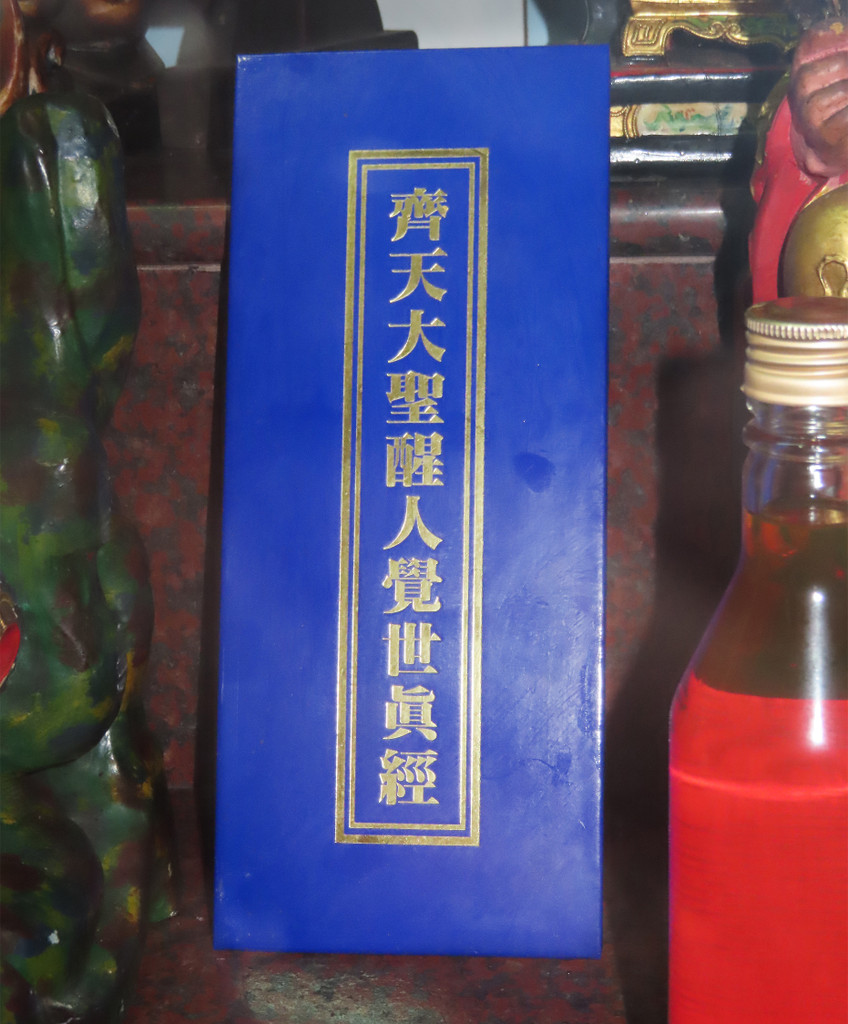
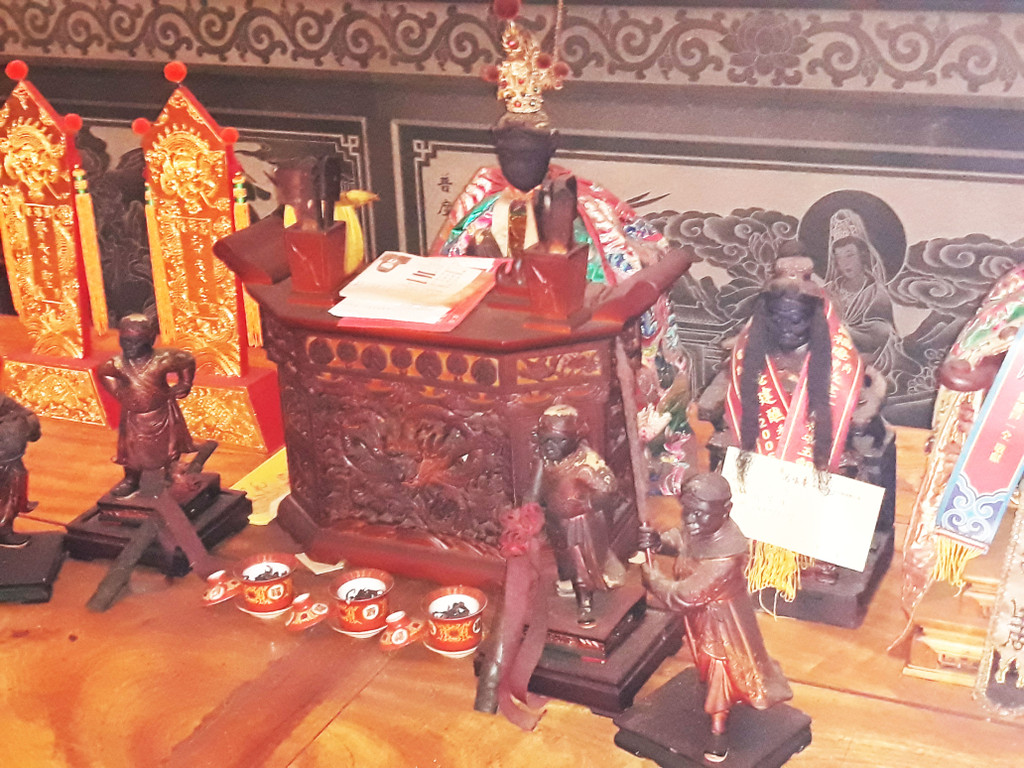
I am absolutely thrilled to share a PDF scan of The Great Sage Equaling Heaven’s True Scripture of Awakening People and Enlightening the World (Qitian Dasheng xingren jueshi zhenjing, 齊天大聖醒人覺世眞/真經). That’s right, the Monkey King has a holy book! I first learned of it when I visited the Great Sage Equaling Heaven Temple (Qitian Dasheng Miao, 齊天大聖廟) in the Zhongshan District of Keelung, Taiwan. I had spent a few minutes taking pictures, when I briefly looked back through the images to make sure they weren’t blurry (a common problem when photographing in dimly lit temples). This is when I saw a blue booklet tucked among the altar statues (fig. 1 and 2). I hadn’t notice it upon first inspecting the figures. But once I looked up and read the characters, I knew I had found something special.
Fig. 1 – The image where I first noticed the blue booklet (larger image). Fig. 2 – The Great Sage Scripture (larger version).
After posting about it online and inquiring with my monkey temple contacts, a gentleman from Taichung wrote me on Facebook and offered to send me a copy free of charge (a BIG thank you to Mr. Chen). A few days later, I received a package in the mail and was delighted to find he had sent me an exact copy as that seen in Keelung.
The resulting scans are the product of an overhead scanner set to document mode. I found the book mode cropped off the page numbers and slightly widened the characters when the program attempted to flatten the curved pages. Still, the final product is not perfect as the accordion-style pages can’t be laid perfectly flat.
The document states that this is the fourth batch printed in September of 2006. I’m not sure when it was first written; though, I’ve been told by a few informants that it is likely the product of the “flying phoenix” (feiluan, 飛鸞), otherwise known as “planchette writing” or “spirit writing” (fuji, 扶乩 / 扶箕). Jordan and Overmyer (1986) note the Chapel of Compassion and Goodness (Cishan Tang, 慈善堂) of the Society of Wisdom and Enlightenment (Huiming She, 慧明社) in Tainan published a book via the planchette in 1965 with 724 “revelations” from assorted Buddhist and Daoist deities, including the Great Sage (pp. 107-108). Perhaps this scripture is part of that tradition. A tangki from Taipei said that last year a sister temple had gifted 20 copies of the Great Sage scripture to various temples. One informant said they saw it at a temple on “Five Fingers Mountain” (Wuzhi shan, 五指山) in Hsinchu, while another said they saw an exact copy in Singapore. The internet has a few videos of the scripture being performed aloud, one in Hokkien and the other in Cantonese (video 1). The latter suggests the scripture is present in Hong Kong as well.
Video 1 – The Cantonese version of the Great Sage scripture.
I am not a translator, so I don’t plan to make my own. My hope is that a more qualified individual will use the PDF to give the scripture the proper translation and analysis that it deserves. I would love to one day host it on my site.
Did you know that Sun Wukong (孫悟空), the immortal monkey hero from the great Chinese classic Journey to the West (Xiyouji, 西遊記, 1592), has his own religion? He is mainly worshiped as the “Great Sage Equaling Heaven” (Qitian dasheng, 齊天大聖) in southern China, Taiwan, and Southeast Asian countries like Malaysia, Singapore, and even Thailand and Vietnam.
I recently returned from a trip exploring Great Sage temples in northern and central Taiwan. I’ve decided to mirror a former article by creating a list of Monkey King temples that I’ve visited on the island. This should not be considered comprehensive. I intend to update the article as I visit new locations. I will divide the list according to the closest city/municipality and provide the address if possible. If I’ve already written an article about a particular location, I will add a link to the name.
(Note: Make sure to call each temple ahead of time to learn about the best travel route. Google is not always the most accurate in regards to traveling on foot in the countryside.)
I didn’t get any information about the temple during my visit as the caretaker appeared to be mute (or just didn’t want to talk to me). Online information states that the temple was built in 1949. Legend has it that the Great Sage saved villagers from rampant fires plaguing Keelung at the time. Like Yilan’s Wujian Ziyu Temple (see below), Shengji’s Great Sage and his army of monkey soldiers are portrayed as martial monks (wuseng, 武僧) with a golden headband and long hair. The alcove housing his statue is called the ShuilianGrotto-Heaven (Shuilian dongtian, 水濓洞天) after Monkey’s home the “Water Curtain Cave” (Shuilian dong, 水簾洞) on the Mountain of Flowers and Fruit. He is flanked on his left and right by Shennong (神農) and Kai Zhang Shengwang (開漳聖王), respectively
No caretakers were present at the time of my visit, so I was unable to ask questions about history or names. All statues were locked inside of a glass display case, along with a blue booklet that caught my eye. It was titled The Great Sage Equaling Heaven’s True Scripture of Awakening People and Enlightening the World (Qitian Dasheng xingren jueshi zhenjing, 齊天大聖醒人覺世眞經). Like in Shengji and Wujian Ziyu Temples, the Great Sage and his monkey army are depicted as martial monks. Also like Shengji, he is flanked, this time on his left, by Kai Zhang Shengwang. He is flanked on his right by Fude Zhengshen (福德正神).
The Zheng’an Temple of Shilin[1] is definitely the smallest Great Sage house of worship that I’ve yet visited. It appears to be a small, open-front store/apartment unit that has been converted into a temple. It recognizes at least seven Great Sages, each with his own name and purpose. I’m still gathering information on the temple, so I will post their names at a later date. While most such temples have one or two spirit-mediums, Zheng’an has an astounding seven, each of whom reports to a respective Great Sage. During special occasions, the spirit-mediums perform self-mortification with swords, axes, swordfish noses, spiked clubs, and spiked balls.
I had the pleasure of joining the temple on a pilgrimage to the south of Taiwan back in November of 2020. I was even blessed with the opportunity to help carry the Third Prince’s palanquin, which led the way for a much larger vehicle containing Zheng’an’s numerous Great Sage statues. I’ll write more about this in the future.
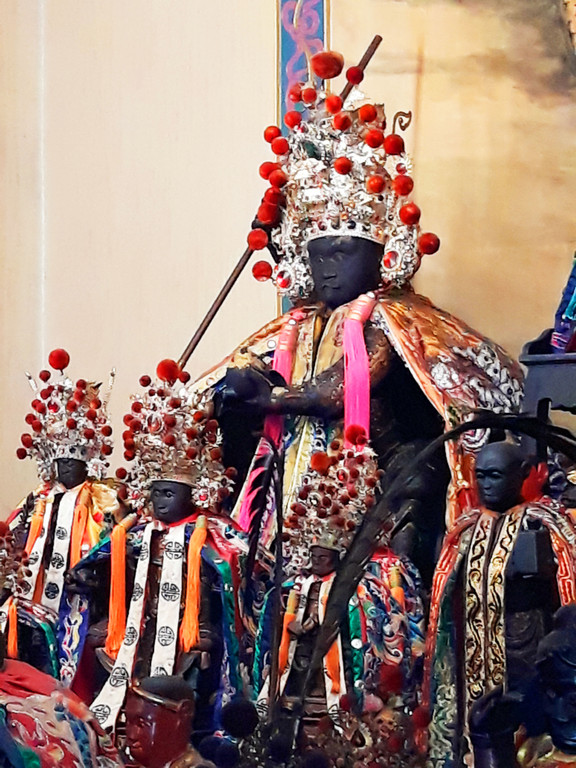
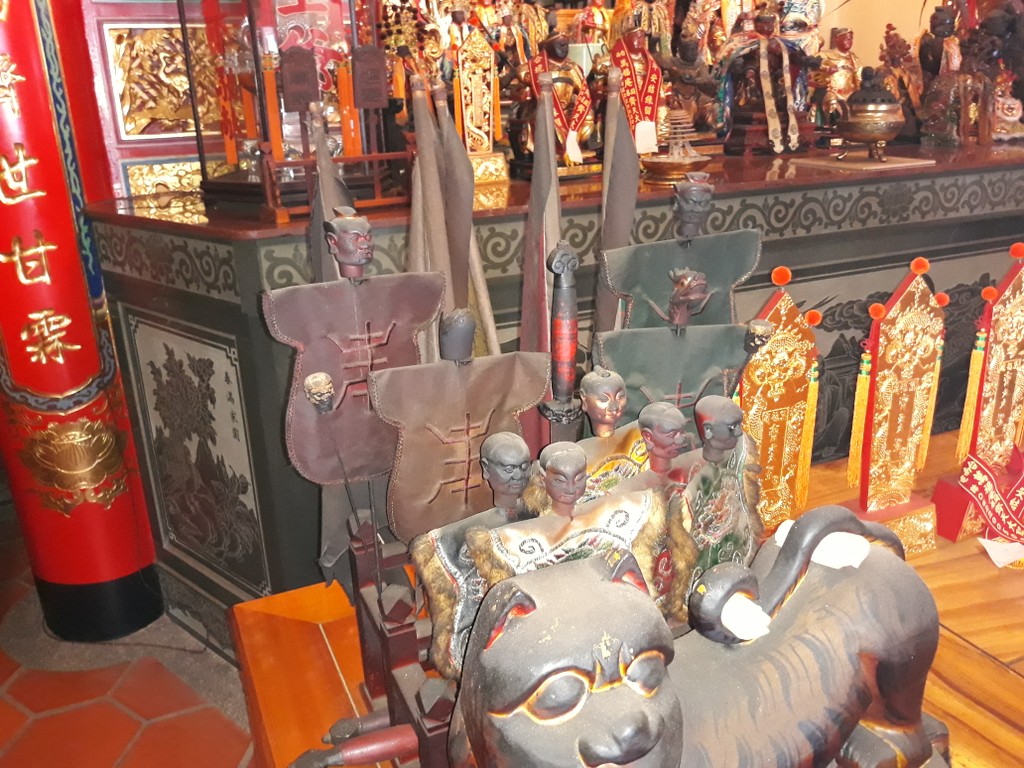
The temple attendants were unable to give me any history on the temple. But I did learn that they worship a trinity: “Great Sage Sun” (Sun Dasheng, 孫大聖), the large central figure (image 1 (27)); the “Black Great Sage” (Hei Dasheng, 黑大聖), the small figure holding the gourd and whip (image 1 (34)); and the “White Great Sage” (Bai Dasheng, 白大聖), the small figure shielding his eyes and holding a staff (image 1 (42)). These color-coded names remind me of the red, white, and black-faced Great Sages from Fujian, the original home of Monkey’s religion. The temple houses many monkey god statues apart from the trinity, likely soldiers. I’ll return to get more info and better pictures. The soot black figures and bright clothing make it hard to get detailed photos.
I was told by the temple’s ritual master that she received a religious vision from the Great Sage to move from Gaoxiong in the south and look for land with good fengshui for a temple. After her third move, she founded her temple in the mountainous region of Bali. While the temple has several monkey statues, each is considered a different aspect of the singular “Lord Great Sage” (Dasheng ye, 大聖爺) or “Great Sage Patriarch” (Dasheng zushi, 大聖祖師).
The area behind the temple features a garden with a colorful, life-sized statue of the Great Sage seated on a throne. He holds a peach of immortality in one hand and his staff in the other. His throne rests on an elevated rock outcropping painted with the characters for the “Mountain of Flowers and Fruit” (Huaguo shan, 花菓山). A series of concrete steps laid within the folds of the rocks takes you to a private heaven further into the mountain with flowers and guava, papaya, banana, and tangerine crops. It’s a great experience.
Be forewarned: The route that Google told me to walk from the bus stop was NOT reliable. My GPS took me through a neglected cemetery up the side of a mountain. I had to cut a path through the forest, jump streams, and climb rocks before I finally arrived all sweaty and dirty. The temple personnel were amazed that I made such a trip because the route was completely unnecessary. They told me of a road leading directly to the temple! Apparently my GPS showed me the most direct route instead of the slightly longer, yet far more practical one. I highly suggest walking from the foot of Duchuantou Rd. (渡船頭路) and following the signs to the temple.
On the bright side, the caretakers were so thrilled to learn of my great interest in their god that they treated me to tea, fruit, and snacks. They are very welcoming people.
This temple was closed when I visited. I had to shoot pictures through two sliding glass doors. It is very small, possibly as small or even smaller than Zheng’an Temple in Taipei.
3) Qitian Dasheng Miao (齊天大聖廟) or Qitian Dasheng Ye Miao (齊天大聖爺廟) – Unknown, possibly new
Address: 238新北市樹林區佳園路一段41巷6號
The caretaker told me that the temple had not yet been consecrated and therefore wouldn’t let me take any pictures inside. However, a Chinese comment on Google says the temple “isn’t open to the outside world,” suggesting that it’s closed to the public. Based on what little I could see, the building unit appears to be someone’s home/business/personal altar. Rows and rows of god statues packaged for sale lined shelves against a back wall.
Legend has it that around 1899 a man found a monkey-shaped stone and enshrined it in a thatched shed. This was eventually converted to a temple a few years later. It was destroyed by a typhoon in 1960 but subsequently rebuilt. The temple appears to recognize a trinity, with countless monkey soldiers beneath them, each portrayed as martial monks with a golden fillet and long hair. The Great Sage has two aspects: the “Martial Great Sage” (Wu Dasheng, 武大聖) (standing statues), who exorcises evil, and the “Civil Great Sage” (Wen Dasheng, 文大聖) (seated statues), who insures the safety of people and animals.
This temple is famous for its nine-meter-tall (29.52 ft.) statue of the Great Sage, which is apparently the tallest in Taiwan. I was told that it was shipped from Fuzhou, Fujian Province, China. The members appear to only revere a single monkey god, whom they call the “Buddha Great Sage Equaling Heaven” (Qitian Dasheng Foye, 齊天大聖佛爺). The smaller statue in front of the taller one was the original focus of worship at a devotee’s home prior to the building of the temple.
Records for the original temple apparently go back to the Xianfeng (1850–1861) period. According to legend, Yusheng was built at the behest of a beggar who revealed himself to be the Great Sage. The current house of worship was built in 1959. The members appear to recognize at least five Great Sages (maybe more). I was told that they don’t have individual names; though, the members may have been apprehensive to share secrets with a random foreigner. They just refer to them as “Lord Great Sage Equaling Heaven” (Qitian Dasheng Ye, 齊天大聖爺). One figure has a painted face similar to pestilence gods (wenshen, 瘟神). Perhaps this version of the Great Sage serves a similar purpose. It’s interesting to note that several statues are shown holding spiked balls like those used by spirit-mediums.
2) Wuji Tianyi Jiancha Gong Tiantan (無極天壹監察宮天壇) – Unknown
Address: 406台中市北屯區太原路三段1398號 (see below)
This temple was closed when I visited. I had to shoot pictures of their lovely statue over the gate. I’m guessing it’s four to five-meters-tall based on the ding censor in front. I plan to go back at a later time to get pictures of the temple interior.
I did see a black command flag (Hokkien: or leng ki; Ch: hei leng qi, 黑令旗) out front, which signifies that a spirit-medium is active in the temple.
Update: 04-24-21 – I was informed that this location is only used for particular festival days. The main temple is located at 404台中市北區富強街117巷17號.
No attendants were present when I visited, so I couldn’t ask any questions about history or beliefs. The small temple appears to recognize three Great Sages, each represented with golden eyes. The larger central figure is depicted as a martial monk with long hair, while those to his left and right have animalistic, furry faces. Interestingly, the main statue is immediately flanked on both sides by a single wooden pole topped by a black or red Great Sage bag puppet, each depicted as a martial monk. A paper fan and two framed ink on paper paintings indicate the monkey god is referred to as the “Fighting Sage Buddha” (Douzhan sheng fo, 鬥戰聖佛). This is a variant of the deity’s lesser used title, the “Victorious Fighting Buddha” (Dou zhansheng fo, 鬥戰勝佛).
The main altar is flanked on the right by various Buddhist deities and on the left by Daoist gods.
The front of the building is adorned with two Great Sage spirit generals (shenjiang, 神將) [2], something I’ve never before seen but have heard of; as well as a large black command flag, indicating the presence of a tangki spirit-medium. A large, ornate spiked ball, like those used by mediums, was positioned on the offerings table between statues of San Taizi and bottles of rice wine.
The temple is located down the street from a small joss stick factory. It was interesting to see brightly-colored bundles and rolling trays of the sticks being aired out to dry.
While an attendant with a thick Taiwanese accent told me the temple was “very, very old,” online information indicates that it was founded in 1979. Legend has it that Lord Guan sent the Great Sage to heal the head injury of a member of the Li (李) family, leading to their worship of the monkey god. (This suggests that Lord Guan is considered a superior of the Great Sage in Jisheng’s celestial hierarchy). The current Great Sage statue is apparently based on an original one that presided over the incense pot at a Lord Guan temple and was later kept in the Li family home. It sits in a man-made cave, along with other monkey figures and Buddho-Daoist gods, behind metal bars. It holds a banana leaf fan like that wielded by Lady Ironfan.
A large metal rod, a replica of the monkey god’s magic staff, is locked to a side wall when not in use by the temple’s spirit-medium. It is plastered with a paper talisman.
A hall to the right of the temple houses several spirit general costumes of various protector deities.
Wanfu is touted as the oldest Qitian Dasheng temple on the island, originally serving as the home of an anti-Qing general’s wife during the Southern Ming (c. 1660s), which was later converted to a house of worship following her death. It was known for taking in orphans during the early-19th century. The temple recognizes a trinity of Great Sages, followed by a small handful in administrative positions, and finally a plethora of soldier monkeys. The highest-ranking member of the trinity is a 300-plus-year-old Fujianese stone statue called “Laying the Foundations Elder Great Sage” (Kaiji Da Dasheng, 開基大大聖). The temple has a single spirit-medium. But the last time I checked, he was training a disciple, his nephew.
Great Sage temples from all over Taiwan look upon Wanfu as a fount of pure energy, visiting every year to procure its incense ashes in order to replenish their spiritual armies. Spirit-mediums are thought to direct these soldiers in battle while possessed by the monkey god. I personally witnessed this ash ceremony during the Shilin Zheng’an Temple pilgrimage (as noted earlier). I saw at least three other temples waiting for their turn. I’m sure many more visited that day and the next.
1) Not to be confused with other Zheng’an Temples in Taiwan.
2) Large, bulky costumes that rest on a performer’s shoulders. They see out through holes in the chest. Such costumes are worn during religious processions, and the walking movement causes hinged arms to swing to and fro.
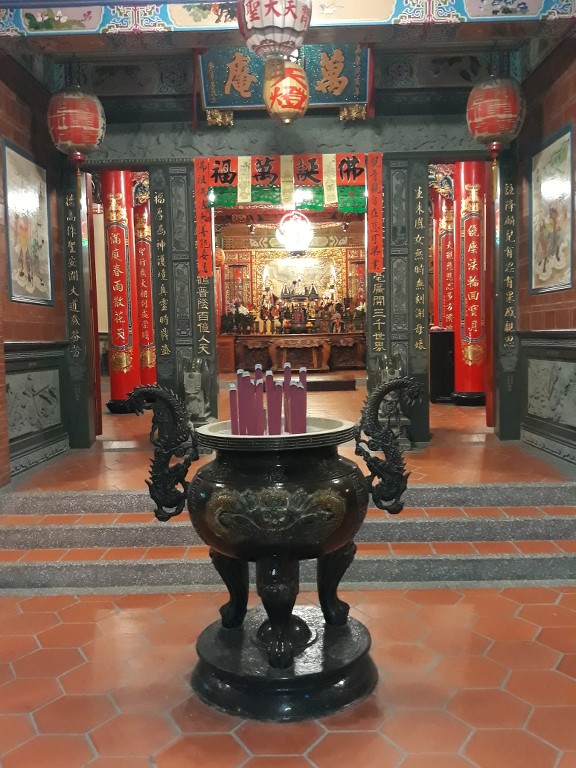
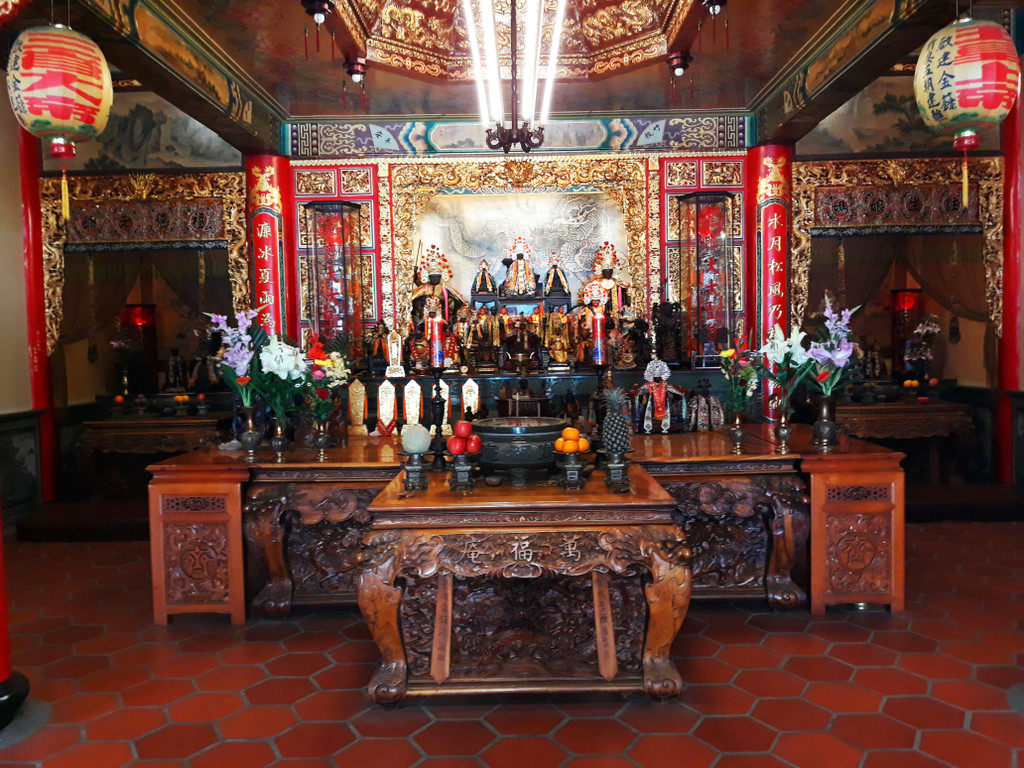
As a historian of the great Chinese classic Journey to the West (Xiyouji, 西遊記, 1592), much of my time researching is spent flipping through piles of books or searching the internet. Rarely do I get the opportunity to conduct field research on living traditions connected with the novel. That’s why I was excited to learn of the Buddho-Daoist Wanfu Temple (Wanfu an, 萬福庵) (fig. 1 & 2) in Tainan, Taiwan, where they worship Sun Wukong under his guise as the Great Sage Equaling Heaven (Qitian Dasheng, 齊天大聖). This happened to coincide with a short break from school, allowing me time to travel. I left Taipei where I live and stayed in the West Central District of the southern municipality. My afternoon was spent independently touring both floors of the recently renovated temple and taking numerous photos, all of which can be seen on my google drive. I had originally planned to catch the train home that evening, but was so intrigued by what I saw that I delayed my return another day. After making introductions, my second afternoon was spent asking questions about pantheon structure, rituals, general beliefs, etc. I was invited back that evening to record their spirit-medium channeling the Great Sage.
Below, I present my initial findings. I realize that a day is obviously not enough time for observation, so the following information should be looked upon as an informal survey. However, I still feel that this material is important, not only because few scholars writing in English have published on the worship of Sun Wukong, but also because it helps flesh out the ongoing history of his veneration going back to at least the 14th century. [1]
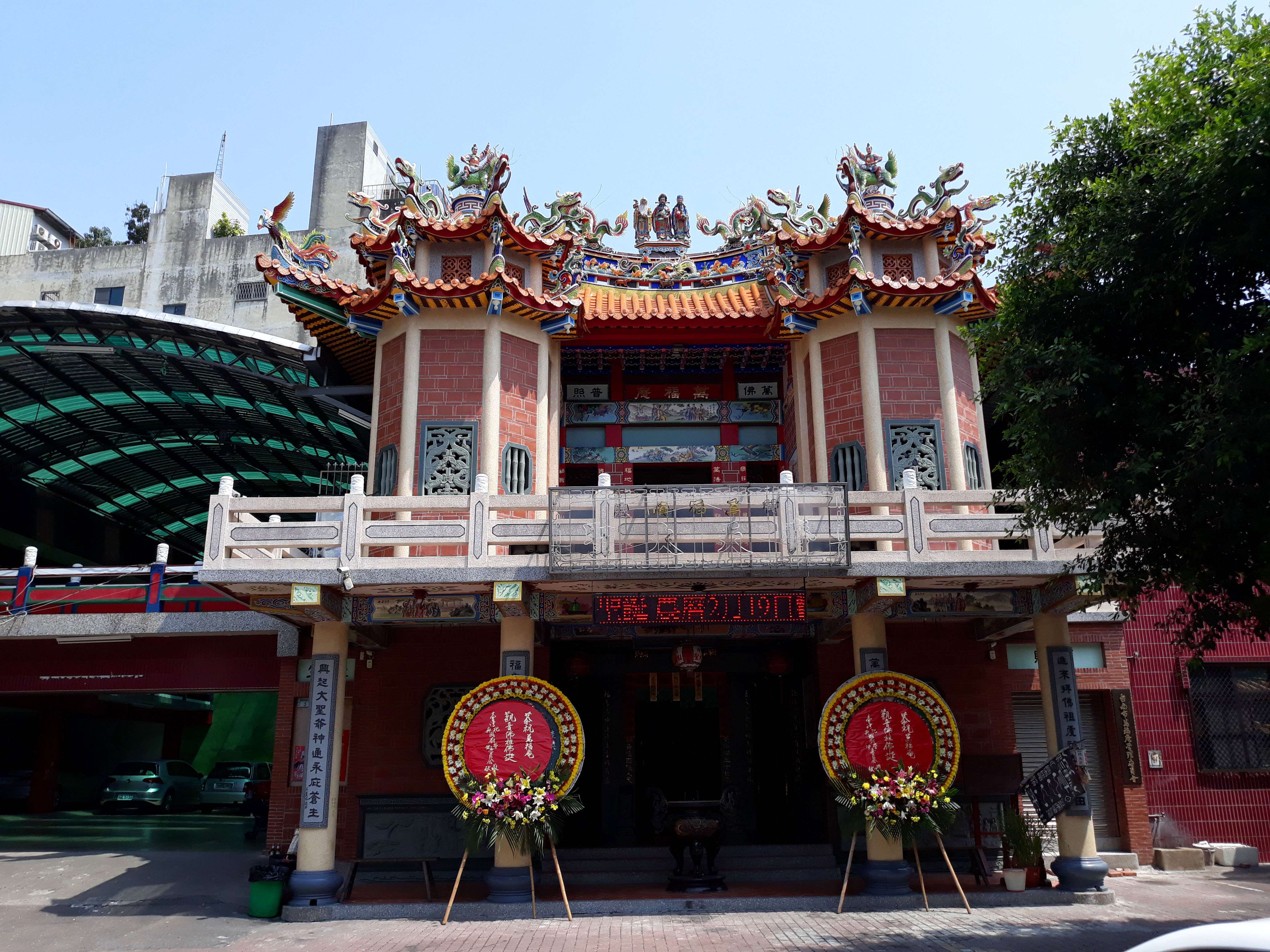
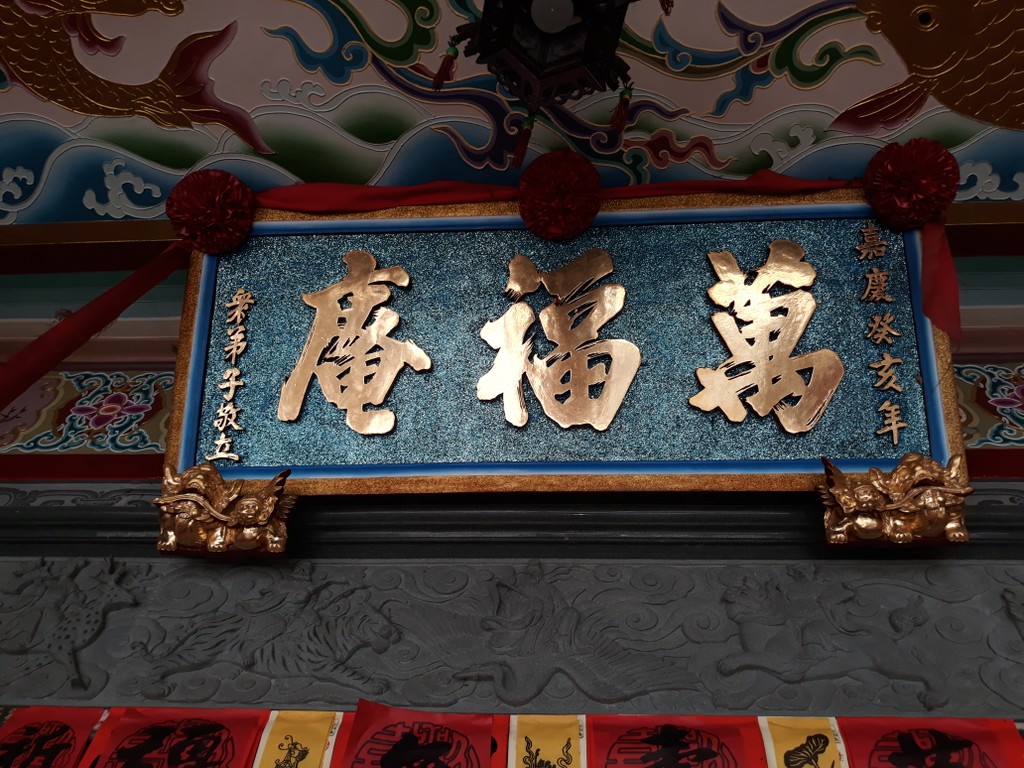
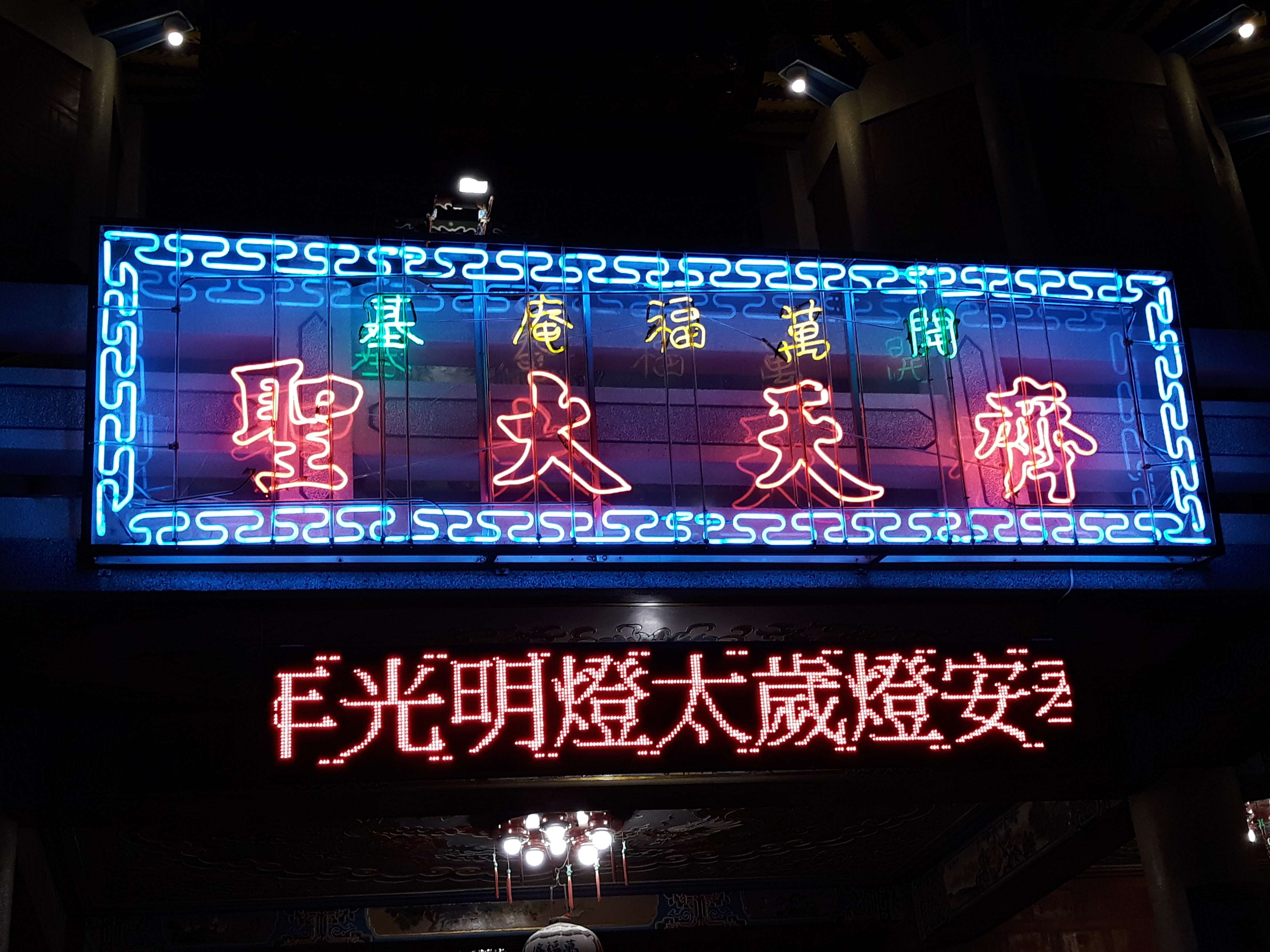
Wanfu is touted as the oldest temple dedicated to the Great Sage in all of Taiwan. It was originally a mansion built during the early-1660s for Ruan Jun (阮駿), a subordinate of the famous Southern Ming Dynasty General Koxinga. His widow Lady Ruan (阮夫人) is said to have lived out the rest of her days there in religious piety, and following her death, the mansion was converted into a house of worship called the Lady Ruan Temple (Ruan Furen si, 阮夫人寺). The name was subsequently changed to “Myriad Blessings” (Wanfu, 萬福) in the 11th year of the Jiaqing reign (1806), during a time when the temple was known for taking in orphans. The change was made by nuns who believed the children benefited from the blessings of an old stone Great Sage statue thought to have been brought over from Fujian by Lady Ruan when she and thousands of other people fled the invading Qing forces to Taiwan. Sun Wukong’s influence over the temple grew to the point that while still officially known as Wanfu (fig. 3), it came to acquire the additional name of Taiwan’s Laying the [Religious] Foundation Great Sage Equaling Heaven Temple (Quantai Kaiji Qitian Dasheng miao, 全臺開基齊天大聖廟) (fig. 4). A second level was added to the building in 1971, and further renovations were completed in 2014.
Fig. 3 (left) – The “Wanfu Temple” sign over the main temple doors (larver version). Fig. 4 (right) – The neon sign on the facade reads “Wanfu Temple Laying the Foundation Great Sage Equaling Heaven” (larger version).
2. Pantheon of Great Sages
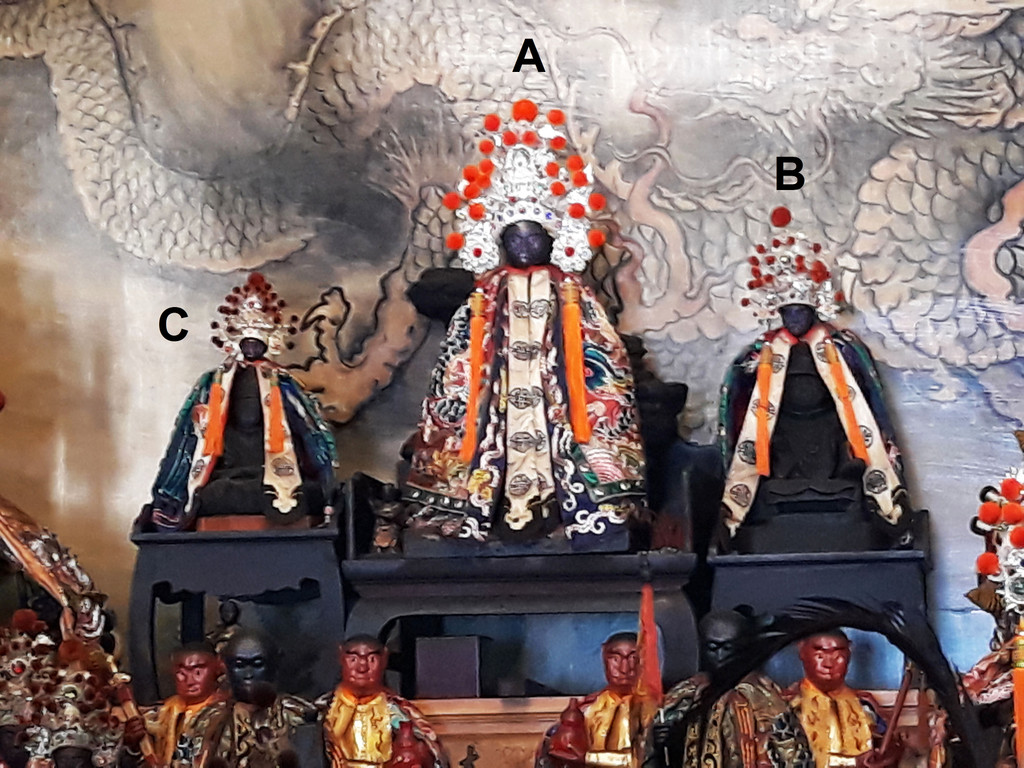
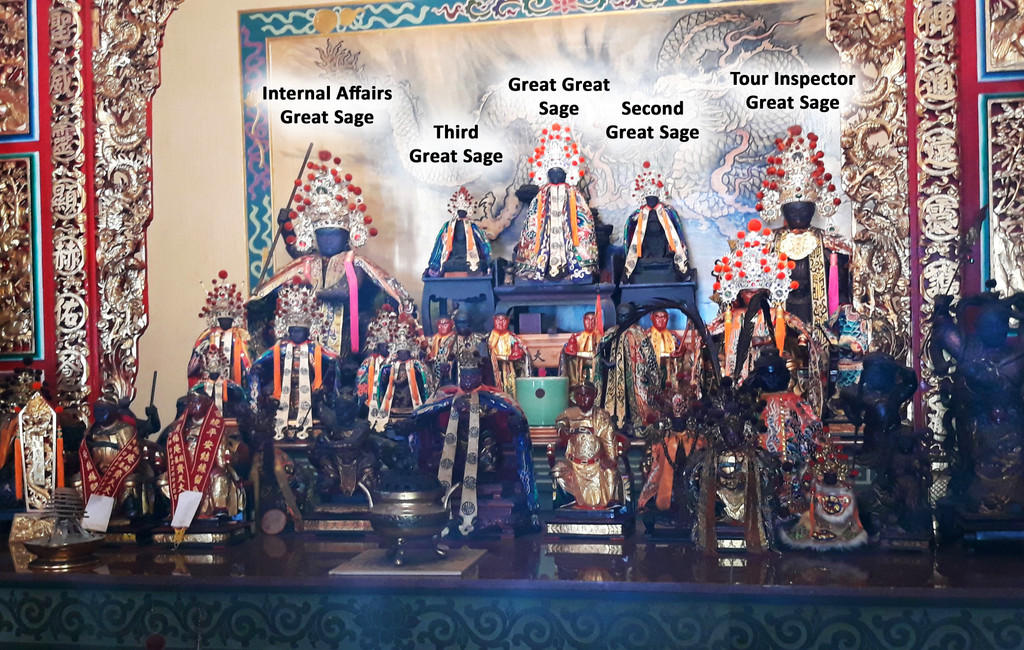
One of the most interesting aspects of the temple is that it recognizes more than one Great Sage, each with his own function. Their pantheon consists of a trinity, followed by a small handful in administrative positions, and finally a plethora of soldier Monkeys. The highest-ranking is the aforementioned 300-plus-year-old stone statue named Laying the Foundations Elder Great Sage (Kaiji Da Dasheng, 開基大大聖) (fig. 5A and 8). His central importance is signified by his position atop a chair on the altar stage. He is alternatively known as the Great Sage Lord (Dasheng Ye, 大聖爺). The second and third ranking members of this trinity, respectively named Laying the Foundations Second Great Sage (Kaiji Er Dasheng, 開基二大聖) and Laying the Foundations Third Great Sage (Kaiji San Dasheng, 開基三大聖) (fig. 5B, 5C, and 8), sit to his right and left. The Elder Great Sage and the Second Great Sage remain in heaven unless some important matter requires their direct participation. The Third Great sage alternates with the administrative Tour Inspector Great Sage (see below) to see to external temple business on Saturdays.
Fig. 5 (left) – (A)The Laying the Foundation Elder Great Sage, the 300-year-old stone statue; (B) The Laying the Foundation Second Great Sage; and (C) The Laying the Foundation Third Great Sage (larger version). Fig. 6 (center) – The Tour Inspector Great Sage (larger version). Fig. 7 (right) – The Internal Affairs Great Sage (larger version).
The administrative Monkeys include the large Tour Inspector Great Sage (Chuxun Dasheng, 出巡大聖) (fig. 6 & 8), who oversees activities outside the temple. He is located to the right of the trinity; the slightly larger, staff-wielding Internal Affairs Great Sage (Neiwu Zongguan Dasheng, 内務總管大聖) (fig. 7 & 8) serves as a manager to lower-ranking Monkeys. He is located to the left of the trinity; and the Sergeant Great Sage (Shiguan Dasheng, 士官大聖) (fig. 9) serves as the temple director. This comparatively small statue sits behind a magistrate’s bench below the altar stage, just behind the offerings table.
Fig. 8 (left) – The altar stage layout, with the most important Great Sages labeled (larger version). Fig. 9 (right) – The Sergeant Great Sage sitting at a magistrate’s bench (larger version).
In addition, the Elder Great Sage has at his disposal a group of powerful commanders known as the Five Camps Celestial Generals (Wuying Bingjiang, 五營兵將), who protect the five cardinal directions. These are the black Northern Camp Sage Lian Gong (Beiying Lian Gong Shengzhe, 北營連公聖者); the blue/green Eastern Camp Sage Zhang Gong (Dongying Zhang Gong Shengzhe, 東營張公聖者); the red Southern Camp Sage Xiao Gong (Nanying Xiao Gong Shengzhe, 南營蕭公聖); the white Western Camp Sage Liu Gong (Xiying Liu Gong Shengzhe, 西營劉公聖者); and the golden Central Camp Marshal of the Central Altar (Zhongying Zhong Tan Yuanshuai, 中營中壇元帥) (fig. 10). Each general in turn leads a vast heavenly army comprised of tens of thousands of soldiers. Such generals are very common to Daoist temples across Taiwan and find their origin in the 36 protector generals of Daoism (Sanshiliu Tianjiang, 三十六天將), who, funny enough, are led by Zhu Bajie’s previous incarnation Marshal Tianpeng (Davis, 2001, p. 78).
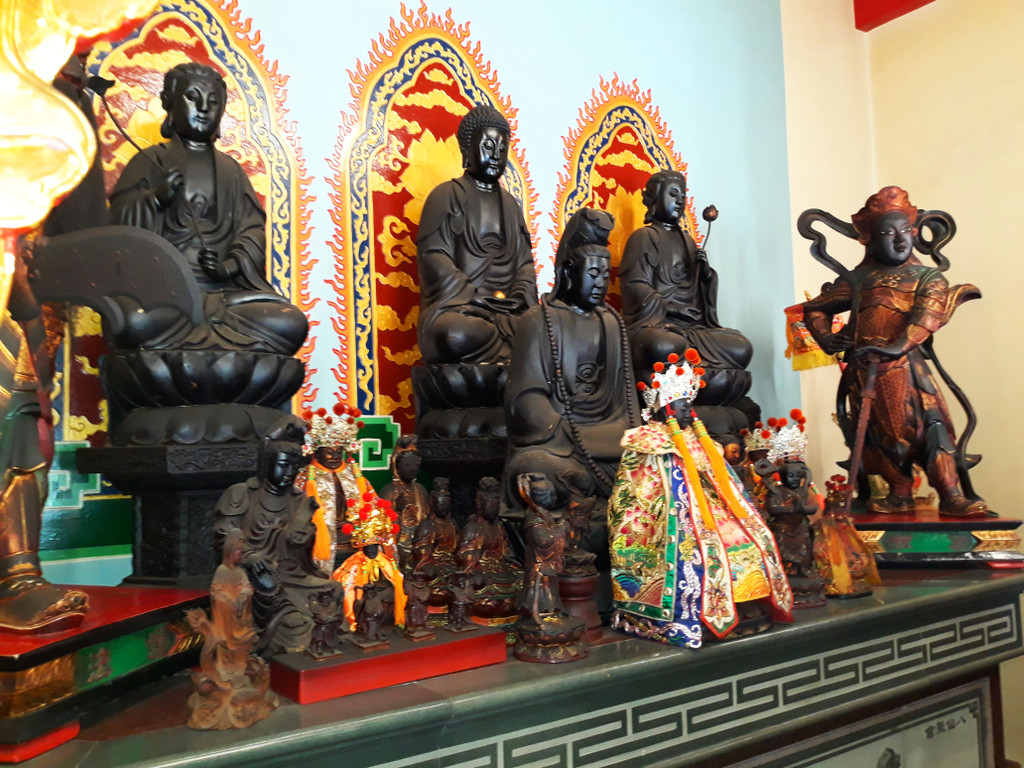
The position of the Great Sage pantheon in relation to the wider Buddho-Daoist pantheon mirrors that from Journey to the West. Despite his central position in Wanfu’s religious life, the Great Sage is still considered subordinate to the Bodhisattva Guanyin (觀音), whose birthday was being celebrated on the second day of my visit with a vegetarian meal open to all. In fact, the temple’s second floor Three Jewels Hall (Sanbao Dian, 三寶殿) contains statues of the Buddha and flanking Bodhisattvas raised on an altar stage, with a statue of Guanyin placed in front of and almost at the same level as the Enlightened One (fig. 11). This shows her great importance.
Fig. 10 (left) – Two sets of the Five Camps Celestial Generals can be seen. Their colors of black, blue/green, red, white, and gold help distinguish each one (larger version). Fig. 11 (right) – The statue of Guanyin sitting in front of and almost at the same level of the Buddha (larger version). The goddess Mazu sits in front of Guanyin. From the second floor Three Jewels Hall.
3. Worshiping the Great Sage and Requesting Blessings
When the faithful come to pray, they often stand directly in line with the center of the altar (fig. 12), with hands pressed and set against their forehead (or chest), or they light a grouping of three incense sticks, kneel on the praying couch, and hold the sticks up to their forehead (or chest) with elbows level, often rhythmically bobbing their arms or upper torso (fig. 13). The procedure for making a request has three steps. First, adherents greet the Great Sage and say their full name, lunar birthday (and time if known), and their address. This is done because many people have names written with the exact same Chinese characters. The step insures that the Great Sage answers the right prayers for the right person. Second, they wish for health, wealth, good luck, removal of a negative influence, etc. Third, they later burn spirit money to repay Monkey’s generosity. This form of prayer is for those who don’t mind waiting for a response.
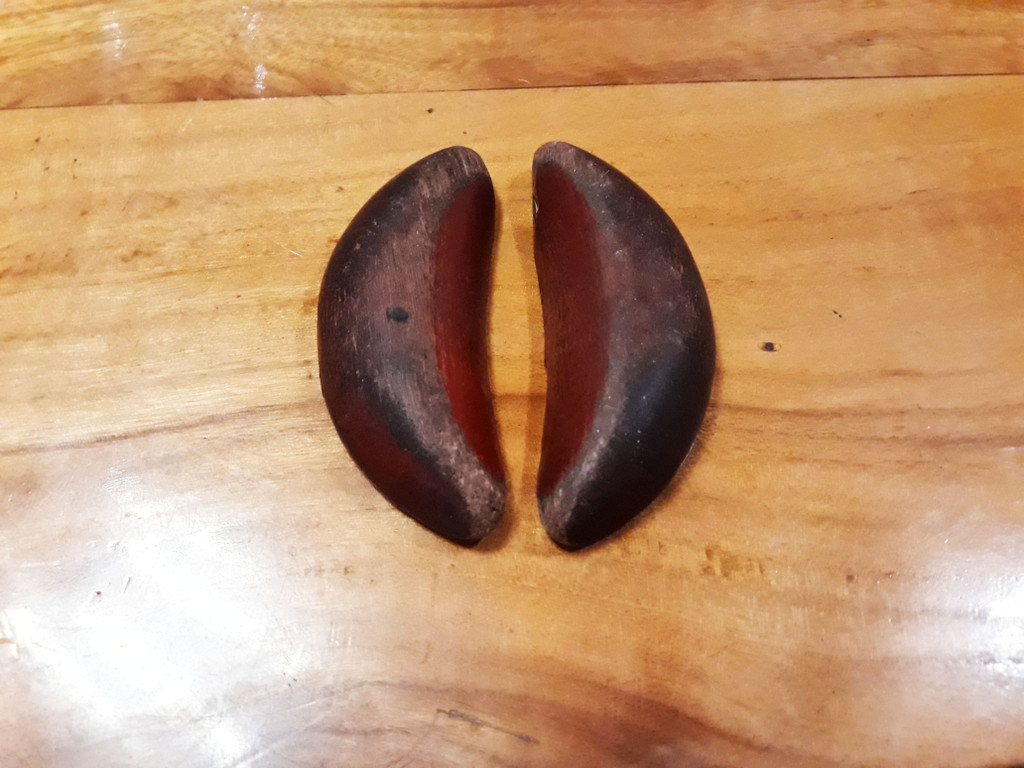
For those seeking an immediate response, the temple employs a pair of crescent moon-shaped wooden blocks known as “bamboo cups” (jiaobei, 筊杯) (fig. 8) for divination purposes. The procedure starts the same with the greeting and personal information, but the cups are grasped between the hands during the prayer and then dropped to the ground after a few minutes. Like rolling spiritual dice, the faithful take note of the orientation in which the blocks fall. One side of the blocks is flat, while the other is curved. If one cup falls with the flat side upwards (open) and the other flat side down (closed), this means “yes” (shengjiao, 聖筊). If both fall upwards, this means the Great Sage is happy or “laughing” at the request (xiaojiao, 笑筊). If both fall facedown, the Great Sage is “angry” and unwilling to fulfill the request (nujiao, 怒筊) (fig. 14). The cups are thrown three times, and the best two of three results are accepted as the answer.
Fig. 12 (left) – The offering table and altar (larger version). Fig. 13 (center) – A young couple praying to the Great Sage (larger version). Fig. 14 (right) – The Bamboo cups, both sitting in the “angry” response (cup down) (larger version).
Often times adherents will want more clarification, so the blocks are used in tandem with “fortune sticks” (qiuqian, 求籤). The traditional procedure is to shake the cylinder full of sticks, each marked with a number, until one falls out. (I, however, saw one young man with long, dyed hair randomly reach into the cylinder without shaking it. He also didn’t wait the required period after his prayer to drop the cups. He must have been in a hurry!) The adherent then looks up the corresponding oracle in a booklet kept on the temple’s front desk. These oracles are also available on slips of paper that can be taken and read later. The use of the bamboo cups and fortune sticks is common in other temples.
I asked one young couple associated with the temple about the exact number of members. They were unsure of the core members and especially of the number of outside worshipers. It appears the veneration of the Great Sage is so entrenched in Tainan religious society that people from other temples will come from time to time to pay their respects to Monkey.
3.1. Great Sage Spirit-Medium
The second day of my visit coincided with one of the twice weekly (Wed. and Sat.) rituals in which the temple’s spirit-medium (Hokkien: tangki, 童乩; Chinese: jitong, 乩童, lit: “divining youth”) calls down the spirit of the Great Sage to possess his body (video 1). Prior to the ritual, red ropes were used to demarcate a sacred space within the center of the altar hall. The ropes were tied to either side of the main central temple doors and stretched diagonally to the respective left and right walls of the hall, forming a V-shape, or a sort of spiritual bottleneck. Only the medium and the temple workers were allowed to inhibit this sacred space shortly before and during the ritual. The faithful seeking blessings and spectators were asked to wait on the other side of the ropes, entering through secondary doors located to the respective left and right of the main set.
Video 1 – The spirit-medium ritual.
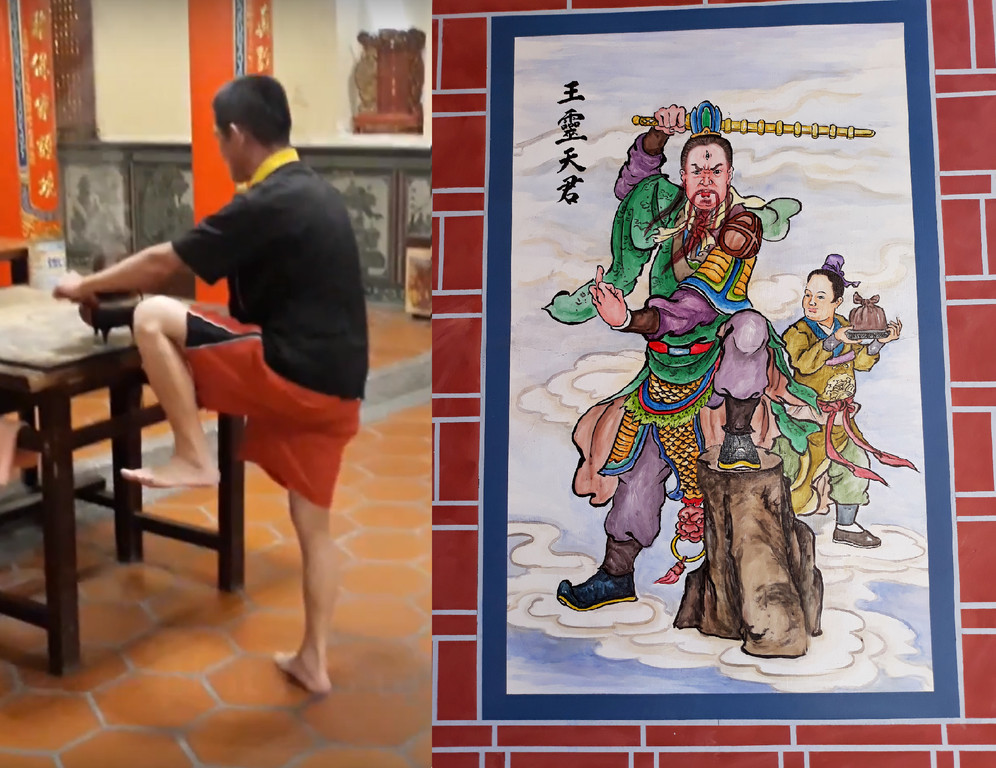
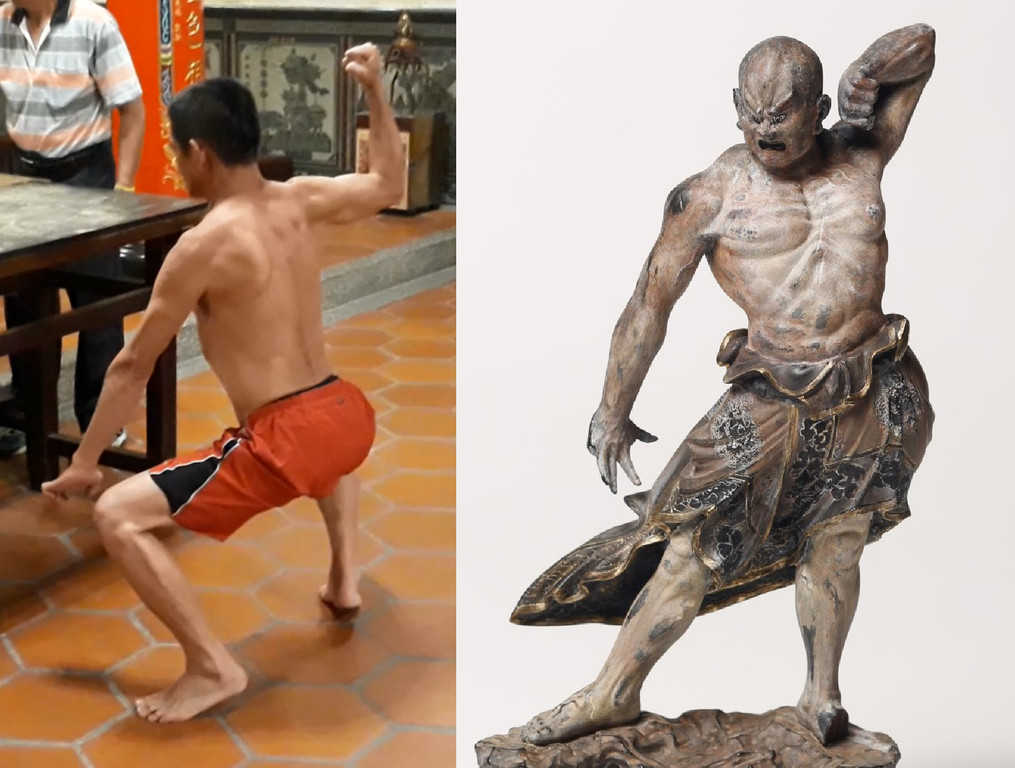
I witnessed the medium chewing an herbal substance that was removed prior to the ritual. [2] He then proceeded to purify himself with a small pot of (psychoactive?) incense, first bathing his hands and arms in the smoke, before passing it around his head, waist, and calves. Taking hold of the pot’s handles, he began belching. This gave way to a moving trance in which he marched in place for several minutes. The arrival of the Great Sage was signaled by an audible growl and the medium lifting high one knee, taking on a martial pose like esoteric protector deities (fig. 15). After an attendant removed his shirt, he squatted low to the ground and struck another pose with arms flexed like said deities (fig. 16). Such postures serve to mark the medium’s transition from a human to a god.
The medium-turned-Great Sage displayed jovial feet clapping, followed by feats of strength, including elevated push ups and a handstand. Finally, he stood atop a wooden bench and used his weight to rock it side to side, slamming the feet down in rapid succession, producing a sound similar to firecrackers. The sound is used to scare away evil influences. I was told in advance that the medium would “do exercise” and use the bench “to make noise,” so these appear to be common aspects of the ritual.
Fig. 15 – The stance announcing the Great Sage’s arrival (left) is similar to esoteric guardian deities, such as the temple’s depiction of Wangling Tianjun (center left) (larger version). Fig. 16 – His next stance (center right) is also similar to said guardians, especially this statue based on a famous 14th-century carving of a Japanese Nio (right) (larger version).
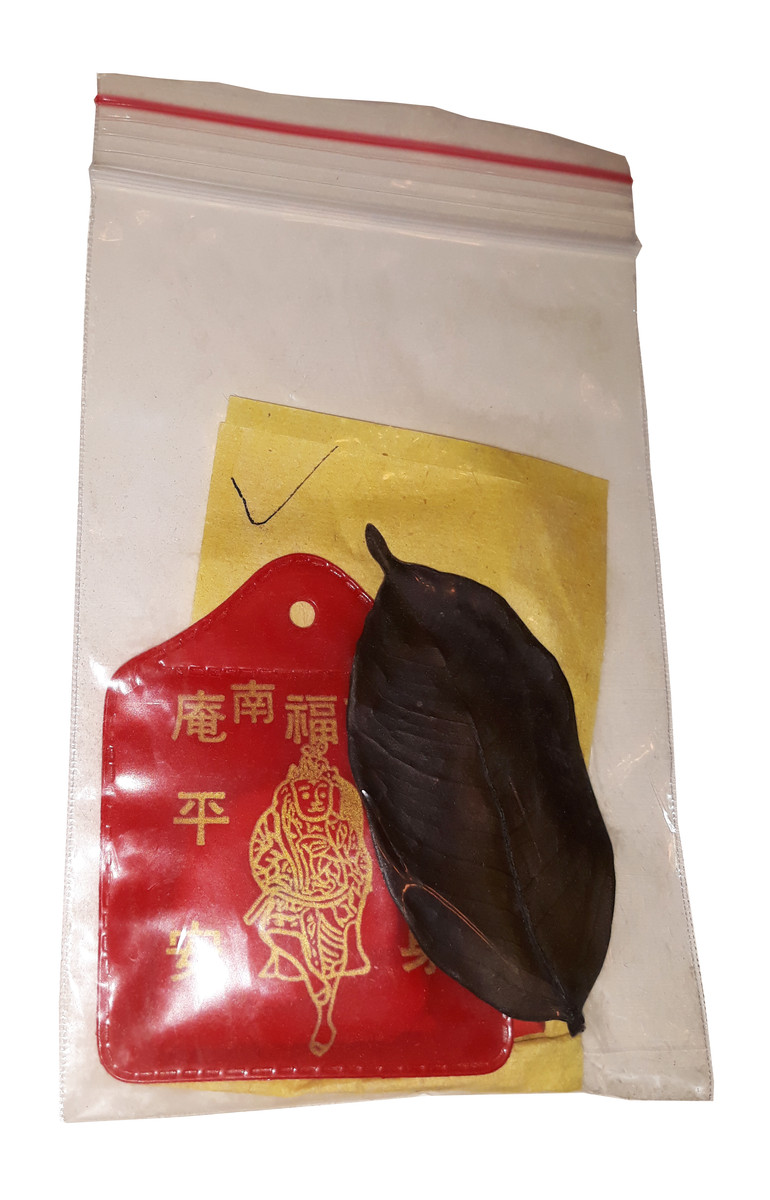
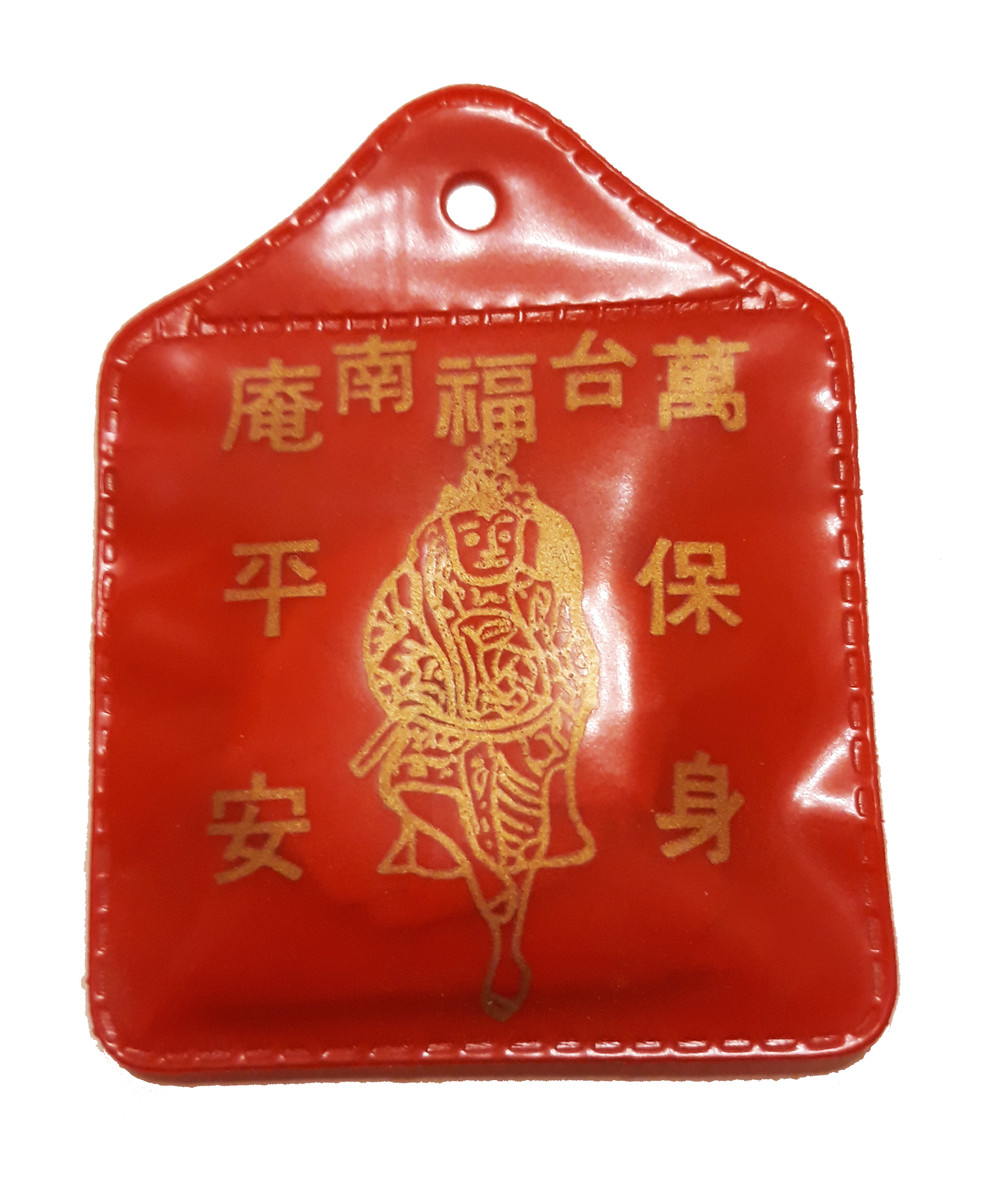
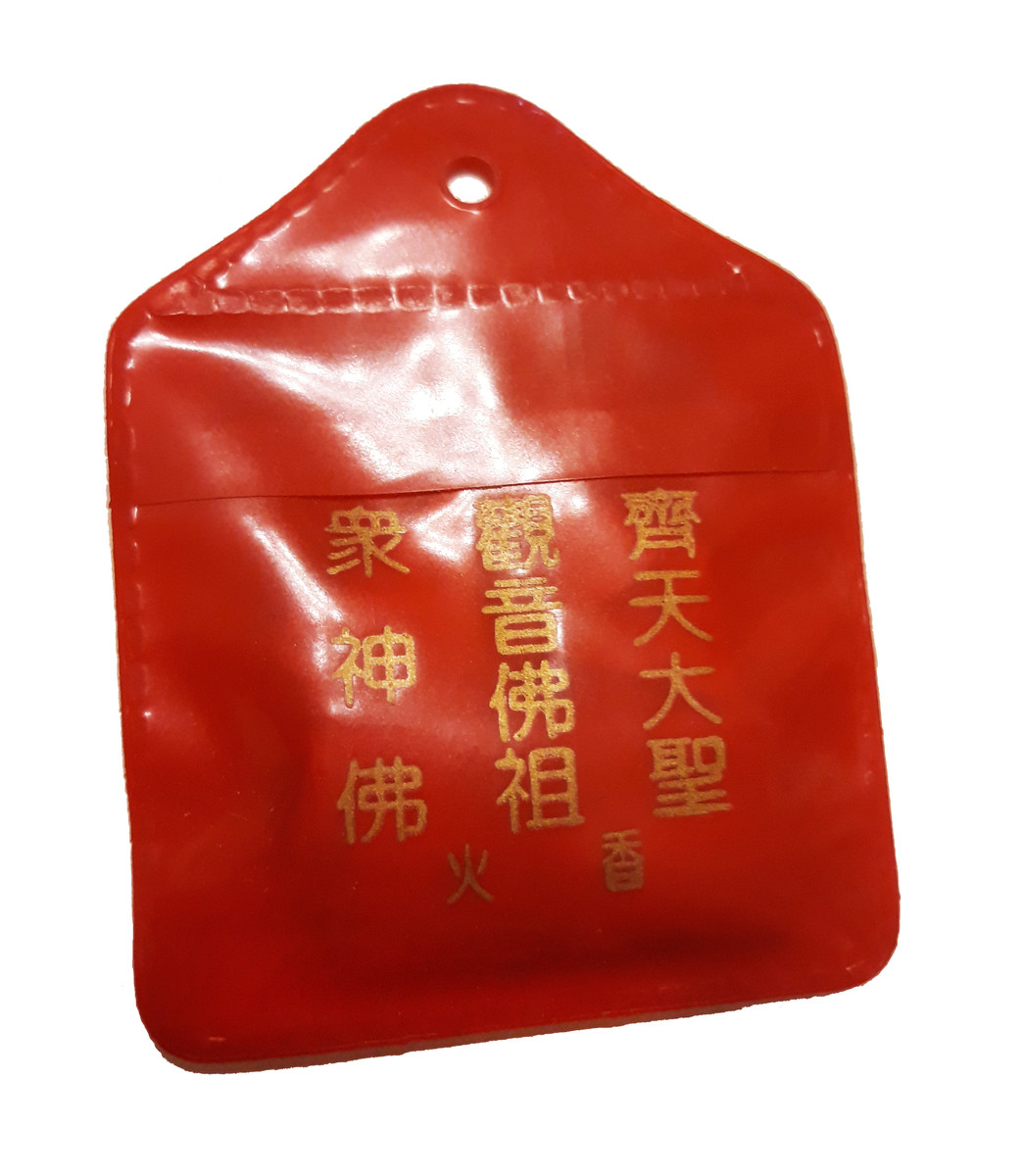
The Great Sage welcomed the first of many children and blessed each the same with the following procedure. First, he touched the top of the incense pot and then transferred his hand to the child’s crown, doing this three times. Second, he dipped his finger into the incense and drew a line down the center of the child’s face from the forehead to the chin and onto the neck. Third, after dipping his fingers in the incense again, he traced a rectangular form on the child’s torso, possibly a symbolic fu (符) talisman, before pushing on the stomach several times to release, as I was told, “bad air” (negative qi). The same rectangle was traced on the child’s back. Fourth, the Great Sage dipped his finger in the incense and turned to the table to write out three fu talismans on yellow strips of paper, his finger often floating above the surface. One was packaged to be later burnt and the ashes combined with an included tea leaf and cold (yin) and hot (yang) water to be given to the child as a magical brew. The second was folded and put inside of a red pouch to be worn as a good luck charm (fig. 17-19). The third was lit and waved over the child’s head and around their body.
Fig. 17 (left) – A baggy containing a loose fu talisman, a folded talisman inside of a red charm, and a tea leaf (larger version). This baggy was given to me when I participated in similar ritual for adults. Fig. 18 (center) – The front of the charm reading “Tainan Wanfu Temple, safety and peace” (larger version). Fig. 19 (right) – The back reading “Great Sage Equaling Heaven,” “Guanyin/Shakyamuni,” and “Multitude of Gods and Buddhas” (larger version).
The large number of children taking part in the ritual (many of which were not shown in the video) is, as mentioned above, tied to the temple’s history. Adherents believe the Great Sage bestows blessings on children, as well as cures them of illnesses when they are sick. [3] Additionally, they believe that those taken as the Great Sage’s godchildren will be well-behaved and become well-tempered adults. [4] For those who have read the novel, this may at first appear to be a paradox—Monkey, a paragon of good behavior?!—but this no doubt refers to his internalization of self-restraint after becoming a Buddha at the end of the novel. This coincides with the disappearance of his restraint-inducing golden headband.
Numerous adults also sought the Great Sage’s blessing. Having already provided their personal information on salmon-colored prayer sheets to temple personnel, each person in turn greeted the medium and then made their request (health, wealth, good luck, etc.). The blessing procedure was the same regarding fu talismans, complete with the third being lit and waved around the head and body. I even saw the Great Sage bless a shirt in place of an adherent who could not come in person. When interacting with the faithful, the medium spoke to them in a high-pitched voice, [5] often making people laugh with his responses. I was later informed that the language being used was Taiwanese, which explains why I couldn’t understand what was being said. I too took part in the ritual and noted that the medium’s eyes were rolled back into his head. Apart from the poses at the beginning, the voice and eyes serve to mark the possessed state.
The medium has held his position at the temple for 20 years. But it should be noted that he has a normal job during the week and volunteers his time at the temple. His path to mediumship began as a young man when he started displaying certain behavior signifying he had been chosen by the Great Sage to be his earthly representative. While many mediums go through a period of training under a “Red Hat” Daoist (Hongtou Daoshi, 紅頭道士), a master of religious ceremony (Clart, 2008), I was told that the methods of mediumship were revealed to him in his dreams by the Great Sage while he slept in the temple for 49 days.
3.2. Celebrating the Great Sage’s Birthday
The Monkey King’s birthday is recognized as the 12th day of the 10th lunar month and is celebrated over the course of three days. This year (2018) the birthday will correspond to November 19th. The first day of celebrations is undertaken by core temple members, while the subsequent days are undertaken by sister temples. Below is a video showing a time-lapse of a past celebration. Many people crowd the temple to pay their respects, as well as to fill the offering table with all kinds of delicious fruits and sweets. I can picture the Great Sage rolling around on the ground and laughing in delight!
Video 2 – The celebration of the Great Sage’s birthday.
His offerings are later shared with his five celestial generals in the Rewarding Soldiers ritual (Kao jun, 犒軍). This too is common in other temples.
4. Conclusion
The Buddho-Daoist Wanfu Temple of Tainan, Taiwan worships Sun Wukong under his guise as the Great Sage Equaling Heaven, who is venerated as a powerful exorcist and healer, as well as a sort of patron saint of children. The main focus of worship is a 300-plus-year old stone statue believed to have been brought over from Fujian during the turmoil of the late-Ming dynasty. The temple recognizes an entire pantheon of Great Sages, from a trinity (headed by the aforementioned statue) and administrative managers down to an army of lowly soldier monkeys. Furthermore, the Great Sage has at his disposal five cardinal celestial generals and their respective armies to insure his will is done. The position of the Great Sage within the greater Buddhist pantheon is the same as in the novel. He is subordinate to the Bodhisattva Guanyin, who is considered by Wanfu to be almost equal to the Buddha in terms of importance.
The Great Sage-adherent dynamic involves two forms of interaction: impersonal and personal. The former involves the adherent praying to the deity in heaven, sometimes using bamboo cups, fortune sticks, and corresponding oracle booklets to divine the Great Sage’s response to their request. The latter involves personal interaction with the deity via a spirit-medium. The Wanfu medium twice-weekly (Wed. and Sat.) holds a ceremony where he calls down the Great Sage, and after taking possession, the deity personally interacts with those seeking blessings. He employs magic fu talismans to bless both children and adults, the paper slip being burnt and waved around their body. The ritual for children is more involved as incense is first used to draw talismans on their body and then negative qi is released by pushing on the stomach.
I plan to revisit the temple at a later date to conduct more in-depth research into the particulars of the pantheon, as well as the ritual of the spirit-medium. Visiting during the Great Sage’s birthday, the 12th day of the 10th lunar month, would be an ideal time since it’s no doubt a time of much fanfare.
5. Update
Update: 07-21-20
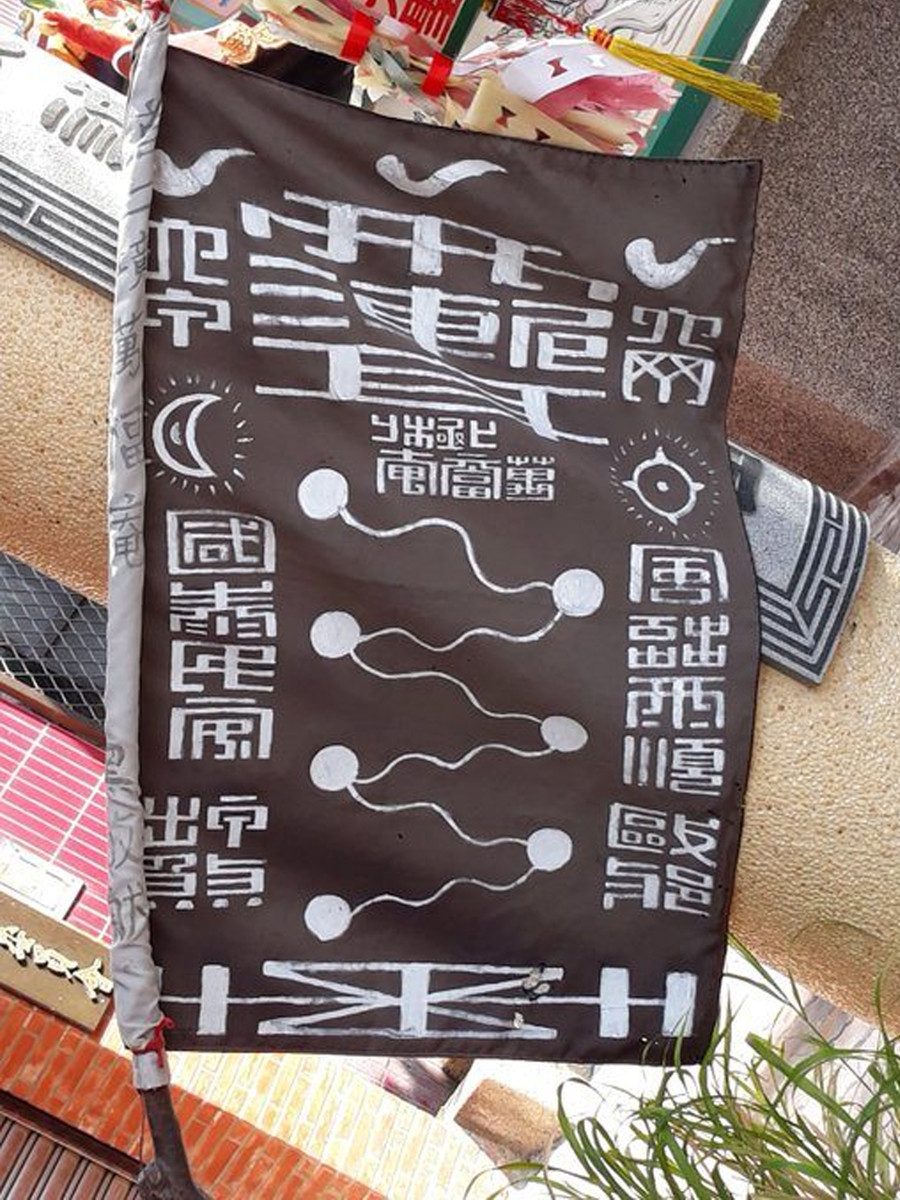
Wanfu Temple’s “black command flag” (Hokkien: or leng ki; Mandarin: hei leng qi, 黑令旗) (fig. 20) is located just outside the rightmost front entrance. Elliott (1955/1990) explains that command flags advertise the presence of a spirit-medium, while also serving as a warning to ghosts and demons (p. 51). Chan (2014) comments that such flags are imbued with the power of the Dark Emperor of the North, considered the greatest exorcist god in Daoism, and act as a covenant between the deity and the tangki spirit-medium who leads his heavenly armies against evil (p. 34).
Fig. 20 (left) – The Wanfu Temple black command flag (larger version). Fig. 21 (right) – The flag legend (larger version).
Each flag is covered with arcane symbols that are usually only intelligible to the initiated. With some help, [6] I have made a near complete translation of the Wanfu black command flag (fig. 21):
雨漸耳 (Yu jian er, “Rain soaks the ears”) – This likely refers to a commandment from heaven.
六? (Liu ?) – The mystery character likely refers to the Six Ding (六丁), protector spirits of Daoism. They are often grouped with the Six Jia (Mugitani, 2008). See also no. 11 below.
六甲 (Liu Jia) – Refers to the Six Jia. See also no. 12.
北極 (Bei ji, “Northern Ultimate”) – This refers to the Dark Emperor of the North. Here, the character for “north” is split in half and “ultimate” is inserted in the middle.
?富? – Two unknown characters sandwich that for “wealth” (fu).
Sun – A symbol for 陽 (yang) energy.
Moon – A symbol for 陰 (yin) energy.
Big Dipper – A seven-star pattern associated with Daoist ritualistic dances and purification ceremonies. See section one of this article for more info.
風調雨順 (fengtiao yushun) – A common Chinese idiom meaning “the wind and rain are seasonal” (i.e. the weather is good).
國泰民安 (guotai minan) – Another common idiom. It means “the country is prosperous, and the people are secure.”
敺邪 (qu xie) – “Expel evil/disease.” This is likely connected to no. 2 above. Together it would read the “Six Ding expel evil/disease.”
押煞 (ya sha) – “Stop malicious spirits”. This is likely connected to no. 3. Together it would read the “Six Jia stop malicious spirits.”
This angular symbol is the 符胆 (fu dan), the talismanic flag’s locus of power (Chan, 2014, p. 35).
Notes:
1) A 14th-century tomb shrine jointly dedicated to the Great Sage Equaling Heaven and the “Great Sage Reaching Heaven” (Tongtian dasheng, 通天大聖) in Baoshan, Fujian shows that Monkey was indeed venerated prior to the publishing of Journey to the West (1592) (Wang, 2004).
2) This appears to be a common practice. In his study of Singaporean spirit-mediums, Elliott (1955/1990) writes:
Before their performances many dang-ki have been seen to chew some sort of root or sip from a cup, but it has been impossible to ascertain whether these contain stimulating substances (p. 64).
3) The Great Sage is, after all, a trained doctor. His medical skills are described in chapters 68 and 69.
4) Such youths are known as “dedicated children” (khoe-kia) in Singapore (Elliott, 1955/1990, p. 83).
5) Elliott (1955/1990) references the tangki‘s “shrill, artificial voice” and notes that it’s “supposed to be ‘shen [神, god] language'” (p. 64).
6) I am indebted to Kelly Black Lin for helping me decipher some of the cryptic characters.
Sources:
Chan, M. (2014). Tangki War Magic: The Virtuality of Spirit Warfare and the Actuality of Peace. Social Analysis: The International Journal of Social and Cultural Practice, 58(1), 25-46. Retrieved from
Clart, P. (2008). Tang-ki (or jitong) In F. Pregadio (Ed.), The Encyclopedia of Taoism: Volume 2 (pp. 964-966). London [u.a.: Routledge].
Davis, E. L. (2001). Society and the Supernatural in Song China. Honolulu (Hawaii: University of Hawaii Press.