A Possible Origin for the Term “Handsome Monkey King”

I normally don’t post tone marks for Chinese words, but I will include them here since they are important to the subject of this article.

Měihóu wáng (美猴王), or the “Handsome Monkey King,” is one of Sūn Wùkōng‘s many names and titles. I recently saw an online post where someone proposed their own folk analysis for the character měi (美, “beautiful/handsome”), suggesting that the two prongs on top reference Monkey’s iconic feathered cap. But others quickly pointed out that this was historically not the case. This reminded me of my theory on the origins of the term Měihóu wáng.

(Left) The character měi (, “beautiful/handsome”) (larger version). Take note of the two prongs on top. Image found here. (Right) Èrláng vs Sūn Wùkōng (larger version). Take note of Monkey’s feathered cap. Image of a production still from the 1986 TV Series.

I have suggested in an update to a past article that the title is a play on Míhóu wáng (獼猴王, “Macaque/Monkey King”), míhóu being a common term for monkeys for centuries. [1] This is because the 13th-century version of Journey to the West (Xīyóu jì西遊記, 1592) calls Sūn Wùkōng‘s antecedent Míhóu wáng. [2] Even a 3rd-century Chinese version of an Indian jataka tale where the Buddha is a monkey king calls him Míhóu wángBut most importantly, the Middle Chinese pronunciation of měi (美) sounds more like “mǐ” (mijX), as do the pronunciations of many ethnic groups and even neighboring countries. This might suggest that the pre-modern usage was adopted by these people and places in the past. Therefore, Míhóu wáng and Měihóu wáng may have sounded similar at some point in history:

Modern Chinese → Middle Chinese

(Míhóu wáng) Míhóu wáng (mjie-huw hjwang) [3]

(Měihóu wáng) Mǐhóu wáng (mijX huw hjwang) [4] 

Ethnic and foreign pronunciations of měi (美)

If true, this would mean that the common link between Sūn Wùkōng‘s title and his ego is a later interpretation.

I must point out, however, that I am NOT a language expert. This is just something that dawned on me one day. I would like feedback from more knowledgeable readers. Please write me via the “contact” button on the menu, or leave a comment below.

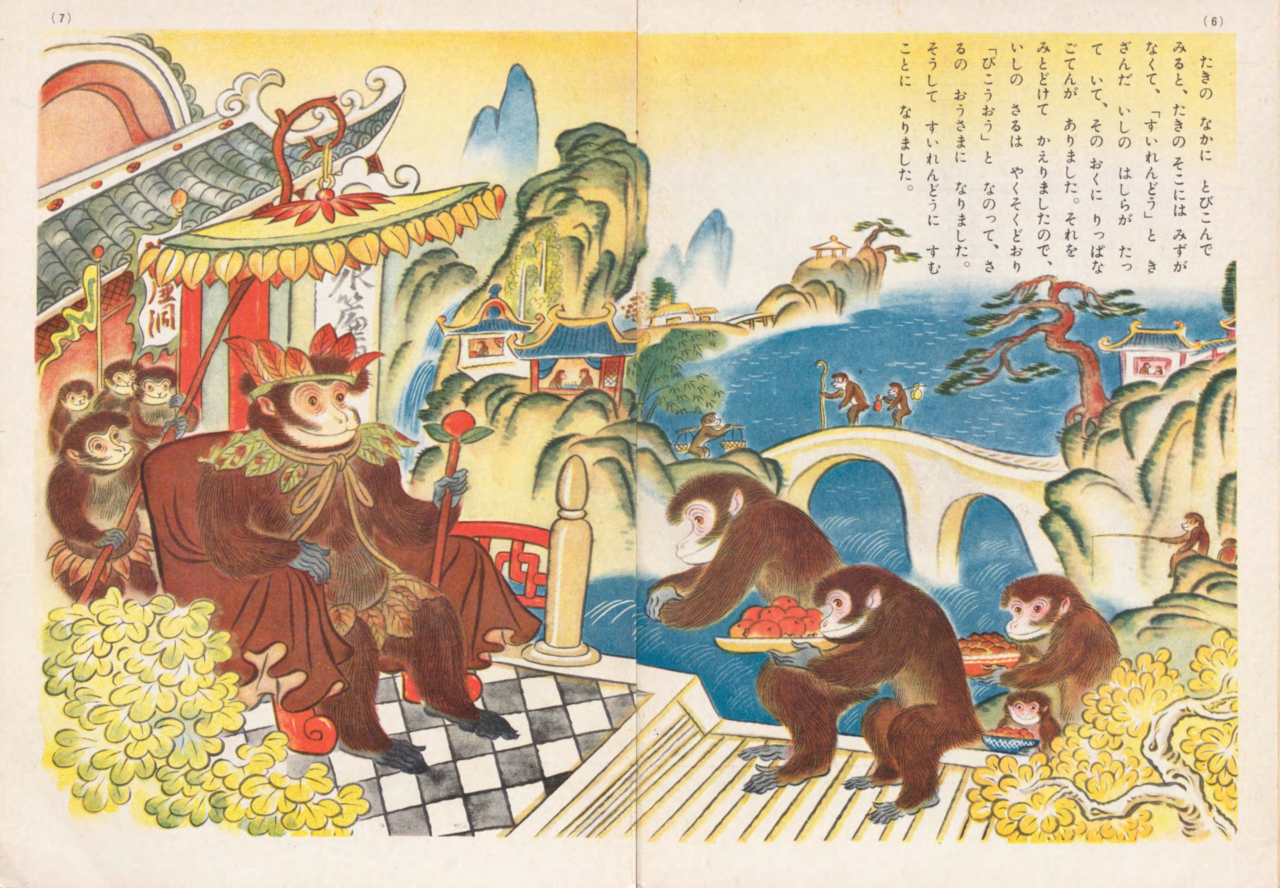
The Handsome Monkey King is waited on by his children (larger version). Image from the Japanese children’s book Son Goku (孫悟空,1939).

Notes:

1) Míhóu is one of various transcriptions for a word of non-Chinese origin used in ancient China to mean “monkey”:

The fact that mu occurs in four variants: 母 and 沐 in Chou literature, and mi 米 or 獼 during the Han dynasty and later, proves that this binom is a phonetic rendering of a non-Chinese term (Van Gulik, 1967, p. 35).

2) The full title is the “Bronze-Headed, Iron-Browed King of the Eighty-Four Thousand Monkeys of the Purple Cloud Grotto on the Mountain of Flowers and Fruit” (Huāguǒ shān Zǐyún dòng bāwàn sìqiān tóngtóu tiě’é Míhóu wáng, 花果山紫雲洞八萬四千銅頭鐵額獼猴王) (Wivell, 1994, p. 1182).

3) See Kroll et al. (2015, pp. 162, 302, and 469).

4) See Kroll et al. (2015, pp. 162, 299, and 469).

Source:

Kroll, P. W., Baxter, W., Boltz, W. G., Knechtges, D. R., Lien, Y. E., Richter, A., Richter, M. L., Warner, D. X. (2015). A Student’s Dictionary of Classical and Medieval Chinese. Belgium: Brill.

Van Gulik, R. H. (1967). The Gibbon in China: An Essay in Chinese Animal Lore. Leiden: E.J. Brill.

Wivell, C.S. (1994). The Story of How the Monk Tripitaka of the Great Country of T’ang Brought Back the Sūtras. In V. Mair (Ed.), The Columbia Anthology of Traditional Chinese Literature (pp. 1181-1207). New York: Columbia University Press.

Archive #38 – Books on Learning Taiwanese Hokkien

Last updated: 11-01-2022

I recently returned from my third pilgrimage with the Zheng’an monkey god temple (Zheng’an gong, 正安宮) in Taipei, Taiwan. This trip made me realize just how badly I need to learn Taiwanese Hokkien (Pe̍h-ōe-jī: Tâi-gí; Chinese: Taiyu, 臺語), for it was spoken almost exclusively in all of the temples we visited, as well as on the tour bus. I feel like having a working knowledge of the language would open doors to more in-depth research about the Great Sage‘s faith. And the best part? Taiwanese Hokkien is intelligible to Hokkien speakers in Fujian (home of Sun Wukong’s cult) and Southeast Asia (where he is also worshiped – example). This would help me expand my area of research.

Here, I would like to archive a few sources on Taiwanese Hokkien that I’ve found online.

1. Taiwanese Grammar: A Concise Reference (2015) by Philip T. Lin

1.1. Book description

Taiwanese Grammar: A Concise Reference is an unprecedented guide delivering clear, straightforward explanations of Taiwanese grammar while offering insightful comparisons to Mandarin Chinese. Designed to be both functional and accessible, the text makes searching for topics quick and easy with fully cross-referenced entries and a comprehensive index.

Topics covered range broadly from parts of speech (nouns, verbs, adverbs, etc.) to grammatical topics (aspect, negation, passive voice, etc.) to special topics (terms of address, pronunciation, time, etc.).

This text is ideal for self-study and enables students at all levels to build a solid foundation in grammar.

Taiwanese (also known as Hokkien, Fookien, Amoy, Southern Min, or Fukienese) along with its variants is spoken by over 40 million people worldwide and is a member of the Chinese language family.

Features of this text include:

  • Easy-to-use reference guide with cross-referenced entries and a comprehensive index
  • 1000+ example sentences using everyday vocabulary rendered in Taiwanese, Mandarin Chinese, and English
  • Character script for Taiwanese in accordance with the official selection of Taiwanese Characters by the Taiwanese Ministry of Education (2007)
  • Romanization provided for both Taiwanese (Peh-oe-ji) and Mandarin Chinese (Hanyu Pinyin)
  • In-depth guide to pronunciation using English approximations and full explanations on rules for changing tones (tone sandhi)

1.2. Archive link

Click to access Philip-T.-Lin-Taiwanese-Grammar_-A-Concise-Reference-Greenhorn-Media-2015.pdf

2. Maryknoll Taiwanese Book Series

This series is highly recommended in many of the places I’ve enquired.

2.1. Book description

With a total of over 1,300 pages, this series is the most comprehensive set readily available for learning Taiwanese. Written in English and Pe̍h-ōe-jī throughout, with Mandarin Character glosses for new vocabulary, these books (and accompanying CDs) offer sufficient lessons to help a learner achieve a good conversational level of Taiwanese.

By virtue of being issued by a Catholic mission (and originally written for missionaries) the vocabulary and dialogs are more Christian-oriented than most language textbooks – the words for ‘Catholic priest’, ‘Protestant minister’ and ‘(Religious) Sister’ all appear in the first few chapters of the book. For many learners of Taiwanese this is not vocabulary they will need to employ very often.

Nevertheless, this series still represents the best investment for the beginning and intermediate student of Taiwanese.

2.2. Archive links

Vol. 1 (1984) – https://journeytothewestresearch.com/wp-content/uploads/2022/10/Soa-Eng-seng-ed.-Maryknoll-Taiwanese-Book-1-Maryknoll-1984.pdf

Vol. 2 (1985) – https://journeytothewestresearch.com/wp-content/uploads/2022/10/Soa-Eng-seng-ed.-Maryknoll-Taiwanese-Book-2-Maryknoll-1985.pdf 

Vol. 3 (1988) – https://journeytothewestresearch.com/wp-content/uploads/2022/10/Soa-Eng-seng-ed.-Maryknoll-Taiwanese-Book-3-Maryknoll-1988.pdf

Taiwanese-English Dictionary (2001) https://journeytothewestresearch.com/wp-content/uploads/2022/10/coll.-台語英語字典.-Taiwanese-English-Dictionary-Maryknoll-Taiwan-2001.pdf 

3. Handbook of Taiwanese Romanization (2017) by David L. Chen

3.1. Book description

The Handbook of Taiwanese Romanization focuses on the phonology of Taiwanese and the closely related Amoy Hokkien. It covers five Taiwanese Romanization methods used in available Taiwanese language resources for English, Japanese, and Chinese (Mandarin) speakers. This book is for native Taiwanese speakers who live overseas and are unfamiliar with Chinese characters but want to learn how to express their mother tongue through reading and writing. It is also a tool to aid native speakers in teaching their own children. This book focuses more on Taiwanese and Amoy Hokkien but provides a foundation in phonetics and tones that can be applied to other Hokkien dialects.

3.2. Archive link

Click to access David-Li-Wei-Chen-Handbook-of-Taiwanese-Romanization-Xlibris-2017.pdf

Disclaimer:

These have been posted for educational purposes. No malicious copyright infringement is intended. If you liked the digital versions, please support the official releases.


Update: 11-01-22

This playlist of youtube videos appears to be useful for beginners.