The Monkey King’s Magic Staff: A Complete Guide

Last updated: 04-23-2026

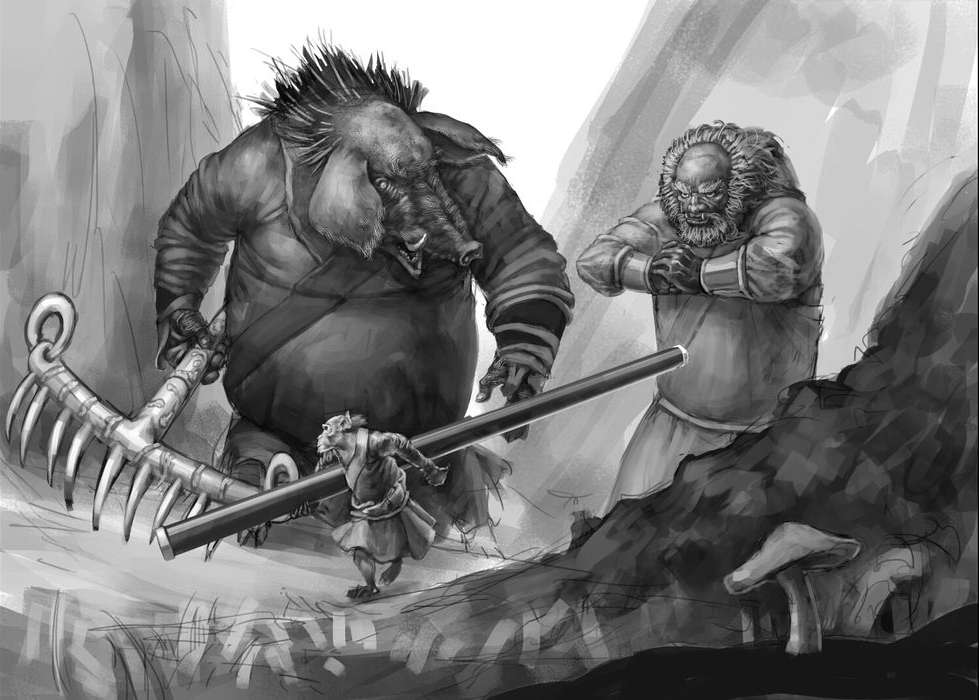
I’ve written many articles on the origins of the Monkey King’s staff over the years. Therefore, I’ve decided to combine all of the information in one location for the benefit of people wishing to learn more about the weapon and its history. This will no doubt be interesting to fans of Journey to the West (Xiyouji, 西遊記, 1592; JTTW hereafter), as well as those of modern franchises like Dragon Ball and Lego Monkie Kid (fig. 1). Citations can be found in the articles linked below.

Fig. 1 – A fan edit of the Lego Monkie Kid character “MK” wielding the Monkey King’s magic staff (larger version). Copyright Lego.

Table of Contents

1. The Literary Weapon

1.1. Staff Background

The staff first appears in chapter three of the original novel when the Monkey King goes to the underwater kingdom of Ao Guang (敖廣), the Dragon King of the Eastern Sea, looking for a magic weapon to match his supernatural strength and martial skill. When all of the traditional weapons offered to him fail to meet his standards, the dragon queen suggests to her husband that they give Sun Wukong “that piece of rare magic iron” taking up space in their treasury. She claims the ancient shaft had started producing heavenly light days prior and proposes that the monkey is fated to own it. The weapon is said to be a “divine treasure iron” originally used to set the depths of the Heavenly River (Tianhe ding di de shenzhen tie, 天河定底的神珍鐵) by Yu the Great (Dayu, 大禹), a mythic Chinese emperor and demigod.

The staff is initially described as a pillar of black iron or bin steel more than 20 feet in height and as wide as a barrel. It is only when Monkey lifts it and suggests a smaller size would be more manageable that the staff complies with his wishes and shrinks. This is when Sun notices that the weapon is decorated with a golden ring on each end, as well as an inscription along the body reading: “The ‘As-You-Will’ Gold-Banded Cudgel. Weight: Thirteen Thousand Five Hundred Catties” (Ruyi jingu bang zhong yiwan sanqian wubai jin, 如意金箍棒重一萬三千五百斤). The inscription indicates that the staff is immensely heavy, weighing 17,560 lbs. (7,965 kg).

Apart from the above information, a poem in chapter 75 (see section 2.3 here) highlights another name, “Rod of Numinous Yang” (Lingyang bang, 靈陽棒). In addition, the poem describes the staff being covered in “tracks of planets and stars” (i.e. astronomical charts) and esoteric “dragon and phoenix scripts” (longwen yu fengzhuan, 龍紋與鳳篆).

The novel provides two contradictory origins for the staff. The chapter 75 poem notes that it “[w]as forged in the stove by Laozi himself.” Laozi is of course the high god of Daoism. Chapter 88 instead states that it was “forged at Creation’s dawn / By Yu the Great himself, the god-man of old.”

Contrary to popular images of the Monkey King holding a regular-sized staff, his literary counterpart wields a massive weapon in battle. It is said to be 20 feet long (likely an error for 12), [1] with the width of a bowl (erzhang changduan, wankou cuxi, 二丈長短,碗口粗細) (fig. 2). I did a cursory search of bowls during the Ming (when the standard edition of JTTW was published) and found that they have a radius of between 4 to 6 inches (10.16 to 15.25 cm).

Fig. 2 – An accurate depiction of the size of Monkey’s staff (larger version). Images found here. Artwork by @真·迪绝人.

1.2. Staff Powers

The staff is shown to have multiple powers.

  1. Size manipulation – This is the weapon’s most well-known ability, growing as big or as small as Monkey wishes.
  2. Controlling the oceans –  The aforementioned poem from chapter 88 writes: “The depths of all oceans, rivers, and lakes / Were fathomed and fixed by this very rod. / Having bored through mountains and conquered floods, / It stayed in East Ocean and ruled the seas…”
  3. Astral entanglement – Monkey’s soul is able to use the staff in Hell despite the physical weapon being with his sleeping body in the world of the living. (See the 04-23-26 update below for more info.)
  4. Multiplication – He can multiply his staff in the hundreds of thousands.
  5. Lock-Picking – He can open any door just by pointing it at the lock.
  6. Transformation – He can change it into tools like a straight razor or a drill.
  7. Sentience – The weapon glows in anticipation of Monkey’s arrival (fig. 3), responds to his touch, and follows his commands, denoting a certain level of sentience.

Fig. 3 – Monkey pointing to the luminous iron pillar (larger version). From the Qing-Era Painted, Complete Edition Journey to the West (Qing caihui quanben Xiyouji, 清彩繪全本西遊記).

2. Origins

2.1. Literary Precursors

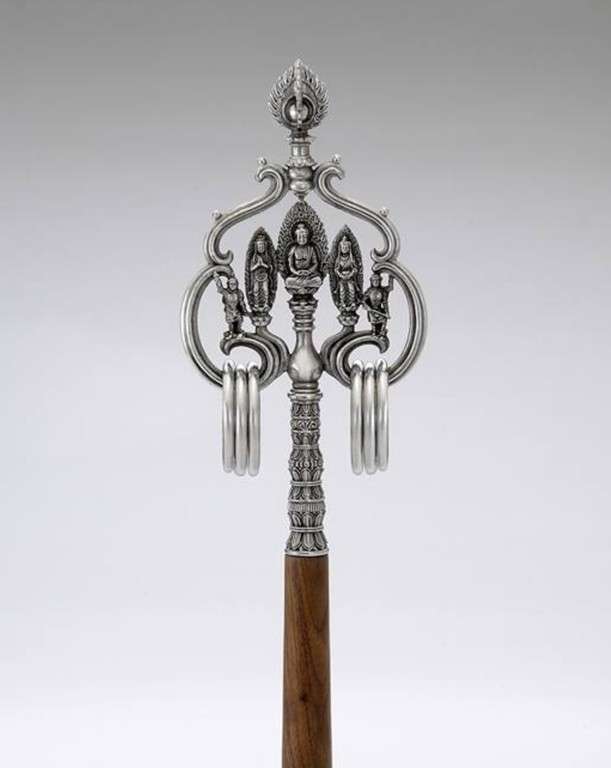
The staff found in the standard Ming edition of JTTW is actually based on two weapons from a 17-chapter storytelling prompt called The Story of How Tripitaka of the Great Tang Procured the Scriptures (Da Tang Sanzang qujing shihua, 大唐三藏取經詩話, c. late 13th-century). Sun Wukong’s precursor, an ageless immortal called the “Monkey Pilgrim” (Hou xingzhe, 猴行者), magically transports Tripitaka and his entourage to heaven. There, the supreme god, the Mahābrahmā Devarāja (Dafan tianwang, 大梵天王; i.e. Vaiśravana), gives the monk a cap of invisibility, a khakkhara (ringed monk’s staff) (fig. 4), and a begging bowl. Tripitaka and the Monkey Pilgrim take turns using these items throughout the journey. The staff is shown capable of shooting destructive beams of light, as well as transforming into magical creatures like an iron dragon or a giant, club-wielding Yaksha. Later, the Monkey Pilgrim also borrows an iron staff from heaven to fight a dragon.

The two staves from this tale were eventually combined by later storytellers. The rings from the first weapon were added to the ends of the second.

Fig. 4 – A beautiful, modern monk’s staff with six rings (larger version).

2.2. Influence from Religion

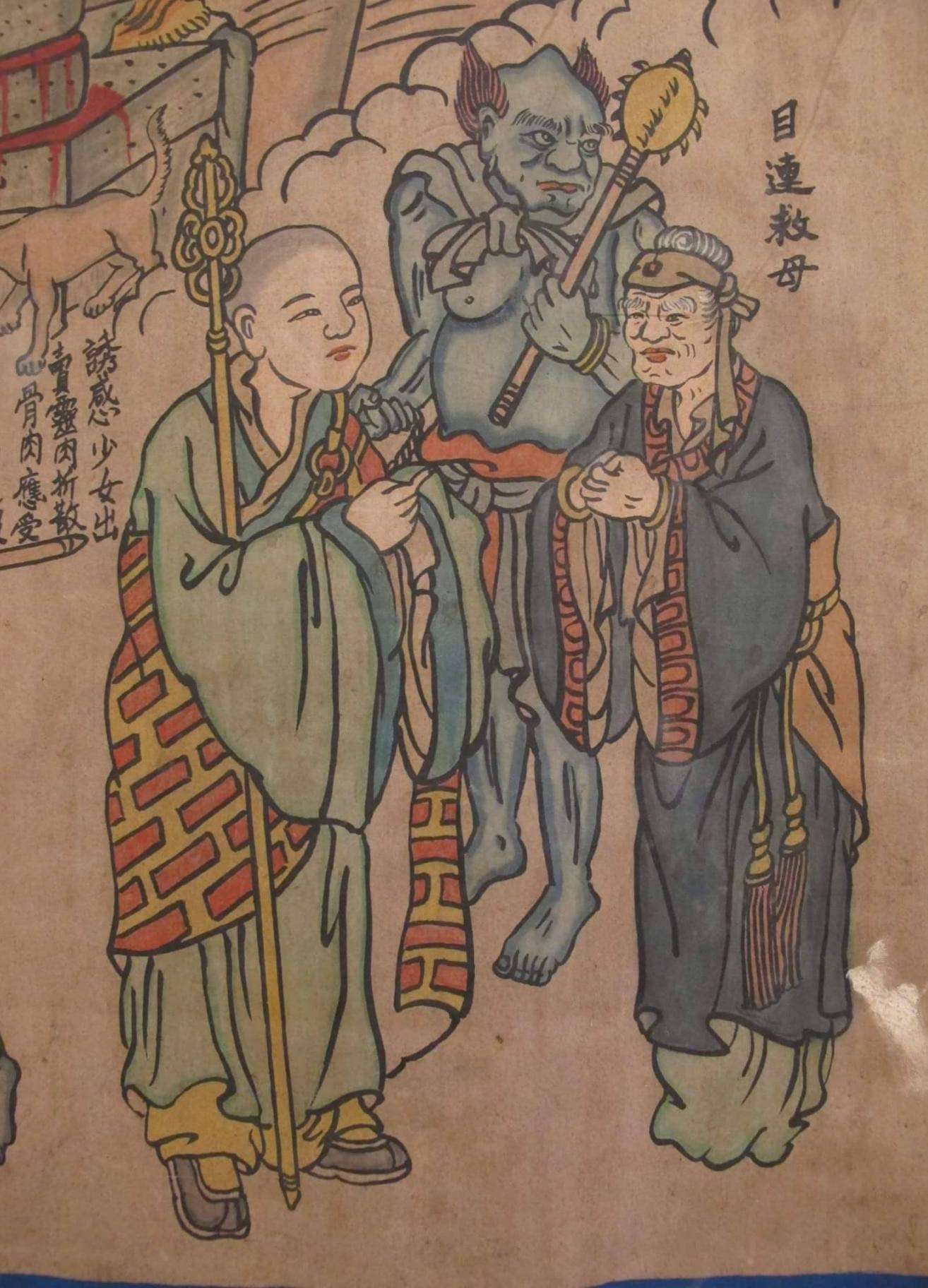
The Monkey Pilgrim’s magic ringed staff and begging bowl were directly influenced by the Buddhist Saint Mulian (目連; Sk: Maudgalyayana), a disciple of the historical Buddha. One particular 9th to 10th-century story notes that the Saint uses the staff to unlock the gates of hell in order to save his mother (fig. 5). This is where Sun Wukong’s weapon from JTTW gets the power to open locks.

Mulian saves his mother, scroll - small

Fig. 5 – A scroll or mural depicting Mulian rescuing his mother from the underworld (larger version). Originally found here.

The ringed and metal staves used by the Monkey Pilgrim are based on those historically carried by Buddhist monks in ancient China. The aforementioned ringed variety, called “tin staves” (xizhang, 錫杖) where used by religious monks and decorated with six to twelve metal rings (see fig. 4). These rings were designed to make a clanging noise to not only scare away animals on the road but also to alert possible donors to the monk’s presence.

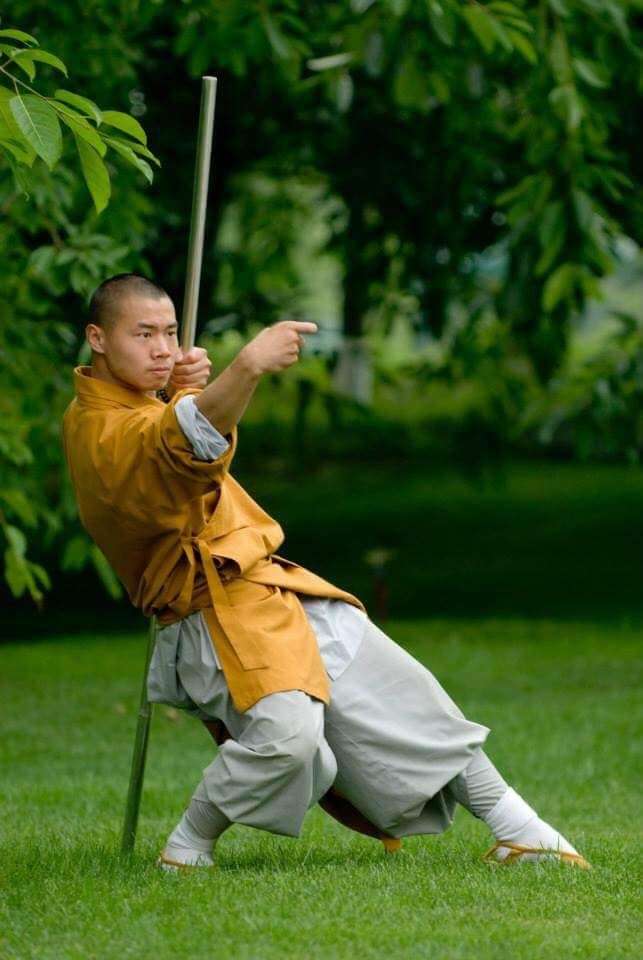
Martial monks charged with protecting monasteries or deployed by the Chinese government against pirates wielded wooden or iron staves (fig. 6). The former were chosen for their diminished capacity for fatal injuries, while the latter were explicitly used for killing during times of war. Sun Wukong wielding the iron variety makes sense as he’s a martial monk charged with protecting Tripitaka from monsters and spirits.

Fig. 6 – A martial monk practicing a drunken staff-fighting form (larger version).

The term “As-you-will” (ruyi, 如意) from Monkey’s staff (mentioned above) is connected with a scepter used in ancient China as a symbol of religious debate and authority and, to a lesser extent, as a weapon. While it can be traced to a Hindo-Buddhist tradition in India, the scepter came to be associated with the highest gods of Daoism thanks to being decorated with a “numinous mushroom” (lingzhi, 靈芝), a real world fungi believed to bestow immortality. This mushroom scepter was at some point associated with the Buddhist Cintamani (Ruyi zhu, 如意珠), or “As-you-will jewel.” This was believed to grant any wish that one might desire. This explains why Monkey’s As-you-will staff grows or shrinks according to his commands. It’s interesting to note that some religious images of the scepter depict it with a syncretic mix of the Daoist mushroom and the Buddhist jewel (fig. 7).

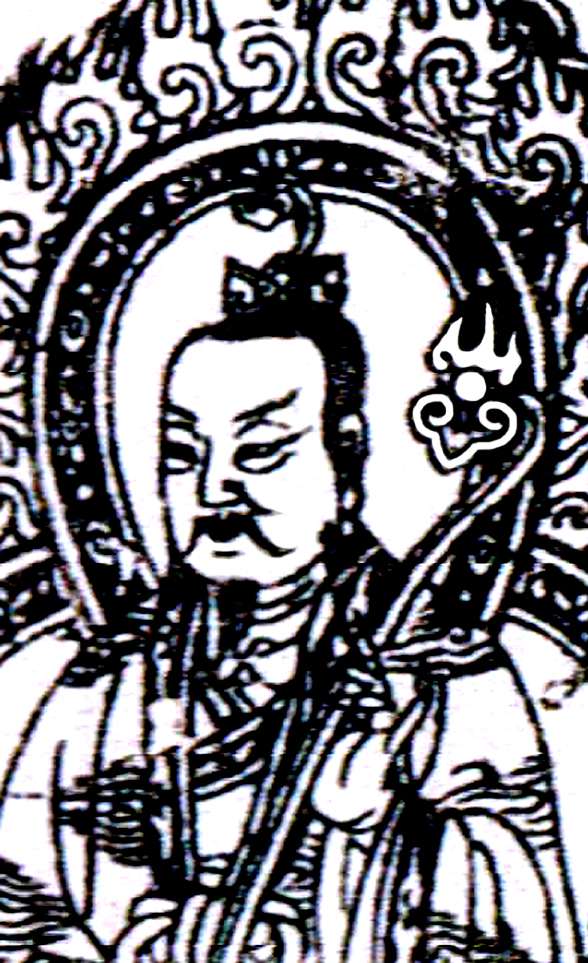
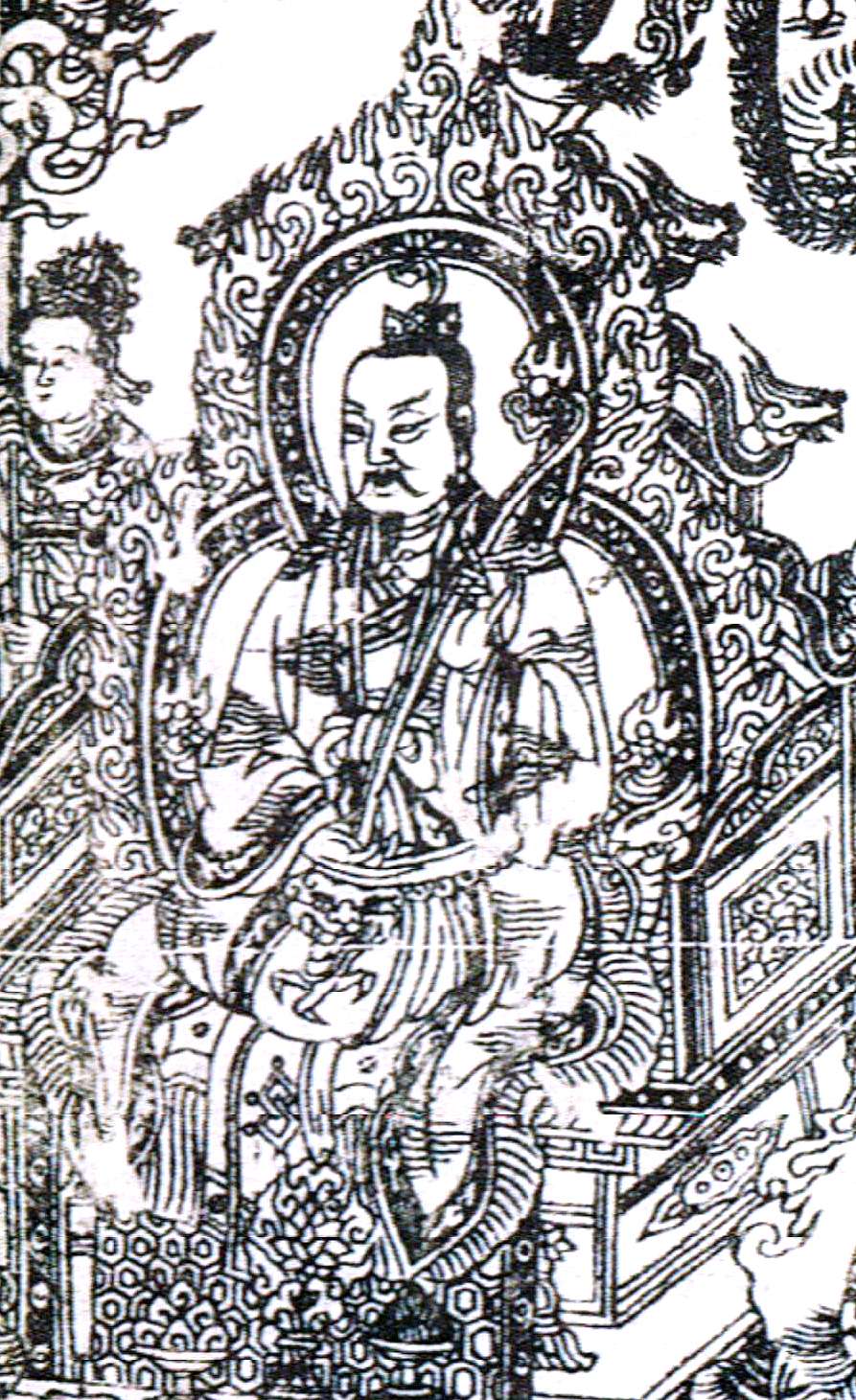
Fig. 7 – An enhanced detail of the Celestial Worthy’s mushroom scepter with a flaming as-you-will jewel (larger version). See here for a fuller version of the deity.

2.3. Influence from Popular Literature

The weapon’s portrayal in JTTW as an iron pillar kept in the dragon kingdom comes from old stories about the immortal Xu Xun (許遜), a historical Daoist master and minor government official from Jiangsu province. Popular tales describe him as a Chinese St. Patrick who traveled southern China ridding the land of flood dragons. One 17th-century version titled “An Iron Tree at Jingyang Palace Drives Away Evil” (Jingyang gong tieshu zhenyao旌陽宮鐵樹鎮妖) describes how he chained the flood dragon patriarch to an iron tree (tieshu, 鐵樹) and submerged it in a well, thus preventing the serpent’s children from leaving their subterranean aquatic realm and causing trouble. Pre-JTTW versions of this tale depict the tree as an actual iron pillar (fig. 8). Chinese Five Elements Theory dictates that metal produces water, and as its creator, holds dominion over it. Therefore, an iron pillar would be the perfect item to ward off creatures entrenched in the aquatic environment.

Fig. 8 – A Ming Dynasty woodblock print depicting the immortal Xu overseeing the creation of the iron pillar in a furnace (right) and it’s placement the well (left). Dated 1444-1445 (larger version).

As previously noted, the staff weighs 17,560 lbs. (7,965 kg). This is likely based on an episode from chapter 27 of the Chinese novel Water Margin (Shuihu zhuan, 水滸傳, c. 1400). It involves the bandit Wu Song lifting a heavy stone block said to weigh 300 to 500 catties (san wu bai jin, 三五百斤; 390-650 lbs./177-295 kg) (fig. 9). This scene and the one from JTTW where Monkey lifts the iron pillar are quite similar. Both involve a hero (Wu Song vs. Sun Wukong) asking someone (Shi En vs. Ao Guang) to show them a heavy object that cannot be moved (stone block vs. iron pillar). Both heroes then adjust their clothing before easily lifting the object with both hands. Most importantly, the Chinese characters for the weight of each object (三五百斤 vs. 一萬三千五百斤) are similar. The only difference is the addition of “10,000” (yiwan, 一萬) and “1,000” (qian, 千), respectively. And given the close historical and cultural ties between the two heroes, I believe the author-compiler of JTTW embellished the Water Margin episode to portray Sun as a hero like no other, a divine immortal that can lift weights far beyond even Wu Song himself.

Fig. 9 – Wu Song lifts the stone block (larger version). Image found here.


3. Updates

Update: 04-23-26

Above, I wrote: “Astral entanglement – Monkey’s soul is able to use the staff in Hell despite the physical weapon being with his sleeping body in the world of the living.”

Sun’s use of said weapon also caught the attention of late-Ming commentators. The authors of The Book to Enlightenment of the Journey to the West (Xiyou Zhengdao Shu西遊證道書, 1663), a Daoist commentary on the novel, asked:

“Did he take this treasure with him in his dream?”

此寶貝夢中亦帶去耶? (Converted from simplified Chinesesource).

Note:

1) Irwen Wong of the Journey to the West Library blog has suggested that the length is likely an error for 12 feet (zhanger, 丈二) since the staff was already near 20 feet when Monkey first acquired it, and he later asked it to shrink to a more manageable size.

The Magic Powers of the Monkey King’s Iron Staff

Last updated: 07-04-2021

I’ve written several articles on Sun Wukong’s iron staff, including its origin from religious and martial staves used by historical Buddhist monks, the meaning of its inscription (“‘As-You-Will’ Gold-Banded Cudgel. Weight: 17,560 lbs” (7,965 kg)), the real world metal that it is made from, its ties to Yu the Great and flood control, its ties to the Buddhist Saint Mulian, its possible ties to a Hindu monument, and modern day misconceptions about its ability to weigh down the entire Milky Way galaxy. Now, I’d like to briefly survey the magic powers associated with this weapon. This will by no means be exhaustive.

I. Powers

A. Size Manipulation

Sun travels to the Eastern Sea Dragon King’s underwater kingdom in ch. 3 to acquire a celestial weapon. But when the immortal fails to find a suitably heavy armament, the Dragon Queen suggests that they give him a black iron pillar from their treasury. It is described as over 20 feet (6.096 m) in height and the width of a barrel. Only when Monkey lifts the pillar and suggests a smaller size would be more manageable does it comply with his wishes:

Wukong girded up his clothes and went forward to touch it: it was an iron rod more than twenty feet long and as thick as a barrel. Using all his might, he lifted it with both hands, saying, “It’s a little too long and too thick. It would be more serviceable if it were somewhat shorter and thinner.” Hardly had he finished speaking when the treasure shrunk a few feet in length and became a layer thinner. “Smaller still would be even better,” said Wukong, giving it another bounce in his hands. Again the treasure became smaller. Highly pleased, Wukong took it out of the ocean treasury to examine it. He found a golden hoop at each end, with solid black iron in between. Immediately adjacent to one of the hoops was the inscription, “The ‘As-You-Wish’ Gold-Banded Cudgel. Weight: 17,560 lbs. [Ruyi jingu bang zhong yiwan sanqian wubai jin, 如意金箍棒重一萬三千五百斤]” (Wu & Yu, 2012, p. 135). [1]

Later in the chapter, Sun shows off the new weapon to his children by shrinking it to the size of a needle and then expanding it to a literal pillar of heaven.

He held the treasure [the staff] in his hands and called out, “Smaller, smaller, smaller!” and at once it shrank to the size of a tiny embroidery needle, small enough to be hidden inside the ear. Awestruck, the monkeys cried, “Great King! Take it out and play with it some more.” The Monkey King took it out from his ear and placed it on his palm. “Bigger, bigger, bigger!” he shouted, and again it grew to the thickness of a barrel and more than twenty feet long. He became so delighted playing with it that he jumped onto the bridge and walked out of the cave. Grasping the treasure in his hands, he began to perform the magic of cosmic imitation. Bending over, he cried, “Grow!” and at once grew to be one hundred thousand feet tall, [2] with a head like the Tai Mountain and a chest like a rugged peak, eyes like lightning and a mouth like a blood bowl, and teeth like swords and halberds. The rod in his hands was of such a size that its top reached the thirty-third Heaven and its bottom the eighteenth layer of Hell (fig. 1) (Wu & Yu, 2012, vol. 1, p. 138).

cosmic transformation

Fig. 1 – Monkey grows his staff to touch heaven as he performs a cosmic transformation for his children (larger version). Original artist unknown. Found on this article.

B. Controlling the oceans

Prior to giving Monkey the staff, the Dragon King tells his wife, “That…was the measure with which [Yu the Great] fixed the depths of rivers and oceans when he conquered the Flood” (Wu & Yu, 2012, vol. 1, p. 135). Later, in ch. 88 our hero recites a poem in which he gives more detail about the weapon’s origins and history. The first few lines discuss its power over water:

An iron rod forged at Creation’s dawn
By Great Yu himself, the god-man of old.
The depths of all oceans, rivers, and lakes
Were fathomed and fixed by this very rod.
Having bored through mountains and conquered floods,
It stayed in East Ocean and ruled the seas,
[…] (Wu & Yu, 2012, vol. 4, p. 201).

Despite the staff’s influence on bodies of water both great and small, it paradoxically doesn’t grant Sun an advantage when traveling through the aquatic realm or fighting water-based demons. [3] I’ll just chalk this up to inconsistencies born from oral storytelling.

C. Astral entanglement

Ch. 3 shows that Monkey’s soul is able to use the staff in the underworld even when the physical weapon is back with his body in the world of the living.

In his sleep the Handsome Monkey King saw two men approach with a summons with the three characters “Sun Wukong” written on it. They walked up to him and, without a word, tied him up with a rope and dragged him off. The soul of the Handsome Monkey King was reeling from side to side. They reached the edge of a city. The Monkey King was gradually coming to himself, when he lifted up his head and suddenly saw above the city an iron sign bearing in large letters the three words “Region of Darkness.” … Yanking and pulling, they were determined to haul him inside. Growing angry, the Monkey King whipped out his treasure. One wave of it turned it into the thickness of a rice bowl; he raised his hand once, and the two summoners were reduced to hash.

[…]

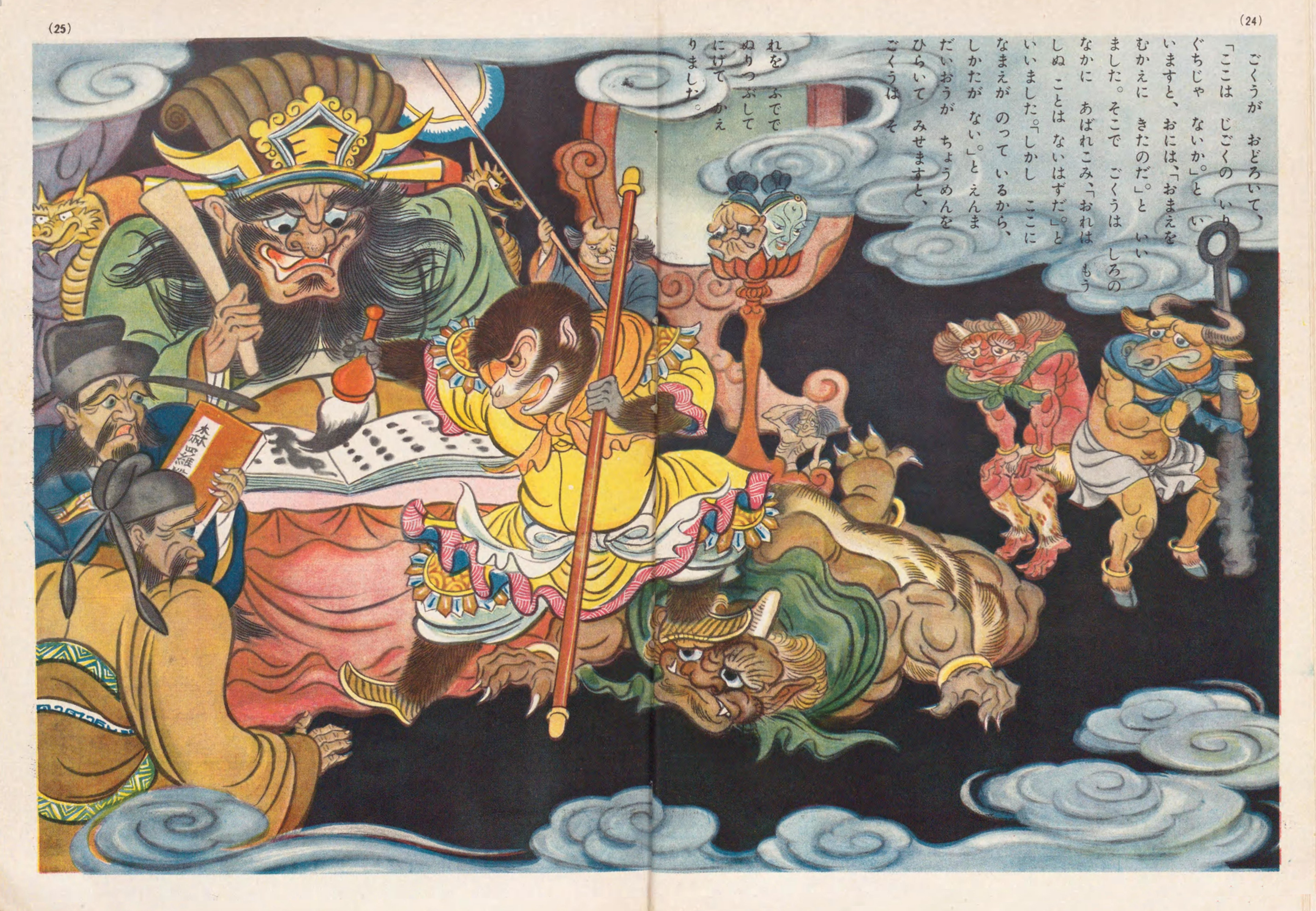
[After reprimanding the 10 judges for bringing his soul to hell, Sun says,] “All I want is to erase my name [from the ledgers of life and death]. Bring me a brush.” The judge hurriedly fetched the brush and soaked it in heavy ink. Wukong took the ledger on monkeys and crossed out all the names he could find in it [fig. 2]. Throwing down the ledger, he said, “That ends the account! That ends the account! Now I’m truly not your subject.” Brandishing his rod, he fought his way out of the Region of Darkness.

[…]

While our Monkey King was fighting his way out of the city, he was suddenly caught in a clump of grass and stumbled. Waking up with a start, he realized that it was all a dream (Wu & Yu, 2012, vol. 1, p. 139).

Sun’s ability to use the weapon as a disembodied spirit implies that it has some power of astral projection and entanglement (i.e. it goes where his soul goes). However, to my knowledge, this only happens once in the story, and the novel clearly demonstrates that he can’t use the weapon if it is physically taken away from him. [4] This is likely another inconsistency from oral storytelling.

Fig. 2 – Monkey holds his staff as he strikes his name from the Book of Life and Death (larger version). From the Japanese children’s book Son Goku (1939). 

D. Multiplication

The weapon is shown capable of creating manifold copies of itself. For example, in ch. 4, Monkey multiplies his staff to accommodate his monstrous, multi-armed form while fighting Prince Nezha: “Dear Great Sage! He shouted, ‘Change!’ and he too transformed himself into a creature with three heads and six arms. One wave of the golden-hooped rod and it became three staffs, which were held with six hands” (Wu & Yu, 2012, vol. 1, p. 155). Later in ch. 50, he rains staves down on a demonic army.

Using the tip of his lance to point at the ground, the demon king shouted for the little imps to attack together. All those brazen fiends, wielding swords, scimitars, staffs, and spears, rushed forward at once and surrounded the Great Sage Sun completely. Entirely undaunted, Pilgrim only cried, “Welcome! Welcome! That’s exactly what I want!” He used his golden-hooped rod to cover his front and back, to parry blows east and west, but that gang of fiends refused to be beaten back. Growing more agitated, Pilgrim tossed his rod up into the air, shouting, “Change!” It changed immediately into iron rods by the hundreds and thousands; like flying snakes and soaring serpents, they descended onto the fiends from the air” (Wu & Yu, 2012, vol. 2, p. 372).

E. Lock-Picking

Sun demonstrates the staff’s magic lock-picking ability in ch. 25.

The doors are all locked. Where are we going to go?” “Watch my power!” said Pilgrim. He seized his golden-hooped rod and exercised the lock-opening magic; he pointed the rod at the door and all the locks fell down with a loud pop as the several doors immediately sprung open. “What talent!” said Eight Rules, laughing. “Even if a little smith were to use a lock pick, he wouldn’t be able to do this so nimbly.” Pilgrim said, “This door is nothing! Even the South Heaven Gate would immediately fly open if I pointed this at it!” (Wu & Yu, 2012, vol. 1, pp. 468-469).

Admittedly, this passage could be read two ways: 1) The staff opens the lock; 2) Monkey uses the staff as a conduit for his own lock-picking magic. But I’m choosing the first interpretation as this ability was likely influenced by Saint Mulian unlocking the gates of hell with his staff. [5]

F. Transformation

In ch. 46, during a competition of Buddhist and Daoist prognostication, Sun magically disguises himself as a Daoist lad’s ritual master and convinces the boy to let him shave his head: “He changed his golden-hooped rod into a sharp razor, and hugging the lad, he said, ‘Darling, try to endure the pain for a moment. Don’t make any noise! I’ll shave your head.’ In a little while, the lad’s hair was completely shorn” (Wu & Yu, 2012, vol. 2, p. 305). In ch. 65, Sun turns the staff into a drill in order to escape from a pair of magic cymbals, using the tool to bore a hole in the horn of a dragon that was just able to pierce the seam: “Marvelous Great Sage! He changed the golden-hooped rod into a steel drill and drilled a hole on the tip of the horn. Transforming his body into the size of a mustard seed, he stuck himself inside the hole and yelled, ‘Pull the horn out! Pull the horn out!'” (Wu & Yu, 2012, vol. 3, p. 218).

G. Sentience

When the Dragon Queen originally suggests giving the pillar to Monkey, she tells her husband: “These past few days the iron has been glowing with a strange and lovely light [fig. 3]. Could this be a sign that it should be taken out to meet this sage?” (Wu & Yu, 2012, vol. 1, p. 135). This might imply the weapon was aware of its new master’s imminent arrival. Later in ch. 75, Sun recites a poem speaking of the staff’s desire for flight.

Its name was one Rod of Numinous Yang,
Stored deep in the sea, hardly seen by men.
Well-formed and transformed it wanted to fly,
Emitting bright strands of five-colored mist.
Enlightened Monkey took it back to the mount
To experience its pow’r for boundless change.
[…] (Wu & Yu, 2012, vol. 3, p. 375).

The phase “wanting to fly” (yao feiteng, 要飛騰) could be read as a metaphor for yearning to be released from the dragon treasury and/or a call for adventure. Add to this the staff’s ability to follow Sun’s wishes to grow, shrink, multiply, change form, and pick locks. Therefore, the novel depicts the staff having a certain amount of awareness. [6]

Fig. 3 – Monkey pointing to the luminous iron pillar (larger version). From the Qing-Era Painted, Complete Edition Journey to the West (Qing caihui quanben Xiyouji, 清彩繪全本西遊記).

II. Conclusion

Journey to the West (1592) describes the Monkey King’s iron staff having the magic power to shrink and grow, control the ocean, astral project and entangle with Monkey’s spirit, multiply endlessly, pick locks, and transform into various objects. It also has sentience to a certain degree.


Update: 07-04-21

Here I present my theory on why Sun Wukong’s staff weighs 13,500 catties (17,560 lbs/7,965 kg). I believe the number is an embellishment on the weight of a stone block lifted by the bandit Wu Song in the Water Margin (c. 1400).

The Weight of the Monkey King’s Staff: A Literary Origin

Notes

1) I have changed Yu’s (Wu & Yu, 2012) dry rendering “Compliant Golden-Hooped Rod” to the more pleasant one based on W.J.F. Jenner. Also, Yu’s original translation says “13,500 pounds”. However, the Chinese version uses jin (斤), known in English as “catty“. The catty and pound are two different measures of weight, the former being heavier than the latter. Therefore, the English text has been altered to show this. The catty during the Ming Dynasty when the novel was compiled equaled 590 grams (Elvin, 2004, p. 491 n. 133), so 13,500 catties would equal 17,550 lb.

2) Here, Yu’s (Wu & Yu, 2012) English translation says Monkey grows to be “ten thousand feet tall”. However, the original Chinese source reads “萬丈” (wanzhang), wan meaning 10,000 and zhang being a measure designating 10 Chinese feet (10,000 x 10 = 100,000). Therefore, I have changed the source to read “One hundred thousand feet”, much like Yu (Wu & Yu, 2012) translates it in chapters six (vol. 1, p. 181) and 61 (vol. 3, p. 157).

3). For example, Monkey relies on Zhu Bajie to fight Sha Wujing when they first come across him at the Flowing-Sands River. This is when Sun admits his weakness to water:

“Worthy Brother,” said Pilgrim with a laugh, “in this case I’ve really nothing to brag about, for I’m just not comfortable doing business in water. If all I do is walk around down there, I still have to make the magic sign and recite the water-repelling spell before I can move anywhere. Or else I have to change into a water creature like a fish, shrimp, crab, or turtle before going in. If it were a matter of matching wits in the high mountains or up in the clouds, I know enough to deal with the strangest and most difficult situation. But doing business in water somewhat cramps my style!” (Wu & Yu, 2012, vol. 1, pp. 423-424).

4) The rhinoceros demon sucks it away with Laozi’s magic steel bracelet in ch. 50 and 51. A lion spirit uses a magic wind to steal the weapons of all three pilgrims in ch. 88. In both cases, Monkey resorts to trickery to retrieve the physical staff from their respective mountain strongholds.

5) One section of Mulian’s tale reads: “With one shake of his staff, the bars and locks fell from the black walls, / On the second shake, the double leaves of the main gate [of hell] flew open” (Mair, 1994, p. 1113).

6) The idea of sentient weapons is certainly not unique to Journey to the West considering that the ancient Chinese ascribed souls to noted swords. For example, Yuan poet Jia Penglai (賈蓬萊, c. mid-14th-c.) described famed Spring and Autumn period blacksmith Ou Yezi‘s (歐冶子) treasure swords Longyuan (龍淵, a.k.a. Longquan, 龍泉) and Tai’e (泰阿/太阿) as mated lovers who pine for each other when separated and even leap from the scabbard to seek out their beloved (Lee & Wiles, 2015, pp. 161-163).

Sources:

Elvin, M. (2004). The Retreat of the Elephants: An Environmental History of China. New Haven (Conn.): Yale university press.

Lee, L. X. H., & Wiles, S. (2015). Biographical Dictionary of Chinese Women: Tang Through Ming: 618-1644. Abingdon: Routledge.

Mair, V. H. (1994). Transformation Text on Mahamaudgalyayana Rescuing his Mother From the Underworld With Pictures, One Scroll, With Preface In V. Mair (Ed.), The Columbia Anthology of Traditional Chinese Literature (pp. 1094-1127). New York: Columbia University Press.

Wu, C., & Yu, A. C. (2012). The Journey to the West: Vol. 1-4. Chicago, Illinois: University of Chicago Press.