Journey to the West Artist Spotlight #1: Dario Virga

From time to time I like to post a fun blog not directly related to (though sometimes informed by) my research. Regular articles will resume after this entry.

Anyone who has read my blog will know that I’m an avid fan of researching the history and influences of Journey to the West (Xiyouji西遊記, 1592; “JTTW” hereafter). But as an artist, I am also a fan of JTTW-related artwork. There are so many talented people in the world who post their traditional and original designs and comics online, so I have decided to feature some of them on my blog. My hope is that such posts will expose this art to a wider audience interested in JTTW, while also documenting modern day perceptions and depictions of the novel and its characters.

Our first artist is Dario Virga, who goes by Onibotokemaru on Instagram. They were kind enough to answer some interview questions, as well as allow permission to display a few of their pieces.

Table of Contents

I. Q & A

1) Can you tell me a little about yourself?

Real name Dario Virga, from Italy (Piedmont). Interested in eastern culture and literature, mostly from Japan and China.

2) Are you self-taught or did you go to art school?

Self-taught, though, I had some help from someone who went to art school.

3) What are your main sources of artistic inspiration?

Usually animals and characters/elements taken from mythology and literature.

4) How did you learn about JTTW?

My very first contact with Journey to the West was back when I was younger, in a book about Chinese myths. Later I found an integral translation done by Serafino Balduzzi (translated from a French one).

5) Who is your favorite character?

Tough question, but I like most of the characters. If forced to choose, I’d say Pigsy for the good guys and the Bull Demon King for the villains.

6) Do you have a favorite episode from the novel?

Probably the whole Gold Horn & Silver Horn arc.

7) Does the novel have a special meaning to you?

Not a special meaning per se, but it was a novel I really enjoyed, both for the setting, the narration, the characters within and watching them grow.

Plan to make a gallery of, if not all, at least a huge amount of the novel’s characters.

II. Art and Thought Process

Sample #1

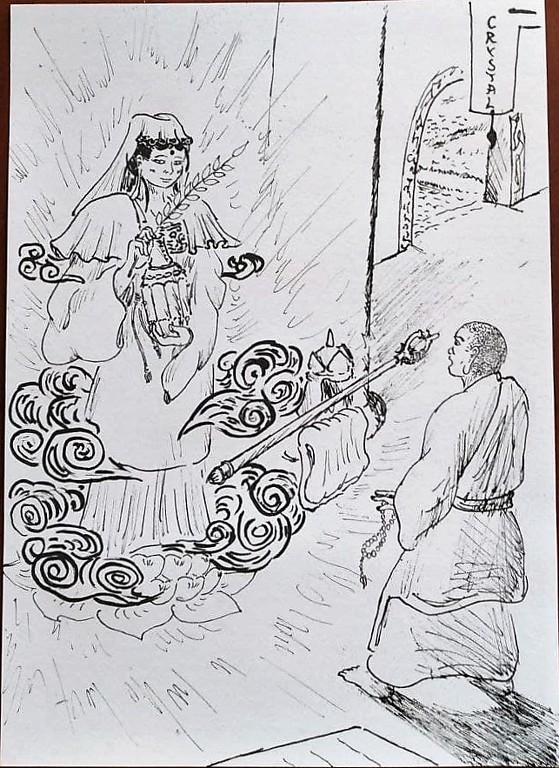
As the opening drawing of the Xiyouji-themed Inktober set, I’ve decided to focus not on Sun Wukong himself but rather on Tripitaka, the monk, as Guanyin Pusa appears before him to assign him the quest for the sutras. Guanyin’s reference are commonly-found icons and statues. Between the two of them float the items Tripitaka receives (the cossack, nine-ringed staff and hat).

(Larger version)

Sample #4

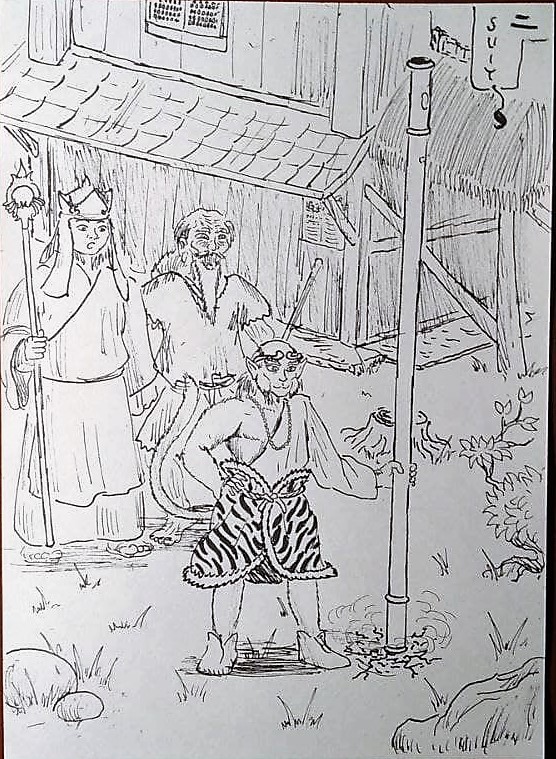
This is the first time I depict Sun Wukong in the series, and I did it based his design on an article written on this very blog, trying to stick as much as possible to his literary description, especially regarding the clothing (monk’s shirt and tiger pelt kilt held by a rope), short stature, simian face and bald spot on the top of the head (converted to Buddhism). I gave him long spike-like hair in the back because otherwise his head felt too small. The Ruyijingubang has a rather simple design, as I never liked its depictions with pommels on both ends. I also tried to make the inscriptions on the shaft, but ultimately gave up, admittedly.

(Larger version)

Sample #3

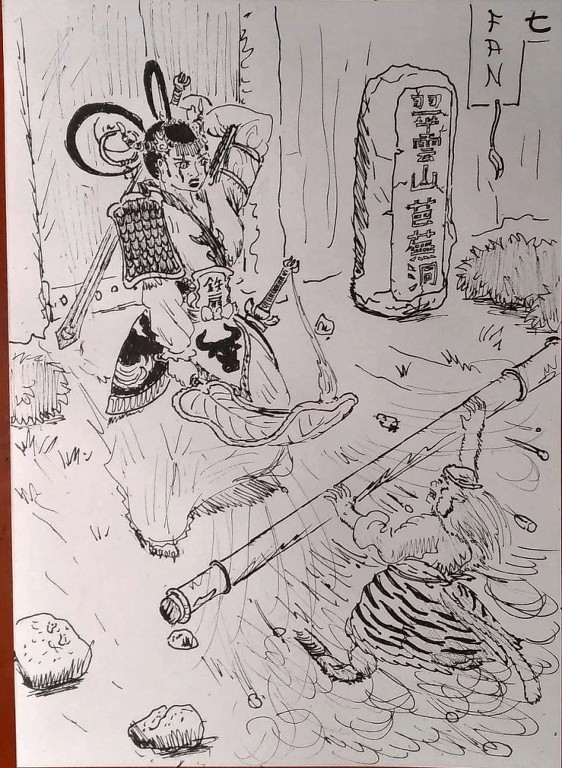
This picture has Sun Wukong fighting against the Iron Fan Princess, who sends him flying away with her Banana Leaf Fan. Once again, I wanted to show how small Monkey is (in comparison to nearly everyone else, though I’m not always 100% consistent) and remind that the Ruyijingubang can increase in both length and width, as seen here where he tries to use it as a shield to block the wind, unsuccessfully. Also of note, the massive stone pillar on which the “address” of the Iron Fan Princess is written.

(Larger version)

Sample #4

This one isn’t based on any specific event, but it’s here to bring out two topics: the first is the size of the party members, which I always tried to keep consistent (and tried is the keyword). The idea is that Sun Wukong is the smallest of the group (4 feet), then we have Tripitaka, the “normal” one, and the Dragon (horse-sized): Pigsy (here depicted with a hint of boar) is the second tallest but also the fattest, while Sandy is the tallest of the party (and definitively not a Kappa). The second one is Sha Wujing’s weapon: while it’s usually depicted as a Monk Spade, the actual name is the “Demon-Subduing Treasure Cane” (降魔宝杖, Xiangmobaozhang), making it a stick/staff. However, it’s also worth a mention that the Monk Spade is sometimes called “Zen Cane” (禪杖, Chanzhang), a term which also refers to the ringed staff used by monks. Admittedly, I liked the spade version the most, though I plan to depict this weapon as a staff when Sandy is in his celestial marshal/arhat forms, implying that the staff changed into a spade when he fell from Heaven.

(Larger version)

Sample #5

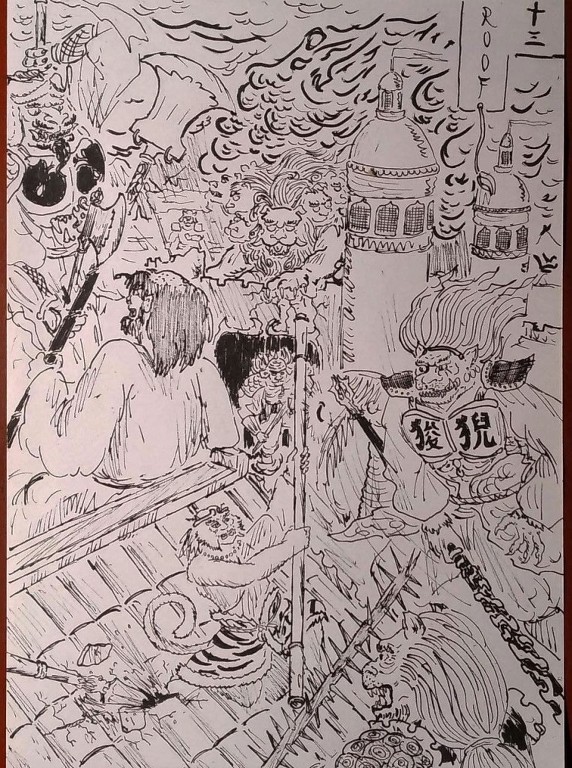
The big battle between Sun Wukong and the Lion Demons working for the Great Sage Nine Spirits (seen in the background, in his giant nine-headed form): this was mostly done because it was one of the rare parts of the book where Sandy actually fights the monsters alongside Sun Wukong (as Pigsy was captured), as well as an attempt to make a big battle scene.

(Larger version)

Sample #6

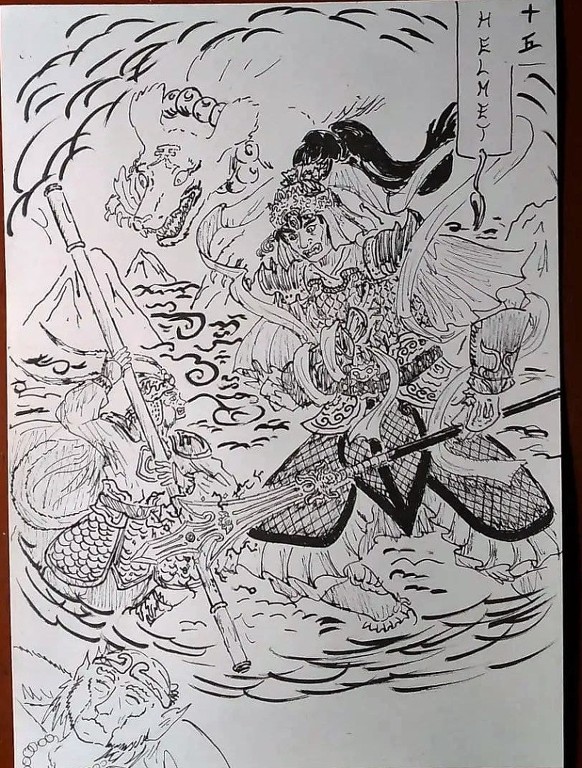
The only god who actually beat Monkey, Erlang Shen. Since the Inktober was focused on the journey itself, I’ve decided to depict their battle as a bad dream. This time, Monkey wears his old, stylish outfit he got from the Dragon Kings, while Erlang is in full battle regalia, including his “Sanjiang Lianrendao” (三尖两刃刀 Three-pointed, Double Edged Glaive) and his Heavenly Roar Dog.

(Larger version)

Sample #7

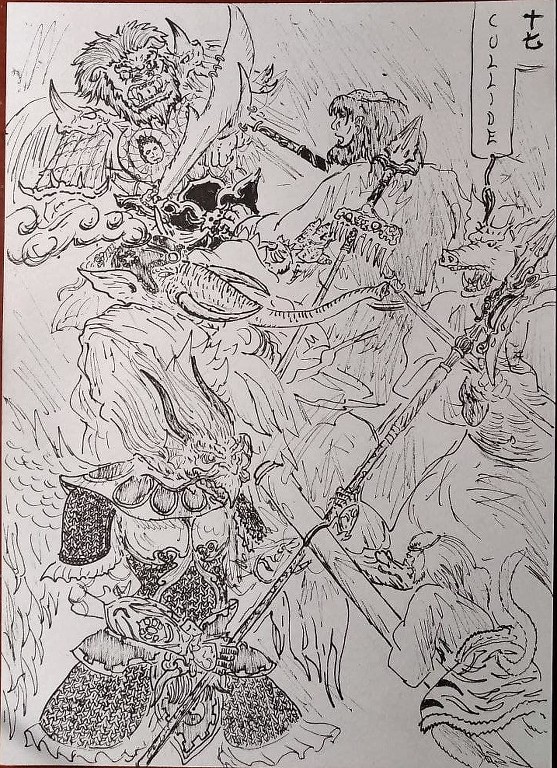
The clash between the three pilgrims and the three Demon Kings of Lion Camel Mountain, from top to bottom: the Blue-Haired Lion vs Sha Wujing, the Yellow-Tusked White Elephant vs Zhu Bajie and the Golden-Wings Peng King vs Sun Wukong. The design of the three kings was based on a series of pictures I loved very much. Once again, a reminder that Wukong’s staff can widen as well.

(Larger version)

Sample #8

Sun Wukong fights the three Rhino Kings, who’re kidnapping Tripitaka. This time I wanted to depict Monkey twirling his staff as he fights. Like with the Demon Kings above, the design of the three Rhinos was based on the same set of pictures, even though I remember that in the novel they’re described as “bull-like” in appearance. Particularly like the dust cloud to the right.

(Larger version)

Sample #9

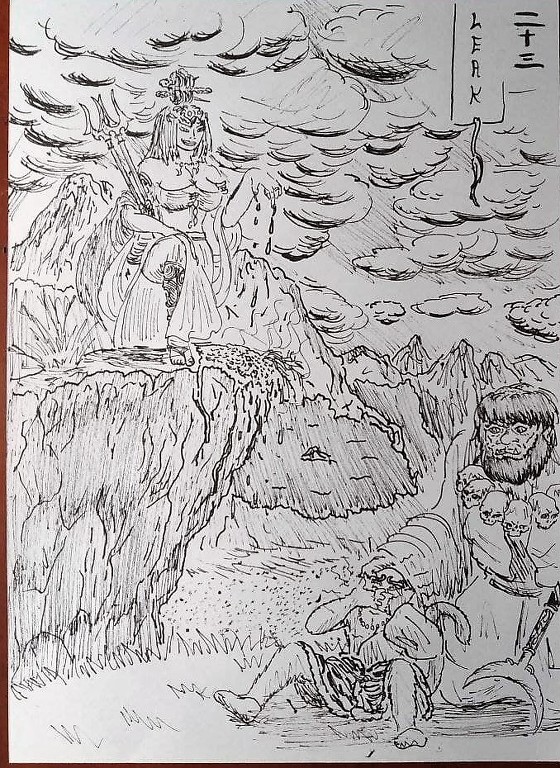
Sun Wukong is poisoned by the Scorpion Spirit. Aside from the scenery, I like the scorpioness. I’ve noticed in several arts (even old ones) that she sports a relatively skimpy outfit. As of her weapon, mentioned to be a “fork/trident” in the book, I’ve seen plenty of depictions with both the single trident version and the smaller, dual trident version.

(Larger version)

Sample #10

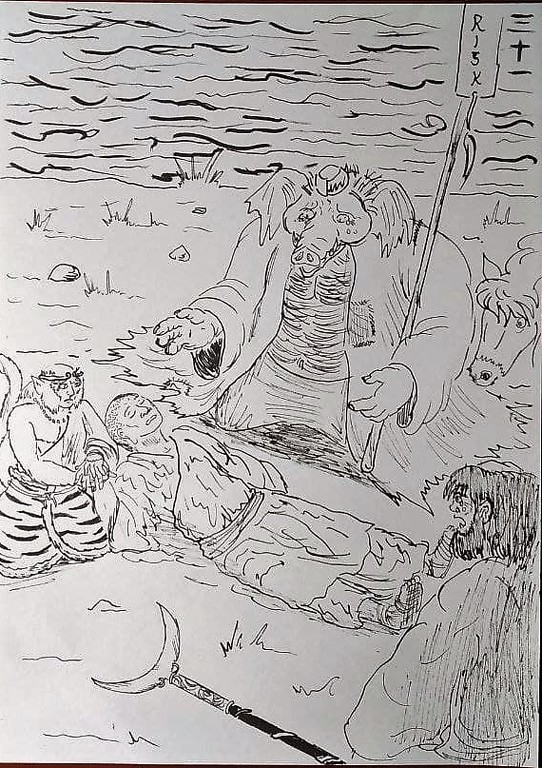
As a bookend, I’ve depicted a scene from the end of the book, the moment where Tripitaka drowns and ascends to buddhahood, so that he can obtain the sutras properly. This is also to represent one of the things I liked the most from the novel, the gradual growth of the pilgrims and the attachment to Tripitaka as a father figure. [Note: Tripitaka sheds his mortal form as he and his disciples are ferried across a body of water to the Buddha’s paradise. See the paragraph above image one and the material between images two and three in this article.]

(Larger version)

The Later Journey to the West: Part 2 – The Journey to India Begins

Note: An AI translation of this novel is now available. Click the linked Chinese characters below that read “後西遊記.”

The main body of Later Journey to the West (Hou Xiyouji, 後西遊記, 17th century) follows a similar trajectory as the parent novel, Journey to the West (Xiyouji西遊記, 1592). The historical monk Dadian (大顛, 732–824) (fig. 1) is tasked with traveling from China to India to retrieve spiritual knowledge from the Buddha, and just like Tripitaka, he is protected by three demonic disciples, namely Sun Luzhen (孫履真), the descendant of Sun Wukong, Zhu Yijie (豬一戒), the son of Zhu Bajie, and Sha Zhihe (沙致和), the disciple of Sha Wujing. Along the way the group travels through many lands, battles numerous evils, and they eventually become enlightened Buddhas like their predecessors two hundred years prior. As noted in part one, Later Journey to the West may appear like a carbon copy of the original, but the similarities are only skin deep since the novel is comprised of extremely dense layers of allegorical meaning.

Below, I present the second of a three-part summary of the novel (part 1 and part 3), which focuses on the journey proper. I rely very heavily on Xiaolian Liu (1994) as the novel has yet to be published in English.

Notes have been added to the sections below to explain the allegorical meaning of various story elements.

Table of Contents

1. The Interpretation Pilgrim is Chosen

After quelling his descendant’s rebellion, Buddha Sun Wukong travels eastward by cloud with Buddha Tripitaka to see how China has benefited from the scriptures delivered by them some two centuries in the past. However, they find that the monks of the Famen temple (Famen si, 法門寺) are not only falsely claiming to have holy relics from Tripitaka’s deceased human body, [1] but also that their leader is his sixth generation disciple and a master of the sutras. This influences Tang Emperor Xianzong (唐憲宗, r. 806-820) to donate heavily to the temple because he believes that the dynasty will prosper once the pagoda containing the supposed relics is opened. The two Buddhas return to the Western Paradise and report their findings to Tathagata, who tells them that the Chinese will continue to misunderstand and misuse the teachings until they receive the “true interpretation” (zhenjie, 真解). The Enlightened One then charges Tripitaka with locating a pilgrim who will make the journey to India to retrieve this interpretation. [2]

In the meantime, the scholar-official Han Yu (韓愈, 768–824) openly criticizes the emperor for his worship of the relics and his spendthrift support of the temple. For this he is exiled from Shaanxi province in the north to Guangdong province in the south, where he meets the Chan Buddhist Master Dadian. [3] Upon hearing of the decadent, misguided state of Buddhism near the capital, Dadian goes north and memorializes the emperor to give up his extravagant patronage of the religion. This show of integrity cements Tripitaka’s decision to choose the monk as his pilgrim. The Buddha then magically seals away the scriptures, forcing the Emperor to send Dadian to India to retrieve the true interpretation.

124782997

Fig. 1 – A woodblock print of the monk Dadian.

2. The Journey to India Begins

The novel has a total of 40 chapters. Liu (1994) only covers certain chapters from this point on since they contain the most allegorical meaning.

Dadian acquires his demonic disciples during the early stage of his journey. First, he recites a magic spell taught to him by Tripitaka which calls Sun Luzhen to his side. Second, he recruits Zhu Yijie on the road after the pig is subdued by Monkey and made to follow the priest west. Third, Dadian accepts Sha Shihe as his last disciple after the water spirit saves him from a monster that had dragged him to the bottom of the Flowing Sands River.

Prior to Sha Shihe joining the group, Monkey, Dadian, and Yijie travel through the sister villages of Ge (葛, “Creepers”) and Teng (籐, “Clinging Vines”), which are both plagued by bottomless pits that appear and swallow untold numbers of people. [A] The elders of these respective villages tell the pilgrims that the source of this calamity is a demon known as King Defect (Quexian wang, 缺陷王), who lives on the Mountain of Imperfection (Buman, 不滿, lit: “Not full”). The monster feeds on the negativity of people whom he curses with poverty, divorce, disease, etc., and those who don’t worship him are swallowed by the ground to be imprisoned forever. Luzhen retrieves a magic golden treasure from heaven that stops the demon from burrowing underground; however, when he flees into a cave, the pilgrims’ path is blocked by seemingly indestructible vines that regrow as soon as they are cut. But Monkey discovers the vines fail to grow if he cuts them while not talking. [B] The group follows suit and they are able to capture and kill the demon, who is revealed to be a badger spirit.

A) These names refer to Geteng (葛籐, Creepers and Clinging Vines), a term used in Buddhist literature to refer to the net of desire that ensnares humans. Liu (1994) notes the Avadanas Scripture (Chuyao jing, 出曜經, late-5th to early-6th cent.) contains two mentions of the term, one of which reads: “Entrapped in the net of desires, common people are bound to undermine the right (orthodoxy) way … like the creepers and vines which twine round a tree and eventually cause its death” (p. 70).

B) The aforementioned creepers and clinging vines also refer to Geteng Chan (葛籐禪, Wordy Chan/Zen), a term often applied “to people who resort to long-winded words or writings, rather than to their intuitive perceptions to grasp the essence of Buddhist principles” (Liu, 1994, p. 71). This love for speaking/writing is believed to hinder the path to enlightenment. This explains why the vines stop growing when Monkey stops talking. The group, in essence, frees themselves from Wordy Chan and relies more on intuition. This puts them one step closer to enlightenment.

After passing the Flowing Sands River and bringing Sha Shihe into their fold, the group travels to the Mountain of Deliverance lorded over by King Deliverance (Jietuo dawang, 解脫大王). He and his demon generals maintain 72 chasms where humans fall prey to their desires (sex, money, alcohol, anger, etc.) and 36 pits where sinners are tortured. [C] During a battle with the demon army, Zhu Yijie resists promises of sex, food, and treasures offered by the generals, but lets his guard down due to flattery and is captured. [D] Dadian is captured by seven demons displaying a range of emotions from joy to hatred. [E] The monk clears his mind and falls into a deep meditative state undisturbed by the outside world. It is only when Monkey comes to his rescue that Tripitaka regains consciousness. [F] In the end, Luzhen manages to kill King Deliverance by crushing him under the weight of a huge boulder that he had transformed into an exact likeness of himself. This causes all of the generals and the chasms and pits to disappear. The author provides an explanatory couplet.

When the heart (mind) is active,
All kinds of demons come into existence;
When the heart (mind) is extinguished,
All kinds of demons disappear (Liu, 1994, p. 77).

心生種種魔生,心滅種種魔滅。

C) The demon king and generals are physical embodiments of desires that keep people from attaining enlightenment.

D) This represents the consequence of temptation, no matter how small.

E) These demons represent the seven emotions of joy, anger, sorrow, fear, love, hate, and desire.

F) Dadian’s capture represents those who erroneously think meditation is simply sitting quietly instead of inner reflection and the examination of truths. His inability to focus his mind is the real reason for his capture. Monkey represents the mind, so his arrival allows the monk to regain consciousness. Therefore, this episode teaches one to focus the mind and thereby not fall prey to desires. This is yet another step closer to enlightenment.

QQ截图20160221185741

Fig. 2 – The immortal Zhenyuanzi as depicted in the famous 1986 television series.

The pilgrims travel to the Temple of Five Villages (Wuzhuang guan, 五莊觀) in the Mountain of Longevity (Wanshou shan, 萬壽山), where they are met by the supreme immortal Zhenyuanzi (鎮元子) (fig. 2), the patriarch of all earthly immortals and a temporary adversary in chapters 24 to 26 of the original. Sensing that Monkey relies too heavily on his physical strength and not his spiritual strength, the immortal only allows Dadian to enter, leaving the others to sit outside for hours. To add further insult to injury, a young immortal page tells Luzhen that his master has decided to forsake the journey in order to study Daoism. This so enrages him that he bursts inside to confront Zhenyuanzi and is challenged to retrieve Dadian from the Mansion of Fiery Clouds (Huoyun lou, 火雲樓) in which the monk is drinking tea. But Monkey’s way is suddenly blocked by a supernatural flame, known as the “fire of the mind” (Xinhuo, 心火), which can’t even be extinguished by Dragon King rain. [G] He finally manages to douse the fire with the sweet dew from Guanyin‘s holy willow sprig and retrieve his master. [H]

G) This fire represents Sun Luzhen and Zhenyuanzi’s anger, which ignites when both enter into an argument. Anger is one of the emotions thought to inhibit enlightenment.

H) This liquid is referred to in Buddhist literature as being able to extinguish everything from desires to negative emotions. For example, Liu (1994) comments: “In a parable in Za baozang jing 雜寶藏經 (Sutra of Miscellaneous Treasures [5th cent.]), the Buddha was said to use the Water of Wisdom to extinguish the Three Fires of Desire, Anger and Delusion” (Liu, 1994, p. 81). Therefore, the dew/water represents wisdom, or the ability to use reason and not become angry. The use of the dew causes Monkey to switch from knee jerk reaction to reason, as exemplified by this statement:

It was my mistake in the first place. I should not have quarreled with him to stir up his fire. Once his fire is stirred up, my fire is stirred up too. I don’t know how long the fire will burn. This surely would cause delay in our master’s proper business (Liu, 1994, p. 80).

初時,原是我差了,不該與他角口,惹他動起火來。他既動了火,我又動起火來,不知燒到幾時?豈不誤了師父正事!

The group comes to an endless, ocean-like river and question how they will ever reach the “other side” (bi’an, 彼岸). [I] They eventually take a derelict boat, but infighting between Dadian and the disciples coincides with a monstrous black storm that erupts overhead, producing powerful winds that blow them thousands of miles off course to the Rakshasa Kingdom (Luocha guo, 羅剎國). This land of monsters is ruled over by the Bull Demon King and Lady Iron Fan (fig. 3), adversaries from chapters 59 to 61 of the original. After learning of the pilgrims’ arrival, Lady Iron Fan sends an army of demon soldiers to capture them so she can exact revenge for perceived misdeeds by their predecessors. [4] Dadian once again enters meditation to avoid evil influences and is quickly rescued by Monkey. Luzhen attempts to save Yijie, who once again falls prey to temptation and is captured, but is stopped by a black whirlwind created by Black Boy (Heihai’er, 黑孩兒), the second son of the demonic couple. [J] Monkey is forced to retrieve a sutra from the Bodhisattva Ksitigarbha in the underworld. Upon reading the sutra, a magic red cloud appears and shines light on the kingdom, destroying all of the demons and leading the monks to freedom. [K]

I) This ocean/river is a common metaphor in Buddhist literature referring to desire, and the “other side” refers to a life free from desire (Paramita), or achieving enlightenment. For example, Huineng (惠能, 638–713), the sixth Chan patriarch, says: “The perverted mind is the great sea and the passions are the waves … if the perverted mind is cast aside the ocean will dry up, and when the passions are gone the waves will subside” (Liu, 1994, p. 81).

J) The black whirlwind represents ignorance, or the Buddhist concept of Wuming (無明, darkness without illumination), and the demon kingdom represents the unenlightened mind that falls prey to its own demons (desire, ignorance, anger, etc.). The metaphors of the black whirlwind and demon kingdom are mentioned in the Collected Essentials of the Five Lamplight Histories (Wudeng huiyuan, 五燈會元, c. 1252), one of several accepted histories of Chan Buddhist orthodoxy in China (Liu, 1994, pp. 84-85).

K) The illuminated red cloud represents sudden enlightenment that sweeps away all ignorance and desire.

01300001248577133770100944901

Fig. 3 – An artist’s depiction of Lady Iron Fan and the Bull Demon King.

Notes:

1) This is false within the novel’s fictional universe because Tripitaka attained living Buddhahood in chapter 100 of the original.

2) Tripitaka serves as Guanyin’s successor in this respect, for it was the Bodhisattva who recruited the “scripture pilgrim” in chapter 12.

3) Liu (1994) notes that this is based on actual history. Han Yu, who was a Confucian scholar and the Vice Minister of the Justice Department, “presented a memorial to the throne, denouncing Buddhism as an alien doctrine and criticizing the emperor for receiving and showing reverence for the ‘decayed and rotten bone’ of the Buddha” (pp. 63-64). So in this case it was a relic belonging to the Buddha and not Tripitaka. Han was actually sentenced to death, but this was later commuted to exile thanks to parties arguing on his behalf.

4) She wishes to exact her revenge because their predecessors, Tripitaka, Sun Wukong, Zhu Bajie, and Sha Wujing, were instrumental in the subjugation and reformation of her first son Red Boy by Guanyin.

Source:

Liu, X. (1994). The Odyssey of the Buddhist Mind: The Allegory of the Later Journey to the West. Lanham, Md: University Press of America.