Yuebei xing, Daughter of the Monkey King

Last updated: 04-27-2024

Ever since I published my article “The Monkey King’s Children” (2021), I’ve noticed that people have fallen in love with Sun Wukong’s monstrous, magic skull-wielding daughter Yuebei xing (月孛星, “Moon Comet Star”) from Journey to the South (Nanyouji, 南遊記, c. 1570s-1580s). For instance, search Tumblr and you will find plenty of art and short stories featuring her. The character does not appear in the original Journey to the West (Xiyouji, 西遊記, 1592) novel, so I’m honestly surprised that she has captured the imagination of so many.

Here, I would like to collect all that I’ve written about her, along with new information, into a single article. This piece discusses her brief character arc, her astrological origins, her appearance in other literature, and her religious iconography.

I. Character arc

In chapter 17 of Journey to the South, Sun Wukong is framed for once again stealing immortal peaches. The Jade Emperor threatens to remand him to the Buddha for punishment but is convinced to give him a month-long reprieve to find the true culprit. Monkey returns to the Mountain of Flowers and Fruit, and it is here, among his people, that the story briefly mentions three children, including sons Jidu (奇都, “Ketu”) and Luohou (羅猴, “Rahu”) and daughter Yuebei xing (月孛星, “Moon Comet Star”).

Sun eventually seeks out Guanyin, who reveals that the troublemaker is the rogue immortal Huaguang (華光). Returning home once more, Monkey’s news prompts his daughter to volunteer to battle the impostor. But her tribe simply pokes fun at her monstrous appearance. Yuebei Xing is said to have a crooked head with huge eyes and a broad mouth, coarse hands, a wide waist, and long legs with thunderous steps.

Sun travels with his daughter to Huaguang’s home of Mt. Lilou (Lilou shan, 離婁山) to provoke battle by chastising him for stealing the immortal peaches. Monkey strikes at him with his magic staff, causing Huaguang to deploy his heavenly treasure, a golden, triangular brick (sanjiao jinzhuan, 三角金磚). But Sun responds by creating untold monkey clones that not only confiscate the weapon but also overwhelm the immortal. Huaguang is seemingly defeated at this point; however, he manages to deploy one last treasure, the Fire Elixir (Huodan, 火丹). This weapon engulfs the Great Sage in heavenly flame (akin to the Red Boy episode), causing him to flee to the Eastern Sea. Yuebei xing then calls Huaguang’s name while holding her own magic treasure, a skull (kulou tou, 骷髏頭). The immortal is immediately stricken with a headache and stumbles back to his cave in a daze. Her weapon is said to be quite dangerous; anyone whose name is called will die within three days.

Huanguang’s religious teacher, the Flame King Buddha of Light (Huoyan wang guangfo, 火炎王光佛), then intervenes in order to sooth the situation between his disciple and the Great Sage. He promises to bring the rogue immortal to justice on the condition that Yuebei Xing withdraws her deadly magic. In the end, all parties are pardoned by the Jade Emperor, and Huaguang and Monkey become bond brothers (Yu, n.d.).

II. Astrological origins

The Monkey King’s daughter is based on Yuebei xing, a shadowy planetary deity representing the lunar apogee, or the furthest point in the moon’s orbit. They are counted among the “Eleven Luminaries” (Shiyi yao, 十一曜) of East Asian astrology (fig. 1). These include the “Nine Planets” (Sk: Navagraha; Ch: Jiuyao, 九曜, “Nine Luminaries”) of Hindu astrology, namely the Sun, Moon, Mars, Mercury, Jupiter, Venus, Saturn, and Rahu and Ketu (Gansten, 2009), as well as Yuebei and another shadowy planet called Ziqi (紫氣/紫炁; “Purple Mist”) (Kotyk, 2017, p. 60). The latter two are mentioned in Daoist writings as early as the late-9th-century (Kotyk, 2017, pp. 61-62).

Fig. 1 – A Chinese depiction of the Eleven Luminaries from the Ink Treasure of Wu Daozi (Daozi mobao, 道子墨寶, c. 13th-century) (larger version). Yuebei xing is located first from the left on the top row. Image found here.

The late-Yuan to early-Ming scripture Secret Practice of the Primordial Lord Yuebei (Yuanhuang Yuebei mifa, 元皇月孛祕法; Secret Practice hereafter) describes them having two forms, one human and the other monstrous:

姓朱, 諱光, 天人相, 披髮裸體, 黑雲掩臍, 紅履鞋, 左手提旱魃頭, 右手杖劍, 騎玉龍, 變相青面獠牙, 緋衣, 杖劍, 駕熊。

Surnamed Zhu [Vermillion] with the honorific title of Guang [Luminous]. In the form of a celestial human, their hair is let down over their naked body. Their mass of black hair covers the navel. Red sandals. Their left hand holds the head of a drought demon. Their right hand holds a blade. They ride a jade dragon. In their modified form, [they display] a blue face with long fangs, a crimson garment and blade, while driving a bear (Kotyk, 2017, p. 62).

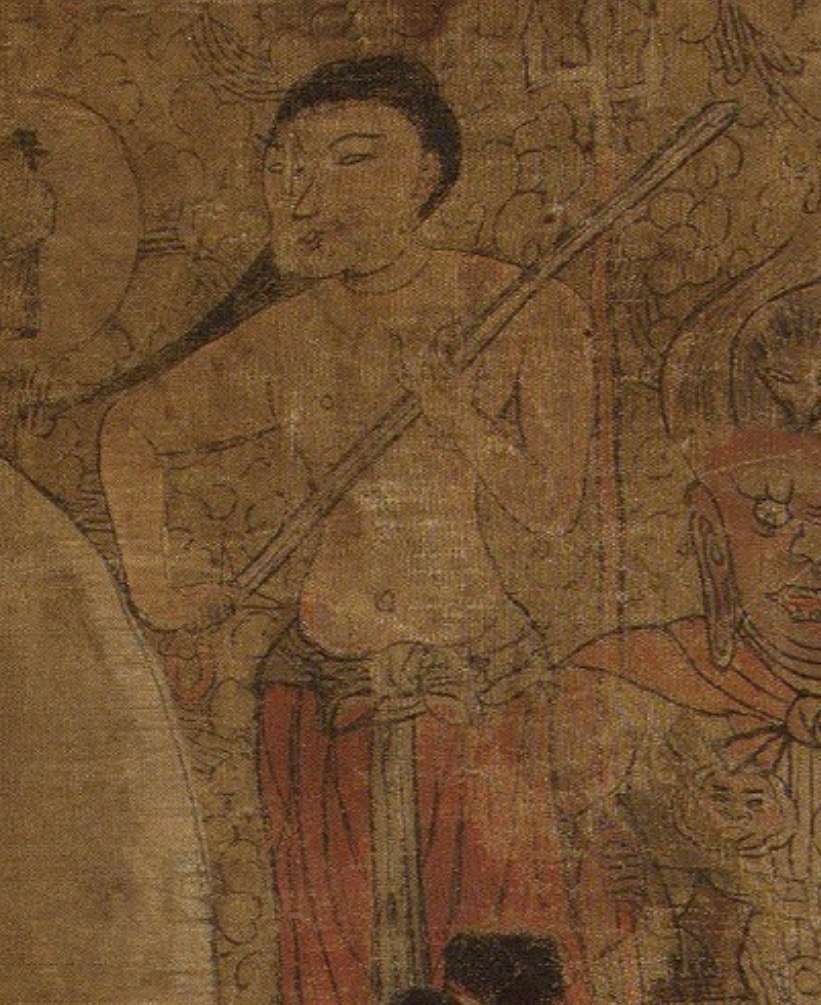
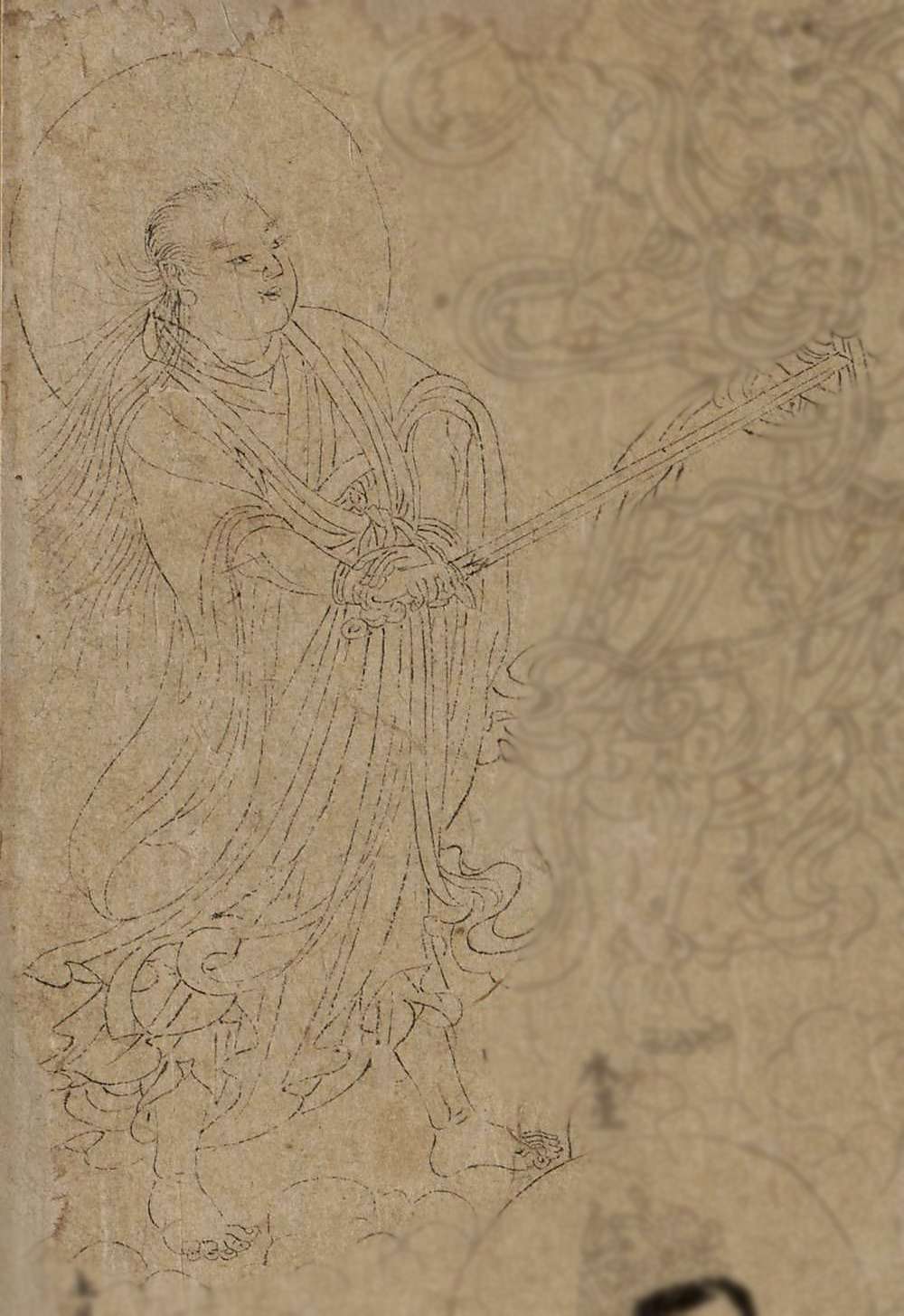
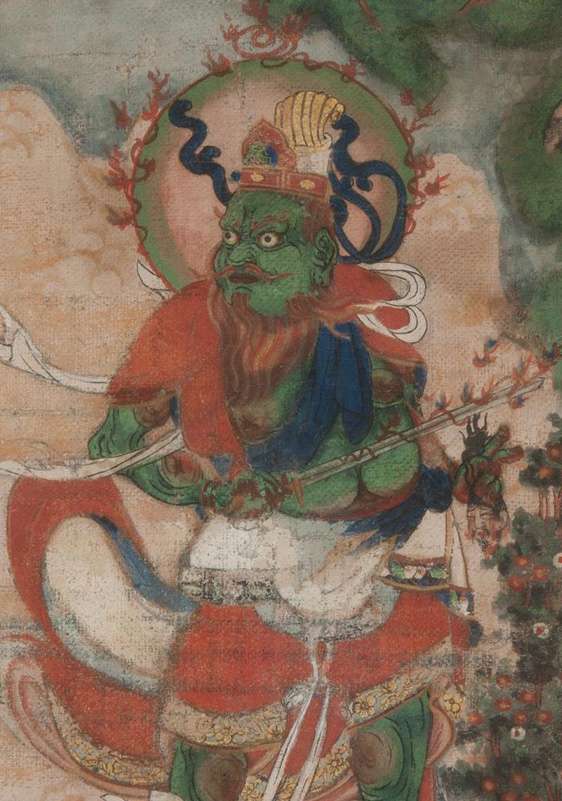
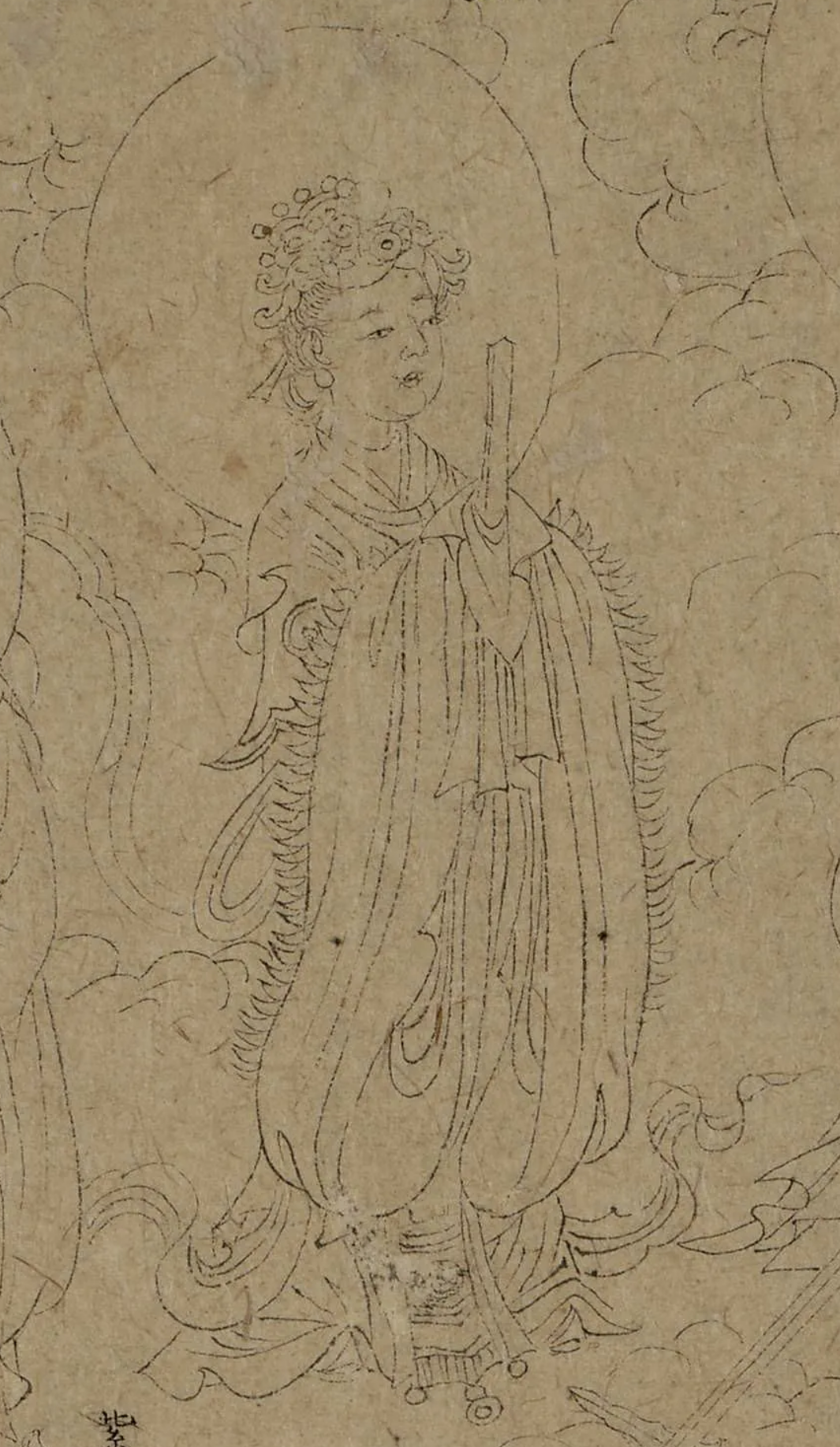
Both versions are known from late-Xixia dynasty (1038-1227) art. The first figure takes the form of a lightly clad or even topless woman with long, sometimes unkempt hair and red garments. One painting shows her with a bloody head in her right hand and a sword hanging from her hip (fig. 2). (Though, I should point out that she isn’t always depicted with the head in Xixia or Chinese art (fig. 3 & 4).) The second figure is much rarer and takes the form of a yaksha-like guardian with green skin, a fiery red beard and hair, and red garments. He wields a flaming sword in his right hand and a bloody head in the other (fig. 5). Thank you to Dr. Jeffrey Kotyk for bringing these to my attention.

Fig. 2 – Yuebei as a woman (larger version). Take note of the severed head in her right hand and the sword at her waist. Detail from a 13th to 14th-century Xixia painting in the Hermitage Museum. Fig. 3 – A topless Yuebei wielding only a sword (larger version). Detail from a 13th to 14th-century Xixia painting in the Hermitage Museum. Fig. 4 – Detail of Yuebei from the Chinese Ink Treasure of Wu Daozi (c. 13th-century) (larger version). She too is holding only a sword. Take note of her lunar halo. Fig. 5 – Yuebei as a man (larger version). He clutches a small head in his left hand. Detail from a 13th-century Xixia painting in the Hermitage Museum.

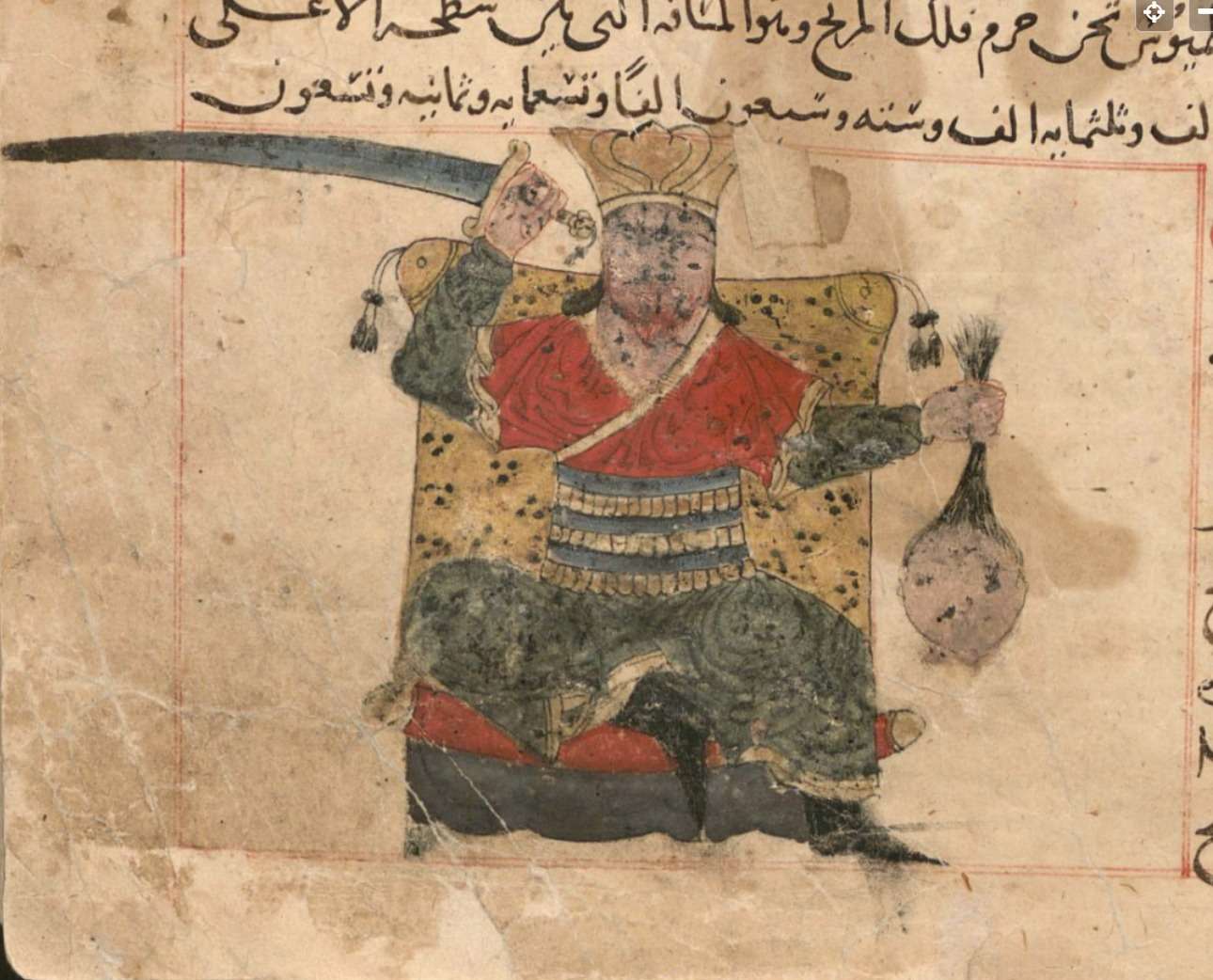
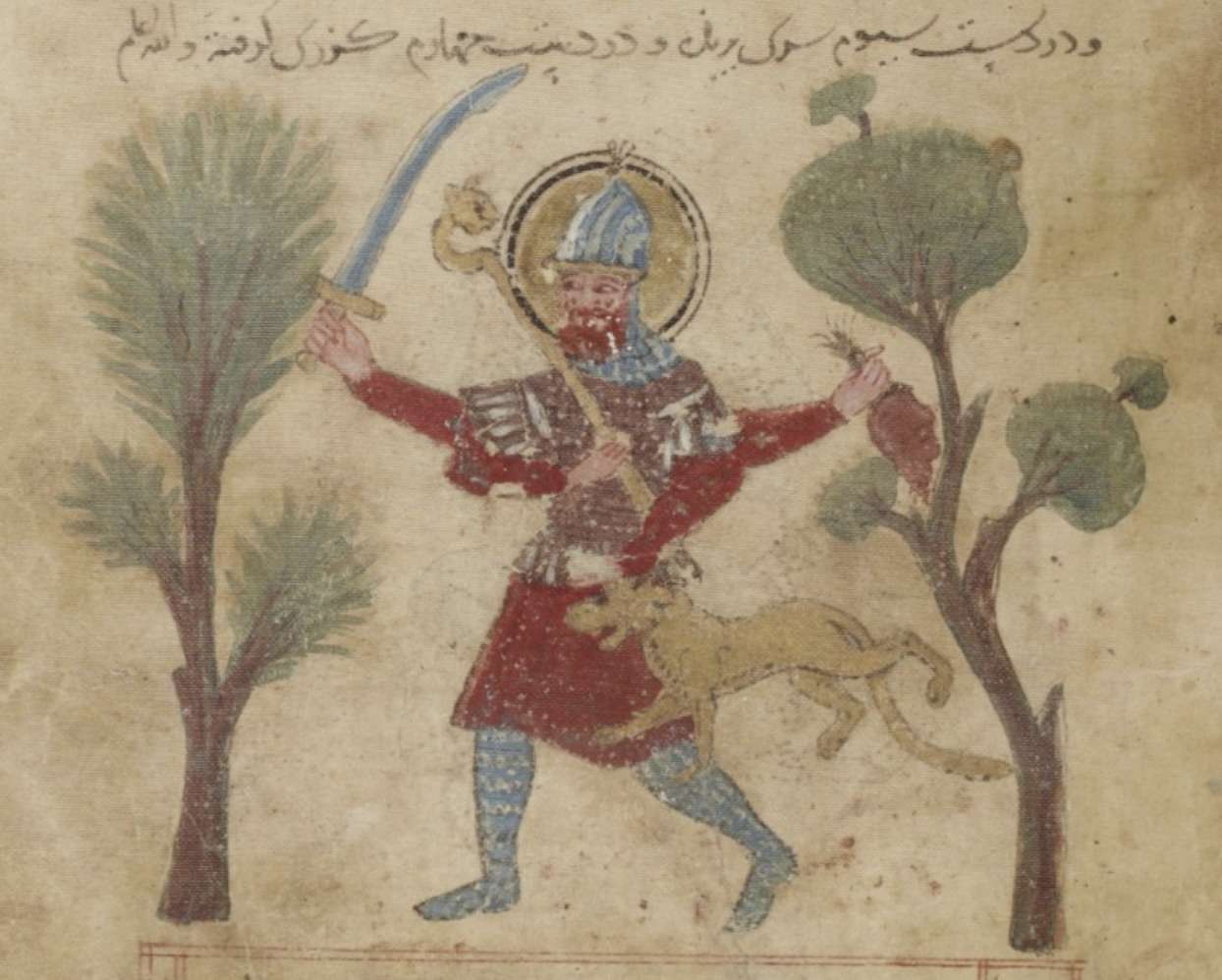
What’s interesting about the yaksha-male Yuebei is that his iconography is strikingly similar to Arabo-Persian depictions of al-Mirrīkh (Mars), who is also known for wielding a sword and head. Dr. Kotyk has directed me to several examples (fig. 6-8). Carboni (Carboni & MET, 1997) suggests that the war god’s imagery is connected to another deity:

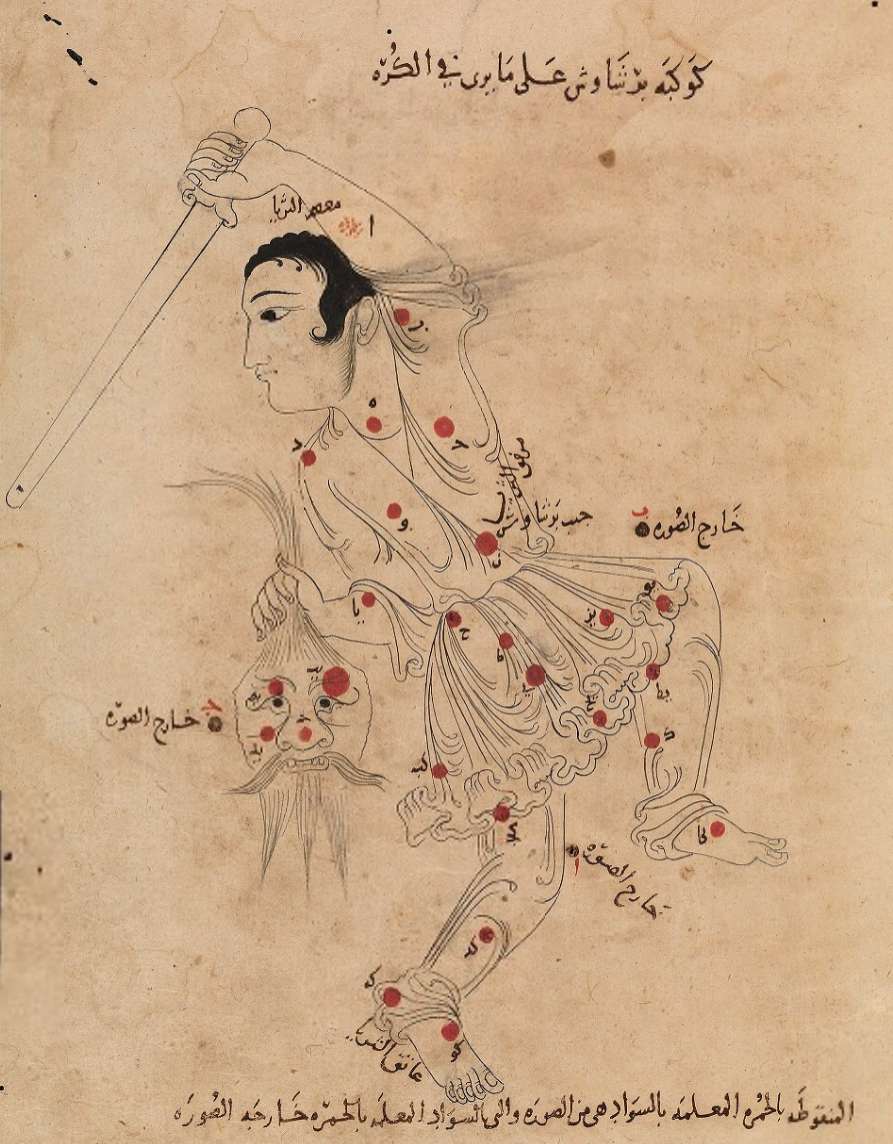
The bold iconography of the severed head underscores the warlike character of the planet but it probably is also related to the astronomical image of the constellation of Perseus, called in Arabic ḥāmil ra’s al-ghūl (“the Bearer of the Demon’s Head”), which represents a transformation of the Greek iconography of the severed head of Medusa [fig. 9] (p. 17).

The literary Yuebei’s use of a deadly skull is fitting considering its possible link to the beheaded Gorgon. [1] Remember that the Secret Practice describes Yuebei’s symbol as that of a “drought demon’s head” (batou, 魃頭), and Arabic sources call Perseus’ symbol the “demon’s head” (ra’s al-ghūl). This shows that both cultures considered the head some kind of supernatural monster.

Fig. 6 – Detail of al-Mirrīkh (Mars) on a late-12th to early-13th century bowl from Central or Northern Iran (larger version). From the Met Museum website. Fig. 7 – Detail from The Wonders of Creation (‘Aja’ib al-Makhluqat wa Ghara’ib al-Mawjudat, 13th-century) (larger version). Found on the Library of Congress website. Fig. 8 – Detail from the Degrees of Truths (Daqa’iq al-haqa’iq, 1272) (larger version). Found on the Bibliothèque nationale de France website. Fig. 9 – The Perseus constellation from the early-11th-century Book of Pictures of the (fixed) Stars (Kitāb Ṣuwar al-kawākib (al-thābitah) (larger version). Found on the Bodleian Library website.

Dr. Kotyk tells me that East Asian depictions of Mars do not show him holding a head. But given the similar iconography of the Arabo-Persian deity and the yaksha-male Yuebei xing, there could be a South Asian intermediary. Bhattacharyya (1958) describes the Indian Buddhist iconography of Maṅgala (Mars) in similar terms: “[He] rides on a Goat. He is red in colour. In the right hand he holds the Kaṭṭāra (cutter) and in the left a severed human head in the act of devouring” (p. 368). But I don’t know how established this description is considering that a cursory search doesn’t turn up any ancient depictions of the Hindo-Buddhist deity holding a head (I’ll update the article if new evidence arises). Another possibility is that the similarities are evidence of cultural exchange between Muslim and Xixia (Tangut) astrologers. Either way, I should point out that the paintings of the yaksha-male Yuebei xing and al-Mirrīkh come from the same time period, the 13th-century. 

Recall that Xixia dynasty art (refer back to fig. 2) and the Secret Practice associate the human-female Yuebei xing with the head and sword, showing that it’s not the purview of the yaksha-male figure. It’s interesting to note that both the female figure and Mars are associated with the color red. Kotyk (2017) explains that there is a likely connection between Yuebei xing and the Irano-Semitic ĀlLīlīṯ (a.k.a. Lilith), who is also described as a demoness with a red, naked body and long, unkempt hair (pp. 63-64).

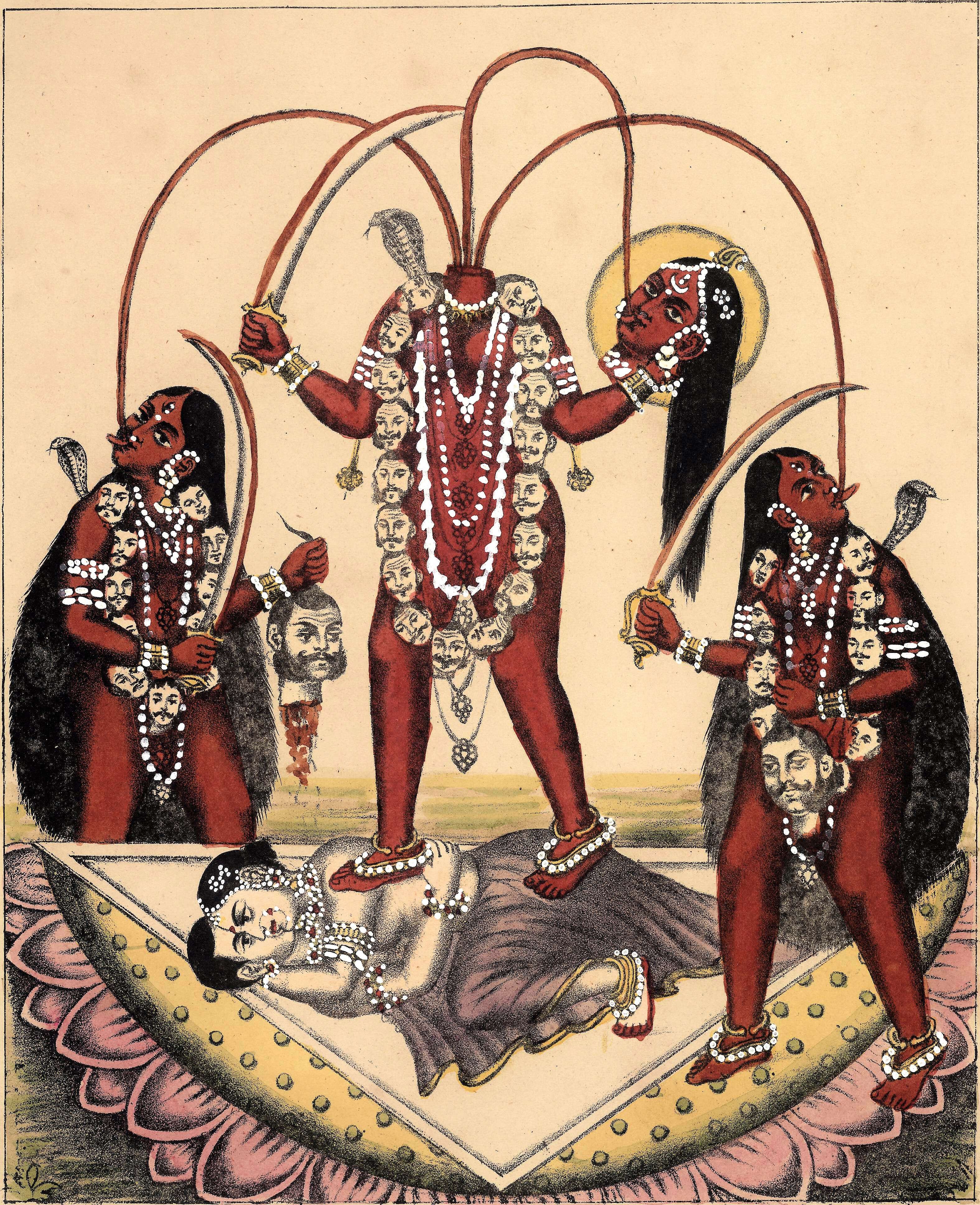
While I’m unsure if there is a connection, Yuebei’s imagery brings to mind the Hindo-Buddhist goddess ChinnamastāChinnamunda (Vajrayoginī). She is commonly shown as a naked, red-bodied figure holding a bloody head in one hand and a sword in the other (Kinsley, 1997, p. 144). In this case, the severed head is her own. Her sister attendants are also sometimes shown holding a head and sword (fig. 10).

Fig. 10 – A 19th-century lithograph of Chinnamastā (larger version). Image found on Wikipedia.

Beyond art, I learned that the respective astrological paths of Yuebei xing and Mars can cross in East Asian astrology. According to Wan Minying (萬民英), author of the Great Compendium of Astral Studies (Xingxue dacheng, 星學大成, 1563):

If Yuebei and Mars are conjunct in the same sign, [the native’s] heart will enjoy virtue, but they will be unable to actually act. They will also have many noxious sores, and pus and blood 孛火同宮心好善而實不能行亦多癰疽膿血. [2] 

III. Appearance in other literature

Apart from Journey to the South, Yuebei briefly appears in an earlier Ming-era fiction titled Drama of Yang Jiajiang (Yang Jiajiang yanyi, 楊家將演義, 16th-century). Kotyk (2017) explains that she is depicted as a red-skinned figure “holding in her hand a skeleton (手執骷髏骨)” (p. 63). I should note that the kulou (骷髏) in kulou gu (骷髏骨) can also mean “skull”, which aligns with her iconography. 

Recall that the Irano-Semitic demoness Lilith and the Hindo-Buddhist goddess Chinnamastā-Chinnamunda are described or depicted as having red skin. This might explain Yuebei xing’s vermillion body in the novel.

IV. Religious iconography

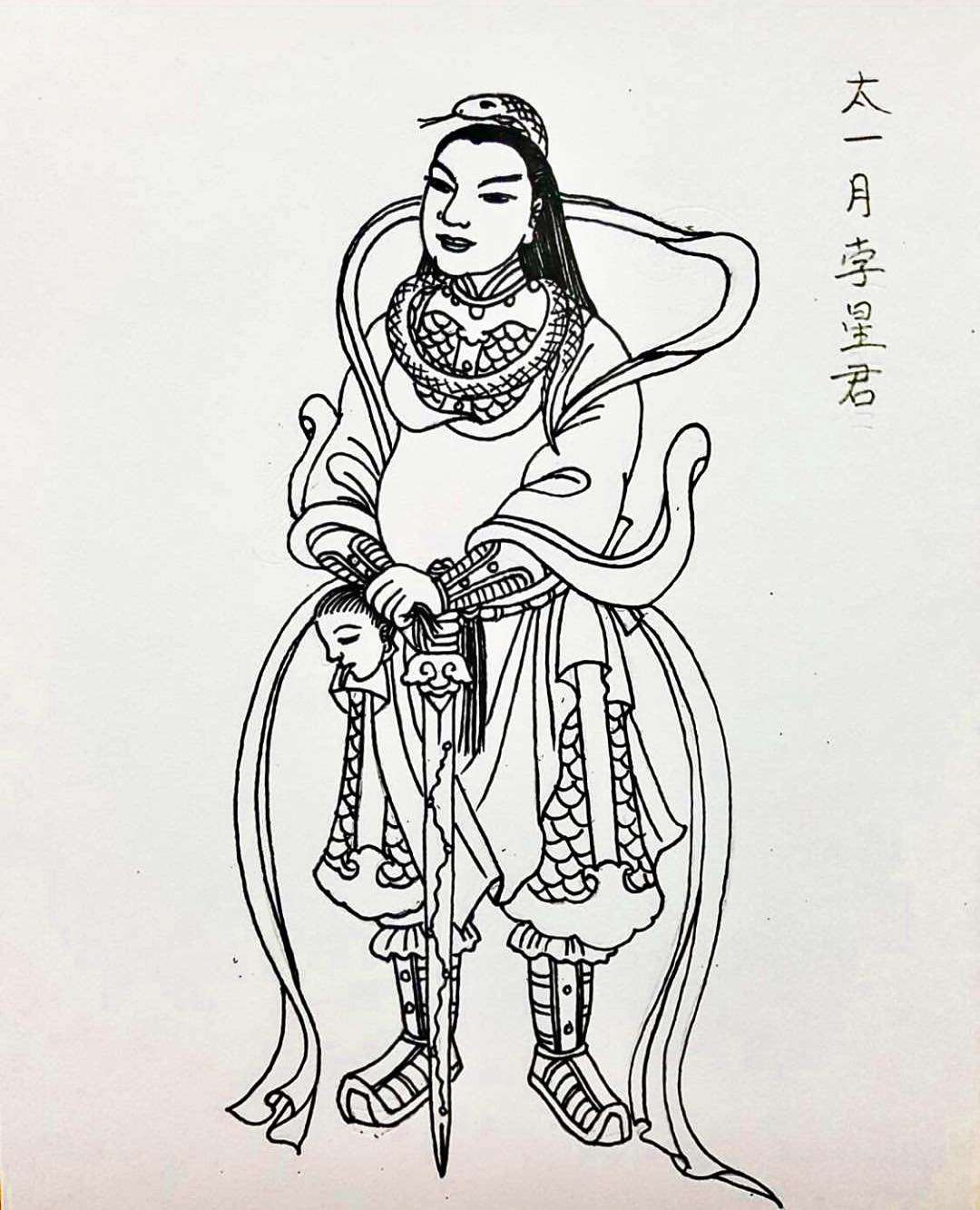
I know nothing of the actual worship of Yuebei xing, but Ronni Pinsler of the BOXS project was kind enough to show me a pattern sheet of her from an idol-maker’s shop in 1970s Singapore (fig. 11). She wears flowing robes just like her ancient Chinese depictions (refer back to fig. 4), but the signature sword and head are not included. They are instead replaced by a fly-whisk and a placard marked “moon” (yue, 月), which compliments the lunar halo behind her head. Additionally, she is labeled the “Vermillion (Comet) Inspiring Goddess, Heavenly Lord of the Moon Comet” (Zhuli[bei?] fu niang Yuebei tianjun, 朱李[孛?]孚娘 月孛天君). This is similar to the way it’s listed among the 36 celestial generals of the Journey to the North (Beiyou ji, 北遊記, 1602), the “Vermillion Comet Goddess, Heavenly Lord of the Moon Comet” (Zhubei wei Yuebei tianjun, 朱孛娘為月孛天君). I also found a more recent religious drawing that appears to mix the feminine and masculine iconography to depict her as an armored general named “Stellar Lord of the Great Monad Moon Comet” (Taiyi Yuebei xingjun (太一月孛星君) (fig. 12). Both the head and sword are present.

Fig. 11 – The vintage Yuebei pattern sheet from a Singaporean idol shop (larger version). Original photograph by Keith Stevens. Fig. 12 – The Yuebei general image (larger version). It was posted by an Indonesian Daoist priest of the Quanzhen school on Facebook.

IV. Conclusion

Yuebei xing (月孛星, “Moon Comet Star”) briefly appears in chapter 17 of Journey to the South (Nanyouji, 南遊記, c. 1570s-1580s) as the Monkey King’s monstrous daughter who uses a magic skull weapon to curse a rogue immortal. The demoness is based on a shadowy planetary deity from East Asian astrology that represents the lunar apogee. Xixia dynasty art and the Yuan-Ming Secret Practice scripture depict this deity having two forms, a lightly clad or even topless human-female with red clothing and long, disheveled hair, or a green-skinned, red-bearded yaksha-male. Both of these forms are sometimes depicted wielding a sword and a disembodied head.

The yaksha-male Yuebei xing surprisingly shares iconography with Arabo-Persian depictions of al-Mirrīkh (Mars), who is also represented as a bearded figure wielding a sword and head. Carboni (Carboni & MET, 1997) suggests that the Middle Eastern iconography is related to the constellation of Perseus (a.k.a. “Bearer of the Demon’s Head”) in which he holds the head of Medusa. This is interesting as the head held by the human-female figure is called a “drought demon” in the Secret Practice. This suggests a possible connection between the literary Yuebei xing’s skull and the deadly Gorgon.

Kotyk (2017) notes a possible connection between the human-female Yuebei xing and the Irano-Semitic Lilith. The latter too is described as having a red, naked body and unkempt hair. This same iconography is shared by the Hindo-Buddhist goddess Chinnamastā-Chinnamunda, who is also depicted bearing a sword and (her own) head. This may then explain why Yuebei xing is described as having red skin in the Drama of Yang Jiajiang (16th-century), which predates Journey to the South.

Yuebei xing is worshiped in modern Chinese folk religion. Religious art depicts them as either a robed figure or an armored general. In both cases, the deity is a woman, but only the martial aspect is shown with the head and sword.


Update: 01-11-2023

Bunce (1994) describes Maṅgala (Mars) just like Bhattacharyya (1958) (refer back to the material below figure 9):

Face: one, angry; arms/hands: two, right hand holds ritual chopper (karttrika, grig-gug), left hand holds severed human head (emphasis added); legs: two; color: red; vahana: goat (p. 328).

But I still haven’t been able to find any ancient drawings of the planetary deity like this.

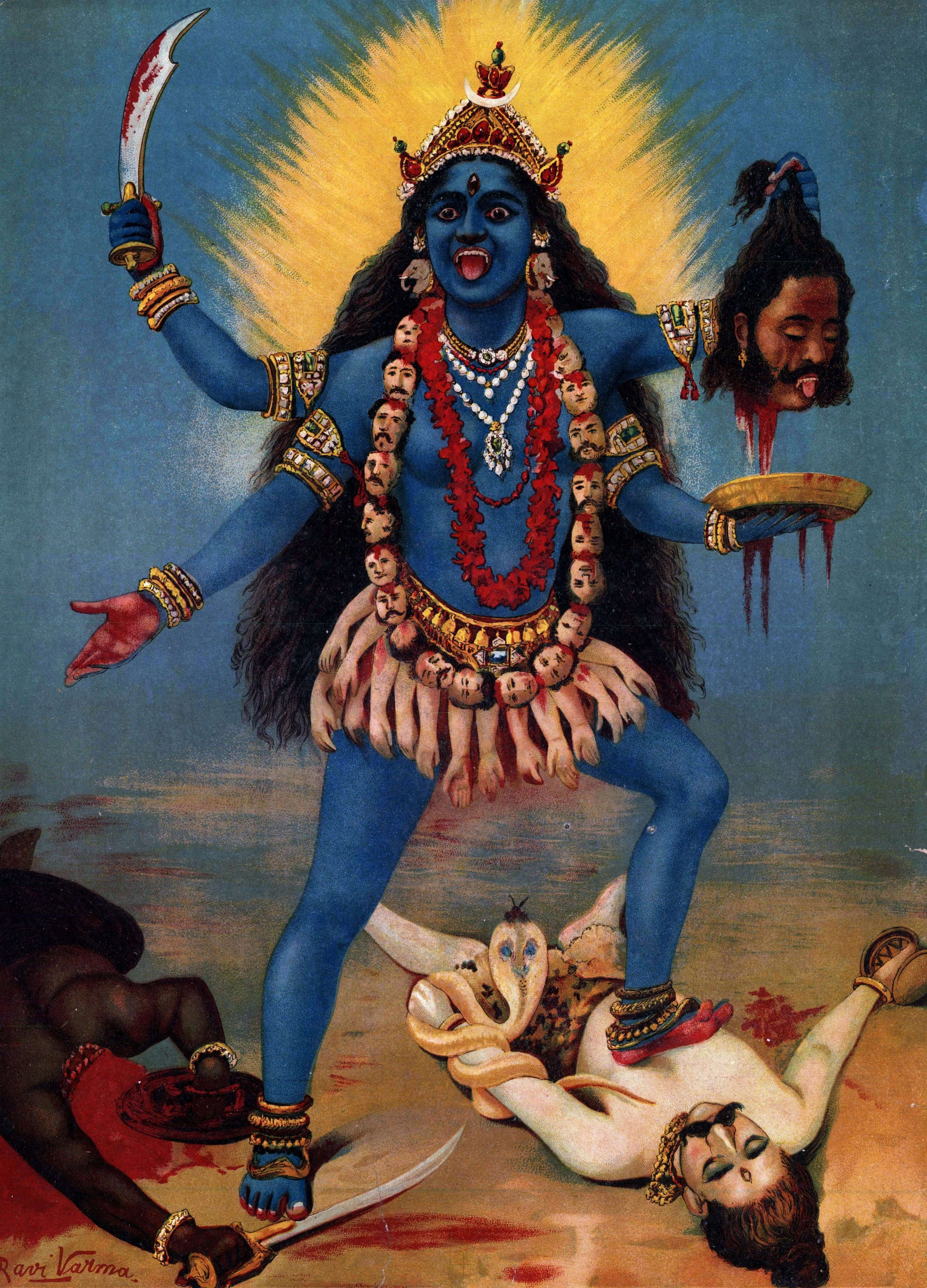
The iconography of the Hindu goddess Kālī also includes a sword and severed head (fig. 13). I didn’t mention her in the original article because she is traditionally depicted with dark skin, but she likely influenced the red-skinned Chinnamastā-Chinnamunda. It’s important to note that her mythos also associates the head with demons (asuras). For example, the Devī-Māhātmyam (c. 400-600 CE) reads:

Mounting her great lion, the Goddess ran at Caṇḍa, / And having seized him by the hair, she cut off his head with her sword. / On seeing Caṇḍa slain, Muṇḍa rushed at her. / She caused him to fall to the ground, wrathfully smitten with her sword. / On seeing Caṇḍa slain, and also the valorous Muṇḍa, / What was left of the assaulted army was overcome with fear and fled in all directions. / Picking up the heads of Caṇḍa and Muṇḍa, Kali / Approached C’aṇḍikā [Durgā] and spoke words mixed with loud and cruel laughter: / “Here, as a present from me to you, are Caṇḍa and Muṇḍa, two beasts / slain in the sacrifice of battle…” (Coburn, 1991, p. 62).

This adds to our list of sword-wielding, demon head-holding deities: 1) Perseus-Medusa; 2) Yuebei xing-Drought Demon; and 3) Kali-Asura.

Fig. 13 – An early-20th-century painting of Kali by Raja Ravi Varma (larger version). Image found here.


Update: 01-16-23

I thought of a way for artists and fan fiction writers to mix Yuebei xing’s skull with Medusa’s head. But first recall that section 1 reads:

Yuebei xing then calls Huaguang’s name while holding her own magic treasure, a skull. The immortal is immediately stricken with a headache and stumbles back to his cave in a daze. Her weapon is said to be quite dangerous; anyone whose name is called will die within three days.

Perhaps the skull’s gaze can turn any living thing into stone, but this lithic death happens over the aforementioned three days. After the target’s name is called, the skull’s glowing eyes open wider and wider upon the dawn of each successive day, causing compounding confusion and pain. The final dawn sees the eyes open wide (fig. 14), making the unfortunate soul (no matter their location) turn to stone.

Refer back to note #1 for a possible defense.

Fig. 14 – The skull would look something like this on the third and final dawn (minus the bullet hole) (larger version). Image found here.


Update: 01-17-23

“Who is the mother of Sun Wukong’s children in Journey to the South?” This is a question I’ve been asked a few times on Tumblr. The novel never answers this, but one can make an educated guess for the purposes of fan fiction.

Each child is based on one of three lunar deities appearing among the “Eleven Luminaries” (Shiyi yao, 十一曜) (mentioned above). The specific gods are:

  1. Jidu (奇都, “Ketu”) = Represents the southern (descending) lunar node, or the point where the moon crosses the earth’s orbit around the sun. Associated with eclipses.
  2. Luohou (羅睺, “Rahu”) = Represents the northern (ascending) lunar node. Also associated with eclipses.
  3. Yuebei Xing (月孛星, “Moon Comet Star”) = Represents the lunar apogee, or the furthest point in the moon’s orbit.

Given their close connection to the night time celestial body, it would make sense for the mother to be Taiyin xing (太陰星, “Star of Supreme Yin”), goddess of the moon from the Eleven Luminaries.

Taiyin xing is commonly equated with Chang’e, goddess of the moon in Chinese mythology. However, Journey to the West chapter 95 depicts her as a separate deity and the leader of an unknown number of Chang’e moon goddesses (cf. Wu & Yu, 2012, vol. 4, p. 302).

Fig. 15 – A detail of Taiyin xing from the Ink Treasure of Wu Daozi (Daozi mobao, 道子墨寶, c. 13th-century) (larger version). See figure 1 for the complete image. She is the fourth person from the left on the top row.

Update: 01-18-23

I’ve decided to make this the only article on my blog where Yuebei xing information can be found. Therefore, I have removed all of it from “The Monkey King’s Children.” This means I have to also transfer some previous updates.

Posted: 02-13-22

I’ve recently started watching the Lego Monkie Kid series, which follows the adventures of Sun Wukong’s human disciple, MK, in a very toyetic, Lego-inspired world. This is why @TustiLoliPop‘s lovely drawing of Yuebei xing (fig. 16) really stood out to me. They were kind enough to give me permission to post it here. It’s based on the Xixia dynasty painting from figure 2.

Fig. 16 – The Lego Monkie Kid-style Yuebei xing by @TustiLoliPop (larger version). Used with permission.

Posted: 07-13-22

Tumblr user @sketching-shark has drawn some great pictures of Monkey and his children. Here is one of them (fig. 17). I love the alternating black and white color scheme of Rahu and Ketu, as well as Yuebei xing’s size.

Fig. 17 – Monkey’s family by @sketching-shark (larger version). Used with permission.


Update: 07-23-23

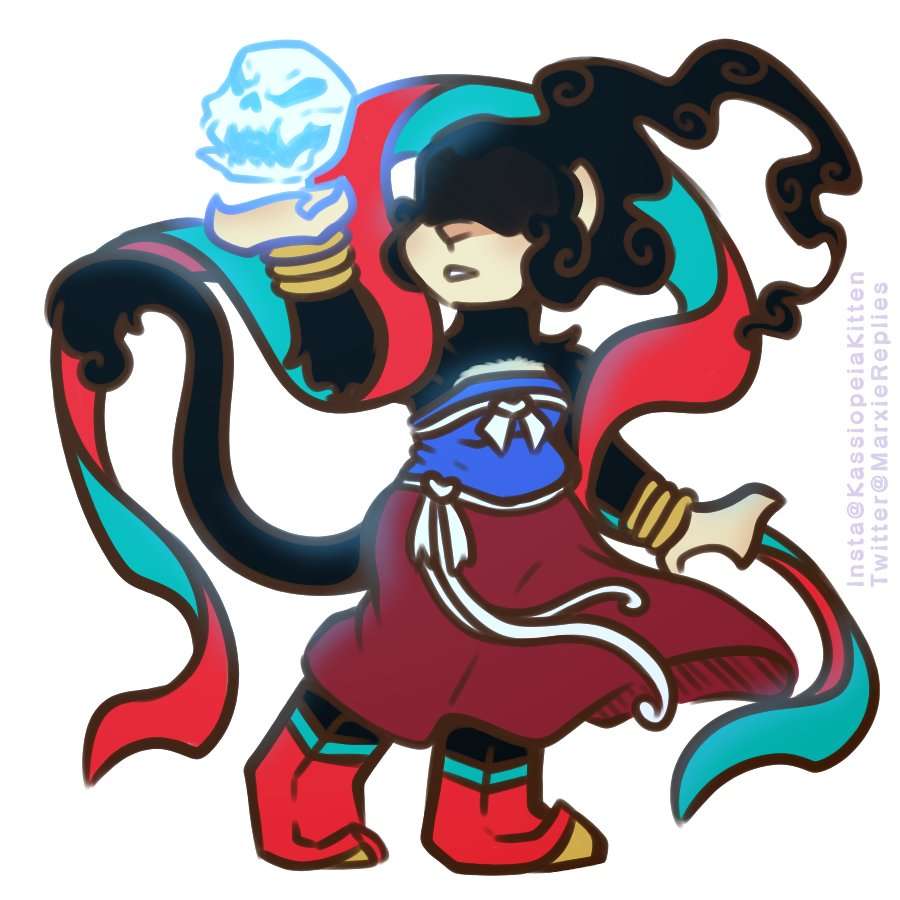
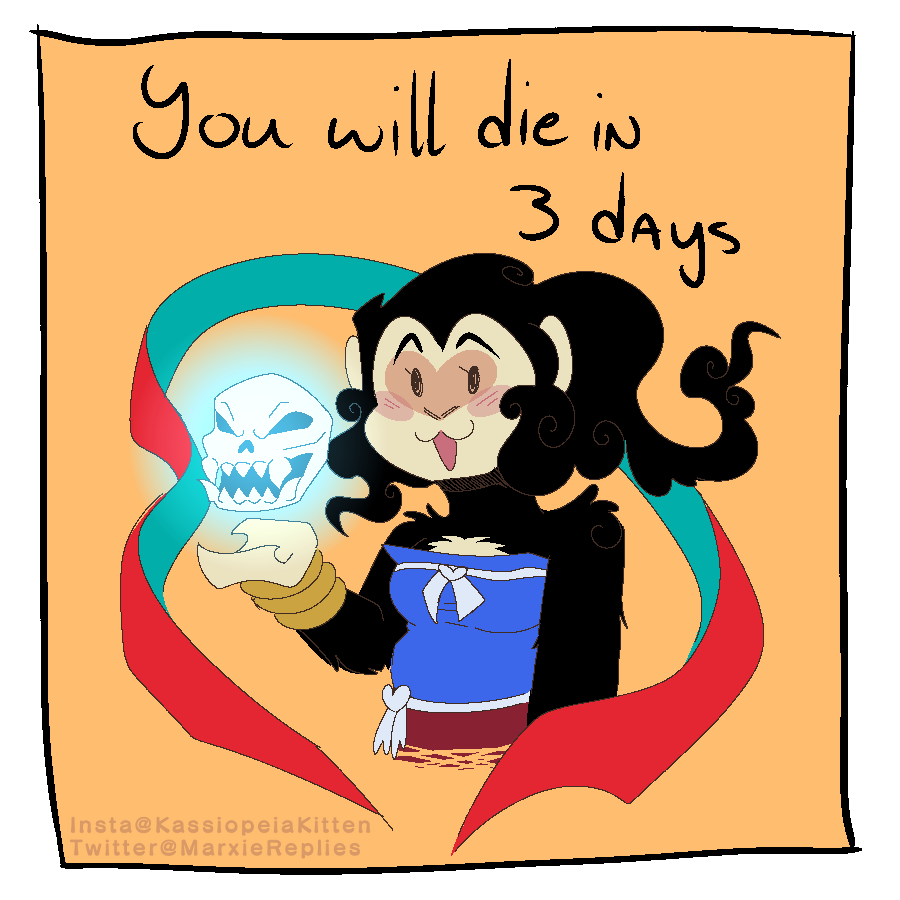
Tumblr user @MarxieReplies has drawn two Lego Monkie Kid-inspired pictures of Yuebei xing (fig. 18 & 19). Her clothing is based on the Xixia dynasty paintings of the lunar goddess (refer back to figure 2). I love the glowing skull and the flow of her ponytail and divine sashes.

Fig. 18 – A full body drawing of Yuebei (larger version). Fig. 19 – A head and torso drawing (larger version). Used with permission.


Update: 01-06-24

I just learned that a “Sun Yuebei” (孫月孛), daughter of the Monkey King, appears in the Japanese video game Touhou Monjusen ~ Bubbling Imaginary Treasures (東方門殊銭 ~ Bubbling Imaginary Treasures, 2021). She looks like a young, pink-haired human girl wearing red, feminine clothing with a bright green bow and light, red armor. And like her old man, she wears the golden headband and tiger skin and wields the iron staff along with her magic skull (video 1).

Video 1 – Sun Yuebei appears at min 3:34. I am 100% positive that the programmers hate people with epilepsy.

On a related note, Journey to the South fans wanting to write fanfiction about our monkey demoness can call her Sun Yuebei, [3] but as mentioned above, the original astrological goddess is surnamed Zhu (朱, “vermillion,” i.e. a shade of red). If anyone wants to create a version of Monkey’s daughter that is more in line with her religious counterpart, then she should be called “Zhu Yuebei” (朱月孛). I’m sure someone can think of a reason for why she wouldn’t take her father’s surname.


Given the connection of Sun Wukong’s children to the moon, it’s interesting to note that he displays an intimate knowledge of the Earth’s satellite as both an astrological body and alchemical symbol. He explains in chapter 36:

When the moon reaches the thirtieth day, the metal [phase] in its yang spirit is completely dissolved, whereas the water [phase] of its yin soul is filled to the brim of the orb. This is the reason for the designation of that day with the term Obscure [Hui, 晦], for the moon is completely dark and without light. It is at this moment also that the moon copulates with the sun, and during the time of the thirtieth day and the first day of the month, it will become pregnant by the light of the sun. By the third day, one [stroke] of the yang will appear, and two [strokes] of the yang will be born by the eighth day. At this time, the moon will have half of its yang spirit in the middle of its yin soul, and its lower half is flat like a rope. That is the reason why the time of the month is called the Upper Bow [Shangxian, 上弦]. By the fifteenth day, all three [strokes] of the yang will be ready, and perfect union will be achieved. That is why this time of the month is called To Face [Wang, 望]. On the sixteenth day, one [stroke] of the yin will be born, and the second stroke will make its appearance on the twenty-second day. At that time half of the yin soul will be in the middle of the yang spirit, and its upper half is flat like a rope. That is the reason why this time of the month is called the Lower Bow [Xiaxian, 下弦]. By the thirtieth day; all three [strokes] of the yin will be ready, and the moon has then reached the state of obscurity once more. All this is the symbol of the process of cultivation practiced by nature (Wu & Yu, 2012, vol. 2, pp. 159-160).

月至三十日,陽魂之金散盡,陰魄之水盈輪,故純黑而無光,乃曰『晦』。此時與日相交,在晦朔兩日之間,感陽光而有孕。至初三日一陽現,初八日二陽生,魄中魂半,其平如繩,故曰『上弦』。至今十五日,三陽備足,是以團圓,故曰『望』。至十六日一陰生,二十二日二陰生,此時魂中魄半,其平如繩,故曰『下弦』。至三十日三陰備足,亦當『晦』。此乃先天採煉之意。

Note:

1) I’ve already suggested that an acquaintance draw Yuebei wielding Medusa’s head in place of her signature skull. The real question is, “Could Medusa’s glare actually kill an immortal?” This insightful reddit post provides evidence from the Dionysiaca showing that even the god Dionysus considered it deadly enough to bring a magic diamond to protect himself from the Gorgon’s death stare:

The thyrsus was held up in his hand, and to defend his face he carried a diamond, the gem made stone in the showers of Zeus which protects against the stony glare of Medusa, that the baleful light of that destroying face may do him no harm (Rouse, 1940, vol. 3, p. 413). 

2) Translation by Dr. Kotyk.

3) Xing (星) just indicates her position has a planetary body.

Sources:

Bhattacharyya, B. (1958). The Indian Buddhist Iconography: Mainly Based on the Sādhanamālā and Cognate Tāntric Texts of Rituals (2nd ed.). Calcutta: Firma K.L. Mukhopadhyay.

Bunce, F. W. (1994). An Encyclopaedia of Buddhist Deities, Demigods, Godlings, Saints and Demons: With Special Focus on Iconographic Attributes (Vols.1-2). New Delhi: D.K. Printworld.

Carboni S. & Metropolitan Museum of Art. (1997). Following the Stars: Images of the Zodiac in Islamic Art. New York: Metropolitan Museum of Art.

Coburn, T. B. (1991). Encountering the Goddess: A Translation of the Devī-Māhātmya and a Study of its Interpretation. Albany: State University of New York Press.

Gansten, M. (2009). Navagrahas. In K. A. Jacobsen (Ed.), Brill’s Encyclopedia of Hinduism (Vol. 1) (pp. 647-653). Leiden: Brill.

Kinsley, D. R. (1997). Tantric Visions of the Divine Feminine: The Ten Mahāvidyās. Berkeley, CA: University of California Press.

Kotyk, J. (2017). Astrological Iconography of Planetary Deities in Tang China. Journal of Chinese Buddhist Studies, 30, 33-88, Retrieved from http://enlight.lib.ntu.edu.tw/FULLTEXT/JR-BJ001/bj001575268.pdf

Rouse, W. H. D. (Ed.) (1940), Nonnos. Dionysiaca, with an English Translation by W. H. D. Rouse, Mythological Introduction and Notes by H. J. Rose and Notes on Text Criticism by L. R. Lind (Vols. 1-3). Cambridge, Ma: Harvard University Press. Retrieved from https://archive.org/details/dionysiaca03nonnuoft/page/412/mode/2up.

Wu, C., & Yu, A. C. (2012). The Journey to the West (Vols. 1-4) (Rev. ed.). Chicago, Illinois: University of Chicago Press.

Yu, X. (n.d.). Nanyouji: Huaguang sanxia Fengdu [Journey to the South: Huaguang goes to the Underworld Three Times]. Retrieved from https://ctext.org/wiki.pl?if=gb&chapter=506975&remap=gb#%E5%8D%8E%E5%85%89%E4%B8%89%E4%B8%8B%E9%85%86%E9%83%BD


The Monkey King’s Children

Last updated: 04-04-2022

Modern media occasionally depicts Sun Wukong with children. Examples include the book series The Monkey King’s Daughter (2009-2011) and the DC Comics character the Monkey Prince (first appearing in 2021). The anime High School DxD (2012) even features a descendent some generations removed called Bikou. But the idea of the Great Sage having children goes back centuries. Two late-Ming novels influenced by the original Journey to the West (Xiyouji, 西遊記, 1592) reference multiple offspring. In this article, I will highlight these children and discuss their connection to Buddhism and Asian astrology.

Those interested in this subject may fancy learning about Sun’s brothers and sisters.

1. King PāramitāA Supplement to the Journey to the West (Xiyoubu, 西遊補, 1640)

This novel is set between the end of chapter 61 and the beginning of chapter 62 of the original. It follows the Monkey King as he travels time seeking a magic weapon, while also striving to unmask the identity of a mysterious foreign king who has persuaded Tripitaka to give up the quest to India. The first reference to Sun’s children appears in chapter 13 when actors in a royal play describe an alternate timeline where our hero settled down: “His wife is so beautiful, his five sons so dashing. He started out as a monk, but came to such a good end! Such a very good end!” (Dong, Lin, & Schulz, 2000, p. 114). Later, in chapter 15, Monkey meets one of these sons on the battlefield. “King Pāramitā” (Boluomi wang, 波羅蜜王) (fig. 1) is portrayed as a sword-wielding general capable of fighting Sun for several rounds. Pāramitā goes on to recount his family history, revealing that, although he’s never met his father, he’s the son of the Great Sage and Princess Iron Fan (Tie shan gongzhu, 鐵扇公主) (Dong, Lin, & Schulz, 2000, pp. 123-124). In addition, he suggests that he was conceived during an event from chapter 59 of the original:

[Sun Wukong] changed into a tiny insect and entered my mother’s belly. He stayed there a while and caused her no end of agony. When my mother could no longer bear the pain, she had no choice but to give the Banana-leaf Fan to my father, Monkey [1] … In the fifth month of the next year, my mother suddenly gave birth to me, King Pāramitā. Day by day I grew older and more intelligent. If you think about it, since my uncle [the Bull Demon King] and mother had never been together, [2] and I was born after my father, Monkey, had been inside my mother’s belly, the fact that I am his direct descendant is beyond dispute (Dong, Lin, & Schulz, 2000, p. 124).

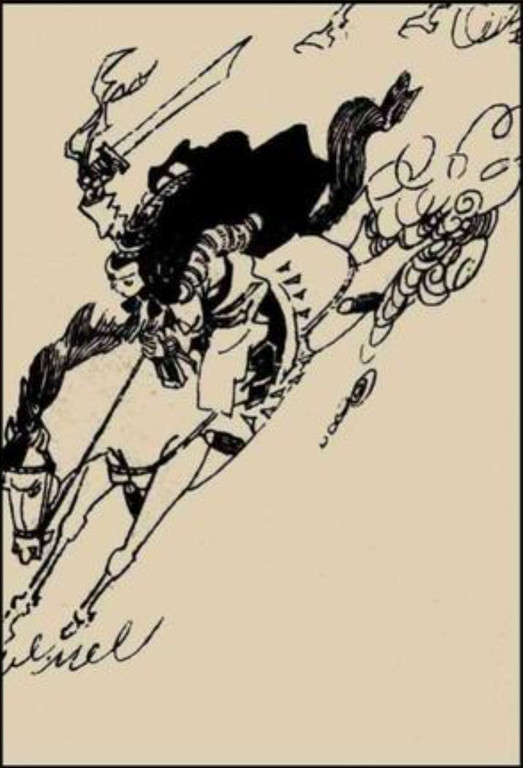
Fig. 1 – King Pāramitā leaps into battle (larger version). Detail from a modern manhua. Image found here.

1.2. Links to Buddhism

The translators of A Supplement to the Journey to the West explain King Pāramitā’s name serves as a pun:

In the Chinese transliteration for Pāramitā, the character used to render the syllable “mi” [蜜] has the intrinsic meaning of “honey,” while the character t’ang [唐] in T’ang dynasty is homophonous with the character meaning “sugar” [糖]. King Pāramitā is punning on these associations (Dong, Lin, & Schulz, 2000, p. 123 n. 2). [3]

However, the name also has deep connections with Buddhism. The Princeton Dictionary of Buddhism defines the Sanskrit term Pāramitā (“perfection”) as “a virtue or quality developed and practiced by a Bodhisattva on the path to becoming a buddha” (Buswell & Lopez, 2014, p. 624). Various traditions recognize six to ten perfections, with the latter including the former six plus an additional four. The Mahayana perfections, for example, include giving, morality, patience, effort, concentration, wisdom, method, vow, power, and knowledge. Bodhisattvas are believed to master these virtues in the listed order, compounding spiritual wisdom and merit over the course of their journey towards Buddhahood (Buswell & Lopez, 2014, p. 624).

2. Jidu, Luohou, and Yuebei XingJourney to the South (Nanyouji, 南遊記, c. 1570s-1580s)

The novel follows the exile of Miao Jixiang (妙吉祥), a divine flame-turned Buddhist deity, from the Western Paradise through several mischievous reincarnations. [5] As the rogue immortal Huaguang (華光), he works to end his mother’s demonic lust for flesh by procuring an immortal peach in chapter 17. He does this by transforming into Sun Wukong and stealing the magic fruit from heaven. The real Monkey King is subsequently accused of his double’s misdeeds, much like the Six-Eared Macaque episode of the original novel. The Jade Emperor threatens to remand him to the Buddha for punishment but is convinced to give Sun a month-long reprieve to find the true culprit.

Monkey returns to the Mountain of Flowers and Fruit, and it is here, among his people, that the story mentions three children, including sons Jidu (奇都, “Ketu”) and Luohou (羅猴, “Rahu”) and daughter Yuebei Xing (月孛星, “Moon Comet Star”). [4] Sun eventually seeks out Guanyin, who reveals the troublemaker is none other than Huaguang. Returning home once more, Monkey’s news prompts his daughter to volunteer to battle the impostor. But her tribe simply pokes fun at her monstrous appearance. Yuebei Xing is said to have a crooked head with huge eyes and a broad mouth, coarse hands, a wide waist, and long legs with thunderous steps.

Sun travels with his daughter to Huaguang’s home of Mt. Lilou (Lilou shan, 離婁山) to provoke battle by chastising him for stealing the immortal peaches. Monkey strikes at him with his magic staff, causing Huaguang to deploy his heavenly treasure, a golden, triangular brick (sanjiao jinzhuan, 三角金磚). But Sun responds by creating untold numbers of clone monkeys that not only confiscate the weapon but also overwhelm the immortal. Huaguang is seemingly defeated at this point; however, he manages to deploy one last treasure, the Fire Elixir (Huodan, 火丹). This weapon engulfs the Great Sage in heavenly flame (akin to the Red Boy episode), causing him to flee to the Eastern Sea. Yuebei Xing then calls Huaguang’s name while holding her own magic treasure, a skull (kulou tou, 骷髏頭). The immortal is immediately stricken with a headache and stumbles back to his cave in a daze. Her weapon is said to be quite dangerous; anyone whose name is called will die within three days.

Huanguang’s religious teacher, the Flame King Buddha of Light (Huoyan wang guangfo, 火炎王光佛), then intervenes in order to sooth the situation between his disciple and the Great Sage. He promises to bring the rogue immortal to justice on the condition that Yuebei Xing withdraws her deadly magic. In the end, all parties are pardoned by the Jade Emperor, and Huaguang and Monkey become bond brothers (Yu, n.d.).

2.1. Links to Asian Astrology

All three of Sun’s children are named after planetary bodies associated with the moon in Asian astrology. [6] His sons Jidu and Luohou are respectively named after Ketu (Jidu, 奇都) and Rahu (Luohou, 羅睺), two of the “Nine Planets” (Sk: Navagraha; Ch: Jiuyao, 九曜, “Nine Luminaries”) from Hindu astrology. [7] These two shadowy planetary deities represent the respective southern (descending) and northern (ascending) lunar nodes, or points where the moon crosses the earth’s orbit around the sun. As such, the pair are associated with eclipses, and sources sometimes depict them as the head (Rahu) and tail (Ketu) of a great eclipse serpent. Other interpretations include Rahu as a disembodied head and Ketu as the torso, or Ketu as a comet or emerging from a cloud of smoke (Gansten, 2009, p. 652-653; Kotyk, 2017, pp. 59-60).

Before continuing, there are two interesting things to note: 1) Sun Wukong singlehandedly battles and defeats the Nine Planets in chapter five of the original novel (Wu & Yu, 2012, vol. 1, pp. 170-172). But the Ketu and Rahu in this group should be considered distinct from his sons; and 2) one of the original Chinese characters for Rahu (Luohou, 羅睺) was changed in Journey to the South to play on Luohou’s (羅猴) primate origins by using the homophonous word for “monkey” (hou, 猴).

All information about Yuebei xing has been moved to a new article.

Yuebei xing, Daughter of the Monkey King

3. Honorable Mention: Sun Luzhen – Later Journey to the West (Hou Xiyouji, 後西遊記, 17th-century)

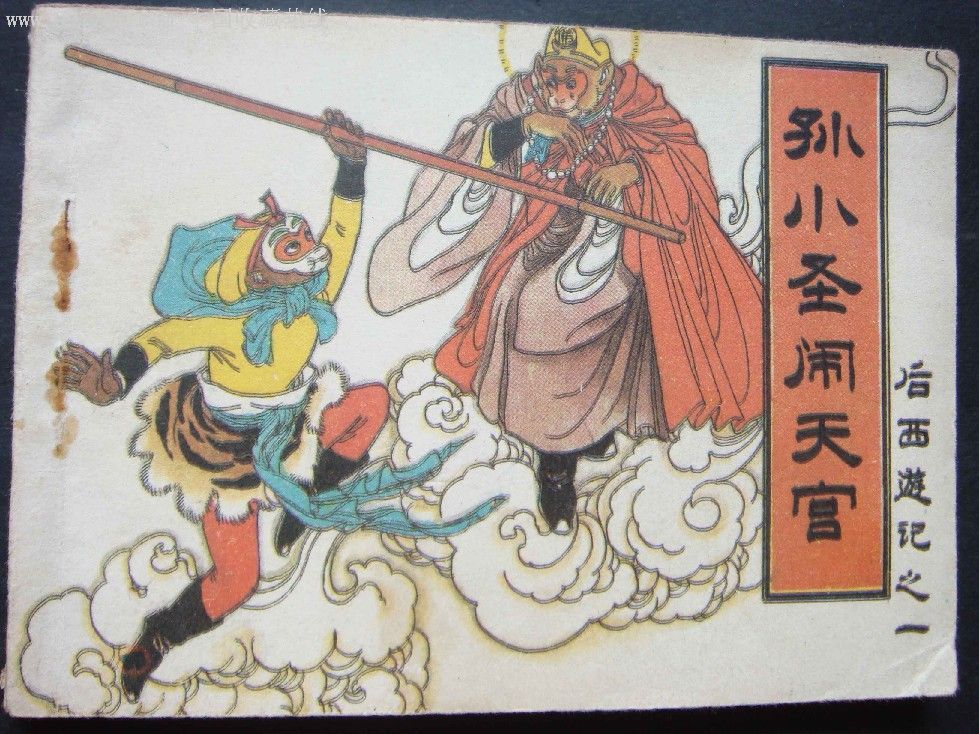
The novel is set two hundred years after the original and follows the adventures of Sun Wukong’s spiritual descendant Sun Luzhen (孫履真, “Monkey who Walks Reality”) (fig. 2). He too learns the secrets of immortality and causes havoc in heaven, before being tasked to protect the historical monk Dadian (大顛, 732-824) on a similar journey to India. The two are accompanied by the son of Zhu Bajie, Zhu Yijie (豬一戒), and the disciple of Sha Wujing, Sha Zhihe (沙致和). I did not include Luzhen in the main list as he is born from a stone in the same fashion as the original Monkey King (see Liu, 1994).

Fig. 2 – “Small Sage Sun’s Havoc in the Heavenly Palace” (larger version). The cover to a modern manhua. Image found here.

4. Conclusion

The Monkey King has a total of eight children shared between two late-Ming novels, but only four are mentioned by name, and only two of these actually have parts in the respective stories. King Pāramitā is one of the Great Sage’s five sons born to Princess Iron Fan in A Supplement to the Journey to the West (1640). He is portrayed as a handsome, sword-wielding general whom Sun faces on the battlefield. His name references the Pāramitās (“perfections”), or the wisdom and merit-building virtues that Bodhisattvas master in their quest for Buddhahood. Monkey has three children in Journey to the South (c. 1570s to 1580s), including sons Jidu and Luohou and daughter Yuebei Xing. The latter is depicted as a grotesque monster with a magic skull weapon cable of harming even celestials. She uses it to defeat the rogue immortal Huaguang. Jidu and Luohou are respectively named after the lunar nodes Ketu and Rahu, two of the Nine Planets from Hindu astrology. Yuebei is named after a shadowy planet representing the lunar apogee, which counts among the Eleven Luminaries of East Asian astrology. Ancient Xixia art sometimes depicts them as a woman or man bearing a sword and a severed head. The feminine iconography appears holding a skull in a novel from the 16th-century.

An honorable mention is Sun Luzhen from Later Journey to the West. He is a stone-bone monkey who follows in his spiritual ancestors footsteps by attaining immortality, causing havoc in heaven, and later protecting a holy monk on the journey to India.


Update: 04-04-22

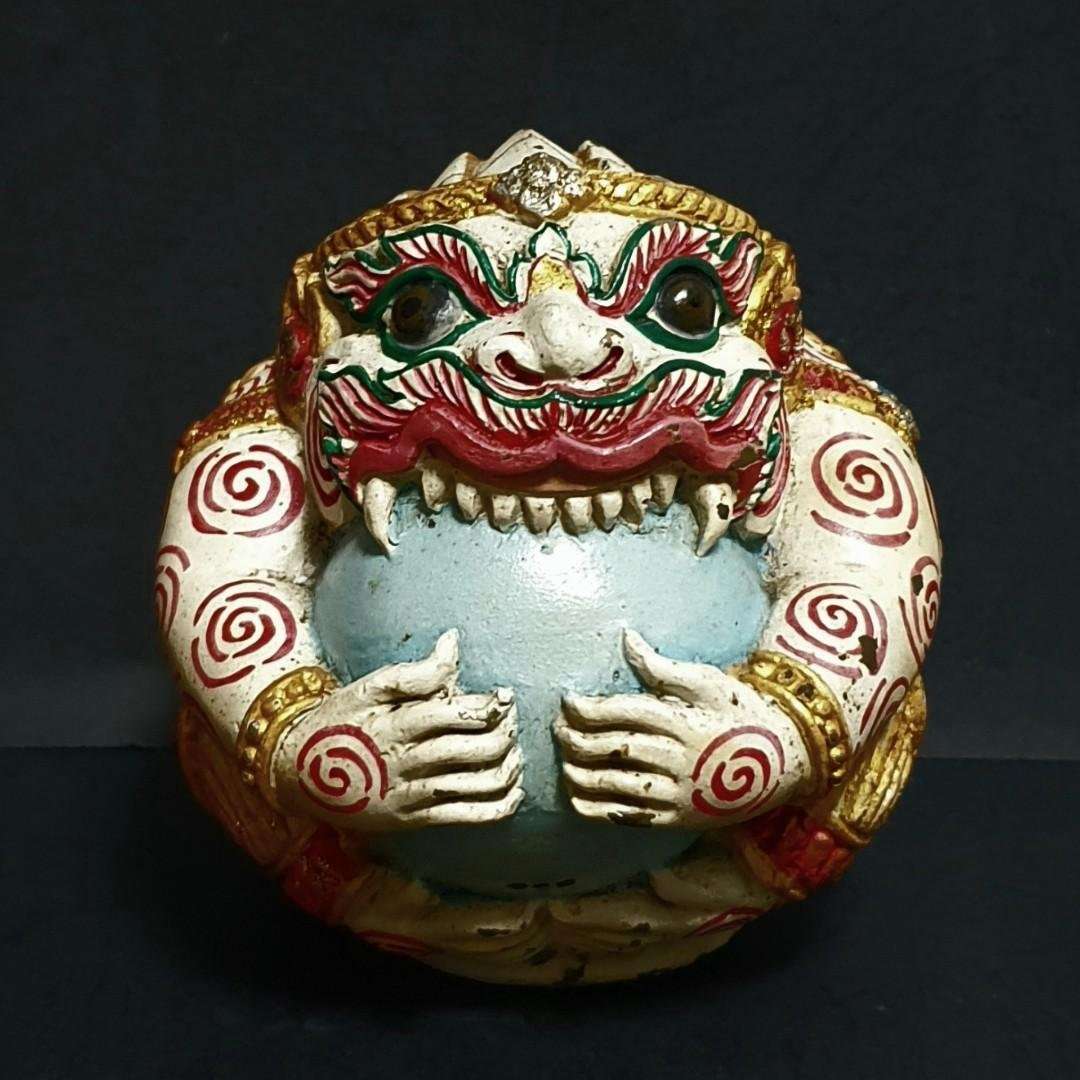
Back in November 2021, I made a post on twitter about a Rahu amulet that a collector friend of my was selling (and later sold). The deity is generally portrayed as a sharp-toothed, giant-mouthed monster devouring the moon. This piece is carved in a similar manner but Rahu is instead patterned after Thai depictions of Hanuman (fig. 3). I imagine his association with the monkey god is based on the latter’s attempt to eat the sun in his youth. 

Fig. 3 – The front of the Hanuman-like Rahu amulet (larger version).

Notes:

1) See Wu & Yu, 2012, vol. 3, p. 129.

2) This statement of course overlooks the conception and birth of the couple’s son Red Boy (Hong haier, 紅孩兒). But King Paramita might be referring to the Bull Demon King’s long absence while living with his mistress.

3) This pun plays out in chapter 14 of Journey to the West when an old patron remarks on Monkey’s monstrous appearance:

“Though you [Tripitaka] may be a Tang man,” the old man said, “that nasty character is certainly no Tang man!” “Old fellow!” cried Wukong in a loud voice, “you really can’t see, can you? The Tang man is my master, and I am his disciple. Of course, I’m no sugar man or honey man! I am the Great Sage, Equal to Heaven!” (Wu & Yu, 2012, vol. 1, p. 312).

Thank you to Irwen Wong for reminding me of this passage.

4) I’m indebted to Jose Loayza for bringing this to my attention.

5) To my knowledge, the only English translation available is this amateur version by Panying Zhao. Thank you to Ronni Pinsler for bringing it to my attention.

6) Thank you to Dr. Jeffrey Kotyk for confirming the astrological connection.

7) Sun, Moon, Mars, Mercury, Jupiter, Venus, Saturn, Rahu, and Ketu (Gansten, 2009).

8) These include the aforementioned Nine Planets (see note #6 above), Yuebei, and another shadowy planet called Ziqi (紫氣/紫炁; “Purple Mist”) (Hart, 2010, p. 145 n. 43; Kotyk, 2017, p. 60). Engravings of the Eleven Luminaries appear on Zhu Bajie’s battle rake (Wu & Yu, 2012, vol. 1, p. 382). See also note #10 on the linked article.

Sources:

Dong, Y., Lin, S. F., & Schulz, L. J. (2000). The Tower of Myriad Mirrors: A Supplement to Journey to the West. Ann Arbor: Center for Chinese Studies, The University of Michigan.

Gansten, M. (2009). Navagrahas. In K. A. Jacobsen (Ed.), Brill’s Encyclopedia of Hinduism (Vol. 1) (pp. 647-653). Leiden: Brill.

Hart, R. (2010). The Chinese Roots of Linear Algebra. United States: Johns Hopkins University Press.

Kotyk, J. (2017). Astrological Iconography of Planetary Deities in Tang China. Journal of Chinese Buddhist Studies, 30, 33-88), Retrieved from https://chinesebuddhiststudies.org/previous_issues/jcbs3002_Kotyk(33-88)_e.pdf

Liu, X. (1994). The Odyssey of the Buddhist Mind: The Allegory of the Later Journey to the West. Lanham, Md: University Press of America.

Buswell, R., & Lopez, D. (2014). The Princeton Dictionary of Buddhism. Princeton University Press.

Wu, C., & Yu, A. C. (2012). The Journey to the West (Vol. 1-4). Chicago, Illinois: University of Chicago Press.

Yu, X. (n.d.). Nanyouji: Huaguang sanxia Fengdu [Journey to the South: Huaguang goes to the Underworld Three Times]. Retrieved from https://ctext.org/wiki.pl?if=gb&chapter=506975&remap=gb#%E5%8D%8E%E5%85%89%E4%B8%89%E4%B8%8B%E9%85%86%E9%83%BD

The Later Journey to the West: Part 2 – The Journey to India Begins

Note: An AI translation of this novel is now available. Click the linked Chinese characters below that read “後西遊記.”

The main body of Later Journey to the West (Hou Xiyouji, 後西遊記, 17th century) follows a similar trajectory as the parent novel, Journey to the West (Xiyouji西遊記, 1592). The historical monk Dadian (大顛, 732–824) (fig. 1) is tasked with traveling from China to India to retrieve spiritual knowledge from the Buddha, and just like Tripitaka, he is protected by three demonic disciples, namely Sun Luzhen (孫履真), the descendant of Sun Wukong, Zhu Yijie (豬一戒), the son of Zhu Bajie, and Sha Zhihe (沙致和), the disciple of Sha Wujing. Along the way the group travels through many lands, battles numerous evils, and they eventually become enlightened Buddhas like their predecessors two hundred years prior. As noted in part one, Later Journey to the West may appear like a carbon copy of the original, but the similarities are only skin deep since the novel is comprised of extremely dense layers of allegorical meaning.

Below, I present the second of a three-part summary of the novel (part 3), which focuses on the journey proper. I rely very heavily on Xiaolian Liu (1994) as the novel has yet to be published in English.

Notes have been added to the sections below to explain the allegorical meaning of various story elements.

I. The Interpretation Pilgrim is Chosen

After quelling his descendant’s rebellion, Buddha Sun Wukong travels eastward by cloud with Buddha Tripitaka to see how China has benefited from the scriptures delivered by them some two centuries in the past. However, they find that the monks of the Famen temple (Famen si, 法門寺) are not only falsely claiming to have holy relics from Tripitaka’s deceased human body, [1] but also that their leader is his sixth generation disciple and a master of the sutras. This influences Tang Emperor Xianzong (唐憲宗, r. 806-820) to donate heavily to the temple because he believes that the dynasty will prosper once the pagoda containing the supposed relics is opened. The two Buddhas return to the Western Paradise and report their findings to Tathagata, who tells them that the Chinese will continue to misunderstand and misuse the teachings until they receive the “true interpretation” (zhenjie, 真解). The Enlightened One then charges Tripitaka with locating a pilgrim who will make the journey to India to retrieve this interpretation. [2]

In the meantime, the scholar-official Han Yu (韓愈, 768–824) openly criticizes the emperor for his worship of the relics and his spendthrift support of the temple. For this he is exiled from Shaanxi province in the north to Guangdong province in the south, where he meets the Chan Buddhist Master Dadian. [3] Upon hearing of the decadent, misguided state of Buddhism near the capital, Dadian goes north and memorializes the emperor to give up his extravagant patronage of the religion. This show of integrity cements Tripitaka’s decision to choose the monk as his pilgrim. The Buddha then magically seals away the scriptures, forcing the Emperor to send Dadian to India to retrieve the true interpretation.

124782997

Fig. 1 – A woodblock print of the monk Dadian.

II. The Journey to India Begins

The novel has a total of 40 chapters. Liu (1994) only covers certain chapters from this point on since they contain the most allegorical meaning.

Dadian acquires his demonic disciples during the early stage of his journey. First, he recites a magic spell taught to him by Tripitaka which calls Sun Luzhen to his side. Second, he recruits Zhu Yijie on the road after the pig is subdued by Monkey and made to follow the priest west. Third, Dadian accepts Sha Shihe as his last disciple after the water spirit saves him from a monster that had dragged him to the bottom of the Flowing Sands River.

Prior to Sha Shihe joining the group, Monkey, Dadian, and Yijie travel through the sister villages of Ge (葛, “Creepers”) and Teng (籐, “Clinging Vines”), which are both plagued by bottomless pits that appear and swallow untold numbers of people. [A] The elders of these respective villages tell the pilgrims that the source of this calamity is a demon known as King Defect (Quexian wang, 缺陷王), who lives on the Mountain of Imperfection (Buman, 不滿, lit: “Not full”). The monster feeds on the negativity of people whom he curses with poverty, divorce, disease, etc., and those who don’t worship him are swallowed by the ground to be imprisoned forever. Luzhen retrieves a magic golden treasure from heaven that stops the demon from burrowing underground; however, when he flees into a cave, the pilgrims’ path is blocked by seemingly indestructible vines that regrow as soon as they are cut. But Monkey discovers the vines fail to grow if he cuts them while not talking. [B] The group follows suit and they are able to capture and kill the demon, who is revealed to be a badger spirit.

A) These names refer to Geteng (葛籐, Creepers and Clinging Vines), a term used in Buddhist literature to refer to the net of desire that ensnares humans. Liu (1994) notes the Avadanas Scripture (Chuyao jing, 出曜經, late-5th to early-6th cent.) contains two mentions of the term, one of which reads: “Entrapped in the net of desires, common people are bound to undermine the right (orthodoxy) way … like the creepers and vines which twine round a tree and eventually cause its death” (p. 70).

B) The aforementioned creepers and clinging vines also refer to Geteng Chan (葛籐禪, Wordy Chan/Zen), a term often applied “to people who resort to long-winded words or writings, rather than to their intuitive perceptions to grasp the essence of Buddhist principles” (Liu, 1994, p. 71). This love for speaking/writing is believed to hinder the path to enlightenment. This explains why the vines stop growing when Monkey stops talking. The group, in essence, frees themselves from Wordy Chan and relies more on intuition. This puts them one step closer to enlightenment.

After passing the Flowing Sands River and bringing Sha Shihe into their fold, the group travels to the Mountain of Deliverance lorded over by King Deliverance (Jietuo dawang, 解脫大王). He and his demon generals maintain 72 chasms where humans fall prey to their desires (sex, money, alcohol, anger, etc.) and 36 pits where sinners are tortured. [C] During a battle with the demon army, Zhu Yijie resists promises of sex, food, and treasures offered by the generals, but lets his guard down due to flattery and is captured. [D] Dadian is captured by seven demons displaying a range of emotions from joy to hatred. [E] The monk clears his mind and falls into a deep meditative state undisturbed by the outside world. It is only when Monkey comes to his rescue that Tripitaka regains consciousness. [F] In the end, Luzhen manages to kill King Deliverance by crushing him under the weight of a huge boulder that he had transformed into an exact likeness of himself. This causes all of the generals and the chasms and pits to disappear. The author provides an explanatory couplet.

When the heart (mind) is active,
All kinds of demons come into existence;
When the heart (mind) is extinguished,
All kinds of demons disappear (Liu, 1994, p. 77).

心生種種魔生,心滅種種魔滅。

C) The demon king and generals are physical embodiments of desires that keep people from attaining enlightenment.

D) This represents the consequence of temptation, no matter how small.

E) These demons represent the seven emotions of joy, anger, sorrow, fear, love, hate, and desire.

F) Dadian’s capture represents those who erroneously think meditation is simply sitting quietly instead of inner reflection and the examination of truths. His inability to focus his mind is the real reason for his capture. Monkey represents the mind, so his arrival allows the monk to regain consciousness. Therefore, this episode teaches one to focus the mind and thereby not fall prey to desires. This is yet another step closer to enlightenment.

QQ截图20160221185741

Fig. 2 – The immortal Zhenyuanzi as depicted in the famous 1986 television series.

The pilgrims travel to the Temple of Five Villages (Wuzhuang guan, 五莊觀) in the Mountain of Longevity (Wanshou shan, 萬壽山), where they are met by the supreme immortal Zhenyuanzi (鎮元子) (fig. 2), the patriarch of all earthly immortals and a temporary adversary in chapters 24 to 26 of the original. Sensing that Monkey relies too heavily on his physical strength and not his spiritual strength, the immortal only allows Dadian to enter, leaving the others to sit outside for hours. To add further insult to injury, a young immortal page tells Luzhen that his master has decided to forsake the journey in order to study Daoism. This so enrages him that he bursts inside to confront Zhenyuanzi and is challenged to retrieve Dadian from the Mansion of Fiery Clouds (Huoyun lou, 火雲樓) in which the monk is drinking tea. But Monkey’s way is suddenly blocked by a supernatural flame, known as the “fire of the mind” (Xinhuo, 心火), which can’t even be extinguished by Dragon King rain. [G] He finally manages to douse the fire with the sweet dew from Guanyin‘s holy willow sprig and retrieve his master. [H]

G) This fire represents Sun Luzhen and Zhenyuanzi’s anger, which ignites when both enter into an argument. Anger is one of the emotions thought to inhibit enlightenment.

H) This liquid is referred to in Buddhist literature as being able to extinguish everything from desires to negative emotions. For example, Liu (1994) comments: “In a parable in Za baozang jing 雜寶藏經 (Sutra of Miscellaneous Treasures [5th cent.]), the Buddha was said to use the Water of Wisdom to extinguish the Three Fires of Desire, Anger and Delusion” (Liu, 1994, p. 81). Therefore, the dew/water represents wisdom, or the ability to use reason and not become angry. The use of the dew causes Monkey to switch from knee jerk reaction to reason, as exemplified by this statement:

It was my mistake in the first place. I should not have quarreled with him to stir up his fire. Once his fire is stirred up, my fire is stirred up too. I don’t know how long the fire will burn. This surely would cause delay in our master’s proper business (Liu, 1994, p. 80).

初時,原是我差了,不該與他角口,惹他動起火來。他既動了火,我又動起火來,不知燒到幾時?豈不誤了師父正事!

The group comes to an endless, ocean-like river and question how they will ever reach the “other side” (bi’an, 彼岸). [I] They eventually take a derelict boat, but infighting between Dadian and the disciples coincides with a monstrous black storm that erupts overhead, producing powerful winds that blow them thousands of miles off course to the Rakshasa Kingdom (Luocha guo, 羅剎國). This land of monsters is ruled over by the Bull Demon King and Lady Iron Fan (fig. 3), adversaries from chapters 59 to 61 of the original. After learning of the pilgrims’ arrival, Lady Iron Fan sends an army of demon soldiers to capture them so she can exact revenge for perceived misdeeds by their predecessors. [4] Dadian once again enters meditation to avoid evil influences and is quickly rescued by Monkey. Luzhen attempts to save Yijie, who once again falls prey to temptation and is captured, but is stopped by a black whirlwind created by Black Boy (Heihai’er, 黑孩兒), the second son of the demonic couple. [J] Monkey is forced to retrieve a sutra from the Bodhisattva Ksitigarbha in the underworld. Upon reading the sutra, a magic red cloud appears and shines light on the kingdom, destroying all of the demons and leading the monks to freedom. [K]

I) This ocean/river is a common metaphor in Buddhist literature referring to desire, and the “other side” refers to a life free from desire (Paramita), or achieving enlightenment. For example, Huineng (惠能, 638–713), the sixth Chan patriarch, says: “The perverted mind is the great sea and the passions are the waves … if the perverted mind is cast aside the ocean will dry up, and when the passions are gone the waves will subside” (Liu, 1994, p. 81).

J) The black whirlwind represents ignorance, or the Buddhist concept of Wuming (無明, darkness without illumination), and the demon kingdom represents the unenlightened mind that falls prey to its own demons (desire, ignorance, anger, etc.). The metaphors of the black whirlwind and demon kingdom are mentioned in the Collected Essentials of the Five Lamplight Histories (Wudeng huiyuan, 五燈會元, c. 1252), one of several accepted histories of Chan Buddhist orthodoxy in China (Liu, 1994, pp. 84-85).

K) The illuminated red cloud represents sudden enlightenment that sweeps away all ignorance and desire.

01300001248577133770100944901

Fig. 3 – An artist’s depiction of Lady Iron Fan and the Bull Demon King.

Notes:

1) This is false within the novel’s fictional universe because Tripitaka attained living Buddhahood in chapter 100 of the original.

2) Tripitaka serves as Guanyin’s successor in this respect, for it was the Bodhisattva who recruited the “scripture pilgrim” in chapter 12.

3) Liu (1994) notes that this is based on actual history. Han Yu, who was a Confucian scholar and the Vice Minister of the Justice Department, “presented a memorial to the throne, denouncing Buddhism as an alien doctrine and criticizing the emperor for receiving and showing reverence for the ‘decayed and rotten bone’ of the Buddha” (pp. 63-64). So in this case it was a relic belonging to the Buddha and not Tripitaka. Han was actually sentenced to death, but this was later commuted to exile thanks to parties arguing on his behalf.

4) She wishes to exact her revenge because their predecessors, Tripitaka, Sun Wukong, Zhu Bajie, and Sha Wujing, were instrumental in the subjugation and reformation of her first son Red Boy by Guanyin.

Source:

Liu, X. (1994). The Odyssey of the Buddhist Mind: The Allegory of the Later Journey to the West. Lanham, Md: University Press of America.