Archive #13 – Huineng, Subhuti, and Monkey’s Religion in “Xiyou ji” (2006)

Last updated: 05-29-2022

I present an archived copy of Ping Shao’s (2006) wonderful paper exploring the origin of Sun Wukong’s characterization and how it effects his story cycle. Shao presents a three-fold objective: first, highlight Daoist and Buddhist concepts in chapters one and two that have previously been overlooked or not given enough weight, showing that they serve a function and are not just expendable story elements; second, provide a unified religious vision based on the Buddho-Daoist philosophy of the Daoist southern lineage patriarch Zhang Boduan (張伯端, 987?–1082); and 3) demonstrate that Zhang’s philosophy dictates the course of Sun’s story cycle from unruly immortal to enlightened Buddha. 

Shao (2006) suggests Monkey’s portrayal in the first two chapters is influenced by the sixth Chan patriarch Huineng (惠能, 638–713), founder of the “Sudden Enlightenment” school of Buddhism. [1] For example, Sun’s quick-wittedness, demonstrated by his deciphering of his teacher, Subodhi’s, chastisement for refusing to learn certain Daoist skills in chapter two as secret code to receive a private lesson at night, [2] is based on a similar episode involving Huineng and the previous patriarch Hongren. Additionally, Monkey’s 108,000 li (33,554 mi/54,000 km)-spanning somersault cloud (fig. 1) is based on the symbolic distance said by Huineng to separate the Buddha’s paradise from the world of man. [3] Only those who achieve enlightenment can arrive instantly. This is symbolized in the novel by Monkey zipping there instantly on his cloud, whereas Tripitaka must travel thousands of miles over many years. Shao (2006) provides further examples, but I feel these suffice.

37e2fc9cebe000bb1c76c73e7ad2963a-d5oas0h

Monkey flying on clouds. Drawing by Funzee on deviantart (larger version).

The unified religious vision is demonstrated by Sun Wukong’s name, which contains both Daoist and Buddhist elements. When broken into its individual components, the surname Sun (孫) refers to an immortality spirit embryo brought about via Daoist cultivation exercises. The given name Wukong (悟空) refers to a vacuous state of mind needed for attaining Buddha-nature. Here, Shao (2006) notes the literary Subodhi is based on Subhuti, a historical disciple of the Buddha, who was known for meditating on emptiness and having a superior grasp of the Enlightened One’s teachings. In later chapters, Sun himself shows a grasp of scripture far surpassing even that of Tripitaka. Therefore, an additional influence on Monkey was likely the historical monk. Shao (2006) contextualizes this information by comparing it to Zhang Boduan’s Buddho-Daoist philosophy. Zhang believed Daoists must first attain the elixir (i.e. a method increasing one’s lifespan) and then attain Buddha-nature to truly become an enlightened transcendent. Conversely, he warned Buddhists that achieving Buddha-Nature alone wouldn’t help them escape the wheel of reincarnation.

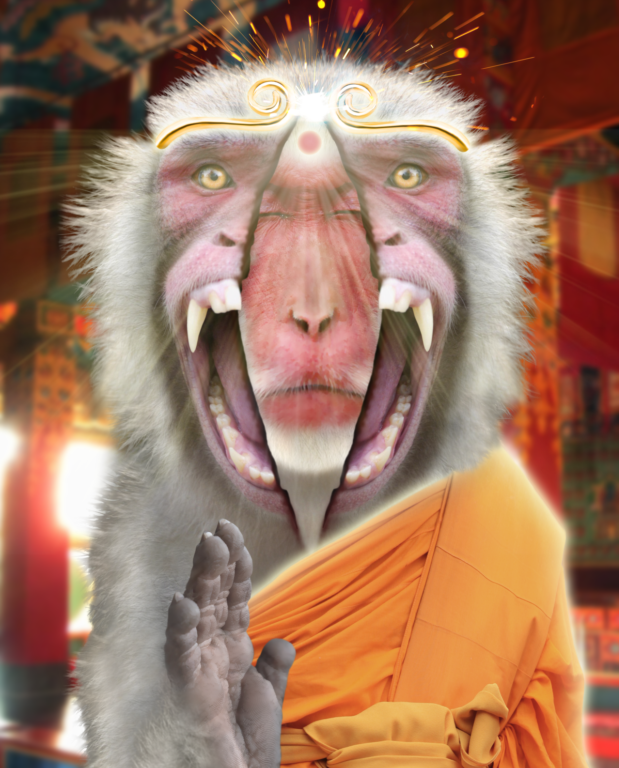
Monkey Buddha Has Awakened - small

Fig. 2 – Sun Wukong becoming a Buddha (larger version). Photomanipulation by the author.

Shao (2006) illustrates how Zhang’s views are played out in the novel. Sun achieves immortality and is even invited to heaven like the hagiographies of famous transcendents, but his unruly nature symbolizes his lack of true spiritual attainment, causing him to wage war against the realm above. He remains a “deviant” or “bogus immortal” (yaoxian, 妖仙) until the journey proper, the tribulations serving to temper his mind. Moreover, when the pilgrims arrive in the Buddha’s paradise, they must first pass through a Daoist temple (referring again to Zhang’s philosophy). In the end, Sun is bestowed Buddhahood (fig. 2)—thereby Buddha-nature—completing the second step of Zhang’s two-part path to true transcendence.

Archive link:

https://journeytothewestresearch.com/wp-content/uploads/2019/12/huineng-subhuti-and-monkeys-religion-in-xiyouji.pdf


Update: 11-28-21

Shao (2006) is taken almost verbatim from the author’s doctoral thesis, Monkey and Chinese Scriptural Tradition: A Rereading of the Novel Xiyouji. This dissertation is a gold mine of information, and Shao’s (1997) Daoist reading of the novel explains many facets of the story. He even shows that Monkey has many religious influences. For example, the summation of one section reads: “[The author] allowed him Huineng’s intuition, Subhuti’s objective, and Laozi’s immortal body” (Shao, 1997, p. 108).

Archive Link:

Click to access Monkey-and-the-Scriptural-Tradition-in-China.pdf

Disclaimer:

This has been posted for educational purposes. No malicious copyright infringement is intended. Please support the official release.


Update: 05-29-22

I’ve taken information from this page and combined it with other material to write the ultimate guide on the Patriarch Subodhi.

The Patriarch Subodhi: Sun Wukong’s First Master

Notes:

1) In this article, I discuss how the “Monkey Pilgrim”, Sun Wukong’s precursor from Song Dynasty material, is based on the monk Mulian (Sk. Maudgalyayana), another of the Buddha’s disciples. 

2) The particular passage reads:

When the Patriarch heard this, he uttered a cry and jumped down from the high platform. He pointed the ruler he held in his hands at Wukong and said to him: “What a mischievous monkey you are! You won’t learn this and you won’t learn that! Just what is it that you are waiting for?” Moving forward, he hit Wukong three times on the head. Then he folded his arms behind his back and walked inside, closing the main doors behind him and leaving the congregation stranded outside […] But Wukong was not angered in the least and only replied with a broad grin. For the Monkey King, in fact, had already solved secretly, as it were, the riddle in the pot; he therefore did not quarrel with the other people but patiently held his tongue. He reasoned that the master, by hitting him three times, was telling him to prepare himself for the third watch; and by folding his arms behind his back, walking inside, and closing the main doors, was telling him to enter by the back door so that he might receive instruction in secret (Wu & Yu, 2012, pp. 118-119).

3) Huineng explains in the Platform Sutra:

This number refers to the ten evils and eight wrongs in one’s person […] Now I urge you, good friends, to first get rid of the ten evils; that is the equivalent of traveling ten [thousand li]. Then get rid of the eight wrongs; that is the equivalent of crossing eight thousand [li]. See essential nature in every moment, always acting with impartial directness, and you will arrive in a finger-snap and see Amitabha Buddha (Huineng & Cleary, 1998, pp. 26-27).

Sources:

Huineng, & Cleary, T. F. (1998). The Sutra of Hui-neng, grand master of Zen: With Hui-neng’s commentary on the Diamond Sutra. Boston: Shambhala.

Shao, P. (2006). Huineng, Subhūti, and Monkey’s Religion in “Xiyou ji”. The Journal of Asian Studies, 65(4), 713-740. Retrieved from www.jstor.org/stable/25076127

Shao, P. (1997). Monkey and Chinese Scriptural Tradition: A Rereading of the Novel Xiyouji (UMI No. 9818173) [Doctoral dissertation, Washington University]. Available from ProQuest Dissertations and Theses database.

Wu, C., & Yu, A. C. (2012). The journey to the West: Vol. 1. Chicago, Illinois: University of Chicago Press.

The Origin of the Monkey King’s Punishment in Laozi’s Furnace

The beginning of Journey to the West (Xiyouji西遊記, 1592; “JTTW” hereafter) chapter seven sees Sun Wukong transported to the realm above to be executed for his rebellion against the primacy of heaven. However, his immortal body proves impervious to blades, fire, and lightning, leading Laozi to theorize that Monkey’s extreme invulnerability is the result of having consumed large quantities of immortal peaches, wine, and elixir that were later refined in his stomach “to form a single solid mass” (Wu & Yu, 2012, vol. 1, p. 188). The Daoist high god goes on to suggest that the demon be subjected to his Brazier of Eight Trigrams (Bagua lu, 八卦爐) in order to separate out the elixir and make his subsequently weakened body susceptible to death:

Arriving at the Tushita Palace, Laozi loosened the ropes on the Great Sage, pulled out the weapon from his breastbone, and pushed him into the Brazier of Eight Trigrams. He then ordered the Daoist who watched over the brazier and the page boy in charge of the fire to blow up a strong flame for the smelting process. The brazier, you see, was of eight compartments corresponding to the eight trigrams of Qian [☰/乾], Kan [☵/坎], Gen [☶/艮], Zhen [☳/震], Xun [☴/巽], Li [☲/離], Kun [☷/坤], and Dui [☱/兌]. The Great Sage crawled into the space beneath the compartment that corresponded to the Xun trigram. Now Xun symbolizes wind; where there is wind, there is no fire. However, wind could churn up smoke, which at that moment reddened his eyes, giving them a permanently inflamed condition. Hence they were sometimes called Fiery Eyes and Diamond Pupils (Wu & Yu, 2012, vol. 1, p. 189).

那老君到兜率宮,將大聖解去繩索,放了穿琵琶骨之器,推入八卦爐中,命看爐的道人、架火的童子,將火搧起鍛煉。原來那爐是乾、坎、艮、震、巽、離、坤、兌八卦。他即將身鑽在巽宮位下。巽乃風也,有風則無火。只是風攪得煙來,把一雙眼火煼紅了,弄做個老害病眼,故喚作「火眼金睛」。

Laozi checks the furnace forty-nine days later expecting ashes, but he is surprised when Sun emerges and kicks over the mystical oven (fig. 1). This episode has two likely sources.

Fig. 1 – Monkey knocking over Laozi’s furnace (larger version).

Table of Contents

1. Sources

1.1. The Story

The first source is The Story of How Tripitaka of the Great Tang Procures the Scriptures (Da Tang Sanzang qujing shihua大唐三藏取經詩話, c. late-13th century; “The Story” hereafter), the earliest known published edition of JTTW. The 17th chapter describes the trials of Daffy (Chi’na, 癡那), a merchant’s son, at the hands of his evil stepmother, a woman of the Meng clan (孟氏). She resents the boy as he stands to inherit all of his father’s wealth, leaving her son with nothing. Therefore, she and her handmaiden try to kill the heir by respectively boiling him in a pot, ripping out his tongue, starving him, and finally pushing him into a river, but each time he is magically saved by heaven. For instance, after four days boiling in the pot, Daffy emerges unscathed and claims:

[T]he iron cauldron changed into a lily pad on which I sat, surrounded by the cool waters of a pond. I could sleep or just sit there. It was very comfortable (Wivell, 1994, p. 1203).

一釜變化蓮花坐,四伴是冷水池;此中坐臥,甚是安穩。

Mair (1987) notes that the story of a youth being tortured by his stepmother is based on a Dunhuang transformation text with two versions dated 946 and 949, respectively (p. 43). The text focuses on the trials of the future Emperor Shun. [1] However, the boiling episode does not appear in the story.

1.2. Laughing at the Dao

The second source is Laughing at the Dao (Xiaodao lun, 笑道論, 570), an anti-Daoist polemic written as part of a court debate between Buddhist and Daoist representatives vying for state sponsorship. One section recounts Laozi’s rebirth in the mortal world and his later attempt to convert a king in India:

He [Laozi] had (long) hairs on the temples and his head was hoary; his body was sixteen feet tall; he wore a heavenly cap and held a metal staff. He took Yin Xi with him to convert the barbarians. (Once arrived in India) he withdrew to the Shouyang 首陽 mountains, covered by a purple cloud. The barbarian king suspected him of sorcery (妖). He (attempted) to boil him in a cauldron, but (the water) did not grow hot … [2]

頭鬢皓首身長丈六。戴天冠捉金杖。將尹喜化胡。隱首陽山。紫雲覆之。胡王疑妖。鑊煮而不熱。

I find this source particularly amusing because the high god of Daoism is in essence subjected to the same punishment as the one that he later suggests for Sun Wukong!

2. The Furnace in Daoist Alchemy

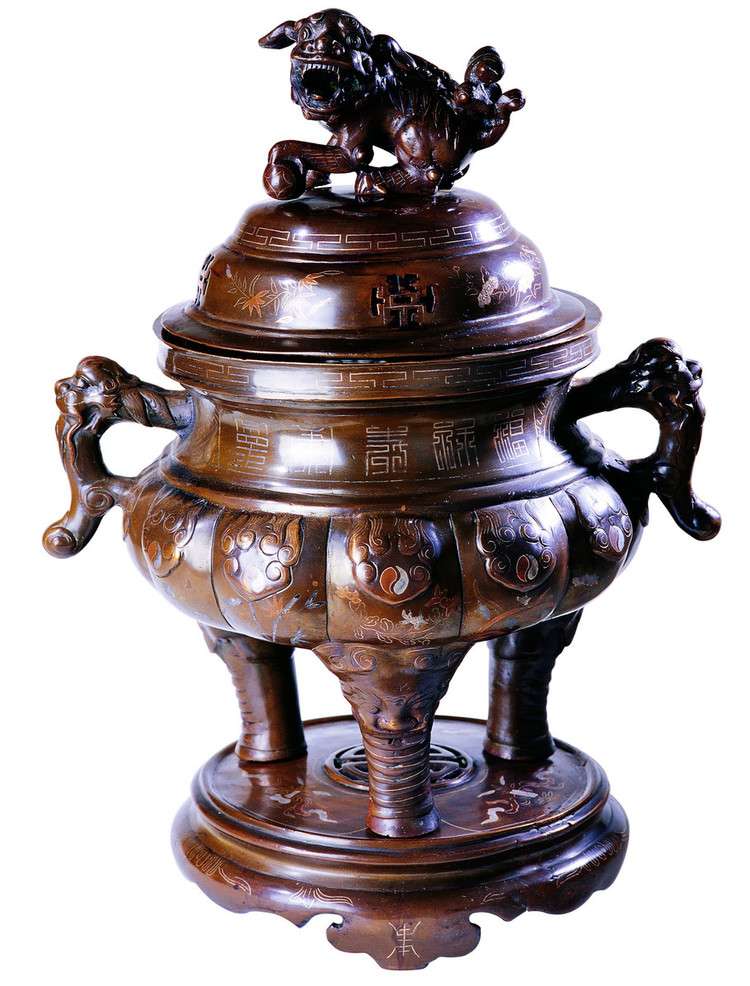
The furnace has two meanings in Daoist alchemy. The first refers to the physical vessel and stove (dinglu, 鼎爐) combo used in external alchemy (waidan, 外丹) to smelt the elixir of immortality (fig. 2). Kim (2008) describes the various parts and models of this contraption:

The reaction vessel has fire around it (when it is placed inside the heating apparatus), under it (when it is placed over the heating apparatus), or above it (when it is entirely covered by ashes inside the heating apparatus). It may contain an inner reaction-case in which the ingredients are placed. In a more complex model, a “water-vessel” containing water and a “fire-vessel” containing the ingredients can be assembled, the former above and the latter below or vice versa. The vessel must be hermetically closed and should not bear any openings or cracks.

The heating apparatus has fire within it and is often placed over a platform or “altar” (tan 壇). The openings on the wall sides allow air to circulate, while those on the top serve to settle the reaction vessel or to emit flame and smoke. One of the main functions of the heating apparatus is to control the intensity and duration of the heat. (pp. 360-361)

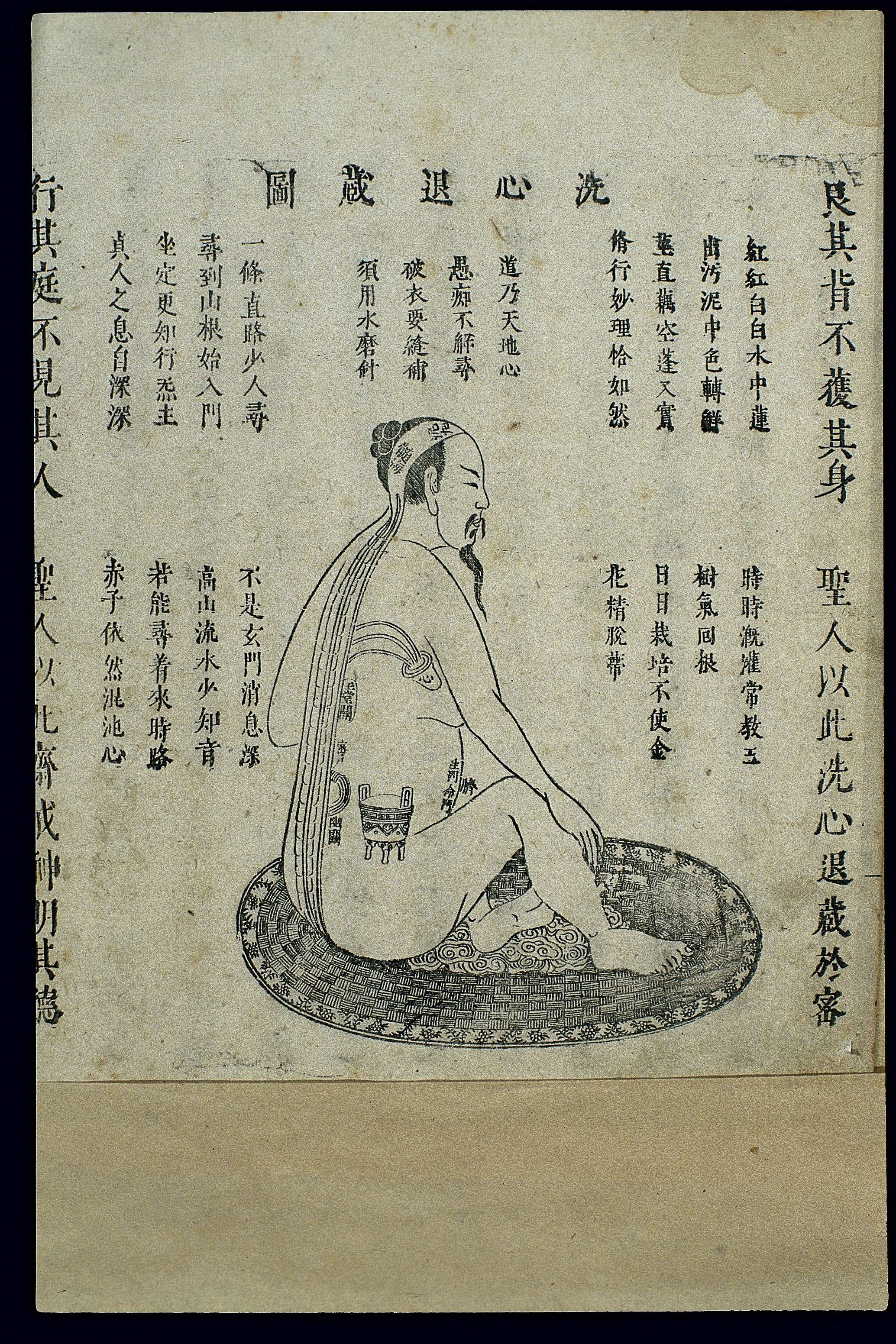
Fig. 2 – An ornate wooden replica dinglu reminiscent of the metal type used in external alchemy (larger version). Fig. 3 – An early 17th-century woodblock print depicting a Daoist practitioner’s dantian as a ding vessel (larger version).

The concept of consuming alchemically derived elixirs is first mentioned in Discourses on Salt and Iron (Yantie tun, 鹽鐵論, c. 60 BCE). Later, the Token for the Agreement of the Three According to the Book of Changes (Zhouyi cantong qi, 周易參同契, c. 2nd century CE; “The Token” hereafter) standardized the use of toxic materials, such as lead and mercury, for making said elixir, and this idea remained entrenched until the Tang Dynasty (618–907 CE) (Pregadio, 2008, pp. 1002-1003). External alchemy was eventually superseded in popularity by internal alchemy (neidan, 内丹) from the Tang onward and was still popular during the Ming Dynasty (1368–1644 CE) when the standard 1592 version of JTTW was published.

The second meaning is the human body as a metaphor for the furnace—i.e. internal alchemy. The Token considers “the 5 organs, 12 vessels, 24 vertebrae, and 360 joints … all part of this body dinglu” (Wang, 2012, p. 192). The corporal furnace, the ingredients (yao, 藥), and the firing time (huohou, 火候) combine to make the “three essentials” (sanyao, 三要) of internal alchemy (Robinet, 2008). The ingredients are yin and yang energy, and the firing time is the measured absorption of said energies and the time at which this activity is partaken (Wang, 2012, pp. 192-193).

3. External vs Internal in JTTW

Laozi’s use of the Eight Trigrams Furnace stands as a perfect example of external alchemy, and Sun’s use of breathing exercises and qi circulation serves as a prime example of internal alchemy. So how are these competing processes depicted in JTTW? Well, recall that the external type had long been supplanted by the internal type by the time the novel was published. Hence, one could say Laozi’s methods were dated compared to those used by Monkey. This might then explain a surprising story element from JTTW chapter seven.

When Sun first escapes from the furnace, “Laozi rushes up to clutch at him, only to be greeted by such a violent shove that he falls head over heels while the Great Sage escapes” (based on Wu & Yu, 2012, vol. 1, p. 189). Think about that for a moment. Monkey, a proponent of internal alchemy, physically assaults the Daoist high god, a proponent of external alchemy. Add to this the fact that Sun seemingly only respects/fears immortals that promote internal alchemy—a good example being his first master, Patriarch Subodhi (Xuputi zushi, 須菩提祖師)—and a picture begins to form: perhaps this is the JTTW author-compiler’s way of touting the superiority of the internal over the external. What do you think?

4. Conclusion

Monkey’s time in Laozi’s furnace likely borrows from (one or both of) two sources, the story of a child magically surviving boiling in The Story, the 13th century CE precursor of JTTW, and the story of Laozi magically surviving boiling from Laughing at the Dao, an anti-Daoist polemic of the 6th-century CE. The latter is humorous as it shows Monkey’s punishment is a recapitulation of the high god’s punishment.

JTTW presents two forms of alchemy: the concept of Laozi’s furnace refers to “external” alchemy and harkens back to Han Dynasty China when alchemists used such furnaces to fire toxic mercury and lead in an attempt to produce an elixir of immortality; Sun Wukong’s use of breathing exercises and qi circulation is a prime example of “internal” alchemy in which the body is used as the furnace to fire the immortal elixir. External alchemy fell out of favor during the Tang and was superseded by Internal alchemy from then on into the Ming, when JTTW was published. Therefore, the novel portrays the high god of Daoism as a proponent of the dated external school, while immortals like Monkey are portrayed as proponents of the then current internal school.

Notes:

1) For a complete translation, see Bodman (1994).

2) See Zürcher & Teiser (2007), pp. 299-300 and 431 n. 53.

Sources:

Bodman, R. W. (1994). The Transformation Text on the Boy Shun’s Extreme Filial Piety. In V. H. Mair (Ed.), The Columbia Anthology of Traditional Chinese Literature (pp. 1128-1134). New York: Columbia University Press.

Kim, D. (2008). Dinglu: I. Waidan In F. Pregadio (Ed.), The Encyclopedia of Taoism (2 Vols.) (pp. 360-361). London [u.a.: Routledge].

Mair, V. H. (1987). Parallels Between Some Tun-Huang Manuscripts and the 17th Chapter of the Kozanji Journey to the West. Cahiers d’Extrême-Asie, 3, 41-53.

Pregadio, F. (2008). Waidan In F. Pregadio (Ed.), The Encyclopedia of Taoism (2 Vols.) (pp. 1002-1005). London [u.a.: Routledge].

Robinet, I. (2008). Dinglu: II. Neidan In F. Pregadio (Ed.), The Encyclopedia of Taoism (2 Vols.) (pp. 361-362). London [u.a.: Routledge].

Wang, R. (2012). Yinyang: The Way of Heaven and Earth in Chinese Thought and Culture. Cambridge: Cambridge University Press.

Wivell, C. S. (1994). The Story of How the Monk Tripitaka of the Great Country of T’ang Brought Back the Sūtras. In Mair, Victor H. The Columbia anthology of traditional Chinese literature (pp. 1181-1207). New York: Columbia University Press.

Wu, C., & Yu, A. C. (2012). The Journey to the West (Vols. 1-4) (Rev. ed.). Chicago, Illinois: University of Chicago Press.

Zürcher, E., & Teiser, S. F. (2007). The Buddhist Conquest of China: The Spread and Adaptation of Buddhism in Early Medieval China. Leiden: Brill.

The Monkey King’s Spiritual Training and Historical Daoist Internal Alchemy

Last updated: 09-22-23

Did you know that the Monkey King’s early spiritual training is connected to historical Daoist internal alchemy? In Journey to the West (Xiyouji西遊記, 1592) chapter two, Sun Wukong receives a private lesson in which his master, Patriarch Subodhi, reveals the secret of immortality in a poem chocked full of esoteric Daoist imagery:

This bold, secret saying that’s wondrous and true:
Spare, nurse nature and life—there’s nothing else.
All power resides in the semen, breath, and spirit;
Store these securely lest there be a leak.
Lest there be a leak!
Keep within the body!
Heed my teaching and the Way itself will thrive.
Hold fast oral formulas so useful and keen
To purge concupiscence, to reach pure cool;
To pure cool
Where the light is bright.
You’ll face the elixir platform, enjoying the moon.
The moon holds the jade rabbit, the sun, the crow;
The tortoise and snake are now tightly entwined.
Tightly entwined,
Nature and life are strong.
You can plant gold lotus e’en in the midst of flames.
Squeeze the Five Phases jointly, use them back and forth—
When that’s done, be a Buddha or immortal at will! (Wu & Yu, 2012, p. 120).

顯密圓通真妙訣,惜修性命無他說。
都來總是精氣神,謹固牢藏休漏泄。
休漏泄,體中藏,汝受吾傳道自昌。
口訣記來多有益,屏除邪慾得清涼。
得清涼,光皎潔,好向丹臺賞明月。
月藏玉兔日藏烏,自有龜蛇相盤結。
相盤結,性命堅,卻能火裡種金蓮。
攢簇五行顛倒用,功完隨作佛和仙。

Table of Contents

1. Explanation

The cryptic methods advocated in the poem find their origins in dogmatic Daoist internal practices that emerged during the Song Dynasty (960–1279) (Kohn, 2008, p. 177). When Subodhi warns Monkey to “Store these [bodily substances] lest there be a leak,” he is referring to the first of three stages in the forging of an immortal spirit body. It involves transforming chaste semen (jing, 精) into pneumatic energy (qi, 氣) and guiding it to the brain, where it is purified and then circulated throughout the body, resulting in the formation of a spiritual pearl in the Cinnabar Field (dantian, 丹田), or the body’s spiritual furnace located in the lower abdomen (Kohn, 2008, p. 178).

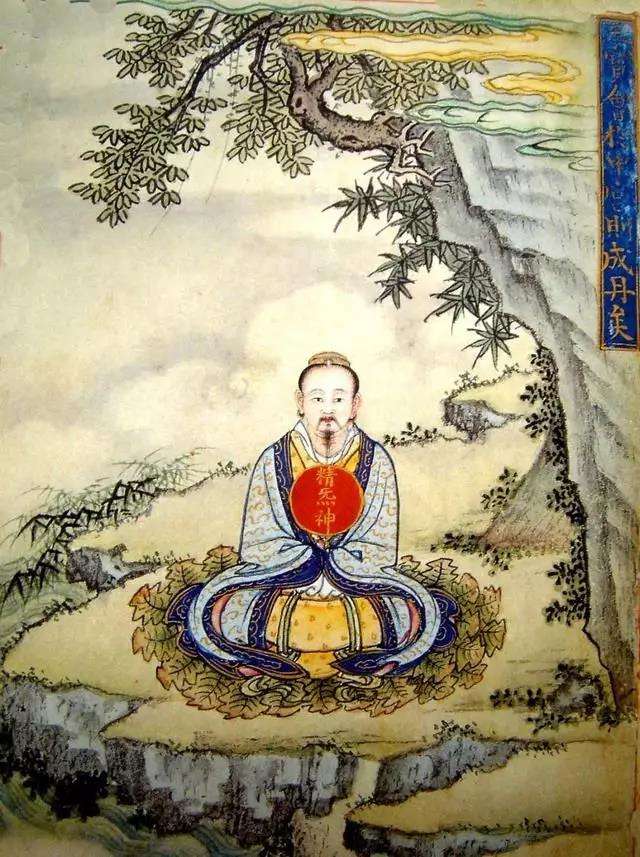
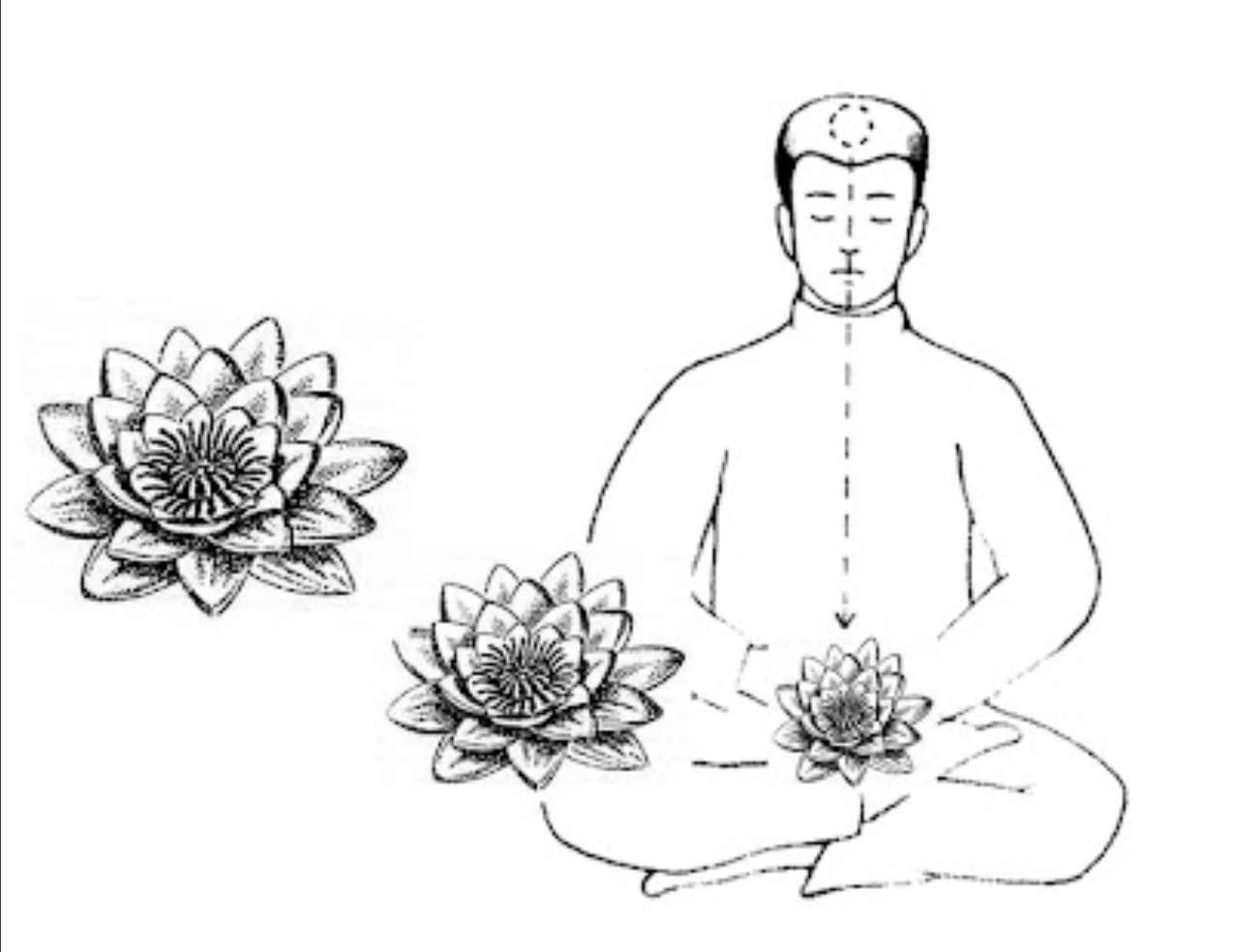
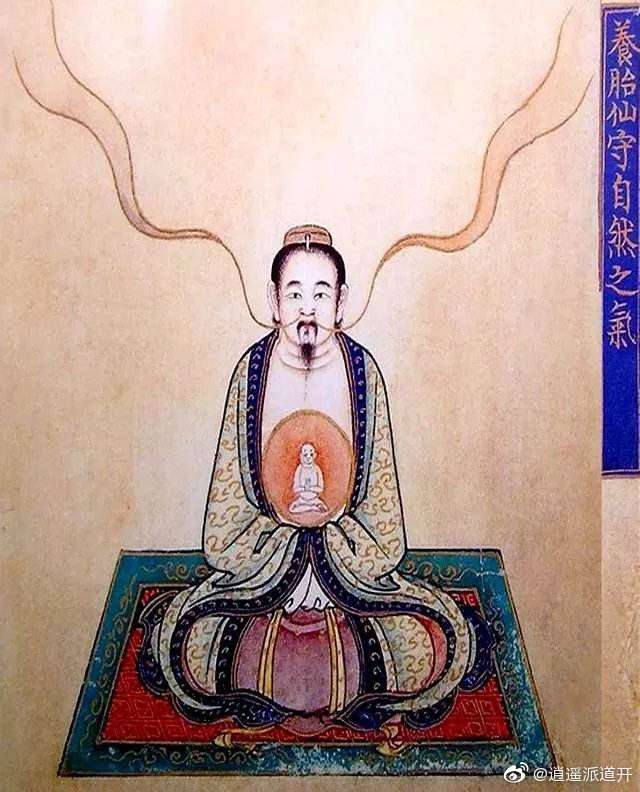
“You can plant gold lotus e’en in the midst of flames. / Squeeze the Five Phases jointly, use them back and forth” refers to the second stage, involving the inhalation and guidance of yang energy through various organs (the “five phases”) in the body to bolster the spirit (shen, 神) (fig. 1). This nurturing of the pearl causes it to sprout like a seed and blossom into a golden lotus (“amidst flames”) in the spiritual furnace (fig. 2). The lotus is considered the early stages of an immortal “spirit embryo” (shengtai, 聖胎) (fig. 3) (Kohn, 2008, pp. 178-179).

The third stage involves the nurturing of said embryo to maturation with spiritual energies and eventually guiding it upwards and out the “Heavenly Gate” (tianguan, 天關), or the top of the crown. This results in a fledgling immortal spirit body that must be trained over an additional three year period in which it learns to travel far and wide apart from the physical vessel (pp. 179-180). “When that’s done, be a Buddha or immortal at will!” refers to the eventual freedom of the immortal spirit.

Fig. 1 (top left) – A sage combining jing, qi, and shen (精炁/氣神, lit: “semen, pneumatic energy, and spirit”; a.k.a. the “Three Treasures,” Sanbao, 三寶) (larger version). Image from the Anthology of Immortals of Complete Perfection (Quanzhen qunxian ji, 全真群仙集). Fig. 2 (top right) – A visualized lotus in the cinnabar field (larger version). Fig. 3 (bottom) – A sage nurturing his spirit embryo with inhaled qi energy (larger version). Image from the Anthology of Immortals.

2. Powers

Kohn (2008) notes that adepts who succeed in their training gain supernatural powers, “including the ability to be in two places at once, to move quickly from one place to another, to know past and future, to divine people’s thoughts, and so on” (p. 180) (fig. 2). I feel this is important information considering all of the powers that Monkey exhibits throughout the story.

3. History

Various facets of the aforementioned Song-era practices, such as the breathing methods from stage two above, have a much older pedigree. While JTTW describes Sun secretly performing “breathing exercises before the hour of Zi and after the hour of Wu” (i.e. after noon and before midnight) (Wu & Yu, 2012, p. 121), the hours are switched in historical practice. The Wondrous Record of the Golden Casket on the Spirit Immortals’ Practice of Eating Qi (Shenxian shiqi jin’gui miaolu, 神仙食氣金櫃妙錄, 4th century; “Wonderous Record” hereafter) explains:

“[A]lways practice after midnight [and before noon] in the period of living qi [yang energy] … In this qi-practice, the time after noon and before midnight is called the period of dead qi [yin energy]. Do not practice then” (Kohn, 2008, p. 84).

So by practicing during the prescribed hours, Monkey absorbs the yang energy that he needs to fuel his immortality.


4. Updates

Update: 08-18-23

Above, I described how the cultivation of an immortal spirit involved refining cosmic energies in the dantian (丹田) into a seed-like pearl, then a lotus, and finally a “spirit embryo” (聖胎). Well, thanks to a tumblr post by user ruibaozha, I now have a better understanding of how Buddhist “lotus births” influenced this imagery. Shahar (2015) explains:

As early as the first centuries CE, redemption in Amitabha‘s Pure Land has been imagined in floral terms. Those who trust in the Buddha’s grace are resurrected from divine lotus blooms. Flower-like beings, they emerge from the sacred lotus blossoms into a realm of purity and happiness:

When beings of this [superior] type are about to die, the Buddha of Measureless Light [Amitabha] appears before them, accompanied by a great crowd of attendants. Then, these beings follow this Buddha and go to be reborn in his land. They are reborn naturally and miraculously in the center of a lotus made of the seven precious substances, and they dwell in the state from which there is no falling back. They come to possess wisdom and courage, supernormal powers and spiritual mastery.

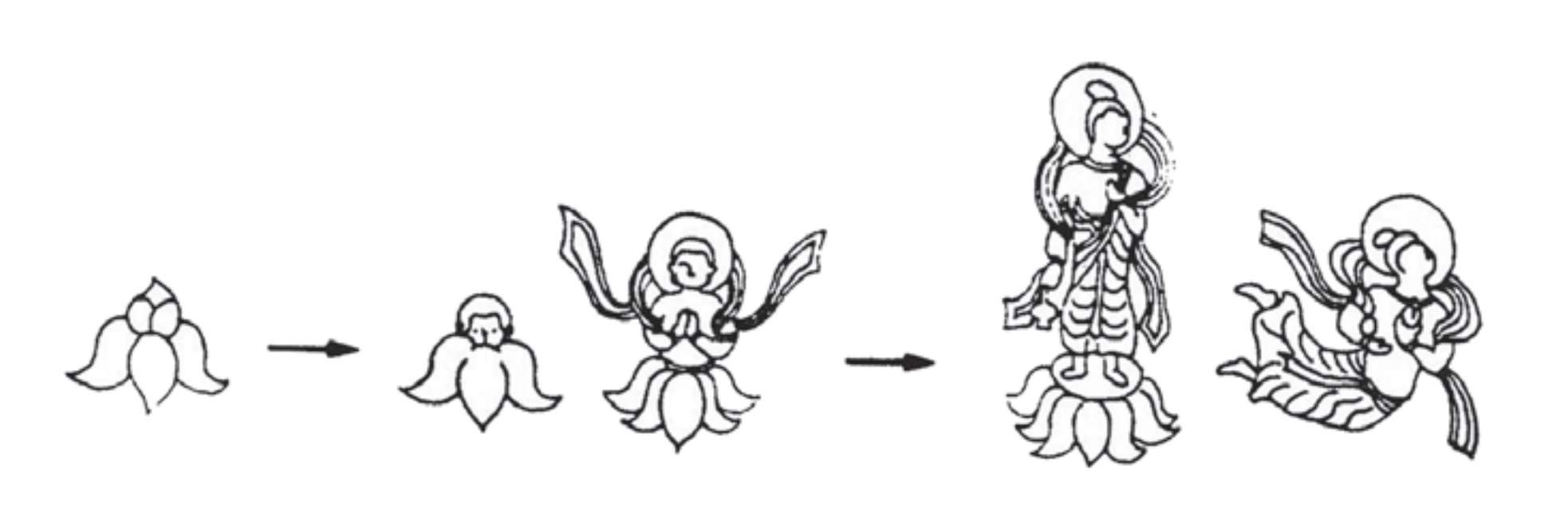
Floral regeneration became a favorite topic of Buddhist art across Asia. Redeemed souls were visually rendered as newborns wrapped in lotus blooms. Some artists faithfully followed a given Pure Land text. The ca. fifth-century Amitabha Visualization Sutra enumerated nine ranks of rebirth in the paradise of the west, from “the upper birth of the upper rank,” through “the middle birth of the upper rank,” downward to the “lower birth of the lower rank.” A seventh-century Dunhuang mural depicted them all in the form of babies emanating from nine lotus blossoms. Other artists focused on the process by which the flower is transformed into a divine being. They created a series of images recording the mysterious metamorphosis of the lotus. Dating from as early as the fifth century CE, the Yun’gang and Longmen caves include numerous examples of these pictorial narratives, showing first a newborn’s head peeping from inside the corolla, then the gradual transformation of the petals into the limbs, and finally the release of a full-blown ethereal being, the divinity of which is indicated by a [halo] [fig. 4] (pp. 143-144). 

Fig. 4 – “Lotus rebirth as rendered at the fifth-century Yun’gang Caves. From Yoshmura Rei, Tianren dansheng tu (Shanghai: Shanghai guji, 2009), p. 23” (larger version) (Shahar, 2015, p. 144).

If viewed through a Daoist lens, this image could represent the fledgling spirit embryo emerging from the lotus, being nurtured to fruition, and then freed to live out an eternity in blissful freedom.


Update: 09-22-23

Above, I quoted Kohn’s (2008) heavily edited translation of the Wonderous Record, which noted the prescribed times for the ingestion of qi energy. This source was apparently cited in the “Inner Chapters” (Neipian, 內篇) of Ge Hong’s Master Who Embraces Simplicity (Baopuzi, 抱朴子, 4th century). A longer quote appearing in Campany (2002) mentions the aforementioned time-based practices, lists the types of resulting spiritual powers, and warns of this path’s difficulty:

Now the circulation of pneumas should be done during the hours of live pneumas (shengqi 生氣[/炁]), not during the hours of dead pneumas (siqi 死氣[/炁]). This is why it is said that “transcendents ingest the six pneumas.” In one day and night there are twelve double-hours. The six double-hours from midnight to noon are those of live pneumas; the six from noon to midnight are those of dead pneumas. During the period of dead pneumas, circulating pneumas is of no benefit.

One who is adept at using pneumas can blow on water and it will flow against its own current for several paces; blow on fire, and it will be extinguished; blow at tigers or wolves, and they will crouch down and not be able to move; blow at serpents, and they will coil up and be unable to flee. If someone is wounded by a weapon, blow on the wound, and the bleeding will stop. If you hear of someone who has suffered a poisonous insect bite, even if you are not in his presence, you can, from a distance, blow and say an incantation over your own hand (males on the left hand, females on the right), and the person will at once be healed even if more than a hundred li away. And if you yourself are struck by a sudden illness, you have merely to swallow pneumas in three series of nine, and you will immediately recover.

However, people by nature are restless, and few are able to maintain the quietude to cultivate this way. Furthermore, to practice the most essential methods of circulating pneumas one must avoid eating very much, or eating flesh vegetables and meats, for these cause the breath to become strong and thus hard to shut off. Also one must avoid rage, for if one has much rage, then the breath becomes disordered, and if it is unable to spill over, then it will cause a fit of coughing.

Few are those, therefore, who can practice breath circulation! (p. 21)

夫行炁當以生炁之時,勿以死炁之時也。故曰仙人服六炁,此之謂也。一日一夜有十二時,其從半夜以至日中六時為生炁,從日中至夜半六時為死炁,死炁之時,行炁無益也。善用炁者,噓水,水為之逆流數步;噓火,火為之滅;噓虎狼,虎狼伏而不得動起;噓蛇虺,蛇虺蟠而不能去。若他人為兵刃所傷,噓之血即止;聞有為毒蟲所中,雖不見其人,遙為噓祝我之手,男噓我左,女噓我右,而彼人雖在百里之外,即時皆愈矣。又中惡急疾,但吞三九之炁,亦登時差也。但人性多躁,少能安靜以修其道耳。又行炁大要,不欲多食,及食生菜肥鮮之物,令人炁強難閉。又禁恚怒,多恚怒則炁亂,既不得溢,或令人發欬,故鮮有能為者也。

Sources:

Campany, R. F. (2002). To Live as Long as Heaven and Earth: A Translation and Study of Ge Hong’s Traditions of Divine Transcendents. United Kingdom: University of California Press.

Kohn, L. (2008). Chinese Healing Exercises: The Tradition of Daoyin. Honolulu: University of Hawaiʻi Press.

Shahar, M. (2015). Oedipal God: The Chinese Nezha and His Indian Origins. Germany: University of Hawaii Press.

Wu, C., & Yu, A. C. (2012). The Journey to the West (Vol. 1) (Rev. ed.). Chicago, Illinois: University of Chicago Press.