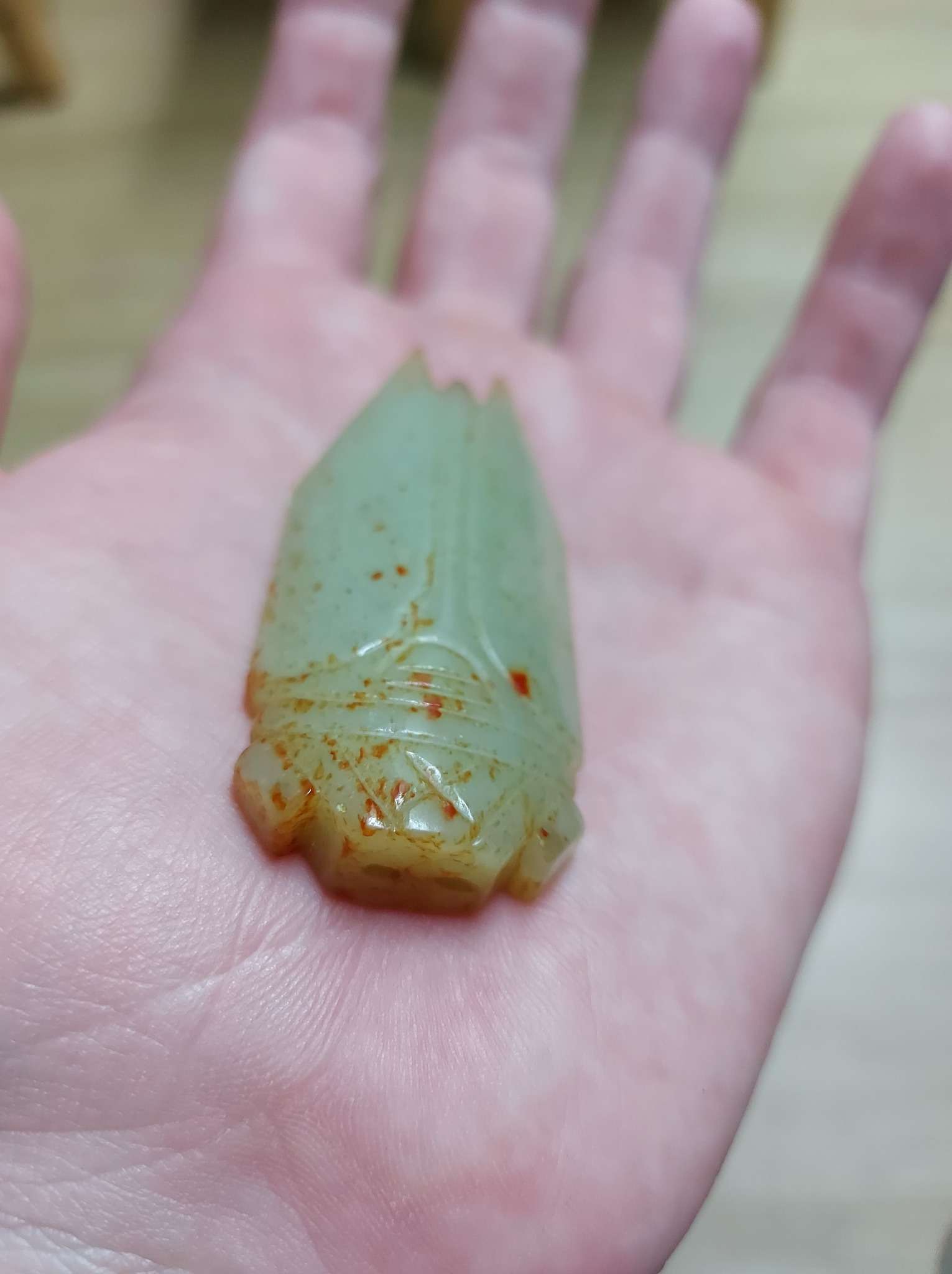
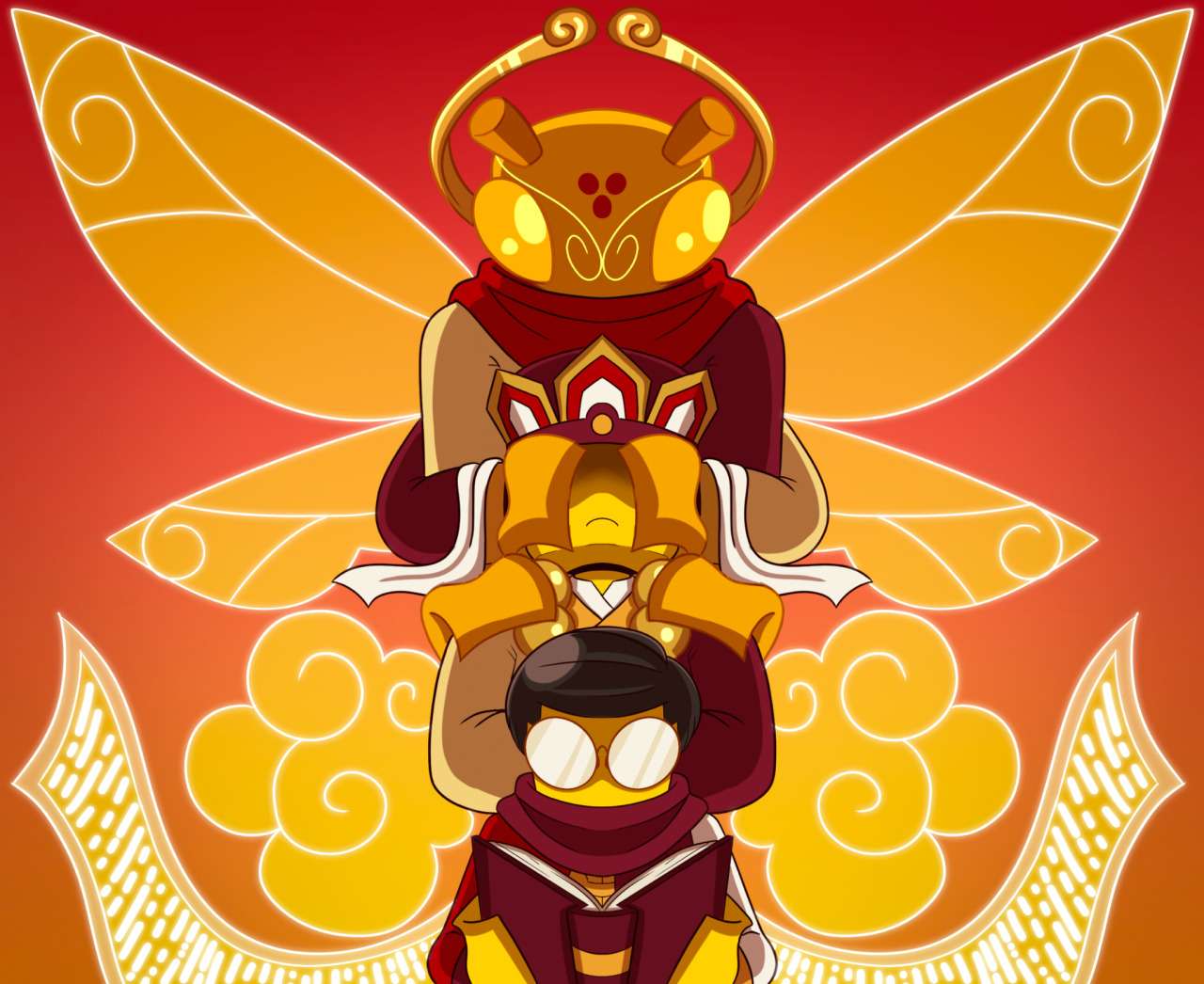
The Tang Monk Tripitaka is elevated in spiritual rank at the end of Journey to the West (Xiyouji, 西遊記, 1592 CE; “1592 JTTW” hereafter) for braving untold dangers and successfully retrieving the scriptures from India. The Tathagata enfeoffs him as the “Buddha of Candana (Sandalwood) Merit” (Zhantan gongde fo, 旃檀功德佛). Many readers may be surprised to learn that this is actually an established Buddhist deity and not just the creation of author-compiler Wu Cheng’en. In this article, I would like to briefly explore this Buddha’s religious background, iconography, purpose, and relationship to the worship of Xuanzang (玄奘, 602–664 CE), the historical Tang monk on whom Tripitaka is based.
Readers familiar with my past work will notice that this piece shares many similarities with my article on Sun Wukong’s Buddha title. I’m using it as a template since the information here is closely related.
1. Literary Enlightenment
In chapter 100, the Buddha states:
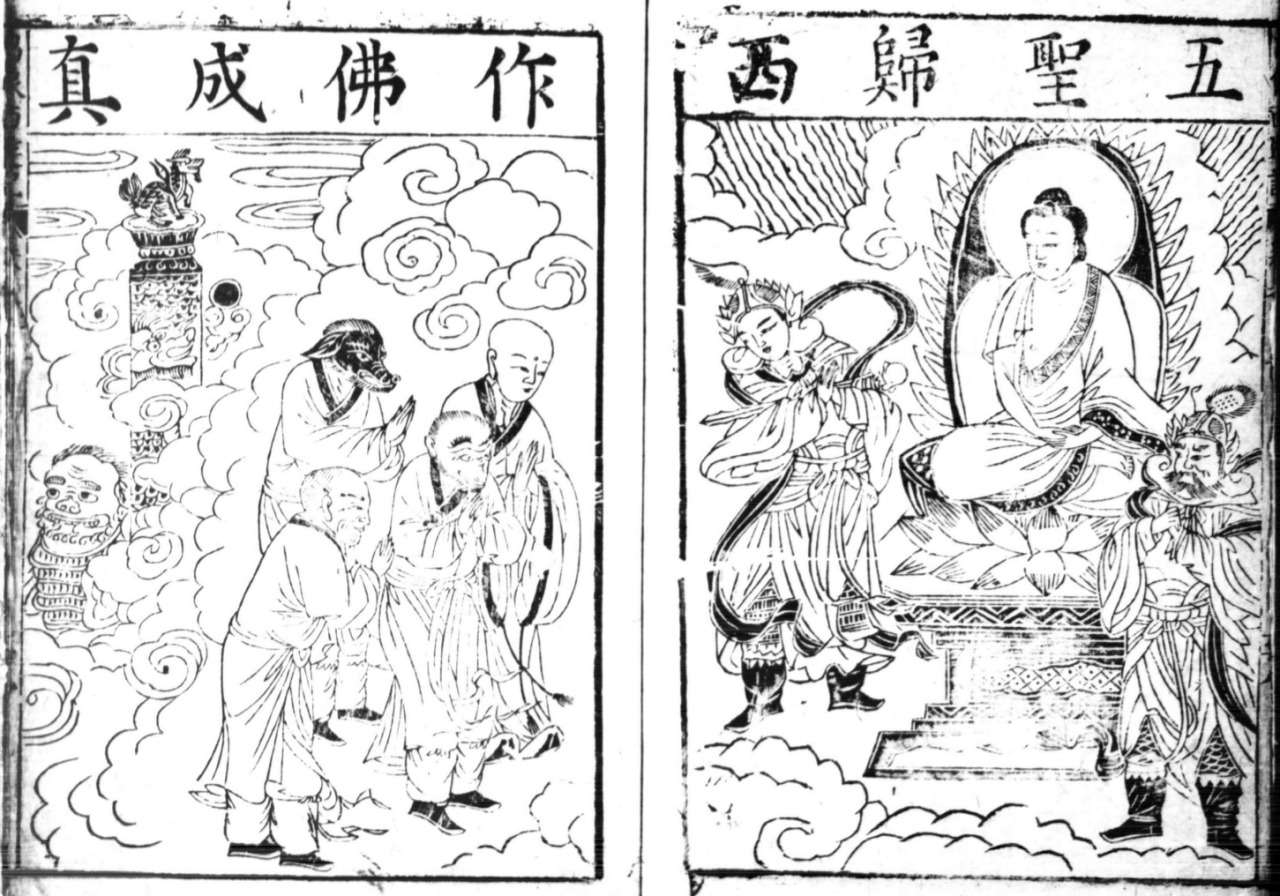
“Sage Monk,” said Tathagata, “in your previous incarnation you were originally my second disciple named Master Gold Cicada. Because you failed to listen to my exposition of the law and slighted my great teaching, your true spirit was banished to find another incarnation in the Land of the East. Happily you submitted and, by remaining faithful to our teaching, succeeded in acquiring the true scriptures. For such magnificent merit, you will receive a great promotion to become the Buddha of Candana Merit (emphasis added) (fig. 1) (Wu & Yu, 2012, vol. 4, p. 381).
Jenner (Wu & Jenner, 1993/2020) translates this title as “Candana-punya Buddha” (vol. 4, p. 2311). However, this appears to be a strange reverse Chinese to Sanskrit translation. Punya (Sk: पुण्य) means “merit.” As you’ll see in sec. 2, this isn’t the actual Sanskrit name of the Buddha.
Fig. 1 – Tripitaka and the other pilgrims receiving their elevation in spiritual rank at the end of the novel (larger version). Image from the original 1592 JTTW. Reading from right to left, the heading says: “The Five Sages Return to the West, Becoming Buddhas Comes True” (Wusheng guixi, Zuofo chengzhen, 五聖歸西,作佛成真)
2. Religious Background
The 1592 JTTW closes by “submitting” or “prostrating” (namo, 南無) to a long list of Buddhas, Bodhisattvas, and Arhats. The Buddha of Candana Merit is placed second to the last of 47 Buddhas and ahead of the Bodhisattva Guanyin. A section of the list reads:
[…]
I submit to the Buddha of Great Perfect Light.
I submit to the Buddha of the Gift of Light. I submit to the Buddha of Candana Merit (emphasis added).
I submit to the Buddha Victorious in Strife.
I submit to the Bodhisattva Guanshiyin.
[…] (Wu & Yu, 2012, p. 385).
Many of the Buddhas mentioned in the novel appear in assorted real world canonical lists, including the 88 Buddhas (Bashiba fo, 八十八佛) from the Great Repentance Text of the Eighty-Eight Buddhas (Ch: Bashiba fo da chanhui wen, 八十八佛大懺悔文). [1] This group is comprised of the 53 Buddhas (Ch: Wushisan fo, 五十三佛) and the 35 Confession Buddhas (Ch: Sanshiwu fo chan, 三十五佛懺) (fig. 1).
The Buddha of Candana Merit (Sk: Candanaśrī or Candanashri, चन्दनश्री; lit: “Glorious Sandalwood”) is the 18th of the 35 Confession Buddhas, [2] who are individually called upon during a confessional prayer to absolve oneself of sins. They appear in a number of sources, such as The Bodhisattva’s Confession of Ethical Downfalls (Ch: Pusa duochan / Pusa chanhui wen, 菩薩墮懺 / 菩薩懺悔文) from the Three Heaps Sutra (Sk: Trīskhandhadharmasūtra; Ch: Sanyun jing, 三蘊經) and the Names of the Thirty-Five Buddhas Spoken by the Buddha (Ch: Foshuo sanshiwu foming lichan wen, 佛說三十五佛名禮懺文).
Fig. 2 – A religious painting of the 35 Confession Buddhas (larger version). The Buddha of Candana Merit is the last (orange) Buddha on the rightmost side of the fourth row from the top. He is below a white Buddha, above a red Buddha, and to the left of a green Buddha. Image found here.
2.1. Iconography
The Buddha of Candana Merit is depicted in Buddhist art with the traditional features of a Buddha (i.e. urṇa, usnisa, long ear lobes, robes, etc.). He has three forms depending on the tradition:
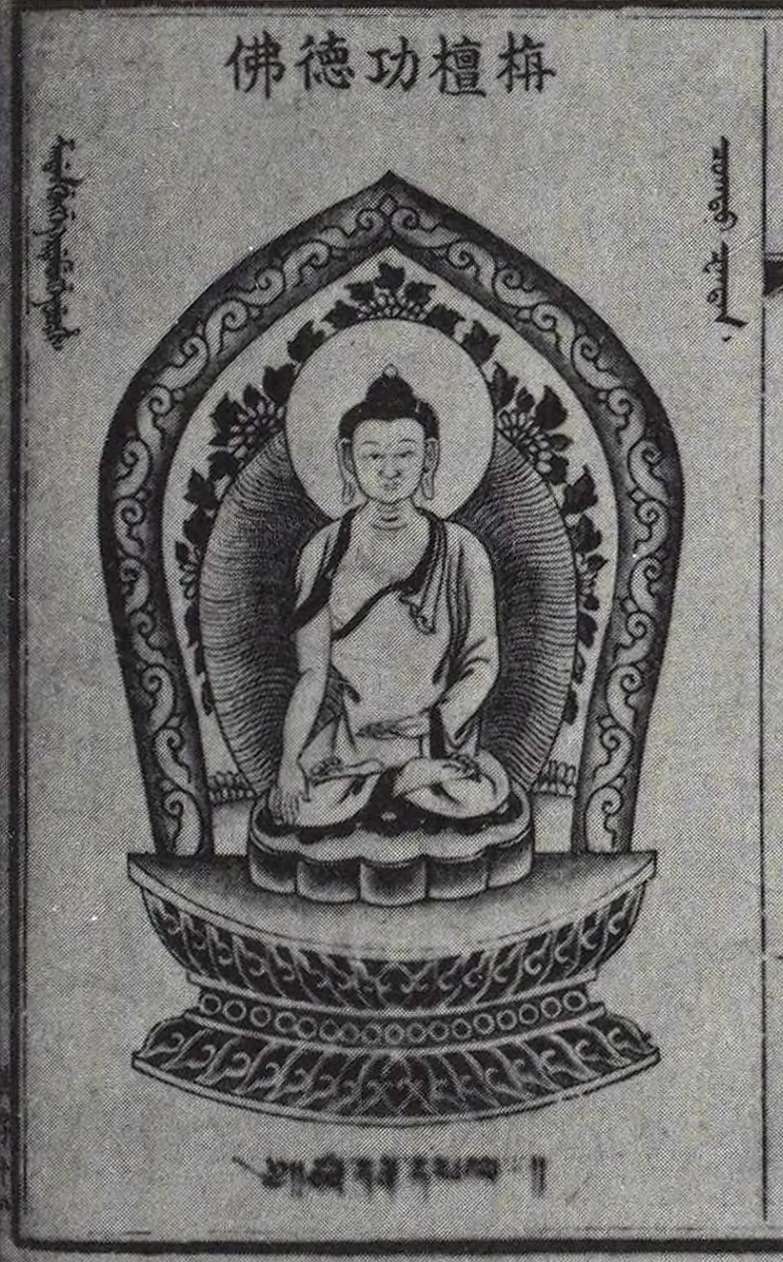
Candanasri Buddha — (Skt.) (Chin.: Chou-t’an-kung-te fo; Mon.” Cogtu candan; Tib.” Tsan-dan-dpal) A Sanskrit variant for the Jina Candanasri. One of the Buddha images found in the Pao Hsiang Lou [寶相樓] temple of the Forbidden City, Beijing, and one of the thirty-five “Buddhas of Confession.” Face: one, calm, urna, usnisa, long ear-lobes; arms/hands: right hand in bhumisparsa mudra, left in dhyana mudra [fig. 3]; mudra: bhumisparsa and dhyana; body: monastic robes; legs; two; asana: vajrasana; vahana: lotus throne.
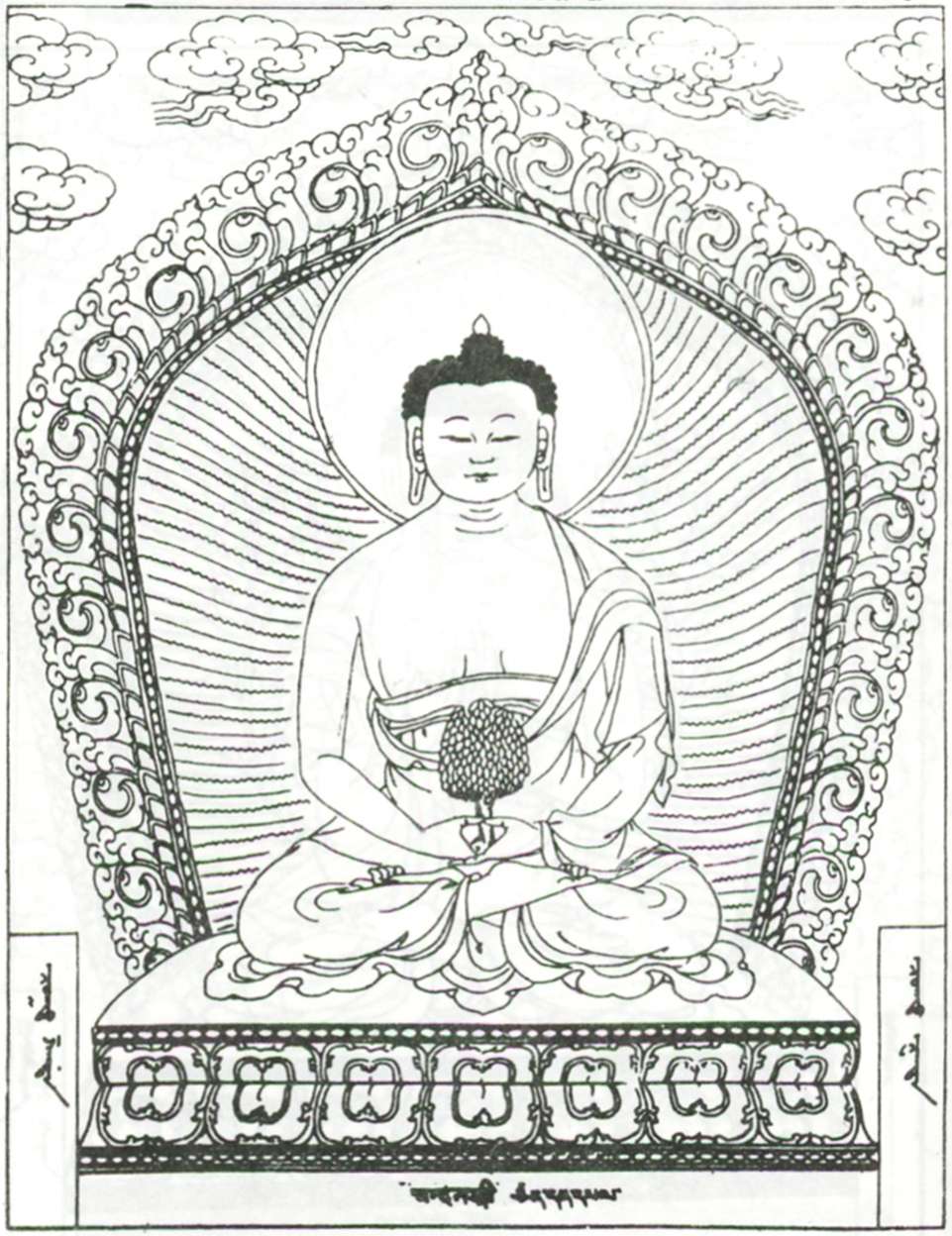
— (2) — (Mon.: Cogtu candan; Tib.: Tsan-dan-dpal) One of the Buddhas of Confession pictured in the Mongolian Kanjur (Mon.: Mongol ganjur-un) (1717-1720) Face: one, calm, urna, usnisa, long ear-lobes; arms/hands: two, holding a small [sandalwood] tree in dhyana mudra [fig. 4]; mudra: dhyana; body: monastic robes, right shoulder uncovered; legs: two; asana: vajrasana; attributes: 32 major and 80 minor signs; vahana: lotus throne (Bunce, 1994, Vol. 1, pp. 81-82).
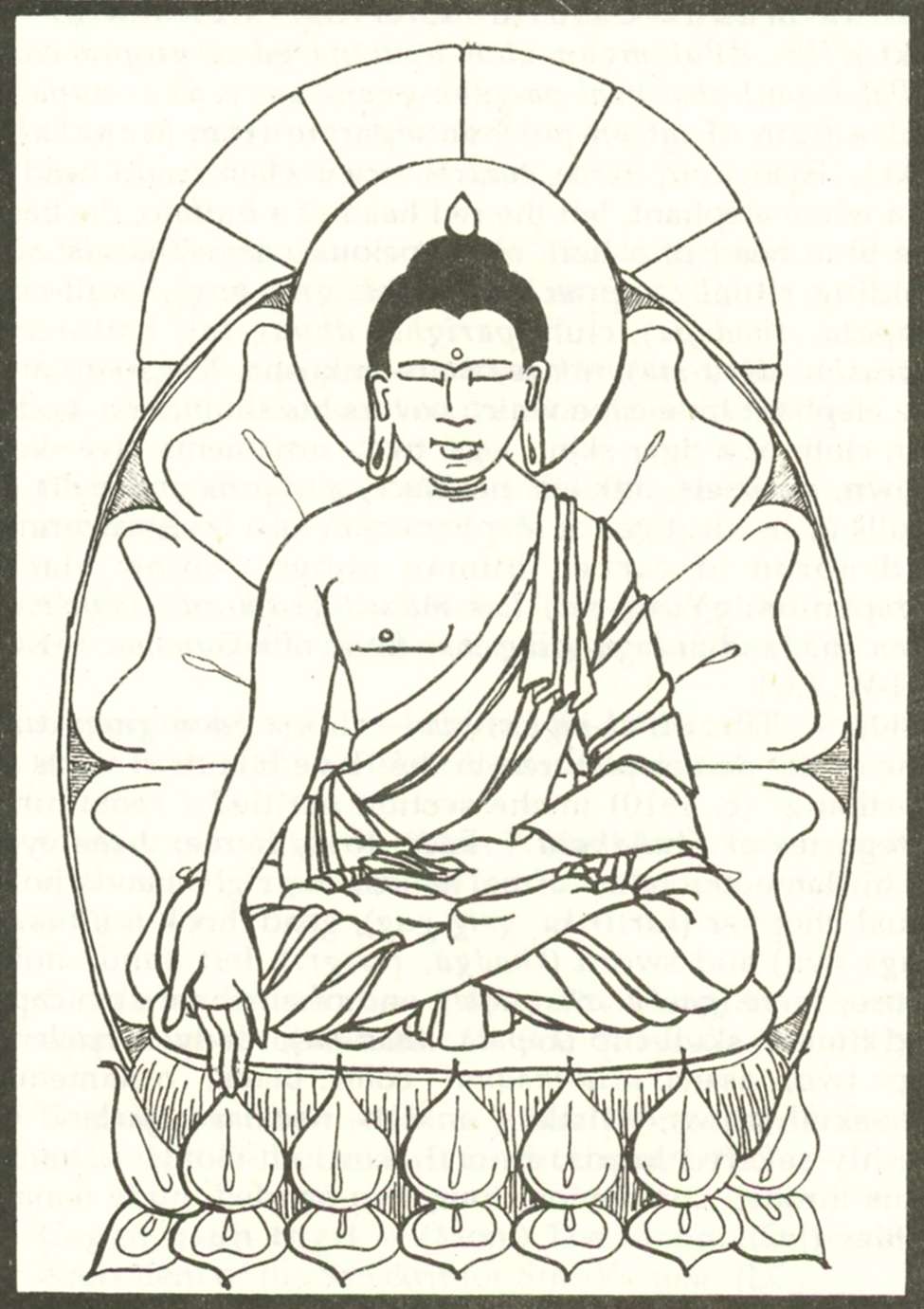
A plate in Bunce (1994) portrays him with the varada and dhyana mudras (fig. 5). And a source associated with the scholar-saint Nagarjuna (c. 150–250 CE) connects Candana Merit with the color orange (see sec. 2.2 below) (fig. 6).
Fig. 3 – (Top Left ) The first form of the Buddha of Candana Merit with the bhumisparsa and dhyana mudras (larger version). Image from Clark, 1937/1965, p. 249. Fig. 4 – (Top Right) The Buddha’s second form with a tree and dhyana mudra (larger version). Image from Chandra, 1999, p. 90. Fig. 5 – (Bottom Left) His third form with the varada and dhyana mudras (larger version). Image from Bunce, 1994, vol. 1, p. 82. Fig. 6 – (Bottom Right) Candana Merit portrayed with orange skin (larger version). Image found here.
2.2. Location and Purpose
Nagarjuna’s Discourse on the Ten Stages (Sk: Daśabhūmikavibhāṣā; Ch: Shi zhu piposha lun, 十住毘婆沙論, c. 3rd century CE) names the Buddha-land in which Candana Merit lives and the effect of his name/scent on the hearts of men:
In the south, after passing innumerable and immeasurable Buddha-lands, multiplied by the number of the sand-grains of the River Ganges, there is a land called Nanda. The Buddha of that land is called Candanashri. At present he lives there teaching the Dharma. [His glorious virtue is] like sandalwood (candana) which is fragrant and refreshing. His name reaches everywhere, just as scent pervades far and wide. It eliminates the fire of the three poisons, thereby cooling the passions of all sentient beings (based on Inagaki, 1998).
This work uses an alternative Chinese name for the Buddha, Zhantande (栴檀德), or “Virtuous Sandalwood.” Zhan (栴) is used in place of zhan (旃), and gong (功) is completely removed.
A Running Commentary on the Confession of Transgressions of Bodhi[sattvas] (Sk: Bodhyāpattideśanāvṛtti; Ch: Puti duofan falu huichu shi, 菩提墮犯發露悔除釋), another work connected to Nagarjuna, associates the Buddha with a different location, as well as the color orange:
He is seated in the North-western region in a world called “Pervaded by Miraculous Fragrance.” He is orange in color and his hands hold a branch of a Sandalwood tree and an auspicious fruit, which settles the mind (based on Lai, 2016).
He is also given a slightly different name, Zhantan jixiang (栴檀吉祥), or “Auspicious Sandalwood.” And once again, zhan (栴) is used instead of zhan (旃).
3. Relationship to Xuanzang’s Worship
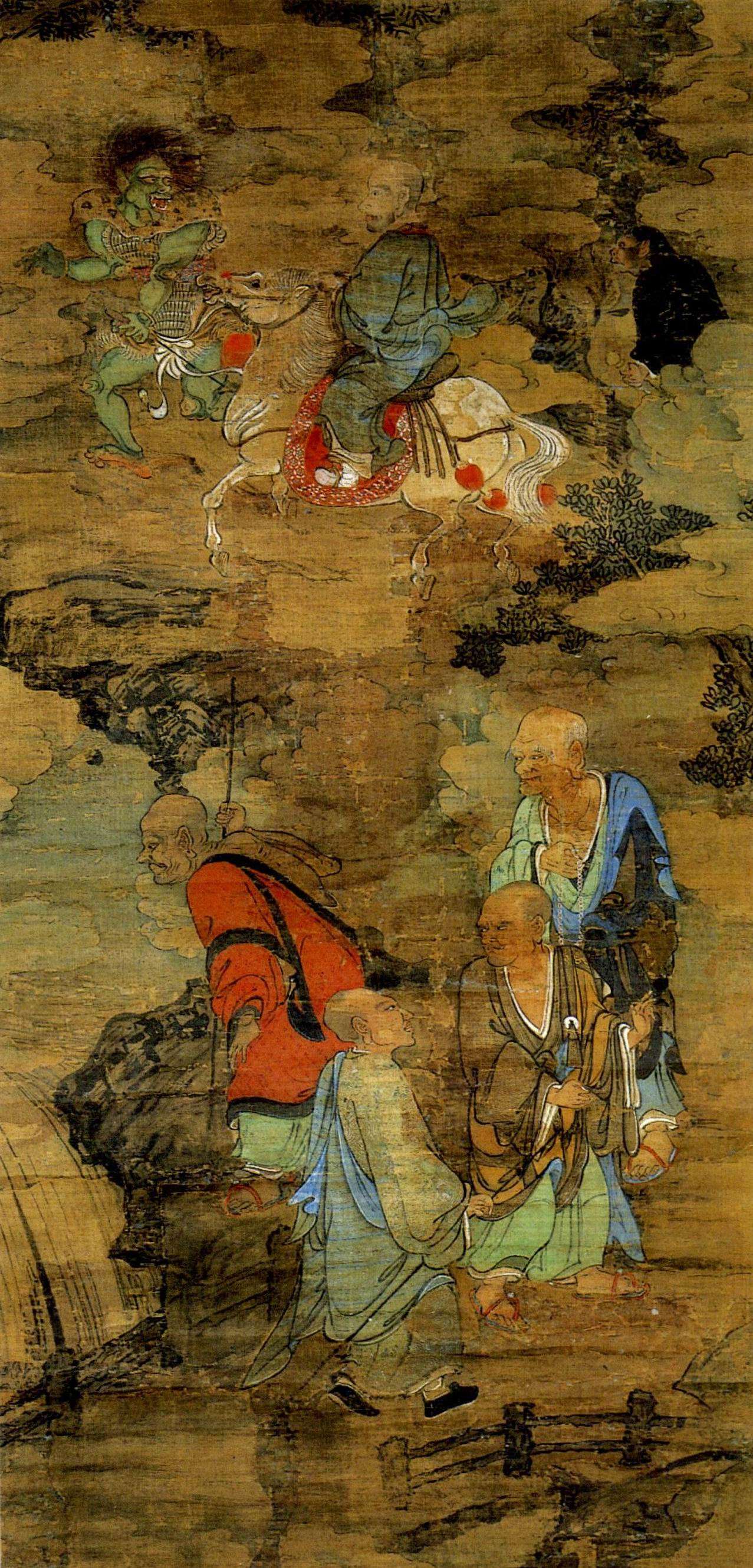
Evidence for the veneration of Xuanzang (玄奘, 602–664 CE), the historical Tang monk on whom Tripitaka is based, first emerged during the Song Dynasty (960–1127 CE) (Liu, 2019). For example, he appears as one of the famed 500 Arhats (Luohan, 羅漢) in a large set of late-12th century ritual scrolls (fig. 7 & 8). [3] This likely explains why an early-Ming JTTW zaju play, which predates the 1592 JTTW, depicts Tripitaka as the reincarnation of one such Buddhist saint. [4]
But most importantly, I was surprised to learn from Dr. Benjamin Brose that Xuanzang was actually associated with the Buddha Candana Merit at some point during the Ming Dynasty (1368-1644):
In a nutshell, during the Ming some salvational associations claimed that Xuanzang was one among several later incarnations of the Sandalwood Buddha sent to the human realm to deliver divine texts. These occurrences predate the publication of the [1592 JTTW] novel” (B. Brose, personal communication, June 3, 2023 *). [5]
* The above information will be expanded upon in Dr. Brose’s forthcoming book, Embodying Xuanzang: The Postmortem Travels of a Buddhist Pilgrim (September, 2023).
This association appears to have been short-lived, however, for I am unfamiliar with any modern temples that worship Xuanzang as Candana Merit. Why is this? I think the simplest answer is that the Buddha already had a long-established following and, therefore, couldn’t be subsumed under the late-blooming cult of the Tang Monk.
Fig. 7 – Lin Tinggui and Zhou Jichang, The Tang Monk Procures the Scriptures (Tangseng qujing, 唐僧取經), no. 77 of 100 scrolls from Images of the 500 Arhats (Wubai Luohan tu, 五百羅漢圖, 1178-1188 CE). Hanging scroll, ink and color on silk (larger version). Image from Nara kuniritsu hakubutsukan, Tōkyō bunkazai kenkyūjo, 2014, p. 86. Courtesy of Dr. Liu Shufen, a research fellow at the Institute of History and Philology, Academia Sinica. Fig. 8 – A detail of Xuanzang on his his horse. He is led by a spirit-soldier(?), and the “Monkey Pilgrim” appears to be visible in the clouds behind him (larger version).
4. Conclusion
At the end of the 1592 JTTW, the Tathagata promotes Tripitaka to the “Buddha of Candana Merit” (Zhantan gongde fo, 旃檀功德佛). This is one of the Chinese names of Candanaśrī or Candanashri (Sk: चन्दनश्री; lit: “Glorious Sandalwood”; a.k.a. “Virtuous or Auspicious Sandalwood,” Zhantande/jixiang, 栴檀德/吉祥), the 18th of the 35 Confession Buddhas called upon during a confessional prayer to absolve oneself of sins. He is portrayed as a sometimes orange-skinned, robe-wearing Buddha making the bhumisparsa, varada, and dhyana mudras and/or holding a fruit-bearing sandalwood tree in his lap. Conflicting sources place his Buddha-land in either “Nanda” (Huanxi, 歡喜) in the South or “Pervaded by Miraculous Fragrance” (Miaoxiang bianman, 妙香遍滿) in the North-West. However, scripture agrees that his name/scent has a calming or “cooling” affect on the passions of mankind.
Xuanzang, the historical Tang monk on whom Tripitaka is based, came to be revered as an arhat during the Song dynasty. This likely explains why he is portrayed as the reincarnation of one such Buddhist saint in an early-Ming JTTW zaju play. But at some point during the Ming, salvational groups connected Xuanzang to Candana Merit, believing the monk to be one of his incarnations. This association took place prior to the 1592 JTTW. However, Xuanzang doesn’t appear to be worshiped as said Buddha in modern practice. This might be because Candana Merit could never be subsumed under the Tang Monk’s late-blooming cult.
2) Thank you to Jose Loayza (Twitter) for telling me that Candana Merit was also one of the 35 Confession Buddhas.
3) To learn more about these Arhat paintings, see Zhou (2021).
4) The early-Ming JTTW zaju play sees the Arhat Vairocana (Pilujia zunzhe, 毗廬伽尊者) willingly reincarnate as Tripitaka in order to obtain the scriptures (Dudbridge, 1970, p. 193). The sage later returns to paradise upon completing his mission (Dudbridge, 1970, p. 200).
5) I don’t know for certain why Xuanzang was associated with Candana Merit during the Ming. However, my educated guess is that it has something to do with the monk’s historical connection to sandalwood statues. Morse (2007) explains:
“Xuanzang played an important role in popularizing sandalwood imagery when he brought ‘four carved sandalwood images of the Buddha’ back to Chang’an from India in 645″ (p. 168)
Sources:
Bunce, F. W. (1994). An Encyclopaedia of Buddhist Deities, Demigods, Godlings, Saints and Demons: With Special Focus on Iconographic Attributes (Vols.1-2). New Delhi: D.K. Printworld.
Chandra, L. (1999). Buddhist Iconography: Compact Edition. New Delhi: International Academy of Indian Culture & Aditya Prakashan.
Liu, S. (2019). Songdai Xuanzang de shenghua: Tuxiang, wenwu he yiji [The Sanctification of Xuanzang in the Song Dynasty: Images, Artifacts and Remains]. Zhonghua wenshi luncong, 133, 161-219.
Morse, S. C. (2007). The Buddhist Transformation of Japan in the Ninth Century: The Case of Eleven-Headed Kannon. In M. Adolphson, E. Kamens, & S. Matsumoto (Eds.), Heian Japan: Centers and Peripheries (pp. 153-176). Honolulu: University of Hawai’i Press.
Nara kuniritsu hakubutsukan, Tōkyō bunkazai kenkyūjo henshū [Nara University Tōkyō Research Institute for Cultural Properties (Ed.)]. (2014). Daitokuji denrai gohyaku rakan zu [Daitoku Temple’s Tradition of the 500 Arhats Paintings]. Kyōto: Shitau bungaku.
Wu, C. & Jenner, W. J. F. (2020). Journey to the West (Vol. 4). Beijing: Foreign Languages Press. (Original work published 1993)
Wu, C., & Yu, A. C. (2012). The Journey to the West (Vol. 4) (Rev. ed.). Chicago, Illinois: University of Chicago Press.
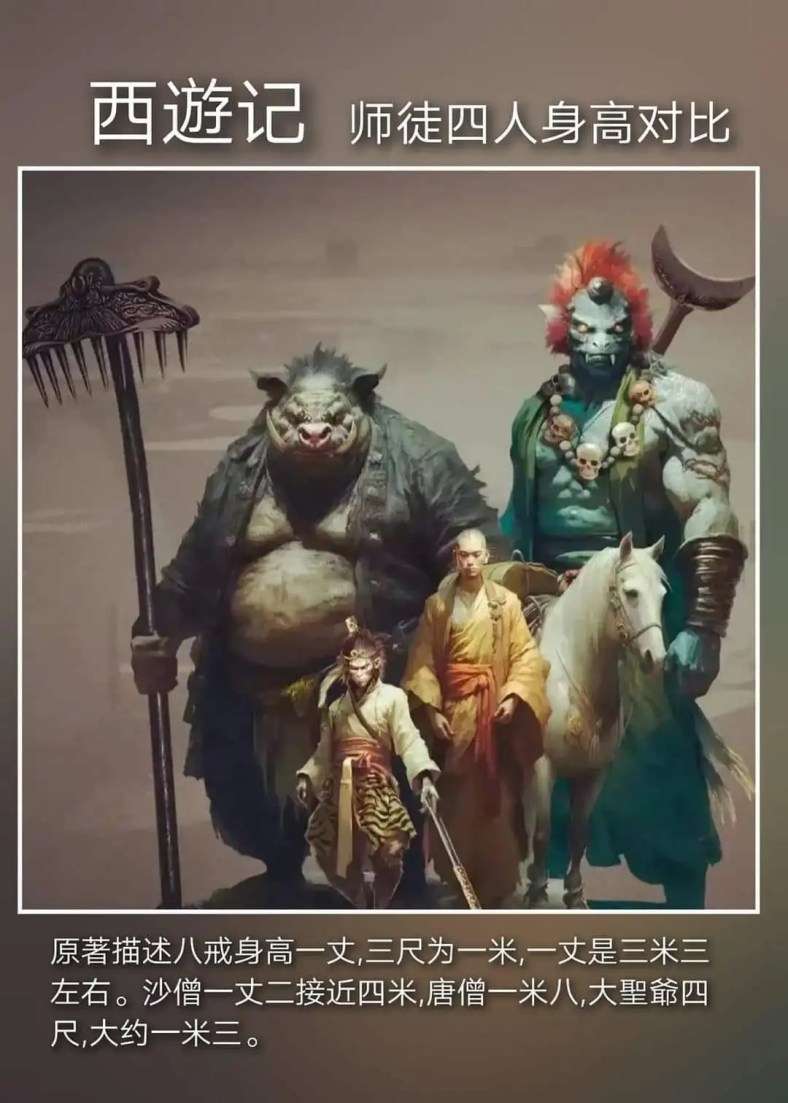
A member of a private Monkey King Facebook group I belong to posted a Chinese informational graphic titled “Journey to the West: The Four Body Height Ratios of the Master and His Disciples” (Xiyou ji: Shitu siren shengao duibi, 西游记 师徒四人身高对比) (fig. 1). Each character is depicted with their correct corresponding height, ranging from Sun Wukong as the shortest to Sha Wujing as the tallest. The bottom of the picture provides some measurements:
The original novel describes Bajie’s body as being 1 zhang tall. Three chi is 1 meter. One zhang is around 3.3 meters. Sha Monk is 1.2 zhang, which is close to 4 meters. The Tang monk is 1.8 meters. The Lord Great Sage is 4 chi, or approximately 1.3 meters.
The information is overgeneralized and at times conjectural, but I figured the picture would be interesting to my followers on Twitter. Little did I know that it would explode in popularity. As of this writing, my tweet has 940 likes (most of these received in a few days). This indicates that not many people were aware of the great height disparity between the pilgrims. I’ve, therefore, decided to write an article recording what Journey to the West (Xiyouji, 西遊記, 1592) actually says about each character’s height.
I believe that the creator of the info graphic got their measurements from this essay, for it has the exact same title and very similar material (Zhongshi Damei Shenghuo [ZDS], 2020). I will use the claims therein to compare and contrast with the actual text from the novel.
Fig. 1 – The Chinese informational picture listing the pilgrims’ heights (larger version). I, unfortunately, don’t know who the original artist is. A reverse image search didn’t turn up anything. This page has the earliest appearance of the informational picture that I can find.
ZDS (2020) uses a mixture of the ancient chi (尺, a.k.a. Chinese foot) and zhang (丈, a.k.a. ten Chinese feet) and the modern meter (mi, 米). The chi (and subsequently the zhang) varied at the local level at different times. During the Ming (1368–1644), when Journey to the West was published, the measurements equaled:
One chi (尺) = roughly 31.8 cm (12.3 in)
Ten chi = one zhang (丈)
one zhang (丈) = roughly 3.18 m (10.43 ft) (Jiang, 2005, p. xxxi).
Yes, the novel is set during the Tang (618–907), but many elements of the story (e.g. language, religion, mythos, martial arts, etc.) are filtered through the lens of the Ming. Therefore, it’s appropriate to use Ming-era measurements.
2. Heights
The characters are listed below from shortest to tallest.
(Note: I will be relying on the Wu & Yu (2012) translation. But since it uses “feet” instead of the original chi or zhang, I’ll alter the source throughout the article for more accuracy.)
2.1. Sun Wukong
See my previous articles discussing Monkey’s height (here and here).
ZDS (2020) states that Sun is “4 chi, that is less than 1.3 m [4.26 ft] or the same height as a child” (4 chi, yejiushi budao 1.3 mi, gen haitong yiban gao, 4尺,也就是不到1.3米,跟孩童一般高). But they miss an important distinction. The novel twice describes him as being “not four chi tall” (buman sichi, 不滿四尺), meaning that Monkey is an unknown height below 1.272 m (4.17 ft).
The phrase is first spoken by the Monstrous King of Havoc (Hunshi mowang, 混世魔王) in chapter 2:
When the Monstrous King saw him, he laughed and said, “You’re not four chi tall (emphasis added), nor are you thirty years old; you don’t even have weapons in your hands. How dare you be so insolent, looking for me to settle accounts?” (based on Wu & Yu, 2012, vol. 1, p. 128).
The second is said hundreds of years later by the Great King Yellow Wind (Huangfeng dawang, 黃風大王) in chapter 21:
The old monster took a careful look and saw the diminutive figure of Pilgrim—less than four chi (emphasis added), in fact—and his sallow cheeks. He said with a laugh: “Too bad! Too bad! I thought you were some kind of invincible hero. But you are only a sickly ghost, with nothing more than your skeleton left!” (based on Wu & Yu, 2012, vol. 1, p. 408).
Some readers may wonder why such a powerful character can be so tiny. This is because the novel describes Sun as a literal monkey. Refer back to this article for more information.
(Note: See the 04-27-24 update below for a more precise measurement.)
2.2. The Tang Monk
I have yet to formally write about Tripitaka‘s height.
ZDS (2020) suggests that the “Tang Monk should be about 1.8 m [5.90 ft]” (Tangseng yinggai zai 1.8 mi zuoyou, 唐僧应该在1.8米左右). This estimate is based on the size of a stone box used to imprison him in chapter 49:
Pilgrim … mov[ed] towards the rear of the palace. He looked, and sure enough there was a stone box, somewhat like a trough that people use in a pigpen or a stone coffin. Measuring it, he found it to be approximately six chi in length (emphasis added). He crawled on top of it and soon heard the pitiful sound of Tripitaka’s weeping coming from inside (Wu & Yu, 2012, vol. 2, p. 347).
Six chi is 1.9 m or 6.25 ft. Tripitaka would obviously be shorter given the inside thickness of the stone walls, but the novel doesn’t provide such detailed information. This means that the 1.8 m estimate is conjecture. So, what other proof is there?
ZDS (2020) also cites a poem from chapter 54 as evidence that the Tank Monk is “tall and handsome” (yougao youshuai, 又高又帅):
What handsome features!
What dignified looks!
Teeth white like silver bricks,
Ruddy lips and a square mouth.
His head’s flat-topped, his forehead, wide and full;
Lovely eyes, neat eyebrows, and a chin that’s long.
Two well-rounded ears betoken someone brave.
He is all elegance, a gifted man.
What a youthful, clever, and comely son of love,
Worthy to wed Western Liang’s gorgeous girl! (Wu & Yu, 2012, vol. 3, p. 55). [1]
Technically, yishen busu (一身不俗) can mean having a body that is “impressive” or “out of the ordinary,” but as Yu (2012) translates, it can also refer to one’s person. This is not the same as listing a particular height.
Hence, there isn’t enough information in the novel to officially say how tall Tripitaka is. But for those demanding some sort of answer, we can always speculate using real world data.
According to one study, out of a sample size of 28,044 Chinese men from 31 provinces/autonomous regions, the average modern height is 169 cm (5.54 ft). Additionally, this Chinese article references a study claiming that men from ancient times up to the Ming were between 165 cm (1.65 m or 5.41 ft) and 167 cm (1.67 m or 5.47 ft). This is obviously shorter than the 1.8 m suggested above.
Therefore, the most we can say is that the Tang Monk would be average historical height.
2.3. Zhu Bajie
I’ve written about Zhu Bajie’s height in the past (see here).
ZDS (2020) writes that Zhu’s “snout is 3 chi long” (zui chang 3 chi, 嘴长3尺). This is based on a descriptive poem from chapter 85:
A snout, pestlelike, over three chi long (emphasis added)
And teeth protruding like silver prongs
Bright like lightning a pair of eyeballs round,
Two ears that whip the wind in hu-hu sound.
Arrowlike hairs behind his head are seen;
His whole body’s skin is both coarse and green.
His hands hold up a thing bizarre and queer:
A muckrake of nine prongs which all men fear.
But, again, an important distinction is missed. Zhu’s nose is “over three chi long,” orlarger than 95.4 cm (3.12 ft), which is over half the height of an average human. ZDS (2020) says this measurement indicates that: “According to the laws of biology, (Zhu’s) body is approximately 3.5 m [11.48 ft]” (Anzhao shengwuxue de guilu, shenti yue 3.5 mi zuoyou, 按照生物学的规律,身体约3.5米左右). However, they never explain what laws they are referring to.
The only other information about Zhu’s size that I’m aware of appears in chapter 29. Upon entering a new kingdom, Tripitaka describes his two remaining disciples. [2] He starts with the pig spirit:
“My elder disciple has the surname of Zhu, and his given names are Wuneng and Eight Rules. He has a long snout and fanglike teeth, tough bristles on the back of his head, and huge, fanlike ears. He is coarse and husky, and he causes even the wind to rise when he walks (emphasis added) …” (Wu & Yu 2012, vol. 2, p. 51).
This tells us that Zhu has a large body capable of stirring the wind when he moves. But it’s important to note that Tripitaka’s subsequent dialogue assigns Sha Wujing a specific height (see below). This points to Zhu being shorter in comparison.
Therefore, just like the Tank Monk, there isn’t enough info to officially say how tall Zhu is. But we can again speculate using real world data.
My friend Barbara Campbell (blog) suggested that I use extinct prehistoric pigs as reference. A prime example is Megalochoerus homungous, which has been estimated to be 3.8 m (12.46 ft) long, 1.8 to 2.2 m (5.9 to 7.21 ft) at the shoulder, and up to 1,600 kg (3,527.39 lbs) (Uchytel, n.d.). A reconstruction by the paleo artist Roman Uchytel presents a towering creature with a head half as long as a man’s body (fig. 2). This is quite similar to the size of Zhu’s nose. Even with it’s head facing forward, a bipedal M. homungous would still be around 3.8 m (12.46 ft) tall. But as you’ll read below, this is too tall if Zhu is supposed to be shorter than Sha.
So how tall is Zhu? Your guess is as good as mine. But for those demanding some sort of answer, we can use human arm span to body height ratio, which is roughly 1:1. Using 1.8 m (5.9 ft), or the lower estimate for M. homungous‘ shoulder height, Zhu could be as much as 3.6 m (11.81 ft). But I am in no way comfortable with this estimate. It’s 100% pure conjecture, and I think it is still too tall.
Fig. 2 – A reconstruction of M. homungous by Roman Uchytel (larger version). Mr. Uchytel graciously gave me permission to use a watermarked version of his art for free. Please consult his website here.
2.4. Sha Wujing
I’ve previously mentioned Sha’s height in the article about Zhu Bajie’s appearance (refer back to here).
ZDS (2020) writes that Sha is “One zhang 2 chi, nearly 4 m” (yizhang erchi, chabuduo 4 mi le, 一丈二尺,差不多4米了). This is based on Tripitaka’s continued dialogue with the foreign king in chapter 29:
“… My second disciple has the surname of Sha, and his religious names are Wujing and Monk. He is one zhang two chi tall and three span wide across his shoulders (emphasis added). His face is like indigo, his mouth, a butcher’s bowl; his eyes gleam and his teeth seem a row of nails” (Wu & Yu 2012, vol. 2, p. 51).
This tells us that the monstrous monk is a whopping 3.816 m (12.51 ft) tall, with an exceptionally broad body.
Fun fact: Sha Wujing’s height is based on his giant antecedent, an obscure desert spirit appearing in the 7th-century biography of the historical monk Xuanzang (on whom Tripitaka is based). The spirit comes to the cleric in a dream to admonish him for sleeping on the journey to India:
[Xuanzang] dreamed that he saw a giant deity several zhang tall (emphasis added), holding a halberd and a flag in his hands. The deity said to him, “Why are you sleeping here instead of forging ahead?” (based on Huili & Li, 1995, p. 28).
“[S]everal zhang” would be 3 zhang (9.54 m or 31.29 ft) or more tall! That’s one big spirit!
3. Conclusion
“Journey to the West: The Four Body Height Ratios of the Master and His Disciples” is an informational picture that depicts the pilgrims with their correct corresponding heights. The bottom of the picture also provides measurements to supplement the illustration. These numbers were likely borrowed from ZDS (2020), an online article with the exact same name and very similar material. According to the essay, Sun Wukong is less than 1.3 m (4.26 ft), the Tang Monk is about 1.8 m (5.90 ft), Zhu Bajie is 3.5 m (11.48 ft), and Sha Wujing is nearly 4 m (13.12 ft). However, this information is overgeneralized and at times conjectural.
The original Chinese text of Journey to the West naturally gives more accurate information. But, unfortunately, the book only lists specific heights for two characters: Monkey is shorter than 1.272 m (4.17 ft) and Sha is 3.816 m (12.51 ft). As for the other two, not enough information is given for Tripitaka or Zhu to officially say how tall they are. However, speculating with real world historical height data suggests that the literary monk could be somewhere between 1.65 m (5.41 ft) and 1.67 m (5.47 ft), which is obviously shorter than the 1.8 m cited above. But even using prehistoric pigs as a reference, Zhu Bajie is the hardest to calculate since the novel indirectly implies that he is shorter than Sha. I used the lower end shoulder height estimate of the extinct M. homungous to suggest that Zhu could be as much as 3.6 m (11.81 ft) tall. But I think that this is still too big.
On an interesting note, Sha’s great height is based on his giant antecedent, a desert spirit appearing in the historical Xuanzang’s 7th-century biography. The spirit is described as being 9.54 m (31.29 ft) or more!
4. Updates
Update: 08-26-23
Tumblr user @digitalagepulao has drawn lovely versions of the JTTW pilgrims (fig. 3). And while some of their heights may differ slightly from those discussed above, the overall ratios are correct. I love the designs.
Fig. 3 – The height ratios for digitalagepulao’s JTTW character designs (larger version). Used with permission.
Update: 04-27-24
Chapter 37 gives a more precise measurement for Monkey’s height. He first transforms into a “tiny monk about two cun tall” (二寸長的小和尚兒) (based on Wu & Yu, 2012, vol. 2, p. 172). He shortly thereafter grows even bigger when a prince makes fun of him:
Tripitaka pulled open the box’s cover; Pilgrim [Sun Wukong] leaped out and began to hobble all over the place. The prince said, “This little midget! What can he know?” When Pilgrim heard this remark about his size, he at once resorted to magic. Straightening up his torso, he grew about three chi and four or five cun instantly (emphasis added). “If he can grow that rapidly,” said the soldiers, highly startled, “it will only be a few days before he pierces the sky.” When Pilgrim reached his normal height, however, he stopped growing (emphasis added) (based on Wu & Yu, 2012, vol. 2, pp. 174-175).
As mentioned in section 1, one chi (尺) is roughly 12.3 in or 31.8 cm (Jiang, 2005, p. xxxi). Expanding on this, one chi equals 10 cun (寸; a.k.a. “Chinese inches”) (Jiang, 2005, p. xxxi). One cun would be about 1.25 in or 3.18 cm. Two cun would, therefore, be 2.5 in or 6.36 cm. Growing the stated additional height would then put our hero at 3 chi and 6 or 7 cun, which is roughly 3.86 ft or 1.176 m. This agrees with the aforementioned estimate of “not (or less than) four chi tall” (buman sichi, 不滿四尺) (Wu & Yu, 2012, vol. 1, pp. 128 and 408).
1) “Western Liang’s gorgeous girl” is referring to the Queen of Womanland.
2) The Tang Monk had previously expelled Monkey from the group in chapter 27 (Wu & Yu, vol. 2, pp. 26-28).
Sources:
Huili, & Li, R. (1995). A Biography of the Tripiṭaka Master of the Great Ci’en Monastery of the Great Tang Dynasty. Berkeley: Numata Center for Buddhist translation and research.
Jiang, Y. (2005). The Great Ming Code / Da Ming Lu. Vancouver, Wa: University of Washington Press.
Wu, C., & Yu, A. C. (2012). The Journey to the West (Vols. 1-4) (Rev. ed.). Chicago, Illinois: University of Chicago Press.
Zhongshi Damei Shenghuo. (2020, August 18). Xiyou ji: Shitu siren shengao duibi [Journey to the West: The Four Body Height Ratios of the Master and His Disciples]. Sohu. Retrieved from https://www.sohu.com/a/413598842_120113471
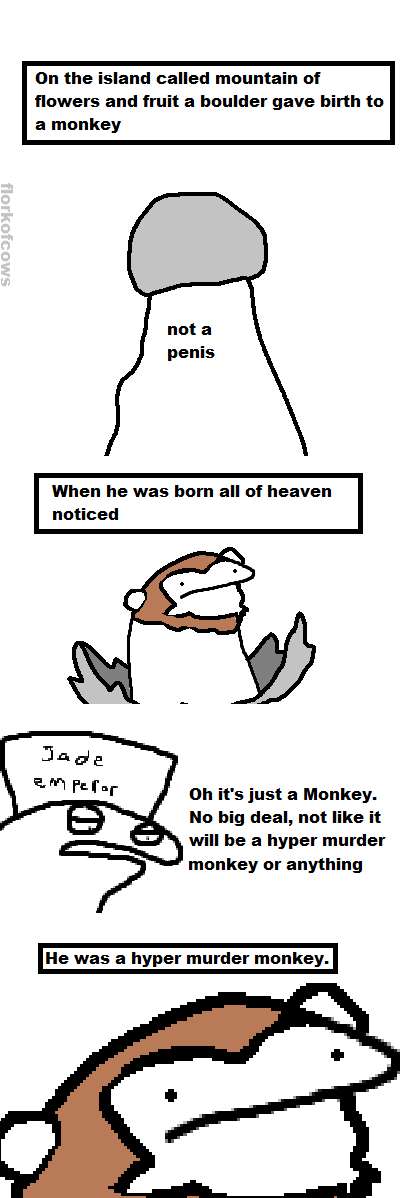
Someone on Tumblr recently asked me if I knew how many monsters, spirits, and humans that Sun Wukong kills throughout Journey to the West (Xiyouji, 西遊記, 1592). But since he’s a “hyper murder monkey” (fig. 1), this is impossible to quantify without an overly extensive survey of the book. However, the task becomes far more manageable if narrowed down to just humans. I know of at least seven instances in chapters 14, 27, 28, 44, 46, and 56. Although I can’t give an exact count, the number slain is over 1,030!
This study is by no means exhaustive. I’ve surely missed a few examples in the latter half of the book. But I’ll update this piece in the future if anything else pops up.(See the 08-15-24 update below.)
The first instance happens when Sun and his master are accosted by six robbers shortly after the immortal is released from under Five Elements Mountain:
Master and disciple had traveled for some time when suddenly six men jumped out from the side of the road with much clamor, all holding long spears and short swords, sharp blades and strong bows. “Stop, monk!” they cried. “Leave your horse and drop your bag at once, and we’ll let you pass on alive!” Tripitaka was so terrified that his soul left him and his spirit fled; he fell from his horse, unable to utter a word. But Pilgrim lifted him up, saying, “Don’t be alarmed, Master. It’s nothing really, just some people coming to give us clothes and a travel allowance!” “Wukong,” said Tripitaka, “you must be a little hard of hearing! They told us to leave our bag and our horse, and you want to ask them for clothes and a travel allowance?” “You just stay here and watch our belongings,” said Pilgrim, “and let old Monkey confront them. We’ll see what happens.” Tripitaka said, “Even a good punch is no match for a pair of fists, and two fists can’t cope with four hands! There are six big fellows over there, and you are such a tiny person. How can you have the nerve to confront them?”
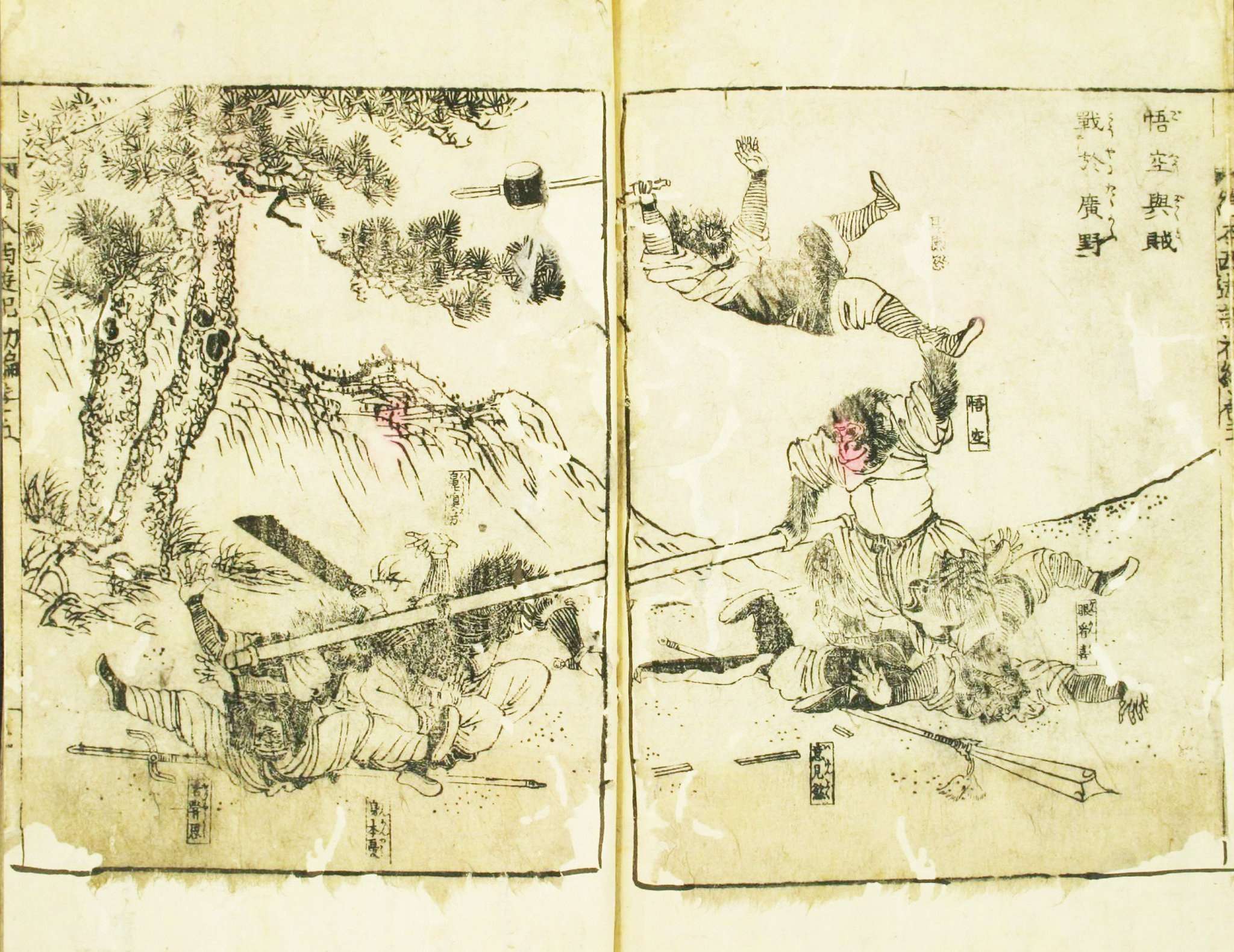
As he always had been audacious, Pilgrim did not wait for further discussion. He walked forward with arms folded and saluted the six men, saying, “Sirs, for what reason are you blocking the path of this poor monk?” “We are kings of the highway,” said the men, “philanthropic mountain lords. Our fame has long been known, though you seem to be ignorant of it. Leave your belongings at once, and you will be allowed to pass. If you but utter half a no, you’ll be chopped to pieces!” “I have been also a great hereditary king and a mountain lord for centuries,” said Pilgrim, “but I have yet to learn of your illustrious names.” “So you really don’t know!” one of them said. “Let’s tell you then: one of us is named Eye That Sees and Delights; another, Ear That Hears and Rages; another Nose That Smells and Loves; another, Tongue That Tastes and Desires; another, Mind That Perceives and Covets; and another, Body That Bears and Suffers.” “You are nothing but six hairy brigands,” said Wukong laughing, “who have failed to recognize in me a person who has left the family, your proper master. How dare you bar my way? Bring out the treasures you have stolen so that you and I can divide them into seven portions. I’ll spare you then!” Hearing this, the robbers all reacted with rage and amusement, covetousness and fear, desire and anxiety. They rushed forward crying, “You reckless monk! You haven’t a thing to offer us, and yet you want us to share our loot with you!” Wielding spears and swords, they surrounded Pilgrim and hacked away at his head seventy or eighty times. Pilgrim stood in their midst and behaved as if nothing were happening.
What a monk!” said one of the robbers. “He really does have a hard head!” “Passably so!” said Pilgrim, laughing. “But your hands must be getting tired from all that exercise; it’s about time for old Monkey to take out his needle for a little entertainment.” “This monk must be an acupuncture man in disguise,” said the robber. “We’re not sick! What’s all this about using a needle?” Pilgrim reached into his ear and took out a tiny embroidery needle; one wave of it in the wind and it became an iron rod with the thickness of a rice bowl. He held it in his hands, saying, “Don’t run! Let old Monkey try his hand on you with this rod!” The six robbers fled in all directions, but with great strides he caught up with them and rounded all of them up. He beat every one of them to death, stripped them of their clothes, and seized their valuables. Then Pilgrim came back smiling broadly and said, “You may proceed now, Master. Those robbers have been exterminated by old Monkey” (Wu & Yu, vol. 1, pp 314-315).
This ends with Tripitaka becoming angry and exiling Monkey. The cleric later welcomes him back, only to rein in his disciple’s unruly behavior with the heaven-sent golden headband (Wu & Yu, 2012, vol. 1, pp. 315-317 and 318-320). This becomes a reoccurring theme (see below).
The six murders (fig. 2) are allegories for defeating the desires of the eyes, ears, nose, tongue, mind, and body that hinder one’s spiritual progression. [1] This is explained by Monkey in chapter 43 (Wu & Yu, 2012, vol. 2, p. 254).
Fig. 2 – A woodblock print depicting Sun killing the six bandits (larger version). It comes from The Illustrated Journey to the West (Ehon Saiyuki, 繪本西遊記), a 19th-century Japanese translation.
2. Chapter 27
Unknown
The second is alluded to during the White Bone Spirit episode. In her attempts to eat the monk, the wily skeleton demon takes on the guises of a beautiful girl, her elderly mother, and her elderly father in turn. But each time Sun attacks her with his staff, she leaves a fake corpse in her wake, [2] making it seem like the immortal has murdered yet another person. This naturally upsets Tripitaka, but Monkey explains that evil spirits commonly disguise themselves as something welcoming in order to catch and eat humans. He uses himself as an example, claiming to have done the same as a young monster:
“Master,” said Pilgrim with a laugh, “how could you know about this? When I was a monster back at the Water-Curtain Cave, I would act like this if I wanted to eat human flesh. I would change myself into gold or silver, a lonely building, a harmless drunk, or a beautiful woman. Anyone feebleminded enough to be attracted by me I would lure back to the cave. There I would enjoy him as I pleased, by steaming or boiling. If I couldn’t finish him off in one meal, I would dry the leftovers in the sun to keep for rainy days. Master, if I had returned a little later, you would have fallen into her trap and been harmed by her.” That Tang Monk, however, simply refused to believe these words; he kept saying instead that the woman was a good person (Wu & Yu, vol. 2, p. 20).
In the end, the cleric isn’t convinced that Sun didn’t kill an entire family, and so he punishes him with the band-tightening spell before once again banishing him from the group (Wu & Yu, 2012, vol. 2, pp. 26-28).
I know some online commentators believe that Monkey lies here about eating people. I’ll leave it up to the reader to make their own decision. But even if his claims are true, there is no way of quantifying the number eaten.
3. Chapter 28
1,000-plus hunters
The third happens shortly after Sun’s exile. Upon returning to the Mountain of Flowers and Fruit, he learns that more than half of his 47,000 monkey subjects had been killed centuries ago in a great fire set by Erlang, and then half of the survivors later fled elsewhere due to a lack of food. In addition, half of those who remained were killed and eaten or captured for entertainment by a band of over 1,000 human hunters who recently came to inhabit the mountain. Hearing this greatly enrages the Monkey King. He thereafter instructs his subjects to gather piles of small rocks for a magical wind attack (Wu & Yu, vol. 2, pp. 31-32):
Making the magic sign with his fingers and reciting a spell, he drew in a breath facing the southwest and blew it out. At once a violent wind arose. Marvelous wind!
It threw up dust and scattered dirt;
It toppled trees and cut down forests.
The ocean waves rose like mountains;
They crashed fold upon fold on the shore.
The cosmos grew dim and darkened;
The sun and the moon lost their light.
The pine trees, once shaken, roared like tigers;
The bamboos, hit abruptly, sang like dragons.
All Heaven’s pores let loose their angry breaths
As rocks and sand flew, hurting one and all.
The Great Sage called up this mighty wind that blew up and scattered those rock pieces in every direction. Pity those thousand-odd (qianyu, 千餘) hunters and horses! This was what happened to every one of them:
The rocks broke their dark heads to pieces;
Flying sand hurt all the winged horses.
Lords and nobles confounded before the peak,
Blood stained like cinnabar the earth.
Fathers and sons could not go home.
Could fine men to their houses return?
Corpses fell to the dust and lay on the mountain,
While rouged ladies at home waited.
The poem says:
Men killed, horses dead—how could they go home?
Lost, lonely souls floundered like tangled hemp.
Pity those strong and virile fighting men,
Whose blood, both good and bad, did stain the sand!
Lowering the direction of his cloud, the Great Sage clapped his hands and roared with laughter, saying, “Lucky! Lucky! Since I made submission to the Tang Monk and became a priest, he has been giving me this advice:
‘Do good a thousand days,
But the good is still insufficient;
Do evil for one day,
And that evil is already excessive.’
Some truth indeed! When I followed him and killed a few monsters, he would blame me for perpetrating violence. Today I came home and it was the merest trifle to finish off all these hunters.”
He then shouted, “Little ones, come out!” When those monkeys saw that the violent wind had passed and heard the Great Sage calling, they all jumped out. “Go down to the south side of the mountain,” said the Great Sage, “and strip the dead hunters of their clothes. Bring them back home, wash away the bloodstains, and you all can wear them to ward off the cold. The corpses you can push into the deep mountain lake over there. Pull back here also the horses that are killed; their hides can be used to make boots, and their meat can be cured for us to enjoy slowly. Gather up the bows and arrows, the swords and spears, and you can use them for military drills again. And finally, bring me those banners of miscellaneous colors; I have use for them” (Wu & Yu, vol. 2, pp 33-34).
This is by far the largest number of humans killed in one go by the hyper murder monkey.
4. Chapter 44
Two Daoists
The fourth happens shortly after the pilgrims arrive in the Cart-Slow Kingdom. Sun is appalled to learn that three self-proclaimed immortals have convinced the region’s monarch to not only destroy all Buddhist institutions but also to enslave the clerics to the Daoists. His initial response is to play a joke on two cocky Daoist overseers by convincing them (under the guise of an aged coreligionist) that he has a relative among the 500 monks who should be set free. But when they ask which one, our hero claims all of them to be his kin (Wu & Yu, 2012, vol. 2, pp. 269-275):
The Daoists said, “You must be a little crazy, for all at once you are babbling! These monks happen to be gifts from the king. If we want to release even one or two of them, we will have to go first before our masters to report that they are ill. Then, we have to submit a death certificate before we can consider the matter closed. How could you ask us to release them all? Nonsense! Nonsense! Why, not to speak of the fact that we would be left without servants in our household, but even the court might be offended. The king might send some officials to look into the work here or he himself might come to investigate. How could we dare let them go?” “You won’t release them?” said Pilgrim. “No, we won’t!” said the Daoists. Pilgrim asked them three times and his anger flared up. Whipping out his iron rod from his ear, he squeezed it once in the wind and it had the thickness of a rice bowl. He tested it with his hand before slamming it down on the Daoists’ heads. How pitiful! This one blow made
Their heads crack, their blood squirts, their bodies sink low;
Their skin split, their necks snap, their brains outflow! (Wu & Yu, vol. 2, p. 275).
5. Chapter 46
One civil official
The fifth happens during a magical contest of torture against one of the three supposed immortals. Monkey easily survives a bath in boiling oil but fakes his death in order to play a trick on Zhu Bajie. The officer in charge of the execution reports the development to the monarch, leading Tripitaka to eulogize and present offerings to his disciple’s spirit. But once Zhu hijacks the proceedings by calling Sun a Bimawen, [3] our hero erupts from the caldron to chastise his religious brother. Fearing possible punishment for seemingly lying to the king, the aforementioned official claims the primate is instead a ghost (Wu & Yu, 2012, vol. 3, pp. 310-312):
Maddened by what he heard, Pilgrim leaped out of the cauldron, dried himself from the oil, and threw on his clothes. Dragging that officer over, he whipped out his iron rod and one blow on the head reduced him to a meat patty. “What ghost is this who’s manifesting itself?” he huffed (Wu & Yu, 2012, vol. 2, pp. 312-313).
6. Chapter 56 – Part 1
Two bandit chiefs
The last two instances that I know of take place shortly after the scorpion spirit episode. The sixth follows a similar pattern to chapter 14: Tripitaka is confronted by bandits → He gets scared and falls off the horse → The bandits demand money and the horse → Sun intervenes → His banter enrages them and they hit and stab at his adamantine pate to no avail → They comment on his hard head → Monkey pulls out his iron staff, referring to it as a needle → The bandits infer that he works in a certain profession and claim to have no use for the needle → He enlarges the weapon and eventually beats them to death. [4] The only difference here is that Sun first challenges the men to lift his staff:
… Sticking the rod into the ground, Pilgrim said to them, “If any of you can pick it up, it’s yours.” The two bandit chiefs at once went forward to try to grab it, but alas, it was as if dragonflies were attempting to shake a stone pillar. They could not even budge it half a whit! This rod, you see, happened to be the compliant golden-hooped rod, which tipped the scale in Heaven at thirteen thousand, five hundred [catties]. How could those bandits have knowledge of this? The Great Sage walked forward and picked up the rod with no effort at all. Assuming the style of the Python Rearing its Body, he pointed at the bandits and said, “Your luck’s running out, for you have met old Monkey!” One of the bandit chiefs approached him and gave him another fifty or sixty blows. “Your hands must be getting tired!” chuckled Pilgrim. “Let old Monkey give you one stroke of the rod. I won’t do it for real either!” Look at him! One wave of the rod and it grew to about seventy feet, its circumference almost as big as a well. He banged it on the bandit, and he at once fell to the ground: his lips hugging the earth, he could not make another sound.
The other bandit chiefs shouted, “This baldy is so audacious! He has no travel money, but he has killed one of us instead!” “Don’t fret! Don’t fret!” said Pilgrim, laughing. “I’ll hit every one of you, just to make sure that all of you will be wiped out!” With another bang he beat to death the other bandit chief Those small thieves were so terrified that they abandoned their weapons and fled for their lives in all directions (Wu & Yu, vol. 3, pp. 80-81).
7. Chapter 56 – Part 2
One unfilial son
twenty-ish bandits
The seventh happens sometime after one of the surviving bandits, the son of an elderly couple surnamed Yang (楊), discovers that his parents are feeding and sheltering the pilgrims for the night. He and his brothers-in-arms make plans to attack the monks after eating dinner and sharpening their weapons, but old Mr. Yang alerts them, giving Tripitaka and his disciples ample time to escape:
Every bandit was darting forward like an arrow, and by sunrise, they caught sight of the Tang Monk. When the elder heard shouts behind him, he turned to look and discovered a band of some thirty men rushing toward him, all armed with knives and spears. “Oh, disciples,” he cried, “the brigand troops are catching up with us. What shall we do?” “Relax, relax!” said Pilgrim. “Old Monkey will go finish them off!” “Wukong,” said Tripitaka as he stopped his horse, “you must not hurt these people. Just frighten them away.” Unwilling, of course, to listen to his master, Pilgrim turned quickly to face his pursuers, saying, “Where are you going, sirs?” “You nasty baldie!” cried the thieves. “Give us back the lives of our great kings!”
As they encircled Pilgrim, the bandits lifted their spears and knives to stab and hack away madly. The Great Sage gave one wave of his rod and it had the thickness of a bowl; with it, he fought until those bandits dropped like stars and dispersed like clouds. Those he bumped into died at once, those he caught hold of perished immediately, those he tapped had their bones broken, and those he brushed against had their skins torn. The few smart ones managed to escape, but the rest of the dumb ones all went to see King Yama!
When Tripitaka saw that many men had fallen, he was so aghast that he turned and galloped toward the West, with Zhu Eight Rules and Sha Monk hard on the horse’s heels. Pilgrim pulled over one of the wounded bandits and asked, “Which is the son of old Yang?” “Father,” groaned the thief, “the one in yellow.” Pilgrim went forward to pick up a knife and beheaded the one in yellow. Holding the bloody head in his hand, he retrieved his iron rod and, in great strides, caught up with the Tang Monk. As he arrived before the horse, he raised the head and said, “Master, this is the rebellious son of old Yang, and he’s been beheaded by old Monkey.” [fig. 3] Paling with fright, Tripitaka fell down from the horse, crying, “Wretched ape! You’ve scared me to death! Take it away! Take it away!” Eight Rules went forward and kicked the head to the side of the road, where he used the muckrake to bury it (Wu & Yu, 2012, vol. 3, pp. 88-89).
The quote is clear that not all 30 bandits are killed. Apart from Yang the bandit, I think 20(-ish) is a conservative estimate based on the wording.
And just like chapters 14 and 27, this episode ends with Tripitaka punishing his disciple with the band-tightening spell before exiling him from the group (Wu & Yu, 2012, vol. 2, pp. 89-90).
To my knowledge, the Monkey King kills over 1,030 humans in Journey to the West. This includes six allegorical robbers in chapter 14, an unknown amount alluded to in chapter 27, over 1,000 hunters in chapter 28, two Daoists in chapter 44, one civil official in chapter 46, and two bandits chiefs, one unfilial son, and maybe 20-ish bandits in chapter 56. I may have missed a few instances in the latter half of the novel, so please don’t look at the above total as complete.(Again, see the 08-15-24 update below.)
9. Updates
Update: 01-17-2023
I previously mentioned an instance in chapter 27 where Monkey admits to eating humans in his youth, something that some online commentators believe to be a fib. Well, a Tumblr user, who goes by both @abitfiendish and @localcactushugger, reminded me that dialogue in chapter 39 further calls this into question.
After a pill of immortal elixir fails to revive a long-dead king, Tripitaka suggests mouth-to-mouth necessitation is needed to complete the resurrection process. Sun is ultimately chosen for this job since he had apparently never eaten meat:
Eight Rules walked forward and was about to do this when he was stopped by Tripitaka. “You can’t do it,” he said. “Wukong still should take over.” That elder indeed had presence of mind, for Zhu Eight Rules, you see, had been a cannibal since his youth, and his breath was unclean. Pilgrim, on the other hand, had practiced self-cultivation since his birth, the food sustaining him being various fruits and nuts, and thus his breath was pure. The Great Sage, therefore, went forward and clamped his thundergod beak to the lips of the king: a mighty breath was blown through his throat … (Wu & Yu, 2012, vol. 2, pp. 195-196).
But it should be remembered that Journey to the West is crammed full of inconsistencies (likely born from the novel coalescing from different oral tales). For example, this chapter shows that all it takes to revive a dead person is an elixir pill and mouth-to-mouth. However, in chapter 97, Monkey has to physically retrieve the soul of a recently deceased householder from the underworld in order to resurrect him (see here).
Again, I’ll leave it up to the reader to make their own decision.
Update: 08-15-24
I recently finished rereading JTTW for the umpteenth time, and I am happy to report that I didn’t miss any mentions of killing humans in the latter part of the book. The above article represents the entire work.
Note:
1) Things that arouse the eyes (sights), ears (sounds), nose (smells), tongue (tastes), and mind and body (wants and desires).
2) This is related to an ancient Daoist concept called “Release by means of a corpse” (Shijie, 尸解). Stories as far back as the Han describe immortals leaving behind a fake corpse (sometimes a magically disguised object) while they ascended in secret to heaven (Kirkland, 2008).
3) This plays on the homophonous relationship between Bimawen (避馬瘟, lit: “avoid the horse plague”), an ancient belief that female monkeys placed in horse stables could ward off equine sickness, and Bimawen (弼馬溫, “To assist horse temperament”), Sun’s former station as keeper of the heavenly horses (see here).
See Wu & Yu, 2012, vol. 3, pp. 78-81.
Source:
Kirkland, R. (2008). Shijie In F. Pregadio (Ed.), The Encyclopedia of Taoism (Vol. 2) (pp. 896-897). London [u.a.: Routledge].
Wu, C., & Yu, A. C. (2012). The Journey to the West (Vols. 1-4) (Rev. ed.). Chicago, Illinois: University of Chicago Press.
Readers may be surprised to learn that chapter nine of the current one hundred chapter edition of Journey to the West did not appear in the original version anonymously published by the Shidetang (世德堂) publishing house in 1592. Chapter nine of course tells the story of how Tripitaka‘s parents, his scholar-official father Chen Guangrui (陳光蕊) and mother Yin Wenjiao (殷溫嬌), meet (fig. 1); Guangrui’s murder and the pregnant Lady Yin’s kidnapping by a bandit; Tripitaka’s birth and Moses-like trip down a river (hence his nickname “River Float,” Jiang liu, 江流); his rescue, rearing, and initiation into the Buddhist order by the abbot of Gold Mountain; Lady Yin’s rescue and the bandit-turned-official’s arrest; and Tripitaka’s later reunion with his mother and father, the latter’s body having been preserved and brought back to life by heaven.
Some scholars, such as Glen Dudbridge, suggest the current ninth chapter is a forgery, having been written by one Zhu Dingchen (朱鼎臣) of Canton because it appears in his slightly later edited version of the novel titled The Chronicle of Deliverances in Tripitaka Tang’s Journey to the West (Tang Sanzang Xiyou shi ni zhuan, 唐三藏西游释尼傳, circa 1595). (See the 01-02-21update for new information about Zhu’s version of the novel.) Other scholars posit there is internal textual evidence for a possible lost chapter and that the current ninth chapter was salvaged from these internal clues.
Fig. 1 – Tripitaka’s parents from the 1986 television show.
Anthony Yu‘s (1975) paper “Narrative Structure and the Problem of Chapter Nine in the ‘Hsi-Yu Chi'” supplements previous analyses of said internal textual evidence. He demonstrates that references to the Chen Guangrui episode litter the book. For example, a poem in chapter twelve (ch. 11 of the original Shidetang version) reads:
Gold Cicada was his former divine name. As heedless he was of the Buddha’s talk, He had to suffer in this world of dust, To fall in the net by being born a man. He met misfortune as he came to Earth, And evildoers even before his birth. His father: Chen, a zhuangyuan [1] from Haizhou. His mother’s sire: chief of this dynasty’s court. Fated by his natal star to fall in the stream, He followed tide and current, chased by mighty waves. At Gold Mountain, the island, he had great luck, For the abbot, Qian’an, raised him up. He met his true mother at age eighteen, And called on her father at the capital. A great army was sent by Chief Kaishan To stamp out at Hongzhou the vicious crew. The zhuangyuan Guangrui escaped his doom: Son rejoined sire—how worthy of praise! They saw the emperor to receive his grace; Their names resounded in Lingyan Tower. Declining office, he chose a monk’s life At Hongfu Temple to seek the true Way, This old Buddha-child, nicknamed River Float, With a religious name of Chen Xuanzang. [2]
Yu (1975) notes “this passage…which introduces Tripitaka to the reader, has, with the exception of one major discrepancy (i.e. the name of the monk who took in the river-borne orphan), all the crucial elements constitutive of the Chen Guangrui story” (p. 296).
After providing several more examples, he concedes external textural evidence for a lost chapter has yet to be discovered, but suggests the author-compiler of the Journey to the West was surely familiar with established Yuan-Ming dramas involving Tripitaka’s birth and life:
I think that the foregoing analysis, admittedly brief, is sufficient to show the significance, if not the indispensability, of the Chen Guangrui episode in the narrative, though as I have remarked earlier, these later allusions certainly cannot be construed as incontrovertible proofs for a “lost chapter.” The existence of such a chapter has to be established by further discovery of textual materials hitherto unknown, if such discovery is indeed still possible. It may be safely asserted, however, that the author of the hundred-chapter novel, Wu Cheng’en or whoever he might be, is thoroughly familiar with the tradition of the birth and adventures of the infant Xuanzang popularized in the dramas of Yuan and Ming China, and that he has consciously and skillfully exploited this tradition in his narrative (Yu, 1975, p. 306).
Yu (1975) goes on to counter Dudbridge’s criticism that the Chen Guangrui episode doesn’t progress the overall plot by saying it should, instead, be accepted as an “organizing principle”, one that explains the reason for the monk’s ordeals:
[T]he theme of the river and its attendant perils utilized by the author of the hundred-chapter novel reinforces the theme of Tripitaka’s this-worldly identity as the incarnation of the banished Gold Cicada. Both themes in turn support the threefold aetiology developed in the narrative for explicating the meaning of Tripitaka’s ordeals: as a form of chastisement for his preexistent transgression, as a test of endurance for the earthly pilgrim, and as an exemplum of the high cost of obtaining sacred writings from the West (p. 307).
Furthermore, he counters Dudbridge’s claim that the concept of a lost chapter would be stronger if the novel provided more than just passing references to background info of the central characters. In fact, the novel does provide lengthy info on our heroes. For example, Yu (1975) presents a very long poem from chapter nineteen detailing Zhu Bajie’s life, from his early Daoist training, achievement of immortality, and rise to heavenly rank to his drunken flirting with the moon goddess (fig. 2), banishment from heaven, and mistaken reincarnation on earth as a pig-man.
Fig. 2 – a Taiwanese stamp featuring Zhu Bajie and the moon goddess Chang’e.
In the end, Yu (1975) states Qing-era editors of the novel were justified in their suspicion of a lost chapter given the lack of detailed info about Tripitaka’s life, unlike the other pilgrims:
In the absence of chapter 9, Tripitaka is the only member of the pilgrimage, in fact, whose origins are presented in the manner which Dudbridge ascribes to the disciples: in allusion or indirectly, in moments of retrospect. The early editors of the Xiyouji, therefore, were not wholly unjustified in their protest that a theme of such significance as the Chen Guangrui story had not been more fully accounted for by antecedent narrative (p. 310).
This has been posted for educational purposes. No malicious copyright infringement is intended. Please support the official release.
Update: 01-02-21
Zhu Dingchen’s edition of Journey to the West actually predates the 1592 edition. This shows that the aforementioned internal clues in the 1592 edition are based on previous material.
Update: 12-01-21
I’ve archived a book that shows how Tripitaka’s exile from heaven is similar to ancient Greek and Egyptian beliefs.
Update: 04-03-22
I’ve posted an entry discussing the characterization of Tripitaka as a Confucian in the novel.
Notes:
1) A scholar rank. All quotes from Yu (1975) originally use Wade-Giles. I have updated them with Pinyin.
2) Yu, 1975, p. 296. See Wu & Yu, 2012, p. 275 in Yu’s updated translation of the novel.
Sources:
Wu, C., & Yu, A. C. (2012). The journey to the West: Vol. 1. Chicago, Illinois: University of Chicago Press.
Yu, A. (1975). Narrative Structure and the Problem of Chapter Nine in The “Hsi-Yu Chi”. The Journal of Asian Studies,34(2), 295-311. doi:10.2307/2052750
The historical Buddhist monk Xuanzang (玄奘, 602-664) is famous for having traveled to India between 629 and 645 in order to supplement the Chinese Buddhist canon with fresh scriptures (see here). As his legend grew, an embellished story cycle began referring to him as Tang Sanzang (唐三藏; lit: “Tripitaka (“Three Baskets”) of the Tang Dynasty Clan”), and as early as the 11th century, he acquired a divine monkey disciple who would later become Sun Wukong (孫悟空). The cleric eventually gained his own supernatural background, for evidence shows that he was worshiped as an Arhat (Luohan, 羅漢; Zunzhe, 尊者), a Buddhist saint, by the Song Dynasty (960–1127 CE) (Liu, 2019). A Yuan-Ming zaju stage production plays on this concept by depicting Tripitaka as the reincarnation of the Arhat Vairocana (Pulujia zunzhe, 毗廬伽尊者) (Dudbridge, 1970, p. 193). [1] This saintly status was further embellished in Journey to the West (Xiyouji, 西遊記, 1592), the culmination of his story cycle, where the character is cast as the earthly reincarnation of Master Golden Cicada (Jinchan zi, 金蟬子), the Buddha’s fictional second disciple.
In this article, I would like to discuss the Golden Cicada, including the story details explaining his background and the origin of his title. I ultimately suggest that the term was chosen because the celestial’s banishment to Earth and eventual return to paradise recalls the metamorphic lifecycle of the real life insect.
Chapter twelve contains a poem introducing Tripitaka as the chosen pilgrim and reveals his heavenly origin. The first part reads:
Gold Cicada was his former divine name. As heedless he was of the Buddha’s talk, He had to suffer in this world of dust, To fall in the net by being born a man […] (Wu & Yu, 2012, vol. 1, p. 275).
Details about the extent of the former celestial’s punishment is revealed throughout the book. For instance, in chapter 33, a demon explains the source of the heavenly aura [2] around Tripitaka:
That Tang Monk is actually the incarnation of the Elder Gold Cicada, a virtuous man who has practiced austerities for ten existences (Wu & Yu, 2012, vol. 2, p. 105).
Furthermore, in chapter 100 the Buddha tells his former disciple:
Because you failed to listen to my exposition of the law and slighted my great teaching, your true spirit was banished to find another incarnation in the Land of the East. Happily you submitted and, by remaining faithful to our teaching [Buddhism], succeeded in acquiring the true scriptures (Wu & Yu, 2012, vol. 4, p. 381).
So, we learn that the Golden Cicada was banished to live out ten pious lives in China until the time came for him to build merit as the scripture pilgrim, thereby gaining reentry into paradise.
2. Title Origin
Yu (2008) alludes to chapter 99 explaining the source of the name Golden Cicada (p. 110). I can’t find such an overt explanation, but the chapter does mention the monk miraculously surviving drowning after being dumped by a disgruntled river turtle[3] into a heavenly river, along with his disciples and the hard-won scriptures. The novel exclaims:
Ah! It was fortunate that the Tang Monk had cast off his mortal frame and attained the way. If he were like the person he had been before, he would have sunk straight to the bottom (Wu & Yu, 2012, vol. 4, p. 363).
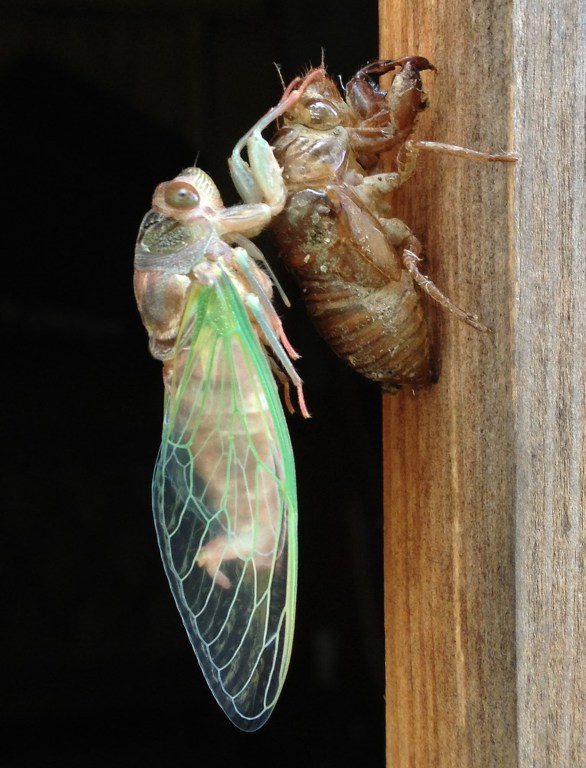
The “cast[ing] off of his body” (tuotai, 脫胎) is reminiscent of the way in which the real life insect sloughs off its shell (fig. 1). If this is what Yu was referring to, I think this is but one part of the puzzle.
Fig. 1 – A newly formed cicada clinging to its shell (larger version).
I suggest that the author-compiler of Journey to the West chose the cicada imagery for the symbolic nature of its life cycle. Munsterberg (1972) describes the insect’s role in ancient Chinese religion:
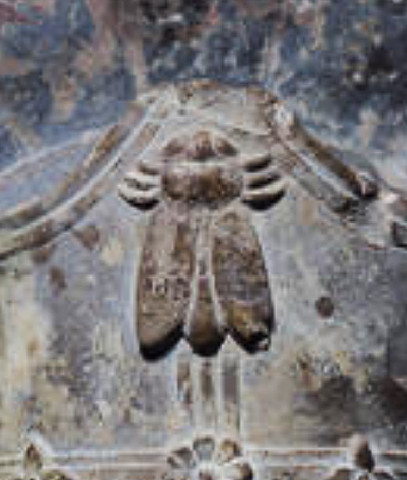
Cicadas carved in jade are frequently found in graves of the Han period [fig. 2]. Since the cicada hatches above ground, spends a long period underground, and finally emerges as if in rebirth, these burial tokens were probably intended to induce resurrection by sympathetic magic (p. 32).
The Golden Cicada’s life follows this cycle very closely: the celestial being resides above in the Western Paradise, is banished below for an extended period of time, and is only allowed back into the celestial realm after a metamorphosis.
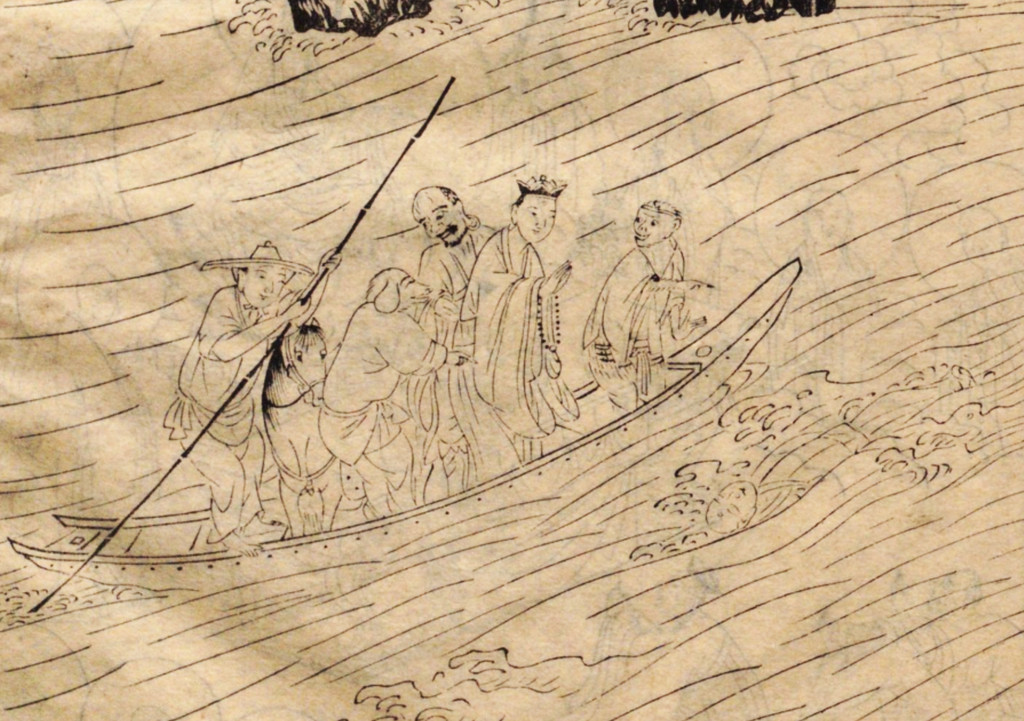
The lifesaving transformation previously referred to by Guanyin takes place in chapter 98 when Tripitaka and his disciples are ferried across a heavenly river in a bottomless boat on their way to the Western Paradise:
All at once they saw a corpse floating [fig. 3] down upstream, the sight of which filled the elder [Tripitaka] with terror.
“Don’t be afraid, Master,” said Pilgrim [Sun Wukong], laughing. “It’s actually you!”
“It’s you! It’s you!” said Eight Rules [Zhu Bajie] also.
Clapping his hands, Sha Monk also said, “It’s you! It’s you!”
Adding his voice to the chorus, the boatman also said, “That’s you! Congratulations! Congratulations!” Then the three disciples repeated this chanting in unison as the boat was punted across the water. In no time at all, they crossed the Divine Cloud-Transcending Ferry all safe and sound. Only then did Tripitaka turn and skip lightly onto the shore. We have here a testimonial poem, which says:
Delivered from their mortal flesh and bone, A primal spirit of mutual love has grown. Their work done, they become Buddhas this day, Free of their former six-six senses sway (Wu & Yu, 2012, vol. 4, pp. 345-346). [4]
Here, we see Tripitaka has shed his mortal form to become a Buddha just like the cicada sheds its shell to grow wings and fly. The monk has freed himself from the endless cycle of birth and death to achieve nirvana.
The Thirty-Six Stratagems (Sanshiliu ji, 三十六計, c. 5th-6th-cent.), a collection of military, political, and civil tactics, contains a plan known as “The Golden Cicada Sheds its Shell” (Jinchan tuoke, 金蟬脫殼), which entails leaving a decoy that distracts the enemy while the losing force is retreating. I’m not sure if this directly influenced the celestial’s title, but it at least shows that the name was known long before Journey to the West was published.
The strategy is actually used by a tiger demon in chapter 20:
Whipping out the iron rod, Pilgrim [Sun Wukong] shouted, “Catch him!” Eight Rules [Zhu Bajie] at once attacked with even greater ferocity, and the monster fled in defeat. “Don’t spare him,” yelled Pilgrim. “We must catch him!” Wielding rod and rake, the two of them gave chase down the mountain. In panic, the monster resorted to the trick of the gold cicada casting its shell (emphasis added): he rolled on the ground and changed back into the form of a tiger. Pilgrim and Eight Rules would not let up. Closing in on the tiger, they intended to dispose of him once and for all. When the monster saw them approaching, he again stripped himself of his own hide and threw the skin over a large piece of rock, while his true form changed into a violent gust of wind heading back the way he had come. (Wu & Yu, 2012, vol. 1, p. 401).
I would like to further suggest that the name Master Golden Cicada (Jinchan zi, 金蟬子) might have been chosen to serve as a pun for “child or student of Chan” (Chanzi, 禪子) (fig. 4). While the historical Xuanzang was the patriarch of the Yogacara school of Chinese Buddhism (Robert & David, 2013, pp. 1015-1016), the novel closely associates him with Chan:
The depiction of the novelistic Xuanzang surely and constantly associates him and his entourage with Chan. Revealing examples can readily be found in both narrative content and such titular couplets as “Tripitaka does not forget his origin; / The Four Sages test the Chan Mind” (chapter 2[3]); “The Child’s tricky transformations confuse the Chan Mind; / Ape, Horse, Spatula, and Wood Mother-all are lost” (chapter 40); “The Chan Lord, taking food, has demonic conception; / Yellow Dame brings water to dissolve perverse pregnancy” (chapter 53); “Rescuing Tuoluo, Chan Nature is secure; / Escaping defilement, the Mind of Dao is pure” (chapter 67); “Mind Monkey envies Wood Mother; / The demon lord plots to devour Chan” (chapter 85); and “Chan, reaching Jade-Flower, convenes an assembly; / Mind Monkey, Wood, and Earth take in disciples” (chapter 88) (Wu & Yu, 2012, vol. 1, pp. 64-65).
If true, this would mean that the cicada-like spiritual transformation is based around a pun.
Fig. 4 – The similarities in form and pronunciation of chanzi (larger version).
This seems like such an obvious connection that I wouldn’t be surprised if someone else beat me to the conclusion by decades or even centuries.
Update: 08-29-20
Art historian Jin Xu posted a picture of a 6th century stone bodhisattva statue on twitter, and I was interested to see a cicada adorning the headdress (fig. 5 & 6). One essay about the statue suggests it was commissioned by an aristocratic layman since cicadas are known to have decorated the caps of high-ranking officials:
Another noteworthy characteristic of this superb sculpture is the cicada-shaped decoration on the front of the crown. To date, there are no other known Chinese Buddhist sculptural examples of this kind. However, cicada images can be found on gold mountain-shaped crown plaques that also are embellished with thin gold wire and granulation; these have been excavated from the tomb of Ping Sufu of the Northern Yan period (A.D. 409-436), and seated Buddha images were molded onto the back face of these crown ornaments. These excavated materials would have been made some one hundred years before the present image and suggest that there were members of the aristocracy who revered Buddhism and hid Buddha images on the backs of their crowns. This suggests the possibility that the Shumei bodhisattva, with a cicada in place of a Buddha image, was created at the request of a member of the aristocracy who revered Buddhism and believed in the philosophy that the Emperor is the living Buddha, which may have dated back to the Northern court (Standing Bodhisattva, n.d.).
The sculpture didn’t influence Tripitaka’s title as the Golden Cicada Elder. But it’s still fascinating to see a real world connection between the insect and a bodhisattva.
Fig. 5 – The 6th century Bodhisattva statue with a cicada decorating the crown (larger version). From Qingzhou Museum in Shandong province, China. Fig. 6 – A detail of the insect (larger version).
Update: 09-13-20
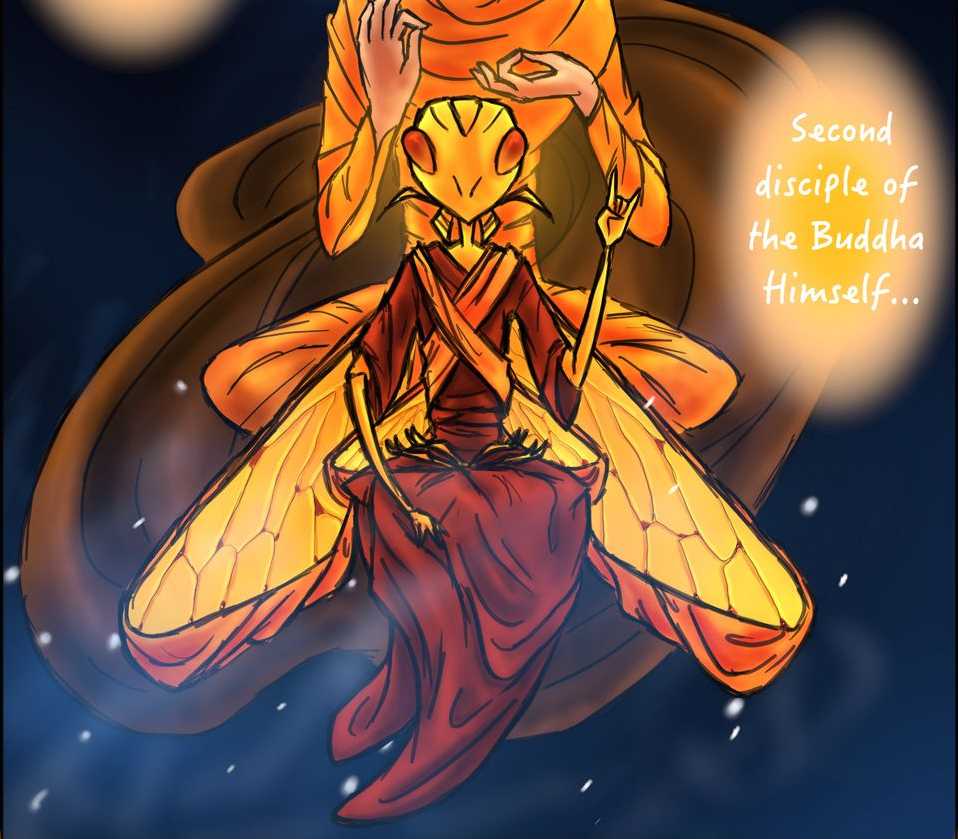
Deviantart user Taylor-Denna has drawn a beautiful depiction of Tripitaka’s former incarnation as a literal cicada (fig. 6). It is quite unique as I’ve never seen any other artist portray the former celestial in such a way. The image makes one think of an insect who acquired magic powers through spiritual cultivation and rose through the Buddho-Daoist hierarchy to become the Buddha’s disciple. The idea would make a good prequel story.
Fig. 6 – Detail of Master Golden Cicada by Taylor-Denna (larger version). Click here for the full version and the artist’s statement. Used with permission.
Update: 12-01-21
I’ve archived a book that shows how Tripitaka’s exile from heaven is similar to ancient Greek and Egyptian beliefs.
In chapter 81, Monkey alludes to his master’s past life, adding to the reason why the celestial had been exiled to Earth:
“You don’t realize that Master was the second disciple of our Buddha Tathagata, and originally he was called Elder Gold Cicada. Because he slighted the Law, he was fated to experience this great ordeal.”
“Elder Brother,” said Eight Rules, […] “Why must he endure sickness [for two days] as well?”
“You wouldn’t know about this,” replied Pilgrim. “Our old master fell asleep while listening to Buddha expounding the Law. As he slumped to one side, his left foot kicked down one grain of rice. That is why he is fated to suffer three days’ illness after he has arrived at the Region Below.”
Horrified, Eight Rules said, “The way old Hog sprays and splatters things all over when he eats, I wonder how many years of illness I’d have to go through!”
“Brother,” said Pilgrim, “you have no idea either that the Buddha is not that concerned with you and other creatures. But as people say:
Rice stalks planted in noonday sun Take root as perspiration runs. Who knows of this food from the soil Each grain requires most bitter toil?
Master still has one more day to go, but he’ll be better by tomorrow” (Wu & Yu, 2012, vol. 4, p. 82).
This points to the supreme importance of rice in an agrarian society like ancient China.
Fig. 10 – “Break the Cycle” by Countingclowns (larger version). The original can be seen here.
3.1. Historical Origin
Update: 06-03-23
Tripitaka’s past celestial life and punishment appear to be based on information from Xuanzang’s historical life story, A Biography of the Tripitaka Master of the Great Ci’en Monastery of the Great Tang Dynasty (Datang Da Ci’ensi Sanzang Fashi zhuan, 大唐大慈恩寺三藏法師傳, 7th century). After his death, a spirit extolls the monk’s virtues, as well as reveals the karmic result of his afterlife:
The Venerable Xuanzang alone cultivated the deeds of both blessedness and wisdom in nine lives. In every incarnation he was always learned and erudite, intelligent and eloquent, always the first and foremost in the land of Cīna in Jambudvīpa. Such were his blessed virtues also. […] Owing to the power of his good deeds, he has now been reborn in the inner court of Maitreya in the Tuṣita Heaven, where he will hear the Dharma with comprehension and understanding, and he will never again be born in the human world (Huili & Shi, 1995, p. 336).
Like Tripitaka, Xuanzang has nine prior pious past lives, and like Master Golden Cicada, he comes to live in a paradise where he can listen to a Buddha lecture on the Dharma. The novel simply changes some of the details, like Xuanzang’s final rebirth in paradise being a previous life, and instead of Maitreya, he studies under the historical Buddha.
4. Updates (continued)
Update: 06-04-23
Brose (2021) mentions a small temple in Taipei, Taiwan where one of Xuanzang’s avatars, the bodhisattva Nine Lotuses (Jiulian pusa, 九蓮菩薩) is worshiped. [5] What’s important for this article is that the deity’s mythos, as recounted by a temple master, alludes to the Golden Cicada’s story:
[Xuanzang], she explained, originally lived in a heavenly Buddha realm, but because his cultivation was incomplete, he was sent down to earth to perform the meritorious task of bringing Buddhist sūtras from India to China. Once his work was complete, Xuanzang was able to return to the Buddha realm, but out of compassion for the world, he left a portion of his spirit behind in the form of Nine Lotuses (Brose, 2021, pp. ix-x).
Update: 04-09-24
In chapter 27, the white bone spirit also comments on the monk’s past life and the effects of eating his flesh:
“What luck! What luck!” she said, unable to contain her delight. “For several years my relatives have been talking about a Tang Monk from the Land of the East going to fetch the Great Vehicle. He is actually the incarnation of the Gold Cicada, and he has the original body that has gone through the process of self-cultivation during ten previous existences. If a man eats a piece of his flesh, his age will be immeasurably lengthened. So, this monk has at last arrived today!” (Wu & Yu, 2012, vol. 2, 17).
Recall that the 01-14-23 update quotes the fullest description of events leading to Master Golden Cicada’s banishment from paradise: he falls asleep during a sermon and accidentally kicks something, causing a single grain of rice to fall to the ground. Well, I’m reading a biography of the Buddha and learned that his family has a connection to rice:
Sakyamuni’s father was called Suddhodana. The name means “pure rice” or “white rice.” In Chinese it is translated as Ching-fan-wang [[Jingfan wang, 淨飯王;] king of pure rice]. Legend says that the names of his four younger brothers all contained the element meaning “rice” (odana). These names suggest that the Sakyas were already cultivating rice and that they particularly valued white rice (Nakamura, 2000, vol. 1, p. 46).
This might explain the Buddha’s reaction.
4.1. Historical Origin – 2
Update: 01-25-25
To recap, Journey to the West casts the Tang Monk Tripitaka as the last incarnation of Master Golden Cicada (Jinchan zi, 金蟬子), the second disciple of the Buddha who is exiled from paradise for falling asleep during his master’s sermon. Chapter 81 adds a second crime: kicking something in his slumber and making a single grain of rice fall to the ground.
This leads me to the point of this post. A reader contacted me the other day asking if Sariputra (Sk: शारिपुत्र; Pali: Sariputta; Ch. Shelifu, 舍利弗), one of the Buddha’s ten primary disciples, was the basis for Master Golden Cicada since he was known for having a golden glow about him. A cursory search didn’t turn up anything connecting them, but thanks to the reader’s prompt, I kept digging and was interested to learn that another disciple of Tathagata, Aniruddha (Sk: अनुरुद्ध; Pali: Anuruddha; Ch: Analu, 阿那律) (fig. 11), was known to have fallen asleep during the Enlightened One’s lessons.
According to monk Jiaoguang’s (交光, fl. 1600) Dafo Dingshou Lengyan Jing Zhengmai Shuxu (大佛頂首楞嚴經正脉疏序, T. 275):
Analu [Aniruddha] then stood up, bowed at the Buddha’s feet, and said to him respectfully …
[Commentary:] Changshui [6] says: Nalu, namely Anouloutuo, which means “free of poverty,” was a Rice Prince. He gave a meal to a Solitary Buddha in a past life and enjoyed happiness for 91 kalpas.
… “When I first entered the monastic life, I was too fond of sleep. The Thus-Come One admonished me, saying that I was no better than an animal. After the Buddha scolded me, I rebuked myself and wept. For seven days I did not sleep, and as a result I went blind in both eyes.”
[Commentary:] Gushan [7] says: According to the Ekottara Agama, the Buddha was preaching the Law in Jetavana when Nalu fell asleep. The Buddha spoke in verse: “Tut-tut … Why are you sleeping? River snails, mussels, clams and the like sleep for a thousand years, never hearing the names of Buddhas.” Thereupon, Nalu made it known that he would never sleep again, and he soon lost his sight. [8]
The term “Rice Prince” (Bifan wangzi, 白飯王子) refers to the fact that Aniruddha was the cousin of the Buddha and a fellow grandson of King Sihahanu, whose sons, including the Buddha’s father (as mentioned above), all had the suffix odana (“rice”) as part of their names. Aniruddha’s father was Amitodana (“Unmeasured Rice”) (Nakamura, 2000, vol. 1, p. 46; Harvey, 2013, p. 117; Thomas, 1931/2013, p. 24).
Therefore, we have a Buddhist disciple who dozes off during the Buddha’s sermon and has an association with rice. This makes Aniruddha the best possible influence for Master Golden Cicada that I’ve seen. The story goes back to at least the 4th century Zengyi ahan jingxu (增壹阿含經序, T. 125), so it would have been around long enough to eventually influence Journey to the West.
I need to point out, however, that I’m not the first person to write about this. While I was finishing typing this update, I came across this article, which mentions Aniruddha in passing. But to my credit, I actually cited the historical Buddhist literature involved.
Fig. 11 – A colored relief of the Buddha helping his blind disciple sew a new robe (larger version). Image found here.
Update: 02-13-25
I just thought of a way to work Aniruddha into JTTW lore: In chapter eight of the Lotus Sutra (Miaofa lianhua jing, 妙法蓮華經; a.k.a. Fahua jing, 法華經, c. 3rd century), the Buddha mentions our tired friend among a list of 500 Arhats who will attain perfect enlightenment and share the same holy title:
In our headcanon, Master Golden Cicada could be the celestial title of the Arhat Aniruddha, but his sleeping episode instead takes place in heaven. In addition, “Universal Brightness” (Puming, 普明) could just be a classification of Buddha, thus allowing for his Tripitaka avatar to receive the individualized title “Buddha of Candana Merit” (Zhantan gongde fo, 旃檀功德佛) at the end of his quest.
Update: 02-19-25
Something just dawned on: although I’ve always considered Master Golden Cicada to be a bodhisattva, the novel never specifically calls him that. So what is his actual spiritual rank then? Several pieces of Information point to him being an Arhat.
First, recall that the introduction to this article reads:
The cleric [Xuanzang] eventually gained his own supernatural background, for evidence shows that he was worshiped as an Arhat (Luohan, 羅漢; Zunzhe, 尊者), a Buddhist saint, by the Song Dynasty (960-1127 CE) (Liu, 2019). A Yuan-Ming zaju stage production plays on this concept by depicting Tripitaka as the reincarnation of the Arhat Vairocana (Pulujia zunzhe, 毗廬伽尊者) (Dudbridge, 1970, p. 193).
This shows that the Tang Monk was already closely associated with Arhats in the past. Second, something I learned but forgot to mention here is that Tripitaka Seeks the Scriptures (Sanzang qujing, 三藏取經), a rare Yuan-Ming puppet play that predates the 1592 JTTW, even refers to the cleric’s past life as the “Golden Chan Arhat” (Jinchan luohan, 金禪羅漢). (This implies that chan (蟬, “cicada”) was based on the Chan (禪) of Chan Buddhism, thereby supporting my suggestion from the 12-08-18 update.) Third, as mentioned above, Golden Cicada was likely based on the Arhat Aniruddha, one of the Buddha’s ten principal disciples, who was reprimanded by his master for dozing off during a lesson. And fourth, the Arhats Ananda (A’nuo, 阿儺) and Kasyapa (Jiaye, 伽葉), two other principle Buddha disciples, also appear among the Enlightened One’s heavenly retinue in JTTW (chapters 7, 8, 77, 98, 99, & 100). Therefore, taken together, this info is a strong indication that the novel’s author-compiler intended Golden Cicada to be an Arhat.
Because of this, I’ve updated the article by removing any previous references to him as a bodhisattva.
Update: 02-21-25
I posted a summary of my last update to Twitter, and a follower commented that Golden Cicada wouldn’t have been able to reincarnate like bodhisattvas if he was really an Arhat. This is based on Buddhist belief. For instance, Buswell and Lopez (2014) briefly explain: [T]he arhat is one who has attained nirvāṇa in this life, and at death attains final liberation ([parinirvāṇa]) and will never again be subject to rebirth” (p. 62). But I reminded them that JTTW is not an accurate snapshot of mainstream beliefs by pointing to two instances from past media (mentioned above) where Tripitaka is the reincarnation of an Arhat. Here, I translate the pertinent sections.
I. The Yuan-Ming JTTW zaju play
Guanyin reveals the monk’s divine origins in act one:
At present, the Western Land of India has the “Golden Scriptures of the Great Repository” in 5,480 volumes. We desire to transmit them to the Eastern Lands (i.e. China), but how can we help propagate them if we don’t have the illusory, corporal body of a genuine person? Currently, the various Buddhas are discussing what to do, and they have decided that the Arhat Vairocana of the Western Heaven will be reborn (tuohua, 托化) as a son to Chen Guangrui’s family in Hongnong County, Haizhou, China. When he grows up, he will leave the family to become a monk and travel to the Western Heaven to retrieve scriptures. He will (later) spread the teachings.
You can see here that there are no negative reasons for his reincarnation. This differs from the next source.
II. The Yuan-Ming JTTW puppet play
Tripitaka describes being born (chushi, 出世) to father Chen Guangrui and a beautiful, nameless mother in scene one (see page 1 of this PDF). His celestial origin is later revealed by “Equaling Heaven” (Qitian, 齊天; i.e. Monkey) in scene six:
The Golden Chan Arhat descended to earth (jiangshi, 降世) because he privately went to the lantern fruit festival without reporting this to the temple sangha, causing the Buddha to punish him to 36 tribulations, including journeying to the Western Heaven to acquire scriptures. After suffering over countless days, he finally returned to the right fruit (i.e. achieved enlightenment).
… 金禪羅漢降世,因私赴燈果會,不報寺中眾僧,佛罰伊過三十六劫,往西天取經。苦難滿日,修歸正果。(see page 9 of this PDF)
Having read the above, I think Master Golden Cicada’s Arhatship is now fully established as fact within the JTTW story cycle.
5. Updates (continued) – 2
Update: 08-03-25
The notion that Arhats fall asleep is exemplified by the “Dreaming/Sleeping Arhat Fist” (Shuimeng luohan quan, 睡梦罗汉拳) from the 1992 HK film King of Beggars (Wu zhuangyuan Su qi’er, 武状元苏乞儿; lit: “Top Martial Scholar: Beggar Su”; video 1).
Video #1 – The scene where Beggar Su displays his new-found boxing abilities.
2) This heavenly aura is also mentioned by Sun Wukong later in chapter 80 (Wu & Yu, 2012, vol. 4, p. 66).
3) The turtle had previously helped the pilgrims cross the same river in chapter 34, and in return they agreed to ask the Buddha when the terrapin would be allowed to achieve human form (for all creatures strive for such an attainment). But Tripitaka forgot to ask the Enlightenment One while visiting the Western paradise, so the turtle dumped them into the river upon their return.
4) The six-six senses (liuliu chen, 六六塵) are “the intensified form of the six gunas, the six impure qualities engendered by the objects and organs of sense: sight, sound, smell, taste, touch and idea” (Wu & Yu, 2012, vol. 4, p. 405 n. 7).
5) Brose (2021), however, explains that this goddess “is usually identified as the divinized form of a Ming Dynasty empress dowager” (p. ix).
6) The monk Changshui (長水), a.k.a. Zixuan (子璿; 965-1038), was the compiler of the Shou lengyan yanyi shu zhu jing (首楞嚴義疏注經, T. 1799) (Sorenson, 2011, p. 39).
7) Gushan (孤山), a.k.a. Zhiyuan (智圓; 976-1022), wrote a commentary for the Shou lengyan jing shu (首楞嚴經疏) (McBride, 2016, pp. 144-145 n. 238).
8) The translation of the commentary is mine, while the rest comes from Buddhist Text Translation Society & Hsuan (2012, p. 210).
Sources:
Brose, B. (2021). Xuanzang: China’s Legendary Pilgrim and Translator. Boulder, Colorado: Shambhala Publications, Inc.
Buddhist Text Translation Society & Hsuan, H. (2012). The Surangama Sutra: A New Translation with Excerpts from the Commentary by the Venerable Master Hsuan Hua. (n.p.): Buddhist Text Translation Society.
Buswell, R. E. , & Lopez, D. S. (2014). The Princeton Dictionary of Buddhism. Princeton University Press.
Harvey, P. (2013). Buddha, Family Of. In C. S. Prebish & D. Keown (Eds.), Encyclopedia of Buddhism (pp. 117-121). United Kingdom: Taylor & Francis.
Huili, & Shi, Y. (1995). A Biography of the Tripitaka Master of the Great Ci’en Monastery of the Great Tang Dynasty (L. Rongxi Trans.). Berkeley, CA: Numata Center for Buddhist Translation and Research.
Liu, S. (2019). Songdai Xuanzang de shenghua: Tuxiang, wenwu he yiji [The Sanctification of Xuanzang in the Song Dynasty: Images, Artifacts and Remains]. Zhonghua wenshi luncong, 133, 161-219.
McBride, R. D. (2016). Doctrine and Practice in Medieval Korean Buddhism: The Collected Works of Ŭich’ŏn. Germany: University of Hawaii Press.
Munsterberg, H. (1972). The Arts of China. Rutland, Vt: C.E. Tuttle Co.
Sorenson, H. H. (2011). Textual Material Relating to Esoteric Buddhism in China Outside the Taisho, vol. 18-21. In C. D. Orzech, H. H. Sorensen, & R. K. Payne (Eds.), Esoteric Buddhism and the Tantras in East Asia (pp. 37-70). Netherlands: Brill.