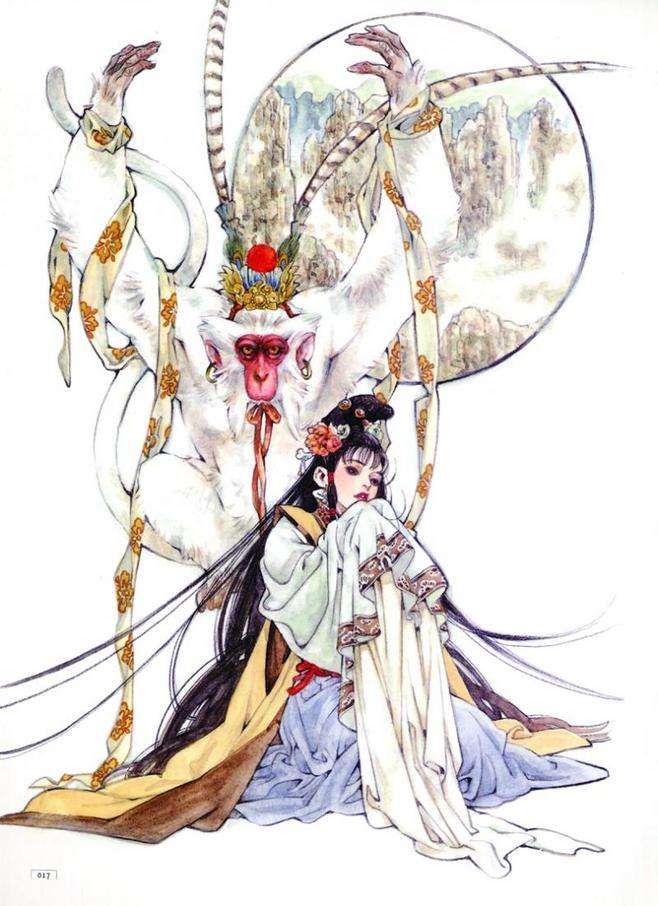
The brief Tang-era tale “A Supplement to Jiang Zong’s Biography of a White Ape” (Bu Jiang Zong Baiyuan Zhuan, 補江總白猿傳, c. late 7th-century) tells how the beautiful young wife of General Ouyang He (歐陽紇, 538–570) is kidnapped by a seemingly invisible force while he is engaged in conquering minority groups of the south lands. The general and his men scour the surrounding area for hundreds of miles before discovering a mountain where she and other women are being kept by a magic white ape (baiyuan, 白猿) (fig. 1). The captives caution that his soldiers are no match for the powerful primate, and so the ladies devise a plan to get him drunk and incapacitate him long enough for a killing blow to be dealt. With their help, the general manages to fall the beast with a well-placed sword strike below the navel, his only weak spot. Before dying, the ape reveals the general’s wife is pregnant and begs him not to kill the child. Ouyang subsequently returns to the north with his wife, the other women, and the monster’s priceless treasures. The tale ends with the birth of an unnamed son a year later.
Fig. 1 – A modern drawing of the white ape and General Ouyang He’s wife by Japanese artist Natsuki Sumeragi(皇名月) (larger version). Original image found here. The silken ropes around his wrists refer to those intertwined with hemp and triple-tied to ensure that he can’t break free in the story.
I. Historical background
Chen (1998) explains the original Biography of a White Ape story, purportedly supplemented by the above tale, [1] never existed. The Supplement is actually a standalone piece anonymously published to slander the historical scholar Ouyang Xun (歐陽詢, 557–641), who was known for his legendary monkey-like ugliness and almost supernatural intellect. The tale implies that he was the unnatural offspring of the general’s wife and the magic white ape (p. 76-79).
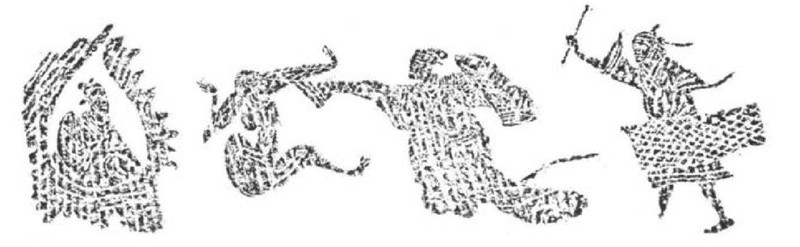
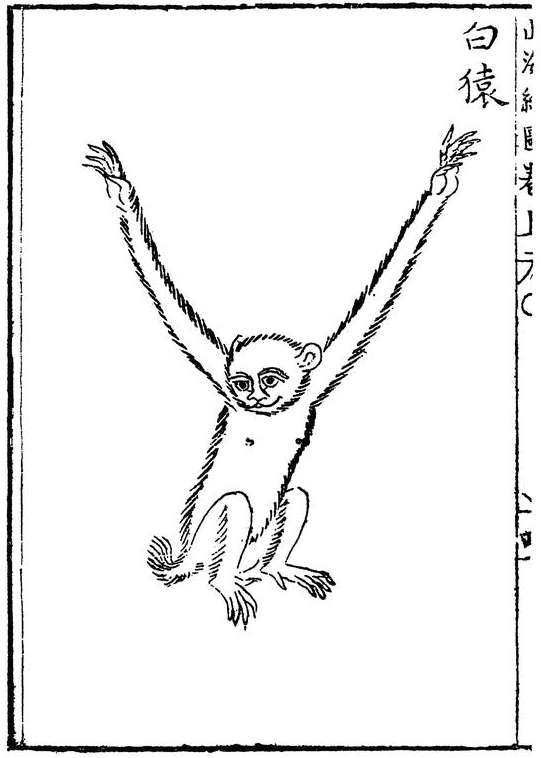
These mischievous simian spirits are known for kidnapping young maidens in tales from the Han to the Song (fig. 2). The mythical creature is based on the Gibbon (fig. 3), a small, long-armed, arboreal ape present in East and Southeast Asia(see Gulik, 1967).
Fig. 2 – A Han-era stone tomb rubbing showing a sword-wielding hero striking at a fleeing white ape (center). A woman can be seen held captive in a teardrop-shaped cave (left). The hero is followed by an assistant beating a gong (right) (larger version). From Wu, 1987, p. 88. Fig. 3 – A woodblock print of a “white ape” or Gibbon from a Ming version of the Shanhai Jing (larger version).
II. Parallels with Sun Wukong
The story’s unnamed primate antagonist shares many surprising similarities with Sun Wukong. Both:
Are supernatural primates possessed of human speech.
Are one thousand-year-old practitioners of longevity arts.
Are masters of Daoist magic with the ability to fly and change their appearance.
Are warriors capable of single-handedly defeating an army.
Have a fondness for armed martial arts.
Have an iron-hard, nigh-invulnerable body immune to most efforts to harm them.
Have eyes that flash like lightning.
Live in verdant mountain paradises (like Flower Fruit Mountain).
Reside in caves with stone furniture (like the Water Curtain Cave).
The character and his home appear to be an early model for the Monkey King, his abilities, and Flower Fruit Mountain.
III. Translation
Chen (1998) provides a complete translation of the brief tale, along with an informative translator’s introduction. The following PDF was put together from smartphone photos as I don’t currently have access to a scanner.
1) A supplement (bu, 補) is an addendum to an existing body of work, sort of like modern fan fiction. See, for example, A Supplement to the Journey to the West (1640).
Sources
Chen, J. (1998). A supplement to Jiang Zong’s biography of a white ape. Renditions, 49, pp. 76-85.
Chen, J. (2003/2004). Revisiting the yingshe mode of representation in “Supplement to Jiang Zong’s biography of a white ape”. Oriens Extremus, 44, pp. 155-178.
Wu, H. (1987). The earliest pictorial representations of ape tales: An interdisciplinary study of early Chinese narrative art and literature.T’oung Pao LXXIII, pp. 86-112.
The Qiang (Ch: 羌; Qiangic: Rrmea) ethnic group have been mentioned in Chinese records as far back as the oracle bones of the Shang Dynasty (17th to 11th-century BCE). Originally inhabiting the northern reaches of China, these sheepherders and warriors were driven southwest over many centuries of conflict with neighboring ethnic groups, as well as the Chinese. Many Chinese dynasties attempted to assimilate them, but the Qiang have resisted up to the present. Today, they live in western Sichuan near the Tibetan border and are listed among the 56 recognized ethnic groups of China (Yu, 2004, pp. 155-156; Wang, 2002, pp. 133-136).
What’s interesting about the Qiang for the purposes of this blog is that both magic monkeys and heavenly stones, and even Sun Wukong himself, play a part in the people’s religious mythology.
Fig. 1 – A map of China showing the location of Sichuan province in red. Larger version available on wikicommons.
I. Monkeys and Qiang shamanism
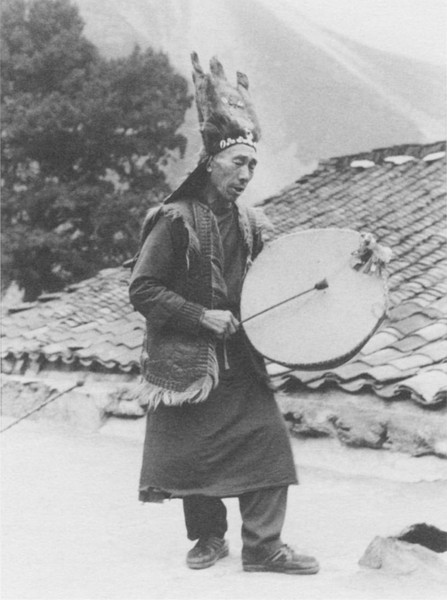
Shamans (Ch: Duan gong, 端公 or Wu, 巫j; Qiangic: Shüpi) are the heart of Qiang religious life. During special ceremonies, they wear three-peaked hats (fig. 2 and 3) made from the fur of golden monkeys(fig. 4), each peak respectively representing the deities of heaven, earth, and shamanism (more on the latter below). [1] These hats are especially worn during exorcisms because the monkeys are considered “the purest of animals, [which stand] in extreme contrast to the vilest of beings—the demons” (Oppitz, 2004, p. 13). There are several legends, with many variants, explaining the origins of the headdress. One version states:
[T]he Qiangs used to have a written language, and their patriarch recorded the scriptures he obtained from the gods and other important writings on human affairs on the bark of birch trees. One day when he took out the pieces of bark to be aired, a mountain sheep came and ate them all. With the help of a golden monkey the patriarch captured the guilty sheep and made its skin into a drum. When he beat on the drum he was able to recall the words written on the birch bark. To prevent future mishaps to these precious documents, he memorized them by heart (Yu, 2004, p. 160).
So in essence the hats are worn to commemorate the assistance of the golden monkey. Interestingly, another version replaces the patriarch and golden monkey with Tripitaka and Sun Wukong:
A long time ago, in the Tang period, there was a monk by the name of Tang Seng [唐僧, “Tang Monk”], who undertook a journey to the western skies in the company of a monkey named Sun Wukong, in order to collect sacred scriptures. On their way back, they encountered a sheep ghost who ate all the newly acquired scriptures. The monkey got very angry, killed the sheep ghost, and used its skin to fabricate a drum. Thereupon Tang Seng and the monkey met with the Eighteen Arhats … Listening to their teachings, Tang Seng picked up the sheep-skin drum and repeated all that he heard through their mouths. Since then all shamans use a drum when reciting their knowledge from memory (Oppitz, 2004, p. 23).
Fig. 2 – The three-peaked golden monkey skin shaman hat. From the Sichuan University Museum. Larger version on wikipedia. Fig. 3 – A shaman wearing the headdress and playing the ritual sheep skin drum (larger version). Original photograph by Michael Oppitz. From Oppitz, 2004, p. 14. Fig. 4 – A golden monkey with child. Larger version on wikipedia.
The golden monkey is closely associated with the Qiang’s pantheistic worship of sacred white stones, each one representing the gods of heaven, sun, fire, mountains, rivers, and trees. [2] Yu (2004) provides another legend for the origins of the Shaman’s hat, describing how the monkey is the offspring of the sacred stone and noting parallels with the birth of Sun Wukong:
Another legend depicts the golden monkey as a Prometheus-like figure who stole fire from heaven. The first two attempts failed because the god of wind and the god of rain extinguished the fire, but the monkey succeeded the third time by concealing the fire in a white stone. It is worth noting that in this legend the golden monkey is closely related to the white stone. In the Qiang language, the first syllables in the names of the monkey’s mother and father mean respectively “stone” and “fire.” “This implies that fire is produced by stone and hidden inside the stone, and that the half-human, half-simian golden monkey was an offspring of the union between stone and fire”. The white stone and the golden monkey, as the source of fire and the messenger who brought it to the human world, became the totems of the Qiang people. To commemorate the recovery of the lost scriptures, wearing the monkey hat and playing the sheepskin drum also became an indispensable part of Sacrifice to the Mountain[, a Qiang ceremony]. However, the monkey legend is not particular to the Qiang people. The Yi minority people of northwestern Guizhou province have a nuo drama known as bianren xi (changing-into-people drama) based on a legend that people derived from monkeys. Actors wear monkey masks for this performance. There is also the famous monkey, Sun Wukong, who was born from a stone in the Han Chinese novel Xiyou ji (Journey to the West, 1592) by Wu Chengen (ca. 1506-1582). [3] The novel was first published in 1592, but the monkey lore included in it was of much earlier time (p. 160).
A celestial, stone-born monkey who steals from heaven certainly sounds like the Monkey King. As noted here, stories about Sun Wukong have been circulating in Asia for a millennia. So it seems only natural that the Qiang’s reverence for heavenly stones and monkeys would lead to some of them worshiping the beloved cultural figure.
Graham (1958) notes that Sun Wukong and Sha Wujing figure among the Chinese patron deities of the “red” shamans (p. 53). [4] What’s interesting is that the red shamans are said to speak a special demon language and use their skills to exorcise demons (p. 54). Therefore, their worship of the Monkey King should come as no surprise considering Sun Wukong is the exorcist par excellence.
As noted above, one of the peaks of the ritual headdress represents the patron deity of shamanism. Known among other names as the Abba mula (“father god”; Ch: Aba muna, 阿爸木纳), this is the title given to the shaman’s main focus of worship. For instance, Sun Wukong is the Abba mula of those who revere him. Most importantly, the chosen deity is further represented by a small bundle that the shaman carries with him and guards jealousy, as it is the source of his knowledge and power. Graham (1958) describes the sacred bundle’s importance, construction, and use:
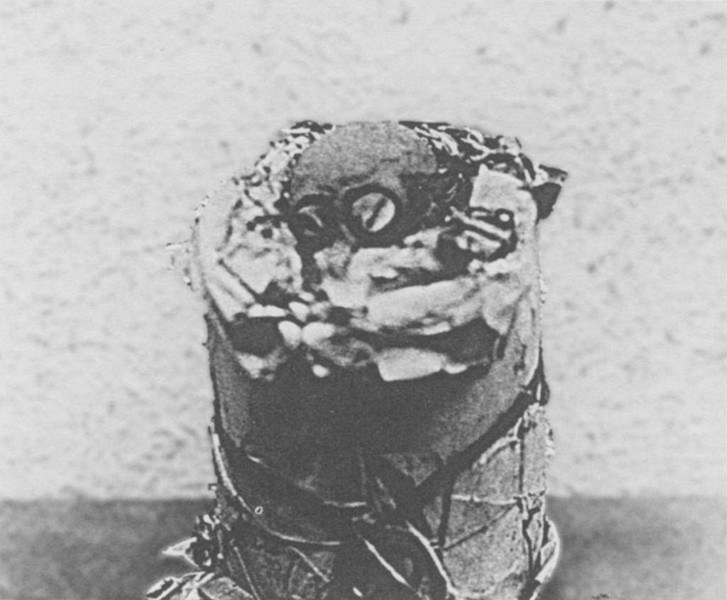
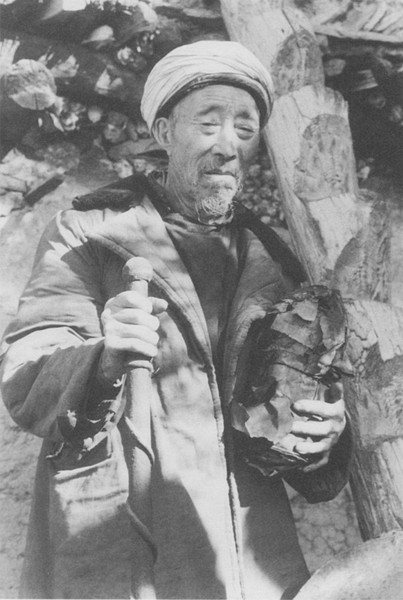
He is the patron or guardian deity and instructor of the Ch’iang priest, and without him the priest could do nothing. It consists of a skull of a golden-haired monkey wrapped in a round bundle of white paper. Its eyes are old cowry shells or large seeds. Inside are also dried pieces of a golden-haired monkey’s lungs, intestines, lips, and fingernails. It is so wrapped that the face of the skull is visible at one end, and the other end is closed [fig. 5 and 6]. After each ceremony in the sacred grove, [5] the priest wraps another sheet of white paper around it, so that it gradually increases in diameter. Some priests will not allow another person to touch his Abba Mula and only the priest worships this god (pp. 51-52).
I mention this because there are no doubt sacred bundles representing Sun Wukong, which are used under his supernatural guidance.
Fig. 5 – The Abba mula bundle. Note the visible monkey skull with cowry shell eyes (larger version). Original photograph by Wolfgang Wenning. Fig. 6 – A Qiang shaman carry a bundle and sacred cane (larger version). Original photograph by Michael Oppitz. Both images are from Oppitz, 2004, p. 41.
Oppitz (2004) explains that stories alluding to Sun Wukong appear in Qiang pictorial divination books. Furthermore, he suggests that the ritual of wrapping the Abba mula bundle with additional paper represents the lost written knowledge saved by the Monkey King / golden monkey, which is now passed on orally.
In Qiang divination books the monkey features in various passages. In one book the picture of a monkey alludes to a story in which he destroys a heavenly palace; another book addresses a monkey’s trip to a western land, where he acquires written texts. In both cases the monkey Sun Wukong of popular literature and protagonist of the novel Xi yu ji, who escorts the Tang pilgrim Xuanzang, stands as the model. This character’s association with the acquisition of books and the role a golden-haired monkey plays in a Qiang myth as the inventor of the drum replacing the lost scriptures, suggests that the paper which is wrapped around the venerated monkey skull may also be interpreted as a hint to the conflict between scriptural versus oral tradition at the intersection of which the monkey stands as a mediator (p. 42).
II. Monkeys and the Qiang origin myth
Called “Mutsitsu and Tugantsu” (Ch: Mujiezhu yu Douanzhu, 木姐珠與斗安珠), the Qiang origin myth centers around the romance of Mutsitsu, the daughter of the supreme god Abamubi (or Mubita), and the earthbound monkey Tugantsu. The latter saves the goddess from a ferocious tiger when she visits the mortal world and both instantly fall in love. She brings him to the celestial realm, where Abamubi only agrees to their marriage if Tugantsu can successfully complete a series of impossible herculean tasks. These include falling the trees of ninety-nine mountains, burning the trees, and using the arable land to plant a crop of corn (other sources say grain); but each time Mutsitsu secretly enlists the aid of fellow gods to insure the tasks are completed on time. During the burning of the forest, Tugantsu’s fur is singed, revealing him to be a handsome man. In the end, the supreme god agrees to their marriage and Mutsitsu and Tugantsu become the progenitors of mankind. [6]
Academia Sinica (n.d.) comments that some Qiang communities who revere Chinese gods often equate Abamubi with the Jade Emperor of Daoism and Tugantsu with Sun Wukong. I find this especially fascinating as the Monkey King then becomes a sacred protoplast.
Fig. 7 – A modern painting showing the monkey and rock ogress of Tibetan myth (larger version). Original from Wikipedia.
In addition, Academia Sinica (n.d.) explains this “monkey transforming into human” motif (i.e. Tugantsu becoming a man) has similarities with Tibetan mythology, for the Qiang live in close proximity to the people of Tibet. This refers to the Tibetan origin myth in which the Bodhisattvas Avalokitesvara (the Indo-Tibetan variant of Guanyin) and Tara are respectively reborn on earth as a monkey and his wife, a rock ogress (fig. 7). (Again, the association between the monkey and rock reminds one of Sun Wukong.) The union produces six half-human half-monkey children, from which originate the six original tribes of Tibet. These children and their offspring eventually evolve human features (Stein, 1972, pp. 37 and 46).
III. Conclusion
The religious mythology of the Qiang ethnic group of China pays reverence to both heavenly monkeys and sacred stones. Examples include stories about a golden monkey born from a stone who both bestows fire on man and creates the sheepskin drum needed to recover lost scriptural knowledge. Qiang communities that revere Chinese deities often replace the golden monkey with Sun Wukong, no doubt due to his birth mirroring the former’s origins. The same holds true for the Qiang origin myth in which a goddess and monkey-turned-man become the progenitors of mankind. The Monkey King is sometimes equated with the father, transforming him from a literary character and cultural figure into a sacred protoplast. Interestingly, the monkey-rock and monkey-to-man motifs have connections to a wider myth cycle present in Tibet.
Some shamans (Qiangic: Shüpi) specializing in exorcism worship our hero as their patron deity, or Abba mula (“father god”). Such deities are given form as a bundled monkey skull successively wrapped in white paper. This sacred object is considered the source of the shaman’s power. It’s possible the wrapping paper references the lost scriptural knowledge that Sun Wukong/the golden monkey helped recover.
To my knowledge, most of what has been written about the Qiang, and by extension their connection with Sun Wukong, was collected by ethnographers during the 20th and 21st centuries. Considering the Qiang have no written language (hence the importance of oral knowledge), it’s impossible to say how far back this connection goes. But as noted in this article, the Monkey King has been worshiped by the Chinese since at least the 17th-century. So the Qiang reverence for Sun Wukong could also be centuries old.
Update: 04-19-2019
Sun Wukong also appears in the folklore of the neighboring (and related) Miao ethnic group. The Miao also believe man derives from monkeys.
Rockhill (1891) provides a complete translation of the Tibetan monkey-ogress origin myth taken from the Mani Kambum (12th to 13th-century), a collection of Tibetan Buddhist texts centered around Avalokitesvara.[7] The translation is too long to transcribe here, so I have made a PDF of the relevant pages. It’s interesting to note that the Bodhisattva Hilumandju, the protagonist, is a monkey king with magic powers.
Hilumandju and Hanumanji are quite similar, as noted by other writers (Chattopadhyaya & Chimpa, 2011, p. 152). The Tibetologist Per K. Sørensen notes “the idea of an ape-gestalt in this myth is directly associated with or inspired by the ape-king … and champion … Ha-lu ma-da = Hanümän, the resourceful figure and protagonist known from Välmlki’s Rämäyana, a tale of considerable popularity already in the dynastic period in Tibet” (Bsod-nams-rgyal-mtshan & Sørensen, 1994, p. 127, n. 329).
Additionally, the Chinese of Sichuan also have stories regarding primates fathering human children. A body of Han and Tang dynasty tales that heavily influenced the creation of Sun Wukong describes magic white apes (baiyuan, 白猿) kidnapping and impregnating young woman. One example appears in both Zhang Hua’s Encyclopedic Records of Things (Bowuzhi, 博物志, c. 290) and the Records of Spirits (Soushenji, 搜神記, c. 340):
In the high mountains of southwestern Shu [Sichuan and Tibet] there is an animal resembling the monkey. It is seven feet in height, it can imitate the ways of human beings and is able to run fast in pursuit of them. It is named Jia-guo 猳國 or Ma-hua 馬化; some call it Jue 貜. It watches out for young women travelling on the road and seizes and bears them away without anyone being aware of it. If travelers are due to pass in its vicinity they lead one another by a long robe, but even this fails to avert disaster. The beast is able to distinguish between the smell of men and women and can thus pick out the women and leave the men. Having abducted a man’s wife or daughter it makes her its own wife. Women that fail to bear its children can never return for the rest of their lives, and after ten years they come to resemble the beast in appearance, their minds become confused, and they no longer think of return. Those that bear sons return to their homes with the infants in their arms. The sons are all like men in appearance. If any refuse to rear them, the mothers die. So the women go in fear of the beast, and none dares refuse to bring up her son. Grown up, the sons are no different from men, and they all take the surname Yang 楊, which is why there are so many people by that name now in the south west of Shu: they are mostly descended from the Jia-guo or Ma-hua (Wu, 1987, pp. 91-92).
I find the last part fascinating because it states the inhabitants of the Sichuan-Tibet region were fathered by the ape. This recalls the Tibetan, Qiang, and Miao tales of humans descending from monkeys. It also suggests the aforementioned ethnic stories about a primate progenitor stretch back to the early part of the first millennium.
Notes:
1) Graham (1958) notes the headdress is one of eleven sacred implements of the Qiang shaman. He provides a detailed description of the hat’s significance.
This is made of a golden-haired monkey skin and is believed to be very efficacious, greatly adding to the dignity and potency of the priest and his ceremonies. The eyes and ears of the monkey are left on, and the tail is sewed on at the back. The eyes enable the hat to see and the ears to hear, and add to the efficiency of the hat. The tail also adds to its efficiency. The front of the hat is ornamented with old cowry shells arranged in ornamental designs, one or two polished white bones that are said to be the kneecaps of tigers, and sometimes with carved sea shells. These ornaments improve the looks of the hat and also add to its efficiency. Other ornaments believed to add efficiency when used are two cloth pennants, one or two small circular brass mirrors, and one or two small brass horse bells much like sleigh bells, on which the Chinese character wang 王 meaning king is carved. Near Wen-ch’uan the priests sometimes assist the magistrate in praying for rain and in turn are presented with a small, thin silver plaque to be worn on the hat, on which is stamped the Chinese word shang 賞, or “reward.” This plaque also adds dignity and efficiency (pp. 55-56).
2) The Qiang reverence for these stones is tied to the aforementioned conflict with neighboring tribes. For example, legend states the great heavenly ancestor of the Qiang sent them three white stones to aid in their battle with a neighboring tribe, transforming them into mountains from which weapons were made. Another legend claims these stones help the Qiang make fire (Yu, 2004, pp. 156-157). These white stones often appear on buildings (both temples and houses), walls, altars, and graves in Qiang society (Graham, 1958, p. 103).
3) The original paper reads, “…in the Han Chinese novel Xiyu ji (Journey to the West, 1982)…” I have corrected the typos.
4) The colors red, white, and black signify the class of magic (good vs. dark), though shamans often inhabit all three roles (Graham, 1958, p. 54).
5) Sacred groves are home to a village’s temple and white stone altar, where many rituals are performed at night and in the early morning (Graham, 1958, p. 64).
7) Another version of the tale appears in The Mirror Illuminating the Royal Genealogies (Rgyal rabs gsal ba’i me long, 14th-century). An annotated translation can be read in Bsod-nams-rgyal-mtshan & Sørensen, 1994, pp. 125-133.
Bsod-nams-rgyal-mtshan, & Sørensen, P. K. (1994). The mirror illuminating the royal genealogies: Tibetan buddhist historiography : an annotated translation of the XIVth century Tibetan chronicle: rGyal-rabs gsal-ba’i me-long. Wiesbaden: Harrassowitz.
Chattopadhyaya, A., & Chimpa. (2011). Atīśa and Tibet: Life and works of Dīpaṃkara Śrījñāna (alias Atīśa) in relation to the history and religion of Tibet, with Tibetan sources. Delhi: Motilal Banarsidass Publishers.
Rockhill, W. W. (1891). The land of the lamas: Notes of a journey through China, Mongolia and Tibet with maps and illustrations. New York: Century Co.
Stein, R. A. (1972). Tibetan civilization. Stanford, Calif: Stanford University Press.
Wang, M. (2002). Searching for Qiang culture in the first half of the twentieth century. Inner Asia,4(1), 131-148. Retrieved from http://www.jstor.org/stable/23615428
Wu, H. (1987). The earliest pictorial representations of ape tales: An interdisciplinary study of early Chinese narrative art and literature.T’oung Pao LXXIII, pp. 86-112.
Yu, S. (2004). Sacrifice to the Mountain: A Ritual Performance of the Qiang Minority People in China. TDR 48(4), 155-166. Retrieved from http://www.jstor.org/stable/4488600
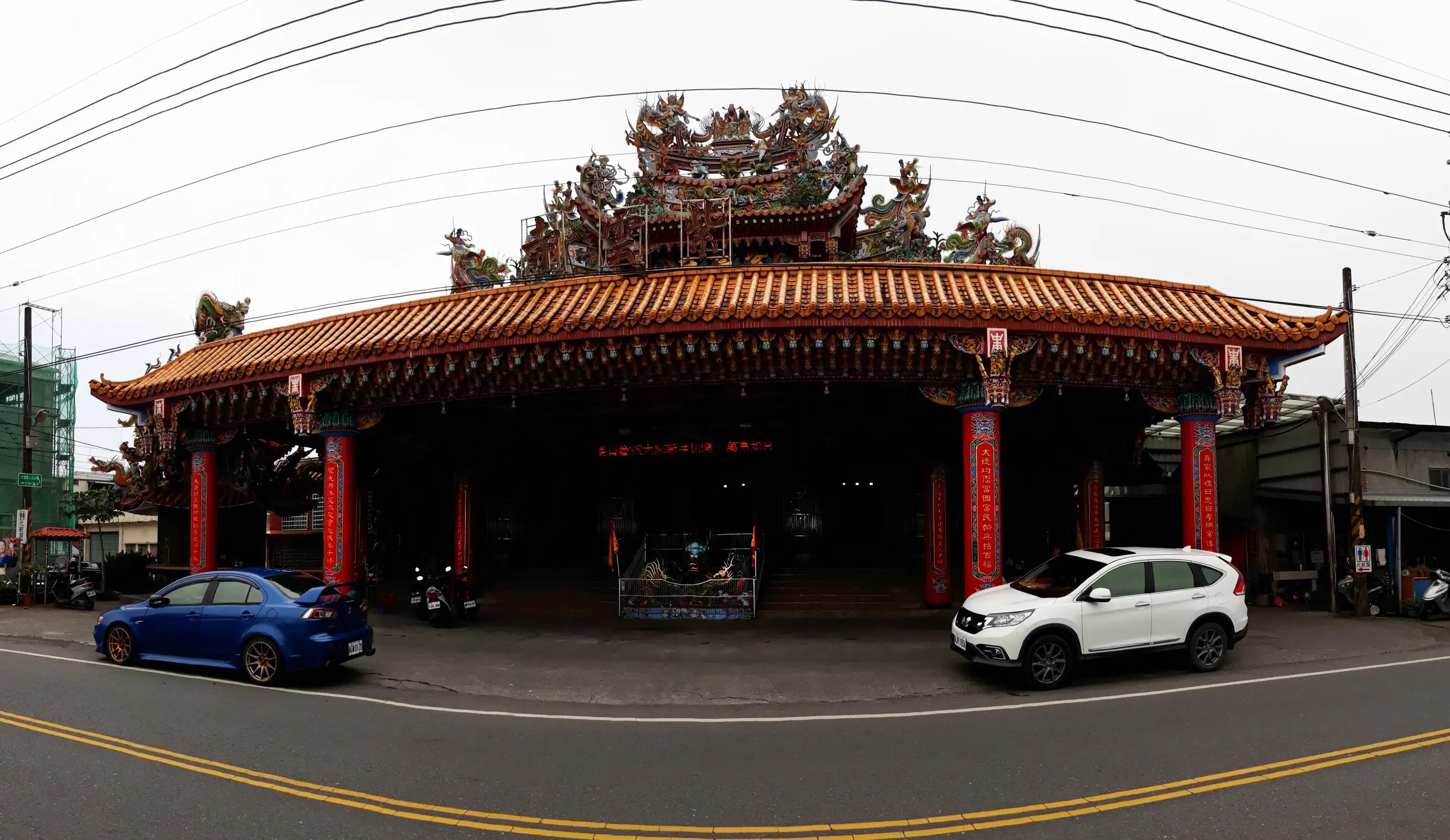
I recently visited another Great Sage temple, this time the Wujian Purple Cloud Temple (Wujian Ziyu si, 五間紫雲寺) of Yilan (宜蘭), Taiwan. The temple was bustling with people during the Chinese New Year celebrations, so I didn’t have time to ask many questions. This entry will serve more as a picture essay until I return to conduct proper research.
1. History
Legend has it that around 1899 a man found a monkey-shaped stone and enshrined it in a thatched shed. This was eventually converted to a temple a few years later. It was destroyed by a typhoon in 1960 but subsequently rebuilt. The temple appears to recognize a trinity, with countless monkey soldiers beneath them. The Great Sage has two aspects: the “Martial Great Sage” (Wu Dasheng, 武大聖) (standing statues), who exorcises evil, and the “Civil Great Sage” (Wen Dasheng, 文大聖) (seated statues), who insures the safety of people and animals.
2. How to get there
(Note: Always consult google if you are directionally challenged like myself)
Address: No. 449, Section 3, Dafu Road, Zhuangwei Township, Yilan County, Taiwan, 263
I took bus #1571 (google calls it #1571A) from gate 15 of the Taiwan City Hall Bus Station. This heads towards the Yilan Bus Station. (If you plan to take this route, please note that buses headed to different areas of Yilan will board from this gate. So pay very close attention to the calls of the bus station attendant. For example, they called “Jiaoxi” (礁溪) (bus #1572), a small township in Yilan, and those waiting for another destination had to stand off to the side while those from different sections of the line made their way to the front. If you aren’t careful, you might end up on the wrong bus.) My destination was the first stop, the Zhuangwei (壯圍) bus stop, a small shelter by an overpass. My short walk to the temple took me passed rows of flooded rice fields and small patches of buildings.
(Click images for larger versions)
Gate 15 at the Taiwan City Hall Bus Station.
The Zhuangwei bus stop shelter (as seen from the opposite outgoing bus stop).
The route map from the Zhuangwei bus stop to the temple.
Random rice fields along Gonglao Road (see map).
A panorama of a rice field next to Lane 423, Sect. 3, Dafu Road (see map).
3. The Outside
The temple is located on the side of a busy road. It appears almost out of nowhere since the face of the holy structure is in line with the buildings on either side. The first thing that caught my eye was the highly ornate roof of the furnace covered in mythical creatures, divine heroes, and gods, features typical of South Chinese and Taiwanese temple architecture. Each face of the hexagonal body was covered with beautiful carvings on black marble, two of which included the pilgrims from Journey to the West.
The furnace visible on the left side of the temple (as seen from the road).
A marble carving of Guanyin, the White Dragon Horse, Monkey, and Tripitaka.
A detail of Monkey.
Monkey, Sha Wujing, Tripitaka on the White Dragon Horse, and Zhu Bajie.
A detail of the group.
The front of the temple houses an ornate statue of three brightly colored dragons enclosed in a fence. Looking up, I noticed beautiful hand-painted dragons and Qilin on the ceiling, along with paintings of events from Chinese mythology and Journey to the West on the cross beams. Walking towards one of the five entrances, I noticed the facade was covered in highly detailed stone carvings, some depicting events from the novel.
The front of the Purple Cloud Temple.
The front of the temple. Three of the five entrances are visible behind the dragons.
A detail of the three dragon statues.
Five hand-painted dragons on the ceiling. The Eight Immortals grace the crossbeam below.
A pair of Qilin on the ceiling. The cross beam below portrays an event from Prince Nezha‘s life.
Zhu Bajie protecting his master from the ogre that will become Sha Wujing.
A stone carving on the facade showing Monkey (top right), Zhu bajie (top center right), and Sha Wujing (center left) battling a monster (top left). The image has been enhanced for clarity.
Monkey (center) battling the heavenly army. Enhanced for clarity.
Monkey (center) leaping from Laozi’s furnace. Enhanced for clarity. Apologies for the blur.
A detail of Monkey leaping.
The Great Sage (top center) and his monkey army battling heaven. Enhanced for clarity. These are just a few of the many carvings covering the temple facade.
4. The Inside
The interior hall is wide yet shallow in depth and split between three altars, Folk religion to the right, the Great Sage in the Center, and Daoist to the left. I must admit in my zeal to photograph anything Monkey-related, I completely forgot to take pictures of the other two sections. This online image shows the folk section includes Mazu, Budai, and other deities. This image shows the Daoist section includes the Jade emperor, the Earth god, and others. Surprisingly, the incense burner in front of the main entrance was not marked with the name of the Great Sage (unlike what I’ve seen at other such temples) but that of the Jade Emperor, 玉皇上帝 (Yuhuang shangdi).
The main hall.
The incense burner bearing the name of the Jade Emperor (visible from the hall looking out the main door).
Upon entering the right side of the main hall, the first thing that caught my eye was a large wooden sculpture of a tree-bound monkey holding onto a branch with one hand and a pair of peaches in the other. Immediately behind him was a stone carving of a vague monkey with two children. (I’m not sure of the ritual importance of either statue. I’ll report on this later. However, I will say the stone statue recalls Sun Wukong’s origins as a stone monkey.) Next to both statues is one of two cylindrical towers, one positioned on each end of the hall. Each is topped by a Great Sage statue and the towers themselves are comprised of hundreds of small compartments, each filled with a small Great Sage figure. These represent a donor who has given money to the temple.
The wooden monkey statue.
A detail of the monkey holding peaches.
The stone monkey with children.
The tower of donor Great Sages.
The Great Sage topping each tower. He holds a fly whisk in one hand and a peach of immortality in the other.
The many compartments.
A mini Great Sage donor figure. He sits on a throne with his staff held over head in one hand and a calabash gourd held to his front in the other.
4.1. The Great Sage Altar
The central offering table to the Great Sage was covered in all sorts of fruits, candies, and flowers. Also included were an incense burner, offerings of wine, and a pair of crescent moon-shaped wooden blocks. These blocks are used in tandem with fortune sticks and oracles revealed on slips of paper, all of which are housed in a metal cylinder to the left of the table (see section three of this article on how these items are used).
The table laden with offerings. Take note of the young woman praying to the Great Sage. She told me that she was from Vietnam and that Monkey was not a common deity there.
The incense burner (back center), tea offerings (three cups visible in the center) and wooden blocks (front right).
The metal cylinder housing the fortune sticks (top), with the corresponding oracles located in each of the surrounding drawers.
Like in other parts of Taiwan and Singapore, this temple appears to recognize a plethora of Great Sages, from a holy trinity to an army of soldier monkeys. (I don’t yet know their individual names. I will report on this later.) All of the Great Sage figures are portrayed with golden armor, red-painted humanoid faces, golden fillets, and long, dark hair. The headband and long hair are no doubt influenced by depictions of Military Monks (Wuseng, 武僧) from Chinese opera (Bonds, 2008, pp. 177-178 and 328). Red face paint is also associated with such characters (Bonds, 2008, p. 211). While the red paint of the statues references the red faces of macaque monkeys, it definitely plays into the military monk personna. Portraying Monkey as such defines him as a divine warrior and a guardian deity.
A military monk from a modern Beijing Opera production (Bonds, 2008, p. 178).
I was pleasantly surprised to see statues of Zhu Bajie appear among the Great Sage’s army. It’s quite appropriate given this is the year of the pig according to the Chinese zodiac. Also included were statues of Ksitigarbha and Nezha.
The three main Great Sages visible in front of the ornate dragon statue. Note the long hair.
Statues of Zhu Bajie among Monkey’s soldiers.
More soldier monkeys. Take note of the Ksitigarbha (front right).
Nezha figures mixed in with the monkey soldiers (left).
This soldier monkey holds a calabash gourd at the ready.
More Nezha figures among the soldiers (right).
I have more pictures of the interior but I’ll leave those for a later article. Lastly, I want to share one of the temple flags stationed opposite the main building.
The following video presents 10 facts about Sun Wukong that even superfans of the novel may not know. It is a summation of my and other scholars’ research. I hope you like it and will share with your friends and family.
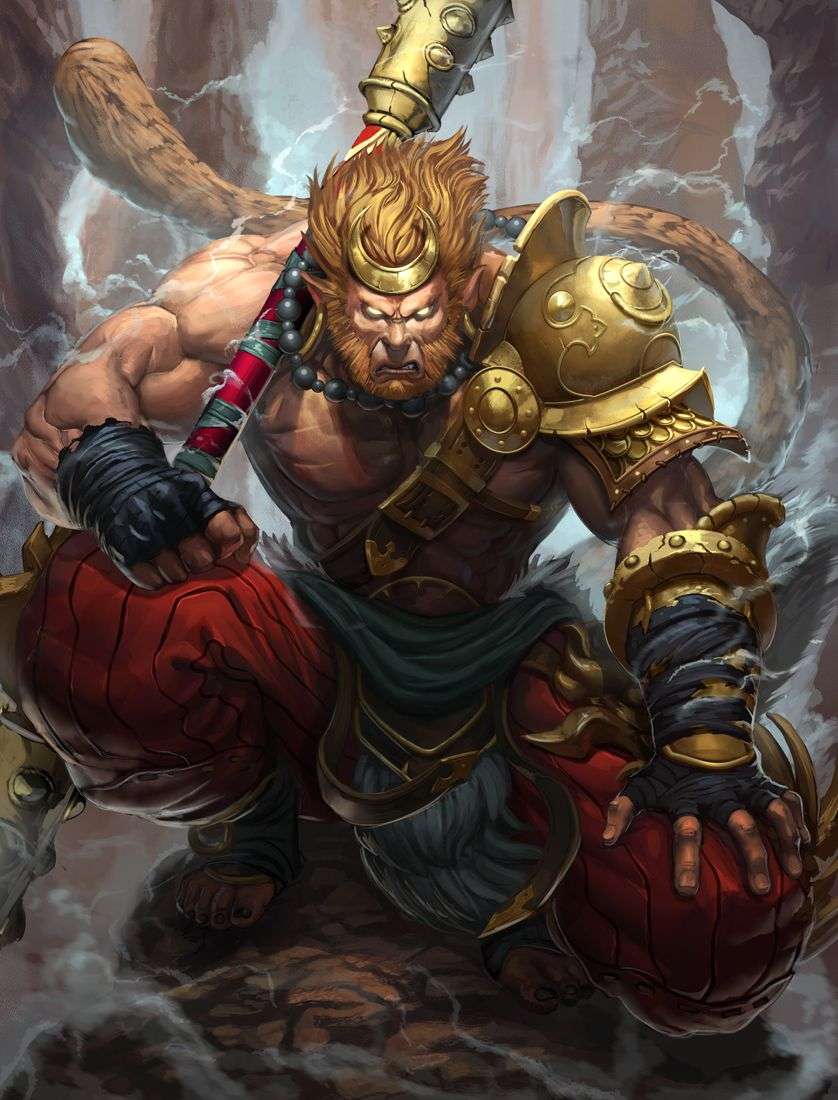
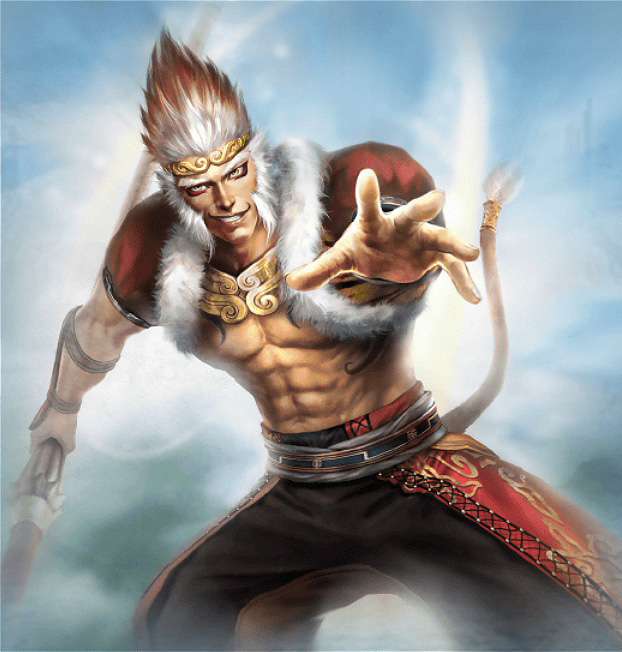
Type “Sun Wukong” into google images and you will be presented with an endless array of pictures that range from the familiar to the alien. A fanciful 1960s cartoon depiction of our hero sits to the left of a SMITE video game character with hulking muscles and a weapon more akin to a club than a staff. A toy version of Liu Xiao Ling Tong‘s much beloved 1986 TV portrayal sits above an anime character with blond hair and a shaved chest. It seems there are as many depictions of Wukong as he has transformations. But how do these myriad personas compare to his depiction in the novel, and who has produced the most authentic look? In this article I present the Monkey King’s literary description, along with ancient depictions that predate the novel. My hope is that the information will be both interesting and useful, especially for artists and cosplayers looking to make a more authentic design.
1. Ancient Depictions
Some readers may be surprised to learn that stories about a “Monkey Pilgrim” (Hou xingzhe, 猴行者) go all the way back to the Song Dynasty (960-1279 CE). This predates the actual name Sun Wukong by centuries. The literary episodes we all know and love began life as oral tales that evolved over time and grew into an accepted storytelling cycle which started to solidify by the 15th-century CE. [1] But the further we go back in time, the less familiar the recorded material becomes, and due to the memory-based nature of oral storytelling, [2] records for the earliest repertoires do not exist. Luckily, visual media from the Song survives, allowing us to see how artists of that time depicted the Monkey King.
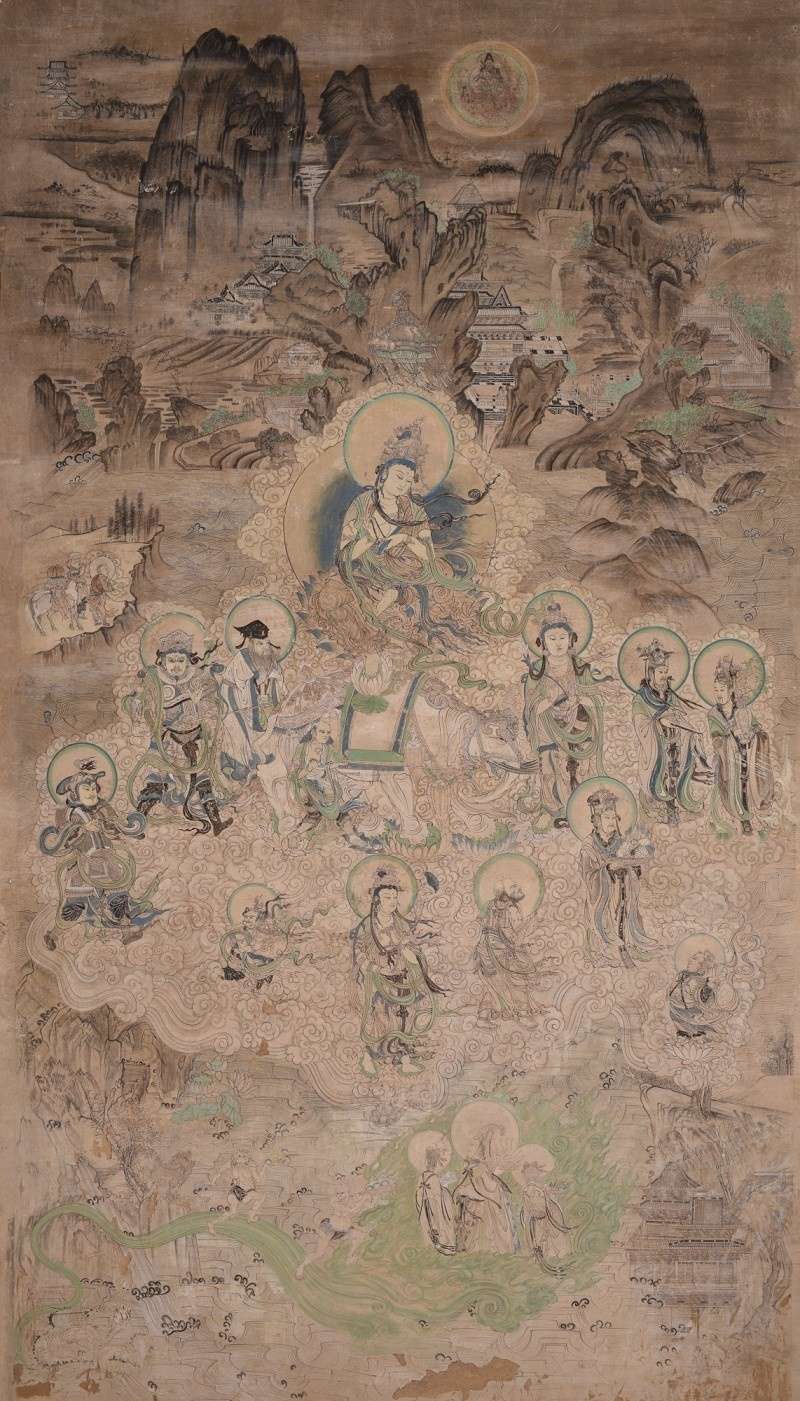
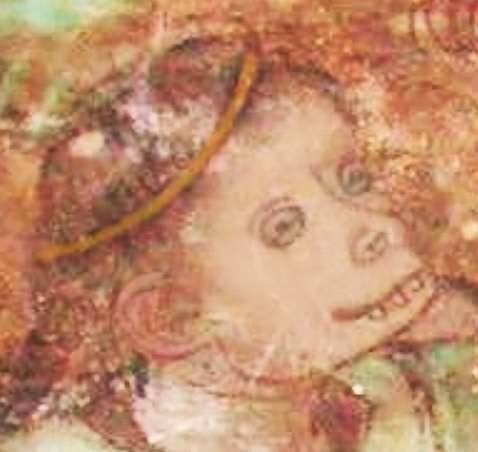
One example, Eastern Thousand Buddha Cave (Dong qianfo dong, 東千佛洞) number two in the Hexi Corridor of Gansu Province, contains a late-Xixia dynasty (late-12th or early-13th-century CE) mural of Xuanzang worshiping Guanyin from a riverbank, while Monkey stands behind him tending to a brown horse. The latter is portrayed with a plain circlet on his head, a homely face with an overbite, waist length hair (or possibly wearing a fur on his back), and light blue-green robes with a red apron and brown pants and sandals (fig. 1 and 2). The depiction is less simian in appearance, yet not wholly human.
Fig. 1 – An almost complete version of the Eastern Thousand Buddha Cave no. 2 painting (larger version). Photo by National Geographic. Fig. 2 – A detail of Monkey and Xuanzang (larger version). See figure 14 for an enhanced detail of Monkey’s head.
A second example, Yulin Cave (Yulin ku, 榆林窟) number three in Gansu, contains a late-Xixia wall painting with similar imagery. Xuanzang is again worshiping from a riverbank, but this time the subject of adoration is Samantabhadra. We see Monkey lacks the fillet but wears a monk’s robe with wrapped socks and sandals. This time he is far more monkey-like in appearance, complete with furry arms (fig. 3 and 4).
Fig. 3 – An almost complete version of the late-Xixia Yulin Cave no. 3 painting (larger version). Monkey and Xuanzang can be seen standing on the river bank on the upper left side. Fig. 4 – A detail of the two figures (larger version).
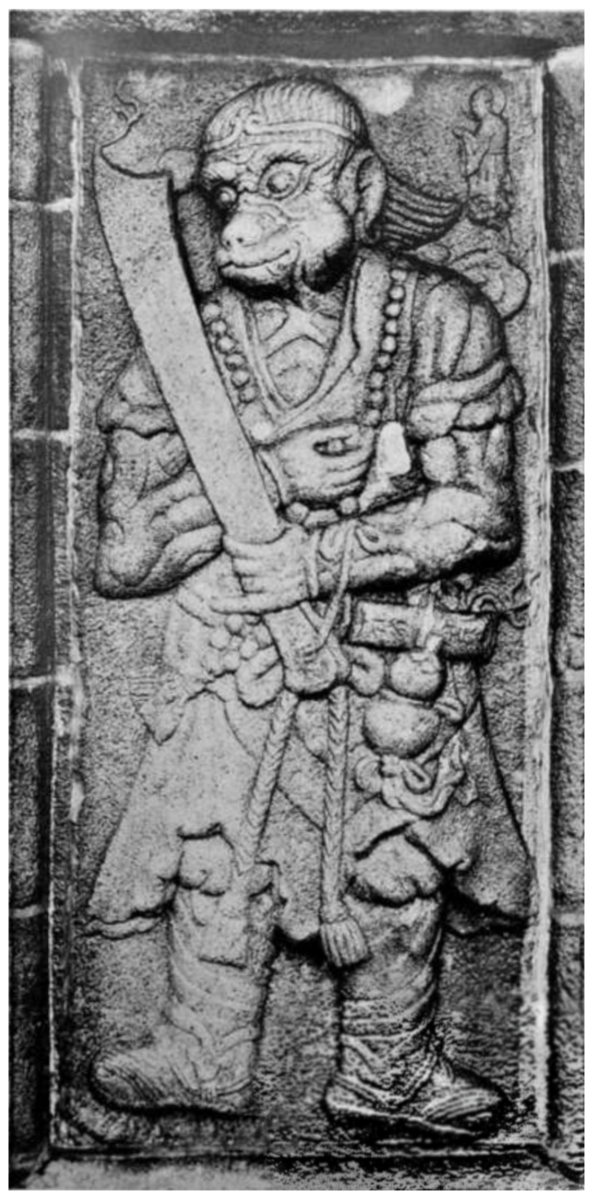
A third example is the 1237 CE stone relief carving from the western pagoda of the Kaiyuan Temple (開元寺) in Quanzhou, Fujian province. This muscular warrior wears a headband, earrings, bracelets, a rosary necklace, and arm bangles (all prescribed Esoteric Buddhist ritual accouterments), as well as a monk’s robe and sandals. He wields a broadsword in one hand, while the other thumbs the rosary at his chest. At his waist hangs a calabash gourd and a scroll of the Mahamayurividyarajni Sutra (Fomu da kongque mingwang jing,佛母大孔雀明王經) (fig. 5) (Ecke & Demiéville, 1935). He has the large ears and protruding mouth of a monkey.
Fig. 5 – The monkey-headed warrior from Kaiyuan temple in Quanzhou, Fujian (larger version).
Writing in the 1250s, the Song poet Liu Kezhuang (劉克莊, 1187-1269) references our hero twice in his work. The second of two such references uses Monkey as a metaphor to describe the ageing 70-year-old’s appearance. A portion of the poem reads:
A back bent like a water-buffalo in the Zi stream, Hair as white as the silk thread issued by the “ice silkworms”, A face even uglier than Hou xingzhe [“Monkey Pilgrim”], Verse more scanty than even He Heshi (Dudbridge, 1970, p. 46).
Ugliness is a subject I will return to several more times.
I mentioned earlier that the farther we go back in time the less familiar the recorded material becomes. Case in point is theThe Story of How Tripitaka of the Great Tang Procures the Scriptures(c. late 13th-century CE), the earliest published edition of Journey to the West. Despite referring to himself as the Monkey King, the Monkey Pilgrim is depicted as a white-clad scholar. Another difference is the fact that he fights with two different staves, one a ringed monk’s staff and the other an iron rod (these two would later be combined to create his signature weapon).
The majority of Song sources depict the Monkey Pilgrim as the size of an adult man but with the head of an ugly monkey. I think that these were likely influenced by early stage plays, which would obviously entail a human actor taking on the role.
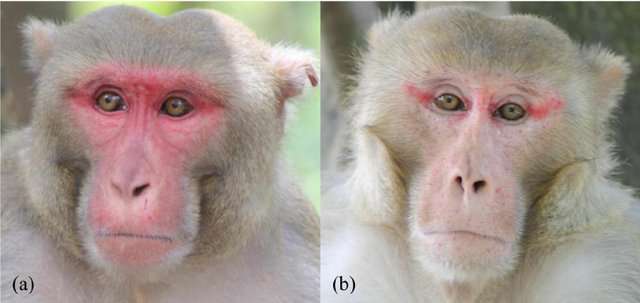
Fig. 6 – A comparison of Rhesus macaque males with red-rimmed eyes during mating season (left) and other times (right) (larger version). Original image from Dubue, Allen, Maestripieri, & Higham, 2014, p. 5.
In chapter 21, a demon king steps out of his cave to fight Sun but is surprised by his small stature:
The old monster took a careful look and saw the diminutive figure of Pilgrim [Monkey]—less than four feet, in fact—and his sallow cheeks. He said with a laugh: “Too bad! Too bad! I thought you were some kind of invincible hero. But you are only a sickly ghost, with nothing more than your skeleton left!” (Wu & Yu, 2012, vol. 1, p. 408).
(Thank you to Jose Loayza for bringing this passage to my attention.)
His bald head is referred to again in chapter 27:
“But ever since Nirvana delivered me from my sins, when with my hair shorn I took the vow of complete poverty and followed you as your disciple, I had this gold fillet clamped on my head…” (Wu & Yu, 2012, vol. 2, p. 24).
(Thank you to Stanley Setiawan for bringing this passage to my attention.)
Fig. 7 – Reggie the baboon from Paignton Zoo (circa 2005). His slick head was the result of his mom’s “over-zealous” grooming. Look at those ears! He’s the wrong genus and species, but you get the general idea what Sun Wukong would look like wearing the golden fillet (larger version).
Wukong’s bald pate is once again referenced in chapter 34:
The fiend then gave the rope a tug and pulled Pilgrim down before he gave that bald head seven or eight blows with the sword. The skin on Pilgrim’s head did not even redden at all (Wu & Yu, 2012, vol. 2, p. 128).
In chapter 44, the Monkey King’s appearance is revealed in a dream to a group of monks by the personification of the planet Venus:
A bumpy brow, and golden eyes flashing; A round head and a hairy face with sunken cheeks; Gaping teeth, pointed mouth, a character most sly; He looks more strange than the thunder god […] (based on Wu & Yu, 2012, vol. 2, p. 276).
A hairy face, a thunder god beak, Empty cheeks unlike Saturn’s; [3] Two forked ears on a big, broad head, And fangs that have outward grown (based on Wu & Yu, 2012, vol. 3, p. 105).
In chapter 67, an old man chastises Monkey for offending him:
You! Look at your skeleton face, flattened brow, collapsed nose, sunken cheeks, and hairy eyes. A consumptive ghost, no doubt, and yet without any manners at all, you dare use your pointed mouth to offend an elderly person like me!” (based on Wu & Yu, 2012, vol. 3, p. 242).
In chapter 75, he once again tests the hardness of his bald head:
“You come over here,” said the old demon, “and act as my chopping block first. If your bald head can withstand three blows of my scimitar, I’ll let you and your Tang Monk go past. But if you can’t, you’d better tum him over quickly to me as a meal.”
When he heard this, Pilgrim smiled and said, “Fiend! If you have brush and paper in your cave, take them out and I’ll sign a contract with you. You can start delivering your blows from today until next year, and I won’t regard you seriously!” Arousing his spirit, the old demon stood firmly with one foot placed in front of the other. He lifted up his scimitar with both hands and brought it down hard on the head of the Great Sage. Our Great Sage, however, jerked his head upward to meet the blow. All they heard was a loud crack, but the skin on the head did not even redden (Wu & Yu, 2012, vol. 3, p. 373).
We can see from these quotes several features that appear again and again. These include a furry face with sunken cheeks, fiery eyes, a broken or flat nose, a beak-like mouth with protruding fangs, and forked ears (with long earlobes, per the 06-02-25 update). The author-compiler of the novel uses these features over and over again to remind the reader just how ugly the Great Sage is. These same features are also shared by the Rhesus monkey and other macaque species (fig. 8). The multiple mentions of the Thunder God‘s beak refers to the monkey’s prognathic (protruding) mouth, which houses large canine teeth. The quotes also let us know that Sun Wukong is less than four feet tall and very skinny (e.g. having “sallow cheeks” and being like “a consumptive ghost”) just like a monkey (fig. 9). It’s important to note that Sun is described as being bald numerous times throughout the novel. This should come as no surprise since he was required to take the tonsure as a Buddhist monk. Modern depictions often deviate from the features mentioned here (more on this below).
Fig. 8 – A Bonnet macaque bearing its teeth. Photo by Hank Christensen. The furry face with sunken cheeks, a broken (flat) nose, beak-like mouth with protruding fangs, and forked ears are easily discernible. Fig. 9 – The short, skinny body of a Rhesus monkey. Photo by mario_ruckh via flickr.
2.2 Clothing and Accessories
The novel mentions Sun Wukong wearing different attire throughout his roughly 1,100 years of life. Here I will focus on that which is closely associated with his traditional iconography.
The clothing most often associated with Monkey is his suit of armor. He receives it from the dragon kings of the world’s oceans in chapter three:
“I have here a pair of cloud-treading shoes the color of lotus root[, said Aoshun, the Dragon King of the Northern Ocean]. Aorun, the Dragon King of the Western Ocean said, “I brought along a cuirass of chainmail made of yellow gold.” “And I have a cap with erect phoenix plumes, made of purple gold,” said Aoqin, the Dragon King of the Southern Ocean (based on Wu & Yu, 2012, vol. 1, p. 137).
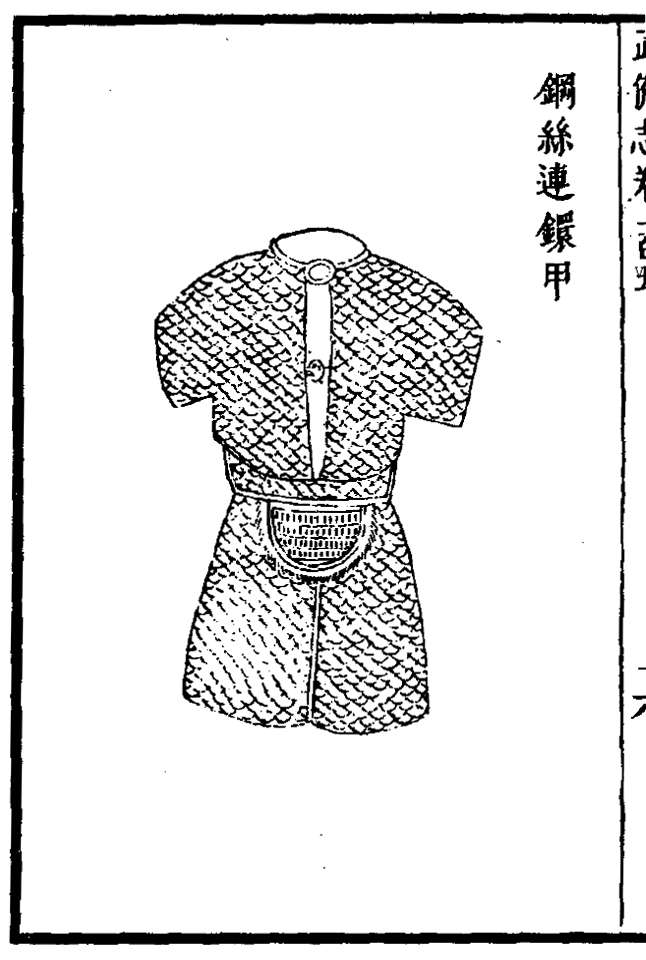
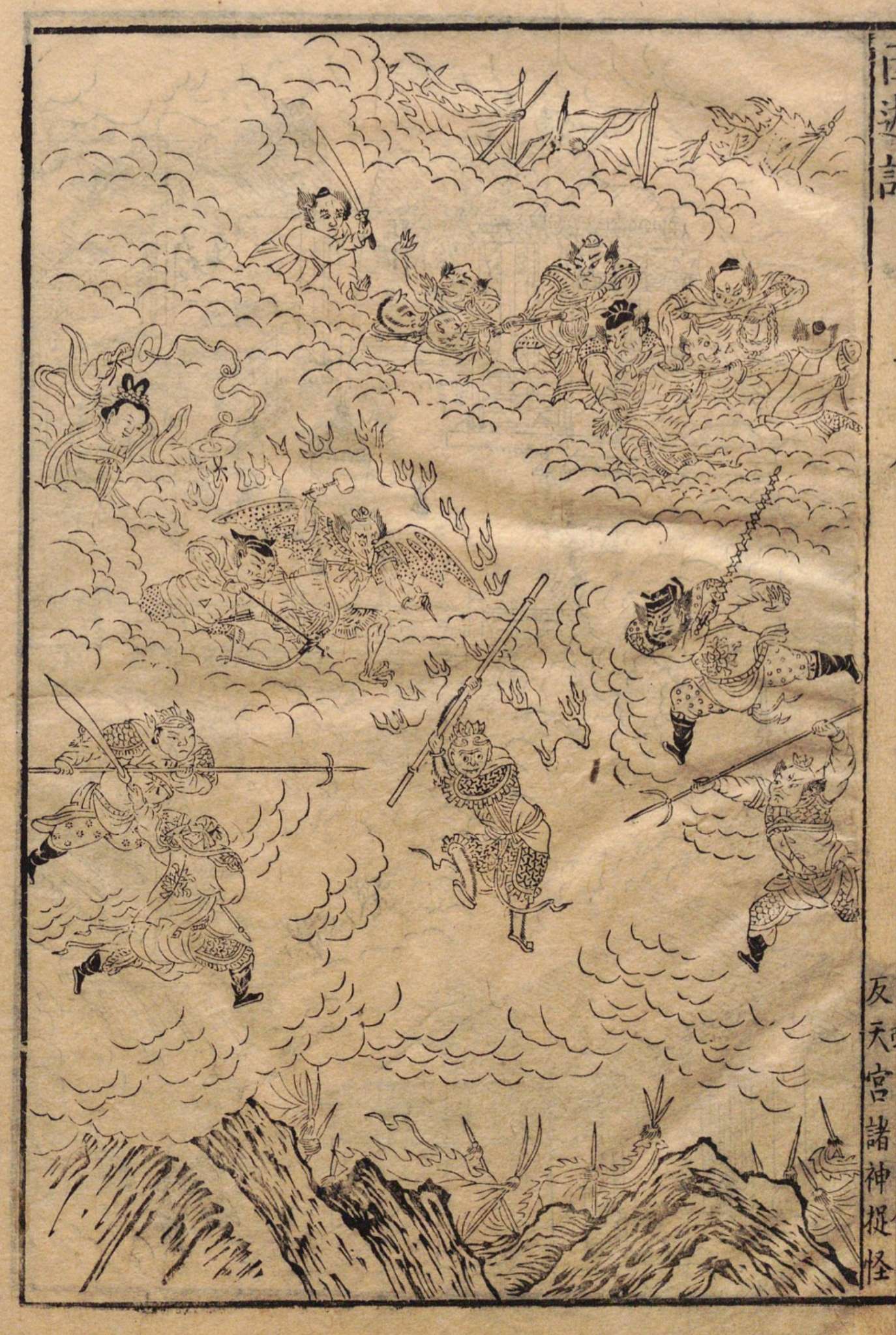
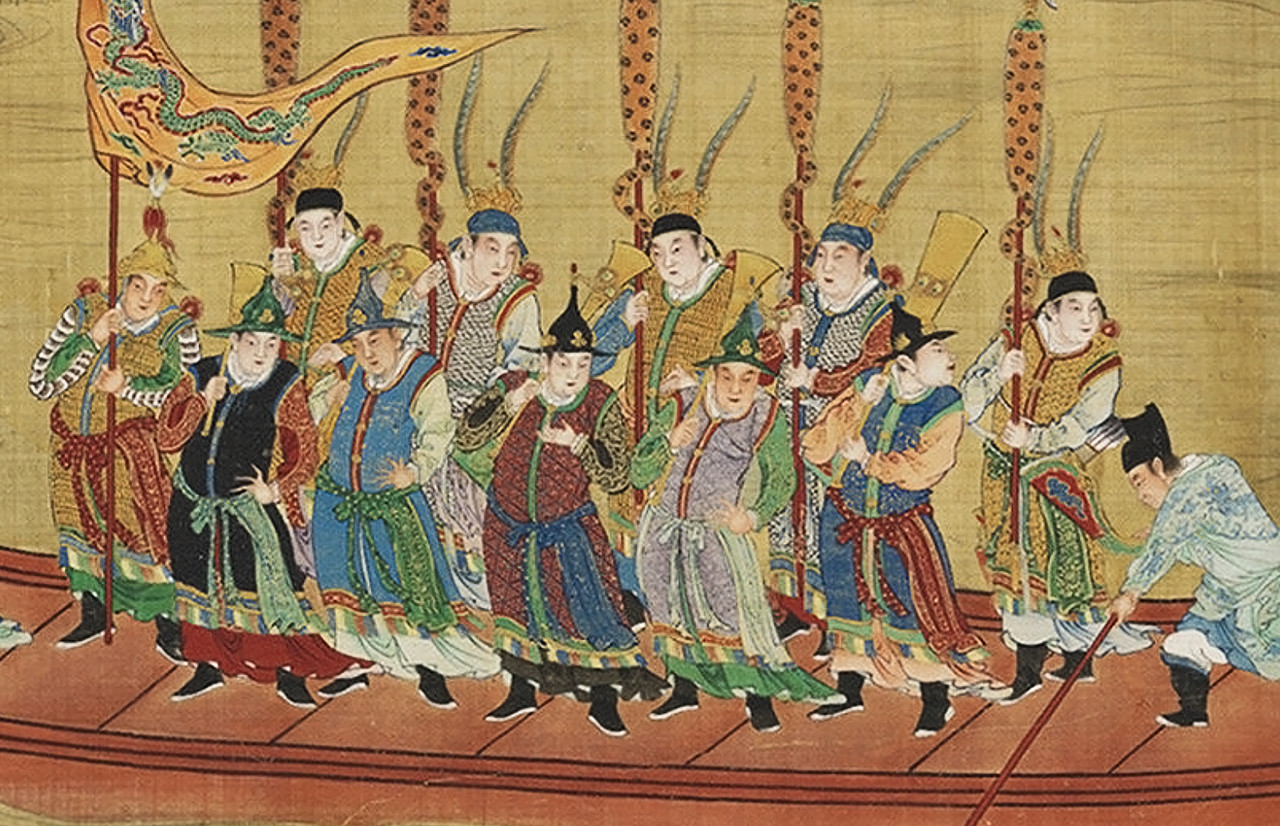
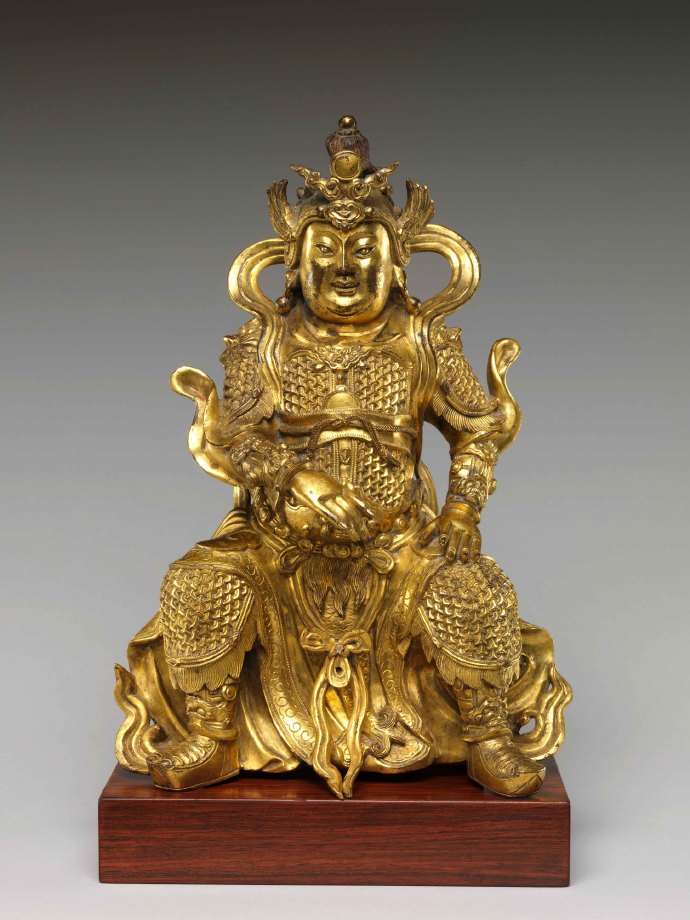
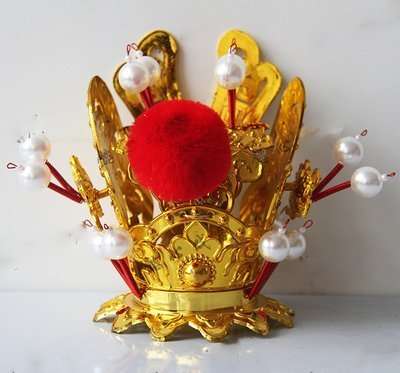
Those wanting to make a novel accurate suit should consult Ming-era chainmail (fig. 10). However, the oldest drawing of Wukong wearing armor that I’m aware of depicts him with “mountain pattern” armor (fig. 11). Combinations of mountain pattern armor and feather caps can be seen in the 16th-century CE scroll The Emperor’s Return to the Capital (Rubitu, 入蹕圖) (fig. 12), showing it was part of historical military regalia and not just the purview of Chinese opera (fig. 13). Modern depictions of Monkey tend to portray him wearing mountain pattern armor with ornate beast elements on the shoulders and waist. Those wishing to replicate this kind of armor should consult Ming-era statues of Buddhist protector deities, such as Skanda or the Four Heavenly Kings (this blog is especially good) (fig. 14, for example). Modern “Purple Gold Caps” (zijin guan, 紫金冠) with lingzi (翎子) feathers should be used for Sun’s phoenix feather cap (fig. 15).
Fig. 10 – Ming chainmail from the Wubei zhi (1621 CE) (larger version). Fig. 11 – A woodblock print of Sun wearing mountain pattern armor while fighting the heavenly army (larger version). From Mr. Li Zhuowu’s Literary Criticism of Journey to the West (late-16th-century CE, “Mr. Li’s Criticism” hereafter). Fig. 12 – A detail of halberd-bearing soldiers wearing mountain pattern armor and feather caps from The Emperor’s Return to the Capital (16th-century CE) (larger version). Image enhanced slightly for clarity. Fig. 13 – Monkey as portrayed in Beijing Opera (larger version). Photo by TAO Images Limited via Alamy. Fig. 14 – A 16th-century CE brass statue of Skanda (larger version). This blog has photos from all sides. Fig. 15 – A modern example of a Purple Gold Cap (larger version).
Contrary to popular belief, Sun does not wear the armor throughout the entire story. Though not openly stated, the novel suggests it is stripped from the monkey when he is captured by heavenly soldiers in chapter six: “They bound him with ropes and punctured his breast bone with a knife, so that he could transform no further” (Wu & Yu, 2012, vol. 1, p. 186). Obviously the knife wouldn’t have punctured the magic armor. And after heaven fails to execute him in chapter seven, several celestial report:
“Your Majesty, we don’t know where this Great Sage has acquired such power to protect his body. Your subjects slashed him with a scimitar and hewed him with an ax; we also struck him with thunder and burned him with fire. Not a single one of his hairs was destroyed (emphasis added). What shall we do?” (Wu & Yu, 2012, vol. 1, p. 188).
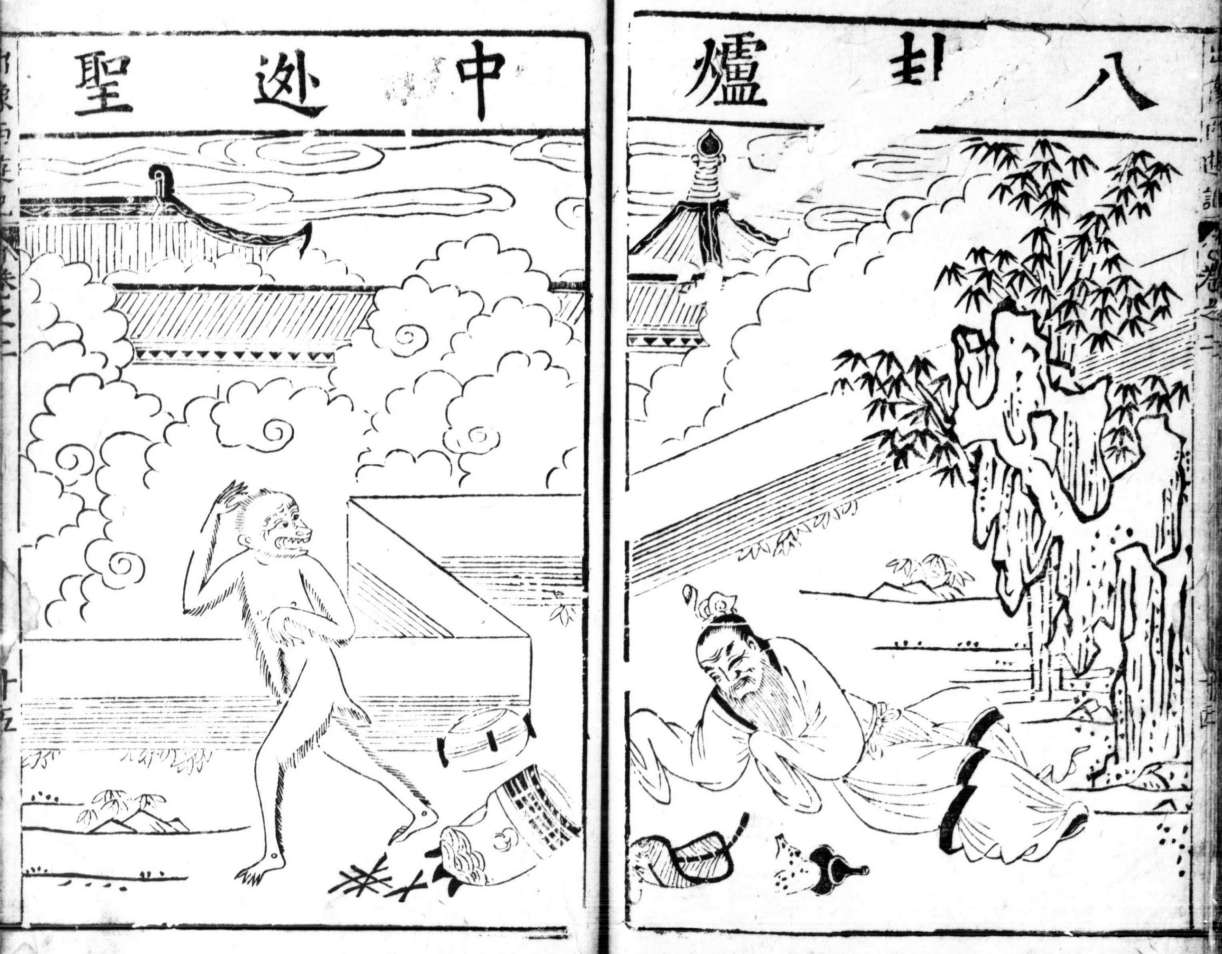
Fig. 16 – Wukong in his birthday suit escaping from Laozi’s eight trigrams furnace (larger version). From Mr. Li’s Criticism (late-16th to early-17th-century CE).
The lack of clothing leads to his second most identifiable and longest-worn piece of attire, a tiger skin kilt (hu pi qun, 虎皮裙). After killing the beast in chapter 14:
He pulled off one strand of hair and blew a mouthful of magic breath onto it, crying, “Change!” It changed into a sharp, curved knife, with which he ripped open the tiger’s chest. Slitting the skin straight down, he then ripped it off in one piece. He chopped away the paws and the head, cutting the skin into one square piece. He picked it up and tried it for size, and then said, “It’s a bit too large; one piece can be made into two.” He took the knife and cut it again into two pieces; he put one of these away and wrapped the other around his waist. Ripping off a strand of rattan from the side of the road, he firmly tied on this covering for the lower part of his body (Wu & Yu, 2012, vol. 1, p. 310).
Monkey’s most recognizable accessory is the self-control-inducing golden fillet (jingu, 金箍; a.k.a. jingu, 緊箍, lit: “tight fillet”), which he is tricked into wearing as a punishment shortly after murdering six bandits in chapter 14. As noted above, the band predates the novel, appearing in the 12th to 13th-century CE Eastern Thousand Buddha Cave number two painting. This piece depicts the headgear as a simple circlet devoid of any decoration (fig. 17). This matches the novel’s description of “a thin metal band” (jinxian, 金線) (Wu & Yu, 2012, vol. 1, p. 310). But as can be seen from the Kaiyuan temple pagoda relief, there also exists a version with a double curlicue pattern in the center of the forehead (fig. 18). This has come to be the most popular version used in modern media.
Fig. 17 – Detail of the Monkey Pilgrim’s fillet from Eastern Thousand Buddha Cave no. 2 (c. 12th to 13th-century CE) (larger version). Image enhanced slightly for clarity. Fig. 18 – Detail from the Kaiyuan Temple pagoda relief (1237 CE) (larger version).
As for other attire, there exists one passage in chapter 58 that describes how Monkey’s doppelganger copied even his clothing:
His looks were exactly the same as those of the Great Sage: he, too, had a gold fillet clamped to his blondish-brown hair, a pair of fiery eyes with golden irises, a monk’s robe on his body, a tiger kilt tied around his waist, a gold-banded iron staff in one of his hands, and a pair of deerskin boots on his feet (based on Wu & Yu, 2012, vol. 3, p. 105).
Two things about this passage require explanation. First, Yu (Wu & Yu, 2012) originally translated huangfa (黃髮) as “brownish hair” (vol. 3, p. 105). But huang (黃) traditionally means “yellow.” If you refer back to figures six, eight, and nine, you will see that macaque monkeys have a light brown to blond coloring, so I changed the translation to reflect this.
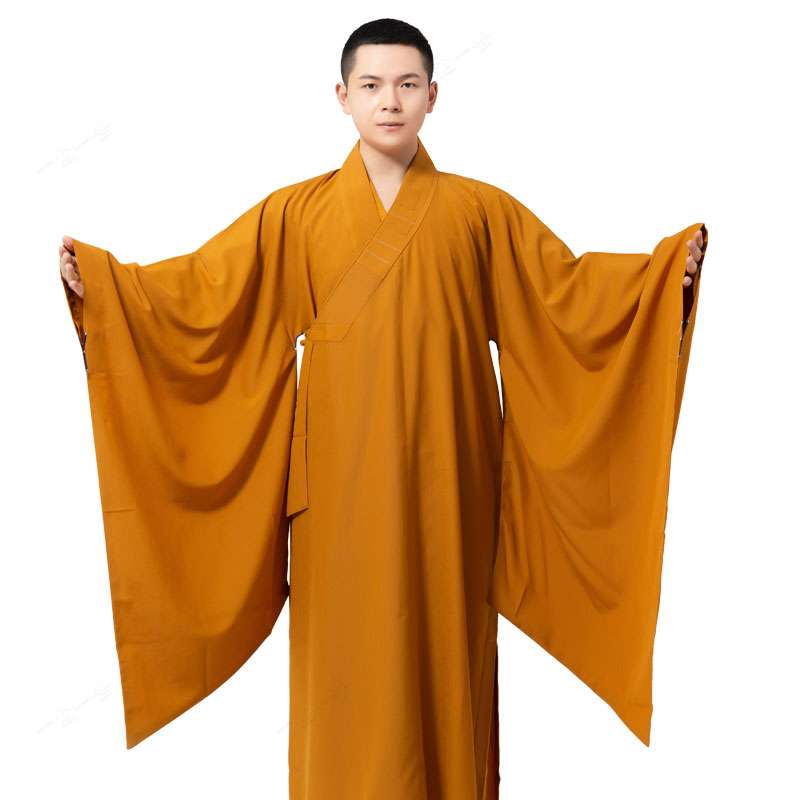
Second, he translates mianbu zhiduo (綿布直裰) as “silk shirt” (Wu & Yu, 2012, vol. 3, p. 105). However, a better translation is “silk cloth zhiduo robe.” The zhiduo robe is known colloquially in English as “Buddhist monk” or “Taoist monk” robes. Also called haiqing (海青), such garments reach almost to the ground and have long, broad sleeves. The robe is closed by a tie on the right side of the torso (fig. 19).
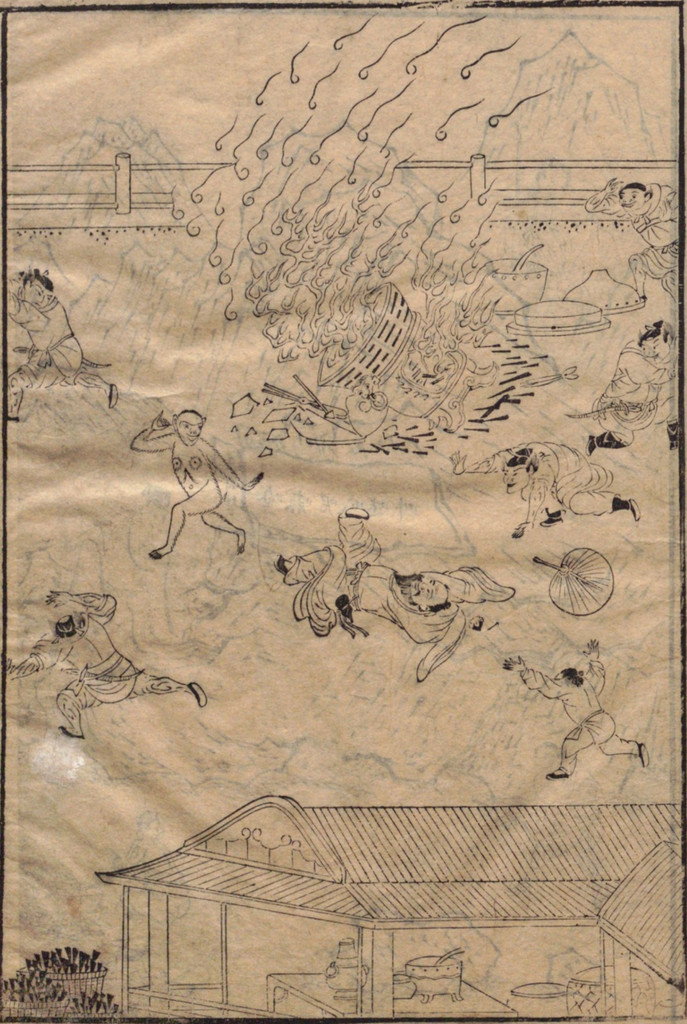
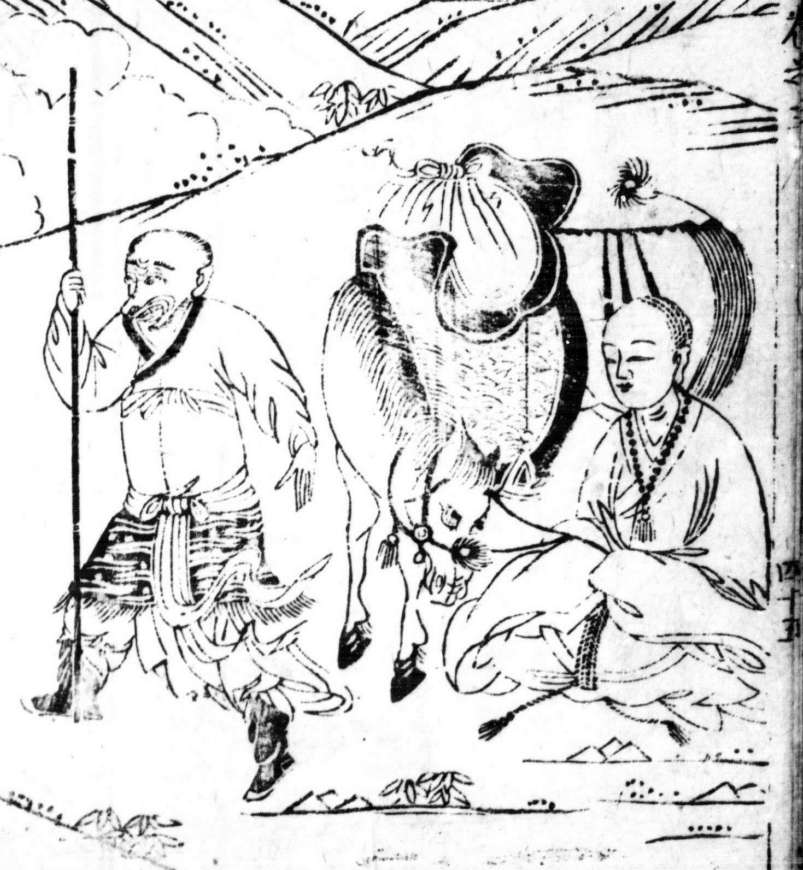
Woodblock prints of Monkey from the original 1592 CE Journey to the West vary from page to page, but one is pretty accurate. He wears the robe (with tied cuffs), the tiger skin kilt, and boots (fig. 20).
Fig. 19 – A zhiduo/haiqing robe (larger version). Image found here. These robes can be any number of colors. Fig. 20 – A woodblock print of Sun Wukong with his master, Tripitaka (larger version).
There is a distinct order in which Sun Wukong wears the aforementioned clothing and accessories: the armor, then the tiger skin, and then the golden fillet. However, many modern depictions portray Monkey wearing both the armor and headband. This is obviously anachronistic within the novel’s fictional story line. (Admittedly, though, this is not unique to the modern era. See figure 11 for a 16th-century CE example.) Furthermore, many depictions dismiss the tiger skin kilt altogether.
2.3. The Staff
Monkey’s staff is first introduced in chapter three when he travels to the undersea palace of the dragon king to procure a divine weapon. There, he is directed towards a massive iron pillar:
Wukong girded up his clothes and went forward to touch it: it was an iron rod more than twenty feet long and as thick as a barrel. Using all his might, he lifted it with both hands, saying, “It’s a little too long and too thick. It would be more serviceable if it were somewhat shorter and thinner.” Hardly had he finished speaking when the treasure shrunk a few feet in length and became a layer thinner. “Smaller still would be even better,” said Wukong, giving it another bounce in his hands. Again the treasure became smaller. Highly pleased, Wukong took it out of the ocean treasury to examine it. He found a golden ring at each end, with solid black iron in between. Immediately adjacent to one of the rings was the inscription, “The As-You-Will Gold-Banded Staff. Weight: 17,560 pounds” (based on Wu & Yu, 2012, p. 135). [4]
A poem in chapter 75 describes how the staff is decorated with magic symbols. Part of it reads:
The rod of bin steel nine cyclic times refined Was forged in the stove by Laozi himself. King Yu took it, named it “Treasure Divine,” To fix the Eight Rivers and Four Seas’ depth. In it were spread out tracks of planets and stars, Its two ends were clamped in pieces of gold. Its dense patterns would frighten gods and ghosts; On it dragon and phoenix scripts were drawn. Its name was one Rod of Numinous Yang, Stored deep in the sea, hardly seen by men […] (based on Wu & Yu, 2012, vol. 3, p. 375)
So we see the staff is depicted as a rod of black iron or steel adorned on both ends with a single golden ring and decorated along the body with astronomical charts and an inscription towards one tip listing the weapon’s name and weight. The literary description greatly differs from modern media which often portrays it as entirely gold or red in color.
Those wishing to replicate the inscription on the staff can use figure 21 as a template. The characters are presented in “Small Seal Script” (Xiao Zhuan, 小篆), which hails from the Qin Dynasty (221-206 BCE) when written Chinese was standardized by Emperor Qin Shihuang. Using this will give the staff a more ancient look. I used the template years ago to create a replica staff for an archaeology course in college.
Fig. 21 – The small script template for Monkey’s staff (larger version).
As for “the tracks of stars and planets,” I recommend using the Dunhuang or Suchow star charts.
3. Popular Depictions
The following two sections include a small sampling of what I consider to be the least and most accurate portrayals in past and modern media. These are presented in no particular order.
3.1. The Least Accurate
1) SMITE video game – He’s basically a bodybuilder with mutton chops (fig. 22). The design includes the aforementioned headband plus armor anachronism. Why is he wearing a gladiator-style pauldron? The original illustration is by Brolo on deviantart.
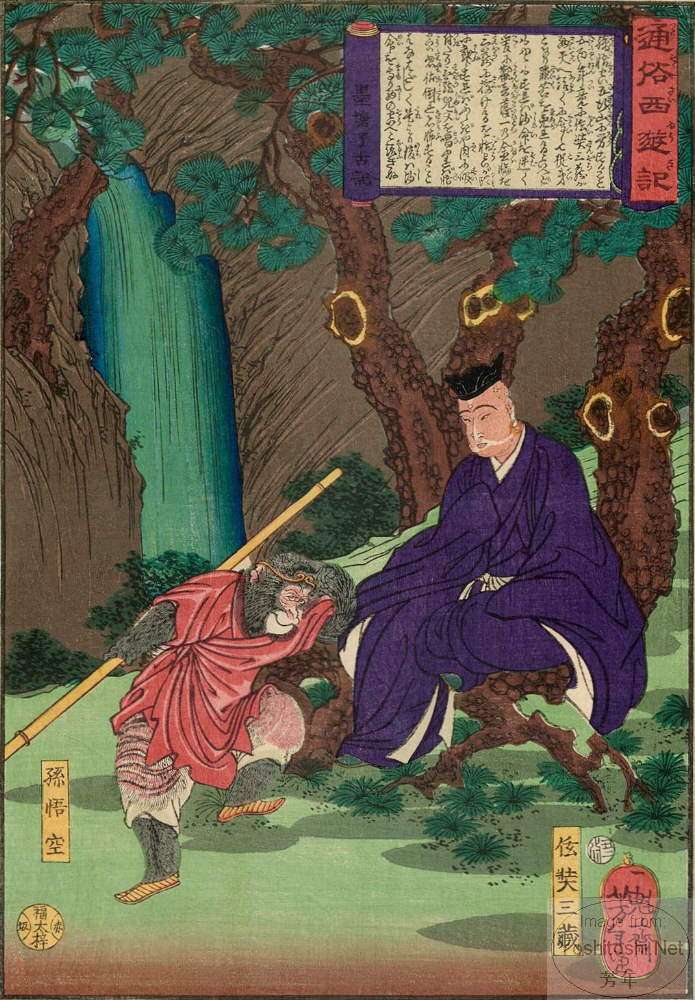
1) Yoshitoshi (1839-1892) – This Japanese artist produced many woodblock prints of our hero. Take for example his Modern Journey to the West series completed between 1864 and 1865. He portrays Sun Wukong as a red-faced snow macaque, which aligns more with the literary description (fig. 25).
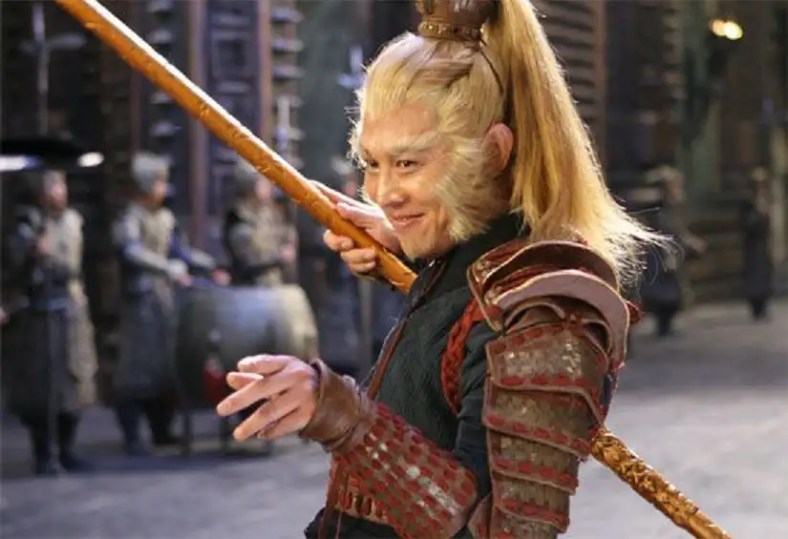
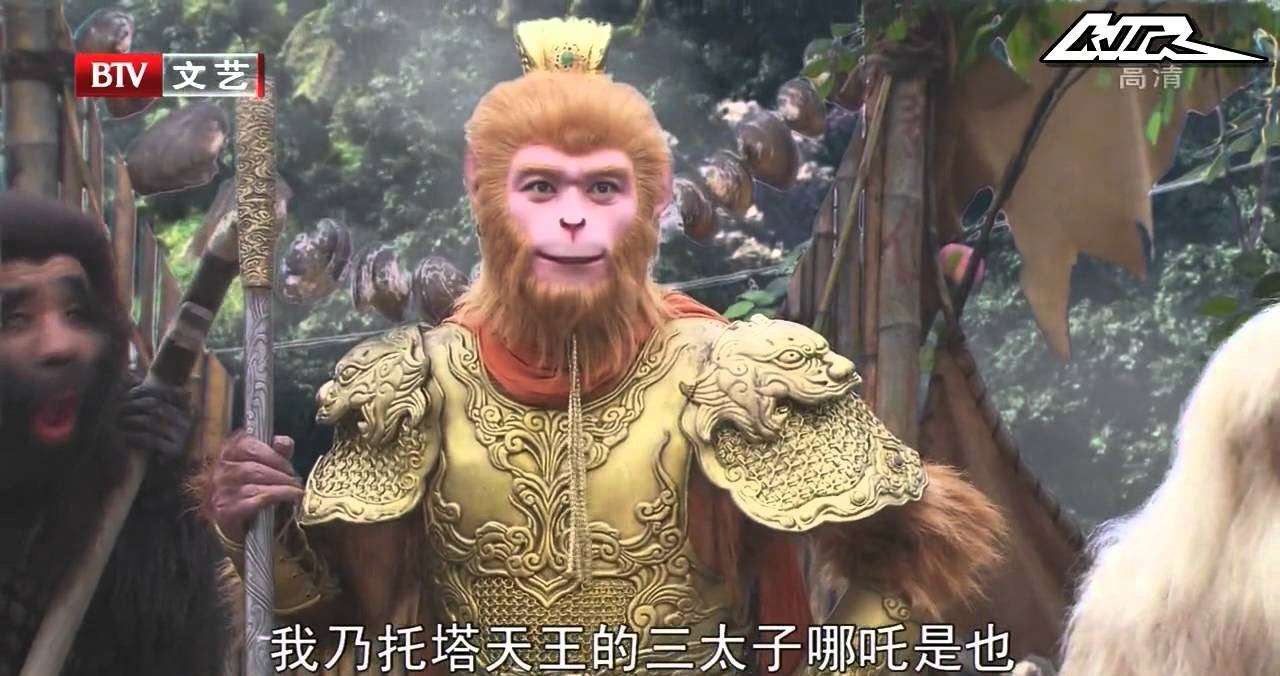
3) Journey to the West (2011) – This television series is a faithful adaptation of the novel. Although the actor who plays Sun Wukong is normal height, he wears a full silicone mask and clawed gloves to give the character a more primate look. His golden chainmail armor and staff are more accurate too. The latter even includes decorations on the shaft (fig. 27).
Fig. 27 – Wukong during his rebellion against heaven (larger version).
4. Conclusion
The novel portrays Sun Wukong as an ugly, bald Rhesus monkey less than four feet tall. (Per the 06-02-25 update, he also has long earlobes.) His traditional literary attire includes a phoenix feather cap, golden chainmail armor, and lotus root-colored boots. Later, he wears a golden fillet, a silk monk’s robe, a tiger skin kilt, and leather boots. He wields a rod of black iron/steel adorned on both ends with a single golden ring and decorated along the body with astronomical charts and an inscription towards one tip listing the weapon’s name and weight.
Update: 02-02-21
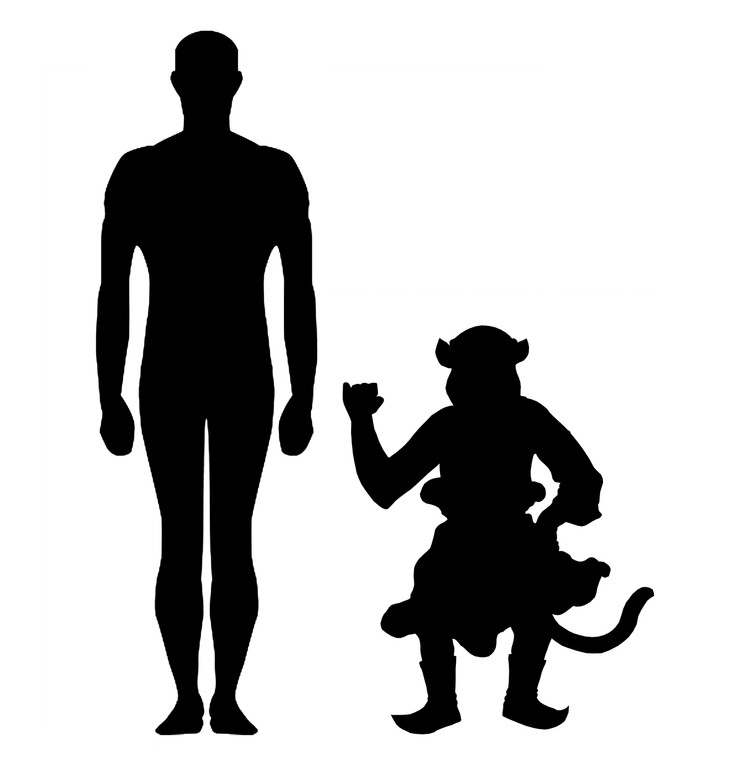
As mentioned above, the novel describes Wukong being “less than four feet, in fact” (Wu & Yu, 2012, vol. 1, p. 408). I have made a chart comparing his height with that of a 6 ft (1.82 m) human man (fig. 28). This should serve as a good illustration for just how short our hero is.
I’ve written an article suggesting a mantra for the secret spell that causes Sun Wukong’s golden headband to tighten. Similar to the above article, I had artists and fanfiction authors in mind when I wrote it.
I previously noted a 16th-century CE woodblock print that shows Sun Wukong naked upon escaping Laozi’s furnace (refer back to fig. 16). A woodblock print from the original 1592 CE Journey to the West also depicts him in his birthday suit (fig. 29). This adds to the evidence that Monkey doesn’t wear his armor during the entirety of the journey.
Fig. 29 – A naked Sun Wukong flees the furnace (larger version).
Update: 09-12-23
In addition, in chapter 22, Sha Wujing mentions having his armor stripped from his body just before his planned execution:
Jade Emperor grew mightily enraged; Hands clasped, he faced his counsel on the left. Stripped of my hat, my armor, and my rank, I had my whole body pushed to the block (Wu & Yu, 2012, vol. 1, p. 425).
This supports the suggestion that Monkey’s armor was removed before heaven tried to execute him.
Update: 04-27-24
Here is another colorful description of Sun Wukong’s face:
A bumpy, scabrous face, a pair of yellow eyeballs, a sunken forehead, and long, protruding fangs—he seemed virtually an overcooked crab with meat inside and bones outside! (based on Wu & Yu, 2012, vol. 2, p. 155)
In addition, chapter 37 gives a more precise measurement for Monkey’s height. He first transforms into a “tiny monk about two cun tall” (二寸長的小和尚兒) (based on Wu & Yu, 2012, vol. 2, p. 172). He shortly thereafter grows even bigger when a prince makes fun of him:
Tripitaka pulled open the box’s cover; Pilgrim [Sun Wukong] leaped out and began to hobble all over the place. The prince said, “This little midget! What can he know?” When Pilgrim heard this remark about his size, he at once resorted to magic. Straightening up his torso, he grew about three chi and four or five cun instantly (emphasis added). “If he can grow that rapidly,” said the soldiers, highly startled, “it will only be a few days before he pierces the sky.” When Pilgrim reached his normal height, however, he stopped growing (emphasis added) (based on Wu & Yu, 2012, vol. 2, pp. 174-175).
One chi (尺) is roughly 12.3 in or 31.8 cm, and one chi equals 10 cun (寸; a.k.a. “Chinese inches”) (Jiang, 2005, p. xxxi). One cun would be about 1.25 in or 3.18 cm. Two cun would therefore be 2.5 in or 6.36 cm. Growing the stated additional height would then put our hero at 3 chi and 6 or 7 cun, which is roughly 3.86 ft or 1.176 m. This agrees with the aforementioned estimate of “not (or less than) four chi tall” (buman sichi, 不滿四尺) (Wu & Yu, 2012, vol. 1, pp. 128 and 408).
Update: 06-02-25
A reader reminded me that I forgot to list one of Monkey’s features: long earlobes. A poem in chapter four reads:
The gold cuirass worn on his body was brilliant and bright; The gold cap on his head also glistened in the light. In his hands was a staff, the golden-hooped rod, That well became the cloud-treading shoes on his feet. His eyes glowered strangely like burning stars. Hanging past his shoulders were two ears, forked and hard (emphasis added). His remarkable body knew many ways of change, And his voice resounded like bells and chimes. This BanHorsePlague with beaked mouth and gaping teeth Aimed high to be the Equal to Heaven Sage.
Long earlobes are a symbol of wisdom and longevity (fig. 30), so the description here might be symbolic of his immortality.
Fig. 30 – An image of the Daoist high god Laozi and his long earlobes (larger version). Image found here.
Notes:
1) The 15th-century CE zaju play Journey to the West contains many familiar episodes that would come to appear in the final novel.
2) See the introduction of Dudbridge (1970), for example.
3) Saturn (Tuxing, 土星; lit: “Earth Star”) is mentioned here because the stellar deity is known for having a thickly-bearded face (see figure one on this article). The reference is saying that Monkey’s sunken cheeks are hairless.
4) Yu’s (Wu & Yu, 2012) original translation says “thirteen thousand five hundred pounds” (vol. 1, p. 135). However, the Chinese version uses jin (斤), known in English as “catty.” The catty and pound are two different measures of weight, the former being heavier than the latter. Therefore, the English text has been altered to show this. The catty during the Ming Dynasty when the novel was compiled equaled 590 grams (Jiang, 2005, p. xxxi), so 13,500 catties would equal 17,560 lbs.
Sources:
Burton, F. D. (2005). Monkey King in China: Basis for a Conservation Policy? In A. Fuentes & L. D. Wolfe (Eds.), Primates Face to Face: Conservation Implications of Human-Nonhuman Primate Interconnections (pp. 137-162). Cambridge: Cambridge University Press.
Ecke, G., & Demiéville, P. (1935). The Twin Pagodas of Zayton: A Study of the Later Buddhist Sculpture in China. Cambridge, Mass: Harvard University Press.
Jiang, Y. (2005). The Great Ming Code / Da Ming Lu. University of Washington Press.