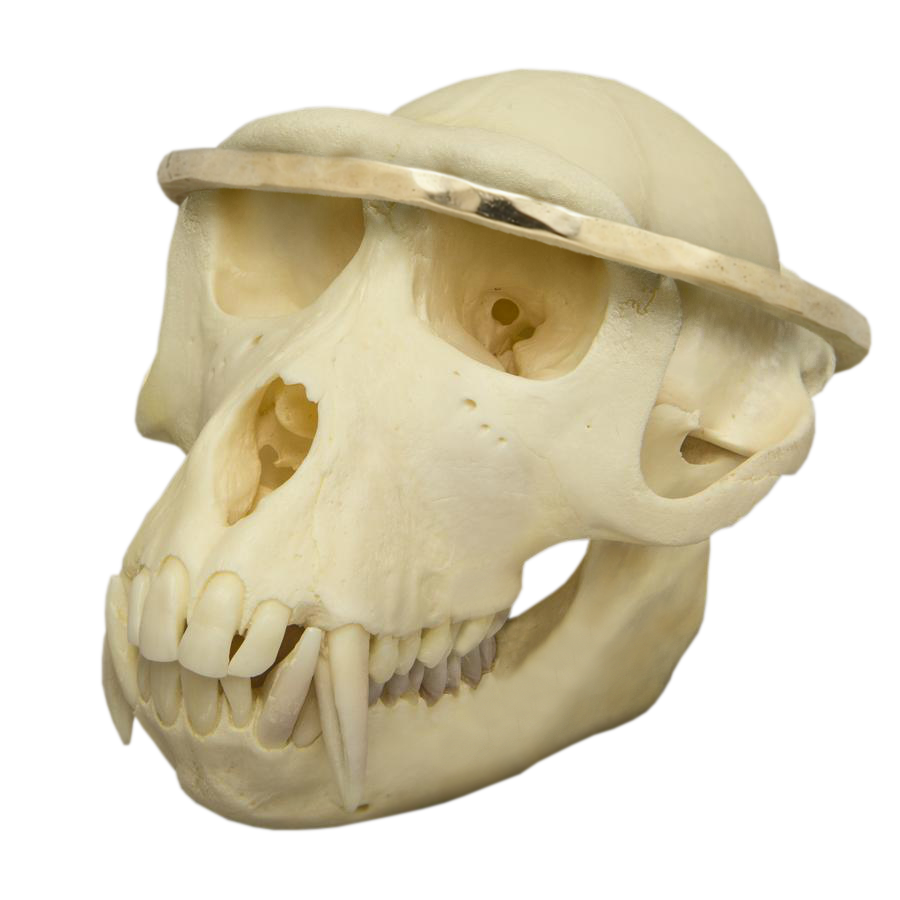
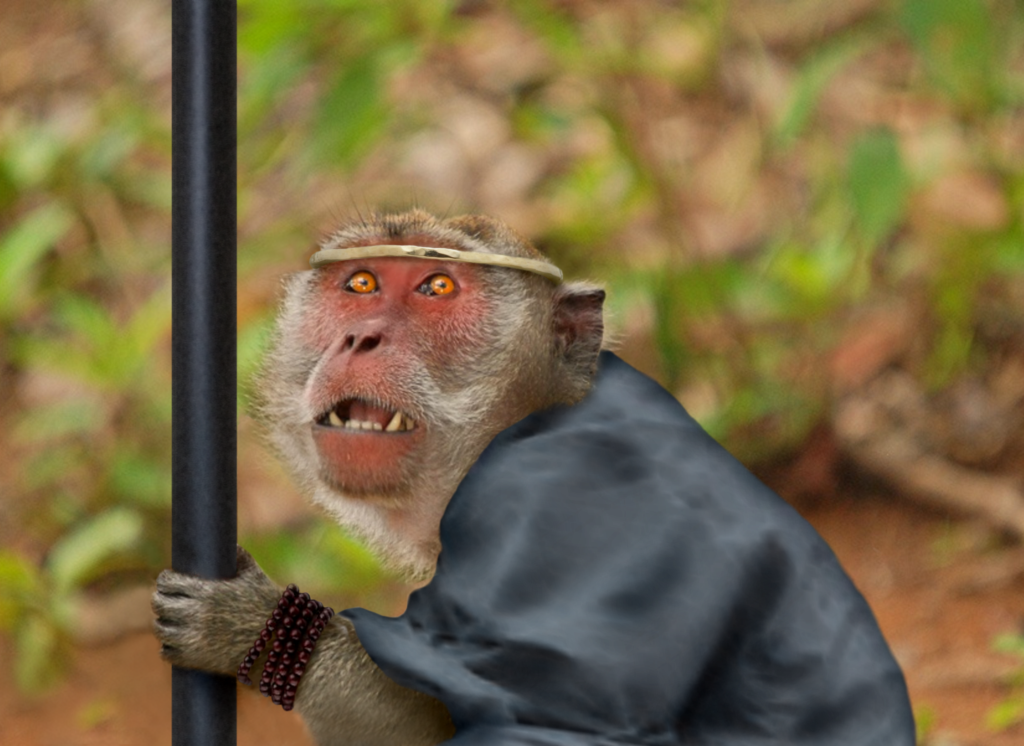
How the Hindu Bird God Garuda Came to Appear in Journey to the West

Last updated: 06-18-2023

Heroes from Chinese military fiction are often cast as reincarnations of celestial beings. For instance, the famous patriot General Yue Fei (岳飛, 1103–1141 C) is portrayed as a reincarnation of the Hindu-Buddhist bird deity Garuda (Jialouluo, 伽樓羅; Jialiuluo, 伽留羅) in his embellished life story, The Complete Vernacular Biography of Yue Fei (Shuo Yue quanzhuan說岳全傳, 1684 CE; a.k.a. The Story of Yue Fei). The bird, called the “Great Peng, the Golden-Winged King of Illumination” (Dapeng jinchi mingwang, 大鵬金翅明王), sits at the head of the Buddha’s throne in the Western Paradise. His fiery temper is aroused when a bat-spirit (the embodiment of the Aquarius constellation) passes gas during the Enlightened One’s sermon on the Lotus Sutra. He swoops down from the throne and snatches her up in his beak, killing her instantly. The Buddha admonishes the bird for his transgression of Buddhist law and exiles him to earth. His rebirth in the human world actually serves to counterbalance the actions of a nomadic antagonist, originally a dragon sent from the Eastern Heaven to punish China (Qian, 2016). This storyline was influenced by a previous work,  Journey to the West (Xiyouji西遊記, 1592 CE), which explains how Garuda came to hold such an important position above the Buddha.

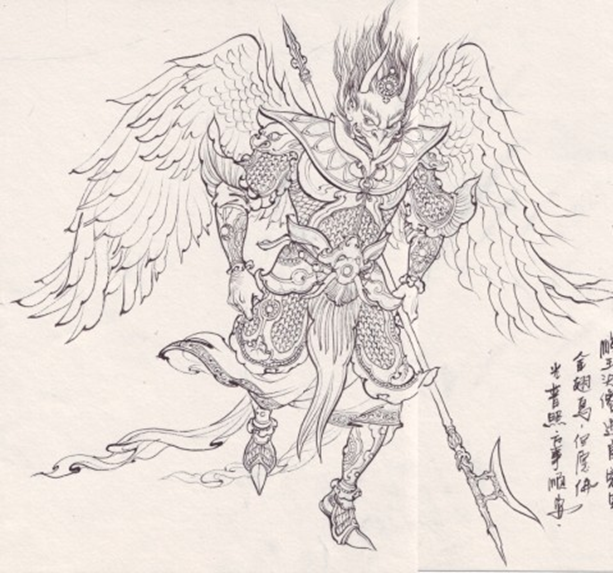
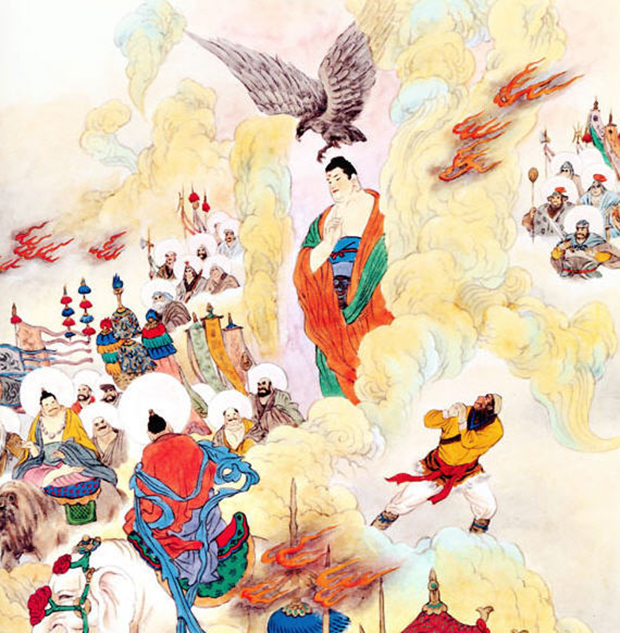
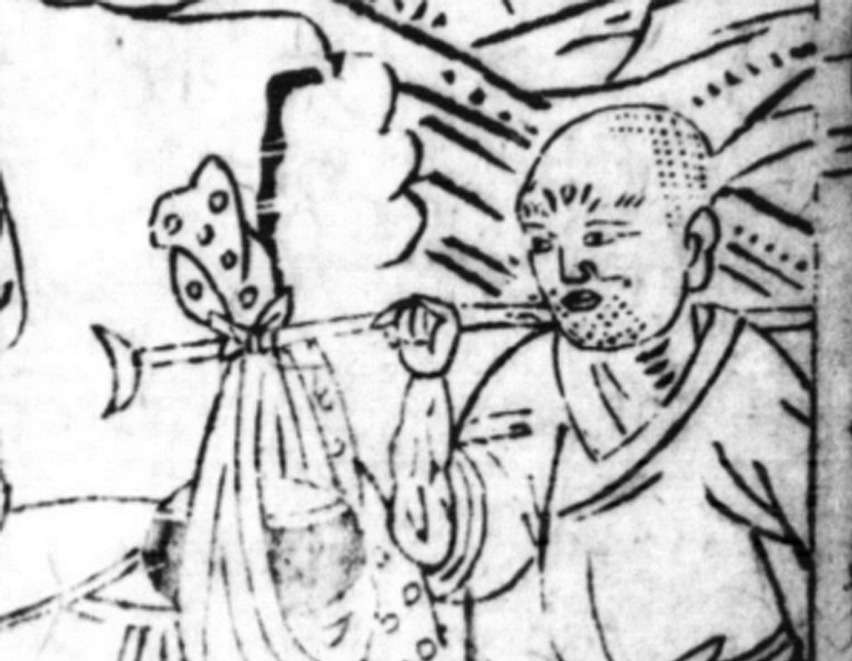
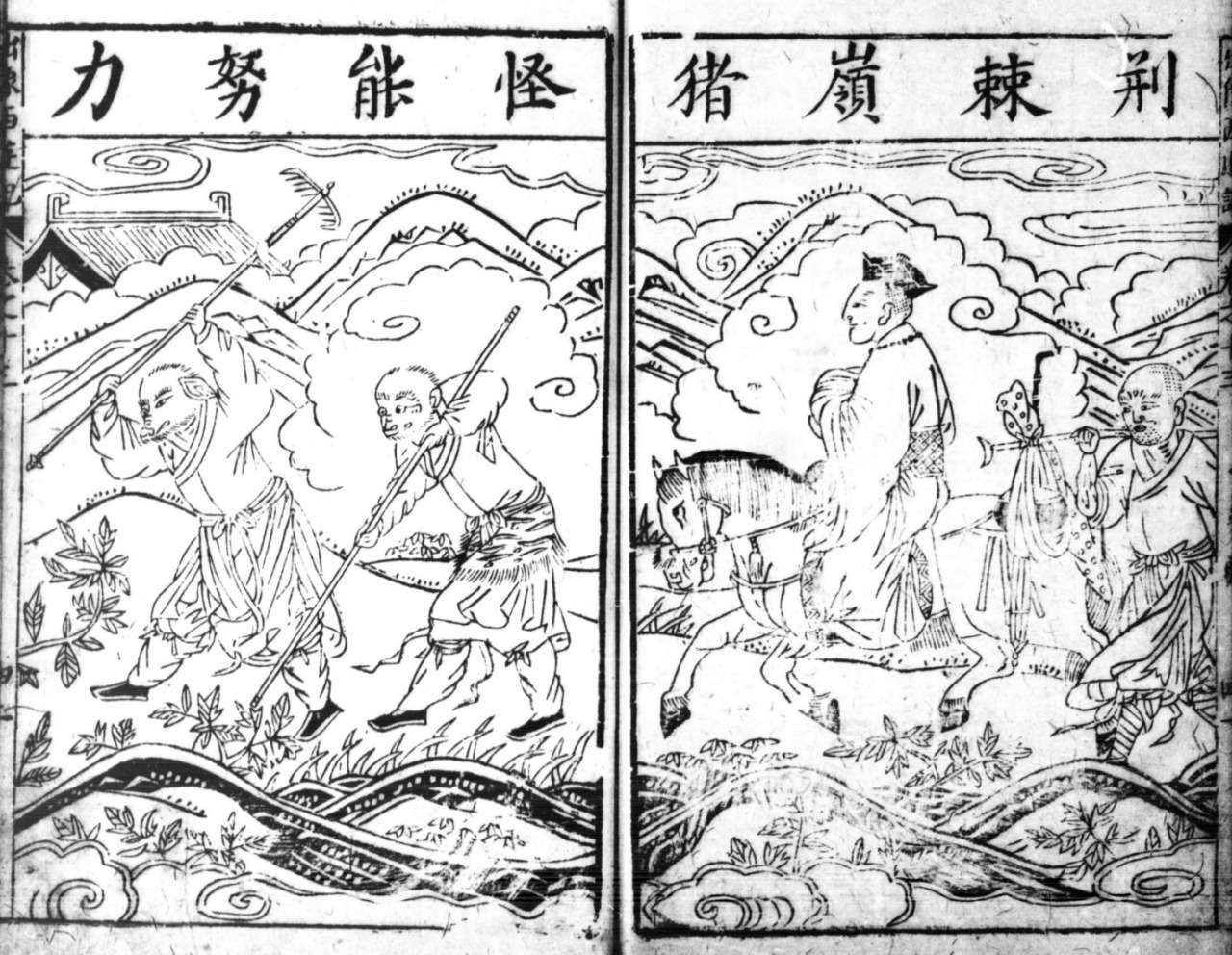
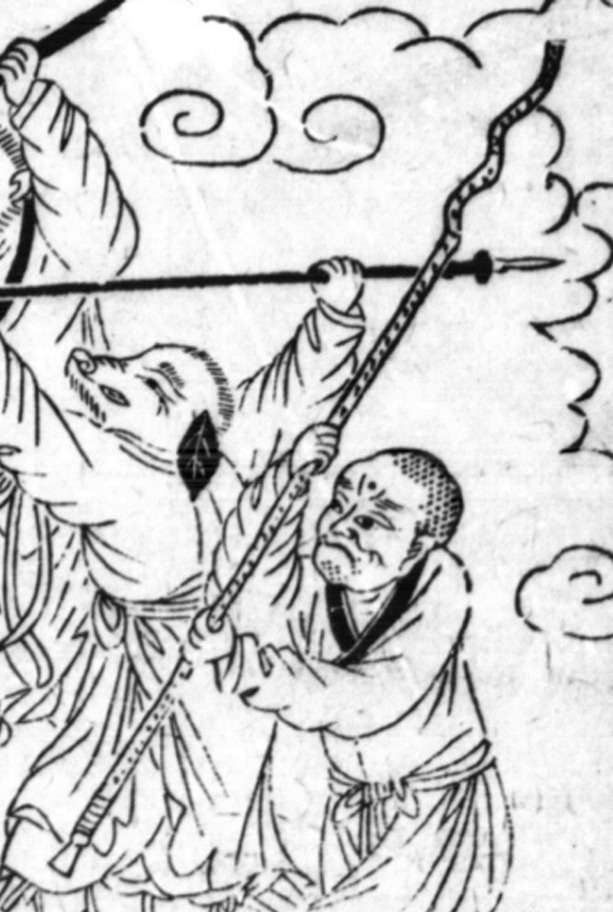
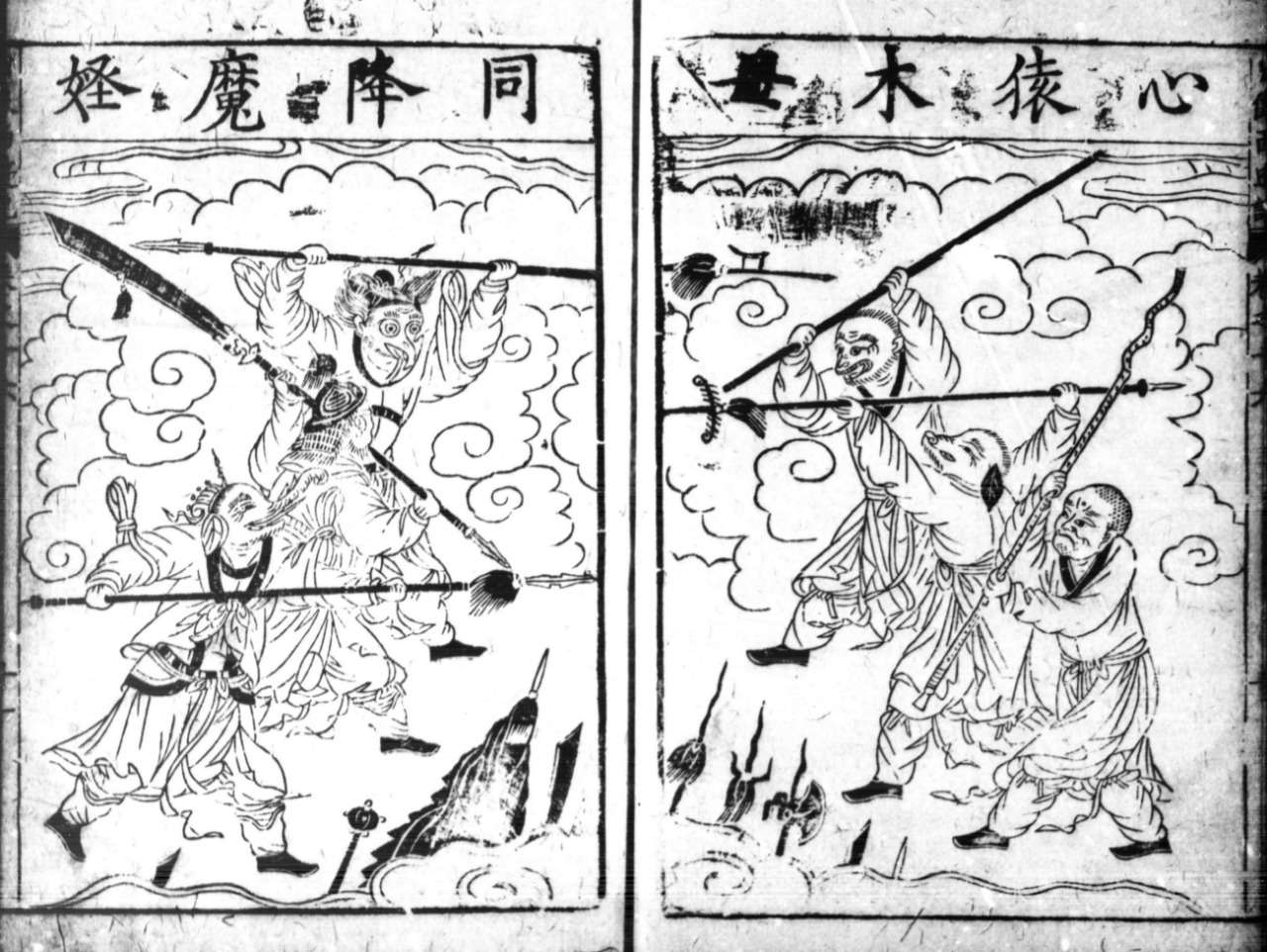
Called the “Peng of Ten Thousand Cloudy Miles” (Yuncheng wanli peng, 雲程萬里鵬), [1] the bird is portrayed as a spiritual uncle of the Buddha and an ancient demon king with unequaled strength, speed, and powers of transformation (fig. 1). He wields two magic weapons, a halberd and a vase capable of trapping and killing even immortals. Garuda is so powerful, in fact, that not even Sun Wukong (孫悟空) is strong enough to pacify the beast. Therefore, the Buddha himself is forced to leave the Western Paradise to confront the demon head-on. He casts the illusion of a bloody piece of meat above his head, and when the man-bird pounces on the bait, the Buddha takes away his ability to fly, thus trapping Garuda above his head in the demon’s original form as a golden-winged vulture (Dapeng jinchi diao, 大鵬金翅鵰) (fig. 2). After some struggle, the bird agrees to become a protector of Buddhist Law (Sk: Dharma; Ch: Fa, 法). Thus, Chinese fiction portrays Garuda as a powerful demon king that submits to the Buddha and perches above his throne as a hot-tempered guardian deity. [2]

The fact that this literary motif appears in two famous Chinese classics points to some widely known religious concept circulating during the 16th- and 17th-centuries CE. In this paper I will trace the origins of the motif from ancient South Asian literature and religious architecture to Esoteric Buddhist art in East Asia. The path we walk is a complicated one spanning centuries, belief systems, and artistic mediums.

Gardua from both novels

Fig. 1 – A modern depiction of the Roc demon in his humanoid form (artist unknown) (larger version). Fig. 2 – A modern depiction of the roc trapped above the Buddha’s head (artist unknown) (larger version).

Table of Contents

1. India – Where Our Search Begins

1.1. Garuda’s Appearance in Ancient Literature

The origin of the Chinese literary motif is over two thousand years old, first appearing in the 4th-century BCE Hindu epic the Mahabharata. The holy work states that Garuda is the son of the creator-sage Kashyapa and his second wife Vinata. After gestating in his egg for one thousand years, the bird bursts forth and his massive, fiery body grows to engulf the entire cosmos. His sun-like splendor is so bright that the devas mistake him for Agni, the god of holy fire. Garuda is forced to reduce his size and illumination when the devas ask him to do so out of fear. Falling prey to an ancient curse, his mother Vinata loses a bet and is enslaved by her sister Kadru, mother of the naga-serpents. Garuda agrees to steal the vessel containing the immortal elixir of amrita from the devas in order to secure his mother’s release. He uses his great strength and speed to defeat the celestial army and kill the serpents guarding the elixir, and he uses his powers of transformation to extinguish the fire surrounding the treasured substance and sneak past the magic discus charged with dismembering thieves. Upon his return trip, Garuda is halted by the supreme deva Vishnu who grants him the boon of immortality for partaking in such a difficult quest. In return, the bird grants him the boon of serving as the carrier of his celestial vehicle (vimana) and positions himself above Vishnu’s head atop the flagpole (dhvaja). Not long after, Indra, king of the devas, strikes the bird with a lightning bolt in an attempt to retrieve the amrita. The bird pays him respect by shedding a single feather and grants him the boon of eternal friendship. After learning the reason for the theft, the devaraja grants Garuda the boon of taking his enemies the nagas as his food. Both of them then orchestrate a plan in which the bird pays the amrita ransom to free his mother, but Indra takes the elixir away before the serpents can drink of it. Finally, Garuda slaughters all of the nagas (Ganguli, 2003, pp. 57-82).

It’s easy to discern several aspects from Chinese fiction in the ancient story: 1) a powerful golden bird with great strength, speed, and powers of transformation; 2) a vessel with magical properties; 3) conflict between the bird and heavenly forces; 4) his subjugation by a higher power; 5) his installment above a deva’s head; and 6) continued conflict between the bird and his serpent foes. This adds to existing literature showing that the Mahabharata influenced Journey to the West (Subbaraman, 2002).

1.2. Garuda’s Appearance on Religious Architecture

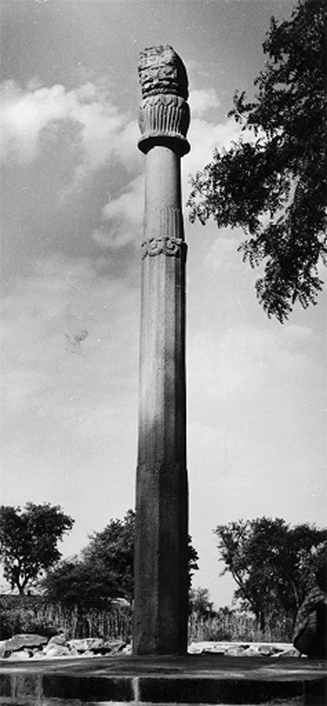
Since the Mahabharata was published, Garuda has been depicted on a number of ritual flagpoles (dvaja) in India. The dvaja pillar “is placed opposite the entrance to the main shrine [of a Hindu temple], on axis with the central image…it is an object of great importance and worship” (Dallapiccola, 2002, p. 60). Adherents would have paid reverence to it before entering the temple. People affected by snake bites would often embrace these types of pillars because they believed Garuda’s powers over the nagas (and their serpentine kin) would neutralize the poison (Zimmer, 1946, p. 75). The oldest of the stone dvaja columns still standing is the Heliodorus pillar (2nd-cent. BCE) erected by a Bactrian-Greek envoy and convert of that name in honor of Vishnu in Vidisha (fig. 3) (Walker, 1968, p. 246). The Garuda is no longer extant, having been eroded by time or destroyed by iconoclasts. It is considered the “first dated monument linked with Vishnu” (Elgood, 2000, p. 56). Clues to what the original capital may have looked like can be drawn from numismatic evidence. The golden dinar of King Samudra (r. 335-375 CE) of the Gupta Empire, for example, features a Garuda dvaja (fig. 4) (Mookerji, 1973, p. 52). The capital is depicted as a bird, suggesting the eroded figure on the Heliodorus pillar may have originally taken such a form. This differs from later humanoid depictions of the god (see below).

pillar and coin

Fig. 3 – The Heliodorus pillar (2nd-cent. BCE), Vidisha, Madhya Pradesh, India (larger version). The Garuda capital is missing. Photo by the American Institute of Indian Studies (AIIS). Fig. 4 – The gold dinar of King Samudra (r. 335-375 CE) of the Gupta Empire (larger version). The Garuda dvaja can be seen to the left. Photo by the American Council for Southern Asian Art (ACSAA).

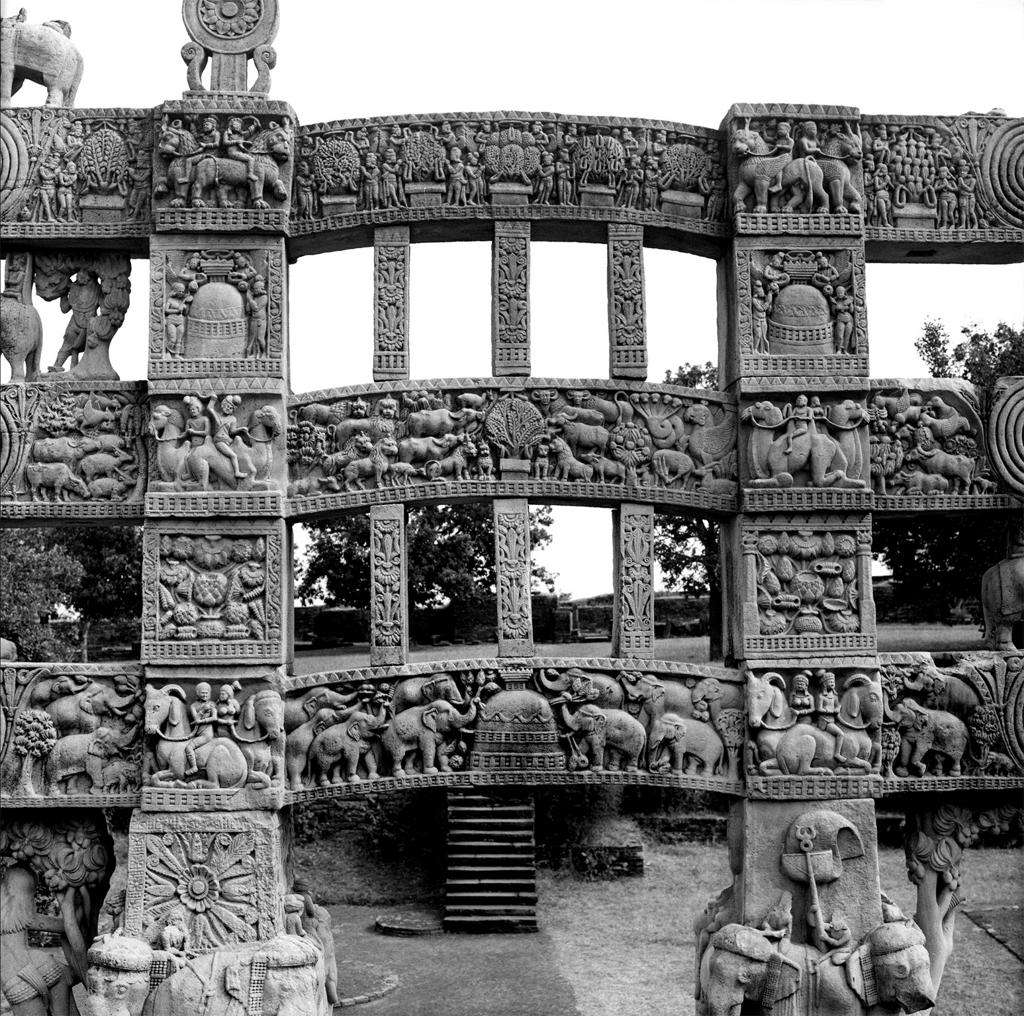
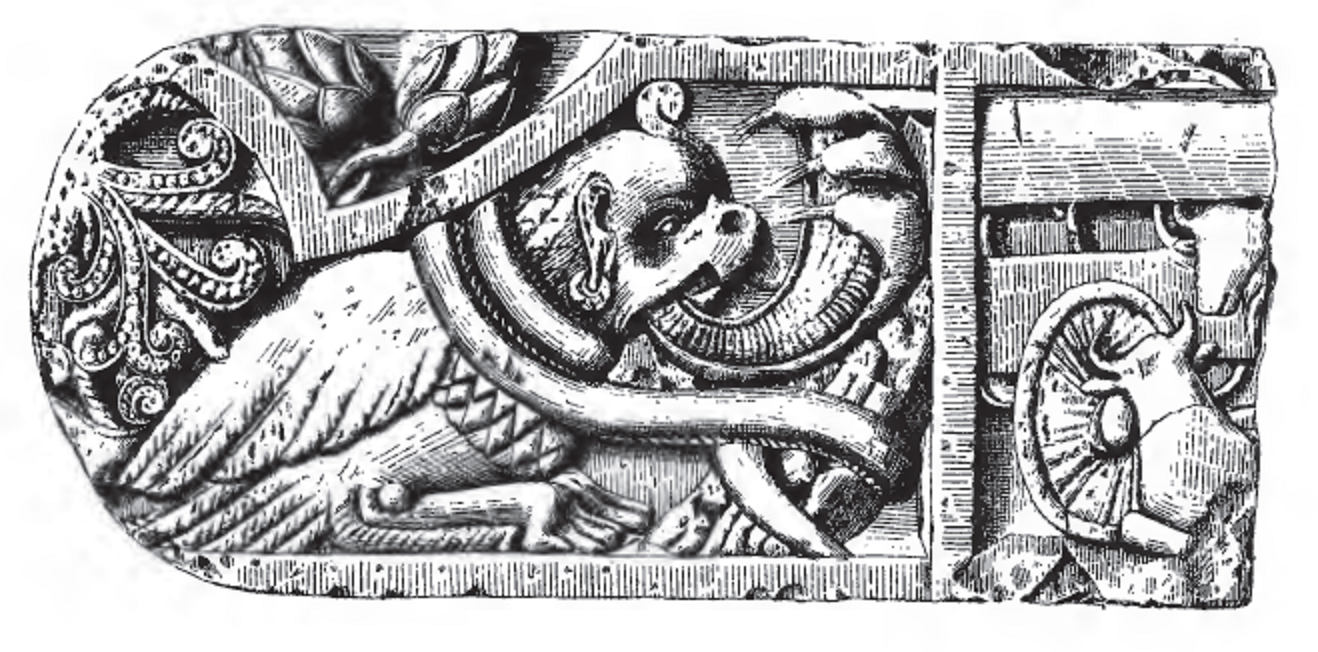
Garuda’s association with Buddhism seems to be quite old. His appearance on a number of standing gateways and carved cave temple entrances, collectively known as toranas, from the 1st-century BCE onward points to him being absorbed into the religion’s pantheon within a few centuries of the historical Buddha’s death. The oldest extant representation of Garuda appears on the eastern gateway of the Great Stupa at Sanchi (fig. 5) (Iyer, 1977, p. 52). Dated to the 1st-century BCE, the standing torana has three tiered architraves, the middle of which portrays a bodhi tree, an iconoclastic representation of the Buddha, flanked by real and mythical creatures paying homage to it. The far right side of this stone relief features Garuda standing next to a five-headed king of serpents (nagaraja) (fig. 6). The bird is depicted as a husky parrot with a delicate, forward curling crest, a thick beak, a pierced human ear, small flapping wings, and lacey tail plumage. The relationship between the two is amicable since it is a scene of religious reverence. This “Garuda and serpent” motif appears on the partial remains of a slightly younger stone architrave discovered in Kankali Tila at Mathura (Smith, 1969, p. 28). [3] The circa 1st-century BCE relief depicts him as a large bird of prey with similar iconography, including the curling crest, thick beak, and pierced human ear. But the tail plumage is far more flowery and ornate, indicating that the artist built off of the earlier example. Also, unlike the architrave from the Sanchi stupa, this piece portrays Garuda locked in a tense standoff with a three-headed nagaraja; the bird has a firm grasp of the hissing serpent with his beak, but the foe’s body is wrapped twice around the god’s neck and the tail is anchored at the base of a nearby tree (fig. 7) (Vogal, 1972, p. 172).

Stupa details

Fig. 5 – The reverse side of the East Torana of the Great Stupa at Sanchi (1st-cent. BCE), Madhya Pradesh, India (larger version). The Garuda and serpent motif is visible on the right side of the central architrave. Fig. 6 – Detail of the Garuda and serpent motif (larger version). Photos by the The Huntington Archive of Buddhist and Related Art (HABRA), The Ohio State University. Fig. 7 – The partial architrave discovered in Kankali Tila (c. 1st-cent. BCE) in Mathura, Uttar Pradesh, India (larger version). Drawing from Smith, 1969, p. 28 .

Later depictions of the motif anthropomorphize Garuda. For instance, he makes an appearance standing over the torana of the carved Bhuta Lena cave shrine number forty (c. 100 CE) in Junnar (fig. 8) (Qureshi, 2010, p. 315). He is coupled with a nagaraja at the apex of the arched doorway; the two are presented as peaceful humanoid companions wearing matching hats and clothing and standing in a similar pose. This could be related to a birth tale (jataka) in which the Buddha, in his previous life as a hermit, reconciles the hatred between Garuda and a naga by “rehears[ing] the blessings of loving kindness until they [are] both at one. Thenceforward they abode together happily in peace and harmony” (Vogal, 1972, p. 142).

Garuda and Nagaraja above the arch of the Chaitya hall (#40) at Maharashtra, stone, 2nd-3rd c

Fig. 8 – Garuda (left) and Nataraja (right) above the torana entrance of the Bhuta Lena cave shrine no. 40 (c. 100 CE) in Junnar, Maharashtra, India (larger version). Photo by ACSAA.

Dhar (2009) notes that the standing gateway toranas were replaced in popularity by “the post, lintel, and eave-cornice (kapotapālikā) type entryways” sometime after the 2nd to 3rd-century CE (p. 16). She continues, “From the fifth century, such an entrance gateway became an integral part of temple doorframes…its posts served as pilaster-doorjambs (stamhaśākhās) and the eave-cornice integrated with the lintel” (Dhar, 2009, p. 16). It was around this time that Hindus followed the example of their Buddhist neighbors and began to create carved religious structures (Dehejia, 1997, p. 124). Such temples were considered the home of a given deity when they left their heavenly abode (Dehejia, 1997, p. 141). As such, these temples were profusely decorated with images of the deva, including the entrance way, to aid in their worship. A related root word for torana “suggests its role as an architectural symbol of a rite of passage or liminality” (Dhar, 2009, p. 1). This means whoever steps into the world of the “other” does so under the watchful eye of the deity placed on the torana. In the case of temples devoted to Vishnu and lesser devas associated with him, the image is either Garuda by himself (being a symbol of the god) or bearing the deva on his back, a variation on his portrayal in the Mahabharata that came to dominate his traditional iconography (Zimmer, 1946, p. 76).

1.3. Appearance of the Antagonistic Garuda and Serpents Motif

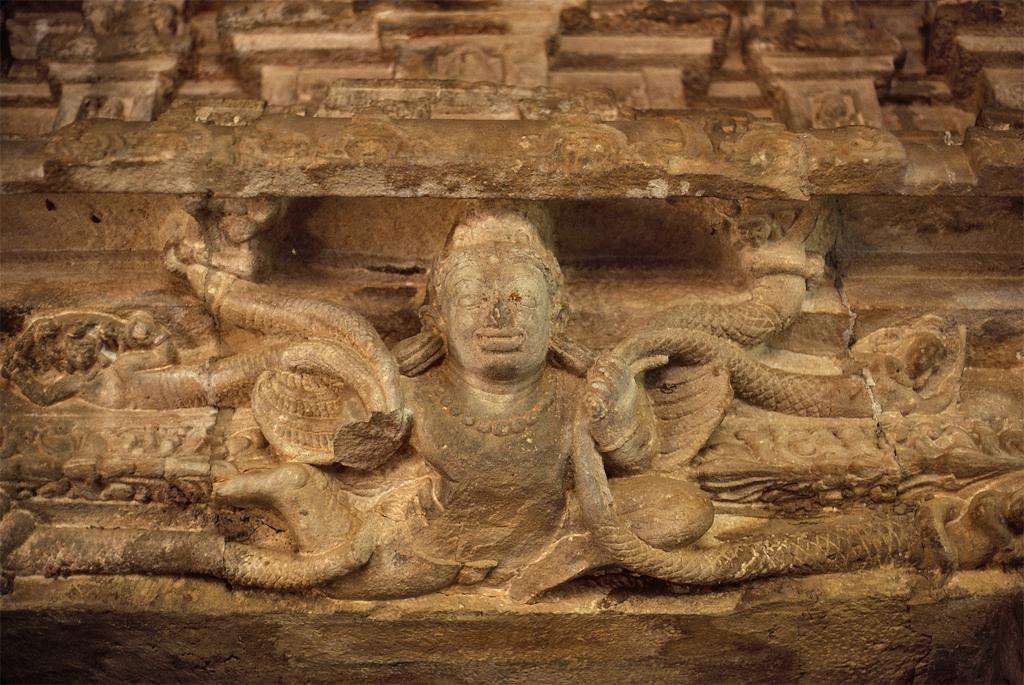
Whether alone or coupled with Vishnu, the antagonistic version of the Garuda and serpents motif began to appear on Hindu toranas by at least the 7th to 8th-century CE. In fact, the only examples that I can find come from this time period. I have seen examples of the “Garuda and Vishnu” motif above entrance ways as late as the 11th-century, but these are missing the serpents. However, later Tibetan art featuring the serpent variation suggests that there may be Indian examples that I am not aware of. The 7th-century CE example appears on the torana of the Gaudar Gudi Temple in Badami (Gupte, 1967, p. 54) (fig. 9). Garuda is portrayed in humanoid form wearing a hat and clothing similar to figure 8. He is squatting over the entrance while grasping the tails of naga-serpents flanking him on both sides. The first c. 700 CE example appears on the torana of the Durga (Fort) Temple in Aihole (fig. 10) (Tartakov, 1997, p. 192). He is depicted as a smiling human in an erect flying posture with his left leg tucked under his groin and his right trailing behind him. Just like the first piece, he is wearing similar attire and grasping the tails of nagas on his left and right sides. The second c. 700 CE example appears over the entranceway of the Rajivalocana Temple in Rajim (fig. 11) (Patel, 1992, p. 146). But this version has Garuda transporting a four armed Vishnu. The figure is again depicted in human form and grasping the tails of his serpentine foes.

Early examples

Fig. 9 – The Gaudar Gudi Temple Garuda with serpents (7th-entury CE), Aihole, Karnataka, India (larger version). Photo by AIIS. Fig. 10 – The Durga (Fort) Temple Garuda with serpents (c. 700 CE), Aihole, Karnataka, India (larger version). Photo by ACSAA. Fig. 11 – The Rajivalocana Temple Garuda and Vishnu with serpents (c. 700 CE), Rajim, Chhattisgarh, India (larger version). Photo by the AIIS.

2. Cambodia – The Motif Achieves Perfection

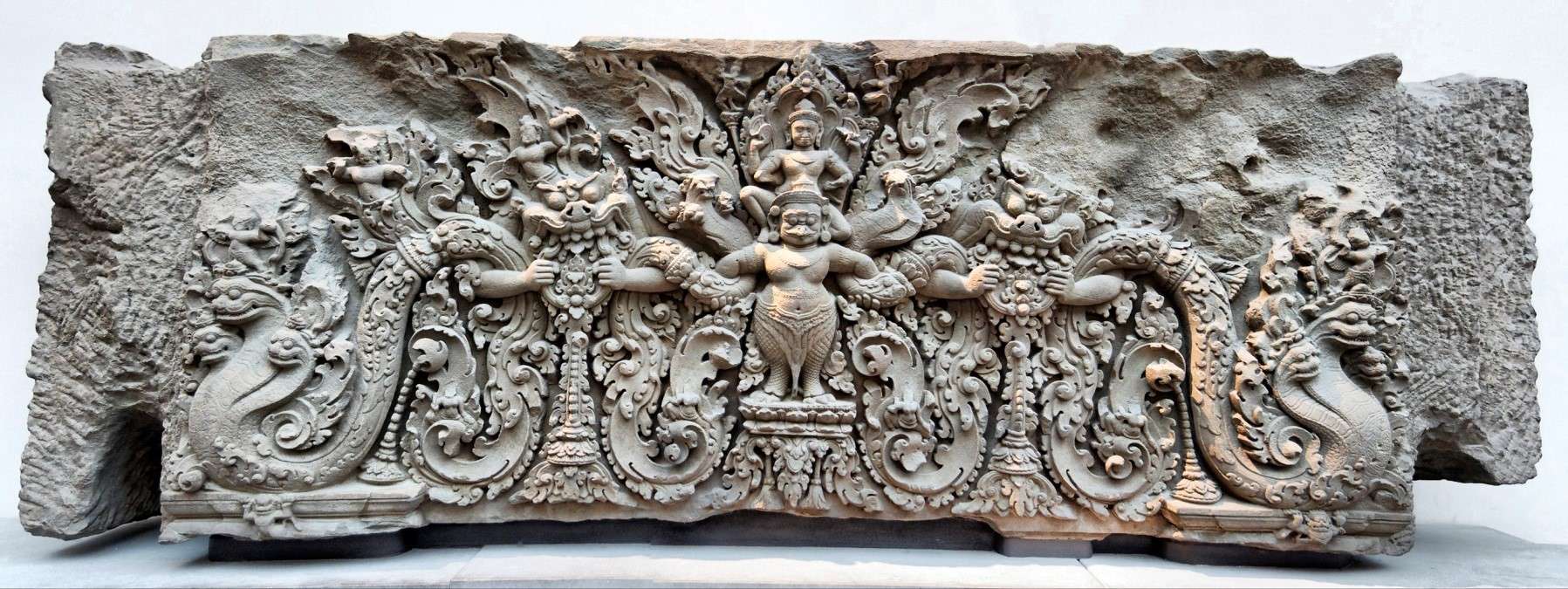
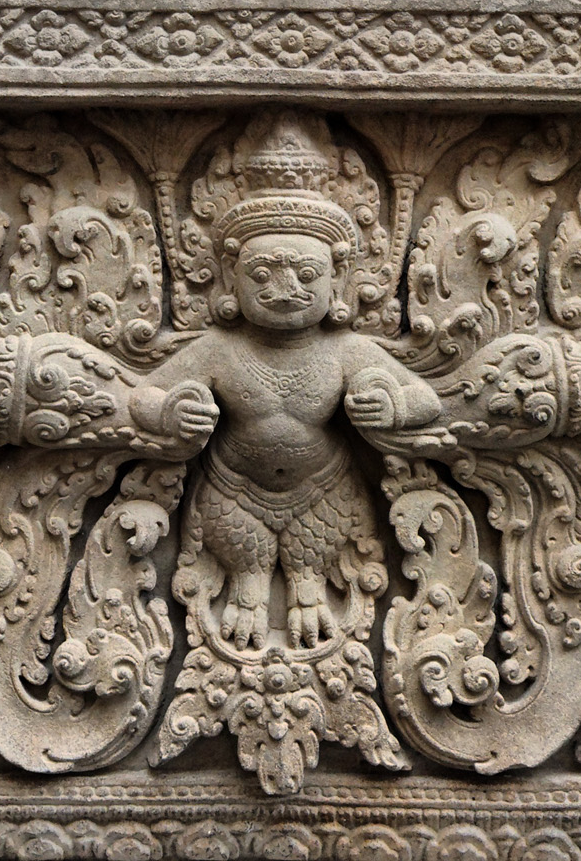
The torana spread to Southeast Asia by the late 6th- or early-7th-century CE. Next to India, Cambodia has the largest number of and most diverse toranas in all of Asia (Dhar, 2009, p. 214). In fact, I would dare say this is where the Garuda and serpents motif reached the point of perfection. Parul Pandya Dhar’s wonderful monograph The Torana in Indian and Southeast Asian Architecture (2009) features two beautiful examples from Buddhist temples carved in the unmistakable Khmer style. The first is an exquisitely crafted 9th-century CE entranceway from the Prasat Kok Po Temple in Siem Reap (pp. 222 and 228) (fig. 12 and 13). It portrays Garuda as a large, stout man-bird with pierced ears and wearing a Cambodian headdress and garment. He is standing on a pedestal and bearing a four-armed Vishnu on his back while grasping the flower garland-like tail of a three-headed nagaraja in each hand. The god is further flanked by two large creatures with gaping mouths known as “Faces of Glory” (Kīrtimukha). [4] Their arms interlock not only with the undulating serpents grasped by the man-bird, but two others located on the outermost left and right portion of the torana—the combination of arms and slithering serpentine bodies form a beautiful horizontal wave pattern with four crests. These larger nagarajas bear images of tiny Garudas standing on the back of their hoods. [5] The author notes that the “Kīrtimukha and makaras seen on Indian and Indonesian toranas are often replaced by the garuḍa-nāgas combination in Cambodia” (Dhar, 2009, p. 228). The second is a mid-10th-century CE entranceway from the Prasat thom Temple in Koh Ker (fig. 14 and 15). The depiction of Garuda is identical to the first example down to the clothing. But instead of bearing Vishnu and cooperating with the Kirtimukha to conquer nagas, he alone is grasping the long, flowery tails of his enemies who are positioned on pedestals at the same level as his own. Two small Buddhas use the bodies of the tightly drawn serpents as a place to meditate. Both nagarajas bear the Wheel of Buddhist Law (Dharmachakra) on their chests. The composition is therefore symbolic of Garuda and the nagas working together to literal “support” Buddhism.

Cambodian lintel with detail - 1

Fig. 12 – The Prasat Kok Po Temple lintel featuring the Garuda and Vishnu with serpents motif (9th-century CE), Siem Reap, Cambodia (larger version). Fig. 13 – A detail of the motif (larger version). Fig. 14 – The Prasat thom Temple lintel with the Garuda and serpents motif (mid-10th-century CE), Preah Vihear, Cambodia (larger version). Fig. 15 – A detail of the motif (larger version). Photos by Wikimedia commons.

3. The Motif Spreads to East Asia

3.1. Tibet – The Motif Jumps from Architecture to Art

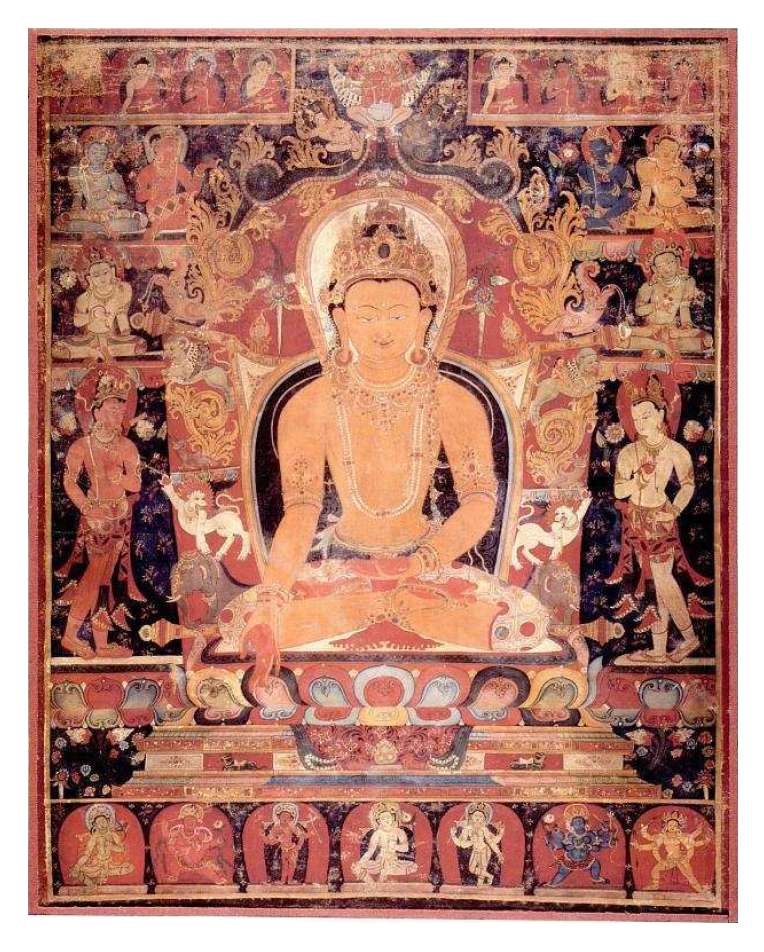
The Buddhist examples from Cambodia appear to have been influenced by depictions of the Garuda and serpents motif from Hindu temples. This is because they depict Hindu deities like Vishnu and portray the bird and naga as (symbolic) enemies. The same can be said for Buddhist art and architecture in East Asia. For instance, Heather Stoddard (1996) comments that the motif “is in fact present in all the main Tibetan [Buddhist] styles, and is indeed unique to Tibetan art” (p. 40). She continues, “The author has searched all over Asia, in Hindu or Buddhist cultures, without success, looking for the garuda in this pro-eminent position” (Stoddard, 1996, p. 40). (It’s obvious that Stoddard was unaware of the architectural origins of the motif at the time of her study.) One of the three pieces that she cites as examples is a 13th-century CE Nepalese painting of Ratnasambhava (Baosheng rulai, 寶生如來, fig. 16), one of the five Esoteric Buddhas (Stoddard, 1996, p. 42). The painting shows the Buddha sitting on a throne comprised of a lotus flower base and a backrest framed by all sorts of real and mythical creatures. The Garuda and serpents motif crowns the apex of the throne. Art historians call this an “enlightenment torana” or a “gate of glory” (Beer, 1999, p. 88; Stoddard, 2008, p. 23). It’s clear that Buddhist artists came to equate the torana with the fiery halo that signifies a deity’s enlightened or divine nature. Robert Beer (1999) believes that these enlightenment toranas could have appeared as early as the 4th-century, but that it became a common fixture in Buddhist art from the 8th to the 12th-century CE (p. 90). Two beautiful examples of an enlightenment torana from the mid-6th-century CE appear in the Kanheri Temple Cave number ninety in Mumbai (Malandra, 1993, p. 110). It depicts two Buddhas standing under their own gates of glory, complete with what appears to be licks of heavenly flame (fig. 17). Though missing the motif, these examples are nearly identical to later Tibetan art, suggesting, as mentioned above, that there could be later Indian examples featuring the Garuda and serpents motif that I am unaware of.

Nepalses Thangka with double gates of glory

Fig. 16 – Ratnasambhava, with Bodhisattvas (13th-century CE), Nepal (larger version). The Garuda and serpent motif can be seen at the apex of the throne. Photo by the Los Angeles County Museum of Art. Fig. 17 – Two Buddhas with enlightenment toranas, from Kanheri Temple Cave number ninety, Mumbai, Maharashtra, India (mid-6th-century CE) (larger version). Photo by the AIIS.

Nepalese-Tibetan Buddhist art featuring the motif doesn’t appear to predate the 11th-century CE, so this may have something to do with the second coming of Buddhism in Tibet. The religion became popular among the common folk during the 11th-century CE after lying dormant for nearly two hundred years. The Tibetan people embraced the Indian Buddhist faith and flocked to India in order to study in various monastic universities. Jan Casey Singer (1999) notes:

Within this international Buddhist community, the Tibetans stood apart by virtue of the particular zeal with which they sought to master the Indian Buddhist tradition. They had both the will and, since Tibet is relatively close to eastern India, the opportunity to observe closely and gradually absorbed the highly sophisticated traditions of Buddhism and Buddhist art that flourished in eastern India at this time” (p. 6).

Tibetans living and traveling in India no doubt came into contact with architecture featuring the Garuda and serpents motif. This is evidenced by their depiction of Garuda as a chubby man-bird (see fig. 22 below, for example). The Vishnudharmottara Purana (7th-century CE) contains a treatise on prescribed Hindu iconography that mentions the deity “should be made slightly pot-bellied and adorned by all ornaments” (Kramrisch, 1928, p. 80).

3.2. The Fiery Garuda Halo

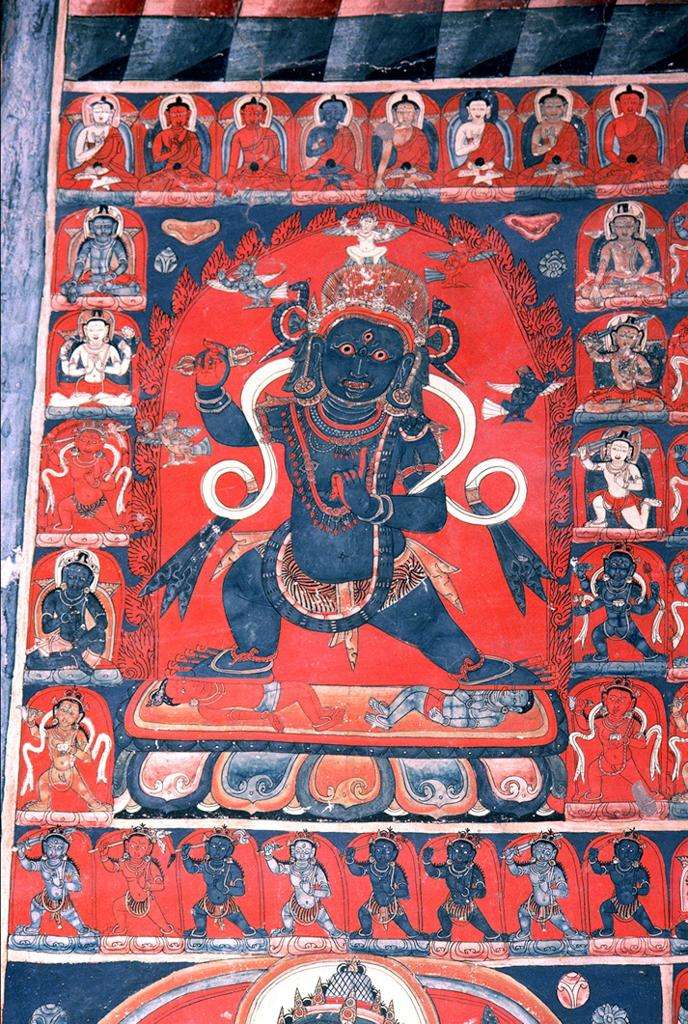
Variations of the motif appeared as it spread eastward. For instance, an 11th-century wall mural of the Bodhisattva Vajrapani (Jingang shou pusa, 金剛手菩薩), the “Bodhisattva holding the Vajra,” in Kashmir features five colored Garudas flying about his flaming halo (fig. 18). Beer (1999) explains that these represent the five Buddhas or Buddhist families of Esoteric Buddhism (p. 62). He adds: “a yellow garuda stands for earth, a white for water, a red for fire, a black for air, and a blue or multicoloured for space” (Beer, 1999, p. 62). This variation changed as it rapidly spread into China. An 11th-century CE painting from the famous Mogao Caves of Dunhuang depicts the Bodhisattva Hayagriva (Matou Guanyin, 馬頭觀音), the “Horse-Headed Guanyin,” with three (of five?) fiery Garudas comprising his halo (Fig. 19). This “Garuda aureola” reached its zenith in Japan. One beautiful 11th-century CE example shows the Esoteric Buddhist guardian deity Fudō Myōō (Budong mingwang, 不動明王) set against a Garuda halo. The five Garudas are portrayed as flaming roosters encircling the god (fig. 20) (Akiyama, 1961, pp. 53 and 57). Thus, Esoteric Buddhism was the catalyst for the spread of the Garuda aureola motif towards the east.

Tibet, China, Japan

Fig. 18 – Five colored Garudas in the aureola of the the Lha khang Soma Vajrapani (11th-century CE), Kashmir (larger version). Photo by HABRA. Fig. 19 – Hayagriva with flaming Garudas (11th-century CE), Dunhuang, Gansu, China (larver version). The simplistic Garudas are located to the respective left and right of a Face of Glory, as well as in between his legs. Photo by the Musée national des Arts asiatiques. Fig. 20 – The God Fudo-myoo (Acala) and Two Attendants (11th-century CE), Japan (larger version). Photo by the University of California, San Diego.

3.3. China – The Mongols Welcome the Motif

The Mongol rulers of the Yuan Dynasty (1271–1368 CE) were largely responsible for bringing the Garuda and serpents motif to China. They were ardent followers of Tibetan Buddhism, and so they invited Buddhist lamas to preach in the Middle Kingdom. The person who first introduced Tibetan Buddhist art to China was the Nepalese artist Anige (阿尼哥, 1245–1306 CE). At the surprisingly young age of eighteen or nineteen years old, he arrived at the Mongol court in 1260 CE as the leader of twenty-four artisans. His most famous accomplishment is the White Pagoda of the Miaoying temple in Beijing (Stoddard, 2008, pp. 19-20). Anige is the father of a Tibetan Stylistic tradition that carried on long after his death.

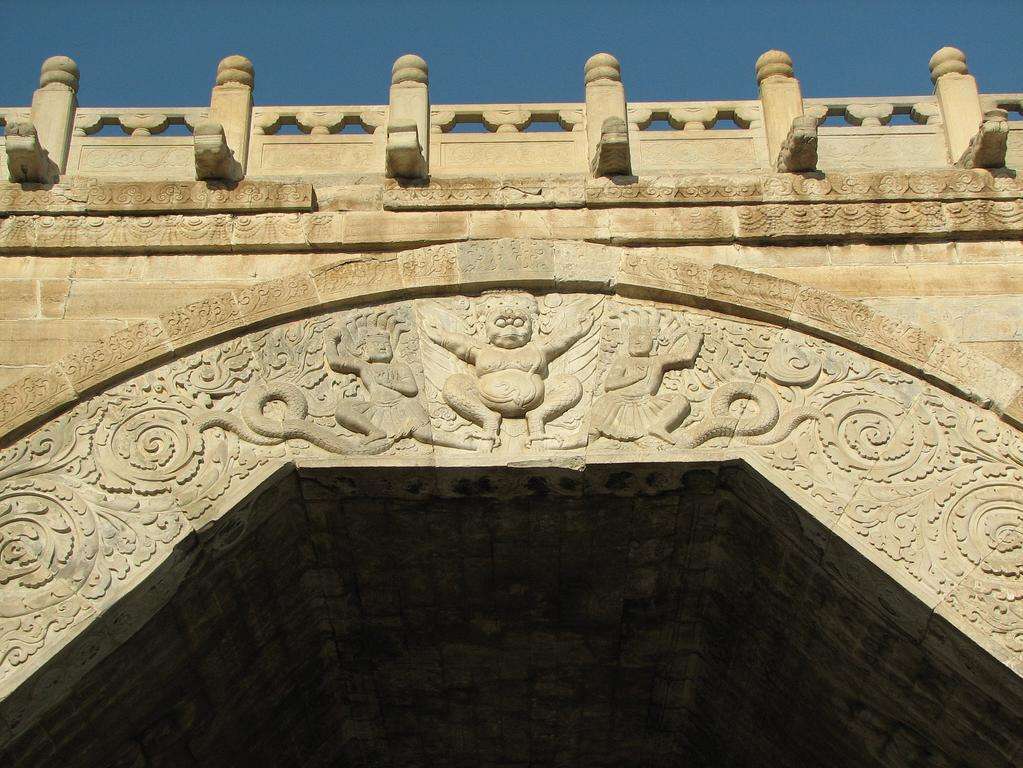
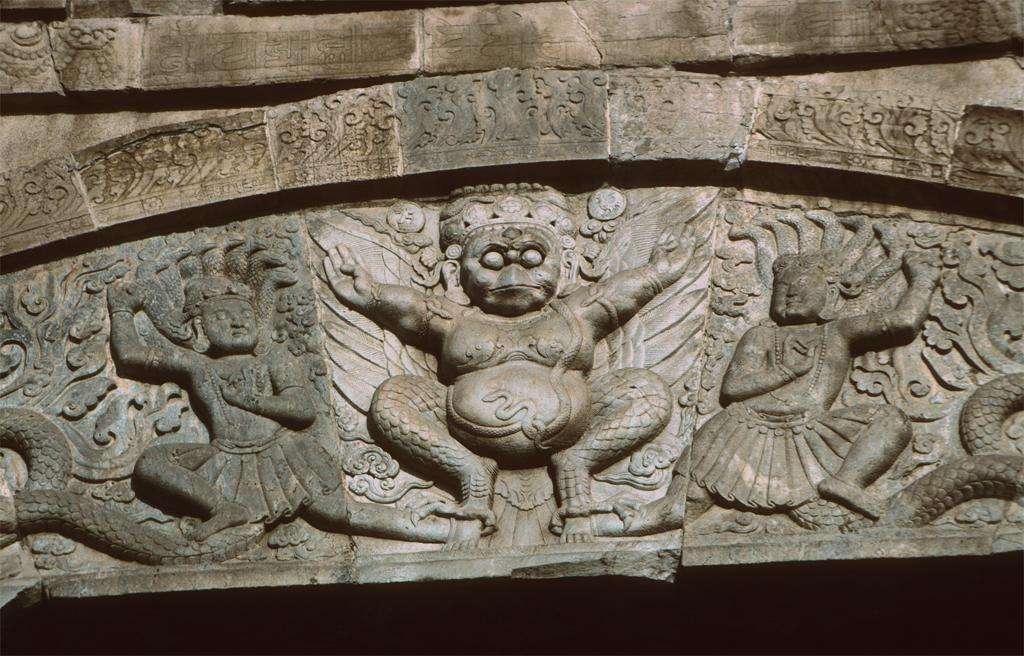
For instance, the Mongols commissioned several stupa-arches to be constructed “on strategic roads leading to the capital [of Beijing]” (Stoddard, 2008, p. 23). The only surviving example is the cloud platform of Juyong Pass (Juyong guan, 居庸關), a later addition to the Great Wall of China built in 1354 CE. It originally supported three Buddhist stupas, but these disappeared within a century of their completion. Multilingual inscriptions on the arch indicate that it was built “in order to bring happiness to the people who pass under the stupa and receive thus the Buddha’s blessings” (Stoddard, 2008, p. 23). The apex of the arch contains the Garuda and serpents motif (fig. 21 and 22). The man-bird is depicted as a stout, pot-bellied figure with the face, wings, and talons of a raptor bird and the ears, arms, and torso of a human. He wears a jeweled crown and his body is decorated with serpents on his wrists, arms, and chest. Hierarchy in scale is employed to portray the humanoid naga-spirits as smaller in stature and importance. They are trying to run away from him, but their scaly heels are pierced by his talons.

Juyong pass with detail

Fig. 21 – The Gate of Glory from the Cloud Platform of Juyong Pass (1345 CE), Beijing, China (larger version). Photo by Snuffy on Flicker. Fig. 22 – A detail of the Garuda and serpents motif (photographer unknown) (larger version).

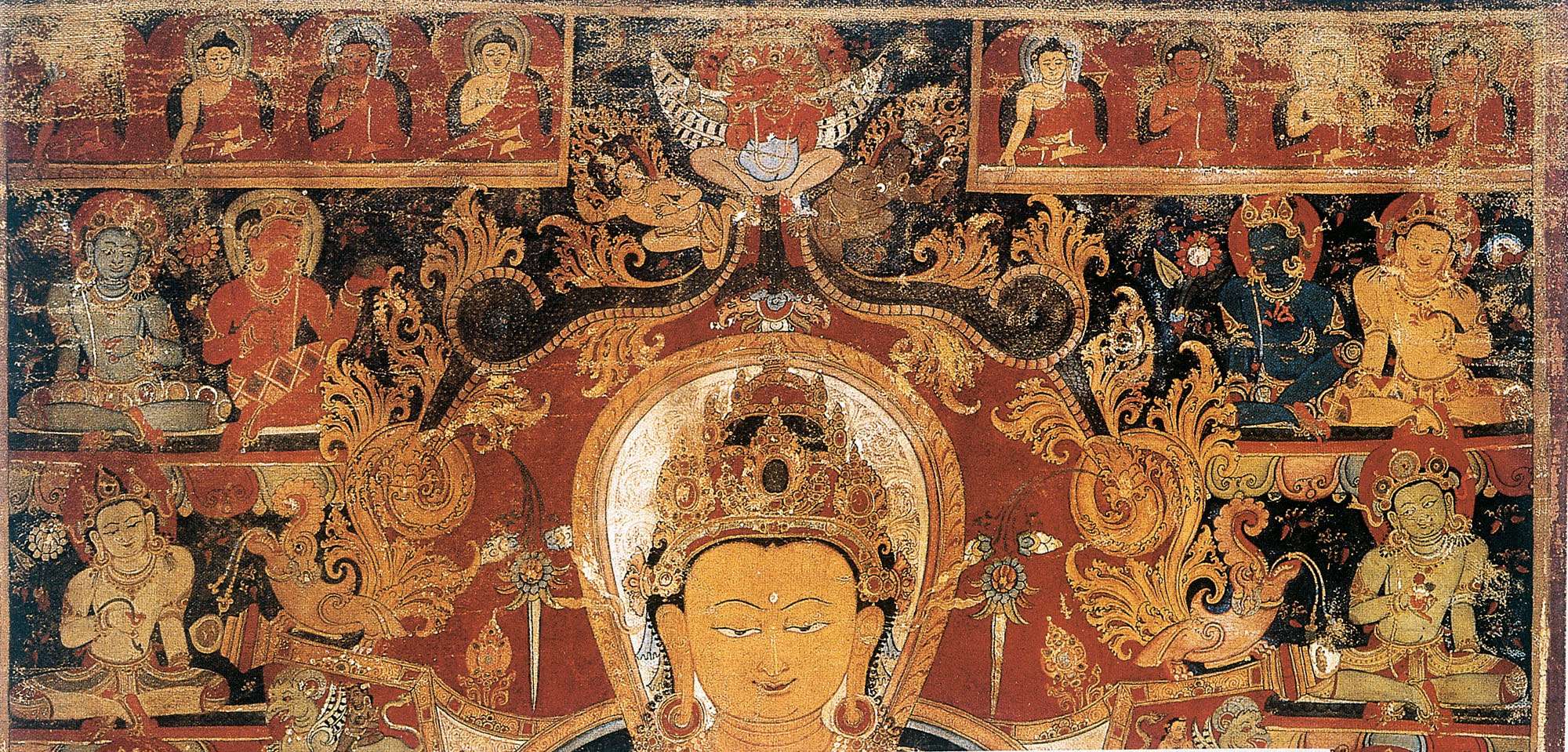
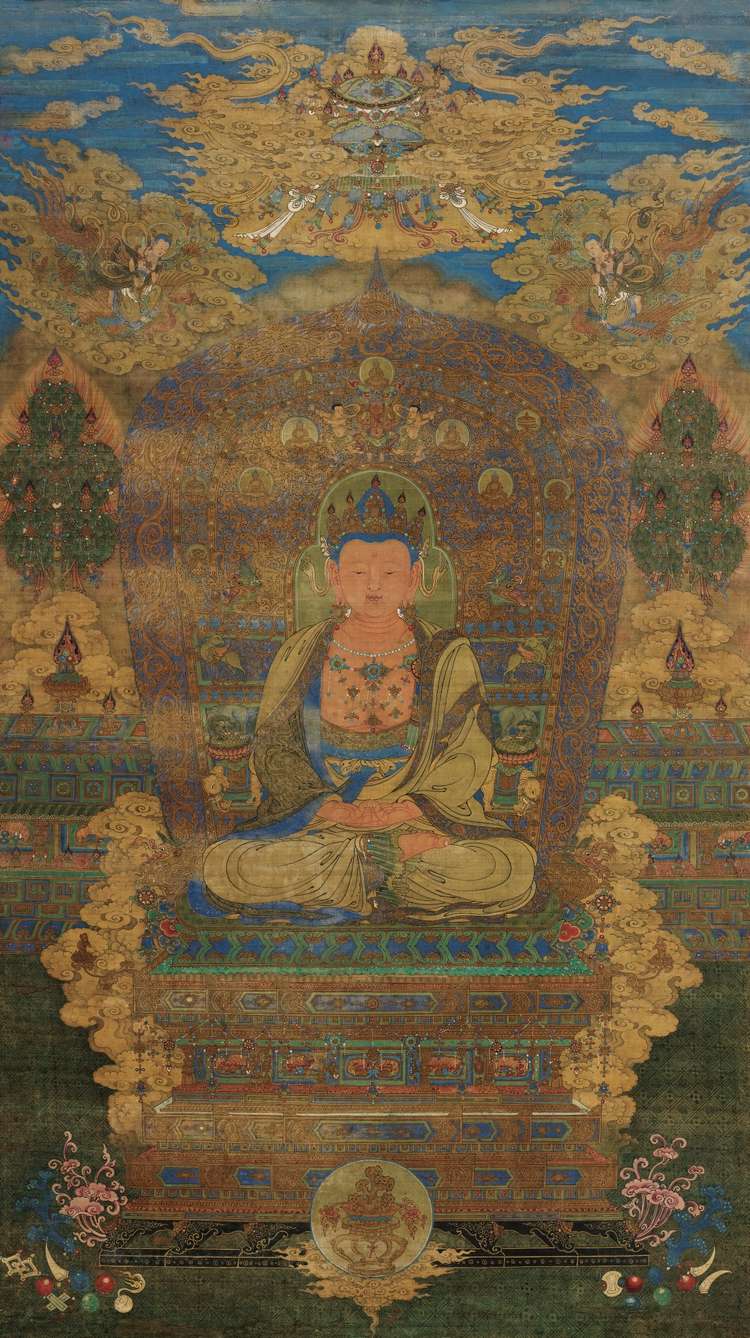
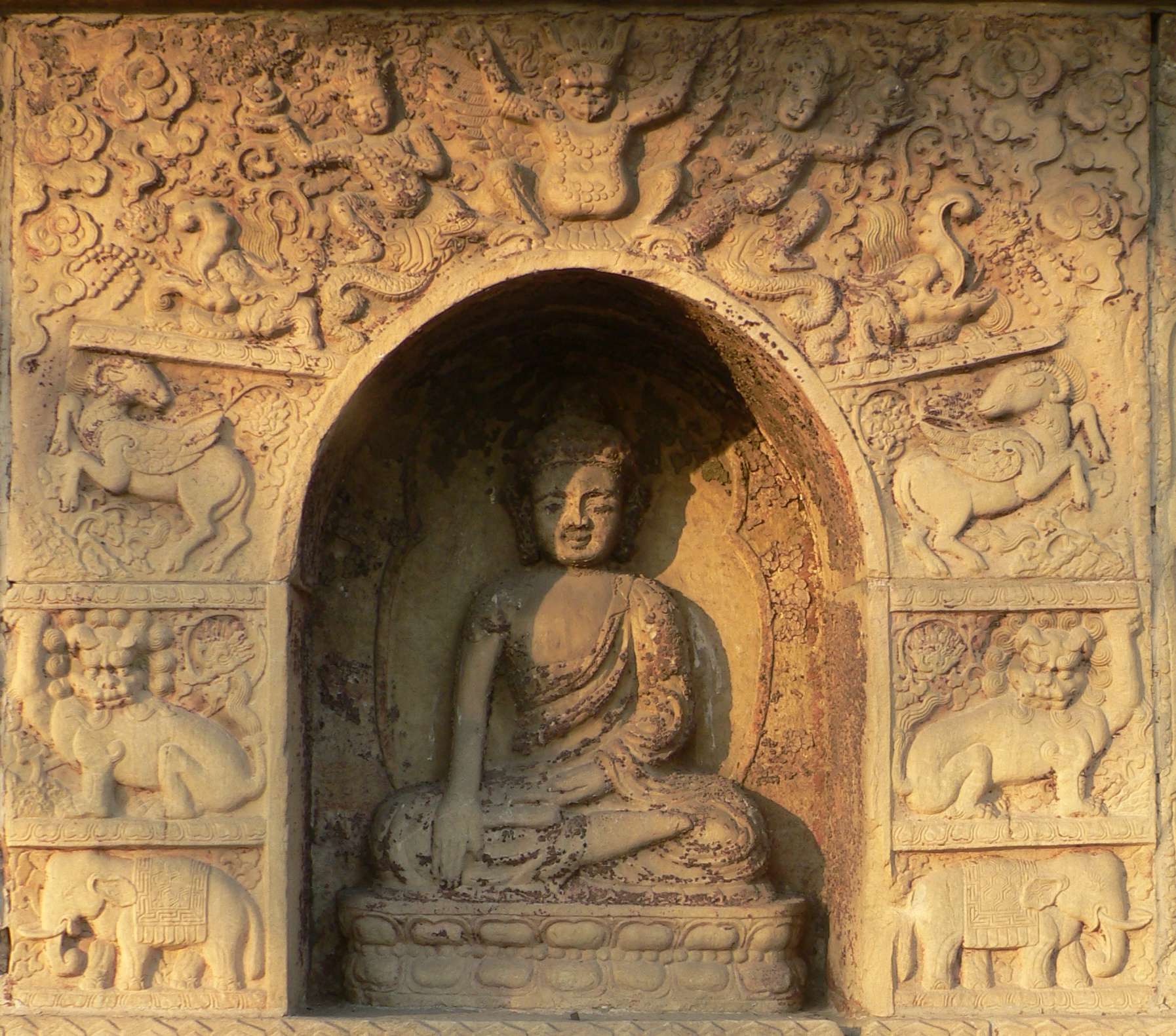
The motif continued to appear in Buddhist art into the Ming dynasty (1368–1644 CE) after the Chinese had overthrown the Mongols. This is because some Chinese rulers, such as the Yongle Emperor (永樂帝, r. 1402–1424 CE), upheld the Tibetan Buddhist tradition. Ming examples include a painting in the Sotheby’s collection dated to the 15th-century CE (fig. 23 and 24); a relief carving on a 15th-century CE pagoda at Zhenjue Temple (真覺寺) in Beijing (fig. 25 and 26); and a stone stele in the Freer Art Gallery collection dated to circa 1500 CE (fig. 27 and 28). All of these pieces depict a Buddhist deity sitting before an enlightenment torana lorded over by Garuda and his serpentine foes. What’s important here is that the variety of media suggests that the motif became a standardized element of Sino-Tibetan Buddhist art at least a century prior to the publishing of Journey to the West (1592 CE). The commonplace nature of the motif might then explain why it was included in the story. There are numerous occasions in the novel when the author-compiler provides folk origins for everyday concepts, such as why rings are put through the noses of buffalos. [6] So a bird attacking serpents above the head of the Buddha would certainly need a fanciful genesis story.

Ming examples

Fig. 23 – The Amitabha Buddha with an enlightenment torana (15th-century CE) (larger version). Fig. 24 – A detail of the Garuda and serpents motif (larger version). Photos by Sotheby’s. Fig. 25 – Zhenjue Temple relief carving (15th-century CE), Beijing, China (larger version). Fig. 26 – A detail of Garuda (larger version). Photos by Wikimedia commons. Fig. 27 – A stone stele of a Bodhisattva with an enlightenment torana (c. 1500 CE) (larger version). Fig. 28 – A detail of the motif (larger version). Photos by the Freer Gallery of Art.

4. Garuda’s Transformation from a God to a Demon

The Ming dynasty examples suggest Garuda was considered a common element of the Buddha’s enlightenment torana. The bird god is in effect a guardian of the faith who watches over the world from an exalted position high atop the Buddha’s throne. So why then did the author-compiler of Journey to the West transform him into a monster who needed conquering? This obviously follows the novel’s theme of powerful demons, such as Sun Wukong, being subjugated and put to good use. This can be traced to the Thunder Ritual (Leifa, 雷法), a Daoist liturgy designed to subjugate powerful gods and demons to be wielded as weapons against evil forces. One such god is Sire Thunder (Leigong, 雷公), a native Chinese weather deity responsible for making dragons produce rain when needed. And since lightning is his weapon, he is also considered a heavenly executioner who kills mortals guilty of unpunished crimes. [7] The god was sometimes portrayed as a human, but it was around the Tang Dynasty (618–907 CE) when he took on a bird-like appearance with a beak, wings, and talons. This avian transformation coincided with the appearance of Garuda and Esoteric Buddhism in China. Upon entering the Middle Kingdom, Garuda served many of the same functions as Sire Thunder. His power over dragons gave him control of rain, and his fierce nature enabled him to be a heavenly executioner. Therefore, depictions of Sire Thunder came to absorb features of the bird god. Most importantly, Tang-era stories describe religious masters and certain brave individuals subjugating this demonic figure and using his powers for their own purposes. [8]

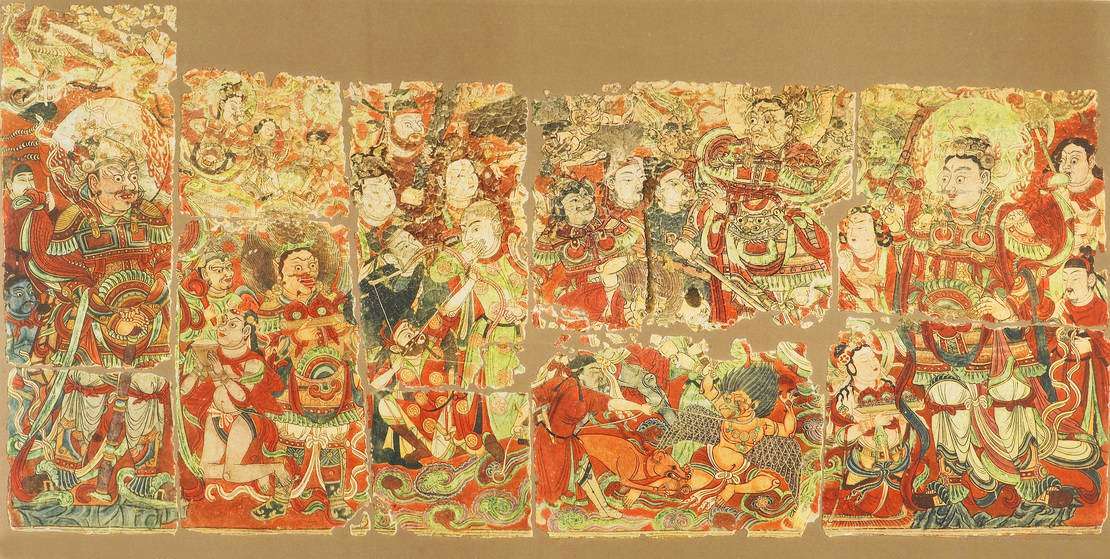
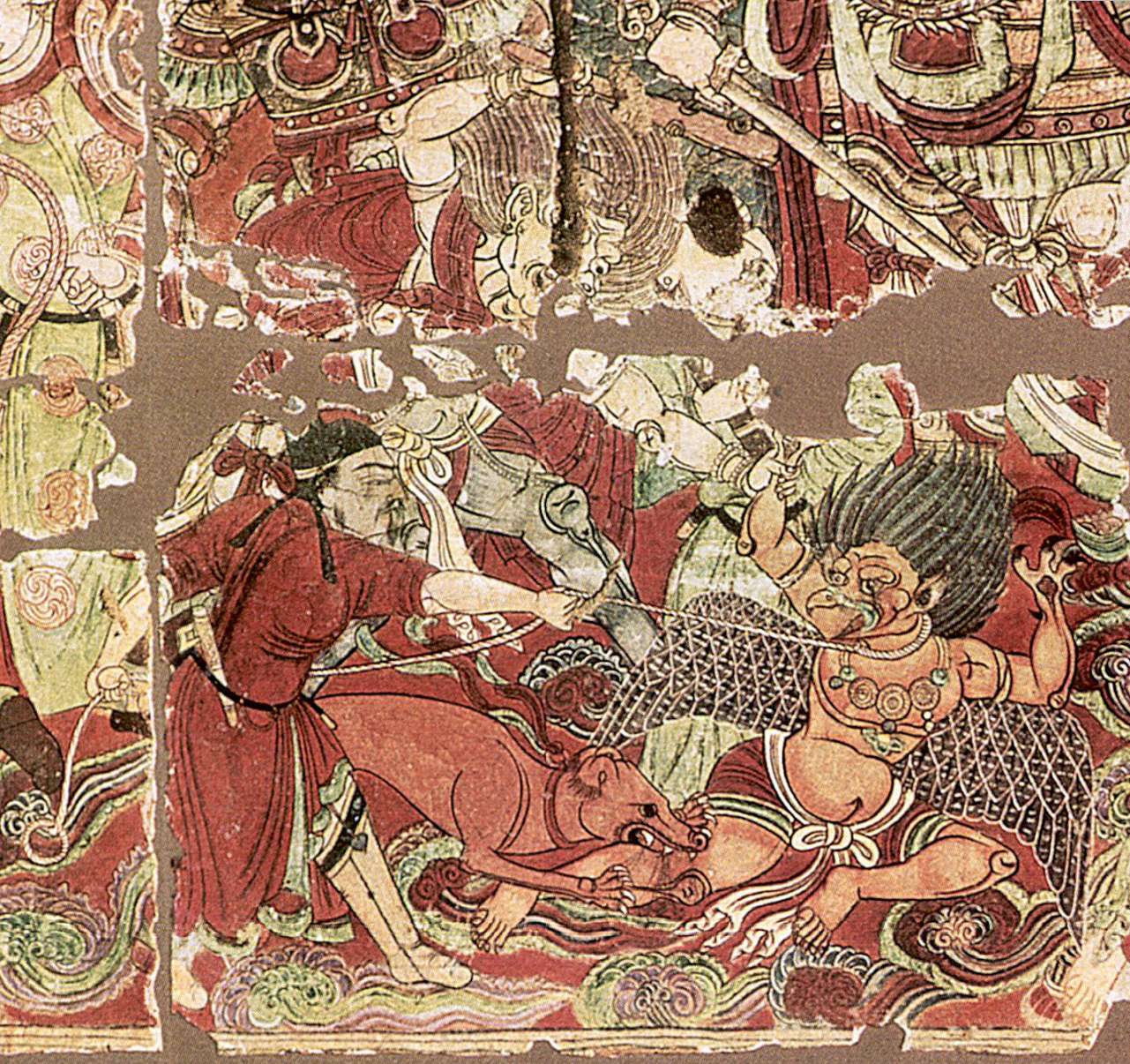
Artistic renderings of Sire Thunder after his metamorphosis are strikingly similar to Garuda. A prime example of this comes to us in the form of a 9th-century CE fresco from Xinjiang originally held in the Berlin Museum of Indian art. The piece depicts numerous beings paying homage to the Four Heavenly Kings (Sida tianwang, 四大天王) (fig. 29). The foreground depicts Sire Thunder caught in a hunter’s snare around his neck, while a hound bites at his leg. A larger figure, presumably a guardian deity of sorts, holds one of the god’s wrists and stands with a club held overhead ready to strike (fig. 30). This scene contrasts with the overall religious nature of the piece, giving the impression that this “demon” is being captured in the name of the heavenly kings. So here we have a bird monster being subjugated by Buddhist forces. Such art could have easily influenced Garuda’s depiction in Journey to the West.

Both hunting pics

Fig. 29 – A fresco showing the adoration of the Heavenly Kings (9th-century), Xinjiang, China (larger version). Fig. 30 – A detail of the subjugation of Sire Thunder (larger version).

5. Conclusion

A literary motif appearing in Journey to the West (1592 CE) and The Complete Vernacular Biography of Yue Fei (1684 CE) depicts the Hindu-Buddhist bird deity Garuda as a demon-turned-Buddhist guardian who sits above the Buddha’s throne. This is based on the bird’s portrayal in the ancient Indian epic the Mahabharata (4th-century BCE), where he comes to sit above the deva Vishnu after taking part in a filial quest and agreeing to carry the god’s celestial vehicle (vimana). Beginning around the 2nd-century BCE, Garuda started appearing on Hindu and Buddhist architecture that depicted him on ritual flag poles and above torana doorways. A motif of Garuda gasping the tails of naga-serpents, his eternal foes from Hindu lore, appeared by at least the 7th-century CE and spread as far away as Cambodia by the 9th- or 10th-century CE. The motif was adopted by Tibetan Buddhist artists by the 11th-century CE and incorporated into wall murals, thus making the jump from architecture to paint. It never lost its association with architecture, however, since the torana came to be equated with the halo of Buddhist deities. This “enlightenment torana” or “gate of glory” became a common feature of Tibetan Buddhist art and even made its way to Japan. This feature was depicted as the backrest of a throne, hence the Chinese literary motif of Garuda sitting above the Buddha can be directly tied to this style of art. The Mongols were largely responsible for bringing the motif to China as they were adherents of Tibetan Buddhism. It continued into the Ming dynasty thanks to royal patronage of Esoteric Buddhism. The motif appeared in Ming religious architecture, paintings, and stele, making it commonplace enough for the author-compiler of Journey to the West to provide a folkloric explanation for the phenomenon. But the concept of a demonic bird being subjugated is most likely based on the Tang Dynasty Thunder Ritual and stories of Sire Thunder, a Daoist weather deity with bird-like features, being captured by mortals and compelled to use his powers in their service.


6. Updates

Update: 04-29-2018

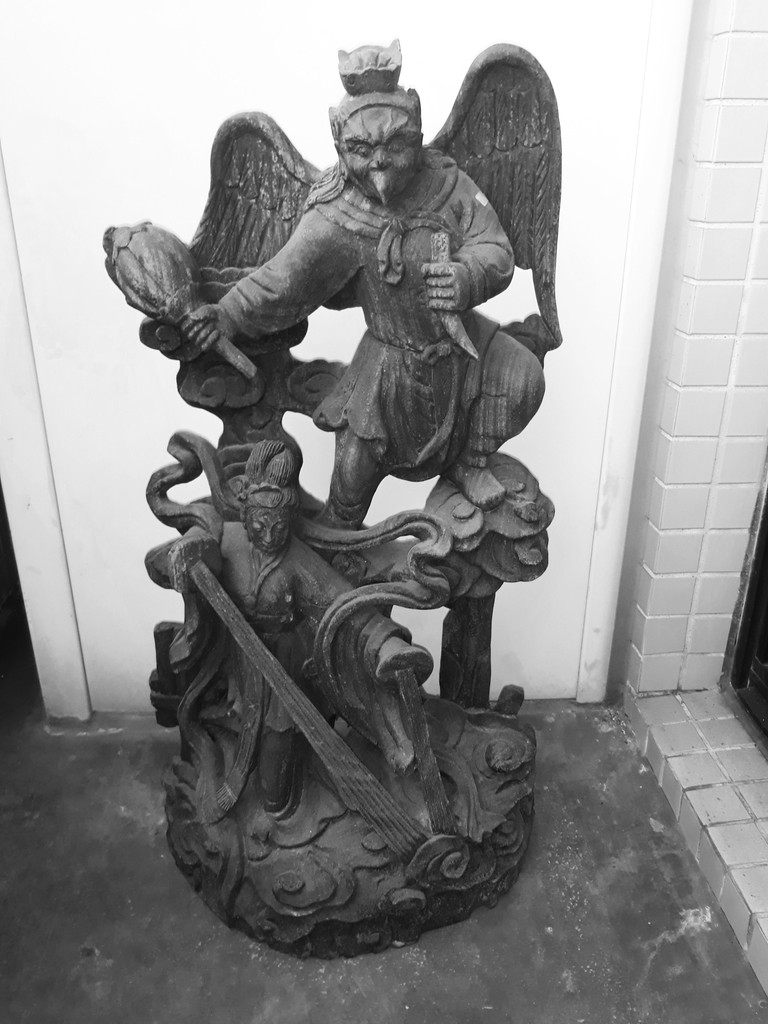
Sire Thunder’s avian form has persisted to this day, having become his standard iconography. Here I present an early 20th-century CE wooden altar statue depicting the deity with his counterpart the Mother of Lightening (Dianmu, 電母) (fig. 31). His similarities to Garuda are just as noticeable today.

20180428_171223 - small

Fig. 31 – Sire Thunder and the Mother of Lightning (20th-century CE), Taipei, Taiwan (larger version). In the author’s personal collection.

Sire Thunder actually appears with the Mother of Lightning (and other weather gods) in Journey to the West. Chapter 45 sees Monkey participating in a competition of transformations and ritual magic with three animal spirits disguised as Daoists. One competition involves making rain, during which time said gods appear. Although the spirit calling on the rain is powerful, Sun Wukong blocks his magic to make him look bad:

Becoming rather agitated, the Daoist loosened his hair, picked up his sword, and recited another spell as he burned a charm. Once more he brought down his tablet with a bang, and immediately the Heavenly Lord Deng arrived from the South Heaven Gate, trailed by the Squire of Thunder and the Mother of Lightning. When they saw Pilgrim [Sun Wukong] in midair, they saluted him, and he gave his explanation as before. “What powerful summons,” he said “brought you all here so quickly?” The Heavenly Lord said, “The proper magic of Five Thunder [Wulei fa, 五雷法] exercised by that Daoist was not faked.

He issued the summons and burned the document, which alerted the Jade Emperor. The Jade Emperor sent his decree to the residence of the Primordial Celestial Worthy of All-Pervading Thunderclap in the Ninefold Heaven. We in turn received his command to come here and assist with the rainmaking by providing thunder and lightning.” “In that case,” said Pilgrim, “just wait a moment. You can help old Monkey instead.” There was, therefore, neither the sound of thunder nor the flash of lightning (Wu & Yu, 2012, vol. 2, p. 293).

那道士心中焦躁,仗寶劍,解散了頭髮,念著咒,燒了符,再一令牌打將下去。只見那南天門裡,鄧天君領著雷公、電母到當空,迎著行者進禮。行者又將前項事說了一遍,道:「你們怎麼來的志誠?是何法旨?」天君道:「那道士五雷法是個真的,他發了文書,燒了文檄,驚動玉帝,玉帝擲下旨意,徑至九天應元雷聲普化天尊府下。我等奉旨前來,助雷電下雨。」行者道:「既如此,且都住了,同候老孫行事。」果然雷也不鳴,電也不灼。

The techniques used by the animal spirit for calling rain refers back to the aforementioned Thunder Ritual, where the powers of Sire Thunder are used in the service of another.


Update: 03-19-22

I recently occurred to me that the antagonistic version of the Garuda and serpents motif is quite similar to the ancient and widespread “Master of Animals” motif, which depicts a humanoid figure in the middle asserting his will over animals to his left and right (fig. 32). Perhaps there is a connection.
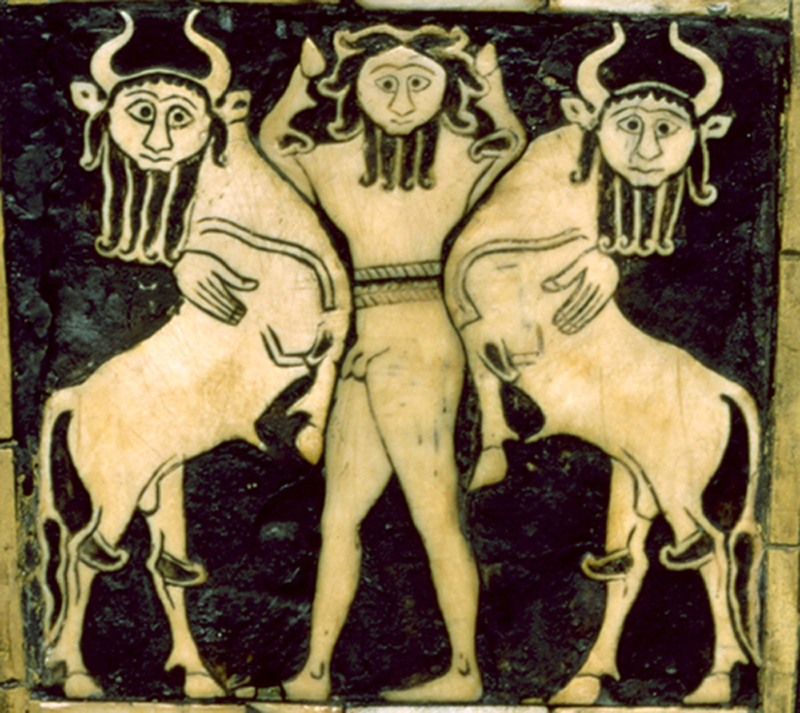
Fig. 32 – One example from a harp found at Ur (circa 2600 BCE) (larger version).


Update: 06-18-23

Above in the introduction, I mentioned how Yue Fei is cast as the reincarnation of the Peng bird. Chapter one of The Complete Vernacular Biography of Yue Fei (Shuo Yue quanzhuan說岳全傳, 1684 CE reads:

Let’s talk about the Buddha Tathagata at the Great Thunderclap Monastery in the Western Paradise. One day, he sat on a nine-level lotus throne, and the Four Great Bodhisattvas, the Eight Great Vajra Warriors, the five hundred Arhats, the three thousand Heavenly Kingsnuns and monks, male and female attendants, all of the heavenly sages who protect the Dharma, gathered to listen to his lecture on the Lotus Sutra. His words were like flowers and precious jewels raining from the heavens. But, at that time, a star-spirit, the Maiden Earth Bat, who had been listening to the lecture from beneath the lotus throne, couldn’t bear it any longer and unexpectedly let out a stinky fart.

The Buddha was a great, merciful lord, so he didn’t mind even the slightest bit. But don’t sympathize with the Dharma protector above his head, the “Great Peng, the Golden-Winged King of Illumination,” whose eyes shone with golden light and whose back was a scene of auspiciousness. He became angry when he saw the nasty, filthy Maiden Earth Bat, and so he unfurled both his wings and dropped down to kill the spirit by pecking her on the head. The light-point of her soul shot out of the Great Thunderclap Monastery and went to the Lands of the East (China) in the world below to find a mother and reincarnate. She was reborn as a daughter of the Wang clan. She would later marry the Song Prime minister Qin Hui (1091-1155) and come to cruelly kill the righteous (i.e. Yue Fei) as a means to get revenge against today’s enemy. We will talk about this later.

Let’s return to the Buddha, who saw what happened with his all-seeing eyes and exclaimed, “Good! Good! It turns out that this is an episode of karma (cause and effect).” Then he called the Great Peng bird to come closer and shouted, “You evil creature! You already took refuge in my teachings. How can you not follow the five precepts by daring to commit such a horrible crime? I don’t need you here; you will descend to the mortal world to pay off your (karmic) debt and wait until you have fulfilled your work. Once that is completed, only then will I allow you to return to the mountain to achieve the right fruit (Buddhist merit).” The Great Peng complied with the decree, flying out of the Great Thunderclap Monastery directly to the Lands of the East to be reincarnated. We will stop here (translation by me).

且說西方極樂世界大雷音寺我佛如來,一日端坐九品蓮臺,旁列著四大菩薩、八大金剛、五百羅漢、三千偈諦、比丘尼、比丘僧、優婆夷、優婆塞,共諸天護法聖眾,齊聽講說妙法真經。正說得天花亂墜、寶雨繽紛之際,不期有一位星官,乃是女土蝠,偶在蓮臺之下聽講,一時忍不住,撒出一個臭屁來。我佛原是個大慈大悲之主,毫不在意。不道惱了佛頂上頭一位護法神祗,名為大鵬金翅明王,眼射金光,背呈祥瑞,見那女土蝠污穢不潔,不覺大怒,展開雙翅落下來,望著女土蝠頭上,這一嘴就啄死了。那女土蝠一點靈光射出雷音寺,徑往東土認母投胎,在下界王門為女,後來嫁與秦檜為妻,殘害忠良,以報今日之讎。此是後話,按下不提。

且說佛爺將慧眼一觀,口稱:「善哉,善哉!原來有此一段因果。」即喚大鵬鳥近前,喝道:「你這孽畜!既歸我教,怎不皈依五戒,輒敢如此行兇?我這裡用你不著,今將你降落紅塵,償還冤債,直待功成行滿,方許你歸山,再成正果。」大鵬鳥遵了法旨,飛出雷音寺,徑來東土投胎不表。

Notes:

1) This name is a reference to the mythical Peng (鵬) bird mentioned in the first chapter of the Zhuangzi (莊子), a philosophical work of the 3rd-century BCE. The chapter details how the creature starts life as a small Kun (鯤) fish and changes into a bird of unfathomable size with wings that span the sky (Zhuangzi & Watson, 2003, pp. 23-24).

2) See Wu & Yu (2012) chapters 74 to 77.

3) The sources are actually conflicting on which relief is older. For instance, Iyer (1977) claims the first is the “earliest representation of garuda” (p. 52). On the contrary, Dhar (2009) lists the second as being from “c. second-first century BCE” (p. 10), which would make it older than the Sanchi example. I, however, believe the second is younger than the first because it is clearly an embellished version of the first.

4) Although some of its iconographical elements can be similar to the bird god, the Face of Glory shouldn’t be confused with Garuda because it represents the “monster of greed” (Beer, 1999, pp. 69-70). This is why it is constantly in the act of eating.

5) This recalls the story of Krishna defeating the serpent Kaliya by dancing on his head (Leeming, 2006, p. 232).

6) For example, in chapters 50 to 52, Laozi’s buffalo runs amuck on earth as a demon. The monster uses a diamond bracelet that he stole from his master to capture Monkey’s staff. The simian hero enlists the aid of the Daoist patriarch, who subjugates the beast and later puts the bracelet through its nose and uses a sash as a lead. The novel then explains: “Thus the custom of leading the buffalo with a ring in its nose was established, a custom in use even now” (Wu & Yu, 2012, vol. 3, p. 30).

7) People struck by lightning were thought to have been marked (scarred) with a sign of their guilt much like a convict in ancient China was tattooed (Meulenbeld, 2007).

8) See Meulenbeld (2007) chapter 4. See also section 6.4 for a discussion on Sun Wukong and his relationship to Sire Thunder and the Thunder Ritual.

Sources:

Akiyama, T. (1961). Japanese Painting. [Geneva]: Skira; [distributed by World Pub. Co., Cleveland.

Association for Asian Studies., Goodrich, L. C., & Fang, Z. (1976). Dictionary of Ming Biography, 1368-1644. New York: Columbia University Press.

Beer, R. (1999). The Encyclopedia of Tibetan Symbols and Motifs. Boston: Shambala.

Dallapicolla, A. L. (2002). Dictionary of Hindu Lore and Legend. New York: Thames & Hudson.

Dehejia, Vidya. 1997. Indian Art. London: Phaidon.

Dhar, P. P. (2009). The Toraṇa in Indian and Southeast Asian Architecture. New Delhi: D.K. Printworld.

Elgood, H. (2000). Hinduism and the Religious arts. London: Cassell.

Ganguli, K. M., and Rāya, P. (2003). The Mahabharata of Krishna-Dwaipayana Vyasa. New Delhi: Munshiram Manoharlal Publishers.

Gupte, R. S. (1967). The Art and Architecture of Aihole: A Study of Early Chalukyan Art Through Temple Architecture and Sculpture. Bombay: Taraporevala.

Hsia, C. T. (2004). C. T. Hsia on Chinese Literature. New York: Columbia University Press.

Iyer, K. B. (1977). Animals in Indian Sculpture. Bombay: Taraporevala.

Kramrisch, S. (1928). The Vishnudharmottara (part III): A Treatise on Indian Painting and Image-Making. Calcutta: Calcutta University Press.

Leeming, D. A. (2006). The Oxford Companion to World Mythology. Oxford: Oxford Univ. Press.

Malandra, G. H. (1993). Unfolding a Maṇḍala: The Buddhist Cave Temples at Ellora. Albany, NY: State Univ. of New York Press.

Meulenbeld, M. R. E. (2007). Civilized Demons: Ming Thunder Gods from Ritual to Literature (Doctoral dissertation). Available from ProQuest Dissertations and Theses database (UMI No: 3247802).

Mookerji, R. (1973). The Gupta Empire. Delhi: Motilal Banarsidass.

Patel, S. K. (1992). Hinduism in India: A Study of Viṣṇu Worship. Delhi (India): Amar Prakashan.

Qian, C. (2016). Shuo Yue quanchuan [The Complete Vernacular Biography of Yue Fei] . Zhangsha: Yue lu shu she.

Qureshi, D. (2010). The Rock-Cut Temples of Western India. Delhi, India: Bharatiya Kala Prakashan.

Singer, J. C. (1999). The Cultural Roots of Early Central Tibetan Painting.  In S. Kossak & J. Singer (Eds.), Sacred Visions: Early Paintings from Central Tibet (pp. 3-24). New York: Metropolitan Museum of Art.

Smith, V. A. (1969). The Jain Stûpa and Other Antiquities of Mathurâ. Varanasi: Indological Book House.

Stoddard, H. (1996). Early Tibetan Paintings: Sources and Styles (Eleventh-Fourteenth Centuries A.D.). Archives of Asian Art 49, pp. 26-50.

Stoddard, H. (2008). Early Sino-Tibetan Art. Bangkok: Orchid Press.

Subbaraman, R. (2002). Beyond the Question of the Monkey Imposter: Indian Influence on the Chinese Novel the Journey to the West. Sino-Platonic Papers, (114), 1-35. Retrieved April, 2018, from http://www.sino-platonic.org/complete/spp114_journey_to_the_west_monkey.pdf.

Tartakov, G. M. (1997). The Durga Temple at Aihole: A Historiographical Study. Delhi [u.a.]: Oxford University Press.

Vogel, J. P. (1972). Indian Serpent-Lore: or, the Nāgas in Hindu Legend and Art. Varanasi [India]: Indological Book House.

Walker, B. (1968). Hindu World: An Encyclopedic Survey of Hinduism. London: Allen & Unwin.

Wu, C., & Yu, A. C. (2012). The Journey to the West (Vols.1-4) (Rev. ed.). Chicago: University of Chicago Press.

Zhuangzi, & Watson, B. (2003). Zhuangzi: Basic Writings. New York: Columbia University Press.

Zimmer, H. R., & Campbell, J. (1946). Myths and Symbols in Indian Art and Civilization. [New York]: Pantheon Books.

Sun Wukong and Martial Arts

Last updated: 08-07-2018

The Monkey King is well known for his prowess with the staff. However, the first two chapters detailing his tutelage under the Buddho-Daoist sage, Patriarch Subodhi, surprisingly do not mention him training in combat skills, what Journey to the West (Xiyouji, 西遊記, 1592; “JTTW” hereafter) calls wuyi (武藝; lit: “martial arts”). [1] In fact, the novel only briefly alludes to it later in a poem from chapter 67, part of which reads: “I bowed to the Patriarch of the Heart and Mind Spirit Platform and perfected with him the martial arts” (身拜靈臺方寸祖,學成武藝甚全周) (based on Wu & Yu, 2012, vol 3, p. 243). [2] But beyond the staff, Sun Wukong comes to master boxing, a skill that he only displays twice in the novel.

For example, a poem in chapter 51 describes his unarmed battle with a buffalo demon:

Hitching up his clothes and walking forward, the fiend assumed a boxing posture; his two fists upraised looked truly like two iron sledge hammers. Our Great Sage also loosened his legs at once and moved his body to attack; right before the cave entrance, he began to box with the demon king. This was quite a fight! Aha!

Opening wide the “Four Levels Posture”;
The double-kicking feet fly up.
They pound the ribs and chests;
They stab at galls and hearts.
“The Immortal pointing the Way”;
“Lao Zi Riding the Crane”;
“A Hungry Tiger Pouncing on the Prey” is most hurtful;
“A Dragon Playing with Water” is quite vicious.
The demon king uses a “Serpent Turning Around”;
The Great Sage employs a “Deer Letting Loose its Horns.”
The dragon plunges to Earth with heels upturned;
The wrist twists around to seize Heaven’s bag.
A green lion’s open-mouthed lunge;
A carp’s snapped-back flip.
Sprinkling flowers over the head;
Tying a rope around the waist;
A fan moving with the wind;
The rain driving down the flowers.
The monster-spirit then uses the “Guanyin Palm,”
And pilgrim counters with the “Arhat Feet.”
The “Long-Range Fist,” stretching, is more slack, of course.
How could it compare with the “Close-Range Fist’s” sharp jabs?
The two of them fought for many rounds—
None was the stronger, for they are evenly matched (Wu & Yu, 2012, vol. 3, pp. 12-13)

那妖撩衣進步,丟了個架子,舉起兩個拳來,真似打油的鐵鎚模樣。這大聖展足挪身,擺開解數,在那洞門前,與那魔王遞走拳勢。這一場好打。咦!
拽開大四平,踢起雙飛腳。韜脅劈胸墩,剜心摘膽著。仙人指路,老子騎鶴。餓虎撲食最傷人,蛟龍戲水能兇惡。魔王使個蟒翻身,大聖卻施鹿解角。翹跟淬地龍,扭腕拿天橐。青獅張口來,鯉魚跌脊躍。蓋頂撒花,遶腰貫索。迎風貼扇兒,急雨催花落。妖精便使觀音掌,行者就對羅漢腳。長掌開闊自然鬆,怎比短拳多緊削。兩個相持數十回,一般本事無強弱。

Shahar (2008) notes that this fight “[gave] the author an opportunity to display his familiarity with the contemporary jargon of ‘postures’ (shi and jiazi), ‘Long-Range Fist’ (changquan), and ‘Close-Range Fist’ (duanquan)” (pp. 131-132).

I consulted with martial artist Joshua Viney to learn what each technique involves. (Interestingly, many of these are still known to this day, some better known by slightly different names.) Joshua has lived and studied folk martial arts from village masters around the noted Shaolin Monastery (Shaolin si, 少林寺) for over ten years. He currently maintains the Shaolin Yuzhai Youtube channel, where he posts instructional videos. Please check it out.

Table of Contents

1. The Techniques

1) “Opening wide the ‘Four Levels Posture'” (Zhuai kaida siping, 拽開大四平) – An open fighting posture where the boxer stands in the horse stance (mabu, 馬步) with arms outstretched to his sides. Also known as “Single Whip Horse Stance” (Mabu danbian kai siping, 馬步單鞭開四平) (fig. 1), which is often associated with Taiji boxing (Taiji quan, 太極拳).

Wide open stance
2) “The double-kicking feet fly up” (Ti qi shuangfei jiao, 踢起雙飛腳) – Also known as “Double kicking feet” (Er qi jiao, 二起腳), this technique involves lifting up one knee to build upward momentum and then kicking high with the other (fig. 2). It is reminiscent of the “crane kick” from The Karate Kid (1984).

double jump kick

3) “They pound the ribs and chests” (Tao xie pi xiong dun, 韜脅劈胸墩) – Possibly referring to the “Pushing palm” (Tui zhang, 推掌) or “Splitting palm” (Pi zhang, 劈掌), which is delivered into the solar plexus and up into the rib cage (fig. 3).

Pushing - splitting palm

From Joshua’s APPLICATION of Xiao Hong Quan video.

4) “The Immortal pointing the Way” (Xianren zhilu, 仙人指路) – A double finger attack aimed at the eyes (fig. 4). The stance is often seen used in tandem with a sword.

Immortal points the way

5) “Lao Zi Riding the Crane” (Laozi qihe, 老子騎鶴) – Most likely another name for the Crane stance (fig. 5).

crane stance

6) “A Hungry Tiger Pouncing on the Prey” (E’hu pu shi, 餓虎撲食) – This name has been applied to many techniques. One variation known as “Fetching the moon from the seabed” (Haidi lao yue, 海底撈月) involves a powerful hip and/or palm strike to the groin/lower midline of the body (fig. 6). The force of the hip strike is powerful enough to send someone flying backwards.

Hip bump 1

Left: Setting up the attack. Right: The hit (from Joshua’s 13 Hammers of Shaolin video).

7) “A Dragon Playing with Water” (Jiaolong xishui, 蛟龍戲水) – Also known as “Dragon puking water” (Jiaolong xishui neng xiong’e, 蛟龍戲水能兇惡), this technique involves fluid, sweeping arm movements (most likely blocks or fake strikes) followed by simultaneous double fist blows (fig. 7). The technique is associated with Shaolin and Chang Family Fist (Changjia quan, 萇家拳), a martial art that influenced the development of Taiji boxing. [3]

Dragon puking water

8) “Serpent Turning Around” (Mang fanshen, 蟒翻身) – Also known as “Python turns over” (Guaimang fanshen, 怪蟒翻身), this technique involves a simultaneous chop to the throat and a pulling leg sweep, effectively knocking the opponent backwards (fig. 8).

Pythong turns

9) “Deer Letting Loose its Horns” (Lu jiejiao, 鹿解角) – A series of elbow strikes to the torso (fig. 9). One variant called “Plum blossom deer lies on a pillow” (Meihua lu wozhen, 梅花鹿臥枕) places the fist of the attacking arm against the temple, looking as if the practitioner is propping his head up in a resting posture.

unnamed

10) “The dragon plunges to Earth with heels upturned” (Qiaogen cuidi long, 翹跟淬地龍) – A shooting maneuver using the Falling stance (Pubu, 仆步) to dip below the opponent’s defenses and attack the lower extremities (fig. 10). Also known as Qiaodi long zou xiapan zhao (雀地龍走下盤找).

dragon drops

11) “The wrist twists around to seize Heaven’s bag” (Niuwan na tiantuo, 扭腕拿天橐) – UNKNOWN. Mostly likely a headlock.

12) “A green lion’s open-mouthed lunge” (Qingshi zhangkou lai, 青獅張口來) – More commonly known as “Lion opens mouth” (Shizi dazhang zui, 獅子大張嘴), this technique has two variations. The large frame version involves shooting in low, pulling up the opponent’s knee with one hand, while simultaneously pushing on their head with the other hand, knocking them over (fig. 11). This can be used for throwing an opponent as well. The small frame version involves cupping the hands to intercept strikes.

lion opens mouth

From APPLICATION of Xiao Hong Quan

13) “A carp’s snapped-back flip” (Liyu die ji yue, 鯉魚跌脊躍) – This can refer to both throwing an opponent and a move commonly referred to as a “kip-up.” The latter involves the practitioner flipping up from a supine position to a standing fighting stance (fig. 12).

14) “Sprinkling flowers over the head” (Gaiding sahua, 蓋頂撒花) – Also known as “Double cloud over peak” (Shuangyun ding, 雙雲頂), this technique involves flourishing the hands above the head as a means of blocking, twisting an opponent’s arm, or disengaging from combat (fig. 13).

d8312e2fd284516d5e12d33375177c5e

15) “Tying a rope around the waist” (Raoyao guansuo, 遶腰貫索) – UNKNOWN. Possibly a circling step similar to one later used in Bagua Palm Boxing (Bagua zhang, 八卦掌) (fig. 14).

16) “A fan moving with the wind” (Yingfeng tieshan’er, 迎風貼扇兒) – Crossed hands shooting out to intercept an opponent’s punch (fig. 15).

fan against the wind

17) “The rain driving down the flowers” (Jiyu cuihua luo, 急雨催花落) – Most likely a rapid succession of punches.

18) “Guanyin Palm” (Guanyin zhang, 觀音掌) – A style of palm strikes. It is listed as number 70 of the “72 Training Methods of Shaolin” (Shaolin qishi’er yilian fa, 少林七十二藝練法) (Jin & Timofeevich, 2004, p. 229).

19) “Arhat Feet” (Luohan jiao, 羅漢腳) – A style of kicking.

20) Long-Range Fist (Chang quan, 長拳) – A family of Northern style martial arts known for their long-range punches and kicks and acrobatic movements.

21) Close-Range Fist (Duan quan, 短拳) – A family of Northern style martial arts known for their compact, short-range, yet quick attacks.

2. Battle Reconstruction

What follows is Joshua’s reconstruction of the fight. He makes an interesting observation that the fight may in fact be a theatrical stage combat version of known techniques.

I think what we are seeing here is a Chinese Opera-like performance of a fight that the author saw and perhaps asked about the names or recognised. I expect it would be very contrived. After this we are not told explicitly who does what and it may not be a one for one exchange. Nevertheless looking at the wording we can make a guess.
 
It begins with a large fighting stance, probably the ‘single whip’ posture of holding the arms straight to the sides. Then both performers do a jumping kick towards each other to enter striking range. Given it uses the phrase 劈胸 ‘pi xiong’ (split chest) I expect they begin by using the chest splitting palm at one another and so cross hands in the center of the arena [fig. 16].
cross hands
 
Once they have crossed hands I think the demon grasps Monkey’s hand and attacks with the fingers of the other hand at his eyes, doing the ‘immortal points the way’ technique. Monkey defends against this by shielding his face with his forearms, then spreading his hands and kicking at the monster’s stomach. This pushes the monster away and Monkey is left with one knee suspended and arms spread to the sides in the ‘Lao Tzu rides a crane’ posture.
 
The Demon takes advantage of this unstable posture by rushing at him with the ‘hungry tiger pounces on prey’ technique, striking Monkey with his hips and grasping hold of him. Monkey uses the ‘dragon puking water’ technique, which erupts from below the demons arms and casts them aside, then rushes forwards again to attack with both hands. The Demon defends this by sticking close to the monkey and uses the ‘python turning its body’ technique to trip him up. But Monkey is strong and keeps his footing, counter attacking with a headbutt and multiple elbow strikes which form the ‘Deer-Horn’ technique. 
 
The Demon jumps away but Monkey pursues with the ‘ground dragon’ technique and attacks the demons groin, causing him to buckle over, whereby Monkey grasps his head with the ‘twisting heavens sack’ technique. The Demon defends by using the ‘Lion opens mouth lunge’ to stop Monkey and throw him down. The monkey recovers by flipping his body in the ‘carp jump’ technique. Then he withdraws from the center by a few steps ‘covering his head with the flowers’ overhead technique. The Demon similarly disengages from the center and puts up a guard, prowling slowly around Monkey with the ‘turning waist’ technique.
 
I think the rest is describing more how they are evenly matched and face each other down rather than any other moves. ‘Iron fan stands against the wind’ is a common technique, a guard, and ‘rain falling on flowers’ is perhaps an eye strike but could also mean the intensity of the fight is like an urgent rain of punches. ‘Guanyin palm’ and ‘Luohans feet’ are both style names. Long fist vs short fist, how can they overcome one another? 10 rounds without a victor.

He goes onto describe the physical and psychological aspects of Long-range and Close-range fist:

Long fist and Short fist are the classic methods of Shaolin shenfa [身法, “Body postures”]. In order to strike the opponent one needs momentum, both physical AND psychological. Momentum is achieved by moving the dantian [4] as the centre of mass. In Short fist the dantian is rotated to add to power. In Long fist the whole dantian is thrown in the direction of the strike instead of rotated–much more powerful but also more wild and uncontrollable. In Shaolin philosophy, mind and matter are not severed, so physical momentum and psychological momentum are intertwined; when one has physical forward momentum, one simultaneously feels more confident.

3. Similarities With Other Literary Combat

A poem similar to that from JTTW appears in the 120 chapter version of the Water Margin (Shuihu zhuan, 水滸傳, c. 1594) by Yu Xiangdou (余象斗, c. 1560–c. 1640). The poem describes unarmed combat between a young man and woman.

Opening wide the “Four Levels Posture”;
The double-kicking feet fly up.
“The Immortal pointing the Way”;
“Lao Zi Riding the Crane”;
“Phoenix Elbow” to the heart;
“The Guard Head Cannon Stance” strikes the temples;
The dragon plunges to Earth with heels upturned;
The wrist twists around to seize Heaven’s bag;
This girl, sprinkling flowers over the head;
This boy, tying a rope around the waist;
Two fans moving with the wind;
The rain driving down the flowers.

拽開大四平,踢起雙飛腳。仙人指路,老子騎鶴。拗鸞肘出近前心,當頭炮勢侵額角。翹跟淬地龍,扭腕擎天橐。這邊女子,使個蓋頂撒花;這裡男兒,耍個腰貫索。兩個似迎風貼扇兒,無移時急雨催花落。

We can see many named techniques from Monkey’s battle appear in this poem. There are only two years between the publishing of the standard 1592 edition of our novel and this version of the Water Margin. But it’s very well possible that both authors drew upon common source material.

Joshua discovered two techniques from the Water Margin poem, namely “Phoenix Elbow” (Aoluan zhao, 拗鸞肘) and “The Guard Head Cannon Stance” (Dang toupao shi, 當頭砲勢), appearing together in the same print of an edition of the Collection of Military Works (Wubei zhi武備志, c. 1621), a Ming treatise on military armaments and fighting techniques (fig. 17). This suggests that Yu Xiangdou borrowed these moves from similar boxing or military manuals. Likewise, the author-compiler of JTTW may have also borrowed from such literature.

Dangtoupao

Fig. 17 – The print from the Collection of Military Works (Wubei zhi, 武備志, c. 1621) mentioning “Phoenix Elbow” and the “Guard the Head Cannon Stance.”


4. Updates

Update: 05-02-2018

The available evidence suggests that “Short Fist” (Duanquan, 短拳; a.k.a. “Close-Range Fist”) is Sun Wukong’s fighting style. As mentioned above, the poem in chapter 51 reads: “The ‘Long-Range Fist,’ stretching, is more slack, of course. How could it compare with the ‘Close-Range Fist’s’ sharp jabs?” (長掌開闊自然鬆,怎比短拳多緊削。) (Wu & Yu, 2012, vol. 3, p. 13). Also, after facing the buffalo monster, Monkey asks heavenly warriors to critique his boxing skills:

“As you watched from afar,” said Pilgrim, smiling, “how did the abilities of the fiend compare with old Monkey’s?” “His punches were slack,” said Devaraja Li, “and his kicks were slow; he certainly could not match the Great Sage for his speed and tightness'” (Wu & Yu, 2012, vol. 3, p. 14).

行者笑道:「列位在此遠觀,那怪的本事,比老孫如何?」李天王道:「他拳鬆腳慢,不如大聖的緊疾。…」

The “speed and tightness” is of course a reference to his use of Short Fist.

In addition, earlier in chapter two, Sun Wukong faces a demon who had taken over his Water Curtain cave in the immortal’s absence. The two resort to boxing since Monkey is unarmed:

The Monstrous King shifted his position and struck out. Wukong closed in on him, hurtling himself into the engagement. The two of them pummeled and kicked, struggling and colliding with each other. Now it’s easy to miss on a long reach, but a short punch is firm and reliable (emphasis added). Wukong jabbed the Monstrous King in the short ribs, hit him on his chest, and gave him such heavy punishment with a few sharp blows that the monster stepped aside, picked up his huge scimitar, aimed it straight at Wukong’s head, and slashed at him (Wu & Yu, 2012, Vol. 1, p. 128).

那魔王丟開架子便打,這悟空鑽進去相撞相迎。他兩個拳搥腳踢,一衝一撞。原來長拳空大,短簇堅牢。那魔王被悟空掏短脅,撞了襠,幾下觔節,把他打重了。他閃過,拿起那板大的鋼刀,望悟空劈頭就砍。

I initially thought Sun Wukong used Short Fist out of necessity as JTTW describes him being less than four feet tall. But the novel’s bias for close-range fighting over long-range was, according to Shahar (2008), “typical of late Ming and early Qing military literature” (p. 117). He continues:

Sixteenth- and seventeenth-century military experts allude to various short-range styles including ‘Cotton Zhang’s Close-Range Fist’ (Mian Zhang duanda [綿張短打]), ‘Ren Family Close-Range Fist’ (Renjia duanda [任家短打]), and ‘Liu [Family] Close-Range Fist’ (Liu duanda [劉短打])” (Shahar, 2008, p. 117).

Wing Chun (Mandarin: Yong Chun, 詠春) is a close-range fighting style similar to Short fist. Although the style postdates the novel by at least two centuries, it showcases the quick, compact punches associated with Short Fist. Take this video of Jackie Chan, for example. Now imagine Monkey using similar techniques in a fight with a much larger opponent, blocking or ducking to avoid attacks and replying with sharp punches targeted at vulnerable areas.


Update: 08-07-2018

I have found a few more instances of martial arts terms, this time related to weapons. Joshua was again kind to lend his knowledge to the subject.

Chapter 17:

The compliant rod,
The black-tasseled lance.
Two men display their power before the cave;
Stabbing at the heart and face;
Striking at the head and arm.
This one proves handy with a death-dealing rod;
That one tilts the lance for swift, triple jabs.
The “white tiger climbing the mountain” extends his paws;
The “yellow dragon lying on the road” turns his back (emphasis added).
With colored mists flying
And bright flashes of light,
Two monster-god’s strength is yet to be tried.
One’s the truth-seeking, Equal-to-Heaven Sage;
One’s the Great Black King who’s now a spirit.
Why wage this battle in the mountain still?
The cassock, for which each would aim to kill! (Wu & Yu, 2012, vol. 1, p. 354)

如意棒,黑纓槍,二人洞口逞剛強。分心劈臉刺,著臂照頭傷。這個橫丟陰棍手,那個直撚急三槍。白虎爬山來探爪,黃龍臥道轉身忙。噴彩霧,吐毫光,兩個妖仙不可量。一個是修正齊天聖,一個是成精黑大王。這場山裡相爭處,只為袈裟各不良。

22) “‘White tiger climbing the mountain’ extends his paws” (Baihu pashan lai tanzhao, 白虎爬山來探爪) – Mountain climbing stance is synonymous with Gong bu (弓步), or the bow stance. The white tiger denotes an overt attack of sorts. I imagine it would look similar to this spear technique.

Gong Bu thrust

23) “‘Yellow dragon lying on the road’ turns his back” (Huanglong wodao zhuanshen mang, 黃龍臥道轉身忙) – Possibly a retreating maneuver.

Chapter 31:

Dear Monkey King! He raised the rod above his head, with both hands, using the style “Tall-Testing the Horse.” The fiend did not perceive that it was a trick. When he saw there was a chance, he wielded the scimitar and slashed at the lower third of Pilgrim’s [Monkey’s] body. Pilgrim quickly employed the “Great Middle Level” to fend off the scimitar, after which he followed up with the style of “Stealing Peaches Beneath the Leaves” and brought the rod down hard on the monster’s head. This one blow made the monster vanish completely (Wu & Yu, 2012, vol. 2, p. 83).

好猴王,雙手舉棍,使一個「高探馬」的勢子。那怪不識是計,見有空兒,舞著寶刀,徑奔下三路砍;被行者急轉個「大中平」,挑開他那口刀,又使個「葉底偷桃勢」,望妖精頭頂一棍,就打得他無影無蹤。

24) “Tall-Testing the Horse” (Gao tanma, 高探馬) – Tanma (探馬) refers to a military scout, so a better translation would be the “High Scout.” This is a double-handed thrust aimed at the opponent’s face as a high fake. A corresponding fist technique, essentially a jab, is associated with Taiji boxing.

25) “Great Middle Level” (Dazhong ping, 大中平) – Holding the staff level at the navel while in the horse stance. This allows for quick defense below the waist.

26) “Stealing Peaches Beneath the Leaves” (Yedi toutao shi, 葉底偷桃勢) – UNKNOWN. The name of this technique is normally associated with an attack to the groin, not the top of the head as implied in the quoted battle.

Based on the sequence of events described above, it seems like Monkey fakes high, blocks the strike to his body, and then attacks the top of the stooping opponent’s head (since the latter ducked the high fake and attacked low).

Here is Joshua’s interpretation:

The two weapons are stuck together: the monkey is forcing down, the demon up. The monkey releases the pressure, circling his staff below the opponents weapon, so with the release of pressure, the opponent’s weapon flings upwards but with no control. The monkey circles from this lower position, then turns over in a big circle and strikes the opponent downwards on the head.

Chapter 56:

The Great Sage walked forward and picked up the rod with no effort at all. Assuming the style of the Python Rearing its Body (emphasis added), he pointed at the bandits and said, “Your lucks running out, for you have met Old Monkey!” (Wu & Yu, 2012, vol. 3, p. 81).

大聖走上前,輕輕的拿起,丟一個蟒翻身拗步勢,指著強人道:「你都造化低,遇著我老孫了。」

27) “Python Rearing its Body” (Mang fanshen, 蟒翻身). UNKNOWN. This is a differently translated version of a similarly titled technique mentioned above. See number eight (“Serpent Turning Around”). The previous listing referred to a boxing technique, while this, again, is for a weapon.

In closing, I would like to quote a particular passage. While it doesn’t list a given technique, it highlights Monkey’s mastery of the staff. Chapter 33 reads:

“Going through this tall mountain and rugged cliff must have made master [Tripitaka] rather apprehensive, that’s all. Don’t be afraid! Don’t be afraid! Let old Monkey put on a show for you with my rod to calm your fears somewhat.” Dear Pilgrim! Whipping out his rod, he began to go through a sequence of maneuvers with his rod as be walked before the horse: up and down, left and right, the thrusts and parries were made in perfect accord with the manuals of martial arts (emphasis added). What the elder saw from the horse was a sight incomparable anywhere in the world (Wu & Yu, 2012, vol. 2, p. 105).

行者道:「胡說,師父是走著這深山峻嶺,必然小心虛驚。莫怕,莫怕,等老孫把棒打一路與你壓壓驚。」

好行者,理開棒,在馬前丟幾個解數,上三下四,左五右六,盡按那六韜三略,使起神通。那長老在馬上觀之,真個是寰中少有,世上全無。

The portion that Yu (Wu & Yu, 2012) translates as “manuals of martial arts” actually lists the names of two noted military manuals, both of which are listed among the Seven Military Classics of China. The first, the Six Secret Teachings (Liu tao, 六韜), was published during the Warring States period (c. 475–221 BCE) but possibly contains information from as far back as the Qi state (1046–221 BCE). The second, the Three Strategies (San lue, 三略), was most likely published during the Western Han period (206 BCE–9 CE) (Sawyer, 1993).

Associating Monkey’s martial arts skill with ancient military classics only serves to further elevate his status as a great warrior and cultural hero.

Notes

1) Wuyi (武藝) was used to refer to Chinese martial arts as far back as the third century CE. The term predates the more familiar wushu (武術) by some three centuries (Lorge, 2012, p. 10).

2) Readers may think that the “Ancestor of Heart and Mind” (Fangcun zu, 方寸祖) is a direct reference to Master Subodhi. However, the supreme immortal threatened Monkey with eternal torment if he ever revealed the sage had been his teacher. A more literal translation of the aforementioned figure is “Patriarch Square Inch” (Fangcun zu, 方寸祖). Square Inch (fangcun, 方寸) is a common metaphor for the “heart / mind” (xin, 心), a broad concept written with a small character. This is just an interesting way of saying that Monkey had learned martial arts on his own via self-cultivation, thereby not revealing his true master. At the same time, it is a veiled admission of studying martial arts under the sage.

3) For more information on Chang Family Fist and its progenitor, Chang Naizhou, see Wells (2005).

4) The dantian (丹田, “cinnabar field”) is an area near the navel believed to be the body’s storehouse of spiritual energy.

Bibliography

Jin, J. Z., & Timofeevich, A. (2004). Training Methods of 72 Arts of Shaolin. USA: Shaolin Kung Fu Online Library. Retrieved from http://files.vse-zajimave.webnode.cz…ts-shaolin.pdf

Lorge, P. A. (2012). Chinese Martial Arts: From Antiquity to the Twenty-First Century. New York, NY: Cambridge University Press.

Sawyer, R. D. (1993). The Seven Military Classics of Ancient China. New York: Basic Books.

Shahar, M. (2008). The Shaolin Monastery: History, Religion, and the Chinese Martial Arts. University of Hawaii Press.

Wells, M., & Chang, N. (2005). Scholar Boxer: Chang Naizhou’s Theory of Internal Martial arts and the Evolution of Taijiquan. Berkeley, Calif: North Atlantic Books.

Wu, C., & Yu, A. C. (2012). The Journey to the West (Vols. 1-4) (Rev. ed.). Chicago, Ill: University of Chicago Press.
The Monkey King’s Spiritual Training and Historical Daoist Internal Alchemy

Last updated: 09-22-23

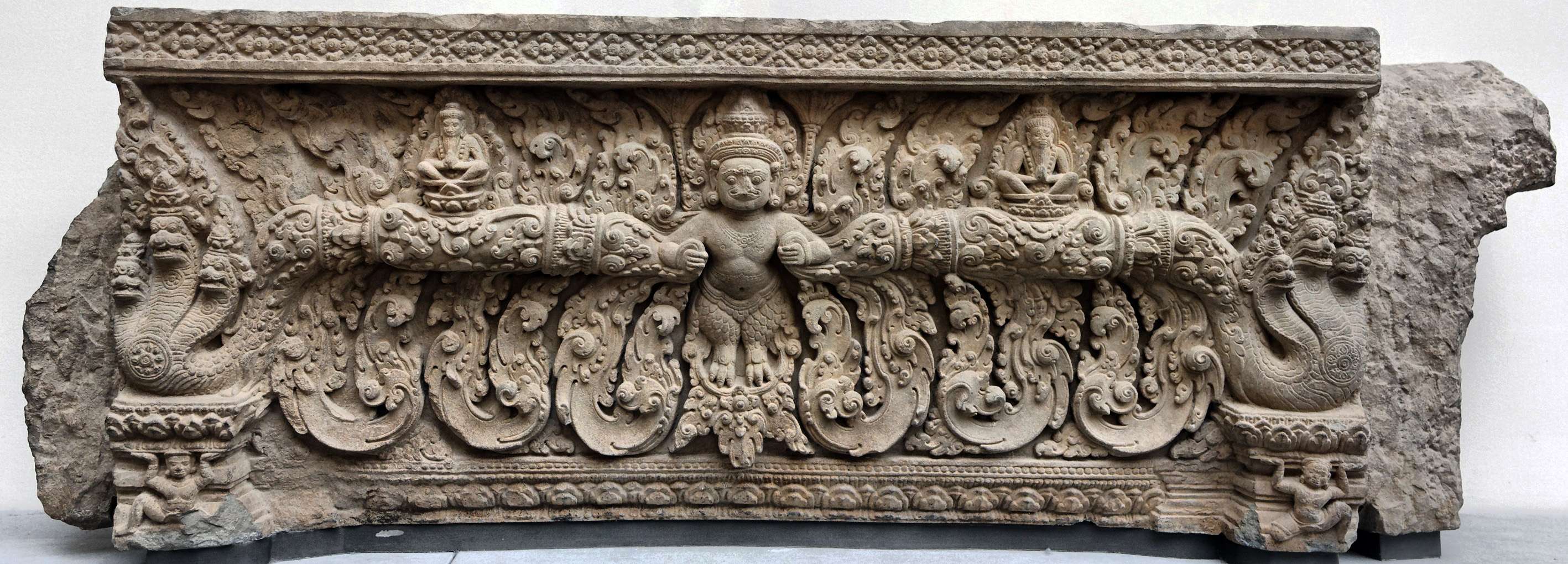
Did you know that the Monkey King’s early spiritual training is connected to historical Daoist internal alchemy? In Journey to the West (Xiyouji西遊記, 1592) chapter two, Sun Wukong receives a private lesson in which his master, Patriarch Subodhi, reveals the secret of immortality in a poem chocked full of esoteric Daoist imagery:

This bold, secret saying that’s wondrous and true:
Spare, nurse nature and life—there’s nothing else.
All power resides in the semen, breath, and spirit;
Store these securely lest there be a leak.
Lest there be a leak!
Keep within the body!
Heed my teaching and the Way itself will thrive.
Hold fast oral formulas so useful and keen
To purge concupiscence, to reach pure cool;
To pure cool
Where the light is bright.
You’ll face the elixir platform, enjoying the moon.
The moon holds the jade rabbit, the sun, the crow;
The tortoise and snake are now tightly entwined.
Tightly entwined,
Nature and life are strong.
You can plant gold lotus e’en in the midst of flames.
Squeeze the Five Phases jointly, use them back and forth—
When that’s done, be a Buddha or immortal at will! (Wu & Yu, 2012, p. 120).

顯密圓通真妙訣,惜修性命無他說。
都來總是精氣神,謹固牢藏休漏泄。
休漏泄,體中藏,汝受吾傳道自昌。
口訣記來多有益,屏除邪慾得清涼。
得清涼,光皎潔,好向丹臺賞明月。
月藏玉兔日藏烏,自有龜蛇相盤結。
相盤結,性命堅,卻能火裡種金蓮。
攢簇五行顛倒用,功完隨作佛和仙。

Table of Contents

1. Explanation

The cryptic methods advocated in the poem find their origins in dogmatic Daoist internal practices that emerged during the Song Dynasty (960–1279) (Kohn, 2008, p. 177). When Subodhi warns Monkey to “Store these [bodily substances] lest there be a leak,” he is referring to the first of three stages in the forging of an immortal spirit body. It involves transforming chaste semen (jing, 精) into pneumatic energy (qi, 氣) and guiding it to the brain, where it is purified and then circulated throughout the body, resulting in the formation of a spiritual pearl in the Cinnabar Field (dantian, 丹田), or the body’s spiritual furnace located in the lower abdomen (Kohn, 2008, p. 178).

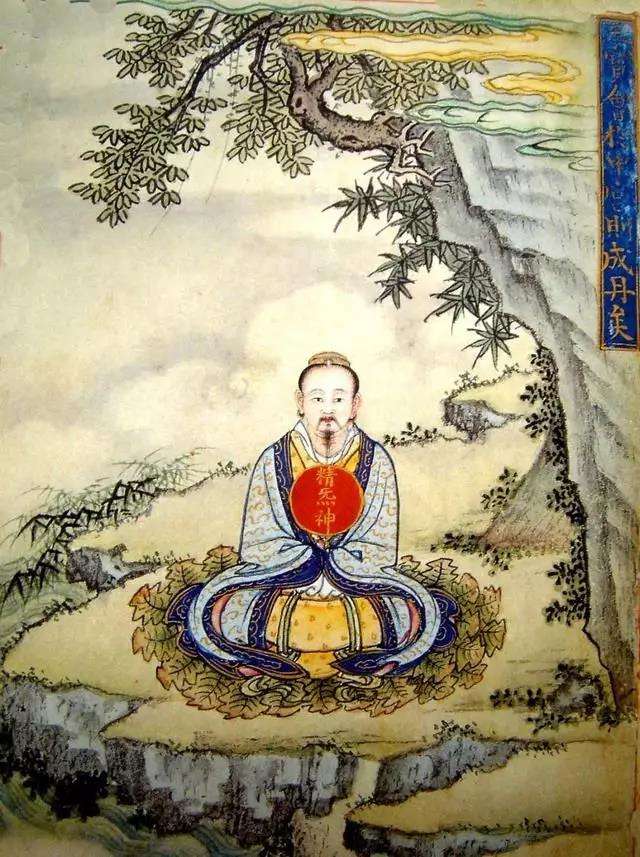
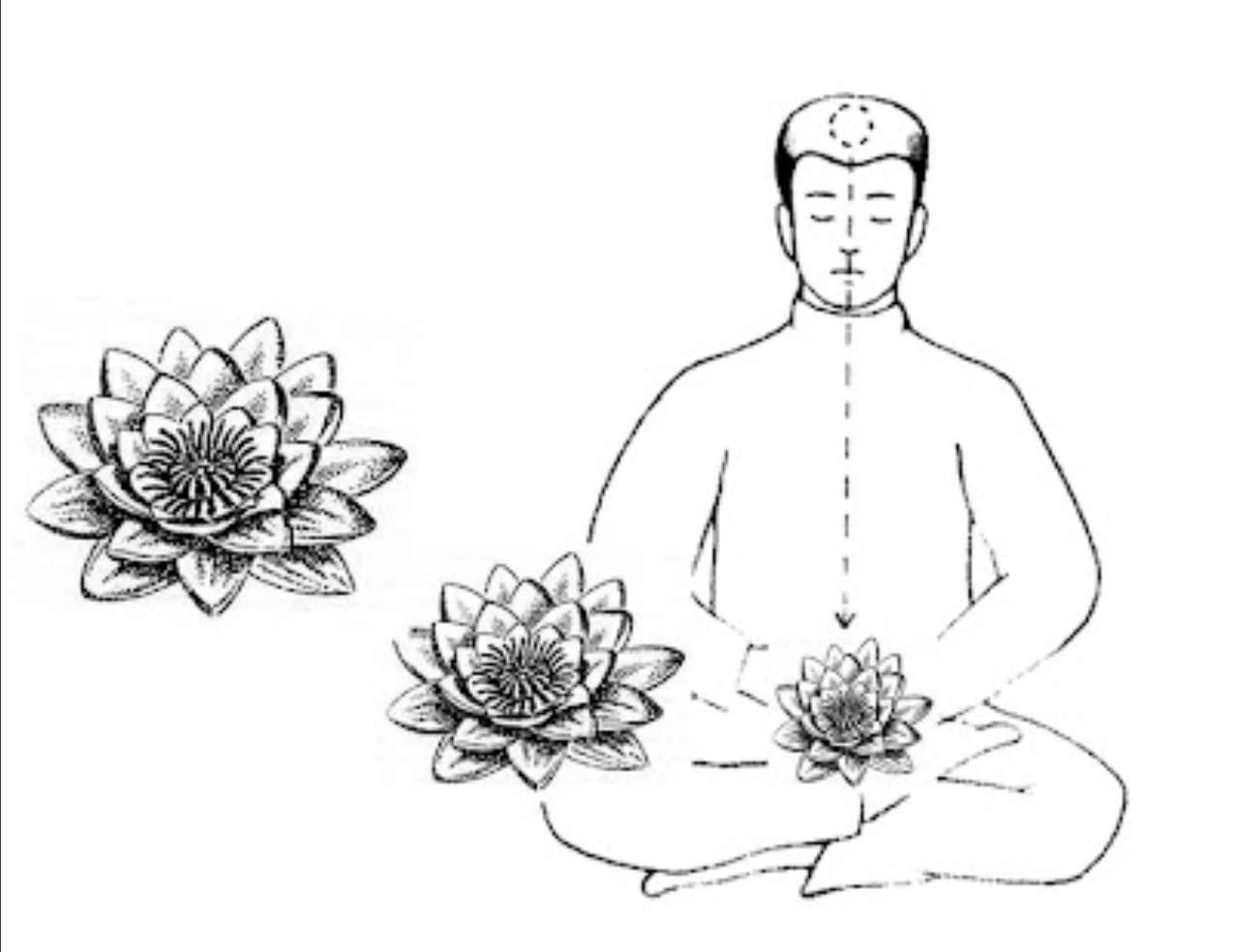
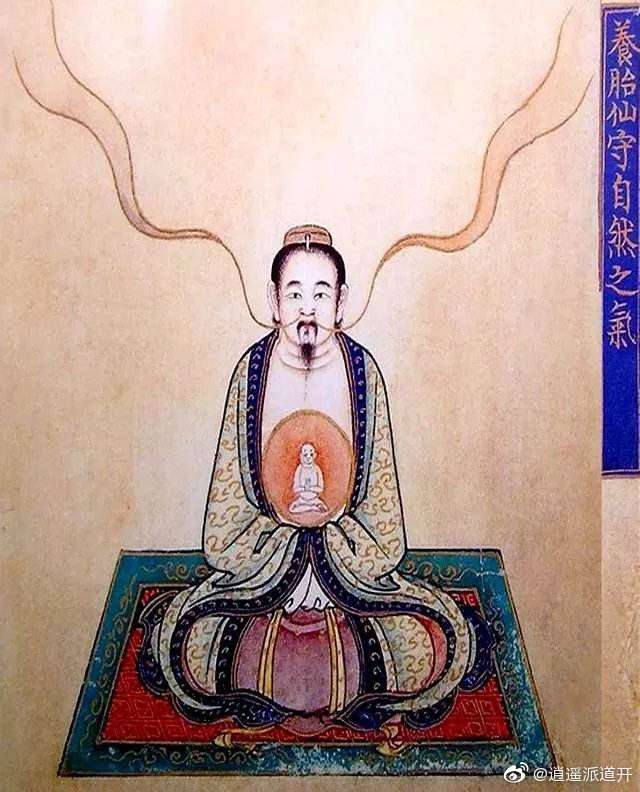
“You can plant gold lotus e’en in the midst of flames. / Squeeze the Five Phases jointly, use them back and forth” refers to the second stage, involving the inhalation and guidance of yang energy through various organs (the “five phases”) in the body to bolster the spirit (shen, 神) (fig. 1). This nurturing of the pearl causes it to sprout like a seed and blossom into a golden lotus (“amidst flames”) in the spiritual furnace (fig. 2). The lotus is considered the early stages of an immortal “spirit embryo” (shengtai, 聖胎) (fig. 3) (Kohn, 2008, pp. 178-179).

The third stage involves the nurturing of said embryo to maturation with spiritual energies and eventually guiding it upwards and out the “Heavenly Gate” (tianguan, 天關), or the top of the crown. This results in a fledgling immortal spirit body that must be trained over an additional three year period in which it learns to travel far and wide apart from the physical vessel (pp. 179-180). “When that’s done, be a Buddha or immortal at will!” refers to the eventual freedom of the immortal spirit.

Fig. 1 (top left) – A sage combining jing, qi, and shen (精炁/氣神, lit: “semen, pneumatic energy, and spirit”; a.k.a. the “Three Treasures,” Sanbao, 三寶) (larger version). Image from the Anthology of Immortals of Complete Perfection (Quanzhen qunxian ji, 全真群仙集). Fig. 2 (top right) – A visualized lotus in the cinnabar field (larger version). Fig. 3 (bottom) – A sage nurturing his spirit embryo with inhaled qi energy (larger version). Image from the Anthology of Immortals.

2. Powers

Kohn (2008) notes that adepts who succeed in their training gain supernatural powers, “including the ability to be in two places at once, to move quickly from one place to another, to know past and future, to divine people’s thoughts, and so on” (p. 180) (fig. 2). I feel this is important information considering all of the powers that Monkey exhibits throughout the story.

3. History

Various facets of the aforementioned Song-era practices, such as the breathing methods from stage two above, have a much older pedigree. While JTTW describes Sun secretly performing “breathing exercises before the hour of Zi and after the hour of Wu” (i.e. after noon and before midnight) (Wu & Yu, 2012, p. 121), the hours are switched in historical practice. The Wondrous Record of the Golden Casket on the Spirit Immortals’ Practice of Eating Qi (Shenxian shiqi jin’gui miaolu, 神仙食氣金櫃妙錄, 4th century; “Wonderous Record” hereafter) explains:

“[A]lways practice after midnight [and before noon] in the period of living qi [yang energy] … In this qi-practice, the time after noon and before midnight is called the period of dead qi [yin energy]. Do not practice then” (Kohn, 2008, p. 84).

So by practicing during the prescribed hours, Monkey absorbs the yang energy that he needs to fuel his immortality.


4. Updates

Update: 08-18-23

Above, I described how the cultivation of an immortal spirit involved refining cosmic energies in the dantian (丹田) into a seed-like pearl, then a lotus, and finally a “spirit embryo” (聖胎). Well, thanks to a tumblr post by user ruibaozha, I now have a better understanding of how Buddhist “lotus births” influenced this imagery. Shahar (2015) explains:

As early as the first centuries CE, redemption in Amitabha‘s Pure Land has been imagined in floral terms. Those who trust in the Buddha’s grace are resurrected from divine lotus blooms. Flower-like beings, they emerge from the sacred lotus blossoms into a realm of purity and happiness:

When beings of this [superior] type are about to die, the Buddha of Measureless Light [Amitabha] appears before them, accompanied by a great crowd of attendants. Then, these beings follow this Buddha and go to be reborn in his land. They are reborn naturally and miraculously in the center of a lotus made of the seven precious substances, and they dwell in the state from which there is no falling back. They come to possess wisdom and courage, supernormal powers and spiritual mastery.

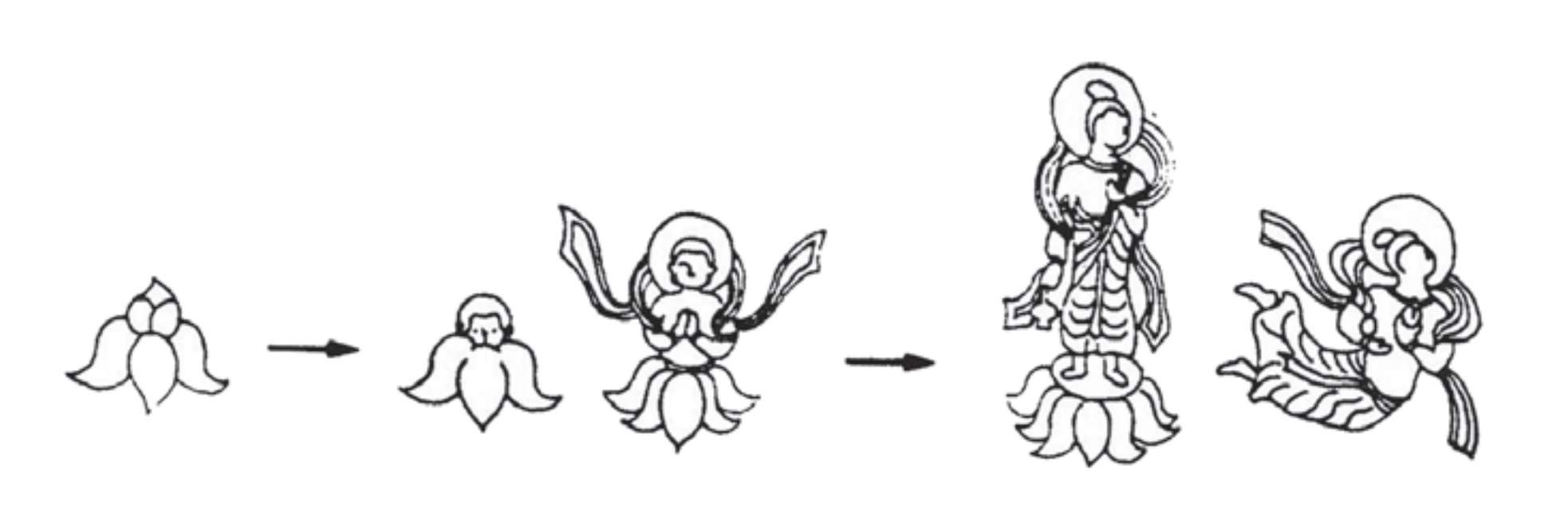
Floral regeneration became a favorite topic of Buddhist art across Asia. Redeemed souls were visually rendered as newborns wrapped in lotus blooms. Some artists faithfully followed a given Pure Land text. The ca. fifth-century Amitabha Visualization Sutra enumerated nine ranks of rebirth in the paradise of the west, from “the upper birth of the upper rank,” through “the middle birth of the upper rank,” downward to the “lower birth of the lower rank.” A seventh-century Dunhuang mural depicted them all in the form of babies emanating from nine lotus blossoms. Other artists focused on the process by which the flower is transformed into a divine being. They created a series of images recording the mysterious metamorphosis of the lotus. Dating from as early as the fifth century CE, the Yun’gang and Longmen caves include numerous examples of these pictorial narratives, showing first a newborn’s head peeping from inside the corolla, then the gradual transformation of the petals into the limbs, and finally the release of a full-blown ethereal being, the divinity of which is indicated by a [halo] [fig. 4] (pp. 143-144). 

Fig. 4 – “Lotus rebirth as rendered at the fifth-century Yun’gang Caves. From Yoshmura Rei, Tianren dansheng tu (Shanghai: Shanghai guji, 2009), p. 23” (larger version) (Shahar, 2015, p. 144).

If viewed through a Daoist lens, this image could represent the fledgling spirit embryo emerging from the lotus, being nurtured to fruition, and then freed to live out an eternity in blissful freedom.


Update: 09-22-23

Above, I quoted Kohn’s (2008) heavily edited translation of the Wonderous Record, which noted the prescribed times for the ingestion of qi energy. This source was apparently cited in the “Inner Chapters” (Neipian, 內篇) of Ge Hong’s Master Who Embraces Simplicity (Baopuzi, 抱朴子, 4th century). A longer quote appearing in Campany (2002) mentions the aforementioned time-based practices, lists the types of resulting spiritual powers, and warns of this path’s difficulty:

Now the circulation of pneumas should be done during the hours of live pneumas (shengqi 生氣[/炁]), not during the hours of dead pneumas (siqi 死氣[/炁]). This is why it is said that “transcendents ingest the six pneumas.” In one day and night there are twelve double-hours. The six double-hours from midnight to noon are those of live pneumas; the six from noon to midnight are those of dead pneumas. During the period of dead pneumas, circulating pneumas is of no benefit.

One who is adept at using pneumas can blow on water and it will flow against its own current for several paces; blow on fire, and it will be extinguished; blow at tigers or wolves, and they will crouch down and not be able to move; blow at serpents, and they will coil up and be unable to flee. If someone is wounded by a weapon, blow on the wound, and the bleeding will stop. If you hear of someone who has suffered a poisonous insect bite, even if you are not in his presence, you can, from a distance, blow and say an incantation over your own hand (males on the left hand, females on the right), and the person will at once be healed even if more than a hundred li away. And if you yourself are struck by a sudden illness, you have merely to swallow pneumas in three series of nine, and you will immediately recover.

However, people by nature are restless, and few are able to maintain the quietude to cultivate this way. Furthermore, to practice the most essential methods of circulating pneumas one must avoid eating very much, or eating flesh vegetables and meats, for these cause the breath to become strong and thus hard to shut off. Also one must avoid rage, for if one has much rage, then the breath becomes disordered, and if it is unable to spill over, then it will cause a fit of coughing.

Few are those, therefore, who can practice breath circulation! (p. 21)

夫行炁當以生炁之時,勿以死炁之時也。故曰仙人服六炁,此之謂也。一日一夜有十二時,其從半夜以至日中六時為生炁,從日中至夜半六時為死炁,死炁之時,行炁無益也。善用炁者,噓水,水為之逆流數步;噓火,火為之滅;噓虎狼,虎狼伏而不得動起;噓蛇虺,蛇虺蟠而不能去。若他人為兵刃所傷,噓之血即止;聞有為毒蟲所中,雖不見其人,遙為噓祝我之手,男噓我左,女噓我右,而彼人雖在百里之外,即時皆愈矣。又中惡急疾,但吞三九之炁,亦登時差也。但人性多躁,少能安靜以修其道耳。又行炁大要,不欲多食,及食生菜肥鮮之物,令人炁強難閉。又禁恚怒,多恚怒則炁亂,既不得溢,或令人發欬,故鮮有能為者也。

Sources:

Campany, R. F. (2002). To Live as Long as Heaven and Earth: A Translation and Study of Ge Hong’s Traditions of Divine Transcendents. United Kingdom: University of California Press.

Kohn, L. (2008). Chinese Healing Exercises: The Tradition of Daoyin. Honolulu: University of Hawaiʻi Press.

Shahar, M. (2015). Oedipal God: The Chinese Nezha and His Indian Origins. Germany: University of Hawaii Press.

Wu, C., & Yu, A. C. (2012). The Journey to the West (Vol. 1) (Rev. ed.). Chicago, Illinois: University of Chicago Press.

Modern Depictions of Sha Wujing’s Weapon and its Origins

Last updated: 07-02-2023

Sha Wujing (沙悟淨), or “Sandy” for short, is commonly portrayed in modern media wielding a Crescent Moon Spade (Yueya chan, 月牙鏟, a.k.a. “Monk’s Spade“), a wooden polearm capped with a sharpened spade on one end and a crescent-shaped blade on the other (fig. 1). But did you know that Sandy never wields this kind of weapon in the novel? Journey to the West (Xiyouji西遊記) chapter 22 contains a poem that describes the actual polearm and its pedigree. A section of it reads:

For years my treasure staff has enjoyed great fame,
Originally a tree of the sala variety in the moon, [1]
Wu Gang cut down from it one limb.
Lu Ban then made it, using all his skills.
Within the hub is “as-you-will” gold. [2]
Outside it’s wrapped by countless pearly threads.
It’s called the Treasure Staff Perfect for Subduing Monsters, [3]
[…] (based on Wu & Yu, 2012, vol. 1, p. 428)

寶杖原來名譽大,本是月裡梭羅派。
吳剛伐下一枝來,魯班製造工夫蓋。
裡邊一條金趁心,外邊萬道珠絲玠。
名稱寶杖善降妖 …

As you can see, it is described as a wooden staff devoid of any metal blades. So how did Sandy become associated with the Crescent Moon Spade?

Table of Contents

1. The Ming-Era Motif

The weapon can be traced to a common motif appearing in late-Ming Dynasty (1368–1644) woodblock prints. Sandy is just one of a number of famous literary staff-wielding monks to be portrayed brandishing a polearm topped with a small crescent shape (fig. 2). Others include Huiming (惠明) from the Story of the Western Wing (Xixiangji, 西廂記, c. 1300) (fig. 3) and Lu Zhishen (魯智深) from the Water Margin (Shuihu zhuan, 水滸傳, c. 1400) (fig. 4) (Shahar, 2008, p. 97).

#12 - Sha Wujing pics for blog entry

Fig. 1 – A modern depiction of Sandy wielding a Crescent Moon Spade (larger version). Fig. 2 – A late-Ming Dynasty print of Sandy with the crescent staff (larger version). Fig. 3 – A 1614 woodblock print of Monk Huiming with a crescent staff (larger version). Fig. 4 – A late-Ming woodblock of Lu Zhishen with a crescent staff (larger version). Fig. 5 – Sandy from Ehon Saiyuki (circa 1806) (larger version). Fig. 6 – Sandy from Xiyou yuanzhi (1819) (larger version). Fig. 7 – A detail from a Long Corridor painting (circa 1890) (larger version).

The exact origin or purpose of the blade is unknown, however. Martial historian Meir Shahar (2008) comments:

Future research may determine the origins of the crescent shape, which is visible in some Ming period illustrations of the staff. Here I will mention only that an identical design is common in a wide variety of twentieth-century martial arts weapons, whether or not they are wielded by Buddhist clerics. The crescent’s significance in contemporary weaponry can be gauged by its appearance in the names of such instruments as the “Crescent-Shaped (Yueya) [Monk’s] Spade,” “Crescent-Shaped Spear,” “Crescent-Shaped Battle-ax,” and “Crescent-Shaped Rake” (pp. 97-98).

A woodblock print appearing in the first section of The Illustrated Journey to the West (Ehon Saiyuki, 画本西遊記), published in 1806, depicts Sandy holding a staff with a large crescent blade (fig. 5), showing how the once small accent had been enlarged by this time to become a more prominent feature of the weapon. This same polearm is echoed in a print from The Original Intent of The Journey to the West (Xiyou yuanzhi, 西遊原旨, 1819) (fig. 6), as well as in multiple circa 1890 JTTW-related paintings from the Long Corridor of the Summer Palace in Beijing (fig. 7, for example). Therefore, Ming depictions of Sandy wielding a crescent-tipped staff were most likely associated with the Crescent Moon Spade due to their physical similarities, and this probably took place no earlier than the early-20thcentury.


2. Updates

2.1. A Crescent Moon Spade in JTTW

Update: 02-25-18

Unlike Sha Wujing, there is a monster in the novel who wields a Crescent Moon Spade. Chapter 63 describes the Nine-Headed Beast (Jiutou chong, 九頭蟲), [4] the son-in-law of a dragon king, using this bladed polearm in a battle against Monkey:

Enraged, Pilgrim shouted, “You brazen thievish fiend! What power do you have that you dare mouth such big words? Come up here and have a taste of your father’s rod!” Not in the least intimidated, the son-in-law parried the blow with his crescent-tooth spade; a marvelous battle thus broke out on top of that Scattered-Rock Mountain (Wu & Yu, 2012, vol. 3, p. 183).

行者大怒,罵道:「這潑賊怪,有甚強能,敢開大口?走上來,吃老爺一棒。」那駙馬更不心慌,把月牙鏟架住鐵棒,就在那亂石山頭 …

During the Ming Dynasty, there existed a military spade with a crescent blade on the top and a dagger-like blade on the bottom (武備志 (四十三) , n.d.) (fig. 8). This is likely the weapon used by the monster. Notice the similarities with figures five to seven. It’s easy to see how the crescent-tipped staff from the Ming woodblock prints could have later been associated with this military weapon. The difference is one of degree and not kind. This polearm was later modified into the modern Crescent Moon Spade, leading to depictions of Sandy wielding the weapon.

Fig. 8 – A Crescent Moon Spade from the Collection of Military Works (Wubei zhi, 武備志, c. 1621), a Ming treatise on military armaments and fighting techniques (larger version).


2.2. Sandy’s Weapon in the 1592 JTTW

Update: 05-15-18

Feng Dajian of Nankai University was kind enough to direct me to this woodblock print (fig. 9) from the original 1592 publishing of Journey to the West. Sandy’s staff is more evident in this piece. It even lacks the aforementioned crescent shape.

Fig. 9 – The 1592 JTTW print of Sandy vs Pigsy (larger version).


2.3. Sandy’s Weapon in the 1592 JTTW – Part 2

Update: 07-02-23

The woodblock prints from the original 1592 JTTW are extremely inconsistent. For example, figure nine shows Sha’s staff as a straight, black line. However, another print (fig. 10 & 11) depicts it with the crescent finial, and yet another (fig. 12 & 13) shows it as a twisting tree branch. The latter is my favorite because it aligns more with the weapon’s origin as presented above in the introduction.

Fig. 10 (top left) – A detail of the crescent staff (larger version). Fig. 11 (top right) – The full print (larger version). Fig. 12 (bottom left) – A detail of the tree branch staff (larger version). Fig. 13 (bottom right) – The full print (larger version).

Notes:

1) The original translation reads: “At first an evergreen tree in the moon” (Wu & Yu, 2012, vol. 1, p. 428), but the Chinese identifies the tree as suoluo pai (梭羅派), which literally means a “(family) branch of the sala tree.” I chose “a variety of” to avoid confusion with “tree branch.” And while the sala is technically a kind of evergreen in wet environments, it has deciduous-looking leaves. I chose to use the actual name of the tree to avoid confusion with pine evergreens. Yu (Wu & Yu, 2012) incorrectly identifies the suoluo tree as “Cunninghamia [l]anceolata,” a type of Chinese pine evergreen (vol. 4, p. 391 n. 7).

2) The original translation reads: “Within the hub one solid piece of gold” (Wu & Yu, 2012, vol. 1, p. 428). But the Chinese states that the inside is jin chenxin (金趁心), or “satisfactory metal/gold.” This is likely referring to the Chinese idiom chenxin ruyi (趁心如意), or “as one desires.” This important as the novel reveals that Sha’s weapon is capable of growing or shrinking on command just like Monkey’s cudgel, the “As-You-Will Gold-Banded Staff” (based on Wu & Yu, 2012, vol. 1, p. 429). Thank you to Irwen Wong of the Journey to the West Library blog for reminding me of this fact.

3) Yu (Wu & Yu, 2012) skipped over shan (), or “good at, apt, perfect,” in his translation (vol. 1, p. 428).

4) The creature’s name is originally translated as the “Nine-Headed Insect,” but its true form is that of a monstrous reptilian bird (Wu & Yu, vol. 3, p. 184). While chong (蟲) usually means “insect, worm, or pest,” it can also mean “beast.” For instance, Da chong (大蟲, “great beast”) is the name of the tiger killed by the hero Wu Song in the Water Margin (c. 1400) (Børdahl, 2007). Therefore, a better name for our villain would be “Nine-Headed Beast.”

Sources:

Børdahl, V. (2007). The Man-Hunting Tiger: From “Wu Song Fights the Tiger” in Chinese Traditions. Asian Folklore Studies, 66(1/2), 141-163. Retrieved January 7, 2021, from http://www.jstor.org/stable/30030454

Shahar, M. (2008). The Shaolin Monastery: History, Religion, and the Chinese Martial Arts. University of Hawaii Press.

Wu, C., & Yu, A. C. (2012). The Journey to the West (Vols. 1-4) (Rev. ed.). Chicago, Illinois: University of Chicago Press.

武備志 (四十三) . (n.d.). Retrieved February 25, 2018, from https://archive.org/details/02092301.cn

Sun Wukong and the Rhesus Macaque

Last updated: 05-18-17

Did you know that Sun Wukong is based on a real species of monkey? In Journey to the West (Xiyou ji西遊記, 1592 CE) chapter one, the Patriarch Subodhi tells him: “Though your features are not the most attractive, you do resemble a pignolia-eating monkey (husun [猢猻])” (Wu & Yu, 2012, vol. 1, p. 115). The master goes on to dismiss the Hu (猢) character for linguistic reasons, and he drops the animal radical (犭) from the second character for religious reasons, leaving Sun (孫, “grandson”) as Monkey’s surname (Wu & Yu, 2012, vol. 1, p. 115).

Table of Contents

1. Historical and Scientific Info

Possibly quoting an earlier source, the noted Ming physician Li Shizhen (1518–1593) explains the meaning of husun and associates it with a particular genus: “Since a macaque resembles a Hu-barbarian [胡], he is also called hu-sun, ‘grandson of a barbarian’” (Gulik, 1967, p. 35). There are several species of macaque native to China, but anthropologist Frances D. Burton (2005) believes that the Rhesus macaque (Macaca mulatta) is the best fit:

Monkey goes bare-headed and wears a red dress, with a yellow sash, and black shoes. This is a fitting description of M. mulatta, whose reddish fur on shoulders and back yields to lighter, more yellowish fur on the abdomen, and whose feet and hands are black. The ‘pouch’ to which the Monkey King himself refers [to in the novel] would likely be the cheek-pouches common in macaques, but not gibbons or leaf-eating monkeys. There is little mention of a tail, except in the episode where Monkey King attempts to avoid capture by changing his appearance to a wayside shrine, where his eyes are the windows, his mouth the door, and his long tail is disguised as a flag-pole. Macaques with such long tails do not live in China. They are members of M. fascicularis, from the more southerly reaches of southeast Asiak where, as in Bali, they are the representatives of Monkey King (Wheatley, 1999).

One of Monkey King’s epithets is ‘Fiery Eyes”. His red eyes–a characteristic he shares with the actual red-rimmed eyes of M. mulatta [fig.1] […]–resulted from his punishment in a crucible. The smoke from the fire set to destroy him caused the condition from which he and his kind never recovered. […] He is also a ‘red-bottomed horse ape’, which suggests M. thibetana or, again M. mulatta, both of which are large animals, with pronounced redness on the bottom, especially during reproductive phases (p. 148).

In chapter two, a monster describes Monkey as being “not [even] four feet tall” (Wu & Yu, 2012, vol. 1, p. 128). Rhesus males measure on average 1.74 feet (Lang, 2005). But I imagine that these measurements were taken while they were in a quadrupedal posture (on all fours), which would make them taller if they stood.

Fig. 1 – A comparison of Rhesus macaques with red-rimmed eyes during mating season (top) and other times (bottom) (larger version). Original image from Dubue, Allen, Maestripieri, & Higham (2014, p. 5).

2. Importance

I think all of this information is important as modern day depictions portray him as a man (or the size of a man) or a hulking brute with huge muscles. Such representations are extremely inaccurate. He is a short monkey, plain and simple. His great strength, martial arts skill, and magical abilities make him a formidable warrior, not his size. I think that the Japanese produced the most accurate renderings of Monkey. The work of Yoshitoshi (1839–1892) is a good example (fig. 2).

Fig. 2 – An 1865 piece by Yoshitoshi (larger version).


3. Updates

Update: 05-18-17

Readers will no doubt recall the golden fillet that Sun Wukong unwillingly wears on his crown. Humanoid depictions of the character show the band sitting on the frontal and parietal areas of the skull. But since Rhesus macaques have a much smaller brain pan, the circlet would have to wrap around the top of the eye orbits and the back of the occipital bone in order to be effective (fig. 3). It would set just above the eyelids (fig. 4).

Fig. 3 (left) – A Rhesus Macaque skull adorned with the golden fillet (larger version). Fig. 4 (right) – A modern depiction of Sun Wukong wearing the circlet (larger version). Photomanipulations by the author.

Sources:

Burton, F. D. (2005). Monkey King in China: Basis for a Conservation Policy? In A. Fuentes & L. D. Wolfe (Eds.), Primates Face to Face: Conservation Implications of Human-Nonhuman Primate Interconnections (pp. 137-162). Cambridge: Cambridge University Press.

Gulik, R. H. (1967). The Gibbon in China: An Essay in Chinese Animal Lore. Leiden: E.J. Brill.

Lang, K. C. (2005). Rhesus macaque Macaca mulatta. Retrieved from http://pin.primate.wisc.edu/factsheets/entry/rhesus_macaque

Wu, C., & Yu, A. C. (2012). The Journey to the West (Vols. 1-4) (Rev. ed.). Chicago, Illinois: University of Chicago Press.