Dragon Ball’s Senzu Bean and Journey to the West

Last updated: 11-20-2021

Fig. 1 – A birdseye view of Senzu beans (larger version). Original image found here.

One reoccurring plot device in the world famous Dragon Ball (Jp: Doragon Bōru,ドラゴンボール; Ch: Qilongzhu, 七龍珠) franchise (1984-present) is the Lima bean-like Senzu (仙豆; Ch: xian dou; lit: “sage or immortal bean”) (fig. 1). As explained by Dragon Ball scholar Derek Padula, the Senzu is a green, crunchy bean used to magically and instantly heal life-threatening flesh wounds and broken bones, to rejuvenate warriors who have overexerted themselves during intense, prolonged training or battle (video 1), and to sate hunger for up to ten days. Its only limitations are the inability to heal viral sicknesses, missing body parts, and preexisting scars. Much like the immortal peaches of the Queen Mother of the West, which only mature every few thousand years, the beans only mature in small numbers, possibly taking hundreds of years for their caretaker, the long-lived sage cat Korin, to harvest a few hundred specimens. The beans become a rarity once a dimwitted character eats them by the handful (Padula, 2015).

Video 1 – The hero Son Goku is healed by a Senzu.

Table of Contents

1. Proposed Origins

1.1. Elixir Pills and Immortal Peaches

Derek traces the bean to elixirs created by practitioners of Daoist external alchemy. For example, he writes:

The sennin [仙人; Ch: xianren] collect rare ingredients and prized metals such as gold, mercury, mushrooms, and precious stones such as jade. Then they place them into a crucible, stoke the fire, and melt them into a concoction. Each particular ingredient possesses various amounts of yīn and yáng energy, and by mixing the ingredients together in just the right fashion the hermit can concoct a potion or pill that will balance the yīn and yáng in their own bodies. Their hope is that the pill will increase their life span, eliminate illness and injuries, or confer immortality (Padula, 2015).

He also sees a connection between Senzu beans and the famed peaches of immortality. After all, both are heavenly agricultural goods with magico-medical properties.

Over time, legends formed around such practices and made their way into popular culture. For example, the Daoist Patriarch Laozi’s “pills of immortality” and “peaches of immortality” (Chinese: xiāntáo, 仙桃), from Journey to the West that Sun Wukong (the character Son Goku is inspired by) so voraciously devours. Sun Wukong becomes immortal not once, not twice, but thrice, by also practicing Internal Alchemy and transforming his body. Since Xiyouji is the inspiration for Dragon Ball, it’s no surprise that we find a simplified form of them here that Son Goku eats. Senzu do not confer instant immortality in Dragon Ball, but they do provide the other benefits. They’re a simplified representation of ancient and supernormal concepts (Padula, 2015).

1.2. Divine Fried Beans?

While Derek alludes to Laozi’s elixir pills above, I think he might have missed an important element from the novel, one that appears to be the ultimate source for Senzu. After raiding the heavenly peach banquet and getting drunk on immortal wine in chapter five, Sun Wukong stumbles into Laozi’s laboratory and eats all of the god’s elixir pills:

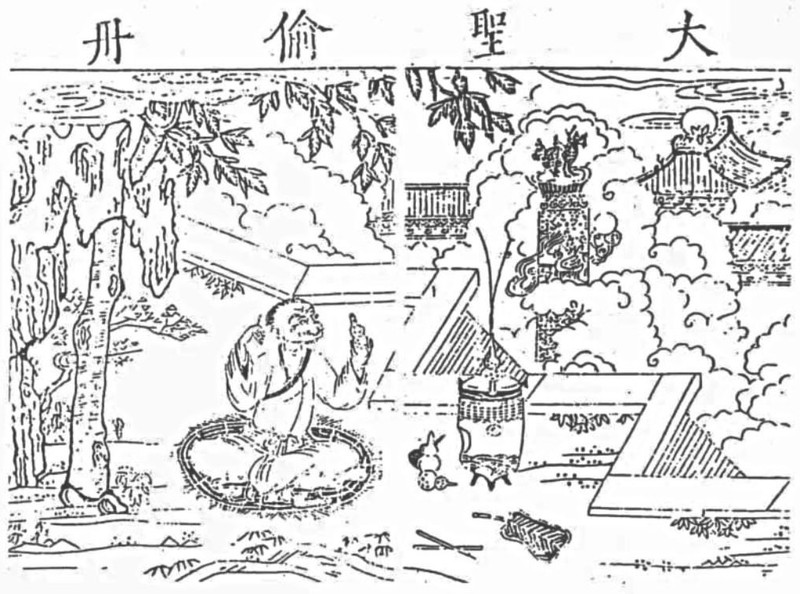
Searching around, our Great Sage went all the way to the alchemical room. He found no one but saw fire burning in an oven beside the hearth, and around the oven were five gourds in which finished elixir was stored. “This thing is the greatest treasure of immortals,” said the Great Sage happily. “Since old Monkey has understood the Way and comprehended the mystery of the Internal’s identity with the External, I have also wanted to produce some golden elixir [jin dan, 金丹] on my own to benefit people. While I have been too busy at other times even to think about going home to enjoy myself, good fortune has met me at the door today and presented me with this! As long as Laozi is not around, I’ll take a few tablets and try the taste of something new.” He poured out the contents of all the gourds and ate them like fried beans [chao dou, 炒豆] (emphasis added) [fig. 2].

In a moment, the effect of the elixir had dispelled that of the wine, and he again thought to himself, “Bad! Bad! I have brought on myself calamity greater than Heaven! If the Jade Emperor has knowledge of this, it’ll be difficult to preserve my life! Go! Go! Go! I’ll go back to the Region Below to be a king.” He ran out of the Tushita Palace and, avoiding the former way, left by the West Heaven Gate, making himself invisible by the magic of body concealment (Wu & Yu, 2012, p. 166).

這大聖直至丹房裡面,尋訪不遇。但見丹灶之傍,爐中有火。爐左右安放著五個葫蘆,葫蘆裡都是煉就的金丹。大聖喜道:「此物乃仙家之至寶。老孫自了道以來,識破了內外相同之理,也要煉些金丹濟人,不期到家無暇。今日有緣,卻又撞著此物。趁老子不在,等我吃他幾丸嘗新。」他就把那葫蘆都傾出來,就都吃了,如吃炒豆相似。

一時間,丹滿酒醒。又自己揣度道:「不好,不好!這場禍比天還大,若驚動玉帝,性命難存。走,走,走,不如下界為王去也。」他就跑出兜率宮,不行舊路,從西天門,使個隱身法逃去。

So we have immortality-bestowing alchemical pills described as beans, which can instantly cure the effects of alcohol, a mild poison. As noted above, Son Goku is based on Sun Wukong. Additionally, many other characters and episodes of the manga/anime were pulled directly from Journey to the West. So it’s not a stretch to think that Akira Toriyama, the creator, embellished the ability of these bean-like pills to create the Senzu.

Fig. 2 – “The Great Sage Steals the Elixir”, from Newly Engraved, Illustrated, Large-Character Official Edition of the Journey to the West (Xinke chuxiang guanban dazi Xiyouji, 新刻出像官板大字西遊記, 1592) (larger version).

2. Updates

Update: 11-20-21

I’ve written an article briefly listing the influences of Journey to the West on Dragon Ball.

Dragon Ball and Journey to the West

Sources:

Padula, D. (2015). Dragon Ball Culture (Vol. 5). (n.p.): Derek Padula.

Wu, C., & Yu, A. C. (2012). The Journey to the West (Vols. 1-4). Chicago, Illinois: University of Chicago Press.

The Origin of the Monkey King’s Punishment in Laozi’s Furnace

The beginning of Journey to the West (Xiyouji西遊記, 1592; “JTTW” hereafter) chapter seven sees Sun Wukong transported to the realm above to be executed for his rebellion against the primacy of heaven. However, his immortal body proves impervious to blades, fire, and lightning, leading Laozi to theorize that Monkey’s extreme invulnerability is the result of having consumed large quantities of immortal peaches, wine, and elixir that were later refined in his stomach “to form a single solid mass” (Wu & Yu, 2012, vol. 1, p. 188). The Daoist high god goes on to suggest that the demon be subjected to his Brazier of Eight Trigrams (Bagua lu, 八卦爐) in order to separate out the elixir and make his subsequently weakened body susceptible to death:

Arriving at the Tushita Palace, Laozi loosened the ropes on the Great Sage, pulled out the weapon from his breastbone, and pushed him into the Brazier of Eight Trigrams. He then ordered the Daoist who watched over the brazier and the page boy in charge of the fire to blow up a strong flame for the smelting process. The brazier, you see, was of eight compartments corresponding to the eight trigrams of Qian [☰/乾], Kan [☵/坎], Gen [☶/艮], Zhen [☳/震], Xun [☴/巽], Li [☲/離], Kun [☷/坤], and Dui [☱/兌]. The Great Sage crawled into the space beneath the compartment that corresponded to the Xun trigram. Now Xun symbolizes wind; where there is wind, there is no fire. However, wind could churn up smoke, which at that moment reddened his eyes, giving them a permanently inflamed condition. Hence they were sometimes called Fiery Eyes and Diamond Pupils (Wu & Yu, 2012, vol. 1, p. 189).

那老君到兜率宮,將大聖解去繩索,放了穿琵琶骨之器,推入八卦爐中,命看爐的道人、架火的童子,將火搧起鍛煉。原來那爐是乾、坎、艮、震、巽、離、坤、兌八卦。他即將身鑽在巽宮位下。巽乃風也,有風則無火。只是風攪得煙來,把一雙眼火煼紅了,弄做個老害病眼,故喚作「火眼金睛」。

Laozi checks the furnace forty-nine days later expecting ashes, but he is surprised when Sun emerges and kicks over the mystical oven (fig. 1). This episode has two likely sources.

Fig. 1 – Monkey knocking over Laozi’s furnace (larger version).

Table of Contents

1. Sources

1.1. The Story

The first source is The Story of How Tripitaka of the Great Tang Procures the Scriptures (Da Tang Sanzang qujing shihua大唐三藏取經詩話, c. late-13th century; “The Story” hereafter), the earliest known published edition of JTTW. The 17th chapter describes the trials of Daffy (Chi’na, 癡那), a merchant’s son, at the hands of his evil stepmother, a woman of the Meng clan (孟氏). She resents the boy as he stands to inherit all of his father’s wealth, leaving her son with nothing. Therefore, she and her handmaiden try to kill the heir by respectively boiling him in a pot, ripping out his tongue, starving him, and finally pushing him into a river, but each time he is magically saved by heaven. For instance, after four days boiling in the pot, Daffy emerges unscathed and claims:

[T]he iron cauldron changed into a lily pad on which I sat, surrounded by the cool waters of a pond. I could sleep or just sit there. It was very comfortable (Wivell, 1994, p. 1203).

一釜變化蓮花坐,四伴是冷水池;此中坐臥,甚是安穩。

Mair (1987) notes that the story of a youth being tortured by his stepmother is based on a Dunhuang transformation text with two versions dated 946 and 949, respectively (p. 43). The text focuses on the trials of the future Emperor Shun. [1] However, the boiling episode does not appear in the story.

1.2. Laughing at the Dao

The second source is Laughing at the Dao (Xiaodao lun, 笑道論, 570), an anti-Daoist polemic written as part of a court debate between Buddhist and Daoist representatives vying for state sponsorship. One section recounts Laozi’s rebirth in the mortal world and his later attempt to convert a king in India:

He [Laozi] had (long) hairs on the temples and his head was hoary; his body was sixteen feet tall; he wore a heavenly cap and held a metal staff. He took Yin Xi with him to convert the barbarians. (Once arrived in India) he withdrew to the Shouyang 首陽 mountains, covered by a purple cloud. The barbarian king suspected him of sorcery (妖). He (attempted) to boil him in a cauldron, but (the water) did not grow hot … [2]

頭鬢皓首身長丈六。戴天冠捉金杖。將尹喜化胡。隱首陽山。紫雲覆之。胡王疑妖。鑊煮而不熱。

I find this source particularly amusing because the high god of Daoism is in essence subjected to the same punishment as the one that he later suggests for Sun Wukong!

2. The Furnace in Daoist Alchemy

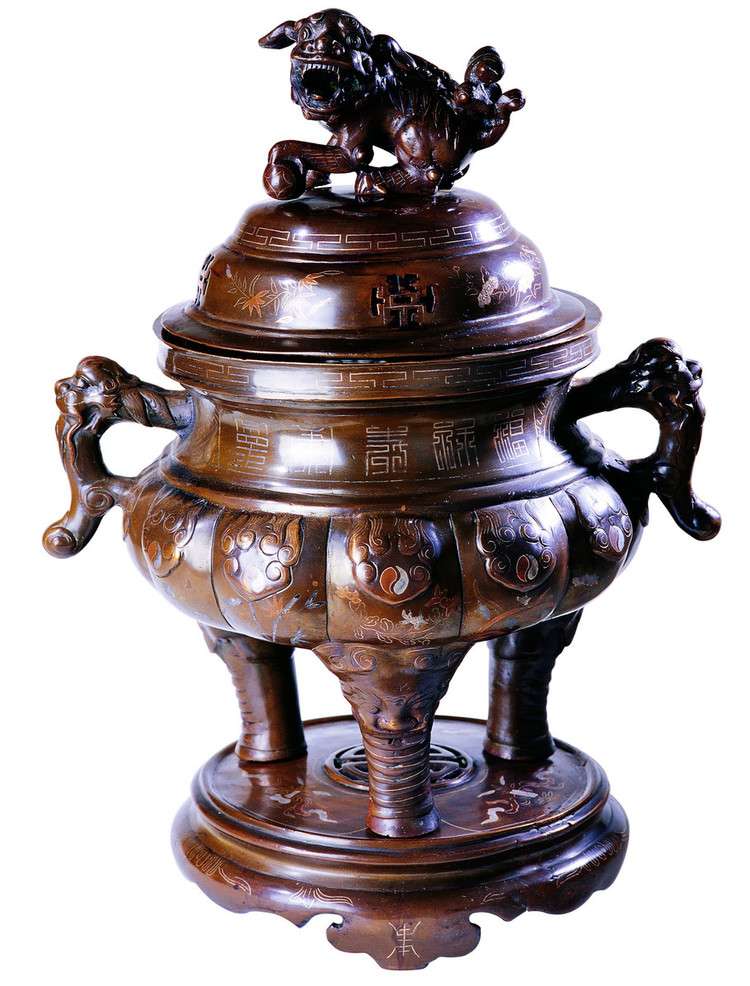
The furnace has two meanings in Daoist alchemy. The first refers to the physical vessel and stove (dinglu, 鼎爐) combo used in external alchemy (waidan, 外丹) to smelt the elixir of immortality (fig. 2). Kim (2008) describes the various parts and models of this contraption:

The reaction vessel has fire around it (when it is placed inside the heating apparatus), under it (when it is placed over the heating apparatus), or above it (when it is entirely covered by ashes inside the heating apparatus). It may contain an inner reaction-case in which the ingredients are placed. In a more complex model, a “water-vessel” containing water and a “fire-vessel” containing the ingredients can be assembled, the former above and the latter below or vice versa. The vessel must be hermetically closed and should not bear any openings or cracks.

The heating apparatus has fire within it and is often placed over a platform or “altar” (tan 壇). The openings on the wall sides allow air to circulate, while those on the top serve to settle the reaction vessel or to emit flame and smoke. One of the main functions of the heating apparatus is to control the intensity and duration of the heat. (pp. 360-361)

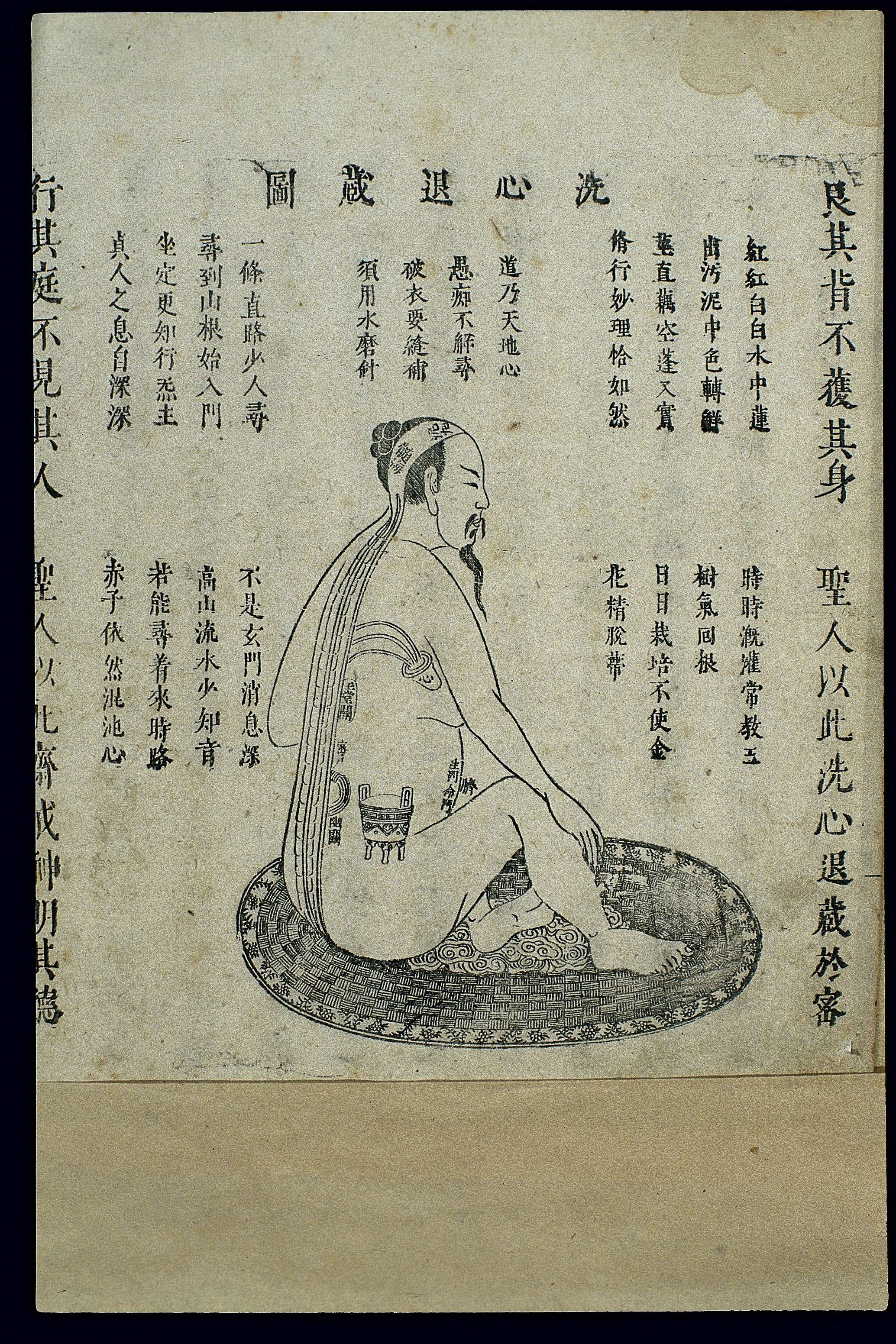
Fig. 2 – An ornate wooden replica dinglu reminiscent of the metal type used in external alchemy (larger version). Fig. 3 – An early 17th-century woodblock print depicting a Daoist practitioner’s dantian as a ding vessel (larger version).

The concept of consuming alchemically derived elixirs is first mentioned in Discourses on Salt and Iron (Yantie tun, 鹽鐵論, c. 60 BCE). Later, the Token for the Agreement of the Three According to the Book of Changes (Zhouyi cantong qi, 周易參同契, c. 2nd century CE; “The Token” hereafter) standardized the use of toxic materials, such as lead and mercury, for making said elixir, and this idea remained entrenched until the Tang Dynasty (618–907 CE) (Pregadio, 2008, pp. 1002-1003). External alchemy was eventually superseded in popularity by internal alchemy (neidan, 内丹) from the Tang onward and was still popular during the Ming Dynasty (1368–1644 CE) when the standard 1592 version of JTTW was published.

The second meaning is the human body as a metaphor for the furnace—i.e. internal alchemy. The Token considers “the 5 organs, 12 vessels, 24 vertebrae, and 360 joints … all part of this body dinglu” (Wang, 2012, p. 192). The corporal furnace, the ingredients (yao, 藥), and the firing time (huohou, 火候) combine to make the “three essentials” (sanyao, 三要) of internal alchemy (Robinet, 2008). The ingredients are yin and yang energy, and the firing time is the measured absorption of said energies and the time at which this activity is partaken (Wang, 2012, pp. 192-193).

3. External vs Internal in JTTW

Laozi’s use of the Eight Trigrams Furnace stands as a perfect example of external alchemy, and Sun’s use of breathing exercises and qi circulation serves as a prime example of internal alchemy. So how are these competing processes depicted in JTTW? Well, recall that the external type had long been supplanted by the internal type by the time the novel was published. Hence, one could say Laozi’s methods were dated compared to those used by Monkey. This might then explain a surprising story element from JTTW chapter seven.

When Sun first escapes from the furnace, “Laozi rushes up to clutch at him, only to be greeted by such a violent shove that he falls head over heels while the Great Sage escapes” (based on Wu & Yu, 2012, vol. 1, p. 189). Think about that for a moment. Monkey, a proponent of internal alchemy, physically assaults the Daoist high god, a proponent of external alchemy. Add to this the fact that Sun seemingly only respects/fears immortals that promote internal alchemy—a good example being his first master, Patriarch Subodhi (Xuputi zushi, 須菩提祖師)—and a picture begins to form: perhaps this is the JTTW author-compiler’s way of touting the superiority of the internal over the external. What do you think?

4. Conclusion

Monkey’s time in Laozi’s furnace likely borrows from (one or both of) two sources, the story of a child magically surviving boiling in The Story, the 13th century CE precursor of JTTW, and the story of Laozi magically surviving boiling from Laughing at the Dao, an anti-Daoist polemic of the 6th-century CE. The latter is humorous as it shows Monkey’s punishment is a recapitulation of the high god’s punishment.

JTTW presents two forms of alchemy: the concept of Laozi’s furnace refers to “external” alchemy and harkens back to Han Dynasty China when alchemists used such furnaces to fire toxic mercury and lead in an attempt to produce an elixir of immortality; Sun Wukong’s use of breathing exercises and qi circulation is a prime example of “internal” alchemy in which the body is used as the furnace to fire the immortal elixir. External alchemy fell out of favor during the Tang and was superseded by Internal alchemy from then on into the Ming, when JTTW was published. Therefore, the novel portrays the high god of Daoism as a proponent of the dated external school, while immortals like Monkey are portrayed as proponents of the then current internal school.

Notes:

1) For a complete translation, see Bodman (1994).

2) See Zürcher & Teiser (2007), pp. 299-300 and 431 n. 53.

Sources:

Bodman, R. W. (1994). The Transformation Text on the Boy Shun’s Extreme Filial Piety. In V. H. Mair (Ed.), The Columbia Anthology of Traditional Chinese Literature (pp. 1128-1134). New York: Columbia University Press.

Kim, D. (2008). Dinglu: I. Waidan In F. Pregadio (Ed.), The Encyclopedia of Taoism (2 Vols.) (pp. 360-361). London [u.a.: Routledge].

Mair, V. H. (1987). Parallels Between Some Tun-Huang Manuscripts and the 17th Chapter of the Kozanji Journey to the West. Cahiers d’Extrême-Asie, 3, 41-53.

Pregadio, F. (2008). Waidan In F. Pregadio (Ed.), The Encyclopedia of Taoism (2 Vols.) (pp. 1002-1005). London [u.a.: Routledge].

Robinet, I. (2008). Dinglu: II. Neidan In F. Pregadio (Ed.), The Encyclopedia of Taoism (2 Vols.) (pp. 361-362). London [u.a.: Routledge].

Wang, R. (2012). Yinyang: The Way of Heaven and Earth in Chinese Thought and Culture. Cambridge: Cambridge University Press.

Wivell, C. S. (1994). The Story of How the Monk Tripitaka of the Great Country of T’ang Brought Back the Sūtras. In Mair, Victor H. The Columbia anthology of traditional Chinese literature (pp. 1181-1207). New York: Columbia University Press.

Wu, C., & Yu, A. C. (2012). The Journey to the West (Vols. 1-4) (Rev. ed.). Chicago, Illinois: University of Chicago Press.

Zürcher, E., & Teiser, S. F. (2007). The Buddhist Conquest of China: The Spread and Adaptation of Buddhism in Early Medieval China. Leiden: Brill.