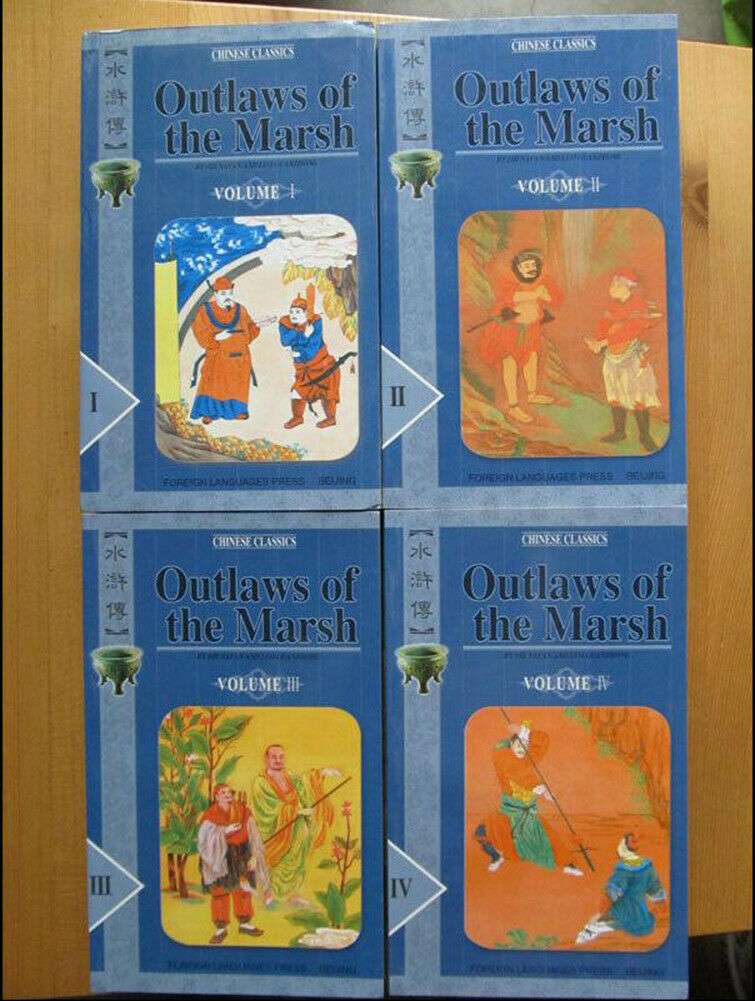
Archive #53 – PDFs of Outlaws of the Marsh (a.k.a. Water Margin) Foreign Language Press English Translation (Vols. 1-4)

Note: My blog is not monetized, so I am not making any money from this post. My hope is that the PDF will make this legendary story more accessible to a wider audience. If you enjoyed the digital version, please, please, please support the official release.

Last updated: 05-31-2026

Here I present a PDF of the 100-chapter Foreign Language Press four-volume boxed set of Outlaws of the Marsh (a.k.a. Water Margin, Shuihu zhuan, 水滸傳, c. 1400; “WM” hereafter) translated by Sidney Shapiro. Credited to Shi Nai’an and Luo Guanzhong, this classic Chinese military romance follows 108 heavenly and earthly spirits-reborn-heroes who band together and use their great physical or mental strengths to rebel against the falling Song Dynasty (960–1279). Some of the surviving members later accept clemency from the government and work to fight the barbarian hordes invading China. Few live to old age.

Table of Contents

1. Influence on JTTW

I’m archiving this book because it has a deep connection with Journey to the West (Xiyouji, 西遊記, 1592; “JTTW” hereafter). Here are a few examples. First, the name and number of Sun Wukong‘s “Multitude of Terrestrial Killers” (Disha shu地煞數; a.k.a. his “72 kinds of transformations,” qishier ban bianhua七十二般變化) and Zhu Bajie’s “Multitude of Celestial Rectifiers” (Tiangang shu天罡數; a.k.a. his “36 kinds of transformations,” sanshiliu ban bianhua三十六般變化) are similar to that of the spirits mentioned above. [1] In WM ch. 2, they are called the “Stars of the 36 Celestial Rectifiers and of the 72 Terrestrial Killers—a total of 108 Demon Lords” (三十六員天罡星,七十二座地煞星,共是一百單八個魔君) (Meulenbeld, 2019, p. 5; Shi & Luo, 1975/2021b, vol. 1,  p. 16). [2] Second, see my previous article analyzing the parallels between the Monkey King and the bandit Wu Song (武松). See also the sister article over at the Journey to the West Library blog. And third, I’ve previously suggested that Sun’s ploy to rescue the beleaguered wife of Zhu Bajie in JTTW ch. 18 is based on an event from WM ch. 5. Both feature:

  • Young, beautiful daughters in unwanted relationships (Green Orchid vs the unnamed maiden).
  • Elderly fathers worried for their child (Mr. Gao vs Mr. Liu).
  • Evil spirit-turned-inhumanly strong, hot-tempered, heavy metal staff-wielding martial monks who come to their aid (Sun Wukong vs Lu Zhishen).
  • The monk takes the place of the woman in a darkened room.
  • The villain is beaten (Zhu Bajie vs Zhou Tong) (Wu & Yu, 2012, vol. 1, pp. 374-377; Shi & Luo, 1993/2001a, pp. 109-113).

2. Other Archived Classics

This PDF will complement the translations that I’ve previously archived. These include the JTTW story cycle (here and here), the four-volume 2000 Library of Chinese Classics Chinese-English bilingual edition of Creation of the Gods (Fengshen yanyi封神演義, c. 1620 CE), a fan translation of Journey to the South (Nanyouji南遊記, c. 1570s-1580s), and the four-volume 2001 Foreign Language Press boxed set of Three Kingdoms (Sanguo yanyi三國演義; lit: “Romance of the Three Kingdoms,” 14th century.).

Click to access Outlaws-of-the-Marsh.pdf

Fig. 1 – The four covers of the boxed set edition (larger version). Image found here.

4. Updates

4.1. Influence on JTTW – Part 2

Another possible influence recently dawned on me while updating WM citations on a past article. Recall that the bandit-monk Wu Song shares several connections with Sun Wukong. Well, in WM chapters 31 and 32, Wu swordfights and finally decapitates an evil Daoist (Shi & Luo, 1993/2001a, vol. 2, pp. 643-645; Shi & Luo, 1975/2021b, vol. 1, pp. 427-428). A young maiden previous held hostage by the fiend goes on to reveal that he had taken the nickname “Flying Centipede” (Fetian wugong, 飛天蜈蚣) because the local area was known as “Centipede Ridge” (Wugong feng, 蜈蚣峰) (Shi & Luo, 1975/2021b, vol. 2,  pp. 428-429). [3] This bad guy might foretell the Demon Lord of a Hundred Eyes (Baiyan mojun, 百眼魔君), an evil, sword-wielding Daoist centipede spirit (wugong jing, 蜈蚣精) that Monkey fights in JTTW chapter 73.

Notes:

1) Anthony C. Yu (Wu & Yu, 2012) translates these as the “Art of the Heavenly Ladle” and the “Art of the Earthly Multitude” (vol. 1, p. 122). I instead follow the translation used by Meulenbeld (2019). In regards to Tiangang (天罡), he explains: “In its exorcist manifestation, the Northern Dipper is known as gang 罡, which I translate here as ‘rectifier’ due to the ritual function it has in righting wrong” (Meulenbeld, 2019, p. 7). “Terrestrial Killers” is a direct translation of Disha (地煞).

2) Shapiro translates these as the “[t]hirty-six stars of Heavenly spirits and seventy two stars of Earthly Fiends, a total of one hundred and eight demons” (Shi & Luo, 1993/2001a, vol. 1, p. 16). Each of the 108 bandits is later associated with a particular star in WM ch. 71 (Shi & Luo, 1993/2001a, vol. 4, pp. 1499-1501; Shi & Luo, 1975/2021b, vol. 3,  pp. 972-975).

3) Shapiro incorrectly translates the location as “Centipede Hill” (Shi & Luo, 1993/2001a, vol. 2, p. 646). I have corrected the area name above based on the original Chinese.

Sources:

Meulenbeld, M. (2019). Vernacular “Fiction” and Celestial Script: A Daoist Manual for the Use of Water Margin. Religions10(9), 518. MDPI AG. Retrieved from http://dx.doi.org/10.3390/rel10090518.

Shi, N., & Luo, G. (2001a). Outlaws of the Marsh (Vols. 1-4) (S. Shapiro, Trans.). Beijing: Foreign Languages Press. (Original work published 1993)

Shi, N., & Luo, G. (2021b). Shuihu zhuan (shangzhongxia) [Tale of the Water Margin (Vols. 1-3)]. Beijing: Renmin wenxue chubanshe. (Original work published 1975)

Wu, C., & Yu, A. C. (2012). The Journey to the West (Vols. 1-4) (Rev. ed.). Chicago, Illinois: University of Chicago Press.

The Past Life Biography of Zhu Bajie

Last updated: 04-09-2025

A twitter user asked me in late 2024 where Zhu Bajie (豬八戒; fig. 1) learned his “36 transformations” (sanshiliu ban bianhua, 三十六般變化). I told them that chapters 19 and 85 of Journey to the West (Xiyouji西遊記; “JTTW” hereafter) contain biographical poems, one of which explains his internal alchemy (neidan, 内丹) training under an immortal and ascension to godhood. I suggested that his past human life learned the magic changes during this time, but after answering the question, it dawned on me that many people may not be aware of these verses. I have, therefore, decided to post and analyze said poems for the benefit of my readers.

This is the second of three articles where I will present info about the disciples’ lives prior to the main events of JTTW. My next article will follow with Sha Wujing‘s (沙悟净) poem. Click here to read the first post about the White Dragon Horse (Bai longma, 白龍馬). These are meant to compliment my previous essay about Sun Wukong (孫悟空).

(On a related note, see here for the oldest known depictions of Zhu Bajie. They come from 14th-century Korea!)

Fig. 1 – A novel accurate depiction of the Tang Monk’s disciples, including our hog hero (top left) (larger version). Artwork by @真·迪绝人 (see here and here).

Table of Contents

1. The Poems

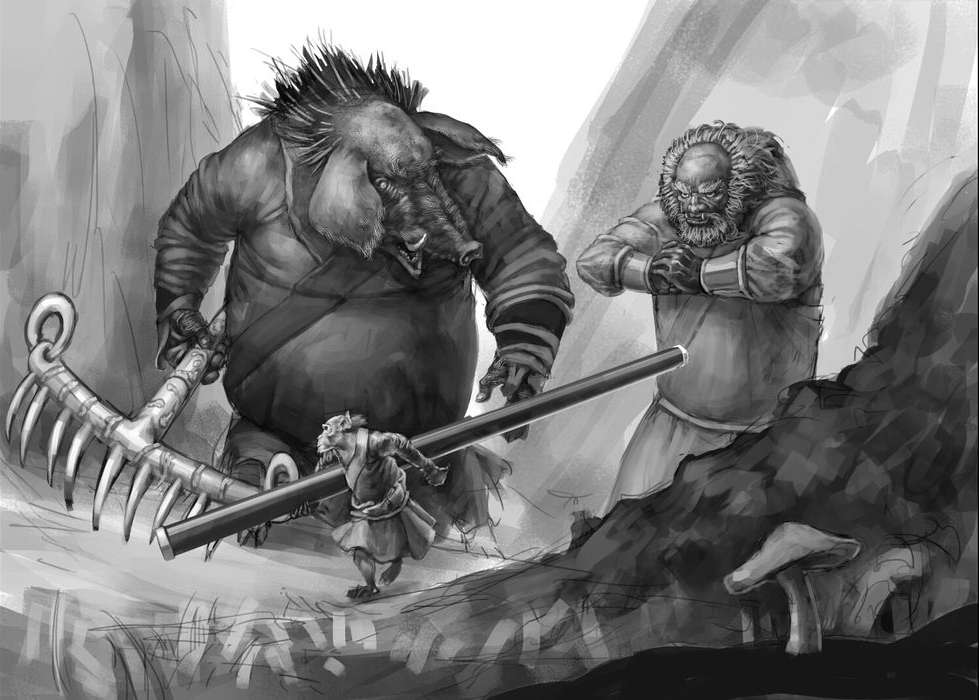
The novel actually presents two contradictory verses on the origins of our beloved pig-monster. One (ch. 19) portrays him as a human-turned-immortal commander of heavenly forces, while the other (ch. 85) alludes to him being a powerful hog-spirit given celestial rank.

1.1. Chapter 19

This poem is chock-full of internal alchemical jargon, so I’m placing explanatory notes just below the blockquote to save readers from having to scroll to the very bottom of the article every time a new concept is mentioned.

My mind was dim since the time of youth;
Always I loved my indolence and sloth.
Neither nursing nature nor seeking the Real,
I passed my days deluded and confused.
I met a true immortal suddenly
Who sat and spoke to me of cold and heat. [A]
‘Repent,’ he said, ‘and cease your worldly way:
From taking life accrues a boundless curse.
One day when the Great Limit ends your lot,
For eight woes and three ways you’ll grieve too late!’ 
I listened and turned my will to mend my ways:
I heard, repented, and sought the wondrous rune.
By fate my teacher he became at once,
Pointing to the Heavenly and Earthly Passes. [B]
Taught to forge the Great Pill Nine Times Reversed, [C]
I worked without pause through day and night
To reach Mud-Pill Palace topping my skull [D]
And Jetting-Spring Points on soles of my feet. [E]
With kidney brine flooding the Floral Pool, [F]
My Cinnabar Field was thus warmly nursed. [G]
Baby and Fair Girl mated as yin and yang[H]
Lead and mercury mixed as sun and moon. [I]
In concord Li-dragon and Kan-tiger used, [J]
The spirit turtle sucked dry the gold crow’s blood. [K]
‘Three flowers joined on top,’ the root reclaimed [L];
‘Five breaths faced their source’ and all freely flowed. [M]
My merit done, I ascended on high,
Met by pairs of immortals from the sky.
Radiant pink clouds arose beneath my feet;
With light, sound frame I faced the Golden Arch.
The Jade Emperor gave a banquet for gods
Who sat in rows according to their ranks.
Made a marshal of the Celestial Stream,
I took command of both sailors and ships.
Because Queen Mother gave the Peaches Feast
When she met her guests at the Jasper Pool
My mind turned hazy for I got dead drunk,
A shameless rowdy reeling left and right.
Boldly I barged into Vast Cold Palace
Where the charming fairy received me in.
When I saw her face that would snare one’s soul,
My carnal itch of old could not be stopped!
Without regard for manners or for rank,
I grabbed Miss Chang’e asking her to bed.
For three or four times she rejected me:
Hiding east and west, she was sore annoyed.
My passion sky-high I roared like thunder,
Almost toppling the arch of Heaven’s gate.
Inspector General told the Emperor Jade;
I was destined that day to meet my fate.
The Vast Cold completely enclosed airtight
Left me no way to run or to escape.
Then I was caught by the various gods,
Undaunted still, for wine was in my heart.
Bound and taken to see the Emperor Jade,
By law I should have been condemned to death.
It was Venus the Gold Star, Mr. Li,
Who left the ranks and knelt to beg for me.
My punishment changed to two thousand blows,
My flesh was torn; my bones did almost crack.
Alive! I was banished from Heaven’s gate
To make my home beneath the Fuling Mount.
An errant womb’s my sinful destination: Stiff-Bristle Hog’s my worldly appellation!” (Wu & Yu, 2012, vol. 1, pp. 378-379).

自小生來心性拙,貪閑愛懶無休歇。
不曾養性與修真,混沌迷心熬日月。
忽然閑裡遇真仙,就把寒溫坐下說。
勸我回心莫墮凡,傷生造下無邊孽。
有朝大限命終時,八難三途悔不喋。
聽言意轉要修行,聞語心回求妙訣。
有緣立地拜為師,指示天關並地[關]
得傳九轉大還丹,工夫晝夜無時輟。
上至頂門泥丸宮,下至腳板湧泉穴。
周流腎水入華池,丹田補得溫溫熱。
嬰兒姹女配陰陽,鉛汞相投分日月。
離龍坎虎用調和,靈龜吸盡金烏血。
三花聚頂得歸根,五氣朝元通透徹。
功圓行滿卻飛昇,天仙對對來迎接。
朗然足下彩雲生,身輕體健朝金闕。
玉皇設宴會群仙,各分品級排班列。
敕封元帥管天河,總督水兵稱憲節。
只因王母會蟠桃,開宴瑤池邀眾客。
那時酒醉意昏沉,東倒西歪亂撒潑。
逞雄撞入廣寒宮,風流仙子來相接。
見他容貌挾人魂,舊日凡心難得滅。
全無上下失尊卑,扯住嫦娥要陪歇。
再三再四不依從,東躲西藏心不悅。
色膽如天叫似雷,險些震倒天關闕。
糾察靈官奏玉皇,那日吾當命運拙。
廣寒圍困不通風,進退無門難得脫。
卻被諸神拿住我,酒在心頭還不怯。
押赴靈霄見玉皇,依律問成該處決。
多虧太白李金星,出班俯顖親言說。
改刑重責二千鎚,肉綻皮開骨將折。
放生遭貶出天關,福陵山下圖家業。
我因有罪錯投胎,俗名喚做豬剛鬣。(source)

Footnotes:

A) “[C]old and heat,” (riyue, 日月; lit: “sun and moon”) refers to respective yang and yin energies (Pregadio, 2025p; see also Wu & Yu, 2012, vol. 1, p. 527 n. 2).

B) The original Chinese, “天關並地” (tianguan bing dique, or “heavenly passes and earthly watchtowers(?)”), is a likely typo for “天關並地” (tianguan bing diguan, or “heavenly and earthly passes”). These respectively refer to the head and feet (Pregadio, 2025d, 2025s). I’ve therefore altered Yu’s (Wu & Yu, 2012) translation.

C) The “Great Pill [i.e. Elixir] Nine Times Reversed” (jiuzhuan da huandan, 九轉大還丹) was originally an external alchemical process where a concoction of toxic elements was purified over successive firings in a crucible to create a drug of immortality (see section 3.1. of this article). However, the term was coopted by later proponents of internal alchemy, who associated the ingestion and circulation of immortality-bestowing cosmic energies within pathways between bodily organs with a complex five phases-influenced numerology (Pregadio, 2025b, 2025n). Needham (1954, as cited in Wu & Yu, 2012) adds that it refers “to a chhi [qi, pneumatic vitality, breath] or substance generated by techniques purposefully within the human body which would bring about a reversion of the tissues from an ageing state to an infantile state” (vo. 1, p. 527 n. 4).

D) The “Mud-Pill Palace” (niwan gong, 泥丸宮) is a name for the upper cinnabar field in the head (Pregadio, 2025m; Wu & Yu, 2012, vol. 1, p. 528 n. 6).

E) The “Jetting-Spring Points” (yongquan xue, 湧泉穴) are pressure points on the bottom of the feet (Wu & Yu, 2012, vol. 1, p. 528 n. 7).

F) Yu (Wu & Yu, 2012) explains that spiritual energies contained in the kidneys (which are associated with the water element) can be directed to different parts of the practitioner’s body, including a spot under the tongue, the “Floral pool” (huachi, 華池) (vol. 1, p. 528 n. 8; see also Pregadio, 2025r). While this is no doubt the correct answer, it’s important to note that internal alchemy also uses the term Floral pool to refer to true yang energy inside yin (Pregadio, 2025h). The corresponding term is “spirit water” (shenshui, 神水), which denotes true yin energy inside yang—think of the white and black dots inside of the Taiji symbol (Pregadio, 2025h). Therefore, the poem’s original Chinese “腎水入華池” (shenshui ru huachi, or “kidney brine flooding the floral pool”) could also be a reference to the similarly-sounding phrase “神水入華池” (shenshui ru huachi, or “spirit water flooding the floral pool), or the mixture of yang and yin, respectively.

G) The “Cinnabar Field” (dantian, 丹田) is one of three spiritual centers in the body, which is located between 1.3 to 3.6 Chinese inches (cun, 寸; 1 = 1.25 in/3.18 cm) below (or behind) the belly button. The Cinnabar Field is believed to store cosmic/bodily energies, that when circulated and refined, produce an immortal alchemical embryo—i.e. a fledgling immortal spirit avatar (Pregadio, 2025c; see also Wu & Yu, 2012, vol. 1, p. 528 n. 9). And “warmly nursed” (bu de wenwen’re, 補得溫溫熱) may refer to “nourishing warmly” (wenyang, 溫養), or the process of “gestati[ng] the alchemical embryo” (Pregadio, 2025t).

H) The “Baby and Fair Girl” (ying’er chanu, 嬰兒姹女) are anthropomorphic personas of yang and yin energy, respectively (Pregadio, 2025a, 2025w; see also Wu & Yu, 2012, vol. 1, p. 528 n. 10).

I) The elemental and celestial imagery of “lead and mercury” (qian gong/hong, 鉛汞) and “sun and moon” (riyue, 日月) refer to yang and yin energies, respectively (Pregadio, 2025g, 2025o, 2025p).

J) The third eight trigram figure, Li (/☲), is associated with dragons (long, ), and both symbolize yang energy. The sixth figure, Kan (/☵), is associated with tigers (hu, ), and both symbolize yin energy (fig. 2) (Pregadio, 2025j, 2025k, 2025l; see also Wu & Yu, 2012, vol. 1, p. 529 n. 11).

K) Yu (Wu & Yu, 2012) suggests that “turtle” (gui, ) “may be another name for the dark liquid of the kidneys” (vol. 1, p. 529 n. 12). He continues, “[T]he gold crow indicates the sun or the heart. The line refers to the union of yin and yang through the absorption of yang energy by yin” (Wu & Yu, 2012, vol. 1, p. 529 n. 12). While I agree that this refers to the mixing of said energies, it’s important to note, however, that turtles are usually paired with “snakes” (she, 蛇), both being anthropomorphic symbols of jing-essence and qi-breath (精氣), respectively (Pregadio, 2025f). Additionally, the “gold crow” (jinwu, 金烏), an anthropomorphic symbol of true yin inside yang energy, is normally paired with the “jade rabbit” (yutu, 玉兔), an anthropomorphic symbol of true yang inside yin (Pregadio, 2025i, 2025y). Similarly, “blood” (xue, ) represents true yin inside of yang (Pregadio, 2025v).

L) The “Three flowers” (sanhua, 三花) is another name for jing-essence, qi-breath, and shen-spirit (精氣神), three important bio-spiritual substances/energies. These must be “joined on top” (juding, 聚頂), or concentrated in the head (the upper cinnabar field) during the internal alchemical process (Wu & Yu, 2012, vol. 1, p. 529 n. 13; see also Pregadio, 2025q). This leads to the “root [being] reclaimed” (guigen, 歸根), which refers to “[g]oing back to the root and returning to the mandate” (guigen fuming, 歸根復命), or achieving immortality (Pregadio, 2025e).

M) Yu (Wu & Yu, 2012) explains, “Five breaths … wuqi chaoyuan 五氣朝元, refers to the pneumatic vitality, qi, of the five viscera (heart, liver, spleen, lungs, and kidneys) in harmonious balance” (Wu & Yu, 2012, vol. 1, p. 529 n. 14). A related view is that said viscera are synced with bio-spiritual substances or mental concepts—ie. hun/liver, jing-essence/kidneys, spirit/heart, po/lungs, intention/spleen—when a practitioner has learned to quiet their senses and still their body (Pregadio, 2025u).

Fig. 2 – An internal alchemy diagram of a Daoist cultivator circulating yang and yin energies, which are respectively represented by the eight trigrams figures (Li, ) and (Kan, ) and the elements fire and water (larger version). Image found here. I believe it originally comes from the Anthology of Immortals of Complete Perfection (Quanzhen qunxian ji, 全真群仙集, 1483).

1.2. Explanation

Zhu was originally a lazy, aimless man, but he encountered a celestial who told him to mend his ways, or else he would be reborn in the lower three Buddhist realms of hell, hungry ghosts, or animals, making it impossible for him to hear the Buddha’s teachings (an example of the novel’s syncretic unity). Upon repenting, he studied under the immortal, learning the art of internal alchemy, which involved absorbing and circulating vital energies around his body. Once he had attained transcendence, he rose on clouds to be escorted by other celestials into the heavenly realm, where he was appointed marshal of the heavenly navy, which sailed the cosmic river of the Milky Way Galaxy.

But his great achievement was tainted when he got drunk at the Queen Mother’s peach banquet and, being aroused by Chang’e’s dazzling beauty (fig. 3), chased her to the moon palace. He propositioned the goddess for sex several times, but her refusals sent him into a powerful rage. The protector deity Wang Lingguan reported this to the Jade Emperor, who had the moon palace surrounded by heavenly soldiers. The Marshal was soon captured and sentenced to death, but the planet Venus asked for lenience, leading to Zhu’s past life being beaten 2,000 times and banished from the heavenly realm. His divine spirit sought reincarnation in the mortal realm below, but an accident of fate led to his rebirth as a pig-spirit. He later took the name “Stiff-Bristles Hog” (Zhu Ganglie, 豬剛鬣) based on his porcine appearance.

Zhu Bajie-Chang'e stamp

Fig. 3 – A Taiwanese stamp reading, “Drunkenly playing Chang’e” (Zuixi Change, 醉戲嫦娥) (larger version). It’s likely meant to serve as a visual reminder of Zhu’s early story arc involving the events leading to his banishment from heaven and rebirth as a hog-spirit.

1.3. Chapter 85

With huge mouth and fangs I’ve great magic might.
Emperor Jade made me Marshal Heavenly Reeds.
The boss of Heaven’s eighty-thousand marines,
Comforts and joys I had in the halls of light.
Because I mocked a palace maiden when I was drunk
And flaunted my strength at a wrongful hour
One shove of my snout toppled the DipperOx Palace;
Queen Mother’s divine herbs I then devoured
Emperor Jade pounded me two thousand times
And banished me from the Three Heavens realm.
Though told to nourish my primal spirit,
I became again a monster down below.
About to marry at the Village Gao, I met Brother Sun—’twas my wretched fate!
Quite defeated by his golden-hooped rod,
I had to bow and take the Buddhist vow:
A coolie who bears luggage and leads the horse,
Who owes, in former life, the Tang Monk a debt!
This iron-legged Heavenly Reed‘s name is Zhu;
And my religious name is Zhu Eight Rules(based on Wu & Yu, 2012, vol. 4, pp. 149-150).

巨口獠牙神力大,玉皇陞我天蓬帥。
掌管天河八萬兵,天宮快樂多自在。
只因酒醉戲宮娥,那時就把英雄賣。
一嘴拱倒斗牛宮,吃了王母靈芝菜。
玉皇親打二千鎚,把吾貶下三天界。
教吾立志養元神,下方卻又為妖怪。
正在高莊喜結親,命低撞著孫兄在。
金箍棒下受他降,低頭才把沙門拜。
背馬挑包做夯工,前生少了唐僧債。
鐵腳天蓬本姓豬,法名喚作豬八戒。(source)

1.4. Explanation

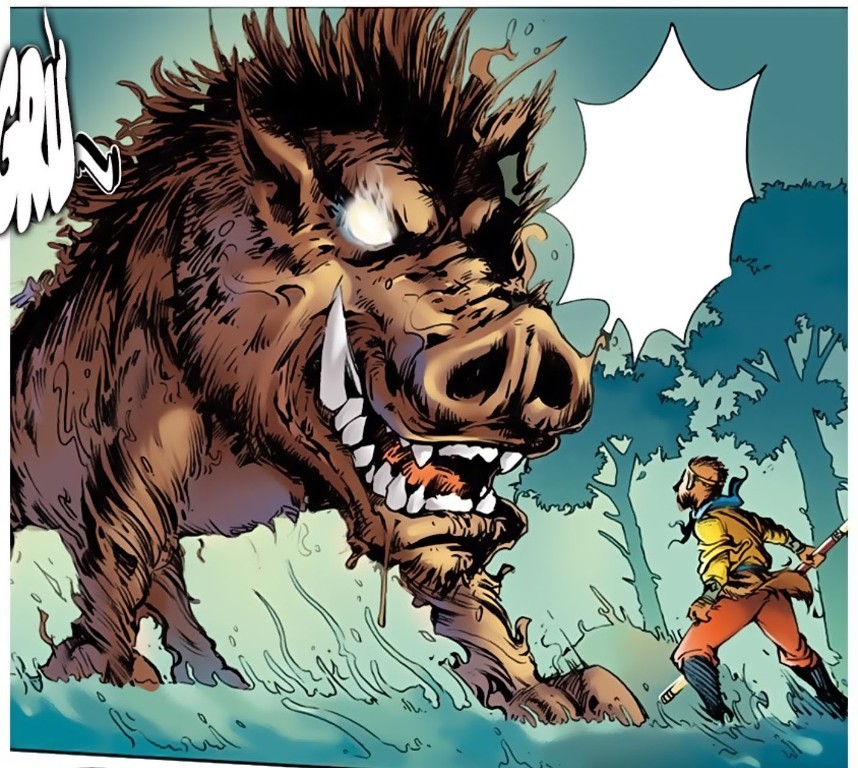
He was originally a pig-spirit with sharp tusks and powerful magic (fig. 4) who was appointed Marshal Tianpeng, commander of the 80,000-strong celestial navy. He enjoyed his new life among the godly ranks but later got drunk (at the Queen Mother’s banquet) and performed a number of forbidden deeds: mistreating a moon goddess, knocking over the Dipper-Ox Palace, and eating the Queen mother’s magic mushrooms. This resulted in a punishment of 2,000 strokes and banishment from heaven, with the added instruction to cultivate his spirit while on earth. But he once again became a monster, and at some point,  he took a wife in Gao Village. He was subsequently defeated by Monkey and forced to take the Buddhist vows, serving as Tripitaka’s disciple and luggage handler. His discipleship may have been the karmic result of a good deed that his master performed for him in a past life.

Fig. 4 – Zhu’s giant boar form from the manhua Journey to the West (Xiyouji, 西遊記) (larger version).

2. Which is True?

Both poems provide certain information that is consistent with internal narrative details, such as:

  • Zhu originally serving as Marshal Heavenly Reed (Tianpeng yuanshuai, 天蓬元帥; lit: “Marshal of Heavenly Mugwort“), commander of the 80,000 soldiers of the celestial navy (and a historical deity) (fig. 5)
  • Getting drunk at the peach festival and harassing a moon goddess
  • Being beaten 2,000 times as punishment and exiled to the mortal world
  • Mistakenly being reborn as Stiff-Bristles Hog, a bloodthirsty pig-monster in Fuling Mountain (Fuling shan, 福陵山)
  • Eventually taking a wife in Gao Village (Gao zhuang, 高莊)
  • Being defeated by Sun Wukong
  • Becoming Zhu Bajie, a Buddhist disciple of Tripitaka
  • Acting as a coolie carrying the luggage

But the real question is: was Zhu originally human or a pig-spirit? I think the first poem is likely true (within the narrative) given the amount of detail that he provides about the alchemical processes that eventually led to his immortality and ascension to godhood. The second poem is cursory in comparison and seems like something that was made up on the spot to embellish his might—perhaps influenced by stories of Sun Wukong’s past havoc in heaven—or monstrous pedigree in the face of a demonic opponent (refer to the events in chapter 85). One detail pointing to this is his claim of knocking over the “Dipper-Ox Palace” (Douniu gong, 斗牛宮), which references the stars of the Southern Dipper and Ox mansions (Stephenson, 2008, p. 517). He’s therefore asserting that he can collapse entire constellations. That’s definitely nonsense as Zhu is often overpowered and defeated in battle, even by groups of little fiends (Wu & Yu, 2012, vol. 2, pp. 102-103, for example).

Fig. 5 – A historical painting of “Great Marshal Tianpeng” (Tianpeng da yuanshui, 天蓬大元帥) from the Ink Treasures of Wu Daozi (Daozi mobao, 道子墨寶, 13th-century), (larger version). Image altered for clarity.

3. Additional Info

The poems actually leave out several details about Zhu’s past and current lives.

  1. The Chang’e (嫦娥) mentioned above is not the singular goddess but one of many such named divine maidens in the entourage of the “Star Lord of Supreme Yin” (Taiyin xingjun, 太陰星君), the aged devi of the moon. [1]
  2. He mauled his sow mother and piglet siblings to death sometime after his mistaken rebirth in Fuling Mountain (Wu & Yu, 2012, vol. 1, p. 212).
  3. His first wife, “Second Elder Sister Mao” (Mao erjie, 夘二姐), [2] a likely rabbit spirit, [3] was the original owner of his Cloudy Paths Cave (Yunzhan dong, 雲棧洞) (Wu & Yu, 2012, vol. 1, p. 212). But sadly, she died less than a year after their marriage (Wu & Yu, 2012, vol. 1, p. 212). Their tragic love story would be good fodder for fanfiction.
  4. He was invited by the Crow’s Nest Chan Master (Wuchao chanshi烏巢禪師), a Buddhist sage, to practice austerities, but he passed on the opportunity.
  5. Years prior to being called Zhu Bajie, he submitted to Buddhism at the behest of the bodhisattva Guanyin and was given the religious name “Zhu Wuneng” (豬悟能, “Pig Who Awakens to Power”) (Wu & Yu, 2012, vol. 1, p. 213).
  6. Sometime after adopting a vegetarian diet, [4] he magically transformed into a “stout, swarthy [human] fellow” (hei pang han, 黑胖漢) in order to fraudulently arrange a marriage with his second wife, “Green Orchid” (Cui’lan, 翠蘭), a maiden from Gao Village in Tibet (Wusizang, 烏斯藏) (Wu & Yu, 2012, vol. 1, p. 372). [5]
  7. The Gao family grew rich from his supernatural labors in the field (Wu & Yu, 2012, vol. 1, pp. 375 and 381).
  8. But he was abusive to his wife, locking her inside a back building and not allowing her to see her family for half a year (Wu & Yu, 2012, vol. 1, p. 372).
  9. Monkey tricked Zhu by magically taking his wife’s form and hiding in a dark room (fig. 6), [6] but he later overpowered the hog-spirit in combat (Wu & Yu, 2012, vol. 1, p. 380). Zhu eventually submitted when he learned Sun was escorting the scripture pilgrim to India (Wu & Yu, 2012, vol. 1, p. 384).

Lastly, I would like to suggest that the immortal teacher of Zhu’s past life also taught him divine military arts—like Master Ghost Valley taught Sun Bin in vernacular fiction—because why else would a random person be given command of the entire heavenly navy? I headcanon that he was once a brilliant military strategist and commander, but his mistaken reincarnation as a hog made him very dim and lazy.

Fig. 6 – A woodblock print from the original 1592 edition of JTTW reading, “The fake Green Orchid outsmarts Stiff-Bristles Hog” (Jia Cui’lan zhinong Zhu Ganglie, 假翠蘭智㺯(弄)豬剛鬣) (larger version). See page 228 of the linked PDF. I’m intrigued by the pig-spirit’s failed human transformation.


4. Updates

Update: 03-04-25

Friend of the blog NingadudeXx has drawn a picture of Zhu Bajie as his past life, Marshal Tianpeng (fig. 7), based on the god’s historical iconography (refer back to fig. 5).

Fig. 7 – Zhu Bajie as Marshal Tianpeng (larger version).


Update: 04-09-25

I forgot to mention that Zhu has some medical knowledge. In chapter 41, for example, he performs life-saving massage to resuscitate a dead Sun Wukong:

With a chuckle, Eight Rules [Zhu Bajie] said, “Brother, stop crying. This ape is pretending to be dead, just to scare us. Feel him a little and see if there’s any warmth left in his breast.” “The whole body has turned cold,” said Sha Monk [Sha Wujing]. “Even if there were a little warmth left, how could you revive him?” Eight Rules said, “If he is capable of seventy-two transformations, he has seventy-two lives. Listen, you stretch out his legs while I take care of him.” Sha Monk indeed straightened Pilgrim’s legs while Eight Rules lifted his head and straightened his upper torso. They then pushed his legs up and folded them around the knees before raising him into a sitting position. Rubbing his hands together until they were warm, Eight Rules covered Pilgrim’s seven apertures and began to apply a Chan method [anmo chanfa, 按摩禪法] of massage on him (emphasis added). The cold water, you see, had had such a traumatic effect on Pilgrim that his breath was caught in his cinnabar field and he could not utter a sound. He was lucky, therefore, to have all that rubbing, squeezing, and kneading by Eight Rules, for in a moment his breath went through the three passes, invaded the bright hall, and burst through his apertures. and burst through his apertures. “O Master,” he [Monkey] began to say (Wu & Yu, 2012, vol. 2, p. 232).

八戒笑道:「兄弟莫哭。這猴子佯推死,嚇我們哩。你摸他摸,胸前還有一點熱氣沒有?」沙僧道:「渾身都冷了,就有一點兒熱氣,怎的就得回生?」八戒道:「他有七十二般變化,就有七十二條性命。你扯著腳,等我擺佈他。」真個那沙僧扯著腳,八戒扶著頭,把他拽個直,推上腳來,盤膝坐定。八戒將兩手搓熱,仵住他的七竅,使一個按摩禪法。原來那行者被冷水逼了,氣阻丹田,不能出聲。卻幸得八戒按摸揉擦,須臾間,氣透三關,轉明堂,沖開孔竅,叫了一聲:「師父啊!」

Also, in chapter 69, he argues with Wukong about the attributes and usages of a medicinal ingredient:

“The flavour of badou [巴豆],” said Eight Rules, “is slightly acrid; its nature is hot and poisonous. Able to pare down the hard and the accumulated, it will therefore sweep out the submerged chills of one’s internal cavities. Able to bore through clottings and impediments, it will therefore facilitate the paths of water and grain. This is a warrior who can break down doors and passes, and it should be used lightly” (Wu & Yu, 2012, vol. 3, p. 274).

八戒道:「巴豆味辛,性熱有毒。削堅積,蕩肺腑之沉寒;通閉塞,利水穀之道路。乃斬關奪門之將,不可輕用。」

This might suggest that Bajie also learned these skills from his immortal master.

Endnotes:

1) Chapter 95 explains that the seemingly singular goddess Chang’e is actually a collective, and also that one of them was the maiden that Zhu’s former life had harassed in the past:

As they stared into the sky, they heard the Great Sage Sun crying out in a loud voice: “Your Majesty of India, please ask your queen and concubines to come out and look. Beneath this treasure canopy is the Star Lord of Supreme Yin of the Moon Palace, and the immortal sisters on both sides of her* are the Chang’e goddesses inside the moon (emphasis added). This little jade hare is the false princess of your household; she has now revealed her true form.”

The king hurriedly assembled the queen, his concubines, the palace maidens, and gaily-attired girls to bow to the sky and worship. He himself and the Tang Monk also expressed their thanks toward the sky by bowing low. All the households in the city also set up incense tables and kowtowed, chanting the name of Buddha.

As they looked up into the air, Zhu Eight Rules was moved to lust. Unable to contain himself, he leaped into the air and embraced a rainbow-skirted immortal, crying, “Sister, you and I are old acquaintances! Let’s go play!” (emphasis added) (based on Wu & Yu, 2012, vol. 4, p. 303).

眾擡頭看處,又聞得孫大聖厲聲高叫道:「天竺陛下,請出你那皇后、嬪妃看者:這寶幢下乃月宮太陰星君,兩邊的仙妹是月裡嫦娥。這個玉兔兒卻是你家的假公主,今現真相也。」那國王急召皇后、嬪妃與宮娥、綵女等眾朝天禮拜,他和唐僧及多官亦俱望空拜謝。滿城中各家各戶,也無一人不設香案,叩頭念佛。正此觀看處,豬八戒動了慾心,忍不住,跳在空中,把霓裳仙子抱住道:「姐姐,我與你是舊相識,我和你耍子兒去也。」

* Yu (Wu & Yu, 2012) calls the Star Lord of Supreme Yin “him” in his original translation (vol. 4, p. 303), but the deity has been portrayed as a woman for centuries. See, for instance, her depiction (2nd from the top left) in the Ink Treasures of Wu Daozi (Daozi mobao, 道子墨寶, 13th-century).

2) Yu (Wu & Yu, 2012) translates her name as “Second Elder Sister Egg” (Luan erjie, 卵二姐)” (vol. 1, p. 212). But this is based on a transcription error—i.e. 夘 (Maooriginal edition) vs 卵 (Luan; modern edition).

3) The relationship of Zhu and Second Elder Sister Mao references the synergy between the elemental and animal aspects of the 12 earthly branches—i.e. Mao (夘; yin wood/rabbit) and Hai (亥; yang wood/pig) complete each other.

4) His vegetarian diet is mentioned in chapters 18 and 19 (Wu & Yu, 2012, vol. 1, pp. 372, 384, and 386).

5) Yu (Wu & Yu, 2012) translates “烏斯藏” (Wusizang), the location of Gao village, as the “Kingdom of Qoco” (Wu & Yu, 2012, vol. 1, p. 369). However, this phrase actually refers to Dbus-gtsang, or Tibet (Zhang, 2023, pp. 32-33; Wilkinson, 2000, p. 728).

6) I’ve previously suggested that this episode was influenced by a scene from chapter five of the Water Margin (Shuihu zhuan, 水滸傳, c. 1400). Both feature:

  • Young, beautiful daughters in unwanted relationships (Green Orchid vs the unnamed maiden).
  • Elderly fathers worried for their child (Mr. Gao vs Mr. Liu).
  • Evil spirit-turned-inhumanly strong, hot-tempered, heavy metal staff-wielding martial monks who come to their aid (Sun Wukong vs Lu Zhishen).
  • The monk takes the place of the woman in a darkened room.
  • The villain is beaten (Zhu Bajie vs Zhou Tong) (Wu & Yu, 2012, vol. 1, pp. 374-377; Shi & Luo, 1993/2021, pp. 109-113).

Sources:

Pregadio, F. (2025a). cha nü 姹女 (chanü). In Dictionary of Taoist Internal Alchemy (pp. 19-20). Leiden: Brill.

Pregadio, F. (2025b). da huan dan 大還丹 (da huandan). In Dictionary of Taoist Internal Alchemy (pp. 32-33). Leiden: Brill.

Pregadio, F. (2025c). dan tian 丹田 (dantian). In Dictionary of Taoist Internal Alchemy (pp. 38-39). Leiden: Brill.

Pregadio, F. (2025d). di guan 地關 (diguan). In Dictionary of Taoist Internal Alchemy (p. 45). Leiden: Brill.

Pregadio, F. (2025e). gui gen fu ming 歸根復命 (guigen fuming). In Dictionary of Taoist Internal Alchemy (p. 78). Leiden: Brill.

Pregadio, F. (2025f). gui she 龜蛇 (guishe). In Dictionary of Taoist Internal Alchemy (p. 78). Leiden: Brill.

Pregadio, F. (2025g). hong 汞. In Dictionary of Taoist Internal Alchemy (p. 86). Leiden: Brill.

Pregadio, F. (2025h). hua chi shen shui 華池神水 (huachi shenshui). In Dictionary of Taoist Internal Alchemy (p. 90). Leiden: Brill.

Pregadio, F. (2025i). jin wu 金烏 (jinwu). In Dictionary of Taoist Internal Alchemy (pp. 124-125). Leiden: Brill.

Pregadio, F. (2025j). kan 坎. In Dictionary of Taoist Internal Alchemy (p. 134). Leiden: Brill.

Pregadio, F. (2025k). li 離. In Dictionary of Taoist Internal Alchemy (pp. 142-143). Leiden: Brill.

Pregadio, F. (2025l). long hu 龍虎 (longhu). In Dictionary of Taoist Internal Alchemy (pp. 154-156). Leiden: Brill.

Pregadio, F. (2025m). ni wan gong 泥丸宮 (niwan gong). In Dictionary of Taoist Internal Alchemy (p. 174). Leiden: Brill.

Pregadio, F. (2025n). qi fan jiu huan 七返九還 (qifan jiuhuan). In Dictionary of Taoist Internal Alchemy (pp. 183-184). Leiden: Brill.

Pregadio, F. (2025o). qian 鉛. In Dictionary of Taoist Internal Alchemy (p. 188). Leiden: Brill.

Pregadio, F. (2025p). ri yue 日月 (riyue). In Dictionary of Taoist Internal Alchemy (pp. 202-203). Leiden: Brill.

Pregadio, F. (2025q). san hua ju ding 三花聚頂 (sanhua juding). In Dictionary of Taoist Internal Alchemy (p. 214). Leiden: Brill.

Pregadio, F. (2025r). shen 腎. In Dictionary of Taoist Internal Alchemy (pp. 230-231). Leiden: Brill.

Pregadio, F. (2025s). tian guan 天關 (tianguan). In Dictionary of Taoist Internal Alchemy (p. 262). Leiden: Brill.

Pregadio, F. (2025t). wen yang 溫養 (wenyang). In Dictionary of Taoist Internal Alchemy (p. 276). Leiden: Brill.

Pregadio, F. (2025u). wu qi chao yuan 五氣朝元 (wuqi chaoyuan). In Dictionary of Taoist Internal Alchemy (pp. 282-283). Leiden: Brill.

Pregadio, F. (2025v). xue 血. In Dictionary of Taoist Internal Alchemy (pp. 321-322). Leiden: Brill.

Pregadio, F. (2025w). ying er 嬰兒 (ying’er) (1). In Dictionary of Taoist Internal Alchemy (pp. 341-342). Leiden: Brill.

Pregadio, F. (2025x). ying er 嬰兒 (ying’er) (2). In Dictionary of Taoist Internal Alchemy (p. 342). Leiden: Brill.

Pregadio, F. (2025y). yu tu 玉兔 (yutu). In Dictionary of Taoist Internal Alchemy (p. 346). Leiden: Brill.

Shi, N., & Luo, G. (2021). Outlaws of the Marsh (Vols. 1-4) (S. Shapiro, Trans.). Beijing: Foreign Languages Press. (Original work published 1993)

Stephenson, F. R. (2008). Lunar Mansions in Chinese Astronomy. In H. Selin (Ed.), Encyclopaedia of the History of Science, Technology, and Medicine in Non-Western Cultures (pp. 516-518) (2nd ed.). Netherlands: Kluwer Academic Publishers.

Wilkinson, E. P. (2000). Chinese History: A Manual. United Kingdom: Harvard University Asia Center.

Wu, C., & Yu, A. C. (2012). The Journey to the West (Vols. 1-4) (Rev. ed.). Chicago, Illinois: University of Chicago Press.

Zhang, F. (2023). The Eastern Land and the Western Heaven: Qing Cosmopolitanism and Its Translation in Tibet in the Eighteenth Century. United Kingdom: Taylor & Francis.

Deciphering the Inscription on the Monkey King’s Staff

Last updated: 07-03-21

This is the third and final installment in my investigation of the history of the Monkey King’s staff from the great Chinese classic Journey to the West (Xiyouji西遊記, 1592). The previous two articles discussed historical staves and an imperial monument that may have influenced the weapon. The current piece will focus on the name of the staff, the “As-You-Wish Gold-Banded Cudgel” (Ruyi jingu bang, 如意金箍棒). This title comes from an inscription appearing on the pole. As the novel states: “There was a line of inlaid writing near the end which said that it was ‘The As-You-Wish Gold-Banded Cudgel. Weight: 13,500 Catties’” (17,560 lbs/7,960 kg) (Ruyi jingu bang zhong yiwan sanqian wubai jin, 如意金箍棒重一萬三千五百斤). [1] The significance of the gold bands (jinggu, 金箍) was discussed in the first article, so it will not be covered here. This leaves “As-you-wish” (ruyi, 如意) and “Weight: 13,500 catties” (zhong yiwan sanqian wubai jin, 重一萬三千五百斤). In this paper, I will trace the origin of each concept and tie them back to Chinese literature, history, and religion. As always, I hope that this will be of interest to layman and researchers.

Table of Contents

The Weight

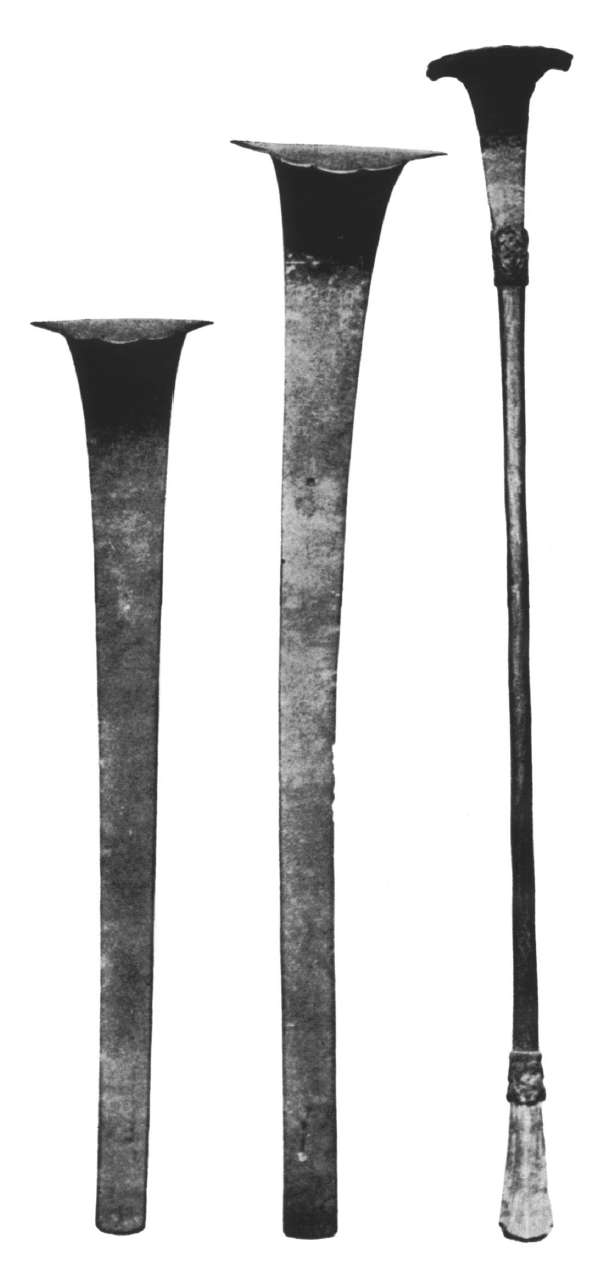
Stating the weight of a weapon follows a tradition in Chinese Military Romance literature in which great heroes brandish heavy polearms and blades. For example, in Romance of the Three Kingdoms (Sanguo yanyi, 三國演義, 14th century), General Guan Yu (關羽) is said to have a glaive weighing 82 catties (107 lbs./48.5 kg). [2] This is referenced in a subsequent novel set hundreds of years later titled the Water Margin (Shuihu zhuan, 水滸傳, c. 1400). In the story, the bandit-turned-Buddhist monk Lu Zhishen (魯智深) asks a blacksmith to make him a cleric’s staff (chanzhang, 禪杖, lit: “Chan staff”) weighing 100 catties (130 lbs./59 kg). But when the latter refuses on the grounds that not even the legendary general would be able to lift it, Lu asks for a staff weighing just as much as Guan’s polearm (here stated as 81 catties) to prove his equal. After some minor bickering, the two finally settle on a more reasonable 62 catties (81 lbs./37 kg). [3]

The ability of these heroes to efficiently wield such weapons sets them apart from normal humans. Likewise, the extraordinary weight of Monkey’s staff sets him apart from his lowly human counterparts. He is, after all, a transcendent immortal capable of supernatural feats of strength. This then might explain the number appearing on the staff. Thirteen thousand five hundred is divisible by nine, which Chinese numerology considers to represent “infinity.” [4] (Note: I no longer agree with this. Please see the 07-03-21 update for my revised views on the origin of the staff’s weight.) So it’s possible the number (infinity multiplied) was meant to convey that the staff was heavy beyond comprehension, something that only a divine hero such as Monkey would be able to wield.

The “As-You-Wish”

Introduction of the Ruyi Scepter

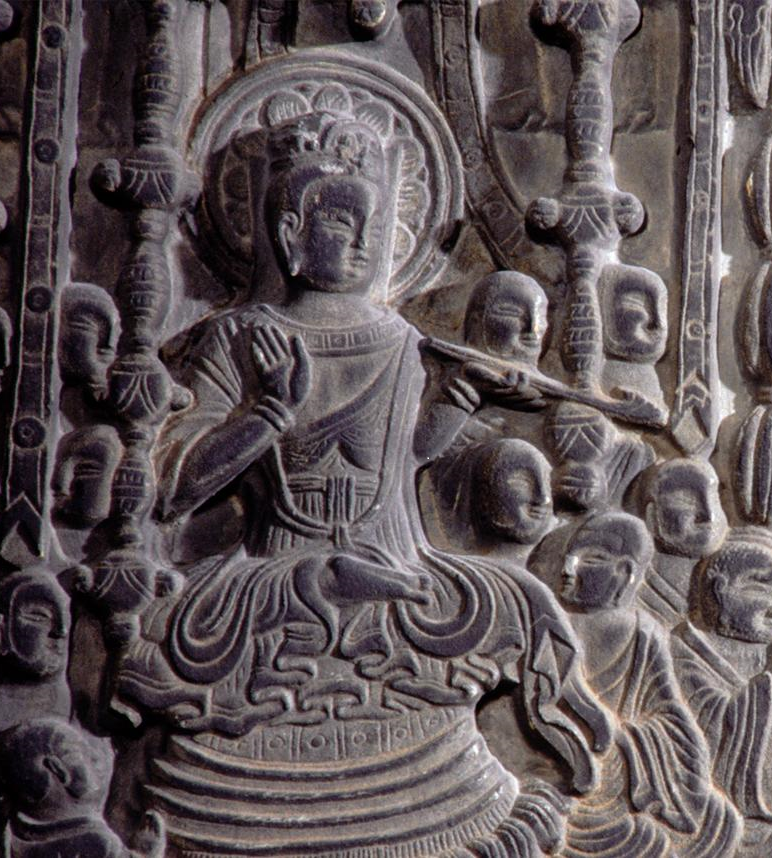
“As-you-wish” (ruyi, 如意), originates with a ritual scepter of that name shaped like an arching snake with a head in the form of a lingzhi mushroom (靈芝, a.k.a., “fungus of immortality”) (fig. 1). They are often seen carried by emperors and Buddho-Daoist deities in Chinese art. Prior to the 10th century, the scepter was closely associated with the Bodhisattva Manjusri (Wenshu, 文殊) and his famous debate with the householder Vimalakirti (Weimojie, 維摩詰). [5] Engravings of the event show him holding the object in the form of a tanbing (談柄), or “discussion stick,” an elongated, shoe horn-shaped wand historically used by religious and secular groups to designate the right to speak before an assembly (similar in function to the Native American “talking stick”) (fig. 2). [6] This implement was sometimes portrayed with vegetal features. For instance, a Chinese stele from the 6th century shows Manjusri debating while holding a sprig (fig. 3). [7] J. Leroy Davidson suggests that this type of scepter has its origin in an Indian Buddhist Jataka tale in which a group of royal sisters use branches to initiate debates with suitors and Buddhist priests. [8] The term ruyi comes from the “wish-fulfilling” Kalpavriksha tree of Hindu mythology. [9] This is suggested by a Chinese source from the 7th century which notes that during the celebration of Upavasatha, [10] lay hosts often gifted “ruyi shu” (如意樹), or “As-you-wish trees” (no doubt saplings or branches), to Indian Buddhist priests [11]. It’s possible that these gifts served as unofficial symbols of the priests’ authority and combined with the aforesaid tradition of debating with branches. This would explain why an instrument of debate would carry the ruyi title.

Fig. 1 – Ruyi scepter from the Qing Dynasty (1644–1911) (larger version). Image found here.

As a Symbol of Authority

Upon entering China with Buddhism, this symbol of authority was adopted by the upper echelons of society. [12] Early records describe emperors, generals, and ministers wielding the object as a means to assert or signify their power. For instance, during the Jin Dynasty (265–420), the court official Shi Chong (石崇, 249–300) used a metal ruyi to smash a coral tree, an imperial gift belonging to a rival aristocrat. [13] Jin General Xie Wan (謝萬, 320–361) used the object to point at his captains and direct his orders to them. [14]. General Wei Rui (韋叡, 442–520) of the Liang Dynasty (502–557) took this one step further and directed his troops in battle with a bamboo scepter. [15] Legend states that Northern Wei Dynasty (386–535) Emperor Xiaowen (孝文, 467–499) placed a bone ruyi (among other items) before his sons; the boy who chose it became his heir because it signified the right to rule. [16] During a time of war, Emperor Wu of Liang (梁武帝, 464–549) gave one of his generals a ruyi because, as one scholar suggests, it was sure to bring him victory in battle. [17]

Fig. 2 – Examples of tanbing-style ruyi from 8th-century Japan (larger version). Due to slow culture transmission, these could be reminiscent of early Chinese scepters. Fig. 3 – Manjusri holding a sprig while debating Vimalakirti. Detail from a Chinese Buddhist stele dated 533–543 (larger version).

As a Weapon

Due to its historical association with military command, Literati ignorant of the scepter’s original function as an instrument of religious debate and authority came to consider the ruyi a type of weapon. For example, the Song Dynasty (960–1279) archaeologist Zhao Xigu (趙希鵠, c. 1195–post 1242) described the object as an iron club used for self-defense: “The men of old used the Ruyi for pointing or indicating the way, and also for guarding themselves against the unforeseen. It was made of wrought iron, and was over two feet in length…” [18] Zhao’s words were later echoed by the art collector Wen Zhenheng (文震亨, 1585–1645) during the Ming Dynasty (1368–1644). [19] The concept of an “As-you-wish” iron club used for self-defense no doubt influenced Monkey’s staff. This is especially true since Wen shows that the idea was current during the time that the Ming version of the novel was published.

The Possible Origin of Its Shape

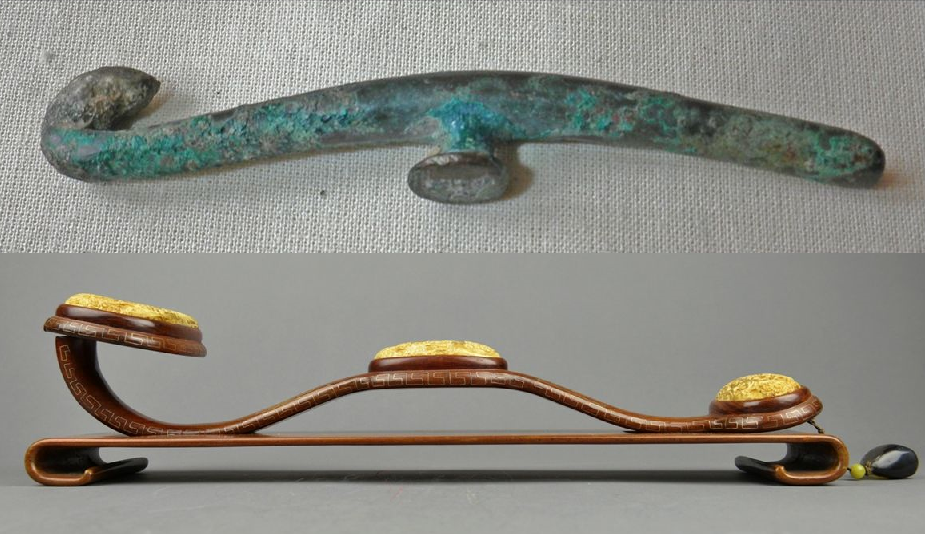
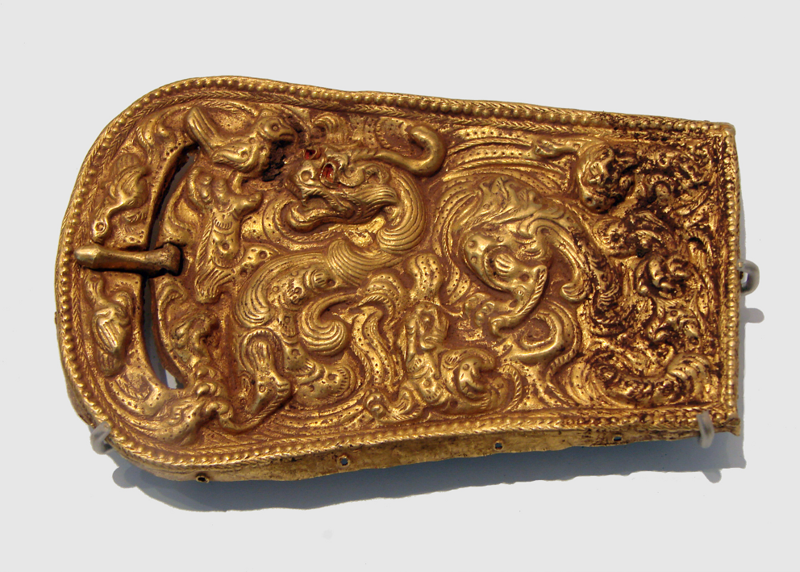
So how did the scepter come to have its signature serpentine curve and ornate head? J. Leroy Davidson believes that this is a simple case of misidentification. He cites material from the Song Dynasty concerning people digging up a “a bronze box in which was a white ruyi decorated with motives of a dragon and tiger.” [20] Davidson suggests that this archaeological artifact was actually a belt hook commonly worn during the Zhou and Han Dynasties (11th c. BCE to 3rd c. CE). Said hooks have an S-shaped curve and the accompanying buckles are often decorated with real and imagined creatures like those mentioned above (fig. 4 and 5). [21] It’s easy to see then how ancient belt buckles—perhaps the features weathered by time—could have been confused with a mushroom.

Fig. 4 – A profile comparison of a Han-era belt hook (top) and a ruyi (bottom) (larger version). Fig. 5 – A Han belt buckle featuring a dragon (larger version).

The Immortal Zhi Mushroom Aspect

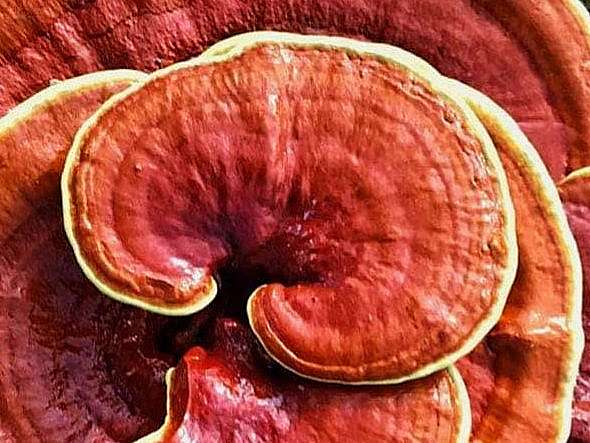
Just like the Vedic Soma and the Greek Ambrosia, the Chinese also had a magical, life-prolonging substance which they called Zhi (芝). [22] The Records of the Grand Historian (Shiji, 史記, c. 90 BCE) mentions that emperors Qin Shihuangdi (秦始皇帝, 260–210 BCE) and Han Wudi (漢武帝, 156–87 BCE) sent thousands of men over many years in search of magical islands housing this immortal herb. [23] It was during the time of the latter that the substance was equated with lingzhi (靈芝, Ganoderma), a genus of spade-shaped mushroom with a lacquered appearance (fig. 6). [24] This fungus became the subject of esoteric texts starting from the Han Dynasty, many of which are now lost. Drawing on these extinct texts, the Daoist adept Ge Hong (葛洪, 283–343) was the first to classify the lingzhi into five major types. [25] Methods For Planting the Zhi Plants (Zhong zhicao fa, 種芝草法), a late-Six Dynasties (220–589) text attributed to the Daoist god Laozi (老子), details how to seed this magical fungus by burying precious substances, such as gold or cinnabar, on a mountain side during solstices and equinoxes. [26] Originally written during the Song Dynasty, a Ming edition of Classification of Supreme Numinous Treasure Mushrooms (Taishang lingbao zhicao pin, 太上靈寶芝草品) lists one hundred twenty-six different kinds of immortality-bestowing fungi. It’s important to note that this text became part of the official Daoist Canon (Daozang, 道藏) during the mid-15th century. [27] This means that immortal mushrooms are a central tenet of Daoism.

Fig. 6 – A lingzhi mushroom (larger version).

The Religious Importance

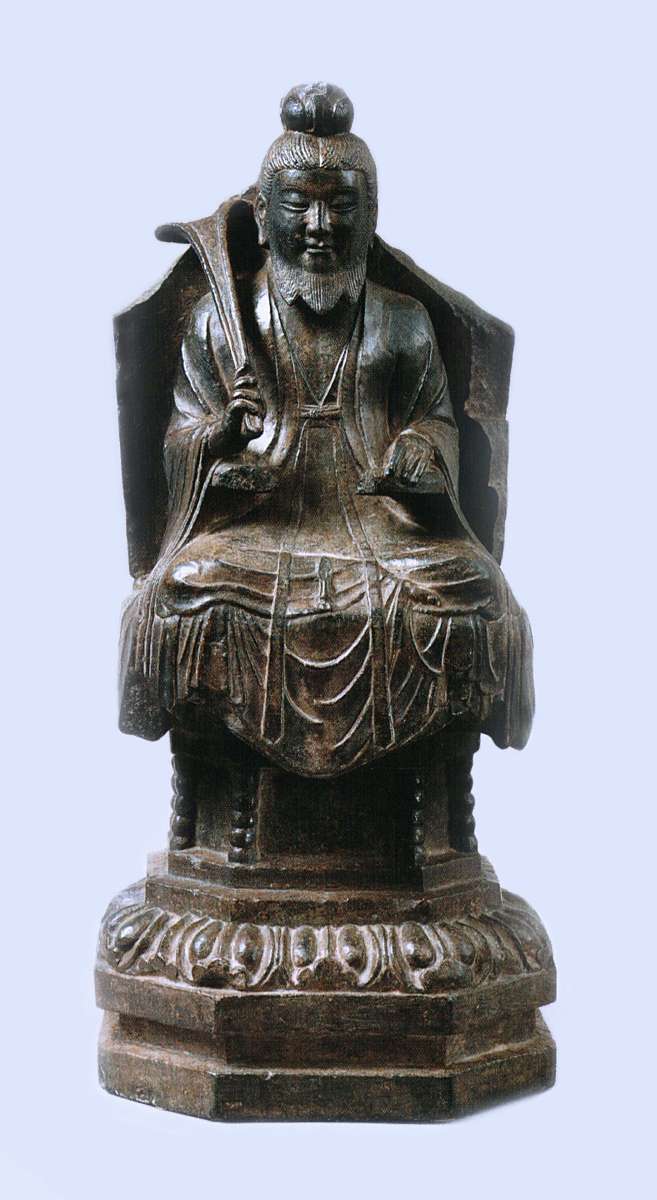
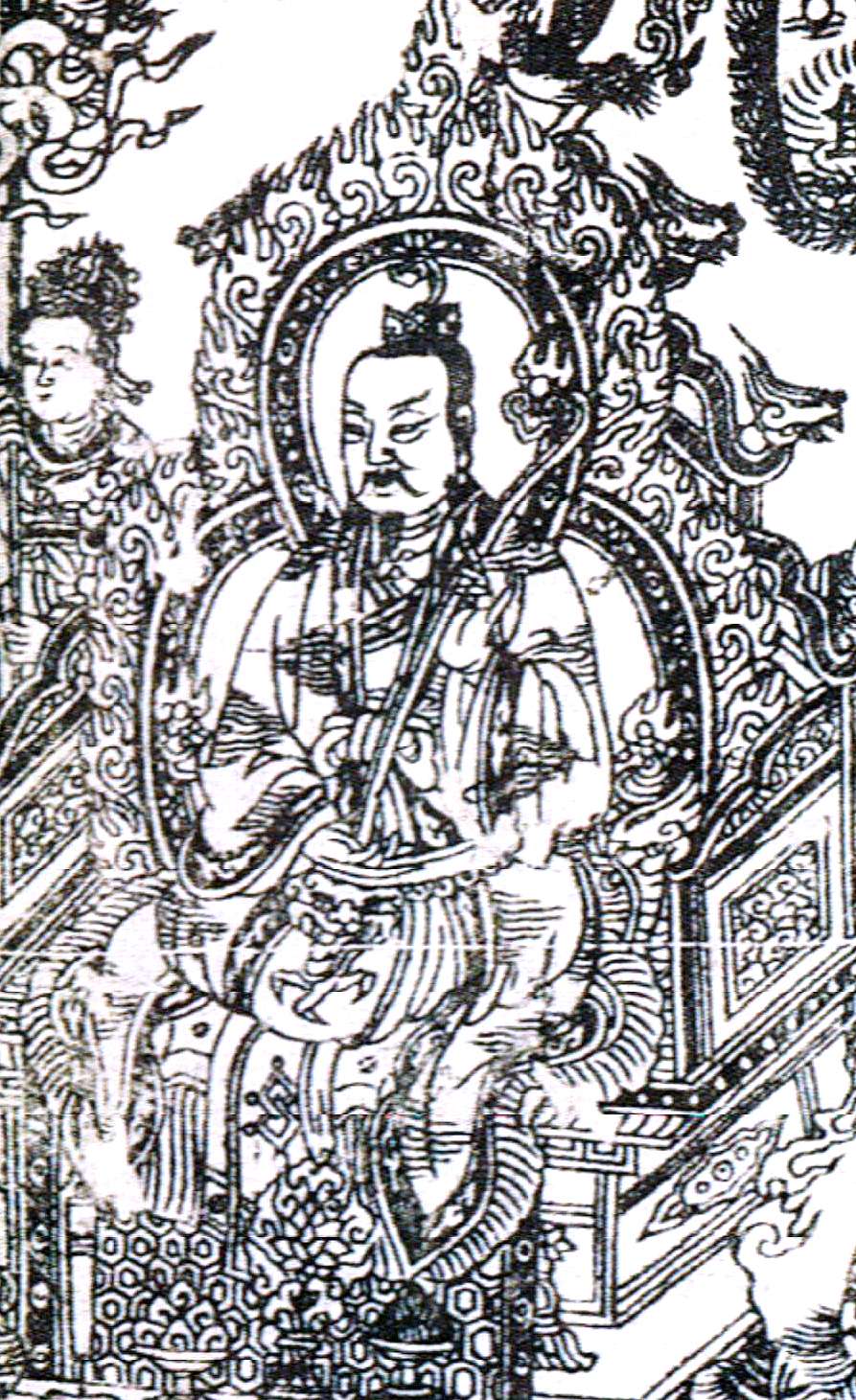
Daoism adopted the ruyi centuries prior to the Song Dynasty when the lingzhi mushroom was associated with the scepter. [28] It was one of the few ritual objects permitted Daoist monks living in medieval Chinese monasteries. [29] In fact, one early Tang Dynasty text states that it is among the items that “are essential for all Daoists, whether male or female, when they present offerings.” [30] Possibly taking a cue from Buddhist depictions of Manjusri, Daoists of the Tang began to depict some of their supreme deities with the scepter. For example, a late-7th or early-8th century statue of Laozi depicts him holding a straight tanbing-style ruyi (fig. 7). [31] After the lingzhi imagery was absorbed into the scepter, it became closely associated with the Celestial Worthy of Numinous Treasure (Lingbao Tianzun, 靈寶天尊), one of the Three Pure Ones (Sanqing, 三清), a trinity representing different aspects of the Dao (道). A 14th-century woodblock print depicts this deity holding a large mushroom ruyi—called by one scholar “his principle attribute”—while sitting on a heavenly throne surrounded by a sea of celestial beings (fig. 8). [32] The scepter was later associated with other Daoist deities during the Ming. [33] Therefore, the long association of the ruyi with Daoist immortals explains why Monkey would come to wield such an instrument with that name.

Fig. 7 – A late-7th  or early-8th century statue of Laozi holding a straight tanbing-style ruyi (larger version). Fig. 8 – A 14th-century woodblock print depicting the Celestial Worthy holding a linzhi ruyi (larger version). Fig. 9 – Detail of a Cintamani, or “wish-granting pearl” (larger version).

The Lowly Buddhist View 

Unlike their Daoist counterparts, Buddhists during the Tang looked upon the scepter as a somewhat base object. For example, although he listed it as a “lecture baton,” the monk Daoxuan (道璿, 702–760), an expert on monastic law, placed the ruyi in the same category as non-ritual items like satchels and spittoons. Furthermore, he described it as being one of the objects not among the “tools of the way.” [34] Sources from this time and the Song Dynasty equate the object with a simple backscratcher. [35] This shows that the ruyi lost any association that it may have had with wish-granting (as the term implies) upon entering China. So how did it regain its magic properties?

The Buddhist Cintamani

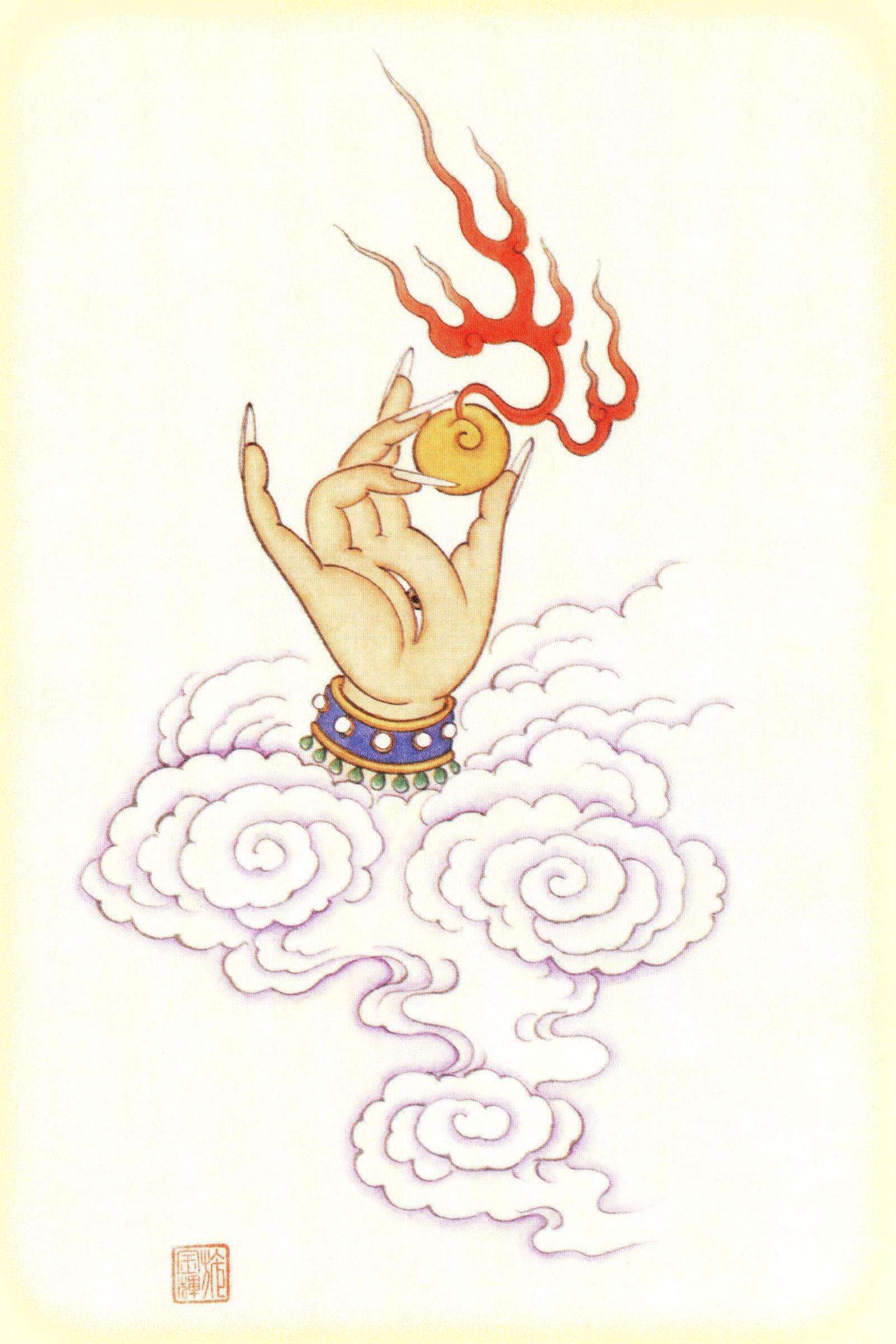
This probably happened because it was equated with the Buddhist Cintamani, or “wish-granting pearl” (fig. 9). [36] This is suggested by the Chinese translation of the Sanskrit term, Ruyi zhu (如意珠). [37] The association between the two was surely established by the Ming as Monkey’s staff has the magical ability to grow or shrink according to his wishes. [38] This is best exemplified by a poem appearing in Chapter seven of Journey to the West:

A spirit beam filling the supreme void—
That’s how the rod behaves accordingly.
It lengthens or shortens as one would wish;
Upright or prone, it grows or shrinks at will. [39]

The magic powers of the staff may be based on a weapon appearing in the earliest version of the novel, The Story of How Tripitaka of the Great Tang, Procures the Scriptures (Da Tang Sanzang qujing shihua, 大唐三藏取經詩話). In this later-13th century adaptation, our protagonist changes a ringed monk’s staff into a “gigantic yaksha whose head touched the sky and whose feet straddled the earth.” [40] This means that the Song and Ming Dynasty versions of the staff both have the ability to change their size and shape as Monkey wishes. I suggested in the second article that the initial description of the weapon in chapter one as a giant pillar of black iron is based on the famous Iron Pillar of Delhi, a religio-political Indian monument of the 4th century. A warrior wishing to wield such a pillar would naturally need to shrink it down. Therefore, the “wish-granting” ruyi concept was probably associated with the shape-changing abilities of the ringed monk’s staff and applied to monkey’s signature iron weapon.

Conclusion

The inscription on Monkey’s staff stands as a microcosm of Chinese literature, history, and religion. The weight harkens back to Yuan and Ming (13th c. to 17th c. CE) Military Romance literature in which great heroes are distinguished from normal humans by their ability to brandish extremely heavy weapons. Monkey’s ability to wield a staff weighing nearly nine tons elevates him above his human counterparts as a divine hero with herculean strength. The ruyi (如意) concept is much older and can be traced back to ancient India. The term is based on the Kalpavriksha, or “wish-granting” tree, of Hindu mythology. This element of Hindu culture was absorbed by Indian Buddhism and mixed with a separate tradition to become a symbol of religious debate and authority. Upon entering China during the Han Dynasty (206 BCE–220 CE), this branch was stylized into a tanbing (談柄), or “Discussion Stick,” which later became the emblem of the Bodhisattva Manjusri. It was simultaneously adopted by aristocrats and military commanders in subsequent dynasties as a sign of their secular power. The object attained its current S-shape and ornate head during the Song Dynasty (960–1279) when historical archaeologists happened upon ancient Chinese belt hooks and buckles from the Zhou and Han Dynasties (11th c. BCE–3rd c. CE) and confused them for such scepters.

There are three reason for the ruyi term being applied to Sun Wukong’s magic weapon. First, due to its historical association with military commanders, literati during the Song and Ming Dynasties came to look upon the object as an iron club used for self-defense. This would be perfect for protecting Monkey’s Buddhist master Xuanzang (玄奘) during their journey to India. Second, the head of the scepter was associated with the immortality-bestowing lingzhi mushroom (靈芝) during the Song Dynasty and became the emblem of the highest gods of Daoism, most notably the Celestial Worthy of Numinous Treasure (靈寶天尊). This makes the ruyi an excellent weapon for an immortal macaque possessed of Daoist magic. Third, the scepter was equated with the Buddhist Cintamani, or “wish-granting pearl”; this was associated with the magic, shape-changing abilities of a literary precursor of the weapon. Hence, the Ming version of Monkey’s pole gained the ability to magically shrink or grow according to his wishes. So, in the end, we see that both Monkey and his staff straddle the Buddhist and Daoist religions.


Updates

Update: 01/05/2015

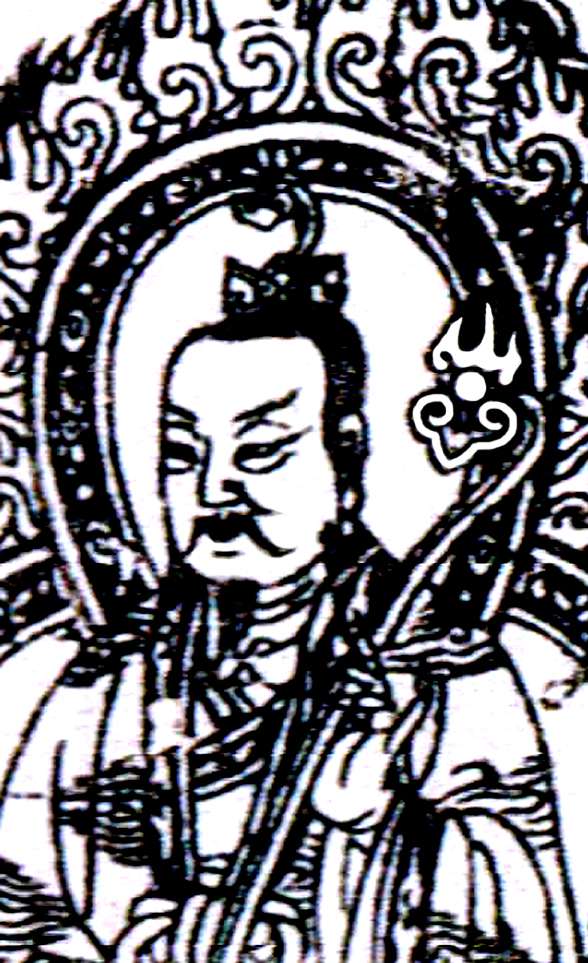
I suggested in the above entry that the ruyi may have been equated with the Buddhist cintamani, or “wish-granting pearl.” Well, I just noticed that the lingzhi-style scepter held by the Celestial Worthy from figure 8 appears to have a flaming pearl attached to it (fig. 9).

Fig. 9 – Enhanced version of the Celestial Worthy’s lingzhi ruyi scepter with a flaming pearl (larger version).

If it really is a Cintamani, this shows that the association between the two happened by at least the 14th century. This probably happened earlier considering that iconography takes time to become standardized. I’ve found at least one other Chinese painting featuring a flaming pearl ruyi. A Ming work titled The Lady of the Highest Primordial and the Empress of Earth (c. 1600) features an attendant of the second deity holding the object (fig. 10).

Fig. 10 – Detail of the attendant (larger version).


Update: 01-06-2015

A prime example of the relationship between the ruyi and the cintamani comes in the form of a 16th-century statue of the Bodhisattva Guanyin (觀音). The deity is usually associated with the flaming pearl, but this statue depicts her holding a scepter (fig. 11). H.A. van Oort comments: “In the mind of the artist, the scepter could well have replaced the cintamani, the “wish-fulfilling jewel”; in that case the statue is a very free interpretation of the Ju-i Kuan-yin [Ruyi Guanyin, 如意觀音], or Cintamani Avalokitesvara, the Kuan-yin with the wish-fulfilling pearl.” [41]

Fig. 11 – Guanyin holding a ruyi scepter (larger version).


Update: 08-16-2020

I’ve written an article suggest the ruyi/lingzhi mushroom influenced the shape of Wukong’s curlicue-style headband.

Sun Wukong’s Curlicue-Style Headband


Update: 02-06-2021

I have written an article that discusses the magic powers of the staff. These include the ability to shrink and grow, control the ocean, astral project and entangle with Monkey’s spirit, multiply endlessly, pick locks, and transform into various objects. It also has sentience to a certain degree.

The Magic Powers of the Monkey King’s Iron Staff


Update: 07-03-21

I now believe the weight of Monkey’s staff is an embellishment of a heavy stone block lifted by the bandit Wu Song in the Water Margin (c. 1400).

The Weight of the Monkey King’s Staff: A Literary Origin

Notes:

[1] Wu Cheng’en and W.J.F. Jenner, Journey to the West (Vol. 1). [S.l.]: Foreign Languages Press, 2001), 56. Text altered slightly. (The text originally says, “As-You-Will,” but I have changed it to align with a source heavily sited in this paper.) Compare it with Anthony C. Yu’s translation: “The Compliant Golden-Hooped Rod” (Wu Cheng’en and Anthony C. Yu, The Journey to the West (Vol. 1) (Chicago, Ill: University of Chicago Press, 2012), 135). I prefer the former. Both translations use the word “pounds”; however, the Chinese version of the novel uses jin (斤), known in English as “catty.” Catty and pound are two different measures of weight, the former being heavier than the latter. Therefore, the text has been altered to show this. The catty during the Ming Dynasty when the novel was compiled equaled 590 grams (Mark Elvin, The Retreat of the Elephants: An Environmental History of China (New Haven (Conn.): Yale University P, 2004), 491 n. 133). This means 13,500 catties would equal roughly 17,560 lbs.

[2] Luo Guanzhong and Moss Roberts, Three Kingdoms: A Historical Novel (Berkeley: University of California Press, 1991), 27.

[3] Shi Naian, Guanzhong Luo, and Sidney Shapiro, Outlaws of the Marsh (Beijing: Foreign Languages Press, 1988), 94-95.

[4] Patricia Bjaaland Welch, Chinese Art: A Guide to Motifs and Visual Imagery (North Clarendon, VT: Tuttle Pub, 2008), 230.

[5] The Vimalakirti Sutra (c. 100) tells of how the Buddha chose Manjusri to call upon the malingering householder whom no other disciple wanted to visit due to his supernatural intellect. He and Vimalakirti debate Buddhist doctrine before a crowd of celestial onlookers until they realize that they are both equally versed in the dharma (Burton Watson, The Vimalakirti Sutra (New York: Columbia University Press, 1997)). For Manjusri’s association with the Ruyi scepter, see J. Leroy Davidson, “The Origin and Early Use of the Ju-i,” Artibus Asiae 13, no. 4 (1950): 240. The aforementioned sutra was not translated into Chinese until the 5th century, so this means the ruyi became associated with the deity rather quickly.

[6] Davidson, 241-242. Medieval Chinese dictionaries refer to the ruyi as a type of backscratcher, the idea being that it can reach the areas that “one wishes” (Ibid, 239; John Kieschnick, The Impact of Buddhism on Chinese Material Culture (Princeton: Princeton University Press, 2002), 142).

[7] Ibid, 245. See plate IV for examples of 8th-century ruyi scepters from Japan shaped like Bamboo stalks.

[8] Ibid, 246. Davidson cites a hard to find book that is long out of print. I located an archived scan of the publication online. See “A Manual of Buddhism, in Its Modern Development (1853).” Internet Archive. Accessed December 17, 2014. https://archive.org/details/manualofbudhism00hard. The story appears on page 255.

[9] Davidson, 246. Various Puranas state that such trees arose during the churning of the ocean of milk. The gods allowed humans to wish for whatever their hearts desired until they started asking for evil things. The trees were then transported to heaven beyond the reach of man (Roshen Dalal, Hinduism: An Alphabetical Guide (New Delhi: Penguin Books, 2010), 189).

[10] A day of religious observance in which the Buddhist lay community renews their commitment to the Eightfold Path. Buddhist priests are invited into homes to help with this process (Yijing, F. Max Müller, and Junjirō Takakusu, A Record of the Buddhist Religion As Practised in India and the Malay Archipelago (A.D. 671-695) (Oxford: Clarendon Press, 1896), 35 n. 1).

[11] Davidson, 246-247.

[12] John Kieschnick believes that the ruyi is a strictly Chinese invention (Kieschnick, 138-152). I, however, find Davidson’s arguments for an Indian origin more compelling.

[13] Joseph Edkins. “The Ju-i, or, Sceptre of Good fortune.” The East of Asia Magazine III (1904), 238. For a complete translation of the story, see John Minford and Joseph S. M. Lau, Classical Chinese Literature: From Antiquity to the Tang Dynasty (New York: Columbia University Press, 2000), 671-672.

[14] Edkins, 238.

[15] Ibid, 239.

[16] Ibid. See also Kieschnick, 144. Kieschnick refers to him by his temple name Gaozu. I have used his reign name to avoid confusion with other similarly named emperors from subsequent dynasties.

[17] Edkins, 239.

[18] Berthold Laufer, Jade: A Study in Chinese Archaeology and Religion (Chicago: Field Museum of Natural History, 1912), 336 n. 1. Text altered slightly. Laufer describes the ruyi as a blunt sword, but the available information makes the object sound more like a club.

[19] He writes: “The ruyi was used in ancient times to give directions or to protect oneself from the unexpected. It was for this reason that it was made of iron, and not on the basis of strictly aesthetic considerations…” (Kieschnick, 151).

[20] Davidson, 249. Text altered slightly.

[21] Ibid.

[22] R. Gordon Wasson and Joseph Needham both suggested that Zhi was actually based on Indian stories of Soma (Paul U. Unschuld, Medicine in China: A History of Ideas (Berkeley: University of California Press, 1985), 112.

[23] Sima Qian and Burton Watson, Records of the Grand Historian (Vol. 2) (Hong Kong: Columbia University Press, 1993), 14-15 and 45-46. Despite its association with mushrooms, some texts refer to it as a type of grass or herb (Wolfram Eberhard, A Dictionary of Chinese Symbols: Hidden Symbols in Chinese Life and Thought (London: Routledge & Kegan Paul, 1986), 173-174.

[24] Xiao Tong, Wen Xuan or Selections of Refined Literature (Vol. 3) (Princeton, N.J.: Princeton Univ. Press, 1996), 201.

[25] These are stone zhi (石芝), wood zhi (木芝), plant zhi (草芝), flesh zhi (肉芝), and mushroom zhi (菌芝) (Fabrizio Pregadio, The Encyclopedia of Taoism (Vol. 2) (London: Routledge, 2008), 1273).

[26] Ibid.

[27] Stephen Little and Shawn Eichman, Taoism and the Arts of China (Chicago: Art Institute of Chicago, 2000), 340.

[28] The association with the lingzhi, however, may have been as early as the Tang Dynasty (618–907). Yan Liben’s (閻立本, 600–673) “The Thirteen Emperors” painting features a monarch holding a straight tanbing-style ruyi with the head in the shape of a lingzhi. Although, the scalloped perimeter could denote a cloud. See “The Thirteen Emperors.” Digital Scrolling Paintings Project. Accessed December 23, 2014. http://scrolls.uchicago.edu/scroll/thirteen-emperors.

[29] Livia Kohn, The Daoist Monastic Manual: A Translation of the Fengdao Kejie (New York: Oxford University Press, 2004), 122.

[30] Ibid, 119.

[31] See image #39 in Little and Eichman, 183. Little suggests that this could instead be a depiction of the Celestial Worthy of Numinous Treasure (靈寶天尊) (Ibid, 187 cat. nos. 39-42 n. 9). On the contrary, Silvio A. Bedini mentions an incense burner of Laozi carrying a ruyi on his famous journey to the Western Paradise (Silvio A. Bedini, The Trail of Time: Time Measurement with Incense in East Asia (Cambridge: Cambridge Univ. Press, 1994), 113). This suggests that Laozi was indeed associated with the scepter.

[32] This illustrates a scene from an important Song Dynasty text in which the Celestial Worthy is said to reveal heavenly secrets to mankind (Little and Eichman, 237-238).

[33] See, for example, Cao Guojiu (曹國舅) (Welch, 259).

[34] Kieschnick, 148-149.

[35] Ibid, 1414-142 and 149-150.

[36] Erik Zürcher has suggested that the only way the lowly back scratcher could have become a symbol of lofty knowledge was via an association with the wish-granting pearl (Erik Zürcher, The Buddhist Conquest of China: The Spread and Adaptation of Buddhism in Early Medieval China (Leiden: Brill, 1997), 407 n. 59). It seems only natural that an affiliation between the scepter and the pearl would have sparked the idea that the former had magical properties.

[37] I’m not sure when the term was first translated into Chinese, but it appears in the Scripture on the Ten Wheels, a 6th-century sutra centered around the Bodhisattva Dizang (地藏, a.k.a., Ksitigarbha) (Ng Zhiru, The Making of a Savior Bodhisattva Dizang in Medieval China (Honolulu: University of Hawai’i Press, 2007), 29-30). This shows the association between the ruyi and the wish-granting pearl could be quite old. For more information on the Cintamani, see Alice Getty, The Gods of Northern Buddhism: Their History and Iconography (New York: Dover Publications, 1988), 186-187.

[38] Wu and Yu, 135.

[39] Ibid, 190.

[40] Victor H. Mair, The Columbia Anthology of Traditional Chinese Literature (New York: Columbia University Press, 1994), 1189. For the complete story, see pages 1181-1207.

[41] H. A. van Oort, The Iconography of Chinese Buddhism in Traditional China (Leiden: E.J. Brill, 1986), 22.

Bibliography:

“A Manual of Buddhism, in Its Modern Development (1853).” Internet Archive. Accessed December 17, 2014. https://archive.org/details/manualofbudhism00hard.

Bedini, Silvio A. The Trail of Time: Time Measurement with Incense in East Asia. Cambridge: Cambridge Univ. Press, 1994.

Dalal, Roshen. Hinduism: An Alphabetical Guide. New Delhi: Penguin Books, 2010.

Davidson, J. Leroy. “The Origin and Early Use of the Ju-i.” Artibus Asiae 13, no. 4 (1950), 239-49.

Eberhard, Wolfram. A Dictionary of Chinese Symbols: Hidden Symbols in Chinese Life and Thought. London: Routledge & Kegan Paul, 1986.

Edkins, Joseph. “The Ju-i, or, Sceptre of Good fortune.” The East of Asia Magazine III (1904), 238-240.

Elvin, Mark. The Retreat of the Elephants: An Environmental History of China. New Haven (Conn.): Yale University Press, 2004.

Getty, Alice. The Gods of Northern Buddhism: Their History and Iconography. New York: Dover Publications, 1988.

Kieschnick, John. The Impact of Buddhism on Chinese Material Culture. Princeton: Princeton University Press, 2002.

Kohn, Livia. The Daoist Monastic Manual: A Translation of the Fengdao Kejie. New York: Oxford University Press, 2004

Laufer,Berthold. Jade: A Study in Chinese Archaeology and Religion. Chicago: Field Museum of Natural History, 1912.

Little, Stephen, and Shawn Eichman. Taoism and the Arts of China. Chicago: Art Institute of Chicago, 2000.

Luo, Guanzhong, and Moss Roberts. Three Kingdoms: A Historical Novel. Berkeley: University of California Press, 1991.

Mair, Victor H. The Columbia Anthology of Traditional Chinese Literature. New York: Columbia University Press, 1994.

Minford, John, and Joseph S. M. Lau. Classical Chinese Literature: From Antiquity to the Tang Dynasty. New York: Columbia University Press, 2000.

Ng, Zhiru. The Making of a Savior Bodhisattva Dizang in Medieval China. Honolulu: University of Hawai’i Press, 2007.

Oort, H. A. van. The Iconography of Chinese Buddhism in Traditional China. Leiden: E.J. Brill, 1986.

Pregadio, Fabrizio. The Encyclopedia of Taoism (Vol. 2). London: Routledge, 2008.

Shi, Naian, Guanzhong Luo, and Sidney Shapiro. Outlaws of the Marsh. Beijing: Foreign Languages Press, 1988.

Sima, Qian, and Burton Watson. Records of the Grand Historian (Vol. 2). Hong Kong: Columbia University Press, 1993.

“The Thirteen Emperors.” Digital Scrolling Paintings Project. Accessed December 23, 2014. http://scrolls.uchicago.edu/scroll/thirteen-emperors.

Unschuld, Paul U. Medicine in China: A History of Ideas. Berkeley: University of California Press, 1985.

Watson, Burton. The Vimalakirti Sutra. New York: Columbia University Press, 1997.

Welch, Patricia Bjaaland. Chinese Art: A Guide to Motifs and Visual Imagery. North Clarendon, VT: Tuttle Pub, 2008.

Wu, Cheng’en, and Anthony C. Yu. The Journey to the West (Vol. 1). Chicago, Ill: University of Chicago Press, 2012.

Wu, Cheng’en, and W.J.F. Jenner. Journey to the West (Vol. 1). [S.l.]: Foreign Languages Press, 2001.

Xiao, Tong. Wen Xuan or Selections of Refined Literature (Vol. 3). Princeton, N.J.: Princeton Univ. Press, 1996.

Yijing, F. Max Müller, and Junjirō Takakusu. A Record of the Buddhist Religion As Practised in India and the Malay Archipelago (A.D. 671-695). Oxford: Clarendon Press, 1896.

Zürcher, Erik. The Buddhist Conquest of China: The Spread and Adaptation of Buddhism in Early Medieval China. Leiden: Brill, 1997.