Sun Wukong’s Hellish Punishment

Last updated: 01-09-2023

At the end of Journey to the West (Xiyouji西遊記, 1592) chapter seven, Sun Wukong is crushed under Five Elements Mountain for 600-plus-years as punishment for attempting to usurp the throne of heaven. I’ve previously described how this sentence is based on Tang and Song-era tales of the Sage-King Yu the Great imprisoning an aquatic simian demon beneath a mountain. Monkey’s time pinned by the landmass has been portrayed numerous times in movies and television, but modern media often forgets that this was only part of his punishment. The other half was a hellish diet:

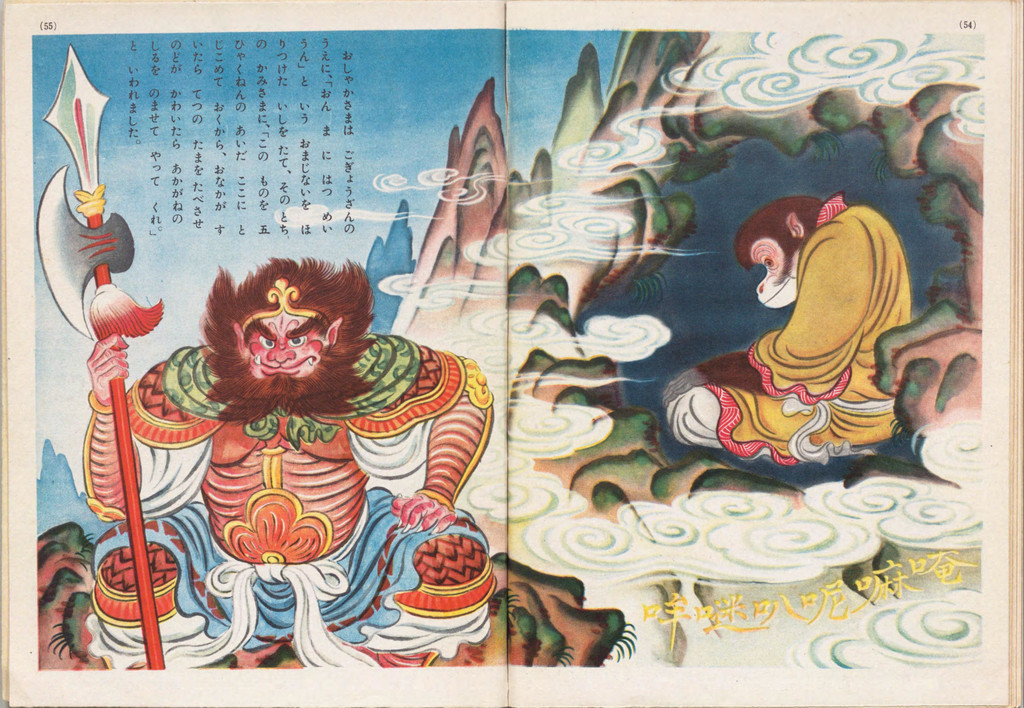
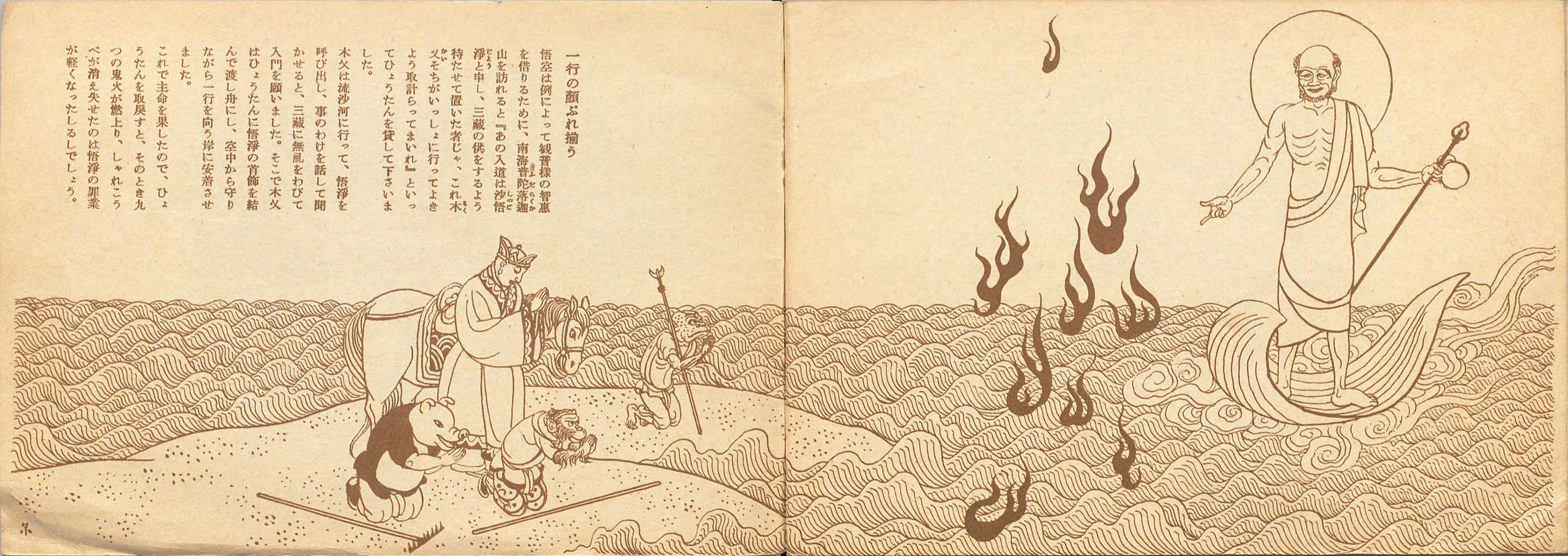
Moved by compassion, he [the Buddha] recited a divine spell and called together a local spirit and the Fearless Guards of Five Quarters to stand watch over the Five-Phases Mountain [fig. 1]. They were told to feed the prisoner with iron pellets [tie wanzi, 鐵丸子] when he was hungry and to give him melted copper [ronghua de tong zhi, 溶化的銅汁] to drink when he was thirsty. When the time of his chastisement was fulfilled, they were told, someone would be coming to deliver him (Wu & Yu, 2012, vol. 1, p. 199).

又發一個慈悲心,念動真言咒語,將五行山召一尊土地神祇,會同五方揭諦,居住此山監押。但他饑時,與他鐵丸子吃;渴時,與他溶化的銅汁飲。待他災愆滿日,自有人救他。

Fig. 1 – One of the guards charged with watching over Monkey (larger version). From the children’s book Son Goku (1939).

Table of Contents

1. The Origin

This punishment comes directly from Buddhist doctrine describing the torture of sinners in hell (Sk: Naraka; Ch: Diyu, 地獄). For example, the Dīrghāgama (Sk: दीर्घागम; Ch: Chang Ahun Jing, 長阿含經, or “The Collection of Long Scriptures”) [1] describes two realms in hell in which the damned are fed such a horrific diet:

[…] Terrified they [a damned soul] run out, seeking safety and refuge, but they arrive at the Hell of Hunger [Ji’e diyu, 飢餓地獄].

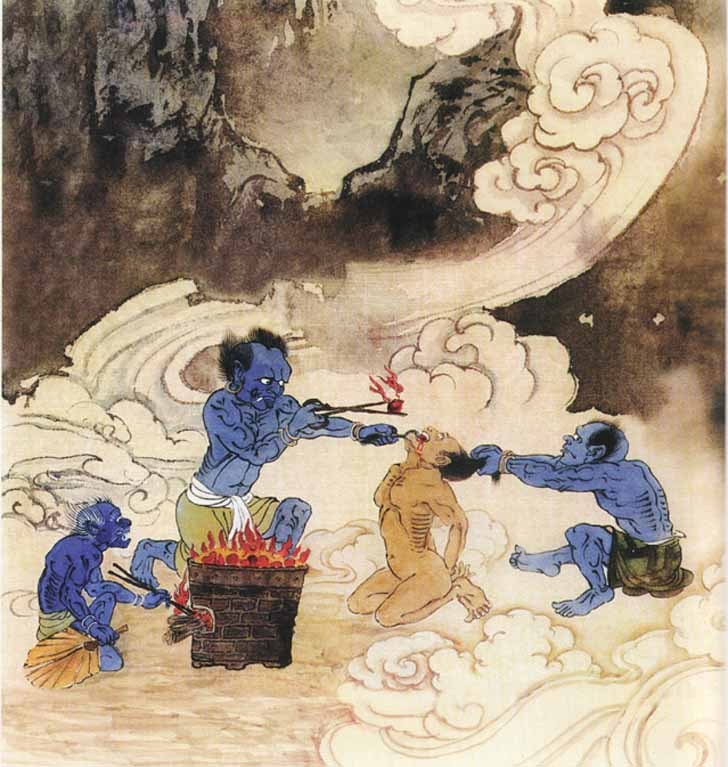
The wardens come to ask them: “Since you came here, what do you want?” They answer: “We are hungry”. The wardens then seize them and throw them on burning iron. They are caused to stretch and spread out their bodies; with iron hooks the wardens hook the sinners’ mouths and force them open; they put [hot] iron pellets into them [fig. 2]. The pellets burn their lips and tongues, from the throats down to their stomachs. The pellets penetrate through the sinners; there is nothing but burning. The horrible, fatal, and bitter suffering makes the sinners shriek and moan. Since their punishment is not yet completed, the sinners do not perish. After having suffered for a long time, they leave the Hell of Hunger. Frightened they run away, looking for relief and safety, until they arrive to the Hell of Thirst [Ke diyu, 渴地獄].

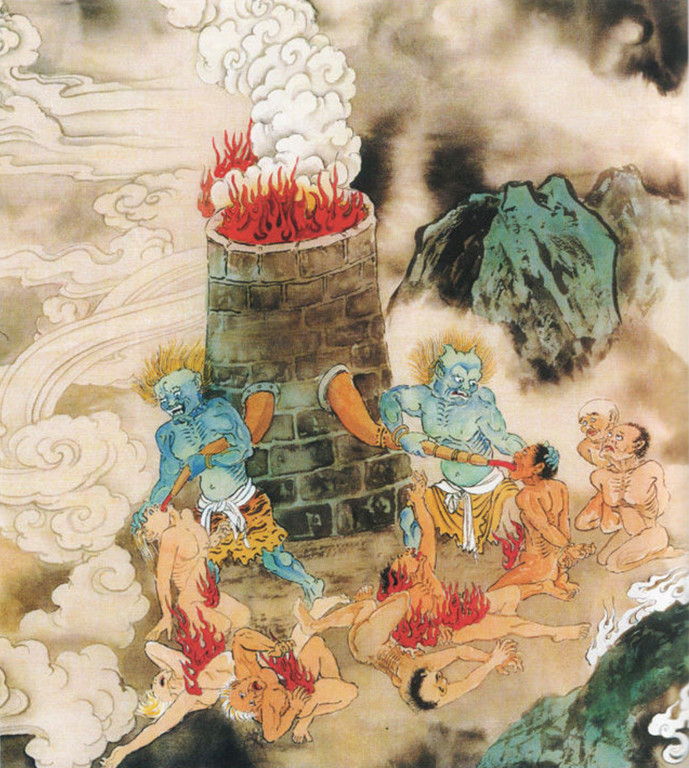
The wardens come to them and ask: “Since you came here, what do you want?” They answer: “We are thirsty.” The wardens thereupon seize the sinners and throw them on burning iron. They are caused to stretch and spread out their bodies; with hot iron hooks, the wardens hook the sinners’ mouths and force them open. They pour down molten copper [fig. 3]. It burns their mouth, lips and tongue; from their throats it reaches their stomachs. It penetrates down and goes through them; there is nothing but burning. The terrible, fatal, and bitter suffering makes the sinners shriek and moan. Since the remaining transgressions have not yet been atoned, they do not perish. After having been subjected to this punishment for a long time, they leave the Hell of Thirst (Howard, 1986, p. 131).

「… 慞惶馳走,求自救護,到飢餓地獄。獄卒來問:『汝等來此,欲何所求?』報言:『我餓。』獄卒即捉撲熱鐵上,舒展其身,以鐵鈎鈎口使開,以熱鐵丸著其口中,燋其脣舌,從咽至腹,通徹下過,無不燋爛,苦毒辛酸,悲號啼哭。餘罪未盡,猶復不死。

「久受苦已,出飢地獄,慞惶馳走,求自救護,到渴地獄。獄卒問言:『汝等來此,欲何所求?』報言:『我渴。』獄卒即捉撲熱鐵上,舒展其身,以熱鐵鈎鈎口使開,消銅灌口,燒其脣舌,從咽至腹,通徹下過,無不燋爛,苦毒辛酸,悲號啼哭。餘罪未盡,猶復不死。

「久受苦已,出渴地獄 …

Soul being forced to eat iron pellets

Fig. 2 – A damned soul being force-fed red hot iron pellets (larger version). Fig. 3 – Souls being forced to drink molten copper (larger version).

1.1. Additional Info

The same source explains that the hells of hunger and thirst are the respective fourth and fifth of sixteen minor hells (shiliu xiaoyu, 十六小獄) making up one of the eight greater purgatories (ba da diyu, 八大地獄) called the hell of consciousness (xiang, 想). Sinners reborn into this labyrinth of pain are full of anger and lash out at each other with scythe-like claws, as well as swords and daggers. They remain conscious through endless rounds of dismemberment and resurrection via a cold, magical wind (lengfeng, 冷風). They then wander into each successive minor hell, enduring everything from grinding by hot millstones to their flesh and bones being shattered by blistering cold. Again, each sinner remains conscious and resurrects between each purgatory (Howard, 1986, pp. 129-134).

Another name for the greater hell of consciousness is the Sanskrit term Samjiva (Ch: Denghuo, 等活), meaning “revival” or “repetition.” These might refer to the cyclical resurrection of the sinner, or to their karmic punishment mirroring what they did to others in life (Buswell & Lopez, 2014, p. 754).

It should be noted that unlike the Judeo-Christian tradition, rebirth in the Buddhist hell is not forever. For some it may last eons, but the torture serves to cleanse the spirit of past sins gained in life. Once the karmic debt has been repaid, the soul will be reborn into one of the other six realms of existence: hell, hungry ghost, animal, human, asura, or deva. Sometimes souls have to work their way back up to human status if they have particularly heavy karmic baggage.

Monkey’s punishment is essentially hell on earth. The Five Elements Mountain pins him down so that the chosen guards can torture him with hot iron pellets and molten copper just like those in the subterranean hells of hunger and thirst. He is not capable of dying, so his immortality serves a similar function to the magic wind that continually resurrects the damned. The finite length of his sentence (600-plus-years) is similar to the way a soul will only stay in the hell realm until they have repaid their karmic debt. And Tripitaka delivering him from his torments is like a soul being reborn into a new life. After all, Monkey’s life drastically changes after his release; he goes from being a rebellious, power-hungry demon, to a Buddhist monk devoted to the protection of his master.

2. Other Damned Celestials

Sun Wukong is not the only celestial to be damned to drink molten copper. Readers may be surprised to learn that King Yama (Yanluo Wang, 閻羅王), fifth of the Ten Judges of Hell, also suffers from this affliction. The aforementioned Dīrghāgama reads:

Buddha said to the bhiksus: “South of Jambudvipa, in the interior of the great Diamond Mountain, lies the palace of King Yama. The realm he governs extends for six thousand yojanas in both directions. His city has seven rows of ramparts, with seven nets and seven rows of trees … Day and night, three times a day, a huge copper cauldron automatically places itself in front of him. If the huge cauldron emerges in the interior of the palace, the king, upon seeing it, rushes out of the palace stricken by horror and fright. But then, if the cauldron emerges outside the palace, the king, upon seeing it, reenters the palace stricken by horror and fright. Giant hell wardens grab King Yama and have him lie down on hot irons. With iron hooks, they split his mouth open and force molten copper down. It burns his lips and tongue; from the throat, it reaches his stomach. It spreads down below and passes through [his body] so that no place is left unburnt. The punishment continues [in this fashion] until its completion. Afterwards, King Yama returns to seek amusement with all his ladies. Many great state[s]men, who possessed riches, are also punished in this way” (Howard, 1986, p. 141).

佛告比丘:「閻浮提南大金剛山內,有閻羅王宮,王所治處縱廣六千由旬,其城七重,七重欄楯、七重羅網、七重行樹 … 然彼閻羅王晝夜三時,有大銅鑊自然在前。若鑊出宮內,王見畏怖,捨出宮外。若鑊出宮外,王見畏怖,捨入宮內。有大獄卒,捉閻羅王臥熱鐵上,以鐵鈎擗口使開,洋銅灌之,燒其脣舌,從咽至腹,通徹下過,無不燋爛。受罪訖已,復與諸婇女共相娛樂。彼諸大臣同受福者,亦復如是。」

So Yama inhabits an odd position where he is both a member of the heavenly hierarchy working to judge the fate of the dead and a damned soul repaying a karmic debt through torture.


3. Updates

Update: 01-09-23

Chapter four of Shao (1997) explains that the term “Five Elements/Phases” (Wuxing, 五行) is used in JTTW and Buddho-Daoist doctrine to represent mortality. For example, Monkey complains to the judges of hell in chapter three that he’s no longer subject to death since he has achieved the Daoist elixir, thereby breaking free of the five elements. His imprisonment beneath Five Elements Mountain and hellish diet are, therefore, clues that the Buddha is punishing Sun to a symbolic death and afterlife. His subsequent release in chapter 14 can then be viewed as a symbolic reincarnation, which completes the cycle of death, karmic punishment, and rebirth.

Recall how the novel states time and time again that Monkey was under the mountain for 500 years. Although internal story details suggest it was actually over 600 years, it’s important to remember that 500 is used in Buddhist doctrine to denote a large number (Zhao, 2021, p. 126). So, maybe the novel was just implying that Monkey was punished for a really long time.

Note:

1) The Dīrghāgama has only survived thanks to a Chinese translation from the original Sanskrit in 413 CE (Buswell & Lopez, 2014, p. 246).

Sources:

Buswell, R. E., & Lopez, D. S. (2014). The Princeton Dictionary of Buddhism. Princeton University Press.

Howard, A. F. (1986). The Imagery of the Cosmological Buddha. Leiden: E.J. Brill.

Wu, C., & Yu, A. C. (2012). The Journey to the West (Vols. 1-4) (Rev. ed.). Chicago, Illinois: University of Chicago Press.

Zhao, P. (2021). The Essentials of Buddhism: Questions and Answers (H. Fang, trans.). Beijing: American Academic Press.

Sun Wukong and the Three Heavenly Calamities

Last updated: 11-09-2022

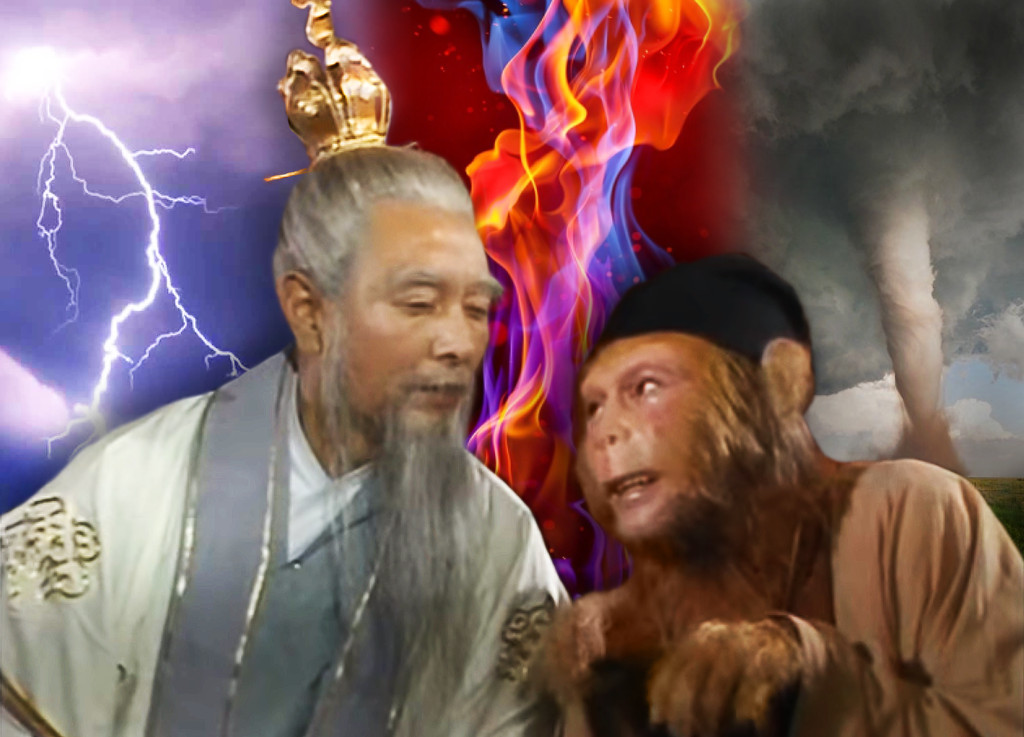
In chapter two of Journey to the West (Xiyouji西遊記, 1592), Master Subodhi warns Sun Wukong that he must protect himself from “Three Calamities” (sanzai lihai, 三災利害) sent by heaven to punish him for achieving immortality and defying his fate (fig. 1). These punishments come every half millennia in the form of destructive elements:

Though your appearance will be preserved and your age lengthened, after five hundred years Heaven will send down the calamity of thunder [leizai, 雷災] to strike you. Hence you must be intelligent and wise enough to avoid it ahead of time. If you can escape it, your age will indeed equal that of Heaven; if not, your life will thus be finished. After another five hundred years Heaven will send down the calamity of fire [huozai, 火災] to burn you. The fire is neither natural nor common fire; its name is the Fire of Yin [yinhuo, 陰火], and it arises from within the soles of your feet to reach even the cavity of your heart, reducing your entrails to ashes and your limbs to utter ruin. The arduous labor of a millennium will then have been made completely superfluous. After another five hundred years the calamity of wind [feng zai, 風災] will be sent to blow at you. It is not the wind from the north, south, east, or west; nor is it one of the winds of four seasons; nor is it the wind of flowers, willows, pines, and bamboos. It is called the Mighty Wind [bifeng, 贔風], and it enters from the top of the skull into the body, passes through the midriff, and penetrates the nine apertures. [1] The bones and the flesh will be dissolved and the body itself will disintegrate. You must therefore avoid all three calamities (Wu & Yu, 2012, pp. 121-122).

雖駐顏益壽,但到了五百年後,天降雷災打你,須要見性明心,預先躲避。躲得過,壽與天齊;躲不過,就此絕命。再五百年後,天降火災燒你。這火不是天火,亦不是凡火,喚做『陰火』。自本身湧泉穴下燒起,直透泥垣宮,五臟成灰,四肢皆朽,把千年苦行,俱為虛幻。再五百年,又降風災吹你。這風不是東南西北風,不是和薰金朔風,亦不是花柳松竹風,喚做『贔風』。自顖門中吹入六腑,過丹田,穿九竅,骨肉消疏,其身自解。所以都要躲過。

These calamities are important because Monkey subsequently learns the 72 transformations in order to escape punishment by hiding under any one of a myriad number of disguises. Therefore, exploring the origins of the three calamities has merit.

Fig. 1 – Master Subodhi tells Sun about the Three Calamities (larger version). Photomanipulation by the author.

Table of Contents

1. Origins

The novel likely borrows from a Buddhist cosmological concept called the “Three Calamities” (sanzai, 三災). We first need some background before continuing. Buddhism recognizes a measurement of time called a Kalpa (jie, 劫), which can be many millions or even billions of years long depending on the tradition. Said traditions recognize between four and eighty kalpas (Buswell & Lopez, 2014, p. 409). The total of these respective ranges make up a Mahakalpa (dajie, 大劫), which is divided into four periods of nothingness, creation, subsistence, and finally destruction, each period being between one and twenty kalpas long (Buswell & Lopez, 2014, p. 496). The Three Calamities are responsible for the destruction of each Mahakalpa.

Kloetzli (1983) describes the cyclical destruction of each Mahakalpa by an element:

The destructions are of three kinds: those by fire, those by water and those by wind. […] The destructions succeed one another in the following sequence: seven by fire followed by a destruction by water. This cycle of eight destructions is repeated a total of seven times. This is then followed by seven more destructions by fire, followed by a final by wind. Thus there are 7 x 8 or 56 destructions by fire; 7 by water and a final 64th by wind [fig. 2] (p. 75).

Therefore, the Three Calamities from Journey to the West follow a similar cycle of destructive elements appearing at set time intervals: lightning, fire, and wind every 500 years in place of fire, water, and wind at the end of every Mahakalpa. And instead of destroying the universe, the elements are sent to kill those who have achieved immortality.

Fig. 2 – A chart mapping the cyclical destructions by fire, water, and wind. A larger version is available on the CBETA page.

The earliest mention of Buddhism’s Three Calamities in Chinese writing that I know of appears in scroll one of the Pearl Forest of the Dharma Garden (Fayuan zhulin, 法苑珠林), a Chinese Buddhist encyclopedia published in 688. So there was plenty of time between this work and the publishing of Journey to the West in 1592.

2. Influence on Xianxia Literature

I was interested to learn that Monkey’s calamities made their way into modern Xianxia (仙侠, “Immortal hero”) literature. For example, the author of the Immortal Mountain wordpress writes:

Heavenly Tribulation (天劫 tiānjié) (重劫 zhòngjié) – in some novels, a trial encountered by cultivators at key points in their cultivation, which they must resist and ultimately transcend. Because immortal cultivation (generally) goes against the Will of Heaven, the Heavens will send down tribulations to oppress high-level cultivators who make progress towards Immortality, often right when they enter a new cultivation stage. This typically takes the form of a lightning storm, with extraordinarily powerful bolts of lightning raining down from the Heavens to strike at the cultivator (source).

The trial by lightning is exactly like the calamity of thunder mentioned by Master Subodhi.

3. Conclusion

Subodhi teaches Monkey the 72 transformations with the expressed purpose of hiding from three calamities (sanzai lihai, 三災利害) of celestial lightening, fire, and wind. They are sent by heaven every 500 years to punish cultivators for defying their fate and achieving immortality. Each was likely influenced by the three calamities (sanzai, 三災) of Buddhist cosmology, which states that the universe is alternately destroyed by fire, water, or wind at the end of every Mahakalpa. Both concepts include destructive elemental forces that appear at given times.

The oldest mention of the original Buddhist calamities that I’m aware of appears in a 7th-century religious encyclopedia titled Pearl Forest of the Dharma Garden (Fayuan zhulin, 法苑珠林).

The literary thunder calamity would later come to influence the “Heavenly Tribulation” (tianjie, 天劫; zhongjie, 重劫) of modern Xianxia literature.


4. Updates

Update: 09-10-2018

The Xianxia translator Deathblade (twitter) was kind enough to direct me to an example of a tribulation from a popular Chinese television show . The scene (video 1) involves a 20,000-year-old child immortal experiencing a trial by lightning. The heavenly bolts tear at his clothing and draw blood, but he survives the ordeal.

Video 1 – Start watching from minute 13:08.

Deathblade also directed me to an example from an online Xianxia novel called I shall Seal the Heavens (Wo yu feng tian, 我欲封天). Chapter 385(!) describes how the anti-hero Meng Hao (孟浩) uses a sentient heavenly treasure to protect himself from powerful bolts of lightning, which instead seek out and kill nearby spiritual cultivators on the cusp of immortality:

The Heavenly Tribulation boomed as one lightning bolt after another shot down onto Meng Hao, who held the meat jelly upraised in his hand to defend himself. The lightning would subsequently disperse into the area around him. Any nearby Cultivators would let out bloodcurdling screams. Soon, the air filled with the sounds of cursing and reviling.

Meng Hao didn’t care. This was something he had learned from Patriarch Reliance. When you con someone and then end up getting cursed by them, you must maintain your cool. It was really a realm unto itself.

Throughout the years, Meng Hao had conned many people, and had refined that skill to the very pinnacle. Therefore, he continued to redirect the descending lightning to the various Cultivators in the three thousand kilometer region.

Wherever he went, he was surrounded by a lake of lightning, along with plaintive cursing. What he left behind was scorched corpses.

To the Cultivators here, it was nothing but a massacre, a slaughter in which no one could do anything to fight back. They couldn’t attack him, nor could they flee as… they were horrified to discover that Meng Hao’ speed was incredible, even if he was being struck by lightning!

(read more here)

The character uses trickery to protect himself from the bolts just like Monkey intended to do with his transformations.


Update: 04-02-2021

As I explained above, Wukong learns the 72 transformations in order to escape the heaven-sent punishments of thunder, fire, and wind. Monkey attains eternal life around his 342nd year when his soul is taken to Hell. He is immortal for over 160 years [2] at the time he’s imprisoned under Five Elements Mountain. This means his 500th year of immortality, the year that the calamity of thunder would be scheduled to strike him, takes place during his imprisonment under the celestial mountain. But this is never described in the story. I assume this is just one of many inconsistencies born from oral storytelling. Although, one could argue that, within the fictional universe, the thunder calamity was voided since Wukong was undergoing punishment at the behest of the Buddha.


Update: 08-29-22

It turns out that punishment by lightning appears in other works of religious vernacular fiction. For example, in The Battle of Wits between Sun and Pang (Sun Pang douzhi yanyi, 孫龐鬥智演義, 1636; a.k.a. The Former and Latter Annals of the Seven KingdomsQianhou qiguo zhi前後七國志):

Sun Bin [孫臏, d. 316 BCE] was overjoyed when he received the Heavenly Book [from the magic White Ape], and hurriedly went back to light the lamp and read it carefully. But during his reading, he felt an eerie, cold wind and heard the rolling of thunder. The Immortal Master Ghost Valley was meditating on the futon when he heard thunder in the air, so he got up and walked immediately to the door of Sun Bin’s room, only to see him reciting the Heavenly Book. When Ghost Valley heard this, he was taken aback. He pushed the door open and went in and said, “I hid this book in the stone box of the prayer cave. I haven’t passed it onto you because your fate has not yet arrived. Where did you get it?

Sun Bin told the story of the white ape. Ghost Valley said: “It turns out that the evil beast stole it and came to you, but unfortunately it was too early. Besides, when you received the Heavenly Book, you didn’t bathe and burn incense, and you didn’t wash your hands or rinse your mouth, thus blaspheming the gods and provoking a great tribulation [da zainan, 大災難] of 100 days.”

Sun Bin’s continence changed. He asked: “Can master save your disciple?”

Ghost Valley said: “If you want me to save you, you must not disobey my nightmare-suppression method.”

Sun Bin said: “I dare not.”

Ghost Valley said: “Due south behind the mountain is an empty stone tomb. You should sleep in the stone tomb with your head to the south and your feet to the north, with 49 grains of raw rice in your mouth. Cover it with your saliva but don’t swallow the grains. You will feel fully nourished. As long as you hide for forty-nine days, you will escape the great tribulation and protect yourself.”

Sun Bin said, “I sincerely receive your instructions.”

Ghost Valley led Sun Bin to the empty tomb at night. Sun complied with his master’s nightmare-suppression method and followed his instructions. A stele was erected in front of the tomb which read: “The Tomb of Sun Bin of the State of Yan” (Wumen xiaoke & Yanshui sanren, 1636).

Another example comes from the Lady of Linshui Pacifies Demons (Linshui pingyao, 臨水平妖, 17th-century). This time, it involves the immortal Lu Dongbin (呂洞賓; a.k.a. Lu Chunyang, 呂純陽) angering Guanyin, who dispatches thunder deities after him. And just like Sun learns the transformations to hide from the calamities, Lu takes the form of a bug to hide from his punishment:

As we take up our tale anew, Guanyin opened wide her eye of wisdom and saw Pure Yang Lü standing on top of the cloud. She cursed him, saying, “A dumb beast like that has no sense of propriety!” Then she sent the Five Thunders (Wu Lei [五雷]) to strike him. The Immortal Ancestor Lü saw them coming and for an instant was helpless with fright. Unable to escape back to his mountain, he hastily fled to Liang Hao’s study. 

He called to Licentiate Liang, “In a moment of distraction, I offended the Heavenly Court, which has dispatched the Five Thunders to strike me. Save me!” As he spoke, the sound of thunder rolled violently. Liang Hao was so frightened that his hands and feet were like ice, and he was unable to reply. Pure Yang Lü said, “If you are willing to rescue me, then that would give this poor Daoist a place to hide.” Liang Hao agreed with alacrity. Pure Yang Lü then turned himself into a tiny insect, ran under Liang Hao’s fingernails, and hid himself. He waited for an hour and three quarters, until the thunder no longer rolled. There was nothing the Five Thunders could do, so they were obliged to go back to the Purple Bamboo Grove [on Guanyin’s mountain], having failed to carry out the Buddha’s [Guanyin’s] orders. At this time, an hour and three quarters having already elapsed, Pure Yang Lü resumed his original form. He thanked Liang Hao and returned to Zhong Mountain, as he did not dare remain in these harrowing circumstances any longer (Fryklund, Lewis, & Baptandier, 2021, p. 6). 


Update: 11-09-22

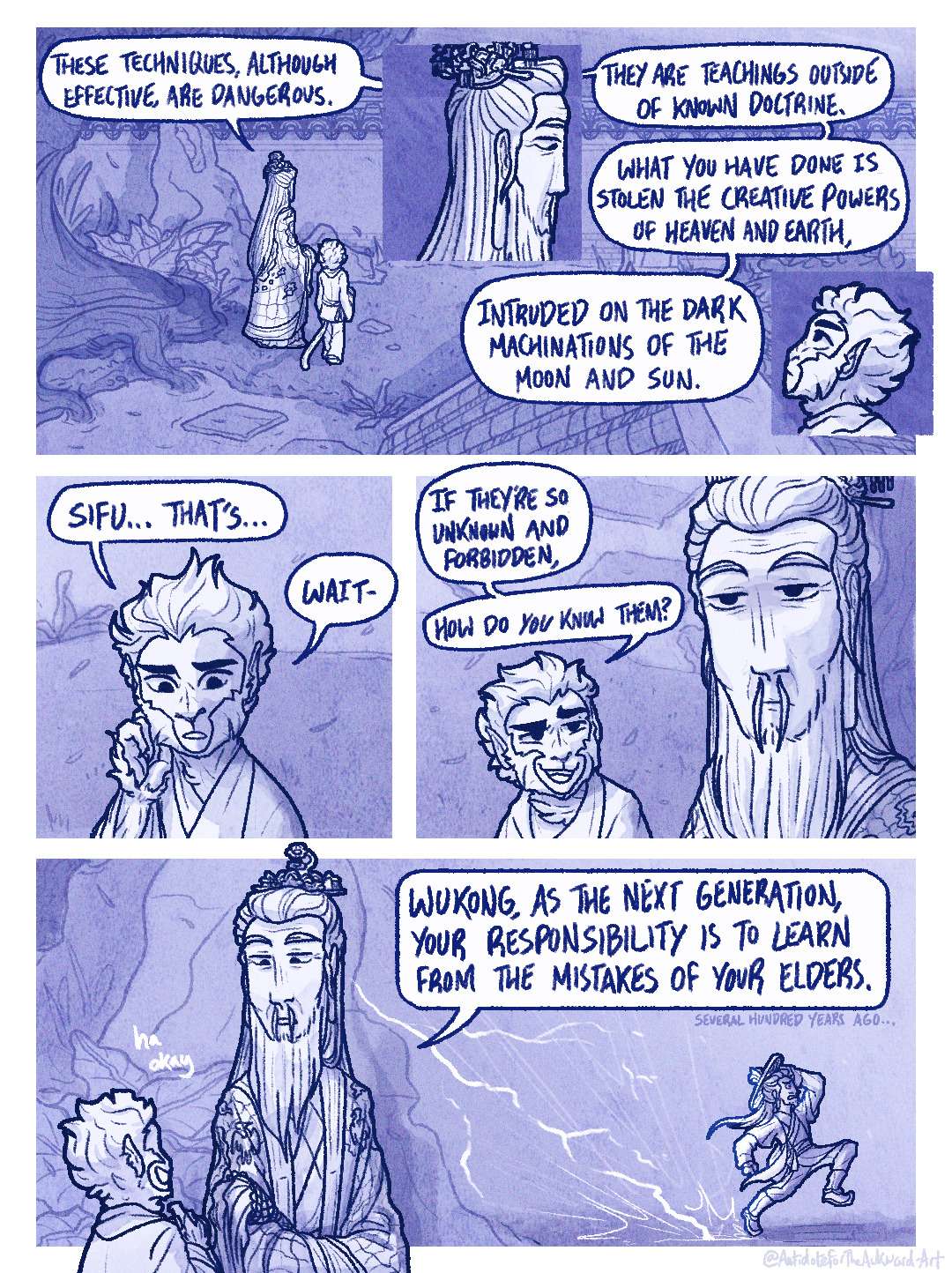
An artist known on Tumblr as “AntidoteForTheAwkward” has posted a wonderful comic (fig. 3) giving a reason for why the Patriarch Subhodi teachers Monkey the 72 transformations in order to avoid the heavenly calamities: personal experience.

Fig. 3 – AntidoteForTheAwkward’s comic (larger version). See the original post here.

Notes:

1) The eyes, ears, nose, mouth, genitals, and anus.

2) Wukong serves in heaven twice: first “for more than ten years” and second “for over a century” (Wu & Yu, 2012, vol. 1, pp. 150 and 166). Then he is punished to 49 days in Laozi’s furnace (Wu & Yu, 2012, vol. 1, p. 189). But the narrative revels “one day in heaven is equal to one year on Earth” (Wu & Yu, 2012, vol. 1, pp. 150 and 167). So this means his turn in the furnace lasts close to fifty years.

Sources:

Buswell, J., & Lopez, D. (2014). The Princeton Dictionary of Buddhism. Princeton, NJ: Princeton University Press.

Fryklund, K. I., Lewis, M. E., & Baptandier, B. (2021). The Lady of Linshui Pacifies Demons: A Seventeenth-Century Novel. Seattle, WA: University of Washington Press.

Kloetzli, R. (1983). Buddhist Cosmology: From Single World System to Pure Land: Science and Theology in the Images of Motion and Light. Oxford: Motilal Books.

Wu, C., & Yu, A. C. (2012). The Journey to the West (Vol. 1) (Rev. ed.). Chicago, Illinois: University of Chicago Press.

Wumen xiaoke, & Yanshui sanren (1636). Qianhou qiguo zhi [Annals of the Seven Kingdoms]. Retrieved from 

Archive #5 – All Woodblock Prints from Mr. Li Zhuowu’s Literary Criticism of Journey to the West

Here I present all of the woodblock prints from Mr. Li Zhuowu’s Literary Criticism of Journey to the West (Li Zhuowu Xiansheng piping Xiyouji, 李卓吾先生批評西遊記, late-16th-c. or early-17th-c.) by the Ming scholar Li Zhi (李贄, 1527-1602). It’s important to remember that the original novel was published in 1592, which means the images therein are some of the earliest depictions of the characters and episodes based on that freshly published version. The PDF linked below has nearly 200 prints, illustrating everything from Sun Wukong’s discovery of the Water Curtain Cave to the pilgrims’ final attainment of Buddhahood or Sainthood. Here is a sample.

Mr. Li's Criticism - Detail of Monkey fighting Heaven (small)

Sun Wukong fighting the heavenly army (larger version). Enhanced slightly for clarity.

PDF link

Click to access mr-li-zhuowus-literary-criticism-of-journey-to-the-west-late-16th-c-pictures-only.pdf

Thanks

The entirety of Mr. Li’s criticism is FAR too large to host on my meager site. The original files are hosted on Shuge.org and are free to download.

Archive #4 – Mid-Century Illustrated Journey to the West Children’s Books from Japan

For my 50th post, I am excited to host PDF copies of two gorgeously illustrated Journey to the West (Xiyouji西遊記, 1592) children’s books produced in Japan during the middle part of the 20th century.

Table of Contents

1. Son Goku (孫悟空, 1939)

This work was illustrated by Shotaro Honda (本田庄太郎, 1893–1939), a Western-trained artist closely associated with children’s literature for nearly 30 years. As the title suggests, the book focuses on the first 7 chapters of the novel, from the time of Monkey’s stone birth to his final imprisonment under Five Elements mountain. Literally every single panel is worthy of framing. The illustrations are bright and vibrant, seemingly jumping from the page. See below for an example.

Click to access e5ad99e6829fe7a9ba-e7bb98e69cac-e5ae87e9878ee6b5a9e4ba8ce69687-e69cace794b0e5ba84e5a4aae9838ee7bb98-1949e5b9b4e78988.pdf

Shotaro_Honda_1939 - Hell (small)

Monkey in the underworld striking his name from the Book of Life and Death (larger version).

2. The Illustrated Journey to the West (繪本西遊記, 1950)

This three volume work was illustrated by Mizushima Nio (水島爾保布, 1884–1958). The first volume covers Monkey’s birth to the submission of Sandy; the second covers the Ginseng fruit tree to the battle with Guanyin’s goldfish; and the third covers the Buffalo demon to the end of the novel. The dark on light line work reminds one of delicate paper cut artwork brought to life. See below for an example.

Click to access e7bb98e69cace8a5bfe6b8b8e8aeb0-e4b88ae4b8ade4b88b-e6b0b4e5b29be5b094e4bf9de5b883-e794bb-1950e5b9b4.pdf

The Illustrated Journey to the West (1950) - End of Volume 1 (small)

The group bowing before a Buddhist figure (larger version).

3. Thanks

The original PDFs are hosted on shuge.org and are free to download. I’m posting them here for posterity. 50Watts appears to be the first English site to host images from both Son Goku and The Illustrated Journey to the West, but they either skip some images or only show a partial spread.

Misconceptions About the Monkey King’s Staff and the Milky Way Galaxy

Last updated: 05-15-2024

A common misconception on the internet is that Sun Wukong’s magic staff was originally used to hold down the Milky Way (fig. 1), suggesting that since the immortal can effortlessly wield the weapon, he is strong enough to lift the weight of a galaxy. (This misconception usually pops up in forums and battle wikis during debates on the lifting strength of particular mythological or fictional characters.) It ultimately stems from a mistranslation in the widely read W. J. F. Jenner edition (see the 02-12-23 update for a PDF). [1] The passage in question reads:

The piece of miraculous iron that anchors the Milky Way in place (emphasis added) has been shining with a lovely rosy glow for the last few days, and creating a most auspicious atmosphere (Wu & Jenner, 1993/2020, p. 55).

However, the original Chinese reads:

我們這海藏中,那一塊天河定底的神珍鐵,這幾日霞光艷艷,瑞氣騰騰

The problem lies in the partial mistranslation of the characters Tianhe dingdi (天河定底). Tianhe is the Chinese name for the Milky Way, while dingdi means to “fix or set the depth or base of.” This refers to setting a fixed measurement for the “Heavenly River” and has nothing to do with anchoring or weighing down anything.

Milky_Way_Arch

Fig. 1 – A panorama of the top arch of the Milky Way galaxy as seen from Chile (larger version).

The far more accurate Anthony C. Yu translations reads:

Inside our ocean treasury is that piece of rare magic iron by which the depth of the Heavenly River is fixed (emphasis added). These past few days the iron has been glowing with a strange and lovely light (Wu and Yu, 2012, vol. 1, p. 135).

Most importantly, the novel is quite clear on how much the staff weighs:

Immediately adjacent to one of the hoops was the inscription, “The Compliant Golden-Hooped Rod. Weight: 13,500 catties” (17,560 lbs./7,965 kg) (based on Wu and Yu, 2012, vol. 1, p. 135). [2]

緊挨箍有鐫成的一行字,喚做:「如意金箍棒,重一萬三千五百斤。」


Update: 08-05-18

I’ve written a follow up discussing Monkey’s greatest feat of strength.

Sun Wukong’s Greatest Feat of Strength: An Allegory for Cultural or Religious Conflict?


Update: 02-06-21

I have written an article that discusses the magic powers of the staff. These include the ability to shrink and grow, control the ocean, astral project and entangle with Monkey’s spirit, multiply endlessly, pick locks, and transform into various objects. It also has sentience to a certain degree.

The Magic Powers of the Monkey King’s Iron Staff


Update: 07-04-21

Here is my theory on why Sun Wukong’s staff weighs 13,500 catties (Yiwan sanqian wubai jin, 一萬三千五百斤; 17,560 lbs./7,965 kg). I believe the number is an embellishment on the 300 to 500 catty (san wubai jin, 三五百斤) stone block lifted by the bandit Wu Song in the Water Margin (Shuihu zhuan, 水滸傳, c. 1400).

The Weight of the Monkey King’s Staff: A Literary Origin


Update: 05-15-24

Sun Wukong claims that his staff can hold up the sky in chapter 67:

Old Monkey isn’t bragging, but this rod I hold in my hands can even hold up the sky—if it collapses!” Wu and Yu, 2012, vol. 3, p. 241)

不是老孫海口,只這條棒子揝在手裡,就是塌下天來,也撐得住。

I should note, however, that this is never demonstrated.

Notes

1) This is the first edition I read as a youngster.

2) Anthony Yu’s (Wu & Yu, 2012) original translation says “thirteen thousand five hundred pounds” (vol. 1, p. 135). However, the Chinese version uses jin (斤), known in English as “catty.” The catty and pound are two different measures of weight, the former being heavier than the latter. Therefore, the English text has been altered to show this. The catty during the Ming Dynasty when the novel was compiled equaled 590 grams (Elvin, 2004, p. 491 n. 133), so 13,500 catties would equal 17,560 lbs.

Sources

Elvin, M. (2004). The Retreat of the Elephants: An Environmental History of China. New Haven (Conn.): Yale university press.

Wu, C. & Jenner, W. J. F. (2020). Journey to the West (Vols. 1-4). Beijing: Foreign Languages Press. (Original work published 1993)

Wu, C., & Yu, A. C. (2012). The Journey to the West (Vols. 1-4) (Rev. ed.). Chicago, Illinois: University of Chicago Press.