Last updated: 01-12-2026
Here I present a list of parallels shared between Sun Wukong from Journey to the West (Xiyou ji, 西遊記, 1592 CE) and the Greco-Roman hero Hercules. I noticed many of the similarities myself, but I am also indebted to the list (that I also contributed to) posted on the DEATH BATTLE! Wiki. (Before continuing, I know the demi-god’s original Greek name is Heracles/Herakles, but I will use Hercules throughout the article as this is the name used by DEATH BATTLE!) Numbers one to sixteen below originally appeared in my Hercules vs Sun Wukong Death Battle Analysis, but I decided to split the information off into a new article in order to make the original a more manageable length.
I should point out that this piece is only listing interesting parallels. It is NOT trying to prove that elements from the Greco-Roman demi-god’s story directly influenced that of our primate immortal. However, at the end, I do very briefly discuss possible antecedents that may have influenced both tales.
Current parallel count: 22
Listed in no particular order.
- Heavenly and earthly origins
- Bad tempers
- Wear big cat skins
- Wield blunt weapons
- Immensely strong
- Subdued by a blow from a deity
- Punished with difficult tasks for past crimes
- Aided by goddesses
- Similar animal enemies
- Tamer of horses
- Visit women lands
- Steal divine fruit
- Save someone from the underworld
- Fight in heavenly wars
- Achieve godhood in respective narratives
- Worshiped in the real world
- Have doubles
- Attack enemies from within
- Blond hair/fur
- Disguised as women
- Compiled adventures
- Kill enemy in bee form with blunt weapon
See below for more details.
I. Details
1) Origins – Both are born of masculine heavenly forces and feminine earthly forces. Hercules is the half-human son of Zeus and the mortal Alkmene. Hesiod‘s Shield of Heracles reads:
But the father of men and gods wove another design in his mind, how he might fashion for gods and wheat-eating men a protector against disaster. He arose from Olympos by night, pondering a deception in his spirit, longing for sex with a fine-waisted woman. Quickly he came to Typhaonion, and from there Zeus the Counselor trod the peak of Mount Phikion. Taking his seat, he planned wondrous deeds in his heart. On that very night he slept with the slender-ankled daughter of Elektryon; he fulfilled his desire […] She bore him [Herakles] by submitting to the son of Kronos, lord of the dark clouds (Hesiod & Powell, 2017, p. 153 and 154; see also Pache, 2021).
The Monkey King is born from a stone seeded by heavenly and earthly energies. Chapter one of JTTW reads:
Since the creation of the world, it [the stone] had been nourished for a long period by the seeds of Heaven and Earth and by the essences of the sun and the moon, until, quickened by divine inspiration, it became pregnant with a divine embryo. One day, it split open, giving birth to a stone egg about the size of a playing ball. Exposed to the wind, it was transformed into a stone monkey endowed with fully developed features and limbs (Wu & Yu, 2012, p. 101).
Hinsch (2011) explains that Chinese works as far back as the Eastern Zhou and Han considered heaven masculine and described it as the father/husband/superior of the feminine earth, the mother/wife/inferior (pp. 157-158).
2) Temper – Both are quick to anger. In his youth, Hercules killed his music teacher for punishing him. The Bibliotheca Historica of Diodorus reads:
Linus [of Thrace] also, who was admired because of his poetry and singing, had many pupils and three of greatest renown, Heracles, Thamyras, and Orpheus. Of these three Heracles, who was learning to play the lyre, was unable to appreciate what was taught him because of his sluggishness of soul, and once when he had been punished with rods by Linus he became violently angry and killed his teacher with a blow of the lyre (3.67.2; Pache, 2021, p. 10).
Sun pushes over a magical, one-of-a-kind Ginseng Tree (Renshen shu, 人參樹) in retaliation for verbal abuse at the hands of some immortal youths. Chapter 25 of JTTW reads:
When the immortal lads found out the truth, they became even more abusive in their language; the Great Sage became so enraged that he ground his steel-like teeth audibly and opened wide his fiery eyes. He gripped his golden-hooped rod again and again, struggling to restrain himself and saying to himself, “These malicious youths! They certainly know how to give people a lashing with their tongues! All right, so I have to take such abuse from them. Let me offer them in return a plan for eliminating posterity: and none of them will have any more fruit to eat!” Dear Pilgrim! He pulled off a strand of hair behind his head and blew on it with his magic breath, crying “Change!” It changed at once into a specious Pilgrim, standing by the Tang Monk, Wujing, and Wuneng to receive the scolding from the Daoist lads. His true spirit rose into the clouds, and with one leap he arrived at the ginseng garden. Whipping out his golden-hooped rod, he gave the tree a terrific blow, after which he used that mountain-moving divine strength of his to give it a mighty shove (Wu & Yu, 2012, vol. 1, pp. 465-466).
3) Skins – Both wear the skins of big cats. Hercules wears the skin of the Nemean Lion. Theocritus‘ Idylls (25) reads:
The fight ended, I fell to pondering how I could strip the shaggy hide from the dead brute’s limbs—a troublesome task indeed, for when I tried, I could not cut it either with iron or with stone or [otherhow]. But then some god put in my mind the thought to sever the lion’s skin with his own claws; and with these I flayed it speedily and wrapped it about my body to guard me from the rents and hurts of war (Theocritus & Gow, 1952, p. 213; see also March, 2021).
Monkey wears the skin of a mountain tiger. Chapter 14 of JTTW reads:
He [Sun] pulled off one strand of hair and blew a mouthful of magic breath onto it, crying, “Change!” It changed into a sharp, curved knife, with which he ripped open the tiger’s chest. Slitting the skin straight down, he then ripped it off in one piece. He chopped away the paws and the head, cutting the skin into one square piece. He picked it up and tried it for size, and then said, “It’s a bit too large; one piece can be made into two.” He took the knife and cut it again into two pieces; he put one of these away and wrapped the other around his waist. Ripping off a strand of rattan from the side of the road, he firmly tied on this covering for the lower part of his body (Wu & Yu, 2012, vol. 1, p. 310).
4) Weapons – Both are knowledgeable in multiple armaments but often wield blunt weapons in their adventures. Hercules uses an olive wood club (I’m unsure if it has an actual name). Theocritus’ Idylls (25) reads:
I set forth, taking my pliant bow, a hallow quiver filled with arrows, and in my other hand a club, made from a spreading wild olive, close-grained, with bark and pith intact, which I had found under holy Helicon and had pulled up entire with all it’s tangle of roots.
[…]
And I, holding in front of me with one hand my arrows … with the other raised my seasoned club over my head and brought it down on [the lion’s] skull; and full on the shaggy head of that invincible brute I broke the tough olive clean in two (Theocritus & Gow, 1952, p. 209 and 211).
Sun uses a black iron staff. Chapter three of JTTW reads:
[After a magic iron pillar followed his wish to shrink] He found a golden hoop at each end, with solid black iron in between. Immediately adjacent to one of the hoops was the inscription, “As-You-Will Gold-Banded Staff. Weight: Thirteen Thousand Five Hundred Catties” [Ruyi jingu bang zhong yiwan sanqian wubai jin, 如意金箍棒重一萬三千五百斤]” [1] … See how he displayed his power now! He wielded the rod to make lunges and passes, engaging in mock combat all the way back to the Water-Crystal Palace. The old Dragon King was so terrified that he shook with fear, and the dragon princes were all panic-stricken (Wu & Yu, 2012, vol. 1, p. 135).
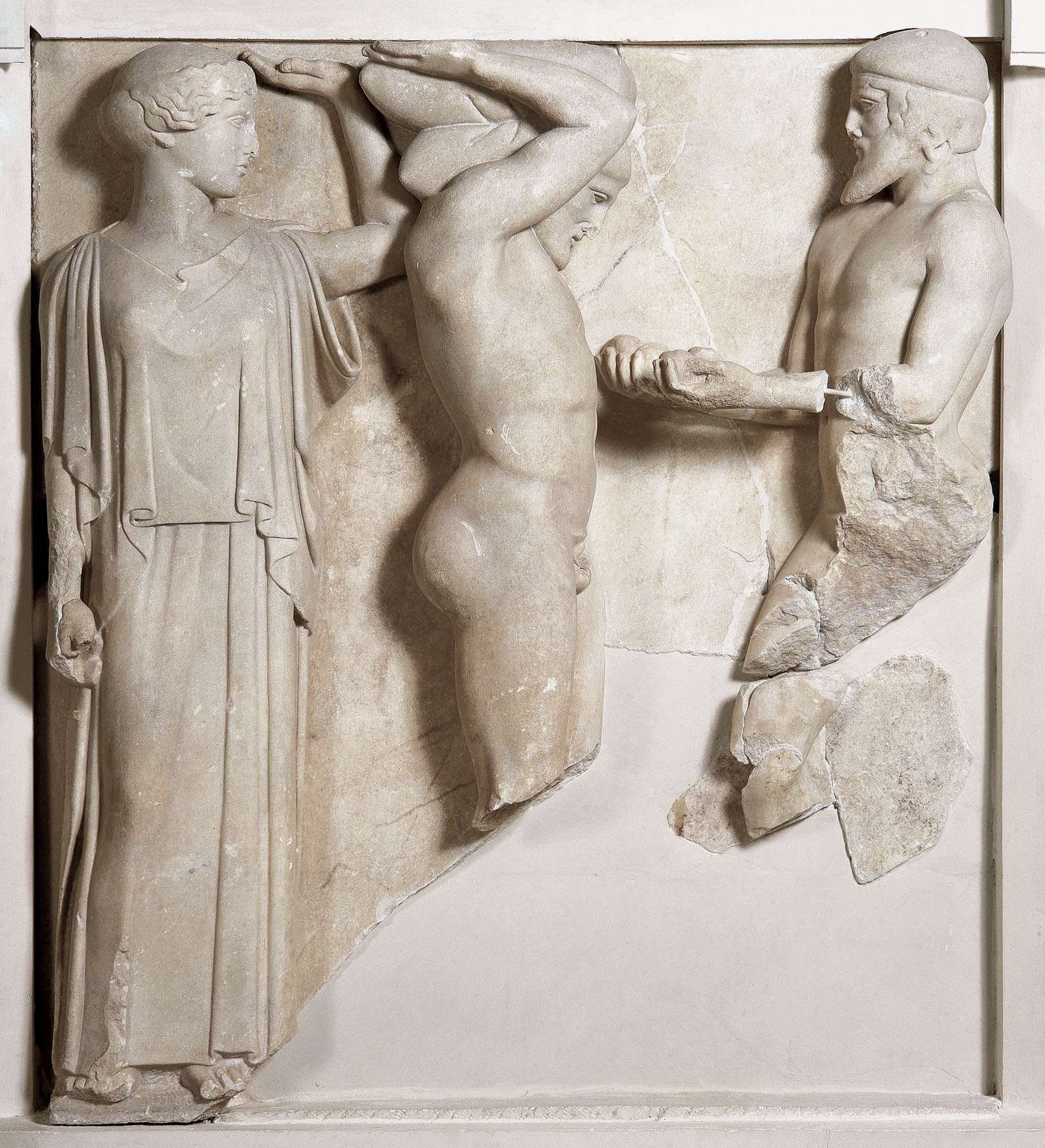
5) Strength – Both are immensely strong. Hercules (in one version of the myth) holds up the sky. The Bibliotheca of Pseudo-Apollodorus reads:
Now Prometheus had told Hercules not to go himself after the apples but to send Atlas, first relieving him of the burden of the sphere; so when he was come to Atlas in the land of the Hyperboreans, he took the advice and relieved Atlas. But when Atlas had received three apples from the Hesperides, he came to Hercules, and not wishing to support the sphere<he said that he would himself carry the apples to Eurystheus, and bade Hercules hold up the sky in his stead. Hercules promised to do so, but succeeded by craft in putting it on Atlas instead. For at the advice of Prometheus he begged Atlas to hold up the sky till he should> put a pad on his head [fig. 1]. When Atlas heard that, he laid the apples down on the ground and took the sphere from Hercules (2.5.11; see also Salapata, 2021).

Fig. 1 – A lovely Olympian Temple of Zeus metopes portraying Hercules (middle) resting the uplifted sky on his cushioned back. Athena (left) aids him in this task. Atlas (right) is shown with the golden apples (larger version). Image found on Wikipedia.
Monkey runs at great speed while bearing the weight of two mountains on his shoulders, one of which is the axis mundi of the Hindo-Buddhist cosmos and the abode of the gods. Chapter 33 of JTTW reads:
Knowing how to summon mountains, he [a demon being carried by Sun] resorted to the magic of Moving Mountains and Pouring Out Oceans. On Pilgrim’s [Monkey] back he made the magic sign with his fingers and recited a spell, sending the Sumeru Mountain into midair and causing it to descend directly on Pilgrim’s head. A little startled, the Great Sage bent his head to one side and the mountain landed on his left shoulder. Laughing, he said, “My child, what sort of press-body magic are you using to pin down old Monkey? This is all right, but a lopsided pole is rather difficult to carry.”
The demon said to himself, “One mountain can’t hold him down.” He recited a spell once more and summoned the Emei Mountain into the air. Pilgrim again turned his head and the mountain landed on his right shoulder. Look at him! Carrying two mountains, he began to give chase to his master with the speed of a meteor! The sight of him caused the old demon to perspire all over, muttering to himself, “He truly knows how to pole mountains!” (Wu & Yu, 2012, vol. 2, pp. 108-109).
6) Submission – Both are subdued with a blow by deities. Hercules is knocked out with a rock by Athena during his murderous rage. Euripides‘ Heracles reads:
Then in wild gallop he starts to slay his aged father; but there came a phantom [Athena], as it seemed to us on-lookers, of Pallas, with plumed helm, brandishing a spear; and she hurled a rock against the breast of Heracles, which held him from his frenzied thirst for blood and plunged him into sleep (1000-1006).
Sun is dazed by Laozi’s magic bracelet during his rebellion, allowing the primate to be captured by heaven. Chapter six of JTTW reads:
[Laozi] rolled up his sleeve and took down from his left arm an armlet, saying, “This is a weapon made of red steel, brought into existence during my preparation of elixir and fully charged with theurgical forces. It can be made to transform at will; indestructible by fire or water, it can entrap many things. It’s called the diamond cutter or the diamond snare … After saying this, Laozi hurled the snare down from the Heaven Gate; it went tumbling down into the battlefield at the Flower-Fruit Mountain and landed smack on the Monkey King’s head. The Monkey King was engaged in a bitter struggle with the Seven Sages and was completely unaware of this weapon, which had dropped from the sky and hit him on the crown of his head. No longer able to stand on his feet, he toppled over (Wu & Yu, 2012, vol. 1, p. 186).
7) Punishment – Both are given difficult tasks in order to atone for past transgressions. For killing his family, Hercules is tasked with serving his cousin, King Eurystheus, and completing the 12 Labors. The Bibliotheca of Pseudo-Apollodorus reads:
Now it came to pass that after the battle with the Minyans Hercules was driven mad through the jealousy of Hera and flung his own children, whom he had by Megara, and two children of Iphicles into the fire; wherefore he condemned himself to exile, and was purified by Thespius, and repairing to Delphi he inquired of the god where he should dwell. The Pythian priestess then first called him Hercules, for hitherto he was called Alcides. And she told him to dwell in Tiryns, serving Eurystheus for twelve years and to perform the ten [plus two] labours imposed on him, and so, she said, when the tasks were accomplished, he would be immortal (2.4.12; see also Hsu, 2021).
Monkey is directed to guard the Buddhist monk Tripitaka for rebelling against heaven. Chapter eight of JTTW reads:
“Tathagata deceived me,” said the Great Sage, “and imprisoned me beneath this mountain. For over five hundred years already I have not been able to move. I implore the Bodhisattva to show a little mercy and rescue old Monkey!” “Your sinful karma is very deep,” said the Bodhisattva. “If I rescue you, I fear that you will again perpetrate violence, and that will be bad indeed.” “Now I know the meaning of penitence,” said the Great Sage. “So I entreat the Great Compassion to show me the proper path, for I am willing to practice cultivation.”
[…]
“If you have such a purpose, wait until I reach the Great Tang Nation in the Land of the East [China] and find the scripture pilgrim. He will be told to come and rescue you, and you can follow him as a disciple. You shall keep the teachings and hold the rosary to enter our gate of Buddha, so that you may again cultivate the fruits of righteousness. Will you do that?” ”I’m willing, I’m willing,” said the Great Sage repeatedly (Wu & Yu, 2012, vol. 1, p. 215).
8) Heavenly aid – Both are aided by goddesses. Hercules is helped by Athena. For example, Homer‘s Illiad reads”
[B]ut my [Athena] father Zeus is mad with spleen, ever foiling me, ever headstrong and unjust. He forgets how often I saved his son [Hercules] when he was worn out by the labors Eurystheus had laid on him. He would weep till his cry came up to heaven, and then Zeus would send me down to help him; if I had had the sense to foresee all this, when Eurystheus sent him to the house of Hades, to fetch the hell-hound from Erebos, he would never have come back alive out of the deep waters of the river Styx (8.366; See also Deacy, 2021).
Sun is helped by the Bodhisattva Guanyin. For example, the goddess tells him the following in chapter 15 of JTTW:
If on your journey you should come across any danger that threatens your life, I give you permission to call on Heaven, and Heaven will respond; to call on Earth, and Earth will prove efficacious. In the event of extreme difficulty, I myself will come to rescue you. Come closer, and I shall endow you with one more means of power.” Plucking three leaves from her willow branch, the Bodhisattva placed them at the back of Pilgrim’s head, crying, “Change!” They changed at once into three hairs with lifesaving power. She said to him: “When you find yourself in a helpless and hopeless situation, you may use these according to your needs, and they will deliver you from your particular affliction.” After Pilgrim had heard all these kind words, he thanked the Bodhisattva of Great Mercy and Compassion. With scented wind and colored mists swirling around her, the Bodhisattva returned to Potalaka (Wu & Yu, 2012, pp. 328-329).
9) Enemies – Both face similar enemies: A) supernatural lions (Nemean Lion vs Lion demon); B) opponents that regrow their heads once severed but are eventually defeated with fire (Lernaean Hydra vs Bull Demon King); C) supernatural deer (Ceryneian Hind vs Great Immortal Deer Strength); D) supernatural boars (Erymanthian Boar vs Zhu Bajie); E) supernatural birds (Stymphalian birds vs Great Peng of 10,000 Cloudy Miles); and F) supernatural bulls (Cretan Bull vs Bull Demon King).
10) Tamer of horses – Both tame supernatural horses. Hercules tames the man-eating Mares of Diomedes. The Bibliotheca Historica of Diodorus reads:
The next Labour which Heracles undertook was the bringing back of the horses of Diomedes, the Thracian. The feeding-troughs of those horses were of brass because the steeds were so savage, and they were fastened by iron chains because of their strength, and the food they ate was not the natural produce of the soil but they tore apart the limbs of strangers and so got their food from the ill lot of hapless men. Heracles, in order to control them, threw to them their master Diomedes, and when he had satisfied the hunger of the animals by means of the flesh of the man who had taught them to violate human law in this fashion, he had them under his control (4.15.3; see also Ogden, 2021b).
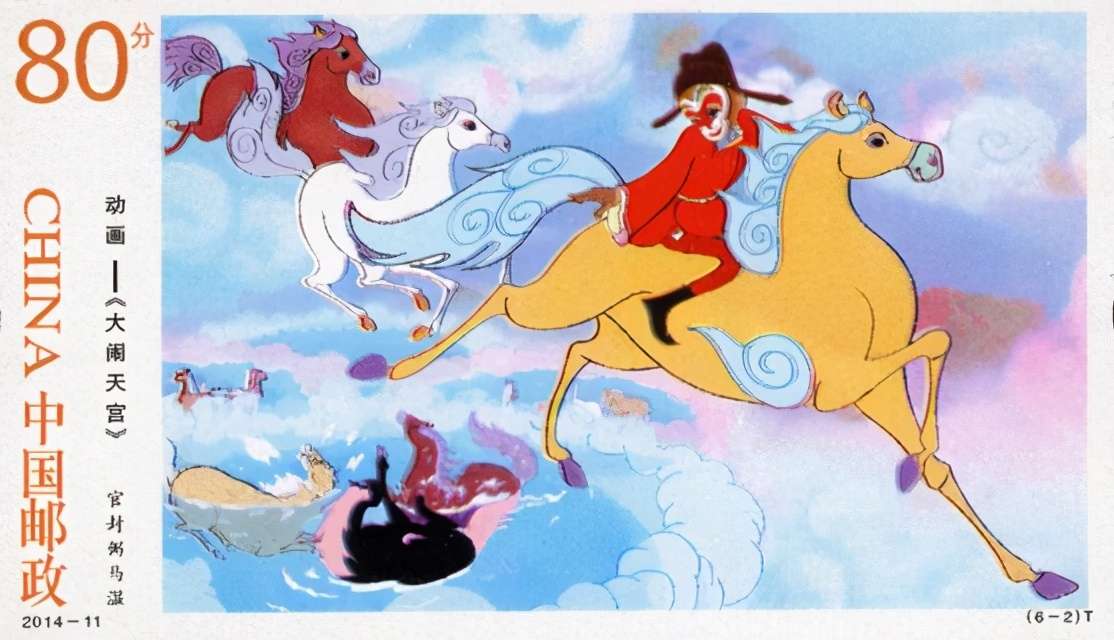
Monkey serves as the Keeper of the Heavenly Horses (fig. 2). Chapter four of JTTW reads:
Never resting, the [Sun] oversaw the care of the horses, fussing with them by day and watching over them diligently by night. Those horses that wanted to sleep were stirred up and fed; those that wanted to gallop were caught and placed in the stalls. When the celestial horses saw him, they all behaved most properly and they were so well cared for that their flanks became swollen with fat (Wu & Yu, 2012, vol. 1, p. 149).

Fig. 2 – A 2014 stamp featuring a scene from the classic 1960s animation Havoc in Heaven in which Sun Wukong serves as the keeper of the heavenly horses (larger version). Image found here.
11) Women lands – Both visit locations peopled entirely by women. Hercules visits the Amazons to get the heavenly war belt (zoster) of their Queen Hippolyte. The Bibliotheca of Pseudo-Apollodorus reads:
The ninth labour he [Eurystheus] enjoined on Hercules was to bring the belt of Hippolyte. She was queen of the Amazons, who dwelt about the river Thermodon, a people great in war; for they cultivated the manly virtues, and if ever they gave birth to children through intercourse with the other sex, they reared the females; and they pinched off the right breasts that they might not be trammelled by them in throwing the javelin, but they kept the left breasts, that they might suckle. Now Hippolyte had the belt of Ares in token of her superiority to all the rest. Hercules was sent to fetch this belt because Admete, daughter of Eurystheus, desired to get it. So taking with him a band of volunteer comrades in a single ship he set sail …
[After taking part in a small war elsewhere, Hercules finally arrived at his destination]
… Having put in at the harbor of Themiscyra, he received a visit from Hippolyte, who inquired why he was come, and promised to give him the belt. But Hera in the likeness of an Amazon went up and down the multitude saying that the strangers who had arrived were carrying off the queen. So the Amazons in arms charged on horseback down on the ship. But when Hercules saw them in arms, he suspected treachery, and killing Hippolyte stripped her of her belt. And after fighting the rest he sailed away and touched at Troy (2.5.9; see also Mayor, 2021).
Monkey and the other pilgrims travel through the “Woman Kingdom of Western Liang” (Xiliang nuguo, 西梁女國) in chapter 53 on their way to India (both Tripitaka and Zhu Bajie become pregnant from drinking magic water while there). In chapter 54, the group enters the capital in order to have their travel rescript signed by the queen, but she has other plans for the head monk:
The queen said, “This man from the Land of the East [China] is a royal brother of the Tang court. In our country, the rulers of various generations since the time when chaos divided had never seen a man come here. Now the royal brother of the Tang emperor has arrived, and he must be a gift from Heaven. We will use the wealth of an entire nation to ask this royal brother to be king; we are willing to be his queen. Such a sexual union will produce children and grandchildren, and the perpetuity of our kingdom will be assured (Wu & Yu, 2012, vol. 3, p. 49).
Sun helps arrange the marriage with the veiled purpose of ensuring that their travel rescript is signed (Wu & Yu, 2012, vol. 3, pp. 52-53).
12) Theft of fruit – Both steal supernatural fruit from the gardens of queenly goddesses. Hercules (in one version of the myth) steals Queen Hera‘s Golden Apples of the Hesperides. The Bibliotheca of Pseudo-Apollodorus reads:
But some say that he did not get them from Atlas, but that he plucked the apples himself after killing the guardian snake. And having brought the apples he gave them to Eurystheus. But he, on receiving them, bestowed them on Hercules, from whom Athena got them and conveyed them back again; for it was not lawful that they should be laid down anywhere (2.5.11; see also Salapata, 2021).
Monkey steals the Queen Mother’s immortal peaches. Chapter five of JTTW reads:
One day he saw that more than half of the peaches on the branches of the older trees had ripened, and he wanted very much to eat one and sample its novel taste. Closely followed, however, by the local spirit of the garden, the stewards, and the divine attendants of the Equal to Heaven Residence, he found it inconvenient to do so. He therefore devised a plan on the spur of the moment and said to them, “Why don’t you all wait for me outside and let me rest a while in this arbor?” The various immortals withdrew accordingly. That Monkey King then took off his cap and robe and climbed up onto a big tree. He selected the large peaches that were thoroughly ripened and, plucking many of them, ate to his heart’s content right on the branches. Only after he had his fill did he jump down from the tree. Pinning back his cap and donning his robe, he called for his train of followers to return to the residence. After two or three days, he used the same device to steal peaches to gratify himself once again (Wu & Yu, 2012, vol. 1, p. 162).
13) Chthonic saviors – Both travel to the land of the dead and bring someone back to life. Hercules goes to Hades to acquire Cerberus and saves Theseus in the process. The Bibliotheca of Pseudo-Apollodorus reads:
A twelfth labour imposed on Hercules was to bring Cerberus from Hades. Now this Cerberus had three heads of dogs, the tail of a dragon, and on his back the heads of all sorts of snakes. When Hercules was about to depart to fetch him, he went to Eumolpus at Eleusis, wishing to be initiated … [He sought ritual purification for his past misdeeds] … And having come to Taenarum in Laconia, where is the mouth of the descent to Hades, he descended through it … [He fended off the empty attacks of shades, rescued Theseus, sated the various ghosts with blood, and won a wrestling match against Menoetes] …When Hercules asked Pluto for Cerberus, Pluto ordered him to take the animal provided he mastered him without the use of the weapons which he carried. Hercules found him at the gates of Acheron, and, cased in his cuirass and covered by the lion’s skin, he flung his arms round the head of the brute, and though the dragon in its tail bit him, he never relaxed his grip and pressure till it yielded. So he carried it off and ascended through Troezen … [A]nd Hercules, after showing Cerberus to Eurystheus, carried him back to Hades (2.5.12; see also Hanesworth, 2021).
Sun travels to the Land of Darkness at least twice (ch. 3 & 97), the latter of which is the most important for our purposes. In chapter 97, he travels there in order to retrieve the spirit of a recently deceased benefactor:
With a series of cloud somersaults, that Great Sage went to the Region Below and crashed right into the Hall of Darkness … Pilgrim said, “Which one of you took away the soul of Kou Hong, the person who fed the monks in the Numinous Earth District of the Bronze Estrade Prefecture? Find out instantly and bring him to me.”
[…]
[After being led out] Kou Hong, who, on seeing Pilgrim, cried out, “Master! Master! Save me!” “You were kicked to death by a robber,” said Pilgrim. “This is the place of the Bodhisattva King Kṣitigarbha in the Region of Darkness. Old Monkey has come especially to take you back to the world of light so that you may give your testimony. The Bodhisattva is kind enough to release you and lengthen your age for another dozen years. Thereafter you’ll return here.” The squire bowed again and again.
Having thanked the Bodhisattva, Pilgrim changed the soul of the squire into ether by blowing on him. The ether was stored in his sleeve so that they could leave the house of darkness and go back to the world of light together. Astride the clouds, he soon arrived at the Kou house (Wu & Yu, 2012, vol. 4, pp. 338-339).
14) Heavenly war – Both take part in battles with heaven but on opposing sides. Hercules fights alongside the Olympian gods during the Gigantomachy. The Bibliotheca of Pseudo-Apollodorus reads:
But Earth, vexed on account of the Titans, brought forth the giants, whom she had by Sky. These were matchless in the bulk of their bodies and invincible in their might; terrible of aspect did they appear, with long locks drooping from their head and chin, and with the scales of dragons for feet. They were born, as some say, in Phlegrae, but according to others in Pallene. And they darted rocks and burning oaks at the sky. Surpassing all the rest were Porphyrion and Alcyoneus, who was even immortal so long as he fought in the land of his birth. He also drove away the cows of the Sun from Erythia. Now the gods had an oracle that none of the giants could perish at the hand of gods, but that with the help of a mortal they would be made an end of. Learning of this, Earth sought for a simple to prevent the giants from being destroyed even by a mortal. But Zeus forbade the Dawn and the Moon and the Sun to shine, and then, before anybody else could get it, he culled the simple himself, and by means of Athena summoned Hercules to his help. Hercules first shot Alcyoneus with an arrow, but when the giant fell on the ground he somewhat revived. However, at Athena’s advice Hercules dragged him outside Pallene, and so the giant died (1.6.1; see also Salowey, 2021).
Monkey fights against the Buddho-Daoist gods a few times. For instance, chapter four of JTTW reads:
Each displaying his divine powers, the Third Prince [Nezha] and Wukong battled for thirty rounds. The six weapons of that prince changed into a thousand and ten thousand pieces; the golden-hooped rod of Sun Wukong into ten thousand and a thousand. They clashed like raindrops and meteors in the air, but victory or defeat was not yet determined. Wukong, however, proved to be the one swifter of eye and hand. Right in the midst of the confusion, he plucked a piece of hair and shouted, “Change!” It changed into a copy of him, also wielding a rod in its hands and deceiving [Nezha]. His real person leaped behind Nata and struck his left shoulder with the rod. [Nezha], still performing his magic, heard the rod whizzing through the air and tried desperately to dodge it. Unable to move quickly enough, he took the blow and fled in pain. Breaking off his magic and gathering up his six weapons, he returned to his camp in defeat (Wu & Yu, 2012, vol. 1, p. 156).
15) Godhood – Both become deities at the end of their respective story cycles. Hercules joins the gods of Olympus after death. Reasons given for this apotheosis include his his 12 Labors, his Gigantomachy deeds, or simply his virtus (Romero-Gonzalez, 2021, p. 275). One account from the Bibliotheca Historica of Diodorus reads:
… Heracles, having abandoned hope for himself [due to exposure to hydra venom], ascended the pyre and asked each one who came up to him too put torch to the pyre. And when no one had courage to obey him Philoctetes alone was prevailed upon; and he, having received in return for his compliance the gift of the bow and arrows of Heracles, lighted the pyre. And immediately lightning also fell from the heavens and the pyre was wholly consumed.
After this, when the companions of Iolaus came to gather up the bones of Heracles and found not a single bone anywhere, they assumed that, in accordance with the words of the oracle, he had passed from among men into the company of the gods.
[Description of the kinds of sacrifices that the various Greek states made to Heracles as a hero and god following his death/ascension]
We should add to what has been said about Heracles, that after his apotheosis Zeus persuaded Hera to adopt him as her son and henceforth for all time to cherish him with a mother’s love, and this adoption, they say, took place in the following manner. Hera lay upon a bed, and drawing Heracles close to her body then let him fall through her garments to the ground, imitating in this way the actual birth; and this ceremony is observed to this day by the barbarians whenever they wish to adopt a son. Hera, the myths relate, after she had adopted Heracles in this fashion, joined him in marriage to Hebe (4.38.4-4.392; see also Romero-Gonzalez, 2021).
Sun is elevated to Buddhahood at the journey’s end. The Buddha says the following to Monkey in chapter 100 of JTTW:
“Sun Wukong, when you caused great disturbance at the Celestial Palace, I had to exercise enormous dharma power to have you pressed beneath the Mountain of Five Phases. Fortunately your Heaven-sent calamity came to an end, and you embraced the Buddhist religion. I am pleased even more by the fact that you were devoted to the scourging of evil and the exaltation of good. Throughout your journey you made great merit by smelting the demons and defeating the fiends. For being faithful in the end as you were in the beginning, I hereby give you the grand promotion and appoint you the Buddha Victorious in Strife [Dou zhansheng fo, 鬥戰勝佛] (Wu & Yu, 2012, p. 381).
16) Worship – Both are (were) worshiped. Hercules was worshiped by the ancient Greeks and Romans, while Sun is worshiped as the “Great Sage Equaling Heaven” in modern Chinese folk religion. It’s interesting to note that both deities are are believed to ward off evil.
II. Possible antecedents
Scholars have previously noted how Hercules shares parallels with godly heroes of the ancient Near East. For example, here is one of two figures listed by Ogden (2021a):
Ninurta/Ningirsu, in the Akkadian epics Anzu and The Return of Ninurta to Nippur (both originally second millennium BC). He is the son of the storm-god and ruler of the gods, Enlil (cf. Zeus); he wears a lion-skin, carries a club and a bow (cf. Heracles’ equipment); he fights eleven or twelve monsters (cf. the Labors); after defeating them he brings them back to his city as trophies (cf. the demands of Eurystheus); and the beasts in question include a seven-headed serpent (cf. the Hydra), a wild bull (cf. the Cretan Bull), a stag (cf. the Cerynean Hind), the Anzubird (cf. the Stymphalian Birds), and a lion (cf. the Nemean Lion) (pp. xxiv-xxv).
Perhaps the Indic practices that would come to influence the Monkey King’s iconography were also influenced by the same ancient Indo-European sources.
Update: 09-27-25
I just thought of another parallel:
17. Doubles – Both have someone who looks exactly like them. Heracles’ double is his twin (half) brother Iphicles (Ἰφικλῆς). The Bibliotheca of Pseudo-Apollodorus reads:
But before Amphitryon reached Thebes, Zeus came by night and prolonging the one night threefold he assumed the likeness of Amphitryon and bedded with Alcmena and related what had happened concerning the Teleboans. But when Amphitryon arrived and saw that he was not welcomed by his wife, he inquired the cause; and when she told him that he had come the night before and slept with her, he learned from Tiresias how Zeus had enjoyed her. And Alcmena bore two sons, to wit, Hercules, whom she had by Zeus and who was the elder by one night, and Iphicles, whom she had by Amphitryon. When the child was eight months old, Hera desired the destruction of the babe and sent two huge serpents to the bed. Alcmena called Amphitryon to her help, but Hercules arose and killed the serpents by strangling them with both his hands. However, Pherecydes says that it was Amphitryon who put the serpents in the bed, because he would know which of the two children was his, and that when Iphicles fled, and Hercules stood his ground, he knew that Iphicles was begotten of his body (2.4.8; see also Pache, 2021).
Monkey’s double is the Six-Eared Macaque (Liu’er mihou, 六耳獼猴), who appears in JTTW chapters 56 to 58. Chapter 58 describes him as Wukong’s mirror image:
His looks were exactly the same as those of the Great Sage: he, too, had a golden headband clamped to his blond hair, a pair of fiery eyes with golden irises, a monk’s robe on his body, a tiger kilt tied around his waist, a gold-banded iron staff in one of his hands, and a pair of deerskin boots on his feet. He, too, had
A hairy face with the Thunder Lord’s beak, [2]
Empty cheeks unlike those of Saturn; [3]
Two forked ears on a big, broad head,
And fangs that have grown outward (based on Wu & Yu, 2012, vol. 3, p. 104).
See my previous article about Six Ears for more info.
Update: 10-04-25
And another:
18. Attack from within – Both are known for assaulting bad guys from inside their bodies. I, unfortunately, can’t find an English translation of the original fifth century BCE source for Heracles’ feat (due to its fragmentary nature), but Wickkiser (2021) provides a brief description: “Hellanicus, unlike Homer, provides details about how Heracles attacks the [sea creature] kētos: he climbs inside its mouth and enters its belly, where he ‘destroyed its flanks,’ cutting them from within” (p. 212). Also, Alexandra by Lycophron (3rd century BCE) gives the following account:
Alas! hapless nurse of mine burnt even aforetime by the warlike pineships of the lion that was begotten in three evenings [i.e. Heracles], whom of old Triton’s hound [i.e. kētos] of jagged teeth devoured with his jaws. But he, a living carver of the monster’s liver, seething in steam of cauldron on a flameless hearth, shed to ground the bristles of his head (source).
Attacking baddies from within is one of Monkey’s favorite methods. He successfully performs this in chapters 59, 66, 67, and 75 (Wu & Yu, 2012, vol. 3, pp. 129, 238, 249, and 380). Wukong attempts this twice in chapter 82, but only one is successful (Wu & Yu, 2012, vol. 4, pp. 104 and 110-111). Here’s an example from chapter 59:
“I’m now having a little fun in my esteemed Sister-in-law’s stomach! I am, as the saying goes, seeing right through you! I know how thirsty you must be, so let me send you a ‘sitting bowl’ to relieve your thirst.” Suddenly he shoved his foot down hard and unbearable pain shot through Rākṣasī‘s lower abdomen, sending her tumbling to the floor and moaning. “Please don’t refuse me, Sister-in-law,” said Pilgrim, “I’m presenting you with an added snack for your hunger.” He jerked his head upward, and unbearable pain coursed through Rākṣasī’s heart. She began to roll all over the ground, the pain turning her face yellow and her lips white. All she could do was to cry out, “Brother-in-law Sun, please spare my life!” (Wu & Yu, 2012, vol. 3, p. 129).
On a related note, I have posted an article that proposes a more natural reason for the two heroes to fight each other.
Update: 10-17-25
And another:
19. Hair/fur color: Both have blond-colored hair/fur. Euripides‘ Madness of Heracles reads:
In Zeus’ glen first, in the Lion’s lair,
He [Heracles] fought, and the terror was no more there;
But the tawny beast’s grim jaws were veiling
His golden head, and behind swept, trailing
Over his shoulders, its fell of hair (source).
I again quote Chapter 58’s description of Monkey’s doppleganger:
His looks were exactly the same as those of the Great Sage: he, too, had a golden headband clamped to his blond hair, a pair of fiery eyes with golden irises, a monk’s robe on his body, a tiger kilt tied around his waist, a gold-banded iron staff in one of his hands, and a pair of deerskin boots on his feet. He, too, had
A hairy face with the Thunder Lord’s beak,
Empty cheeks unlike those of Saturn;
Two forked ears on a big, broad head,
And fangs that have grown outward (based on Wu & Yu, 2012, vol. 3, p. 104).
The original Chinese says the hair of Wukong and his double is huang (黃), or “yellow.” Macaque monkeys, like our hero, tend to have sandy blonde to light brown and even reddish fur (depending on the area of their body).
Update: 10-25-25
And another:
20. Feminine disguises – Both disguise themselves as women in order to hide their true identities. Plutarch’s Greek Questions reads:
Heracles, putting out with his six ships from Troy, encountered a storm ; and when his other ships had been destroyed, with the only one remaining he was driven by the gale to Cos. He was cast ashore upon the Laceter, as the place is called, with nothing salvaged save his arms and his men. Now he happened upon some sheep and asked for one ram from the shepherd. This man, whose name was Antagoras, was in the prime of bodily strength, and bade Heracles wrestle with him ; if Heracles could throw him, he might carry off the ram. And when Heracles grappled with him, the Meropes came to the aid of Antagoras, and the Greeks to help Heracles, and they were soon engaged in a mighty battle. In the struggle it is said that Heracles, being exhausted by the multitude of his adversaries, fled to the house of a Thracian woman ; there, disguising himself in feminine garb, he managed to escape detection (section 58; Matyszak, 2015, p. 123).
This story is only mentioned by Plutarch, however. Older writers don’t reference this defeat.
I think the most famous instance of Wukong taking on a feminine appearance happens in chapter 18, when he transforms into Zhu Bajie’s beleaguered wife:
Pilgrim said. “Old Man! Take your beloved daughter to the building in front, and then you can spend all the time you want with her. Old Monkey will be here waiting for him; if the monster doesn’t show up, don’t blame me. But if he comes at all, I’ll pull out the weeds of your troubles by the roots!” With great joy, old Mr. Gao led his daughter to the front building. Exercising his magic might, Pilgrim shook his body and changed at once into the form of that girl, sitting all by herself to wait for the monster (Wu & Yu, 2012, vol. 1, p. 374).
He goes on to act like a dissatisfied spouse, complaining that her family doesn’t know anything about Zhu’s family (i.e. his background) in order to learn more about him (Wu & Yu, 2012, vol. 1, p. 376).
Update: 01-10-26
Another deals more with their literary origins:
21. Compiled adventures – The stories of both heroes have been gathered from disparate sources. For Hercules, Grollios (1984) explains:
It is very fortunate that we possess today the work of a number of authors who undertook the difficult task of compiling and syncretizing the loose mass of myths that centred around Herakles in antiquity. They were called mythographoi and one of the most important among them was Pherekydes, a 5th century B.C. scholar from Athens, whose work survives only in fragments and references. Fortunately enough, another compiler called Apollodorus, who lived in Athens during the 1st century B.C., appears to have followed the work of Pherekydes quite closely in his own work, the Bibliotheke, which is today one of the most reliable sources (if not the most reliable) for the study of the myths about Herakles. There existed many other compilers, like Diodorus Siculus, Konon, Athenaeus, to mention just a few, who devoted part or the whole of their work to the preservation of myths, among which a large part was covered by myths concerning Herakles. It is mainly through their copious and scholastic collections that we are able today to possess a significant amount of information about the life and deeds of Herakles (p. XXVI).
The piecemeal origins of Sun Wukong’s adventures are discussed in this book:
Archive #33 – The Hsi-yu chi: A Study of Antecedents to the Sixteenth-Century Chinese Novel (1970)
Update: 01-12-26
And another:
22) Kill bee enemy – Both use their signature armaments to kill an opponent transformed into a bee. Hercules ends the shapeshifting warrior Periclymenus/Periklymenos, the son of King Neleus of Pylos, with his club. Frazer notes the following in his translation of [Pseudo] Apollodorus (1921):
As to Periclymenus, see the verses of Hesiod quoted by the Scholiast on Apollonius Rhodius, Argon. i. 156, according to whom Periclymenus received from Poseidon the power of turning himself into an eagle, an ant, a bee, or a snake; but Hercules, so says the scholiast, killed him with a blow of his club when he had assumed the form of a fly. According to another account, it was in the form of a bee that Periclymenus was slain by Hercules (Eustathius, on Homer, Od. xi. 285, pp. 1685 sq.; Scholiast on Homer, Il. ii. 336) (pp. 84-85, n. 1).
Monkey kills his doppelganger-turned-bee with his staff at the end of JTTW chapter 58:
When the macaque heard how Tathagata had announced his original form, he shook with fear; leaping up quickly, he tried to flee. Tathagata, however, at once ordered the Four Bodhisattvas, the Eight Diamond Kings, the five hundred arhats, the three thousand guardians of the faith, the mendicant monks, the mendicant nuns, the upasakas, the upasikas, Guanyin, and Moksa to have him completely encircled. The Great Sage Sun also wanted to rush forward, but Tathagata said, “Wukong, don’t move. Let me capture him for you.” The macaque’s hair stood on end, for he supposed that he would not be able to escape. Shaking his body quickly, he changed at once into a bee, flying straight up. Tathagata threw up into the air a golden almsbowl, which caught the bee and brought it down. Not perceiving that, the congregation thought the macaque had escaped. With a smile, Tathagata said, “Be silent, all of you. The monster-spirit hasn’t escaped. He’s underneath this alms bowl of mine:’ The congregation surged forward and lifted up the almsbowl; a sixth-eared macaque in his original form indeed appeared. Unable to contain himself anymore, the Great Sage Sun raised his iron rod and killed it with one blow on the head. To this day this species of monkey has remained extinct (Wu & Yu, 2012, vol. 3, p. 116).
Note:
1) Yu (Wu & Yu, 2012) uses “pounds” instead of the original jin (斤, a.k.a. catty) (vol. 1, p. 135). During the Ming dynasty when the novel was compiled, one jin equaled approximately 590 grams (Jiang, 2005, p. xxxi). I will therefore alter Yu’s translation to reflect more accurate measures.
2) This is comparing a monkey’s prognathic face with the beak of the Chinese thunder god, who is commonly portrayed as a bird man.
3) Saturn (Tuxing, 土星; lit: “Earth Star”) is mentioned here because the stellar deity is known for having a thickly-bearded face (see figure one on this article). The reference is saying that Sun Wukong’s sunken cheeks are hairless.
Sources:
Apollodorus. (1921). Apollodorus: The Library; With an English translation by Sir James George Frazer, F.B.A., F.R.S. (J. Frazer, Trans.). London: William Heinemann; New York: G. P. Putnam’s Sons.
Deacy, S. (2021). Heracles between Hera and Athena. In D. Ogden (Ed.), The Oxford Handbook of Heracles (pp. 387-394). United Kingdom: Oxford University Press.
Grollios, A. D. (1984). The Myths of Herakles as a Fighter (Publication No. 10867846) [Masters thesis, University of Glasgow]. ProQuest Dissertations & Theses Global.
Hanesworth, P. (2021). Labor XII: Cerberus. In D. Ogden (Ed.), The Oxford Handbook of Heracles (pp. 165-180). United Kingdom: Oxford University Press.
Hesiod, & Powell, B. B. (2017). The Poems of Hesiod: Theogony, Works and Days, and The Shield of Herakles. United States: University of California Press.
Hinsch, B. (2011). Women in Early Imperial China. Lanham, Md: Rowman & Littlefield Publishers.
Hsu, K. L. (2021). The Madness and the Labors. In D. Ogden (Ed.), The Oxford Handbook of Heracles (pp. 13-25). United Kingdom: Oxford University Press.
Jiang, Y. (2005). The Great Ming Code / Da Ming Lu. Vancouver, Wa: University of Washington Press.
March, J. (2021). Labor I: The Nemean Lion. In D. Ogden (Ed.), The Oxford Handbook of Heracles (pp. 29-44). United Kingdom: Oxford University Press.
Matyszak, P. (2015). Hercules: The First Superhero (An Unauthorized Biography). Canada: Monashee Mountain Publishing.
Mayor, A. (2021). The Girdle of the Amazon Hippolyte. In D. Ogden (Ed.), The Oxford Handbook of Heracles (pp. 124-134). United Kingdom: Oxford University Press.
Ogden, D. (2021a). Introduction. In D. Ogden (Ed.), The Oxford Handbook of Heracles (pp. xxi-xxxi). United Kingdom: Oxford University Press.
Ogden, D. (2021b). Labor VIII: The Mares of Diomede (and Alcestis). In D. Ogden (Ed.), The Oxford Handbook of Heracles (pp. 113-123). United Kingdom: Oxford University Press.
Pache, C. (2021). Birth and Childhood. In D. Ogden (Ed.), The Oxford Handbook of Heracles (pp. 3-12). United Kingdom: Oxford University Press.
Romero-Gonzalez, D. (2021). Deianeira, Death, and Apotheosis. In D. Ogden (Ed.), The Oxford Handbook of Heracles (pp. 266-280). United Kingdom: Oxford University Press.
Salapata, G. (2021). Labor XI: The Apples of Hesperides. In D. Ogden (Ed.), The Oxford Handbook of Heracles (pp. 149-164). United Kingdom: Oxford University Press.
Salowey, C. (2021). The Gigantomachy. In D. Ogden (Ed.), The Oxford Handbook of Heracles (pp. 235-250). United Kingdom: Oxford University Press.
Theocritus, & Gow A. S. F. (1952). Theocritus (Vols. 1-2). Kiribati: Cambridge University Press.
Wickkiser, B. (2021). Laomedon, Hesione, and The Sea-Monster. In D. Ogden (Ed.), The Oxford Handbook of Heracles (pp. 209-223). United Kingdom: Oxford University Press.
Wu, C., & Yu, A. C. (2012). The Journey to the West (Vols. 1-4) (Rev. ed.). Chicago, Illinois: University of Chicago Press.