Last updated: 01-31-2026
I’ve previously written several articles that survey a chosen subject from Journey to the West (Xiyouji, 西遊記, 1592; “JTTW” hereafter). These include Monkey’s immortal breath, his names and titles, his four mighty commanders, and a comprehensive list of his magic powers and skills. Also, there are my articles on the respective appearances of Sun Wukong, Zhu Bajie, and Red Boy.
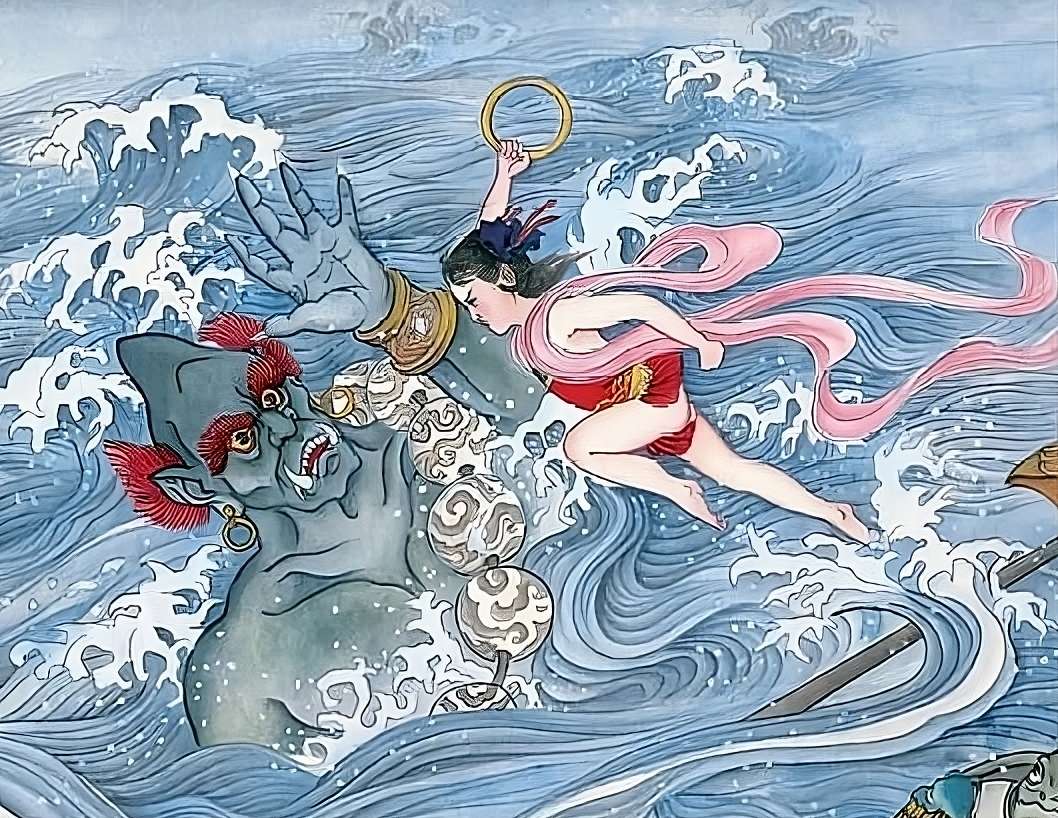
Here, I would like to focus on a bangle-like holy treasure belonging to the Daoist high god Laozi (老子). The fillet first appears in chapter six when it is used as a blunt throwing weapon to incapacitate Sun Wukong during his rebellion. It later reappears in chapters 50 to 52 as a mysterious, white, shiny string of pearls used by a buffalo spirit to instantly suck away magic weapons and animals and defeat even destructive elemental attacks, kind of like a personal black hole generator with a built-in pocket dimension. It’s so powerful, in fact, that even the sight of it is enough to make Monkey and a host of other gods flee for their lives.
This article will quote all mentions of the weapon, complete with the original Chinese; explain how it was created; describe the history of terminology that ties the treasure to diamond-pointed tools used by craftsmen west of China to work hard stone like jade; demonstrate that it is a mirrored literary element to Sun Wukong’s headband and Prince Nezha‘s fire wheel; and, finally, explore its influence on three fillet-like throwing weapons from another Chinese vernacular classic.
The overwhelming power of Lord Li’s treasure has stuck with me ever since I first read JTTW nearly 25 years ago. I hope that this article will introduce the subject to a wider audience who may not be aware of it.
Table of Contents
1. Introduction in Chapter Six
The high god of Daoism claims to have used the steel bangle as protection while proselytizing in the west:
He rolled up his sleeve and took down from his left arm an armlet [quanzi, 圈子, lit: “circle”], saying, “This is a weapon made of kun steel [kungang, 錕鋼], brought into existence during my preparation of reverted elixir and fully charged with spiritual energy. It can be made to transform at will; indestructible by fire or water, it can entrap many things. It’s called the diamond cutter [jingang zhuo, 金鋼琢] or the diamond snare [jingang tao, 金鋼套]. The year when I crossed the Hangu Pass, I depended on it a great deal for the conversion of the barbarians to Buddhism, for it was practically my bodyguard night and day (based on Wu & Yu, 2012, vol. 1, p. 186).
捋起衣袖,左膊上取下一個圈子,說道:「這件兵器,乃錕鋼摶煉的,被我將還丹點成,養就一身靈氣,善能變化,水火不侵,又能套諸物。一名『金鋼琢』,又名『金鋼套』。當年過函關,化胡為佛,甚是虧他。早晚最可防身。
He then throws it at Wukong’s head, knocking him off balance:
After saying this, Laozi hurled the cutter [1] down from the Heaven Gate; it went tumbling down into the battlefield at the Flower-Fruit Mountain and landed smack on the Monkey King’s head. The Monkey King was engaged in a bitter struggle with the Seven Sages and was completely unaware of this weapon, which had dropped from the sky and hit him on the crown of his head. No longer able to stand on his feet, he toppled over (Wu & Yu, 2012, vol. 1, p. 186).
話畢,自天門上往下一摜,滴流流,徑落花果山營盤裡,可可的著猴王頭上一下。猴王只顧苦戰七聖,卻不知天上墜下這兵器,打中了天靈,立不穩腳,跌了一跤 …

Fig. 1 – Laozi looks lovingly upon his diamond cutter (larger version). A screenshot from the 1986 JTTW TV Show. The cutter here looks like a gold or copper ring, but the novel describes it differently (see below).
2. Appearance in Later Chapters
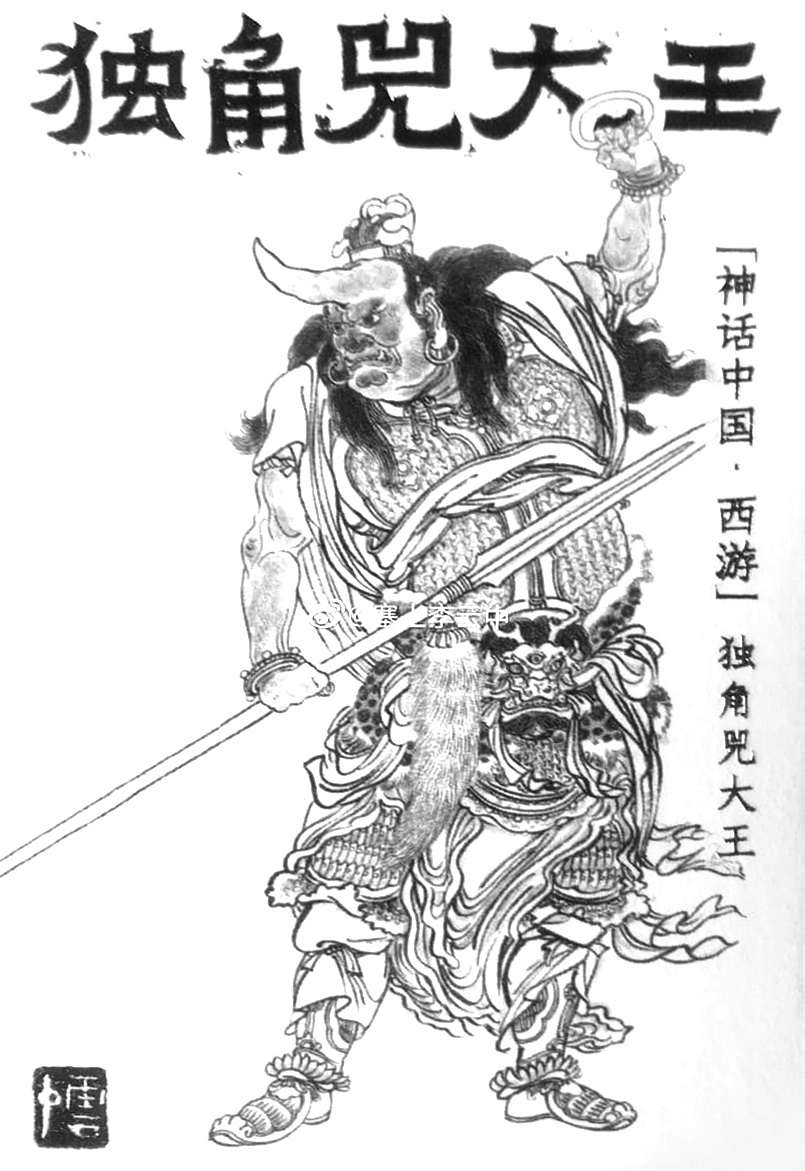
The diamond cutter reappears in chapters 50 to 52 as a mysterious, white, shiny string of pearls used by the Great King One-Horned Buffalo (Dujiao si dawang, 獨角兕大王) (fig. 2) to instantly disarm gods and defeat destructive elemental attacks. [2]

Fig. 2 – A modern drawing of Great King One-Horned Buffalo holding the diamond cutter and his spear (larger version). Based on an image found here.
2.1. Chapter 50
Monkey multiplies his iron staff many times over to fight against the buffalo and his army of minions. But the fiend easily sucks away all of the cudgels with the magic weapon:
The old demon king, however, stood still and, laughing with scorn, said, “Monkey, don’t be impertinent! Watch my trick!” He at once took out from his sleeve a white, shiny fillet [liang zhuozhuo bai sensen de quanzi, 亮灼灼白森森的圈子] and tossed it up in the air, crying, “Hit!” [zhao, 著] With a swish, all the iron rods changed back into a single rod, which was then sucked up by the fillet [fig. 3]. The Great Sage Sun, completely empty-handed, had to use his somersault desperately in order to escape with his life (Wu & Yu, 2012, vol. 2, p. 372).
老魔王唏唏冷笑道:「那猴不要無禮,看手段。」即忙袖中取出一個亮灼灼白森森的圈子來,望空拋起,叫聲:「著!」唿喇一下,把金箍棒收做一條,套將去了。弄得孫大聖赤手空拳,翻觔斗逃了性命。

Fig. 3 – The diamond cutter sucking in the iron staff (larger version). A screenshot from the 2011 JTTW TV show. Image found here.
2.2. Chapter 51
After his defeat, Wukong seeks heavenly aid several times in a row. First, Prince Nezha is sent to do battle but fails:
“Change!” he roared, and [his six magic] weapons changed into hundreds and thousands. Like a thundershower and a sleet storm, these weapons rained down on the head of the demon. Not the least bit daunted, the demon king took out with one hand that somber white fillet tossed it into the air, crying, “Hit!” With a loud whoosh, the six weapons were all sucked away by it. In desperation Prince Nezha fled for his life with empty hands, [3] while the demon king turned back in triumph (Wu & Yu, 2012, vol. 3, p. 6).
大叫一聲:「變!」一變十,十變百,百變千,千變萬,都是一般兵器,如驟雨冰雹,紛紛密密,望妖魔打將去。那魔王公然不懼,一隻手取出那白森森的圈子來,望空拋起,叫聲:「著!」唿喇的一下,把六般兵器套將下來。慌得那哪吒太子赤手逃生。魔王得勝而回。
Second, the Devaraja Li Jing is sent to distract the buffalo with combat, while a fire god prepares his forces to scorch the spirit, but the plan fails:
The demon fought the devaraja for some time, and in the heat of the battle, he again took out the fillet. When the devaraja saw it, he at once turned his auspicious luminosity around and fled in defeat. On the tall summit the Star of Fiery Virtue quickly gave the command for the various gods of his department to start the fire. It was some fire, all right!
你看那個妖魔與天王正鬥到好處,卻又取出圈子來。天王看見,即撥祥光,敗陣而走。這高峰上火德星君忙傳號令,教眾部火神一齊放火。這一場真個利害 …
[…]
When the demon saw the fire coming, he was not in the least afraid. He tossed the fillet in the air and with a loud whoosh, it sucked away all those fire dragons, fire horses, fire crows, fire rats, fire lances, fire swords, and fire bows and arrows. Then he turned toward his cave and went back in triumph (based on Wu & Yu, 2012, vol. 3, pp. 8-9).
那妖魔見火來時,全無恐懼。將圈子望空拋起,唿喇一聲,把這火龍、火馬、火鴉、火鼠、火槍、火刀、火弓、火箭,一圈子又套將下去,轉回本洞,得勝收兵。
Third, a water god attempts to drown the monster with the Yellow River but fails:
[T]he Water Lord immediately emptied the content of his white jade chalice toward the inside of the cave. When he saw the water rushing in, the fiend dropped his long lance and took out the fillet, holding it high at the second door. Not only was the water blocked right there, but it reversed its course and gushed back out of the cave. So startled was the Great Sage Sun that he somersaulted immediately into the air and, together with Water Lord, leaped up to the tallest peak (Wu & Yu, 2012, vol. 3, p. 11).
這水伯將白玉盂向裡一傾。那妖見是水來,撒了長槍,即忙取出圈子,撐住二門。只見那股水骨都都的只往外泛將出來。慌得孫大聖急縱觔斗,與水伯跳在高峰。
Monkey then requests a boxing match to show that he isn’t useless without his staff. But when the bout comes to a draw, both heavenly and demonic forces charge in to help their respective fighter. Fearing the worst, Wukong creates hair clones to overwhelm the monster, but this strategy fails:
At once they changed into some fifty little monkeys, who swarmed all over the demon—grabbing his legs, tugging at his torso, gouging his eyes, and pulling at his hair. The fiendish creature became so alarmed that he immediately took out his fillet. When the Great Sage and his companions saw that object, they mounted the clouds at once and fled toward the tall summit. Tossing the fillet up into the air, the fiend changed those fifty monkeys back into their true forms and then they were sucked away again with a loud whoosh. After he had gained this victory, the fiend led his troops back to his cave, closed the door, and celebrated (Wu & Yu, 2012, vol. 3, p. 13).
即變做三五十個小猴,一擁上前,把那妖纏住,抱腿的抱腿,扯腰的扯腰,抓眼的抓眼,撏毛的撏毛。那怪物慌了,急把圈子拿將出來。大聖與天王等見他弄出圈套,撥轉雲頭,走上高峰逃陣。那妖把圈子往上拋起,唿喇的一聲,把那三五十個毫毛變的小猴,收為本相,套入洞中,得了勝,領兵閉門,賀喜而去。
2.3. Chapter 52
Monkey resorts to stealth, changing into a cricket (cuzhi’er, 促織兒) and sneaking into the monster’s cave in order to learn where the treasure is kept:
After the demon king took off his clothes, at once the fillet—all ghostly white—could be seen. It was attached to his left shoulder like an armlet made of a string of pearls [zhuzhuo tou, 珠鐲頭]. Look at him! Instead of taking the fillet off, he pushed it up a couple of times until it was snugly clamped to his shoulder. Only then did he lie down to sleep (Wu & Yu, 2012, vol. 3, p. 18).
只見那魔王寬了衣服,左肐膊上白森森的套著那個圈子,原來像一個連珠鐲頭模樣。你看他更不取下,轉往上抹了兩抹,緊緊的勒在肐膊上,方才睡下。
He changes into a flea (gezao, 虼蚤) and twice bites the spirit, but this plan fails to make the beast take off the bangle (Wu & Yu, 2012, vol. 3, pp. 18-19).
Wukong goes on to rescue the stolen holy weapons and animals and magic hairs, before setting the cave on fire:
The Bovine Great King was scared out of his wits; dashing out of his room, he held his fillet up high with both hands. He pushed it toward the fire this way and that way, and it immediately went out. Though the air was filled with flame and smoke, they all subsided after he and his treasure [baobei, 寶貝] had run through the entire cave (Wu & Yu, 2012, vol. 3, p. 20).
諕得個兕大王魂不附體,急欠身開了房門,雙手拿著圈子,東推東火滅,西推西火消,滿空中冒煙突火,執著寶貝跑了一遍,四下裡煙火俱熄。
Monkey and the host of gods become foolhardy upon retrieving their weapons and once more challenge the buffalo to a fight. But their holy armaments are again sucked away by the fillet:
Smiling scornfully, the demon calmly took out from his sleeve his treasure and tossed it in the air, crying, “Hit!” With a loud whoosh, the six divine weapons, the fire equipment, the thunderbolts, the scimitar of the devaraja, and the rod of Pilgrim were all snatched away. Once again, the deities and the Great Sage Sun were empty-handed (Wu & Yu, 2012, vol. 3, p. 23).
那魔頭巍巍冷笑,袖子中暗暗將寶貝取出,撒手拋起空中,叫聲:「著!」唿喇的一下,把六件神兵、火部等物、雷公㨝、天王刀、行者棒,盡情又都撈去。眾神靈依然赤手,孫大聖仍是空拳。
Having no more ideas, Wukong travels to Vulture Peak in the western continent (i.e. India) to seek the Buddha’s wisdom. The Tathagata in turn sends the 18 arhats armed with “golden cinnabar sand” (jindan sha, 金丹砂) in an attempt to bog the demon down and stop him from moving. But this plan also fails:
When the demon saw that the flying sand was clouding up his vision, he lowered his head and discovered that his feet were already standing in three feet of the stuff. He was so horrified that he tried to jump upward; before he could even stand up properly the sand grew another foot. In desperation, the fiend tried to pull up his legs while taking out his fillet. Throwing it up into the air, he cried, “Hit!” With a loud whoosh, the eighteen grains of golden cinnabar sand were sucked away. The demon then strode back to the cave (Wu & Yu, 2012, vol. 3, p. 27).
那妖魔見飛砂迷目,把頭低了一低,足下就有三尺餘深。慌得他將身一縱,跳在浮上一層。未曾立得穩,須臾,又有二尺餘深。那怪急了,拔出腳來,即忙取圈子,往上一撇,叫聲:「著!」唿喇的一下,把十八粒金丹砂又盡套去,拽回步,徑歸本洞。
Monkey later receives a message from the Buddha suggesting that he consult Laozi. Upon traveling to the Tushita Palace in the 33rd Heaven, he learns that the Daoist high god’s holy mount, a green buffalo (qingniu, 青牛), is missing. This prompts the deity to check his collection of holy treasures:
Laozi made a quick inventory; everything was there except the diamond cutter. “This cursed beast stole my diamond cutter!” said Laozi. “So, that’s the treasure!” said Pilgrim. “It was the same snare that hit me that time! [refer back to sec. 1] Now it’s going wild down below, sucking away who knows how many things.”
君急查看時,諸般俱在,止不見了金剛琢。老君道:「這孽畜偷了我金剛琢去了!」行者道:「原來是這件寶貝。當時打著老孫的是他。如今在下界張狂,不知套了我等多少物件。」
[After Wukong describes all of the magic weapons sucked away by the bangle …]
Laozi said, “That diamond cutter of mine is a treasure perfected since the time of my youth, and it was also an instrument with which I converted the barbarians when I passed through the Hangu Pass. Whatever weapons you may have, including fire and water, you can’t touch it. If the demon had stolen my plantain-leaf fan also, then even I would not be able to do anything to him” (Wu & Yu, 2012, vol. 3, p. 29).
老君道:「我那金剛琢,乃是我過函關化胡之器,自幼煉成之寶。憑你甚麼兵器、水火,俱莫能近他。若偷去我的芭蕉扇兒,連我也不能奈他何矣。」
Lord Li’s closing sentence is eye-opening, for it means that anyone who wields both the diamond cutter and fan would be invincible, even against Laozi. This is surprising since JTTW acknowledges him as the creator of the universe who separated the earth and sky from chaos. [4]
In the end, though, Laozi takes back the diamond cutter and subdues the buffalo spirit without trouble:
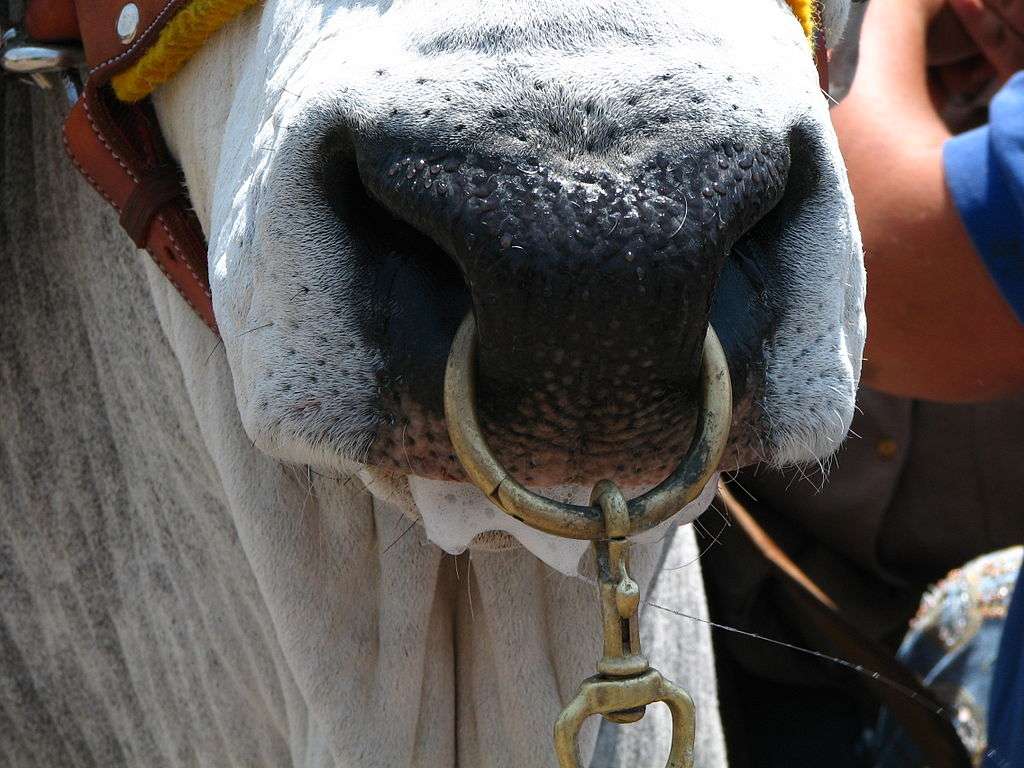
Reciting a spell, Laozi fanned the air once with his fan. The fiend threw the fillet at Laozi, who caught it immediately and gave him another fan. All at once the fiend’s strength fled him and his tendons turned numb; he changed back into his original form, which was that of a green buffalo. Blowing a mouthful of divine breath on the diamond snare, Laozi then used it to pierce the nostrils of the fiend. Next, he took off the sash around his waist and fastened one end of it to the cutter while his hand held the other. Thus the custom of leading the buffalo with a ring in its nose was established [fig. 4], a custom in use even now. This is also what we call binlang [賓郎] (Wu & Yu, 2012, vol. 3, p. 30). [5]
老君念個咒語,將扇子搧了一下,那怪將圈子丟來,被老君一把接住。又一搧,那怪物力軟筋麻,現了本相,原來是一隻青牛。老君將金鋼琢吹口仙氣,穿了那怪的鼻子,解下勒袍帶,繫於琢上,牽在手中。至今留下個拴牛鼻的拘兒,又名賓郎 …

Fig. 4 – A nose ring through a bull’s nose (larger version). Image found here.
3. Background
3.1. Literary Origin
Laozi’s dialogue explains how the diamond cutter was created. While at least two JTTW poems reference the high god’s skill in forging mystical weapons (Wu & Yu, 2012, vol. 1, p. 382; vol. 3, p. 375), his own words instead point to alchemical experimentation. As a reminder, in chapter 6, he states: “This is a weapon … brought into existence during my preparation of reverted elixir and fully charged with spiritual energy” (這件兵器,乃錕鋼摶煉的,被我將還丹點成,養就一身靈氣…) (based on Wu & Yu, 2012, vol. 1, p. 186). Later, in chapter 52, he adds: “That diamond cutter of mine is a treasure perfected since the time of my youth” (我那金剛琢 … 自幼煉成之寶。) (Wu & Yu, 2012, vol. 3, p. 29).
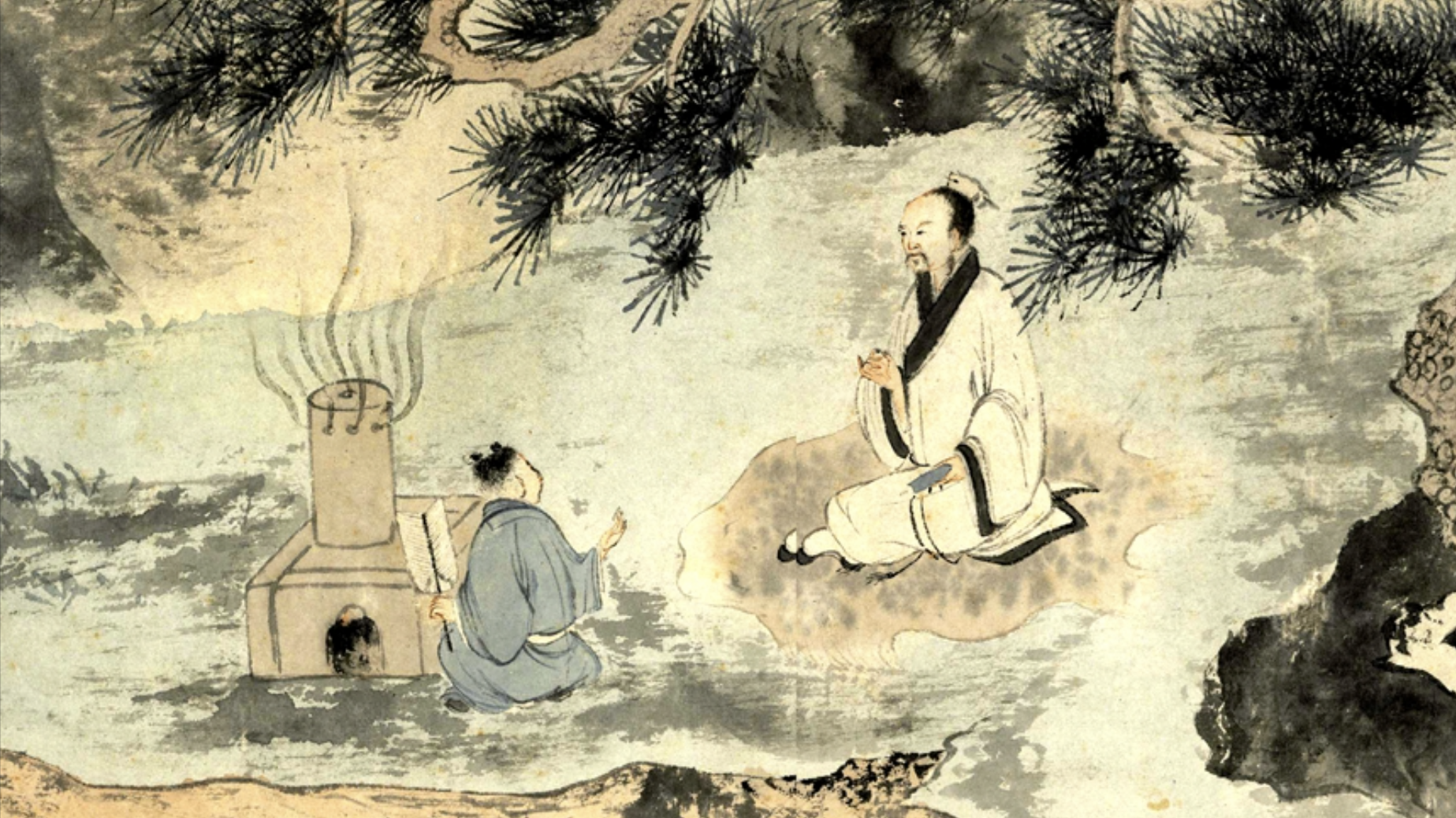
The phrase “reverted elixir” (huandan, 還丹) is key to understanding the origins of the treasure-weapon. This refers to a concept in external alchemy where a concoction of toxic elements is purified over successive firings in a crucible to create a drug of immortality (fig. 5). The Book of the Master Who Embraces Simplicity (Baopuzi, 抱樸子, 4th-century CE), for example, describes firing cycle periods of between one and nine times, and each subsequent medicine is said to bestow divine longevity within a respective period of time. The more the substance is fired, the faster the desired effect (Kohn, 1993, pp. 309 and 312-313). The product of the ninth cycle is said to transform into reverted elixir when combined with heated cinnabar and exposed to the sun, and a small dose of the drug is enough to bestow instant divinity:
Place the elixir, which has been cycled nine times, in a reaction vessel and expose it to the sun after the summer solstice. When the container becomes hot, introduce a pound of cinnabar beneath the lid. Even while you are watching, with the full power of the sun shining upon it, the whole content will suddenly glow and sparkle with all the colors of spirit radiance. It will immediately turn into reverted elixir. If you take even a single spoonful, you will straightaway rise to heaven in broad daylight (Kohn, 1993, p. 313).
若取九轉之丹,內神鼎中,夏至之後,爆之鼎熱,內朱兒一斤於蓋下。伏伺之,候日精照之。須臾翕然俱起,煌煌煇煇,神光五色,即化為還丹。取而服之一刀圭,即白日昇天。
The fact that Laozi has been developing the cutter from a young age, as stated above, suggests that it is ultimately a byproduct of excessive, millennia-long elixir firing cycles.

Fig. 5 – An alchemist watches as a young lad tends to the firing vessel (larger version). This is an example from Tang Yin’s (唐寅) Images of Cooking Medicine (Shaoyao tu, 燒葯圖) series. Image found here.
3.2. History
Anthony C. Yu (Wu & Yu, 2012) translates kungang (錕鋼), the substance comprising the diamond cutter, as “red steel” (vol. 1, p. 186). The original Chinese term refers to a legendary red knife mentioned in Master Lie (Liezi, 列子, c. 4th century) as coming from Kunwu (錕鋙/昆吾), a distant land. This incredibly hard blade was presented as a royal tribute, along with asbestos cloth, a product of the west:
When King Mu of Zhou made his great expedition against the Rong tribes of the West, they presented him with a knife from Kunwu and a fire-proof cloth. The knife was one chi and zhi [changchi youzhi, 長尺有咫, 22.8 in/57.9 cm] long with a red blade [6] of tempered steel; cutting jade with it was as easy as cutting mud (based on Liezi & Graham, 1960/1990, p.117). [7]
周穆王大征西戎,西戎獻錕鋙之劍,火浣之布。其劍長尺有咫,練鋼赤刃,用之切玉如切泥焉。
The later Ten Islands of the Inner Seas (Hainei shizhou ji, 海內十洲記; a.k.a. Shizhou ji, 十洲記, c. 5th century; “Ten Islands” hereafter) associates Kunwu with stones that can be smelted into jade-cutting iron swords. What’s important here is that the rocks are located in the “Western Ocean” (Xihai, 西海), a term commonly associated with the Mediterranean, the Persian Gulf, or the Indian Ocean—i.e. bodies of water and land west of China:
There is a floating island [liuzhou, 流洲] in the middle of the Western Ocean … The island has many mountains and rivers accumulating stones called kunwu [昆吾]. Smelting the stones will turn them into iron. A sword made from this will shine brightly like crystal, and it will cut jade like mud (cf. Laufer, 1915, p. 29).
流洲在西海中 … 上多山川積石,名為昆吾。冶其石成鐵,作劍光明洞照,如水精狀,割玉物如割泥。
But the now lost Record of the Mysterious Center (Xuanzhong ji, 玄中記, c. 5th century) (as cited here) explicitly associates jade-cutting blades with diamonds from western lands:
The country of Daqin [大秦, i.e. Roman Syria] produces diamonds (jingang [金剛]), termed also ‘jade-cutting swords or knives’ [xiaoyu dao, 削玉刀]. The largest reach a length of over one chi [12.3 in/31.8 cm], the smallest are of the size of a rice or millet grain. Hard stone can be cut by means of it all round, and on examination it turns out that it is the largest of diamonds. This is what the Buddhist priests substitute for the tooth of Buddha (based on Laufer, 1915, p. 30).
大秦國出金剛,一名削玉刀,大者長尺許,小者如稻黍,著環中,可以刻玉。
觀此則金剛有甚大者,番僧以充佛牙是也。
Similar to the Ten Islands, the Memoir of the Four Gentlemen of Liang (Liang sigong ji, 梁四公記, late-7th century) speaks of an island in the west but adds that the inhabitants are talented lapidarists, or gemstone cutters:
In the west, arriving at the Western Ocean, there is in the sea an island of two hundred square li [62.13 mi/100 km]. On this island is a large forest abundant in trees with precious stones, and inhabited by over ten thousand families. These men show great ability in cleverly working gems, which are named for the country Fulin 拂林 [i.e. Rome] (based on Laufer, 1915, p. 7).
西至西海,海中有島,方二百里。島上有大林,林皆寶樹。中有萬餘家,其人皆巧,能造寶器,所謂拂林國也。
Rustic Talks From the East of Qi (Qidong yeyu, 齊東野語, 13th century) (as cited here) describes how lapidarists use iron-like diamond-points to polish and carve jade:
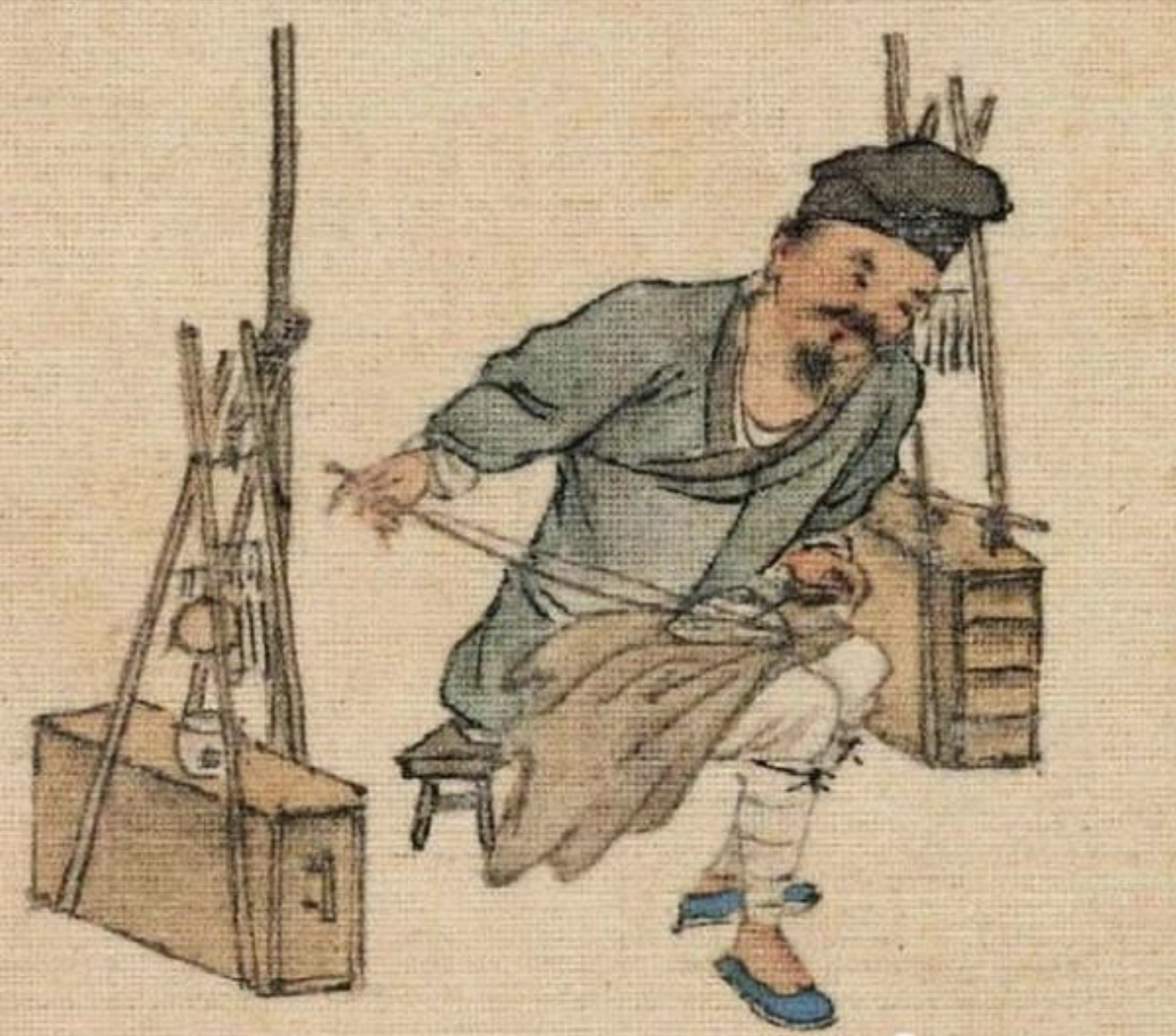
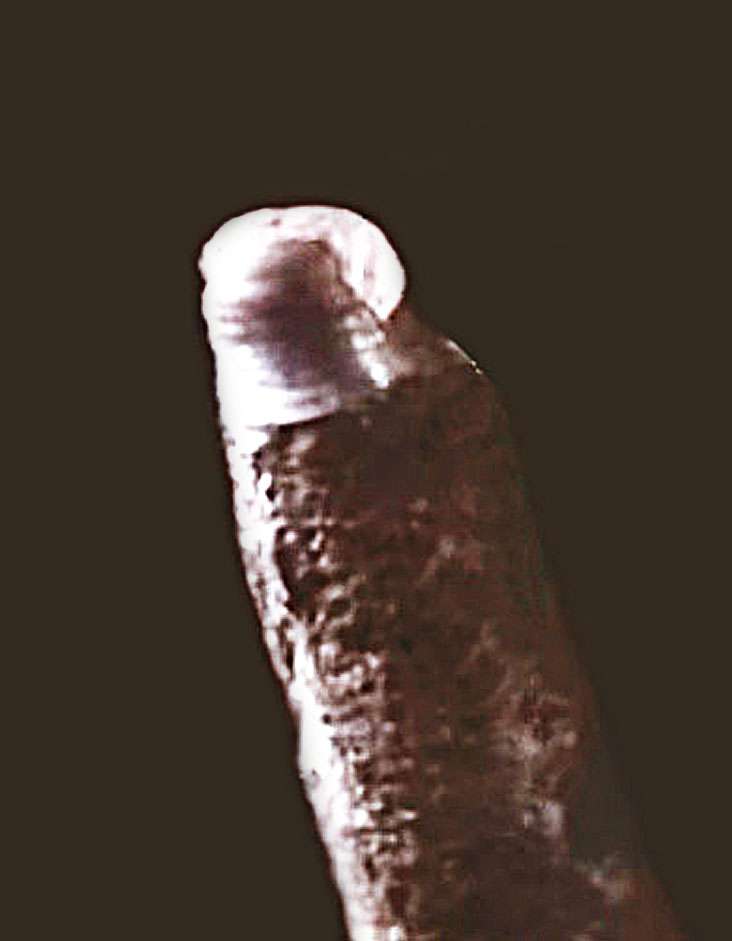
The workers in jade polish jade by the persevering application of Ganges river-sand, and carve it by means of a diamond-point drill [jingang zuan, 金剛鑽]. Its shape is like the excrement of rodents [fig. 6 & 7]; it is of very black color, and is at once like stone and like iron (based on Laufer, 1915, p. 31). [8]
玉人攻玉,以恆河之砂,以金剛鑽鏤之,其形如鼠矢,青黑色,如石如鐵。
This brings us back to the kunwu blade. Laufer (1915) rejects the notion that it was an iron knife. Instead, he states that it was an embellishment on the kinds of diamond-pointed tools used by craftsmen west of China to carve hard stones like jade (Laufer, 1915, p. 32).
This ultimately explains the odd name of Laozi’s holy treasure, diamond cutter (jingang zhuo, 金鋼琢)—i.e. a cutter made from diamond. This name was no doubt chosen to infer that the weapon is unimaginably hard, something capable of “ringing the bell” of even the invincible Monkey King.
The use of kungang (錕鋼), along with the name diamond cutter, suggests that the JTTW author-compiler had knowledge of both the ancient red knife and its ties to diamonds. And speaking of the gemstone, I think given the above information, a better translation for kungang would be something like “diamond steel.” This is more fitting than Yu’s (Wu & Yu, 2012) “red steel” (vol. 1, p. 186).
Also, the description of the cutter as a white, shiny string of pearls makes much more sense when its ties to diamonds are taken into account. This brings to mind a bracelet of perhaps milky diamonds instead of a steel ring.

Fig. 6 (left) – A craftsman works a product with a bow-driven diamond-point drill (larger version). A painting from Zhou Kun’s (周鯤) “Village and Market Life Album” (Cunshi shengya hua’ce, 村市生涯畫冊, 18th century). Image found here. Fig. 7 (right) – An example of the diamond-point of a diamond drill (larger version). Image found here. This recalls the rodent excrement description of diamond-points mentioned in Rustic Talks From the East of Qi (13th century).
4. Mirrored Objects
The diamond cutter serves as a mirrored literary element to Wukong’s golden headband (jingu, 金箍; a.k.a. jingu, 緊箍, lit: “tight fillet”), which initially appears in chapters eight and 14. Both are used to rein in Monkey’s unruly behavior by way of his head: the first hits him on the crown, and the second clamps around his skull. And the fact that the diamond cutter “can entrap many things” (tao zhu wu, 套諸物) reminds me of the way that the golden fillet constricts (jin, 緊) around Wukong’s head when the correct spell is spoken (Wu & Yu, 2012, vol. 1, p. 319). Isn’t this also a kind of entrapment?
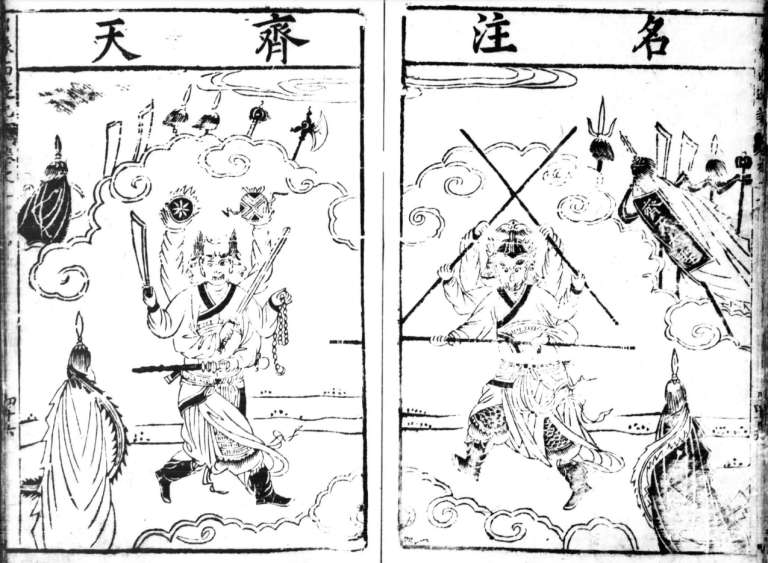
Another mirrored candidate is Nezha’s “fire wheel” (huolun’er, 火輪兒) (fig. 8), which numbers among his six magic weapons (liujian shenbing, 六件神兵). In chapter 61, this flaming fillet is placed on the Bull Demon King’s horn (i.e. on his head) to stop his rampaging transformations (Wu & Yu, 2012, vol. 3, p. 160). Compare this to the way that the diamond cutter stops Wukong via his head. This at first may seem like a passing similarity until you take into account the many parallels shared by Wukong and the bull spirit. The latter is a demon king nicknamed the “Great Sage,” who wields an iron staff, knows 72 changes, can adopt a titanic form, takes part in a battle of magic transformations, is trapped by a joint effort from heaven, is incapacitated by a circular object on his head, and finally faces the Buddha for punishment. [9] Therefore, I can confidently state that the fire wheel is a mirror of the golden headband and subsequently the diamond cutter. I’ll discuss the importance of these connections below.
The novel has many more mirrored objects and characters. I plan to write an article about this at a later date.

Fig. 8 – Nezha (left) wielding his six magic weapons in his three-headed, six-armed form against Sun Wukong (right) (larger version). The fire wheel can be seen in his upper rightmost hand (i.e. the flaming black circle with white spokes). Print from the original 1592 edition of JTTW.
5. Influence
The relationship between Laozi’s diamond cutter and Nezha’s fire wheel in JTTW may have inspired the latter’s “cosmic ring” (qiankun quan, 乾坤圈) in Investiture of the Gods (Fengshen yanyi, 封神演義, c. 1620, “IOTG” hereafter). Nezha first uses it as a youth in chapter 12 to bludgeon a fierce water-spirit to death:
Standing there naked, Nezha dodged the advancing warrior’s attack and upraised the cosmic ring in his right hand. This treasure was originally bestowed by the Jade Emptiness Palace of Mt. Kunlun to the Perfected Man of the Grand Monad [Taiyi zhenren, 太乙真人] to secure the items of his Golden Light Cave. How could the yaksha withstand the magic weapon as it struck downward on his head? [fig. 9] His brains exploded from the blow, and he fell dead on the shore (cf. Gu, 2000, vol. 1, p. 239).
哪吒正赤身站立,見夜叉來得勇猛,將身躲過,把右手套的乾坤圈望空中一舉。此寶原係崑崙山玉虛宮所賜太乙真人鎮金光洞之物,夜叉那裏經得起,那寶打將下來,正落在夜叉頭上,只打的腦漿迸流,即死於岸上。
He also uses it as a throwing weapon:
After fighting three or four rounds, Nezha simultaneously blocked Yu Hua’s halberd with his spear and took out his cosmic ring from the leopard skin bag. He hit him directly in the arm, breaking tendons and shattering bone (cf. Gu, 2000, vol. 2, p. 671).
哪吒未及三四合,用鎗架住畫戟,豹皮囊內忙取乾坤圈打來,正中余化臂膊,打得筋斷骨折.
See note no. 11 below for more overt examples of throwing.
To sum up, both the diamond cutter and cosmic ring are holy treasures belonging to supreme Daoist deities, are circular and hard enough to serve as blunt throwing weapons, and have the power to entrap (tao, 套) or secure (zhen, 鎮, lit: “press down”) things. It’s also worth noting that the caves associated with these objects have similar names: Great King One-Horned Buffalo lives in Golden Helmet Cave (Jindou dong, 金▯洞), [10] while the Perfected Man of the Grand Monad lives in the Golden Light Cave (Jinguang dong, 金光洞).
My friend, a devotee and researcher of Nezha, tells me that the cosmic ring is a later development in the Third Prince’s mythos, first appearing in IOTG. And since the ring does not appear in JTTW (ctext), it certainly could have been influenced by the similarities between the diamond cutter and Nezha’s fire wheel.
Also, the diamond cutter likely influenced two other fillet-like throwing weapons in the novel, both of which are destroyed by Nezha’s much harder cosmic ring. One is Mo Liqing’s (魔禮青) “white jade diamond bracelet” (baiyu jingang zhuo, 白玉金剛鐲) from chapter 41. The alternate name for said treasure, jingang zhuo (金剛鐲), sounds exactly the same as Laozi’s diamond cutter, jingang zhuo (金鋼琢). I doubt the homophonous title and pale color are a coincidence.
The second is Wen Liang’s (溫良) “white jade ring” (baiyu huan, 白玉環) [11] Again, the white color is telling.

Fig. 9 – Nezha seconds from killing Li Gen with the cosmic ring (larger version). This is an upscaled version of an image found here.
6. Conclusion
Laozi’s great treasure-weapon, the “diamond cutter” (jingang zhuo, 金鋼琢; a.k.a. “diamond snare,” jingang tao, 金鋼套), first appears in chapter six when he uses the fillet to stop Monkey’s rampage by throwing it from heaven and hitting him on the head. It reappears in chapters 50 to 52 as a mysterious, white, shiny string of pearls used by Great King One-Horned Buffalo, an evil spirit, to suck away magic weapons and animals and defeat even destructive elemental attacks. The treasure gives Sun Wukong and a host of Daoist and Buddhist gods no end of trouble before Laozi retrieves his treasure and submits the monster, his runaway buffalo mount.
Lord Li explains that the treasure is a byproduct of creating “reverted elixir,” or a drug of immortality, and that it is made of “kun steel” (kungang, 錕鋼). The latter is a reference to an extremely hard, jade-cutting iron knife from Chinese folklore said to come from the distant land of Kunwu (錕鋙/昆吾). But this is itself an embellishment on reports of diamond-pointed tools used by craftsmen west of China to work hard stone like jade. The name diamond cutter was, therefore, likely chosen to denote something unimaginably hard, something capable of hurting even Sun Wukong.
The diamond cutter is a mirrored literary element to Sun Wukong’s headband. This is because the treasure and the golden fillet are both circular objects that rein in Monkey’s unruly behavior by way of his head, hitting it and clamping around his skull, respectively. The diamond cutter is also a mirrored element of Prince Nezha’s “fire wheel” (huolun’er, 火輪兒) because the latter stops the rampage of the Bull Demon King by way of his head. This takes place during a battle that closely mirrors Monkey’s early rebellion and defeat.
This connection between the diamond cutter and the fire wheel likely influenced Nezha’s “cosmic ring” (qiankun quan, 乾坤圈) from Investiture of the Gods (Fengshen yanyi, 封神演義, c. 1620). Both treasures belong to supreme Daoist deities, can be used as blunt throwing weapons, have the power to entrap or secure things, and are associated with caves with “gold” (jin, 金) in the name. The diamond cutter also likely influenced two other throwing fillets from the novel, Mo Liqing’s (魔禮青) “white jade diamond bracelet” (baiyu jingang zhuo, 白玉金剛鐲) and Wen Liang’s (溫良) “white jade ring” (baiyu huan, 白玉環). The name of the former closely mirrors that of the jade cutter.
7. Updates
Update: 03-14-24
The full name of the Diamond Sutra (c. 2nd to 4th-century) is the Diamond-Cutter Perfection of Wisdom Sutra (Sk: Vajracchedikāprajñāpāramitāsūtra) (Buswell & Lopez, 2014, p. 953). This interests me because Laozi states in chapter six:
The year when I crossed the Hangu Pass, I depended on it [his diamond-cutter treasure] a great deal for the conversion of the barbarians to Buddhism, for it was practically my bodyguard night and day (based on Wu & Yu, 2012, vol. 1, p. 186).
當年過函關,化胡為佛,甚是虧他。早晚最可防身。
Perhaps the diamond cutter is meant to be a metaphor for the Diamond Sutra, which he used to convert the people of the West.
Update: 01-31-2026
Above, I discussed how Nezha’s “Cosmic Ring” first appeared in IOTG and that it was likely influenced by Laozi’s Diamond Cutter. I originally thought that this was just a literary thing, but it recently dawned on me that Nezha’s circular weapon often appears in the hands of his idols (fig. 10). This demonstrates how JTTW has influenced real world religious iconography.

Fig. 10 – Lotus Flower Nezha bearing his Cosmic Ring (left hand) and spear (right) (larger version). Idol in the author’s personal collection.
Notes:
1) Yu (Wu & Yu, 2012) uses the English words “diamond snare” or just “snare” numerous times whenever Laozi’s weapon is mentioned. However, the corresponding Chinese phrase, jingang tao (金鋼套), only appears once in the entire novel, while that for “diamond cutter,” jingang zhuo (金鋼琢), appears a total of four times. Therefore, I have made changes to the translation for more accuracy.
2) Jenner (Wu & Jenner, 1993/2001) translates Dujiao si dawang (獨角兕大王), the monster’s name, as “Great King Rhinoceros” (vol. 2, p. 1143). This is because the character si (兕) is associated with rhinos. For instance, Strassberg’s (2002) translation of the Classic of Mountains and Seas (Shanhai jing, 山海經, c. 4th-century to 1st-century BCE) reads:
The Si-Rhinoceros dwell east of Shun’s Tomb and south of the Xiang River. Their form resembles an ox that is blue-black with a single horn” (p. 188).
兕在舜葬東,湘水南,其狀如牛,蒼黑,一角。
But the JTTW spirit is likely an amalgamation of Lord Li’s green/black buffalo (qingniu, 青牛) and the mythical animal. This is because both are dark, bovine-like beasts with a single horn. This association between the two is exemplified by a humorous vintage porcelain statue of Laozi riding a rhino.
3) I have changed all references to Nata to Nezha, a FAR more widely used term for the martial god.
4) Monkey explains in chapter 86 that everyone has a boss, thereby alluding to Laozi’s hallowed past:
Old Lord Li happens to be the patriarch of creation [kaitian pidi zhi zhu, 開天闢地之祖; lit: the “patriarch of splitting heaven and earth (from chaos)], but he still sits to the right of Supreme Purity. The Buddha Tathagata is the honored one who governs the world, and yet he still sits beneath the Great Peng. Kong the Sage is the founder of Confucianism, but he assumes the mere title of Master (Wu & Yu, 2012, vol. 4, p. 163).
李老君乃開天闢地之祖,尚坐於太清之右;佛如來是治世之尊,還坐於大鵬之下;孔聖人是儒教之尊,亦僅呼為『夫子』。
My thanks goes to Irwen Wong of the Journey to the West Library blog for reminding me of this fact.
5) Yu (Wu & Yu, 2012) points out that binlang (賓郎) is a variant of binlang (檳榔), or betel nut (vol. 3, p. 385 n. 8). One French translator suggests that the name comes from the circular shape shared by betel nut and coconuts, and that nose rings were likely made from the latter (Levy, 1991, as cited in Wu & Yu, 2012, vol. 3, p. 385-386 n. 8).
6) Regarding the red blade (chidao, 赤刃), the Classic of Mountains and Seas (Shanhai jing, 山海經, c. 4th-century to 1st-century BCE) mentions that the peaks of Kunwu have an abundance of copper (chitong, 赤銅, i.e. “red copper”) (Strassberg, 2002, p. 145).
7) I have changed all Wade-Giles to pinyin.
8) The passage from Rustic Talks From the East of Qi (13th century) goes on to associate diamonds with a strange phenomenon in western lands where birds pass the gemstone in their droppings:
According to legend, high in the mountains of the Western Regions [Xiyu, 西域] where the Huihe live, hawks and falcons would ingest (diamonds). These would then be deposited in the sandy gravel of Hebei Province when they defecate. But I do not know if this is true or not (cf. Laufer, 1915, p. 12).
相傳出西域及回紇高山頂上,鷹隼粘帶食入腹中,遺糞於河北砂磧間。未知然否?
This matches another passage from the aforementioned Memoir of the Four Gentlemen of Liang (late-7th century). This earlier source provides more information:
In a northwesterly direction from the island is a ravine hollowed out like a bowl, more than a thousand feet deep. They throw flesh into this valley. Birds take it up in their beaks, whereupon they drop the precious stones. The biggest of these have a weight of five catties. There is a saying that this is the treasury of the Devaraja of the Rupadhatu 色界天王 (Laufer, 1915, p. 7).
島西北有坑,盤坳深千餘尺。以肉投之,鳥銜寶出,大者重五斤,彼雲是色界天王之寶藏。
The bird-diamond connection is mentioned in non-Chinese sources as well. This includes The Book of the Wonders of India (Kitāb ‘Aja’ib al-Hind, 953), a collection of “sailor’s tales” by the Persian Shipmaster Buzurg Ibn Shahriyār. The 82nd tale in this collection, “Kashmiri Diamonds,” associates the gemstones with northernmost India. The full tale reads:
Someone who had been to India told me he had heard it said that the purest, the most beautiful, and the most precious diamonds come from the Kashmir region. There is a valley between two mountains, where a fire burns ceaselessly, night and day, winter and summer. It is there that the diamonds are. Only low-caste Indians risk themselves in this dangerous country. They gather in bands, and reach the entrance to the valley. They kill lean sheep, and cut them up into bits. Then they fling the pieces one after another into the valley, by means of a mangonel that they set in motion. There are many reasons that prevent their access to their valley. First, there is the ever-burning fire; and, in addition, around the fire, there is an uncountable number of snakes and vipers, so that no man can go there and not perish.
When the meat is thrown, a great number of vultures falls on it and seizes it. If it falls some distance from the fire, they carry it off. They follow the vulture as it flies. Sometimes a diamond falls from the meat that has been carried off. If the vulture comes down in some place to eat it, they go to there and find diamonds. If the meat falls in the fire, it burns. The vulture that wants to seize a piece too near the fire burns likewise. Sometimes also, by chance, a vulture seizes meat in flight, before it reaches the ground.
This is how diamonds are gathered. Most of the people who busy themselves looking for them die from the fire, or from the snakes and vipers. The kings of these countries are very fond of diamonds, and go to great trouble to get them. Those employed in this work are watched carefully, because of the beauty and high price of the stones (Shahriyar & Freeman-Grenville, 1981, p. 75).
9) The Bull Demon King takes the title “Great Sage, Parallel with Heaven” (Pingtian dasheng, 平天大聖) in chapter 4 (compare this to Monkey’s title, the “Great Sage Equaling Heaven“) (Wu & Yu, 2012, vol. 1, pp. 156-157). The rest of the similarities appear in chapters 60 and 61. He wields his own “cast-iron rod” (huntie gun, 混鐵棍) (compare this to Wukong’s weapon) (Wu & Yu, 2012, vol. 3, pp. 137 and 147). His skill with the 72 changes is referenced when he takes on Zhu’s appearance (compare this to Monkey’s ability) (Wu & Yu, 2012, vol. 3, p. 148). The battle of transformations against Sun takes place shortly after he’s overwhelmed by our hero and Zhu in combat (compare this to Wukong’s battle of transformations with Erlang in ch. 6) (Wu & Yu, 2012, vol. 3, pp. 156-157; vol. 1, pp. 182-183). He takes on his cosmic form, a giant white bull, in a last ditch effort to defeat Monkey (compare this to Wukong’s skill) (Wu & Yu, 2012, vol. 3, p. 157). He is trapped on all sides by Buddho-Daoist deities (compare this to Monkey’s troubles with heaven in ch. 6) (Wu & Yu, 2012, vol. 3, pp. 159-160; vol. 1, pp. 185-186). As mentioned above, Nezha uses his fire wheel to stop his rampaging transformations (compare this to Laozi stopping Monkey’s rampage by knocking him over with the diamond cutter in ch. 6) (Wu & Yu, 2012, vol. 3, p. 160; vol. 1, p. 186). And he is taken to see the Buddha at the end of his story arc (compare this to Wukong’s meeting with the Buddha) (Wu & Yu, 2012, vol. 3, p. 162).
10) The Ctext version is missing a particular Chinese character that appears in the original novel (see the right side, third column from the left, on p. 658 of this PDF). It is comprised of shan (山) and dou (兠/兜). Thank you to Irwen Wong for reminding me of this.
11) Mo Liqing clashes with Nezha in chapter 41, leading to the destruction of his white jade diamond bracelet:
Before they had fought twenty rounds, Mo Liqing hurled his white jade diamond bracelet. It cast a ray of multi-colored light as it struck him [Huang Tianhua, 黃天化] in the middle of the back. The hit knocked down his golden cap [i.e. he died] and fell from his mount.
Mo Liqing wanted to cut off his head, but before he could, Nezha screamed, “Don’t hurt my Daoist brother!” Riding his wind and fire wheels, the third prince fought to the front of the formation and rescued the body of Huang Tianhua.
Nezha engaged Mo Liqing in combat, their respective spears stabbing out in succession. Their battle saddened heaven and made gloomy the earth [i.e. it was extremely tense]. Mo Liqing hurled the diamond bracelet a second time to hit Nezha. The youth also cast his cosmic ring, but it was made of gold and the diamond bracelet jade. When the two clashed, the diamond bracelet shattered into many pieces (cf. Gu, 2000, vol. 2, p. 807 and 809)
來往未及二十回合,早被魔禮青隨手帶起白玉金剛鐲,一道霞光,打將下來,正中後心。只打得金冠倒撞,跌下騎來。魔禮青方欲取首級,早被哪吒大叫:「不要傷吾道兄!」登開風火輪,殺至陣前,救了黃天化。哪吒大戰魔禮青,雙鎗共發,殺得天愁地暗。魔禮青二起金剛鐲來打哪吒。哪吒也把乾坤圈丟起。乾坤圈是金的,金剛鐲是玉的,金打玉,打得粉碎。
Wen Liang’s white jade ring is destroyed by the Third Prince’s cosmic ring in chapter 64:
Now let’s talk about how Wen Liang cast up his white jade ring to attack Nezha. But he didn’t know that Nezha had the cosmic ring. The youth also cast his own treasure. Wen didn’t know that gold beats jade, and when the two clashed, the white jade ring shattered into many pieces (cf. Gu, 2000, vol, 3, pp. 1315 and 1317).
且說溫良祭起白玉環來打哪吒,不知哪吒也有乾坤圈,也祭起來;不知金打玉,打得紛紛粉碎。
Sources:
Buswell, R. E. , & Lopez, D. S. (2014). The Princeton Dictionary of Buddhism. Princeton University Press.
Gu, Z. (2000). Creation of the Gods (Vols. 1-4). Beijing: New World Press.
Kohn, L. (1993). The Taoist Experience: An Anthology. United States: State University of New York Press.
Laufer, B. (1915). The Diamond: A Study in Chinese and Hellenistic Folk-lore. United States: Field Museum of Natural History. Retrieved from https://archive.org/details/diamondstudyinch00lauf/page/n5/mode/2up
Liezi, & Graham, A. C. (1990). The Book of Lieh-tzu: A Classic of Tao. New York: Columbia University Press. (Original work published 1960)
Shahriyar, B., & Freeman-Grenville, G. S. P. (1981). The Book of the Wonders of India: Mainland, Sea and Islands. London: East-West Publications.
Strassberg, R. (2002). A Chinese Bestiary: Strange Creatures from the Guideways Through Mountains and Seas. University of California Press.
Wu, C. & Jenner, W. J. F. (2020). Journey to the West (Vols. 1-4). Beijing: Foreign Languages Press. (Original work published 1993)
Wu, C., & Yu, A. C. (2012). The Journey to the West (Vols. 1-4) (Rev. ed.) Chicago, Ill: University of Chicago Press.




#/media/File:Cow_ring.jpg)