Last updated: 07-21-2025
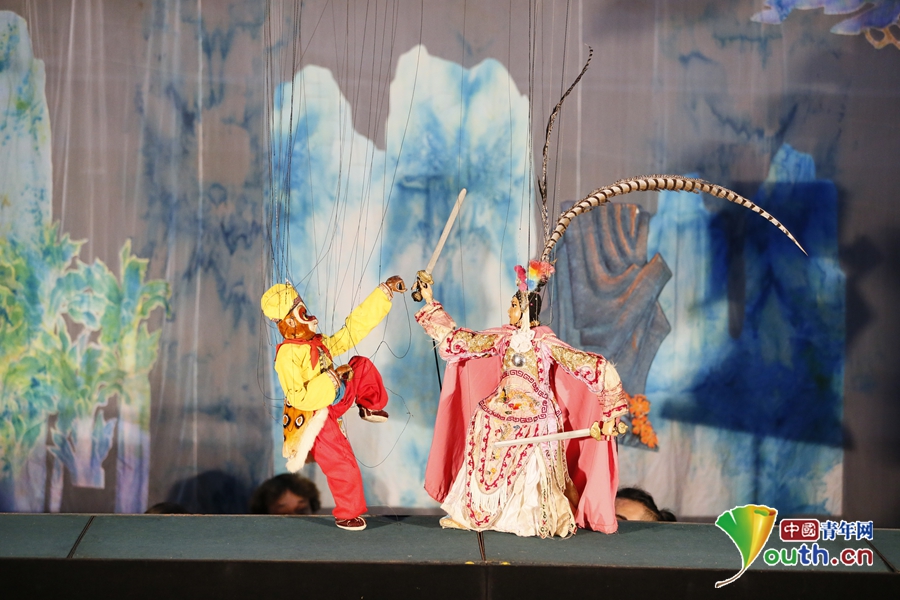
The Journey to the West Research blog is proud to host a guest post by the very knowledgeable @ryin-silverfish of Tumblr. They managed to track down a digital copy of the script for Tripitaka Seeks the Scriptures (Sanzang Qujing, 三藏取经), an extremely rare Journey to the West (Xiyouji, 西遊記; “JTTW” hereafter) puppet play from Quanzhou, Fujian province, China (fig. 1). This prompt book was first transcribed during the Qing Dynasty (1644-1911), but internal characteristics date it to sometime after the late-13th-century JTTW and before or concurrent with the early-Ming JTTW zaju play. Needless to say, this is a super important addition to JTTW studies as it likely serves as a “missing link” between the northern and southern traditions of the story cycle (Hu, 2017a; 2017b). The strange thing is that I’ve never read anything about the play in any English sources on JTTW. This fact demonstrates just how rare and precious the play is.
The work contains familiar episodes, like Monkey’s havoc and punishment, Tripitaka‘s tumultuous childhood and vow to retrieve scriptures from India; Sun Wukong and Zhu Bajie becoming his disciples, etc. (This and other parallels presented below perhaps point to the play and the later 1592 JTTW drawing upon the same source material.) But the play also has some very interesting differences: Tripitaka is adopted by Tang Emperor Taizong, thus becoming a prince; Monkey is imprisoned in a magic well for his past misdeeds; Sha Wujing is the one transformed into a white horse; and Erlang becomes the Tang Monk’s disciple after being punished for flirting with a heavenly maiden. Read on for a full Chinese script and English synopsis below.

Fig. 1 – An example of modern Quanzhou string puppetry depicting a battle between Sun Wukong and Princess Iron Fan (larger version). Image found here.
Table of Contents
- 1. The Chinese Script
- 2. English Summary
- Chapter 1: Meeting the Buddha (Jian Fozu, 见佛祖)
- Chapter 2: Monkey in a Well (Zuojing Hou, 坐井猴)
- Chapter 3: Farewell Banquet (Paishu, 派数)
- Chapter 4: Monkey Joins (Shou Hou, 收猴)
- Chapter 5: The Horse Joins (Shou Ma, 收马)
- Chapter 6: Erlang Joins (Shou Erlang, 收二郎)
- Chapter 7: Pigsy Joins (Shou Zhu, 收猪)
- Chapter 8: Spiderly Woe (Zhizhu Men, 蜘蛛闷)
- Chapter 9: Subduing the Spider (Shou Zhizhu, 收蜘蛛)
- Chapter 10: Bad News (Bao Xiongxun, 报凶讯)
- Chapter 11: Subduing the Three Saints (Shou Sansheng, 收三圣)
- Chapter 12: Ascending the Immortal Pavilion (Dengxian Ge, 登仙阁)
- Chapter 13: Meeting the Grandfather and Grandson (Yu Gongsun, 遇公孙)
- Chapter 14: Subduing the Great Serpent (Shou Dashe, 收大蛇)
- Chapter 15: Firewood Crossing (Ge chaidu, 隔柴渡)
- Chapter 16: Party in the Celestial Realm (Tiangong Hui, 天宫会)
- Chapter 17: Where did the monk go? (Tao Heshang, 讨和尚)
- Chapter 18: Subduing the Red-faced Demon (Shou Chimian, 收赤面)
- Chapter 19: Eight Wheels (Balun Tan, 八轮叹)
- Chapter 20: Subduing the Eight Wheels (Shou Balun, 收八轮)
- Chapter 21: Meeting the Great Buddha (Jian Dafo, 见大佛)
- Chapter 22 to 23: Descending with the Buddha’s Decree (Jiang Fozhi, 降佛旨) and Conferring of Titles (Fengci, 封赐)
- 3. Thanks
- 4. Updates
1. The Chinese Script PDF
The source of this text is quite obscure, only featured in a 1999 Chinese collection of puppet theater plays published by the Quanzhou Regional Opera Research Society.
Name of the book: 泉州地方戲曲研究社編,《泉州傳統戲曲叢書》第十卷《傀儡戲•目連全簿》(北京:中國戲劇出版社,1999)。
Unsurprisingly, I have no way of getting my hands on an actual copy of the book, so the Chinese text here came from a Tieba user who did, and then someone helpfully uploaded it onto Baidu Cloud Drive.
Just something to keep in mind.
PDF File
https://docs.google.com/document/d/10XhOpvLFrdcSaqyrhY_4MmiXylSGNhWutcgv6Ngen3M/edit
Jim: Here is a backup just in case.
Click to access Quanzhou-Puppet-Theatre-JTTW.pdf
[Note: See also the 07-21-25 update below for a PDF of the original book!]
2. English Summary
Disclaimer – This is a very rough chapter-by-chapter summary of the play, which was first transcribed in the Qing dynasty and appeared to be written in the local dialect. As I do not speak Hokkien, nuances are likely lost and errors made.
Jim: I have added italicized explanatory notes to @ryin-silverfish’s summary below. I formatted the section as such so that readers will have more context at hand. This way, you won’t have to constantly scroll down to the footnotes. Also, I have added links, as well as more hanzi and pinyin. I don’t (yet) know Hokkien either, so I apologize for not adding the corresponding romanization.
Chapter 1: Meeting the Buddha (Jian Fozu, 见佛祖)
Tripitaka (Sanzang, 三藏; a.k.a. Xuanzang, 玄奘) sings his backstory, which is pretty much the same as the JTTW novel version, minus the revenge part, and with a few more details: he was found by Li Gong (李公) and raised under the name “River Float” (Jiang Liu’er, 江流儿) in the Golden Mountain Temple (Jinshan Si, 金山寺). [A] As an adult, he later traveled to become a monk at the Immortal Peach Temple (Pantao Si, 蟠桃寺). Tang Emperor Taizong came there one day to sponsor a mass and present incense, and being impressed by the monk’s arhat-like aura, made him his adopted son, “Prince Tripitaka” (Sanzang Taizi, 三藏太子). [B]
The royal monk is praying to the “Buddha of the Southern Seas” (Nanhai Fozu, 南海佛祖, a.k.a. Guanyin), when the goddess arrives to ask what is bothering him. He worries that the monks who travel outside the temple might be tempted by worldly things, so he vows that day to retrieve scriptures from India in order to save them from negative karmic fate. [C] In response, Guanyin first tells him that the journey will be perilous, with untold dangers along the way. Then, she tells Tripitaka of the “Great Sage Equaling Heaven” (Qitian Dasheng, 齐天大圣), who had been imprisoned in a well for stealing the Jade Emperor’s wine in the past. Next, she recommends recruiting the Great Sage to protect the monk on the trip, and to that end gives him a “Precious Sash of Infinity” (Wujin Baodi, 无尽宝绦) and a golden headband, two heavenly treasures needed to respectively free and submit the spirit. Finally, Guanyin gives him a ringed staff, an alms bowl, and straw slippers before sending him on his way.
A) Tripitaka is found as a baby by the monk Faming (Faming Heshang, 法明和尚), the holy abbot of the Golden Mountain Temple, in JTTW chapter nine. He gives the baby the same name, “River Float” (Jiang Liu/er, 江流/儿) (Wu & Yu, 2012, vol. 1, p. 222).
B) The monk becomes Tang Emperor Taizong’s bond brother (xiongdi, 兄弟) in JTTW chapter 12 (Wu & Yu, 2012, vol. 1, p. 290). The monarch even refers to him as his “Royal Brother” (yudi, 御弟) (Wu & Yu, 2012, vol. 1, p. 291, for example).
C) The Tang Monk’s reason for the trip is different in the novel: he is chosen to procure scriptures of the “Great Vehicle” (Dacheng, 大乘; i.e. Mahayana texts) in order to perform a “Grand Mass of Land and Water (Shuilu Dahui, 水陆大会), which will free untold numbers of abandoned souls from the underworld (Wu & Y, 2012, vol. 1, pp. 275 and 286-290). This is more in line with Tang Taizong’s mass in the play.
Chapter 2: Monkey in a Well (Zuojing Hou, 坐井猴)
Sun Wukong sings his backstory inside the well: he was as old as heaven and earth and had eleven brothers, a.k.a. the “Eleven Luminaries” (Shiyi Yao Xingjun, 十一曜星君). [D-F] Turning into a mosquito and flying into the celestial realm, he ate twelve peaches of immortality and three, multi-ton alms bowls full of Laozi’s golden elixir pills and drank 3,000 jars of heavenly wine. [G]
In a drunken haze, Monkey drank so much water from the Eastern Sea that the Dragon King’s palace was exposed, causing the monarch, together with every other deity he had pissed off, to complain to the Jade Emperor.
After he was captured by the combined forces of Erlang, Nezha, Devaraja Li Jing, the Curtain-Raising General Deng Hua (Juanlian Denghua, 卷帘邓化), and celestial soldiers, the plot, again, proceeds the same as in the JTTW novel. This includes his failed execution, sentence to the eight trigrams furnace, wager with the Buddha, and his defeat under “Five-Fingers Mountain” (Wuzhi Shan, 五指山; a.k.a. “Five Elements Mountain“). The only thing different is his place of imprisonment: the power-nullifying, 10,000-zhang-deep “Dazzling Crystal Well” under the Wild Horse Bridge of Youzhou (Youzhou Yema Qiao xia wanzhang Huashan Liuli Jing, 幽州野马桥下万丈花闪琉璃井). [H-J]
Monkey is told that only when “flowers bloom on iron trees” (tieshu kaihua, 铁树开花) will he be released. Shortly thereafter, Guanyin shows up in his dreams and mentions Tripitaka, and the chapter ends with him crying out the monk’s name, hoping he might be heard.
D) Monkey formally introduces himself as Sun Wukong (xing Sun ming Wukong, 姓孙名悟空). But this name only appears twice in the entire play. He is primarily called “Equaling Heaven” (Qitian, 齐天). It appears a total of 286 times, including only two uses of “Great Sage Equaling Heaven” (Qitian Dasheng, 齐天大圣) (ch. 2 & 4). He is twice referred to in chapter four as the “Monkey Whose Greatness Equals Heaven” (Yuansun Qitian, 猿孙大齐天) (refer to the PDF). The present summary primarily uses Sun Wukong and Monkey out of tradition.
E) Monkey’s stated age, “the same as Heaven and Earth” (yu tiandi tonggeng, 与天地同庚) (refer to the PDF), is different from the novel. Calculations based on internal story details suggest that he was born around the year 500 BCE during the late-Zhou Dynasty (c. 1046-256 BCE).
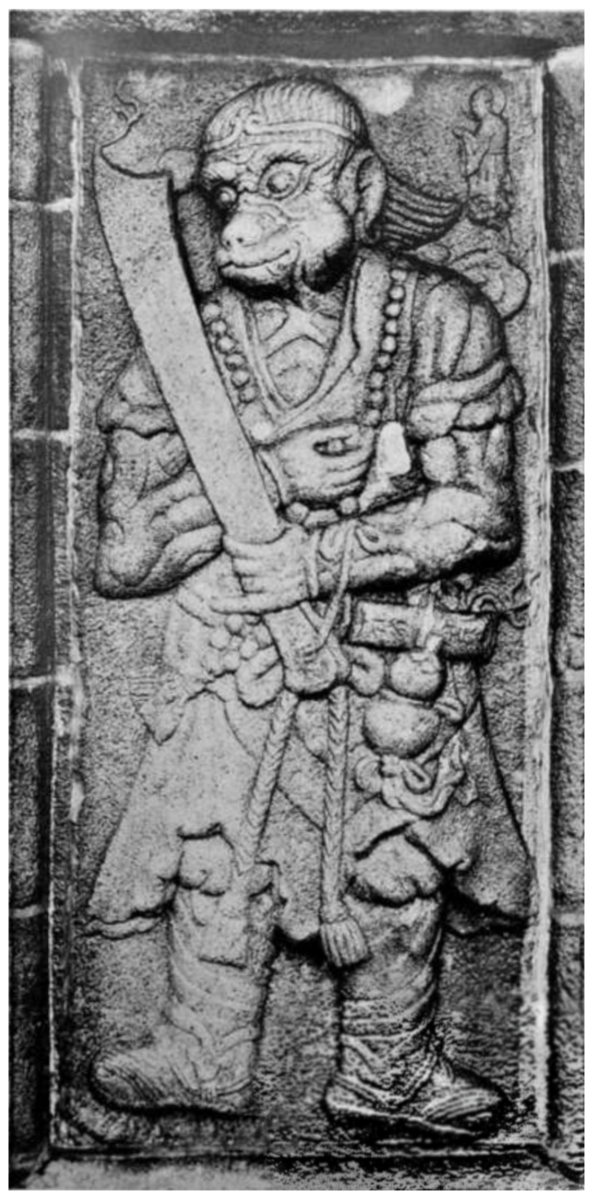
F) The “Eleven Luminaries” (Shiyi Yao Xingjun, 十一曜星君) are a combination of nine sinicized Hindu astrological deities and two East Asian astrological deities. They include the Sun (Taiyang xing, 太陽星), Moon (Taiyin xing, 太阴星), Mars (Huoxing, 火星), Mercury (Shuixing, 水星), Jupiter (Muxing, 木星), Venus (Jinxing, 金星), Saturn (Tuxing, 土星), Rahu (Luohou, 罗睺), Ketu (Jidu, 奇都), and two shadowy planets called Yuebei xing (月孛星) and Ziqi (紫气). See figure one here for a circa 13th-century image of these gods. I don’t know if these are supposed to be his biological siblings or just bond brothers. But Wukong does take the “Nine Luminaries” (Jiu Yaoxing, 九曜星), the aforementioned sinified stellar gods, as his bond brothers in JTTW chapter five (Wu & Yu, 2012, vol. 1, p. 160). He later fights and singlehandedly defeats them all during his rebellion (Wu & Yu, 2012, vol. 1, p. 171).
Monkey does have biological brothers and sisters in two Yuan–Ming stage plays (see the 12-20-23 update here). One is a sister called the “Iron-Colored Macaque” (Tiese Mihou, 铁色狝猴) (refer to this PDF). In the puppet play, Laozi refers to Monkey as an “iron bone-colored macaque” (Tiegu Se Mihou, 铁骨色猕猴) because his body is immune to harm. I’m not sure where these terms come from. They might be connected to the tiese (铁色), a kind of fruit-bearing tree in Asia. Perhaps macaques were associated with eating its fruit. Also, I should note that Monkey is called the “Great Sage Steel Muscles and Iron Bones” (Gangjin Tiegu Dasheng, 钢筋铁骨大圣) at the end of the late-13th-century JTTW.
G) Monkey is punished in JTTW chapter five for a host of crimes, including eating countless immortal peaches, ruining a celestial banquet, drinking copious amounts of heavenly wine, and eating all of Laozi’s elixir pills (Wu & Yu, 2012, vol. 1, pp. 162 and 165-166).
H) One zhang (丈) comprises ten chi (尺, a.k.a. “Chinese feet”), and one chi is roughly 31.8 cm (12.3 in). This makes one zhang 3.18 m (10.43 ft) (Jiang, 2005, p. xxxi). Ten-thousand zhang (wanzhang, 万丈) would therefore be 31,800 m (104,300 ft). That’s one deep well!
The Water Margin (Shuihu Zhuan, 水浒传, c. 1400), another famous Chinese vernacular novel, also contains a 10,000 zhang deep pit (wanzhang shenqian dixue, 万丈深浅地穴) used to imprison 108 stellar spirits (Shi & Luo, 1975/2021a, vol. 1, p. 15). Shapiro translates this as “a pit 100,000 feet deep” (Shi & Luo, 1993/2021b, vol. 1, p.15). But the use of 10,000 zhang is likely referring to an infinitely deep, inescapable abyss.
This idea can be traced to a Song-era Daoist ritual in which an exorcist draws the character for “well” (jing, 井/丼) on the ground. This divides the ritual space into nine sections, representing the Nine Palaces (Jiugong, 九宮) (stellar groupings comprising the cosmos), thereby creating an earth prison to incarcerate evil spirits. The Compilation of Rituals of the Way (Daofa huiyuan, 道法会元) reads:
[U]se the Sword mudrā to draw the character for “well” on the ground. Transform it into a black prison, ten-thousand zhang deep, and ten thousand li wide. Black vapors burst out of it. Inside the prison, visualize how cangues and locks, as well as tools and machinery are laid out. Then recite the Spell for Fast Arrest.
右用劍訣,就地劃一井字。化為黑獄,深萬丈,闊萬里。黑炁衝騰。存獄中枷鎖、噐械備列;就念「促捉咒」(Meulenbeld, 2007, p. 142).
Therefore, Monkey’s imprisonment was likely influenced by this Daoist rite.
I) It’s important to note that liuli (琉璃), the material comprising his prison, has a connection to Buddhism. For example, it is mentioned in Indian Buddhist sources under it’s Pali/Sanskrit equivalent, vaiḍūrya (वैडूर्य), as one of the seven precious substances, along with gold, silver, pearls, etc. Modern translators of said sources associate vaiḍūrya with shiny, translucent beryl and cat’s eye gemstones. But the Chinese originally associated vaiḍūrya/liuli with opaque, dark blue, and sometimes golden-speckled lapis lazuli (Winder, 1990). This is why the Chinese name of the Medicine Buddha, Yaoshi Liuli Guangwang Rulai (藥師琉璃光如來), is translated as the “Medicine Master [of] Lapis Lazuli Light Tathāgata” (for example).
This would suggest that Wukong’s prison is not crystal but lapis lazuli, perhaps with golden speckles, which would explain the “dazzle” (huashan, 花闪) part of the well’s name. And since he is held fast there by the Buddha’s seal (see chapter 4 below), the medium of his jail is likely influenced by Buddhism. This would make his prison a joint Buddho-Daoist punishment.
J) Youzhou (幽州) was an ancient prefecture in what is now Heibei province, China.
Chapter 3: Farewell Banquet (Paishu, 派数)
Zhangsun Wuji, historically Taizong’s minister, is preparing a farewell banquet for Prince Tripitaka. It’s mostly a list of dishes; not much to see here.
Chapter 4: Monkey Joins (Shou Hou, 收猴)
Tripitaka attends Zhangsun Wuji’s farewell banquet, and then begins his journey to the west. The Buddha Maitreya sees him about to reach a wide river, uncrossable by boats, and sends Shancai to assist him by covering the river in lotus flowers.
Tripitaka steps over the lotuses and crosses the “Nine-Rank, No Boats River” (Jiupin Wuchuan Jiang, 九品无船江). Keep on keeping on, he hears someone calling out his name, but doesn’t see the caller. The local god of the soil shows up to inform him that it is the Great Sage Equaling Heaven, yelling from inside his well.
The monk removes the Buddha’s seal on the well cover by reciting the “Three-Jewels Mantra” (Sanbao zhenyan, 三宝真言), and then he uses the Precious Sash to lift Sun Wukong out of the well, thereby breaking the iron locks holding him down.
Tripitaka asks Monkey to escort him to the Western Heaven, but the spirit only wants to go back to Flower-Fruit Mountain. Sun Wukong agrees to have his head shaved just so he can bail out after a few li. [K] Unfortunately for him, he also agrees to wear the golden headband, and right after he speeds away, Tripitaka recites the tightening sutra and forces him to return.
Monkey finally relents and agrees to protect Tripitaka on the journey to India. He takes this as an opportunity to bring out the “luggage” from his ear: the 30,000 catty “As-You-Wish Staff” (Qianjun Ruyi Bang, 千钧如意棒; a.k.a. the “Golden-Hooped As-You-Wish Staff,” Jingu Ruyi Bang, 金箍如意棒), forged by the sage-king Yu the Great. [L & M]
K) Wukong also sports a shaven head in the novel. For instance, in JTTW chapter 27, he states:
But ever since Nirvana delivered me from my sins, when with my hair shorn I took the vow of complete poverty and followed you as your disciple, I had this gold fillet clamped on my head… (Wu & Yu, 2012, vol. 2, p. 24).
L) The staff’s weight is based on a thousand multiples of 30 catties (jun, 钧). One catty (jin, 斤) is 590 grams (Elvin, 2004, p. 491 n. 133). Therefore, 30,000 catties would be roughly 17,700 kg or 39,021.82 lbs. But 30,000 is likely used here to refer to an unimaginably large number (i.e. Wukong’s staff is REALLY heavy).
The novel staff weighs 13,500 catties (cf. Wu & Yu, 2012, vol. 1, p. 135). This equals 7,965 kg or 17,559.81 lbs.
M) The literary weapon also has a slightly different name: the “As-You-Wish Gold-Banded staff” (Ruyi Jingu Bang, 如意金箍棒). (Notice how ruyi (如意) and jingu (金箍) are switched around from the play’s staff name.) In addition, it is said to have been used by Yu the Great in the past to conquer the world flood (Wu & Yu, 2012, vol. 1, p. 135). But the staff’s creation is attributed to both Laozi (ch. 75) and Yu (ch. 88) (Wu & Yu, 2012, vol. 3, pp. 375; vol. 4, 201).
Chapter 5: The Horse Joins (Shou Ma, 收马)
The “Deep Sand God” of Black Sand Cave (Heisha Dong Shensha Shen, 黑沙洞深沙神, i.e. Sha Wujing) sits in his abode, [N] looking to grab some travelers to eat, and soon, he comes across Tripitaka and Sun Wukong. He seizes the monk first, then tries to grab the monkey but seemingly fails.
Sun Wukong, using his magic “Fiery Eyes and Golden Irises” (Huoyan Jinjing, 火眼金睛), figures out it was the Deep Sand God, and then goes into his cave for a rescue mission. They banter and proceed to fight. Knowing that the old monkey spirit is vulnerable to 1) flames and 2) water, [O] the Deep Sand God sets a fire inside his cave, forcing Sun Wukong to flee to the South Sea for help.
Guanyin decides to come along and asks Sun Wukong to bring her alms bowl, too. When they confront the Deep Sand God again, Guanyin presents a wager to him: if he can lift her alms bowl (boyu, 钵盂), both she and Tripitaka will be his food.
The monster tries but is unable to lift it. [P] Sun Wukong then lifts the bowl, tosses it onto his head, and attempts to slay the Deep Sand God. But Guanyin spares him on the condition that he will turn into a white horse and become Tripitaka’s steed. [Q]
N) The “Deep Sand God” (Shensha Shen, 深沙神) appears as a desert demon in (the incomplete) chapter eight of the late-13th-century JTTW. He claims to have eaten Tripitaka’s two previous incarnations on their journey to India. The monster only helps the pilgrims cross the “Deep Sands” (Shensha, 深沙) via a magical golden bridge once he is threatened with heavily retribution. Memorial poems note that Tripitaka releases the Spirit from a 500-year-long curse, and Monkey promises to speak highly of him when they meet the Buddha (Wivell, 1994, pp. 1190-1191).
O) Monkey is shown to be weak to “True Samadhi Fire” (Sanmei zhenhuo, 三昧真火), an intense flame born from spiritual cultivation, in JTTW chapter 41 (Wu & Yu, 2012, vol. 2, pp. 230-23). And he is shown throughout the novel to be a less proficient fighter in water (ch. 21, for example) (Wu & Yu, 2012, vol. 1, pp. 423-424).
P) This is reminiscent of JTTW chapter 42, when Guanyin challenges Wukong to pick up her porcelain vase, which contains an ocean full of water. He is unsuccessful (see the 07-03-22 update here). The Deep Sand God’s inability to raise the alms bowl is likely related to monk Faxian‘s story about the immovable quality of Buddha’s almsbowl (Faxian & Legge, 1886/1965, pp. 34-35).
Q) In the novel, the white horse is a transformed dragon prince. He is forced to become Tripitaka’s steed after eating the original horse in chapter 15 (Wu & Yu, 2012, vol. 1, p. 328).
Chapter 6: Erlang Joins (Shou Erlang, 收二郎)
Erlang sings his backstory. The previous year, he harassed a Jade Maiden messenger (Chuanyan Yunu, 传言玉女) on a bridge in Tianjin (Tianjin Qiaotou, 天津桥头), provoking the Jade Emperor’s wrath and causing him to cut off sacrifices and worship to Erlang. After the intervention of Guanyin, he was sent to Mt. Guankou (灌口山) (in Sichuan) as a guardian deity, but often preyed on passing mortals and ate their flesh. [R]
The POV switches to Tripitaka and Wukong; the latter sees a black cloud blocking his way, and suspecting it to be a demon, he asks his master to hide while he checks. Erlang reveals his identity and suggests that he will catch the monk and share his flesh with “Elder Brother Qi” (Qige, 齐哥) (i.e. Monkey).
Wukong promptly chews him out and reveals that Tripitaka is the reincarnation of the Golden Chan Arhat (Jinchan Luohan, 金禅罗汉), [S] who attended a lantern fruit festival without notifying his fellow monks and was punished by the Buddha to experience 36 perils (sanshiliu jie, 三十六劫) on his journey to the west. [T]
After getting a monk makeover, Erlang becomes Tripitaka’s disciple.
R) This is reminiscent of Zhu Bajie’s backstory from JTTW chapter 18. After being stripped of his divine post and exiled to earth for forcing himself on a moon maiden, Pigsy becomes a meat-eating spirit (Wu & Yu, 2012, vol. 1, p. 212).
S) Tripitaka’s past divine title, the “Golden Chan Arhat” (Jinchan Luohan,金禅罗汉), is similar to that from JTTW, “Master Golden Cicada” (Jinchan Zi, 金蝉子). Chan (as in Chan Buddhism) and chan (蝉, “cicada”) look and sound similar.
T) Master Golden Cicada is exiled from heaven for sleeping during the Buddha’s lecture. The fullest explanation for this appears in chapter 81 (Wu & Yu, 2012, vol. 4, p. 82). Another part of his punishment is experiencing 81 perils, which happen throughout the novel. Eighty of these are listed, with the final one happening shortly thereafter, in chapter 99 (Wu & Yu, 2012, vol. 4, pp. 358-363).
Chapter 7: Pigsy Joins (Shou Zhu, 收猪)
Zhu Bajie (猪八戒), the pig demon of Mt. Song (嵩山; later called “Pig Excrement Mountain,” Zhushi Shan, 猪屎山), is hungry for human flesh, and so he decides to whip up some smoke and seize some unaware travelers under its cover. Just like the two villains before him, he picks the pilgrims as his target.
Wukong fights him, subdues him, and he joins the party.
Chapter 8: Spiderly Woe (Zhizhu Men, 蜘蛛闷)
Lady Earth-Raised (Diyang Furen, 地养夫人), the spider demoness of Mt. Hua (Hua Shan, 华山), has a problem. She might be the youngest sister of the “Three Saints of Mt. Song” (Song Shan Sansheng Langjun, 嵩山三圣郎君), [U] living on her silk webs, but she is still single and unmarried. As such, she commands her imps to patrol the mountains daily, so as to kidnap a fine man as her future husband.
The imps soon spot a group of people under the mountain: a monkey, a horse, a pig, and a monk (Erlang isn’t mentioned for some reason). She asks one of her imp minions, the “Big-headed Demon” (Datou Gui, 大头鬼), which one seems like a good choice, and after comically dismissing the first three, she settles on the monk.
The Big-headed Demon eagerly grabs a sack and chopper and, when she asks why, he tells her he is going to cut the monk in half and bring the body to her. But since a dead person does not a good husband make, she decides to kidnap the monk herself.
U) Lady Earth-Raised is similar to the seven Spider Spirits (Zhizhu Jing, 蜘蛛精) from JTTW chapters 72 to 73, and her lofty brothers, the Three Saints, are reminiscent of the Demon Lord of a Hundred Eyes (Baiyan Mojun, 百眼魔君), the spider spirits’ senior from chapter 73.
Her name and at least one of her deceptions is also very similar to a demoness in JTTW chapter 80 (see below).
Chapter 9: Subduing the Spider (Shou Zhizhu, 收蜘蛛)
The demoness disguises herself as a young woman with her lower half buried in the earth (the same trick Lady Earth Flow uses in JTTW chapter 80 (Wu & Yu, 2012, vol. 4, p. 67) and calls out for help. Tripitaka orders Wukong to investigate, but he refuses because he doesn’t want trouble. However, the monk forces him into it via the headband tightening spell.
She says she was buried there by her husband for doing something wrong, and then asks the monk for help. When Tripitaka tries to pry her free with a monk’s knife (jiedao, 戒刀), she grabs him and returns to her cave.
Sun Wukong spots some spider silk with his fiery eyes and plans to turn into a jiaoming fly (jiaoming chong, 蟭螟虫) [V] and follow it back to her cave. However, the horse says she probably raises hens inside, and a fly would quickly be eaten, so he should transform into a Scops owl (Lao Chi, 老鸱), a bird of prey. That way Wukong can deal with the chickens when he sneaks inside.
He soon finds the spider demoness and orders her to let his master go or die. She replies that if he dares, her brothers, the “Three Saints of Mt. Wo” (Wo Shan Sanshen Langjun, 窝山三圣郎君) (again, a mountain’s name does not stay consistent) will deal with him. [W] Wukong beats her to death with the staff anyways and rescues Tripitaka.
V) The jiaoming fly (jiaoming chong, 蟭/焦螟虫) is an aquatic insect from Daoist literature said to be so small that it can congregate in the eyebrows of a mosquito (Wang, 2012, p. 28 n. 44).
W) The “Three Saints of Mt. Song/Wo” (Song/Wo Shan Sansheng Langjun, 嵩/窝山三圣郎君) are part of a pattern in JTTW in which the pilgrims face a trio of baddies. Examples include the three bogus animal immortals (ch. 46), the three demon kings of Lion-Camel Cave (ch. 74-77), and the three rhino demons (ch. 91-92). The three incarnations of the White Bone Spirit (ch. 27) could also count. This reoccurring number is perhaps meant to mirror Tripitaka’s three disciples.
Chapter 10: Bad News (Bao Xiongxun, 报凶讯)
Luo Tuo, Luo Du, and Luo Hou (罗托,罗独,罗候)—the Three Saints of Mt. Wo—are having a party in celebration of their eldest brother, Luo Tuo’s birthday. They wonder why their sister has not arrived yet, when suddenly, the Big-Headed Demon enters and delivers the bad news.
Furious, the trio swear revenge and set out to capture Tripitaka and kill Wukong. [X]
X) The Saints’ anger over the murder of their spider sister is also similar to the rage of the Demon Lord of a Hundred Eyes over the killing of his seven spider sisters (ch. 73) (Wu & Yu, 2012, vol. 3, pp. 340-341). All eight are done in by Monkey.
Chapter 11: Subduing the Three Saints (Shou Sansheng, 收三圣)
The pilgrims are passing through a mountain, when Luo Tuo swoops down and grabs Tripitaka but fails to capture Wukong. Monkey informs the rest of the gang about the Three Saints. Erlang suggests that since Wukong is the one who started it, he alone should deal with them.
The whole gang goes after the trio anyways but fails to beat them. Wukong tells Erlang and Sandy to keep watch on the Three Saints so that they do not harm Tripitaka, and he flies to the South Sea to seek Guanyin’s help.
Guanyin agrees, but the chapter ends here because the rest of the pages are missing from the original manuscript.
Chapter 12: Ascending the Immortal Pavilion (Dengxian Ge, 登仙阁)
The chapter begins with the head of the pavilion’s local shrine asking an attendant about sacrifices, for the birthday of a certain “Great Immortal” (Daxian, 大仙) is near. He demands a young boy, as well as food and fruits, as gifts.
The shrine attendant goes to inform the families responsible for supplying each of the sacrifices; this year, it is Old Huang’s (Huang Gong, 黄公) turn to give up his only grandson. [Y] He begs them to delay the sacrifices until his family can … sire another grandkid!
In response, the shrine attendants tie him up and start beating him, stating that if the Great Immortal does not get his sacrifice, the whole village will suffer. Unable to withstand the beating, Old Huang yields and agrees to their demand.
Y) This plot is similar to the Great King of Numinous Power (Linggan Dawang, 灵感大王) episode from JTTW chapters 47 to 48. He demands a yearly sacrifice of children from families that shoulder the horrible burden on a rotating basis. This shares shocking similarities with Hindu literature (see section 2.2 here).
Chapter 13: Meeting the Grandfather and Grandson (Yu Gongsun, 遇公孙)
The pilgrims hear the commotions of the sacrificial ceremony, and upon investigating, come across Old Huang, dragging his grandson along and sobbing. After questioning him, Tripitaka decides to go to Ascending Immortal Pavilion himself and talk the Great Immortal out of this whole “human sacrifice” thing.
Chapter 14: Subduing the Great Serpent (Shou Dashe, 收大蛇)
The sacrificial ceremony begins. But the shrine attendants wonder if the Great Immortal has not yet arrived because the young boy hasn’t been offered up. Tripitaka arrives just in time to call out the Great Immortal for demanding human sacrifices.
Enraged, the Great Immortal orders his imps to snatch Tripitaka, but Wukong smashes his way in and demands the release of his master. The Great Immortal dares Wukong to allow the spirit three free strikes; Wukong agrees.
After three hits and no effect, the Great Immortal tries to bash him over the head with a stone incense burner, which only annoys Wukong. [Z] He whips out his staff and kills the Great Immortal in one strike, revealing his true form—a huge serpent. [AA]
The pilgrims continue their journey. Wukong asks Erlang to get their master some water, while he travels on his cloud to get some food from the Immortal Peach Monastery (蟠桃寺). As the two leave, Tripitaka hears the sound of people chopping firewood and goes to investigate.
Z) Monkey is famous for his invulnerability in JTTW. For instance, in chapter 75, Wukong willingly blocks a sword strike with his adamantine head:
Arousing his spirit, the old demon stood firmly with one foot placed in front of the other. He lifted up his scimitar with both hands and brought it down hard on the head of the Great Sage. Our Great Sage, however, jerked his head upward to meet the blow. All they heard was a loud crack, but the skin on the head did not even redden (Wu & Yu, 2012, vol. 3, p. 373).
AA) A massive, red-scaled python spirit (honglin damang, 紅鳞大蟒) appears in JTTW chapter 67.
Chapter 15: Firewood Crossing (Ge chaidu, 隔柴渡)
Two firewood choppers turn out to be Hanshan and Shide (寒山,拾得), two famous historical monks of Mt. Tiantai, who are also worshiped in folk religion. Tripitaka asks them if there is a temple nearby. They say yes but that it’s on the other side of the river.
There aren’t any boats either, so they use their firewood to create a bridge for Tripitaka. Halfway across, the bridge collapses; he falls into the river, only to be rescued by the local Dragon King, who escorts him to the “Correctness and Broadness Temple” (Fangguang Si, 方广寺), [AB] where the Buddha is secretly staying.
After the monk greets Buddha, an immortal lad brings Tripitaka a message: Devaraja Li (Li Tianwang, 李天王) of the Bisha-men Palace (Pisha Gong, 毗沙宫) is inviting him to a party in celebration of his own birthday, as well as Prince Nezha’s (Nezha Taizi, 哪吒太子) “return to the world/rebirth” (zai chushi, 在出世). Tripitaka agrees and heads for the celestial realm on a white crane.
AB) This may be a reference to the Buddhāvataṃsaka Sūtra (Dafangguang fo huayan jing, 大方广佛华严经; a.k.a. “Flower Garland Sutra,” Huayan jing, 华严经). The Chinese believed that this was the Buddha’s first teaching shortly after achieving enlightenment (Buswell & Lopez, 2014, p. 84). This might then explain why the Buddha is residing in a random temple along the journey.
Chapter 16: Party in the Celestial Realm (Tiangong Hui, 天宫会)
Devaraja Li is organizing the party, sending out invitations for the 500 Arhats (Wubai Luohan, 五百罗汉). The immortal lad reports that all five hundred handkerchiefs (shoupa, 手帕) were given out, save for one—which turned out to be Tripitaka’s, missing because of the whole reincarnation thing. [AC]
Luckily, he soon arrives. Devaraja Li gifts him three cups of immortal wine, and Tripitaka, being a lightweight, becomes totally wasted and is taken into the backrooms of the palace to rest.
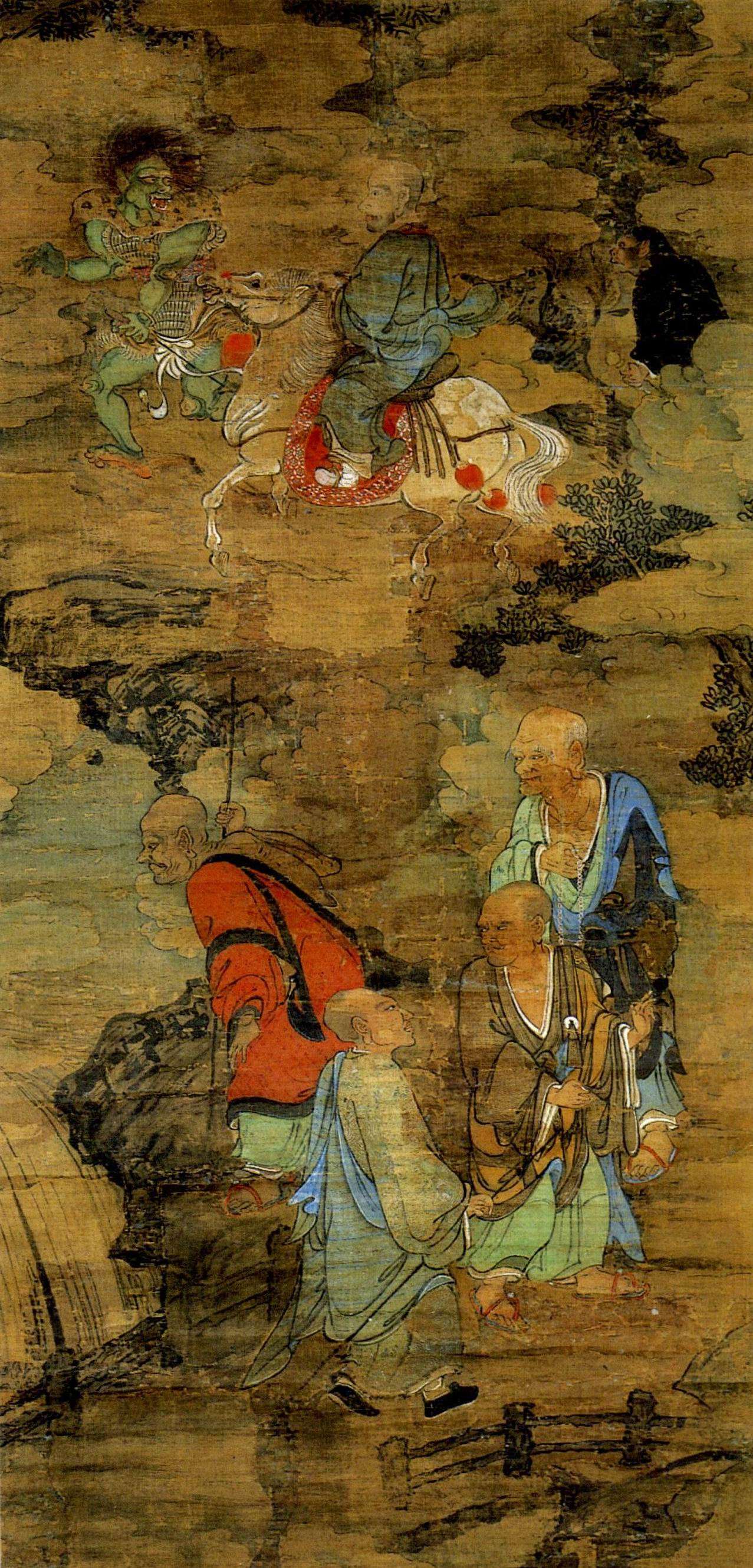
AC) Tripitaka was historically venerated as an arhat as early as the Song dynasty (960-1279) (Liu, 2019). For example, he is included in a series of late-12th-century religious paintings focusing on the 500 Arhats. A black-robed Sun Wukong can be seen walking in the clouds behind him (fig. 2) (see the 06-04-23 update here).

Fig. 2 – Lin Tinggui and Zhou Jichang, The Tang Monk Procures the Scriptures (Tangseng qujing, 唐僧取經), no. 77 of 100 scrolls from Images of the 500 Arhats (Wubai Luohan tu, 五百羅漢圖, 1178-1188 CE) (larger version). Hanging scroll, ink and color on silk. Image from Nara kuniritsu hakubutsukan, Tōkyō bunkazai kenkyūjo, 2014, p. 86. Courtesy of Dr. Liu Shufen, a research fellow at the Institute of History and Philology, Academia Sinica. See the 06-04-23 update here for close ups of Monkey.
Chapter 17: Where did the monk go? (Tao Heshang, 讨和尚)
Meanwhile, Wukong and Erlang return, only to find their master missing. They bash on the gate of the Correctness and Broadness Temple to demand his whereabouts; the Buddha replies that Tripitaka is drunk and sleeping in Devaraja Li’s palace, then slams the door shut in their faces.
Erlang asks Wukong to go to the celestial realm and bring their master back. Wukong declines, citing the whole “Havoc in Heaven” business, then asks Erlang to go. He also declines because of the Jade Maiden incident in the past.
Finally, they summon the local Jiedi (揭帝) with a mantra and send the guardian deity to pick up Tripitaka.
Chapter 18: Subduing the Red-faced Demon (Shou Chimian, 收赤面)
Elder Li De (Laofu Li De, 老夫李德) of Mt. Song has an 18-year-old daughter, Jinyu (金玉, “Golden Jade”), who has been charmed by a demon, and none of the exorcisms by Daoist priests seem to work. The pilgrims happen to pass by and stay at his place for the night, so naturally, Tripitaka signs his monkey disciple up to banish the demon.
Wukong hides in her bedroom, ready to ambush the demon. However, when spooked, it spews out fire and forces Wukong to retreat. Elder Li laments that the demon will surely give them even more trouble after this fiasco; in response, Wukong transforms into the man’s daughter and summons the local god of the soil for questioning. The deity reveals the monster’s identity as the “Red-Faced Demon King” (Chimian Guiwang, 赤面鬼王).
A transformed Wukong marches to the demon’s cave and tells him their relationship might not work out now that her father has seen the demon flee, deeming him a weakling. The Red-Faced Demon then reveals his backstory: he used to be a woodcutter until he saw the “Lamp-Lamp Buddha” (Dengdeng Fo, 灯灯佛) meditating on a rock, [AD] with a precious pearl (zhu, 珠) by his side. He stole the pearl and swallowed it, which allowed him to turn into a fireball and take flight.
Wukong cajoles him into giving up the pearl, immediately swallows it, and uses the True Samadhi Fire to eliminate the demon. [AE]
AD) This is a likely reference to Dīpaṃkara (Sk: दीपंकर), the Buddha preceding Śākyamuni. His Chinese name appears in countless sutras as Dengdeng Fo (燃灯佛), or the “Lamp Buddha.” This is appropriate given the magic pearl’s connection to spiritual fire. Also, this implies that the Red-Faced Demon has lived for countless eons if he was alive during the time of the previous Buddha.
Dīpaṃkara is referenced in JTTW chapter 5, and he briefly appears in chapter 98 (Wu & Yu, 2012, vol. 1, p. 166; vol. 4, p. 352). In addition, his name is listed first (even above Śākyamuni) in a roster of Buddhas and Bodhisattvas saluted at the end of the novel (Wu & Yu, 2012, vol. 4, p. 384). Journey to the West calls him Dendeng Gufo (燃灯古佛; a.k.a. Gufo, 古佛, here and here), or the “Ancient Buddha of the Lamp.”
AE) This chapter shares similarities with a number of JTTW episodes. First, Monkey hiding in the daughter’s room and later transforming into her likeness is reminiscent of Sun and Zhu’s first meeting in chapter 18 (Wu & Yu, 2012, vol. 1, pp. 374-375). Second, Wukong, once again disguised as a woman, tricks a spirit into spitting up a magic pearl and then swallows it himself in chapter 31 (Wu & Yu, 2012, vol. 2, pp. 80-81). And third, the emphasis on a red demon’s command of True Samadhi Fire is similar to Red Boy from chapter 40-42.
Chapter 19: Eight Wheels (Balun Tan, 八轮叹)
The “Holy Mothers of the Eight Wheels” (Balun Shengmu, 八轮圣母) sing their backstory: They were eight sisters—Gold Wheel, Silver Wheel, Copper Wheel, Iron Wheel, Tin Wheel, Wind Wheel, Fire Wheel, and Cart Wheel (Jinlun, Yinlun, Tonglun, Tielun, Xilun, Fenglun, Huolun, Chelun, 金轮, 银轮, 铜轮, 铁轮, 锡轮, 风轮, 火轮, 车轮), who were famous for their might but had remained single for 24,000 years.
As such, they planned to kidnap a husband to share between themselves.
Chapter 20: Subduing the Eight Wheels (Shou Balun, 收八轮)
Tripitaka is very close to his destination, when he is kidnapped by Gold Wheel. A very amusing sequence ensues, where each sister tries to snatch him away for their own wedding but are interrupted by Wukong bashing his way in and threatening to kill all eight of them.
The sisters beg for mercy; Wukong accepts their surrender, and then orders them to turn into eight immortal maidens (Feixian, 飞仙), fly to the Thunderclap Monastery (Leiyin Si, 雷音寺), and notify the Buddha of the pilgrims’ forthcoming arrival.
Chapter 21: Meeting the Great Buddha (Jian Dafo, 见大佛)
The pilgrims greet the Buddha and receive the Three Baskets of scriptures, consisting of sutras, texts and monastic codes. Afterwards, these are taken back to Immortal Peach Temple by the Four Bodhisattvas and Eight Vajrapanis (Ba Jingang, Si Pusa, 八金刚,四菩萨). [AF]
AF) The Eight Vajrapanis are ordered by Buddha to escort the pilgrims and sutras back to China in JTTW chapter 98 (Wu & Yu, 2012, vol. 4, p. 357). However, the guardians are later directed to land after only half way so that Tripitaka can experience the last of the 81 perils: the sutras are nearly lost in chapter 99 when a giant white turtle carrying the group to the other side of a river gets annoyed and dives into the water (this might be based on a historical event) (Wu & Yu, 2012, vol. 4, pp. 363). Thankfully, the Vajrapanis pick them back up and finish the trip to China in chapter 100 (Wu & Yu, 2012, vol. 4, pp. 370).
Chapter 22 to 23: Descending with the Buddha’s Decree (Jiang Fozhi, 降佛旨) and Conferring of Titles (Fengci, 封赐)
After the pilgrims descend to the Tang capital on colorful clouds, their Vajrapani escort suddenly remembers that he forgot to ask for the Buddha’s decree. He then flies back to Thunderclap Monastery after telling them to first start reading the scriptures to the masses.
That minor incident aside, the decree soon arrives without problem: Tripitaka is appointed the “Venerable Pindola Arhat” (Bintou Luohan Zunzhe, 宾头罗汉尊者), Wukong the “Great Sage of the Void” (Xukong Dasheng, 虚空大圣), Erlang the “Great Emperor of Miraculous Knowledge” (Lingtong Dadi, 灵通大帝), [AG] while Zhu Bajie and the Deep Sand God are made Buddhas. [AH]
Taizong then welcomes Prince Tripitaka back and gives him the royal title of “The Great Chan Master of the Great Law and True Scriptures” (Dafa Zhenjing Dachan Shi, 大法真经大禅师).
AG) This section of the manuscript contains an out of place passage not mentioned in the summary. It reads: “The Tree-born Prince and Sinful Dragon, Tathagata, and Erlang were each granted the title of Great Emperor of Marvelous Knowledge” (树生太子业龙,如来,灌口二郎各封灵通大帝) (refer to the PDF). This previously unmentioned princely dragon Buddha character is likely a transcription error (Hu, 2017a; 2017b).
AH) This is radically different than JTTW chapter 100. Only Sun Wukong and Tripitaka become Buddhas. Sha is made an arhat, while Zhu is made an altar custodian (Wu & Yu, 2012, vol. 4, pp. 381-382). Would the play’s ending then suggest that Buddhahood is considered lesser to the heavenly titles given to Monkey and Erlang?
–THE END–
3. Thanks
Jim: I would like to express my utmost thanks to @ryin-silverfish for alerting me to this play, providing the Chinese script, summarizing it, and directing me to an intricate paper about the play’s history. This article would not have been possible without their generous contributions.
4. Updates
Update: 07-21-2025
I’m excited to archive a PDF of the original book (fig. 3) containing the JTTW puppet play.
泉州地方戲曲研究社編,《泉州傳統戲曲叢書》第十卷《傀儡戲•目連全簿》(北京:中國戲劇出版社,1999)。
Quanzhou Local Opera Research Society. (1999). Quanzhou Traditional Opera Series (Vol. 10): Puppet Opera – The Complete Book of Mulian. Beijing: China Drama Publishing House.
All thanks goes to @ryin-silverfish for providing the PDF.
Archive link:
Click to access 泉州传统戏曲丛书-第10卷-傀儡戏·《目连》全簿-Pdg2Pic-郑国权主编;泉州地方戏曲研究社编-Z-Library.pdf

Fig. 3 – Quanzhou Traditional Opera Series (Vol. 10): Puppet Opera – The Complete Book of Mulian (《泉州傳統戲曲叢書》第十卷《傀儡戲•目連全簿》) (larger version).
Sources:
Buswell, R. E., & Lopez, D. S. (2014). The Princeton Dictionary of Buddhism. Princeton University Press.
Elvin, M. (2004). The Retreat of the Elephants: An Environmental History of China. New Haven (Conn.): Yale University Press.
Faxian, & Legge, J. (1965). A Record of Buddhistic Kingdoms: Being an Account by the Chinese Monk Fâ-Hien of his Travels in India and Ceylon (A.D. 399-414) in Search of the Buddhist Books of Discipline. New York: Dover Publications. (Original work published 1886)
Hu, S. (2017a, December 26). Chonggu “Nanxi” Xiyouji: Yi Quanzhou Kuileixi Sanzang Qujing Wei Qieru dian [A Re-evaluation of the Southern Story System of The Journey to the West: Based on Quanzhou Puppet Drama Monk Xuanzang on a Pilgrimage for Buddhist Scriptures]. Weixin Gongzhong Pintai. Retrieved from https://www.yidianzixun.com/article/0HzCWYnd.
Hu, S. (2017b). Chonggu “Nanxi” Xiyouji: Yi Quanzhou Kuileixi Sanzang Qujing Wei Qieru dian [A Re-evaluation of the Southern Story System of The Journey to the West: Based on Quanzhou Puppet Drama Monk Xuanzang on a Pilgrimage for Buddhist Scriptures], Fudan Xuebao (Shehui Kexue Ban), 59(6), 65-74.
Jiang, Y. (2005). The Great Ming Code / Da Ming Lu. Vancouver, Wa: University of Washington Press.
Liu, S. (2019). Songdai Xuanzang de shenghua: Tuxiang, wenwu he yiji [The Sanctification of Xuanzang in the Song Dynasty: Images, Artifacts and Remains]. Zhonghua wenshi luncong, 133, 161-219.
Meulenbeld, M. R. E. (2007). Civilized Demons: Ming Thunder Gods from Ritual to Literature (Publication No. 3247802) [Doctoral dissertation, Princeton University]. ProQuest Dissertations & Theses Global.
Nara kuniritsu hakubutsukan, Tōkyō bunkazai kenkyūjo henshū [Nara University Tōkyō Research Institute for Cultural Properties (Ed.)]. (2014). Daitokuji denrai gohyaku rakan zu [Daitoku Temple’s Tradition of the 500 Arhats Paintings]. Kyōto: Shitau bungaku.
Shi, N., & Luo, G. (2021a). Shuihu Zhuan (Shang, Zhong, Xia) [Tale of the Water Margin (Vols. 1-3)]. Beijing: Renmin Wenxue Chubanshe. (Original work published 1975)
Shi, N, & Luo, G. (2021b). Outlaws of the Marsh (vols. 1-4) (Trans. S. Shapiro). Beijing: Foreign Language Press. (Original work published 1993)
Wang, y. (2004). Sun Wukong De Yuanji Keneng Zai Fujian Baoshan [Sun Wukong’s Origin Could be In Baoshan, Fujian]. Yuncheng Xueyan Bao, 22(3), 30-34.
Wang, P. (2012). The Age of Courtly Writing: Wen Xuan Compiler Xiao Tong (501-531) and His Circle. Netherlands: Brill.
Winder, M. (1990). Vaiḍūrya. Bulletin of Tibetology, 26(1-3), 31-37.
Wivell, C.S. (1994). The Story of How the Monk Tripitaka of the Great Country of T’ang Brought Back the Sūtras. In V. Mair (Ed.), The Columbia Anthology of Traditional Chinese Literature (pp. 1181-1207). New York: Columbia University Press.
Wu, C., & Yu, A. C. (2012). The Journey to the West (Vols. 1-4) (Rev. ed.). Chicago, Illinois: University of Chicago Press.