The Origin of Sun Wukong’s Golden Headband

Last updated: 12-24-2023

The golden headband or fillet (jingu, 金箍; a.k.a. jingu, 緊箍, lit: “tight fillet”) is one of the Monkey King’s most recognizable iconographic elements appearing in visual media based on the great Chinese classic Journey to the West (Xiyouji西遊記, 1592 CE; “JTTW” hereafter). It is generally portrayed as a ringlet of gold with blunt ends that meet in the middle of the forehead and curl upwards like scowling eyebrows (type one) (fig. 1). A different version is a single band adorned with an upturned crescent shape in the center (type two) (fig. 2). Another still is a simple band devoid of decoration (type three) (fig. 3). Sun first earns the headband as punishment for murdering humans. The circlet is a heaven-sent magic treasure designed to reign in the immortal’s unruly, rebellious nature. Since Sun Wukong is a personification of the Buddhist concept of the “Monkey of the Mind” (xinyuan, 心猿), or the disquieted mind that bars humanity from enlightenment, the fillet serves as a not-so-subtle reminder of Buddhist restraint. Few scholars writing in English have attempted to analyze the treasure’s history.

In this paper, I present textual and visual evidence from India, China, and Japan that suggests it is ultimately based on a ritual headband worn by Esoteric Buddhist Yogin ascetics in 8th century CE India. I also show how such fillets became the emblem of some Chinese protector deities, as well as military monks in Chinese opera.

Table of Contents

1. Literary Origin and Purpose

The headband is first mentioned in chapter eight when three such “tightening fillets” are given to the Bodhisattva Guanyin by the Buddha in order to conquer any demons that she may come across while searching for a scripture pilgrim:

“These treasures are called the tightening fillets, and though they are all alike, their uses are not the same. I have a separate spell for each of them: the Golden, the Constrictive, and the Prohibitive Spell. If you encounter on the way any monster who possesses great magic powers, you must persuade him to learn to be good and to follow the scripture pilgrim as his disciple. If he is disobedient, this fillet may be put on his head, and it will strike root the moment it comes into contact with the flesh. Recite the particular spell which belongs to the fillet and it will cause the head to swell and ache so painfully that he will think his brains are bursting. That will persuade him to come within our fold” (Wu & Yu, 2012, vol. 1, pp. 206-207).

此寶喚做緊箍兒,雖是一樣三個,但只是用各不同。我有金緊禁的咒語三篇。假若路上撞見神通廣大的妖魔,你須是勸他學好,跟那取經人做個徒弟。他若不伏使喚,可將此箍兒與他戴在頭上,自然見肉生根。各依所用的咒語念一念,眼脹頭痛,腦門皆裂,管教他入我門來。

Guanyin later explains in JTTW chapter 42 which demons get which fillet (Wu & Yu, 2012, vol. 2, p. 251).

Sun Wukong earns the “Constrictive” (jin, 緊) band in JTTW chapter 14 after brutally murdering six thieves who accost his master Tripitaka, the chosen scripture pilgrim, on the road to the west. The killings cause the two to part ways, and it is during Monkey’s absence when Guanyin gives the monk a brocade hat containing the fillet and teaches him the “True Words for Controlling the Mind, or the Tight-Fillet Spell” (喚做『定心真言』,又名做『緊箍兒咒』) (Wu & Yu, 2012, vol. 1, p. 317). Sun is eventually persuaded to return and tricked into wearing the hat under the guise of gaining the ability to recite scripture without rote memorization. It soon takes root, and the powerful immortal is brought under control through the application of pain. He then promises to behave and to protect Tripitaka during their long journey to the Western Paradise. [1]

The remaining two fillets are used by Guanyin to conquer monsters in later episodes. She throws the “Prohibitive” (jin, 禁) band onto the head of the Black Bear Demon (Hei xiong jing, 黑熊精) in JTTW chapter 17, and after reciting the spell, he agrees to become the rear entrance guard of her Potalaka Island paradise (Wu & Yu, 2012, vol. 1, p. 365). The “Golden” (jin, 金) band is split into five rings—one each for the head, wrists, and ankles—and used to subdue Red Boy (Hong hai’er, 紅孩兒), the fire-spewing son of the Bull Demon King and Princess Iron Fan, at the end of JTTW chapter 42 and the beginning of 43 (Wu & Yu, 2012, vol. 2, pp. 251-252). The child demon becomes her disciple and eventually takes the religious name “Sudhana.” [2]

Monkey is forced to wear the fillet until he attains Buddhahood in JTTW chapter 100, causing it to vanish (Wu & Yu, 2012, vol. 4, p. 383). The band’s disappearance at the end of the novel denotes Sun’s internalization of self-control, but the treasure doesn’t disappear forever. It appears once more in the Later Journey to the West (Hou Xiyouji, 後西游記, 17th century CE), an unofficial sequel set 200 years after the original. The story follows a similar trajectory, with Monkey’s descendant Sun Luzhen (孫履真, “Monkey who Walks Reality”) attaining immortality and causing havoc in heaven. But this time the macaque Buddha is called in to quell the demon. Monkey quickly disarms the “Small Sage Equaling Heaven” of his iron staff and pacifies him not with trickery but with an enlightening Buddhist koan. He then places the band on Luzhen’s head to teach him restraint (see Liu, 1994).

Fig. 1 – (Left) The “Type One” headband. From the comedy A Chinese Odyssey Part Two: Cinderella (1995). (Center) The “Type Two” headband. From the famous 1986 TV show. (Right) The “Type Three” headband. From the 2011 TV show (larger version).

2. Past Research into the Origins of the Headband

It appears very few scholars writing in English have attempted to trace the origins of the golden fillet. Wang Tuancheng theorizes that the idea for the headband came from two sources. First, the historical journal of Xuanzang (602–664 CE), the Tang Dynasty monk on whom Tripitaka is loosely based, details how he was challenged to a religious debate by a man in a foreign kingdom who offered his own head as the price of defeat. Xuanzang won, but instead of collecting his prize, the monk took the man as his servant. Second, Wang notes that slaves during the Han Dynasty (206 BCE–220 CE) wore a metal collar around their neck shaped like the Chinese character for twenty (nian, 廿). He goes on to explain: “…the author transformed the metal hoop that the non-Buddhist might have worn to Sun Wukong’s headband” (Wang, 2006, p. 67).

I’m not particularly persuaded by this argument since Wang doesn’t offer any evidence as to why a Han-era slave implement would still be in use during the Tang (618–907 CE) four to five hundred years later; nor does he suggest a reason for why such a collar would be moved from the neck to the head. Besides, there exists religious art featuring the fillet (see below) that predates the novel by centuries, meaning it wasn’t the sole invention of the JTTW author-compiler.

Before I continue, I would like to point out that the 13th century CE precursor of the novel, The Story of How Tripitaka of the Great Tang Procures the Scriptures, does not mention the fillet at all. (This is just one of many differences between it and the final 16th century CE version.) Monkey is simply portrayed as a concerned celestial who purposely seeks out Tripitaka to ensure his safety, as the monk’s two previous incarnations have perished on the journey to India. In other words, he comes as a willing participant, which negates the need for punishment via the ringlet. [3] But at least two pictorial representations of Monkey coinciding with the Song Dynasty (960–1279 CE) depict him wearing a band, which, again, excludes the treasure being a later invention.

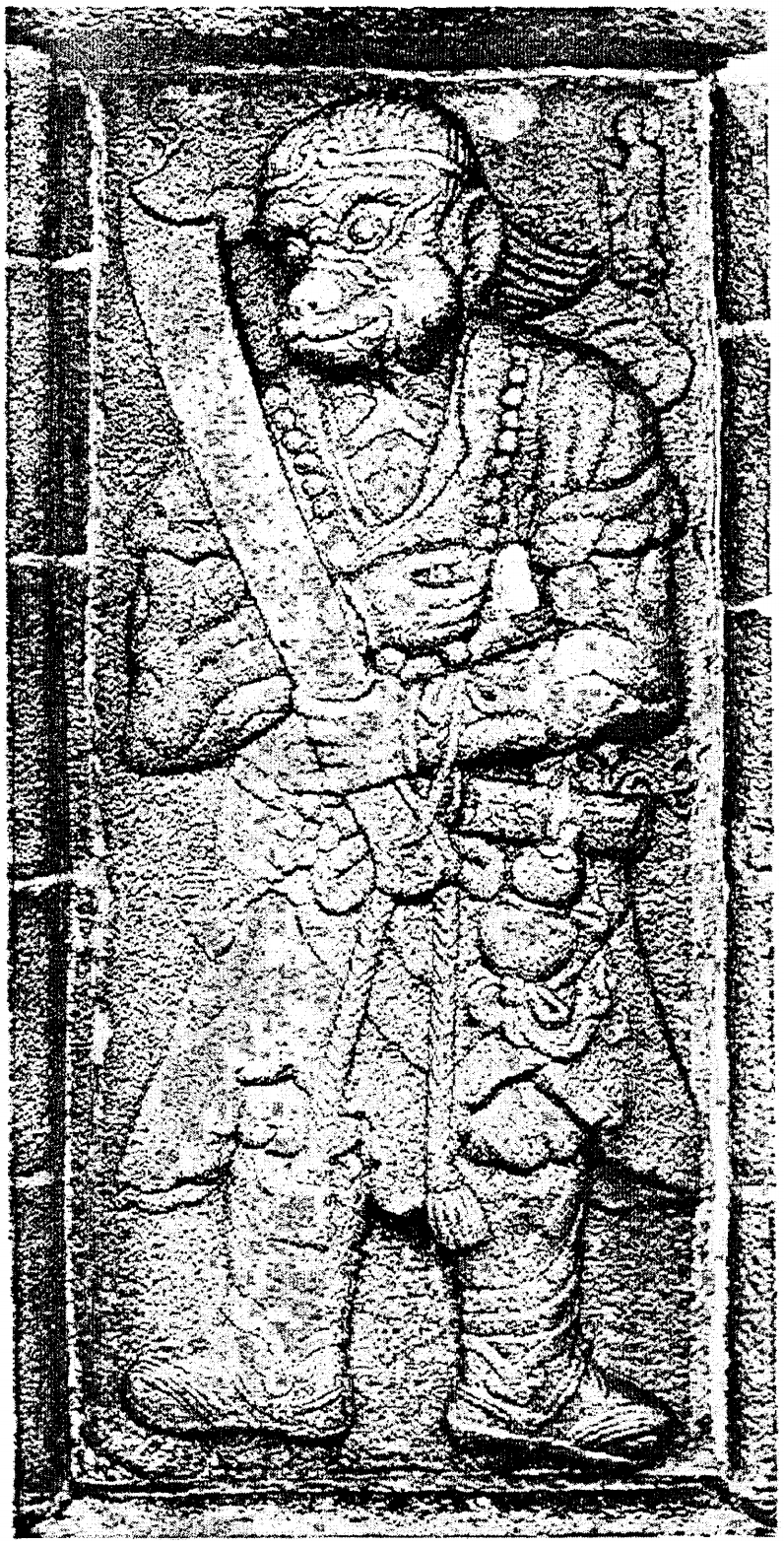
In her excellent paper on the origins of Sun Wukong, Hera S. Walker (1998) discusses a 13th century CE stone relief from the western pagoda of the Kaiyuan Temple (開元寺) in Quanzhou, Fujian province, China that portrays a sword-wielding, monkey-headed warrior (pp. 69-70). Considered by many to be an early depiction of Monkey, the figure wears a robe, a Buddhist rosary, and, most importantly, a type one fillet on the forehead (Fig. 4). [4] Walker quotes Victor Mair, who believes that the fillet “recalls the band around the head of representations of Andira, the simian guardian of Avalokitesvara” (the Indian counterpart to Guanyin) (Walker, 1998, p. 70). He goes on to list similarities between the stone relief and depictions of Andira, while also suggesting said depictions are based on south and southeast Asian representations of the Hindu monkey god Hanuman:

Identical earrings (these are key iconographic features of H[anuman] in many Southeast Asian R[ama saga]s), comparable tilt of the head… which seems to indicate enforced submission, long locks of hair… flaring out behind the head, elongated monkey’s mouth, similar decorations on the forearm and upper arm, etc. It is crucial to note that all these features can be found in South Asian and Southeast Asian representations of H[anuman] (Walker, 1998, p. 70).

So as it stands, the 13th century CE appears to be the furthest that the motif has been reliably traced.

Fig. 4 – The 13th century CE stone relief of Sun Wukong from the Kaiyuan Temple in Quanzhou, Fujian province, China (larger version).

3. My Findings

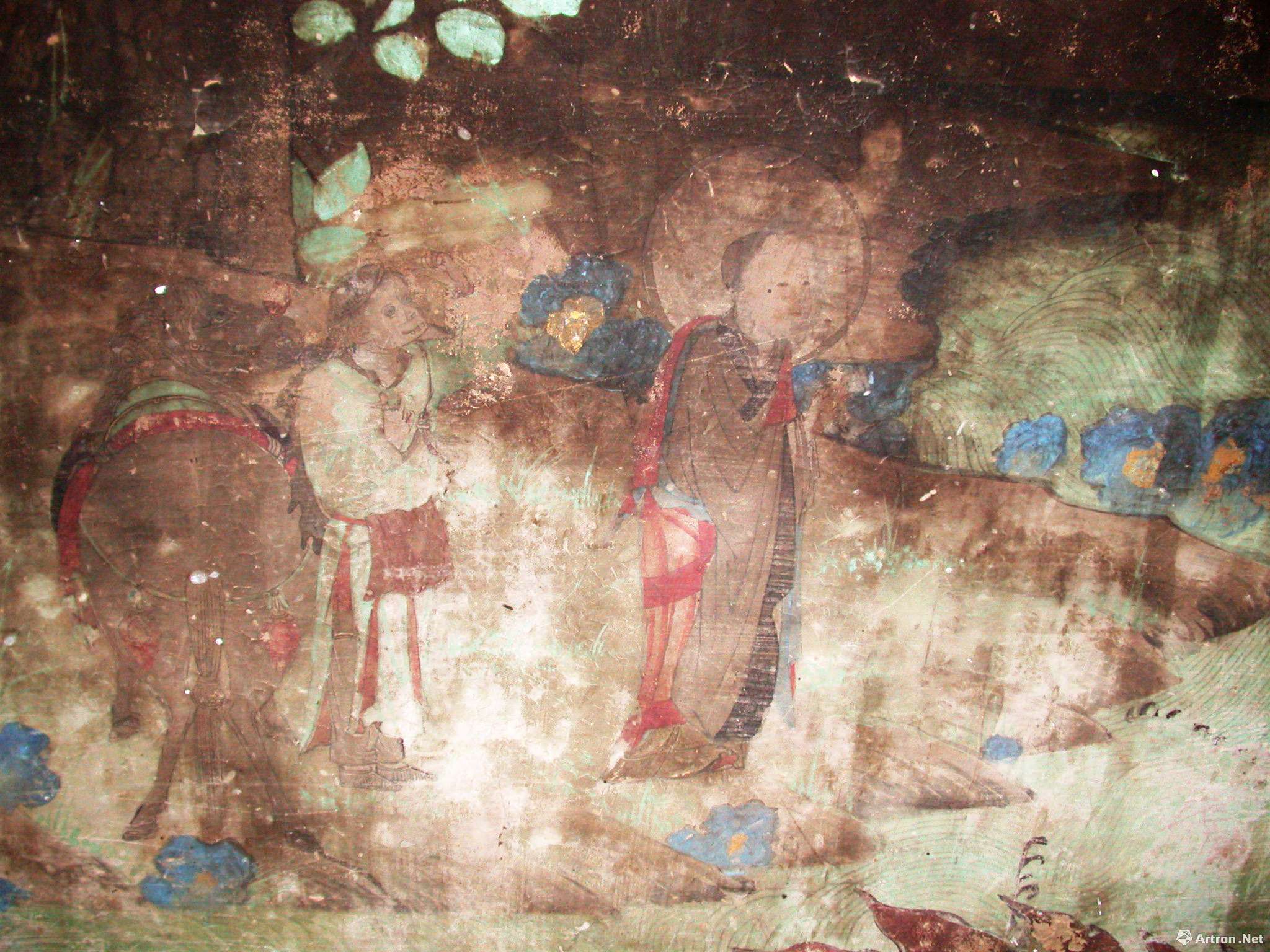
While Mair suggests a Southeast Asian Hindo-Buddhist influence, I know of at least one example from northeastern China that suggests an Indo-Tibetan Buddhist influence. The Eastern Thousand Buddha Cave no. 2 (Dong qianfo dong di 2 ku, 東千佛洞第2窟) in the Hexi Corridor of Gansu Province contains a late-Xixia dynasty (late-12th to early-13th century CE) mural of Xuanzang worshiping Guanyin from a riverbank. Monkey stands behind him tending to a brown horse. He is portrayed with a type three circlet on his head, waist length hair, and light blue-green robes with brown pants (fig. 5). This painting was completed during a time when China was seeing an influx of monks fleeing the inevitable fall of India’s Buddhist-led Pala Dynasty (750–1174 CE) from the 10th to the 12th century CE. They brought with them the highly influential Pala Buddhist art style and Vajrayana Buddhism, a form of esoteric Buddhism. The MET (2010) writes:

A mixture of Chinese-style and Vajrayana traditions and imagery was employed in the Tangut Xixia Kingdom …  which was based in Ningxia, Gansu, and parts of Shanxi … It is difficult to imagine that this “new” type of Buddhism, which not only was flourishing in Tibet in the late tenth century but was also found in the neighboring Xixia Kingdom and may have been practiced by Tibetans based in the Hexi Corridor region of Gansu Province, was completely unknown in central China until the advent of the Mongols (p. 19).

The painting of Monkey and Tripitaka was surely created by an Indian or Tibetan Buddhist monk, or at the very least a fellow Tangut or Chinese practitioner living in the area. This suggests that the imagery within the painting, such as the fillet, could have an Esoteric Buddhist pedigree, and textual evidence shows such headbands were indeed worn in some esoteric rituals.

For example, the Indian Buddhist Hevajra Tantra (Dabei kongzhi jingang dajiao wang yigui jing, 大悲空智金剛大教王儀軌經, 8th century CE) instructs adherents on how to adorn and dress themselves for worshipping Heruka, a Wrathful Destroyer of Obstacles:

The yogin must wear the sacred ear-rings, and the circlet on his head (emphasis added); on his wrists the bracelets, and the girdle round his waist, rings around his ankles, bangles round his arms; he wears the bone-necklace and for his dress a tiger-skin… (Linrothe, 1999, p. 250).

彼修觀者當如是行:謂頂想寶輪、耳帶、寶鐶,手串寶釧,腰垂寶帶,足繫寶鐸及妙臂釧,頸嚴寶鬘衣、虎皮衣 …

Furthermore, it describes how each of the ritual adornments and implements used in the ceremony represents each of the five esoteric Buddhas, as well as other religio-philosophical elements:

Aksobhya is symbolized by the circlet (emphasis added), Amitabha by the ear-rings, Ratnesa by the necklace, and Vairocana (by the rings) upon the wrists. Amogha is symbolized by the girdle. Wisdom by the khatvanga [staff] and Means by the drum, while the yogin represents the Wrathful One himself [i.e. Heruka]. Song symbolizes mantra, dance symbolizes meditation, and so singing and dancing the yogin always acts (Linrothe, 1999, p. 251).

「輪者,表阿閦如來;鐶者,無量壽如來;頸上鬘者,寶生如來;手寶釧者,大毘盧遮那如來;腰寶帶者,不空成就如來。於是色相而生念住:金剛渴椿誐杖者,表勝慧相;奎樓鼓者,即善方便故;瑜伽行者,瞋業清淨;住金剛歌詠者,真言清淨。

「又復,不應為求利養作是金剛歌舞事業。是故,瑜伽者當如是行…

As can be seen, the circlet represents Aksobhya (Sk: “Immovable”; Ch: Achu, 阿閦; Budong, 不動). This deity is known for his adamantine vow to attain buddhahood through the practice of Sila, or “morality,” the aim of which “is to restrain nonvirtuous deeds of body and speech, often in conjunction with the keeping of precepts” (Buswell & Lopez, 2014, pp. 27 and 821). So, the ritual band most likely served as a physical reminder of right speech and action, making it the best candidate for the origin of Monkey’s fillet. Sun is after all the representation of the “Monkey of the Mind” (as noted in the introduction), so his inclusion in the Eastern Thousand Buddha Cave painting was probably meant to convey the taming of this Buddhist concept via the circlet (apart from referencing the popular tale itself).

The Hevajra Tantra, the text in which the circlet appears, was first translated into Tibetan by Drogmi (993–1074 CE) and adopted during the 11th century CE as a central text by the respective founders of the Kagyu and Sakya sects, two of the six major schools of Tibetan Buddhism. Various members of the Sakya sect were invited by Mongol royalty to initiate them into the text’s esoteric teachings during the 13th century CE. These include Sakya Pandita and his nephew Chogyal Phagpa, who tutored Genghis Khan‘s grandson Prince Goden in 1244 and Kublai Khan in 1253, respectively. The meeting between Kublai and Chogyal resulted in Vajrayana Buddhism becoming the state religion of Mongolia. The Hevajra Tantra was translated into Chinese by the Indian monk Dharmapala (963–1058 CE) in 1055 during the Northern Song Dynasty (960–1127 CE). The text, however, did not become popular within the Chinese Buddhist community like it would with the Mongols in the 13th century CE (Bangdel & Huntington, 2003, p. 455). But this evidence shows how the concept of the 8th century CE ritual circlet could have traveled from India to East Asia to influence depictions of Sun Wukong in the 12th/13th century CE. And the relatively unknown status of the text in China might ultimately explain why there are so few ancient depictions of Chinese deities wearing the fillet, or why it does not appear in the 13th century CE version of JTTW.

While the late-Xixia mural (fig. 5) lacks many of the ritual adornments (apart from the fillet) mentioned in the Hevajra Tantra, the Quanzhou stone relief (refer back to fig. 3) includes the band, earrings, necklace, bangles, and possibly even a tiger skin apron, suggesting it too has an esoteric origin (most likely based on Chinese source material). The band’s connection to esoteric Buddhism is further strengthened by a 12th century CE painting from Japan. Titled Aka-Fudo (赤不動), or “Red Fudo [Myoo],” it depicts the wrathful esoteric god seated in a kingly fashion, holding a fiery, serpent-wrapped Vajra sword in one hand and a lasso in the other (fig. 6). He wears a golden, three-linked headband (similar to the curls of type one), which stands out against his deep red body and flaming aureola. Biswas (2010) notes: “… the headband on his forehead … indicate[s], according to some, a relation to the habit of groups of ascetics who were among the strong supporters of Acalanatha” (p. 112). His supporters were no doubt yogin practitioners in the same vein as those who worshipped Heraku and other such wrathful protector deities.

Fig. 5 – A portion of the late-Xixia (late-12th to early-13th century CE mural) in the Eastern Thousand Buddha Cave number two (larger version). Fig. 6 – The 12th century CE Japanese painting “Aka-Fudo” (赤不動) (larger version).

3.1. Symbol of Martial Deities and Warrior Monks

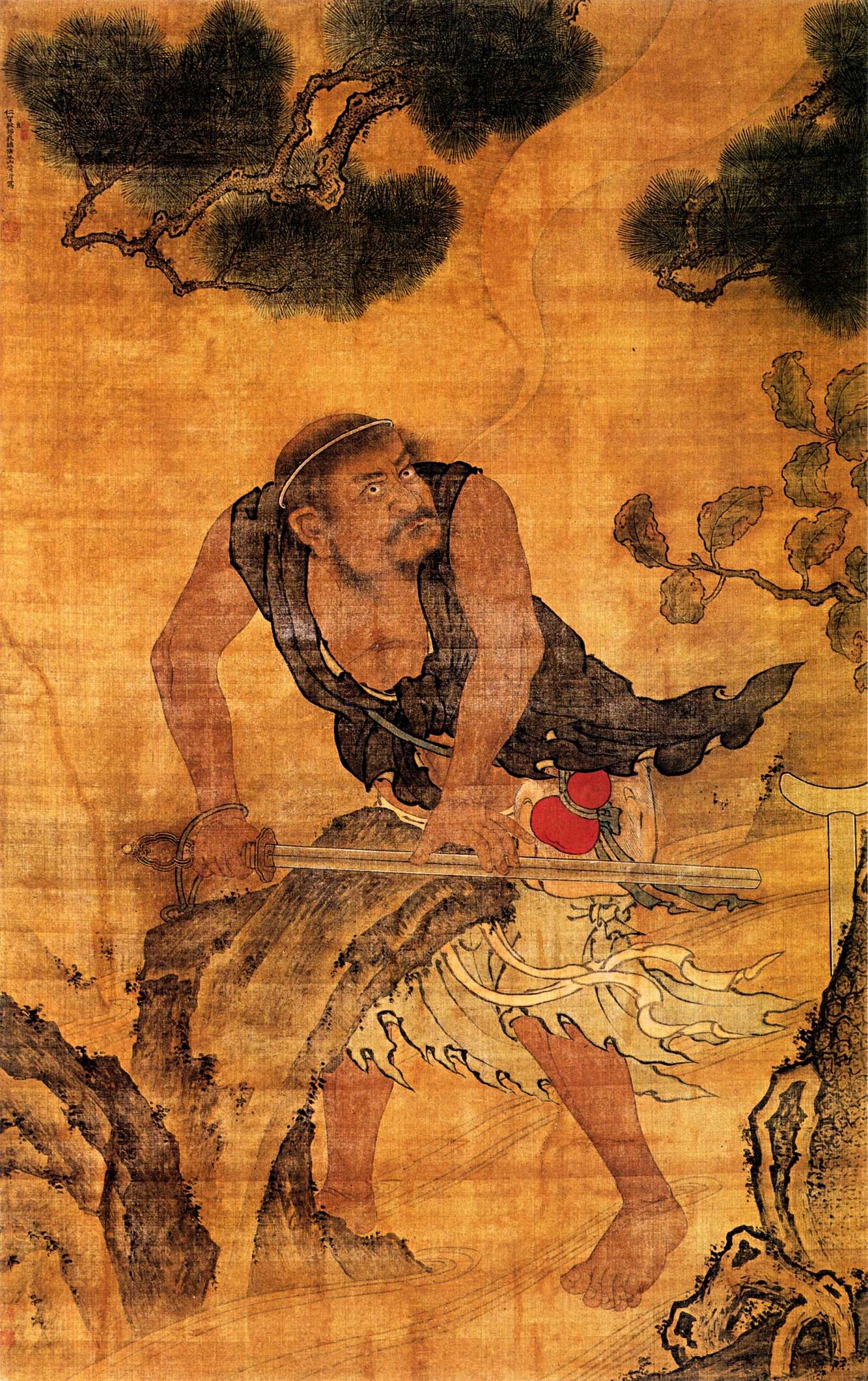
It’s important to note that Monkey was not the only cultural hero of the Ming Dynasty (1368–1644 CE) to wear a golden fillet. Another example is Li Tieguai (李鐵拐), or “Iron Crutch Li,” the oldest of the Eight Immortals. [5] Li is generally portrayed as a crippled beggar leaning on a cane. Legend has it that his original body was cremated prematurely by a disciple while the immortal traveled in spirit to answer a summons from Lord Laozi, the high god of Daoism. Li’s spirit returned a day later to find only ashes, thus forcing him to inhabit the body of a recently deceased cripple. According to Allen and Philips (2012), “Laozi gave him in recompense a golden headband and the crutch that was to become his symbol” (p. 108). Some depictions of Li wearing the fillet predate JTTW. The most striking example is Huang Ji’s Sharpening a Sword (early-15th century CE) (Fig. 7), which portrays the immortal wearing a type three band and sharpening a double-edged blade on a stone while staring menacingly at the viewer. [6] One theory suggests Li’s martial visage identifies him as a “spirit-guardian of the [Ming] state” (Little, 2000, p. 333). Both Monkey and Li are, therefore, portrayed as brutish, weapon-bearing, golden headband-wearing immortals who serve as protectors. This shows that the fillet was associated with certain warrior deities during the Ming.

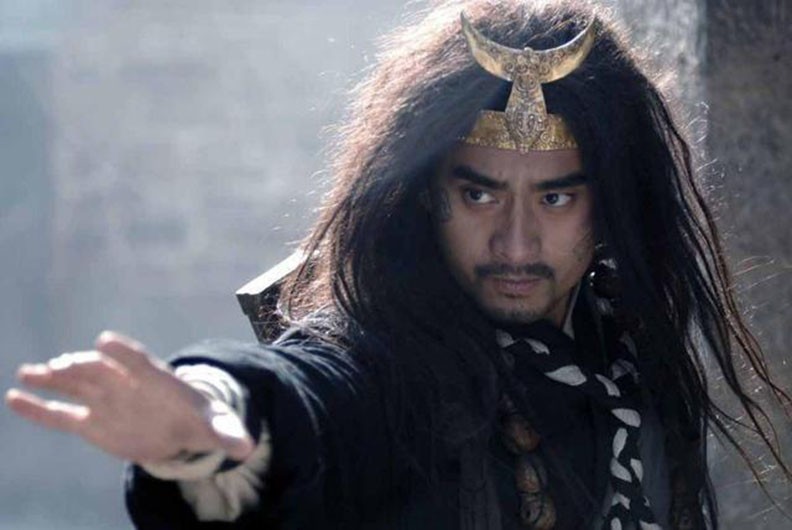
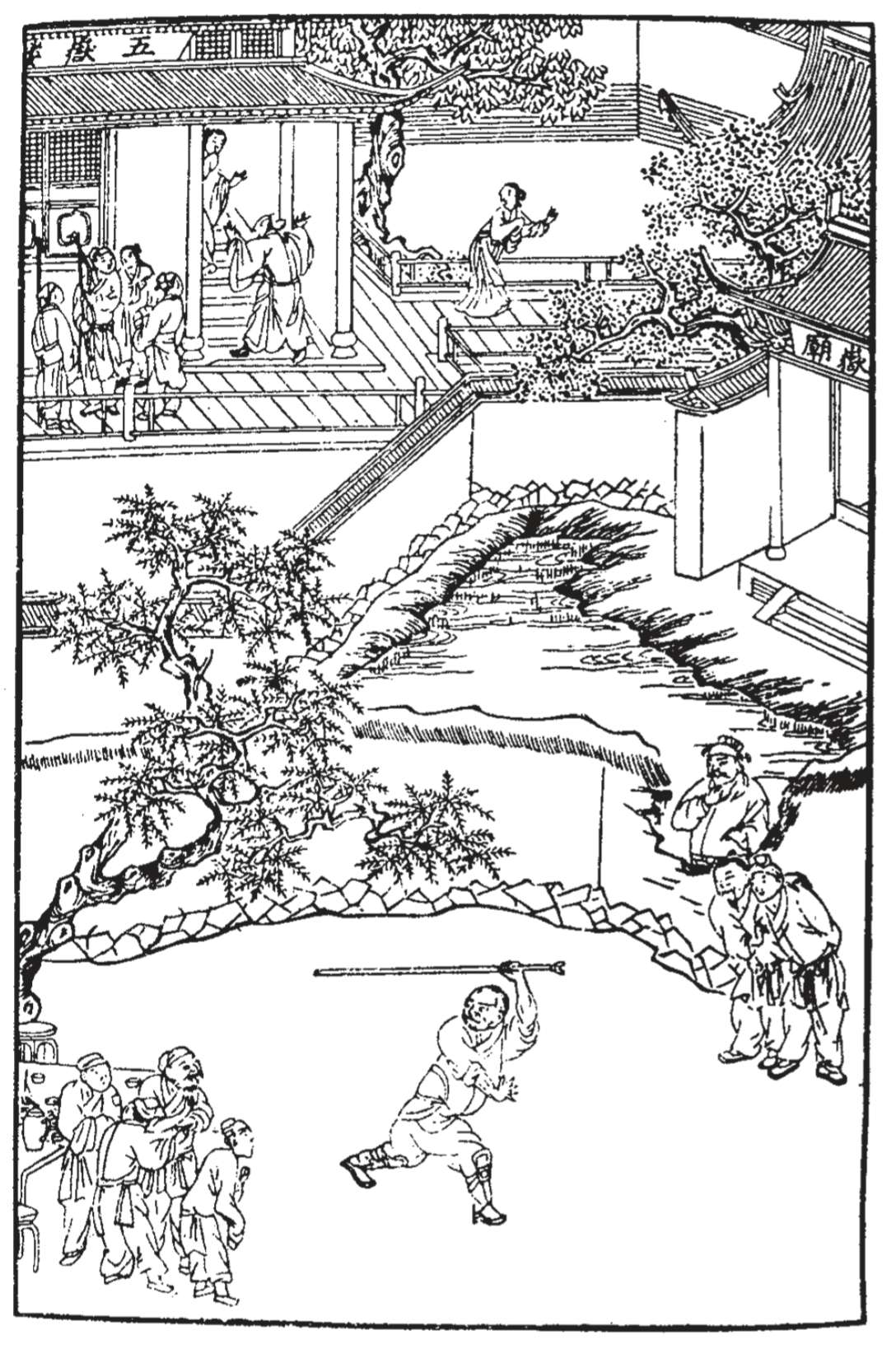
The fillet’s connection to religion and martial attributes culminated in the Jiegu (戒箍, “ring to forget desires”), a type two band worn by Military Monks (Wuseng, 武僧) in Chinese opera to show that they have taken a vow of abstinence (fig. 8). Such monks are depicted as wearing a Jiegu over long hair (Bonds, 2008, pp. 177-178 and 328), which contrasts with the bald heads of religious monks. [7] I would like to suggest that the band’s half-moon shape may have some connection to a Ming-era woodblock print motif in which martial monks are shown wielding staves tipped with a crescent (fig. 9) . The exact reason for the shape is still unknown (Shahar, 2008, pp. 97-98), but the association between the crescent and martial monks seems obvious. (See the 07-25-22 update below for the foreign origins of this motif.) The use of the fillet in Chinese opera led to it being worn by Sun Wukong in the highly popular 1986 live-action TV show adaptation of the novel (fig. 2). [8]

Fig. 7 (Left) – Huang Ji’s “Sharpening a Sword” (early-15th century CE) (larger version). Fig. 8 (Center) – An image of the military monk Wu Song wearing a jiegu (戒箍) fillet from a 2011 Water Margin TV show (larger version). Fig. 9 (Right) – A late-Ming woodblock of the warrior monk Lu Zhishen with a crescent staff (larger version). From Shahar (2008).

4. Conclusion

Examples of past research into the origins of the golden fillet respectively point to a slave collar from the Han dynasty (206 BCE–220 CE) and circa 13th century CE South and Southeast Asian depictions of the Buddhist guardian Andira and the Hindu monkey god Hanuman as possible precursors. However, the first isn’t credible, and the second, while on the right track, doesn’t go back far enough. A late-12th to early-13th century CE mural in the Eastern Thousand Buddha Cave complex depicts Sun Wukong wearing a type three fillet with possible ties to a ritual circlet worn by Esoteric Buddhist Yogin ascetics in 8th century CE India. The Hevajra Tantra, the esoteric text that mentions the band, associates it with the Aksobhya Buddha and thereby his moralistic, self-restraining practices. The text was transmitted from India to Tibet, China, and Mongolia from the 11th to the 13th centuries CE, showing a clear path for such imagery to appear in East Asia. A 12th century CE Japanese Buddhist painting of the guardian deity Fudo Myoo with a fillet suggests that the practice of wearing circlets in esoteric rituals continued for centuries. Other non-Buddhist deities became associated with the fillet during the Ming Dynasty. A 15th century CE painting of the immortal Li Tieguai, for example, depicts him as a type one circlet-wearing, sword-wielding guardian of the Ming dynasty. All of this suggests that the band became a symbol of Chinese protector deities. The association between the fillet and religion and martial attributes led to its use as the symbol of military monks in Chinese opera.


5. Updates

Update: 12-23-17

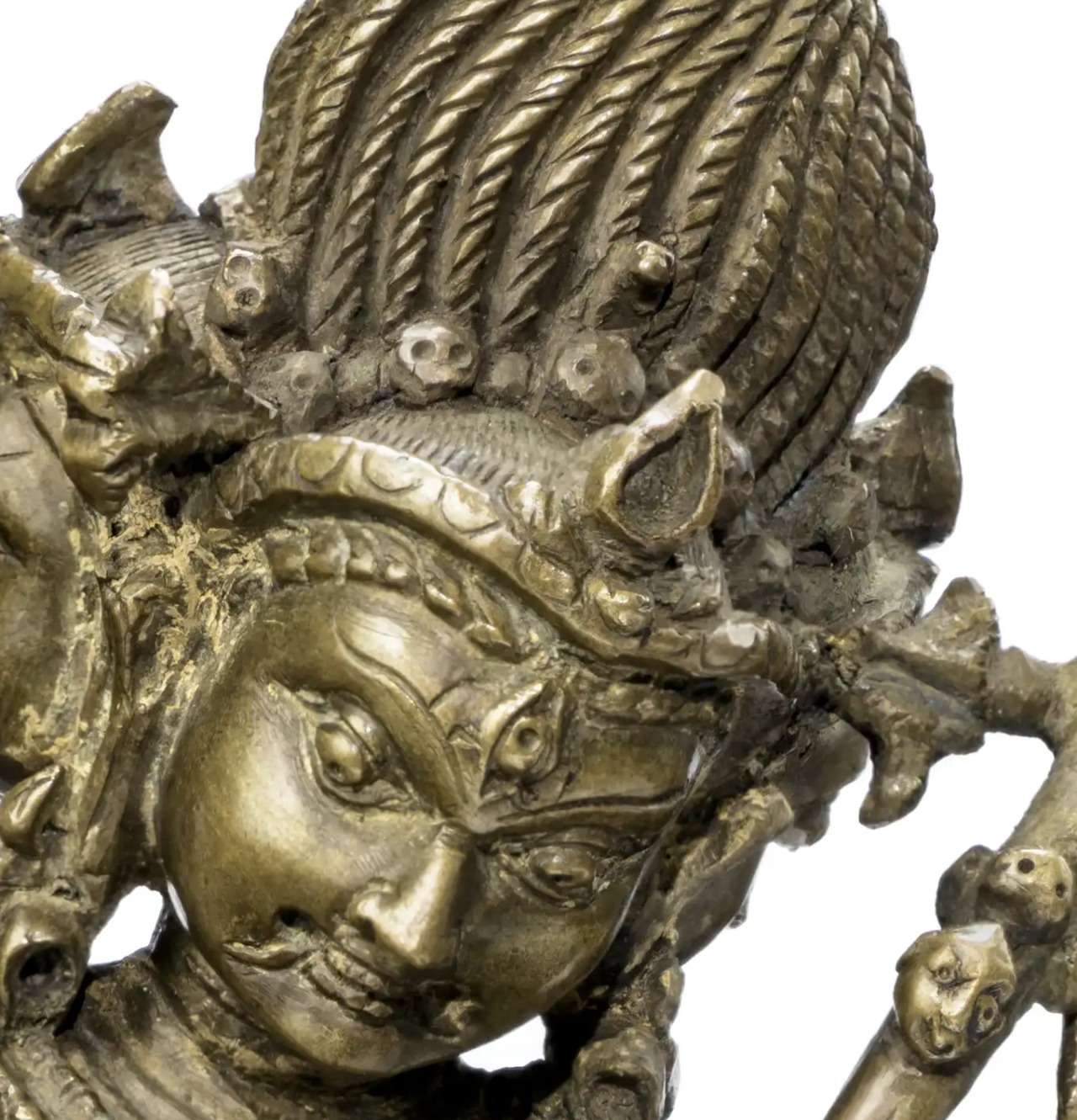
I’ve been wondering what the 8th century CE version of the circlet (along with the other ritual implements) mentioned in the Hevajra Tantra might have looked like. While I have yet to find a contemporary sculpture or painting, I have found an 11th to 12th century CE interpretation from Tibet. Titled The Buddhist Deity Hevajra (fig. 10), this copper alloy statue somewhat follows the prescribed iconography of the god as laid out in the aforementioned text:

Dark blue and like the sun in colour with reddened and extended eyes, his yellow hair twisted upwards, and adorned with the five symbolic adornments,/ the circlet, the ear-rings and necklace, the bracelets and belt. These five symbols are well known for the purificatory power of the Five Buddhas./ He has the form of a sixteen-year-old youth and is clad in a tiger-skin. His gaze is wrathful. In his left hand he holds a vajra-skull, and a khatvahga [staff] likewise in his left, while in his right is a vajra of [a] dark hue…(Linrothe, 1999, p. 256)

Fig. 10 – The Buddhist Deity Hevajra, late-11th to early-12th century CE, copper alloy (larger version). Courtesy of the Los Angeles County Museum of Art. Fig. 11 – Detail of the circlet (larger version).

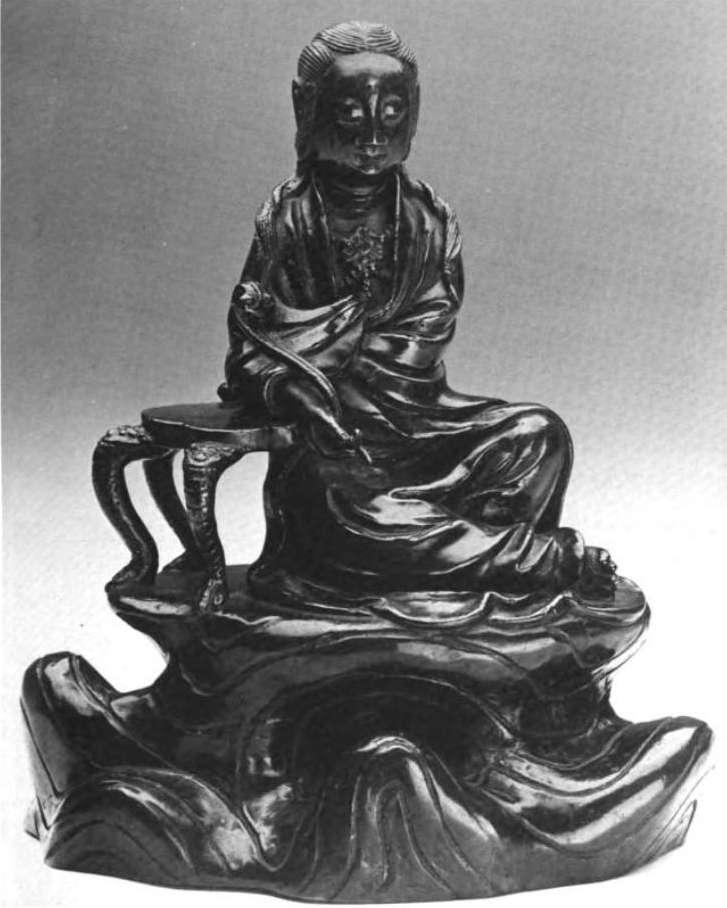
The circlet here is depicted as a fitted band with crescent trim and a teardrop-shaped adornment (a conch?) (fig. 11). The statue’s iconography more closely follows that from the Sadhanamala (“Garland of Methods”), a compilation of esoteric texts from the 5th to 11th centuries CE. The following information probably derives from the later part of this period:

He wields the vajra in the right hand and from his left shoulder hangs the Khatvanga [staff] with a flowing banner, like a sacred thread. He carries in his left hand the kapala [skull cap] full of blood. His necklace is beautified by a chain of half-a-hundred severed heads. His face is slightly distorted with bare fangs and blood-shot eyes. His brown hair rises upwards and forms into a crown which bears the effigy of Aksobhya. He wears a kundala [ear decoration] and is decked in ornaments of bones. His head is beautified by five skulls (Donaldson, 2001, p. 221).

Our statue has many of these features but lacks the image of the Buddha in his hair. This suggests the knob visible in the coif (fig. 10) once carried such a figure. So, once again we see the importance of the Aksobhya Buddha. The statue is similar to 10th and 11th century CE stone statues from India. [9]

While this doesn’t get us any closer to what the original circlet looked like, this statue adds to the mutability of the fillet imagery. The Hevajra Tantra is vague in its description, and so it is no surprise that so many variations have appeared over the centuries. The original sanskrit text uses the word cakri (circle) to refer to the band (Farrow & Menon, 2001, pp. 61-62). This might explain the simple type three fillet worn by Monkey in the Eastern Thousand Buddha Cave no. two painting (fig. 2).


Update: 08-16-20

I have written an article suggesting an origin for the type one headband, or as I now call it, the “curlicue headband.”

Sun Wukong’s Curlicue-Style Headband


Update: 12-12-21

One thing I figured out a while ago but never explained here was the reason why the Japanese Buddhist protector deity Aka-Fudo (赤不動) (fig. 6) is depicted with a headband. I believe this is a visual representation of the fillet’s association with the Aksobhya Buddha. This is because the fudo (Ch: budong, 不動) of Aka-Fudo and the Sanskrit meaning of Aksobhya respectively mean “immovable.” So, the image of Aka-Fudo is encapsulating both his position as a protector deity and the Buddha represented by the headband. 


Update: 01-23-22

I’ve written an article suggesting a mantra for the secret spell that causes the golden fillet to tighten.

The Tightening Spell of Sun Wukong’s Golden Headband


Update: 07-25-22

I’ve written an article that explains the origins of the “crescent-style” headband.

The Monkey King’s Crescent-Style Headband


Update: 06-26-23

Above, I mentioned that the novel contains three kinds of headbands:

  1. Sun Wukong/Six Ears – “Constrictive” (jin, 緊) – ch. 14
  2. Black Bear Demon – “Prohibitive” (jin, 禁) – ch. 17
  3. Red Boy – “Golden” (jin, 金) – ch. 42

It’s interesting that all of them are pronounced “jin” (with varying tones).

Now imagine that there is a secret fourth headband not intended to punish but to empower. Called the “Strength” (jin, 勁) headband, it would only be used in the most extreme emergencies.

It would be neat to see someone work this into their fanfiction.


Update: 12-24-23

A character is briefly punished to wear a golden headband in the famed Ming-era novel Investiture of the Gods (Fengshen yanyi封神演義, c. 1620; summary). Chapter 82 reads: 

Ma Sui [馬遂] attacked him with his sword, and after only one round, threw a gold hoop [jingu, 金箍] around the immortal’s head. The Yellow Dragon Immortal [Huanglong zhenren, 黃龍真人] writher in pain but was quickly rescued and brought back to the pavilion.

The Yellow Immortal Dragon Immortal tried to take the hoop off his head but found it was impossible. It was so tight the true samadhi fire went out of his eyes.

The Immortal of the South Pole [Nanji xianweng, 南極仙翁] came in to announce Heavenly Primogenitor’s [Yuanshi tianzun, 元始天尊] arrival. The religious leader entered the pavilion and said, “The Yellow Dragon Immortal was destined to be caught in this gold hoop. Come here and let me help you.”

He pointed at the gold hoop, and it dropped to the ground (Gu, 2000, pp. 1713-1715).

只一合,馬遂祭起金箍,把黃龍真人的頭箍住了。真人頭疼不可忍,眾仙急救真人,大家回蘆篷上來。真人急忙除金箍,除又除不掉,只箍得三昧真火從眼中冒出;大家鬧在一處。不表。且說元始天尊來會萬仙陣,先著南極仙翁持玉符先行。南極仙翁跨鶴而來,雲光縹緲。馬遂抬頭,見是南極仙翁,急駕雲光至半空中來,阻住去路。仙翁笑曰:「馬遂,你休要猖獗,掌教師尊來了。」馬遂正欲爭持,只見後面仙樂一派,遍地異香,馬遂知不可爭持,按落雲頭,回歸本陣。南極仙翁先至蘆篷,率眾仙迎鑾接駕,上篷坐下。眾門人拜畢,侍立兩傍。元始曰:「黃龍真人有金箍之厄。」忙叫:「過來。」黃龍真人走至面前;元始用手一指,金箍隨脫。

(Gu (2000) skips over some elements in the original Chinese.)

I’ve known about this episode for a while but forget to post about it.

Notes

1) For the entire episode, see Wu & Yu, 2012, vol. 1, pp. 314-320.

2) The child first speaks his new name in chapter 49 (Wu & Yu, 2012, vol. 2, p. 354). The original Sudhana originates from the Avatamsaka Sutra (Wu & Yu, 2012, vol. 2, pp. 386-387 n. 3).

3) For a complete English translation, see Wivell (1994).

4) This is just one of many relief carvings that grace the pagoda. It includes other guardian-type figures with esoteric elements but rendered in the Chinese style. See Ecke and Demiéville (1935).

5) The Eight Immortals are Daoist saints who came to be worshipped as a group starting sometime in the Jin Dynasty (1115–1234 CE) (Little, 2000, p. 319).

6) The sword is usually a symbol of the immortal Lu Dongbin, but as noted above, it is used to identify Li Tieguai as a Ming guardian (Little, 2000, p. 333).

7) Shahar (2008) discusses the historical differences between religious and military monks in ancient China.

8) Liu Xiao Ling Tong (六小龄童; born Zhang Jinlai, 章金萊, 1959), the actor who played Monkey in the 1986 TV show, comes from a family who has specialized in playing Sun Wukong in Chinese opera for generations (Ye, 2016).

9) See the Heruka chapter in Linrothe (1999). He includes our statue in his study, but other sources describe it as Tibetan instead of Indian (Bangdel & Huntington, 2003, p. 458).

Bibliography

Allan, T., & Phillips, C. (2012). Ancient China’s Myths and Beliefs. New York: Rosen Pub.

Bangdel, D., & Huntington, J. C. (2003). The Circle of Bliss: Buddhist Meditational Art. Chicago, Ill: Serindia Publications.

Biswas, S. (2010). Indian Influence on the Art of Japan. New Delhi: Northern Book Centre.

Bonds, A. B. (2008). Beijing Opera costumes: The Visual Communication of Character and Culture. Honolulu: University of Hawai’i Press.

Buswell, R. E., & Lopez, D. S. (2014). The Princeton Dictionary of Buddhism. Princeton, NJ: Princeton University Press.

Donaldson, T. E. (2001). Iconography of the Buddhist Sculpture of Orissa. New Delhi: Indira Gandhi National Centre for the Arts.

Ecke, G., & Demiéville, P. (1935). The Twin Pagodas of Zayton: A Study of the Later Buddhist Sculpture in China. Cambridge, Mass: Harvard University Press.

>Farrow, G. W., & Menon, I. (2001). The Concealed Essence of the Hevajra Tantra: With the Commentary Yogaratnamālā. Delhi: Motilal Banarsidass Publ.

Gu, Z. (2000). Creation of the Gods (Vols. 1-4). Beijing: New World Press.

Linrothe, R. N. (1999). Ruthless Compassion: Wrathful Deities in Early Indo-Tibetan Esoteric Buddhist Art. Boston, Mass: Shambhala.

Little, S. (2000). Taoism and the Arts of China. Chicago, IL: Art Institute of Chicago.

Liu, X. (1994). The Odyssey of the Buddhist Mind: The Allegory of the Later Journey to the West. Lanham, Md: University Press of America.

Metropolitan Museum of Art, Leidy, D. P., Strahan, D. K., & Becker, L. (2010). Wisdom Embodied: Chinese Buddhist and Daoist sculpture in the Metropolitan Museum of Art. New York: Metropolitan Museum of Art.

Shahar, M. (2008). The Shaolin Monastery: History, Religion, and the Chinese Martial Arts. University of Hawaii Press.

Walker, H.S. (1998). Indigenous or Foreign? A Look at the Origins of Monkey Hero Sun Wukong. Sino-Platonic Papers, 81, 1-117.

Wang, T. (2006). Dust in the Wind: Retracing Dharma Master Xuanzang’s Western Pilgrimage. Taipei: Rhythms Monthly.

Wivell, C.S. (1994). The Story of How the Monk Tripitaka of the Great Country of T’ang Brought Back the Sūtras. In V. H. Mair (Ed.), The Columbia Anthology of Traditional Chinese Literature (pp. 1181-1207). New York: Columbia University Press.

Wu, C., & Yu, A. C. (2012). The Journey to the West (Vols. 1-4) (Rev. ed.) Chicago, Ill: University of Chicago Press.

Ye, X. (2016). Liu Xiao Ling Tong and Sun Wukong. Retrieved December 15, 2017, from https://www.youlinmagazine.com/story/liu-xiao-ling-tong-and-sun-wukong/Njgw

The Origin of Sun Wukong’s Battle with Lord Erlang and Its Ties to Han Dynasty Funerary Rites and Folklore

Did you know the battle between Monkey and Lord Erlang is tied to Han Dynasty funerary rights and folklore? Wu (1987) notes that, during the Eastern Han Dynasty (25-220 CE), the people of Sichuan often buried their dead in stone tombs decorated with brave heroes, such as archers and crossbowmen, and fierce animals, such as tigers and hounds. Regarding the latter, the canines are sometimes depicted attacking or intimidating apes, which were considered emblems of disease or bad luck (fig. 1). Therefore, by portraying the subjugation of such evil forces, the carvings are thought to have served the ritual function of protecting deceased loved ones from dark influences on their wayward journey to the afterlife (pp. 100-101).

The idea of dogs overcoming apes should bring to mind Sun Wukong’s capture at the mouth of Lord Erlang’s loyal hound at the end of chapter six.

Fig. 1 – A Han Dynasty tomb rubbing of oversized dogs intimidating apes (larger version).

One recurring motif depicts an archer drawing his bow to fall an ape in a tree (fig. 2). This is based on a third-century BCE tale about the legendary Chu archer Yang Youji (養由基) shooting an elusive white ape held in the palace of the King of Jing. This in turn is based on an even older tale about the archer Yi (羿) bringing order to the primordial earth by killing nine of ten suns that took the form of monstrous crows. Han era tombs are known to portray Yi drawing a bow to shoot said birds flying around a tree, so it most likely influenced the motif of Yang shooting the ape in a tree (Wu, 1987, pp. 102-106). Despite his later connection with the three-pointed polearm, Erlang was also portrayed as an archer in early media.

Fig. 2 – A Han tomb decoration depicting an archer shooting at an ape (larger version).

Lord Erlang was originally worshiped during the Han as a hunting god and queller of mountain ghosts by the Qiang (羌) ethnic group of the western Sichuan region. His cult grew and absorbed other deities and heroes under his mantle. For instance, Wu (1987) writes:

The Er-lang cult became even more popular in Sichuan under the patronage of the Later Shu emperor, Meng Chang 孟昶 (r. 934-65), and in 965, when the Song dynasty conquered the kingdom, it adopted the cult, erecting temples for the god in the capital and throughout the country.

When the Er-lang cult became increasingly popular in Sichuan, the previous divine archers such as Yang Youji and Yi, (like many other legendary demon-quellers), were mologized into this new cult, and their defeat of an ape demon became an important part of the Er-lang legend. Er-lang’s traits in later stories and art works clearly disclose this transformation (pp. 107-108).

It should also be noted that Erlang was at some point associated with the historical engineer Li Bing (李冰, c. 3rd-cent. BCE) and the official Zhao Yu (趙昱, c. 6th/7th-cent CE), both of whom were worshipped for defeating flood demons (Wu, 1987, p. 107). I suggest this may have led to his cult being connected to that of Yu the Great (大禹), the flood-queller par excellence in Chinese folklore. This is important because Tang Dynasty legends state Yu battled a simian water demon and eventually imprisoned it under a mountain (see Andersen, 2001). Sound familiar? This may have been another avenue in which Erlang was associated with quelling ape demons.

One anonymous 13th-century album leaf ink painting portrays Erlang seated in a kingly fashion and watching as his spirit soldiers round up and execute ape demons (fig. 3). An anonymous 15th-century scroll reproduces the scene in color (fig. 4 & 5).

Fig. 3 – (Top L) – The 13th-century painting depicting Erlang and his soldiers rounding up and executing ape demons. A captive ape can be seen on the bottom left between the two soldiers (larger version). Fig. 4 (Top R) – A detail from the 15th-century painting showing the ape, his humanoid wives, and their gibbon-like children being rounded up (larger version). This section is located in the last four-fifths of the scroll. Fig. 5 (Bottom) – A detail showing Erlang near the front of the same scroll (larger version).

The image of the deity as a queller of ape monsters culminated in an anonymous Yuan-Ming Dynasty play called The God Er-lang Locks up the Great Sage-Equal to Heaven (二郎神鎖齊天大聖, Er-lang Shen suo Qitian Dasheng). Much like JTTW, the god is sent to capture a magical primate, in this case an ape, who has stolen immortal food and wine from heaven (Wu, 1987, pp. 108-109). This no doubt influenced Monkeys mischief in heaven and subsequent battle with the deity.

Sources:

Andersen, P. (2001). The Demon Chained Under Turtle Mountain: The History and Mythology of the Chinese River Spirit Wuzhiqi. Berlin: G-und-H-Verl.

Wu, H. (1987). The Earliest Pictorial Representations of Ape Tales: An Interdisciplinary Study of Early Chinese Narrative Art and Literature. T’oung Pao LXXIII, pp. 86-112.

Deciphering the Inscription on the Monkey King’s Staff

Last updated: 07-03-21

This is the third and final installment in my investigation of the history of the Monkey King’s staff from the great Chinese classic Journey to the West (Xiyouji西遊記, 1592). The previous two articles discussed historical staves and an imperial monument that may have influenced the weapon. The current piece will focus on the name of the staff, the “As-You-Wish Gold-Banded Cudgel” (Ruyi jingu bang, 如意金箍棒). This title comes from an inscription appearing on the pole. As the novel states: “There was a line of inlaid writing near the end which said that it was ‘The As-You-Wish Gold-Banded Cudgel. Weight: 13,500 Catties’” (17,560 lbs/7,960 kg) (Ruyi jingu bang zhong yiwan sanqian wubai jin, 如意金箍棒重一萬三千五百斤). [1] The significance of the gold bands (jinggu, 金箍) was discussed in the first article, so it will not be covered here. This leaves “As-you-wish” (ruyi, 如意) and “Weight: 13,500 catties” (zhong yiwan sanqian wubai jin, 重一萬三千五百斤). In this paper, I will trace the origin of each concept and tie them back to Chinese literature, history, and religion. As always, I hope that this will be of interest to layman and researchers.

Table of Contents

The Weight

Stating the weight of a weapon follows a tradition in Chinese Military Romance literature in which great heroes brandish heavy polearms and blades. For example, in Romance of the Three Kingdoms (Sanguo yanyi, 三國演義, 14th century), General Guan Yu (關羽) is said to have a glaive weighing 82 catties (107 lbs./48.5 kg). [2] This is referenced in a subsequent novel set hundreds of years later titled the Water Margin (Shuihu zhuan, 水滸傳, c. 1400). In the story, the bandit-turned-Buddhist monk Lu Zhishen (魯智深) asks a blacksmith to make him a cleric’s staff (chanzhang, 禪杖, lit: “Chan staff”) weighing 100 catties (130 lbs./59 kg). But when the latter refuses on the grounds that not even the legendary general would be able to lift it, Lu asks for a staff weighing just as much as Guan’s polearm (here stated as 81 catties) to prove his equal. After some minor bickering, the two finally settle on a more reasonable 62 catties (81 lbs./37 kg). [3]

The ability of these heroes to efficiently wield such weapons sets them apart from normal humans. Likewise, the extraordinary weight of Monkey’s staff sets him apart from his lowly human counterparts. He is, after all, a transcendent immortal capable of supernatural feats of strength. This then might explain the number appearing on the staff. Thirteen thousand five hundred is divisible by nine, which Chinese numerology considers to represent “infinity.” [4] (Note: I no longer agree with this. Please see the 07-03-21 update for my revised views on the origin of the staff’s weight.) So it’s possible the number (infinity multiplied) was meant to convey that the staff was heavy beyond comprehension, something that only a divine hero such as Monkey would be able to wield.

The “As-You-Wish”

Introduction of the Ruyi Scepter

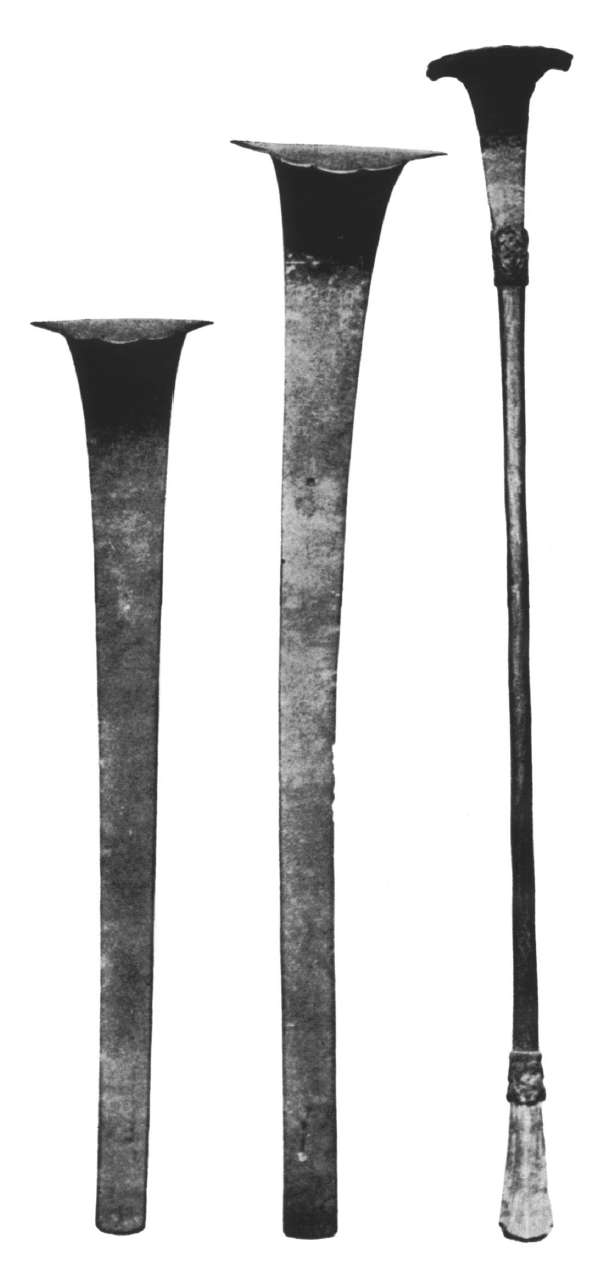
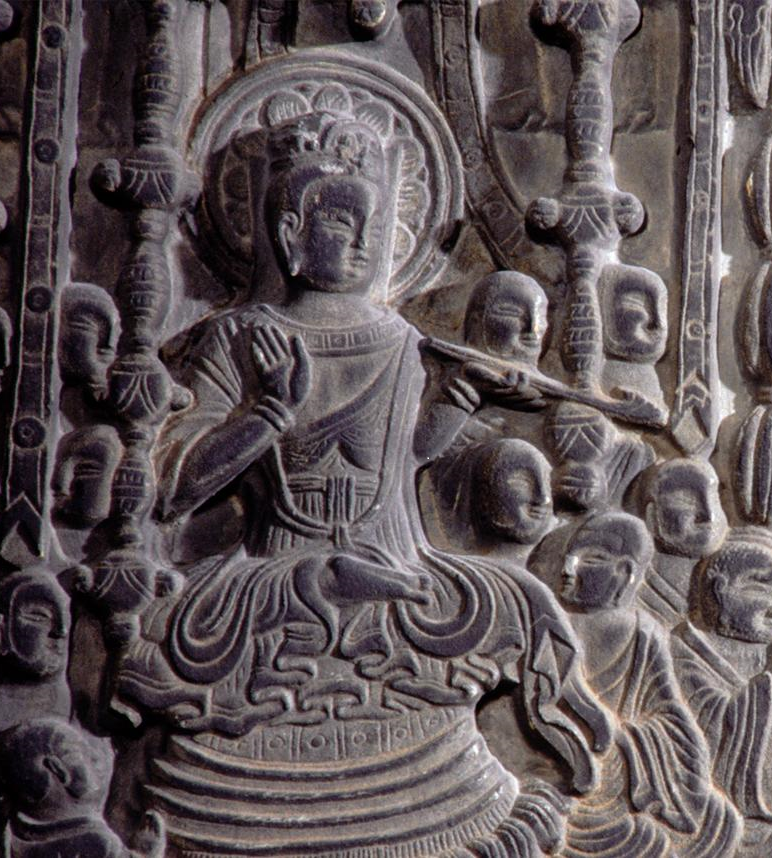
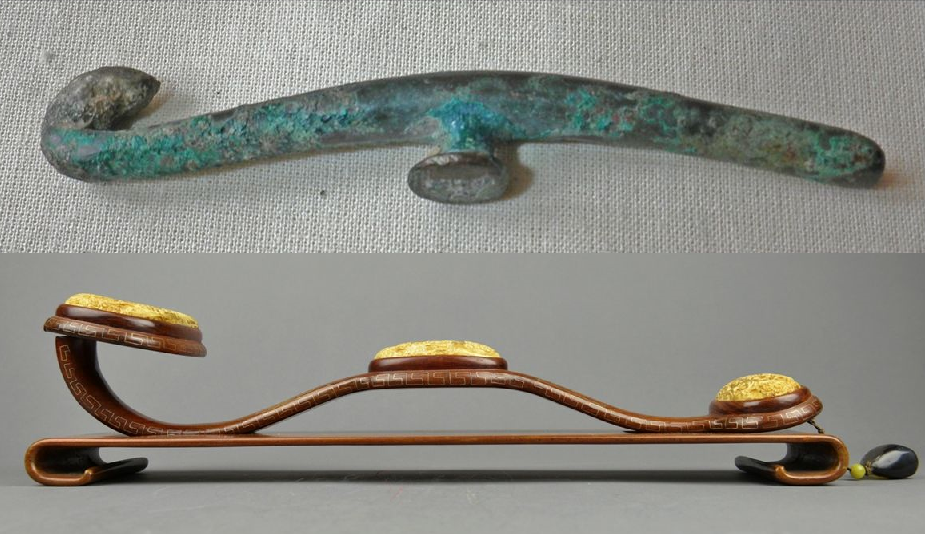
“As-you-wish” (ruyi, 如意), originates with a ritual scepter of that name shaped like an arching snake with a head in the form of a lingzhi mushroom (靈芝, a.k.a., “fungus of immortality”) (fig. 1). They are often seen carried by emperors and Buddho-Daoist deities in Chinese art. Prior to the 10th century, the scepter was closely associated with the Bodhisattva Manjusri (Wenshu, 文殊) and his famous debate with the householder Vimalakirti (Weimojie, 維摩詰). [5] Engravings of the event show him holding the object in the form of a tanbing (談柄), or “discussion stick,” an elongated, shoe horn-shaped wand historically used by religious and secular groups to designate the right to speak before an assembly (similar in function to the Native American “talking stick”) (fig. 2). [6] This implement was sometimes portrayed with vegetal features. For instance, a Chinese stele from the 6th century shows Manjusri debating while holding a sprig (fig. 3). [7] J. Leroy Davidson suggests that this type of scepter has its origin in an Indian Buddhist Jataka tale in which a group of royal sisters use branches to initiate debates with suitors and Buddhist priests. [8] The term ruyi comes from the “wish-fulfilling” Kalpavriksha tree of Hindu mythology. [9] This is suggested by a Chinese source from the 7th century which notes that during the celebration of Upavasatha, [10] lay hosts often gifted “ruyi shu” (如意樹), or “As-you-wish trees” (no doubt saplings or branches), to Indian Buddhist priests [11]. It’s possible that these gifts served as unofficial symbols of the priests’ authority and combined with the aforesaid tradition of debating with branches. This would explain why an instrument of debate would carry the ruyi title.

Fig. 1 – Ruyi scepter from the Qing Dynasty (1644–1911) (larger version). Image found here.

As a Symbol of Authority

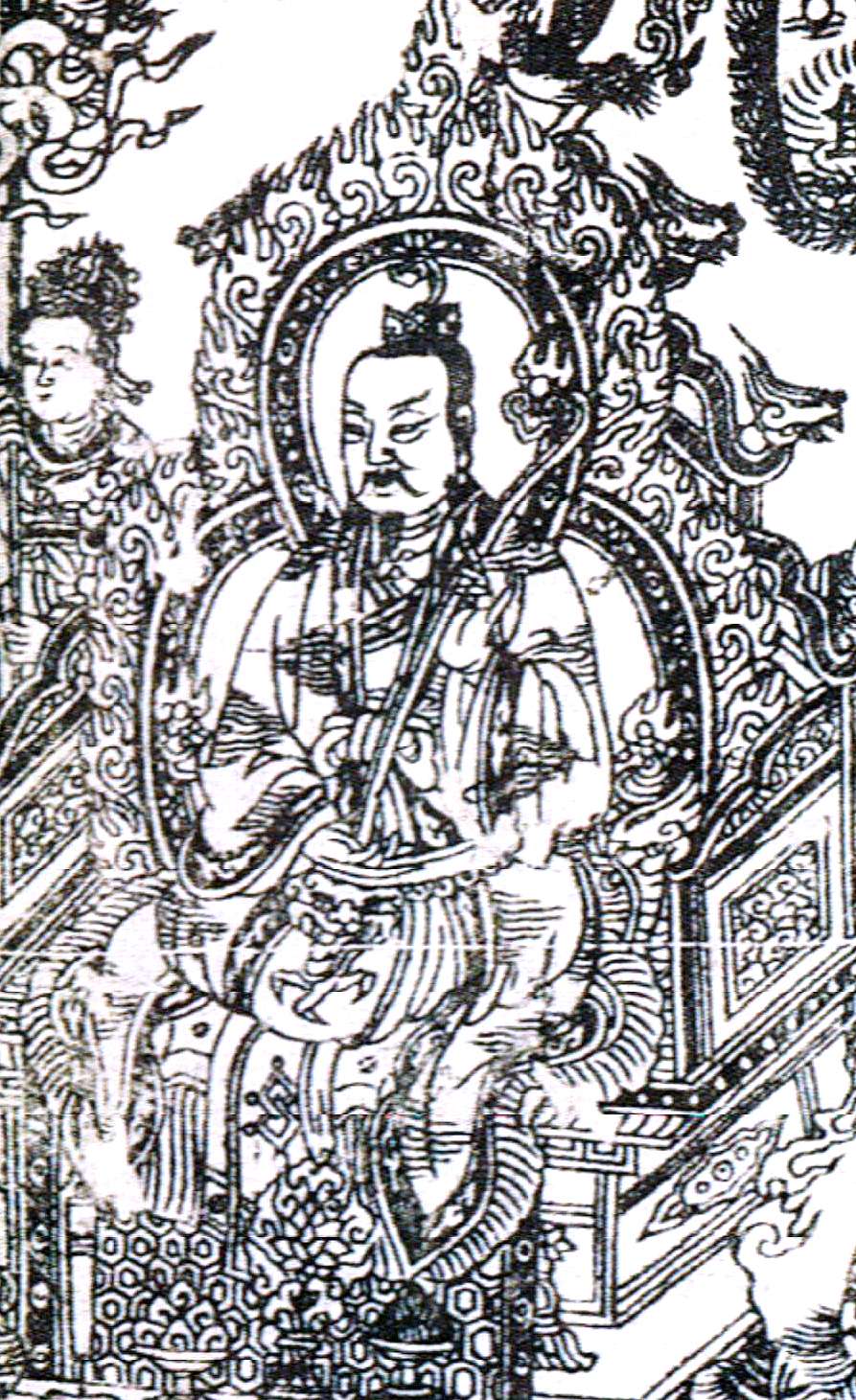
Upon entering China with Buddhism, this symbol of authority was adopted by the upper echelons of society. [12] Early records describe emperors, generals, and ministers wielding the object as a means to assert or signify their power. For instance, during the Jin Dynasty (265–420), the court official Shi Chong (石崇, 249–300) used a metal ruyi to smash a coral tree, an imperial gift belonging to a rival aristocrat. [13] Jin General Xie Wan (謝萬, 320–361) used the object to point at his captains and direct his orders to them. [14]. General Wei Rui (韋叡, 442–520) of the Liang Dynasty (502–557) took this one step further and directed his troops in battle with a bamboo scepter. [15] Legend states that Northern Wei Dynasty (386–535) Emperor Xiaowen (孝文, 467–499) placed a bone ruyi (among other items) before his sons; the boy who chose it became his heir because it signified the right to rule. [16] During a time of war, Emperor Wu of Liang (梁武帝, 464–549) gave one of his generals a ruyi because, as one scholar suggests, it was sure to bring him victory in battle. [17]

Fig. 2 – Examples of tanbing-style ruyi from 8th-century Japan (larger version). Due to slow culture transmission, these could be reminiscent of early Chinese scepters. Fig. 3 – Manjusri holding a sprig while debating Vimalakirti. Detail from a Chinese Buddhist stele dated 533–543 (larger version).

As a Weapon

Due to its historical association with military command, Literati ignorant of the scepter’s original function as an instrument of religious debate and authority came to consider the ruyi a type of weapon. For example, the Song Dynasty (960–1279) archaeologist Zhao Xigu (趙希鵠, c. 1195–post 1242) described the object as an iron club used for self-defense: “The men of old used the Ruyi for pointing or indicating the way, and also for guarding themselves against the unforeseen. It was made of wrought iron, and was over two feet in length…” [18] Zhao’s words were later echoed by the art collector Wen Zhenheng (文震亨, 1585–1645) during the Ming Dynasty (1368–1644). [19] The concept of an “As-you-wish” iron club used for self-defense no doubt influenced Monkey’s staff. This is especially true since Wen shows that the idea was current during the time that the Ming version of the novel was published.

The Possible Origin of Its Shape

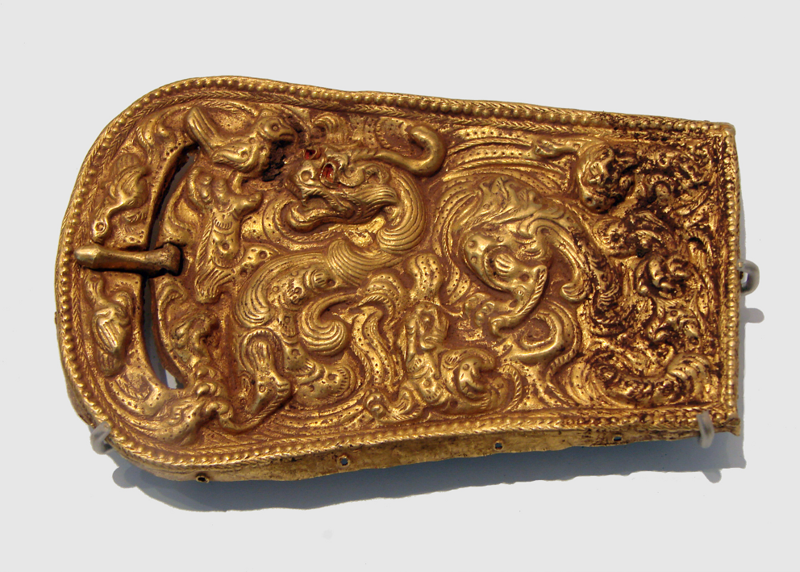
So how did the scepter come to have its signature serpentine curve and ornate head? J. Leroy Davidson believes that this is a simple case of misidentification. He cites material from the Song Dynasty concerning people digging up a “a bronze box in which was a white ruyi decorated with motives of a dragon and tiger.” [20] Davidson suggests that this archaeological artifact was actually a belt hook commonly worn during the Zhou and Han Dynasties (11th c. BCE to 3rd c. CE). Said hooks have an S-shaped curve and the accompanying buckles are often decorated with real and imagined creatures like those mentioned above (fig. 4 and 5). [21] It’s easy to see then how ancient belt buckles—perhaps the features weathered by time—could have been confused with a mushroom.

Fig. 4 – A profile comparison of a Han-era belt hook (top) and a ruyi (bottom) (larger version). Fig. 5 – A Han belt buckle featuring a dragon (larger version).

The Immortal Zhi Mushroom Aspect

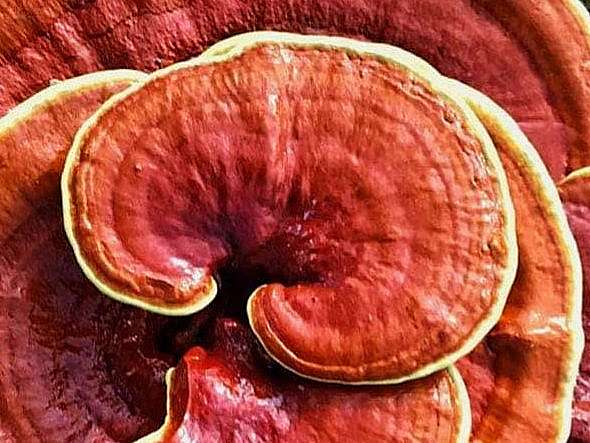
Just like the Vedic Soma and the Greek Ambrosia, the Chinese also had a magical, life-prolonging substance which they called Zhi (芝). [22] The Records of the Grand Historian (Shiji, 史記, c. 90 BCE) mentions that emperors Qin Shihuangdi (秦始皇帝, 260–210 BCE) and Han Wudi (漢武帝, 156–87 BCE) sent thousands of men over many years in search of magical islands housing this immortal herb. [23] It was during the time of the latter that the substance was equated with lingzhi (靈芝, Ganoderma), a genus of spade-shaped mushroom with a lacquered appearance (fig. 6). [24] This fungus became the subject of esoteric texts starting from the Han Dynasty, many of which are now lost. Drawing on these extinct texts, the Daoist adept Ge Hong (葛洪, 283–343) was the first to classify the lingzhi into five major types. [25] Methods For Planting the Zhi Plants (Zhong zhicao fa, 種芝草法), a late-Six Dynasties (220–589) text attributed to the Daoist god Laozi (老子), details how to seed this magical fungus by burying precious substances, such as gold or cinnabar, on a mountain side during solstices and equinoxes. [26] Originally written during the Song Dynasty, a Ming edition of Classification of Supreme Numinous Treasure Mushrooms (Taishang lingbao zhicao pin, 太上靈寶芝草品) lists one hundred twenty-six different kinds of immortality-bestowing fungi. It’s important to note that this text became part of the official Daoist Canon (Daozang, 道藏) during the mid-15th century. [27] This means that immortal mushrooms are a central tenet of Daoism.

Fig. 6 – A lingzhi mushroom (larger version).

The Religious Importance

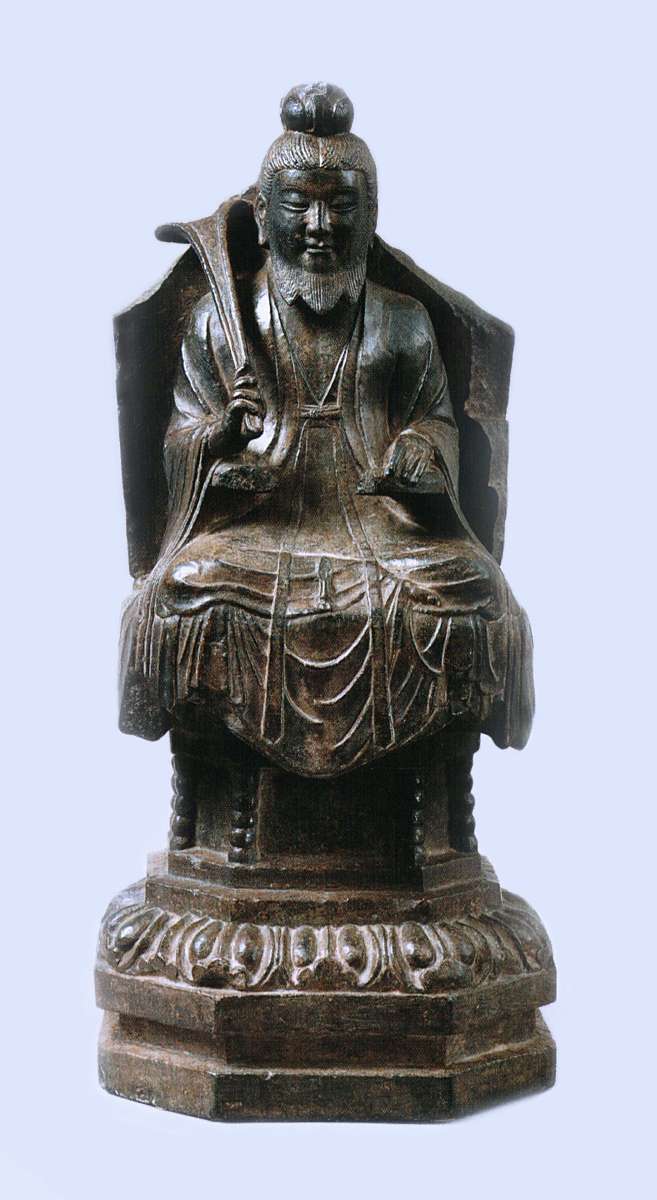
Daoism adopted the ruyi centuries prior to the Song Dynasty when the lingzhi mushroom was associated with the scepter. [28] It was one of the few ritual objects permitted Daoist monks living in medieval Chinese monasteries. [29] In fact, one early Tang Dynasty text states that it is among the items that “are essential for all Daoists, whether male or female, when they present offerings.” [30] Possibly taking a cue from Buddhist depictions of Manjusri, Daoists of the Tang began to depict some of their supreme deities with the scepter. For example, a late-7th or early-8th century statue of Laozi depicts him holding a straight tanbing-style ruyi (fig. 7). [31] After the lingzhi imagery was absorbed into the scepter, it became closely associated with the Celestial Worthy of Numinous Treasure (Lingbao Tianzun, 靈寶天尊), one of the Three Pure Ones (Sanqing, 三清), a trinity representing different aspects of the Dao (道). A 14th-century woodblock print depicts this deity holding a large mushroom ruyi—called by one scholar “his principle attribute”—while sitting on a heavenly throne surrounded by a sea of celestial beings (fig. 8). [32] The scepter was later associated with other Daoist deities during the Ming. [33] Therefore, the long association of the ruyi with Daoist immortals explains why Monkey would come to wield such an instrument with that name.

Fig. 7 – A late-7th  or early-8th century statue of Laozi holding a straight tanbing-style ruyi (larger version). Fig. 8 – A 14th-century woodblock print depicting the Celestial Worthy holding a linzhi ruyi (larger version). Fig. 9 – Detail of a Cintamani, or “wish-granting pearl” (larger version).

The Lowly Buddhist View 

Unlike their Daoist counterparts, Buddhists during the Tang looked upon the scepter as a somewhat base object. For example, although he listed it as a “lecture baton,” the monk Daoxuan (道璿, 702–760), an expert on monastic law, placed the ruyi in the same category as non-ritual items like satchels and spittoons. Furthermore, he described it as being one of the objects not among the “tools of the way.” [34] Sources from this time and the Song Dynasty equate the object with a simple backscratcher. [35] This shows that the ruyi lost any association that it may have had with wish-granting (as the term implies) upon entering China. So how did it regain its magic properties?

The Buddhist Cintamani

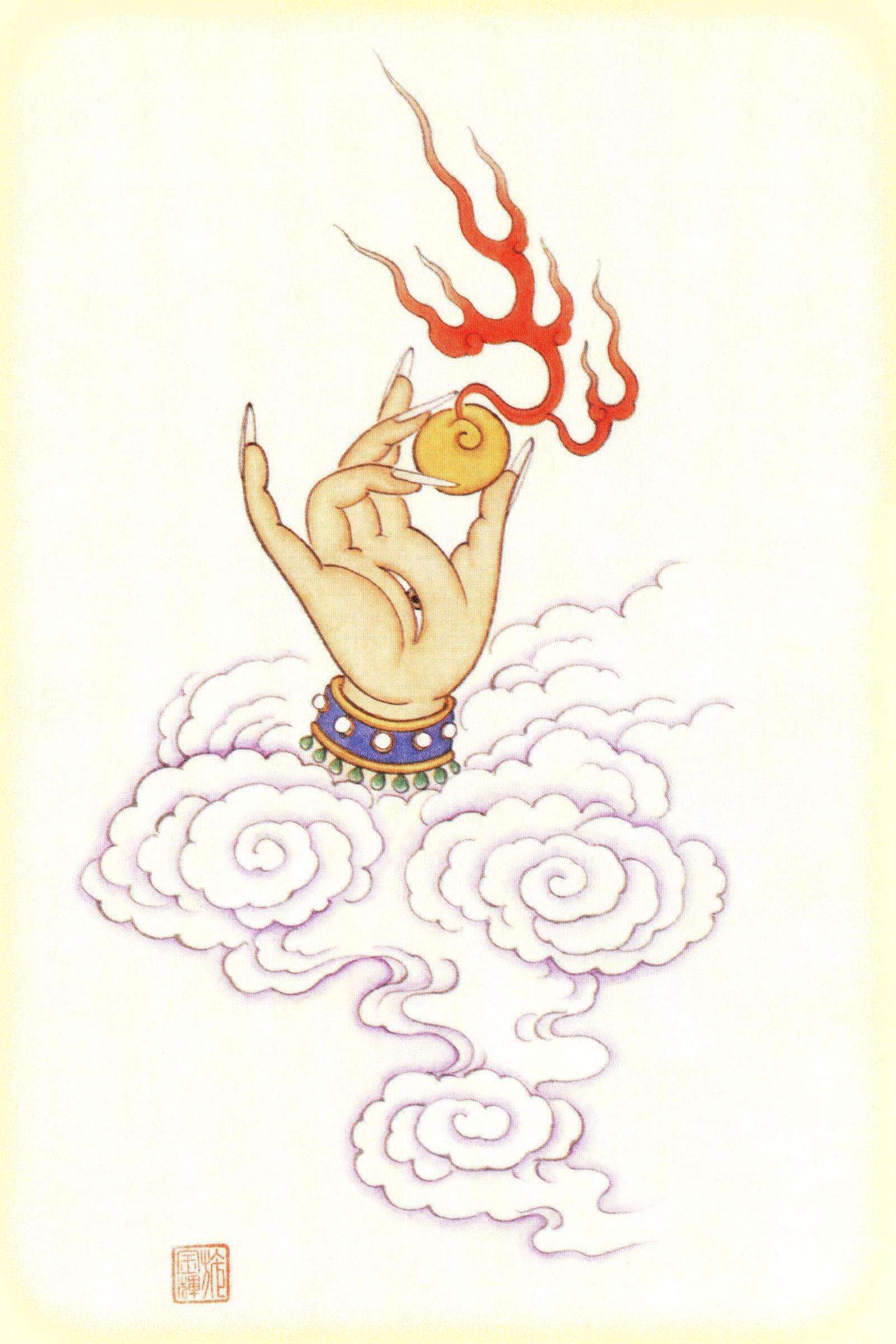
This probably happened because it was equated with the Buddhist Cintamani, or “wish-granting pearl” (fig. 9). [36] This is suggested by the Chinese translation of the Sanskrit term, Ruyi zhu (如意珠). [37] The association between the two was surely established by the Ming as Monkey’s staff has the magical ability to grow or shrink according to his wishes. [38] This is best exemplified by a poem appearing in Chapter seven of Journey to the West:

A spirit beam filling the supreme void—
That’s how the rod behaves accordingly.
It lengthens or shortens as one would wish;
Upright or prone, it grows or shrinks at will. [39]

The magic powers of the staff may be based on a weapon appearing in the earliest version of the novel, The Story of How Tripitaka of the Great Tang, Procures the Scriptures (Da Tang Sanzang qujing shihua, 大唐三藏取經詩話). In this later-13th century adaptation, our protagonist changes a ringed monk’s staff into a “gigantic yaksha whose head touched the sky and whose feet straddled the earth.” [40] This means that the Song and Ming Dynasty versions of the staff both have the ability to change their size and shape as Monkey wishes. I suggested in the second article that the initial description of the weapon in chapter one as a giant pillar of black iron is based on the famous Iron Pillar of Delhi, a religio-political Indian monument of the 4th century. A warrior wishing to wield such a pillar would naturally need to shrink it down. Therefore, the “wish-granting” ruyi concept was probably associated with the shape-changing abilities of the ringed monk’s staff and applied to monkey’s signature iron weapon.

Conclusion

The inscription on Monkey’s staff stands as a microcosm of Chinese literature, history, and religion. The weight harkens back to Yuan and Ming (13th c. to 17th c. CE) Military Romance literature in which great heroes are distinguished from normal humans by their ability to brandish extremely heavy weapons. Monkey’s ability to wield a staff weighing nearly nine tons elevates him above his human counterparts as a divine hero with herculean strength. The ruyi (如意) concept is much older and can be traced back to ancient India. The term is based on the Kalpavriksha, or “wish-granting” tree, of Hindu mythology. This element of Hindu culture was absorbed by Indian Buddhism and mixed with a separate tradition to become a symbol of religious debate and authority. Upon entering China during the Han Dynasty (206 BCE–220 CE), this branch was stylized into a tanbing (談柄), or “Discussion Stick,” which later became the emblem of the Bodhisattva Manjusri. It was simultaneously adopted by aristocrats and military commanders in subsequent dynasties as a sign of their secular power. The object attained its current S-shape and ornate head during the Song Dynasty (960–1279) when historical archaeologists happened upon ancient Chinese belt hooks and buckles from the Zhou and Han Dynasties (11th c. BCE–3rd c. CE) and confused them for such scepters.

There are three reason for the ruyi term being applied to Sun Wukong’s magic weapon. First, due to its historical association with military commanders, literati during the Song and Ming Dynasties came to look upon the object as an iron club used for self-defense. This would be perfect for protecting Monkey’s Buddhist master Xuanzang (玄奘) during their journey to India. Second, the head of the scepter was associated with the immortality-bestowing lingzhi mushroom (靈芝) during the Song Dynasty and became the emblem of the highest gods of Daoism, most notably the Celestial Worthy of Numinous Treasure (靈寶天尊). This makes the ruyi an excellent weapon for an immortal macaque possessed of Daoist magic. Third, the scepter was equated with the Buddhist Cintamani, or “wish-granting pearl”; this was associated with the magic, shape-changing abilities of a literary precursor of the weapon. Hence, the Ming version of Monkey’s pole gained the ability to magically shrink or grow according to his wishes. So, in the end, we see that both Monkey and his staff straddle the Buddhist and Daoist religions.


Updates

Update: 01/05/2015

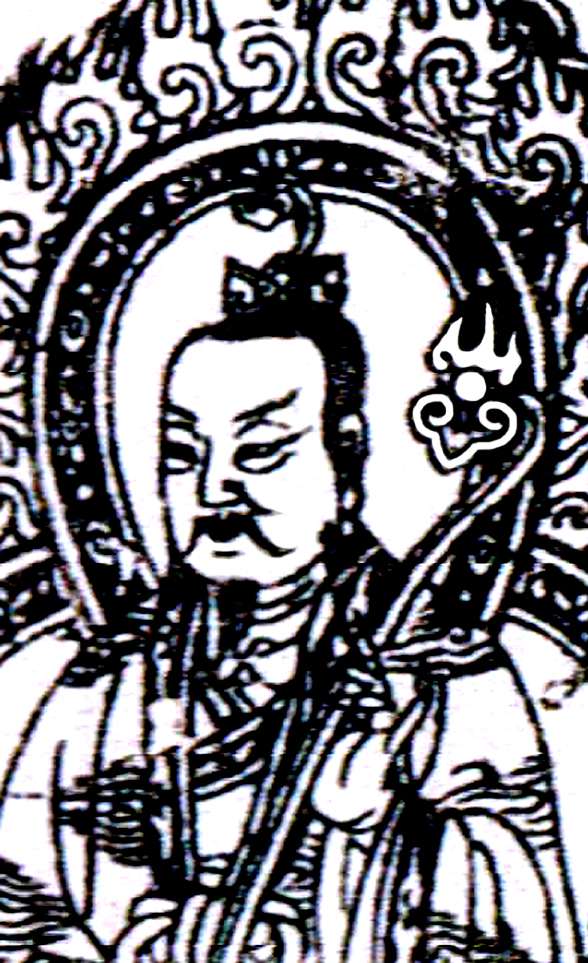
I suggested in the above entry that the ruyi may have been equated with the Buddhist cintamani, or “wish-granting pearl.” Well, I just noticed that the lingzhi-style scepter held by the Celestial Worthy from figure 8 appears to have a flaming pearl attached to it (fig. 9).

Fig. 9 – Enhanced version of the Celestial Worthy’s lingzhi ruyi scepter with a flaming pearl (larger version).

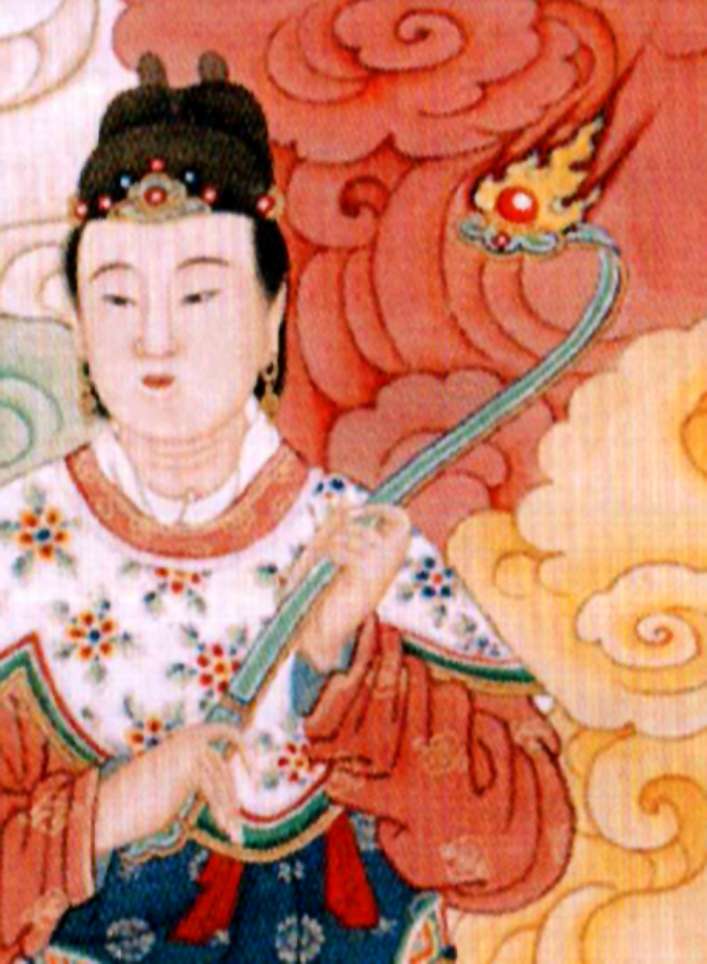
If it really is a Cintamani, this shows that the association between the two happened by at least the 14th century. This probably happened earlier considering that iconography takes time to become standardized. I’ve found at least one other Chinese painting featuring a flaming pearl ruyi. A Ming work titled The Lady of the Highest Primordial and the Empress of Earth (c. 1600) features an attendant of the second deity holding the object (fig. 10).

Fig. 10 – Detail of the attendant (larger version).


Update: 01-06-2015

A prime example of the relationship between the ruyi and the cintamani comes in the form of a 16th-century statue of the Bodhisattva Guanyin (觀音). The deity is usually associated with the flaming pearl, but this statue depicts her holding a scepter (fig. 11). H.A. van Oort comments: “In the mind of the artist, the scepter could well have replaced the cintamani, the “wish-fulfilling jewel”; in that case the statue is a very free interpretation of the Ju-i Kuan-yin [Ruyi Guanyin, 如意觀音], or Cintamani Avalokitesvara, the Kuan-yin with the wish-fulfilling pearl.” [41]

Fig. 11 – Guanyin holding a ruyi scepter (larger version).


Update: 08-16-2020

I’ve written an article suggest the ruyi/lingzhi mushroom influenced the shape of Wukong’s curlicue-style headband.

Sun Wukong’s Curlicue-Style Headband


Update: 02-06-2021

I have written an article that discusses the magic powers of the staff. These include the ability to shrink and grow, control the ocean, astral project and entangle with Monkey’s spirit, multiply endlessly, pick locks, and transform into various objects. It also has sentience to a certain degree.

The Magic Powers of the Monkey King’s Iron Staff


Update: 07-03-21

I now believe the weight of Monkey’s staff is an embellishment of a heavy stone block lifted by the bandit Wu Song in the Water Margin (c. 1400).

The Weight of the Monkey King’s Staff: A Literary Origin

Notes:

[1] Wu Cheng’en and W.J.F. Jenner, Journey to the West (Vol. 1). [S.l.]: Foreign Languages Press, 2001), 56. Text altered slightly. (The text originally says, “As-You-Will,” but I have changed it to align with a source heavily sited in this paper.) Compare it with Anthony C. Yu’s translation: “The Compliant Golden-Hooped Rod” (Wu Cheng’en and Anthony C. Yu, The Journey to the West (Vol. 1) (Chicago, Ill: University of Chicago Press, 2012), 135). I prefer the former. Both translations use the word “pounds”; however, the Chinese version of the novel uses jin (斤), known in English as “catty.” Catty and pound are two different measures of weight, the former being heavier than the latter. Therefore, the text has been altered to show this. The catty during the Ming Dynasty when the novel was compiled equaled 590 grams (Mark Elvin, The Retreat of the Elephants: An Environmental History of China (New Haven (Conn.): Yale University P, 2004), 491 n. 133). This means 13,500 catties would equal roughly 17,560 lbs.

[2] Luo Guanzhong and Moss Roberts, Three Kingdoms: A Historical Novel (Berkeley: University of California Press, 1991), 27.

[3] Shi Naian, Guanzhong Luo, and Sidney Shapiro, Outlaws of the Marsh (Beijing: Foreign Languages Press, 1988), 94-95.

[4] Patricia Bjaaland Welch, Chinese Art: A Guide to Motifs and Visual Imagery (North Clarendon, VT: Tuttle Pub, 2008), 230.

[5] The Vimalakirti Sutra (c. 100) tells of how the Buddha chose Manjusri to call upon the malingering householder whom no other disciple wanted to visit due to his supernatural intellect. He and Vimalakirti debate Buddhist doctrine before a crowd of celestial onlookers until they realize that they are both equally versed in the dharma (Burton Watson, The Vimalakirti Sutra (New York: Columbia University Press, 1997)). For Manjusri’s association with the Ruyi scepter, see J. Leroy Davidson, “The Origin and Early Use of the Ju-i,” Artibus Asiae 13, no. 4 (1950): 240. The aforementioned sutra was not translated into Chinese until the 5th century, so this means the ruyi became associated with the deity rather quickly.

[6] Davidson, 241-242. Medieval Chinese dictionaries refer to the ruyi as a type of backscratcher, the idea being that it can reach the areas that “one wishes” (Ibid, 239; John Kieschnick, The Impact of Buddhism on Chinese Material Culture (Princeton: Princeton University Press, 2002), 142).

[7] Ibid, 245. See plate IV for examples of 8th-century ruyi scepters from Japan shaped like Bamboo stalks.

[8] Ibid, 246. Davidson cites a hard to find book that is long out of print. I located an archived scan of the publication online. See “A Manual of Buddhism, in Its Modern Development (1853).” Internet Archive. Accessed December 17, 2014. https://archive.org/details/manualofbudhism00hard. The story appears on page 255.

[9] Davidson, 246. Various Puranas state that such trees arose during the churning of the ocean of milk. The gods allowed humans to wish for whatever their hearts desired until they started asking for evil things. The trees were then transported to heaven beyond the reach of man (Roshen Dalal, Hinduism: An Alphabetical Guide (New Delhi: Penguin Books, 2010), 189).

[10] A day of religious observance in which the Buddhist lay community renews their commitment to the Eightfold Path. Buddhist priests are invited into homes to help with this process (Yijing, F. Max Müller, and Junjirō Takakusu, A Record of the Buddhist Religion As Practised in India and the Malay Archipelago (A.D. 671-695) (Oxford: Clarendon Press, 1896), 35 n. 1).

[11] Davidson, 246-247.

[12] John Kieschnick believes that the ruyi is a strictly Chinese invention (Kieschnick, 138-152). I, however, find Davidson’s arguments for an Indian origin more compelling.

[13] Joseph Edkins. “The Ju-i, or, Sceptre of Good fortune.” The East of Asia Magazine III (1904), 238. For a complete translation of the story, see John Minford and Joseph S. M. Lau, Classical Chinese Literature: From Antiquity to the Tang Dynasty (New York: Columbia University Press, 2000), 671-672.

[14] Edkins, 238.

[15] Ibid, 239.

[16] Ibid. See also Kieschnick, 144. Kieschnick refers to him by his temple name Gaozu. I have used his reign name to avoid confusion with other similarly named emperors from subsequent dynasties.

[17] Edkins, 239.

[18] Berthold Laufer, Jade: A Study in Chinese Archaeology and Religion (Chicago: Field Museum of Natural History, 1912), 336 n. 1. Text altered slightly. Laufer describes the ruyi as a blunt sword, but the available information makes the object sound more like a club.

[19] He writes: “The ruyi was used in ancient times to give directions or to protect oneself from the unexpected. It was for this reason that it was made of iron, and not on the basis of strictly aesthetic considerations…” (Kieschnick, 151).

[20] Davidson, 249. Text altered slightly.

[21] Ibid.

[22] R. Gordon Wasson and Joseph Needham both suggested that Zhi was actually based on Indian stories of Soma (Paul U. Unschuld, Medicine in China: A History of Ideas (Berkeley: University of California Press, 1985), 112.

[23] Sima Qian and Burton Watson, Records of the Grand Historian (Vol. 2) (Hong Kong: Columbia University Press, 1993), 14-15 and 45-46. Despite its association with mushrooms, some texts refer to it as a type of grass or herb (Wolfram Eberhard, A Dictionary of Chinese Symbols: Hidden Symbols in Chinese Life and Thought (London: Routledge & Kegan Paul, 1986), 173-174.

[24] Xiao Tong, Wen Xuan or Selections of Refined Literature (Vol. 3) (Princeton, N.J.: Princeton Univ. Press, 1996), 201.

[25] These are stone zhi (石芝), wood zhi (木芝), plant zhi (草芝), flesh zhi (肉芝), and mushroom zhi (菌芝) (Fabrizio Pregadio, The Encyclopedia of Taoism (Vol. 2) (London: Routledge, 2008), 1273).

[26] Ibid.

[27] Stephen Little and Shawn Eichman, Taoism and the Arts of China (Chicago: Art Institute of Chicago, 2000), 340.

[28] The association with the lingzhi, however, may have been as early as the Tang Dynasty (618–907). Yan Liben’s (閻立本, 600–673) “The Thirteen Emperors” painting features a monarch holding a straight tanbing-style ruyi with the head in the shape of a lingzhi. Although, the scalloped perimeter could denote a cloud. See “The Thirteen Emperors.” Digital Scrolling Paintings Project. Accessed December 23, 2014. http://scrolls.uchicago.edu/scroll/thirteen-emperors.

[29] Livia Kohn, The Daoist Monastic Manual: A Translation of the Fengdao Kejie (New York: Oxford University Press, 2004), 122.

[30] Ibid, 119.

[31] See image #39 in Little and Eichman, 183. Little suggests that this could instead be a depiction of the Celestial Worthy of Numinous Treasure (靈寶天尊) (Ibid, 187 cat. nos. 39-42 n. 9). On the contrary, Silvio A. Bedini mentions an incense burner of Laozi carrying a ruyi on his famous journey to the Western Paradise (Silvio A. Bedini, The Trail of Time: Time Measurement with Incense in East Asia (Cambridge: Cambridge Univ. Press, 1994), 113). This suggests that Laozi was indeed associated with the scepter.

[32] This illustrates a scene from an important Song Dynasty text in which the Celestial Worthy is said to reveal heavenly secrets to mankind (Little and Eichman, 237-238).

[33] See, for example, Cao Guojiu (曹國舅) (Welch, 259).

[34] Kieschnick, 148-149.

[35] Ibid, 1414-142 and 149-150.

[36] Erik Zürcher has suggested that the only way the lowly back scratcher could have become a symbol of lofty knowledge was via an association with the wish-granting pearl (Erik Zürcher, The Buddhist Conquest of China: The Spread and Adaptation of Buddhism in Early Medieval China (Leiden: Brill, 1997), 407 n. 59). It seems only natural that an affiliation between the scepter and the pearl would have sparked the idea that the former had magical properties.

[37] I’m not sure when the term was first translated into Chinese, but it appears in the Scripture on the Ten Wheels, a 6th-century sutra centered around the Bodhisattva Dizang (地藏, a.k.a., Ksitigarbha) (Ng Zhiru, The Making of a Savior Bodhisattva Dizang in Medieval China (Honolulu: University of Hawai’i Press, 2007), 29-30). This shows the association between the ruyi and the wish-granting pearl could be quite old. For more information on the Cintamani, see Alice Getty, The Gods of Northern Buddhism: Their History and Iconography (New York: Dover Publications, 1988), 186-187.

[38] Wu and Yu, 135.

[39] Ibid, 190.

[40] Victor H. Mair, The Columbia Anthology of Traditional Chinese Literature (New York: Columbia University Press, 1994), 1189. For the complete story, see pages 1181-1207.

[41] H. A. van Oort, The Iconography of Chinese Buddhism in Traditional China (Leiden: E.J. Brill, 1986), 22.

Bibliography:

“A Manual of Buddhism, in Its Modern Development (1853).” Internet Archive. Accessed December 17, 2014. https://archive.org/details/manualofbudhism00hard.

Bedini, Silvio A. The Trail of Time: Time Measurement with Incense in East Asia. Cambridge: Cambridge Univ. Press, 1994.

Dalal, Roshen. Hinduism: An Alphabetical Guide. New Delhi: Penguin Books, 2010.

Davidson, J. Leroy. “The Origin and Early Use of the Ju-i.” Artibus Asiae 13, no. 4 (1950), 239-49.

Eberhard, Wolfram. A Dictionary of Chinese Symbols: Hidden Symbols in Chinese Life and Thought. London: Routledge & Kegan Paul, 1986.

Edkins, Joseph. “The Ju-i, or, Sceptre of Good fortune.” The East of Asia Magazine III (1904), 238-240.

Elvin, Mark. The Retreat of the Elephants: An Environmental History of China. New Haven (Conn.): Yale University Press, 2004.

Getty, Alice. The Gods of Northern Buddhism: Their History and Iconography. New York: Dover Publications, 1988.

Kieschnick, John. The Impact of Buddhism on Chinese Material Culture. Princeton: Princeton University Press, 2002.

Kohn, Livia. The Daoist Monastic Manual: A Translation of the Fengdao Kejie. New York: Oxford University Press, 2004

Laufer,Berthold. Jade: A Study in Chinese Archaeology and Religion. Chicago: Field Museum of Natural History, 1912.

Little, Stephen, and Shawn Eichman. Taoism and the Arts of China. Chicago: Art Institute of Chicago, 2000.

Luo, Guanzhong, and Moss Roberts. Three Kingdoms: A Historical Novel. Berkeley: University of California Press, 1991.

Mair, Victor H. The Columbia Anthology of Traditional Chinese Literature. New York: Columbia University Press, 1994.

Minford, John, and Joseph S. M. Lau. Classical Chinese Literature: From Antiquity to the Tang Dynasty. New York: Columbia University Press, 2000.

Ng, Zhiru. The Making of a Savior Bodhisattva Dizang in Medieval China. Honolulu: University of Hawai’i Press, 2007.

Oort, H. A. van. The Iconography of Chinese Buddhism in Traditional China. Leiden: E.J. Brill, 1986.

Pregadio, Fabrizio. The Encyclopedia of Taoism (Vol. 2). London: Routledge, 2008.

Shi, Naian, Guanzhong Luo, and Sidney Shapiro. Outlaws of the Marsh. Beijing: Foreign Languages Press, 1988.

Sima, Qian, and Burton Watson. Records of the Grand Historian (Vol. 2). Hong Kong: Columbia University Press, 1993.

“The Thirteen Emperors.” Digital Scrolling Paintings Project. Accessed December 23, 2014. http://scrolls.uchicago.edu/scroll/thirteen-emperors.

Unschuld, Paul U. Medicine in China: A History of Ideas. Berkeley: University of California Press, 1985.

Watson, Burton. The Vimalakirti Sutra. New York: Columbia University Press, 1997.

Welch, Patricia Bjaaland. Chinese Art: A Guide to Motifs and Visual Imagery. North Clarendon, VT: Tuttle Pub, 2008.

Wu, Cheng’en, and Anthony C. Yu. The Journey to the West (Vol. 1). Chicago, Ill: University of Chicago Press, 2012.

Wu, Cheng’en, and W.J.F. Jenner. Journey to the West (Vol. 1). [S.l.]: Foreign Languages Press, 2001.

Xiao, Tong. Wen Xuan or Selections of Refined Literature (Vol. 3). Princeton, N.J.: Princeton Univ. Press, 1996.

Yijing, F. Max Müller, and Junjirō Takakusu. A Record of the Buddhist Religion As Practised in India and the Malay Archipelago (A.D. 671-695). Oxford: Clarendon Press, 1896.

Zürcher, Erik. The Buddhist Conquest of China: The Spread and Adaptation of Buddhism in Early Medieval China. Leiden: Brill, 1997.