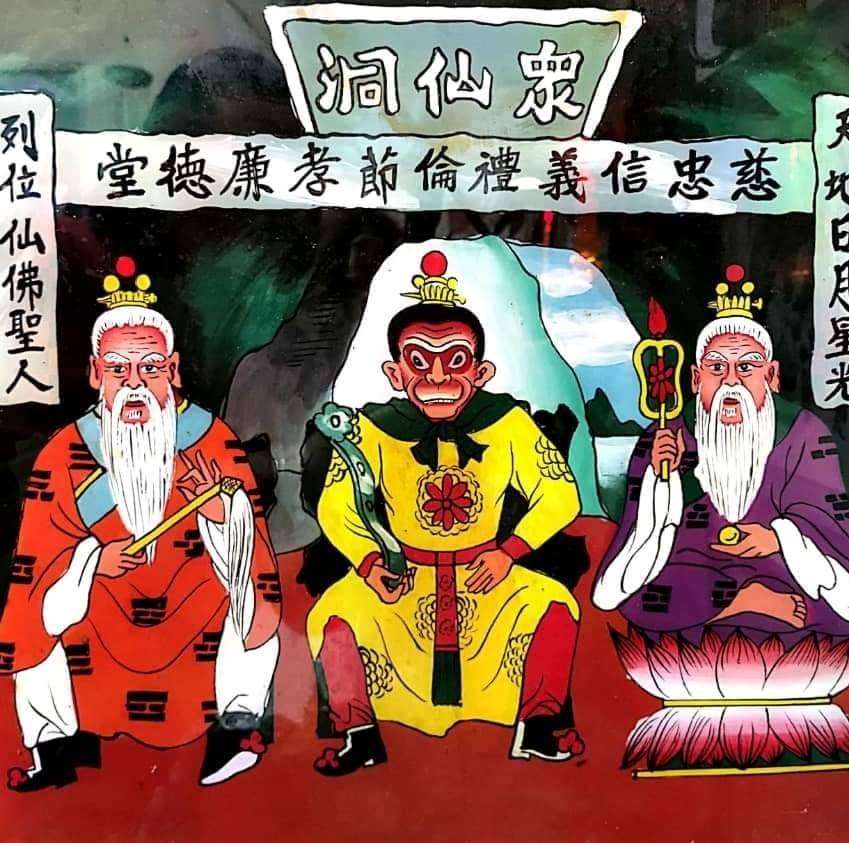
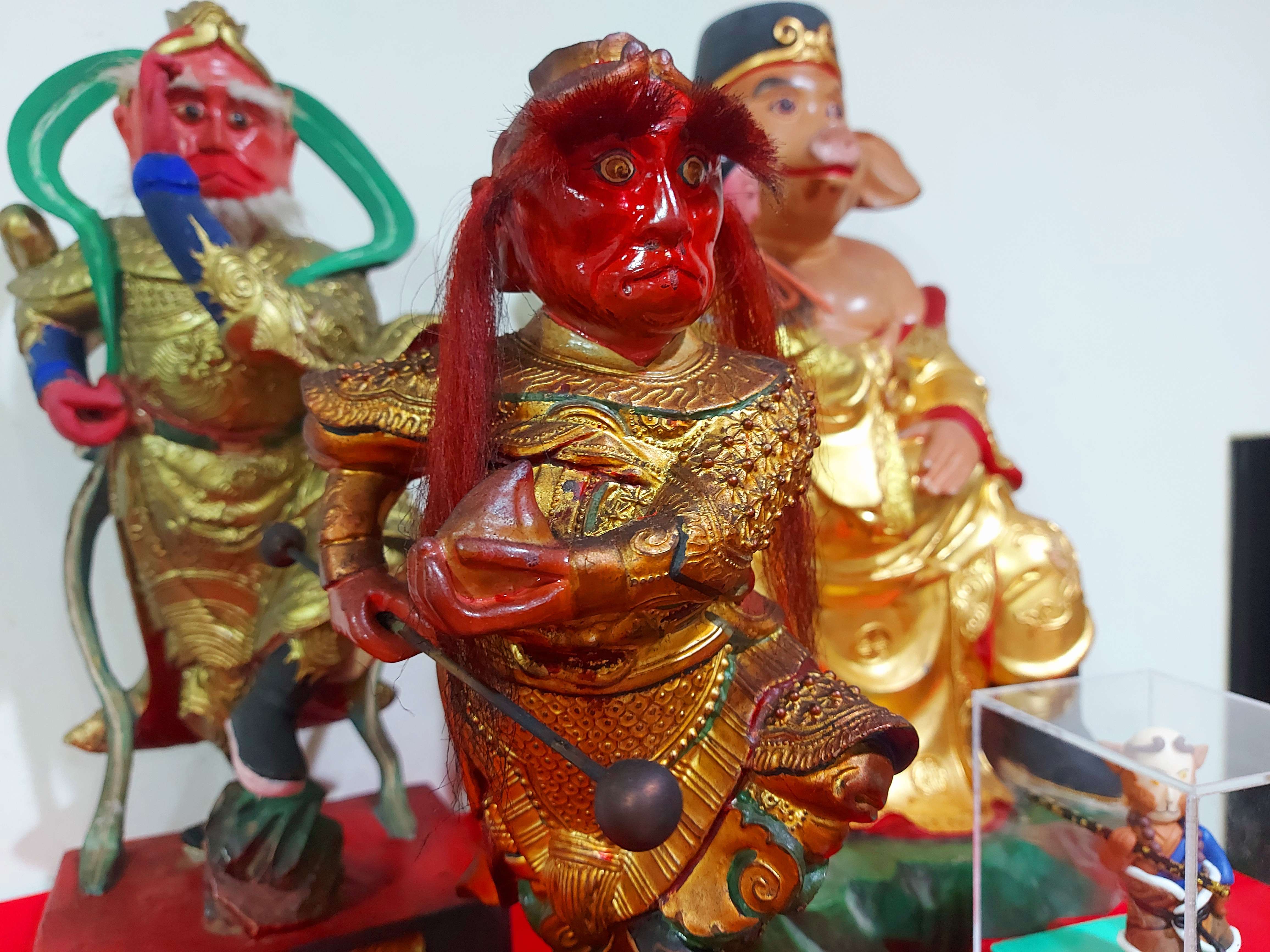
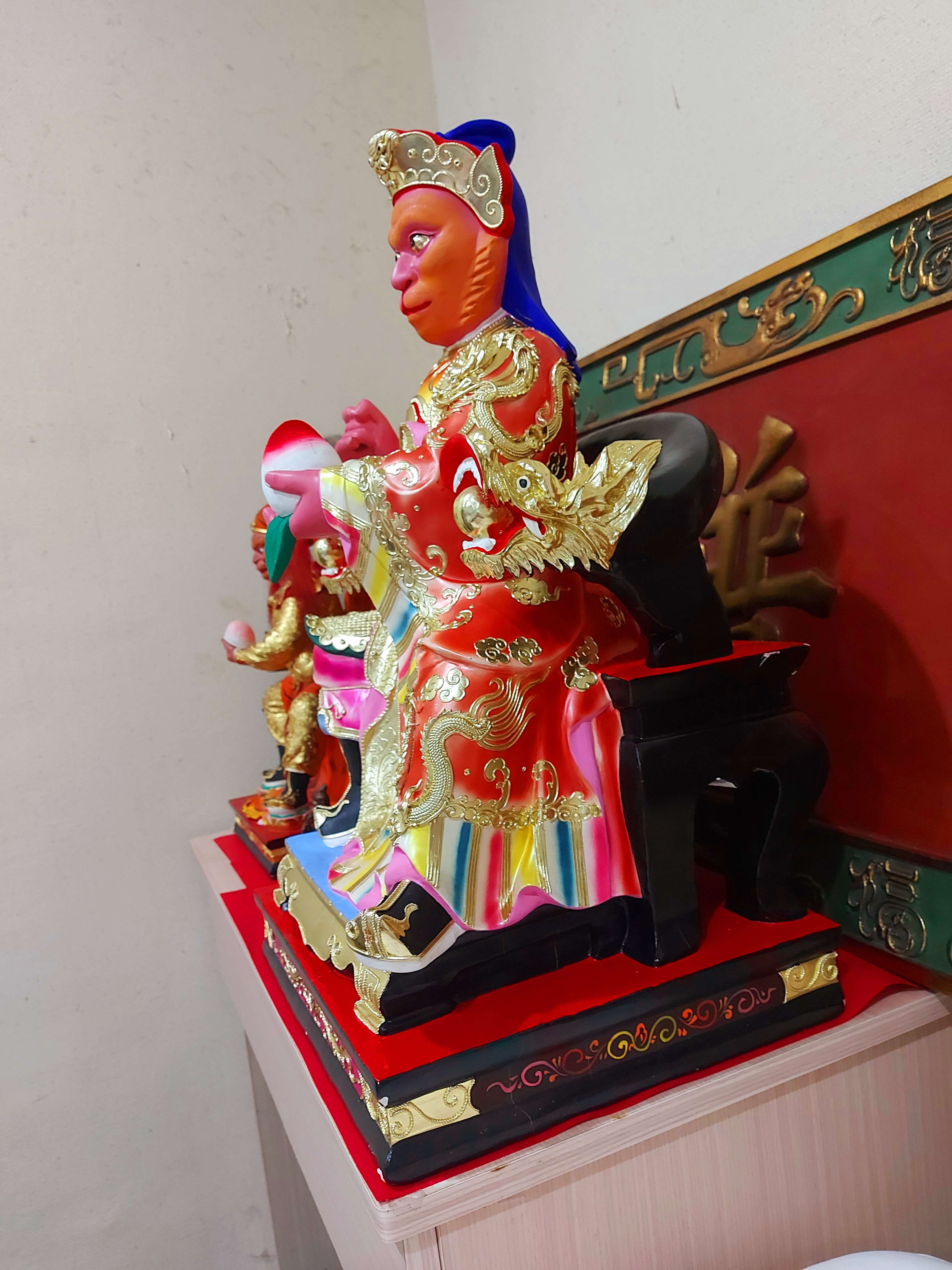
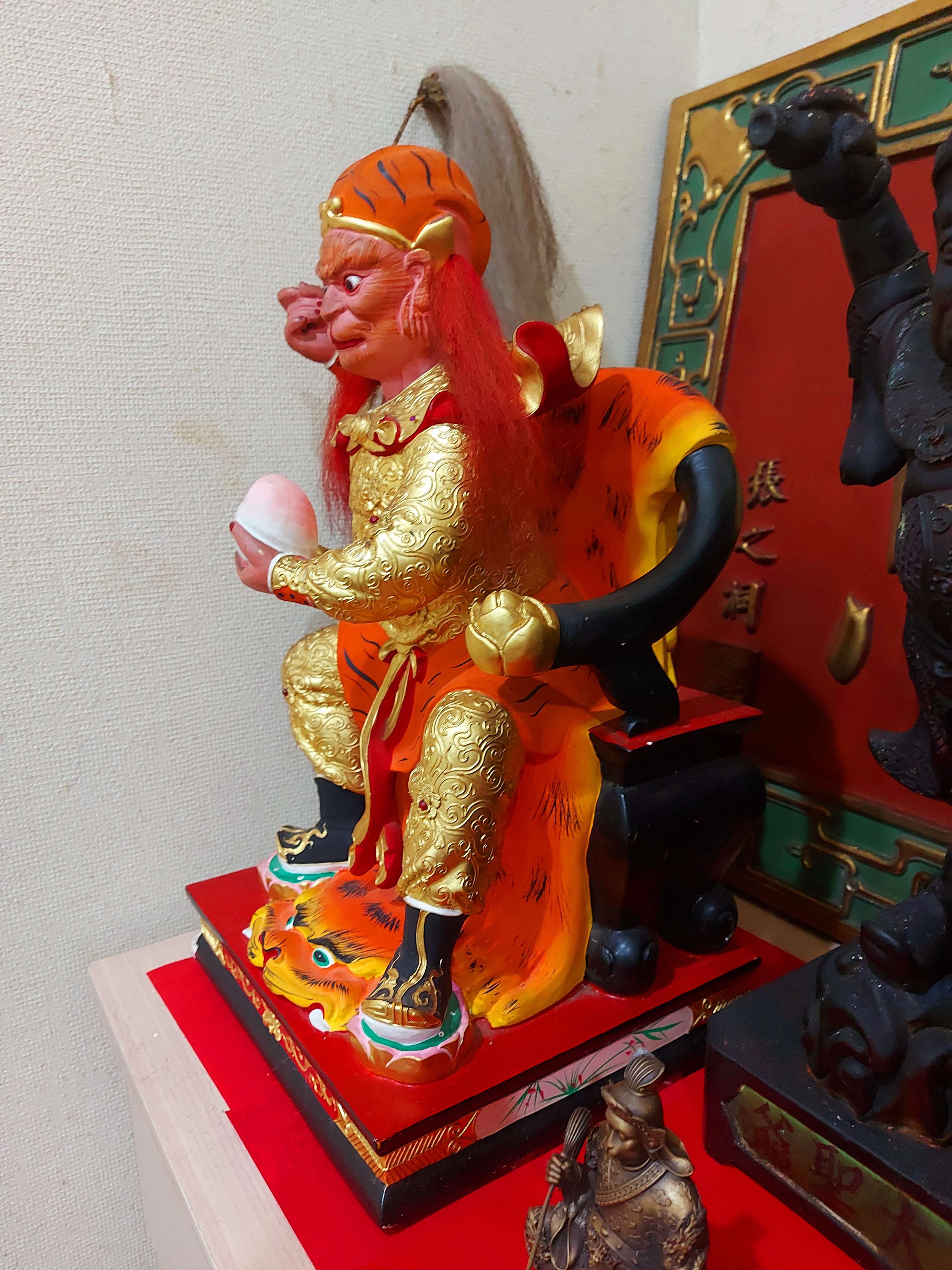
Sun Wukong’s Names and Titles

Last updated: 03-21-2026

I was recently contacted by a reader who said they were researching the Monkey King’s various nicknames. I had never thought about this before, so I decided to write an article to help them out. I am indebted to Irwen Wong of the Journey to the West Library blog for helping me with some of the more obscure terms. If you know of others that I missed, please let me know in the comments below or by email (see the “contact” button).

The vast majority of the terms listed here come from the standard 1592 edition of Journey to the West (Xiyouji西遊記; “JTTW” hereafter) (Wu & Yu, 2012). I have also added a few terms from a precursor, The Story of How Tripitaka of the Great Tang Procures the Scriptures (Da Tang Sanzang qujing shihua大唐三藏取經詩話, c. late-13th-century) (Wivell, 1994). I did this to show that certain variations of names or titles have existed for centuries.

My translation of some names and titles will slightly differ from those appearing in Wu and Yu (2012).

Table of Contents

1. Mentioned in the Narrative

These are names or titles mentioned by the narrative.

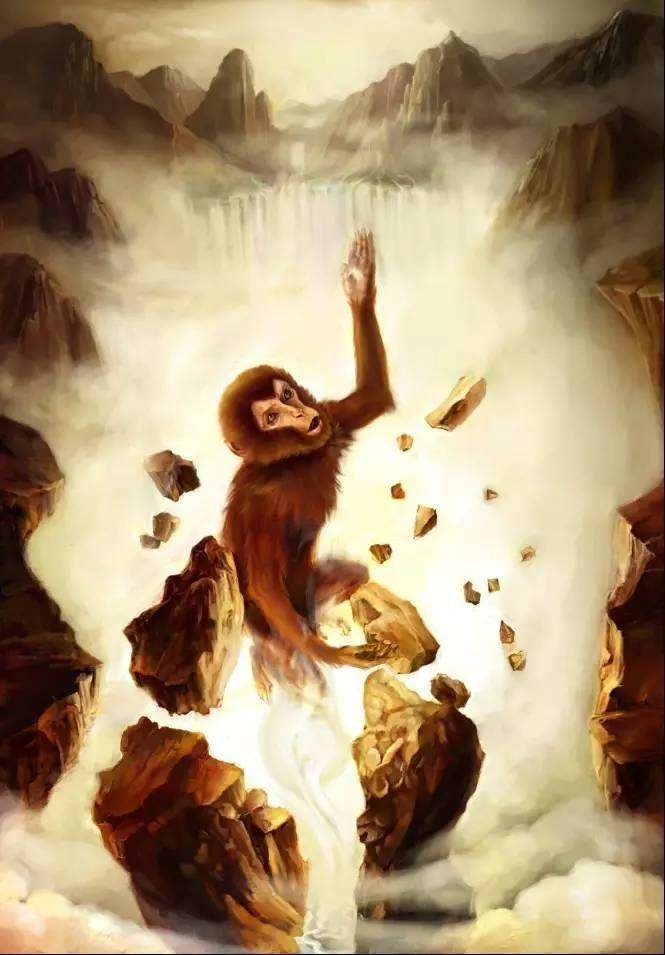
  1. Shihou (石猴, “Stone Monkey”) – Monkey’s first name according to chapter one (Wu & Yu, 2012, vol. 1, p. 104). This is related to his birth from stone (fig. 1).
  2. Tianchan Shihou (天產石猴, “Heaven-Born Stone Monkey”) – His REAL name as listed in the ledgers of hell in chapter three (Wu & Yu, 2012, vol. 1, p. 140).
  3. Xinyuan (心猿, “Mind Monkey/Ape”) – A Buddho-Daoist allegorical term for the disquieted thoughts and emotions that keep man trapped in Saṃsāra. It is used numerous times in chapter titles (e.g. ch. 7) and poems to refer to Monkey (see the material below figure three here).
  4. Jingong (金公, “Lord or Squire of Gold/Metal”) – A term used mainly in poems to refer to Monkey. It is an alternative reading of the component characters making up lead (qian, 鉛), namely jin (金) and gong (公). Lead was an important ingredient in immortal elixirs of external alchemy, and metal/gold (jin, 金) is connected to the earthly branch shen (申), which is associated with monkeys (see no. 9 here) (Wu & Yu, 2012, vol. 1, p. 83 and p. 532 n. 3).
  5. Taiyi Sanxian (太乙散仙, “Leisurely or Minor Immortal of the Great Monad”) – Monkey’s rank within the hierarchy of cosmic immortals (Wu & Yu, 2012, vol. 1, p. 471, for example). It essentially means that he is a divine being without a heavenly post.
  6. Taiyi Jinxian (太乙金仙, “Golden Immortal of the Great Monad”) – A seemingly embellished version of the previous term (Wu & Yu, 2012, vol. 2, p. 264, for example). It speaks of a higher rank. [1] (See the 07-26-25 update below for more info.)
  7. Lingming Shihou (靈明石猴, “Stone Monkey of Numinous Wisdom”) – The name of his magic species according to the Buddha in chapter 58 (Wu & Yu, 2012, vol. 3, p. 115). [2] He is the first of four spiritual primates.
  8. Nanbian Mihou (難辨獼猴, “Indistinguishable Macaques”) – A term referring to both Sun Wukong and the Six-Eared Macaque. [3]

Fig. 1 – Monkey’s birth from stone by Zhang Moyi (larger version). Found on this article.

2. Given by Characters

These are names, titles, or insults that are given to or directed at our hero by other characters.

  1. Hou Xingzhe (猴行者, “Monkey Pilgrim”) – Monkey’s original religious name in the 13th-century JTTW. It is given by Tripitaka at the beginning of the journey (Wivell, 1994, p. 1182). The Xingzhe (行者) portion of this name carried over to the 1592 edition. See nos. 12 & 13 below.
  2. Gangjin Tiegu Dasheng (鋼筋鐵骨大聖, “Great Sage Steel Muscles and Iron Bones”) – His divine title in the 13th-century JTTW. It is bestowed by Tang Emperor Taizong at the end of the journey (Wivell, 1994, p. 1207). [4] The Dasheng (大聖) portion of this name carried over to the 1592 edition. See sec. 3, nos. 7 & 8 below.
  3. Sun Wukong (孫悟空, “Monkey Awakened to Emptiness”) – The religious name given to him in chapter one by his first master, the Patriarch Subodhi (Wu & Yu, 2012, vol. 1, p. 115). It predates the 1592 JTTW, first appearing as early as the early-Ming zaju play (see here, for example). It’s important to note that the name “Wukong” (悟空) might have been influenced by a Tang-era monk who traveled throughout India just like Xuanzang (on whom Tripitaka is based).
  4. Liu Xiao Ling Tong (六小龄童) – Monkey’s name in the human world.
  5. Pohou (潑猴, “Reckless or Brazen Monkey”) – An insult used throughout JTTW (Wu & Yu, 2012, vol. 1, p. 118, for example).
  6. Shangxian (上仙, “High or Exalted Immortal”) – A respectful title used by the Dragon King of the Eastern Ocean in chapter three (Wu & Yu, 2012, vol. 1, p. 134).
  7. Huaguo Shan Shuilian Dong Tianchan Yaohou (花果山水簾洞天產妖猴, “Heaven-Born Demon Monkey from the Water-Curtain Cave of the Mountain of Flowers and Fruit”) – An insult used by King Qinguang, a Judge of Hell, in a memorial to the Jade Emperor in chapter three (Wu & Yu, 2012, vol. 1, p. 142).
  8. Xiandi (賢弟, “Worthy Little Brother”) – A nickname used by the Bull Demon King (Wu & Yu, 2012, vol. 1, p. 156, for example). Monkey is the smallest and therefore the last of seven sworn brothers (Wu & Yu, 2012, vol. 2, pp. 223-224).
  9. Yaoxian (妖仙, “Bogus Immortal”) – A category of nigh-immortal beings. He is called this by the Jade Emperor (ch. 4), the Buddha (ch. 7), and the Dragon King of the Eastern Sea in (ch. 14) (Wu & Yu, 2012, vol. 1, pp. 147-148, 193, and 318).
  10. Bimawen (弼馬溫, “To Assist Horse Temperament”) – A minor post overseeing the celestial horse stables. Monkey is given this position in chapter four by the Jade Emperor. Yu (Wu & Yu, 2012) translates this as “BanHorsePlague” (vol. 1, p. 148, for example). [5] This is sometimes used as an insult (Wu & Yu, 2012, vol. 1, p. 354, for example).
  11. Yaohou (妖猴, “Monster or Demon Monkey”) – An insult used numerous times throughout the novel (Wu & Yu, 2012, vol. 1, p. 154, for example).
  12. Sun Xingzhe (孫行者, “Pilgrim Sun”) – Monkey’s second religious name. It is given to him in chapter 14 by Tripitaka (Wu & Yu, 2012, vol. 1, p. 309). Refer back to no. 1. See also sec. 3, nos. 9 & 10 below.
  13. Xingzhe (行者, “Pilgrim”) – He is more commonly referred to by this name than Sun Xingzhe or Sun Wukong combined. [6] See section III here to learn about the significance of this title. Refer back to no. 1. Again, see sec. 3, no. 9 & 10 below.
  14. Sun Zhanglao (孫長老, “Elder Sun”) – A respectful title used by people he has helped (Wu & Yu, vol. 2, p. 85, for example).
  15. Dashixiong (大師兄, “Elder Religious Brother”) – A term used by Zhu Bajie and Sha Wujing (Wu & Yu, 2012, vol. 2, p. 74, for example).
  16. Houtou (猴頭, “Monkey/Ape Head”) – An insult used by various characters, especially Tripitaka (Wu & Yu, 2012, vol. 2, p. 26, for example).
  17. Maolian Heshang (毛臉和尚, “Hairy-Faced Monk”) – A term that describes his features (Wu & Yu, 2012, vol. 1, p. 407, for example).
  18. Maolian Lei Gong Zui de Heshang (毛臉雷公嘴的和尚, “Hairy-Faced, Thunder God-Beaked Monk) – A term that compares his elongated simian face to the beak of the bird-like thunder god Lei Gong (Wu & Yu, 2012, vol. 1, p. 351, for example). Variations include Lei Gong Zui Heshang (雷公嘴和尚, “Thunder God-Beaked Monk”) and Lei Gong de Nanzi/Hanzi (雷公嘴的男子/漢子, “Thunder God-Beaked Man”).
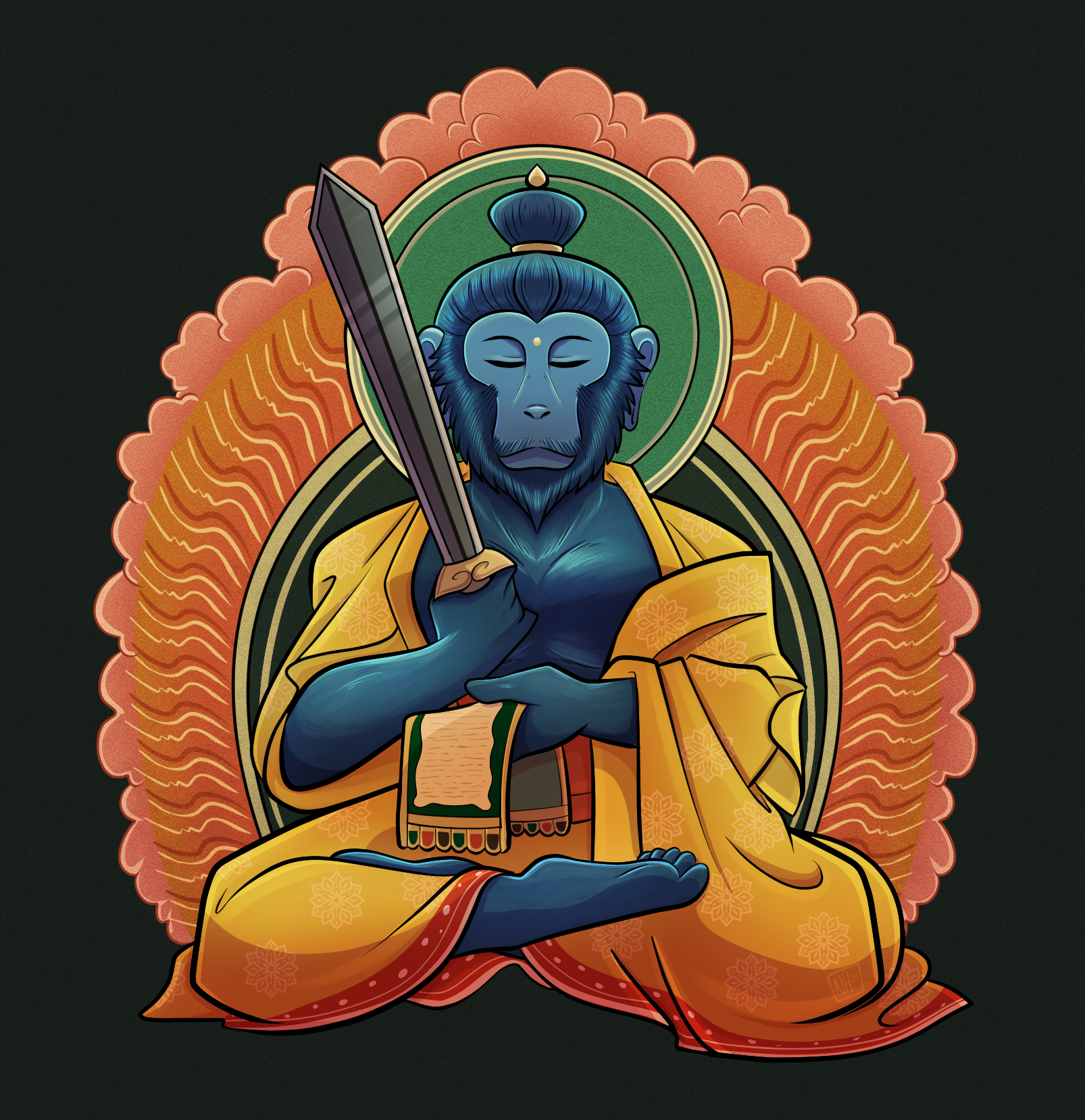
  19. Dou Zhansheng Fo (鬥戰勝佛, “Buddha Victorious in Strife or Victorious Fighting Buddha”) – His Buddha title bestowed by the Tathagata at the end of the journey in chapter 100 (fig. 2) (Wu & Yu, 2012, vol. 4, p. 381).

Fig. 2 – A religiously accurate drawing of Monkey as Dou zhansheng fo by NinjaHaku21 (larger version).

3. Self-Given

These are names, titles, or pseudonyms taken by Monkey himself. These do not include the names of the innumerable gods, monsters, or humans that he disguises himself as. They only refer to him personally.

  1. Huaguo Shan Ziyun Dong Bawan Siqian Tongtou Tie’e Mihou Wang (花果山紫雲洞八萬四千銅頭鐵額獼猴王, “Bronze-Headed, Iron-Browed King of the Eighty-Four Thousand Monkeys of the Purple Cloud Grotto on the Mountain of Flowers and Fruit”) – How he introduces himself to Tripitaka in the 13th-century JTTW (Wivell, 1994, p. 1182). The “Monkey King” (Mihou Wang, 獼猴王) portion of this name carried over to the 1592 edition but was represented with different Chinese characters. See nos. 2 & 3 below. This article discusses the term mihou (獼猴).
  2. Meihou Wang (美猴王, “Handsome Monkey King“) – The title that he takes upon ascending the throne in chapter one (Wu & Yu, 2012, vol. 1, p. 106).
  3. Hou Wang (猴王, “Monkey King”) – He is more commonly referred to by this name than Meihou wang. [7]
  4. Huaguo Shan Shuilian Dong Dongzhu (花果山水簾洞洞主, “Lord of the Water-Curtain Cave in the Mountain of Flowers and Fruit”) – How he introduces himself in chapter two to a demon king plaguing his people (Wu & Yu, 2012, vol. 1, p. 127).
  5. Huaguo Shan Shuilian Dong Tiansheng Shenren (花果山水簾洞天生聖人, “Heaven-Born Sage From the Water-Curtain Cave in the Mountain of Flowers and Fruit”) – How he introduces himself to the Ten Kings of Hell in chapter three (Wu & Yu, 2012, vol. 1, p. 140).
  6. Lao Sun (老孫, “Old Sun”) – A term that he uses many, many times throughout the novel. Yu (Wu & Yu, 2012) translates this as “Old Monkey” (vol. 1, p. 128, for example).
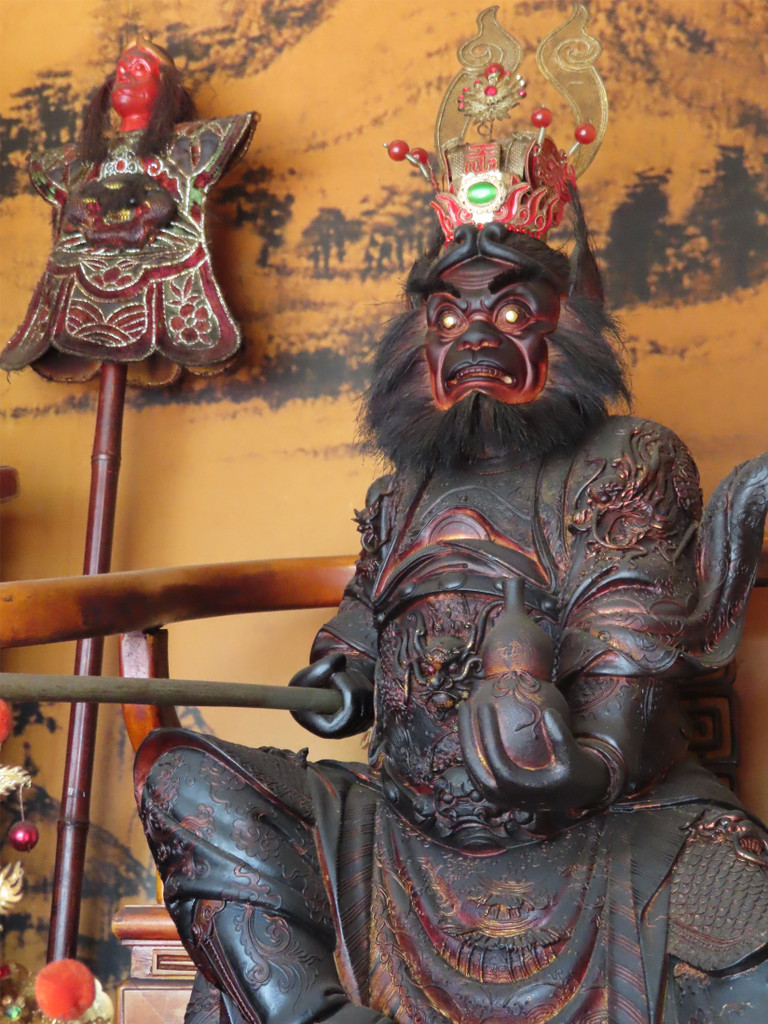
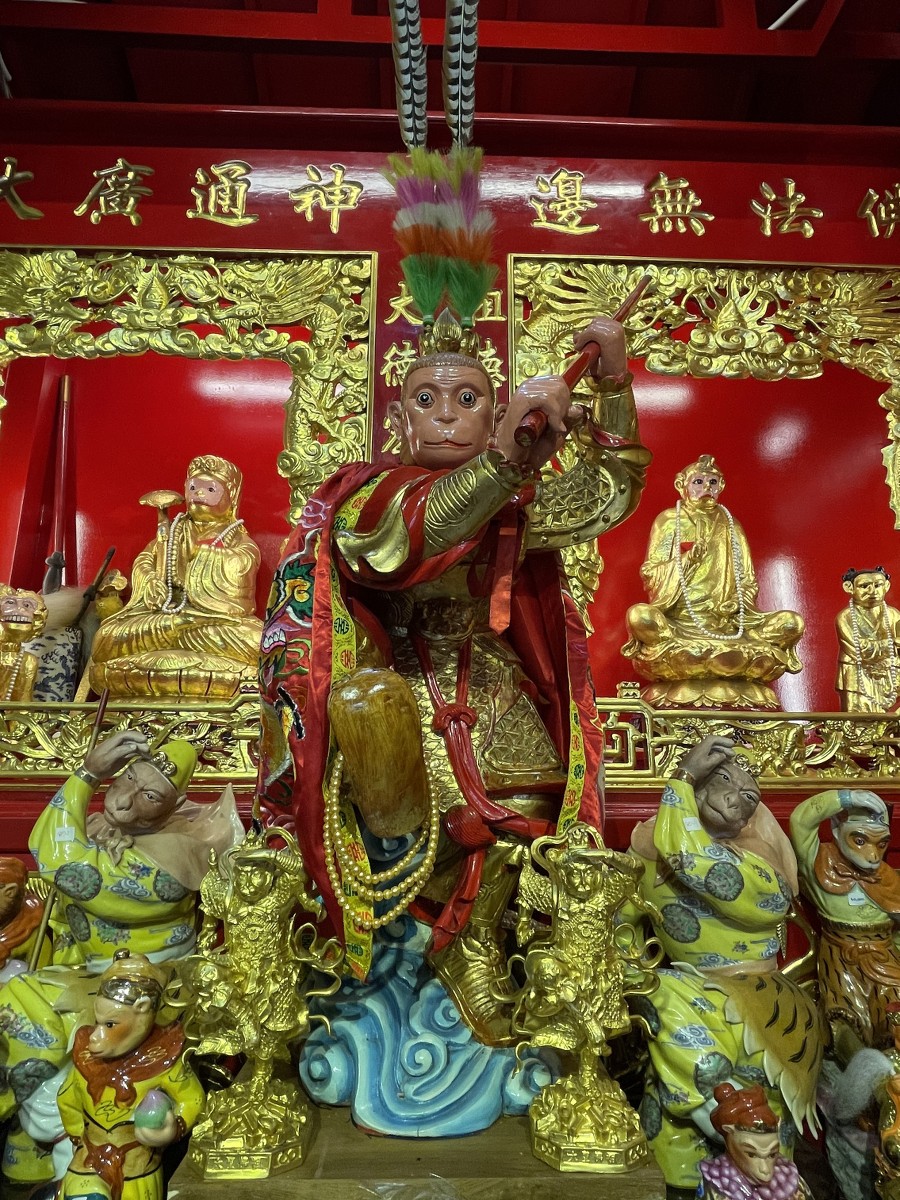
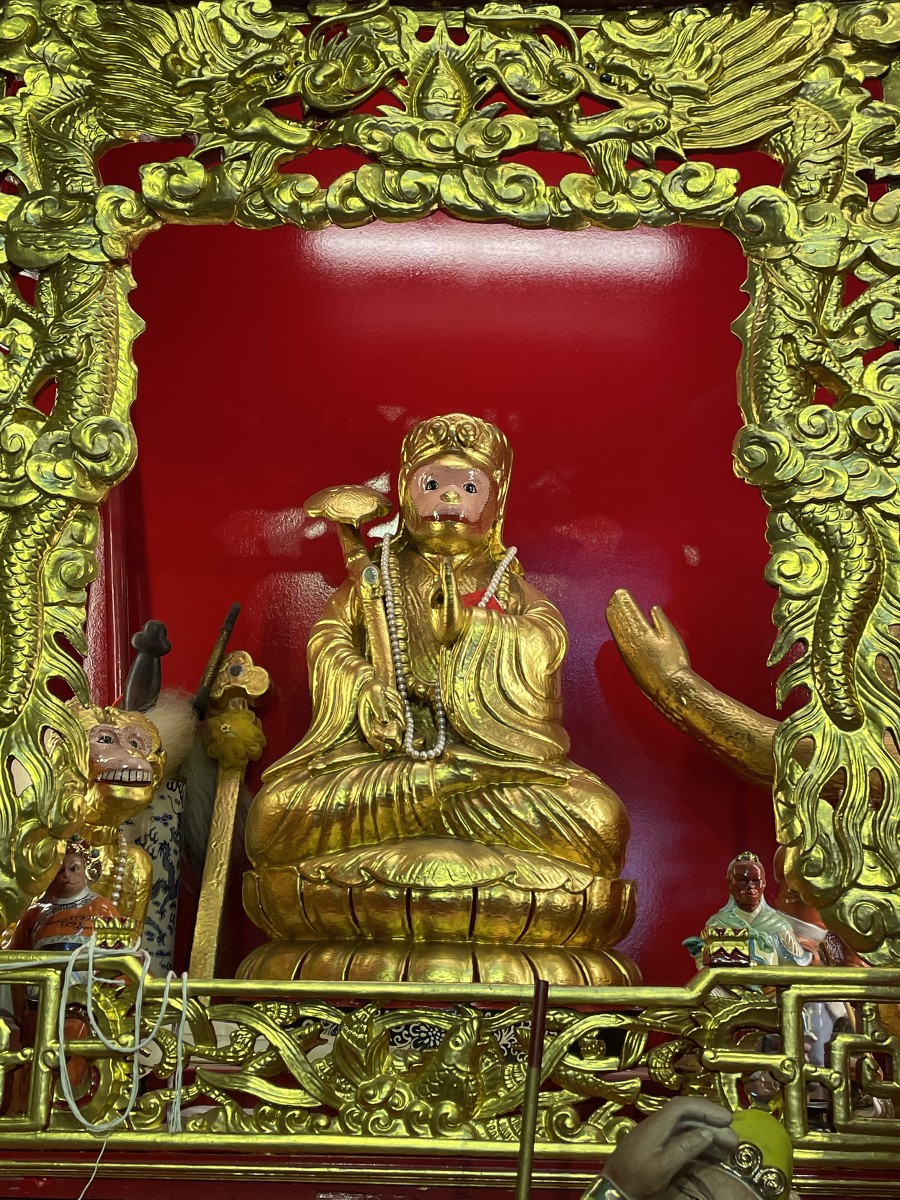
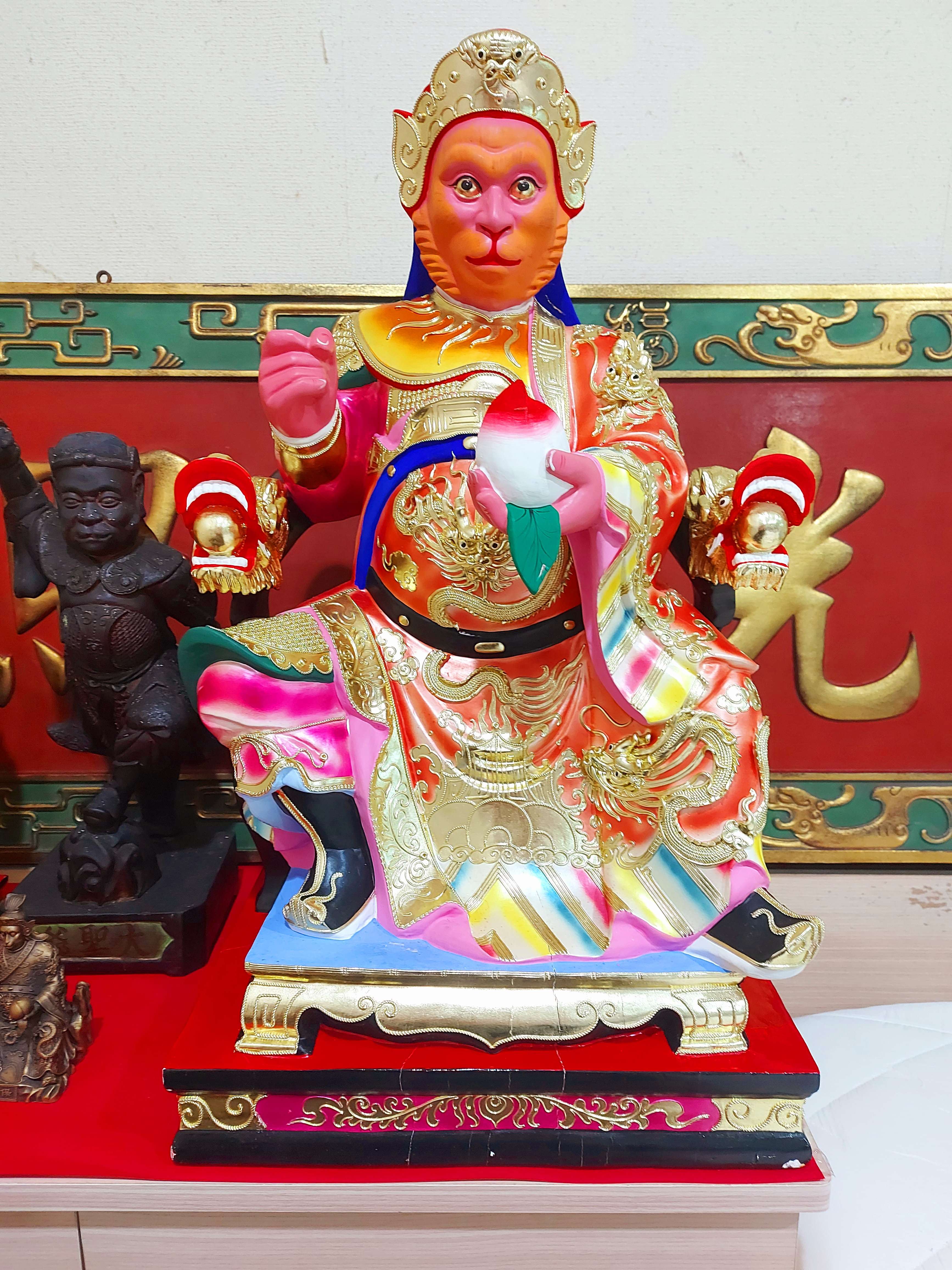
  7. Qitian Dasheng (齊天大聖, “Great Sage Equaling Heaven”) – The seditious title that he takes during his rebellion against heaven (Wu & Yu, 2012, vol. 1, p. 151). Monkey is worshiped by this name in modern Chinese Folk Religion (fig. 3). Refer back to sec. 2, no. 2.
  8. Dasheng (大聖, “Great Sage”) – He is more commonly referred to by this title than Qitian dasheng. [8] Variations include Dasheng Yeye (大聖爺爺, “[Paternal] Grandpa Great Sage”) and Sun Dasheng (孫大聖, “Great Sage Sun”). Refer back to sec. 2, no. 2.
  9. Zhexing Sun (者行孫, “Grimpil Sun”) – A pseudonym taken in chapter 34 when Monkey secretly escapes imprisonment and then presents himself as his own brother in an attempt to trick demons (Wu & Yu, 2012, vol. 1, p. 130). The strange English rendering is Yu’s (Wu & Yu, 2012) way of accounting for the change from Sun Xingzhe (, “Pilgrim Sun“) to Zhexing Sun (, “Grimpil Sun“). Refer back to sec. 2, no. 12. See also no. 10 below.
  10. Xingzhe Sun (行者孫, “Sun Pilgrim”) – A pseudonym taken in chapter 35 when he once again escapes capture and presents himself as a second brother (Wu & Yu, 2012, vol. 1, p. 133). This is a reversal of Sun Xingzhe (孫行者, “Pilgrim Sun”). Refer back to sec. 2, no. 12.
  11. Sun Waigong (孫外公, “([Maternal] Grandpa Sun”) – A name that he uses to taunt demons (Wu & Yu, 2012, vol. 1, p. 407, for example). It’s a cheeky way of saying, “I’m your elder, so you better submit to me.”
  12. Sun Yeye (孫爺爺, “([Paternal] Grandpa Sun”) – Same.
  13. Sun Erguan (孫二官, “Second Master Sun”) – A pseudonym taken in chapter 84 in order to investigate an anti-Buddhist kingdom under the guise of a horse trader. The other pilgrims take similar names (Wu & Yu, 2012, vol. 4, p. 132).

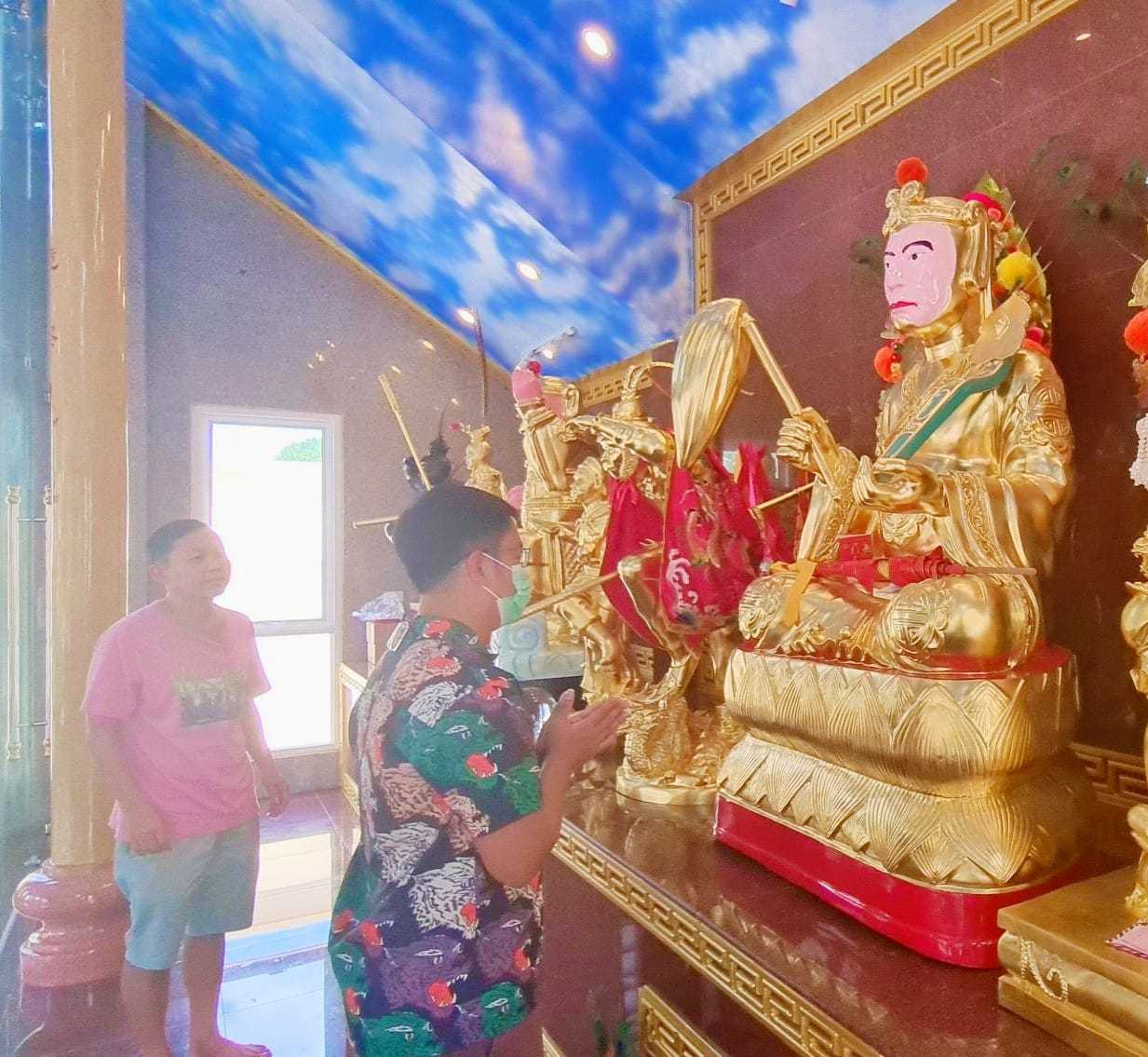
Fig. 3 – A Great Sage idol from Shengfo Tang (聖佛堂, “Sage Buddha Hall”) in Beigang Township, Yunlin County, Taiwan (larger version). It is one of many Monkey King Temples on the island. Photo by the author.


4. Updates

Update: 10-28-24

Someone on reddit questioned why I didn’t add a title for Monkey as the “Protector of the Peaches” or “Guardian of the Heavenly Peach Garden” (as mentioned by Wikipedia). This is how I responded:

This is what the novel says:

“We perceive,” said the Jade Emperor, “that your life is quite indolent, since you have nothing to do, and we have decided therefore to give you an assignment. You will temporarily take care of the Garden of Immortal Peaches. Be careful and diligent, morning and evening” (Wu & Yu, 2012, vol. 1, p. 160).

玉帝道:「朕見你身閑無事,與你件執事:你且權管那蟠桃園,早晚好生在意。」

The phrase “care for the Immortal Peach garden” (管蟠桃園) appears four times. But there is no official title for the position.


Update: 07-26-25

In section one, no. 6, I listed the title Taiyi Jinxian (太乙金仙, “Golden Immortal of the Great Monad”). However, this is only part of the term. The full title is Hunyuan yiqi shangfang taiyi jinxian (混元一氣上方太乙金仙), or “Golden Immortal of the Great Monad Atop the Primordial Breath of the Chaotic Origin.” The phrase “Atop the Primordial Breath … ” likely refers to the pristine, original energy of the universe that all Daoists wish to return to. Therefore, I believe this refers to his level of spiritual attainment—think of it in terms of cultivation literature—which is separate from his actual heavenly rank.


Update: 03-21-2026

It dawned on me that Pilgrim Sun (sec. 2, no. 12) and his “brothers,” Grimpil Sun and Sun Pilgrim (sec. 3, nos. 9 & 10), might be intentional references to the tripart monkey gods of religion and theater. For example, one Fujian tradition names the triad as the black-faced “Great Sage Reaching Heaven” (Tongtian dasheng, 通天大聖), the white-faced “Third Son Shuashua” (Shuashua sanlang, 耍耍三郎/爽爽三郎), and the red-faced “Cinnabar Cloud Great Sage” (Danxia dasheng, 丹霞大聖). The first two figures appear as brothers, along side the Great Sage Equaling Heaven and two sisters, in a pair of Yuan-Ming zaju plays (see the 12-20-23 update here.)

Notes:

1) The Jinxian (金仙) of Monkey’s title Taiyi Jinxian (太乙金仙, “Golden Immortal of the Great Monad”) is associated with far more lofty figures. For example, a poem in chapter one refers to the Patriarch Subodhi as the Dajue Jinxian (大覺金仙, “Golden Immortal of Great Awareness”) (see section 2.3 here).

2) I’m placing the name in this category because the Tathagata is stating a fact instead of bestowing it as a proper name.

3) Yu (Wu & Yu, 2012) translates this as the “macaque hard to distinguish” (vol. 4, p. 360). But I think that the original Chinese term is likely referring to both Sun and Six Ears. Their battle across the cosmos is counted in chapter 99 as the 46th of 81 hardships that Tripitaka was fated to endure (Wu &Yu, 2012, vol. 4, p. 360).

4) Wivell (1994) translates the name as “Great Sage of Bronze Muscles and Iron Bones” (p. 1207). But the gang (鋼) of Gangjin tiegu dasheng (鋼筋鐵骨大聖) means “steel.”

5) This references the homophonous term Bimawen (避馬瘟, “avoid the horse plague”), the historical practice of placing monkeys in horse stables to ward off equine sickness (see the 02-26-22 update here).

6) The term Xingzhe (行者, “pilgrim”) appears 4,355 times, while Sun xingzhe and Sun Wukong appear 239 and 127 times, respectively. Xingzhe is used numerous times to refer to other characters, such as Guanyin’s disciple Hui’an (惠岸行者, 6 times; a.k.a. Mucha or Mokṣa, 木叉行者, 9 times), but the vast majority refer to Monkey.

7) The term Hou wang (猴王, “Monkey King”) appears 185 times, while Meihou wang (美猴王) appears 42 times.

8) The term Dasheng (大聖, “Great Sage”) appears 1,273 times, while Qitian dasheng (齊天大聖) appears 103 times. I believe Dasheng is also used to refer to the Buddha a few times, so please keep this in mind.

Sources:

Wivell, C.S. (1994). The Story of How the Monk Tripitaka of the Great Country of T’ang Brought Back the Sūtras. In V. Mair (Ed.), The Columbia Anthology of Traditional Chinese Literature (pp. 1181-1207). New York: Columbia University Press.

Wu, C., & Yu, A. C. (2012). The Journey to the West (Vols. 1-4) (Rev. ed.). Chicago, Illinois: University of Chicago Press.

My Great Sage Monkey King Statue from Thailand

I learned in April via a private Thai Monkey King Facebook group that a limited run of colored resin, plain brass, painted brass, and gold-plated brass idols were to be made to raise funds to buy land on which a Great Sage temple would be built in Lam Narai, Lopburi province, Thailand. I procured the services of a local who contacted the religious organization building the temple, “The Equaling Heaven Academy (Altar) of Lam Narai” (Thai: Săm-nák chĕe tiian dtŭua lam-naa-raai, สำนักฉีเทียนตั๋วลำนารายณ์; Ch: Qitian tan Nannalai, 齊天壇南那來), and reserved a statue for me. Once the idols were cast (over several months), they shipped mine and it arrived on August 31st, 2022. Here, I’d like to briefly describe and compare the idol to other statues that I’ve seen or own.

I. Specs

Material: Brass

Length: 9.8 in (24.9 cm)

Width: 11.31 in (28.75 cm)

Height: 16.33 in (41.5 cm)

Weight: Around 24.25 lbs. (11 kg)

II. Pictures

Fig. 1 – The front (larger version).

Fig. 2 – The side (larger version).

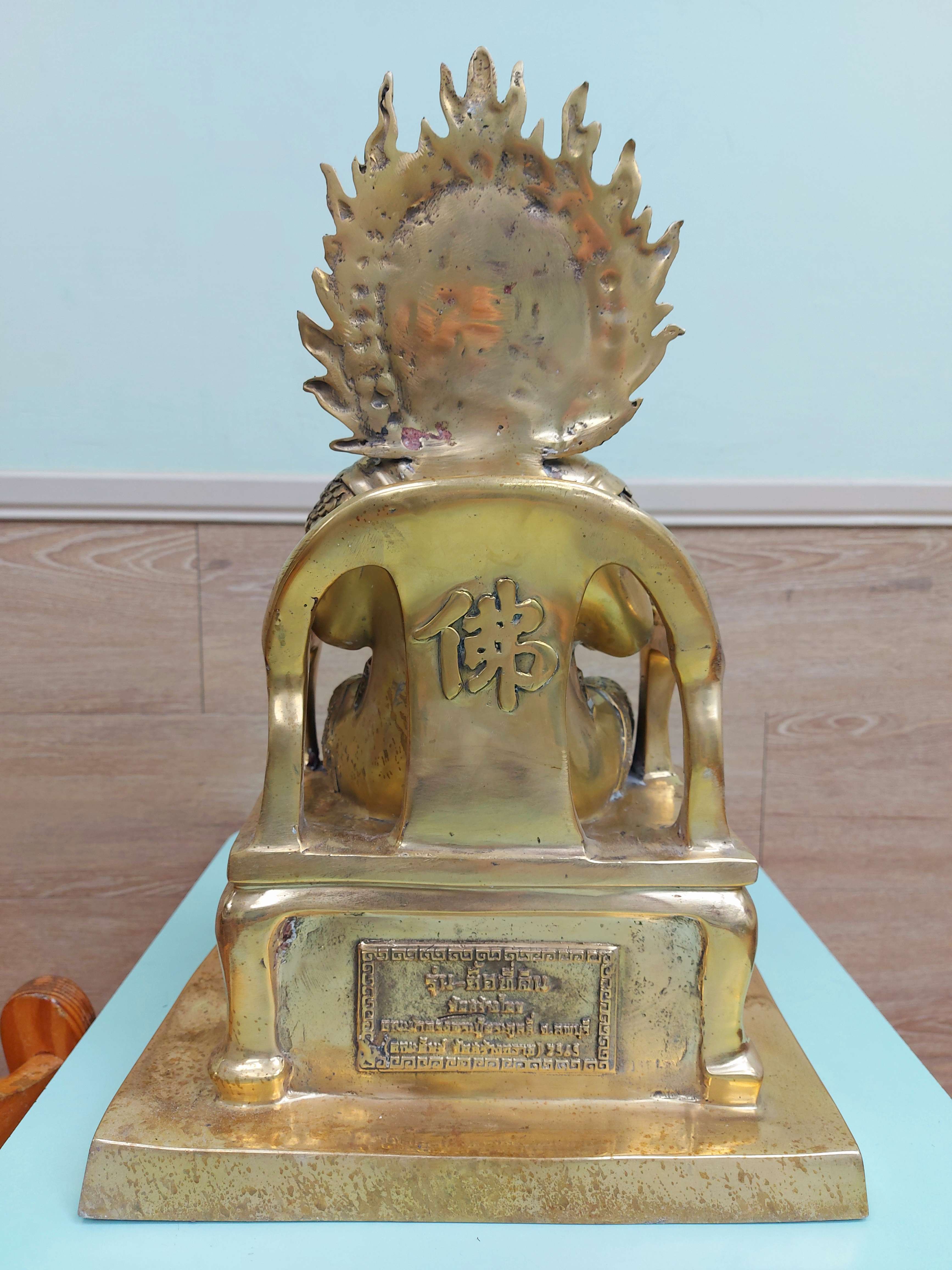
Fig. 3 – The back (larger version).

Fig. 4 – Detail of the front’s upper half (larger version).

Fig. 5 – Detail of the front’s lower half (larger version).

Fig. 6 – Detail of the placard on the back (larger version).

III. Discussion

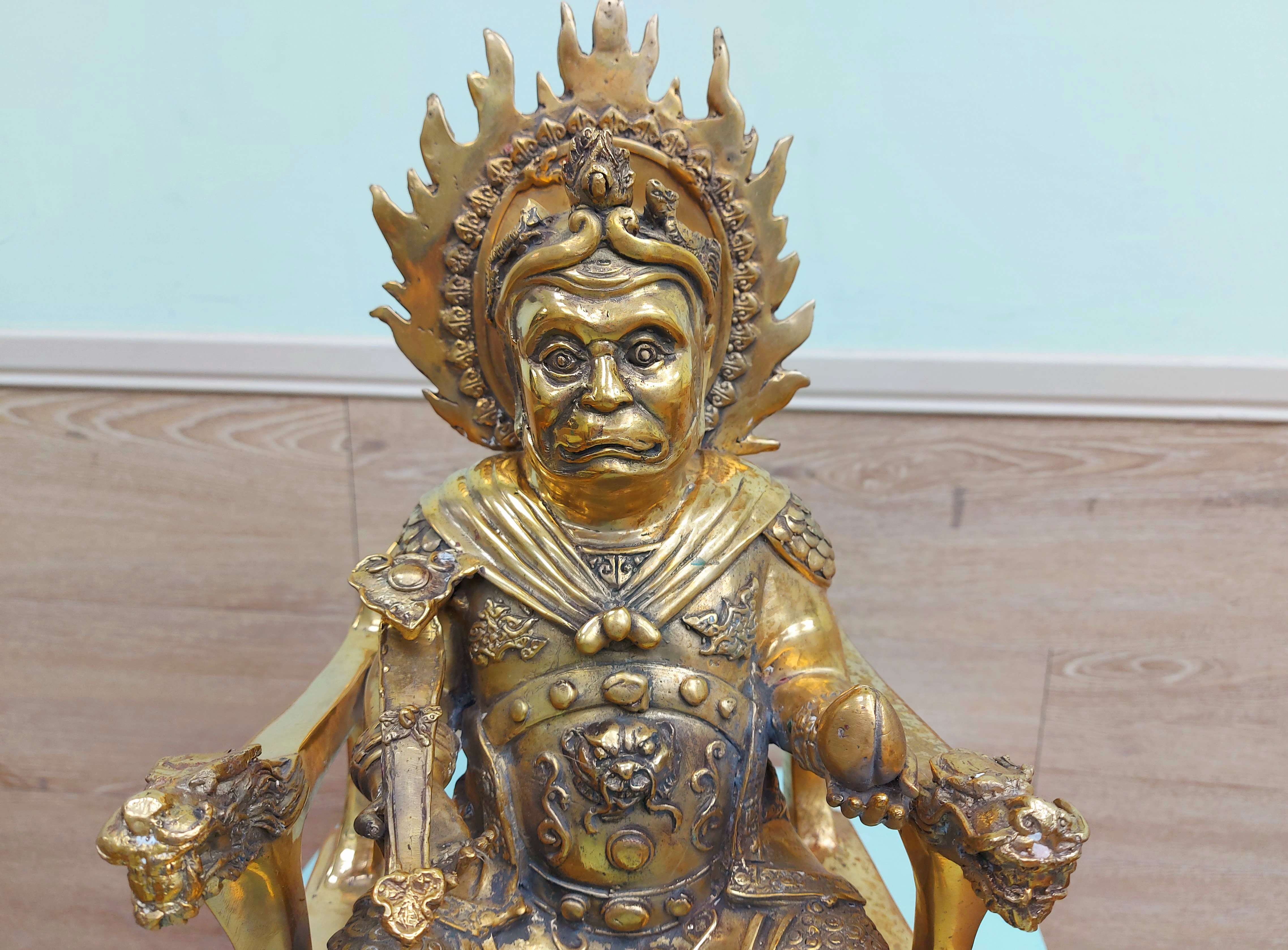
A fiery halo embellished with an inner circle of stylized ruyi-pattern mushrooms sits behind the Monkey King’s head. This shares similarities with a Monkey Buddha statue from a temple in Fujian province, China (fig. 7), the home of his cult. His bald head is adorned with the famous “curlicue-style” golden headband topped with a flaming Cintāmaṇi jewel, as well as a pair of slithering dragons wrapping around the back and sides of his crown. His visage is intense, with eyes opened wide and the corners of his mouth drawn downwards, forming a subtle “w” shape. A line marking the boundary of his forehead, the sides of his face, and just above his chin is slightly raised, giving the impression that he’s wearing a covering over his head and neck. This represents the pink facial patch, either covering the whole face or just a mask around the eyes, that often appears on gilded Monkey King statues in Thailand (fig. 8).

Fig. 7 (top) – A stature of Sun Wukong as a Buddha at the Yufeng Equaling Heaven Palatial Ancestor Hall of Pingshan (Yufeng Qitian fu Pingshan zudian, 玉封齐天府屏山祖殿) in Fuzhou City, Fujian (larger version). Picture by Saie Surendra of Hanumovies.com. Fig. 8 (bottom) – An example of a golden Thai Monkey statue with a pink patch on the face (larger version). Picture originally posted here.

Both arms are bent at the elbow and held out palm up towards the viewer. His left hand holds an immortal peach, while the right cups the handle of a ruyi-pattern scepter resting on his shoulder. The peach is a common element of his iconography all around the world (fig. 9 & 10); however, the scepter imagery seems to be more popular in Southeast Asia. See, for instance, the trinity from the syncretic “Three Teachings” cult of Malaysia and Singapore. Monkey holds the ruyi-scepter in the same manner (fig. 11).

Fig. 9 – A Taiwanese Monkey statue holding an immortal peach in the left hand (larger version). Fig. 10 – A Singaporean statue with an immortal peach in the left hand (larger version). Both are in my personal collection. See also figure twelve below. Fig. 11 – The “Three Teachings” trinity of Southeast Asia (larger version). Take note of Monkey’s ruyi-scepter. Picture originally posted here.

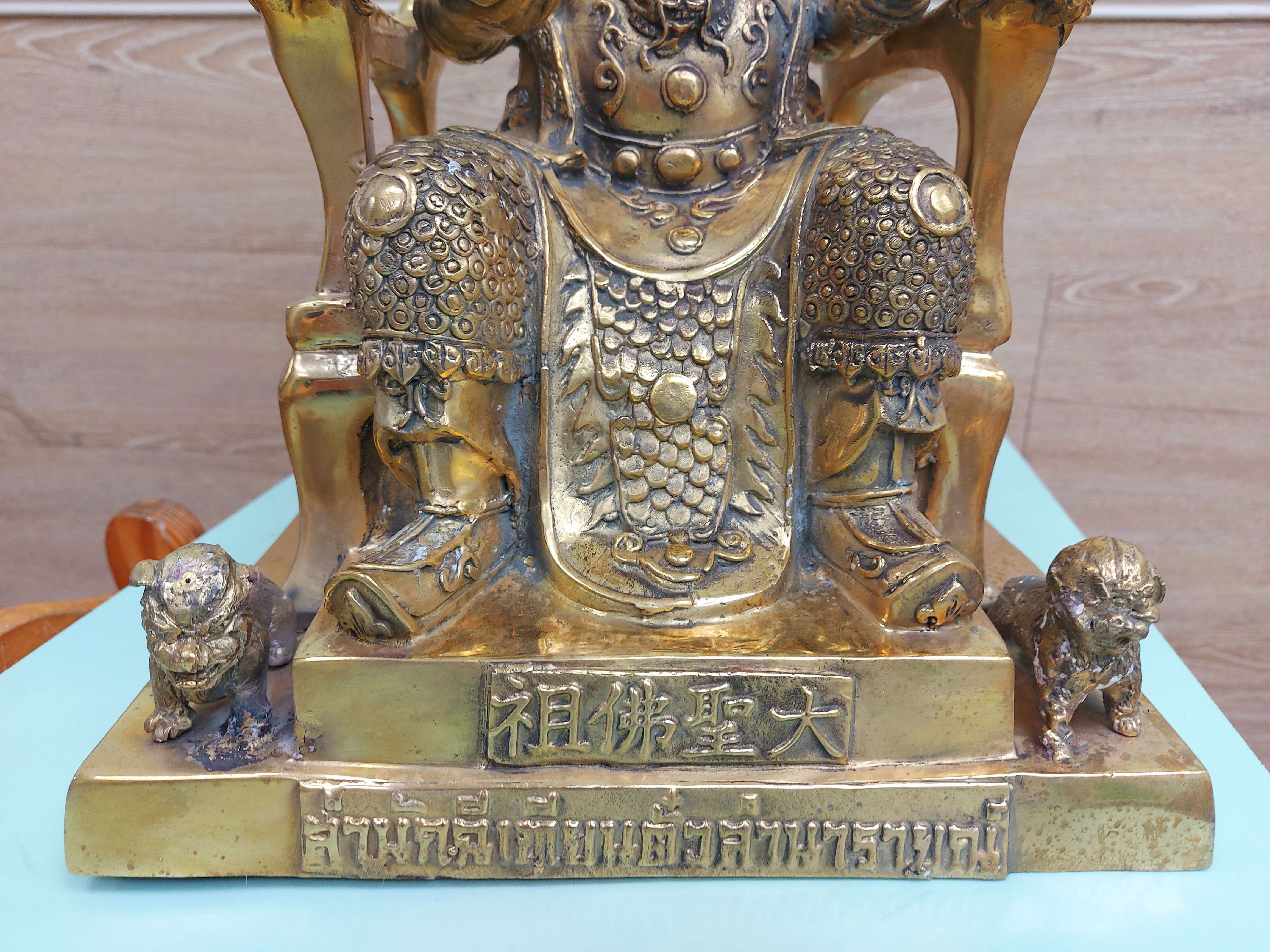
He wears a knotted neckerchief over a war coat with scale-pattern armor on his shoulders and the flap of cloth between his legs, a military girdle at his stomach and waist adorned with a dragon face, scale-pattern armored pants, and war boots with blocky, up-turned toes. His clothing and armor are adorned with various ruyi-pattern mushrooms. The Monkey King’s iconography commonly shows him wearing armor (fig. 12).

Fig. 12 – Detail of a Taiwanese Great Sage statue wearing armor (larger version). Take note of the armored Monkey statue behind him. Also notice that, like figures nine and ten, the lead idol is holding a peach in the left hand. All statues are in my personal collection.

He sits in a traditional dragon chair. More kingly depictions of the Great Sage commonly portray him seated (fig. 12 & 13). But this element is rare compared to the number of statues showing him standing (refer back to fig. 12; see also my other statues here).

Fig. 12 – The idol from figure nine is also shown seated in a dragon chair (larger version). Fig. 13 – The statue from figure ten is seated in a similar chair but replaces the dragon elements with lotuses (larger version).

Infront of the chair is a step on which his boots rest. It’s labeled in Chinese “大聖佛祖” (Dasheng fozu), or “Great Sage Buddha Patriarch“. I show in this article that the phrase is sometimes transliterated into Thai as “ต้าเชิ่งโฝจู่” (Dtâa chêrng fŏh jòo) and “ไต้เสี่ยฮุกโจ้ว” (Dtâi sìia húk-jôh, or just “Tai Sia Huk Chou/Zhou/Jow”). Both the chair and step sit on a rectangular base adorned with simplistic stone lions to his left and right. I haven’t seen lions in any of his other imagery. The front of the base is labeled:

สำนักฉีเทียนตั๋วลำนารายณ์ (Thai: Săm-nák chĕe tiian dtŭua lam-naa-raai)

“The Equaling Heaven Academy (Altar) of Lam Narai”.

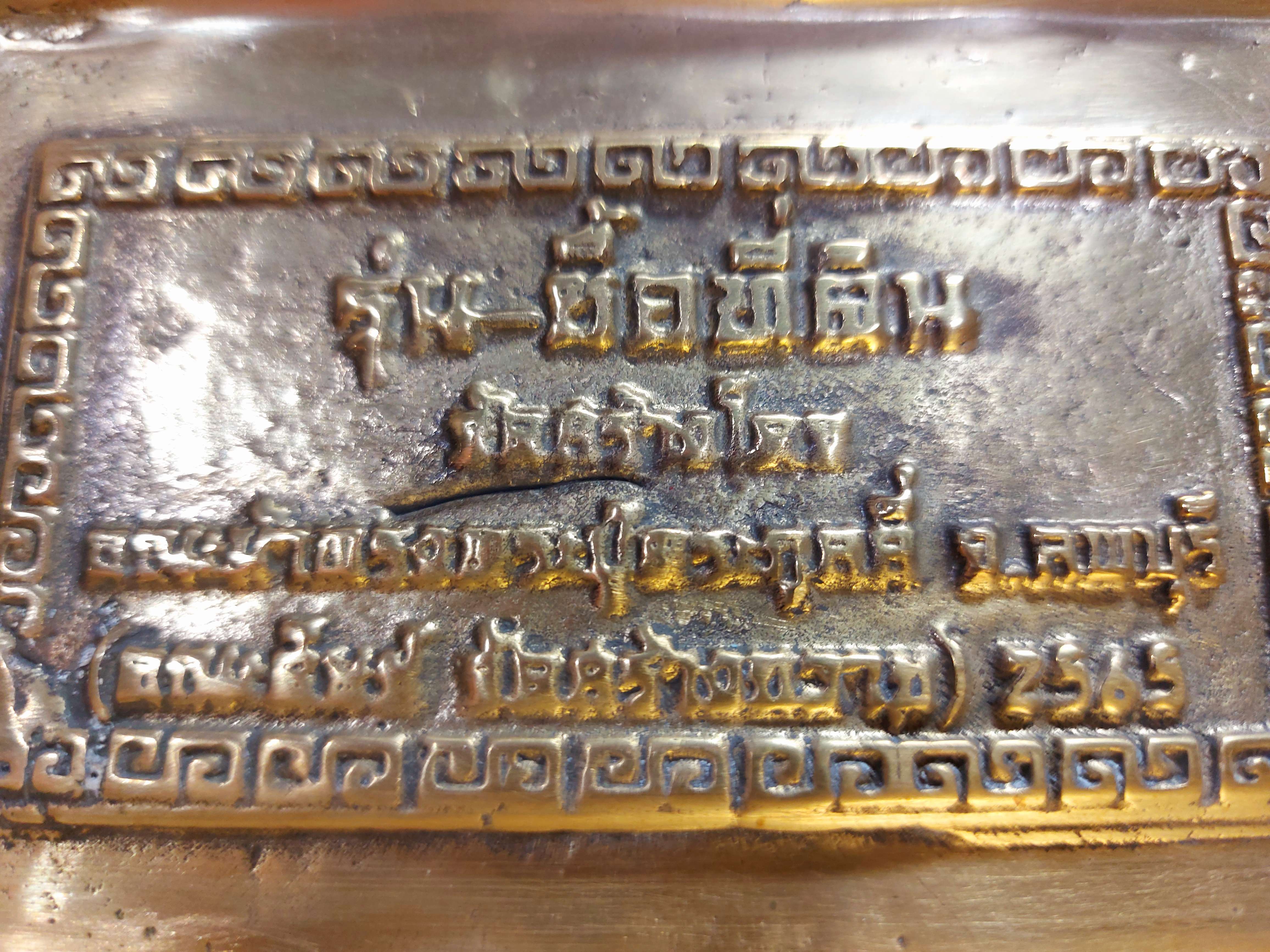
The reverse of the backrest features a large symbol for “Buddha” (Fo, 佛), and below this (between the back legs) is a cloud and thunder-pattern lined placard reading:

รุ่น-ซื้อที่ดิน – จัดสร้างโดย คณะม้าทรงพระบู๊ตระกลูหลี่ จลพบุรี (คณะศิษย์จัดสร้างถวาย) 2565 (Thai: rûn séu têe din jàt sâang doi ká-ná máa song prá bóo ต rá gloo-lèe jà-lóp bù-ree (ká-ná sìt jàt sâang tà-wăai))

“The Young Generation Buys Land – Created by the Royal Horse Riding Troupe Raklu Li, Lopburi Province (a group of students made an offering), 2022”. [1]

This Thai statue is a welcome addition to my ever-growing collection of Great Sage idols. It’s certainly the biggest metal Monkey statue that I’ve found so far.

Note:

1. Thank you to “Nattida” for transcribing and translating the Thai text for me.


The Monkey King’s Worship in Thailand

Last updated: 09-11-2022

I first learned of Great Sage worship in Thailand when Ronni Pinsler of the BOXS project showed me a Monkey King statue on a Thai Facebook group. Since then, I’ve noticed an explosion in social media posts (mainly on Facebook and Instagram) highlighting his veneration in the “Land of Smiles”. Here, I’d like to record what I’ve learned so far.

Please revisit the page for future updates.

I. Names for the Monkey King

  1. เห้งเจีย (Hêng jiia, or just “Heng Jia/Chia” = Xingzhe, 行者, “Pilgrim”). [1] This appears to be the most popular of his Thai names. This should come as no surprise, though, as Xingzhe (行者) is used FAR more to refer to Monkey in Journey to the West (4,335 times) than Wukong (悟空) (512 times). [2]
  2. ซุนหงอคง (Sun ngŏr kong, or just “Sun Ngokong” = Sun Wukong, 孫悟空) (see here).
  3. ฉีเทียนต้าเชิ่ง (Chĕe tiian dtâa chêrng = Qitian dasheng, 齊天大聖, “Great Sage Equaling Heaven”)
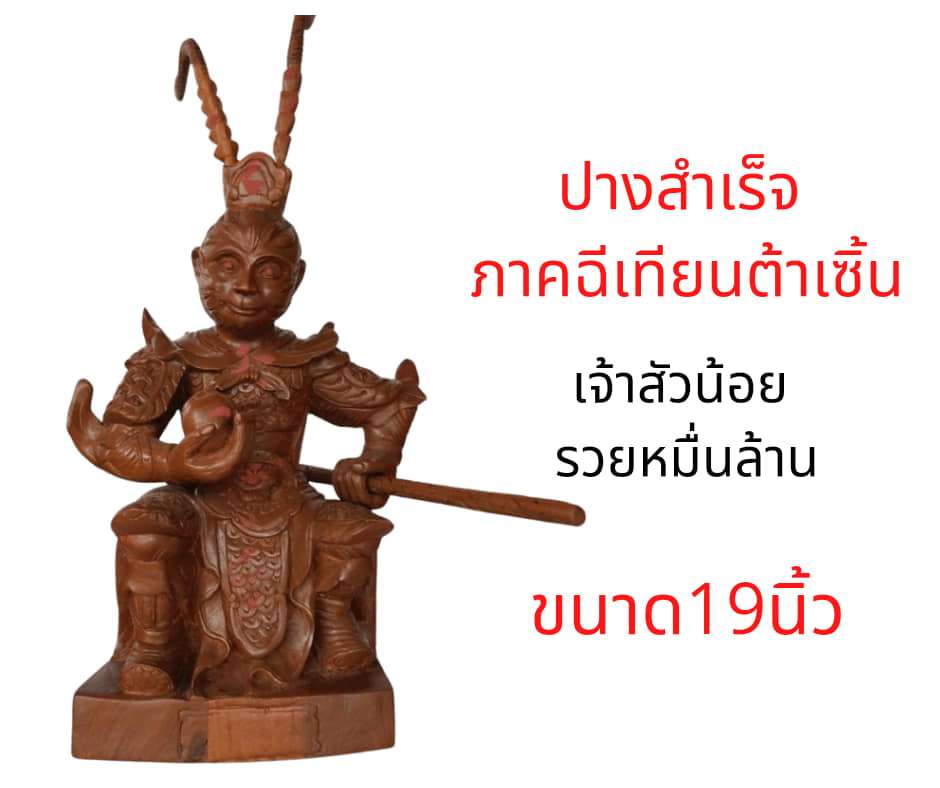
  4. ฉีเทียนต้าเซิน (Chĕe tiian dtâa sern = same as above)
  5. โต้วจั้นเชิ่งโฝ (Dtôh wá jân chêrng fŏh = Douzhan shengfo, 鬥戰勝佛, “Victorious Fighting Buddha”)
  6. ต้าเชิ่งโฝจู่ (Dtâa chêrng fŏh jòo = Dasheng fozu, 大聖佛祖, “Great Sage Buddha Patriarch”
  7. ไต้เสี่ยฮุกโจ้ว (Dtâi sìia húk-jôh, or just “Tai Sia Huk Chou/Zhou/Jow” = same as above)

II. Statuary

Various Thai Facebook groups post pictures of the same kinds of monkey god statues found in East and Southeast Asia. These range from armored warriors wielding the magic staff to serene buddhas on lotus thrones (consult the third paragraph after video one here for a description of Monkey’s traditional iconography). But I’ve noticed that one flavor of Thai Great Sage statue is almost entirely gilded (or draped with gold cloth) except for a pink/red mask around the eyes, the latter being similar to his Chinese opera depictions. Said statues tend to feature a golden headband with very tall curlicues (fig. 1).

Fig. 1 – An example of a golden Thai monkey statue with a pink mask and a high curlicue headband (larger version). Originally posted here.

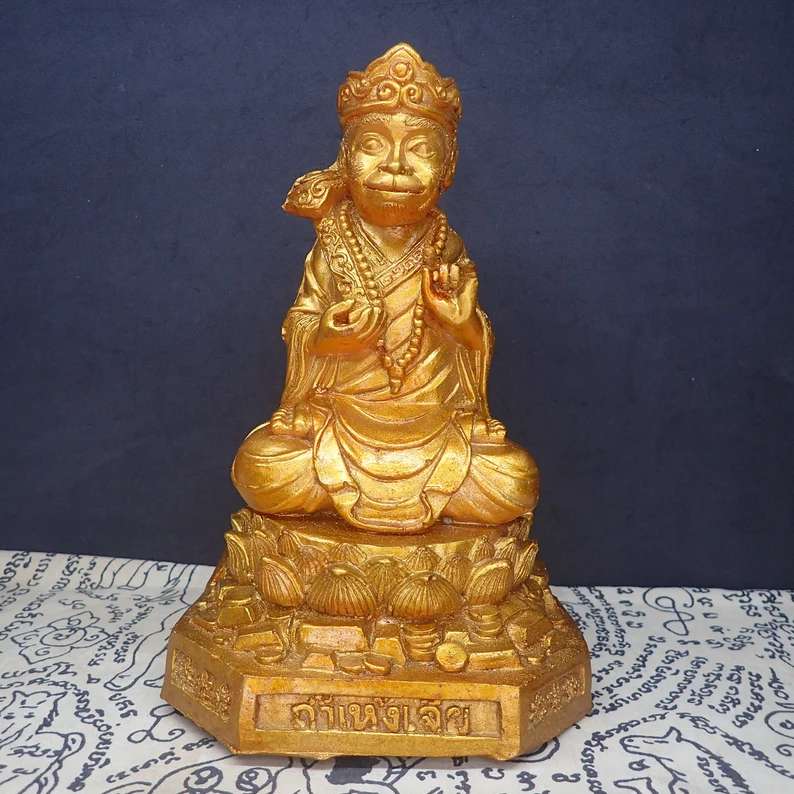
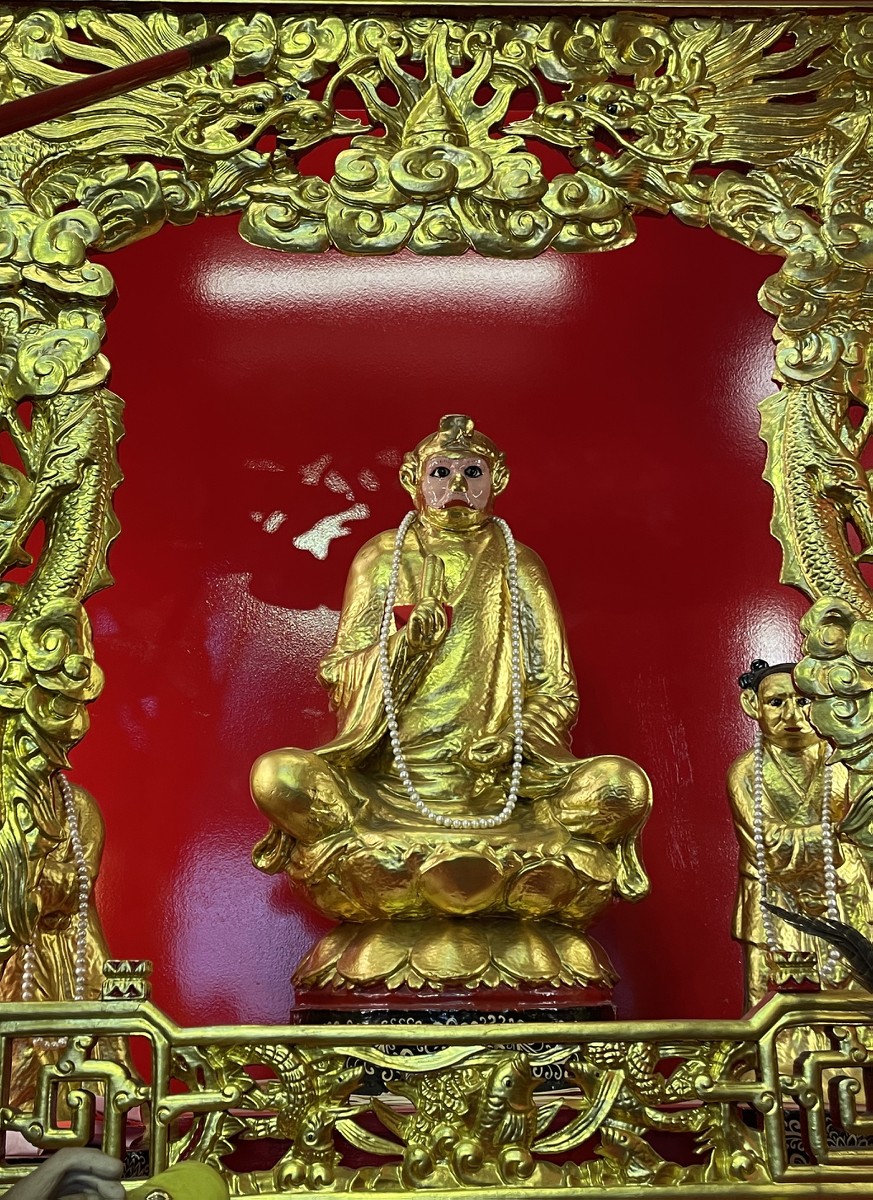
I’ve also noticed an abundance of Dizang-like Monkey Buddha statues, similar to those found in Singapore (I haven’t seen many such depictions in Taiwan). This may be of Fujian influence (see here). He is sometimes portrayed wearing an ornate crown (with or without the golden headband) and monk’s robes and seated on a lotus throne. One hand is held in a mudra, while the other clasps a ruyi scepter (or more rarely a fly whisk). I recently purchased such a statue with an amulet pressed in the bottom (fig. 2 and video #1).

Fig. 2 – My 20cm colored resin Thai Monkey Buddha statue (larger version). Take note that the lotus throne sits on a pile of gold coins and ingots. Picture by the original seller.

Video #1 – Video by the original seller.

III. Amulets

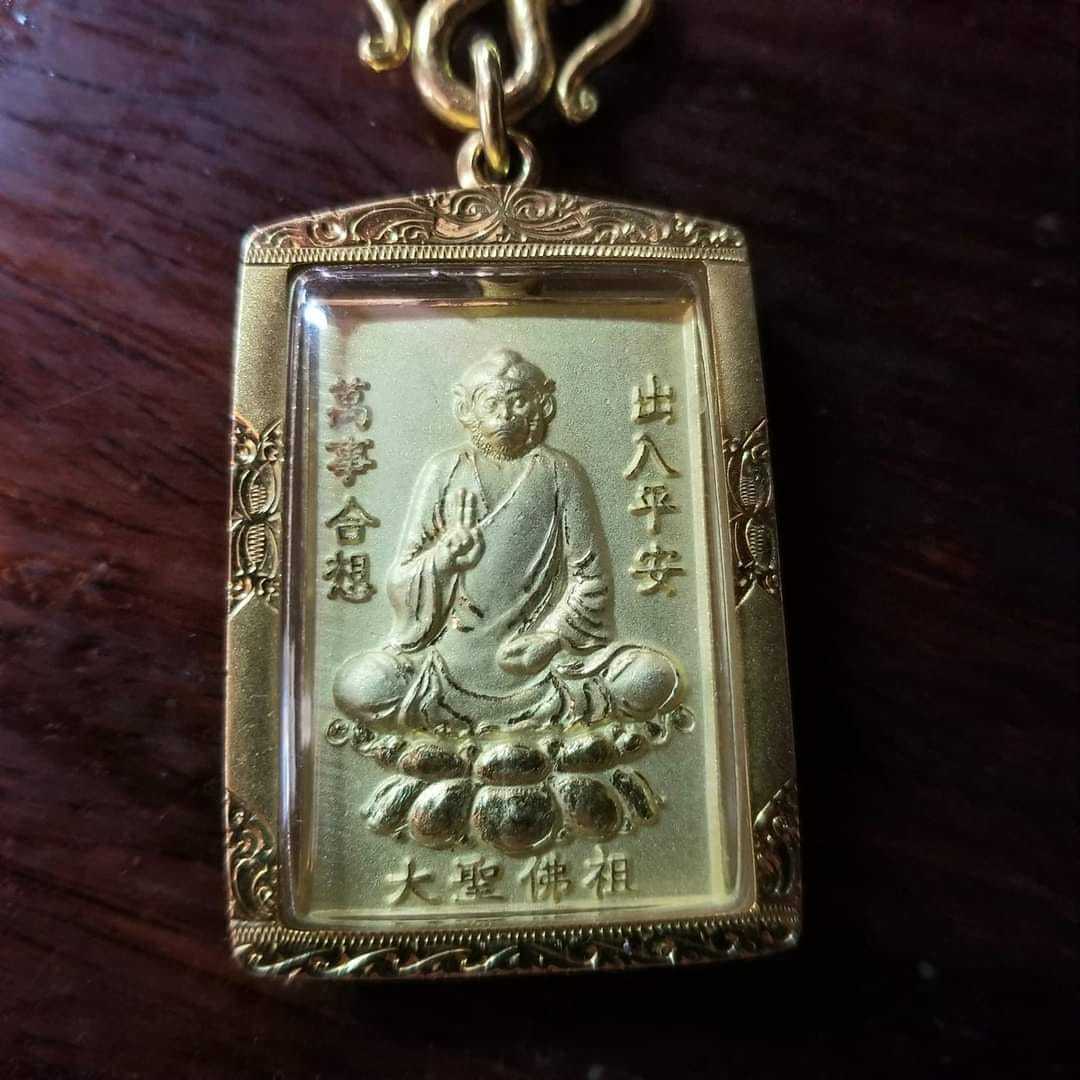
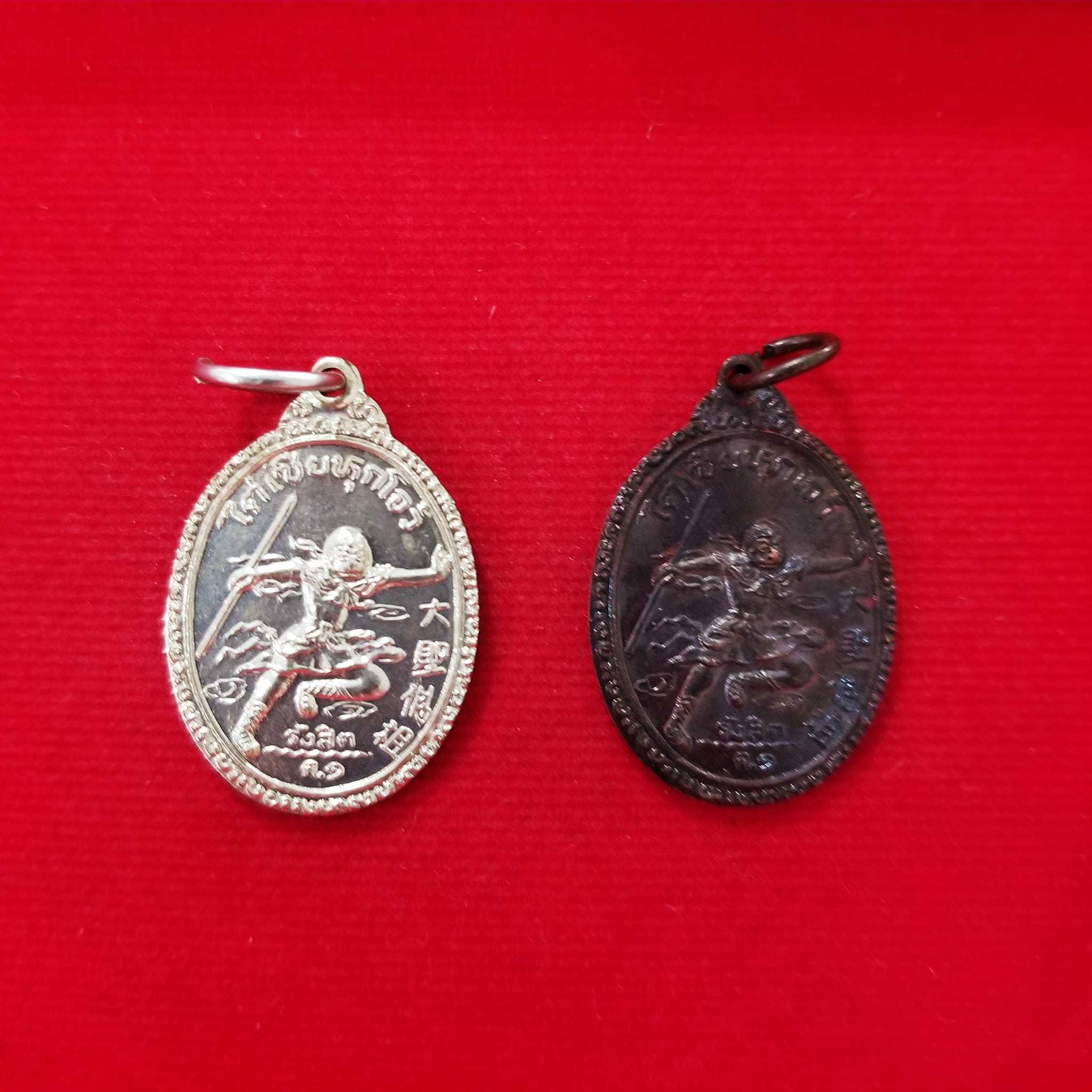
Buddhist amulets (Th: prá krêuuang, พระเครื่อง) are immensely important to Thai devotees. Marcus (2018) explains that they are believed to “endow wearers with supernatural faculties”. He continues: “Some amulets are thought to bring success and happiness. Others are believed to protect the wearer against disease, witchcraft, and misfortune” (Marcus, 2018). It’s no different for worshipers of the Monkey King. I’ve seen countless examples on Facebook ranging from Monkey Buddhas to Monkey warriors. See four examples below (fig. 3-6).

Fig. 3 – An amulet listing him as the “Great Sage Buddha Patriarch” (larger version). Originally posted here. Fig. 4 – A multi-armed Buddha Patriarch (larger version). Originally posted here. Fig. 5 – An armored, flying Buddha Patriarch (larger version). Originally posted here. Fig. 6 – Another armored example (larger version). Originally posted here.

IV. Spirit-Mediumship

Like East and Southeast Asia, Thailand also has Great Sage spirit-mediums (Ch: Jitong, 乩童; Hokkien: Tangki, 童乩; lit: “Divining Child”) (consult the paragraph after figure six here for more information about these ritual specialists). One temple medium seen on the ไปดีมาดี Channel1928 YouTube channel employs white, black, and gold headbands with the aforementioned high curlicue design. The color used appears to depend on which monkey god takes over the medium. I can’t comment on any rituals particular to the Thai religious sphere. But I have seen the medium perform self-mortification in order to create paper talismans (video #2). This is a normal function of spirit-mediums even in East and Southeast Asia. See my twitter post for pictures of a similar Taiwanese ritual.

I’m hoping to gather more information on Thai Great Sage spirit-mediumship in the future.

Video #2 –  HEADPHONE WARNING!!! The Thai Great Sage medium cuts his tongue to create paper talismans.


Update: 04-20-22

I just learned from this webpage that there is a Thai language book about the history of the Monkey King. Here’s the citation:

จรัสศรี จิรภาส. เห้งเจีย (ฉีเทียนต้าเสิ้ง) ลิงในวรรณกรรมที่กลายเป็นเทพเจ้า. กรุงเทพฯ : มติชน, 2547.

Jaratsri Jirapas. Heng Jia (Chi Tian Da Sheng), a Literary Monkey who has become a God. Bangkok: Matichon, 2004.

This online book seller has pictures of the cover (fig. 7) and some of the internal pages.

Fig. 7 – The cover of the Heng Jia book (larger version).

Also, I’ve learned the name and location of a small monkey god temple in Bangkok, Thailand (fig. 8-10 and video #3). It is claimed to be at least 200 years old(!), suggesting that Heng Jia has been worshiped by Chinese-Thai for several centuries:

ศาลเจ้าพ่อเห้งเจีย (Săan-jâo-pôr Hêng-jiia) – “Shrine of Heng Jia”

66 Rama IV Rd, Talat Noi, Samphanthawong, Bangkok 10500, Thailand

+66 2 221 9018

Fig. 8 – The main altar statue, behind which are two gold Monkey Buddha statues with pink masks (larger version). Fig. 9 – The left Monkey Buddha (larger version). Fig. 10 – The right Monkey Buddha (larger version). Pictures by KittyBinny’s Journey on Blockdit.

Video #3 – An episode about the temple on the MY CHANNEL – OFFICIAL YouTube Channel.


Update: 04-21-21

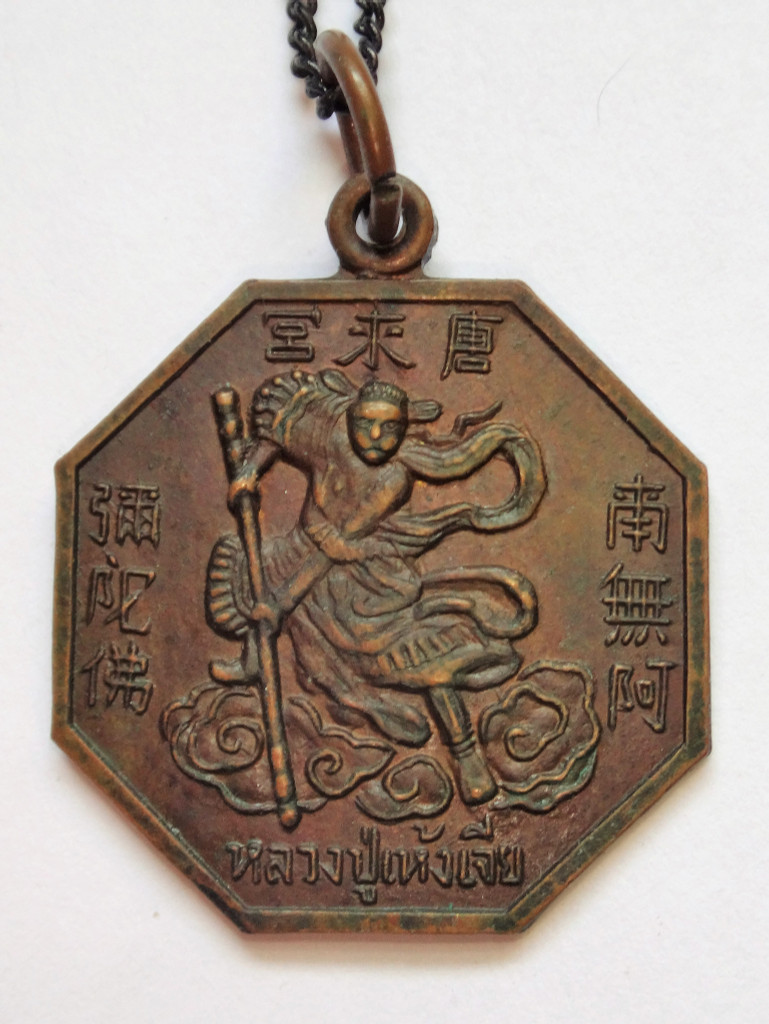
A fellow member of the Taoism Singapore and the Local Gods and their Legends Facebook groups was kind enough to let me post pictures of a Thai Monkey God amulet that he received in San Francisco around the year 2000. The top notes that it’s from the Tanglai Temple (Tanglai gong, 唐來宮), the first two characters being a term used in Journey to the West to indicate that the pilgrims have “come from China” in the east. The characters on the left and right sides combine to read “I submit to the Buddha Amitabha” (Namo Amituofo, 南無阿彌陀佛). The Thai at the bottom reads “Reverend Monk Heng Jia” (lŭuang bpòo hêng-jiia, หลวงปู่เห้งเจีย) (fig. 11). The reverse depicts the eight trigrams encircling a Taiju symbol (fig. 12), indicating that the amulet is Buddho-Daoist.

Fig. 11 – The front of the Monkey God amulet (larger version). Fig. 12 – The backside (larger version). 


Update: 04-22-22

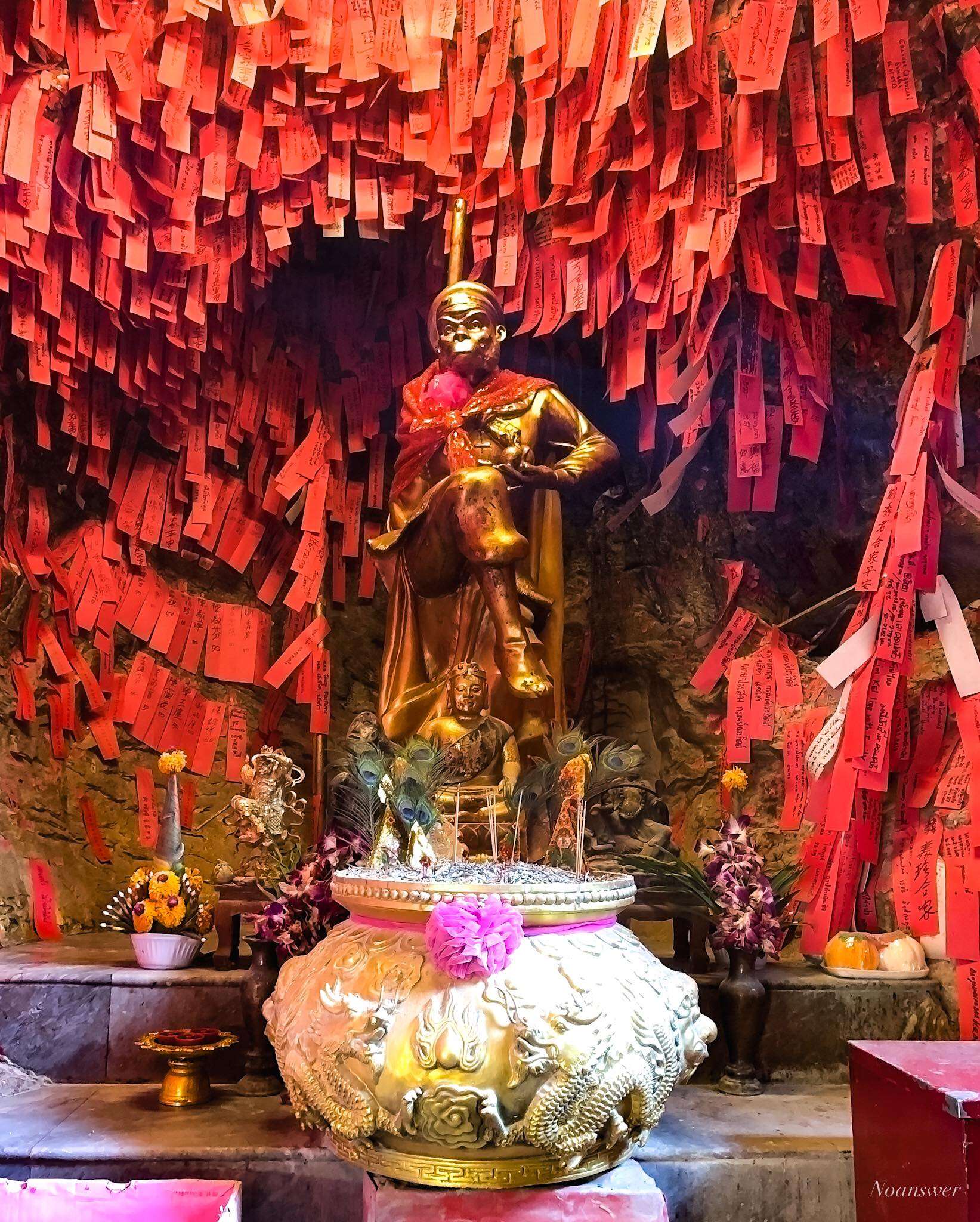
Ellis (2017) mentions a “monument” to Heng Jia in Chao Pho Khao Yai cave (ศาลเจ้าพ่อเขาใหญ่) (p. 86). Mr. Ellis told me in a personal communication that the cave “is on Ko Si Chang island off the coast of Pattaya“. The address is:

5R94+7MM, Tha Thewawong, Ko Sichang District, Chon Buri 20120, Thailand

The small Monkey shrine is located in the interior, and it is surrounded by a forest of red prayer sheets (fig. 13). See here for a video touring the cave. The section featuring Heng Jia starts around minute 3:16.

Munier (1998) notes that this cave is the “only one” dedicated to Monkey in Thailand (p. 170) (see the 09-11-22 update below). A big thank you to Mr. Ellis for providing this information. Please check out his blog.

Fig. 13 – The Heng Jia shrine at Chao Pho Khao Yai cave (larger version). Original photo posted here. See here for a wider shot of the shrine.


Update: 04-23-22

A fellow member of a Monkey King group that I belong to posted this article of seven Thai Heng Jia shrines, including the ones I’ve mentioned above.

https://travel.trueid.net/detail/m0gr288wBPQx

Also, here’s a Thai prayer to Hengjia (video #4). It’s called “Prayer to the Great Sage Buddha Patriarch” (Bòt sùuat mon dtâi sìia húk-jôh, บทสวดมนต์ไต้เสี่ยฮุกโจ้ว), and the video labels it in Chinese as “Scripture of the Great Sage Buddha Patriarch” (Dasheng fozu jing, 大聖佛祖經).

Video #4 – The prayer to Hengjia.

Here’s a transcription of the prayer:

ไต่เสี่ยฮุกโจวเก็ง
ไต่ เสี่ย จู เสี่ยง กิ๋ง
บ่อ เสียง กิก เซี้ยง จูง
ก่วย ขื่อ อี ซิว เจ่ง
หลี่ ไอ่ เถี่ยว สี่ กัง
ซุ้ย ชื้อ สี่ เกียง เอ๋า
เหลี่ยง เมี่ยง จู คุ่ง อู๋
ห่วย ซิง เทียง ตง จู้
ปัก เก๊ก ฉิก อ้วง จูง
หู่ เพียก กั่ง ข่วง อ๋วย
จู๋ ไจ้ อี บ่วง ลุ้ย
เสียง ไจ่ เส็ก เกีย ซือ
อุ่ย เจ่ง กู่ ซวง ส่วย
อั้ว เต้ง กิม อี บุ๋ง
ง่วง ก้วง อี ม้วก สี่
หยู่ สี เก็ง กง เต็ก
คิ่ว ฮุก จิ่ง ซวง เอี้ยง
ไต่ เสี่ย ฮุก โจ้ว เก็ง
ยื่อ ซี้ ฮุก เก่า ไต๋ เจ่ง
เยียก อู๋ เสียง น้ำ สิ่ง นึ่ง ยิ้ง
ม้วย ยิก จี่ ซิม เหนี่ยม เจ็ก กึ้ง
หยู่ จ้วง กิม กัง เก็ง ซา จับ บ่วง กิ้ง
อิ่ว ติก สิ่ง เม้ง เกีย หู
เจ่ง ซิ้ง ที หี
ตี่ หุย ไจ เทียง ตี๋
อู่ นั่ง อ่วย เสี้ย เจ็ก ปึ้ง
อื้อ นั้ง หลิ่ว ท้วง
กง เต็ก เกา หยู่ ซู หนี่ ซัว
ชิม หยู่ ไต่ ไห้
บ่อ เหลียง กง เต็ก
ย่ง สี่ ปุก ตะ ตี่ เง็ก มิ้ง
ฉู่ ฉู่ หลั่ง สั่ว
เทีย ตัก มอ อิ้ง ซา ผ่อ ฮอ


Update: 04-24-22

This page mentions the benefits of worshiping Heng Jia (based on Google Translate):

If anyone worships Lord Tai Sia Huk Zhou, it will make everything smooth, turning bad into good, making it possible to do anything without obstacles. This includes family and friends, doing business, selling progress, keeping anything bad from coming into our lives. The believer must behave well, think positively, and never think ill of others. All blessings will bear fruit. Life will be truly happy and business will progress more and more.

[…]

If worshipers are free from evil and have health, intelligence, tact, and courage, they will be able to always find a solution to their problems. Therefore, [Heng Jia’s faith] is very popular among business operators that need to find a solution to every obstacle and problem.


Update: 05-21-22

A Thai temple is raising funds by selling Monkey King statues in different postures, each with their own benefits (fig. 14-16). Here is a translation by a friend:

1. Clairvoyant posture = worship this for blessing of import/export trading.
2. Success posture = worship this for blessing of wealth.
3. Meditation posture = worship this for blessing of wisdom.

Fig. 14 – The “Clairvoyant posture” (larger version). Fig. 15 – The “Success posture” (larger version). Fig. 16 – The “Meditation posture” (larger version).


Update: 06-07-22

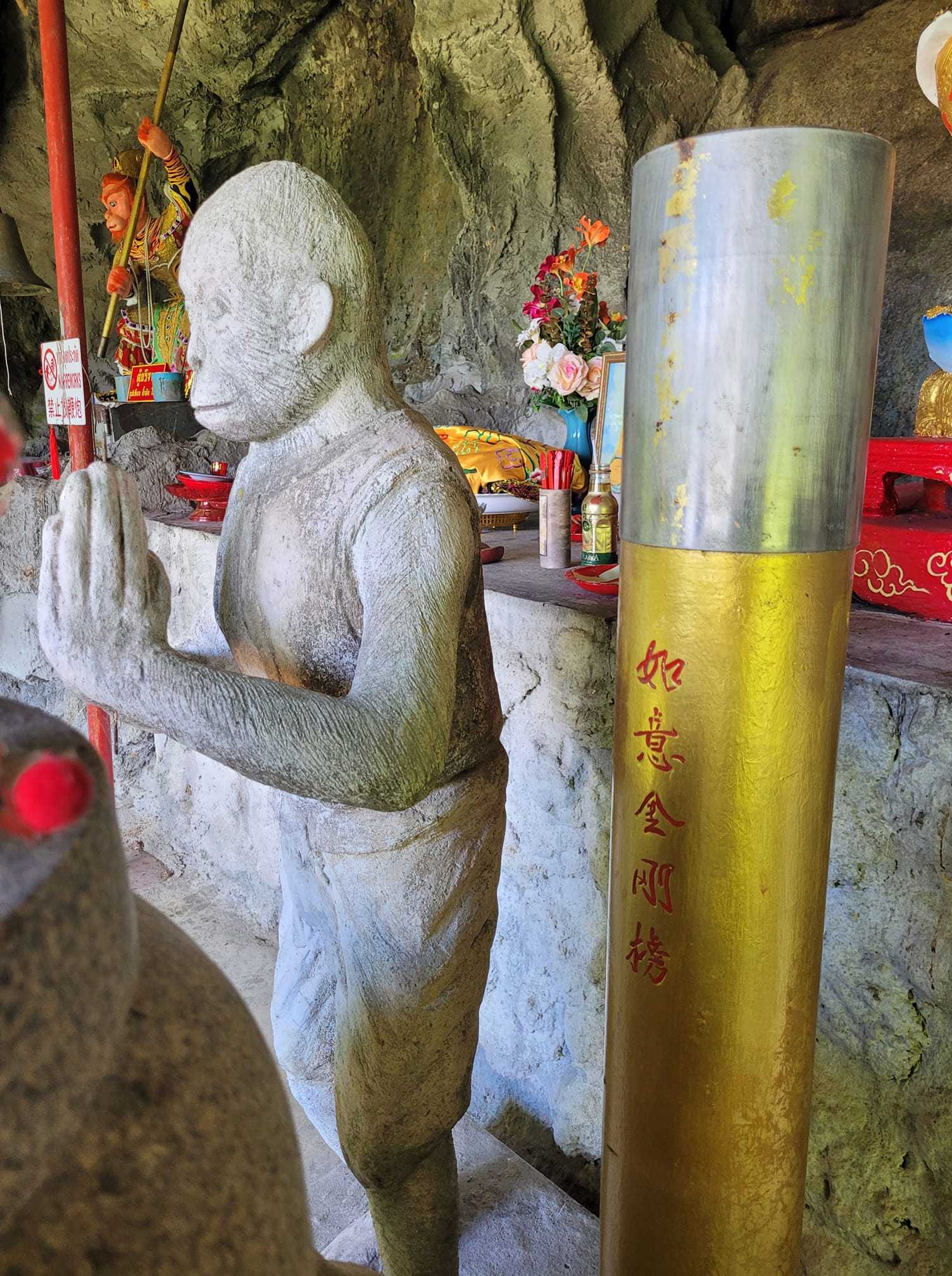
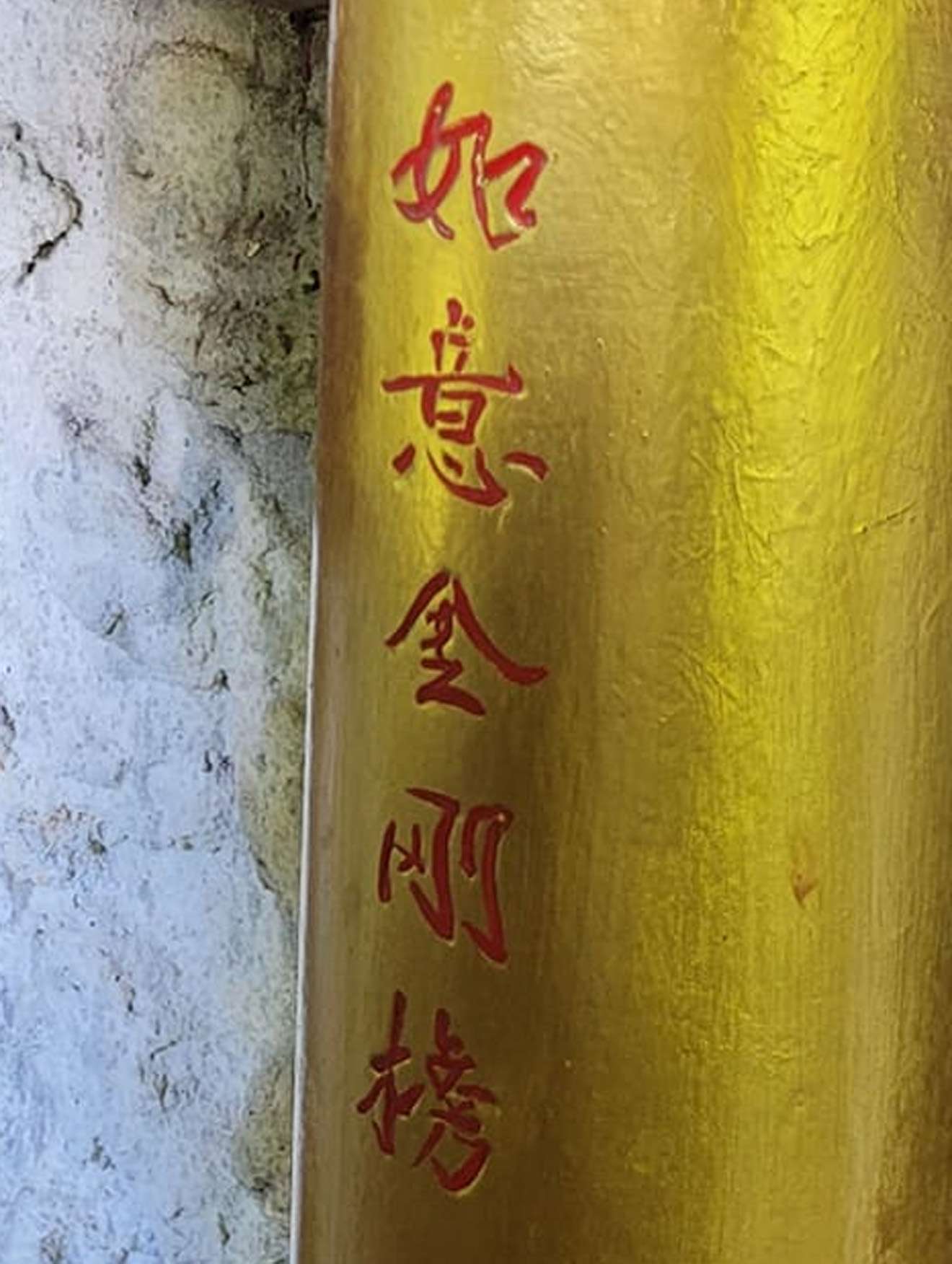
My friend posted a picture of a Thai Great Sage shrine to Facebook. It shows a stone monkey statue, behind which is a large silver and gold staff. Whereas the literary weapon is “如意金箍棒” (Ruyi jingu bang), the “As-you-will Gold-Banded Staff”, the shrine version is labeled “如意金剛榜” (Ruyi jingang bang), “As-you-will Vajra staff” (fig. 17 and 18). [3] The Vajra (jingang, 金剛) is a heavenly weapon closely associated with the Buddhist guardian deity Vajrapāni (Jingang shou pusa, 金剛手菩薩, lit: “The Vajra-Bearing Bodhisattva”) (Buswell & Lopez, 2014, p. 955). Therefore, the name change strengthens Sun Wukong’s association with Buddhism.

Fig. 17 – The Great Sage shrine with a stone monkey statue and the silver and gold staff (larger version). Fig. 18 – Detail of the Chinese characters on the staff (larger version).


Update: 09-03-22

I’ve written an article about a large brass Monkey King statue that I received from Thailand (fig. 19).

My Great Sage Monkey King Statue from Thailand

Fig. 19 – My new Great Sage statue from Thailand (larger version).


Update: 09-05-22

Figures one, nine, and ten above show gilded Monkey King statues with a pink mask over their eyes. I’ve found another variant that covers the entire face (fig. 20). Hints of this appear on my recently acquired Monkey King statue from Thailand. It lacks the color but includes a raised line around the face marking the boundary of said pink patch (fig. 21).

Fig. 20 – The whole face variant of the pink face patch (larger version). Picture originally posted here. Fig. 21 – Detail of my Thai statue indicating the aforementioned patch (larger version).


Update: 09-11-22

Mr. Ellis of the Caves and Caving in Thailand blog (see the 04-22-22 update above) was kind enough to point me to another Heng Jia cave shrine (fig. 22):

It is Tham Thevasathit, which is in the temple complex on top of the hill to the north of Prachaup Khiri Khan town at 11.8153 N 99.7986 E (personal communication).

Fig. 22 – A photo of Heng Jia’s statue in the cave shrine of Tham Thevasathit (larger version). Image courtesy of Mr. Ellis.

Note:

1) See section III of this article for more info on the name “Pilgrim”.

2) Thank you to Irwen Wong for bringing this to my attention.

3) 榜 (bang) should be 棒 (bang).

Source:

Buswell, R. E., & Lopez, D. S. (2014). The Princeton Dictionary of Buddhism. N: Princeton University Press.
Ellis, M. (2017). The Caves of Eastern Thailand. (n.p.): Lulu.com.

Marcus, D. (2018, May 5). Featured Object: Thai Buddhist Amulet. Spurlock Museum of World Cultures Blog. Retrieved April 17, 2022, from https://www.spurlock.illinois.edu/blog/p/featured-object-thai/263.

Munier, C. (1998). Sacred Rocks and Buddhist Caves in Thailand. Thailand: White Lotus.