Note: My blog is not monetized, so I am not making any money from this post. My hope is that the PDF will make this legendary story more accessible to a wider audience. If you enjoyed the digital version, please, please, please support the official release.
The world famous Liaozhai zhiyi (聊齋志異, 1740; a.k.a. “Strange Tales from a Chinese Studio”) is a collection of over 400 narratives serving as a snapshot of late-Ming and early-Qing-era popular stories and culture. This is why story no. 4 of scroll 11, “The Great Sage Equaling Heaven” (Qitian dasheng, 齊天大聖), is important to the study of the Monkey King’s religion as it shows his cult was active in 17th and 18th-century Fujian. It also preserves the condescension that the scholarly class held for certain gods. For example, as Meir Shahar (1996) points out, the author Pu Songling was likely speaking through the main character Xu Sheng (許盛), a young merchant from Shandong, when he states: “Sun Wukong is nothing but a parable invented by [the novelist] Old Qiu [老丘]” (pp. 194). [1] Here, Xu chastises the people of Fujian for worshiping what he considers to be a fictional god. In addition, the story associates the Great Sage with a heavenly sword as opposed to his famous magic staff. I believe that this is related to a 13th-century stone relief carving from Quanzhou.
Below, I have archived the only complete English translation of the tale that I’m aware of. It comes from volume six of Sidney L. Sondergard’s (Pu & Sondergard, 2014) Strange Tales from Liaozhai (pp. 2078-2085). I don’t currently have access to the physical book, so I have isolated the tale from an ebook and converted it into a PDF.
1) This refers to Qiu Chuji (丘處機, 1148–1227), the founder of the Dragon Gate sect of Daoism during the Song Dynasty. Qiu is associated with a travel journal also named Journey to the West, which Pu Songling confused with the novel of the same name (Pu & Sondergard, 2014, p. 2080 n. 1).
Sources:
Shahar, M. (1996). Vernacular Fiction and the Transmission of Gods’ Cults in Later Imperial China. In M. Shahar, & R. P. Weller (Eds.), Unruly Gods: Divinity and Society in China (pp. 184-211). Honolulu: University of Hawaiʻi Press.
Pu, S., & Sondergard, S. L. (2014). Strange Tales from Liaozhai: Vol. 6. Fremont, Calif: Jain Pub.
The Journey to the West Research blog is proud to host an entry by our friend Edward White (his blog). The following is a reformatted and lightly edited version of his brief but insightful analysis of The Great Sage Equaling Heaven’s True Scripture of Awakening People and Enlightening the World (Qitian Dasheng xingren jueshi zhenjing, 齊天大聖醒人覺世眞/真經) posted on Twitter (see here). He was gracious enough to give me permission to post it here. – Jim
Analysis
This book alone is extremely interesting, because it shows the sheer amount of syncretism that is found in Chinese popular religion: It freely combines Buddhist and Daoist elements. The first text in this book is not actually the Great Sage scripture itself, but rather The Thousand-Handed and Thousand-Eyed Bodhisattva Guanshiyin’s Great Compassion Heart Mantra (Qianshou qianyan Guanshiyin pusa dabbixin tuoluoni, 千手千眼觀世音菩薩大悲心陀羅尼), better known as the Great Compassion Mantra (Dabei Zhou, 大悲咒), followed by the celebrated Heart Sutra (Xinjing, 心經), here called by its full name the Prajnaparamita Heart Sutra (Bore boluomi duo xinjing, 般若波羅蜜多心經) (pp. 9-13). Both are quintessentially Buddhist texts. These are, however, followed by a set of mantras for cleansing the body and the surroundings, which are associated with Daoist rites (starting from p. 13).
This is followed again with a “Precious Admonition of the Great Sage Equalling Heaven” (Qitian Dasheng Baogao, 齊天大聖寶誥) (p. 25). This format—effectively a hymn—is a liturgical form that is associated exclusively with Daoist scriptures (Cf. the set phrase 志心皈命禮 on p. 26). [1] Then, you have a list of salutations of four Buddhas and bodhisattvas, and five Heavenly Worthies (Tianzun, 天尊) (Daoist deities), all of which are equally saluted by the Sanskrit “Namo” (南無) (pp. 28-30).
The scripture itself starts on page 30, and has five chapters in total. Chapter one is titled “Cultivating the Body and Rectifying Fate” (Xiushen liming di yi zhang, 修身立命第一章) (p. 30). Chapter two is titled “Entering Sagacity and Transcending Ordinariness” (Ru sheng chaofan di er zhang, 入聖超凡第二章) (p. 33). Chapter three is titled “Returning to the Origin of Brilliance and Kindness” (Mingshan fu chu di san zhang, 明善復初第三章) (p. 40). What is interesting in this text, however, is that between chapters two and three, there is a lengthy section titled “True Words of the Great Sage Equalling Heaven” (Qitian Dasheng zhenyan, 齊天大聖眞言) (p. 36). [2] This is absent in the online edition. Chapter 4 is titled “Cause, Effect, and Retribution” (Yinguo baoying di si zhang, 因果報應第四章) (p. 44). The fifth and final chapter is titled “Cultivating Both Internally and Externally” (Neiwai shuangxiu di wu zhang, 內外雙修第五章) (p. 52). In this particular edition of the Great Sage Scripture, between chapters four and five are found a long list of evils that reciting this scripture can resolve (this is also not found on the online edition) (pp. 48-52). Our Daoist readers may find this similar to a list found in the very, very Daoist “Big Dipper Scripture” (Beidou jing, 北斗經), which I translate here.
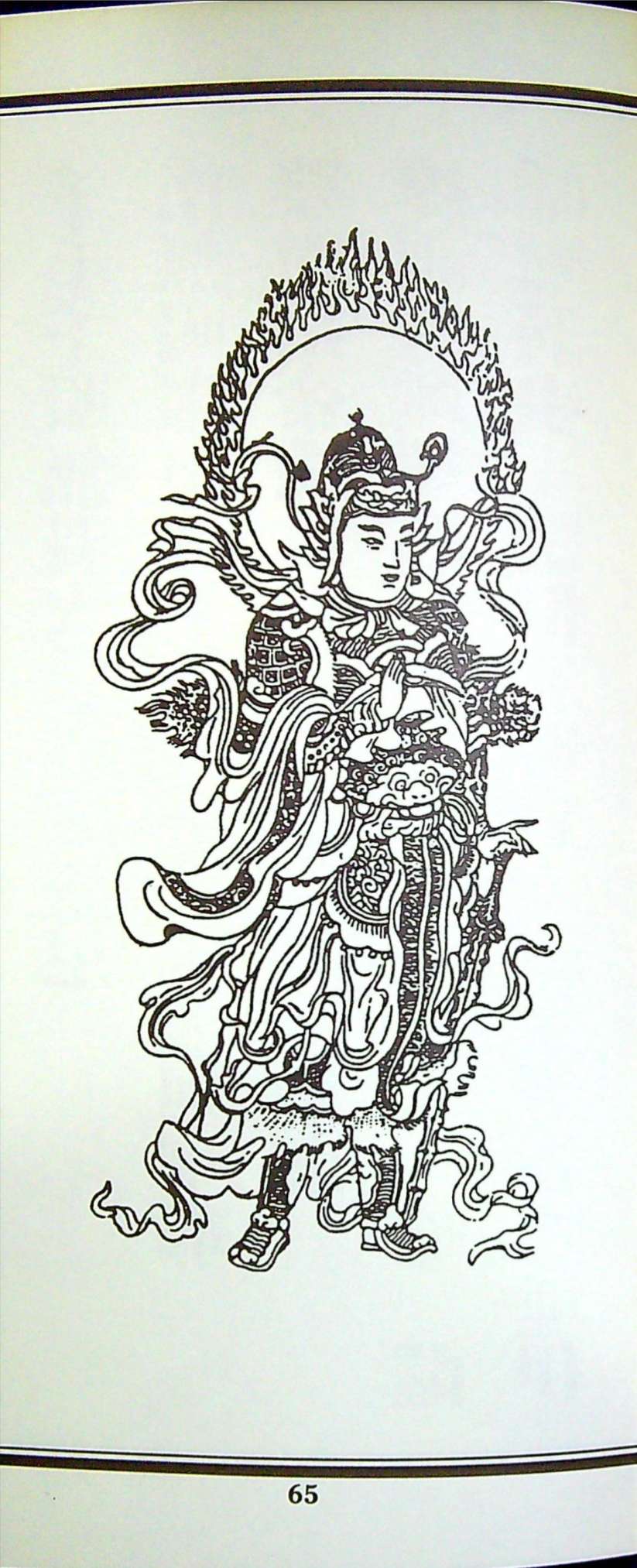
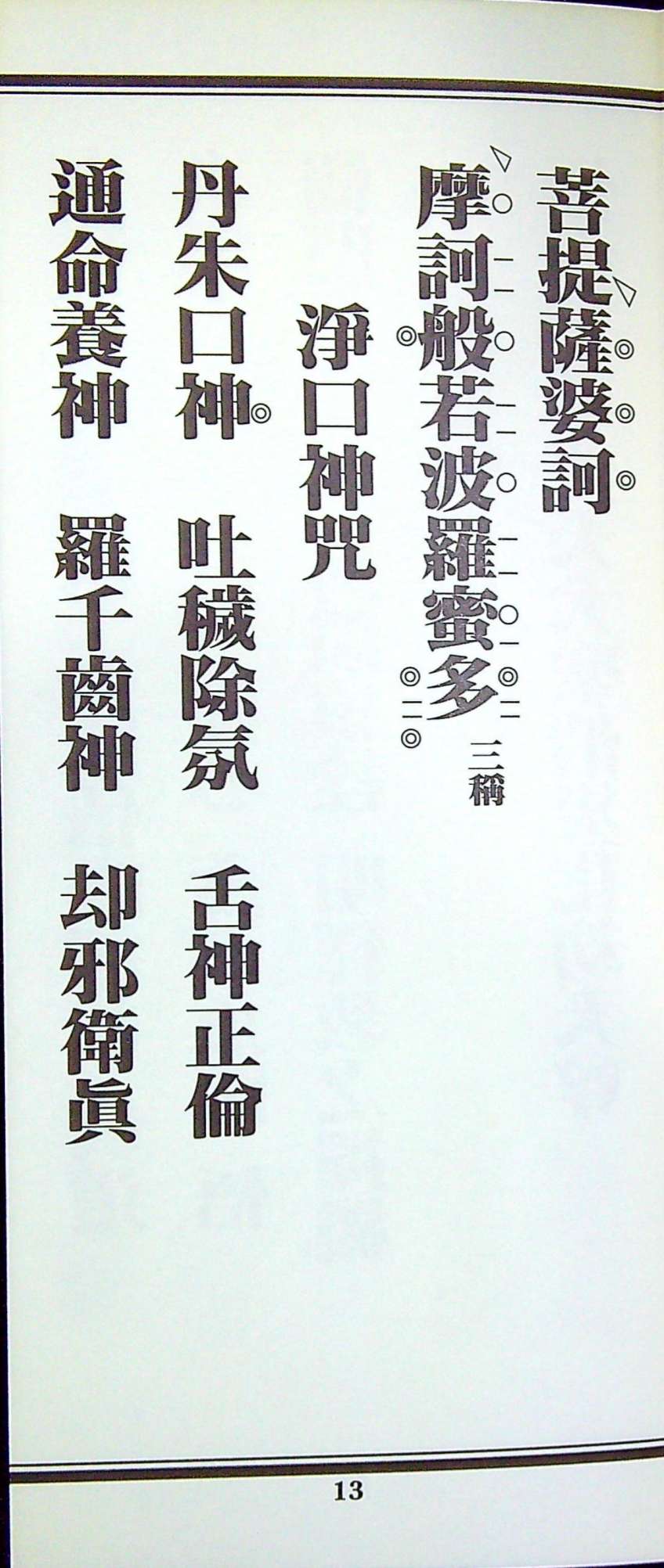
Fig. 1 – Weituo standing guard at the end of the scripture (larger version). Fig. 2 – Examples of percussion marks (larger version).
The text ends with a hymn called “In Praise of the Great Sage Equalling Heaven” (Qitian Dasheng zan, 齊天大聖讚) (p. 56), followed by a text called “The Essentials of Cultivating the Dao” (Xiudao shouyao pian, 修道首要篇) (p. 57). This is immediately followed by the “Mantra of the Seven Buddhas to Extinguish Offences” (Qi fo miezui zhenyan, 七佛滅罪眞言) (p. 59). Syncretism indeed. On the last page we have a picture of the Buddhist god Weituo (韋馱) (fig. 1), who stands guard on the last page of scriptures to protect them (p. 65). Thus we have an extremely Daoist text literally bookended by Buddhism.
We are hence immensely grateful to Jim for uploading scans of this scripture. As even from this preliminary reading shows, it preserves liturgical texts that are not found in online editions of the scripture. The online presence of non-Buddhist Chinese religious works is extremely poor and patchy; we have nothing like the Taisho Tripitaka to work on; every scripture uploaded advances our knowledge greatly. By observing not just the scripture itself, but also its front and back matter that is printed along with it, we can tell how the scripture was used by the religious communities that produced it—something again that gets lost in transmission.
Some words should be said about the format of the book. The book is clearly bound in what is called in the west the “Concertina format”. This format is unique to religious books, thereby increasing its authenticity as a holy work. But also more importantly, makes the book very easy to use in a liturgical context: it lays absolutely flat, and is easy to turn—valuable features if you are chanting off the scripture. In turn, on some pages, you see little dashes and dots besides the characters (fig. 2) (p. 13, for example). These are indications of the percussion—when the various gongs and bells are to be struck. These factors—along with the inclusion of several hymns inserted between chapters of the scripture—would lead me to conclude that this book represents not just a scripture to be contemplated, but a scripture prepared for public performance as a ritual (refer back to “True Words of the Great Sage Equalling Heaven” between ch. 2 and 3). The appended mantras, percussion, and inserted hymns, would only make sense in a context where people would chant the scripture in a grand ceremony: they would be irrelevant if the text was produced with quiet study and contemplation in mind. I could be wrong, though.
Notes:
1) For a Chinese example of another “Precious Admonition”, see here. My translation of another can be seen here.
2) “True Words” 真言 is one of the names by which mantras are known in Chinese. Thus, the term “True Words of the Great Sage” might just as well be read as “Mantra of the Great Sage”.