The Journey to the West Research blog is proud to host an entry by our friend Monkey Ruler (Twitter and Tumblr). They have graciously written an essay on the global nature of Journey to the West adaptations, as well as provided a link to their ongoing project recording JTTW media (fig. 1). As of the publishing of this article, it includes a long list of almost 570 movies, 90 TV shows, and 160 video games! – Jim
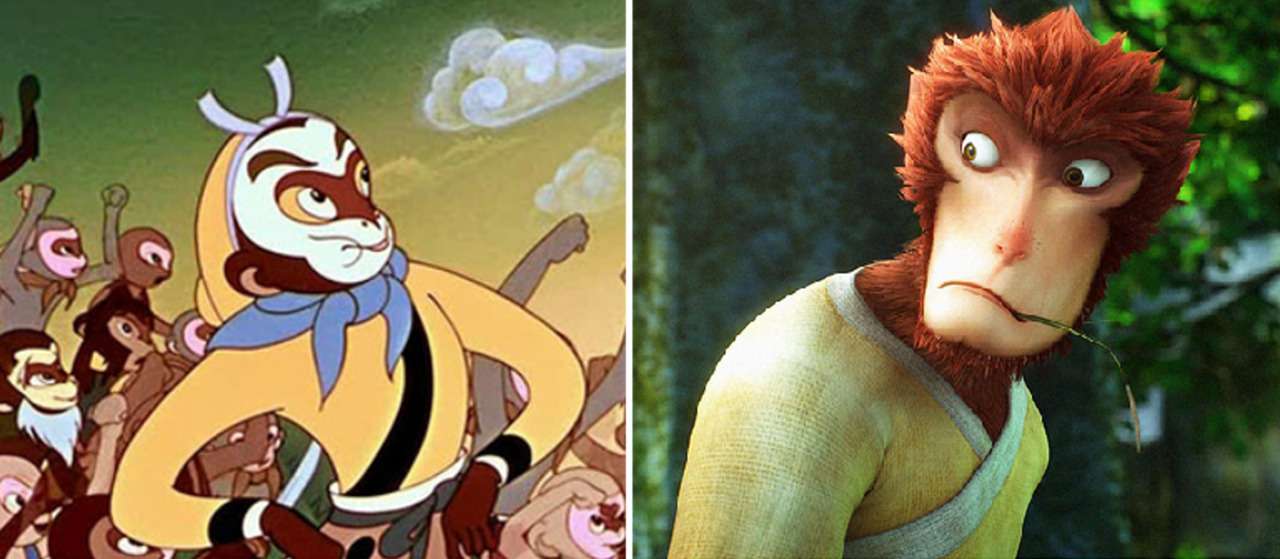
Fig. 1 – Depictions of Sun Wukong from adaptations produced over 50 years apart: (left) Havoc in Heaven (Danao tiangong, 大鬧天宮, 1961) and (right) Monkey King: Hero is Back (Xiyouji zhi Dasheng guilai, 西遊記之大聖歸來, lit: “Journey to the West: Return of the Great Sage,” 2015) (larger version). Courtesy of Monkey Ruler.
I. Media adaptations
This started out as a collection of Xiyouji (西遊記; lit: “Journey to the West,” 1592) movies and TV shows for the sake of a Master’s class project; it was simple enough to look for Xiyouji media and start adding them to a collection datasheet. But even when the project was over, I kept finding more and more adaptations, even stumbling across others trying to show the magnitude of how much this novel has encompassed popular culture throughout the centuries. It has been told and re-told again and again in oral and published literature, plays, art, songs, poems, etc., and now on the big and small screens. Audiences are re-introduced to the image of Sun Wukong and his fellow pilgrims with every new media addition.
What really inspired me was the book Transforming Monkey: Adaptations and Representation of a Chinese Epic(2018) by Hongmei Sun, where she explained in depth the cultural impact that Sun Wukong (fig. 2) and Xiyouji has had on Chinese media, as well as how this loose set of franchises have come to represent Chinese culture as these shows and movies have become more globally accessible. Xiyouji is such an iconic cultural universe that it can be both heavily entertaining while still being so personal to audiences of any generation depending on how the artist/writer portrays their interpretation of these characters and their stories.
There hasn’t been a lot written about how these interpretations influence modern Xiyouji adaptations despite how the story has greatly influenced popular culture.
Fig. 2 – The front cover of Transforming Monkey (2018) (larger version).
Xiyouji is such an influential story, one that will continue to grow more and more globally known throughout time because it is such an all-encompassing piece that can cover politics, identities, and allegories, while still being a very personal and interpersonal work that artists or writers can relate to.
However, even with these layers of meaning and symbolism to be found, the story never loses the charming and entertaining aspects that can and have captured audiences. Despite being published over 430 years ago (with a history stretching back even further), Xiyouji is still able to relate to modern audiences through its allegories of oppression, rebellion, and self-identity. It has the capability to resonate with any generation depending on what artists or writers at the time wish to highlight or personally connect with themselves or their current world around them, using Xiyouji as a medium for their own struggles.
As Xiyouji starts to become more and more globally known, it is important to understand and resonate that this is still a Chinese story and how to address further adaptations with cross-nation gaps in both translation and cultural differences. There are media forms that are far more exploitative of the mythical journey, creating impractical scenarios of the narrative and thus changing the message of the story and characters completely. However, there needs to be an acknowledgment of what doesn’t work as Xiyouji adaptations due to the ever-changing zeitgeist in not only its home of origin but introducing it to a global sphere as it adds influence.
In order to see what works for adaptations, there needs to be an acknowledgment of what is the core of the story and just why it remains popular, story-beat or character-wise. For example, Sun Wukong can be used as a great model for positive ambivalence in media, moving away from set limits of a single stereotype and rather being a constant motion of new ideas and new identities. Monkey has been changed from a mischievous monkey to a revolutionary hero to a post-modern rebel against authority throughout the years. But even throughout the constant changes and interpretations, people never lose sight of what the nature of Sun Wukong is: rebelliousness, variability, optimism, and persistence.
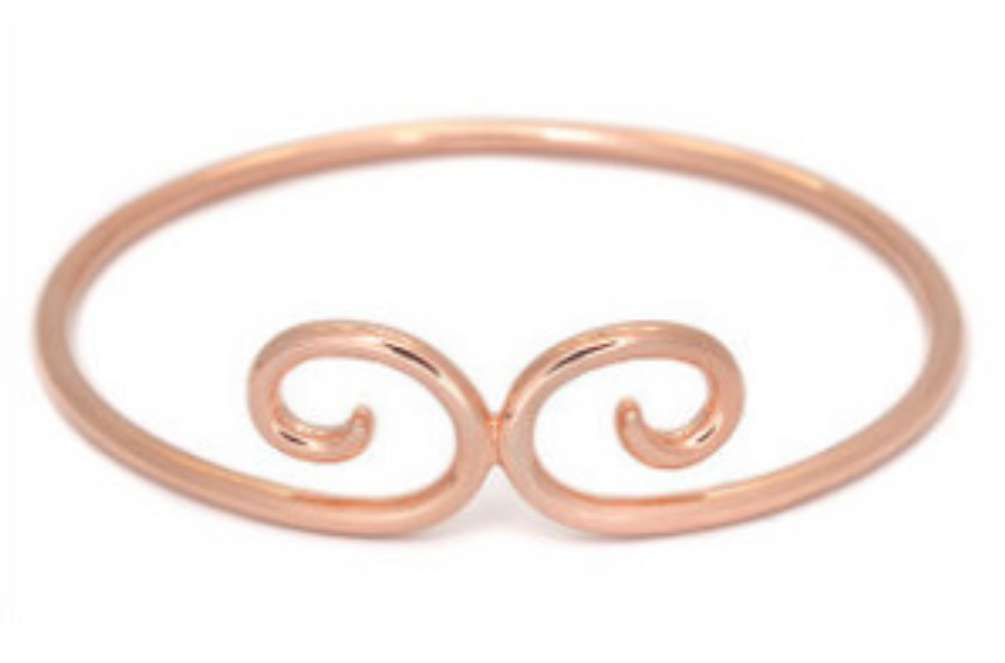
Monkey is a transcending character as he is able to mediate contradictions within his own design, one being his gold-banded staff, a symbol of breaking barriers, and his golden filet (fig. 3), a symbol of limits. These two simple but prominent pieces of iconography immediately tell audiences who the character is supposed to be and what they are about.
Fig. 3 – A modern replica of Monkey’s golden filet or headband (larger version).
While it is entertaining and able to be enjoyed by younger audiences, Xiyouji still has a deeper meaning that can be interpreted and recognized into adulthood. This is one of the few stories that I imagine can be adapted again and again without the issue of overlap as there are so many ways people can personally connect with these characters.
Having that any generation, anyone really can find enjoyment in this media, and perhaps even be inspired to read the novel itself.
II. Archive link
Please consult the tabs at the bottom of the spreadsheet linked below. They are listed as “Movie Information,” “Movie Links,” “Honorary Shows,” “Game Information,” “Game Pictures,” “Honorary Games,” and “Sources.” – Jim
Monkey Ruler has officially posted a website called “Journey to the West Media.” They continue to update the page with movies, tv shows, video games, and now comic books.
Ever since I published my article “The Monkey King’s Children” (2021), I’ve noticed that people have fallen in love with Sun Wukong’s monstrous, magic skull-wielding daughter Yuebei xing (月孛星, “Moon Comet Star”) from Journey to the South (Nanyouji, 南遊記, c. 1570s-1580s, “JTTS” hereafter). For instance, search Tumblr and you will find plenty of art and short stories featuring her. The character does not appear in the original Journey to the West (Xiyouji, 西遊記, 1592) novel, so I’m honestly surprised that she has captured the imagination of so many.
Here, I would like to collect all that I’ve written about her, along with new information, into a single article. This piece discusses her brief character arc, her astrological origins, her appearance in other literature, and her religious iconography.
In chapter 17 of JTTS, Sun Wukong is framed for once again stealing immortal peaches. The Jade Emperor threatens to remand him to the Buddha for punishment but is convinced to give him a month-long reprieve to find the true culprit. Monkey returns to the Mountain of Flowers and Fruit, and it is here, among his people, that the story briefly mentions three children, including sons Jidu (奇都, “Ketu”) and Luohou (羅猴, “Rahu”) and daughter Yuebei xing (月孛星, “Moon Comet Star”).
Sun eventually seeks out Guanyin, who reveals that the troublemaker is the rogue immortal Huaguang (華光). Returning home once more, Monkey’s news prompts his daughter to volunteer to battle the impostor. But her tribe simply pokes fun at her monstrous appearance. Yuebei Xing is said to have a crooked head with huge eyes and a broad mouth, coarse hands, a wide waist, and long legs with thunderous steps.
Sun travels with his daughter to Huaguang’s home of Mt. Lilou (Lilou shan, 離婁山) to provoke battle by chastising him for stealing the immortal peaches. Monkey strikes at him with his magic staff, causing Huaguang to deploy his heavenly treasure, a golden, triangular brick (sanjiao jinzhuan, 三角金磚). But Sun responds by creating untold monkey clones that not only confiscate the weapon but also overwhelm the immortal. Huaguang is seemingly defeated at this point; however, he manages to deploy one last treasure, the Fire Elixir (Huodan, 火丹). This weapon engulfs the Great Sage in heavenly flame (akin to the Red Boy episode), causing him to flee to the Eastern Sea. Yuebei xing then calls Huaguang’s name while holding her own magic treasure, a skull (kulou tou, 骷髏頭). The immortal is immediately stricken with a headache and stumbles back to his cave in a daze. Her weapon is said to be quite dangerous: anyone whose name is called will die within three days.
Huanguang’s religious teacher, the Flame King Buddha of Light (Huoyan wang guangfo, 火炎王光佛), then intervenes in order to sooth the situation between his disciple and the Great Sage. He promises to bring the rogue immortal to justice on the condition that Yuebei Xing withdraws her deadly magic. In the end, all parties are pardoned by the Jade Emperor, and Huaguang and Monkey become bond brothers (Yu, n.d.).
2. Astrological Origins
The Monkey King’s daughter is based on Yuebei xing, a shadowy planetary deity representing the lunar apogee, or the furthest point in the moon’s orbit. They are counted among the “Eleven Luminaries” (Shiyi yao, 十一曜) of East Asian astrology (fig. 1). These include the “Nine Planets” (Sk: Navagraha; Ch: Jiuyao, 九曜, “Nine Luminaries”) of Hindu astrology, namely the Sun, Moon, Mars, Mercury, Jupiter, Venus, Saturn, and Rahu and Ketu (Gansten, 2009), as well as Yuebei and another shadowy planet called Ziqi (紫氣/紫炁; “Purple Mist”) (Kotyk, 2017, p. 60). The latter two are mentioned in Daoist writings as early as the late-9th century (Kotyk, 2017, pp. 61-62).
Fig. 1 – A Chinese depiction of the Eleven Luminaries from the Ink Treasure of Wu Daozi (Daozi mobao, 道子墨寶, c. 13th century) (larger version). Yuebei xing is located first from the left on the top row. Image found here.
The late-Yuan to early-Ming scripture Secret Practice of the Primordial Lord Yuebei (Yuanhuang Yuebei mifa, 元皇月孛祕法; Secret Practice hereafter) describes them having two forms, one human and the other monstrous:
Surnamed Zhu [Vermillion] with the honorific title of Guang [Luminous]. In the form of a celestial human, their hair is let down over their naked body. Their mass of black hair covers the navel. Red sandals. Their left hand holds the head of a drought demon. Their right hand holds a blade. They ride a jade dragon. In their modified form, [they display] a blue face with long fangs, a crimson garment and blade, while driving a bear (Kotyk, 2017, p. 62).
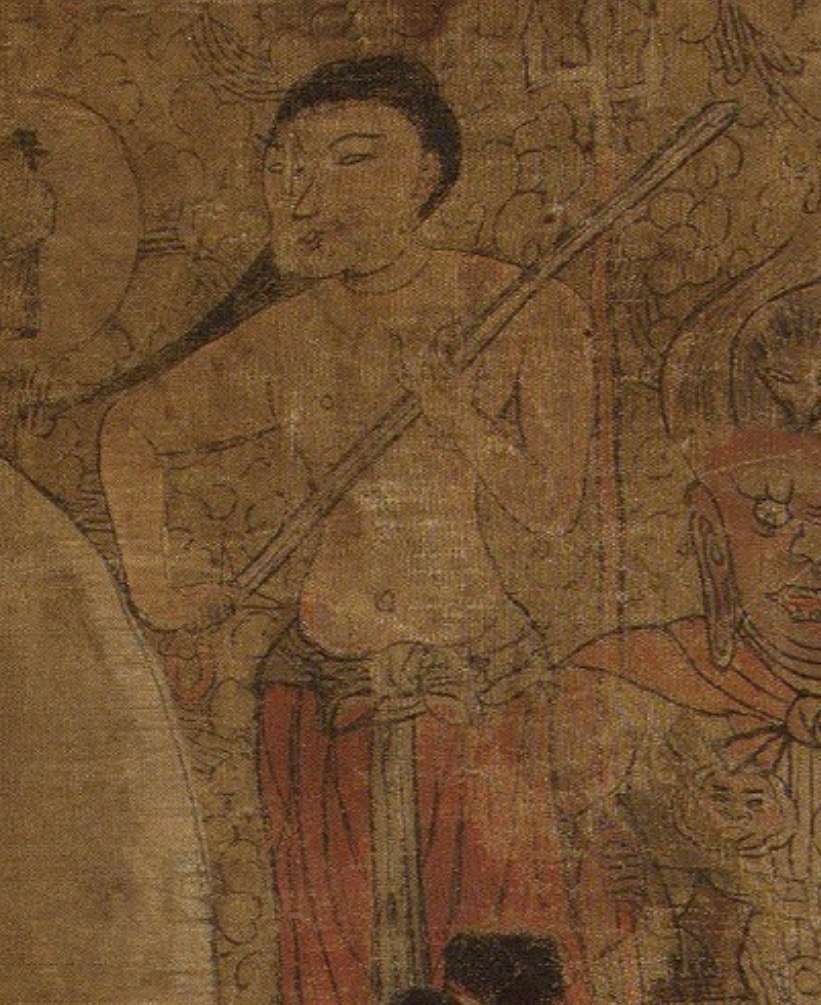
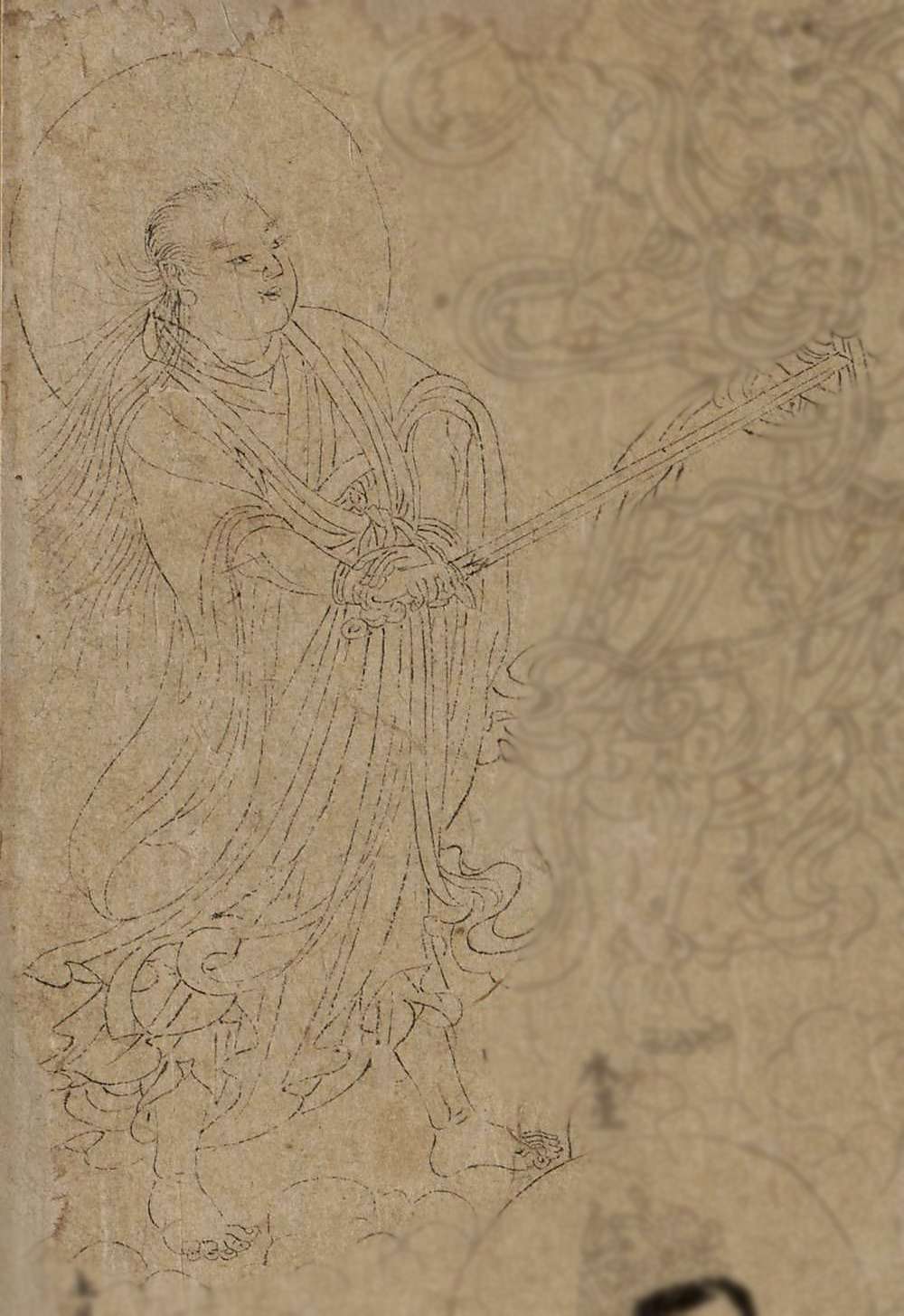
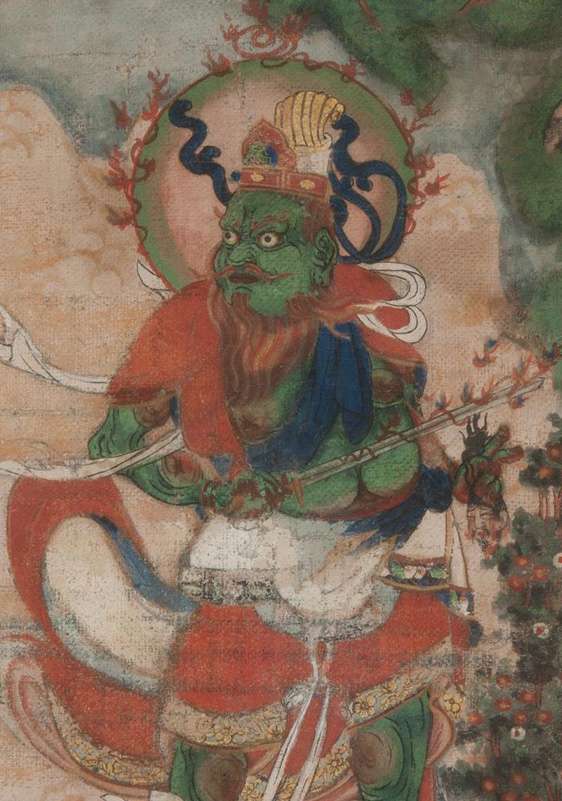
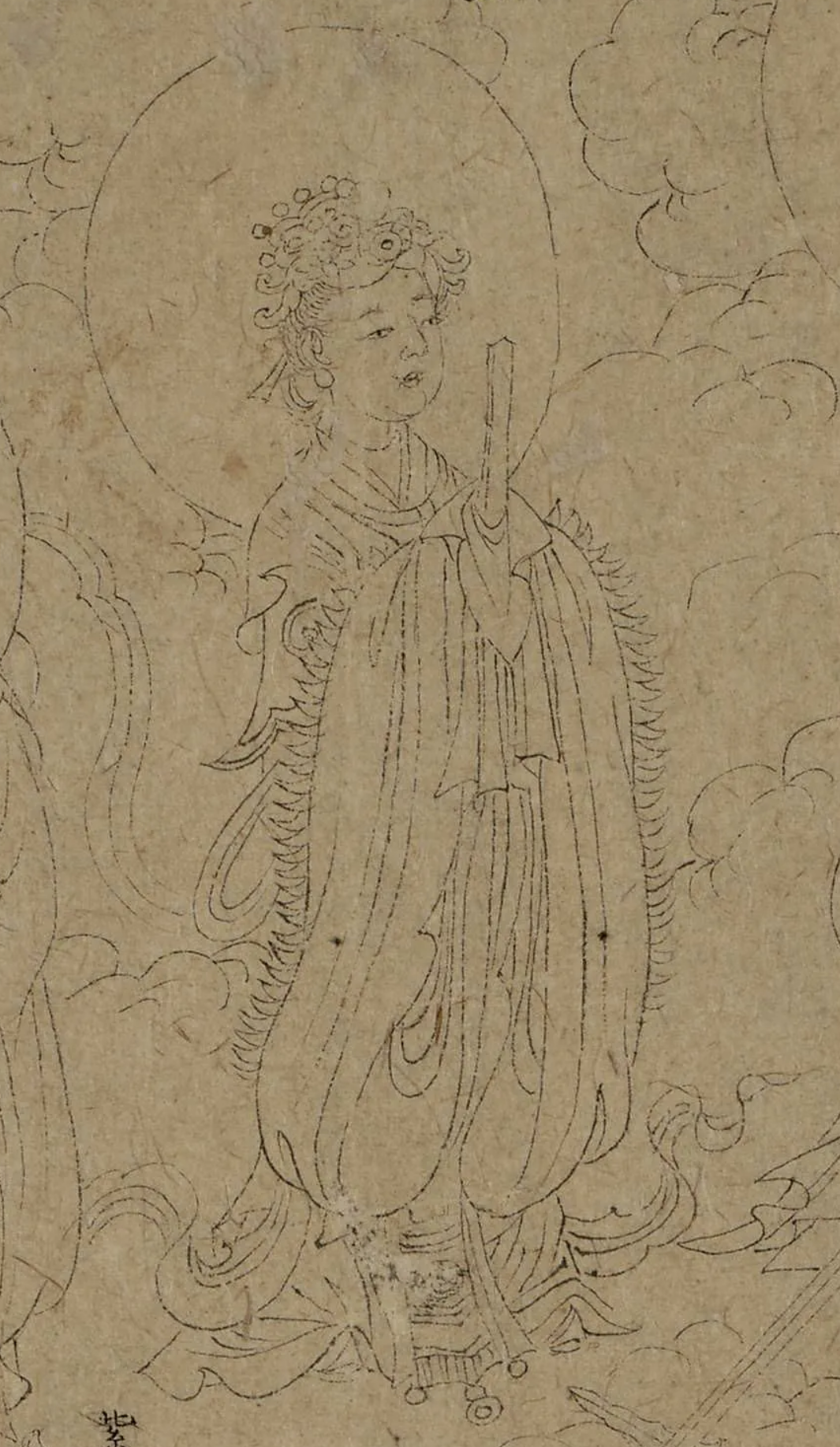
Both versions are known from late-Xixia dynasty (1038–1227) art. The first figure takes the form of a lightly clad or even topless woman with long, sometimes unkempt hair and red garments. One painting shows her with a bloody head in her right hand and a sword hanging from her hip (fig. 2). (Though, I should point out that she isn’t always depicted with the head in Xixia or Chinese art (fig. 3 & 4).) The second figure is much rarer and takes the form of a yaksha-like guardian with green skin, a fiery red beard and hair, and red garments. He wields a flaming sword in his right hand and a bloody head in the other (fig. 5). Thank you to Dr. Jeffrey Kotyk for bringing these to my attention.
Fig. 2 – Yuebei as a woman (larger version). Take note of the severed head in her right hand and the sword at her waist. Detail from a 13th to 14th-century Xixia painting in the Hermitage Museum. Fig. 3 – A topless Yuebei wielding only a sword (larger version). Detail from a 13th to 14th-century Xixia painting in the Hermitage Museum. Fig. 4 – Detail of Yuebei from the Chinese Ink Treasure of Wu Daozi (c. 13th century) (larger version). She too is holding only a sword. Take note of her lunar halo. Fig. 5 – Yuebei as a man (larger version). He clutches a small head in his left hand. Detail from a 13th-century Xixia painting in the Hermitage Museum.
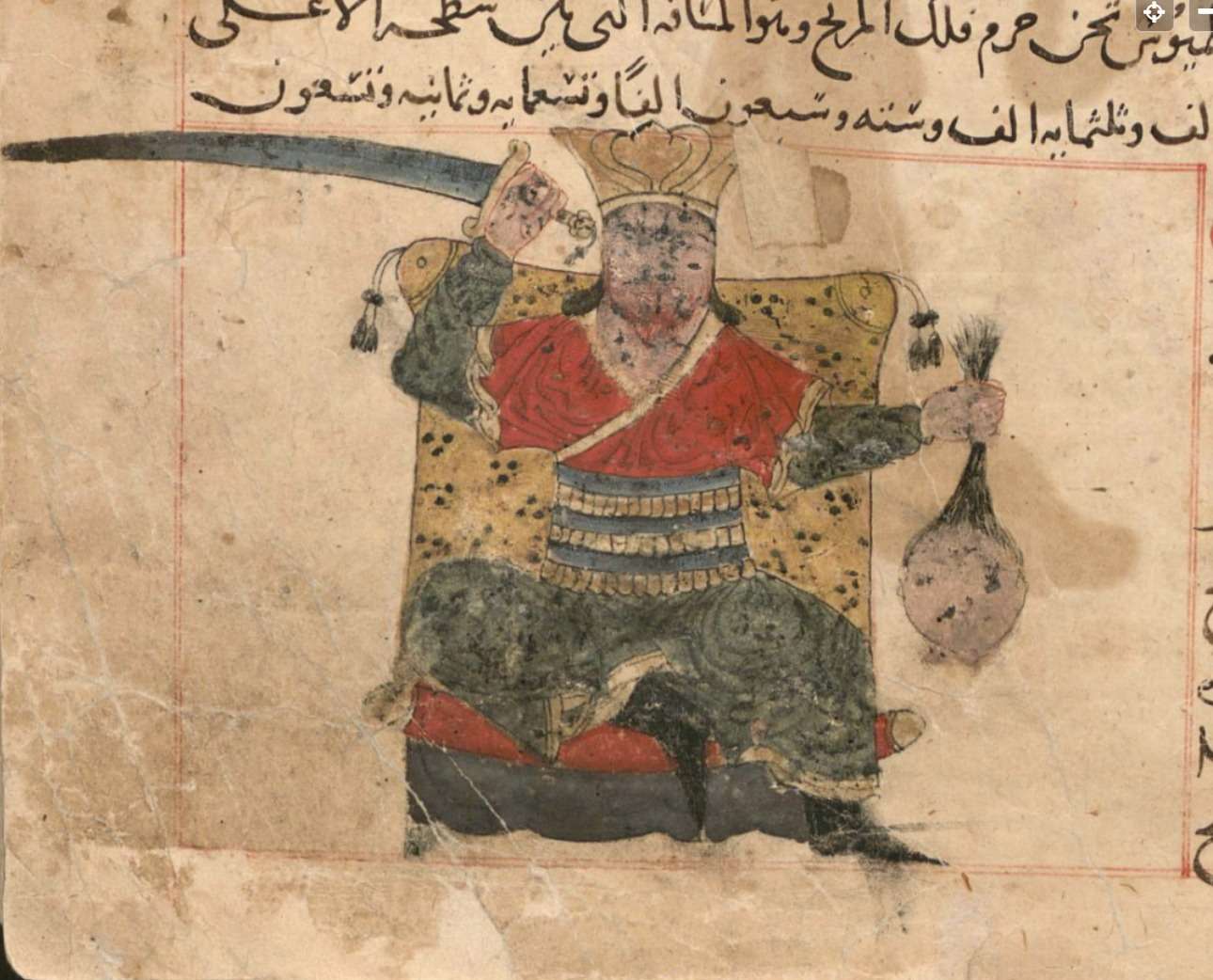
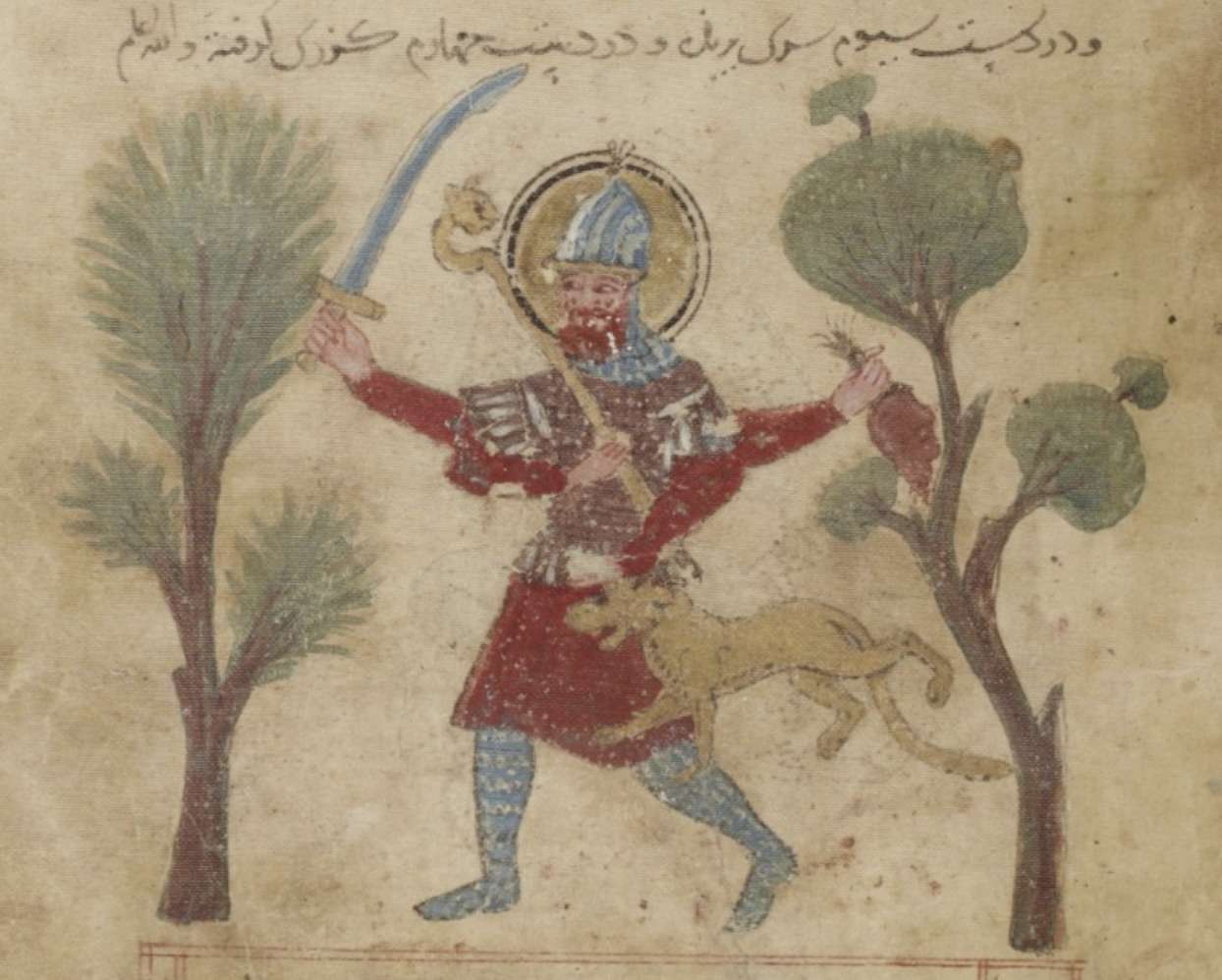
What’s interesting about the yaksha-male Yuebei is that his iconography is strikingly similar to Arabo-Persian depictions of al-Mirrīkh (Mars), who is also known for wielding a sword and head. Dr. Kotyk has directed me to several examples (fig. 6-8). Carboni (Carboni & MET, 1997) suggests that the war god’s imagery is connected to another deity:
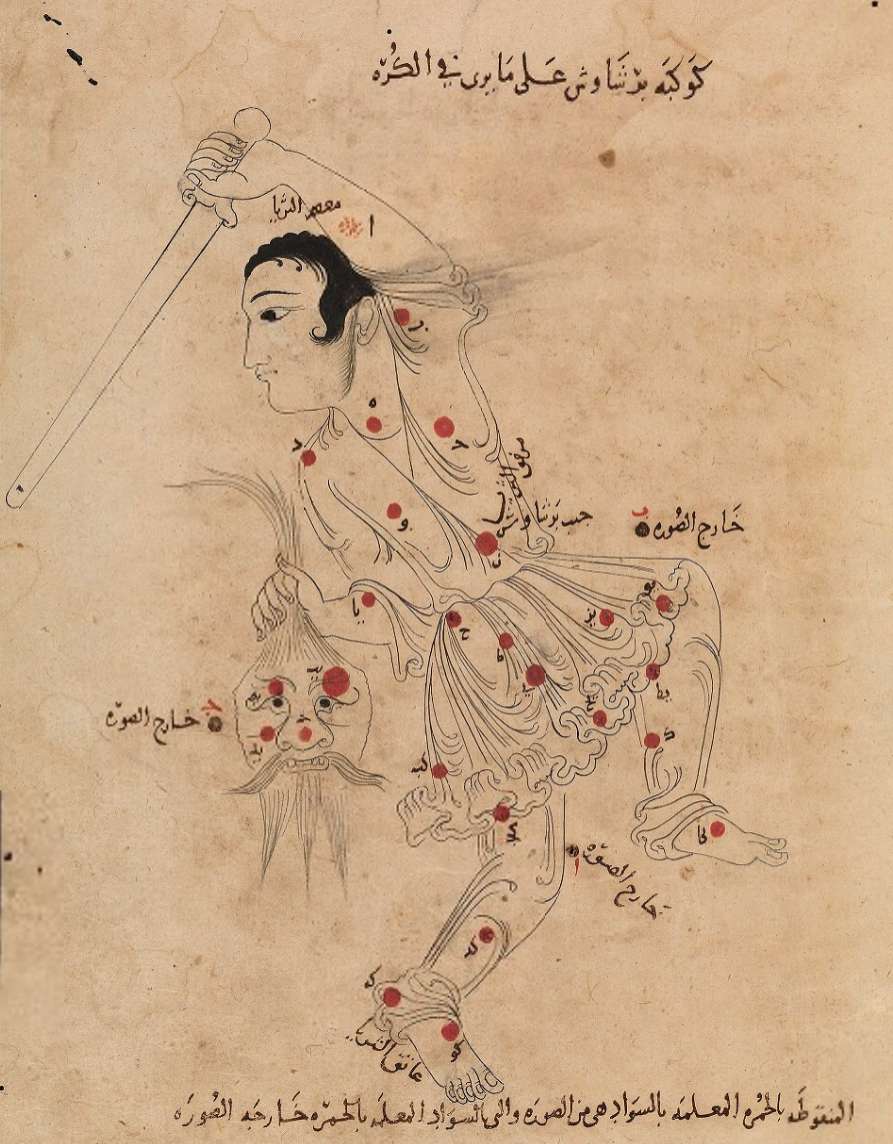
The bold iconography of the severed head underscores the warlike character of the planet but it probably is also related to the astronomical image of the constellation of Perseus, called in Arabic ḥāmil ra’s al-ghūl (“the Bearer of the Demon’s Head”), which represents a transformation of the Greek iconography of the severed head of Medusa [fig. 9] (p. 17).
The literary Yuebei’s use of a deadly skull is fitting considering its possible link to the beheaded Gorgon. [1] Remember that the Secret Practice describes Yuebei’s symbol as that of a “drought demon’s head” (batou, 魃頭), and Arabic sources call Perseus’ symbol the “demon’s head” (ra’s al-ghūl). This shows that both cultures considered the head some kind of supernatural monster.
(See the 01-16-23 update below for a headcanon mixing Yuebei’s skull with Medusa.)
Fig. 6 – Detail of al-Mirrīkh (Mars) on a late-12th to early-13th century bowl from Central or Northern Iran (larger version). From the Met Museum website. Fig. 7 – Detail from The Wonders of Creation (‘Aja’ib al-Makhluqat wa Ghara’ib al-Mawjudat, 13th century) (larger version). Found on the Library of Congress website. Fig. 8 – Detail from the Degrees of Truths (Daqa’iq al-haqa’iq, 1272) (larger version). Found on the Bibliothèque nationale de France website. Fig. 9 – The Perseus constellation from the early-11th-century Book of Pictures of the (fixed) Stars (Kitāb Ṣuwar al-kawākib (al-thābitah) (larger version). Found on the Bodleian Library website.
Dr. Kotyk tells me that East Asian depictions of Mars do not show him holding a head. But given the similar iconography of the Arabo-Persian deity and the yaksha-male Yuebei xing, there could be a South Asian intermediary. Bhattacharyya (1958) describes the Indian Buddhist iconography of Maṅgala (Mars) in similar terms: “[He] rides on a Goat. He is red in colour. In the right hand he holds the Kaṭṭāra (cutter) and in the left a severed human head in the act of devouring” (p. 368). But I don’t know how established this description is considering that a cursory search doesn’t turn up any ancient depictions of the Hindo-Buddhist deity holding a head (I’ll update the article if new evidence arises). Another possibility is that the similarities are evidence of cultural exchange between Muslim and Xixia (Tangut) astrologers. Either way, I should point out that the paintings of the yaksha-male Yuebei xing and al-Mirrīkh come from the same time period—the 13th century.
Recall that Xixia dynasty art (refer back to fig. 2) and the Secret Practice associate the human-female Yuebei xing with the head and sword, showing that it’s not the purview of the yaksha-male figure. It’s interesting to note that both the female figure and Mars are associated with the color red. Kotyk (2017) explains that there is a likely connection between Yuebei xing and the Irano-Semitic Āl–Līlīṯ (a.k.a. Lilith), who is also described as a demoness with a red, naked body and long, unkempt hair (pp. 63-64).
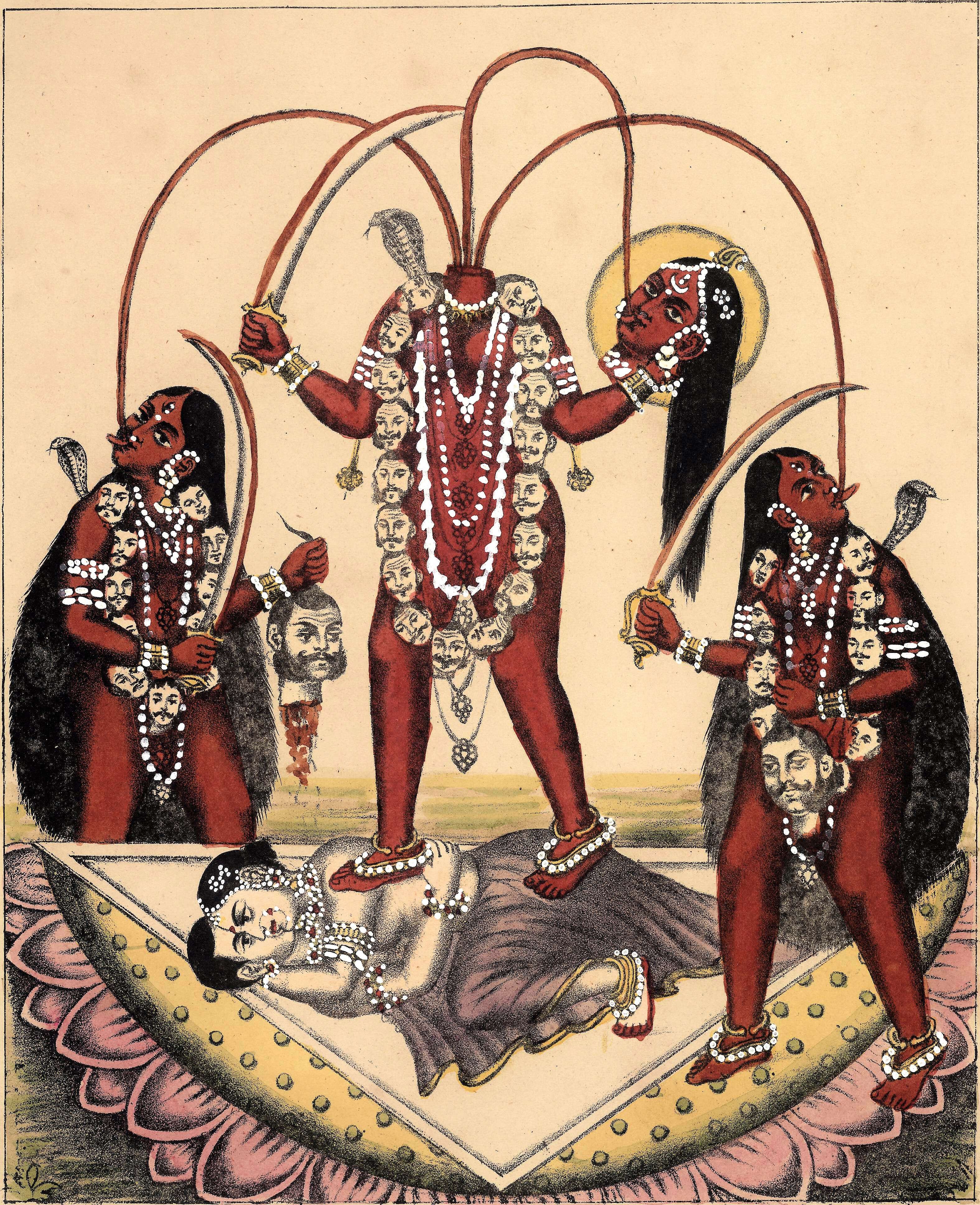
While I’m unsure if there is a connection, Yuebei’s imagery brings to mind the Hindo-Buddhist goddess Chinnamastā–Chinnamunda(Vajrayoginī). She is commonly shown as a naked, red-bodied figure holding a bloody head in one hand and a sword in the other (Kinsley, 1997, p. 144). In this case, the severed head is her own. Her sister attendants are also sometimes shown holding a head and sword (fig. 10).
Beyond art, I learned that the respective astrological paths of Yuebei xing and Mars can cross in East Asian astrology. According to Wan Minying (萬民英), author of the Great Compendium of Astral Studies (Xingxue dacheng, 星學大成, 1563):
If Yuebei and Mars are conjunct in the same sign, [the native’s] heart will enjoy virtue, but they will be unable to actually act. They will also have many noxious sores, and pus and blood
Apart from JTTS, Yuebei briefly appears in an earlier Ming-era fiction titled Drama of Yang Jiajiang (Yang Jiajiang yanyi, 楊家將演義, 16th century). Kotyk (2017) explains that she is depicted as a red-skinned figure “holding in her hand a skeleton (手執骷髏骨)” (p. 63). I should note that the kulou (骷髏) in kulou gu (骷髏骨) can also mean “skull,” which aligns with her iconography.
Recall that the Irano-Semitic demoness Lilith and the Hindo-Buddhist goddess Chinnamastā-Chinnamunda are described or depicted as having red skin. This might explain Yuebei xing’s vermillion body in the novel.
4. Religious Iconography
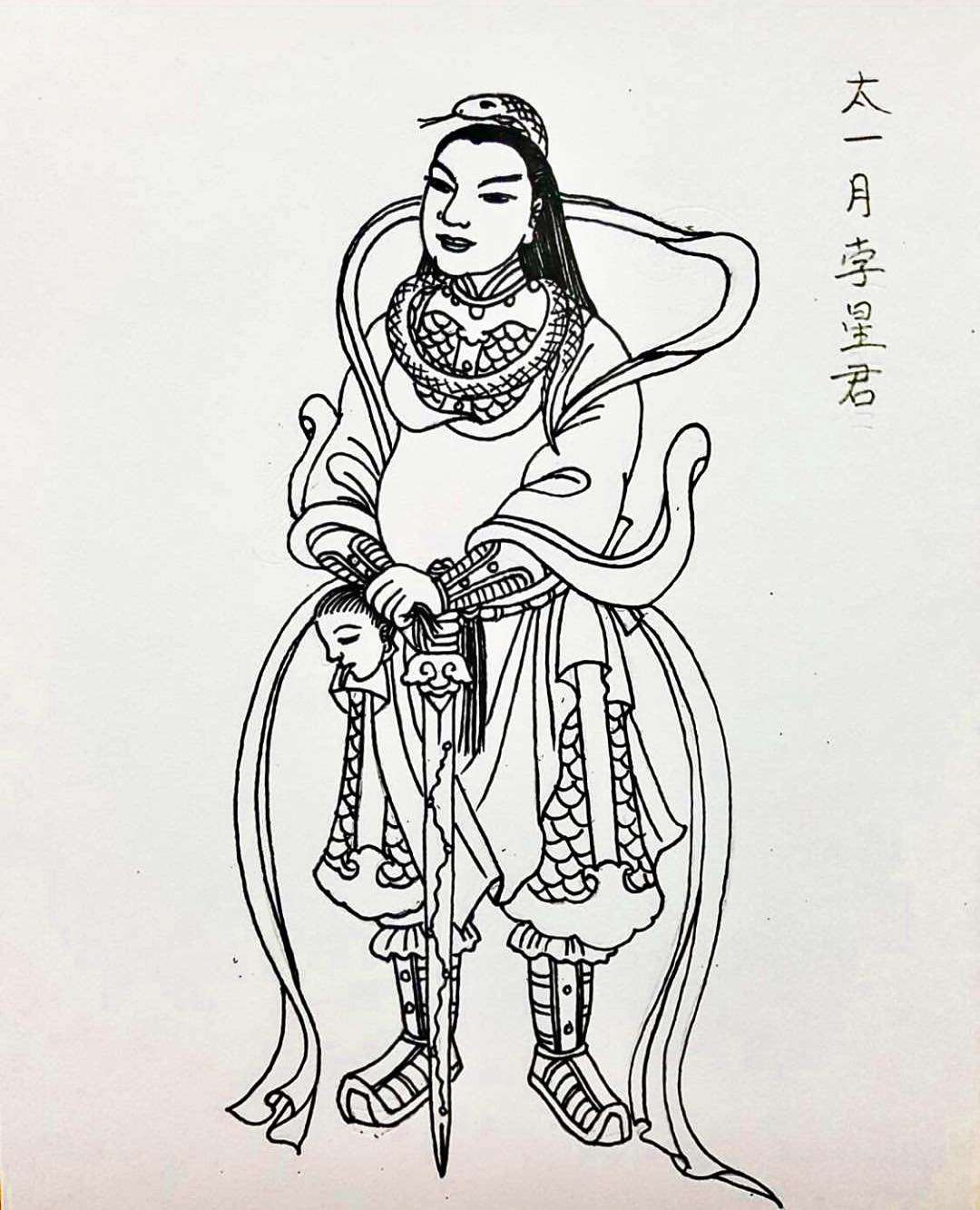
I know nothing of the actual worship of Yuebei xing, but Ronni Pinsler of the BOXS project was kind enough to show me a pattern sheet of her from an idol-maker’s shop in 1970s Singapore (fig. 11). She wears flowing robes just like her ancient Chinese depictions (refer back to fig. 4), but the signature sword and head are not included. They are instead replaced by a fly-whisk and a placard marked “moon” (yue, 月), which compliments the lunar halo behind her head. Additionally, she is labeled the “Vermillion (Comet) Inspiring Goddess, Heavenly Lord of the Moon Comet” (Zhuli[bei?] fu niang Yuebei tianjun, 朱李[孛?]孚娘 月孛天君). This is similar to the way it’s listed among the 36 celestial generals of the Journey to the North (Beiyou ji, 北遊記, 1602), the “Vermillion Comet Goddess, Heavenly Lord of the Moon Comet” (Zhubei wei Yuebei tianjun, 朱孛娘為月孛天君). I also found a more recent religious drawing that appears to mix the feminine and masculine iconography to depict her as an armored general named “Stellar Lord Moon Comet of the Great Monad” (Taiyi Yuebei xingjun (太一月孛星君) (fig. 12). Both the head and sword are present.
(See the 04-07-24 update below for a modern idol similar to figure 12.)
Fig. 11 – The vintage Yuebei pattern sheet from a Singaporean idol shop (larger version). Original photograph by Keith Stevens. Fig. 12 – The Yuebei general image (larger version). It was posted by an Indonesian Daoist priest of the Quanzhen school on Facebook.
5. Conclusion
Yuebei xing (月孛星, “Moon Comet Star”) briefly appears in chapter 17 of JTTS as the Monkey King’s monstrous daughter who uses a magic skull weapon to curse a rogue immortal. The demoness is based on a shadowy planetary deity from East Asian astrology that represents the lunar apogee. Xixia dynasty art and the Yuan-Ming Secret Practice scripture depict this deity having two forms, a lightly clad or even topless human-female with red clothing and long, disheveled hair, or a green-skinned, red-bearded yaksha-male. Both of these forms are sometimes depicted wielding a sword and a disembodied head.
The yaksha-male Yuebei xing surprisingly shares iconography with Arabo-Persian depictions of al-Mirrīkh (Mars), who is also represented as a bearded figure wielding a sword and head. Carboni (Carboni & MET, 1997) suggests that the Middle Eastern iconography is related to the constellation of Perseus (a.k.a. “Bearer of the Demon’s Head”) in which he holds the head of Medusa. This is interesting as the head held by the human-female figure is called a “drought demon” in the Secret Practice. This suggests a possible connection between the literary Yuebei xing’s skull and the deadly Gorgon.
Kotyk (2017) notes a possible connection between the human-female Yuebei xing and the Irano-Semitic Lilith. The latter too is described as having a red, naked body and unkempt hair. This same iconography is shared by the Hindo-Buddhist goddess Chinnamastā-Chinnamunda, who is also depicted bearing a sword and (her own) head. This may then explain why Yuebei xing is described as having red skin in the Drama of Yang Jiajiang (16th century), which predates JTTS.
Yuebei xing is worshiped in modern Chinese folk religion. Religious art depicts them as either a robed figure or an armored general. In both cases, the deity is a woman, but only the martial aspect is shown with the head and sword.
6. Updates
Update: 01-11-2023
Bunce (1994) describes Maṅgala (Mars) just like Bhattacharyya (1958) (refer back to the material below figure 9):
Face: one, angry; arms/hands: two, right hand holds ritual chopper (karttrika, grig-gug), left hand holds severed human head (emphasis added); legs: two; color: red; vahana: goat (p. 328).
But I still haven’t been able to find any ancient drawings of the planetary deity like this.
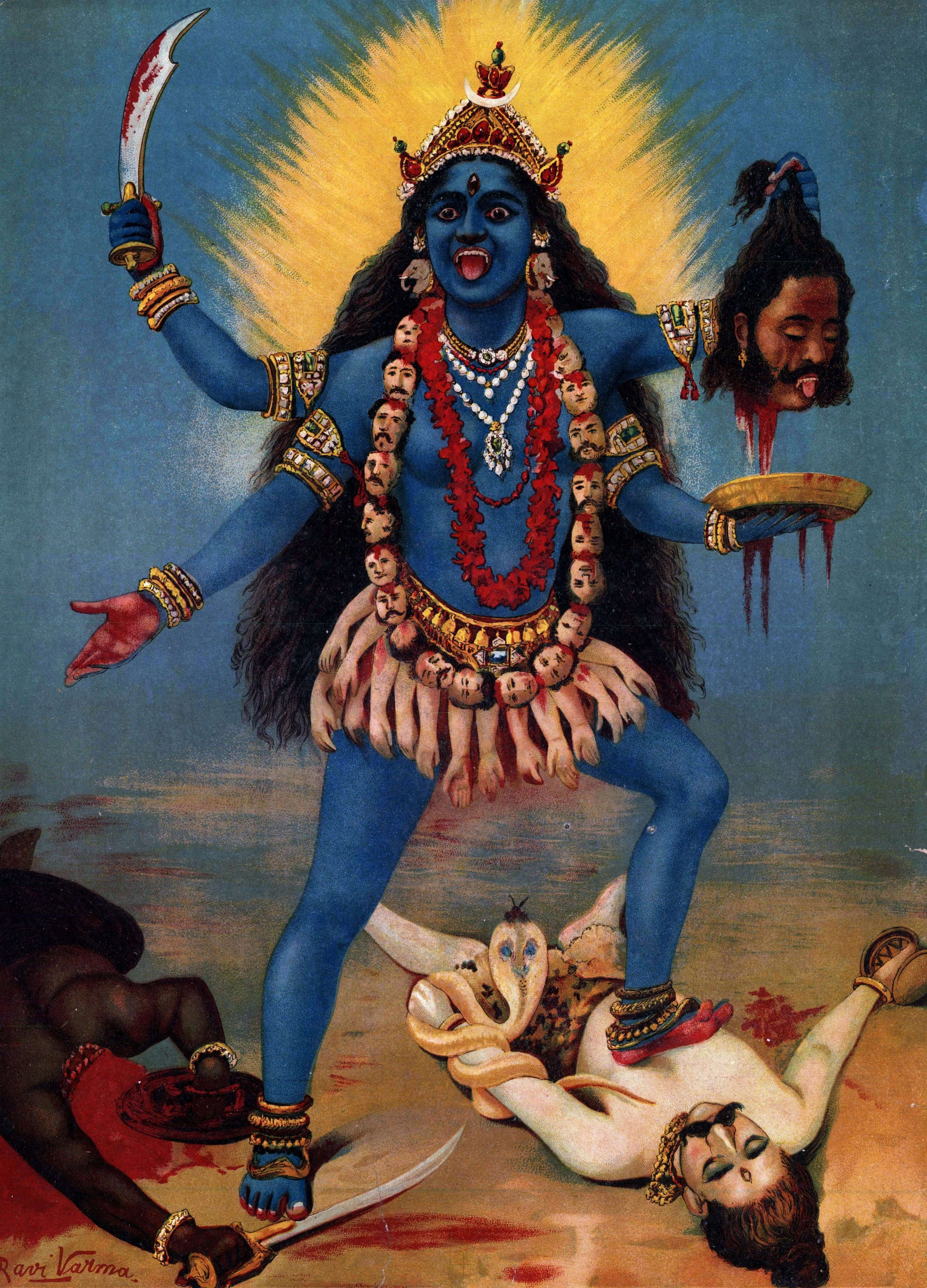
The iconography of the Hindu goddess Kālī also includes a sword and severed head (fig. 13). I didn’t mention her in the original article because she is traditionally depicted with dark skin, but she likely influenced the red-skinned Chinnamastā-Chinnamunda. It’s important to note that her mythos also associates the head with demons (asuras). For example, the Devī-Māhātmyam (c. 400-600 CE) reads:
Mounting her great lion, the Goddess ran at Caṇḍa, / And having seized him by the hair, she cut off his head with her sword. / On seeing Caṇḍa slain, Muṇḍa rushed at her. / She caused him to fall to the ground, wrathfully smitten with her sword. / On seeing Caṇḍa slain, and also the valorous Muṇḍa, / What was left of the assaulted army was overcome with fear and fled in all directions. / Picking up the heads of Caṇḍa and Muṇḍa, Kali / Approached C’aṇḍikā [Durgā] and spoke words mixed with loud and cruel laughter: / “Here, as a present from me to you, are Caṇḍa and Muṇḍa, two beasts / slain in the sacrifice of battle…” (Coburn, 1991, p. 62).
This adds to our list of sword-wielding, demon head-holding deities: 1) Perseus-Medusa; 2) Yuebei xing-Drought Demon; and 3) Kali-Asura.
I thought of a way for artists and fan fiction writers to mix Yuebei xing’s skull with Medusa’s head. But first recall that section 1 reads:
Yuebei xing then calls Huaguang’s name while holding her own magic treasure, a skull. The immortal is immediately stricken with a headache and stumbles back to his cave in a daze. Her weapon is said to be quite dangerous; anyone whose name is called will die within three days.
Perhaps the skull’s gaze can turn any living thing into stone, but this lithic death happens over the aforementioned three days. After the target’s name is called, the skull’s glowing eyes open wider and wider upon the dawn of each successive day, causing compounding confusion and pain. The final dawn sees the eyes open wide (fig. 14), making the unfortunate soul (no matter their location) turn to stone.
Fig. 14 – The skull would look like this on the third and final dawn (larger version). Adapted from an image found here.
Update: 01-17-23
“Who is the mother of Sun Wukong’s children in Journey to the South?” This is a question I’ve been asked a few times on Tumblr. The novel never answers this, but one can make an educated guess for the purposes of fan fiction.
Each child is based on one of three lunar deities appearing among the “Eleven Luminaries” (Shiyi yao, 十一曜) (mentioned above). The specific gods are:
Given their close connection to the night time celestial body, it would make sense for the mother to be Taiyin xing (太陰星, “Star of Supreme Yin”), goddess of the moon from the Eleven Luminaries.
Fig. 15 – A detail of Taiyin xing from the Ink Treasure of Wu Daozi (Daozi mobao, 道子墨寶, c. 13th century) (larger version). See figure 1 for the complete image. She is the fourth person from the left on the top row.
Update: 01-18-23
I’ve decided to make this the only article on my blog where Yuebei xing information can be found. Therefore, I have removed all of it from “The Monkey King’s Children.” This means I have to also transfer some previous updates.
Posted: 02-13-22
I’ve recently started watching the Lego Monkie Kid series, which follows the adventures of Sun Wukong’s human disciple, MK, in a very toyetic, Lego-inspired world. This is why @TustiLoliPop‘s lovely drawing of Yuebei xing (fig. 16) really stood out to me. They were kind enough to give me permission to post it here. It’s based on the Xixia dynasty painting from figure 2.
Fig. 16 – The Lego Monkie Kid-style Yuebei xing by @TustiLoliPop (larger version). Used with permission.
Posted: 07-13-22
Tumblr user @sketching-shark has drawn some great pictures of Monkey and his children. Here is one of them (fig. 17). I love the alternating black and white color scheme of Rahu and Ketu, as well as Yuebei xing’s size.
Fig. 17 – Monkey’s family by @sketching-shark (larger version). Used with permission.
Update: 07-23-23
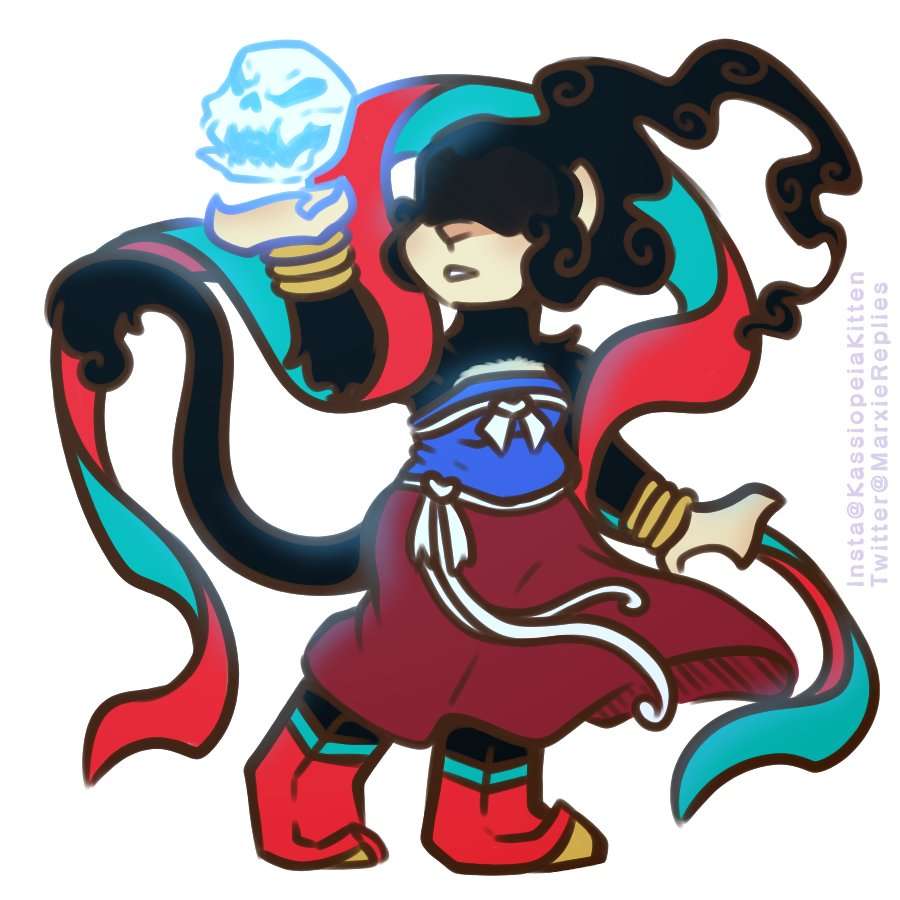
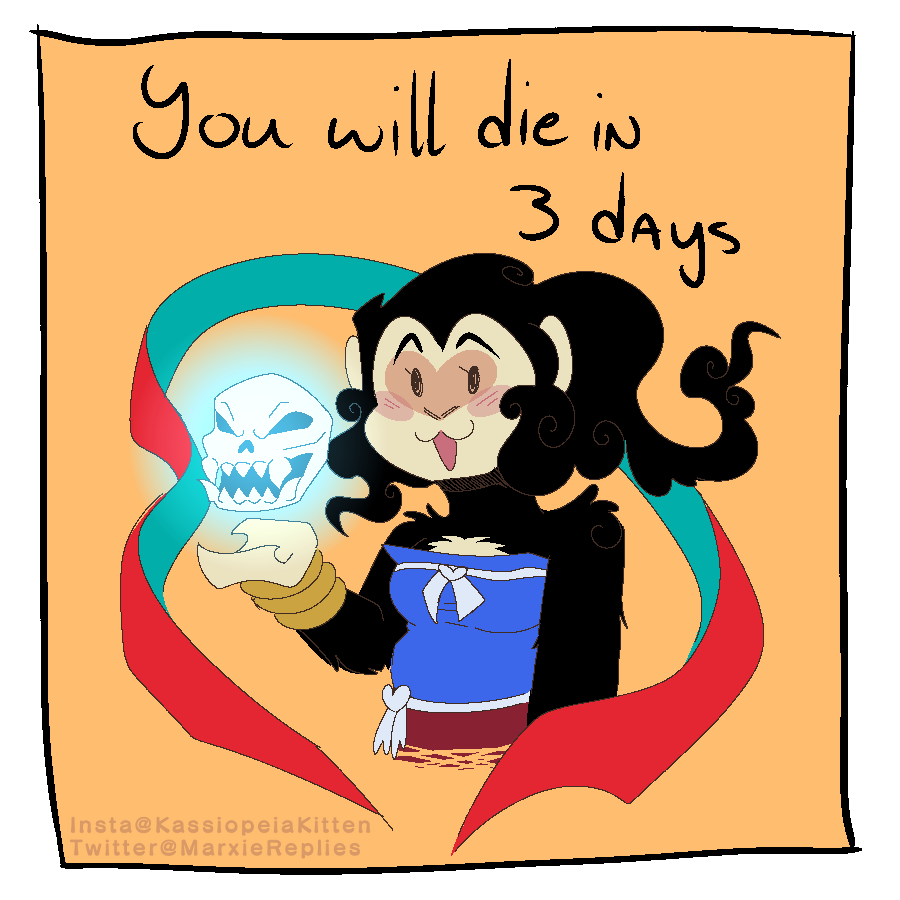
Tumblr user @MarxieReplies has drawn two Lego Monkie Kid-inspired pictures of Yuebei xing (fig. 18 & 19). Her clothing is based on the Xixia dynasty paintings of the lunar goddess (refer back to figure 2). I love the glowing skull and the flow of her ponytail and divine sashes.
Fig. 18 – A full body drawing of Yuebei (larger version). Fig. 19 – A head and torso drawing (larger version). Used with permission.
Update: 01-06-24
I just learned that a “Sun Yuebei” (孫月孛), daughter of the Monkey King, appears in the Japanese video game Touhou Monjusen ~ Bubbling Imaginary Treasures (東方門殊銭 ~ Bubbling Imaginary Treasures, 2021). She looks like a young, pink-haired human girl wearing red, feminine clothing with a bright green bow and light, red armor. And like her old man, she wears the golden headband and tiger skin and wields the iron staff along with her magic skull (video 1).
Video 1 – Sun Yuebei appears at min 3:34. I am 100% positive that the programmers hate people with epilepsy.
JTTS fans wanting to write fanfiction about our monkey demoness can call her Sun Yuebei, [3] but as mentioned above, the original astrological goddess is surnamed Zhu (朱, “vermillion,” i.e. a shade of red). If anyone wants to create a version of Monkey’s daughter that is more in line with her religious counterpart, then she should be called “Zhu Yuebei” (朱月孛). I’m sure someone can think of a reason for why she wouldn’t take her father’s surname.
Update: 04-27-24
Given the connection of Sun Wukong’s children to the moon, it’s interesting to note that he displays an intimate knowledge of the Earth’s satellite as both an astrological body and alchemical symbol. He explains in chapter 36:
When the moon reaches the thirtieth day, the metal [phase] in its yang spirit is completely dissolved, whereas the water [phase] of its yin soul is filled to the brim of the orb. This is the reason for the designation of that day with the term Obscure [Hui, 晦], for the moon is completely dark and without light. It is at this moment also that the moon copulates with the sun, and during the time of the thirtieth day and the first day of the month, it will become pregnant by the light of the sun. By the third day, one [stroke] of the yang will appear, and two [strokes] of the yang will be born by the eighth day. At this time, the moon will have half of its yang spirit in the middle of its yin soul, and its lower half is flat like a rope. That is the reason why the time of the month is called the Upper Bow [Shangxian, 上弦]. By the fifteenth day, all three [strokes] of the yang will be ready, and perfect union will be achieved. That is why this time of the month is called To Face [Wang, 望]. On the sixteenth day, one [stroke] of the yin will be born, and the second stroke will make its appearance on the twenty-second day. At that time half of the yin soul will be in the middle of the yang spirit, and its upper half is flat like a rope. That is the reason why this time of the month is called the Lower Bow [Xiaxian, 下弦]. By the thirtieth day; all three [strokes] of the yin will be ready, and the moon has then reached the state of obscurity once more. All this is the symbol of the process of cultivation practiced by nature (Wu & Yu, 2012, vol. 2, pp. 159-160).
I was happy to learn that a temple in southern Taiwan features an idol of Yuebei. She is depicted as a dark-skinned, bare-breasted, double sword-wielding amazon wearing light, golden armor, golden jewelry, and a divine sash (fig. 20). This Facebook post (with additional images) refers to her as the “Thunder Lord Moon Comet from the Fire Department of the Great Monad” (Taiyi huofu Yuebei leijun, 太乙火府月孛雷君). Her title and appearance recall figure 12 (refer back to section 4). Though, the severed head hanging from her belt is missing.
1) I’ve already suggested that an acquaintance draw Yuebei wielding Medusa’s head in place of her signature skull. The real question is: could Medusa’s glare actually kill an immortal? This insightful reddit post provides evidence from the Dionysiaca showing that even the god Dionysus considered it deadly enough to bring a magic diamond to protect himself from the Gorgon’s death stare:
The thyrsus was held up in his hand, and to defend his face he carried a diamond, the gem made stone in the showers of Zeus which protects against the stony glare of Medusa, that the baleful light of that destroying face may do him no harm (Rouse, 1940, vol. 3, p. 413).
3)Xing (星) just indicates her position as a planetary body.
Sources:
Bhattacharyya, B. (1958). The Indian Buddhist Iconography: Mainly Based on the Sādhanamālā and Cognate Tāntric Texts of Rituals (2nd ed.). Calcutta: Firma K.L. Mukhopadhyay.
Bunce, F. W. (1994). An Encyclopaedia of Buddhist Deities, Demigods, Godlings, Saints and Demons: With Special Focus on Iconographic Attributes (Vols.1-2). New Delhi: D.K. Printworld.
Carboni S. & Metropolitan Museum of Art. (1997). Following the Stars: Images of the Zodiac in Islamic Art. New York: Metropolitan Museum of Art.
Coburn, T. B. (1991). Encountering the Goddess: A Translation of the Devī-Māhātmya and a Study of its Interpretation. Albany: State University of New York Press.
Gansten, M. (2009). Navagrahas. In K. A. Jacobsen (Ed.), Brill’s Encyclopedia of Hinduism (Vol. 1) (pp. 647-653). Leiden: Brill.
Kinsley, D. R. (1997). Tantric Visions of the Divine Feminine: The Ten Mahāvidyās. Berkeley, CA: University of California Press.
Rouse, W. H. D. (Ed.) (1940), Nonnos. Dionysiaca, with an English Translation by W. H. D. Rouse, Mythological Introduction and Notes by H. J. Rose and Notes on Text Criticism by L. R. Lind (Vols. 1-3). Cambridge, Ma: Harvard University Press. Retrieved from https://archive.org/details/dionysiaca03nonnuoft/page/412/mode/2up.
Wu, C., & Yu, A. C. (2012). The Journey to the West (Vols. 1-4) (Rev. ed.). Chicago, Illinois: University of Chicago Press.
From time to time I like to post a fun blog not directly related to (though sometimes informed by) my research. Regular articles will resume after this entry.
Last updated: 05-09-2023
Anyone who has read my blog will know that I’m an avid fan of researching the history and influences of Journey to the West (Xiyouji, 西遊記, 1592). But as an artist, I am also a fan of JTTW-related artwork. There are so many talented people in the world who post their traditional and original designs and comics online, so I’ve decided to feature some of them on my blog. My hope is that such posts will expose this art to a wider audience interested in JTTW, while also documenting modern day perceptions and depictions of the novel and its characters.
Our next artist is NinjaHaku21, who goes by @NinjaHaku21_Art on both Twitter and Instagram and @NinjaHaku21Art on Tumblr. They also have a Patreon and an Etsy store. They were kind enough to answer some interview questions, as well as allow permission to display a few of their pieces.
I. Q & A
1) Can you tell me a little about yourself?
Hi there! I go by Ninja, and I am a freelance artist! I recently just started my freelancing career this year, and work on a few indie comics along with thumbnails for youtube!
2) Are you self-taught or did you go to art school?
I am self taught! I always wanted to go to art school, but life had other plans in mind!
3) What are your main sources of artistic inspiration?
While growing up, comics for sure! Was a huge fan of sonic comics, and now, it’s a mix of that and other media!
4) How did you learn about Journey to the West?
I learned about the Journey To The West after watching the show LEGO Monkie Kid! My friends and I have seen clips of it on twitter, and so we binged the entire series up to date. I was so interested in the characters and the world, I had to look up more. I then discovered the novel and was hooked. I am still looking into more movies to see their take on the novel!
5) Who is your favorite character?
Sun Wukong! He grows so much throughout the story and faces so many challenges. It’s hard not to love this murderous Monkey King who seeks redemption.
To me, seeing what the characters have acted before in the past and seeing them grow and learn makes me happy. It helps me remember that even though you may have done some awful stuff in the past, you can still make a difference and grow from it.
8) Can you tell me about any ongoing JTTW-related projects?
Currently I am working on my own designs of the characters for fun! Making illustrations about my versions of them, and making some merch of the designs for my shop!
II. Art and Thought Process
Note: Click each image to enlarge it.
1. Ever since I started reading Journey To The West and watching movies with the Monkey King or anything JTTW-related, I wanted to create my own take of the characters. With this piece, I was seeing how my designs would look with all of them together! I had rough sketched out some draft looks that got inspired by different pieces of them from either shows, movies, or ancient drawings of them, then fit in what I liked most and created this piece! I wanted to have them express their own personality through the look, and I am quite proud of the final results! I imagined some unlucky villager getting a visit from these “ugly demons” and their Master asking for a place to visit.
2. With this piece, I wanted to capture a fun moment on their journey to the west. These guys have to deal with so much while trying to protect their master, so I figured giving them a nice snow day would be a fun thing to draw!
3. The Six-Eared Macaque. Definitely one of my favorite characters from the stories. I wanted to show him off along with the opera mask, kind of symbolizing him transforming into Wukong to trick his companions.
4. I wanted to put these three pieces together, showing how Sun Wukong acts around his companions and Master.
I know for sure Wukong and Zhu Bajie argued a lot, and I haven’t seen any issues between Sha Wujing and Wukong (still reading and learning) and figured they’d have some nice conversations. And of course, Wukong protects his master from a group of hungry demons or bandits!
5. Now this one I did decide on having some fun on creating my own version of a “spider queen” (I know there wasn’t a queen in the story, but it was still fun)! I based this loosely around the chapter with the spider sisters, making the eldest one the queen. I had a fun time drawing this out, making the eldest have a thing for Wukong, haha!
6. In this piece here, I wanted to have my design of Nezha interacting with Wukong. I based Nezha’s design on a few different inspirations (some being from the Monkie Kid series and ancient art of the deity), and descriptions from the story. I also wanted to add in a dragon tattoo, sort of as a remembrance of what Nezha had done in the past. But this picture was to show the type of relationship these two have. Nezha would definitely feel a bit salty of losing to Wukong all those years ago!
Update: 05-09-23
I commissioned NinjaHaku21 to draw a religiously accurate illustration of Sun Wukong as the “Victorious Fighting Buddha.” It is based on the traditional iconography of the Yuddhajaya Buddha, the deity from which his religious title is derived. The results are stunning!
I learned in April via a private Thai Monkey King Facebook group that a limited run of colored resin, plain brass, painted brass, and gold-plated brass idols were to be made to raise funds to buy land on which a Great Sage temple would be built in Lam Narai, Lopburi province, Thailand. I procured the services of a local who contacted the religious organization building the temple, “The Equaling Heaven Academy (Altar) of Lam Narai” (Thai: Săm-nák chĕe tiian dtŭua lam-naa-raai, สำนักฉีเทียนตั๋วลำนารายณ์; Ch: Qitian tan Nannalai, 齊天壇南那來), and reserved a statue for me. Once the idols were cast (over several months), they shipped mine and it arrived on August 31st, 2022. Here, I’d like to briefly describe and compare the idol to other statues that I’ve seen or own.
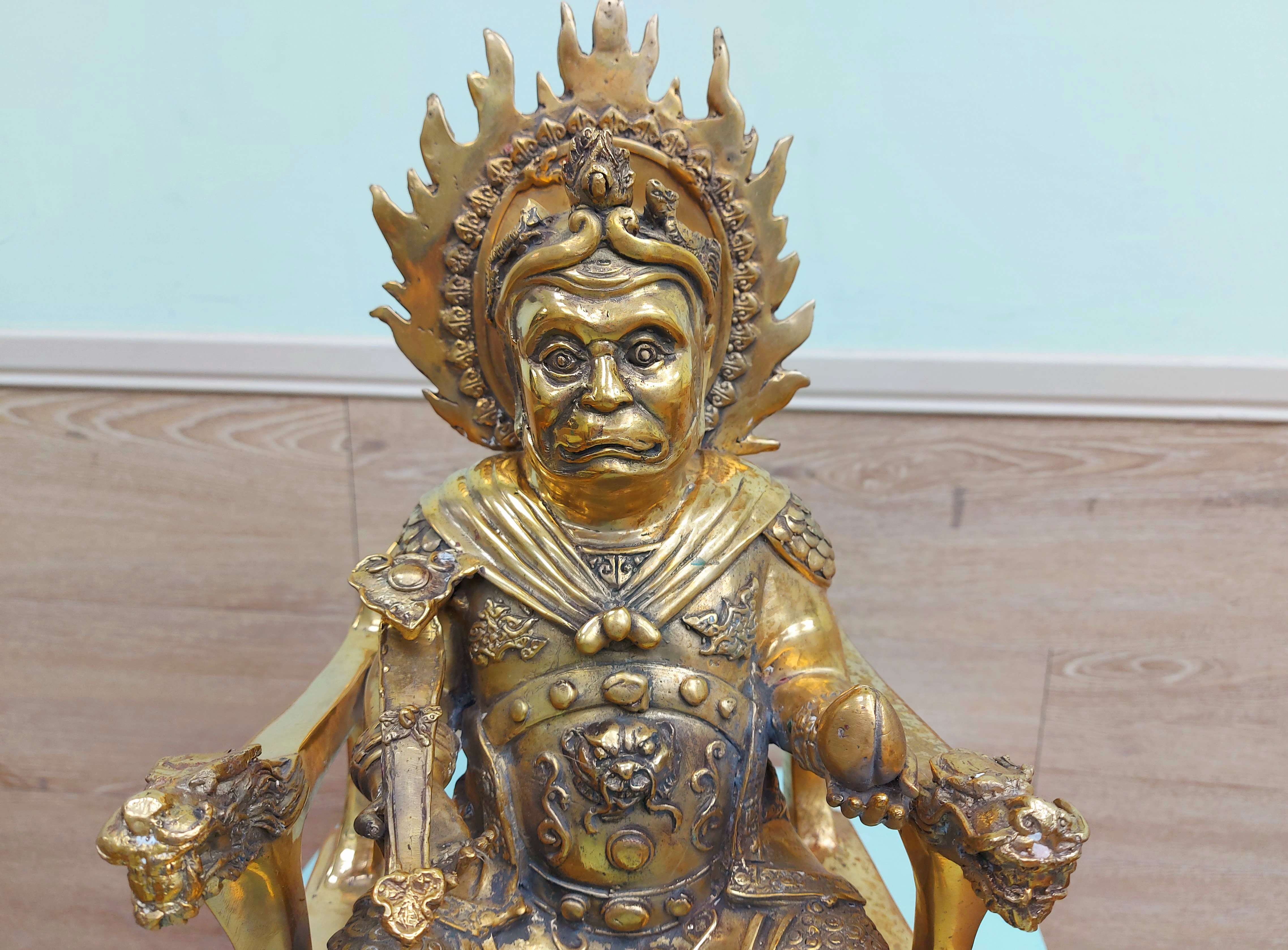
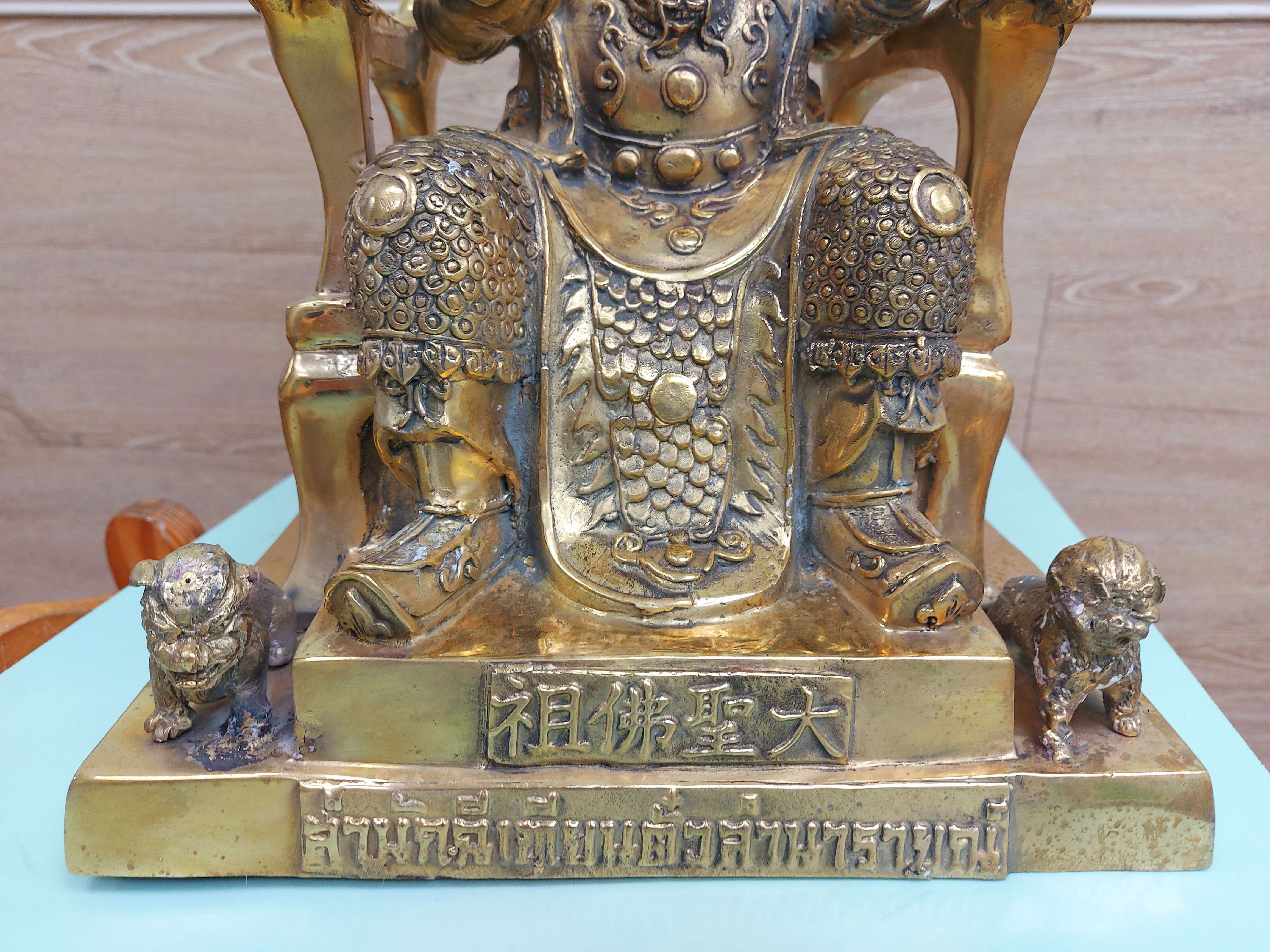
Fig. 4 – Detail of the front’s upper half (larger version).
Fig. 5 – Detail of the front’s lower half (larger version).
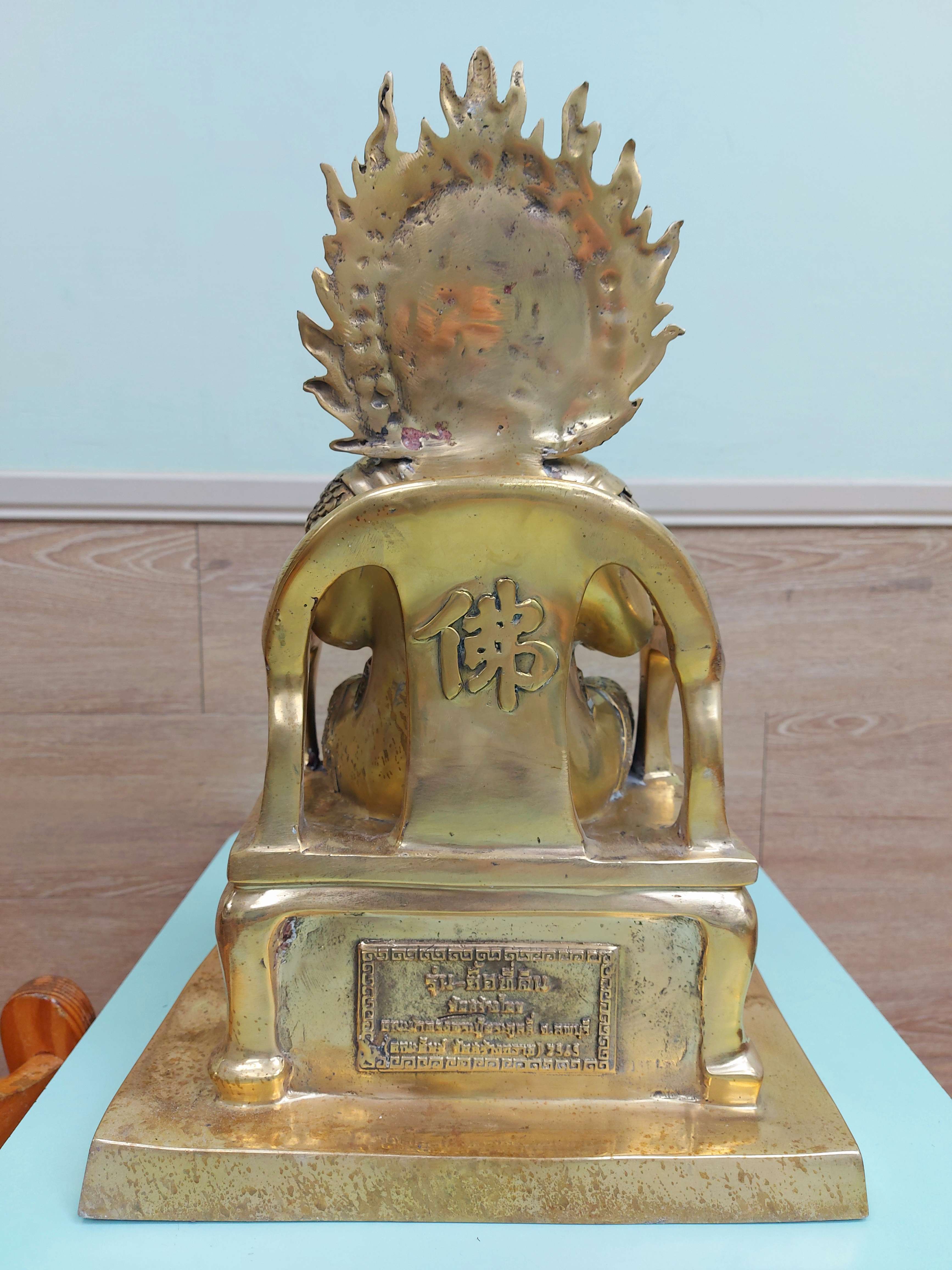
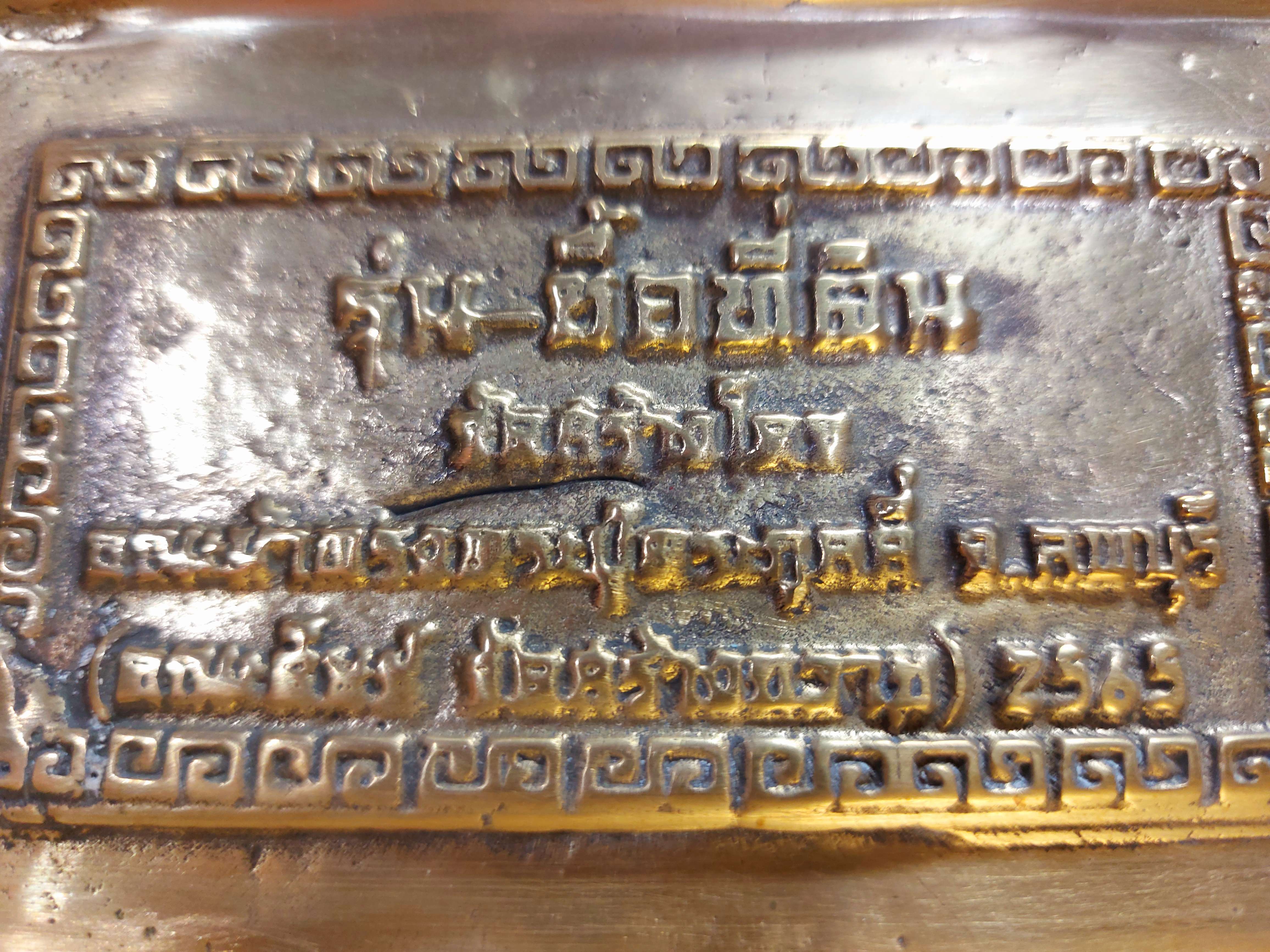
Fig. 6 – Detail of the placard on the back (larger version).
3. Discussion
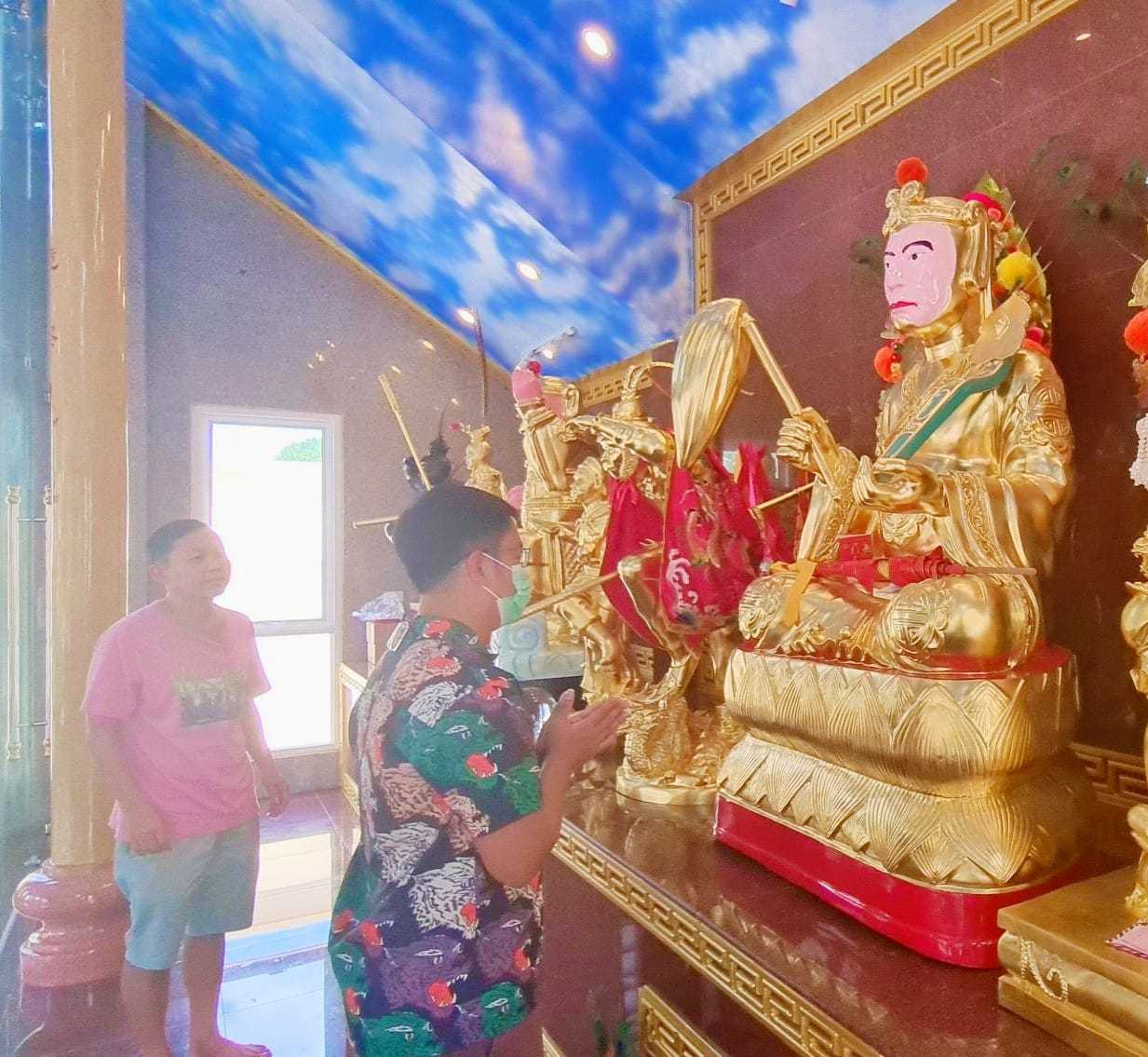
A fiery halo embellished with an inner circle of stylized ruyi-pattern mushrooms sits behind the Monkey King’s head. This shares similarities with a Monkey Buddha statue from a temple in Fujian province, China (fig. 7), the home of his cult. His bald head is adorned with the famous “curlicue-style” golden headband topped with a flaming Cintāmaṇi jewel, as well as a pair of slithering dragons wrapping around the back and sides of his crown. His visage is intense, with eyes opened wide and the corners of his mouth drawn downwards, forming a subtle “w” shape. A line marking the boundary of his forehead, the sides of his face, and just above his chin is slightly raised, giving the impression that he’s wearing a covering over his head and neck. This represents the pink facial patch, either covering the whole face or just a mask around the eyes, that often appears on gilded Monkey King statues in Thailand (fig. 8).
Fig. 7 (top) – A stature of Sun Wukong as a Buddha at the Yufeng Equaling Heaven Palatial Ancestor Hall of Pingshan (Yufeng Qitian fu Pingshan zudian, 玉封齐天府屏山祖殿) in Fuzhou City, Fujian (larger version). Picture by Saie Surendra of Hanumovies.com. Fig. 8 (bottom) – An example of a golden Thai Monkey statue with a pink patch on the face (larger version). Picture originally posted here.
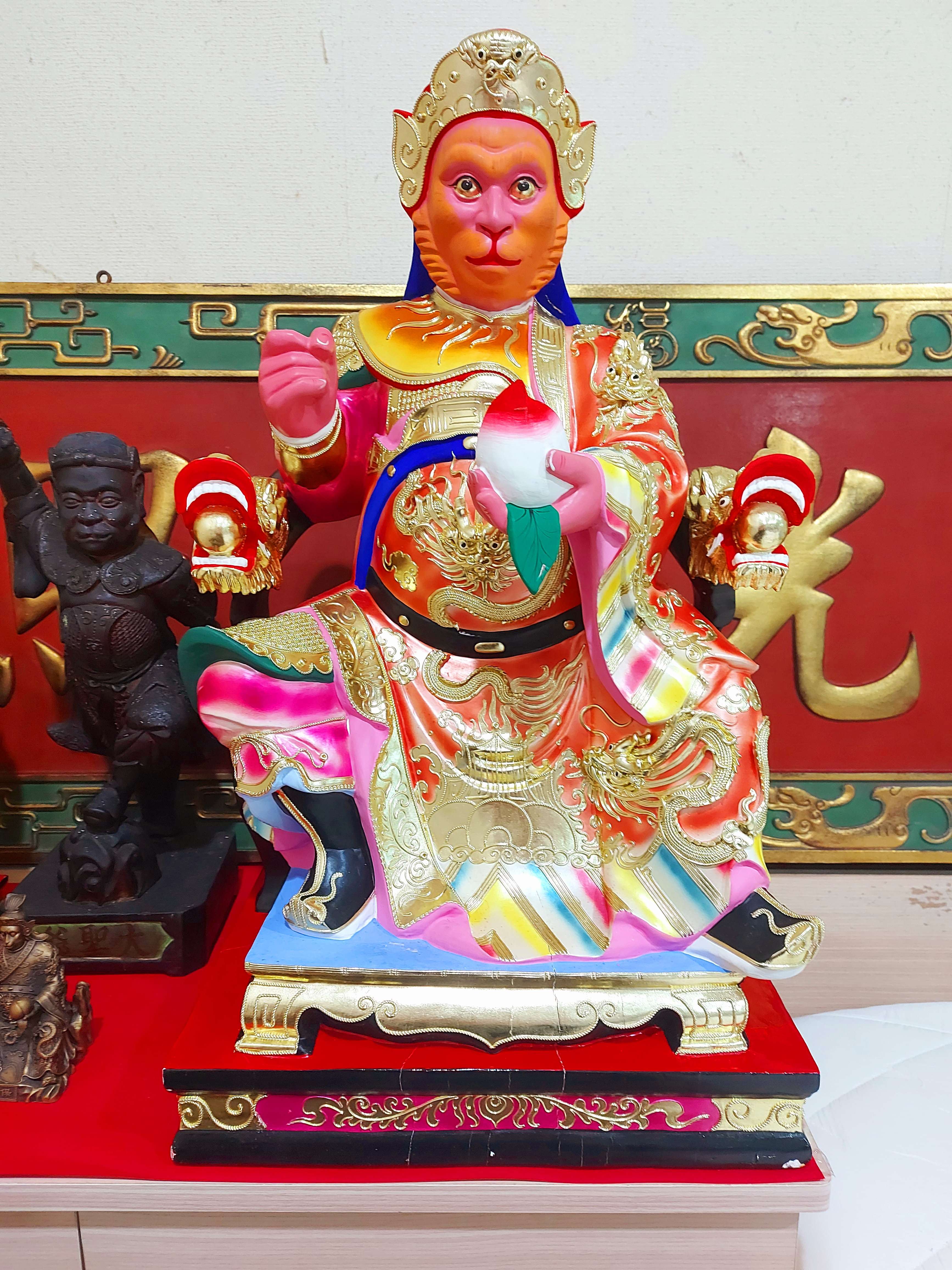
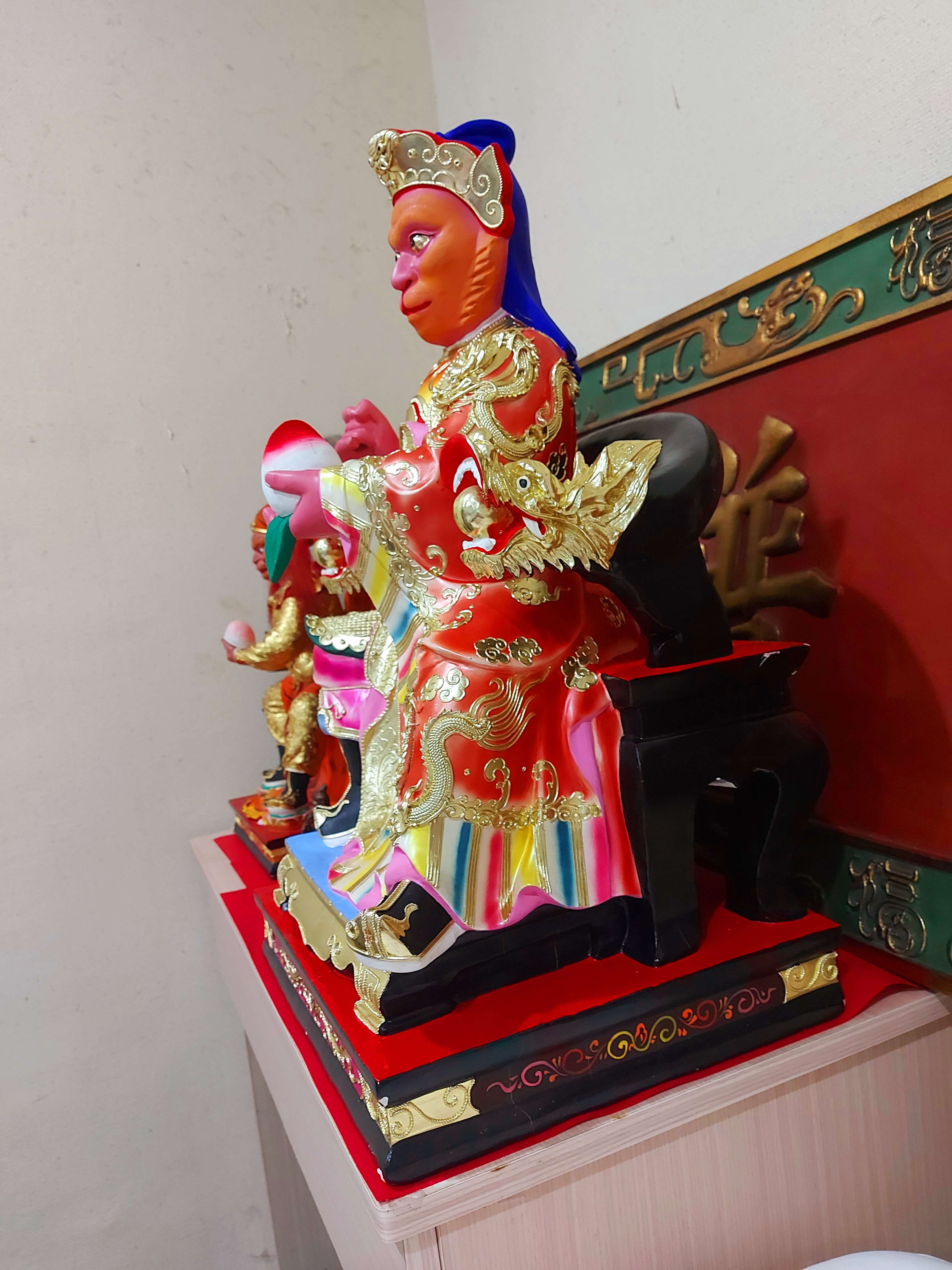
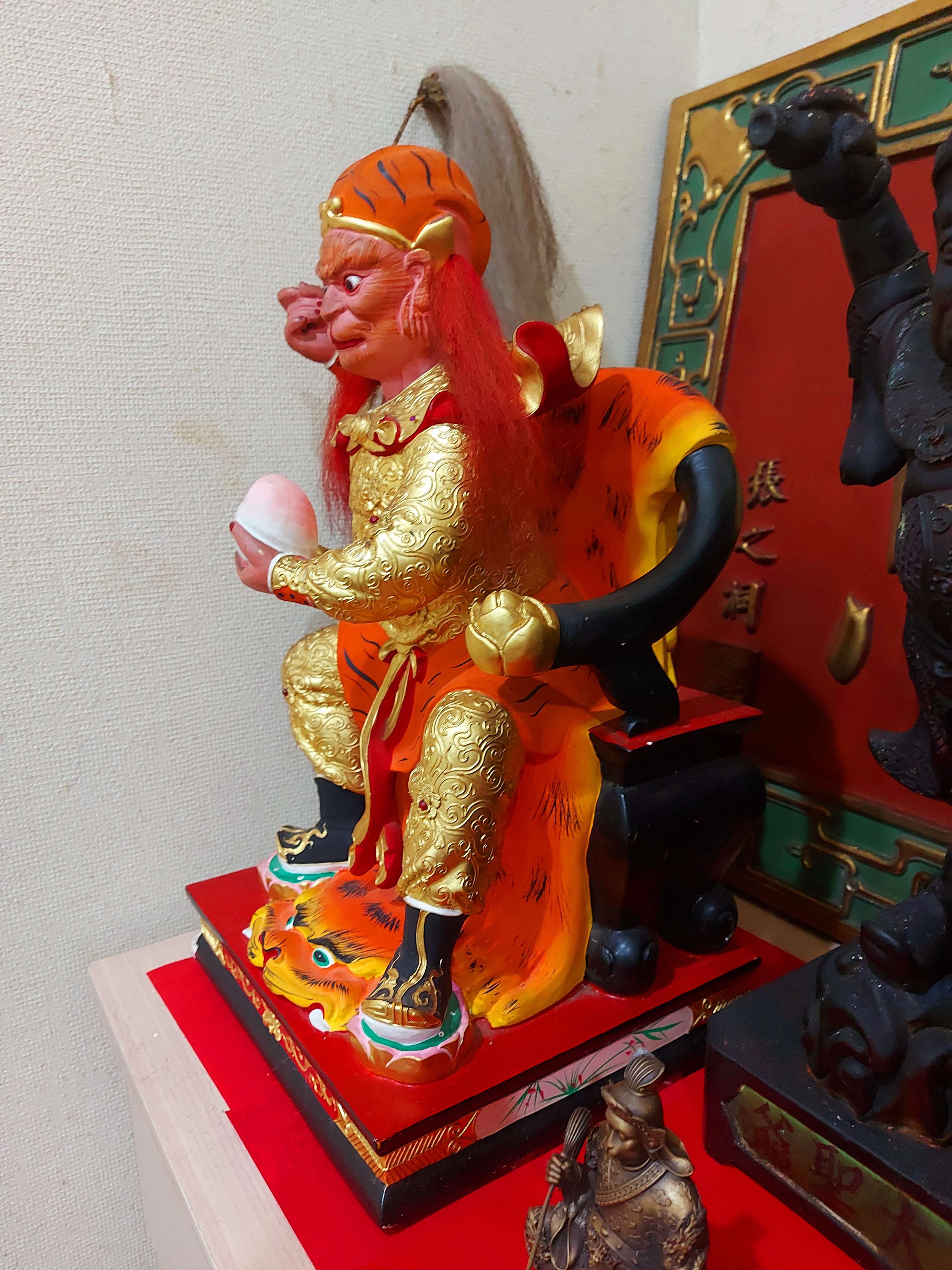
Both arms are bent at the elbow and held out palm up towards the viewer. His left hand holds an immortal peach, while the right cups the handle of a ruyi-pattern scepter resting on his shoulder. The peach is a common element of his iconography all around the world (fig. 9 & 10); however, the scepter imagery seems to be more popular in Southeast Asia. See, for instance, the trinity from the syncretic “Three Teachings” cult of Malaysia and Singapore. Monkey holds the ruyi-scepter in the same manner (fig. 11).
Fig. 9 – A Taiwanese Monkey statue holding an immortal peach in the left hand (larger version). Fig. 10 – A Singaporean statue with an immortal peach in the left hand (larger version). Both are in my personal collection. See also figure twelve below. Fig. 11 – The “Three Teachings” trinity of Southeast Asia (larger version). Take note of Monkey’s ruyi-scepter. Picture originally posted here.
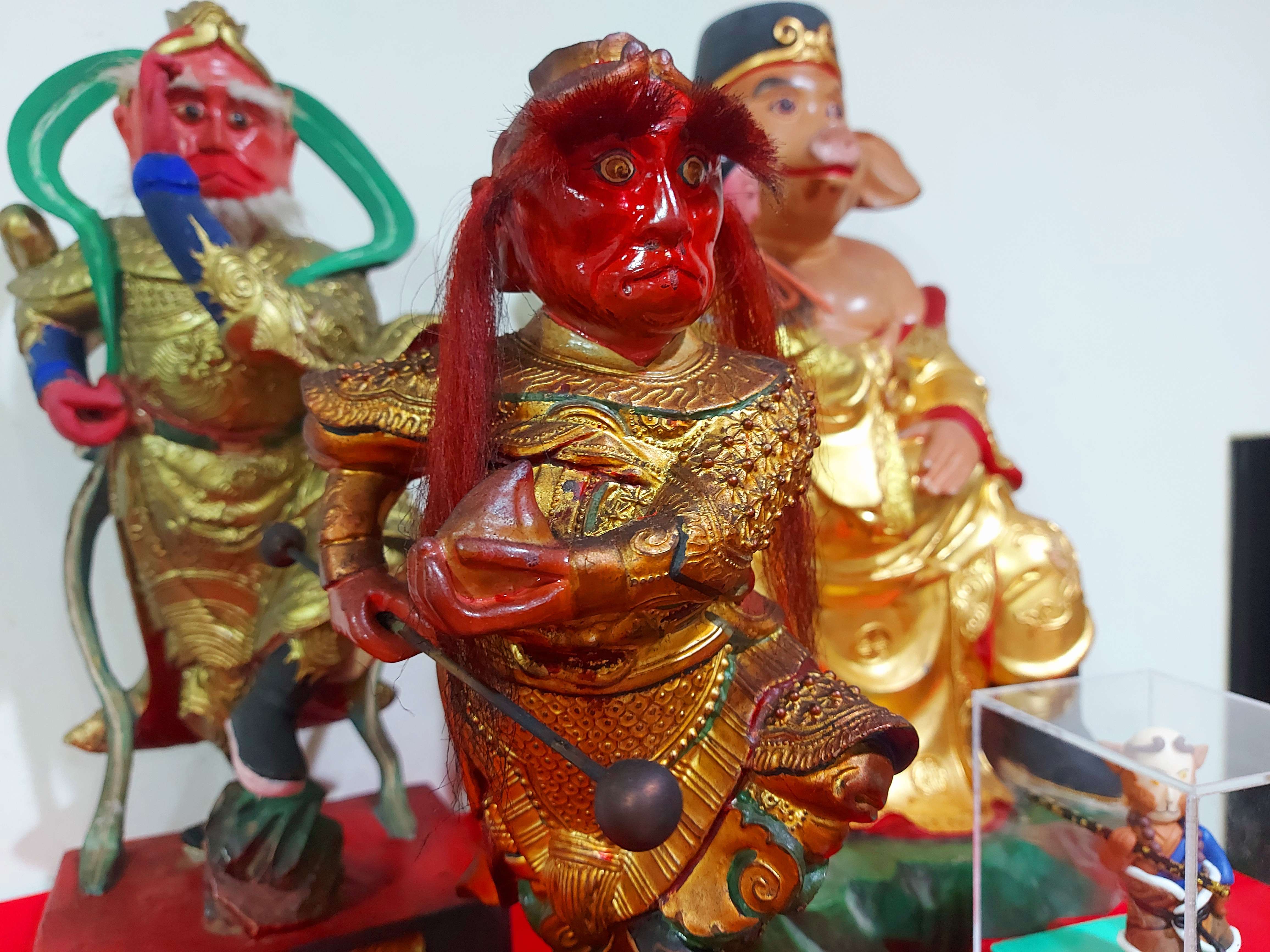
He wears a knotted neckerchief over a war coat with scale-pattern armor on his shoulders and the flap of cloth between his legs, a military girdle at his stomach and waist adorned with a dragon face, scale-pattern armored pants, and war boots with blocky, up-turned toes. His clothing and armor are adorned with various ruyi-pattern mushrooms. The Monkey King’s iconography commonly shows him wearing armor (fig. 12).
Fig. 12 – Detail of a Taiwanese Great Sage statue wearing armor (larger version). Take note of the armored Monkey statue behind him. Also notice that, like figures nine and ten, the lead idol is holding a peach in the left hand. All statues are in my personal collection.
He sits in a traditional dragon chair. More kingly depictions of the Great Sage commonly portray him seated (fig. 12 & 13). But this element is rare compared to the number of statues showing him standing (refer back to fig. 12; see also my other statues here).
Fig. 12 – The idol from figure nine is also shown seated in a dragon chair (larger version). Fig. 13 – The statue from figure ten is seated in a similar chair but replaces the dragon elements with lotuses (larger version).
Infront of the chair is a step on which his boots rest. It’s labeled in Chinese “大聖佛祖” (Dasheng fozu), or “Great Sage Buddha Patriarch.” I show in this article that the phrase is sometimes transliterated into Thai as “ต้าเชิ่งโฝจู่” (Dtâa chêrngfŏh jòo) and “ไต้เสี่ยฮุกโจ้ว” (Dtâi sìia húk-jôh, or just “Tai Sia Huk Chou/Zhou/Jow”). Both the chair and step sit on a rectangular base adorned with simplistic stone lions to his left and right. I haven’t seen lions in any of his other imagery. The front of the base is labeled:
“The Equaling Heaven Academy (Altar) of Lam Narai.”
The reverse of the backrest features a large symbol for “Buddha” (Fo, 佛), and below this (between the back legs) is a cloud and thunder-pattern lined placard reading:
รุ่น-ซื้อที่ดิน – จัดสร้างโดย คณะม้าทรงพระบู๊ตระกลูหลี่ จลพบุรี (คณะศิษย์จัดสร้างถวาย) 2565 (Thai: rûn séu têe din jàt sâang doi ká-ná máa song prá bóo ต rá gloo-lèe jà-lóp bù-ree (ká-ná sìt jàt sâang tà-wăai))
“The Young Generation Buys Land – Created by the Royal Horse Riding Troupe Raklu Li, Lopburi Province (a group of students made an offering), 2022.” [1]
This Thai statue is a welcome addition to my ever-growing collection of Great Sage idols. It’s certainly the biggest metal Monkey statue that I’ve found so far.
Note:
1) Thank you to “Nattida” for transcribing and translating the Thai text for me.
I was recently directed to an online Chinese article by Ye Zhiqiu (叶之秋) (n.d.) in which they claim that the Buddha makes “four grand, overarching lies” (sige mitian dahuang, 四個彌天大謊) throughout the course of Journey to the West (Xiyouji, 西遊記, 1592; “JTTW” hereafter). They believe that this is because the literary version of the Enlightened One is a master strategist who uses lies in a calculated attempt to usurp power from the Jade Emperor, ruler of the cosmos. This is admittedly a fascinating idea but one that falls apart under careful analysis. Ye (n.d.) displays a fundamental misunderstanding of the novel’s history and religious influences. Worse still, they appear to selectively interpret details to suit a possible agenda against Buddhism. In this article, I will show that there are far more plausible reasons for the Buddha’s statements than lying.
The Buddha states the following about the novel’s Hindo-Buddhist cosmos (ch. 8), which features four island-like continents floating in a great sea around a cosmic mountain (fig. 1):
I have watched the Four Great Continents, and the morality of their inhabitants varies from place to place. Those living on the East Pūrvavideha revere Heaven and Earth, and they are straightforward and peaceful. Those on the North Uttarakuru, though they love to destroy life, do so out of the necessity of making a livelihood. Moreover, they are rather dull of mind and lethargic in spirit, and they are not likely to do much harm. Those of our West Aparagodānīya are neither covetous nor prone to kill; they control their humor and temper their spirit. There is, to be sure, no illuminate of the first order, but everyone is certain to attain longevity. Those who reside in the South Jambūdvīpa, however, are prone to practice lechery and delight in evildoing, indulging in much slaughter and strife. Indeed, they are all caught in the treacherous field of tongue and mouth, in the wicked sea of slander and malice. However, I have three baskets of true scriptures which can persuade man to do good (Wu & Yu, 2012, vol. 1, pp. 204-205).
Ye (n.d.) claims that the Enlightened One is lying because most of the monsters show up not in the supposedly evil continent of South Jambūdvīpa (the Land of the East, i.e. China) but in the Buddha’s home of West Aparagodānīya (India). They even provide a long list of monsters encountered there. Also, the writer theorizes that the planned scripture pilgrimage is just a ploy to spread the Buddha’s influence to the Land of the East, making him the ruler of two of four continents. The implication here is that he is slowly chipping away at the Jade Emperor’s domain.
However, the Buddha was likely referring to the people in those particular continents and not the monsters. And most importantly, his words appear to mirror the views of foreign Buddhist monks. When the historical monk Xuanzang (玄奘; 602–664), on whom Tripitaka is based, planned to return home from India, his friends tried dissuading him by describing China in similarly negative terms. Brose (2021) comments:
For many of the monks he had befriended, the decision was hard to fathom. “India is the birthplace of the Buddha,” they reminded him. “Although the Great Sage is gone, his traces remain. To travel around and venerate them is enough to make one’s life content. Why would you want to give this up after having come here? China is a barbarian land where people are neglected, and the Dharma is despised. That is why no buddhas have ever been born there. The people have narrow aspirations and deep impurities, so sages do not go there. The air is cold and the land is dangerous. How can you think of returning there?” Xuanzang reportedly responded by quoting an exchange from the Vimalakīrti Sūtra, where the noble layman Vimalakīrti asks Śāriputra, “Why does the sun come to Jambudvīpa?” The answer: “To illuminate it and eliminate the darkness.” If Xuanzang remained in India, the true Dharma might never be known in China (pp. 61-62).
Additionally, Xuanzang is known to have left China illegally when he first began his journey. Brose (2021) explains:
Xuanzang almost didn’t make it to India. Before setting out on his pilgrimage, his initial request for a travel permit was denied by the [Tang] court and, after traveling over five hundred miles from the capital to the westernmost Chinese city of Liangzhou, the local governor ordered him to turn back. Hiding during the day and traveling at night, Xuanzang quietly continued on to the desert outpost of Guazhou. There, he learned that the court had issued a warrant for his arrest. The local prefect, it turned out, was a pious Buddhist and urged Xuanzang to leave quickly… (p. 16).
Conversely, the monk in JTTW is portrayed as a loyal Confucian-type person. Therefore, in order to frame Tripitaka as a faithful, law-abiding citizen of China, the novel had to provide a reason for his pilgrimage, one that the Tang Emperor would give his blessing to. [1]
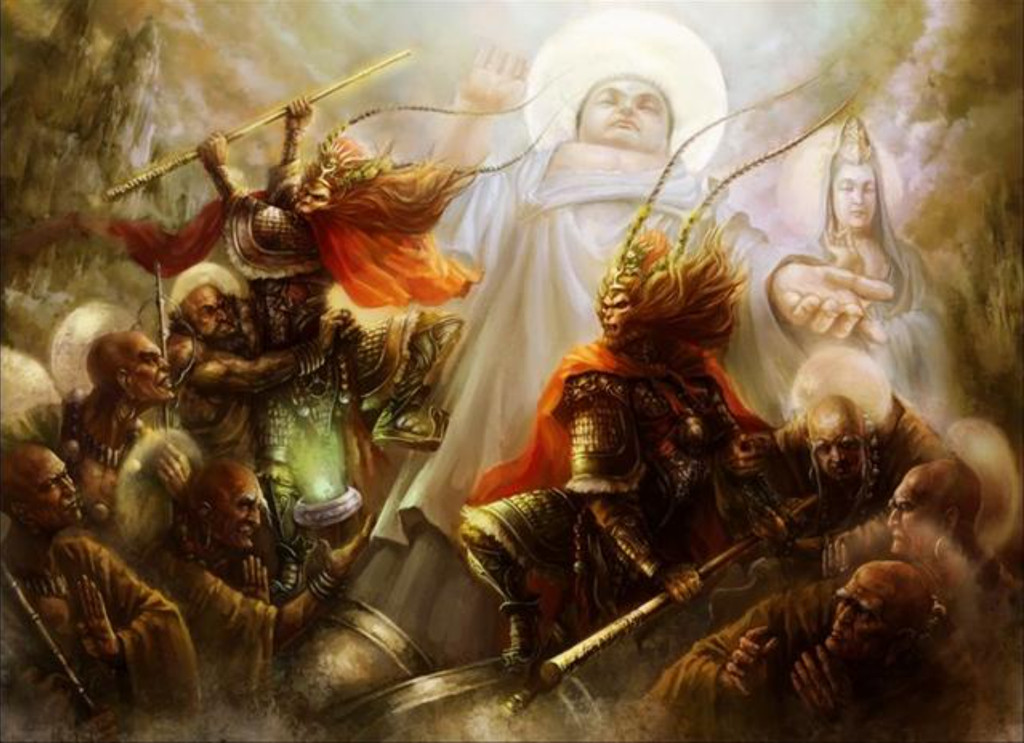
During Sun Wukong’s battle with the Six-Eared Macaque (ch. 58) (fig. 2), the Buddha reveals the doppelganger’s true identity, noting that he and Monkey are two of four celestial primates (sihou hunshi, 四猴混世, lit: “four monkeys of havoc”) with amazing abilities:
“The first,” said Tathāgata [the Buddha], “is the Stone Monkey of Numinous Wisdom, [2] who
Knows transformations, Recognizes the seasons, Discerns the advantages of earth, And is able to alter the course of planets and stars.
The second is the Red-Buttocked Horse Monkey, who
Has knowledge of yin and yang, Understands human affairs, Is adept in its daily life And able to avoid death and lengthen its life.
A sensitive ear, Discernment of fundamental principles, Knowledge of past and future, And comprehension of all things.
These four kinds of monkeys are not classified in the ten categories [of life], nor are they contained in the names between Heaven and Earth. As I see the matter, that specious Wukong must be a six-eared macaque, for even if this monkey stands in one place, he can possess the knowledge of events a thousand miles away and whatever a man may say in that distance” (Wu & Yu, 2012, vol. 3, p. 115).
Ye (n.d.) claims that the Buddha concocted the list of supernatural primates in order to hide the fact that Six Ears was an aspect of the Monkey King’s mind. They reason that the falsehood was used to avoid offending the Daoist hierarchy who couldn’t figure out the doppelganger’s true identity.
I think the author’s issue here is that the Daoist gods considered Six Ears a real figure, while the Buddha knew him to be an aspect of Sun’s mind. Something being real and illusory at the same time may seem like a big contradiction, but it’s not in the JTTW cosmos. Campany (1985) explains that as physical threats, the monsters enable Monkey and his religious brothers to build Buddhist merit (zhenguo, 正果; lit: “right fruit”) by fighting them. At the same time, being illusory aspects of the mind, the monsters help the pilgrims, especially Tripitaka, to understand that reality is empty (kong, 空). This is something that Wukong (悟空, “Aware of Emptiness”) reminds his master of throughout the journey.
Ye (n.d.) also points out that the listed powers of the Horse Monkey and Tongbi Gibbon don’t appear to be true, for they (under the guise of the commanders Ma and Liu and Beng and Ba – see section 2 here) are supposedly killed by Erlang’s forces in chapter six. They claim this proves that the two supernatural primates don’t actually exist. However, two things need to be said. One, the aforementioned underlings appear alive and well in chapter 28 (Wu & Yu, 2012, vol. 2, p. 32), meaning that they were not killed. And two, an irregularity in the story does not equate to a lie. The author hasn’t even come close to offering conclusive evidence of intent. Instead, I suggest that this is just an inconsistency born from the novel’s origin as individual oral tales that were eventually compiled, expanded, and published in book form. See, for instance, the 13th-century version of the story cycle. Therefore, irregularities are bound to pop up throughout the narrative.
But even if this lie was somehow true, how exactly does it further the Buddha’s supposed plan to take power from the Jade Emperor?
Fig. 2 – The Great Sage and Six Ears battle in the Western Paradise (larger version). Artist unknown.
Third Lie
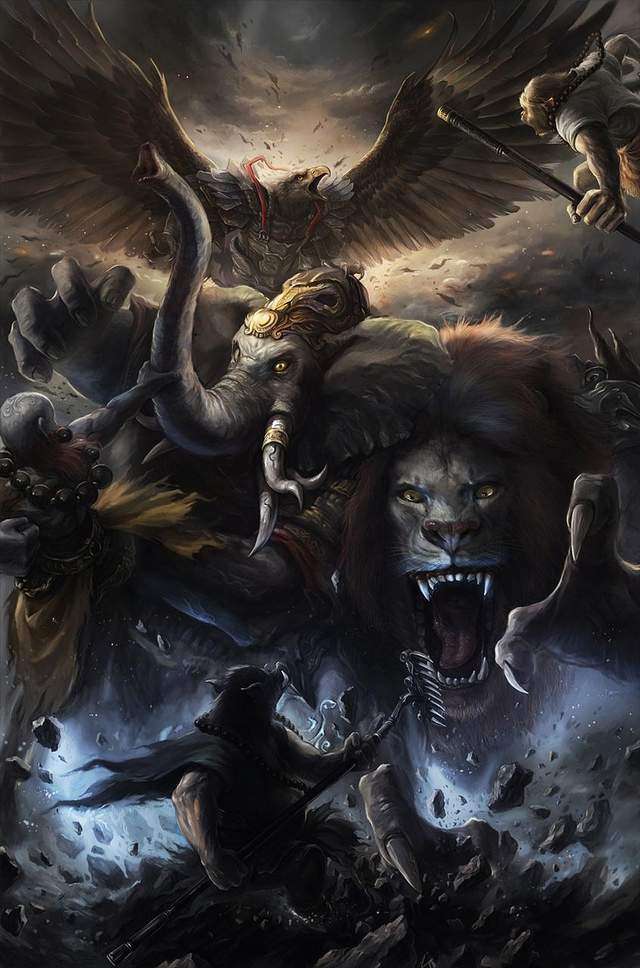
After the Buddha learns that the holy beasts of two bodhisattvas have escaped their respective mountain paradises and become man-eating demons on earth (ch. 77) (fig. 3), he has the following conversation with his disciples:
[…] Tathāgata left the lotus throne and went out of the monastery gate with the rest of the buddhas. There they saw Ānanda and Kāśyapa leading Mañjuśrī and Samantabhadra[3] on their way to the monastery also.
As the two bodhisattvas bowed to him, Tathagata asked, “How long have your beasts of burden been gone from your mountains?” “Seven days,” replied Mañjuśrī. “Seven days in the mountain,” said Tathāgata, “are equivalent to several thousand years on earth. I wonder how many lives they have taken down there. You must follow me quickly if we are to retrieve them.” With one bodhisattva standing on each side of him, the Buddha and his followers rose into the air (Wu & Yu, 2012, vol. 4, pp. 29-30).
Ye (n.d.) believes that the Buddha is lying about the corresponding time on earth in order to mask his guilt over not intervening sooner. As evidence, they cite the fact that the novel states “one day in heaven is equal to one year on Earth” (Wu & Yu, 2012, vol. 1, pp. 150 and 167). However, this could just be one of the aforementioned inconsistencies. One oral tradition may have said one day equals one year, while another said it equals one thousand years, and then both of these made it into the novel. But there is a more likely answer (see below).
They also claim that the respective Bodhisattvas’ mountain paradises are on earth, meaning that they would be subject to the same time as the mortal world. This carries the implication that the beasts were eating people for at least a few hundred years and none of the Buddhist deities did anything to stop them. But the author clearly doesn’t understand earthly paradises like Mañjuśrī’s Mount Wutai (Wutai shan, 五臺山; lit: “Five Terrace/Platform Mountain”), which they mention by name in the article. Chou (2018) notes that a “central paradox of Mount Wutai” is that it is “both an earthly place and a Buddhist paradise (pure land)” (p. 142). Kōtatsu (Kōtatsu & Otowa, 1996) explains that Pure Lands (Jingtu, 净土) are “world[s] of another dimension” that are “temporally different from this one” (p. 45). Therefore, it seems more likely that the Enlightened One was referring to the time difference between Buddhist mountain paradises and the mortal realm. This is distinct from the Daoist heaven, which is expressly associated with the “one heavenly day = one earthly year” time dilation.
Additionally, Ye (n.d.) claims that Mañjuśrī is lying about the length of time his beast was absent because of a similar bout of guilt. It’s strange, though, that the writer’s answer for everything is “such and such Buddhist figure is being dishonest.” I’d be interested to read some of their other work to see if there’s a pattern of deconstructing Buddhism. JTTW clearly treats the religion with reverence, placing the Buddha and his disciples at the top of the novel’s cosmic hierarchy. Therefore, selectively interpreting details to support some agenda against Buddhism wouldn’t reflect positively on the author or their writing.
And again, I have to ask: How would this lie further the Buddha’s supposed plans?
Fig. 3 – Sun Wukong and his religious brothers battling the bird, elephant, and lion demons from Lion-Camel Cave (larger version). Artist unknown. Image found here. The elephant and lion are the missing holy beasts who became monsters on earth.
Fourth Lie
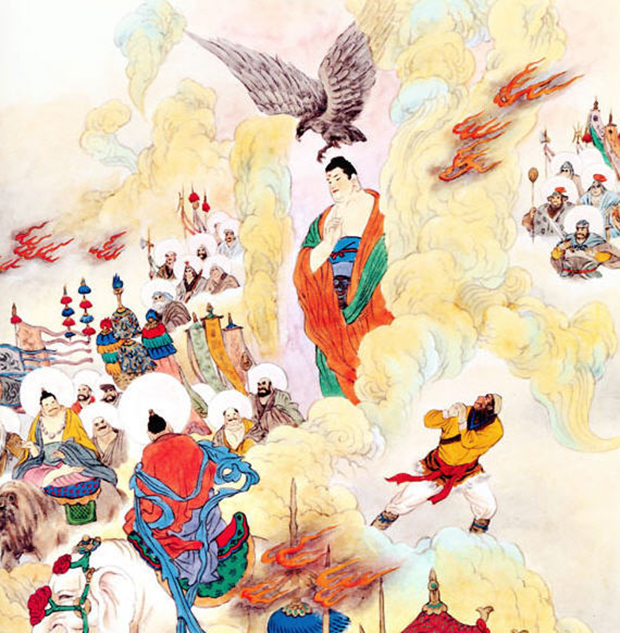
After the Buddha captures the Great Peng (ch. 77) (fig. 4), the bird demon submits to Buddhism but stubbornly refuses to stop eating meat. The Enlightened One thinks for a moment and then offers him the following solution:
“In the four great continents of my domain,” said Tathāgata, “there are countless worshippers. I shall ask those who wish to do good to sacrifice first to your mouth” (Wu & Yu, 2012, vol. 4, p. 31).
Ye (n.d.) believes that the Buddha is deceptively bragging here in order to placate the uber powerful monster. At the same time, his statement about having dominance over the four continents is thought to be a lie since the Jade Emperor is the stated ruler of the cosmos. They reason that it’s evidence of the Enlightened One wanting to govern all four continents. But it’s important to remember that, as mentioned above, the novel takes place in a world modeled after Hindo-Buddhist cosmic geography, which Ye (n.d.) is fully aware of. The Daoist bureaucracy of JTTW is therefore a syncretic veil that has been draped over a pre-existing Buddhist structure. In the original system, the world is overseen by the Devarāja Śakra (Sk: Śakro devānāṃ indraḥ; Ch: Dishi, 帝釋) from the heaven of the thirty-three gods atop Mount Sumeru (Buswell & Lopez, 2014, pp. 739-740 and 921-922). (Interestingly, the novel hints that the Daoist bureaucracy is located in this very same heaven). But despite the gods’ divine lifespans, as inhabitants of the Realm of Desire, they are still subject to death and therefore susceptible to the Wheel of Reincarnation (Buswell & Lopez, 2014, pp. 230-233). Only the Buddha can help such beings escape from the endless rounds of rebirth by leading them to enlightenment. He does this within the confines of his own domain or “Buddha-Field” (Sk: Buddhakṣetra; Ch: Focha, 佛刹). Buswell and Lopez (2014) explain:
[W]hen a buddha achieves enlightenment, a “container” or “inanimate” world is produced in the form of a field where the buddha leads beings to enlightenment. The inhabitant of that world is the buddha endowed with all the [qualities of an Enlightened One]. Buddha-fields occur in various levels of purification, broadly divided between pure and impure. Impure buddha-fields are synonymous with a world system (cakravāḍa), the infinite number of “world discs” in Buddhist cosmology that constitutes the universe; here, ordinary sentient beings (including animals, ghosts, and hell beings) dwell, subject to the afflictions of greed, hatred, and delusion. Each Cakravāḍa is the domain of a specific buddha, who achieves enlightenment in that world system and works there toward the liberation of all sentient beings… (p. 153).
Therefore, the JTTW cosmos is the Enlightened One’s Buddha-Field. But Ye (n.d.) appears to be aware of this fact (at least on some level), for they write: “The truth of the matter is that the Buddha is the lord of all sentient beings in the Buddhist schools of the four continents” (真實情況是,如來是四大部洲佛派眾生之主). So why would the writer still claim that the Buddha’s statement is a lie when they know it isn’t? This is a prime example of the author selectively interpreting facts.
Fig. 4 – A modern depiction of the Great Peng trapped above the Buddha’s head (larger version). Artist unknown.
Conclusion
Ye (n.d.) claims that the Buddha is a master strategist who makes “four grand, overarching lies” in a bid to usurp power from the Jade Emperor, ruler of the cosmos. But the writer demonstrates a fundamental misunderstanding of the novel’s history and religious influences. Worse still, they appear to selectively interpret details to suit a possible agenda against Buddhism. I show that the supposed falsehoods are instead likely based on the viewpoints of historical foreign monks, are inconsistencies within the JTTW narrative, reference Buddhist views of time, and reflect the Buddhist world system.
Notes:
1) The ruler’s decision to allow said pilgrimage is associated with a subplot in chapters 11 and 12 where he learns of countless orphaned souls in the underworld and searches for a monk to release them from their torments via a grand Buddhist ceremony. Tripitaka is chosen to lead the ceremony but is later convinced by the Bodhisattva Guanyin to halt the ritual until he has retrieved more appropriate scriptures from India.
2) Source altered slightly.
3) Yu (Wu & Yu, 2012) originally translates Puxian (普賢) as “Viśvabhadra” (vol. 4, pp. 29). I’ve changed it to “Samantabhadra” as this appears to be a more well-known version of the Bodhisattva’s name.
Sources:
Brose, B. (2021). Xuanzang: China’s Legendary Pilgrim and Translator. Boulder, Colorado: Shambhala Publications, Inc.
Buswell, R. E., & Lopez, D. S. (2014). The Princeton Dictionary of Buddhism. N: Princeton University Press.
Campany, R. (1985). Demons, Gods, and Pilgrims: The Demonology of the Hsi-yu Chi. Chinese Literature: Essays, Articles, Reviews (CLEAR), 7(1/2), 95-115. doi:10.2307/495195.
Chou, W. (2018). Mount Wutai: Visions of a Sacred Buddhist Mountain. Princeton; Oxford: Princeton University Press.