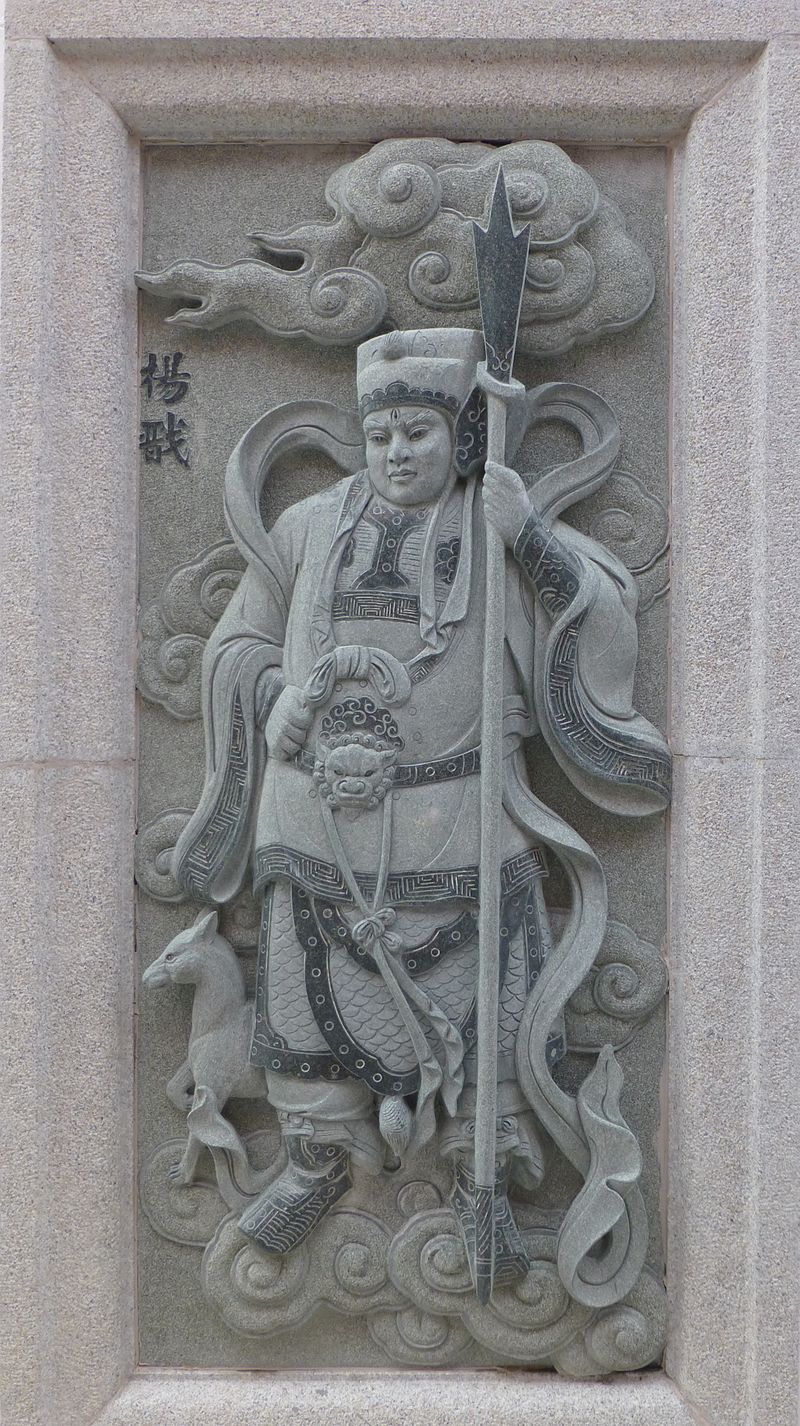
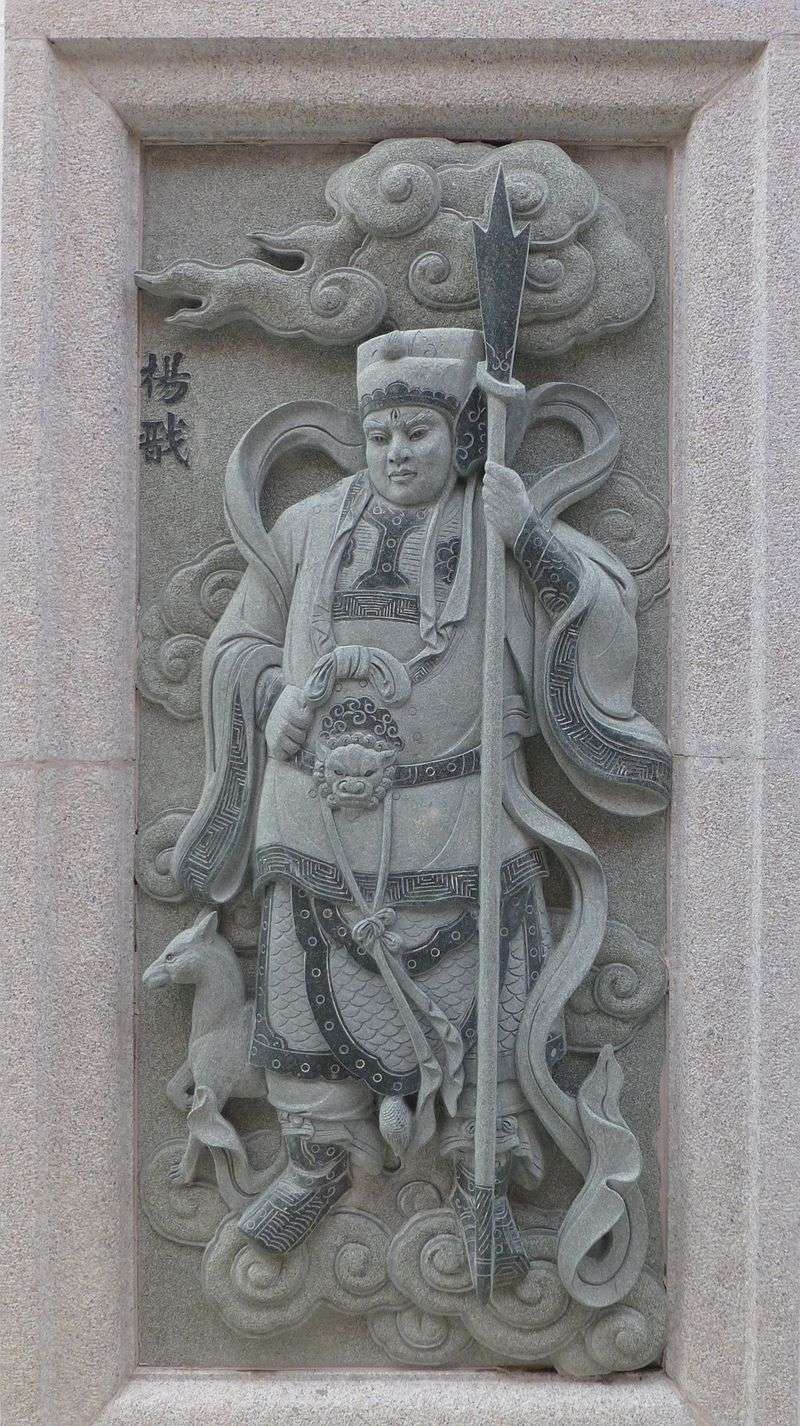
The Precious Scroll of Erlang (Erlang Baojuan, 二郎寳卷; full name Qingyuan Miaodao Xiansheng Zhenjun Yiliao Zhenren huguo youmin zhongxiao Erlang Baojuan, 清源妙道顯聖真君一了真人護國佑民忠孝二郎開山寶卷), is an important baojuan from the 1560s that contains the heroic deeds of the immortal Erlang (二郎) (fig. 1), including his defeat of Sun Wukong (PDF page 46). This shows that the Monkey King was mentioned in a religious context 30 years before the standard Ming edition of Journey to the West (Xiyouji, 西遊記, 1592) was even published. Therefore, apart from recording the religious story of Erlang, it adds to that of Sun Wukong.
I must thank Dr. Benjamin Brose for sending me a PDF of the scroll. I’m excited to archive it on my blog for other scholars to access and read.
In 1562 a text entitled Erlang baojuan (Precious scroll on Erlang) appeared, providing further information on the emerging Eternal Mother myth. Based on the story of Erlang’s valiant fight with the Monkey King, a famous and entertaining episode from the classic novel Journey to the West (which, incidentally, was given the finishing touches around the same time), the Erlang baojuan describes the final subjugation of the Monkey King by the semidivine Erlang, thanks in large measure to the assistance provided by the Eternal Mother. This text also seems to presage the legend surrounding the building of the Baoming Si, Temple Protecting the Ming dynasty, as described hereafter. In it the story of the bodhisattva Guanyin incarnating as a nun by the name of Lü is first being told. According to this text, the nun had tried unsuccessfully to dissuade Emperor Yingzong from fighting the Oirat Mongols prior to his debacle at Fort Tumu in 1449. When Yingzong was restored to the throne in 1457 after his long captivity, he rewarded the nun for her loyalty and courage and built a temple for her, naming it the Baoming Si. The temple had been reportedly in existence since 1462. By the late years of the Jiajing reign (1522–1567), however, it came under the sway of believers of the Eternal Mother religion (Shek & Tetsuro, 2004, p. 252).
Shek, R., & Tetsuro, N. (2004). Eternal Mother Religion: It’s History and Ethics. In K Liu. & R. Shek. (Eds.). Heterodoxy in Late Imperial China (pp. 241-280). Hong Kong: University of Hawai’i Press.
I’m proud to present a PDF of the original edition of Journey to the West anonymously published in 1592 by the Shidetang (世德堂, “Hall of Generational Virtue”) publishing house of Jinling (金陵, “Gold Hill,” a.ka. Nanjing). Titled Newly Printed, Illustrated, Deluxe and Large Character, Journey to the West (Xinke chuxiang guanban dazi Xiyou ji, 新刻出像官板大字西遊記), it features 20 scrolls and 100 chapters (minus the current chapter nine). It contains many charming woodblock prints depicting the events described in the story. For example, this print shows the battle between Monkey and Nezha in their three-headed and six-armed forms.
One doctoral thesis shows that this version is based on an earlier edition of the story titled Newly printed, Completely Illustrated, Chronicle of Deliverances in Sanzang of the Tang’s Journey to the West (Xinqie quanxiang Tang Sanzang Xiyou shi ni (e) zhuan, 新鍥全像唐三藏西遊释尼(厄)傳) in ten scrolls (with three to ten chapters each) by Zhu Dingchen (朱鼎臣) of Yangcheng (羊城, i.e. Guangzhou).
The PDF is quite large at 1.5 gigs, so it will take time to download.
Note: My blog is not monetized, so I am not making any money from this post. My hope is that the PDF will make this legendary story more accessible to a wider audience. If you enjoyed the digital version, please, please, please support the official release.
The world famous Liaozhai zhiyi (聊齋志異, 1740; a.k.a. “Strange Tales from a Chinese Studio”) is a collection of over 400 narratives serving as a snapshot of late-Ming and early-Qing-era popular stories and culture. This is why story no. 4 of scroll 11, “The Great Sage Equaling Heaven” (Qitian dasheng, 齊天大聖), is important to the study of the Monkey King’s religion as it shows his cult was active in 17th and 18th-century Fujian. It also preserves the condescension that the scholarly class held for certain gods. For example, as Meir Shahar (1996) points out, the author Pu Songling was likely speaking through the main character Xu Sheng (許盛), a young merchant from Shandong, when he states: “Sun Wukong is nothing but a parable invented by [the novelist] Old Qiu [老丘]” (pp. 194). [1] Here, Xu chastises the people of Fujian for worshiping what he considers to be a fictional god. In addition, the story associates the Great Sage with a heavenly sword as opposed to his famous magic staff. I believe that this is related to a 13th-century stone relief carving from Quanzhou.
Below, I have archived the only complete English translation of the tale that I’m aware of. It comes from volume six of Sidney L. Sondergard’s (Pu & Sondergard, 2014) Strange Tales from Liaozhai (pp. 2078-2085). I don’t currently have access to the physical book, so I have isolated the tale from an ebook and converted it into a PDF.
1) This refers to Qiu Chuji (丘處機, 1148–1227), the founder of the Dragon Gate sect of Daoism during the Song Dynasty. Qiu is associated with a travel journal also named Journey to the West, which Pu Songling confused with the novel of the same name (Pu & Sondergard, 2014, p. 2080 n. 1).
Sources:
Shahar, M. (1996). Vernacular Fiction and the Transmission of Gods’ Cults in Later Imperial China. In M. Shahar, & R. P. Weller (Eds.), Unruly Gods: Divinity and Society in China (pp. 184-211). Honolulu: University of Hawaiʻi Press.
Pu, S., & Sondergard, S. L. (2014). Strange Tales from Liaozhai: Vol. 6. Fremont, Calif: Jain Pub.
I consider one of my greatest accomplishments on this blog to be discovering the origin of Sun Wukong’s golden headband. This would not have been possible without reading about the Hevajra Tantra (8th-century) in Robert Nelson Linrothe’s (1999) Ruthless Compassion: Wrathful Deities in Early Indo-Tibetan Esoteric Buddhist Art. This amazing study analyzes Esoteric Buddhist statues and texts to trace the evolution of these guardians from mere dwarf attendants to mighty warrior gods endowed with the power of the Five Wisdom Buddhas. This is a great resource for anyone researching religious art involving wrathful guardians in Buddhism, Daoism, and of course Chinese folk religion, for the iconography of these divine warriors spread far and wide.
I am sharing a PDF of the book found on libgen for the benefit of other scholars. The black and white portions of the book appear to be based on a xeroxed copy. However, there are full color plates in the back.
Book description:
Buddhists believe that the wrathful spirits represent inherent qualities of our own, and that meditating on them can transmute the otherwise malevolent sides of our own natures into positive qualities and actions. The wrathful deities also provide precious clues as to the early development of esoteric Buddhism in India, about which few early texts survive. Through careful examination of a large body of images as well as Sanskrit, Tibetan, and Indic texts, this lavishly illustrated volume traces the evolution of the forms and the unfolding significance of the wrathful deity in esoteric Buddhist sculpture.
This work has been posted for educational purposes. No malicious copyright infringement is intended. If you enjoyed the digital version, please support the official release.
Citation:
Linrothe, R. N. (1999). Ruthless Compassion: Wrathful Deities in Early Indo-Tibetan Esoteric Buddhist Art. London: Serindia Publ.
Sun Wukong‘s golden headband (jingu, 金箍; a.k.a. jingu, 緊箍, lit: “tight fillet”) (fig. 1) is an instantly recognizable part of his popular iconography. Anyone who’s read Journey to the West (Xiyouji, 西遊記, 1592 CE) will know that it painfully tightens around our hero’s skull to correct any unsavory behavior. “What kind of behavior?” someone might ask. Well, mass murder, of course! In chapter 56, for example, Monkey’s Buddhist master Tripitaka recites the spell to punish him for beating a group of bandits to death with his magic staff and beheading one of them with a blade (Wu & Yu, 2012, vol. 3, p. 89).
This spell is first revealed to the monk by Guanyin in chapter 14:
I have a spell which is called the True Words for Controlling the Mind [dingxin zhenyan, 定心真言], or the Tight-Fillet Spell [jingu er zhou, 緊箍兒咒]. You must memorize it secretly; commit it firmly to your memory, and don’t let anyone learn of it. I’ll try to catch up with him [Monkey] and persuade him to come back and follow you. When he returns, give him the shirt and the cap [containing the headband] to wear; and if he again refuses to obey you, recite the spell silently. He will not dare do violence or leave you again.” (Wu & Yu, 2012, p. 317).
You can see the exact words are never revealed. This is not surprising, though, as the spell is one of the few things in the entire Buddho-Daoist cosmos that can control Sun Wukong. Tripitaka’s life would be in danger and the journey would be doomed if any villains got ahold of this secret. But … what if … we could guess the spell, just for fun? I’d like to suggest a mantra based on historical religious beliefs and iconography. This thought experiment was written for the benefit of artists and fanfiction writers looking to create more accurate portrayals of the novel and its characters.
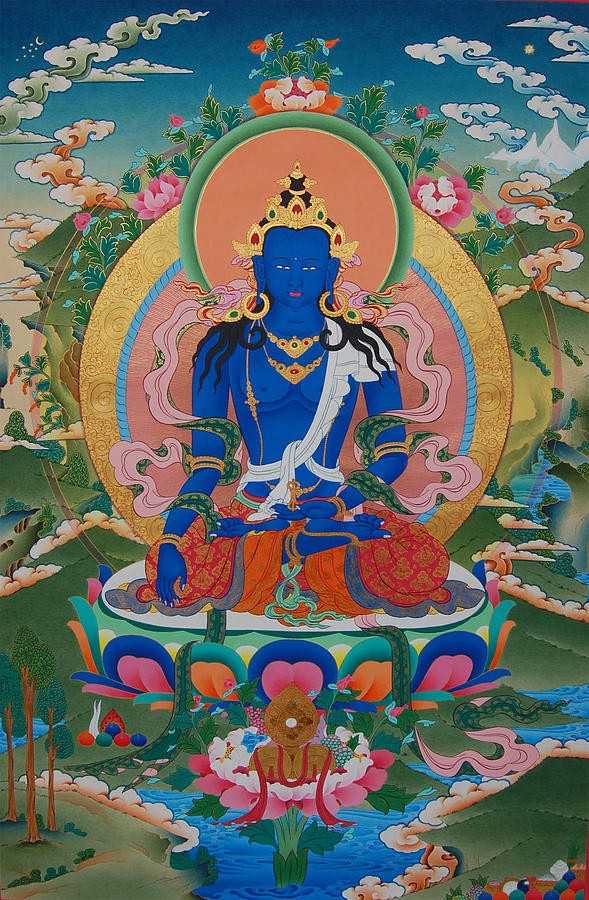
As I note in this article, the golden fillet is likely based on a ritual headband worn by Buddhist ascetics in ancient India. The Hevajra Tantra (Dabei kongzhi jingang dajiao wang yigui jing, 大悲空智金剛大教王儀軌經, 8th-c.) states yogins must wear the band and a list of other prescribed ritual items in their worship of the wrathful protector deity Heruka (Linrothe, 1999, p. 250). Most importantly, the tantra states the band symbolizes the Buddha Akshobhya (Ch: Achu, 阿閦; Budong, 不動; lit: “Immovable”) (fig. 2), who gained enlightenment through moralistic practices of right speech and action (Linrothe, 1999, p. 251; Buswell & Lopez, 2013, p. 27).
Fig. 2 – A depiction of Akshobhya (larger version). [1] Artist unknown.
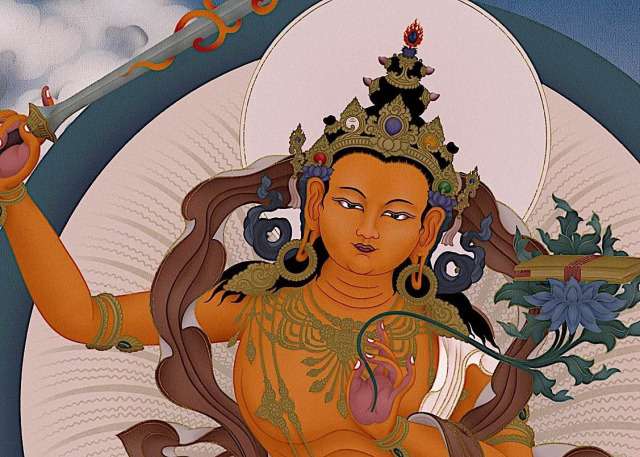
Akshobhya and the other esoteric Wisdom Buddhas are sometimes depicted as small figures or colored jewels in the headdress of the Manjusri Bodhisattva (and other Buddhist personages) (Getty, 1914/1988, p. 37; Vessantara, 1993, p. 155). Akshobhya is symbolized by the color blue (Getty, 1914/1988, p. 36). A cursory Google image search shows the blue jewel is often set in the top most position over Manjusri’s forehead (fig. 3).
This might suggest a more religiously accurate version of Sun Wukong’s golden headband would include a figure or jewel representing Akshobhya.
Fig. 3 – A modern painting of Manjusri by Ben Christian (larger version). The jewel above his forehead is a purple/blue color. Image found here.
2. The Mantra
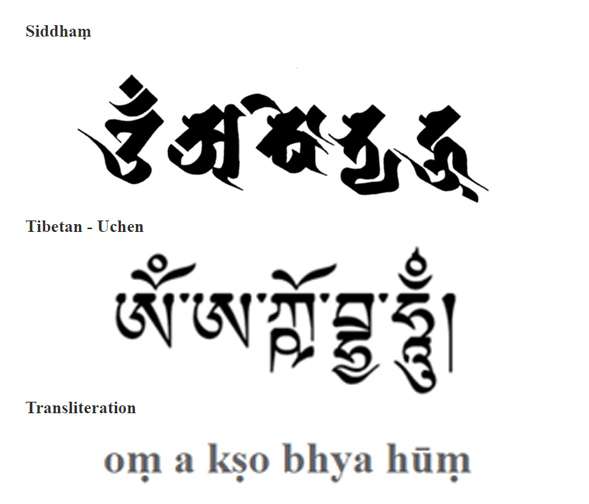
Given the above information, I’d like to suggest the tightening spell for Monkey’s headband—within the context of our thought experiment—is the Akshobhya Mantra! There are two kinds. I’ll leave it up to you which one you like best. The first is a short recitation of the buddha’s name: Oṃ a kṣo bhya hūṃ (fig. 4). This can be very roughly translated as “Praise to the Immovable One!” Om and Hum are both holy syllables invoking spiritual power and enlightenment, respectively. They also appear in the more well-known Oṃ maṇi padme hūṃ (Ch: An mo ni ba mi hong, 唵嘛呢叭咪吽). One Chinese version of the name mantra appears to be “An a bie zha zhi ga hong hong” (唵 阿別炸枝嘎 吽吽).
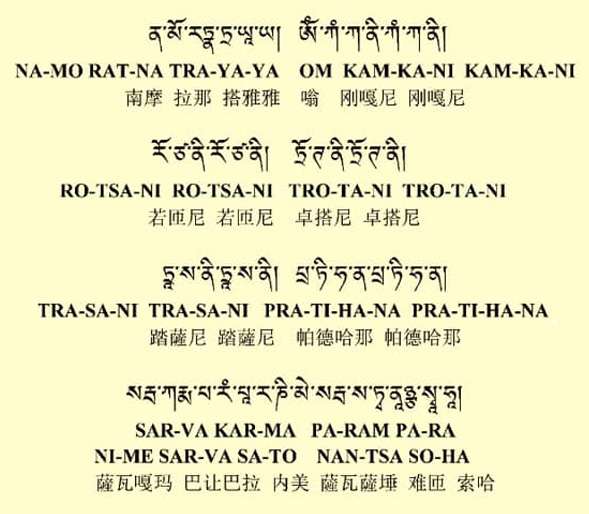
Fig. 4 – The Siddham and Uchen script versions of the short mantra (larger version). Based on information found here. Fig. 5 – A version of the longer chant with Uchen script, as well as English and Chinese transliterations (larger version). Based on an image found here.
The second is a longer chant, again called the “Mantra of Akshobhya” (Achu fo xinzhou, 阿閦佛心咒) (fig. 5 and video 1). It’s interesting to note that the historical Xuanzang (on whom Tripitaka is based) is known to have translated a version of this mantra. [2]
Reciting this to rein in Sun Wukong not only references the band’s historical and religious connection to Akshobhya but also serves as a physical reminder of right speech and action (how the deity gained buddhahood). It’s Tripitaka’s way of screaming, “Stop murdering everyone within arm’s reach!”
Fig. 6 – Shifu Pigsy (a.k.a. Zhu Bajie) reciting “Amituofo” to activate the golden headband on the Monkey Prince, son of the original Monkey King (larger version). From Yang, 2021, p. 80. Copyright DC Comics.
3.1. Additional Religious Background
Update: 01-25-22
The case for Akshobhya’s mantra being the tight-fillet spell is strengthened—again, within the context of our thought experiment—by the fact that he has power over strong negative emotions. According to Bangdel and Huntington (2003): “The transcendental insight represented by Akshobhya is mirrorlike wisdom (adarsha jnana), which…is the antidote to the poison of anger, or hatred” (p. 91). The monk Tripitaka assuages these emotions by activating the golden headband, once again reminding Wukong of right speech and action.
In addition, Akshobhya and Gautama have matching iconography: both are shown seated with the left hand palm up on the lap and the right reaching down to touch the earth. Hinayana Buddhists of Sri Lanka and Southeast Asia worship Gautama in this form, but Mahayana worships Akshobhya as such (see note #1). This is important as Gautama gives the three golden headbands to Guanyin in order to pacify any demons that she might encounter during her search for the scripture pilgrim (Wu & Yu, 2012, vol. 1, pp. 206-207). This shows there is a connection between the two Buddhas, and it also explains why Gautama would gift a headband associated with Akshobhya.
4. Updates (continued)
Update: 01-27-22
Various online sources and adaptations sometimes refer to the spell as the “Headache Sutra” (for example). But to my knowledge it’s never explicitly called this in the novel. The pain associated with the spell is generally used as a threat. For example, in chapter 16, Tripitaka exclaims: “Monkey! Aren’t you afraid of your headache [ni toutong, 你頭痛]? Do you still want to behave badly? (Wu & Yu, 2012, vol. 1, p. 347) (emphasis mine).
Chapter 25 provides two more names for the spell:
There is, moreover, the Tight-Fillet Spell or the Tight-Fillet Sutra [jingu er jing, 緊箍兒經]. It’s also [Tripitaka’s] “Old Saying Sutra” [jiuhua er jing, 舊話兒經]. [3] The moment he recites that, I’ll have a terrible headache, for it’s the magic trick designed to give me a hard time (Wu & Yu, 2012, vol. 1, p. 468).
Another name for the spell is hua’er zhou (話兒咒), which Yu (Wu & Yu, 2012) translates as the “little something spell” (vol. 2, p. 16, for example).
Notes:
1) Akshobhya’s iconography is as follows:
[He] is represented seated, like all the Dhyani-Buddhas, with the legs locked and both feet apparent. There are often wheels marked on the soles of his feet, or a protuberance like a button, resembling the urna on the forehead. His left hand lies on his lap in ‘meditation’ mudra. His right touches the earth with the tips of the outstretched fingers, the palm turned inward. This is called the bhumisparsa or ‘witness’ mudra.
The Hinayana Buddhists in Ceylon, Java, Burma, and Siam worship Gautama Buddha under this form, while those of the Mahayana school look upon it as Akshobhya; for, with but rare exceptions, the historic Buddha is only appealed to by the Northern Buddhists in his ethereal form of Amitabha.
Akshobhya may also take in Tibet another form of Gautama Buddha called ‘Vajrasana’ (diamond throne). The attitude is the same as the above, but before him on the lotus throne lies a vajra, or it may be balanced in the palm of the left hand lying in ‘meditation’ mudra on his lap (Getty, 1914/1988, p. 36).
2) The Chinese source refers to Akshobhya as the “Immovable Buddha” (Budong rulai, 不動如來).
3) I’ve added an extra sentence from the Chinese original glossed over in the translation. Yu (Wu & Yu, 2012) translates the spell as the “Old-Time Sutra” in a previous sentence (vol. 1, p. 468).
Sources:
Bangdel, D., & Huntington, J. C. (2003). The Circle of Bliss: Buddhist Meditational Art. United Kingdom: Serindia Publications.
Buswell, R. E., & Lopez, D. S. (2013). The Princeton Dictionary of Buddhism. Princeton, NJ: Princeton University Press.
Getty, A. (1988). The Gods of Northern Buddhism: Their History, Iconography and Progressive Evolution through the Northern Buddhist Countries. New York: Dover Publications, Inc. (Original work published 1914)
Linrothe, R. N. (1999). Ruthless Compassion: Wrathful Deities in Early Indo-Tibetan Esoteric Buddhist Art. Boston, Mass: Shambhala.
Vessantara. (1993). Meeting the Buddhas: A Guide to Buddhas, Bodhisattvas, and Tantric Deities. United Kingdom: Windhorse Publications.
Wu, C., & Yu, A. C. (2012). The Journey to the West (Vols. 1-4) (Rev. ed.). Chicago, Illinois: University of Chicago Press.