After the Monkey King’s birth from stone in Journey to the West (Xiyou ji, 西遊記, 1592; “JTTW” hereafter) chapter one, two beams of light shoot forth from his eyes, [1] alarming the Jade Emperor in heaven (fig. 1). The cosmic ruler then orders the personification of his eyes and ears, generals Thousand-Mile Eye (Qianliyan, 千里眼) and Fair-Wind Ear (Shunfenger, 順風耳), respectively, to trace the source:
At this command the two captains went out to the gate, and, having looked intently and listened clearly, they returned presently to report, “Your subjects, obeying your command to locate the beams, discovered that they came from the Flower-Fruit Mountain at the border of the small Aolai Country, which lies to the east of the East Pūrvavideha Continent. On this mountain is an immortal stone that has given birth to an egg. Exposed to the wind, it has been transformed into a monkey, who, when bowing to the four quarters, has flashed from his eyes those golden beams that reached the Palace of the Polestar. Now that he is taking some food and drink, the light is about to grow dim.” With compassionate mercy the Jade Emperor declared, “These creatures from the world below are born of the essences of Heaven and Earth, and they need not surprise us” (vol. 1, p. 102).
Fig. 1 – Sun Wukong’s laser eyes. From the Japanese children’s book Son Goku (1939) (larger version).
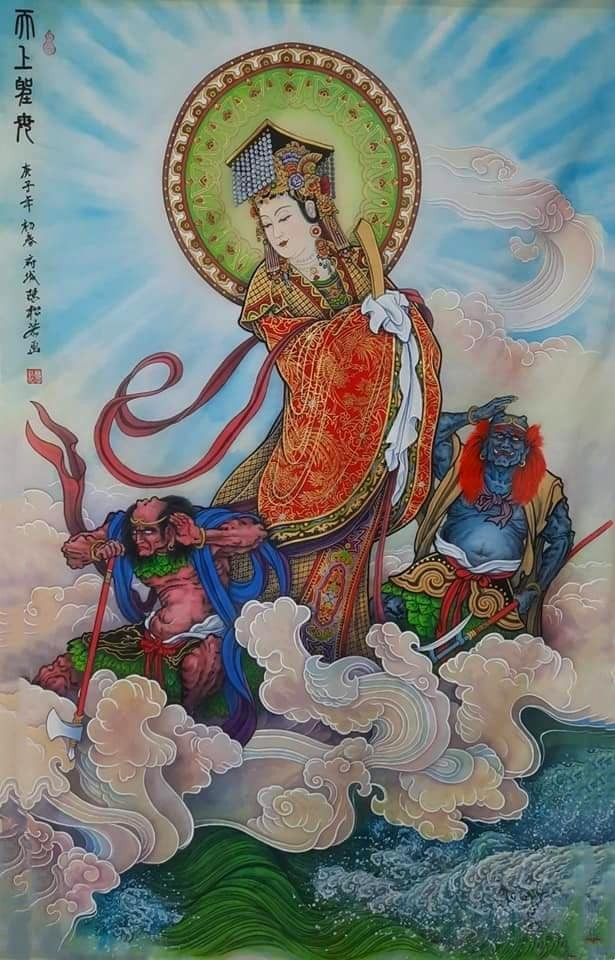
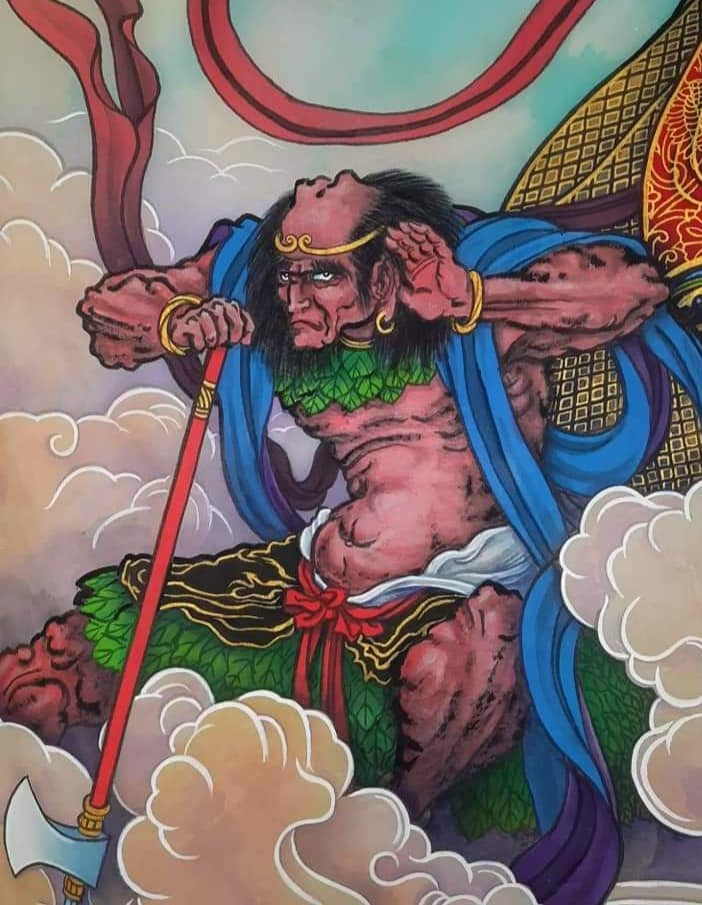
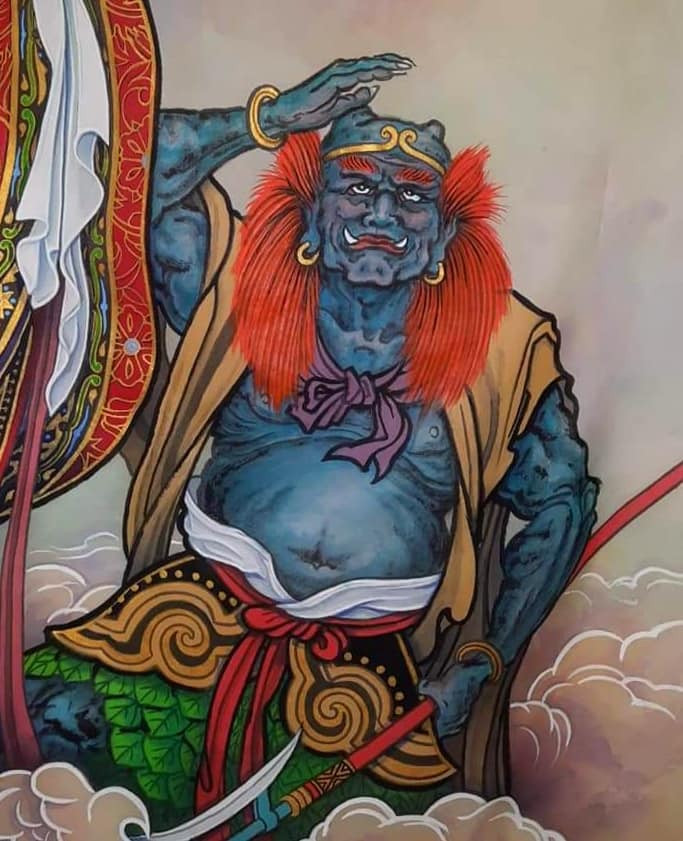
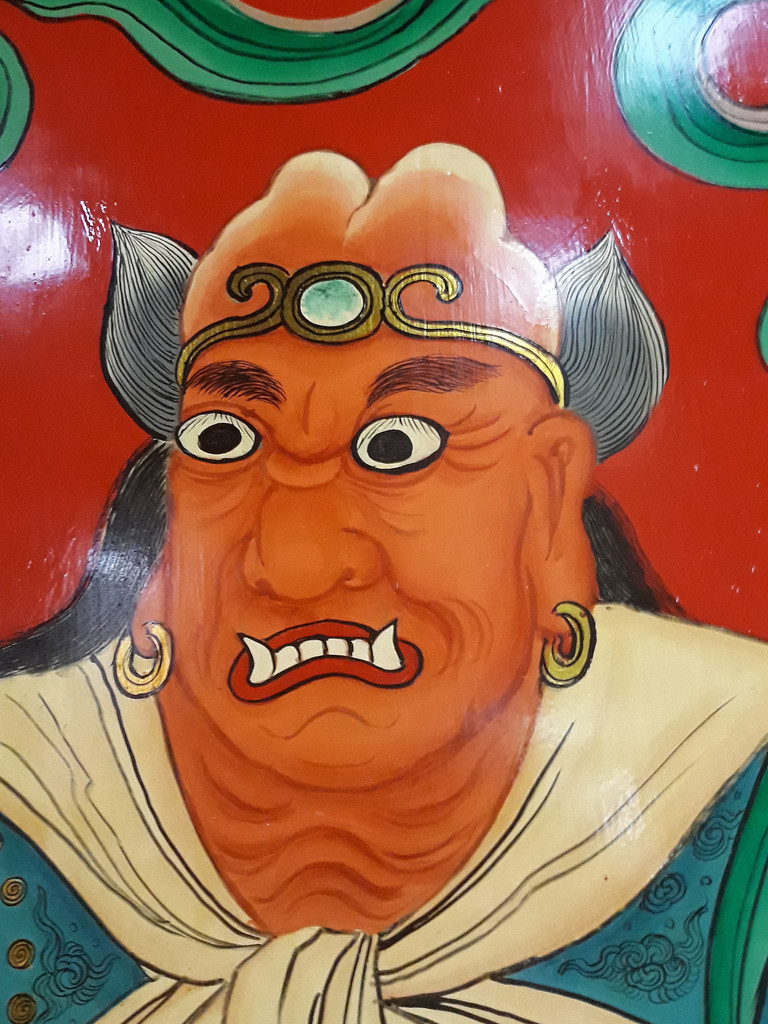
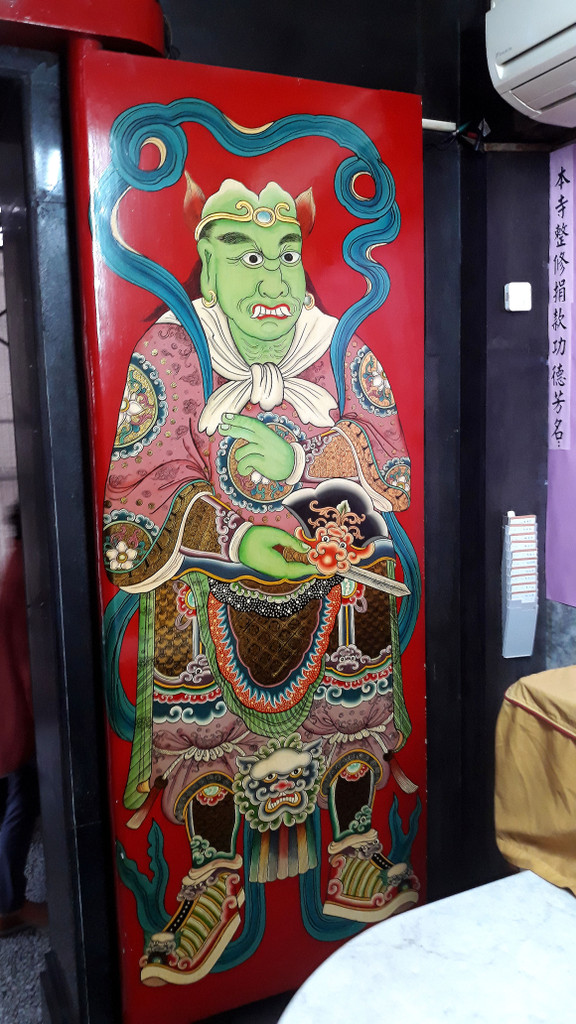
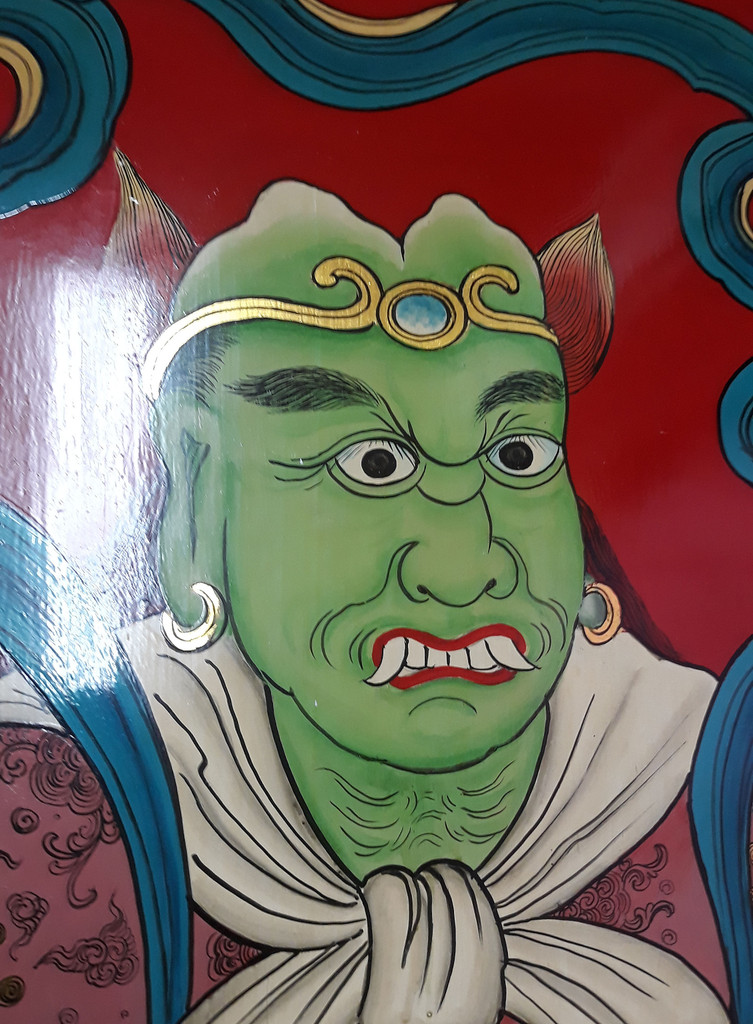
Today, these generals are celebrated as the guardians of Mazu (fig. 2), a popular sea goddess worshiped in Southern China, Macao, and Taiwan. Thousand-Mile Eye is commonly portrayed as a fierce, red warrior scanning the horizon with one hand shielding his eyes (fig. 3), while Fair-Wind Ear is green with one hand to his ear (fig. 4). According to Ruitenbeek (1999), the story of their subjugation is told in a series of circa 1880 mural paintings from the Temple of Divine Mercy (Lingcimiao, 靈慈廟) in Fengting village (楓停), Xianyou district (仙遊), Fujian.
Thousand-Miles Eye (in the murals called Jinxing yan [金星眼], “Venus-eye”), in the disguise of a lovely girl, lures men into a cave, and then dismembers and devours them. [2] When With-the-Wind Ear sees this, he starts a fight with Thousand-Miles Eye, but in the end the two monsters pledge to become sworn brothers. Guanyin, seated on Mount Potala, orders the Dragon’s Daughter to tell Mazu to subdue the monsters. In the first round of the battle, Mazu is forced to retreat. She then implores heavenly warriors to help her, and with their assistance is able to defeat the two monsters. Thereafter, Thousand-Miles Eye and With-the-Wind Ear become her loyal servants. First they help Mazu to fight a man-eating lion, thereafter they subdue the Evil Dragon Monster (p. 316).
Fig. 2 (left) – Mazu with her generals (larger version). Fig. 3 (center) – A detail of Fair-Wind Ear (larger version). Fig. 4 (right) – A detail of Thousand-Mile Eye (larger version). Original artist unknown.
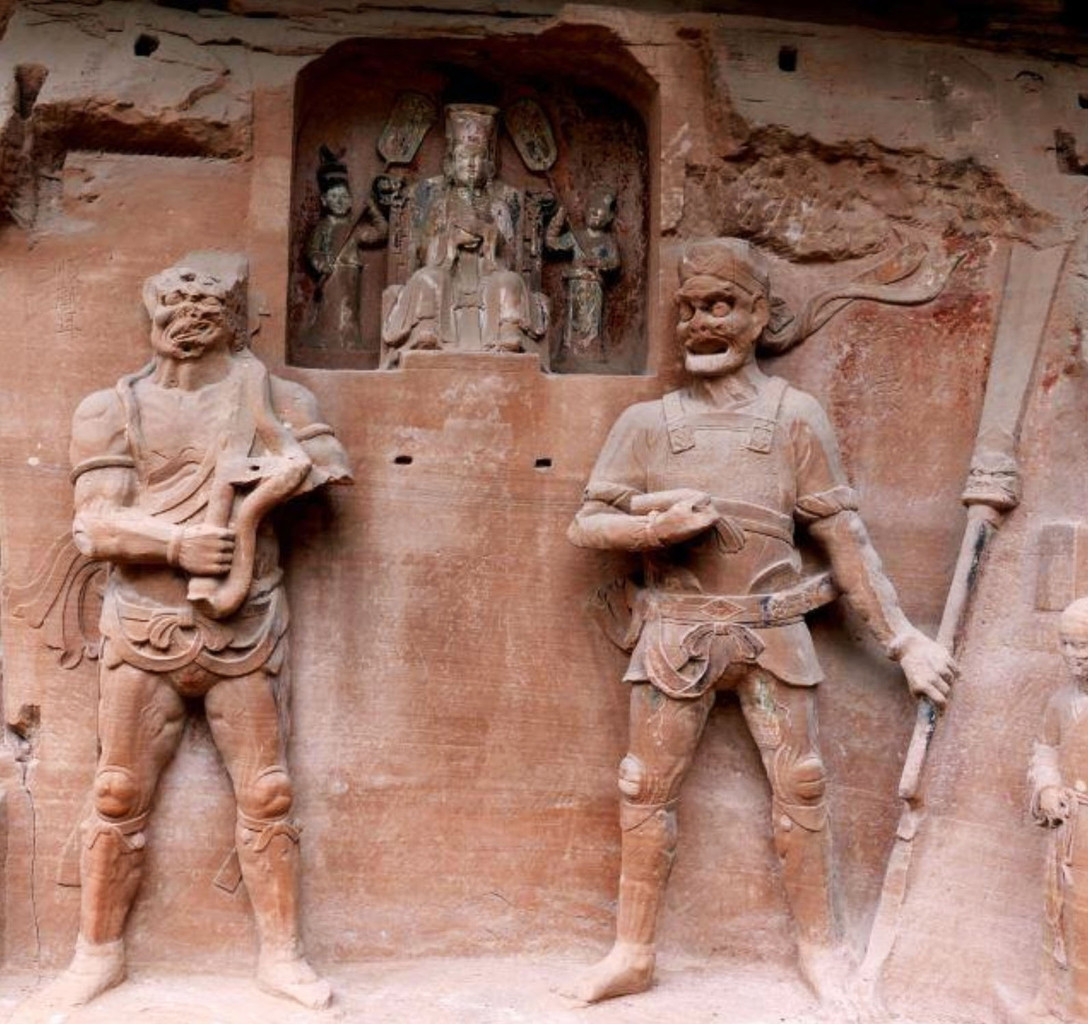
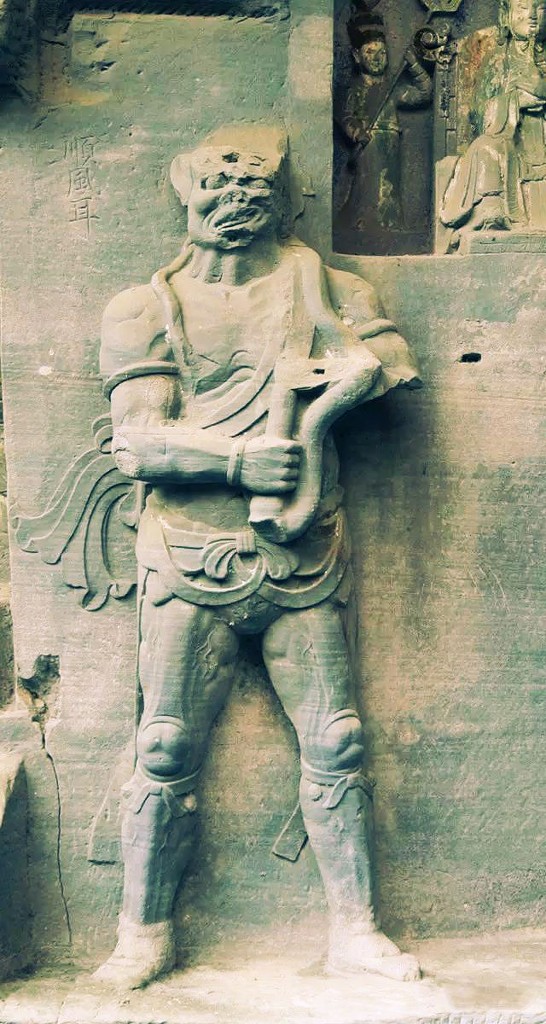
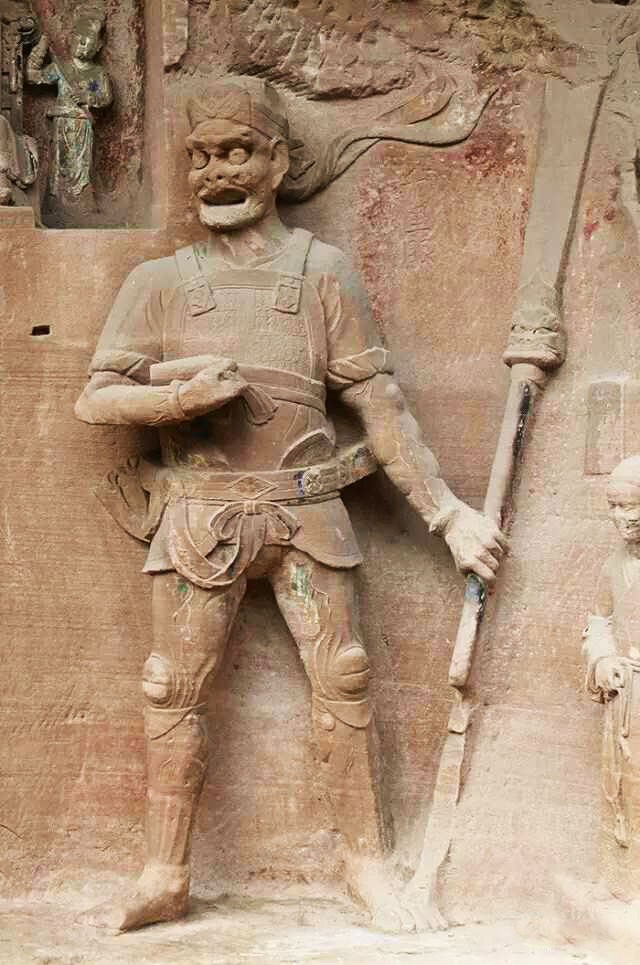
I am unsure when the generals where first associated with Mazu. They are only alluded to in passing as subjugated planetary spirits in the goddess’ early-17th century pious novel Record of the Miracles Performed by the Heavenly Princess (Tianfei xiansheng lu, 天妃顯聖錄) (Ruitenbeek, 1999, p. 319). However, it is clear from their appearance in JTTW that they were associated with the Jade Emperor during the late-16th century. [3] This association stretches back to at least the Shaoxing (紹興, 1131–1162) period of Song Emperor Gaozong, for they appear with the cosmic monarch among the rock carvings of the Shimen Mountain Grotto (Shimen shan shiku, 石門山石窟), one of many sites making up the world famous Dazu rock carvings in Sichuan (fig. 5-7). [4]
Fig. 5 (left) – Song-era statues of generals Fair-Wind Ear (L) and Thousand-Mile Eye (R) guarding the Jade Emperor’s alcove (larger version). From the Shimen Mountain Grotto. Photo originally from this article. Fig. 6 (center) – A detail of Fair-Wind Ear (larger version). Fig. 7 (right) – A detail of Thousand-Mile Eye (larger version). Photos originally from this article.
Readers will notice that apart from being dressed differently, neither statue is striking their characteristic pose. These poses came later and may have been influenced by earlier deities. For example, Nikaido (2011) writes that a Song-era sea god named Zhaobao Qilang (招寶七郎) is sometimes depicted shielding his eyes just like Thousand-Mile Eye, and so he cautiously suggests that, once the deity’s cult waned in popularity and yielded to Mazu, this trait may have been passed on to her generals (pp. 89-90). Conversely, the poses could simply be based on postures used by the very sailors who worshiped such gods. After all, keen eyesight and hearing are skills needed to successfully navigate the open ocean.
2. Golden Headbands
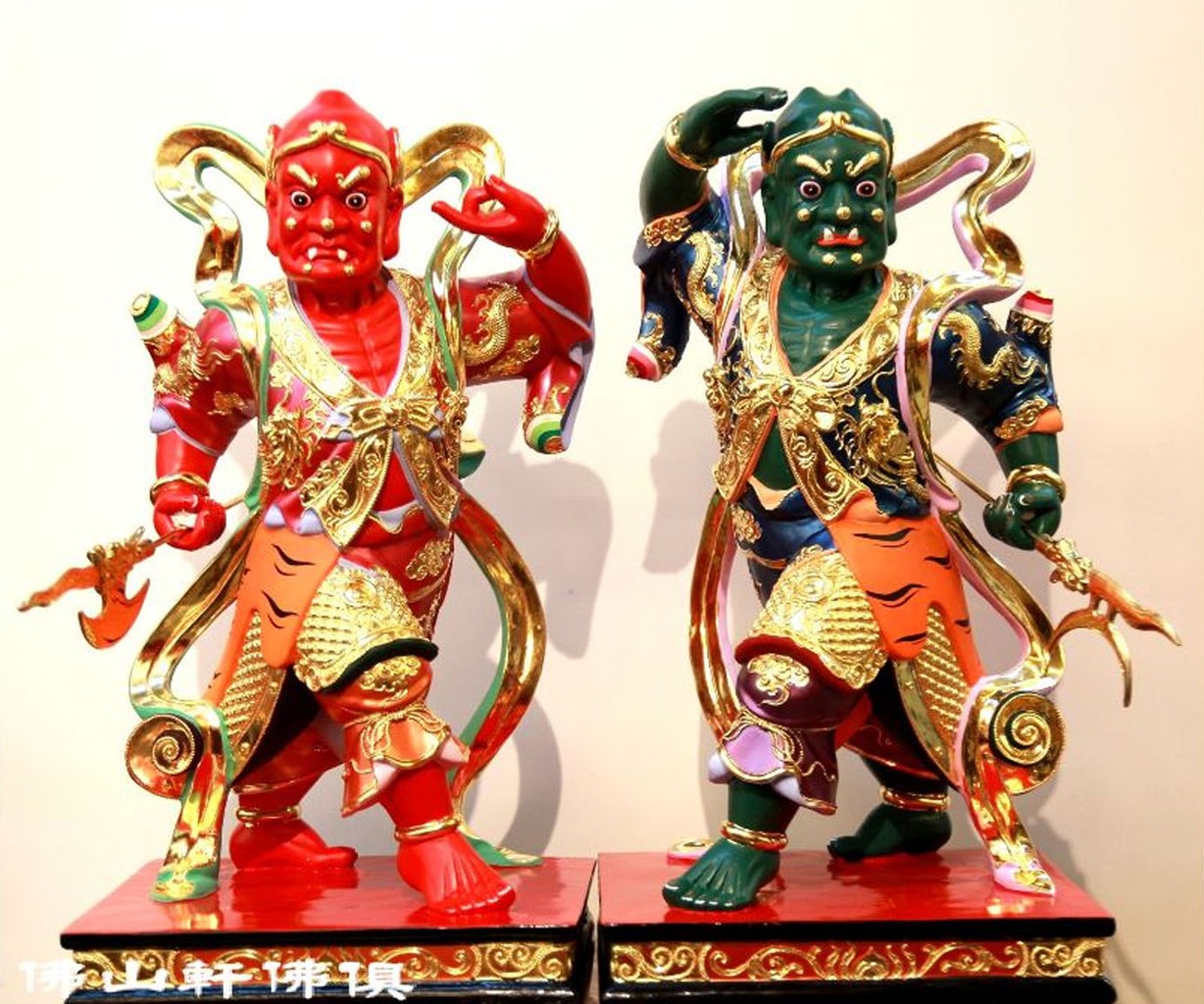
The generals are normally depicted wearing flowing clothing or open armor to show off their muscular physiques. Apart from their divine sashes, they are commonly shown wearing golden armbands, bracelets, and/or anklets, as well as a tiger skin at the waist. These traits appear to be consistent from all the examples that I’ve seen in Taiwan and Hong Kong. However, the statues in Taiwan stand out the most to me because they are often depicted wearing golden fillets on their heads just like Sun Wukong (fig. 8). This is because these headbands share a common origin.
Fig. 8 – Religious statues of Fair-Wind Ear (left) and Thousand-Mile Eye (right) (larger version). Take note of the headbands. Also refer back to figures 4 and 5. Photo originally found here.
I explain in this article that the golden fillet can be traced to a list of prescribed ritual items worn by ancient Buddhist yogins in their worship of Hevajra-Heruka, a wrathful protector deity. These items appear in the 8th century Hevajra Tantra (Dabei kongzhi jingang dajiao wang yigui jing, 大悲空智金剛大教王儀軌經):
The practitioner should wear divine ear-rings, a circlet around the head, upon each wrist a bracelet, a girdle around his waist, anklets around the ankles, arm ornaments around the upper arms and a garland of bones around the neck. His dress must be of tiger skin and his food the Five Nectars (Farrow & Menon, 2001, pp. 61-62; Cf. Linrothe, 1999, p. 250).
You will notice that all of the items associated with the generals, including the headband, the rings on the arms, wrists, and ankles, and the tiger skin are listed here. This is because wrathful protector deities were often depicted in the same attire as their followers, leading to the fillet becoming a symbol of powerful Buddhist spirits. For instance, the Hevajra Tanta describes Hevajra-Heruka as a wrathful youth wearing such clothing:
Dark blue and like the sun in colour with reddened and extended eyes, his yellow hair twisted upwards, and adorned with the five symbolic adornments,/ the circlet, the ear-rings and necklace, the bracelets and belt. These five symbols are well known for the purificatory power of the Five Buddhas./ He has the form of a sixteen-year-old youth and is clad in a tiger-skin. His gaze is wrathful. In his left hand he holds a vajra-skull, and a khatvahga [staff] likewise in his left, while in his right is a vajra of [a] dark hue… (Linrothe, 1999, p. 256; Cf. Farrow & Menon, 2001, p. 44).
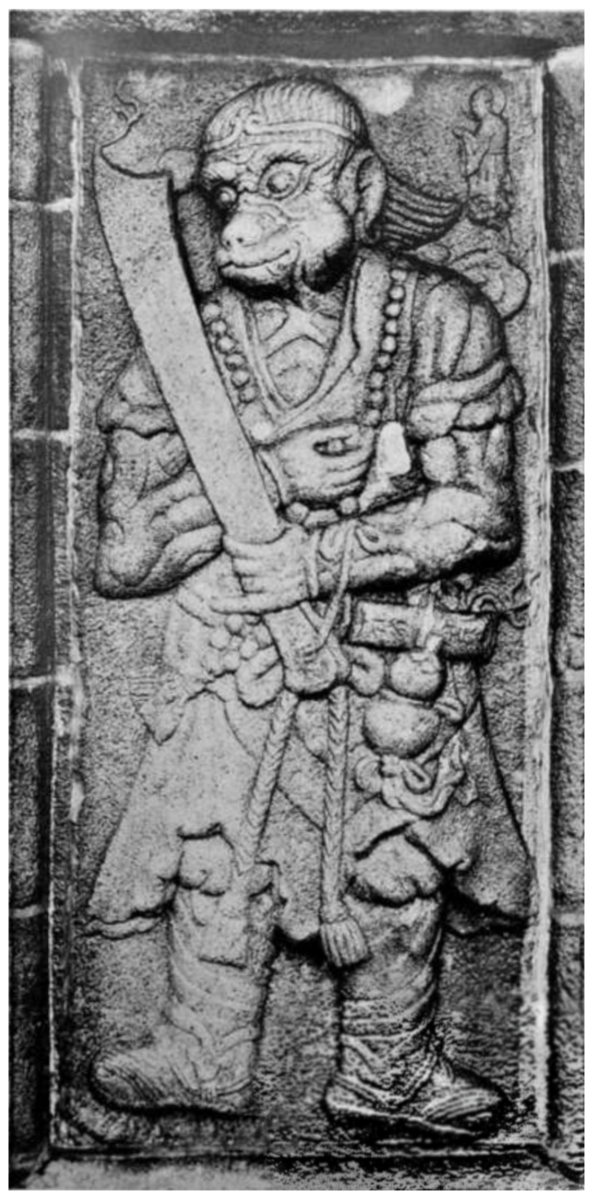
The Hevajra Tantra was translated into Tibetan and Chinese during the 11th century (Bangdel & Huntington, 2003, p. 455), allowing this iconography to spread eastward. A prime example is the 13th-century Kaiyuan Temple Pagoda carving of Sun Wukong in Fujian. He is depicted with the headband, armbands, bracelets, anklets, and possibly even a tigerskin apron (fig. 9).
Given the close cultural connection between Fujian and Taiwan, the generals’ depiction with fillets is likely based on previous examples from the southern Chinese province.
It’s interesting to note that Fair-Wind Ear’s statue from Shimen Mountain Grotto in Sichuan has the aforementioned body rings (refer back to fig. 6). His head is, unfortunately, damaged, though. I would be interested in analyzing similarly dressed guardian figures in the area to see if they wear a fillet.
3. Updates
Update: 04-22-20
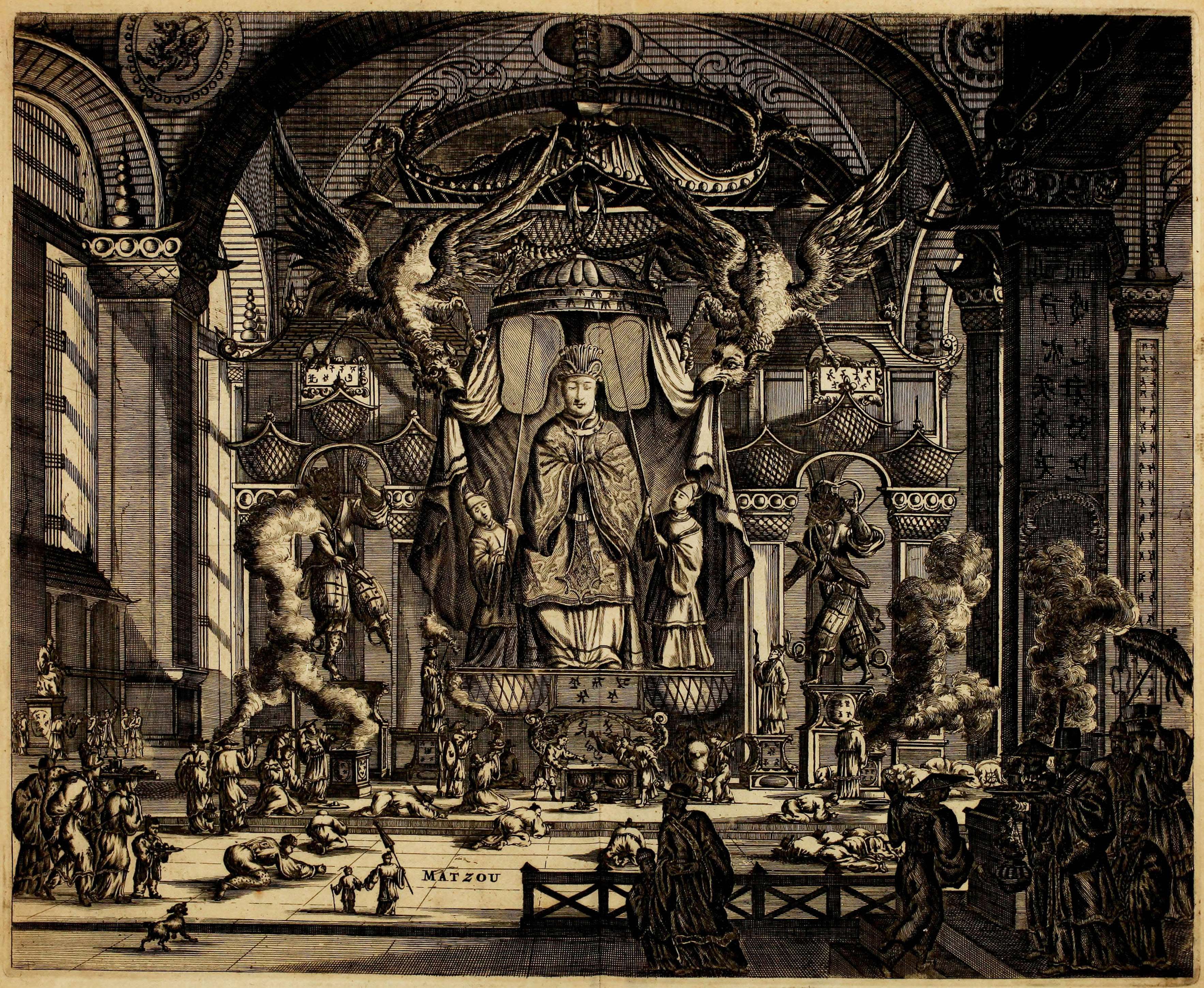
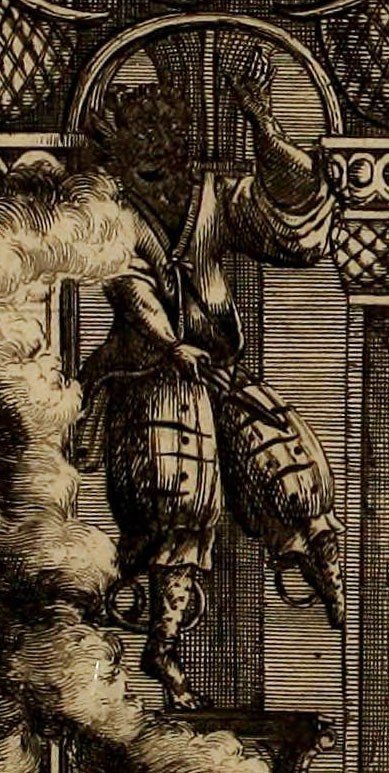
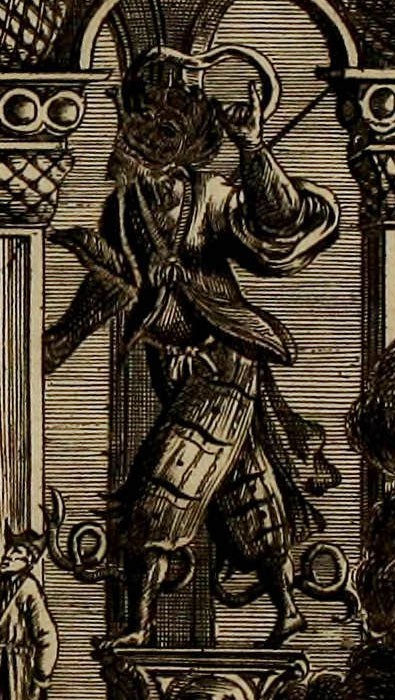
Here is a lovely Dutch engraving of a Mazu temple from a 17th-century book by Olfert Dapper (fig. 10). The generals can be seen standing in their characteristic poses to the left (fig. 11) and right (fig. 12) of the main altar stage. Their attire includes the aforementioned body rings (and possibly tiger skin pants) but no headband.
Fig. 10 (left) – Engraving from Memorable Mission of the Dutch East India Company up the Coast to China and into the Empire of Taising of China (Gedenkwaerdig bedryf der Nederlandsche Ooste-Indische Maetschappye, op de kuste en in het keizerrijk van Taising of Sina, 1670) (larger version). Image from the Clark Collection. Fig. 11 (center) – A detail of General Thousand-Mile Eye (larger version). Fig. 12 (right) – A detail of General Fair-Wind Ear (larger version).
Update: 04-26-20
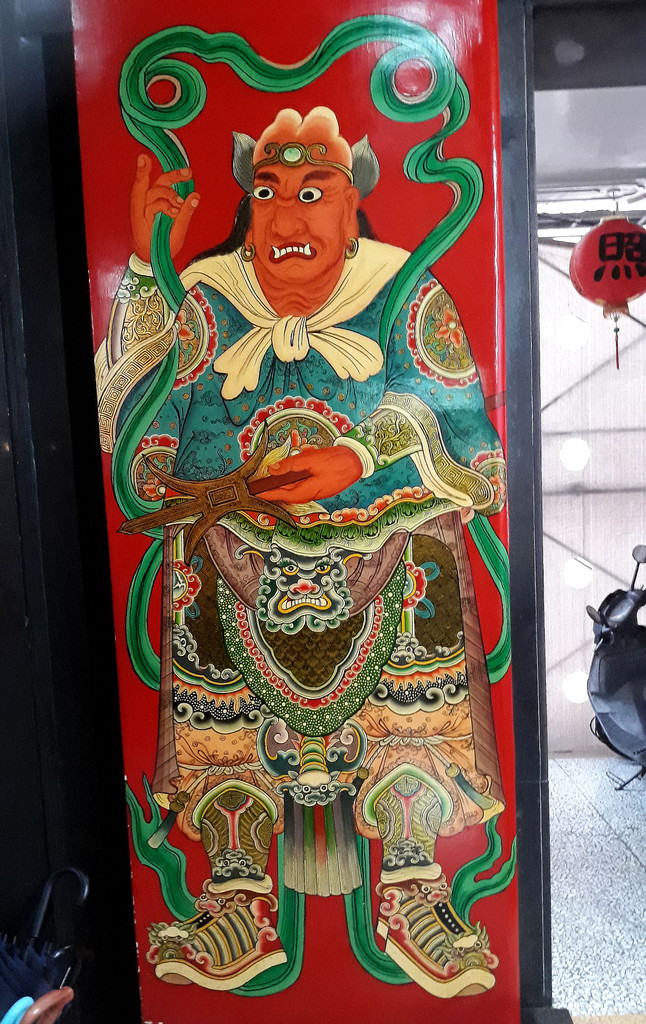
The Puji Temple (普濟寺) in Datong district (大同區), Taipei (near my home) includes door god paintings of the two generals (fig. 13-16). They are depicted with bejeweled headbands. These demonstrate the variability of fillet designs.
1) This feat may be based on Daoist mind-training exercises where adepts try to expand their vision to the ends of the earth/cosmos. According to Robinet (1979), one source reads: “Consider that your two eyes radiate a single light which is like liquid fire and as brilliant as the stars; glowing red, it extends for ten thousand miles. The mountains, marshes, rivers, thickets and forests of the four directions are all resplendent with its light” (p. 55).
2) Wukong states in chapter 27 that he used the same trick to eat humans:
When I was a monster back at the Water-Curtain Cave, I would act like this if I wanted to eat human flesh. I would change myself into gold or silver, a lonely building, a harmless drunk, or a beautiful woman. Anyone feeble-minded enough to be attracted by me I would lure back to the cave. There I would enjoy him as I pleased, by steaming or boiling. If I couldn’t finish him off in one meal, I would dry the leftovers in the sun to keep for rainy days (Wu & Yu, 2012, vol. 2, p. 20).
3) The generals are associated with Huaguang Dadi (華光大帝) in Journey to the South (Nanyouji, 南遊記, 1570s or 1580s). They are referred to as Li Lou (離婁) and Shi Kuang (師曠) (Nikaido, 2011, p. 90). They also make an appearance in Investiture of the Gods (Fengshen yanyi, 封神演義, c. 1620). Ruitenbeek (1999) writes:
[T]hey occur, without the context of Mazu, in the guise of the brothers Gao Ming and Gao Jue. In reality, these were a Peach-tree Spirit and a Willow-tree Ogre, who had availed themselves of the divine power of two clay statues of Qianli yan and Shunfeng er in the temple of Xuan Yuan in Qipanshan. Only after these statues were smashed to pieces did they lose their power. They were subsequently transformed into Shenshu and Yulei, better known as the Door Gods (p. 319).
4) See Zhao (n.d.). These carvings are described by Hu (1994). I, unfortunately, don’t have access to it at the time of this writing.
Sources:
Bangdel, D., & Huntington, J. C. (2003). The Circle of Bliss: Buddhist Meditational Art. Chicago, Ill: Serindia Publications.
Farrow, G. W., & Menon, I. (2001). The Concealed Essence of the Hevajra Tantra: With the Commentary Yogaratnamālā. Delhi: Motilal Banarsidass Publ.
Hu, W. (1994). Sichuan jiaodao fojiao shiku yishu [Taoist and Buddhist Sichuan rock cave art]. Chengdu: Sichuan People’s Publishing.
Nikaido, Y. (2011). The Transformation of Gods in Chinese Popular Religion: The Examples of Huaguang dadi and Zhaobao Qilang. A Selection of Essays on Oriental Studies of the Institute for Cultural Interaction Studies. Osaka: Kansai University, 85-92.
Ruitenbeek, K. (1999). Mazu, the patroness of sailors, in Chinese pictorial art. Artibus Asia 58(3/4). 281-329. Retrieved from https://www.jstor.org/stable/3250021
Wu, C., & Yu, A. C. (2012). The Journey to the West (Vols. 1-4) (Rev. ed.). Chicago, Illinois: University of Chicago Press.
Sun Wukong first appears as the “Monkey Pilgrim” (Hou xingzhe, 猴行者) in The Story of How Tripitaka of the Great Tang Procures the Scriptures (Datang Sanzang qujing shihua, 大唐三藏取經詩話, late-13th-century; “The Story” hereafter), the earliest-known published version of the Journey to the West (Xiyouji, 西遊記, 1592; “JTTW” hereafter) story cycle. He is described as an immortal banished from heaven for stealing divine peaches from the Queen Mother of the West, and he later becomes the ruler of the 84,000 monkeys of Flower-Fruit Mountain. But he first enters the story as a white-clad scholar and willing participant in the journey who actively seeks out the monk Tripitaka and his retinue of fellow clerics on the quest to India. The Monkey Pilgrim then uses his magical abilities and heavenly treasures to protect the monks from all manner of spirits, warlocks, and dragons. In the end, he is bestowed the title “Great Sage Steel Muscles and Iron Bones” (Gangjin tiegu dasheng, 鋼筋鐵骨大聖) (Wivell, 1994). [1]
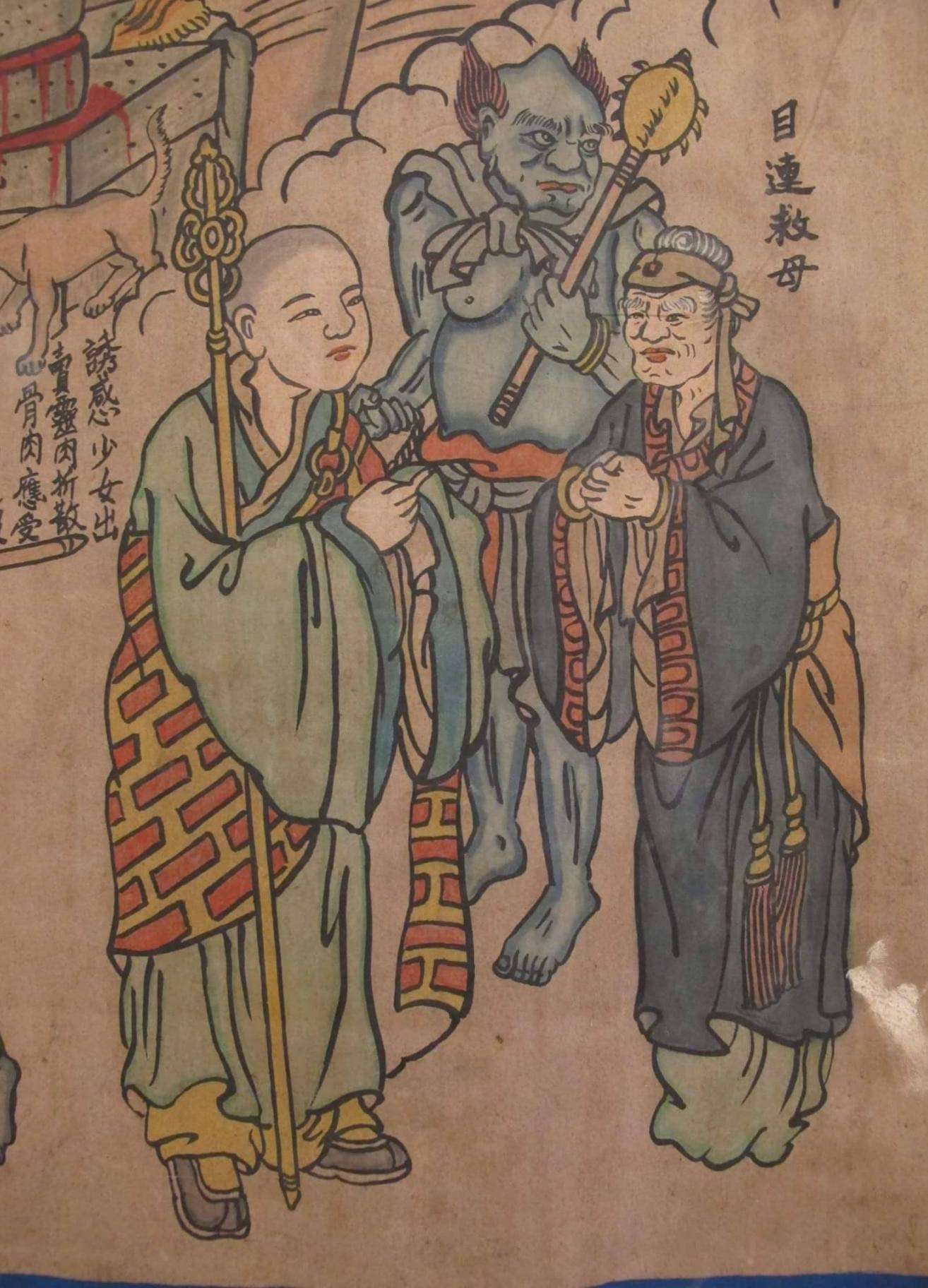
The heavenly treasures wielded by the Monkey Pilgrim are based on those used by the famed Buddhist saint and cultural hero Mulian (目連; Sk: Maudgalyayana), a disciple of the Buddha. He appears in the Transformation Text on Mahamaudgalyayana Rescuing his Mother From the Underworld with Pictures, One Scroll, with Preface (Damuganlian mingjian jiumu bianwen bingtu yijuan bingxu, 大目乾連冥間救母變文并圖一卷並序), a late-9th to early-10th century Bianwen (變文) text in which he travels to the underworld to release his mater from karmic torment (fig. 1). Originally discovered in the oasis of Dunhuang, the text serves as the foundational myth for the Ghost Festival (Gui jie, 鬼節; a.k.a. “Zhongyuan Festival,” Zhongyuan jie, 中元節; a.k.a. “Yulanpen Festival,” Yulanpen jie, 盂蘭盆節), which is held on the 15th day of the seventh month.
In this article, I will discuss three similarities that the Monkey Pilgrim shares with Mulian, including using similar holy treasures, visiting the same heavenly realm, and having a connection to the Ghost Festival. While Tripitaka, as a monk working towards the salvation of others, is a more obvious cognate for Mulian, it’s correct to say that Monkey is an amalgam of the Buddhist saint and Chinese stories of animals that guide the recently deceased through the underworld.
Fig. 1 – A scroll or mural depicting Mulian rescuing his mother from the underworld (larger version). Originally found here.
The Monkey Pilgrim and Tripitaka first receive the golden-ringed monk’s staff, along with two other treasures, from the supreme deity, the Mahabrahma devaraja (Dafan tianwang, 大梵天王; lit: “Great Brahma Heavenly King,” a.k.a. Vaisravana), in chapter two.
The Dharma Master [Tripitaka] and Monkey Pilgrim approached the Devaraja and begged for his help. The Devaraja granted them a cap of invisibility, a golden-ringed staff, and a begging bowl. After accepting these three boons, the Dharma Master said farewell, then turned to the Monkey Pilgrim and asked: “How can we get back to the mortal world?” Pilgrim replied: “Before the Dharma Master speaks of returning to the world below, he had better ask the Devaraja how we can save ourselves from the monsters and disasters which lie ahead of us.” The Dharma Master returned to Mahabrahma and asked as Monkey had suggested. The Devaraja responded: “When you meet calamity, point toward the Heavenly Palace from afar and shout ‘Devaraja’ once, and you will be saved.” The Dharma Master accepted his instructions and bowed farewell (Wivell, 1994, p. 1184).
Now compare that with Mulian’s tale in which he receives the staff from the Buddha:
“How will I [Mulian] be able to see my dear mother again?” The World-Honored called out to him, saying, “Mahamaudgalyayana! Do not be so mournful that you cry yourself heartbroken; The sins of the world are tied to those who commit them like a string, They are not stuck on clay-fashion by anyone else. Quickly I take my metal-ringed staff and give it to you. It can repel the eight difficulties and the three disasters. If only you remember diligently to recite my name, The hells will certainly open up their doors for you” (Mair, 1994, p. 1111).
Both receive a magic monk’s staff with abilities tied to the recitation of a Buddhist deity’s name.
Here is one example of the power of The Story‘s staff:
The pilgrims arrived at the valley of the fire-spitting White Tiger Spirit. Coming closer they encountered a great ditch. The four steep entrances were pitch-black and they heard a roar of thunder. They could not advance. The Dharma Master held up his golden-ringed staff and, flourishing it toward the distant heavenly palace, yelled: “Devaraja! Help us in our afflictions!” Suddenly a shaft of light shot out from the staff five tricents long. It slashed through the long ditch and soon they were able to get across (Wivell, 1994, 1187-1188).
He [Mulian] wiped his tears in mid-air, and shook the metal-ringed staff, Ghosts and spirits were mowed down on the spot like stalks of hemp. Streams of cold sweat crisscrossed their bodies, dampening them like rain, Dazed and unconscious, they groaned in self-pity; They let go of the three-cornered clubs which were in their hands, They threw far away the six-tined pitchforks which were on their shoulders (Mair, 1994, p. 1112).
But The Story‘s treasure builds upon the Mulian tale by adding an exciting new ability: creating giant, monstrous life. For instance, while confronting the white tiger spirit in chapter six:
Monkey Pilgrim transformed his golden-ringed staff into a gigantic yaksa whose head touched the sky and whose feet straddled the earth. In his hands he grasped a demon-subduing cudgel. His body was blue as indigo, his hair red as cinnabar; from his mouth a fiery gleam shot forth a hundred yards long (Wivell, 1994, p. 1189).
How cool is that? And in chapter seven, “he transformed the magic staff into an iron dragon” to battle a group of nine-headed serpents (被猴行者 … 金鐶錫杖化作一條鐵龍) (Wivell, 1994, p. 1190).
Fig. 2 – The head of a 12-ringed monk’s staff (larger version). From the author’s personal collection.
1.2. The Alms Bowl
The treasure bowl is first used in chapter six:
Next they suddenly came to a wild fire [2] which reached to the heavens. It sent off such a huge amount of smoke and sparks that the pilgrims could not proceed. The Dharma Master shone the light of his begging-bowl toward the fire and yelled: “Devaraja!” The fire died out immediately and the seven pilgrims crossed this pit (Wivell, 1994, p. 1189).
It is next used by the Monkey Pilgrim in chapter seven while fighting the nine-headed serpents. He “sucked all the thousand tricents of water into the begging-bowl” (被猴行者 … 缽盂盛卻萬里之水) (Wivell, 1994, p. 1190).
There are no similar feats in Mulian’s story, but his alms bowl is also imbued with magic, allowing him to fly freely between the realms of heaven, earth, and the underworld. For instance,
Maudgalyayana awoke from abstract meditation, Then swiftly exercised his supernatural power; His coming was quick as a thunderclap, His going seemed like a gust of wind. […] With his supernatural power, he gained freedom, So he hurled up his begging bowl and leaped into space; Thereupon, instantaneously, He ascended to the heavenly palace of Brahma (Mair, 1994, pp. 1097-1098).
Both he and the primate hero travel to the Brahma realm. Readers will recall that Monkey magically transports Tripitaka and his group to the crystal palace of the Mahabrahma Devaraja in chapter two (Wivell, 1994, p. 1184).
1.3. Connection to the Ghost Festival
Not only does the Monkey Pilgrim use Mulian-esque treasures, he also ascends to heaven on the Ghost Festival. After the group receives the last of the scriptures in chapter 16, the Dipamkara Buddha tells them:
“On the fifteenth day of the seventh month [i.e. the date of the Ghost Festival], it will be time for you, Dharma Master, and your band of seven to return to the celestial halls. Remember what I have said, and on the fifteenth rise early and bathe yourself. Say farewell to the T’ang emperor, for at noon the ‘Lotus-Plucking Barge’ will arrive. There will also be golden lotus-flower seats and auspicious rainbow-colored clouds. Twelve mellifluously voiced youths will escort you with incense, flowers, and decorated banners. They will adorn you with the seven precious gems, welcoming you seven to return to Heaven. But the invitation from Heaven has a time limit and you must not dally! Listen well to what I have told you and keep it firmly implanted in your mind!” (Wivell, 1994, 1202).
The seven boarded the barge and, looking due west, they ascended into the heavens and became immortals. Nine dragons rose up into the mist and ten phoenixes came out to welcome them. A thousand cranes offered them felicitations and there were flashing lights of transcendence (Wivell, 1994, p. 1206).
Recall that Mulian’s quest to free his mother’s soul from underworld torments is the foundational myth of the Ghost Festival. It actually opens with an explanation of the chthonic celebration:
Now, on the fifteenth day of the seventh month, the heavens open their doors and the gates of hells are flung wide. The three mires dissipate, the ten virtues increase. Because this is the day when the company of monks end their summer retreat, the deity who confers blessings and and the eight classes of supernatural beings all come to convey blessings. Those who undertake to make offerings to them in the present world will have a supply of blessings and those who are dead will be reborn in a superlative place. Therefore, a purgatorian feast is spread before the Three Honored Ones who, through the grace of their welcoming the great assembly, put a priority upon saving those who are distressed by hanging in limbo (Wivell, 1994, pp. 1093-1094).
The Monkey Pilgrim’s use of Mulian-style holy accoutrements, travel to the Brahma realm, and ascension on the Ghost Festival raises the question: is our hero suppose to be a stand-in for the Buddhist saint? The simple answer is “not exactly.” It’s important to remember that he and Tripitaka share the duty of wielding the holy treasures. And while the immortal uses them more, the fact that Tripitaka is a Buddhist monk working towards the salvation of others makes him a more fitting cognate for Mulian.
However, The Story‘s connection to chthonic literature still provides Monkey a link to the Buddhist saint:
The Japanese scholar Chūbachi Masakazu (b. 1938) was the first to point out that the Kōzanji narratives mirror two closely related mythic archetypes. The first, derived from ancient Han Chinese traditions, is the journey of the dead to the netherworld. In many accounts of postmortem travels, spirit animals (including but not limited to monkeys) serve as the guides for the dead on their passage through the spirit realm, whether the final destination is the Yellow Springs beneath the earth or Mount Kunlun in the distant west. The other motif, emerging from early Indian Buddhist literature, is the transmigration of the spirit to the Pure Land, which, like Mount Kunlun, was conventionally located somewhere in the west. In Buddhist accounts, animals (again, often but not always monkeys) also serve as escorts for the dead. Chūbachi proposed that these narrative traditions—culturally distinct but thematically and functionally similar—were fused together with the historical account of Xuanzang’s journey to India. The Kōzanji texts, according to this reading, represent a complex but organic blending of initially independent narratives. The broad contours of Xuanzang’s biography and travelogue were superimposed onto older mythic accounts to provide a new, quasi-historical frame for age-old stories about the transmigrations of the dead.
Viewed from this perspective, Xuanzang was not passing through Central Asia en route to India but, instead, was traversing a hellish purgatory to reach a heavenly pure land. Like a shaman, he departs the human world and enters a dangerous liminal zone. Beset by ghosts and demons, he is guided and protected by powerful spirit animals and Buddhist deities. After enduring extreme hardship, he eventually arrives in an immortal realm populated by spirit monks, immortals, bodhisattvas, and buddhas. From Śākyamuni Buddha, he receives a collection of apotropaic texts with the power to safeguard the living and liberate the dead. Xuanzang then transmits these sacred scriptures back to the human realm before he and his assistants ascend to heaven during the annual ritual for liberating the damned from purgatory. This narrative not only maps the landscape of a postmortem shadow world, it also identifies the scriptures that guard against demonic molestation and ensure a propitious rebirth: the Buddhist canon in general and the Heart Sūtra in particular. Those who read, recited, or heard the Kōzanji texts were thus informed of the perils of purgatory and offered the promise of protection and salvation. Xuanzang, they also learned, was the saintly monk responsible for delivering these divine texts and technologies into the hands of humans (Brose, 2023, pp. 62-63).
Given the above information, it’s more correct to view the Monkey Pilgrim as a sort of amalgam of Mulian and the animal helpers who guide the recently deceased through the under world. This is important to remember, especially when discussing the origins of the Great Sage, for his history is far more nuanced than the “foreign only” (i.e. Hanuman=Sun Wukong) theory would suggest.
2. Updates
2.1 Sun Wukong’s Staff
Update: 09-15-19
Another power of Mulian’s staff likely influenced the Monkey King’s “As You Wish Gold-Banded Staff.” During his quest to free his mother from the underworld, the Buddhist saint uses the treasure to unlock the gates of hell:
With one shake of his staff, the bars and locks fell from the black walls, On the second shake, the double leaves of the main gate [of hell] flew open (Mair, 1994, p. 1113).
Now compare that to an episode from JTTW chapter 25:
“Elder Brother,” said Eight Rules [Zhu Bajie], “stop this hocus-pocus. The doors are all locked. Where are we going to go?” “Watch my power!” said Pilgrim. He seized his golden-hooped rod and exercised the lock-opening magic; he pointed the rod at the door and all the locks fell down with a loud pop as the several doors immediately sprung open. “What talent!” said Eight Rules, laughing. “Even if a little smith were to use a lock pick, he wouldn’t be able to do this so nimbly.” Pilgrim said, “This door is nothing! Even the South Heaven Gate would immediately fly open if I pointed this at it!” (Wu & Yu, 2012, vol. 1, pp. 468-469)
While I believe Mulian’s bowl influenced the somersault cloud, Shao (2006) notes that the 108,000 li (33,554 mi/54,000 km) covered by Monkey in a single leap is based on the symbolic distance said by Huineng to separate the Buddha’s paradise from the world of man. As the Chan patriarch explains in the Platform Sutra, “This number refers to the ten evils and eight wrongs in one’s person” (Huineng & Cleary, 1998, p. 26, for example). Only those who achieve enlightenment can overcome these hindrances and arrive instantly in paradise. This is symbolized in the novel by Monkey zipping their instantly on his cloud, whereas Tripitaka must travel thousands of miles over many years.
Update: 02-06-21
I have written an article that discusses the magic powers of the staff. These include the ability to shrink and grow, control the ocean, astral project and entangle with Monkey’s spirit, multiply endlessly, pick locks, and transform into various objects. It also has sentience to a certain degree.
I’ve rewritten and added new some new information to the article.
Note:
1) Wivell (1994) translates the name as “Great Sage of Bronze Muscles and Iron Bones” (p. 1207). But the gang (鋼) of Gangjin tiegu dasheng (鋼筋鐵骨大聖) means “steel.” Therefore, I’ve changed the original source accordingly.
2) Wivell (1994) translates yehuo (野火) as “prairie fire” (p. 1189), but “wildfire” is a more literal rendering. Therefore, I’ve changed the original source accordingly.
Sources:
Brose, B. (2023). Embodying Xuanzang: The Postmortem Travels of a Buddhist Pilgrim. United States: University of Hawaii Press.
Buswell, R. E., & Lopez, D. S. (2014). The Princeton Dictionary of Buddhism. Princeton University Press.
Mair, V. H. (1994). Transformation Text on Mahamaudgalyayana Rescuing his Mother From the Underworld with Pictures, One Scroll, with Preface. In V. Mair (Ed.), The Columbia Anthology of Traditional Chinese Literature (pp. 1094-1127). New York: Columbia University Press.
Shao, P. (2006). Huineng, Subhūti, and Monkey’s Religion in “Xiyou ji”. The Journal of Asian Studies,65(4), 713-740. Retrieved from www.jstor.org/stable/25076127
Look up the terms “monkey” or “ape” in the dictionary and you’ll find that they serve as verbs meaning to mimic the movements or actions of another. This is because monkeys and apes have a propensity for observation and mimicry. Being primates ourselves, humans are no different. But interestingly this mimicry sometimes mirrors our primate cousins. Chinese martial arts, for example, has developed several primate-based fighting arts, including White Ape Connected Arms boxing (Baiyuan tongbei quan, 白猿通背拳) and several flavors of Monkey boxing (Houquan, 猴拳), and other styles have even adopted primate techniques, such as the monkey footwork of Praying Mantis boxing (Tanglang quan, 螳螂拳). Humans have long marveled at the physical prowess and acrobatic mastery of apes and monkeys, so it’s only natural that boxers would want to incorporate the powerful arm movements and awe-inspiring leaps and flips of primates into various fighting arts. But how long have our cousins been associated with martial arts in Chinese culture, and when and how did primate-based martial arts develop?
Two approaches can be used in an attempt to answer both questions. The first method involves charting similarities in techniques shared between modern regional primate-based Chinese martial arts styles and relying on folk lineages, ethnographic data, and (when possible) historical manuals to discover the earliest vestiges of primate boxing in China. A second method is to search for references to primate-based martial arts in the historical record. A benefit of the first approach would be pinpointing the areas in China where these styles likely first emerged in recent history. The downside is that martial arts are passed from teacher to student via embodied practices (e.g. fist and weapons forms and sparring), often without the material being recorded in a manual. This means such styles can’t be reliably traced beyond a certain time period. A benefit of the second approach is that it provides a deeper view of history, giving the researcher license to record not only the odd mention of historical boxing styles but also associations between primates and weapons and other forms of physical exercise in ancient folklore, literature, medicine, and religion. Obviously, the best approach would be a combination of the two. However, I lack the necessary encyclopedic knowledge of Chinese martial arts techniques. Such a grand project will have to wait for a more qualified researcher. I have instead decided to adopt the second approach.
This article is divided into five sections. The first presents a folk history for Tai Shing Pek Kwar, a popular modern form of Monkey boxing, to serve as an example of how such styles can be created. The second provides three references to premodern Monkey boxing appearing in military and travel writings of the 16th century during the late Ming (1368–1644), pointing to the commonplace nature of the style. Here, I suggest that the lack of evidence for pre-Ming references to primate-based boxing points to the style emerging during this time. This section also provides examples of armed techniques associated with apes in military literature of the 16th and 17th century. The third discusses the story of the noted literary monkey hero Sun Wukong (孫悟空), his portrayal as a master of armed and unarmed fighting, and how he bridges the gap between the aforementioned lack of pre-Ming boxing references and older material associating apes and monkeys with armed combat. The fourth presents ancient stories pitting a magic white ape against the martial skills of legendary Chinese heroes, including the archer Yang Youji (養由基, 7th c. BCE) and the swordswoman the Maiden of Yue (Yuenu, 越女, 5th c. BCE). And the fifth discusses ancient animal mimicry and suggests that primate-based boxing is tied to war-like shamanic totemic dances and yoga-like daoyin calisthenics (8th c. to 2nd c. BCE). [1]
Shaolin Monkey – This combative style is said to have developed among various animal styles at the famed Shaolin Monastery (Shaolin si, 少林寺) in Henan province, China. Matsuda (2013) claims this particular style to be thousands of years old (p. 50); however, this has no basis in history, as will be explained below.
Wushu Monkey – This modern, non-combative style focuses on gymnastic leaps and flips for entertainment purposes. It is used in both Chinese opera and the floor routines of form competitions (video 1) (Matsuda, 2013, pp. 54-56).
Tai Shing Pek Kwar Monkey – This is the Cantonese variant of the Mandarin Dasheng Pigua men (大聖劈掛門), or the “Great Sage Ax School” of boxing. This combative style is said to be quite young, being a little over 100 years old (Matsuda, 2013, p. 56).
To this I add one more:
Emei Monkey – This combative style is associated with the martial arts of Emei Mountain (Emei quan, 峨嵋拳) in Sichuan, China.
Video 1 – The first half of this video shows a youth performing Wushu Monkey for a form competition.
Tai Shing Pek Kwar is a combination of two different styles. The first, which I will only describe briefly, is Pek Kwar kyun (Pigua quan, 劈掛拳), a style that mimics the swinging of an ax, relying on the lively arm movements to generate power, much like the Choy Li Fut style of southern China. It is said to have been created over two hundred years ago in Shandong (northern China) by a woodcutter named Ma Chi Ho (Matsuda, 2013, pp. 64-68). The weapons practiced by this style include the double-edged sword (jian, 劍), the single-edged saber (dao, 刀), and the staff (gun, 棍) (Matsuda, 2013, pp. 70-75).
The Tai Shing kyun (Dasheng quan, 大聖拳) style is said to have been founded in northern China around the year 1911 (the end of the Qing dynasty) by a prisoner named Kou Si (寇四). [2] After being sent to jail for murder, Kou discovered that his cell faced a forest where he could observe the day-to-day lives of a troupe of monkeys. He noted five distinct behaviors among them that when combined with his knowledge of Great Earth boxing (Di tang quan, 地趟拳), a type of ground combat, could be adapted for fighting.
Lost Monkey (Mi Hou, 迷猴) – This form mimics the behavior of a frightened monkey, comprising periods of attack and retreat, with lots of rolling, low kicks, and quick, frantic running low to the ground (video 2).
Stone Monkey (Shi Hou, 石猴) – This form mimics the behavior of an enraged alpha male, comprising slower but drastically more powerful fist, elbow, and knee strikes, all of which are delivered from a low stance.
Tall Monkey (Qi Hou, 企猴) – This form mimics the behavior of a tall monkey, comprising longer, quicker swinging arm strikes and higher-level kicks.
Drunken Monkey (Zui Hou, 醉猴) – This form mimics the behavior of intoxicated monkeys, comprising falls, swaying motions with broken footwork, and circular punches, all of which are delivered from a low stance.
Wooden Monkey (Mu Hou, 木猴) – This form mimics the behavior of an intelligent, deceptive monkey, comprising quick, low attacks and rolls similar to the Lost Monkey, but feigning retreat only to turn and unleash strikes upon the pursuing opponent.
After perfecting the style, Kou Si is said to have named it “Great Sage boxing” in honor of the monkey hero Sun Wukong (Matsuda, 2013, pp. 86-116). This is a reference to the title taken by the character during his rebellion against heaven (see section 3 below). The weapons practiced by this style include the staff and the metal ring (Matsuda, 2013, pp. 118-131).
Video 2 – The Lost Monkey form.
2. Primates and Martial Arts During the Ming
Textural evidence for Monkey boxing actually predates Kou Si’s lineage, appearing in late-Ming dynasty (1368–1644) records. The first reference appears in the eighteen volume edition of famed general Qi Jiguang‘s (戚繼光, 1528–1588) (fig. 1) New Treatise on Military Efficiency (Jixiao xinshu shiba juan ben, 紀效新書十八卷本), a military training manual completed in 1561 or 1562. The fourteenth chapter, titled “Chapter on the Fist Canon and the Essentials of Nimbleness” (Quanjing jieyao pian, 拳經捷要篇), reads:
Among the past and present fist specialists, the Song Great Founder had the Long Fist system with thirty-two positions. Moreover there are six pace and fist techniques, the Monkey Fist, and the Feinting Fist. The famous positions each have their own names, but in reality they are quite similar and scarcely differ from one another (Gyves, 1993, p. 34).
While Qi believed that boxing had no place in armed conflict, he thought such training was useful as it strengthened soldiers’ bodies, coordinated their limbs, improved their weapons skills, and bolstered their courage (Gyves, 1993, pp. 33-37). Qi gathered what he considered the most efficient techniques to achieve this goal, meaning that he consulted with many martial artists in the process. The fact that he mentions Monkey boxing suggests that it was a common style among fighters of this time.
The second reference appears in Zheng Ruozeng’s (郑若曾, 1505–1580) Strategic Situation in Jiangnan (Jiangnan jinglue, 江南經略, 1564), which was written in response to the ever-present threat of the Woukou (倭寇), a conglomeration of Japanese, Chinese, and Korean sea bandits, invading China’s coastline. In the eighth volume, Zheng provides a long list of armed and unarmed martial arts, including the “thirty-six roads (forms) of Monkey boxing” (Houquan sanshiliu lu, 猴拳三十六路) (Zheng, 1564). Again, this suggests that Monkey boxing was quite common.
The third appears in scholar Wang Shixing’s (王士性, 1547–1598) A Journey to Mt. Song (Songyou ji, 嵩遊記), a travel log of the mountain on which the famed Shaolin monastery is located:
Martial monks again each came to present skills. With fists and staves contending, they struck as if flying. Their teacher with folded hands looked on. Among them was a monkey striker, spinning and leaping, just like a monkey… (Wells & Chang, 2004, p. 23).
This shows that a single Shaolin warrior monk practiced Monkey boxing. But does this mean the style was part of the monastery’s official curriculum at the time? The answer is no. According to Shahar (2008), textual evidence suggests that Shaolin officially took up boxing in the proceeding 17th century, and the first styles practiced were Drunken Eight Immortals boxing (Zui baxian quan, 醉八仙拳) and Lost Track boxing (Mizong quan, 迷蹤拳), and possibly followed by Plum Flower boxing (Meihua quan, 梅花拳) in the 18th- century. The monks adopted pugilism as a form of calisthenic exercise, later combining it with Daoyin (導引) calisthenics and spirituality to create a new form of self-cultivation. [3] Prior to this, the Shaolin monks were only known for their proficiency with the staff. Therefore, given the seeming commonplace nature of Monkey boxing during the late Ming, the monk could have learned the style from an outside source.
Modern folklore associated with one primate-based style, White Ape Connected Arms Boxing (Baiyuan tongbei / bi quan, 白猿通背 / 臂拳), traces its origins to religious and military figures of the Song dynasty (960–1279), centuries prior to the Ming (Lu, 2006, pp. 103-105, for example). However, it should be said that having a Song-era foundation is a reoccurring theme in many martial arts legends. For instance, the famed Song general Yue Fei (岳飛, 1103–1142) is commonly attributed Eagle Claw boxing (Yingzhao quan, 鷹爪拳) and Form-Intent boxing (Xingyi quan, 形意拳) (Liang & Yang, 2002, pp. 15-16, for example). But textual evidence for these styles don’t appear until the Ming and Qing, respectively. [4] Most importantly, the oldest source associated with White Ape Connected Arms Boxing, titled the Connected Arms Boxing Manual (Tongbi quan pu, 通臂拳谱), was written during the late Ming and finally published in 1665 during the early Qing (List of surviving Ming period martial arts, 2017). Likewise, concrete references to primate-based boxing do not predate the Ming. This might suggest such styles arose during this time when there was an explosion in the popularity of pugilism. But this tells us nothing about how primate-based boxing may have developed. The history of animal mimicry in Chinese martial arts can be traced to much older concepts based in medicine and religion. This is discussed in section 5 below.
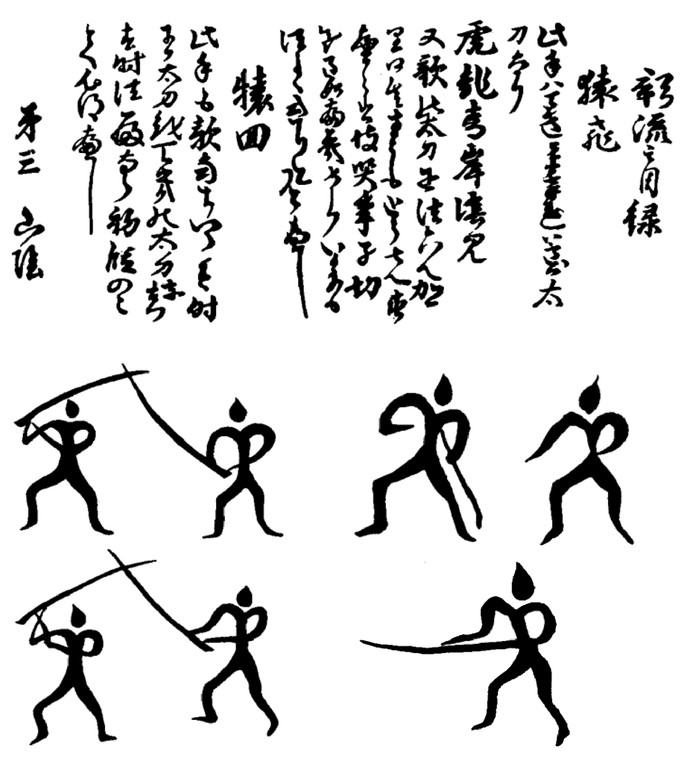
Fig. 2 – A compilation of images of the sword-fighting apes from the Collection of Military Works (c. 1621) (larger version). By the author. Fig. 3 – A compilation of the original stick figures and Japanese calligraphy from the fourteen volume edition of the New Treatise on Military Efficiency (1584) (larger version). From Qi, 1584/2001, p. 83. Note the similarities in stance and the position of the blades.
As for the association between primates and armed combat during the Ming, the animals are occasionally referenced in the named fighting techniques of military literature. For example, the tenth volume of Qi Jiguang’s aforementioned manual includes a feinting lance technique titled “White Ape Trailing Sword Stance” (Baiyuan tuo dao shi, 白猿拖刀勢) (Yang & Xie, 1995, p. 336). The 35th volume of the Collection of Military Works (Wubei zhi, 武備志, c. 1621), a Ming treatise on military armaments and fighting techniques compiled by Mao Yuanyi (茅元儀, 1594–1640), includes “White ape exits cave” (Baiyuan chudong shi, 白猿出洞勢), a stance appearing in the sequence for an overhead sword guard. [5] (Incidentally, this is also the name of a fist set practiced in some lineages of Praying Mantis boxing). Additionally, the same volume includes a two-section sword manual, the first section of which portrays fanciful images of apes practicing with the “sprout saber” (miaodao, 苗刀) (Mao, 1621), a long, two-handed blade similar to the Japanese Katana (fig. 2). These strange images differ from the human-based figures in the rest of the source. It’s important to note that the original sword manual, called Saber Techniques of the Xinyou-Era (i.e. 1561) (Xinyou daofa, 辛酉刀法), is taken directly from the fourth volume of the revised fourteen volume edition of Qi’s New Treatise on Military Efficiency (Jixiao xinshu shisi juan ben, 紀效新書十四卷本, 1584). The first of the aforementioned two sections reproduces a series of sword-wielding stick figures taken from a Shadow School (Kage-ryu, 影流 / 陰流) manual of Japanese sword fighting. The section is prefaced by lively Japanese calligraphy, and the few words recognizable to readers of Chinese include “ape flying” (yuanfei, 猿飛) and “ape returning” (yuanhui, 猿回) (fig. 3), both of which are Kenjutsu techniques still practiced today (video 3). [6] This then might explain why the stick figures were changed to apes when the material was reproduced in the Collection of Military Works decades later. But I would also like to suggest that the change (as well as the allusion to the sword-wielding white ape from the lance technique mentioned earlier) was influenced by a famous first-century Chinese story about a talented swordswoman who has her skills tested by a magic white ape. This is discussed in section 4 below.
Video 3 – A modern demonstration of the “ape-flying” technique.
3. Sun Wukong the Monkey King
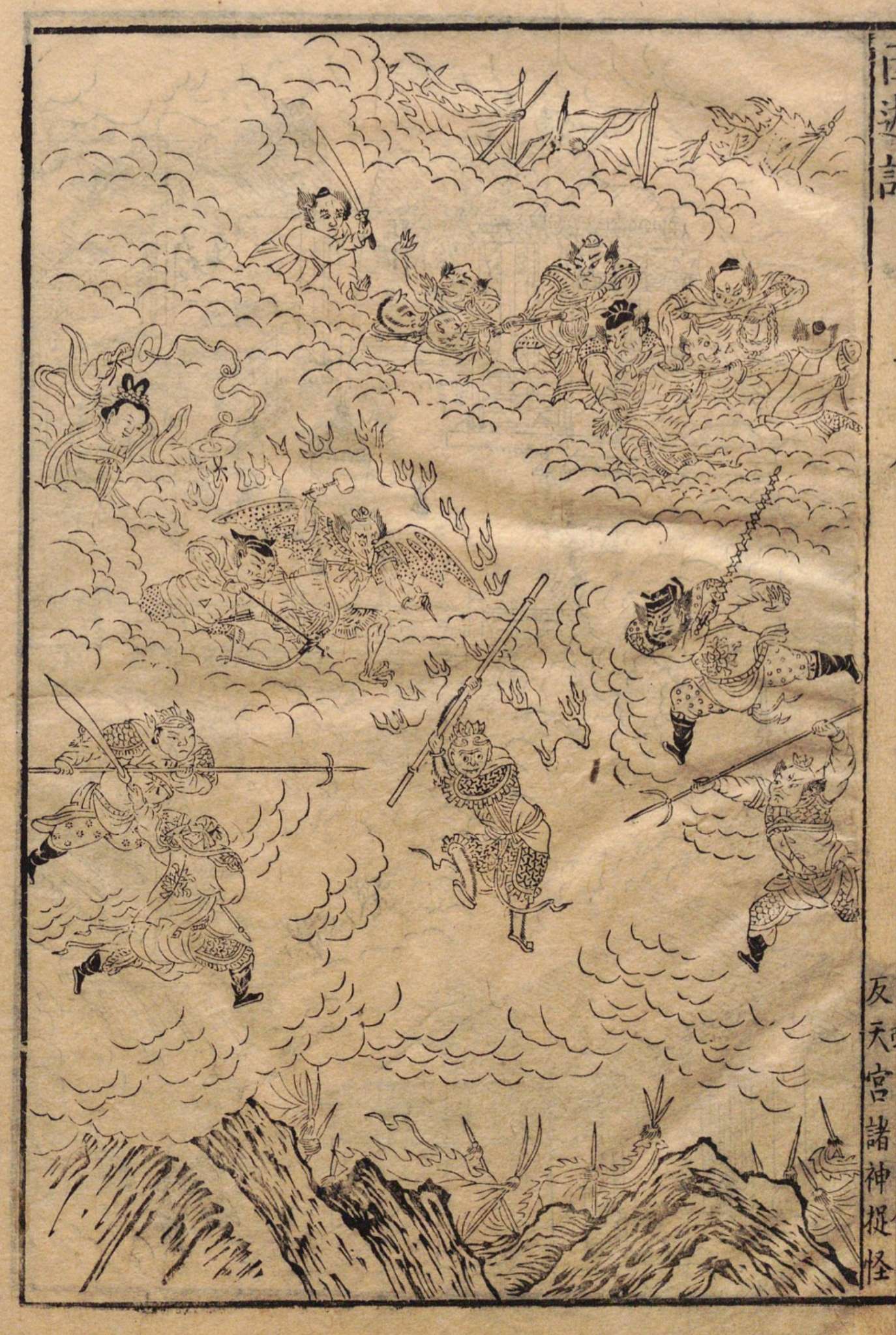
By far, the most famous weapon-bearing primate of the late Ming-period is Sun Wukong (孫悟空, a.k.a. “Monkey”), the simian protagonist of the highly popular Chinese novel Journey to the West (Xiyou ji, 西遊記, 1592). According to the tale, the stone-born monkey rules a mountain utopia before learning magic, martial arts, and the secret of immortality under a Buddho-Daoist sage. He soon thereafter acquires a magic, size-changing iron staff, which he uses to wage war against the celestial realm (fig. 4), proclaiming himself the “Great Sage Equaling Heaven” (Qitian dasheng, 齊天大聖, hence the name for Kou Si’s Monkey boxing). But his rebellion is eventually quelled by the Buddha, who imprisons the indestructible monkey demon beneath a mountain for his crimes. Five hundred years later, the repentant immortal is called upon to use his great strength, martial arts, and powers of transformation to protect the monk Tripitaka on a journey to procure scriptures from India.
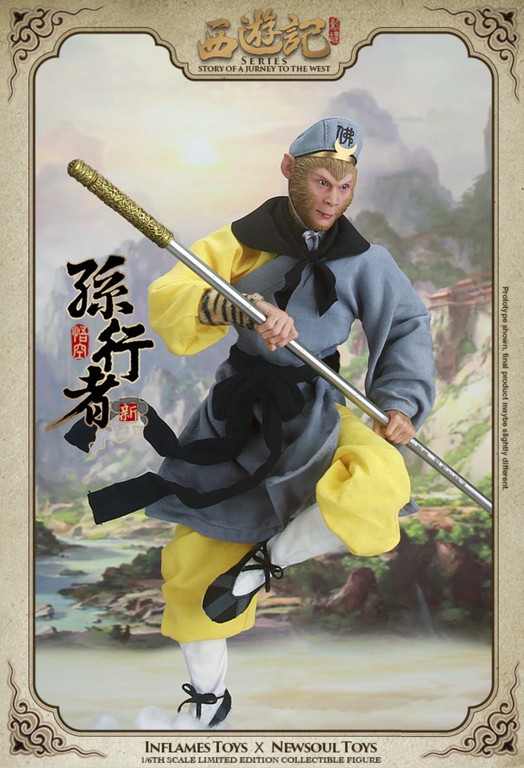
The narrative portrays Sun as a well-rounded martial artist proficient in both weapons and boxing. For example, during his rebellion with heaven, he trains his monkey children as soldiers, teaching them troop movement and weapons, including swords, spears, axes, and bows and arrows. But he is best known for his skill with the staff (fig. 5). One episode sees Monkey give a display of his martial prowess while he and his master travel through a spooky mountain. His skill is so great that the story likens it to the strategy taught in two of the Seven Military Classics of China:
“Going through this tall mountain and rugged cliff must have made master [Tripitaka] rather apprehensive, that’s all. Don’t be afraid! Don’t be afraid! Let old Monkey put on a show for you with my rod to calm your fears somewhat.” Dear Pilgrim! Whipping out his rod, he began to go through a sequence of maneuvers with his rod as he walked before the horse: up and down, left and right, the thrusts and parries were made in perfect accord with the Six Secret Teachings and Three Strategies [Liutao Sanlue, 六韜三略)]. [7] What the elder saw from the horse was a sight incomparable anywhere in the world (Wu & Yu, 2012, vol. 2, p. 105).
Fig. 5 – A modern action figure of Sun Wukong with his magic staff (larger version).
Furthermore, Monkey displays a mastery of unarmed fighting (fig. 6) in two episodes. A poem in chapter 51, for example, is important because it describes a battle between Sun and a buffalo demon in which they use real boxing techniques, many of which are still known and practiced to this day:
Hitching up his clothes and walking forward, the fiend assumed a boxing posture; his two fists upraised looked truly like two iron sledge hammers. Our Great Sage also loosened his legs at once and moved his body to attack; right before the cave entrance, he began to box with the demon king. This was quite a fight! Aha!
Opening wide the “Four Levels Posture”; The double-kicking feet fly up. They pound the ribs and chests; They stab at galls and hearts. “The Immortal pointing the Way”; “Lao Zi Riding the Crane”; “A Hungry Tiger Pouncing on the Prey” is most hurtful; “A Dragon Playing with Water” is quite vicious. The demon king uses a “Serpent Turning Around”; The Great Sage employs a “Deer Letting Loose its Horns.” The dragon plunges to Earth with heels upturned; The wrist twists around to seize Heaven’s bag. A green lion’s open-mouthed lunge; A carp’s snapped-back flip. Sprinkling flowers over the head; Tying a rope around the waist; A fan moving with the wind; The rain driving down the flowers. The monster-spirit then uses the “Guanyin Palm,” And pilgrim counters with the “Arhat Feet.” The “Long-Range Fist,” stretching, is more slack, of course. How could it compare with the “Close-Range Fist’s” sharp jabs? The two of them fought for many rounds— None was the stronger, for they are evenly matched (Wu & Yu, 2012, vol. 3, pp. 12-13).
While the techniques are not Monkey boxing, the narrative certainly helped solidify the connection between primates and martial arts during the late Ming when references to the style were recorded.
Fig. 6 – Sun teaching a young human apprentice martial arts. Drawing by Celsohenrique on deviantart (larger version).
Sun Wukong’s image as a master of armed and unarmed combat led to his veneration among northern Chinese martial artists at the end of the Qing. As noted in this article, fighters of the anti-foreign Boxer Rebellion (1899–1901) were known to channel the spirit of the Monkey King (among other deities) in order to gain his martial prowess. A German catholic missionary active in Shandong in the late 19th and early 20th century recorded how four boxer youths were chosen as possible vessels, and after a ritual enticed the deity to earth, the “possessed” individual performed a frightening saber dance, indicating that the Great Sage had taken control. Additionally, Dudbridge (1970) cites one 17th-century source that describes Sun’s veneration in the southern Chinese province of Fujian for “appear[ing] in the clouds to beat back an attack from Japanese pirates” (p. 158). This refers to the preceding 16th century when China’s coast was plagued by the aforementioned Wokou pirates. Interestingly, Sun Wukong fighting pirates puts him in the same company as the Shaolin warrior monks, who used their martial arts skills to rout the same bandits during the 1550s (Shahar, 2008, pp. 68-70).
Fig. 7 – The Monkey Pilgrim stone relief carving, 1237, from the Kaiyuan Temple Western Pagoda, Quanzhou City, Fujian Province, China (larger version).
Monkey is important to this study because he bridges the gap between the lack of pre-Ming references to primate-based boxing and older material associating apes and monkeys with armed combat. Sun first appears as the “Monkey Pilgrim” (Hou xingzhe, 猴行者) in The Story of How Tripitaka of the Great Tang Procures the Scriptures (Da Tang Sanzang qujing shihua, 大唐三藏取經詩話), a seventeen chapter storytelling prompt dated to the late 13th century. The narrative presents our hero wielding two staves, one a golden-ringed monk’s staff and the other an iron staff, in defense of his Buddhist master. These two staves would later be combined by storytellers to create his signature weapon.
Older still, the Kaiyuan Temple (Kaiyuan si, 開元寺) of Fujian is home to a nearly life-sized carving of the hero (fig. 7), who is presented as a saber-wielding guardian deity. He appears alongside other such wrathful gods, as well as bodhisattvas, arhats, patriarchs, and eminent monks, on a stone pagoda that was erected in the year 1237. So, Monkey was associated with various weapons as far back as the 13th century.
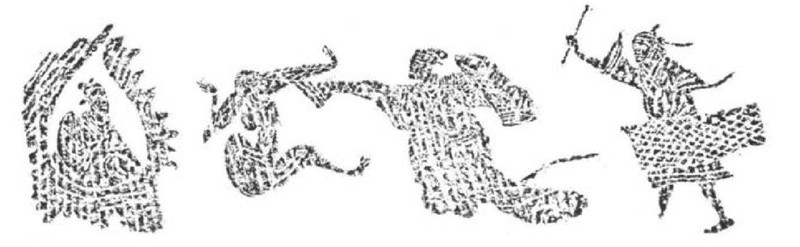
Fig. 8 – A Han-era stone tomb rubbing showing a sword-wielding hero striking at a fleeing white ape (center). A woman can be seen held captive in a teardrop-shaped cave (left). The hero is followed by an assistant beating a gong (right) (larger version). From Wu, 1987, p. 88.
Apart from possible Indian influences, Sun Wukong’s origins can be traced to a body of Han (206 BCE–220 CE) and Tang (618–907 CE) dynasty tales in which a magical white ape or gibbon (baiyuan, 白猿) kidnaps human woman and spoils their innocence (fig. 8). For example, the unnamed primate antagonist of “A Supplement to Jiang Zong’s Biography of a White Ape” (Bu Jiang Zong baiyuan zhuang, 補江總白猿傳, c. late 7th c.) is described as a 1,000-year-old hermit who lives in a mountain utopia, practices Daoist longevity arts, wields the power to fly and change his shape, and has supernatural strength and an iron-hard, nigh-invulnerable body immune to most efforts to harm him. Most importantly, he is depicted as a master of armed combat, one displaying a fondness for sword dancing. His blade is said to “circl[e] his body as fast as lightning and as round as a full moon.” [8] As noted above, this is not the first story involving a magic white ape who is fond of swordplay.
4. Magic Apes and Ancient Chinese Heroes
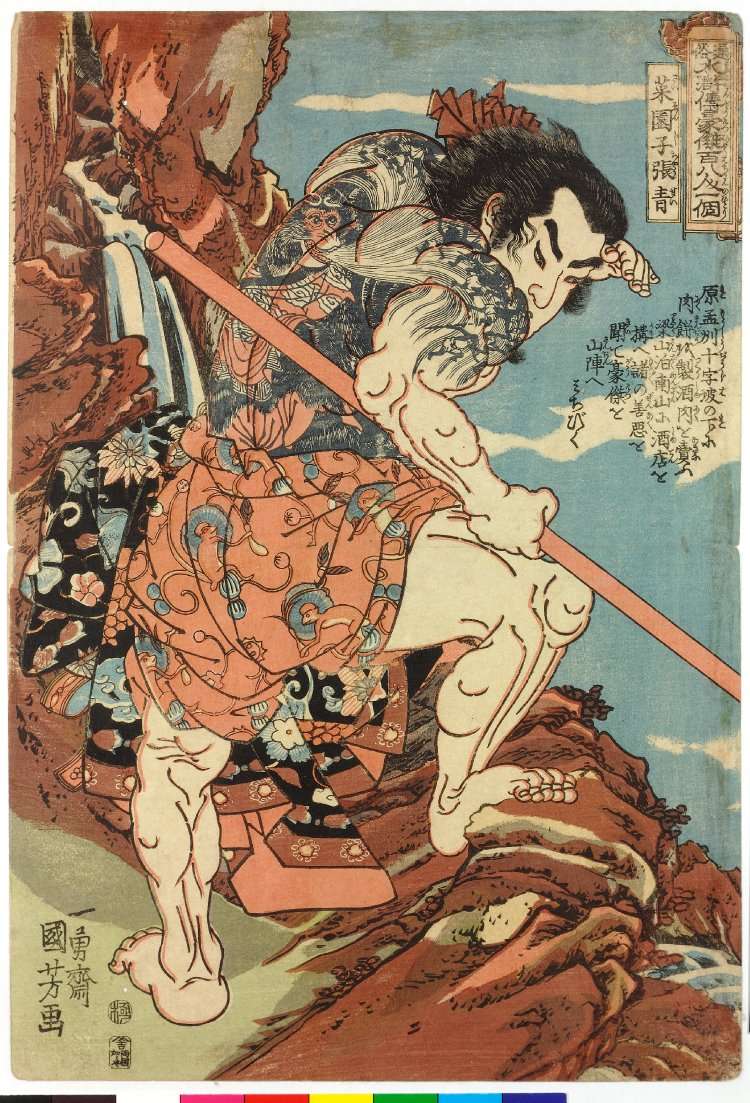
The Chinese classic the Water Margin (Shuihu zhuan, 水滸傳, c. 1400) describes the literary heroes Hou Jian (侯健), Lin Chong (林沖), and Zhang Qing (張清) (fig. 9) each having ape-like arms, denoting their great strength and agility. This same nickname was applied to powerful archers of the past. Ma (2010) writes:
[I]t is said that the Xiongnu warrior Liu Chong ‘had arms like an ape, was skilled at archery (yuanbei shanshe 猿臂善射), and could pull a bow of three hundred jin’ 斤 (Book of Wei《魏書》). Similarly, History of Ming describes General Chang Yuchun 常遇春 as ‘distinguished looking, with peerless courage and strength, had arms like those of an ape and was skilled at archery’; and in the same vein, Tang poet Cui Daorong 崔道融 wrote that ‘the ape-armed general runs as if on wings, sparing no one with his bow from a hundred paces’ (General Li’s Biography [Ti Li jianjun zhuan 題李將軍傳]) (p. 24).
Fig. 9 – A woodblock print of the hero Zhang Qing by Kuniyoshi produced between 1827 and 1830 (larger version). It is part of the artist’s “One of the 108 Heroes of the Popular Water Margin” series (Tsuzoku Suikoden goketsu hyakuhachinin no hitori, 通俗水滸傳濠傑百八人一個). Original image found here. Look closely and you’ll notice that the tattoo on Zhang’s back portrays Sun Wukong producing magical clones of himself from his mouth.
Oddly enough, the earliest tales mentioning archers and magic white apes do not liken one to the other. In fact, they are diametrically opposed. For example, a third-century BCE tale about the famed archer Yang Youji (養由基, 7th c. BCE) portrays the creature as an elusive target for his arrow:
Once in the palace of Jing 荊 there was a supernatural white ape. Even the skillful archers of Jing could not hit it. Then the king of Jing asked … Yang Youji to shoot it. Yang straightened his bow and went to the palace with arrows in his hands. Before shooting he aimed at a place where the [moving] ape had not yet arrived. When he let the arrow fly, the ape fell immediately. Thus Yang Youji could be called the archer who could hit a target before it was there (Wu, 1987, p. 103; see also Gulik, 1967, p. 41).
A similar version of the tale states that the ape recognizes Yang’s supernatural skill, anticipating the arrow and crying out in pain moments before actually being struck (Wu, 1987, p. 103; Gulik, 1967, p. 41).
Perhaps the most famous story associating the magic white ape with martial arts is the “Maiden of Yue” (Yuenu, 越女, 1st c. BCE), named after its protagonist, a peerless swordswoman of the 5th century BCE. The story describes how she participates in a sparring match with the shape-changing ape:
The Young Woman of Yue travelled north for her audience with the king [Goujian of Yue]. On the way, she met an old fellow who said his name was “Old Mr. Yuan” [Yuan gong, 袁公].
He said to the young woman, “I hear you fight well with a [sword]. I’d like to see a demonstration.”
She replied, “I wouldn’t presume to keep anything from you: you are welcome to test my skill, Sir.”
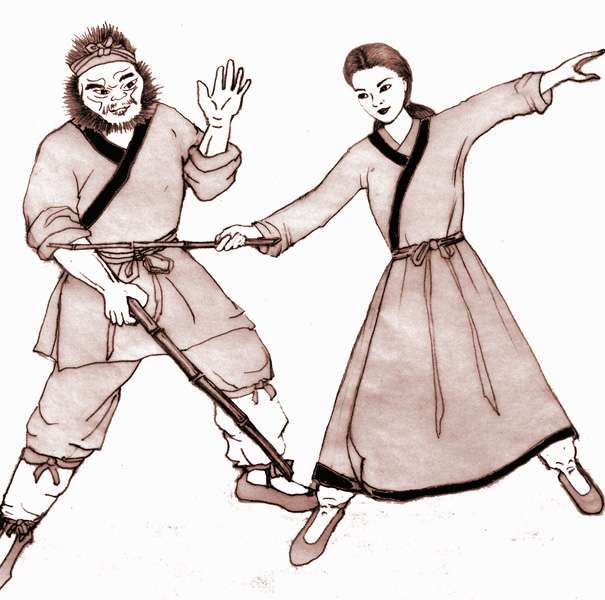
So Old Man Yuan drew out a length of Linyu bamboo. But the bamboo was rotten at one end. The end fell to the ground and the young woman immediately snatched it up. The old man wielded the top end of the staff and thrust towards the young woman, but [she] parried straight back, thrust three times, and finally raised her end of bamboo and drove home her attack against Old Man Yuan [fig. 10]. Old Man Yuan hopped off up a tree, turning into a white ape [baiyuan, 白猿, hence the surname]. Then each went their own way, and she went on to meet with the king. [9]
Upon meeting the king, the Maiden reveals that the secret to her fighting ability is the application of yin and yang energy, which are metaphorically described as the opening and closing of large and small swinging doors. This is “[t]he earliest extant published exposition of [the] theory applied directly to the martial arts” (Henning, 2001, p. 746), predating the artificial categorization of Chinese boxing into “internal” (neijia, 内家) and “external” (waijia, 外家) styles during the 17th century (Henning, 2007, p. 26). Therefore, the importance of the story in the annals of Chinese martial arts history can’t be overstated. Nor can the inclusion of the white ape. His supernatural challenge and subsequent defeat respectively tests and confirms the effectiveness of the theory.
This tale likely influenced the association between white apes and swordplay in later sources, such as the sword-dancing antagonist of the Tang-era “Supplement to Jiang Zong’s Biography of a White Ape” (section 3) and the sword-wielding primates of military literature (section 2). For example, “White Ape Trailing Sword Stance,” the aforementioned feinting lance technique from New Treatise on Military Efficiency (c. 1561/1562), may refer to Old Mr. Yuan’s defeat.
Fig. 10 – A modern drawing of the Maiden of Yue fighting Old Mr. Yuan by martial historian Stan Henning (larger version). From Henning, 2007, p. 24.
Our heroes’ respective stories make no reference to animal mimicry, the cornerstone of primate-based boxing. In fact, it’s the reverse in the second narrative: an ape mimics man. [10] The tales instead promote the idea of trained human skill conquering the raw, often magical, power of nature. In the case of the Maiden of Yue, her mastery of yin and yang energy enabled her to best the magic white ape. Yang Youji is more of a mythic figure capable of miraculous feats, such as sinking an arrow into a boulder simply because he mistook it for a rhino (i.e. mind over matter) (Selby, 2000, p. 131). But he succeeded in falling a white ape when many archers failed. These tales are, therefore, the antithesis of primate-based boxing, representing what might have been considered more “civilized” or “noble” forms of martial arts, namely the armed disciplines of archery and swordplay.
5. Animal Mimicry in Chinese Medicine and Religion
I suggested above that primate-based styles may have arisen during the Ming. But how the styles developed is likely tied to the long history of animal mimicry in China. For example, around the year 60 BCE (during the Han), the courtier Tan Changqing (檀長卿) is said to have been reprimanded for violating ritual norms by performing the dance of the “dog and macaque combat” (wu wei muhou yu goudou, 舞為沐猴與狗鬭) while at a drunken party (Harper, 2001, p. 18). This dance may have some connection to a funerary motif appearing in Han-era stone tombs in which dogs are shown intimidating apes, the motif representing the conquering of evil influences. [11] Tan’s display can’t be assigned a martial role, however, because it was likely a comical pantomime. [12] But this shows mimicking primates served a variety of purposes in Chinese culture.
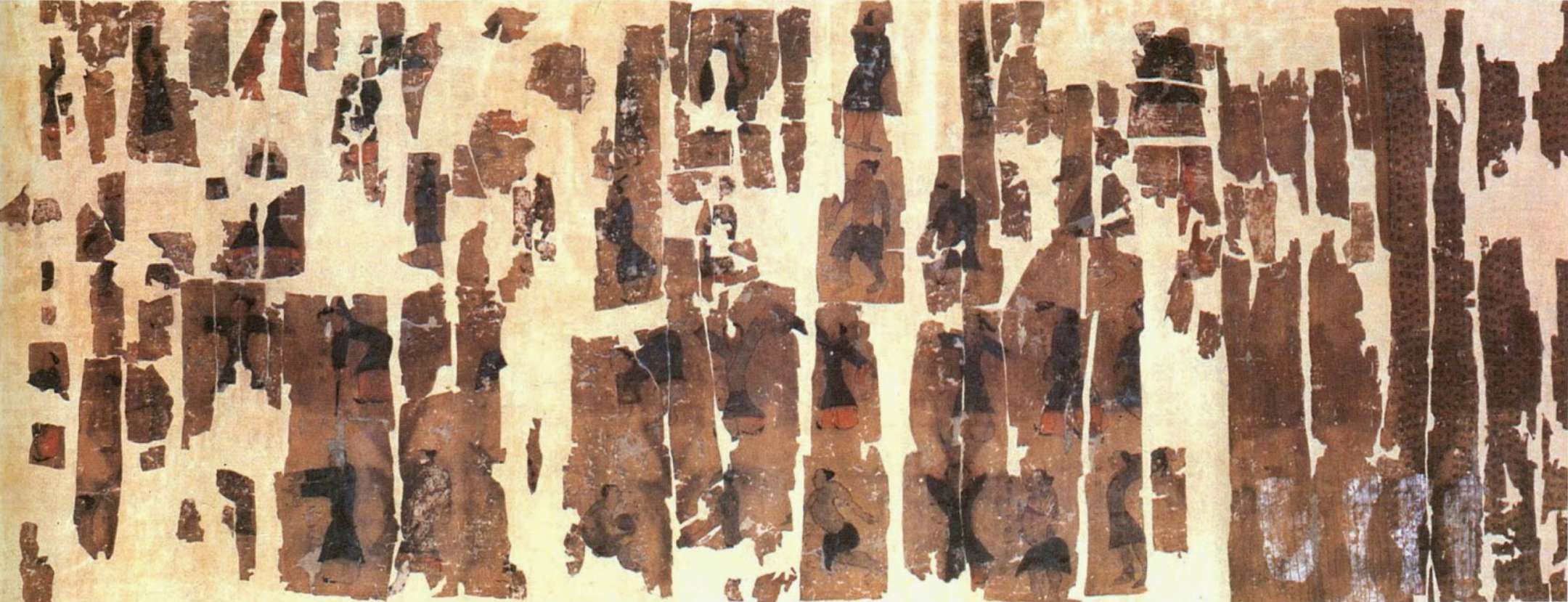
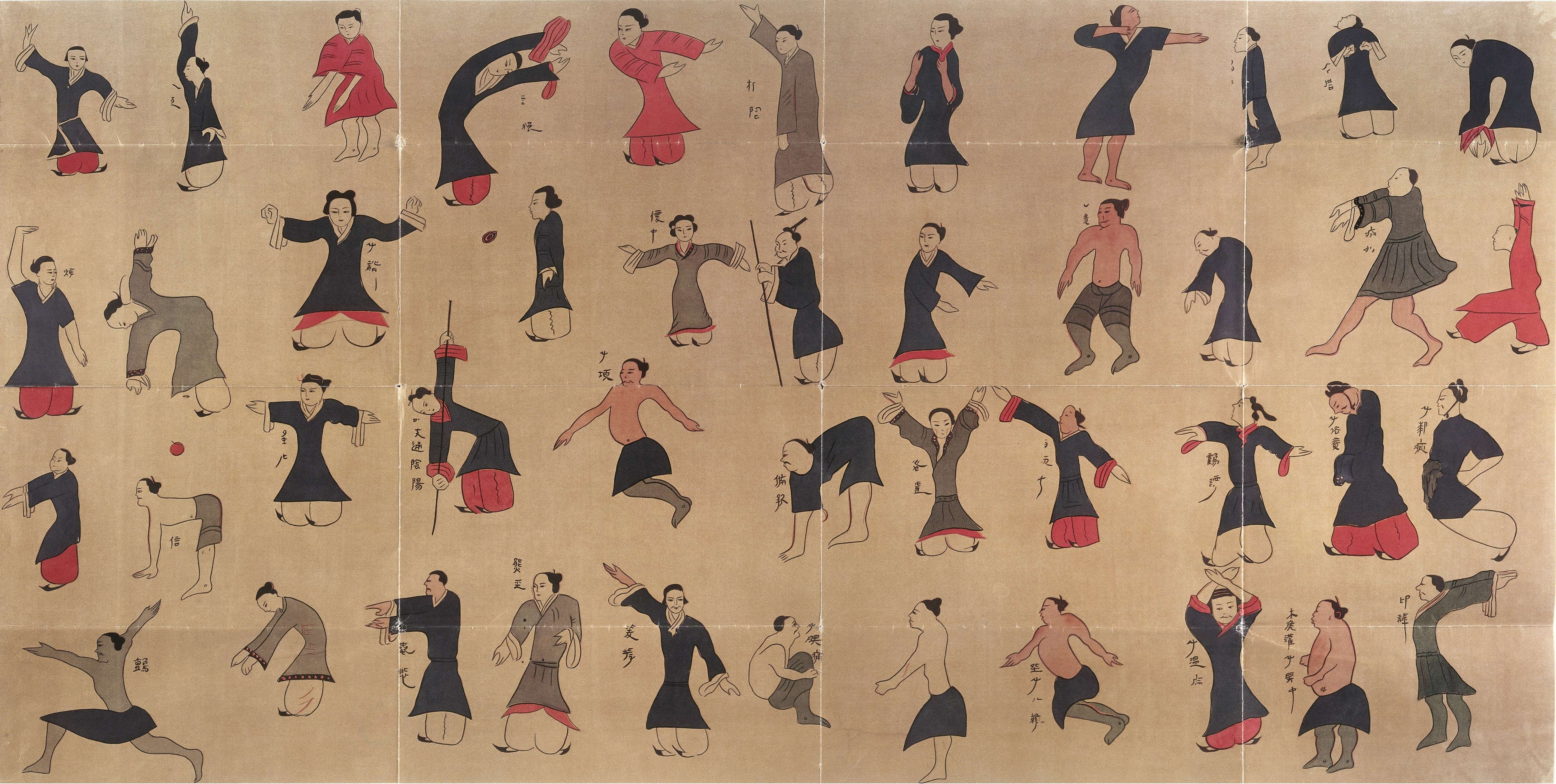
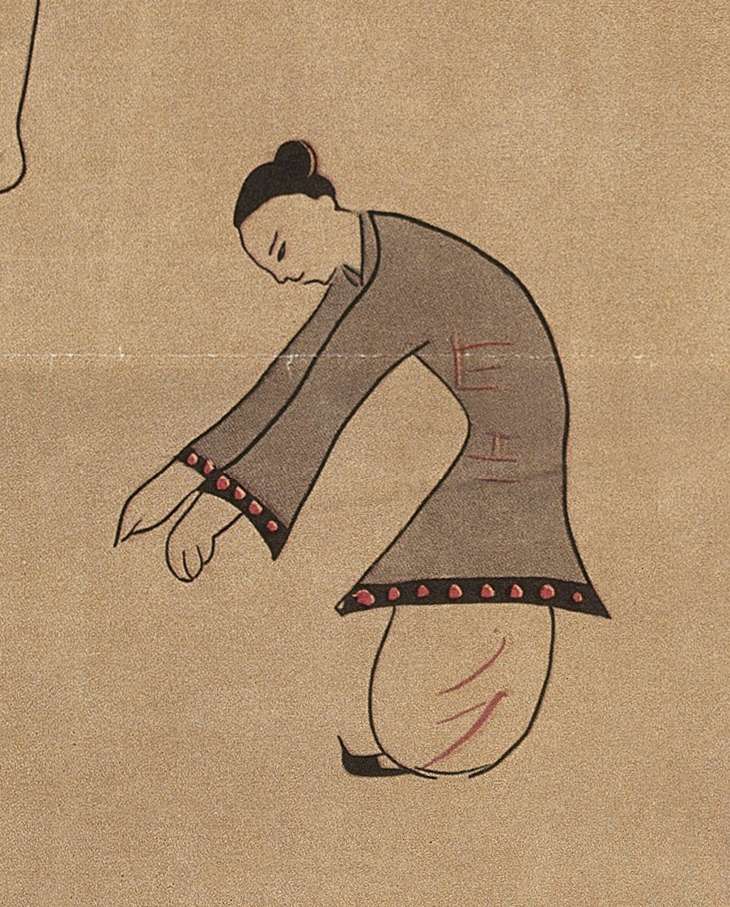
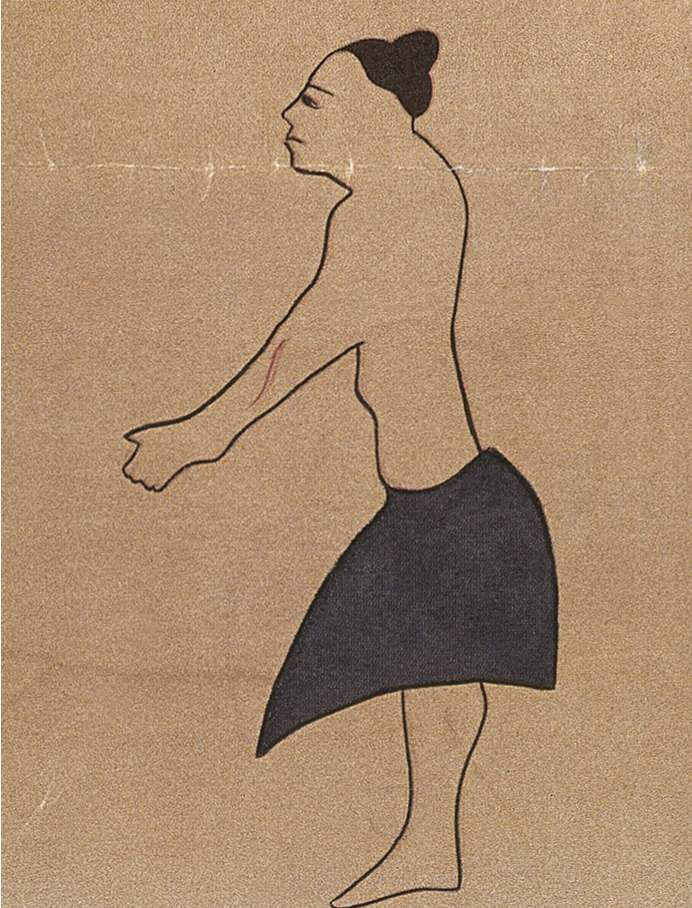
Primate-based movements figure in a number of ancient therapeutic exercises. For instance, the monkey appears in the Five Animals’ Frolic (Wuqin xi, 五禽戲), a 3rd-century system of daoyin calisthenics, which mimics the movements or behaviors of the tiger, deer, bear, monkey, and bird (in that order), each animal set strengthening a particular area of the body (Kohn, 2008, pp. 163-169). Movements mimicking the bear, monkey, and bird actually predate this system, appearing among forty-four exercises listed in the Illustrations of Guiding and Pulling (Daoyin tu, 導引圖, 168 BCE), the oldest known diagram of daoyin exercises, discovered in Mawangdui (馬王堆) (fig. 11 and 12). Primate-based exercises include the “Monkey Bawling to Pull Internal Hotness” (muhou guan yinling zhong, 沐猴灌引靈中) (#35) and “Gibbon Shouting” (yuanhu, 猿謼) (#40) (fig. 13 and 14) (Harper, 1998, pp. 315 and 316). [13]
The Masters of Huainan (Huananzi, 淮南子, 139 BCE), a compendium of Daoist, Confucian, and Legalist thought, references another primate-based daoyin set in a section criticizing such exercises as inferior to spiritual cultivation:
If you huff and puff,
exhale and inhale,
blow out the old and pull in the new,
practice the Bear Hang [xiongjing, 熊經], the Bird Stretch [niaoshen, 鳥伸],
the Duck Splash [fuyu, 鳧浴], the Ape leap [yuanjue, 蝯躩],
the Owl Gaze [chishi, 鴟視], and the Tiger Stare [hugu, 虎顧]:
This is what is practiced by those who nurture the body. They are not the practices of those who polish the mind (Liu & Major, 2010, p. 236).
Fig 11 – (Top left) The Illustrations of Guiding and Pulling, 2nd c. BCE, paint on silk, 142 x 70 cm (55.9 x 27.5 in) (larger version). Image originally found here. Fig. 12 – (Top right) A modern reconstruction (larger version). Image originally found on Wikipedia. Harper (1998) warns such reconstructions “should be regarded as conjectural in many details” since the original is in such poor condition (p. 191). Fig. 13 – (Bottom left) The reconstruction of “Monkey Bawling to Pull Internal Hotness” (larger version). Fig. 14 – (Bottom right) The reconstruction of “Gibbon Shouting” (larger version).
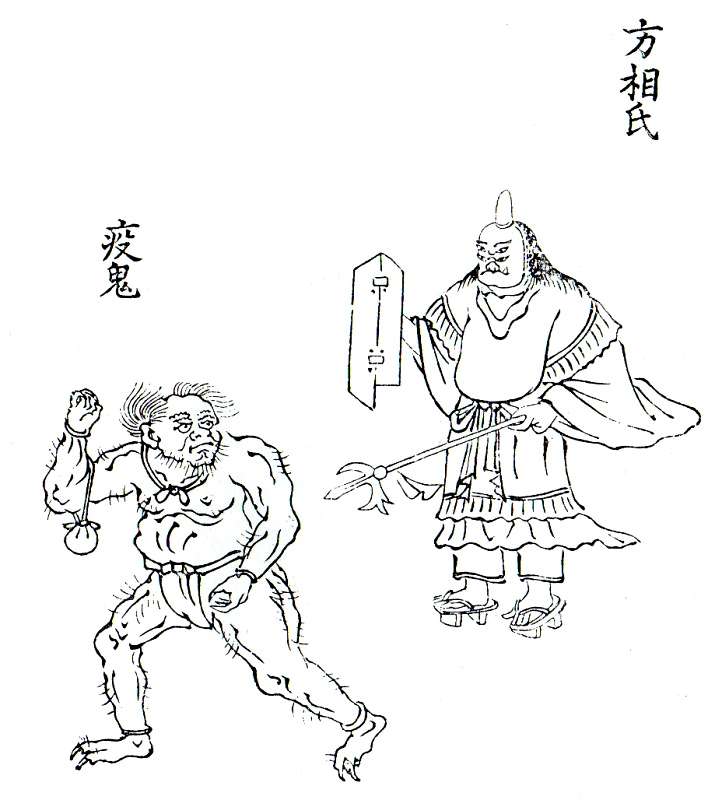
These therapeutic exercises likely find their origin in ancient Shamanic animal dances designed to drive away demonic illness and influences (Harper, 1985, pp. 487-488). One such dance was the seasonal Da Nuo (大儺 / 難; Jp: Tsuina, 追儺) ritual in which a bearskin-clad exorcist (Ch: fangxiangshi; Jp: hōsōshi, 方相氏) and his army of fur, feather, and horn-clad youths, representing twelve animal deities, expelled evil spirits from human dwellings. Evidence suggests that it may have been performed as early as the Shang (17th to 11th c. BCE), but the earliest concrete references come from the Eastern Zhou (8th to 3rd c. BCE) (Poo, 2009, p. 286). What’s interesting for our purposes is that the exorcism has a martial aspect; not only does the exorcist bear a lance and shield for ritual combat (fig. 15), but also the group travels throughout the given location dancing and shouting, with the youths beating drums and commanding twelve spirits by name to devour or eviscerate anthropomorphic representations of malevolent influences (Poo, 2009, pp. 287-288). So, by wearing animal products, the exorcist and his ritual army gained the strength of animal deities to combat dark forces.
Fig. 15 – A Japanese woodblock print portraying the Da Nuo exorcist expelling a “pestilence” spirit with his lance and shield (larger version). Originally found here. Note the four-eyed mask. This is based on the four golden-eyed bear skin worn by the exorcist in ancient Chinese records (Poo, 2009, p. 287).
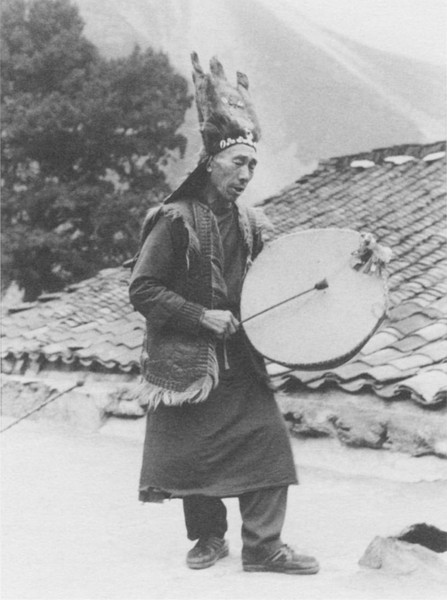
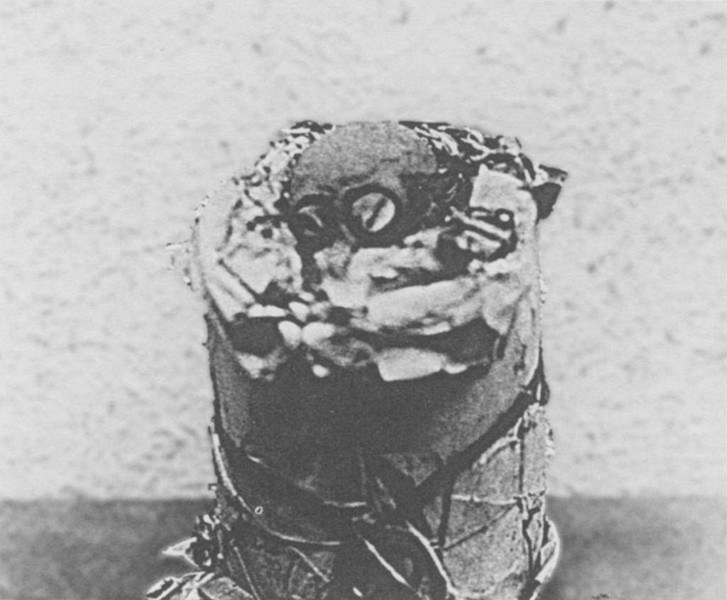
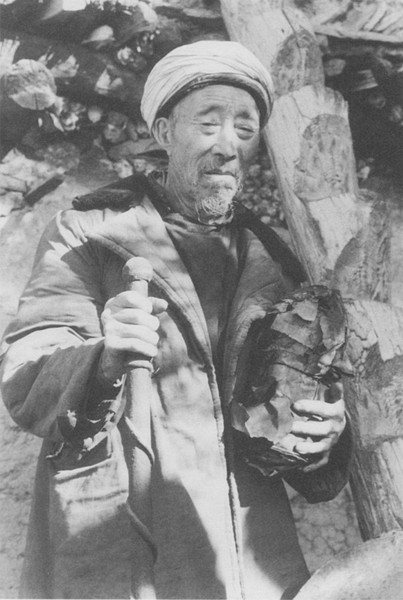
It’s possible that the “twelve animals” of the Da Nuo exorcism refer to some precursor of the Chinese zodiacal animals (rat, ox, tiger, rabbit, dragon, snake, horse, goat, monkey, rooster, dog, and pig). If true, monkey fur could have been among the animal products worn by the ritual army. After all, monkeys have long been associated with curing illness and expelling evil in East Asia. [14] A modern example of exorcists who don monkey fur are the shamans of the Qiang ethnic group of Sichuan. The Qiang worship monkeys as the source and savior of their sacred knowledge, as well as the progenitor of their people, the latter being a myth cycle common among ethnic groups of Tibet and southwestern China.
Henning (2001) highlights the connection between animal totemism and animal boxing:
Another view is that at least some animal forms may hark back to a distant totemic past that still occupies a place in the Chinese psyche. This totemic influence is difficult if not impossible to trace in majority Han Chinese boxing styles; however, it can be seen in the combination of martial arts and dance practiced by some of China’s many national minorities. Cheng Dali, in his Chinese Martial Arts: History and Culture, points to Frog Boxing, practiced by the Zhuang Nationality of the Guangxi Zhuang Autonomous Region, as an example, the frog being considered their protector against both natural and man-made disasters (p. 16).
Therefore, the primate-based martial arts of the Ming could descend from totemic mimicry of apes and monkeys in Chinese spiritual practices. The development could have gone something like this:
Early shamanic dances drawing on the totemic power of primate deities (via their fur) to exorcise evil influences through ritual combat, including the bearing of weapons, drumming, dancing, and the shouting of spells.
The animal fur and martial dancing give way to calisthenics drawing on primate mimicry to expel sickness and strengthen the body.
These calisthenic movements are adapted for fighting.
It’s even possible that the war-like shamanic dancing gave way directly to boxing. Martiality (wu, 武) and dance (wu, 舞) have long been associated in Chinese history, for drums and gongs were used to direct the movements of both troops and dancers (Lorge, 2012, p. 26-27). Musical accompaniment remains a staple of folk martial arts performances. A modern example of totemic mimicry, dancing, and martial arts is the Lion Dance (wushi, 舞獅) popular in Asian communities throughout the world (video 4).
Video 4 – Five lion dancing teams performing before a crowd.
6. Conclusion
Apes and monkeys have been associated with armed and unarmed martial arts in Chinese culture for over two thousand years. Tai Shing Pek Kwar, a popular modern combat style of Monkey boxing created in the early 20th century, is predated by even older instances of Monkey boxing alluded to in military and travel writings of the 16th century, suggesting that it was a common form of pugilism. Additionally, military literature of the 16th and 17th century associates white apes with swordplay. The lack of historical references to primate-based boxing prior to the Ming (1368–1644) suggests such styles developed during the explosion in popularity of pugilism at this time. The image of the highly popular late Ming literary monkey hero Sun Wukong as a master of armed and unarmed martial arts, as well as his association with staff and sword fighting in 13th century oral literature and Buddhist art, respectively, helps bridge this gap between the lack of historical boxing references and older material associating primates with armed combat. He can be traced to a body of Han (206 BCE–220 CE) and Tang (618–907 CE) dynasty stories about magic white apes who, due to their supernatural abilities, were portrayed as the ultimate test of a warrior’s martial skills. The most famous of these tells how the Maiden of Yue, a talented swordswoman of the 5th century BCE, vets her yin-yang theory-based sword style by defeating a white ape-turned-old man in a sparring match. This story is important because it’s the first recorded association of yin-yang theory and martial arts in Chinese history. This tale and another involving the mythic archer Yang Youji are the antitheses of primate-based boxing because each touts the superiority of trained human skill over the raw, magical power of nature. Despite this, animal mimicry played a large role in early therapeutic yoga-like Daoyin calisthenics, such as the Five Animals Frolic (3rd c. CE) and those appearing in the Illustrations of Guiding and Pulling (168 BCE), which copied the movements of monkeys and apes (among other animals) to strengthen given areas of the body. These exercises likely find their origin in ancient war-like Shamanic animal dances designed to drive away demonic illness and influences, one example being the seasonal Da Nuo exorcism of the Eastern Zhou (8th to 3rd c. BCE). The Da Nuo exorcist and his ritual army wore animal products (fur, horns, feathers, etc.) to invoke the power of animal deities capable of driving away malevolent forces. Monkey fur may have been worn by members of the ritual army because the animal and its products have long been associated with curing illness and expelling evil in East Asia. Shamans among the modern Qiang ethnic group of Sichuan worship monkeys and draw on the power of their fur to perform exorcisms. Animal totemism plays a part in some animal-based martial arts, such as the Frog boxing of the Zhuang ethnic group. Therefore, the primate-based martial arts of the Ming may have been influenced by the ancient totemic mimicry of apes and monkeys in Chinese spiritual practices, those that formed the basis of later animal-based therapeutic exercises. This is where the historical study would benefit from modern ethnographic field research. A follow-up study might bridge the gap between the historical data and modern practice.
7. Updates
Update: 12-11-2021
I’ve written an article about a white ape immortal associated with revealing heavenly knowledge. One source claims the primate transcendent taught boxing to a modern Chinese monk.
1) A shorter paper with a similar focus is Ma (2010). The editor of the Journal of Chinese Martial Studies was gracious enough to provide me with a PDF copy of the article when I was nearing completion of this paper.
2) Regarding the name of the creator of Monkey boxing, Kou Si (寇四), kou (寇) means “bandit, foe, or enemy.” I find this especially interesting given that he was imprisoned for murder, the reasons for which range from accidentally killing a villager in a fight to purposely killing a military official to avoid service (Matsuda, 2013, pp. 86-87). It’s possibly that this name is simply a folk title given to an unknown creator, or one known to have been active in crime.
3) See chapters three and four.
4) The earliest mention of Eagle Claw appears in Qi Jiguang’s training manual. It refers to “Eagle Claw Wang’s grappling methods” (Yingzhao Wang zhi na, 鷹爪王之拿) (Gyves, 1993, p. 35). Qing-era manuals and family histories suggest that Xingyi was created by a certain Ji Jike (姬際可, fl. 1650) (Shahar, 2008, pp. 134-135).
5) For an English translation of the sword technique mentioning the stance, see Chen, 2018, pp. 73-75.
6) Qi, 1584/2001, p. 83. I’m indebted to the operator of the Great Ming Military blog for explaining the connection between the ape images and the visible characters from the Japanese calligraphy, as well as providing me with a digital copy of the fourteen volume edition of Qi’s training manual.
7) The original English translation omits the two named books from the Chinese version. It reads, “…the thrusts and parries were made in perfect accord with the manuals of martial arts” (Wu & Yu, 2012, vol. 2, p. 105).
8) Chen, 1998, p. 84. Some readers may have noticed the sword is a reoccurring theme in Sun Wukong’s history: 1) The Qing-era boxers are said to have performed a saber dance under his possession; 2) he is depicted with a saber on the Kaiyuan temple pagoda in Fujian; and 3) the magic white ape on whom he is likely based loves performing sword dances. In addition, two other sources mention Monkey’s association with the sword. First, a 15th-century Zaju play describes Guanyin giving Sun Wukong a Buddhist saber (jiedao, 戒刀) (apart from other magic items) to protect his master on the eve of their journey. Second, a 17th-century tale set in Fujian describes the Great Sage magically afflicting a merchant with painful leg sores using a “Bodhisattva Saber” (Pusa dao, 菩薩刀).
I don’t think that these have any unifying significance, however. For example, the saber requires less training and is cheaper than other implements of war. So, it was often the go to weapon for soldiers and bodyguards. Monkey’s association with the saber on the pagoda is likely tied to this same concept. As a guardian deity, he is portrayed with the same weapon used by mortals to protect others in times of need. The magic white ape is portrayed as a Daoist gentleman, one in possession of a pair of treasure swords (baojian, 寶劍), the kind used in Daoist ritual. His fancy for the sword may be based on Old Mr. Yuan from the Maiden of Yue (see section 4). Another literary character with Buddhist sabers is Wu Song from the Water Margin (Shuihu zhuan, 水滸傳, c. 1400). I explain footnote #2 of a past article that his sabers are based on real world Buddhist knives issued to monks. The same concept is no doubt tied to Monkey’s weapon from the play. Having said that, I will admit, though, that the saber from the pagoda may have had some influence on that mentioned in the 17th-century story. After all, the pagoda example is portrayed with a lick of heavenly flame, just like one would expect from a celestial sword. Also, both the story and the pagoda take place/are located in Fujian, home to the Great Sage’s cult.
9) Selby, 2000, pp. 155-156. The famous Tang poet Li Bai (李白) referenced Mr. Yuan’s defeat in one of his poems. A line reads “The White Ape was ashamed of his fencing” (Ma, 2010, p. 24). This is fascinating as Li Bai was also known to have been a proficient swordsmen in his youth (Liu, 1967, pp. 46-47).
10) This is based on an old concept in which primates were thought to progress through a type of magical evolution, similar to modern day Pokémon. The Baopuzi (抱朴子, 2nd c. CE) states that a monkey will transform into a gibbon after 800 years of life. It will then change into several legendary apes over some 3,500 years, before evolving into an old man (Ball, 1927, p. 117). Gulik (1967) cites a tale in which the soothsayer Zhou Qun (周羣 / 周群) learns the secrets of divination from a gibbon-turned-old man (p. 50).
11) As noted in this article, Sun Wukong’s capture at the mouth of Lord Erlang’s hound is tied to the Han-era tomb motif of dogs intimidating apes.
12) Ma (2010) translates the historical passage, noting those at the party were “drinking wine and making merry, then Tan Changqing, the high official of Changxin Palace, starts to dance, to imitate a monkey fighting with a dog, bringing laughter to all present” (p. 25).
13) Harper (1998) suggests an alternate reading for “Gibbon shout” (yuanhu, 猿謼) is “Gibbon Jump” (yuanjue, 蝯躩) based on graphical similarities to an exercise from the Huainanzi. (淮南子, 139 BCE) (p. 316, n. 1).
14) This is tied to a Song-era (and likely older) superstition from Sichuan where people would place monkeys in stables to ward off equine sickness (Eberhard, 1969, p. 52). This is why heaven appoints Sun Wukong the Bimawen (弼馬溫, a.k.a. Keeper of the Heavenly Horses), which is a pun on Bimawen (避馬瘟, “Avoid the horse plague”). Due to his former exalted position, earthly horses are shown to fear the Monkey King throughout the narrative (Wu & Yu, 2012, vol. 1, p. 309, for example).
In Japan, monkeys were also associated with horses and healing via the warding of evil. Apart from monkeys being kept in stables like their Chinese counterparts, their fur was applied to the harnesses and quivers of Samurai because the warriors believed it gave them more control over their mounts. Furthermore, monkey body parts have been consumed for centuries as curative medicines, and their hides have even been stuffed to make protective amulets (kukurizaru) to ward off illness. Likewise, a genre of painting depicts divine monkeys (saru gami), messengers of the mountain deity, performing Da Nuo-like dances to ensure a good rice harvest (Ohnuki-Tierney, 1987, pp. 43-50)
Sources:
Ball, K. M. (1927). Decorative Motives of Oriental Art. London, John Lane; New York, Dodd, Mead and Co.
Gyves, C. M. (1993). An English Translation of General Qi Jiguang’s “Quanjing Jieyao Pian” (Master’s thesis). The University of Arizona, Arizona, USA.
Harper, D. (1985). A Chinese Demonography of the Third Century B.C. Harvard Journal of Asiatic Studies, 45 (2), pp. 459-498.
Harper, D. (1998). Early Chinese Medical Literature: The Mawangdui Medical Manuscripts. London: Wellcome Asian Medical Monographs.
Harper, D. (2001). Poets and Primates: Wang Yanshou’s Poem on the Macaque, Asia Major 14(2), pp. 1-25.
Henning, S. (2001). Written Texts: China. In T. A. Green (Ed.), Martial Arts of the World: An Encyclopedia, Volume Two: R–Z (pp. 745-748). Santa Barbara, Calif: ABC-CLIO.
Henning, S. (2007). The Maiden of Yue: Fount of Chinese Martial Arts Theory. Journal of Asian Martial Arts, 16(3), pp. 24-27.
Kohn, L. (2008). Chinese Healing Exercises: The Tradition of Daoyin. Honolulu: University of Hawaiʻi Press.
Liang, S. Y., and Yang, J. M. (2002). Xingyiquan: Theory, Applications, Fighting Tactics and Spirit. Boston: YMAA Publication Center.
Liu, J. Y. (1967). The Chinese Knight-Errant. Chicago: University of Chicago Press.
Liu, A., and Major, J. S. (2010). The Huainanzi: A Guide to the Theory and Practice of Government in Early Han China. New York: Columbia University Press.
Lorge, P. A. (2012). Chinese Martial Arts: From Antiquity to the Twenty-First Century. New York, NY: Cambridge University Press.
Lu, S. (2006). Combat Techniques of Taiji, Xingyi, and Bagua: Principles and Practices of Internal Martial Arts. Berkeley, Calif: Blue Snake Books.
Ma, L. (2010). From Ape Worship in Ancient China to Monkey Imitation in Modern Competition Wu Shu. Journal of Chinese Martial Studies 2, pp. 20-28.
Matsuda, M. (2013). Monkey Kung Fu: History & Tradition. (n.p.): Michael Matsuda.
Ohnuki-Tierney, E. (1987). The Monkey As Mirror: Symbolic Transformations in Japanese History and Ritual. Princeton: Princeton University Press.
Poo, M. (2009). Ritual and Ritual Texts in Early China. In J. Lagerwey and M. Kalinowski (Ed.). Early Chinese Religion, Part One: Shang Through Han (1250 BC-220 AD) (pp. 281-313). Leiden: Brill.
Qi, J. (2001). Jixiao xinshu shisi juan ben [New Treatise on Military Efficiency: Fourteen volume edition]. Beijing: Zhonghua shuju. (Original work published 1584)
Selby, S. (2000). Chinese Archery. Hong Kong: Hong Kong University Press.
Shahar, M. (2008). The Shaolin Monastery: History, Religion, and the Chinese Martial Arts. Honolulu: University of Hawai’i Press.
Wu, C., and Yu, A. C. (2012). The Journey to the West (Vols. 1-4) (Rev. ed). Chicago, Ill: University of Chicago Press.
Wu, H. (1987). The Earliest Pictorial Representations of Ape Tales: An Interdisciplinary Study of Early Chinese Narrative Art and Literature. T’oung Pao LXXIII, pp. 86-112.
Yang, J., and Xie, G. (Ed.) (1995). Zhongguo bingshu jicheng [Collection of Chinese Military Literature]. Beijing: Liaoshen shushe.
I by chance happened upon an old magazine article that mentions the worship of Sun Wukong in 1892 San Francisco Chinatown. The piece is written by one Frederic J. Masters, D.D., a Methodist pastor who wrote extensively about the area’s Chinese community. Not surprisingly, the article is dripping with condescension towards Chinese religion, condemning the Great Sage’s worship as “the acme of absurdity and sinfulness” (Masters, 1892, p. 737).
In the Spofford-alley temple are found the shrines of some twenty other gods and goddesses, the principal being the Grand Duke of Peace, the God of Medicine, and Pan Kung, a celebrated Prime Minister of the Sung Dynasty. The funniest discovery in this temple was that of Tsai Tin Tai Shing [Qitian dasheng, 齊天大聖]. He is a beatified monkey in the image of a man. Hatched from a bowlder [sic], this animal is said to have proclaimed himself king of the monkeys. At last he learned the language of men, and finding himself possessed of supernatural powers, he obtained a place among the gods. Such is the legend. Chinese idolatry thus reaches the acme of absurdity and sinfulness in the canonization of a monkey. Thoughts of Darwin’s descent of man at once flashed across our mind as we looked at this image. It was disappointing at one’s curiosity to find that the old temple keeper who cared more for a pipe of opium than for speculations in theology and anthropology could not tell us what part natural selection played in the evolution of Chinese deities, or whether monkey worship was the newest phase of Chinese ancestral worship. Finding him lamentably ignorant upon the great question of the descent of man, we astonished with him with a complete history of his monkey god.
There was an ape in the days that were earlier; Centuries passed and his hair became curlier; Centuries more and his tail disappeared, Then he was man and a god to be feared (Masters, 1892, pp. 736-737).
2. Immigrant Worshipers
So what can we learn from this brief entry? Given the time, place, and use of Cantonese, the worshipers were most likely immigrants from Guangdong province. Refo Mason (1994) explains, “When news of the discovery of gold in California reached South China in 1849, thousands of labourers in Guangdong and Fujian provinces left their villages to seek work in the gum shan ([金山] ‘Gold Mountain’) … Emigration from South China to California…peaked in 1852, when 20,000 Chinese arrived in San Francisco” (p. 200). Monkey‘s adherents may have counted among these men or their descendants. Either way, belief in the Great Sage came with those who traveled from southern China to America.
Somebody please get Neil Gaimon on the phone and tell him that he can now include Monkey in American Gods (fig. 1). What do you think the character would look like? Maybe a short old man with a cane?
Fig. 1 – A photomanipulation of Sun Wukong above the title logo from the ongoing American Gods television show (larger version). By the author. The program is based on the 2001 novel of the same name.
2.1. Gangsters and Rebels?
During the 19th century, Spofford Alley (fig. 2), where the temple housing the Great Sage shrine was located, was home to the Chee Kong Tong (Zhigong tang, 致公堂, “Chamber of High Justice Society,” a.k.a. the “Chinese Freemasons”), the secret Chinese society-turned-criminal organization running Chinatown’s illicit opium, gambling, and prostitution trade (Risse, 2012, p. 37). The Chee Kong Tong were originally an offshoot of anti-Manchu rebels who wanted to overthrow the foreign-ruledQing dynasty (Cassel, 2002, pp. 218-219). [1] Therefore, Sun Wukong’s worshipers may have included gangsters and rebels. As mentioned in this article, the Great Sage was venerated by fighters of the Boxer Rebellion (1899–1901). This makes sense as the divine primate is famous for his rebellion against heaven in Journey to the West (Xiyouji, 西遊記, 1592).
Fig 2 – A modern Google satellite image of Spofford Alley (larger version). It is only a few hundred feet long.
3. Updates
3.1. Location of Temple
Update: 01-15-2022
I was very happy to find an article called “Map of Temples in San Francisco’s Chinatown 1850s-1906” (Romaskiewicz, 2021). The author, a PhD student named Peter Romaskiewicz, has done a great service by scouring 19th and 20-century material and cross-referencing this with antique maps of Chinatown. The article has a list of over 20 temples/immigrant associations and their corresponding locations plotted on a map. This is great because it has allowed me to pinpoint the exact place where the Monkey King was worshiped in 1892 Chinatown!
Masters (1892) refers twice to temples on Spofford: 1) “[Guanyin’s] shrine is found up a dingy staircase on the southwest corner of Spofford alley and Washington streets” (p. 734); and 2) “In the Spofford-alley temple are found the shrines of some twenty other gods and goddesses…” (p. 736). Romaskiewicz (2021) shows that the Guanyin temple (#10) was located at the end of Spofford, while a different joss house belonging to the Chee Kong Tong (#9) was located in the middle of the street. I, therefore, assumed Monkey was worshiped at the Chee Kong Tong joss house because Masters’ (1892) second temple reference didn’t mention Guanyin. However, after writing Romaskiewicz, I learned that there were actually three joss houses on Spofford during the 19th century (one from an 1887 map is not listed). But most importantly, Masters (1982) was likely referring to the Guanyin Temple in both instances. That’s why he highlights “the shrines of some twenty other gods and goddesses…” (emphasis added) (Masters, 1892, p. 736), meaning that these icons were also found in the same location.
The Guanyin Temple (Guanyin miao, 觀音廟) was located at No. 60 on the corner of Spofford and Washington (fig. 3) (Romaskiewicz, 2021). I’m unsure if some form of it still exists in that location, but I do know from Google Maps that the old No. 60 is not the same as the current No. 60.
Romaskiewicz was kind enough to direct me to an 1883 brochure asking for funds to restore the temple. This shows that it was in use for some time.
Fig. 3 – The yellow star marks the location of the Guanyin Temple (larger version). Based on Romaskiewicz (2021). See this 1885 map.
Notes:
1)Sun Yatsen, the “Father of modern China,” made contact with the Chee Kong Tong several times and even used their no. 36 Spofford Alley office as his own while raising money for his revolution in China (United States, 1993, pp. 45-46; Lum & Lum, 1999, p. 57).
Source:
Cassel, S. L. (2002). The Chinese in America: A history from Gold Mountain to the new millennium. Walnut Creek, CA: AltaMira Press.
Lum, Y. M., & Lum, R. M. K. (1999). Sun Yat-sen in Hawaii: Activities and supporters. Honolulu: Hawaii Chinese History Center.
Masters. F. J. (1892). Pagan Temples in San Francisco. In C.F. Holder (Ed.). The Californian illustrated magazine: June to November, 1892, vol. 2 (pp. 727-741). San Francisco, Calif.: Californian Pub. Co.
Refo Mason, S. (1994). Social Christianity, American feminism, and Chinese prostitutes: The history of the Presbyterian mission home, San Francisco, 1874-1935 In M. Jaschok and S. Miers (Ed.) Women and Chinese Patriarchy: Submission, Servitude, and Escape (pp. 198-220). Hong Kong: Hong Kong University Press.
Risse, G. B. (2012). Plague, fear, and politics in San Francisco’s Chinatown. Baltimore: The Johns Hopkins University Press.
United States. (1993). An introduction to organized crime in the United States. Washington, D.C.: Organized Crime/Drug Branch, Criminal Investigative Division.
The Qiang (Ch: 羌; Qiangic: Rrmea) ethnic group have been mentioned in Chinese records as far back as the oracle bones of the Shang Dynasty (17th to 11th century BCE). Originally inhabiting the northern reaches of China, these sheepherders and warriors were driven southwest over many centuries of conflict with neighboring ethnic groups, as well as the Chinese. Many Chinese dynasties attempted to assimilate them, but the Qiang have resisted up to the present. Today, they live in western Sichuan near the Tibetan border and are listed among the 56 recognized ethnic groups of China (Yu, 2004, pp. 155-156; Wang, 2002, pp. 133-136).
What’s interesting about the Qiang for the purposes of this blog is that both magic monkeys and heavenly stones, and even Sun Wukong himself, play a part in the people’s religious mythology.
Fig. 1 – A map of China showing the location of Sichuan province in red. Larger version available on wikicommons.
Shamans (Ch: Duan gong, 端公 or Wu, 巫j; Qiangic: Shüpi) are the heart of Qiang religious life. During special ceremonies, they wear three-peaked hats (fig. 2 and 3) made from the fur of golden monkeys (fig. 4), each peak respectively representing the deities of heaven, earth, and shamanism (more on the latter below). [1] These hats are especially worn during exorcisms because the monkeys are considered “the purest of animals, [which stand] in extreme contrast to the vilest of beings—the demons” (Oppitz, 2004, p. 13). There are several legends, with many variants, explaining the origins of the headdress. One version states:
[T]he Qiangs used to have a written language, and their patriarch recorded the scriptures he obtained from the gods and other important writings on human affairs on the bark of birch trees. One day when he took out the pieces of bark to be aired, a mountain sheep came and ate them all. With the help of a golden monkey the patriarch captured the guilty sheep and made its skin into a drum. When he beat on the drum he was able to recall the words written on the birch bark. To prevent future mishaps to these precious documents, he memorized them by heart (Yu, 2004, p. 160).
So, in essence, the hats are worn to commemorate the assistance of the golden monkey. Interestingly, another version replaces the patriarch and golden monkey with Tripitaka and Sun Wukong:
A long time ago, in the Tang period, there was a monk by the name of Tang Seng [唐僧, “Tang Monk”], who undertook a journey to the western skies in the company of a monkey named Sun Wukong, in order to collect sacred scriptures. On their way back, they encountered a sheep ghost who ate all the newly acquired scriptures. The monkey got very angry, killed the sheep ghost, and used its skin to fabricate a drum. Thereupon Tang Seng and the monkey met with the Eighteen Arhats … Listening to their teachings, Tang Seng picked up the sheep-skin drum and repeated all that he heard through their mouths. Since then all shamans use a drum when reciting their knowledge from memory (Oppitz, 2004, p. 23).
Fig. 2 (left) – The three-peaked golden monkey skin shaman hat. From the Sichuan University Museum. Larger version on wikipedia. Fig. 3 (center) – A shaman wearing the headdress and playing the ritual sheep skin drum (larger version). Original photograph by Michael Oppitz. From Oppitz, 2004, p. 14. Fig. 4 (right) – A golden monkey with child. Larger version on Wikipedia.
The golden monkey is closely associated with the Qiang’s pantheistic worship of sacred white stones, each one representing the gods of heaven, sun, fire, mountains, rivers, and trees. [2] Yu (2004) provides another legend for the origins of the Shaman’s hat, describing how the monkey is the offspring of the sacred stone and noting parallels with the birth of Sun Wukong:
Another legend depicts the golden monkey as a Prometheus-like figure who stole fire from heaven. The first two attempts failed because the god of wind and the god of rain extinguished the fire, but the monkey succeeded the third time by concealing the fire in a white stone. It is worth noting that in this legend the golden monkey is closely related to the white stone. In the Qiang language, the first syllables in the names of the monkey’s mother and father mean respectively “stone” and “fire.” “This implies that fire is produced by stone and hidden inside the stone, and that the half-human, half-simian golden monkey was an offspring of the union between stone and fire”. The white stone and the golden monkey, as the source of fire and the messenger who brought it to the human world, became the totems of the Qiang people. To commemorate the recovery of the lost scriptures, wearing the monkey hat and playing the sheepskin drum also became an indispensable part of Sacrifice to the Mountain[, a Qiang ceremony]. However, the monkey legend is not particular to the Qiang people. The Yi minority people of northwestern Guizhou province have a nuo drama known as bianren xi (changing-into-people drama) based on a legend that people derived from monkeys. Actors wear monkey masks for this performance. There is also the famous monkey, Sun Wukong, who was born from a stone in the Han Chinese novel Xiyu ji (Journey to the West, 1592) by Wu Chengen (ca. 1506-1582). [3] The novel was first published in 1592, but the monkey lore included in it was of much earlier time (p. 160).
A celestial, stone-born monkey who steals from heaven certainly sounds like the Monkey King. As noted here, stories about Sun Wukong have been circulating in Asia for a millennia. Therefore, it seems only natural that the Qiang’s reverence for heavenly stones and monkeys would lead to some of them worshiping the beloved cultural figure.
Graham (1958) notes that Sun Wukong and Sha Wujing figure among the Chinese patron deities of the “red” shamans (p. 53). [4] What’s interesting is that the red shamans are said to speak a special demon language and use their skills to exorcise demons (p. 54). Therefore, their worship of the Monkey King should come as no surprise considering Sun Wukong is the exorcist par excellence.
As noted above, one of the peaks of the ritual headdress represents the patron deity of shamanism. Known among other names as the Abba mula (“father god”; Ch: Aba muna, 阿爸木纳), this is the title given to the shaman’s main focus of worship. For instance, Sun Wukong is the Abba mula of those who revere him. Most importantly, the chosen deity is further represented by a small bundle that the shaman carries with him and guards jealousy, as it is the source of his knowledge and power. Graham (1958) describes the sacred bundle’s importance, construction, and use:
He is the patron or guardian deity and instructor of the Ch’iang priest, and without him the priest could do nothing. It consists of a skull of a golden-haired monkey wrapped in a round bundle of white paper. Its eyes are old cowry shells or large seeds. Inside are also dried pieces of a golden-haired monkey’s lungs, intestines, lips, and fingernails. It is so wrapped that the face of the skull is visible at one end, and the other end is closed [fig. 5 and 6]. After each ceremony in the sacred grove, [5] the priest wraps another sheet of white paper around it, so that it gradually increases in diameter. Some priests will not allow another person to touch his Abba Mula and only the priest worships this god (pp. 51-52).
I mention this because there are no doubt sacred bundles representing Sun Wukong, which are used under his supernatural guidance.
Fig. 5 (left) – The Abba mula bundle. Note the visible monkey skull with cowry shell eyes (larger version). Original photograph by Wolfgang Wenning. Fig. 6 (right) – A Qiang shaman carry a bundle and sacred cane (larger version). Original photograph by Michael Oppitz. Both images are from Oppitz, 2004, p. 41.
Oppitz (2004) explains that stories alluding to Sun Wukong appear in Qiang pictorial divination books. Furthermore, he suggests that the ritual of wrapping the Abba mula bundle with additional paper represents the lost written knowledge saved by the Monkey King / golden monkey, which is now passed on orally.
In Qiang divination books the monkey features in various passages. In one book the picture of a monkey alludes to a story in which he destroys a heavenly palace; another book addresses a monkey’s trip to a western land, where he acquires written texts. In both cases the monkey Sun Wukong of popular literature and protagonist of the novel Xi yu ji, who escorts the Tang pilgrim Xuanzang, stands as the model. This character’s association with the acquisition of books and the role a golden-haired monkey plays in a Qiang myth as the inventor of the drum replacing the lost scriptures, suggests that the paper which is wrapped around the venerated monkey skull may also be interpreted as a hint to the conflict between scriptural versus oral tradition at the intersection of which the monkey stands as a mediator (p. 42).
2. Monkeys and the Qiang and Tibetan Origin Myths
Called “Mutsitsu and Tugantsu” (Ch: Mujiezhu yu Douanzhu, 木姐珠與斗安珠), the Qiang origin myth centers around the romance of Mutsitsu, the daughter of the supreme god Abamubi (or Mubita), and the earthbound monkey Tugantsu. The latter saves the goddess from a ferocious tiger when she visits the mortal world and both instantly fall in love. She brings him to the celestial realm, where Abamubi only agrees to their marriage if Tugantsu can successfully complete a series of impossible herculean tasks. These include falling the trees of ninety-nine mountains, burning the trees, and using the arable land to plant a crop of corn (other sources say grain); but each time Mutsitsu secretly enlists the aid of fellow gods to insure the tasks are completed on time. During the burning of the forest, Tugantsu’s fur is singed, revealing him to be a handsome man. In the end, the supreme god agrees to their marriage and Mutsitsu and Tugantsu become the progenitors of mankind. [6]
Academia Sinica (n.d.) comments that some Qiang communities who revere Chinese gods often equate Abamubi with the Jade Emperor of Daoism and Tugantsu with Sun Wukong. I find this especially fascinating as the Monkey King then becomes a sacred protoplast.
Fig. 7 – A modern painting showing the monkey and rock ogress of Tibetan myth (larger version). Original from Wikipedia.
In addition, Academia Sinica (n.d.) explains that this “monkey transforming into human” motif (i.e. Tugantsu becoming a man) has similarities with Tibetan mythology, for the Qiang live in close proximity to the people of Tibet. This refers to the Tibetan origin myth in which the Bodhisattvas Avalokitesvara (the Indo-Tibetan variant of Guanyin) and Tara are respectively reborn on earth as a monkey and his wife, a rock ogress (fig. 7). (Again, the association between the monkey and rock reminds one of Sun Wukong.) The union produces six half-human half-monkey children, from which originate the six original tribes of Tibet. These children and their offspring eventually evolve human features (Stein, 1972, pp. 37 and 46).
3. Conclusion
The religious mythology of the Qiang ethnic group of China pays reverence to both heavenly monkeys and sacred stones. Examples include stories about a golden monkey born from a stone who both bestows fire on man and creates the sheepskin drum needed to recover lost scriptural knowledge. Qiang communities that revere Chinese deities often replace the golden monkey with Sun Wukong, no doubt due to his birth mirroring the former’s origins. The same holds true for the Qiang origin myth in which a goddess and monkey-turned-man become the progenitors of mankind. The Monkey King is sometimes equated with the father, transforming him from a literary character and cultural figure into a sacred protoplast. Interestingly, the monkey-rock and monkey-to-man motifs have connections to a wider myth cycle present in Tibet.
Some shamans (Qiangic: Shüpi) specializing in exorcism worship our hero as their patron deity, or Abba mula (“father god”). Such deities are given form as a bundled monkey skull successively wrapped in white paper. This sacred object is considered the source of the shaman’s power. It’s possible that the wrapping paper references the lost scriptural knowledge that Sun Wukong/the golden monkey helped recover.
To my knowledge, most of what has been written about the Qiang, and by extension their connection with Sun Wukong, was collected by ethnographers during the 20th and 21st centuries. Considering that the Qiang have no written language (hence the importance of oral knowledge), it’s impossible to say how far back this connection goes. But as noted in this article, the Monkey King has been worshiped by the Chinese since at least the 17th century, so the Qiang reverence for Sun Wukong could also be centuries old.
4. Updates
4.1. Other Sun Wukong Ethnic Folklore
Update: 04-19-19
Sun Wukong also appears in the folklore of the neighboring (and related) Miao ethnic group. The Miao also believe man derives from monkeys.
Rockhill (1891) provides a complete translation of the Tibetan monkey-ogress origin myth taken from the Mani Kambum (12th to 13th century), a collection of Tibetan Buddhist texts centered around Avalokitesvara. [7] The translation is too long to transcribe here, so I have made a PDF of the relevant pages. It’s interesting to note that the Bodhisattva Hilumandju, the protagonist, is a monkey king with magic powers.
Hilumandju and Hanumanji are quite similar, as noted by other writers (Chattopadhyaya & Chimpa, 2011, p. 152). The Tibetologist Per K. Sørensen notes that “the idea of an ape-gestalt in this myth is directly associated with or inspired by the ape-king … and champion … Ha-lu ma-da = Hanümän, the resourceful figure and protagonist known from Välmlki’s Rämäyana, a tale of considerable popularity already in the dynastic period in Tibet” (Bsod-nams-rgyal-mtshan & Sørensen, 1994, p. 127, n. 329).
Additionally, the Chinese of Sichuan also have stories regarding primates fathering human children. A body of Han and Tang dynasty tales that heavily influenced the creation of Sun Wukong describes magic white apes (baiyuan, 白猿) kidnapping and impregnating young woman. One example appears in both Zhang Hua’s Encyclopedic Records of Things (Bowuzhi, 博物志, c. 290) and the Records of Spirits (Soushenji, 搜神記, c. 340):
In the high mountains of southwestern Shu [Sichuan and Tibet] there is an animal resembling the monkey. It is seven feet in height, it can imitate the ways of human beings and is able to run fast in pursuit of them. It is named Jia-guo 猳國 or Ma-hua 馬化; some call it Jue 貜. It watches out for young women travelling on the road and seizes and bears them away without anyone being aware of it. If travelers are due to pass in its vicinity they lead one another by a long robe, but even this fails to avert disaster. The beast is able to distinguish between the smell of men and women and can thus pick out the women and leave the men. Having abducted a man’s wife or daughter it makes her its own wife. Women that fail to bear its children can never return for the rest of their lives, and after ten years they come to resemble the beast in appearance, their minds become confused, and they no longer think of return. Those that bear sons return to their homes with the infants in their arms. The sons are all like men in appearance. If any refuse to rear them, the mothers die. So the women go in fear of the beast, and none dares refuse to bring up her son. Grown up, the sons are no different from men, and they all take the surname Yang 楊, which is why there are so many people by that name now in the south west of Shu: they are mostly descended from the Jia-guo or Ma-hua (Wu, 1987, pp. 91-92).
I find the last part fascinating because it states that the inhabitants of the Sichuan-Tibet region were fathered by the ape. This recalls the Tibetan, Qiang, and Miao tales of humans descending from monkeys. It also suggests that the aforementioned ethnic stories about a primate progenitor stretch back to the early part of the first millennium.
Notes:
1) Graham (1958) notes that the headdress is one of eleven sacred implements of the Qiang shaman. He provides a detailed description of the hat’s significance.
This is made of a golden-haired monkey skin and is believed to be very efficacious, greatly adding to the dignity and potency of the priest and his ceremonies. The eyes and ears of the monkey are left on, and the tail is sewed on at the back. The eyes enable the hat to see and the ears to hear, and add to the efficiency of the hat. The tail also adds to its efficiency. The front of the hat is ornamented with old cowry shells arranged in ornamental designs, one or two polished white bones that are said to be the kneecaps of tigers, and sometimes with carved sea shells. These ornaments improve the looks of the hat and also add to its efficiency. Other ornaments believed to add efficiency when used are two cloth pennants, one or two small circular brass mirrors, and one or two small brass horse bells much like sleigh bells, on which the Chinese character wang 王 meaning king is carved. Near Wen-ch’uan the priests sometimes assist the magistrate in praying for rain and in turn are presented with a small, thin silver plaque to be worn on the hat, on which is stamped the Chinese word shang 賞, or “reward.” This plaque also adds dignity and efficiency (pp. 55-56).
2) The Qiang reverence for these stones is tied to the aforementioned conflict with neighboring tribes. For example, legend states that the great heavenly ancestor of the Qiang sent them three white stones to aid in their battle with a neighboring tribe, transforming them into mountains from which weapons were made. Another legend claims that these stones help the Qiang make fire (Yu, 2004, pp. 156-157). These white stones often appear on buildings (both temples and houses), walls, altars, and graves in Qiang society (Graham, 1958, p. 103).
3) The original paper reads, “(Journey to the West, 1982)…” I have corrected the typo.
4) The colors red, white, and black signify the class of magic (good vs. dark), though, shamans often inhabit all three roles (Graham, 1958, p. 54).
5) Sacred groves are home to a village’s temple and white stone altar, where many rituals are performed at night and in the early morning (Graham, 1958, p. 64).
7) Another version of the tale appears in The Mirror Illuminating the Royal Genealogies (Rgyal rabs gsal ba’i me long, 14th century). An annotated translation can be read in Bsod-nams-rgyal-mtshan & Sørensen, 1994, pp. 125-133.
Bsod-nams-rgyal-mtshan, & Sørensen, P. K. (1994). The mirror illuminating the royal genealogies: Tibetan buddhist historiography : an annotated translation of the XIVth century Tibetan chronicle: rGyal-rabs gsal-ba’i me-long. Wiesbaden: Harrassowitz.
Chattopadhyaya, A., & Chimpa. (2011). Atīśa and Tibet: Life and works of Dīpaṃkara Śrījñāna (alias Atīśa) in relation to the history and religion of Tibet, with Tibetan sources. Delhi: Motilal Banarsidass Publishers.
Rockhill, W. W. (1891). The land of the lamas: Notes of a journey through China, Mongolia and Tibet with maps and illustrations. New York: Century Co.
Stein, R. A. (1972). Tibetan civilization. Stanford, Calif: Stanford University Press.
Wang, M. (2002). Searching for Qiang culture in the first half of the twentieth century. Inner Asia,4(1), 131-148. Retrieved from http://www.jstor.org/stable/23615428
Wu, H. (1987). The earliest pictorial representations of ape tales: An interdisciplinary study of early Chinese narrative art and literature.T’oung Pao LXXIII, pp. 86-112.
Yu, S. (2004). Sacrifice to the Mountain: A Ritual Performance of the Qiang Minority People in China. TDR 48(4), 155-166. Retrieved from http://www.jstor.org/stable/4488600