A Brief Study of the Term Mihou (獼猴) in Journey to the West

Last updated: 09-27-2023

This article is based on a question put to me on Tumblr. I decided to post my answer here because it contains information from several previous articles discussing monkeys in Chinese culture and Buddhism. This is obviously important when thinking about Journey to the West (Xiyouji西遊記).

Question:

Heya, I was researching SWK’s various sworn brothers because I kept hearing abt this one sworn bro of his called “The Female Demon Monkey King” and obviously with a name like that I was curious abt them. But for some reason I can’t find any info abt them anywhere online, and one Tumblr post said that the Female Monkey King and the Macaque King were the same person? I was wondering if you knew anything abt that and had additional info abt the Female Monkey King?

The Female Monkey King seems to be based on a discrepancy in Anthony C. Yu’s (Wu & Yu, 2012) translation. The original Chinese name, Mihou wang (獼猴王, “Macaque King”), appears three times in the novel, but Yu translates it two different ways. I’ve added the Chinese text for comparison.

I. Examples of Mihou wang from JTTW

Chapter 3

At this time, moreover, he entered into fraternal alliance with six other monarchs: the Bull Monster King, the Dragon Monster King, the Garuda Monster King, the Giant Lynx King, the Macaque King, and the Orangutan King, they formed a fraternal order of seven (Wu & Yu, 2012, vol. 1, pp. 138-139).

此時又會了個七弟兄,乃牛魔王、蛟魔王、鵬魔王、獅狔王、獼猴王、狨王,連自家美猴王七個。

Chapter 4

[Sun Wukong] then said to the six brothers, “If little brother is now called the Great Sage, Equal to Heaven, why don’t all of you assume the title of Great Sage also?” “Our worthy brother’s words are right!” shouted the Bull Monster King from their midst, ”I’m going to be called the Great Sage, Parallel with Heaven.” “I shall be called the Great Sage, Covering the Ocean,” said the Dragon Monster King. “I shall be called the Great Sage, United with Heaven,” said the Garuda Monster King. “I shall be called the Great Sage, Mover of Mountains,” said the Giant Lynx King. “I shall be called the Telltale Great Sage,” said the Macaque King. ”And I shall be called the God-Routing Great Sage,” said the Orangutan King (Wu & Yu, 2012, vol. 1, pp. 156-157).

他卻對六弟兄說:「小弟既稱齊天大聖,你們亦可以大聖稱之。」內有牛魔王忽然高叫道:「賢弟言之有理,我即稱做平天大聖。」蛟魔王道:「我稱做覆海大聖。」鵬魔王道:「我稱混天大聖。」獅狔王道:「我稱移山大聖。」 獼猴王道:「我稱通風大聖。」狨王道:「我稱驅神大聖。」

Chapter 41

Now this is where the change happens.

Your [Red Boy’s] father, the Bull Monster King, called himself the Great Sage, Parallel with Heaven. He and old Monkey formed a fraternal alliance of seven, and we all made him the big brother. There were also a Dragon Monster King, who called himself the Great Sage, Covering the Ocean, and became the second brother; a Garuda Monster King, who called himself Great Sage, United with Heaven, and became the third brother; a Lion Monster King, who called himself the Great Sage, Mover of Mountains, and became the fourth brother; a Female Monkey King, who called herself the Fair Wind Great Sage and became the fifth member; and a Giant Ape Monster King, who called himself the God-Routing Great Sage and became the sixth brother. Old Monkey, the Great Sage, Equal to Heaven, was rather small in size, and so he was number seven (Wu & Yu, 2012, vol. 2, pp. 223-224).

你令尊叫做牛魔王,稱為平天大聖,與我老孫結為七弟兄,讓他做了大哥;還有個蛟魔王,稱為覆海大聖,做了二哥;又有個大鵬魔王,稱為混天大聖,做了三哥;又有個獅㾩王,稱為移山大聖,做了四哥;又有個獼猴王,稱為通風大聖,做了五哥;又有個狨王,稱為驅神大聖,做了六哥;惟有老孫身小,稱為齊天大聖,排行第七。

Despite what Yu (Wu & Yu, 2012) translates above, the original Chinese does not include any gendered language referring to the character as a woman. It’s just the exact same name, Mihou wang (獼猴王), used twice before. In addition, the Chinese refers to this character as the “fifth brother” (wuge, 五哥). The W. J. F. Jenner (1993/2020) edition translates the Chinese as such:

The Macaque King, our fifth brother, was the Great Sage Who Travels with the Wind (vol. 2, p. 925).

又有個獼猴王,稱為通風大聖,做了五哥

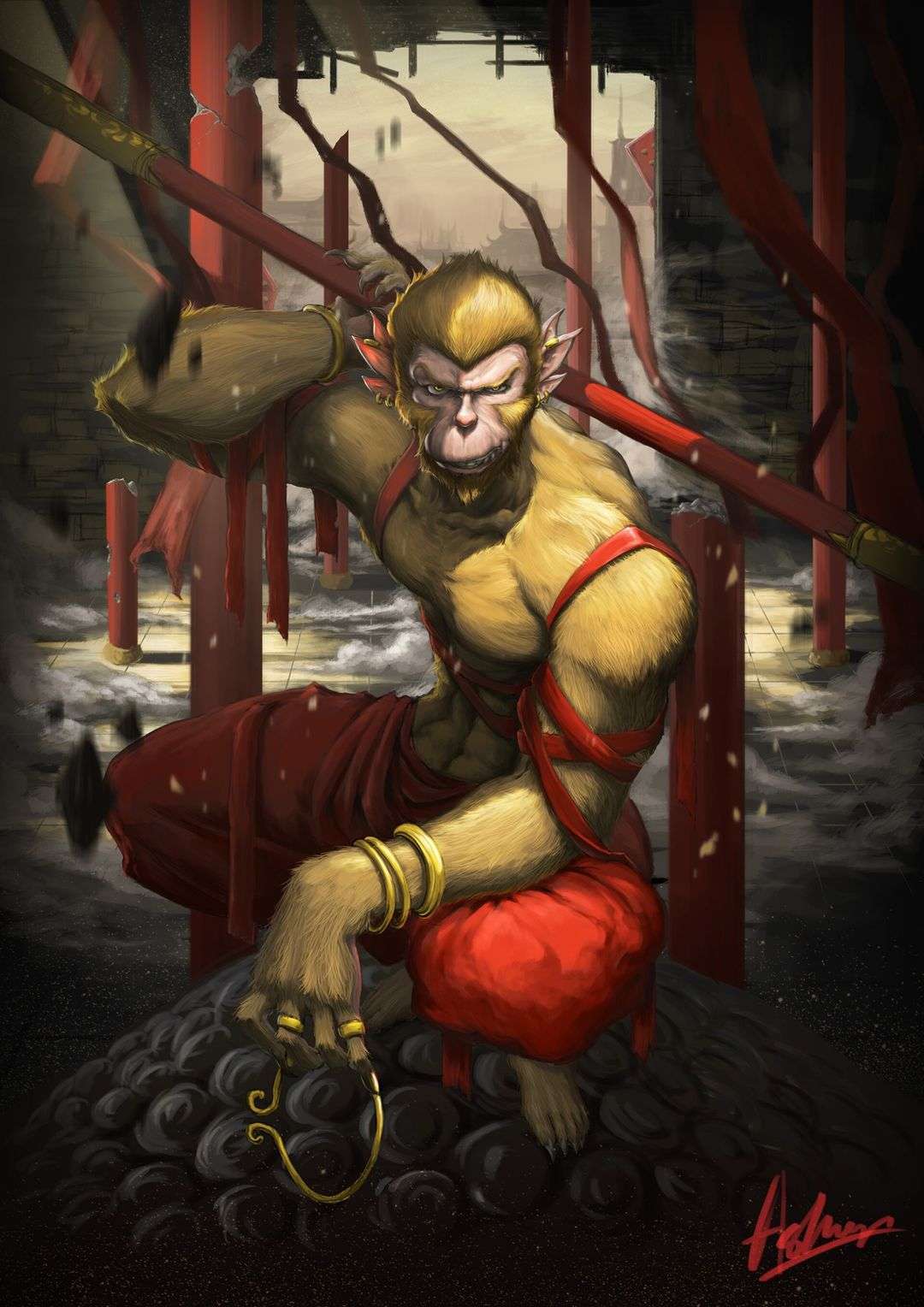
Some people try to explain away the discrepancy in Yu’s (Wu & Yu, 2012) translation by claiming mihou (獼猴) is associated with female monkeys. But if this was true within the context of Journey to the West, ALL monkeys referred to by this name would be women. This certainly isn’t the case, though, since Liu’er mihou (六耳獼猴, “Six-Eared Macaque“) (fig. 1), Sun Wukong’s doppelganger, is male. In fact, out of 13 mentions of mihou (獼猴) in the novel, over 61% refer directly to Six Ears:

  • Random monkeys (mihou, 獼猴) – 1
  • All monkeys (mihou zhu chu duoshou, 獼猴之畜多壽, “long life has been given to monkey beasts”) – 1
  • Macaque King (Mihou wang, 獼猴王) – 3
  • Six Ears 8
    • Liu’er mihou (六耳獼猴) – 5
    • Na mihou (那獼猴, “that macaque”) – 2
    • Nanbian mihou (難辨獼猴, “Indistinguishable Macaques,” i.e. Six Ears and Sun Wukong) – 1

Notice, too, that the term is even used once to refer to monkeys as a whole. This takes place in chapter three when King Qinguang (秦廣王) of hell submits a complaint to heaven after Sun Wukong makes all monkeys immortal by striking their names from the book of life and death (Wu & Yu, 2012, vol. 1, pp. 142-143).

In addition, the term mi (獼) is used by itself to refer to all monkeys: Miyuan wei qin (獼猿為親, “[H]e called the monkey and gibbon his relatives”).

The Liu’er Mihou by Zhang Ji (larger version).

II. The Etymology of Mihou

Dynastic sources indicate that the association of mihou (獼猴) with female monkeys is based on a misunderstanding of the word’s etymological history. For example, the Compendium of Materia Medica (Bencao gangmu, 本草綱目, 1596 CE) states:

The monkey likes to wipe its face as if bathing (mu), so it is called a “bathing (monkey).” Later generations mistook this mu for “mother,” and then mother for mi. The meaning is lost as errors compound.

猴好拭面如沐,故谓之沐,而后人讹沐为母,又讹母为猕,愈讹愈失矣。

In addition, the Annotation of the Shuowen jiezi (Shuowen jiezi zhu說文解字注, 1815 CE) reads:

“Mother monkey” (muhou) is the name of the beast, not the female. “Bathing monkey” (muhou) and “full monkey” (mihou) are changes in dialect. The characters are wrong.

母猴乃此兽名,非谓牝者。沐猴、獮[獼]猴皆语之转,字之讹也。

This confusion is based on the non-Chinese origin of the word for macaque. Van Gulik (1967) explains:

The fact that mu occurs in four variants: 母 and 沐 in Chou literature, and mi 米 or 獼 during the Han dynasty and later, proves that this binom is a phonetic rendering of a non-Chinese term (p. 35).

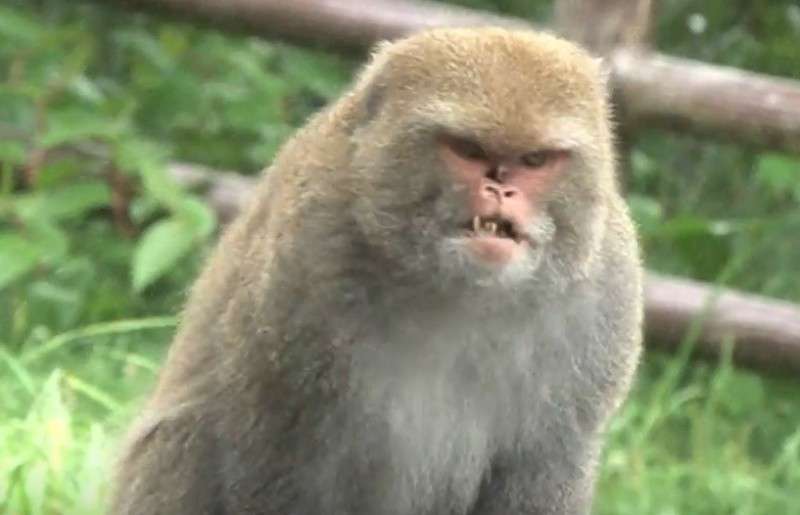
Therefore, mihou (獼猴) is just one of several ways to refer to the primate, either male or female (fig. 2).

Fig. 2 – A most beautiful mihou (larger version). Image found here.

III. Male Mihou in Buddhist literature

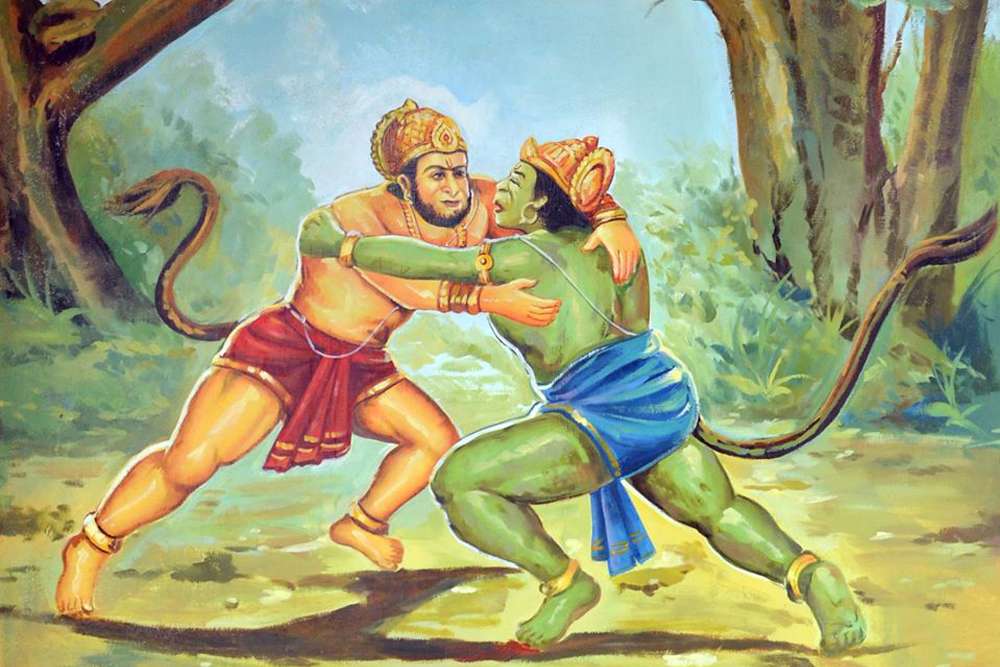
It’s important to note that Buddhist literature also uses the term to refer to male monkeys. For instance, story no. 46 in the Collection of Sutras on the Six Paramitas (Liudu jijing, 六度集經, 3rd-century CE; “Collection of Sutras” hereafter) tells how a past life of the Buddha helps a macaque (mihou, 獼猴) regain his kingship after being usurped by his uncle. What’s important is that this tale, the Dasaratha Jataka, is a famous Buddhist retelling of the Hindu epic Ramayana (5th-century BCE). The hero-king Rama is replaced by the Buddha, and the warring monkey king brothers Sugriva and Vali (fig. 3) are replaced by a nephew and his uncle. [1]

The Buddha himself also has a past life as a king of monkeys. One Chinese variant of the Mahakapi Jataka, story no. 56 in the Collection of Sutras, expressly calls him Mihou wang (獼猴王). A second Chinese variant, story no. 12 in the Scripture on the Storehouse of Sundry Treasures (Za baozang jing, 雜寶藏經, mid-5th-century CE), calls him Shan mihou (善獼猴, “Good Macaque”).

Fig. 3 – The famous battle between the monkey king brothers Sugriva and Vali (larger version). Image found here.

IV. Conclusion

Journey to the West uses the term Mihou wang (獼猴王) three times to refer to the same character. Yu (Wu & Yu, 2012) translates this twice as “Macaque King” (ch. 3 & 4) but later changes it to “Female Monkey King” (ch. 41). Despite the original Chinese referring to the character as the “fifth brother” (wuge, 五哥), Yu (Wu & Yu, 2012) appears to represent them as a woman based solely on the association of mihou (獼猴) with female monkeys. However, not even Journey to the West follows this association, for out of 13 mentions of the term, over 61% refer directly to Liu’er mihou (六耳獼猴), Sun Wukong’s six-eared doppelganger. In addition, mihou (獼猴) and mi (獼) are even used in the novel to refer to monkeys as a whole.

The term mihou (獼猴) is just one of several transcriptions for a non-Chinese word used in China for millennia to mean “macaque” or “monkey.” Dynastic sources show that the association with female monkeys is a misunderstanding based on changes in dialect, along with differences in transcription. Said changes include muhou (沐猴, “bathing monkey”), muhou (母猴, “mother monkey”), and of course mihou (獼猴). Therefore, the word can be applied to either male or female monkeys.

The last point is exemplified in Buddhist literature. A 3rd-century CE Chinese version of the Dasaratha Jataka, which retells the Hindu epic Ramayana (5th-century BCE), references the great battle between the monkey king brothers Sugriva and Vali and calls the former Mihou (獼猴). A 3rd-century Chinese version of the Mahakapi Jataka, which tells of the Buddha’s past life as a monkey king, also refers to him as Mihou wang (獼猴王). And a 5th-century variant of the same story refers to the Enlightened One as the Shan mihou (善獼猴), or “Good Macaque.”


Update: 08-09-23

Sun Wukong calls himself the Meihou wang (美猴王, “Handsome Monkey King”) throughout JTTW. While it serves as an example of his ego-driven personality, I can’t help but think that meihou (美猴) is a play on mihou (獼猴). Recall that even the Buddha’s past life as a monkey king is referred to as Mihou wang (獼猴王) in Chinese sources.


Update: 09-27-23

It just dawned on me that Sun Wukong’s precursor, Hou xingzhe (猴行者, the “Monkey Pilgrim”) from the 13th-century JTTW, is also called Mihou wang (獼猴王). Chapter two refers to him as Huaguo shan ziyun dong bawan siqian tongtou tie’e Mihou wang (花果山紫雲洞八萬四千銅頭鐵額獼猴王, the “Bronze-Headed, Iron-Browed King of the Eighty-Four Thousand Monkeys of the Purple Cloud Grotto on the Mountain of Flowers and Fruits”) (Wivell, 1994, p. 1182). This adds to the evidence that mihou refers to monkeys as a whole and not just female macaques. Also, refer back to the suggestion in my 08-09-23 update.

Note:

1) See Mair, 1989, pp. 676-678 for a full English translation.

Sources:

Mair, V. (1989). Suen Wu-kung = Hanumat? The Progress of a Scholarly Debate. In Proceedings of the Second International Conference on Sinology (pp. 659-752). Taipei: Academia Sinica.

Van Gulik, R. H. (1967). The Gibbon in China: An Essay in Chinese Animal Lore. Leiden: E.J. Brill.

Wivell, C.S. (1994). The Story of How the Monk Tripitaka of the Great Country of T’ang Brought Back the Sūtras. In V. Mair (Ed.), The Columbia Anthology of Traditional Chinese Literature (pp. 1181-1207). New York: Columbia University Press.

Wu, C. & Jenner, W. J. F. (2020). Journey to the West (Vols. 1-4). Beijing: Foreign Languages Press. (Original work published 1993)

Wu, C., & Yu, A. C. (2012). The Journey to the West (Vols. 1-4) (Rev. ed.). Chicago, Illinois: University of Chicago Press.

Archive #41 – PDFs of The Illustrated Journey to the West (Ehon Saiyuki, 繪本西遊記, 1835) – The First Complete Japanese Translation

While the earliest known published edition of Journey to the West (Xiyouji西遊記) hails from the 13th-century, the standard 1592 edition of the novel appears to have arrived on Japan’s shores at a relatively late date. For example, the 18th-century translator Nishida Korenori (西田維則; penname: Kuchiki sanjin, 口木山人) began publishing Japanese translations of the stories in 1758, ultimately publishing a total of 26 chapters before his death. Others picked up where he left off, including Ishimaro Sanjin (石麻呂山人) (ch. 27-39 and later 40-47), Ogata Teisai (尾方貞斎) (ch. 48-53), and Gakutei Kyuzan 岳亭丘山 (ch. 54-65). This incomplete version, known as The Popular Journey to the West (Tsuzoku saiyuki, 通俗西遊記, 1758-1831) was published in five instalments over 31 volumes. The first complete version of the novel, The Illustrated Journey to the West (Ehon Saiyuki, 繪本西遊記), was published in 40 volumes a few years later in 1835 (Tanaka, 1988, as cited in Chien, 2017, p. 21).

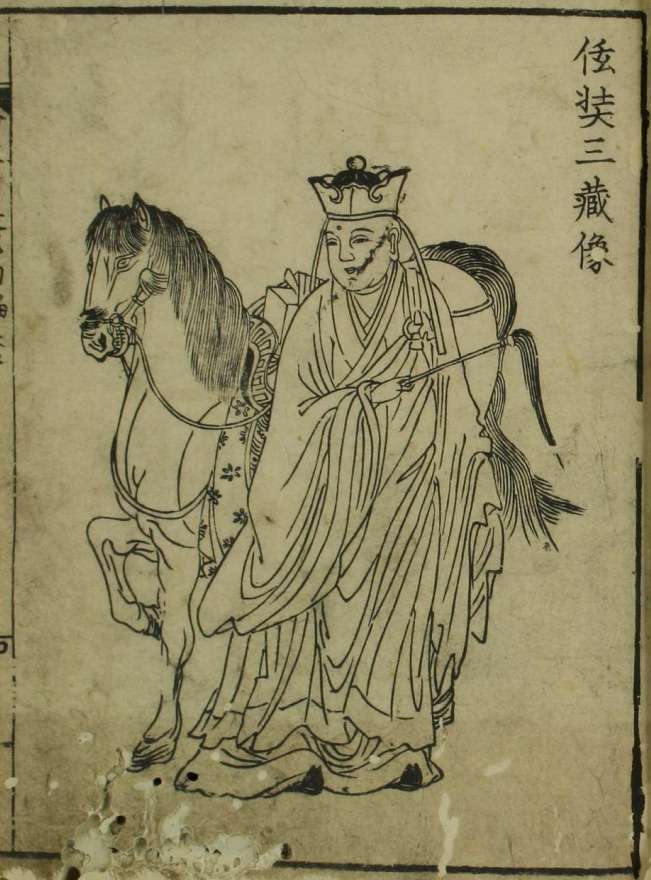
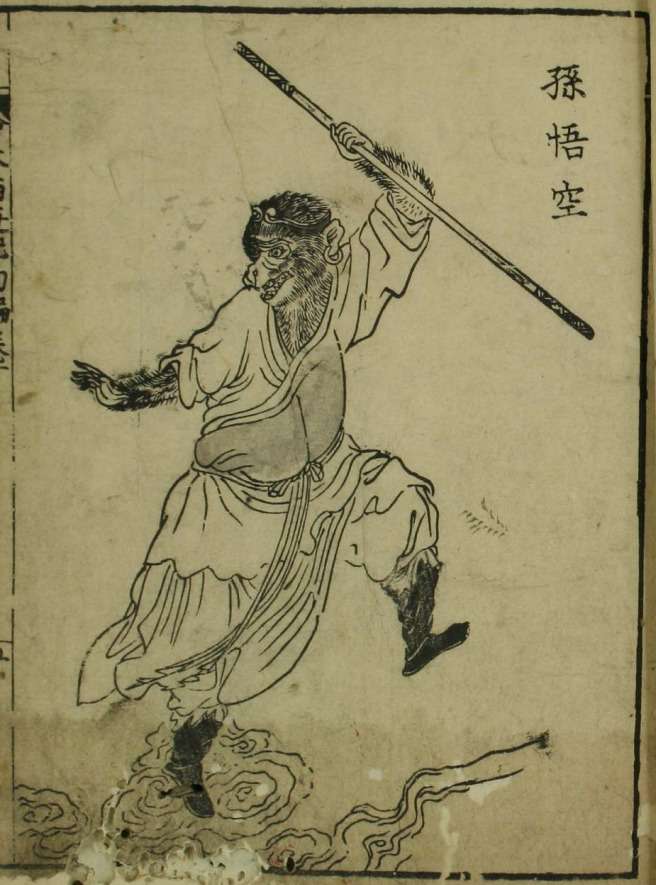
The latter is full of breathtaking woodblock prints, which are, in my honest opinion, FAR superior to those appearing in the aforementioned standard edition. While commonly attributed to Hokusai (北斎), this art was the joint work of Ohara Toya (大原東野), Utagawa Toyohiro (歌川豐廣), and Katsushika Taito II (二代葛飾戴斗) (Van Rappard-Boon, 1982, p. 147). Most are black and white (fig. 1-4), but a few are in color.

Here, I would like to archive PDF scans of the complete Japanese translation of Journey to the West. I hope it is useful to my readers.

Fig. 1 – The monk Xuanzang/Sanzang (larger version). Fig. 2 – Sun Wukong (larger version). Fig. 3 – Zhu Wuneng/Bajie (larger version). Fig. 4 – Sha Wujing (larger version). Woodblock prints from vol. 1, pp. 8-11.

I. Archive Links

Vol. 1

Click to access Saiyuki-1835-No-1.pdf

Vol. 2

Click to access Saiyuki-1835-No-2.pdf

Vol. 3

Click to access Saiyuki-1835-No-3.pdf

Vol. 4

Click to access Saiyuki-1835-No-4.pdf

Vol. 5

Click to access Saiyuki-1835-No-5.pdf

Vol. 6

Click to access Saiyuki-1835-No-6.pdf

Vol. 7

Click to access Saiyuki-1835-No-7.pdf

Vol. 8

Click to access Saiyuki-1835-No-8.pdf

Vol. 9

Click to access Saiyuki-1835-No-9.pdf

Vol. 10

Click to access Saiyuki-1835-No-10.pdf

Vol. 11

Click to access Saiyuki-1835-No-11.pdf

Vol. 12

Click to access Saiyuki-1835-No-12.pdf

Vol. 13

Click to access Saiyuki-1835-No-13.pdf

Vol. 14

Click to access Saiyuki-1835-No-14.pdf

Vol. 15

Click to access Saiyuki-1835-No-15.pdf

Vol. 16

Click to access Saiyuki-1835-No-16.pdf

Vol. 17

Click to access Saiyuki-1835-No-17.pdf

Vol. 18

Click to access Saiyuki-1835-No-18.pdf

Vol. 19

Click to access Saiyuki-1835-No-19.pdf

Vol. 20

Click to access Saiyuki-1835-No-20.pdf

Vol. 21

Click to access Saiyuki-1835-No-21.pdf

Vol. 22

Click to access Saiyuki-1835-No-22.pdf

Vol. 23

Click to access Saiyuki-1835-No-23.pdf

Vol. 24

Click to access Saiyuki-1835-No-24.pdf

Vol. 25

Click to access Saiyuki-1835-No-25.pdf

Vol. 26

Click to access Saiyuki-1835-No-26.pdf

Vol. 27

Click to access Saiyuki-1835-No-27.pdf

Vol. 28

Click to access Saiyuki-1835-No-28.pdf

Vol. 29

Click to access Saiyuki-1835-No-29.pdf

Vol. 30

Click to access Saiyuki-1835-No-30.pdf

Vol. 31

Click to access Saiyuki-1835-No-31.pdf

Vol. 32

Click to access Saiyuki-1835-No-32.pdf

Vol. 33

Click to access Saiyuki-1835-No-33.pdf

Vol. 34

Click to access Saiyuki-1835-No-34.pdf

Vol. 35

Click to access Saiyuki-1835-No-35.pdf

Vol. 36

Click to access Saiyuki-1835-No-36.pdf

Vol. 37

Click to access Saiyuki-1835-No-37.pdf

Vol. 38

Click to access Saiyuki-1835-No-38.pdf

Vol. 39

Click to access Saiyuki-1835-No-39.pdf

Vol. 40

Click to access Saiyuki-1835-No-40.pdf

II. Thanks

I originally retrieved the PDF scans from this archive. My thanks to them.

Sources:

Chien, P. (2017). A Journey to the Translation of Verse in the Five English Versions of Xiyouji [Unpublished Master’s dissertation]. National Taiwan Normal University. Retrieved from http://rportal.lib.ntnu.edu.tw/bitstream/20.500.12235/95894/1/060025002l01.pdf

Van Rappard-Boon, C. (1982). Hokusai and His School: Japanese Prints C.1800-1840. Netherlands: Rijksprntenkabinet /  Rijksmuseum.

Archive #40 – Journey to the South (Nanyouji) English Translation PDF

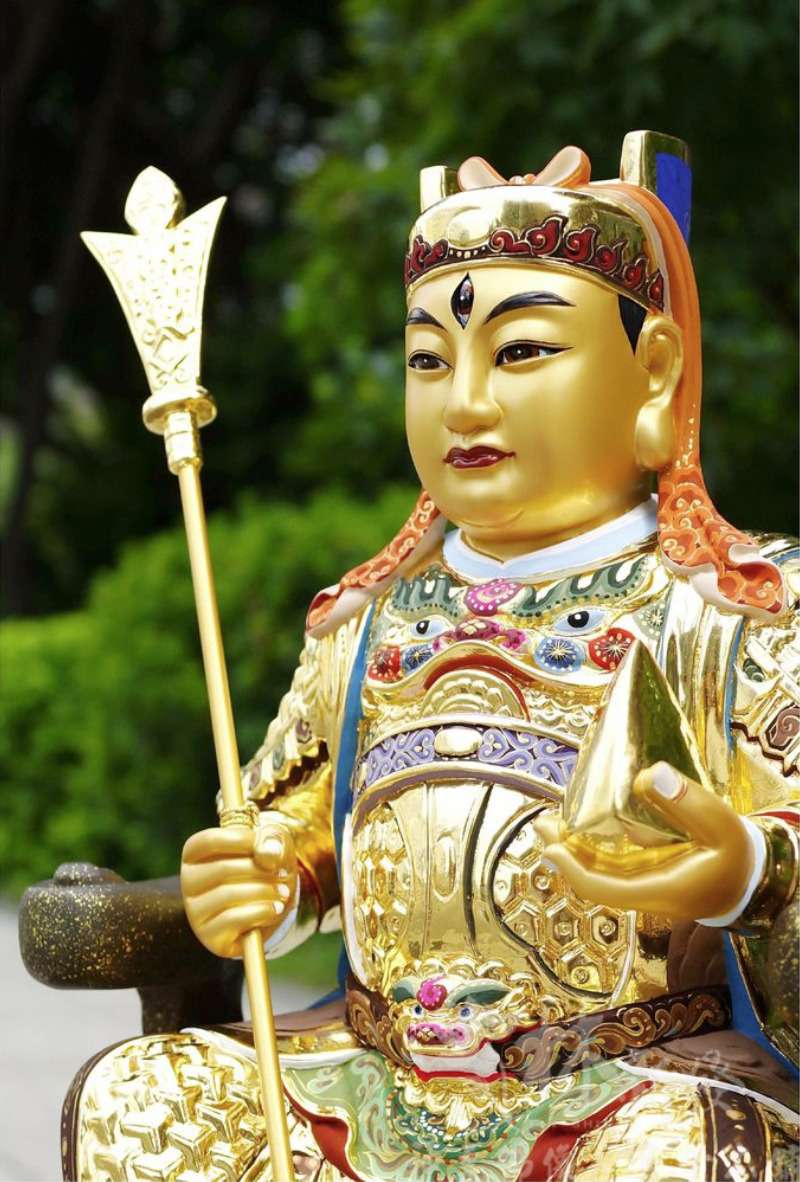
Journey to the South (Nanyouji南遊記, c. 1570s-1580s), [1] is one of four shenmo novels, dubbed the Four Journeys (Siyou ji, 四遊記), (re)published during the Wanli era by Yu Xiangdou (余象斗, c. 1560-c. 1640). This eighteen chapter work follows the adventures of the martial deity Huaguang dadi (華光大帝) (fig. 1), variously translated as “Great Emperor of Flowery/Resplendent/Magnificent/Majestic Light.” He begins the story as a divine disciple of the Buddha who is exiled from paradise for taking a life. But after a series of rebirths in which he causes trouble as a trickster, Huaguang redeems himself by using his powers to subdue evil.

What’s interesting for the purposes of this blog is that the Monkey King appears as a tertiary character in chapters one and seventeen. The latter is notable among fans of Journey to the West as it mentions that our hero has children. One in particular, his monstrous daughter Yuebei xing (月孛星, “Moon Comet Star”), is shown to be a powerful sorceress who can threaten the lives of even immortals with her magic skull weapon.

Here, I would like to archive an English translation of Journey to the South found online. It is by a translator with the penname “Peter Pan.” My thanks to them.

Fig. 1 – A modern Huaguang dadi idol (larger version). Readers will notice that he shares many iconographical similarities with Erlang shen. Image found here.

I. Synopsis

After killing a havoc-wreaking Single-Flame King, Manjusri is banished by Tathagata [Buddha] to reincarnate into Spirit Light as a son of Mount Horse-Ear King, endowed with five accesses to natural elements and a heavenly eye.

[Jim here: One of Manjushri’s old Chinese Buddhist names is Miao Jixiang (妙吉祥). Huaguang’s previous incarnation, a divine flame-turned-Buddhist deity, also shares this name, but the two are not related (Von Glahn, 2004, p. 214). Therefore, translating the name as Manjushri is not accurate.]

During his trip to the Spiritual Void Palace, Spirit Light frees two ghosts by stealing a golden spear, but he is killed by Purple Subtlety Heaven Emperor. He again reincarnates as Three-Eye Spirit Flare in the family of Blazing Darkness Heavenly King. He steals from his master Wonderful Joy Celestial Being a golden broadsword, to make it into a triangular golden brick as his divine weapon.

Later, he wreaks havoc in the Jade Flower Gathering in the heavens and assumes the title of Huaguang, but he is subdued by Black Sky Heaven Emperor. Afraid of being punished by the Jade Emperor, Huaguang reincarnates again into Xiao’s Family Village, where he subdues demons and evil spirits with his divine power. Considering his meritorious deeds, the Jade Emperor grants pardon to him.

Huaguang has no idea that his mother is a man-eating monster named Ganoderma who is later detained by Dragon Auspice King in Fengdu, the demon capital.

Searching around for his mother, Huaguang cheats the Goddess Jade Ring for her pagoda, intending to melt it as his weapon. He meets her daughter Princess Iron Fan and takes her as his wife. He continues to subdue more demons and evil spirits.

Still missing his mother, Huaguang learns she was in the underworld and ventures there without hesitation.

Could Huaguang save his mother? Could he prevent his mother from eating humans again? What stories occur between Huaguang and the legendary Monkey King? What is the fate of Huaguang himself after his undulating reincarnations?

Read on to know more about the making of Heavenly King Resplendent Light, a renowned divine figure in Chinese mythology.

II. Archive Link

Click to access Journey_to_the_South_ENG.pdf

III. Disclaimer

This has been posted for educational purposes. No malicious copyright infringement is intended. If you liked the digital version, please support the official release when it once again becomes available on Amazon.

Note:

1) Evidence suggests that the book was originally published prior to the 1590s (Cedzich, 1995, as cited in Von Glahn, 2004, p. 311 n. 145). Yu Xiangdou later renamed the book when he combined it with the other novels to create the Four Journeys. Von Glahn (2004) explains:

The full title of the earliest known copy of Journey to the South, the 1631 edition in the British Museum, is Quanxiang Huaguang tianwang nanyou zhizhuan [全像華光天王南游志傳] (A Fully Illustrated Chronicle of the Journey to the South by the Heavenly King Huaguang) (p. 311 n. 145).

Sources:

Von Glahn, R. (2004). The Sinister Way: The Divine and the Demonic in Chinese Religious Culture. United Kingdom: University of California Press.

Archive #39 – Journey to the West Adaptations

Last updated: 07-21-2025

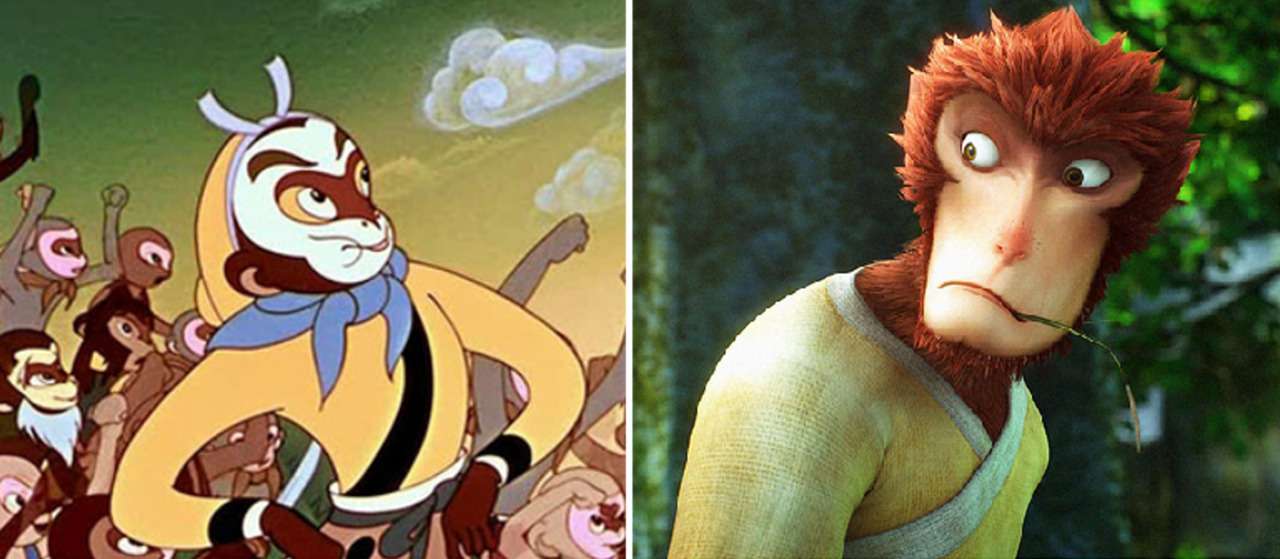
The Journey to the West Research blog is proud to host an entry by our friend Monkey Ruler (Twitter and Tumblr). They have graciously written an essay on the global nature of Journey to the West adaptations, as well as provided a link to their ongoing project recording JTTW media (fig. 1). As of the publishing of this article, it includes a long list of almost 570 movies, 90 TV shows, and 160 video games! – Jim

Fig. 1 – Depictions of Sun Wukong from adaptations produced over 50 years apart: (left) Havoc in Heaven (Danao tiangong, 大鬧天宮, 1961) and (right) Monkey King: Hero is Back (Xiyouji zhi Dasheng guilai, 西遊記之大聖歸來, lit: “Journey to the West: Return of the Great Sage,” 2015) (larger version). Courtesy of Monkey Ruler.

I. Media adaptations

This started out as a collection of Xiyouji (西遊記; lit: “Journey to the West,” 1592) movies and TV shows for the sake of a Master’s class project; it was simple enough to look for Xiyouji media and start adding them to a collection datasheet. But even when the project was over, I kept finding more and more adaptations, even stumbling across others trying to show the magnitude of how much this novel has encompassed popular culture throughout the centuries. It has been told and re-told again and again in oral and published literature, plays, art, songs, poems, etc., and now on the big and small screens. Audiences are re-introduced to the image of Sun Wukong and his fellow pilgrims with every new media addition.

What really inspired me was the book Transforming Monkey: Adaptations and Representation of a Chinese Epic (2018) by Hongmei Sun, where she explained in depth the cultural impact that Sun Wukong (fig. 2) and Xiyouji has had on Chinese media, as well as how this loose set of franchises have come to represent Chinese culture as these shows and movies have become more globally accessible. Xiyouji is such an iconic cultural universe that it can be both heavily entertaining while still being so personal to audiences of any generation depending on how the artist/writer portrays their interpretation of these characters and their stories. 

There hasn’t been a lot written about how these interpretations influence modern Xiyouji adaptations despite how the story has greatly influenced popular culture.

Fig. 2 – The front cover of Transforming Monkey (2018) (larger version).

Xiyouji is such an influential story, one that will continue to grow more and more globally known throughout time because it is such an all-encompassing piece that can cover politics, identities, and allegories, while still being a very personal and interpersonal work that artists or writers can relate to. 

However, even with these layers of meaning and symbolism to be found, the story never loses the charming and entertaining aspects that can and have captured audiences. Despite being published over 430 years ago (with a history stretching back even further), Xiyouji is still able to relate to modern audiences through its allegories of oppression, rebellion, and self-identity. It has the capability to resonate with any generation depending on what artists or writers at the time wish to highlight or personally connect with themselves or their current world around them, using Xiyouji as a medium for their own struggles.

As Xiyouji starts to become more and more globally known, it is important to understand and resonate that this is still a Chinese story and how to address further adaptations with cross-nation gaps in both translation and cultural differences. There are media forms that are far more exploitative of the mythical journey, creating impractical scenarios of the narrative and thus changing the message of the story and characters completely. However, there needs to be an acknowledgment of what doesn’t work as Xiyouji adaptations due to the ever-changing zeitgeist in not only its home of origin but introducing it to a global sphere as it adds influence. 

In order to see what works for adaptations, there needs to be an acknowledgment of what is the core of the story and just why it remains popular, story-beat or character-wise. For example, Sun Wukong can be used as a great model for positive ambivalence in media, moving away from set limits of a single stereotype and rather being a constant motion of new ideas and new identities. Monkey has been changed from a mischievous monkey to a revolutionary hero to a post-modern rebel against authority throughout the years. But even throughout the constant changes and interpretations, people never lose sight of what the nature of Sun Wukong is: rebelliousness, variability, optimism, and persistence. 

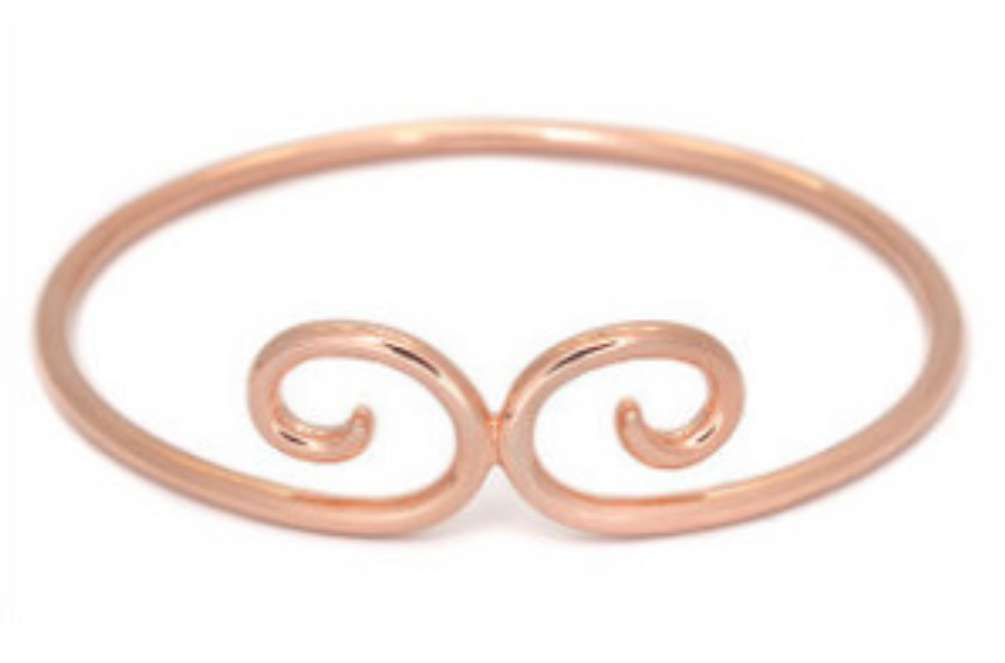
Monkey is a transcending character as he is able to mediate contradictions within his own design, one being his gold-banded staff, a symbol of breaking barriers, and his golden filet (fig. 3), a symbol of limits. These two simple but prominent pieces of iconography immediately tell audiences who the character is supposed to be and what they are about.

Fig. 3 – A modern replica of Monkey’s golden filet or headband (larger version).

While it is entertaining and able to be enjoyed by younger audiences, Xiyouji still has a deeper meaning that can be interpreted and recognized into adulthood. This is one of the few stories that I imagine can be adapted again and again without the issue of overlap as there are so many ways people can personally connect with these characters. 

Having that any generation, anyone really can find enjoyment in this media, and perhaps even be inspired to read the novel itself.

II. Archive link

Please consult the tabs at the bottom of the spreadsheet linked below. They are listed as “Movie Information,” “Movie Links,” “Honorary Shows,” “Game Information,” “Game Pictures,” “Honorary Games,” and “Sources.” – Jim

https://docs.google.com/spreadsheets/d/1GsiCGzE1DZDy2Vpc85wiVXSyLWpxMbxj/edit?usp=sharing&ouid=112097376285754662736&rtpof=true&sd=true


Update: 07-21-25

Monkey Ruler has officially posted a website called “Journey to the West Media.” They continue to update the page with movies, tv shows, video games, and now comic books.

https://www.journeytothewestmedia.com/

Laozi’s Realm in Journey to the West

Last updated: 01-23-2024

A reader recently asked me why Journey to the West (Xiyouji, 西遊記, 1592) associates Laozi (老子), a high god of Daoism, with the Tushita Heaven (Doushuai tian, 兜率天). It’s easy to understand why they might be confused, for this is a Buddhist heaven in which bodhisattvas are born prior to their final life and enlightenment as a Buddha (Buswell & Lopez, 2014, p. 930). I’ve therefore decided to do a brief study.

This piece will complement my article about the location of the Buddha’s realm. It will also give me an excuse to add new material to my article about the cosmic geography of Journey to the West.

I. What the novel says

Sun Wukong stumbles upon Laozi’s realm while in a drunken stupor. Chapter five reads:

Dear Great Sage! Reeling from side to side, he stumbled along solely on the strength of wine, and in a moment he lost his way. It was not the Equal to Heaven Residence that he went to, but the Tushita Palace. The moment he saw it, he realized his mistake. “The Tushita Palace is at the uppermost of the thirty-three Heavens,” he said, “the Separation’s Regret Heaven, [1] which is the home of the Most High Laozi. How did I get here? (Wu & Yu, 2012, vol. 1, pp. 165-166).

好大聖,搖搖擺擺,仗著酒,任情亂撞。一會把路差了,不是齊天府,卻是兜率天宮。一見了,頓然醒悟道:「兜率宮是三十三天之上,乃離恨天太上老君之處,如何錯到此間?…

This is also where the god’s famous alchemical furnace is located. Chapter seven reads:

Arriving at the Tushita Palace, Laozi loosened the ropes on the Great Sage, pulled out the weapon from his breastbone, and pushed him into the Brazier of Eight Trigrams. He then ordered the Daoist who watched over the brazier and the page boy in charge of the fire to blow up a strong flame for the smelting process (Wu & Yu, 2012, p. 189).

那老君到兜率宮,將大聖解去繩索,放了穿琵琶骨之器,推入八卦爐中,命看爐的道人、架火的童子,將火搧起鍛煉。

Based on the above, Laozi and his furnace reside in the “Tushita Palace” (Doushuai gong, 兜率宮) of the “Separation’s Regret Heaven” (Lihen tian, 離恨天), which is said to be the highest of the “thirty-three heavens” (sanshisan tian, 三十三天). I will return to the Tushita Palace below.

II. The Buddhist Heavenly Realms

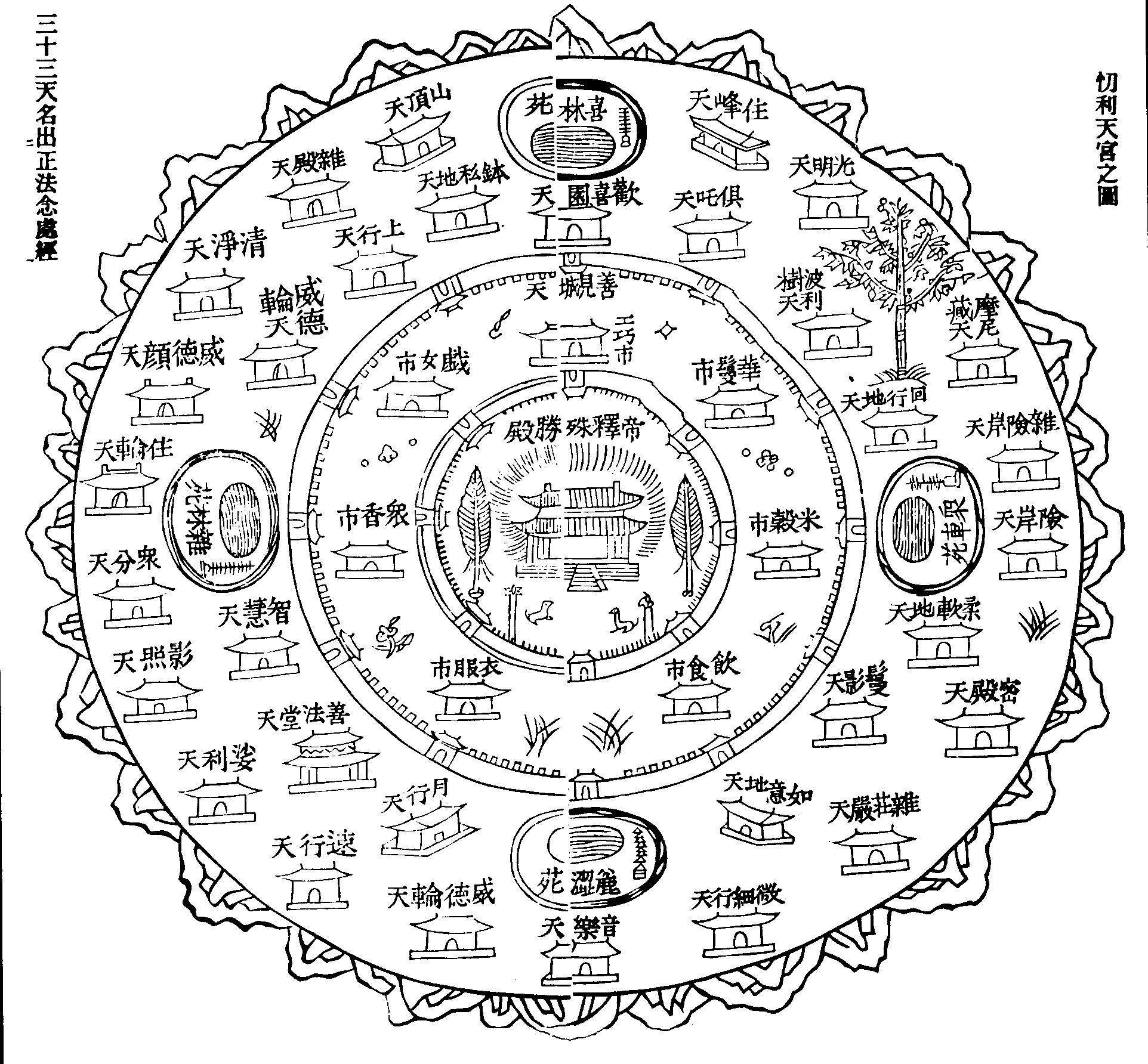
The twenty-fifth scroll of the Sūtra of the Foundations of Mindfulness of the True Law (Ch: Zhengfa nianchu jing, 正法念處經; Sk: Saddharmasmṛtyupasthānasūtra, 6th-century) lists thirty-three Buddhist heavenly realms. [2] These make up the heaven of the “Thirty-Three (Gods)” (Ch: Sanshisan tian, 三十三天; Daoli tian, 忉利天; Sk: Trāyastriṃśa, त्रायस्त्रिंश) (fig. 1). But Separation’s Regret is not mentioned among them, and the actual thirty-third realm is called the “Heaven of Purity” (Qingjing tian, 清淨天). So where does Laozi’s realm come from?

Fig. 1 – The thirty-three heavenly realms overlaid on a map of Buddhist cosmic geography (larger version). From the Establishment of the Dharma-Field with Illustrations (Fajie anli tu, 法界安立圖,17th-century).

III. Ties to Performance Arts

According to Johnson (2020), the Heaven of Separation’s Regret (Lihen tian, 離恨天) is a reoccurring trope in Yuan dynasty stage plays denoting the “[f]rustrations of love” (p. 136). Idema (Wang & Idema, 1995) further explains that it was considered “the home of thwarted lovers obligated to endure eternal separation” (p. 120, n. 24).

The Anthology of Yuan Music Dramas (Yuanqu xuan, 元曲選, 17th-century) contains several examples. One is Listening to a Zither from the Bamboo Thicket (Zhuwu tingqin, 竹塢聽琴, 13th-century) in which a character sings:

Separation’s Regret is the highest of the thirty-three heavenly realms. Of the four hundred and four illnesses, [3] lovesickness is the most bitter. This pining will kill me.

三十三天離恨天最高。四百四病相思病最苦。則被這相思害殺我也。

What’s important for my purposes is that the Yuan play Story of the Western Wing (Xixiangji, 西廂記) specifically mentions Separation’s Regret together with the Tushita Palace, the same palace from Journey to the West. While visiting a monastery, the male lead becomes entranced by a woman and longingly sings of her beauty. Part of the song reads:

Stunning knockouts—I’ve seen a million;
But a lovely face like this is rarely seen!
It dazzles a man’s eyes, stuns him speechless,
And makes his soul fly away into the heavens (emphasis added).
She there, without a thought of teasing, fragrant shoulders bare,
Simply twirls the flower, smiling.

顛不刺的見了萬千,似這般可喜娘的龐兒罕曾見。則著人眼花撩亂口難言,魂靈兒飛在半天。他那裡盡人調戲軃著香肩,只將花笑拈

This is Tushita Palace,
Don’t guess it to be the heaven of Separation’s Regret (emphasis added).
Ah, who would ever have thought that I would meet a divine sylph?
I see her spring-­breeze face, fit for anger, fit for joy,
Just suited to those flowered pins pasted with kingfisher feathers (Wang & Idema, 1995, pp. 120-121).

這的是兜率宮,休猜做了離恨天。呀,誰想著寺裡遇神仙!我見他宜嗔宜喜春風面,偏、宜貼翠花鈿。

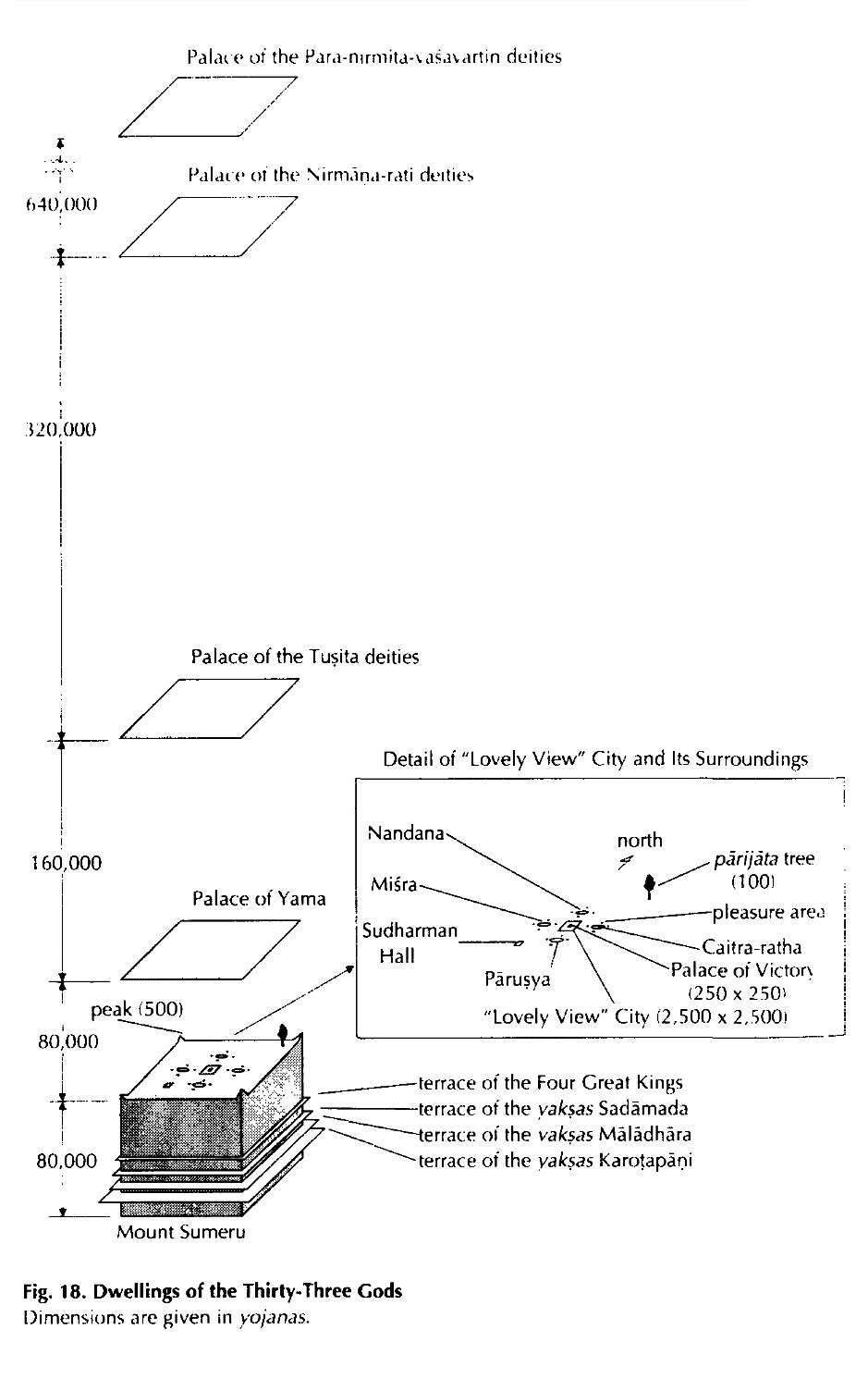
When the male lead sings of the Tushita Palace, he is referring here to the “contentment” of the Buddhist Tushita heaven (Buswell & Lopez, 2014, p. 930). That’s why he differentiates it from the Separation’s Regret heaven. After all, Tushita is higher than the traditional Heaven of the Thirty-Three Gods (refer back to sec. II) in Buddhist cosmology (fig. 2) (Buswell & Lopez, 2014, p. 230-231).

This song (or others like it) might ultimately explain why Journey to the West associates the Tushita Palace with Separation’s Regret. But how does this connect to Laozi?

Fig. 2 – A diagram of the heavens above the Heaven of the Thirty-Three Gods atop Mt. Sumeru (larger version). From Sadakata, 1997, p. 60. Take note that the heaven of the Thirty-Three Gods is separated from Tushita by the Yama Heaven.

IV. The Daoist Heavens

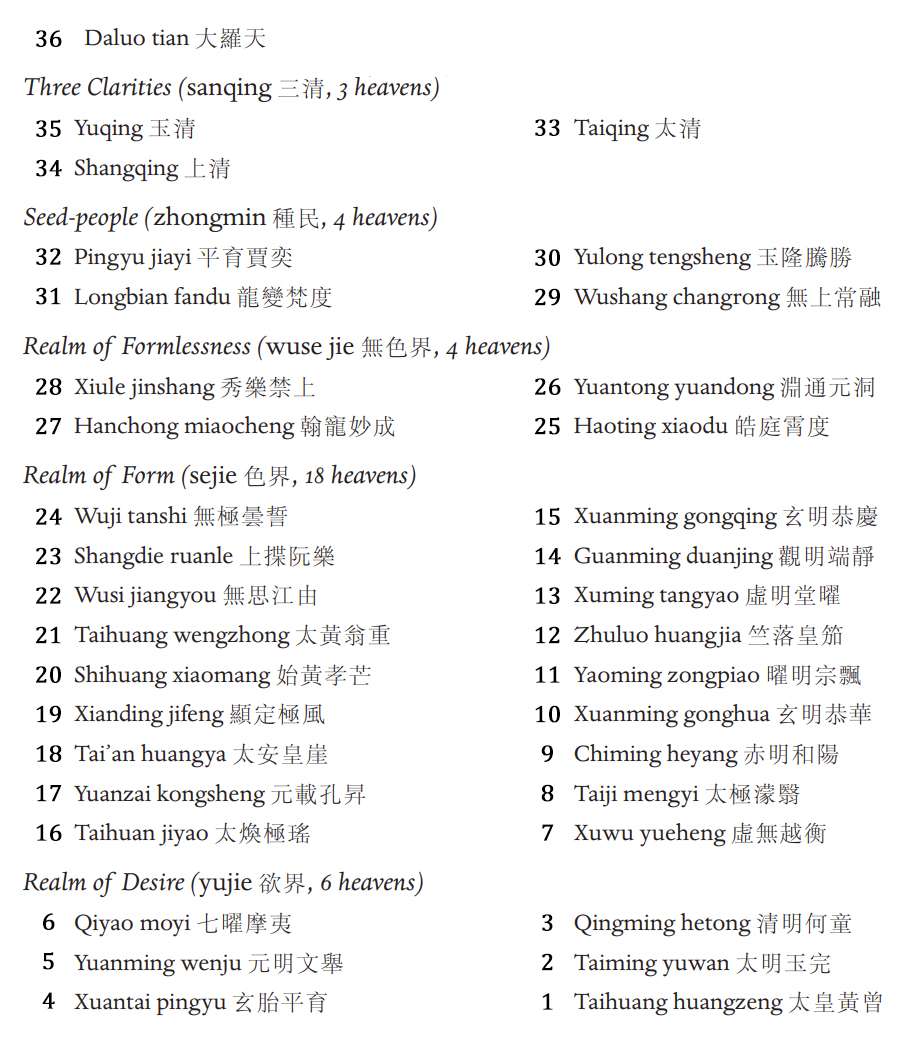
The Seven Bamboo Tablets of the Cloudy Satchel (Yunji qiqian, 雲笈七籤, c. 1029), an encyclopedia of mostly Shangqing (上清) Daoist texts, states that the universe has thirty-six heavens. These comprise thirty-two lower heavens, then the three respective heavens of the “Three Pure Ones” (Sanqing, 三清), and a final grand heaven at the top called the “Great Canopy” (Daluo tian, 大羅天) (fig. 3) (here and here, for example; see also Miller, 2008c). The Cloudy Satchel lists the heavens of the Three Pure Ones from top to bottom, associating Laozi with the bottommost (i.e. the thirty-third heaven):

The realms of the Three Pure ones are Jade Clarity, Highest Clarity, and Grand Clarity.

其三清境者,玉清、上清、太清是也。

[…]

The Lord of Divine Treasures (Laozi) lives in the Grand Clarity Realm, that is the Great Scarlet Heaven.

神宝君治在太清境,即大赤天也。

An earlier work, Pearl Satchel of the Three Caverns (Sandong zhunang, 三洞珠囊, 6th-century), more pointedly refers to the number of Laozi’s heaven, stating:

It is said that the Most High Lord Lao lives at the top of the thirty-third heaven in the Grand Ultimate Palace of the Great Clarity Realm.

又云:大清境、太極宮,即太上老君位在三十三天之上也。

As can be seen, Laozi’s heaven, the “Grand or Great Clarity Realm” (Tai / Daqing jing, 太/大清境), is said to be the thirty-third of thirty-six Daoist heavens. This likely explains how he was associated with the thirty-three Buddhist heavenly realms, Separation’s Regret, and thereby the Tushita Palace.

Fig. 3 – The various layers of the thirty-six Daoist heavens according to the Seven Bamboo Tablets of the Cloudy Satchel (c. 1029) (larger version). Adapted from Miller, 2008c, p. 850. The original source lists the thirty-sixth heaven as number one. I’ve numbered them according to how they are listed in the Cloudy Satchel. 

V. Myth vs Religion

While there is an overlap between Chinese mythology and religion, this article shows that the cosmos of Journey to the West is not an accurate snapshot of religious beliefs. But the novel should not be looked upon solely as entertainment, as is commonly claimed. Like Investiture of the Gods (Fengshen yanyi, 封神演義, c. 1620), Journey to the West helped spread the mythos of many gods still worshiped today. This is especially true for Sun Wukong because he never received royal patronage due to his literary penchant for rebelling against authority (Shahar, 1996).

VI. Conclusion

The early chapters of Journey to the West state that Laozi and his furnace reside in the Tushita Palace of the Separation’s Regret Heaven, which is the highest of the thirty-three heavenly realms. These realms were borrowed from Buddhism, but Separation’s Regret does not appear among them. It is instead a trope from Yuan-era drama denoting the frustration of being separated from a lover. One Yuan play in particular mentions Separation’s Regret together with the Tushita Palace, a clear reference to the Buddhist heaven of the same name, showing how they might have been associated. And since Laozi’s realm is the thirty-third of thirty-six Daoist heavens, this likely explains why he came to be associated with the thirty-three Buddhist heavenly realms, Separation’s Regret, and thereby the Tushita Palace.

This article shows that Journey to the West is therefore not an accurate snapshot of Chinese religion. But the novel is important as it helped spread the mythos of many gods still worshiped today, including Sun Wukong.


Update: 03-02-23

It turns out that “Tushita Palace” (Doushuai(tian) gong, 兜率(天)宮) is used many times throughout Buddhist literature to refer to the Tushita Heaven (see here and here). For example, the Flower Garland Sutra (Huayan jing, 華嚴經, late-3rd to early-4th-century) reads:

Then the king of the Tushita heaven (emphasis added), having set up the throne for the Enlightened One, respectfully greeted the Buddha together with countless godlings of the Tushita heaven.

爾時兜率天王為如來敷置座已心生尊重與十萬億阿僧祇兜率天子奉迎如來

[…]

In the Tushita palace (emphasis added) a host of unspeakably many enlightening beings hovered in the air, and with diligence and single-mindedness produced offerings surpassing all the heavens and presented them to the Buddha, bowing respectfully, while countless forms of music played all at once (Cleary, 1993, pp. 504-505).

中不可說諸菩薩眾住虛空中精勤一心以出過諸天諸供養具供養於佛恭敬作禮阿僧祇音樂一時同奏


Update: 03-04-23

Famed Tang-era poet Li Bai / Bo (李白, 701-762) uses the phrase “Separation’s regret” (Lihen, 離恨), translated below as “Parting’s pain,” to describe the agony of being separated from his beloved winter time comforts:

“Parting from My Felt Curtain and Brazier” (Bie zhanzhang huolu, 別氈帳火爐)

I recall recently in late winter weather
the north wind and three feet of snow.
Getting old, I couldn’t stop feeling cold,
how was I to get through the long nights?
Luckily I had a green felt curtain,
I hung it up against the wind.
Also there was this red brazier
that warmed me up in the snow.
I was like a fish diving into deep water,
like a rabbit hiding deep in his hole.
Tender and gentle, the wintering scales revive,
poached in warmth, frozen flesh revitalized.
But then those dark and gloomy evenings
changed instantly to a time of balmy light.
It’s the seasons moving inevitably on—
of course my affection has not ceased.
The frizzy curtain is rolled up with the days,
the ashes die in the fragrant brazier.
Parting’s pain (emphasis added) belongs to springtime,
our tryst will be in the tenth month.
If only this body stays healthy,
we will not be parted for long (Owen, 2006, p. 52).

憶昨臘月天,北風三尺雪。
年老不禁寒,夜長安可徹。
賴有青氈帳,風前自張設。
復此紅火爐,雪中相暖熱。
如魚入淵水,似兔藏深穴。
婉軟蟄鱗蘇,溫燉凍肌活。
方安陰慘夕,遽變陽和節。
無奈時候遷,豈是恩情絕。
毳䈴逐日卷,香燎隨灰滅。
離恨屬三春,佳期在十月。
但令此身健,不作多時別。

This shows that the phrase carried the same tortured meaning prior to being elevated to a metaphorical heaven during the Yuan.

On an unrelated note, Dario Virga reminded me that Investiture of the Gods (Fengshen yanyi, 封神演義, c. 1620), a sort of prequel to Journey to the West, places Laozi in a different location. For instance, chapter 44 reads:

Chi Jingzi took his leave of the Elder Immortal of the South Pole and sailed on his auspicious cloud towards the Mysterious Metropolis, arriving at the immortal mountain in no time at all. This was the Mysterious Metropolis Cave of the Great Canopy heaven, [4] which was the residence of Laozi (emphasis added). Inside was the wonderland of the Eight Effulgences Palace … [5]

赤精子辭了南極仙翁,駕祥雲往玄都而來。不一時已到仙山。此處乃大羅宮玄都洞,是老子所居之地,內有八景宮,仙境異常 …

As mentioned above, the Great Canopy is the highest of the traditional thirty-six Daoist heavens (Miller, 2008c; refer back to fig. 3).


Update: 03-06-23

After a quick search, it appears that Journey to the West also makes use of the Great Canopy Heaven (Daluo tian, 大羅天). For example, chapter 35 associates it with Laozi’s Tushita Palace:

After receiving the five treasures, Laozi lifted the seals of the gourd and the vase and poured out two masses of divine ether. With one point of his finger he transformed the ether again into two youths, standing on his left and right. Ten thousand strands of propitious light appeared as

They all drifted toward the Tushita Palace;
Freely they went straight up to Great Canopy (emphasis added)(Wu & Yu, 2012, vol. 2, p. 146). [6]

那老君收得五件寶貝,揭開葫蘆與淨瓶蓋口,倒出兩股仙氣。用手一指,仍化為金、銀二童子,相隨左右。只見那霞光萬道,咦!
縹緲同歸兜率院,逍遙直上大羅天。

But since Journey to the West closely associates the Tushita Palace with the thirty-third heaven of Separation’s Regret, I think the addition of Great Canopy is a clear cut case of a separate oral tradition making its way into the novel.

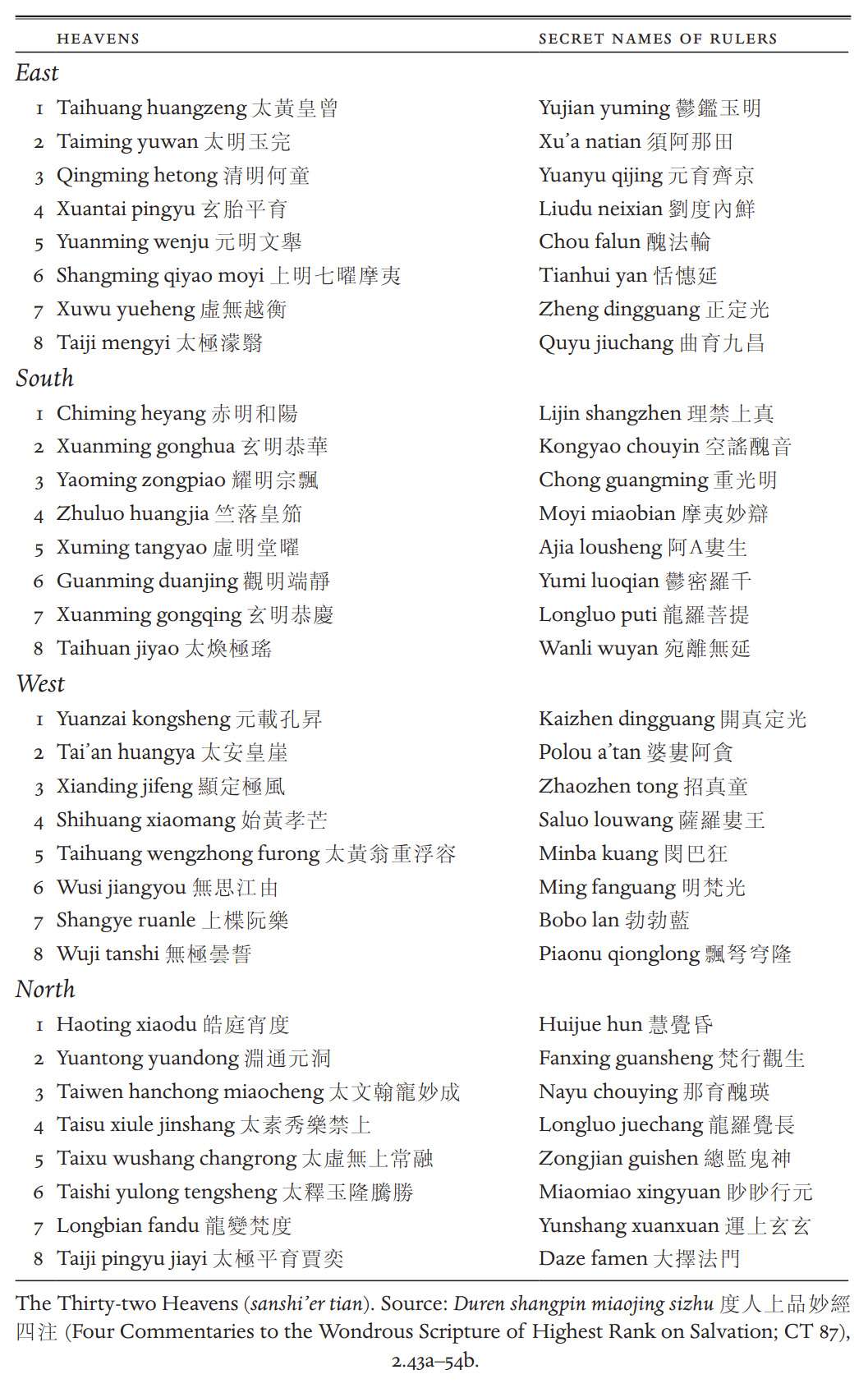
Lingbao (靈寶) Daoism recognizes thirty-two main heavens topped by the Great Canopy heaven, for a total of thirty-three (fig. 4). This shows that Buddhism came to influence Daoism’s cosmic geography (Miller, 2008b).

This means that the novel places Laozi’s realm in two different locations, but each is treated as the thirty-third heaven.

Fig. 4 – The Thirty-two cardinal Daoist heavens (larger version). Image from Miller, 2008b, p. 848.


Update: 03-12-23

I was surprised to learn recently that the Sutra Spoken by the Buddha on the Names of the Buddhas (Foshuo foming jing, 佛說佛名經, 6th-century) lists a certain “Separation’s Regret Buddha” (lihen fo, 離恨佛). I’m not sure if lihen (離恨) is a translation/transliteration of a foreign Indian Buddhist term. I doubt the deity is related to Laozi’s drama-inspired heaven, but it’s still interesting to see the term associated with a Buddha.


Update: 08-29-23

There are other examples showing that JTTW is not an accurate snapshot of Chinese religious beliefs. Another is the fact that the Tathagata is a combination of two Buddhas, Shakyamuni and Amitabha. A good indication of this appears in chapter seven:

The Buddha laughed, saying: “I am Shakyamuni, the Venerable One from the Western Region of Ultimate Bliss. Salutations to Amitabha Buddha!” (based on Wu & Yu, vol. 1, p. 193). [4]

如來笑道:「我是西方極樂世界釋迦牟尼尊者。南無阿彌陀佛!…」

The Western Region of Ultimate Bliss (Xifang jileshijie, 西方極樂世界) is the paradise of the Amitabha Buddha. The term “Ultimate Bliss” (Jile, 極樂) appears 33 times in JTTW.

My guess is that the storytellers and/or author-compilers who added this element did so to make the story more inclusive. After all, there are many different sects of Buddhism, and each one venerates a different Buddha.


Update: 01-23-24

A more overt reference to Shakyamuni as the Amitabha Buddha appears later in chapter seven, when the gods hold a banquet in celebration of his defeat of Monkey. One poem speaks of the gods bearing gifts for him. The openly lines read: “The Naked-Feet Immortal brought fragrant pears and dates/ To give to Amitabha, whose count of years is long …” (大仙赤腳棗梨香,敬獻彌陀壽算長。) (Wu & Yu, vol. 1, p. 199).

Notes:

1) Source slightly altered for accuracy. Yu’s (Wu & Yu, 2012) translation originally reads “the Griefless heaven” (vol. 1, p. 166). See section III above for more context.

2) The Great Dictionary of Buddhism (Foxue dacidian, 佛學大辭典, 1922) gives the same list.

3) This is a concept borrowed from Buddhist medicine (Demiéville, 1985, p. 77).

4) The original Chinese reads “Daluo gong” (大羅宮), which can be translated as “Great Canopy Palace.” But I’ve already shown in my 03-02-23 update that gong (宮) can also refer to a heaven, and this is true of Great Canopy.

5) Translation by the author. The Eight Effulgences (Bajing, 八景) refer to planetary and stellar deities, internal alchemical practices, or divine chariots of the gods (Robinet, 2008).

6) Source altered slightly for conformity. Yu’s (Wu & Yu, 2012) translation originally reads “Heaven’s Canopy” (vol. 3, p. 77)

7) Yu (Wu & Yu, 2012) skipped over the last sentence about Amitabha in his translation.

Sources:

Buswell, R. E. , & Lopez, D. S. (2014). The Princeton Dictionary of Buddhism. Princeton University Press.

Cleary, T. (1993). The Flower Ornament Scripture: A Translation of the Avatamsaka Sutra. Boston: Shambhala.

Demiéville, P. (1985). Buddhism and Healing Demiéville’s Article “Byō” from Hōbōgirin (M. Tatz trans.). Lanham: University Pr. of America.

Johnson, D. R. (2020). A Glossary of Words and Phrases in the Oral Performing and Dramatic Literatures of the Jin, Yuan, and Ming. Ann Arbor: University of Michigan Center for Chinese Studies.

Miller, A. L. (2008a). Daluo tian. In F. Pregadio (Ed.), The Encyclopedia of Taoism (Vols. 1-2) (p. 299). London: Routledge.

Miller, A. L. (2008b). Sanshi’er tian. In F. Pregadio (Ed.), The Encyclopedia of Taoism (Vols. 1-2) (ppp. 847-848). London: Routledge.

Miller, A. L. (2008c). Sanshiliu tian. In F. Pregadio (Ed.), The Encyclopedia of Taoism (Vols. 1-2) (pp. 849-851). London: Routledge.

Owen, S. (2006). The Late Tang: Chinese Poetry of the Mid-Ninth Century (827-860). Cambridge, MA: Harvard University Asia Center.

Robinet, I. (2008). Bajing. In F. Pregadio (Ed.), The Encyclopedia of Taoism (Vols. 1-2) (pp. 210-211). London: Routledge.

Sadakata, A. (1997). Buddhist Cosmology: Philosophy and Origins. Japan: Kosei Publishing Company.

Shahar, M. (1996). Vernacular Fiction and the Transmission of Gods’ Cults in Later Imperial China. In M. Shahar & R. P. Weller (Eds.), Unruly Gods: Divinity and Society in China (pp. 184-211). Honolulu: University of Hawaiʻi Press.

Wang, S., & Idema, W. L. (1995). The Story of the Western Wing. Los Angeles, CA: University of California Press.

Wu, C., & Yu, A. C. (2012). The Journey to the West (Vols. 1-4) (Rev. ed.). Chicago, Illinois: University of Chicago Press.