Note: My blog is not monetized, so I am not making any money from this post. My hope is that the PDF will make this legendary story more accessible to a wider audience. If you enjoyed the digital version, please, please, please support the official release.
Last updated: 04-06-2026
Here I present a PDF of the Library of Chinese Classics bilingual edition of Creation of the Gods (Fengshen yanyi, 封神演義, c. 1620 CE), sometimes translated as Investiture of the Gods or Enfeoffment of the Gods.
Table of Contents
- 1. Novel Description
- 2. Relationship to JTTW
- 3. Translation: Pros and Cons
- 3.1. Example
- 4. PDF File
- 5. Updates
1. Novel Description
This 100 chapter shenmo novel tells of the great struggle between the declining Shang (c. 1600–1046 BCE) and ascending Zhou (c. 1046–256 BCE) dynasties. In the beginning, King Zhou of Shang offends the primordial goddess Nuwa by leaving a lewd poem in her temple, and in response, the devi summons a trio of spirits (a fox, a pheasant, and a lute) to bring about the dynasty’s downfall. The fox spirit takes the place of the king’s concubine Daji and, over the course of nearly 30 years, leads him down a path of imperial neglect, decadence, and sadism. This causes many of the kingdom’s dukes, marquis, and generals to later rebel in favor of King Wu of Zhou, the monarch destined by heaven to rule China.
The majority of the story follows the countless battles between the forces of Shang and Zhou. Along the way, the latter are aided by immortals of the Chan (闡) sect (an analogy for Quanzhen Daoism), which favors spiritual cultivation, while the former are aided by the Jie (截) sect (an analogy for Zhengyi), which favors charms and incantations. [1] Each transcendent wields any number of swords, fans, hooks, staves, axes, halberds, scissors, hammers, rings, sashes, nails, dippers, pennants, pearls, gourds (etc.), each with not only the power to take the lives of thousands of humans but also immobilize other immortals and even kill them. These celestial battles escalate to the point that Laozi and the Buddha must fight side-by-side to defeat a trap designed to kill 10,000 immortals.
A story line present throughout the novel is the fate of Jiang Ziya, a Daoist adept and the military strategist and stalwart commander of the Zhou army. He is destined to deify the souls of the humans and immortals who die in battle using the “List of Creation” (Fengshen bang, 封神榜), an index of preordained names agreed upon at the beginning of time by the heads of the three sects. This list is housed in the “Terrace of Creation” (Fengshen tai, 封神臺), a reed pavilion in which the souls of the dead are gathered to await their apotheosis. In the end, after defeating the Shang forces, Jiang deifies a total of 365 major gods, along with thousands of lesser gods, ranging from holy mountains, weather, and plagues to constellations, the time cycle, and the five elements.
Considering that the story takes place a millennia prior to the arrival of Buddhism in China, the novel portrays the religion having no presence in the east. There are several times in the narrative when a Buddhist deity travels from the western paradise to halt the execution of a powerful immortal or demon as they are fated to submit to Buddhism. Furthermore, when the Buddha intervenes in the great battle towards the end, he does so to find talented disciples who will help him spread the religion in the east. In fact, Bodhisattvas like Guanyin and Manjusri are depicted as former Chan sect immortals who later become disciples of Buddhism.
See also this chapter-by-chapter summary.
2. Relationship to JTTW
For the purposes of this blog, several characters from Journey to the West (Xiyouji, 西遊記, 1592) appear in the novel, including Laozi, the Buddha, Nezha (fig. 1), Muzha, and Li Jing, Ao Guang, Erlang (called Yang Jian, 楊戩) and his hound, etc. Journey to the West also had a number of clear influences on the book, one being the ape spirit Yuan Hong (袁洪) from later chapters who wields a staff and 72 transformations in a fight with Yang Jian. Sound familiar?

Fig. 1 – A detail of Nezha striking at an enemy during battle. Image from The Newly Printed, Zhong Bojing Annotated, Investiture of the Gods (Xinke Zhong Bojing xiansheng piping Fengshen yanyi, 新刻鍾伯敬先生批評封神演義, c. 1620) (larger version).
3. Translation: Pros and Cons
This edition of the novel was originally translated by Gu Zhizhong (顾执中, 1898–1995) in 1992. Dr. Barbara Witt notes that the translation has its pros and cons:
The positive: It is the only complete translation of Fengshen yanyi into a Western language that I am aware of. The edition I read (from 1992 I think), was also nicely done with interesting woodcut illustrations throughout the novel.
The negative: Firstly, it is not a very faithful translation. Poems are generally left untranslated and sentences often paraphrased. [2] I think, when ever the translator found something difficult, he just skipped it. Secondly, I think Gu Zhizhong was not an English native speaker and not very familiar with Western mythology and some of his translations are really off. For example Taiyi zhenren 太乙真人 (“True Man Primordial”), a powerful Daoist immortal, becomes “Fairy Primordial” in his translation, which conjures up a very different image.
3.1. Example
Chapter 12 describes how young Nezha inadvertently causes havoc in the aquatic realm when washing himself in a river with a powerful magic sash. This eventually leads to Li Gen (李艮), a yaksha water-spirit soldier, to attack him with an ax. Gu’s (2000) description of the fight reads:
Nezha, naked and empty-handed, dodged the vicious blow, raised his Universal Ring and struck Li Gen on the head. How could the Yaksha withstand the magic weapon from Fairy Primordial! His skull broke open and he fell dead on the river bank (vol. 1, p. 239).
However, the full encounter should read:
Standing there naked, Nezha dodged the advancing warrior’s attack and upraised the Universal Ring in his right hand. This treasure was originally bestowed by the Jade Emptiness Palace of Mt. Kunlun to the Perfected Man of the Grand Monad to secure the items of his Golden Light Cave. How could the yaksha withstand the magic weapon as it struck downward on his head? His brains exploded from the blow, and he fell dead on the shore.
哪吒正赤身站立,見夜叉來得勇猛,將身躲過,把右手套的乾坤圈望空中一舉。此寶原係崑崙山玉虛宮所賜太乙真人鎮金光洞之物,夜叉那裏經得起,那寶打將下來,正落在夜叉頭上,只打的腦漿迸流,即死於岸上。
You can see that quite a bit of information was left out. This happens throughout the entire novel. This makes me angrier the more that I think about. Why even bother to translate something if you are only going to paraphrase or even skip over passages? It seems like a pointless enterprise.
However, while imperfect, I think that the translation is a must read as many of the gods mentioned therein are worshiped in modern temples throughout China, Taiwan, Malaysia, and Singapore. It is a lens into modern folk religion.
4. PDF File
The following PDF is a combination of all four volumes making up Gu (2000):
Click to access fsyy-en-cn.pdf
5. Updates
Update: 11-28-21
I’ve added Wan (1987), a doctoral thesis analyzing the historical sources and micro/macro structure of the story. It also provides a summary of the tale in the end.
PDF File
Update: 03-14-23
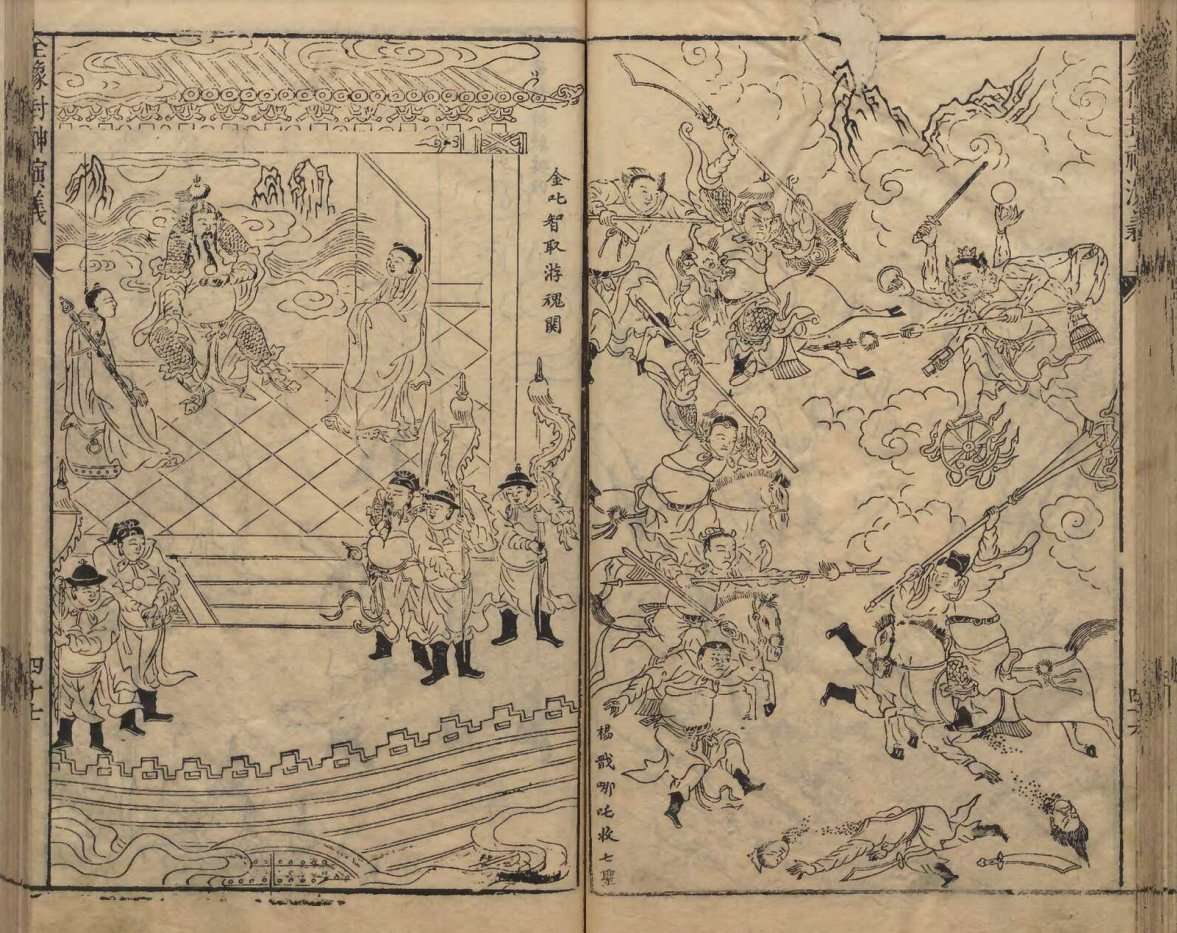
Here is a PDF for volume one of The Newly Printed, Zhong Bojing Annotated, Investiture of the Gods (Xinke Zhong Bojing xiansheng piping Fengshen yanyi, 新刻鍾伯敬先生批評封神演義, c. 1620), the oldest known edition of the novel. It is full of lovely woodblock prints (fig. 2).
PDF File
Click to access Investiture-of-the-Gods-1620-prints.pdf

Fig. 2 – A random page from vol. 1 of The Newly Printed, Zhong Bojing Annotated, Investiture of the Gods (larger version).
Thank you to the National Archives of Japan for offering the complete 1620 edition of FSYY. It can be downloaded here.
Update: 09-13-23
Tumblr user digitalagepulao has drawn an amazing Nezha (fig. 3). The theme is based on the feud between the prince and his father, which leads to the former’s suicide and divine resurrection. The artist describe a tense scene from the novel:
Li Jing in a fury grabbed his halberd, leapt on his horse and galloped out of the headquarters. He was astonished to see Nezha with his Wind-Fire Wheels and Fire-Tipped Spear. He swore loudly, “You damned beast! You caused us endless suffering before your death, and now that you’ve been reborn, you’re troubling us again!”
“Li Jing! I’ve returned my flesh and bones to you [via suicide], and there’s no longer any relation between us. Why did you smash my golden idol with your whip and burn down my temple? Today I must take my revenge!
The drawing is part of digitalagepulao’s Expedition to the West au (JTTW alternate universe) storyline based on this article.

Fig. 3 – Digitalagepulao’s Nezha (larger version).
Update: 09-08-24
@ryin-silverfish of Tumblr (author of this guest post) has made a catalog of the fantastic pets from the novel.
https://docs.google.com/document/d/1NozJF8nbhy8t6Jta7AZ5WKbyCmEMYtgFM_akcSt9D-Y/edit?usp=drivesdk
They have also made a catalog of Nezha’s powers.
https://docs.google.com/document/d/1FjHQPXmEalChk7PNiw9ljAJ8Cq66-AjevgEfdEa6wgI/edit?usp=sharing
A very big thank you to them. I’ll add more later if or when new lists are available.
Update: 11-03-24
My friend Dario Virga (Onibotokemaru on Instagram) (fig. 4) has completed an Italian translation of the novel titled L’investitura degli Dei: Romanzo cinese di epoca Ming (2024). This 1,120 page, two-volume edition can be purchased here for € 50,00:

Fig. 4 – Dario and his translation (larger version).
Update: 04-06-26
See my archives of other translations.
Notes:
1) Prof. Shi Changyu notes in his preface to this translation that the friction between the fictional Chan and Jie sects serves as an analogy for that of Quanzhen and Zhengyi during the Ming, for the former was marginalized, while the latter was held in high esteem and fell prey to decadence, naturally hindering its ability to contribute anything of value to the development of Daoism at this time (Gu, 2000, pp. 50-53).
2) Those interested in reading some of the poetry from the novel should consult Koss (1979), which compares them with those from Journey to the West.
Sources:
Gu, Z. (2000). Creation of the Gods (Vols. 1-4). Beijing: New World Press.
Koss, N. (1979). The Relationship of Hsi-yu chi and Feng-shen yen-i: An Analysis of Poems Found in Both Novels. T’oung Pao,65(4/5), second series, 143-165. Retrieved May 5, 2020, from http://www.jstor.org/stable/4528175
Wan, P. (1987). Investiture of the Gods (“Fengshen yanyi”): Sources, Narrative Structure, and Mythical Significance (UMI No. 8810607) [Doctoral dissertation, University of Washington]. Available from ProQuest Dissertations and Theses database.
Wu, C., & Yu, A. C. (2012). The Journey to the West (Vols. 1-4) (Rev. ed.). Chicago, Illinois: University of Chicago Press.