Last updated: 04-23-2026
I’ve written many articles on the origins of the Monkey King’s staff over the years. Therefore, I’ve decided to combine all of the information in one location for the benefit of people wishing to learn more about the weapon and its history. This will no doubt be interesting to fans of Journey to the West (Xiyouji, 西遊記, 1592; JTTW hereafter), as well as those of modern franchises like Dragon Ball and Lego Monkie Kid (fig. 1). Citations can be found in the articles linked below.

Fig. 1 – A fan edit of the Lego Monkie Kid character “MK” wielding the Monkey King’s magic staff (larger version). Copyright Lego.
Table of Contents
- 1. The Literary Weapon
- 1.1. Staff Background
- 1.2. Staff Powers
- 2. Origins
- 3. Updates
1. The Literary Weapon
1.1. Staff Background
The staff first appears in chapter three of the original novel when the Monkey King goes to the underwater kingdom of Ao Guang (敖廣), the Dragon King of the Eastern Sea, looking for a magic weapon to match his supernatural strength and martial skill. When all of the traditional weapons offered to him fail to meet his standards, the dragon queen suggests to her husband that they give Sun Wukong “that piece of rare magic iron” taking up space in their treasury. She claims the ancient shaft had started producing heavenly light days prior and proposes that the monkey is fated to own it. The weapon is said to be a “divine treasure iron” originally used to set the depths of the Heavenly River (Tianhe ding di de shenzhen tie, 天河定底的神珍鐵) by Yu the Great (Dayu, 大禹), a mythic Chinese emperor and demigod.
The staff is initially described as a pillar of black iron or bin steel more than 20 feet in height and as wide as a barrel. It is only when Monkey lifts it and suggests a smaller size would be more manageable that the staff complies with his wishes and shrinks. This is when Sun notices that the weapon is decorated with a golden ring on each end, as well as an inscription along the body reading: “The ‘As-You-Will’ Gold-Banded Cudgel. Weight: Thirteen Thousand Five Hundred Catties” (Ruyi jingu bang zhong yiwan sanqian wubai jin, 如意金箍棒重一萬三千五百斤). The inscription indicates that the staff is immensely heavy, weighing 17,560 lbs. (7,965 kg).
Apart from the above information, a poem in chapter 75 (see section 2.3 here) highlights another name, “Rod of Numinous Yang” (Lingyang bang, 靈陽棒). In addition, the poem describes the staff being covered in “tracks of planets and stars” (i.e. astronomical charts) and esoteric “dragon and phoenix scripts” (longwen yu fengzhuan, 龍紋與鳳篆).
The novel provides two contradictory origins for the staff. The chapter 75 poem notes that it “[w]as forged in the stove by Laozi himself.” Laozi is of course the high god of Daoism. Chapter 88 instead states that it was “forged at Creation’s dawn / By Yu the Great himself, the god-man of old.”
Contrary to popular images of the Monkey King holding a regular-sized staff, his literary counterpart wields a massive weapon in battle. It is said to be 20 feet long (likely an error for 12), [1] with the width of a bowl (erzhang changduan, wankou cuxi, 二丈長短,碗口粗細) (fig. 2). I did a cursory search of bowls during the Ming (when the standard edition of JTTW was published) and found that they have a radius of between 4 to 6 inches (10.16 to 15.25 cm).

Fig. 2 – An accurate depiction of the size of Monkey’s staff (larger version). Images found here. Artwork by @真·迪绝人.
1.2. Staff Powers
The staff is shown to have multiple powers.
- Size manipulation – This is the weapon’s most well-known ability, growing as big or as small as Monkey wishes.
- Controlling the oceans – The aforementioned poem from chapter 88 writes: “The depths of all oceans, rivers, and lakes / Were fathomed and fixed by this very rod. / Having bored through mountains and conquered floods, / It stayed in East Ocean and ruled the seas…”
- Astral entanglement – Monkey’s soul is able to use the staff in Hell despite the physical weapon being with his sleeping body in the world of the living. (See the 04-23-26 update below for more info.)
- Multiplication – He can multiply his staff in the hundreds of thousands.
- Lock-Picking – He can open any door just by pointing it at the lock.
- Transformation – He can change it into tools like a straight razor or a drill.
- Sentience – The weapon glows in anticipation of Monkey’s arrival (fig. 3), responds to his touch, and follows his commands, denoting a certain level of sentience.

Fig. 3 – Monkey pointing to the luminous iron pillar (larger version). From the Qing-Era Painted, Complete Edition Journey to the West (Qing caihui quanben Xiyouji, 清彩繪全本西遊記).
2. Origins
2.1. Literary Precursors
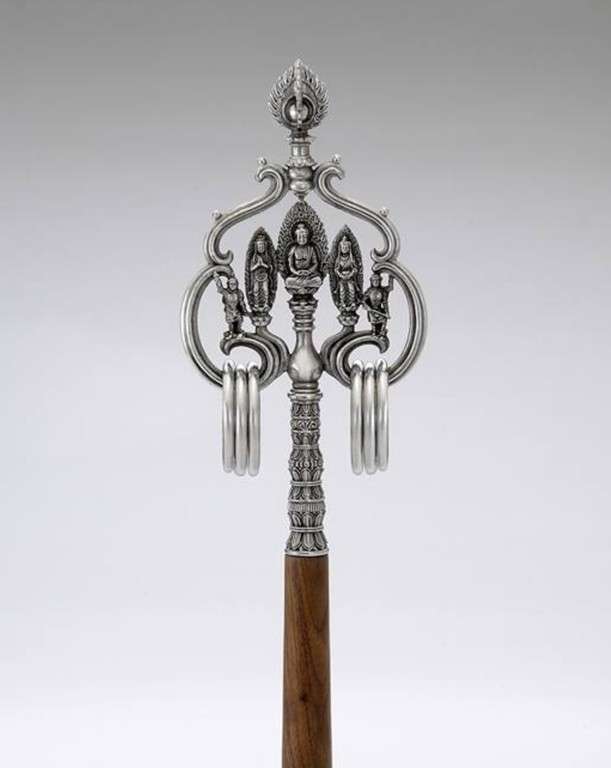
The staff found in the standard Ming edition of JTTW is actually based on two weapons from a 17-chapter storytelling prompt called The Story of How Tripitaka of the Great Tang Procured the Scriptures (Da Tang Sanzang qujing shihua, 大唐三藏取經詩話, c. late 13th-century). Sun Wukong’s precursor, an ageless immortal called the “Monkey Pilgrim” (Hou xingzhe, 猴行者), magically transports Tripitaka and his entourage to heaven. There, the supreme god, the Mahābrahmā Devarāja (Dafan tianwang, 大梵天王; i.e. Vaiśravana), gives the monk a cap of invisibility, a khakkhara (ringed monk’s staff) (fig. 4), and a begging bowl. Tripitaka and the Monkey Pilgrim take turns using these items throughout the journey. The staff is shown capable of shooting destructive beams of light, as well as transforming into magical creatures like an iron dragon or a giant, club-wielding Yaksha. Later, the Monkey Pilgrim also borrows an iron staff from heaven to fight a dragon.
The two staves from this tale were eventually combined by later storytellers. The rings from the first weapon were added to the ends of the second.

Fig. 4 – A beautiful, modern monk’s staff with six rings (larger version).
2.2. Influence from Religion
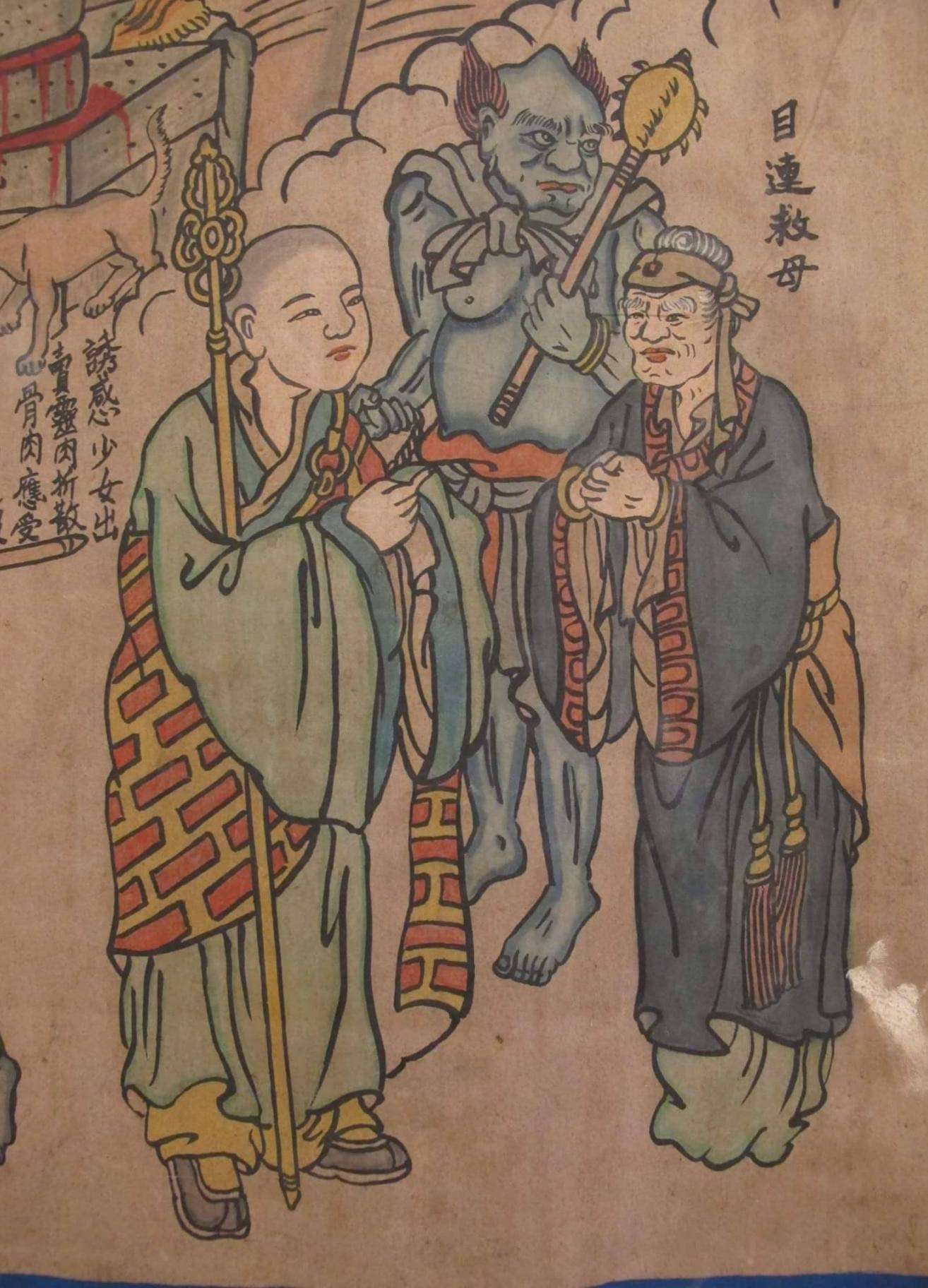
The Monkey Pilgrim’s magic ringed staff and begging bowl were directly influenced by the Buddhist Saint Mulian (目連; Sk: Maudgalyayana), a disciple of the historical Buddha. One particular 9th to 10th-century story notes that the Saint uses the staff to unlock the gates of hell in order to save his mother (fig. 5). This is where Sun Wukong’s weapon from JTTW gets the power to open locks.

Fig. 5 – A scroll or mural depicting Mulian rescuing his mother from the underworld (larger version). Originally found here.
The ringed and metal staves used by the Monkey Pilgrim are based on those historically carried by Buddhist monks in ancient China. The aforementioned ringed variety, called “tin staves” (xizhang, 錫杖) where used by religious monks and decorated with six to twelve metal rings (see fig. 4). These rings were designed to make a clanging noise to not only scare away animals on the road but also to alert possible donors to the monk’s presence.
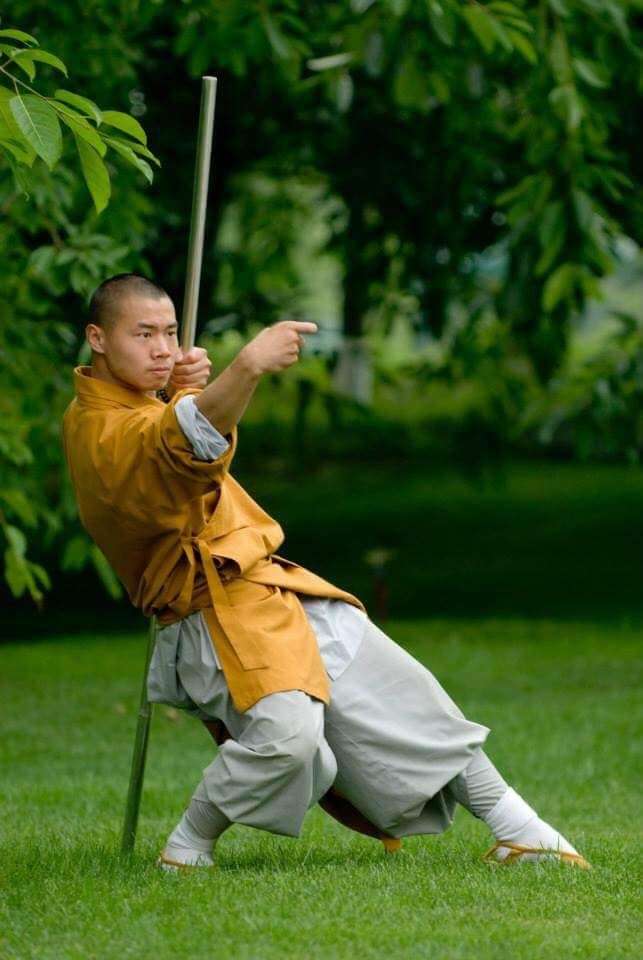
Martial monks charged with protecting monasteries or deployed by the Chinese government against pirates wielded wooden or iron staves (fig. 6). The former were chosen for their diminished capacity for fatal injuries, while the latter were explicitly used for killing during times of war. Sun Wukong wielding the iron variety makes sense as he’s a martial monk charged with protecting Tripitaka from monsters and spirits.

Fig. 6 – A martial monk practicing a drunken staff-fighting form (larger version).
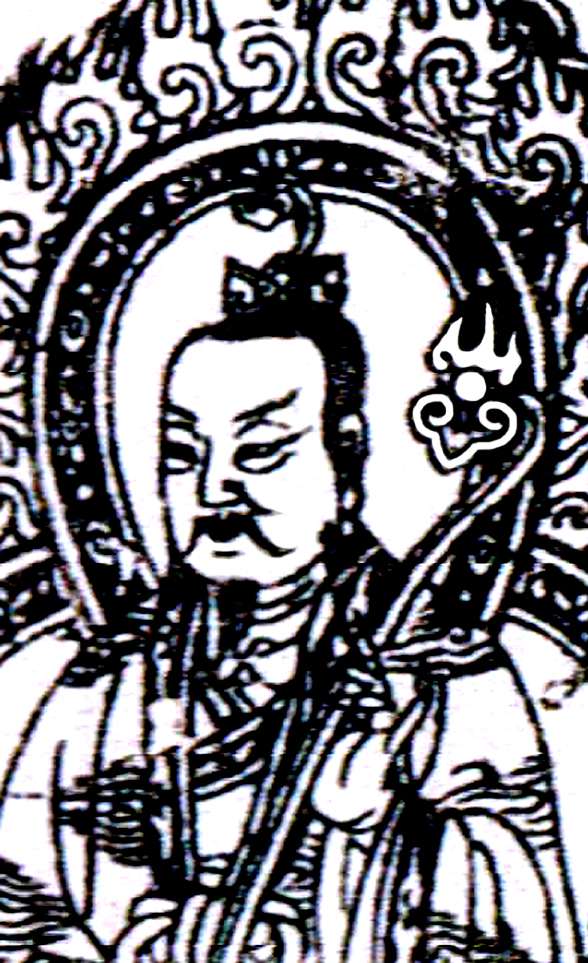
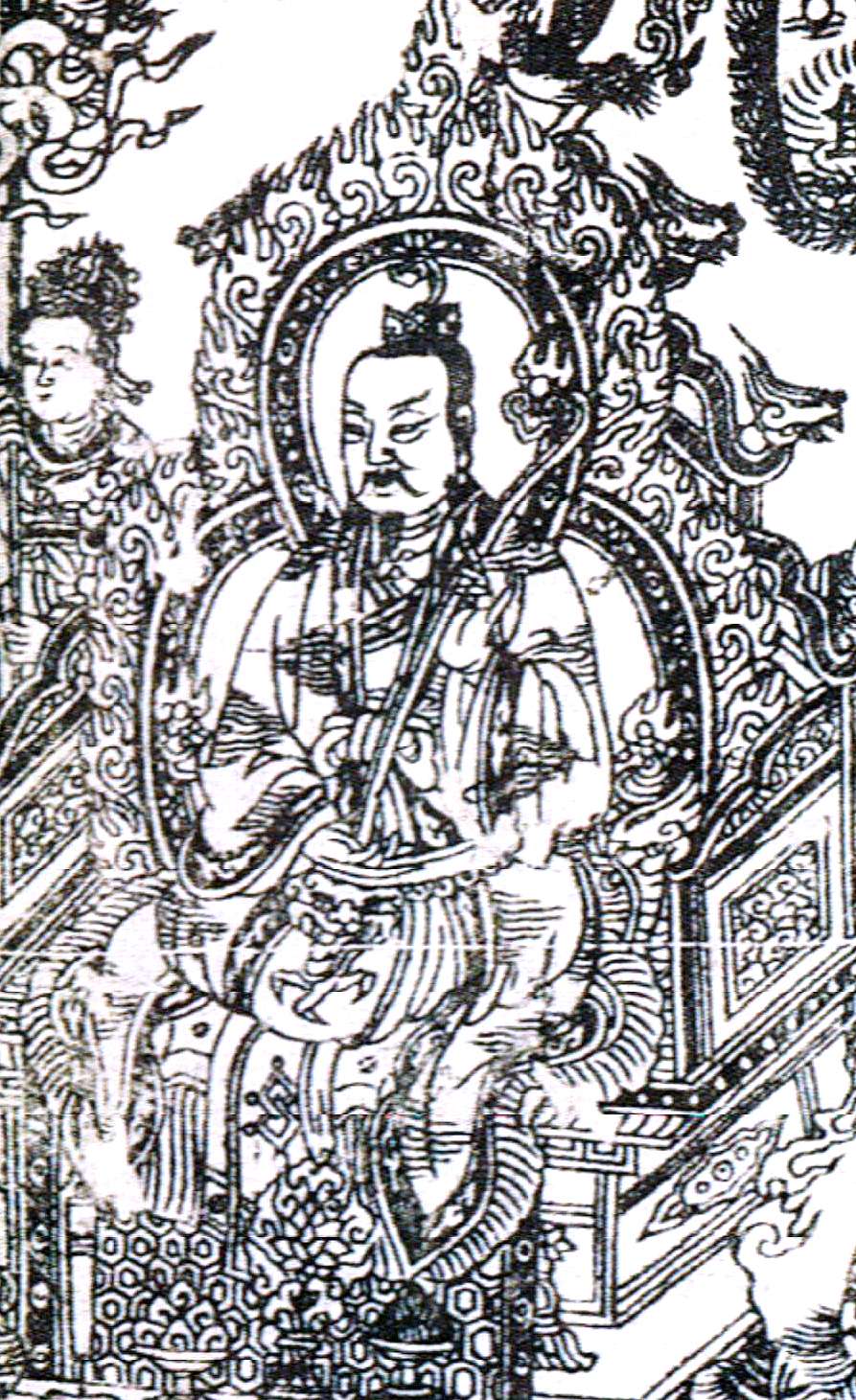
The term “As-you-will” (ruyi, 如意) from Monkey’s staff (mentioned above) is connected with a scepter used in ancient China as a symbol of religious debate and authority and, to a lesser extent, as a weapon. While it can be traced to a Hindo-Buddhist tradition in India, the scepter came to be associated with the highest gods of Daoism thanks to being decorated with a “numinous mushroom” (lingzhi, 靈芝), a real world fungi believed to bestow immortality. This mushroom scepter was at some point associated with the Buddhist Cintamani (Ruyi zhu, 如意珠), or “As-you-will jewel.” This was believed to grant any wish that one might desire. This explains why Monkey’s As-you-will staff grows or shrinks according to his commands. It’s interesting to note that some religious images of the scepter depict it with a syncretic mix of the Daoist mushroom and the Buddhist jewel (fig. 7).

Fig. 7 – An enhanced detail of the Celestial Worthy’s mushroom scepter with a flaming as-you-will jewel (larger version). See here for a fuller version of the deity.
2.3. Influence from Popular Literature
The weapon’s portrayal in JTTW as an iron pillar kept in the dragon kingdom comes from old stories about the immortal Xu Xun (許遜), a historical Daoist master and minor government official from Jiangsu province. Popular tales describe him as a Chinese St. Patrick who traveled southern China ridding the land of flood dragons. One 17th-century version titled “An Iron Tree at Jingyang Palace Drives Away Evil” (Jingyang gong tieshu zhenyao, 旌陽宮鐵樹鎮妖) describes how he chained the flood dragon patriarch to an iron tree (tieshu, 鐵樹) and submerged it in a well, thus preventing the serpent’s children from leaving their subterranean aquatic realm and causing trouble. Pre-JTTW versions of this tale depict the tree as an actual iron pillar (fig. 8). Chinese Five Elements Theory dictates that metal produces water, and as its creator, holds dominion over it. Therefore, an iron pillar would be the perfect item to ward off creatures entrenched in the aquatic environment.

Fig. 8 – A Ming Dynasty woodblock print depicting the immortal Xu overseeing the creation of the iron pillar in a furnace (right) and it’s placement the well (left). Dated 1444-1445 (larger version).
As previously noted, the staff weighs 17,560 lbs. (7,965 kg). This is likely based on an episode from chapter 27 of the Chinese novel Water Margin (Shuihu zhuan, 水滸傳, c. 1400). It involves the bandit Wu Song lifting a heavy stone block said to weigh 300 to 500 catties (san wu bai jin, 三五百斤; 390-650 lbs./177-295 kg) (fig. 9). This scene and the one from JTTW where Monkey lifts the iron pillar are quite similar. Both involve a hero (Wu Song vs. Sun Wukong) asking someone (Shi En vs. Ao Guang) to show them a heavy object that cannot be moved (stone block vs. iron pillar). Both heroes then adjust their clothing before easily lifting the object with both hands. Most importantly, the Chinese characters for the weight of each object (三五百斤 vs. 一萬三千五百斤) are similar. The only difference is the addition of “10,000” (yiwan, 一萬) and “1,000” (qian, 千), respectively. And given the close historical and cultural ties between the two heroes, I believe the author-compiler of JTTW embellished the Water Margin episode to portray Sun as a hero like no other, a divine immortal that can lift weights far beyond even Wu Song himself.

Fig. 9 – Wu Song lifts the stone block (larger version). Image found here.
3. Updates
Update: 04-23-26
Above, I wrote: “Astral entanglement – Monkey’s soul is able to use the staff in Hell despite the physical weapon being with his sleeping body in the world of the living.”
Sun’s use of said weapon also caught the attention of late-Ming commentators. The authors of The Book to Enlightenment of the Journey to the West (Xiyou Zhengdao Shu, 西遊證道書, 1663), a Daoist commentary on the novel, asked:
“Did he take this treasure with him in his dream?”
此寶貝夢中亦帶去耶? (Converted from simplified Chinese – source).
Note:
1) Irwen Wong of the Journey to the West Library blog has suggested that the length is likely an error for 12 feet (zhanger, 丈二) since the staff was already near 20 feet when Monkey first acquired it, and he later asked it to shrink to a more manageable size.