Journey to the West Fanfiction Writer Spotlight #1: DarkscytheDrake

From time to time I like to post a fun blog not directly related to (though sometimes informed by) my research. Regular articles will resume after this entry.

Anyone who follows me on social media will know that I generally do not like modern adaptations of Journey to the West (Xiyouji西遊記, 1592; “JTTW” hereafter) (see here and here, for example). But thanks to enjoying this book, I’ve learned to temper my negativity. I’ve, therefore, decided to mirror the format of a series of past art-based articles [1] and shine a spotlight on the author of a JTTW-related fanfiction that I actually like. My hope is that such posts will expose their work to a wider audience interested in JTTW, while also documenting modern day perceptions and depictions of the novel and its characters.

Our first writer goes by the online handle DarkscytheDrake (AO3, Fanfiction.net, Spacebattles). They were kind enough to answer some interview questions, as well as allow permission to display some of their work.

I. Q & A

1) Can you tell me a little about yourself?

I’m 24 years old and live in the Middle East. I’m a huge fan of mythologies and old stories. I dabble in many aspects of the art world, and writing has been a hobby of mine since high school. Since I was a kid my dad used to bring me books from abroad to read. I’ve travelled the world thanks to my parents’ business trips and was exposed to many cultures and stories, which made me fall in love with them even more.

2) Are you self-taught or have you taken writing classes?

I’m self-taught, using the example of others. By the time I seriously thought about writing, there weren’t any writing workshops in my area, at least ones that didn’t focus on the genres I wanted to write in. English is my second native language and most books I read are in English.

3) What are your main sources of literary inspiration?

My main inspirations are the Inheritance Cycle, Shogun (book and TV show), The Hobbit (book and movies), and Bone. Manga like Fullmetal Alchemist have also taught me a lot about storytelling and character arcs.

4) How did you learn about Journey to the West?

I first became fully aware of Journey to the West proper, meaning not expys like Dragon Ball, when I visited China for the first time. I saw a lot of ads and costumes for the Monkey King, and I asked our guide who this character was. I did some research to get acquainted with the story and main players, and I left it alone until Black Myth: Wukong was announced, which revitalized my interest and prompted me to purchase an abridged version of the book, Monkey King. I read the Anthony C. Yu translation online. From there, I also watched some of his spin-off works like Lego Monkie Kid.

5) Who is your favorite character?

Sun Wukong is my favorite character, and while half of that does come from the sheer insanity of his powers and adventures, the other half comes from how much he learns in the journey, and the family he finds within his companions. His moments of innocence, like when he plays in the snow or his more vulnerable moments like in the White Bone Spirit arc. Princess Iron Fan has got to be my second favorite, though. She takes a lot of shit from her husband, suffered the imprisonment of her son and had to deal with Wukong’s antics, but ultimately remains a decent person and one of the few demons on the journey who isn’t wicked or wants to eat Tripitaka.

6) Do you have a favorite episode from the novel?

My favorite episode would have to be the fight against Demon Bull King, because of how personal it is to Wukong and the sheer scale of the fights that ensue there, like Wukong and DBK transforming into their giant forms and duking it out. Really, all of the Demon Bull family’s episodes (Iron Fan and Red Boy) are the best.

7) Does the novel have a special meaning to you?

I’m honestly surprised by the sheer depth the novel has for its age. There’s a lot of worldbuilding there which is on par with Tolkien‘s work, and those who grew up in Asian culture are aware of its deeper meanings, so it transcends ‘modern’ worldbuilders in that sense. And when I see just how influential the novel is and how it led to one of the greatest anime of all time…I’m humbled.

8) Can you tell me about your ongoing JTTW-related project?

My current JTTW project is a fanfiction story called “Great Sage, Equal to Heaven and Above Brockton” (AO3, Fanfiction.net, Spacebattles), and it’s a crossover with the webnovel Worm by Wildbow. The world of Worm is filled with superpowered humans called ‘capes’ (fig. 1), but unlike DC and Marvel, many capes use their powers for crime. There are heroes who battle these villains of course, but matters aren’t as clear-cut as they appear. On top of that, giant monsters attack cities every few months and cause untold damage. The main premise of my story is that an untold amount of time after the journey, Sun Wukong wakes up in Worm‘s main setting of Brockton Bay, a coastal city [north of Boston, MA, USA] with a lot of capes, nazis, Asian gangsters and heroes. From there he investigates the modern era, having fun and tries to find out what’s going on with these strange superpowered humans. It’s a classic premise of ‘OP character gets dropped into a lower-ranked world’, but it’s also a study of how a character who found a home suddenly gets dropped into a new one, and how power doesn’t always solve problems. And if it does, what are the potential consequences?

[Jim here: As of this writing, chapters one to 11 are available for free online, but chapters 12 to 13 (and a ch. 14 preview) are still only available on patreon.]

Fig. 1 – Cover for a fake Worm comic book featuring the original story’s main character, who makes an appearance in the Great Sage story (larger version). Illustration by @codetrillogy on Twitter. Used with permission.

II. Writing Sample

The following excerpt comes from an event in chapter six. After befriending a young boy, Sun Wukong jumps in to save his sister from gangsters attempting to take her in lieu of a missed “protection money” payment:

* The boy’s name.
** The boy’s sister.
*** The name of a local gang leader. Monkey comically believes he is a literal dragon.

Note:

1) As of this writing, I’ve made three such art posts here, here, and here.

Journey to the West Artist Spotlight #3: NingadudeXx

From time to time I like to post a fun blog not directly related to (though sometimes informed by) my research. Regular articles will resume after this entry.

Anyone who has read my blog will no doubt realize that I am an avid fan of researching the history and influences of Journey to the West (Xiyouji西遊記, 1592). But as an artist, I am also a fan of JTTW-related artwork. There are so many talented people in the world who post their original designs and comics online, so I’ve decided to feature some of them on my blog. My hope is that such posts will expose this art to a wider audience interested in JTTW, while also documenting modern day perceptions and depictions of the novel and its characters.

Our third artist goes by the username NingadudeXx on Tumblr and  They were kind enough to answer some interview questions, as well as allow permission to display a few of their pieces.

The previous artist spotlight entries can be seen here and here.

I. Q & A

1) Can you tell me a little about yourself?

Hello, I go by DSG! I currently have an art blog called NingadudeXx on Tumblr that I use as a personal portfolio for my artwork. I also have a YouTube channel under the same name, where I post my animations and animatics! My username originates from when I was very young playing Minecraft and didn’t know how to spell, so I ended up with a wonky spelling of my current username. I’ve been using this username out of habit over the past decade and found that my misspelling helps people separate my username from the other dozen Ninja Dude’s out there!

2) Are you self-taught or did you go to art school?

I graduated from a high school that had an arts program, which specialized in animation, film, sound-design, and gaming. Funnily enough, my animation teacher wasn’t much of an artist himself, but the assignments he gave us over the years helped me to improve my skills! Aside from that, I would say that I am mostly a self-taught artist who’s been drawing since I could hold a pencil. Currently, I go to college and I’m working towards getting a degree in the arts, more specifically animation. I work at my school as a digital media tutor, where I help students with graphic design projects involving Adobe programs.

3) What are your main sources of artistic inspiration?

Some big inspirations of mine are Bill Watterson, Charles Schultz, and Craig McCracken. My dad introduced me to comic books when I was young, so I began reading Calvin and Hobbes and Peanuts books at a young age. I also grew up watching Cartoon Network shows, more specifically all of Craig McCracken’s cartoons. Growing up with the early style of 2000s/2010s cartoons has significantly influenced my style over the years. My biggest animation inspiration would have to be Flying Bark Studios, who have created beautiful cartoons such as Lego Monkie Kid and Rise of the Teenage Mutant Ninja Turtles!

4) How did you learn about Journey to the West?

I learned about Journey to the West over 3 years ago now from watching Lego Monkie Kid! I’ve been captivated by the show and Journey to the West since. I love to research and watch any new media I can find that’s inspired by the novel!

5) Who is your favorite character?

My favorite character is Sun Wukong, who I find endlessly fascinating to draw and think about. I think he’s an incredible character that goes through many changes throughout his lifetime, as he ultimately becomes a better person despite the odds against him!

6) Do you have a favorite episode from the novel?

That’s a tough question. I really love everything about the novel! But if I had to choose a favorite section in general, I would have to say the beginning chapters of the novel, where we get to see how Wukong earns his various titles and gains all his abilities. Sun Wukong’s beginnings are an important aspect of his character, especially when compared to how he changes and grows during his journey to the west.

7) Does the novel have a special meaning to you?

This novel is a huge source of inspiration and strength for me. When times are tough, I often try to put myself in the mindset of my favorite characters and think about how they’d react/confront the problem at hand. While I didn’t grow up with the story when I was younger, I’m grateful to be reading and learning about this wonderful novel now!

8) Can you tell me about your ongoing JTTW-related projects?

I hope to make JTTW comics in the future depicting my favorite chapters and scenes from the novel! Until then, I’m always drawing Monkey King whenever I get a sliver of free time, which I usually post on my Tumblr or YouTube page.

II. Art and Thought Process

Note: Click each image to enlarge it.

1. For this piece, I wanted to draw Sun Wukong enjoying himself surrounded by his favorite stone fruits! Some of my favorite types of backgrounds to draw are the ones that involve twisty trees and grassy fields.

2. In this work, I wanted to capture the scene where Wukong breaks out of the Trigram Furnace after 49 long days and goes on a rampage in Heaven. I like to use strong shapes to emphasize emotion, so I made Wukong’s hair sharp and spiky to show his anger.

3. In this piece, I took clothing inspiration from the amazing painting The Great Sage Equaling Heaven by the talented Yang Ruifen. I try my best to include a lot of star/sun motifs in my Sun Wukong artwork, whether it be through the shape of his hair or by putting stars in his eyes. Or in this case, by putting a literal sun behind him!

4. A lot of my artwork is based on spur of the moment ideas, or is inspired by small things that happen in my life! In this case, I happened to eat some colorful and sweet gummies, which inspired the ‘gummy’ monkeys in this piece. It’s fun to find inspiration in small things that are otherwise considered mundane. Wukong is a very reactive and intense character, so I like to think that he has a lot on his mind. This piece was my way of showing that!

5. These two pieces I included together as a diptych! I was studying the attire and textures of the Beijing Opera Monkey King, and the 1996 Journey to the West version of Sun Wukong. I love contrasting warm oranges and yellows against a nice sky-blue color. I ended up entering this diptych into an arts competition at my college and won the illustration category!

6. For this animation, I focused more specifically on Monkie Kid’s version of Sun Wukong, mixed with my own idea of his character! I wanted to capture the feeling that Wukong is a very old being who has inspired many generations, having been in novels, cartoons, films, operas, etc. I wonder if the older Wukong gets, the more his identity gets muddled with other people’s perception of him? Maybe he feels like he must put on a mask of sorts around those who don’t know him personally.

Journey to the West Artist Spotlight #2: NinjaHaku21

From time to time I like to post a fun blog not directly related to (though sometimes informed by) my research. Regular articles will resume after this entry.

Last updated: 05-09-2023

Anyone who has read my blog will know that I’m an avid fan of researching the history and influences of Journey to the West (Xiyouji, 西遊記, 1592). But as an artist, I am also a fan of JTTW-related artwork. There are so many talented people in the world who post their traditional and original designs and comics online, so I’ve decided to feature some of them on my blog. My hope is that such posts will expose this art to a wider audience interested in JTTW, while also documenting modern day perceptions and depictions of the novel and its characters.

Our next artist is NinjaHaku21, who goes by @NinjaHaku21_Art on both Twitter and Instagram and @NinjaHaku21Art on Tumblr.  They also have a Patreon and an Etsy storeThey were kind enough to answer some interview questions, as well as allow permission to display a few of their pieces.

I. Q & A

1) Can you tell me a little about yourself?

Hi there! I go by Ninja, and I am a freelance artist! I recently just started my freelancing career this year, and work on a few indie comics along with thumbnails for youtube!

2) Are you self-taught or did you go to art school?

I am self taught! I always wanted to go to art school, but life had other plans in mind!

3) What are your main sources of artistic inspiration?

While growing up, comics for sure! Was a huge fan of sonic comics, and now, it’s a mix of that and other media!

4) How did you learn about Journey to the West?

I learned about the Journey To The West after watching the show LEGO Monkie Kid! My friends and I have seen clips of it on twitter, and so we binged the entire series up to date. I was so interested in the characters and the world, I had to look up more. I then discovered the novel and was hooked. I am still looking into more movies to see their take on the novel!

5) Who is your favorite character?

Sun Wukong! He grows so much throughout the story and faces so many challenges. It’s hard not to love this murderous Monkey King who seeks redemption.

6) Do you have a favorite episode from the novel?

That’s a tough one! I think my favorites have to be the Six- Eared Macaque, the battle with Red Boy, and the Immortals of Tiger, Elk, and Antelope Power!

7) Does the novel have a special meaning to you?

To me, seeing what the characters have acted before in the past and seeing them grow and learn makes me happy. It helps me remember that even though you may have done some awful stuff in the past, you can still make a difference and grow from it.

8) Can you tell me about any ongoing JTTW-related projects?

Currently I am working on my own designs of the characters for fun! Making illustrations about my versions of them, and making some merch of the designs for my shop!

II. Art and Thought Process

Note: Click each image to enlarge it.

1. Ever since I started reading Journey To The West and watching movies with the Monkey King or anything JTTW-related, I wanted to create my own take of the characters. With this piece, I was seeing how my designs would look with all of them together! I had rough sketched out some draft looks that got inspired by different pieces of them from either shows, movies, or ancient drawings of them, then fit in what I liked most and created this piece! I wanted to have them express their own personality through the look, and I am quite proud of the final results! I imagined some unlucky villager getting a visit from these “ugly demons” and their Master asking for a place to visit.

2. With this piece, I wanted to capture a fun moment on their journey to the west. These guys have to deal with so much while trying to protect their master, so I figured giving them a nice snow day would be a fun thing to draw!

3. The Six-Eared Macaque. Definitely one of my favorite characters from the stories. I wanted to show him off along with the opera mask, kind of symbolizing him transforming into Wukong to trick his companions.

4. I wanted to put these three pieces together, showing how Sun Wukong acts around his companions and Master.

I know for sure Wukong and Zhu Bajie argued a lot, and I haven’t seen any issues between Sha Wujing and Wukong (still reading and learning) and figured they’d have some nice conversations. And of course, Wukong protects his master from a group of hungry demons or bandits!

5. Now this one I did decide on having some fun on creating my own version of a “spider queen” (I know there wasn’t a queen in the story, but it was still fun)! I based this loosely around the chapter with the spider sisters, making the eldest one the queen. I had a fun time drawing this out, making the eldest have a thing for Wukong, haha!

(Jim here. This reminds me of the Scorpion Spirit having a thing for Tripitaka.)

6. In this piece here, I wanted to have my design of Nezha interacting with Wukong. I based Nezha’s design on a few different inspirations (some being from the Monkie Kid series and ancient art of the deity), and descriptions from the story. I also wanted to add in a dragon tattoo, sort of as a remembrance of what Nezha had done in the past. But this picture was to show the type of relationship these two have. Nezha would definitely feel a bit salty of losing to Wukong all those years ago!


Update: 05-09-23

I commissioned NinjaHaku21 to draw a religiously accurate illustration of Sun Wukong as the “Victorious Fighting Buddha.” It is based on the traditional iconography of the Yuddhajaya Buddha, the deity from which his religious title is derived. The results are stunning!


Journey to the West Artist Spotlight #1: Dario Virga

From time to time I like to post a fun blog not directly related to (though sometimes informed by) my research. Regular articles will resume after this entry.

Anyone who has read my blog will know that I’m an avid fan of researching the history and influences of Journey to the West. But as an artist, I am also a fan of JTTW-related artwork. There are so many talented people in the world who post their traditional and original designs and comics online, so I’ve decided to feature some of them on my blog. My hope is that such posts will expose this art to a wider audience interested in JTTW, while also documenting modern day perceptions and depictions of the novel and its characters.

Our first artist is Dario Virga, who goes by Onibotokemaru on Instagram. They were kind enough to answer some interview questions, as well as allow permission to display a few of their pieces.

I. Q & A

1) Can you tell me a little about yourself?

Real name Dario Virga, from Italy (Piedmont). Interest in eastern culture and literature, mostly from Japan and China.

2) Are you self-taught or did you go to art school?

Self-taught, though I had some help from someone who went to art school.

3) What are your main sources of artistic inspiration?

Usually animals and characters/elements taken from mythology and literature.

4) How did you learn about Journey to the West?

My very first contact with Journey to the West was back when I was younger, in a book about Chinese myths. Later I found an integral translation done by Serafino Balduzzi (translated from a French one).

5) Who is your favorite character?

Tough question, but I like most of the characters. If forced to choose, I’d say Pigsy for the good guys and the Bull Demon King for the villains.

6) Do you have a favorite episode from the novel?

Probably the whole Gold Horn & Silver Horn arc.

7) Does the novel have a special meaning to you?

Not a special meaning per se, but it was a novel I really enjoyed, both for the setting, the narration, the characters within and watching them grow.

8) Can you tell me about your ongoing JTTW-related projects?

Plan to make a gallery of, if not all, at least a huge amount of the novel’s characters.

II. Art and Thought Process

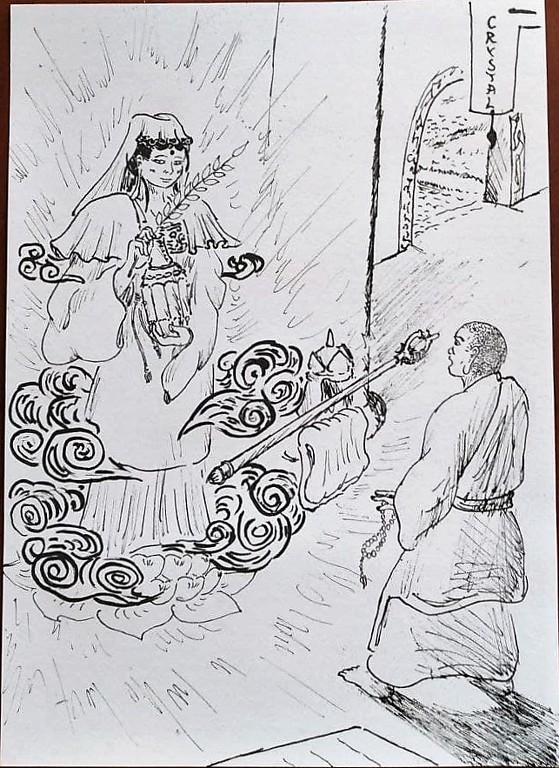
1. As the opening drawing of the Xiyouji-themed Inktober set, I’ve decided to focus not on Sun Wukong himself but rather on Tripitaka, the monk, as Guanyin Pusa appears before him to assign him the quest for the sutras. Guanyin’s reference are commonly-found icons and statues. Between the two of them float the items Tripitaka receives (the cossack, nine-ringed staff and hat).

(Larger version)

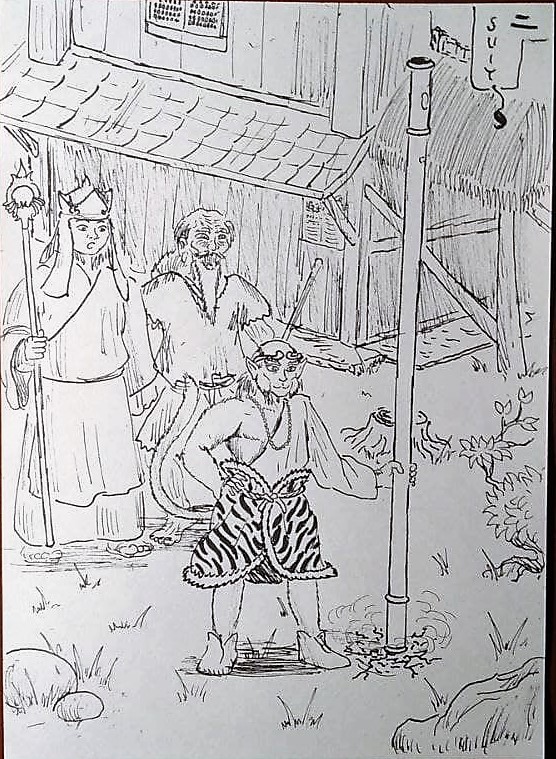
2. This is the first time I depict Sun Wukong in the series, and I did it based his design on an article written on this very blog, trying to stick as much as possible to his literary description, especially regarding the clothing (monk’s shirt and tiger pelt kilt held by a rope), short stature, simian face and bald spot on the top of the head (converted to Buddhism). I gave him long spike-like hair in the back because otherwise his head felt too small. The Ruyijingubang has a rather simple design, as I never liked its depictions with pommels on both ends. I also tried to make the inscriptions on the shaft, but ultimately gave up, admittedly.

(Larger version)

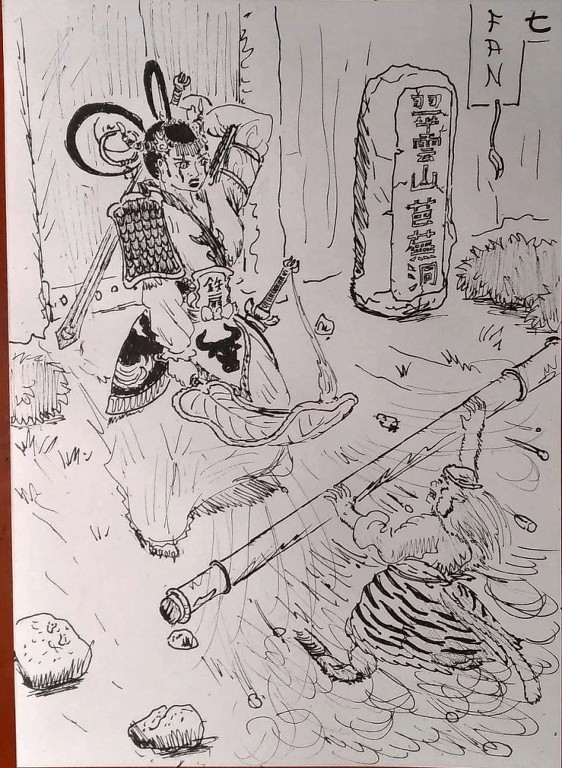
3. This picture has Sun Wukong fighting against the Iron Fan Princess, who sends him flying away with her Banana Leaf Fan. Once again, I wanted to show how small Monkey is (in comparison to nearly everyone else, though I’m not always 100% consistent) and remind that the Ruyijingubang can increase in both length and width, as seen here where he tries to use it as a shield to block the wind, unsuccessfully. Also of note, the massive stone pillar on which the “address” of the Iron Fan Princess is written.

(Larger version)

4. This one isn’t based on any specific event, but it’s here to bring out two topics: the first is the size of the party members, which I always tried to keep consistent (and tried is the keyword). The idea is that Sun Wukong is the smallest of the group (4 feet), then we have Tripitaka, the “normal” one, and the Dragon (horse-sized): Pigsy (here depicted with a hint of boar) is the second tallest but also the fattest, while Sandy is the tallest of the party (and definitively not a Kappa). The second one is Sha Wujing’s weapon: while it’s usually depicted as a Monk Spade, the actual name is the “Demon-Subduing Treasure Cane” (降魔宝杖, Xiangmobaozhang), making it a stick/staff. However, it’s also worth a mention that the Monk Spade is sometimes called “Zen Cane” (禪杖, Chanzhang), a term which also refers to the ringed staff used by monks. Admittedly, I liked the spade version the most, though I plan to depict this weapon as a staff when Sandy is in his celestial marshal/arhat forms, implying that the staff changed into a spade when he fell from Heaven.

(Larger version)

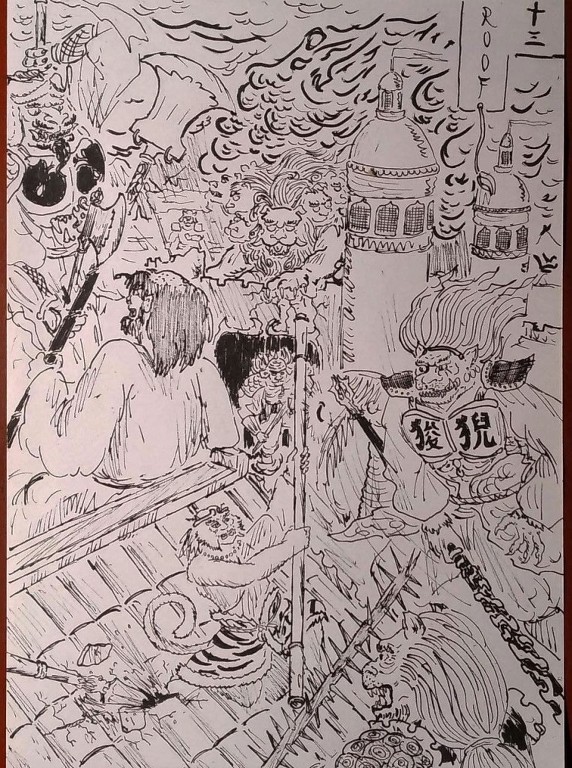
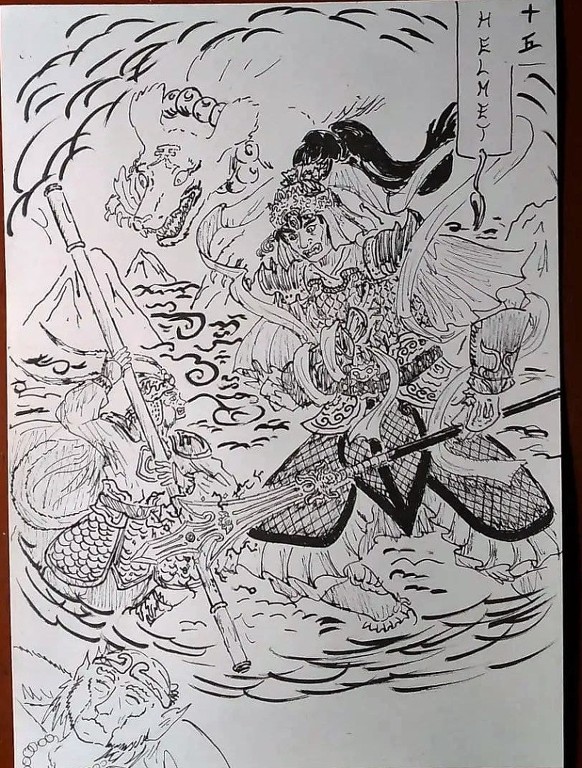
5. The big battle between Sun Wukong and the Lion Demons working for the Great Sage Nine Spirits (seen in the background, in his giant nine-headed form): this was mostly done because it was one of the rare parts of the book where Sandy actually fights the monsters alongside Sun Wukong (as Pigsy was captured), as well as an attempt to make a big battle scene.

(Larger version)

6. The only god who actually beat Monkey, Erlang Shen. Since the Inktober was focused on the journey itself, I’ve decided to depict their battle as a bad dream. This time, Monkey wears his old, stylish outfit he got from the Dragon Kings, while Erlang is in full battle regalia, including his “Sanjiang Lianrendao” (三尖两刃刀 Three-pointed, Double Edged Glaive) and his Heavenly Roar Dog.

(Larger version)

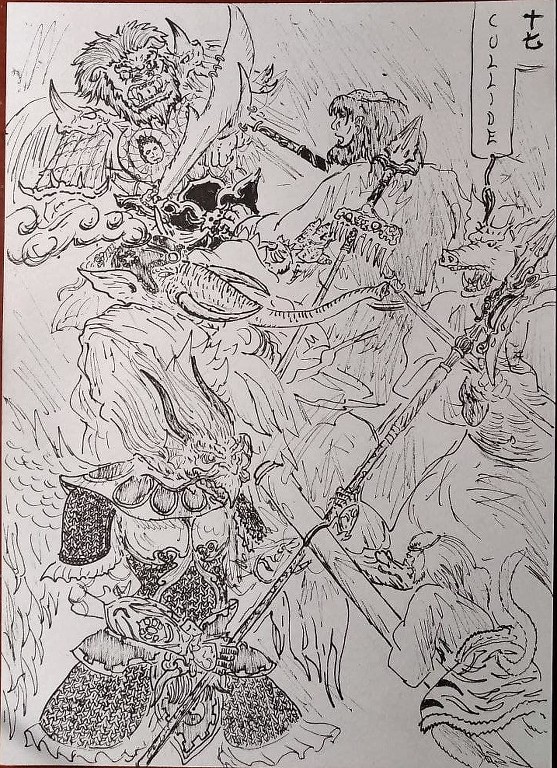
7. The clash between the three pilgrims and the three Demon Kings of Lion Camel Mountain, from top to bottom: the Blue-Haired Lion vs Sha Wujing, the Yellow-Tusked White Elephant vs Zhu Bajie and the Golden-Wings Peng King vs Sun Wukong. The design of the three kings was based on a series of pictures I loved very much. Once again, a reminder that Wukong’s staff can widen as well.

(Larger version)

8. Sun Wukong fights the three Rhino Kings, who’re kidnapping Tripitaka. This time I wanted to depict Monkey twirling his staff as he fights. Like with the Demon Kings above, the design of the three Rhinos was based on the same set of pictures, even though I remember that in the novel they’re described as “bull-like” in appearence. Particularly like the dust cloud to the right.

(Larger version)

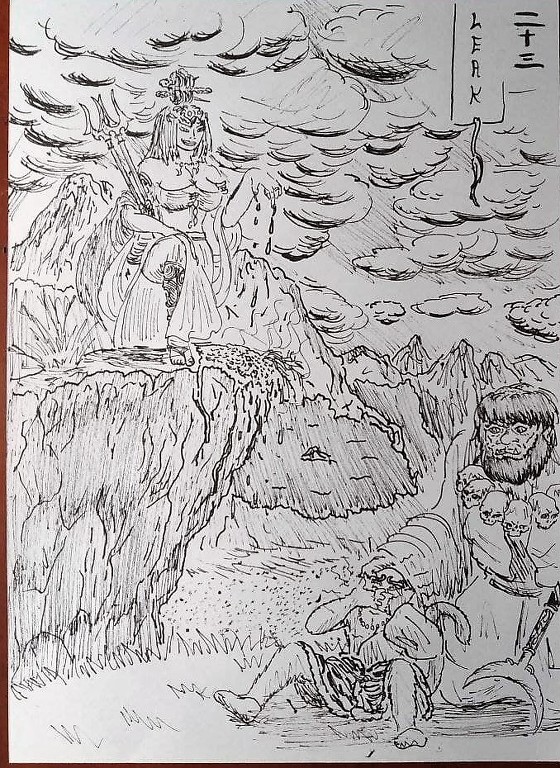
9. Sun Wukong is poisoned by the Scorpion Spirit. Aside from the scenery, I like the scorpioness. I’ve noticed in several arts (even old ones) that she sports a relatively skimpy outfit. As of her weapon, mentioned to be a “fork/trident” in the book, I’ve seen plenty of depictions with both the single trident version and the smaller, dual trident version.

(Larger version)

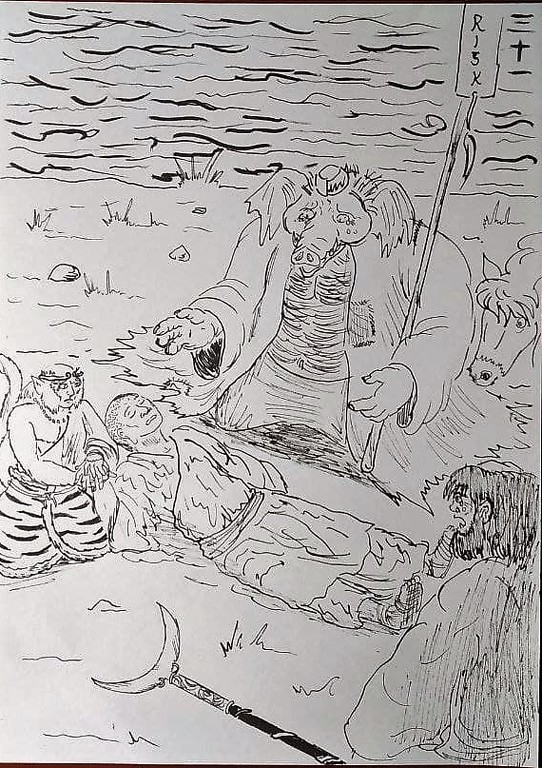
10. As a bookend, I’ve depicted a scene from the end of the book, the moment where Tripitaka drowns and ascends to buddhahood, so that he can obtain the sutras properly. This is also to represent one of the things I liked the most from the novel, the gradual growth of the pilgrims and the attachment to Tripitaka as a father figure. [Note: Tripitaka sheds his mortal form as he and his disciples are ferried across a body of water to the Buddha’s paradise. See the paragraph above image one and the material between images two and three in this article.]

(Larger version)

What Does Zhu Bajie Look Like? A Resource for Artists and Cosplayers

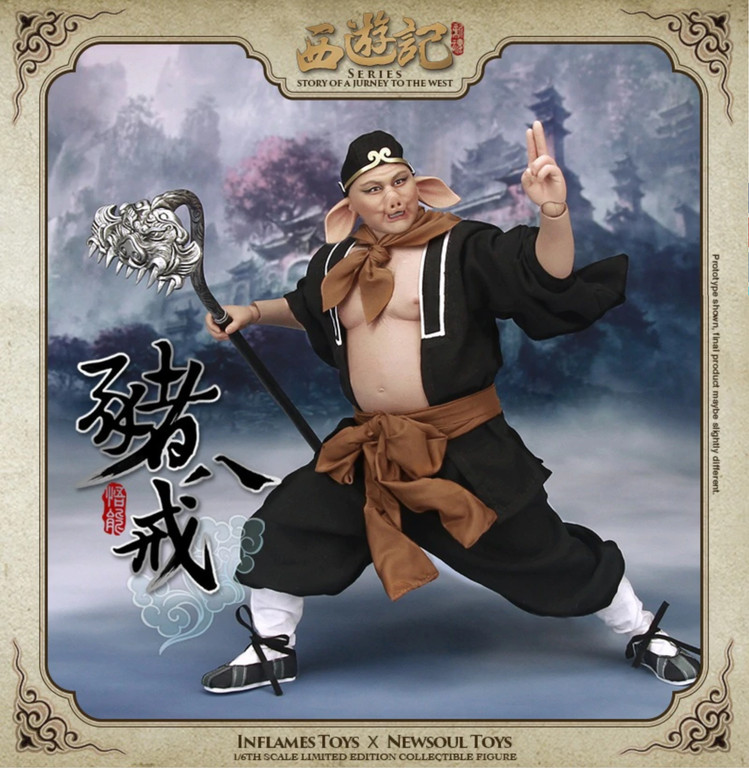
Type “Zhu Bajie” (豬八戒) into Google images and you will generally see a cute or friendly-looking pig-man with pink skin, big ears, a short snout, and a large stomach, and he will inevitably be holding some form of metal rake. Most iterations will likely be based on the character’s iconic look from the classic 1986 TV show, which portrays him wearing a Ji Gong-style Buddhist hat (Ji Gong mao, 濟公帽) with a golden fillet (à la Sun Wukong), a handkerchief tied around his neck and a sash at his waist, and black monk’s robes open at the chest (fig. 1). You might even see a few images depicting Zhu as a hulking warrior, but rarely will you see him portrayed with dark skin. So how do these representations compare to his depiction in the novel, and who has produced the most authentic look? In this article I present Zhu’s literary description, along with ancient depictions that predate the novel. My hope is that the information will be both interesting and useful, especially for artists and cosplayers looking to make a more authentic design.

I should note that this is not meant to be an exhaustive survey, just a general overview.

Zhu Bajie In-Flames Action Figure- small

Fig. 1 – A modern action figure of Zhu Bajie from the 1986 TV show (larger version).

1. Ancient Depictions

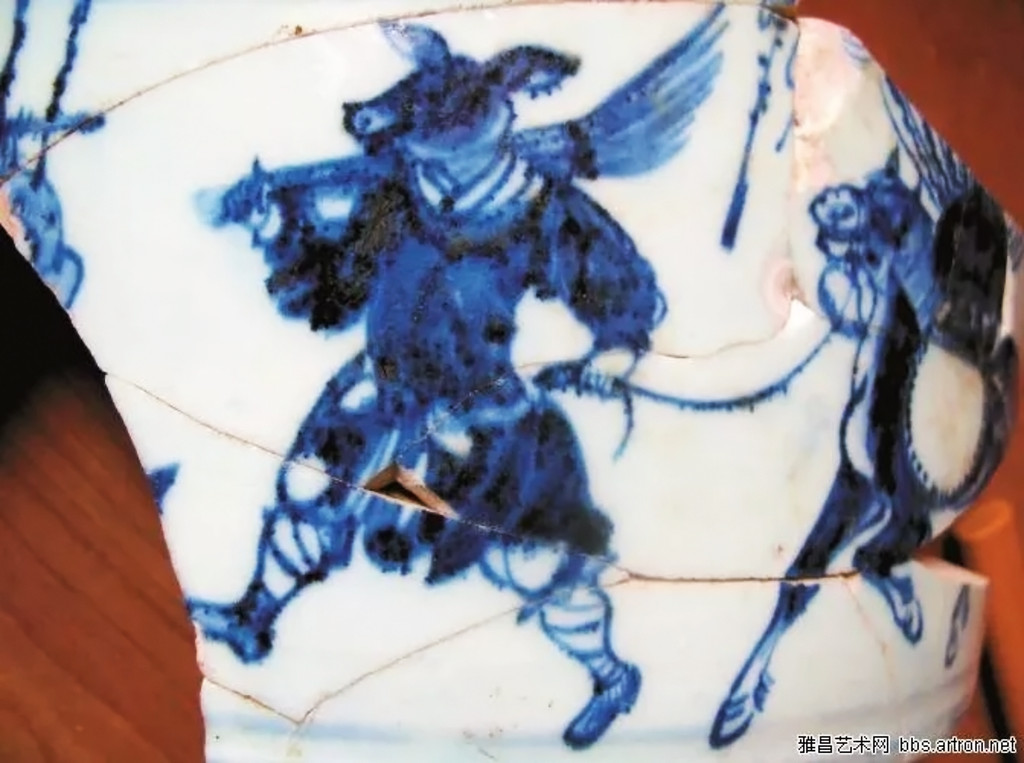
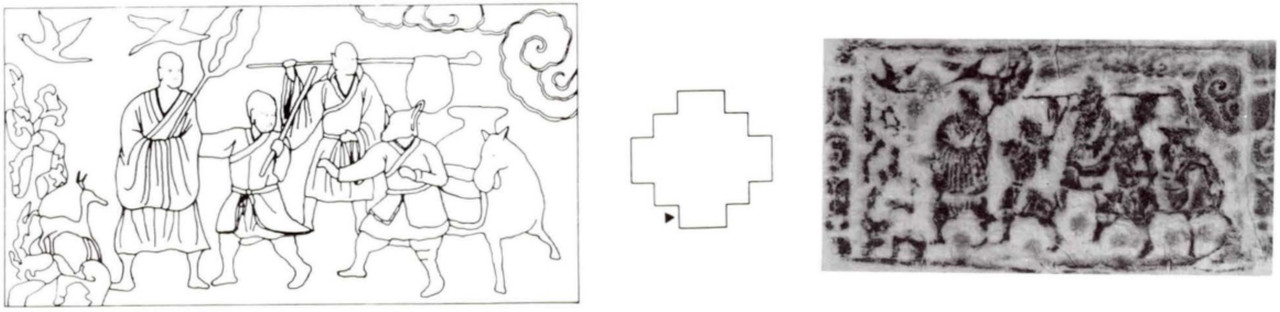
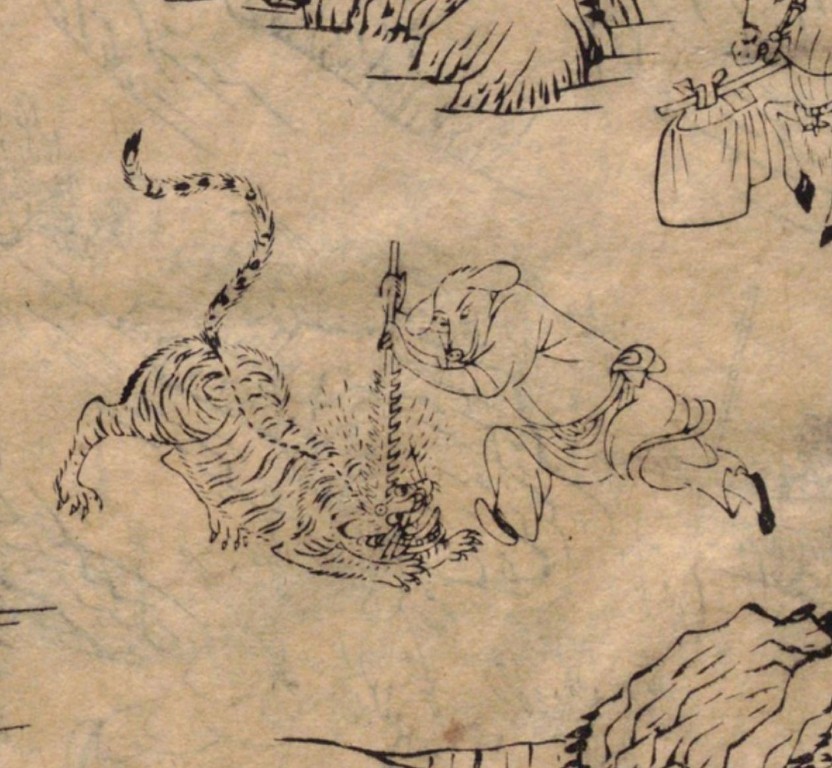
Zhu’s earliest depictions hail from the 14th-century as he is a latecomer to the story cycle, postdating the appearance of Sun Wukong and Sha Wujing by centuries. He is featured on a ceramic pillow and an incense burner from late Yuan China, as well as a series of carvings on a stone pagoda from late Goryeo Korea. Each piece draws on the same motif, depicting Zhu as a pig-headed monk taking large strides as he shoulders his rake and/or leads the horse. Even in instances where the weapon and equine are not present, he’s depicted in the same general posture (fig. 2-4).

Korean Pagoda paper - Pigsy iconography comparison

Fig. 2 – Detail of Zhu from a Cizhou ware ceramic pillow. See here for the full image. Fig. 3 – Detail from the incense burner. See here for the full image. Fig. 4 – Detail from panel two of the Korean pagoda. Note the figure’s matching posture. See here for the full line drawing.

2. What the novel says

2.1. Physical appearance

A poem in chapter 8 contains the earliest reference to Zhu’s appearance:

Lips curled and twisted like dried lotus leaves;
Ears like rush-leaf fans [pushan, 蒲扇] and hard, gleaming eyes;
Gaping teeth as sharp as a fine steel file’s;
A long mouth wide open like a fire pot [huopen, 火盆].
[…] (Wu & Yu, 2012, vol. 1, p. 211).

Chapter 18 provides more detail about his bristly neck and dark skin:

“Well,” said old Mr. Gao, “when he first came, he was a stout, swarthy [hei, 黑; lit: “black”] fellow, but afterwards he turned into an idiot with huge ears and a long snout, with a great tuft of bristles [zongmao, 鬃毛; lit: “mane”] behind his head. His body became horribly coarse and hulking. In short, his whole appearance was that of a hog!” (Wu & Yu, 2012, vol. 1, p. 372).

When the violent gust of wind had gone by, there appeared in midair a monster who was ugly indeed. With his black face [hei lian, 黑臉] covered with short, stubby hair, his long snout and huge ears, he wore a cotton shirt that was neither quite green nor quite blue. A sort of spotted cotton handkerchief was tied round his head (Wu & Yu 2012, vol. 1, p. 375).

The mane on the back of Zhu’s head is such a prominent feature that he took it as his personal name: “[M]y surname is based on my appearance. Hence I am called Zhu ([豬] Hog), and my official name is Ganglie ([剛鬣] Stiff Bristles)” (Wu & Yu 2012, vol. 1, p. 376).

Chapter 19 shows he has hands and feet like a man:

The monster did indeed raise his rake high and bring it down with all his might; with a loud bang, the rake made sparks as it bounced back up. But the blow did not make so much as a scratch on Pilgrim’s head. The monster was so astounded that his hands [shou, 手] turned numb and his feet [jiao, 腳] grew weak (Wu & Yu 2012, vol. 1, pp. 383-384).

Compare this to the mention of hooves (ti, 蹄) when he transforms into a giant boar in chapter 67 (see section 2.2 below).

Chapter 29 gives the fullest description:

My elder disciple has the surname of Zhu, and his given names are Wuneng [悟能] and Eight Rules [Bajie, 八戒]. He has a long snout and fanglike teeth, tough bristles on the back of his head, and huge, fanlike ears. He is coarse and husky, and he causes even the wind to rise when he walks (Wu & Yu 2012, vol. 2, p. 51).

Chapter 85 reveals the shocking size of his snout:

A snout, pestlelike, over three Chinese feet long [san chi, 三尺, 3.15 feet/96 cm] [1]
And teeth protruding like silver prongs.
Bright like lightning a pair of eyeballs round,
Two ears that whip the wind in hu-hu [唿唿] sound.
Arrowlike hairs behind his head are seen;
His whole body’s skin is both coarse and black [qing, 青]. [2]
[…] (Wu & Yu 2012, vol. 4, p. 149).

Chapter 90 notes Zhu has a tail: “Seizing him by the bristles and the tail [wei, 尾], the two spirits hauled Eight Rules away to show him to the nine-headed lion, saying, “Grandmaster, we’ve caught one” (Wu & Yu 2012, vol. 4, p. 219).

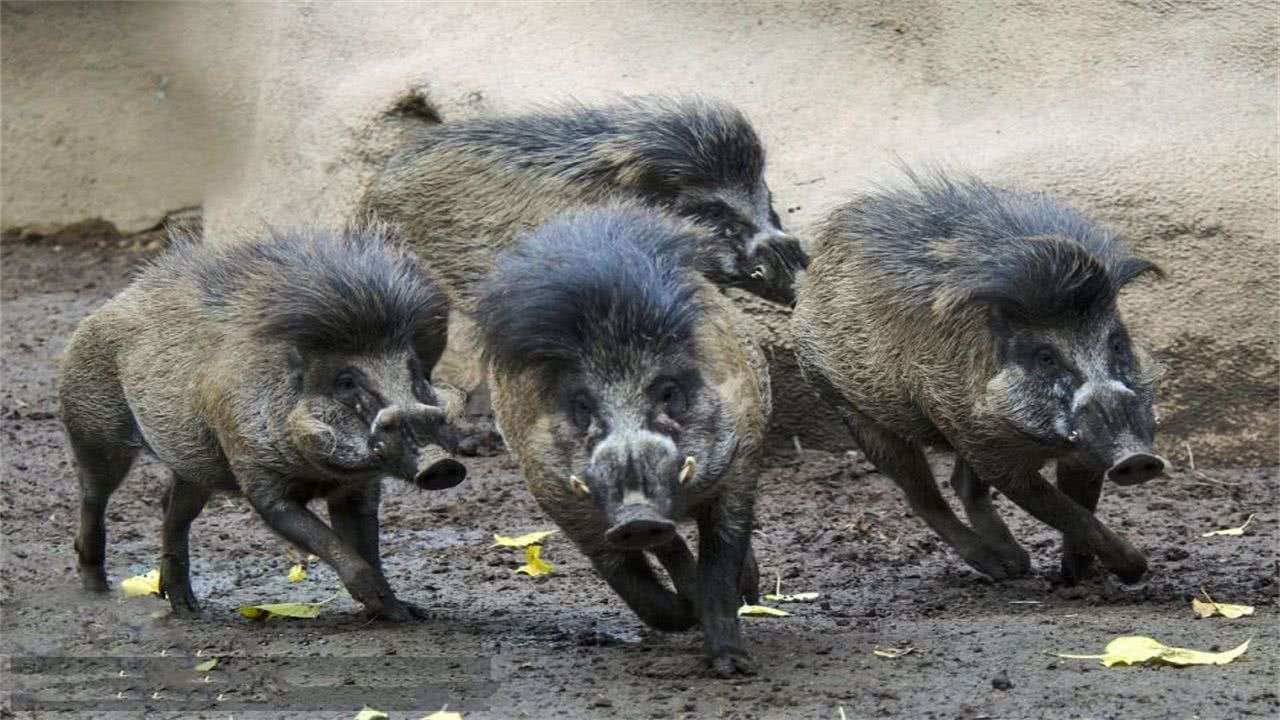
We can see from these quotes several features that appear again and again. These include a bristly mane on the back of his head, fan-like ears, a big mouth with protruding fangs, an overly long snout, and a hulking body with black, furry skin. He is also said to have human hands and feet and a pig tail. This grotesque description greatly differs from his cutesy appearance in modern media. It’s important to note that, just like Sun Wukong, Zhu was modeled on a real life animal. In this case, he shares many of his monstrous qualities with the wild boar (yezhu, 野豬) (fig. 5 & 6).

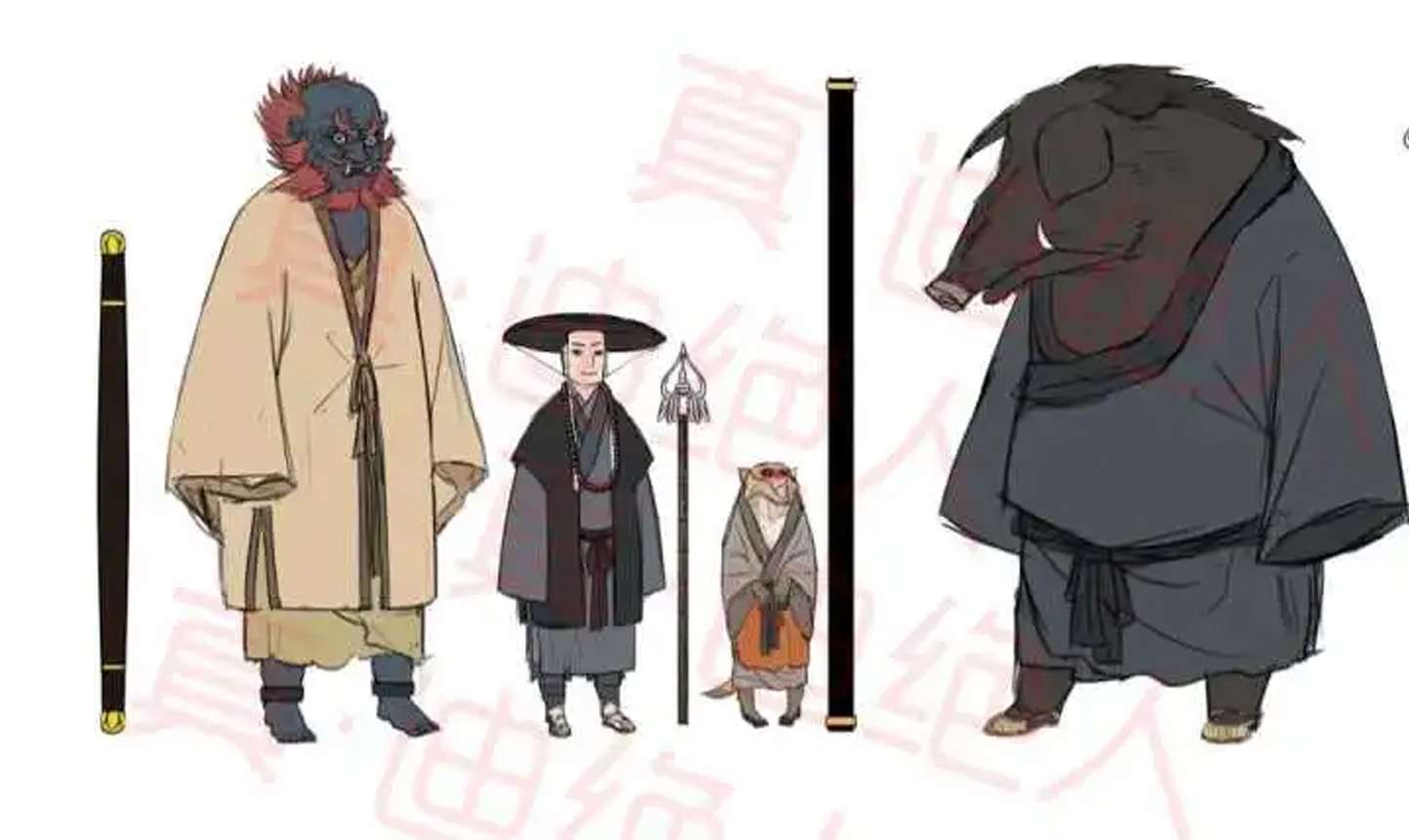
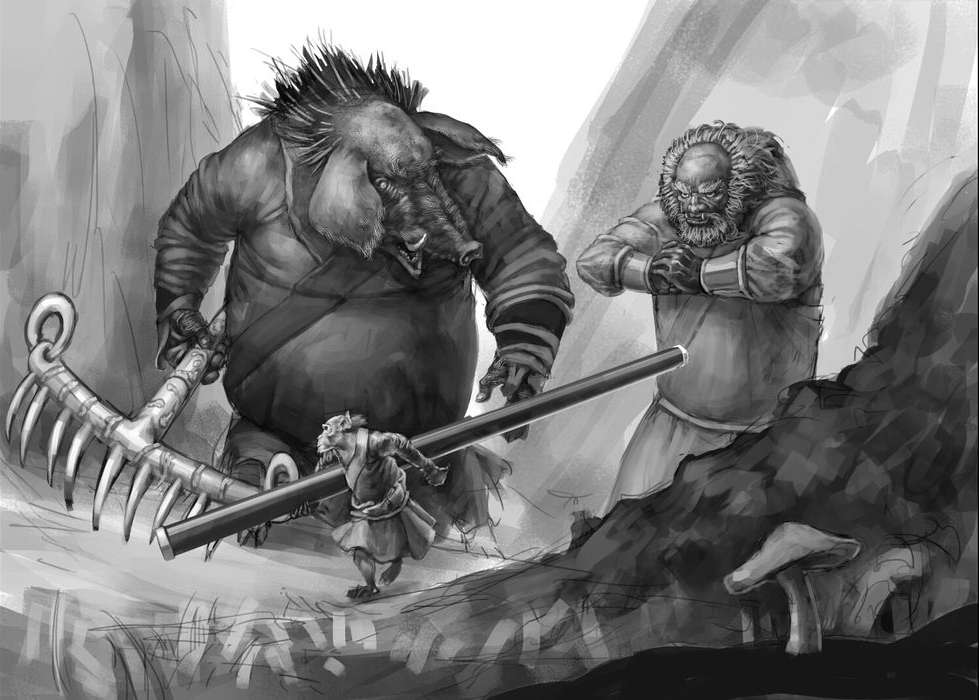
While the novel doesn’t give an exact height for our hero, the cited attributes do provide clues as to his general size. First and foremost is Tripitaka‘s statement: “[H]e causes even the wind to rise when he walks” (Wu & Yu 2012, vol. 2, p. 51). Obviously something capable of stirring the wind just from moving is going to be really big. Then there is Zhu’s 3.15 foot (96 cm) snout, which is over half the height of an average person. This suggests he’s several feet taller than a human. Furthermore, the novel states Sha Wujing is a whopping twelve Chinese feet (zhang er, 丈二; 12.6 feet / 3.84 m) tall (Wu & Yu 2012, vol. 2, p. 51). [3] Zhu is likely shorter than Sha as the latter’s height is specifically mentioned. So I would guess that he is at least 10 feet (roughly 3 m) tall. Zhu’s size is highlighted in some lovely online art (fig. 7 & 8).

Fig. 5 – A pack of running Visayan warty pigs (larger version). Image found here. Fig. 6 – An Indian boar (larger version). Check out that cool hair!!! Fig. 7 – The relative sizes of the pilgrims (larger version). As noted, I believe Zhu is probably shorter than Sha. Fig. 8 – The disciples on patrol (larger version). This is my favorite. Images found here. Artwork by @真·迪绝人 (see here and here).

2.2. Original form?

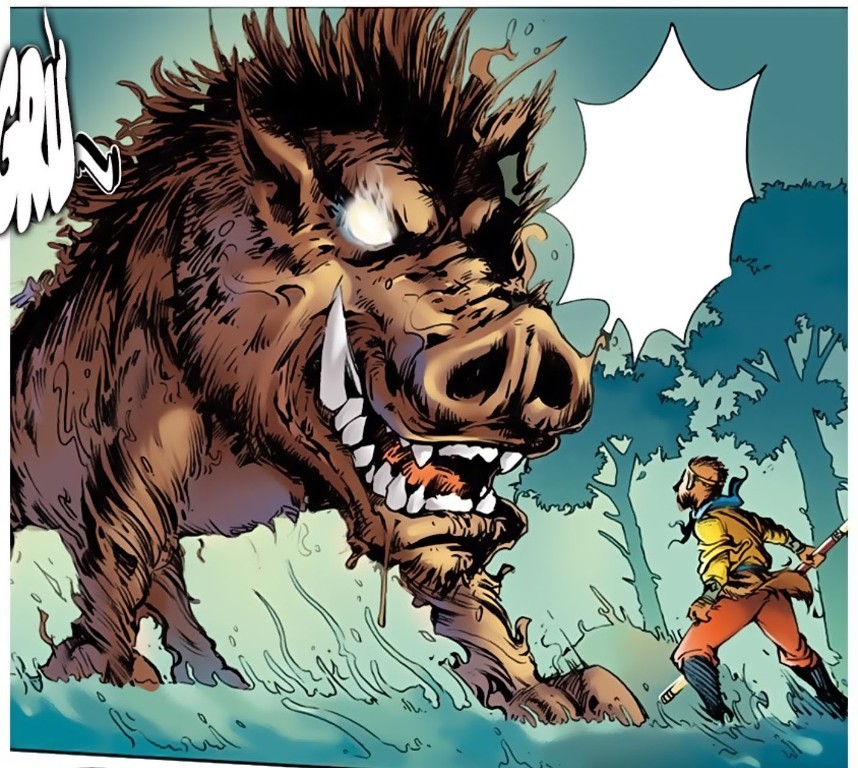
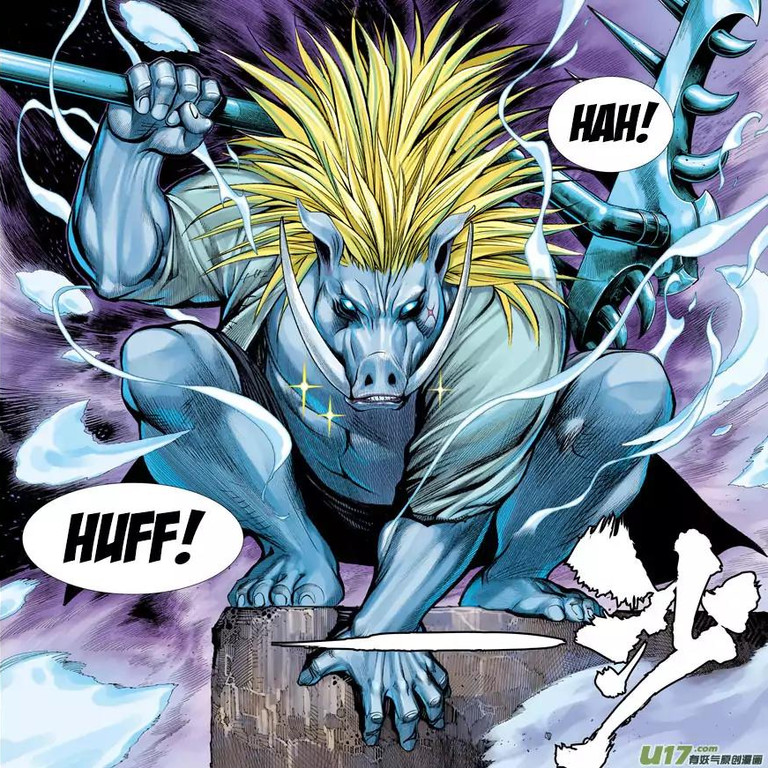
Zhu provides two contradictory origins for himself, which have implications for what his true form may be and why he looks the way he does in the novel. [5] A biographical poem in chapter 19 explains he was once a wayward, lazy youth who took up Daoist cultivation and later rose on clouds to receive celestial rank in heaven. But his immortal spirit was eventually exiled for drunkenly forcing himself on the moon goddess and mistakenly regained corporeal form in the womb of a sow, becoming the pig spirit that we know today (Wu & Yu 2012, vol. 1, pp. 378-379). [6] However, a poem in chapter 85 implies he was already a powerful pig monster who was given celestial rank but later exiled for drunkenly mocking the moon goddess, destroying Laozi‘s palace, and eating the Queen Mother‘s magic herbs (Wu & Yu 2012, vol. 4, p. 149). The latter origin might be represented in chapter 67 when Zhu transforms into a gigantic boar (fig. 9):

A long snout and short hair—all rather plump.
He fed on herbs of the mountain since his youth.
A black face with round eyes like the sun and moon;
A round head with huge ears like plantain leaves.
His bones were made lasting as Heaven’s age;
Tougher than iron was his thick skin refined.
In deep nasal tones he made his oink-oink cry.
What gutteral grunts when he puffed and huffed!
Four white hoofs [ti, 蹄] standing a thousand feet tall;
Swordlike bristles topped a thousand-foot frame. [7]
Mankind had long seen fatted pigs and swine,
But never till today this old hog elf [lao zhu xiao, 老豬魈].
The Tang Monk and the people all gave praise;
At such high magic pow’r they were amazed (Wu & Yu 2012, vol. 3, p. 253).

Fig. 9 – Zhu’s giant boar form from the manhua Journey to the West (Xiyouji, 西遊記) (larger version).

2.3. Clothing

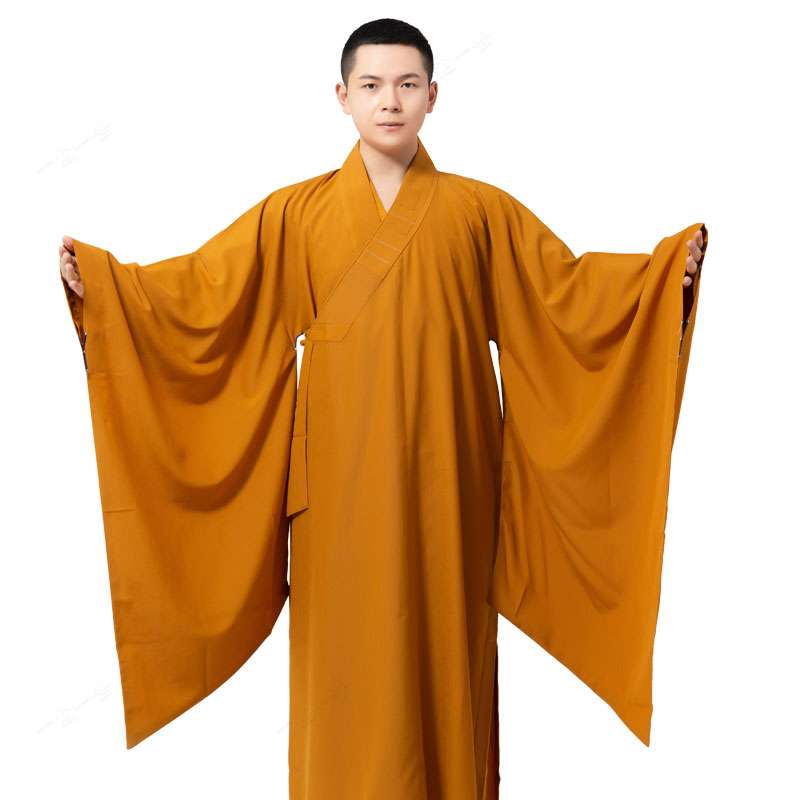
Zhu is not associated in popular culture with any specialized clothing or adornments like Sun Wukong, who’s very name brings to mind the golden fillet, a tiger skin kilt, and golden armor with a feather cap. But several later chapters do mention our pig hero wearing a “black brocade zhiduo robe” (zao jin zhiduo, 皂錦直裰) (ch. 55, 61, 72, & 86) or just a “black zhiduo robe” (zao zhiduo, 皂直裰) (ch. 63, 67, & 84). [4] The zhiduo robe is known colloquially in English as “Buddhist monk” or “Taoist monk” robes. Also called haiqing (海青), such garments reach almost to the ground and have long, broad sleeves. The robe is closed by a tie on the right side of the torso (fig. 10; also refer back to fig. 7).

Fig. 10 – A zhiduo/haiqing robe (larger version). Image found here. Imagine this robe with black cloth.

2.4. The rake

Zhu’s signature weapon is first mentioned in chapter 8. A line from his introductory poem reads: “He holds a rake—a dragon’s outstretched claws” (Wu & Yu, 2012, vol. 1, p. 211). The most detailed description appears in chapter 19:

This is divine bin steel greatly refined, [8]
Polished so highly that it glows and shines.
Laozi wielded the large hammer and tong;
Mars himself added charcoals piece by piece.
Five Kings of Five Quarters applied their schemes;
The Six Ding and Six Jia Spirits expended all their skills. [9]
They made nine prongs like dangling teeth of jade,
And double rings were cast with dropping gold leaves.
Decked with Five Stars and Six Celestial Bodies, [10]
Its frame conformed to eight spans and four climes.
Its whole length set to match the cosmic scheme
Accorded with yin yang, with the sun and moon:
Hexagram Spirit Generals etched as Heaven ruled;
Eight-Trigram Stars stood in ranks and files.
They named this the High Treasure Golden Rake, [Shang bao qin jin pa, 上寶沁金鈀]
[…] (Wu & Yu, 2012, vol. 1, p. 382).

So we see the rake has nine jade-like teeth and a bin steel body decorated with two golden rings and inscriptions of the sun, moon, and planets, as well as hexagram and eight-trigram symbols. The exact position of the rings is not specified, but one online drawing shows them at each end of the rake head (refer back to fig. 8). This might be a reference to the rings capping the ends of Sun’s weapon. While the weight is not listed on the rake like the Monkey King’s staff, chapter 88 states it is 5,048 catties (wuqian ling sishiba jin, 五千零四十八斤; 6,566 lbs. / 2,978.28 kg), [11] or the weight of the Buddhist canon (Wu & Yu, 2012, vol. 4, p. 200). [12]

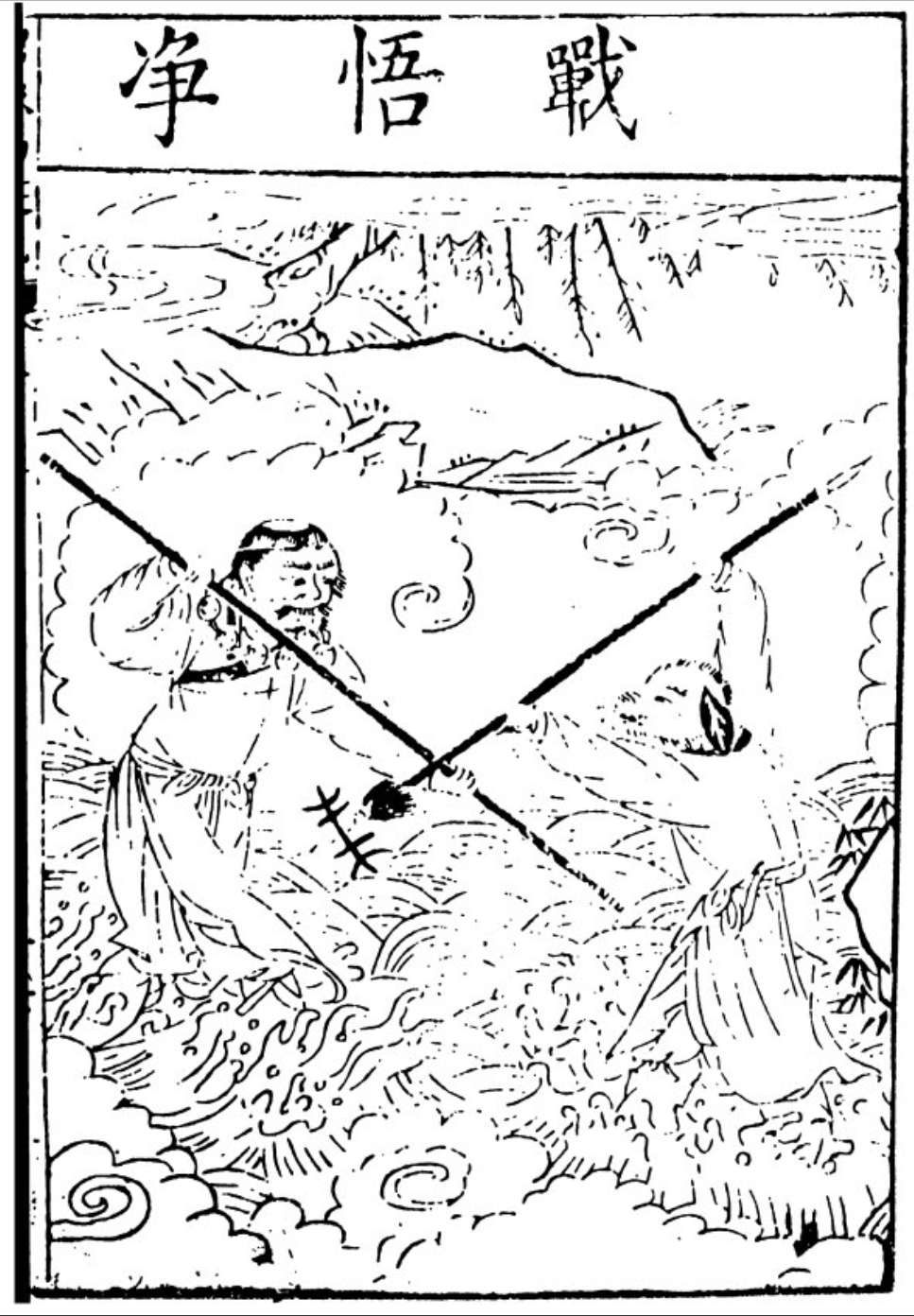
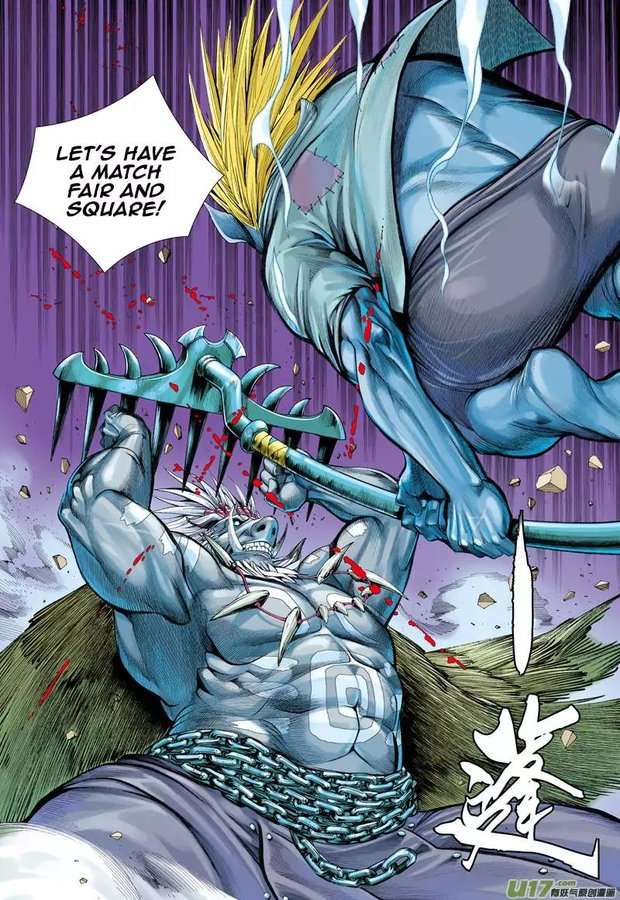
Since the rake’s literary description is more vague than that of Wukong’s staff, my normally strict views on the accuracy of the disciples’ weapons in various media don’t really apply in this case. This is especially true as even historical depictions are all over the place (fig. 11-13). I think the monstrous pig face on the rake from the 1986 TV show-inspired action figure is really neat (refer back to fig. 1). Another favorite of mine is the spiky rake from the ongoing manhua The Westward (Xixingji, 西行記, 2015-present) (fig. 13).

Fig. 11 – A print of Zhu vs Sha Wujing from the Shide tang edition (1592) of the novel (larger version). The weapon is portrayed as a war rake used by the Chinese military. Fig. 12 – His rake is depicted as a wolftooth club in Mr. Li Zhuowu’s Criticism (late-16th/early-17th-century) (larger version). Fig. 13 – Zhu (top) wields the rake against his evil brother (bottom) in The Westward (larger version). This brother is not a character in the original novel.

The following two sections include a small sampling of what I consider to be the least and most accurate portrayals in past and modern media. These are presented in no particular order.

3.1. The least accurate

1) Journey to the West (1996/1998) – It’s like the show’s creators purposely went in the opposite direction. Instead of big, black, and scary, they went with small, pink, and cute (fig. 14).

Fig. 14 – Wayne Lai as the adorable pig spirit (larger version).

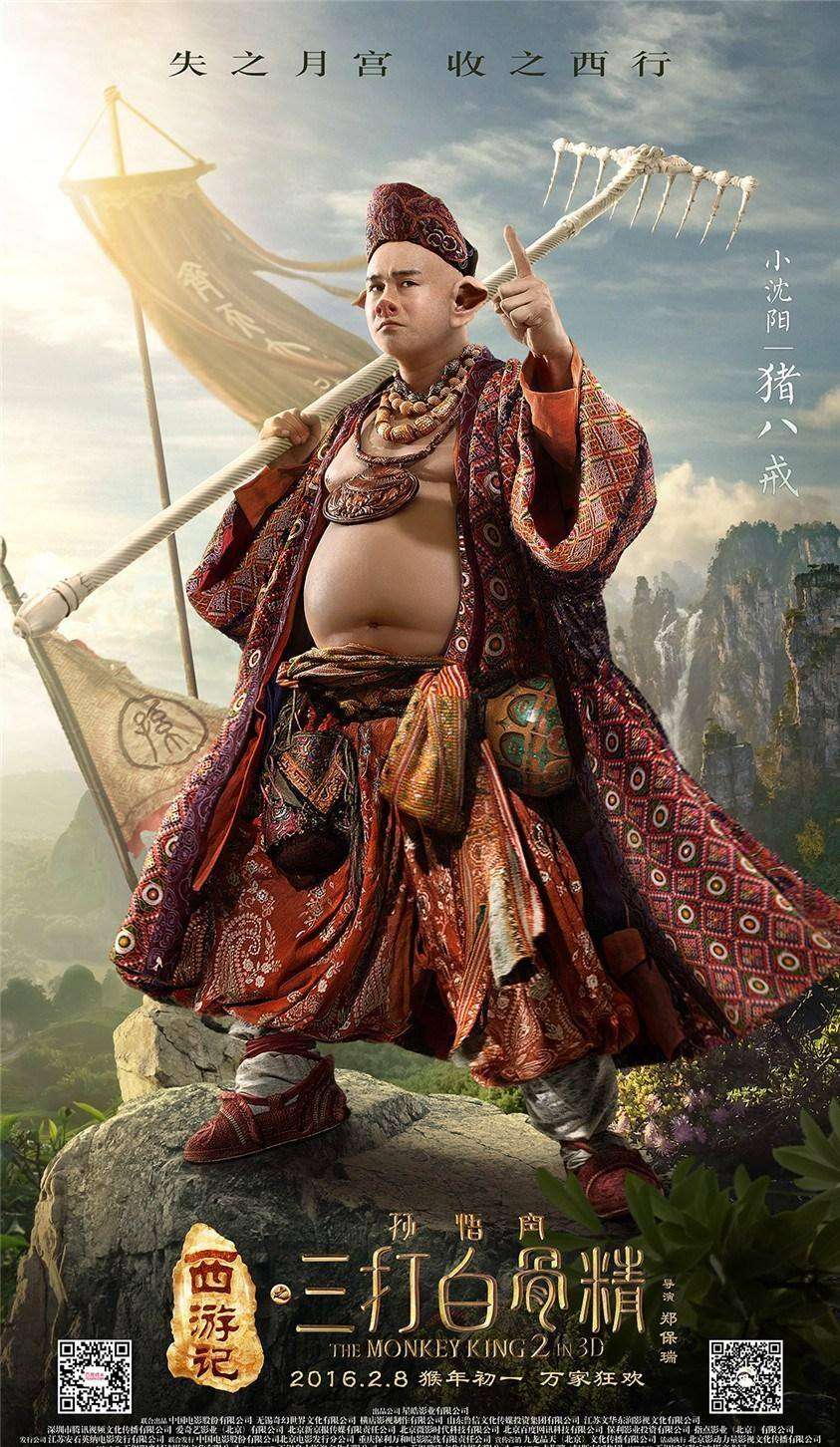
2) The Monkey King 2 & 3 (2016/2018) – It’s the same as before but minus the hair (fig. 15).

Fig. 15 – Xiaoshenyang as the fake hero (larger version).

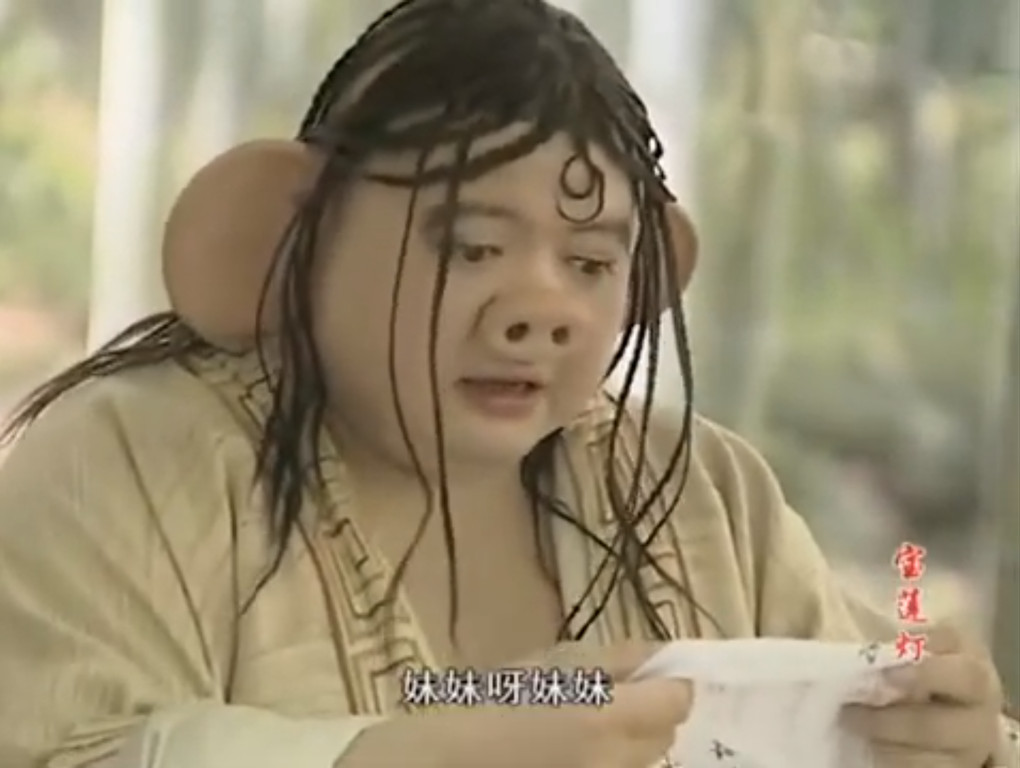
3) The Precious Lotus Lantern (Baolian deng, 寶蓮燈, 2005) – And then there’s this mess… (fig. 16).

Fig. 16 – Xie Ning (谢宁) as “Spaghetti Head” Zhu (larger version).

3.2. The most accurate

1) The Westward (Xixingji, 西行記, 2015-present) – This is perhaps the closest to his literary description (but his body and hair should be darker) (fig. 17). Admittedly, this is not the character’s original form. The manhua portrays Zhu as a small, pink pig-man who needs to absorb energy from the surrounding environment in order to achieve this monstrous transformation.

Fig. 17 – Zhu’s ultimate form (larger version).

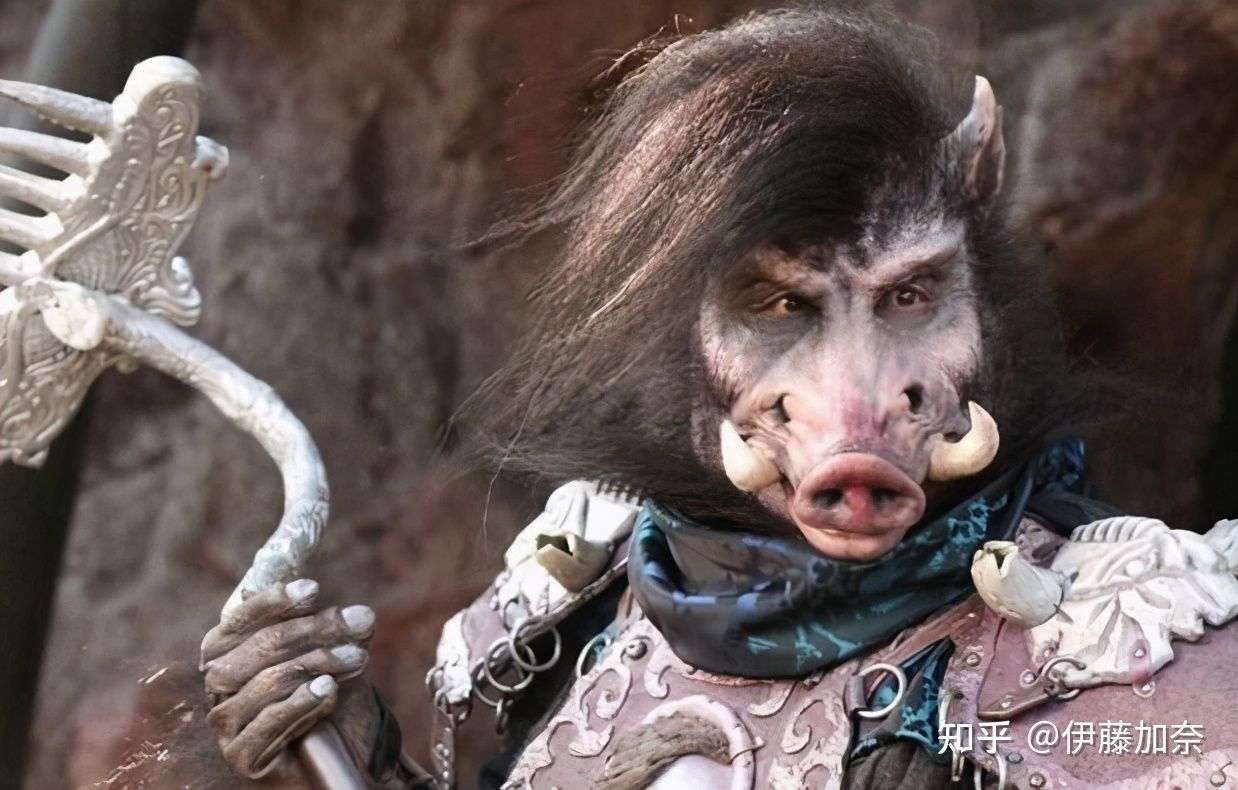
2) Journey to the West (2011) – This is how Zhu is portrayed when he’s still a monster (fig. 18). He has the dark skin, fangs, and mane. But he later changes to a friendly, pink pig-man once subjugated.

Fig. 18 – Zang Jinsheng as the armored pig monster (larger version).

3) The Cave of the Silken Web (1927) – While missing his bristly mane, Zhu is portrayed with a long snout, big ears, and, most importantly, black skin (fig. 19). He is also wearing a black zhiduo robe. Thanks to Irwen Wong for suggesting this entry.

Fig. 19 – Zhou Hongquan (周鴻泉) as Zhu in The Cave of the Silken Web (1927) (larger version).

4. Conclusion

While modern media often depicts Zhu as a friendly-looking, pink pig-man, the novel describes him as a giant pig monster with a bristly mane on the back of his head, fan-like ears, a big mouth with protruding fangs, a three-foot-long snout, and a hulking body with black, furry skin, human hands and feet, and a pig tail. He wears a black zhiduo robe. His 3.28 ton bin steel rake has nine jade-like teeth, two golden rings (possibly adorning the ends of the head), and a body inscribed with the sun, moon, and planets and hexagram and eight-trigram symbols. Needless to say, the literary Zhu is far more imposing than his modern, family friendly persona.

Notes:

1) The Chinese foot (chi, 尺) was slightly longer than the modern western foot (12 in/30.48 cm). The Board of Works (Yingzao, 營造) of the Ming and Qing standardized the measurement at 32 cm (12.59 in), though it varied at the local level and at different times (Ruitenbeek, 1996, Chinese Dynasties and Chinese Measurements section). I’m basing the length given in the novel on that from the Board of Works as the novel was published during the Ming dynasty.

2) The original English translation says “green” (Wu & Yu 2012, vol. 4, p. 149). However, there are times when it refers to black. For example, the phrase “The black ox goes west” (qing niu xi qu, 青牛西去) references Laozi and the Daodejing (Ma & van Brakel, 2016, p. 328 n. 71). In addition, the novel previously refers to Zhu having a “black face” (hei lian, 黑臉) (Wu & Yu 2012, vol. 1, p. 375).

3) This recalls the origin of the immortal Iron Crutch Li (Li tieguai, 李鐵拐), whose body was prematurely burnt by a disciple while his celestial spirit traveled to heaven. Upon his return, Li was forced to take corporeal form in the body of a recently deceased cripple.

4) Yu (Wu & Yu, 2012) translates the garment as “black cloth shirt” (Wu & Yu 2012, vol. 3, p. 253, for example).

5) Thank you to Irwen Wong and Anthony “Antz” Chong for bringing this to my attention.

6) See note #1 for how this measurement is calculated.

7) The original English translation says “hundred-yard” (Wu & Yu 2012, vol. 3, p. 253). However, the Chinese states 百丈 (bai zhang), or 100 x 10 Chinese feet, which of course equals 1,000 feet.

8) The original English translation/Chinese text states “divine ice steel” (shen bing tie, 神冰鐵) (Wu & Yu, 2012, vol. 1, p. 382). However, this is likely an error for “divine bin steel” (shen bin tie, 神鑌鐵) as bing (冰) and bin (鑌) sound similar. Bin steel (bin tie, 鑌鐵) was a high quality metal originally imported from Persia before the secret of its manufacture reached China in the 12th-century. It is mentioned a few times in the novel, including being associated with Monkey’s staff in one instance (Wu & Yu, 2012, vol. 3, p. 375).

I’ve made several changes to the translation from this point forward to better accord with the original Chinese.

9) The “Six Ding and Six Jia” (六丁六甲, Liuding liujia) are protector spirits of Daoism (Mugitani, 2008).

10) The “Five Stars” (wuxing, 五星) refer to Mercury (shuixing, 水星), Venus (jinxing, 金星), Jupiter (muxing, 木星), Mars (huoxing, 火星), and Saturn (tuxing, 土星). The Six Celestial Bodies (liuyao, 六曜) refer to the sun (taiyang/ri, 太陽/日) and moon (taiyin/yue, 太陰/月) and the four hidden pseudo-planets Yuebei (月孛), Ziqi (紫氣), Luohou (羅睺), and Jidu (計都). Combined, they are called the “Eleven Luminaries” (shiyi yao, 十一 曜), and these are sometimes broken into the “Seven Governors and Four Hidden Luminaries” (qizheng siyu, 七政四余) (Wang, 2020, pp. 169-170; Hart, 2010, p. 145 n. 43).

11) The original English translation says “five thousand and forty-eight pounds” (Wu & Yu, 2012, vol. 4, p. 200). However, the Chinese version uses jin (斤), known in English as “catty“. The catty and pound are two different measures of weight, the former being heavier than the latter. Therefore, the English text has been altered to show this. The catty during the Ming Dynasty when the novel was compiled equaled 590 grams (Elvin, 2004, p. 491 n. 133), so 5,048 catties would equal 6,566 lbs. or 2,978.28 kg.

12) Yu (Wu & Yu, 2012) notes popular belief held that the Buddhist canon was comprised of 5,048 scrolls (vol. 4, p. 396 n. 7). I’m not sure if the rake’s weight was purely based on the number of scrolls, or if each scroll was believed to weigh one catty.

Sources:

Hart, R. (2010). The Chinese Roots of Linear Algebra. United States: Johns Hopkins University Press.

Ma, L., & van Brakel, J. (2016). Fundamentals of Comparative and Intercultural Philosophy. United States: State University of New York Press.

Mugitani, K. (2008). Liujia and Liuding. In F. Pregadio (Ed.), The Encyclopedia of Taoism (vol. 1-2) (pp. 695-697). Longdon: Routledge.

Ruitenbeek, K. (1996). Carpentry and Building in Late Imperial China: A Study of the Fifteenth-century Carpenter’s Manual, Lu Ban Jing. Germany: E.J. Brill.

Wang, X. (2020). Physiognomy in Ming China: Fortune and the Body. Netherlands: Brill.

Wu, C., & Yu, A. C. (2012). The Journey to the West (vol. 1-4). Chicago, Illinois: University of Chicago Press.