Archive #36 – Sun Wukong and Battles of Magical Transformations

Last updated: 04-10-2022

One of the most famous episodes from Journey to the West (Xiyouji, 西遊記, 1592) happens in chapter six when heaven sends Erlang to confront Sun Wukong during his rebellion. After a prolonged, indecisive battle between the two immortals in their respective humanoid and cosmic giant forms, Monkey loses heart when his children are captured, causing him to flee. He tries to hide in the guise of a sparrow but is soon spotted by Erlang. This leads to an epic battle of magical transformations (video 1):

… Erlang at once discovered that the Great Sage had changed into a small sparrow perched on a tree. He changed out of his magic form and took off his pellet bow. With a shake of his body, he changed into a sparrow hawk with outstretched wings, ready to attack its prey. When the Great Sage saw this, he darted up with a flutter of his wings; changing himself into a cormorant, he headed straight for the open sky. When Erlang saw this, he quickly shook his feathers and changed into a huge ocean crane, which could penetrate the clouds to strike with its bill. The Great Sage therefore lowered his direction, changed into a small fish, and dove into a stream with a splash. Erlang rushed to the edge of the water but could see no trace of him. He thought to himself, “This simian must have gone into the water and changed himself into a fish, a shrimp, or the like. I’ll change again to catch him.” He duly changed into a fish hawk and skimmed downstream over the waves. After a while, the fish into which the Great Sage had changed was swimming along with the current. Suddenly he saw a bird that looked like a green kite though its feathers were not entirely green, like an egret though it had small feathers, and like an old crane though its feet were not red. “That must be the transformed Erlang waiting for me,” he thought to himself. He swiftly turned around and swam away after releasing a few bubbles. When Erlang saw this, he said, “The fish that released the bubbles looks like a carp though its tail is not red, like a perch though there are no patterns on its scales, like a snake fish though there are no stars on its head, like a bream though its gills have no bristles. Why does it move away the moment it sees me? It must be the transformed monkey himself!” He swooped toward the fish and snapped at it with his beak. The Great Sage shot out of the water and changed at once into a water snake; he swam toward shore and wriggled into the grass along the bank. When Erlang saw that he had snapped in vain and that a snake had darted away in the water with a splash, he knew that the Great Sage had changed again. Turning around quickly, he changed into a scarlet-topped gray crane, which extended its heel like sharp iron pincers to devour the snake. With a bounce, the snake changed again into a spotted bustard standing by itself rather stupidly amid the water pepper along the bank. When Erlang saw that the monkey had changed into such a vulgar creature—for the spotted bustard is the basest and most promiscuous of birds, mating indiscriminately with phoenixes, hawks, or crows-he refused to approach him. Changing back into his true form, he went and stretched his bow to the fullest. With one pellet he sent the bird hurtling (Wu & Yu, 2012, vol. 1, pp. 182-183).

二郎圓睜鳳目觀看,見大聖變了麻雀兒,釘在樹上。就收了法象,撇了神鋒,卸下彈弓。搖身一變,變作個鷂鷹兒,抖開翅,飛將去撲打。大聖見了,颼的一翅飛起去,變作一只大鶿老,沖天而去。二郎見了,急抖翎毛,搖身一變,變作一隻大海鶴,鑽上雲霄來嗛。大聖又將身按下,入澗中,變作一個魚兒,淬入水內。二郎趕至澗邊,不見蹤跡。心中暗想道:「這猢猻必然下水去也,定變作魚蝦之類。等我再變變拿他。」果一變,變作個魚鷹兒,飄蕩在下溜頭波面上,等待片時。那大聖變魚兒,順水正游,忽見一隻飛禽:似青鷂,毛片不青;似鷺鷥,頂上無纓;似老鸛,腿又不紅:「想是二郎變化了等我哩!」急轉頭,打個花就走。二郎看見道:「打花的魚兒:似鯉魚,尾巴不紅;似鱖魚,花鱗不見;似黑魚,頭上無星;似魴魚,鰓上無針。他怎麼見了我就回去了?必然是那猴變的。」趕上來,刷的啄一嘴。那大聖就攛出水中,一變,變作一條水蛇,游近岸,鑽入草中。二郎因嗛他不著,他見水響中,見一條蛇攛出去,認得是大聖。急轉身,又變了一隻朱繡頂的灰鶴,伸著一個長嘴,與一把尖頭鐵鉗子相似,徑來吃這水蛇。水蛇跳一跳,又變做一隻花鴇,木木樗樗的,立在蓼汀之上。二郎見他變得低賤,(花鴇乃鳥中至賤至淫之物,不拘鸞、鳳、鷹、鴉,都與交群)故此不去攏傍。即現原身,走將去,取過彈弓,拽滿,一彈子把他打個躘踵。

Video 1 – A light-hearted, animated version of the battle between Erlang and Sun Wukong. From the 1960s classic Havoc in Heaven.

My friend Irwen Wong over at the Journey to the West Library blog has analyzed this fight, showing that Erlang’s changes are always a stronger response to the Monkey King’s transformations.

[…] 1.3. Round 3

Type: Transformation
Monkey turns himself into a sparrow and flees by flying away. Erlang notices this transformation and turns himself into a sparrow hawk to attack.
Result: Erlang wins.

1.4. Round 4

Type: Transformation
When Monkey now changes into a cormorant to be able to fly higher, out of Erlang’s hawk’s reach. Erlang was aware of this and transforms into an ocean crane to give chase.
Result: Erlang wins.

1.5. Round 5

Type: Transformation & intellect
Monkey was afraid of Erlang’s powerful transformations and turns himself into a small fish to hide in a stream. Erlang changes into a fish hawk and scans the stream for Monkey’s trace. He cleverly identifies the fish that was Monkey and attempts to catch it.
Result: Erlang wins.

1.6. Round 6

Type: Transformation
Monkey immediately darts out of the water when he sees Erlang and changes into a water snake. Erlang transforms into a grey crane to catch the water snake.
Result: Erlang wins.

1.7. Round 7

Type: Transformation & intellect
Monkey sees that Erlang had turned into a crane to chase him, so he wittily transformed into a spotted bustard to oppose Erlang’s crane.
Result: Monkey wins – Erlang as a crane did not dare approach the bustard.

1.8. Round 8

Type: Transformation & combat
When Monkey changed into a bustard, Erlang was afraid to approach it. Instead, Erlang reverted to his original form and took out his pellet bow. With the bow, he aimed at Monkey’s bustard and succeeded with a strong direct hit.
Result: Erlang wins.
[…]

This magical battle is actually related to an ancient mythic motif involving two warring supernatural beings.

I. Antecedents of the motif

Ioannis M. Konstantakos’ (2016) paper “The Magical Transformation Contest in the Ancient Storytelling Tradition” explains that the motif can be traced to the Near East of the late-3rd millennium BCE. However, the oldest variants instead depict the combatants transforming objects and not their physical bodies in battle. But the outcome is still the same: one competitor produces stronger responses to the other’s initial attack. For example, the Sumerian tale Enmerkar and Ensuhgirana (c. early-2nd millennium BCE) depicts the two titular characters engaged in a magical battle over the fate of their respective homelands. Konstantakos (2016) writes:

The competition of Sağburu and Urğirnuna consists precisely in the magical fabrication of various animals. Each one of the adversaries throws a certain object of witchcraft into the river and draws out a magically produced creature (or group of creatures). Every time, however, Sağburu’s creations are bigger, stronger, and wilder than those of Urğirnuna, which they seize and lacerate as a result. Specifically, the foreign sorcerer produces in sequence: 1) a big carp; 2) a ewe with its lamb; 3) a cow with its calf; 4) an ibex and a wild sheep; and 5) a young gazelle. The wise witch, on the other hand, counters these creations correspondingly with 1) an eagle; 2) a wolf; 3) a lion; 4) a mountain leopard; and 5) a tiger and another kind of lion. In this way, all of Urğirnuna’s creatures are eliminated, and Sağburu wins the contest (p. 210).

This finds parallels with ancient Egyptian stories and even an event from the book of Exodus (7.8-12) (Konstantakos, 2016, pp. 210-213).

The more familiar version of the motif, which sees competitors transforming their bodies, is found in ancient Greek drama. Konstantakos (2016) describes one such tale involving the lustful adventures of Zeus:

The Cypria offers the most expanded and detailed form of the saga. Zeus was amorously chasing [his daughter] Nemesis, but she was averse to his sexual intentions and ran away. In the course of her flight, Nemesis took the form of various beasts; she became a fish in the sea and swam through the Ocean’s stream; then she changed herself into many kinds of animals on the land, in order to escape. In the end, the goddess was transformed into a bird, the species of which is variously given in the ancient sources. … Zeus assimilated himself to the same species of bird, becoming respectively a gander in the former version and a male swan in the latter one. In this form, the great god finally managed to mate with the metamorphosed and bird-like Nemesis (pp. 213-214).

The body transforming motif came to influence later European stories, many involving a battle between a magician and his arrogant pupil (folklore index no. 325) (Konstantakos, 2016, p. 208).

The Greek version is very similar to the battle between Erlang and Sun Wukong, for both feature a character fleeing under different magical disguises while being chased by an assailant who undergoes stronger transformations in response. Given the link between Greek and Indian philosophy, I’d wager that there’s some ancient South Asian version of this motif that came to influence Journey to the West. I’m just happy that Monkey wasn’t handled like Nemesis in the final product. That would have been awkward for everyone!

II. Archive

Below, I archive Konstantakos (2016). The first half of the paper is fascinating, while the second is quite repetitive. It takes up a great deal of space analyzing a Near Eastern-influenced version of the motif in the Greek Alexander Romance. Please keep this in mind.

Archive link:

Click to access The_Magical_Transformation_Contest_in_t.pdf

Disclaimer:

This has been posted for educational purposes. No malicious copyright infringement is intended. If you liked the digital version, please support the official release.


Update: 04-10-22

I’ve mentioned in this article (section 3) that the Bull Demon King‘s story arc shares many similarities with Sun Wukong’s. He too has a battle of transformations, but instead of Erlang, his opponent is the Monkey King. Chapter 61 reads:

[…] Unable to enter the cave, the old Bull turned swiftly and saw Eight Rules and Pilgrim rushing toward him. He became so flustered that he abandoned his armor and his iron rod; with one shake of his body, he changed into a swan and flew into the air.

[…]

Putting away his golden-hooped rod, the Great Sage shook his body and changed into a Manchurian vulture, which spread its wings and darted up to a hole in the clouds. It then hurtled down and dropped onto the swan, seeking to seize its neck and peck at the eyes. Knowing also that this was a transformation of Pilgrim Sun, the Bull King hurriedly flapped his wings and changed himself into a yellow eagle to attack the vulture. At once Pilgrim changed himself into a black phoenix, the special foe of the yellow eagle. Recognizing him, the Bull King changed next into a white crane which, after a long cry, flew toward the south. Pilgrim stood still, and shaking his feathers, changed into a scarlet phoenix that uttered a resounding call. Since the phoenix was the ruler of all the birds and fowl, the white crane dared not touch him. Spreading wide his wings, he dived instead down the cliff and changed with one shake of the body into a musk deer, grazing rather timorously before the slope. Recognizing him, Pilgrim flew down also and changed into a hungry tiger which, with wagging tail and flying paws, went after the deer for food. Greatly flustered, the demon king then changed into a huge spotted leopard to attack the tiger. When Pilgrim saw him, he faced the wind and, with one shake of his head, changed into a golden-eyed Asian lion, with a voice like thunder and a head of bronze, which pounced on the huge leopard. Growing even more anxious, the Bull King changed into a large bear, which extended his paws to try to seize the lion. Rolling on the ground, Pilgrim at once turned himself into a scabby elephant, with a trunk like a python and tusks like bamboo shoots. Whipping up his trunk, he tried to catch hold of the bear (Wu & Yu, 2012, vol. 3, pp. 156-157).

This fight shows that Sun Wukong learned a lot from his encounter with Erlang, for his transformations are far more fierce in comparison.

Sources:

Konstantakos, I. (2016). The Magical Transformation Contest in the Ancient Storytelling Tradition. Estudios griegos e indoeuropeos, 26, 207-234. Retrieved from https://www.academia.edu/25983449/_The_Magical_Transformation_Contest_in_the_Ancient_Storytelling_Tradition_Cuadernos_de_Filolog%C3%ADa_Cl%C3%A1sica_Estudios_griegos_e_indoeuropeos_26_2016_207_234.

Wu, C., & Yu, A. C. (2012). The Journey to the West (Vols. 1-4) (Rev. ed.). Chicago, Illinois: University of Chicago Press.

Journey to the West and Islamic Lore

Last updated: 04-07-2024

I. Battle of Transformations

Did you know that certain portions of Journey to the West were influenced by Indo-Persian and Arab Islamic lore? For instance, in chapter six, Sun Wukong and Lord Erlang engage in a magical battle of skill in which they freely transform into myriad animals, each trying to one-up the other. This battle is unusual as Chinese stories going back to pre-Tang dynasty sources show that characters could not transform into successive beasts at will (Hsia, 1968/2015, pp. 122-123). Conversely, One Thousand and One Arabian Nights (1704), which is based on stories as far back as the 9th-century, contains a tale featuring a magical battle of transformations between a princess and a genie (Hsia, 1968/2015, p. 122). Literary critic C.T. Hsia (1968/2015) notes that the similarities in magical combat “does not mean…the makers of the Monkey legend were specifically indebted to [the Arabian Nights], but it certainly indicates their general awareness of the popular literature of the Middle and Near East” (p. 123).

(Note: I no longer feel Hsia’s (1968/2015) suggestion is accurate. See the 11-21-2019 update below.)

Click the image to open in full size.

Fig. 1 (left) – Modern pears grown in molds to imitate ginseng baby fruit. Fig. 2 (right) – A 14th to 15th-century illuminated manuscript depicting the women fruit of the Waqwaq tree (larger version).

II. Magic Tree

Chapters 24 to 26 of Journey to the West feature a magical Ginseng Tree (Renshen shu, 人參樹; a.k.a. “Immortal/Divine Root of the Five Villages Abbey,” Wuzhuang guan li xiangen, 五莊觀裡仙根) that produces crying, baby-shaped ginseng fruits (renshen guo, 人參果; a.k.a. “grass of reverted cinnabar,” cao huandan, 草還丹; a.k.a. “long-life grass of reverted cinnabar,” wanshou cao huandan, 萬壽草還丹) capable of extending the lives of those who eat them to 47,000 years (fig. 1). The literary antecedent of this fruit first appears in The Story of How Tripitaka of the Great Tang Procures the Scriptures (Da Tang Sanzang qujing shihua, 大唐三藏取經詩話; “The Story” hereafter), a 17-chapter storytelling prompt dated to the late 13th-century. Chapter 11 features an immortal peach tree with fruits that transform into edible children once they drop into water. Each is capable of answering when asked a question:

Monkey Pilgrim continued: ‘There are more than ten peaches on the tree now, but there are gods of the earth who are posted here especially to protect them. There is no way to steal the peaches.’ The Master teased: ‘Your supernatural powers are stupendous. If you were to go, what could prevent you?’ Before his words were finished three peaches of immortality fell down into the pool. The Master was startled by the splash and he asked: ‘What fell down?’ Monkey Pilgrim replied: ‘Don’t be alarmed, Master. It was just a few ripe peaches of immortality which fell into the pool.’ The Master said: ‘Can we find them and eat them?’

Monkey Pilgrim took the golden-ringed staff and shook it three times in the direction of the huge, flat stone. A small child with a greenish face appeared. His fingernails were as sharp as a hawk’s claws and from his gaping mouth the teeth showed as he emerged from the pool. Pilgrim asked: ‘How old are you?’ The child answered: ‘Three thousand years.’ Pilgrim replied: ‘I have no use for you.’ Again he rapped five times and a child appeared whose face was as round as the full moon. He wore embroidered clothes and a headdress with tassels. Pilgrim asked: ‘How old are you?’ The child replied: ‘Five thousand years.’ Pilgrim replied: ‘I will not use you.’ And once more he rapped several times with the staff. Another child appeared all of a sudden. Monkey Pilgrim asked: ‘How old are you?’ ‘Seven thousand years,” the child replied. Monkey put down the golden-ringed staff and made the child get on his hand. Then he asked: ‘Monk! Will you eat this?’ The monks were terrified and fled. Pilgrim whirled his hand with the child in it a number of times and the child became a milky jujube which he popped into his mouth (Wivell, 1994, p. 1196).

猴行者曰:「樹上今有十餘顆,為地神專在彼此守定,無路可去偷取。」師曰:「你神通廣大,去必無妨。」說由未了,攧下三顆蟠桃入池中去。師甚敬惶。問:「此落者是何物?」答曰:「師不要敬,此是蟠桃正熱,攧下水中也。」師曰:「可去尋取來吃。」

猴行者即將金鐶杖向盤石上敲三下,乃見一個孩兒,面帶青色,爪似鷹鷂,開口露牙,從池中出。行者問:『汝年幾多?」孩曰:「三千歲。」行者曰:「我不用你。」又敲五下,見一孩兒,面如滿月,身掛繡纓。行者曰:「汝年多少?」答曰:「五千歲。」行者曰:「不用你。」又敲數下,偶然一孩兒出來。問曰:「你年多少?」答曰:「七千歲。」行者放下金鐶杖,叫取孩兒入手中,問:「和尚,你吃否?」和尚聞語,心敬便走。被行者手中旋數下,孩兒化成一枝乳棗,當時吞入口中。後歸東土唐朝,遂吐出於西川。至今此地中生人參是也。

The concept of speaking, human-shaped fruit can be traced to the “Waqwaq tree” from Islamic lore. For example, The Book of the Wonders of India (Kitaab Ajaaib al-Hind), a set of Indo-Persian sailor stories collected between 900 and 953, contains a brief anecdote which reads:

Muhammad b. Babishad told me that, according to what he had learnt from men who had been to the Waqwaq country, there is a large tree there, with round leaves, or sometimes oblong, which bears fruit like a marrow, only larger, and looking something like a human being. When the wind blows, a voice comes out of it. The inside is full of air, like the fruit of the usher. If one picks it, the air escapes at once, and it is nothing but skin (Buzurg & Freeman-Grenville, 1981, p. 39).

The 15th-century Arab historian Ibn al-Wardi took the concept further by describing the fruit as being shaped like voluptuous women (fig. 2) with the power of speech:

On this island are trees that bear as fruit women: shapely, with bodies, eyes, hands, feet, hair, breasts, and vulvas like the vulvas of women. Their faces are exceptionally beautiful and they hang by their hair. They come out of cases like big swords, and when they feel the wind and sun, they shout “Waq Waq” until their hair tears (Toorawa, 2000, p. 393).

Various sources respectively locate the Waqwaq tree and its home of Waqwaq, a faraway, exotic land or island, somewhere within the Indian Ocean, beyond Iraq, or, further still, beyond China. The Waqwaq term was most likely used to describe the limits of the known world at given times (Toorawa, 2000). The tree itself can possibly be traced to a passage in the Quran (Sura 37, verses 60-64) that describes how the “Tree of Zakkum” produces fruit shaped like the heads of demons. The earliest mention of the Waqwaq tree in Chinese sources appears in the late 8th-century Comprehensive Encyclopedia (Tongdian, 通典) by the travel writer Du Huan (杜環). This is apparently based on an earlier Arabic source (A floral fantasy, n.d.).


Update: 02-28-2018

I was looking through the Ming-era Illustrated Encyclopedia of the Three Realms (Sancai tuhui, 三才圖會, 1609; “Three Realms” hereafter) and happened upon a woodblock print of a Waqwaq tree (fig. 3). The image is labeled Dashi Guo (大食國), a term used since the Tang Dynasty to refer to an ancient country in the Arab World (Zhang & Unschuld, 2015, p. 81). This shows the Chinese were still aware of the tree’s foreign origin around the time that Journey to the West was published.

Ginseng tree - From Sancai tuhui (1609), based on image of Iskander (Alexander the Great) talking to the Talking Tree from the Shamanah

Fig. 3 – Woodblock print from the Three Realms showing the Waqwaq tree (larger version).


Update: 11-21-2019

As noted above, Hsia (1996) suggests the battle of transformations between Monkey and Erlang was influenced in some way by Islamic literature. However, Robinet (1979) describes a tit-for-tat battle from Daoist literature that casts doubt on this view:

The Xianyuan bianzhu [仙苑編珠, “Paired Pearls from the Garden of Immortals,” after c. 921] tells how Wang Tan [王探] received “the art of hiding his light and transforming his body.” Dared by someone to metamorphose himself, he took the form of a tree, but the other fellow seized an axe. Wang immediately transformed himself into a stone, but the other lit a fire (in the theory of the five elements, fire prevails over minerals). After turning himself into bubbling water and so on, Wang Tan finally achieved the upper hand by adopting the appearance of a corpse-the man fled immediately (p. 46). [1]

The way the Daoist and his opponent try to one up the other is very similar to the battle between the Great and Small Sages. Therefore, it’s not a stretch to suggest this story (or related media) was embellished by a storyteller or the author-compiler of the Ming Journey to the West to include two masters of transformation instead of one.


Update: 04-04-2020

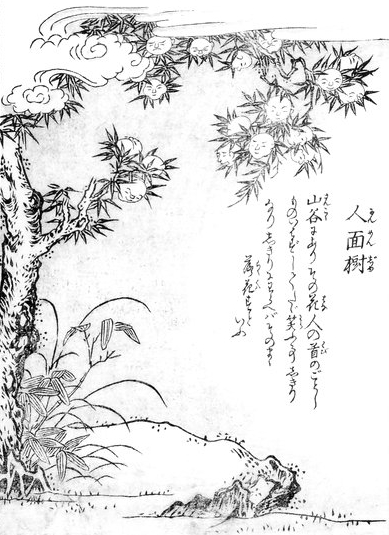
Thanks to a recent Twitter post by Guy Reisman, I was delighted to learn that the Islamic Waqwaq tree made its way to Japan, where it is known as the Jinmenju (人面樹, “human-face tree“). In fact, an illustration of the tree appearing in the Edo-period bestiary Konjaku Hyakki Shūi (今昔百鬼拾遺, “Supplement to The Hundred Demons from the Present and the Past,” c. 1781) appears to be based on that from the Three Realms cited above (refer back to fig. 3).

Even more exciting, however, is the revelation of the identity of the man standing beneath the tree in the Three Realms illustration. Foster (2015) traces the Japanese image to the Three Realms and then further back to a Persian source, thereby associating the man with a famous historical king:

If we continue back in time and along the Silk Road, we find different versions of the great Persian epic poem Shahnama (Book of Kings) by Firdawsi (d. 1020), with illustrations of a man conversing with a tree bearing human heads. The man, it turns out, is Alexander the Great (Sikandar or Iskandar), and the illustrations portray his legendary encounter with a talking tree, sometimes called the Wakwak Tree, that prophesied his death (p. 185).

That’s right, the man in the Three Realms is based on Alexander the Great! See image four for a comparison of the Chinese illustration and one example of Persian “Iskander and the Talking Tree”-genre drawings. Both men stand in a similar position, looking upwards. The Persian Alexander is passively listening, while the Three Realms Alexander is actively talking.

Iskander and the Talking Tree - Three Realms Ginseng Tree

Fig. 4 – A comparison of a 15th-century Persian “Iskander and the Talking Tree” image and the Three Realms image (larger version). The former is held by the Bodleian Library.

This then raises the question: Did material related to the Shahmana influence the Ginseng Tree in Journey to the the West? [2] I’ve already demonstrated that an antecedent of the Ginseng tree appears in The Story. But this doesn’t necessarily negate some sort of influence. After all, both the Shahmana and Journey to the West feature mythic kings (Alexander and Sun Wukong) coming into contact with magic trees with humanoid fruit. I should note, however, that the trees represent two drastically different fates. Alexander’s tree foresees his death, while Monkey’s tree holds the promise of eternal life. Further research might shed light on stronger connections between both stories.


Update: 04-03-22

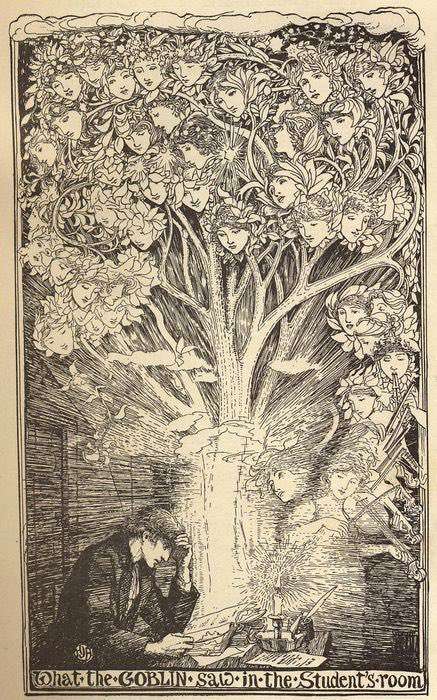
I was scrolling through Twitter, when I came across a post displaying a lovely 19th-century engraving of a magical tree from “The Goblin and the Grocer” (Danish: Nissen hos Spekhøkeren, 1852), a fairy tale by Hans Christian Andersen. The tree is shown to have smiling, female head-shaped fruits similar to the waqwaq tree (fig. 5). The description of the tree reads:

Out of the book shot a streak of light which grew into a large tree and spread its branches far above the student. Every leaf was alive, and every flower was a beautiful girl’s head, some with dark and shining eyes, others with wonderful blue ones. Every fruit was a glittering star” (Anderson, 1904, pp. 13-14)

So it appears that the waqwaq tree came to influence European literature as well.

Fig. 5 – The tree engraving from “The Goblin and the Grocer” (larger version). From Anderson, 1904, p. 15.


Update: 04-05-22

I’ve archived a paper showing that magical battles of transformation can be traced to Ancient Near Eastern, Egyptian, and Greek stories.

Archive #36 – Sun Wukong and Battles of Magical Transformations


Update: 04-07-24

Here is a description of the Ginseng Fruit Tree from ch. 24:

There was a huge tree right in the middle of the garden, with long, healthy branches and luxuriant green leaves that somewhat resembled those of the plantain. Soaring straight up, the tree was over a thousand chi [1,043.30 ft or 318 m] tall, and its base must have measured seven [73.03 ft or 22.26 m] or eight zhang [83.46 ft or 25.44 m] around. Leaning on the tree, Pilgrim looked up and found one ginseng fruit sticking out on one of the branches pointing southward. It certainly had the appearance of an infant with a tail-like peduncle. Look at it dangling from the end of the branch, with limbs moving wildly and head bobbing madly! It seemed to make sounds as it swung in the breeze (based on Wu & Yu, 2012, vol. 1, p. 461).

只見那正中間有根大樹,真個是青枝馥郁,綠葉陰森,那葉兒卻似芭蕉模樣,直上去有千尺餘高,根下有七八丈圍圓。那行者倚在樹下,往上一看,只見向南的枝上露出一個人參果,真個像孩兒一般。原來尾間上是個扢蒂,看他丁在枝頭,手腳亂動,點頭幌腦,風過處似乎有聲。

Notes:

1) I changed the Wade-Giles to Pinyin.

2) Hall (2019) explains Iskander’s meeting with the talking tree takes place in both the Shahmana and the older Greek Alexander Romance (p. 149).

Sources:

A floral fantasy of animals and birds (Waq-waq). (n.d.). Cleveland Museum of Art. Cleveland, Ohio. Retrieved May 12, 2017, from http://library.clevelandart.org/site…0Waq%20waq.pdf

Anderson, H. C. (1904). The Goblin and the Grocer. In A. Lang (Ed.), The Pink Fairy Book (pp. 12-17). New York: Longmans, Green, and Co. Retrieved from https://archive.org/details/pinkfairybook00lang/page/12/mode/2up

Buzurg, S., & Freeman-Grenville, G. S. P. (1981). The book of the wonders of India: Mainland, sea and islands. London: East-West.

Foster, M. D. (2015). The book of yōkai: Mysterious creatures of Japanese folklore. Oakland: University of California Press.

Hall, M. (2019). The imagination of plants: A book of botanical mythology. Albany : State University of New York Press

Hsia, C. (2015). The classic Chinese novel: A critical introduction (Rev. ed.). Hong Kong: The Chinese University of Hong Kong. ( Original work published 1968)

Robinet, I. (1979). Metamorphosis and deliverance from the corpse in Taoism. History of Religions, 19(1), 37-70.

Toorawa, S. M. (2000). WaÃq al-waÃq: Fabulous, fabular, Indian Ocean (?) island(s). Emergences, 10(2), 387-402.

Wivell, C.S. (1994). The story of how the monk Tripitaka of the great country of T’ang brought back the Sūtras In V. Mair (Ed.), The Columbia anthology of traditional Chinese literature (pp. 1181-1207). New York: Columbia University Press.

Zhang, Z., & Unschuld, P. U. (2015). Dictionary of the Ben cao gan mu: Volume 2 – Geographical and administrative designations. Oakland, California: University of California Press