Archive #47: The Newly Annotated Journey to the West With Illustrations (Xinshuo Xiyouji (tuxiang), 1749/1888)

I. Original Text

The Newly Annotated Journey to the West (Xinshuo Xiyouji, 新說西遊記, 1749) by Zhang Shushen (張書紳) is one of three popular editions of JTTW that circulated during the Qing Dynasty (1644-1911) and overshadowed the original. [1] It contains a running commentary dispersed throughout the pilgrims’ many adventures. Anthony C. Yu (Wu & Yu, 2012) describes Zhang’s work as having a Confucian bias:

In his unabridged hundred-chapter Xinshuo Xiyouji (The Journey to the West, Newly Interpreted) of 1749, Zhang Shushen declared in the section entitled “Xiyouji zongpi 西游記總批 (Overall Comments on The Journey to the West)” that “the book Xiyou has been designated by the ancients as a book meant to illuminate the Dao [a pointed dig at the 1662 edition titled Xiyou zhengdao shu, with the Daoist-leaning preface attributed to Yu Ji … ], by which it originally means the Dao of the sages, the worthies, and the Confucians (儒 Ru). To consider it an illumination of the Dao of immortals and Buddhism would be a mistake, indeed.” From a point of view clearly unsympathetic to the popular movement of Three-Religions-Joining-As-One (sanjiao heyi 三教合一, a possibly millennium-old notion … ), Zhang defended the story of the quest for Buddhist scriptures as an allegory of the classic Confucian doctrines on the illustration of virtue (mingde 明德) and the rectification of the mind (zhengxin 正心), ignoring the repeated and complex elaborations of zhengxin in Chan Buddhism also for at least a thousand years prior to his time (vol. 1, pp. 51-52).

I’ve decided to archive a scanned copy of this work for posterity.

A digital version of the text (interspersed with other commentaries) can be found here.

Book link

Click to access Journey-to-the-West-Newly-Annotated-by-Zhang-Shushen-Xinshuo-Xiyouji-compressed.pdf

II. Text With Illustrations

I’ve previously archived illustrated versions of JTTW, including the original 1592 edition, (images from) Li Zhuowu’s late-16th-century critique, and a circa 1835 Japanese translation. Here, I’d like to add another, the Newly Annotated Journey to the West With Illustrations (Xinshuo Xiyouji tuxiang, 新說西遊記圖像, 1888). The original text and commentary are the same, but this edition features a preface by Wang Tao (王韜), as well as over 100 woodblock prints.

The prints in the archived book below are admittedly a little fuzzy. This webpage has somewhat clearer versions.

Book link

Click to access Journey-to-the-West-Newly-Annotated-With-Illustrations-1888-compressed.pdf

Prints of Zhu Bajie and Sun Wukong from the opening illustrations (larger version).

Note:

1) The Qing versions are noted for having shoehorned Tripitaka‘s life story (chapter nine) into the original 100 chapters of the 1592 edition.

Story Idea: Sun Wukong vs Juggernaut

From time to time I like to post a fun blog not directly related to (though sometimes informed by) my research. Regular articles will resume later.

Note: This is not about power scaling.

I. Background

In chapter 59 of Journey to the West (Xiyouji西遊記, 1592), Princess Iron Fan uses her magic fan to blast Sun Wukong into the heavens (Wu & Yu, 2012, vol. 3, p. 126). The book provides two conflicting figures as to its effective range, stating that the fan can blow a target a total of 84,000 li (bawan siqian li, 八萬四千里; 26,097.59 mi/42,000 km) or 108,000 li (shiwan baqian li, 十萬八千里; 33,554 mi/54,000 km) (based on Wu & Yu, 2012, vol. 3, pp. 127-128 and 148). To combat this weapon, the Bodhisattva Lingji (Lingji pusa, 靈吉菩薩) offers our hero a magical Buddha treasure:

Lingju said, “In years past when I received the instructions from Tathagata, [1] I was given a Flying-Dragon Staff and a Wind-Arresting Elixir [Dingfeng dan, 定風丹; fig. 1]. [2] The staff was used to subdue the wind demon [from ch. 21], but the elixir has never been used. I’ll give it to you now, and you can be certain that that fan will not be able to move you (Wu & Yu, 2012, vol. 3, p. 128).

靈吉道:「我當年受如來教旨,賜我一粒定風丹、一柄飛龍杖。飛龍杖已降了風魔。這定風丹尚未曾見用,如今送了大聖,管教那廝搧你不動 … 」

Lingji then sews it into his robe collar, and the next time that he faces Princess Iron Fan, her weapon has no effect on him (Wu & Yu, 2012, vol. 3, pp. 128-129).

Fig. 1 – The Great Sage receives the Wind-Arresting Elixir (larger version). Image found here. I believe this comes from the circa 1999/2000 Monkey King cartoon.

But Sun accidentally swallows the treasure at some point, and it causes a physical change in his body. Chapter 61 reads:

He [the Bull Demon King] did not know, however, that when the Great Sage changed previously into a tiny mole cricket to enter the stomach of Raksasi [in ch. 59], [3] he still had in his mouth that Wind-Arresting Elixir, which he swallowed unwittingly. All his viscera had become firm; his skin and bones were wholly fortified (emphasis added). No matter how hard the Bull King fanned at him, he could not be moved (Wu & Yu, 2012, vol. 3, p. 149).

不知那大聖先前變蟭蟟蟲入羅剎女腹中之時,將定風丹噙在口裡,不覺的嚥下肚裡,所以五臟皆牢,皮骨皆固,憑他怎麼搧,再也搧他不動。

Let me reiterate: the elixir makes the Great Sage’s organs lao (牢), or “solid” or “firm,” like a prison (dictionary), and it also makes his skin and bones gu (固), or “solid” or “firm” like a four-sided structure (dictionary). Therefore, the pill essentially fortifies his body to the point of becoming an immovable object, even in the face of divine wind capable of blasting someone tens of thousands of miles or kilometers away. This makes him a perfect component of the Irresistible Force Paradox. This power is forgotten in subsequent chapters—a consequence of the novel’s origin as a collection of piecemeal stories—but this would be an interesting element to explore in fanfiction.

The other half of the paradox could be filled by the Juggernaut (Ch: Hong tanke, 紅坦克, or “Red Tank”), a.k.a. Cain Marko (Ch: Kaiyin Make, 凱因·馬可) (fig. 2), a Marvel Comics villain created by Stan Lee and Jack Kirby and first introduced in 1965. He was previously the human step-brother of the powerful mutant telepath Charles Xavier, but after finding a magic gem inside an ancient temple, he became the avatar of the extradimensional deity Cyttorak and was empowered with great physical strength, durability, and immortality. He is often portrayed as unstoppable when in motion. For example, in Uncanny X-Men #183, the Wolverine describes him as “the closest thing on Earth to an irresistible force” (Claremont, 1984, p. 19).

Fig. 2 – The Juggernaut advances on the viewer (larger version). Image found here.

II. Similarities

Both Sun and the Juggernaut are:

  1. Fierce
  2. Super strong
  3. Super durable
  4. Immortal
  5. Empowered by divine beings, Buddha and Cyttorak, respectively (see here for cited examples of all of Monkey’s powers and skills)

The only difference between them—beyond size and origins—is that the powers under discussion are polar opposites, making one an immovable object and the other an unstoppable force. So, what do you think would happen if they ever came to blows?

III. Scenario

The only way I can think of that the Great Sage and Juggernaut could meet would involve borrowing story elements from the “Fear Itself” cross-over event in which both characters make appearances. In Iron Man 2.0 #5-7, Marvel’s Sun Wukong is introduced as a divinely empowered crime boss who’s released from hell when one of the magic hammers of Serpent, the Asgardian god of fear and the deposed brother of Odin, punches through Beijing, China and opens the dimensional barrier separating the underworld from earth. He attempts to lift the enchanted weapon on his way out but fails since he’s not the fated owner (figs. 3a,b,c & 4) (Spencer, 2011a; 2011b; 2011c). In Fear Itself #2, another hammer impacts Juggernaut’s island prison (on New York’s East River), and upon touching it, he becomes Serpent’s new warrior, “Kuurth, Breaker of Stone” (figs. 5a,b,c) (Fraction, 2011). Now, for the purposes of our story, instead of the weapon breaking into hell, imagine it opens a rift to the Buddho-Daoist cosmos of Journey to the West during the quest to India. This would allow a novel accurate Monkey King (fig. 6) to eventually battle Juggernaut, as well as meet modern day superheroes. This change would, of course, require widescale alterations to the rest of the “Fear Itself” storyline. [4] I’m open to suggestions.

How the battle goes would depend on the writer. I’m biased, so I would naturally root for Sun Wukong.

Fig. 3(a) – After beating up some demonic thugs, Sun Wukong sees the hammer falling (here); (b) it makes impact (here); and (c) he first touches it (here) (Spencer, 2011a). Fig. 4 – He fails to lift the enchanted weapon (larger version) (Spencer, 2011b). Fig. 5(a) – A separate hammer impacts the Juggernaut’s prison (here); (b) he first touches it (here); and (c) he is transformed into Serpent’s new warrior (here) (Fraction, 2011). Copyright Marvel comics. Fig. 6 – A nearly novel accurate Monkey King (larger version). A photomanipulation by me.

Notes:

1) This refers to the Buddha’s previous instructions to defeat “Great King Yellow Wind” (Huangfeng dawang, 黃風大王), a demon with a mastery of powerful, divine wind (Wu & Yu, 2012, vol. 1, pp. 413 and 419).

2) Lingji twice reveals (ch. 21 and 59) that the Wind-Arresting Elixir (Dingfeng dan, 定風丹) is a treasure bestowed by the Buddha (Wu & Yu, 2012, vol. 1, p. 419; vol. 3, p. 128). Yu (Wu & Yu, 2012) translates this magic pill as the “wind-stopping pearl” in chapter 21 (vol. 1, p. 419). And It’s interesting to note that a “wind-stopping pearl” (dingfeng zhu, 定風珠) is said to be one of many heavenly jewels decorating Tripitaka’s cassock in chapter 12 (Wu & Yu, 2012, vol. 1, p. 282).

3) This refers to Monkey’s plan to procure the magic fan by beating up Princess Iron Fan from inside her stomach (Wu & Yu, 2012, vol. 3, p. 129).

4) The changes to the comic book storyline wouldn’t affect the original novel. Monkey would eventually return to his universe and continue the journey to India.

Sources:

Claremont, C. (1984, July). Uncanny X-Men (Vol. 1, No. 183 [Comic book]. New York, YK: Marvel. Retrieved from https://readallcomics.com/uncanny-x-men-v1-183/

Fraction, M. (2011). Fear Itself (No. 2) [Comic book]. New York, NY: Marvel. Retrieved from https://readallcomics.com/fear-itself-002-2011/

Spencer, N. (2011a). Iron Man 2.0 (No. 5) [Comic book]. New York, NY: Marvel Comics. Retrieved from https://readallcomics.com/iron-man-2-0-05/

Spencer, N. (2011b). Iron Man 2.0 (No. 6) [Comic book]. New York, NY: Marvel Comics. Retrieved from https://readallcomics.com/iron-man-2-0-06/

Spencer, N. (2011c). Iron Man 2.0 (No. 7) [Comic book]. New York, NY: Marvel Comics. Retrieved from https://readallcomics.com/iron-man-2-0-07/

Wu, C., & Yu, A. C. (2012). The Journey to the West (Vols. 1-4) (Rev. ed.). Chicago, Illinois: University of Chicago Press.

Why Did the White Dragon Horse Burn His Father’s Pearls in Journey to the West?

Last updated: 03-03-2026

This is the first of three articles where I will present info about the disciples’ lives prior to the main events of Journey to the West (Xiyouji西遊記, 1592; “JTTW” hereafter). This piece will focus on the White Dragon Horse (Bai longma, 白龍馬). The next two will focus on Zhu Bajie (here) and Sha Wujing. These are meant to compliment my previous essay on Sun Wukong.

This particular article is based on a question put to me by a reader in late-January 2023:

I was wondering about Ao Lie’s* punishment. I know that he burned a pearl from the Jade Emperor (I think?), but I’m not exactly clear as to why he did that. Was it on accident or in anger, or is there a reason given?

* Ao Lie (敖烈) is a modern name for the dragon that comes from a live action TV show called Journey to the West Afterstory (Xiyouji houzhuan, 西游记后传, 2000). [1] JTTW chapter 15 actually calls him Yulong san taizi (玉龍三太子), or “Third Prince Jade Dragon.”

What follows is a formatted and expanded version of my reply. [2]

Table of Contents

1. Explanation

The Jade Dragon briefly describes the details of his crime to the Bodhisattva Guanyin in JTTW chapter eight:

Because I inadvertently set fire to the palace and burned some of the pearls therein, my father the king [Ao Run] memorialized to the Court of Heaven and charged me with grave disobedience. The Jade Emperor hung me in the sky and gave me three hundred lashes, and I shall be executed in a few days. I beg the Bodhisattva to save me (Wu & Yu, 2012, vol. 1, p. 213).

… 因縱火燒了殿上明珠,我父王表奏天庭,告了忤逆。玉帝把我吊在空中,打了三百,不日遭誅。望菩薩搭救搭救。」

However, despite Yu’s (Wu & Yu, 2012) translation, the original Chinese doesn’t include a word meaning “inadvertently.” In fact, zonghuo (縱火) means “to set fire” or “arson,” meaning that the Third Prince did it on purpose—for whatever selfish reasons. Unfortunately, the novel doesn’t go into anymore detail.

2. Possible Origin

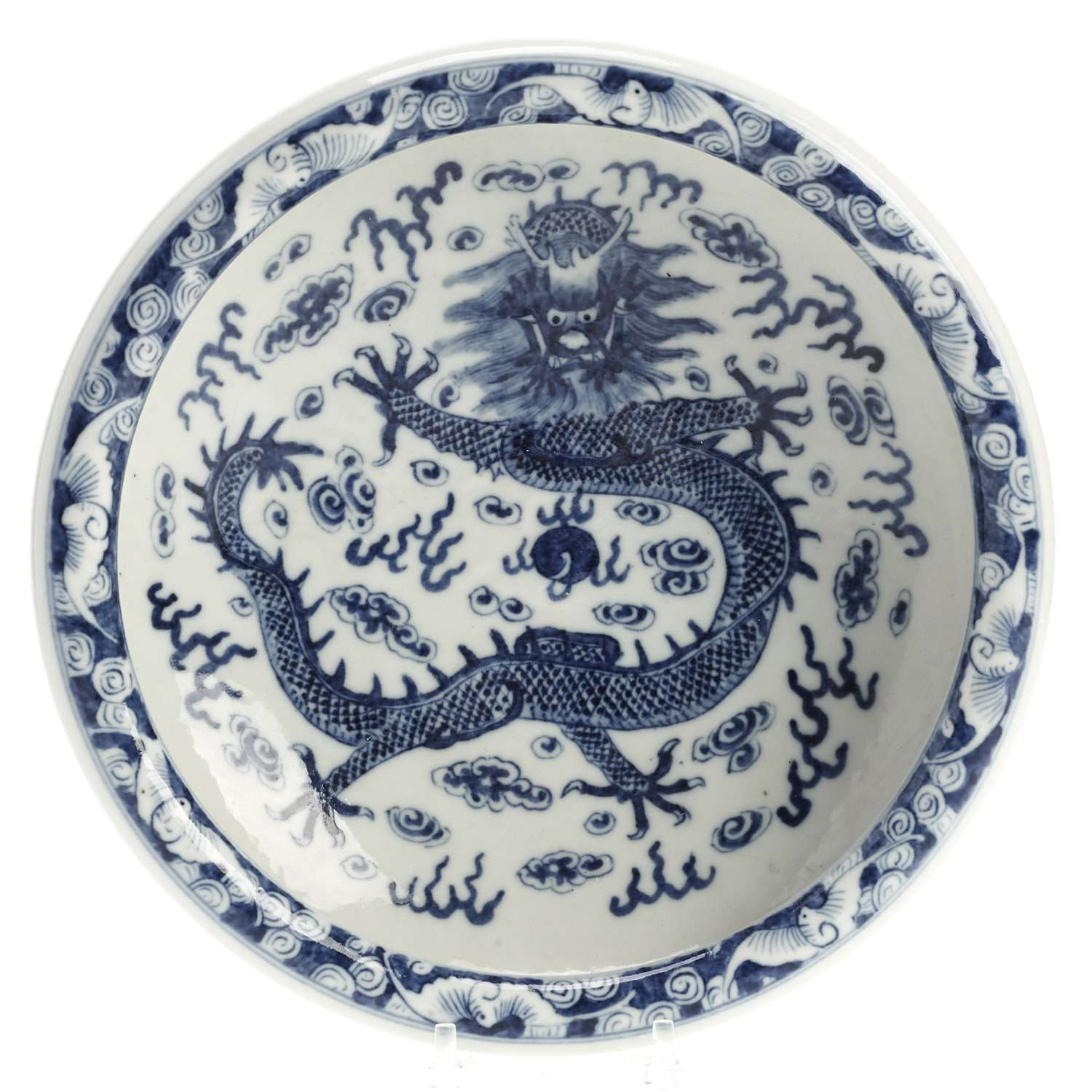
I suggest that this episode is intended to explain the “dragon chasing a jewel” (ganzhu longwen, 趕珠龍紋) motif in Chinese art. The jewel is shown emitting flames, and the dragon looks as if it’s frozen in the heavens, just like the Jade Dragon Prince was (fig. 1).

Fig. 1 – A Qing-era plate showing the dragon chasing a flaming jewel motif (larger version). Image found here. I like to think the title of this piece is “SHIT SHIT SHIT SHIT!!!! MY DAD’S GONNA KILL MEEE!!!!”

3. Significance

The pearl-burning incident is important because it directly leads to Jade Dragon joining the pilgrimage to India. After being rescued by Guanyin, he’s recruited and sent to wait for the Tang Monk “in a deep mountain stream” (shenjian zhi zhong, 深澗之中), and he official joins the quest in chapter 15 following a brief confrontation with Monkey at the specifically named Eagle Grief Stream (Yingchou jian, 鷹愁澗) (Wu & Yu, 2012, vol. 1, pp. 214 and 327-328).

Here’s the scene where he is transformed into a horse:

The Bodhisattva went up to the little dragon and plucked off the shining pearls hanging around his neck. She then dipped her willow branch into the sweet dew in her vase and sprinkled it all over his body; blowing a mouthful of magic breath on him, she cried, “Change!” The dragon at once changed into a horse with hair of exactly the same color and quality as that of the horse he had swallowed (Wu & Yu, 2012, vol. 1, p. 328).

菩薩上前,把那小龍的項下明珠摘了,將楊柳枝蘸出甘露,往他身上拂了一拂,吹口仙氣,喝聲叫:「變!」那龍即變做他原來的馬匹毛片。


4. Updates

Update: 01-04-25

It just dawned on me that Jade Dragon’s portrayal as a mischief-causing third prince mirrors the early life of Third Prince Nezha (San taizi Nezha, 三太子哪吒; Nezha san taizi, 哪吒三太子), whose devilry leads to him battling and killing the dragon Third Prince Ao Bing (San taizi Ao Bing三太子敖丙) in Investiture of the Gods (Fengshen yanyi封神演義, c. 1620) chapter twelve (Gu, 2000).


Update: 01-05-25

Friend of the blog Ryin-Silverfish has reminded me that the Third Dragon Prince is also associated with fire in the early-Ming JTTW Zaju play that predates the standard 1592 edition of the novel. He appears in “Act Seven: Mucha Sells a Horse” (Diqi chu Mucha shouma, 第七出 木叉售馬) as the “Third Prince Fire Dragon” (Huolong san taizi, 火龍三太子), who is sentenced to death for not delivering the full amount of rain to a given area as ordered by the heavenly court. And after being pardoned, he is transformed into a horse just like his novel counterpart.


Update: 03-03-26

Chinese art historian Jin Xu has posted on twitter about pottery found in a 14th-century shipwreck from Singapore. One is a blue and white dish with a lovely example of the dragon chasing a flaming jewel motif (fig. 2). I like it more than the example from above.

Fig. 2 – The dragon dish (larger version). See figure one in the June 2025 report.

Note:

1) Thank you to the good folks over at the JTTW Discord for connecting the name to a TV show, and thank you to reader innerdreamily6dcc2c3a93 for giving me the specific name.

2) I actually added this material as a January 2023 update to a previous article, but I decided to split it off into this new post.

Source:

Gu, Z. (2000). Creation of the Gods (Vols. 1-4). Beijing: New World Press.

Wu, C., & Yu, A. C. (2012). The Journey to the West (Vols. 1-4). Chicago, Illinois: University of Chicago Press.

Review: The Second Journey (2024) by Joel Bigman

Note: I was not paid for this review.

Format: Ebook ($6.99 USD) and paperback (280 pages; $19.99 to $21.99 USD) [1]
Publisher: Earnshaw Books Ltd.
Release date: December 17th, 2024
Purchase links:

1. Introduction

Over two decades ago I was inspired by Journey to the West (Xiyouji西遊記, 1592 CE; “JTTW” hereafter) to begin writing my own Chinese fantasy about an itinerant disciple of Sun Wukong battling monsters across ancient China. However, this all changed when I learned about the Kaifeng Jews, a historical enclave of sinified Israelite descendants who have lived in the Middle Kingdom for nearly a millennium. This convergence of two different cultures immediately captured my imagination, leading to the main character becoming the son of a founding member of the community. He would go on to brave supernatural events and creatures while serving as a soldier under General Yue Fei (1103–1142 CE), [2] eventually becoming a Jewish sage and powerful exorcist later in life. However, the book ultimately didn’t materialize as I came to realize that I was much better at coming up with research-based story ideas than actually writing narratives. Thus, my dreams of a Chinese-Jewish fantasy novel never came to pass.

But fret not, for Joel Bigman has written The Second Journey (2024), a modern sequel to JTTW, which is being touted as “The World’s First Chinese-Jewish Historical Fantasy.” [3] The story is framed as the contents of a lost 7th-century CE scroll discovered inside a buried jar while city planners investigate a watermain leak in modern Xi’an, Shaanxi province, China. A subsequent translation of the Aramaic text reveals a second, unknown journey undertaken by Xuanzang, Sun Wukong, and Zhu Bajie (but not Sha Wujing or the Dragon Horse) five years after their original return. This new quest is initiated by the Bodhisattva Guanyin, who requests that the Tang Monk seek knowledge outside of China for the benefit of the Kaifeng Jews, who have assimilated so much into Chinese culture that they’ve forgotten how to read their Hebrew scriptures. The trio travels past India and into Central Asia, where they procure the services of “Bear” (a.k.a. the “Second Samson“), a supernaturally strong Jew with knowledge of the various routes and personages of Historic Palestine. Together with a mysterious donkey, they travel from town to town looking for a holy man willing to return to China and become the Kaifeng Jewish community’s new teacher, thereby reigniting their religious life. Bear arranges for the pilgrims to meet and stay with several such holy men—allowing them to learn Hebrew and Jewish culture and religious history along the way—but the search for the right candidate is quite difficult.

Cover art by the wonderful Yuyu (与鱼), a freelance illustrator. You can see other examples of their work here.

2. Analysis

2.1. Compare and contrast

How does The Second Journey compare to JTTW? Recall that the original is a fictionalized retelling of the historical monk Xuanzang‘s (玄奘, 602–664 CE) journey to India from 627 to 645 (640 to 654 in the novel) (Buswell & Lopez, 2014, pp. 1015-1016; Wu & Yu, 2012, vol. 1, p. 293; vol. 4, p. 374). The set up for the sequel is also based on actual history. The Jewish community of Kaifeng, Henan Province, China is believed to have been founded around the Northern Song Dynasty (960–1127 CE), [4] and after centuries of unchecked assimilation, the enclave became religiously extinct sometime after the last Rabbi with knowledge of Hebrew died around 1800, [5] during the Qing Dynasty (1644–1911 CE). Joel has simply taken some artistic license by setting these events during the Tang Dynasty (618–907 CE). Also, the novel is full of historical Jewish sages and people that Xuanzang and his companions come to meet and/or learn from over the course of their journey. These include Eliezer ben Hurcanus, Yehoshua ben Hananiah, Akiva ben Joseph, Elisha ben Abuyah, Simeon ben Azzai, Simeon ben Zoma, Honi HaMe’agel, Shimon bar Yochai and his son Eleazar ben Shimon, Hillel the Elder, Rav Nachman bar Yaakov and his wife Lady Yalta, Rav Sheshet, Yohanan ben Zakkai, Shimon ben Lakish, Rabbi Tarfon, Judah ha-Nasi, Rabbi Meir and his wife Bruriah, and others. One of my favorite historical moments happens in “Wine,” when Monkey helps an enraged Lady Yalta attain catharsis by prompting her to smash hundreds of casks in a wine cellar after being slighted by her husband’s house guest (Bigman, 2024, pp. 138-140). Another happens in “Mother,” when Sun smashes a vase at the behest of Xuanzang in order to snap grieving disciples out of their ceaseless prayers, which are keeping ailing Rabbi Judah from dying (Bigman, 2024, pp. 165-167). Inserting our heroes into these Talmudic stories is an ingenious way of making the pilgrims feel that much more real, like they are being pulled out of myth and thrust into the real world.

JTTW is full of enlightened beings, gods, immortals, and demons and ghosts that can fly and wield spells and mystic objects for benign or malevolent purposes. The Second Journey also features magic. I can’t continue without first acknowledging that the historical Jews listed above actually lived centuries before Xuanzang was even born—something that informed readers may have already figured out. This means that the story follows a dreamlike timeline where the group magically flows like water between their present, the early Talmudic period (70–638 CE), and the distant Exodus Period, freely interacting with sages, prophets, patriarchs, and even God himself along the way. [6] Some of these Jewish holy men have mystical adventures of their own, such as in “Orchard” when Rabbi Akiva and others fly on a flaming chariot to the “Orchard of mystical knowledge” in order to discuss spiritual matters with wise men-cum-divine beings, or in “Slow Cart” when Sage Honi, a biblical rain-maker, is transported in his dreams to the past events of JTTW chapter 46, where he takes part in a rain-making competition against a Daoist animal-spirit (Bigman, 2024, pp. 56-62 and 99-104). And of course no JTTW story would be complete without Monkey showing off his magic powers. One of the more inventive uses of his abilities happens in a particular chapter where the titanic, golem-like angel Gabriel produces a giant clay sword from his thigh, and Monkey uses the intense spiritual flames inside his divine body to carburize it into a fine steel blade (Bigman, 2024, pp. 79). You’ll have to read the book to see how the weapon is used.

The original story is set in a world where Buddhism, Daoism, and Confucianism live in harmony with one another. The sequel also features such religious pluralism. In “Kaifeng,” Guanyin explains that she is sending the Tang Monk to the Western lands in order to save the Kaifeng Jews from being completely absorbed by Chinese culture. And in order to accomplish this, Xuanzang must bring foreign knowledge back to the Eastern lands, referring to it as “[s]eeds that may grow into something new” (Bigman, 2024, p. 11). As mentioned above, “Orchard” sees Jewish sages travel to a mystical orchard, where they converse with wise country folk, who are in actuality the Jade Emperor and Laozi (Bigman, 2024, pp. 59-62). This implies that even Jewish holy men can benefit from the knowledge of the East. A third example takes the form of the novel’s two-fold world system, where the Eastern and Western lands are two distinct realms overseen by the Jade Emperor and God, respectively. The reader first learns about this partitioned cosmos in “Oven” when Monkey seeks Guanyin’s aid in order to facilitate a biblical miracle:

In the past, you have received help in battling demons, either from myself, or from other celestial beings. But in this case, even the Jade Emperor cannot help you. These [Western] lands are too far away from our realm. You must ask for help from the emperor in a different heaven, in the Far Western Heaven […] He is Olam-Tzu, World-Master. The westerners call him Ribbono Shel Olam. You’ll have to find your own way to his heaven (Bigman, 2024, p. 36).

JTTW is full of humor, my favorite episode being when Monkey tricks three animal-spirits into drinking “elixir” which is actually the disciples’ stinky urine (Wu & Yu, 2012, vol. 2, pp. 286-287). BWAHAHAHA!!! The Second Journey also has its funny moments. In “The Other,” we learn our heroes have melodious snores:

Our friends woke up late the following morning; only Xuanzang woke up before noon. There was a whole chorus of snoring, led by the renowned soloist Pigsy, accompanied by Bear, their Foreign Guide, and our dear Monkey (Bigman, 2024, p. 187).

My absolute favorite comical moment happens in “Karma,” when Sage Sheshet warns Zhu that his over indulgence of Sabbath stew will come back to haunt him. And sure enough, after eating eighteen bowls worth, horrible stomach pains wake him from his afternoon nap. This causes him to worry that he has once again become magically pregnant like in chapter 53 of the original. But instead of relying on magic abortion water this time to end his suffering, his problem is solved by ripping nasty, giant farts (Bigman, 2024, pp. 145 and 148-150).

Beyond cultural and religious differences, the only applicable element that contrasts with JTTW is that Historic Palestine is said to be free of monsters (Bigman, 2024, pp. 46 and 109, for example). Monkey does briefly tangle with some biblical baddies in the sequel, but they are separated from the human world and therefore do not pose an immediate threat to the Tang Monk. This lack of action might be a little depressing for fans of the original, but readers should understand that both books serve different purposes. JTTW is chocked full of spirits that act as both merit-building obstacles and cultivation-facilitating illusions of the mind. These act as metaphors for the journey towards Buddhist enlightenment. However, such concepts aren’t needed in The Second Journey since Joel tells me that the point of the book is to introduce readers to Jewish culture and history via the medium of Xuanzang’s quest to find a teacher. Therefore, our heroes spend the majority of the story learning local beliefs and customs, listening to biblical tales, and acting as casual observers of Jewish religious history as it unfolds during their time travels. Entering the book with this knowledge should make it more enjoyable.

2.2. Suggestions

The book’s version of Xuanzang is an amalgam of his historical and literary counterparts. While this generally meshes well within the more realistic context of Historic Palestine, it does cause a problem in one particular instance. In “Bandits,” the pilgrims are accosted on the road by a group of highwaymen, and after their Daoist immortal-looking leader neutralizes Sun, Zhu, and Bear with a magic net, they choose the Tang Monk and a temporary travel companion as sacrifices to the Hindu goddess Durga. But a mysterious, powerful wind sent from heaven causes them to change their minds. The bandit leader is eventually revealed to be a Jew with a shady past who would go on to become a great holy man (Bigman, 2024, pp. 152-156). The problem is that the attempted sacrifice supposedly happened to the historical Xuanzang in India while sailing down the Ganges River (Huili & Shi, 1995, pp. 76-78). Recall that the historical Sage Honi travels back in time to past events from JTTW in “Slow Cart,” but this happens in his dreams. The episode under discussion is different because a historical event from India—which should have already happened to our composit Xuanzang—has been transposed onto Historic Palestine. It’s so out of place that it took me out of the story at that moment. The same can be said about a Daoist Jew leading a group of Hindu bandits in the Levant. I understand that Joel was trying to manufacture tension here, but he could have come up with an original group of bandits, and that way, Xuanzang could liken the experience to the one he had in India years prior. Or better still, the event could be likened to the Tang Monk’s experience in JTTW chapter 56 when Monkey is kicked out of the group for killing brigands, including beheading the wayward son of a local elderly couple (Wu & Yu, 2012, vol. 3, pp. 88-90). Perhaps Sun is put into a similar situation in the sequel where he could easily kill, but he doesn’t, thereby showing his master that he has internalized restraint.

And lastly, beyond fixing some minor issues, [7] the book would benefit from adding a glossary or footnotes to explain the names and significance of the various Jewish personages featured in the narrative. Joel told me that he “didn’t want to make it too ‘educational,’ like lecturing at the reader,” but non-Jews like myself who lack an extensive knowledge of Jewish religious history will no doubt be lost without some kind of guide. Having one would, therefore, make the novel far more accessible and enjoyable to a wider audience. As evidence of this, I actually read the book twice for this review, and I found that I enjoyed it more the second time around after having looked up info about the historical people and events.

3. My rating

I give The Second Journey four and a half out of five stars. The book is well-written, with smooth and oftentimes thought-provoking dialogue. The worldbuilding is very creative and yet still respectful to both Jewish beliefs and Chinese mythos. It’s definitely a great way to introduce someone to Jewish culture and religious history via Journey to the West. I highly recommend it!

Notes:

1) I read the Kindle version for this review. My thanks to Joel for giving me an advanced copy.

2) This was based on Weisz (2006), who shows that the Kaifeng Jews reference Yue Fei’s famous patriotic back tattoo, “Serve the country with utmost loyalty” (Jinzhang baoguo, 盡忠報國), in two of three main stone monuments erected in 1489, 1512, and 1663. The first mention appears in a section of the 1489 stele:

[…]

They received kindness from the Prince,
Lived on the income from the Prince
(They) only exerted in prayers To inform Heaven of their sincerity
Which meant “Boundless loyalty to the country and Prince.” (emphasis added)
May the Great Emperor of the Ming
His virtue surpass that of Yu and Tang
and His Highness that of Yao and Xun (Weisz, 2006, p. 18).

[…]

… 受君之恩食君之祿惟盡禮拜告天之誠報國忠君之意祝頌大明皇上德邁禹湯聖並堯舜 … (White, 1966, p. 38; see also the punctuated version).

The second is in a section of the 1512 stele:

[…]

Look at today.
If those who initiated subjects to study
And “brought glory to one’s parents
And became celebrated”
They had made it.
If those who arranged order among China and foreigners and were loyal to the Prince and benefited the people, they had made it.
Or, those who subdued the enemy and resisted aggression
And where “boundlessly loyal to the country” (emphasis added)
They had made it (Weisz, 2006, p. 26).

[…]

… 今日若進取科目而顯親揚名者有之若布列中外而致君澤民者有之或折衝禦侮而盡忠報國者有 … (White, 1966, p. 53; see also the punctuated version).

3) This is per the book’s blurb:

The World’s first Chinese-Jewish Historical Fantasy.

The Tang Monk Xuanzang along with Monkey and Pigsy famously brought the Buddhist scriptures back to China. Now the trio go on a new adventure to get the Hebrew Scriptures. The strongman Bear joins them as they face new monsters and new challenges, and finally reach a land filled with hundreds of foreign sages, yet only one god. The search for a teacher willing to come back to China is difficult, but a talking donkey helps solve the problem.

A fresh parable linking the Chinese classic story with the worlds of Western Asia and Roman Palestine, The Second Journey brings together the cultures, myths and philosophies of all Asia.

4) See my two-part article (here and here) summarizing theories about when the Kaifeng Jews first came to China.

5) Writing in 1850 CE, a Chinese protestant delegate sent to Kaifeng reported:

The present neglect of the Jewish religion is due to the fact that for these fifty years, there has been no one to instruct the members in the knowledge of the fifty-three sections of the Divine Scriptures, and in the twenty-seven [sic] letters of the Jewish alphabet (White, 1966, p. 116).

“These fifty years” implies that the last rabbi died around 1800 CE.

6) Beyond a mention of a specific “magic time traveling cave” in “Cave” (Bigman, 2024, p. 112), the reason for their time-jumping is never openly explained in the narrative. But Joel notes in his “Afterward” that he did this just so the Tang Monk could meet famous Jewish holy men (Bigman, 2024, p. 260).

7) The first minor issue is plot holes. For example, in “Kaifeng,” after being asked by Xuanzang to be his guide, Bear exclaims: “I have always wanted to go west, to where my people came from. I’ll gladly join you!” (Bigman, 2024, p. 19). But despite having never gone there, he spends the rest of the story expertly guiding the group throughout Historic Palestine like he’s intimately familiar with the routes, towns, and people. Another is that the pilgrims are able to understand spoken Hebrew without the narrative ever mentioning when they first started learning it. For instance, in “Oven,” Sun Wukong understands a debate between Jewish sages: “Old Monkey listened carefully and while it was hard to follow, the question seemed to be whether this specific oven was ritually pure or impure, or maybe whether it could become impure or not” (Bigman, 2024, p. 32). He goes on to use his magic to produce biblical miracles that support one holy man’s exclamations of truth (Bigman, 2024, pp. 34-35). In “Angels,” Bear claims out of nowhere that Xuanzang has been “learn[ing] their language, at least a bit,” and the Tang Monk shortly thereafter speaks to Moses with “accented formal Hebrew” (Bigman, 2024, p. 47). Official Hebrew lessons (in this case reading) are not mentioned until “Mother” (Bigman, 2024, p. 158). A lesser plot hole appears at the end of a particular chapter where Monkey rolls up the recently flayed hide of a biblical baddie on his staff, shrinks it, and stores it to never be seen again (Bigman, 2024, p. 80). I would have liked to have seen the skin play a part in another episode, perhaps serving as a magic blanket or being tailored into a magic robe.

The second minor issue is inconsistency. For instance, in “Kaifeng,” the sequel states that Monkey’s magic staff weighs 17,500 jin (22,762.73 lbs./10,325 kg), but “Oven” changes this to the novel accurate number of 13,500 jin (17,560 lbs./7,965 kg) (Bigman, 2024, pp. 17 and 35). “Leviathan” ups this to an astounding 54,000 jin (70,239.28 lbs./31,860 kg), and then “Skip” sees Sun hand the weapon to Moses, who picks it up with ease (Bigman, 2024, pp. 73 and 183). So, either the prophet is crazy strong, or Joel forgot how much the weapon weighs.

The third minor issue is typos. The book could do with an additional copy edit. I’ve alerted Joel to the misprints I noticed during my readings (please forgive any typos that are overlooked in this article).

Sources:

Bigman, J. (2024). The Second Journey. Hong Kong: Earnshaw Books Ltd. Retrieved from https://www.amazon.com/Second-Journey-Joel-Bigman/dp/9888843702.

Buswell, R. E. , & Lopez, D. S. (2014). The Princeton Dictionary of Buddhism. Princeton, NJ: Princeton University Press.

Huili, & Shi, Y. (1995). A Biography of the Tripitaka Master of the Great Ci’en Monastery of the Great Tang Dynasty (L. Rongxi Trans.). Berkeley, CA: Numata Center for Buddhist Translation and Research. Retrieved from https://www.bdkamerica.org/product/a-biography-of-the-tripitaka-master-of-the-great-cien-monastery/.

Weisz, T. (2006). The Kaifeng Stone Inscriptions: The Legacy of the Jewish Community in Ancient China. Bloomington, IN: iUniverse.

White, W. C. (1966). Chinese Jews: A Compilation of Matters Relating to the Jews of K’ai-fêng Fu (2nd ed.). Canada: University of Toronto Press. Retrieved from https://archive.org/details/lccn_66026456/mode/2up.

Why was Sun Wukong Able to Live 342 Years Prior to his Immortality?

Last updated: 04-23-2026

Someone on reddit recently asked why Sun Wukong was able to live just shy of 400 years before even attaining immortality. I thought this was a good question, so I decided to split off related material from an old piece that I never finished and make a quick article. The short answer is tied to Daoist concepts of fate, and the long answer ultimately explains why Monkey strikes his name from the ledger of life and death in hell.

Table of Contents

1.  Novel Info

Here, I would like to quote two early sections from Journey to the West (Xiyouji西遊記, 1592) that refer to Sun Wukong’s age. The first appears in chapter one after he becomes monarch of the primates:

The Handsome Monkey King thus led a flock of gibbons, macaques, and horse-monkeys, some of whom were appointed by him as his ministers, aides, and envoys. They toured the Flower-Fruit Mountain in the morning, and they lived in the Water-Curtain Cave by night. Living in concord and sympathy, they did not mingle with bird or beast but enjoyed their independence in perfect happiness. For such were their activities:

In the spring they gathered flowers for food and drink.
In the summer they went in quest of fruits for sustenance.
In the autumn they amassed taros and chestnuts to ward off time.
In the winter they searched for yellow-sperms to live out the year.

The Handsome Monkey King had enjoyed this insouciant existence for three to five hundred years (emphasis added) when one day, while feasting with the rest of the monkeys, he suddenly grew sad and shed a few tears (based on Wu & Yu, 2012, p. 106).

美猴王領一群猿猴、獼猴、馬猴等,分派了君臣佐使。朝遊花果山,暮宿水簾洞,合契同情,不入飛鳥之叢,不從走獸之類,獨自為王,不勝歡樂。是以:

春採百花為飲食,夏尋諸果作生涯。
秋收芋栗延時節,冬覓黃精度歲華。

美猴王享樂天真,何期有三五百載。一日,與群猴喜宴之間,忽然憂惱,墮下淚來。

And the second appears in chapter three after Monkey is dragged to hell. He bullies underworld officials into giving him his ledger of life and death, in which he learns his exact age and fate:

You see, though this monkey resembled a human being [i.e. his body], he was not listed under the names of men; though he resembled the short-haired creatures [i.e. his fur], he did not dwell in their kingdoms; though he resembled other animals, he was not subject to the unicorn; and though he resembled flying creatures [i.e. his beak-like, protruding face], he was not governed by the phoenix. He had, therefore, a separate ledger, which Wukong examined himself. Under the heading “Soul1350” he found the name Sun Wukong recorded, with the description: “Heaven-born Stone Monkey. Age: three hundred and forty-two years. A good end” (emphasis added) (Wu & Yu, 2012, p. 140).

又看到猴屬之類,原來這猴似人相,不入人名;似臝蟲,不居國界;似走獸,不伏麒麟管;似飛禽,不受鳳凰轄。另有個簿子,悟空親自檢閱,直到那「魂」字一千三百五十號上,方注著孫悟空名字,乃「天產石猴,該壽三百四十二歲,善終」

So why then was he able to live so long?

2. Religious Background

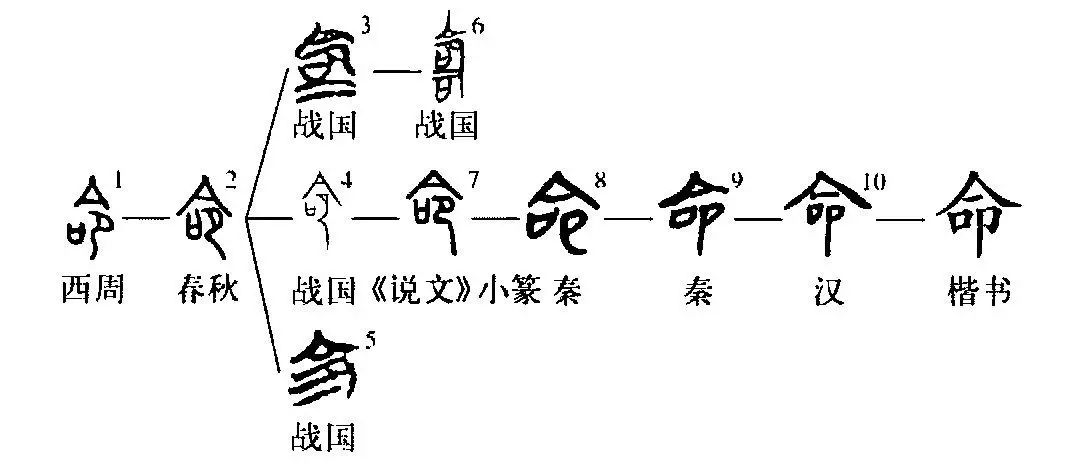
The answer lies in the concept of “pre-allotted lifespans” (ming, 命; a.k.a. “fate”) (fig. 1), which can be traced to weft texts [1] and Grand Purity (Taiqing, 太清) scriptures of the Han dynasty (3rd-c. BCE to 3rd-c. CE). According to 1st to 3rd-century CE commentators, a person’s lifespan and good or bad fortune in life were determined according to whatever combination of “heavenly pneumas” (tianqi, 天氣) and “astral essences” (xingjing, 星精) that they were born under, meaning one’s fate was not handpicked by heaven (Campany, 2005, pp. 131-134). This allotted lifespan was not set in stone, however, for it was subject to subtractions and additions based on one’s bad or good deeds. The deity in charge of this tally system was called the “Director of Allotted Life Spans” (Siming, 司命), and, unlike the underworld officials who provided Monkey with his ledger, he was said to reside in heaven where he regularly received reports on individual human sins by the tutelary Stove god (Zaoshen, 竈神) on the first, fifteenth, and last day of every month. Additionally, he received reports from the three corpses/worms (sanshi, 三尸) inhabiting a person’s body. [2] The more a person sinned, the more points (time) was subtracted, anywhere from almost a year for major offences to just three days for minor offences. Doing good deeds or cheating the system were the only ways to live out the entirety of the allotted lifespan (Campany & Ge, 2002, pp. 47-52).

Evolution of the character ming () (larger version). Image found here.

Ways of “living off the books” included magically disguising clothing or a sword as a body (fig. 2), ritually bribing the gods of life and death with a golden statue to be used as a substitute body, or inserting a fake death certificate into the coffin of a recently deceased grandfather. These methods essentially tricked heaven into thinking that the person had died (Campany, 2005, pp. 134-138; Campany & Ge, 2002, pp. 60). The use of longevity-bestowing elixirs was considered the only true way of breaking free of the allotted lifespan and achieving immortality. Interestingly, the Han-era Scripture on the Elixirs of the Nine Tripods (Jiuding danjing, 九鼎丹經) describes how taking a fired concoction of cinnabar, vinegar, and lacquer for a thousand days straight would result in the “Director of Allotted Life Spans expung[ing] your name from the registers of death, so that you will end only when Heaven and Earth do” (Campany & Ge, 2002, pp. 52).

Fig. 2 – A type of Chinese jian (劍) sword that might be magically disguised to look like a decoy body (larger version). Image found here.

2.1. Relation to Monkey

Therefore, we can see that Wukong’s allotted lifespan was 342 years and his birth fell under fortunate cosmic circumstances, for he was born onto an island paradise, served as the king of monkeys, and was destined to have a “good end” (shan zhong, 善終). Monkey had already achieved immortality via Daoist practices prior to being dragged to hell, so he had no need for cheating the system in order to live out the rest of his allotted lifespan. Nor did he need to take an elixir. He was simply so powerful that he could strike his name from the ledgers by force, thereby freeing himself from heaven’s control.

As for the significance of 342, Irwen Wong over at the Journey to the West Library blog has pointed out to me that the numbers add up to nine (3+4+2 = 9), which is an important digit in religious numerology. However, he also suggests that 342 could just be a random number chosen by the author-compiler. (See the 04-23-26 update below for more info.)


3. Updates

Update: 10-15-24

I was reminded that the max level in the hit video game Black Myth: Wukong (2024) is 342, an obvious reference to Monkey’s lifespan.


Update: 10-26-24

Someone on reddit disagreed with me regarding allotted lifespans. Instead, they suggested that Sun Wukong somehow naturally performs the Daoist breathing exercises that would eventually lead to his immortality, as in he lengthened his life via cultivation practices just like Monkey deduces the 270-year-old Buddhist abbot, “Elder of the Golden Pool” (Jinchi changlao金池長老), did in chapter 17 (Wu & Yu, 2012, vol. 1, p. 356). But this explanation ignores two elements from the novel. One, as mentioned above, the Great Sage’s allotted lifespan of 342 years is clearly recorded in the ledgers of life and death. This is beyond dispute. And two, the book presents cultivated longevity as a crime against heaven. For example, when Sun achieves immortality, the Patriarch Subodhi gives him a warning:

“What you have learned,” said the Patriarch, “is no ordinary magic: you have stolen the creative powers of Heaven and Earth and invaded the dark mysteries of the sun and moon. Your success in perfecting the elixir is something that the gods and the demons cannot countenance. Though your appearance will be preserved and your age lengthened, [heaven will send the three calamities to destroy you]” (Wu & Yu, 2012, vol. 1, p. 121).

祖師道:「此乃非常之道:奪天地之造化,侵日月之玄機;丹成之後,鬼神難容。雖駐顏益壽,但到了五百年後,天降雷災打你,須要見性明心,預先躲避。躲得過,壽與天齊;躲不過,就此絕命。再五百年後,天降火災燒你。這火不是天火,亦不是凡火,喚做『陰火』。自本身湧泉穴下燒起,直透泥垣宮,五臟成灰,四肢皆朽,把千年苦行,俱為虛幻。再五百年,又降風災吹你。這風不是東南西北風,不是和薰金朔風,亦不是花柳松竹風,喚做『贔風』。自顖門中吹入六腑,過丹田,穿九竅,骨肉消疏,其身自解。所以都要躲過。」

The aforementioned calamities are elemental attacks of divine lightening, fire, and wind that are respectively sent every 500 years to kill cultivators for defying their fated age and attaining immortality (Wu & Yu, 2012, vol. 1, pp. 121-122).

This negative view of immortality also extends to the cultivation practices that produce it. Campany (1985) explains that demons are evil in the novel because they try to bypass the natural cosmic hierarchy by using spiritual practices to encapsulate the universe within themselves, while the pilgrims follow the “correct” path by submitting to Buddhism and building Buddhist merit in place of the selfish quest for immortality (pp. 112-113). This is perfectly summed up by the Great Sage’s story trajectory. He was considered a monster until he reformed and became Tripitaka’s disciple.

Having said that, I would like to return to the Golden Pool Elder. It’s important to remember that he learned his life-prolonging techniques from a nearby spirit, and that he was, as Monkey puts it, also a member of the fiend’s “monster’s gang” (yaojing jiedang, 妖精結黨) (Wu & Yu, 2012, vol. 1, p. 356). And when you take into account his willingness to set his own monastery on fire just to murder Tripitaka and attain the monk’s heaven-sent robe (Wu & Yu, 2012, vol. 1, p. 340), the abbot is just as much of a devil as those he congregated with. Therefore, his cultivation falls into the same category as demons, making him an ill-suited example to use.


Update: 04-23-26

The Book to Enlightenment of the Journey to the West (Xiyou Zhengdao Shu, 西遊證道書, 1663), a Daoist commentary on the novel, points out the numerological significance of 342:

This is extremely absurd but nonetheless true. Three hundred is ten thirties; plus three tens and three fours, it equals three hundred and forty-two, also a sum of three times three (nine).

荒唐極矣,說來卻是逼真。奇絕奇絕。 〇三百者,十個三十也;又加三個十,三個四,恰是三百四十二,亦是三三之數。(Converted from simplified Chinesesource)

Notes:

1) The term “Weft texts” draws on a weaving analogy to refer to side texts that compliment or complete existing material.

2) The ancient Chinese believed that the body was inhabited by upwards of ten souls, namely three hun (魂) and seven po (魄) souls. In addition, the body was inhabited by three demonic parasites, the three corpses/worms (sanshi, 三尸), who wanted nothing more than to be rid of their mortal confinement so they’d be free to wander and eat sacrificial offerings left for ghosts. Therefore, they would report the sins of their human vessel to heaven in order to hasten their demise (Campany & Ge, 2002, p. 49, for example).

Monkey’s own three corpses/worms are referenced in chapter 32 when a demon magically calls forth a mountain that crushes our hero:

Exerting his spirit even more, he [the monster] recited another spell and sent up the Tai Mountain to press down on Pilgrim’s head. With this magic of the Tai Mountain Pressing the Head, the Great Sage was overpowered as his strength ebbed and his tendons turned numb; the weight was so great that the spirits of the Three Worms inside his body exploded (emphasis added) and blood spouted from his seven apertures [i.e. his eyes, ears, nostrils, and mouth] (Wu & Yu, 2012, vol. 2, pp. 108-109).

又整性情,把真言念動,將一座泰山遣在空中,劈頭壓住行者。那大聖力軟觔麻,遭逢他這泰山下頂之法,只壓得三尸神咋,七竅噴紅。

Sources:

Campany, R. F. (1985). Demons, Gods, and Pilgrims: The Demonology of the Hsi-yu ChiChinese Literature: Essays, Articles, Reviews (CLEAR), 7(1/2), 95-115. doi:10.2307/495195

Campany, R. F., & Ge, H. (2002). To Live as Long as Heaven and Earth: A Translation and Study of Ge Hong’s Traditions of Divine Transcendents. Berkeley: University of California Press.

Campany, R. F. (2005). Living off the Books: Fifty Ways to Dodge Ming in Early Medieval China. In C. Lupke (Ed.), The Magnitude of Ming: Command, Allotment, and Fate in Chinese Culture (pp. 129-150), University of Hawaii Press.

Wu, C., & Yu, A. C. (2012). The Journey to the West (Vols. 1-4) (Rev. ed.). Chicago, Illinois: University of Chicago Press.