Archive #48: The Eighteen Arhats Battle Wukong (十八罗汉斗悟空): A 7-Volume Lianhuanhua Comic

Last updated: 02-28-2025

I was contacted late last year by reader Adelar Eleramo (their JTTW group) looking for more information about a story called The Eighteen Arhats Battle (Sun) Wukong (Shiba luohan dou Wukong, 十八罗汉斗悟空/十八羅漢鬥悟空). A cursory searched turned up this Baidu article, which explained that both a 1982 Chinese opera and a six-volume 1989 lianhuanhua share this title. The respective stories differ, but both draw upon Journey to the West (Xiyouji西遊記, 1592) for inspiration. Regarding the comic, Baidu explains:

[It] tells the story of how the fully enlightened Sun Wukong goes out of his way to stir up trouble with the Eighteen Arhats because he cannot stand the way people celebrate and venerate them. He later reunites with Zhu Bajie to face the Buddhist saints in a battle of wits, courage, and magic, until the two groups finally reconcile.

漫画《十八罗汉斗悟空》描述讲述了修成正果的孙悟空因为看不惯十八罗汉声名显赫受人膜拜而刻意挑起事端,后联合猪八戒一起与十八罗汉斗智斗勇斗法,直至最后心悦诚服地言归于好。

Adelar was kind enough to send me an archive of a seven-volume 2011 adaptation of the original.

I am archiving it here in order to document modern day perceptions and depictions of JTTW and its characters.

1. Info

  • Title – The Eighteen Arhats Battle Wukong (十八罗汉斗悟空)
    • Original – He Hanqiu (何汉秋)
    • Adaptation – Jin Dan (金丹)
    • Editor-in-charge – Rao Zhongwei (饶忠伟)
    • Cover illustrations – Hong Zhe (洪哲), Zhang Zhiwen (张志文), and Dai Rui (戴锐)
    • Illustrations – Dai Rui (戴锐)
    • Planning – Yuhai Cultural Propagation Company (義海文化传播公司)
  • Publisher – Helongjiang Fine Arts Publishing House (黑龙江美术出版社)
  • First edition – August 2011
  • ISBN 978-7-5318-2967-6

Sun battles an Arhat (larger version).

2. Download links

The files are quite large, so I am providing two different download options.

2.1. WordPress

These are slow to load, but you can read them online without needing to first download.

Vol. 1https://journeytothewestresearch.com/wp-content/uploads/2025/02/01大战棋盘阵.戴锐.黑龙江美术出版社.2011.pdf

Vol. 2https://journeytothewestresearch.com/wp-content/uploads/2025/02/02青山龙虎斗.戴锐.黑龙江美术出版社.2011.pdf

Vol. 3https://journeytothewestresearch.com/wp-content/uploads/2025/02/03-两请猪八戒.戴锐.黑龙江美术出版社.2011.pdf

Vol. 4https://journeytothewestresearch.com/wp-content/uploads/2025/02/04围陷流沙河.戴锐.黑龙江美术出版社.2011.pdf

Vol. 5https://journeytothewestresearch.com/wp-content/uploads/2025/02/05火焚罗汉庙.戴锐.黑龙江美术出版社.2011.pdf

Vol. 6https://journeytothewestresearch.com/wp-content/uploads/2025/02/06威震十八湾.戴锐.黑龙江美术出版社.2011.pdf

Vol. 7https://journeytothewestresearch.com/wp-content/uploads/2025/02/07悟空心归正.戴锐.黑龙江美术出版社.2011.pdf

2.2. Google Drive

Google cannot provide an online preview, so you’ll, unfortunately, have to download these to read.

Vol. 1https://drive.google.com/file/d/1G8-KH5M4zCUhHYxRIs_yXeLBhPkqbND4/view?usp=sharing

Vol. 2https://drive.google.com/file/d/1uSPTLofaWglWcayxuDTGWdyxUUijlhbW/view?usp=drive_link

Vol. 3https://drive.google.com/file/d/12ybtR750U3h8lqErSdN2iw5V_x88dkem/view?usp=sharing

Vol. 4https://drive.google.com/file/d/1beRZw_Lx08l3HRv4mW7yh1JAsYUeENdj/view?usp=drive_link

Vol. 5https://drive.google.com/file/d/1PRWW-g9mWb9uS9hi6Wje7qu2eUywFKls/view?usp=sharing

Vol. 6https://drive.google.com/file/d/1Fby7yK_CwOeO5TpwJeiZA4IV2DuFKZ3b/view?usp=sharing

Vol. 7https://drive.google.com/file/d/1khp9Rj2VYUBH4V4EkvgjzWTuzqZg5sx3/view?usp=sharing


Update: 02-28-25

I have uploaded another lianhuanhua comic.

Archive #49: Journey to the West (西游记): A 60-Volume Lianhuanhua Comic

Archive #34 – Understanding Reality: A Taoist Alchemical Classic

Last updated: 03-17-2022

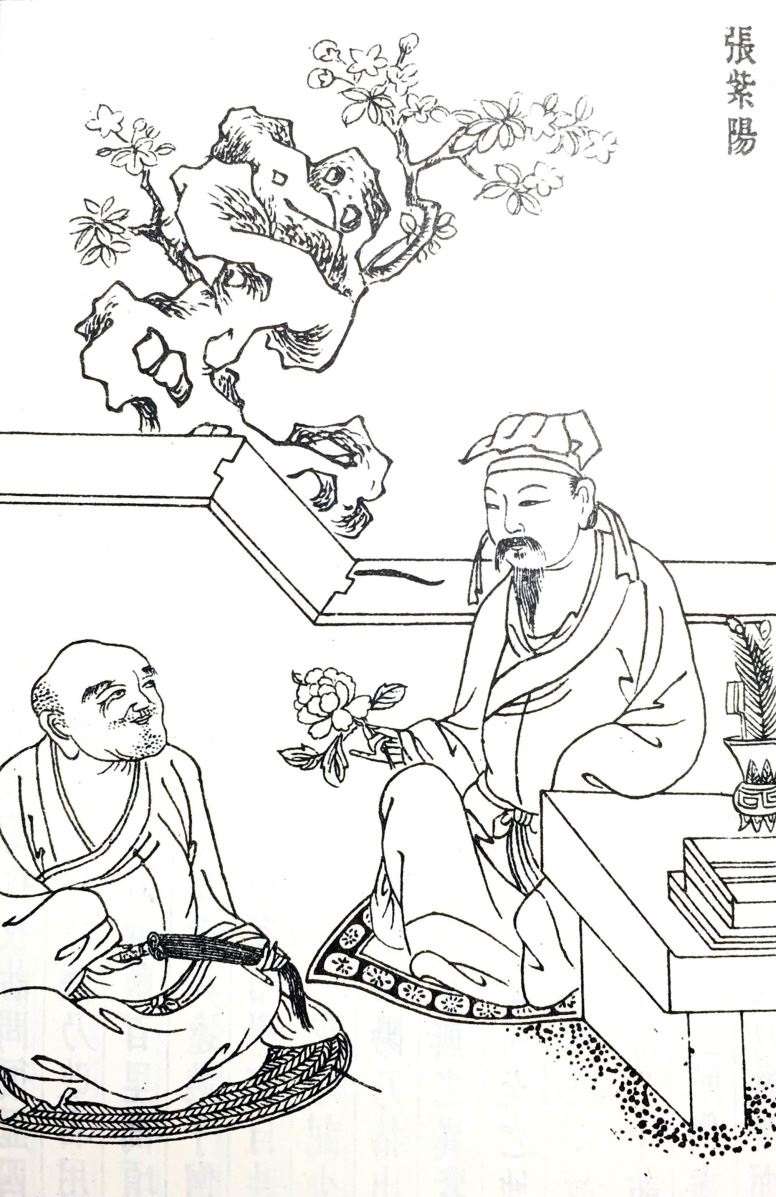
The Wuzhi pian (悟真篇, “Writings on Understanding / Becoming Aware of Reality”, 1075) is a Song-era work of Buddho-Daoist philosophy by the Southern Quanzhen School Patriarch Zhang Boduan (張伯端, mid to late-980s-1082) (fig. 1). Shao (1997) expertly shows that Zhang’s writing had a huge impact on the standard 1592 edition of Journey to the West (Xiyouji, 西遊記) (see especially ch. 4). For example, the reason that the first half of Sun Wukong‘s story (ch. 1 to 7) is Taoist heavy (i.e. his quest for immortality and later ascension to heavenly rank) is because this follows the first part of Zhang’s philosophy, which is attaining the golden elixir (jindan, 金丹). And the reason the second half (ch. 14 to 100) is Buddhist heavy (i.e. building merit by protecting Tripitaka on the pilgrimage west and the rise to Buddhahood) is because the second part of Zhang’s philosophy involves attaining the Buddha-Mind. Combined, these achievements make someone a true transcendent, one free from the wheel of rebirth.

A line from the Wuzhi pian is a prime example of Zhang’s stance on those who strive only to attain the elixir: “A halo behind the head is still a phantom; / Even when clouds rise beneath your feet you are still not an immortal” (Zhang, Liu, & Cleary, 1987, p. 161). This explains why Monkey is banished from heaven and imprisoned under Five Elements Mountain. He has yet to attain the Buddha-Mind.

An even better example of this two-stage process among Zhang’s other works reads:

The elixir is the most precious treasure for the physical body.
When cultivated to perfection, the transformations are endless.
If one further explores the true meaning of the buddha-nature,
One is bound to attain the ineffable bliss of the birthless (Xue, 1977, as cited in Shao, 1997, pp. 99-100).

I’m archiving an English translation of the Wuzhi pian by Thomas Clearly, with explanations by the Qing-era Daoist scholar Liu Yiming (1734-1821).

Fig. 1 – A print of Zhang Boduan (a.k.a. Zhang Ziyang, 張紫陽) from the Ming-era Traces of Immortals and Buddhas (Xianfo jizong, 仙佛奇蹤) (larger version).

Archive link:

Click to access Chang-Po-Tuan_-Thomas-Cleary_-Liu-Yiming-Understanding-Reality-University-of-Hawaii-Press-1987.pdf

Disclaimer:

This has been posted for educational purposes. No malicious copyright infringement is intended. If you liked the digital version, please support the official release.


Update: 03-17-2022

Jeff Pepper, writer and publisher of Imagin8 Press, left an informative comment reminding me that Zhang actually appears in a later chapter of JTTW.

It’s worth noting that Zhang Boduan (also referred to as Zhang Ziyang and Great Heaven’s Immortal Purple Cloud) appears in Chapter 71 of JTW. Sun Wukong has just returned Lady Golden Sage Palace to her husband, the king of Scarlet Purple Kingdom. The king tries to embrace her but is painfully pricked by the poison thorns on her cloak. Zhang appears in the clouds, comes to earth, points his finger at the Lady, and her poison cloak disappears. He explains that he was the one who put the cloak on her in the first place, to protect her from her captor, the evil demon Jupiter’s Rival.

Citation:

Zhang, B., Liu, Y., & Cleary, T. (1987). Understanding Reality: A Taoist Alchemical Classic. Honululu Univ. of Hawaii Press.

Shao, P. (1997). Monkey and Chinese Scriptural Tradition: A Rereading of the Novel Xiyouji (UMI No. 9818173) [Doctoral dissertation, Washington University]. Available from ProQuest Dissertations and Theses database.

Dragon Ball’s Senzu Bean and Journey to the West

Last updated: 11-20-2021

Fig. 1 – A birdseye view of Senzu beans (larger version). Original image found here.

One reoccurring plot device in the world famous Dragon Ball (Jp: Doragon Bōru,ドラゴンボール; Ch: Qilongzhu, 七龍珠) franchise (1984-present) is the Lima bean-like Senzu (仙豆; Ch: xian dou; lit: “sage or immortal bean”) (fig. 1). As explained by Dragon Ball scholar Derek Padula, the Senzu is a green, crunchy bean used to magically and instantly heal life-threatening flesh wounds and broken bones, to rejuvenate warriors who have overexerted themselves during intense, prolonged training or battle (video 1), and to sate hunger for up to ten days. Its only limitations are the inability to heal viral sicknesses, missing body parts, and preexisting scars. Much like the immortal peaches of the Queen Mother of the West, which only mature every few thousand years, the beans only mature in small numbers, possibly taking hundreds of years for their caretaker, the long-lived sage cat Korin, to harvest a few hundred specimens. The beans become a rarity once a dimwitted character eats them by the handful (Padula, 2015).

Video 1 – The hero Son Goku is healed by a Senzu.

Derek traces the bean to elixirs created by practitioners of Daoist external alchemy. For example, he writes:

The sennin [仙人; Ch: xianren] collect rare ingredients and prized metals such as gold, mercury, mushrooms, and precious stones such as jade. Then they place them into a crucible, stoke the fire, and melt them into a concoction. Each particular ingredient possesses various amounts of yīn and yáng energy, and by mixing the ingredients together in just the right fashion the hermit can concoct a potion or pill that will balance the yīn and yáng in their own bodies. Their hope is that the pill will  increase their life span, eliminate illness and injuries, or confer immortality (Padula, 2015).

He makes a keen connection between the Senzu and immortal peaches. After all, both are heavenly agricultural goods with magico-medical properties.

Over time, legends formed around such practices and made their way into popular culture. For example, the Daoist Patriarch Laozi’s “pills of immortality” and “peaches of immortality” (Chinese: xiāntáo, 仙桃), from Journey to the West that Sun Wukong (the character Son Goku is inspired by) so voraciously devours. Sun Wukong becomes immortal not once, not twice, but thrice, by also practicing Internal Alchemy and transforming his body. Since Xiyouji is the inspiration for Dragon Ball, it’s no surprise that we find a simplified form of them here that Son Goku eats. Senzu do not confer instant immortality in Dragon Ball, but they do provide the other benefits. They’re a simplified representation of ancient and supernormal concepts (Padula, 2015).

While Derek alludes to Laozi’s elixir pills above, I think he might have missed an important element from the novel, one that appears to be the ultimate source for Senzu. After raiding the heavenly peach banquet and getting drunk on immortal wine in chapter five, Sun Wukong stumbles into Laozi’s laboratory and eats all of the god’s elixir pills:

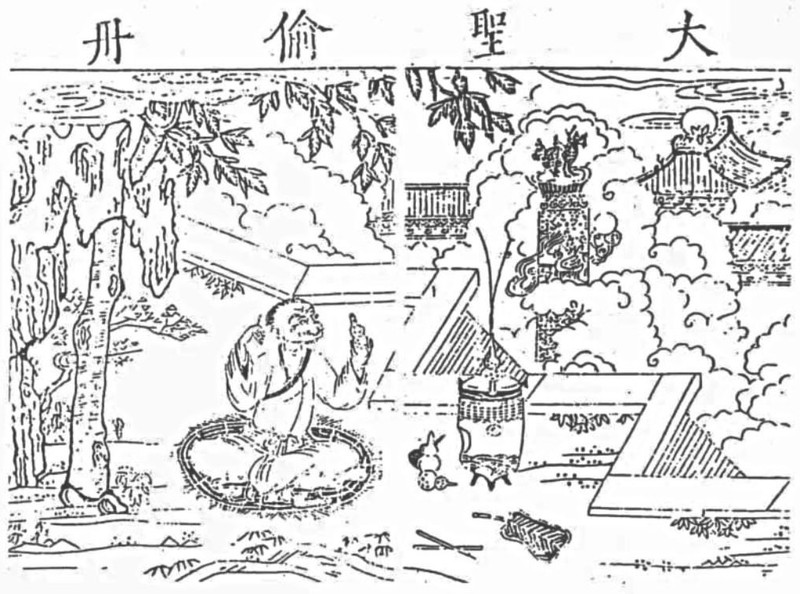
Searching around, our Great Sage went all the way to the alchemical room. He found no one but saw fire burning in an oven beside the hearth, and around the oven were five gourds in which finished elixir was stored. “This thing is the greatest treasure of immortals,” said the Great Sage happily. “Since old Monkey has understood the Way and comprehended the mystery of the Internal’s identity with the External, I have also wanted to produce some golden elixir [jin dan, 金丹] on my own to benefit people. While I have been too busy at other times even to think about going home to enjoy myself, good fortune has met me at the door today and presented me with this! As long as Laozi is not around, I’ll take a few tablets and try the taste of something new.” He poured out the contents of all the gourds and ate them like fried beans [chao dou, 炒豆] (emphasis added) [fig. 2].

In a moment, the effect of the elixir had dispelled that of the wine, and he again thought to himself, “Bad! Bad! I have brought on myself calamity greater than Heaven! If the Jade Emperor has knowledge of this, it’ll be difficult to preserve my life! Go! Go! Go! I’ll go back to the Region Below to be a king.” He ran out of the Tushita Palace and, avoiding the former way, left by the West Heaven Gate, making himself invisible by the magic of body concealment (Wu & Yu, 2012, p. 166).

這大聖直至丹房裡面,尋訪不遇。但見丹灶之傍,爐中有火。爐左右安放著五個葫蘆,葫蘆裡都是煉就的金丹。大聖喜道:「此物乃仙家之至寶。老孫自了道以來,識破了內外相同之理,也要煉些金丹濟人,不期到家無暇。今日有緣,卻又撞著此物。趁老子不在,等我吃他幾丸嘗新。」他就把那葫蘆都傾出來,就都吃了,如吃炒豆相似。

一時間,丹滿酒醒。又自己揣度道:「不好,不好!這場禍比天還大,若驚動玉帝,性命難存。走,走,走,不如下界為王去也。」他就跑出兜率宮,不行舊路,從西天門,使個隱身法逃去。

So we have immortality-bestowing alchemical pills described as beans, which can instantly cure the effects of alcohol, a mild poison. As noted above, Son Goku is based on Sun Wukong. Additionally, many other characters and episodes of the manga/anime were pulled directly from Journey to the West. So it’s not a stretch to think that Akira Toriyama, the creator, embellished the ability of these bean-like pills to create the Senzu.

Fig. 2 – “The Great Sage Steals the Elixir”, from Newly Engraved, Illustrated, Large-Character Official Edition of the Journey to the West (Xinke chuxiang guanban dazi Xiyouji, 新刻出像官板大字西遊記, 1592) (larger version).


Update: 11-20-21

I’ve written an article briefly listing the influences of Journey to the West on Dragon Ball.

Dragon Ball and Journey to the West

Sources:

Padula, D. (2015). Dragon Ball Culture (Vol. 5). (n.p.): Derek Padula.

Wu, C., & Yu, A. C. (2012). The Journey to the West (Vol. 1). Chicago, Illinois: University of Chicago Press.