A Survey of Sun Wukong’s Magic “Immortal Breath” and Its Abilities

Sun Wukong first exhibits the ability to transform his magic hair in chapter two of Journey to the West (Xiyouji, 西遊記, 1592):

Plucking a handful of hairs from his own body and throwing them into his mouth, he chewed them to tiny pieces and then spat them into the air. “Change!” he cried, and they changed at once into two or three hundred little monkeys encircling the combatants on all sides. For you see, when someone acquires the body of an immortal, he can project his spirit, change his form, and perform all kinds of wonders. Since the Monkey King had become accomplished in the Way, every one of the eighty-four thousand hairs on his body could change into whatever shape or substance he desired (Wu & Yu, 2012, vol. 1, p. 129).

拔一把毫毛,丟在口中嚼碎,望空噴去,叫一聲:「變!」即變做三、二百個小猴,週圍攢簇。 原來人得仙體,出神變化無方。不知這猴王自從了道之後,身上有八萬四千毛羽,根根能變,應物隨心。

This tactic of transforming chewed up hairs into dozens, hundreds, or even thousands of monkey clones also appears in chapters 3, 5, 21, 35, 44, 86, and 90 (A & B) (Wu & Yu, 2012, vol. 1, pp. 132, 165, 172, & 409; vol. 2, pp. 138 & 277; vol. 3, p. 332; vol. 4, pp. 164-165, 168, 219, & 221). But these chewed up hairs can also be transformed into other objects, such as sleep-inducing bugs in chapters 5 and 86, as well as seven kinds of hawks in chapter 72 (Wu & Yu, 2012, vol. 1, p. 165; vol. 3, p. 332; vol. 4, p. 168).

But the novel states that Monkey sometimes changes his hair by first blowing on it with his magic “immortal breath” (xianqi, 仙氣). This article will provide a brief survey of this skill and its abilities.

Table of Contents

1. Hair

Explicit mentions of the immortal breath show that it can transform hair into:

  • Ink-soaked brush to write on the Buddha’s hand (ch. 7) (Wu & Yu, 2012, vol. 1, p. 195).
  • Dagger to skin a tiger (ch. 14) (Wu & Yu, 2012, vol. 1, p. 310).
  • Three-ply hemp rope to tie up Zhu Bajie (ch. 19) (Wu & Yu, 2012, vol. 1, p. 385).
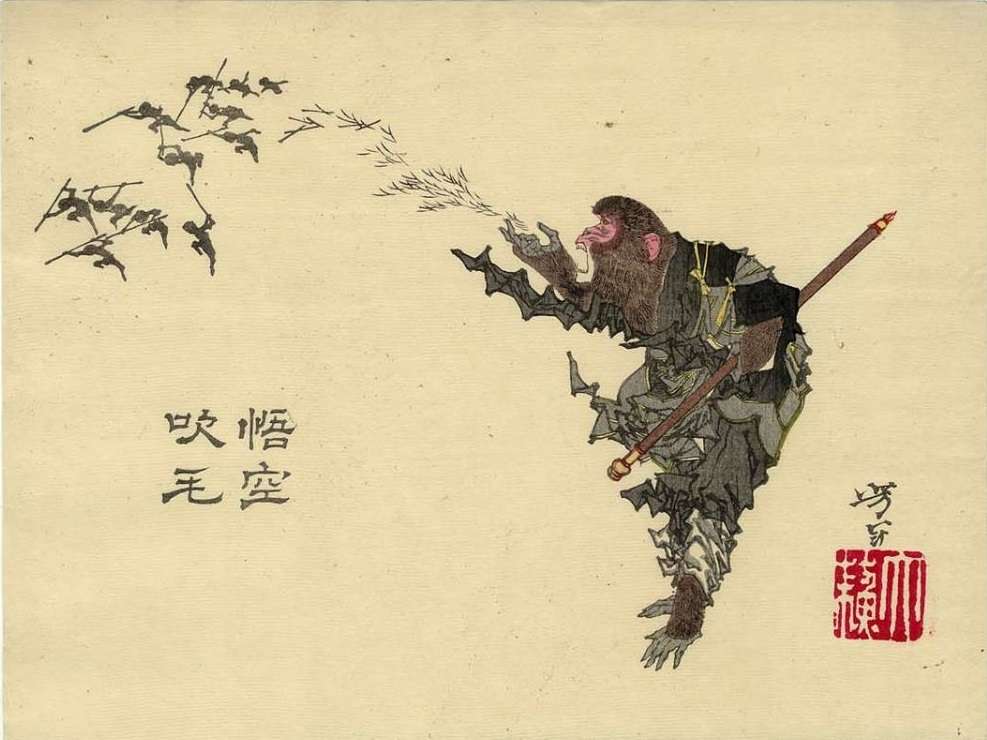
  • Duplicates of the Monkey King (fig. 1) (ch. 25, 27, 45, 73, 77, 84, 85, & 94) (Wu & Yu, 2012, vol. 1, pp. 465; vol. 2, p. 27, 129, & 292; vol. 3, p. 340; vol. 4, pp. 20, 139, 151, & 293).
  • Copper coin to pay for paper (ch. 33) (Wu & Yu, 2012, vol. 2, pp. 117-118).
  • Fake lesser demons (ch. 34) (Wu & Yu, 2012, vol. 2, p. 122).
  • Yellow-gold rope to replace a magical weapon of the same name (ch. 34) (Wu & Yu, 2012, vol. 2, p. 130).
  • Gold-plated, red lacquered box to hold a white jade token (ch. 37) (Wu & Yu, 2012, vol. 2, p. 169).
  • Wrapper to infiltrate a demon’s lair (ch. 41) (Wu & Yu, 2012, vol. 2, pp. 235-236).
  • Yellow hound to carry away a bogus immortal’s decapitated head (ch. 46) (Wu & Yu, 2012, vol. 2, p. 308).
  • Hungry hawk to eat a bogus immortal’s entrails (ch. 46) (Wu & Yu, 2012, vol. 2, p. 310).
  • Group of 30 tigers to scare away monks (ch. 64) (Wu & Yu, 2012, vol. 3, p. 194).
  • Sleep-inducing insects and lice, fleas, and bedbugs (ch. 71 (A & B) & 84) (Wu & Yu, 2012, vol. 3, pp. 303 & 304; vol. 4, p. 139).
  • Gold-headed fly to scare a demon king (ch. 75) (Wu & Yu, 2012, vol. 3, p. 366).
  • Bow drill (comprised of a diamond bit, a bamboo strip, and a cotton string) to drill out of a dangerous magic treasure (ch. 75) (Wu & Yu, 2012, vol. 3, p. 369).
  • Very thin but long rope to climb out of a monster’s stomach (ch. 76) (Wu & Yu, 2012, vol. 4, p. 3).
  • Thirty ropes for tying up bandits (ch. 97) (Wu & Yu, 2012, vol. 4, p. 328).

It should be noted, however, that the novel is very inconsistent regarding this ability. The immortal breath is not always used; Sun often just commands the hair to transform or changes it without saying anything, such as in chapters 4, 33, 34 (A, B, & C), 42, 46, 49, 51, 59, 65, 68, 71, and 74 (Wu & Yu, 2012, vol. 1, p. 156; vol. 2, p. 115, 124-125, 237, 301, 305, & 345-346; vol. 3, p. 13, 120, 216, 269, 305, & 358). The “chewing” and “spitting out” of the hair is another example (see above). But one might argue that spitting requires a build of air in the lungs, so by extension, the immortal breath is being used.

This inconsistency is probably due to the standard 1592 edition of Journey to the West coalescing from independent oral stories developed and told over the centuries (see the late-13th century version of the story, for example). Therefore, some story tellers likely employed the immortal breath, while others did not.

sc137582 - small

Fig. 1 – “Wukong Blows His Hair” (c. 1882) by Yoshitoshi (larger version).

2. Staff

This immortal breath is also shown capable of transforming the magic iron staff (fig. 2).

  • Steel file to file through a magic golden ring pinning Monkey’s neck to a column (ch. 34) (Wu & Yu, 2012, vol. 2, p. 129).
  • Razor to mutilate two lesser demons (ch. 63) (Wu & Yu, 2012, vol. 3, p. 180).
  • Flag pole to make a pair of magic cymbals stand upright (ch. 65) (Wu & Yu, 2012, vol. 3, p. 216).
  • Seventy forked weapons to cut the threads of supernatural spider webs (ch. 73) (Wu & Yu, 2012, vol. 3, p. 340).
  • Nail to prop open a demon’s mouth while Monkey climbs out of their stomach (ch. 83) (Wu & Yu, 2012, vol. 4, p. 113).
  • Three-pointed drill to make a covert hole in a wardrobe (ch. 84) (Wu & Yu, 2012, vol. 4, p. 139).

As noted above, the novel is inconsistent in this regard. For instance, Monkey changes the staff into a steel drill without blowing on it in chapter 65 (Wu & Yu, 2012, vol. 3, p. 218). Likewise, no breath is used in chapters 46 and 84 when Sun transforms the weapon into razors for shaving heads (Wu & Yu, 2012, vol. 2, p. 305; vol. 4, p. 139).

Fig. 2 – Monkey pointing to the luminous iron pillar that will become his iron staff (larger version). From the Qing-Era Painted, Complete Edition Journey to the West (Qing caihui quanben Xiyouji, 清彩繪全本西遊記).

3. Miscellaneous 

Monkey can also transform items not in contact with his body.

3.1. Clothing Color

For instance, in chapter 46, he changes a Daoist lad’s clothing from a spring onion white robe into a brown monk’s robe (Wu & Yu, 2012, vol. 2, p. 305). 

3.2. Likeness

In chapter 78, Sun transforms Tripitaka into his likeness using a mask made from mud:

Pilgrim, too, had little alternative but to flatten the mud and press it on his own face and, after a little while, succeeded in making an apelike mask. Asking the Tang Monk to stand up but without uttering another word, Pilgrim pasted the mask on his master’s face and recited a magic spell. He then blew his immortal breath onto the mask, crying, “Change!” At once the elder took on the appearance of Pilgrim. He was told to take off his own garments and switch clothes with Pilgrim, who made the magic sign and then recited another spell to change into the form of the Tang Monk (Wu & Yu, 2012, vol. 4, p. 47).

行者沒奈何,將泥撲作一片,往自家臉上一安,做下個猴像的臉子。叫唐僧站起休動,再莫言語。貼在唐僧臉上,念動真言,吹口仙氣,叫:「變!」那長老即變做個行者模樣。脫了他的衣服,以行者的衣服穿上。行者卻將師父的衣服穿了,捻著訣,念個咒語,搖身變作唐僧的嘴臉。

Again, the novel is inconsistent regarding external objects. Sometimes Monkey bights his tongue and spits blood out to change said item, such as in chapter 25 (A & B) (Wu & Yu, 2012, vol. 1, pp. 474-475 & 477; vol. 2, p. 303). [1 & 2] But, again, one could argue that the immortal breath is used as spitting requires a build-up of air in the lungs.

4. Special Abilities 

The immortal breath (fig. 3) is also shown to have other special abilities.

4.1. Healing

For instance, in chapter 46, Monkey uses it to heal a gaping wound in his stomach:

With a swagger, Pilgrim walked down to the execution site. Leaning himself on a huge pillar, he untied his robe and revealed his stomach. The executioner used a rope and tied his neck to the pillar; down below, another rope strapped his two legs also to the pillar. Then he wielded a sharp dagger and ripped Pilgrim’s chest downward, all the way to his lower abdomen. Pilgrim used both his hands to push open his belly, and then he took out his intestines, which he examined one by one. After a long pause, he put them back inside, coil for coil exactly as before. Grasping the skins of his belly and bringing them together with his hands, he blew his magic breath on his abdomen, crying, “Grow!” At once his belly closed up completely (Wu & Yu, 2012, vol. 2, p. 309).

行者搖搖擺擺,徑至殺場。將身靠著大樁,解開衣帶,露出肚腹。那劊子手將一條繩套在他膊項上,一條繩紮住他腿足,把一口牛耳短刀幌一幌,著肚皮下一割,搠個窟窿。這行者雙手爬開肚腹,拿出腸臟來,一條條理夠多時,依然安在裡面,照舊盤曲。捻著肚皮,吹口仙氣,叫:「長!」依然長合。

4.2. Soul Manipulation

The novel implies that Sun’s immortal breath also has the ability to manipulate souls. For example, in chapter 88, Sun uses it in an arcane ritual designed to bestow three human disciples with super human strength. The pertinent section reads:

In a secluded room behind the Gauze-Drying Pavilion, Pilgrim traced out on the ground a diagram of the Big Dipper. Then he asked the three princes to prostrate themselves inside the diagram and, with eyes closed, exercise the utmost concentration. Behind them he himself recited in silence the true sayings of realized immortality and intoned the words of Dharani as he blew divine breaths into their visceral cavities. Their primordial spirits [yuanshen, 元神] were thus restored to their original abodes …

行者才教三個王子都在暴紗亭後,靜室之間,畫了罡斗。教三人都俯伏在內,一個個瞑目寧神。這裡卻暗暗念動真言,誦動咒語,將仙氣吹入他三人心腹之中,把元神收歸本舍 。。。

The term “primordial spirits” (yuanshen, 元神) is commonly associated with Buddhahood or enlightenment. In Daoism, it is synonymous with the attainment of immortality via the formation of a “Sacred Embryo” (shengtai, 聖胎), which is forged from spiritual energies over long years of self-cultivation (Darga, 2008). This suggests that Monkey’s immortal breath also grants the disciples some form of immortality. You can read about the entire ritual here.

Fig. 3 – A vapor blowing smoke (larger version). I imagine this is what the immortal breath would look like. Image found here. Photographer unknown. 

And in chapter 97, Sun uses the immortal breath to transform an old man’s soul into “ether” for easy transport back to the world of the living:

Pilgrim changed the soul of the squire into ether [qi, 氣] by blowing on him. The ether was stored in his sleeve so that they could leave [Hell] and go back to the world of light together. Astride the clouds, he soon arrived at the Kou house. Eight Rules [Zhu Bajie] was told to pry open the lid of the coffin, and the soul of the squire was pushed into his body. In a moment, he began to breathe once more and revived (Wu & Yu, 2012, vol. 4, p. 339).

將他吹化為氣,掉於衣袖之間,同去幽府,復返陽間。駕雲頭,到了寇家,即喚八戒捎開材蓋,把他魂靈兒推付本身。須臾間,透出氣來活了。

The phrase “immortal breath” (xianqi, 仙氣) is missing in the original Chinese, but the ability’s use is understood as the passage mentions Monkey “blowing” (chui, 吹) on the soul.

V. Conclusion

Various chapters of Journey to the West show that Sun Wukong can use his immortal breath to transform his hair, his magic staff, and items not directly in contact with his body into anything he desires. These range from utilitarian items like files, blades, drills, and ropes to living creatures like insects, birds of prey, dogs, tigers, lesser demons, and even independent copies of himself. It can also change the color and appearance of clothing, as well as magically disguise someone when used in tandem with a mud mask. The skill’s special abilities include healing and soul manipulation. Evidence suggests that it can restore the “primordial spirit,” granting superhuman strength and some form of immortality, as well as transform souls into “ether” for better ease of transport.

The immortal breath, however, is not used consistently throughout the novel. Monkey sometimes chews up and spits out the hair, commands it to change, or simply transforms it without saying anything at all. This inconsistency is likely due to the novel coalescing from independent oral stories developed and told over the centuries.

Notes:

1) Thank you to Irwen Wong for reminding me of this.

2) The second instance of tongue-biting doesn’t mention the word for blood (xie, 血), but it can be understood to be present.

Sources:

Darga, M. (2008). Shengtai. In F. Pregadio (Ed.), The Encyclopedia of Taoism (Vols. 1-2) (pp. 883-884). London: Routledge].

Wu, C., & Yu, A. C. (2012). The Journey to the West (Vols. 1-4). Chicago, Illinois: University of Chicago Press.

The Sun Wukong Stone Relief of Kaiyuan Temple

Last updated: 01-27-2024

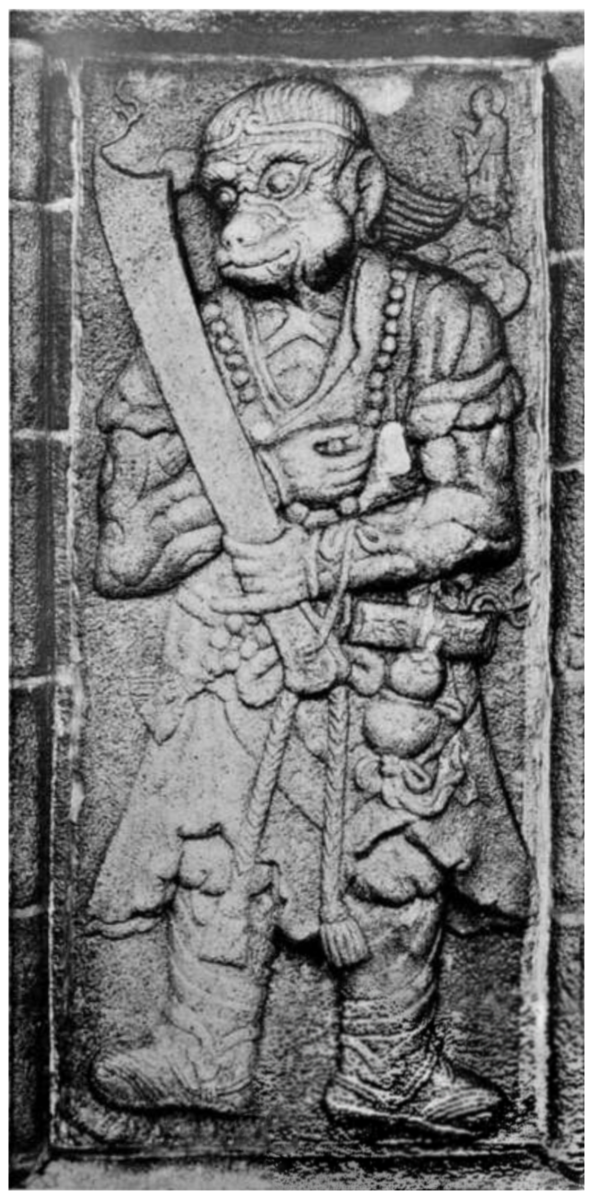
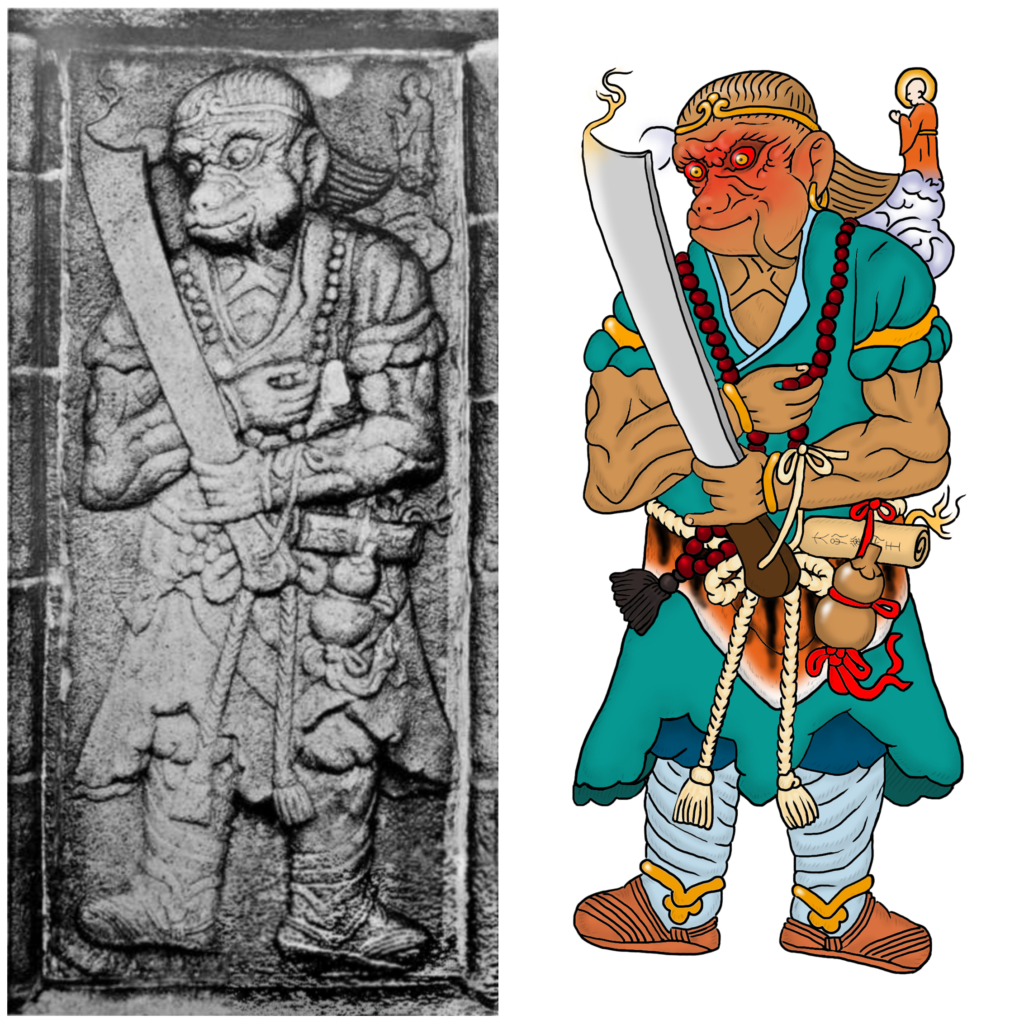
The southern Chinese seaport of Quanzhou in Fujian province is home to Kaiyuan Temple (Kaiyuan si, 開元寺), also known as the Purple Cloud Temple (Ziyun si, 紫雲寺), an ancient Buddhist complex originally built in 686. The temple is famous for its two stone pagodas, each of which is covered in 80 life-size relief carvings of bodhisattvas, arhats, patriarchs, protector deities, and various mythological creatures rendered in a rustic style influenced by the Northern Song Dynasty school of art (Ecke & Demiéville, 1935, pp. 11-18). One figure of interest is a muscular, sword-wielding, monkey-headed warrior (fig. 1) located on the northeastern side of the western pagoda’s fourth story. Many scholars consider this to be an early depiction of Sun Wukong from Journey to the West (Xiyouji, 西遊記, 1592). The pagoda was erected in 1237 (Ecke & Demiéville, 1935, p. 91), so this depiction predates the Ming novel by 355 years, making it an important source for analyzing the early influences on the much beloved literary character. In this paper, I present past research on the relief, as well my own in which I suggest that the iconography is based on ritual adornments mentioned in the Hevajra Tantra, an Esoteric Buddhist text of the 8th century.

Fig. 1 – The  Kaiyuan temple pagoda relief (larger version), Quanzhou, Fujian.

Table of Contents

1. Previous Research

The first detailed description of the relief appears in Ecke and Demiéville (1935):

A guardian with a monkey-head, holding with one hand a rosary which is hanging around his neck, and with the other a sword emitting a cloud from its tip. He wears a short tunic, travel-sandals, and a rope-belt from which are hanging a calabash and a scroll with the Chinese title of the Mahamayarividyārajñi [Fomu da kongque mingwang jing, 佛母大孔雀明王經] (T982-985, a text which was used as a charm against all calamities, dangers, wounds, and diseases). [According to local tradition, it is] Sun Wu-k’ung the name of the monkey assistant (alias the Monkey attendant 猴行者, or the fair Monkey-king 美猴王, or the Great Saint Equal to Heaven 齊天大聖) of Hsüan-tsang [Xuanzang] in the JW-novel. In the upper right corner of the carving there is a small monk-figure with a halo, evidently Hsüan-tsang himself, appearing on a cloud, seemingly the same cloud as that which emanates from the monkey’s sword. In the version of the JW now extant, the monkey assistant’s weapon is not a sword, but an iron rod with two golden rings, which he can reduce, whenever he finds it convenient, into a needle and so keep inside his ear. Also, he wears a tiger-skin over the lower part of his body, a detail which does not agree with our carving (p. 35)

Glen Dudbridge (1970) compares Ecke and Demiéville’s analysis with the description of the Monkey Pilgrim (Hou xinzhe, 猴行者) from the The Story of How Tripitaka of the Great Tang Procures the Scriptures, the late-13th century precursor of Journey to the West. Based on the differences, he suggests that Northern and Southern China may have had separate Monkey story cycles:

[T]here is no sign there of the traveller’s garb in which the Zayton [1] figure is so meticulously clothed; the sword is also not mentioned, although the ‘iron rod with gold rings’ … has not yet assumed its full distinctive role; similarly, the tiger-skin robe, while not described in so many words, seems faintly anticipated in the episode [chapter six] in which Hou Hsing-che slays a tiger-demon, and certainly this standard attribute of demonic figures in Tantric iconography accords well with the description of the yakṣa in that same episode. [2] All this tends to suggest that the Zayton monkey-figure remains strangely distinct from that known to us in the literary sources … Certainly at this stage of their development, there seems to have been no obligation to uniformity in the enactment or representation of popular story cycles: the monkey seen, heard or read about by the northern public could well have differed from his southern counterpart (Dudbridge, 1970, p. 49).

Journey to the West translator and scholar Anthony C. Yu (1977) highlighted a difference in opinion regarding the pious figure on the upper right of the piece:

Ōta Tatsuo 太田辰夫 and Torii Hisayasu 鳥居久靖, in “Kaisetsu 解説,” in Saiyuki, Chūgoku koten bungaku taikei, 31-32 (Tokyo 1971), 432, have challenged Ecke and Demiéville’s interpretation of the carving by pointing out that the figure at the upper righthand corner should be thought of simply as a figure of Buddha (not Hsüan-tsang), which Monkey will become by virtue of bringing back the scriptures. It may be added that Sun Wu-k’ung of the hundred chapter narrative did use a sword or scimitar 刀 (JW, chaps. 2 and 3) before he acquired his famous rod. [3] None of the scholars consulted here sees fit to discuss the significance of what seems to be a headband worn by the carved figure (p. 497 n. 23). 

Victor Mair (1989) focuses on the relief’s iconography and suggests that the various elements might have ties to depictions of both the Buddhist protector deity Aṇḍīra and the Hindu monkey god Hanuman from the Ramayana (c. 4th cent BCE):

The band on the Zayton monkey’s head is indeed very important. Surely it must represent what becomes the Tight-Fillet 緊箍 of the Ming JW, ch. 14. Regardless of the author’s (or his predecessors’) elaborate creative inventions surrounding this fillet in the tradition of the novel, we may ask whether it has any identifiable iconographical origins in art.

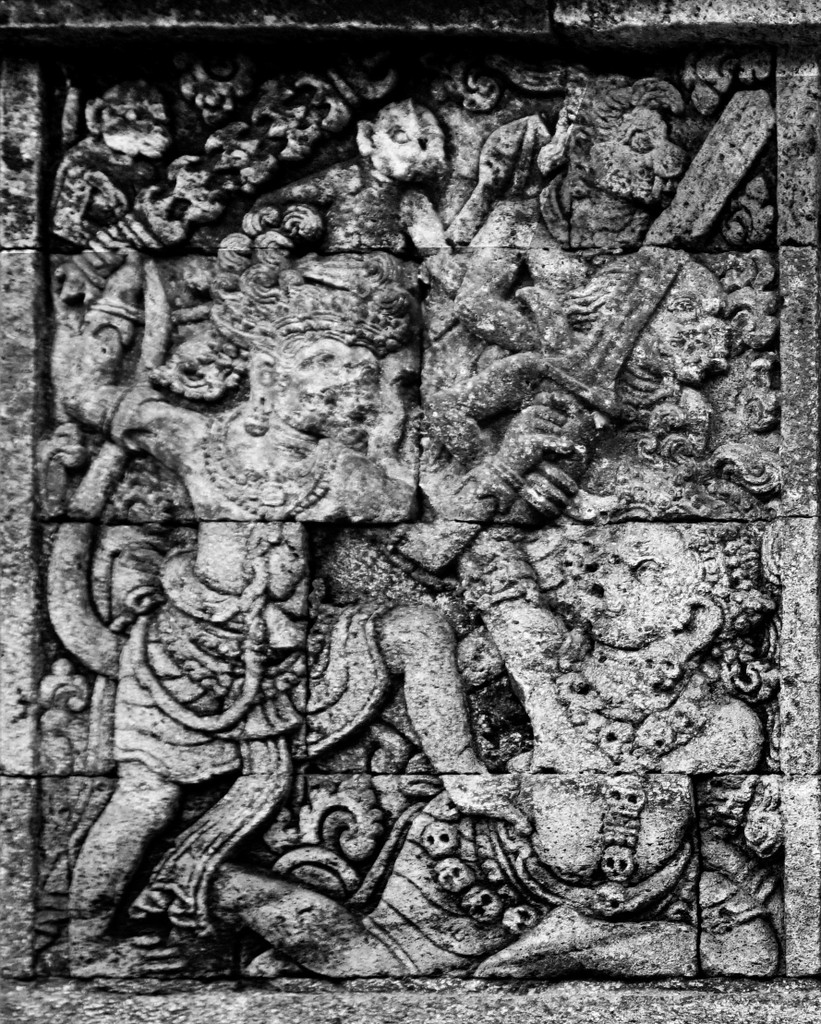
The Tight-Fillet recalls the band around the head of representations of Aṇḍīra, the simian guardian of Avalokiteśvara and Bhaișajyaguruvaidūryaprabhāṣa … As a typical specimen, we may take a statue [fig. 2] from the Kōfukuji in Nara. The Kōfukuji Aṇḍīra has curious wing-like projections extending from the sides of the band around his head that remind us of Mercury in Western classical art. On the Zayton SWK [Sun Wukong], these symbols of swiftness have been displaced to the sides of the eyes. In either case, the wings remind us of H’s [Hanuman’s] descent from the god of the wind. Other similarities between the Kōfukuji Aṇḍīra and the Zayton SWK include: identical earrings (these are key iconographical features of H in many Southeast Asian Rs [Ramayanas]), comparable tilt of the head (exaggerated with the Kōfukuji Aṇḍīra) which seems to indicate enforced submission, long locks of hair flaring out behind the head, elongated monkey’s mouth, similar decorations on forearms and upper arm, etc. It is crucial to note that all of these features can be found in South Asian and Southeast Asian representations of H. For its photographic clarity, we may choose a scene from the Rāma reliefs in Panataran, Indonesia [fig. 3]. H’s forearms are bare in this particular representation, but in some Thai reliefs (at Wat Phra Jetubon in Bangkok), they resemble those of the Zayton SWK and the Kōfukuji Aṇḍīra. The discrepancies in the dress and ornamentation of the lower parts of the body may be attributed to culture and climate (pp. 699-700).

Fig. 2 – The Kōfukuji Aṇḍīra wooden relief carving (c. 11th to 12th cent.) (larger version), Nara, Japan. Fig. 3 – Hanuman (left) besting a demonic foe (right), from the Ramayana reliefs of the Panataran temple complex (c. 12th cent.) (larger version), East Java, Indonesia. 

2. My Findings

My opinion on the origins of the Kaiyuan relief’s iconography parts ways with Mair in some respects. For instance, upon close inspection of the Japanese Aṇḍīra carving, the band that he refers to appears to be the brim of a helmet. I do agree that the Kaiyuan relief shares affinities with the cited image of Hanuman (e.g., the earrings and armbands). But again, here I part ways with Mair because I suggest that the relief’s accoutrements were instead influenced by Esoteric Buddhism and not Hinduism. The similar imagery is no doubt due to a common cultural source.

Nearly every aspect of Sun Wukong’s attire can be found in a passage from the 8th-century esoteric text the Hevajra Tantra (Dabei kongzhi jingang dajiao wang yigui jing, 大悲空智金剛大教王儀軌經). It instructs yogins on how to adorn and dress themselves for worshipping Heruka (Xilujia, 呬嚕迦), a wrathful protector deity of Buddhism.

Sanskrit: bhavakena vidhartavyam karnayor divyakupdalam/ sirasi cakri dhartavya hastayo rucakadvayam/ katyarp va mekhalam caiva padayor nupuran tatha/ bahumule ca keyuram gnvayam asthimalika/ paridhanam vyaghracarma bhaksanam dasardhamrtam

Translation: The practitioner should wear divine ear-rings, a circlet around the head, upon each wrist a bracelet, a girdle around his waist, anklets around the ankles, arm ornaments around the upper arms and a garland of bones around the neck. His dress must be of tiger skin … (Farrow & Menon, 2001, pp. 61-62).

彼修觀者當如是行:謂頂想寶輪、耳帶、寶鐶,手串寶釧,腰垂寶帶,足繫寶鐸及妙臂釧,頸嚴寶鬘衣、虎皮衣 …

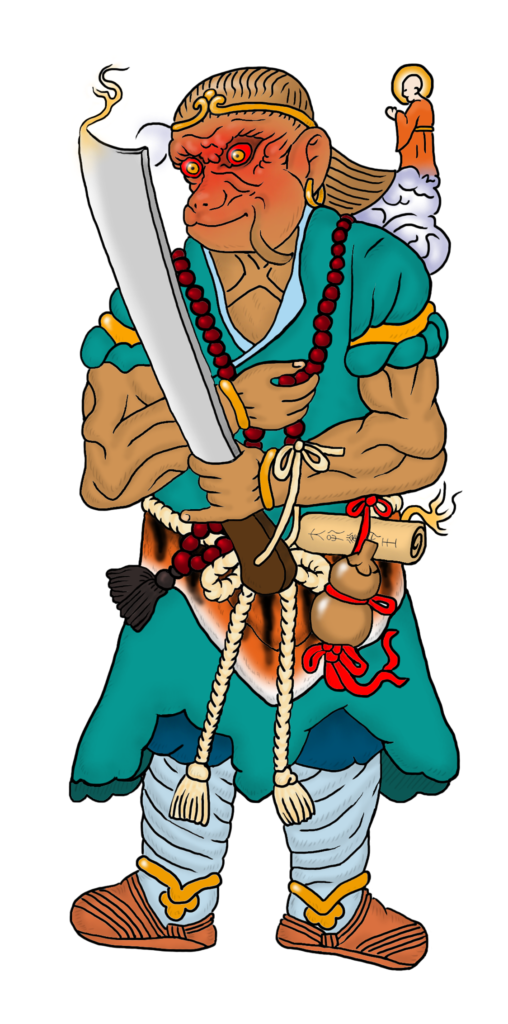
Earrings? Check! Circlet? Check! Bracelets, girdle, anklets, and arm ornaments? Check, check, check, and check! The only two aspects that are questionable are the bone necklace and the tigerskin. Rosaries are sometimes made from bone, which satisfies that requirement. And while Ecke and Demiéville were quick to note the omission of the pelt in their study, I think that the appearance of so many elements from the passage suggests that the tigerskin is present but the features may have just been eroded by time. The chevron shape visible below the girdle could be a skin apron. I’ve created a color version of the relief based on this information (fig. 4).

Fig. 4 – My interpretation of the relief (larger version). A comparison of the original and new versions can be seen here.

(Note: 05-22-23 – Upon reviewing figure four, I don’t like the way the proposed tiger skin cuts off at the belt. It would make more sense for the skin to act as a girdle, making it visible above the belt. I’ll probably update this in the future.)

As I explained in a previous article, the Hevajra Tantra was officially translated into Chinese in 1055 (no doubt arriving earlier than this), so the text was present in the middle kingdom for nearly 200 years prior to the creation of the relief.

What can these ritual elements tell us about Monkey’s depiction? Firstly, it should be noted that the esoteric deity Heruka and other such wrathful guardians, known by the neologism “Wrathful Destroyers of Obstacles” (Sk: krodha-vighnantaka), are commonly portrayed wearing such items, leading to the scholar Van Kooij (as cited in Linrothe, 1999) to comment, “Heruka is more or less a deified hypostasis of the … yogin himself” (p. 251). Second, these deities are often portrayed wielding weapons. For example, one source describes Vajrapani‘s wrathful form Trailokyavijaya “hold[ing] the vajra, ankusa-hook, sharp sword, pâsa-noose and other âyudha [weapons]” (Linrothe, 1999, p. 188). Sun Wukong, too, is depicted with a weapon, a sword with a lick of heavenly flame. Third, the flaming sutra tied to Monkey’s girdle was, as explained above, historically “used as a charm against all calamities, dangers, wounds, and diseases” (Ecke & Demiéville, 1935, p. 35). Wrathful Destroyers of Obstacles are charged “with the destruction of barriers which prevent the experience of enlightenment” (Linrothe, 1999, p. 25). These include external threats like manifested demons and internal threats like demon-caused mental and bodily illness, the “three poisons,” and karmic debt (Linrothe, 1999, pp. 24-25). Therefore, the iconography presents Sun Wukong as a wrathful protector deity.

This then may lend support to Ecke and Demiéville’s original assertion that the pious figure floating in the clouds to the right of Monkey’s head is in fact Xuanzang. The Great Sage clears the path of manifested demons that obstruct the monk’s path to enlightenment, leading to his ascension into paradise (this happens in both the 13th-century version of the story and the standard Ming novel).

3. Ritual Adornments and Other Literary Figures

While Monkey’s association with the fillet and the tiger skin carried over into the novel, other characters came to be associated with ritual adornments from the Hevajra Tantra. A prime example is Red Boy (Hong hai’er, 紅孩兒), son of the Bull Demon King and Princess Iron Fan. The Bodhisattva Guanyin forces the demon child to submit in chapter 42, after which she uses a magic treasure given to her by the Buddha to ensnare his extremities.

Dear Bodhisattva! She took the fillet and waved it at the wind once, crying, “Change!” It changed into five fillets, which she threw at the body of the boy, crying, “Hit!” One fillet enveloped the boy’s head, while the rest caught his two hands and two feet (Wu & Yu, 1977, vol. 2, p. 280).

Red Boy is the literary counterpart of the religious figure Sudhana (Sancai, 善財), whose spiritual journey is told in the Gandavyuha Sutra (Dafang guang fohuayan jing, 大方廣佛華嚴經, c. 3rd cent.). The youth sets out on a quest towards enlightenment and trains under 52 different teachers, including Maitreya, Avalokiteśvara (the South Asian variant of Guanyin), Mañjuśrī, and Samantabhadra (Buswell & Lopez, 2014, p. 864). It’s no wonder then that the ascetic came to be associated with such ritual adornments. South and East Asian depictions of Sudhana/Sancai often portray him wearing bangles and anklets (fig. 5).

Fig. 5 – A modern day altar statue of Sudhana/Sancai (larger version). Notice the bracelets and anklets.

4. Conclusion

The 13th-century Sun Wukong pagoda relief of the Kaiyuan Temple shares many similarities to ritual adornments mentioned in the esoteric Hevajra Tantra (8th cent.), including earrings, the circlet, arm cuffs, a necklace, a girdle, wrist bangles, anklets, and possibly even a tiger skin. Esoteric protector deities are often portrayed with similar attire since they represent the very yogin ascetics who worship them. Monkey’s depiction with said attire suggests the artist who created the piece intended to present him as a powerful Buddhist guardian on par with Wrathful Destroyers of Obstacles like Heruka. The depicted sword and sutra, each shown with a lick of heavenly flame, no doubt represent the means by which the Great Sage protects his master Xuanzang (possibly the pious figure on the upper right corner of the relief).

The onetime enemy Redboy comes to wear the ritual circlet, bracelets, and anklets in Journey to the West after being subjugated by Guanyin. While he is depicted as a defeated foe who submits to Buddhism, these adornments recall his historical and religious origins as Sudhana, a great ascetic from Buddhist literature.


5. Updates

5.1. Fan Art

Update: 05-22-23

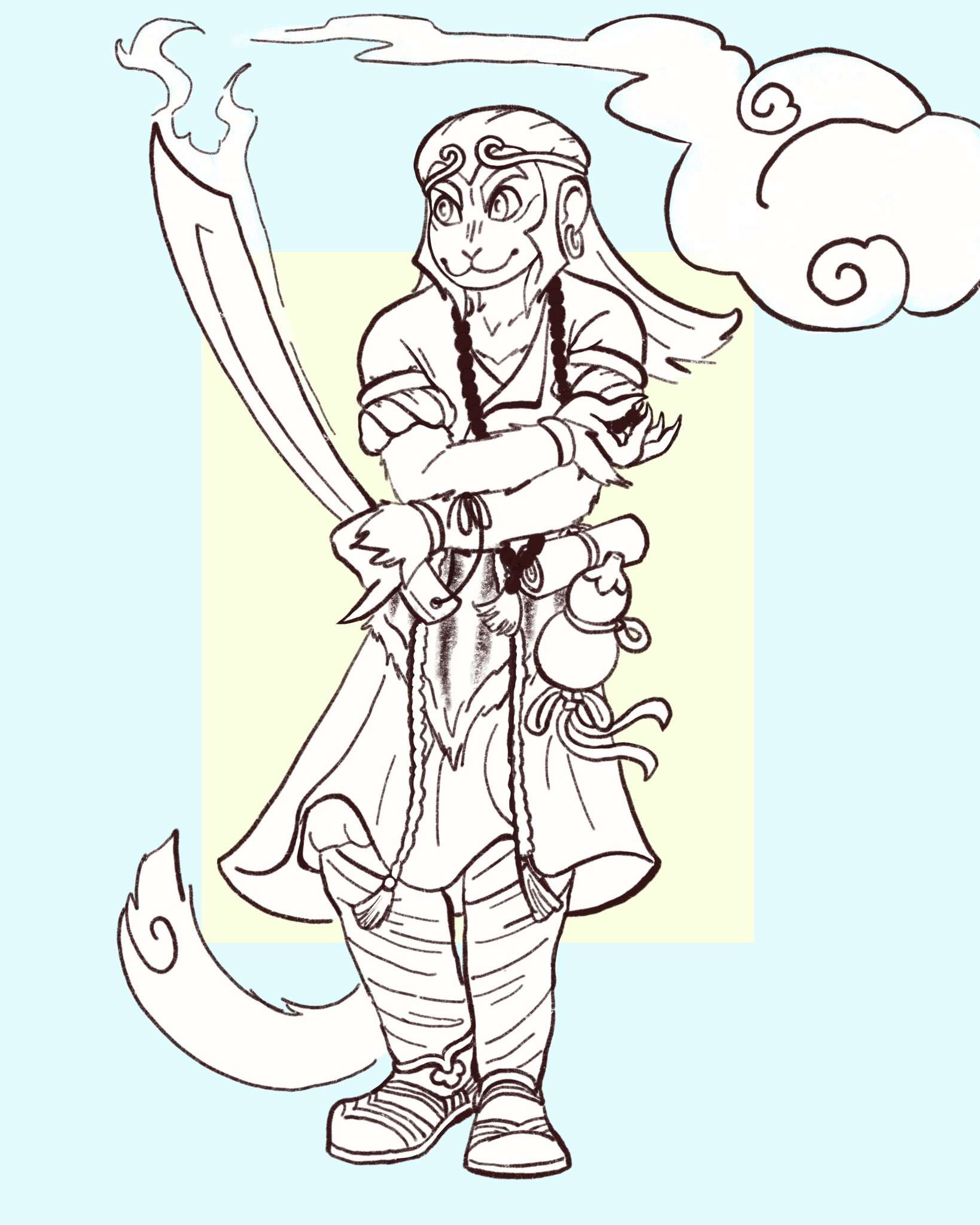
Twitter user Lava (@Lavaflowe) has allowed me to post their lovely drawing of the stone pagoda carving.

Fig. 6 – Lavaflowe’s version of the stone pagoda carving (larger version). Image from twitter.


5.2. No Tiger Skin?

Update: 01-26-24

There is also a possibility that the tiger skin isn’t present at all (as suggested by others). Despite the Hevajra Tantra prescribing this dress, the skin isn’t listed among the most basic accoutrements of a yogi elsewhere in the work. These are known as the “Five Symbolic Ornaments” or “Five Seals” (Sk: Pancamudrā, पञ्चमुद्रा; Ch: Wuyin, 五印; a.k.a. “Five Buddha Seals,” Wufo yin, 五佛印). Each is associated with a particular Buddha:

Aksobhya is symbolised by the circlet, Amitabha by the ear-rings, Ratnesa by the necklace, Vairocana by the hand ornaments, [and] Amogha by the girdle (Farrow, 1992, p. 65).

輪者,表阿閦如來;鐶者,無量壽如來;頸上鬘者,寶生如來;手寶釧者,大毘盧遮那如來;腰寶帶者,不空成就如來。


5.3. The Six Ornaments

Update: 01-27-24

The aforementioned five ornaments are sometimes combined with another item to form the “Six Ornaments” or “Six Seals” (Sk: Shanmudrā, षण्मुद्रा), each of which is associated with a Buddhist wisdom:

The yogic ornaments … are commonly classified as being six in number: (1) the skull-tiara, (2) the armlets, (3) the bracelets, (4) the anklets … (5) the bone-bead apron and waist-band combined … and (6) the double line of bone-beads extending over the shoulders to the breast, where they hold in place the breast-plate Mirror of Karma, wherein … are reflected every good and bad action. These six ornaments (usually of human bone) denote the Six Pāramitā (‘Boundless Virtues’), which are: (1) Dāna-Pāramitā (‘Boundless Charity’), (2) Shīla-Pāramitā (‘Boundless Morality’), (3) Kshānti-Pāramitā (‘Boundless Patience’), (4) Vīrya-Pāramitā (‘Boundless Industry’), (5) Dhyāna-Pāramitā (‘Boundless Meditation’), and (6) Prajñā-Pāramitā (‘Boundless Wisdom’). To attain to Buddhahood, and as a Bodhisattva to assist in the salvation of all living creatures, the Six Pramita must be assiduously practised (Evans-Wentz, 2000, p. xxv).

The most detailed source I’ve found reads:

a. The Bone Wheel

Vajradharma wears a bone wheel on his head. It is formed from a small bone circle that sits around the crown of the head, surrounded by a second, larger circle. The two circles are attached to one another by eight bone spokes. On each of the five spokes at the front, above the forehead, stands a dried skull that supports the jewel, which is the crest ornament. From the lower part of their jaws, looped chains and hanging decorative chains extend downward to the space between Vajradharma’s eyebrows and to the tips of his ears. One the back of each skull is a multicolored vajra with a crescent moon placed to the left. The deity’s long hair passes up through the hole in the middle of the inner bone circle and is tired in a topknot. 

b. The Earrings 

There are five parts to the earrings. There is a main circle of bone, which is like a bangle. From the bottom of the circle hang two smaller rings, each one attached to the larger ring above them by a semi-circle of bone.

c. The Necklace 

The necklace is made of two strings of bones bound together with hair taken from both a corpse and a living person. At the front is a square central hub. The hub forms the base for a T-shaped triple vajra. There are to more triple vajras placed at the two points where the strings of the necklace reach the shoulders.

d. The Bracelets

The deity wears a bracelet on each ankle, wrist, and upper arm, making six in total. Each bracelet is made from two strings of bones that have been bound together. There are three vajras on each pair of bracelets, one at the knot in the upper string, one at the knot in the lower string, and one opposite the knot in the upper string.

e. The Brahmin’s Bone Thread

Next is the Brahmin’s bone thread, or investiture thread (yajnopavita). On the front of the body, above the novel, is a bone wheel with either right or four spokes. There are holes in four of the spokes and two parallels strings of bone pass through each of them. Two of these strings go over the shoulders, and two pass under the armpit. On each of these strings are two vajras on the shoulder and another two under the armpit, making eight in total. Sometimes there is a second bone wheel on the back, to which all the strings are tied; if not, all the ends of the strings are knotted together. 

Together, or with the thread of hair from a slain thief, these bone ornaments are called the ornaments of the five mudras.

f. The Bone Belt 

The bone belt, or apron, hangs from the waist. It is made, as before, of two parallel strings of bone. The strings have five vajras attached to them–one at the front in the center, one on each hip, and one on each side of the center, halfway to the whips. Hanging chains and looped chains decorated with small silver bells and small bone spearheads hang from the tips of the vajras. The chains end at the point where the calf muscle begins to taper.

According to oral tradition, the necklace we just mentioned is ornamented with five vajras at the heart. Although I have consulted many descriptions of the bone ornaments, I have never seen this stated anywhere else. There are many traditions concerning the bone ornaments, but here I have presented that of the oral tradition taught by my master (Lingpa, Rinpoche, & Chemchok, 2017, pp. 52-54). 

As can be seen, the tiger skin is not mentioned among these ornaments either.

Also, as is mentioned, the items making up the six ornaments vary from tradition to tradition. For instance, Huntington and Bangdel (2003) list bone ash in place of the bone thread (p. 161). But it’s important to note for our purposes that the circlet, bangles, bracelets, anklets, and belt make up the five basic accoutrements.

Notes:

1) The city of Quanzhou was known to both Marco Polo and Ibn Battuta by the Arabic name Zayton or Zaiton (زيتون , the “City of Olives”).

2) Monkey transforms a ringed monk’s staff into a titanic yakṣa that crushes the aforementioned tiger demon with a club.

3) Yu (Wu & Yu, 1977) is referring to the fight between Sun Wukong and a demon, during which time the monkey disarms him and uses the latter’s own sword against him.

Sources:

Buswell, R. E., & Lopez, D. S. (2014). The Princeton Dictionary of Buddhism. Princeton, NJ: Princeton University Press.

Dudbridge, G. (1970). The Hsi-yu chi: A Study of Antecedents to the Sixteenth-Century Chinese Novel. Cambridge: Cambridge Univ. Press.

Ecke, G., & Demiéville, P. (1935). The Twin Pagodas of Zayton: A Study of the Later Buddhist Sculpture in China. Cambridge, Mass: Harvard University Press.

Evans-Wentz, W. Y. (Ed.). (2000). Tibet’s Great Yogi Milarepa: A Biography from the Tibetan Being the Jetsun-Kabbum Or Biographical History of Jetsun-Milarepa, According to the Late Lama Kazi Dawa-Samdup’s English Rendering. United Kingdom: Oxford University Press, USA.

Farrow, G. W., & Menon, I. (2001). The Concealed Essence of the Hevajra Tantra: With the Commentary Yogaratnamālā. Delhi: Motilal Banarsidass Publ.

Huntington, J. C., & Bangdel, D. (2003). The Circle of Bliss: Buddhist Meditational Art. United Kingdom: Serindia Publications.

Lingpa, J., Rinpoche, P., Chemchok, K. (2017). The Gathering of Vidyadharas: Text and Commentaries on the Rigdzin Düpa. United States: Shambhala.

Linrothe, R. N. (1999). Ruthless Compassion: Wrathful Deities in Early Indo-Tibetan Esoteric Buddhist Art. Boston, Mass: Shambhala.

Mair, V. (1989). Suen Wu-kung = Hanumat? The Progress of a Scholarly Debate, in Proceedings of the Second International Conference on Sinology (pp. 659-752). Taipei: Academia Sinica.

Wu, C., & Yu, A. C. (1977). The Journey to the West (Vol. 1). Chicago, Illinois: University of Chicago Press.

The Origins and Evolution of Sha Wujing

Did you know that Sha Wujing can be traced to an obscure Chinese desert spirit who was venerated as a minor Buddhist protector deity in Japan? This god is first mentioned in a 7th-century account of the historical Xuanzang, a.k.a. Tripitaka, titled Da Tang Daciensi Sanzang Fashi Zhuan (大唐大慈恩寺三藏法師傳, A Biography of the Tripitaka Master of the Great Ci’en Monastery of the Great Tang Dynasty). According to the text, Xuanzang spilled his surplus of water while in the deserts near Dunhuang, and after several days without drink, he had a fevered dream in which a tall, halberd-wielding spirit chastised him for sleeping instead of continuing his journey to retrieve scriptures from India. The monk immediately awoke and mounted his horse, which took him to an oasis with green grass and fresh water (Dudbridge, 1970, pp. 18-19).

Table of Contents

1. Close Ties With Japan

The Tang Sanzang ji (唐三藏記, Record of the Tang Monk Tripitaka), a book of seemingly unknown date appearing in an 11th-century Japanese collection of tales known as Jōbodai shū (成菩堤集), states that Xuanzang was magically provided food and drink by a deva while in the “Flowing Sands” (Liusha, 流沙) desert, a term commonly used for the harsh environment of China’s northwestern region. [1] The compiler of the Jōbodai shū explains: “This is the reason for the name Spirit of the Deep Sands (Shensha shen, 深沙神)” (Dudbridge, 1970, p. 19). After returning from a pilgrimage to China (838–839), the Japanese Buddhist monk Jōgyō (常曉, d. 865) wrote a report which describes Tripitaka’s fabled exchange with the deity, as well as equates Shensha shen with King Vaiśravaṇa, one of the Four Heavenly Kings of Buddhism (Dudbridge, 1970, pp. 19-20). [2] Therefore, the Tang Sanzang ji most likely hails from the Tang Dynasty (618–907). The Jōbodai shū also states that the god manifested itself before the famous Chinese Buddhist monk Faxian (法顯, 337–c. 422) during his pilgrimage to India. Shensha shen describes himself thus:

I am manifested in an aspect of fury. My head is like a crimson bowl. My two hands are like the nets of heaven and earth. From my neck hang the heads of seven demons. About my limbs are eight serpents, and two demon heads seem to engulf my (nether-) limbs… (Dudbridge, 1970, p. 20).

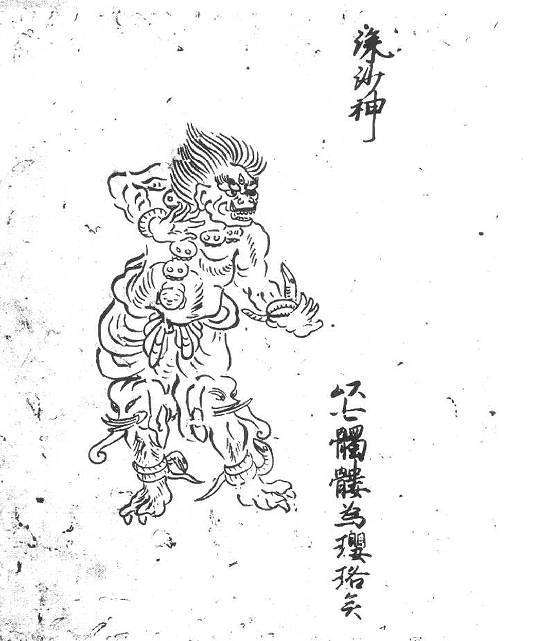
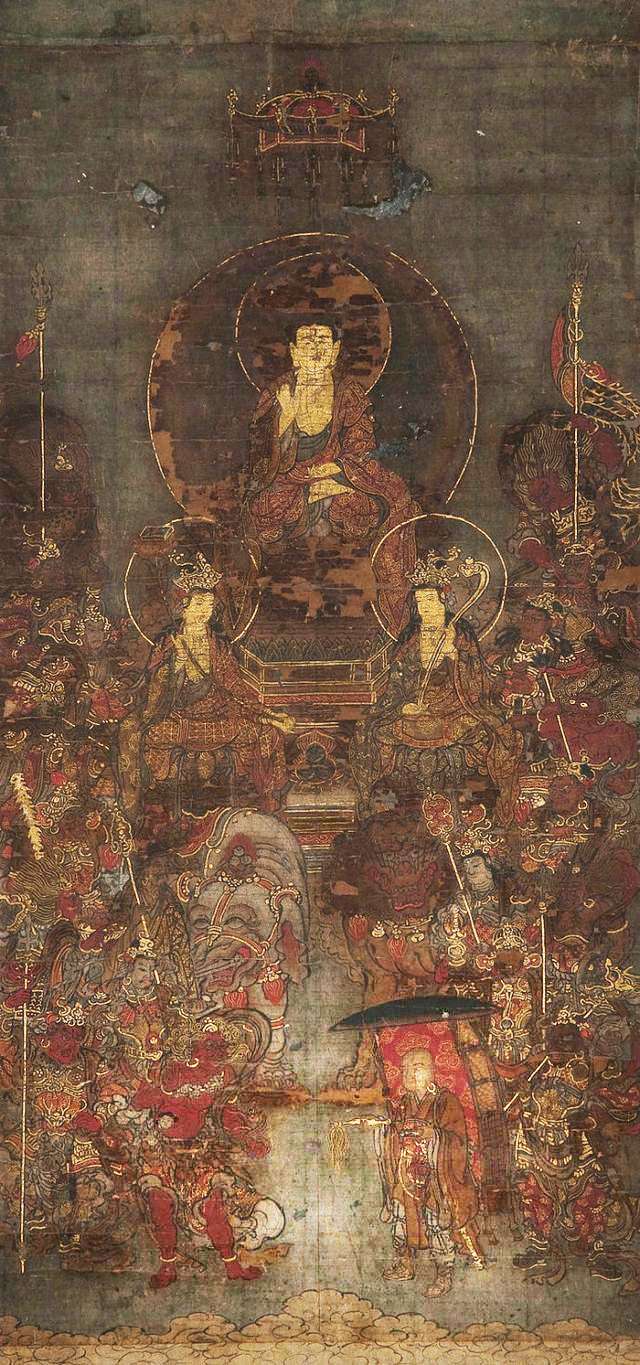
Monk Jōgyō’s aforementioned 9th-century report on Shensha shen appears to have initiated veneration of the spirit as a Buddhist guardian (no doubt thanks to his association with King Vaiśravaṇa). This deity was at some point given the title Jinja Taishō (深沙大將, “General of the Deep Sands”) and appeared in late-Heian (794–1185) and Kamakura (1185–1333) period art (Wong, 2002, pp. 61 and 63). One 12th-century ink on paper painting follows the iconography from the Jōbodai shū and depicts his legs with demonic elephant knees and bird-like talons (fig. 1). This same depiction most likely served as the basis for an exquisite wooden statue from the Kamakura period (fig. 2). The god never lost his association with Xuanzang, for one well-known 14th-century painting of the monk depicts him wearing Jinja Taisho’s necklace of skulls (fig. 3 and 4). Another painting of the same period depicts the pair standing on either side of a celestial crowd paying reverence to the Buddha. [3] It appears to be based on an earlier Chinese Song Dynasty painting (Figs. 5-7). Regarding the Japanese image, Wong (2002) notes:

Even though Xuanzang, of human origin, and Shensha shen, a demonic figure, were of low status in the Buddhist hierarchy, they are represented because of their role in the transmission of the Heart Sutra, and become elevated in rank by being shown with the deities and bodhisattvas that protect the sacred text (p. 63).

Sha Wujing Origins - 1

Fig. 1 – 12th-century Japanese ink on paper painting (larger version); Fig. 2 – 13th to 14th-century Japanese Kamakura wooden statue (larger version); Fig. 3 – Famous 14th-century Kamakura painting of Xuanzang (larger version); Fig. 4 – Detail of the skull necklace (larger version); Fig. 5 – Chinese Song Dynasty painting of the Buddha’s heavenly retinue, including Shensha shen (bottom center left) and Xuanzang (bottom center right) (larger version); Fig 6 – Detail of Shensha shen (larger version); Fig. 7 – Detail of Xuanzang (larger version).

2. Mention in Chinese Literature

The concept of Shensha shen was well enough established in China by the 13th century to be included in the eighth chapter of The Story of How Tripitaka of the Great Tang Procures the Scriptures, the earliest version of Journey to the West. But instead of being a benevolent deity, he is portrayed as a bloodthirsty monster who had several times eaten Xuanzang’s past reincarnations. The demon tells him, “I am the one who devoured you twice before, monk. Slung from my neck are all your dry bones!” (Wivell, 1994, p. 1190). The monster only helps the monk and his retinue cross the “Deep Sands” via a magical golden bridge once he is threatened with heavily retribution. Memorial poems thereafter note that Tripitaka releases the spirit from a five hundred-year-long curse, and Pilgrim (Sun Wukong) promises to speak highly of him when they finally meet the Buddha.

Sha Wujing first appears in the 22nd chapter of the final 1592 edition as an ogre-like beast living in the “Flowing Sands River” (Liusha he, 流沙河), a callback to the similarly named desert from earlier sources .

A head full of tousled and flame-like hair;
A pair of bright, round eyes which shone like lamps;
An indigo face, neither black nor green;
An old dragon’s voice like thunderclap or drum.
He wore a cape of light yellow goose down.
Two strands of white reeds tied around his waist [fig. 8].
Beneath his chin nine skulls were strung and hung;
His hands held an awesome priestly staff (Wu & Yu, 2012, vol. 1, p. 422).

Like The Story, Sha Wujing is persuaded to help the group cross the river, but this time it is after Xuanzang takes him as his third and final disciple (he had previously been pacified and converted by the Bodhisattva Guanyin). The water spirit takes off his skull necklace and, with the aid of a heaven-sent magic gourd, transforms the accoutrements into a boat on which Tripitaka rides to the other side.

sandy_appearing_by_tianwaitang-d319dlj

Fig. 8 – A modern depiction of Sha Wujing by Tianwaitang on deviantart (larger version).

3. Origin of Shensha Shen and Sha Wujing’s Skull Necklace

The skull necklace (Sanskrit: muṇḍamālā) can be tied to Esoteric Buddhism. For instance, the Sadhanamala (“Garland of Methods”), a compilation of esoteric texts from the 5th to 11th centuries, describes the wrathful protector deity Hevajra (fig. 9) wearing such a necklace:

He wields the vajra in the right hand and from his left shoulder hangs the Khatvanga [staff] with a flowing banner, like a sacred thread. He carries in his left hand the kapala [skull cap] full of blood. His necklace is beautified by a chain of half-a-hundred severed heads (emphasis added) [Fig. 10]. His face is slightly distorted with bare fangs and blood-shot eyes. His brown hair rises upwards and forms into a crown which bears the effigy of Aksobhya [Buddha]. He wears a kundala [ear decoration] and is decked in ornaments of bones. His head is beautified by five skulls (Donaldson, 2001, p. 221).

This attire is traceable to that worn by adherents of Heruka, another wrathful deity, as prescribed in the Indian Buddhist Hevajra Tantra (Ch: Dabei kongzhi jingang dajiao wang yigui jing, 大悲空智金剛大教王儀軌經, 8th century):

The yogin must wear the sacred ear-rings, and the circlet on his head; on his wrists the bracelets, and the girdle round his waist, rings around his ankles, bangles round his arms; he wears the bone-necklace (emphasis added) and for his dress a tiger-skin… (Linrothe, 1999, p. 250).

Compare this description with, for example, the Song Dynasty painting of Shensha shen (fig. 6). Many of the elements are present.

Statue with necklace detail

Fig. 8 – The Buddhist Deity Hevajra, late-11th to early-12th century, copper alloy (larger version). Courtesy of the Los Angeles County Museum of Art. Fig. 9 – Detail of the necklace (larger version).

4. Conclusion

Sha Wujing is traceable to an obscure Chinese desert spirit first mentioned in an embellished 7th-century account of the historical Xuanzang’s travels. This and later accounts portray him as a benevolent guardian watching over the monk and providing Tripitaka with subsistence on his journey through the harsh “Flowing Sands” desert of northwestern China. The Japanese Monk Jōgyō wrote a 9th-century report in which he mentioned the deity and associated him with King Vaiśravaṇa. This appears to have led to his veneration in Japan, for sources from the 11th century onward not only provide him with the titles Shensha shen (“Spirit of the Deep Sands”) and Jinja Taisho (“General of the Deep Sands”), but also lay out a prescribed iconography for him. He is generally portrayed in late-12th to 14th-century Japanese art as a fierce warrior with flame-like hair, a necklace of skulls, serpent arm adornments, demonic knees, and (sometimes) bird-like talons.

This spirit appears in The Story of How Tripitaka of the Great Tang Procures the Scriptures (13th century), the earliest version of Journey to the West, but is instead portrayed as a bloodthirsty desert demon who revels in having eaten Xuanzang’s last two incarnations. A necklace of dry bones serves as proof of his murderous hobby. He only decides to help the monk pass the Deep Sands when threatened with heavenly retribution. This episode served as the basis for Sha Wujing’s origin in the final 1592 version of the novel. He is similarly portrayed as a flesh-craving, skull necklace-wearing demon. Even his home, the aquatic realm of the “Deep Sands River,” is based on the former’s desert home. But after helping Tripitaka cross the river, Sha Wujing differentiates himself from his precursor by serving as the monk’s disciple and stalwart protector.

The skull necklace can be traced to wrathful Esoteric Buddhist deities and their accoutrements. For example, an 11th-century esoteric text describes the deity Hevajra wearing a “necklace…beautified by a chain of half-a-hundred severed heads.” This is ultimately based on one of the five kinds of ritual adornments worn by Indian Buddhist yogin adherents of the wrathful deity Heruka during the 8th century.

Notes:

1) The original source says “Moving sands” (Dudbridge, 1970, p. 19 n. 3), but I have changed the wording to conform with that commonly used in various English translations of the tale.

2) It’s interesting to note that King Vaiśravaṇa influenced another character from Journey to the West, Heavenly King Li Jing. Li Jing (李靖, 571–649) was a historical Tang Dynasty general who won many battles in China and Central Asia. Shahar (2013) notes that Li was deified after his death, and that the cult centered around him existed into the Song Dynasty (p. 28). Most importantly, “The general [was] celebrated in a large body of oral and written fiction, which gradually associated him with the Indian god [Vaiśravana]” (Shahar, 2013, p. 28). He continues, “Storytellers and playwrights [eventually] merged the Tang general with the martial Heavenly King” (Shahar, 2013, p. 28). This merging may have happened as early as the Yuan Dynasty (1271–1368) (Shahar & Kieschnick, 2013, p. 224 n. 18).

3) I, unfortunately, couldn’t find a high res version of this painting. All those I could find were either too blurry or to small for focusing on specific areas for details. The above linked webpage with the Song Dynasty variant includes a low res version of the Japanese painting.

Sources:

Dudbridge, G. (1970). The Hsi-yu chi: A Study of Antecedents to the Sixteenth-Century Chinese Novel. Cambridge: Cambridge Univ. Press.

Linrothe, R. N. (1999). Ruthless Compassion: Wrathful Deities in Early Indo-Tibetan Esoteric Buddhist Art. Boston, Mass: Shambhala.

Shahar, M., & Kieschnick, J. (2013). India in the Chinese Imagination: Myth, Religion, and Thought. University of Pennsylvania Press.

Shahar, M. (2013). Indian Mythology and the Chinese Imagination: Nezha, Nalakubara, and Krshna. In M. Shahar and J. Kieschnick (Eds.), India in the Chinese Imagination: Myth, Religion, and Thought (pp 21-45). University of Pennsylvania Press.

Wivell, C.S. (1994). The Story of How the Monk Tripitaka of the Great Country of T’ang Brought Back the Sūtras. In V. H. Mair (Ed.), The Columbia Anthology of Traditional Chinese Literature (pp 1181-1207). New York: Columbia University Press.

Wong, D. C. (2002). The Making of a Saint: Images of Xuanzang in East Asia. Early Medieval China 8, pp. 43-95.

Wu, C., & Yu, A. C. (2012). The Journey to the West (Vols. 1-4) (Rev. ed.). Chicago, Illinois: University of Chicago Press.