
The novels Journey to the West (Xiyouji, 西遊記, 1592) and Investiture of the Gods (Fengshen yanyi, 封神演義, c. 1620) are dramatized examples of the syncretic Buddho-Daoist pantheon of Chinese Folk Religion. The number of Buddhas, sages, gods, immortals, spirits, guardians (etc.) revered by people of Chinese descent is enormous, and new figures are being added to the list even to this day. Needless to say, laymen and researchers who visit temples and wish to correctly identify a particular deity need a resource with images, names, and listed attributes. Luckily there is one such source. Keith Stevens (1926-2015), a veteran of the British Army and Foreign and Commonwealth Office, traveled East and Southeast Asia for 40 years collecting information on the folk pantheon. He produced an invaluable monograph titled Chinese Gods: The Unseen World of Spirits and Demons (1997). The book is unfortunately out of print, and available copies are expensive to buy. So, I am pleased to host a PDF of this wonderful work on my site.
The scan was produced with an overhead document camera. The glossy pages made scanning somewhat difficult. I had to use a soft, indirect light source. Therefore, not all pages are crisp due to the low light levels.

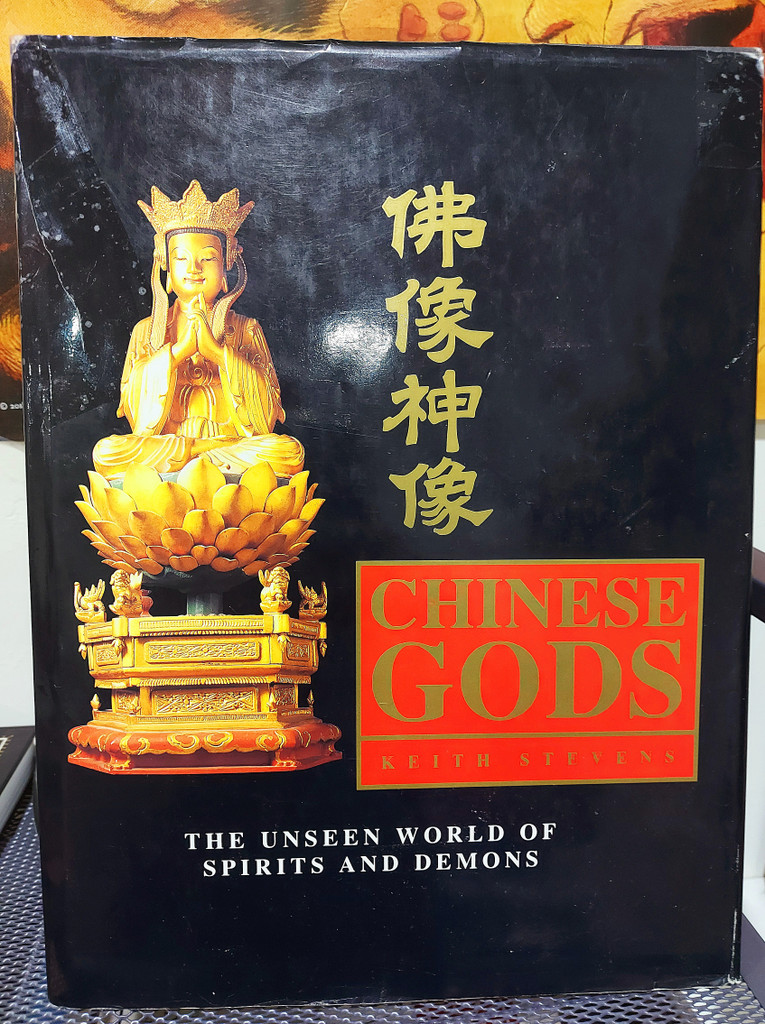
My well-worn personal copy of Chinese Gods (larger version).
1. Dust Jacket Description
China is a land full of gods and goddesses, ranging from the Creators of the World to Worthies local to only one or two villages.
This book introduces the reader to the most important figures of Chinese folk history, and those of Buddhism, Taoism and Confucianism.
Intensely pragmatic in their religion, Chinese people hold all gods in reverence, but it is only the ones who answer prayers with concrete results that are exceptionally praised. Many gods have particular specialities, for instance, there are different Wealth Gods for success in business and for gambling. There are also individual gods for each trade, from those for removal men in Hong Kong to students at Beijing University.
In addition, there are the City Gods and Kitchen Gods, the Earth Gods who protect a specific piece of land, and myriad spirits who protect wells, mountains or bridges, distribute rain or snow, control flooding or protect humanity from disease and epidemics.
Keith Stevens has spent a lifetime researching the subject, travelling extensively in China, Taiwan and throughout South-East Asia. He has gathered information from hundreds of temple keepers, god-carvers and religious specialists and collected details of images and their stories – providing glimpses into the sometimes little-known folk history of China. The author also provides pointers on how to identify images, together with invaluable background information including chronology of Chinese history, a map of the area covered, a glossary and detailed index with the names of deities in Chinese characters.
2. Book Link
Click to access chinese-gods-the-unseen-world-of-spirits-and-demons-compressed.pdf
Disclaimer:
This has been posted for educational purposes. No malicious copyright infringement is intended. If you like the digital version, please support the official release.
Citation:
Stevens, K. G. (1997). Chinese Gods: The Unseen World of Spirits and Demons. London: Collins & Brown.