Archive #44 – The God Erlang Captures the Great Sage Equaling Heaven (Erlang shen suo Qitian dasheng) Zaju Play

Last updated: 03-08-2025

The God Erlang Captures the Great Sage Equaling Heaven (Erlang shen suo Qitian dasheng / Erh-lang shen so Ch’i-t’ien Ta-sheng, 二郎神鎖齊天大聖) is a zaju play from the Yuan-Ming period. To my knowledge it is roughly contemporaneous with the early-Ming Journey to the West zaju play (Xiyou ji zaju西遊記雜劇). Here, I would like to archive the Chinese script, as well as provide a brief description for those unable to read the original.

1. Synopsis

Dudbridge (1970) gives a brief overview of the play:

The action, in brief, is as follows: An ape-demon, Qitian dasheng [齊天大聖], steals Taoist elixir and fairy wine from the Immortal Yuanshi tianzun [元始天尊] and returns with it to his home Shuilian dong [水簾洞] on Huaguo shan. The theft reported, Erlang is summoned to capture him. The ape meanwhile feasts with members of his family on Huaguo shan. Erlang, mustering his traditional followers, advances in company with Juling shen [巨靈神] and effects the capture. In the final act he surrenders the prisoner to the Taoist deity Quxie yuanzhu [驅邪院主]. The ape begs for clemency and is finally dismissed with only a firm injunction to reform (p. 129). [1]

Apart from Erlang and his followers, some of these figures carried over into the 1592 Journey to the West novel. Yuanshi tianzun (“Celestial Worthy of Original Commencement”) is mentioned by name in the novel six times. Juling shen (“Might-Spirit God”) is easily bested by Sun Wukong in chapter four (Wu & Yu, 2012, vol. 1, pp. 153-154). His name is mentioned a total of 15 times.

Quxie yuanzhu (驅邪院主, “Lord of the Court for Exorcising Evils”) does not appear in the novel.

2. Similarities with the JTTW Zaju

As noted in the introduction, this zaju shares parallels with the early-Ming JTTW zaju. Dudbridge (1970) explains:

A number of details demand attention:
the name of the ape: Qitian Dasheng;
the name of his home: Huaguo shan, Shuilian dong [花果山水簾洞];
the members of his family: “My elder brother Tongtian Dasheng [通天大聖], myself Qitian Dasheng, my elder sister Guishan shuimu [龜山水母], my younger sister Tiese mihou [鐵色獼猴], my younger brother Shuashua Sanlang [耍耍三郎]” (speech in the first act);
the stealing of elixir and wine;
the role of Erlang and Juling shen;
the ‘iron cudgel’ [鐵棒], with which the ape defends himself in the third act;
the name Sun xingzhe [孫行者] claimed by the youngest brother in the same act;
minor details of the battle—the attendants of Erlang, the Taoist gods—also peripherally related to the Xiyouji story (pp. 129-130).

For a list comparing the names of Monkey’s siblings from both plays, see the 12-20-23 update here.

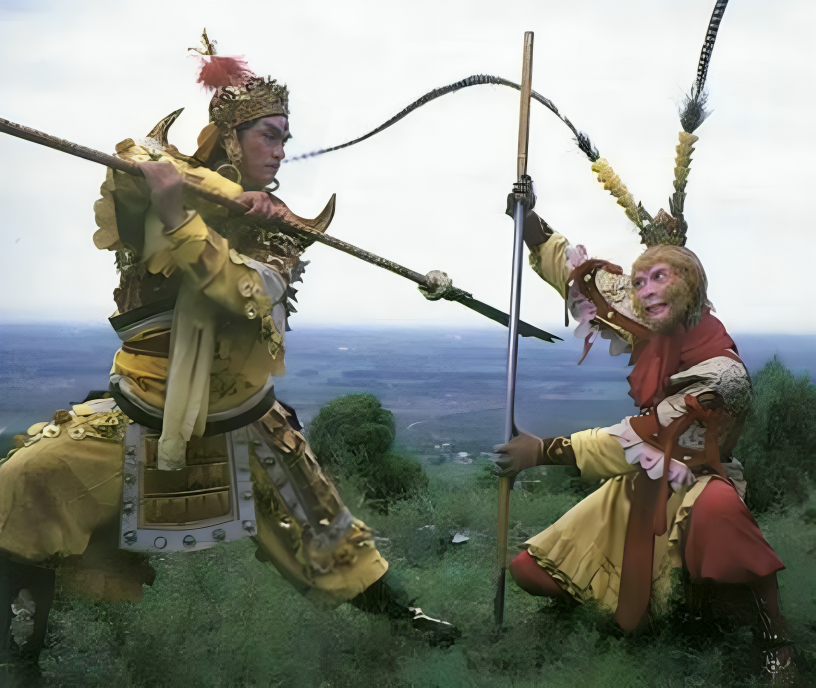
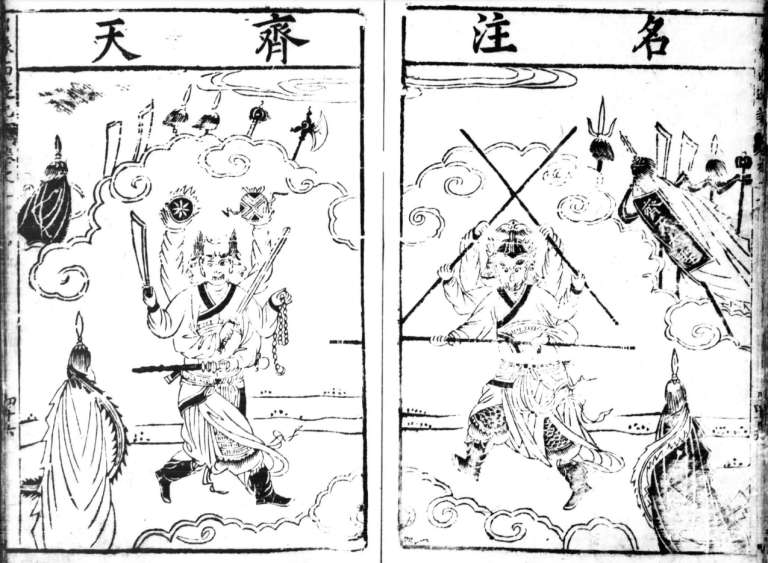
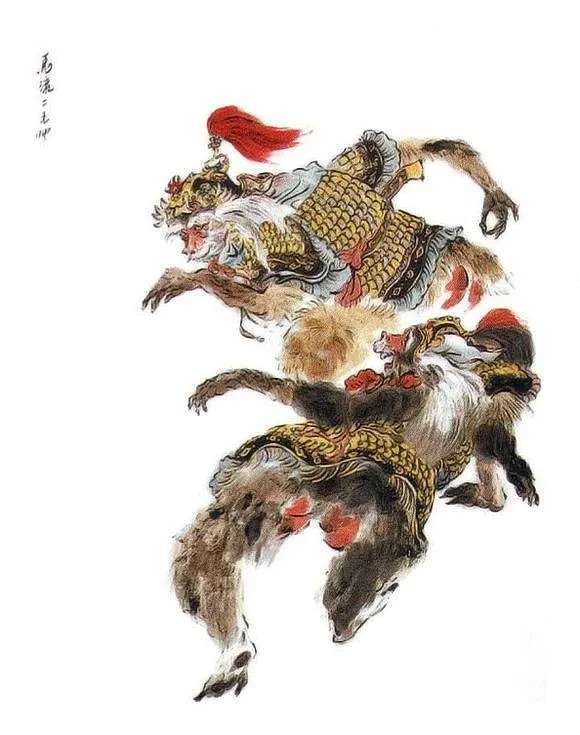
Erlang vs the Great Sage (larger version).

3. Archive link

The Chinese text is split up in sections just like it was posted to Text Court (see below).

Click to access The-God-Erlang-Captures-the-Great-Sage-Equaling-Heaven.pdf

Thanks:

Thank you to the Text Court of the University of Oxford for making this zaju play freely available. The original can be found here.


Update: 03-07-25

Above, Quxie yuanzhu (驅邪院主, “Lord of the Court for Exorcising Evils”) was mentioned as a character that didn’t carry over to the 1592 JTTW. I originally couldn’t find any info about said deity, but I have found a possible lead. According to Kohn (2020), “In Daoism under the Song, [the immortal Zhongli Quan] was particularly honored as the head of the Department of Exorcism (Quxie yuan 驅邪元[院]), a central part of the celestial administration” (p. 13). Perhaps there is a connection between the two.


Update: 03-08-25

I apparently didn’t look hard enough because Text Court (thanked and linked above) provides a list of the character’s other titles:

  • 北極鎮天真武玉虚師相玄天元聖仁威
  • 北極驅邪院主
  • 北極驅邪院都教主

The first title, “北極鎮天真武玉虚師相玄天元聖仁威” (Beiji Zhentian Zhenwu Yuxushi Shixiang Xuantian Yuansheng Renwei), or the “Northern Ultimate and Suppressing Heaven True Warrior, Jade Emptiness Prime Minister, Dark (or Mysterious) Heaven Primal Sage of Humane Power,” contains several illusions to a deity associated with exorcism. The most obvious of these is Zhenwu (真武) and Xuantian (玄天), both of which refer to a singular martial god. I guess this is mystery solved.

Zhenwu appears as the “Demon-Conquering Celestial Worthy” (Dangmo tianzun, 蕩魔天尊) in JTTW chapter 66 (Wu & Yu, 2012, vol. 3, p. 226), but his role is small like in the play.

Notes:

1. All Wade-Giles has been converted to Pinyin.

Source:

Dudbridge, G. (1970). The Hsi-yu chi: A Study of Antecedents to the Sixteenth-Century Chinese Novel. Cambridge: Cambridge University Press.

Kohn, L. (2020). The Zhong-Lü System of Internal Alchemy. Russia: Three Pines Press.

Buddhist Deities Exiled From the Western Heaven in Chinese Vernacular Literature

Last updated: 1-25-2025

Anyone who has read Journey to the West (Xiyouji西遊記, 1592) will know that the Tang monk Tripitaka (Tang Sanzang, 唐三藏; a.k.a. Xuanzang) is said to be an incarnation of Master Golden Cicada (Jinchan zi, 金蟬子), the Buddha’s second disciple. The full picture of his past can be pieced together from verse and character dialogue throughout the narrative. This culminates with the Tathagata‘s explanation in chapter 100:

Because you failed to listen to my exposition of the law and slighted my great teaching, your true spirit was banished to find another incarnation in the Land of the East [i.e. China]. Happily you submitted and, by remaining faithful to our teaching, succeeded in acquiring the true scriptures (Wu & Yu, 2012, vol. 4, p. 381).

因為汝不聽說法,輕慢我之大教,故貶汝之真靈,轉生東土。今喜皈依,秉我迦持,又乘吾教,取去真經 …

In the course of my research, I’ve come across two other examples of Buddhist deities from Ming-Qing Chinese vernacular literature that are exiled from the Western Heaven. In this article, I would like to highlight these stories, as well as analyze them alongside Master Golden Cicada’s tale to record parallels. It’s important to note that all examples are connected to the Journey to the West story cycle. Finally, I will show that the presented examples share similarities with Greek philosophy.

I wrote this to better understand how the story of Master Golden Cicada’s exile may have come about.

1. Master Golden Cicada

For the record, the fullest account of Tripitaka’s past is described by Sun Wukong in chapter 81:

“You don’t realize that Master was the second disciple of our Buddha Tathagata, and originally he was called Elder Gold Cicada. Because he slighted the Law, he was fated to experience this great ordeal.”

“Elder Brother,” said Eight Rules, “even if Master did slight the Law, he had already been banished back to the Land of the East where he took on human form in the field of slander and the sea of strife. After he made his vow to worship Buddha and seek scriptures in the Western Heaven, he was bound whenever he ran into monster-spirits and he was hung high whenever he met up with demons. Hasn’t he suffered enough? “Why must he endure sickness as well?”

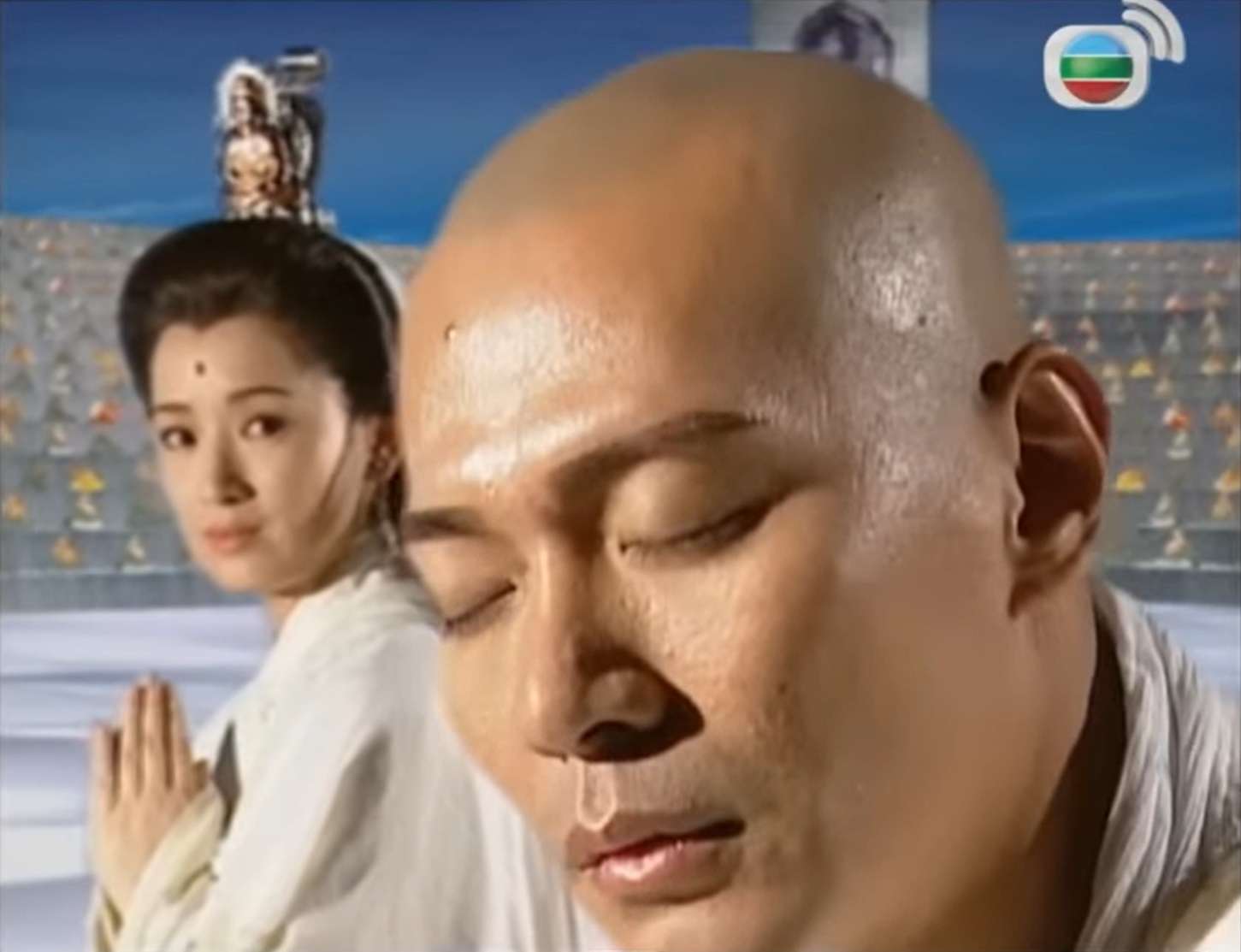
“You wouldn’t know about this,” replied Pilgrim. “Our old master fell asleep while listening to Buddha expounding the Law [fig. 1]. As he slumped to one side, his left foot kicked down one grain of rice. That is why he is fated to suffer three days’ illness after he has arrived at the Region Below.” [1]

Horrified, Eight Rules said, “The way old Hog sprays and splatters things all over when he eats, I wonder how many years of illness I’d have to go through!”

“Brother,” said Pilgrim, “you have no idea either that the Buddha is not that concerned with you and other creatures. But as people say:

Rice stalks planted in noonday sun
Take root as perspiration runs.
Who knows of this food from the soil
Each grain requires most bitter toil?

Master still has one more day to go, but he’ll be better by tomorrow” (Wu & Yu, 2012, vol. 4, p. 82).

你不知道。師父是我佛如來第二個徒弟,原叫做金蟬長老,只因他輕慢佛法,該有這場大難。」八戒道:「哥啊,師父既是輕慢佛法,貶回東土,在是非海內,口舌場中,託化做人身,發願往西天拜佛求經,遇妖精就捆,逢魔頭就吊,受諸苦惱,也夠了,怎麼又叫他害病?」行者道:「你那裡曉得。老師父不曾聽佛講法,打了一個盹,往下一試,左腳屣了一粒米,下界來,該有這三日病。」八戒驚道:「像老豬吃東西潑潑撒撒的,也不知害多少年代病是。」行者道:「兄弟,佛不與你眾生為念,你又不知。人云:『鋤禾日當午,汗滴禾下土。誰知盤中餐,粒粒皆辛苦。』師父只今日一日,明日就好了。」

Fig. 1 – Master Golden Cicada falls asleep during the Buddha’s sermon (larger version). Screenshot from episode one of the 1996 Journey to the West TV show.

2. Miao Jixiang

Miao Jixiang (妙吉祥) is a former oil lamp-turned-humanoid Buddhist disciple who briefly appears in chapter one of Journey to the South (Nanyouji南遊記, c. 1570s-1580s). He is exiled from the Western Heaven for using his holy flame to kill a belligerent sage. But Miao escapes underworld punishment thanks to the intervention of the Bodhisattva Guanyin. He is later reborn in China as a number of figures, most famously the popular martial deity Huaguang dadi (華光大帝; variously translated as “Great Emperor of Flowery/Resplendent/Magnificent/Majestic Light”):

That Great King of the Single Flame [Duhuo dawang, 独火大王] … wanted to incinerate Spirit Mountain. Fortunately, the Tathagata foresaw this with his all-seeing eyes, and so he recited a mantra, summoning five hundred dragons that brought forth dew and fog to cover the mountain.

Unable to unleash his fire, this Single-Flame demon became angry, rampaging to the left and right of the temple and hurling insults.

Miao Jixiang [2] offered a word of advice, “You are not the same caliber of wisdom as we Buddhist disciples. You can leave if you want; it makes no difference.”

“If you enrage my heart-mind, I will burn your dog bones to death!” replied the Great King of the Single Flame.

Miao Jixiang laughed, “You can only burn others. You can never burn me. If you can burn me, I will acknowledge you as superior.”

Anger racing through him, the Great King set loose his Fire of the Five Dippers, but Miao Jixiang remained perfectly still.

He laughed, “You monster, how could your fire burn me? I used to be the oil lamp before the Tathagata’s Dharma Hall, burning brilliantly day and night, listening to the sutras, and inquiring about the Dharma. I have accumulated many candle wicks during this time. But one day, Tathagata recited a spell and bestowed onto me a human body. With my appearance, spirit, hearing, and origins all arising from fire, how could you burn me? You monster, if you continue to harass our Spirit Mountain and cause us unease, I will inevitably bring forth my Perfected Fire of Samadhi to burn you monster to death, so as to avoid any future troubles.”

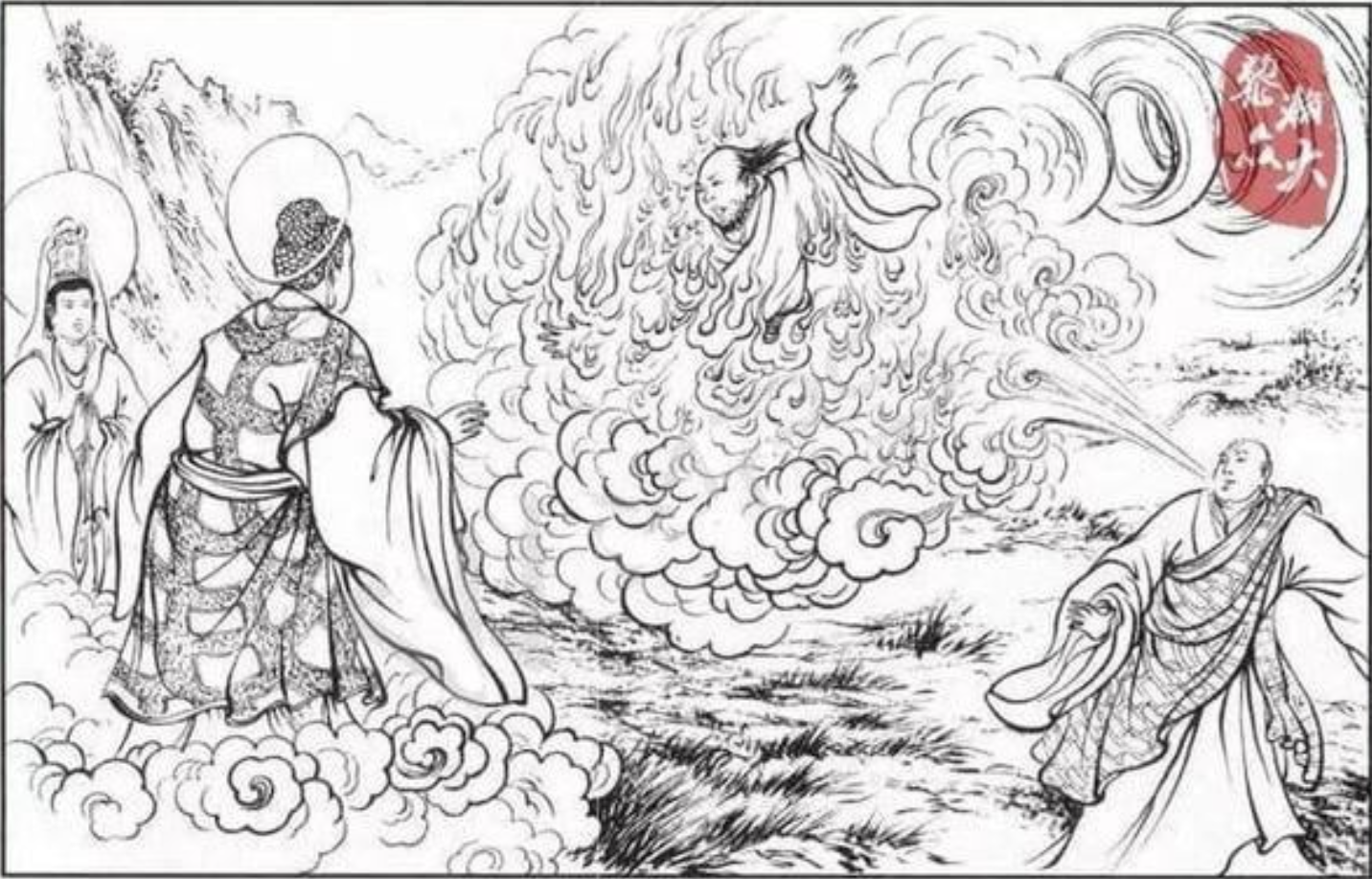
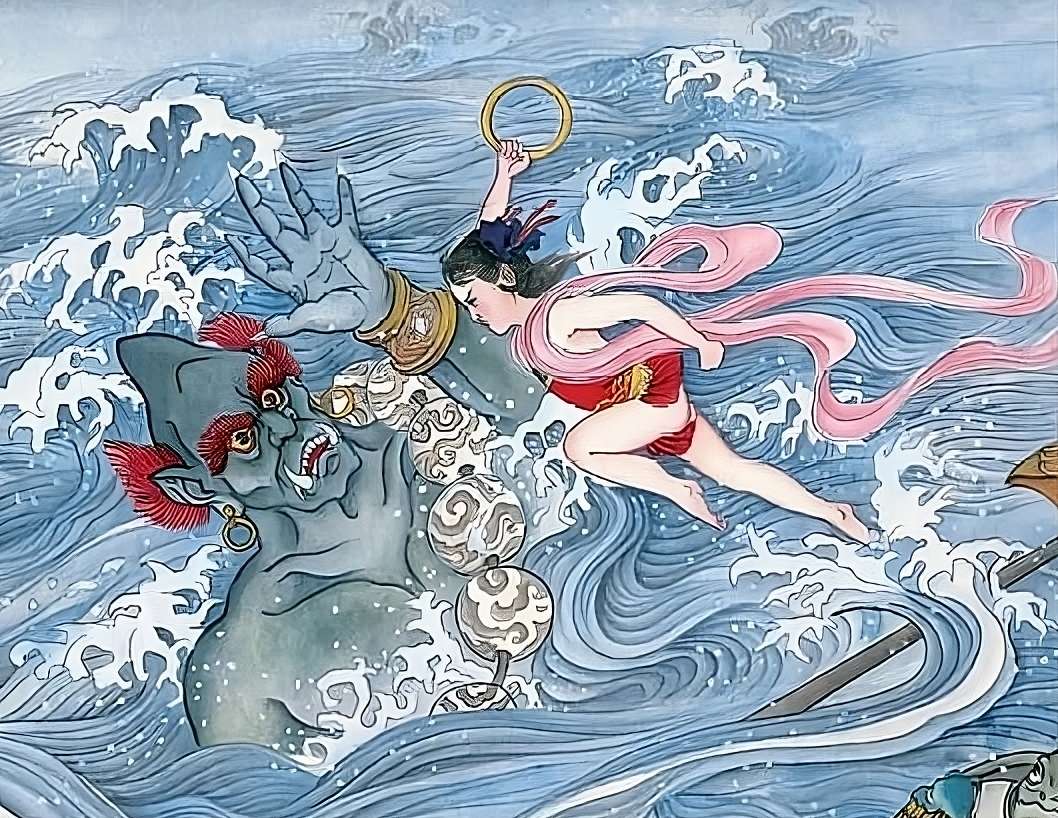
Watching this with his all-seeing eyes, the Tathagata was about to stop Miao Jixiang, but the latter had already unleashed his fire and burned that damnable Single Flame to death [fig. 2].

Furious, the Tathagata summoned heavenly generals to arrest Miao Jixiang, “You beast, how dare you break my precepts?” Tathagata scolded. “Although he is wrong, you and I are Buddhists (chujia zhi ren, 出家之人, lit: “people who have left their families”); we’re supposed to be infinitely merciful. Why did you burn him to death? Such an act is intolerable by the Buddhist Dharma. I shall banish you to the underworld (yinshan, 陰山; lit: “mountain of yin/darkness”) to suffer.”

Miao Jixiang begged for forgiveness.

The Reverend Mother Guanyin came forward from one said to defend him by saying, “Although he is guilty, Miao Jixiang is a disciple of Spirit Mountain. He should not be banished to the underworld. When he was still alive, the Great King of Horse-Ear Mountain approached our Spirit Mountain to pray for a son. Now that his wife is pregnant, why not send Miao Jixiang to be reincarnated as her son? After Miao Jixiang goes through this catastrophe, he shall be allowed to return to Spirit Mountain and serve the Master. Why not do this?”

Nodding, Tathagata was about to send Miao Jixiang away.

“My master, you order me to reincarnate,” Miao Jixiang said in tears, “but if I am deprived of the Divine Way, I am afraid that I will be bullied.”

Sitting atop his treasured throne, Tathagata recited a spell, “I shall now bestow you with the five supernatural powers: the heaven power, with which you can travel freely to heaven; the earth power, with which the earth will crack by itself if you want to get inside; the wind power, with which you are shadowless in the wind; the water power, with which you can travel without any obstacle in water; the fire power, with which you feel ease in the fire.”

Tathagata pointed his dharma finger at Miao Jixiang’s forehead, saying, “I will also bestow you with a heavenly eye, with which you can see all across the three realms.”

Tathagata ordered the Reverend Mother Guanyin to deliver Miao Jixiang to his reincarnation (adapted from pp. 10-11 of this PDF).

那大王 … 即要放火烧灵山。幸如来慧眼一见,便念动咒语,放出五百条逆龙,涌起露雾罩住灵山,此火便不能发。独火鬼见火不发,十分著恼,于寺中左冲右撞,出言不逊,妙吉祥进言曰:「我们佛家弟子,亦不比你见识,你可去也罢。」独火大王曰:「恼得我心一边来,把你这狗骨头亦将来烧死。」妙吉祥笑曰:「你的火只好烧别人,烧得我不成;你若烧得我,便见你高。」大王怒起,就放出五斗火,便烧吉祥,吉祥端然不动。笑曰:「你这妖怪,你那火如何烧得我?我乃如来法堂前一盏油灯,昼夜煌煌,听经问法,灯花堆积,一日如来念咒,咒成人身。我这火之相,火之灵,火之听,火之起,你焉能烧我?你这妖怪,今你若再在整日闹我灵山,不得自在,我不免请出三昧真火,烧死你这妖怪,免致后患。」如来慧眼看见,便叫不可之时,独火鬼已被他烧死在地。如来大怒,喝声叫将妙吉祥拿下,责曰:「你这畜生如何敢破我戒?他虽不是,我你俱出家之人,当大慈大悲终是,为何将他烧死?佛法难容,贬去阴山受罪。」吉祥告饶。观音老母在旁保曰:「妙吉祥虽然有罪,乃灵山弟子,不可贬去阴山。当日马耳山大王在日之时,来我灵山祈嗣。今日那娘娘有孕有身,不如送去投胎,等他大难满日,取回灵山,伏侍师父,何不可也。」如来依言,便欲送去。吉祥流泪告曰:「师父命我投胎,奈我不晓神道,恐后被人欺负。」如来于宝座中,念动咒语,说:「我就赐你五通:你一通天,天中自行;二通地,地赶自裂;三通风,风中无影;四通水,水中无碍;五通火,火里自在。」又用法手一指顶门:「赐你一个天眼挪门,可见三界。」就叫观音老母送去投胎。

Fig. 2 – Miao Jixiang kills the Great King of the Single Flame (larger version). From a modern lianhuanhua comic. Image found here

3. The Great Peng

The Complete Vernacular Biography of Yue Fei (Shuo Yue quanzhuan說岳全傳, 1684) depicts the Great Peng, the Golden-Winged King of Illumination (Dapeng jinchi mingwang, 大鵬金翅明王), [3] as a hot-tempered avian dharma protector stationed above the Buddha’s head (fig. 3). He is exiled from the Western Heaven for killing a bat-spirit who farts during the Buddha’s sermon, and the bird is later reborn in China as the famed Song-era General Yue Fei (岳飛, 1103-1142):

Let’s talk about the Buddha Tathagata at the Great Thunderclap Monastery in the Western Paradise. One day, he sat on a nine-level lotus throne, and the Four Great Bodhisattvas, the Eight Great Vajra Warriors, the five hundred Arhats, the three thousand Heavenly Kingsnuns and monks, male and female attendants, all of the heavenly sages who protect the Dharma, gathered to listen to his lecture on the Lotus Sutra. His words were like flowers and precious jewels raining from the heavens. But, at that time, a star-spirit, the Maiden Earth Bat, who had been listening to the lecture from beneath the lotus throne, couldn’t bear it any longer and unexpectedly let out a stinky fart.

The Buddha was a great, merciful lord, so he didn’t mind even the slightest bit. But don’t console the Dharma protector above his head, [4] the “Great Peng, the Golden-Winged King of Illumination,” whose eyes shone with golden light and whose back was a scene of auspiciousness. He became angry when he saw the nasty, filthy Maiden Earth Bat, and so he unfurled both his wings and dropped down to kill the spirit by pecking her on the head. The light-point of her soul shot out of the Great Thunderclap Monastery and went to the Lands of the East (China) in the world below to find a mother and reincarnate. She was reborn as a daughter of the Wang clan. She would later marry the Song Prime minister Qin Hui (1091-1155) and come to cruelly kill the righteous (Yue Fei) as a means to get revenge against today’s enemy. We will talk about this later.

Let’s return to the Buddha, who saw what happened with his all-seeing eyes and exclaimed, “Good! Good! It turns out that this is an episode of karma (cause and effect).” Then he called the Great Peng bird to come closer and shouted, “You evil creature! You already took refuge in my teachings. How can you not follow the five precepts by daring to commit such a horrible crime? I don’t need you here; you will descend to the mortal world to pay off your (karmic) debt and wait until you have fulfilled your work. Once that is completed, only then will I allow you to return to the mountain to achieve the right fruit (Buddhist merit).” The Great Peng complied with the decree, flying out of the Great Thunderclap Monastery directly to the Lands of the East to be reincarnated. We will stop here (translated by the author).

且說西方極樂世界大雷音寺我佛如來,一日端坐九品蓮臺,旁列著四大菩薩、八大金剛、五百羅漢、三千偈諦、比丘尼、比丘僧、優婆夷、優婆塞,共諸天護法聖眾,齊聽講說妙法真經。正說得天花亂墜、寶雨繽紛之際,不期有一位星官,乃是女土蝠,偶在蓮臺之下聽講,一時忍不住,撒出一個臭屁來。我佛原是個大慈大悲之主,毫不在意。不道惱了佛頂上頭一位護法神祗,名為大鵬金翅明王,眼射金光,背呈祥瑞,見那女土蝠污穢不潔,不覺大怒,展開雙翅落下來,望著女土蝠頭上,這一嘴就啄死了。那女土蝠一點靈光射出雷音寺,徑往東土認母投胎,在下界王門為女,後來嫁與秦檜為妻,殘害忠良,以報今日之讎。此是後話,按下不提。

且說佛爺將慧眼一觀,口稱:「善哉,善哉!原來有此一段因果。」即喚大鵬鳥近前,喝道:「你這孽畜!既歸我教,怎不皈依五戒,輒敢如此行兇?我這裡用你不著,今將你降落紅塵,償還冤債,直待功成行滿,方許你歸山,再成正果。」大鵬鳥遵了法旨,飛出雷音寺,徑來東土投胎不表。

Fig. 3 – Detail of an altar to the Great Peng, the Golden-Winged King of Illumination (larger version). Full image found here.

4. Analysis

There are four parallels shared between these stories. First, each character is exiled for disrespecting the Buddha. Master Golden Cicada falls asleep during the Tathagata’s sermon. Miao Jixiang kills a belligerent sage on the grounds of the Thunderclap Monastery. And the Great Peng kills the Maiden Earth Bat in the same hallowed place during the Buddha’s lecture. The latter two examples are similar in that both characters are admonished by the Tathagata for breaking the precept against killing. For the former, the Buddha exclaims, “You beast, how dare you break my precepts? … Such an act is intolerable by the Buddhist Dharma” (你這畜生如何敢破我戒?… 佛法難容). And for the latter, he screams, “You evil creature! You already took refuge in my teachings. How can you not follow the five precepts by daring to commit such a horrible crime?” (你這孽畜!既歸我教,怎不皈依五戒,輒敢如此行兇?). Admittedly, these acts make Master Golden Cicada’s sleeping far less serious in comparison.

Second, each is exiled from the Western Heaven in India to be reborn as a hero in China. Master Golden Cicada lives out a number of pious incarnations before his final life as Tripitaka, a learned monk who procures scriptures needed to release untold numbers of orphaned souls from the underworld. Miao Jixiang experiences several adventurous incarnations before his final life as Huaguang dadi, a martial deity who rids the world of evil spirits. And the Great Peng is reborn as Song Dynasty General Yue Fei, a patriot who fights against invading Jurchen forces which threaten the Middle Kingdom.

Third, all are exiled with the understanding that they will return once they have accumulated enough Buddhist merit and/or paid off a karmic debt. This is more implied in Master Golden Cicada/Tripitaka’s case when the Buddha reveals his past transgression and then grants him an elevation in spiritual rank to an enlightened being, thereby allowing him to return to the Western Heaven at the end of his story arc (Wu & Yu, 2012, vol. 4, p. 381). Whereas with Miao Jixiang, this is openly suggested by Guanyin: “After [he] goes through this catastrophe, he shall be allowed to return to Spirit Mountain and serve the Master. Why not do this?” (等他大难满日,取回灵山,伏侍师父,何不可也。) The Tathagata agrees to this arrangement. As for the Great Peng, the Buddha states,

[Y]ou will descend to the mortal world to pay off your (karmic) debt and wait until you have fulfilled your work. Once that is completed, only then will I allow you to return to the mountain to achieve the right fruit (Buddhist merit).

今將你降落紅塵,償還冤債,直待功成行滿,方許你歸山,再成正果。

And fourth, all are connected to the Journey to the West story cycle. For instance, in chapter one of Journey to the South (c. 1570s-1580s), “Pilgrim Sun” (Sun xingzhe, 孫行者; i.e. Sun Wukong) wins first place in a competition between the gods of the Buddho-Daoist pantheon to see who owns the greatest celestial treasure (see pp. 6-7 of this PDF). And in chapter 17, Monkey fights Miao Jixiang’s reincarnation, Huaguang dadi, because the latter framed the former for the theft of immortal peaches. The Great Sage initially wins the encounter, but he is unexpectantly burned at the last minute, leaving his non-canonical daughter to finish the fight (see pp. 107-110 of this PDF). And the Great Peng originally appears as a demon king named the “Peng of Ten Thousand Cloudy Miles” (Yuncheng wanli peng, 雲程萬里鵬) in chapters 74 to 77 of Journey to the West (1592). At the end of his arc, he is trapped above the Buddha’s head (fig. 4):

Perceiving the Peng’s intentions, Tathagata produced a golden light and, facing the wind, and gave his head (which had once supported the nests of magpies) a shake. The head changed at once into a piece of meat dripping with fresh blood. Stretching out his claws, the monster-spirit drew near and tried to clutch at the piece of meat. Our Father Buddha pointed at him with his finger and immediately the monster-spirit felt such cramps throughout his huge wings that he could not fly away. He was trapped above the Buddha’s head in his true form: the Great Peng, a golden-winged eagle [fig. 4] (based on Wu & Yu, 2012, vol. 4, p. 31).

如來情知此意,即閃金光,把那鵲巢貫頂之頭迎風一幌,變做鮮紅的一塊血肉。妖精掄利爪叼他一下。被佛爺把手往上一指,那妖翅膊上就了筋,飛不去,只在佛頂上不能遠遁,現了本相,乃是一個大鵬金翅鵰。

The Great Peng later begrudgingly agrees to submit to Buddhism (Wu & Yu, 2012, vol. 4, p. 31). Therefore, this explains his lofty position in The Complete Vernacular Biography of Yue Fei (1684).

Fig. 4 – The Great Peng trapped above the Buddha’s head (larger version). From Chen Huiguan’s Newly Illustrated and Complete Journey to the West (Chen Huiguan Xinhui Quanben Xiyouji, 陈惠冠新绘全本西游记, 2001).

5. Similarities to Western Philosophy

McEvilley (2002) comments that the Greek philosopher Empedocles (5th-c. BCE) wrote of gods being exiled for ten thousand years for the crime of murder or lying under oath. The fallen deity was believed to reincarnate into every creature of land, air, and sea, and when their long punishment was over, they were reborn in their last life as a person of high culture, such as royalty, religious leaders, and scholars. They then returned to their former heavenly station upon death (McEvilley, 2002, pp. 106-107). These beliefs mirror the misdeeds (sleeping and murder), exile from heaven, experience of reincarnation, and then eventual return to heaven of Master Golden Cicada, Miao Jixiang, and the Great Peng. These similarities likely point to a broader concept in Greco-Indian philosophy that made its way into Chinese vernacular fiction.


Update: 01-25-25

I have suggested that a historical disciple of the Buddha influenced the episode of Master Golden Cicada falling asleep. See 01-25-25 update here:

The Monk Tripitaka and the Golden Cicada

Notes:

1) Tripitaka’s additional punishment points to the supreme importance of rice in an agrarian society like ancient China.

2) Miao Jixiang should not be confused with the Bodhisattva Manjushri, who has the same Chinese name in some older Buddhist literature (Von Glahn, 2004, p. 214).

3) The mingwang (明王, “illumination king”) of the Great Peng’s Buddhist title could also mean “wisdom king,” which refers to spiritual knowledge.

4) My previous article traces the religious motif of a bird (Garuda) hovering above the heads of Buddhist personages to Hindo-Buddhist architecture in ancient India.

Sources:

McEvilley, T. (2002). The Shape of Ancient Thought: Comparative Studies in Greek and Indian Philosophies. New York: Allworth.

Von Glahn, R. (2004). The Sinister Way: The Divine and the Demonic in Chinese Religious Culture. United Kingdom: University of California Press.

Wu, C., & Yu, A. C. (2012). The Journey to the West (Vols. 1-4) (Rev. ed.). Chicago, Illinois: University of Chicago Press.

Laozi’s Diamond Cutter Treasure-Weapon from Journey to the West

Last updated: 01-31-2026

I’ve previously written several articles that survey a chosen subject from Journey to the West (Xiyouji西遊記, 1592; “JTTW” hereafter). These include Monkey’s immortal breath, his names and titles, his four mighty commanders, and a comprehensive list of his magic powers and skills. Also, there are my articles on the respective appearances of Sun Wukong, Zhu Bajie, and Red Boy.

Here, I would like to focus on a bangle-like holy treasure belonging to the Daoist high god Laozi (老子). The fillet first appears in chapter six when it is used as a blunt throwing weapon to incapacitate Sun Wukong during his rebellion. It later reappears in chapters 50 to 52 as a mysterious, white, shiny string of pearls used by a buffalo spirit to instantly suck away magic weapons and animals and defeat even destructive elemental attacks, kind of like a personal black hole generator with a built-in pocket dimension. It’s so powerful, in fact, that even the sight of it is enough to make Monkey and a host of other gods flee for their lives.

This article will quote all mentions of the weapon, complete with the original Chinese; explain how it was created; describe the history of terminology that ties the treasure to diamond-pointed tools used by craftsmen west of China to work hard stone like jade; demonstrate that it is a mirrored literary element to Sun Wukong’s headband and Prince Nezha‘s fire wheel; and, finally, explore its influence on three fillet-like throwing weapons from another Chinese vernacular classic.

The overwhelming power of Lord Li’s treasure has stuck with me ever since I first read JTTW nearly 25 years ago. I hope that this article will introduce the subject to a wider audience who may not be aware of it.

1. Introduction in chapter six

The high god of Daoism claims to have used the steel bangle as protection while proselytizing in the west:

He rolled up his sleeve and took down from his left arm an armlet [quanzi, 圈子, lit: “circle”], saying, “This is a weapon made of kun steel [kungang, 錕鋼], brought into existence during my preparation of reverted elixir and fully charged with spiritual energy. It can be made to transform at will; indestructible by fire or water, it can entrap many things. It’s called the diamond cutter [jingang zhuo, 金鋼琢] or the diamond snare [jingang tao, 金鋼套]. The year when I crossed the Hangu Pass, I depended on it a great deal for the conversion of the barbarians to Buddhism, for it was practically my bodyguard night and day (based on Wu & Yu, 2012, vol. 1, p. 186).

捋起衣袖,左膊上取下一個圈子,說道:「這件兵器,乃錕鋼摶煉的,被我將還丹點成,養就一身靈氣,善能變化,水火不侵,又能套諸物。一名『金鋼琢』,又名『金鋼套』。當年過函關,化胡為佛,甚是虧他。早晚最可防身。

He then throws it at Wukong’s head, knocking him off balance:

After saying this, Laozi hurled the cutter [1] down from the Heaven Gate; it went tumbling down into the battlefield at the Flower-Fruit Mountain and landed smack on the Monkey King’s head. The Monkey King was engaged in a bitter struggle with the Seven Sages and was completely unaware of this weapon, which had dropped from the sky and hit him on the crown of his head. No longer able to stand on his feet, he toppled over (Wu & Yu, 2012, vol. 1, p. 186).

話畢,自天門上往下一摜,滴流流,徑落花果山營盤裡,可可的著猴王頭上一下。猴王只顧苦戰七聖,卻不知天上墜下這兵器,打中了天靈,立不穩腳,跌了一跤

Fig. 1 – Laozi looks lovingly upon his diamond cutter (larger version). A screenshot from the 1986 JTTW TV Show. The cutter here looks like a gold or copper ring, but the novel describes it differently (see below).

2. Appearance in later chapters

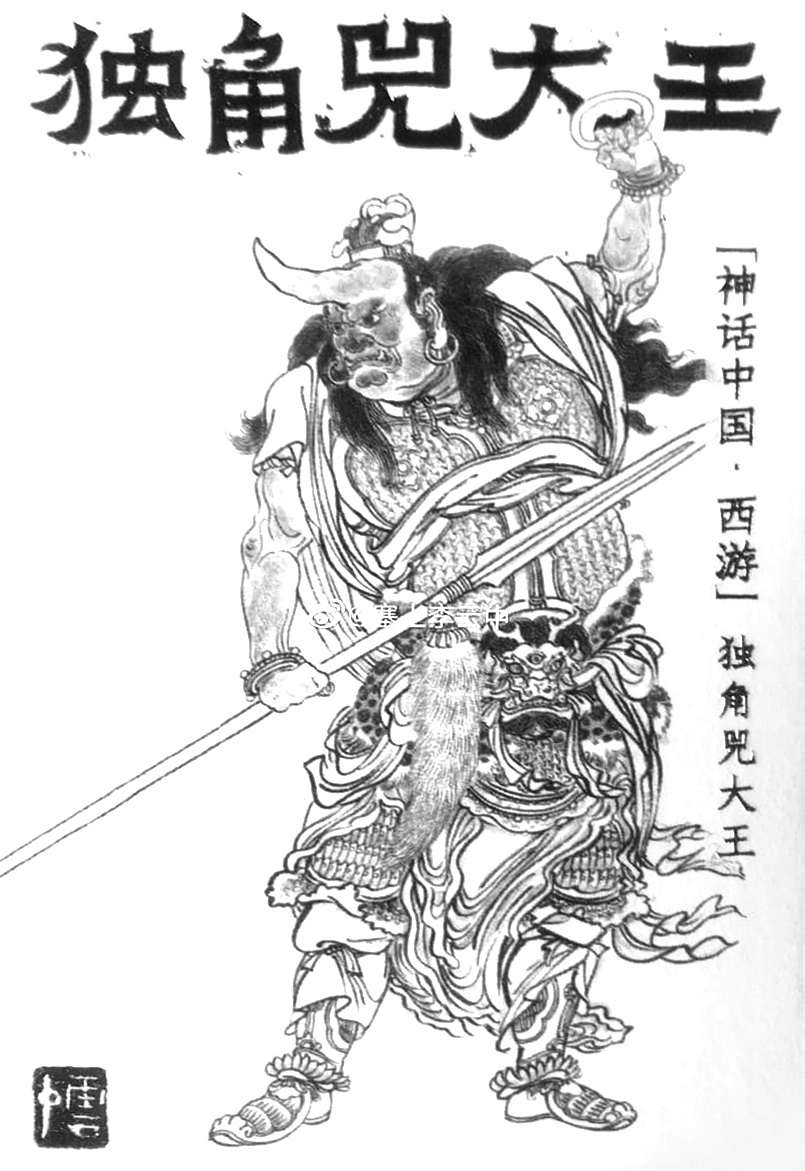
The diamond cutter reappears in chapters 50 to 52 as a mysterious, white, shiny string of pearls used by the Great King One-Horned Buffalo (Dujiao si dawang, 獨角兕大王) (fig. 2) to instantly disarm gods and defeat destructive elemental attacks. [2]

Fig. 2 – A modern drawing of Great King One-Horned Buffalo holding the diamond cutter and his spear (larger version). Based on an image found here.

2.1. Chapter 50

Monkey multiplies his iron staff many times over to fight against the buffalo and his army of minions. But the fiend easily sucks away all of the cudgels with the magic weapon:

The old demon king, however, stood still and, laughing with scorn, said, “Monkey, don’t be impertinent! Watch my trick!” He at once took out from his sleeve a white, shiny fillet [liang zhuozhuo bai sensen de quanzi, 亮灼灼白森森的圈子] and tossed it up in the air, crying, “Hit!” [zhao, 著] With a swish, all the iron rods changed back into a single rod, which was then sucked up by the fillet [fig. 3]. The Great Sage Sun, completely empty-handed, had to use his somersault desperately in order to escape with his life (Wu & Yu, 2012, vol. 2, p. 372).

老魔王唏唏冷笑道:「那猴不要無禮,看手段。」即忙袖中取出一個亮灼灼白森森的圈子來,望空拋起,叫聲:「著!」唿喇一下,把金箍棒收做一條,套將去了。弄得孫大聖赤手空拳,翻觔斗逃了性命。

Fig. 3 –  The diamond cutter sucking in the iron staff (larger version). A screenshot from the 2011 JTTW TV show. Image found here.

2.2. Chapter 51

After his defeat, Wukong seeks heavenly aid several times in a row. First, Prince Nezha is sent to do battle but fails:

“Change!” he roared, and [his six magic] weapons changed into hundreds and thousands. Like a thundershower and a sleet storm, these weapons rained down on the head of the demon. Not the least bit daunted, the demon king took out with one hand that somber white fillet tossed it into the air, crying, “Hit!” With a loud whoosh, the six weapons were all sucked away by it. In desperation Prince Nezha fled for his life with empty hands, [3] while the demon king turned back in triumph (Wu & Yu, 2012, vol. 3, p. 6).

大叫一聲:「變!」一變十,十變百,百變千,千變萬,都是一般兵器,如驟雨冰雹,紛紛密密,望妖魔打將去。那魔王公然不懼,一隻手取出那白森森的圈子來,望空拋起,叫聲:「著!」唿喇的一下,把六般兵器套將下來。慌得那哪吒太子赤手逃生。魔王得勝而回。

Second, the Devaraja Li Jing is sent to distract the buffalo with combat, while a fire god prepares his forces to scorch the spirit, but the plan fails:

The demon fought the devaraja for some time, and in the heat of the battle, he again took out the fillet. When the devaraja saw it, he at once turned his auspicious luminosity around and fled in defeat. On the tall summit the Star of Fiery Virtue quickly gave the command for the various gods of his department to start the fire. It was some fire, all right!

你看那個妖魔與天王正鬥到好處,卻又取出圈子來。天王看見,即撥祥光,敗陣而走。這高峰上火德星君忙傳號令,教眾部火神一齊放火。這一場真個利害

[…]

When the demon saw the fire coming, he was not in the least afraid. He tossed the fillet in the air and with a loud whoosh, it sucked away all those fire dragons, fire horses, fire crows, fire rats, fire bows, and fire arrows. Then he turned toward his cave and went back in triumph (Wu & Yu, 2012, vol. 3, pp. 8-9).

那妖魔見火來時,全無恐懼。將圈子望空拋起,唿喇一聲,把這火龍、火馬、火鴉、火鼠、火槍、火刀、火弓、火箭,一圈子又套將下去,轉回本洞,得勝收兵。

Third, a water god attempts to drown the monster with the Yellow River but fails:

[T]he Water Lord immediately emptied the content of his white jade chalice toward the inside of the cave. When he saw the water rushing in, the fiend dropped his long lance and took out the fillet, holding it high at the second door. Not only was the water blocked right there, but it reversed its course and gushed back out of the cave. So startled was the Great Sage Sun that he somersaulted immediately into the air and, together with Water Lord, leaped up to the tallest peak (Wu & Yu, 2012, vol. 3, p. 11).

這水伯將白玉盂向裡一傾。那妖見是水來,撒了長槍,即忙取出圈子,撐住二門。只見那股水骨都都的只往外泛將出來。慌得孫大聖急縱觔斗,與水伯跳在高峰。

Monkey then requests a boxing match to show that he isn’t useless without his staff. But when the bout comes to a draw, both heavenly and demonic forces charge in to help their respective fighter. Fearing the worst, Wukong creates hair clones to overwhelm the monster, but this strategy fails:

At once they changed into some fifty little monkeys, who swarmed all over the demon—grabbing his legs, tugging at his torso, gouging his eyes, and pulling at his hair. The fiendish creature became so alarmed that he immediately took out his fillet. When the Great Sage and his companions saw that object, they mounted the clouds at once and fled toward the tall summit. Tossing the fillet up into the air, the fiend changed those fifty monkeys back into their true forms and then they were sucked away again with a loud whoosh. After he had gained this victory, the fiend led his troops back to his cave, closed the door, and celebrated (Wu & Yu, 2012, vol. 3, p. 13).

即變做三五十個小猴,一擁上前,把那妖纏住,抱腿的抱腿,扯腰的扯腰,抓眼的抓眼,撏毛的撏毛。那怪物慌了,急把圈子拿將出來。大聖與天王等見他弄出圈套,撥轉雲頭,走上高峰逃陣。那妖把圈子往上拋起,唿喇的一聲,把那三五十個毫毛變的小猴,收為本相,套入洞中,得了勝,領兵閉門,賀喜而去。

2.3. Chapter 52

Monkey resorts to stealth, changing into a cricket (cuzhi’er, 促織兒) and sneaking into the monster’s cave in order to learn where the treasure is kept:

After the demon king took off his clothes, at once the fillet—all ghostly white—could be seen. It was attached to his left shoulder like an armlet made of a string of pearls [zhuzhuo tou, 珠鐲頭]. Look at him! Instead of taking the fillet off, he pushed it up a couple of times until it was snugly clamped to his shoulder. Only then did he lie down to sleep (Wu & Yu, 2012, vol. 3, p. 18).

只見那魔王寬了衣服,左肐膊上白森森的套著那個圈子,原來像一個連珠鐲頭模樣。你看他更不取下,轉往上抹了兩抹,緊緊的勒在肐膊上,方才睡下。

He changes into a flea (gezao, 虼蚤) and twice bites the spirit, but this plan fails to make the beast take off the bangle (Wu & Yu, 2012, vol. 3, pp. 18-19).

Wukong goes on to rescue the stolen holy weapons and animals and magic hairs, before setting the cave on fire:

The Bovine Great King was scared out of his wits; dashing out of his room, he held his fillet up high with both hands. He pushed it toward the fire this way and that way, and it immediately went out. Though the air was filled with flame and smoke, they all subsided after he and his treasure [baobei, 寶貝] had run through the entire cave (Wu & Yu, 2012, vol. 3, p. 20).

諕得個兕大王魂不附體,急欠身開了房門,雙手拿著圈子,東推東火滅,西推西火消,滿空中冒煙突火,執著寶貝跑了一遍,四下裡煙火俱熄。

Monkey and the host of gods become foolhardy upon retrieving their weapons and once more challenge the buffalo to a fight. But their holy armaments are again sucked away by the fillet:

Smiling scornfully, the demon calmly took out from his sleeve his treasure and tossed it in the air, crying, “Hit!” With a loud whoosh, the six divine weapons, the fire equipment, the thunderbolts, the scimitar of the devaraja, and the rod of Pilgrim were all snatched away. Once again, the deities and the Great Sage Sun were empty-handed (Wu & Yu, 2012, vol. 3, p. 23).

那魔頭巍巍冷笑,袖子中暗暗將寶貝取出,撒手拋起空中,叫聲:「著!」唿喇的一下,把六件神兵、火部等物、雷公㨝、天王刀、行者棒,盡情又都撈去。眾神靈依然赤手,孫大聖仍是空拳。

Having no more ideas, Wukong travels to Vulture Peak in the western continent (i.e. India) to seek the Buddha’s wisdom. The Tathagata in turn sends the 18 arhats armed with “golden cinnabar sand” (jindan sha, 金丹砂) in an attempt to bog the demon down and stop him from moving. But this plan also fails:

When the demon saw that the flying sand was clouding up his vision, he lowered his head and discovered that his feet were already standing in three feet of the stuff. He was so horrified that he tried to jump upward; before he could even stand up properly the sand grew another foot. In desperation, the fiend tried to pull up his legs while taking out his fillet. Throwing it up into the air, he cried, “Hit!” With a loud whoosh, the eighteen grains of golden cinnabar sand were sucked away. The demon then strode back to the cave (Wu & Yu, 2012, vol. 3, p. 27).

那妖魔見飛砂迷目,把頭低了一低,足下就有三尺餘深。慌得他將身一縱,跳在浮上一層。未曾立得穩,須臾,又有二尺餘深。那怪急了,拔出腳來,即忙取圈子,往上一撇,叫聲:「著!」唿喇的一下,把十八粒金丹砂又盡套去,拽回步,徑歸本洞。

Monkey later receives a message from the Buddha suggesting that he consult Laozi. Upon traveling to the Tushita Palace in the 33rd Heaven, he learns that the Daoist high god’s holy mount, a green buffalo (qingniu, 青牛), is missing. This prompts the deity to check his collection of holy treasures:

Laozi made a quick inventory; everything was there except the diamond cutter. “This cursed beast stole my diamond cutter!” said Laozi. “So, that’s the treasure!” said Pilgrim. “It was the same snare that hit me that time! [refer back to sec. 1] Now it’s going wild down below, sucking away who knows how many things.”

君急查看時,諸般俱在,止不見了金剛琢。老君道:「這孽畜偷了我金剛琢去了!」行者道:「原來是這件寶貝。當時打著老孫的是他。如今在下界張狂,不知套了我等多少物件。」

[After Wukong describes all of the magic weapons sucked away by the bangle …]

Laozi said, “That diamond cutter of mine is a treasure perfected since the time of my youth, and it was also an instrument with which I converted the barbarians when I passed through the Hangu Pass. Whatever weapons you may have, including fire and water, you can’t touch it. If the demon had stolen my plantain-leaf fan also, then even I would not be able to do anything to him” (Wu & Yu, 2012, vol. 3, p. 29).

老君道:「我那金剛琢,乃是我過函關化胡之器,自幼煉成之寶。憑你甚麼兵器、水火,俱莫能近他。若偷去我的芭蕉扇兒,連我也不能奈他何矣。」

Lord Li’s closing sentence is eye-opening, for it means that anyone who wields both the diamond cutter and fan would be invincible, even against Laozi. This is surprising since JTTW acknowledges him as the creator of the universe who separated the earth and sky from chaos. [4]

In the end, though, Laozi takes back the diamond cutter and subdues the buffalo spirit without trouble:

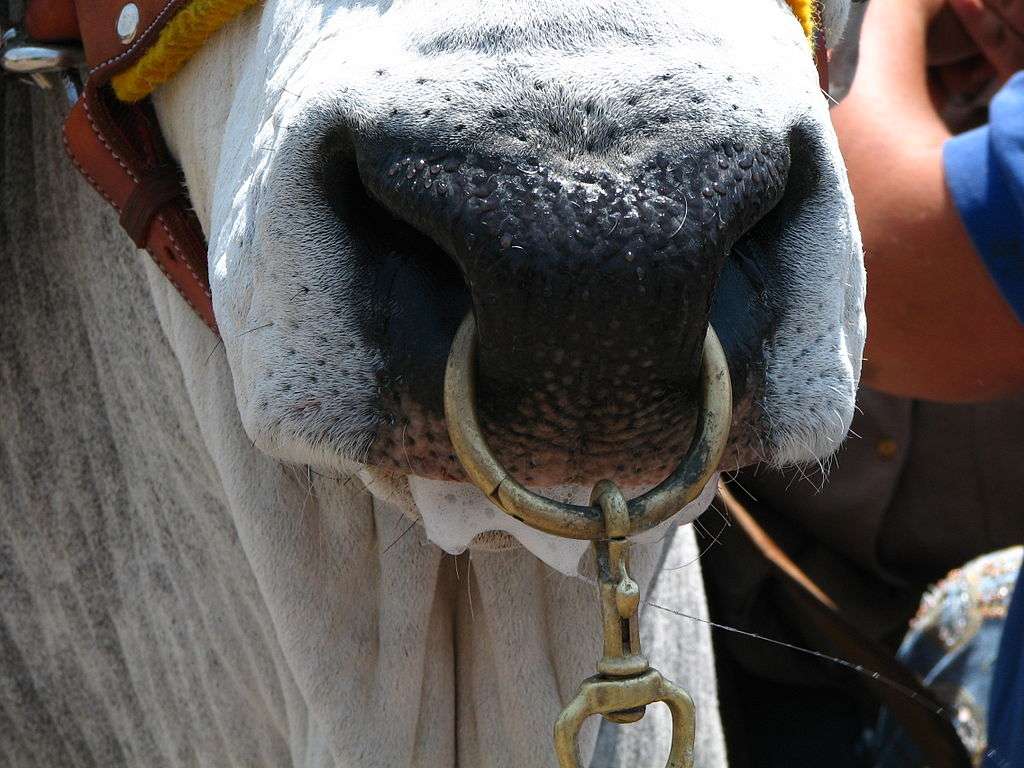
Reciting a spell, Laozi fanned the air once with his fan. The fiend threw the fillet at Laozi, who caught it immediately and gave him another fan. All at once the fiend’s strength fled him and his tendons turned numb; he changed back into his original form, which was that of a green buffalo. Blowing a mouthful of divine breath on the diamond snare, Laozi then used it to pierce the nostrils of the fiend. Next, he took off the sash around his waist and fastened one end of it to the cutter while his hand held the other. Thus the custom of leading the buffalo with a ring in its nose was established [fig. 4], a custom in use even now. This is also what we call binlang [賓郎] (Wu & Yu, 2012, vol. 3, p. 30). [5]

老君念個咒語,將扇子搧了一下,那怪將圈子丟來,被老君一把接住。又一搧,那怪物力軟筋麻,現了本相,原來是一隻青牛。老君將金鋼琢吹口仙氣,穿了那怪的鼻子,解下勒袍帶,繫於琢上,牽在手中。至今留下個拴牛鼻的拘兒,又名賓郎 …

Fig. 4 – A nose ring through a bull’s nose (larger version). Image found here.

3. Background

3.1. Literary origin

Laozi’s dialogue explains how the diamond cutter was created. While at least two JTTW poems reference the high god’s skill in forging mystical weapons (Wu & Yu, 2012, vol. 1, p. 382; vol. 3, p. 375), his own words instead point to alchemical experimentation. As a reminder, in chapter 6, he states: “This is a weapon … brought into existence during my preparation of reverted elixir and fully charged with spiritual energy” (這件兵器,乃錕鋼摶煉的,被我將還丹點成,養就一身靈氣…) (based on Wu & Yu, 2012, vol. 1, p. 186). Later, in chapter 52, he adds: “That diamond cutter of mine is a treasure perfected since the time of my youth” (我那金剛琢 … 自幼煉成之寶。) (Wu & Yu, 2012, vol. 3, p. 29).

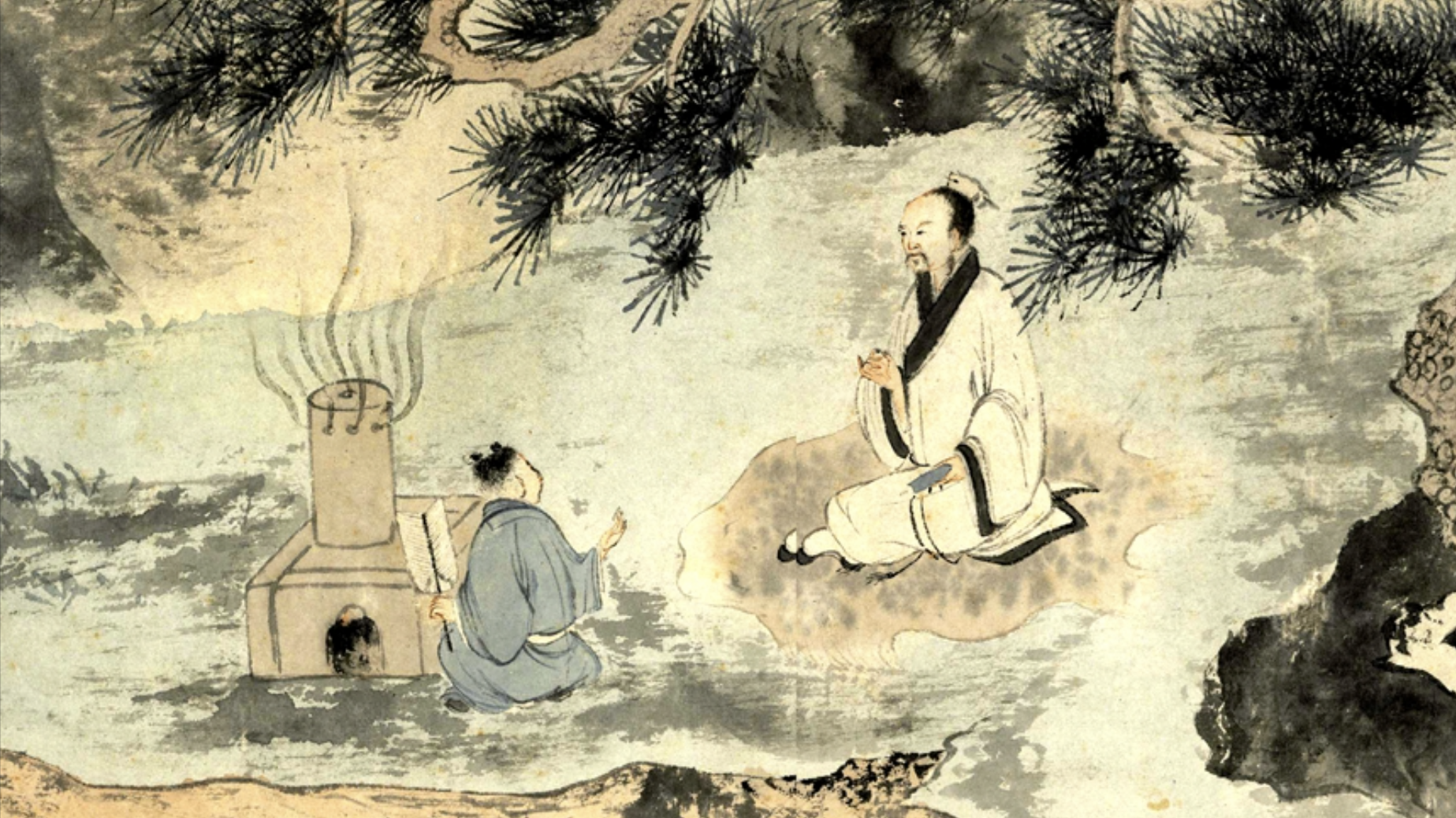
The phrase “reverted elixir” (huandan, 還丹) is key to understanding the origins of the treasure-weapon. This refers to a concept in external alchemy where a concoction of toxic elements is purified over successive firings in a crucible to create a drug of immortality (fig. 5). The Book of the Master Who Embraces Simplicity (Baopuzi抱樸子, 4th-century CE), for example, describes firing cycle periods of between one and nine times, and each subsequent medicine is said to bestow divine longevity within a respective period of time. The more the substance is fired, the faster the desired effect (Kohn, 1993, pp. 309 and 312-313). The product of the ninth cycle is said to transform into reverted elixir when combined with heated cinnabar and exposed to the sun, and a small dose of the drug is enough to bestow instant divinity:

Place the elixir, which has been cycled nine times, in a reaction vessel and expose it to the sun after the summer solstice. When the container becomes hot, introduce a pound of cinnabar beneath the lid. Even while you are watching, with the full power of the sun shining upon it, the whole content will suddenly glow and sparkle with all the colors of spirit radiance. It will immediately turn into reverted elixir. If you take even a single spoonful, you will straightaway rise to heaven in broad daylight (Kohn, 1993, p. 313).

若取九轉之丹,內神鼎中,夏至之後,爆之鼎熱,內朱兒一斤於蓋下。伏伺之,候日精照之。須臾翕然俱起,煌煌煇煇,神光五色,即化為還丹。取而服之一刀圭,即白日昇天。

The fact that Laozi has been developing the cutter from a young age, as stated above, suggests that it is ultimately a byproduct of excessive, millennia-long elixir firing cycles.

Fig. 5 – An alchemist watches as a young lad tends to the firing vessel (larger version). This is an example from Tang Yin’s (唐寅) Images of Cooking Medicine (Shaoyao tu, 燒葯圖) series. Image found here.

3.2. History

Anthony C. Yu (Wu & Yu, 2012) translates kungang (錕鋼), the substance comprising the diamond cutter, as “red steel” (vol. 1, p. 186). The original Chinese term refers to a legendary red knife mentioned in Master Lie (Liezi, 列子, c. 4th-century) as coming from Kunwu (錕鋙/昆吾), a distant land. This incredibly hard blade was presented as a royal tribute, along with asbestos cloth, a product of the west:

When King Mu of Zhou made his great expedition against the Rong tribes of the West, they presented him with a knife from Kunwu and a fire-proof cloth. The knife was one chi and zhi [changchi youzhi, 長尺有咫, 22.8 in/57.9 cm] long with a red blade [6] of tempered steel; cutting jade with it was as easy as cutting mud (based on Liezi & Graham, 1960/1990, p.117). [7]

周穆王大征西戎,西戎獻錕鋙之劍,火浣之布。其劍長尺有咫,練鋼赤刃,用之切玉如切泥焉。

The later Ten Islands of the Inner Seas (Hainei shizhou ji, 海內十洲記; a.k.a. Shizhou ji, 十洲記, c. 5th; “Ten Islands” hereafter) associates Kunwu with stones that can be smelted into jade-cutting iron swords. What’s important here is that the rocks are located in the “Western Ocean” (Xihai, 西海), a term commonly associated with the Mediterranean, the Persian Gulf, or the Indian Ocean—i.e. bodies of water and land west of China:

There is a floating island [liuzhou, 流洲] in the middle of the Western Ocean … The island has many mountains and rivers accumulating stones called kunwu [昆吾]. Smelting the stones will turn them into iron. A sword made from this will shine brightly like crystal, and it will cut jade like mud (cf. Laufer, 1915, p. 29).

流洲在西海中 … 上多山川積石,名為昆吾。冶其石成鐵,作劍光明洞照,如水精狀,割玉物如割泥。

But the now lost Record of the Mysterious Center (Xuanzhong ji, 玄中記, c. 5th-century) (as cited here) explicitly associates jade-cutting blades with diamonds from western lands:

The country of Daqin [大秦, i.e. Roman Syria] produces diamonds (jingang [金剛]), termed also ‘jade-cutting swords or knives’ [xiaoyu dao, 削玉刀]. The largest reach a length of over one chi [12.3 in/31.8 cm], the smallest are of the size of a rice or millet grain. Hard stone can be cut by means of it all round, and on examination it turns out that it is the largest of diamonds. This is what the Buddhist priests substitute for the tooth of Buddha (based on Laufer, 1915, p. 30).

大秦國出金剛,一名削玉刀,大者長尺許,小者如稻黍,著環中,可以刻玉。

觀此則金剛有甚大者,番僧以充佛牙是也。

Similar to the Ten Islands, the Memoir of the Four Gentlemen of Liang (Liang sigong ji, 梁四公記, late-7th-century) speaks of an island in the west but adds that the inhabitants are talented lapidarists, or gemstone cutters:

In the west, arriving at the Western Ocean, there is in the sea an island of two hundred square li [62.13 mi/100 km]. On this island is a large forest abundant in trees with precious stones, and inhabited by over ten thousand families. These men show great ability in cleverly working gems, which are named for the country Fulin 拂林 [i.e. Rome] (based on Laufer, 1915, p. 7).

西至西海,海中有島,方二百里。島上有大林,林皆寶樹。中有萬餘家,其人皆巧,能造寶器,所謂拂林國也。

Rustic Talks From the East of Qi (Qidong yeyu, 齊東野語, 13th-century) (as cited here) describes how lapidarists use iron-like diamond-points to polish and carve jade:

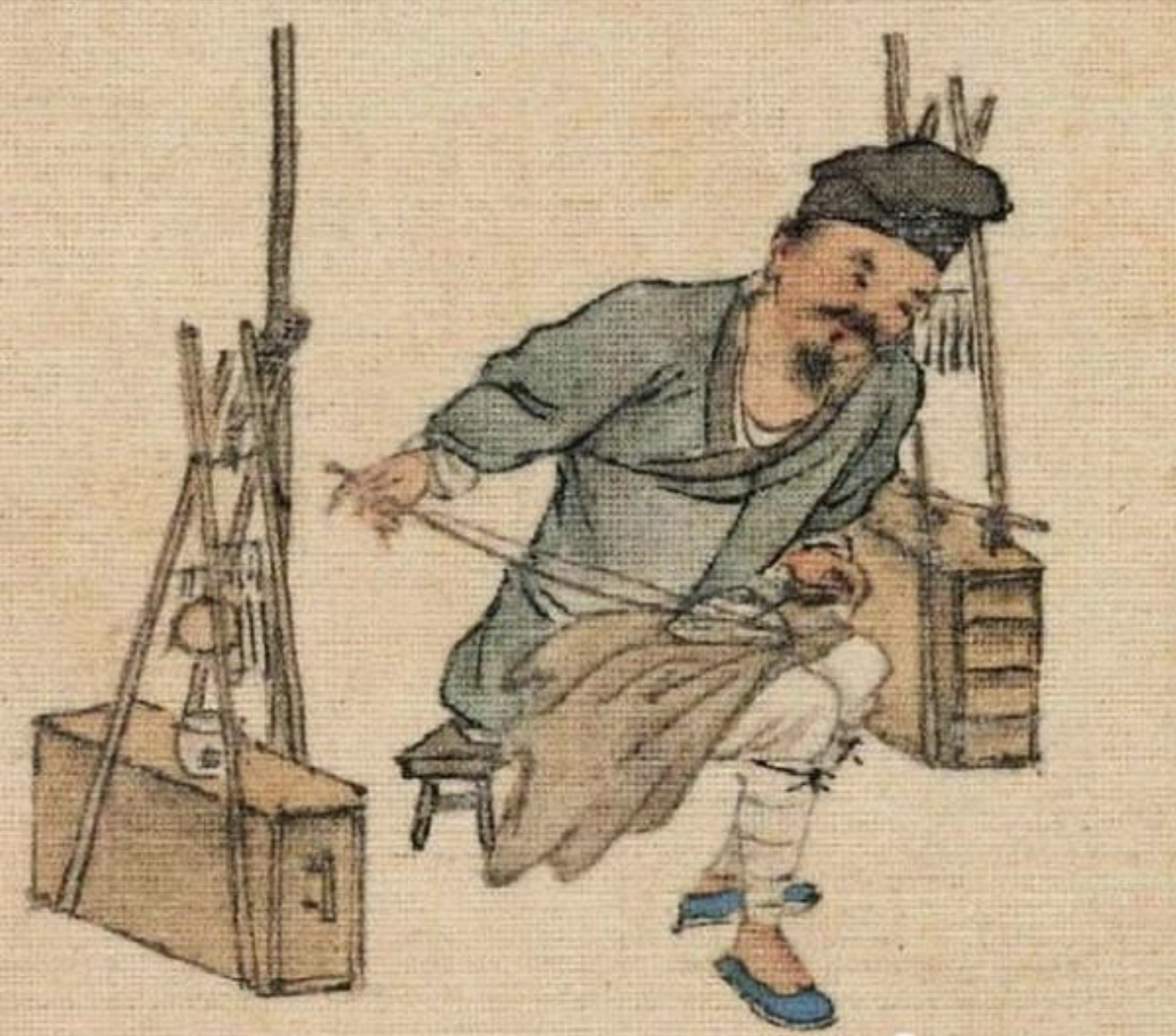
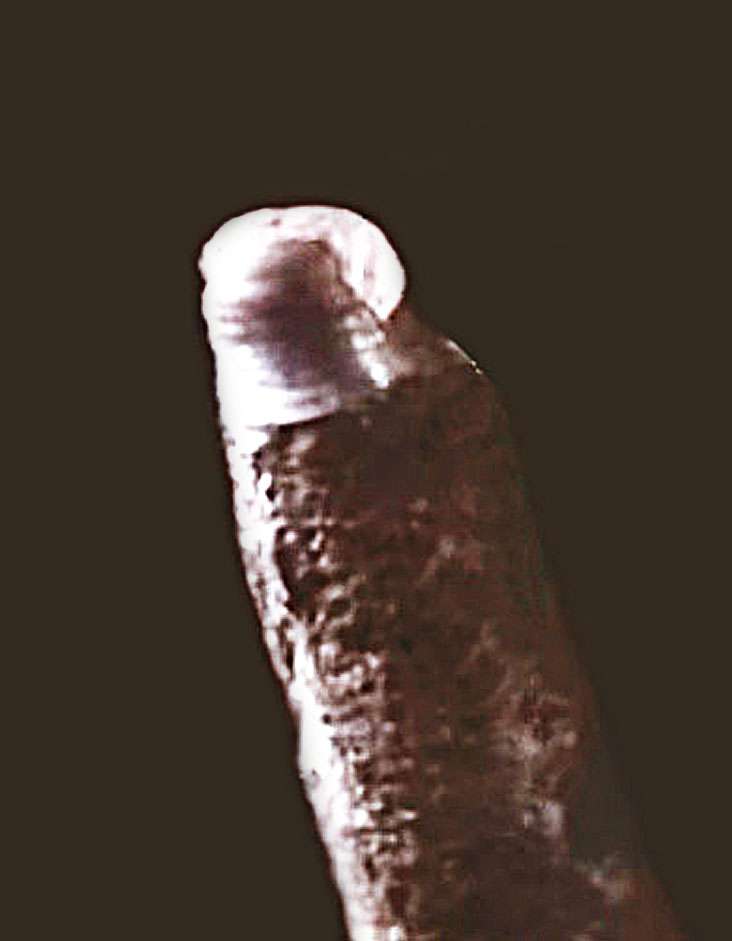
The workers in jade polish jade by the persevering application of Ganges river-sand, and carve it by means of a diamond-point drill [jingang zuan, 金剛鑽]. Its shape is like the excrement of rodents [fig. 6 & 7]; it is of very black color, and is at once like stone and like iron (based on Laufer, 1915, p. 31). [8]

玉人攻玉,以恆河之砂,以金剛鑽鏤之,其形如鼠矢,青黑色,如石如鐵。

This brings us back to the kunwu blade. Laufer (1915) rejects the idea that it was an iron knife. Instead, he states that it was an embellishment on the kinds of diamond-pointed tools used by craftsmen west of China to carve hard stones like jade (Laufer, 1915, p. 32).

This ultimately explains the odd name of Laozi’s holy treasure, diamond cutter (jingang zhuo, 金鋼琢)—i.e. a cutter made from diamond. This name was no doubt chosen to infer that the weapon is unimaginably hard, something capable of “ringing the bell” of even the invincible Monkey King.

The use of kungang (錕鋼), along with the name diamond cutter, suggests that the JTTW author-compiler had knowledge of both the ancient red knife and its ties to diamonds. And speaking of the gemstone, I think given the above information, a better translation for kungang would be something like “diamond steel.” This is more fitting than Yu’s (Wu & Yu, 2012) “red steel” (vol. 1, p. 186).

Also, the description of the cutter as a white, shiny string of pearls makes much more sense when its ties to diamonds are taken into account. This brings to mind a bracelet of perhaps milky diamonds instead of a steel ring.

Fig. 6 (left) – A craftsman works a product with a bow-driven diamond-point drill (larger version). A painting from Zhou Kun’s (周鯤) “Village and Market Life Album” (Cunshi shengya hua’ce, 村市生涯畫冊, 18th-century). Image found here. Fig. 7 (right) – An example of the diamond-point of a diamond drill (larger version). Image found here. This recalls the rodent excrement description of diamond-points mentioned in Rustic Talks From the East of Qi (13th-century).

4. Mirrored objects

The diamond cutter serves as a mirrored literary element to Wukong’s golden headband (jingu, 金箍; a.k.a. jingu, 緊箍, lit: “tight fillet”), which initially appears in chapters eight and 14. Both are used to rein in Monkey’s unruly behavior by way of his head: the first hits him on the crown, and the second clamps around his skull. And the fact that the diamond cutter “can entrap many things” (tao zhu wu, 套諸物) reminds me of the way that the golden fillet constricts (jin, 緊) around Wukong’s head when the correct spell is spoken (Wu & Yu, 2012, vol. 1, p. 319). Isn’t this also a kind of entrapment?

Another mirrored candidate is Nezha’s “fire wheel” (huolun’er, 火輪兒) (fig. 8), which numbers among his six magic weapons (liujian shenbing, 六件神兵). In chapter 61, this flaming fillet is placed on the Bull Demon King’s horn (i.e. on his head) to stop his rampaging transformations (Wu & Yu, 2012, vol. 3, p. 160). Compare this to the way that the diamond cutter stops Wukong via his head. This at first may seem like a passing similarity until you take into account the many parallels shared by Wukong and the bull spirit. The latter is a demon king nicknamed the “Great Sage,” who wields an iron staff, knows 72 changes, can adopt a titanic form, takes part in a battle of magic transformations, is trapped by a joint effort from heaven, is incapacitated by a circular object on his head, and finally faces the Buddha for punishment. [9] Therefore, I can confidently state that the fire wheel is a mirror of the golden headband and subsequently the diamond cutter. I’ll discuss the importance of these connections below.

The novel has many more mirrored objects and characters. I plan to write an article about this at a later date.

Fig. 8 – Nezha (left) wielding his six magic weapons in his three-headed, six-armed form against Sun Wukong (right) (larger version). The fire wheel can be seen in his upper rightmost hand (i.e. the flaming black circle with white spokes). Print from the original 1592 edition of JTTW.

5. Influence

The relationship between Laozi’s diamond cutter and Nezha’s fire wheel in JTTW may have inspired the latter’s “cosmic ring” (qiankun quan, 乾坤圈) in Investiture of the Gods (Fengshen yanyi封神演義, c. 1620, “IOTG” hereafter). Nezha first uses it as a youth in chapter 12 to bludgeon a fierce water-spirit to death:

Standing there naked, Nezha dodged the advancing warrior’s attack and upraised the cosmic ring in his right hand. This treasure was originally bestowed by the Jade Emptiness Palace of Mt. Kunlun to the Perfected Man of the Grand Monad [Taiyi zhenren, 太乙真人] to secure the items of his Golden Light Cave. How could the yaksha withstand the magic weapon as it struck downward on his head? [fig. 9] His brains exploded from the blow, and he fell dead on the shore (cf. Gu, 2000, vol. 1, p. 239).

哪吒正赤身站立,見夜叉來得勇猛,將身躲過,把右手套的乾坤圈望空中一舉。此寶原係崑崙山玉虛宮所賜太乙真人鎮金光洞之物,夜叉那裏經得起,那寶打將下來,正落在夜叉頭上,只打的腦漿迸流,即死於岸上。

He also uses it as a throwing weapon:

After fighting three or four rounds, Nezha simultaneously blocked Yu Hua’s halberd with his spear and took out his cosmic ring from the leopard skin bag. He hit him directly in the arm, breaking tendons and shattering bone (cf. Gu, 2000, vol. 2, p. 671).

哪吒未及三四合,用鎗架住畫戟,豹皮囊內忙取乾坤圈打來,正中余化臂膊,打得筋斷骨折.

See note no. 11 below for more overt examples of throwing.

To sum up, both the diamond cutter and cosmic ring are holy treasures belonging to supreme Daoist deities, are circular and hard enough to serve as blunt throwing weapons, and have the power to entrap (tao, 套) or secure (zhen, 鎮, lit: “press down”) things. It’s also worth noting that the caves associated with these objects have similar names: Great King One-Horned Buffalo lives in Golden Helmet Cave (Jindou dong, 金▯洞), [10] while the Perfected Man of the Grand Monad lives in the Golden Light Cave (Jinguang dong, 金光洞).

My friend, a devotee and researcher of Nezha, tells me that the cosmic ring is a later development in the Third Prince’s mythos, first appearing in IOTG. And since the ring does not appear in JTTW (ctext), it certainly could have been influenced by the similarities between the diamond cutter and Nezha’s fire wheel.

Also, the diamond cutter likely influenced two other fillet-like throwing weapons in the novel, both of which are destroyed by Nezha’s much harder cosmic ring. One is Mo Liqing’s (魔禮青) “white jade diamond bracelet” (baiyu jingang zhuo, 白玉金剛鐲) from chapter 41. The alternate name for said treasure, jingang zhuo (金剛鐲), sounds exactly the same as Laozi’s diamond cutter, jingang zhuo (金鋼琢). I doubt the homophonous title and pale color are a coincidence.

The second is Wen Liang’s (溫良) “white jade ring” (baiyu huan, 白玉環) [11] Again, the white color is telling.

Fig. 9 – Nezha seconds from killing Li Gen with the cosmic ring (larger version). This is an upscaled version of an image found here.

6. Conclusion

Laozi’s great treasure-weapon, the “diamond cutter” (jingang zhuo, 金鋼琢; a.k.a. “diamond snare,” jingang tao, 金鋼套), first appears in chapter six when he uses the fillet to stop Monkey’s rampage by throwing it from heaven and hitting him on the head. It reappears in chapters 50 to 52 as a mysterious, white, shiny string of pearls used by Great King One-Horned Buffalo, an evil spirit, to suck away magic weapons and animals and defeat even destructive elemental attacks. The treasure gives Sun Wukong and a host of Daoist and Buddhist gods no end of trouble before Laozi retrieves his treasure and submits the monster, his runaway buffalo mount.

Lord Li explains that the treasure is a byproduct of creating “reverted elixir,” or a drug of immortality, and that it is made of “kun steel” (kungang, 錕鋼). The latter is a reference to an extremely hard, jade-cutting iron knife from Chinese folklore said to come from the distant land of Kunwu (錕鋙/昆吾). But this is itself an embellishment on reports of diamond-pointed tools used by craftsmen west of China to work hard stone like jade. The name diamond cutter was, therefore, likely chosen to denote something unimaginably hard, something capable of hurting even Sun Wukong.

The diamond cutter is a mirrored literary element to Sun Wukong’s headband. This is because the treasure and the golden fillet are both circular objects that rein in Monkey’s unruly behavior by way of his head, hitting it and clamping around his skull, respectively. The diamond cutter is also a mirrored element of Prince Nezha’s “fire wheel” (huolun’er, 火輪兒) because the latter stops the rampage of the Bull Demon King by way of his head. This takes place during a battle that closely mirrors Monkey’s early rebellion and defeat.

This connection between the diamond cutter and the fire wheel likely influenced Nezha’s “cosmic ring” (qiankun quan, 乾坤圈) from Investiture of the Gods (Fengshen yanyi, 封神演義, c. 1620). Both treasures belong to supreme Daoist deities, can be used as blunt throwing weapons, have the power to entrap or secure things, and are associated with caves with “gold” (jin, 金) in the name. The diamond cutter also likely influenced two other throwing fillets from the novel, Mo Liqing’s (魔禮青) “white jade diamond bracelet” (baiyu jingang zhuo, 白玉金剛鐲) and Wen Liang’s (溫良) “white jade ring” (baiyu huan, 白玉環). The name of the former closely mirrors that of the jade cutter.


Update: 03-14-24

The full name of the Diamond Sutra (c. 2nd to 4th-century) is the Diamond-Cutter Perfection of Wisdom Sutra (Sk: Vajracchedikāprajñāpāramitāsūtra) (Buswell & Lopez, 2014, p. 953). This interests me because Laozi states in chapter six:

The year when I crossed the Hangu Pass, I depended on it [his diamond-cutter treasure] a great deal for the conversion of the barbarians to Buddhism, for it was practically my bodyguard night and day (based on Wu & Yu, 2012, vol. 1, p. 186).

當年過函關,化胡為佛,甚是虧他。早晚最可防身。

Perhaps the diamond-cutter is meant to be a metaphor for the Diamond Sutra, which he used to convert the people of the West.


Update: 01-31-2026

Above, I discussed how Nezha’s “Cosmic Ring” first appeared in IOTG and that it was likely influenced by Laozi’s Diamond Cutter. I originally thought that this was just a literary thing, but it recently dawned on me that Nezha’s circular weapon often appears in the hands of his idols (fig. 10). This demonstrates how JTTW has influenced real world religious iconography.

Fig. 10 – Lotus Flower Nezha bearing his Cosmic Ring (left hand) and spear (right) (larger version). Idol in the author’s personal collection.

Notes:

1) Yu (Wu & Yu, 2012) uses the English words “diamond snare” or just “snare” numerous times whenever Laozi’s weapon is mentioned. However, the corresponding Chinese phrase, jingang tao (金鋼套), only appears once in the entire novel, while that for “diamond cutter,” jingang zhuo (金鋼琢), appears a total of four times. Therefore, I have made changes to the translation for more accuracy.

2) Jenner (Wu & Jenner, 1993/2001) translates Dujiao si dawang (獨角兕大王), the monster’s name, as “Great King Rhinoceros” (vol. 2, p. 1143). This is because the character si (兕) is associated with rhinos. For instance, Strassberg’s (2002) translation of the Classic of Mountains and Seas (Shanhai jing, 山海經, c. 4th-century to 1st-century BCE) reads:

The Si-Rhinoceros dwell east of Shun’s Tomb and south of the Xiang River. Their form resembles an ox that is blue-black with a single horn” (p. 188).

兕在舜葬東,湘水南,其狀如牛,蒼黑,一角。

But the JTTW spirit is likely an amalgamation of Lord Li’s green/black buffalo (qingniu, 青牛) and the mythical animal. This is because both are dark, bovine-like beasts with a single horn. This association between the two is exemplified by a humorous vintage porcelain statue of Laozi riding a rhino.

3) I have changed all references to Nata to Nezha, a FAR more widely used term for the martial god.

4) Monkey explains in chapter 86 that everyone has a boss, thereby alluding to Laozi’s hallowed past:

Old Lord Li happens to be the patriarch of creation [kaitian pidi zhi zhu, 開天闢地之祖; lit: the “patriarch of splitting heaven and earth (from chaos)], but he still sits to the right of Supreme Purity. The Buddha Tathagata is the honored one who governs the world, and yet he still sits beneath the Great Peng. Kong the Sage is the founder of Confucianism, but he assumes the mere title of Master (Wu & Yu, 2012, vol. 4, p. 163).

李老君乃開天闢地之祖,尚坐於太清之右;佛如來是治世之尊,還坐於大鵬之下;孔聖人是儒教之尊,亦僅呼為『夫子』。

My thanks goes to Irwen Wong of the Journey to the West Library blog for reminding me of this fact.

5) Yu (Wu & Yu, 2012) points out that binlang (賓郎) is a variant of binlang (檳榔), or betel nut (vol. 3, p. 385 n. 8). One French translator suggests that the name comes from the circular shape shared by betel nut and coconuts, and that nose rings were likely made from the latter (Levy, 1991, as cited in Wu & Yu, 2012, vol. 3, p. 385-386 n. 8).

6) Regarding the red blade (chidao, 赤刃), the Classic of Mountains and Seas (Shanhai jing, 山海經, c. 4th-century to 1st-century BCE) mentions that the peaks of Kunwu have an abundance of copper (chitong, 赤銅, i.e. “red copper”) (Strassberg, 2002, p. 145).

7) I have changed all Wade-Giles to pinyin.

8) The passage from Rustic Talks From the East of Qi (13th-century) goes on to associate diamonds with a strange phenomenon in western lands where birds pass the gemstone in their droppings:

According to legend, high in the mountains of the Western Regions [Xiyu, 西域] where the Huihe live, hawks and falcons would ingest (diamonds). These would then be deposited in the sandy gravel of Hebei Province when they defecate. But I do not know if this is true or not (cf. Laufer, 1915, p. 12).

相傳出西域及回紇高山頂上,鷹隼粘帶食入腹中,遺糞於河北砂磧間。未知然否?

This matches another passage from the aforementioned Memoir of the Four Gentlemen of Liang (late-7th-century). This earlier source provides more information:

In a northwesterly direction from the island is a ravine hollowed out like a bowl, more than a thousand feet deep. They throw flesh into this valley. Birds take it up in their beaks, whereupon they drop the precious stones. The biggest of these have a weight of five catties. There is a saying that this is the treasury of the Devaraja of the Rupadhatu 色界天王 (Laufer, 1915, p. 7).

島西北有坑,盤坳深千餘尺。以肉投之,鳥銜寶出,大者重五斤,彼雲是色界天王之寶藏。

The bird-diamond connection is mentioned in non-Chinese sources as well. This includes The Book of the Wonders of India (Kitāb ‘Aja’ib al-Hind, 953), a collection of “sailor’s tales” by the Persian Shipmaster Buzurg Ibn Shahriyār. The 82nd tale in this collection, “Kashmiri Diamonds,” associates the gemstones with northernmost India. The full tale reads:

Someone who had been to India told me he had heard it said that the purest, the most beautiful, and the most precious between two mountains, where diamonds come from the Kashmir region. There is a valley a fire burns ceaselessly, and day, winter and summer. It is there that the diamonds are. Only low-caste Indians risk themselves in this dangerous country. They gather in bands, and reach the entrance to the valley. They kill lean sheep, and cut them up into bits. Then they fling the pieces one after another into the valley, by means of a mangonel that they set in motion. There are many reasons that prevent their access to their valley. First, there is the ever- burning fire; and, in addition, around the fire, there is an uncountable number of snakes and vipers, so that no man can go there and not perish.

When the meat is thrown, a great number of vultures falls on it and seizes it. If it falls some distance from the fire, they carry it off. They follow the vulture as it flies. Sometimes a diamond falls from the meat that has been carried off. If the vulture comes down in some place to eat it, they go to there and find diamonds. If the meat falls in the fire, it burns. The vulture that wants to seize a piece too near the fire burns likewise. Sometimes also, by chance, a vulture seizes meat in flight, before it reaches the ground.

This is how diamonds are gathered. Most of the people who busy themselves looking for them die from the fire, or from the snakes and vipers. The kings of these countries are very fond of diamonds, and go to great trouble to get them. Those employed in this work are watched carefully, because of the beauty and high price of the stones (Shahriyar & Freeman-Grenville, 1981, p. 75).

9) The Bull Demon King takes the title “Great Sage, Parallel with Heaven” (Pingtian dasheng, 平天大聖) in chapter 4 (compare this to Monkey’s title, the “Great Sage Equaling Heaven“) (Wu & Yu, 2012, vol. 1, pp. 156-157). The rest of the similarities appear in chapters 60 and 61. He wields his own “cast-iron rod” (huntie gun, 混鐵棍) (compare this to Wukong’s weapon) (Wu & Yu, 2012, vol. 3, pp. 137 and 147). His skill with the 72 changes is referenced when he takes on Zhu’s appearance (compare this to Monkey’s ability) (Wu & Yu, 2012, vol. 3, p. 148). The battle of transformations against Sun takes place shortly after he’s overwhelmed by our hero and Zhu in combat (compare this to Wukong’s battle of transformations with Erlang in ch. 6) (Wu & Yu, 2012, vol. 3, pp. 156-157; vol. 1, pp. 182-183). He takes on his cosmic form, a giant white bull, in a last ditch effort to defeat Monkey (compare this to Wukong’s skill) (Wu & Yu, 2012, vol. 3, p. 157). He is trapped on all sides by Buddho-Daoist deities (compare this to Monkey’s troubles with heaven in ch. 6) (Wu & Yu, 2012, vol. 3, pp. 159-160; vol. 1, pp. 185-186). As mentioned above, Nezha uses his fire wheel to stop his rampaging transformations (compare this to Laozi stopping Monkey’s rampage by knocking him over with the diamond cutter in ch. 6) (Wu & Yu, 2012, vol. 3, p. 160; vol. 1, p. 186). And he is taken to see the Buddha at the end of his story arc (compare this to Wukong’s meeting with the Buddha) (Wu & Yu, 2012, vol. 3, p. 162).

10) The Ctext version is missing a particular Chinese character that appears in the original novel (see the right side, third column from the left, on p. 658 of this PDF). It is comprised of shan (山) and dou (兠/兜). Thank you to Irwen Wong for reminding me of this.

11) Mo Liqing clashes with Nezha in chapter 41, leading to the destruction of his white jade diamond bracelet:

Before they had fought twenty rounds, Mo Liqing hurled his white jade diamond bracelet. It cast a ray of multi-colored light as it struck him [Huang Tianhua, 黃天化] in the middle of the back. The hit knocked down his golden cap [i.e. he died] and fell from his mount.

Mo Liqing wanted to cut off his head, but before he could, Nezha screamed, “Don’t hurt my Daoist brother!” Riding his wind and fire wheels, the third prince fought to the front of the formation and rescued the body of Huang Tianhua.

Nezha engaged Mo Liqing in combat, their respective spears stabbing out in succession. Their battle saddened heaven and made gloomy the earth [i.e. it was extremely tense]. Mo Liqing hurled the diamond bracelet a second time to hit Nezha. The youth also cast his cosmic ring, but it was made of gold and the diamond bracelet jade. When the two clashed, the diamond bracelet shattered into many pieces (cf. Gu, 2000, vol. 2, p. 807 and 809)

來往未及二十回合,早被魔禮青隨手帶起白玉金剛鐲,一道霞光,打將下來,正中後心。只打得金冠倒撞,跌下騎來。魔禮青方欲取首級,早被哪吒大叫:「不要傷吾道兄!」登開風火輪,殺至陣前,救了黃天化。哪吒大戰魔禮青,雙鎗共發,殺得天愁地暗。魔禮青二起金剛鐲來打哪吒。哪吒也把乾坤圈丟起。乾坤圈是金的,金剛鐲是玉的,金打玉,打得粉碎。

Wen Liang’s white jade ring is destroyed by the Third Prince’s cosmic ring in chapter 64:

Now let’s talk about how Wen Liang cast up his white jade ring to attack Nezha. But he didn’t know that Nezha had the cosmic ring. The youth also cast his own treasure. Wen didn’t know that gold beats jade, and when the two clashed, the white jade ring shattered into many pieces (cf. Gu, 2000, vol, 3, pp. 1315 and 1317).

且說溫良祭起白玉環來打哪吒,不知哪吒也有乾坤圈,也祭起來;不知金打玉,打得紛紛粉碎。

Sources:

Buswell, R. E. , & Lopez, D. S. (2014). The Princeton Dictionary of Buddhism. Princeton University Press.

Gu, Z. (2000). Creation of the Gods (Vols. 1-4). Beijing: New World Press.

Kohn, L. (1993). The Taoist Experience: An Anthology. United States: State University of New York Press.

Laufer, B. (1915). The Diamond: A Study in Chinese and Hellenistic Folk-lore. United States: Field Museum of Natural History. Retrieved from https://archive.org/details/diamondstudyinch00lauf/page/n5/mode/2up

Liezi, & Graham, A. C. (1990). The Book of Lieh-tzu: A Classic of Tao. New York: Columbia University Press. (Original work published 1960)

Shahriyar, B., & Freeman-Grenville, G. S. P. (1981). The Book of the Wonders of India: Mainland, Sea and Islands. London: East-West Publications.

Strassberg, R. (2002). A Chinese Bestiary: Strange Creatures from the Guideways Through Mountains and Seas. University of California Press.

Wu, C. & Jenner, W. J. F. (2020). Journey to the West (Vols. 1-4). Beijing: Foreign Languages Press. (Original work published 1993)

Wu, C., & Yu, A. C. (2012). The Journey to the West (Vols. 1-4) (Rev. ed.) Chicago, Ill: University of Chicago Press.

How to Kill Sun Wukong

Last updated: 01-07-2024

The Monkey King is famed for his multiple categories of immortality in Journey to the West (Xiyouji西遊記, 1592; “JTTW” hereafter). These are acquired through spiritual cultivation, redacting underworld ledgers, partaking in celestial foodstuffs, and (at the journey’s end) attaining Buddhahood. But “immortality” in Chinese vernacular literature doesn’t mean “invulnerable to harm.” Despite his great durability, during the journey, Wukong is a “bogus immortal” (yaoxian妖仙) who is still susceptible to injury and death because he hasn’t yet achieved Buddha-nature and broken free of the wheel of rebirth. [1] For instance, he briefly dies from thermal shock after being overwhelmed by Red Boy‘s (Honghai’er, 紅孩兒) true samadhi fire (sanmei zhenhuo三昧真火) in chapter 41:

His whole body covered by flame and smoke, the Great Sage found the intense heat unbearable and he dove straight into the mountain stream to try to put out the fire. Little did he anticipate that the shock of the cold water was so great that the heat caused by the fire was forced inward into his body and his three hun spirits left his vessel. Alas!

His breath caught in his chest, his tongue and throat grew cold;
His hun spirits fled, his po souls left, and his life was gone! (based on Wu & Yu, 2012, vol. 2, p. 231)

這大聖一身煙火,炮燥難禁,徑投於澗水內救火。怎知被冷水一逼,弄得火氣攻心,三魂出舍。可憐氣塞胸堂喉舌冷,魂飛魄散喪殘生。

Luckily, Zhu Bajie resuscitates him by performing a life-saving massage that forces qi from his cinnabar field and circulates it throughout his body (Wu & Yu, 2012, vol. 2, p. 232). [2]

This episode was an accident. But what if someone wanted to kill Monkey for good? How would they do it? Killing him in a one-on-one match would be nearly impossible, for few characters surpass Wukong in strength or fighting ability. I think it’s best that we draw on methods from another famous god and demon novel, Investiture of the Gods (Fengshen yanyi封神演義, c. 1620; “Investiture” hereafter), a sort of prequel to JTTW. It centers on a great battle between the falling Shang (c. 1600-1046 BCE) and the rising Zhou (c. 1046–256 BCE) dynasties, both of which are aided by factions of powerful immortals. The story is famous for a number of weapons, traps, and rituals designed to kill divine cultivators.

In this article, I would like to describe ten magical array traps (zhen, 陣) and one magic ritual that could possibly kill the Monkey King. The latter is, in my opinion, the best option for ending his life (fig. 1). And the best part is that it can be done from a distance! That way a villain doesn’t have to worry about getting smashed into hamburger or ripped to shreds by an angry monkey immortal. In addition, I will detail this method’s potential for great fanfiction.

Before continuing, I must point out that none of the information from Investiture can be considered JTTW canon. While it contains a host of similar characters (Laozi, Buddha, Nezha, Muzha, Li Jing, Ao Guang, Erlang and his hound, etc.), the novel is a separate work that was published nearly 30 years after JTTW. Look at this piece as a fun “What if?”

Fig. 1 – Monkey’s headstone (larger version).

I. Possible Ways

Ch. 44 of Investiture mentions ten magical array traps that rely on primordial energies, destructive elements like wind, thunder, fire, sand, ice, and water, and spiritual attacks to terminate immortals:

  1. Heavenly Destruction (Tianjue zhen, 天絕陣) – This trap contains primordial energies (xiantian zhi qi, 先天之氣) and the mechanisms of chaos (hundun zhi ji, 混沌之機). It uses three magic pennants (fan, 旛), representing the respective energies of Heaven, Earth, and Man, to turn humans into dust and shatter the limbs of immortals with rolls of thunder.
  2. Earthly Fury (Dilie zhen, 地烈陣) – This trap uses a magic red pennant that kills intruders with rolls of thunder from above and fire below. It is also said to cut them off from reincarnation.
  3. Roaring Typhoon (Fenghou zhen, 風吼陣) – This trap uses wind, true samadhi fire, and countless swirling blades formed from primordial energies to kill intruders and render their bodies into a fragrant powder (jifen, 虀粉).
  4. Frigid Ice (Hanbing zhen, 寒冰陣) – This trap uses jagged, wolf fang-like ice mountains above, sword-like ice blocks below, and wind and thunder in the middle to grind intruders into a fragrant powder.
  5. Golden Light (Jinguang zhen, 金光陣) – This trap contains the essences of the sun and moon (riyue zhi jing, 日月之精) and the energies of heaven and earth (tiandi zhi qi, 天地之氣). It uses 21 treasure mirrors (baojing, 寶鏡) affixed to wooden polls to kill intruders with golden light that renders (melts?) their bodies into pus and blood.
  6. Bleeding Blood (Huaxue zhen, 化血陣) – This trap uses thunder and wind powered by primordial energies to blast black sand that kills intruders by rendering their bodies into a bloody mess.
  7. Vehement Flame (Lieyan zhen, 烈焰陣) – This trap uses true samadhi fire, fire from the sky (meteorites?), and fire from stone (lava?) to kill intruders by turning them into ash.
  8. Soul-Snatching (Luohun zhen, 落魂陣) – This trap contains the fierce energies of heaven and earth (tiandi liqi, 天地厲氣). It uses a white paper pennant stamped with a talisman seal (fuyin, 符印) to kill intruders by dispersing and eliminating their po and hun spirits.
  9. Red Water (Hongshui zhen, 紅水陣) – This trap controls the essences of the ninth and tenth heavenly stems (rengui zhi jing, 壬癸之精) (representing water), as well as contains the wonder of the Grand Monad (Tianyi zhi miao, 天乙之妙). It uses three bottle gourds resting on an eight trigrams platform (bagua tai, 八卦臺) to kill intruders by gushing forth an ocean of dangerous, red water, a single drop of which can render their bodies into a bloody mess.
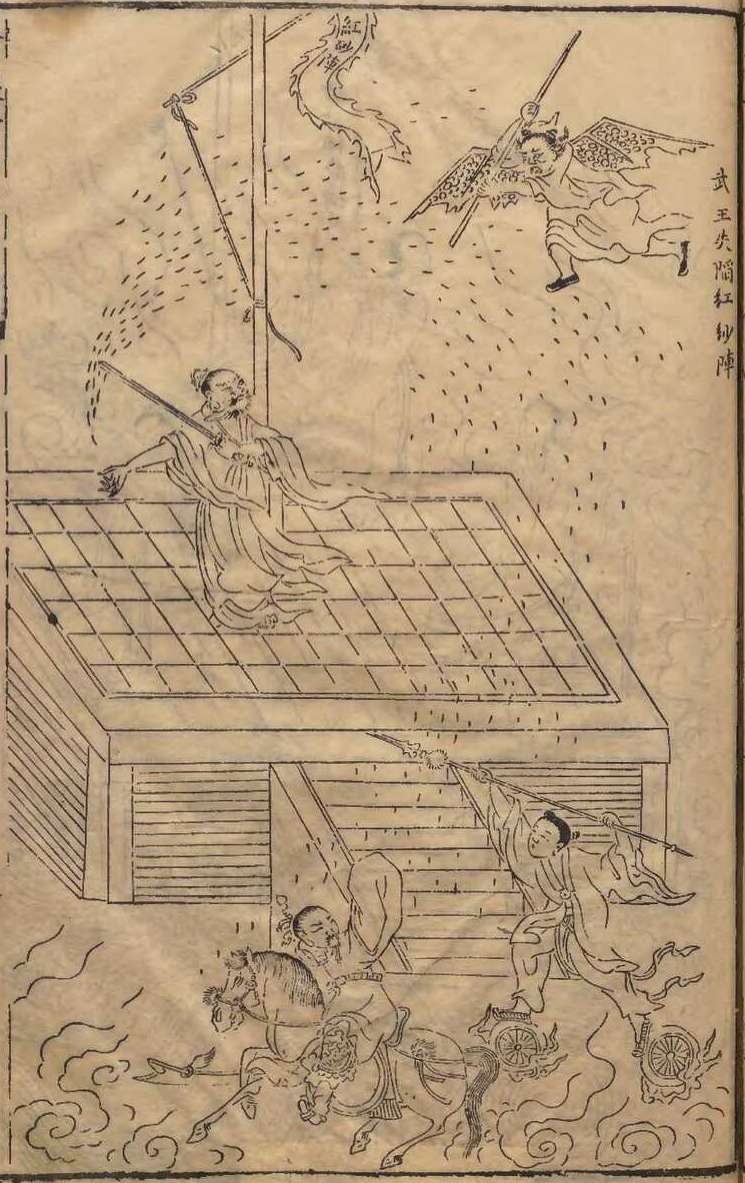
  10. Red Sand (Hongsha zhen, 紅砂陣/紅沙陣) – This trap controls the energies of Heaven, Earth, and Man. It uses thunder and wind to blast three buckets of red, sword-like sand to kill intruders by rendering their bones into a fragrant powder (fig. 2) (cf. Gu, 2000, vol. 2, pp. 869-873).

I think that Sun Wukong would easily survive many of these traps due to the adamantine nature of his body. [3] But numbers three, seven, and eight might give him some problems. As mentioned in the introduction, his encounter with Red Boy in chapter 41 shows that he is weak against true samadhi fire (Wu & Yu, 2012, vol. 2, p. 231). And of course, having his souls scattered and destroyed would certainly finish him off. Recall in JTTW chapter three how Monkey’s spirit (魂靈兒) is easily reaped by two underworld officers in his heavenly wine-induced slumber (Wu & Yu, 2012, vol. 1, p. 139). This might point to a weakness against spiritual attacks (at least while drunk, anyway).

However, I think it would be hard to trick Wukong into going inside of these array traps. His “fiery eyes and gold Irises” (huoyan jinjing, 火眼金睛) would certainly notice the dark auras hovering above each one (Gu, 2000, vol. 2, p. 925 and 989, for example).

No, there’s only one sure fire way to kill our hero.

Fig. 2 – A Shang camp immortal working the Red Sand array trap (larger version). The woodblock print omits the three buckets. Image from The Newly Printed, Zhong Bojing Annotated, Investiture of the Gods (Xinke Zhong Bojing xiansheng piping Fengshen yanyi, 新刻鍾伯敬先生批評封神演義, c. 1620). See page 42 of this PDF.

II. The Best Way

Overcoming Monkey’s great power, durability, and speed would require an indirect approach, something that he wouldn’t even be aware of. A secret, spiritual assault from afar is, therefore, the only method that would work, in my opinion. Something like this is described in chapters 48 and 49 of Investiture. But I first need to give some background information as to why the rite is used in the first place.

Grand Preceptor Wen (Wen Taishi, 聞太師) recruits his old friend, the ancient immortal Zhao Gongming (趙公明), in chapter 46 after many of their divine comrades die in battle against Zhou allies (Gu, 2000, vol. 2, p. 935). Zhao is powerful in his own right, claiming to be able to flip Mount Sumeru (Xumi, 須彌) and reverse the course of the sun and moon (cf. Gu, 2000, vol. 2, pp. 945-947). But it’s his command of three holy treasures, namely the “Dragon-Binding Rope” (Fulong suo縛龍索), the “Sea-Fixing Mala Beads” (Dinghai zhu定海珠), and the “Golden-Scaled Dragon Scissors” (Jinjiao jian金蛟剪), [4] that make him a supremely dangerous opponent. The latter two treasures prove in chapter 47 to be especially difficult weapons for Zhou allies to counter.

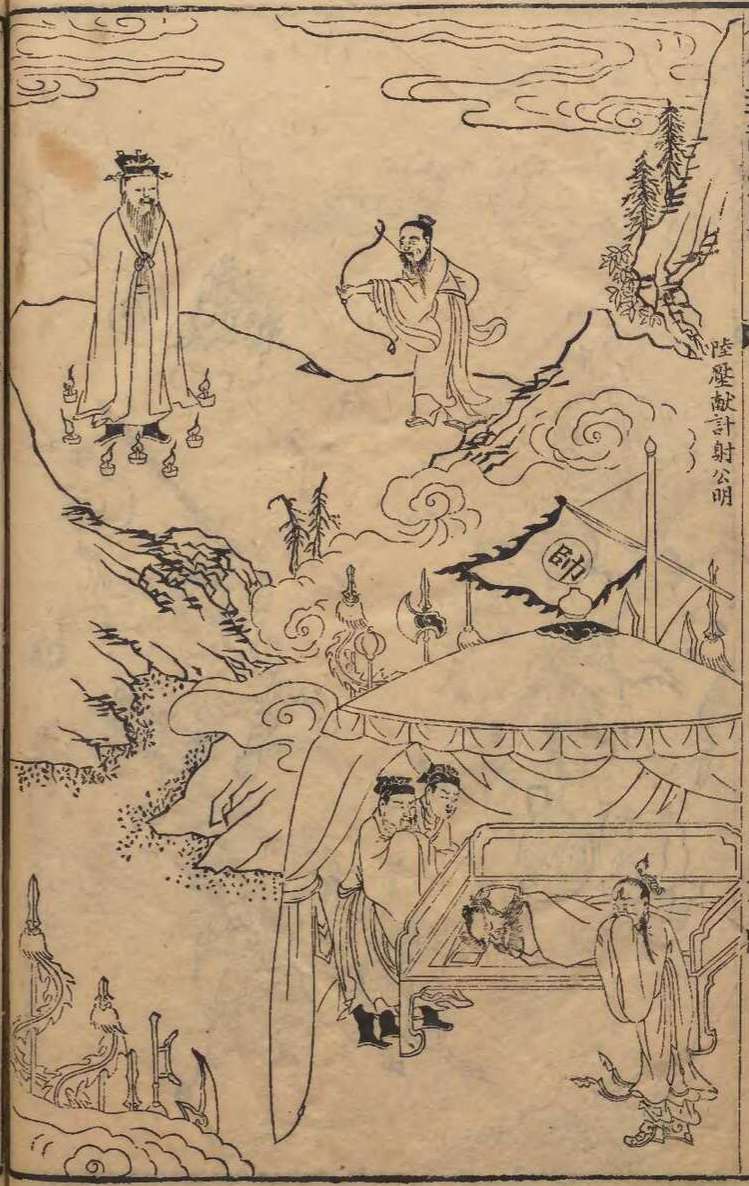
Therefore, in chapter 48, the immortal Lu Ya (陸壓) devises a plan to secretly attack Zhao’s spirit from a distance. He enlists the help of Jiang Ziya (姜子牙), a Taoist disciple and commander of the Zhou forces, and instructs him how to perform a sympathetic magic ritual from the Book of Fixing the Seventh Posthumous Day Arrow (Ding touqi jianshu, 釘頭七箭書):

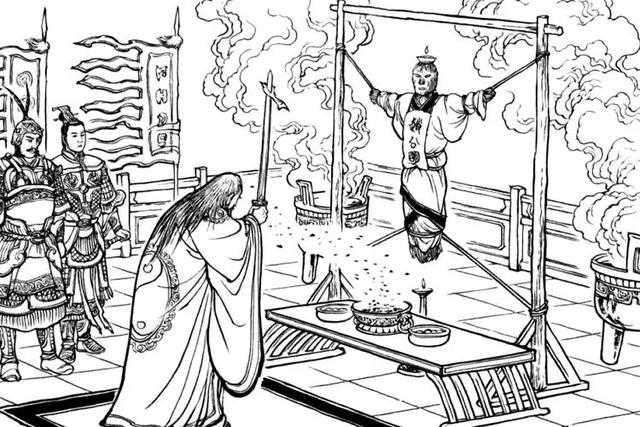
Lu Ya opened his flower basket and took out a book stamped with talisman seals and oral formulas. “Using these, you can set up camp and erect a platform on Mount Qi. Make a straw effigy and post a document with the three characters “Zhao Gongming” on its body. Place one lamp above its head and another beneath its feet. Then pray to it three times a day, burning the talismans and pacing the dipper. At noon on the twenty-first day, this poor Taoist (Lu Ya) will come and help you cut his life short.”

Before going to Mount Qi, Ziya secretly sent 3,000 troops, along with Nangong Kuo [南宮适] and Wu Ji [武吉] to find a suitable place to set up camp. After Ziya arrived at camp, Nangong built a platform, arranging it properly and making a straw effigy. He did everything strictly as instructed. Finally Ziya loosened his hair, took a sword, and paced the dipper, reciting charms, burning spells, and praying over and over again before the straw effigy (based on Gu, 2000, vol. 2, p. 967).

陸壓揭開花籃,取出一幅書,書寫明白,上有符印口訣,「……依此而用,可往岐山立一營;營內築一臺。紮一草人;人身上書『趙公明』三字,頭上一盞燈,足下一盞燈。自步罡斗,書符結印焚化,一日三次拜禮,至二十一日之時,貧道自來午時助你,公明自然絕也。」

子牙領命,前往岐山,暗出三千人馬,又令南宮适、武吉前去安置。子牙後隨軍至岐山,南宮适築起將臺,安排停當,紮一草人,依方製度。子牙披髮仗劍,腳步罡斗,書符結印

[Three to five days later, Zhao Gongming feels frantic, with a strange burning in his heart.]

[…]

Now let’s speak of Ziya, who prayed until he had expelled the primal spirit [yuanshen, 元神] of Zhao Gongming. The primal spirit was of major importance to an immortal, enabling him to tour freely throughout the eight extremes (the universe). But now that Zhao Gongming had lost his primal spirit, he became drowsy and wanted to sleep all of the time (based on Gu, 2000, p. 973).

且說子牙拜掉了趙公明元神散而不歸,──但神仙以元神為主,遊八極,任逍遙,今一旦被子牙拜去,不覺昏沉,只是要睡。

[Sleeping is said to be uncharacteristic of immortals. This alerts Zhao Gongming’s comrades that he is being spiritually assaulted. After divining the effigy’s location, Wen sends Shang allies to steal it. They are initially successful, but the straw man is eventually recaptured by Zhou forces.]

[…]

[Lu Ya finally arrives as promised to finish the ritual.]

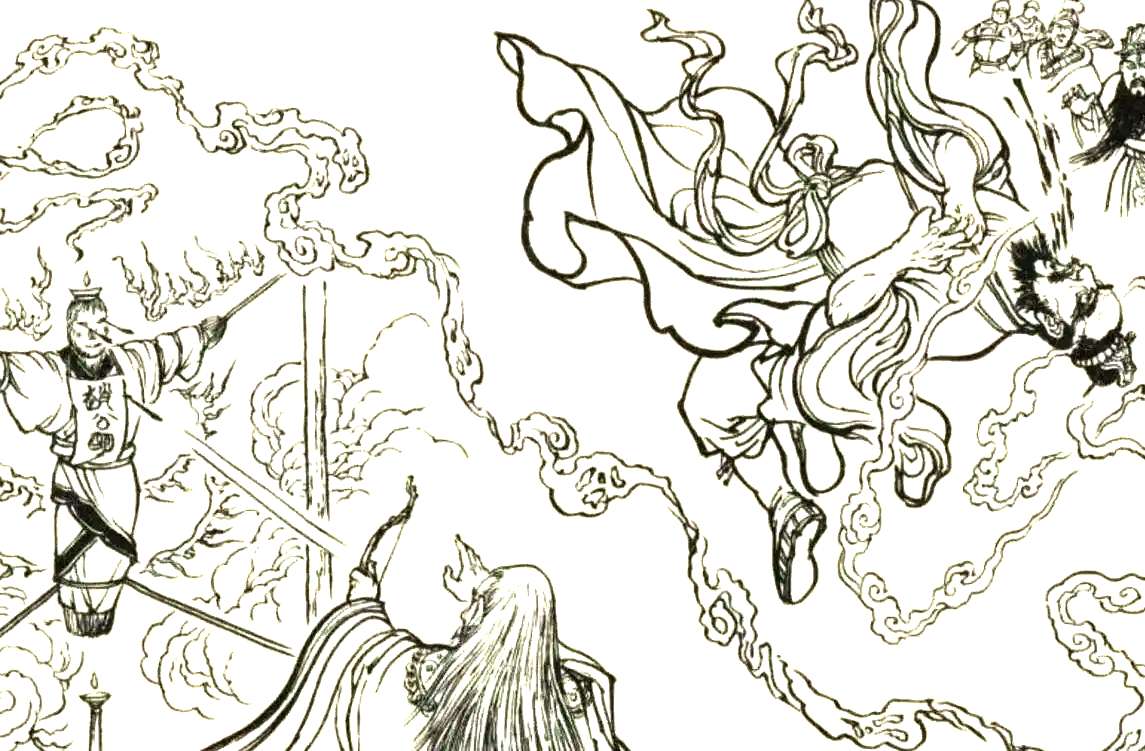
With a smile, Lu Ya opened his flower basket and took out a small mulberry bow and three short peach arrows, which he handed to Ziya. “At noon today, you must shoot the effigy with these arrows,” Lu Ya said. Ziya replied: “Order received!” The two waited in a tent until the astrological official came to report: “Noon time has arrived!” Ziya cleaned his hands, picked up the bow, and then nocked the first arrow. “Shoot his left eye first,” instructed Lu Ya. Ziya did as ordered. As the first arrow hit the left eye of the effigy, Zhao Gongming, lying in the Shang camp, roared in agony and closed his left eye. Grand Preceptor Wen held him in his arms, sobbing as the tears poured down his cheeks. Back at Mount Qi, the second arrow hit the right eye of the effigy, and the third penetrated its heart [fig. 3]. Zhao Gongming died in the Shang camp (based on Gu, 2000, vol. 2, pp. 985-987). [5]

陸壓笑吟吟揭開花籃,取出小小一張桑枝弓,三隻桃枝箭,遞與子牙,「今日午時初刻,用此箭射之。」子牙曰:「領命。」二人在帳中等至午時,不覺陰陽官來報:「午時牌!」子牙淨手,拈弓,搭箭。陸壓曰:「先中左目。」子牙依命,先中左目。──這西岐山發箭射草人,成湯營裏趙公明大叫一聲,把左眼閉了。聞太師心如刀割,一把抱住公明,淚流滿面,哭聲甚慘。──子牙在岐山,二箭射右目,三箭劈心一箭,三箭射了草人。──公明死于成湯營裏。

Like Ziya, a bad guy could perform the same ritual to secretly steal Monkey’s primal spirit, tether it to a straw effigy marked “Sun Wukong” (孫悟空), and finally kill our hero with three well-placed peach arrows to the eyes and chest.

Fig. 3 – Jiang Ziya aiming the ritual bow at the straw effigy (larger version). Zhao Gongming can be seen sleeping in the Shang camp below. Woodblock print from The Newly Printed, Zhong Bojing Annotated, Investiture of the Gods (Xinke Zhong Bojing xiansheng piping Fengshen yanyi, 新刻鍾伯敬先生批評封神演義, c. 1620). See page 42 of this PDF.

III. Story Potential

If anyone decided to write their own fanfiction using the method described above, I could see this being a great opportunity for Zhu Bajie (豬八戒) and/or Sha Wujing (沙悟淨) to shine. He/they could be the one(s) searching the cosmos for answers, and upon learning of the rite, desperately racing to find the straw effigy before the ritual is complete. All of this would of course take place while Monkey is sleeping.

I can definitely see Zhu and/or Sha seeking the aid of Guanyin (觀音), who could easily break the ritual. I imagine she would reveal that, “The Great Sage is destined to experience this tribulation…” (or something like that), but she would surely provide them with the location in the end.

Reasons for the villain performing the ritual could include:

  • Eliminating Wukong so that they can more easily catch and eat the Tang Monk, thus gaining immortality.
  • Absorbing Monkey’s primal spirit in order to gain his immortality and skills.

The latter is my favorite, but the former would work better for the story since the whole point of the ritual is to kill the target. And besides, Monkey’s disembodied spirit is powerful enough to kill the psychopomps sent to reap his soul, as well as bully the judges and officers of hell (Wu & Yu, 2012, vol. 1, pp. 139-141). Now, imagine what it could do to some random demon king and/or cultivator who tried to absorb it!

IV. Conclusion

Sun Wukong is famed for his multiple categories of immortality, but he is still susceptible to death and the wheel of rebirth since during the journey, he hasn’t yet achieved Buddha-nature. Killing him in one-on-one combat would be nearly impossible, though, given his great durability and power. However, using methods borrowed from Investiture of the Gods (c. 1620) might work. For instance, chapter 44 mentions ten magical array traps that rely on primordial energies, destructive elements like wind, thunder, fire, sand, ice, and water, and spiritual attacks to terminate immortals. Three of the traps, numbers three, seven, and eight, respectively use true samadhi fire or soul-scattering and destruction to kill divine cultivators. These might give Monkey problems as his soul is easily reaped in his heavenly wine-induced slumber in JTTW chapter three, suggesting that it may be weak against spiritual attacks (at least while drunk), and he is shown to be weak against Red Boy’s true samadhi fire in chapter 41. But I think it would be hard to trick him into entering the traps since his magic eyes would no doubt see the dark auras above them.

The best way to overcome his great power, durability, and speed requires an indirect approach, a secret, spiritual assault from afar. A ritual used in chapters 48 and 49 of Investiture does exactly that. In order to defeat the immortal Zhao Gongming and circumvent his powerful holy treasures, the immortal Lu Ya instructs Zhou army commander Jiang Ziya how to perform a rite from the Book of Fixing the Seventh Posthumous Day Arrow. This involves a bureaucratic ceremony (praying, talisman-burning, and dipper-walking) that slowly steals the immortal’s primal spirit over a 21 day period, tethers it to a straw effigy marked with Zhao’s name, and then kills him by shooting the icon with three peach arrows: two to the eyes and a third to the heart.

A villain wanting to kidnap and eat the Tang Monk for immortality could perform this ritual in order to get Monkey out of the way. This would make for a great story centered on Zhu Bajie and/or Sha Wujing. He/they could frantically search the universe for answers, before racing to find the straw effigy before the rite is complete.


Update: 12-28-23

I found two neat drawings portraying Jiang Ziya performing the rite (fig. 4 & 5).

Fig. 4 (top) – Jiang Ziya performing the procedural side of the ritual (larger version). Image found here. Fig. 5 (bottom) – Ziya fires the last arrow, killing Zhao Gongming (larger version). Image found here. They appear to be from the same anonymous lianhuanhua comic book.


Update: 12-29-23

A reader’s comment (below) has prompted me to add more context. Zhao Gongming’s disembodied spirit is not destroyed by the ritual. It is pulled towards the “Terrace of Creation” (Fengshen tai, 封神臺), a magic receptacle of souls, to await his apotheosis at the end of the novel. He is enfeoffed as the “Golden Dragon, Wish-Fulfilling and Righteously Unifying, Dragon-Tiger Mysterious Altar Perfected Lord” (Jinlong ruyi zhengyi longhu xuantan zhenjun, 金龍如意正一龍虎玄壇真君), a god of wealth (cf. Gu, 2000, vol. 4, pp. 2119-2121).

This then raises the question, “What would happen to Wukong’s soul if the ritual was successful? After the death of his body, it would naturally report to the underworld for processing. Remember, Monkey has yet to attain Buddha-Nature, so he is still subject to the wheel of rebirth. I can see him causing trouble down there like he had done in the past, but perhaps Kṣitigarbha (Ch: Dizang, 地藏) would calm his rage and convince him that reincarnation is the right choice. This would lead to a new adventure.

Or, considering that the journey to India would still be underway, and Tripitaka is constantly in danger, heaven might rush to find a new body for Wukong’s spirit to inhabit. This actually happens to a minor character in chapters 11 and 12 of JTTW. The soul of an official’s wife is forced into the body of a recently dead princess to live out the remainder of her allotted lifespan (Wu & Yu, 2012, vol. 1, pp. 268-269).

Another reader suggested a second method from Investiture to kill Monkey (see the comment below):

The Immortal-slaying Flying Knife, also a treasure of Lu Ya’s, might be a good second-contender here. It’s a strange weapon with head and eyes and wings, stored inside a gourd: when released, its eyes shoot out white light that “nails down” an enemy’s true form, and, upon recitation of “Turn around please, precious” (请宝贝转身), will spin and instantly decapitate the target.

Sure, there is the matter of getting it out and saying the magical words before you were reduced to a meat patty, but if the target is already immobilized——like Yuan Hong, FSYY’s own staff-wielding ape with 72 transformations——the Immortal-Slaying Flying Knife will be that final nail in the coffin.

I’ll look into this more and update the page at a later date.


Update: 01-07-24

Lu Ya’s ritual reminds me of a two-step process used in Chinese Folk Religion to activate a religious statue (shenxiang, 神像). Part one is the “entering-spirit” (rushen, 入神) ceremony, which invites a deity’s essence inside. Lin (2020) explains:

When the carving is complete, the carver chooses an auspicious day to hold the spirit-entering ritual. A cavity at the back of the image is carved out for this rite. The objects placed in this hole include incense ashes (xianghui) or talismans from the root temple, a live hornet, five precious materials (gold, silver, bronze, iron, and tin), five crops (rice, wheat, sesame, and different kinds of beans), and a bundle of five-color threads (red, yellow, blue, black, and white) [fig. 6 & 7] … The worshippers have to prepare fruit and flowers and burn incense to invite the deity to come.

When the auspicious moment arrives, the carver inserts the previously listed items into the cavity and plugs it with a piece of wood. The objects placed in the cavity are important clues regarding how people conceptualize deities. Local inhabitants explained to me that the ashes or talisman symbolizes the spirit of the deity, and the living hornet is to increase the deity’s power. Some people said the five forms of treasure represent the five organs of the deity, whereas others just said they are symbols of the deity’s grandeur. The five crops represent the harvest and the bunch of five-color threads is related to the five spirit-soldier camps (p. 38).

Lu Ya’s ritual essentially treats the straw effigy like an idol that will house a god’s essence. This might explain how the primal spirit of Zhao Gongming (and therefore Sun Wukong) is called to enter the icon.

Fig. 6 (top) – A collection of the talisman, grains, treasures, and colored-threads used in the entering-spirit ceremony (larger version). Fig. 7 (bottom) – A live wasp is retrieved to be added to the necessary ritual items (larger version). Images found here

Part two is the “eye-opening and dotting” (kaiguang dianyan, 開光點眼) ceremony, which brings the idol to life. Again, I refer to Lin (2020):

For this ceremony, the carver prepares flowers, fruit, a round mirror, a red brush pen, and a white cock. When the auspicious moment arrives, the mirror is taken outside where the light is sufficient to reflect it into the statue’s eyes. Next, the carver goes back to the altar and uses a knife to cut the cockscomb and smear the blood with the red brush pen. He then starts to chant and to dot the deity with the brush pen. There are many different kinds of chants … but their contents are not very different. The process of dotting usually begins at the center of the forehead and proceeds to the eyes, ears, nose, mouth, heart, navel, feet, toes, fingers, and back [fig. 8-10], as the following chant demonstrates:

First dot the sacred head, second dot the sacred hat,
Third dot the sacred body, then the true and righteous god will occupy the body.
Open the left eye to see heaven.
Open the right eye to see into the earth.
Open the left ear to listen to sounds from all directions.
Open the right ear to hear sounds from far away.
Open the divine nose, to smell fragrant scents.
Open the divine mouth, but not to eat house hold foods.
Open the left hand and the disciples will be prosperous year after year.
Open the right hand and the god will capture ghosts without being asked.
Open the sacred belly and great divine power will come forth.
Open the left foot to step upon the correct path.
Open the right foot to step into the divine carriage.
Open the back so that all people may be enlightened.

It can be inferred that in this ceremony, the carver at first draws the natural energy into the statue to enliven it. Then, he uses the blood of a white cock, symbolizing purity, to dot and connect the important parts of the body. This makes the statue like a living person with veins in which blood flows without obstruction (pp. 38-39).

Although Investiture doesn’t mention any of this, I think performing the eye-opening and dotting ceremony would be the final step in making the straw effigy a separate, living embodiment of the Monkey King. The ritual would open the eyes of Wukong’s spiritual double to the cosmos and fill his chest with divine energies in preparation for shooting said targets. This would explain why Zhao Gongming closes his eyes upon each arrow strike (refer back to section II).

Writers wanting to add a certain level of religious authenticity to the fictional Monkey King-killing ritual could have the villain place the talisman, grains, treasures, live wasp, and five colored-threads inside the straw effigy. And then he could chant while simultaneously reflecting sunlight on the face and dotting the eyes and body with a rooster blood-soaked brush. The only major difference between the fictional and religious ceremonies would be that the former’s first step, the entering-spirit ritual, lasts three weeks.

Fig. 8 (top L) – An entering-spirit and eye-opening and dotting kit commonly sold in Taiwan (larger version). Notice how the mirror is rectangular instead of circular. Image found here. Fig. 9 (top R) – A white temple rooster kept as a supply of pure blood (larger version). Don’t worry, nowadays they are only nicked on the comb with a knife. Image found here. Fig. 10 (bottom) – A ritual master uses a circular mirror to shine sunlight into an idol’s eyes while dotting the figure with a blood-soaked brush (larger version). Image found here.

Notes:

1) Monkey is called a “bogus immortal” by the Jade Emperor (ch. 4), the Buddha (ch. 7), and the Dragon King of the Eastern Sea in (ch. 14) (Wu & Yu, 2012, vol. 1, pp. 147-148, p. 193, and p. 318). This alludes to the fact that he is not yet a true transcendent.

The idea that Wukong is still susceptible to death is based on the Buddho-Taoist philosophy of Southern Quanzhen School Patriarch Zhang Boduan (張伯端, mid to late-980s-1082), which heavily influenced JTTW. Zhang believed that one had to attain both the Taoist elixir and Buddha-Nature in order to be truly immortal. Only then could one rise above death and the endless rounds of rebirth to live forever (Shao, 1997, pp. 80-84). This is why JTTW starts with Monkey achieving immortality in chapter two and ends with him attaining Buddhahood in chapter 100, thereby fulfilling Zhang’s two-step process to true transcendence.

Zhang’s philosophy is reflected in his Writings on Understanding Reality (Wuzhen pian, 悟真篇, 1075). One poem reads:

The elixir is the most precious treasure of the physical body; when cultivated to perfection, the transmutations are endless. One can go on to investigate the true source in the realm of essence, and ascertain the ineffable function of the birthless. Without awaiting another body in the next life, one attains the spiritual capacities of a Buddha in the present; after the Naga Girl achieved this, who since then has been able to follow in her footsteps? (Zhang, Liu, & Cleary, 1987, p. 1481; cf. Shao, 1997, p. 83)

丹是色身至寶,煉成變化無窮。更能性上究真宗,决了無生妙用。不待他身後世,見前獲佛神通。自從龍女著斯功,爾後誰能繼踵。

2) It’s interesting to note that Pigsy suggests that Wukong dying isn’t a problem because his 72 changes give him 72 lives (qishi’er tiao xingming, 七十二條性命) (Wu & Yu, 2012, vol. 2, p. 232).

3) For instance, heaven fails to execute Monkey in chapter seven because of his adamantine hide:

They then slashed him with a scimitar, hewed him with an ax, stabbed him with a spear, and hacked him with a sword, but they could not hurt his body in any way. Next, the Star Spirit of the South Pole ordered the various deities of the Fire Department to burn him with fire, but that, too, had little effect. The gods of the Thunder Department were then ordered to strike him with thunderbolts, but not a single one of his hairs was destroyed (Wu & Yu, 2012, vol. 1, p. 188).

刀砍斧剁,槍刺劍刳,莫想傷及其身。南斗星奮令火部眾神放火煨燒,亦不能燒著。又著雷部眾神以雷屑釘打,越發不能傷損一毫。

4) Apart from these treasures, Zhao Gongming fights with a hard whip (bian, 鞭), a sword-like metal club with stacked ridges and a pointed end. Gu (2000) incorrectly translates this as “staff” (vol. 2, p. 941).

5) Given the ritual’s association with the number seven (i.e. “Fixing the Seventh Posthumous Day Arrow”), and the fact that it takes 21 days to execute, it seems that one arrow is used for every week that the rite is performed. Remember that there are a total of three: two for the eyes and a third one for the heart.

6) These are the holes in the head: eyes, nose, ears, and mouth.

Sources:

Gu, Z. (2000). Creation of the Gods (Vols. 1-4). Beijing: New World Press.

Lin, W. (2020). Materializing Magic Power: Chinese Popular Religion in Villages and Cities. Netherlands: Brill.

Shao, P. (1997). Monkey and Chinese Scriptural Tradition: A Rereading of the Novel Xiyouji (UMI No. 9818173) [Doctoral dissertation, Washington University]. Available from ProQuest Dissertations and Theses database.

Wu, C., & Yu, A. C. (2012). The Journey to the West (Vols. 1-4) (Rev. ed.). Chicago, Illinois: University of Chicago Press.

Zhang, B., Liu, Y., & Cleary, T. (1987). Understanding Reality: A Taoist Alchemical Classic. Honululu Univ. of Hawaii Press.

Sun Wukong’s Four Mighty Commanders

The Monkey King’s “Four Mighty Commanders” (Si Jianjiang, 四健將) (figs. 1 & 2) are minor characters appearing in chapters one, three to six, and 28 of Journey to the West (Xiyouji西遊記). They are presented as two elderly gibbons and two elderly horse-monkeys (i.e. macaques) who serve their monarch as advisors and makeshift tutors on spiritual and military matters. In fact, one of them is responsible for setting Wukong on his path towards immortality. They are later given high military rank and charged with training and governing Wukong’s monkey army. An outside observer may question the commanders’ ability to lead troops in battle since they are defeated in nearly every single skirmish. But it should be remembered that, while technically immortal, they can still be killed and only have access to mere earthly weapons. Yet, they choose to face celestial soldiers who wield divine weapons and have millennia of combat experience. This speaks to their great bravery.

Here, I have gathered all references to these characters that I know of. I’ve also included a section on the possible homophonic origins of their names, as well as a section describing their immortality.

This article was prompted by a question put to me on tumblr. Searching the site for “beng ba” and “ma liu” results in a number of posts with fan art and fiction, so this survey has merit. Hopefully it will benefit fans of the novel and/or those who wish to insert these characters into their Lego Monkey Kid-inspired media.

Fig. 1 – Marshals Ma and Liu (larger version). Fig. 2 – Generals Beng and Ba (larger version). Paintings by Dai Dunbang. Images found here.

I. References

Chapter 1

Note: I have changed some of Yu’s (Wu & Yu, 2012) translations of primate names for more accuracy.

[The Stone Monkey becomes the king of the primates through a test of bravery: leaping through a waterfall and discovering a long-forgotten immortal’s cave.]

The Handsome Monkey King thus led a flock of gibbons [yuanhou, 猿猴], macaques [mihou, 獼猴], and horse-monkeys [mahou, 馬猴], some of whom were appointed by him as his officers and ministers (based on Wu & Yu, 2012, vol. 1, p. 106).

[After 300-something years of ruling the Mountain of Flowers and Fruit, the Monkey King comes to realize that he too will someday die.]

From among the ranks a long-armed gibbon [tongbei yuanhou, 通背猿猴; lit: “(arms)-through-the back-gibbon”] [1] suddenly leaped forth and cried aloud, “If the Great King is so farsighted, it may well indicate the sprouting of his religious inclination. There are, among the five major divisions of all living creatures, only three species that are not subject to Yama, King of the Underworld.” The Monkey King said, “Do you know who they are?” The monkey said, “They are the Buddhas, the immortals, and the holy sages; these three alone can avoid the Wheel of Transmigration as well as the process of birth and destruction, and live as long as Heaven and Earth, the mountains and the streams.” “Where do they live?” asked the Monkey King. The monkey said, “They do not live beyond the world of the Jambudvipa, for they dwell within ancient caves on immortal mountains.” When the Monkey King heard this, he was filled with delight, saying, “Tomorrow I shall take leave of you all and go down the mountain. Even if I have to wander with the clouds to the comers of the sea or journey to the distant edges of Heaven, I intend to find these three kinds of people. I will learn from them how to be young forever and escape the calamity inflicted by King Yama” (based on Wu & Yu, 2012, vol. 1, p. 107).
Chapter 3
[After returning from abroad, the Monkey King wishes to train his children in how to defend themselves with weapons since they had previously been plagued by the Demon King of Havoc.]

As they were speaking, four older monkeys came forward, two horse-monkeys with red buttocks [chikao mahou, 赤尻馬猴] and two long-armed gibbons. Coming to the front, they said, “Great King, to be furnished with sharp-edged weapons is a very simple matter.” “How is it simple?” asked Wukong. The four monkeys replied, “East of our mountain, across two hundred miles of water, is the boundary of the Aolai Country. In that country there is a king who has numberless men and soldiers in his city, and there are bound to be all kinds of gold, silver, copper, and iron works there. If the great king goes there, he can either buy weapons or have them made (based on Wu & Yu, 2012, vol. 1, p. 131).

[Wukong frets over not having a divine weapon that fits his taste.]

The four elder monkeys came forward and memorialized, “The great king is a divine sage, and therefore it is not fit for him to use an earthly weapon. We do not know, however, whether the great king is able to take a journey through water?” “Since I have known the Way,” said Wukong, “I have the ability of seventy-two transformations. The cloud somersault has unlimited power. I am familiar with the magic of body concealment and the magic of displacement. I can find my way to Heaven or I can enter the Earth. I can walk past the sun and the moon without casting a shadow, and I can penetrate stone and metal without hindrance. Water cannot drown me, nor fire burn me. Is there any place I can’t go to?” “It’s a good thing that the great king possesses such powers,” said the four monkeys, “for the water below this sheet iron bridge of ours flows directly into the Dragon Palace of the Eastern Ocean. If you are willing to go down there, Great King, you will find the old Dragon King, from whom you may request some kind of weapon. Won’t that be to your liking?” Hearing this, Wukong said with delight, “Let me make the trip!” (Wu & Yu, 2012, vol. 1, p. 133).

[He returns from the Dragon Kingdom with his magic iron staff.]

The Monkey King made the four old monkeys mighty commanders of his troops by appointing the two horse-monkeys with red buttocks as marshals Ma and Liu [Ma, Liu er yuanshuai, 馬、流二元帥], and the two long-armed gibbon as generals Beng and Ba [Beng, Ba er jiangjun, 崩、芭二將軍]. The four mighty commanders, moreover, were entrusted with all matters concerning fortification, pitching camps, reward, and punishment (based on Wu & Yu, 2012, vol. 1, p. 138).

[The Monkey King becomes sworn brothers with six other animal demon kings.]

One day, the four mighty commanders had been told to prepare a great banquet in their own cave, and the six kings were invited to the feast. They killed cows and slaughtered horses; they sacrificed to Heaven and Earth. The various imps were ordered to dance and sing, and they all drank until they were thoroughly drunk. After sending the six kings off, Wukong also rewarded the leaders great and small with gifts. Reclining in the shade of pine trees near the sheet iron bridge, he fell asleep in a moment. The four mighty commanders led the crowd to form a protective circle around him, not daring to raise their voices (based on Wu & Yu, 2012, vol. 1, p. 139).
[Wukong’s soul is taken to the underworld because he is fated to die at 342 year old. However, he inks out his name, as well as those of all other monkeys, from the ledgers of hell and then fights his way out of the world of darkness.]

While our Monkey King was fighting his way out of the city, he was suddenly caught in a clump of grass and stumbled. Waking up with a start, he realized that it was all a dream. As he was stretching himself, he heard the four mighty commanders and the various monkeys crying with a loud voice, “Great King! How much wine did you imbibe? You’ve slept all night long. Aren’t you awake yet?” “Sleeping is nothing to get excited about,” said Wukong, “but I dreamed that two men came to arrest me, and I didn’t perceive their intention until they brought me to the outskirts of the Region of Darkness. Showing my power, I protested right up to the Palace of Darkness and argued with the Ten Kings. I went through our ledger of births and deaths and crossed out all our names. Those fellows have no hold over us now.” The various monkeys all kowtowed to express their gratitude. From that time onward there were many mountain monkeys who did not grow old, for their names were not registered in the Underworld. When the Handsome Monkey King finished his account of what had happened, the four mighty commanders reported the story to the demon kings of various caves, who all came to tender their congratulations (Wu & Yu, 2012, vol. 1, p. 141).

[Monkey is invited to heaven to be the keeper of the heavenly horses. This is a plan to keep his unruly adventures in check.]

He then called the four mighty commanders together for this admonition: “Be diligent in teaching and drilling the young ones. Let me go up to Heaven to take a look and to see whether I can have you all brought up there too to live with me.” The four mighty commanders indicated their obedience (Wu & Yu, 2012, vol. 1, p. 144).
Chapter 4
[He leaves heaven in rebellion when he learns that his post is the lowest in the celestial bureaucracy.]

ln a moment, he lowered the direction of his cloud and returned to the Flower-Fruit Mountain. The four mighty commanders were seen drilling troops with the Monster Kings of various caves. “Little ones,” this Monkey King cried in a loud voice, “old Monkey has returned!” (Wu & Yu, 2012, vol. 1, p. 150).

[A demon suggests a rebellious title for Wukong.]

“Make me a banner immediately,” he ordered the four mighty commanders, “and inscribe on it in large letters, ‘The Great Sage, Equal to Heaven.’ Erect a pole to hang it on” (Wu & Yu, 2012, vol. 1, p. 151).
Chapter 5
[He is granted the empty title of “Great Sage Equaling Heaven” and charged with guarding the immortal peach groves. However, he eats most of the ripe fruit, and then he wrecks a long-awaited banquet just because he isn’t invited. He finally flees to earth.]

Lowering the direction of his cloud, he returned to the Flower-Fruit Mountain. There he was greeted by flashing banners and shining spears, for the four mighty commanders and the monster kings of seventy-two caves were engaging in a military exercise. “Little ones,” the Great Sage called out loudly, “I have returned!” The monsters dropped their weapons and knelt down, saying, “Great Sage! What laxity of mind! You left us for so long, and did not even once visit us to see how we were doing.” “It’s not that long!” said the Great Sage. “It’s not that long!” They walked as they talked, and went deep inside the cave dwelling. After sweeping the place clean and preparing a place for him to rest, and after kowtowing and doing homage, the four mighty commanders said, “The Great Sage has been living for over a century in Heaven. May we ask what appointment he actually received?”

“I recall that it’s been but half a year,” said the Great Sage, laughing. “How can you talk of a century?” “One day in Heaven,” said the commanders, “is equal to one year on Earth” (Wu & Yu, 2012, vol. 1, p. 166).

[…]
[Wukong describes leaving heaven after trashing the banquet and eating Laozi’s elixir pills.]

The various monsters were delighted by these words, and they prepared a banquet of fruits and wine to welcome him. A stone bowl was filled with coconut wine and presented to the Great Sage, who took a mouthful and then exclaimed with a grimace, “It tastes awful! Just awful!” “The Great Sage,” said Beng and Ba, the two commanders, “has grown accustomed to tasting divine wine and food in Heaven. Small wonder that coconut wine now seems hardly delectable. But the proverb says, “Tasty or not, it’s water from home!” (Wu & Yu, 2012, vol. 1, p. 167).

[Heaven calls up forces to end his hijinks. The first to challenge him are the Nine Luminaries, anthropomorphic deities of the planets, moon, and sun.]

Hastily the little monsters reported inside, “Great Sage, disaster! Disaster! Outside there are nine savage deities who claim that they are sent from the Region Above to subdue the Great Sage.” Our Great Sage was just sharing the Heavenly wine with the four mighty commanders and the monster kings of seventy-two caves. Hearing this announcement, he said in a most nonchalant manner,

“If you have wine today, get drunk today;
Mind not the troubles in front of your door!”

Hardly had he finished speaking when still another flock of imps arrived to report, “Father, those nine savage gods have broken down the door, and are about to fight their way in!”

These reckless, witless gods!” said the Great Sage angrily. “They really have no manners! I was not about to quarrel with them. Why are they abusing me to my face?” He gave the order for the One-Horn Demon King to lead the monster kings of seventy-two caves to battle, adding that old Monkey and the four mighty commanders would follow in the rear. The Demon King swiftly led his troops of ogres to go out to fight, but they were ambushed by the Nine Luminaries and pinned down right at the head of the sheet iron bridge (Wu & Yu, 2012, vol. 1, pp. 170-171).

[…]
[The Monkey King singlehandedly defeats the Nine Luminaries.]

Devaraja Li then ordered the Four Great Devarajas and the Twenty-Eight Constellations to go out together to do battle. Without displaying the slightest panic, the Great Sage also ordered the One-Horn Demon King, the monster kings of seventy-two caves, and the four mighty commanders to range themselves in battle formation in front of the cave (Wu & Yu, 2012, vol. 1, p. 171).

[…]

Beginning with the battle formation at dawn, they fought until the sun sank down behind the western hills. The One-Horn Demon King and the monster kings of seventy-two caves were all taken captive by the forces of Heaven. Those who escaped were the four mighty commanders and the troop of monkeys, who hid themselves deep inside the Water-Curtain Cave. With his single rod, the Great Sage withstood in midair the Four Great Devarajas, Li the Pagoda Bearer, and Prince Nata, and battled with them for a long time. When he saw that evening was approaching, the Great Sage plucked a handful of hairs, threw them into his mouth, and chewed them to pieces. He spat them out, crying, “Change!” They changed at once into many thousands of Great Sages, each employing a golden-hooped rod! They beat back Prince Nata and defeated the Five Devarajas.

In triumph the Great Sage collected back his hairs and hurried back to his cave. Soon, at the head of the sheet iron bridge, he was met by the four mighty commanders leading the rest of the monkeys. As they kowtowed to receive him they cried three times, sobbing aloud, and then they laughed three times, hee-heeing and ho-hoing. The Great Sage said, “Why do you all laugh and cry when you see me?” “When we fought with the Deva Kings this morning,” said the four mighty commanders, “the monster kings of seventy-two caves and the One-Horn Demon King were all taken captive by the gods. We were the only ones who managed to escape alive, and that is why we cried. Now we see that the Great Sage has returned unharmed and triumphant, and so we laugh as well.”

“Victory and defeat,” said the Great Sage, “are the common experiences of a soldier. The ancient proverb says,

You may kill ten thousand of your enemies,
But you will lose three thousand of your allies!

Moreover, those chieftains who have been captured are tigers and leopards, wolves and insects, badgers and foxes, and the like. Not a single member of our own kind has been hurt. Why then should we be disconsolate? Although our adversaries have been beaten back by my magic of body division, they are still encamped at the foot of our mountain. Let us be most vigilant, therefore, in our defense. Have a good meal, rest well, and conserve your energy. When morning comes, watch me perform a great magic and capture some of these generals from Heaven, so that our comrades may be avenged.” The four mighty commanders drank a few bowls of coconut wine with the host of monkeys and went to sleep peacefully. We shall speak no more of them (Wu & Yu, 2012, vol. 1, pp. 172-173).
Chapter 6
[Erlang is called in to capture Wukong.]

The Immortal Master fought the Great Sage for more than three hundred rounds, but the result still could not be determined. The Immortal Master, therefore, summoned all his magical powers; with a shake, he made his body a hundred thousand feet tall. Holding with both hands the divine lance of three points and two blades like the peaks that cap the Hua Mountain, this green-faced, saber-toothed figure with scarlet hair aimed a violent blow at the head of the Great Sage. But the Great Sage also exerted his magical power and changed himself into a figure having the features and height of Erlang. He wielded a compliant golden-hooped rod that resembled the Heaven-supporting pillar on top of Mount Kunlun to oppose the god Erlang. This vision so terrified the marshals, Ma and Liu, that they could no longer wave the flags, and so appalled the generals, Beng and Ba, that they could use neither scimitar nor sword. On the side of Erlang, the Brothers Kang, Zhang, Yao, Li, Guo Shen, and Zhi Jian gave the order to the plant-headed deities to let loose the falcons and dogs and to advance upon those monkeys in front of the Water-Curtain Cave with mounted arrows and drawn bows. The charge, alas,

Dispersed the four mighty commanders of monkey imps
And captured two or three thousand numinous fiends!

Those monkeys dropped their spears and abandoned their armor, forsook their swords, and threw away their lances. They scattered in all directions running, screaming, scuttling up the mountain, or scrambling back to the cave. It was as if a cat at night had stolen upon resting birds: they darted up as stars to fill the sky. The Brothers thus gained a complete victory, of which we shall speak no further (Wu & Yu, 2012, vol. 1, pp. 181-182).
Chapter 28
[Monkey returns to the Mountain of Flowers and Fruit after being kicked out of the pilgrimage. He discovers that the remainder of his children are plagued by human hunters that eat or force them to perform tricks.]

When the Great Sage heard these words, he became terribly angry. “Who is in charge in the cave now?” he asked. “We still have Ma and Liu, the two marshals,” said the little fiends, “[B]eng and Ba, the two generals, they are in charge.” “Report to them at once,” said the Great Sage, “and say that I’ve returned.” Those little fiends dashed inside the cave and cried, “Father Great Sage has come home!” When Ma, Liu, [B]eng, and Ba heard the report, they rushed out of the door to kowtow and to receive him inside the cave. The Great Sage took a seat in the middle as the various fiends all lined up before him to pay homage. “Father Great Sage,” they said, “we heard recently that you had regained your life so that you could protect the Tang Monk on his journey to the Western Heaven to acquire scriptures. Why are you not heading toward the West? Why do you come back to this mountain?”

“Little ones,” said the Great Sage, “you have no idea that the Tang Monk is wholly ignorant of who is worthy and who is foolish. For his sake, I caught fiends and overcame demons throughout the journey, using all my abilities. Several times I slew a monster, but, accusing me of doing evil and violence, he disowned me as his disciple and banished me back here. He even wrote me a formal letter of banishment as proof that he would never want to use me again.” Clapping their hands and roaring with laughter, the monkeys said, “Lucky! Lucky! What do you want to be a monk for? Come home and you can lead us to have a few years’ fun. Quick! Let’s bring out the coconut wine for the reception of Father.” “Let’s not drink wine just yet,” said the Great Sage. “Let me ask you, how often do those hunters come to our mountain?” “Great Sage,” said Ma and Liu, “there’s no telling of time. They are here every day to make trouble.” The Great Sage asked, “Why aren’t they here today?” Ma and Liu replied, “Just wait and you’ll see them come” (Wu & Yu, 2012, vol. 2, pp. 31-32).

II. Meaning of Names

This Chinese article suggests a naturalistic explanation for these odd-sounding names:

Beng-Ba [崩芭] should be a homophone of “bengba” [蹦巴], that is, bengda [蹦躂], which means that the monkey jumps up and down all day without a moment’s peace. Therefore, it became an alternative name for monkeys. Ma-Liu [馬流] is a homophone for “maliu” [麻溜], which means the monkey moves with speed and agility.

… 崩芭應為「蹦巴」諧音,即蹦躂,意指猴子整日蹦蹦跳跳,伏低竄高,沒個安靜時候,所以成了猴子別稱。馬流即「麻溜」諧音,意即猴子動作麻溜,敏捷迅速。

III. Immortality

I mentioned in the introduction that the Four Mighty Commanders are technically immortal. This is the result of Wukong inking out the names of all monkeys from the ledgers of hell in chapter three (fig. 2). Wukong explains:

I went through our ledger of births and deaths [shengsi buzi, 生死簿子] and crossed out all our names. Those fellows have no hold over us now.” The various monkeys all kowtowed to express their gratitude. From that time onward there were many mountain monkeys [shanhou, 山猴] who did not grow old, for their names were not registered in the Underworld (Wu & Yu, 2012, vol. 1, p. 141).

Their divine longevity is exhibited when they reappear in chapter 28, sometime after Wukong is released from his 600-plus year imprisonment under Five Elements Mountain.

This same chapter also reveals that they are still capable of dying if fatally wounded. The rank and file monkeys lament their fate at the hands of human hunters:

Those of us who were shot by arrows, pierced by spears, or clubbed to death they took away for food to be served with rice. The dead monkeys would be skinned and boned, cooked with sauce and steamed with vinegar, fried with oil, and sauteed with salt (Wu & Yu, 2012, vol. 2, p. 31).

Shotaro_Honda_1939 - Hell (small)

Fig. 2 – Monkey striking the names from the ledger (larger version). From the Japanese children’s book Son Goku (1939).

Note:

1) This term refers to the belief that the long, agile arms of the gibbon were somehow connected (i.e. tongbi, 通臂), passing through the back (i.e. tongbei, 通背) (Gulik, 1967, p. 92-93). 

Sources:

Gulik, R. H. (1967). The Gibbon in China: An Essay in Chinese Animal Lore. Leiden: E.J. Brill.

Wu, C., & Yu, A. C. (2012). The Journey to the West (Vols. 1-4) (Rev. ed.). Chicago, Illinois: University of Chicago Press.