The Worship of Sun Wukong in Wanfu Temple: Initial Findings

Last updated: 07-21-2020

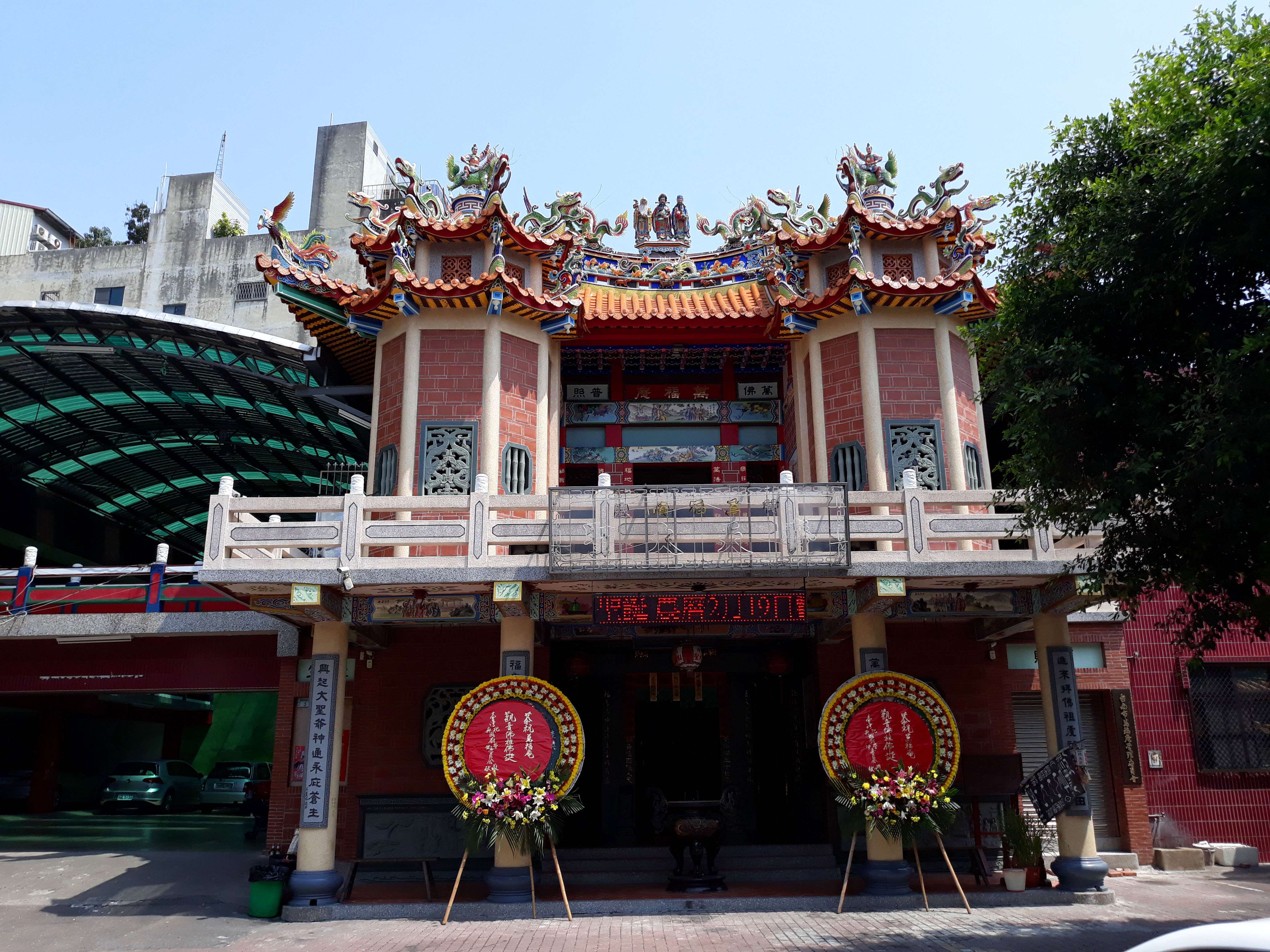
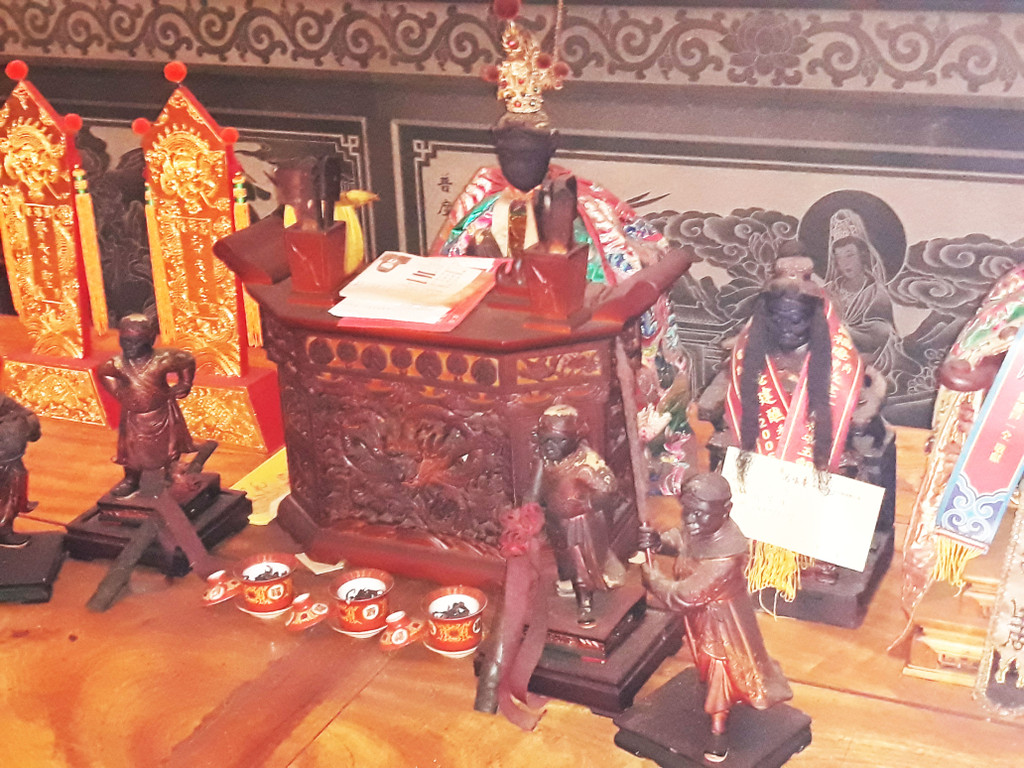
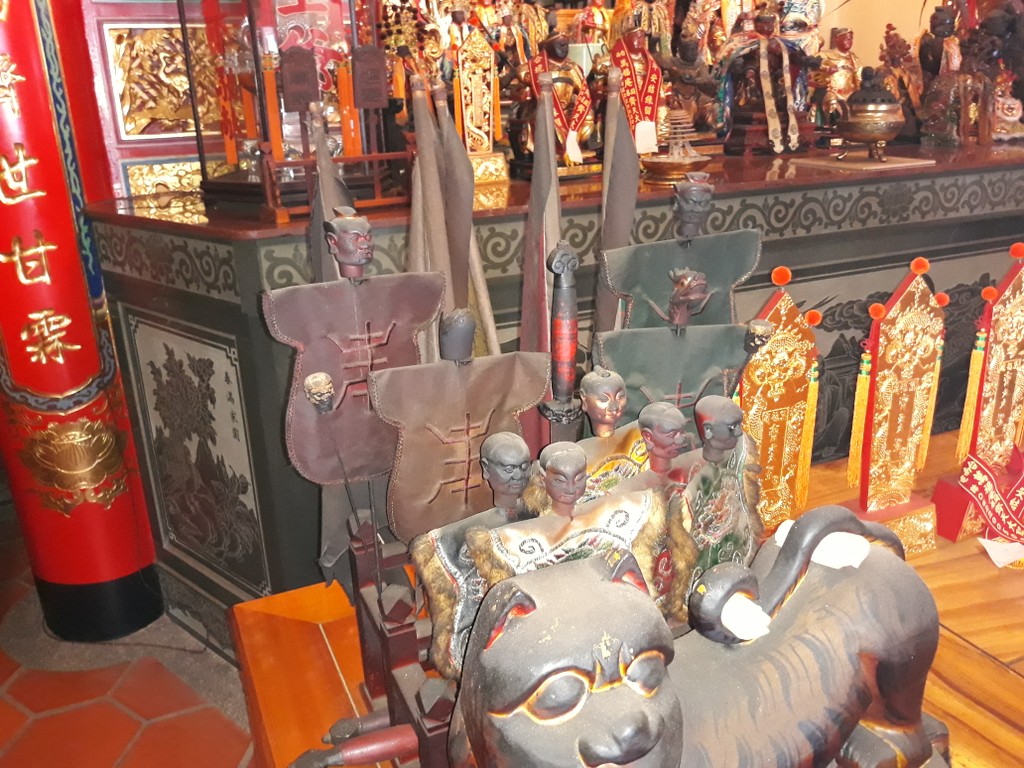
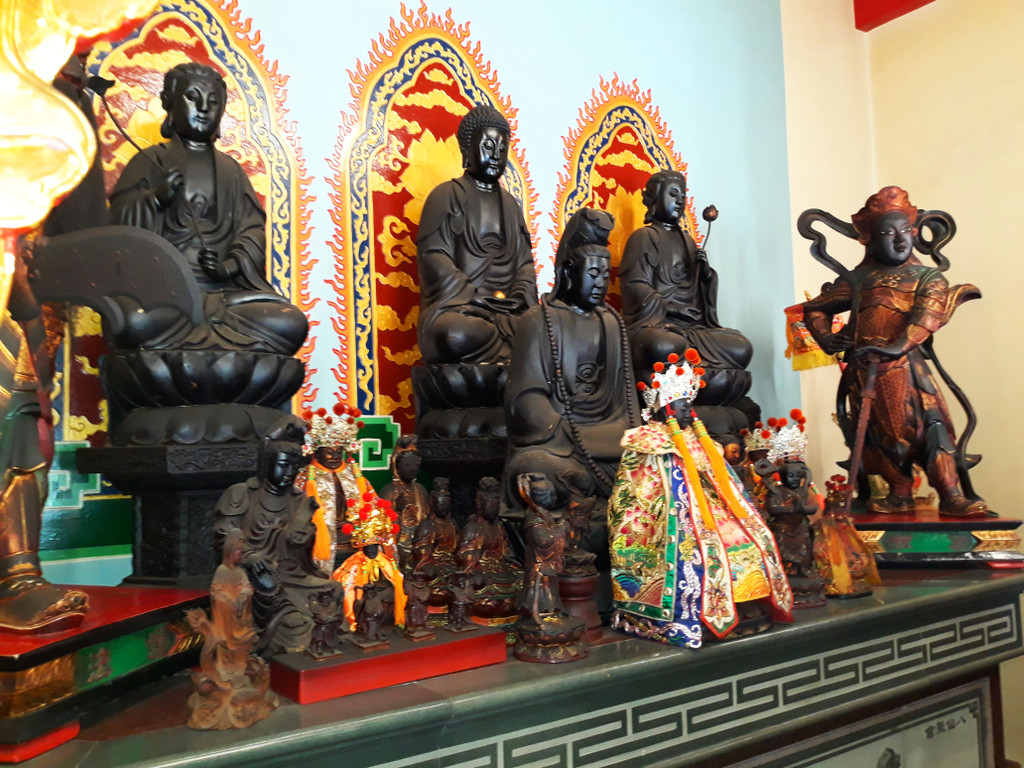
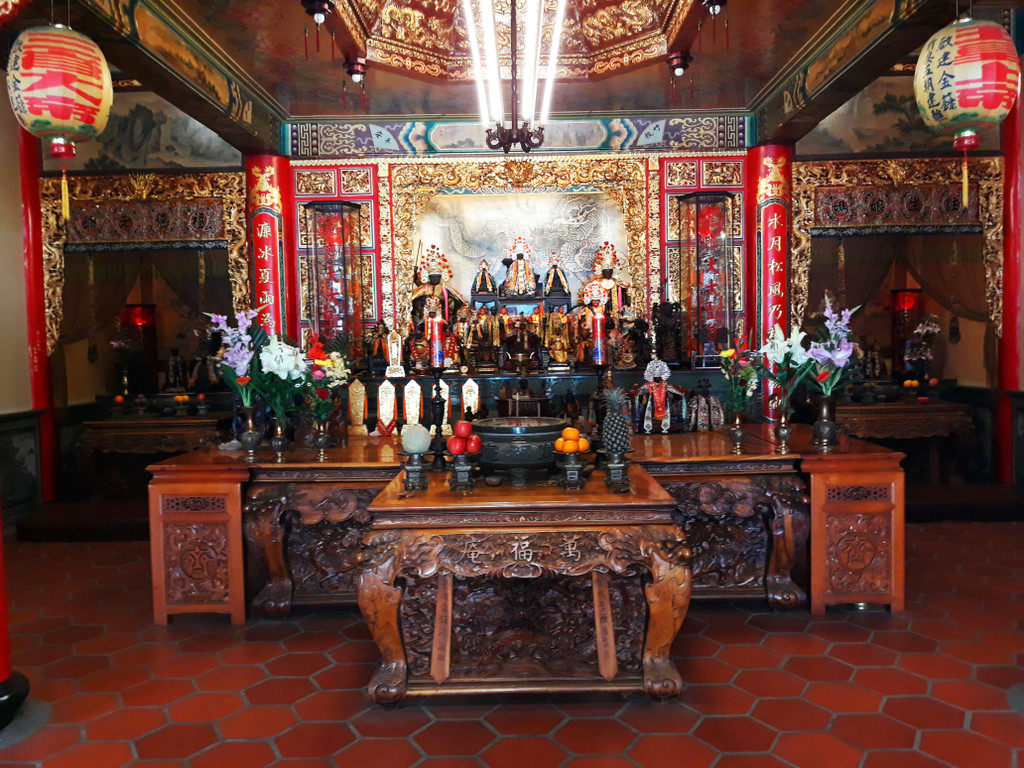
As a historian of the great Chinese classic Journey to the West (Xiyouji西遊記, 1592), much of my time researching is spent flipping through piles of books or searching the internet. Rarely do I get the opportunity to conduct field research on living traditions connected with the novel. That’s why I was excited to learn of the Buddho-Daoist Wanfu Temple (Wanfu an, 萬福庵) (fig. 1 & 2) in Tainan, Taiwan, where they worship Sun Wukong under his guise as the Great Sage Equaling Heaven (Qitian Dasheng, 齊天大聖). This happened to coincide with a short break from school, allowing me time to travel. I left Taipei where I live and stayed in the West Central District of the southern municipality. My afternoon was spent independently touring both floors of the recently renovated temple and taking numerous photos, all of which can be seen on my google drive. I had originally planned to catch the train home that evening, but was so intrigued by what I saw that I delayed my return another day. After making introductions, my second afternoon was spent asking questions about pantheon structure, rituals, general beliefs, etc. I was invited back that evening to record their spirit-medium channeling the Great Sage.

Below, I present my initial findings. I realize that a day is obviously not enough time for observation, so the following information should be looked upon as an informal survey. However, I still feel that this material is important, not only because few scholars writing in English have published on the worship of Sun Wukong, but also because it helps flesh out the ongoing history of his veneration going back to at least the 14th century. [1]

Exterior and entrance

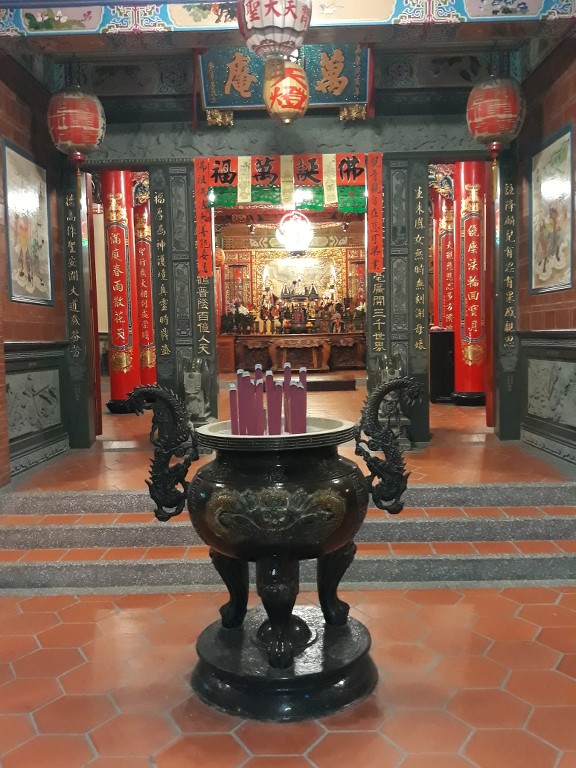
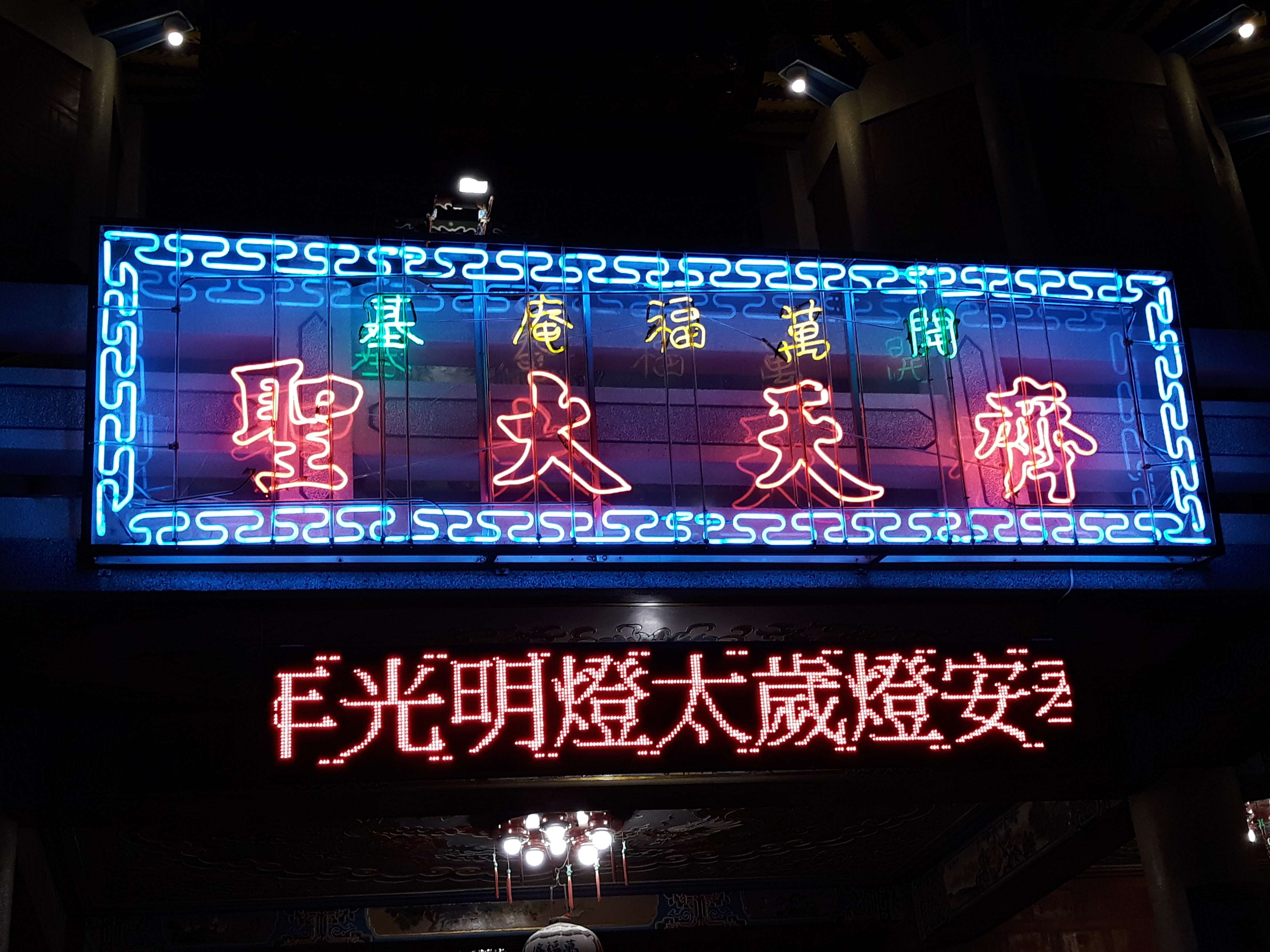
Fig. 1 – Wanfu temple exterior (larger version). Fig. 2 – The entrance (larger version).

Table of Contents

1. Temple History

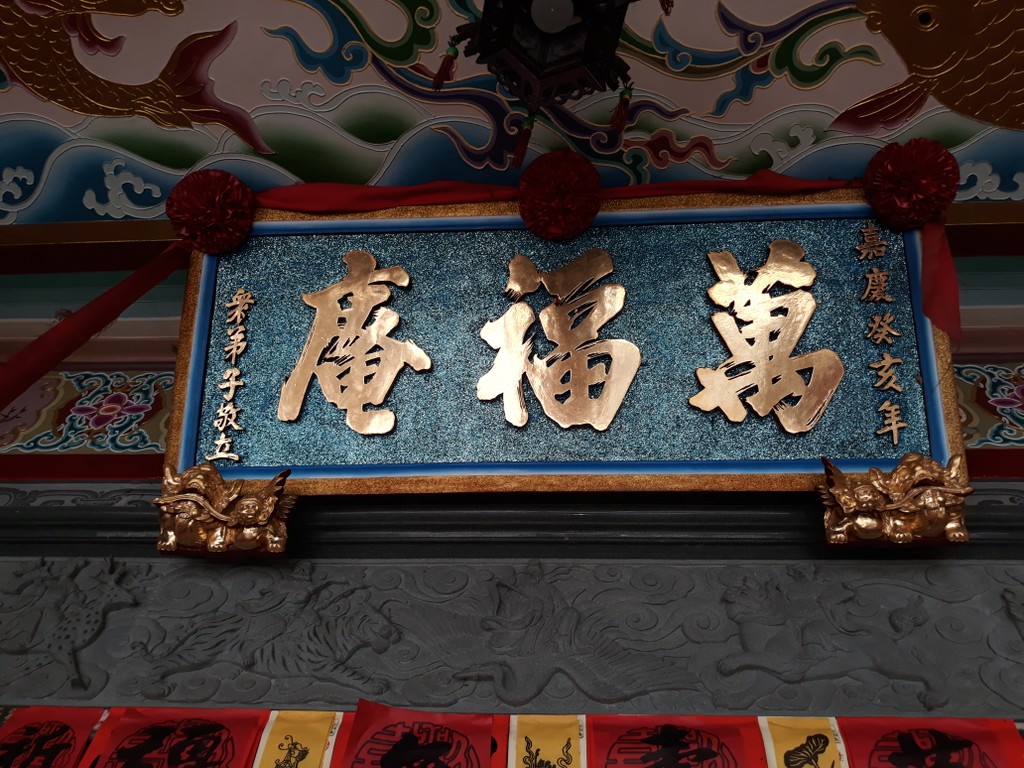
Wanfu is touted as the oldest temple dedicated to the Great Sage in all of Taiwan. It was originally a mansion built during the early-1660s for Ruan Jun (阮駿), a subordinate of the famous Southern Ming Dynasty General Koxinga. His widow Lady Ruan (阮夫人) is said to have lived out the rest of her days there in religious piety, and following her death, the mansion was converted into a house of worship called the Lady Ruan Temple (Ruan Furen si, 阮夫人寺). The name was subsequently changed to “Myriad Blessings” (Wanfu, 萬福) in the 11th year of the Jiaqing reign (1806), during a time when the temple was known for taking in orphans. The change was made by nuns who believed the children benefited from the blessings of an old stone Great Sage statue thought to have been brought over from Fujian by Lady Ruan when she and thousands of other people fled the invading Qing forces to Taiwan. Sun Wukong’s influence over the temple grew to the point that while still officially known as Wanfu (fig. 3), it came to acquire the additional name of Taiwan’s Laying the [Religious] Foundation Great Sage Equaling Heaven Temple (Quantai Kaiji Qitian Dasheng miao, 全臺開基齊天大聖廟) (fig. 4). A second level was added to the building in 1971, and further renovations were completed in 2014.

Fig. 3 (left) – The “Wanfu Temple” sign over the main temple doors (larver version). Fig. 4 (right) – The neon sign on the facade reads “Wanfu Temple Laying the Foundation Great Sage Equaling Heaven” (larger version).

2. Pantheon of Great Sages

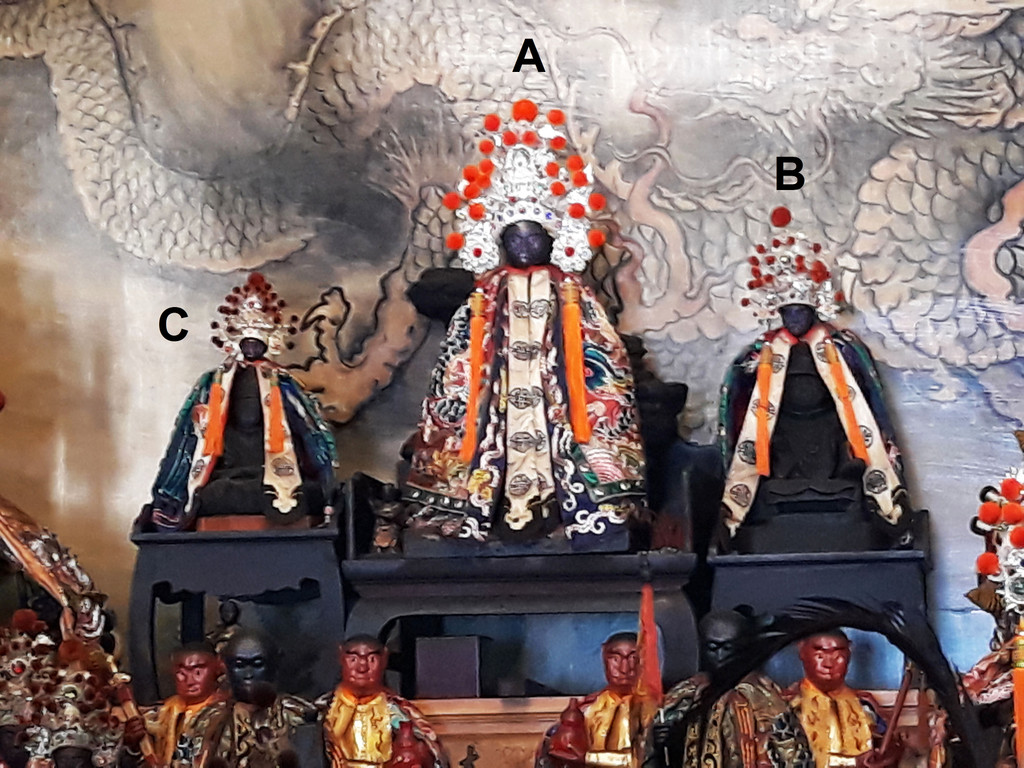
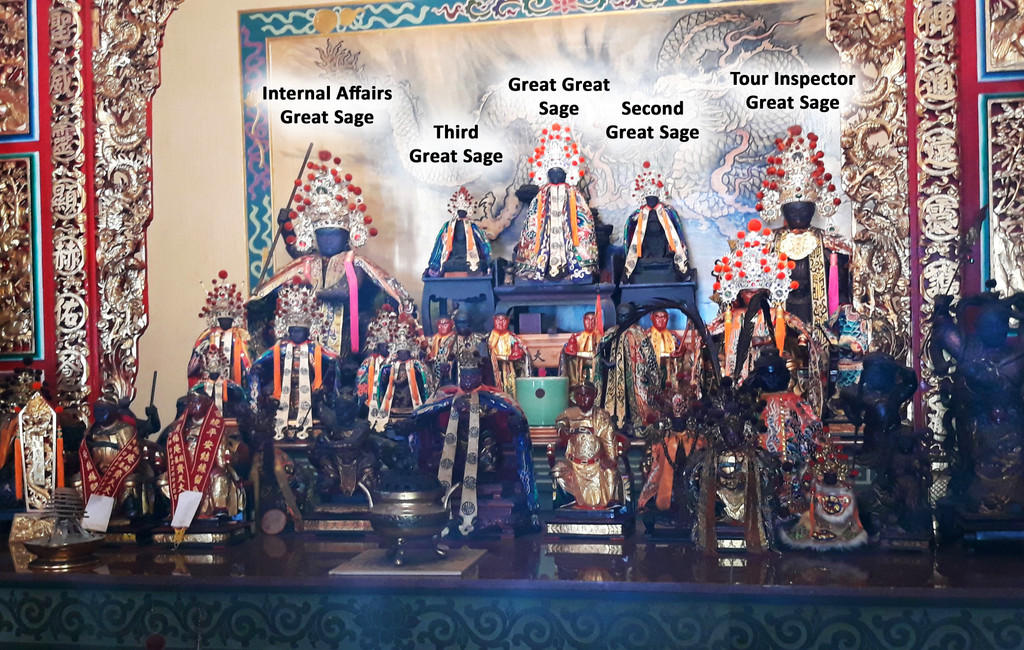
One of the most interesting aspects of the temple is that it recognizes more than one Great Sage, each with his own function. Their pantheon consists of a trinity, followed by a small handful in administrative positions, and finally a plethora of soldier Monkeys. The highest-ranking is the aforementioned 300-plus-year-old stone statue named Laying the Foundations Elder Great Sage (Kaiji Da Dasheng, 開基大大聖) (fig. 5A and 8). His central importance is signified by his position atop a chair on the altar stage. He is alternatively known as the Great Sage Lord (Dasheng Ye, 大聖爺). The second and third ranking members of this trinity, respectively named Laying the Foundations Second Great Sage (Kaiji Er Dasheng, 開基二大聖) and Laying the Foundations Third Great Sage (Kaiji San Dasheng, 開基三大聖) (fig. 5B, 5C, and 8), sit to his right and left. The Elder Great Sage and the Second Great Sage remain in heaven unless some important matter requires their direct participation. The Third Great sage alternates with the administrative Tour Inspector Great Sage (see below) to see to external temple business on Saturdays.

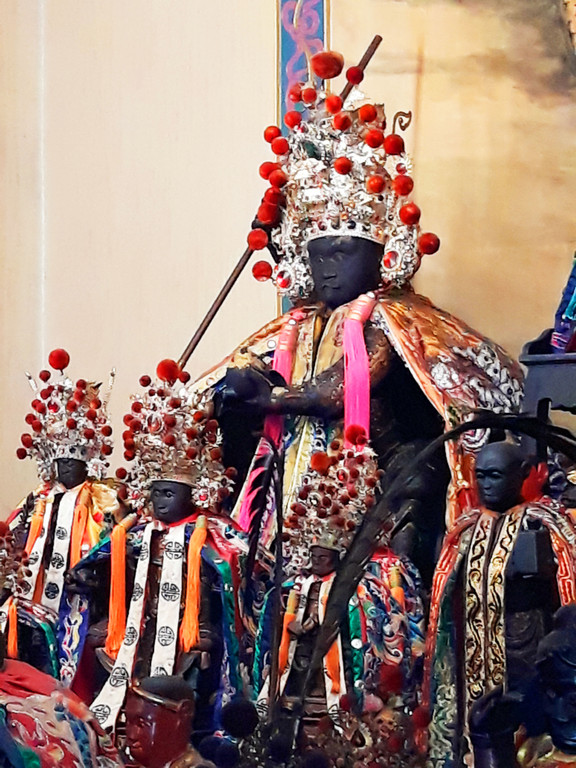
Fig. 5 (left) – (A)The Laying the Foundation Elder Great Sage, the 300-year-old stone statue; (B) The Laying the Foundation Second Great Sage; and (C) The Laying the Foundation Third Great Sage (larger version). Fig. 6 (center) – The Tour Inspector Great Sage (larger version). Fig. 7 (right) – The Internal Affairs Great Sage (larger version). 

The administrative Monkeys include the large Tour Inspector Great Sage (Chuxun Dasheng, 出巡大聖) (fig. 6 & 8), who oversees activities outside the temple. He is located to the right of the trinity; the slightly larger, staff-wielding Internal Affairs Great Sage (Neiwu Zongguan Dasheng, 内務總管大聖) (fig. 7 & 8) serves as a manager to lower-ranking Monkeys. He is located to the left of the trinity; and the Sergeant Great Sage (Shiguan Dasheng, 士官大聖) (fig. 9) serves as the temple director. This comparatively small statue sits behind a magistrate’s bench below the altar stage, just behind the offerings table.

Fig. 8 (left) – The altar stage layout, with the most important Great Sages labeled (larger version). Fig. 9 (right) – The Sergeant Great Sage sitting at a magistrate’s bench (larger version). 

In addition, the Elder Great Sage has at his disposal a group of powerful commanders known as the Five Camps Celestial Generals (Wuying Bingjiang, 五營兵將), who protect the five cardinal directions. These are the black Northern Camp Sage Lian Gong (Beiying Lian Gong Shengzhe, 北營連公聖者); the blue/green Eastern Camp Sage Zhang Gong (Dongying Zhang Gong Shengzhe, 東營張公聖者); the red Southern Camp Sage Xiao Gong (Nanying Xiao Gong Shengzhe, 南營蕭公聖); the white Western Camp Sage Liu Gong (Xiying Liu Gong Shengzhe, 西營劉公聖者); and the golden Central Camp Marshal of the Central Altar (Zhongying Zhong Tan Yuanshuai, 中營中壇元帥) (fig. 10). Each general in turn leads a vast heavenly army comprised of tens of thousands of soldiers. Such generals are very common to Daoist temples across Taiwan and find their origin in the 36 protector generals of Daoism (Sanshiliu Tianjiang, 三十六天將), who, funny enough, are led by Zhu Bajie’s previous incarnation Marshal Tianpeng (Davis, 2001, p. 78).

The position of the Great Sage pantheon in relation to the wider Buddho-Daoist pantheon mirrors that from Journey to the West. Despite his central position in Wanfu’s religious life, the Great Sage is still considered subordinate to the Bodhisattva Guanyin (觀音), whose birthday was being celebrated on the second day of my visit with a vegetarian meal open to all. In fact, the temple’s second floor Three Jewels Hall (Sanbao Dian, 三寶殿) contains statues of the Buddha and flanking Bodhisattvas raised on an altar stage, with a statue of Guanyin placed in front of and almost at the same level as the Enlightened One (fig. 11). This shows her great importance.

Fig. 10 (left) – Two sets of the Five Camps Celestial Generals can be seen. Their colors of black, blue/green, red, white, and gold help distinguish each one (larger version). Fig. 11 (right) – The statue of Guanyin sitting in front of and almost at the same level of the Buddha (larger version). The goddess Mazu sits in front of Guanyin. From the second floor Three Jewels Hall.

3. Worshiping the Great Sage and Requesting Blessings

When the faithful come to pray, they often stand directly in line with the center of the altar (fig. 12), with hands pressed and set against their forehead (or chest), or they light a grouping of three incense sticks, kneel on the praying couch, and hold the sticks up to their forehead (or chest) with elbows level, often rhythmically bobbing their arms or upper torso (fig. 13). The procedure for making a request has three steps. First, adherents greet the Great Sage and say their full name, lunar birthday (and time if known), and their address. This is done because many people have names written with the exact same Chinese characters. The step insures that the Great Sage answers the right prayers for the right person. Second, they wish for health, wealth, good luck, removal of a negative influence, etc. Third, they later burn spirit money to repay Monkey’s generosity. This form of prayer is for those who don’t mind waiting for a response.

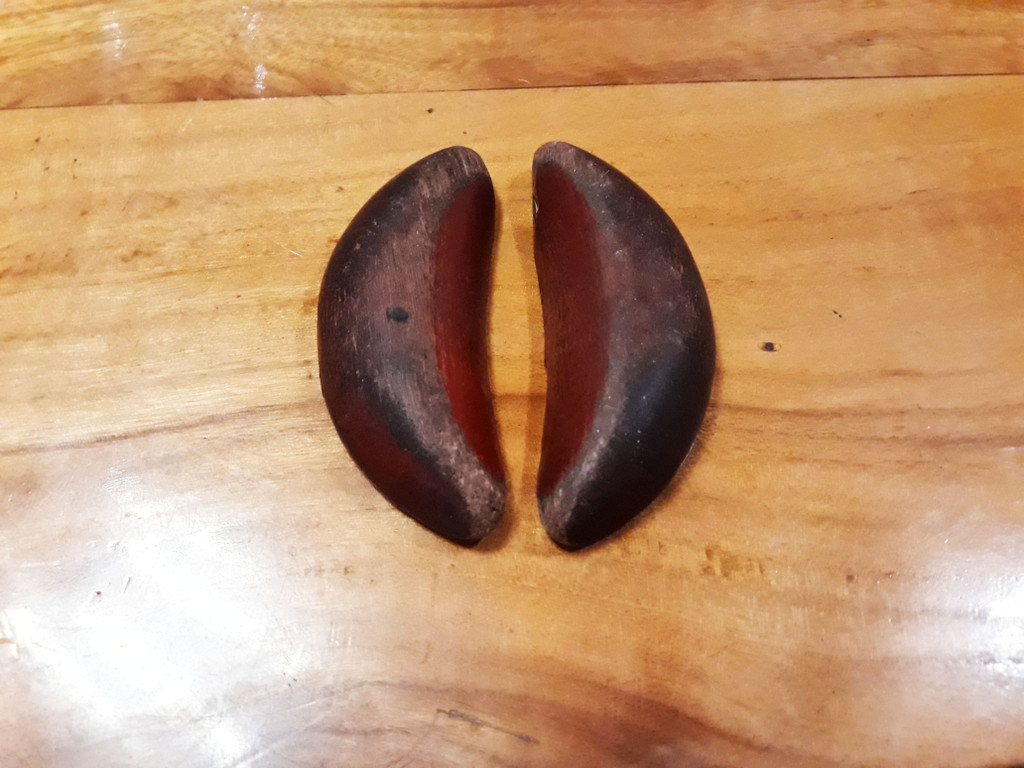
For those seeking an immediate response, the temple employs a pair of crescent moon-shaped wooden blocks known as “bamboo cups” (jiaobei, 筊杯) (fig. 8) for divination purposes. The procedure starts the same with the greeting and personal information, but the cups are grasped between the hands during the prayer and then dropped to the ground after a few minutes. Like rolling spiritual dice, the faithful take note of the orientation in which the blocks fall. One side of the blocks is flat, while the other is curved. If one cup falls with the flat side upwards (open) and the other flat side down (closed), this means “yes” (shengjiao, 聖筊). If both fall upwards, this means the Great Sage is happy or “laughing” at the request (xiaojiao, 笑筊). If both fall facedown, the Great Sage is “angry” and unwilling to fulfill the request (nujiao, 怒筊) (fig. 14). The cups are thrown three times, and the best two of three results are accepted as the answer.

Fig. 12 (left) – The offering table and altar (larger version). Fig. 13 (center) – A young couple praying to the Great Sage (larger version). Fig. 14 (right) – The Bamboo cups, both sitting in the “angry” response (cup down) (larger version).

Often times adherents will want more clarification, so the blocks are used in tandem with “fortune sticks” (qiuqian, 求籤). The traditional procedure is to shake the cylinder full of sticks, each marked with a number, until one falls out. (I, however, saw one young man with long, dyed hair randomly reach into the cylinder without shaking it. He also didn’t wait the required period after his prayer to drop the cups. He must have been in a hurry!) The adherent then looks up the corresponding oracle in a booklet kept on the temple’s front desk. These oracles are also available on slips of paper that can be taken and read later. The use of the bamboo cups and fortune sticks is common in other temples.

I asked one young couple associated with the temple about the exact number of members. They were unsure of the core members and especially of the number of outside worshipers. It appears the veneration of the Great Sage is so entrenched in Tainan religious society that people from other temples will come from time to time to pay their respects to Monkey.

3.1. Great Sage Spirit-Medium

The second day of my visit coincided with one of the twice weekly (Wed. and Sat.) rituals in which the temple’s spirit-medium (Hokkien: tangki, 童乩; Chinese: jitong, 乩童, lit: “divining youth”) calls down the spirit of the Great Sage to possess his body (video 1). Prior to the ritual, red ropes were used to demarcate a sacred space within the center of the altar hall. The ropes were tied to either side of the main central temple doors and stretched diagonally to the respective left and right walls of the hall, forming a V-shape, or a sort of spiritual bottleneck. Only the medium and the temple workers were allowed to inhibit this sacred space shortly before and during the ritual. The faithful seeking blessings and spectators were asked to wait on the other side of the ropes, entering through secondary doors located to the respective left and right of the main set.

Video 1 – The spirit-medium ritual.

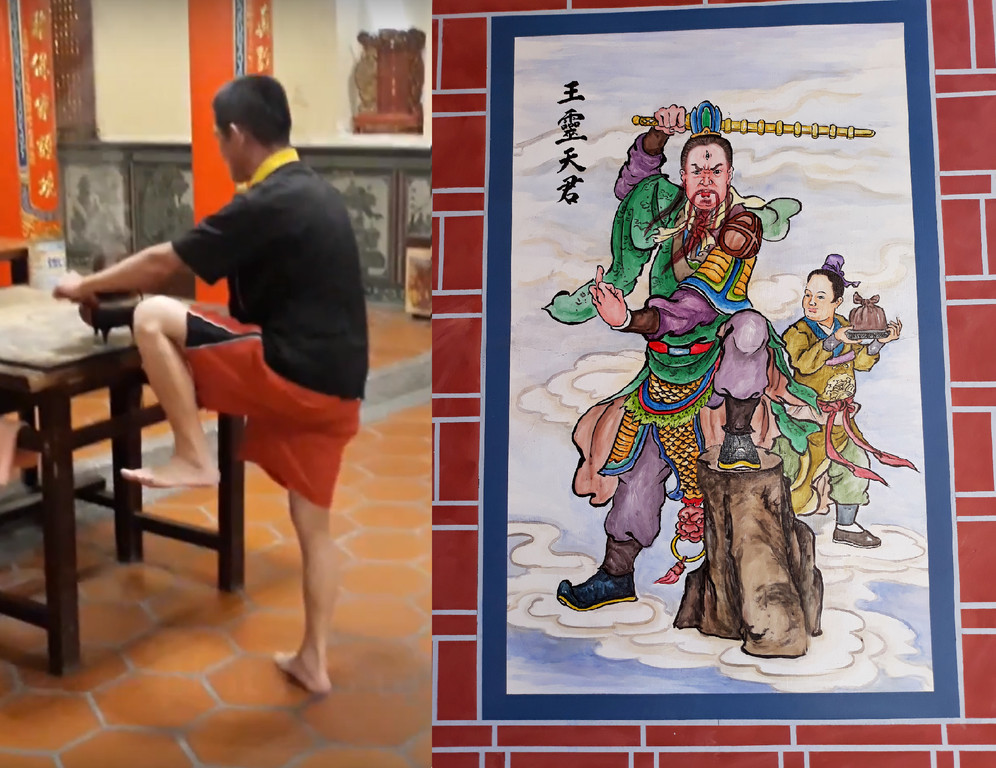
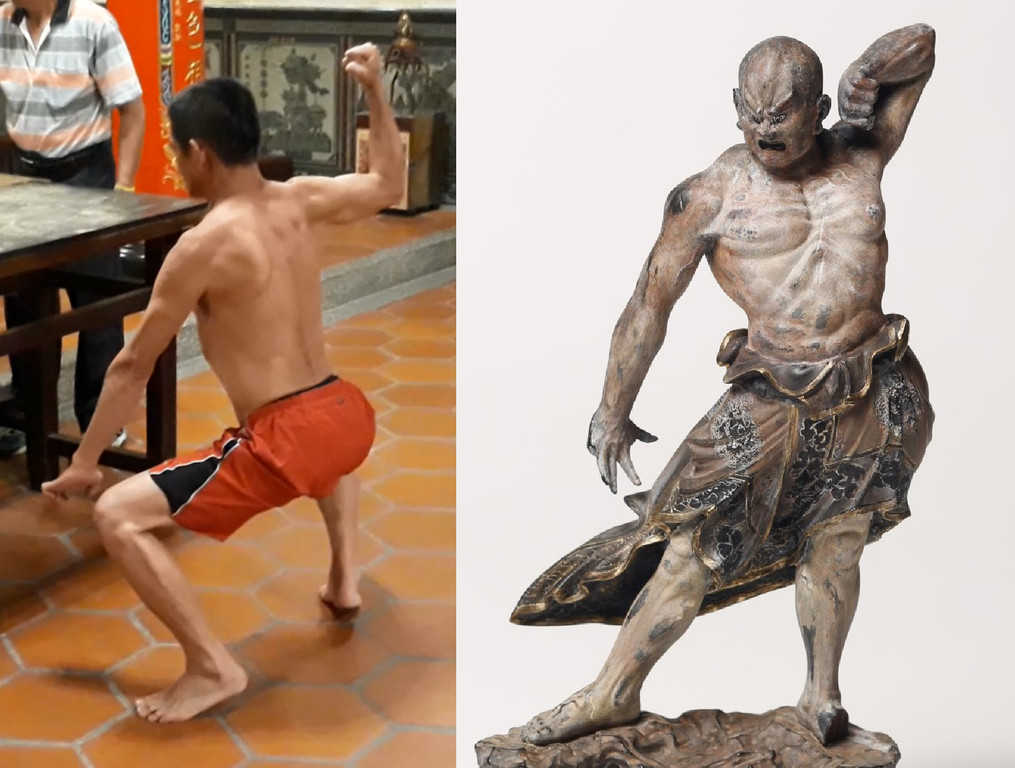
I witnessed the medium chewing an herbal substance that was removed prior to the ritual. [2] He then proceeded to purify himself with a small pot of (psychoactive?) incense, first bathing his hands and arms in the smoke, before passing it around his head, waist, and calves. Taking hold of the pot’s handles, he began belching. This gave way to a moving trance in which he marched in place for several minutes. The arrival of the Great Sage was signaled by an audible growl and the medium lifting high one knee, taking on a martial pose like esoteric protector deities (fig. 15). After an attendant removed his shirt, he squatted low to the ground and struck another pose with arms flexed like said deities (fig. 16). Such postures serve to mark the medium’s transition from a human to a god.

The medium-turned-Great Sage displayed jovial feet clapping, followed by feats of strength, including elevated push ups and a handstand. Finally, he stood atop a wooden bench and used his weight to rock it side to side, slamming the feet down in rapid succession, producing a sound similar to firecrackers. The sound is used to scare away evil influences. I was told in advance that the medium would “do exercise” and use the bench “to make noise,” so these appear to be common aspects of the ritual.

Fig. 15 – The stance announcing the Great Sage’s arrival (left) is similar to esoteric guardian deities, such as the temple’s depiction of Wangling Tianjun (center left) (larger version). Fig. 16 – His next stance (center right) is also similar to said guardians, especially this statue based on a famous 14th-century carving of a Japanese Nio (right) (larger version).

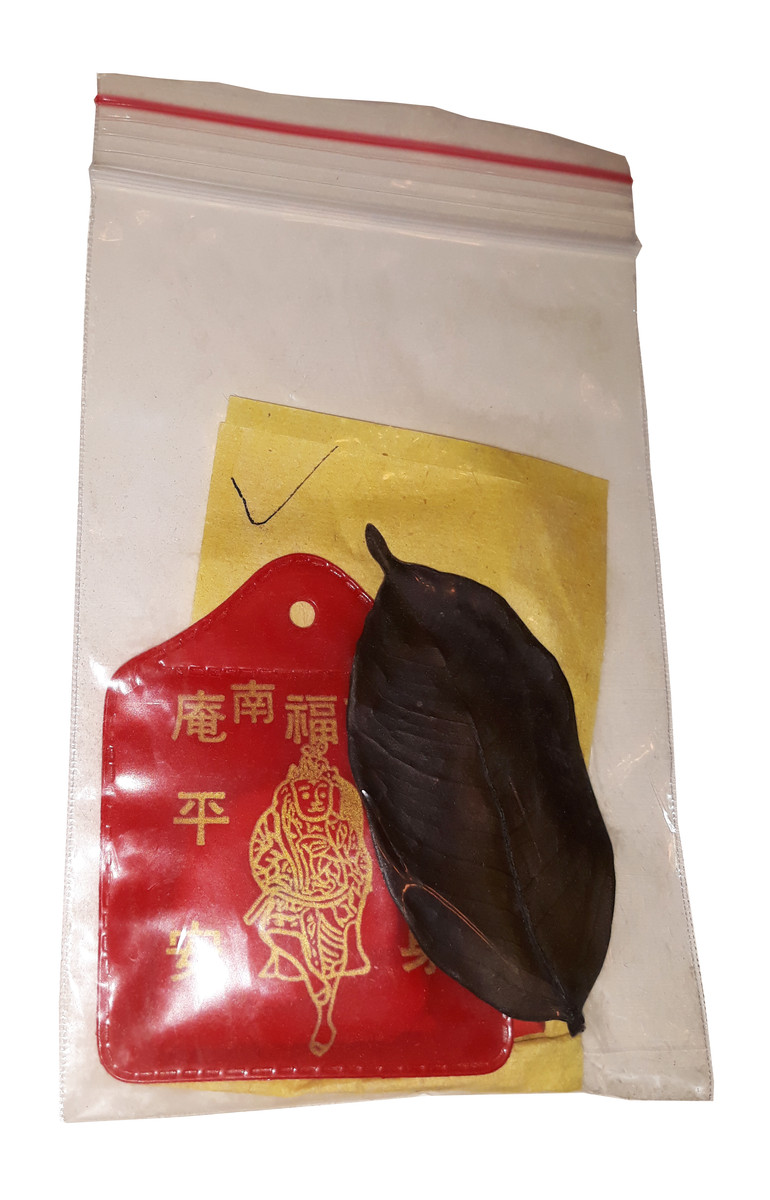
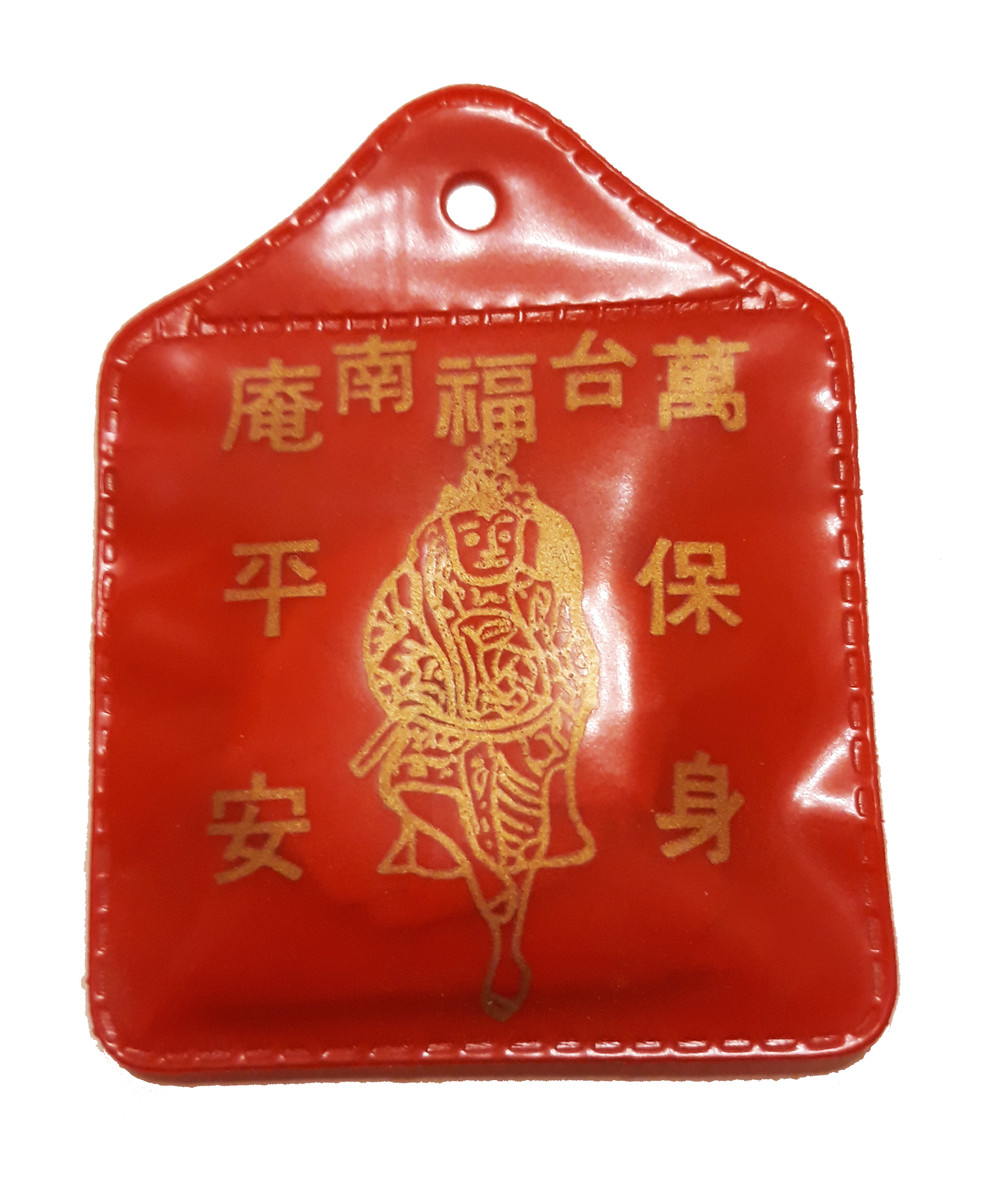
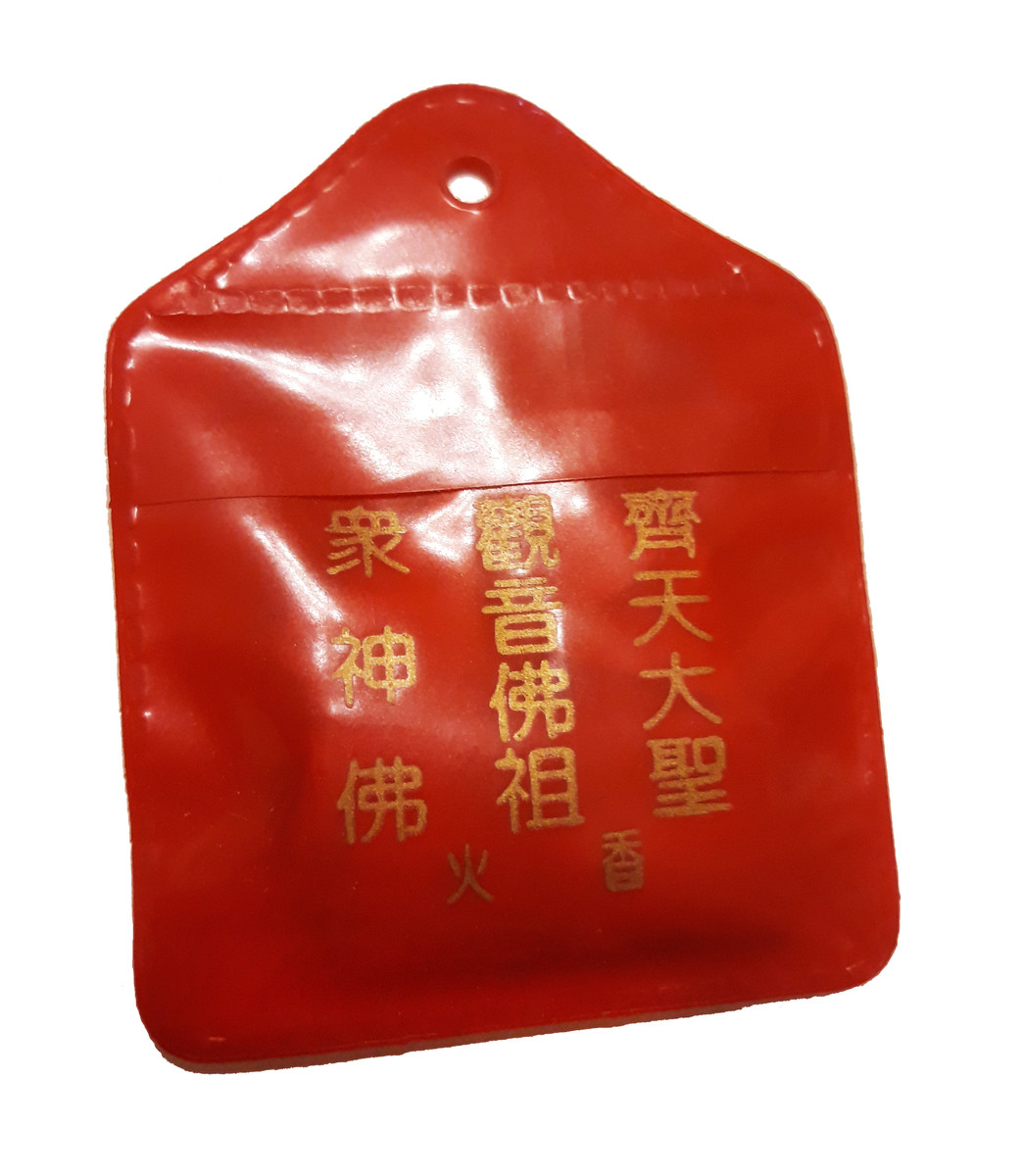
The Great Sage welcomed the first of many children and blessed each the same with the following procedure. First, he touched the top of the incense pot and then transferred his hand to the child’s crown, doing this three times. Second, he dipped his finger into the incense and drew a line down the center of the child’s face from the forehead to the chin and onto the neck. Third, after dipping his fingers in the incense again, he traced a rectangular form on the child’s torso, possibly a symbolic fu (符) talisman, before pushing on the stomach several times to release, as I was told, “bad air” (negative qi). The same rectangle was traced on the child’s back. Fourth, the Great Sage dipped his finger in the incense and turned to the table to write out three fu talismans on yellow strips of paper, his finger often floating above the surface. One was packaged to be later burnt and the ashes combined with an included tea leaf and cold (yin) and hot (yang) water to be given to the child as a magical brew. The second was folded and put inside of a red pouch to be worn as a good luck charm (fig. 17-19). The third was lit and waved over the child’s head and around their body.

Fig. 17 (left) – A baggy containing a loose fu talisman, a folded talisman inside of a red charm, and a tea leaf (larger version). This baggy was given to me when I participated in similar ritual for adults. Fig. 18 (center) – The front of the charm reading “Tainan Wanfu Temple, safety and peace” (larger version). Fig. 19 (right) – The back reading “Great Sage Equaling Heaven,” “Guanyin/Shakyamuni,” and “Multitude of Gods and Buddhas” (larger version). 

The large number of children taking part in the ritual (many of which were not shown in the video) is, as mentioned above, tied to the temple’s history. Adherents believe the Great Sage bestows blessings on children, as well as cures them of illnesses when they are sick. [3] Additionally, they believe that those taken as the Great Sage’s godchildren will be well-behaved and become well-tempered adults. [4] For those who have read the novel, this may at first appear to be a paradox—Monkey, a paragon of good behavior?!—but this no doubt refers to his internalization of self-restraint after becoming a Buddha at the end of the novel. This coincides with the disappearance of his restraint-inducing golden headband.

Numerous adults also sought the Great Sage’s blessing. Having already provided their personal information on salmon-colored prayer sheets to temple personnel, each person in turn greeted the medium and then made their request (health, wealth, good luck, etc.). The blessing procedure was the same regarding fu talismans, complete with the third being lit and waved around the head and body. I even saw the Great Sage bless a shirt in place of an adherent who could not come in person. When interacting with the faithful, the medium spoke to them in a high-pitched voice, [5] often making people laugh with his responses. I was later informed that the language being used was Taiwanese, which explains why I couldn’t understand what was being said. I too took part in the ritual and noted that the medium’s eyes were rolled back into his head. Apart from the poses at the beginning, the voice and eyes serve to mark the possessed state.

The medium has held his position at the temple for 20 years. But it should be noted that he has a normal job during the week and volunteers his time at the temple. His path to mediumship began as a young man when he started displaying certain behavior signifying he had been chosen by the Great Sage to be his earthly representative. While many mediums go through a period of training under a “Red Hat” Daoist (Hongtou Daoshi, 紅頭道士), a master of religious ceremony (Clart, 2008), I was told that the methods of mediumship were revealed to him in his dreams by the Great Sage while he slept in the temple for 49 days.

3.2. Celebrating the Great Sage’s Birthday

The Monkey King’s birthday is recognized as the 12th day of the 10th lunar month and is celebrated over the course of three days. This year (2018) the birthday will correspond to November 19th. The first day of celebrations is undertaken by core temple members, while the subsequent days are undertaken by sister temples. Below is a video showing a time-lapse of a past celebration. Many people crowd the temple to pay their respects, as well as to fill the offering table with all kinds of delicious fruits and sweets. I can picture the Great Sage rolling around on the ground and laughing in delight!

Video 2 – The celebration of the Great Sage’s birthday.

His offerings are later shared with his five celestial generals in the Rewarding Soldiers ritual (Kao jun, 犒軍). This too is common in other temples.

4. Conclusion

The Buddho-Daoist Wanfu Temple of Tainan, Taiwan worships Sun Wukong under his guise as the Great Sage Equaling Heaven, who is venerated as a powerful exorcist and healer, as well as a sort of patron saint of children. The main focus of worship is a 300-plus-year old stone statue believed to have been brought over from Fujian during the turmoil of the late-Ming dynasty. The temple recognizes an entire pantheon of Great Sages, from a trinity (headed by the aforementioned statue) and administrative managers down to an army of lowly soldier monkeys. Furthermore, the Great Sage has at his disposal five cardinal celestial generals and their respective armies to insure his will is done. The position of the Great Sage within the greater Buddhist pantheon is the same as in the novel. He is subordinate to the Bodhisattva Guanyin, who is considered by Wanfu to be almost equal to the Buddha in terms of importance.

The Great Sage-adherent dynamic involves two forms of interaction: impersonal and personal. The former involves the adherent praying to the deity in heaven, sometimes using bamboo cups, fortune sticks, and corresponding oracle booklets to divine the Great Sage’s response to their request. The latter involves personal interaction with the deity via a spirit-medium. The Wanfu medium twice-weekly (Wed. and Sat.) holds a ceremony where he calls down the Great Sage, and after taking possession, the deity personally interacts with those seeking blessings. He employs magic fu talismans to bless both children and adults, the paper slip being burnt and waved around their body. The ritual for children is more involved as incense is first used to draw talismans on their body and then negative qi is released by pushing on the stomach.

I plan to revisit the temple at a later date to conduct more in-depth research into the particulars of the pantheon, as well as the ritual of the spirit-medium. Visiting during the Great Sage’s birthday, the 12th day of the 10th lunar month, would be an ideal time since it’s no doubt a time of much fanfare.


5. Update

Update: 07-21-20

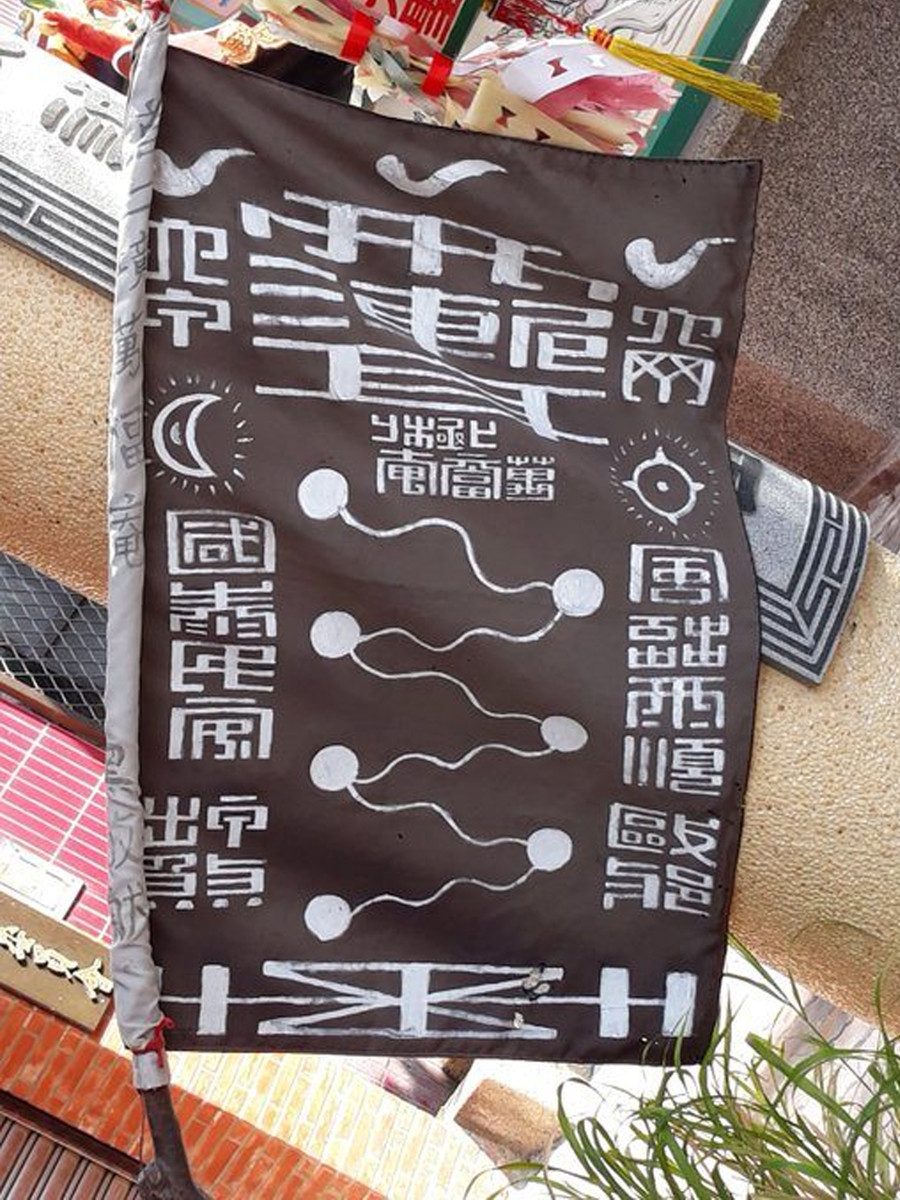
Wanfu Temple’s “black command flag” (Hokkien: or leng ki; Mandarin: hei leng qi, 黑令旗) (fig. 20) is located just outside the rightmost front entrance. Elliott (1955/1990) explains that command flags advertise the presence of a spirit-medium, while also serving as a warning to ghosts and demons (p. 51). Chan (2014) comments that such flags are imbued with the power of the Dark Emperor of the North, considered the greatest exorcist god in Daoism, and act as a covenant between the deity and the tangki spirit-medium who leads his heavenly armies against evil (p. 34).

Fig. 20 (left) – The Wanfu Temple black command flag (larger version). Fig. 21 (right) – The flag legend (larger version).

Each flag is covered with arcane symbols that are usually only intelligible to the initiated. With some help, [6] I have made a near complete translation of the Wanfu black command flag (fig. 21):

  1. 雨漸耳 (Yu jian er, “Rain soaks the ears”) – This likely refers to a commandment from heaven.
  2. 六? (Liu ?) – The mystery character likely refers to the Six Ding (六丁), protector spirits of Daoism. They are often grouped with the Six Jia (Mugitani, 2008). See also no. 11 below.
  3. 六甲 (Liu Jia) – Refers to the Six Jia. See also no. 12.
  4. 北極 (Bei ji, “Northern Ultimate”) – This refers to the Dark Emperor of the North. Here, the character for “north” is split in half and “ultimate” is inserted in the middle.
  5. ?富? – Two unknown characters sandwich that for “wealth” (fu).
  6. Sun – A symbol for 陽 (yang) energy.
  7. Moon – A symbol for 陰 (yin) energy.
  8. Big Dipper – A seven-star pattern associated with Daoist ritualistic dances and purification ceremonies. See section one of this article for more info.
  9. 風調雨順 (fengtiao yushun) – A common Chinese idiom meaning “the wind and rain are seasonal” (i.e. the weather is good).
  10. 國泰民安 (guotai minan) – Another common idiom. It means “the country is prosperous, and the people are secure.”
  11. 敺邪 (qu xie) – “Expel evil/disease.” This is likely connected to no. 2 above. Together it would read the “Six Ding expel evil/disease.”
  12. 押煞 (ya sha) – “Stop malicious spirits”. This is likely connected to no. 3. Together it would read the “Six Jia stop malicious spirits.”
  13. This angular symbol is the 符胆 (fu dan), the talismanic flag’s locus of power (Chan, 2014, p. 35).

Notes:

1) A 14th-century tomb shrine jointly dedicated to the Great Sage Equaling Heaven and the “Great Sage Reaching Heaven” (Tongtian dasheng, 通天大聖) in Baoshan, Fujian shows that Monkey was indeed venerated prior to the publishing of Journey to the West (1592) (Wang, 2004).

2) This appears to be a common practice. In his study of Singaporean spirit-mediums, Elliott (1955/1990) writes:

Before their performances many dang-ki have been seen to chew some sort of root or sip from a cup, but it has been impossible to ascertain whether these contain stimulating substances (p. 64).

3) The Great Sage is, after all, a trained doctor. His medical skills are described in chapters 68 and 69.

4) Such youths are known as “dedicated children” (khoe-kia) in Singapore (Elliott, 1955/1990, p. 83).

5) Elliott (1955/1990) references the tangki‘s “shrill, artificial voice” and notes that it’s “supposed to be ‘shen [神, god] language'” (p. 64).

6) I am indebted to Kelly Black Lin for helping me decipher some of the cryptic characters.

Sources:

Chan, M. (2014). Tangki War Magic: The Virtuality of Spirit Warfare and the Actuality of Peace. Social Analysis: The International Journal of Social and Cultural Practice, 58(1), 25-46. Retrieved from 

Clart, P. (2008). Tang-ki (or jitong) In F. Pregadio (Ed.), The Encyclopedia of Taoism: Volume 2 (pp. 964-966). London [u.a.: Routledge].

Davis, E. L. (2001). Society and the Supernatural in Song China. Honolulu (Hawaii: University of Hawaii Press.

Elliott, A. J. (1990). Chinese Spirit-Medium Cults in Singapore. London: The Athlone Press. (Original work published 1955)

Mugitani, K. (2008). Liujia and Liuding. In F. Pregadio (Ed.), The encyclopedia of Taoism: Vol 1-2 (pp. 695-697). Longdon: Routledge.

Wang, y. (2004). Sun Wukong De Yuanji Keneng Zai Fujian Baoshan [Sun Wukong’s Origin Could be In Baoshan, Fujian]Yuncheng Xueyan Bao, 22(3), 30-34.

The Origin of the Monkey King’s Punishment in Laozi’s Furnace

The beginning of Journey to the West (Xiyouji西遊記, 1592; “JTTW” hereafter) chapter seven sees Sun Wukong transported to the realm above to be executed for his rebellion against the primacy of heaven. However, his immortal body proves impervious to blades, fire, and lightning, leading Laozi to theorize that Monkey’s extreme invulnerability is the result of having consumed large quantities of immortal peaches, wine, and elixir that were later refined in his stomach “to form a single solid mass” (Wu & Yu, 2012, vol. 1, p. 188). The Daoist high god goes on to suggest that the demon be subjected to his Brazier of Eight Trigrams (Bagua lu, 八卦爐) in order to separate out the elixir and make his subsequently weakened body susceptible to death:

Arriving at the Tushita Palace, Laozi loosened the ropes on the Great Sage, pulled out the weapon from his breastbone, and pushed him into the Brazier of Eight Trigrams. He then ordered the Daoist who watched over the brazier and the page boy in charge of the fire to blow up a strong flame for the smelting process. The brazier, you see, was of eight compartments corresponding to the eight trigrams of Qian [☰/乾], Kan [☵/坎], Gen [☶/艮], Zhen [☳/震], Xun [☴/巽], Li [☲/離], Kun [☷/坤], and Dui [☱/兌]. The Great Sage crawled into the space beneath the compartment that corresponded to the Xun trigram. Now Xun symbolizes wind; where there is wind, there is no fire. However, wind could churn up smoke, which at that moment reddened his eyes, giving them a permanently inflamed condition. Hence they were sometimes called Fiery Eyes and Diamond Pupils (Wu & Yu, 2012, vol. 1, p. 189).

那老君到兜率宮,將大聖解去繩索,放了穿琵琶骨之器,推入八卦爐中,命看爐的道人、架火的童子,將火搧起鍛煉。原來那爐是乾、坎、艮、震、巽、離、坤、兌八卦。他即將身鑽在巽宮位下。巽乃風也,有風則無火。只是風攪得煙來,把一雙眼火煼紅了,弄做個老害病眼,故喚作「火眼金睛」。

Laozi checks the furnace forty-nine days later expecting ashes, but he is surprised when Sun emerges and kicks over the mystical oven (fig. 1). This episode has two likely sources.

Fig. 1 – Monkey knocking over Laozi’s furnace (larger version).

Table of Contents

1. Sources

1.1. The Story

The first source is The Story of How Tripitaka of the Great Tang Procures the Scriptures (Da Tang Sanzang qujing shihua大唐三藏取經詩話, c. late-13th century; “The Story” hereafter), the earliest known published edition of JTTW. The 17th chapter describes the trials of Daffy (Chi’na, 癡那), a merchant’s son, at the hands of his evil stepmother, a woman of the Meng clan (孟氏). She resents the boy as he stands to inherit all of his father’s wealth, leaving her son with nothing. Therefore, she and her handmaiden try to kill the heir by respectively boiling him in a pot, ripping out his tongue, starving him, and finally pushing him into a river, but each time he is magically saved by heaven. For instance, after four days boiling in the pot, Daffy emerges unscathed and claims:

[T]he iron cauldron changed into a lily pad on which I sat, surrounded by the cool waters of a pond. I could sleep or just sit there. It was very comfortable (Wivell, 1994, p. 1203).

一釜變化蓮花坐,四伴是冷水池;此中坐臥,甚是安穩。

Mair (1987) notes that the story of a youth being tortured by his stepmother is based on a Dunhuang transformation text with two versions dated 946 and 949, respectively (p. 43). The text focuses on the trials of the future Emperor Shun. [1] However, the boiling episode does not appear in the story.

1.2. Laughing at the Dao

The second source is Laughing at the Dao (Xiaodao lun, 笑道論, 570), an anti-Daoist polemic written as part of a court debate between Buddhist and Daoist representatives vying for state sponsorship. One section recounts Laozi’s rebirth in the mortal world and his later attempt to convert a king in India:

He [Laozi] had (long) hairs on the temples and his head was hoary; his body was sixteen feet tall; he wore a heavenly cap and held a metal staff. He took Yin Xi with him to convert the barbarians. (Once arrived in India) he withdrew to the Shouyang 首陽 mountains, covered by a purple cloud. The barbarian king suspected him of sorcery (妖). He (attempted) to boil him in a cauldron, but (the water) did not grow hot … [2]

頭鬢皓首身長丈六。戴天冠捉金杖。將尹喜化胡。隱首陽山。紫雲覆之。胡王疑妖。鑊煮而不熱。

I find this source particularly amusing because the high god of Daoism is in essence subjected to the same punishment as the one that he later suggests for Sun Wukong!

2. The Furnace in Daoist Alchemy

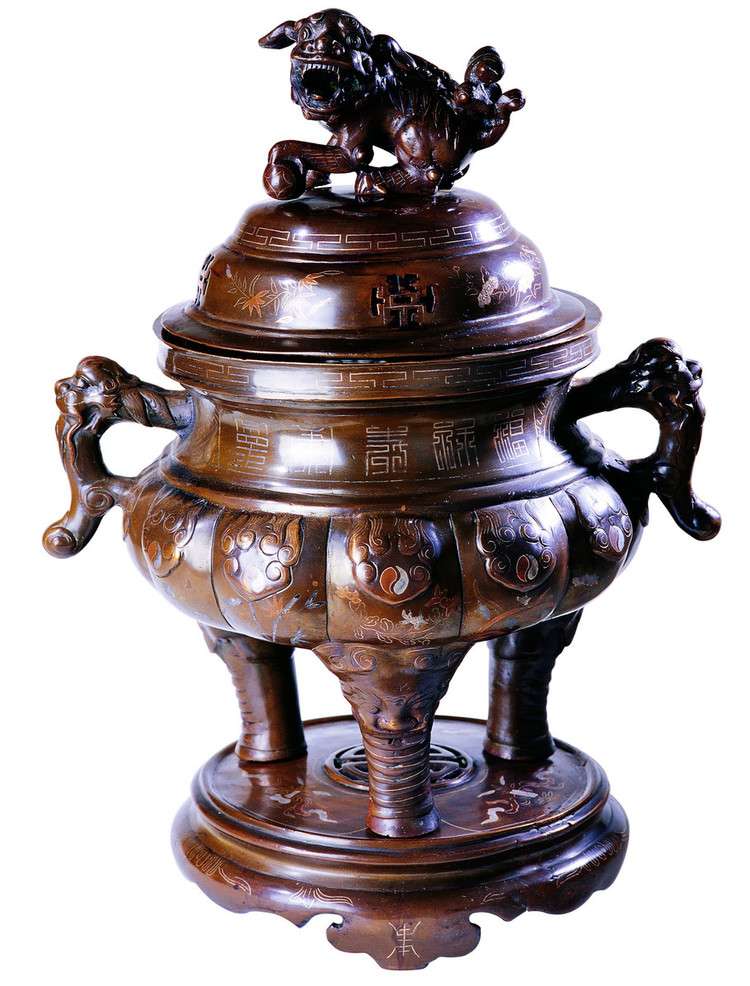
The furnace has two meanings in Daoist alchemy. The first refers to the physical vessel and stove (dinglu, 鼎爐) combo used in external alchemy (waidan, 外丹) to smelt the elixir of immortality (fig. 2). Kim (2008) describes the various parts and models of this contraption:

The reaction vessel has fire around it (when it is placed inside the heating apparatus), under it (when it is placed over the heating apparatus), or above it (when it is entirely covered by ashes inside the heating apparatus). It may contain an inner reaction-case in which the ingredients are placed. In a more complex model, a “water-vessel” containing water and a “fire-vessel” containing the ingredients can be assembled, the former above and the latter below or vice versa. The vessel must be hermetically closed and should not bear any openings or cracks.

The heating apparatus has fire within it and is often placed over a platform or “altar” (tan 壇). The openings on the wall sides allow air to circulate, while those on the top serve to settle the reaction vessel or to emit flame and smoke. One of the main functions of the heating apparatus is to control the intensity and duration of the heat. (pp. 360-361)

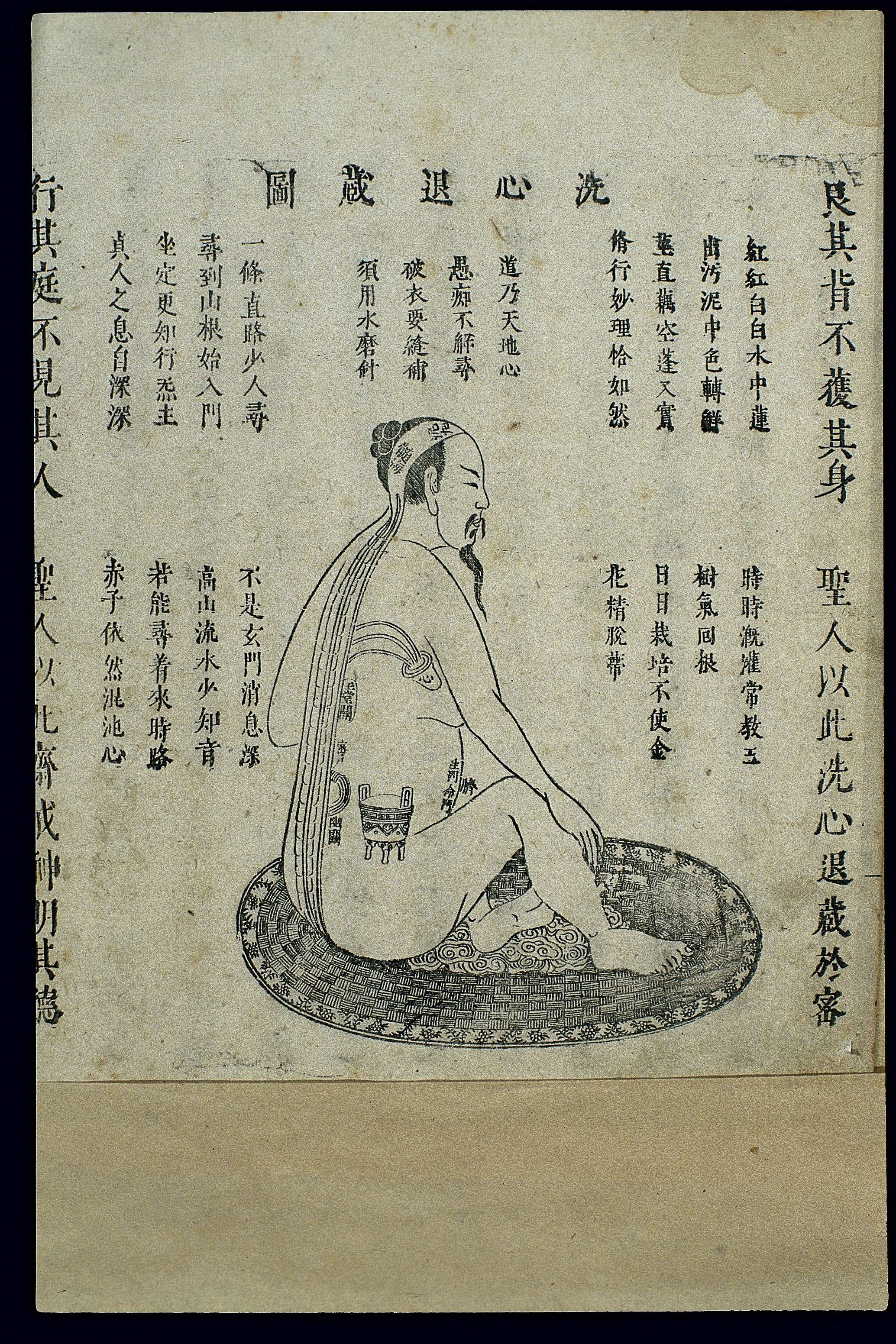
Fig. 2 – An ornate wooden replica dinglu reminiscent of the metal type used in external alchemy (larger version). Fig. 3 – An early 17th-century woodblock print depicting a Daoist practitioner’s dantian as a ding vessel (larger version).

The concept of consuming alchemically derived elixirs is first mentioned in Discourses on Salt and Iron (Yantie tun, 鹽鐵論, c. 60 BCE). Later, the Token for the Agreement of the Three According to the Book of Changes (Zhouyi cantong qi, 周易參同契, c. 2nd century CE; “The Token” hereafter) standardized the use of toxic materials, such as lead and mercury, for making said elixir, and this idea remained entrenched until the Tang Dynasty (618–907 CE) (Pregadio, 2008, pp. 1002-1003). External alchemy was eventually superseded in popularity by internal alchemy (neidan, 内丹) from the Tang onward and was still popular during the Ming Dynasty (1368–1644 CE) when the standard 1592 version of JTTW was published.

The second meaning is the human body as a metaphor for the furnace—i.e. internal alchemy. The Token considers “the 5 organs, 12 vessels, 24 vertebrae, and 360 joints … all part of this body dinglu” (Wang, 2012, p. 192). The corporal furnace, the ingredients (yao, 藥), and the firing time (huohou, 火候) combine to make the “three essentials” (sanyao, 三要) of internal alchemy (Robinet, 2008). The ingredients are yin and yang energy, and the firing time is the measured absorption of said energies and the time at which this activity is partaken (Wang, 2012, pp. 192-193).

3. External vs Internal in JTTW

Laozi’s use of the Eight Trigrams Furnace stands as a perfect example of external alchemy, and Sun’s use of breathing exercises and qi circulation serves as a prime example of internal alchemy. So how are these competing processes depicted in JTTW? Well, recall that the external type had long been supplanted by the internal type by the time the novel was published. Hence, one could say Laozi’s methods were dated compared to those used by Monkey. This might then explain a surprising story element from JTTW chapter seven.

When Sun first escapes from the furnace, “Laozi rushes up to clutch at him, only to be greeted by such a violent shove that he falls head over heels while the Great Sage escapes” (based on Wu & Yu, 2012, vol. 1, p. 189). Think about that for a moment. Monkey, a proponent of internal alchemy, physically assaults the Daoist high god, a proponent of external alchemy. Add to this the fact that Sun seemingly only respects/fears immortals that promote internal alchemy—a good example being his first master, Patriarch Subodhi (Xuputi zushi, 須菩提祖師)—and a picture begins to form: perhaps this is the JTTW author-compiler’s way of touting the superiority of the internal over the external. What do you think?

4. Conclusion
Monkey’s time in Laozi’s furnace likely borrows from (one or both of) two sources, the story of a child magically surviving boiling in The Story, the 13th century CE precursor of JTTW, and the story of Laozi magically surviving boiling from Laughing at the Dao, an anti-Daoist polemic of the 6th-century CE. The latter is humorous as it shows Monkey’s punishment is a recapitulation of the high god’s punishment.
JTTW presents two forms of alchemy: the concept of Laozi’s furnace refers to “external” alchemy and harkens back to Han Dynasty China when alchemists used such furnaces to fire toxic mercury and lead in an attempt to produce an elixir of immortality; Sun Wukong’s use of breathing exercises and qi circulation is a prime example of “internal” alchemy in which the body is used as the furnace to fire the immortal elixir. External alchemy fell out of favor during the Tang and was superseded by Internal alchemy from then on into the Ming, when JTTW was published. Therefore, the novel portrays the high god of Daoism as a proponent of the dated external school, while immortals like Monkey are portrayed as proponents of the then current internal school.

Notes:

1) For a complete translation, see Bodman (1994).

2) See Zürcher & Teiser (2007), pp. 299-300 and 431 n. 53.

Sources:

Bodman, R. W. (1994). The Transformation Text on the Boy Shun’s Extreme Filial Piety. In V. H. Mair (Ed.), The Columbia Anthology of Traditional Chinese Literature (pp. 1128-1134). New York: Columbia University Press.

Kim, D. (2008). Dinglu: I. Waidan In F. Pregadio (Ed.), The Encyclopedia of Taoism (2 Vols.) (pp. 360-361). London [u.a.: Routledge].

Mair, V. H. (1987). Parallels Between Some Tun-Huang Manuscripts and the 17th Chapter of the Kozanji Journey to the West. Cahiers d’Extrême-Asie, 3, 41-53.

Pregadio, F. (2008). Waidan In F. Pregadio (Ed.), The Encyclopedia of Taoism (2 Vols.) (pp. 1002-1005). London [u.a.: Routledge].

Robinet, I. (2008). Dinglu: II. Neidan In F. Pregadio (Ed.), The Encyclopedia of Taoism (2 Vols.) (pp. 361-362). London [u.a.: Routledge].

Wang, R. (2012). Yinyang: The Way of Heaven and Earth in Chinese Thought and Culture. Cambridge: Cambridge University Press.

Wivell, C. S. (1994). The Story of How the Monk Tripitaka of the Great Country of T’ang Brought Back the Sūtras. In Mair, Victor H. The Columbia anthology of traditional Chinese literature (pp. 1181-1207). New York: Columbia University Press.

Wu, C., & Yu, A. C. (2012). The Journey to the West (Vols. 1-4) (Rev. ed.). Chicago, Illinois: University of Chicago Press.

Zürcher, E., & Teiser, S. F. (2007). The Buddhist Conquest of China: The Spread and Adaptation of Buddhism in Early Medieval China. Leiden: Brill.

The Origins and Evolution of Sha Wujing

Did you know that Sha Wujing can be traced to an obscure Chinese desert spirit who was venerated as a minor Buddhist protector deity in Japan? This god is first mentioned in a 7th-century account of the historical Xuanzang, a.k.a. Tripitaka, titled Da Tang Daciensi Sanzang Fashi Zhuan (大唐大慈恩寺三藏法師傳, A Biography of the Tripitaka Master of the Great Ci’en Monastery of the Great Tang Dynasty). According to the text, Xuanzang spilled his surplus of water while in the deserts near Dunhuang, and after several days without drink, he had a fevered dream in which a tall, halberd-wielding spirit chastised him for sleeping instead of continuing his journey to retrieve scriptures from India. The monk immediately awoke and mounted his horse, which took him to an oasis with green grass and fresh water (Dudbridge, 1970, pp. 18-19).

Table of Contents

1. Close Ties With Japan

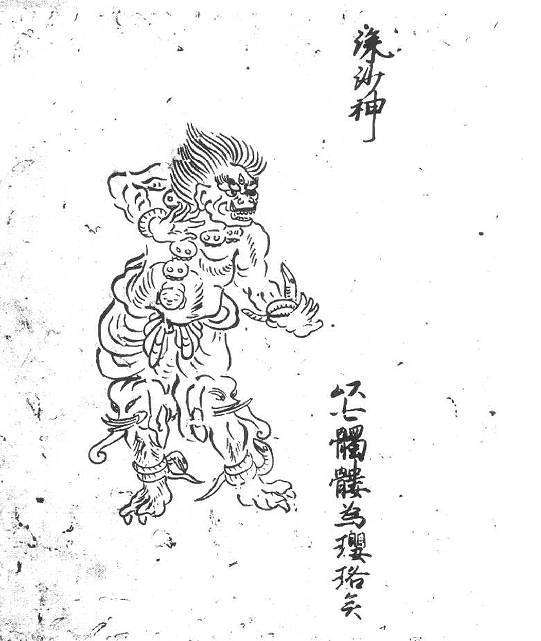
The Tang Sanzang ji (唐三藏記, Record of the Tang Monk Tripitaka), a book of seemingly unknown date appearing in an 11th-century Japanese collection of tales known as Jōbodai shū (成菩堤集), states that Xuanzang was magically provided food and drink by a deva while in the “Flowing Sands” (Liusha, 流沙) desert, a term commonly used for the harsh environment of China’s northwestern region. [1] The compiler of the Jōbodai shū explains: “This is the reason for the name Spirit of the Deep Sands (Shensha shen, 深沙神)” (Dudbridge, 1970, p. 19). After returning from a pilgrimage to China (838–839), the Japanese Buddhist monk Jōgyō (常曉, d. 865) wrote a report which describes Tripitaka’s fabled exchange with the deity, as well as equates Shensha shen with King Vaiśravaṇa, one of the Four Heavenly Kings of Buddhism (Dudbridge, 1970, pp. 19-20). [2] Therefore, the Tang Sanzang ji most likely hails from the Tang Dynasty (618–907). The Jōbodai shū also states that the god manifested itself before the famous Chinese Buddhist monk Faxian (法顯, 337–c. 422) during his pilgrimage to India. Shensha shen describes himself thus:

I am manifested in an aspect of fury. My head is like a crimson bowl. My two hands are like the nets of heaven and earth. From my neck hang the heads of seven demons. About my limbs are eight serpents, and two demon heads seem to engulf my (nether-) limbs… (Dudbridge, 1970, p. 20).

Monk Jōgyō’s aforementioned 9th-century report on Shensha shen appears to have initiated veneration of the spirit as a Buddhist guardian (no doubt thanks to his association with King Vaiśravaṇa). This deity was at some point given the title Jinja Taishō (深沙大將, “General of the Deep Sands”) and appeared in late-Heian (794–1185) and Kamakura (1185–1333) period art (Wong, 2002, pp. 61 and 63). One 12th-century ink on paper painting follows the iconography from the Jōbodai shū and depicts his legs with demonic elephant knees and bird-like talons (fig. 1). This same depiction most likely served as the basis for an exquisite wooden statue from the Kamakura period (fig. 2). The god never lost his association with Xuanzang, for one well-known 14th-century painting of the monk depicts him wearing Jinja Taisho’s necklace of skulls (fig. 3 and 4). Another painting of the same period depicts the pair standing on either side of a celestial crowd paying reverence to the Buddha. [3] It appears to be based on an earlier Chinese Song Dynasty painting (Figs. 5-7). Regarding the Japanese image, Wong (2002) notes:

Even though Xuanzang, of human origin, and Shensha shen, a demonic figure, were of low status in the Buddhist hierarchy, they are represented because of their role in the transmission of the Heart Sutra, and become elevated in rank by being shown with the deities and bodhisattvas that protect the sacred text (p. 63).

Sha Wujing Origins - 1

Fig. 1 – 12th-century Japanese ink on paper painting (larger version); Fig. 2 – 13th to 14th-century Japanese Kamakura wooden statue (larger version); Fig. 3 – Famous 14th-century Kamakura painting of Xuanzang (larger version); Fig. 4 – Detail of the skull necklace (larger version); Fig. 5 – Chinese Song Dynasty painting of the Buddha’s heavenly retinue, including Shensha shen (bottom center left) and Xuanzang (bottom center right) (larger version); Fig 6 – Detail of Shensha shen (larger version); Fig. 7 – Detail of Xuanzang (larger version).

2. Mention in Chinese Literature

The concept of Shensha shen was well enough established in China by the 13th century to be included in the eighth chapter of The Story of How Tripitaka of the Great Tang Procures the Scriptures, the earliest version of Journey to the West. But instead of being a benevolent deity, he is portrayed as a bloodthirsty monster who had several times eaten Xuanzang’s past reincarnations. The demon tells him, “I am the one who devoured you twice before, monk. Slung from my neck are all your dry bones!” (Wivell, 1994, p. 1190). The monster only helps the monk and his retinue cross the “Deep Sands” via a magical golden bridge once he is threatened with heavily retribution. Memorial poems thereafter note that Tripitaka releases the spirit from a five hundred-year-long curse, and Pilgrim (Sun Wukong) promises to speak highly of him when they finally meet the Buddha.

Sha Wujing first appears in the 22nd chapter of the final 1592 edition as an ogre-like beast living in the “Flowing Sands River” (Liusha he, 流沙河), a callback to the similarly named desert from earlier sources .

A head full of tousled and flame-like hair;
A pair of bright, round eyes which shone like lamps;
An indigo face, neither black nor green;
An old dragon’s voice like thunderclap or drum.
He wore a cape of light yellow goose down.
Two strands of white reeds tied around his waist [fig. 8].
Beneath his chin nine skulls were strung and hung;
His hands held an awesome priestly staff (Wu & Yu, 2012, vol. 1, p. 422).

Like The Story, Sha Wujing is persuaded to help the group cross the river, but this time it is after Xuanzang takes him as his third and final disciple (he had previously been pacified and converted by the Bodhisattva Guanyin). The water spirit takes off his skull necklace and, with the aid of a heaven-sent magic gourd, transforms the accoutrements into a boat on which Tripitaka rides to the other side.

sandy_appearing_by_tianwaitang-d319dlj

Fig. 8 – A modern depiction of Sha Wujing by Tianwaitang on deviantart (larger version).

3. Origin of Shensha Shen and Sha Wujing’s Skull Necklace

The skull necklace (Sanskrit: muṇḍamālā) can be tied to Esoteric Buddhism. For instance, the Sadhanamala (“Garland of Methods”), a compilation of esoteric texts from the 5th to 11th centuries, describes the wrathful protector deity Hevajra (fig. 9) wearing such a necklace:

He wields the vajra in the right hand and from his left shoulder hangs the Khatvanga [staff] with a flowing banner, like a sacred thread. He carries in his left hand the kapala [skull cap] full of blood. His necklace is beautified by a chain of half-a-hundred severed heads (emphasis added) [Fig. 10]. His face is slightly distorted with bare fangs and blood-shot eyes. His brown hair rises upwards and forms into a crown which bears the effigy of Aksobhya [Buddha]. He wears a kundala [ear decoration] and is decked in ornaments of bones. His head is beautified by five skulls (Donaldson, 2001, p. 221).

This attire is traceable to that worn by adherents of Heruka, another wrathful deity, as prescribed in the Indian Buddhist Hevajra Tantra (Ch: Dabei kongzhi jingang dajiao wang yigui jing, 大悲空智金剛大教王儀軌經, 8th century):

The yogin must wear the sacred ear-rings, and the circlet on his head; on his wrists the bracelets, and the girdle round his waist, rings around his ankles, bangles round his arms; he wears the bone-necklace (emphasis added) and for his dress a tiger-skin… (Linrothe, 1999, p. 250).

Compare this description with, for example, the Song Dynasty painting of Shensha shen (fig. 6). Many of the elements are present.

Statue with necklace detail

Fig. 8 – The Buddhist Deity Hevajra, late-11th to early-12th century, copper alloy (larger version). Courtesy of the Los Angeles County Museum of Art. Fig. 9 – Detail of the necklace (larger version).

4. Conclusion

Sha Wujing is traceable to an obscure Chinese desert spirit first mentioned in an embellished 7th-century account of the historical Xuanzang’s travels. This and later accounts portray him as a benevolent guardian watching over the monk and providing Tripitaka with subsistence on his journey through the harsh “Flowing Sands” desert of northwestern China. The Japanese Monk Jōgyō wrote a 9th-century report in which he mentioned the deity and associated him with King Vaiśravaṇa. This appears to have led to his veneration in Japan, for sources from the 11th century onward not only provide him with the titles Shensha shen (“Spirit of the Deep Sands”) and Jinja Taisho (“General of the Deep Sands”), but also lay out a prescribed iconography for him. He is generally portrayed in late-12th to 14th-century Japanese art as a fierce warrior with flame-like hair, a necklace of skulls, serpent arm adornments, demonic knees, and (sometimes) bird-like talons.

This spirit appears in The Story of How Tripitaka of the Great Tang Procures the Scriptures (13th century), the earliest version of Journey to the West, but is instead portrayed as a bloodthirsty desert demon who revels in having eaten Xuanzang’s last two incarnations. A necklace of dry bones serves as proof of his murderous hobby. He only decides to help the monk pass the Deep Sands when threatened with heavenly retribution. This episode served as the basis for Sha Wujing’s origin in the final 1592 version of the novel. He is similarly portrayed as a flesh-craving, skull necklace-wearing demon. Even his home, the aquatic realm of the “Deep Sands River,” is based on the former’s desert home. But after helping Tripitaka cross the river, Sha Wujing differentiates himself from his precursor by serving as the monk’s disciple and stalwart protector.

The skull necklace can be traced to wrathful Esoteric Buddhist deities and their accoutrements. For example, an 11th-century esoteric text describes the deity Hevajra wearing a “necklace…beautified by a chain of half-a-hundred severed heads.” This is ultimately based on one of the five kinds of ritual adornments worn by Indian Buddhist yogin adherents of the wrathful deity Heruka during the 8th century.

Notes:

1) The original source says “Moving sands” (Dudbridge, 1970, p. 19 n. 3), but I have changed the wording to conform with that commonly used in various English translations of the tale.

2) It’s interesting to note that King Vaiśravaṇa influenced another character from Journey to the West, Heavenly King Li Jing. Li Jing (李靖, 571–649) was a historical Tang Dynasty general who won many battles in China and Central Asia. Shahar (2013) notes that Li was deified after his death, and that the cult centered around him existed into the Song Dynasty (p. 28). Most importantly, “The general [was] celebrated in a large body of oral and written fiction, which gradually associated him with the Indian god [Vaiśravana]” (Shahar, 2013, p. 28). He continues, “Storytellers and playwrights [eventually] merged the Tang general with the martial Heavenly King” (Shahar, 2013, p. 28). This merging may have happened as early as the Yuan Dynasty (1271–1368) (Shahar & Kieschnick, 2013, p. 224 n. 18).

3) I, unfortunately, couldn’t find a high res version of this painting. All those I could find were either too blurry or to small for focusing on specific areas for details. The above linked webpage with the Song Dynasty variant includes a low res version of the Japanese painting.

Sources:

Dudbridge, G. (1970). The Hsi-yu chi: A Study of Antecedents to the Sixteenth-Century Chinese Novel. Cambridge: Cambridge Univ. Press.

Linrothe, R. N. (1999). Ruthless Compassion: Wrathful Deities in Early Indo-Tibetan Esoteric Buddhist Art. Boston, Mass: Shambhala.

Shahar, M., & Kieschnick, J. (2013). India in the Chinese Imagination: Myth, Religion, and Thought. University of Pennsylvania Press.

Shahar, M. (2013). Indian Mythology and the Chinese Imagination: Nezha, Nalakubara, and Krshna. In M. Shahar and J. Kieschnick (Eds.), India in the Chinese Imagination: Myth, Religion, and Thought (pp 21-45). University of Pennsylvania Press.

Wivell, C.S. (1994). The Story of How the Monk Tripitaka of the Great Country of T’ang Brought Back the Sūtras. In V. H. Mair (Ed.), The Columbia Anthology of Traditional Chinese Literature (pp 1181-1207). New York: Columbia University Press.

Wong, D. C. (2002). The Making of a Saint: Images of Xuanzang in East Asia. Early Medieval China 8, pp. 43-95.

Wu, C., & Yu, A. C. (2012). The Journey to the West (Vols. 1-4) (Rev. ed.). Chicago, Illinois: University of Chicago Press.

Zhu Bajie: Patron Deity of Sex Workers

Last updated: 02-01-2026

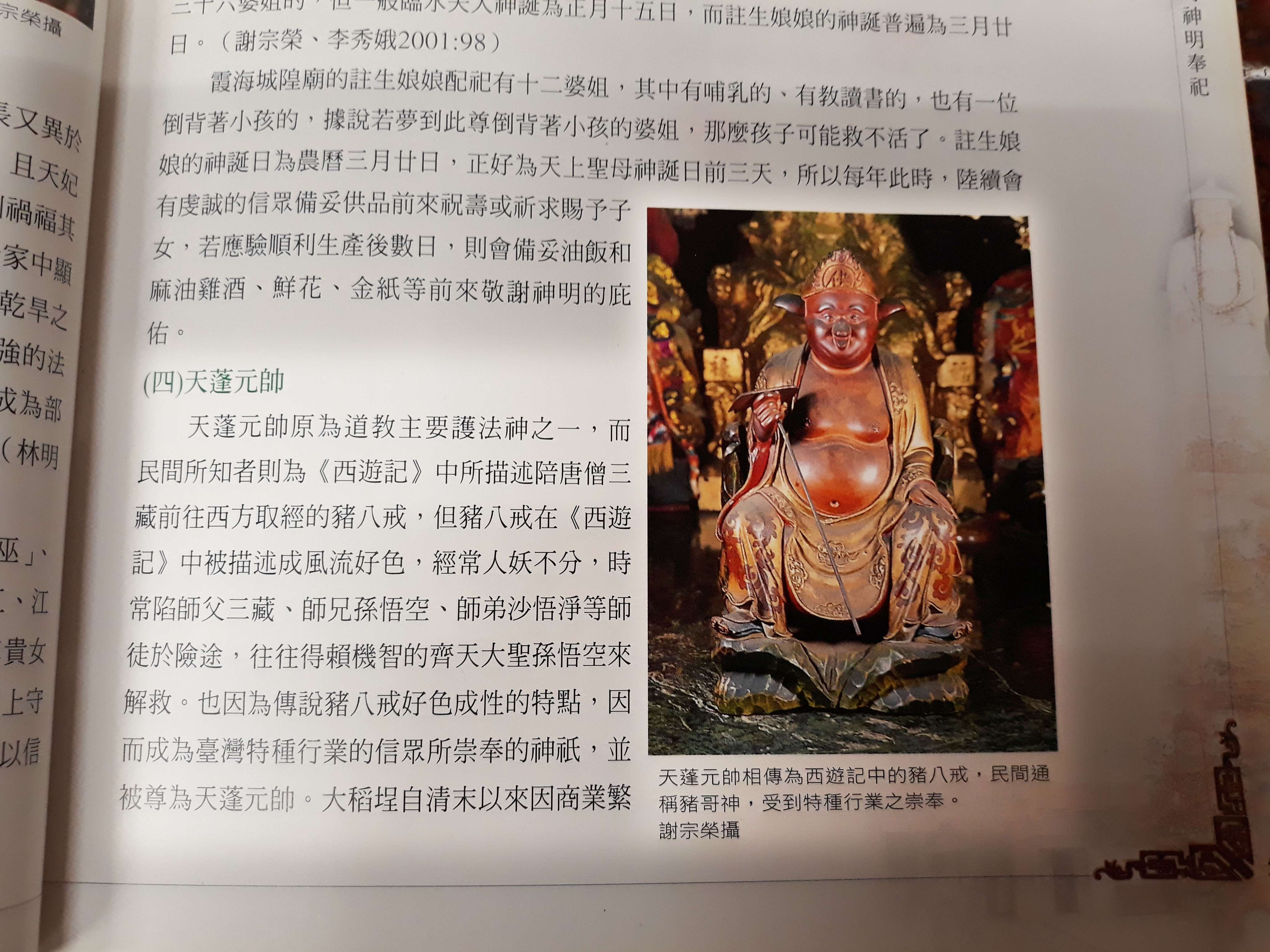
The Xiahai City God Temple (Xiahai chenghuang miao, 霞海城隍廟) in the Dadaocheng district of (old) Taipei, Taiwan contains a Zhu Bajie (豬八戒) shrine statue (fig. 1) to which sex workers and other members of the hospitality industry pay reverence.

Table of Contents

1. News Report

Taiwan Today writes:

The novel depicts the travels to India by the monk Xuanzang in search of Buddhist sutras. He is accompanied by three main disciples, of which Pigsy, who was previously Marshal Tian Peng, Grand Admiral of the Heavenly River, took responsibility for social events. With his easygoing nature, he blessed the group with jubilance. This also gained him a reputation of living a good life with abundant food and numerous flirtations with women. As Chen Wen-wen, manager of the Xiahai temple noted, this makes Zhu Ba Jie “the only deity that the hospitality industry needs to worship.”

In addition to its role as an ancient trading area beside the Danshui River, the Dadaocheng District became famous for the richness of its theaters, restaurants, hotels and gaming dens. People working in the clubs, especially those in the sex industry, would come to worship Pigsy after they finished work when the temple opened in the morning. “Every morning around 6 a.m. to 8 a.m., many ladies and bigwigs driving black Benz cars would come to pray to the deity Pigsy. They tended to dress beautifully and look wealthy,” Chen noted, explaining that these people hoped their customers would be as easygoing as Pigsy and would continue to visit their businesses.

Fig. 1 – Pigsy’s statue from the Xiahai City God temple (Credit: Mark Hodson).

Although the area was no longer as affluent as before, and the piano bar trade long ago moved elsewhere, Chen recalled a woman visiting her temple just a few days earlier. “She said she was in charge of arranging girls for customers and admitted she had come here to pray for better business.” Chen asked to whom she was praying, to which the middle-aged woman replied “You have the Marshal Tian Peng here.” Chen asked if she meant Zhu Ba Jie, and the woman said, yes, that he had been educated and cultivated by his mentor, the monk Xuanzang, and had then became the spiritual figure of the hospitality business (Ministry of Foreign Affairs, Republic of China (Taiwan), 2006). [1]

2. My Visit

I visited the Xiahai City God temple but, unfortunately, did not see the statue since (as I was told) it was tucked behind those of more prominent deities. The temple has a book with listings for each deity housed therein. The listing for Zhu doesn’t provide any new information other than a title, Zhuge Shen (猪哥神, “Brother God Zhu”) (fig. 2 & 3). (The title speaks of familiarity and friendship. Zhu is the sort of god you want to go out drinking and chasing after girls with.) The rest just mentions his previous incarnation as Marshal Tianpeng (Tianpeng yuanshuai, 天蓬元帥) (see below), his adventures in Journey to the West (Xiyouji西遊記, 1592), and the demographics of his cult.

Note: An informant told me that the Hokkien version of Zhuge shen is “Ti Ko Sin.” 

Fig. 2 (left) and 3 (right) – Zhu’s listing as Marshal Tianpeng from the Xiahai City God temple book. Full size versions here and here.

3. Previous Research

Zhu Bajie’s worship by working girls is not isolated to this temple, however. Keith Stevens (2000) writes:

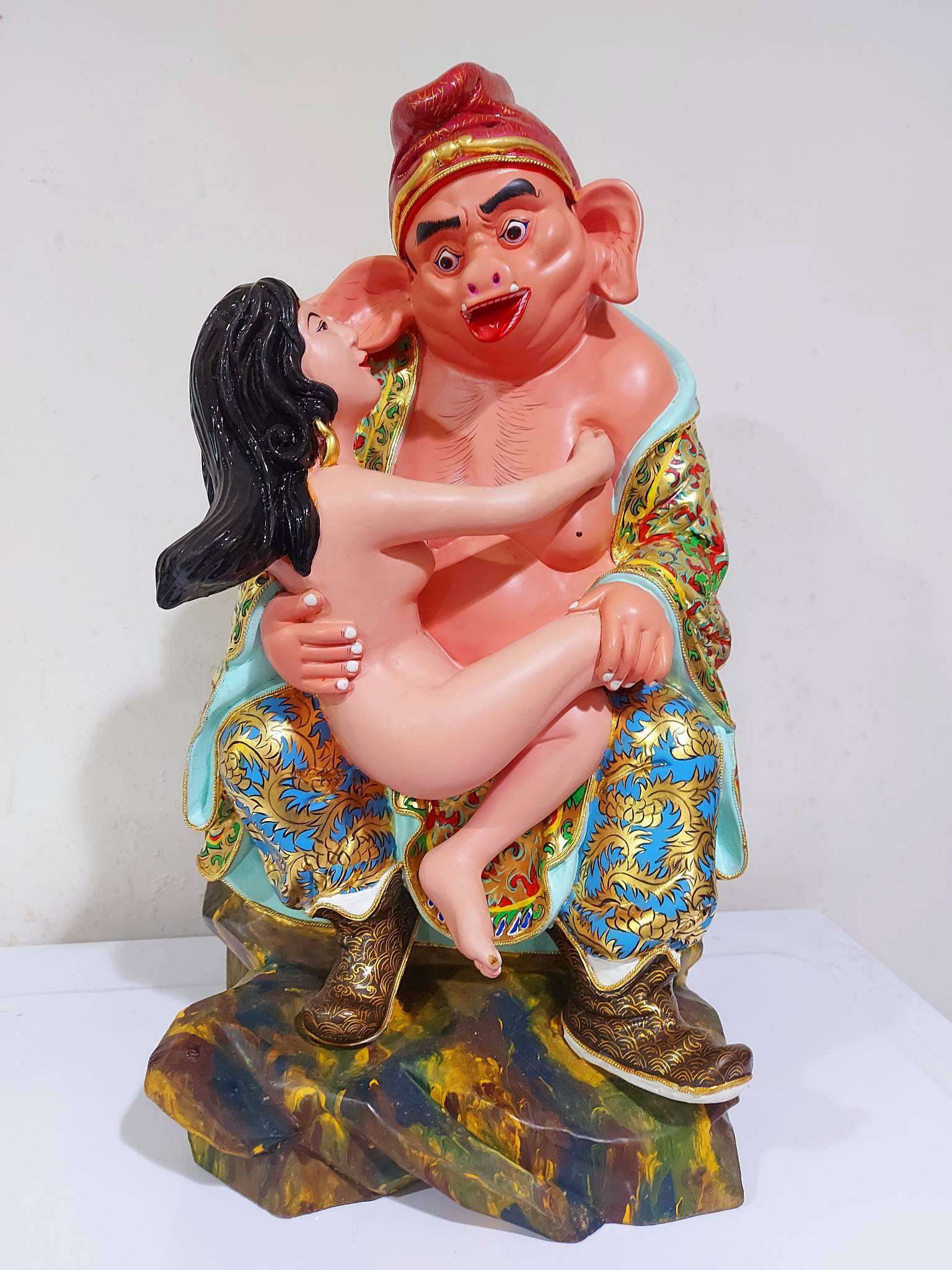
Although he is usually regarded China-wide as the epitome of gluttony, in Taiwan he is also revered by prostitutes who call on his divine title Shoushou Ye 授受爺, offering him incense and chants morning and evening whilst calling on him to bring them rich guests, foolish and witless, to be fleeced. An image, one of a number on loan from devotees, depicts him sitting holding a virtually nude woman in his arms alone on one of the side altars in the City God Temple in Chia I [Southwestern Taiwan] (p. 195).

The cited image is similar to this piece (fig. 4).

Fig. 4 – The type of Zhu Bajie idol prayed to by sex workers (larger version). In the author’s private collection.

3.1. My Analysis

I find his divine title of Shoushou Ye (授受爺, “Lord Give and Receive”) to be quite humorous. Not only does it represent the exchange of money for flesh between a lady of pleasure and her customer, but it may also be a cheeky allusion to an ancient mōs from the time of Mencius (孟子, 4th cent. BCE):

It is prescribed by the rites that, in giving and receiving [an object], man and woman should not touch each other [男女授受不親, nannu shoushou buqin] (McMahon, 1995, p. 166).

Zhu Bajie thumbs his nose at such a rule!

4. Worship of His Past Life

I mentioned in a previous article that Zhu’s literary incarnation Marshal Tianpeng is a historical deity that was worshiped as a powerful exorcist starting around the 6th century. During the early-Song Dynasty (960–1279), the celestial general joined with other demonifugic deities to form the quaternity of the Sisheng (四聖, “Four Saints”). His position as a protector led to his worship by the military from this time onward. Marshal Tianpeng’s long history in the Daoist pantheon may then explain why Zhu was readily adopted as a deity in his own right. He no doubt has the novel to thank for this honor.


5. Updates

5.1. Worship in China

Update: 03-21-18

Across the Taiwan Strait lies the southern Chinese province of Fujian. The Putian plains of the central coast hosts a number of temples dedicated to Zhu Bajie, also known there as Puji Shenghou (普濟聖侯, “Marquis Sage of Universal Salvation”). Dean and Zheng (2009) note an interesting geographical correlation:

Using GIS mapping, one can unearth many suggestive correlations in distributions of different cultural features across the plain. For example, certain gods such as Qitian dasheng … and Puji shenghou …, the Monkey and the Pig of the classic Xiyouji 西遊記 (Journey to the West), appear more often in poorer villages in the northern plain [fig. 5], often in higher elevations than in the low-lying, densely irrigated, wealthier villages of the southern plains. This suggests that the unruly natures of these gods appealed to poorer communities rather than to villages with established scholar-literati lineages (pp. 38-39)

bumuzn

Fig. 5 – Distribution of Zhu Bajie temples in the Putian plains of Fujian Province, China (larger version). Adapted from Dean and Zheng, 2009, p. 193.

Considering the close historical connection between Fujian and Taiwan, [2] it’s possible that the demographics of Zhu’s cult in China may have some bearing on the history of his worship on the island.


5.2. Academic Paper

Updated: 01-05-19

A new paper on the subject has been published by Prof. Ben Brose of the University of Michigan. He has permitted me to archive it here. A big thank you to him.

Archive #8 – The Pig and the Prostitute: The Cult of Zhu Bajie in Modern Taiwan


5.3. Worship in Thailand

Update: 12-24-22

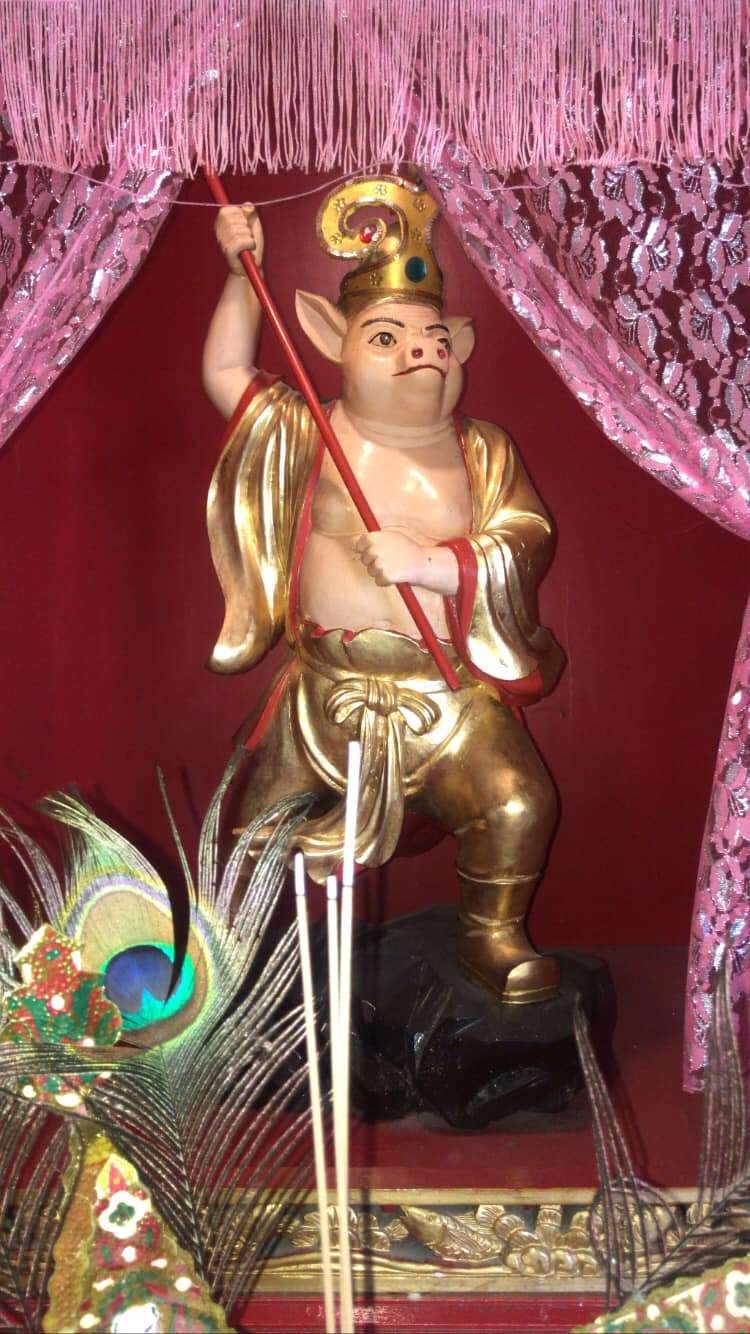
I know that Chinese-Thai will sometimes pair Zhu Bajie with idols of Sun Wukong. But I was recently surprised to see a post on Facebook in which a stand alone statue was labeled “Bajie Buddha Patriarch” (Bajie fozu, 八戒佛祖) (fig. 6 & 7). I consulted a believer who told me that “most people pray [to him] for money and charms.” So, Zhu Bajie is more of a wealth god in Thailand.

Fig. 6 (left) – The Bajie Buddha Patriarch shrine (larger version). Fig. 7 (right) – Detail of the idol (larger version). Take note of the embellished curlicue-style headband.


5.4. Correction of Religious Name

Update: 02-20-23

Above, I noted that the Xiahai City God Temple calls our hero Zhuge Shen (猪哥神, “Brother God Zhu”). But it appears that my translation is wrong because the title has a slang meaning. An informant told me that in Taiwan, zhuge (猪哥, “brother pig”) is slang for a perverted guy who likes to make lude jokes and touch girls. Therefore, a better translation for the title is “God of Pig Brothers.”


Update: 02-01-2026

I was contacted several years ago by someone who shared with me a sex talisman associated with Zhu Bajie (fig. 8). They described it as a way “to pull women and men to fall in love in a more crude way, with extra libido between them.” I was instructed at the time to not share it for fear that their master would find out and get upset. However, this is no longer a concern, so I have been given permission to share a lightly redacted version on my blog. A very big thank you them.

I won’t translate the material to the right of the talisman, but I will point out a few things about the sigil itself. The top reveres the “Immortal Vixen” (Huli xiangu, 狐狸仙姑; lit: “Immortal Maiden Fox”), a nine-tailed vulpine goddess commonly associated with sex. The outermost left and right sides mention the coming together of beautiful women (xishi meinu, 西施美女) offering their bodies and male souls (nanhun, 男魂) hastening from the four/five cardinal directions, respectively. The inner most left and right sides mention double feminine earthly forces (kunnu, 坤女) and double masculine heavenly forces (qiannan, 乾男), respectively, and below each is a set of three vertical circles. These are spaces for writing names, that of the man who commissioned the talisman (right) and the girl he wants to woo (read: control; left). The middle line mentions the hastening of “Pig Brother Guests” (Zhuge ke, 豬哥客). Recall that Zhu Bajie is the God of Pig Brothers (per the 02-20-23 update). Lastly, the illustration at the bottom portrays a nude woman riding a swine, reminiscent of Pigsy’s idols (refer back to figure 4).

I posted this talisman to a folk religion group on Facebook, and one member called it “foxcraft,” while another suggested that it “us[es] bad entities to grant a sin.” And on a related note, my contact further tells me that this “taboo” and “vulgar” sigil is actually banned in their lineage. This is best illustrated by the fact that the required mudra (hand symbol) used to activate the spell has “not [been] passed on.”

Fig. 8 – The talisman (larger version).

Notes:

1) I changed the romanization of particular Chinese terms to pinyin.

2) Taiwan was made a prefecture of Fujian province in 1684 by the foreign rulers of the Qing Dynasty (1644-1911). It later achieved province status in 1887.

Sources:

Dean, K., & Zheng, Z. (2009). Ritual Alliances of the Putian Plain. Volume One: Historical Introduction to the Return of the Gods. Leiden: Brill.

McMahon, K. (1995). Misers, Shrews, and polygamists: Sexuality and Male-Female Relations in Eighteenth-Century Chinese Fiction. Durham: Duke University Press.

Ministry of Foreign Affairs, Republic of China (Taiwan). (2006, Dec. 22). Temple Visitors Pray to Pigsy. Taiwan Today. Retrieved from https://taiwantoday.tw/news.php?unit=18,23,45,18&post=24059

Stevens, K. (2000). Patron Deity of Prostitutes: Zhu Bajie / 豬八戒. Journal of the Hong Kong Branch of the Royal Asiatic Society, 40, 195-196. Retrieved March 20, 2018, from http://www.jstor.org/stable/23895263

Sun Wukong and Martial Arts

Last updated: 08-07-2018

The Monkey King is well known for his prowess with the staff. However, the first two chapters detailing his tutelage under the Buddho-Daoist sage, Patriarch Subodhi, surprisingly do not mention him training in combat skills, what Journey to the West (Xiyouji, 西遊記, 1592; “JTTW” hereafter) calls wuyi (武藝; lit: “martial arts”). [1] In fact, the novel only briefly alludes to it later in a poem from chapter 67, part of which reads: “I bowed to the Patriarch of the Heart and Mind Spirit Platform and perfected with him the martial arts” (身拜靈臺方寸祖,學成武藝甚全周) (based on Wu & Yu, 2012, vol 3, p. 243). [2] But beyond the staff, Sun Wukong comes to master boxing, a skill that he only displays twice in the novel.

For example, a poem in chapter 51 describes his unarmed battle with a buffalo demon:

Hitching up his clothes and walking forward, the fiend assumed a boxing posture; his two fists upraised looked truly like two iron sledge hammers. Our Great Sage also loosened his legs at once and moved his body to attack; right before the cave entrance, he began to box with the demon king. This was quite a fight! Aha!

Opening wide the “Four Levels Posture”;
The double-kicking feet fly up.
They pound the ribs and chests;
They stab at galls and hearts.
“The Immortal pointing the Way”;
“Lao Zi Riding the Crane”;
“A Hungry Tiger Pouncing on the Prey” is most hurtful;
“A Dragon Playing with Water” is quite vicious.
The demon king uses a “Serpent Turning Around”;
The Great Sage employs a “Deer Letting Loose its Horns.”
The dragon plunges to Earth with heels upturned;
The wrist twists around to seize Heaven’s bag.
A green lion’s open-mouthed lunge;
A carp’s snapped-back flip.
Sprinkling flowers over the head;
Tying a rope around the waist;
A fan moving with the wind;
The rain driving down the flowers.
The monster-spirit then uses the “Guanyin Palm,”
And pilgrim counters with the “Arhat Feet.”
The “Long-Range Fist,” stretching, is more slack, of course.
How could it compare with the “Close-Range Fist’s” sharp jabs?
The two of them fought for many rounds—
None was the stronger, for they are evenly matched (Wu & Yu, 2012, vol. 3, pp. 12-13)

那妖撩衣進步,丟了個架子,舉起兩個拳來,真似打油的鐵鎚模樣。這大聖展足挪身,擺開解數,在那洞門前,與那魔王遞走拳勢。這一場好打。咦!
拽開大四平,踢起雙飛腳。韜脅劈胸墩,剜心摘膽著。仙人指路,老子騎鶴。餓虎撲食最傷人,蛟龍戲水能兇惡。魔王使個蟒翻身,大聖卻施鹿解角。翹跟淬地龍,扭腕拿天橐。青獅張口來,鯉魚跌脊躍。蓋頂撒花,遶腰貫索。迎風貼扇兒,急雨催花落。妖精便使觀音掌,行者就對羅漢腳。長掌開闊自然鬆,怎比短拳多緊削。兩個相持數十回,一般本事無強弱。

Shahar (2008) notes that this fight “[gave] the author an opportunity to display his familiarity with the contemporary jargon of ‘postures’ (shi and jiazi), ‘Long-Range Fist’ (changquan), and ‘Close-Range Fist’ (duanquan)” (pp. 131-132).

I consulted with martial artist Joshua Viney to learn what each technique involves. (Interestingly, many of these are still known to this day, some better known by slightly different names.) Joshua has lived and studied folk martial arts from village masters around the noted Shaolin Monastery (Shaolin si, 少林寺) for over ten years. He currently maintains the Shaolin Yuzhai Youtube channel, where he posts instructional videos. Please check it out.

Table of Contents

1. The Techniques

1) “Opening wide the ‘Four Levels Posture'” (Zhuai kaida siping, 拽開大四平) – An open fighting posture where the boxer stands in the horse stance (mabu, 馬步) with arms outstretched to his sides. Also known as “Single Whip Horse Stance” (Mabu danbian kai siping, 馬步單鞭開四平) (fig. 1), which is often associated with Taiji boxing (Taiji quan, 太極拳).

Wide open stance
2) “The double-kicking feet fly up” (Ti qi shuangfei jiao, 踢起雙飛腳) – Also known as “Double kicking feet” (Er qi jiao, 二起腳), this technique involves lifting up one knee to build upward momentum and then kicking high with the other (fig. 2). It is reminiscent of the “crane kick” from The Karate Kid (1984).

double jump kick

3) “They pound the ribs and chests” (Tao xie pi xiong dun, 韜脅劈胸墩) – Possibly referring to the “Pushing palm” (Tui zhang, 推掌) or “Splitting palm” (Pi zhang, 劈掌), which is delivered into the solar plexus and up into the rib cage (fig. 3).

Pushing - splitting palm

From Joshua’s APPLICATION of Xiao Hong Quan video.

4) “The Immortal pointing the Way” (Xianren zhilu, 仙人指路) – A double finger attack aimed at the eyes (fig. 4). The stance is often seen used in tandem with a sword.

Immortal points the way

5) “Lao Zi Riding the Crane” (Laozi qihe, 老子騎鶴) – Most likely another name for the Crane stance (fig. 5).

crane stance

6) “A Hungry Tiger Pouncing on the Prey” (E’hu pu shi, 餓虎撲食) – This name has been applied to many techniques. One variation known as “Fetching the moon from the seabed” (Haidi lao yue, 海底撈月) involves a powerful hip and/or palm strike to the groin/lower midline of the body (fig. 6). The force of the hip strike is powerful enough to send someone flying backwards.

Hip bump 1

Left: Setting up the attack. Right: The hit (from Joshua’s 13 Hammers of Shaolin video).

7) “A Dragon Playing with Water” (Jiaolong xishui, 蛟龍戲水) – Also known as “Dragon puking water” (Jiaolong xishui neng xiong’e, 蛟龍戲水能兇惡), this technique involves fluid, sweeping arm movements (most likely blocks or fake strikes) followed by simultaneous double fist blows (fig. 7). The technique is associated with Shaolin and Chang Family Fist (Changjia quan, 萇家拳), a martial art that influenced the development of Taiji boxing. [3]

Dragon puking water

8) “Serpent Turning Around” (Mang fanshen, 蟒翻身) – Also known as “Python turns over” (Guaimang fanshen, 怪蟒翻身), this technique involves a simultaneous chop to the throat and a pulling leg sweep, effectively knocking the opponent backwards (fig. 8).

Pythong turns

9) “Deer Letting Loose its Horns” (Lu jiejiao, 鹿解角) – A series of elbow strikes to the torso (fig. 9). One variant called “Plum blossom deer lies on a pillow” (Meihua lu wozhen, 梅花鹿臥枕) places the fist of the attacking arm against the temple, looking as if the practitioner is propping his head up in a resting posture.

unnamed

10) “The dragon plunges to Earth with heels upturned” (Qiaogen cuidi long, 翹跟淬地龍) – A shooting maneuver using the Falling stance (Pubu, 仆步) to dip below the opponent’s defenses and attack the lower extremities (fig. 10). Also known as Qiaodi long zou xiapan zhao (雀地龍走下盤找).

dragon drops

11) “The wrist twists around to seize Heaven’s bag” (Niuwan na tiantuo, 扭腕拿天橐) – UNKNOWN. Mostly likely a headlock.

12) “A green lion’s open-mouthed lunge” (Qingshi zhangkou lai, 青獅張口來) – More commonly known as “Lion opens mouth” (Shizi dazhang zui, 獅子大張嘴), this technique has two variations. The large frame version involves shooting in low, pulling up the opponent’s knee with one hand, while simultaneously pushing on their head with the other hand, knocking them over (fig. 11). This can be used for throwing an opponent as well. The small frame version involves cupping the hands to intercept strikes.

lion opens mouth

From APPLICATION of Xiao Hong Quan

13) “A carp’s snapped-back flip” (Liyu die ji yue, 鯉魚跌脊躍) – This can refer to both throwing an opponent and a move commonly referred to as a “kip-up.” The latter involves the practitioner flipping up from a supine position to a standing fighting stance (fig. 12).

14) “Sprinkling flowers over the head” (Gaiding sahua, 蓋頂撒花) – Also known as “Double cloud over peak” (Shuangyun ding, 雙雲頂), this technique involves flourishing the hands above the head as a means of blocking, twisting an opponent’s arm, or disengaging from combat (fig. 13).

d8312e2fd284516d5e12d33375177c5e

15) “Tying a rope around the waist” (Raoyao guansuo, 遶腰貫索) – UNKNOWN. Possibly a circling step similar to one later used in Bagua Palm Boxing (Bagua zhang, 八卦掌) (fig. 14).

16) “A fan moving with the wind” (Yingfeng tieshan’er, 迎風貼扇兒) – Crossed hands shooting out to intercept an opponent’s punch (fig. 15).

fan against the wind

17) “The rain driving down the flowers” (Jiyu cuihua luo, 急雨催花落) – Most likely a rapid succession of punches.

18) “Guanyin Palm” (Guanyin zhang, 觀音掌) – A style of palm strikes. It is listed as number 70 of the “72 Training Methods of Shaolin” (Shaolin qishi’er yilian fa, 少林七十二藝練法) (Jin & Timofeevich, 2004, p. 229).

19) “Arhat Feet” (Luohan jiao, 羅漢腳) – A style of kicking.

20) Long-Range Fist (Chang quan, 長拳) – A family of Northern style martial arts known for their long-range punches and kicks and acrobatic movements.

21) Close-Range Fist (Duan quan, 短拳) – A family of Northern style martial arts known for their compact, short-range, yet quick attacks.

2. Battle Reconstruction

What follows is Joshua’s reconstruction of the fight. He makes an interesting observation that the fight may in fact be a theatrical stage combat version of known techniques.

I think what we are seeing here is a Chinese Opera-like performance of a fight that the author saw and perhaps asked about the names or recognised. I expect it would be very contrived. After this we are not told explicitly who does what and it may not be a one for one exchange. Nevertheless looking at the wording we can make a guess.
 
It begins with a large fighting stance, probably the ‘single whip’ posture of holding the arms straight to the sides. Then both performers do a jumping kick towards each other to enter striking range. Given it uses the phrase 劈胸 ‘pi xiong’ (split chest) I expect they begin by using the chest splitting palm at one another and so cross hands in the center of the arena [fig. 16].
cross hands
 
Once they have crossed hands I think the demon grasps Monkey’s hand and attacks with the fingers of the other hand at his eyes, doing the ‘immortal points the way’ technique. Monkey defends against this by shielding his face with his forearms, then spreading his hands and kicking at the monster’s stomach. This pushes the monster away and Monkey is left with one knee suspended and arms spread to the sides in the ‘Lao Tzu rides a crane’ posture.
 
The Demon takes advantage of this unstable posture by rushing at him with the ‘hungry tiger pounces on prey’ technique, striking Monkey with his hips and grasping hold of him. Monkey uses the ‘dragon puking water’ technique, which erupts from below the demons arms and casts them aside, then rushes forwards again to attack with both hands. The Demon defends this by sticking close to the monkey and uses the ‘python turning its body’ technique to trip him up. But Monkey is strong and keeps his footing, counter attacking with a headbutt and multiple elbow strikes which form the ‘Deer-Horn’ technique. 
 
The Demon jumps away but Monkey pursues with the ‘ground dragon’ technique and attacks the demons groin, causing him to buckle over, whereby Monkey grasps his head with the ‘twisting heavens sack’ technique. The Demon defends by using the ‘Lion opens mouth lunge’ to stop Monkey and throw him down. The monkey recovers by flipping his body in the ‘carp jump’ technique. Then he withdraws from the center by a few steps ‘covering his head with the flowers’ overhead technique. The Demon similarly disengages from the center and puts up a guard, prowling slowly around Monkey with the ‘turning waist’ technique.
 
I think the rest is describing more how they are evenly matched and face each other down rather than any other moves. ‘Iron fan stands against the wind’ is a common technique, a guard, and ‘rain falling on flowers’ is perhaps an eye strike but could also mean the intensity of the fight is like an urgent rain of punches. ‘Guanyin palm’ and ‘Luohans feet’ are both style names. Long fist vs short fist, how can they overcome one another? 10 rounds without a victor.

He goes onto describe the physical and psychological aspects of Long-range and Close-range fist:

Long fist and Short fist are the classic methods of Shaolin shenfa [身法, “Body postures”]. In order to strike the opponent one needs momentum, both physical AND psychological. Momentum is achieved by moving the dantian [4] as the centre of mass. In Short fist the dantian is rotated to add to power. In Long fist the whole dantian is thrown in the direction of the strike instead of rotated–much more powerful but also more wild and uncontrollable. In Shaolin philosophy, mind and matter are not severed, so physical momentum and psychological momentum are intertwined; when one has physical forward momentum, one simultaneously feels more confident.

3. Similarities With Other Literary Combat

A poem similar to that from JTTW appears in the 120 chapter version of the Water Margin (Shuihu zhuan, 水滸傳, c. 1594) by Yu Xiangdou (余象斗, c. 1560–c. 1640). The poem describes unarmed combat between a young man and woman.

Opening wide the “Four Levels Posture”;
The double-kicking feet fly up.
“The Immortal pointing the Way”;
“Lao Zi Riding the Crane”;
“Phoenix Elbow” to the heart;
“The Guard Head Cannon Stance” strikes the temples;
The dragon plunges to Earth with heels upturned;
The wrist twists around to seize Heaven’s bag;
This girl, sprinkling flowers over the head;
This boy, tying a rope around the waist;
Two fans moving with the wind;
The rain driving down the flowers.

拽開大四平,踢起雙飛腳。仙人指路,老子騎鶴。拗鸞肘出近前心,當頭炮勢侵額角。翹跟淬地龍,扭腕擎天橐。這邊女子,使個蓋頂撒花;這裡男兒,耍個腰貫索。兩個似迎風貼扇兒,無移時急雨催花落。

We can see many named techniques from Monkey’s battle appear in this poem. There are only two years between the publishing of the standard 1592 edition of our novel and this version of the Water Margin. But it’s very well possible that both authors drew upon common source material.

Joshua discovered two techniques from the Water Margin poem, namely “Phoenix Elbow” (Aoluan zhao, 拗鸞肘) and “The Guard Head Cannon Stance” (Dang toupao shi, 當頭砲勢), appearing together in the same print of an edition of the Collection of Military Works (Wubei zhi武備志, c. 1621), a Ming treatise on military armaments and fighting techniques (fig. 17). This suggests that Yu Xiangdou borrowed these moves from similar boxing or military manuals. Likewise, the author-compiler of JTTW may have also borrowed from such literature.

Dangtoupao

Fig. 17 – The print from the Collection of Military Works (Wubei zhi, 武備志, c. 1621) mentioning “Phoenix Elbow” and the “Guard the Head Cannon Stance.”


4. Updates

Update: 05-02-2018

The available evidence suggests that “Short Fist” (Duanquan, 短拳; a.k.a. “Close-Range Fist”) is Sun Wukong’s fighting style. As mentioned above, the poem in chapter 51 reads: “The ‘Long-Range Fist,’ stretching, is more slack, of course. How could it compare with the ‘Close-Range Fist’s’ sharp jabs?” (長掌開闊自然鬆,怎比短拳多緊削。) (Wu & Yu, 2012, vol. 3, p. 13). Also, after facing the buffalo monster, Monkey asks heavenly warriors to critique his boxing skills:

“As you watched from afar,” said Pilgrim, smiling, “how did the abilities of the fiend compare with old Monkey’s?” “His punches were slack,” said Devaraja Li, “and his kicks were slow; he certainly could not match the Great Sage for his speed and tightness'” (Wu & Yu, 2012, vol. 3, p. 14).

行者笑道:「列位在此遠觀,那怪的本事,比老孫如何?」李天王道:「他拳鬆腳慢,不如大聖的緊疾。…」

The “speed and tightness” is of course a reference to his use of Short Fist.

In addition, earlier in chapter two, Sun Wukong faces a demon who had taken over his Water Curtain cave in the immortal’s absence. The two resort to boxing since Monkey is unarmed:

The Monstrous King shifted his position and struck out. Wukong closed in on him, hurtling himself into the engagement. The two of them pummeled and kicked, struggling and colliding with each other. Now it’s easy to miss on a long reach, but a short punch is firm and reliable (emphasis added). Wukong jabbed the Monstrous King in the short ribs, hit him on his chest, and gave him such heavy punishment with a few sharp blows that the monster stepped aside, picked up his huge scimitar, aimed it straight at Wukong’s head, and slashed at him (Wu & Yu, 2012, Vol. 1, p. 128).

那魔王丟開架子便打,這悟空鑽進去相撞相迎。他兩個拳搥腳踢,一衝一撞。原來長拳空大,短簇堅牢。那魔王被悟空掏短脅,撞了襠,幾下觔節,把他打重了。他閃過,拿起那板大的鋼刀,望悟空劈頭就砍。

I initially thought Sun Wukong used Short Fist out of necessity as JTTW describes him being less than four feet tall. But the novel’s bias for close-range fighting over long-range was, according to Shahar (2008), “typical of late Ming and early Qing military literature” (p. 117). He continues:

Sixteenth- and seventeenth-century military experts allude to various short-range styles including ‘Cotton Zhang’s Close-Range Fist’ (Mian Zhang duanda [綿張短打]), ‘Ren Family Close-Range Fist’ (Renjia duanda [任家短打]), and ‘Liu [Family] Close-Range Fist’ (Liu duanda [劉短打])” (Shahar, 2008, p. 117).

Wing Chun (Mandarin: Yong Chun, 詠春) is a close-range fighting style similar to Short fist. Although the style postdates the novel by at least two centuries, it showcases the quick, compact punches associated with Short Fist. Take this video of Jackie Chan, for example. Now imagine Monkey using similar techniques in a fight with a much larger opponent, blocking or ducking to avoid attacks and replying with sharp punches targeted at vulnerable areas.


Update: 08-07-2018

I have found a few more instances of martial arts terms, this time related to weapons. Joshua was again kind to lend his knowledge to the subject.

Chapter 17:

The compliant rod,
The black-tasseled lance.
Two men display their power before the cave;
Stabbing at the heart and face;
Striking at the head and arm.
This one proves handy with a death-dealing rod;
That one tilts the lance for swift, triple jabs.
The “white tiger climbing the mountain” extends his paws;
The “yellow dragon lying on the road” turns his back (emphasis added).
With colored mists flying
And bright flashes of light,
Two monster-god’s strength is yet to be tried.
One’s the truth-seeking, Equal-to-Heaven Sage;
One’s the Great Black King who’s now a spirit.
Why wage this battle in the mountain still?
The cassock, for which each would aim to kill! (Wu & Yu, 2012, vol. 1, p. 354)

如意棒,黑纓槍,二人洞口逞剛強。分心劈臉刺,著臂照頭傷。這個橫丟陰棍手,那個直撚急三槍。白虎爬山來探爪,黃龍臥道轉身忙。噴彩霧,吐毫光,兩個妖仙不可量。一個是修正齊天聖,一個是成精黑大王。這場山裡相爭處,只為袈裟各不良。

22) “‘White tiger climbing the mountain’ extends his paws” (Baihu pashan lai tanzhao, 白虎爬山來探爪) – Mountain climbing stance is synonymous with Gong bu (弓步), or the bow stance. The white tiger denotes an overt attack of sorts. I imagine it would look similar to this spear technique.

Gong Bu thrust

23) “‘Yellow dragon lying on the road’ turns his back” (Huanglong wodao zhuanshen mang, 黃龍臥道轉身忙) – Possibly a retreating maneuver.

Chapter 31:

Dear Monkey King! He raised the rod above his head, with both hands, using the style “Tall-Testing the Horse.” The fiend did not perceive that it was a trick. When he saw there was a chance, he wielded the scimitar and slashed at the lower third of Pilgrim’s [Monkey’s] body. Pilgrim quickly employed the “Great Middle Level” to fend off the scimitar, after which he followed up with the style of “Stealing Peaches Beneath the Leaves” and brought the rod down hard on the monster’s head. This one blow made the monster vanish completely (Wu & Yu, 2012, vol. 2, p. 83).

好猴王,雙手舉棍,使一個「高探馬」的勢子。那怪不識是計,見有空兒,舞著寶刀,徑奔下三路砍;被行者急轉個「大中平」,挑開他那口刀,又使個「葉底偷桃勢」,望妖精頭頂一棍,就打得他無影無蹤。

24) “Tall-Testing the Horse” (Gao tanma, 高探馬) – Tanma (探馬) refers to a military scout, so a better translation would be the “High Scout.” This is a double-handed thrust aimed at the opponent’s face as a high fake. A corresponding fist technique, essentially a jab, is associated with Taiji boxing.

25) “Great Middle Level” (Dazhong ping, 大中平) – Holding the staff level at the navel while in the horse stance. This allows for quick defense below the waist.

26) “Stealing Peaches Beneath the Leaves” (Yedi toutao shi, 葉底偷桃勢) – UNKNOWN. The name of this technique is normally associated with an attack to the groin, not the top of the head as implied in the quoted battle.

Based on the sequence of events described above, it seems like Monkey fakes high, blocks the strike to his body, and then attacks the top of the stooping opponent’s head (since the latter ducked the high fake and attacked low).

Here is Joshua’s interpretation:

The two weapons are stuck together: the monkey is forcing down, the demon up. The monkey releases the pressure, circling his staff below the opponents weapon, so with the release of pressure, the opponent’s weapon flings upwards but with no control. The monkey circles from this lower position, then turns over in a big circle and strikes the opponent downwards on the head.

Chapter 56:

The Great Sage walked forward and picked up the rod with no effort at all. Assuming the style of the Python Rearing its Body (emphasis added), he pointed at the bandits and said, “Your lucks running out, for you have met Old Monkey!” (Wu & Yu, 2012, vol. 3, p. 81).

大聖走上前,輕輕的拿起,丟一個蟒翻身拗步勢,指著強人道:「你都造化低,遇著我老孫了。」

27) “Python Rearing its Body” (Mang fanshen, 蟒翻身). UNKNOWN. This is a differently translated version of a similarly titled technique mentioned above. See number eight (“Serpent Turning Around”). The previous listing referred to a boxing technique, while this, again, is for a weapon.

In closing, I would like to quote a particular passage. While it doesn’t list a given technique, it highlights Monkey’s mastery of the staff. Chapter 33 reads:

“Going through this tall mountain and rugged cliff must have made master [Tripitaka] rather apprehensive, that’s all. Don’t be afraid! Don’t be afraid! Let old Monkey put on a show for you with my rod to calm your fears somewhat.” Dear Pilgrim! Whipping out his rod, he began to go through a sequence of maneuvers with his rod as be walked before the horse: up and down, left and right, the thrusts and parries were made in perfect accord with the manuals of martial arts (emphasis added). What the elder saw from the horse was a sight incomparable anywhere in the world (Wu & Yu, 2012, vol. 2, p. 105).

行者道:「胡說,師父是走著這深山峻嶺,必然小心虛驚。莫怕,莫怕,等老孫把棒打一路與你壓壓驚。」

好行者,理開棒,在馬前丟幾個解數,上三下四,左五右六,盡按那六韜三略,使起神通。那長老在馬上觀之,真個是寰中少有,世上全無。

The portion that Yu (Wu & Yu, 2012) translates as “manuals of martial arts” actually lists the names of two noted military manuals, both of which are listed among the Seven Military Classics of China. The first, the Six Secret Teachings (Liu tao, 六韜), was published during the Warring States period (c. 475–221 BCE) but possibly contains information from as far back as the Qi state (1046–221 BCE). The second, the Three Strategies (San lue, 三略), was most likely published during the Western Han period (206 BCE–9 CE) (Sawyer, 1993).

Associating Monkey’s martial arts skill with ancient military classics only serves to further elevate his status as a great warrior and cultural hero.

Notes

1) Wuyi (武藝) was used to refer to Chinese martial arts as far back as the third century CE. The term predates the more familiar wushu (武術) by some three centuries (Lorge, 2012, p. 10).

2) Readers may think that the “Ancestor of Heart and Mind” (Fangcun zu, 方寸祖) is a direct reference to Master Subodhi. However, the supreme immortal threatened Monkey with eternal torment if he ever revealed the sage had been his teacher. A more literal translation of the aforementioned figure is “Patriarch Square Inch” (Fangcun zu, 方寸祖). Square Inch (fangcun, 方寸) is a common metaphor for the “heart / mind” (xin, 心), a broad concept written with a small character. This is just an interesting way of saying that Monkey had learned martial arts on his own via self-cultivation, thereby not revealing his true master. At the same time, it is a veiled admission of studying martial arts under the sage.

3) For more information on Chang Family Fist and its progenitor, Chang Naizhou, see Wells (2005).

4) The dantian (丹田, “cinnabar field”) is an area near the navel believed to be the body’s storehouse of spiritual energy.

Bibliography

Jin, J. Z., & Timofeevich, A. (2004). Training Methods of 72 Arts of Shaolin. USA: Shaolin Kung Fu Online Library. Retrieved from http://files.vse-zajimave.webnode.cz…ts-shaolin.pdf

Lorge, P. A. (2012). Chinese Martial Arts: From Antiquity to the Twenty-First Century. New York, NY: Cambridge University Press.

Sawyer, R. D. (1993). The Seven Military Classics of Ancient China. New York: Basic Books.

Shahar, M. (2008). The Shaolin Monastery: History, Religion, and the Chinese Martial Arts. University of Hawaii Press.

Wells, M., & Chang, N. (2005). Scholar Boxer: Chang Naizhou’s Theory of Internal Martial arts and the Evolution of Taijiquan. Berkeley, Calif: North Atlantic Books.

Wu, C., & Yu, A. C. (2012). The Journey to the West (Vols. 1-4) (Rev. ed.). Chicago, Ill: University of Chicago Press.