The Monkey King and Graffiti

Type the phrase “到此一遊/游” (daoci yi you) into an online Chinese dictionary and chances are the results will say it’s a type of vandalism meaning “…was here,” as in “so-and-so was here.” This phrase is often used as a form of graffiti by Chinese tourists wanting to record their visit to a particular site. The most famous modern example that comes to mind happened in 2013 when a Chinese teenager defaced a carving in Egypt’s 3,500-year-old Luxor Temple with the phrase “Ding Jinhao was here” (Ding Jinhao daoci yi you, 丁锦昊到此一游) (fig. 1) (Wong, 2013).

Chinese graffiti - small

Fig. 1 – The “Ding Jinhao was here” graffiti on the face of a Luxor Temple relief (larger version). Screenshot from a CBS news report

Table of Contents

1. The Phrase in JTTW

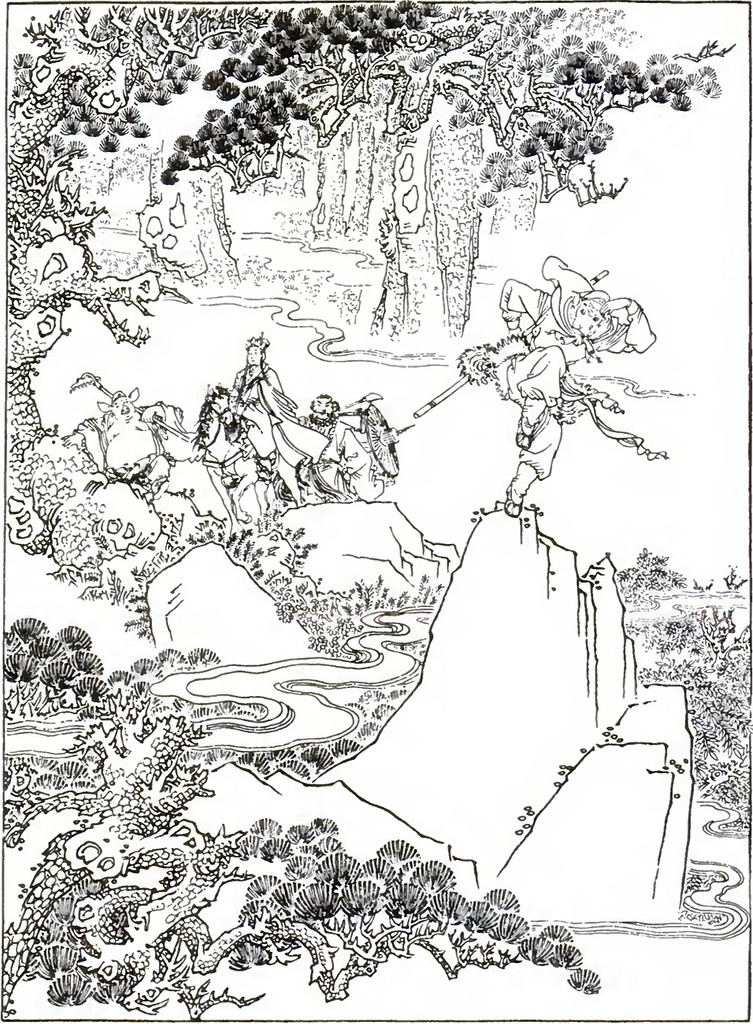
This same phrase appears in the seventh chapter of Journey to the West (Xiyouji西遊記, 1592). After Sun Wukong escapes from Laozi’s eight trigrams furnace, the immortal causes such an uproar that the Buddha is forced to intervene. The latter makes a wager that if Monkey can jump out of his hand, the Tathagata will make him the new Emperor of Heaven. Sun accepts and leaps from the Enlightened One’s palm:

As the Great Sage advanced, he suddenly saw five flesh-pink pillars supporting a mass of green air. “This must be the end of the road,” he said. “When I go back presently, Tathagata [the Buddha] will be my witness and I shall certainly take up residence in the Palace of Divine Mists.” But he thought to himself, “Wait a moment! I’d better leave some kind of memento if I’m going to negotiate with Tathagata.” He plucked a hair and blew a mouthful of magic breath onto it, crying, “Change!” It changed into a writing brush with extra thick hair soaked in heavy ink. One the middle pillar he then wrote in large letters the following line: “The Great Sage, Equal to Heaven, has made a tour of this place” [Qitian Dasheng, daoci yi you, 齊天大聖,到此一遊; fig. 2] (emphasis added). When he had finished writing, he retrieved his hair, and with a total lack of respect he left a bubbling pool of monkey urine at the base of the first pillar (Wu & Yu, 2012, pp. 194-195).

大聖行時,忽見有五根肉紅柱子,撐著一股青氣。他道:「此間乃盡頭路了。這番回去,如來作證,靈霄宮定是我坐也。」又思量說:「且住,等我留下些記號,方好與如來說話。」拔下一根毫毛,吹口仙氣,叫:「變!」變作一管濃墨雙毫筆,在那中間柱子上寫一行大字云:「齊天大聖,到此一遊。」寫畢,收了毫毛。又不莊尊,卻在第一根柱子根下撒了一泡猴尿。

Anyone whose read the story will know that the pillars are in fact the Buddha’s fingers, implying that Monkey never left because the former had exercised his great spiritual powers. Sun, therefore, loses the bet and is crushed under Five Elements Mountain as punishment for his rebellion.

The Great Sage Defaces Buddha's Hand, from Son Goku (1939) - small

Fig. 2 – Sun tags the pillar (Buddha’s finger) with the phrase “The Great Sage Equaling Heaven was here” (larger version). From the Japanese children’s book Son Goku (1939). 

2. Is JTTW the Source?

The quoted translation by Anthony C. Yu (Wu & Yu, 2012) can be rendered simply as “The Great Sage was here.” This is a perfect example of Monkey’s brash, ego-driven personality, not unlike the type of tourist who’d think it appropriate to defile an ancient monument with their name. A few online sources (example) suggest that Journey to the West is the origin of the “…was here” phrase. However, knowing that the novel has so many historical influences, I’m of the opinion that this literary element certainly reflects an already extant real world concept from the Ming (or earlier). But the novel no doubt helped make the phrase more popular in the public eye.

Can you imagine how many people copied this phrase after the novel was published in 1592?

Sources:

Wong, H. (2013, May 29). Netizen outrage after Chinese tourist defaces Egyptian temple. CNN. Retrieved September 6, 2018, from http://edition.cnn.com/travel/article/china-egypt/index.html

Wu, C., & Yu, A. C. (2012). The Journey to the West (Vols. 1-4) (Rev. ed.). Chicago, Illinois: University of Chicago Press.

Archive #7 – The PRC Mythology Chapter from The Contemporary Chinese Historical Drama (1990)

Here I present the “Monkey King Subdues the White-Bone Demon: A Study in PRC Mythology” chapter from The Contemporary Chinese Historical Drama (1990). This fascinating chapter discusses how a play/film based on the named Journey to the West episode was co-opted during the mid-20th-century as Communist propaganda. Of note is the way each figure is associated with a particular aspect of the communist party. For example, the group of pilgrims represents the party itself, Sun Wukong represents Mao Zedong, and the White Bone Demon, while first representing Imperialism, came to be associated with Soviet Revisionists bowing to imperialism. While the monk Tripitaka was originally associated with the Revisionists Eduard Bernstein and Nikita Khrushchev, he later came to represent the “Middle-of-the-roaders” within the Chinese communist party. It should be remembered that, in the particular episode from the novel, Monkey keeps killing the White Bone Demon because he sees through her demonic disguises, yet the monk continues to punish his protector via the Tight-fillet spell because he is continually deluded by said disguises. Therefore, the play/film was symbolic of Mao’s struggle to placate the communist party while trying to battle the evil of revisionists.

Most surprising to me is that the play/film was made into a children’s book. I believe I’ve seen the illustrations (fig. 1) on the internet but never realized the book had a political origin and purpose.

PRC Monkey King beats the White Bone Demon Three Times (1962) Detail - small

Fig. 1 – Page one from Sun Wukong sanda baigujing (1962) (larger version).

Archive Link:

Click to access contemporary-chinese-drama-sun-wukong-chapter.pdf

Thanks:

A PDF of the full book can be found on archive.org and downloaded for free.

Archive #6 – A Mission to Heaven (1913) – The First Attempt to Translate Journey to the West into English

Here I present A Mission to Heaven (1913), the first English version of Journey to the West translated by the Welsh Baptist missionary Timothy Richard (1845-1919). Modern translator Anthony C. Yu describes it and a slightly later translation as “no more than brief paraphrases and adaptations” (Wu & Yu, 2012, vol. 1, p. xiii). This is because Yu’s translation stretches over 2,000 pages, while Richard’s barely breaks 370 pages. Also, there are many mistranslations that will become apparent to those who have already read Yu’s version. For example, in chapter one when light from Sun Wukong’s eyes reach the celestial realm, A Mission to Heaven reads:

They saw the light burning brightly and ordered a telescope to be brought. (The telescope was invented by Galileo only in 1609 A.D., therefore the Chinese must have had some kind of telescope before we in Europe had it. — Tr.) It was taken to the South gate of heaven to be looked through from thence (Chiu & Richard, 1913, p. 3).

However, Yu’s more accurate version reads:

Upon seeing the glimmer of the golden beams, he [the Jade Emperor] ordered Thousand-Mile Eye and Fair-Wind Ear to open the South Heaven Gate and to look out (Wu & Yu, 2012, vol. 1, p. 102).

As can be seen, Richard completely glossed over the two named deities, choosing instead to refer to both as a telescope.

1913 Sun Wukong print - small

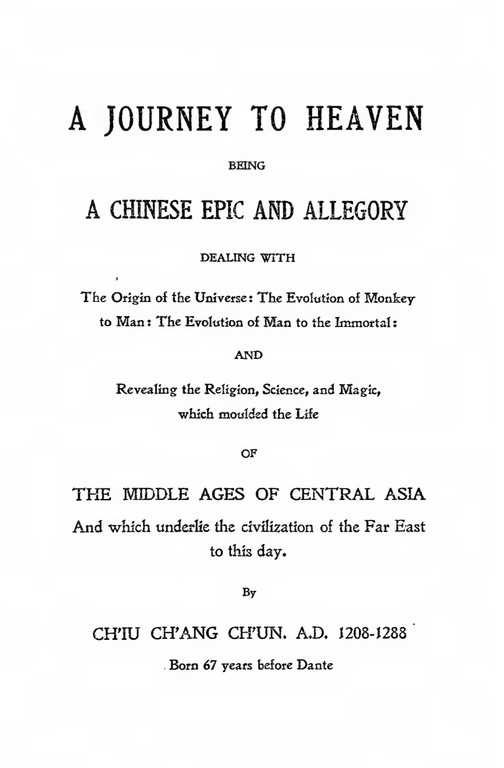
The full title of the translation (larger version).

It’s interesting to note the author of A Mission to Heaven/Journey to the West is listed as one Qiu Changchun, otherwise known as Qiu Chuji (1148-1227), founder of the Dragon Gate sect of Daoism. This may be confusing to some since the novel has long been touted as the work of Wu Cheng’en (1500-1582). However, the novel was anonymously published in 1592. Qiu’s disciple is known to have written a travel journal titled Journey to the West (西遊記), which detailed his master’s journey to meet Genghis Khan. Therefore, early commentators confused this historical travel journal with the fictional narrative, thereby claiming Qiu as the author as early as the 17th-century. Wu Cheng’en wasn’t associated with the novel until the 1920s, and the association is again based on a similarly named work published by Wu. Historians remain divided on the true author.

PDF link

Click to access a-mission-to-heaven-1913-translation-of-xiyouji.pdf

Thanks

The original file can be downloaded for free from archive.org.

Sources

Chiu, C., & Richard, T. (1913). A Mission to Heaven. Shanghai: The Christian Literature Society’s Depot.

Wu, C., & Yu, A. C. (2012). The Journey to the West (Vol. 1) (Rev. ed.). Chicago, Illinois : University of Chicago Press.

Archive #5 – All Woodblock Prints from Mr. Li Zhuowu’s Literary Criticism of Journey to the West

Here I present all of the woodblock prints from Mr. Li Zhuowu’s Literary Criticism of Journey to the West (Li Zhuowu Xiansheng piping Xiyouji, 李卓吾先生批評西遊記, late-16th-c. or early-17th-c.) by the Ming scholar Li Zhi (李贄, 1527-1602). It’s important to remember that the original novel was published in 1592, which means the images therein are some of the earliest depictions of the characters and episodes based on that freshly published version. The PDF linked below has nearly 200 prints, illustrating everything from Sun Wukong’s discovery of the Water Curtain Cave to the pilgrims’ final attainment of Buddhahood or Sainthood. Here is a sample.

Mr. Li's Criticism - Detail of Monkey fighting Heaven (small)

Sun Wukong fighting the heavenly army (larger version). Enhanced slightly for clarity.

PDF link

Click to access mr-li-zhuowus-literary-criticism-of-journey-to-the-west-late-16th-c-pictures-only.pdf

Thanks

The entirety of Mr. Li’s criticism is FAR too large to host on my meager site. The original files are hosted on Shuge.org and are free to download.

Archive #4 – Mid-Century Illustrated Journey to the West Children’s Books from Japan

For my 50th post, I am excited to host PDF copies of two gorgeously illustrated Journey to the West (Xiyouji西遊記, 1592) children’s books produced in Japan during the middle part of the 20th century.

Table of Contents

1. Son Goku (孫悟空, 1939)

This work was illustrated by Shotaro Honda (本田庄太郎, 1893–1939), a Western-trained artist closely associated with children’s literature for nearly 30 years. As the title suggests, the book focuses on the first 7 chapters of the novel, from the time of Monkey’s stone birth to his final imprisonment under Five Elements mountain. Literally every single panel is worthy of framing. The illustrations are bright and vibrant, seemingly jumping from the page. See below for an example.

Click to access e5ad99e6829fe7a9ba-e7bb98e69cac-e5ae87e9878ee6b5a9e4ba8ce69687-e69cace794b0e5ba84e5a4aae9838ee7bb98-1949e5b9b4e78988.pdf

Shotaro_Honda_1939 - Hell (small)

Monkey in the underworld striking his name from the Book of Life and Death (larger version).

2. The Illustrated Journey to the West (繪本西遊記, 1950)

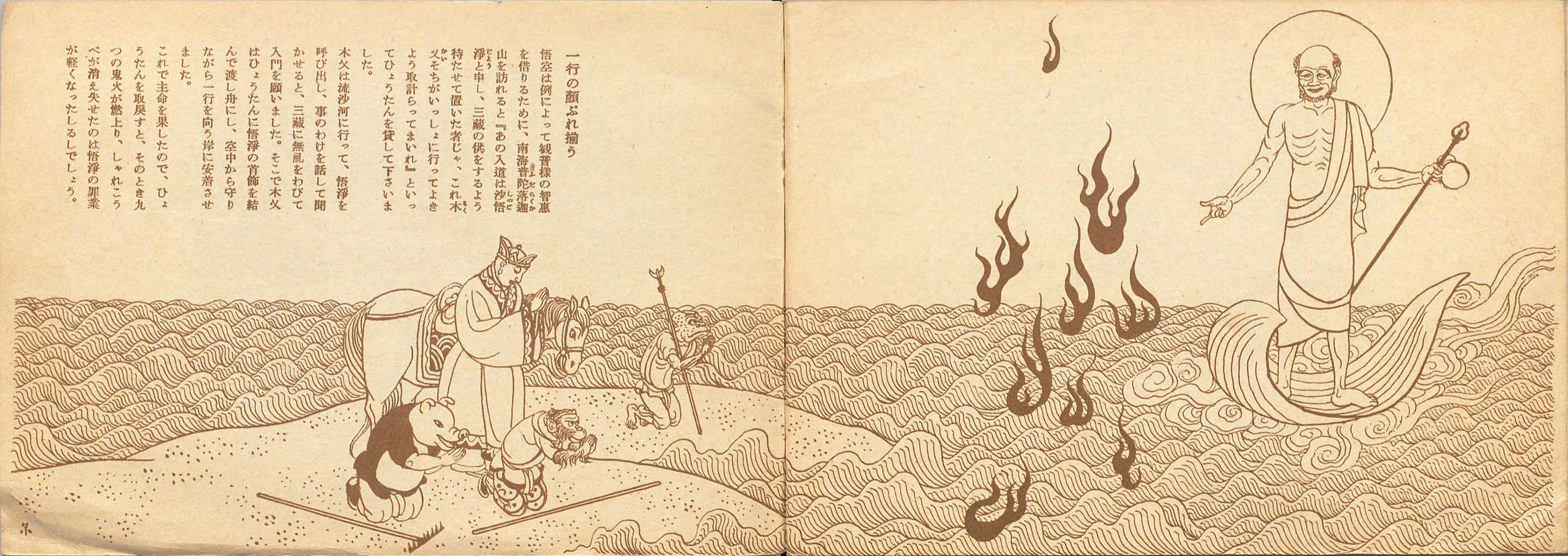
This three volume work was illustrated by Mizushima Nio (水島爾保布, 1884–1958). The first volume covers Monkey’s birth to the submission of Sandy; the second covers the Ginseng fruit tree to the battle with Guanyin’s goldfish; and the third covers the Buffalo demon to the end of the novel. The dark on light line work reminds one of delicate paper cut artwork brought to life. See below for an example.

Click to access e7bb98e69cace8a5bfe6b8b8e8aeb0-e4b88ae4b8ade4b88b-e6b0b4e5b29be5b094e4bf9de5b883-e794bb-1950e5b9b4.pdf

The Illustrated Journey to the West (1950) - End of Volume 1 (small)

The group bowing before a Buddhist figure (larger version).

3. Thanks

The original PDFs are hosted on shuge.org and are free to download. I’m posting them here for posterity. 50Watts appears to be the first English site to host images from both Son Goku and The Illustrated Journey to the West, but they either skip some images or only show a partial spread.