Archive #17 – PDFs of Creation of the Gods Library of Chinese Classics Chinese-English Bilingual Edition (Vols. 1-4)

Note: My blog is not monetized, so I am not making any money from this post. My hope is that the PDF will make this legendary story more accessible to a wider audience. If you enjoyed the digital version, please, please, please support the official release.

Last updated: 04-06-2026 

Here I present a PDF of the Library of Chinese Classics bilingual edition of Creation of the Gods (Fengshen yanyi, 封神演義, c. 1620 CE), sometimes translated as Investiture of the Gods or Enfeoffment of the Gods.

Table of Contents

1. Novel Description

This 100 chapter shenmo novel tells of the great struggle between the declining Shang (c. 1600–1046 BCE) and ascending Zhou (c. 1046–256 BCE) dynasties. In the beginning, King Zhou of Shang offends the primordial goddess Nuwa by leaving a lewd poem in her temple, and in response, the devi summons a trio of spirits (a fox, a pheasant, and a lute) to bring about the dynasty’s downfall. The fox spirit takes the place of the king’s concubine Daji and, over the course of nearly 30 years, leads him down a path of imperial neglect, decadence, and sadism. This causes many of the kingdom’s dukes, marquis, and generals to later rebel in favor of King Wu of Zhou, the monarch destined by heaven to rule China.

The majority of the story follows the countless battles between the forces of Shang and Zhou. Along the way, the latter are aided by immortals of the Chan () sect (an analogy for Quanzhen Daoism), which favors spiritual cultivation, while the former are aided by the Jie () sect (an analogy for Zhengyi), which favors charms and incantations. [1] Each transcendent wields any number of swords, fans, hooks, staves, axes, halberds, scissors, hammers, rings, sashes, nails, dippers, pennants, pearls, gourds (etc.), each with not only the power to take the lives of thousands of humans but also immobilize other immortals and even kill them. These celestial battles escalate to the point that Laozi and the Buddha must fight side-by-side to defeat a trap designed to kill 10,000 immortals.

A story line present throughout the novel is the fate of Jiang Ziya, a Daoist adept and the military strategist and stalwart commander of the Zhou army. He is destined to deify the souls of the humans and immortals who die in battle using the “List of Creation” (Fengshen bang, 封神榜), an index of preordained names agreed upon at the beginning of time by the heads of the three sects. This list is housed in the “Terrace of Creation” (Fengshen tai, 封神臺), a reed pavilion in which the souls of the dead are gathered to await their apotheosis. In the end, after defeating the Shang forces, Jiang deifies a total of 365 major gods, along with thousands of lesser gods, ranging from holy mountains, weather, and plagues to constellations, the time cycle, and the five elements.

Considering that the story takes place a millennia prior to the arrival of Buddhism in China, the novel portrays the religion having no presence in the east. There are several times in the narrative when a Buddhist deity travels from the western paradise to halt the execution of a powerful immortal or demon as they are fated to submit to Buddhism. Furthermore, when the Buddha intervenes in the great battle towards the end, he does so to find talented disciples who will help him spread the religion in the east. In fact, Bodhisattvas like Guanyin and Manjusri are depicted as former Chan sect immortals who later become disciples of Buddhism.

See also this chapter-by-chapter summary.

2. Relationship to JTTW

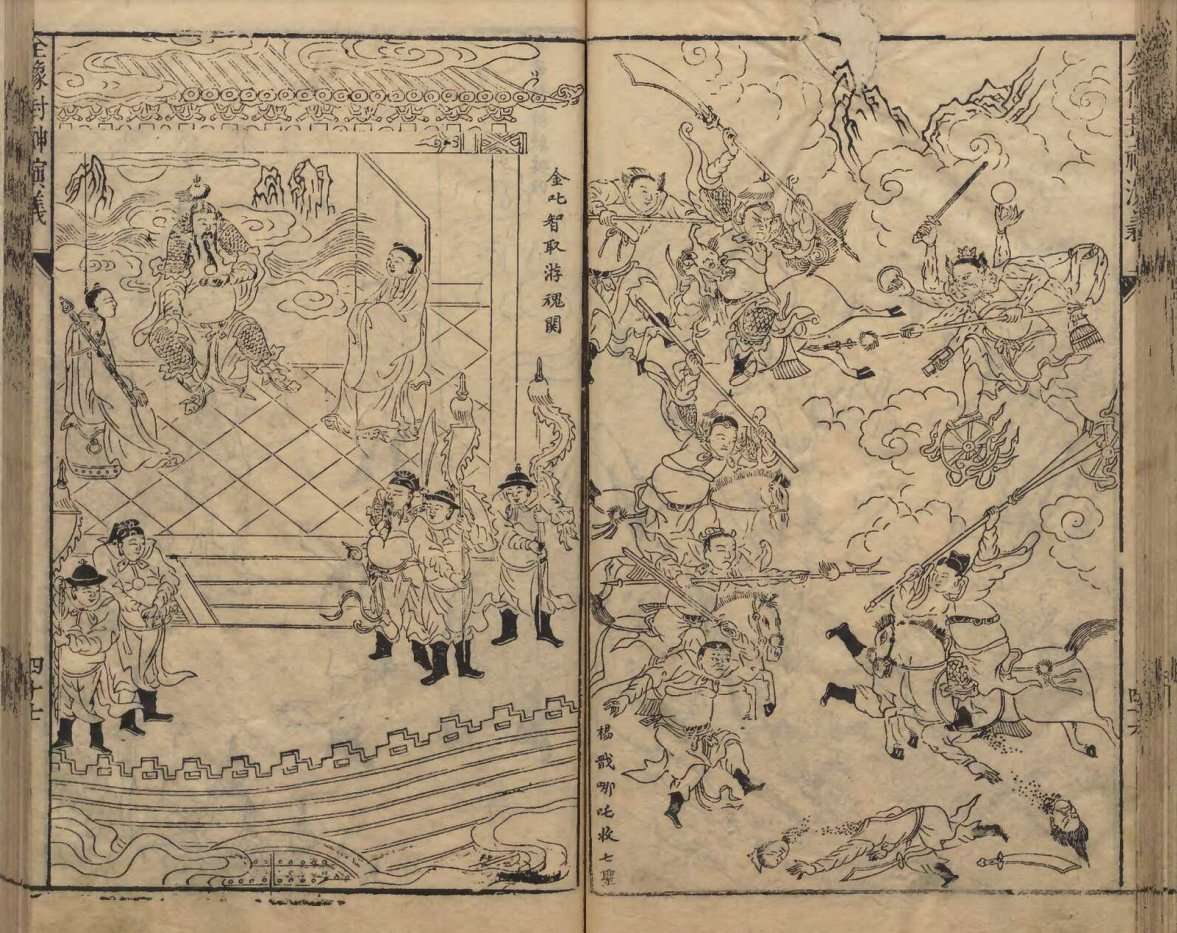
For the purposes of this blog, several characters from Journey to the West (Xiyouji, 西遊記, 1592) appear in the novel, including Laozi, the Buddha, Nezha (fig. 1), Muzha, and Li Jing, Ao Guang, Erlang (called Yang Jian, 楊戩) and his hound, etc. Journey to the West also had a number of clear influences on the book, one being the ape spirit Yuan Hong (袁洪) from later chapters who wields a staff and 72 transformations in a fight with Yang Jian. Sound familiar?

Fig. 1 – A detail of Nezha striking at an enemy during battle. Image from The Newly Printed, Zhong Bojing Annotated, Investiture of the Gods (Xinke Zhong Bojing xiansheng piping Fengshen yanyi, 新刻鍾伯敬先生批評封神演義, c. 1620) (larger version).

3. Translation: Pros and Cons

This edition of the novel was originally translated by Gu Zhizhong (顾执中, 1898–1995) in 1992. Dr. Barbara Witt notes that the translation has its pros and cons:

The positive: It is the only complete translation of Fengshen yanyi into a Western language that I am aware of. The edition I read (from 1992 I think), was also nicely done with interesting woodcut illustrations throughout the novel.

The negative: Firstly, it is not a very faithful translation. Poems are generally left untranslated and sentences often paraphrased. [2] I think, when ever the translator found something difficult, he just skipped it. Secondly, I think Gu Zhizhong was not an English native speaker and not very familiar with Western mythology and some of his translations are really off. For example Taiyi zhenren 太乙真人 (“True Man Primordial”), a powerful Daoist immortal, becomes “Fairy Primordial” in his translation, which conjures up a very different image.

3.1. Example

Chapter 12 describes how young Nezha inadvertently causes havoc in the aquatic realm when washing himself in a river with a powerful magic sash. This eventually leads to Li Gen (李艮), a yaksha water-spirit soldier, to attack him with an ax. Gu’s (2000) description of the fight reads:

Nezha, naked and empty-handed, dodged the vicious blow, raised his Universal Ring and struck Li Gen on the head. How could the Yaksha withstand the magic weapon from Fairy Primordial! His skull broke open and he fell dead on the river bank (vol. 1, p. 239).

However, the full encounter should read:

Standing there naked, Nezha dodged the advancing warrior’s attack and upraised the Universal Ring in his right hand. This treasure was originally bestowed by the Jade Emptiness Palace of Mt. Kunlun to the Perfected Man of the Grand Monad to secure the items of his Golden Light Cave. How could the yaksha withstand the magic weapon as it struck downward on his head? His brains exploded from the blow, and he fell dead on the shore.

哪吒正赤身站立,見夜叉來得勇猛,將身躲過,把右手套的乾坤圈望空中一舉。此寶原係崑崙山玉虛宮所賜太乙真人鎮金光洞之物,夜叉那裏經得起,那寶打將下來,正落在夜叉頭上,只打的腦漿迸流,即死於岸上。

You can see that quite a bit of information was left out. This happens throughout the entire novel. This makes me angrier the more that I think about. Why even bother to translate something if you are only going to paraphrase or even skip over passages? It seems like a pointless enterprise.

However, while imperfect, I think that the translation is a must read as many of the gods mentioned therein are worshiped in modern temples throughout China, Taiwan, Malaysia, and Singapore. It is a lens into modern folk religion.

4. PDF File

The following PDF is a combination of all four volumes making up Gu (2000):

Click to access fsyy-en-cn.pdf


5. Updates

Update: 11-28-21 

I’ve added Wan (1987), a doctoral thesis analyzing the historical sources and micro/macro structure of the story. It also provides a summary of the tale in the end.

PDF File

Click to access Investiture-of-the-gods-Fengshen-yanyi-Sources-narrative-structure-and-mythical-significance.pdf


Update: 03-14-23

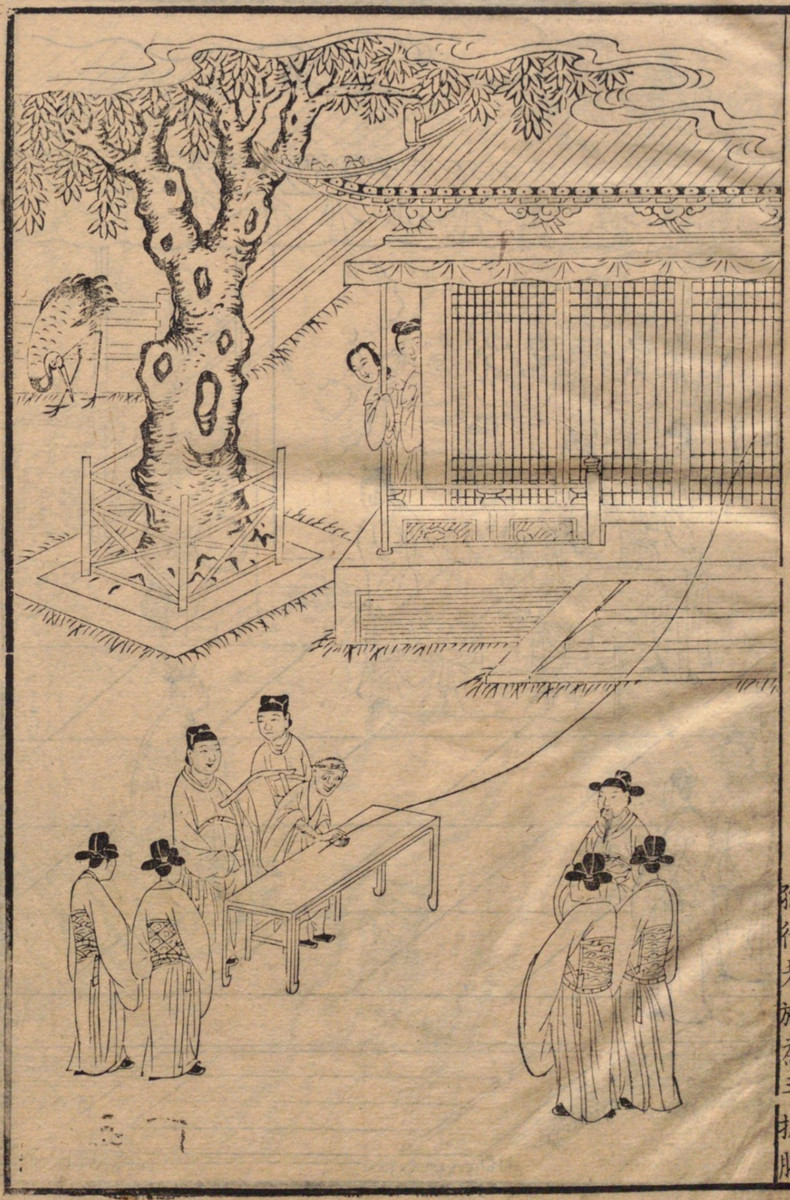
Here is a PDF for volume one of The Newly Printed, Zhong Bojing Annotated, Investiture of the Gods (Xinke Zhong Bojing xiansheng piping Fengshen yanyi, 新刻鍾伯敬先生批評封神演義, c. 1620), the oldest known edition of the novel. It is full of lovely woodblock prints (fig. 2).

PDF File

Click to access Investiture-of-the-Gods-1620-prints.pdf

Fig. 2 – A random page from vol. 1 of The Newly Printed, Zhong Bojing Annotated, Investiture of the Gods (larger version).

Thank you to the National Archives of Japan for offering the complete 1620 edition of FSYY. It can be downloaded here.


Update: 09-13-23

Tumblr user digitalagepulao has drawn an amazing Nezha (fig. 3). The theme is based on the feud between the prince and his father, which leads to the former’s suicide and divine resurrection. The artist describe a tense scene from the novel:

Li Jing in a fury grabbed his halberd, leapt on his horse and galloped out of the headquarters. He was astonished to see Nezha with his Wind-Fire Wheels and Fire-Tipped Spear. He swore loudly, “You damned beast! You caused us endless suffering before your death, and now that you’ve been reborn, you’re troubling us again!”

“Li Jing! I’ve returned my flesh and bones to you [via suicide], and there’s no longer any relation between us. Why did you smash my golden idol with your whip and burn down my temple? Today I must take my revenge!

The drawing is part of digitalagepulao’s Expedition to the West au (JTTW alternate universe) storyline based on this article.

Fig. 3 – Digitalagepulao’s Nezha (larger version).


Update: 09-08-24

@ryin-silverfish of Tumblr (author of this guest post) has made a catalog of the fantastic pets from the novel.

https://docs.google.com/document/d/1NozJF8nbhy8t6Jta7AZ5WKbyCmEMYtgFM_akcSt9D-Y/edit?usp=drivesdk

They have also made a catalog of Nezha’s powers.

https://docs.google.com/document/d/1FjHQPXmEalChk7PNiw9ljAJ8Cq66-AjevgEfdEa6wgI/edit?usp=sharing

A very big thank you to them. I’ll add more later if or when new lists are available.


Update: 11-03-24

My friend Dario Virga (Onibotokemaru on Instagram) (fig. 4) has completed an Italian translation of the novel titled L’investitura degli Dei: Romanzo cinese di epoca Ming (2024). This 1,120 page, two-volume edition can be purchased here for € 50,00:

https://www.libraccio.it/libro/9788879847049/xu-zhonglin/investitura-degli-dei-romanzo-cinese-di-epoca-ming.html?tr=C3137

Fig. 4 – Dario and his translation (larger version). 


Update: 04-06-26

See my archives of other translations.

Notes:

1) Prof. Shi Changyu notes in his preface to this translation that the friction between the fictional Chan and Jie sects serves as an analogy for that of Quanzhen and Zhengyi during the Ming, for the former was marginalized, while the latter was held in high esteem and fell prey to decadence, naturally hindering its ability to contribute anything of value to the development of Daoism at this time (Gu, 2000, pp. 50-53).

2) Those interested in reading some of the poetry from the novel should consult Koss (1979), which compares them with those from Journey to the West.

Sources:

Gu, Z. (2000). Creation of the Gods (Vols. 1-4). Beijing: New World Press.

Koss, N. (1979). The Relationship of Hsi-yu chi and Feng-shen yen-i: An Analysis of Poems Found in Both Novels. T’oung Pao,65(4/5), second series, 143-165. Retrieved May 5, 2020, from http://www.jstor.org/stable/4528175

Wan, P. (1987). Investiture of the Gods (“Fengshen yanyi”): Sources, Narrative Structure, and Mythical Significance (UMI No. 8810607) [Doctoral dissertation, University of Washington]. Available from ProQuest Dissertations and Theses database.

Wu, C., & Yu, A. C. (2012). The Journey to the West (Vols. 1-4) (Rev. ed.). Chicago, Illinois: University of Chicago Press.

Generals Thousand-Mile Eye and Fair-Wind Ear

Last updated: 04-26-20

After the Monkey King’s birth from stone in Journey to the West (Xiyou ji西遊記, 1592; “JTTW” hereafter) chapter one, two beams of light shoot forth from his eyes, [1] alarming the Jade Emperor in heaven (fig. 1). The cosmic ruler then orders the personification of his eyes and ears, generals Thousand-Mile Eye (Qianliyan, 千里眼) and Fair-Wind Ear (Shunfenger, 順風耳), respectively, to trace the source:

At this command the two captains went out to the gate, and, having looked intently and listened clearly, they returned presently to report, “Your subjects, obeying your command to locate the beams, discovered that they came from the Flower-Fruit Mountain at the border of the small Aolai Country, which lies to the east of the East Pūrvavideha Continent. On this mountain is an immortal stone that has given birth to an egg. Exposed to the wind, it has been transformed into a monkey, who, when bowing to the four quarters, has flashed from his eyes those golden beams that reached the Palace of the Polestar. Now that he is taking some food and drink, the light is about to grow dim.” With compassionate mercy the Jade Emperor declared, “These creatures from the world below are born of the essences of Heaven and Earth, and they need not surprise us” (vol. 1, p. 102).

Fig. 1 – Sun Wukong’s laser eyes. From the Japanese children’s book Son Goku (1939) (larger version). 

Table of Contents

1. History

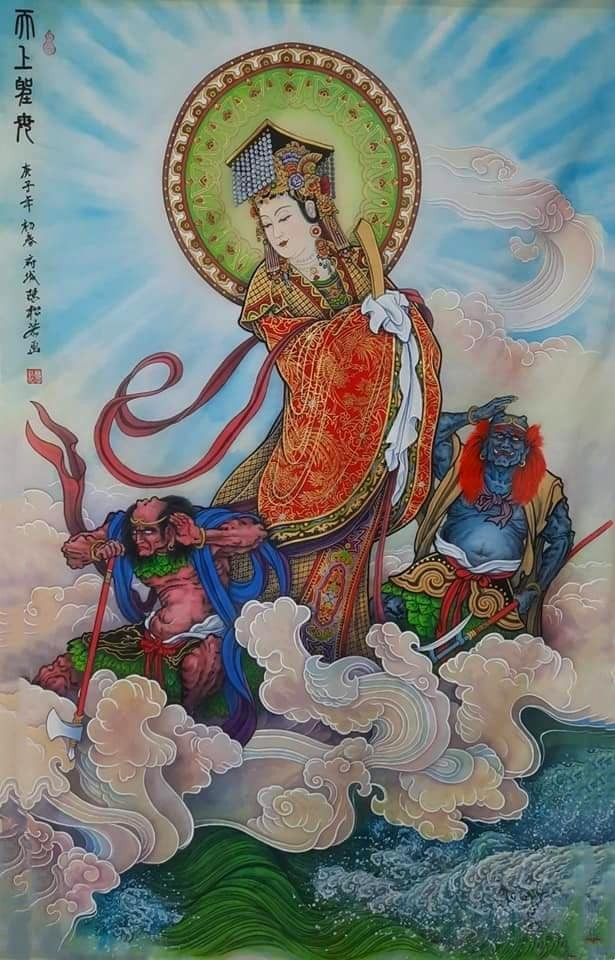
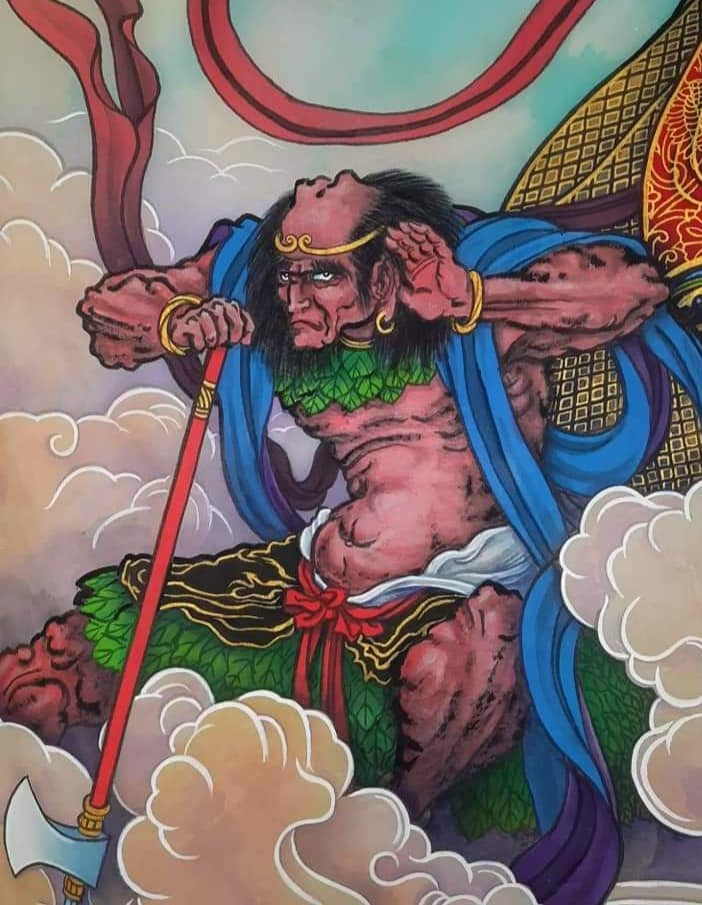
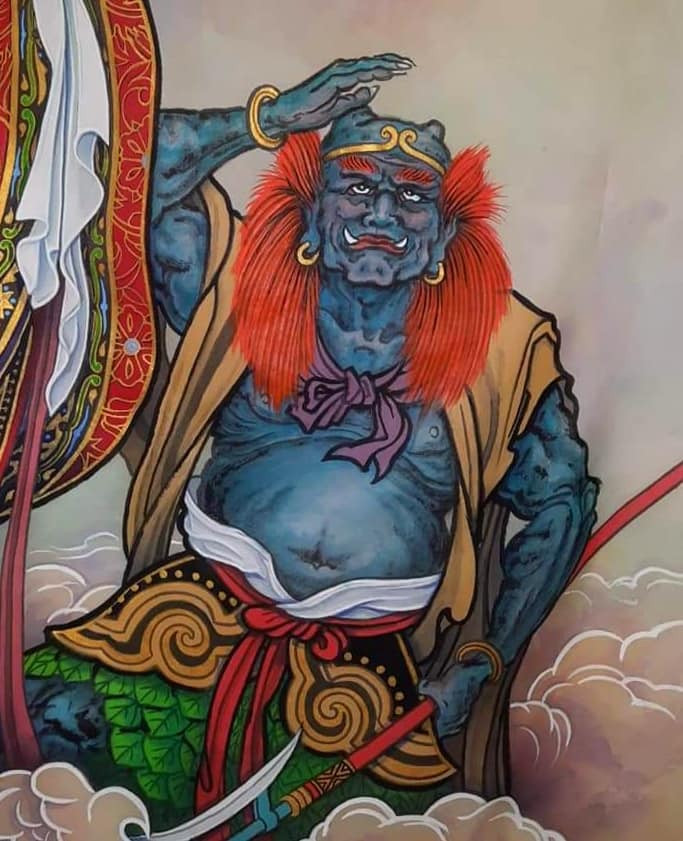
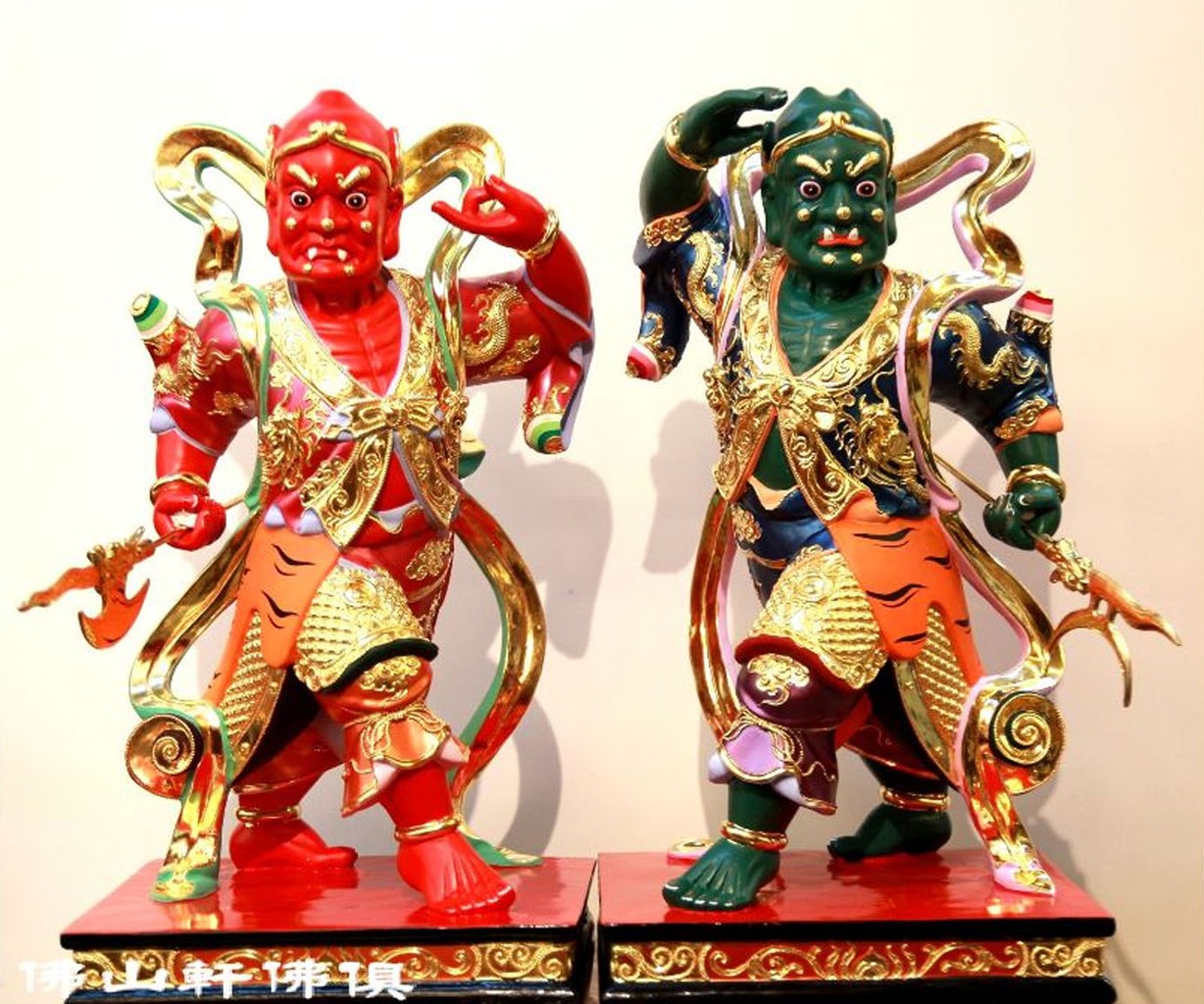
Today, these generals are celebrated as the guardians of Mazu (fig. 2), a popular sea goddess worshiped in Southern China, Macao, and Taiwan. Thousand-Mile Eye is commonly portrayed as a fierce, red warrior scanning the horizon with one hand shielding his eyes (fig. 3), while Fair-Wind Ear is green with one hand to his ear (fig. 4). According to Ruitenbeek (1999), the story of their subjugation is told in a series of circa 1880 mural paintings from the Temple of Divine Mercy (Lingcimiao, 靈慈廟) in Fengting village (楓停), Xianyou district (仙遊), Fujian.

Thousand-Miles Eye (in the murals called Jinxing yan [金星眼], “Venus-eye”), in the disguise of a lovely girl, lures men into a cave, and then dismembers and devours them. [2] When With-the-Wind Ear sees this, he starts a fight with Thousand-Miles Eye, but in the end the two monsters pledge to become sworn brothers. Guanyin, seated on Mount Potala, orders the Dragon’s Daughter to tell Mazu to subdue the monsters. In the first round of the battle, Mazu is forced to retreat. She then implores heavenly warriors to help her, and with their assistance is able to defeat the two monsters. Thereafter, Thousand-Miles Eye and With-the-Wind Ear become her loyal servants. First they help Mazu to fight a man-eating lion, thereafter they subdue the Evil Dragon Monster (p. 316).

Fig. 2 (left) – Mazu with her generals (larger version). Fig. 3 (center) – A detail of Fair-Wind Ear (larger version). Fig. 4 (right) – A detail of Thousand-Mile Eye (larger version). Original artist unknown.

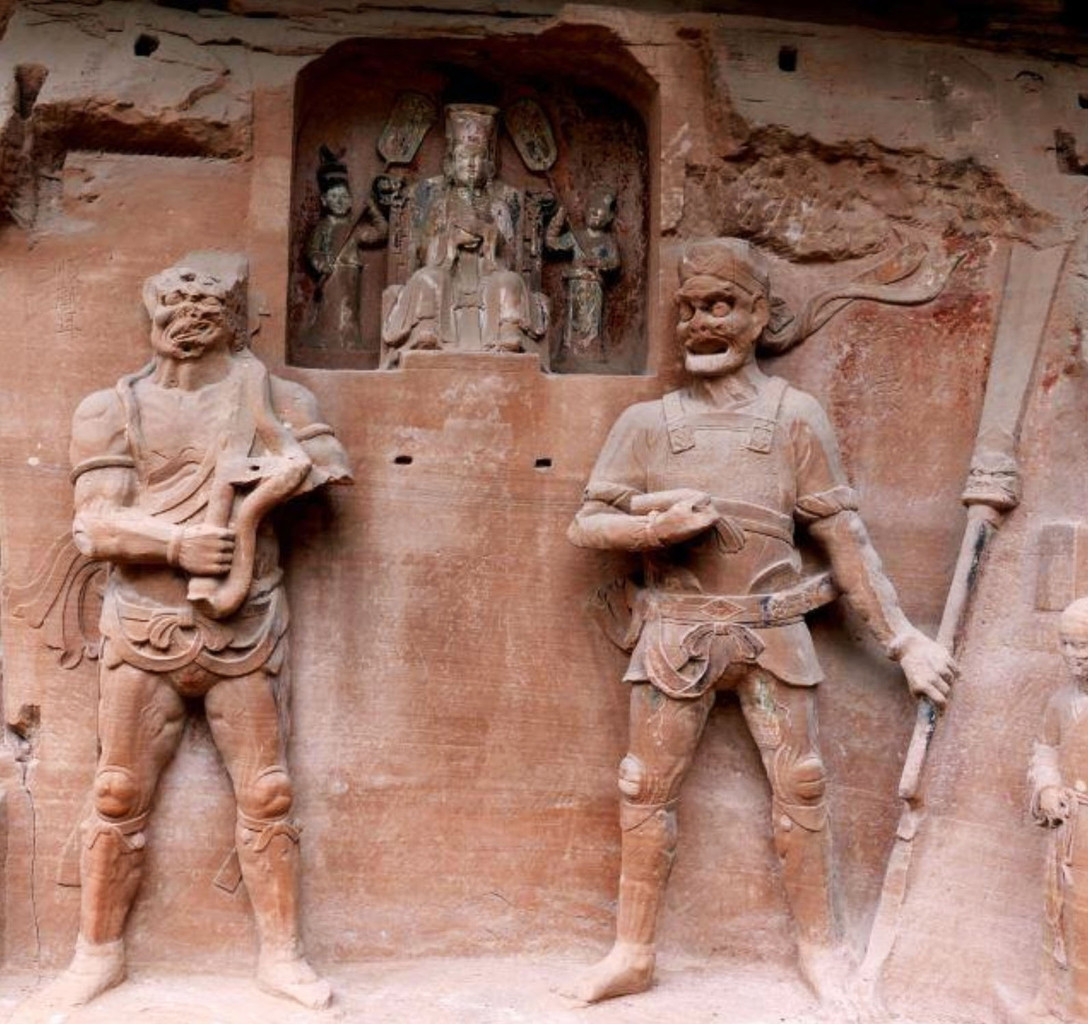
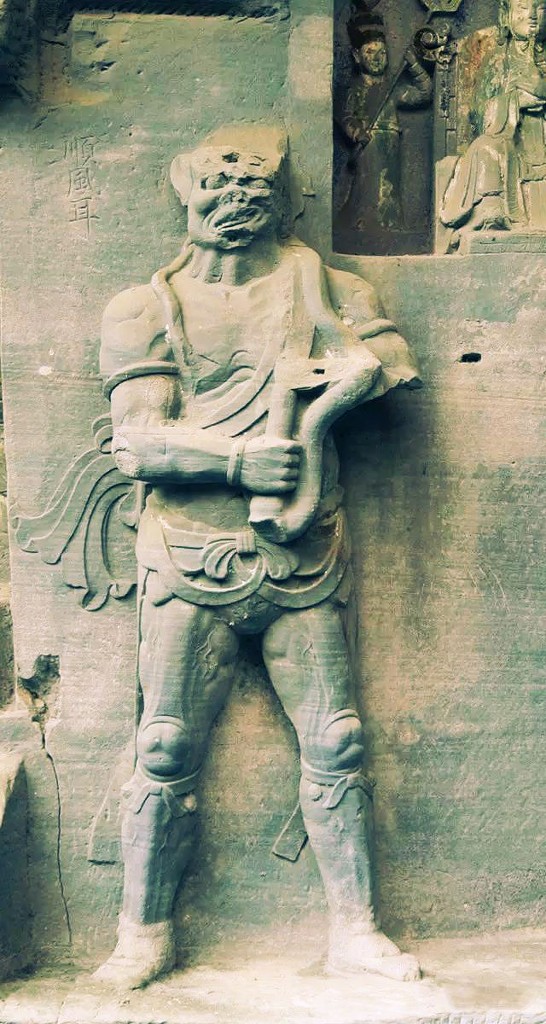
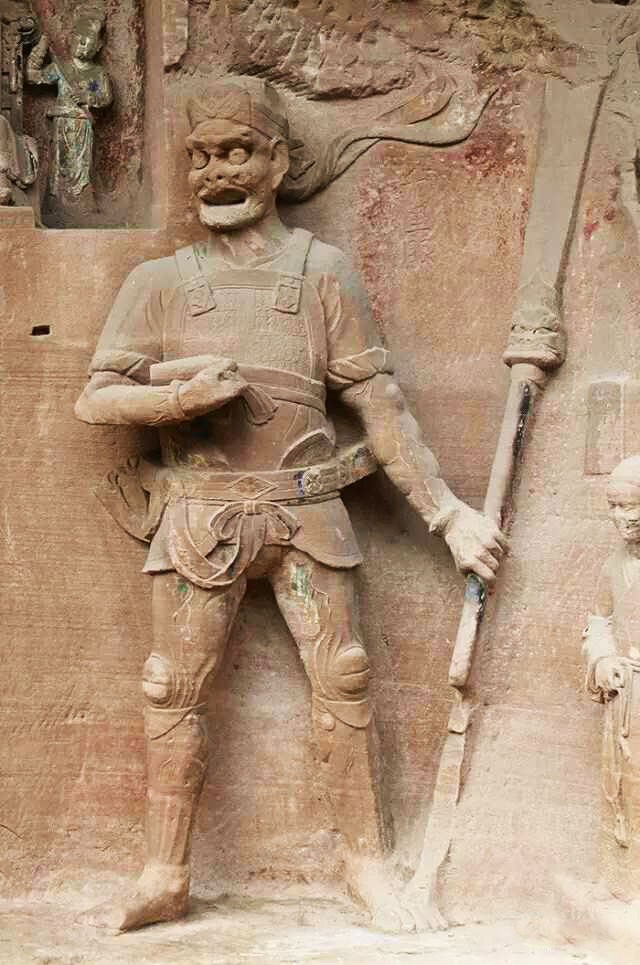
I am unsure when the generals where first associated with Mazu. They are only alluded to in passing as subjugated planetary spirits in the goddess’ early-17th century pious novel Record of the Miracles Performed by the Heavenly Princess (Tianfei xiansheng lu, 天妃顯聖錄) (Ruitenbeek, 1999, p. 319). However, it is clear from their appearance in JTTW that they were associated with the Jade Emperor during the late-16th century. [3] This association stretches back to at least the Shaoxing (紹興, 1131–1162) period of Song Emperor Gaozong, for they appear with the cosmic monarch among the rock carvings of the Shimen Mountain Grotto (Shimen shan shiku, 石門山石窟), one of many sites making up the world famous Dazu rock carvings in Sichuan (fig. 5-7). [4]

Fig. 5 (left) – Song-era statues of generals Fair-Wind Ear (L) and Thousand-Mile Eye (R) guarding the Jade Emperor’s alcove (larger version). From the Shimen Mountain Grotto. Photo originally from this article. Fig. 6 (center) – A detail of Fair-Wind Ear (larger version). Fig. 7 (right) – A detail of Thousand-Mile Eye (larger version). Photos originally from this article

Readers will notice that apart from being dressed differently, neither statue is striking their characteristic pose. These poses came later and may have been influenced by earlier deities. For example, Nikaido (2011) writes that a Song-era sea god named Zhaobao Qilang (招寶七郎) is sometimes depicted shielding his eyes just like Thousand-Mile Eye, and so he cautiously suggests that, once the deity’s cult waned in popularity and yielded to Mazu, this trait may have been passed on to her generals (pp. 89-90). Conversely, the poses could simply be based on postures used by the very sailors who worshiped such gods. After all, keen eyesight and hearing are skills needed to successfully navigate the open ocean.

2. Golden Headbands

The generals are normally depicted wearing flowing clothing or open armor to show off their muscular physiques. Apart from their divine sashes, they are commonly shown wearing golden armbands, bracelets, and/or anklets, as well as a tiger skin at the waist. These traits appear to be consistent from all the examples that I’ve seen in Taiwan and Hong Kong. However, the statues in Taiwan stand out the most to me because they are often depicted wearing golden fillets on their heads just like Sun Wukong (fig. 8). This is because these headbands share a common origin.

Fig. 8 – Religious statues of Fair-Wind Ear (left) and Thousand-Mile Eye (right) (larger version). Take note of the headbands. Also refer back to figures 4 and 5. Photo originally found here

I explain in this article that the golden fillet can be traced to a list of prescribed ritual items worn by ancient Buddhist yogins in their worship of Hevajra-Heruka, a wrathful protector deity. These items appear in the 8th century Hevajra Tantra (Dabei kongzhi jingang dajiao wang yigui jing, 大悲空智金剛大教王儀軌經):

The practitioner should wear divine ear-rings, a circlet around the head, upon each wrist a bracelet, a girdle around his waist, anklets around the ankles, arm ornaments around the upper arms and a garland of bones around the neck. His dress must be of tiger skin and his food the Five Nectars (Farrow & Menon, 2001, pp. 61-62; Cf. Linrothe, 1999, p. 250).

You will notice that all of the items associated with the generals, including the headband, the rings on the arms, wrists, and ankles, and the tiger skin are listed here. This is because wrathful protector deities were often depicted in the same attire as their followers, leading to the fillet becoming a symbol of powerful Buddhist spirits. For instance, the Hevajra Tanta describes Hevajra-Heruka as a wrathful youth wearing such clothing:

Dark blue and like the sun in colour with reddened and extended eyes, his yellow hair twisted upwards, and adorned with the five symbolic adornments,/ the circlet, the ear-rings and necklace, the bracelets and belt. These five symbols are well known for the purificatory power of the Five Buddhas./ He has the form of a sixteen-year-old youth and is clad in a tiger-skin. His gaze is wrathful. In his left hand he holds a vajra-skull, and a khatvahga [staff] likewise in his left, while in his right is a vajra of [a] dark hue… (Linrothe, 1999, p. 256; Cf. Farrow & Menon, 2001, p. 44).

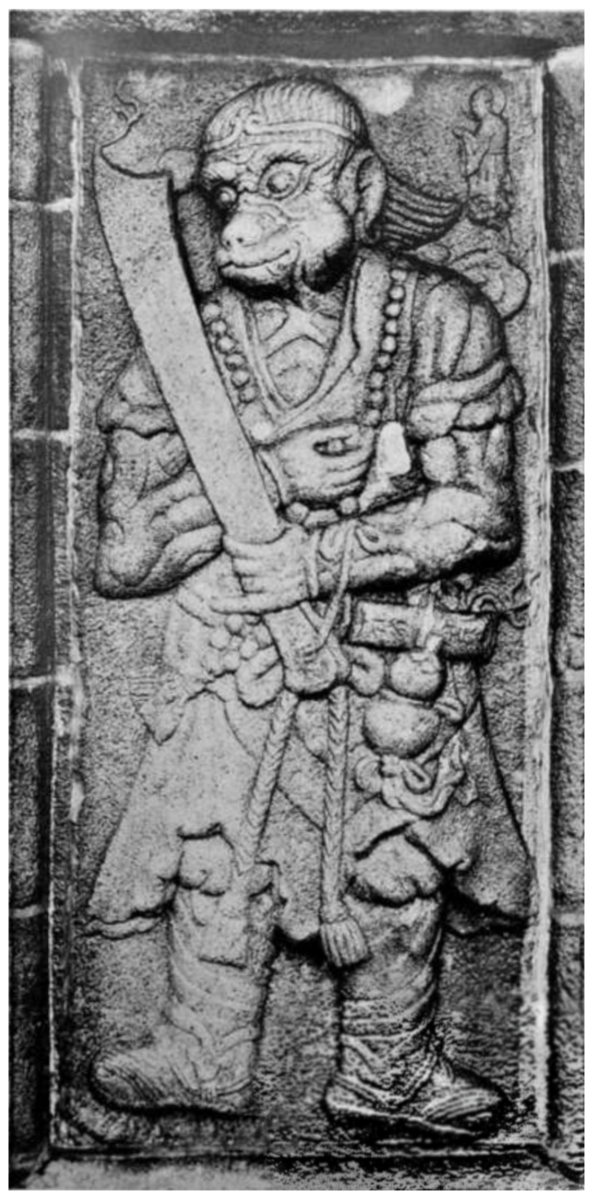
The Hevajra Tantra was translated into Tibetan and Chinese during the 11th century (Bangdel & Huntington, 2003, p. 455), allowing this iconography to spread eastward. A prime example is the 13th-century Kaiyuan Temple Pagoda carving of Sun Wukong in Fujian. He is depicted with the headband, armbands, bracelets, anklets, and possibly even a tigerskin apron (fig. 9). 

Given the close cultural connection between Fujian and Taiwan, the generals’ depiction with fillets is likely based on previous examples from the southern Chinese province.

Fig. 9 – The  Kaiyuan temple pagoda relief (larger version), Quanzhou, Fujian.

It’s interesting to note that Fair-Wind Ear’s statue from Shimen Mountain Grotto in Sichuan has the aforementioned body rings (refer back to fig. 6). His head is, unfortunately, damaged, though. I would be interested in analyzing similarly dressed guardian figures in the area to see if they wear a fillet.


3. Updates

Update: 04-22-20

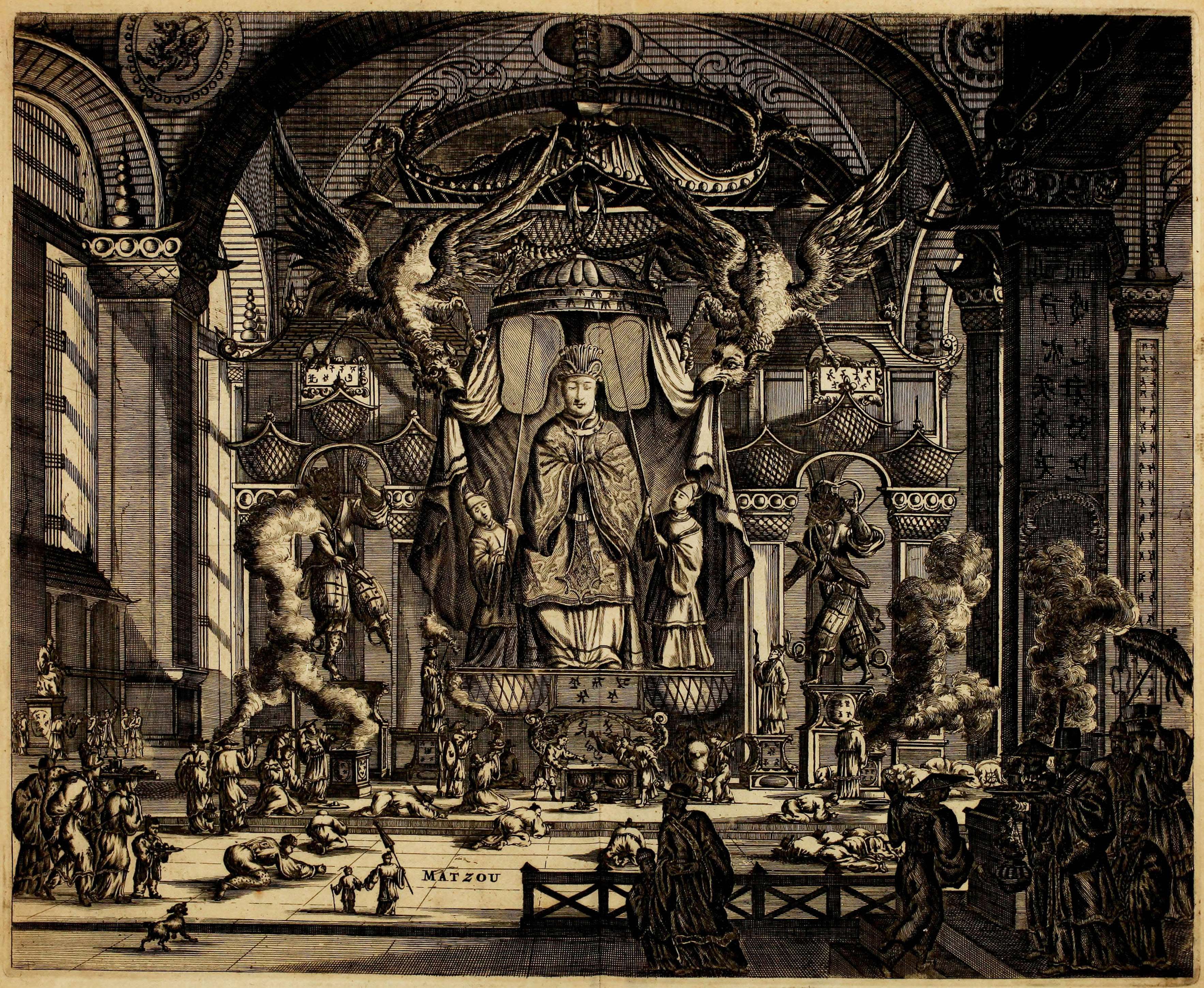
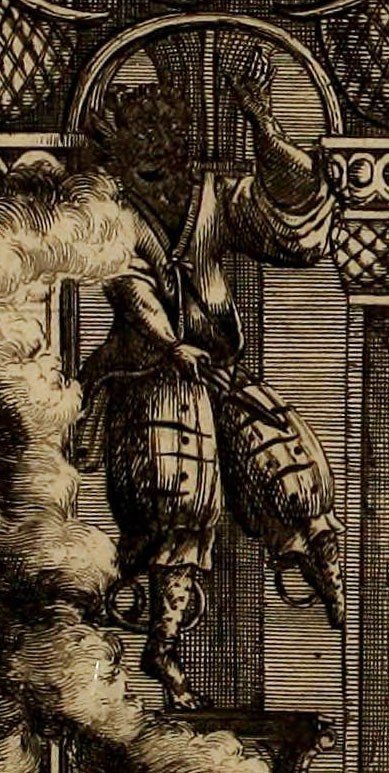
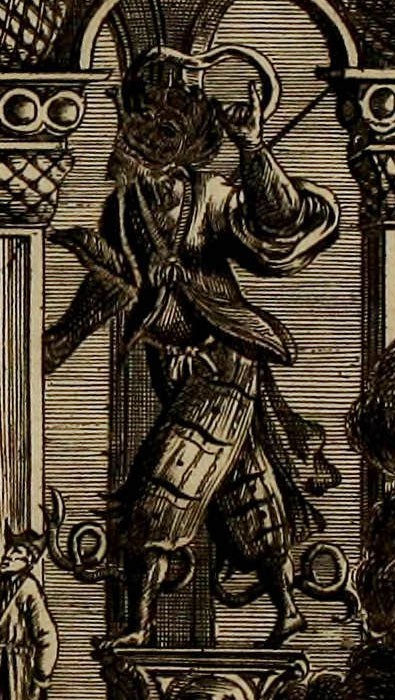
Here is a lovely Dutch engraving of a Mazu temple from a 17th-century book by Olfert Dapper (fig. 10). The generals can be seen standing in their characteristic poses to the left (fig. 11) and right (fig. 12) of the main altar stage. Their attire includes the aforementioned body rings (and possibly tiger skin pants) but no headband.

Fig. 10 (left) – Engraving from Memorable Mission of the Dutch East India Company up the Coast to China and into the Empire of Taising of China (Gedenkwaerdig bedryf der Nederlandsche Ooste-Indische Maetschappye, op de kuste en in het keizerrijk van Taising of Sina, 1670) (larger version). Image from the Clark Collection. Fig. 11 (center) – A detail of General Thousand-Mile Eye (larger version). Fig. 12 (right) – A detail of General Fair-Wind Ear (larger version).


Update: 04-26-20

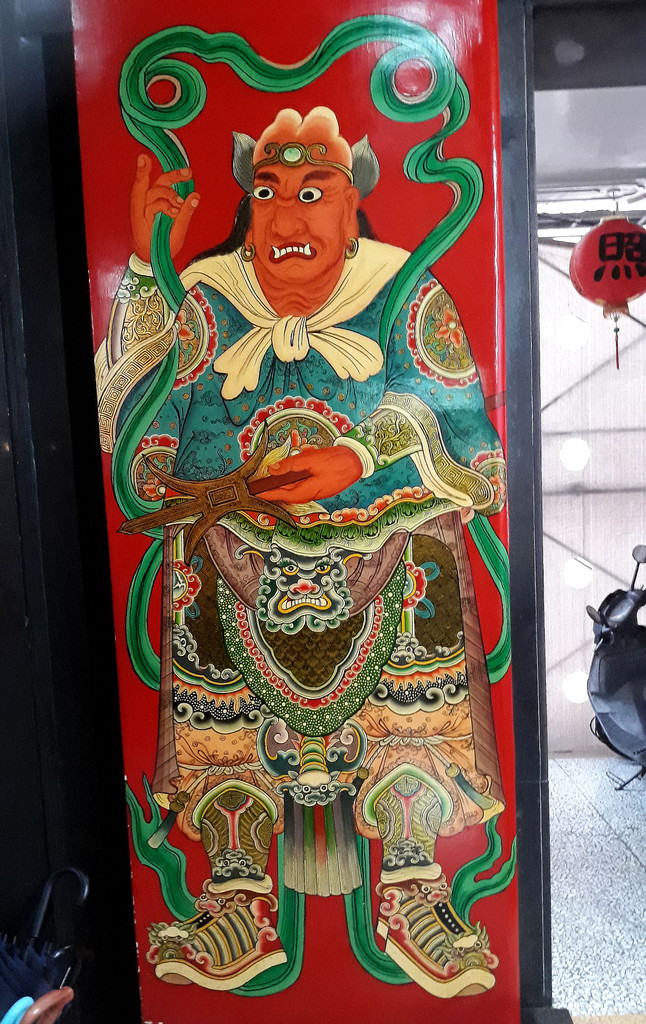
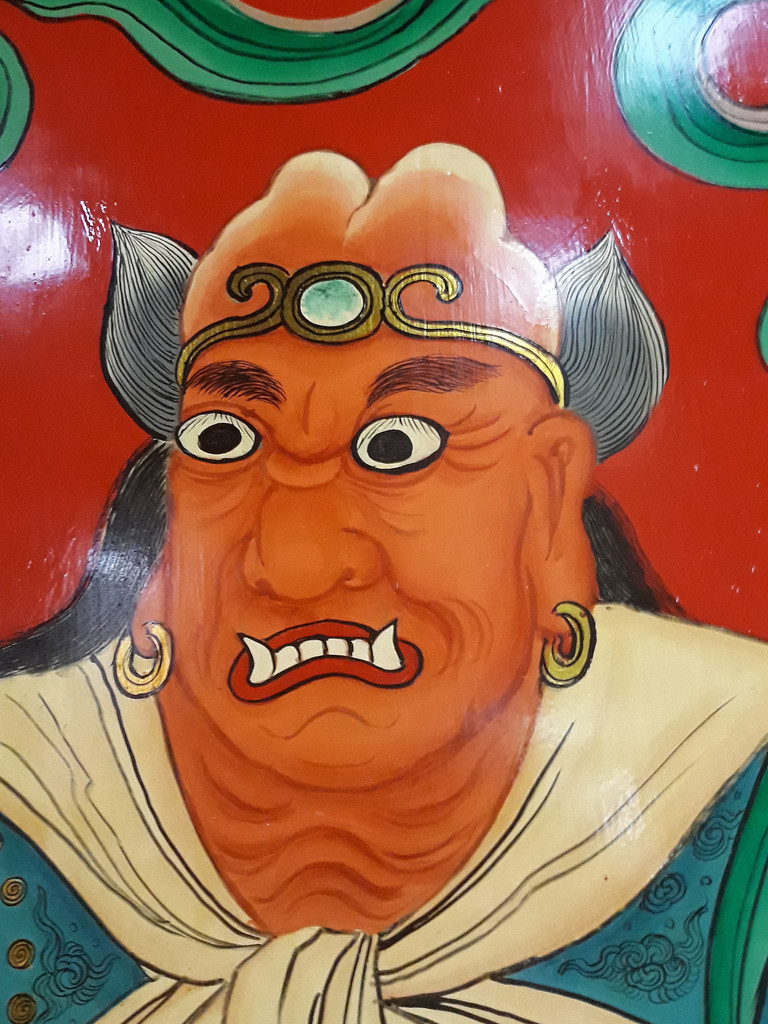
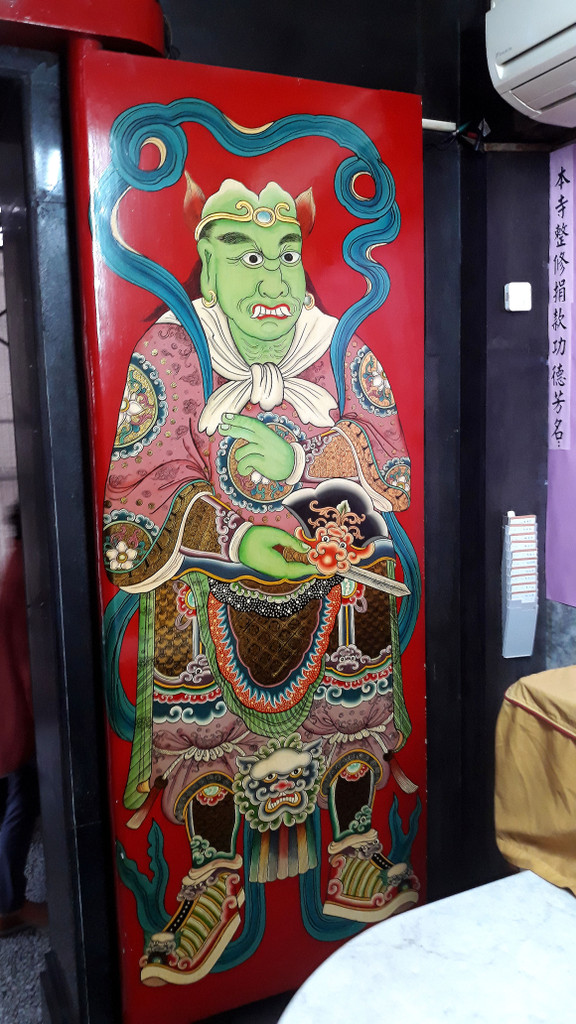
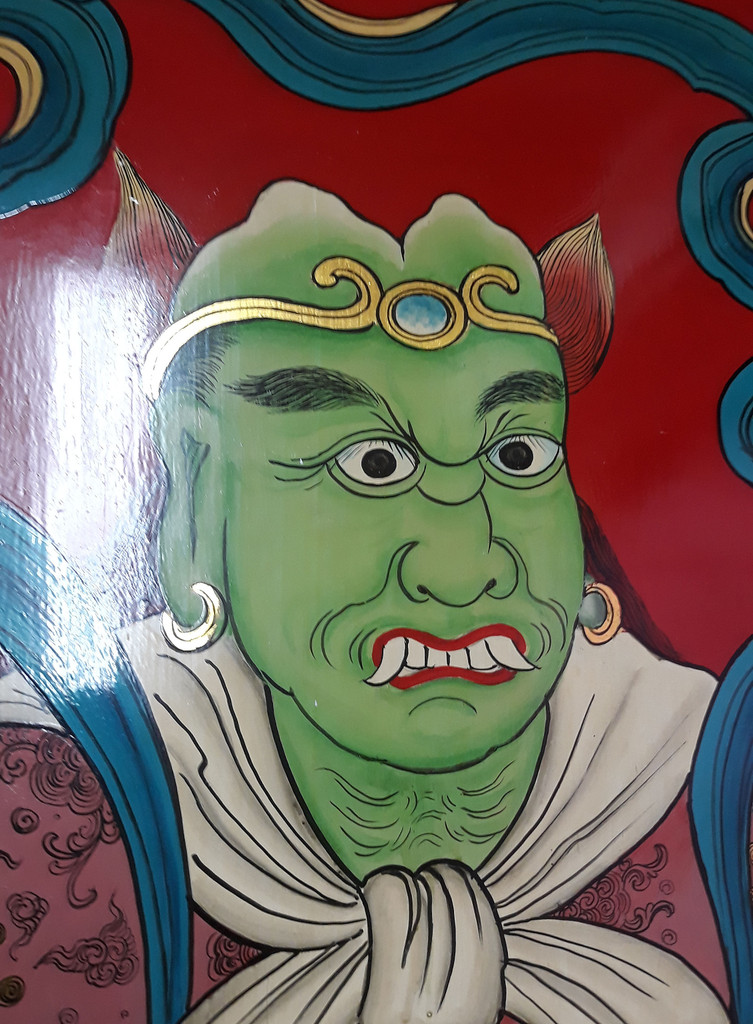
The Puji Temple (普濟寺) in Datong district (大同區), Taipei (near my home) includes door god paintings of the two generals (fig. 13-16). They are depicted with bejeweled headbands. These demonstrate the variability of fillet designs.

Fig. 13 – General Fair-Wind Ear (larger version). Fig. 14 – Detail of his head (larger version). Fig. 15. General Thousand-Mile Eye (larger version). Fig. 16 – Detail of his head (larger version).

Notes:

1) This feat may be based on Daoist mind-training exercises where adepts try to expand their vision to the ends of the earth/cosmos. According to Robinet (1979), one source reads: “Consider that your two eyes radiate a single light which is like liquid fire and as brilliant as the stars; glowing red, it extends for ten thousand miles. The mountains, marshes, rivers, thickets and forests of the four directions are all resplendent with its light” (p. 55).

2) Wukong states in chapter 27 that he used the same trick to eat humans:

When I was a monster back at the Water-Curtain Cave, I would act like this if I wanted to eat human flesh. I would change myself into gold or silver, a lonely building, a harmless drunk, or a beautiful woman. Anyone feeble-minded enough to be attracted by me I would lure back to the cave. There I would enjoy him as I pleased, by steaming or boiling. If I couldn’t finish him off in one meal, I would dry the leftovers in the sun to keep for rainy days (Wu & Yu, 2012, vol. 2, p. 20).

3) The generals are associated with Huaguang Dadi (華光大帝) in Journey to the South (Nanyouji, 南遊記, 1570s or 1580s). They are referred to as Li Lou (離婁) and Shi Kuang (師曠) (Nikaido, 2011, p. 90). They also make an appearance in Investiture of the Gods (Fengshen yanyi, 封神演義, c. 1620). Ruitenbeek (1999) writes:

[T]hey occur, without the context of Mazu, in the guise of the brothers Gao Ming and Gao Jue. In reality, these were a Peach-tree Spirit and a Willow-tree Ogre, who had availed themselves of the divine power of two clay statues of Qianli yan and Shunfeng er in the temple of Xuan Yuan in Qipanshan. Only after these statues were smashed to pieces did they lose their power. They were subsequently transformed into Shenshu and Yulei, better known as the Door Gods (p. 319).

4) See Zhao (n.d.). These carvings are described by Hu (1994). I, unfortunately, don’t have access to it at the time of this writing.

Sources:

Bangdel, D., & Huntington, J. C. (2003). The Circle of Bliss: Buddhist Meditational Art. Chicago, Ill: Serindia Publications.

Farrow, G. W., & Menon, I. (2001). The Concealed Essence of the Hevajra Tantra: With the Commentary Yogaratnamālā. Delhi: Motilal Banarsidass Publ.

Hu, W. (1994). Sichuan jiaodao fojiao shiku yishu [Taoist and Buddhist Sichuan rock cave art]. Chengdu: Sichuan People’s Publishing.

Linrothe, R. N. (1999). Ruthless Compassion: Wrathful Deities in Early Indo-Tibetan Esoteric Buddhist Art. Boston, Mass: Shambhala.

Nikaido, Y. (2011). The Transformation of Gods in Chinese Popular Religion: The Examples of Huaguang dadi and Zhaobao Qilang. A Selection of Essays on Oriental Studies of the Institute for Cultural Interaction Studies. Osaka: Kansai University, 85-92.

Robinet, I. (1979). Metamorphosis and Deliverance from the Corpse in Taoism. History of Religions, 19(1), 37-70.

Ruitenbeek, K. (1999). Mazu, the patroness of sailors, in Chinese pictorial art. Artibus Asia 58(3/4). 281-329. Retrieved from https://www.jstor.org/stable/3250021

Wu, C., & Yu, A. C. (2012). The Journey to the West (Vols. 1-4) (Rev. ed.). Chicago, Illinois: University of Chicago Press.

Zhao, W. (n.d.). Yuhuang dadi jianglin Shimenshan [The Jade Emperor Descends to Shimen Mountain].  Retrieved April 21, 2020, from https://chiculture.org.hk/tc/china-five-thousand-years/622

Taiwanese Religious Humor: The Epidemic Prevention Conference

From time to time I like to post a fun blog not directly related to (though sometimes informed by) my research. Past examples can be seen here, here, and here. Regular articles will resume after this entry.

“The Epidemic Prevention Conference” (Fangyi dahui, 防疫大會) is a humorous COVID-19-related short story that has been circulating in Taiwan. It gets longer and longer as people add new details. I wanted to share it because it mentions many figures from Journey to the West (Xiyouji西遊記, 1592), including Xuanzang and Sun Wukong. I’ve added notes at the bottom to explain the cultural context of particular statements.

I. English Translation

The Anti-Epidemic Conference was held in the celestial court. The Jade Emperor was worried when he discovered many seats were vacant, and so he asked the gods:

Jade Emperor: “Why don’t I see the ‘Thousand-Armed’ Guanyin Bodhisattva?”

The gods answered: “She is still washing her hands!”

thousand_armed_avalokitesvara_-_guanyin_nunnery_-_2

Jade Emperor asked again: “Why didn’t Brahma, the Four-Faced Buddha, come?”

The gods replied: The government only gave him three masks for the week, so he is short one and can’t come.” [1]

brahma_the_four-faced_buddha

Jade Emperor asked again: “Why didn’t Bhaisajyaguru, the Medicine Buddha, come?”

The gods answered: “The Medicine Buddha is selling masks.”

korea-gangneung-deungmyeongnakgasa-medicine_buddha-01

Jade Emperor asked again: “What about the Eight Immortals?”

The gods replied: “Because they returned from overseas and had to be quarantined at home.” [2]

eight_immortals_crossing_the_sea_-_project_gutenberg_etext_15250

Jade Emperor asked again: “What about Sage Emperor Guan?”

The gods replied: “His face was flush and he had a fever of more than 37.5 °C (99.5° F). [3] He is isolated at home.”

guan_yu_statue_2016_temple_of_guan_yu_28xuchang29_1

Jade Emperor asked again: “Why did Tang Sanzang not come?” [4]

The gods replied: “He has a history of travel and is quarantined at home, so he cannot come.”

xuanzang_w

Jade Emperor asked again: “What about King Yama?”

The gods answered: “Because too many people have died. He is still taking roll of their names.”

kagamibuta_netsuke_front

Then the Jade Emperor asked again: “Why did Mazu Lin Moniang not come?”

The gods replied: “The DPP government discovered that she is originally from Fujian and thus a foreign national. Now she cannot return, and her pilgrimage festival has been cancelled.”

e9a6ace7a596e58d97e7abbfe98489e5aabde7a596e5ae97e69599e59c92e58d80e4b98be5aabde7a596e5b7a8e7a59ee5838f

“The Plague God did not come because he is busy spreading the plague.

93323008_3172456276099464_9036148687230730240_n

The God of Wealth didn’t come because he is busy giving financial relief.”

93244583_880452579084105_6486426117711331328_n

“Why didn’t the Bodhisattva King Kṣitigarbha come?”

The gods answered: “The death toll is skyrocketing, so there’s no time to come!”

bodhisattva_ksitigarbha_2819531360529

“Why didn’t Sun Wukong come?”

“Because of contact with the pathogen bat demon. [5] He is in quarantine.”

Monkey King Kicking - small

“Why didn’t the Earth God come yet?”

The gods replied: “He and King Kṣitigarbha are looking for land with good fengshui, [6] so he has no time to come!

tudi_gong_28129

II. Chinese Original

天庭開防疫大會,玉皇大帝發現有許多空位,關心問眾神。

玉帝問:怎麼沒見到千手觀音?

眾神回答:還在洗手!

玉帝又問: 為何四面佛也沒來?

眾神回答:—周領3個口罩,所以少—個囗罩,不能來。

玉帝又問:為何藥師佛沒來?

眾神回答:藥師在賣口罩

玉帝又問:那八仙呢?

眾神回答:因為從海外回來,要居家隔離。

玉帝又問:那關聖帝君呢?

眾神回答:他臉紅發燒超過37.5度,在家裡自我隔離⋯

玉帝又問: 為何唐三藏也沒來

眾神回答: 他有旅遊史, 被居家檢疫,不能來…

玉帝又問: 閻羅王呢?

眾神回答: 因為死了太多人,他還在點名中…

然後玉帝又問: 為何媽祖林默娘也沒來?

眾神回答: 民進黨政府查出她是福建人,屬外籍人氏,現在不能入境,不能來了,遶境也取消了。

瘟神也沒來,因為忙著散播瘟疫。

財神也沒來,因為忙著紓困呀!

為何地藏王菩薩也沒來? 眾神回答 :死亡人數超飆 無暇前來!

孫悟空為何沒來?因為接觸過病原體蝙蝠妖所以被隔離。

為何土地公也沒來,眾神回答 :地藏王正在和他一起找風水寶地,無暇前來!

Notes:

1) At the time this story first started circulating, the Taiwanese government was providing each citizen with three masks a week. This number has since then increased to nine (at least the last time I picked up mine).

2) This references a famous story in which the Eight Immortals cross a sea using their own magic treasures.

3) Guan Yu is typically portrayed with a deep red face.

4) This obviously references Xuanzang’s quest to India.

5) Genomic sequences suggest COVID-19 originated in bats.

6) Edward White notes on Twitter that this “is a reference to seeking gravesites with good Fengshui.”

Story Idea: Sun Wukong Animated Music Short

From time to time I like to post a fun blog not directly related to (though sometimes informed by) my research. Past examples can be seen here and here. Regular articles will resume after this entry.

Back in 2010 I dreamed up an animation based around a modern adaptation of “In the Hall of the Mountain King” by the Finnish operatic metal band Apocalyptica. The original version of the song was composed by Edvard Grieg for Henrik Ibsen‘s play Peer Gynt in 1876. The play is based on an old Norwegian tale about a man named Per Gynt who travels the land rescuing maidens from the clutches of trolls. The music is used during the play to enhance the drama and action of a particular scene where Peer attempts to hide and then escape from the hall of the mountain king. This plot obviously shares many similarities with Journey to the West. Sun Wukong spends the majority of the novel rescuing Tripitaka from the mountain strongholds of various demon kings.

The animation would be completely silent to accommodate the music, the various notes acting as dialogue or sound effects. Below, I present the story with time stamps to indicate when the events are to take place. I recommend reading the material once, then listening to the song, and finally reading and listening in unison to better understand. You can possibly use the stopwatch on your phone and start it the same time as the music.

Apocalyptica’s arrangement of “In the Hall of the Mountain King”.

0:00 – 0:29 – The scene opens in a cave where a mountain demon is celebrating news that the Tang monk is headed to his territory. An imp runs in to inform him that Tripitaka has been spotted in the mountain with only two of his three disciples.

0:30 – 1:03 – The demon king leaves the cave and silently spies on them from afar as Tripitaka on his dragon-horse, Zhu Bajie and Sha Wujing walk down a path through the mountains. When it’s obvious that Wukong is off running errands for his master, the demon magically disguises himself as an elderly man or woman and waits for them, drawing them near.

  • The notes in this section sound like someone is sneaking around.

1:04 – 1:42 – He reveals his true form, grabs the monk, and orders his imps to attack Zhu Bajie and Sha Wujing. The two fight but are over powered by sheer numbers.

  • The change up from the sneaky notes is when he reveals his true self.
  • Each of the high-pitched notes here represent imps attacking the disciples in wave after wave, coming faster and faster until they are overwhelmed.

1:43 – 1:52 – The monk calls out Sun Wukong’s name. I imagine the words would come out as Chinese characters that drift through the air to Monkey’s ear. He forcefully turns his head towards the sound, his eyes flash with a fiery light.

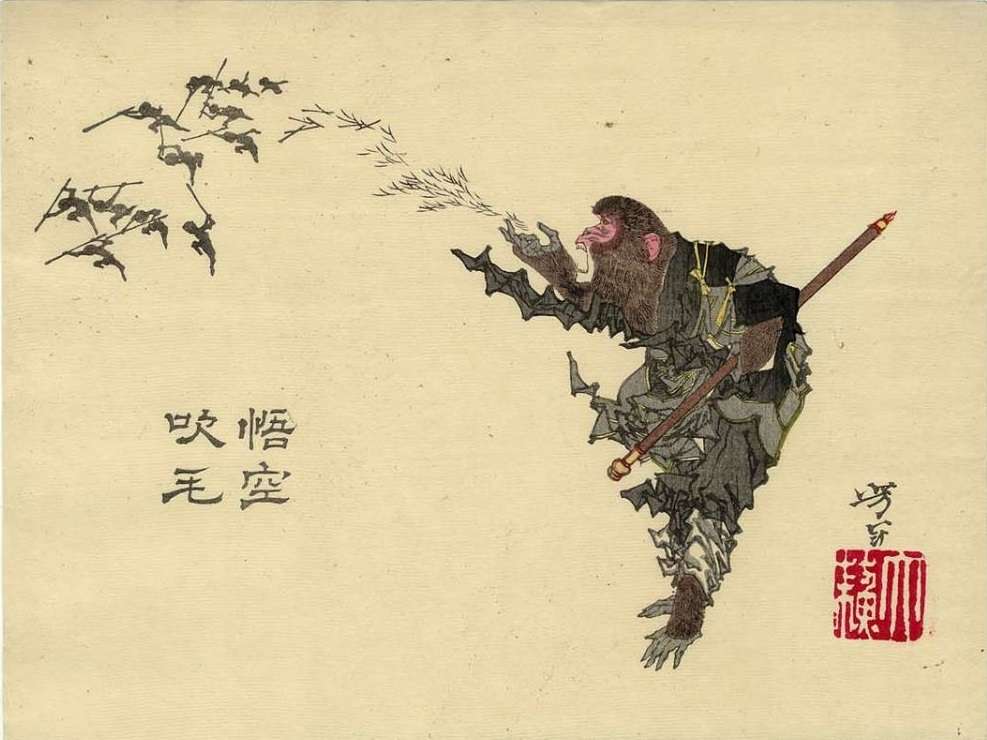
1:53 – 2:20 – Wukong lands in an explosion of multicolored clouds and light. He waves his staff in front of him, thus forcing the imps away from his brothers. He then pulls out magic hairs and blows on them, creating an army of monkeys to do battle with the imps. The monkeys do all manner of things to the imps while Wukong rolls around on the ground in laughter.

  • 1:58 – Wukong creates the army of monkeys. Also, notice how a few seconds in the notes sound almost like monkeys.

sc137582 - small

“Wukong Blows His Hair” (c. 1882) by Yoshitoshi (larger version).

2:21 – 2:26 – The imps run away in defeat. Monkey stands outside the cave screaming and hopping up and down while shaking his fist in order to entice the mountain demon outside.

  • 2:23 – Double hop while shaking fist and screaming obscenities. The words come out as Chinese characters. They could be “coward” or something demeaning like that. The particular sound of “bwah bwah” in the song at this point is when he screams and hops.
  • 2:26 – Second double hop, same.

2:27 – 2:31 – His trick works as the demon king pokes his head out of the doors and shakes his fist back at Wukong.

  • 2:28 – First fist shake and screams obscenity. Same “bwah bwah” sound but with lower register.
  • 2:31 – Second fist shake, same.

2:32 – 2:50 – The demon emerges with his armor and weapon ready to fight and the two begin their bout. The earth shakes, mountains crumble, forests tumble, and the gods shiver in the realm above.

2:51 – 3:08 – Both take to their clouds, the warriors circling each other, rising higher and higher into the heavens, leaving a double helix-like pattern in their wake.

3:09 – 3:12 – The demon makes one last attack with his weapon. Wukong disappears in a puff of smoke, only to reappear instantly in his 100,000-foot-tall cosmic form, breathing fire from a mouth full of tusk-like teeth, his eyes like the sun and moon. The demon realizes he is not Wukong’s match and flees in terror.

cosmic transformation

Monkey performs the cosmic transformation for his children (larger version). Original artist unknown. Found on this article.

3:13 – 3:16 – Wukong reverts to his original form and rockets towards earth with his staff held high.

3:17 – 3:21 – He lands a mortal blow to the demon and stands over his remains.

  • 3:17 – The exact moment the demon is turned into hamburger.

3:22 – 3:24 – Wukong kicks open the double door of the mountain stronghold. The view would be from the inside out (i.e. it’s dark and then the doors are kicked inward, revealing the dark silhouette of Monkey holding his staff against a bright background).

  • The “boom” at the end is when he kicks in the doors.

After the song stops, the animation silently ends with them all continuing their journey to India. The entire animation would probably be around three minutes and forty seconds long. I would really love to work with an animator to make this a reality.

Archive #16 – Sun Wukong and Chinese Medicine

Note: My blog is not monetized, so I am not making any money from this post. If you enjoyed the digital version, please, please, please support the official release.

Last updated: 09-22-2024

I noted in my previous article that medicine was among the skills acquired by Monkey while training under the Buddho-Daoist sage, Patriarch Subodhi. In Journey to the West (Xiyouji西遊記, 1592) chapters 68 to 69, Monkey works to diagnose the long-standing malady of the Scarlet-Purple Kingdom emperor. But due to the immortal’s monstrous appearance, Sun is forced to analyze the ruler from afar, using three magic hairs-turned-golden strings to measure the vibrations of the pulse from three locations of each forearm. He deduces that the illness is caused by fear and anxiety over the loss of the monarch’s queen, who had been kidnapped by a demon. Monkey then concocts three pills from a secret recipe and administers the elixir with dragon king saliva. The medicine causes the emperor to pass an obstruction in his bowels, thus restoring the natural qi flow in his body and curing him of his sickness.

Fig. 1 – Monkey uses golden threads to analyze the emperor’s pulse (larger version). From Mr. Li Zhuowu’s Literary Criticism of Journey to the West (late-16th century).

Table of Contents

1. Examples of Sun’s Medical Knowledge

1.1. Chapter 68

Monkey first assuages the fears of court officials by reciting a poem explaining the proper procedure for analyzing a patient:

Most mysterious is the physician’s art;
His mind must ever be alert and keen.
To look, listen, ask, and take-these four things If one is missing, his craft’s not complete.
One, we look at the patient’s complexion:
Is it moist, dry, fat, or thin in waking or sleep?
Two, we listen for clear or turbid voice
When he speaks lucid or frenetic words.
Three, we ask for the ailment’s cause and length.
For how he eats, drinks, and eliminates.
Four, we scan the conduits by taking the pulse,
To learn how submerged or floating in and out.
If we do not look, listen, ask, and take, In this life his ailment will ne’er him forsake!” (based on Wu & Yu, 2012, vol. 3, p. 268).

醫門理法至微玄,大要心中有轉旋。
望聞問切四般事,缺一之時不備全:
第一望他神氣色,潤枯肥瘦起和眠;
第二聞聲清與濁,聽他真語及狂言;
三問病原經幾日,如何飲食怎生便;
四才切脈明經絡,浮沉表裡是何般。
我不望聞並問切,今生莫想得安然。(source)

1.2. Chapter 69

Sun then follows through with the analysis:

We were telling you about the Great Sage Sun, who went with the palace attendant to the interior division of the royal palace. He stood still only after he had reached the door of the royal bedchamber. Then he told the attendant to take the three golden threads inside along with the instruction: “Ask one of the palace ladies or eunuchs to tie these three threads to the inch, the pass, and the foot sections of His Majesty’s left hand where the radial pulse are felt. Then pass the other ends of the threads out to me through the window shutters” [fig. 1].

The attendant followed his instruction. The king was asked to sit up on the dragon bed, while the three sections of his pulse were tied by the golden threads, and their other ends were then passed out to Pilgrim. Using the thumb and the index finger of his right hand to pick up one of the threads, Pilgrim first examined the pulse of the cun [寸] section; next, he used his middle finger and his thumb to pick up the second thread and examine the pulse of the guan [關] section; finally, he used the thumb and his fourth finger to pick up the third thread and examine the pulse of the chi [尺] section.

Thereafter Pilgrim made his own breathing regular and proceeded to determine which of the Four Heteropathic Pneumatics, the Five Stases, the Seven External Images of the Pulse, the Eight Internal Images of the Pulse, and the Nine Pulse Indications were present. [1] His pressure on the threads went from light to medium to heavy, and from heavy to medium to light, until he could clearly perceive whether the condition of the patient was repletion or depletion of energy and its cause. Then he made the request that the threads be untied from the king’s left wrist and be attached as before to the positions on his right wrist. Using now the fingers on his left hand, he then examined the pulse on the right wrist section by section. When he had completed his examination, he shook his body once and retrieved his hairs (based on Wu & Yu, 2012, p. 270).

話表孫大聖同近侍宦官到於皇宮內院,直至寢宮門外立定。將三條金線與宦官拿入裡面,吩咐:「教內宮妃后,或近侍太監,先繫在聖躬左手腕下,按寸、關、尺三部上,卻將線頭從窗櫺兒穿出與我。」真個那宦官依此言,請國王坐在龍床,按寸、關、尺,以金線一頭繫了,一頭理出窗外。行者接了線頭,以自己右手大指先托著食指,看了寸脈;次將中指按大指,看了關脈;又將大指托定無名指,看了尺脈。調停自家呼吸,分定四氣、五鬱、七表、八裡、九候、浮中沉、沉中浮,辨明了虛實之端。又教解下左手,依前繫在右手腕下部位。行者即以左手指,一一從頭診視畢,卻將身抖了一抖,把金線收上身來。

Finally he delivers a very detailed diagnosis:

“Your Majesty,” he cried in a loud voice, “on your left wrist the pulse of your cun section feels strong and tense, the pulse of your guan section feels rough and languid, and the pulse of your chi section feels hollow and sunken. On your right wrist the pulse of your cun section feels floating and smooth, the pulse of your guan section feels retarded and hesitant, and the pulse of your chi section feels accelerated and firm. Now, when the pulse of your left cun section feels strong and tense, it indicates an internal energetic depletion with pain in the cardiac system of functions. When the pulse of your left guan section feels rough and languid, it indicates sweating that has led to numbness in the flesh. When the pulse of your left chi section feels hollow and sunken, it indicates a pink tinge to your urine and blood in your stool. When the pulse of the cun section on your right wrist feels floating and smooth, it indicates a congestion blocking the pneumatic energy circulation and leading to cessation of menses. When the pulse of your right guan section feels retarded and hesitant, it indicates a stasis of alimentary matter in the stomach system with retention of fluids. When the pulse of your right chi section feels accelerated and firm, it indicates discomfort caused by sensations of stuffiness and chills caused by energetic depletion. To sum up, your illness has been caused by fear and anxiety, and it may be the manifestation type of an illness called the ‘Paired Birds in Severance’ [shuangniao shiqun, 雙鳥失群]” (based on Wu & Yu, 2012, vol. 3, pp. 270-271).

陛下左手寸脈強而緊,關脈濇而緩,尺脈芤且沉;右手寸脈浮而滑,關脈遲而結,尺脈數而牢。夫左寸強而緊者,中虛心痛也;關濇而緩者,汗出肌麻也;尺芤而沉者,小便赤而大便帶血也。右手寸脈浮而滑者,內結經閉也;關遲而結者,宿食留飲也;尺數而牢者,煩滿虛寒相持也。診此貴恙,是一個驚恐憂思,號為『雙鳥失群』之症。

Baring the strings, Monkey’s method of reading the pulse aligns with real Chinese medicinal practice. The area of the forearm analyzed by traditional Chinese doctors is known as cunkou (寸口, the “inch opening”), and this is broken up into the three spots cun (寸, “inch”), guan (關, “pass”), and chi (尺, “foot”) (fig. 2). The mirrored spots on each arm are believed to correspond to specific internal organs. For example, the cun spot (nearest the wrist) on the right hand corresponds to the lungs, while that of the left hand corresponds to the heart (Liao, 2011, pp. 55-56). Therefore, analyzing the pulse at these spots is believed to reveal the health of the corresponding organs.

Fig. 2 – The spots analyzed during pulse diagnosis (larger version). Picture originally found here.

2. The Elixir of Black Gold and its Historical Origins

Wukong selects his ingredients from among 808 requested substances in order to keep the recipe a secret from the foreign kingdom’s doctors. It is made from an ounce of powderized dahuang (大黃), which is said to “loosen phlegm and facilitate respiration [and] sweep out the chill and heat congealed in one’s stomach” (Wu & Yu, 2012, pp. 273-274); an ounce of shelled, powerderized badou (巴豆), which is said to “break up congestion and drain the intestines [and] take care of swellings at the heart and dropsy in the abdomen” (Wu & Yu, 2012, p. 274); half a flask of “Hundred-Grass Frost” (baicao shuang, 百草霜), or frying pan soot, which is said to “soothe a hundred ailments” (Wu & Yu, 2012, p. 274); and half a flask of dragon (horse) urine, which is said to “cure any kind of disease a human may have when it is ingested” (Wu & Yu, 2012, p. 274). The resulting paste is rolled into three pills and presented to the emperor as the “Elixir of Black Gold” (Wujin dan, 烏金丹) (video 1) (Wu & Yu, 2012, p. 276).

Video 1 – Episode 20 of the 1986 Journey to the West series portrays this story. See minute 19:19 for the preparation of the Elixir of Black Gold.

Andrew Schonebaum’s (2016) fascinating book Novel Medicine: Healing, Literature, and Popular Knowledge in Early Modern China explains the historical significance of the real world ingredients used in this elixir. He introduces the first two ingredients by way of their anthropomorphization as Badou Dahuang, the ruler of the fictional Hujiao (胡椒, black pepper) kingdom from the vernacular novel Annals of Herbs and Trees (Caomu chunqiu yanyi, 草木春秋演義, c. 17th/18th century), a work that gives human form to Chinese medicines, pitting armies of mortal, immortal, and demonic characters/remedies against one another. Badou is depicted as having the mandate of heaven (the right to rule) in his own country but wanting to invade the Han empire. This dual nature can be explained by the properties of the ingredients making up his name. Schonebaum (2016) writes:

[B]adou (croton) and dahuang (rhubarb), are two of the most common drugs in Chinese medicine. Badou is toxic and a strong purgative, and it was used to treat stagnation in the viscera and bowels, as well as to facilitate urination, eliminate malignant flesh, and purge vicious agents such as invading ghosts or worms. Dahuang is nontoxic and is sometimes referred to by the name “military general” because “the drug pushes away the old and brings in the new, like a military general putting down a riot and bringing peace” (pp. 99-100).

Regarding the “Elixir of Black Gold,” Schonebaum (2016) explains that “black gold” was the name of a common prescription and that badou and dahuang were part of its core, while other ingredients could be replaced with those of similar properties:

One commentator had never heard of this medicine, saying that it had a strange name, but this only reveals his own highbrow background (or general ignorance), since “black gold” was the name of various prescriptions common among hereditary doctors. In fact, it was mentioned in the Systematic Materia Medica repeatedly, and Xu Dachun recommends it in Medical Cases of Huixi, so it was not exclusively the purview of nonelite healers.

“Black gold pills” (wujin wan) was a name and a concoction similar to “elixir surpassing [the value of] gold” (shengjin dan) and “black spirit pills” (heishen wan). All of them were core formulas that could be modified in their effects by ingesting them with different liquids. These “black gold” medicines, along with the likes of “the prescription offering Guanyin’s all-encompassing help” (Guanyin puji fang) and “pills prepared with old ink” (gumo wan), treated a wide variety of ailments (in one medical manuscript, twenty-nine, forty, and seventy-one ailments, respectively), and were extremely common formula in the Qing. The “black gold” formulas had at their core the drugs dahuang and badou. One medical manuscript from the Republican period states in its introduction, “Black gold powder [wujin san] cures all ailments, just as the wind bends the grasses. Other names [of this prescription] are ‘pine smoke elixir’ [songyan dan] and ‘black spirit pills’ [heishen wan]. It cures thousands of illnesses, just as the sun melts the frost.”

Black gold pills (wan), powder (san), paste (gao), and elixir (dan) were commonly employed to cure gynecological issues. A prescription named “black gold powder” was first recorded in the Song work A Spring of Recipes in the Magic Park (Lingyuan fangquan) and was followed by references in the Southern Song prescription collection “Complete Collection of Effective Prescriptions for Women” (Furen daquan liangfang, 1237), Formulas for Universal Benefit (Puji fang, 1390), and other works. Over the centuries, numerous formulas, each with different ingredients, became known under the names “black gold powder,” “black gold pills,” and “black gold elixir.” The three designations of this formula result from the use of pitch (mo), a vernacular name for which is the “black gold” of these prescriptions.

Monkey’s prescription reflects a historical reality, namely that the advent of the imperial pharmacy (huimin yaoju) in the Song required doctors who had previously relied on simple medicines with one or two ingredients to employ formulas with numerous substances whose composition followed theories of systematic correspondences. From this conflict between empirical and theory-based recipes arose a new type of prescription eventually consisting of a nuclear formula that could be adapted to the requirements of a given patient’s disease by omitting or adding individual constituents in accordance with his pathological condition. Monkey is preparing simple, trusted medicine at the core, namely badou and dahuang, and adding to it many exotic, unobtainable ingredients (pp. 103-104).

As noted above, black gold medicines were sometimes used to treat gynecological issues. This makes Monkey’s prescription all the more comical as he had partly attributed the foreign emperor’s ails to a “cessation of the menses” (Wu & Yu, 2012, p. 271), obviously a woman’s problem. Schonebaum (2016) comments: “To understand this aspect of the carnivalesque comedy, or to realize that it was a mistake in the incorporation of medical materials into the novel, readers would have had to be quite familiar with medicine, at least enough to know that the medicine Monkey is preparing is consistent with his diagnosis” (p. 104).

Chapter three of Novel Medicine (2016) is archived here.

Click to access novel-medicine-healing-literature-and-popular-knowledge-in-early-modern-china-chapter-3-contains-jttw-ch.-68-69-material.pdf


4. Updates

4.1. Legendary Influence and Modern Ritual

Update: 09-22-24

As mentioned above, Sun Wukong analyzes the ailing king’s pulse from afar using three magic hairs-turned-golden threads. This is no doubt based on the story of the “Grand Emperor of Protecting Life” (Baosheng dadi, 保生大帝), the Daoist and folk religion god of medicine, curing an empress using the same method:

During the reign of Chengzu (1403–21), the Empress Wen suffered from an inflamed breast. A Taoist priest offered his skills, but the Emperor tested him by having him take her pulse with a string held on the other side of her bedroom wall. First the Emperor attached it to a cat. The Taoist said, “Not a bear, no not bear, it’s a cat.” Then the Emperor tied the string to a doorknob. The Taoist said that it was something of metal and wood, and not a human pulse. Finally, the Emperor tied the string to the woman’s breast and the Taoist said that the liver pulse was inflamed and the blood clotted, and that this indicated a breast infection which had to be treated by moxibustion. He offered to perform the operation by dangling a cord over the wall. He cured the ailment and vanished, refusing a reward of gold and office. In He Qiaoyuan’s version, the Emperor inquired about his name and discovered that he was the long-deceased Divine Doctor Wu Tao. In gratitude, the Emperor enfeoffed the god as Wanshou wuji baosheng dadi (Emperor Who Protects Life of Limitless Longevity) (Dean, 2014, p. 74).

What’s interesting is that this legend carried over into religious practices. A reader who contacted me in 2022 explains:

I observed a practice at [Sidian Xingji Temple (祀典興濟宮)] in Tainan where an individual would let the god Baosheng dadi check their pulse by resting three sticks of incense on their forearm. The temple brochure also mentions this procedure [fig. 3]. I believe this to be relevant to your article …

Fig. 3 – A detail from the aforementioned temple brochure showing the three incense sticks resting on a member’s wrist (larger version). Photo by Richard Malabarista.

Notes:

1) Yu (Wu & Yu, 2012) provides explanations for these terms in the end notes of his wonderful translation (pp. 448-449, n. 3-7).

Sources:

Dean, K. (2014). Taoist Ritual and Popular Cults of Southeast China. United States: Princeton University Press.

Liao, Y. (2011). Traditional Chinese medicine. Cambridge: Cambridge University Press.

Schonebaum, A. (2016). Novel Medicine: Healing, Literature, and Popular Knowledge in Early Modern China. Seattle: University of Washington Press

Wu, C., & Yu, A. C. (2012). The Journey to the West (Vol. 3) (Rev. ed.). Chicago, Illinois: University of Chicago Press.