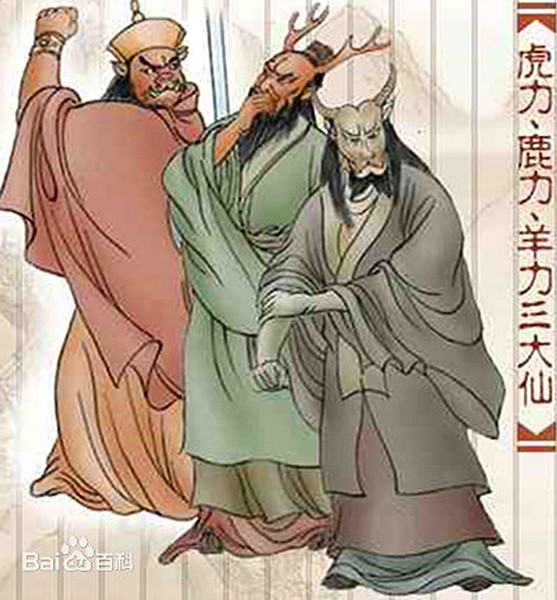
Chapters 44 to 46 of Journey to the West sees the pilgrims enter the Cart-Slow Kingdom (Chechi guo, 車遲國) where they find Buddhist monks have been enslaved by local Daoists to haul a cart full of materials up an impossibly narrow, steep, spine-like ridge in order to construct buildings behind an abbey. After some investigation, Sun Wukong discovers their enslavement is a royal punishment for losing a rain-making competition some years prior to three mysterious Daoist priests, Tiger Strength Great Immortal (Huli daxian, 虎力大仙), Deer Strength Great Immortal (Luli daxian, 鹿力大仙), and Goat Strength Great Immortal (Yangli daxian, 羊力大仙) (fig. 1). (For their victory in saving the country during a time of drought, the three priests are bestowed the royal titles “Precepts of State” (Guoshi, 國師).) Monkey and his brothers break into the abbey and trick the three priests, under the guise of the Three Pure Ones, into thinking their urine is heavenly elixir. The enraged priests then gain permission from the country’s ruler to engage our heroes in a series of magical competitions in order to defend their dignity. After aiding Tripitaka in contests of meditation and clairvoyance, the Great Sage personally faces each of the three priests in contests of surviving corporal punishment, namely beheading (vs Tiger Strength), evisceration (vs Deer Strength), and being boiled in oil (vs Goat Strength). Each priest dies as a result of having lesser magical skills born from heretical practices, and in the end they are revealed to have been animal spirits (a tiger, a deer, and a goat) in disguise. The country’s ruler releases the monks from their bondage and our pilgrims continue their journey to India.
Fig. 1 – A modern depiction of the three animal priests (larger version). Artist unknown.
Oldstone-Moore’s (1998) paper “Alchemy and Journey to the West: The Cart-Slow Kingdom Episode” explores the history and hidden meaning of the three chapters. She reveals certain aspects of the episode serve as allegories for internal alchemical processes. For background she explains Daoism sometimes presents the body as a microcosmic mountain landscape. In the case of the story, the ridge represents the spine and the building material being hauled by the monks represents unrefined qi, seminal essence, and spiritual energies that, when purified via circulation up the spine and down the front of the body numerous times, bolster the body and aids in the attainment of immortality. The cart itself represents a meditation technique used in the Quanzhen school of Daoism to transport the aforementioned energies up the spine. Interestingly, one Zhong-Lü scripture [1] notes this “River Cart” (heche, 河車) is pulled by a number of animals, including an oxen, a deer, and a goat. Therefore, Deer Strength and Goat Strength likely represent these animals. Oldstone-Moore (1998) suggests Tiger Strength is based on Uncle Eyes Great Immortal (Boyan daxian, 伯眼大仙), a tiger spirit appearing in an earlier version of the Slow-Cart Kingdom episode recorded in a 14th-century Korean primer on colloquial Chinese. Additionally, she highlights the conflict between orthodox and heretical practices in the episode. Sun Wukong is shown to have stronger magic because his early Daoist cultivation was guided by a teacher. This differs from the three priests, whose lesser abilities are the result of self study. So taken together, the episode is a warning that esoteric alchemical cultivation should only be pursued under the guidance of an initiated teacher.
Fig. 2 – A 14th-century painting of the Buddhist monk Amoghavajra (larger version). Image from Wikipedia.
Oldstone-Moore (1998) also mentions the rain-making competition between Buddhist and Daoists at the beginning of the episode is based on historical events. This is laid out by Yu (1987), who suggests it is based on Tang-era magic competitions between the Indo-Sogdian Buddhist monk Amoghavajra(Bukong, 不空) (fig. 2) and the Daoist Luo Gongyuan (羅公遠). What’s interesting is that, just like the three priests, Luo was also a Precept of State.
This has been posted for educational purposes. No malicious copyright infringement is intended. Please support the official release.
Notes:
1) This refers to teachings associated with the immortals Zhongli Quan and his student Lü Dongbin.
Sources:
Oldstone-Moore, J. (1998). Alchemy and Journey to the West: The Cart-Slow Kingdom Episode. Journal of Chinese Religions, 26(1), 51-66, DOI: 10.1179/073776998805306930
Yu, A. C. (1987). Religion and literature in China: The ‘Obscure Way’ in The Journey to the West In C. Tu (Ed.), Tradition and creativity: Essays on East Asian civilization (pp. 122-24). Publisher City, State: Publisher.
Upon Sun Wukong achieving immortality, his Buddho-Daoist master, Patriarch Subodhi, warns him of three calamities sent by heaven to kill those who defy their fate and attain eternal life. The Sage then offers to teach Monkey one of two forms of transformation in order to avoid this outcome by living in hiding. [1] The first form, called the “Multitude of the Heavenly Ladle” (Tiangang shu, 天罡數), contains thirty-six changes, while the second, the “Multitude of Earthly Fiends” (Disha shu, 地煞數), contains seventy-two. Our hero chooses the latter and quickly masters a set of secret oral formulas (koujue, 口訣). This becomes one of his signature abilities used throughout the narrative. Sun’s most famous use of the skill appears in chapter six when he battles Lord Erlang, a divine demon queller and fellow master of transformations (video 1).
Video 1 – Sun’s battle with Lord Erlang. From the great animated Classic Havoc in Heaven (1965).
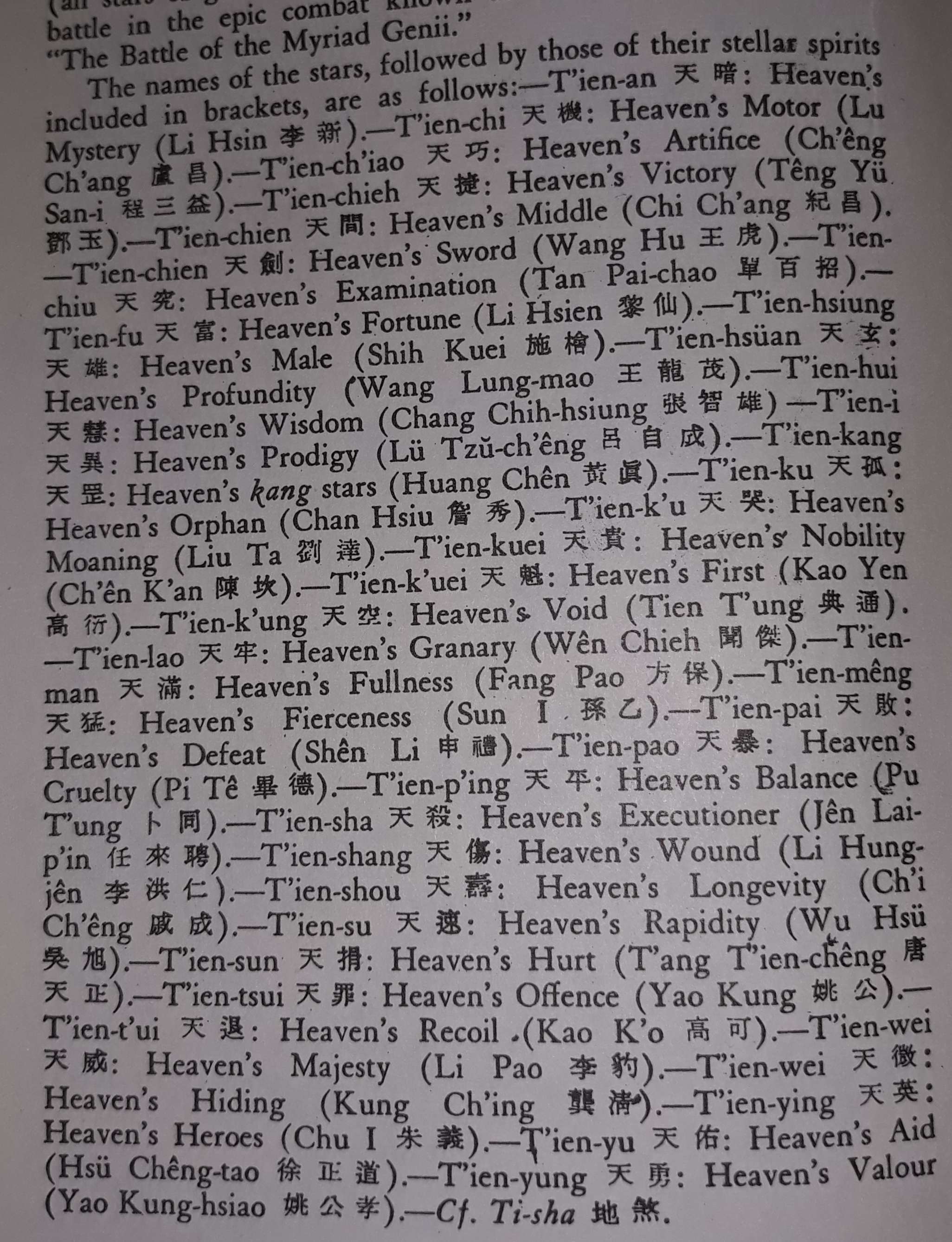
The names of the two forms of transformation that Subodhi offers to teach Monkey can be traced to Chinese astrology. The “Heavenly Ladle” (Tiangang, 天罡; i.e. the Big Dipper) is associated in some traditions with thirty-six stars (fig. 1). Regarding the origin of these stellar bodies, Werner (1932/1969) explains: “The gods of these stars (all stars of good omen) are all heroes who fell on the field of battle in the epic combat known as Wan Xian Zhen 萬仙陣, “The Battle of the Myriad Genii [or Immortals]” (p. 506). This is, of course, a reference to a famous military trap appearing in the Chinese classic Investiture of the Gods (Fengshen yanyi, 封神演義, c. 1620).
Fig. 1 – A list of the thirty-six Heavenly Ladle stars (larger version). Photograph of Werner, 1932/1969, p. 506. Apologies for not having access to a scanner at this time.
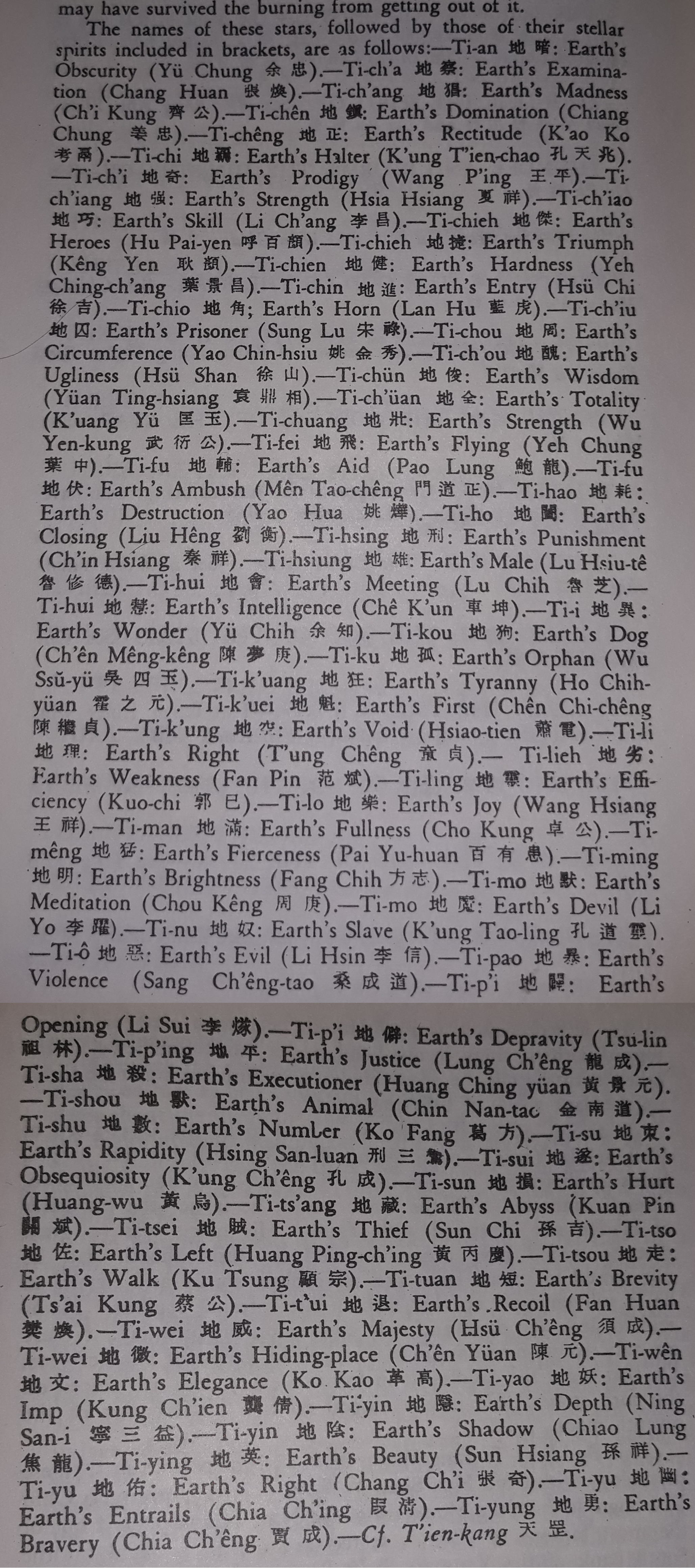
Furthermore, he writes that the “Earthly Fiends” (Disha, 地煞) are:
[S]eventy-two stars [fig. 2] of evil influence, opposed to the Tiangang. The wicked genii of these stars are cast out and slain by tongzi 童子 magicians [i.e. spirit mediums], who impale them on forks and shut them up in earthen jars, then take them to waste lands, throw them into fires, and surround the spot with a circle of lime, which is supposed to prevent any spirit which may have survived the burning from getting out of it (Werner, 1932/1969, p. 496). [2]
Fig. 2 – A list of the seventy-two Earthly Fiend stars (larger version). Photographs of Werner, 1932/1969, pp. 496-497.
Additionally, the Earthly Fiends are considered the “enemies of man, and causes of all diseases and ailments” (Doré & Kennelly, 1916, p. xviii). Several Buddho-Daoist folk talismans exist to ward afflictions caused by the Fiends. One such Buddhist talisman said to cure the “one hundred ailments” even invokes the thirty-six Heavenly Ladle stars to aid in the conquering of the seventy-two demons:
An order is hereby made by the “Ministry of the Thunderbolt”, commanding in the name of the “three religions” that the auspicious stellar gods, Tiangang 天罡, reduce to order the maleficent demons, Disha 地煞, who have caused this disease. The charm must also repress these malignant beings and expel them forthwith (fig.3) (Doré & Kennelly, 1916, p. 312).
Fig. 3 – A reproduction of the illness-curing Buddhist Talisman (larger version).
It’s interesting that Sun Wukong chooses the transformation method centered around stars of evil influence and later becomes a demon who challenges heaven. [3]Good fodder for fan fiction, no?
When these dichotomous stellar bodies were first acknowledged isn’t exactly clear, [4] but the Heavenly Ladle stars go back to at least the mid-13th century as they are mentioned in the Old Incidents in the Xuanhe Period of the Great Song Dynasty (Da Song Xuanhe Yishi, 大宋宣和遺事), a storytelling prompt of the late-Song to early-Yuan. It contains the earliest stories associated with the Water Margin (Shuihu zhuan, 水滸傳, c. 1400), a Chinese classic that predates Journey to the West. The one hundred and eight heroes of this novel are famous for being reincarnations of the Heavenly Ladle and Earthly Fiend stars, a fact revealed in chapter seventy-one when a heaven-sent stone slab is found to list their human names along with the corresponding stellar titles. The long association of the stars with the hugely popular Water Margin novel, therefore, may have inspired the names for the techniques taught by Subodhi in Journey to the West.
2. Ties to Daoist Practices
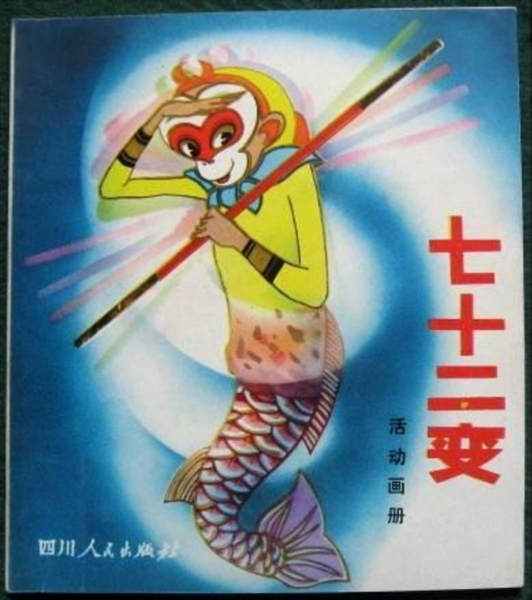
Robinet (1979) expertly explains that transformation (bianhua, 變化), or “metamorphosis” as she calls it, is central to Daoism. Gods and Saints are portrayed in Daoist literature as being in constant flux, changing with the seasons, taking on different guises and titles, disappearing and reappearing, never remaining the same, thereby living eternally. Daoists and magicians achieve metamorphosis through external and internal alchemical processes, the former involving the ingestion of drugs and talismans and the latter via mental exercises. Those who succeed in their practice can divide themselves endlessly; create rivers, mountains, and forests from meager samples of water, earth, and seeds; and most importantly, change their form into anything (fig. 4), including the five elements, dragons, clouds, rays of light, or even celestial bodies like the sun and moon.
Fig. 4 – The cover of a vintage children’s flip book about Monkey’s transformations (larger version). Here he is seen changing into a fish.
Interestingly, transformations could be used to live in hiding, much like originally intended by Subodhi in Journey to the West. Adepts still questing for immortality could magically transform a sword, staff, or slipper into their deceased body, thereby faking death and escaping elsewhere to find a method leading to eternal life. (Often times, those who took this route assumed a new identity to avoid heaven’s gaze (Campany, 2005)). Additionally, sages are said to use their powers to hide in the earth or in the light of the sun, moon, and stars. One source mentions adepts hiding by scattering their shadow and transforming it into seventy-two types of light. In a related book chapter, Robinet (1993) notes that this number “alludes to [Laozi’s] seventy-two supernatural marks” (clearly borrowing from the Buddhist Mahapurusa laksana) (p. 166). This is fascinating as it shows that there is precedent for seventy-two transformations in Daoism.
2.1. Archive Link for Robinet (1979)
I have archived the wonderful paper on metamorphosis cited above. It can be read here:
This has been posted for educational purposes. No malicious copyright infringement is intended. Please support the official release.
3. Update
Update: 06-12-22
I recently posted an in-depth article about the Patriarch Subodhi in which I reveal information about the additional benefits of the 72 Transformations. Anyone involved in any upcoming “What if” battles involving the Monkey King (COUGH, COUGH!) would do well to take note of this information.
Subodhi teaches this skill to Monkey with the expressed purpose of helping him hide from three calamities of cosmic lightning, fire, and wind sent by heaven to destroy immortals for defying fate and achieving eternal life. But beyond the power of metamorphosis, the novel implies that the ability also grants the user multiple lives (similar to a video game), which might serve as a buffer against the calamities. For example, in chapter 41, after Sun passes out from Red Boy‘s fiery attack, Zhu Bajie reassures everyone by saying: “If he is capable of seventy-two transformations, he has seventy-two lives” (Wu & Yu, 2012, vol. 2, p. 232). Also, in chapter 46, Monkey magically regrows his head after being non-fatally beheaded in a contest of magical skill. Sha Wujing remarks: “If he knows seventy-two ways of transformation, … he may have altogether seventy-two heads!” (Wu & Yu, 2012, vol. 2, p. 308). [5] In addition, while not directly related to the primate hero, the Bull Demon King is said in chapter 61 to also know the 72 changes (Wu & Yu, 2012, vol. 3, p. 148). He uses the extra lives to survive being beheaded by Prince Nezha a number of times:
[Nezha] leaped onto the bull’s back and brought his monster-cleaving sword down on the bull’s neck: the bull was beheaded at once. Putting away his scimitar, the devaraja was about to greet [Sun Wukong] when another head emerged from the torso of the bull, his mouth belching black air and his eyes beaming golden rays. [Nezha] lifted his sword once more and cut off the bull’s head; as soon as it dropped to the ground, another head came out. It went on like this more than ten times. At last, [Nezha] took out his fiery wheel and hung it on the Bull’s horn. The wheel at once started a great blaze of true immortal fire, which burned so fiercely that the bull began to growl and roar madly, shaking his head and wagging his tail (Wu & Yu, vol. 3, p. 160).
Notes:
1) It should be noted that the calamities are sent every five hundred years. Sun never has to live in hiding, though, as he is trapped under Five Elements Mountain upon the five hundredth anniversary of his immortality. (He was almost 350 years old prior to taking up spiritual cultivation.) And he achieves Buddhahood prior to reaching the one thousandth year of his immortality, so he never has to guard against subsequent calamities.
3) Conversely, Zhu Bajie is shown capable of thirty-six transformations (Wu & Yu, 2012, vol 2, p. 328, for example), meaning that he studied the method associated with the stars of good omens. And, of course, we know his sordid story …
4) Though, in my opinion, the thirty-six stars are likely based on the thirty-six generals led by the stellar exorcist, Marshal Tianpeng (天蓬, i.e. Zhu Bajie’s former incarnation), who is himself one of the nine stars of the Big Dipper. The Marshal and his generals appear in the liturgy of the Song-era “Correct Method of the Celestial Heart” (Tianxin zhengfa, 天心正法) exorcist tradition (Anderson, 2008).
5) Thank you to Irwen Wong of the Journey to the West Library blog for bringing these examples to my attention.
Sources:
Anderson, P. (2008) Tianxin zhengfa In F. Pregadio (ed.), The encyclopedia of Taoism: Vol 1-2 (pp. 989-993). Longdon: Routledge.
Campany, R. (2005). Living off the Books: Fifty Ways to Dodge Ming 命 [Preallotted Lifespan] in Early Medieval China In C. Lupke (Ed.), The Magnitude of Ming: Command, Allotment, and Fate in Chinese Culture (pp. 129-150). University of Hawaii Press.
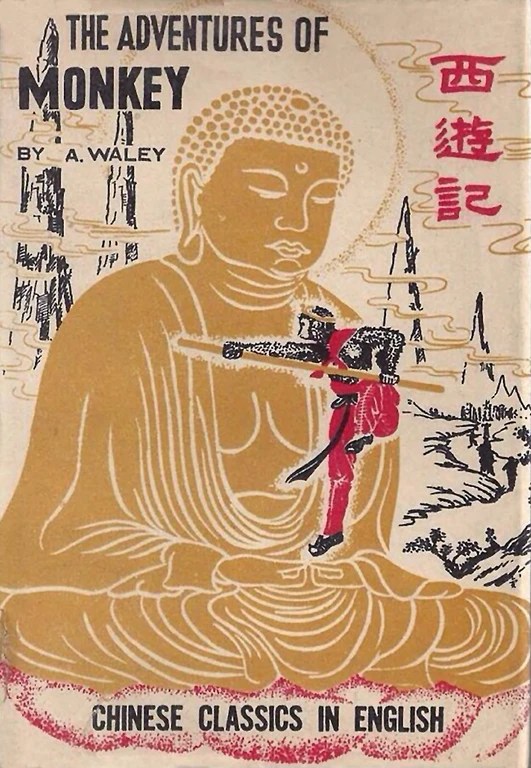
A few weeks ago I was looking for an image to complement an article I was working on and noticed that Arthur Waley‘s Monkey (1942), his classic 30-chapter abridged translation of Journey to the West, has many different cover designs. I decided to collect the more interesting ones here for others to enjoy. Three are adaptations of Monkey by his second wife, Alison Waley.
(Click images to enlarge)
Monkey (George Allen & Unwin Ltd., 1942)
The Adventures of Monkey (Chinese Classics in English, 1942)
Note: My blog is not monetized, so I am not making any money from this post. My hope is that these PDFs will make this legendary story more accessible to a wider audience. If you enjoyed the digital version, please, please, please support the official release.
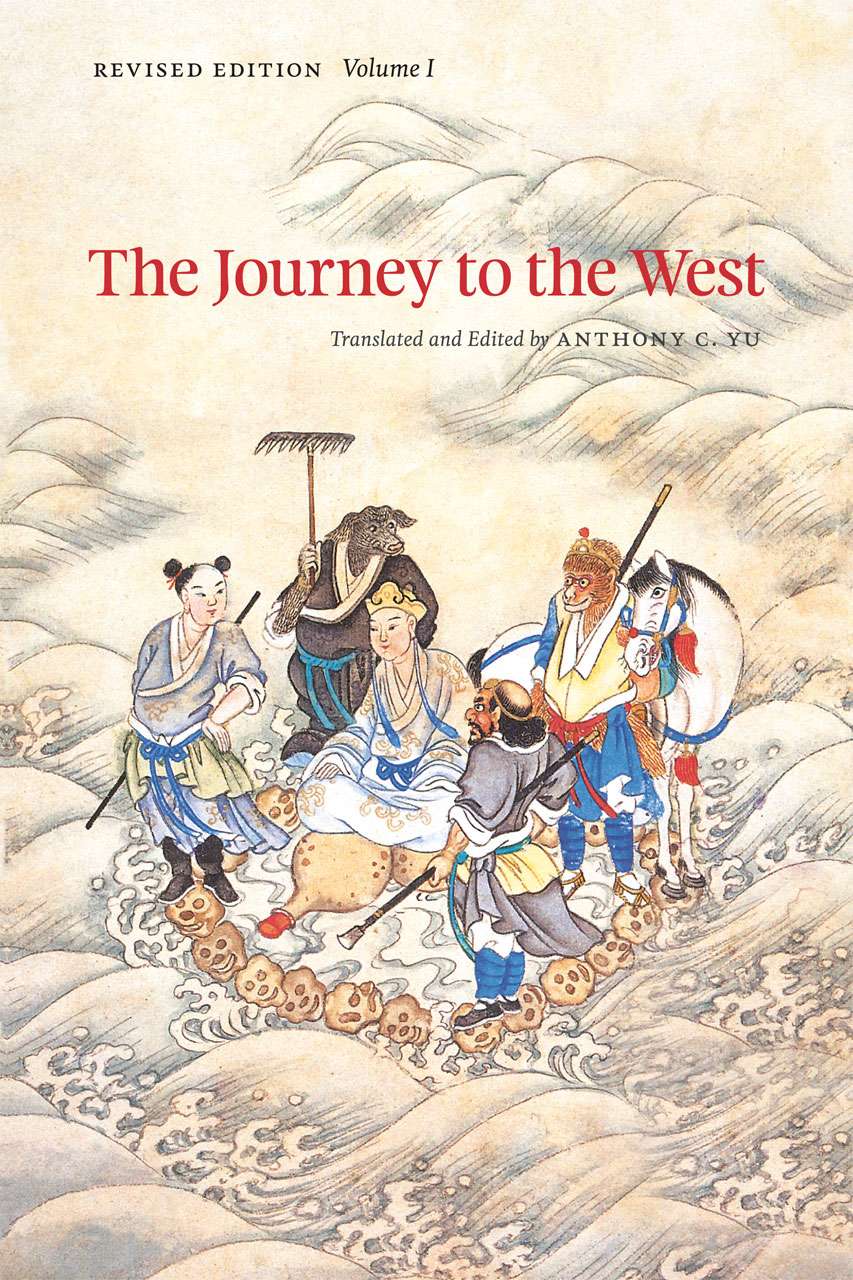
Here I present PDFs comprising the complete four volume 2012 revised edition of The Journey to the West(Xiyouji, 西遊記)translated by Anthony C. Yu (October 6, 1938 – May 12, 2015). This is considered THE most accurate translation of the tale available. I hope those who read and enjoy the digital version will support the official release.
Yu was Carl Darling Buck Distinguished Service Professor Emeritus in the Humanities and Professor Emeritus of Religion and Literature in the Chicago Divinity School. I shared a long email correspondence with Prof. Yu, during which we became friends. He was always quick to answer my many questions. His translation remains a treasure trove of explanatory notes and sources.
Anthony C. Yu’s translation of The Journey to the West, initially published in 1983, introduced English-speaking audiences to the classic Chinese novel in its entirety for the first time […] With over a hundred chapters written in both prose and poetry, The Journey to the West has always been a complicated and difficult text to render in English while preserving the lyricism of its language and the content of its plot. But Yu has successfully taken on the task, and in this new edition he has made his translations even more accurate and accessible. The explanatory notes are updated and augmented, and Yu has added new material to his introduction, based on his original research as well as on the newest literary criticism and scholarship on Chinese religious traditions. He has also modernized the transliterations included in each volume, using the now-standard Hanyu Pinyin romanization system. Perhaps most important, Yu has made changes to the translation itself in order to make it as precise as possible (source).
Different mythologies and fictional universes have their own magical metals. For example, Marvel’s Asgardians have Uru, and the elves of Middle-earth have Mithril. The great Chinese classic Journey to the West (Xiyouji, 西遊記, 1592 CE) hosts a long list of magical weapons, armor, and objects made from all kinds of metal (steel, iron, brass, gold, silver, etc.). A specific type is called Bin iron or Bin steel (bin tie, 鑌鐵), and it is mentioned several times in the narrative.
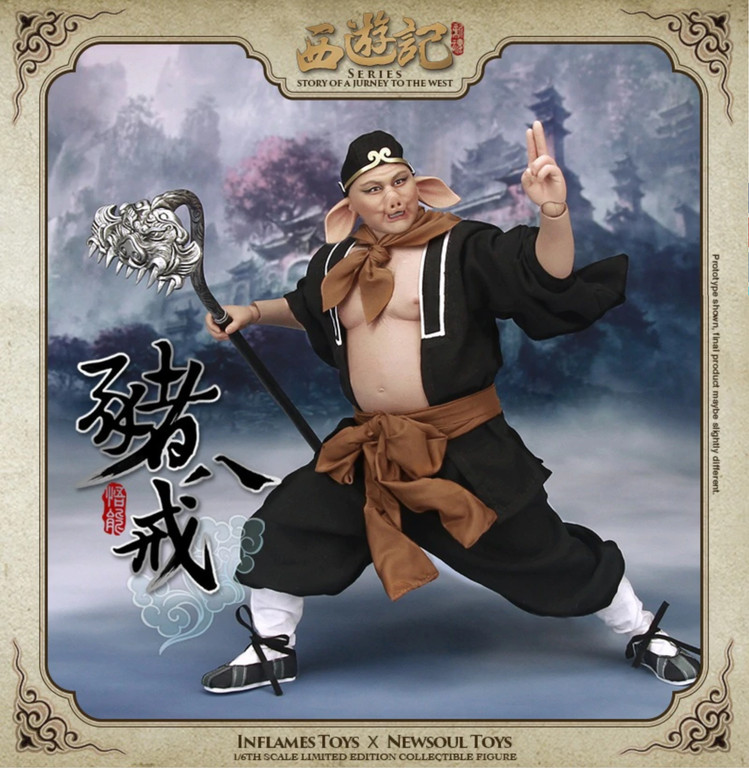
When Zhu Bajie first faces Sun Wukong in combat, he recites a poem praising the celestial origin of his weapon (fig. 1).
This is divine ice steel greatly refined,
Polished so highly that it glows and shines.
Laozi wielded the large hammer and tong;
Mars himself added charcoals piece by piece.
Five Kings of Five Quarters applied their schemes;
Twelve Gods of Time expended all their skills.
They made nine prongs like dangling teeth of jade,
And brass rings were cast with dropping gold leaves.
[…] (Wu & Yu, 2012, vol. 1, p. 382)
The “divine ice steel” (shen bing tie, 神冰鐵) is likely an error for “divine Bin steel” (shen bin tie, 神鑌鐵) as bing (冰) and bin (鑌) sound similar. This may also have something to do with the snowflake-like grain pattern of Bin steel (see sections two and three below). Take note that the metal is associated with Laozi and his furnace. We will see this association again.
Fig. 1 – A modern action figure of Zhu Bajie with his battle rake (larger version.
Chapter 34
On the cusp of his battle with the Monkey King, the demon King Silverhorn (Yinjiao wang, 銀角王) is described as wearing polished armor made from the material.
He wears a phoenix helmet white than snow
And armor made of bright Bin steel. [1]
The belt on his waist is dragon’s tendon.
Plum-flower shaped gaiters top his goat-skin boots.
He seems the living Lord of Libation Stream;
He looks no different from Mighty Spirit.
He holds in his hands the sword of seven stars,
Stern and imposing in a towering rage (Wu & Yu, 2012, vol. 1, p. 127).
The monster is later revealed to be one of two young attendants of Laozi’s furnace sent by heaven to test the resolve of the pilgrims (Wu & Yu, 2012, vol. 2, p. 145).
Chapter 75
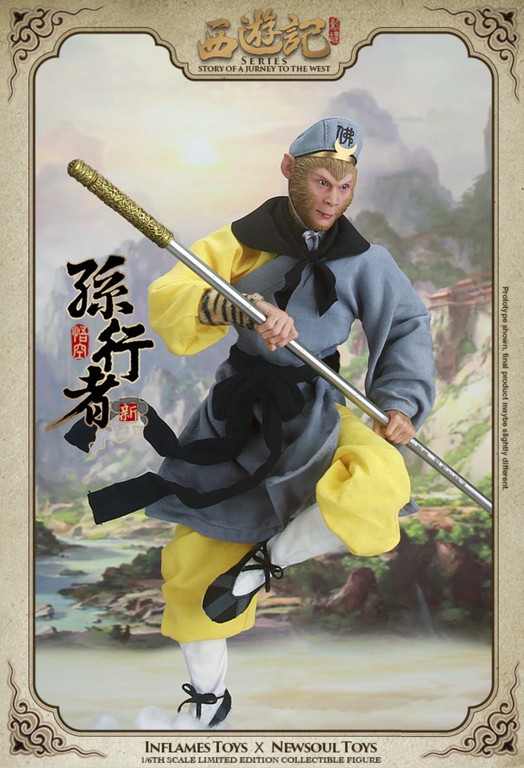
The Monkey King recites a poem about his divine staff (fig. 2) prior to battling a lion demon.
The rod of [Bin] steel nine cyclic times refined
Was forged in the stove by Laozi himself.
King Yu took it, named it “Treasure Divine,”
To fix the Eight Rivers and Four Seas’ depth.
In it were spread out tracks of planets and stars,
Its two ends were clamped in pieces of gold.
Its dense patterns would frighten gods and ghosts;
On it dragon and phoenix scripts were drawn.
Its name was one Rod of Numinous Yang,
Stored deep in the sea, hardly seen by men.
Well-formed and transformed it wanted to fly,
Emitting bright strands of five-colored most.
[…] (Wu & Yu, 2012, vol. 3, p. 375)
Here again we see Laozi is associated with the material.
Fig. 2 – A modern action figure of Sun Wukong with his magic staff (larger version).
2. The Metal of Heroes
I want to reiterate the fact that Zhu Bajie and Sun Wukong, two of Tripitaka’s three main disciples and bodyguards, have weapons made from Bin steel (Sha Wujing’s staff is made from a heavenly tree). Each is the product of Laozi refining Bin steel in his magic furnace and smelting the polearms by hand. Just like dwarves imbued Thor’s uru-metal hammer with magical abilities, so too did the high god of Daoism for Zhu and Sun’s weapons. Each has supernatural durability and the power of transformation. In fact, the Monkey King’s staff is one of the strongest weapons in the entire novel, making its association with Bin steel very important. After all, a great hero requires a great weapon.
Another example of a hero wielding a Bin steel weapon is Wu Song (武松) from the classic Chinese novel the Water Margin (Shuihu zhuan, 水滸傳, c. 1400; a.k.a. “Outlaws of the Marsh” or “All Men Are Brothers”). The former constable-turned-outlaw comes into possession of a pair of Buddhist sabers (fig. 3) made from “snowflake [pattern] Bin steel” (xuehua bintie jiedao, 雪花鑌鐵戒刀) and housed in a sharkskin sheath. [2] They are described as being made from the “finest steel, and obviously hadn’t been made in a day” (Shi & Luo, 1993/2001, vol. 2, p. 580). In addition, the blades are said to “often groan in the night” (Shi & Luo, 1993/2001, vol. 2, p. 640), suggesting a magical, sentient longing for combat. Wu later sates this desire by using the sabers in a prolonged skirmish with an evil Daoist priest, eventually beheading the brigand with a single strike (Shi & Luo, 1993/2001, pp. 643-645).
Fig. 3 – A modern drawing of Wu Song with his Buddhist sabers (larger version).
3. Real World History
Wagner (2008) suggests that the name Bin (鑌) is a transliteration of a foreign term, possibly the Sanskrit word Piṇḍa, meaning “steel” or “lump” (p. 270). The material is mentioned in Chinese records of the 6th and 7th centuries as being imported from Persia (Bosi, 波斯) and Jaguda (Cao, 漕, modern day Ghazni) in Afghanistan. Mentions of the metal strangely disappear for centuries, only to reappear in early-10th century records. This is possibly due to the disruption of Persian trade wrought by the Islamic conquest of Persia and the subsequent rise of Muslim trade with the east. Bin steel is believed to have originally been transported in a raw “lump” state prior to smelting in China. But the secret of its manufacture eventually reached the Middle Kingdom, for a 12th-century report shows that the metal was produced in Inner Mongolia. The early Yuan government is known in 1275 to have established the “Office for Bin iron” (Bintie ju, 鑌鐵局), which possibly catered to elite blacksmiths (Wagner, 2008, pp. 268-272).
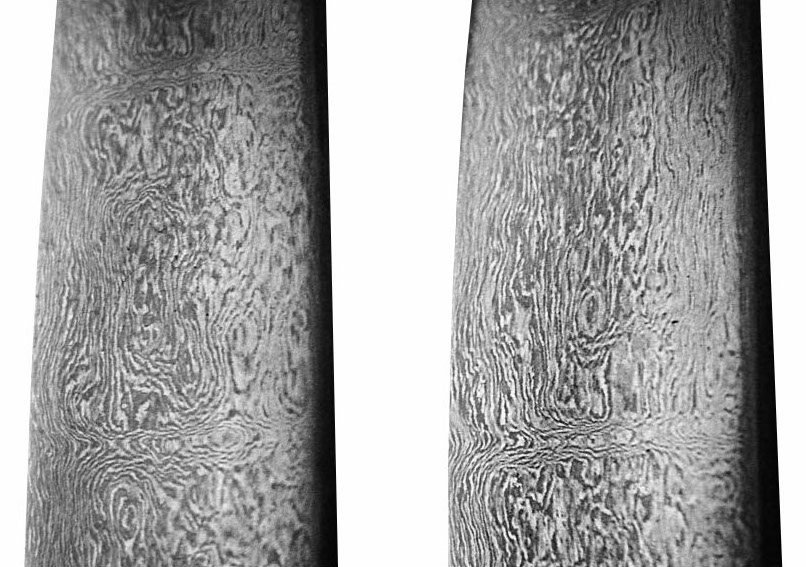
Fig. 4 – Persian-made Damascus steel blades of the 13th century (larger version). Take note of the intricate grain pattern. Bin steel was known to have various patterns (see below).
The best description of the material comes from Cao Zhao’s (曹昭) The Essential Criteria of Antiquities (Gegu yaolun, 格古要論, 1368), an early guide for connoisseurs.
Bin iron: It is produced by the Western Barbarians. Some [types] have a spiral self-patterning, while others have a sesame-seed or snowflake patterning. When a knife or sword is wiped clean and treated with ‘gold thread’ alum, [the pattern] appears. Its value is greater than silver.
An ancient saying holds that “knowing the strength of iron is like knowing gold” [i.e., the ability to judge the properties of steel is as valuable as the ability to assay the purity of gold]. Forgeries have a black patterning. One should examine [a steel object] very carefully.
There are three rules for knives. The first is that in the blade there should be perfect control of fire, metal, and water [i.e., the blade should be correctly quench-hardened and tempered]. The second is that the haft should be of xichi wood from the Western Barbarians, and the third is that the sheath should be of Tatar birchbark.
I once had a pair of scissors of bin iron, of exquisite workmanship. It had a raised gilt pattern on the inside, and on the outside a silver-inlaid inscription in Islamic characters (Wagner, 2008, p. 271).
So we see that Bin steel is comparable to Damascus steel (fig. 4), as both require quench-hardening and produce a number of intricate grain patterns visible after an acid treatment. One such pattern is the snowflake pattern associated with Wu Song’s sabers (and possibly Zhu Bajie’s rake). Most importantly, the metal was considered an exceptionally fine steel. One general is described as boasting that rebels would “have to nick (chi, 齒) his sword of bin iron” if they wished to rise up (Wagner, 2008, p. 269). [3] I take this statement to be symbolic of his unbreakable resolve. At the same time, it shows that Bin steel was considered exceptionally durable.
Highly durable Bin steel weapons could have seemed like magic in comparison to those made from lesser quality metal. Therefore, it’s interesting that Journey to the West presents the metal being smelted by a god in his magic furnace. It seems only natural that a magical forge would produce the finest steel. In fact, after the 10th century, the very name Bin steel came to be used as a term for any type of exquisite steel (Wagner, 2008, p. 271). Therefore, the author-compiler of Journey to the West may have been using it in that sense instead of referring to imported Persian steel.
4. Updates
Update: 02-06-21
I have written an article that discusses the magic powers of the staff. These include the ability to shrink and grow, control the ocean, astral project and entangle with Monkey’s spirit, multiply endlessly, pick locks, and transform into various objects. It also has sentience to a certain degree.
1) Yu’s (Wu & Yu) original translation says “bright Persian steel” (vol. 1, p. 127).
2) While the Water Margin presents them as sabers, Buddhist knives (jiedao, 戒刀, lit: “precept knife”) were historically small, unadorned, curved, finger-length blades used for cutting robes, trimming fingernails, opening wounds, or slicing food (Yifa, 2009, p. 250, n. 37).
3) Wagner (2008) states that the story is listed as coming from the 9th century but the housing source is from the 11th century (p. 269, n. 103). Therefore, it likely originates after the reappearance of Bin steel in Chinese records during the early-10th century.
Sources
Shi, N., & Luo, G. (2001). Outlaws of the Marsh (Vols. 1-4) (S. Shapiro, Trans.). Beijing: Foreign Languages Press. (Original work published 1993)
Wagner, D. (2008). Science and Civilisation in China: Volume 5, Chemistry and Chemical Technology, Part 11, Ferrous Metallurgy. Cambridge: Cambridge Univ. Press.
Wu, C., & Yu, A. C. (2012). The Journey to the West (Vols. 1-4) (Rev. ed.). Chicago, Ill: University of Chicago Press.
Yifa. (2009). The Origins of Buddhist Monastic Codes in China: An Annotated Translation and Study of the Chanyuan Qinggui. Honolulu: University of Hawai’i press.