The Crow’s Nest Chan Master of Journey to the West

Last Updated: 04-12-25

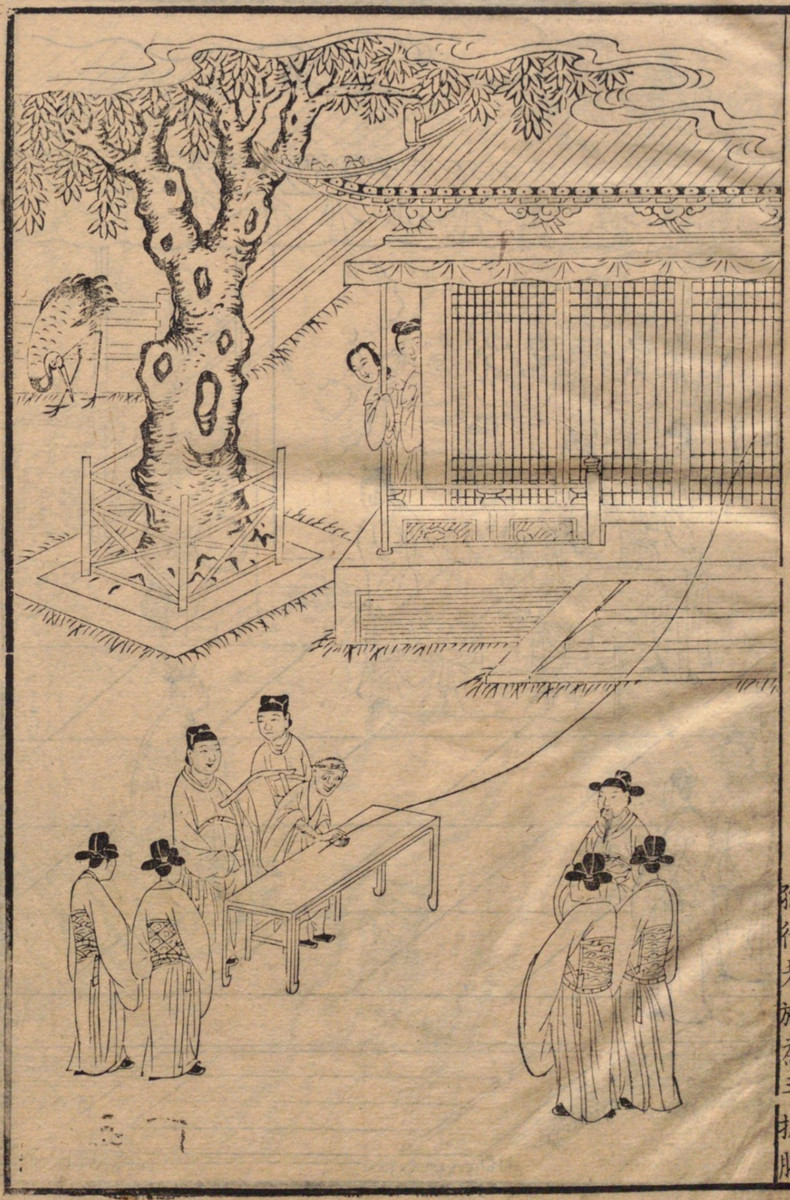
The end of Journey to the West (Xiyouji西遊記; “JTTW” hereafter) chapter 19 contains a strange, seemingly throwaway character called the “Crow’s Nest Chan Master” (Wuchao chanshi, 烏巢禪師) (fig. 1). Having met the Buddhist sage in the past, Zhu Bajie describes him as an accomplished cultivator who lives in a nest atop a juniper tree on Pagoda Mountain (Futu shan, 浮屠山), just beyond the border of Tibet (Wusizang, 烏斯藏). [1] Zhu also claims to have been invited by him to jointly practice austerities, but the pig-spirit passed on the opportunity (Wu & Yu, 2012, vol. 1, p. 388).

The pilgrims soon thereafter run into Crow’s Nest on their trek through his mountain, and following a brief chat, he orally passes on the Heart Sutra (Mohe bore boluomiduo xinjing, 摩訶般若波羅蜜多心經) to Tripitaka (Wu & Yu, 2012, vol. 1, pp. 389-390). This lesson is referenced a few times in later chapters. [2]

Here, I’d like to explore the sage’s powers and real world history, as well as to suggest a possible reason for why the novel associates him with Zhu Bajie.

Fig. 1 – A woodblock print of the Crow’s Nest Chan Master (larger version). From the Newly Annotated Journey to the West With Illustrations (Xinshuo Xiyouji tuxiang, 新說西遊記圖像, 1888).

Table of Contents

1. Interesting facts

1.1. Powers

The first thing that interests me about the Chan Master is his supernatural abilities. He demonstrates his clairvoyance by reciting a poem [3] in which foretells some of the evils that the pilgrims will face on their quest. For example, one section reads: “Monsters all mountains populate; / Old tigers sit as magistrates; / Graying wolves act as registrars. / Lions, elephants—all called kings!” (Wu & Yu, 2012, vol. 1, p. 391). The last line likely references the lion and elephant demon kings appearing in JTTW chapters 74 to 77.

Another part predicts the coming of Sha Wujing. The section reads: “A wild pig totes a hauling pole; / You’ll meet ahead a water sprite. / An old stone ape of many years / Now nurses over there his spite!” (Wu & Yu, 2012, vol. 1, p. 391). You’ll notice that Crow’s Nest spins his prediction between taking jabs at Zhu and Wukong. Monkey was already upset with him at this point for not recognizing the Great Sage’s fame, so this afront leads the primate immortal to strike out.

This leads to another display of power. In response to the attack, the cultivator uses defensive magic to protect himself:

The Chan Master, changing into a beam of golden light, went straight up to his crow’s nest, while the priest [Tripitaka] bowed toward him to express his gratitude. Enraged, Pilgrim lifted his iron rod and thrust it upward violently, but garlands of blooming lotus flowers were seen together with a thousand-layered shield of auspicious clouds. Though Pilgrim might have the strength to overturn rivers and seas, he could not catch hold of even one strand of the crow’s nest (Wu & Yu, 2012, vol. 1, p. 391).

那禪師化作金光,徑上烏巢而去。長老往上拜謝,行者心中大怒,舉鐵棒望上亂搗,只見蓮花生萬朵,祥霧護千層。行者縱有攪海翻江力,莫想挽著烏巢一縷籐。

This reminds me of an event from Acts of the Buddha (Sk: Buddhacarita; Ch: Fo suoxing za佛所行讚, 2nd century), an ancient biography of the Tathagata:

The host of Mara hastening, as arranged, each one exerting his utmost force, taking each other’s place in turns, threatening every moment to destroy [the Buddha, but] … Their flying spears, lances, and javelins, stuck fast in space, refusing to descend; the angry thunderdrops and mighty hail, with these, were changed into five-colour’d lotus flowers…” (Beal, 1883, pp. 152 and 153).

魔眾相駈策, 各進其威力,
迭共相催切, 須臾令摧滅,

[…]

飛矛戟利矟, 凝虛而不下,
雷震雨大雹, 化成五色花 …

The similarities suggest that Crow’s Nest is also an enlightened being like the Tathagata.

1.2. History

The second thing that interests me is that the Chan Master is based on a historical monk, Niaoke Daolin (鳥窠道林, lit: “Bird’s Nest in the Forest of the Way”; 741–824), who was born nearly 80 years after the death of the historical Xuanzang (on whom Tripitaka is based) (Buswell & Lopez, 2014, pp. 1015-1016). His full biography appears in the Records of the Transmission of the Lamp (Jingde chuandenglu, 景德傳燈錄, 1004–1007):

Chan master Niaoke Daolin … was from Fuyang in Hangzhou and his family name was Pan. His mother, whose maiden name was Zhu, once dreamt of the rays of the sun entering her mouth, after which she conceived. When the baby was born a strange fragrance pervaded the room, so the name ‘Fragrant Light’ was given to the boy. He left the home life at the age of nine and received the full precepts at the Guoyuan Temple in Jing (Jingling, Hubei) when he was twenty-one years old. Later he went to the Ximing Monastery in Chang’an to study the Huayan Jing (Avataṃsaka Sūtra) and the Śāstra on the Arising of Faith (Śraddhotpada Śāstra, Aśvagosa) under the Dharma Teacher Fuli, who also introduced him to the Song of the Real and Unreal, and had him practise meditation.

Once Niaoke asked Fuli, ‘Could you say how one meditates and how to exercise the heart?’

Teacher Fuli was silent for a long time, so then the master bowed three times and withdrew.

It happened that at this time Tang Emperor Taizong had called the First Teacher in the Empire [Daoqin] of Jing Mountain to the Imperial Palace and Daolin went to pay him a formal visit, obtaining the True Dharma from him.

Returning south the master first came to the Yongfu Temple on Mount Gu (Zhejiang), where there was a stūpa dedicated to the Pratyekabuddhas. At this time both monks and laymen were gathering there for a Dharma-talk. The master also entered the hall, carrying his walking stick, which emitted a clicking sound. There was a Dharma-teacher present from a temple called Lingying, whose name was Taoguang, and who asked the master, ‘Why make such a sound in this Dharma-meeting?’

‘Without making a sound who would know that it was a Dharma-meeting?’ replied the master.

Later, on Qinwang Mountain, the master saw an old pine tree with lush foliage, its branches shaped like a lid, so he settled himself there, in the tree, which is why the people of that time called him Chan Master Niaoke (Bird’s Nest). Then magpies made their nest by the master’s side and became quite tame through the intimacy with a human – so he was also referred to as the Magpie Nest Monk.

One day the master’s attendant Huitong suddenly wished to take his leave. ‘Where are you off to then?’ asked the master.

‘Huitong left the home life for the sake of the Dharma, but the venerable monk has not let fall one word of instruction, so now it’s a question of going here and there to study the Buddha-dharma,’ replied Huitong.

‘If it could be said that there is Buddha-dharma,’ said the master, ‘I also have a little here,’ whereupon he plucked a hair from the robe he was wearing and blew it away. Suddenly Huitong understood the deep meaning.

During the Yuan reign period (806–820 CE) Bai Juyi was appointed governor of this commandery and so went to the mountain to pay the master a courtesy call. He asked the master, ‘Is not the Chan Master’s residing here very dangerous?’

‘Is not your Excellency’s position even more so?’ countered the master.

‘Your humble student’s place is to keep the peace along the waterways and in the mountains. What danger is there in that?’ asked Bai Juyi.

‘When wood and fire meet there is ignition – the nature of thinking is endless,’ replied the master, ‘so how can there not be danger?’

‘What is the essence of the Buddha-dharma?’ asked Bai.

‘To refrain from all evil and do all that is good,’ answered the master.

‘A three-year-old child already knows these words,’ said Bai.

‘Although a three-year-old can say them, an old man of eighty can’t put them into practice!’ countered the master.

Bai then made obeisance.

In the fourth year, during the tenth day of the second month of the reign period Changqing (824 CE), the master said to his attendant, ‘Now my time is up.’ And having spoken he sat on his cushion and passed away. He was eighty-four years old and had been a monk for sixty-three years.

(Textual note: Some say the master’s name was Yuanxiu, but this is probably his posthumous name.) (Whitfiled, n.d., pp. 56-58).

杭州鳥窠道林禪師。本郡富陽人也。姓潘氏。母朱氏夢日光入口。因而有娠。及誕異香滿室。遂名香光焉。九歲出家。二十一於荊州果願寺受戒。後詣長安西明寺復禮法師。學華嚴經起信論。復禮示以真妄頌俾修禪那。師問曰。初云何觀。云何用心。復禮久而無言。師三禮而退。屬唐代宗詔徑山國一禪師至闕。師乃謁之遂得正法。及南歸先是孤山永福寺有辟支佛塔。時道俗共為法會。師振錫而入。有靈隱寺韜光法師。問曰。此之法會何以作聲。師曰。無聲誰知是會。後見秦望山。有長松枝葉繁茂盤屈如蓋。遂棲止其上。故時人謂之鳥窠禪師。復有鵲巢于其側自然馴狎人。亦目為鵲巢和尚。有侍者會通。忽一日欲辭去。師問曰。汝今何往。對曰。會通為法出家。以和尚不垂慈誨。今往諸方學佛法去。師曰。若是佛法。吾此間亦有少許。曰如何是和尚佛法。師於身上拈起布毛吹之。會通遂領悟玄旨。元和中白居易出守茲郡。因入山禮謁。乃問師曰。禪師住處甚危險。師曰。太守危險尤甚。曰弟子位鎮江山。何險之有。師曰。薪火相交識性不停。得非險乎。又問如何是佛法大意。師曰。諸惡莫作眾善奉行。白曰。三歲孩兒也解恁麼道。師曰。三歲孩兒雖道得。八十老人行不得。白遂作禮。師於長慶四年二月十日。告侍者曰。吾今報盡言訖坐亡。壽八十有四。臘六十三(有云師名圓修者。恐是諡號)。(source)

2. Connection to Zhu Bajie (豬八戒)

The narrative seems to indicate that Crow’s Nest and Zhu first met before the latter converted to Buddhism in the past. This is because when the pilgrims encounter him on his mountain, the sage recognizes the pig-spirit not by his original Dharma name, Wuneng (悟能), but by his secular name: ”Aren’t you the Zhu Ganglie [豬剛鬣, “Stiff-Bristles Hog”] of the Fuling Mountain?” (Wu & Yu, 2012, vol. 1, p. 389). [4] The association between these two figures in JTTW may be based on homophonous surnames.

As stated in the above biography, the surname of Niaoke’s mother was Zhu (朱), which sounds exactly the same as the pig-spirit’s surname, Zhu (豬). This is important since our porcine hero is likely named after Zhu Shixing (朱士行), a Han-era monk with the Dharma name Bajie (八戒)—i.e. Zhu Bajie (朱八戒).

Can you imagine what Zhu’s story would be like if he had taken the Chan Master up on his offer? An enlightened pig-spirit devoid of lust, gluttony, and sloth would seem so foreign to us. This might be good fodder for a JTTW AU.


3. Updates

Update: 04-12-25

Regarding the JTTW AU, a friend on discord suggested that Zhu’s cultivation would lead to him regaining his human form. This fits with the original novel because Princess Iron Fan had “attained the way of humanity” (i.e. a human form) via spiritual practices (Wu & Yu, 2012, vol. 3, p. 162).

Notes:

1) Yu (Wu & Yu, 2012) translates “烏斯藏” (Wusizang), the location of Gao village, as the “Kingdom of Qoco” (Wu & Yu, 2012, vol. 1, p. 369). However, this phrase actually refers to Dbus-gtsang, or Tibet (Zhang, 2023, pp. 32-33; Wilkinson, 2000, p. 728).

2) Although Tripitaka is the intended recipient of the Heart Sutra, Monkey thrice demonstrates (chapters 43, 85, and 93) that he understands its meaning better than his master (Wu & Yu, 2012, vol. 2, p. 254; vol. 4, pp. 144-145 and 264-265).

3) Here is the Chan Master’s full poem:

“The way [to India] is not too hard to walk;
Try listening to what I say.
A thousand hills and waters deep;
Places full of goblins and snags;
When you reach those sky-touching cliffs,
Fear not and put your mind at rest.
Crossing the Rub Ear Precipice,
You must walk with steps placed sideways.
Take care in the Black Pine Forest;
Fox-spirits will likely bar your way.
Griffins will fill the capitals;
Monsters all mountains populate;
Old tigers sit as magistrates;
Graying wolves act as registrars.
Lions, elephants—all called kings! 
Leopards, tigers are coachmen all!
A wild pig totes a hauling pole;
You’ll meet ahead a water sprite.
An old stone ape of many years
Now nurses over there his spite!
Just ask that acquaintance of yours:
Well he knows the way to the West” (Wu & Yu, 2012, vol. 1, pp. 390-391).

道路不難行,試聽我吩咐。
千山千水深,多瘴多魔處。
若遇接天崖,放心休恐怖。
行來摩耳巖,側著腳蹤步。
仔細黑松林,妖狐多截路。
精靈滿國城,魔主盈山住。
老虎坐琴堂,蒼狼為主簿。
獅象盡稱王,虎豹皆作御。
野豬挑擔子,水怪前頭遇。
多年老石猴,那裡懷嗔怒。
你問那相識,他知西去路。(source)

4) Zhu first reveals his secular name in chapter 18 (Wu & Yu, 2012, vol. 1, p. 376). He was given his original Dharma nameWuneng (悟能, “Awake to Power”), by Guanyin in chapter eight sometime in the past (Wu & Yu, 2012, vol. 1, p. 213).

Sources:

Beal, S. (Trans.). (1883). The Fo-sho-hing-tsan-king: A Life of Buddha by Asvaghosha Bodhisattva. Oxford: Clarendon Press. Retrieved from https://archive.org/details/foshohingtsankin00asva/mode/2up.

Buswell, R. E. , & Lopez, D. S. (2014). The Princeton Dictionary of Buddhism. Princeton, NJ: Princeton University Press.

Whitfiled, R. S. (Trans.). (n.d.). Records of the Transmission of the Lamp: Volume 2 – The Early Masters. Hokun Trust. Retrieved from https://terebess.hu/zen/mesterek/Lamp2.pdf.

Wilkinson, E. P. (2000). Chinese History: A Manual. United Kingdom: Harvard University Asia Center.

Wu, C., & Yu, A. C. (2012). The Journey to the West (Vols. 1-4) (Rev. ed.). Chicago, Illinois: University of Chicago Press.

Zhang, F. (2023). The Eastern Land and the Western Heaven: Qing Cosmopolitanism and Its Translation in Tibet in the Eighteenth Century. United Kingdom: Taylor & Francis.

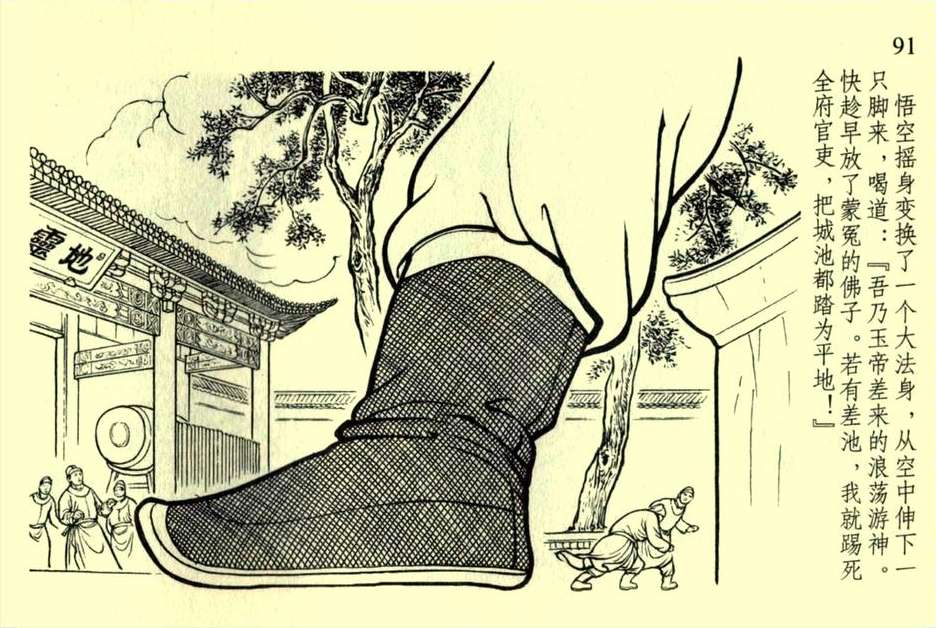
Archive #49: Journey to the West (西游记): A 60-Volume Lianhuanhua Comic

I recently archived a seven-volume lianhuanhua comic about Sun Wukong battling the famous Eighteen Arhats. Upon learning this, a follower on Twitter asked me if I could locate scans of a 60-volume set that they read when they were younger. Luckily, I found a website selling them for super cheap.

I am archiving the set here in order to document modern day perceptions and depictions of JTTW and its characters.

1. Info

  • Title – Journey to the West (西游记)
    • Adaptation – Zhang Yuzhi (张玉枝)
    • Illustrations – Yan Dong (严东)
    • Editor-in-charge – Chang Shengli (常胜利)
  • Publisher – China Lianhuanhua Publishing House and Distribution (中国连环画出版社出版发行)
  • First edition – November 1997
  • ISBN 7-5061-0827-5

The volume 60 cover reading, “Meeting the Buddhist Patriarch at Spirit Mountain” (Lingshan jian Fozu, 灵山见佛祖) (larger version).

1.1. Reprint

This set is the first of at least two prints, the other coming out in 2008 (ISBN: 7801388461, 9787801388469). See, for example, this Ebay listing (screenshot).

The 2008 boxed set (larger version).

2. Download link:

This is for the 1997 version only.

The comics can be read on Google Drive or downloaded and read on Adobe. However, I’ve had problems reading them on Chrome. Please keep this in mind. It might just be a problem on my end.

https://drive.google.com/drive/folders/1JcS65ckxWZQh462mlqwj5OOzNl4JJAQ7?usp=sharing

Archive #47: The Newly Annotated Journey to the West With Illustrations (Xinshuo Xiyouji (tuxiang), 1749/1888)

I. Original Text

The Newly Annotated Journey to the West (Xinshuo Xiyouji, 新說西遊記, 1749) by Zhang Shushen (張書紳) is one of three popular editions of JTTW that circulated during the Qing Dynasty (1644-1911) and overshadowed the original. [1] It contains a running commentary dispersed throughout the pilgrims’ many adventures. Anthony C. Yu (Wu & Yu, 2012) describes Zhang’s work as having a Confucian bias:

In his unabridged hundred-chapter Xinshuo Xiyouji (The Journey to the West, Newly Interpreted) of 1749, Zhang Shushen declared in the section entitled “Xiyouji zongpi 西游記總批 (Overall Comments on The Journey to the West)” that “the book Xiyou has been designated by the ancients as a book meant to illuminate the Dao [a pointed dig at the 1662 edition titled Xiyou zhengdao shu, with the Daoist-leaning preface attributed to Yu Ji … ], by which it originally means the Dao of the sages, the worthies, and the Confucians (儒 Ru). To consider it an illumination of the Dao of immortals and Buddhism would be a mistake, indeed.” From a point of view clearly unsympathetic to the popular movement of Three-Religions-Joining-As-One (sanjiao heyi 三教合一, a possibly millennium-old notion … ), Zhang defended the story of the quest for Buddhist scriptures as an allegory of the classic Confucian doctrines on the illustration of virtue (mingde 明德) and the rectification of the mind (zhengxin 正心), ignoring the repeated and complex elaborations of zhengxin in Chan Buddhism also for at least a thousand years prior to his time (vol. 1, pp. 51-52).

I’ve decided to archive a scanned copy of this work for posterity.

A digital version of the text (interspersed with other commentaries) can be found here.

Book link

Click to access Journey-to-the-West-Newly-Annotated-by-Zhang-Shushen-Xinshuo-Xiyouji-compressed.pdf

II. Text With Illustrations

I’ve previously archived illustrated versions of JTTW, including the original 1592 edition, (images from) Li Zhuowu’s late-16th-century critique, and a circa 1835 Japanese translation. Here, I’d like to add another, the Newly Annotated Journey to the West With Illustrations (Xinshuo Xiyouji tuxiang, 新說西遊記圖像, 1888). The original text and commentary are the same, but this edition features a preface by Wang Tao (王韜), as well as over 100 woodblock prints.

The prints in the archived book below are admittedly a little fuzzy. This webpage has somewhat clearer versions.

Book link

Click to access Journey-to-the-West-Newly-Annotated-With-Illustrations-1888-compressed.pdf

Prints of Zhu Bajie and Sun Wukong from the opening illustrations (larger version).

Note:

1) The Qing versions are noted for having shoehorned Tripitaka‘s life story (chapter nine) into the original 100 chapters of the 1592 edition.

Review: The Second Journey (2024) by Joel Bigman

Note: I was not paid for this review.

Format: Ebook ($6.99 USD) and paperback (280 pages; $19.99 to $21.99 USD) [1]
Publisher: Earnshaw Books Ltd.
Release date: December 17th, 2024
Purchase links:

1. Introduction

Over two decades ago I was inspired by Journey to the West (Xiyouji西遊記, 1592 CE; “JTTW” hereafter) to begin writing my own Chinese fantasy about an itinerant disciple of Sun Wukong battling monsters across ancient China. However, this all changed when I learned about the Kaifeng Jews, a historical enclave of sinified Israelite descendants who have lived in the Middle Kingdom for nearly a millennium. This convergence of two different cultures immediately captured my imagination, leading to the main character becoming the son of a founding member of the community. He would go on to brave supernatural events and creatures while serving as a soldier under General Yue Fei (1103–1142 CE), [2] eventually becoming a Jewish sage and powerful exorcist later in life. However, the book ultimately didn’t materialize as I came to realize that I was much better at coming up with research-based story ideas than actually writing narratives. Thus, my dreams of a Chinese-Jewish fantasy novel never came to pass.

But fret not, for Joel Bigman has written The Second Journey (2024), a modern sequel to JTTW, which is being touted as “The World’s First Chinese-Jewish Historical Fantasy.” [3] The story is framed as the contents of a lost 7th-century CE scroll discovered inside a buried jar while city planners investigate a watermain leak in modern Xi’an, Shaanxi province, China. A subsequent translation of the Aramaic text reveals a second, unknown journey undertaken by Xuanzang, Sun Wukong, and Zhu Bajie (but not Sha Wujing or the Dragon Horse) five years after their original return. This new quest is initiated by the Bodhisattva Guanyin, who requests that the Tang Monk seek knowledge outside of China for the benefit of the Kaifeng Jews, who have assimilated so much into Chinese culture that they’ve forgotten how to read their Hebrew scriptures. The trio travels past India and into Central Asia, where they procure the services of “Bear” (a.k.a. the “Second Samson“), a supernaturally strong Jew with knowledge of the various routes and personages of Historic Palestine. Together with a mysterious donkey, they travel from town to town looking for a holy man willing to return to China and become the Kaifeng Jewish community’s new teacher, thereby reigniting their religious life. Bear arranges for the pilgrims to meet and stay with several such holy men—allowing them to learn Hebrew and Jewish culture and religious history along the way—but the search for the right candidate is quite difficult.

Cover art by the wonderful Yuyu (与鱼), a freelance illustrator. You can see other examples of their work here.

2. Analysis

2.1. Compare and contrast

How does The Second Journey compare to JTTW? Recall that the original is a fictionalized retelling of the historical monk Xuanzang‘s (玄奘, 602–664 CE) journey to India from 627 to 645 (640 to 654 in the novel) (Buswell & Lopez, 2014, pp. 1015-1016; Wu & Yu, 2012, vol. 1, p. 293; vol. 4, p. 374). The set up for the sequel is also based on actual history. The Jewish community of Kaifeng, Henan Province, China is believed to have been founded around the Northern Song Dynasty (960–1127 CE), [4] and after centuries of unchecked assimilation, the enclave became religiously extinct sometime after the last Rabbi with knowledge of Hebrew died around 1800, [5] during the Qing Dynasty (1644–1911 CE). Joel has simply taken some artistic license by setting these events during the Tang Dynasty (618–907 CE). Also, the novel is full of historical Jewish sages and people that Xuanzang and his companions come to meet and/or learn from over the course of their journey. These include Eliezer ben Hurcanus, Yehoshua ben Hananiah, Akiva ben Joseph, Elisha ben Abuyah, Simeon ben Azzai, Simeon ben Zoma, Honi HaMe’agel, Shimon bar Yochai and his son Eleazar ben Shimon, Hillel the Elder, Rav Nachman bar Yaakov and his wife Lady Yalta, Rav Sheshet, Yohanan ben Zakkai, Shimon ben Lakish, Rabbi Tarfon, Judah ha-Nasi, Rabbi Meir and his wife Bruriah, and others. One of my favorite historical moments happens in “Wine,” when Monkey helps an enraged Lady Yalta attain catharsis by prompting her to smash hundreds of casks in a wine cellar after being slighted by her husband’s house guest (Bigman, 2024, pp. 138-140). Another happens in “Mother,” when Sun smashes a vase at the behest of Xuanzang in order to snap grieving disciples out of their ceaseless prayers, which are keeping ailing Rabbi Judah from dying (Bigman, 2024, pp. 165-167). Inserting our heroes into these Talmudic stories is an ingenious way of making the pilgrims feel that much more real, like they are being pulled out of myth and thrust into the real world.

JTTW is full of enlightened beings, gods, immortals, and demons and ghosts that can fly and wield spells and mystic objects for benign or malevolent purposes. The Second Journey also features magic. I can’t continue without first acknowledging that the historical Jews listed above actually lived centuries before Xuanzang was even born—something that informed readers may have already figured out. This means that the story follows a dreamlike timeline where the group magically flows like water between their present, the early Talmudic period (70–638 CE), and the distant Exodus Period, freely interacting with sages, prophets, patriarchs, and even God himself along the way. [6] Some of these Jewish holy men have mystical adventures of their own, such as in “Orchard” when Rabbi Akiva and others fly on a flaming chariot to the “Orchard of mystical knowledge” in order to discuss spiritual matters with wise men-cum-divine beings, or in “Slow Cart” when Sage Honi, a biblical rain-maker, is transported in his dreams to the past events of JTTW chapter 46, where he takes part in a rain-making competition against a Daoist animal-spirit (Bigman, 2024, pp. 56-62 and 99-104). And of course no JTTW story would be complete without Monkey showing off his magic powers. One of the more inventive uses of his abilities happens in a particular chapter where the titanic, golem-like angel Gabriel produces a giant clay sword from his thigh, and Monkey uses the intense spiritual flames inside his divine body to carburize it into a fine steel blade (Bigman, 2024, pp. 79). You’ll have to read the book to see how the weapon is used.

The original story is set in a world where Buddhism, Daoism, and Confucianism live in harmony with one another. The sequel also features such religious pluralism. In “Kaifeng,” Guanyin explains that she is sending the Tang Monk to the Western lands in order to save the Kaifeng Jews from being completely absorbed by Chinese culture. And in order to accomplish this, Xuanzang must bring foreign knowledge back to the Eastern lands, referring to it as “[s]eeds that may grow into something new” (Bigman, 2024, p. 11). As mentioned above, “Orchard” sees Jewish sages travel to a mystical orchard, where they converse with wise country folk, who are in actuality the Jade Emperor and Laozi (Bigman, 2024, pp. 59-62). This implies that even Jewish holy men can benefit from the knowledge of the East. A third example takes the form of the novel’s two-fold world system, where the Eastern and Western lands are two distinct realms overseen by the Jade Emperor and God, respectively. The reader first learns about this partitioned cosmos in “Oven” when Monkey seeks Guanyin’s aid in order to facilitate a biblical miracle:

In the past, you have received help in battling demons, either from myself, or from other celestial beings. But in this case, even the Jade Emperor cannot help you. These [Western] lands are too far away from our realm. You must ask for help from the emperor in a different heaven, in the Far Western Heaven […] He is Olam-Tzu, World-Master. The westerners call him Ribbono Shel Olam. You’ll have to find your own way to his heaven (Bigman, 2024, p. 36).

JTTW is full of humor, my favorite episode being when Monkey tricks three animal-spirits into drinking “elixir” which is actually the disciples’ stinky urine (Wu & Yu, 2012, vol. 2, pp. 286-287). BWAHAHAHA!!! The Second Journey also has its funny moments. In “The Other,” we learn our heroes have melodious snores:

Our friends woke up late the following morning; only Xuanzang woke up before noon. There was a whole chorus of snoring, led by the renowned soloist Pigsy, accompanied by Bear, their Foreign Guide, and our dear Monkey (Bigman, 2024, p. 187).

My absolute favorite comical moment happens in “Karma,” when Sage Sheshet warns Zhu that his over indulgence of Sabbath stew will come back to haunt him. And sure enough, after eating eighteen bowls worth, horrible stomach pains wake him from his afternoon nap. This causes him to worry that he has once again become magically pregnant like in chapter 53 of the original. But instead of relying on magic abortion water this time to end his suffering, his problem is solved by ripping nasty, giant farts (Bigman, 2024, pp. 145 and 148-150).

Beyond cultural and religious differences, the only applicable element that contrasts with JTTW is that Historic Palestine is said to be free of monsters (Bigman, 2024, pp. 46 and 109, for example). Monkey does briefly tangle with some biblical baddies in the sequel, but they are separated from the human world and therefore do not pose an immediate threat to the Tang Monk. This lack of action might be a little depressing for fans of the original, but readers should understand that both books serve different purposes. JTTW is chocked full of spirits that act as both merit-building obstacles and cultivation-facilitating illusions of the mind. These act as metaphors for the journey towards Buddhist enlightenment. However, such concepts aren’t needed in The Second Journey since Joel tells me that the point of the book is to introduce readers to Jewish culture and history via the medium of Xuanzang’s quest to find a teacher. Therefore, our heroes spend the majority of the story learning local beliefs and customs, listening to biblical tales, and acting as casual observers of Jewish religious history as it unfolds during their time travels. Entering the book with this knowledge should make it more enjoyable.

2.2. Suggestions

The book’s version of Xuanzang is an amalgam of his historical and literary counterparts. While this generally meshes well within the more realistic context of Historic Palestine, it does cause a problem in one particular instance. In “Bandits,” the pilgrims are accosted on the road by a group of highwaymen, and after their Daoist immortal-looking leader neutralizes Sun, Zhu, and Bear with a magic net, they choose the Tang Monk and a temporary travel companion as sacrifices to the Hindu goddess Durga. But a mysterious, powerful wind sent from heaven causes them to change their minds. The bandit leader is eventually revealed to be a Jew with a shady past who would go on to become a great holy man (Bigman, 2024, pp. 152-156). The problem is that the attempted sacrifice supposedly happened to the historical Xuanzang in India while sailing down the Ganges River (Huili & Shi, 1995, pp. 76-78). Recall that the historical Sage Honi travels back in time to past events from JTTW in “Slow Cart,” but this happens in his dreams. The episode under discussion is different because a historical event from India—which should have already happened to our composit Xuanzang—has been transposed onto Historic Palestine. It’s so out of place that it took me out of the story at that moment. The same can be said about a Daoist Jew leading a group of Hindu bandits in the Levant. I understand that Joel was trying to manufacture tension here, but he could have come up with an original group of bandits, and that way, Xuanzang could liken the experience to the one he had in India years prior. Or better still, the event could be likened to the Tang Monk’s experience in JTTW chapter 56 when Monkey is kicked out of the group for killing brigands, including beheading the wayward son of a local elderly couple (Wu & Yu, 2012, vol. 3, pp. 88-90). Perhaps Sun is put into a similar situation in the sequel where he could easily kill, but he doesn’t, thereby showing his master that he has internalized restraint.

And lastly, beyond fixing some minor issues, [7] the book would benefit from adding a glossary or footnotes to explain the names and significance of the various Jewish personages featured in the narrative. Joel told me that he “didn’t want to make it too ‘educational,’ like lecturing at the reader,” but non-Jews like myself who lack an extensive knowledge of Jewish religious history will no doubt be lost without some kind of guide. Having one would, therefore, make the novel far more accessible and enjoyable to a wider audience. As evidence of this, I actually read the book twice for this review, and I found that I enjoyed it more the second time around after having looked up info about the historical people and events.

3. My rating

I give The Second Journey four and a half out of five stars. The book is well-written, with smooth and oftentimes thought-provoking dialogue. The worldbuilding is very creative and yet still respectful to both Jewish beliefs and Chinese mythos. It’s definitely a great way to introduce someone to Jewish culture and religious history via Journey to the West. I highly recommend it!

Notes:

1) I read the Kindle version for this review. My thanks to Joel for giving me an advanced copy.

2) This was based on Weisz (2006), who shows that the Kaifeng Jews reference Yue Fei’s famous patriotic back tattoo, “Serve the country with utmost loyalty” (Jinzhang baoguo, 盡忠報國), in two of three main stone monuments erected in 1489, 1512, and 1663. The first mention appears in a section of the 1489 stele:

[…]

They received kindness from the Prince,
Lived on the income from the Prince
(They) only exerted in prayers To inform Heaven of their sincerity
Which meant “Boundless loyalty to the country and Prince.” (emphasis added)
May the Great Emperor of the Ming
His virtue surpass that of Yu and Tang
and His Highness that of Yao and Xun (Weisz, 2006, p. 18).

[…]

… 受君之恩食君之祿惟盡禮拜告天之誠報國忠君之意祝頌大明皇上德邁禹湯聖並堯舜 … (White, 1966, p. 38; see also the punctuated version).

The second is in a section of the 1512 stele:

[…]

Look at today.
If those who initiated subjects to study
And “brought glory to one’s parents
And became celebrated”
They had made it.
If those who arranged order among China and foreigners and were loyal to the Prince and benefited the people, they had made it.
Or, those who subdued the enemy and resisted aggression
And where “boundlessly loyal to the country” (emphasis added)
They had made it (Weisz, 2006, p. 26).

[…]

… 今日若進取科目而顯親揚名者有之若布列中外而致君澤民者有之或折衝禦侮而盡忠報國者有 … (White, 1966, p. 53; see also the punctuated version).

3) This is per the book’s blurb:

The World’s first Chinese-Jewish Historical Fantasy.

The Tang Monk Xuanzang along with Monkey and Pigsy famously brought the Buddhist scriptures back to China. Now the trio go on a new adventure to get the Hebrew Scriptures. The strongman Bear joins them as they face new monsters and new challenges, and finally reach a land filled with hundreds of foreign sages, yet only one god. The search for a teacher willing to come back to China is difficult, but a talking donkey helps solve the problem.

A fresh parable linking the Chinese classic story with the worlds of Western Asia and Roman Palestine, The Second Journey brings together the cultures, myths and philosophies of all Asia.

4) See my two-part article (here and here) summarizing theories about when the Kaifeng Jews first came to China.

5) Writing in 1850 CE, a Chinese protestant delegate sent to Kaifeng reported:

The present neglect of the Jewish religion is due to the fact that for these fifty years, there has been no one to instruct the members in the knowledge of the fifty-three sections of the Divine Scriptures, and in the twenty-seven [sic] letters of the Jewish alphabet (White, 1966, p. 116).

“These fifty years” implies that the last rabbi died around 1800 CE.

6) Beyond a mention of a specific “magic time traveling cave” in “Cave” (Bigman, 2024, p. 112), the reason for their time-jumping is never openly explained in the narrative. But Joel notes in his “Afterward” that he did this just so the Tang Monk could meet famous Jewish holy men (Bigman, 2024, p. 260).

7) The first minor issue is plot holes. For example, in “Kaifeng,” after being asked by Xuanzang to be his guide, Bear exclaims: “I have always wanted to go west, to where my people came from. I’ll gladly join you!” (Bigman, 2024, p. 19). But despite having never gone there, he spends the rest of the story expertly guiding the group throughout Historic Palestine like he’s intimately familiar with the routes, towns, and people. Another is that the pilgrims are able to understand spoken Hebrew without the narrative ever mentioning when they first started learning it. For instance, in “Oven,” Sun Wukong understands a debate between Jewish sages: “Old Monkey listened carefully and while it was hard to follow, the question seemed to be whether this specific oven was ritually pure or impure, or maybe whether it could become impure or not” (Bigman, 2024, p. 32). He goes on to use his magic to produce biblical miracles that support one holy man’s exclamations of truth (Bigman, 2024, pp. 34-35). In “Angels,” Bear claims out of nowhere that Xuanzang has been “learn[ing] their language, at least a bit,” and the Tang Monk shortly thereafter speaks to Moses with “accented formal Hebrew” (Bigman, 2024, p. 47). Official Hebrew lessons (in this case reading) are not mentioned until “Mother” (Bigman, 2024, p. 158). A lesser plot hole appears at the end of a particular chapter where Monkey rolls up the recently flayed hide of a biblical baddie on his staff, shrinks it, and stores it to never be seen again (Bigman, 2024, p. 80). I would have liked to have seen the skin play a part in another episode, perhaps serving as a magic blanket or being tailored into a magic robe.

The second minor issue is inconsistency. For instance, in “Kaifeng,” the sequel states that Monkey’s magic staff weighs 17,500 jin (22,762.73 lbs./10,325 kg), but “Oven” changes this to the novel accurate number of 13,500 jin (17,560 lbs./7,965 kg) (Bigman, 2024, pp. 17 and 35). “Leviathan” ups this to an astounding 54,000 jin (70,239.28 lbs./31,860 kg), and then “Skip” sees Sun hand the weapon to Moses, who picks it up with ease (Bigman, 2024, pp. 73 and 183). So, either the prophet is crazy strong, or Joel forgot how much the weapon weighs.

The third minor issue is typos. The book could do with an additional copy edit. I’ve alerted Joel to the misprints I noticed during my readings (please forgive any typos that are overlooked in this article).

Sources:

Bigman, J. (2024). The Second Journey. Hong Kong: Earnshaw Books Ltd. Retrieved from https://www.amazon.com/Second-Journey-Joel-Bigman/dp/9888843702.

Buswell, R. E. , & Lopez, D. S. (2014). The Princeton Dictionary of Buddhism. Princeton, NJ: Princeton University Press.

Huili, & Shi, Y. (1995). A Biography of the Tripitaka Master of the Great Ci’en Monastery of the Great Tang Dynasty (L. Rongxi Trans.). Berkeley, CA: Numata Center for Buddhist Translation and Research. Retrieved from https://www.bdkamerica.org/product/a-biography-of-the-tripitaka-master-of-the-great-cien-monastery/.

Weisz, T. (2006). The Kaifeng Stone Inscriptions: The Legacy of the Jewish Community in Ancient China. Bloomington, IN: iUniverse.

White, W. C. (1966). Chinese Jews: A Compilation of Matters Relating to the Jews of K’ai-fêng Fu (2nd ed.). Canada: University of Toronto Press. Retrieved from https://archive.org/details/lccn_66026456/mode/2up.