The beginning of Journey to the West (Xiyouji, 西遊記, 1592; “JTTW” hereafter) chapter seven sees Sun Wukong transported to the realm above to be executed for his rebellion against the primacy of heaven. However, his immortal body proves impervious to blades, fire, and lightning, leading Laozi to theorize that Monkey’s extreme invulnerability is the result of having consumed large quantities of immortal peaches, wine, and elixir that were later refined in his stomach “to form a single solid mass” (Wu & Yu, 2012, vol. 1, p. 188). The Daoist high god goes on to suggest that the demon be subjected to his Brazier of Eight Trigrams (Bagua lu, 八卦爐) in order to separate out the elixir and make his subsequently weakened body susceptible to death:
Arriving at the Tushita Palace, Laozi loosened the ropes on the Great Sage, pulled out the weapon from his breastbone, and pushed him into the Brazier of Eight Trigrams. He then ordered the Daoist who watched over the brazier and the page boy in charge of the fire to blow up a strong flame for the smelting process. The brazier, you see, was of eight compartments corresponding to the eight trigrams of Qian [☰/乾], Kan [☵/坎], Gen [☶/艮], Zhen [☳/震], Xun [☴/巽], Li [☲/離], Kun [☷/坤], and Dui [☱/兌]. The Great Sage crawled into the space beneath the compartment that corresponded to the Xun trigram. Now Xun symbolizes wind; where there is wind, there is no fire. However, wind could churn up smoke, which at that moment reddened his eyes, giving them a permanently inflamed condition. Hence they were sometimes called Fiery Eyes and Diamond Pupils (Wu & Yu, 2012, vol. 1, p. 189).
Laozi checks the furnace forty-nine days later expecting ashes, but he is surprised when Sun emerges and kicks over the mystical oven (fig. 1). This episode has two likely sources.
Fig. 1 – Monkey knocking over Laozi’s furnace (larger version).
1. Sources
1.1. The Story
The first source is The Story of How Tripitaka of the Great Tang Procures the Scriptures(Da Tang Sanzang qujing shihua, 大唐三藏取經詩話, c. late-13th-century; “The Story” hereafter), the earliest known published edition of JTTW. The 17th chapter describes the trials of Daffy (Chi’na, 癡那), a merchant’s son, at the hands of his evil stepmother, a woman of the Meng clan (孟氏). She resents the boy as he stands to inherit all of his father’s wealth, leaving her son with nothing. Therefore, she and her handmaiden try to kill the heir by respectively boiling him in a pot, ripping out his tongue, starving him, and finally pushing him into a river, but each time he is magically saved by heaven. For instance, after four days boiling in the pot, Daffy emerges unscathed and claims:
[T]he iron cauldron changed into a lily pad on which I sat, surrounded by the cool waters of a pond. I could sleep or just sit there. It was very comfortable (Wivell, 1994, p. 1203).
Mair (1987) notes that the story of a youth being tortured by his stepmother is based on a Dunhuang transformation text with two versions dated 946 and 949, respectively (p. 43). The text focuses on the trials of the future Emperor Shun. [1] However, the boiling episode does not appear in the story.
1.2. Laughing at the Dao
The second source is Laughing at the Dao (Xiaodao lun, 笑道論, 570), an anti-Daoist polemic written as part of a court debate between Buddhist and Daoist representatives vying for state sponsorship. One section recounts Laozi’s rebirth in the mortal world and his later attempt to convert a king in India:
He [Laozi] had (long) hairs on the temples and his head was hoary; his body was sixteen feet tall; he wore a heavenly cap and held a metal staff. He took Yin Xi with him to convert the barbarians. (Once arrived in India) he withdrew to the Shouyang 首陽 mountains, covered by a purple cloud. The barbarian king suspected him of sorcery (妖). He (attempted) to boil him in a cauldron, but (the water) did not grow hot … [2]
I find this source particularly amusing because the high god of Daoism is in essence subjected to the same punishment as the one that he later suggests for Sun Wukong!
2. The Furnace in Daoist Alchemy
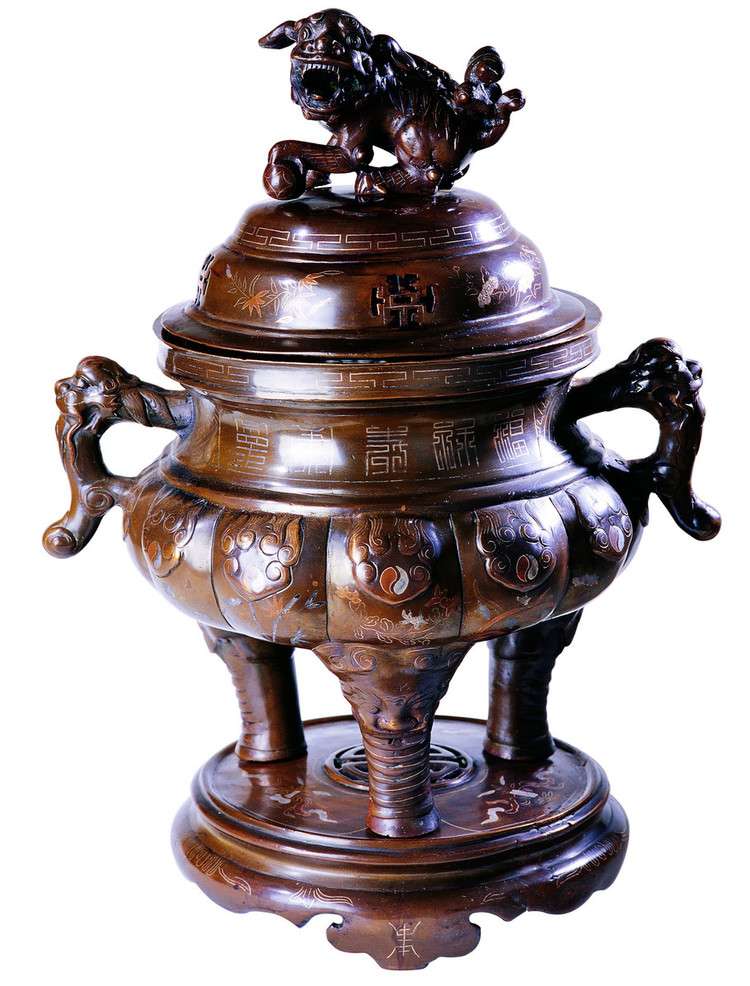
The furnace has two meanings in Daoist alchemy. The first refers to the physical vessel and stove (dinglu, 鼎爐) combo used in external alchemy (waidan, 外丹) to smelt the elixir of immortality (fig. 2). Kim (2008) describes the various parts and models of this contraption:
The reaction vessel has fire around it (when it is placed inside the heating apparatus), under it (when it is placed over the heating apparatus), or above it (when it is entirely covered by ashes inside the heating apparatus). It may contain an inner reaction-case in which the ingredients are placed. In a more complex model, a “water-vessel” containing water and a “fire-vessel” containing the ingredients can be assembled, the former above and the latter below or vice versa. The vessel must be hermetically closed and should not bear any openings or cracks.
The heating apparatus has fire within it and is often placed over a platform or “altar” (tan 壇). The openings on the wall sides allow air to circulate, while those on the top serve to settle the reaction vessel or to emit flame and smoke. One of the main functions of the heating apparatus is to control the intensity and duration of the heat. (pp. 360-361)
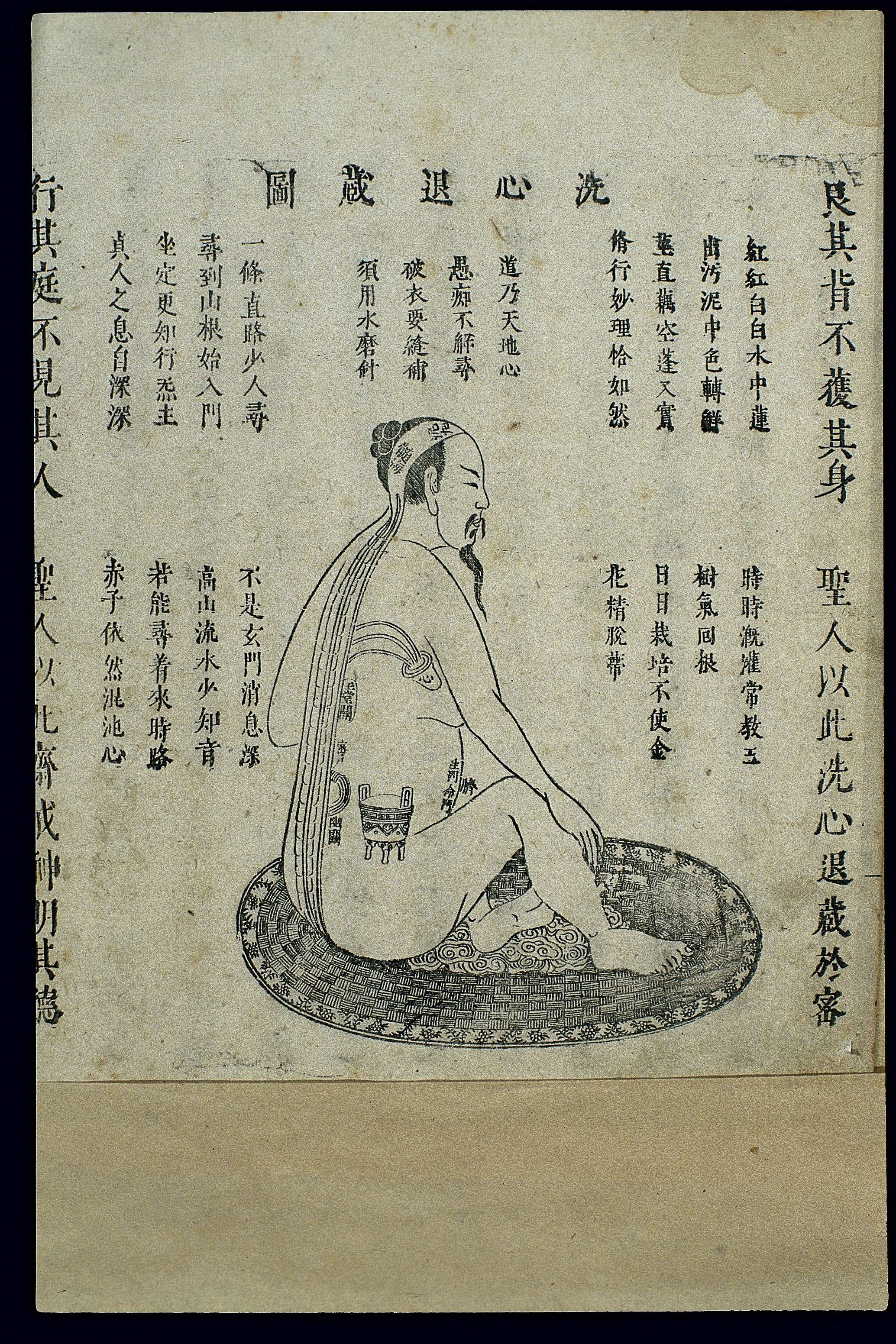
Fig. 2 – An ornate wooden replica dinglu reminiscent of the metal type used in external alchemy (larger version). Fig. 3 – An early 17th-century woodblock print depicting a Daoist practitioner’s dantian as a ding vessel (larger version).
The concept of consuming alchemically derived elixirs is first mentioned in Discourses on Salt and Iron (Yantie tun, 鹽鐵論, c. 60 BCE). Later, the Token for the Agreement of the Three According to the Book of Changes (Zhouyi cantong qi, 周易參同契, c. 2nd-century CE; “The Token” hereafter) standardized the use of toxic materials, such as lead and mercury, for making said elixir, and this idea remained entrenched until the Tang Dynasty (618–907 CE) (Pregadio, 2008, pp. 1002-1003). External alchemy was eventually superseded in popularity by internal alchemy (neidan, 内丹) from the Tang onward and was still popular during the Ming Dynasty (1368–1644 CE) when the standard 1592 version of JTTW was published.
The second meaning is the human body as a metaphor for the furnace—i.e. internal alchemy. The Token considers “the 5 organs, 12 vessels, 24 vertebrae, and 360 joints … all part of this body dinglu” (Wang, 2012, p. 192). The corporal furnace, the ingredients (yao, 藥), and the firing time (huohou, 火候) combine to make the “three essentials” (sanyao, 三要) of internal alchemy (Robinet, 2008). The ingredients are yin and yang energy, and the firing time is the measured absorption of said energies and the time at which this activity is partaken (Wang, 2012, pp. 192-193).
3. External vs Internal in JTTW
Laozi’s use of the Eight Trigrams Furnace stands as a perfect example of external alchemy, and Sun’s use of breathing exercises and qi circulation serves as a prime example of internal alchemy. So how are these competing processes depicted in JTTW? Well, recall that the external type had long been supplanted by the internal type by the time the novel was published. Hence, one could say Laozi’s methods were dated compared to those used by Monkey. This might then explain a surprising story element from JTTW chapter seven.
When Sun first escapes from the furnace, “Laozi rushes up to clutch at him, only to be greeted by such a violent shove that he falls head over heels while the Great Sage escapes” (based on Wu & Yu, 2012, vol. 1, p. 189). Think about that for a moment. Monkey, a proponent of internal alchemy, physically assaults the Daoist high god, a proponent of external alchemy. Add to this the fact that Sun seemingly only respects/fears immortals that promote internal alchemy—a good example being his first master, Patriarch Subodhi (Xuputi zushi, 須菩提祖師)—and a picture begins to form: perhaps this is the JTTW author-compiler’s way of touting the superiority of the internal over the external. What do you think?
4. Conclusion
Monkey’s time in Laozi’s furnace likely borrows from (one or both of) two sources, the story of a child magically surviving boiling in The Story, the 13th-century CE precursor of JTTW, and the story of Laozi magically surviving boiling from Laughing at the Dao, an anti-Daoist polemic of the 6th-century CE. The latter is humorous as it shows Monkey’s punishment is a recapitulation of the high god’s punishment.
JTTW presents two forms of alchemy: the concept of Laozi’s furnace refers to “external” alchemy and harkens back to Han Dynasty China when alchemists used such furnaces to fire toxic mercury and lead in an attempt to produce an elixir of immortality; Sun Wukong’s use of breathing exercises and qi circulation is a prime example of “internal” alchemy in which the body is used as the furnace to fire the immortal elixir. External alchemy fell out of favor during the Tang and was superseded by Internal alchemy from then on into the Ming, when JTTW was published. Therefore, the novel portrays the high god of Daoism as a proponent of the dated external school, while immortals like Monkey are portrayed as proponents of the then current internal school.
Notes:
1) For a complete translation, see Bodman (1994).
2) See Zürcher & Teiser (2007), pp. 299-300 and 431 n. 53.
Sources:
Bodman, R. W. (1994). The Transformation Text on the Boy Shun’s Extreme Filial Piety. In V. H. Mair (Ed.), The Columbia Anthology of Traditional Chinese Literature (pp. 1128-1134). New York: Columbia University Press.
Kim, D. (2008). Dinglu: I. Waidan In F. Pregadio (Ed.), The Encyclopedia of Taoism (2 Vols.) (pp. 360-361). London [u.a.: Routledge].
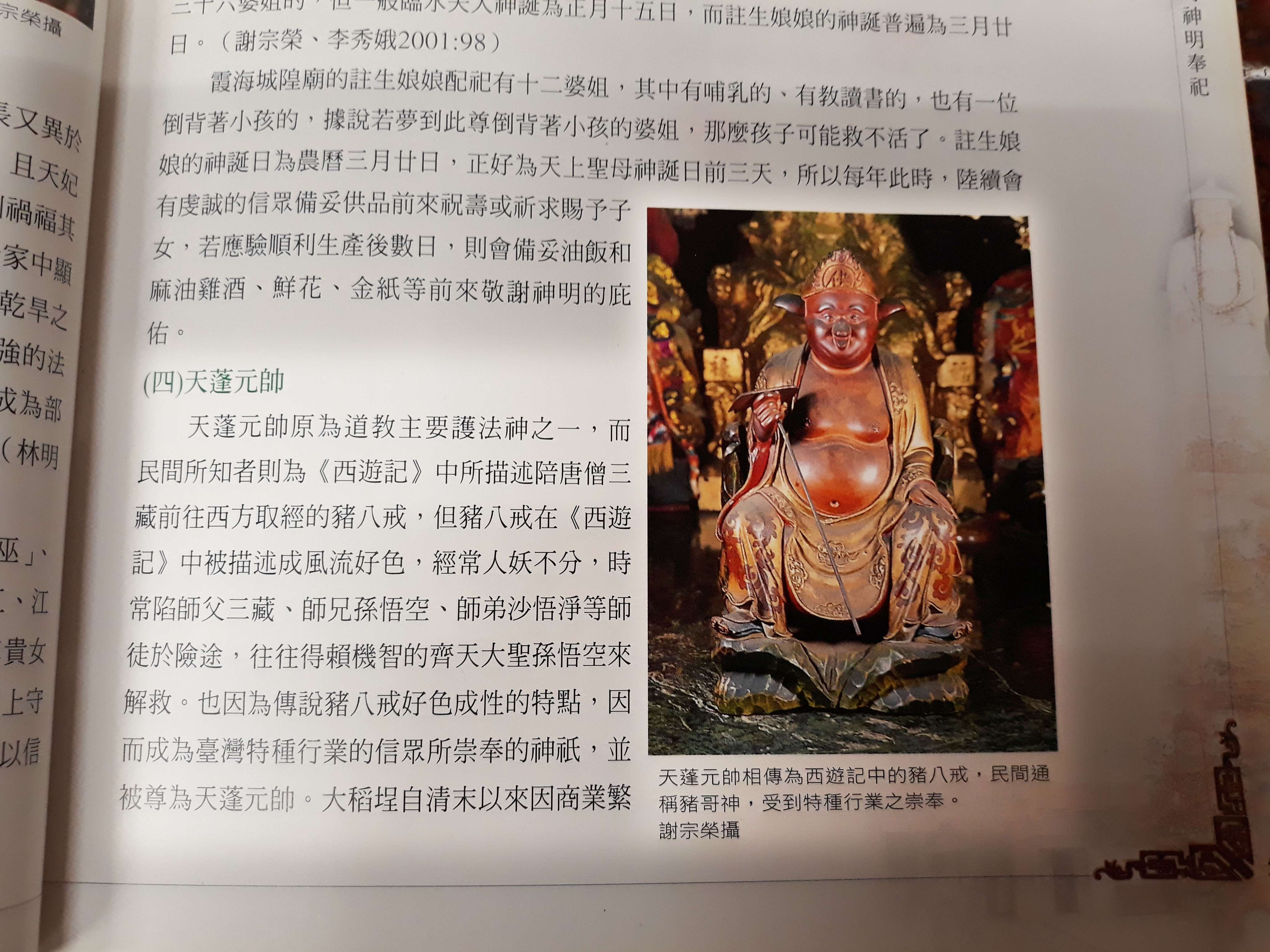
The Xiahai City God Temple (Xiahai chenghuang miao, 霞海城隍廟) in the Dadaocheng district of (old) Taipei, Taiwan contains a Zhu Bajie (豬八戒) shrine statue (fig. 1) to which sex workers and other members of the hospitality industry pay reverence. Taiwan Today writes:
The novel depicts the travels to India by the monk Xuanzang in search of Buddhist sutras. He is accompanied by three main disciples, of which Pigsy, who was previously Marshal Tian Peng, Grand Admiral of the Heavenly River, took responsibility for social events. With his easygoing nature, he blessed the group with jubilance. This also gained him a reputation of living a good life with abundant food and numerous flirtations with women. As Chen Wen-wen, manager of the Xiahai temple noted, this makes Zhu Ba Jie “the only deity that the hospitality industry needs to worship.”
In addition to its role as an ancient trading area beside the Danshui River, the Dadaocheng District became famous for the richness of its theaters, restaurants, hotels and gaming dens. People working in the clubs, especially those in the sex industry, would come to worship Pigsy after they finished work when the temple opened in the morning. “Every morning around 6 a.m. to 8 a.m., many ladies and bigwigs driving black Benz cars would come to pray to the deity Pigsy. They tended to dress beautifully and look wealthy,” Chen noted, explaining that these people hoped their customers would be as easygoing as Pigsy and would continue to visit their businesses.
Fig. 1 – Pigsy’s statue from the Xiahai City God temple (credit: Mark Hodson).
Although the area was no longer as affluent as before, and the piano bar trade long ago moved elsewhere, Chen recalled a woman visiting her temple just a few days earlier. “She said she was in charge of arranging girls for customers and admitted she had come here to pray for better business.” Chen asked to whom she was praying, to which the middle-aged woman replied “You have the Marshal Tian Peng here.” Chen asked if she meant Zhu Ba Jie, and the woman said, yes, that he had been educated and cultivated by his mentor, the monk Xuanzang, and had then became the spiritual figure of the hospitality business (Ministry of Foreign Affairs, Republic of China (Taiwan), 2006). [1]
I visited the Xiahai City God temple but unfortunately did not see the statue since (as I was told) it was tucked behind those of more prominent deities. The temple has a book with listings for each deity housed therein. The listing for Zhu doesn’t provide any new information other than a title, Zhuge Shen (猪哥神, “Brother God Zhu”) (fig. 2 & 3). [2] It just mentions his previous incarnation as Marshal Tianpeng, his adventures in JTTW, and the demographics of his cult.
Note: An informant told me that the Hokkien version of Zhuge shen is “Ti Ko Sin.”
Fig. 2 and 3 – Zhu’s listing as Marshal Tianpeng (Tianpeng yuanshuai, 天蓬元帥) from the Xiahai City God temple book. Full size versions here and here.
Zhu Bajie’s worship by working girls is not isolated to this temple, however. Keith Stevens (2000) writes:
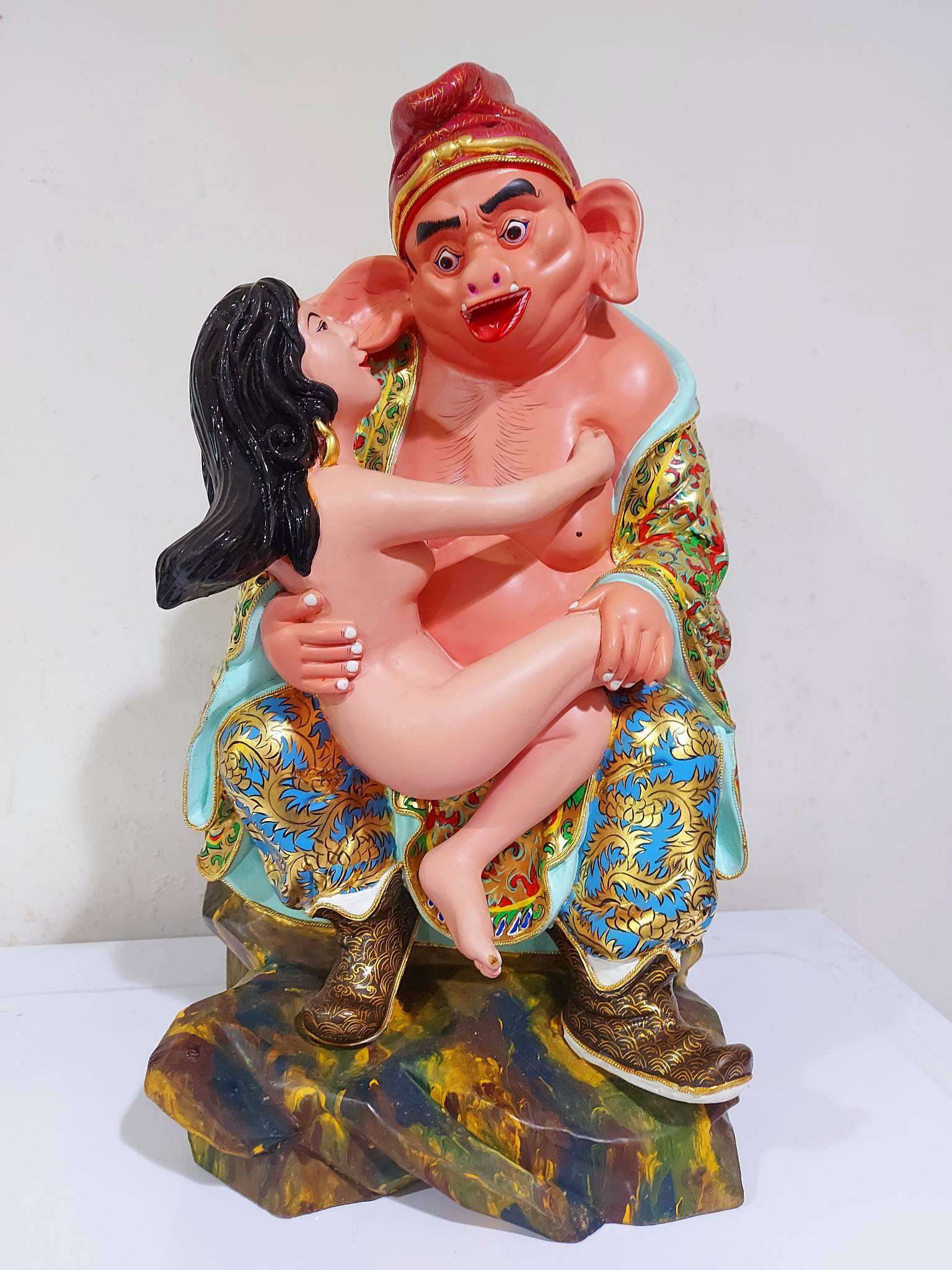
Although he is usually regarded China-wide as the epitome of gluttony, in Taiwan he is also revered by prostitutes who call on his divine title Shoushou Ye 授受爺, offering him incense and chants morning and evening whilst calling on him to bring them rich guests, foolish and witless, to be fleeced. An image, one of a number on loan from devotees, depicts him sitting holding a virtually nude woman in his arms alone on one of the side altars in the City God Temple in Chia I [Southwestern Taiwan] (p. 195).
The cited image is similar to this piece (fig. 4).
Fig. 4 – The type of Zhu Bajie idol prayed to by sex workers (larger version). In the author’s private collection.
I find his divine title of Shoushou Ye (授受爺, “Lord Give and Receive”) to be quite humorous. Not only does it represent the exchange of money for flesh between a lady of pleasure and her customer, but it may also be a cheeky allusion to an ancient more from the time of Mencius (4th-cent. BCE):
It is prescribed by the rites that, in giving and receiving [an object], man and woman should not touch each other [男女授受不親, nannu shoushou buqin] (McMahon, 1995, p. 166).
Zhu Bajie thumbs his nose at such a rule!
I mentioned in a previous article that Zhu’s literary incarnation Marshal Tianpeng is a historical deity that was worshiped as a powerful exorcist starting around the 6th-century. During the early Song Dynasty (960-1279), the celestial general joined with other demonifugic deities to form the quaternity of the Sisheng (四聖, “Four Saints”). His position as a protector led to his worship by the military from this time onward. Marshal Tianpeng’s long history in the Daoist pantheon may then explain why Zhu was readily adopted as a deity in his own right. He no doubt has the novel to thank for this honor.
Update: 03-21-18
Across the Taiwan Strait lies the southern Chinese province of Fujian. The Putian plains of the central coast hosts a number of temples dedicated to Zhu Bajie, also known there as Puji Shenghou (普濟聖侯, “Marquis Sage of Universal Salvation”). Dean and Zheng (2009) note an interesting geographical correlation:
Using GIS mapping, one can unearth many suggestive correlations in distributions of different cultural features across the plain. For example, certain gods such as Qitian dasheng … and Puji shenghou …, the Monkey and the Pig of the classic Xiyouji 西遊記 (Journey to the West), appear more often in poorer villages in the northern plain [fig. 5], often in higher elevations than in the low-lying, densely irrigated, wealthier villages of the southern plains. This suggests that the unruly natures of these gods appealed to poorer communities rather than to villages with established scholar-literati lineages (pp. 38-39)
Fig. 5 – Distribution of Zhu Bajie temples in the Putian plains of Fujian Province, China (larger version). Adapted from Dean and Zheng, 2009, p. 193.
Considering the close historical connection between Fujian and Taiwan, [3] it’s possible the demographics of Zhu’s cult on the mainland may have some bearing on the history of his worship on the island.
Updated: 01-05-19
A new paper on the subject has been published by Prof. Ben Brose of the University of Michigan. He was kind enough to give me permission to archive it here.
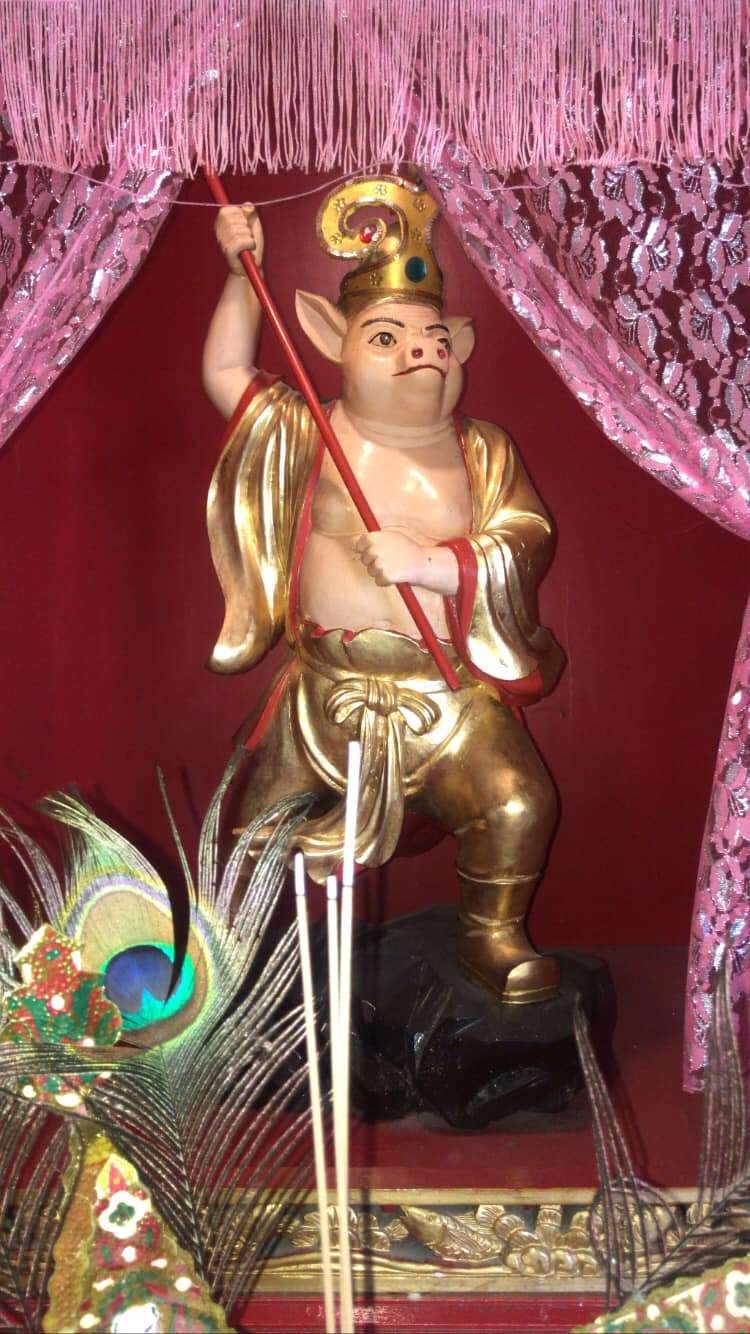
I know that Chinese-Thai will sometimes pair Zhu Bajie with idols of Sun Wukong. But I was recently surprised to see a post on Facebook in which a stand alone statue was labeled “Bajie Buddha Patriarch” (Bajie fozu, 八戒佛祖) (fig. 6 & 7). I consulted a believer who told me that “most people pray [to him] for money and charms.” So Zhu Bajie is more of a wealth god in Thailand.
Above, I noted that the Xiahai City God Temple calls our hero Zhuge Shen (猪哥神, “Brother God Zhu”). But it appears that my translation is wrong because the title has a slang meaning. An informant told me that in Taiwan, zhuge (猪哥, “brother pig”) is slang for a perverted guy who likes to make lude jokes and touch girls. Therefore, a better translation for the title is “God of Pig Brothers.”
Update: 02-01-2026
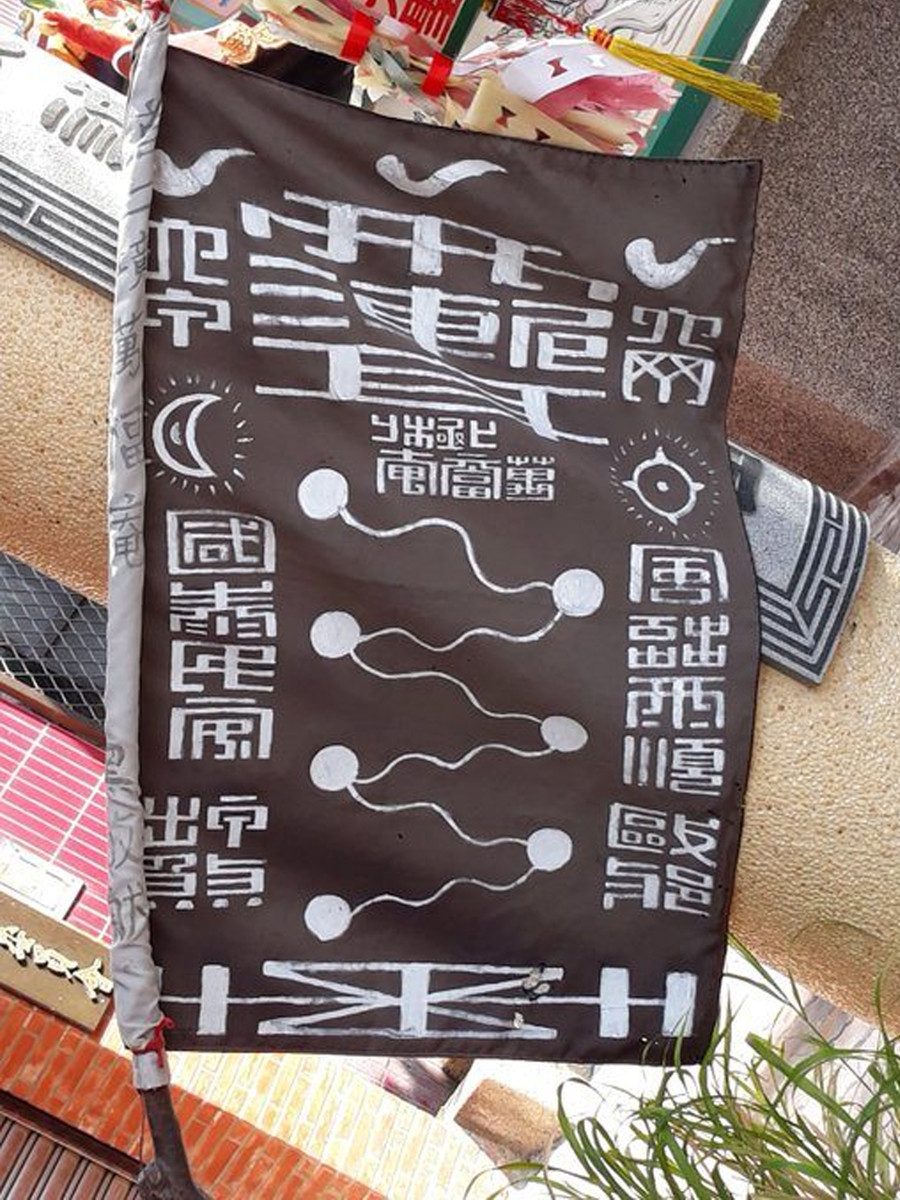
I was contacted several years ago by someone who shared with me a sex talisman associated with Zhu Bajie (fig. 8). They described it as a way “to pull women and men to fall in love in a more crude way, with extra libido between them.” I was instructed at the time to not share it for fear their master would find out and get upset. However, this is no longer a concern, so I have been given permission to share a lightly redacted version on my blog. A very big thank you to my contact.
I won’t translate the material to the right of the talisman, but I will point out a few things about the sigil itself. The top reveres the “Immortal Vixen” (Huli xiangu, 狐狸仙姑; lit: “Immortal Maiden Fox”), a nine-tailed vulpine goddess commonly associated with sex. The outermost left and right sides mention the coming together of beautiful women (xishi meinu, 西施美女) offering their bodies and male souls (nanhun, 男魂) hastening from the four/five cardinal directions, respectively. The inner most left and right sides mention double feminine earthly forces (kunnu, 坤女) and double masculine heavenly forces (qiannan, 乾男), respectively, and below each is a set of three vertical circles. These are spaces for writing names, that of the man who commissioned the talisman (right) and the girl he wants to woo (read: control; left). The middle line mentions the hastening of “Pig Brother Guests” (Zhuge ke, 豬哥客). Recall that Zhu Bajie is the God of Pig Brothers (per the 02-20-23 update). Lastly, the illustration at the bottom portrays a nude woman riding a swine, reminiscent of Pigsy’s idols (refer back to figure 4).
I posted this talisman to a folk religion group on Facebook, and one member called it “foxcraft,” while another suggested that it “us[es] bad entities to grant a sin.” And on a related note, my contact further tells me that this “taboo” and “vulgar” sigil is actually banned in their lineage. This is best illustrated by the fact that the required mudra (hand symbol) used to activate the spell has “not [been] passed on.”
1) I changed the romanization of particular Chinese terms to pinyin.
2) To me, this title speaks of familiarity and friendship. Zhu is the sort of god you want to go out drinking and chasing after girls with.
3) Taiwan was made a prefecture of Fujian province in 1684 by the foreign rulers of the Qing Dynasty (1644-1911). It later achieved province status in 1887.
Sources:
Dean, K., & Zheng, Z. (2009). Ritual alliances of the Putian plain. Volume One: Historical introduction to the return of the gods. Leiden: Brill.
McMahon, K. (1995). Misers, shrews, and polygamists: Sexuality and male-female relations in eighteenth-century Chinese fiction. Durham: Duke University Press.
Stevens, K. (2000). Patron Deity of Prostitutes: Zhu Bajie / 豬八戒. Journal of the Hong Kong Branch of the Royal Asiatic Society,40, 195-196. Retrieved March 20, 2018, from http://www.jstor.org/stable/23895263
The Monkey King is well known for his prowess with the staff. However, the first two chapters detailing his tutelage under the Buddho-Daoist sage, Patriarch Subodhi, surprisingly do not mention him training in combat skills, what Journey to the West (Xiyouji, 西遊記, 1592) calls wuyi (武藝; lit: “martial arts”). [1] In fact, the novel only briefly alludes to it later in a poem from chapter 67, part of which reads: “I bowed to the Patriarch of the Heart and Mind Spirit Platform and perfected with him the martial arts” (身拜靈臺方寸祖,學成武藝甚全周) (based on Wu & Yu, 2012, vol 3, p. 243). [2] But beyond the staff, Sun Wukong comes to master boxing, a skill he displays only a few times in the novel.
For example, a poem in chapter 51 describes his unarmed battle with a rhinoceros demon:
Hitching up his clothes and walking forward, the fiend assumed a boxing posture; his two fists upraised looked truly like two iron sledge hammers. Our Great Sage also loosened his legs at once and moved his body to attack; right before the cave entrance, he began to box with the demon king. This was quite a fight! Aha!
Opening wide the “Four Levels Posture”;
The double-kicking feet fly up.
They pound the ribs and chests;
They stab at galls and hearts.
“The Immortal pointing the Way”;
“Lao Zi Riding the Crane”;
“A Hungry Tiger Pouncing on the Prey” is most hurtful;
“A Dragon Playing with Water” is quite vicious.
The demon king uses a “Serpent Turning Around”;
The Great Sage employs a “Deer Letting Loose its Horns.”
The dragon plunges to Earth with heels upturned;
The wrist twists around to seize Heaven’s bag.
A green lion’s open-mouthed lunge;
A carp’s snapped-back flip.
Sprinkling flowers over the head;
Tying a rope around the waist;
A fan moving with the wind;
The rain driving down the flowers.
The monster-spirit then uses the “Guanyin Palm,”
And pilgrim counters with the “Arhat Feet.”
The “Long-Range Fist,” stretching, is more slack, of course.
How could it compare with the “Close-Range Fist’s” sharp jabs?
The two of them fought for many rounds—
None was the stronger, for they are evenly matched (Wu & Yu, 2012, vol. 3, pp. 12-13)
Shahar (2008) notes that this fight “[gave] the author an opportunity to display his familiarity with the contemporary jargon of ‘postures’ (shi and jiazi), ‘Long-Range Fist’ (changquan), and ‘Close-Range Fist’ (duanquan)” (pp. 131-132).
Interestingly, many of these techniques are still known to this day, some better known by slightly different names.
I consulted with martial artist Joshua Viney to learn what each technique involves. Joshua has lived and studied folk martial arts from village masters around the noted Shaolin Monastery (Shaolin si, 少林寺) for ten years. He currently maintains the Shaolin Yuzhai Youtube channel where he posts instructional videos. Please check it out.
I. The techniques
1) Opening wide the “Four Levels Posture” (Zhuai kaida siping, 拽開大四平) – An open fighting posture where the boxer stands in the horse stance (Mabu, 馬步) with arms outstretched to his sides. Also known as “Single Whip Horse Stance” (Mabu danbian kai siping, 馬步單鞭開四平) (fig. 1), which is often associated with Taiji boxing (太極拳).
2) The double-kicking feet fly up (Ti qi shuangfei jiao, 踢起雙飛腳) – Also known as “Double kicking feet” (Er qi jiao, 二起腳), this technique involves lifting up one knee to build upward momentum and then kicking high with the other (fig. 2). It is reminiscent of the “crane kick” from the Karate Kid (1984).
3) They pound the ribs and chests (Tao xie pi xiong dun, 韜脅劈胸墩) – Possibly referring to the “Pushing palm” (Tui zhang, 推掌) or “Splitting palm” (Pi zhang, 劈掌), which is delivered into the solar plexus and up into the rib cage (fig. 3).
4) “The Immortal pointing the Way” (Xianren zhilu, 仙人指路) – A double finger attack aimed at the eyes (fig. 4). The stance is often seen used in tandem with a sword.
5) “Lao Zi Riding the Crane” (Laozi qihe, 老子騎鶴) – Most likely another name for the Crane stance (fig. 5).
6) “A Hungry Tiger Pouncing on the Prey” (E hu pu shi, 餓虎撲食) – This name has been applied to many techniques. One variation known as “Fetching the moon from the seabed” (Haidi lao yue, 海底撈月) involves a powerful hip and/or palm strike to the groin/lower midline of the body (fig. 6). The force of the hip strike is powerful enough to send someone flying backwards.
Left: Setting up the attack. Right: The hit (from Joshua’s 13 Hammers of Shaolin video).
7) A Dragon Playing with Water (Jiaolong xi shui, 蛟龍戲水) – Also known as “Dragon puking water” (Jiaolong xi shuineng xiong’e, 蛟龍戲水能兇惡), this technique involves fluid, sweeping arm movements (most likely blocks or fake strikes) followed by simultaneous double fist blows (fig. 7). The technique is associated with Shaolin and Chang Family Fist (Changjia quan, 萇家拳), a martial art that influenced the development of Taiji boxing.[3]
8) “Serpent Turning Around” (Mang fanshen, 蟒翻身) – Also known as “Python turns over” (Guai mang fanshen, 怪蟒翻身), this technique involves a simultaneous chop to the throat and a pulling leg sweep, effectively knocking the opponent backwards (fig. 8).
9) “Deer Letting Loose its Horns” (Lu jie jiao, 鹿解角) – A series of elbow strikes to the torso (fig. 9). One variant called “Plum blossom deer lies on a pillow” (Meihua lu wo zhen, 梅花鹿臥枕) places the fist of the attacking arm against the temple, looking as if the practitioner is propping his head up in a resting posture.
10) The dragon plunges to Earth with heels upturned (Qiao gen cui dilong, 翹跟淬地龍) – A shooting maneuver using the Falling stance (Pubu, 仆步) to dip below the opponent’s defenses and attack the lower extremities (fig. 10). Also known as Qiao dilong zou xiapan zhao (雀地龍走下盤找).
11) The wrist twists around to seize Heaven’s bag (Niu wan na tiantuo, 扭腕拿天橐) – UNKNOWN. Mostly likely a headlock.
12) A green lion’s open-mouthed lunge (Qingshi zhangkou lai, 青獅張口來) – More commonly known as “Lion opens mouth” (Shizi dazhang zui, 獅子大張嘴), this technique has two variations. The large frame version involves shooting in low, pulling up the opponent’s knee with one hand, while simultaneously pushing on their head with the other hand, knocking them over (fig. 11). This can be used for throwing an opponent as well. The small frame version involves cupping the hands to intercept strikes.
13) A carp’s snapped-back flip (Liyu die ji yue, 鯉魚跌脊躍) – This can refer to both throwing an opponent and a move commonly referred to as a “kip-up.” The latter involves the practitioner flipping up from a supine position to a standing fighting stance (fig. 12).
14) Sprinkling flowers over the head (Gai ding sa hua, 蓋頂撒花) – Also known as “Double cloud over peak” (Shuang yun ding, 雙雲頂), this technique involves flourishing the hands above the head as a means of blocking, twisting an opponent’s arm, or disengaging from combat (fig. 13).
15) Tying a rope around the waist (Rao yao guan suo, 遶腰貫索) – UNKNOWN. Possibly a circling step similar to one later used in Bagua Palm Boxing (Bagua zhang, 八卦掌) (fig. 14).
16) A fan moving with the wind (Yingfeng tie shan er, 迎風貼扇兒) – Crossed hands shooting out to intercept an opponent’s punch (fig. 15).
17) The rain driving down the flowers (Ji yu cui hua luo, 急雨催花落) – Most likely a rapid succession of punches.
18) “Guanyin Palm” (Guanyin zhang, 觀音掌) – A style of palm strikes. It is listed as number 70 of the “72 Training Methods of Shaolin” (Shaolin qishi’er yi lian fa, 少林七十二藝練法) (Jin & Timofeevich, 2004, p. 229).
19) “Arhat Feet” (Luohan jiao, 羅漢腳) – A style of kicking.
What follows is Joshua’s reconstruction of the fight. He makes an interesting observation that the fight may in fact be a theatrical stage combat version of known techniques.
I think what we are seeing here is a Chinese Opera-like performance of a fight that the author saw and perhaps asked about the names or recognised. I expect it would be very contrived. After this we are not told explicitly who does what and it may not be a one for one exchange. Nevertheless looking at the wording we can make a guess.
It begins with a large fighting stance, probably the ‘single whip’ posture of holding the arms straight to the sides. Then both performers do a jumping kick towards each other to enter striking range. Given it uses the phrase 劈胸 ‘pi xiong’ (split chest) I expect they begin by using the chest splitting palm at one another and so cross hands in the center of the arena [fig. 16].
Once they have crossed hands I think the demon grasps Monkey’s hand and attacks with the fingers of the other hand at his eyes, doing the ‘immortal points the way’ technique. Monkey defends against this by shielding his face with his forearms, then spreading his hands and kicking at the monster’s stomach. This pushes the monster away and Monkey is left with one knee suspended and arms spread to the sides in the ‘Lao Tzu rides a crane’ posture.
The Demon takes advantage of this unstable posture by rushing at him with the ‘hungry tiger pounces on prey’ technique, striking Monkey with his hips and grasping hold of him. Monkey uses the ‘dragon puking water’ technique, which erupts from below the demons arms and casts them aside, then rushes forwards again to attack with both hands. The Demon defends this by sticking close to the monkey and uses the ‘python turning its body’ technique to trip him up. But Monkey is strong and keeps his footing, counter attacking with a headbutt and multiple elbow strikes which form the ‘Deer-Horn’ technique.
The Demon jumps away but Monkey pursues with the ‘ground dragon’ technique and attacks the demons groin, causing him to buckle over, whereby Monkey grasps his head with the ‘twisting heavens sack’ technique. The Demon defends by using the ‘Lion opens mouth lunge’ to stop Monkey and throw him down. The monkey recovers by flipping his body in the ‘carp jump’ technique. Then he withdraws from the center by a few steps ‘covering his head with the flowers’ overhead technique. The Demon similarly disengages from the center and puts up a guard, prowling slowly around Monkey with the ‘turning waist’ technique.
I think the rest is describing more how they are evenly matched and face each other down rather than any other moves. ‘Iron fan stands against the wind’ is a common technique, a guard, and ‘rain falling on flowers’ is perhaps an eye strike but could also mean the intensity of the fight is like an urgent rain of punches. ‘Guanyin palm’ and ‘Luohans feet’ are both style names. Long fist vs short fist, how can they overcome one another? 10 rounds without a victor.
He goes onto describe the physical and psychological aspects of Long-range and Close-range fist:
Long fist and Short fist are the classic methods of Shaolin shenfa [身法, “Body postures”]. In order to strike the opponent one needs momentum, both physical AND psychological. Momentum is achieved by moving the dantian [4] as the centre of mass. In Short fist the dantian is rotated to add to power. In Long fist the whole dantian is thrown in the direction of the strike instead of rotated–much more powerful but also more wild and uncontrollable. In Shaolin philosophy, mind and matter are not severed, so physical momentum and psychological momentum are intertwined; when one has physical forward momentum, one simultaneously feels more confident.
III. Similarities with other literary combat
A poem similar to that from JTTW appears in the 120 chapter version of the Water Margin (Shuihu zhuan, 水滸傳, c. 1594) by Yu Xiangdou (余象斗, c. 1560–c. 1640). The poem describes unarmed combat between a young man and woman.
Opening wide the “Four Levels Posture”;
The double-kicking feet fly up.
“The Immortal pointing the Way”;
“Lao Zi Riding the Crane”;
“Phoenix Elbow” to the heart;
“The Guard Head Cannon Stance” strikes the temples;
The dragon plunges to Earth with heels upturned;
The wrist twists around to seize Heaven’s bag;
This girl, sprinkling flowers over the head;
This boy, tying a rope around the waist;
Two fans moving with the wind;
The rain driving down the flowers.
We can see many named techniques from Monkey’s battle appear in this poem. There are only two years between the publishing of JTTW (1592) and this version of the Water Margin. But it’s very well possible that both authors drew upon common source material.
Joshua discovered two techniques from the Water Margin poem, namely “Phoenix Elbow” (Aoluan zhao, 拗鸞肘), and “The Guard Head Cannon Stance” (Dang toupao shi, 當頭砲勢), appearing together in the same print of an edition of the Collection of Military Works(Wubei zhi, 武備志, c. 1621), a Ming treatise on military armaments and fighting techniques (fig. 17). This suggests that Yu Xiangdou borrowed these moves from similar boxing or military manuals. Likewise, the author-compiler of JTTW may have also borrowed from such literature.
Fig. 17 – The print from the Collection of Military Works (Wubei zhi, 武備志, c. 1621) mentioning “Phoenix Elbow” and the “Guard the Head Cannon Stance.”
Update: 05-02-2018
The available evidence suggests that Short Fist (Duanquan, 短拳; a.k.a. “Close-Range Fist”) is Monkey’s fighting style. As mentioned above, the poem in chapter 51 reads: “The ‘Long-Range Fist,’ stretching, is more slack, of course. How could it compare with the ‘Close-Range Fist’s’ sharp jabs?” (長掌開闊自然鬆,怎比短拳多緊削。) (Wu & Yu, 2012, vol. 3, p. 13). Also, after facing the rhino monster, Sun Wukong asks heavenly warriors to critique his boxing skills:
“As you watched from afar,” said Pilgrim, smiling, “how did the abilities of the fiend compare with old Monkey’s?” “His punches were slack,” said Devaraja Li, “and his kicks were slow; he certainly could not match the Great Sage for his speed and tightness'” (Wu & Yu, 2012, vol. 3, p. 14).
The “speed and tightness” is of course a reference to his use of Short Fist.
In addition, earlier in chapter two, Monkey faces a demon who had taken over his Water Curtain cave in the immortal’s absence. The two resort to boxing since Monkey is unarmed:
The Monstrous King shifted his position and struck out. Wukong closed in on him, hurtling himself into the engagement. The two of them pummeled and kicked, struggling and colliding with each other. Now it’s easy to miss on a long reach, but a short punch is firm and reliable (emphasis added). Wukong jabbed the Monstrous King in the short ribs, hit him on his chest, and gave him such heavy punishment with a few sharp blows that the monster stepped aside, picked up his huge scimitar, aimed it straight at Wukong’s head, and slashed at him (Wu & Yu, 2012, Vol. 1, p. 128).
I initially thought Sun Wukong used Short Fist out of necessity as JTTW describes him being less than four feet tall. But the novel’s bias for close-range fighting over long-range was, according to Shahar (2008), “typical of late Ming and early Qing military literature” (p. 117). He continues:
Sixteenth- and seventeenth-century military experts allude to various short-range styles including ‘Cotton Zhang’s Close-Range Fist’ (Mian Zhang duanda [綿張短打]), ‘Ren Family Close-Range Fist’ (Renjia duanda [任家短打]), and ‘Liu [Family] Close-Range Fist’ (Liu duanda [劉短打])” (Shahar, 2008, p. 117).
Wing Chun (Mandarin: Yong Chun, 詠春) is a close-range fighting style similar to Short fist. Although the style postdates the novel by at least two centuries, it showcases the quick, compact punches associated with Short Fist. Take this video of Jackie Chan, for example. Now imagine Monkey using similar techniques in a fight with a much larger opponent, blocking or ducking to avoid attacks and replying with sharp punches targeted at vulnerable areas.
Update: 08-07-2018
I have found a few more instances of martial arts terms, this time related to weapons. Joshua was again kind to lend his knowledge to the subject.
Chapter 17:
The compliant rod,
The black-tasseled lance.
Two men display their power before the cave;
Stabbing at the heart and face;
Striking at the head and arm.
This one proves handy with a death-dealing rod;
That one tilts the lance for swift, triple jabs. The “white tiger climbing the mountain” extends his paws; The “yellow dragon lying on the road” turns his back (emphasis added).
With colored mists flying
And bright flashes of light,
Two monster-god’s strength is yet to be tried.
One’s the truth-seeking, Equal-to-Heaven Sage;
One’s the Great Black King who’s now a spirit.
Why wage this battle in the mountain still?
The cassock, for which each would aim to kill! (Wu & Yu, 2012, vol. 1, p. 354)
22) “White tiger climbing the mountain”extends his paws (Baihu pashan, 白虎爬山來探爪) – Mountain climbing stance is synonymous with Gong bu (弓步), or the bow stance. The white tiger denotes an overt attack of sorts. I imagine it would look similar to this spear technique.
23) “Yellow dragon lying on the road” turns his back (Huanglong wo dao zhuanshen mang, 黃龍臥道轉身忙) – Possibly a retreating maneuver.
Chapter 31:
Dear Monkey King! He raised the rod above his head, with both hands, using the style “Tall-Testing the Horse.” The fiend did not perceive that it was a trick. When he saw there was a chance, he wielded the scimitar and slashed at the lower third of Pilgrim’s [Monkey’s] body. Pilgrim quickly employed the “Great Middle Level” to fend off the scimitar, after which he followed up with the style of “Stealing Peaches Beneath the Leaves” and brought the rod down hard on the monster’s head. This one blow made the monster vanish completely (Wu & Yu, 2012, vol. 2, p. 83).
24) “Tall-Testing the Horse” (Gao tanma, 高探馬) – Tanma (探馬) refers to a military scout, so a better translation would be the “High Scout.” This is a double-handed thrust aimed at the opponent’s face as a high fake. A corresponding fist technique, essentially a jab, is associated with Taiji boxing.
25) “Great Middle Level” (Da zhong ping, 大中平) – Holding the staff level at the navel while in the horse stance. This allows for quick defense below the waist.
26) “Stealing Peaches Beneath the Leaves” (Ye di tou tao shi, 葉底偷桃勢) – UNKNOWN. The name of this technique is normally associated with an attack to the groin, not the top of the head as implied in the quoted battle.
Based on the sequence of events described above, it seems like Monkey fakes high, blocks the strike to his body, and then attacks the top of the stooping opponent’s head (since the latter ducked the high fake and attacked low).
Here is Joshua’s interpretation:
The two weapons are stuck together: the monkey is forcing down, the demon up. The monkey releases the pressure, circling his staff below the opponents weapon, so with the release of pressure, the opponent’s weapon flings upwards but with no control. The monkey circles from this lower position, then turns over in a big circle and strikes the opponent downwards on the head.
Chapter 56:
The Great Sage walked forward and picked up the rod with no effort at all. Assuming the style of the Python Rearing its Body (emphasis added), he pointed at the bandits and said, “Your lucks running out, for you have met Old Monkey!” (Wu & Yu, 2012, vol. 3, p. 81).
27) Python Rearing its Body (Mang fanshen, 蟒翻身). UNKNOWN. This is a differently translated version of a similarly titled technique mentioned above. See number eight (“Serpent Turning Around”). The previous listing referred to a boxing technique, while this again is for a weapon.
In closing, I would like to quote a particular passage. While it doesn’t list a given technique, it highlights Monkey’s mastery of the staff. Chapter 33 reads:
“Going through this tall mountain and rugged cliff must have made master [Tripitaka] rather apprehensive, that’s all. Don’t be afraid! Don’t be afraid! Let old Monkey put on a show for you with my rod to calm your fears somewhat.” Dear Pilgrim! Whipping out his rod, he began to go through a sequence of maneuvers with his rod as be walked before the horse: up and down, left and right, the thrusts and parries were made in perfect accord with the manuals of martial arts (emphasis added). What the elder saw from the horse was a sight incomparable anywhere in the world (Wu & Yu, 2012, vol. 2, p. 105).
The portion that Yu (Wu & Yu, 2012) translates as “manuals of martial arts” actually lists the names of two noted military manuals, both of which are listed among the Seven Military Classics of China. The first, the Six Secret Teachings (Liu tao, 六韜), was published during the Warring States period (c. 475 – 221 BCE) but possibly contains information from as far back as the Qi state (1046 – 221 BCE). The second, the Three Strategies (San lue, 三略), was most likely published during the Western Han period (206 BCE – 9 CE) (Sawyer, 1993).
Associating Monkey’s martial arts skill with ancient military classics only serves to further elevate his status as a great warrior and cultural hero.
Notes
1) Wuyi (武藝) was used to refer to Chinese martial arts as far back as the third-century CE. The term predates the more familiar wushu (武術) by some three centuries (Lorge, 2012, p. 10).
2) Readers may think the “Ancestor of Heart and Mind” (Fangcun zu, 方寸祖) is directly referring to Master Subodhi. However, the supreme immortal threatened Monkey with eternal torment if he ever revealed the sage had been his teacher. A more literal translation of the aforementioned figure is “Patriarch Square Inch” (Fangcun zu, 方寸祖). Square Inch (fangcun, 方寸) is a common metaphor for the “heart / mind” (xin, 心), a broad concept written with a small character. This is just an interesting way of saying Monkey learned martial arts on his own via self-cultivation, thereby not revealing his true master. At the same time, it is a veiled admission of studying martial arts under the sage.
3) For more information on Chang Family Fist and its progenitor Chang Naizhou, see Wells (2005).
4) The dantian (丹田, “cinnabar field”) is an area near the navel believed to be the body’s storehouse of spiritual energy.
Lorge, P. A. (2012). Chinese Martial Arts: From Antiquity to the Twenty-First Century. New York, NY: Cambridge University Press.
Sawyer, R. D. (1993). The Seven Military Classics of Ancient China. New York: Basic Books.
Shahar, M. (2008). The Shaolin Monastery: History, Religion, and the Chinese Martial Arts. University of Hawaii Press.
Wells, M., & Chang, N. (2005). Scholar Boxer: Chang Naizhou’s Theory of Internal Martial arts and the Evolution of Taijiquan. Berkeley, Calif: North Atlantic Books.
Wu, C., & Yu, A. C. (2012). The Journey to the West (Vols. 1-4) (Rev. ed.). Chicago, Ill: University of Chicago Press.
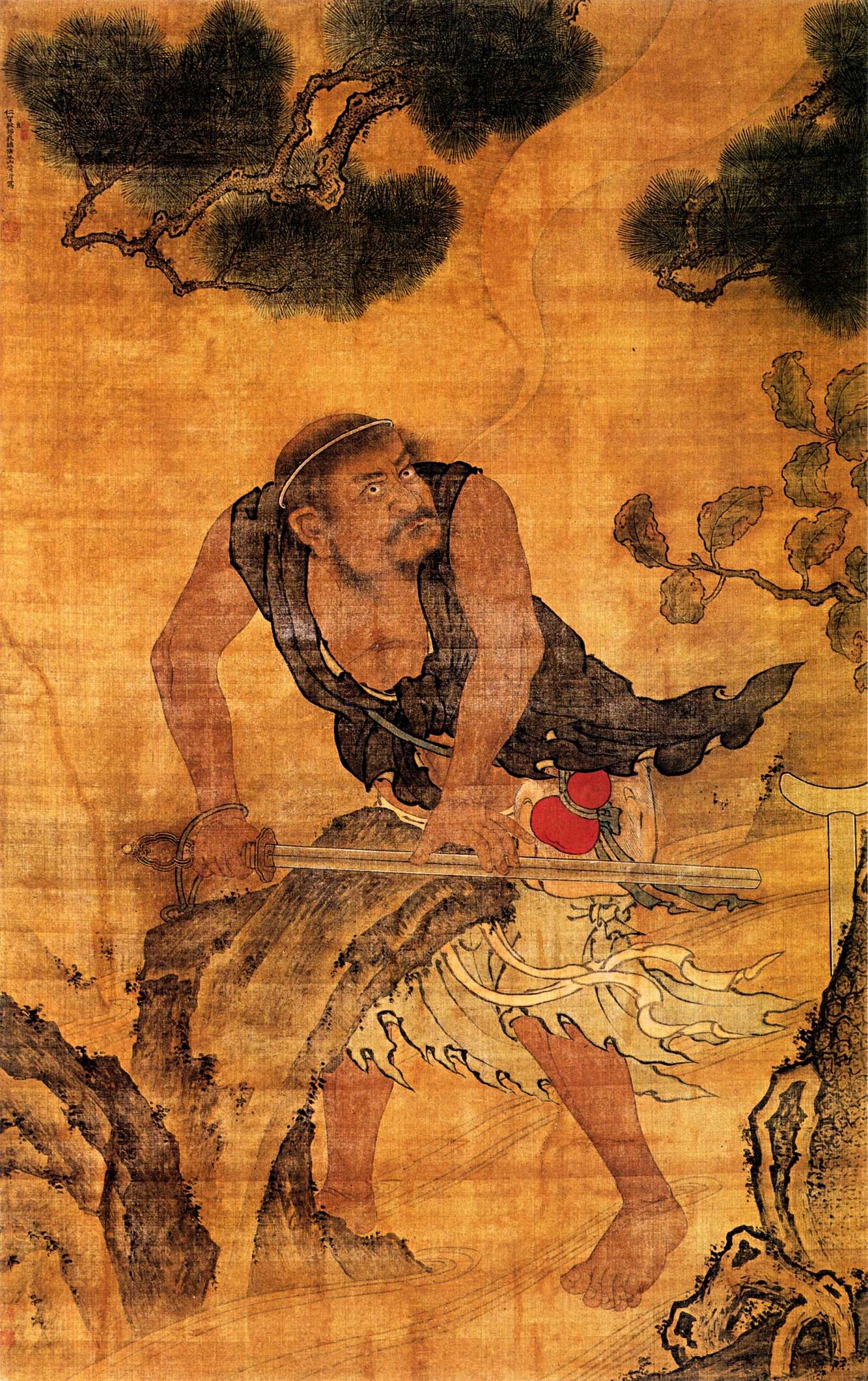
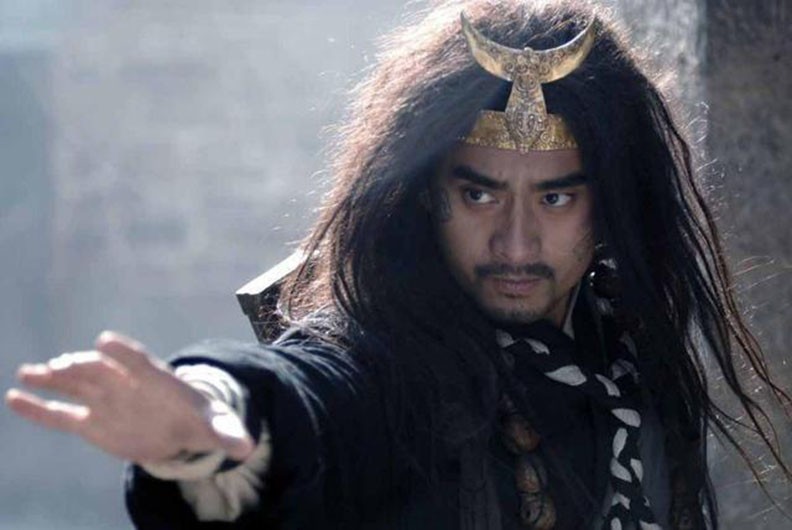
The golden headband or fillet (jingu, 金箍; a.k.a. jingu, 緊箍, lit: “tight fillet”) is one of the Monkey King’s most recognizable iconographic elements appearing in visual media based on the great Chinese classic Journey to the West (Xiyouji, 西遊記, 1592 CE). It is generally portrayed as a ringlet of gold with blunt ends that meet in the middle of the forehead and curl upwards like scowling eyebrows (type one) (fig. 1). A different version is a single band adorned with an upturned crescent shape in the center (type two) (fig. 2). Another still is a simple band devoid of decoration (type three) (fig. 3). Sun first earns the headband as punishment for killing six thieves shortly after being released from his five hundred-year-long imprisonment. The circlet is a heaven-sent magic treasure designed to reign in the immortal’s unruly, rebellious nature. Since Sun Wukong is a personification of the Buddhist concept of the “Monkey of the Mind” (xinyuan, 心猿), or the disquieted mind that bars humanity from enlightenment, the fillet serves as a not so subtle reminder of Buddhist restraint. Few scholars have attempted to analyze the treasure’s history. In this paper I present textual and visual evidence from India, China, and Japan that suggests it is ultimately based on a ritual headband worn by Esoteric Buddhist Yogin ascetics in 8th-century CE India. I also show how such fillets became the emblem of some weapon-bearing protector deities in China, as well as military monks in Chinese opera.
1. The Headband’s Literary Origin and Purpose
The headband is first mentioned in chapter eight when three such “tightening fillets” are given to the Bodhisattva Guanyin by the Buddha in order to conquer any demons that she may come across while searching for a monk who will bring sutras back to China from India:
“These treasures are called the tightening fillets, and though they are all alike, their uses are not the same. I have a separate spell for each of them: the Golden, the Constrictive, and the Prohibitive Spell. If you encounter on the way any monster who possesses great magic powers, you must persuade him to learn to be good and to follow the scripture pilgrim as his disciple. If he is disobedient, this fillet may be put on his head, and it will strike root the moment it comes into contact with the flesh. Recite the particular spell which belongs to the fillet and it will cause the head to swell and ache so painfully that he will think his brains are bursting. That will persuade him to come within our fold” (Wu & Yu, 2012, vol. 1, pp. 206-207).
Guanyin later explains in volume two which demons get which fillet (Wu & Yu, 2012, vol. 2, p. 251).
Sun Wukong earns the “Constrictive” (jin, 緊) band in chapter fourteen after brutally murdering six thieves who accost his master Tripitaka, the chosen scripture seeker, on the road to the west. The killings cause the two to part ways, and it is during Monkey’s absence when Guanyin gives the monk a brocade hat containing the fillet and teaches him the “True Words for Controlling the Mind, or the Tight-Fillet Spell” (喚做『定心真言』,又名做『緊箍兒咒』) (Wu & Yu, 2012, vol. 1, p. 317). Sun is eventually persuaded to return and tricked into wearing the hat under the guise of gaining the ability to recite scripture without rote memorization. It soon takes root, and the powerful immortal is brought under control through the application of pain. He then promises to behave and to protect Tripitaka during their long journey to the Western Paradise. [1]
The remaining two fillets are used by Guanyin to conquer other monsters in later chapters. She throws the “Prohibitive” (jin, 禁) band onto the head of the Black Bear Demon (Hei xiong jing, 黑熊精) in chapter seventeen and, after reciting the spell, he agrees to become the rear entrance guard of her Potalaka Island paradise (Wu & Yu, 2012, vol. 1, p. 365). The “Golden” (jin, 金) band is split into five rings—one each for the head, wrists, and ankles—and used to subdue Red Boy (Hong hai’er, 紅孩兒), the fire-spewing son of the Bull Demon King and Princess Iron Fan, at the end of chapter forty-two and the beginning of forty-three (Wu & Yu, 2012, vol. 2, pp. 251-252). The child demon becomes her disciple and eventually takes the religious name “Sudhana.” [2]
Monkey is forced to wear the fillet until he attains Buddhahood in chapter one hundred, causing it to vanish (Wu & Yu, 2012, vol. 4, p. 383). The band’s disappearance at the end of the novel denotes Sun’s internalization of self-control. But the treasure doesn’t disappear forever. It appears once more in the Later Journey to the West (Hou Xiyouji, 後西游記, 17th-century CE), a sequel set 200 years after the original. The story follows a similar trajectory with Monkey’s descendant Sun Luzhen (孫履真, “Monkey who Walks Reality”) attaining immortality and causing havoc in heaven. But this time the macaque Buddha is called in to quell the demon. Monkey quickly disarms the “Small Sage Equaling Heaven” of his iron staff and pacifies him not with trickery but with an enlightening Buddhist koan. He then places the band on Luzhen’s head to teach him restraint (see Liu, 1994).
It appears very few scholars writing in English have attempted to trace the origins of the golden fillet. Wang Tuancheng theorizes that the idea for the headband came from two sources. First, the historical journal of Xuanzang (602-664 CE), the Tang Dynasty monk on whom Tripitaka is loosely based, details how he was challenged to a religious debate by a man in a foreign kingdom who offered his own head as the price of defeat. Xuanzang won, but instead of collecting his prize, the monk took the man as his servant. Second, Wang notes that slaves during the Han Dynasty (206 BCE-220 CE) wore a metal collar around their neck shaped like the Chinese character for twenty (nian, 廿). He goes on to explain: “…the author transformed the metal hoop that the non-Buddhist might have worn to Sun Wukong’s headband” (Wang, 2006, p. 67).
I’m not particularly persuaded by this argument since Wang doesn’t offer any evidence as to why a Han-era slave implement would still be in use during the Tang (618-907 CE) four to five hundred years later; nor does he suggest a reason for why such a collar would be moved from the neck to the head. Besides, there exists religious art featuring the fillet (see below) that predates the novel by centuries, meaning it wasn’t the sole invention of the author-compiler of the novel.
Before I continue, I would like to point out that the 13th-century CE precursor of the novel, The Story of How Tripitaka of the Great Tang Procures the Scriptures, does not mention the fillet at all (this is just one of many differences between it and the final 16th-century CE version). Monkey is simply portrayed as a concerned individual who purposely seeks out Tripitaka to ensure his safety, as the monk’s two previous incarnations have perished on the journey to India. In other words, he comes as a willing participant, which negates the need for positive punishment via the ringlet. [3] But at least two pictorial representations of Monkey coinciding with the Song Dynasty (960-1279 CE) depict him wearing a band, which, again, excludes the treasure being a later invention.
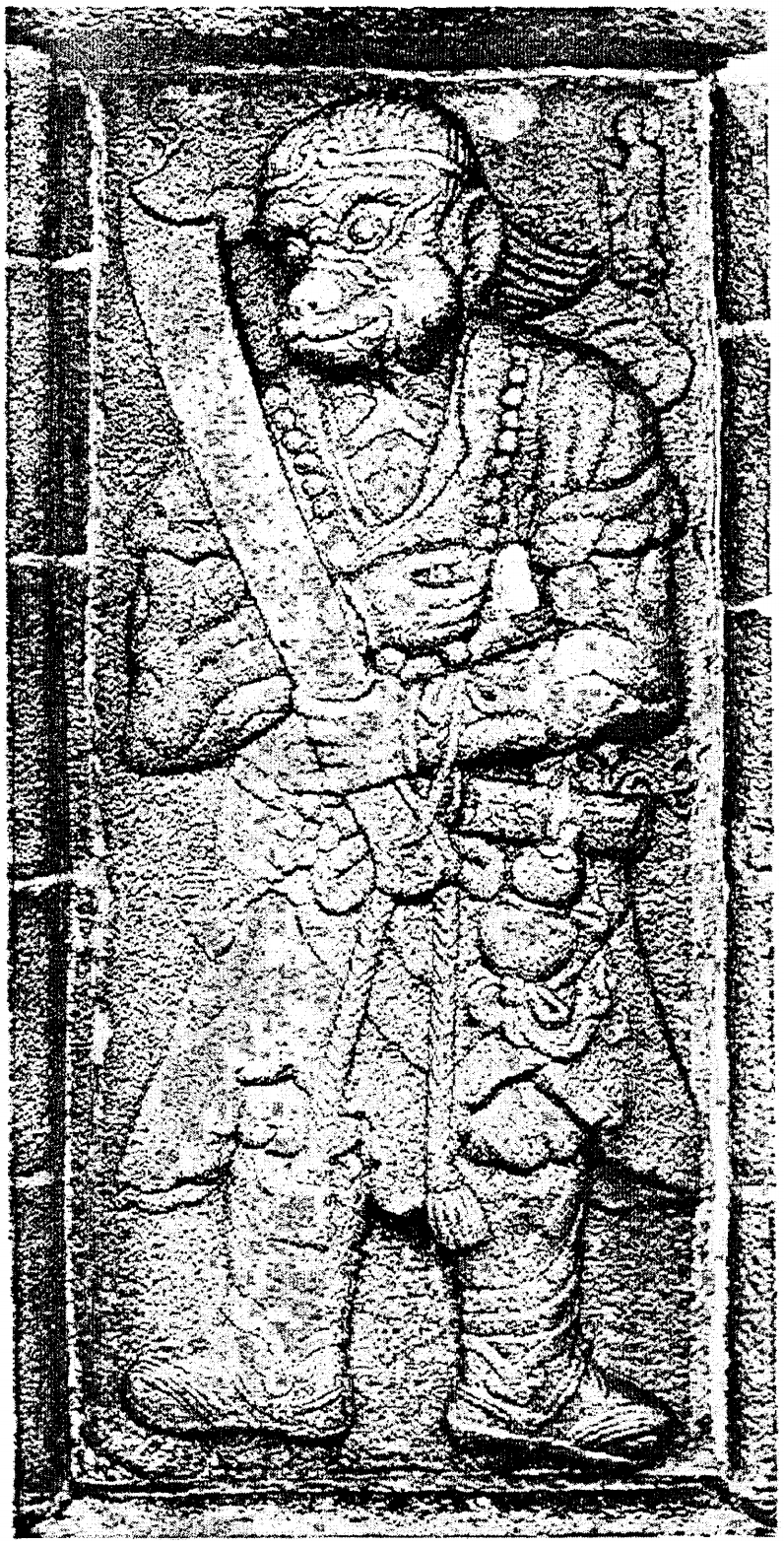
In her excellent paper on the origins of Sun Wukong, Hera S. Walker (1998) discusses a 13th-century CE stone relief from the western pagoda of the Kaiyuan Temple (開元寺) in Quanzhou, Fujian province, China that portrays a sword-wielding, monkey-headed warrior (pp. 69-70). Considered by many to be an early depiction of Monkey, the figure wears a robe, a Buddhist rosary, and, most importantly, a type one fillet on the forehead (Fig. 4). [4] Walker quotes Victor Mair, who believes the fillet “recalls the band around the head of representations of Andira, the simian guardian of Avalokitesvara” (the Indian counterpart to Guanyin) (Walker, 1998, p. 70). He goes on to list similarities between the stone relief and depictions of Andira, while also suggesting said depictions are based on south and southeast Asian representations of the Hindu monkey god Hanuman:
Identical earrings (these are key iconographic features of H[anuman] in many Southeast Asian R[ama saga]s), comparable tilt of the head… which seems to indicate enforced submission, long locks of hair… flaring out behind the head, elongated monkey’s mouth, similar decorations on the forearm and upper arm, etc. It is crucial to note that all these features can be found in South Asian and Southeast Asian representations of H[anuman] (Walker, 1998, p. 70).
So as it stands, the 13th-century CE appears to be the furthest that the motif has been reliably traced.
Fig. 4 – The 13th-century CE stone relief of Sun Wukong from the Kaiyuan Temple in Quanzhou, Fujian province, China (larger version).
3. My Findings
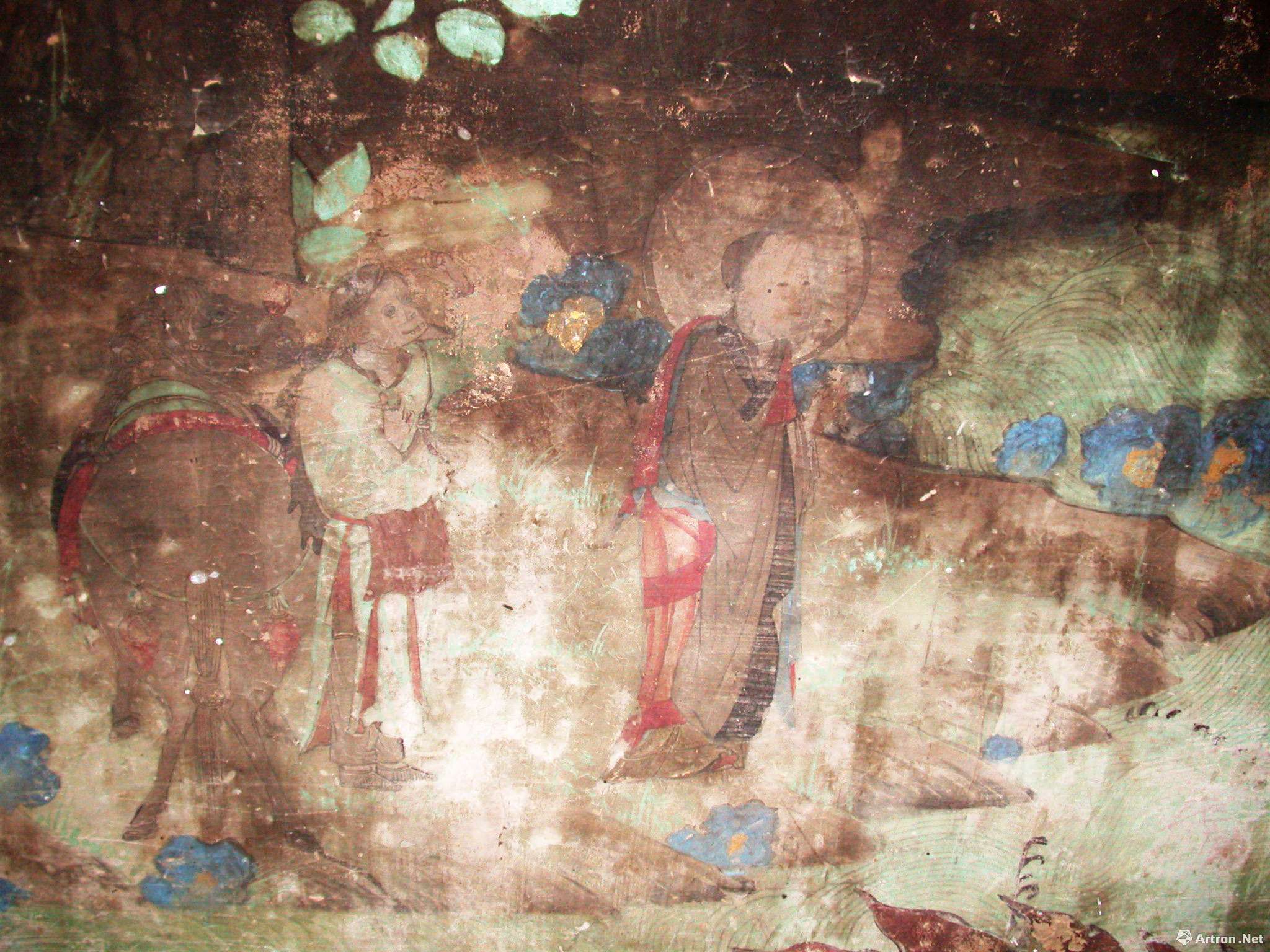
While Mair suggests a Southeast Asian Hindo-Buddhist influence, I know of at least one example from northeastern China that suggests an Indo-Tibetan Buddhist influence. The Eastern Thousand Buddha Cave no. 2 (Dong qianfo dong di 2 ku, 東千佛洞第2窟) in the Hexi Corridor of Gansu Province contains a late-Xixia dynasty (late-12th to early-13th-century CE) mural of Xuanzang worshiping Guanyin from a riverbank. Monkey stands behind him tending to a brown horse. He is portrayed with a type three circlet on his head, waist length hair, and light blue-green robes with brown pants (fig. 5). This painting was completed during a time when China was seeing an influx of monks fleeing the inevitable fall of India’s Buddhist-led Pala Dynasty (750-1174 CE) from the 10th to the 12th-century CE. They brought with them the highly influential Pala Buddhist art style and Vajrayana Buddhism, a form of esoteric Buddhism. The MET (2010) writes:
A mixture of Chinese-style and Vajrayana traditions and imagery was employed in the Tangut Xixia Kingdom … which was based in Ningxia, Gansu, and parts of Shanxi … It is difficult to imagine that this “new” type of Buddhism, which not only was flourishing in Tibet in the late tenth century but was also found in the neighboring Xixia Kingdom and may have been practiced by Tibetans based in the Hexi Corridor region of Gansu Province, was completely unknown in central China until the advent of the Mongols (p. 19).
The painting of Monkey and Tripitaka was surely created by an Indian/Tibetan Buddhist monk (or at the very least a fellow Tangut/Chinese practitioner) living in the area. This suggests that the imagery within the painting, such as the fillet, could have an Esoteric Buddhist pedigree, and textual evidence shows such headbands were indeed worn in some esoteric rituals.
The yogin must wear the sacred ear-rings, and the circlet on his head (emphasis added); on his wrists the bracelets, and the girdle round his waist, rings around his ankles, bangles round his arms; he wears the bone-necklace and for his dress a tiger-skin… (Linrothe, 1999, p. 250).
Furthermore, it describes how each of the ritual adornments and implements used in the ceremony represents each of the five esoteric Buddhas, as well as other religio-philosophical elements:
Aksobhya is symbolized by the circlet (emphasis added), Amitabha by the ear-rings, Ratnesa by the necklace, and Vairocana (by the rings) upon the wrists. Amogha is symbolized by the girdle. Wisdom by the khatvanga [staff] and Means by the drum, while the yogin represents the Wrathful One himself [i.e. Heruka]. Song symbolizes mantra, dance symbolizes meditation, and so singing and dancing the yogin always acts (Linrothe, 1999, p. 251).
As can be seen, the circlet represents Aksobhya (Sk: “Immovable”; Ch: Achu, 阿閦; Budong, 不動). This deity is known for his adamantine vow to attain buddhahood through the practice of Sila, or “morality”, the aim of which “is to restrain nonvirtuous deeds of body and speech, often in conjunction with the keeping of precepts” (Buswell & Lopez, 2014, pp. 27 and 821). So the ritual band most likely served as a physical reminder of right speech and action, making it the best candidate for the origin of Monkey’s fillet. Sun is after all the representation of the “Monkey of the Mind” (as noted in the introduction), so his inclusion in the Eastern Thousand Buddha Cave painting was probably meant to convey the taming of this Buddhist concept via the circlet (apart from referencing the popular tale itself).
The Hevajra Tantra, the textin which the circlet appears, was first translated into Tibetan by Drogmi (993-1074 CE) and adopted during the 11th-century CE as a central text by the respective founders of the Kagyu and Sakya sects, two of the six major schools of Tibetan Buddhism. Various members of the Sakya sect were invited by Mongol royalty to initiate them into the text’s esoteric teachings during the 13th-century CE. These include Sakya Pandita and his nephew Chogyal Phagpa, who respectively tutored Genghis Khan‘s grandson Prince Goden in 1244 and Kublai Khan in 1253. The meeting between Kublai and Chogyal resulted in Vajrayana Buddhism becoming the state religion of Mongolia. The Hevajra Tantrawas translated into Chinese by the Indian monk Dharmapala (963-1058 CE) in 1055 during the Northern Song Dynasty (960-1127 CE). The text, however, did not become popular within the Chinese Buddhist community like it would with the Mongols in the 13th-century CE (Bangdel & Huntington, 2003, p. 455). But this evidence shows how the concept of the 8th-century CE ritual circlet could have traveled from India to East Asia to influence depictions of Sun Wukong in the 11th-century CE. And the relatively unknown status of the text in China might ultimately explain why there are so very few depictions of Chinese deities wearing the fillet, or why it does not appear in the 13th-century CE version of Journey to the West.
While the late-Xixia mural (fig. 5) lacks many of the ritual adornments (apart from the fillet) mentioned in the Hevajra Tantra, the Quanzhou stone relief (fig. 3) includes the band, earrings, necklace, bangles, and possibly even a tiger skin apron, suggesting it too has an esoteric origin (most likely based on Chinese source material). [5] The band’s connection to esoteric Buddhism is further strengthened by a 12th-century CE painting from Japan. Titled Aka-Fudo (赤不動), or “Red Fudo [Myoo],” it depicts the wrathful esoteric god seated in a kingly fashion, holding a fiery, serpent-wrapped Vajra sword in one hand and a lasso in the other (fig. 6). He wears a golden, three-linked headband (similar to the curls of type one), which stands out against his deep red body and flaming aureola. Biswas (2010) notes: “…the headband on his forehead … indicate[s], according to some, a relation to the habit of groups of ascetics who were among the strong supporters of Acalanatha” (p. 112). His supporters were no doubt yogin practitioners in the same vein as those who worshipped Heraku and other such wrathful protector deities.
Fig. 5 – A portion of the late-Xixia (late-12th to early-13th-century CE mural) in the Eastern Thousand Buddha Cave number two (larger version). Fig. 6 – The 12th-century CE Japanese painting “Aka-Fudo” (赤不動) (larger version).
3.1. The Fillet as a Symbol of Martial Deities and Warrior Monks
It’s important to note that Monkey was not the only cultural hero of the Ming Dynasty (1368-1644 CE) to wear a golden fillet. Another example is Li Tieguai (李鐵拐), or “Iron Crutch Li,” the oldest of the Eight Immortals. [5] Li is generally portrayed as a crippled beggar leaning on a cane. Legend has it that his original body was cremated prematurely by a disciple while the immortal traveled in spirit to answer a summons from Lord Laozi, the high god of Daoism. Li’s spirit returned a day later to find only ashes, thus forcing him to inhabit the body of a recently deceased cripple. According to Allen and Philips (2012), “Laozi gave him in recompense a golden headband and the crutch that was to become his symbol” (p. 108). Some depictions of Li wearing the fillet predate Journey to the West. The most striking example is Huang Ji’s Sharpening a Sword (early-15th-century CE) (Fig. 7), which portrays the immortal wearing a type three band and sharpening a double-edged blade on a stone while staring menacingly at the viewer. [6] One theory suggests Li’s martial visage identifies him as a “spirit-guardian of the [Ming] state” (Little, 2000, p. 333). Both Monkey and Li are therefore portrayed as brutish, weapon-bearing, golden headband-wearing immortals who serve as protectors. This shows the fillet was associated with certain warrior deities during the Ming.
The fillet’s connection to religion and martial attributes culminated in the Jiegu (戒箍, “ring to forget desires”), a type two band worn by Military Monks (Wuseng, 武僧) in Chinese opera to show that they have taken a vow of abstinence (fig. 8). Such monks are depicted as wearing a Jiegu over long hair (Bonds, 2008, pp. 177-178 and 328), which contrasts with the bald heads of religious monks. [7] I would like to suggest that the band’s half-moon shape may have some connection to a Ming-era woodblock print motif in which martial monks are shown wielding staves tipped with a crescent (fig. 9)(Note: see my 07-25-22 update for the foreign origins of this motif). The exact reason for the shape is still unknown (Shahar, 2008, pp. 97-98), but the association between the crescent and martial monks seems obvious. The use of the fillet in Chinese opera led to it being worn by Sun Wukong in the highly popular 1986 live-action tv show adaptation of the novel (fig. 2). [8]
Fig. 7 (Left) – Huang Ji’s “Sharpening a Sword” (early 15th-century CE) (larger version). Fig. 8 (Center) – An image of the military monk Wu Song wearing a jiegu (戒箍) fillet from a 2011 Water Margin TV show (larger version). Fig. 9 (Right) – A late-Ming woodblock of the warrior monk Lu Zhishen with a crescent staff (larger version). From Shahar (2008).
4. Conclusion
Examples of past research into the origins of the golden fillet respectively point to a slave collar from the Han dynasty (206 BCE-220 CE) and circa 13th-century CE South and Southeast Asian depictions of the Buddhist guardian Andira and the Hindu monkey god Hanuman as possible precursors. However, the first isn’t credible, and the second, while on the right track, doesn’t go back far enough. A late-12th to early-13th-century CE mural in the Eastern Thousand Buddha Cave complex depicts Sun Wukong wearing a type three fillet with possible ties to a ritual circlet worn by Esoteric Buddhist Yogin ascetics in 8th-century CE India. The Hevajra Tantra, the esoteric text that mentions the band, associates it with the Aksobhya Buddha and thereby his moralistic, self-restraining practices. The text was transmitted from India to Tibet, China, and Mongolia from the 11th to the 13th-centuries CE, showing a clear path for such imagery to appear in East Asia. A 12th-century CE Japanese Buddhist painting of the guardian deity Fudo Myoo with a fillet suggests that the practice of wearing circlets in esoteric rituals continued for centuries. Other non-Buddhist deities became associated with the fillet during the Ming Dynasty. A 15th-century CE painting of the immortal Li Tieguai, for example, depicts him as a type one circlet-wearing, sword-wielding guardian of the Ming dynasty. All of this suggests that the band became a symbol of weapon-bearing protector deities. The association between the fillet and religion and martial attributes led to its use as the symbol of military monks in Chinese opera.
Update: 12-23-17
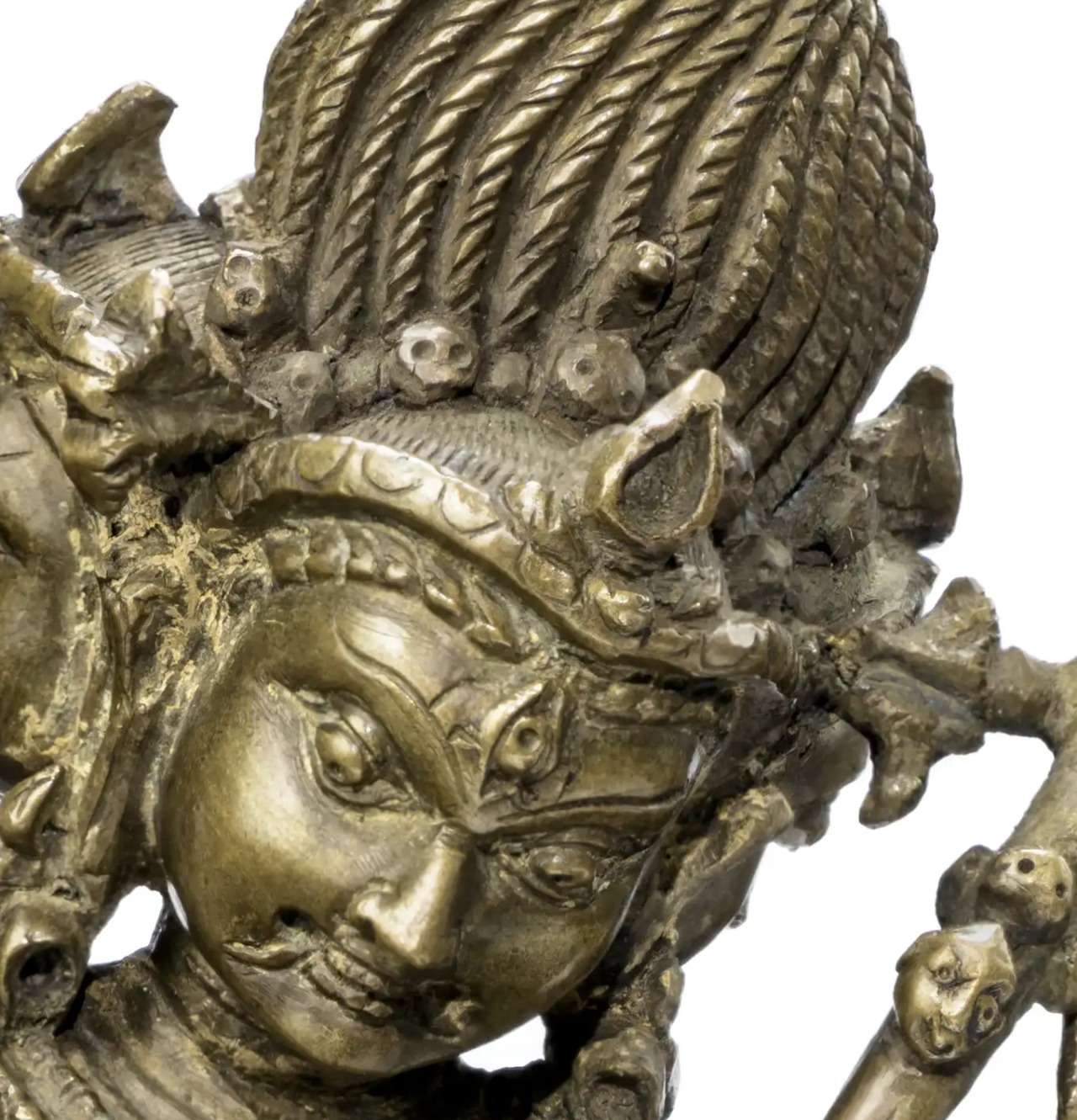
I’ve been wondering what the 8th-century CE version of the circlet (along with the other ritual implements) mentioned in the Hevajra Tantra might have looked like. While I have yet to find a contemporary sculpture or painting, I have found an 11th to 12th-century CE interpretation from Tibet. Titled The Buddhist Deity Hevajra (fig. 10), this copper alloy statue somewhat follows the prescribed iconography of the god as laid out in the aforementioned text:
Dark blue and like the sun in colour with reddened and extended eyes, his yellow hair twisted upwards, and adorned with the five symbolic adornments,/ the circlet, the ear-rings and necklace, the bracelets and belt. These five symbols are well known for the purificatory power of the Five Buddhas./ He has the form of a sixteen-year-old youth and is clad in a tiger-skin. His gaze is wrathful. In his left hand he holds a vajra-skull, and a khatvahga [staff] likewise in his left, while in his right is a vajra of [a] dark hue…(Linrothe, 1999, p. 256)
The circlet here is depicted as a fitted band with crescent trim and a teardrop-shaped adornment (a conch?) (fig. 11). The statue’s iconography more closely follows that from the Sadhanamala (“Garland of Methods”), a compilation of esoteric texts from the 5th to 11th-centuries CE. The following information probably derives from the later part of this period:
He wields the vajra in the right hand and from his left shoulder hangs the Khatvanga [staff] with a flowing banner, like a sacred thread. He carries in his left hand the kapala [skull cap] full of blood. His necklace is beautified by a chain of half-a-hundred severed heads. His face is slightly distorted with bare fangs and blood-shot eyes. His brown hair rises upwards and forms into a crown which bears the effigy of Aksobhya. He wears a kundala [ear decoration] and is decked in ornaments of bones. His head is beautified by five skulls (Donaldson, 2001, p. 221).
Our statue has many of these features but lacks the image of the Buddha in his hair. This suggests the knob visible in the coif (fig. 10) once carried such a figure. So once again we see the importance of the Aksobhya Buddha. The statue is similar to 10th and 11th-century CE stone statues from India. [9]
While this doesn’t get us any closer to what the original circlet looked like, this statue adds to the mutability of the fillet imagery. The Hevajra Tantra is vague in its description, and so it is no surprise that so many variations have appeared over the centuries. The original sanskrit text uses the word cakri (circle) to refer to the band (Farrow & Menon, 2001, pp. 61-62). This might explain the simple type three fillet worn by Monkey in the Eastern Thousand Buddha Cave two painting (fig. 2).
Update: 08-16-20
I have written an article suggesting an origin for the type one headband, or as I now call it, the “curlicue headband.”
One thing I figured out a while ago but never explained here was the reason why the Japanese Buddhist protector deity Aka-Fudo (赤不動) (fig. 6) is depicted with a headband. I believe this is a visual representation of the fillet’s association with the Aksobhya Buddha. This is because the fudo (Ch: budong, 不動) of Aka-Fudo and the Sanskrit meaning of Aksobhya respectively mean “immovable.” So the image of Aka-Fudo is encapsulating both his position as a protector deity and the Buddha represented by the headband.
Update: 01-23-22
I’ve written an article suggesting a mantra for the secret spell that causes the golden fillet to tighten.
Above, I mentioned that the novel contains three kinds of headbands:
Sun Wukong/Six Ears – “Constrictive” (jin, 緊) – ch. 14
Black Bear Demon – “Prohibitive” (jin, 禁) – ch. 17
Red Boy – “Golden” (jin, 金) – ch. 42
It’s interesting that all of them are pronounced “jin” (with varying tones).
Now imagine that there is a secret fourth headband not intended to punish but to empower. Called the “Strength” (jin, 勁) headband, it would only be used in the most extreme emergencies.
It would be neat to see someone work this into their fanfiction.
Update: 12-24-23
A character is briefly punished to wear a golden headband in the famed Ming-era novel Investiture of the Gods (Fengshen yanyi, 封神演義, c. 1620; summary). Chapter 82 reads:
Ma Sui [馬遂] attacked him with his sword, and after only one round, threw a gold hoop [jingu, 金箍] around the immortal’s head. The Yellow Dragon Immortal [Huanglong zhenren, 黃龍真人] writher in pain but was quickly rescued and brought back to the pavilion.
The Yellow Immortal Dragon Immortal tried to take the hoop off his head but found it was impossible. It was so tight the true samadhi fire went out of his eyes.
The Immortal of the South Pole [Nanji xianweng, 南極仙翁] came in to announce Heavenly Primogenitor’s [Yuanshi tianzun, 元始天尊] arrival. The religious leader entered the pavilion and said, “The Yellow Dragon Immortal was destined to be caught in this gold hoop. Come here and let me help you.”
He pointed at the gold hoop, and it dropped to the ground (Gu, 2000, pp. 1713-1715).
(Gu (2000) skips over some elements in the original Chinese.)
I’ve known about this episode for a while but forget to post about it.
Notes
1) For the entire episode, see Wu & Yu, 2012, vol. 1, pp. 314-320.
2) The child first speaks his new name in Wu & Yu, 2012, vol. 2, p. 354. The name Sudhana originates from the Avatamsaka Sutra (Wu & Yu, 2012, vol. 2, pp. 386-387 n. 3).
3) For a complete English translation, see Wivell (1994).
4) This is just one of many relief carvings that grace the pagoda. It includes other guardian-type figures with esoteric elements but rendered in the Chinese style. See Ecke and Demiéville (1935).
5) The Eight Immortals are Daoist saints who came to be worshipped as a group starting sometime in the Jin Dynasty (1115-1234 CE) (Little, 2000, p. 319).
6) The sword is usually a symbol of the immortal Lu Dongbin, but, as noted above, it is used to identify Li Tieguai as a Ming guardian (Little, 2000, p. 333).
7) Shahar (2008) discusses the historical differences between religious and military monks in ancient China.
8) The actor who played Monkey, Liu Xiao Ling Tong (Born Zhang Jinlai, 章金萊, 1959), comes from a family who has specialized in playing Sun Wukong in Chinese opera for generations (Ye, 2016).
9) See the Heruka chapter in Linrothe (1999). He includes our statue in his study, but other sources describe it as Tibetan instead of India (Bangdel & Huntington, 2003, p. 458).
Bibliography
Allan, T., & Phillips, C. (2012). Ancient China’s Myths and Beliefs. New York: Rosen Pub.
Bangdel, D., & Huntington, J. C. (2003). The Circle of Bliss: Buddhist Meditational Art. Chicago, Ill: Serindia Publications.
Biswas, S. (2010). Indian Influence on the Art of Japan. New Delhi: Northern Book Centre.
Bonds, A. B. (2008). Beijing Opera costumes: The Visual Communication of Character and Culture. Honolulu: University of Hawai’i Press.
Buswell, R. E., & Lopez, D. S. (2014). The Princeton Dictionary of Buddhism. Princeton, NJ: Princeton University Press.
Donaldson, T. E. (2001). Iconography of the Buddhist Sculpture of Orissa. New Delhi: Indira Gandhi National Centre for the Arts.
Ecke, G., & Demiéville, P. (1935). The Twin Pagodas of Zayton: A Study of the Later Buddhist Sculpture in China. Cambridge, Mass: Harvard University Press.
Farrow, G. W., & Menon, I. (2001). The Concealed Essence of the Hevajra Tantra: With the Commentary Yogaratnamālā. Delhi: Motilal Banarsidass Publ.
Little, S. (2000). Taoism and the Arts of China. Chicago, IL: Art Institute of Chicago.
Liu, X. (1994). The Odyssey of the Buddhist Mind: The Allegory of the Later Journey to the West. Lanham, Md: University Press of America.
Metropolitan Museum of Art, Leidy, D. P., Strahan, D. K., & Becker, L. (2010). Wisdom Embodied: Chinese Buddhist and Daoist sculpture in the Metropolitan Museum of Art. New York: Metropolitan Museum of Art.
Shahar, M. (2008). The Shaolin Monastery: History, Religion, and the Chinese Martial Arts. University of Hawaii Press.
Walker, H.S. (1998). Indigenous or Foreign? A Look at the Origins of Monkey Hero Sun Wukong. Sino-Platonic Papers, 81, 1-117.
Wang, T. (2006). Dust in the Wind: Retracing Dharma Master Xuanzang’s Western Pilgrimage. Taipei: Rhythms Monthly.
Did you know Sun Wukong was among the various martial spirits that the fighters (fig. 1) of the anti-foreign Boxer Rebellion (1899-1901) channeled to gain what they believed to be superhuman fighting ability? This ritual is described by the German catholic missionary Georg Maria Stenz in his 1907 book Contributions to the Folklore of Southern Shandong (Beiträge zur Volkskunde Süd-Schantungs) (fig. 2).
On any day of the first month, [the possessing spirit of] the monkey is invited [to earth] […] In order to invite the monkey, money is collected to buy incense in the village. On that particular day, four young men, who are not allowed to be … born in the year of the dragon or tiger, are led to any temple or cemetery … There the incense candles are lit and the following prayer is spoken:
一匹馬兩匹馬 請孫大老爺來玩耍 一條龍兩條龍 請孫大老爺下天攻
One horse, two horses. Great Lord Sun, please come and play. One dragon, two dragons. Great Lord Sun, please descend from Heaven and fight.
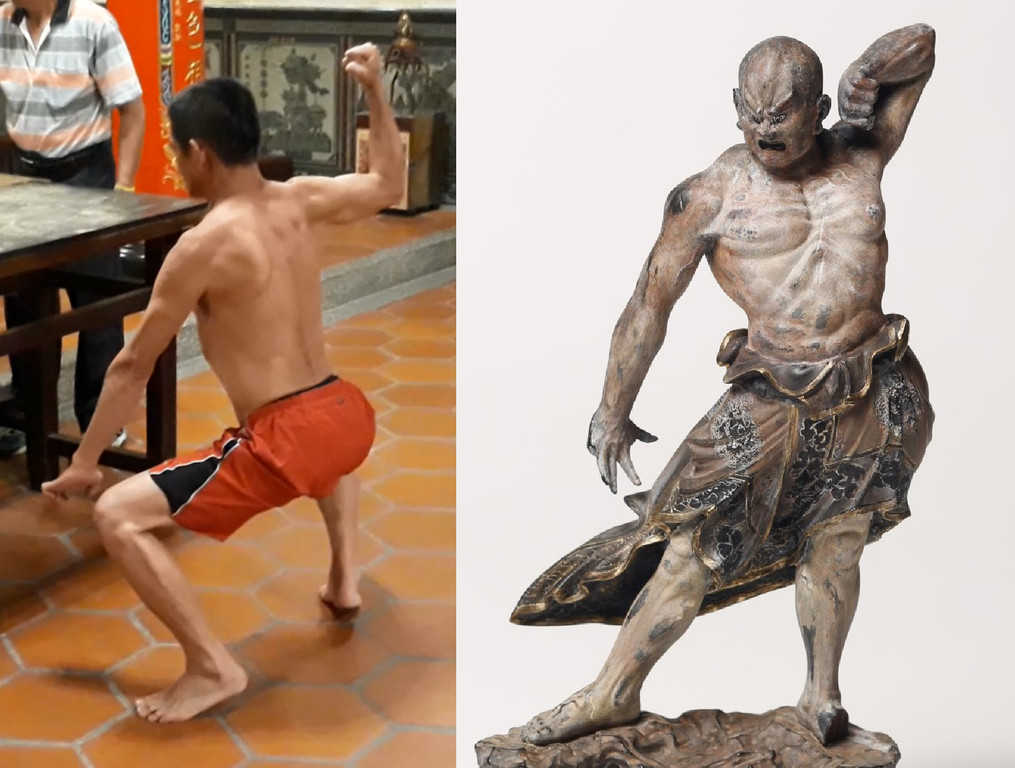
Then the four fall on their faces and remain in this position for a while. Suddenly someone flops to one side: the [spirit of the] monkey has taken hold and the young man can no longer move himself. After being carried home, lighted incense candles are held under his nose until he jumps up by himself. Once a long saber is put in his hand, he makes a scandalous display accompanied by much fanfare and cymbals. The “possessed” is constantly brandishing the saber in the air and jumping over tables and benches. If one believes the display is too scary, then one lets the incense candles extinguish and the possessed falls immediately as if lifeless to the ground. After some time you call him by his name and he wakes up slowly as if from a deep sleep (Stenz, 1907, pp. 47-49). [1]
Fig. 1 – Boxer rebels circa 1900. Originally from Wikimedia commons. Fig. 2 – A map of China showing Shandong province in red. Originally from Wikipedia.
Esherick (1987) notes the term “horse” from the poem was often used by boxers to refer to the possessee (pp. 56 and 62), or the human vessel that spirits command like a rider on a horse. I imagine both the horses and dragons refer to all four men who volunteer for the ritual.
Today I attended Sun Wukong’s birthday celebration (the 16th day of the 8th lunar month) in Kowloon, Hongkong. I might post an article about this in the future. In the meantime, I wanted to note that, since the worship of the Monkey King appears in so many coastal provinces, it’s possible that his cult spread via sailors and merchants.
Update: 07-10-20
Elliott (1955/1990) describes a spirit-medium (Hokkien: tangki, 童乩; Mandarin: jitong, 乩童) initiation ceremony in Singapore with similarities to the above ritual. These include a small number of young male volunteers; a temple (where the altar is located); chanting, gongs and drums; and one of the volunteers being possessed by a deity, followed by violent movements. This suggests a widespread tradition of spirit-mediumship using similar methods:
The candidates, who may number five or six, seat themselves in a row in front of the altar. Each is given three small incense sticks to hold. they then have to meditate on the shen [神, “god”] which they wish to invoke … After appropriate cleansing ceremonies have been performed the assistants begin to chant and beat their drums and gongs. The experienced dang-ki who has been asked to participate is standing by and possibly assisting in one or another of the minor duties. This initial stage may last for an hour or two while the candidates sit with their heads bowed, waiting to become possessed … Eventually, some slightly strange effects take place in one or more of the the novices. They may shiver a little, or shake their heads. When the experienced dang-ki sees this, he seats himself in a chair beside them and prepares to enter a trance. Within a few minutes his shen has possessed him. Rising from his chair, he strikes a posture in front of the altar and waits until the novices show further signs of possession. At last one of them begins to get more violent in his movements. His head begins to node up and down, and his body sways from side to side so that assistants have to hold his chair lest it fall over. Here the experienced dang-ki intervenes. He grabs the novice by both hands and tries to drag him to his feet … As soon as the dang-ki and assistants can support him in a standing position, they lean over and try to catch the words he is muttering. From this, or from his bodily movements, they identify the shen that is possessing him. An assistant rushes to the altar and produces the stomacher [2] and other items of apparel appropriate to the shen they have identified. The stomacher is tied across the novice’s chest, and he is dragged up to the offering table, still reluctantly, and in a state bordering on collapse. Here he has charm water blown over him and he is given a drink” (p. 60)
Notes:
1) Adapted from the original German.
2) A stomacher (dudou, 肚兜) is an embroidered bib worn on the tangki’s bare torso. It is a symbol that the tangki is “‘naked’ to the sun”, serving as a reenactment of ancient Shang-period sacrificial rain-making ceremonies (Chan, 2015, p. 5).