Sun Wukong’s Greatest Feat of Strength: An Allegory for Cultural or Religious Conflict?

Last updated: 07-03-2022

Now that I’ve written an entry debunking the idea that the Monkey King’s staff anchored the Milky Way, I now want to write a piece about his greatest feat of strength in Journey to the West. This takes place in chapter 33 after Zhu Bajie has been captured by two demon brothers, Kings Goldhorn (Jinjiao Dawang, 金角大王) and Silverhorn (Yinjiao Dawang, 銀角大王). King Silverhorn, the younger of the two, then sets out to capture Tripitaka but is forced to resort to trickery when he learns that the monk is protected by Sun Wukong. He transforms himself into an elderly Daoist laying by the roadside with a broken leg. The monk subsequently forces Monkey to carry him on his back, but our hero sees through the disguise and plans to throw his charge off a cliff. However…

As the Great Sage was about to do this, the monster knew instantly of his plan. Knowing how to summon mountains, he resorted to the magic of Moving Mountains and Pouring Out Oceans. On Pilgrim’s [Monkey’s] back he made the magic sign with his fingers and recited a spell, sending the Sumeru Mountain into midair and causing it to descend directly on Pilgrim’s head. A little startled, the Great Sage bent his head to one side and the mountain landed on his left shoulder. Laughing, he said, “My child, what sort of press-body magic are you using to pin down old Monkey? This is all right, but a lopsided pole is rather difficult to carry.”

The demon said to himself, “One mountain can’t hold him down.” He recited a spell once more and summoned the Emei Mountain into the air. Pilgrim again turned his head and the mountain landed on his right shoulder. Look at him! Carrying two mountains, he began to give chase to his master with the speed of a meteor! The sight of him caused the old demon to perspire all over, muttering to himself, “He truly knows how to pole mountains!” Exerting his spirit even more, he recited another spell and sent up the Tai Mountain to press down on Pilgrim’s head. With this magic of the Tai Mountain Pressing the Head, the Great Sage was overpowered as his strength ebbed and his tendons turned numb; the weight was so great that the spirits of the Three Worms inside his body exploded and blood spurted from his seven apertures (Wu & Yu, 2012, vol. 2, pp. 108-109).

這大聖正算計要摜,原來那怪就知道了,且會遣山。就使一個「移山倒海」的法術,就在行者背上捻訣,念動真言,把一座須彌山遣在空中,劈頭來壓行者。這大聖慌得把頭偏一偏,壓在左肩臂上,笑道:「我的兒,你使甚麼重身法來壓老孫哩?這個倒也不怕,只是正擔好挑,偏擔兒難挨。」那魔道:「一座山壓他不住。」卻又念咒語,把一座峨嵋山遣在空中來壓。行者又把頭偏一偏,壓在右肩臂上。看他挑著兩座大山,飛星來趕師父。那魔頭看見,就嚇得渾身是汗,遍體生津道:「他卻會擔山。」又整性情,把真言念動,將一座泰山遣在空中,劈頭壓住行者。那大聖力軟觔麻,遭逢他這泰山下頂之法,只壓得三尸神咋,七竅噴紅。

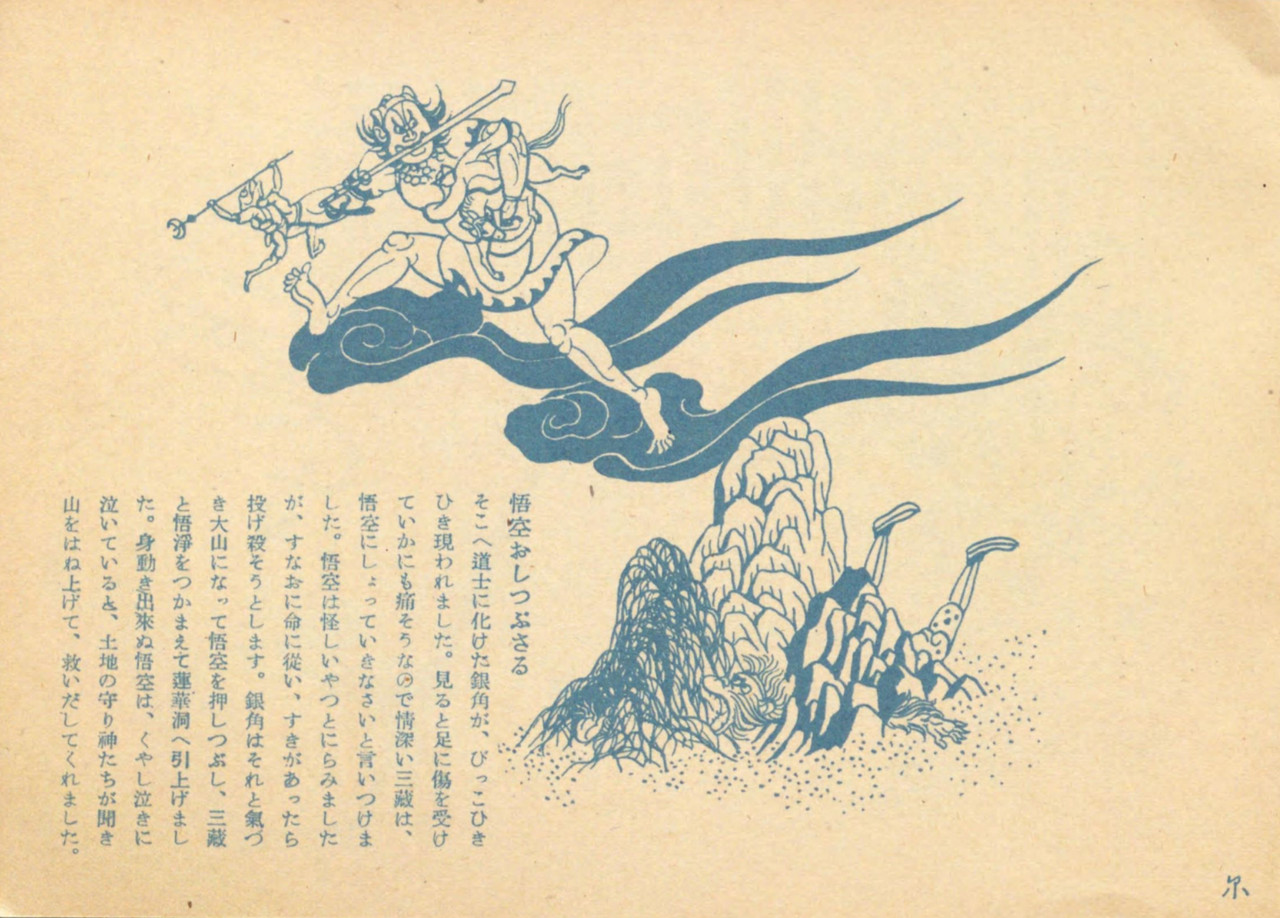
We see here Monkey is able to successfully carry the weight of both the Sumeru and Emei mountains, while running after his master “with the speed of a meteor.” That’s quite impressive, even if he is eventually crushed under the weight of a third mountain (fig. 1). Attention should be given to the particular mountains used in this episode. Let’s start with Sumeru since this is the first one mentioned.
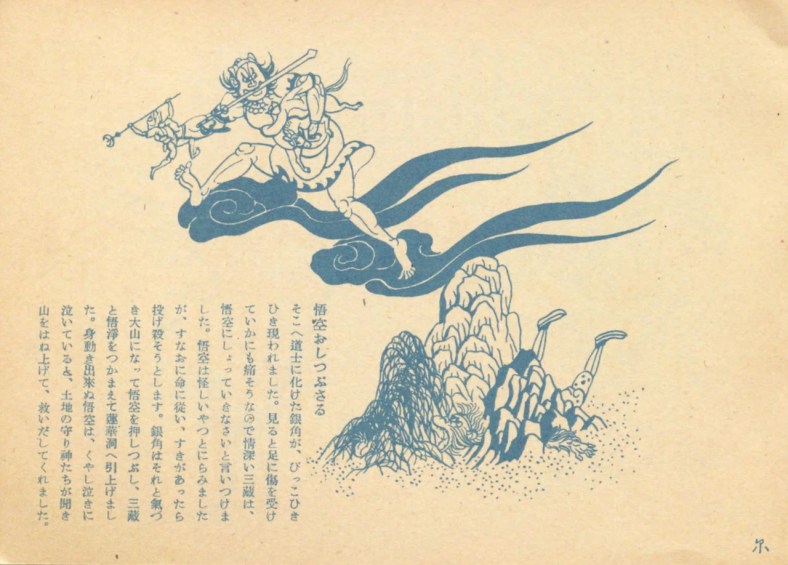
Fig. 1 – Monkey trapped under the three mountains as King Silverhorn abducts Tripitaka, the dragon horse, and Sha Wujing (larger version). From The Illustrated Journey to the West (1950), a Japanese children’s book.

Buswell and Lopez (2014) describe Mount Sumeru (Ximi shan, 須彌山; Miaogao shan, 妙高山) as:

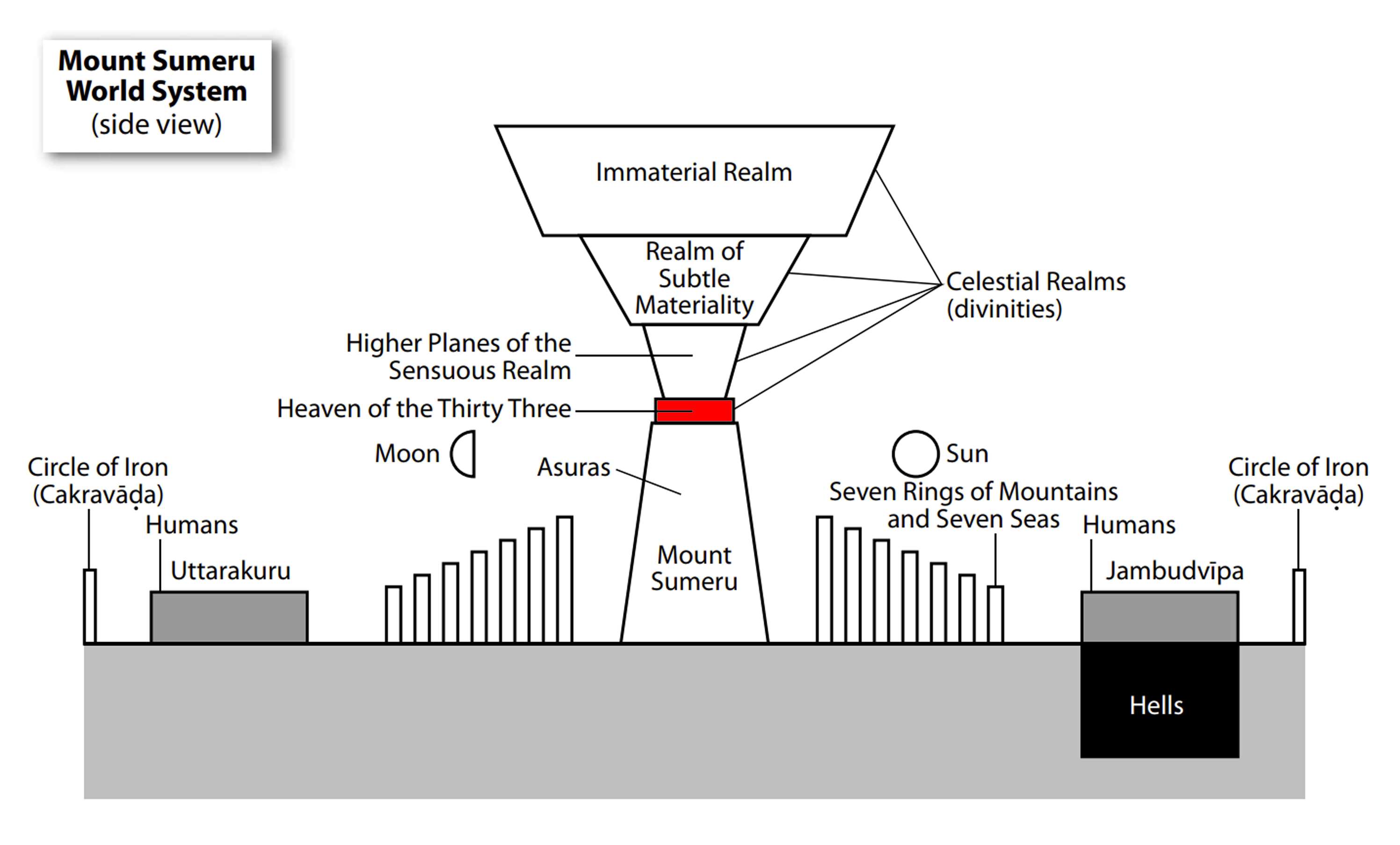
The central axis of the universe in Buddhist cosmology; also known as Mount Meru. Mount Sumeru stands in the middle of the world as its axis and is eight leagues high …  The slopes of Sumeru are the abode of demigods, and its upper reaches are the heavens of the four heavenly kings. At the summit of the mountain is the heaven of the thirty-three, ruled by the king of the gods, Sakra. Above Mount Sumeru are located the remaining heavens of the sensuous realm [fig. 2] (p. 896).

[Note: The portion that has been struck through appears to be a typo. Please see the 06-19-22 update below.]

A poem in chapter four of Journey to the West describes what Monkey sees when he first comes to live in heaven as the Keeper of the Heavenly Horses. A portion reads:

Thirty-three mansions were found up here, / With names like the Scattered Cloud, the Vaisravana, the Pancavidya, the Suyama, the Nirmanarati…” (Wu & Yu, 2012, vol. 1, p. 146).

這天上有三十三座天宮,乃遣雲宮、毘沙宮、五明宮、太陽宮、花樂宮 …

Yu (Wu & Yu, 2012) comments, “The verse here is alluding to the Indra heaven with it’s thirty-three summits (trāyastriṃśa) [fig. 2] and the six heavens of desire (devalokas)” (vol. 1, p. 510, n. 1), which are located atop Mount Sumeru. Therefore, the heaven described in the novel is located on the same cosmic mountain as that from Hindo-Buddhist cosmology, meaning Monkey successfully supports the axis of the universe on one shoulder.

Fig. 2 – A sideview of Hindo-Buddhist cosmic geography (larger version). The Heaven of the Thirty-Three is indicated in red. Adapted from Buswell & Lopez, 2014, p. xxxii.

Mount Emei (Emei shan, 峨嵋山; 峨眉山) is one of the four sacred Buddhist mountains of China. It is considered extremely important as Chinese tradition believes, upon entering the Middle Kingdom from India, Buddhism spread from this place during the eastern Han Dynasty and proliferated throughout China. The mountain is 10,167 feet high, making it over 3,000 feet taller than the other sacred Buddhist mountains. The mountain is believed to be the heavenly abode of the Bodhisattva Samantabhadra, making him the patron saint of Emei (Buswell & Lopez, 2014, pp. 282-283).

I want to reiterate the fact that both Sumeru and Emei are important to Buddhism. Not only does Monkey support the very axis of the Buddhist universe on one shoulder, he supports on the other the very mountain from which the religion is believed to have spread into China. I’m not sure if this was the author-compiler’s original intent, but it seems as if this feat of strength could be symbolism for Monkey literally “supporting” Buddhism by protecting his master on their journey to India. After all, the historical Xuanzang (玄奘, 602-664), on whom Tripitaka was based, is considered to be one of, if not the most, prolific translators of Buddhist texts in the history of Chinese Buddhism (Buswell & Lopez, 2014, pp. 1015-1016).

I turn now to Mount Tai (Taishan, 泰山), the mountain that ultimately overwhelms Sun Wukong’s supernatural strength. It is one of the five sacred mountains of China, which differ from the four Buddhist counterparts mentioned above. Mount Tai was the epicenter of a state cult in Ancient China, one in which Sage-Kings and emperors of past millennia traveled there to perform sacrifices to heaven, thereby gaining the right to rule or attaining eternal life. An entry in the Classic of History (Shujing, 書經, 4th-c. BCE) suggests that the practice goes all the way back to the Sage-King Shun (3rd millennia BCE) (Poo, 2011, pp. 20-21). Due to its great cultural and historical significance, the mountain came to be recognized as an adamantine monolith, the very name of which was used as a metaphor for something unfathomably heavy, whether it be a physical measure of weight or philosophical importance. For example, Warring States philosopher Mozi took part in a debate over the plausibility of his school of thought taking center stage in Chinese society. His opponent claimed, “As we see it, one can no more put it into practice than one can pick up Mount Tai and leap over a river with it!” Mozi highlighted the irrelevant nature of the metaphor by replying, “As for picking up Mount Tai and leaping over rivers with it, no one from ancient times to the present, from the beginning of humankind to now, has ever succeeded in doing that!” (Watson, 1999a, p. 71). Another example comes from the Han historian Sima Qian who wrote, “A man has only one death. That death may be as weighty as Mount Tai, or it may be as light as a goose feather. It all depends upon the way he uses it” (Watson, 1999a, pp. 371-372). Therefore, the mountain represented the heaviest thing imaginable in Chinese culture. It’s no wonder then that not even Monkey could withstand its weight.

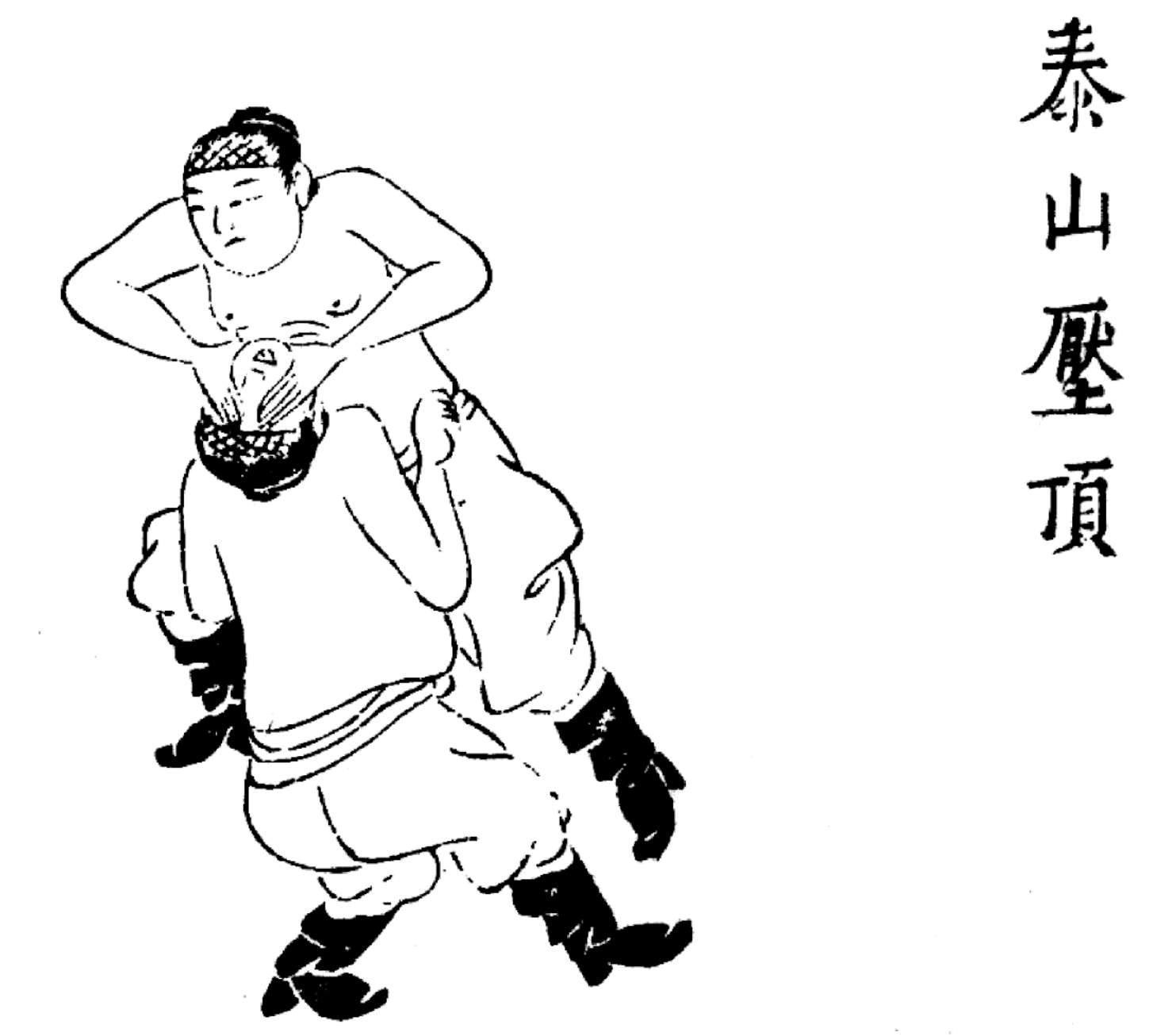
The idea of Mount Tai symbolizing a heavy object influenced the name of a 17th-century technique related to the development of Taiji boxing called “Crush with the Weight of Mount Tai” (Taishan yading, 泰山壓頂) (fig. 3), which involved climbing onto an opponent (Henning, 2009, pp. 78 and 82). Incidentally, the name of this technique is also a common Chinese saying referring to someone being under a lot of stress (Gao, Wang, & Weightman, 2012, p. 191).

Fig. 3 – “Crush with the Weight of Mount Tai”. From Henning, 2009, p. 78 (larger version).

I find it interesting that, after easily bearing the weight of two Buddhist mountains, Mount Tai is the proverbial straw that broke the camel’s back. Mount Tai represents native Chinese history and culture, while Sumeru and Emei represent Buddhism, a non-native religion from India. Therefore, this episode could be read as a struggle between the domestic and foreign aspects of Chinese culture. Considering that the monsters are later revealed to be Daoist attendants of Laozi sent by heaven to test the resolve of the pilgrims (Wu & Yu, 2012, vol. 2, p. 145), it’s possible the conflict is between Daoism, a native Chinese religion, and Buddhism.

This is obviously not a perfect theory, though. For instance, Laozi reveals that it was actually the Bodhisattva Guanyin who requested the lads be sent (Wu & Yu, 2012, vol. 2, p. 145). Does this explain why a Daoist spirit would summon two Buddhist mountains to crush Monkey? I’m interested in what others think.

Fig. 4 – A modern painting of Hanuman lifting the mountain (larger version). All credit goes to the original artist S. Keerthi. 

Lastly, I would like to note that Sun Wukong’s feat of lifting mountains recalls an episode in the Ramayana (4th-c. BCE) in which the monkey god Hanuman carries back a mountain laden with magical herbs to heal the wounds of his master‘s brother Lakshmana (fig. 4). Hanuman is the living embodiment of strength (shakti) in India (see for example Alter, 1992). Monkey is believed to be loosely based on Hanuman (Walker, 1998), so there could be a connection between both instances of mountain lifting.


Update: 08-10-18

Monkey’s feat appears to be based on a native Chinese story and not the Ramayana. This is first hinted at in chapter 33 when the demon exclaims that the Great Sage “truly knows how to pole mountains [ta que hui danshan, 他卻會擔山]!” (Wu & Yu, 2012, vol. 2, p. 109). A poem spoken by Sun Wukong in chapter 67 confirms the connection:

Purvavideha was my ancestral home,
I did cultivation on Mount Flower-Fruit.
I bowed to the Patriarch of Heart and Mind
and perfected with him the martial arts.
I can tame dragons, stirring up the seas;
I can tote mountains to chase down the sun (emphasis added).
In binding fiends and demon’s I’m the best;
Moving stars and planets, I scare ghosts and gods.
Stealing from heav’n and Earth gives me great fame,
Of boundless change, Handsome Stone Monkey’s my name (Wu & Yu, 2012, vol. 3, p. 243).

祖居東勝大神洲,花果山前自幼修。
身拜靈臺方寸祖,學成武藝甚全周:
也能攪海降龍母,善會擔山趕日頭;
縛怪擒魔稱第一,移星換斗鬼神愁。
偷天轉地英名大,我是變化無窮美石猴。

Fig. 5 – Erlang poling the mountains (larger version). Artist unknown.

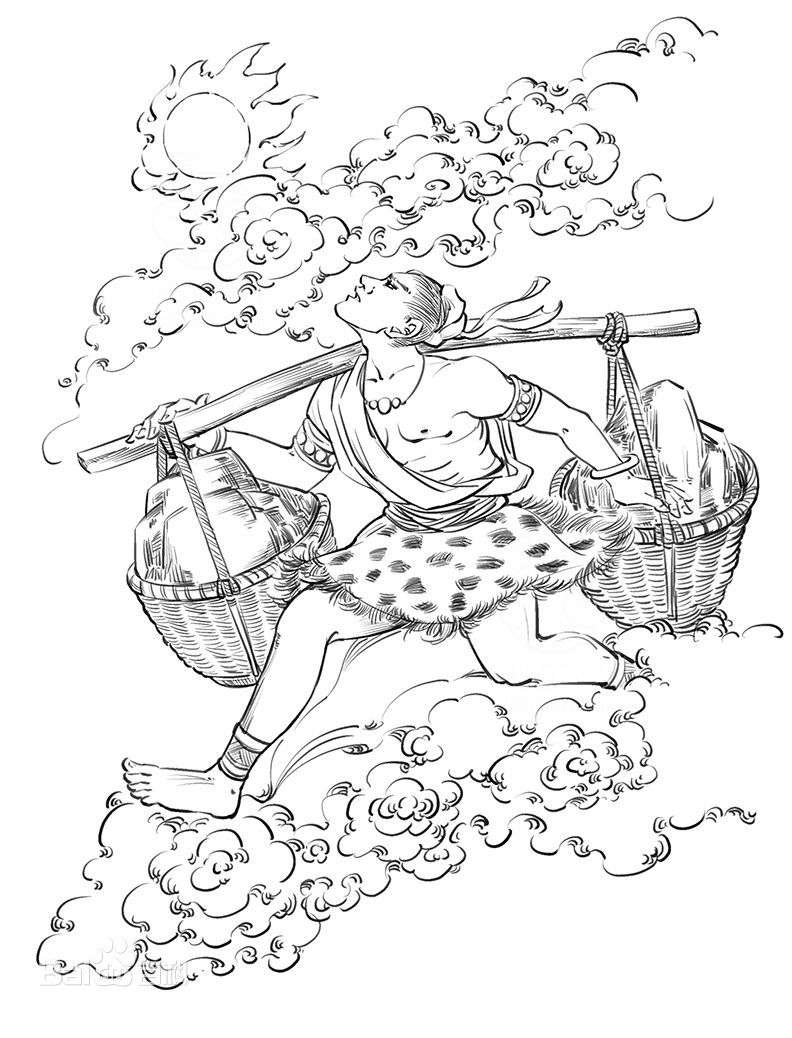
“I can tote mountains to chase down the sun” (shan hui danshan gan ritou, 善會擔山趕日頭) is a clear allusion to the ancient tale “Erlang carries mountains to chase the suns” (Erlang dan shan gan taiyang, 二郎擔​​山趕太陽). The tale describes how the ancient earth was plagued by many suns that scorched the land, making it impossible for people to grow anything. Vowing to end this plight, the hero Erlang shoulders two mountains hanging from a tree and, with the aid of magical shoes, chases down each sun (fig. 5), using the weight from both landmasses to overwhelm and crush the superfluous celestial bodies (担山赶太阳, n.d). Apart from the feat of lifting two mountains, Erlang’s fleet pursuit of each sun (gan taiyang, 趕太陽) foreshadows Monkey “giv[ing] chase to his master with the speed of a meteor” (fei xing lai gan shifu, 飛星來趕師父).

It’s interesting to note that “Erlang Carrying Mountains” (Erlang dan shan, 二郎擔山) is a common Shaolin stance, and a staff variant even appears in the Collection of Military Works (Wubei zhi, 武備志, c. 1621), a Ming treatise on military armaments and fighting techniques (fig. 6). The staff obviously recalls the pole (or in this case tree) that Erlang uses to bear the weight of the mountains.

Fig. 6 – The “Erlang Carrying Mountains” staff stance (larger version).


Update: 06-23-21

One thing I forgot to stress was the speed with which Sun Wukong is able to run while carrying the mountains. The novel reads: “Carrying two mountains, he began to give chase to his master with the speed of a meteor!” (Kan ta tiaozhe liang zuo dashan, feixing lai gan shifu, 看他挑著兩座大山,飛星來趕師父) (Wu & Yu, 2012, vol. 2, p. 109). According to this page, meteors (feixing, 飛星; lit: “flying stars”) enter the atmosphere between 25,000 to 160,000 mph (40,226 to 257,451 km/h). So Monkey would be traveling at mach 32 to 208(!) while carrying the weight of the aforesaid mountains. Pretty impressive, no? I wonder if Superman has ever carried something this heavy while running.

Update: 03-11-22

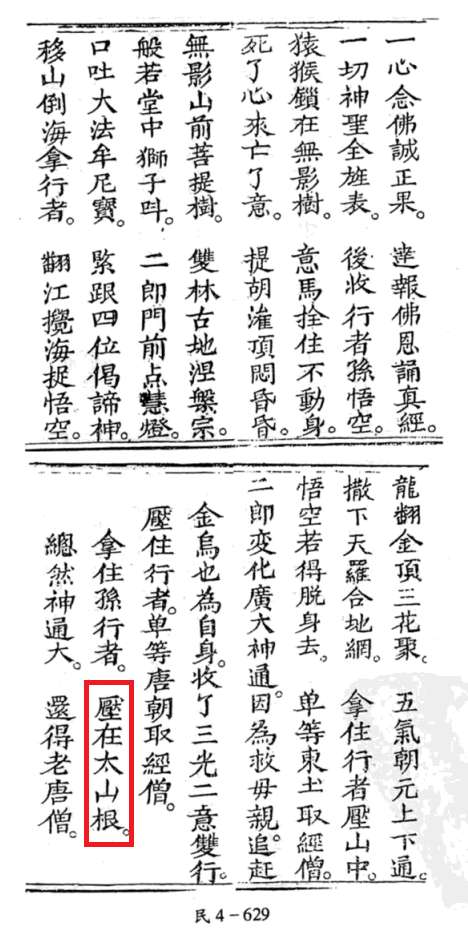
I recently archived the Precious Scroll of Erlang (Erlang baojuan, 二郎寳卷, 1562), a baojuan that venerates and records the various deeds of the immortal demi-god. The work states that the Monkey King was “pressed under the base of Mt. Tai” (yazai, taishan gen, 壓在太山根) (PDF page 46) (fig. 7). This might also explain why Mt. Tai overwhelms Monkey in chapter 33.

Fig. 7– The Mt. Tai sentence is indicated in red (larger version).


Update: 03-25-22

My friend Irwen Wong of the Journey to the West Library blog was kind enough to provide me with time-stamped links to the aforementioned episode in the various JTTW TV shows. I will list them in order of year.

Journey to the West (1986) – live action

Even though this is my favorite show, it did a poor job of representing the mountain. It’s little more than a boulder.

Journey to the West: Legends of the Monkey King (2000) – animated 

This cartoon just has monkey trapped by a single mountain.

New Journey to the West (2010) – live action

This version uses all three mountains and really steps up the special effects. This is no surprise given the differences in time and budget between it and the 1986 edition.

Journey to the West (2011) – live action

This is my favorite depiction of the episode. The special effects are top notch. I will say the elongated arms on the Taoist are a bit odd. But Irwen suggests it’s likely a visual representation of “poling” mountains (as discussed above).

Each of these iterations have their own charm. But all of them depart from the novel by showing Monkey struggling to carry the first two mountains. I remind the reader that the literary character runs “with the speed of a meteor!” while carrying the load (Wu & Yu, 2012, vol. 2, p. 108). I guess that would have been hard to depict, even with modern computer graphics.


Update: 06-19-22

Sun Wukong’s feats are on the minds of many people as the Death Battle TV show is set to feature a fight between Hercules and our monkey hero. I’ve seen a few blogs where people try to calculate the size of Mount Sumeru. I cited a source above stating that the landmass is “eight leagues high” (Buswell & Lopez, 2014, p. 896), but this appears to be a typo, for other sources multiply this estimate by thousands of times. For example, Sadakata (1997) explains that, according to the Abhidharmakośa (Ch: Api damo jushe lun, 阿毗達磨俱舍論, 4th to 5th-century): “Sumeru has a height of 160,000 yojanas, of which half is under water. The half above water is therefore 80,000 yojanas high” (pp. 26-27). The yojana (youxun, 由旬) is approximately eight miles (12.87 km), or the distance that one can travel in one day on a cart driven by a team of oxen. But estimates also range between four and ten miles (6.43 and 16.09 km) (Buswell & Lopez, 2014, p. 1036). If eight miles is used, then Mt. Sumeru would an astounding 1,280,000 miles (2,059,960.32 km) tall. 


Update: 07-03-22

I should note that Journey to the West does not depict Monkey’s strength consistently throughout the novel. As mentioned, he can carry two mountains (one of them the cosmic axis) on his shoulders while running with meteoric speeds. But apart from Mt. Tai, the novel describes another object that he can’t pick up. Chapter 42 reads:

[T]he Bodhisattva grew terribly angry, crying, “How dare that brazen fiend [Red Boy] change into my image!” As she cried, she flung into the ocean the immaculate porcelain vase set with precious pearls which she held in her hand …

菩薩聽說,心中大怒道:「那潑妖敢變我的模樣?」恨了一聲,將手中寶珠、淨瓶往海心裡撲的一摜。

[…]

[After her turtle emerges from the sea with the vase on its back, she orders Monkey to retrieve it for her.] Pilgrim went forward at once to pick up the vase. Alas! He could not do so at all! It was as if a dragonfly attempted to rock a stone pillar-how could he even budge it? Pilgrim approached the Bodhisattva and knelt down, saying, “Your disciple cannot pick it up.” “Monkey head,” said the Bodhisattva, “all you know is how to brag! If you can’t even pick up a small vase, how can you subdue fiends and capture monsters?” “To tell you the truth, Bodhisattva,” said Pilgrim, “I might be able to do it ordinarily, but today I just can’t pick it up. I must have been hurt by the monster-spirit, and my strength has weakened.” The Bodhisattva said, “Normally it’s an empty vase, but once it has been thrown into the ocean, it has traveled through the three rivers, the five lakes, the eight seas, and the four big rivers. It has, in fact, gathered together from all the aquatic bodies in the world an oceanful of water, which is now stored inside it. You may be strong, but you don’t possess the strength of upholding the ocean. That’s why you cannot pick up the vase…” (Wu & Yu, 2012, vol. 2, pp. 243 and 244).

這行者即去拿瓶。唉!莫想拿得他動。好便似蜻蜓撼石柱,怎生搖得半分毫?行者上前跪下道:「菩薩,弟子拿不動。」菩薩道:「你這猴頭,只會說嘴。瓶兒你也拿不動,怎麼去降妖縛怪?」行者道:「不瞞菩薩說。平日拿得動,今日拿不動。想是吃了妖精虧,觔力弱了。」菩薩道:「常時是個空瓶;如今是淨瓶拋下海去,這一時間,轉過了三江五湖、八海四瀆、溪源潭洞之間,共借了一海水在裡面。你那裡有架海的斤量?此所以拿不動也。」

But there may be an underlying religious reason for this. For instance, while Sun can’t lift it, the goddess does so easily, as does her holy sea turtle (Wu & Yu, 2012, vol. 2, p. 243). Most importantly, the story suggests that Guanyin will send her holy disciple, the “Dragon Girl Skilled in Wealth” (Shancai longnu, 善財龍女), to carry it for him (Wu & Yu, 2012, vol. 2, p. 244). So, this could mean that Monkey, at this point in the story, lacks the Buddhist spiritual attainments necessary to lift the vase. “Dharma Power” (fali, 法力) is considered the penultimate power in the novel’s universal hierarchy, even outclassing that wielded by high Daoist deities. 

Sources:

Alter, J. S., & OUP. (1992). The Wrestler’s Body: Identity and Ideology in North India. Berkeley, Calif: University of California Press.

Buswell, R. E., & Lopez, D. S. (2014). The Princeton Dictionary of Buddhism. N: Princeton University Press.

Gao, W., Wang, A., & Weightman, F. (2012). A Handbook of Chinese Cultural Terms. Bloomington, Indiana: Trafford On Demand Pub.

Henning, S. (2009). Taijiquan: Symbol of Traditional Chinese Martial Arts Culture. Journal of Chinese Martial Arts, 1, pp. 76-83.

Poo, M. (2011). Preparation for the Afterlife in Ancient China. In Olberding, A., & Ivanhoe, P. J. (Ed.), Mortality in Traditional Chinese Thought (pp. 13-36). Albany: State University of New York Press.

Sadakata, A. (1997). Buddhist Cosmology: Philosophy and Origins. Japan: Kosei Publishing Company.

Walker, H.S. (1998). Indigenous or Foreign? A Look at the Origins of Monkey Hero Sun Wukong. Sino-Platonic Papers, 81, 1-117.

Watson, B. (1999a). Mozi: Utility, Uniformity, and Universal Love. In De Bary, W. T. & Bloom, I. (Eds.), Sources of Chinese Tradition: Volume 1: From Earliest Times to 1600 (pp. 64-76). New York: Columbia University Press.

Watson, B. (1999b). The Great Han Historians. In De Bary, W. T. & Bloom, I. (Eds.), Sources of Chinese Tradition: Volume 1: From Earliest Times to 1600 (pp. 367-374). New York: Columbia University Press.

Wu, C., & Yu, A. C. (2012). The Journey to the West (Vols. 1-4) (Rev. ed.). Chicago, Illinois: University of Chicago Press.

担山赶太阳. (n.d.). Retrieved August 10, 2018, from https://baike.baidu.com/item/担山赶太阳

Misconceptions About the Monkey King’s Staff and the Milky Way Galaxy

Last updated: 05-15-2024

A common misconception on the internet is that Sun Wukong’s magic staff was originally used to hold down the Milky Way (fig. 1), suggesting that since the immortal can effortlessly wield the weapon, he is strong enough to lift the weight of a galaxy. (This misconception usually pops up in forums and battle wikis during debates on the lifting strength of particular mythological or fictional characters.) It ultimately stems from a mistranslation in the widely read W. J. F. Jenner edition (see the 02-12-23 update for a PDF). [1] The passage in question reads:

The piece of miraculous iron that anchors the Milky Way in place (emphasis added) has been shining with a lovely rosy glow for the last few days, and creating a most auspicious atmosphere (Wu & Jenner, 1993/2020, p. 55).

However, the original Chinese reads:

我們這海藏中,那一塊天河定底的神珍鐵,這幾日霞光艷艷,瑞氣騰騰

The problem lies in the partial mistranslation of the characters Tianhe dingdi (天河定底). Tianhe is the Chinese name for the Milky Way, while dingdi means to “fix or set the depth or base of.” This refers to setting a fixed measurement for the “Heavenly River” and has nothing to do with anchoring or weighing down anything.

Milky_Way_Arch

Fig. 1 – A panorama of the top arch of the Milky Way galaxy as seen from Chile (larger version).

The far more accurate Anthony C. Yu translations reads:

Inside our ocean treasury is that piece of rare magic iron by which the depth of the Heavenly River is fixed (emphasis added). These past few days the iron has been glowing with a strange and lovely light (Wu and Yu, 2012, vol. 1, p. 135).

Most importantly, the novel is quite clear on how much the staff weighs:

Immediately adjacent to one of the hoops was the inscription, “The Compliant Golden-Hooped Rod. Weight: 13,500 catties” (17,560 lbs./7,965 kg) (based on Wu and Yu, 2012, vol. 1, p. 135). [2]

緊挨箍有鐫成的一行字,喚做:「如意金箍棒,重一萬三千五百斤。」


Update: 08-05-18

I’ve written a follow up discussing Monkey’s greatest feat of strength.

Sun Wukong’s Greatest Feat of Strength: An Allegory for Cultural or Religious Conflict?


Update: 02-06-21

I have written an article that discusses the magic powers of the staff. These include the ability to shrink and grow, control the ocean, astral project and entangle with Monkey’s spirit, multiply endlessly, pick locks, and transform into various objects. It also has sentience to a certain degree.

The Magic Powers of the Monkey King’s Iron Staff


Update: 07-04-21

Here is my theory on why Sun Wukong’s staff weighs 13,500 catties (Yiwan sanqian wubai jin, 一萬三千五百斤; 17,560 lbs./7,965 kg). I believe the number is an embellishment on the 300 to 500 catty (san wubai jin, 三五百斤) stone block lifted by the bandit Wu Song in the Water Margin (Shuihu zhuan, 水滸傳, c. 1400).

The Weight of the Monkey King’s Staff: A Literary Origin


Update: 05-15-24

Sun Wukong claims that his staff can hold up the sky in chapter 67:

Old Monkey isn’t bragging, but this rod I hold in my hands can even hold up the sky—if it collapses!” Wu and Yu, 2012, vol. 3, p. 241)

不是老孫海口,只這條棒子揝在手裡,就是塌下天來,也撐得住。

I should note, however, that this is never demonstrated.

Notes

1) This is the first edition I read as a youngster.

2) Anthony Yu’s (Wu & Yu, 2012) original translation says “thirteen thousand five hundred pounds” (vol. 1, p. 135). However, the Chinese version uses jin (斤), known in English as “catty.” The catty and pound are two different measures of weight, the former being heavier than the latter. Therefore, the English text has been altered to show this. The catty during the Ming Dynasty when the novel was compiled equaled 590 grams (Elvin, 2004, p. 491 n. 133), so 13,500 catties would equal 17,560 lbs.

Sources

Elvin, M. (2004). The Retreat of the Elephants: An Environmental History of China. New Haven (Conn.): Yale university press.

Wu, C. & Jenner, W. J. F. (2020). Journey to the West (Vols. 1-4). Beijing: Foreign Languages Press. (Original work published 1993)

Wu, C., & Yu, A. C. (2012). The Journey to the West (Vols. 1-4) (Rev. ed.). Chicago, Illinois: University of Chicago Press.

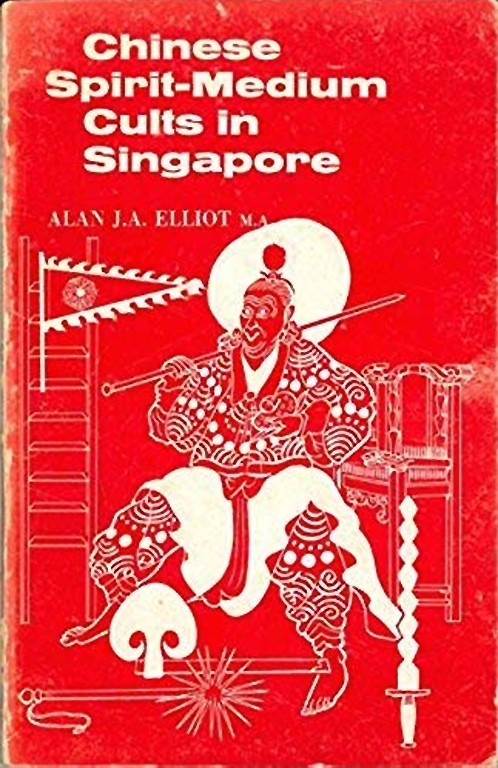
Archive #3 – PDF of Chinese Spirit-Medium Cults in Singapore (1955) by Alan J. A. Elliott

Here I present a PDF of Chinese Spirit-Medium Cults in Singapore (1955/1990) by Alan J. A. Elliott. The book contains a large chapter on the importance of spirit-mediums (Hokkien: Tangki, 童乩; Chinese: Jitong, 乩童; literally: “Divining Child”) in the worship of Sun Wukong. For those unfamiliar with spirit-mediums, I have quoted material from my article linked above:

They are believed to channel [the Great Sage’s] spirit to interact with believers, generally answering their questions, blessing them or their belongings with paper talismans, or prescribing medicine. On special occasions, they also perform a complex self-mortification ceremony […] The ritual serves several purposes. First, hacking, skewering, and poking the body with various weapons is considered a form of self-sacrifice. Second, the weapons that pierce the flesh are believed to imbue the mediums with spiritual power needed in their battle with demonic forces that pervade every corner of daily life. Third, the resulting blood is believed to have demonifugic properties, hence the reason it is smeared on paper talismans and clothing. Overall, the ritual is performed to exorcize evil spirits that cause bad luck and mental and physical illnesses.

Cover from the 1964 (2nd edition) (larger version). Note the prominence of the Monkey King.

I. Forward from the 1990 Edition

This account of Chinese spirit-medium cults describes in great detail an important aspect of the religion of overseas Chinese in Singapore. It is an historical study, since the field research was carried out over nearly two years in 1950 and 1951. It is historical for two reasons. One is that the highly personalized nature of many of these cults has meant that they are short-lived, emphemeral. The other is that in the forty years since the study was made the life of the Singapore Chinese has changed radically, and many of their ritual practices must have altered accordingly. But at the time this research was carried out, anthropological field studies of Chinese social institutions were rare, and this particular investigation was unique. Most studies of Chinese religion anywhere had been of a literary nature, concerning the ideas and practices of Confucianism, Buddhism, Taoism; very little information was available about how ordinary Chinese conducted their daily ritual affairs.

The significance of this study is not just focused on the past. It has contemporary relevance, and for a field far wider than Singapore alone. For anthropologists, enquiry into spirit-mediumship, shamanism, ecstatic religion, possession, has become a recognised part of the discipline, over a broad ethnographic range. But the general problems involved, of alternative personality, of apparent lack of sensitivity to external physical stimuli, of claims in the name of spirit to knowledge and authority not possessed by the human medium, can attract the attention of psychologists, psychiatrists, and all interested in the obscure and complex workings of the human mind. The issues raised involve ordinary people too, since they show how anxiety, uncertainty, fear, disappointment and greed seek assurance and resolution from some source deemed superhuman, even spiritual. The basic beliefs revealed by this study of Chinese spirit-mediumship are not confined to Chinese.

II. PDF Link


Disclaimer
:

This has been posted for educational purposes. No malicious copyright infringement is intended. Please support the official release.

Citation:

Elliott, A. J. (1990). Chinese Spirit-Medium Cults in Singapore. London: The Athlone Press. (Original work published 1955)

The Sun Wukong Stone Relief of Kaiyuan Temple

Last updated: 01-27-2024

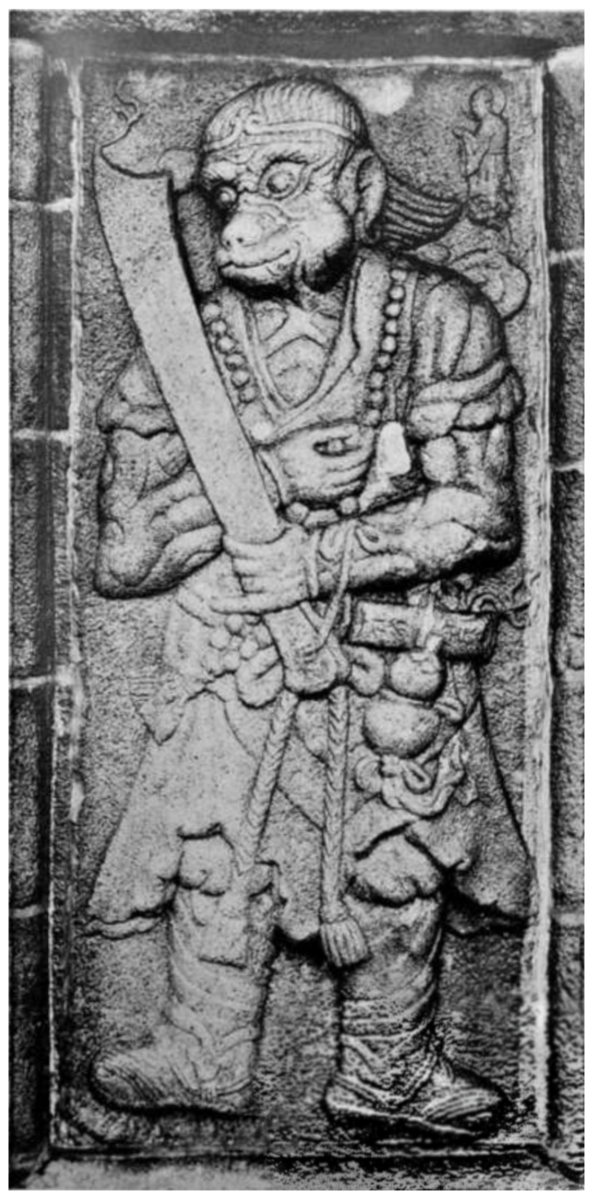
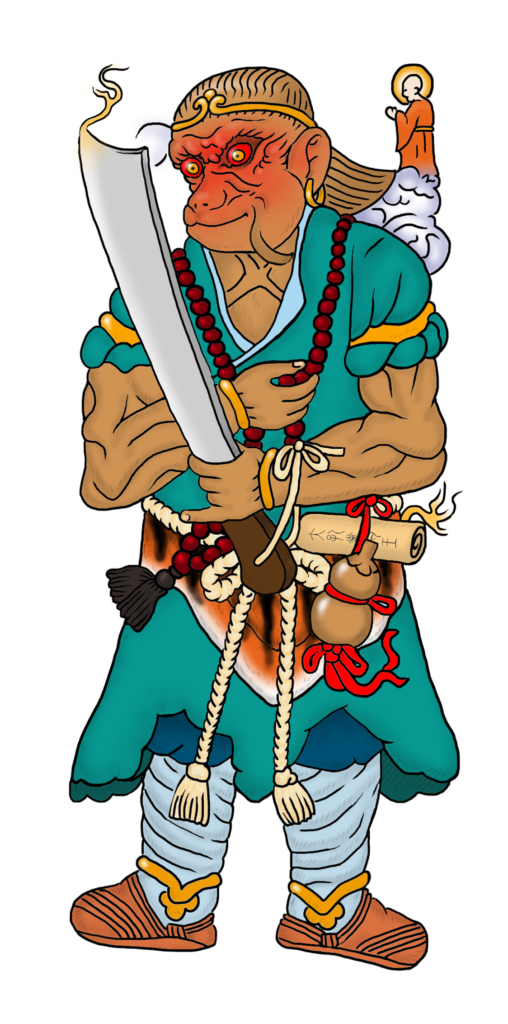
The southern Chinese seaport of Quanzhou in Fujian province is home to Kaiyuan Temple (Kaiyuan si, 開元寺), also known as the Purple Cloud Temple (Ziyun si, 紫雲寺), an ancient Buddhist complex originally built in 686. The temple is famous for its two stone pagodas, each of which is covered in 80 life-size relief carvings of bodhisattvas, arhats, patriarchs, protector deities, and various mythological creatures rendered in a rustic style influenced by the Northern Song Dynasty school of art (Ecke & Demiéville, 1935, pp. 11-18). One figure of interest is a muscular, sword-wielding, monkey-headed warrior (fig. 1) located on the northeastern side of the western pagoda’s fourth story. Many scholars consider this to be an early depiction of Sun Wukong from Journey to the West (Xiyouji, 西遊記, 1592). The pagoda was erected in 1237 (Ecke & Demiéville, 1935, p. 91), so this depiction predates the Ming novel by 355 years, making it an important source for analyzing the early influences on the much beloved literary character. In this paper, I present past research on the relief, as well my own in which I suggest the iconography is based on ritual adornments mentioned in the Hevajra Tantra, an Esoteric Buddhist text of the 8th-century.

Fig. 1 – The  Kaiyuan temple pagoda relief (larger version), Quanzhou, Fujian .

I. Previous research

The first detailed description of the relief appears in Ecke and Demiéville (1935):

A guardian with a monkey-head, holding with one hand a rosary which is hanging around his neck, and with the other a sword emitting a cloud from its tip. He wears a short tunic, travel-sandals, and a rope-belt from which are hanging a calabash and a scroll with the Chinese title of the Mahamayarividyārajñi [Fomu da kongque mingwang jing佛母大孔雀明王經] (T982-985, a text which was used as a charm against all calamities, dangers, wounds, and diseases). [According to local tradition, it is] Sun Wu-k’ung the name of the monkey assistant (alias the Monkey attendant 猴行者, or the fair Monkey-king 美猴王, or the Great Saint Equal to Heaven 齊天大聖) of Hsüan-tsang [Xuanzang] in the JW-novel. In the upper right corner of the carving there is a small monk-figure with a halo, evidently Hsüan-tsang himself, appearing on a cloud, seemingly the same cloud as that which emanates from the monkey’s sword. In the version of the JW now extant, the monkey assistant’s weapon is not a sword, but an iron rod with two golden rings, which he can reduce, whenever he finds it convenient, into a needle and so keep inside his ear. Also, he wears a tiger-skin over the lower part of his body, a detail which does not agree with our carving (p. 35)

Glen Dudbridge (1970) compares Ecke and Demiéville’s analysis with the description of the Monkey Pilgrim (Hou xinzhe, 猴行者) from the The Story of How Tripitaka of the Great Tang Procures the Scriptures, the late 13th-century precursor of Journey to the West. Based on the differences, he suggests Northern and Southern China may have had separate Monkey story cycles:

[T]here is no sign there of the traveller’s garb in which the Zayton [2] figure is so meticulously clothed; the sword is also not mentioned, although the ‘iron rod with gold rings’ … has not yet assumed its full distinctive role; similarly, the tiger-skin robe, while not described in so many words, seems faintly anticipated in the episode [chapter six] in which Hou Hsing-che slays a tiger-demon, and certainly this standard attribute of demonic figures in Tantric iconography accords well with the description of the yakṣa in that same episode. [3] All this tends to suggest that the Zayton monkey-figure remains strangely distinct from that known to us in the literary sources … Certainly at this stage of their development, there seems to have been no obligation to uniformity in the enactment or representation of popular story cycles: the monkey seen, heard or read about by the northern public could well have differed from his southern counterpart (Dudbridge, 1970, p. 49).

Journey to the West translator and scholar Anthony C. Yu (1977) highlighted a difference in opinion regarding the pious figure on the upper right of the piece:

Ōta Tatsuo 太田辰夫 and Torii Hisayasu 鳥居久靖, in “Kaisetsu 解説,” in Saiyuki, Chūgoku koten bungaku taikei, 31-32 (Tokyo 1971), 432, have challenged Ecke and Demiéville’s interpretation of the carving by pointing out that the figure at the upper righthand corner should be thought of simply as a figure of Buddha (not Hsüan-tsang), which Monkey will become by virtue of bringing back the scriptures. It may be added that Sun Wu-k’ung of the hundred chapter narrative did use a sword or scimitar 刀 (JW, chaps. 2 and 3) before he acquired his famous rod. [1] None of the scholars consulted here sees fit to discuss the significance of what seems to be a headband worn by the carved figure (p. 497 n. 23). 

Victor Mair (1989) focuses on the relief’s iconography and suggests that the various elements might have ties to depictions of both the Buddhist protector deity Aṇḍīra and the Hindu monkey god Hanuman from the Ramayana (c. 4th-cent BCE):

The band on the Zayton monkey’s head is indeed very important. Surely it must represent what becomes the Tight-Fillet 緊箍 of the Ming JW, ch. 14. Regardless of the author’s (or his predecessors’) elaborate creative inventions surrounding this fillet in the tradition of the novel, we may ask whether it has any identifiable iconographical origins in art.

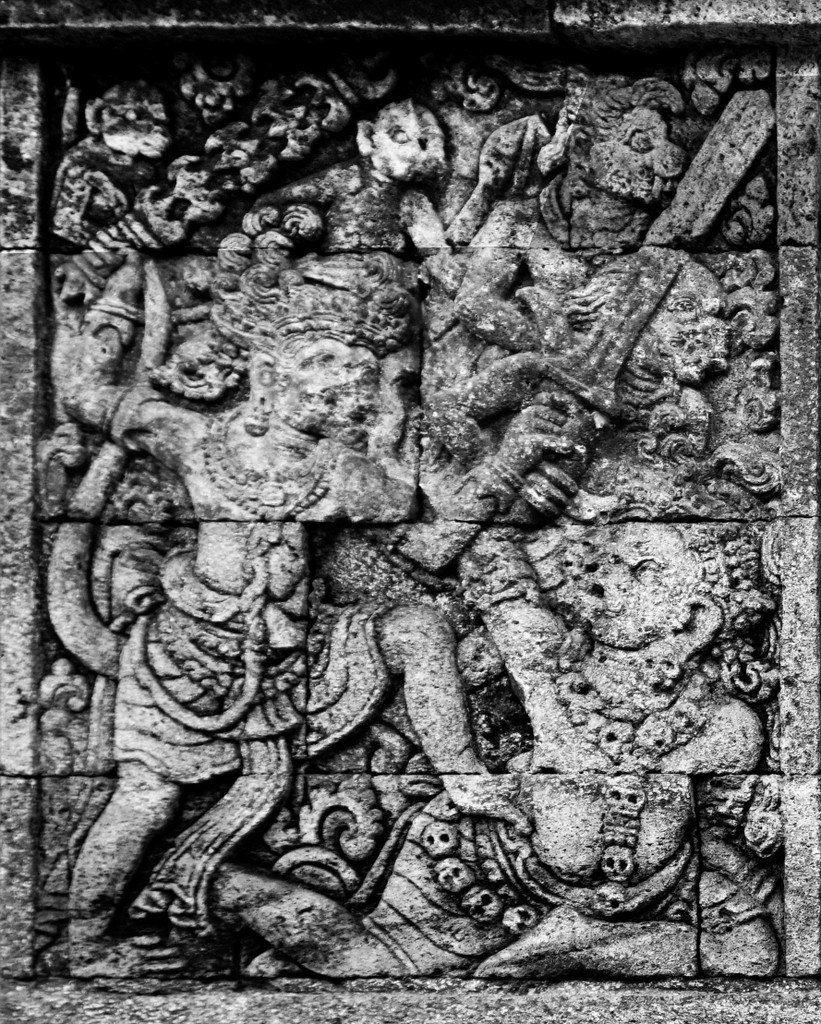
The Tight-Fillet recalls the band around the head of representations of Aṇḍīra, the simian guardian of Avalokiteśvara and Bhaișajyaguruvaidūryaprabhāṣa … As a typical specimen, we may take a statue [fig. 2] from the Kōfukuji in Nara. The Kōfukuji Aṇḍīra has curious wing-like projections extending from the sides of the band around his head that remind us of Mercury in Western classical art. On the Zayton SWK [Sun Wukong], these symbols of swiftness have been displaced to the sides of the eyes. In either case, the wings remind us of H’s [Hanuman’s] descent from the god of the wind. Other similarities between the Kōfukuji Aṇḍīra and the Zayton SWK include: identical earrings (these are key iconographical features of H in many Southeast Asian Rs [Ramayanas]), comparable tilt of the head (exaggerated with the Kōfukuji Aṇḍīra) which seems to indicate enforced submission, long locks of hair flaring out behind the head, elongated monkey’s mouth, similar decorations on forearms and upper arm, etc. It is crucial to note that all of these features can be found in South Asian and Southeast Asian representations of H. For its photographic clarity, we may choose a scene from the Rāma reliefs in Panataran, Indonesia [fig. 3]. H’s forearms are bare in this particular representation, but in some Thai reliefs (at Wat Phra Jetubon in Bangkok), they resemble those of the Zayton SWK and the Kōfukuji Aṇḍīra. The discrepancies in the dress and ornamentation of the lower parts of the body may be attributed to culture and climate (pp. 699-700).

Fig. 2 – The Kōfukuji Aṇḍīra wooden relief carving (c. 11th to 12th-cent.) (larger version), Nara, Japan. Fig. 3 – Hanuman (left) besting a demonic foe (right), from the Ramayana reliefs of the Panataran temple complex (c. 12th-cent.) (larger version), East Java, Indonesia. 

II. My findings

My opinion on the origins of the Kaiyuan relief’s iconography parts ways with Mair in some respects. For instance, upon close inspection of the Japanese Aṇḍīra carving, the band that he refers to appears to be the brim of a helmet. I do agree the Kaiyuan relief shares affinities with the cited image of Hanuman (e.g., the earrings and armbands). But again, here I part ways with Mair because I suggest the relief’s accoutrements were instead influenced by Esoteric Buddhism and not Hinduism. The similar imagery is no doubt due to a common cultural source.

Nearly every aspect of Sun Wukong’s attire can be found in a passage from the 8th-century esoteric text the Hevajra Tantra (Dabei kongzhi jingang dajiao wang yigui jing, 大悲空智金剛大教王儀軌經). It instructs yogins on how to adorn and dress themselves for worshipping Heruka (Xilujia, 呬嚕迦), a wrathful protector deity of Buddhism.

Sanskrit: bhavakena vidhartavyam karnayor divyakupdalam/ sirasi cakri dhartavya hastayo rucakadvayamkatyarp va mekhalam caiva padayor nupuran tatha/ bahumule ca keyuram gnvayam asthimalika/ paridhanam vyaghracarma bhaksanam dasardhamrtam

Translation: The practitioner should wear divine ear-rings, a circlet around the head, upon each wrist a bracelet, a girdle around his waist, anklets around the ankles, arm ornaments around the upper arms and a garland of bones around the neck. His dress must be of tiger skin … (Farrow & Menon, 2001, pp. 61-62).

彼修觀者當如是行:謂頂想寶輪、耳帶、寶鐶,手串寶釧,腰垂寶帶,足繫寶鐸及妙臂釧,頸嚴寶鬘衣、虎皮衣 …

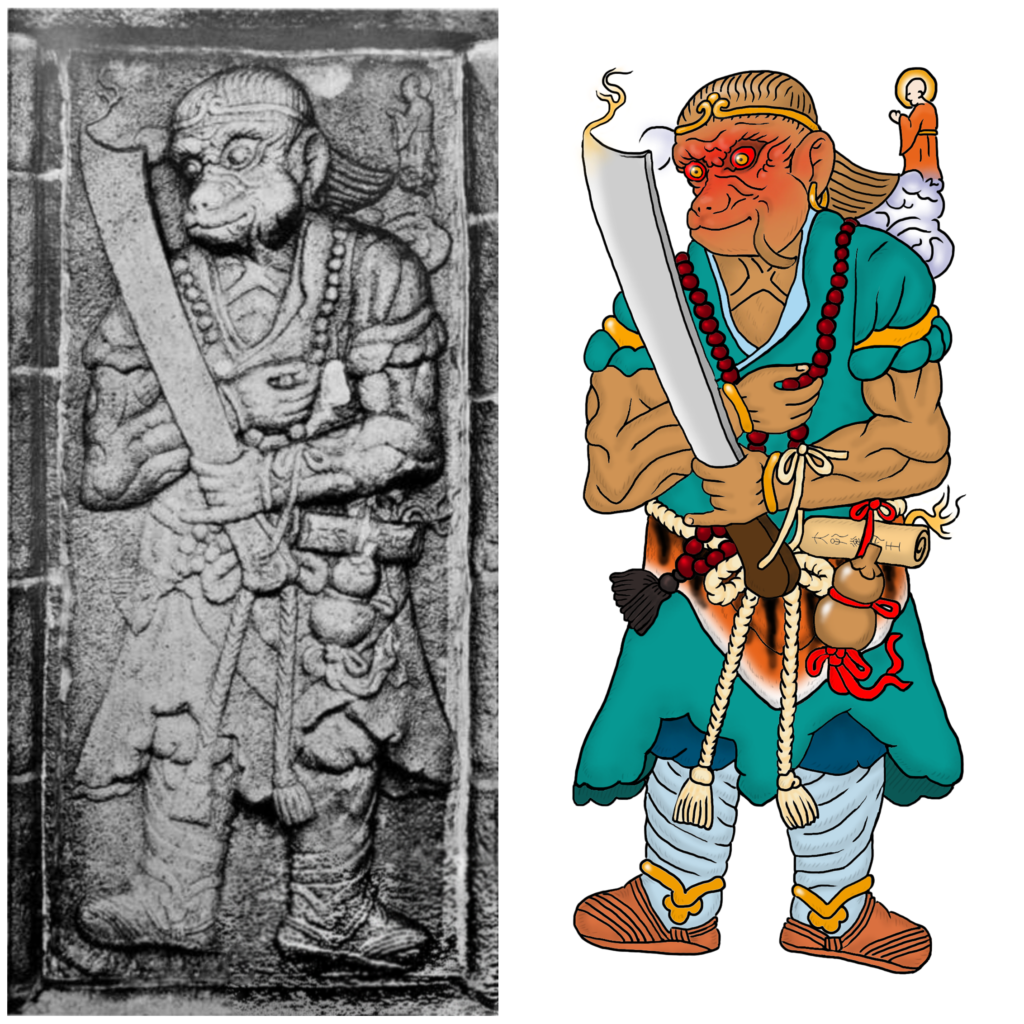
Earrings? Check! Circlet? Check! Bracelets, girdle, anklets, and arm ornaments? Check, check, check, and check! The only two aspects that are questionable are the bone necklace and the tigerskin. Rosaries are sometimes made from bone, which satisfies that requirement. As for the skin, while Ecke and Demiéville were quick to note its omission in their study, I think the appearance of so many elements from the passage suggests the tigerskin is present but the features may have just been eroded by time. The chevron shape visible below the girdle could be a skin apron. I’ve created a color version of the relief based on this information (fig. 4).

Fig. 4 – My interpretation of the relief (larger version). A comparison of the original and new versions can be seen here.

(Note 05-22-23: Upon reviewing figure four, I don’t like the way the proposed tiger skin cuts off at the belt. It would make more sense for the skin to act as a girdle, making it visible above the belt. I’ll probably update this in the future.)

As I explained in a previous article, the Hevajra Tantra was officially translated into Chinese in 1055 (no doubt arriving earlier than this), so the text was present in the middle kingdom for nearly 200 years prior to the creation of the relief.

What can these ritual elements tell us about Monkey’s depiction? Firstly, it should be noted that the esoteric deity Heruka and other such wrathful guardians, known by the neologism “Wrathful Destroyers of Obstacles” (Sk: krodha-vighnantaka), are commonly portrayed wearing such items, leading to the scholar Van Kooij (as cited in Linrothe, 1999) to comment, “Heruka is more or less a deified hypostasis of the … yogin himself” (p. 251). Second, these deities are often portrayed wielding weapons. For example, one source describes Vajrapani‘s wrathful form Trailokyavijaya “hold[ing] the vajra, ankusa-hook, sharp sword, pâsa-noose and other âyudha [weapons]” (Linrothe, 1999, p. 188). Sun Wukong too is depicted with a weapon, a sword with a lick of heavenly flame. Third, the flaming sutra tied to Monkey’s girdle was, as explained above, historically “used as a charm against all calamities, dangers, wounds, and diseases” (Ecke & Demiéville, 1935, p. 35). Wrathful Destroyers of Obstacles are charged “with the destruction of barriers which prevent the experience of enlightenment” (Linrothe, 1999, p. 25). These include external threats like manifested demons and internal threats like demon-caused mental and bodily illness, the “three poisons,” and karmic debt (Linrothe, 1999, pp. 24-25). Therefore, the iconography presents Sun Wukong as a wrathful protector deity.

This then may lend support to Ecke and Demiéville’s original assertion that the pious figure floating in the clouds to the right of Monkey’s head is in fact Xuanzang. The Great Sage clears the path of manifested demons that obstruct the monk’s path to enlightenment, leading to his ascension into paradise (this happens in both the 13th-century version of the story and the final Ming novel).

III. Ritual Adorments and Other Literary Figures

While Monkey’s association with the fillet and the tiger skin carried over into the novel, other characters came to be associated with ritual adornments from the Hevajra Tantra. A prime example is Red Boy (Hong hai’er, 紅孩兒), son of the Bull Demon King and Princess Iron Fan. The Bodhisattva Guanyin forces the demon child to submit in chapter 42, after which she uses a magic treasure given to her by the Buddha to ensnare his extremities.

Dear Bodhisattva! She took the fillet and waved it at the wind once, crying, “Change!” It changed into five fillets, which she threw at the body of the boy, crying, “Hit!” One fillet enveloped the boy’s head, while the rest caught his two hands and two feet (Wu & Yu, 1977, vol. 2, p. 280).

Red Boy is the literary counterpart of the religious figure Sudhana (Sancai, 善財), whose spiritual journey is told in the Gandavyuha Sutra (Dafang guang fohuayan jing, 大方廣佛華嚴經, c. 3rd-cent.). The youth sets out on a quest towards enlightenment and trains under 52 different teachers, including Maitreya, Avalokiteśvara (the South Asian variant of Guanyin), Mañjuśrī, and Samantabhadra (Buswell & Lopez, 2014, p. 864). It’s no wonder then that the ascetic came to be associated with such ritual adornments. South and East Asian depictions of Sudhana/Sancai often portray him wearing bangles and anklets (fig. 5).

Fig. 5 – A modern day altar statue of Sudhana/Sancai (larger version). Notice the bracelets and anklets.

IV. Conclusion

The 13th-century Sun Wukong pagoda relief of the Kaiyuan Temple shares many similarities to ritual adornments mentioned in the esoteric Hevajra Tantra (8th-cent.), including earrings, the circlet, arm cuffs, a necklace, a girdle, wrist bangles, anklets, and possibly even a tiger skin. Esoteric protector deities are often portrayed with similar attire since they represent the very yogin ascetics who worship them. Monkey’s depiction with said attire suggests the artist who created the piece intended to present him as a powerful Buddhist guardian on par with Wrathful Destroyers of Obstacles like Heruka. The depicted sword and sutra, each shown with a lick of heavenly flame, no doubt represent the means by which the Great Sage protects his master Xuanzang (possibly the pious figure on the upper right corner of the relief).

The onetime enemy Redboy comes to wear the ritual circlet, bracelets, and anklets in Journey to the West after being subjugated by Guanyin. While he is depicted as a defeated foe who submits to Buddhism, these adornments recall his historical and religious origins as Sudhana, a great ascetic from Buddhist literature.


Update: 05-22-23

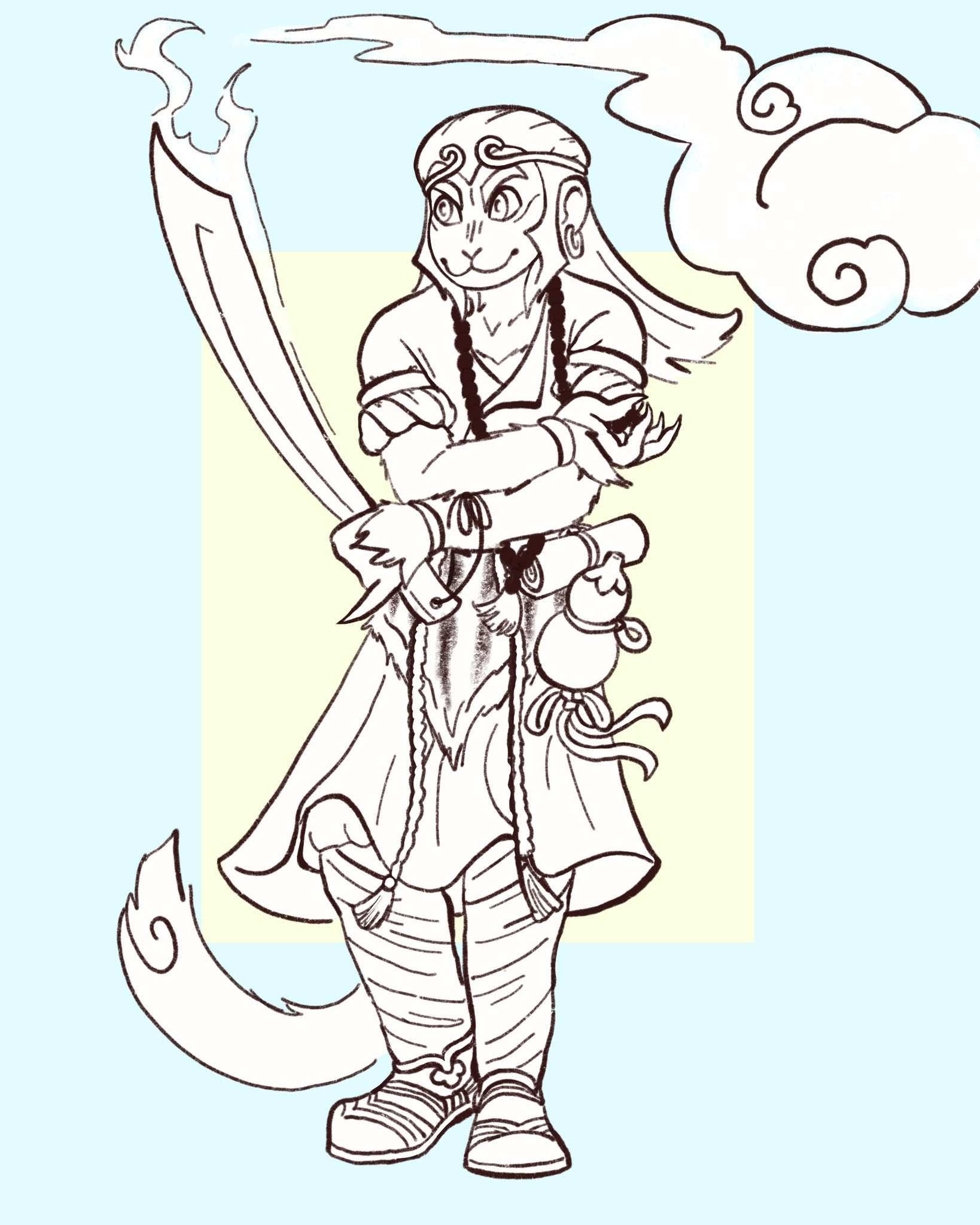
Twitter user Lava (@Lavaflowe) has allowed me to post their lovely drawing of the stone pagoda carving.

Fig. 6 – Lavaflowe’s version of the stone pagoda carving (larger version). Image from twitter.


Update: 01-26-24

There is also a possibility that the tiger skin isn’t present at all (as suggested by others). Despite the Hevajra Tantra prescribing this dress, the skin isn’t listed among the most basic accoutrements of a yogi elsewhere in the work. These are known as the “Five Symbolic Ornaments” or “Five Seals” (Sk: Pancamudrā, पञ्चमुद्रा; Ch: Wuyin, 五印; a.k.a. “Five Buddha Seals,” Wufo yin, 五佛印). Each is associated with a particular Buddha:

Aksobhya is symbolised by the circlet, Amitabha by the ear-rings, Ratnesa by the necklace, Vairocana by the hand ornaments, [and] Amogha by the girdle (Farrow, 1992, p. 65).

輪者,表阿閦如來;鐶者,無量壽如來;頸上鬘者,寶生如來;手寶釧者,大毘盧遮那如來;腰寶帶者,不空成就如來。


Update: 01-27-24

The aforementioned five ornaments are sometimes combined with another item to form the “Six Ornaments” or “Six Seals” (Sk: Shanmudrā, षण्मुद्रा), each of which is associated with a Buddhist wisdom:

The yogic ornaments … are commonly classified as being six in number: (1) the skull-tiara, (2) the armlets, (3) the bracelets, (4) the anklets … (5) the bone-bead apron and waist-band combined … and (6) the double line of bone-beads extending over the shoulders to the breast, where they hold in place the breast-plate Mirror of Karma, wherein … are reflected every good and bad action. These six ornaments (usually of human bone) denote the Six Pāramitā (‘Boundless Virtues’), which are: (1) Dāna-Pāramitā (‘Boundless Charity’), (2) Shīla-Pāramitā (‘Boundless Morality’), (3) Kshānti-Pāramitā (‘Boundless Patience’), (4) Vīrya-Pāramitā (‘Boundless Industry’), (5) Dhyāna-Pāramitā (‘Boundless Meditation’), and (6) Prajñā-Pāramitā (‘Boundless Wisdom’). To attain to Buddhahood, and as a Bodhisattva to assist in the salvation of all living creatures, the Six Pramita must be assiduously practised (Evans-Wentz, 2000, p. xxv).

The most detailed source I’ve found reads:

a. The Bone Wheel

Vajradharma wears a bone wheel on his head. It is formed from a small bone circle that sits around the crown of the head, surrounded by a second, larger circle. The two circles are attached to one another by eight bone spokes. On each of the five spokes at the front, above the forehead, stands a dried skull that supports the jewel, which is the crest ornament. From the lower part of their jaws, looped chains and hanging decorative chains extend downward to the space between Vajradharma’s eyebrows and to the tips of his ears. One the back of each skull is a multicolored vajra with a crescent moon placed to the left. The deity’s long hair passes up through the hole in the middle of the inner bone circle and is tired in a topknot. 

b. The Earrings 

There are five parts to the earrings. There is a main circle of bone, which is like a bangle. From the bottom of the circle hang two smaller rings, each one attached to the larger ring above them by a semi-circle of bone.

c. The Necklace 

The necklace is made of two strings of bones bound together with hair taken from both a corpse and a living person. At the front is a square central hub. The hub forms the base for a T-shaped triple vajra. There are to more triple vajras placed at the two points where the strings of the necklace reach the shoulders.

d. The Bracelets

The deity wears a bracelet on each ankle, wrist, and upper arm, making six in total. Each bracelet is made from two strings of bones that have been bound together. There are three vajras on each pair of bracelets, one at the knot in the upper string, one at the knot in the lower string, and one opposite the knot in the upper string.

e. The Brahmin’s Bone Thread

Next is the Brahmin’s bone thread, or investiture thread (yajnopavita). On the front of the body, above the novel, is a bone wheel with either right or four spokes. There are holes in four of the spokes and two parallels strings of bone pass through each of them. Two of these strings go over the shoulders, and two pass under the armpit. On each of these strings are two vajras on the shoulder and another two under the armpit, making eight in total. Sometimes there is a second bone wheel on the back, to which all the strings are tied; if not, all the ends of the strings are knotted together. 

Together, or with the thread of hair from a slain thief, these bone ornaments are called the ornaments of the five mudras.

f. The Bone Belt 

The bone belt, or apron, hangs from the waist. It is made, as before, of two parallel strings of bone. The strings have five vajras attached to them–one at the front in the center, one on each hip, and one on each side of the center, halfway to the whips. Hanging chains and looped chains decorated with small silver bells and small bone spearheads hang from the tips of the vajras. The chains end at the point where the calf muscle begins to taper.

According to oral tradition, the necklace we just mentioned is ornamented with five vajras at the heart. Although I have consulted many descriptions of the bone ornaments, I have never seen this stated anywhere else. There are many traditions concerning the bone ornaments, but here I have presented that of the oral tradition taught by my master (Lingpa, Rinpoche, & Chemchok, 2017, pp. 52-54). 

As can be seen, the tiger skin is not mentioned among these ornaments either.

Also, as is mentioned, the items making up the six ornaments vary from tradition to tradition. For instance, Huntington and Bangdel (2003) list bone ash in place of the bone thread (p. 161). But it’s important to note for our purposes that the circlet, bangles, bracelets, anklets, and belt make up the five basic accoutrements.

Notes:

1) Yu (Wu & Yu, 1977) is referring to the fight between Sun Wukong and a demon, during which time the monkey disarms him and uses the latter’s own sword against him.

2) The city of Quanzhou was known to both Marco Polo and Ibn Battuta by the Arabic name Zayton or Zaiton (زيتون , the “City of Olives”).

3) Monkey transforms a ringed monk’s staff into a titanic yakṣa that crushes the aforementioned tiger demon with a club.

Sources:

Buswell, R. E., & Lopez, D. S. (2014). The Princeton Dictionary of Buddhism. Princeton, NJ: Princeton University Press.

Dudbridge, G. (1970). The Hsi-yu chi: A Study of Antecedents to the Sixteenth-Century Chinese Novel. Cambridge: Cambridge Univ. Press.

Ecke, G., & Demiéville, P. (1935). The Twin Pagodas of Zayton: A Study of the Later Buddhist Sculpture in China. Cambridge, Mass: Harvard University Press.

Evans-Wentz, W. Y. (Ed.). (2000). Tibet’s Great Yogi Milarepa: A Biography from the Tibetan Being the Jetsun-Kabbum Or Biographical History of Jetsun-Milarepa, According to the Late Lama Kazi Dawa-Samdup’s English Rendering. United Kingdom: Oxford University Press, USA.

Farrow, G. W., & Menon, I. (2001). The Concealed Essence of the Hevajra Tantra: With the Commentary Yogaratnamālā. Delhi: Motilal Banarsidass Publ.

Huntington, J. C., & Bangdel, D. (2003). The Circle of Bliss: Buddhist Meditational Art. United Kingdom: Serindia Publications.

Lingpa, J., Rinpoche, P., Chemchok, K. (2017). The Gathering of Vidyadharas: Text and Commentaries on the Rigdzin Düpa. United States: Shambhala.

Linrothe, R. N. (1999). Ruthless Compassion: Wrathful Deities in Early Indo-Tibetan Esoteric Buddhist Art. Boston, Mass: Shambhala.

Mair, V. (1989). Suen Wu-kung = Hanumat? The Progress of a Scholarly Debate, in Proceedings of the Second International Conference on Sinology (pp. 659-752). Taipei: Academia Sinica.

Wu, C., & Yu, A. C. (1977). The Journey to the West (Vol. 1). Chicago, Illinois: University of Chicago Press.