I’ve previously written an article on the worship of Sun Wukong in 19th-century America. My source was Frederic J. Masters’ (1892) “Pagan Temples in San Francisco”, which appears in a collected edition of The Californian. He discusses the legends of Guan Gong (“Kwan Kung”), Hau Wong (a.k.a. “How Wong”), Mazu (“Queen of Heaven”, a.k.a. “Tin Hau”), Guanyin (“Kwan Yum”), our monkey god Qitian Dasheng (“Tsai Tin Tai Shing”), and Kum Fah, as well as mentions various other deities, such as Tudi Gong (“Earth God”), Kum Fah’s attendants, Chenghuangshen (“City God”), Heidi (“god of the North Pole”), Zhurong (“God of Fire”), and the “Holy Abbot” (Ksitigarbha?). Much of the information covered in the article isn’t new for anyone familiar with Chinese religion. But it’s easy to forget that Masters is talking about the religious practices and beliefs of immigrant Chinese workers living in 19th-century San Francisco, and this is where the article’s true value lies. Many of the temples (“Joss Houses”) are said to be the property of immigrant businesses.
Masters was a Methodist pastor who wrote extensively about Chinatown. While he comments at length about the beauty of temples and the respectability of keeping the stories of noble heroes alive for centuries, he shows a marked Western Christian condescension for many Chinese beliefs. For example, he calls the worship of the monkey god “the acme of absurdity and sinfulness” (Masters, 1892, p. 737). In the beginning of the article, he makes the mistake of equating the ancient god Shangdi with the Judeo-Christian god, believing that Chinese worship of the Almighty was perverted over the millennia by outside influences. He closes the piece by saying the Chinese will return to this ancient worship with proper guidance: “The nation [China] will one day return to the worship of the Highest and the faith in the True. In the dawn of a clearer light shall vanish all that is extravagant, foolish and false” (Masters, 1892, p. 741).
Masters. F. J. (1892). Pagan Temples in San Francisco. In C.F. Holder (Ed.). The Californian Illustrated Magazine: June to November, 1892, vol. 2 (pp. 727-741). San Francisco, Calif.: Californian Pub. Co.
The Journey to the West Research blog is proud to host an entry by our friend Edward White (his blog). The following is a reformatted and lightly edited version of his brief but insightful analysis of The Great Sage Equaling Heaven’s True Scripture of Awakening People and Enlightening the World (Qitian Dasheng xingren jueshi zhenjing, 齊天大聖醒人覺世眞/真經) posted on Twitter (see here). He was gracious enough to give me permission to post it here. – Jim
Analysis
This book alone is extremely interesting, because it shows the sheer amount of syncretism that is found in Chinese popular religion: It freely combines Buddhist and Daoist elements. The first text in this book is not actually the Great Sage scripture itself, but rather The Thousand-Handed and Thousand-Eyed Bodhisattva Guanshiyin’s Great Compassion Heart Mantra (Qianshou qianyan Guanshiyin pusa dabbixin tuoluoni, 千手千眼觀世音菩薩大悲心陀羅尼), better known as the Great Compassion Mantra (Dabei Zhou, 大悲咒), followed by the celebrated Heart Sutra (Xinjing, 心經), here called by its full name the Prajnaparamita Heart Sutra (Bore boluomi duo xinjing, 般若波羅蜜多心經) (pp. 9-13). Both are quintessentially Buddhist texts. These are, however, followed by a set of mantras for cleansing the body and the surroundings, which are associated with Daoist rites (starting from p. 13).
This is followed again with a “Precious Admonition of the Great Sage Equalling Heaven” (Qitian Dasheng Baogao, 齊天大聖寶誥) (p. 25). This format—effectively a hymn—is a liturgical form that is associated exclusively with Daoist scriptures (Cf. the set phrase 志心皈命禮 on p. 26). [1] Then, you have a list of salutations of four Buddhas and bodhisattvas, and five Heavenly Worthies (Tianzun, 天尊) (Daoist deities), all of which are equally saluted by the Sanskrit “Namo” (南無) (pp. 28-30).
The scripture itself starts on page 30, and has five chapters in total. Chapter one is titled “Cultivating the Body and Rectifying Fate” (Xiushen liming di yi zhang, 修身立命第一章) (p. 30). Chapter two is titled “Entering Sagacity and Transcending Ordinariness” (Ru sheng chaofan di er zhang, 入聖超凡第二章) (p. 33). Chapter three is titled “Returning to the Origin of Brilliance and Kindness” (Mingshan fu chu di san zhang, 明善復初第三章) (p. 40). What is interesting in this text, however, is that between chapters two and three, there is a lengthy section titled “True Words of the Great Sage Equalling Heaven” (Qitian Dasheng zhenyan, 齊天大聖眞言) (p. 36). [2] This is absent in the online edition. Chapter 4 is titled “Cause, Effect, and Retribution” (Yinguo baoying di si zhang, 因果報應第四章) (p. 44). The fifth and final chapter is titled “Cultivating Both Internally and Externally” (Neiwai shuangxiu di wu zhang, 內外雙修第五章) (p. 52). In this particular edition of the Great Sage Scripture, between chapters four and five are found a long list of evils that reciting this scripture can resolve (this is also not found on the online edition) (pp. 48-52). Our Daoist readers may find this similar to a list found in the very, very Daoist “Big Dipper Scripture” (Beidou jing, 北斗經), which I translate here.
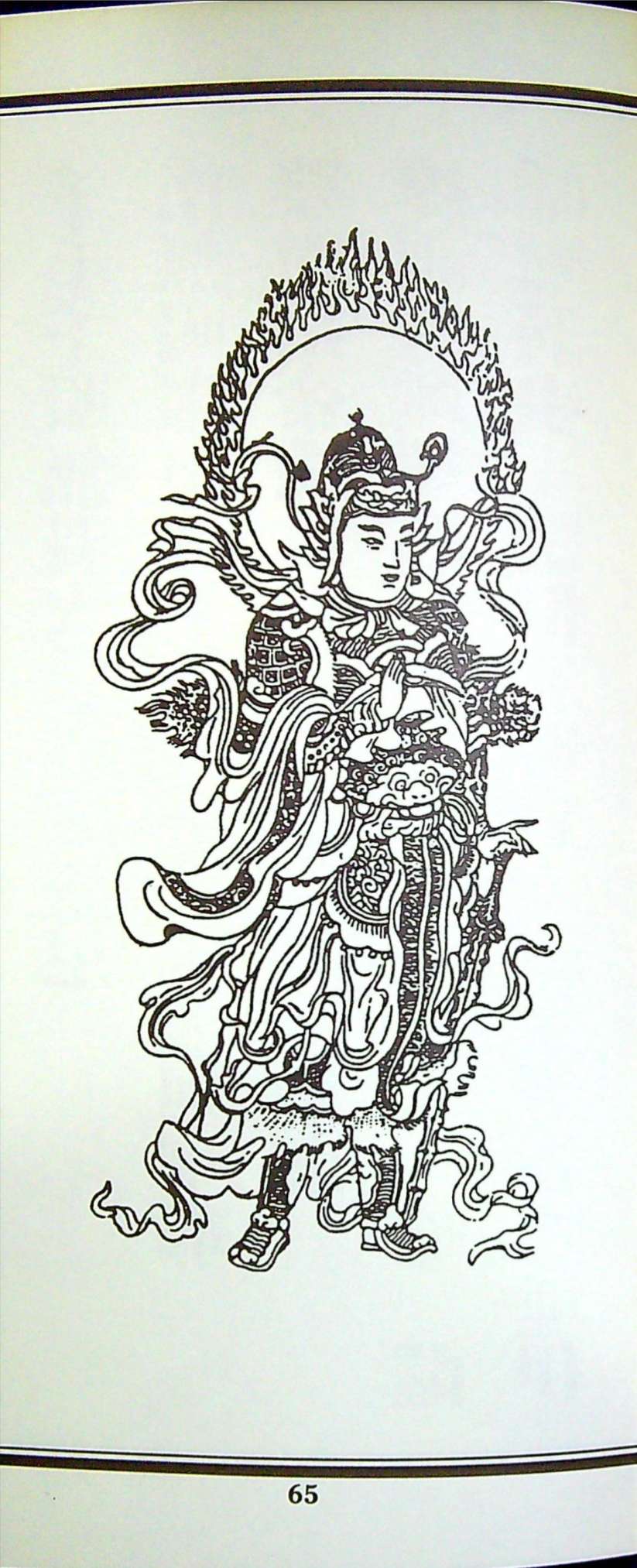
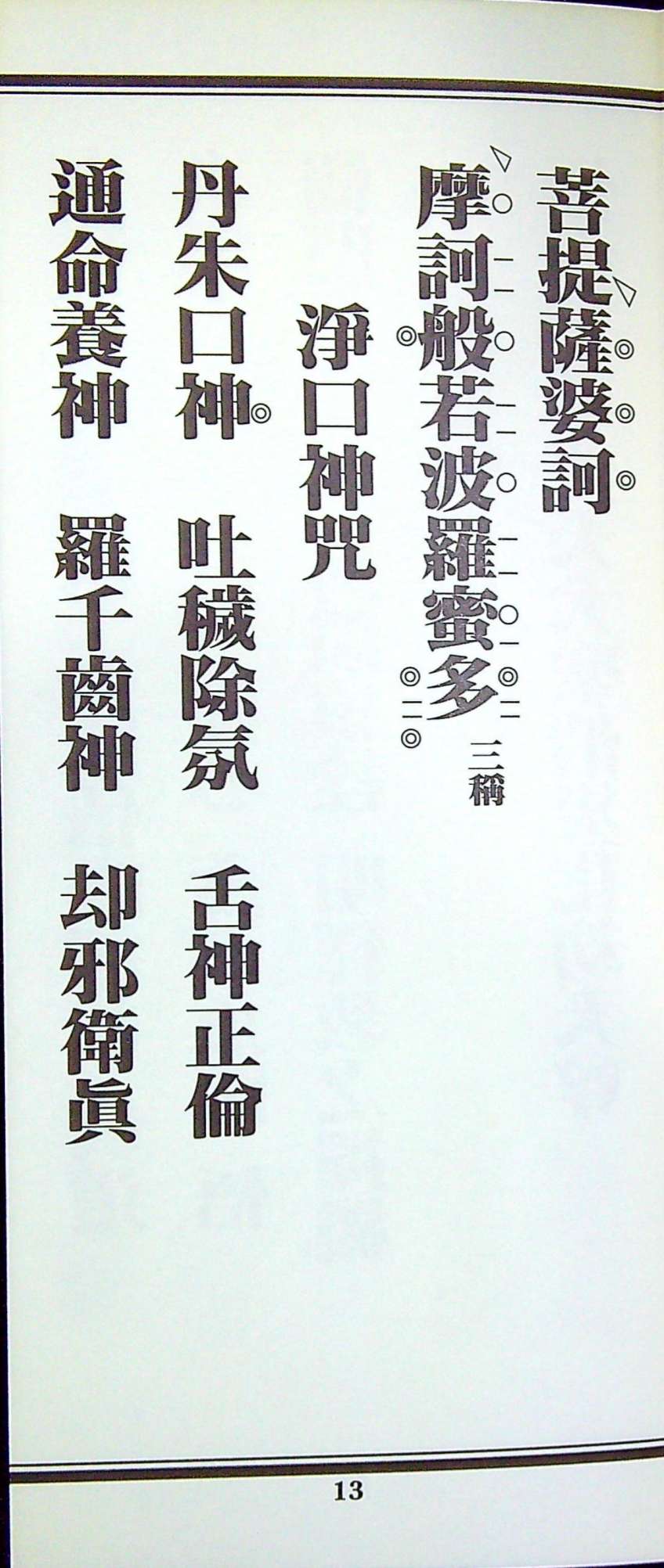
Fig. 1 – Weituo standing guard at the end of the scripture (larger version). Fig. 2 – Examples of percussion marks (larger version).
The text ends with a hymn called “In Praise of the Great Sage Equalling Heaven” (Qitian Dasheng zan, 齊天大聖讚) (p. 56), followed by a text called “The Essentials of Cultivating the Dao” (Xiudao shouyao pian, 修道首要篇) (p. 57). This is immediately followed by the “Mantra of the Seven Buddhas to Extinguish Offences” (Qi fo miezui zhenyan, 七佛滅罪眞言) (p. 59). Syncretism indeed. On the last page we have a picture of the Buddhist god Weituo (韋馱) (fig. 1), who stands guard on the last page of scriptures to protect them (p. 65). Thus we have an extremely Daoist text literally bookended by Buddhism.
We are hence immensely grateful to Jim for uploading scans of this scripture. As even from this preliminary reading shows, it preserves liturgical texts that are not found in online editions of the scripture. The online presence of non-Buddhist Chinese religious works is extremely poor and patchy; we have nothing like the Taisho Tripitaka to work on; every scripture uploaded advances our knowledge greatly. By observing not just the scripture itself, but also its front and back matter that is printed along with it, we can tell how the scripture was used by the religious communities that produced it—something again that gets lost in transmission.
Some words should be said about the format of the book. The book is clearly bound in what is called in the west the “Concertina format”. This format is unique to religious books, thereby increasing its authenticity as a holy work. But also more importantly, makes the book very easy to use in a liturgical context: it lays absolutely flat, and is easy to turn—valuable features if you are chanting off the scripture. In turn, on some pages, you see little dashes and dots besides the characters (fig. 2) (p. 13, for example). These are indications of the percussion—when the various gongs and bells are to be struck. These factors—along with the inclusion of several hymns inserted between chapters of the scripture—would lead me to conclude that this book represents not just a scripture to be contemplated, but a scripture prepared for public performance as a ritual (refer back to “True Words of the Great Sage Equalling Heaven” between ch. 2 and 3). The appended mantras, percussion, and inserted hymns, would only make sense in a context where people would chant the scripture in a grand ceremony: they would be irrelevant if the text was produced with quiet study and contemplation in mind. I could be wrong, though.
Notes:
1) For a Chinese example of another “Precious Admonition”, see here. My translation of another can be seen here.
2) “True Words” 真言 is one of the names by which mantras are known in Chinese. Thus, the term “True Words of the Great Sage” might just as well be read as “Mantra of the Great Sage”.
I noted in my previous article that medicine was among the skills acquired by Monkey while training under the Buddho-Daoist sage, Master Subodhi. In Journey to the West (Xiyouji, 西遊記, 1592) chapters 68 to 69, Monkey works to diagnose the long-standing malady of the Scarlet-Purple Kingdom emperor. But due to the immortal’s monstrous appearance, Sun is forced to analyze the ruler from afar, using three magic hairs-turned-golden strings to measure the vibrations of the pulse from three locations of each forearm. He deduces the illness is caused by fear and anxiety over the loss of the monarch’s queen, who had been kidnapped by a demon. Monkey then concocts three pills from a secret recipe and administers the elixir with dragon king saliva. The medicine causes the emperor to pass an obstruction in his bowels, thus restoring the natural qi flow in his body and curing him of his sickness.
Monkey first assuages the fears of court officials by reciting a poem explaining the proper procedure for analyzing a patient:
Most mysterious is the physician’s art; His mind must ever be alert and keen. To look, listen, ask, and take-these four things If one is missing, his craft’s not complete. One, we look at the patient’s complexion: Is it moist, dry, fat, or thin in waking or sleep? Two, we listen for clear or turbid voice When he speaks lucid or frenetic words. Three, we ask for the ailment’s cause and length. For how he eats, drinks, and eliminates. Four, we scan the conduits by taking the pulse, To learn how submerged or floating in and out. If we do not look, listen, ask, and take, In this life his ailment will ne’er him forsake!” (based on Wu & Yu, 2012, vol. 3, p. 268).
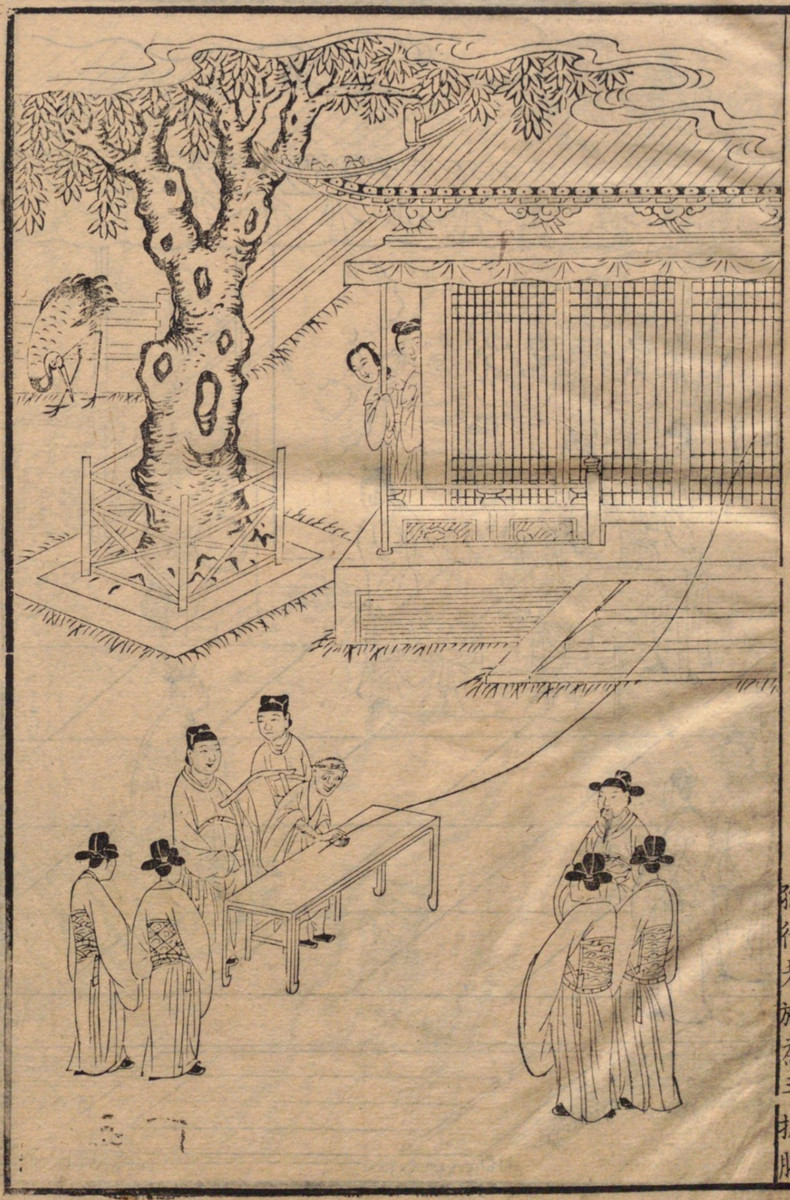
We were telling you about the Great Sage Sun, who went with the palace attendant to the interior division of the royal palace. He stood still only after he had reached the door of the royal bedchamber. Then he told the attendant to take the three golden threads inside along with the instruction: “Ask one of the palace ladies or eunuchs to tie these three threads to the inch, the pass, and the foot sections of His Majesty’s left hand where the radial pulse are felt. Then pass the other ends of the threads out to me through the window shutters” [fig. 1].
The attendant followed his instruction. The king was asked to sit up on the dragon bed, while the three sections of his pulse were tied by the golden threads, and their other ends were then passed out to Pilgrim. Using the thumb and the index finger of his right hand to pick up one of the threads, Pilgrim first examined the pulse of the cun [寸] section; next, he used his middle finger and his thumb to pick up the second thread and examine the pulse of the guan [關] section; finally, he used the thumb and his fourth finger to pick up the third thread and examine the pulse of the chi [尺] section.
Thereafter Pilgrim made his own breathing regular and proceeded to determine which of the Four Heteropathic Pneumatics, the Five Stases, the Seven External Images of the Pulse, the Eight Internal Images of the Pulse, and the Nine Pulse Indications were present. [1] His pressure on the threads went from light to medium to heavy, and from heavy to medium to light, until he could clearly perceive whether the condition of the patient was repletion or depletion of energy and its cause. Then he made the request that the threads be untied from the king’s left wrist and be attached as before to the positions on his right wrist. Using now the fingers on his left hand, he then examined the pulse on the right wrist section by section. When he had completed his examination, he shook his body once and retrieved his hairs (based on Wu & Yu, 2012, p. 270).
“Your Majesty,” he cried in a loud voice, “on your left wrist the pulse of your cun section feels strong and tense, the pulse of your guan section feels rough and languid, and the pulse of your chi section feels hollow and sunken. On your right wrist the pulse of your cun section feels floating and smooth, the pulse of your guan section feels retarded and hesitant, and the pulse of your chi section feels accelerated and firm. Now, when the pulse of your left cun section feels strong and tense, it indicates an internal energetic depletion with pain in the cardiac system of functions. When the pulse of your left guan section feels rough and languid, it indicates sweating that has led to numbness in the flesh. When the pulse of your left chi section feels hollow and sunken, it indicates a pink tinge to your urine and blood in your stool. When the pulse of the cun section on your right wrist feels floating and smooth, it indicates a congestion blocking the pneumatic energy circulation and leading to cessation of menses. When the pulse of your right guan section feels retarded and hesitant, it indicates a stasis of alimentary matter in the stomach system with retention of fluids. When the pulse of your right chi section feels accelerated and firm, it indicates discomfort caused by sensations of stuffiness and chills caused by energetic depletion. To sum up, your illness has been caused by fear and anxiety, and it may be the manifestation type of an illness called the ‘Paired Birds in Severance’ [shuangniao shiqun, 雙鳥失群]” (based on Wu & Yu, 2012, vol. 3, pp. 270-271).
Baring the strings, Monkey’s method of reading the pulse aligns with real Chinese medicinal practice. The area of the forearm analyzed by traditional Chinese doctors is known as cunkou (寸口, the “inch opening”), and this is broken up into the three spots cun (寸, “inch”), guan (關, “pass”), and chi (尺, “foot”) (fig. 2). The mirrored spots on each arm are believed to correspond to specific internal organs. For example, the cun spot (nearest the wrist) on the right hand corresponds to the lung, while that of the left hand corresponds to the heart (Liao, 2011, pp. 55-56). Therefore, analyzing the pulse at these spots is believed to reveal the health of the corresponding organs.
Video 1 – Episode 20 of the 1986 Journey to the West series portrays this story. See minute 19:19 for the preparation of the Elixir of Black Gold.
Andrew Schonebaum’s (2016) fascinating book Novel Medicine: Healing, Literature, and Popular Knowledge in Early Modern China explains the historical significance of the real world ingredients used in this elixir. He introduces the first two ingredients to us by way of their anthropomorphization as Badou Dahuang, the ruler of the fictional Hujiao (胡椒, black pepper) kingdom from the vernacular novel Annals of Herbs and Trees (Caomu chunqiu yanyi, 草木春秋演義, c. 17th/18th-century), a work that gives human form to Chinese medicines, pitting armies of mortal, immortal, and demonic characters/remedies against one another. Badou is depicted as having the mandate of heaven (the right to rule) in his own country but wanting to invade the Han empire. This dual nature can be explained by the properties of the ingredients making up his name. Schonebaum (2016) writes:
[B]adou (croton) and dahuang (rhubarb), are two of the most common drugs in Chinese medicine. Badou is toxic and a strong purgative, and it was used to treat stagnation in the viscera and bowels, as well as to facilitate urination, eliminate malignant flesh, and purge vicious agents such as invading ghosts or worms. Dahuang is nontoxic and is sometimes referred to by the name “military general” because “the drug pushes away the old and brings in the new, like a military general putting down a riot and bringing peace” (pp. 99-100).
Regarding the “Elixir of Black Gold,” Schonebaum (2016) explains “black gold” was the name of a common prescription and that badou and dahuang were part of its core, while other ingredients could be replaced with those of similar properties:
One commentator had never heard of this medicine, saying that it had a strange name, but this only reveals his own highbrow background (or general ignorance), since “black gold” was the name of various prescriptions common among hereditary doctors. In fact, it was mentioned in the Systematic Materia Medica repeatedly, and Xu Dachun recommends it in Medical Cases of Huixi, so it was not exclusively the purview of nonelite healers.
“Black gold pills” (wujin wan) was a name and a concoction similar to “elixir surpassing [the value of] gold” (shengjin dan) and “black spirit pills” (heishen wan). All of them were core formulas that could be modified in their effects by ingesting them with different liquids. These “black gold” medicines, along with the likes of “the prescription offering Guanyin’s all-encompassing help” (Guanyin puji fang) and “pills prepared with old ink” (gumo wan), treated a wide variety of ailments (in one medical manuscript, twenty-nine, forty, and seventy-one ailments, respectively), and were extremely common formula in the Qing. The “black gold” formulas had at their core the drugs dahuang and badou. One medical manuscript from the Republican period states in its introduction, “Black gold powder [wujin san] cures all ailments, just as the wind bends the grasses. Other names [of this prescription] are ‘pine smoke elixir’ [songyan dan] and ‘black spirit pills’ [heishen wan]. It cures thousands of illnesses, just as the sun melts the frost.”
Black gold pills (wan), powder (san), paste (gao), and elixir (dan) were commonly employed to cure gynecological issues. A prescription named “black gold powder” was first recorded in the Song work A Spring of Recipes in the Magic Park (Lingyuan fangquan) and was followed by references in the Southern Song prescription collection “Complete Collection of Effective Prescriptions for Women” (Furen daquan liangfang, 1237), Formulas for Universal Benefit (Puji fang, 1390), and other works. Over the centuries, numerous formulas, each with different ingredients, became known under the names “black gold powder,” “black gold pills,” and “black gold elixir.” The three designations of this formula result from the use of pitch (mo), a vernacular name for which is the “black gold” of these prescriptions.
Monkey’s prescription reflects a historical reality, namely that the advent of the imperial pharmacy (huimin yaoju) in the Song required doctors who had previously relied on simple medicines with one or two ingredients to employ formulas with numerous substances whose composition followed theories of systematic correspondences. From this conflict between empirical and theory-based recipes arose a new type of prescription eventually consisting of a nuclear formula that could be adapted to the requirements of a given patient’s disease by omitting or adding individual constituents in accordance with his pathological condition. Monkey is preparing simple, trusted medicine at the core, namely badou and dahuang, and adding to it many exotic, unobtainable ingredients (pp. 103-104).
As noted above, black gold medicines were sometimes used to treat gynecological issues. This makes Monkey’s prescription all the more comical as he had partly attributed the foreign emperor’s ails to a “cessation of the menses” (Wu & Yu, 2012, p. 271), obviously a woman’s problem. Schonebaum (2016) comments: “To understand this aspect of the carnivalesque comedy, or to realize that it was a mistake in the incorporation of medical materials into the novel, readers would have had to be quite familiar with medicine, at least enough to know that the medicine Monkey is preparing is consistent with his diagnosis” (p. 104).
3. Archive link
Chapter three of Novel Medicine (2016) is archived here.
This has been posted for educational purposes. No malicious copyright infringement is intended. Please support the official release.
Update: 09-22-24
As mentioned above, Sun Wukong analyzes the ailing king’s pulse from afar using three magic hairs-turned-golden threads. This is no doubt based on the story of the “Grand Emperor of Protecting Life” (Baosheng dadi, 保生大帝), the Daoist and folk religion god of medicine, curing an empress using the same method:
During the reign of Chengzu (1403-21), the Empress Wen suffered from an inflamed breast. A Taoist priest offered his skills, but the Emperor tested him by having him take her pulse with a string held on the other side of her bedroom wall. First the Emperor attached it to a cat. The Taoist said, “Not a bear, no not bear, it’s a cat.” Then the Emperor tied the string to a doorknob. The Taoist said that it was something of metal and wood, and not a human pulse. Finally, the Emperor tied the string to the woman’s breast and the Taoist said that the liver pulse was inflamed and the blood clotted, and that this indicated a breast infection which had to be treated by moxibustion. He offered to perform the operation by dangling a cord over the wall. He cured the ailment and vanished, refusing a reward of gold and office. In He Qiaoyuan’s version, the Emperor inquired about his name and discovered that he was the long-deceased Divine Doctor Wu Tao. In gratitude, the Emperor enfeoffed the god as Wanshou wuji baosheng dadi (Emperor Who Protects Life of Limitless Longevity) (Dean, 2014, p. 74).
What’s interesting is that this legend carried over into religious practices. A reader who contacted me in 2022 explains:
I observed a practice at [Sidian Xingji Temple (祀典興濟宮)] in Tainan where an individual would let the god Baosheng dadi check their pulse by resting three sticks of incense on their forearm. The temple brochure also mentions this procedure [fig. 3]. I believe this to be relevant to your article …
Fig. 3 – A detail from the aforementioned temple brochure showing the three incense sticks resting on a member’s wrist (larger version). Photo by Richard Malabarista.
Notes:
1) Yu (Wu & Yu, 2012) provides explanations for these terms in the end notes of his wonderful translation (pp. 448-449, n. 3-7).
Sources:
Dean, K. (2014). Taoist Ritual and Popular Cults of Southeast China. United States: Princeton University Press.
Liao, Y. (2011). Traditional Chinese medicine. Cambridge: Cambridge University Press.
Schonebaum, A. (2016). Novel Medicine: Healing, Literature, and Popular Knowledge in Early Modern China. Seattle: University of Washington Press
Wu, C., & Yu, A. C. (2012). The Journey to the West (Vol. 3) (Rev. ed.). Chicago, Illinois: University of Chicago Press.
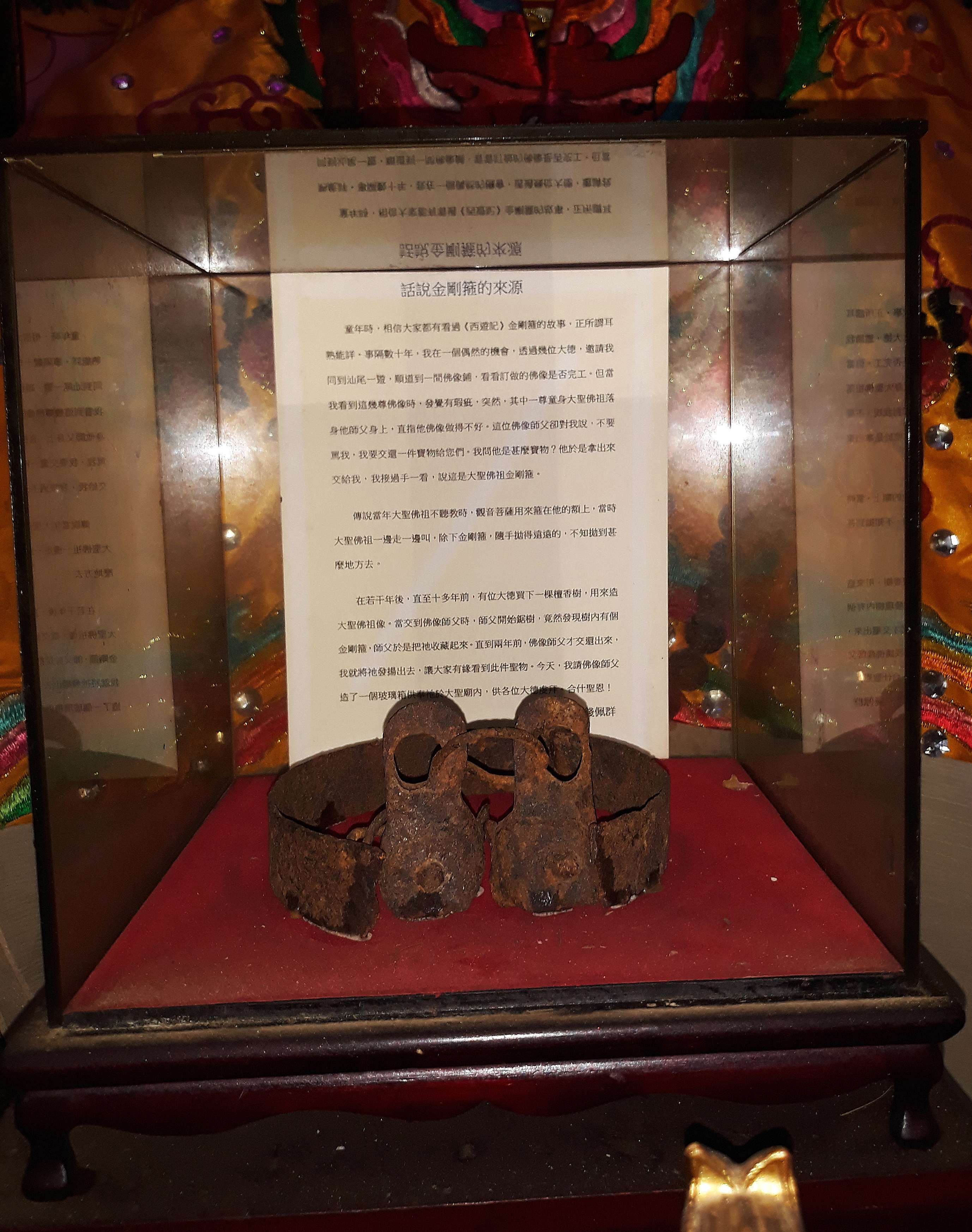
I recently attended the birthday of Sun Wukong on September 25th (the 16th day of the 8th lunar month) in Kowloon, Hong Kong (I’ll write more about this later). While the festivities took place at an alternate location with a secondary altar, I later visited the main altar in the Great Sage Treasure Temple (Dasheng bao miao, 大聖寶廟) on the Po Tat Estate. The altar stage includes a large gilded statue of Wukong, flanked on either side by those of his religious brothers Sha Wujing and Zhu Bajie. Strangely enough, a glass box is conspicuously placed in front of the Monkey King’s visage (fig. 1). Inside is a rusted metal band held together with a single chain link (fig. 2). An accompanying text panel labels it the “Vajra/Diamond Headband” (Jingang gu, 金剛箍) and claims the piece to be the original band worn by the Great Sage during his adventures. This same text is echoed in the Kowloon Great Sage Buddha Hall: Special Inaugural Ceremony Issue of the Sixteenth Year Council Association (Jiulong Dasheng Fo tang: Di shiliu jie lishi hui jiu shi dianli tekan, 九龍大聖佛堂: 第十六屆理事會就識典禮特刊) (2014), a booklet handed out during this year’s festivities. [1]
Fig. 1 – The glass box is visible between the food offerings and the Great Sage’s statue (larger version). Photo by the author.
I. Translation
From Childhood, I believe that everyone has read the story of the golden headband from Journey to the West. Everyone is familiar with the tale. A few decades later [after the events took place], some Buddhists were invited to a Buddhist statue workshop in Shanwei [City, Guangdong Province, China] to see if the Buddha statue they ordered was finished. But when they saw the statue they found it full of flaws. Suddenly, one among them spoke up and said it wasn’t made well enough. The Buddhist statue workshop master asked not to be chastised and said he instead wanted to give them a treasure. They asked him what it was. When he handed it to them they saw it was the Great Sage Buddha’s [original] golden headband.
People say that when Sun Wukong would not accept the Buddhist teachings, Guanyin put the band on his head. Sun Wukong ran side to side while yelling, trying to take it off and throw it far away to some unknown place [but couldn’t].
Many years later, maybe until ten years ago, a virtuous man purchased a sandalwood tree in order to build a Great Sage Buddha statue. He gave it to a Buddhist statue workshop master, who started to saw the tree but soon discovered the golden headband inside and decided to keep it for himself. Two years later, he decided to return it so everyone could behold this sacred treasure. Today, we asked the Buddhist workshop master to make a glass box to display the band in the Great Sage Temple for everyone to worship (p. 45). [2]
Fig. 2 – The glass box with the headband. The accompanying text panel can be seen in the back (larger version). Photo by the author.
Chapter 100 of the original novel describes the headband disappearing once Monkey internalizes self-restraint and becomes a Buddha (Wu & Yu, 2012, p. 383). The ultimate fate of the band is never commented on thereafter. The above story presents a continuation of the tale, thereby linking the Great Sage Treasure Temple with the original events of the novel. The band is lost and discovered twice over the centuries, eventually coming to rest in Hong Kong.
II. Similarities with Shaolin art
The displayed headband appears to be quite old given the level of rust damage. In addition, the style is different than any band I’ve written about before. That being said, the style is somewhat similar to a 17th-century mural from the famed Shaolin Monastery. The mural depicts a muscular luohan wielding a staff and standing next to a ferocious tiger (possibly the Tiger-Taming Luohan). His crown is adorned with a headband held together by a single chain link (fig. 3) similar to our aforementioned band. I am by no means claiming a connection to Shaolin, but it shows there may have been some style of linked headband associated with protector deities in late dynastic China.
Fig. 3 – The 17th-century Shaolin mural (larger version). Take note of the linked headband. From Shahar, 2008, p. 90.
Notes
1) The presented folk story is as told by the Kowloon Great Sage Buddha Hall First Vice-Chairperson Qian Peiqun (錢佩群).
2) Thank you to Kelly Black Lin for helping me with the translation.
Sources
Kowloon Great Sage Buddha hall: Special inaugural ceremony issue of the sixteenth year Council association (2014, Sept. 9). Published by the Hong Kong Shanwei General Commerce Association Limited.
Shahar, M. (2008). The Shaolin monastery: History, religion, and the Chinese martial arts. Honolulu: University of Hawai’i Press.
Wu, C., & Yu, A. C. (2012). The journey to the West: Volume 4. Chicago, Ill: University of Chicago Press.