Parallels between Sun Wukong and Wu Song

Last updated: 06-18-2022

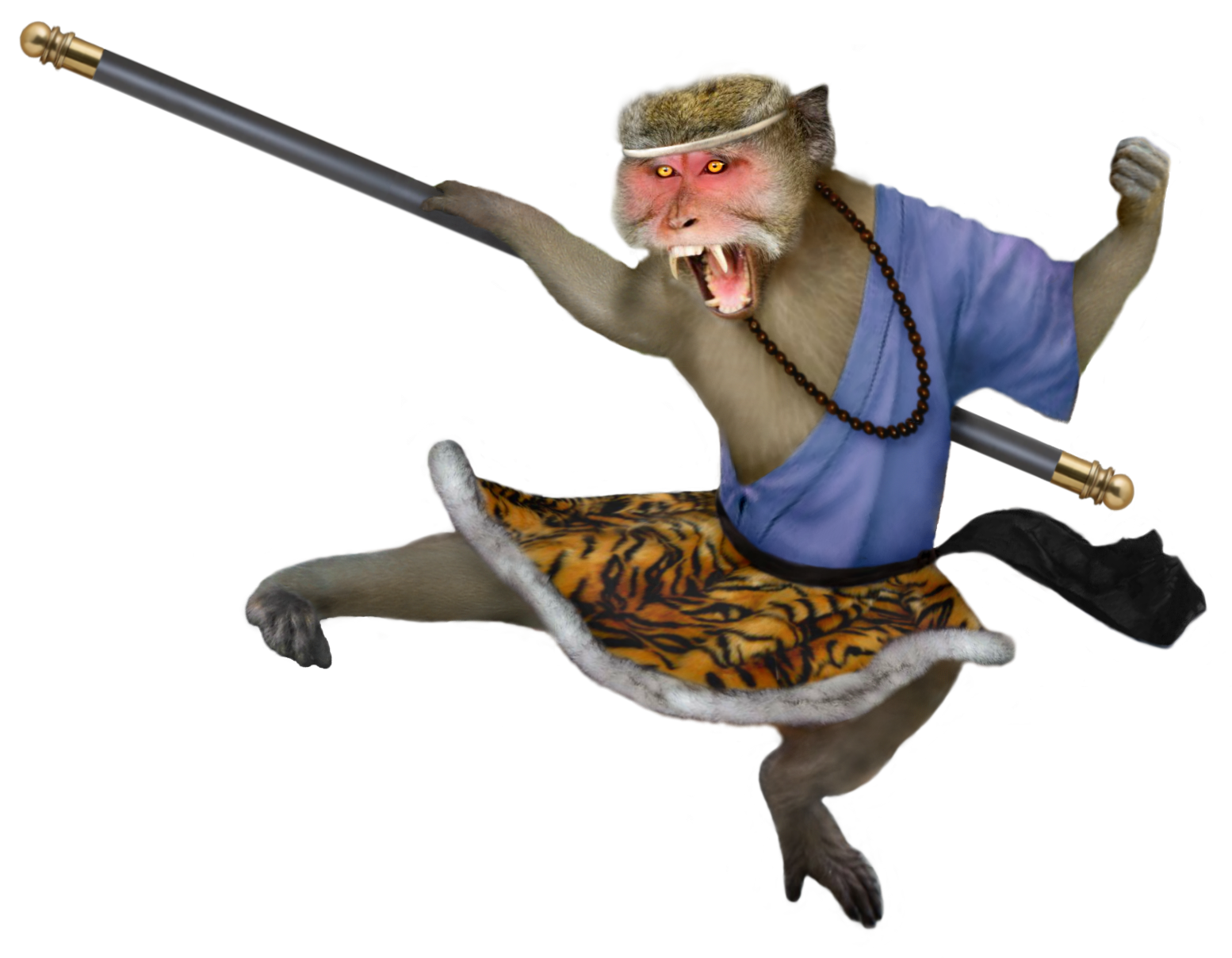
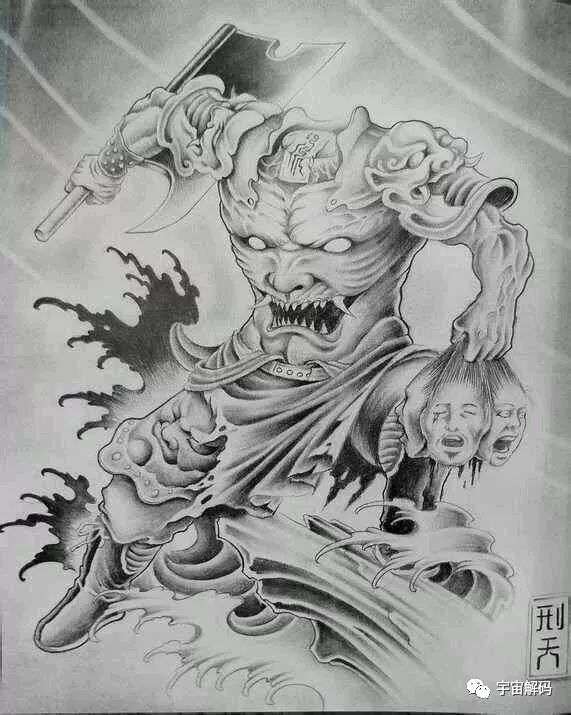
It recently occurred to me that Sun Wukong from Journey to the West (Xiyouji, 西遊記, 1592) (hereafter, JTTW) and Wu Song (武松) from the Water Margin (Shuihu zhuan, 水滸傳, c. 1400) (hereafter, WM) share a number of similarities. Each is a reformed supernatural spirit, a tiger-slayer, a Buddhist monk nicknamed “Pilgrim”, and a monastic martial artist, and each wears a moralistic headband and wields a weapon made from the same fanciful metal. Since the WM predates the publication of JTTW by nearly two hundred years, one might be tempted to speculate that the latter influenced the former. However, both story cycles first appeared during the Song dynasty, with various iterations from the Yuan to the Ming (see Ge, 2001). In this article I show the parallels are due to the respective narratives drawing on similar religious, folkloric, and historical source material. I feel such a comparison is important as it presents a fuller picture of the cultural landscape in which the Monkey King developed. 

I. Reformed supernatural spirits

Chapters one through seven of JTTW present Sun Wukong as a celestial stone-born monkey who studies under a Buddho-Daoist master and achieves great magic powers, which he uses to rebel against heaven. After being defeated by the Buddha, Monkey is imprisoned under Five Elements Mountain for five hundred years. In chapter fourteen, the repentant immortal is later released to protect the monk Tripitaka on his journey to retrieve scriptures from India.

Sun Wukong trapped under mountain - In Flames toy - small

Fig. 1 – A modern action figure of Sun Wukong’s imprisonment under a section of Five Elements Mountain (larger version).

Chapter one of the WM tells how one hundred and eight spirits were quelled by a Daoist sage during the Tang dynasty and imprisoned in a bottomless pit under a great stone slab. Four or five hundred years later during the Song dynasty, a haughty government official orders the slab dug up and removed to sate his curiosity, allowing the spirits to escape in a plume of miasmic black fumes and later be reborn on earth. Wu Song, whose main story appears in chapters 23 to 32, is one of these extraordinary men and women who come to use their martial, intellectual, or magical skills to rebel against the corrupt Song government. A heaven-sent stone slab in chapter 71 is later discovered to list the names of each bandit with the corresponding name of their previous incarnation, which make up the “Thirty-Six Heavenly Stars” (Tiangang sanshiliu xing, 天罡三十六星) and the “Seventy-Two Earthly Fiend Stars” (Disha qishier xing, 地煞七十二星). Wu Song is listed as the “Heavenly Harm Star” (Tianshang xing, 天傷星), the fourteenth of the Thirty-Six Heavenly Stars.

So we see both are formerly evil spirits who were conquered by a religious figure and imprisoned under stone for centuries. After being released, each rebellious figure becomes a force for good.

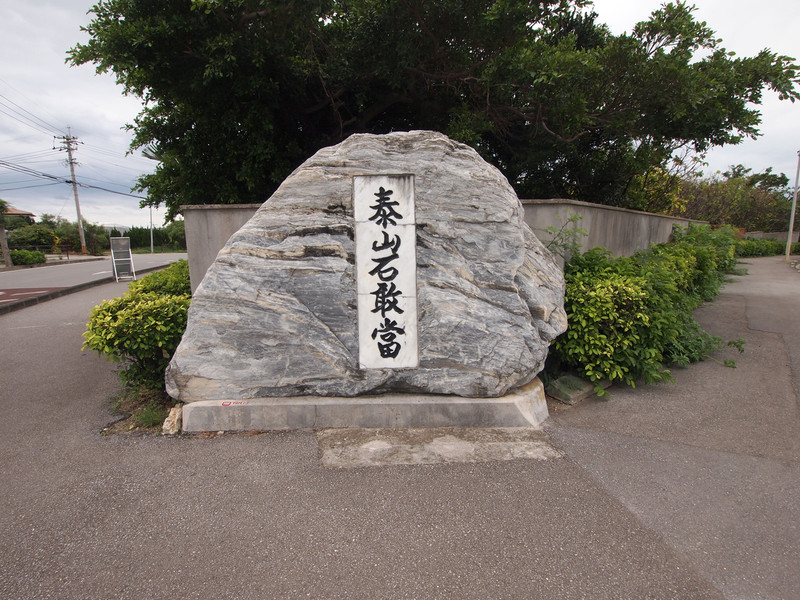
Monkey’s punishment can be traced to Tang and Song dynasty tales about the sage king Yu the Great imprisoning a simian water demon under a mountain. To my knowledge, the first recorded mention of this punishment appears in an early Ming zaju play in which Guanyin traps Sun Wukong under Flower Fruit Mountain. Wang (1992) suggests the stone slab from the WM was likely influenced by the Taishan stone (taishan shi, 泰山石) (fig. 2), a class of “evil-warding stones” (shigandang, 石敢當) often placed outside of homes and temples or at the intersection of roads as protection from malevolent forces (pp. 71-72 and 254). The Taishan stone represents Mount Tai and its deity. The landmass is considered the heaviest thing imaginable in Chinese culture. This means the evil would be completely immobilized by the great weight.

Taishan stone example - small

Fig. 2 – A modern Japanese example of a Taishan stone (larger version). They often read “Taishan stone takes upon itself” (Taishan shi gandang, 泰山石敢當), denoting its duty of protection (Wang, 1992, p. 71). Original image from Wikipedia

Additionally, the pit containing the spirits can be traced to a Song-era Daoist ritual in which an exorcist draws the character for “well” (jing, 井/丼) on the ground, thereby dividing the ritual space into nine sections, representing the Nine Palaces (jiugong, 九宮), [1] and creating an earth prison. The Compilation of Rituals of the Way (Daofa huiyuan, 道法會元) reads:

[U]se the Sword mudrā to draw the character for “well” on the ground. Transform it into a black prison, ten-thousand zhang deep, and ten thousand li wide. [2] Black vapors burst out of it. Inside the prison, visualize how cangues and locks, as well as tools and machinery are laid out. Then recite the Spell for Fast Arrest [cu zhuo zhou, 促捉咒] (Meulenbeld, 2007, p. 142).

The black vapors should remind readers of that released upon the spirits’ escape from their centuries-long imprisonment.

Mountain mudra with Chinese character

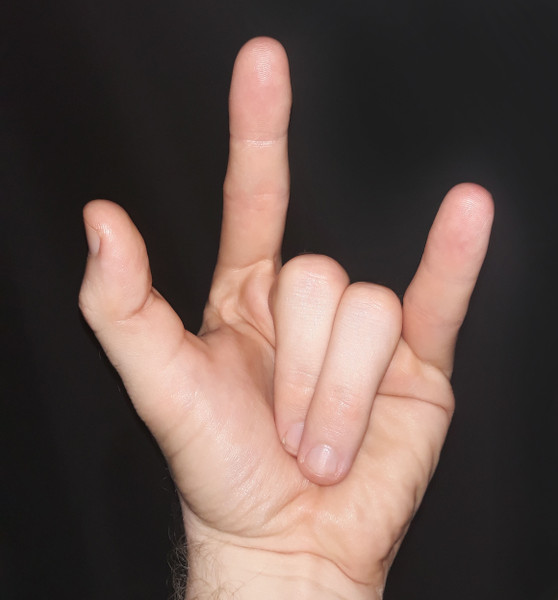
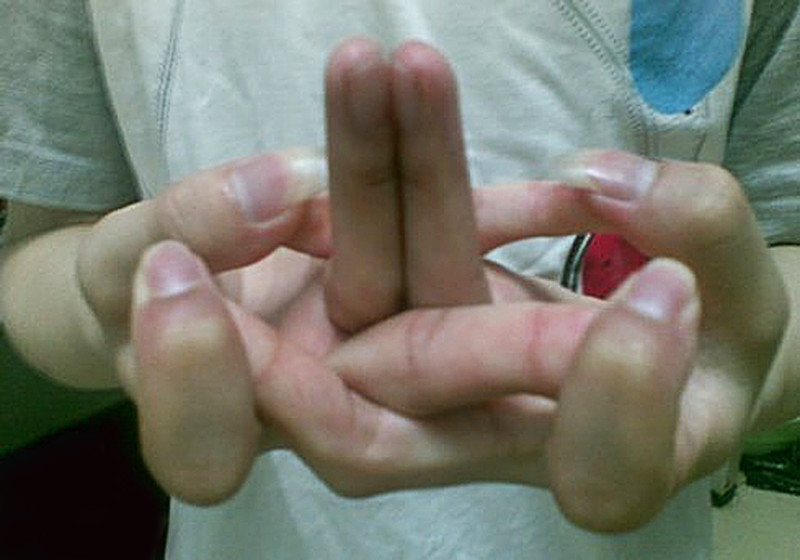
Fig. 3 – The Chinese character for mountain (shan, 山) (larger version). Fig. 4 – The Mountain mudra (shanzi jue, 山字訣) (larger version). Photo by the author. Fig. 5 – The double-handed Mount Tai mudra (Taishan jue, 泰山訣) (larger version). Original picture from here.

Another version of the ritual sees the spirits being coaxed or forced inside of a liquid-filled jar placed in the center of the well diagram. Afterwards, the opening is sealed with paper and the exorcist performs a mudra representing the immense pressing weight of a mountain (just like the aforementioned Taishan stone). [3] Meulenbeld (2007) writes:

The spirits captured within the grid of the Nine Palaces were kept inside their prison by symbolically pressing them down underneath a mountain. The symbolism here lies in the fact that the mountain was represented by a posture of the hand forming the character for mountain (“Mountain Mudrā” 山字訣 with the thumb, index-finger, and little finger all pointing upward [fig. 3 and 4]. Oftentimes the specific “mudrā of Mt. Tai” 泰山訣 [fig. 5], was used, representing the heaviest of all mountains. Moreover, many present-day exorcist talismans contain a character composed of a “demon” 鬼 underneath a “mountain” 山, namely the character wei 嵬 (p. 145, n. 92).

This means the respective punishments of Sun Wukong and Wu Song (and his brethren) are for all intents and purposes the same: they are imprisoned under mountains. The Taishan stone and the Mountain mudra are no doubt based on the same belief that mountains can immobilize evil spirits. Most importantly, the mudra likely influenced the concept of the Buddha transforming his hand into Five Elements Mountain in chapter 7 of JTTW. The fictional mountain is then a cognate of Mount Tai. 

Five Thunders talisman - small

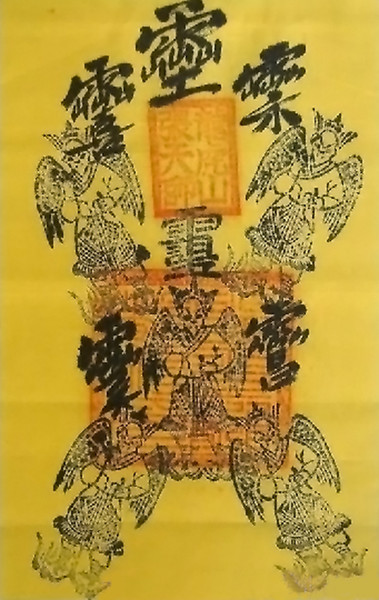
Fig. 6 – A paper fu talisman marked with an image of the Five Thunders (Wu Lei, 五雷) (larger version).

Lastly, the idea that evil spirits can be reformed and their powers put to good use—i.e. Sun Wukong protecting Tripitaka and Wu Song standing against a corrupt government—is tied to the Song-era “Thunder Ritual” (Leifa, 雷法). Meulenbeld (2007) explains stories from the Tang to the Song present the characteristics of the thunder god, Sire Thunder (Lei Gong, 雷公), becoming increasingly demonic, changing from a muscular deity to a number of animals and finally a Garuda-like bird monster. Likewise, while he was a respected force of nature in the past, Sire Thunder becomes an impulsive agent of heaven, one capable of being challenged and even captured by a brave individual or ritual master. The subjugation of this demonic god allows his captors to appropriate his heavenly power for their own purposes. The deity and his four brothers, comprising the “Five Thunders” (Wu Lei, 五雷) (fig. 6), can be summoned on command via talismans and charms and made to bring rain, heal sicknesses, or conquer demons. [4] Such ritual accouterments are just a small part of a much larger subsequent Thunder Ritual liturgy that is, according to one Song dynasty source, capable of “control[ing] the demons and spirits of the Sixfold Heavens, [expelling] evil and avert[ing] disaster” (Meulenbeld, 2007, p. 67). 

II. Tiger-Slayers

JTTW, ch. 14 – Sun Wukong’s first act of protecting Tripitaka upon his release is effortlessly killing a tiger with a single stroke of his staff. This happens the day after a huntsman had come to the monk’s defense by fighting a tiger for hours before dispatching it with a trident. The difference in power between the immortal and human heroes leads the monk to exclaim, “For the strong, there’s always someone stronger!” (Wu & Yu, 2012, vol. 1, p. 310).

WM, ch. 23 – Wu Song gets drunk on a trip home to see his elder brother, and after ignoring warnings not to take a mountain shortcut, the hero is set upon by a ferocious man-eating tiger. In the process of initially defending himself, Wu snaps his walking staff on a nearby tree, forcing him to resort to brute strength. He manages to wrestle the big cat’s face into the dirt and rains down sixty or seventy fist blows before it stops moving (fig. 7). He then finishes off the beast with the remains of his staff.

Wu Song kills tiger - small

Fig. 7 – “Wu Song Beats the Tiger” (Wu Song da hu, 武松打虎) by Wang Kewei (王可偉) (larger version).

I can’t help but imagine the episode from JTTW is a sly nod to that from the WM. Tripitaka’s statement could be a way of propping up the Monkey King as the most powerful hero, one who can dispatch tigers with no effort at all.

The ability to kill a tiger was considered the sign of a powerful warrior in Chinese folklore. For example, A New Account of the Tales of the World (Shishuo xinyu, 世說新語, 5th-century), a collection of historical and fictional anecdotes, tells the story of how the Western Jin general Zhou Chu (周處, 236–297) was originally a wayward youth considered the worst of Yixing‘s “Three Scourges”—a tiger, a dragon, and himself. Wanting to prove his strength, Zhou is said to have easily killed the tiger but disappeared for three days and nights fighting the dragon. The youth later returned to find the people celebrating his apparent death. This caused Zhou to mend his ways and eventually become a great general (Knechtges & Chang, 2010, pp. 2274-2275).

III. Buddhist monks with matching religious nicknames 

JTTW, ch. 14 – Sun Wukong takes the tonsure as a Buddhist monk upon his release. [5] His master Tripitaka then gives him the religious nickname “Pilgrim Sun” (Sun xingzhe, 孫行者), and the character is often simply referred to as “Pilgrim” (xingzhe, 行者; literally: “traveler”) throughout the narrative.

WM, ch. 31 – Wu Song kills a thug and his Song government official friend for framing the hero for theft and attempting to have him murdered en route to a prison camp. As a result, he is forced to dress as a Buddhist monk, taking a slain priest’s religious garb and ordination certificate (jiedie, 戒牒) and calling himself “Pilgrim Wu” (Wu xingzhe, 武行者).

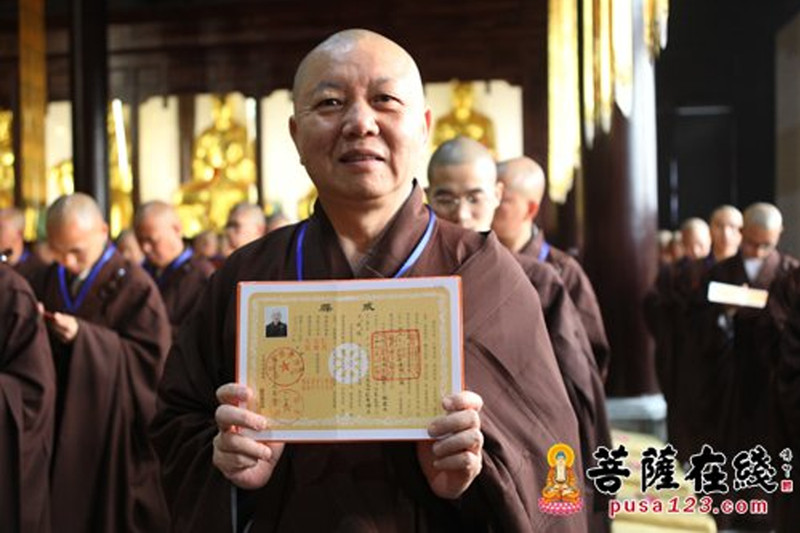
The term Pilgrim refers to a “postulant”, a lay Buddhist acolyte who has yet to be ordained but lives as an untonsured monk, one expected to follow the Five Precepts (Pali: Pañcasīla; Ch: Wujie, 五戒) against killing, lying, stealing, sexual misconduct, and drinking alcohol (Robert & David, 2013, pp. 1011-1012). Ch’en (1956) writes that such trainees were historically required to complete a long period of intense religious study and pass a rigorous examination before being awarded the aforementioned ordination certificate (fig. 8), thereby becoming a full-fledged monk. This certification system was originally initiated during the Tang to weed out those wanting to evade the draft and taxes, as well as bandits like Wu Song who sought refuge from the law. However, during the Song, the government sold these documents like war bonds in order to help pay for their ongoing struggle against the barbarians of northern China. Therefore, ordination certificates were often exuberantly expensive, [6] meaning those who had the training but could not afford the document were doomed to live as a postulant. This contrasts with the thousands upon thousands of people who bought their way into the Buddha’s fold simply for the draft and tax exemption. They forwent the training altogether and were monks only on paper. This continued practice naturally resulted in a major decline in the quality of monks during the Song.

Monk with ordination certificate - small

Fig. 8 – A present day monk showing his ordination certificate (jiedie, 戒牒) (larger version). Original image found here.

Having read the above, we can say Sun Wukong is called Pilgrim because he assists a Buddhist priest but lacks the religious education and ordination certificate. While Wu Song has the document (taken from a dead priest), he lacks the required education. It should be remembered that Wu is a bandit-turned-monk. At the same time, both characters typify the “itinerant monk”, the second meaning of Pilgrim (xingzhe, 行者), as both are on a journey: Sun is traveling to India and Wu is traveling the road—albeit secretly to meet with fellow outlaws. But I would like to suggest that the titles may have also been meant as a jab at the violent, untrained riffraff passing for monks during the Song (more on this below). After all, the earliest references to our characters with these titles come from this period.

“Pilgrim Wu” appears in scholar-painter Gong Shengyu‘s (龔聖予, 1222–1307) In Praise of the Thirty-Six [men] of Song Jiang (Song Jiang sanshiliu zan, 宋江三十六贊), a collection of poems eulogizing each of the thirty-six bandits then associated with the early WM story cycle.

Pilgrim Wu Song: You resisted women, obeyed the Five Precepts, among Wine, Women, Wealth and Force, you were inclined to kill people (Børdahl, 2013, p. 29).

Gong claims the poems were based on “stories of the streets and tales of the lanes” (jie tan xiang yu, 街談巷語), popular narratives performed by storytellers at local venues.  Given that such early tales no longer exist, its impossible to say whether or not Wu Song was always a monk or a bandit-turned-impostor monk like his counterpart from the published edition of the WM (Børdahl, 2013, pp. 28-29). Either way, this suggests Wu’s predilection for killing was a prominent aspect of his story cycle by at least the 13-century.

Sun Wukong first appears as the “Monkey Pilgrim” (Hou xingzhe, 猴行者) in The Story of How Tripitaka of the Great Tang Procures the Scriptures (Da Tang Sanzang qujing shihua, 大唐三藏取經詩話), a seventeen chapter storytelling prompt dated to the late 13th-century. Like Wu Song, Monkey is also depicted as comfortable with killing. For example, in chapter five, he turns an evil sorcerer’s wife into grass so that she will be eaten by a young monk who had been transformed by her husband into a donkey. After both parties are changed back to normal, Monkey threatens to “mow down all the grass of [his] house” (i.e. kill his wife and anyone else he loves) if the man ever misuses his magic again. [7] Later in chapter six, Monkey brutally tortures and then kills a white tiger demon who tries to eat his master (Wivell, 1994, pp. 1181-1207)

Wu Song and Lu Zhishen - Small

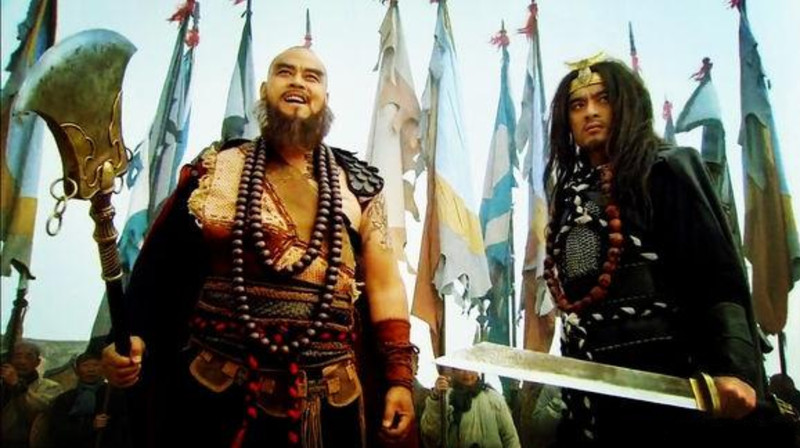
Fig. 9 – The “Pilgrim” Wu Song (right) and the “Flower Monk” Lu Zhishen (left) from a recent WM television series (larger version).

Additionally, two early WM-related tales titled “Pilgrim Wu” (Wu xingzhe, 武行者) and the “Flower [Tattooed] Monk” (Hua heshang, 花和尚) are listed under the “staff” (ganbang, 桿棒) category of popular stories in The Drunken Man’s Talk (Zuiweng tanlu, 醉翁談錄), a circa 13th-century collection of short stories, anecdotes, and poetry. [8] So-called staff tales were character-driven narratives about heroes, in this case Wu Song and his fellow outlaw-turned-monk Lu Zhishen (fig. 9), righting injustices using staves. [9] I should note that The Story describes the Monkey Pilgrim wielding two such weapons in his adventures.

Sun and Wu’s association with killing and staff fighting were likely influenced by historical warrior monks and bandit monks. Shahar (2008) explains warrior monks were seasoned fighters who lived in subsidiary shrines away from the devout community and protected monasteries in times of trouble. These “monks” regularly drank wine and ate meat, associating the latter with physical strength and fighting ability, and even worshiped wrathful deities like Vajrapani, who is described in scripture as killing in the name of Buddha. Their weapon of choice was a wooden staff, which was originally chosen for being non-lethal. However, a metal staff like the one wielded by Sun Wukong in JTTW was sometimes used by warrior monks for its killing capacity in times of war. The most famous monastic staff method belongs to the Shaolin Monastery (Shaolin si, 少林寺) (video 1). After the Shaolin warrior monks helped the Ming dynasty government repel Japanese pirate incursions from the Chinese coast during the 1550s, their staff method was touted in military encyclopedias and civilian weapons manuals. [10]

Video 1 – A demonstration of Shaolin Wind Devil Staff (Fengmo gun, 風魔棍).
 

Bandit monks are outlaws like Wu Song who dressed as monks to avoid problems with the law. [11] Lorge (2012) comments that the characteristics of bandit monks were nearly indistinguishable from that of warrior monks.

[I]t is easy to see how bandit-monks are virtually the same as warrior-monks. These men drank wine, at meat, and had sex with women—practices alien to true Buddhist monks. A number of Buddhist authorities were deeply troubled by the presence of monks who directly violated Buddhist precepts. We do not know whether there was a sharp break between ordained and trained monks who carefully followed monastic rules in their search for enlightenment and men who simply claimed to be monks, wore monastic robes, shaved their heads, but otherwise did not follow monastic rules (p. 174).

He goes on to explain that the Shaolin monastery, for example, became heavily militarized after a nasty defeat in 1356 during the Red Turban Rebellion and so may have replenished its ranks using formerly deactivated soldiers at the turn of the Ming dynasty. Such violence-prone men would naturally turn towards a life of crime. Therefore, these bandits “would have been easy enough to recruit and send out as warrior-monks to fight against [other] bandits” (Lorge, 2012, p. 175).

So we see there existed a class of staff-bearing pseudo-monks who regularly took life and drank alcohol. Serving as mainly monastic bodyguards, these fighters lacked the devotion to the precepts and, especially, the religious education to be considered real monks. Therefore, Sun and Wu’s characterization as such warriors may further explain why they are called Pilgrim.

IV. Monastic martial artists

I want to preface this section by stating upfront that it overlaps to some degree with the previous one. But while the former explored Sun and Wu’s connection to staff-wielding warrior monks by way of their characterization in late Song oral literature, this one will discuss the connection between their images as monastic martial artists and the historical practice of boxing by warrior monks.

While the Great Sage is primarily known for his skill with the staff, he displays a mastery of unarmed combat twice in JTTW. Chapter 51, for example, describes Sun and a demonic opponent fighting with a long list of punches, kicks, grapples, and throws.

Hitching up his clothes and walking forward, the fiend assumed a boxing posture; his two fists upraised looked truly like two iron sledge hammers. Our Great Sage also loosened his legs at once and moved his body to attack; right before the cave entrance, he began to box with the demon king. This was quite a fight! Aha!

Opening wide the “Four Levels Posture”;
The double-kicking feet fly up.
They pound the ribs and chests;
They stab at galls and hearts.
“The Immortal pointing the Way”;
“Lao Zi Riding the Crane”;
“A Hungry Tiger Pouncing on the Prey” is most hurtful;
“A Dragon Playing with Water” is quite vicious.
The demon king uses a “Serpent Turning Around”;
The Great Sage employs a “Deer Letting Loose its Horns.”
The dragon plunges to Earth with heels upturned;
The wrist twists around to seize Heaven’s bag.
A green lion’s open-mouthed lunge;
A carp’s snapped-back flip.
Sprinkling flowers over the head;
Tying a rope around the waist;
A fan moving with the wind;
The rain driving down the flowers.
The monster-spirit then uses the “Guanyin Palm,”
And pilgrim counters with the “Arhat Feet.”
The “Long-Range Fist,” stretching, is more slack, of course.
How could it compare with the “Close-Range Fist’s” sharp jabs?
The two of them fought for many rounds—
None was the stronger, for they are evenly matched (Wu & Yu, 2012, vol. 3, pp. 12-13)

I show in this article that many of the named techniques are real and are still practiced to this day. Furthermore, the poem’s bias for close-range fighting over long-range “is typical of late Ming and early Qing military literature”, as noted by Shahar (2008, p. 117). He continues, “Sixteenth- and seventeenth-century military experts allude to various short-range styles including ‘Cotton Zhang’s Close-Range Fist’ (Mian Zhang duanda [綿張短打]), ‘Ren Family Close-Range Fist’ (Renjia duanda [任家短打]), and ‘Liu [Family] Close-Range Fist’ (Liu duanda [劉短打])” (Shahar, 2008, p. 117). This shows the author-compiler of JTTW consulted real martial arts material to make this fight more authentic.

Having donned the monk persona, Pilgrim Wu stops by an inn while on a journey to meet with fellow outlaws in chapter 32. The monk’s great tolerance for wine (fig. 13) and request for meat surprises the inn keeper, whom Wu slaps to the ground upon seeing the man serve better wine and even chicken to a different patron. The patron and his friends attack the monk but are soundly beaten by his superior strength and fighting ability. [12]

Wu’s characterization as a meat-eating, alcohol-drinking monk with a thirst for combat is obviously tied to the warrior and bandit monks discussed earlier.

Wu Song with jug of wine and sword - small

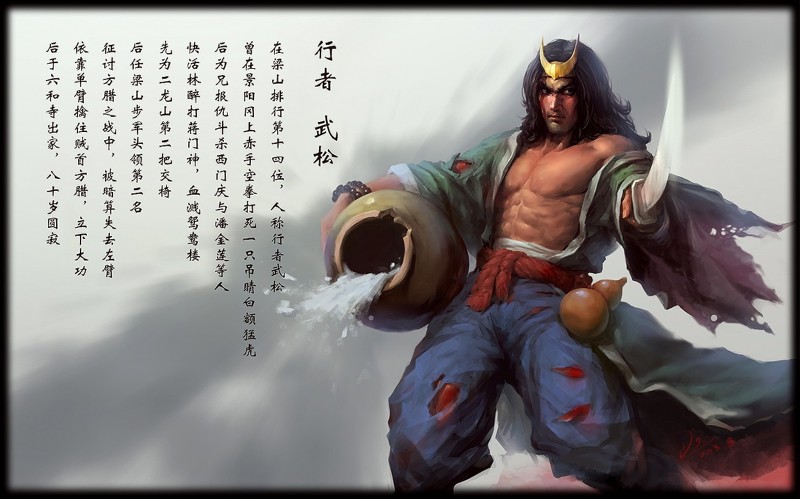
Fig. 15 – A modern depiction of Pilgrim Wu holding a jar of wine and brandishing a saber (larger version). By Leewiart user Du_YH. Original image found here

While it precedes Wu becoming a monk, the best example of his martial prowess appears in chapter 29:

But Jiang was scornful of his foe [Wu Song], thinking that he was drunk, and he closed in rapidly. Quicker than it takes to tell, Wu Song flourished his two fists at Jiang’s face, then turned and started away. Enraged, Jiang raced after him. Wu Song lashed out backwards with his left foot and kicked him in the groin. As Jiang clasped his injured section and doubled over in pain, Wu Song whirled around and swung his right foot in a flying kick to the forehead that slammed the big man over on his back. Wu Song planted one foot on his chest and, with keg-like fists, began pommeling Jiang’s head.

This maneuver we just described—the flourish of fists and turning away, the backward left kick, the whirling around and the forward right kick—is called “the Jade-Circle Steps with Duck and Drake Feet” [Yuhuan bu, yuanyang jiao, 玉環步, 鴛鴦腳]. It was one of Wu Song’s most skillful moves. A remarkable trick! (Shi, Luo, & Shapiro, 2015, p. 332).

Wu’s style is possibly another name for “Piercing Foot” (Chuojiao, 戳腳), a northern Chinese martial art known for its dynamic kicking skills. Modern folklore traces the style to the Song dynasty due to its association with WM heroes. [13]

While JTTW never openly describes Sun Wukong training in martial arts, it does imply that he learns armed and unarmed combat as a young monk studying under the Buddho-Daoist Sage Subodhi. Monkey learning boxing in a religious institution is actually a faithful depiction of one aspect of monastic life during the Ming. Shahar (2008) shows Shaolin warrior monks took up unarmed combat during the late Ming-period, when boxing saw an explosion in popularity in Chinese culture (as demonstrated by the named techniques recorded in JTTW and the WM). Textual evidence suggests the first styles practiced by Shaolin were Drunken Eight Immortals Boxing (Zui baxian quan, 醉八仙拳), popularized by Jackie Chan in The Drunken Master (1978), and Lost Track Boxing (Mizong quan, 迷蹤拳), the fighting style of the national hero Huo Yuanjia popularized by Bruce Lee in Fist of Fury (1972). The monks may have adopted boxing as a form of calisthenic exercise. To this they later added Daoyin (導引), a regimen of yoga-like Daoist breathing and stretching exercises designed to absorb qi (氣) energy and circulate it throughout the body. Therefore, the monks elevated their boxing practice from mere fighting to a form of spiritual cultivation. This synthesis of martial and spiritual practices simultaneously took place in wider Ming culture, leading to the creation of so-called “internal” (Neijia, 内家) martial arts like Taiji and Xingyi boxing. [14]

sengchou-jumps-into-the-rafters-small-1.jpg

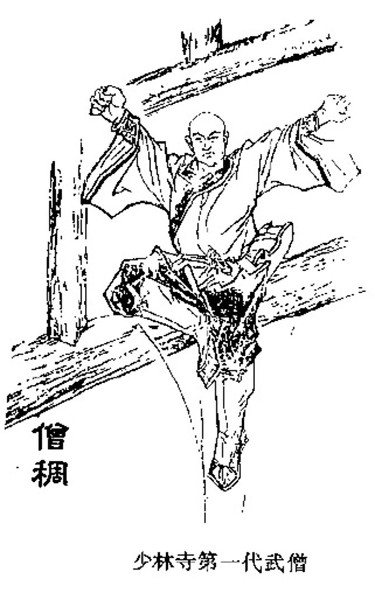
Fig. 10 – A modern drawing of the monk Sengchou showing off his newfound powers by jumping above the rafters of the Shaolin monastery (larger version). Original image found here.

That’s not to say Shaolin monks did not practice unarmed martial arts prior to the 17th-century. It’s just boxing was only a form of entertainment practiced by a few and not part of the official training regimen. For example, the Tang-era anthology Complete Records from Court and Commonality (Chaoye qian zai, 朝野僉載, c. 8th-century), contains the story of the famed dhyana master and Shaolin monk Sengchou (僧稠, 480–560) beseeching a religious statue of Vajrapani to bless him with martial strength so that the other monks, who enjoy sparring in their free time, will stop bullying him. After six straight days of prayer, the deity appears before him and offers the young novice a bowl of sinews to eat. Sengchou initially refuses due to the prohibition against eating meat, but he ultimately finishes the meal for fear Vajrapani will smite him with his vajra club. Like the radioactive spider bite that changes Peter Parker into Spider-Man, the sinews transform the monk, blessing him with a god-like physique and miraculous powers, such as the ability to walk on walls, leap great heights (fig. 10), and lift thousands of pounds. Most importantly, it drastically improves his fighting skills, so much so, in fact, that his former tormentors come to grovel in his presence (Shahar, 2008, pp. 35-37).

From whom might have Sengchou’s religious brothers learned their unarmed martial arts centuries prior to it becoming an official part of Shaolin’s training regimen? The simplest answer is someone like Wu Song who learned boxing as a bandit or soldier and later joined the sangha. Readers may recall such violence-prone men may have been tapped as warrior monks to protect the monastery in times of trouble. They could have easily passed their fighting skills to the next generation of warrior monks.

A good example of a soldier-turned-monk is the brutish former general Huiming (惠明) from the Platform Sutra (Liuzu tanjing, 六祖壇經, written from the 8th to 13th-c.). The text tells how the disciples of Hongren (弘忍, 601–674), the fifth Chan patriarch, were enraged when their master passed the mantle onto the illiterate postulant laborer Huineng (惠能, 638–713). Hundreds of monks are said to have pursued the fleeing Pilgrim south intent on forcefully taking the patriarchal symbols of the begging bowl and robe for themselves. Huiming persevered and managed to corner Huineng on a mountain. He attempted to wrestle the treasures away, but, by a miracle, he could not lift them. Realizing Huineng was the rightful heir, the monk became his disciple (Huineng & Cleary, 1998, pp. 11-12). Jealousy and anger are obviously qualities unbecoming of a real monk. In fact, the only thing that separates Huiming’s actions of hounding and attempted strong arm robbery from a bandit is his monkhood.

So we see Sun Wukong typifies a next generation warrior monk who learns boxing inside a religious institution. Wu Song typifies the soldier or bandit who learns boxing outside the monastery and later becomes a monastic fighter, one who passes on their skills to younger monks.

V. Moralistic headbands

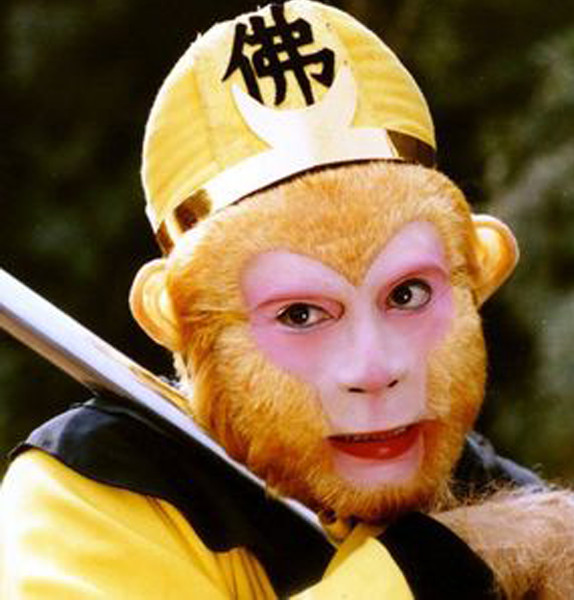
JTTW, ch. 14 – The Monkey King is tricked into wearing a brocade hat under the pretense of gaining the ability to recite scripture without rote memorization. However, the hat houses a golden fillet (jinguquan, 金箍圈) that soon takes root and painfully tightens around the immortal’s head when the correct spell is chanted (fig. 11). This allows the feeble monk Tripitaka to control the celestial monkey’s unruly nature.

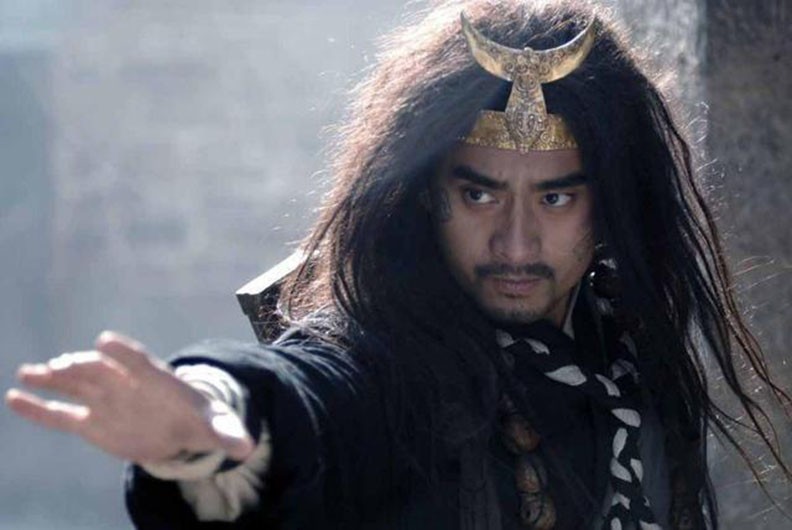
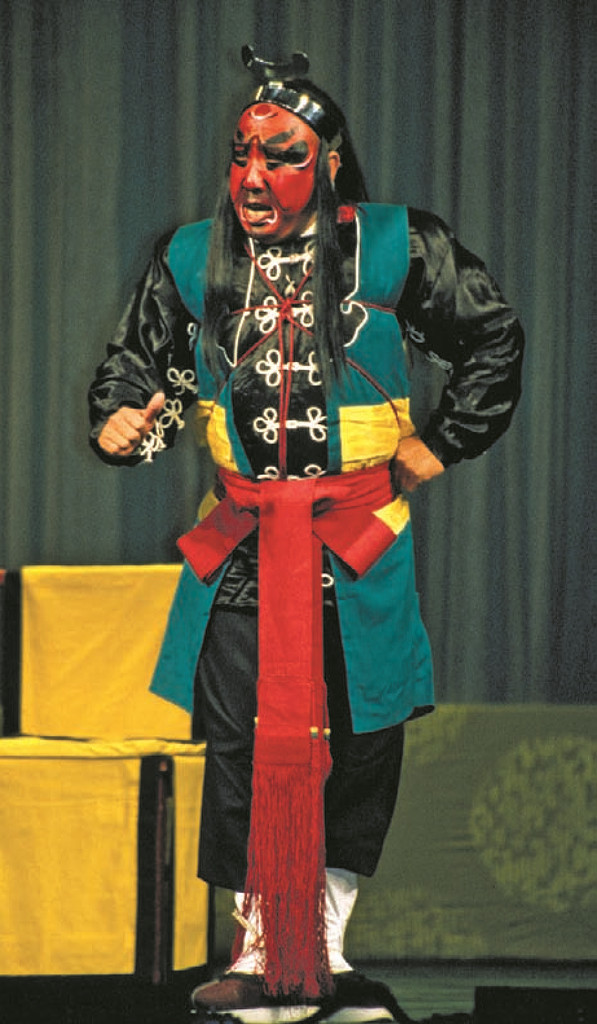
WM, ch. 31 – When Wu Song disguises himself as a monk, he wears the garments of a priest who had previously been killed by bandits. The habit includes a metal “Precepts fillet” (jiegu, 戒箍) that he wears over his long hair (fig. 12).

Fillet examples - small

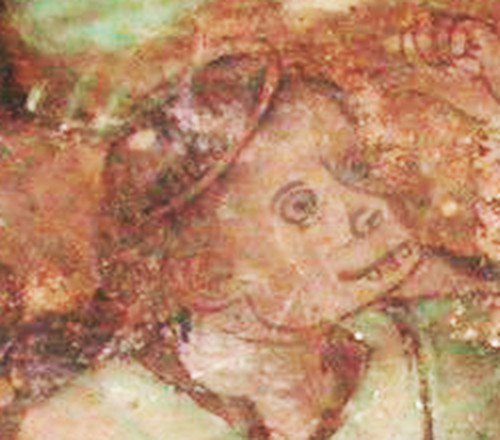
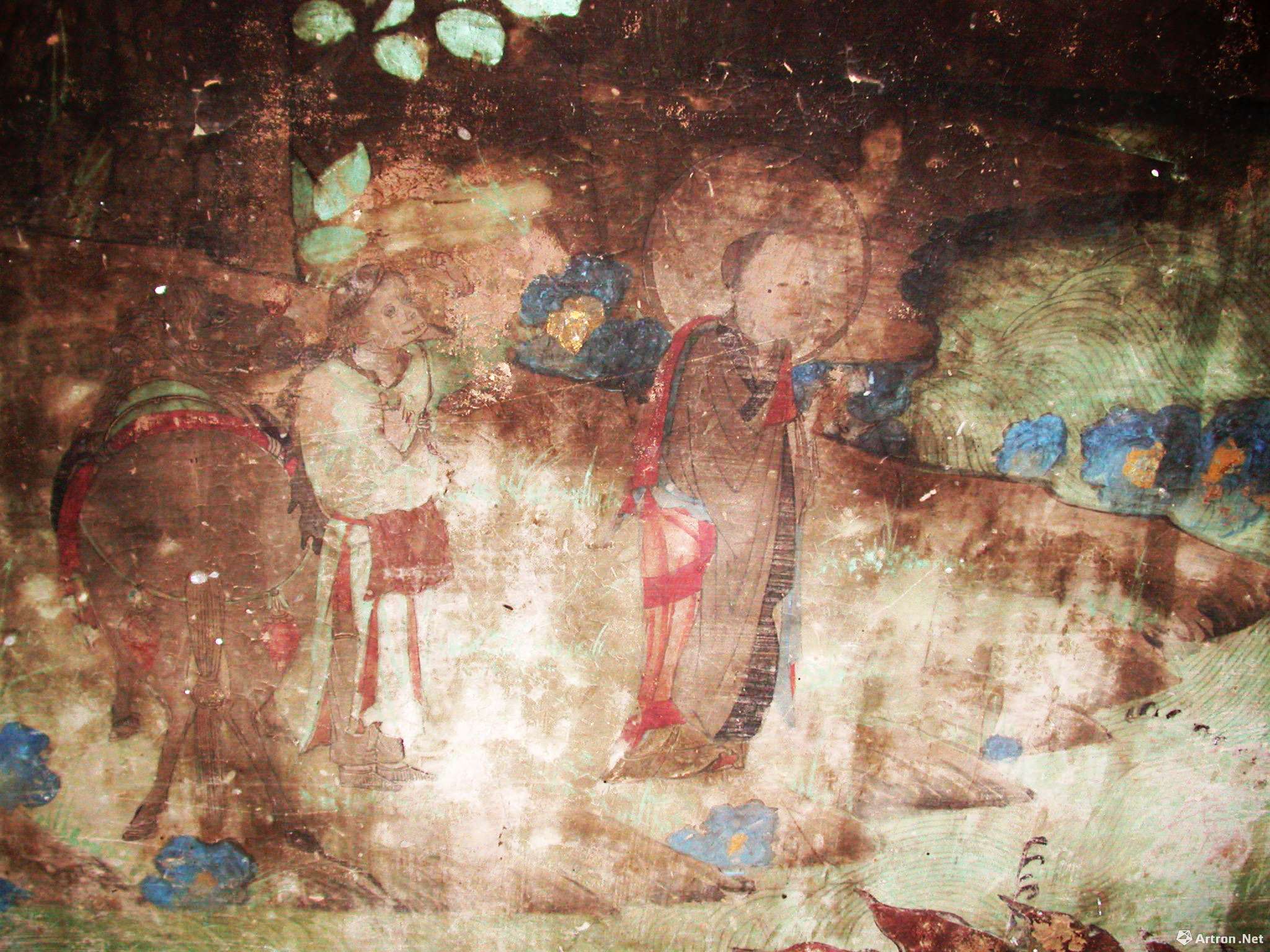
Fig. 11 – (Top left) Sun Wukong’s golden fillet from the 1986 JTTW television series (larger version). Fig. 12 – (Top right) Wu Song’s Precepts fillet from a recent WM television series (larger version). Fig. 13 – (Bottom left) A late 11th to early 12th-century copper alloy statue of the wrathful deity Hevajra (larger version). He is portrayed with the same Esoteric Buddhist ritual attire as his followers, including the headband, arm cuffs, a bone (skull) rosary, bracelets, a girdle, anklets, and a tiger skin sarong. Courtesy of the Los Angeles County Museum of ArtFig. 14 – (Bottom center) A detail of the Monkey Pilgrim’s fillet featured in an 11th-century mural from Eastern Thousand Buddha Cave number two in Gansu Province, China (larger version). It has been slightly enhanced for clarity. A fuller version of the image can be seen here. Fig. 15 – (Bottom right) A military monk from a modern Beijing Opera production (larger version). From Bonds, 2008, p. 178.

I explain in this article that the heroes’ fillets share a common origin in an ancient Indo-Tibetan Esoteric Buddhist ritual headband, one representing the Buddha Akshobhya and thereby moral self-restraint. It was one of several ritual items worn while worshiping wrathful protector deities like Heruka. Such deities were often depicted wearing the same attire as their followers, leading to the band becoming a symbol of powerful Buddhist spirits (fig. 13). The Hevajra Tantra (Ch: Dabei kongzhi jingang dajiao wang yigui jing, 大悲空智金剛大教王儀軌經), the original 8th-century Indian Buddhist text mentioning the ritual items, was translated into Tibetan and Chinese during the 11th-century. Interestingly, the earliest example of Monkey wearing the circlet (likely symbolizing the taming of the monkey of the mind) hails from this time (fig. 14). But Wu’s association with the headband was likely influenced by the Precepts fillet worn by the warrior monks of Chinese Opera (fig. 15). These heroes wear the band to show that they have taken a vow of abstinence (Bonds, 2008, pp. 177-178 and 328).

VI. Bin steel weapons

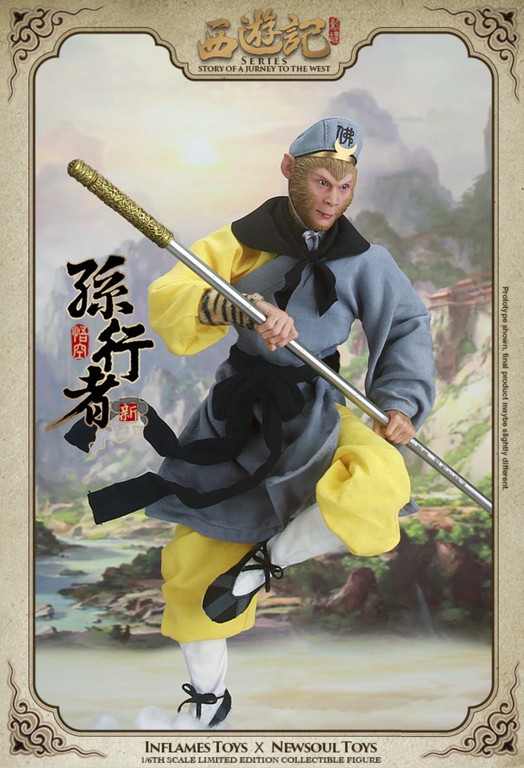
JTTW, ch. 3 – Sun Wukong comes into possession of a magic staff (fig. 16) taken from the Dragon King’s underwater treasury. A poem in chapter 75 describes the weapon being hand-forged from Bin steel (bintie, 鑌鐵) by the high Daoist god Laozi.

WM, ch. 31 – Apart from wearing the fallen monk’s religious clothing, Wu Song also takes possession of his Buddhist sabers made from “snowflake pattern” Bin steel (huaxue bintie jiedao, 雪花鑌鐵戒刀) (fig. 17). [15]

Sun Wukong and Wu Song weapons - small

Fig. 16 – A modern action figure of Sun Wukong holding his magic Bin steel staff (larger version). Fig. 17 – A modern painting of Wu Song wielding his Bin steel sabers (larger version). Artist unknown. 

Sun’s staff and Wu’s sabers are not the first bin steel weapons to appear in Chinese literature. A bladed pole arm example is the Bin steel great sword (bintie da podao, 鑌鐵刀) wielded by a bandit from the Old incidents in Xuanhe period of the Great Song Dynasty (Da Song Xuanhe Yishi, 大宋宣和遺事, mid-13th-century), a storytelling prompt containing WM material predating the published novel. [16] Another pole arm is the Bin steel spear (bintie qiang鑌鐵槍) wielded by a general from The Three Sui Quash the Demons’ Revolt (San sui pingyao zhuan, 三遂平妖傳, c. late 16th-century), which also takes place in the Song-era (Luo, n.d.). 

I explain in this article that Bin steel is a real world metal akin to Damascus that was imported to China from Persia starting from the 6th-century, and the secret of its manufacture eventually reached the Middle Kingdom by the 12th-century. The metal was considered an exceptionally fine steel and was often used to make strong, durable, and sharp knives and swords, some worth more than silver. One general is described as boasting that rebels would “have to nick (chi, 齒) his sword of bin iron” if they wished to rise up (Wagner, 2008, p. 269). This is a simultaneous declaration of his unbreakable resolve and a statement praising the seemingly indestructible metal. Therefore, JTTW and the WM portray the finest of heroes wielding the finest of steel weapons.

VII. Conclusion

As shown, the parallels between Sun Wukong and Wu Song are the result of JTTW and the WM borrowing from the same cultural source material. Monkey’s imprisonment under Five Elements mountain and Wu’s time as an evil spirit trapped in a well beneath stone was influenced by the Daoist belief that mountains—be they sympathetically represented by stone or hand mudras—could immobilize malevolent forces. Likewise, our heroes’ portrayal as reformed demons can be tied to the Daoist “Thunder Ritual”, which aims to conquer evil and repurpose its power for good. Sun and Wu’s image as tiger-slayers was influenced by stories of tiger-killing strongmen from Chinese folklore. Their religious nickname “Pilgrim” and characterization as monastic martial artists can be tied to uneducated pseudo-monks and holy warriors skilled in both staff fighting and boxing from Chinese history. Their religious fillets were inspired by an Esoteric Buddhist ritual headband worn as a reminder of moral self-restraint. And the metal comprising Sun and Wu’s weapons can be traced to a real world steel prized in ancient China for its durability. 

This was a fun piece to write because it shows the Great Sage obviously didn’t develop in a vacuum. It’s interesting to me that much of Sun and Wu’s influences hail from the Song dynasty. These include the Daoist rituals for trapping and reforming spirits, the Pilgrim nickname and characterization as staff-wielding warrior monks, and the translation of the tantric text mentioning the moralistic headband and Monkey’s earliest known depiction wearing it.


Update: 10-04-20

I have written a follow up article explaining the parallels between Monkey and the historical Buddha.

Parallels Between the Monkey King and the Buddha


Update: 07-08-21

I’ve written an article that shows the weight of Sun Wukong’s magic staff (一萬三千五百斤) is an embellishment on the weight of a stone block (三五百斤) lifted by Wu Song in ch. 27 of the WM.


Update: 10-02-21

My friend over at Journey to the West Library has written a sequel to this article detailing further similarities between Sun Wukong and Wu Song.

https://journeytothewestlibrary.weebly.com/parallels-between-wukong-and-wu-song

Update: 02-26-22

I’m thinking about writing a piece on characters from world myth trapped under mountains. Here’s the list I have so far:

  1. Sun Wukong (various Journey to the West iterations) – Mt. Huaguo by Guanyin or Five Elements Mountain by the Buddha
  2. 108 stars (Water Margin) – Imprisoned in an earth prison under a stone slab by a Daoist master. As mentioned above, Jing Wang (1992) suggests the stone slab was likely influenced by the Taishan stone (泰山石).
  3. Goddess Yaoji (Precious Scroll of Erlang) – Mt. Tai by the Jade Emperor
  4. Goddess Sanshengmu (Precious Lotus Lamp) – Mt. Hua by Erlang
  5. Wuzhiqi (Extensive Records of the Taiping Reign) – Turtle Mountain by Yu the Great
  6. Ravana (Ramayana) – Mt. Kailash by Shiva
  7. Typhon (Dionysiaca/various) – Sicily/ Mt. Etna by Zeus
  8. Enceladus (Apollodorus/various) – Sicily by Athena or Mt. Etna by Zeus
  9. Polybotes (Apollodorus/various) – Kos/Nisyros by Poseidon

The parameters may later be expanded to include “earth prisons” in general, which would open the door to Lucifer.


Update: 03-11-22

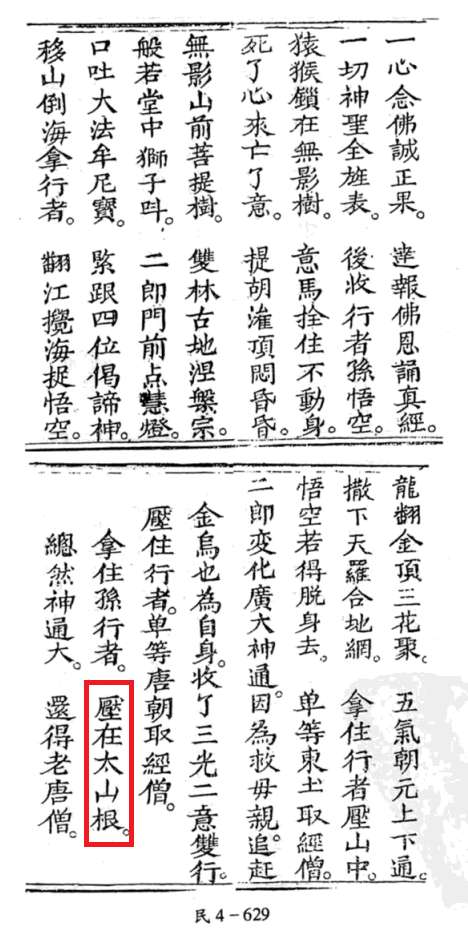
I recently archived the Precious Scroll of Erlang (Erlang baojuan, 二郎寳卷, 1562), a baojuan that venerates and records the various deeds of the immortal demi-god. This work states that the Monkey King was “pressed under the base of Mt. Tai” (yazai, taishan gen, 壓在太山根) (PDF page 46) (fig. 18). This supports my suggestion above that Five Elements Mountain is a cognate for Mt. Tai.

Fig. 18 – The Mt. Tai sentence is indicated in red (larger version).


Update: 06-18-22

I’ve written an article that lists a number of surprising parallels shared by Monkey and the Greco-Roman hero Heracles (see section 2).

Hercules vs Sun Wukong Death Battle Analysis

Notes

1) The nine palaces are a cosmic geographical concept in which stars are mapped according to the five Chinese cardinal directions (N, S, E, W, and center) and the four intermediate directions. Thus, they represent the universe as a whole.

2) A zhang (丈) is ten Chinese feet, so 10,000 zhang would be 100,000 feet. A li (里) is one-third of a Western mile. More importantly, in Chinese culture, the number 10,000 represents an infinitely large concept. Therefore, by squaring the number, the well prison is described as an unfathomably large and inescapable place. I would like to thank the Dragon Ball scholar Derek Padula (his website) for suggesting this note as it helps better visualize the prison. He was kind enough to read an earlier draft of this article.

3) See Meulenbeld, 2007, pp. 143-145 for more information about the jar ritual. It likely influenced media that influenced Akira Toriyama of Dragon Ball fame to create the Mafuba (魔封波; Ch: mofengbo), or “Demon Containment Wave” ritual. Padula (2016) describes the etymology and background of the Mafuba (pp. 122 to 126). He graciously provided me with a digital copy of his book.

4) See chapter two.

5) This is not openly stated in chapter 14 but is implied in chapter 27. See this article for more information.

6) Ch’en (1956) gives examples. During the Song, the official selling prices for the certificates ranged from one hundred thirty to eight hundred strings of cash. To put these prices in perspective, he notes the lowest cost would pay for the equivalent of seventy-five bolts of silk or one hundred twenty-five bushels of rice (pp. 316-317). 

7) Wivell, 1994, p. 1187. The full episode appears on pages 1186-1187.

8) Ge, 2001, p. 38. The eight types of stories appearing in The Drunken Man’s Talk are: “lingguai [靈怪] (spirits and demons), yanfen [煙粉] (rouge and powder), chuanqi [傳奇] (marvels), gong’an [公案] (court cases), podao [朴刀] (broadsword), ganbang [桿棒] (staff), shenxian [神仙] (immortals), and yaoshu [妖術] (sorcery)” (Ge, 2001, p. 209, n. 6).

9) Huang, 2018, p. 61 and n. 8. It’s interesting to note that the monk Lu Zhishen is said to wield an impossibly heavy metal staff like Sun Wukong. See this article for more details.

10) See chapters three and four.

11) Lorge (2012) cites a Tang-era story about an 8th-century prince who discovers an abandoned wardrobe while hunting in the forest. It is found to contain a young woman who had been kidnapped the previous night by bandits but was subsequently whisked away by two monks among the group. The prince replaces her with a wild bear that later mauls the bandit monks to death when the wardrobe is reopened (pp. 106-107). The monks were likely impostors like Wu Song.

12) Wu Song is famed in Chinese folklore for his martial arts ability. This led to the creation of a wushu form known as “Wu Song Breaks Manacles” (Wu Song tuo kao, 武松脫拷), which mimics a person fighting with their hands clasped as if shackled, forcing them to rely on doubled fist and elbow strikes and lots of kicking. The form is based on an episode from chapter 30 of the WM when the hero is attacked by assassins while being led in shackles to a prison camp. Wu Song is forced to defend himself in such a manner before breaking his restraints.

13) See, for example, Chlumsky, 2005, p. 72. The author also repeats folklore further tying the style to the Song dynasty heroes Yue Fei and his teacher Zhou Tong.

14) See chapters five and six.

15) I think it’s interesting that each weapon is presented as having some level of sentienceCalled the “As-you-wish” Gold-Banded Cudgel (Ruyi jingu bang, 如意金箍棒), Sun’s staff grows or shrinks according to his whim. Wu’s peerless blades are said to “often groan in the night” (Shi, Luo, & Shapiro, 2015, p. 350), suggesting a magic longing for combat. The sentience of each weapon is based on different sources, however. I note in this article that the compliance of Monkey’s weapon is based on the Ruyi (如意) scepter, a symbol of religious and secular authority that was at some point associated with the similarly named wish-fulfilling cintamani jewel (ruyi zhu, 如意珠) from Buddhist mythology. The vocal ability of Wu Song’s blades may be based on the Chinese belief that swords have a soul. Two prime examples are the famed treasure swords Longyuan (龍淵, a.k.a. Longquan, 龍泉) and Tai’e (泰阿/太阿) made by the legendary swordsmith Ou Yezi (歐冶子) during the Spring and Autumn period. Yuan poet Jia Penglai (賈蓬萊, c. mid-14th-ccentury) described them as mated lovers who pine for each other when separated and even leap from the scabbard to seek out their beloved (Lee & Wiles, 2015, pp. 161-163).

16) See Luo (n.d.). The original source says “po bintie dadao” (潑鑌鐵大刀). This is likely a transcription error. I have corrected it above. 

Sources

Bonds, A. B. (2008). Beijing opera costumes: The visual communication of character and culture. Honolulu: University of Hawai’i Press.

Børdahl, V. (2013). Wu Song fights the tiger: The interaction of oral and written traditions in the Chinese novel, drama and storytelling. Copenhagen, Denmark: NIAS Press.

Ch’en, K. (1956). The sale of monk certificates during the Sung dynasty: A factor in the decline of Buddhism in China. The Harvard Theological Review 49(4), pp. 307-327.

Chen, P., & Petersen, V. (2016). The development of Chinese martial arts fiction. Cambridge, U.K.: Cambridge University Press.

Chlumsky, N. (2015). Inside kungfu: Chinese martial arts encyclopedia. [n.p.]: Lulu.com.

Da song xuanhe yishi [Old incidents in xuanhe period of the great Song dynasty] (n.d.). [archived document]. Retrieved from https://zh.wikisource.org/zh-hant/%E5%A4%A7%E5%AE%8B%E5%AE%A3%E5%92%8C%E9%81%BA%E4%BA%8B

Huang, Y. (2018). Narrative of Chinese and western popular fiction: Comparison and interpretation. Berlin, Germany: Springer.

Huineng, & Cleary, T. F. (1998). The Sutra of Hui-neng, grand master of Zen: With Hui-neng’s commentary on the Diamond Sutra. Boston: Shambhala.

Ge, L. (2001). Out of the margins: The rise of Chinese vernacular fiction. Honolulu: University of Hawaii Press.

Knechtges, D. R., & Chang, T. (2010). Ancient and early medieval Chinese literature: A reference guide. Leiden: Brill.

Lee, L. X. H., & Wiles, S. (2015). Biographical dictionary of Chinese women: Tang through Ming: 618-1644. Abingdon: Routledge.

Lorge, P. A. (2012). Chinese martial arts: From antiquity to the twenty-first century. New York, NY: Cambridge University Press.

Luo, G. (n.d.). San sui pingyao zhuan [The three sui quash the demons’ revolt] [archived document]. Retrieved from https://zh.wikisource.org/wiki/%E4%B8%89%E9%81%82%E5%B9%B3%E5%A6%96%E5%82%B3/16

Meulenbeld, M. R. E. (2007). Civilized demons: Ming thunder gods from ritual to literature (Doctoral dissertation). Available from ProQuest Dissertations and Theses database (UMI No: 3247802).

Padula, D. (2016). Dragon ball culture: Volume 5. (n.p.): Derek Padula.

Robert, E. B. J., & David, S. L. J. (2013). The Princeton Dictionary of Buddhism. Princeton University Press.

Shahar, M. (2008). The Shaolin monastery: History, religion, and the Chinese martial arts. Honolulu: University of Hawai’i Press.

Shi, N., Luo, G., & Shapiro, S. (2015). Outlaws of the marsh. California: CreateSpace Independent Publishing Platform.

Wagner, D. (2008). Science and civilisation in China: volume 5, chemistry and chemical technology, part 11, ferrous metallurgy. Cambridge: Cambridge Univ. Press.

Wang, J. (1992). The story of stone: Intertextuality, ancient Chinese stone lore, and the stone symbolism in Dream of the red chamber, Water margin, and the journey to the west. Durham, N.C: Duke University Press.

Wivell, C.S. (1994). The story of how the monk Tripitaka of the great country of T’ang brought back the sūtras. In V. Mair (Ed.). The Columbia anthology of traditional Chinese literature (pp 1181-1207). New York: Columbia University Press.

Wu, C., & Yu, A. C. (2012). The journey to the West: Vol. 1-4. Chicago, Illinois: University of Chicago Press.

The Worship of Sun Wukong in 19th-century America

Last updated: 01-15-2022

I by chance happened upon an old magazine article that mentions the worship of Sun Wukong in San Francisco’s Chinatown in 1892. The piece is written by one Frederic J. Masters, D.D., a Methodist pastor who wrote extensively about the area’s Chinese community. Not surprisingly, the article is dripping with condescension towards Chinese religion, condemning the Great Sage’s worship as “the acme of absurdity and sinfulness” (Masters, 1892, p. 737). Below is the section discussing the Monkey King.

In the Spofford-alley temple are found the shrines of some twenty other gods and goddesses, the principal being the Grand Duke of Peace, the God of Medicine, and Pan Kung, a celebrated Prime Minister of the Sung Dynasty. The funniest discovery in this temple was that of Tsai Tin Tai Shing [Qitian dasheng, 齊天大聖]. He is a beatified monkey in the image of a man. Hatched from a bowlder [sic], this animal is said to have proclaimed himself king of the monkeys. At last he learned the language of men, and finding himself possessed of supernatural powers, he obtained a place among the gods. Such is the legend. Chinese idolatry thus reaches the acme of absurdity and sinfulness in the canonization of a monkey. Thoughts of Darwin’s descent of man at once flashed across our mind as we looked at this image. It was disappointing at one’s curiosity to find that the old temple keeper who cared more for a pipe of opium than for speculations in theology and anthropology could not tell us what part natural selection played in the evolution of Chinese deities, or whether monkey worship was the newest phase of Chinese ancestral worship. Finding him lamentably ignorant upon the great question of the descent of man, we astonished with him with a complete history of his monkey god.

There was an ape in the days that were earlier;
Centuries passed and his hair became curlier;
Centuries more and his tail disappeared,
Then he was man and a god to be feared (Masters, 1892, pp. 736-737).

So what can we learn from this brief entry? Given the time, place, and use of Cantonese, the worshipers were most likely immigrants from Guangdong province. Refo Mason (1994) explains, “When news of the discovery of gold in California reached South China in 1849, thousands of labourers in Guangdong and Fujian provinces left their villages to seek work in the gum shan ([金山] ‘Gold Mountain’) … Emigration from South China to California…peaked in 1852, when 20,000 Chinese arrived in San Francisco” (p. 200). Monkey‘s adherents may have counted among these men or their descendants (or possibly among those from later periods of immigration). Either way, belief in the Great Sage came with those who traveled from southern China to America.

Monkey King Bust - American Gods - Instagram 1 - small

Fig. 1 – A photomanipulation of Sun Wukong above the title logo from the ongoing American Gods television show (larger version). By the author. The program is based on the 2001 novel of the same name.

Somebody please get Neil Gaimon on the phone and tell him that he can now include Monkey in American Gods (fig. 1). What do you think the character would look like? Maybe a short old man with a cane?

Spofford Alley, home to 19th-century temple with Monkey King shrine - small

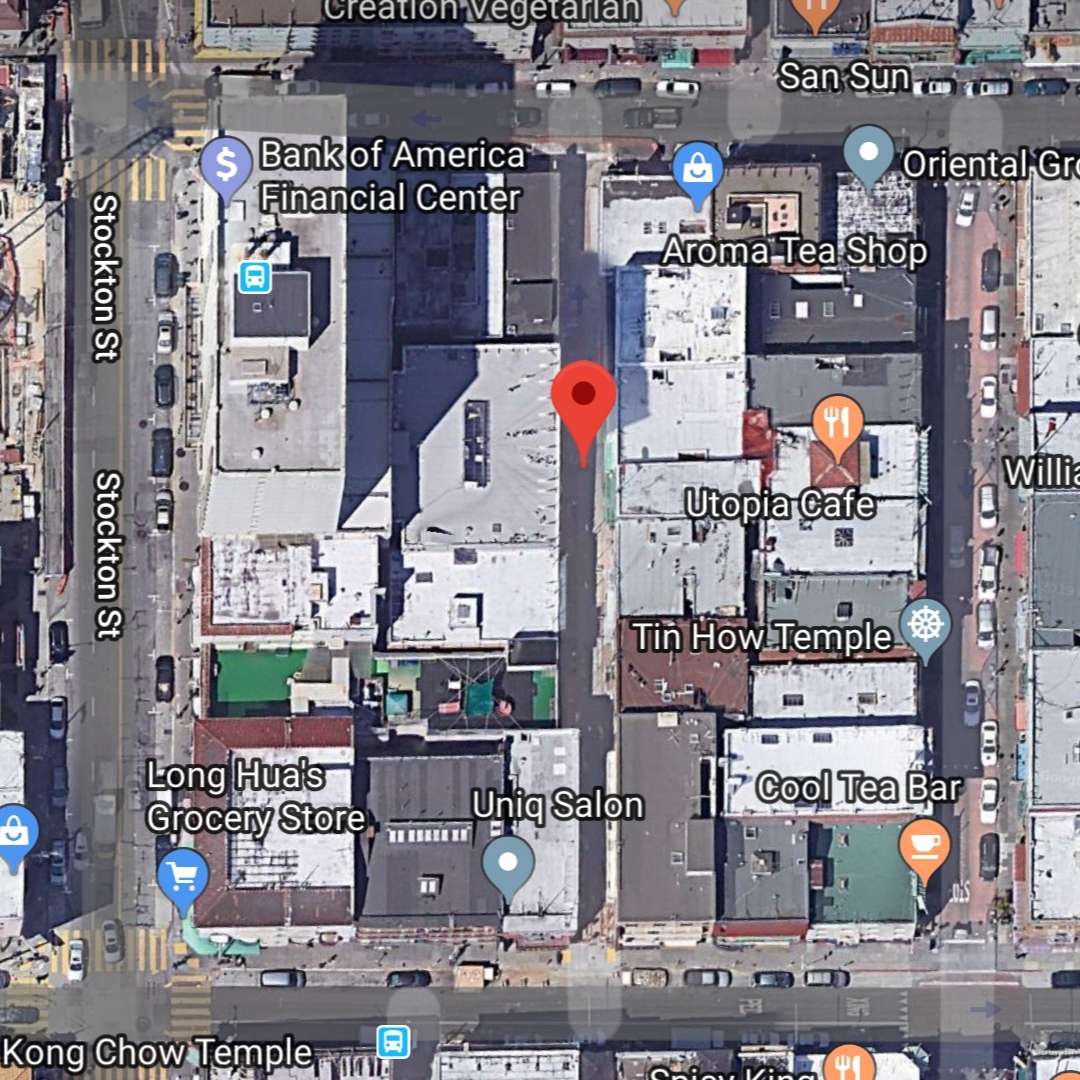
Fig 2 – A modern Google satellite image of Spofford Alley (larger version). It is only a few hundred feet long.

During the 19th-century, Spofford Alley (fig. 2), where the temple housing the Great Sage shrine was located, was home to the Chee Kong Tong (Zhigong tang, 致公堂, “Chamber of High Justice Society,” a.k.a. the “Chinese Freemasons”), the secret Chinese society-turned-criminal organization running Chinatown’s illicit opium, gambling, and prostitution trade (Risse, 2012, p. 37). The Chee Kong Tong were originally an offshoot of anti-Manchu rebels who wanted to overthrow the foreign-ruled Qing dynasty (Cassel, 2002, pp. 218-219). [1] Therefore, Sun Wukong’s worshipers may have included gangsters and rebels. As mentioned in this article, the Great Sage was venerated by fighters of the Boxer Rebellion (1899-1901). This makes sense as the divine primate is famous for his rebellion against heaven in Journey to the West.


Update: 01-15-2022

I was very happy to recently find an article called “Map of Temples in San Francisco’s Chinatown 1850s-1906” (Romaskiewicz, 2021). The author, a PhD student named Peter Romaskiewicz, has done a great service by scouring 19th and 20-century material and cross-referencing this with antique maps of Chinatown. The article has a list of over 20 temples/immigrant associations and their corresponding locations plotted on a map. This is great because it has allowed me to pinpoint the exact place where the Monkey King was worshiped in 1892 Chinatown!

Masters (1892) refers twice to temples on Spofford: 1) “[Guanyin’s] shrine is found up a dingy staircase on the southwest corner of Spofford alley and Washington streets” (p. 734); and 2) “In the Spofford-alley temple are found the shrines of some twenty other gods and goddesses…” (p. 736). Romaskiewicz (2021) shows the Guanyin temple (#10) was located at the end of Spofford, while a different joss house belonging to the Chee Kong Tong (#9) was located in the middle of the street. I therefore assumed Monkey was worshiped at the Chee Kong Tong joss house because Masters’ (1892) second temple reference didn’t mention Guanyin. However, after writing Romaskiewicz, I learned that there were actually three joss houses on Spofford during the 19th-century (one from an 1887 map is not listed). But most importantly, Masters (1982) was likely referring to the Guanyin Temple in both instances. That’s why he highlights “the shrines of some twenty other gods and goddesses…” (emphasis added) (Masters, 1892, p. 736), meaning these icons were also found in the same location.

The Guanyin Temple (Guanyin miao, 觀音廟) was located at No. 60 on the corner of Spofford and Washington (fig. 3) (Romaskiewicz, 2021). I’m unsure if it still exists in some form in that location. But I do know from Google Maps that the old No. 60 is not the same as the current No. 60.

Romaskiewicz was kind enough to direct me to an 1883 brochure asking for funds to restore the temple. This shows it was in use for some time.

Fig. 3 – The yellow star marks the location of the Guanyin Temple (larger version). Based on Romaskiewicz (2021). See this 1885 map

Notes:

1) Sun Yatsen, the “Father of modern China,” made contact with the Chee Kong Tong several times and even used their no. 36 Spofford Alley office as his own while raising money for his revolution in China (United States, 1993, pp. 45-46; Lum & Lum, 1999, p. 57).

Source:

Cassel, S. L. (2002). The Chinese in America: A history from Gold Mountain to the new millennium. Walnut Creek, CA: AltaMira Press.

Lum, Y. M., & Lum, R. M. K. (1999). Sun Yat-sen in Hawaii: Activities and supporters. Honolulu: Hawaii Chinese History Center.

Masters. F. J. (1892). Pagan Temples in San Francisco. In C.F. Holder (Ed.). The Californian illustrated magazine: June to November, 1892, vol. 2 (pp. 727-741). San Francisco, Calif.: Californian Pub. Co.

Refo Mason, S. (1994). Social Christianity, American feminism, and Chinese prostitutes: The history of the Presbyterian mission home, San Francisco, 1874-1935 In M. Jaschok and S. Miers (Ed.) Women and Chinese Patriarchy: Submission, Servitude, and Escape (pp. 198-220). Hong Kong: Hong Kong University Press.

Romaskiewicz, P. (2021, April 15). Map of Temples in San Francisco’s Chinatown 1850s-1906. Personal Site of Peter Romaskiewicz. Retrieved from https://peterromaskiewicz.com/2020/06/02/map-of-temples-in-san-franciscos-chinatown-1850s-1906/

Risse, G. B. (2012). Plague, fear, and politics in San Francisco’s Chinatown. Baltimore: The Johns Hopkins University Press.

United States. (1993). An introduction to organized crime in the United States. Washington, D.C.: Organized Crime/Drug Branch, Criminal Investigative Division.

Zhu Bajie’s Earliest Known Depictions and the Gyeongcheonsa Pagoda

Last updated: 10-26-19

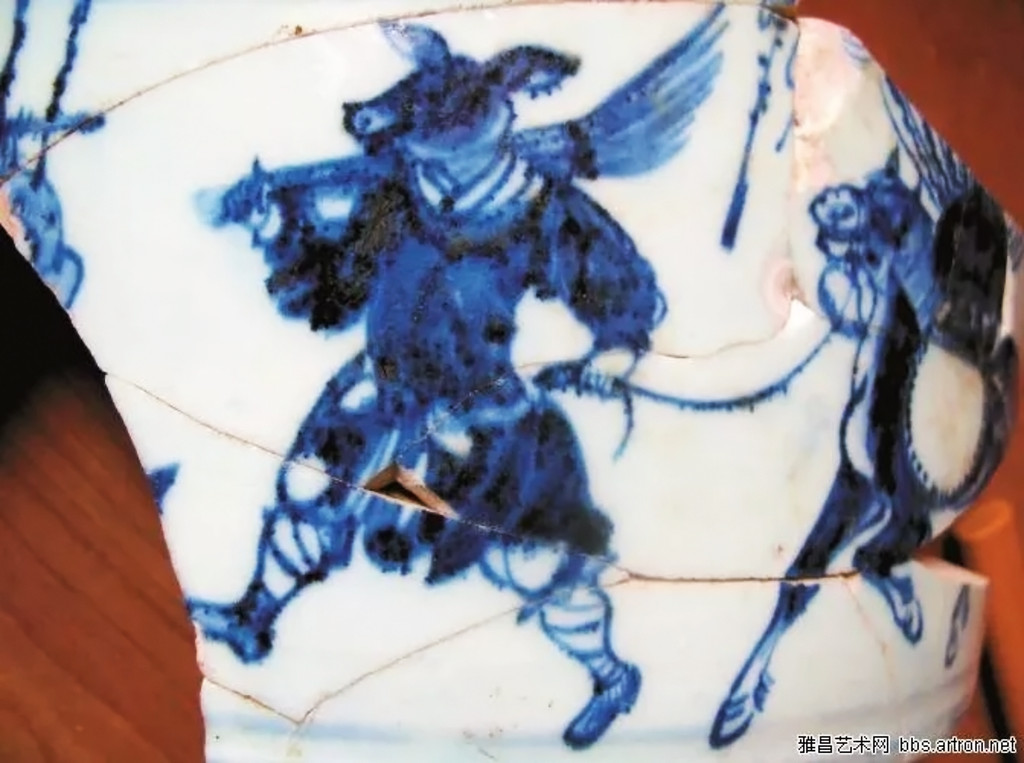
I suggested in a previous article that Zhu Bajie was first added to the Journey to the West story cycle during the 14th-century. This is because the character does not appear in the 13th-century version of the story, but he does appear in a stage play from the 15th-century. Thanks to the writing of Prof. Ben Brose, I learned of Pigsy’s three earliest known depictions from this time period. The first is a Yuan Dynasty Cizhou ware ceramic pillow showing all of the characters (fig. 1). The second is a fragmented Yuan-era blue and white incense burner (fig. 2). Older still are Zhu’s depictions appearing on the 14th-century Gyeongcheonsa pagoda (Kyŏngch’ŏnsa sipch’ŭng sŏkt’ap, 경천사십층석탑) from Korea (fig. 3). You read that right, Korea!

cizhou ware pillow and korean pagoda

Fig. 1 – The Cizhou ware pillow featuring Pigsy and the other pilgrims (larger version); Fig. 2 – A fragment of the blue and white incense burner showing Pigsy leading the White Dragon Horse (larger version). Fragments with the other characters can be found here; Fig. 3 – The Gyeongcheonsa pagoda is now housed inside of the National Museum of Korea (larger version). 

I. Why Korea?

The Pak t’ongsa ŏnhae (Ch: 朴通事諺解, Pu tongshi yanjie), a 17th-century Korean primer on colloquial Chinese comprised mostly of material traceable to the mid-15th-century, presents the Journey to the West story cycle as a highly popular tale among Koreans. This fact is revealed during a conversation between two Buddhist monks, one of which states: “The Xiyouji is lively. It is good reading when you are feeling gloomy” (Dudbridge, 1970, p. 180). The same monk then recounts an episode where Monkey competes with three animal spirits-cum-Daoist priests in a test of magic skill. This episode comprises chapters 44 to 46 in the final Ming version of the novel. [1] The popularity of the Chinese story cycle in Korea then explains why scenes from it appear on the pagoda.

II. Pagoda Background

The National Museum of Korea explains the 13.5 meter (44.3 ft) tower has a long and tumultuous history:

Made of marble, this ten-story stone pagoda was erected at Gyeongcheonsa Temple in Gaeseong in 1348, the fourth year of the reign of Goryeo’s King Chungmok. The first tier of the pagoda bears an inscription that records various details about the pagoda’s production, including the production date and the patrons. According to the inscription, the pagoda was sponsored by Goryeo people who were associated with China’s Yuan Dynasty. Notably, this stone pagoda was closely modeled after wooden architecture, and each story is expertly carved with Buddhist images. The platform is sculpted with scenes of Xiyouji (Journey to the West), as well as lions, dragons, and lotus flowers. The lower four stories are sculpted with scenes of Buddha’s Assembly, while the upper six stories are sculpted with images of Buddha with both hands clasped. The four sides of the platform and those of the lower three tiers are protruding, recalling the shape of Tibetan-Mongolian pagodas that were prevalent in the Yuan period. However, the upper seven tiers have a more standard rectangular shape that corresponds with the conventional form of stone pagodas. Notably, about 120 years after this pagoda was built, the Joseon royal court erected a stone pagoda with a similar material and shape at Wongaksa Temple in Gwangju. In 1907, this pagoda was illegally dismantled and smuggled to Japan by Tanaka Mitsuyaki, the Japanese Minister of the Imperial Household. However, thanks in part to the efforts of a British journalist named Ernest Thomas Bethel and an American journalist named Homer Hulbert, it was returned to Korea in 1918. The pagoda was partially restored in 1960, while it was being kept at Gyeongbokgung Palace, but after having been kept outside for so long, suffering the effects of weather and acid rain, it could not be properly preserved. Thus, in 1995, it was dismantled for a more extensive restoration project. Ten years later, it was reassembled inside the new building of the National Museum of Korea in Yongsan, being unveiled as part of the museum’s grand opening in 2005 (“Ten-story Stone Pagoda”, n.d.).

The pagoda’s political and architectural connections to Yuan China further explain why scenes from the story cycle grace the platform.

III. The Images

(Note: I have recently learned that the line drawings from Yegŭrin Kŏnchʻuksa Samuso (1993) are all but useless. See the 10-26-19 update below for more info.)

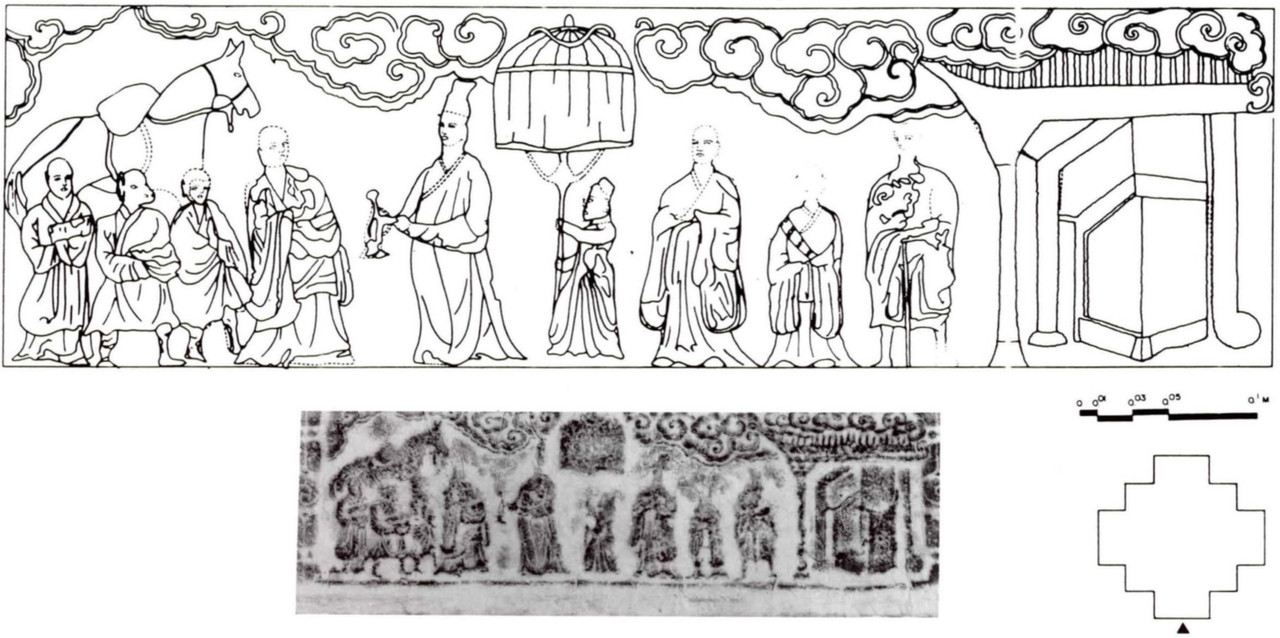
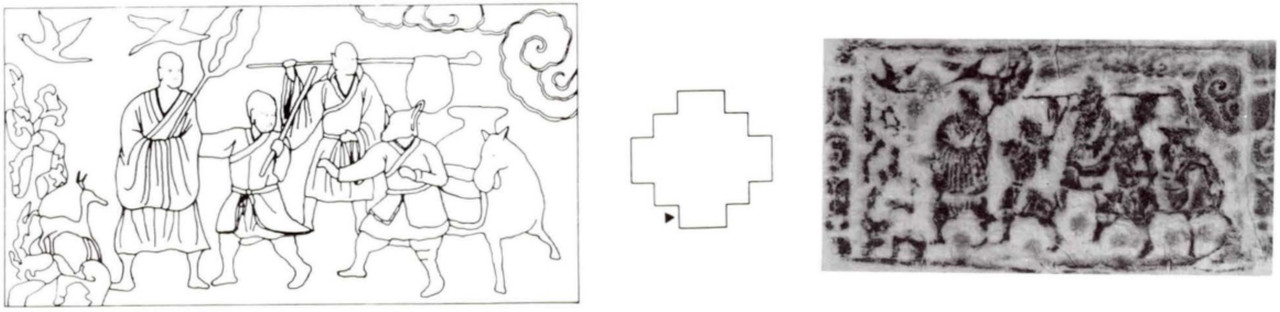
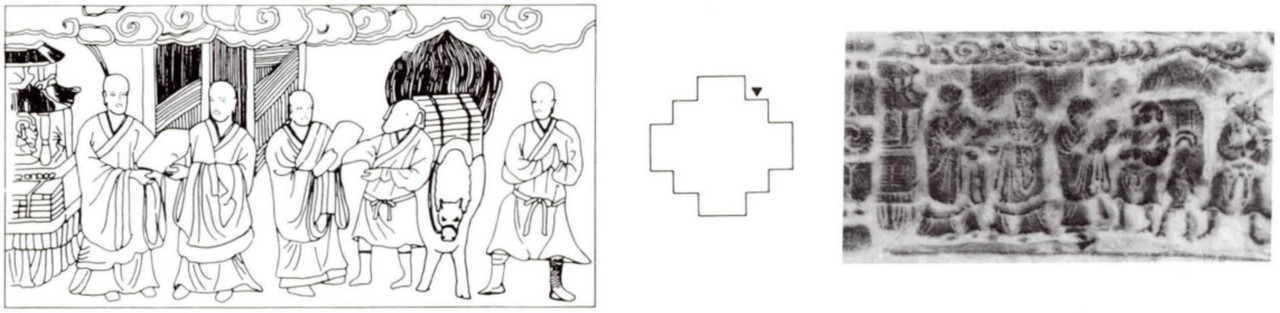
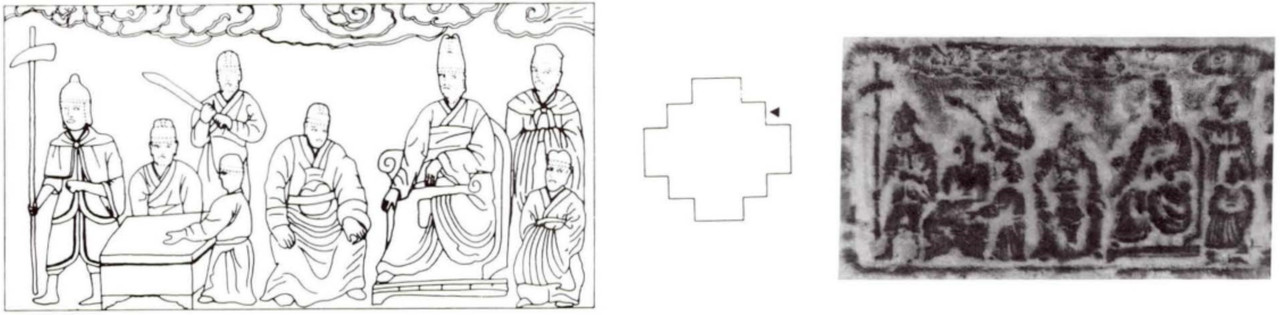
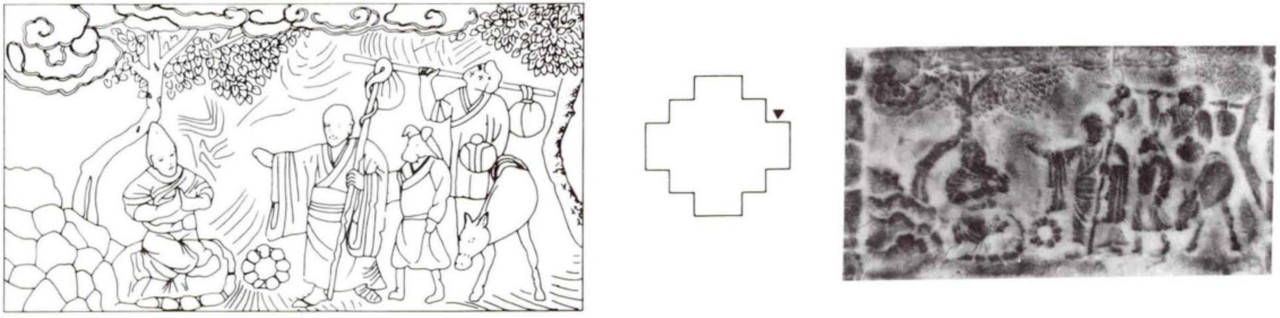
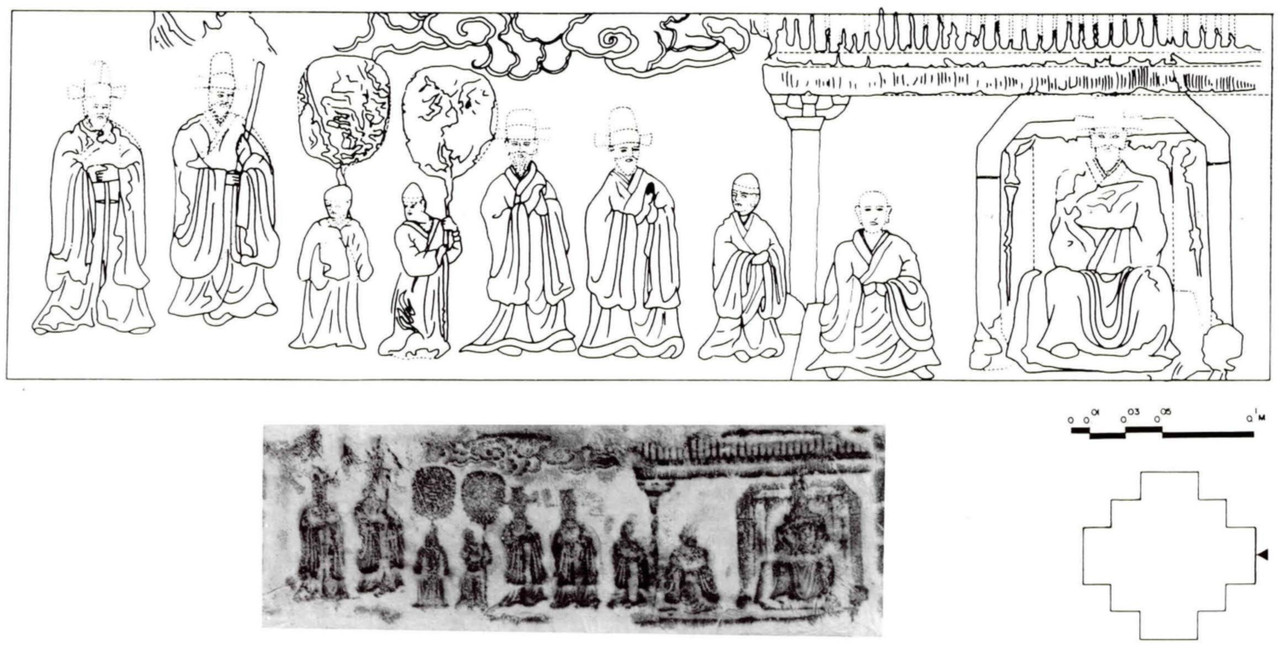
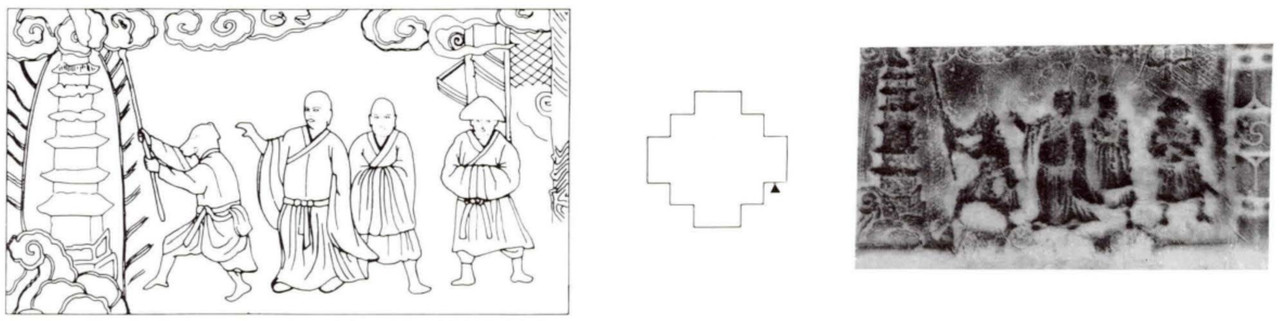
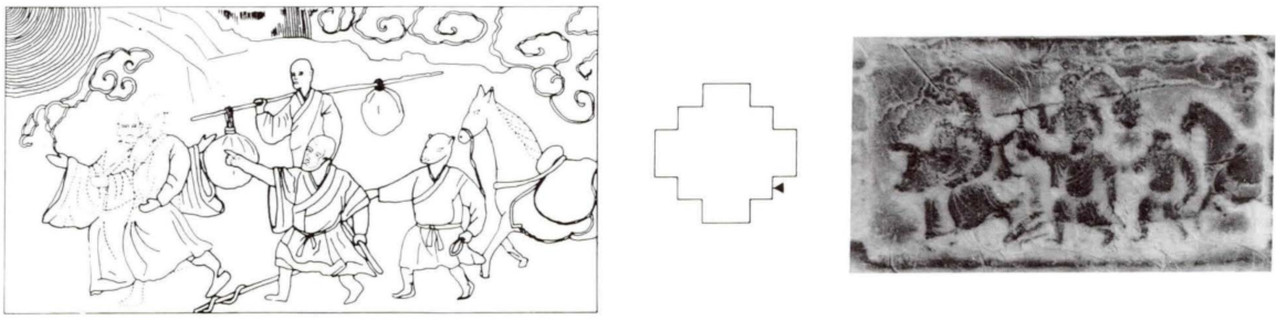
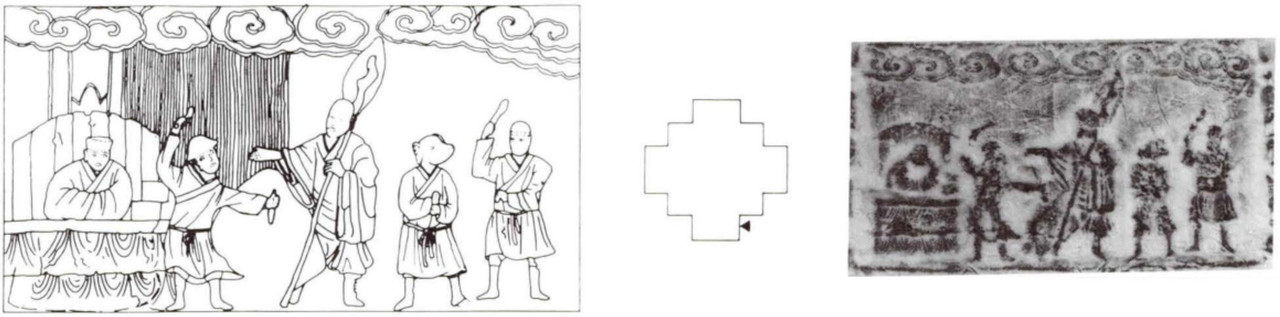
Twenty Journey to the West-related scenes appear on the second level of the pagoda’s multifaceted three-tiered base. The following line drawings, which are based on ink rubbings of the original carvings, come from an in-depth field report by the Yegŭrin Architectural Firm (Yegŭrin Kŏnchʻuksa Samuso, 1993). The images are presented below starting from the southernmost face (the six o’clock position) of the pagoda’s diamond-shaped cross section, proceeding in a clockwise fashion. Each is accompanied with commentary from the original report.[2] You will notice the report is generally vague as the exact meaning of the scenes are often unclear. I will therefore present my own commentary or questions below in the hopes of furthering the discussion.

Number One: A royal send off

image 1 (small)

Fig. 5 – (larger version)

On the left, a figure of a Buddhist monk stands at the front, and behind him a horse and figures in the shape of a pig’s head, a monkey, and more are depicted. The figure of the Buddhist monk appears to be Monk Xuanzang, the figure of the monkey, Sun Wukong, the figure with the pig’s head, Zhu Bajie, and the last figure appears to be Sha Wujing. In other words, it is Monk Xuanzang’s travel companions. On the right, pictured symmetrically with Xuanzang’s travel party is the figure of a nobleman wearing a crown, and behind him stands a figure of a young boy holding an umbrella over his head and the figures of three noblemen.

And to the right of this a building structure is depicted. The nobleman who is at the very front wearing a crown seems to be a king and the building structure appears to represent a palace. Therefore, the content of the carving above seems to be the scene of a king sending off Monk Xuanzang’s travel party [fig. 5] (Yegŭrin Kŏnchʻuksa Samuso, 1993, p.123).

Could this scene be a telescopic version of the narrative, one in which the already assembled group is being sent off by Tang Taizong? After all, the authors suggest in panel number ten that the first ten images likely show the journey to India, while the latter half shows the return (Yegŭrin Kŏnchʻuksa Samuso, 1993, p. 124). Hierarchy in scale is employed to portray the king as the largest and therefore the most important, with Tripitaka being the second tallest/important, and the three disciples even shorter. Pigsy’s porcine head really stands out as Sandy is depicted as a human monk.

Number Two: On the Road

image 2 (small)

Fig. 6 – (larger version)

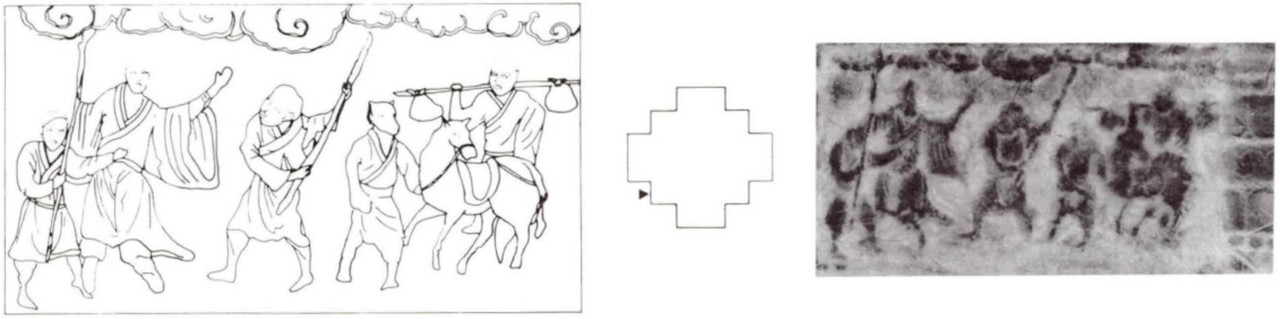
As above, the horse and the travel party of Monk Xuanzang, Monkey, Zhu Bajie and Sha Wujing have been portrayed. Here Sha Wujing is carrying a knapsack. On the left a road populated with animals and birds are depicted. Therefore, here it appears to show that Monk Xuanzang and his companions are traveling on a mountain road [fig. 6] (Yegŭrin Kŏnchʻuksa Samuso, 1993, p.123).

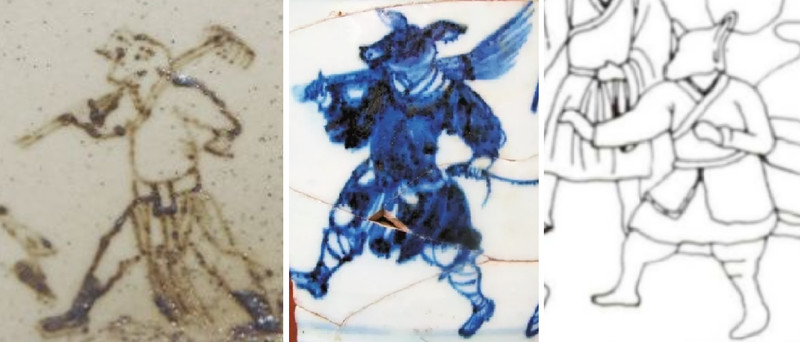
Take note of Pigsy’s upraised hands and wide stride. This motif appears several more times on other panels (fig. 12, 13, 17, and 24). The posture is quite similar to that from the aforementioned ceramic pillow and incense burner, which depict Pigsy carrying his rake and leading the horse. He lacks his signature weapon in these scenes, however (fig. 7). This might explain the strange posture of his right hand.

Korean Pagoda paper - Pigsy iconography comparison

Fig. 7 – Similar Pigsy iconography from the Cizhou ware pillow (left), the incense burner (center), and panel two (right), all corresponding with the Yuan Dynasty (larger version). See also figure 24 for a better match. 

Number Three: A prisoner?

image 3 (small)

Fig. 8 – (larger version)

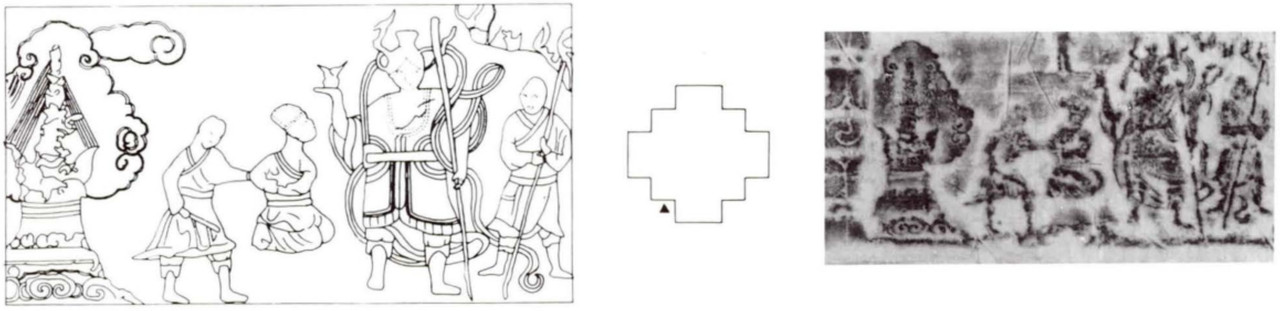
On the left, the figure of a nobleman wearing a crown is kneeling. Behind him, a figure of a person holding a club appears to threaten the nobleman in front. Behind them something like an altar is depicted. Symmetrical with the figure of the kneeling nobleman, a figure looking like a government official from a prison in a provincial district stands holding a tool of torture.

Even if we don’t know what this is, it seems to show the oppression by those of other religions during the years of Xuanzang’s journey [fig. 8] (Yegŭrin Kŏnchʻuksa Samuso, 1993, p. 123).

My view on the scene differs from the authors. The “government official” appears to be a deity (noted by the flowing ribbons around the shoulders), possibly Guanyin since the upheld item reminds me of her holy vase. The figure to the right could be her disciple Moksha. Would this make the club-wielding figure Monkey and his prisoner a captured demon?

Number Four: A confrontation

image 4 (small)

Fig. 9 – (larger version)

On the left, a figure holding a club and Monk Xuanzang are depicted. On the right, Monkey, Zhu Bajie and Sha Wujing are portrayed. Here Monkey is posed as if he is defeating something with the stick, and behind the horse Sha Wujing is carrying the knapsack. Monk Xuanzang is shown lifting his left hand as if he is arguing something. This appears to show the scene of Xuanzang’s companions defeating some hindrance [fig. 9] (Yegŭrin Kŏnchʻuksa Samuso, 1993, p. 123).

I believe Tripitaka is begging Monkey not to slay or beat the person, as the monk steps in many times throughout the narrative to do this. Could this be the White Bone Demon under one of its many disguises from chapter 27?

Number 5: A king or deity

image 5 (small)

Fig. 10 – (larger version)

On the right side, a figure riding a lion is depicted. On the left side, three figures that seem like they are servants are depicted, and in the back a building structure is carved. It seems to depict some group of royals or noblemen on Xuanzang’s way to India [fig. 10] (Yegŭrin Kŏnchʻuksa Samuso, 1993, p. 123).

The group of servants appear to me to be our pilgrims, the long-faced figure possibly being Pigsy. The figure riding the lion could be Manjusri and his feline mount. Could this be a reference to him subduing the beast in chapter 77? The figure’s hands appear to be producing bolts of lightning. I’m not sure of the significance, if any.

Number Six: A foreign court

image 6 (small)

Fig. 11 – (larger version)

On the right, there is a figure of a Buddhist monk holding a monk’s staff who seems to be Monk Xuanzang, and a figure to his left seems to be a disguised Monkey. On the left, figures of noblemen from a palace are portrayed. This appears to depict a scene where Monk Xuanzang’s travel party is welcomed in some palace along the road [fig. 11] (Yegŭrin Kŏnchʻuksa Samuso, 1993, p. 124).

The strange figure in the middle is a complete mystery to me. While the figure is identified as Monkey, it’s impossible to tell for sure.

Number Seven: Fire Mountain

image 7 (small)

Fig. 12 – (larger version)

On the left side, a pattern of fire sparks is carved. And in front of that is Monkey, holding a fan trying to put out the fire. Behind him Monk Xuanzang is carrying out some action with lifted hands, and behind him Zhu Bajie is holding the horse reins while Sha Wujing as always is carrying the knapsack. This depicts the scene of Xuanzang’s travel party meeting and trying to eliminate difficulties along the road [fig. 12] (Yegŭrin Kŏnchʻuksa Samuso, 1993, p. 124).

This is the least ambiguous of the twenty scenes and my personal favorite. It depicts Monkey using the magic palm leaf fan to conquer the flames of Fire Mountain.

Pigsy’s upraised hand-wide stride motif appears once more.

Number Eight: Offerings

image 8 (small)

Fig. 13 – (larger version)

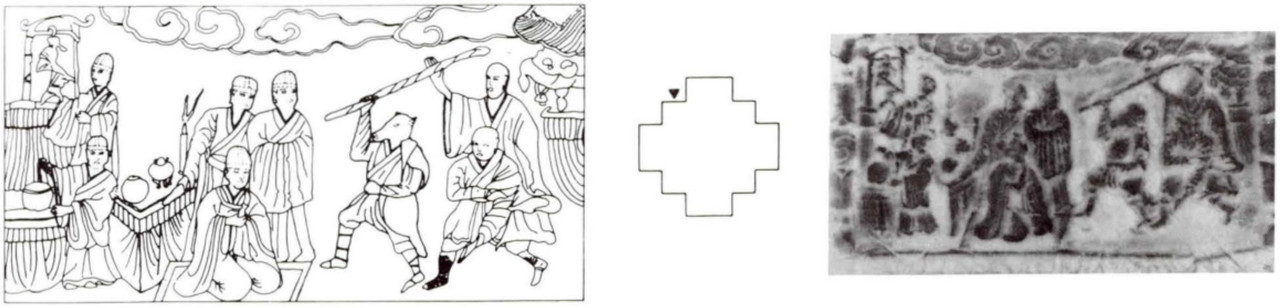
A table is placed in the middle, and on top of it lays objects that seem to be offerings. On the right Xuanzang’s travel party and on the left figures of noblemen or royals are depicted. Two of the figures from Xuanzang’s travel party are covering their heads with something, but this seems to be to conceal the sight of Monkey and Zhu Bajie’s animal heads. This appears to be the scene of Xuanzang’s travel party receiving offerings from a royal or gentry family along the way [fig. 13] (Yegŭrin Kŏnchʻuksa Samuso, 1993, p. 124).

The bearded figure between Tripitaka and the supposedly veiled figure is no doubt Pigsy, based on his upraised hands and wide stride. The elongated snout has been confused for a beard.

Also, could the veil actually be supplies on the horse’s back? Maybe the original rubbing is degraded in this area, making the head look as if it is under (instead of in front of) the object.

Number Nine: Another confrontation

image 9 (small)

Fig. 14 – (larger version)

On the left, a figure of a nobleman who is kneeling or bending his head is depicted. On the right, the figure of Zhu Bajie, who is trying to attack the nobleman, and the figure of Monk Xuanzang, who is trying to prevent this, are shown. It appears to be depicting some sort of misunderstanding that happened between the nobleman and Xuanzang’s attendant [fig. 14] (Yegŭrin Kŏnchʻuksa Samuso, 1993, p. 124).

Pigsy has not been portrayed with a weapon up to this point. It would make more sense if Monkey was wielding the staff. After all, figure 17 depicts Sun standing in a similar posture while wielding a club/staff. Perhaps the elongated face on this panel is just an artifact from the original rubbing?

Number Ten: A temple

image 10 (small)

Fig. 15 – (larger version)

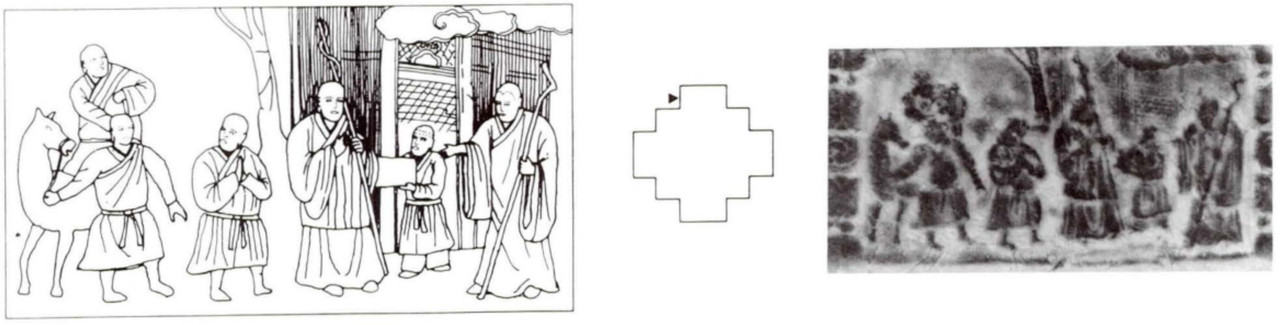
On the left side, Xuanzang bears a monk’s staff and his attendants are depicted together with the horse. And on the right side, symmetrical to this, are the figures of a Buddhist monk (holding a monk’s staff) and his attendant, who are about to receive Xuanzang’s travel party. This appears to depict the scene of Xuanzang’s travel party being welcomed by the monks of some temple along the way. Here Monkey and Zhu Bajie seem to have transformed into monks and are posing as Buddhist monks.

The above ten sides, beginning at due south and reaching due north, appear to be depicting the process of Xuanzang’s travel party going to India, while the ten sides starting at due north appears to depict their return journey [fig. 15] (Yegŭrin Kŏnchʻuksa Samuso, 1993, p. 124).

The scene shows the small monk on the right passing something to Tripitaka. Based on iconography from the following images (see, for example, fig. 18), this could be portraying the monks receiving the scriptures in India.

Number Eleven: Returning home

image 11 (small)

Fig. 16 – (larger version)

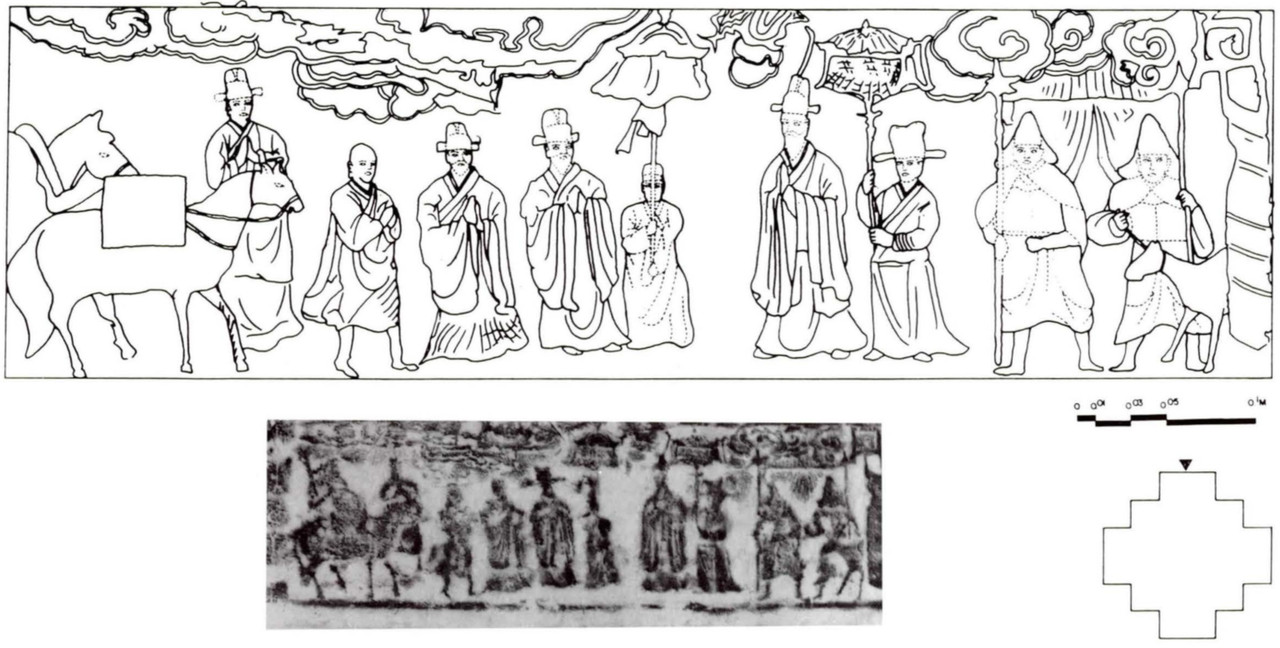
On the left side, two horses carrying something on their backs and Xuanzang’s travel party are shown. On the left are two figures of kings with umbrellas held over their heads by attendants. And to the left of them, a figure of an official who seems to be guarding the palace is visible. This appears to be depicting the scene where the kings are sending off Xuanzang’s travel party, who are setting off on their journey home after obtaining the scriptures [fig. 16] (Yegŭrin Kŏnchʻuksa Samuso, 1993, p. 124).

The “something” on the horses’ backs could be the scriptures.

Number Twelve: Saving their Master

image 12 (small)

Fig. 17 – (larger version)

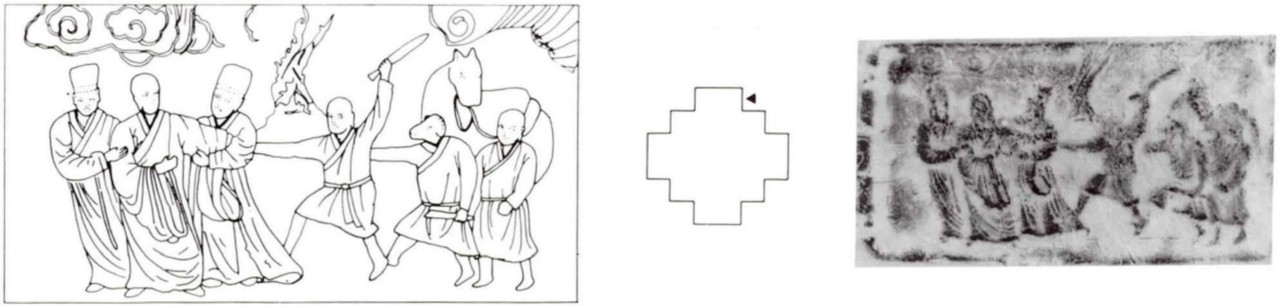
On the left, the figure of a monk is caught by the figures of noblemen wearing crowns. On the left Monkey, Zhu Bajie, Sha Wujing and the horse are depicted. But Monkey and Zhu Bajie are assuming postures threatening to save the captured Monk Xuanzang. This seems to show the image of Monkey and company as guards, trying to save Xuanzang when he was being captured on their way back [fig. 17] (Yegŭrin Kŏnchʻuksa Samuso, 1993, p. 125).

Here the figure wielding the staff is designated Monkey, with Pigsy standing behind him. Again, this makes more sense than Zhu Bajie attacking (as portrayed in figure 14).

Number Thirteen: Passing on the dharma

image 13 (small)

Fig. 18 – (larger version)

On the right side, Xuanzang’s travel party and the horse carrying the scriptures are depicted. Here Xuanzang is shown handing over some of the Buddhist scriptures to the figure of a monk on the left. This appears to show Xuanzang’s travel party passing on Buddhism along the way on their return journey [fig. 18] (Yegŭrin Kŏnchʻuksa Samuso, 1993, p. 125).

Compare the shape of the Buddhist scriptures held by the monks with that in figure 15.

The panel draws on preexisting iconography regarding the sutras. The collection of holy writings are sometimes portrayed as a bundle of scrolls emitting an aura of holy light. See, for example, the 12th-century mural from Yulin Cave (Yulin ku, 榆林窟) number three in Gansu province, China (fig. 19).

Yulin Cave and Korean pagoda examples of sutras - small

 Fig. 19 – Detail of sutras from a 12th-century Yunlin cave mural (left) and the sutras from panel thirteen (right) (larger version). Both are shown stacked atop a horse. 

Number Fourteen: The emperor waits

image 14 (small)

Fig. 20 – (larger version)

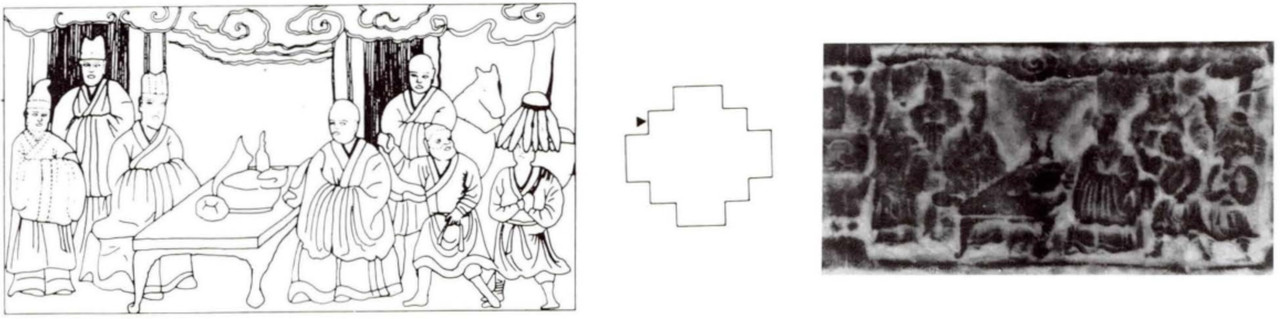
In the middle of the right side, the figure of a king seated on a throne is depicted. On both sides of him figures of scholar-officials attend to him or sit. On the left, figures of officials are shown attending to duties or sitting. It seems this is depicting the scene of China’s emperor waiting for Xuanzang’s travel party [fig. 20] (Yegŭrin Kŏnchʻuksa Samuso, 1993, p. 125).

Could the figures at the table actually be our heroes, with Xuanzang kneeling before a foreign king?

Number Fifteen: An ascetic or Monkey

image 15 (small)

Fig. 21 – (larger version)

On the left side, a figure of an ascetic is depicted sitting under a tree (Bodhi tree) meditating, and Xuanzang’s travel party and the horse are depicted. Here Xuanzang is assuming a posture, holding the monk’s staff and lifting his right hand trying to assert something. This seems to show the scene of Xuanzang’s travel party meeting an ascetic and passing on Buddhism on their journey home [fig. 21] (Yegŭrin Kŏnchʻuksa Samuso, 1993, p. 125).

Look closely and you will notice that Sun Wukong does not appear in the scene. Could the “ascetic” be Monkey kneeling before Xuanzang. If so, could this be a reference to the immortal and his master mending their relationship in chapter 58 after the trickery of the Six-Eared Macaque forced them apart?

Number Sixteen: Imperial court

image 1 (small)

Fig. 22 – (larger version)

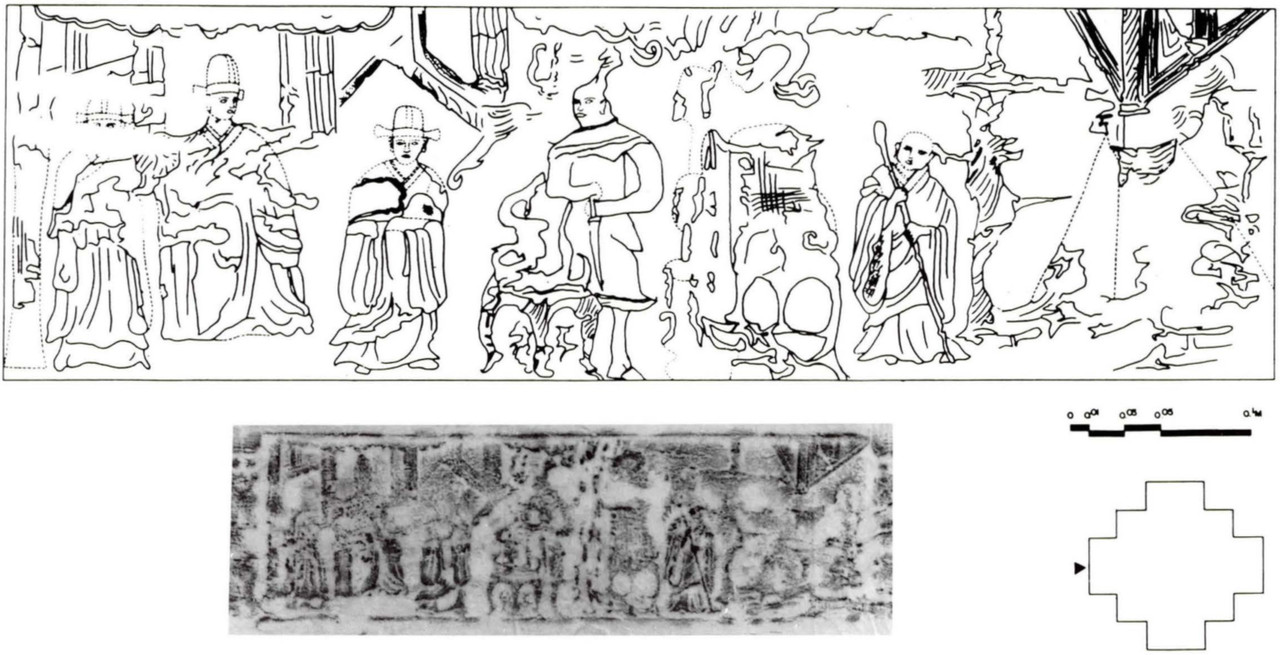
On the right, a building is depicted and inside it a figure of a king sitting on a throne, and in front of him, a figure of a kneeling monk (Xuanzang) are portrayed. Outside the building, the figure of a young monk that seems to be Xuanzang’s attendant is depicted. Behind him, figures that seem to be civil and military officials are depicted. This seems to show the scene of Xuanzang meeting some king along his way [fig. 22](Yegŭrin Kŏnchʻuksa Samuso, 1993, p. 125).

Could the “attendant” be Monkey?

Number Seventeen: Attacking a pagoda

image 2 (small)

Fig. 23 – (larger version)

On the left, a pagoda is depicted and in front of it, Zhu Bajie is carrying a club, assuming a posture trying to bring the pagoda down. Behind him Monk Xuanzang is lifting his right hand and insisting something, as if trying to stop him. This seems to show the soothing of Zhu Bajie’s aggressive, insulting actions towards Buddhism [fig. 23] (Yegŭrin Kŏnchʻuksa Samuso, 1993, p. 125).

Like figure 14, it would make more sense if Monkey is the one wielding the staff. Could this be a reference to chapter 62 when Sun captures two fish spirits found on a pagoda’s topmost floor?

Number Eighteen: Nearing home

image 3 (small)

Fig. 24 – (larger version)

In the upper left part, the sun symbolizing light is depicted. Headed in that direction Monk Xuanzang is taking the lead and behind him Monkey, Zhu Bajie and Sha Wujing are shown hurrying their steps while leading the horse. Here Monk Xuanzang seems to be urging Monkey, Zhu Bajie and Sha Wujing, rushing their journey home [fig. 24] (Yegŭrin Kŏnchʻuksa Samuso, 1993, p. 125).

This includes Pigsy’s aforementioned motif. It is a better match for the ceramic pillow and incense burner examples from figure 19.

Number Nineteen: A deity appears

image 4 (small)

Fig. 25 – (larger version)

On the right, a figure of a celestial being is depicted and Xuanzang’s travel party is facing it symmetrically. This seems to show the fact that Xuanzang’s travel party received the blessing of celestial guardian deities [fig. 25] (Yegŭrin Kŏnchʻuksa Samuso, 1993, p. 126).

I’m confused as to why the two characters on the far right are stacked one on the other. Per the original ink rubbing, could “they” actually be a singular figure, possibly someone of great importance given their size? Could the “deity” actually be Xuanzang being elevated in spiritual rank like in chapter 100?

Number Twenty: Teaching the dharma

image 5 (small)

Fig. 26 – (larger version)

On the left, something that seems to be a Buddhist altar is depicted. In front of it, Xuanzang is placed in the middle shown holding the monk’s staff, and Monkey, Zhu Bajie and Sha Wujing are each shown performing different actions. Xuanzang is lifting his right hand, posed arguing something and you could say he is trying to educate his attendants, Monkey etc., in Buddhism [fig. 26] (Yegŭrin Kŏnchʻuksa Samuso, 1993, p. 126).

While the line drawing looks more like a figure at a desk, it very well could be an altar with a Buddha statue. Could this depict the lives of our heroes after entering paradise?

IV. Other Pagodas

This is not the first time characters from the story cycle have appeared on a pagoda. Even older examples appear on the 13th-century tower of the Kaiyuan Temple from Quanzhou, Fujian province, China. In this previous article I described how the pagoda is covered with eighty life-sized carvings of Buddhas, bodhisattvas, guardian deities, Buddhist saints, and eminent monks. Of note is a muscular, sword-wielding, monkey-headed warrior that many consider to be an early example of Sun Wukong. Another is an armored, spear-wielding warrior believed to be the dragon prince who becomes the white dragon horse. Both occupy the same face of the eight-sided structure (Dudbridge, 1970, pp. 47-48 and 49-51).

V. Conclusion

Zhu Bajie’s oldest known depictions come from a time coinciding with the late Yuan Dynasty, examples including a ceramic pillow and a fragmented incense burner from China and carvings on a pagoda from Korea. Built in 1348 by Goryeo representatives with ties to the Yuan court, the ten-story Gyeongcheonsa pagoda includes twenty Journey to the West-related scenes around the second level of the structure’s multifaceted three-tiered base. Many of the scenes are vague or focus more on kings and nobles in place of Tripitaka’s tribulations or instances of supernatural battles. One has to consider the story cycle was still solidifying at this point, so it’s possible some of the scenes depict episodes that did not make it into the final Ming version of the novel. But given the amount of royalty, is it possible the donors/planners were trying to ingratiate themselves with people of higher social rank? Or were they just trying to illustrate the great many countries visited by the pilgrims (each one ruled by a king) within the limited space provided?

The panels involving Pigsy for the most part use a consistent iconography borrowed from China. The aforementioned Yuan examples portray Pigsy leading the horse with one hand and with the other holding his signature rake, which rests on his shoulder, all while taking a large step forward. The pagoda panels, however, do not portray the rake, leaving our portly hero with his arm strangely floating in the air. Instead of a rake, some panels appear to show him wielding a staff. But the figure might actually be Sun Wukong, the elongated face just being an artifact from the original ink rubbings.

The fact that characters from the Journey to the West story cycle appear on Chinese and Korean pagodas alongside Buddhist deities proves just how intertwined the story is with the religion. The tale essentially symbolizes the quest for enlightenment, the ultimate goal of Buddhism. Therefore, such pictorial representations, especially the narrative-type scenes from Gyeongcheonsa, were probably meant to both entertain and spread the faith.


Update: 10-26-19

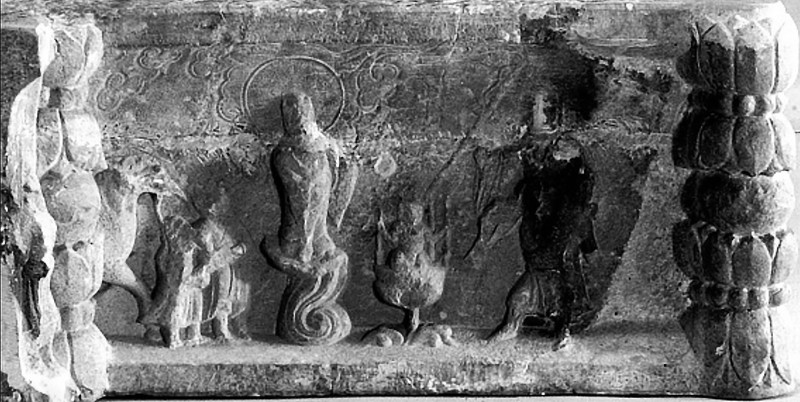
I have recently learned that the line drawings from Yegŭrin Kŏnchʻuksa Samuso (1993) are all but useless. A prime example is number nineteen. As a reminder, here is the drawing:

Korean Pagoda scene with Red Boy - Line drawing

(larger version)

I originally suggested that the being on the cloud was Xuanzang being elevated in spiritual rank. I didn’t comment on the strange, flower-like cloud to the right of that figure because of its abstract shape.

Now here is a photo of the actual carving. It has been enhanced slightly for clarity.

Korean Pagoda scene with Red Boy - small

(larger version)

You’ll noticed that the cloud really is a flower with a defined bulb, stem, and leaves. There also appears to be a figure sitting on the flower, one who is surrounded by what looks to be spikes or swords. Here’s a closer look with a crude line drawing by the author.

Korean Pagoda scene with Red Boy - Close up of flower with new line drawing - small

(larger version)

Wall (2019) notes the figure on the flower is Red Boy and the figure on the cloud is Guanyin (pp. 2129-2130), making this a depiction of the former’s defeat at the end of what would be chapter 42 of the Ming Journey to the West:

After she received [treasure swords borrowed from heaven], the Bodhisattva [Guanyin] threw them into the air as she recited a spell: the swords were transformed into a thousand-leaf lotus platform. Leaping up, the Bodhisattva sat solemnly in the middle.

[…]

[Sun Wukong feigns defeat and tricks Red Boy into chasing him to Guayin’s domain] When the monster spirit suddenly discovered that Pilgrim was gone, he walked up to the Bodhisattva with bulging eyes and said to her, “Are you the reinforcement Pilgrim Sun brought here?” The Bodhisattva did not reply. Rolling the lance in his hands, the monster king bellowed, “Hey! Are you the reinforcement Pilgrim Sun brought here?” Still the Bodhisattva did not reply. The monster-spirit lifted his lance and jabbed at the heart of the Bodhisattva, who at once changed herself into a beam of golden light and rose into the air. Pilgrim followed her on her way up and said to her, “Bodhisattva, you are trying to take advantage of me! The monster-spirit asked you several times. How could you pretend to be deaf and dumb and not make any noise at all? One blow of his lance, in fact, chased you away, and you have even left behind your lotus platform.”

“Don’t talk,” said the Bodhisattva, “let’s see what he will do.” At this time, Pilgrim and Mokṣa both stood in the air shoulder to shoulder and stared down; they found the monster-spirit laughing scornfully and saying to himself, “Brazen ape, you’re mistaken about me! What sort of person do you think that I, Holy Child, happen to be? For several times you could not prevail against me, and then you had to go and fetch some namby-pamby Bodhisattva. One blow of my lance now has made her vanish completely. Moreover, she has even left the treasure lotus platform behind. Well, let me get up there and take a seat.” Dear monster-spirit. He imitated the Bodhisattva by sitting in the middle of the platform with hands and legs folded. When he saw this, Pilgrim said, “Fine! Fine! Fine! This lotus platform has been given to someone else!”

“Wukong,” said the Bodhisattva, “what are you mumbling again?”

“Mumbling what? Mumbling what?” replied Pilgrim. “I’m saying that the lotus platform has been given to someone else. Look! It’s underneath his thighs. You think he’s going to return it to you?”

“I wanted him to sit there,” said the Bodhisattva.

“Well, he’s smaller than you,” said Pilgrim, “and it seems that the seat fits him even better than it fits you.”

“Stop talking,” said the Bodhisattva, “and watch the dharma power.”

She pointed the willow twig downward and cried, “Withdraw!” All at once, flowers and leaves vanished from the lotus platform and the auspicious luminosity dispersed entirely. The monster king, you see, was sitting actually on the points of those swords. The Bodhisattva then gave this command to Mokṣa:

“Use your demon-routing cudgel and strike back and forth at the sword handles.”

Dropping from the clouds, Mokṣa wielded his cudgel as if he were demolishing a wall: he struck at the handles hundreds of times. As for that monster-spirit,

Both his legs were pierced till the points stuck out;
Blood spouted in pools as flesh and skin were torn.

Marvelous monster! Look at him! Gritting his teeth to bear the pain, he abandoned the lance so that he could use both hands to try to pull the swords out from his body (Wu & Yu, 2012, vol. 2, pp. 246 and 249-250).

Could the figures, one on top of the other’s shoulders, be an inventive way of showing Monkey and Guanyin’s disciple Moksha working together to subdue Red Boy?

This carving shows the Red Boy episode was known in Korea during the 14th-century, demonstrating that it predates the final Ming novel by centuries. The tale obviously would have taken time to form, become established in the accepted story cycle, and travel north, suggesting it may date to the early part of the corresponding Yuan-period when the Pagoda was raised in Korea, or possibly even before.

I hope to locate pictures of the other carvings to make this article more accurate.

Notes:

1) See Dudbridge, 1970, pp. 60-74 for more information. The tale itself is translated in appendix B of the same work. See pages 179-188.

2) I am indebted to Sini Henningsen, BA (sinihenningsen@gmail.com) for translating the cited Korean material.

Sources:

Brose, B. (2018). The pig and the prostitute: The cult of Zhu Bajie in modern Taiwan. Journal of Chinese Religions, 46 (2), pp. 167-196, DOI:
10.1080/0737769X.2018.1507091

Dudbridge, G. (1970). The Hsi-yu chi: A study of antecedents to the sixteenth-century Chinese novel. Cambridge: Cambridge Univ. Press.

Ten-story Stone Pagoda from Gyeongcheonsa Temple. (n.d.). Retrieved January 23, 2019, from https://www.museum.go.kr/site/eng/relic/masterpiece/view?relicMpId=11

Wall, B. (2019). Dynamic texts as hotbeds for transmedia storytelling: A case study of the story universe of the Journey to the West. International Journal of Communication 13, 2116-2142. Retrieved from https://ijoc.org/index.php/ijoc/article/view/10006/2648

Yegŭrin Kŏnchʻuksa Samuso 예그린 건축사사무소. (1993). Wŏn′gaksaji sipch′ŭng sŏkt′ap: silch′ŭk chosa pogosŏ 圓覺寺址十層石塔: 實測調查報告書. Seoul: Munhwajae Kwalliguk.

Story Idea: The Origin of Sun Wukong

Last updated: 02-22-2025

The following story sketch was originally posted on my external Historum blog on 01-20-2014. The site recently switched to a new server, but the blogs have yet to be migrated. I’m posting it here for posterity. Regular articles will resume after this entry.

Story Idea #1

As a lover of Chinese mythology and a former primatology major, I’ve always wanted to create my own primate-based character similar to Sun Wukong. I originally wanted him to be the son of Monkey or the son of one of his advisers or allies during his days as a demon. Either way, I thought he could train under Sun and gain similar powers. But then I decided that I wanted him to be a more civilized, yet more powerful version of the character; someone who is held in high regard by all beings of the six realms (demons, hungry ghosts, animals, humans, asuras, and devas) of Buddhist cosmology, as well as the Buddha himself. After reading about the ancient Chinese view of the gibbon, [A] a small, long-armed, arboreal ape native to Asia (fig. 1), I thought the character could be an ape immortal. It was only recently that I decided to pair him with a female since gibbons generally mate for life.

gibbon-jump-sachin-rai

Fig. 1 – A gibbon soaring through the treetops. Photo by Sachin Rai. A larger version can be found here.

1. Plot

This tale is meant to be a standalone story, but it includes details that explain the origin of Monkey and how his life parallels his spiritual parentage. I’ve drawn upon traditional Chinese religious and vernacular texts for inspiration. The notes below contain important information on the texts I used and why particular plot choices were made.

The Daodejing (道德經) reads:

The Dao (道, the way) gives birth to the One (yiqi, 一氣, the first breath);
The One gives birth to the Two (yin and yang, 陰陽);
The Two gives birth to the Three (San qing, 三清, the Three Pure Ones);
The Three gives birth to the Ten Thousand Things.
The Ten Thousand Things carry the Yin and enfold the Yang;
Kneading gently, they create harmony. [B]

In the beginning of the universe, the Three Pure Ones, the manifestations of the Dao, use the vital energies of the cosmos to create heaven, earth, and all living things. Among the first to be created are two gibbons, a male and a female (fig. 2). They become the progenitors of all apes and monkeys, just like the phoenix and his mate, the next to be created, are the progenitors of all birds. Being embodiments of yin and yang sexual forces, the pair propagates quickly. They frolic with their children and the following generations through the mountain tops soaking up qi (氣), prolonging their lives for thousands upon thousands of years. And Like modern apes, the pair shows a propensity for observation, watching the cyclical movement of the stars and planets and becoming aware of the ebb and flow of qi, studying the energy and cultivating its mysteries over endless eons.

Mated Gibbons

Fig. 2 – A pair of mated gibbons. A larger version can be found here.

Once their family grows to titanic proportions, the gibbons wield their arcane knowledge to create an island home, raising up Flower-Fruit Mountain (Huaguo shan, 花果山) from the ocean. There, they construct the Water Curtain Cave (Shuilian dong, 水簾洞) from which they continue to plumb the depths of the Dao. [C] Their exploration takes them to the heights of the mountain where heaven meets earth, using the corresponding yin (earth/female) and yang (heaven/male) energy to fuel their reenactment of the creation of the cosmos through sexual union. By chance, these powerful, creative sexual energies are absorbed by a boulder atop the mountain. [D]

As mated gibbons often do, the pair sings the most beautiful duets that echo throughout time and space. [E] The power of their song continues to increase as their immortal lives extend through the ages. It becomes so powerful that the duet is capable of crumbling mountains, churning the oceans, and shaking the very firmament of heaven. In fact, their song inadvertently topples one of the mountain pillars supporting the sky, and so the devi Nuwa (女媧) is forced to mend the heavens with five magic stones. [F] The primordial devas and spirits fear what might happen if the couple continues, so they plead with the gibbons to separate in order to avoid destroying the cosmos. They promise to allow the pair to see one another at some fixed period of time in the distant future.

The immortal lovers reluctantly agree and isolate themselves to two separate holy mountains; [G] the male becomes known as the “Eastern Ape Immortal” (東猿仙) and the “Ape Patriarch” (Yuan jiazhang, 猿家長), while the female becomes known as the “Western Ape Immortal” (Xi yuan xian, 西猿仙) and the “Ape Matriarch” (Yuan nu jiazhang, 猿女家長). The two are much sought after by animal, human, devil, and deva to teach them the essence of the Dao. Both become the religious teachers of countless beings, from the lowliest creature to the purest deva in the highest heaven. Former students include the Tathagata Buddha and the immortal Subodhi. [H]

The primordial devas are eventually superseded by deified humans after a great battle between the Shang and Zhou Dynasties. [I] The August Jade Emperor (Yuhuang dadi, 玉皇大帝) and the rest of the heavenly retinue go about setting the cosmos into order. The promise made by the primordial devas is lost to time.

It is during the interim when the previously mentioned boulder, having been nourished by the light of the sun and moon for centuries, births a stone embryo that is eroded by the elements into a stone monkey. He becomes the king of the monkeys on Flower-Fruit Mountain by rediscovering the Water Curtain Cave that the previous generations of his kin had forgotten long after the Ape Immortals went into exile. The monkey eventually trains under Subodhi, receiving the religious name Sun Wukong (孫悟空, Monkey Awakened to Vacuity) (fig. 3), and achieving great magical powers with which he later uses to rebel against heaven for not recognizing him as a full-fledged god. After being imprisoned by the Buddha for 600 years, Sun redeems himself by escorting the monk Tripitaka (Sanzang, 三藏) to India, and for this he is rewarded with Buddhahood, becoming the “Victorious Fighting Buddha” (Dou zhansheng fo, 鬥戰勝佛).

n8mflz

Fig. 3 – A modern depiction of Sun Wukong (larger version). A photomanipulation by the author.

After the fixed period of time has elapsed, the primordial gibbons request to leave their individual exile. The August Jade Emperor, however, refuses due to the potential for danger. Angered because heaven went back on its word, the immortal lovers leave their exile anyway, and so all of the devas, spirits, and devils struggle to keep them apart. This is an impossible task given that the two are among the highest immortals. A great battle ensues in which the pair uses their knowledge of the Dao to put the celestial army into disarray. For instance, the Ape Patriarch is a master of transformations; he grows to titanic proportions, multiplies his long arms, and captures the most powerful Daoist and Buddhist deities in his vice-like hands. The Ape Matriarch is a mistress of illusions; she clouds the minds of the soldiers, making them think they are fighting her when they are really fighting each other. [J] In addition, their individual songs have grown in power, now capable of destroying anything by separating the yin and yang forces therein (fig. 4).

Gibbon yawning

Fig. 4 – A gibbon yawning. Imagine powerful sound waves emanating from its mouth. A larger version can be found here.

The August Jade Emperor begs the Buddha to intervene like he had done for the rebelling Sun Wukong in the past. But considering that heaven went back on its word and the ape immortals are both friends and former teachers of the Enlightened One, the Tathagata sends their spiritual son, the Victorious Fighting Buddha, to ask them to pacify their rage instead of using trickery to halt the onslaught. [K] After a brief reunion, the pair acquiesces, and all three travel by cloud to the Buddha’s abode on Vulture Peak (Lingjiu shan, 靈鷲山) to discuss the matter. The immortal lovers opine the great injustice done to them by the heavenly hierarchy. The Buddha knows their duet is part of their primordial animal nature and is the ultimate expression of their love, which reaches back to the very beginning of time. Unfortunately, he realizes that the power of their song could destroy the universe if allowed to take place.

After some thought, the Tathagata gives them a lesson on the cyclical dissolution of the cosmos: at the end of each Mahakalpa (Da jie, 大劫), the universe is destroyed by a different element. There are fifty-six destructions by fire, seven by water, and one by wind. The latter is the most powerful, destroying all earthly and heavenly realms below the pure realm inhabited by the Buddha and his retinue. The Tathagata then suggests a compromise in which the couple can remain as his permanent guests of the Buddha realm, where they can frolic with the Victorious Fighting Buddha. This way the gibbons will be free to sing their melodious song without fear of negative effects. And when the end of the sixty-fourth Mahakalpa comes to a close, their song will serve the function of the wind element to bring about the dissolution of the universe to make way for the new one. [L]

2. Background information

A) The Chinese viewed the gibbon (Yuan, 猿) as symbolic of Confucian gentlemen and Daoist immortals. Their long arms were thought to be evidence of their expertise in soaking up qi. This resulted in long lives and occult powers (Geissmann, 2008).

B) This is based on chapter 42 of the Daodejing (道德經), the premiere holy text of Daoism. The original passage has been interpreted differently by different scholars. I’m using the interpretation presented in Laozi and Wilson, 2012, p. 197. The cited text, however, makes no mention of the Three Pure Ones. This is based on later Daoist texts and folk views on the supreme immortals. See Stevens, 1997, pp. 68-70.

C) JTTW never explains where the magical cave came from. This is my attempt to give it an origin story.

D) JTTW states the following about the boulder: “Since the creation of the world, it had been nourished for a long period by the seeds of Heaven and Earth and by the essences of the sun and moon, until, quickened by divine inspiration it became pregnant with a divine embryo” (Wu & Yu, 2012, p. 101). I’ve never been satisfied with the explanation for Monkey’s birth. Why would the rock produce a simian character? This is why I wrote that the Ape Immortals make love atop of the mountain, thereby impregnating the boulder with powerful, creative energies. In Daoist sexual practices, earth and heaven are often euphemisms for the feminine and masculine sexual energies of yin and yang (Wile, 1992, pp. 11-12 and 28-29). Therefore, what I have proposed is simply a difference in semantics.

E) Gibbon duets have an ethereal quality. Those wishing to listen to some can do so here and here (make sure your volume is not too high). It’s interesting to note that gibbons can naturally perform what takes professional opera singers years of dedicated practice to achieve (Lougheed, 2014).

F) The original mythology has the pillar being fallen by a water demon. I guess an explanation could be included somewhere that the original reason for the disaster, the gibbon song, was forgotten to time and confused with a different incident.

G) I wanted there to be a parallel between Monkey’s imprisonment and the pair’s exile, both of which are connected to mountains.

H) The Buddha’s tutelage under the gibbons happens in the distant past when he is still a Bodhisattva in the Tushita heaven. I listed Subodhi because I wanted there to be a further link between Monkey and the Ape Immortals. Therefore, the skills of Sun Wukong’s spiritual parents are transmitted to him by their former student.

I) This is based on the events in the 16th-century Chinese classic Fengshen Yanyi (封神演義), or Investiture of the Gods. In the story, chaos in heaven causes many gods to be reborn on earth as various heroes of the competing Shang and Zhou Dynasties. The King of Zhou wins the conflict and his strategist, an apprentice of the supreme immortal Yuanshi Tianzun (元始天尊), one of the Three Pure Ones, uses a magic list to deify the souls of those who died in battle. Thus, heaven is repopulated once more (Stevens, 1997, p. 60).

J) The strengths of each correspond to the skills passed on to the Buddha and the immortal Subodhi. Again, I wanted there to be a parallel between Monkey and his spiritual parents. The pair rebels like he did, but they do so because of injustice, not pride. However, I must say that lofty immortals would have surely evolved passed such earthly “wants and needs” (e.g. lust and anger). Daoist literature and vernacular Chinese fiction often describes immortals as being celibate. But the immortal love of the couple may transcend what might be expected of human-based immortals. That’s why I present them as living embodiments of yin and yang. Wile (1992) states: “The early [Daoist] texts are marked by the existential loneliness of yin and yang for each other, and their union consummates a cosmic synergy” (p. 29).

K) An example of trickery would be the way that the Buddha uses illusion to make Monkey think that he has left his palm in the seventh chapter of JTTW.

L) Buddhism recognizes a measurement of time called a Kalpa (jie, 劫), which can be many millions or even billions of years long depending on the tradition. Said traditions recognize between four and eighty kalpas (Buswell & Lopez, 2014, p. 409). The total of these respective ranges make up a Mahakalpa (dajie, 大劫), which is divided into four periods of nothingness, creation, subsistence, and finally destruction, each period being between one and twenty kalpas long (Buswell & Lopez, 2013, p. 496). For more information on the cyclical destruction of the universe by fire, water, and wind, see my article here.


Update: 01-17-21

Story idea #2

Last year I wrote an article that explored other stone-born figures from world mythology. In the conclusion I cautiously suggested that Wukong’s birth and later rebellion was influenced by the Hurrian myth the “Song of Ullikummi” (c. 1200 BCE), which appears in an extant Hittite cuneiform text comprising three fragmented clay tablets. For example, one scholar noted similarities between Ullikummi and a later figure from Greek mythology: “(1) The initial situation: the big stone; (2) a god fertilizes the stone; (3) the stone gives birth to a child; (4) the child thus created is a rebel against the gods; (5) the gods gather and plan countermeasures; (6) the enemy of the gods is rendered harmless” (see the linked article). Anyone who has read Journey to the West will no doubt notice the striking similarities with Monkey’s tale. Therefore, I think Ullikummi’s story would be a solid basis for a more authentic origin story for the Monkey King.

While the ancient tale is named after the eponymous stone monster (fig. 5), the story follows the machinations of Kumarbi, a resentful former ruler of the gods, who wishes to usurp the throne from his son, the storm god Tesub. Kumarbi sets about doing this by bedding a massive stone in an effort to produce a being powerful enough to rout the gods. Upon its birth, the doting father gives the creature a name meaning “Destroy Kummiya”, foreshadowing its intended fate to destroy Tesub’s home.

Fig. 5 – Ullikummi as a playable character from the online video game Final Fantasy XI (larger version).

Fearing that it may be killed by the gods before coming into full power, Kumarbi has the monster hidden in the underworld, where it is placed on the right shoulder of the Atlas-like god Upelluri. The creature quickly multiples in size, growing nine thousand leagues tall, eventually reaching heaven. When the goddess Ishtar fails to seduce the blind and deaf monster, the warrior god Astabi leads seventy deities into battle against the lithic menace only to be defeated and cast into the sea below. Tesub abandons the throne and, along with his vizier and brother Tasmisu, seeks the aid of Ea, the god of wisdom and witchcraft, who travels to the underworld in search of the creature’s origins. Upon questioning Upelluri, who effortlessly carries the weight of the heavens, earth, and sea, Ea learns a great weight, which turns out to be the monster, pains the titan’s right shoulder. In the end (of the third and final extant tablet), Ea calls for a tool originally used by the old gods to cleave heaven and earth and chisels Ullikummi free of Upelluri’s shoulder, thus breaking the monster’s base of power and leaving it vulnerable to attack by the gods. One scholar suggests there’s a missing fourth tablet that describes the monster’s ultimate defeat (again, see the linked article).

Xingtian

Fig. 6 – A modern depiction of Xingtian (larger version). Artist unknown.

Now, I’ve previously written a story sketch in which Master Subodhi’s school is actually a training ground for an immortal monastic army akin to the Shaolin Temple. I speculated that Wukong’s skill in martial arts and troop movement would come from his time serving as a soldier and eventual officer in this army. Additionally, I suggested that the baddie whom the army faces is the headless monster Xingtian (刑天) (fig. 6), who originally battled the supreme god Shangdi for control of the universe and was beheaded after his defeat. Perhaps he or a figure like him follows in Kumarbi’s footsteps and beds a stone, in this case the rock on the Mountain of Flowers and Fruits, in an effort to create a powerful son to finish what he started. Then, he works in the shadows, influencing the direction of Monkey’s life, leading to his famous rebellion against heaven. Wukong’s defeat of the seventy-two major gods in the heavenly army [1] would mirror Ullikummi routing the seventy gods led by Astabi. Likewise, the Jade Emperor’s call to the Buddha, leading to Monkey’s defeat, mirrors Tesub’s plea to Ea and the eventual downfall of the stone monster. Thoughts?


Update: 12-10-21

I’ve posted a piece about a folk Taoist white ape god. His story overlaps with Sun Wukong just like the spiritual parents I presented above.

The White Ape Perfected Man: Sun Wukong’s Divine Double


Update: 06-16-23

Story Idea #3

Another idea could predate Monkey’s stone birth and instead focus on a past life as a heavenly being. It would draw from three sources: First, the backstory of the Tang Monk, Tripitaka. Those who’ve read JTTW will know that his past life, an Arhat called Master Golden Cicada (Jinchan zi, 金蟬子), is exiled from paradise for ten lifetimes for falling asleep during the Buddha’s lecture.

Just like his master, Sun Wukong is formerly a celestial in paradise. A great name for this figure would be the “Arhat Steel Muscles and Iron Bones” (Gangjin tiegu luohan, 鋼筋鐵骨羅漢). This plays on a similar title given to Sun’s antecedent, the “Monkey Pilgrim” (Hou xingzhe, 猴行者), by Tang Emperor Taizong in the 13th-century oral version of JTTW. [3]

Second, the embellished life story of Song-era General Yue Fei (岳飛, 1103-1142). The Complete Vernacular Biography of Yue Fei (Shuo Yue quanzhuan, 說岳全傳, c. 17th-century; “The Biography of Yue Fei” hereafter) actually draws inspiration from the 1592 JTTW by portraying the general as a reincarnation of a bird monster-turned-Dharma protector from chapters 74 to 77. Originally called the “Peng Bird of Ten Thousand Cloudy Miles” (Yuncheng wanli peng, 雲程萬里鵬) in JTTW, the “Great Peng, the Golden-Winged King of Illumination” (Dapeng jinchi mingwang, 大鵬金翅明王) is exiled from paradise in chapter one of The Biography of Yue Fei for killing a stellar bat-spirit who farted during the Tathagata’s sermon on the Lotus Sutra. [4]

Just like the Great Peng bird, the Arhat Steel Muscles and Iron Bones kills a spirit for seemingly offending the Buddha. [5] I imagine the Enlightened One would admonish him by saying something like, “You are so sure of your strength, so proud of your physical gifts. And yet you don’t know how to defend the Dharma with it!” He then exiles the Arhat to live out ten lifetimes (à la Master Golden Cicada) where he’s a figure of great strength who is continually bested and humiliated and forced by circumstances to protect something weaker than him.

And third, the Buddha’s Jataka tales. The Tathagata has many birth stories where he is both humans and animals who embody an important lesson (Cowell, 1895). In fact, one tale depicts him as a Monkey King!

The Arhat is reborn in the lower three paths of reincarnation, and just like the Buddha, he has several past lives as animals. He works his way up the cosmic hierarchy by performing good deeds, such as a past life where he’s a man-eating tiger who comes to protect a small child. He attains the human-like form of a monkey in his final incarnation, leading to the events of JTTW.

I like this option a lot because this would make both Monkey and Tripitaka former Arhats who undergo prolonged trials that refine their spirits over many lifetimes. This would ultimately explain why both of them attain Buddhahood at the end of their respective character arcs, our hero becoming the “Buddha Victorious in Strife” (Dou zhansheng fo, 鬥戰勝佛) and the Tang Monk “Buddha of Candana Merit” (Zhantan gongde fo, 旃檀功德佛) (Wu & Yu, 2012, vol. 4, p. 381). I also like it because Sun Wukong’s past life references the Tibetan monkey bodhisattva Hilumandju, who is an avatar of the bodhisattva Avalokiteshvara (Guanyin) and a possible Buddhist syncretic version of the Hindu monkey god Hanumanji. What’s interesting about this legendary figure is that he mates with a rock ogress (see the 08-02-19 update here), which reminds one of Sun’s stone birth.


Update: 02-22-25

While I like elements from the first two story ideas, the third one is turning out to be more authentic and interesting.

I had previously referred to Monkey’s past life on this article as a Bodhisattva, but I changed this to an Arhat after finding evidence that Golden Cicada, Tripitaka’s past life, was a Buddhist saint. This includes the following:

  • Xuanzang was historically worshiped as one during the Song dynasty.
  • Two Yuan-Ming plays depict him as the reincarnation of Arhats.
  • The story of Golden Cicada is likely based on the Arhat Aniruddha, one of the ten principle disciples of the Buddha.
  • Two other principle disciples, the Arhats Ananda and Kasyapa, appear among the Tathagata’s retinue in JTTW (see here). 

In addition, my previous article on Sun Wukong’s first master, the Buddho-Daoist Sage Subodhi, suggests that he is the historical Arhat Subhuti, also one of the principle disciples. And if we insert the aforementioned Aniruddha as the original identity of Master Golden Cicada, that will make four of ten disciples appearing in the story. I stress this because maybe—within our fanfiction—Monkey’s previous life could be another principle disciple that has been conveniently inserted among the historical figures. That way, the Great Sage would have known both Golden Cicada (his master Tripitaka) and Subhuti (his master Subodhi) in the past!

This is neat because he (Arhat Steel Muscles and Iron Bones) and Golden Cicada could ideally be living out their respective transmigrational punishments around the same time. And this further stimulates my brain: what if each of Monkey’s incarnations have protected each of Tripitaka’s past lives?!?! 

Notes:

1) Koss (1981) writes: “Adding up the number of gods listed here [see Wu & Yu, 2012, p. 169] from the Twenty-Eight Constellations through the Deities of the Five Mountains and the Four Rivers, the number arrived at is seventy-three, if 東西星斗 [dongxi xingdou, the “Stars of East and West”] is counted as two, which Yu does in his translation, or seventy two, if the latter is taken as one, which is another possible interpretation” (p. 84).

2) This is how old the ledger of life and death lists Monkey as in chapter 3: “Heaven-born Stone Monkey. Age: three hundred and forty-two years. A good end” (Wu & Yu, 2012, vol. 1, p. 140).

3) In chapter 17, Tang Taizong names him the “Great Sage Steel Muscles and Iron Bones” (Gangjin tiegu dasheng, 鋼筋鐵骨大聖) (Wivell, 1994, p. 1207).

4) Chapter one of The Complete Vernacular Biography of Yue Fei reads:

Let’s talk about the Buddha Tathagata at the Great Thunderclap Monastery in the Western Paradise. One day, he sat on a nine-level lotus throne, and the Four Great Bodhisattvas, the Eight Great Vajra Warriors, the five hundred Arhats, the three thousand Heavenly Kings, nuns and monks, male and female attendants, all of the heavenly sages who protect the Dharma, gathered to listen to his lecture on the Lotus Sutra. His words were like flowers and precious jewels raining from the heavens. But, at that time, a star-spirit, the Maiden Earth Bat, who had been listening to the lecture from beneath the lotus throne, couldn’t bear it any longer and unexpectedly let out a stinky fart.

The Buddha was a great, merciful lord, so he didn’t mind even the slightest bit. But don’t sympathize with the Dharma protector above his head, the “Great Peng, the Golden-Winged King of Illumination,” whose eyes shone with golden light and whose back was a scene of auspiciousness. He became angry when he saw the nasty, filthy Maiden Earth Bat, and so he unfurled both his wings and dropped down to kill the spirit by pecking her on the head. The light-point of her soul shot out of the Great Thunderclap Monastery and went to the Lands of the East (China) in the world below to find a mother and reincarnate. She was reborn as a daughter of the Wang clan. She would later marry the Song Prime minister Qin Hui (1091-1155) and come to cruelly kill the righteous (i.e. Yue Fei) as a means to get revenge against today’s enemy. We will talk about this later.

Let’s return to the Buddha, who saw what happened with his all-seeing eyes and exclaimed, “Good! Good! It turns out that this is an episode of karma (cause and effect).” Then he called the Great Peng bird to come closer and shouted, “You evil creature! You already took refuge in my teachings. How can you not follow the five precepts by daring to commit such a horrible crime? I don’t need you here; you will descend to the mortal world to pay off your (karmic) debt and wait until you have fulfilled your work. Once that is completed, only then will I allow you to return to the mountain to achieve the right fruit (Buddhist merit).” The Great Peng complied with the decree, flying out of the Great Thunderclap Monastery directly to the Lands of the East to be reincarnated. We will stop here.

且說西方極樂世界大雷音寺我佛如來,一日端坐九品蓮臺,旁列著四大菩薩、八大金剛、五百羅漢、三千偈諦、比丘尼、比丘僧、優婆夷、優婆塞,共諸天護法聖眾,齊聽講說妙法真經。正說得天花亂墜、寶雨繽紛之際,不期有一位星官,乃是女土蝠,偶在蓮臺之下聽講,一時忍不住,撒出一個臭屁來。我佛原是個大慈大悲之主,毫不在意。不道惱了佛頂上頭一位護法神祗,名為大鵬金翅明王,眼射金光,背呈祥瑞,見那女土蝠污穢不潔,不覺大怒,展開雙翅落下來,望著女土蝠頭上,這一嘴就啄死了。那女土蝠一點靈光射出雷音寺,徑往東土認母投胎,在下界王門為女,後來嫁與秦檜為妻,殘害忠良,以報今日之讎。此是後話,按下不提。

且說佛爺將慧眼一觀,口稱:「善哉,善哉!原來有此一段因果。」即喚大鵬鳥近前,喝道:「你這孽畜!既歸我教,怎不皈依五戒,輒敢如此行兇?我這裡用你不著,今將你降落紅塵,償還冤債,直待功成行滿,方許你歸山,再成正果。」大鵬鳥遵了法旨,飛出雷音寺,徑來東土投胎不表。

5) A murderous Buddhist deity may seem weird, but Vajrapani (Jingang shou pusa, 金剛手菩薩; lit: “Bodhisattva Holding the Vajra Weapon”), a yaksha-turned-wrathful Dharma protector, is considered a bodhisattva (Buswell & Lopez, 2014, p. 955).

Sources:

Buswell, R. E. , & Lopez, D. S. (2014). The Princeton Dictionary of Buddhism. Princeton, NJ: Princeton University Press.

Cowell, E. B. (Ed.) (1895). The Jātaka, or Stories of the Buddha’s Former Births (Vols. 1-5). Cambridge: Cambridge University Press. Retrieved from https://archive.org/search?query=The+Ja%CC%84taka%2C+or%2C+Stories+of+the+Buddha%27s+former+births.

Geissmann, T. (2008). Gibbon paintings in China, Japan, and Korea: Historical distribution, production rate and context. Gibbon Journal, 4, 1-38. Received from http://www.gibbonconservation.org/07_publications/journal/gibbon_journal_4.pdf

Koss, N. (1981). The Xiyou ji in Its Formative Stages: The Late Ming Editions (Vols. 1-2). (Doctoral dissertation). Available from ProQuest Dissertations and Theses database. (UMI No. 8112445)

Laozi, & Wilson, W. S. (2012). Tao Te Ching: An All-New Translation. Boston & London: Shambhala

Lougheed, K. (2012, August 23). Helium reveals gibbon’s soprano skill. Retrieved January 20, 2014, from https://www.nature.com/news/helium-reveals-gibbon-s-soprano-skill-1.11257

Stevens, K. G. (1997). Chinese Gods: The Unseen World of Spirits and Demons. London: Collins & Brown.

Wile, D. (1992). Art of the Bedchamber: The Chinese Sexual Yoga Classics Including Women’s Solo Meditation Texts. Albany: State University of New York Press.

Wivell, C.S. (1994). The Story of How the Monk Tripitaka of the Great Country of T’ang Brought Back the Sūtras. In V. Mair (Ed.), The Columbia Anthology of Traditional Chinese Literature (pp. 1181-1207). New York: Columbia University Press.

Wu, C., & Yu, A. C. (2012). The Journey to the West (Vols. 1-4) (Rev. ed.). Chicago, Illinois: University of Chicago Press.

Yang, L., An, D., & Turner, J. A. (2011). Handbook of Chinese Mythology. Santa Barbara, Calif: ABC-CLIO.

The Monkey King’s Cosmic Body

Last updated: 04-04-2024

Sun Wukong is known for his limitless shape-changing powers, capable of taking the form of anything from gods, monsters, and humans to animals, insects, and even inanimate objects like buildings. But his most powerful transformation, that of a cosmic giant, is displayed only three times in the novel. It is used mostly in defense against other powerful characters, namely the god Erlang and the Bull Demon King. In this article, I will introduce the ancient astral-geographical term used to describe this phenomenon, associate the transformation with a divine giant from Chinese mythology, and explore possible ties to Hindu mythology.

I. Episodes from the Novel

The first instance takes place in chapter three after Monkey returns from the Dragon King’s undersea palace with his new weapon. The form is used to show off his magical abilities for his children (fig. 1):

Grasping the treasure [iron staff] in his hands, he began to perform the magic of cosmic imitation (emphasis added). Bending over, he cried, “Grow!” and at once grew to be ten thousand zhang [104,300 ft or 31,800 m] tall, [1] with a head like the Tai Mountain and a chest like a rugged peak, eyes like lightning and a mouth like a blood bowl, and teeth like swords and halberds. The rod in his hands was of such a size that its top reached the thirty-third Heaven and its bottom the eighteenth layer of Hell (based on Wu & Yu, 2012, vol. 1, p. 138). 

將寶貝揝在手中,使一個法天像地的神通,把腰一躬,叫聲:「長!」他就長的高萬丈,頭如泰山,腰如峻嶺,眼如閃電,口似血盆,牙如劍戟;手中那棒,上抵三十三天,下至十八層地獄。

Fig. 1 – Monkey performs the cosmic transformation for his children (larger version). A page from Chen Huiguan’s Newly Illustrated and Complete Journey to the West (Chen Huiguan xinhui quanben xiyouji, 陈惠冠新绘全本西游记, 2001). Image found on this article.

The second takes place in chapter six during his battle with Erlang Shen. The form is used this time in response to the god’s own cosmic transformation.

The Immortal Master [Erlang] fought the Great Sage for more than three hundred rounds, but the result could still not be determined. The Immortal Master, therefore, summoned all of his magic powers; with a shake he made his body a ten thousand zhang tall. Holding with both hands the divine lance of three points and two blades like the peaks that cap the Hua Mountain, this green-faced, sabre-toothed figure with scarlet hair aimed a violent blow at the head of the Great Sage. But the Great Sage also exerted his magical power and changed himself into a figure having the features and height of Erlang. He wielded a compliant golden-hooped rod that resembled the Heaven-supporting pillar on top of Mount Kunlun to oppose the god Erlang (based on Wu & Yu, 2012, vol. 1, p. 181).

真君與大聖鬥經三百餘合,不知勝負。那真君抖擻神威,搖身一變,變得身高萬丈,兩隻手舉著三尖兩刃神鋒,好便似華山頂上之峰,青臉獠牙,朱紅頭髮,惡狠狠,望大聖著頭就砍。這大聖也使神通,變得與二郎身軀一樣,嘴臉一般,舉一條如意金箍棒,卻就是崑崙頂上擎天之柱,抵住二郎神。

[…]

Now we were telling you about the Immortal Master and the Great Sage, who had changed themselves into forms which imitated Heaven and Earth (emphasis added) (based on Wu & Yu, 2012, vol. 1, p. 182).

卻說真君與大聖變做法天象地的規模

The third takes place in chapter sixty-one during Sun’s battle with the Bull Demon King (fig. 2). Again, the form is used in response to another powerful character’s transformation.

With a loud guffaw, the Bull King then revealed his original form of a gigantic white bull, with a head like a rugged mountain and eyes like bolts of lightning. The two horns were like two iron pagodas, and his teeth were like rows of sharp daggers. From head to toe, he measured more than ten thousand-plus zhang [10,430 ft or 3,179.06 m], while his height from hoof to neck was about eight hundred zhang [8,344 ft or 2,543.25 m]. [2]

“Wretched ape!” he roared at Pilgrim [Monkey]. “What will you do with me now?” Pilgrim also changed back to his true form; yanking out his golden-hooped rod, he bent his back and then straightened out, crying, “Grow!” At once he grew to a height of ten thousand zhang, with a head like Mount Tai, eyes like the sun and moon, a mouth like a bloody pound, and teeth like doors (based on Wu & Yu, 2012, vol. 3, p. 157).

牛王嘻嘻的笑了一笑,現出原身:一隻大白牛,頭如峻嶺,眼若閃光,兩隻角似兩座鐵塔,牙排利刃,連頭至尾有千餘丈長短,自蹄至背有八百丈高下。對行者高叫道:「潑猢猻!你如今將奈我何?」行者也就現了原身,抽出金箍棒來,把腰一躬,喝聲叫:「長!」長得身高萬丈,頭如泰山,眼如日月,口似血池,牙似門扇

[…]

[After Zhu Bajie returns from exterminating all of the demons in the Bull King’s cave] “You have achieved great merit, Worthy Brother,” said Pilgrim. “Congratulations! Old Monkey has waged in vain a contest of transformation with him [the Bull King], for I have not yet achieved victory. He finally changed into the biggest possible white bull, and therefore assumed the appearance that imitated Heaven and Earth” (emphasis added) (based on Wu & Yu, 2012, vol. 3, p. 158). 

行者道:「賢弟有功,可喜,可喜。老孫空與那老牛賭變化,未曾得勝。他變做無大不大的白牛,我變了法天象地的身量。

Fig. 2 – Monkey vs the Bull King, both in their cosmic transformations (larger version). An 1833 woodblock print by Yashima Gakutei. Photo by Prof. Vincent Durand-Dastès of the ‏National Institute for Oriental Languages and Civilizations. With permission. 

II. Ties to Ancient Chinese Astral-Geography and Mythology

The exact word used each time to describe Sun’s modus for attaining his cosmic form is Fatian Xiangdi (法天像(象)地), or the “method of modeling Heaven on Earth.” This is actually related to ancient Pre-Qin and Han concepts of astral-geography later used in the construction of imperial Chinese cities. The ancient Chinese viewed the heavens as a complex system of seven star units set in four cardinal sections, making up the Twenty-Eight Lunar Mansions, all of which enclosed and revolved around a central star ruled by one of two supreme gods, Shangdi or Taiyi. Known as the “Purple Palace Enclosure” (Ziweiyuan, 紫微垣), this bound star system was the heavenly abode from which the supreme god oversaw reality, while the surrounding stars represented his civil and military officials and even outlying areas, such as dwellings and a marketplace. The Chinese emperor, commonly called the Son of Heaven, was considered the earthly counterpart of the great god, serving as the mediator between the will of heaven and the needs of man. Therefore, architects often modeled imperial cities on these celestial patterns, placing the emperor at the center surrounded by outer layers of courts, residential quarters, markets, and streets (Chan, 2008, pp. 8-19).

The arcane-sounding Fatian Xiangdi term was no doubt chosen simply because Monkey’s magic body mirrors the vastness of the cosmos (both heaven and earth), not that it borrowed particular celestial patterns like earthly architects. Interestingly, though, legend states the ancient Yuan capital of Dadu was modeled on the magic body of the child god Prince Nezha, who also appears in Journey to the West. [3]

The novel likens aspects of Sun’s cosmic form to earthly features and celestial bodies. This resembles stories of the ancient god Pangu (盤古) (fig. 3), the first being born into primordial chaos who slaved to separate heaven from earth, cleaving one from the other and forcing them apart. Stevens (1997) writes this monumental task took its toll on the titan:

He died as the task was reaching a climax and his body became features of the Earth. His head became the mountains, his breath the wind and clouds; his voice became thunder, his left eye the sun and his right eye the moon, and his four limbs became the four quarters of the Earth. His blood ran as rivers, his veins and muscles were the strata of the rocks, and his flesh the soil. His skin sprouted and became vegetable patches, forests and paddy fields, while his bones and teeth became the minerals. His sweat became the rain and to complete creation humanity sprang from the parasites on his body (p. 54).

Monkey in a way becomes a living embodiment of the divine giant because he too is described as having a head like a mountain, eyes like the sun and moon, and a mouth like a large body of liquid, which also happens to be blood.

Fig. 3 – A modern (metal?) relief simultaneously symbolizing Pangu’s separation of heaven and earth and the decay of his body into earthly features and celestial bodies (larger version). Take note of the eye-like sun. Found on this news article about the god.

Giant characters were obviously not a new concept to Chinese literature by the Ming. An earlier example comes to us from The Story of How Tripitaka of the Great Tang Procures the Scriptures, the thirteenth-century precursor of Journey to the West. Chapter six sees Monkey transform his golden-ringed monk’s staff “into a gigantic Yakşa whose head touched the sky and whose feet straddled the earth. In his hands he grasped a demon-subduing cudgel. His body was blue as indigo, his hair red as cinnabar” (Wivell, 1994, p. 1189) (fig. 4). This line simultaneously predicts Sun’s goliath form and blunt weapon (that touches heaven and earth like the head and feet of the yaksha) and Erlang’s monstrous appearance (i.e. his green skin and red hair).

Fig. 4 – A guardian yaksha statue, Bangkok, Thailand (larger version). Take note of the large stature, blue skin, and club. Found on this article.

III. Possible ties to Hindu Mythology

Yakşas or Yakshas (Ch: Yecha, 夜叉) appear in Hindu, Jain, and Buddhist scriptures as the assistants or protectors of divine beings. They are possessed of great magical powers and can do anything from flying to shape-changing (Dalal, 2014, p. 470; Buswell & Lopez, 2014, p. 1018). These nature spirits are often depicted in early religious art as portly dwarves (fig. 5), an element of iconography that they share with Vamana, the fifth avatar of the supreme deva Vishnu. This connection is important because the avatar is celebrated for his ability to eclipse the universe. According to Hindu mythology, Vishnu takes the form of the dwarf Brahmin when a benevolent asura named Mahabali wrestles control of the cosmos from the gods. Vamana visits the king during a great sacrifice, during which the asura grants gifts, and humbly requests only as much land as he can cover in three strides. But when his wish is granted, the deceptively small priest grows to cosmic proportions, “mightily waxing, swelling in every limb, with his first stride stepp[ing] beyond the sun and moon, with his second reach[ing] the limits of the universe, and with his third return[ing] to set his foot on the head of the conquered foe” (Zimmer & Campbell, 1992/1946, p. 132). With his feat (pun intended), Vishnu regains control of heaven (step one) and earth (step two), while simultaneously banishing the asura to the underworld (step three) (Dalal, 2014, p. 442).

Fig. 5 – A detail of chubby Yakshas from the western gateway of Stupa 1 at Sanchi (1st-cent.) (larger version). Found on this article.

The noted art historian Heinrich Zimmer comments sculptures based on this story fall under a category of representationally kinetic art that he calls the “Phenomenon of Expanding Form.” One cited example is the Trivikrama Vishnu (lit: “three steps” Vishnu), a sixth-century Badami cave number two relief (fig. 6) which presents a continuous narrative of the dwarf (fig. 7) growing to become the cosmic giant, the latter’s leg kicking high above his waist (fig. 8), symbolizing his mighty, universe-spanning strides. Though the piece is carved in stone, the dynamic nature of the composition gives it a feeling of swelling energy (Zimmer & Campbell, 1992/1946, p. 132).

The carving portrays the cosmic giant holding all manner of weapons, including a club, a sword, a bow, and a chakram, all of which are attributes of Vishnu (Dalal, 2014, p. 460).

badami vamana carving (total for blog)

Fig. 6 – The Trivikrama Vishnu relief carving of Vamana’s story, Badami cave number two (sixth-cent.) (larger version). Fig. 7 – A detail of the dwarf Brahmin holding a parasol (larger version). Fig. 8 – A detail of the cosmic giant holding celestial weapons and taking a supernaturally large stride (larger version). Adapted from this wikipedia image.

The close association of the Yaksha and Vamana with a short, chubby body and shape-changing powers no doubt influenced the former to take on the latter’s ability to grow to huge proportions. In addition, after being absorbed into Buddhism, Yakshas are portrayed in scripture as divine warriors wielding clubs in defense of the dharma. Two prominent examples are Kubera (a.k.a. Vaisravana) and Vajrapani, both of whom are touted as the yaksha commander (Lutgendorf, 2007, p. 42; Buswell & Lopez, 2014, pp. 449 and 955). This surely influenced the later Chinese image of yakshas as club-wielding titans, such as the cited example from The Story. In turn, this and related material could have easily influenced the cosmic transformations of Monkey and other characters and their weapons from Journey to the West.

IV. Conclusion

The novel describes Monkey taking on a giant cosmic form in chapters three, six, and sixty-one, the first time showing off his magic powers to his children and the second and third in response to the respective titanic transformations of Erlang and the Bull King. The magical spell used to achieve this form, titled Fatian Xiangdi (the “Method of modeling Heaven on Earth”), is based on ancient Pre-Qin and Han concepts of astral-geography later used in the construction of imperial Chinese cities. The idea of Sun’s body parts mirroring aspects of heaven and earth recalls the myth of the primordial god Pangu, whose body parts became the very building blocks of the cosmos after his death.

The cited episodes demonstrate that the characters involved transform both their bodies and weapons. Apart from being described as a 104,300 foot (31,800 m) tall juggernaut with a head like Mt. Tai, Monkey’s staff is said to inhabit the upper and lowermost reaches of the universe (“its top reached the thirty-third Heaven and its bottom the eighteenth layer of Hell”) or that it resembles “the Heaven-supporting pillar on top of Mount Kunlun.” Likewise, Erlang’s three-pointed polearm is said to resemble “the peaks that cap the Hua Mountain.” Such transformations are predicted, for example, by an episode in the thirteenth-century precursor of Journey to the West in which Sun changes a monk’s staff into a gigantic Yaksha wielding a club.

While Yakshas are portrayed in early South Asian religious art as chubby dwarves, they most likely gained the ability to grow to enormous sizes thanks to iconographic similarities to Vamana, the fifth avatar of Vishnu famed for traversing the cosmos in three mighty steps. One sixth-century stone carving of the story portrays the dwarf-turned-cosmic giant wielding all sorts of celestial weapons. Additionally, Buddhist scriptures would come to portray yakshas as club-wielding warriors. Therefore, we can see how Monkey’s cosmic transformation could have ultimately been influenced by Hindu and Buddhist religious material.


Update: 10-17-21

Monkey also takes on his cosmic form in chapter 97. The episode calls it his “huge magic body” (da fa shen, 大法身). Read here for more information.

Watch Your Step: The Influence of Journey to the West on the “Ashiarai Yashiki” Yokai Story of Edo-Period Japan


Update: 08-06-22

Sun Wukong’s cosmic body likely influenced Shaolin Monastery myth. The yaksha-bodhisattva Vajrapāni was historically worshiped as the progenitor of their famous staff method. A stele erected by Shaolin abbot Wenzai in 1517 shows that the deity’s vajra-club had been changed to a Chinese staff (fig. 9) (Shahar, 2008, p. 84). Vajrapāni’s Yaksha-like Nārāyana (Naluoyan(tian), 那羅延(天)) form was eventually equated with one of the four staff-wielding “Kimnara Kings” from the Lotus Sutra in 1575. His name was thus changed from Nārāyana to “Kimnara King” (Jinnaluo, 緊那羅) (Shahar, 2008, p. 87). One version of the story about his creation of the staff method takes place during the Yuan Dynasty‘s Red Turban Rebellion. Bandits lay siege to the monastery, but it is saved by a lowly kitchen worker wielding a long fire poker as a makeshift staff. He leaps into the oven and emerges as a monstrous giant tall enough to straddle both Mount Song and the imperial fort atop Mount Shaoshi, which are five miles (8.046 km) apart. The bandits flee when they behold this staff-wielding titan. The Shaolin monks later realize that the kitchen worker was none other than the Kimnara King in disguise (Shahar, 2008, pp. 87-88). Shahar (2008) suggests that mythical elements of the story were borrowed from the Monkey King’s adventures. He compares the worker’s transformation in the stove with Sun’s time in Laozi’s Eight Trigrams furnace (Bagua lu八卦爐), their use of the staff, and the fact that Monkey and his weapon can both grow to gigantic proportions (Shahar, 2008, p. 109). [4]

The aforementioned stele was erected in 1517, showing that Monkey’s cosmic body predates the standard 1592 edition of the novel. 

Fig. 4 – The 1517 Shaolin stele showing a titanic Vajrapāni defending the monastery from rebels (larger version). From Shahar, 2008, p. 84.


Update: 04-04-24

In chapter 14, Sun Wukong lists a number of his powers, including the ability to grow as big as the cosmos:

“I, old Monkey, possess the ability to subdue dragons and tame tigers, and the power to overturn rivers and stir up oceans. I can look at a person’s countenance and discern his character; I can listen merely to sounds and discover the truth. If I want to be big, I can fill the universe; if I want to be small, I can be smaller than a piece of hair (emphasis added). In sum, I have boundless ways of transformation and incalculable means of becoming visible or invisible (Wu & Yu, 2012, vol. 1, p. 311).

我老孫頗有降龍伏虎的手段,翻江攪海的神通;見貌辨色,聆音察理;大之則量於宇宙,小之則攝於毫毛;變化無端,隱顯莫測

This might imply that the aforementioned “ten thousand zhang” (wanzhang, 萬丈; 104,300 ft or 31,800 m) number is instead meant to be a metaphor for a much larger height, one that would fill the universe.

Notes:

1) Here, Anthony C. Yu’s English translation says Monkey grows to be “ten thousand feet tall.” However, the original Chinese source reads “萬丈” (wanzhang), wan meaning 10,000 and zhang being a measure designating ten Chinese feet (10,000 x 10 = 100,000). Therefore, I have changed the source to read “ten thousand zhang.

2) Yu’s translation reads “eight hundred.” But, again, the original source is different. It reads “八百丈” (babai zhang), or 800 x 10 Chinese feet = 8,000. This makes more sense as he is said to be 10,000-plus feet long.

3) While the city is square, it has eleven gates, which legend states correspond to the three heads, six arms, and two legs of the god. For more information, see Chan (2008).

4) Yes, this information comes from Wikipedia, but I’m the one who originally added it under the screenname “Ghostexorcist.” See this edit history, for example.

Sources:

Chan, H. (2008). Legends of the Building of Old Peking. Seattle: University of Washington Press.

Dalal, R. (2014). Hinduism: An Alphabetical Guide. New Delhi, India: Penguin Books.

Lutgendorf, P. (2007). Hanuman’s Tale: The Messages of a Divine Monkey. Oxford: Oxford University Press.

Buswell, R., & Lopez, D. (2014). The Princeton Dictionary of Buddhism. Princeton University Press.

Shahar, M. (2008). The Shaolin Monastery: History, Religion, and the Chinese Martial Arts. Honolulu: University of Hawai’i Press.

Stevens, K. G. (1997). Chinese Gods: The Unseen World of Spirits and Demons. London: Collins & Brown.

Wivell, C.S. (1994). The Story of how the Monk Tripitaka of the Great Country of T’ang brought back the Sūtras. In Mair, Victor H. The Columbia Anthology of Traditional Chinese Literature (pp. 1181-1207). New York: Columbia University Press.

Wu, C., & Yu, A. C. (2012). The Journey to the West (Vols. 1-4) (Rev. ed.). Chicago, Illinois: University of Chicago Press.

Zimmer, H. R., & Campbell, J. (1992). Myths and Symbols in Indian Art and Civilization. Princeton, New Jersey: Princeton University Press. (Original work published 1946)