From time to time I like to post a fun blog not directly related to (though sometimes informed by) my research. Past examples can be seen here, here, and here. Regular articles will resume after this entry.
I was recently contacted by someone writing a fanfiction about Journey to the West (Xiyou ji, 西遊記, 1592 CE) and asked when the Monkey King was born from stone. I have, therefore, decided to write an entry for those interested in the subject. I will start at the end of the novel and work my way backwards. However, it is important to note that the years presented here are guesstimates and should not be taken as wholly accurate considering that the novel does not follow a strict historical timeline.
I should also point out that this has nothing to do with Sun Wukong’s religious birthday, which is variously celebrated on the sixteenth day of the eighth lunar month in Hong Kong and Singapore (Elliott, 1955/1990, p. 82), the twenty-third (Fuzhou) or twenty-fifth day (Putian) of the second lunar month in Fujian (Doolittle, 1865, vol. 1, pp. 288; Dean & Zheng, 2010, p. 162, for example), and the twelfth day of the tenth lunar month (Taiwan) (see here).
After Wukong bullies the Eastern Dragon King and the Judges of Hell, Heaven appoints him the “Keeper of the Heavenly Horses” in order to keep his unruly adventures in check. But upon learning that his position is the lowest in heaven, he returns home in rebellion. His children ask, “Having gone to the region above for more than ten years (emphasis added), you must be returning in success and glory” (Wu & Yu, 2012, vol. 1, p. 150). [3] This dates his first ascension somewhere below the range 150–136 BCE (160–146 BCE?). Again, I can’t provide a more precise number given the vague language.
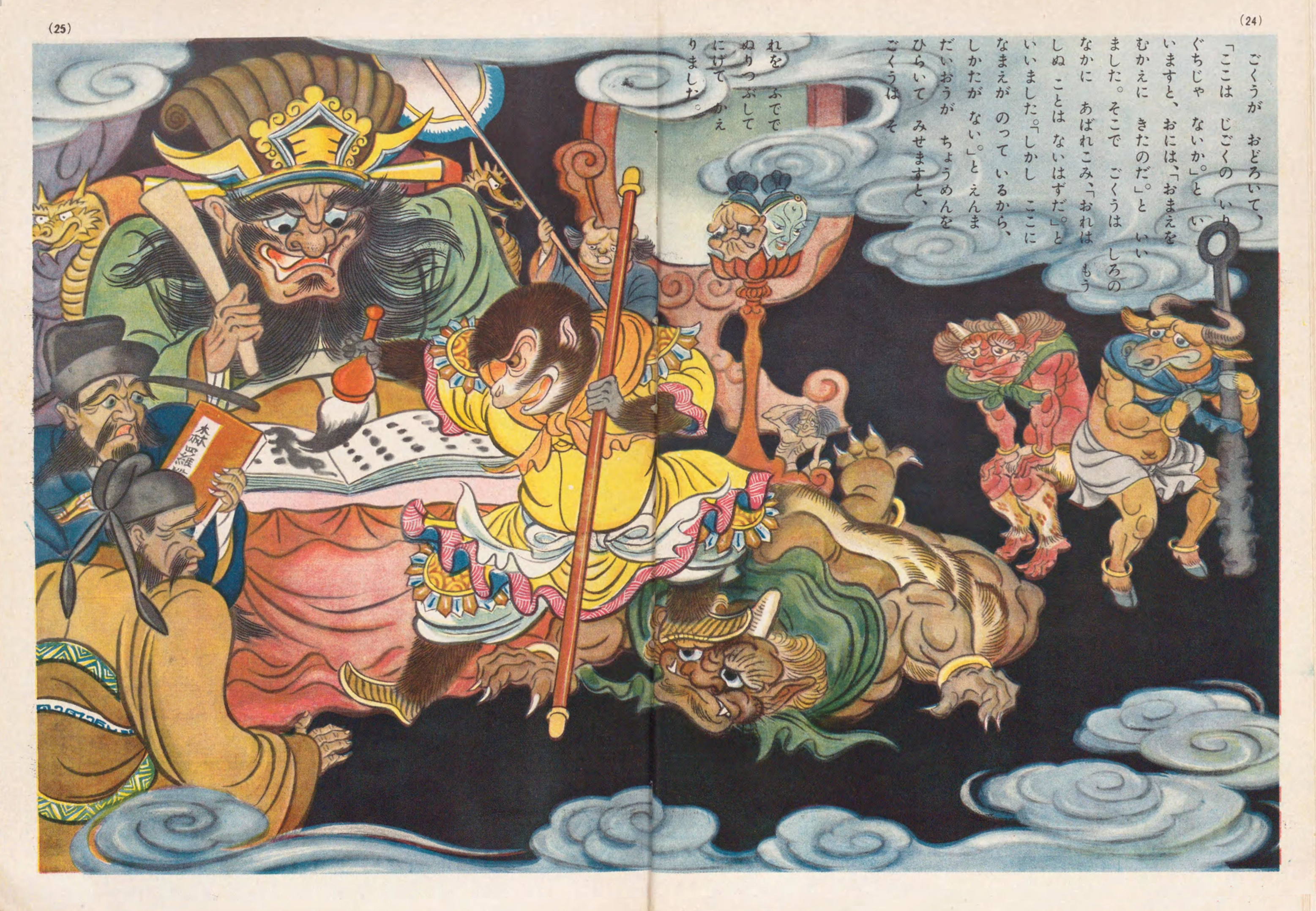
During his time in Hell, Monkey calls for the ledger containing his information. Under a heading marked “Soul 1350,” Wukong reads, “Heaven-born Stone Monkey. Age: three hundred and forty-two years. A good end” (Wu & Yu, 2012, vol. 1, p. 140). [4] If we use 160–146 BCE as a conservative estimate for his first ascension, then this dates his birth to somewhere between 502–488 BCE during the Zhou Dynasty (c. 1046–256 BCE). I think 500 BCE is a nice round number.
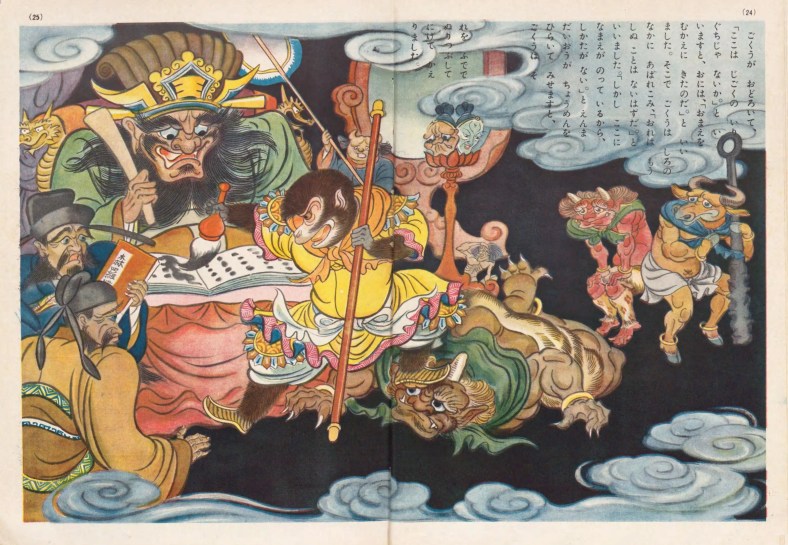
Monkey strikes his name from the Book of Life and Death in Hell (larger version). From Son Goku (1939).
6. Updates
Update: 07-08-20
The novel suggests a two hour window for the time of Wukong’s birth. This takes place in chapter 61 when Monkey is preparing to battle the Bull Demon King over the palm-leaf fan. Our hero recites an emboldening poem, to which Zhu Bajie replies:
Yes! Yes! Yes! Go! Go! Go! Who cares if the Bull King says yes or no! Wood’s born at Boar, the hog’s its proper mate, Who’ll lead back the Bull to return to earth. Monkey is the metal born under shen (emphasis added): Peaceful and docile, how harmonious! Use the palm-leaf As water’s sign. When flames are extinct, Completion’s attained. In hard work we persist both night and day And rush, merit done, to Ullambana Feast (Wu & Yu, 2012, vol. 3, p. 154).
The monkey is one of twelve animals of the Chinese zodiac, each corresponding to an earthly branch, an elemental phase, and a time period. The monkey is born under the shen (申) branch, which is associated with metal and the hours 3:00 PM to 5:00 PM.
Update: 04-02-21
As I explain in this article, Wukong learns the 72 transformations in order to escape a trio of heaven-sent punishments scheduled to kill him for defying his fate and achieving immortality. The calamities of thunder, fire, and wind respectively come every 500 years (after the initial attainment of eternal life) to kill Daoist cultivators. Monkey becomes an immortal around his 342nd year when his soul is taken to Hell. He is immortal for over 160 years [5] at the time he’s imprisoned under Five Elements Mountain. This means his 500th year of immortality, the year that the calamity of thunder would be scheduled to strike him, takes place during his imprisonment under the celestial mountain. But this is never described in the story. I assume this is just one of many inconsistencies born from oral storytelling. Although, one could argue that, within the fictional universe, the thunder calamity was voided since Wukong was undergoing punishment at the behest of the Buddha.
Notes:
1) I am indebted to Irwen Wong for bringing this passage to my attention.
2) Wukong, however, questions this estimate, saying: “I recall that it’s been but half a year…How can you talk of a century?” (Wu & Yu, 2012, vol. 1, p. 167). But, earlier in the novel, a wise member of Monkey’s tribe points out that one’s view of time is skewed while inhabiting the celestial realm: “You are not aware of time and seasons when you are in Heaven” (Wu & Yu, 2012, vol. 1, p. 150). Add to this the established fact that one heavenly day equals one solar year. Therefore, the Great Sage’s recollection of the passage of time is unreliable.
4) These include three years as Subodhi’s student (Wu & Yu, 2012, vol. 1, p. 121), seven as a junior monk (Wu & Yu, 2012, vol. 1, p. 117), and “more than ten years” searching the world for a master (Wu & Yu, 2012, vol. 1, p. 114).
5) As previously mentioned, Wukong serves in heaven twice: first “for more than ten years” and second “for over a century” (Wu & Yu, 2012, vol. 1, pp. 150 and 166). Then he is punished to 49 heavenly days/49 solar years in Laozi’s furnace (see above).
Sources:
Bielenstein, H. (1986). Wang Mang, the Restoration of the Han Dynasty, and Later Han. In D. Twitchett and M. Loewe (Ed.). The Cambridge History of China: Volume 1, The Ch’in and Han Empires, 221 BC-AD 220 (pp. 223-290). Kiribati: Cambridge University Press.
Buswell, R. E., & Lopez, D. S. (2014). The Princeton Dictionary of Buddhism. Princeton, NJ: Princeton University Press.
Dean, K., & Zheng, Z. (2010). Ritual Alliances of the Putian plain. Volume Two: A Survey of Village Temples and Ritual Activities. Leiden: Brill.
Doolittle, J. (1865). Social Life of the Chinese: With Some Account of Their Religious, Governmental, Educational, and Business Customs and Opinions. With Special but not Exclusive Reference to Fuhchau (vol. 1 and 2). New York: Harper & Brothers.
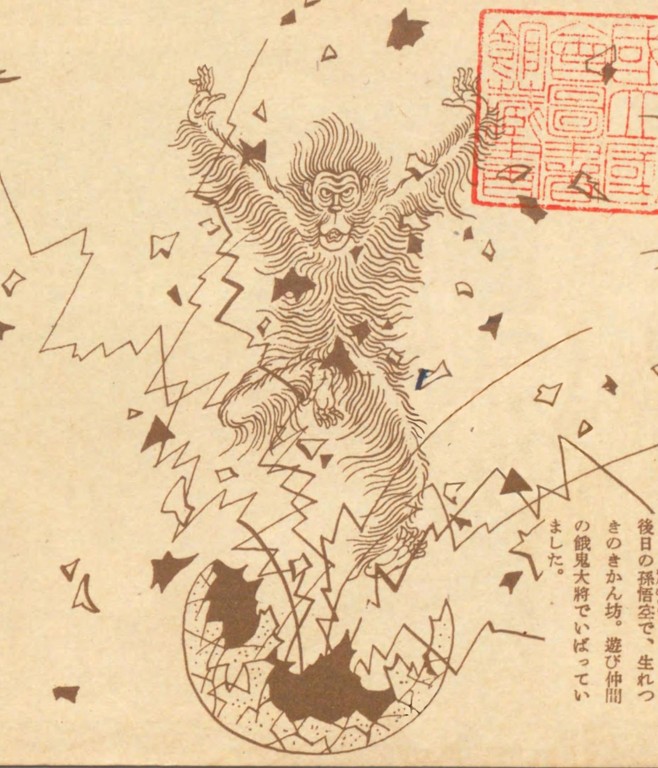
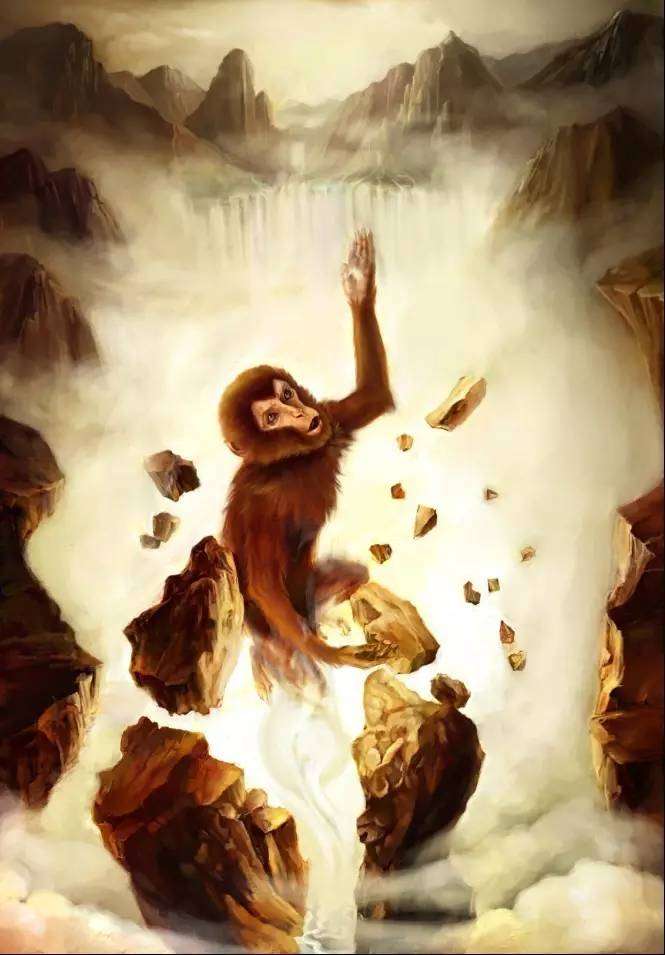
One of the many unique aspects of Sun Wukong‘s story cycle is his birth from stone (fig. 1). Chapter one of Journey to the West (Xiyouji, 西遊記, 1592 CE) describes how the 36-foot, 5-inch (11.09 m)-tall, 24-foot (7.31 m)-circumference rock issues forth a stone egg after absorbing celestial and terrestrial energies over countless eons:
Since the creation of the world, it [the stone] had been nourished for a long period by the seeds of Heaven and Earth and by the essences of the sun and the moon, until, quickened by divine inspiration, it became pregnant with a divine embryo [xianbao, 仙胞]. One day, it split open, giving birth to a stone egg [shiluan, 石卵] about the size of a playing ball [yuanqiu, 圓毬]. Exposed to the wind, it was transformed into a stone monkey endowed with fully developed features and limbs (Wu & Yu, 2012, p. 101).
The description of Wukong’s conception draws on ancient Chinese cosmological ideas regarding the gendered nature of the universe. Works of the Eastern Zhou and Han considered heaven masculine and described it as the father/husband/superior of the feminine earth, the mother/wife/inferior (Hinsch, 2011, pp. 157-158). As quoted above, the stone is “nourished…by the seeds of Heaven and Earth.” This line was likely influenced by philosophical works such as the Yijing (易經, late-9th century BCE) which states: “Heaven and Earth come together, and all things take shape and find form. Male and female mix their seed, and all creatures take shape and are born” (Wilhelm & Baynes, 1977, pp. 342-343).
Surprisingly, Wukong is not the only figure from world mythology born from stone. In fact, “Birth from rock” (T544.1) is a mythic category appearing in Stith Thompson’s Motif-Index of Folk-Literature. Eliade (1978) comments: “The theme recurs in the great civilizations of Central America (Inca, Maya), in the traditions of certain tribes of Southern American, among the Greeks, the Semites, in the Caucasus, and generally from Asia Minor right down to Oceania” (p. 43).
In this article, I will explore eight examples from Asian and Western myth, demonstrating how stone-born figures share certain parallels with Monkey. I will show that with the exception of creator gods and savior figures, stone-born beings generally have one or more of the following in common: 1) they are the product of masculine heavenly forces and feminine earthly forces (anthropomorphic or otherwise); 2) they violate the natural order by challenging heaven (in one form or another); and 3) they are eventually defeated by the gods. The purpose of this preliminary survey is to better understand an ancient myth cycle that may have influenced the development of the Monkey King’s lore.
1. Stone Births of Eastern Mythology – Other Examples
1.1. Yu the Great
Yu the Great (Dayu, 大禹), a demi-god, sage-king, and founder of the Xia Dynasty, is generally portrayed in his mythos as either violently erupting from the side or back of his mother or emerging (or being hewn with an ax) from the executed body of his father Gun (Cook & Luo, 2017, p. 98-101). However, a few sources briefly note his lithic birth. For example, the Han-era Huainanzi (淮南子, 2nd century BCE) simply states: “Yu was born from a stone” (Cook & Luo, 2017, p. 100). Lewis (2006) explains Yu’s stone birth is tied to ancient Chinese beliefs about the fertile, creative power of stone, as evidenced by the stone altar of the High Matchmaker (Gao mei, 高媒), which was historically prayed to for children by married couples, as well as legends of the mending of the sky with five magic stones by the primordial goddess Nuwa, the High Matchmaker’s mythic prototype. [1] This naturally has implications for the stone birth of Monkey.
Interestingly, the Jin-era Diwang Shiji (帝王世紀, 3rd century) states Yu’s mother was impregnated by swallowing magic seeds and a “divine pearl” (shenzhu, 神珠), a type of stone, and even locates his birth in a place called “Stone Knob” (Shiniu, 石紐) (Cook & Luo, 2017, p. 101). While the mother is not a stone, his birth is effected by one and happens in a place named stone. In this instance, the divine pearl is an encapsulation of the same masculine heavenly and feminine earthly forces that help create Wukong.
Yu is of course most famous in Chinese myth for his monumental effort in quelling the fabled world flood and then establishing the nine provinces of China (Birrell, 1999, pp. 81-83). Therefore, as a savior figure his mythos lacks the rebellious challenge against the gods and eventual defeat that marks several figures in this list. However, in a twist, his father Gun is known for violating the natural order by stealing God’s “self-renewing soil” in his quest to quell the flood. For this crime, he is executed (Birrell, 1999, pp. 79-81).
1.2. Qi of Xia
Yu’s son, Qi (啟) or Kai (開), both meaning “open” (fig. 2), [2] is said in an early-4th century source to have also been born from stone: [3]
When Yu was controlling the floodwaters and was making a passage through Mount Huanyuan, he changed into a bear. He spoke to the Tushan girl: “If you want to give me some food, when you hear the sound of a drumbeat, come to me.” But Yu leaped on a stone and by mistake drummed on it. The Tushan girl came forward, but when she saw Yu in the guise of a bear she was ashamed and fled. She reached the foothills of Mount Songgao, when she turned into a stone and gave birth to Qi. Yu said, “Give me back my son!” The stone then split open [4] on its north flank and Qi was born (Birrell, 1999, p. 123).
禹治洪水,通轘轅山,化為熊。謂塗山氏曰:『欲餉,聞鼓聲乃來。』禹跳石,誤中鼓, 塗山氏往,見禹方作熊,慚而去。至嵩高山下,化為石,方生啟。禹曰:『歸我子!』 石破北方而啟生。」(source – see p. 72, n. 20)
Lewis (2006) notes that early texts, such as the aforementioned Diwang Shiji, claim this daughter of the Tushan clan is named Nuwa (with variations on her given name), proving that Yu and the goddess were married in some traditions (p. 134). This then strengthens the association between marriage, procreation, and stones.
Birrell (1999) explains a text appearing in the Zhou to Han-era Guicang (歸藏) records that he tried to “steal” (qie, 竊) music from heaven, while the Shanhaijing (山海經) states he received it as a gift from the realm above (pp. 83-84). While not directly related to Qi’s stone birth story, this shows at least one tradition believed Qi followed in his grandfather’s footsteps by stealing from heaven and violating the natural order, much like Wukong steals immortal peaches and wine.
Fig. 2 – A woodblock print of Qi of Xia from a Ming-era version of the Shanhai jing (larger version). Plate XLIV from Strassberg, 2002, p. 168.
1.3. The Children of Hilumandju
One myth explains that the Tibetan people were the product of the union of a magic monkey and a rock-ogress (Tb: brag srin mo) (fig. 3). While evidence for this tale goes back to at least the 7th century, [5] the best known version comes from the Mani Kambum (12th to 13th century; lit: “Collected Teachings on Mani”). As the story goes, the Buddha charges the Avalokitesvara Bodhisattva with converting the evil creatures of the “Land of Snow” (Tibet) to Buddhism. The latter sends his avatar, the Bodhisattva Hilumandju, a monkey king (and possible reference to Hanuman) with great spiritual powers, to meditate on a mountain top in Tibet. A rock-ogress comes upon his hermitage and attempts to seduce him by taking the form of a female monkey and then a human woman, but each time her advances are rejected due to his supernatural focus. As a result, the rock-ogress threatens to mate with an ogre and produce a race of demonic creatures that would devour the world, thereby heaping sins upon the monkey king if he does not take her as his wife. So after seeking council with his master, Hilumandju agrees to become her husband (I have archived the full story here):
“So be it (Laso),” he made answer. Then the monkey Bodhisattva, fearing lest the rock-ogress should destroy herself, departed in all haste for the Abode of Snow, and as soon as he arrived he took her unto him as his wife. When the space of nine months had elapsed she bore him six sons, who participated of the nature of the six classes of sentient creatures subject to birth and death. As their father was a monkey, so their bodies were covered with hair, and as their mother was a rock-ogress, so they had tails; their faces were reddish and they were most unsightly. From the mortal gods, one had gentleness and patience; from the mortal (lit., subject to birth and death) Asuras (lh’a-mayin), one of them derived angry passions and quarrelsomeness. One of them had in part great lusts, and love of worldly riches, which qualities he owed to mortal man. One of them owed to hell’s mortal fiends, hate, and anger, and great hardiness. One partook of the mortal Préta’s (yidag) characteristics in being deformed, from his cravings for food (lit., bad stomach), and his avariciousness. One partook of mortal brute beasts in not being able to distinguish right from wrong, and in having neither comprehension nor cleverness. When born they were ruddy-faced, had a taste for flesh and blood, and hair covered their heads and bodies, and, moreover, they knew how to speak (Rockhill, 1891, pp. 357-358). [6]
The resulting six offspring mate with monkeys and reproduce in the many hundreds, becoming more and more human with each new generation. When they eat all of their resources and begin to starve, Avalokitesvara gives Hilumandju grain and jewels for his descendants to grow and mine until they are fully human and ready to receive the Buddhist teachings (Rockhill, 1891, pp. 358-361).
The rock-ogress and her kind are portrayed as vicious, blood-thirsty creatures beyond Avalokitesvara’s ability to convert to Buddhism (Rockhill, 1891, p. 359). The rock-monkey children inherit not only their mother’s misshapen appearance but also many of her negative qualities, making them resistant to the teachings. So, in a way, they too violate the natural order.
I obviously can’t continue without commenting on this tale’s interesting parallels with Sun Wukong. Hilumandju is a monkey king who uses his magic powers in the service of Buddhism at the behest of the Bodhisattva Avalokitesvara. And like Wukong, Hilumandju’s children are the product of a masculine heavenly force and a feminine earthly force (the rock-ogress). Wukong is a monkey king who uses his magic powers in the service of Buddhism at the behest of the Bodhisattva Guanyin, the feminine form of Avalokitesvara.
Fig. 3 – A modern painting showing the monkey and rock ogress of Tibetan myth (larger version). Original from Wikipedia.
2. Stone Births in Western Mythology
Jong (1997) explains Western myths of stone-born figures “are usually connected with the Song of Ullikummi known from Hittite and Hurrian sources” (p. 292). He continues:
There are many more myths or complexes of myths which largely follow the same pattern: the cycle of Agdistis from Phrygia, the Nart-epics of the Ossetes, the Jewish myths of the monster Armillus and—for some aspects—the Georgian myth cycles of Amirani [fig. 4] (Jong, 1997, p. 292).
Fig. 4 – A chart showing the existence of the rock-born son trope from other cultures (larger version). From Jong, 1997, p. 293.
2.1. Ullikummi
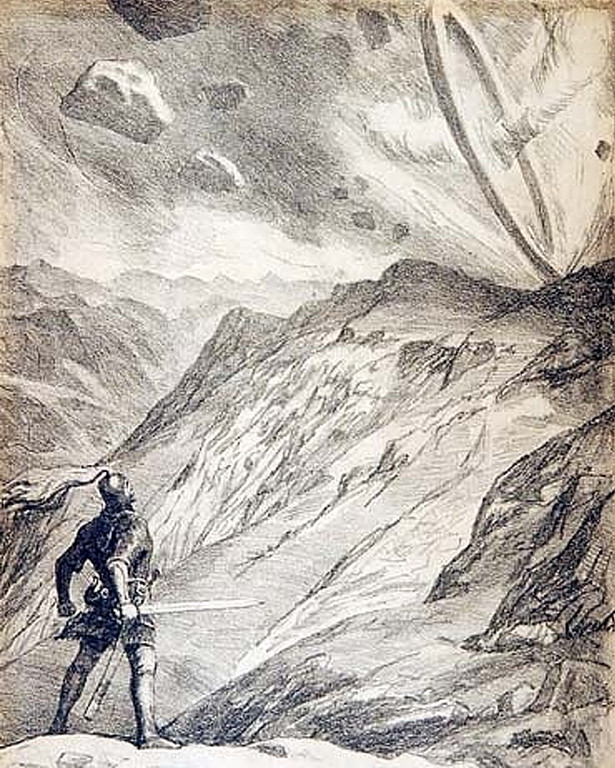
The aforementioned Hurrian myth of the “Song of Ullikummi” (c. 1200 BCE) appears in an extant Hittite cuneiform text comprising three fragmented clay tablets. While named after the eponymous stone monster (fig. 5), the story follows the machinations of Kumarbi, a resentful former ruler of the gods, who wishes to usurp the throne from his son, the storm god Tesub. Kumarbi sets about doing this by bedding a massive stone in an effort to produce a being powerful enough to rout the gods. Upon its birth, the doting father gives the creature a name meaning “Destroy Kummiya” (Rutherford, 2020, p. 147), foreshadowing its intended fate to destroy Tesub’s home (I have archived papers reconstructing the story here and here):
Out of the [rock’s] body like a blade he sprang.
He shall go! Ullikummi be his name!
Up to Heaven to kingship he shall go,
and Kummiya, the dear town, he shall press down!
But the Storm-God he shall hit,
and like salt he shall pound him,
and like an ant with (his) foot he shall crush him!
But Tasmisu[7] like a …… reed he shall break off!
All the gods down from Heaven like birds he shall scatter,
and like empty vessels he shall break them! (Güterbock, 1951, p. 153).
Fearing that it may be killed by the gods before coming into full power, Kumarbi has the monster hidden in the underworld, where it is placed on the right shoulder of the Atlas-like god Upelluri. The creature quickly multiples in size, growing nine thousand leagues tall, eventually reaching heaven. When Ishtar fails to seduce the blind and deaf monster, the warrior god Astabi leads 70 deities into battle against the lithic menace only to be defeated and cast into the sea below. Tesub abandons the throne and, along with Tasmisu, seeks the aid of Ea, the god of wisdom and witchcraft, who travels to the underworld in search of the creature’s origins. Upon questioning Upelluri, who effortlessly carries the weight of the heavens, earth, and sea, Ea learns that a great weight, which turns out to be the monster, pains the titan’s right shoulder. In the end (of the third and final extant tablet), Ea calls for a tool originally used by the old gods to cleave heaven and earth and chisels Ullikummi free of Upelluri’s shoulder, thus breaking the monster’s base of power and leaving it vulnerable to attack by the gods. Güterbock (1951) suggests that there’s a missing fourth tablet that describes the monster’s ultimate defeat (p. 140). [8]
Like Monkey and the other figures listed above, Ullikummi is the product of a masculine heavenly force (Kumarbi) and a feminine earthly force (the stone). Although the assault on heaven is orchestrated by his father, Ullikummi’s challenge to the gods, like that of Monkey, violates the natural order. And his presumed defeat in the end also follows the story cycle of Wukong.
I’d like to add that Ullikummi battling Astabi’s force of 70 gods is similar to Sun fighting the 72 gods called up against him (Koss, 1981, p. 84). Also, King Tesub seeking aid from Ea, leading to Ullikummi’s defeat, is reminiscent of the Jade Emperor asking for the Buddha to intervene, leading to Wukong’s defeat.
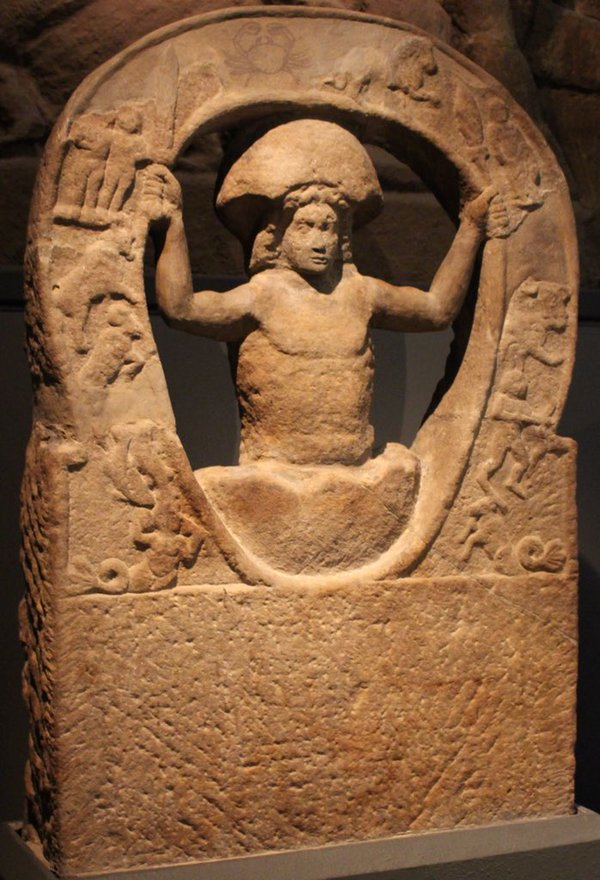
The Greco-Roman god of light, Mithras, [9] is perhaps the best known and studied of the stone-born deities in Western mythology. Researchers often refer to his birth stone using the Latin term Petra Genetrix, or the “Fecund rock.” Manfred Clauss notes that the symbolism of the rock is tied to the earth and the cosmic egg (I have archived the relevant chapter section here).
The multi-layered quality of Mithraic symbolism … reappears in the case of the rock: represented and understood not only as the kosmos but also as the earth, on many images it is encircled by a serpent, [fig. 6] a creature associated with the earth (Clauss & Gordon, 2001, p. 67).
[…]
We can discern the influence of Orphic speculation in a Greek inscription from one of the numerous mithraea in Rome, on a statue-base dedicated Διi ‘Hλω Miθpa Φávητı, that is to Deus Sol Mithras Phanes. Phanes is the embodiment of unlimited light, an Orphic deity who emerged from the cosmic egg. There is also literary evidence for the syncretism of Mithras with Phanes. In this community, therefore, Mithras’ identification with the sun god grounded an allusion to the Orphic-Platonic ideas current among the intellectual élites. Mithras-Phanes is also known to us in iconographic form: a relief from Vercovicium (Housesteads) on Hadrian’s Wall shows Mithras emerging from the cosmic egg, [fig. 7] which is represented both as such and by the shape of the zodiacal ring (Clauss & Gordon, 2001, p. 70).
Mithras’ position as a solar deity and depiction emerging from a cosmic egg/stone establishes him as a self-born creator god. This is supported by another aspect of his holy narrative: the slaying of the bull. Stone reliefs depict him in a great struggle to pin the animal down and then strike it in the neck with a knife. Since the bull was symbolic of the moon (and thus death), its sacrifice is seen as the creation of life and the cosmos. This is represented by zodiac symbols—the path of the newly formed planets—on the god’s fluttering cloak and by grapes or ears of corn in place of the pooled blood on the ground (Clauss & Gordon, 2001, pp. 78-90). Therefore, like Yu the Great, Mithras’ feat distances him from the rebellion and defeat that mark other figures in this list.
Sun Wukong is similar to Mithras as he too struggles against bovine opponents, including Laozi’s buffalo in chapters 50 to 52 and the Bull Demon King in chapters 59 to 61. However, Monkey’s conception involves the mingling of masculine heavenly and feminine earthly forces, while Mithras is born of a virginal stone.
Fig. 6 – An example of Mithras’ serpent-wrapped birth rock from Austria. A larger version is available on Wikicommons; Fig. 7 – The deity emerging from a cosmic egg surrounded by the western Zodiac symbols (larger version). From the Homesteads Roman Fort along Hadrian’s Wall. Found on this article.
2.3. Diorphus
Mithras’ son, Diorphus, is said to have also been born from a stone. Pseudo-Plutarch (c. 3rd century) writes:
Near to this [the Araxes] river lies the mountain Diorphus, so called from Diorphus the son of the Earth, of whom this story is reported. Mithras desirous to have a son, yet hating woman-kind, lay with a stone, till he had heated it to that degree that the stone grew big, and at the prefixed time was delivered of a son, called Diorphus; who, growing up and contending with Mars for courage and stoutness, was by him slain, and by the providence of the Gods was transformed into the mountain which was called Diorphus by his name (Plutarch & Goodwin, 1874, p. 505).
Diorphus is similar to Monkey, Qi of Xia, and the children of Hilumandju as he is the product of a masculine heavenly force (Mithras) and a feminine earthly force (the stone). He and Qi share a further connection as they are both the sons of beings who were themselves born from stone. And much like Wukong, Diorphus violates the natural order by challenging the gods (in this case Mars) and is defeated, being transformed into a mountain after his death. While not exactly the same, the end result brings to mind Monkey’s imprisonment under Five Elements Mountain.
The tale of Diorphus’ conception follows the same tradition as the Story of Ullikummi where a god intends to sire a son with a stone and not a goddess, resulting in a powerful, rebellious offspring.
2.4. Agdistis
The god Agdistis is a monstrous, hermaphroditic being sired by Zeus. Their story is recorded by Arnobious of Sicca (died c. 330):
Within the confines of Phrygia, he says (Timotheus), there is a rock of unheard-of wildness in every respect, the name of which is Agdus, so named by the natives of that district. Stones taken from it, as Themis by her oracle had enjoined, Deucalion and Pyrrha threw upon the earth, [10] at that time emptied of men; from which this Great Mother, too, as she is called, was fashioned along with the others, and animated by the deity. Her, given over to rest and sleep on the very summit of the rock, Jupiter assailed with lewdest desires. But when, after long strife, he could not accomplish what he had proposed to himself, he, baffled, spent his lust on the stone. This the rock received, and with many groanings Acdestis (Agdistis) is born in the tenth month, being named from his mother rock. In him there had been resistless might, and a fierceness of disposition beyond control, a lust made furious, and derived from both sexes. He violently plundered and laid waste; he scattered destruction wherever the ferocity of his disposition had led him; he regarded not gods nor men, nor did he think anything more powerful than himself; he contemned earth, heaven, and the stars.
Now, when it had been often considered in the councils of the gods, by what means it might be possible either to weaken or to curb his audacity, Liber, the rest hanging back, takes upon himself this task. With the strongest wine he drugs a spring much resorted to by Acdestis where he had been wont to assuage the heat and burning thirst roused in him by sport and hunting. Hither runs Acdestis to drink when he felt the need; he gulps down the draught too greedily into his gaping veins. Overcome by what he is quite unaccustomed to, he is in consequence sent fast asleep. Liber is near the snare which he had set; over his foot he throws one end of a halter formed of hairs, woven together very skillfully; with the other end he lays hold of his privy members. When the fumes of the wine passed off, Acdestis starts up furiously, and his foot dragging the noose, by his own strength he robs himself of his sex; with the tearing asunder of these parts there is an immense flow of blood; both are carried off and swallowed up by the earth; from them there suddenly springs up, covered with fruit, a pomegranate tree … (Burkert, 1979, pp. 255-256)
Agdistis is similar to Monkey and the above figures as they are the product of a masculine heavenly force (Zeus) and a feminine earthly force (the stone). And like Wukong’s rebellion, the hermaphrodite’s raw, destructive nature threatens the primacy of heaven. As a result, both Agdistis and Monkey share a superiority complex, believing that they are mightier than the gods. The deities fear their power and, therefore, seek ways to tame them. Wukong is placated for a time with celestial posts before ultimately being imprisoned by the Buddha, while Agdistis is stripped of their manhood.
Agdistis’ conception also follows the tradition of Ullikummi and Diorphus. The end result of Zeus’s attempted rape of the stone/earth goddess is a powerful, rebellious offspring.
2.5. Armilus
The Book of Zerubbabel(7th century) describes Armilus, a Jewish anti-messiah figure, as the spawn of Satan and a world conqueror who will force all to worship his lithic mother. Knohl (2009) presents the section where Zerubbabel learns of Armilus from an angel:
This city is Nineveh, the city of bloodshed, which is the big Rome. And I have said to him: “When would be the end of these awful things?’ And he took me by my hand and brought me to the house of disgrace.
And he showed me there a marble stone in the shape of a very beautiful virgin. And he said to me: ‘What do you see, Zerubbabel?’ And I said: ‘I see a marble stone in the shape of a very beautiful woman.’
And he told me: “This stone is the wife of Belial [Satan], and when Belial sees her, he will lie with her and she will become pregnant and will bear him Armilus, and she will be the chief idolatry. And he (Armilus) will rule over the whole world and his dominion will be from one end of the earth to the other end of the earth. And he will make signs. He will worship strange gods, and will speak words against the Most High and no one will be able to stand against him. And all nations will go astray after him except for Israel.
And he Armilus will take his mother from the house of disgrace and all places and all nations will worship this stone and will make sacrifices and libations to it. And no one will be able to look upon her face because of her beauty. He is Arimolaus son of Satan, and he will become a King in Emmaus, the city of his father, and his fear will fall in all places (pp. 79-81). [11]
Another tradition explains Armilus will proclaim himself God and, having won the trust of Christians, lead a vast army to decimate Jews who stand against him. In the end, though, God or the Messiah will gather the scattered Israelites and defeat Armilus:
But as Armilus nevertheless insists upon being recognized as God by the Jews, and they cry out to him that he is Satan and not God, a bitter battle breaks out between Armilus with an immense heathen army on the one side, and Nehemiah with 30,000 Jewish heroes on the other. This unequal combat ends in the death of the “Ephraimite Messiah” and a million Jews. After an interval of forty-five days, … Michael will blow his trumpet; then the Messiah and Elijah will appear, gather the dispersed of Israel, and proceed to Jerusalem. Armilus, inflamed against the Jews, will march against the Messiah. But now God Himself will war against Armilus and his army and destroy them; or the Messiah, as one version has it, will slay Armilus by the breath of his mouth (Kohler & Ginzberg, 1906, p. 119).
Like Monkey and the above figures, Armilus is the product of a masculine heavenly force (Satan) and a feminine earthly force (the stone statue). He violates the natural order by proclaiming himself God and even fights against the All Mighty, much like Monkey proclaims himself the “Great Sage Equaling Heaven” and leads an army against heaven. Armilus’ defeat by God is also like Wukong’s subjugation by the Buddha, Diorphus’ death by Mars, and Ullikummi’s presumed besting by the gods.
Armilus’ conception also follows the tradition of Ullikummi, Diorphus, and Agdistis. Satan lays with the stone statue with the intent of creating a powerful, rebellious offspring.
2.6. Soslan
The hero Soslan, also known as Sozryko, appears in a body of legends associated with the Caucasian Nart Saga:
At the sight of the beautiful Satana [the mother of the Narts] washing clothes on the riverbank, a shepherd across the river poured out his semen on a stone from which, nine months later, the child Soslan came forth. When he had grown up, he demanded to be “tempered” in the milk of a she-wolf, a treatment destined to make him invulnerable. The divine smith Kurdalägon dropped him into a trough containing one hundred goatskins of milk, but since the trough was too short, Soslan had to bend his knees, which consequently were not tempered and thus remained vulnerable.
After a long existence devoted to war exploits, mostly miraculous, Soslan insulted the daughter of Balsäg, a kind of celestial spirit, who took his vengeance by discharging at Soslan a living steel wheel that he controlled. The hero was hit by the wheel on all parts of his body successively and threw it back without being injured until, on the advice of the treacherous Syrdon [a figure similar to Loki], the wheel hit him on the knees and smashed them to pieces. According to an eastern Circassian variant, Soslan indulged in a game during which the Narts, again at Syrdon’s instigation, threw a wheel made of serrated steel at him from the top of a hill. It hit the distracted Soslan in the knees (Honigsblum, 1993, p. 264).
Despite the slight difference, Soslan’s parentage still follows the same tradition as Ullikummi, Diorphus, Agdistis, and Armilus. His father is humanoid, while his mother is a stone. The change from deity to lowly human shows that, in this case, even mortal sperm was thought capable of magically fertilizing earth.
Fig. 8 – “Soslan vs Balsag Wheel” by Maharbek Tuganov (larger version).
3. Western Influences on Sun Wukong’s Story?
Monkey’s birth narrative was likely influenced by that of Yu the Great and his son Qi/Kai considering that our hero wields the sage-king’s cosmic ruler, the gold-banded cudgel, as a weapon. But since his stone birth and later rebellion mirror the tales above, might this suggest the author-compiler of Journey to the West was aware of the ancient myth cycle of a stone-born son who challenges heaven? Many of the cited Western myths show a clear affinity with the Song of Ullikummi. For example, Burkert (1979) notes six similarities between the myths of Agdistis and the stone titan: “(1) The initial situation: the big stone; (2) a god fertilizes the stone; (3) the stone gives birth to a child; (4) the child thus created is a rebel against the gods; (5) the gods gather and plan countermeasures; (6) the enemy of the gods is rendered harmless” (p. 257). Sound familiar? If this circa 12th-century BCE myth cycle spread west from Anatolia to Greece, could not a version of it have spread east and penetrated China by way of Persia and India? This need not have been the original Ullikummi story but an older protomyth or even a later variation. Of course this then raises the question: how would the author-compiler have learned about this story? Needless to say, much, much more research is needed to determine if such a dissemination took place. Similarities alone aren’t enough without some kind of textural, oral, or archaeological evidence. Perhaps in the future a scholar more qualified than myself will pursue this line of inquiry.
4. Monkey’s Stone Egg and Popular Culture
Sun Wukong’s stone birth is so well known that it is referenced in the world famous anime Dragon Ball Z (DBZ). The original Dragon Ball series presents the main character Son Goku, himself based on the Great Sage, as a good-natured little boy with bulletproof skin and a monkey tail. However, DBZ reveals him to be a Saiyan, a humanoid alien warrior, who was sent as an infant in a rocket ship (à la Superman) to destroy Earth. This vessel, known as an “Attack Ball” (Atakku Bōru, アタックボール), is spherical in shape and represents the stone from which Wukong is born (fig. 9). It is a fun little twist on the original lore.
Fig. 9 – Goku in the stone egg-like Attack Ball (larger version).
5. Conclusion
This brief survey demonstrates that stone is capable of giving birth to creator gods, protoplasts, savior figures, heroes, and even great monsters. But much like a human egg, a father is needed to fertilize it with sperm. Sun Wukong’s stone is nourished by the seeds of heaven. Qi of Xia was fathered by the demigod Yu the Great and born from a woman-turned-stone. The first Tibetans, born of a rock-ogress, are sired by the Bodhisattva Hilumandju. In almost all cases in Western mythology (with the exception of Soslan), the pater is a heavenly force, an anthropomorphic deity, who begets a son by impregnating a stone in place of a goddess or mortal woman. Examples include Kumarbi and the stone titan Ullikummi, Mithras and the foolhardy Diorphus, Zeus and the violent Agdistis, and Satan and the anti-Messiah Armilus. Misogyny aside, the myths discussed speak to some belief that a son born of stone would pose a threat to the gods. I suggest this tendency towards violating the natural order is a manifestation of their unnatural births.
The number of similarities between Monkey’s early story arc and the Song of Ullikummi might suggest a possible flow of influence from the near east. Both are born of stone, rebel against heaven, rout an army of 70-something gods, and are defeated by a supreme deity. I must stress, however, that these are just surface level affinities. They shouldn’t be accepted as concrete proof of influence until a deeper study providing actual historical evidence is conducted.
6. Updates
Updated: 01-27-21
I have found a full account of the mythical stone birth of the Nart hero Soslan. It is portrayed as volcanic in nature, with the birth stone growing as it is baked in an oven for nine months. And finally, the child is born glowing red hot, causing a god of blacksmiths to quench-harden him in water.
There were two brothers, the sons of Sajem. The elder was named Zartyzh, the younger Shawey.
One day Setenaya [Satana] was bathing by the river. On the water’s other side stood one of these brothers, the Nart herdsman Sajemuquo Zartyzh, also called Tezhidada, the “Eldest Ram.” From where he stood he was able to see Lady Setenaya. When that brother saw the beautiful temptress going back and forth, not standing still, strewing her clothes about, he could no longer control his passion. He was enchanted by her beauty and so let loose an arrow of manly fluid.
“Setenaya” It is coming to you.”
“So, let it come, but why did you do that?” said Setenaya.
“Hey, Setenaya! By day I tend the sheep. By night, when I come to you, the lance is always stuck in the ground in front of your house. so how would you have me do it?” said the shepherd.
Heavy steam arose as the bolt skimmed over the water, tracing a path until it reached Setenaya, but the bolt of lust just missed her and instead fell on a stone that was lying beside her on the riverbank. Setenaya picked up the stone, wrapped it in a warm cloth, brought it home, and placed it in the stove. Day by day the stone grew. It lay for nine months and nine days. During this time it grew in size and became very big. Lady Setenaya had her people bring the stone to Tlepsh‘s smithy. There she bade Tlepsh, the god of the forge, to break open the stone.
Tlepsh did as she had bidden him. From inside the stone emerged a baby boy, glowing as bright as fire. The baby fell on the front part of Setenaya’s dress and burned through it until he fell to the ground. Tlepsh seized him with his blacksmith’s tongs, and holding him by the thighs plunged him into the water for the grindstone seven times, thus cooling the baby. Then once again Tlepsh picked up the little child with his metal tongs by his thighs and hardened him seven times, so that the child’s skin became a little bit more flexible. The child became like a human being, but his skin remained tough, like tempered steel. Tlepsh named the baby Sawseruquo [Soslan] and gave him back to Setenaya.
On his thighs, where Tlepsh had held him with the tongs, Sawseruquo’s skin remained soft like human skin, and because his thighs had been squeezed, he was bowlegged (Colarusso, 2015, pp. 52-53).
This story has obvious parallels with the Greek story of Achilles, a mighty warrior with a vulnerable spot on his feet. Interestingly, a character from the Iliad (8th century BCE) suggests that, due to his unwillingness to help his comrades in battle, Achilles’ parents were not the human couple commonly associated with him but the very sea and a rock cliff. Alepidou (2020) convincingly argues that these are references to the ancient Hurro-Hittite “Story of Hedammu” and the “Story of Ullikummi.” Hedammu, the offspring of Kumarbi and a sea goddess, was a massive sea creature that plagued the earth and sea. As noted above, Kumarbi’s subsequent offspring, Ullikummi, is a stone giant who attacked heaven. The stone titan is defeated when he is chiseled free from his base of power on the shoulder of an underworld god. This weakness of the lower extremities likely influenced that of Achilles and Soslan.
Update: 02-26-22
I was originally thinking about writing a sequel to this piece in which I list mythic characters trapped under mountains. Here’s the list I have so far:
Sun Wukong (various Journey to the West iterations) – Mt. Huaguo by Guanyin or Five Elements Mountain by the Buddha
108 stars (Water Margin) – Imprisoned in an earth prison under a stone slab by a Daoist master. Jing Wang (1992) suggests the stone slab was likely influenced by the Taishan stone (泰山石).
But if I choose the broader term “earth prisons,” I can include other mythic baddies like Lucifer and Loki, as well as the Titans in Tartarus!
Update: 08-31-25
It has occurred to me since writing the main article that my suggestion Sun Wukong was influenced by Ullikummi is just a coincidence. There are three reasons for this. First, I overlooked the fact that the earliest published edition of the JTTW story cycle, a Song-era storytelling prompt, does not mention how the “Monkey Pilgrim” (Hou xingzhe, 猴行者) was born. He’s simply an ageless immortal from the very beginning of the tale. Second, while this version does mention the stealing of divine fruit, the idea of a rebellious Great Sage didn’t take hold until the Yuan-Ming period (see here and here). And third, most importantly, the lithic nativity is an aspect unique to the standard 1592 JTTW. This means that the rebellious, stone-born Sun Wukong that we know and love is an amalgam of elements that developed at different points in his historical story cycle.
However, we can at least say that his final, standard narrative fits into the rebellious, stone-born European motif discussed above.
Notes:
1) See chapter four, especially the sections “The Mythology of Nü Gua and the Flood” and “Yu, Marriage, and the Body.”
2) Strassberg (2002) explains that the variant Kai (開) was used during the Han to avoid conflicting with Emperor Jing’s personal name, Liu Qi (劉啟) (p. 169). Whether Qi or Kai is used, both names reference the story of the stone splitting open to give birth to Yu’s son. See also note four below.
3) Birrell (1999) writes:
It is said by the Tang classical scholar and commentator Yan Shigu (A.D. 581-645) to be a reference he located in a text from Huainanzi, compiled circa 139 B.C. That text, however, does not appear in the extant editions of Huainanzi. The only reference the latter makes to the Yu/Qi myth is: “Yu was born of a stone.” Embroidered versions of the metamorphosis of the Tushan girl into stone begin to appear in the writings of Han commentators such as Gao You (third century A.D.), and Ying Shao (second century A.D.). The fourth-century commentator of The Classic of Mountains and Seas, Guo Pu, however, specifies that the mother of Qi (Kai) metamorphosed into stone and gave birth to Qi on the mountain. Thus the tradition of Qi’s miraculous birth is confirmed by at least the early fourth century A.D. and probably derives from an earlier tradition (p. 122).
I changed the Wade-Giles to Pinyin.
4) The stone “splitting open” is related to stories of sage-kings erupting from the backs or sides of their mothers, splitting them open in the process (Cook & Luo, 2017, pp. 97-100). See also note two above.
5) Sørensen notes that the myth was depicted in a mural from the famous Jokhang Temple, which was built in the 7th century (Bsod-nams-rgyal-mtshan & Sørensen, 1994, p. 582).
6) Another version of the tale appears in The Mirror Illuminating the Royal Genealogies (Tb: Rgyal rabs gsal ba’i me long, 14th century). An annotated translation can be read in Bsod-nams-rgyal-mtshan & Sørensen, 1994, pp. 125-133.
7) The vizier and brother of Tesub.
8) Güterbock (1951), pp. 138-140 gives a summary of the tale. The paper also translates the first half of the fragmented epic. Güterbock (1952) translates the other half. Both papers are archived above.
9) I am indebted to Jose Loayza for bringing the stone birth of Mithras to my attention. This resulted in the rest of the Western figures in this article.
10) This references another myth in which, following the great flood, mankind is repopulated by Deucalion and Pyrrha casting the “bones” (stones) of the “great mother” (Gaia) over their shoulders. Thus thrown, the stones soften and take on human shape. See for example Ovid’s Metamorphosis (Ovid & More (n.d.)).
11) Knohl (2009) suggests that Armilus’ story is a veiled attack against Augustus Caesar: 1) who is said to have been sired by the god Apollo under the guise of a dragon, the Jewish symbol for Satan; 2) who founded the Greek city of Nicopolis, which brings to mind the biblical Emmaus Nicopolis; 3) and who helped spread the cult of the goddess Roma, a statue of a beautiful woman (pp. 81-83). So, Satan impregnating the stone statue to produce Armilus likely refers to the myth of Apollo siring Augustus.
Birrell, A. (1999). Chinese Mythology: An introduction. Baltimore: The Johns Hopkins University Press.
Bsod-nams-rgyal-mtshan, & Sørensen, P. K. (1994). The Mirror Illuminating the Royal Genealogies: Tibetan Buddhist Historiography: An Annotated Translation of the XIVth Century Tibetan Chronicle: rGyal-rabs gsal-ba’i me-long. Wiesbaden: Harrassowitz.
Clauss, M., & Gordon, R. (2001). The Roman Cult of Mithras: The god and his mysteries. New York: Routledge.
Colarusso, J. (2015). Nart Sagas from the Caucasus: Myths and Legends from the Circassians, Abazas, Abkhaz and Ubykhs. Princeton: Princeton University Press.
Cook, C. A., & Luo, X. (2017). Birth in Ancient China: A study of metaphor and cultural identity in pre-imperial China. Albany: State University of New York Press
Eliade, M. (1978). The Forge and the Crucible (3rd ed.). Chicago: University of Chicago Press.
Güterbock, H. (1951). The Song of Ullikummi Revised Text of the Hittite Version of a Hurrian Myth. Journal of Cuneiform Studies,5(4), 135-161. doi:10.2307/1359008
Güterbock, H. (1952). The Song of Ullikummi Revised Text of the Hittite Version of a Hurrian Myth (Continued). Journal of Cuneiform Studies,6(1), 8-42. doi:10.2307/1359160
Hinsch, B. (2011). Women in Early Imperial China. Lanham, Md: Rowman & Littlefield Publishers.
Honigsblum, G. (1993). The Religion and Myths of the Ossets. In Y. Bonnefoy (Ed.). American, African, and Old European mythologies (pp. 262-265). Chicago: University of Chicago Press.
Jong, A. (1997). Traditions of the Magi: Zoroastrianism in Greek and Latin literature. Leiden; New York: Brill.
Knohl, I. (2009). Messiahs and Resurrection in ‘The Gabriel Revelation’. Israel: Bloomsbury Publishing.
Note: My blog is not monetized, so I am not making any money from this post. My hope is that the PDF will make this legendary story more accessible to a wider audience. If you enjoyed the digital version, please, please, please support the official release.
Here I present a PDF of the Library of Chinese Classics bilingual edition of Creation of the Gods (Fengshen yanyi, 封神演義, c. 1620 CE), sometimes translated as Investiture of the Gods or Enfeoffment of the Gods.
This 100 chapter shenmo novel tells of the great struggle between the declining Shang (c. 1600–1046 BCE) and ascending Zhou (c. 1046–256 BCE) dynasties. In the beginning, King Zhou of Shang offends the primordial goddess Nuwa by leaving a lewd poem in her temple, and in response, the devi summons a trio of spirits (a fox, a pheasant, and a lute) to bring about the dynasty’s downfall. The fox spirit takes the place of the king’s concubine Daji and, over the course of nearly 30 years, leads him down a path of imperial neglect, decadence, and sadism. This causes many of the kingdom’s dukes, marquis, and generals to later rebel in favor of King Wu of Zhou, the monarch destined by heaven to rule China.
The majority of the story follows the countless battles between the forces of Shang and Zhou. Along the way, the latter are aided by immortals of the Chan (闡) sect (an analogy for Quanzhen Daoism), which favors spiritual cultivation, while the former are aided by the Jie (截) sect (an analogy for Zhengyi), which favors charms and incantations. [1] Each transcendent wields any number of swords, fans, hooks, staves, axes, halberds, scissors, hammers, rings, sashes, nails, dippers, pennants, pearls, gourds (etc.), each with not only the power to take the lives of thousands of humans but also immobilize other immortals and even kill them. These celestial battles escalate to the point that Laozi and the Buddha must fight side-by-side to defeat a trap designed to kill 10,000 immortals.
A story line present throughout the novel is the fate of Jiang Ziya, a Daoist adept and the military strategist and stalwart commander of the Zhou army. He is destined to deify the souls of the humans and immortals who die in battle using the “List of Creation” (Fengshen bang, 封神榜), an index of preordained names agreed upon at the beginning of time by the heads of the three sects. This list is housed in the “Terrace of Creation” (Fengshen tai, 封神臺), a reed pavilion in which the souls of the dead are gathered to await their apotheosis. In the end, after defeating the Shang forces, Jiang deifies a total of 365 major gods, along with thousands of lesser gods, ranging from holy mountains, weather, and plagues to constellations, the time cycle, and the five elements.
Considering that the story takes place a millennia prior to the arrival of Buddhism in China, the novel portrays the religion having no presence in the east. There are several times in the narrative when a Buddhist deity travels from the western paradise to halt the execution of a powerful immortal or demon as they are fated to submit to Buddhism. Furthermore, when the Buddha intervenes in the great battle towards the end, he does so to find talented disciples who will help him spread the religion in the east. In fact, Bodhisattvas like Guanyin and Manjusri are depicted as former Chan sect immortals who later become disciples of Buddhism.
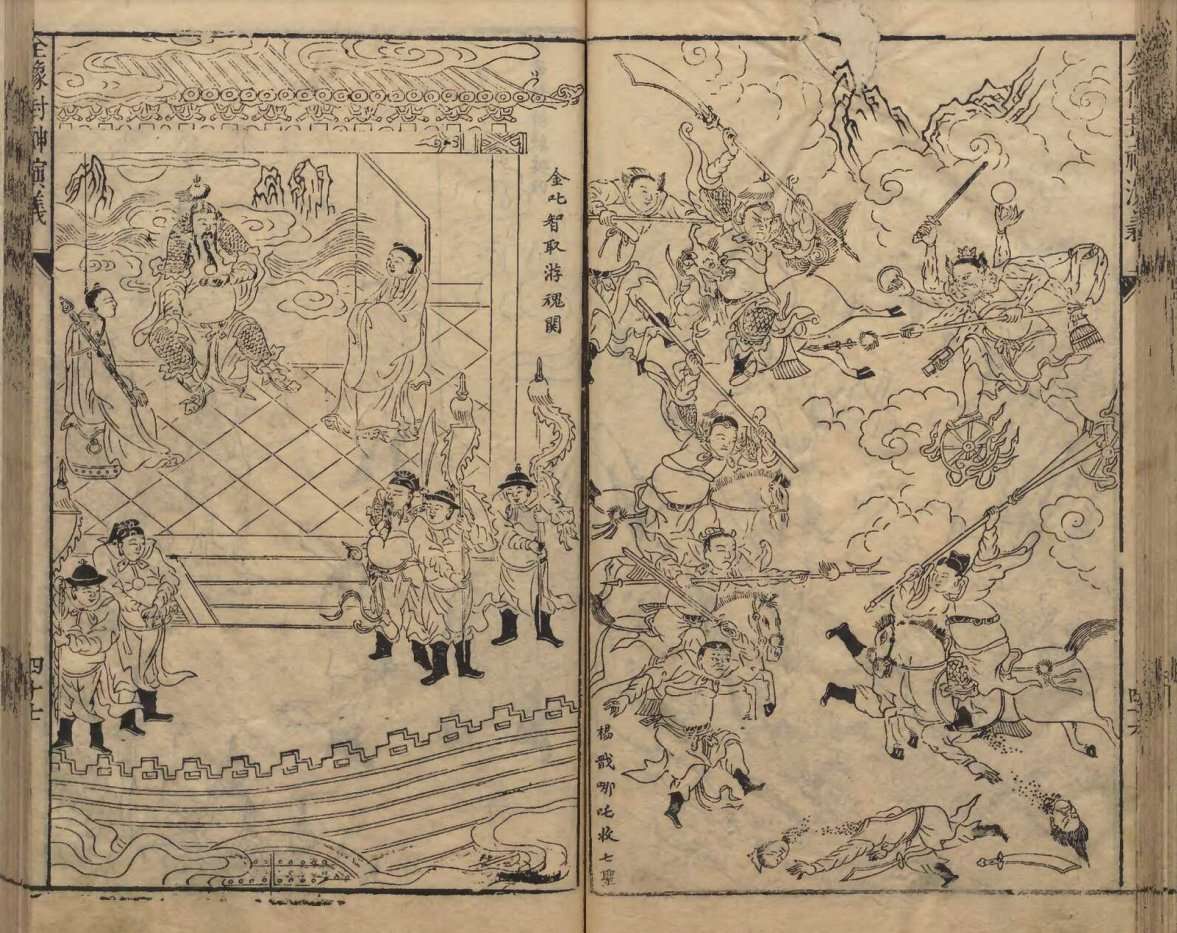
For the purposes of this blog, several characters from Journey to the West (Xiyouji, 西遊記, 1592) appear in the novel, including Laozi, the Buddha, Nezha (fig. 1), Muzha, and Li Jing, Ao Guang, Erlang (called Yang Jian, 楊戩) and his hound, etc. Journey to the West also had a number of clear influences on the book, one being the ape spirit Yuan Hong (袁洪) from later chapters who wields a staff and 72 transformations in a fight with Yang Jian. Sound familiar?
Fig. 1 – A detail of Nezha striking at an enemy during battle. Image from The Newly Printed, Zhong Bojing Annotated, Investiture of the Gods (Xinke Zhong Bojing xiansheng piping Fengshen yanyi, 新刻鍾伯敬先生批評封神演義, c. 1620) (larger version).
3. Translation: Pros and Cons
This edition of the novel was originally translated by Gu Zhizhong (顾执中, 1898–1995) in 1992. Dr. Barbara Witt notes that the translation has its pros and cons:
The positive: It is the only complete translation of Fengshen yanyi into a Western language that I am aware of. The edition I read (from 1992 I think), was also nicely done with interesting woodcut illustrations throughout the novel.
The negative: Firstly, it is not a very faithful translation. Poems are generally left untranslated and sentences often paraphrased. [2] I think, when ever the translator found something difficult, he just skipped it. Secondly, I think Gu Zhizhong was not an English native speaker and not very familiar with Western mythology and some of his translations are really off. For example Taiyi zhenren 太乙真人 (“True Man Primordial”), a powerful Daoist immortal, becomes “Fairy Primordial” in his translation, which conjures up a very different image.
3.1. Example
Chapter 12 describes how young Nezha inadvertently causes havoc in the aquatic realm when washing himself in a river with a powerful magic sash. This eventually leads to Li Gen (李艮), a yaksha water-spirit soldier, to attack him with an ax. Gu’s (2000) description of the fight reads:
Nezha, naked and empty-handed, dodged the vicious blow, raised his Universal Ring and struck Li Gen on the head. How could the Yaksha withstand the magic weapon from Fairy Primordial! His skull broke open and he fell dead on the river bank (vol. 1, p. 239).
However, the full encounter should read:
Standing there naked, Nezha dodged the advancing warrior’s attack and upraised the Universal Ring in his right hand. This treasure was originally bestowed by the Jade Emptiness Palace of Mt. Kunlun to the Perfected Man of the Grand Monad to secure the items of his Golden Light Cave. How could the yaksha withstand the magic weapon as it struck downward on his head? His brains exploded from the blow, and he fell dead on the shore.
You can see that quite a bit of information was left out. This happens throughout the entire novel. This makes me angrier the more that I think about. Why even bother to translate something if you are only going to paraphrase or even skip over passages? It seems like a pointless enterprise.
However, while imperfect, I think that the translation is a must read as many of the gods mentioned therein are worshiped in modern temples throughout China, Taiwan, Malaysia, and Singapore. It is a lens into modern folk religion.
4. PDF File
The following PDF is a combination of all four volumes making up Gu (2000):
I’ve added Wan (1987), a doctoral thesis analyzing the historical sources and micro/macro structure of the story. It also provides a summary of the tale in the end.
Here is a PDF for volume one of The Newly Printed, Zhong Bojing Annotated, Investiture of the Gods (Xinke Zhong Bojing xiansheng piping Fengshen yanyi, 新刻鍾伯敬先生批評封神演義, c. 1620), the oldest known edition of the novel. It is full of lovely woodblock prints (fig. 2).
Fig. 2 – A random page from vol. 1 of The Newly Printed, Zhong Bojing Annotated, Investiture of the Gods (larger version).
Thank you to the National Archives of Japan for offering the complete 1620 edition of FSYY. It can be downloaded here.
Update: 09-13-23
Tumblr user digitalagepulao has drawn an amazing Nezha (fig. 3). The theme is based on the feud between the prince and his father, which leads to the former’s suicide and divine resurrection. The artist describe a tense scene from the novel:
Li Jing in a fury grabbed his halberd, leapt on his horse and galloped out of the headquarters. He was astonished to see Nezha with his Wind-Fire Wheels and Fire-Tipped Spear. He swore loudly, “You damned beast! You caused us endless suffering before your death, and now that you’ve been reborn, you’re troubling us again!”
“Li Jing! I’ve returned my flesh and bones to you [via suicide], and there’s no longer any relation between us. Why did you smash my golden idol with your whip and burn down my temple? Today I must take my revenge!
A very big thank you to them. I’ll add more later if or when new lists are available.
Update: 11-03-24
My friend Dario Virga (Onibotokemaru on Instagram) (fig. 4) has completed an Italian translation of the novel titled L’investitura degli Dei: Romanzo cinese di epoca Ming (2024). This 1,120 page, two-volume edition can be purchased here for € 50,00:
1) Prof. Shi Changyu notes in his preface to this translation that the friction between the fictional Chan and Jie sects serves as an analogy for that of Quanzhen and Zhengyi during the Ming, for the former was marginalized, while the latter was held in high esteem and fell prey to decadence, naturally hindering its ability to contribute anything of value to the development of Daoism at this time (Gu, 2000, pp. 50-53).
2) Those interested in reading some of the poetry from the novel should consult Koss (1979), which compares them with those from Journey to the West.
Sources:
Gu, Z. (2000). Creation of the Gods (Vols. 1-4). Beijing: New World Press.
Koss, N. (1979). The Relationship of Hsi-yu chi and Feng-shen yen-i: An Analysis of Poems Found in Both Novels. T’oung Pao,65(4/5), second series, 143-165. Retrieved May 5, 2020, from http://www.jstor.org/stable/4528175
Wan, P. (1987). Investiture of the Gods (“Fengshen yanyi”): Sources, Narrative Structure, and Mythical Significance (UMI No. 8810607) [Doctoral dissertation, University of Washington]. Available from ProQuest Dissertations and Theses database.
Wu, C., & Yu, A. C. (2012). The Journey to the West (Vols. 1-4) (Rev. ed.). Chicago, Illinois: University of Chicago Press.
Note: My blog is not monetized, so I am not making any money from this post. If you enjoyed the digital version, please, please, please support the official release.
Last updated: 09-22-2024
I noted in my previous article that medicine was among the skills acquired by Monkey while training under the Buddho-Daoist sage, Patriarch Subodhi. In Journey to the West (Xiyouji, 西遊記, 1592) chapters 68 to 69, Monkey works to diagnose the long-standing malady of the Scarlet-Purple Kingdom emperor. But due to the immortal’s monstrous appearance, Sun is forced to analyze the ruler from afar, using three magic hairs-turned-golden strings to measure the vibrations of the pulse from three locations of each forearm. He deduces that the illness is caused by fear and anxiety over the loss of the monarch’s queen, who had been kidnapped by a demon. Monkey then concocts three pills from a secret recipe and administers the elixir with dragon king saliva. The medicine causes the emperor to pass an obstruction in his bowels, thus restoring the natural qi flow in his body and curing him of his sickness.
Monkey first assuages the fears of court officials by reciting a poem explaining the proper procedure for analyzing a patient:
Most mysterious is the physician’s art; His mind must ever be alert and keen. To look, listen, ask, and take-these four things If one is missing, his craft’s not complete. One, we look at the patient’s complexion: Is it moist, dry, fat, or thin in waking or sleep? Two, we listen for clear or turbid voice When he speaks lucid or frenetic words. Three, we ask for the ailment’s cause and length. For how he eats, drinks, and eliminates. Four, we scan the conduits by taking the pulse, To learn how submerged or floating in and out. If we do not look, listen, ask, and take, In this life his ailment will ne’er him forsake!” (based on Wu & Yu, 2012, vol. 3, p. 268).
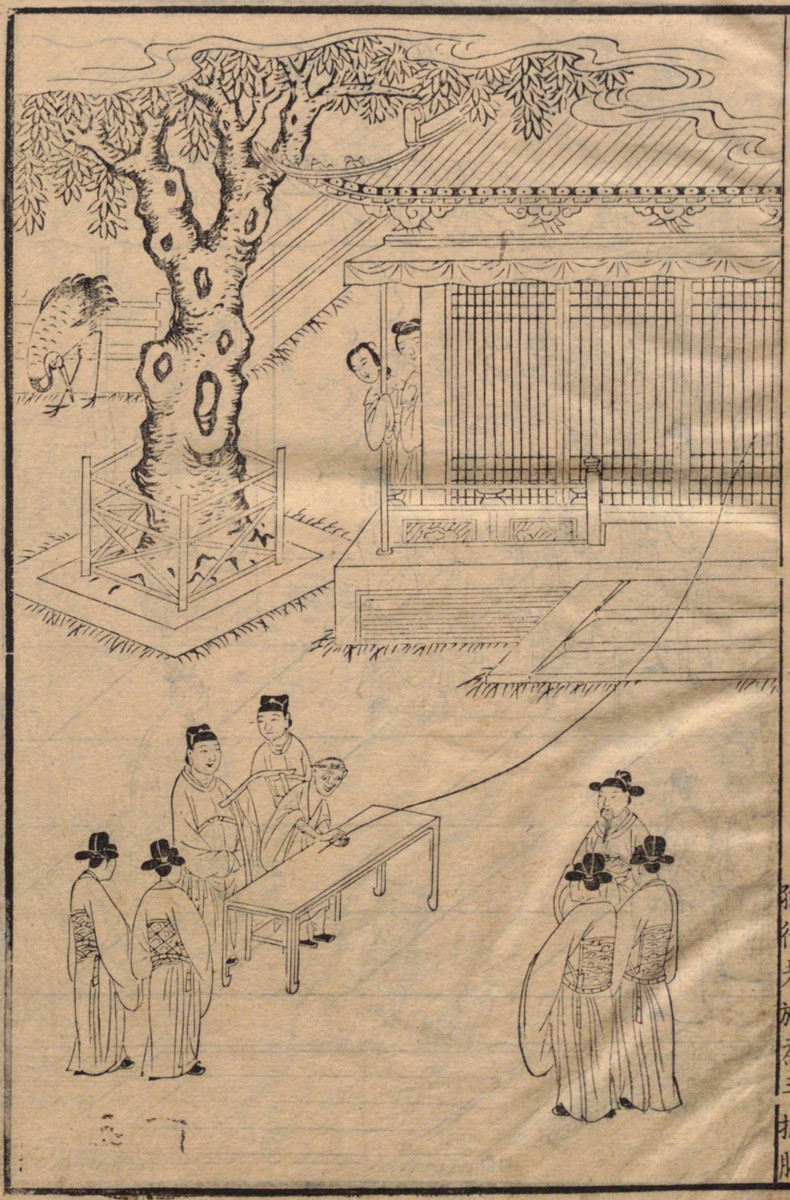
We were telling you about the Great Sage Sun, who went with the palace attendant to the interior division of the royal palace. He stood still only after he had reached the door of the royal bedchamber. Then he told the attendant to take the three golden threads inside along with the instruction: “Ask one of the palace ladies or eunuchs to tie these three threads to the inch, the pass, and the foot sections of His Majesty’s left hand where the radial pulse are felt. Then pass the other ends of the threads out to me through the window shutters” [fig. 1].
The attendant followed his instruction. The king was asked to sit up on the dragon bed, while the three sections of his pulse were tied by the golden threads, and their other ends were then passed out to Pilgrim. Using the thumb and the index finger of his right hand to pick up one of the threads, Pilgrim first examined the pulse of the cun [寸] section; next, he used his middle finger and his thumb to pick up the second thread and examine the pulse of the guan [關] section; finally, he used the thumb and his fourth finger to pick up the third thread and examine the pulse of the chi [尺] section.
Thereafter Pilgrim made his own breathing regular and proceeded to determine which of the Four Heteropathic Pneumatics, the Five Stases, the Seven External Images of the Pulse, the Eight Internal Images of the Pulse, and the Nine Pulse Indications were present. [1] His pressure on the threads went from light to medium to heavy, and from heavy to medium to light, until he could clearly perceive whether the condition of the patient was repletion or depletion of energy and its cause. Then he made the request that the threads be untied from the king’s left wrist and be attached as before to the positions on his right wrist. Using now the fingers on his left hand, he then examined the pulse on the right wrist section by section. When he had completed his examination, he shook his body once and retrieved his hairs (based on Wu & Yu, 2012, p. 270).
“Your Majesty,” he cried in a loud voice, “on your left wrist the pulse of your cun section feels strong and tense, the pulse of your guan section feels rough and languid, and the pulse of your chi section feels hollow and sunken. On your right wrist the pulse of your cun section feels floating and smooth, the pulse of your guan section feels retarded and hesitant, and the pulse of your chi section feels accelerated and firm. Now, when the pulse of your left cun section feels strong and tense, it indicates an internal energetic depletion with pain in the cardiac system of functions. When the pulse of your left guan section feels rough and languid, it indicates sweating that has led to numbness in the flesh. When the pulse of your left chi section feels hollow and sunken, it indicates a pink tinge to your urine and blood in your stool. When the pulse of the cun section on your right wrist feels floating and smooth, it indicates a congestion blocking the pneumatic energy circulation and leading to cessation of menses. When the pulse of your right guan section feels retarded and hesitant, it indicates a stasis of alimentary matter in the stomach system with retention of fluids. When the pulse of your right chi section feels accelerated and firm, it indicates discomfort caused by sensations of stuffiness and chills caused by energetic depletion. To sum up, your illness has been caused by fear and anxiety, and it may be the manifestation type of an illness called the ‘Paired Birds in Severance’ [shuangniao shiqun, 雙鳥失群]” (based on Wu & Yu, 2012, vol. 3, pp. 270-271).
Baring the strings, Monkey’s method of reading the pulse aligns with real Chinese medicinal practice. The area of the forearm analyzed by traditional Chinese doctors is known as cunkou (寸口, the “inch opening”), and this is broken up into the three spots cun (寸, “inch”), guan (關, “pass”), and chi (尺, “foot”) (fig. 2). The mirrored spots on each arm are believed to correspond to specific internal organs. For example, the cun spot (nearest the wrist) on the right hand corresponds to the lungs, while that of the left hand corresponds to the heart (Liao, 2011, pp. 55-56). Therefore, analyzing the pulse at these spots is believed to reveal the health of the corresponding organs.
Video 1 – Episode 20 of the 1986 Journey to the West series portrays this story. See minute 19:19 for the preparation of the Elixir of Black Gold.
Andrew Schonebaum’s (2016) fascinating book Novel Medicine: Healing, Literature, and Popular Knowledge in Early Modern China explains the historical significance of the real world ingredients used in this elixir. He introduces the first two ingredients by way of their anthropomorphization as Badou Dahuang, the ruler of the fictional Hujiao (胡椒, black pepper) kingdom from the vernacular novel Annals of Herbs and Trees (Caomu chunqiu yanyi, 草木春秋演義, c. 17th/18th century), a work that gives human form to Chinese medicines, pitting armies of mortal, immortal, and demonic characters/remedies against one another. Badou is depicted as having the mandate of heaven (the right to rule) in his own country but wanting to invade the Han empire. This dual nature can be explained by the properties of the ingredients making up his name. Schonebaum (2016) writes:
[B]adou (croton) and dahuang (rhubarb), are two of the most common drugs in Chinese medicine. Badou is toxic and a strong purgative, and it was used to treat stagnation in the viscera and bowels, as well as to facilitate urination, eliminate malignant flesh, and purge vicious agents such as invading ghosts or worms. Dahuang is nontoxic and is sometimes referred to by the name “military general” because “the drug pushes away the old and brings in the new, like a military general putting down a riot and bringing peace” (pp. 99-100).
Regarding the “Elixir of Black Gold,” Schonebaum (2016) explains that “black gold” was the name of a common prescription and that badou and dahuang were part of its core, while other ingredients could be replaced with those of similar properties:
One commentator had never heard of this medicine, saying that it had a strange name, but this only reveals his own highbrow background (or general ignorance), since “black gold” was the name of various prescriptions common among hereditary doctors. In fact, it was mentioned in the Systematic Materia Medica repeatedly, and Xu Dachun recommends it in Medical Cases of Huixi, so it was not exclusively the purview of nonelite healers.
“Black gold pills” (wujin wan) was a name and a concoction similar to “elixir surpassing [the value of] gold” (shengjin dan) and “black spirit pills” (heishen wan). All of them were core formulas that could be modified in their effects by ingesting them with different liquids. These “black gold” medicines, along with the likes of “the prescription offering Guanyin’s all-encompassing help” (Guanyin puji fang) and “pills prepared with old ink” (gumo wan), treated a wide variety of ailments (in one medical manuscript, twenty-nine, forty, and seventy-one ailments, respectively), and were extremely common formula in the Qing. The “black gold” formulas had at their core the drugs dahuang and badou. One medical manuscript from the Republican period states in its introduction, “Black gold powder [wujin san] cures all ailments, just as the wind bends the grasses. Other names [of this prescription] are ‘pine smoke elixir’ [songyan dan] and ‘black spirit pills’ [heishen wan]. It cures thousands of illnesses, just as the sun melts the frost.”
Black gold pills (wan), powder (san), paste (gao), and elixir (dan) were commonly employed to cure gynecological issues. A prescription named “black gold powder” was first recorded in the Song work A Spring of Recipes in the Magic Park (Lingyuan fangquan) and was followed by references in the Southern Song prescription collection “Complete Collection of Effective Prescriptions for Women” (Furen daquan liangfang, 1237), Formulas for Universal Benefit (Puji fang, 1390), and other works. Over the centuries, numerous formulas, each with different ingredients, became known under the names “black gold powder,” “black gold pills,” and “black gold elixir.” The three designations of this formula result from the use of pitch (mo), a vernacular name for which is the “black gold” of these prescriptions.
Monkey’s prescription reflects a historical reality, namely that the advent of the imperial pharmacy (huimin yaoju) in the Song required doctors who had previously relied on simple medicines with one or two ingredients to employ formulas with numerous substances whose composition followed theories of systematic correspondences. From this conflict between empirical and theory-based recipes arose a new type of prescription eventually consisting of a nuclear formula that could be adapted to the requirements of a given patient’s disease by omitting or adding individual constituents in accordance with his pathological condition. Monkey is preparing simple, trusted medicine at the core, namely badou and dahuang, and adding to it many exotic, unobtainable ingredients (pp. 103-104).
As noted above, black gold medicines were sometimes used to treat gynecological issues. This makes Monkey’s prescription all the more comical as he had partly attributed the foreign emperor’s ails to a “cessation of the menses” (Wu & Yu, 2012, p. 271), obviously a woman’s problem. Schonebaum (2016) comments: “To understand this aspect of the carnivalesque comedy, or to realize that it was a mistake in the incorporation of medical materials into the novel, readers would have had to be quite familiar with medicine, at least enough to know that the medicine Monkey is preparing is consistent with his diagnosis” (p. 104).
3. Archive link
Chapter three of Novel Medicine (2016) is archived here.
As mentioned above, Sun Wukong analyzes the ailing king’s pulse from afar using three magic hairs-turned-golden threads. This is no doubt based on the story of the “Grand Emperor of Protecting Life” (Baosheng dadi, 保生大帝), the Daoist and folk religion god of medicine, curing an empress using the same method:
During the reign of Chengzu (1403–21), the Empress Wen suffered from an inflamed breast. A Taoist priest offered his skills, but the Emperor tested him by having him take her pulse with a string held on the other side of her bedroom wall. First the Emperor attached it to a cat. The Taoist said, “Not a bear, no not bear, it’s a cat.” Then the Emperor tied the string to a doorknob. The Taoist said that it was something of metal and wood, and not a human pulse. Finally, the Emperor tied the string to the woman’s breast and the Taoist said that the liver pulse was inflamed and the blood clotted, and that this indicated a breast infection which had to be treated by moxibustion. He offered to perform the operation by dangling a cord over the wall. He cured the ailment and vanished, refusing a reward of gold and office. In He Qiaoyuan’s version, the Emperor inquired about his name and discovered that he was the long-deceased Divine Doctor Wu Tao. In gratitude, the Emperor enfeoffed the god as Wanshou wuji baosheng dadi (Emperor Who Protects Life of Limitless Longevity) (Dean, 2014, p. 74).
What’s interesting is that this legend carried over into religious practices. A reader who contacted me in 2022 explains:
I observed a practice at [Sidian Xingji Temple (祀典興濟宮)] in Tainan where an individual would let the god Baosheng dadi check their pulse by resting three sticks of incense on their forearm. The temple brochure also mentions this procedure [fig. 3]. I believe this to be relevant to your article …
Fig. 3 – A detail from the aforementioned temple brochure showing the three incense sticks resting on a member’s wrist (larger version). Photo by Richard Malabarista.
Notes:
1) Yu (Wu & Yu, 2012) provides explanations for these terms in the end notes of his wonderful translation (pp. 448-449, n. 3-7).
Sources:
Dean, K. (2014). Taoist Ritual and Popular Cults of Southeast China. United States: Princeton University Press.
Liao, Y. (2011). Traditional Chinese medicine. Cambridge: Cambridge University Press.
Schonebaum, A. (2016). Novel Medicine: Healing, Literature, and Popular Knowledge in Early Modern China. Seattle: University of Washington Press
Wu, C., & Yu, A. C. (2012). The Journey to the West (Vol. 3) (Rev. ed.). Chicago, Illinois: University of Chicago Press.
Look up the terms “monkey” or “ape” in the dictionary and you’ll find that they serve as verbs meaning to mimic the movements or actions of another. This is because monkeys and apes have a propensity for observation and mimicry. Being primates ourselves, humans are no different. But interestingly this mimicry sometimes mirrors our primate cousins. Chinese martial arts, for example, has developed several primate-based fighting arts, including White Ape Connected Arms boxing (Baiyuan tongbei quan, 白猿通背拳) and several flavors of Monkey boxing (Houquan, 猴拳), and other styles have even adopted primate techniques, such as the monkey footwork of Praying Mantis boxing (Tanglang quan, 螳螂拳). Humans have long marveled at the physical prowess and acrobatic mastery of apes and monkeys, so it’s only natural that boxers would want to incorporate the powerful arm movements and awe-inspiring leaps and flips of primates into various fighting arts. But how long have our cousins been associated with martial arts in Chinese culture, and when and how did primate-based martial arts develop?
Two approaches can be used in an attempt to answer both questions. The first method involves charting similarities in techniques shared between modern regional primate-based Chinese martial arts styles and relying on folk lineages, ethnographic data, and (when possible) historical manuals to discover the earliest vestiges of primate boxing in China. A second method is to search for references to primate-based martial arts in the historical record. A benefit of the first approach would be pinpointing the areas in China where these styles likely first emerged in recent history. The downside is that martial arts are passed from teacher to student via embodied practices (e.g. fist and weapons forms and sparring), often without the material being recorded in a manual. This means such styles can’t be reliably traced beyond a certain time period. A benefit of the second approach is that it provides a deeper view of history, giving the researcher license to record not only the odd mention of historical boxing styles but also associations between primates and weapons and other forms of physical exercise in ancient folklore, literature, medicine, and religion. Obviously, the best approach would be a combination of the two. However, I lack the necessary encyclopedic knowledge of Chinese martial arts techniques. Such a grand project will have to wait for a more qualified researcher. I have instead decided to adopt the second approach.
This article is divided into five sections. The first presents a folk history for Tai Shing Pek Kwar, a popular modern form of Monkey boxing, to serve as an example of how such styles can be created. The second provides three references to premodern Monkey boxing appearing in military and travel writings of the 16th century during the late Ming (1368–1644), pointing to the commonplace nature of the style. Here, I suggest that the lack of evidence for pre-Ming references to primate-based boxing points to the style emerging during this time. This section also provides examples of armed techniques associated with apes in military literature of the 16th and 17th century. The third discusses the story of the noted literary monkey hero Sun Wukong (孫悟空), his portrayal as a master of armed and unarmed fighting, and how he bridges the gap between the aforementioned lack of pre-Ming boxing references and older material associating apes and monkeys with armed combat. The fourth presents ancient stories pitting a magic white ape against the martial skills of legendary Chinese heroes, including the archer Yang Youji (養由基, 7th c. BCE) and the swordswoman the Maiden of Yue (Yuenu, 越女, 5th c. BCE). And the fifth discusses ancient animal mimicry and suggests that primate-based boxing is tied to war-like shamanic totemic dances and yoga-like daoyin calisthenics (8th c. to 2nd c. BCE). [1]
Shaolin Monkey – This combative style is said to have developed among various animal styles at the famed Shaolin Monastery (Shaolin si, 少林寺) in Henan province, China. Matsuda (2013) claims this particular style to be thousands of years old (p. 50); however, this has no basis in history, as will be explained below.
Wushu Monkey – This modern, non-combative style focuses on gymnastic leaps and flips for entertainment purposes. It is used in both Chinese opera and the floor routines of form competitions (video 1) (Matsuda, 2013, pp. 54-56).
Tai Shing Pek Kwar Monkey – This is the Cantonese variant of the Mandarin Dasheng Pigua men (大聖劈掛門), or the “Great Sage Ax School” of boxing. This combative style is said to be quite young, being a little over 100 years old (Matsuda, 2013, p. 56).
To this I add one more:
Emei Monkey – This combative style is associated with the martial arts of Emei Mountain (Emei quan, 峨嵋拳) in Sichuan, China.
Video 1 – The first half of this video shows a youth performing Wushu Monkey for a form competition.
Tai Shing Pek Kwar is a combination of two different styles. The first, which I will only describe briefly, is Pek Kwar kyun (Pigua quan, 劈掛拳), a style that mimics the swinging of an ax, relying on the lively arm movements to generate power, much like the Choy Li Fut style of southern China. It is said to have been created over two hundred years ago in Shandong (northern China) by a woodcutter named Ma Chi Ho (Matsuda, 2013, pp. 64-68). The weapons practiced by this style include the double-edged sword (jian, 劍), the single-edged saber (dao, 刀), and the staff (gun, 棍) (Matsuda, 2013, pp. 70-75).
The Tai Shing kyun (Dasheng quan, 大聖拳) style is said to have been founded in northern China around the year 1911 (the end of the Qing dynasty) by a prisoner named Kou Si (寇四). [2] After being sent to jail for murder, Kou discovered that his cell faced a forest where he could observe the day-to-day lives of a troupe of monkeys. He noted five distinct behaviors among them that when combined with his knowledge of Great Earth boxing (Di tang quan, 地趟拳), a type of ground combat, could be adapted for fighting.
Lost Monkey (Mi Hou, 迷猴) – This form mimics the behavior of a frightened monkey, comprising periods of attack and retreat, with lots of rolling, low kicks, and quick, frantic running low to the ground (video 2).
Stone Monkey (Shi Hou, 石猴) – This form mimics the behavior of an enraged alpha male, comprising slower but drastically more powerful fist, elbow, and knee strikes, all of which are delivered from a low stance.
Tall Monkey (Qi Hou, 企猴) – This form mimics the behavior of a tall monkey, comprising longer, quicker swinging arm strikes and higher-level kicks.
Drunken Monkey (Zui Hou, 醉猴) – This form mimics the behavior of intoxicated monkeys, comprising falls, swaying motions with broken footwork, and circular punches, all of which are delivered from a low stance.
Wooden Monkey (Mu Hou, 木猴) – This form mimics the behavior of an intelligent, deceptive monkey, comprising quick, low attacks and rolls similar to the Lost Monkey, but feigning retreat only to turn and unleash strikes upon the pursuing opponent.
After perfecting the style, Kou Si is said to have named it “Great Sage boxing” in honor of the monkey hero Sun Wukong (Matsuda, 2013, pp. 86-116). This is a reference to the title taken by the character during his rebellion against heaven (see section 3 below). The weapons practiced by this style include the staff and the metal ring (Matsuda, 2013, pp. 118-131).
Video 2 – The Lost Monkey form.
2. Primates and Martial Arts During the Ming
Textural evidence for Monkey boxing actually predates Kou Si’s lineage, appearing in late-Ming dynasty (1368–1644) records. The first reference appears in the eighteen volume edition of famed general Qi Jiguang‘s (戚繼光, 1528–1588) (fig. 1) New Treatise on Military Efficiency (Jixiao xinshu shiba juan ben, 紀效新書十八卷本), a military training manual completed in 1561 or 1562. The fourteenth chapter, titled “Chapter on the Fist Canon and the Essentials of Nimbleness” (Quanjing jieyao pian, 拳經捷要篇), reads:
Among the past and present fist specialists, the Song Great Founder had the Long Fist system with thirty-two positions. Moreover there are six pace and fist techniques, the Monkey Fist, and the Feinting Fist. The famous positions each have their own names, but in reality they are quite similar and scarcely differ from one another (Gyves, 1993, p. 34).
While Qi believed that boxing had no place in armed conflict, he thought such training was useful as it strengthened soldiers’ bodies, coordinated their limbs, improved their weapons skills, and bolstered their courage (Gyves, 1993, pp. 33-37). Qi gathered what he considered the most efficient techniques to achieve this goal, meaning that he consulted with many martial artists in the process. The fact that he mentions Monkey boxing suggests that it was a common style among fighters of this time.
The second reference appears in Zheng Ruozeng’s (郑若曾, 1505–1580) Strategic Situation in Jiangnan (Jiangnan jinglue, 江南經略, 1564), which was written in response to the ever-present threat of the Woukou (倭寇), a conglomeration of Japanese, Chinese, and Korean sea bandits, invading China’s coastline. In the eighth volume, Zheng provides a long list of armed and unarmed martial arts, including the “thirty-six roads (forms) of Monkey boxing” (Houquan sanshiliu lu, 猴拳三十六路) (Zheng, 1564). Again, this suggests that Monkey boxing was quite common.
The third appears in scholar Wang Shixing’s (王士性, 1547–1598) A Journey to Mt. Song (Songyou ji, 嵩遊記), a travel log of the mountain on which the famed Shaolin monastery is located:
Martial monks again each came to present skills. With fists and staves contending, they struck as if flying. Their teacher with folded hands looked on. Among them was a monkey striker, spinning and leaping, just like a monkey… (Wells & Chang, 2004, p. 23).
This shows that a single Shaolin warrior monk practiced Monkey boxing. But does this mean the style was part of the monastery’s official curriculum at the time? The answer is no. According to Shahar (2008), textual evidence suggests that Shaolin officially took up boxing in the proceeding 17th century, and the first styles practiced were Drunken Eight Immortals boxing (Zui baxian quan, 醉八仙拳) and Lost Track boxing (Mizong quan, 迷蹤拳), and possibly followed by Plum Flower boxing (Meihua quan, 梅花拳) in the 18th- century. The monks adopted pugilism as a form of calisthenic exercise, later combining it with Daoyin (導引) calisthenics and spirituality to create a new form of self-cultivation. [3] Prior to this, the Shaolin monks were only known for their proficiency with the staff. Therefore, given the seeming commonplace nature of Monkey boxing during the late Ming, the monk could have learned the style from an outside source.
Modern folklore associated with one primate-based style, White Ape Connected Arms Boxing (Baiyuan tongbei / bi quan, 白猿通背 / 臂拳), traces its origins to religious and military figures of the Song dynasty (960–1279), centuries prior to the Ming (Lu, 2006, pp. 103-105, for example). However, it should be said that having a Song-era foundation is a reoccurring theme in many martial arts legends. For instance, the famed Song general Yue Fei (岳飛, 1103–1142) is commonly attributed Eagle Claw boxing (Yingzhao quan, 鷹爪拳) and Form-Intent boxing (Xingyi quan, 形意拳) (Liang & Yang, 2002, pp. 15-16, for example). But textual evidence for these styles don’t appear until the Ming and Qing, respectively. [4] Most importantly, the oldest source associated with White Ape Connected Arms Boxing, titled the Connected Arms Boxing Manual (Tongbi quan pu, 通臂拳谱), was written during the late Ming and finally published in 1665 during the early Qing (List of surviving Ming period martial arts, 2017). Likewise, concrete references to primate-based boxing do not predate the Ming. This might suggest such styles arose during this time when there was an explosion in the popularity of pugilism. But this tells us nothing about how primate-based boxing may have developed. The history of animal mimicry in Chinese martial arts can be traced to much older concepts based in medicine and religion. This is discussed in section 5 below.
Fig. 2 – A compilation of images of the sword-fighting apes from the Collection of Military Works (c. 1621) (larger version). By the author. Fig. 3 – A compilation of the original stick figures and Japanese calligraphy from the fourteen volume edition of the New Treatise on Military Efficiency (1584) (larger version). From Qi, 1584/2001, p. 83. Note the similarities in stance and the position of the blades.
As for the association between primates and armed combat during the Ming, the animals are occasionally referenced in the named fighting techniques of military literature. For example, the tenth volume of Qi Jiguang’s aforementioned manual includes a feinting lance technique titled “White Ape Trailing Sword Stance” (Baiyuan tuo dao shi, 白猿拖刀勢) (Yang & Xie, 1995, p. 336). The 35th volume of the Collection of Military Works (Wubei zhi, 武備志, c. 1621), a Ming treatise on military armaments and fighting techniques compiled by Mao Yuanyi (茅元儀, 1594–1640), includes “White ape exits cave” (Baiyuan chudong shi, 白猿出洞勢), a stance appearing in the sequence for an overhead sword guard. [5] (Incidentally, this is also the name of a fist set practiced in some lineages of Praying Mantis boxing). Additionally, the same volume includes a two-section sword manual, the first section of which portrays fanciful images of apes practicing with the “sprout saber” (miaodao, 苗刀) (Mao, 1621), a long, two-handed blade similar to the Japanese Katana (fig. 2). These strange images differ from the human-based figures in the rest of the source. It’s important to note that the original sword manual, called Saber Techniques of the Xinyou-Era (i.e. 1561) (Xinyou daofa, 辛酉刀法), is taken directly from the fourth volume of the revised fourteen volume edition of Qi’s New Treatise on Military Efficiency (Jixiao xinshu shisi juan ben, 紀效新書十四卷本, 1584). The first of the aforementioned two sections reproduces a series of sword-wielding stick figures taken from a Shadow School (Kage-ryu, 影流 / 陰流) manual of Japanese sword fighting. The section is prefaced by lively Japanese calligraphy, and the few words recognizable to readers of Chinese include “ape flying” (yuanfei, 猿飛) and “ape returning” (yuanhui, 猿回) (fig. 3), both of which are Kenjutsu techniques still practiced today (video 3). [6] This then might explain why the stick figures were changed to apes when the material was reproduced in the Collection of Military Works decades later. But I would also like to suggest that the change (as well as the allusion to the sword-wielding white ape from the lance technique mentioned earlier) was influenced by a famous first-century Chinese story about a talented swordswoman who has her skills tested by a magic white ape. This is discussed in section 4 below.
Video 3 – A modern demonstration of the “ape-flying” technique.
3. Sun Wukong the Monkey King
By far, the most famous weapon-bearing primate of the late Ming-period is Sun Wukong (孫悟空, a.k.a. “Monkey”), the simian protagonist of the highly popular Chinese novel Journey to the West (Xiyou ji, 西遊記, 1592). According to the tale, the stone-born monkey rules a mountain utopia before learning magic, martial arts, and the secret of immortality under a Buddho-Daoist sage. He soon thereafter acquires a magic, size-changing iron staff, which he uses to wage war against the celestial realm (fig. 4), proclaiming himself the “Great Sage Equaling Heaven” (Qitian dasheng, 齊天大聖, hence the name for Kou Si’s Monkey boxing). But his rebellion is eventually quelled by the Buddha, who imprisons the indestructible monkey demon beneath a mountain for his crimes. Five hundred years later, the repentant immortal is called upon to use his great strength, martial arts, and powers of transformation to protect the monk Tripitaka on a journey to procure scriptures from India.
The narrative portrays Sun as a well-rounded martial artist proficient in both weapons and boxing. For example, during his rebellion with heaven, he trains his monkey children as soldiers, teaching them troop movement and weapons, including swords, spears, axes, and bows and arrows. But he is best known for his skill with the staff (fig. 5). One episode sees Monkey give a display of his martial prowess while he and his master travel through a spooky mountain. His skill is so great that the story likens it to the strategy taught in two of the Seven Military Classics of China:
“Going through this tall mountain and rugged cliff must have made master [Tripitaka] rather apprehensive, that’s all. Don’t be afraid! Don’t be afraid! Let old Monkey put on a show for you with my rod to calm your fears somewhat.” Dear Pilgrim! Whipping out his rod, he began to go through a sequence of maneuvers with his rod as he walked before the horse: up and down, left and right, the thrusts and parries were made in perfect accord with the Six Secret Teachings and Three Strategies [Liutao Sanlue, 六韜三略)]. [7] What the elder saw from the horse was a sight incomparable anywhere in the world (Wu & Yu, 2012, vol. 2, p. 105).
Fig. 5 – A modern action figure of Sun Wukong with his magic staff (larger version).
Furthermore, Monkey displays a mastery of unarmed fighting (fig. 6) in two episodes. A poem in chapter 51, for example, is important because it describes a battle between Sun and a buffalo demon in which they use real boxing techniques, many of which are still known and practiced to this day:
Hitching up his clothes and walking forward, the fiend assumed a boxing posture; his two fists upraised looked truly like two iron sledge hammers. Our Great Sage also loosened his legs at once and moved his body to attack; right before the cave entrance, he began to box with the demon king. This was quite a fight! Aha!
Opening wide the “Four Levels Posture”; The double-kicking feet fly up. They pound the ribs and chests; They stab at galls and hearts. “The Immortal pointing the Way”; “Lao Zi Riding the Crane”; “A Hungry Tiger Pouncing on the Prey” is most hurtful; “A Dragon Playing with Water” is quite vicious. The demon king uses a “Serpent Turning Around”; The Great Sage employs a “Deer Letting Loose its Horns.” The dragon plunges to Earth with heels upturned; The wrist twists around to seize Heaven’s bag. A green lion’s open-mouthed lunge; A carp’s snapped-back flip. Sprinkling flowers over the head; Tying a rope around the waist; A fan moving with the wind; The rain driving down the flowers. The monster-spirit then uses the “Guanyin Palm,” And pilgrim counters with the “Arhat Feet.” The “Long-Range Fist,” stretching, is more slack, of course. How could it compare with the “Close-Range Fist’s” sharp jabs? The two of them fought for many rounds— None was the stronger, for they are evenly matched (Wu & Yu, 2012, vol. 3, pp. 12-13).
While the techniques are not Monkey boxing, the narrative certainly helped solidify the connection between primates and martial arts during the late Ming when references to the style were recorded.
Fig. 6 – Sun teaching a young human apprentice martial arts. Drawing by Celsohenrique on deviantart (larger version).
Sun Wukong’s image as a master of armed and unarmed combat led to his veneration among northern Chinese martial artists at the end of the Qing. As noted in this article, fighters of the anti-foreign Boxer Rebellion (1899–1901) were known to channel the spirit of the Monkey King (among other deities) in order to gain his martial prowess. A German catholic missionary active in Shandong in the late 19th and early 20th century recorded how four boxer youths were chosen as possible vessels, and after a ritual enticed the deity to earth, the “possessed” individual performed a frightening saber dance, indicating that the Great Sage had taken control. Additionally, Dudbridge (1970) cites one 17th-century source that describes Sun’s veneration in the southern Chinese province of Fujian for “appear[ing] in the clouds to beat back an attack from Japanese pirates” (p. 158). This refers to the preceding 16th century when China’s coast was plagued by the aforementioned Wokou pirates. Interestingly, Sun Wukong fighting pirates puts him in the same company as the Shaolin warrior monks, who used their martial arts skills to rout the same bandits during the 1550s (Shahar, 2008, pp. 68-70).
Fig. 7 – The Monkey Pilgrim stone relief carving, 1237, from the Kaiyuan Temple Western Pagoda, Quanzhou City, Fujian Province, China (larger version).
Monkey is important to this study because he bridges the gap between the lack of pre-Ming references to primate-based boxing and older material associating apes and monkeys with armed combat. Sun first appears as the “Monkey Pilgrim” (Hou xingzhe, 猴行者) in The Story of How Tripitaka of the Great Tang Procures the Scriptures (Da Tang Sanzang qujing shihua, 大唐三藏取經詩話), a seventeen chapter storytelling prompt dated to the late 13th century. The narrative presents our hero wielding two staves, one a golden-ringed monk’s staff and the other an iron staff, in defense of his Buddhist master. These two staves would later be combined by storytellers to create his signature weapon.
Older still, the Kaiyuan Temple (Kaiyuan si, 開元寺) of Fujian is home to a nearly life-sized carving of the hero (fig. 7), who is presented as a saber-wielding guardian deity. He appears alongside other such wrathful gods, as well as bodhisattvas, arhats, patriarchs, and eminent monks, on a stone pagoda that was erected in the year 1237. So, Monkey was associated with various weapons as far back as the 13th century.
Fig. 8 – A Han-era stone tomb rubbing showing a sword-wielding hero striking at a fleeing white ape (center). A woman can be seen held captive in a teardrop-shaped cave (left). The hero is followed by an assistant beating a gong (right) (larger version). From Wu, 1987, p. 88.
Apart from possible Indian influences, Sun Wukong’s origins can be traced to a body of Han (206 BCE–220 CE) and Tang (618–907 CE) dynasty tales in which a magical white ape or gibbon (baiyuan, 白猿) kidnaps human woman and spoils their innocence (fig. 8). For example, the unnamed primate antagonist of “A Supplement to Jiang Zong’s Biography of a White Ape” (Bu Jiang Zong baiyuan zhuang, 補江總白猿傳, c. late 7th c.) is described as a 1,000-year-old hermit who lives in a mountain utopia, practices Daoist longevity arts, wields the power to fly and change his shape, and has supernatural strength and an iron-hard, nigh-invulnerable body immune to most efforts to harm him. Most importantly, he is depicted as a master of armed combat, one displaying a fondness for sword dancing. His blade is said to “circl[e] his body as fast as lightning and as round as a full moon.” [8] As noted above, this is not the first story involving a magic white ape who is fond of swordplay.
4. Magic Apes and Ancient Chinese Heroes
The Chinese classic the Water Margin (Shuihu zhuan, 水滸傳, c. 1400) describes the literary heroes Hou Jian (侯健), Lin Chong (林沖), and Zhang Qing (張清) (fig. 9) each having ape-like arms, denoting their great strength and agility. This same nickname was applied to powerful archers of the past. Ma (2010) writes:
[I]t is said that the Xiongnu warrior Liu Chong ‘had arms like an ape, was skilled at archery (yuanbei shanshe 猿臂善射), and could pull a bow of three hundred jin’ 斤 (Book of Wei《魏書》). Similarly, History of Ming describes General Chang Yuchun 常遇春 as ‘distinguished looking, with peerless courage and strength, had arms like those of an ape and was skilled at archery’; and in the same vein, Tang poet Cui Daorong 崔道融 wrote that ‘the ape-armed general runs as if on wings, sparing no one with his bow from a hundred paces’ (General Li’s Biography [Ti Li jianjun zhuan 題李將軍傳]) (p. 24).
Fig. 9 – A woodblock print of the hero Zhang Qing by Kuniyoshi produced between 1827 and 1830 (larger version). It is part of the artist’s “One of the 108 Heroes of the Popular Water Margin” series (Tsuzoku Suikoden goketsu hyakuhachinin no hitori, 通俗水滸傳濠傑百八人一個). Original image found here. Look closely and you’ll notice that the tattoo on Zhang’s back portrays Sun Wukong producing magical clones of himself from his mouth.
Oddly enough, the earliest tales mentioning archers and magic white apes do not liken one to the other. In fact, they are diametrically opposed. For example, a third-century BCE tale about the famed archer Yang Youji (養由基, 7th c. BCE) portrays the creature as an elusive target for his arrow:
Once in the palace of Jing 荊 there was a supernatural white ape. Even the skillful archers of Jing could not hit it. Then the king of Jing asked … Yang Youji to shoot it. Yang straightened his bow and went to the palace with arrows in his hands. Before shooting he aimed at a place where the [moving] ape had not yet arrived. When he let the arrow fly, the ape fell immediately. Thus Yang Youji could be called the archer who could hit a target before it was there (Wu, 1987, p. 103; see also Gulik, 1967, p. 41).
A similar version of the tale states that the ape recognizes Yang’s supernatural skill, anticipating the arrow and crying out in pain moments before actually being struck (Wu, 1987, p. 103; Gulik, 1967, p. 41).
Perhaps the most famous story associating the magic white ape with martial arts is the “Maiden of Yue” (Yuenu, 越女, 1st c. BCE), named after its protagonist, a peerless swordswoman of the 5th century BCE. The story describes how she participates in a sparring match with the shape-changing ape:
The Young Woman of Yue travelled north for her audience with the king [Goujian of Yue]. On the way, she met an old fellow who said his name was “Old Mr. Yuan” [Yuan gong, 袁公].
He said to the young woman, “I hear you fight well with a [sword]. I’d like to see a demonstration.”
She replied, “I wouldn’t presume to keep anything from you: you are welcome to test my skill, Sir.”
So Old Man Yuan drew out a length of Linyu bamboo. But the bamboo was rotten at one end. The end fell to the ground and the young woman immediately snatched it up. The old man wielded the top end of the staff and thrust towards the young woman, but [she] parried straight back, thrust three times, and finally raised her end of bamboo and drove home her attack against Old Man Yuan [fig. 10]. Old Man Yuan hopped off up a tree, turning into a white ape [baiyuan, 白猿, hence the surname]. Then each went their own way, and she went on to meet with the king. [9]
Upon meeting the king, the Maiden reveals that the secret to her fighting ability is the application of yin and yang energy, which are metaphorically described as the opening and closing of large and small swinging doors. This is “[t]he earliest extant published exposition of [the] theory applied directly to the martial arts” (Henning, 2001, p. 746), predating the artificial categorization of Chinese boxing into “internal” (neijia, 内家) and “external” (waijia, 外家) styles during the 17th century (Henning, 2007, p. 26). Therefore, the importance of the story in the annals of Chinese martial arts history can’t be overstated. Nor can the inclusion of the white ape. His supernatural challenge and subsequent defeat respectively tests and confirms the effectiveness of the theory.
This tale likely influenced the association between white apes and swordplay in later sources, such as the sword-dancing antagonist of the Tang-era “Supplement to Jiang Zong’s Biography of a White Ape” (section 3) and the sword-wielding primates of military literature (section 2). For example, “White Ape Trailing Sword Stance,” the aforementioned feinting lance technique from New Treatise on Military Efficiency (c. 1561/1562), may refer to Old Mr. Yuan’s defeat.
Fig. 10 – A modern drawing of the Maiden of Yue fighting Old Mr. Yuan by martial historian Stan Henning (larger version). From Henning, 2007, p. 24.
Our heroes’ respective stories make no reference to animal mimicry, the cornerstone of primate-based boxing. In fact, it’s the reverse in the second narrative: an ape mimics man. [10] The tales instead promote the idea of trained human skill conquering the raw, often magical, power of nature. In the case of the Maiden of Yue, her mastery of yin and yang energy enabled her to best the magic white ape. Yang Youji is more of a mythic figure capable of miraculous feats, such as sinking an arrow into a boulder simply because he mistook it for a rhino (i.e. mind over matter) (Selby, 2000, p. 131). But he succeeded in falling a white ape when many archers failed. These tales are, therefore, the antithesis of primate-based boxing, representing what might have been considered more “civilized” or “noble” forms of martial arts, namely the armed disciplines of archery and swordplay.
5. Animal Mimicry in Chinese Medicine and Religion
I suggested above that primate-based styles may have arisen during the Ming. But how the styles developed is likely tied to the long history of animal mimicry in China. For example, around the year 60 BCE (during the Han), the courtier Tan Changqing (檀長卿) is said to have been reprimanded for violating ritual norms by performing the dance of the “dog and macaque combat” (wu wei muhou yu goudou, 舞為沐猴與狗鬭) while at a drunken party (Harper, 2001, p. 18). This dance may have some connection to a funerary motif appearing in Han-era stone tombs in which dogs are shown intimidating apes, the motif representing the conquering of evil influences. [11] Tan’s display can’t be assigned a martial role, however, because it was likely a comical pantomime. [12] But this shows mimicking primates served a variety of purposes in Chinese culture.
Primate-based movements figure in a number of ancient therapeutic exercises. For instance, the monkey appears in the Five Animals’ Frolic (Wuqin xi, 五禽戲), a 3rd-century system of daoyin calisthenics, which mimics the movements or behaviors of the tiger, deer, bear, monkey, and bird (in that order), each animal set strengthening a particular area of the body (Kohn, 2008, pp. 163-169). Movements mimicking the bear, monkey, and bird actually predate this system, appearing among forty-four exercises listed in the Illustrations of Guiding and Pulling (Daoyin tu, 導引圖, 168 BCE), the oldest known diagram of daoyin exercises, discovered in Mawangdui (馬王堆) (fig. 11 and 12). Primate-based exercises include the “Monkey Bawling to Pull Internal Hotness” (muhou guan yinling zhong, 沐猴灌引靈中) (#35) and “Gibbon Shouting” (yuanhu, 猿謼) (#40) (fig. 13 and 14) (Harper, 1998, pp. 315 and 316). [13]
The Masters of Huainan (Huananzi, 淮南子, 139 BCE), a compendium of Daoist, Confucian, and Legalist thought, references another primate-based daoyin set in a section criticizing such exercises as inferior to spiritual cultivation:
If you huff and puff,
exhale and inhale,
blow out the old and pull in the new,
practice the Bear Hang [xiongjing, 熊經], the Bird Stretch [niaoshen, 鳥伸],
the Duck Splash [fuyu, 鳧浴], the Ape leap [yuanjue, 蝯躩],
the Owl Gaze [chishi, 鴟視], and the Tiger Stare [hugu, 虎顧]:
This is what is practiced by those who nurture the body. They are not the practices of those who polish the mind (Liu & Major, 2010, p. 236).
Fig 11 – (Top left) The Illustrations of Guiding and Pulling, 2nd c. BCE, paint on silk, 142 x 70 cm (55.9 x 27.5 in) (larger version). Image originally found here. Fig. 12 – (Top right) A modern reconstruction (larger version). Image originally found on Wikipedia. Harper (1998) warns such reconstructions “should be regarded as conjectural in many details” since the original is in such poor condition (p. 191). Fig. 13 – (Bottom left) The reconstruction of “Monkey Bawling to Pull Internal Hotness” (larger version). Fig. 14 – (Bottom right) The reconstruction of “Gibbon Shouting” (larger version).
These therapeutic exercises likely find their origin in ancient Shamanic animal dances designed to drive away demonic illness and influences (Harper, 1985, pp. 487-488). One such dance was the seasonal Da Nuo (大儺 / 難; Jp: Tsuina, 追儺) ritual in which a bearskin-clad exorcist (Ch: fangxiangshi; Jp: hōsōshi, 方相氏) and his army of fur, feather, and horn-clad youths, representing twelve animal deities, expelled evil spirits from human dwellings. Evidence suggests that it may have been performed as early as the Shang (17th to 11th c. BCE), but the earliest concrete references come from the Eastern Zhou (8th to 3rd c. BCE) (Poo, 2009, p. 286). What’s interesting for our purposes is that the exorcism has a martial aspect; not only does the exorcist bear a lance and shield for ritual combat (fig. 15), but also the group travels throughout the given location dancing and shouting, with the youths beating drums and commanding twelve spirits by name to devour or eviscerate anthropomorphic representations of malevolent influences (Poo, 2009, pp. 287-288). So, by wearing animal products, the exorcist and his ritual army gained the strength of animal deities to combat dark forces.
Fig. 15 – A Japanese woodblock print portraying the Da Nuo exorcist expelling a “pestilence” spirit with his lance and shield (larger version). Originally found here. Note the four-eyed mask. This is based on the four golden-eyed bear skin worn by the exorcist in ancient Chinese records (Poo, 2009, p. 287).
It’s possible that the “twelve animals” of the Da Nuo exorcism refer to some precursor of the Chinese zodiacal animals (rat, ox, tiger, rabbit, dragon, snake, horse, goat, monkey, rooster, dog, and pig). If true, monkey fur could have been among the animal products worn by the ritual army. After all, monkeys have long been associated with curing illness and expelling evil in East Asia. [14] A modern example of exorcists who don monkey fur are the shamans of the Qiang ethnic group of Sichuan. The Qiang worship monkeys as the source and savior of their sacred knowledge, as well as the progenitor of their people, the latter being a myth cycle common among ethnic groups of Tibet and southwestern China.
Henning (2001) highlights the connection between animal totemism and animal boxing:
Another view is that at least some animal forms may hark back to a distant totemic past that still occupies a place in the Chinese psyche. This totemic influence is difficult if not impossible to trace in majority Han Chinese boxing styles; however, it can be seen in the combination of martial arts and dance practiced by some of China’s many national minorities. Cheng Dali, in his Chinese Martial Arts: History and Culture, points to Frog Boxing, practiced by the Zhuang Nationality of the Guangxi Zhuang Autonomous Region, as an example, the frog being considered their protector against both natural and man-made disasters (p. 16).
Therefore, the primate-based martial arts of the Ming could descend from totemic mimicry of apes and monkeys in Chinese spiritual practices. The development could have gone something like this:
Early shamanic dances drawing on the totemic power of primate deities (via their fur) to exorcise evil influences through ritual combat, including the bearing of weapons, drumming, dancing, and the shouting of spells.
The animal fur and martial dancing give way to calisthenics drawing on primate mimicry to expel sickness and strengthen the body.
These calisthenic movements are adapted for fighting.
It’s even possible that the war-like shamanic dancing gave way directly to boxing. Martiality (wu, 武) and dance (wu, 舞) have long been associated in Chinese history, for drums and gongs were used to direct the movements of both troops and dancers (Lorge, 2012, p. 26-27). Musical accompaniment remains a staple of folk martial arts performances. A modern example of totemic mimicry, dancing, and martial arts is the Lion Dance (wushi, 舞獅) popular in Asian communities throughout the world (video 4).
Video 4 – Five lion dancing teams performing before a crowd.
6. Conclusion
Apes and monkeys have been associated with armed and unarmed martial arts in Chinese culture for over two thousand years. Tai Shing Pek Kwar, a popular modern combat style of Monkey boxing created in the early 20th century, is predated by even older instances of Monkey boxing alluded to in military and travel writings of the 16th century, suggesting that it was a common form of pugilism. Additionally, military literature of the 16th and 17th century associates white apes with swordplay. The lack of historical references to primate-based boxing prior to the Ming (1368–1644) suggests such styles developed during the explosion in popularity of pugilism at this time. The image of the highly popular late Ming literary monkey hero Sun Wukong as a master of armed and unarmed martial arts, as well as his association with staff and sword fighting in 13th century oral literature and Buddhist art, respectively, helps bridge this gap between the lack of historical boxing references and older material associating primates with armed combat. He can be traced to a body of Han (206 BCE–220 CE) and Tang (618–907 CE) dynasty stories about magic white apes who, due to their supernatural abilities, were portrayed as the ultimate test of a warrior’s martial skills. The most famous of these tells how the Maiden of Yue, a talented swordswoman of the 5th century BCE, vets her yin-yang theory-based sword style by defeating a white ape-turned-old man in a sparring match. This story is important because it’s the first recorded association of yin-yang theory and martial arts in Chinese history. This tale and another involving the mythic archer Yang Youji are the antitheses of primate-based boxing because each touts the superiority of trained human skill over the raw, magical power of nature. Despite this, animal mimicry played a large role in early therapeutic yoga-like Daoyin calisthenics, such as the Five Animals Frolic (3rd c. CE) and those appearing in the Illustrations of Guiding and Pulling (168 BCE), which copied the movements of monkeys and apes (among other animals) to strengthen given areas of the body. These exercises likely find their origin in ancient war-like Shamanic animal dances designed to drive away demonic illness and influences, one example being the seasonal Da Nuo exorcism of the Eastern Zhou (8th to 3rd c. BCE). The Da Nuo exorcist and his ritual army wore animal products (fur, horns, feathers, etc.) to invoke the power of animal deities capable of driving away malevolent forces. Monkey fur may have been worn by members of the ritual army because the animal and its products have long been associated with curing illness and expelling evil in East Asia. Shamans among the modern Qiang ethnic group of Sichuan worship monkeys and draw on the power of their fur to perform exorcisms. Animal totemism plays a part in some animal-based martial arts, such as the Frog boxing of the Zhuang ethnic group. Therefore, the primate-based martial arts of the Ming may have been influenced by the ancient totemic mimicry of apes and monkeys in Chinese spiritual practices, those that formed the basis of later animal-based therapeutic exercises. This is where the historical study would benefit from modern ethnographic field research. A follow-up study might bridge the gap between the historical data and modern practice.
7. Updates
Update: 12-11-2021
I’ve written an article about a white ape immortal associated with revealing heavenly knowledge. One source claims the primate transcendent taught boxing to a modern Chinese monk.
1) A shorter paper with a similar focus is Ma (2010). The editor of the Journal of Chinese Martial Studies was gracious enough to provide me with a PDF copy of the article when I was nearing completion of this paper.
2) Regarding the name of the creator of Monkey boxing, Kou Si (寇四), kou (寇) means “bandit, foe, or enemy.” I find this especially interesting given that he was imprisoned for murder, the reasons for which range from accidentally killing a villager in a fight to purposely killing a military official to avoid service (Matsuda, 2013, pp. 86-87). It’s possibly that this name is simply a folk title given to an unknown creator, or one known to have been active in crime.
3) See chapters three and four.
4) The earliest mention of Eagle Claw appears in Qi Jiguang’s training manual. It refers to “Eagle Claw Wang’s grappling methods” (Yingzhao Wang zhi na, 鷹爪王之拿) (Gyves, 1993, p. 35). Qing-era manuals and family histories suggest that Xingyi was created by a certain Ji Jike (姬際可, fl. 1650) (Shahar, 2008, pp. 134-135).
5) For an English translation of the sword technique mentioning the stance, see Chen, 2018, pp. 73-75.
6) Qi, 1584/2001, p. 83. I’m indebted to the operator of the Great Ming Military blog for explaining the connection between the ape images and the visible characters from the Japanese calligraphy, as well as providing me with a digital copy of the fourteen volume edition of Qi’s training manual.
7) The original English translation omits the two named books from the Chinese version. It reads, “…the thrusts and parries were made in perfect accord with the manuals of martial arts” (Wu & Yu, 2012, vol. 2, p. 105).
8) Chen, 1998, p. 84. Some readers may have noticed the sword is a reoccurring theme in Sun Wukong’s history: 1) The Qing-era boxers are said to have performed a saber dance under his possession; 2) he is depicted with a saber on the Kaiyuan temple pagoda in Fujian; and 3) the magic white ape on whom he is likely based loves performing sword dances. In addition, two other sources mention Monkey’s association with the sword. First, a 15th-century Zaju play describes Guanyin giving Sun Wukong a Buddhist saber (jiedao, 戒刀) (apart from other magic items) to protect his master on the eve of their journey. Second, a 17th-century tale set in Fujian describes the Great Sage magically afflicting a merchant with painful leg sores using a “Bodhisattva Saber” (Pusa dao, 菩薩刀).
I don’t think that these have any unifying significance, however. For example, the saber requires less training and is cheaper than other implements of war. So, it was often the go to weapon for soldiers and bodyguards. Monkey’s association with the saber on the pagoda is likely tied to this same concept. As a guardian deity, he is portrayed with the same weapon used by mortals to protect others in times of need. The magic white ape is portrayed as a Daoist gentleman, one in possession of a pair of treasure swords (baojian, 寶劍), the kind used in Daoist ritual. His fancy for the sword may be based on Old Mr. Yuan from the Maiden of Yue (see section 4). Another literary character with Buddhist sabers is Wu Song from the Water Margin (Shuihu zhuan, 水滸傳, c. 1400). I explain footnote #2 of a past article that his sabers are based on real world Buddhist knives issued to monks. The same concept is no doubt tied to Monkey’s weapon from the play. Having said that, I will admit, though, that the saber from the pagoda may have had some influence on that mentioned in the 17th-century story. After all, the pagoda example is portrayed with a lick of heavenly flame, just like one would expect from a celestial sword. Also, both the story and the pagoda take place/are located in Fujian, home to the Great Sage’s cult.
9) Selby, 2000, pp. 155-156. The famous Tang poet Li Bai (李白) referenced Mr. Yuan’s defeat in one of his poems. A line reads “The White Ape was ashamed of his fencing” (Ma, 2010, p. 24). This is fascinating as Li Bai was also known to have been a proficient swordsmen in his youth (Liu, 1967, pp. 46-47).
10) This is based on an old concept in which primates were thought to progress through a type of magical evolution, similar to modern day Pokémon. The Baopuzi (抱朴子, 2nd c. CE) states that a monkey will transform into a gibbon after 800 years of life. It will then change into several legendary apes over some 3,500 years, before evolving into an old man (Ball, 1927, p. 117). Gulik (1967) cites a tale in which the soothsayer Zhou Qun (周羣 / 周群) learns the secrets of divination from a gibbon-turned-old man (p. 50).
11) As noted in this article, Sun Wukong’s capture at the mouth of Lord Erlang’s hound is tied to the Han-era tomb motif of dogs intimidating apes.
12) Ma (2010) translates the historical passage, noting those at the party were “drinking wine and making merry, then Tan Changqing, the high official of Changxin Palace, starts to dance, to imitate a monkey fighting with a dog, bringing laughter to all present” (p. 25).
13) Harper (1998) suggests an alternate reading for “Gibbon shout” (yuanhu, 猿謼) is “Gibbon Jump” (yuanjue, 蝯躩) based on graphical similarities to an exercise from the Huainanzi. (淮南子, 139 BCE) (p. 316, n. 1).
14) This is tied to a Song-era (and likely older) superstition from Sichuan where people would place monkeys in stables to ward off equine sickness (Eberhard, 1969, p. 52). This is why heaven appoints Sun Wukong the Bimawen (弼馬溫, a.k.a. Keeper of the Heavenly Horses), which is a pun on Bimawen (避馬瘟, “Avoid the horse plague”). Due to his former exalted position, earthly horses are shown to fear the Monkey King throughout the narrative (Wu & Yu, 2012, vol. 1, p. 309, for example).
In Japan, monkeys were also associated with horses and healing via the warding of evil. Apart from monkeys being kept in stables like their Chinese counterparts, their fur was applied to the harnesses and quivers of Samurai because the warriors believed it gave them more control over their mounts. Furthermore, monkey body parts have been consumed for centuries as curative medicines, and their hides have even been stuffed to make protective amulets (kukurizaru) to ward off illness. Likewise, a genre of painting depicts divine monkeys (saru gami), messengers of the mountain deity, performing Da Nuo-like dances to ensure a good rice harvest (Ohnuki-Tierney, 1987, pp. 43-50)
Sources:
Ball, K. M. (1927). Decorative Motives of Oriental Art. London, John Lane; New York, Dodd, Mead and Co.
Gyves, C. M. (1993). An English Translation of General Qi Jiguang’s “Quanjing Jieyao Pian” (Master’s thesis). The University of Arizona, Arizona, USA.
Harper, D. (1985). A Chinese Demonography of the Third Century B.C. Harvard Journal of Asiatic Studies, 45 (2), pp. 459-498.
Harper, D. (1998). Early Chinese Medical Literature: The Mawangdui Medical Manuscripts. London: Wellcome Asian Medical Monographs.
Harper, D. (2001). Poets and Primates: Wang Yanshou’s Poem on the Macaque, Asia Major 14(2), pp. 1-25.
Henning, S. (2001). Written Texts: China. In T. A. Green (Ed.), Martial Arts of the World: An Encyclopedia, Volume Two: R–Z (pp. 745-748). Santa Barbara, Calif: ABC-CLIO.
Henning, S. (2007). The Maiden of Yue: Fount of Chinese Martial Arts Theory. Journal of Asian Martial Arts, 16(3), pp. 24-27.
Kohn, L. (2008). Chinese Healing Exercises: The Tradition of Daoyin. Honolulu: University of Hawaiʻi Press.
Liang, S. Y., and Yang, J. M. (2002). Xingyiquan: Theory, Applications, Fighting Tactics and Spirit. Boston: YMAA Publication Center.
Liu, J. Y. (1967). The Chinese Knight-Errant. Chicago: University of Chicago Press.
Liu, A., and Major, J. S. (2010). The Huainanzi: A Guide to the Theory and Practice of Government in Early Han China. New York: Columbia University Press.
Lorge, P. A. (2012). Chinese Martial Arts: From Antiquity to the Twenty-First Century. New York, NY: Cambridge University Press.
Lu, S. (2006). Combat Techniques of Taiji, Xingyi, and Bagua: Principles and Practices of Internal Martial Arts. Berkeley, Calif: Blue Snake Books.
Ma, L. (2010). From Ape Worship in Ancient China to Monkey Imitation in Modern Competition Wu Shu. Journal of Chinese Martial Studies 2, pp. 20-28.
Matsuda, M. (2013). Monkey Kung Fu: History & Tradition. (n.p.): Michael Matsuda.
Ohnuki-Tierney, E. (1987). The Monkey As Mirror: Symbolic Transformations in Japanese History and Ritual. Princeton: Princeton University Press.
Poo, M. (2009). Ritual and Ritual Texts in Early China. In J. Lagerwey and M. Kalinowski (Ed.). Early Chinese Religion, Part One: Shang Through Han (1250 BC-220 AD) (pp. 281-313). Leiden: Brill.
Qi, J. (2001). Jixiao xinshu shisi juan ben [New Treatise on Military Efficiency: Fourteen volume edition]. Beijing: Zhonghua shuju. (Original work published 1584)
Selby, S. (2000). Chinese Archery. Hong Kong: Hong Kong University Press.
Shahar, M. (2008). The Shaolin Monastery: History, Religion, and the Chinese Martial Arts. Honolulu: University of Hawai’i Press.
Wu, C., and Yu, A. C. (2012). The Journey to the West (Vols. 1-4) (Rev. ed). Chicago, Ill: University of Chicago Press.
Wu, H. (1987). The Earliest Pictorial Representations of Ape Tales: An Interdisciplinary Study of Early Chinese Narrative Art and Literature. T’oung Pao LXXIII, pp. 86-112.
Yang, J., and Xie, G. (Ed.) (1995). Zhongguo bingshu jicheng [Collection of Chinese Military Literature]. Beijing: Liaoshen shushe.