
The following video presents 10 facts about Sun Wukong that even superfans of the novel may not know. It is a summation of my and other scholars’ research. I hope you like it and will share with your friends and family.
Category Daoism
The Sun Wukong Cult in Fujian
Last update: 08-17-19
Worshipers of the Wanfu Temple of Tainan, Taiwan believe that their high god and oldest altar statue, the “Laying the Foundation Elder Great Sage” (Kaiji Da Dasheng, 開基大大聖) (fig. 1), was transported to the island from the southern Chinese province of Fujian by a certain Lady Ruan (Ruan Furen, 阮夫人) during the Southern Ming/early-Qing Dynasty (c. 1660). Fujian is home to a large number of temples dedicated to Sun Wukong. Monkey’s cult on the mainland may have some bearing on the history of his worship on the island. This is especially true since Taiwan was made a prefecture of Fujian in 1684 by the Qing. It was later granted provincehood in 1887 (Gordon, 2007). The cult was no doubt part of the cultural exchange that took place between these two areas during this time. In this paper, I use modern demographics and historical records and stories to explore the history of Sun Wukong’s worship in Fujian. I suggest that the existence of a historical 12th-century monkey cult explains why the Great Sage’s cult was so readily adopted in the province.

Fig. 1 – The Wanfu Temple’s Laying the Foundation Great Great Sage altar statue, indicated by the letter A (larger version). B and C are lesser Great Sages within the temple’s pantheon.
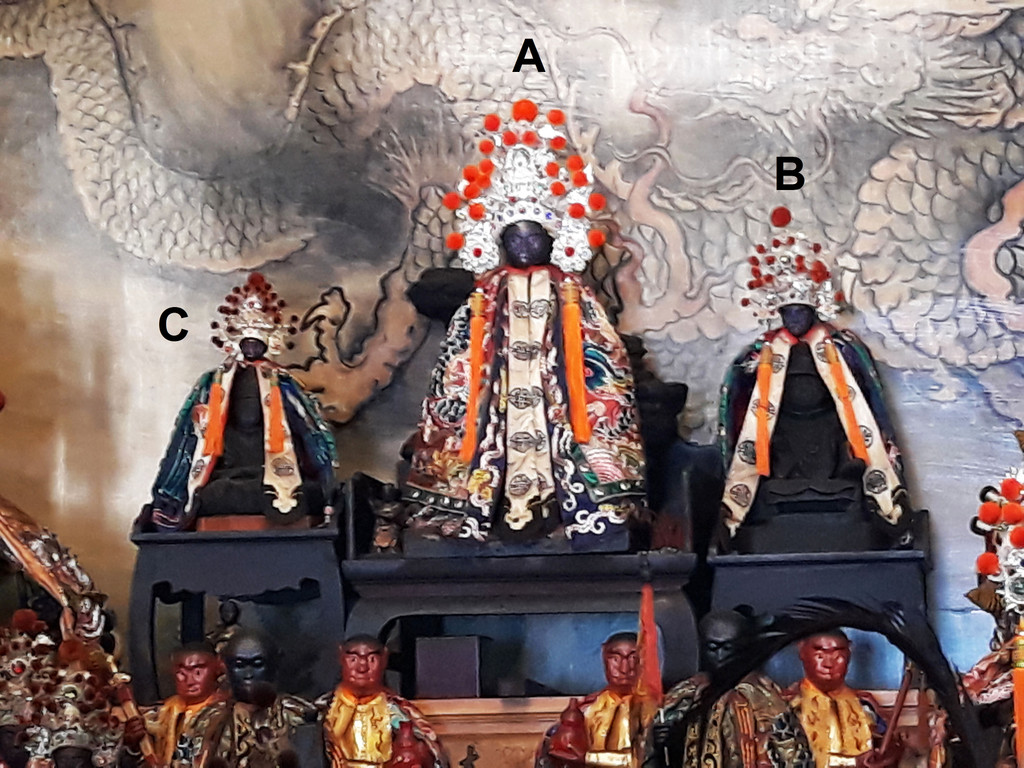
Table of Contents
- 1. Modern Demographics and Possible Ties to Historical Trends
- 2. The Connection Between Religion, Myth, and Popular Literature
- 3. Historical Monkey Cults in Fujian
- 4. Conclusion
- 5. Updates
1. Modern Demographics and Possible Ties to Historical Trends
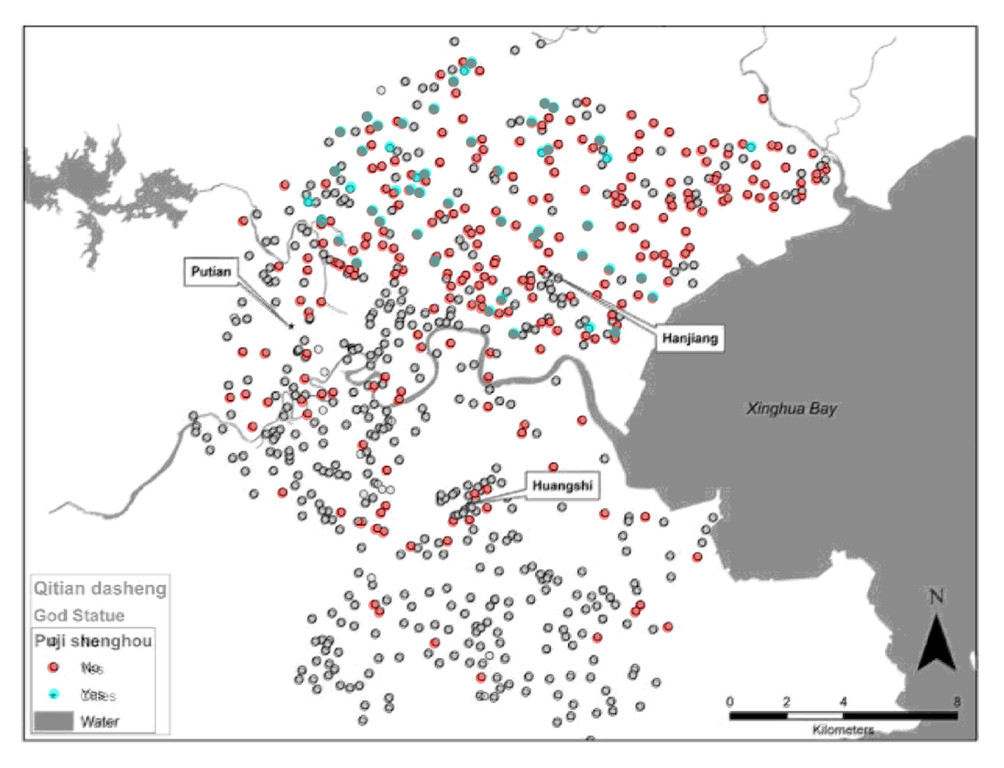
The plains of Putian (莆田) on the central Fujian coast hosts a cluster of Great Sage temples. Dean and Zheng (2009) show that the Great Sage is the sixth of the forty most deities, his statue appearing in 332 temples, even beating out Guanyin (322 statues) in seventh place (p. 177). Additionally, they describe an interesting geographical correlation in their distribution:
Using GIS mapping, one can unearth many suggestive correlations in distributions of different cultural features across the plain. For example, certain gods such as Qitian dasheng 齊天大聖 (Sun Wukong 孫悟空) and Puji shenghou 普濟聖侯 (Zhu Bajie 豬八戒), the Monkey and the Pig of the classic Xiyouji 西游記 (Journey to the West), appear more often in poorer villages in the northern plain [fig. 2], often in higher elevations than in the low-lying, densely irrigated, wealthier villages of the southern plains. This suggests that the unruly natures of these gods appealed to poorer communities rather than to villages with established scholar-literati lineages (Dean & Zheng, 2009, pp. 38-39)

Fig. 2 – Left: Distribution of Sun Wukong temples (red) in the Putian plains of Fujian Province, China (larger version); Right: An overlay of Zhu Bajie Temples (light blue) with those of Monkey (red) (larger version). There is quite a bit of overlap. Adapted from Dean & Zheng, 2009, pp. 192-193.

Sun Wukong is one of several gods who never enjoyed state patronage in dynastic China due to their eccentric or rebellious nature (Shahar, 1996, p. 185). Regarding the latter, emperors had to deal with real world challenges to their own primacy, so paying homage to, say, a dissident monkey spirit probably didn’t seem too appealing. It’s interesting to note that Monkey is worshiped in Fujian and Taiwan under his defiant title of the Great Sage Equaling Heaven (Qitian dasheng, 齊天大聖), a name he took up during his rebellion with the celestial realm, instead of his Buddhist name Wukong (悟空, “Awakened to Emptiness”) (Shahar, 1996, p. 201). Therefore, Monkey may have historically appealed to poorer folks because he had the power to push back against an unfair government, perhaps one that favored rich literati over impoverished farmers. This could explain the demographics mentioned above. If true, such people could be responsible for bringing Sun’s cult to Taiwan.
2. The Connection Between Religion, Myth, and Popular Literature
Emperors who officially recognized gods helped make them more popular or at least better known. [1] But as Shahar (1996) explains, the state’s involvement rarely went beyond building temples and making offerings. Oral tales and popular novels were largely responsible for spreading the myth of a particular deity (p. 185). He continues:
In some cases the novel’s transformation of its divine protagonist was so profound, and its impact on the shape of its cult so great, that the novelist could be considered the deity’s creator. A notable example is Sun Wukong. The cult of this divine monkey in late imperial times cannot be separated from his image as shaped by the successive Journey to the West novels. In this respect he is indeed their author’s creation, and Pu Songling‘s complaint, voiced through his protagonist Xu Sheng [許盛], is justified: “Sun Wukong is nothing but a parable invented by [the novelist] Old Qiu [老丘]. [2] How can people sincerely believe in him?” (Shahar, 1996, pp. 193-194).
The tale referred to by Shahar, titled the Great Sage Equaling Heaven (Qitian Dasheng, 齊天大聖), appears in Strange Tales from a Chinese Studio (Liaozhai zhiyi, 聊齋誌異), a collection of popular tales recorded as early as 1679 by Pu Songling and later posthumously published in 1740 (Barr, 1984). The story follows the aforementioned Xu Sheng and his older brother, both merchants from Shandong, who travel to Fujian to sell their wares but are told to pray to the Great Sage when they fail to make any money. They visit the monkey god temple and witness people burning incense and kowtowing to an image of Sun Wukong. The older brother takes part in the rituals, but Sheng simply laughs and leaves, resulting in a subsequent argument between the two during which Sheng ridicules adherents for worshiping a fictional character from a novel. Sheng later falls bedridden with agonizing leg sores that prevent him from walking, yet he refuses to accept the Great sage is punishing him. His sibling begs him to repent, but he still refuses. The brother shortly thereafter falls ill and dies, prompting Sheng to go to the temple to beg for his brother’s life. That night, he dreams that he is brought before Sun Wukong, who rebukes Sheng for his rude behavior and reveals that the leg sores—the result of being stabbed by Monkey’s heavenly sword [3]—and his brother’s subsequent death to be heaven-sent punishments. The deity finally agrees to revive the brother and sends an order to King Yama in hell to release his soul. Sheng shows his thanks by kneeling. He then awakes to find his brother has revived but remains too weak to work. Days later, Sheng meets an old man who claims that he can use “a little magic” to transport them to a beautiful place that will sap away the merchant’s depression wrought by the past events. The two travel by cloud to a celestial paradise where Sheng and the old man drink tea with an aged deity. The god rewards Sheng with twelve magic stones for taking the time to visit him. Upon returning to earth, the merchant realizes that the old man was the Great Sage, for both use the “Somersault Cloud” (Jindou yun, 筋斗雲) as a means of conveyance. In the end, the magic stones are found to have melted, but this corresponds to a drastic increase in the brothers’ selling profits. The two return home but are sure to pay their respects to the Great Sage anytime they visit Fujian for business (Pu & Sondergard, 2014, pp. 2078-2085).
The tale includes an afterward that critiques the idea of Sun Wukong being a real god:
The collector of these strange tales remarks, “Once upon a time, a scholar who was passing a temple went in and painted a pipa on one wall, then left; when he checked on it later, its spiritual power was considered so outstanding that people had joined together there to burn incense to it. A god certainly doesn’t have to exist in order to be considered powerful in this world; if people believe it to be divine, it will be so for them. What’s the reason for this? When people who share the same beliefs gather together, they’ll choose some creature figure to represent those beliefs. It’s right that an outspoken man like Sheng should be blessed by the god; who else could believe for real that he’s protected by someone who keeps an embroidery needle inside his ear, who he can transform one of his hairs into a writing brush, or who ascends via cloud-somersault into the cerulean sky! In the end, Sheng’s mind must have deluded him, for what he saw simply couldn’t be true” (Pu & Sondergard, 2014, p. 2085)
This shows that while the common folk believed in Monkey, the literati class scoffed at such an idea. This again may explain why, as mentioned above, that more well-educated communities in modern Fujian do not widely worship the Great Sage.
3. Historical Monkey Cults in Fujian
Apart from Pu Songling’s story, there are two other 17th-century references to the worship of a monkey god in Fujian. Dudbridge (1970) explains:
According to You Dong [尤侗] (1618-1704) the citizens of Fuzhou worshiped Sun Xingzhe [孫行者, Pilgrim Sun] as a household god and built temples to the monkey-god Qitian Dasheng. Tong Shisi [佟世思] (1651-92) describes the monkey-headed god of Fujian as bearing a metal circlet about his forehead, brandishing an iron cudgel, wearing a tiger-skin and known as Sun Dasheng [孫大聖, Great Sage Sun]. Traditionally he had appeared in the clouds to beat back an attack from Japanese pirates (p. 158). [4]
I find the last reference particularly interesting because it refers to the preceding 16th century when China’s coast was plagued by Japanese pirates. It depicts the Great Sage as a benevolent god who intervenes to protect his chosen people, the Chinese.
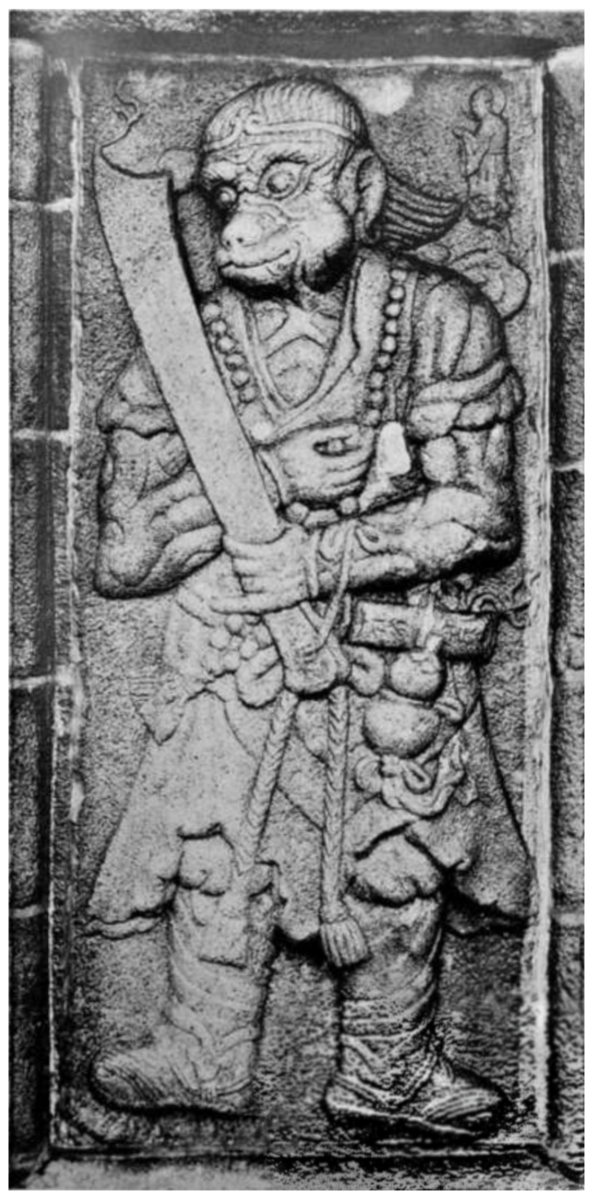
In her excellent paper on the origins of Sun Wukong, Hera S. Walker (1998) discusses a 1237 stone relief from the western pagoda of the Kaiyuan Temple (開元寺) in Quanzhou, a port city in Fujian, that portrays a sword-wielding, monkey-headed warrior (pp. 69-70). [5] Considered by many to be an early depiction of Monkey, the figure wears a fillet, a tunic, a Buddhist rosary, and a pair of bangles (Fig. 3). Walker quotes Victor Mair, who believes that the fillet and the figure wearing it recall South and Southeast asian depictions of the Buddhist guardian Andira and the Hindu monkey god Hanuman (Walker, 1998, p. 70). I have suggested in a previous article that the accouterments worn by the warrior are instead more likely based on Esoteric Buddhist ritual attire known in China. So instead of being based on a foreign source, it can be considered a depiction of a local spirit or deity. The relief, therefore, suggests that the proposed Fujian monkey god cult predates the 17th century.

Fig. 3 – The 1237 stone relief of Sun Wukong from the Kaiyuan Temple in Quanzhou, Fujian (larger version).
The oldest known evidence for a cult based around a monkey is described in Hong Mai’s (洪邁, 1123–1202) the Record of the Listener (Yijian zhi, 夷堅志, c. 1160), a collection of supernatural tales from the Song Dynasty. The following story is said to take place in the Yongfu County of Fujian. Again, we turn to Dudbridge (2005):
The image [effigy], dubbed Monkey King 猴王, was shaped around a captured living monkey and worshipped as a ‘spirit protecting hills and woods’ (保山林神). [6] It afflicted the surrounding population with fevers and frenzy. Blood sacrifice won no relief. Shamans and monks assaulted the spirit by night with noisy ritual music, but to no effect. Only the Buddhist elder Zongyan 宗演 successfully admonished the resentful monkey spirit and wrought its deliverance by reciting in Sanskrit the dhāraṇī of the All-Compassionate (大悲咒). The grateful monkey appeared to him the same night, explaining that she was now able to rise to heaven. Later the image and its thirty-two attendants (all made from birds) were smashed, and the hauntings came to an end (p. 264; see also Dudbridge, 1970, p. 159).
Dudbridge (1970) is reluctant, however, to accept this as a precursor to Sun Wukong’s cult, especially since both this 12th-century monkey spirit and the “Monkey Pilgrim” (Hou Xingzhe, 猴行者) from the The Story of How Tripitaka of the Great Tang Procures the Scriptures, a 13th-century precursor to Journey to the West, bear little resemblance to the simian god mentioned in 17th-century records. He instead suggests that the Great Sage’s cult could have grown up around stories connected to the publishing of the novel (Dudbridge, 1970, p. 159). While Journey to the West certainly played a sizable role in the spread of Monkey’s cult, I think that the above tale shows that the Fujian area was already primed for monkey worship by at least the 12th century. Most importantly, the noted Song dynasty poet Liu Kezhuang (劉克莊, 1187–1269), whose family hailed from the Fujian city of Putian (mentioned in section one) (Ebrey, 2005, p. 95), referenced the Monkey pilgrim twice in his 13th century work. The second of two such references uses Monkey as a metaphor to describe the ageing 70-year-old poet’s appearance. A portion of the poem reads:
A back bent like a water-buffalo in the Zi stream [泗河],
Hair as white as the silk thread issued by the “ice silkworms”,
A face even uglier than Hou Xingzhe,
Verse more scanty than even He Heshi [鶴何師] (Dudbridge, 1970, p. 46)
This shows that the character’s story cycle was so well-known in Fujian at this time that no other specifics from the oral tradition had to be mentioned. Therefore, stories of the early monkey cult and those of Sun Wukong could have existed in Fujian around the same time. It’s not entirely impossible then that the historical monkey worship in the province gave the cult of the Great Sage, whenever it first appeared, a boost. This might explain why a so-called literary character would come to be so readily worshiped in the province.
4. Conclusion
Taiwan has close ties to the southern Chinese province of Fujian because the former was made a prefecture of the latter during the 17th century. The province is home to a large number of temples dedicated to the Monkey King, so this is no doubt connected to the spread of his cult to the island nation. Modern GIS mapping in Fujian suggests that Sun Wukong’s temples mainly inhabit the northern highlands of the Putian plains, where poorer villages reside. Monkey’s cult never received royal patronage in dynastic China due to his rebellious nature. The fact that he is worshiped in Fujian and Taiwan by his rebellious title of the Great Sage Equaling Heaven suggests Monkey may have historically appealed to the poorer class because he had the power to push back against an unfair government, perhaps one that favored the rich over the destitute. If true, these could be the people responsible for bringing Sun’s cult to Taiwan.
The mythos of Monkey’s cult was spread thanks to oral tales and popular literature. His mythos became so inseparable from the novel that the scholar class looked down on him as a literary character that jumped from the pages of fiction to be worshiped as a god. An example of this viewpoint appears in Strange Tales from a Chinese Studio (written c. 17th century) in which a skeptical merchant only becomes an adherent of the Great Sage after he and his brother are punished with painful sores and death, respectively. The author of the tale comments that the merchant was probably delusional to fall for such a belief. This scholarly disdain for such literary gods may then explain why the more well-educated villages in Putian don’t widely worship Sun Wukong today.
Other 17th-century sources referring to Monkey’s Fujian cult portray him as a headband-wearing, cudgel-wielding benevolent god who comes to the aid of the Chinese people. A 13th-century stone relief located on the western pagoda of the Kaiyuan Temple in Quanzhou depicts a sword-wielding, monkey-headed warrior wearing a fillet. While past scholarship has posited a South and Southeast Asian origin for the figure’s iconography, my research suggests it to be based on esoteric ritual accouterments known in China. So instead of being based on a foreign source, it can be considered a depiction of a local spirit or deity. The relief, therefore, suggests that the proposed Fujian monkey god cult predates the 17th century. The oldest evidence for such a cult appears in Hong Mai’s Record of the Listener, a 12th-century collection of supernatural tales. It refers to a malevolent simian god worshiped as the “Spirit protecting hills and woods” that spread fever and was eventually pacified by a Buddhist monk. This shows that Fujian was primed for monkey worship by at least the 12th century, and the fact that the “Monkey Pilgrim” (Sun Wukong’s original name) is mentioned in the secular works of the Putian poet Liu Kezhuang in the 13th century shows that stories of this god and Monkey existed in Fujian around the same time. The historical existence of a Fujian monkey cult may have then given Sun Wukong’s cult a boost, explaining how a literary character came to be so readily worshiped.
5. Updates
5.1. Great Sage Worship in 19th-Century Fujian
Updated: 07-26-19
The American missionary Justus Doolittle (1865) recorded information about the worship of the Great Sage in Fuzhou city, Fujian province, China during the 19th century:
The Monkey. — It is represented as a man sitting, the face only being like a monkey. The image is usually made of wood or clay. Sometimes a picture of it is made on paper, or simply the title under which the monkey is worshiped is written on a slip of paper, and used instead of an image. There are several large temples at this place, erected for the worship of “His Excellency the Holy King,” one of the titles much used in speaking of the monkey as an object of worship. Oftentimes the niche holding the image or the written name is placed in a hollow tree, or in the wall at the corners of streets, or at the heads of alleys or lanes. Such places, in this city and vicinity, where the monkey is worshiped, reckoned together with the small temples or buildings dedicated to it, amount to several scores. The worship consists principally in the burning of incense and candles, sometimes attended with the presentation of meats, vegetables, and fruits. The monkey was first worshiped in return for some supposed services rendered the individual who went to India, by special command of an emperor of the Tang dynasty, to obtain the Sacred Books of the Buddhist religion — so some affirm. This emperor deified the monkey, or, at least, he conferred the august title of “the great Sage equal to Heaven” upon that quadruped. The birthday of “His Excellency the Holy King” is believed to occur on the twenty-third of the second Chinese month, when his monkey majesty is specially worshiped by men from all classes of society. The monkey is believed to have the general control of hobgoblins, witches, elves, etc. It is also supposed to be able to bestow health, protection, and success on mankind, if not directly, indirectly, by keeping away malicious spirits or goblins. People often imagine that sickness, or want of success in study and trade, is caused by witches and hobgoblins. Hence the sick or the unsuccessful worship the monkey, in order to obtain its kind offices in driving away or preventing the evil influences of various imaginary spirits or powers (vol. 1, pp. 287-288).
He continues, “Sometimes the image carried in procession while praying for rain represents a deified monkey, an object which is much worshiped by some classes of the people at this place” (Doolittle, 1865, vol. 2, p. 119).
It appears that Doolittle wasn’t aware of Journey to the West since he combines folklore with history, claiming a Tang emperor deified and/or bestowed Wukong with his Great Sage title. Sun’s image as an exorcist and healer, as well as his remuneration with incense and delicious foodstuffs, matches what I’ve previously written about in Taiwan. But his association with rainmaking is new, although not entirely a surprise. Also, his birthday is celebrated on a different day, the twenty-third day of the second lunar month, instead of the twelfth day of the tenth lunar month in Taiwan and the sixteenth day of the eighth lunar month in Hong Kong and Singapore. Interestingly, unlike Fuzhou, his birthday is celebrated on the twenty-fifth day of the second lunar month in Putian (Dean & Zheng, 2010, p. 162, for example). Such differences highlight that Monkey’s cult never received state patronage and, therefore, lacks standardization in beliefs and practices even in Fujian.
This information may have implications for the worship of the Great Sage by southern Chinese immigrants in 19th-century San Francisco.
5.2 Tang-Era Monkey Worship
Updated: 08-17-2019
The Japanese researcher Isobe Akira shows that despite appearing in Song-era sources, the aforementioned story about the female monkey king can be traced to the late-Tang period (Mair, 1989, pp. 694-695). This shows that Fujian was primed for monkey worship centuries prior to the development of Sun Wukong’s story cycle.
Additionally, Isobe points to one of the earliest known references to Sun Wukong. A tale appearing in Zhang Shinan’s (張世南, 12th to 13th century) Memoirs of a Traveling Official (Youhuan jiwen, 遊宦紀聞) tells of Zhang the Sage (Zhang sheng, 張聖), a farmer-turned-Buddhist monk who gains literacy and clairvoyance after eating a magic peach. In the story, Zhang is asked to write a eulogy in honor of a newly built revolving sutra case. The resulting poem references the Monkey Pilgrim:
Fresh are the pattra (palm) leaves on which are written
the unexcelled (anuttara), vigorous texts,
In several lives, Tripitaka went west to India to retrieve them;
Their every line, their every letter is a precious treasure,
Each sentence and each word is a field of blessing (punyaksetra).
In the waves of the sea of misery (duhkha-sagara),
the Monkey-disciple presses on 猴行復,
Through the waters of the river that soak its hair,
the horse rushes forward;
No sooner have they passed the long sand than they must face
the trial of the golden sands,
Only while gazing toward the other shore do they know
the reasons (pratyaya) for being on this shore.
The demons (yaksas) are delighted that they might
get their heart’s desire,
But the Bodhisattva, with hand clasped in respectful greeting,
sends them on;
Now here are the five hundred and sixty-odd cases of scriptures,
Their merit is difficult to measure, their perfection
hard to encompass (Mair, 1989, pp. 693-694).
This eulogy is fascinating because it references additional elements that would appear in The Story of How Tripitaka of the Great Tang Procures the Scriptures, including the Buddhist master’s quest to India over many lifetimes, the tribulations at the river of sand (a nod to Sha Wujing’s precursor), the demons encountered, and heavenly assistance. Isobe dates Zhang the Sage’s tale to the late-Northern Song to the early-Southern Song (circa 1127) (Mair, 1989, p. 694). But what’s interesting for our purposes is that the original recorder, Zhang Shinan was known to have historically held a government post in Fujian (Zheng, Kirk, Buell, & Unschuld, 2018, pp. 644-645), meaning that he could have picked up the tale in the southern province. This adds an additional connection between Fujian and Sun Wukong.
Notes:
1) One example of this connected to Journey to the West is Erlang. He was originally worshiped as a hunting god and queller of mountain ghosts by the Qiang (羌) ethnic group of the western Sichuan region. But his cult became even more popular upon gaining state recognition. Wu (1987) writes: “The Er-lang cult became even more popular in Sichuan under the patronage of the Later Shu emperor, Meng Chang 孟昶 (r. 934-65), and in 965, when the Song dynasty conquered the kingdom, it adopted the cult, erecting temples for the god in the capital and throughout the country” (pp. 107-108).
2) This refers to Qiu Chuji (丘處機, 1148–1227), the founder of the Dragon Gate sect of Daoism during the Song Dynasty. Qiu is known to have written a travel journal named Journey to the West, which Pu Songling confused with the novel of the same name (Pu & Sondergard, 2014, p. 2080 n. 1).
3) Literally “Bodhisattva Saber” (Pusa dao, 菩薩刀).
4) Source altered slightly. The Wade Giles was converted to pinyin and the Chinese characters from the footnotes were moved into the paragraph.
5) In act 10 of the early-15th century zaju play Journey to the West, Guanyin gives Sun Wukong an iron headband, a cassock, and most importantly, a sword. His depiction in the play and this relief then may have some connection.
6) The fact that the effigy was formed around a living monkey suggests that it was killed in the process. This would explain its rage.
Sources:
Barr, A. (1984). The Textural Transmission of Liaozhai zhiyi. Harvard Journal of Asiatic Studies, 44 (2), pp. 515-562.
Dean, K., & Zheng, Z. (2009). Ritual alliances of the Putian plain. Volume One: Historical introduction to the return of the gods. Leiden: Brill.
Dean, K., & Zheng, Z. (2010). Ritual alliances of the Putian plain. Volume Two: A survey of village temples and ritual activities. Leiden: Brill.
Doolittle, J. (1865). Social life of the Chinese: With some account of their religious, governmental, educational, and business customs and opinions. With special but not exclusive reference to Fuhchau. Volume 1 and 2. New York: Harper & Brothers.
Dudbridge, G. (2005). Books, tales and vernacular culture: Selected papers on China. Leiden: Brill.
Dudbridge, G. (1970). The Hsi-yu chi: A study of antecedents to the sixteenth-century Chinese novel. Cambridge: Cambridge Univ. Press.
Ebrey, P. B. (2005). Women and the family in Chinese history. London: Routledge.
Gordon, L. H. D. (2007). Confrontation over Taiwan: Nineteenth-century China and the powers. Lanham, MD: Lexington Books.
Mair, V. (1989). Suen Wu-kung = Hanumat? The Progress of a Scholarly Debate, in Proceedings of the Second International Conference on Sinology (pp. 659-752). Taipei: Academia Sinica.
Pu, S., & Sondergard, S. L. (2014). Strange tales from Liaozhai. Volume 6. Fremont, Calif: Jain Pub.
Shahar, M. (1996). Vernacular Fiction and the Transmission of Gods’ Cults in Later Imperial China. In M. Shahar & R. P. Weller (Eds.), Unruly gods: Divinity and Society in China (pp. 184-211). Honolulu: University of Hawaiʻi Press.
Walker, H.S. (1998). Indigenous or foreign? A look at the origins of monkey hero Sun Wukong. Sino-Platonic Papers, 81, pp. 1-117.
Zheng, J., Kirk, N., Buell, P. D., & Unschuld, P. U. (2018). Dictionary of the Ben cao gang mu, Vol. 3: Authors and book titles. Berkeley: University of California Press.
The Later Journey to the West: Part 3 – The Journey Comes to an End
Note: An AI translation of this novel is now available. Click the linked Chinese characters below that read “後西遊記.”
The main body of Later Journey to the West (Hou Xiyouji, 後西遊記, 17th century) follows a similar trajectory as the parent novel, Journey to the West (Xiyouji, 西遊記, 1592). The historical monk Dadian (大顛, 732–824) is tasked with traveling from China to India to retrieve spiritual knowledge from the Buddha, and just like Tripitaka, he is protected by three demonic disciples, namely Sun Luzhen (孫履真), the descendant of Sun Wukong, Zhu Yijie (豬一戒), the son of Zhu Bajie, and Sha Zhihe (沙致和), the disciple of Sha Wujing. Along the way the group travels through many lands, battles numerous evils, and they eventually become enlightened Buddhas like their predecessors two hundred years prior. As noted in part one, Later Journey to the West may appear like a carbon copy of the original, but the similarities are only skin deep since the novel is comprised of extremely dense layers of allegorical meaning.
Below, I present the last of a three-part summary of the novel (part 1 and part 2), which focuses on the end of the journey. I rely very heavily on Xiaolian Liu (1994) as the novel has yet to be published in English.
Notes have been added to the sections below to explain the allegorical meaning of various story elements.
Table of Contents
1. The Latter Half of the Journey
The novel has a total of 40 chapters. Liu (1994) only covers certain chapters since they contain the most allegorical meaning.
The pilgrims travel towards String and Song village (Xiange cun, 弦歌村) when they learn the Confucian society there hates Buddhism and spreads lies about its demonic nature. [A] Enraged, Monkey creates an army of warrior Skanda Bodhisattvas (Weituo, 韋馱) from his magic hair, each of which visits every family in the village and threatens them with punishment if they don’t receive the “living Buddhas” (the pilgrims) with much respect and fanfare. Luzhen also creates likenesses of the Four Heavenly Kings, who lead the monks into the village. The celestial spectacle causes the entire population to convert to Buddhism on the spot. This angers the demon ruler of the region, the Heavenly King of Civilization (Wenming tianwang, 文明天王), the reincarnation of a Qilin unicorn (fig. 1) who favors Confucianism over Buddhism. In their first battle, Monkey proves impervious to the demon’s weaponized coin scales, but is crushed under the weight of his writing brush-turned-spear. [B] The monster explains:
I don’t need knives or swords to kill you. With the writing brush, I can easily describe you as a heretic monk and write the words “Foreign religion,” which will crush you down, so you will never be able to stand up (Liu, 1994, p. 89).
A) The name of the village refers to the classic method of teaching Confucian values through song (Xiange, 弦歌) in ancient China.
B) The money and brush refer to the power and wealth belonging to the Confucian social elite. Monkey is impervious to the weaponized coins because, as a monk, he has no desire for money, but falls to the brush-spear because Confucians can sway public opinion about Buddhism simply with a few strokes of the brush.
The demon then kidnaps Dadian and subdues him under the weight of the brush and a golden ingot. Monkey consults the god of literature in heaven and learns that the monster’s brush is so powerful because it was originally used by Confucius to write the Analects. The group is finally able to defeat the demon and release Dadian with the god’s help.

Fig. 1 – A Qilin unicorn. This beast is often depicted with coin scales (larger version).

After many more adventures, the group comes to the Temple of Sudden Realization (Mengxing an, 猛省庵) on Division Ridge (Zhongfen ling, 中分嶺). There, the head monk tells them that the ridge is an extension of the Western paradise installed by the Buddha to weed out corrupt Chinese monks heading to India. Only those who pass the test of the Bodhisattva of Great Eloquence (Da biancai pusa, 大辯才菩薩) in the Temple of Division (Zhongfen si, 中分寺) on top of the ridge will be allowed to continue their pilgrimage. [C] The pilgrims pass their respective tests and are allowed to enter the Pass of Obstruction (Gua’ai guan, 挂礙關), where they face a blizzard and a road covered in brambles. [D] Dadian, Luzhen, and Shihe pay the obstacles no attention, but Yijie continues to fall further and further behind. The monks are surprised when they circle back around to find the same temple. A young monk gives them a note from the bodhisattva:
The temple which you have seen twice is the same temple;
The pass which appears and disappears is not a pass;
The true cultivation is without obstacles,
And the enlightened nature will eliminate delusions;
Only for those who are greedy and deceitful;
The road will be rugged and full of brambles;
One must cleanse himself of desires,
Before he can pay homage to the Buddha at the Spirit Mountain (Liu, 1994, p. 93)
C) Division Ridge and the Temple of Division both serve as filters that separate (or divide) true believers from those still plagued with desires or negative emotions.
D) The pass and Yijie’s troubles therein are metaphors for the negative mental states (or obstacles) that block someone’s path to enlightenment.
Yijie arrives late covered with scratches and bruises from his rough journey. He questions how his companions traveled so easily, but realizes the error of his ways when shown the note.
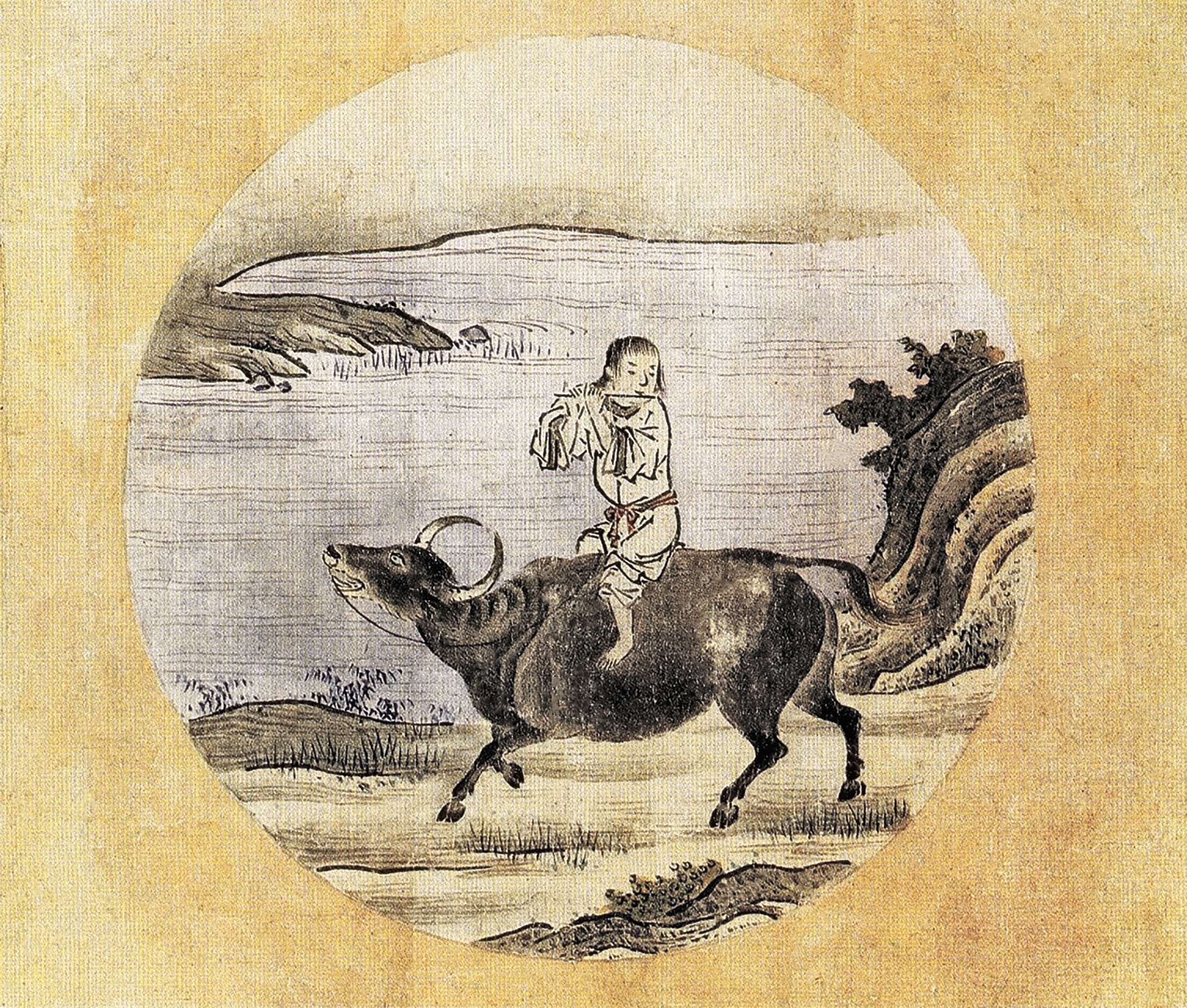
The pilgrims arrive at the Mountain of Cloud-Crossing (Yundu shan, 雲度山) located on the outskirts of India. They meet a young cowherd riding an ox (fig. 2) who tells them the mountain is a gateway to the Buddha’s paradise and that two paths to heaven exist. The easiest is located on the three small peaks of the mountain and measures a mere square inch. [E] This path is often taken by Buddhas, immortals, and other celestials. The other is a long, winding road located on the ground. He describes the latter as being a quick and pleasant route, but one fraught with danger if traveled with the wrong mindset:
If the Monkey of the Mind is still and the Horse of the Will is tame, and your speed is neither fast nor slow, the road will be smooth and steady, and you will be able to reach your destination in an instant. But if the Fire of the Liver flares up, the plank road will be burned down; if the Wind of the Spleen blows, the platform bridge will be destroyed; if the Water of the Kidneys is dried up, the boat will be stranded; and if the Air of the Lungs is weak, the chariot cannot be driven. In that case you will be traveling all your life, groping in the Skin Bag, and never be able to get out (Liu, 1994, pp. 94-95) [F].
E) The three peaks and the square inch are references to the Chinese character for heart or mind (xin, 心) (take note of the three dots on top of the character). This means the mountain is a metaphor for the mind. Those who master the mind and achieve enlightenment can take this quick path to paradise since they have already done the heard work of cleansing themselves of desires. This path is essentially located in the clouds, hence the name of the mountain.
F) The skin bag is the human body. Each of the body parts and elements refers to a particular human emotion. Therefore, if a person doesn’t tame the emotions, they will forever be a slave to their bodily desires.

Fig. 2 – The cowherd and his ox, a traditional symbol of enlightenment (larger version). Painting by Tenshō Shūbun (天章周文) (1414-1463).
Dadian chooses the long path, but his disciples goad him into taking a boat, a forbidden shortcut, which initiates the chain of events foretold by the cowherd (actually a sage in disguise). The vessel eventually runs aground on the riverbed because the water dries up. The priest then mounts his horse once more, but Yijie slaps its behind to speed up, leading to a wild, uncontrolled ride that knocks the wind out of Dadian and dampens his will to continue. Angry, the master admonishes the pig, causing the group’s path to be blocked by a monstrous fire. Seeing the road to paradise blocked, Dadian is beset with anxiety, causing a terrible wind that forces the group to take shelter in the forest. [G] The pilgrims soon realize the obstacles arise from the monk’s mental state. When Dadian centers himself, the wind subsides. The path before them then becomes an easy one.
G) Pilgrims on the journey to enlightenment create their own obstacles.
The group arrives at Spirit Mountain and meets the Laughing Monk (Xiao heshang, 笑和尚) who informs Dadian that he will meet the Buddha the following day and asks if he wants to see his material appearance (Semian, 色面) or immaterial appearance (Kongmian, 空面). The master, however, fails to answer out of confusion. The next day the pilgrims climb to Thunderclap Monastery, home of the Buddha, and find it devoid of any people. Monkey explains this represents “emptiness” and coincides with the Buddha’s aforementioned immaterial appearance. He goes on to not only claim himself the Buddha, but also superior to him:
Listen to what I have to say: The Buddha is merciful. Am I not merciful? The Buddha is wise. Am I not wise? The Buddha is vast. Am I not vast? The Buddha is divine. Am I not divine? The Buddha is void of the five qualities and I don’t have an inch of thread hanging on my body. [1] The cultivation of the Buddha took ten thousand kalpas of time. But it only takes me an instant. In the most profound sense, I can exist without the Buddha, but the Buddha can’t exist without me. You should think carefully. In what respect am I inferior to the Buddha (Liu, 1994, pp. 104-105).
When Yijie scoffs at his words, Luzhen enters a neighboring chamber and transforms into the Enlightened One, using his magic hairs to create a large retinue of lesser buddhas, saints, and guardian spirits (fig. 3). The pig is called before the false Buddha and sentenced to torture in hell, but Monkey is forced to revert to his true form when Dadian begs for lenience. The Laughing Monk later explains Luzhen’s stunt is not disrespectful but a demonstration of “The Mind is the Buddha” (Liu, 1994, p. 106). [H]
H) This refers back to the riddle that opens the novel (see part one):
I have a statue of Buddha, which nobody knows;
He needs no molding or carving;
Nor does he have any clay or color;
No human can draw him; no thief can steal him;
His appearance is originally natural,
And his clarity and purity are not the result of cleaning;
Though only one body,
He is capable of transforming himself into myriad forms (Liu, 1994, p. 22)
The answer to this riddle is “the Buddha is in the mind”. Liu (1994) considers Monkey’s above statement about being equal and even superior to the Buddha to be the most important passage in the entire book because it demonstrates “Buddhahood is inherent in everybody’s nature and everyone is capable of becoming the Buddha through self-cultivation” (Liu, 1994, p. 105).

Fig. 3 – The Buddha surrounded by a celestial retinue (larger version).

2. Returning with the Interpretations and Becoming Buddhas
The Laughing Monk escorts the pilgrims to see the Buddha, who is reluctant to release the true interpretation:
The divine scripture can only relieve people for a moment. Even with the transmission of the true interpretation, it is difficult to deliver many people. It would be better to get rid of all the words and interpretations and thus make people forget knowledge and perception. This is the wonderful principle of returning to the origin (Liu, 1994, p. 106). [I]
[I] This refers to over reliance on the written word and spoken interpretations, a concept revisited many times throughout the novel.
But he releases the interpretations anyway. The group, having become enlightened beings, fly on clouds back to the Chinese capital of Chang’an, returning five years after the journey started. Emperor Muzong (唐穆宗, r. 820–824) welcomes the pilgrims and builds for Dadian a prayer platform from which he can read the scriptures. [2] On the 18th day of the second (lunar) month of 824, the priest orders Luzhen to open the sutras that had been magically sealed by Tripitaka years prior. The Small Sage sends out a legion of monkeys all across the Middle Kingdom to complete this task. The resulting sermon enlightens the whole of China. The monk intends to finish reading the entire interpretation, but his lecture is stopped by the Laughing Monk who reveals himself to be the Buddha. Dadian and his disciples return to the Western Paradise with the Enlightened One and are bestowed with Buddhahood for their efforts. In the end, the Buddha shines light from his third eye onto China, transforming it into a paradise on earth.
Notes:
1) These five qualities, or “Wuyun 五蘊 are the five mental and physical qualities or constituents (Sanskrit: skandhas), i.e. the components of an intelligent being, especially a human being” (Liu, 1994, p. 116, n. 47). This means the Buddha and Monkey are not human.
2) Emperor Muzong’s father, Xianzong, dies during the course of the journey.
Source:
Liu, X. (1994). The Odyssey of the Buddhist Mind: The Allegory of the Later Journey to the West. Lanham, Md: University Press of America.
The Origin of Sun Wukong’s Magic Hairs
Last updated: 07-17-2022
I’ve written at length about Monkey’s staff, armor, golden headband, and tiger skin kilt, but the one thing that has puzzled me the most is the origin of his magic hair. The ability to create anything he wants from his hair first appears in chapter two when he’s forced to fight a demon who has kidnapped some of his children:
Seeing that his opponent was growing fiercer, Wukong now used the method called the Body beyond the Body [shen wai shenfa, 身外身法]. Plucking a handful of hairs from his own body and throwing them into his mouth, he chewed them to tiny pieces then spat them into the air. “Change!” he cried, and they changed at once into two or three hundred little monkeys encircling the combatants on all sides [fig. 1]. For you see, when someone acquires the body of an immortal, he can project his spirit, change his form, and perform all kinds of wonders. Since the Monkey King had become accomplished in the Way, every one of the eighty-four thousand hairs on his body could change into whatever shape or substance he desired (Wu & Yu, 2012, vol. 1, p. 128).

Fig. 1 – “Wukong Blows His Hair” (c. 1882) by Yoshitoshi (larger version).
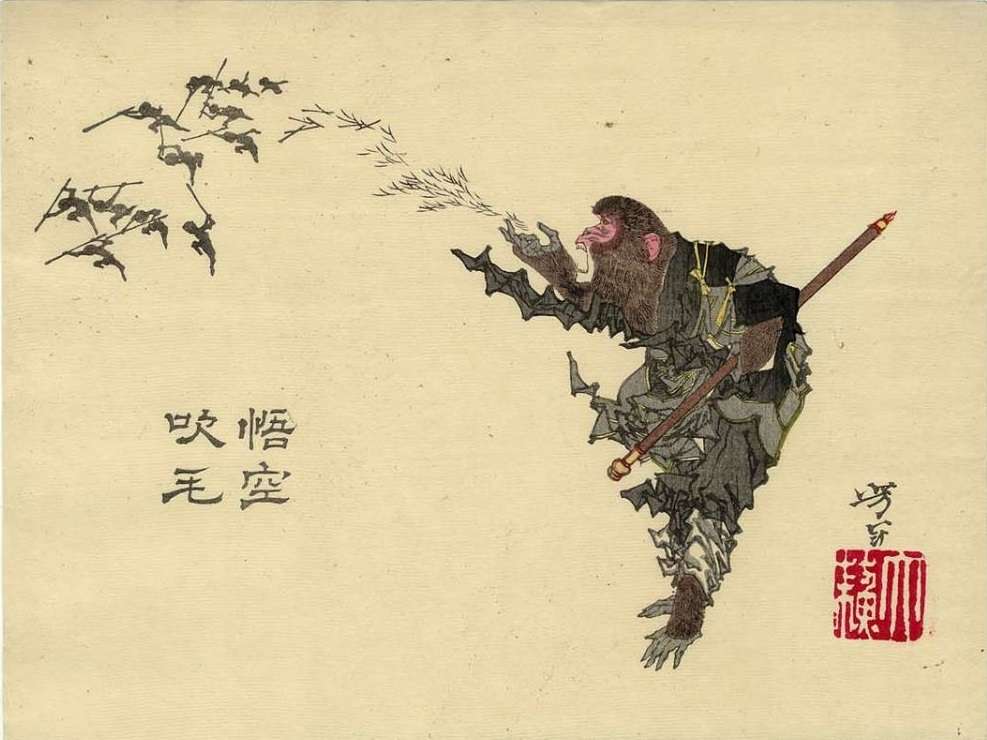
Table of Contents
- 1. Origin
- 2. Updates
1. Origin
I was pleased to find the answer while finishing work on a recent article. The following material appears in Meulenbeld’s (2007) wonderful study on Lei Gong (雷公):
This peculiar technique was not an invention of the author of Xiyouji; it existed in ritual practice as performed by Daoist priests to produce martial proxies. In an example from the late fourteenth century [the Song Lian quanji, 宋濂全集], recorded by Song Lian, we read about a certain Daoist that his “steps of Yu formed a Heavenly Paladin, pulling out hair to make soldiers” 禹步成罡, 拔髮為兵. A ritual manual from the Heavenly Reed tradition [the Daofa huiyuan, 道法會元], written at least one and a half centuries before Xiyouji (and probably much earlier even), mentions that in the practice of summoning forth divine troops “the spiritual agents, generals and scribes come out through the pores” 靈官, 將吏, 自毛竅出. Consistent with the Golden Glow of self-incineration practices I have described in chapter 3, the pores could radiate with the same Golden Glow, and make the gods manifest: “From all the holes and pores in the body of down and hair burst forth ten-thousand rays of Golden Glow; […] the ten-thousand gods all manifested themselves inside this Golden Glow” 一身毛髮孔竅都迸出萬道金光 […] 萬神俱現於金光中. In Daoist literature generally, the pores were regarded to be the “source of transformations” 造化之源 (pp. 294-295).
2. Updates
2.1. Relation to Immortal Spirits
Update: 09-19-19
As previously stated, the novel refers to Monkey’s ability to make clones of himself as “the method [of] the Body beyond the Body” (shen wai shenfa, 身外身法). Interestingly, this corresponds to a similar sounding name for the immortal embryo that a Daoist adept cultivates within themselves in an effort to create an immortal spirit body. Pregadio (2018) notes that, once gestated to maturation and freed to roam, this embryo-turned-immortal spirit is called the “person outside one’s person” or the “self outside one-self” (shen zhi wai shen, 身之外身) (p. 400). Above, I cited Meulenbeld (2007) who described a ritual in which a Daoist creates heavenly paladins by plucking out hair. Monkey instead creates magic clones of himself and sends these autonomous beings out to do his bidding, much like an advanced practitioner might send out their immortal spirit body. So it appears the author-compiler of Journey to the West mixed and matched various Daoist concepts to create some of Sun Wukong’s magical abilities.
2.2. Body Division in Daoist Literature
Update: 11-24-19
Body division (fenxing, 分形) is a common skill of the Daoist sage (Robinet, 1979, p. 49). Daoist hagiography mentions several practitioners able to divide themselves in order to simultaneously entertain multiple guests or answer the numerous summons of lofty officials. The most famous example is that of the late Han alchemist Zuo Ci (左慈), who is known for enraging the warlord Cao Cao (曹操) and using his body division power in hilarious ways to escape capture and execution time and time again. Part of his story reads:
<Inquiries determined that Zuo Ci had returned home. Duke Cao was now even more determined to have him killed, and he also wanted to test whether Zuo could avoid death, so he gave orders to have him apprehended. [As Cao’s men approached,]> Zuo fled into a flock of sheep, and his pursuers, losing sight of him, suspected that he might have transformed himself into one of the sheep. They had the sheep counted. Originally there had been an even thousand of them, but now there was one extra, so they knew that Zuo had indeed transformed himself. They announced: “Master Zuo, if you’re in there, just come out; we won’t hurt you.” Then one of the sheep knelt down and spoke words, saying, “Who would have thought I’d be pardoned?” When the pursuers tried to seize that one sheep, all of the other sheep knelt down and said, “Who would have thought I’d be pardoned?” So the pursuers [gave up and] left.
<Later on, someone learned Zuo Ci’s whereabouts and informed Cao, who once again sent men to apprehend him, and they captured him. It was not that Zuo could not have escaped; he deliberately allowed himself to be arrested in order to demonstrate his divine transformations. He was taken into prison. When the guards there were ready to torture and interrogate him, there was one Zuo inside the cell door and another Zuo outside it, and they did not know which one to torture. When Cao was informed, he despised Zuo even more, and ordered that he be taken out of the city and killed.> As they were taking him out of the city, Zuo suddenly vanished. So they locked the city gates and searched for him. It was announced that [they were searching for a man who] was blind in one eye and wearing a linen cloth wrapped on his head and a one-layer gown. The moment this announcement was made, the entire city full of people, numbering several tens of thousands, all turned into men blind in one eye wearing a linen cloth on their head and a one-layer gown [fig. 2]. So in the end they did not know which one to seize.
<Cao then put out an all-points order that Zuo Ci was to be killed on sight.> Someone saw and recognized Zuo, so they beheaded him and presented [the head] to Cao. Cao was overjoyed. When he inspected the head, however, it turned out to be only a bundle of straw. <When someone went back to search for Zuo’s corpse, it had vanished (Campany & Ge, 2002, pp. 280-281).

Fig. 2 – An entire city of Zuo clones (larger version). From a modern Romance of the Three Kingdoms comic.
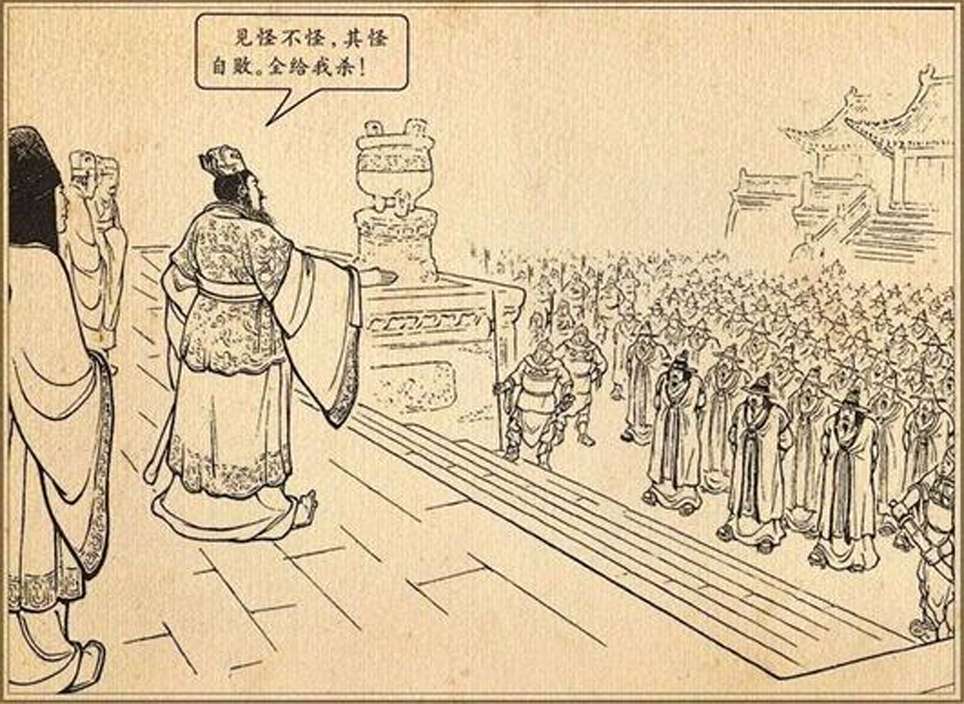
Zuo and Monkey share a cheeky talent for taunting their enemies with magic transformations. It’s important to note that, while this particular hagiography appears in Traditions of Divine Transcendents (Shenxian zhuan, 神仙傳, c. 4th century), a later adapted version appears in chapter 68 of the Chinese classic Romance of the Three Kingdoms (Sanguo yanyi, 三國演義, 14th century).
Additionally, Robinet (1979) describes a form of body division in which Daoists create miniature clones to do their bidding, much like the monkeys called forth from Sun’s magic hairs:
The Taoist encyclopedia, Yunji Qiqian [雲笈七籤, c. 1029], sets forth three similar methods, all of which involve the creation of a human simulacrum (yingren 影人 [lit: “shadow person”]) by means of mental concentration. Such figures, only several inches tall, can pass through walls and ascend to the heavens. They are substitutes for the Taoist himself, acting as representatives for him so as to roam the heavens and secure beneficial influences for him. They infuse these influences into the adept’s body where they proceed to the major organs (p. 49). [1]
This information shows that body division appeared in religious and vernacular literature prior to the publishing of the Ming Journey to the West. This means the novel’s author-compiler could have drawn from such media to influence Monkey’s powers.
2.3. Best Description from JTTW
Update: 03-19-22
The most impressive description of the magic hairs’ abilities appears in chapter 90:
“On my body,” replied Pilgrim with a chuckle, “there are eighty-four thousand hairs. One of them can change into ten of me, and the ten can also change into one hundred. In fact, the transformation can grow to millions and billions. This is the magic of the body beyond the body” (Wu & Yu, 2012, vol. 4, p. 220).
2.4. Magic Power (Including Hairs)
Update: 07-17-22
I’ve posted an article that explores one method that Monkey uses to transform his hair.
A Survey of Sun Wukong’s Magic “Immortal Breath” and Its Abilities
Notes:
1) Original source changed slightly. The original Wade-Giles was changed to pinyin.
Source:
Campany, R. F., & Ge, H. (2002). To Live as Long as Heaven and Earth: A Translation and Study of Ge Hong’s Traditions of Divine Transcendents. Berkeley: University of California Press.
Meulenbeld, M. R. E. (2007). Civilized Demons: Ming Thunder Gods from Ritual to Literature (Doctoral dissertation). Available from ProQuest Dissertations and Theses database (UMI No: 3247802).
Pregadio, F. (2018). Which is the Daoist Immortal Body? Micrologus 26, 385-407.
Robinet, I. (1979). Metamorphosis and Deliverance from the Corpse in Taoism. History of Religions, 19(1), 37-70.
Wu, C., & Yu, A. C. (2012). The Journey to the West (Vols. 1-4). Chicago: University of Chicago Press.
How the Hindu Bird God Garuda Came to Appear in Journey to the West
Last updated: 06-18-2023
Heroes from Chinese military fiction are often cast as reincarnations of celestial beings. For instance, the famous patriot General Yue Fei (岳飛, 1103–1141 C) is portrayed as a reincarnation of the Hindu-Buddhist bird deity Garuda (Jialouluo, 伽樓羅; Jialiuluo, 伽留羅) in his embellished life story, The Complete Vernacular Biography of Yue Fei (Shuo Yue quanzhuan, 說岳全傳, 1684 CE; a.k.a. The Story of Yue Fei). The bird, called the “Great Peng, the Golden-Winged King of Illumination” (Dapeng jinchi mingwang, 大鵬金翅明王), sits at the head of the Buddha’s throne in the Western Paradise. His fiery temper is aroused when a bat-spirit (the embodiment of the Aquarius constellation) passes gas during the Enlightened One’s sermon on the Lotus Sutra. He swoops down from the throne and snatches her up in his beak, killing her instantly. The Buddha admonishes the bird for his transgression of Buddhist law and exiles him to earth. His rebirth in the human world actually serves to counterbalance the actions of a nomadic antagonist, originally a dragon sent from the Eastern Heaven to punish China (Qian, 2016). This storyline was influenced by a previous work, Journey to the West (Xiyouji, 西遊記, 1592 CE), which explains how Garuda came to hold such an important position above the Buddha.
Called the “Peng of Ten Thousand Cloudy Miles” (Yuncheng wanli peng, 雲程萬里鵬), [1] the bird is portrayed as a spiritual uncle of the Buddha and an ancient demon king with unequaled strength, speed, and powers of transformation (fig. 1). He wields two magic weapons, a halberd and a vase capable of trapping and killing even immortals. Garuda is so powerful, in fact, that not even Sun Wukong (孫悟空) is strong enough to pacify the beast. Therefore, the Buddha himself is forced to leave the Western Paradise to confront the demon head-on. He casts the illusion of a bloody piece of meat above his head, and when the man-bird pounces on the bait, the Buddha takes away his ability to fly, thus trapping Garuda above his head in the demon’s original form as a golden-winged vulture (Dapeng jinchi diao, 大鵬金翅鵰) (fig. 2). After some struggle, the bird agrees to become a protector of Buddhist Law (Sk: Dharma; Ch: Fa, 法). Thus, Chinese fiction portrays Garuda as a powerful demon king that submits to the Buddha and perches above his throne as a hot-tempered guardian deity. [2]
The fact that this literary motif appears in two famous Chinese classics points to some widely known religious concept circulating during the 16th- and 17th-centuries CE. In this paper I will trace the origins of the motif from ancient South Asian literature and religious architecture to Esoteric Buddhist art in East Asia. The path we walk is a complicated one spanning centuries, belief systems, and artistic mediums.

Fig. 1 – A modern depiction of the Roc demon in his humanoid form (artist unknown) (larger version). Fig. 2 – A modern depiction of the roc trapped above the Buddha’s head (artist unknown) (larger version).
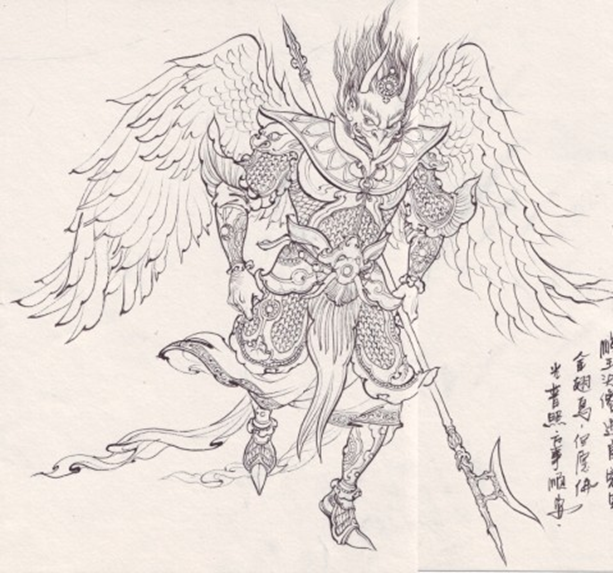
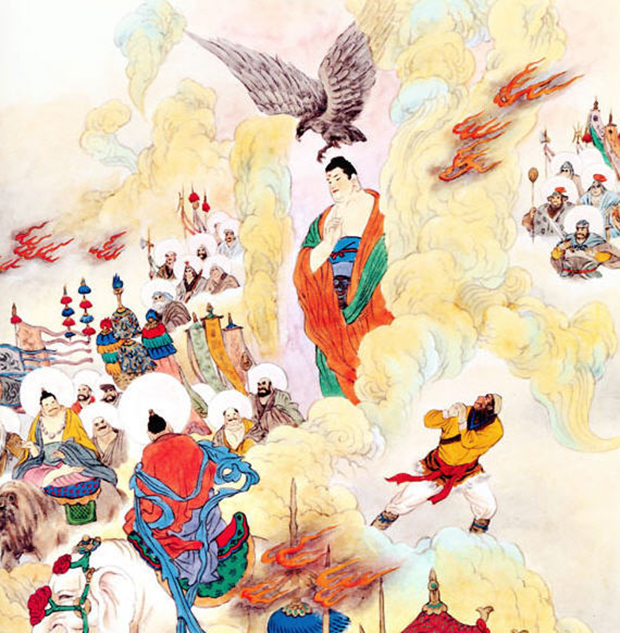
Table of Contents
- 1. India – Where Our Search Begins
- 2. Cambodia – The Motif Achieves Perfection
- 3. The Motif Spreads to East Asia
- 4. Garuda’s Transformation from a God to a Demon
- 5. Conclusion
- 6. Updates
1. India – Where Our Search Begins
1.1. Garuda’s Appearance in Ancient Literature
The origin of the Chinese literary motif is over two thousand years old, first appearing in the 4th-century BCE Hindu epic the Mahabharata. The holy work states that Garuda is the son of the creator-sage Kashyapa and his second wife Vinata. After gestating in his egg for one thousand years, the bird bursts forth and his massive, fiery body grows to engulf the entire cosmos. His sun-like splendor is so bright that the devas mistake him for Agni, the god of holy fire. Garuda is forced to reduce his size and illumination when the devas ask him to do so out of fear. Falling prey to an ancient curse, his mother Vinata loses a bet and is enslaved by her sister Kadru, mother of the naga-serpents. Garuda agrees to steal the vessel containing the immortal elixir of amrita from the devas in order to secure his mother’s release. He uses his great strength and speed to defeat the celestial army and kill the serpents guarding the elixir, and he uses his powers of transformation to extinguish the fire surrounding the treasured substance and sneak past the magic discus charged with dismembering thieves. Upon his return trip, Garuda is halted by the supreme deva Vishnu who grants him the boon of immortality for partaking in such a difficult quest. In return, the bird grants him the boon of serving as the carrier of his celestial vehicle (vimana) and positions himself above Vishnu’s head atop the flagpole (dhvaja). Not long after, Indra, king of the devas, strikes the bird with a lightning bolt in an attempt to retrieve the amrita. The bird pays him respect by shedding a single feather and grants him the boon of eternal friendship. After learning the reason for the theft, the devaraja grants Garuda the boon of taking his enemies the nagas as his food. Both of them then orchestrate a plan in which the bird pays the amrita ransom to free his mother, but Indra takes the elixir away before the serpents can drink of it. Finally, Garuda slaughters all of the nagas (Ganguli, 2003, pp. 57-82).
It’s easy to discern several aspects from Chinese fiction in the ancient story: 1) a powerful golden bird with great strength, speed, and powers of transformation; 2) a vessel with magical properties; 3) conflict between the bird and heavenly forces; 4) his subjugation by a higher power; 5) his installment above a deva’s head; and 6) continued conflict between the bird and his serpent foes. This adds to existing literature showing that the Mahabharata influenced Journey to the West (Subbaraman, 2002).
1.2. Garuda’s Appearance on Religious Architecture
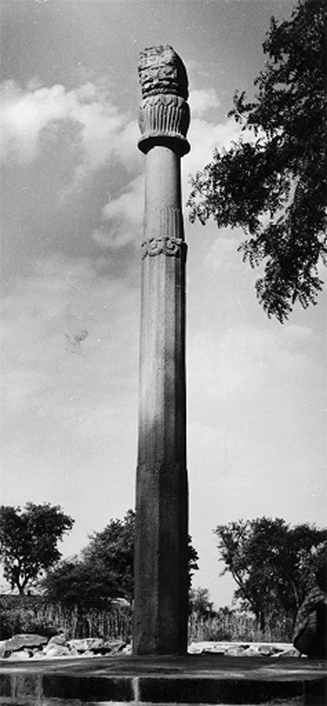
Since the Mahabharata was published, Garuda has been depicted on a number of ritual flagpoles (dvaja) in India. The dvaja pillar “is placed opposite the entrance to the main shrine [of a Hindu temple], on axis with the central image…it is an object of great importance and worship” (Dallapiccola, 2002, p. 60). Adherents would have paid reverence to it before entering the temple. People affected by snake bites would often embrace these types of pillars because they believed Garuda’s powers over the nagas (and their serpentine kin) would neutralize the poison (Zimmer, 1946, p. 75). The oldest of the stone dvaja columns still standing is the Heliodorus pillar (2nd-cent. BCE) erected by a Bactrian-Greek envoy and convert of that name in honor of Vishnu in Vidisha (fig. 3) (Walker, 1968, p. 246). The Garuda is no longer extant, having been eroded by time or destroyed by iconoclasts. It is considered the “first dated monument linked with Vishnu” (Elgood, 2000, p. 56). Clues to what the original capital may have looked like can be drawn from numismatic evidence. The golden dinar of King Samudra (r. 335-375 CE) of the Gupta Empire, for example, features a Garuda dvaja (fig. 4) (Mookerji, 1973, p. 52). The capital is depicted as a bird, suggesting the eroded figure on the Heliodorus pillar may have originally taken such a form. This differs from later humanoid depictions of the god (see below).

Fig. 3 – The Heliodorus pillar (2nd-cent. BCE), Vidisha, Madhya Pradesh, India (larger version). The Garuda capital is missing. Photo by the American Institute of Indian Studies (AIIS). Fig. 4 – The gold dinar of King Samudra (r. 335-375 CE) of the Gupta Empire (larger version). The Garuda dvaja can be seen to the left. Photo by the American Council for Southern Asian Art (ACSAA).

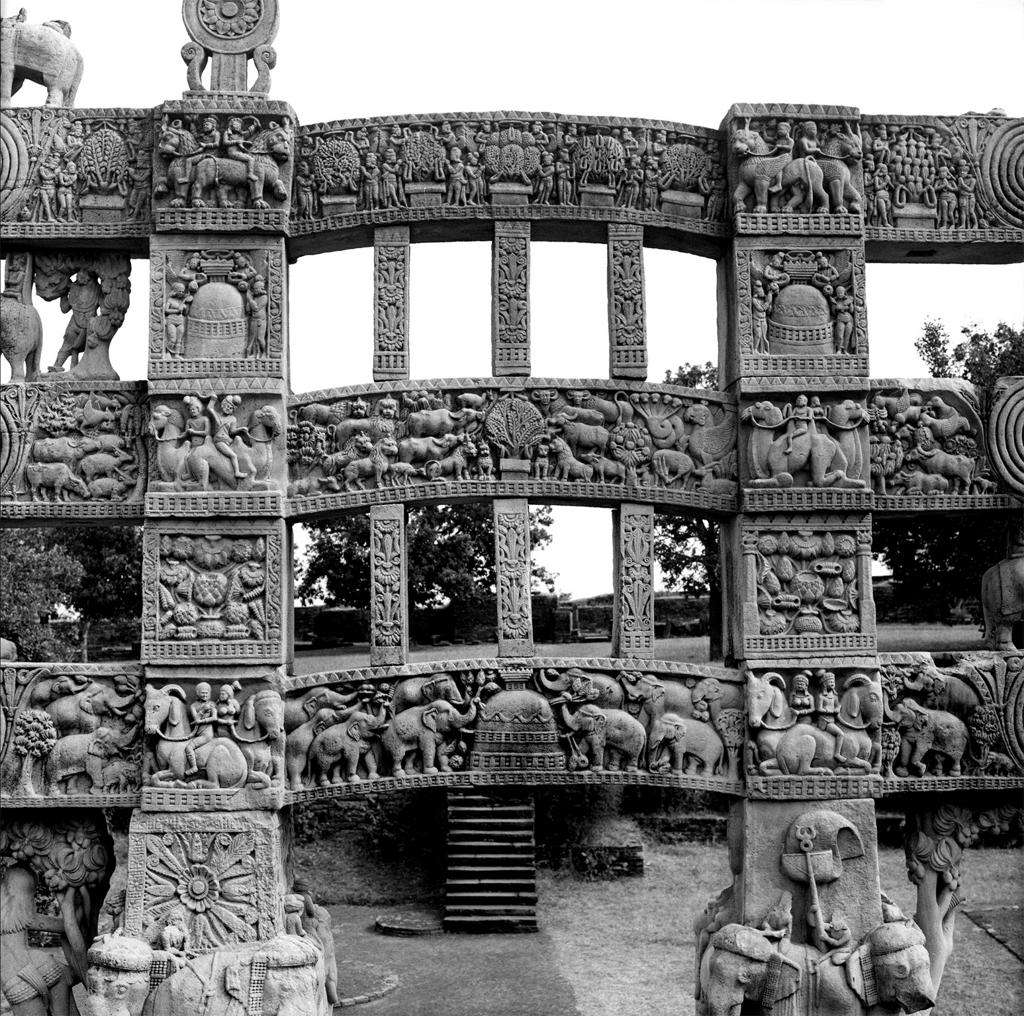
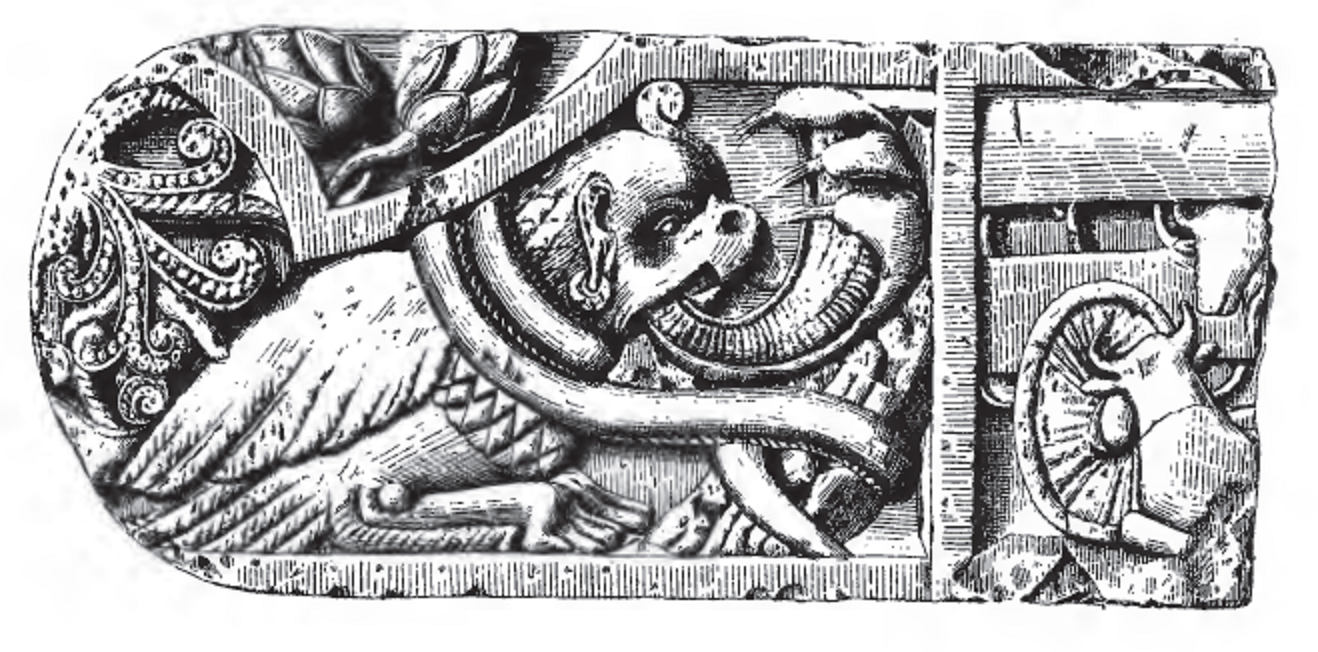
Garuda’s association with Buddhism seems to be quite old. His appearance on a number of standing gateways and carved cave temple entrances, collectively known as toranas, from the 1st-century BCE onward points to him being absorbed into the religion’s pantheon within a few centuries of the historical Buddha’s death. The oldest extant representation of Garuda appears on the eastern gateway of the Great Stupa at Sanchi (fig. 5) (Iyer, 1977, p. 52). Dated to the 1st-century BCE, the standing torana has three tiered architraves, the middle of which portrays a bodhi tree, an iconoclastic representation of the Buddha, flanked by real and mythical creatures paying homage to it. The far right side of this stone relief features Garuda standing next to a five-headed king of serpents (nagaraja) (fig. 6). The bird is depicted as a husky parrot with a delicate, forward curling crest, a thick beak, a pierced human ear, small flapping wings, and lacey tail plumage. The relationship between the two is amicable since it is a scene of religious reverence. This “Garuda and serpent” motif appears on the partial remains of a slightly younger stone architrave discovered in Kankali Tila at Mathura (Smith, 1969, p. 28). [3] The circa 1st-century BCE relief depicts him as a large bird of prey with similar iconography, including the curling crest, thick beak, and pierced human ear. But the tail plumage is far more flowery and ornate, indicating that the artist built off of the earlier example. Also, unlike the architrave from the Sanchi stupa, this piece portrays Garuda locked in a tense standoff with a three-headed nagaraja; the bird has a firm grasp of the hissing serpent with his beak, but the foe’s body is wrapped twice around the god’s neck and the tail is anchored at the base of a nearby tree (fig. 7) (Vogal, 1972, p. 172).

Fig. 5 – The reverse side of the East Torana of the Great Stupa at Sanchi (1st-cent. BCE), Madhya Pradesh, India (larger version). The Garuda and serpent motif is visible on the right side of the central architrave. Fig. 6 – Detail of the Garuda and serpent motif (larger version). Photos by the The Huntington Archive of Buddhist and Related Art (HABRA), The Ohio State University. Fig. 7 – The partial architrave discovered in Kankali Tila (c. 1st-cent. BCE) in Mathura, Uttar Pradesh, India (larger version). Drawing from Smith, 1969, p. 28 .

Later depictions of the motif anthropomorphize Garuda. For instance, he makes an appearance standing over the torana of the carved Bhuta Lena cave shrine number forty (c. 100 CE) in Junnar (fig. 8) (Qureshi, 2010, p. 315). He is coupled with a nagaraja at the apex of the arched doorway; the two are presented as peaceful humanoid companions wearing matching hats and clothing and standing in a similar pose. This could be related to a birth tale (jataka) in which the Buddha, in his previous life as a hermit, reconciles the hatred between Garuda and a naga by “rehears[ing] the blessings of loving kindness until they [are] both at one. Thenceforward they abode together happily in peace and harmony” (Vogal, 1972, p. 142).

Fig. 8 – Garuda (left) and Nataraja (right) above the torana entrance of the Bhuta Lena cave shrine no. 40 (c. 100 CE) in Junnar, Maharashtra, India (larger version). Photo by ACSAA.

Dhar (2009) notes that the standing gateway toranas were replaced in popularity by “the post, lintel, and eave-cornice (kapotapālikā) type entryways” sometime after the 2nd to 3rd-century CE (p. 16). She continues, “From the fifth century, such an entrance gateway became an integral part of temple doorframes…its posts served as pilaster-doorjambs (stamhaśākhās) and the eave-cornice integrated with the lintel” (Dhar, 2009, p. 16). It was around this time that Hindus followed the example of their Buddhist neighbors and began to create carved religious structures (Dehejia, 1997, p. 124). Such temples were considered the home of a given deity when they left their heavenly abode (Dehejia, 1997, p. 141). As such, these temples were profusely decorated with images of the deva, including the entrance way, to aid in their worship. A related root word for torana “suggests its role as an architectural symbol of a rite of passage or liminality” (Dhar, 2009, p. 1). This means whoever steps into the world of the “other” does so under the watchful eye of the deity placed on the torana. In the case of temples devoted to Vishnu and lesser devas associated with him, the image is either Garuda by himself (being a symbol of the god) or bearing the deva on his back, a variation on his portrayal in the Mahabharata that came to dominate his traditional iconography (Zimmer, 1946, p. 76).
1.3. Appearance of the Antagonistic Garuda and Serpents Motif
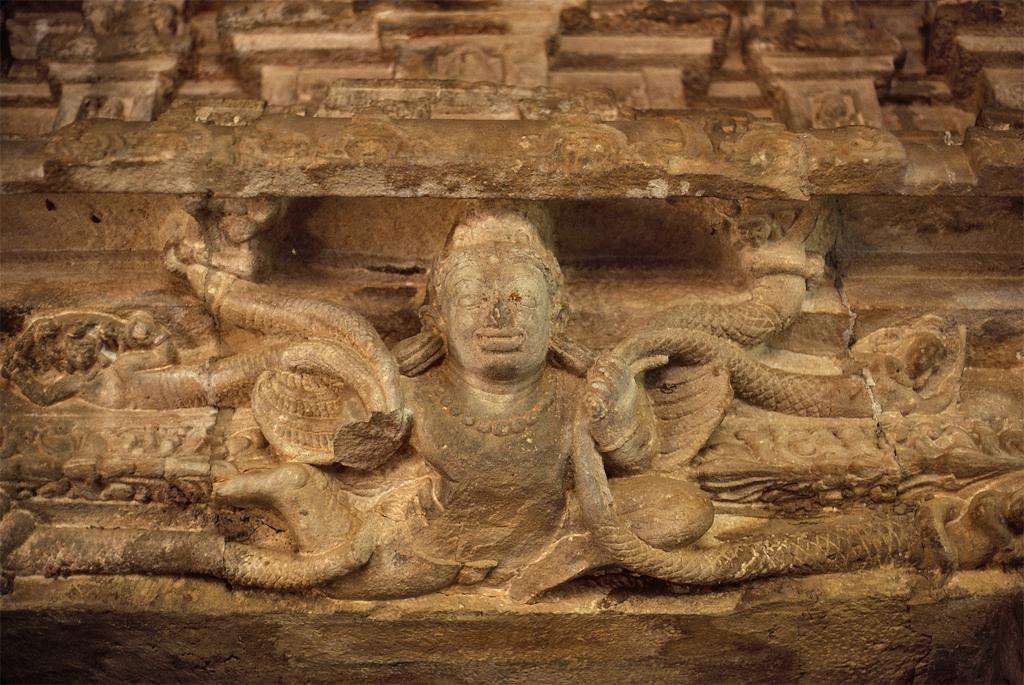
Whether alone or coupled with Vishnu, the antagonistic version of the Garuda and serpents motif began to appear on Hindu toranas by at least the 7th to 8th-century CE. In fact, the only examples that I can find come from this time period. I have seen examples of the “Garuda and Vishnu” motif above entrance ways as late as the 11th-century, but these are missing the serpents. However, later Tibetan art featuring the serpent variation suggests that there may be Indian examples that I am not aware of. The 7th-century CE example appears on the torana of the Gaudar Gudi Temple in Badami (Gupte, 1967, p. 54) (fig. 9). Garuda is portrayed in humanoid form wearing a hat and clothing similar to figure 8. He is squatting over the entrance while grasping the tails of naga-serpents flanking him on both sides. The first c. 700 CE example appears on the torana of the Durga (Fort) Temple in Aihole (fig. 10) (Tartakov, 1997, p. 192). He is depicted as a smiling human in an erect flying posture with his left leg tucked under his groin and his right trailing behind him. Just like the first piece, he is wearing similar attire and grasping the tails of nagas on his left and right sides. The second c. 700 CE example appears over the entranceway of the Rajivalocana Temple in Rajim (fig. 11) (Patel, 1992, p. 146). But this version has Garuda transporting a four armed Vishnu. The figure is again depicted in human form and grasping the tails of his serpentine foes.

Fig. 9 – The Gaudar Gudi Temple Garuda with serpents (7th-entury CE), Aihole, Karnataka, India (larger version). Photo by AIIS. Fig. 10 – The Durga (Fort) Temple Garuda with serpents (c. 700 CE), Aihole, Karnataka, India (larger version). Photo by ACSAA. Fig. 11 – The Rajivalocana Temple Garuda and Vishnu with serpents (c. 700 CE), Rajim, Chhattisgarh, India (larger version). Photo by the AIIS.


2. Cambodia – The Motif Achieves Perfection
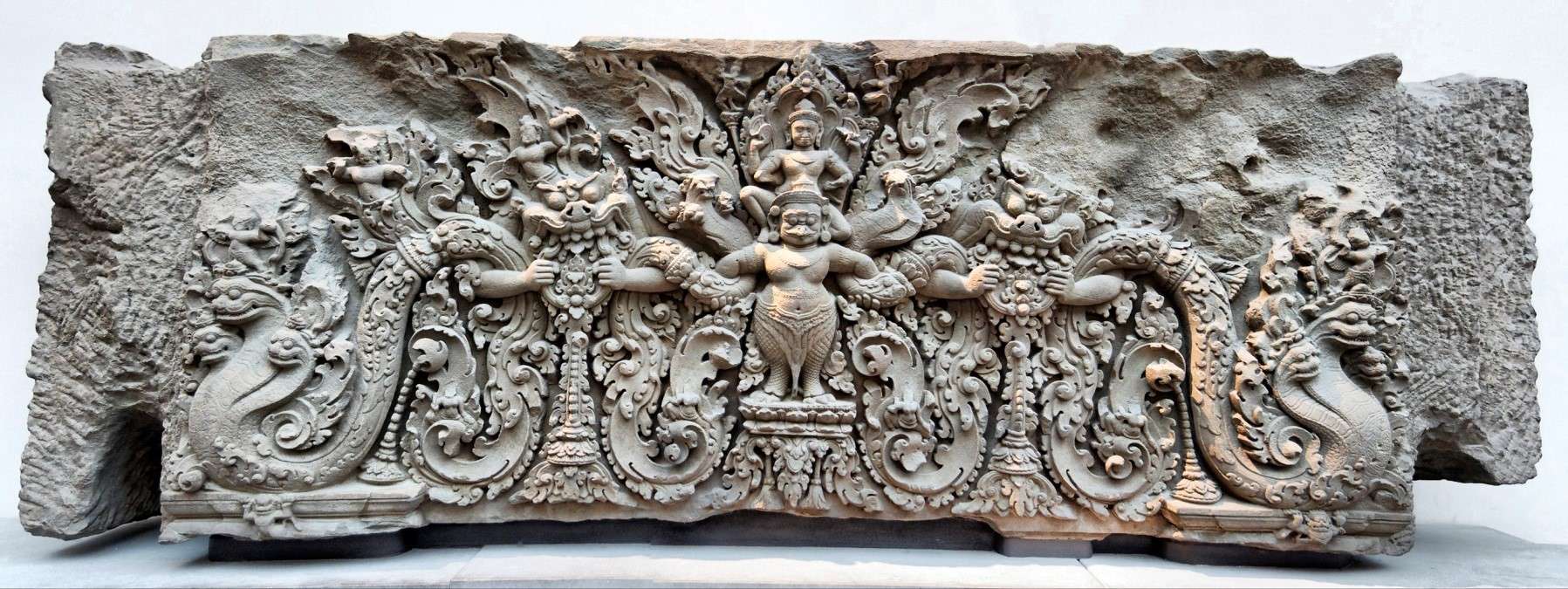
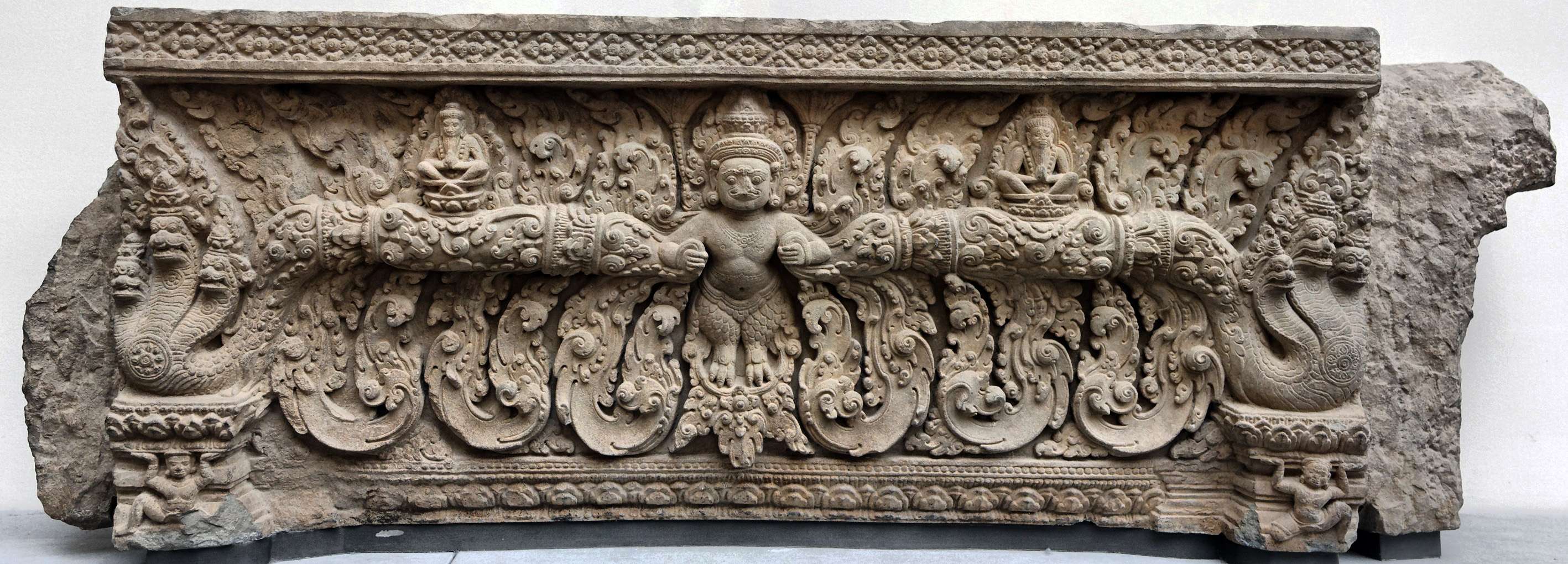
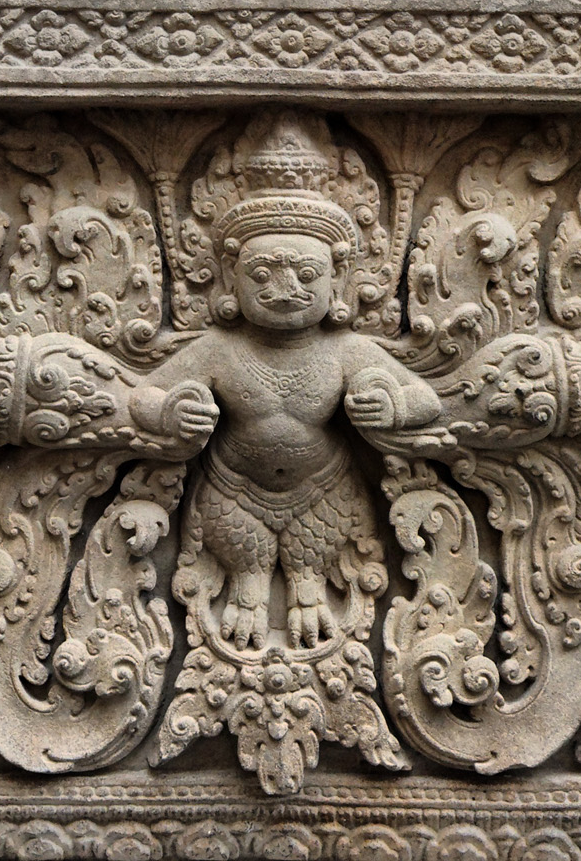
The torana spread to Southeast Asia by the late 6th- or early-7th-century CE. Next to India, Cambodia has the largest number of and most diverse toranas in all of Asia (Dhar, 2009, p. 214). In fact, I would dare say this is where the Garuda and serpents motif reached the point of perfection. Parul Pandya Dhar’s wonderful monograph The Torana in Indian and Southeast Asian Architecture (2009) features two beautiful examples from Buddhist temples carved in the unmistakable Khmer style. The first is an exquisitely crafted 9th-century CE entranceway from the Prasat Kok Po Temple in Siem Reap (pp. 222 and 228) (fig. 12 and 13). It portrays Garuda as a large, stout man-bird with pierced ears and wearing a Cambodian headdress and garment. He is standing on a pedestal and bearing a four-armed Vishnu on his back while grasping the flower garland-like tail of a three-headed nagaraja in each hand. The god is further flanked by two large creatures with gaping mouths known as “Faces of Glory” (Kīrtimukha). [4] Their arms interlock not only with the undulating serpents grasped by the man-bird, but two others located on the outermost left and right portion of the torana—the combination of arms and slithering serpentine bodies form a beautiful horizontal wave pattern with four crests. These larger nagarajas bear images of tiny Garudas standing on the back of their hoods. [5] The author notes that the “Kīrtimukha and makaras seen on Indian and Indonesian toranas are often replaced by the garuḍa-nāgas combination in Cambodia” (Dhar, 2009, p. 228). The second is a mid-10th-century CE entranceway from the Prasat thom Temple in Koh Ker (fig. 14 and 15). The depiction of Garuda is identical to the first example down to the clothing. But instead of bearing Vishnu and cooperating with the Kirtimukha to conquer nagas, he alone is grasping the long, flowery tails of his enemies who are positioned on pedestals at the same level as his own. Two small Buddhas use the bodies of the tightly drawn serpents as a place to meditate. Both nagarajas bear the Wheel of Buddhist Law (Dharmachakra) on their chests. The composition is therefore symbolic of Garuda and the nagas working together to literal “support” Buddhism.

Fig. 12 – The Prasat Kok Po Temple lintel featuring the Garuda and Vishnu with serpents motif (9th-century CE), Siem Reap, Cambodia (larger version). Fig. 13 – A detail of the motif (larger version). Fig. 14 – The Prasat thom Temple lintel with the Garuda and serpents motif (mid-10th-century CE), Preah Vihear, Cambodia (larger version). Fig. 15 – A detail of the motif (larger version). Photos by Wikimedia commons.

3. The Motif Spreads to East Asia
3.1. Tibet – The Motif Jumps from Architecture to Art
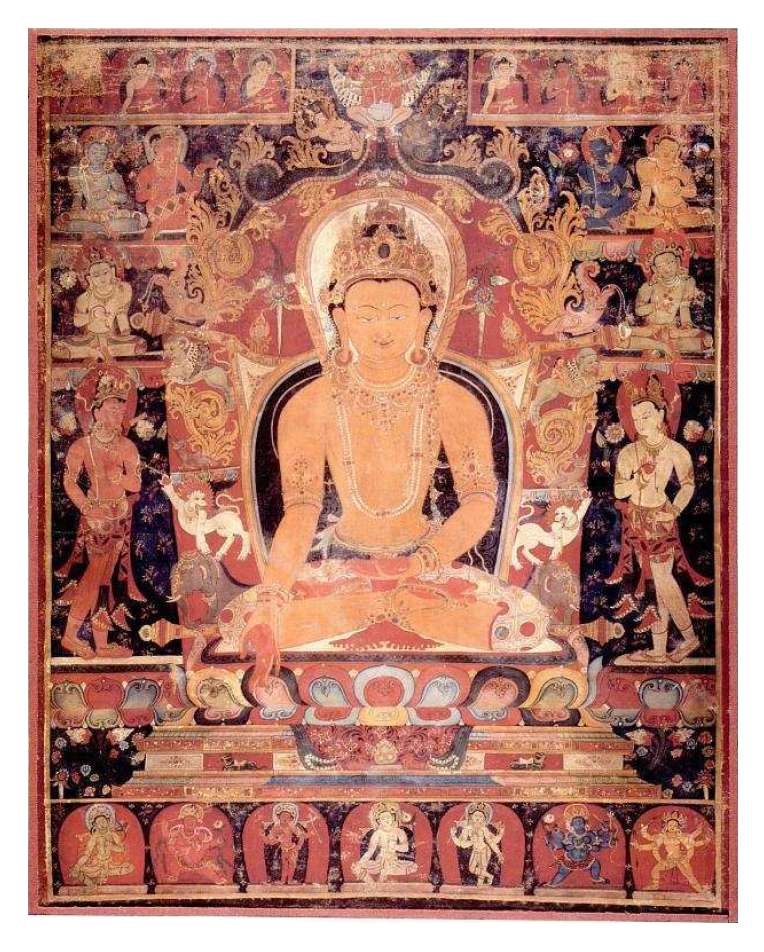
The Buddhist examples from Cambodia appear to have been influenced by depictions of the Garuda and serpents motif from Hindu temples. This is because they depict Hindu deities like Vishnu and portray the bird and naga as (symbolic) enemies. The same can be said for Buddhist art and architecture in East Asia. For instance, Heather Stoddard (1996) comments that the motif “is in fact present in all the main Tibetan [Buddhist] styles, and is indeed unique to Tibetan art” (p. 40). She continues, “The author has searched all over Asia, in Hindu or Buddhist cultures, without success, looking for the garuda in this pro-eminent position” (Stoddard, 1996, p. 40). (It’s obvious that Stoddard was unaware of the architectural origins of the motif at the time of her study.) One of the three pieces that she cites as examples is a 13th-century CE Nepalese painting of Ratnasambhava (Baosheng rulai, 寶生如來, fig. 16), one of the five Esoteric Buddhas (Stoddard, 1996, p. 42). The painting shows the Buddha sitting on a throne comprised of a lotus flower base and a backrest framed by all sorts of real and mythical creatures. The Garuda and serpents motif crowns the apex of the throne. Art historians call this an “enlightenment torana” or a “gate of glory” (Beer, 1999, p. 88; Stoddard, 2008, p. 23). It’s clear that Buddhist artists came to equate the torana with the fiery halo that signifies a deity’s enlightened or divine nature. Robert Beer (1999) believes that these enlightenment toranas could have appeared as early as the 4th-century, but that it became a common fixture in Buddhist art from the 8th to the 12th-century CE (p. 90). Two beautiful examples of an enlightenment torana from the mid-6th-century CE appear in the Kanheri Temple Cave number ninety in Mumbai (Malandra, 1993, p. 110). It depicts two Buddhas standing under their own gates of glory, complete with what appears to be licks of heavenly flame (fig. 17). Though missing the motif, these examples are nearly identical to later Tibetan art, suggesting, as mentioned above, that there could be later Indian examples featuring the Garuda and serpents motif that I am unaware of.

Fig. 16 – Ratnasambhava, with Bodhisattvas (13th-century CE), Nepal (larger version). The Garuda and serpent motif can be seen at the apex of the throne. Photo by the Los Angeles County Museum of Art. Fig. 17 – Two Buddhas with enlightenment toranas, from Kanheri Temple Cave number ninety, Mumbai, Maharashtra, India (mid-6th-century CE) (larger version). Photo by the AIIS.
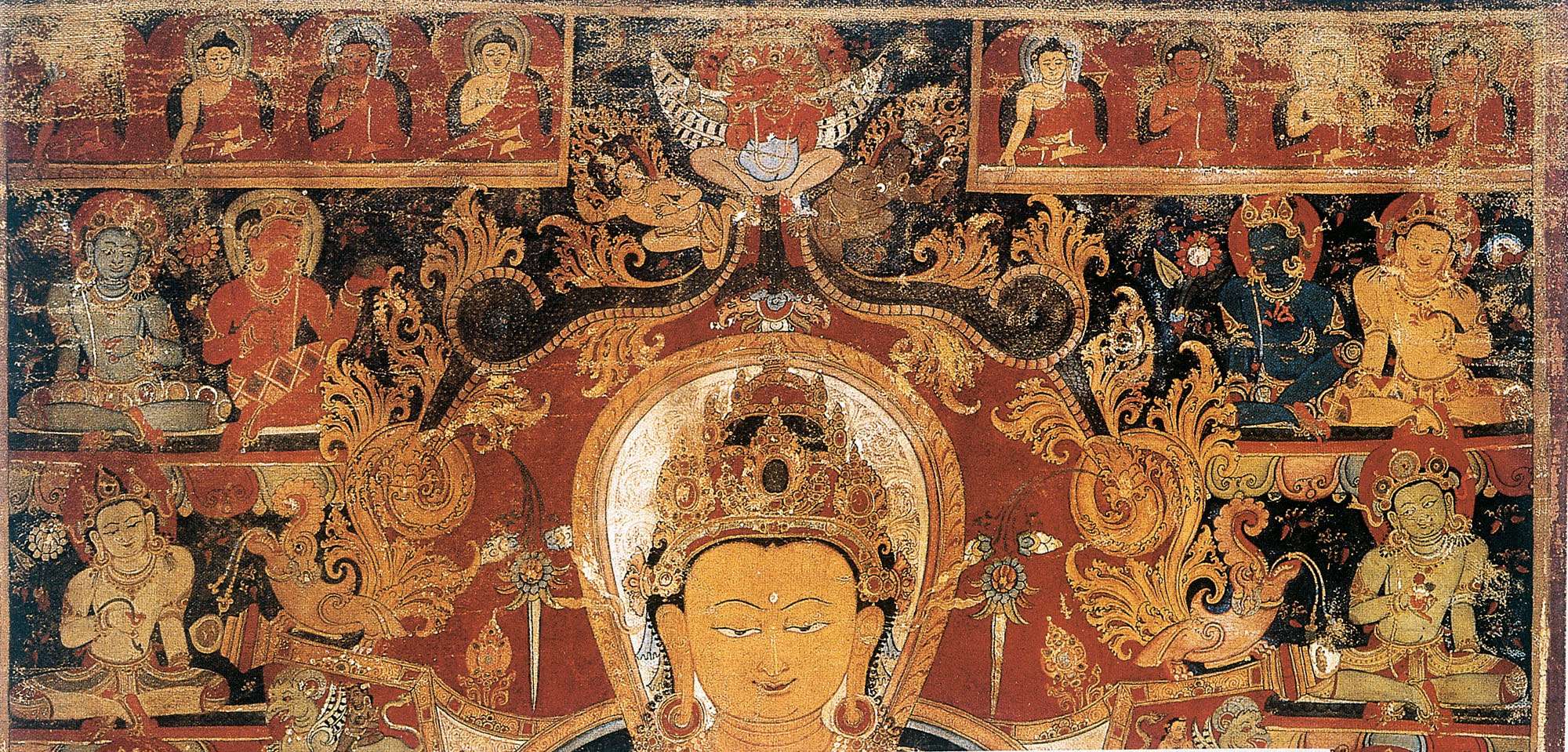

Nepalese-Tibetan Buddhist art featuring the motif doesn’t appear to predate the 11th-century CE, so this may have something to do with the second coming of Buddhism in Tibet. The religion became popular among the common folk during the 11th-century CE after lying dormant for nearly two hundred years. The Tibetan people embraced the Indian Buddhist faith and flocked to India in order to study in various monastic universities. Jan Casey Singer (1999) notes:
Within this international Buddhist community, the Tibetans stood apart by virtue of the particular zeal with which they sought to master the Indian Buddhist tradition. They had both the will and, since Tibet is relatively close to eastern India, the opportunity to observe closely and gradually absorbed the highly sophisticated traditions of Buddhism and Buddhist art that flourished in eastern India at this time” (p. 6).
Tibetans living and traveling in India no doubt came into contact with architecture featuring the Garuda and serpents motif. This is evidenced by their depiction of Garuda as a chubby man-bird (see fig. 22 below, for example). The Vishnudharmottara Purana (7th-century CE) contains a treatise on prescribed Hindu iconography that mentions the deity “should be made slightly pot-bellied and adorned by all ornaments” (Kramrisch, 1928, p. 80).
3.2. The Fiery Garuda Halo
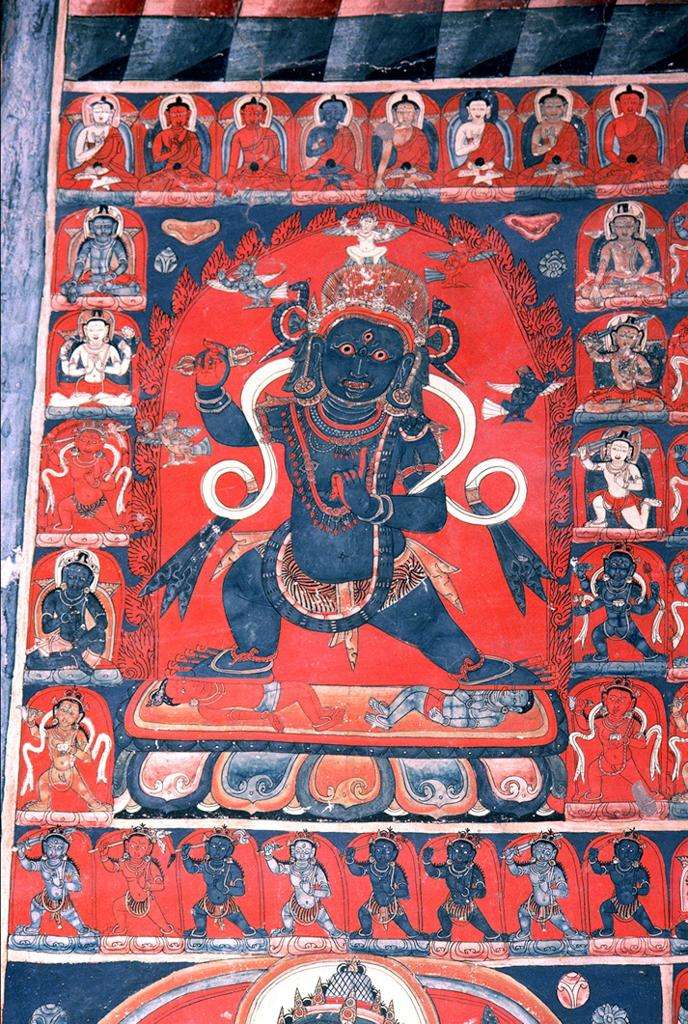
Variations of the motif appeared as it spread eastward. For instance, an 11th-century wall mural of the Bodhisattva Vajrapani (Jingang shou pusa, 金剛手菩薩), the “Bodhisattva holding the Vajra,” in Kashmir features five colored Garudas flying about his flaming halo (fig. 18). Beer (1999) explains that these represent the five Buddhas or Buddhist families of Esoteric Buddhism (p. 62). He adds: “a yellow garuda stands for earth, a white for water, a red for fire, a black for air, and a blue or multicoloured for space” (Beer, 1999, p. 62). This variation changed as it rapidly spread into China. An 11th-century CE painting from the famous Mogao Caves of Dunhuang depicts the Bodhisattva Hayagriva (Matou Guanyin, 馬頭觀音), the “Horse-Headed Guanyin,” with three (of five?) fiery Garudas comprising his halo (Fig. 19). This “Garuda aureola” reached its zenith in Japan. One beautiful 11th-century CE example shows the Esoteric Buddhist guardian deity Fudō Myōō (Budong mingwang, 不動明王) set against a Garuda halo. The five Garudas are portrayed as flaming roosters encircling the god (fig. 20) (Akiyama, 1961, pp. 53 and 57). Thus, Esoteric Buddhism was the catalyst for the spread of the Garuda aureola motif towards the east.

Fig. 18 – Five colored Garudas in the aureola of the the Lha khang Soma Vajrapani (11th-century CE), Kashmir (larger version). Photo by HABRA. Fig. 19 – Hayagriva with flaming Garudas (11th-century CE), Dunhuang, Gansu, China (larver version). The simplistic Garudas are located to the respective left and right of a Face of Glory, as well as in between his legs. Photo by the Musée national des Arts asiatiques. Fig. 20 – The God Fudo-myoo (Acala) and Two Attendants (11th-century CE), Japan (larger version). Photo by the University of California, San Diego.


3.3. China – The Mongols Welcome the Motif
The Mongol rulers of the Yuan Dynasty (1271–1368 CE) were largely responsible for bringing the Garuda and serpents motif to China. They were ardent followers of Tibetan Buddhism, and so they invited Buddhist lamas to preach in the Middle Kingdom. The person who first introduced Tibetan Buddhist art to China was the Nepalese artist Anige (阿尼哥, 1245–1306 CE). At the surprisingly young age of eighteen or nineteen years old, he arrived at the Mongol court in 1260 CE as the leader of twenty-four artisans. His most famous accomplishment is the White Pagoda of the Miaoying temple in Beijing (Stoddard, 2008, pp. 19-20). Anige is the father of a Tibetan Stylistic tradition that carried on long after his death.
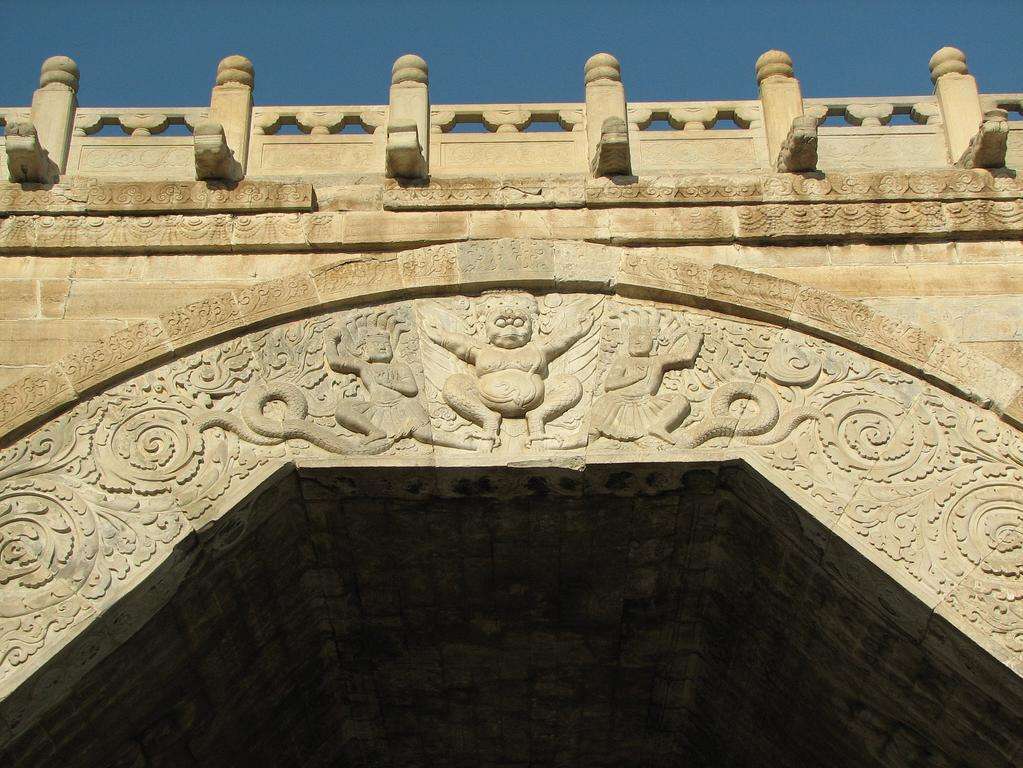
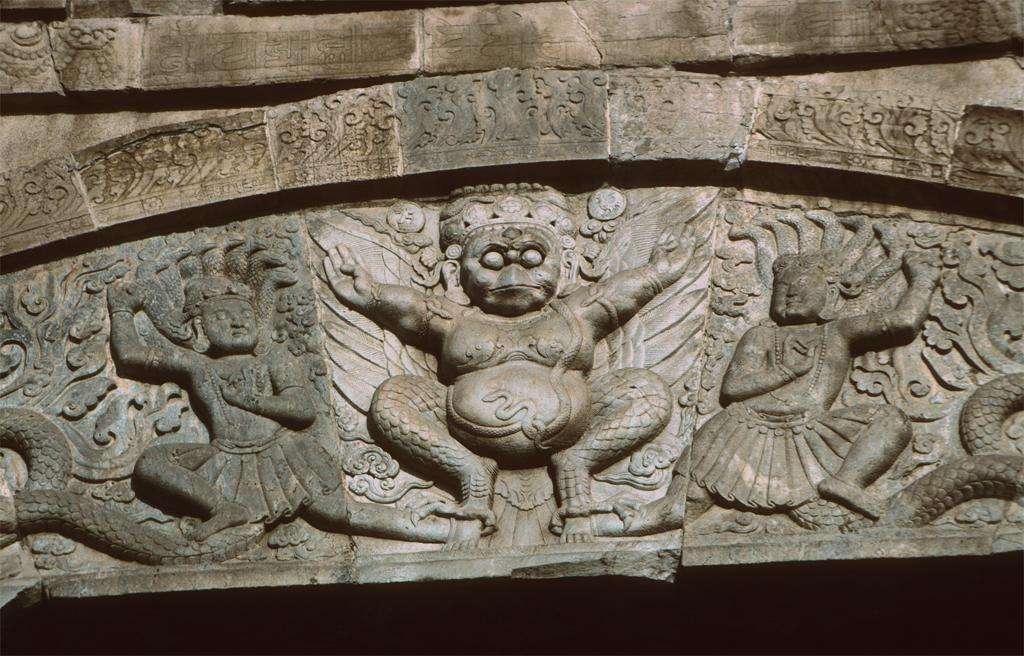
For instance, the Mongols commissioned several stupa-arches to be constructed “on strategic roads leading to the capital [of Beijing]” (Stoddard, 2008, p. 23). The only surviving example is the cloud platform of Juyong Pass (Juyong guan, 居庸關), a later addition to the Great Wall of China built in 1354 CE. It originally supported three Buddhist stupas, but these disappeared within a century of their completion. Multilingual inscriptions on the arch indicate that it was built “in order to bring happiness to the people who pass under the stupa and receive thus the Buddha’s blessings” (Stoddard, 2008, p. 23). The apex of the arch contains the Garuda and serpents motif (fig. 21 and 22). The man-bird is depicted as a stout, pot-bellied figure with the face, wings, and talons of a raptor bird and the ears, arms, and torso of a human. He wears a jeweled crown and his body is decorated with serpents on his wrists, arms, and chest. Hierarchy in scale is employed to portray the humanoid naga-spirits as smaller in stature and importance. They are trying to run away from him, but their scaly heels are pierced by his talons.

Fig. 21 – The Gate of Glory from the Cloud Platform of Juyong Pass (1345 CE), Beijing, China (larger version). Photo by Snuffy on Flicker. Fig. 22 – A detail of the Garuda and serpents motif (photographer unknown) (larger version).
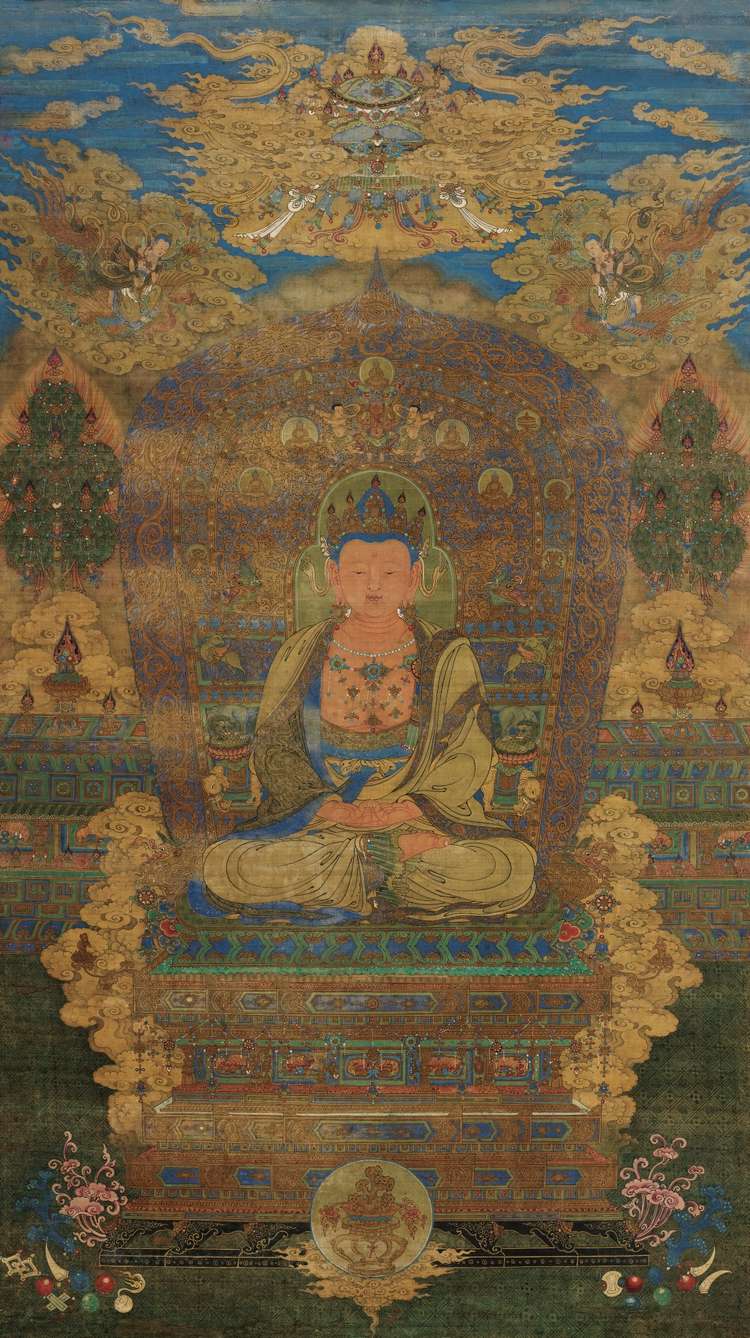
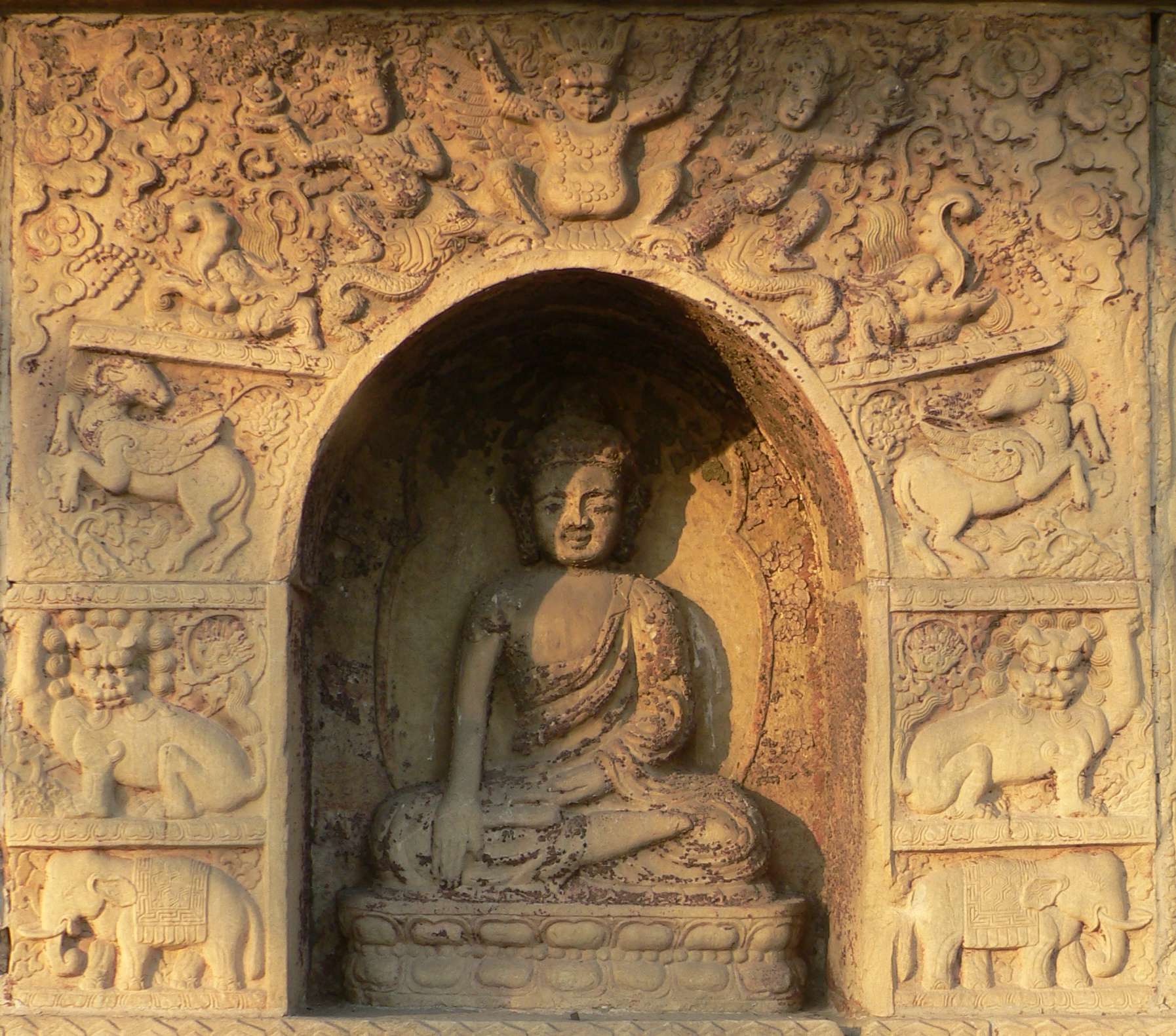
The motif continued to appear in Buddhist art into the Ming dynasty (1368–1644 CE) after the Chinese had overthrown the Mongols. This is because some Chinese rulers, such as the Yongle Emperor (永樂帝, r. 1402–1424 CE), upheld the Tibetan Buddhist tradition. Ming examples include a painting in the Sotheby’s collection dated to the 15th-century CE (fig. 23 and 24); a relief carving on a 15th-century CE pagoda at Zhenjue Temple (真覺寺) in Beijing (fig. 25 and 26); and a stone stele in the Freer Art Gallery collection dated to circa 1500 CE (fig. 27 and 28). All of these pieces depict a Buddhist deity sitting before an enlightenment torana lorded over by Garuda and his serpentine foes. What’s important here is that the variety of media suggests that the motif became a standardized element of Sino-Tibetan Buddhist art at least a century prior to the publishing of Journey to the West (1592 CE). The commonplace nature of the motif might then explain why it was included in the story. There are numerous occasions in the novel when the author-compiler provides folk origins for everyday concepts, such as why rings are put through the noses of buffalos. [6] So a bird attacking serpents above the head of the Buddha would certainly need a fanciful genesis story.

Fig. 23 – The Amitabha Buddha with an enlightenment torana (15th-century CE) (larger version). Fig. 24 – A detail of the Garuda and serpents motif (larger version). Photos by Sotheby’s. Fig. 25 – Zhenjue Temple relief carving (15th-century CE), Beijing, China (larger version). Fig. 26 – A detail of Garuda (larger version). Photos by Wikimedia commons. Fig. 27 – A stone stele of a Bodhisattva with an enlightenment torana (c. 1500 CE) (larger version). Fig. 28 – A detail of the motif (larger version). Photos by the Freer Gallery of Art.



4. Garuda’s Transformation from a God to a Demon
The Ming dynasty examples suggest Garuda was considered a common element of the Buddha’s enlightenment torana. The bird god is in effect a guardian of the faith who watches over the world from an exalted position high atop the Buddha’s throne. So why then did the author-compiler of Journey to the West transform him into a monster who needed conquering? This obviously follows the novel’s theme of powerful demons, such as Sun Wukong, being subjugated and put to good use. This can be traced to the Thunder Ritual (Leifa, 雷法), a Daoist liturgy designed to subjugate powerful gods and demons to be wielded as weapons against evil forces. One such god is Sire Thunder (Leigong, 雷公), a native Chinese weather deity responsible for making dragons produce rain when needed. And since lightning is his weapon, he is also considered a heavenly executioner who kills mortals guilty of unpunished crimes. [7] The god was sometimes portrayed as a human, but it was around the Tang Dynasty (618–907 CE) when he took on a bird-like appearance with a beak, wings, and talons. This avian transformation coincided with the appearance of Garuda and Esoteric Buddhism in China. Upon entering the Middle Kingdom, Garuda served many of the same functions as Sire Thunder. His power over dragons gave him control of rain, and his fierce nature enabled him to be a heavenly executioner. Therefore, depictions of Sire Thunder came to absorb features of the bird god. Most importantly, Tang-era stories describe religious masters and certain brave individuals subjugating this demonic figure and using his powers for their own purposes. [8]
Artistic renderings of Sire Thunder after his metamorphosis are strikingly similar to Garuda. A prime example of this comes to us in the form of a 9th-century CE fresco from Xinjiang originally held in the Berlin Museum of Indian art. The piece depicts numerous beings paying homage to the Four Heavenly Kings (Sida tianwang, 四大天王) (fig. 29). The foreground depicts Sire Thunder caught in a hunter’s snare around his neck, while a hound bites at his leg. A larger figure, presumably a guardian deity of sorts, holds one of the god’s wrists and stands with a club held overhead ready to strike (fig. 30). This scene contrasts with the overall religious nature of the piece, giving the impression that this “demon” is being captured in the name of the heavenly kings. So here we have a bird monster being subjugated by Buddhist forces. Such art could have easily influenced Garuda’s depiction in Journey to the West.

Fig. 29 – A fresco showing the adoration of the Heavenly Kings (9th-century), Xinjiang, China (larger version). Fig. 30 – A detail of the subjugation of Sire Thunder (larger version).
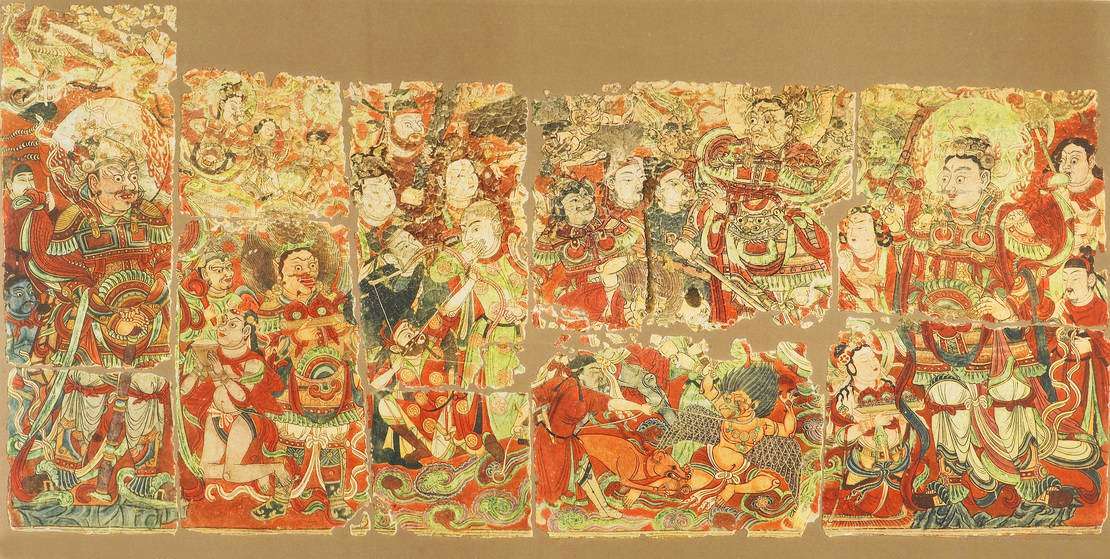
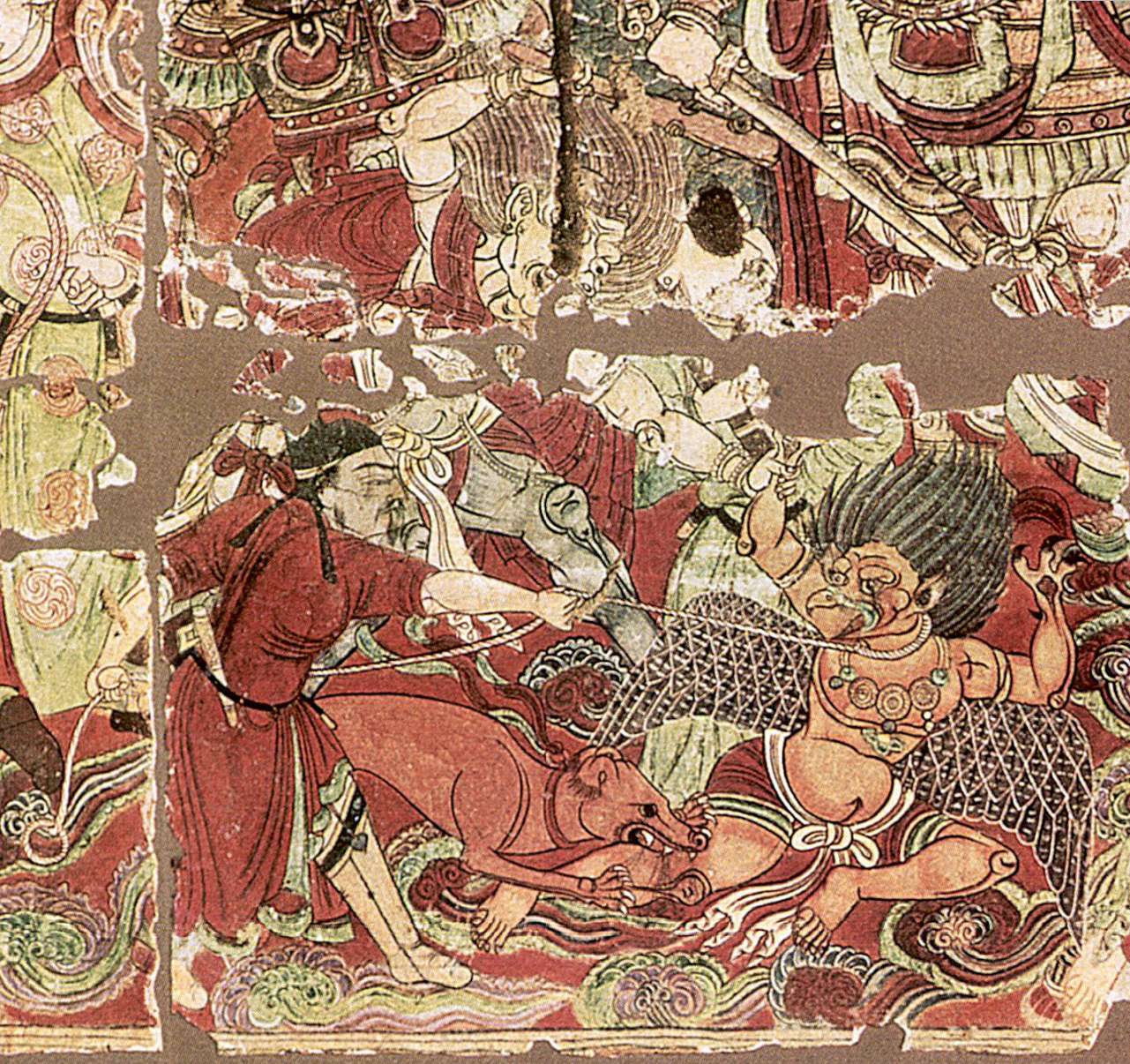
5. Conclusion
A literary motif appearing in Journey to the West (1592 CE) and The Complete Vernacular Biography of Yue Fei (1684 CE) depicts the Hindu-Buddhist bird deity Garuda as a demon-turned-Buddhist guardian who sits above the Buddha’s throne. This is based on the bird’s portrayal in the ancient Indian epic the Mahabharata (4th-century BCE), where he comes to sit above the deva Vishnu after taking part in a filial quest and agreeing to carry the god’s celestial vehicle (vimana). Beginning around the 2nd-century BCE, Garuda started appearing on Hindu and Buddhist architecture that depicted him on ritual flag poles and above torana doorways. A motif of Garuda gasping the tails of naga-serpents, his eternal foes from Hindu lore, appeared by at least the 7th-century CE and spread as far away as Cambodia by the 9th- or 10th-century CE. The motif was adopted by Tibetan Buddhist artists by the 11th-century CE and incorporated into wall murals, thus making the jump from architecture to paint. It never lost its association with architecture, however, since the torana came to be equated with the halo of Buddhist deities. This “enlightenment torana” or “gate of glory” became a common feature of Tibetan Buddhist art and even made its way to Japan. This feature was depicted as the backrest of a throne, hence the Chinese literary motif of Garuda sitting above the Buddha can be directly tied to this style of art. The Mongols were largely responsible for bringing the motif to China as they were adherents of Tibetan Buddhism. It continued into the Ming dynasty thanks to royal patronage of Esoteric Buddhism. The motif appeared in Ming religious architecture, paintings, and stele, making it commonplace enough for the author-compiler of Journey to the West to provide a folkloric explanation for the phenomenon. But the concept of a demonic bird being subjugated is most likely based on the Tang Dynasty Thunder Ritual and stories of Sire Thunder, a Daoist weather deity with bird-like features, being captured by mortals and compelled to use his powers in their service.
6. Updates
Update: 04-29-2018
Sire Thunder’s avian form has persisted to this day, having become his standard iconography. Here I present an early 20th-century CE wooden altar statue depicting the deity with his counterpart the Mother of Lightening (Dianmu, 電母) (fig. 31). His similarities to Garuda are just as noticeable today.

Fig. 31 – Sire Thunder and the Mother of Lightning (20th-century CE), Taipei, Taiwan (larger version). In the author’s personal collection.
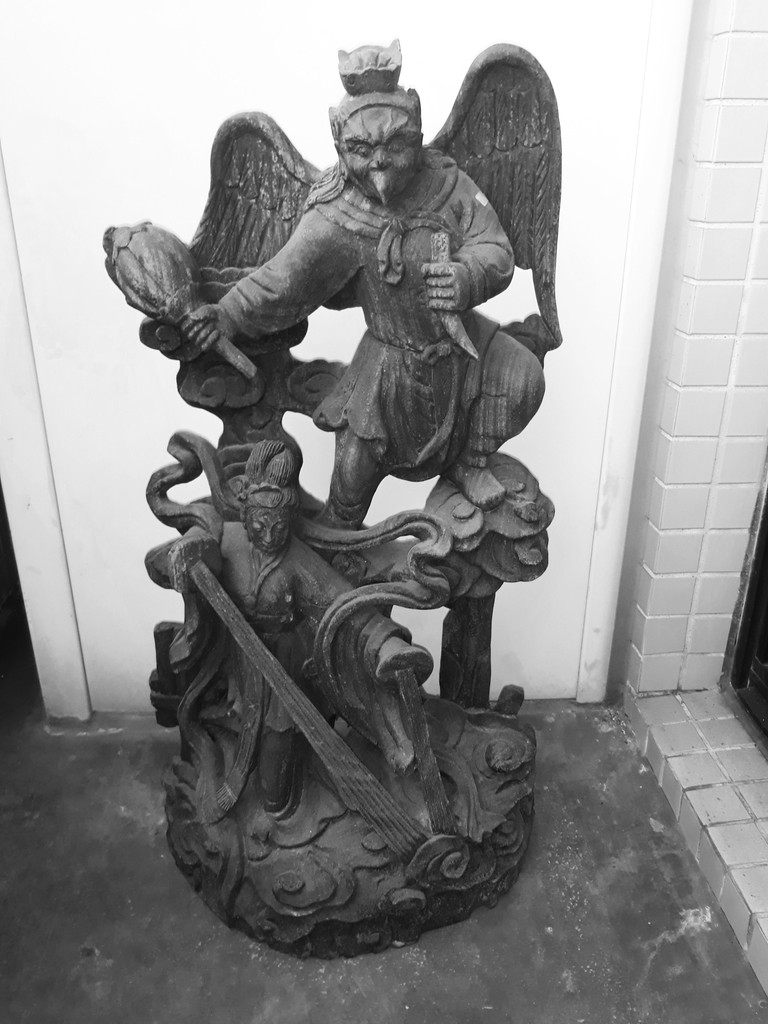
Sire Thunder actually appears with the Mother of Lightning (and other weather gods) in Journey to the West. Chapter 45 sees Monkey participating in a competition of transformations and ritual magic with three animal spirits disguised as Daoists. One competition involves making rain, during which time said gods appear. Although the spirit calling on the rain is powerful, Sun Wukong blocks his magic to make him look bad:
Becoming rather agitated, the Daoist loosened his hair, picked up his sword, and recited another spell as he burned a charm. Once more he brought down his tablet with a bang, and immediately the Heavenly Lord Deng arrived from the South Heaven Gate, trailed by the Squire of Thunder and the Mother of Lightning. When they saw Pilgrim [Sun Wukong] in midair, they saluted him, and he gave his explanation as before. “What powerful summons,” he said “brought you all here so quickly?” The Heavenly Lord said, “The proper magic of Five Thunder [Wulei fa, 五雷法] exercised by that Daoist was not faked.
He issued the summons and burned the document, which alerted the Jade Emperor. The Jade Emperor sent his decree to the residence of the Primordial Celestial Worthy of All-Pervading Thunderclap in the Ninefold Heaven. We in turn received his command to come here and assist with the rainmaking by providing thunder and lightning.” “In that case,” said Pilgrim, “just wait a moment. You can help old Monkey instead.” There was, therefore, neither the sound of thunder nor the flash of lightning (Wu & Yu, 2012, vol. 2, p. 293).
The techniques used by the animal spirit for calling rain refers back to the aforementioned Thunder Ritual, where the powers of Sire Thunder are used in the service of another.
Update: 03-19-22
I recently occurred to me that the antagonistic version of the Garuda and serpents motif is quite similar to the ancient and widespread “Master of Animals” motif, which depicts a humanoid figure in the middle asserting his will over animals to his left and right (fig. 32). Perhaps there is a connection.
Fig. 32 – One example from a harp found at Ur (circa 2600 BCE) (larger version).

Update: 06-18-23
Above in the introduction, I mentioned how Yue Fei is cast as the reincarnation of the Peng bird. Chapter one of The Complete Vernacular Biography of Yue Fei (Shuo Yue quanzhuan, 說岳全傳, 1684 CE reads:
Let’s talk about the Buddha Tathagata at the Great Thunderclap Monastery in the Western Paradise. One day, he sat on a nine-level lotus throne, and the Four Great Bodhisattvas, the Eight Great Vajra Warriors, the five hundred Arhats, the three thousand Heavenly Kings, nuns and monks, male and female attendants, all of the heavenly sages who protect the Dharma, gathered to listen to his lecture on the Lotus Sutra. His words were like flowers and precious jewels raining from the heavens. But, at that time, a star-spirit, the Maiden Earth Bat, who had been listening to the lecture from beneath the lotus throne, couldn’t bear it any longer and unexpectedly let out a stinky fart.
The Buddha was a great, merciful lord, so he didn’t mind even the slightest bit. But don’t sympathize with the Dharma protector above his head, the “Great Peng, the Golden-Winged King of Illumination,” whose eyes shone with golden light and whose back was a scene of auspiciousness. He became angry when he saw the nasty, filthy Maiden Earth Bat, and so he unfurled both his wings and dropped down to kill the spirit by pecking her on the head. The light-point of her soul shot out of the Great Thunderclap Monastery and went to the Lands of the East (China) in the world below to find a mother and reincarnate. She was reborn as a daughter of the Wang clan. She would later marry the Song Prime minister Qin Hui (1091-1155) and come to cruelly kill the righteous (i.e. Yue Fei) as a means to get revenge against today’s enemy. We will talk about this later.
Let’s return to the Buddha, who saw what happened with his all-seeing eyes and exclaimed, “Good! Good! It turns out that this is an episode of karma (cause and effect).” Then he called the Great Peng bird to come closer and shouted, “You evil creature! You already took refuge in my teachings. How can you not follow the five precepts by daring to commit such a horrible crime? I don’t need you here; you will descend to the mortal world to pay off your (karmic) debt and wait until you have fulfilled your work. Once that is completed, only then will I allow you to return to the mountain to achieve the right fruit (Buddhist merit).” The Great Peng complied with the decree, flying out of the Great Thunderclap Monastery directly to the Lands of the East to be reincarnated. We will stop here (translation by me).
Notes:
1) This name is a reference to the mythical Peng (鵬) bird mentioned in the first chapter of the Zhuangzi (莊子), a philosophical work of the 3rd-century BCE. The chapter details how the creature starts life as a small Kun (鯤) fish and changes into a bird of unfathomable size with wings that span the sky (Zhuangzi & Watson, 2003, pp. 23-24).
2) See Wu & Yu (2012) chapters 74 to 77.
3) The sources are actually conflicting on which relief is older. For instance, Iyer (1977) claims the first is the “earliest representation of garuda” (p. 52). On the contrary, Dhar (2009) lists the second as being from “c. second-first century BCE” (p. 10), which would make it older than the Sanchi example. I, however, believe the second is younger than the first because it is clearly an embellished version of the first.
4) Although some of its iconographical elements can be similar to the bird god, the Face of Glory shouldn’t be confused with Garuda because it represents the “monster of greed” (Beer, 1999, pp. 69-70). This is why it is constantly in the act of eating.
5) This recalls the story of Krishna defeating the serpent Kaliya by dancing on his head (Leeming, 2006, p. 232).
6) For example, in chapters 50 to 52, Laozi’s buffalo runs amuck on earth as a demon. The monster uses a diamond bracelet that he stole from his master to capture Monkey’s staff. The simian hero enlists the aid of the Daoist patriarch, who subjugates the beast and later puts the bracelet through its nose and uses a sash as a lead. The novel then explains: “Thus the custom of leading the buffalo with a ring in its nose was established, a custom in use even now” (Wu & Yu, 2012, vol. 3, p. 30).
7) People struck by lightning were thought to have been marked (scarred) with a sign of their guilt much like a convict in ancient China was tattooed (Meulenbeld, 2007).
8) See Meulenbeld (2007) chapter 4. See also section 6.4 for a discussion on Sun Wukong and his relationship to Sire Thunder and the Thunder Ritual.
Sources:
Akiyama, T. (1961). Japanese Painting. [Geneva]: Skira; [distributed by World Pub. Co., Cleveland.
Association for Asian Studies., Goodrich, L. C., & Fang, Z. (1976). Dictionary of Ming Biography, 1368-1644. New York: Columbia University Press.
Beer, R. (1999). The Encyclopedia of Tibetan Symbols and Motifs. Boston: Shambala.
Dallapicolla, A. L. (2002). Dictionary of Hindu Lore and Legend. New York: Thames & Hudson.
Dehejia, Vidya. 1997. Indian Art. London: Phaidon.
Dhar, P. P. (2009). The Toraṇa in Indian and Southeast Asian Architecture. New Delhi: D.K. Printworld.
Elgood, H. (2000). Hinduism and the Religious arts. London: Cassell.
Ganguli, K. M., and Rāya, P. (2003). The Mahabharata of Krishna-Dwaipayana Vyasa. New Delhi: Munshiram Manoharlal Publishers.
Gupte, R. S. (1967). The Art and Architecture of Aihole: A Study of Early Chalukyan Art Through Temple Architecture and Sculpture. Bombay: Taraporevala.
Hsia, C. T. (2004). C. T. Hsia on Chinese Literature. New York: Columbia University Press.
Iyer, K. B. (1977). Animals in Indian Sculpture. Bombay: Taraporevala.
Kramrisch, S. (1928). The Vishnudharmottara (part III): A Treatise on Indian Painting and Image-Making. Calcutta: Calcutta University Press.
Leeming, D. A. (2006). The Oxford Companion to World Mythology. Oxford: Oxford Univ. Press.
Malandra, G. H. (1993). Unfolding a Maṇḍala: The Buddhist Cave Temples at Ellora. Albany, NY: State Univ. of New York Press.
Meulenbeld, M. R. E. (2007). Civilized Demons: Ming Thunder Gods from Ritual to Literature (Doctoral dissertation). Available from ProQuest Dissertations and Theses database (UMI No: 3247802).
Mookerji, R. (1973). The Gupta Empire. Delhi: Motilal Banarsidass.
Patel, S. K. (1992). Hinduism in India: A Study of Viṣṇu Worship. Delhi (India): Amar Prakashan.
Qian, C. (2016). Shuo Yue quanchuan [The Complete Vernacular Biography of Yue Fei] . Zhangsha: Yue lu shu she.
Qureshi, D. (2010). The Rock-Cut Temples of Western India. Delhi, India: Bharatiya Kala Prakashan.
Singer, J. C. (1999). The Cultural Roots of Early Central Tibetan Painting. In S. Kossak & J. Singer (Eds.), Sacred Visions: Early Paintings from Central Tibet (pp. 3-24). New York: Metropolitan Museum of Art.
Smith, V. A. (1969). The Jain Stûpa and Other Antiquities of Mathurâ. Varanasi: Indological Book House.
Stoddard, H. (1996). Early Tibetan Paintings: Sources and Styles (Eleventh-Fourteenth Centuries A.D.). Archives of Asian Art 49, pp. 26-50.
Stoddard, H. (2008). Early Sino-Tibetan Art. Bangkok: Orchid Press.
Subbaraman, R. (2002). Beyond the Question of the Monkey Imposter: Indian Influence on the Chinese Novel the Journey to the West. Sino-Platonic Papers, (114), 1-35. Retrieved April, 2018, from http://www.sino-platonic.org/complete/spp114_journey_to_the_west_monkey.pdf.
Tartakov, G. M. (1997). The Durga Temple at Aihole: A Historiographical Study. Delhi [u.a.]: Oxford University Press.
Vogel, J. P. (1972). Indian Serpent-Lore: or, the Nāgas in Hindu Legend and Art. Varanasi [India]: Indological Book House.
Walker, B. (1968). Hindu World: An Encyclopedic Survey of Hinduism. London: Allen & Unwin.
Wu, C., & Yu, A. C. (2012). The Journey to the West (Vols.1-4) (Rev. ed.). Chicago: University of Chicago Press.
Zhuangzi, & Watson, B. (2003). Zhuangzi: Basic Writings. New York: Columbia University Press.
Zimmer, H. R., & Campbell, J. (1946). Myths and Symbols in Indian Art and Civilization. [New York]: Pantheon Books.