Monkey and the Summoners of Hell: The Story and Origins of the Heibai Wuchang

Last updated: 05-04-2026

One of the most famous episodes from Journey to the West (Xiyouji西遊記, 1592) happens in chapter three after Sun Wukong returns from the undersea palace with his magic staff and is chosen as lord of the 72 monster kings. Following a lavish banquet in his honor, a drunken Monkey King falls asleep and his soul is dragged to the Chinese underworld by two spirits:

In his sleep the Handsome Monkey King saw two men approach with a summons with the three characters “Sun Wukong” written on it. They walked up to him and, without a word, tied him up with a rope and dragged him off. The soul of the Handsome Monkey King was reeling from side to side. They reached the edge of a city. The Monkey King was gradually coming to himself, when he lifted up his head and suddenly saw above the city an iron sign bearing in large letters the three words “Region of Darkness [You mingjie, 幽冥界].” The Handsome Monkey King at once became fully conscious. “The Region of Darkness is the abode of Yama, King of Death,” he said. “Why am I here?” “Your age in the World of Life has come to an end,” the two men said. “The two of us were given this summons to arrest you.” When the Monkey King heard this, he said, “I, old Monkey himself, have transcended the Three Regions and the Five Phases [1]; hence I am no longer under Yama’s jurisdiction. Why is he so confused that he wants to arrest me?” The two summoners paid scant attention. Yanking and pulling, they were determined to haul him inside. Growing angry, the Monkey King whipped out his treasure. One wave of it turned it into the thickness of a rice bowl; he raised his hand once, and the two summoners were reduced to hash (Wu & Yu, 2012, p. 139).

只見那美猴王睡裡,見兩人拿一張批文,上有「孫悟空」三字,走近身,不容分說,套上繩,就把美猴王的魂靈兒索了去,踉踉蹌蹌,直帶到一座城邊。猴王漸覺酒醒,忽擡頭觀看,那城上有一鐵牌,牌上有三個大字,乃「幽冥界」。美猴王頓然醒悟道:「幽冥界乃閻王所居,何為到此?」那兩人道:「你今陽壽該終,我兩人領批,勾你來也。」猴王聽說,道:「我老孫超出三界之外,不在五行之中,已不伏他管轄,怎麼朦朧,又敢來勾我?」那兩個勾死人,只管扯扯拉拉,定要拖他進去。這猴王惱起性來,耳朵中掣出寶貝,幌一幌,碗來粗細。略舉手,把兩個勾死人打為肉醬。

The two unnamed psychopomps are simply referred to in the story as “[those who] arrest the dead” (Gou siren, 勾死人). Modern media sometimes portrays these two wearing contrasting black and white uniforms with tall hats (fig. 1).

Heibai Wuchang summon Wukong - small

Fig. 1 – The summoners taking Sun Wukong’s soul in his sleep (larger version). From episode 7 of the Little Fox ESL Journey to the West series.

Table of Contents

1. The Heibai Wuchang

The specific color-coded deities are known in China, Taiwan, and Southeast Asian countries like Malaysia and Singapore as the Heibai wuchang (黑白無常), or the “Black and White [spirits of] Impermanence.” Tan (2018) describes their mythic background and religious importance:

[A] good deal of importance attaches to the worship in Malaysia and Singapore of Heibai Wuchang … popularly known as Da Er Ye (大二爺, Eldest and Second Uncles). In charge of policing the netherworld and protecting humans from evil, they are believed to be two soldiers of the Tang dynasty, General Xie [謝] and General Fan [范]. The former was tall and was hanged by the enemy, while the latter was shorter and was drowned while fighting enemies. General Xie’s image is that of a tall person with a protruding long tongue; he’s wearing a white shirt, and his high hat has the characters yijian daji ([一見大吉] “big luck on seeing me”) or yijian shengcai ([一見生財] “getting wealth on seeing me”). General Fan’s image has a dark face, and his square hat bears the characters tianxia taiping [天下太平], or “peace in the world.” Also called Qiye (七爺) and Baye (八爺), the two generals are in charge of rewarding good people and punishing evil ones. General Xie is more popular among worshippers; frightening as he is, the Elder Uncle benefits from his association with blessing wealth (p. 58).

Chen (2014) provides a different background for the two, which is commonly told in the southern Chinese city of Fuzhou in Fujian province:

The Seventh Lord (七爺) and Eighth Lord (八爺) are frequently seen and are well-known in Taiwanese religious parades. These two deities were originally two brother-like friends in Fuzhou (福州). One was called Xie Bian (謝必安), and the other one was named Fan Wujiu (范無救; 范無咎). On a rainy day, they had an appointment to meet under the Nan Tai Bridge (南臺橋). Fan Wujiu was short with a dark complexion, but Xie Bian was tall with a light complexion. Fan Wujiu arrived at the meeting place earlier, waited there in spite of the heavy rain, and was drowned. Xie Bian tried to bring umbrellas for Fan Wujiu and was therefore late. When he arrived at the bridge, Fan Wujiu was already dead, so he decided to commit suicide because of his friendship and guilt. According to legends, the Heavenly Emperor (玉皇大帝) was touched by this pair of brother-like friends, and promoted their ghosts to supernatural officers from the underworld. The Seventh Lord is Bai Wuchang (白無常), and the Eighth Lord is Hei Wuchang (黑無常). Their mission is to bring dead people’s ghosts from the ordinary human world to the underworld at the moment of their deaths (p. 220).

Heibai wuchang statues - small

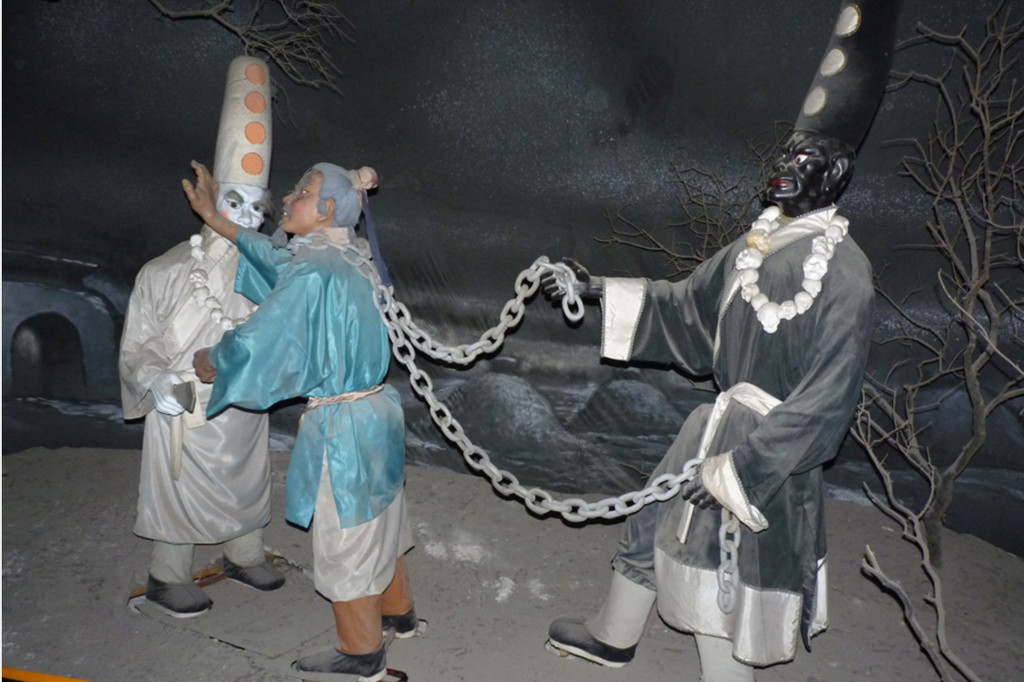
Fig. 2 – A depiction of the spirits taking a soul to the Chinese underworld (larger version). From the Haw Par Villa theme park in Singapore. Original picture from Baike.

Stevens (1997) goes into more detail about their function and veneration:

The pair are despatched on orders from the City God when the due date of a person’s death arrives, to seek out and identify the correct human through the local spiritual official, the Earth God [fig. 3]. They appear before the human and the Tall Demon [the white spirit] announces that the time has come. The Short Demon [the black spirit] binds the soul and drags it before the City God. The Short Demon carries the tablet of authority and the chains to arrest the soul whose due date of death has arrived [fig. 2].

The Tall Demon … receives considerable attention from devotees, often relatives of the very sick, and in a few temples he is provided with cigarettes which are to be seen continually burning having been forced in between his lips. More popularly, his mouth is smeared with a black substance to win his favour and bribe him to keep away. This used to be opium and is still said to be opium, though the substance appears to be more of a sweet sticky mess. In northern and central China, only the Tall Demon is found (p. 173).

tudi_gong_28129

Fig. 3 – A monumental statue of an Earth god in Taiwan (larger version).

2. Origins

The sources above provide two backgrounds for the spirits, historical generals or brother-like friends, all of whom died unnatural deaths. Both origins involve the tall, white figure being hanged, while the short, black figure was drowned. Both of these backgrounds have respective ties to religious beliefs of the Han (206 BCE–220 CE) and Song (960–1279 CE) dynasties. It was common practice during the Han for generals, especially those slain by the enemy, to be deified as gods. This concept of deified mortals carried over into the Song Dynasty when tutelary gods were popular. Those deified were often pious or loyal people who died unnatural deaths. But most importantly, these individuals were deified by the very communities in which they lived, meaning they were worshiped as the protector of the specific locale and its people (Von Glahn, 2004, p. 164).

These tutelary cults find their origin in earth gods (tudishen, 土地神) worshiped as early as the Han. Just like people of the Song worshiped the worthy among their fallen community members, people of the Han worshiped the gods believed to inhabit the very earth on which their communities were established. Considering the dead were buried underground, these earth gods also served the function of “escort[ing] the deceased to the world of the afterlife” (Von Glahn, 2004, p. 165). Remember above that Stevens described the tall and short spirits relying on the local earth god to help locate the correct soul being summoned. Therefore, our spirits appear to be a combination of deified mortals (generals/worthy citizens) and earth gods who escorted the deceased to the afterlife. But there may be more to the story.

Wuchang (無常), or “impermanence”, is the Chinese term for the sanskrit Anitya. This is one of the “Three Marks” (Sk: Trilaksana) of existence in Buddhism, the other two being suffering (Duhkha) and non-self (Anatman) (Buswell & Lopez, 2014, pp. 47-48). The fact Wuchang is associated with these spirits suggests there is an added Buddhist influence. As I’ve written before, the Chinese underworld presented in Journey to the West is an amalgam of local Chinese and foreign Buddhist beliefs. In short, the Chinese Underworld consists of ten courts in which a soul is punished and sent on to the next until their karma is cleansed. The concept of purgatory and the Ten Kings or Judges of hell are products of 7th century Chinese Buddhism. Prior to this, souls of the dead were kept en masse in a sort of Daoist city of the dead. So our two summoners were no doubt absorbed into this new Buddhist worldview. The spirits in effect could be viewed as personifications of Buddhist impermanence.

The contrasting black and white color scheme has at least two origins. One, it may have evolved from the belief that each performed duties at different times. Maspero (1981) writes, “The most famous of [the City God’s] subordinates are Master White (Bai laoye [白老爺]) and Master Black (Hei laoye [黑老爺]), who perceive everything that goes on within the constituency, the former during the day and the latter during the night” (p. 110). Two, it may draw from the dualistic nature of Chinese philosophy. Baptandier (2008) comments their color is a “personification of the yin and yang principles of life” (p. 146).

20180916_131548 - small

Fig. 4 – A wall mural depicting the Ba Jiajiang (Eight Generals), including General Xie (white) with the phrase “Big Luck” (daji, 大吉) on his hat (larger version) and to his left General Fan (black) with a square hat. Taken by the author in Taipei, Taiwan.

3. Influence

Both General Xie (the tall, white spirit) and General Fan (the short, black spirit) figure among the Ba Jiajiang (八家將), or “Eight Generals” (fig. 4). These spirit generals are considered protectors of the City God (as well as other popular folk deities) and destroyers of evil. They consist of our two spirits, two more underworld figures called Generals Gan (甘) and Liu (柳), as well as four other figures known as the Four Seasons (Siji, 四季). These generals are personified during festivals by temple parade dance troupes called Jiajiang (家將). Members paint their faces according to the prescribed wrathful iconography for each general (fig. 5) and perform all sorts of choreographed militaristic dances while wielding weapons (video 1). These performances serve to exorcize evil spirits.

National Akau Mazu’s Cup of Youth Ba-Jia-Jang and Guan-Jang-Shou Competition, Ci Feng Mazu Temple, Pingtung City, Taiwan

Fig. 5 – The facepaint of General Xie, the tall, white spirit. A larger version can be seen on this blog. Original picture by Rich J. Matheson.

The tradition originated in Fuzhou but later spread to Taiwan by the 1870s, making it a rather recent phenomenon (Sutton, 1996).

Video 1 – A Ba Jiajiang performance.


4. Updates

Update: 10-29-2018

Sutton (1996) explains the ceremonial procession of the Eight Generals is modeled after yamen officials making an arrest in dynastic China. In this case, the otherworldly generals would be sent to arrest evil spirits:

The performers seen on the march—excluding the Four Seasons—represent a process, though it is never ritually played out: arrest by yamen underlings. In principle the punishment bearer warns, the messengers search out, the stave bearers pursue, Erye and Daye [the Black and White Spirits] take into custody, and the justices at the rear interrogate and record (p. 215).

In video 1, the man dressed in civilian attire and carrying the strange, yoke-like device on his shoulders (visible at 00:26) is performing the part of the punishment bearer, which I take to mean a symbol of those previously arrested and used as warnings to the evil spirits being pursued.


Update: 10-14-22

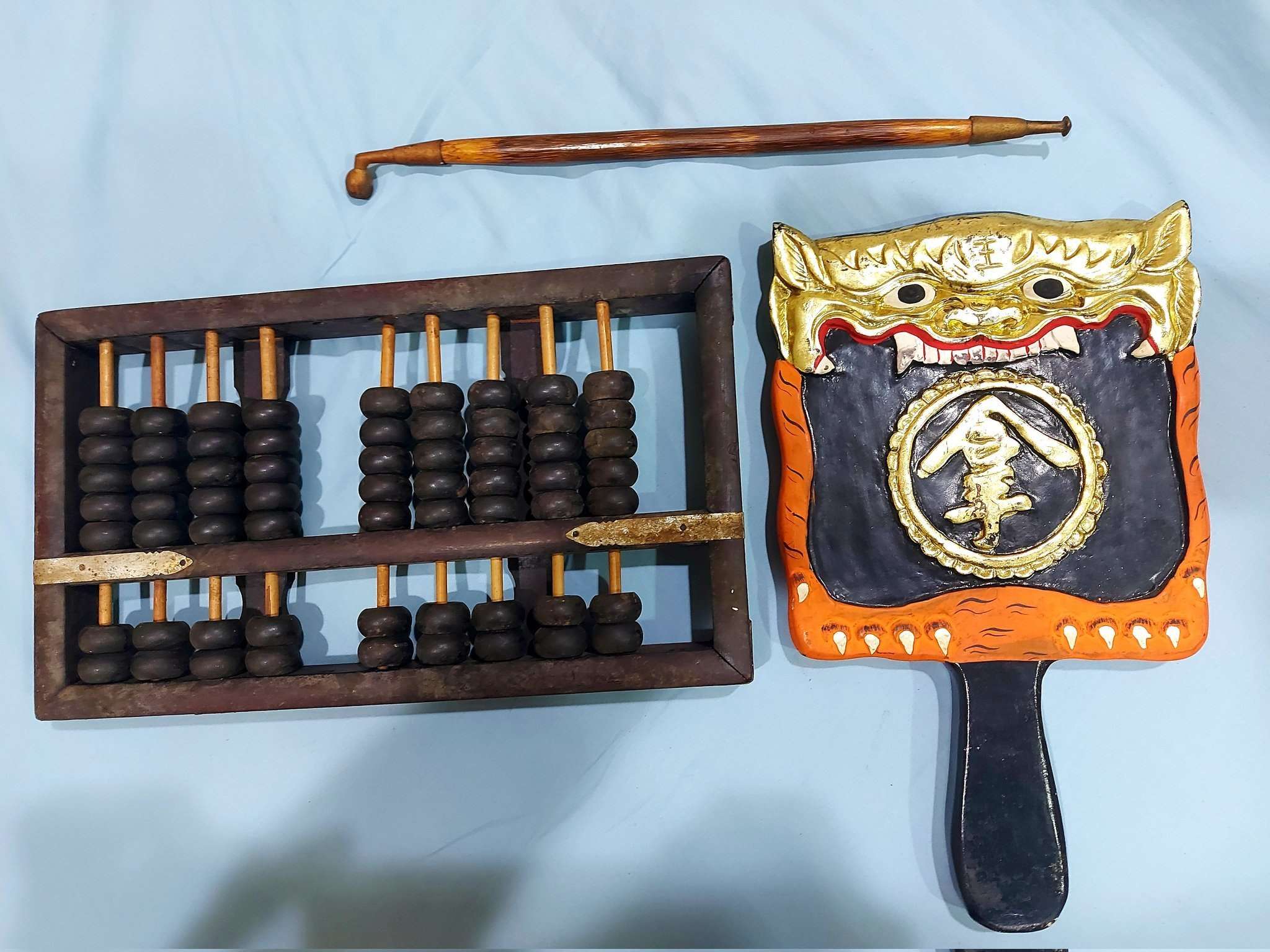
I purchased some ritual items from Singapore previously used by tangki spirit-mediums of the Heibai wuchang. These include an old-school abacus for making arcane calculations, a soul-summoning placard, and a smoking pipe (fig. 6). I feel much cooler now that I have them. My seller-collector friend, from whom I purchased this set, told me that some of the beads are missing from the abacus because they were most likely given to believers as talismans.

Fig. 6 – The ritual items used by Singaporean tangki spirit-mediums of the Heibai wuchang (larger version).


Update: 05-04-26

This is my favorite woodblock print from The Book to Enlightenment of the Journey to the West (Xiyou Zhengdao Shu西遊證道書, 1663), a Daoist commentary on the novel. It shows Monkey’s soul being dragged to hell in his sleep by the Heibai wuchang. The uncles are shown holding the soul-summoning placard and tugging on the chains, respectively (fig. 7).

Fig. 7 – The psychopomps drag Wukong to the Underworld in his sleep (larger version).

Notes:

1) The Three Realms are Heaven, Earth, and Hell, and the Five Phases are the elements of fire, water, earth, metal, and wood. The point being that he is beyond the control of the three realms and the effects of the elements because he has achieved immortality.

Sources

Baptandier, B. (2008). The lady of Linshui: A Chinese female cult. Stanford, Calif: Stanford University Press.

Chen, Y. (2014). Cinematic visualization of spiritual lesbianism in Monkia Treut’s Ghosted: countering essentialist concerns about Li Ang’s literary works In Y. Chen (Ed). New modern Chinese women and gender politics: The centennial of the end of the Qing Dynasty (pp. 210-222).

Maspero, H. (1981). Taoism and Chinese religion. Amherst: University of Massachusetts Press.

Buswell, R., & Lopez, D. (2014). The Princeton Dictionary of Buddhism. Princeton University Press.

Stevens, K. G. (1997). Chinese gods: the unseen world of spirits and demons. London: Collins & Brown.

Sutton, D. S. (1996). Transmission in Popular Religion: The Jiajiang Festival Troupe of Southern Taiwan in Later Imperial China in Shahar, M., & Weller, R. P. (Ed.) Unruly gods: Divinity and society in China (pp. 212-249). Honolulu: University of Hawaiʻi Press.

Tan, C. B. (2018). Chinese religion in Malaysia: Temples and communities. Leiden; Boston: Brill.

Von Glahn, R. (2004). The sinister way: The divine and the demonic in Chinese religious culture. Berkeley: University of California Press.

Wu, C., & Yu, A. C. (2012). The journey to the West: Volumes 1. Chicago, Illinois : University of Chicago Press.

Archive #6 – A Mission to Heaven (1913) – The First Attempt to Translate Journey to the West into English

Here I present A Mission to Heaven (1913), the first English version of Journey to the West translated by the Welsh Baptist missionary Timothy Richard (1845-1919). Modern translator Anthony C. Yu describes it and a slightly later translation as “no more than brief paraphrases and adaptations” (Wu & Yu, 2012, vol. 1, p. xiii). This is because Yu’s translation stretches over 2,000 pages, while Richard’s barely breaks 370 pages. Also, there are many mistranslations that will become apparent to those who have already read Yu’s version. For example, in chapter one when light from Sun Wukong’s eyes reach the celestial realm, A Mission to Heaven reads:

They saw the light burning brightly and ordered a telescope to be brought. (The telescope was invented by Galileo only in 1609 A.D., therefore the Chinese must have had some kind of telescope before we in Europe had it. — Tr.) It was taken to the South gate of heaven to be looked through from thence (Chiu & Richard, 1913, p. 3).

However, Yu’s more accurate version reads:

Upon seeing the glimmer of the golden beams, he [the Jade Emperor] ordered Thousand-Mile Eye and Fair-Wind Ear to open the South Heaven Gate and to look out (Wu & Yu, 2012, vol. 1, p. 102).

As can be seen, Richard completely glossed over the two named deities, choosing instead to refer to both as a telescope.

1913 Sun Wukong print - small

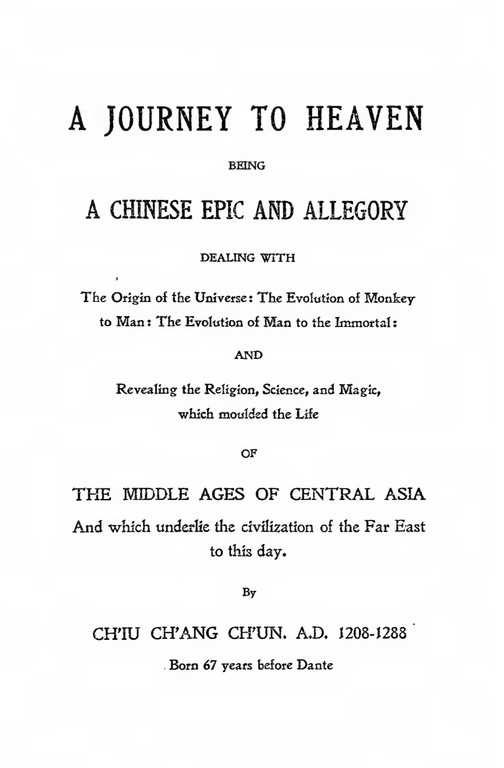
The full title of the translation (larger version).

It’s interesting to note the author of A Mission to Heaven/Journey to the West is listed as one Qiu Changchun, otherwise known as Qiu Chuji (1148-1227), founder of the Dragon Gate sect of Daoism. This may be confusing to some since the novel has long been touted as the work of Wu Cheng’en (1500-1582). However, the novel was anonymously published in 1592. Qiu’s disciple is known to have written a travel journal titled Journey to the West (西遊記), which detailed his master’s journey to meet Genghis Khan. Therefore, early commentators confused this historical travel journal with the fictional narrative, thereby claiming Qiu as the author as early as the 17th-century. Wu Cheng’en wasn’t associated with the novel until the 1920s, and the association is again based on a similarly named work published by Wu. Historians remain divided on the true author.

PDF link

Click to access a-mission-to-heaven-1913-translation-of-xiyouji.pdf

Thanks

The original file can be downloaded for free from archive.org.

Sources

Chiu, C., & Richard, T. (1913). A Mission to Heaven. Shanghai: The Christian Literature Society’s Depot.

Wu, C., & Yu, A. C. (2012). The Journey to the West (Vol. 1) (Rev. ed.). Chicago, Illinois : University of Chicago Press.

Archive #5 – All Woodblock Prints from Mr. Li Zhuowu’s Literary Criticism of Journey to the West

Here I present all of the woodblock prints from Mr. Li Zhuowu’s Literary Criticism of Journey to the West (Li Zhuowu Xiansheng piping Xiyouji, 李卓吾先生批評西遊記, late-16th-c. or early-17th-c.) by the Ming scholar Li Zhi (李贄, 1527-1602). It’s important to remember that the original novel was published in 1592, which means the images therein are some of the earliest depictions of the characters and episodes based on that freshly published version. The PDF linked below has nearly 200 prints, illustrating everything from Sun Wukong’s discovery of the Water Curtain Cave to the pilgrims’ final attainment of Buddhahood or Sainthood. Here is a sample.

Mr. Li's Criticism - Detail of Monkey fighting Heaven (small)

Sun Wukong fighting the heavenly army (larger version). Enhanced slightly for clarity.

PDF link

Click to access mr-li-zhuowus-literary-criticism-of-journey-to-the-west-late-16th-c-pictures-only.pdf

Thanks

The entirety of Mr. Li’s criticism is FAR too large to host on my meager site. The original files are hosted on Shuge.org and are free to download.

Sun Wukong’s Greatest Feat of Strength: An Allegory for Cultural or Religious Conflict?

Last updated: 07-03-2022

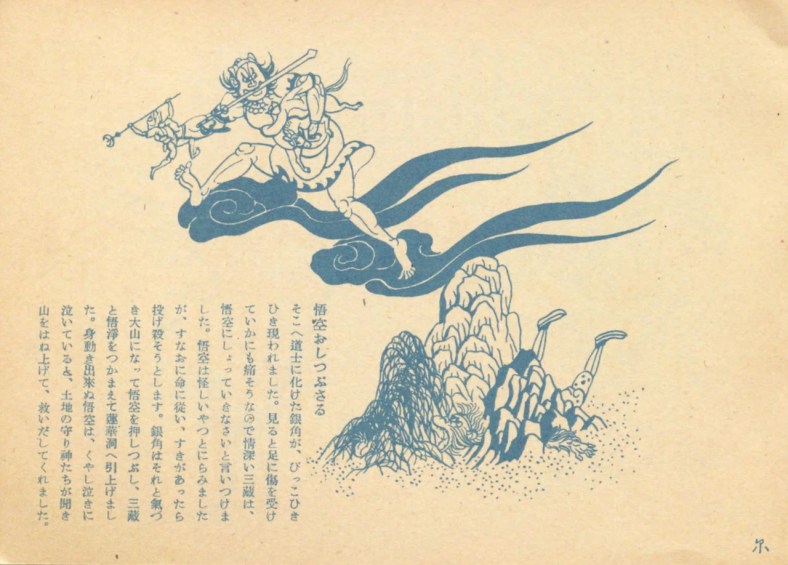
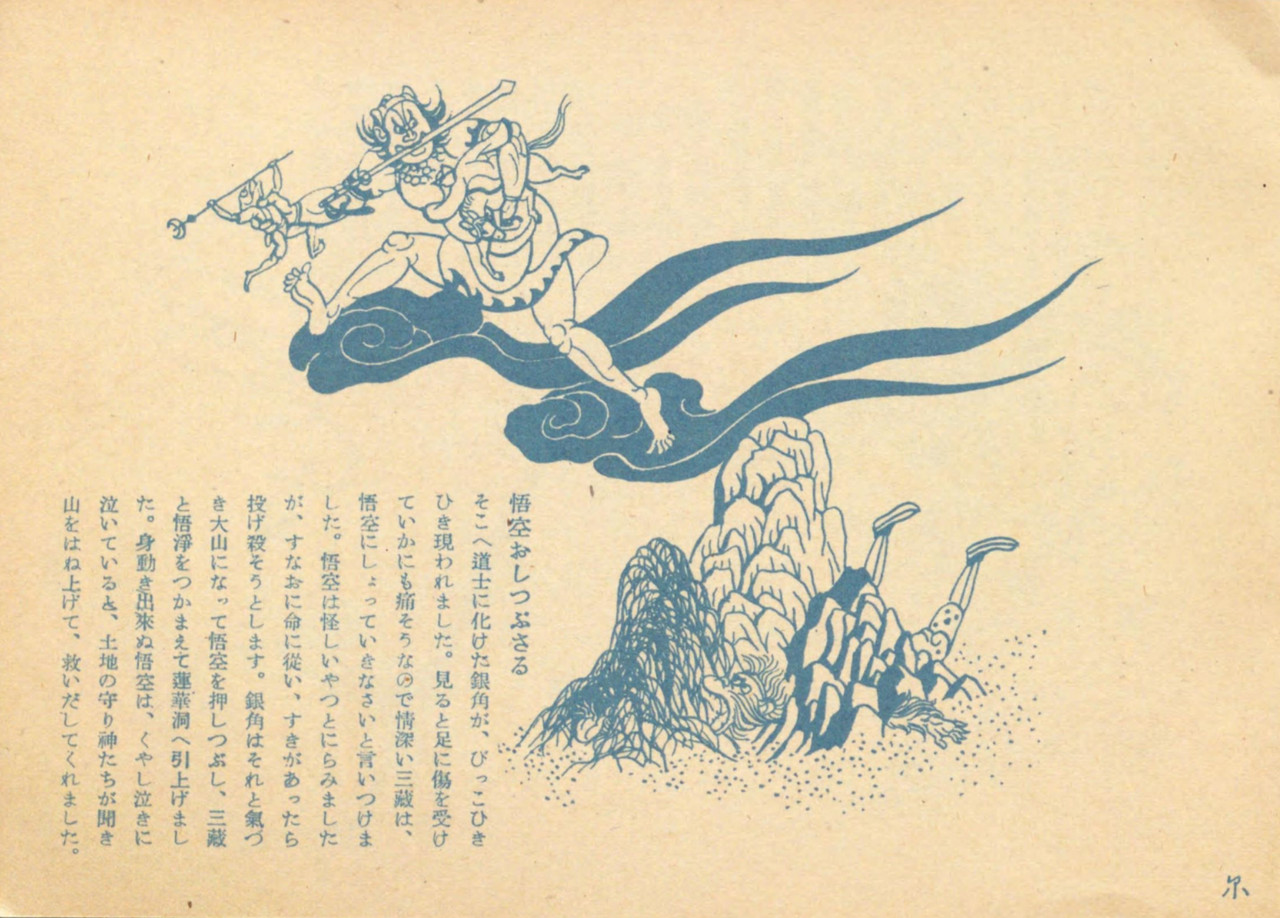
Now that I’ve written an entry debunking the idea that the Monkey King’s staff anchored the Milky Way, I want to write a piece about his greatest feat of strength in Journey to the West (Xiyouji西遊記, 1592). This takes place in chapter 33 after Zhu Bajie has been captured by two demon brothers, Great Kings Goldhorn (Jinjiao Dawang, 金角大王) and Silverhorn (Yinjiao Dawang, 銀角大王). Great King Silverhorn, the younger of the two, then sets out to capture Tripitaka but is forced to resort to trickery when he learns that the monk is protected by Sun Wukong. He transforms himself into an elderly Daoist laying by the roadside with a broken leg. The monk subsequently forces Monkey to carry him on his back, but our hero sees through the disguise and plans to throw his charge off a cliff. However…

As the Great Sage was about to do this, the monster knew instantly of his plan. Knowing how to summon mountains, he resorted to the magic of Moving Mountains and Pouring Out Oceans [“Yishan daohaide fashu, “移山倒海” 的法術]. On Pilgrim’s [Monkey’s] back he made the magic sign with his fingers and recited a spell, sending the Sumeru Mountain into midair and causing it to descend directly on Pilgrim’s head. A little startled, the Great Sage bent his head to one side and the mountain landed on his left shoulder. Laughing, he said, “My child, what sort of press-body magic are you using to pin down old Monkey? This is all right, but a lopsided pole is rather difficult to carry.”

The demon said to himself, “One mountain can’t hold him down.” He recited a spell once more and summoned the Emei Mountain into the air. Pilgrim again turned his head and the mountain landed on his right shoulder. Look at him! Carrying two mountains, he began to give chase to his master with the speed of a meteor! The sight of him caused the old demon to perspire all over, muttering to himself, “He truly knows how to pole mountains!” Exerting his spirit even more, he recited another spell and sent up the Tai Mountain to press down on Pilgrim’s head. With this magic of the Tai Mountain Pressing the Head, the Great Sage was overpowered as his strength ebbed and his tendons turned numb; the weight was so great that the spirits of the Three Worms inside his body exploded and blood spurted from his seven apertures (Wu & Yu, 2012, vol. 2, pp. 108-109).

這大聖正算計要摜,原來那怪就知道了,且會遣山。就使一個「移山倒海」的法術,就在行者背上捻訣,念動真言,把一座須彌山遣在空中,劈頭來壓行者。這大聖慌得把頭偏一偏,壓在左肩臂上,笑道:「我的兒,你使甚麼重身法來壓老孫哩?這個倒也不怕,只是正擔好挑,偏擔兒難挨。」那魔道:「一座山壓他不住。」卻又念咒語,把一座峨嵋山遣在空中來壓。行者又把頭偏一偏,壓在右肩臂上。看他挑著兩座大山,飛星來趕師父。那魔頭看見,就嚇得渾身是汗,遍體生津道:「他卻會擔山。」又整性情,把真言念動,將一座泰山遣在空中,劈頭壓住行者。那大聖力軟觔麻,遭逢他這泰山下頂之法,只壓得三尸神咋,七竅噴紅。

We see here that Monkey is able to successfully carry the weight of both the Sumeru and Emei mountains, while running after his master “with the speed of a meteor.” That’s quite impressive, even if he is eventually crushed under the weight of a third mountain (fig. 1). Attention should be given to the particular mountains used in this episode, as well as their possible allegorical meanings.

Table of Contents

Fig. 1 – Wukong trapped under the three mountains as Great King Silverhorn abducts Tripitaka, the dragon horse, and Sha Wujing (larger version). From The Illustrated Journey to the West (1950), a Japanese children’s book.

1. Explanation

1.1. Mount Sumeru

Buswell and Lopez (2014) describe Mount Sumeru (Ximi shan, 須彌山; Miaogao shan, 妙高山) as:

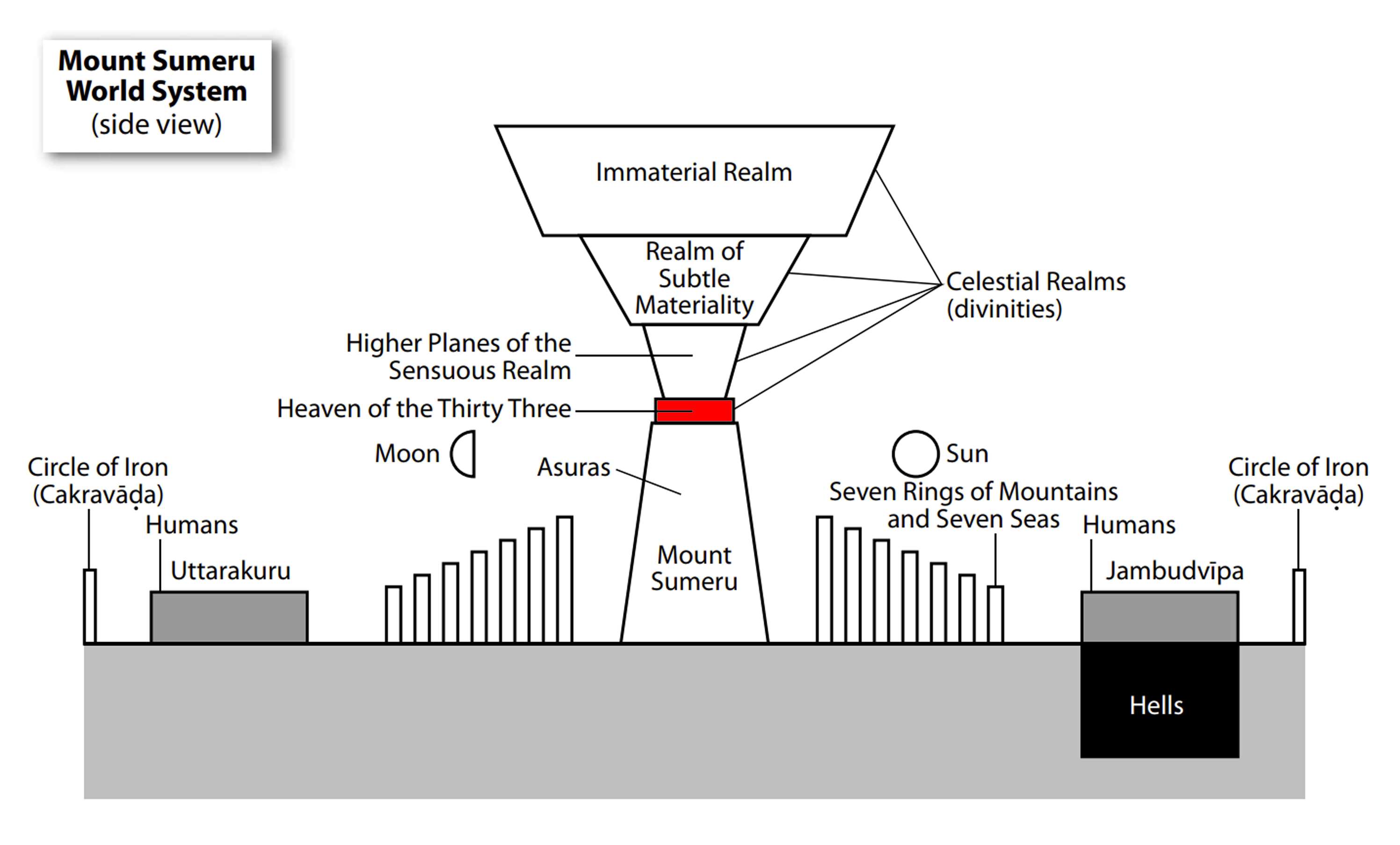
The central axis of the universe in Buddhist cosmology; also known as Mount Meru. Mount Sumeru stands in the middle of the world as its axis and is eight leagues high …  The slopes of Sumeru are the abode of demigods, and its upper reaches are the heavens of the four heavenly kings. At the summit of the mountain is the heaven of the thirty-three, ruled by the king of the gods, Sakra. Above Mount Sumeru are located the remaining heavens of the sensuous realm [fig. 2] (p. 896).

[Note: The portion that has been struck through is a typo. Please see section 4.5 below.]

A poem in chapter four of Journey to the West describes what Monkey sees when he first comes to live in heaven as the Keeper of the Heavenly Horses. A portion reads:

Thirty-three mansions were found up here, / With names like the Scattered Cloud, the Vaisravana, the Pancavidya, the Suyama, the Nirmanarati…” (Wu & Yu, 2012, vol. 1, p. 146).

這天上有三十三座天宮,乃遣雲宮、毘沙宮、五明宮、太陽宮、花樂宮 …

Yu (Wu & Yu, 2012) comments, “The verse here is alluding to the Indra heaven with it’s thirty-three summits (trāyastriṃśa) [fig. 2] and the six heavens of desire (devalokas)” (vol. 1, p. 510, n. 1), which are located atop Mount Sumeru. Therefore, the heaven described in the novel is located on the same cosmic mountain as that from Hindo-Buddhist cosmology, meaning that Wukong successfully supports the axis of the universe on one shoulder.

Fig. 2 – A sideview of Hindo-Buddhist cosmic geography (larger version). The Heaven of the Thirty-Three is indicated in red. Adapted from Buswell & Lopez, 2014, p. xxxii.

1.2. Mount Emei

Mount Emei (Emei shan, 峨嵋/眉山) is one of the four sacred Buddhist mountains of China. It is considered extremely important as Chinese tradition believes, upon entering the Middle Kingdom from India, Buddhism spread from this place during the eastern Han Dynasty and proliferated throughout China. The mountain is 10,167 ft (3098.90 m) high, making it over 3,000 ft (914.4 m) taller than the other sacred Buddhist mountains. The mountain is believed to be the heavenly abode of the Bodhisattva Samantabhadra, making him the patron saint of Emei (Buswell & Lopez, 2014, pp. 282-283).

1.3. Mount Tai

I turn now to Mount Tai (Taishan, 泰山), the mountain that ultimately overwhelms Sun Wukong’s supernatural strength. It is one of the five sacred mountains of China, which differ from the four Buddhist counterparts mentioned above. Mount Tai was the epicenter of a state cult in Ancient China, one in which Sage-Kings and emperors of past millennia traveled there to perform sacrifices to heaven, thereby gaining the right to rule or attaining eternal life. An entry in the Classic of History (Shujing, 書經, 4th c. BCE) suggests that the practice goes all the way back to the Sage-King Shun (3rd millennia BCE) (Poo, 2011, pp. 20-21).

Due to its great cultural and historical significance, the mountain came to be recognized as an adamantine monolith, the very name of which was used as a metaphor for something unfathomably heavy, whether it be a physical measure of weight or philosophical importance. For example, Warring States philosopher Mozi took part in a debate over the plausibility of his school of thought taking center stage in Chinese society. His opponent claimed, “As we see it, one can no more put it into practice than one can pick up Mount Tai and leap over a river with it!” Mozi highlighted the irrelevant nature of the metaphor by replying, “As for picking up Mount Tai and leaping over rivers with it, no one from ancient times to the present, from the beginning of humankind to now, has ever succeeded in doing that!” (Watson, 1999a, p. 71). Another example comes from the Han historian Sima Qian who wrote, “A man has only one death. That death may be as weighty as Mount Tai, or it may be as light as a goose feather. It all depends upon the way he uses it” (Watson, 1999a, pp. 371-372). Therefore, the mountain represented the heaviest thing imaginable in Chinese culture. It’s no wonder then that not even Monkey could withstand its weight.

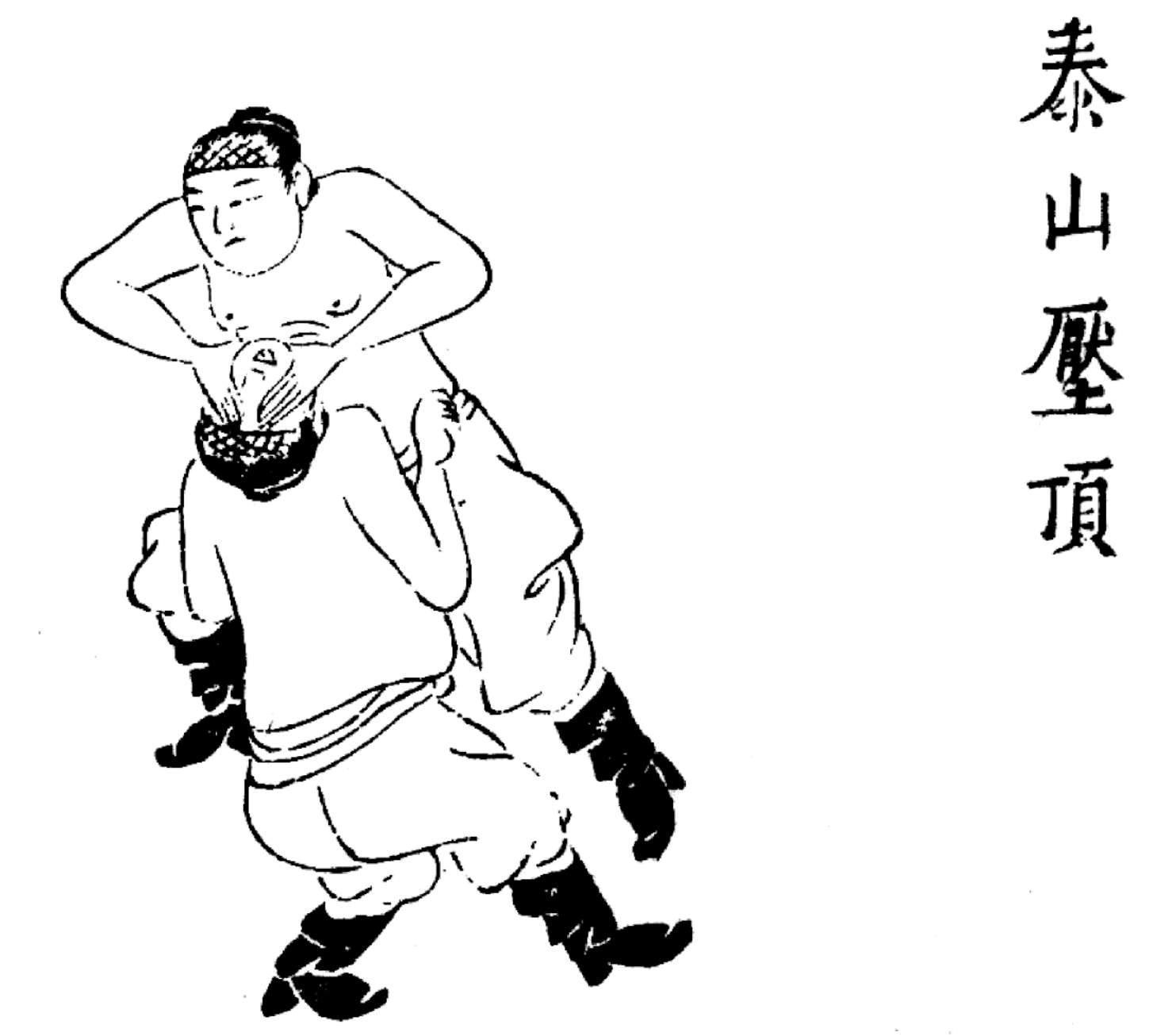
The idea of Mount Tai symbolizing a heavy object influenced the name of a 17th century technique related to the development of Taiji boxing called “Crush with the Weight of Mount Tai” (Taishan yading, 泰山壓頂) (fig. 3), which involved climbing onto an opponent (Henning, 2009, pp. 78 and 82). Incidentally, the name of this technique is also a common Chinese saying referring to someone being under a lot of stress (Gao, Wang, & Weightman, 2012, p. 191).

Fig. 3 – “Crush with the Weight of Mount Tai”. From Henning, 2009, p. 78 (larger version).

2. An Allegory for Cultural or Religious Conflict?

I want to reiterate the fact that both Sumeru and Emei are important to Buddhism, a religion originally foreign to China. Not only does Monkey support the very axis of the Buddhist universe on one shoulder, he supports on the other the very mountain from which the religion is believed to have spread into China. Therefore, considering that Wukong carries these landmasses while protecting Tripitaka on the quest to India, the feat could be read as an allegory for “supporting” Buddhism. After all, the historical Xuanzang (玄奘, 602–664), on whom Tripitaka was based, is considered to be one of, if not the most, prolific translators of religious texts in the history of Chinese Buddhism (Buswell & Lopez, 2014, pp. 1015-1016).

This is why it’s fascinating that Mount Tai ultimately overpowers the Monkey King. It represents native Chinese history and culture, while Sumeru and Emei represent foreign Buddhism. Therefore, this episode could be read as a struggle between the domestic and foreign aspects of Chinese culture. Considering that the monsters are later revealed to be Daoist attendants of Laozi sent by heaven to test the resolve of the pilgrims (Wu & Yu, 2012, vol. 2, p. 145), it’s possible that the conflict is between Daoism, a native Chinese religion, and Buddhism.

This is obviously not a perfect theory, though. For instance, Laozi reveals that it was actually the Bodhisattva Guanyin who requested the lads be sent (Wu & Yu, 2012, vol. 2, p. 145). Does this explain why a Daoist spirit would summon two Buddhist mountains to crush Monkey? I’m interested in what others think.

3. Possible Ties to Hanuman

Lastly, I would like to note that Wukong’s feat of lifting mountains recalls an episode in the Ramayana (4th c. BCE) in which the monkey god Hanuman carries back a mountain laden with magical herbs to heal the wounds of his master‘s brother Lakshmana (fig. 4). Hanuman is the living embodiment of strength (shakti) in India (Alter, 1992). Monkey is believed to be loosely based on Hanuman (Walker, 1998), so there could be a connection between both instances of mountain lifting.

Fig. 4 – A modern painting of Hanuman lifting the mountain (larger version). All credit goes to the original artist, S. Keerthi. 


4. Updates

4.1. The Feat’s Origin in Chinese Folklore

Update: 08-10-18

Monkey’s feat appears to be based on a native Chinese story and not the Ramayana. This is first hinted at in chapter 33 when the demon exclaims that the Great Sage “truly knows how to pole mountains [ta quehui danshan, 他卻會擔山]!” (Wu & Yu, 2012, vol. 2, p. 109). A poem spoken by Wukong in chapter 67 confirms the connection:

Purvavideha was my ancestral home,
I did cultivation on Mount Flower-Fruit.
I bowed to the Patriarch of Heart and Mind
and perfected with him the martial arts.
I can tame dragons, stirring up the seas;
I can tote mountains to chase down the sun (emphasis added).
In binding fiends and demon’s I’m the best;
Moving stars and planets, I scare ghosts and gods.
Stealing from heav’n and Earth gives me great fame,
Of boundless change, Handsome Stone Monkey’s my name (Wu & Yu, 2012, vol. 3, p. 243).

祖居東勝大神洲,花果山前自幼修。
身拜靈臺方寸祖,學成武藝甚全周:
也能攪海降龍母,善會擔山趕日頭
縛怪擒魔稱第一,移星換斗鬼神愁。
偷天轉地英名大,我是變化無窮美石猴。

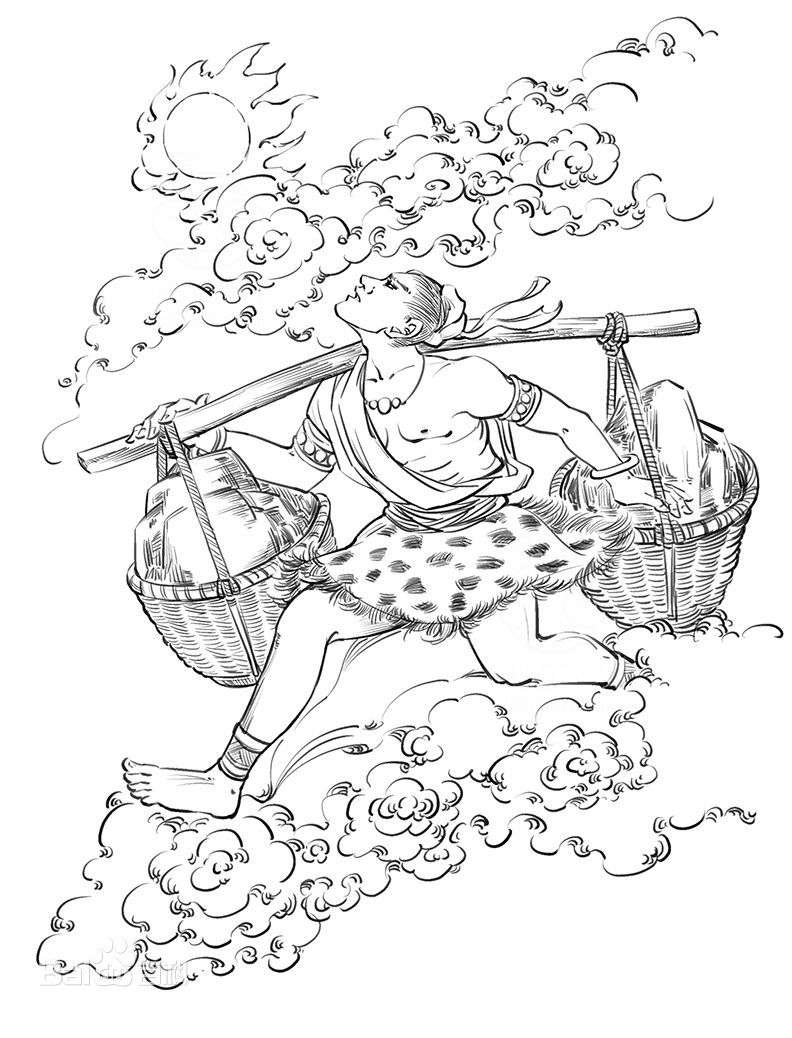
Fig. 5 – Erlang poling the mountains (larger version). Artist unknown.

“I can tote mountains to chase down the sun” (shanhui danshan gan ritou, 善會擔山趕日頭) is a clear allusion to the ancient tale “Erlang carries mountains to chase the suns” (Erlang danshan gan taiyang, 二郎擔​​山趕太陽). The story describes how the ancient earth was plagued by many suns that scorched the land, making it impossible for people to grow anything. Vowing to end this plight, the hero Erlang shoulders two mountains hanging from a tree and with the aid of magical shoes, chases down each sun (fig. 5), using the weight from both landmasses to overwhelm and crush the superfluous celestial bodies (担山赶太阳, n.d). Apart from the feat of lifting two mountains, Erlang’s fleet pursuit of each sun (gan taiyang, 趕太陽) foreshadows Monkey “giv[ing] chase to his master with the speed of a meteor” (feixing laigan shifu, 飛星來趕師父).

It’s interesting to note that “Erlang Carrying Mountains” (Erlang danshan, 二郎擔山) is a common Shaolin stance, and a staff variant even appears in the Collection of Military Works (Wubei zhi, 武備志, c. 1621), a Ming treatise on military armaments and fighting techniques (fig. 6). The staff obviously recalls the pole (or in this case tree) that Erlang uses to bear the weight of the mountains.

Fig. 6 – The “Erlang Carrying Mountains” staff stance (larger version).


4.2. Carrying Mountains AND Running

Update: 06-23-21

One thing I forgot to stress is the fact that Sun Wukong RUNS while transporting the Buddhist landmasses. The novel reads: “Carrying two mountains, he began to give chase to his master with the speed of a meteor!” (Kanta tiaozhe liang zuo dashan, feixing laigan shifu, 看他挑著兩座大山,飛星來趕師父) (Wu & Yu, 2012, vol. 2, p. 109). The meteoric imagery is no doubt hyperbole given that Tripitaka isn’t that far ahead of him, but this additional feat is still impressive.


4.3. Monkey and Mount Tai in Religious Literature

Update: 03-11-22

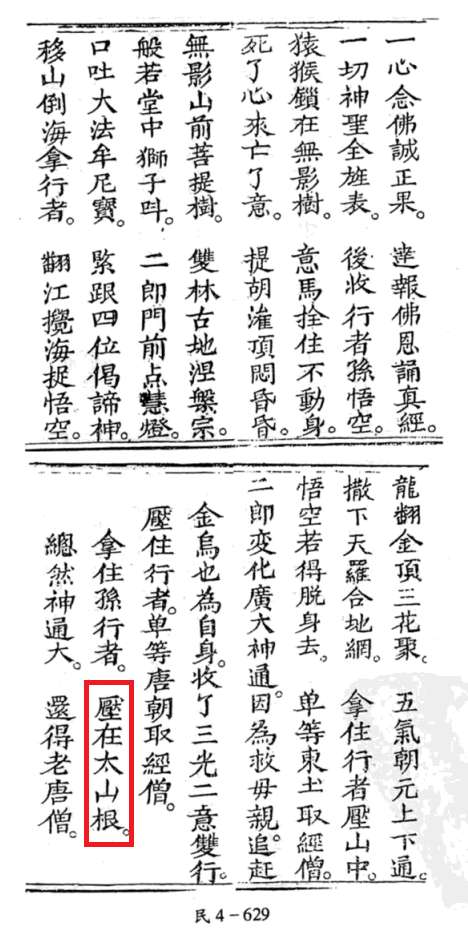
I recently archived the Precious Scroll of Erlang (Erlang baojuan, 二郎寳卷, 1562), a religious text that venerates and records the various deeds of the immortal demi-god. The work states that the Monkey King was “pressed under the base of Mt. Tai” (yazai, taishan gen, 壓在太山根) (PDF page 46) (fig. 7). This might also explain why Mount Tai overwhelms Monkey in chapter 33.

Fig. 7– The Mt. Tai sentence is indicated in red (larger version).


Update: 03-25-22

My friend Irwen Wong of the Journey to the West Library blog was kind enough to provide me with time-stamped links to the aforementioned episode in the various JTTW TV shows. I will list them in order of year.

Journey to the West (1986) – Live action

Even though this is my favorite show, it did a poor job of representing the mountain. It’s little more than a boulder.

Journey to the West: Legends of the Monkey King (2000) – Animated

This cartoon just has monkey trapped by a single mountain.

New Journey to the West (2010) – Live action

This version uses all three mountains and really steps up the special effects. This is no surprise given the differences in time and budget between it and the 1986 edition.

Journey to the West (2011) – Live action

This is my favorite depiction of the episode. The special effects are top notch. I will say the elongated arms on the Taoist are a bit odd, but Irwen suggests that it’s likely a visual representation of “poling” mountains (as discussed above).

Each of these iterations have their own charm, but all of them depart from the novel by showing Wukong struggling to carry the first two mountains. I remind the reader that the literary character runs “with the speed of a meteor!” while carrying the load (Wu & Yu, 2012, vol. 2, p. 108). I guess that would have been hard to depict, even with modern computer graphics.


4.5. The Correct Size of Mount Sumeru

Update: 06-19-22

The Monkey King’s feats are on the minds of many people as the Death Battle TV show is set to feature a fight between Hercules and our hero. I’ve seen a few blogs where people try to calculate the size of Mount Sumeru. I cited a source above stating that the landmass is “eight leagues high” (Buswell & Lopez, 2014, p. 896), but this appears to be a typo, for other sources multiply this estimate by thousands of times. For example, Sadakata (1997) explains that according to the Abhidharmakośa (Ch: Api damo jushe lun, 阿毗達磨俱舍論, 4th to 5th century): “Sumeru has a height of 160,000 yojanas, of which half is under water. The half above water is therefore 80,000 yojanas high” (pp. 26-27). The yojana (youxun, 由旬) is approximately eight miles (12.87 km), or the distance that one can travel in one day on a cart driven by a team of oxen. But estimates also range between four and ten miles (6.43 and 16.09 km) (Buswell & Lopez, 2014, p. 1036). If eight miles is used, then Mt. Sumeru would an astounding 1,280,000 miles (2,059,960.32 km) tall.


4.6. Wukong’s Inconsistent Strength in JTTW

Update: 07-03-22

I should note that Journey to the West does not depict Monkey’s strength consistently throughout the novel. As mentioned, he can carry two mountains (one of them the cosmic axis) on his shoulders while running with meteoric speeds. But apart from Mount Tai, the novel describes another object that he can’t lift. Chapter 42 reads:

[T]he Bodhisattva grew terribly angry, crying, “How dare that brazen fiend [Red Boy] change into my image!” As she cried, she flung into the ocean the immaculate porcelain vase set with precious pearls which she held in her hand …

菩薩聽說,心中大怒道:「那潑妖敢變我的模樣?」恨了一聲,將手中寶珠、淨瓶往海心裡撲的一摜。

[…]

[After her turtle emerges from the sea with the vase on its back, she orders Monkey to retrieve it for her.] Pilgrim went forward at once to pick up the vase. Alas! He could not do so at all! It was as if a dragonfly attempted to rock a stone pillar-how could he even budge it? Pilgrim approached the Bodhisattva and knelt down, saying, “Your disciple cannot pick it up.” “Monkey head,” said the Bodhisattva, “all you know is how to brag! If you can’t even pick up a small vase, how can you subdue fiends and capture monsters?” “To tell you the truth, Bodhisattva,” said Pilgrim, “I might be able to do it ordinarily, but today I just can’t pick it up. I must have been hurt by the monster-spirit, and my strength has weakened.” The Bodhisattva said, “Normally it’s an empty vase, but once it has been thrown into the ocean, it has traveled through the three rivers, the five lakes, the eight seas, and the four big rivers. It has, in fact, gathered together from all the aquatic bodies in the world an oceanful of water, which is now stored inside it. You may be strong, but you don’t possess the strength of upholding the ocean. That’s why you cannot pick up the vase…” (Wu & Yu, 2012, vol. 2, pp. 243 and 244).

這行者即去拿瓶。唉!莫想拿得他動。好便似蜻蜓撼石柱,怎生搖得半分毫?行者上前跪下道:「菩薩,弟子拿不動。」菩薩道:「你這猴頭,只會說嘴。瓶兒你也拿不動,怎麼去降妖縛怪?」行者道:「不瞞菩薩說。平日拿得動,今日拿不動。想是吃了妖精虧,觔力弱了。」菩薩道:「常時是個空瓶;如今是淨瓶拋下海去,這一時間,轉過了三江五湖、八海四瀆、溪源潭洞之間,共借了一海水在裡面。你那裡有架海的斤量?此所以拿不動也。」

However, there may be an underlying religious reason for this. For instance, while Sun can’t lift it, the goddess does so easily, as does her holy sea turtle (Wu & Yu, 2012, vol. 2, p. 243). Most importantly, the story suggests that Guanyin will send her holy disciple, the “Dragon Girl Skilled in Wealth” (Shancai longnu, 善財龍女), to carry it for him (Wu & Yu, 2012, vol. 2, p. 244). So, this could mean that Monkey, at this point in the story, lacks the Buddhist spiritual attainments necessary to lift the vase. After all, “Dharma Power” (Fali, 法力) is considered the penultimate power in the novel’s universal hierarchy, even outclassing that wielded by high Daoist deities.

Sources:

Alter, J. S., & OUP. (1992). The Wrestler’s Body: Identity and Ideology in North India. Berkeley, Calif: University of California Press.

Buswell, R. E., & Lopez, D. S. (2014). The Princeton Dictionary of Buddhism. N: Princeton University Press.

Gao, W., Wang, A., & Weightman, F. (2012). A Handbook of Chinese Cultural Terms. Bloomington, Indiana: Trafford On Demand Pub.

Henning, S. (2009). Taijiquan: Symbol of Traditional Chinese Martial Arts Culture. Journal of Chinese Martial Arts, 1, pp. 76-83.

Poo, M. (2011). Preparation for the Afterlife in Ancient China. In Olberding, A., & Ivanhoe, P. J. (Ed.), Mortality in Traditional Chinese Thought (pp. 13-36). Albany: State University of New York Press.

Sadakata, A. (1997). Buddhist Cosmology: Philosophy and Origins. Japan: Kosei Publishing Company.

Walker, H.S. (1998). Indigenous or Foreign? A Look at the Origins of Monkey Hero Sun Wukong. Sino-Platonic Papers, 81, 1-117.

Watson, B. (1999a). Mozi: Utility, Uniformity, and Universal Love. In De Bary, W. T. & Bloom, I. (Eds.), Sources of Chinese Tradition: Volume 1: From Earliest Times to 1600 (pp. 64-76). New York: Columbia University Press.

Watson, B. (1999b). The Great Han Historians. In De Bary, W. T. & Bloom, I. (Eds.), Sources of Chinese Tradition: Volume 1: From Earliest Times to 1600 (pp. 367-374). New York: Columbia University Press.

Wu, C., & Yu, A. C. (2012). The Journey to the West (Vols. 1-4) (Rev. ed.). Chicago, Illinois: University of Chicago Press.

担山赶太阳. (n.d.). Retrieved August 10, 2018, from https://baike.baidu.com/item/担山赶太阳

Archive #3 – PDF of Chinese Spirit-Medium Cults in Singapore (1955) by Alan J. A. Elliott

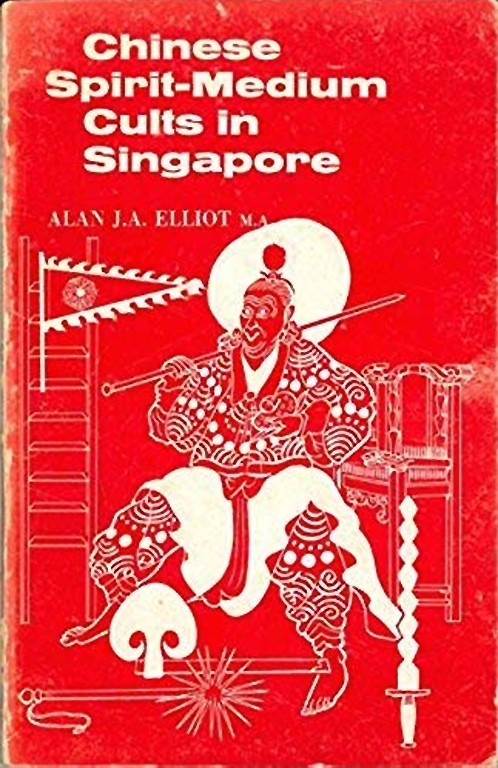
Here I present a PDF of Chinese Spirit-Medium Cults in Singapore (1955/1990) by Alan J. A. Elliott. The book contains a large chapter on the importance of spirit-mediums (Hokkien: Tangki, 童乩; Chinese: Jitong, 乩童; literally: “Divining Child”) in the worship of Sun Wukong. For those unfamiliar with spirit-mediums, I have quoted material from my article linked above:

They are believed to channel [the Great Sage’s] spirit to interact with believers, generally answering their questions, blessing them or their belongings with paper talismans, or prescribing medicine. On special occasions, they also perform a complex self-mortification ceremony […] The ritual serves several purposes. First, hacking, skewering, and poking the body with various weapons is considered a form of self-sacrifice. Second, the weapons that pierce the flesh are believed to imbue the mediums with spiritual power needed in their battle with demonic forces that pervade every corner of daily life. Third, the resulting blood is believed to have demonifugic properties, hence the reason it is smeared on paper talismans and clothing. Overall, the ritual is performed to exorcize evil spirits that cause bad luck and mental and physical illnesses.

Cover from the 1964 (2nd edition) (larger version). Note the prominence of the Monkey King.

I. Forward from the 1990 Edition

This account of Chinese spirit-medium cults describes in great detail an important aspect of the religion of overseas Chinese in Singapore. It is an historical study, since the field research was carried out over nearly two years in 1950 and 1951. It is historical for two reasons. One is that the highly personalized nature of many of these cults has meant that they are short-lived, emphemeral. The other is that in the forty years since the study was made the life of the Singapore Chinese has changed radically, and many of their ritual practices must have altered accordingly. But at the time this research was carried out, anthropological field studies of Chinese social institutions were rare, and this particular investigation was unique. Most studies of Chinese religion anywhere had been of a literary nature, concerning the ideas and practices of Confucianism, Buddhism, Taoism; very little information was available about how ordinary Chinese conducted their daily ritual affairs.

The significance of this study is not just focused on the past. It has contemporary relevance, and for a field far wider than Singapore alone. For anthropologists, enquiry into spirit-mediumship, shamanism, ecstatic religion, possession, has become a recognised part of the discipline, over a broad ethnographic range. But the general problems involved, of alternative personality, of apparent lack of sensitivity to external physical stimuli, of claims in the name of spirit to knowledge and authority not possessed by the human medium, can attract the attention of psychologists, psychiatrists, and all interested in the obscure and complex workings of the human mind. The issues raised involve ordinary people too, since they show how anxiety, uncertainty, fear, disappointment and greed seek assurance and resolution from some source deemed superhuman, even spiritual. The basic beliefs revealed by this study of Chinese spirit-mediumship are not confined to Chinese.

II. PDF Link


Disclaimer
:

This has been posted for educational purposes. No malicious copyright infringement is intended. Please support the official release.

Citation:

Elliott, A. J. (1990). Chinese Spirit-Medium Cults in Singapore. London: The Athlone Press. (Original work published 1955)