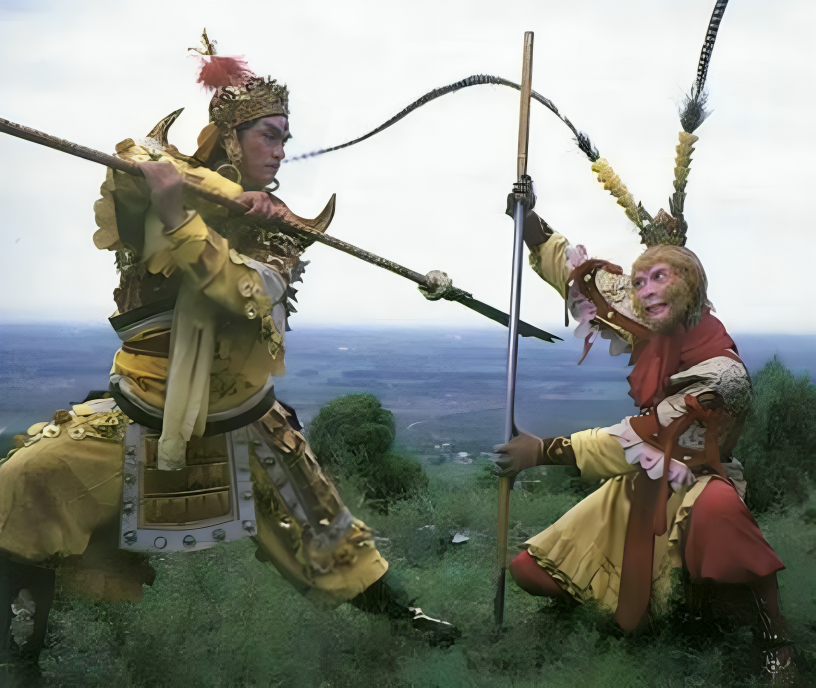
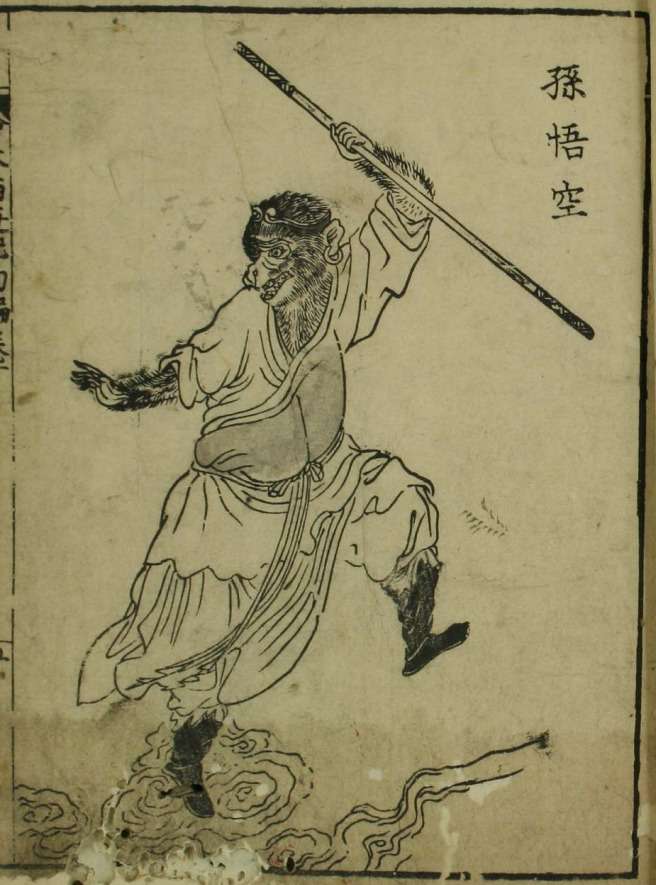
The God Erlang Captures the Great Sage Equaling Heaven (Erlang shen suo Qitian dasheng / Erh-lang shen so Ch’i-t’ien Ta-sheng, 二郎神鎖齊天大聖) is a zaju play from the Yuan-Ming period. To my knowledge it is roughly contemporaneous with the early-Ming Journey to the West zaju play (Xiyou ji zaju, 西遊記雜劇). Here, I would like to archive the Chinese script, as well as provide a brief description for those unable to read the original.
1. Synopsis
Dudbridge (1970) gives a brief overview of the play:
The action, in brief, is as follows: An ape-demon, Qitian dasheng [齊天大聖], steals Taoist elixir and fairy wine from the Immortal Yuanshi tianzun [元始天尊] and returns with it to his home Shuilian dong [水簾洞] on Huaguo shan. The theft reported, Erlang is summoned to capture him. The ape meanwhile feasts with members of his family on Huaguo shan. Erlang, mustering his traditional followers, advances in company with Juling shen [巨靈神] and effects the capture. In the final act he surrenders the prisoner to the Taoist deity Quxie yuanzhu [驅邪院主]. The ape begs for clemency and is finally dismissed with only a firm injunction to reform (p. 129). [1]
Apart from Erlang and his followers, some of these figures carried over into the 1592 Journey to the West novel. Yuanshi tianzun (“Celestial Worthy of Original Commencement”) is mentioned by name in the novel six times. Juling shen (“Might-Spirit God”) is easily bested by Sun Wukong in chapter four (Wu & Yu, 2012, vol. 1, pp. 153-154). His name is mentioned a total of 15 times.
Quxie yuanzhu (驅邪院主, “Lord of the Court for Exorcising Evils”) does not appear in the novel.
2. Similarities with the JTTW Zaju
As noted in the introduction, this zaju shares parallels with the early-Ming JTTW zaju. Dudbridge (1970) explains:
A number of details demand attention:
the name of the ape: Qitian Dasheng;
the name of his home: Huaguo shan, Shuilian dong [花果山水簾洞];
the members of his family: “My elder brother Tongtian Dasheng [通天大聖], myself Qitian Dasheng, my elder sister Guishan shuimu [龜山水母], my younger sister Tiese mihou [鐵色獼猴], my younger brother Shuashua Sanlang [耍耍三郎]” (speech in the first act);
the stealing of elixir and wine;
the role of Erlang and Juling shen;
the ‘iron cudgel’ [鐵棒], with which the ape defends himself in the third act;
the name Sun xingzhe [孫行者] claimed by the youngest brother in the same act;
minor details of the battle—the attendants of Erlang, the Taoist gods—also peripherally related to the Xiyouji story (pp. 129-130).
For a list comparing the names of Monkey’s siblings from both plays, see the 12-20-23 update here.
Thank you to the Text Court of the University of Oxford for making this zaju play freely available. The original can be found here.
Update: 03-07-25
Above, Quxie yuanzhu (驅邪院主, “Lord of the Court for Exorcising Evils”) was mentioned as a character that didn’t carry over to the 1592 JTTW. I originally couldn’t find any info about said deity, but I have found a possible lead. According to Kohn (2020), “In Daoism under the Song, [the immortal Zhongli Quan] was particularly honored as the head of the Department of Exorcism (Quxie yuan 驅邪元[院]), a central part of the celestial administration” (p. 13). Perhaps there is a connection between the two.
Update: 03-08-25
I apparently didn’t look hard enough because Text Court (thanked and linked above) provides a list of the character’s other titles:
北極鎮天真武玉虚師相玄天元聖仁威
北極驅邪院主
北極驅邪院都教主
The first title, “北極鎮天真武玉虚師相玄天元聖仁威” (Beiji Zhentian Zhenwu Yuxushi Shixiang Xuantian Yuansheng Renwei), or the “Northern Ultimate and Suppressing Heaven True Warrior, Jade Emptiness Prime Minister, Dark (or Mysterious) Heaven Primal Sage of Humane Power,” contains several illusions to a deity associated with exorcism. The most obvious of these is Zhenwu (真武) and Xuantian (玄天), both of which refer to a singular martial god. I guess this is mystery solved.
Zhenwu appears as the “Demon-Conquering Celestial Worthy” (Dangmo tianzun, 蕩魔天尊) in JTTW chapter 66 (Wu & Yu, 2012, vol. 3, p. 226), but his role is small like in the play.
Fans of Journey to the West (Xiyouji, 西遊記, 1592 CE; “JTTW” hereafter) sometimes debate whether Sun Wukong’s 72 “Multitude of Terrestrial Killers” (Disha shu, 地煞數; a.k.a. “… Earthly Fiends”) and Zhu Bajie’s 36 “Multitude of Heavenly Rectifiers” (Tiangang shu, 天罡數; a.k.a. “… the Heavenly Ladle or Northern Dipper”) [1] are just transformations or actual lists of individual magical skills. For example, in March of 2023, a reddit user claimed in one post that “72 transformations” was a mistranslation for “72 different spells.” And then they asked if there existed a list of the 36 spells. I responded by saying:
There is no official list of the 72 or 36 transformations. This is because they are never mentioned in the novel. Any attempt at making a list is a guesstimate at best or completely made up at worst.
[…]
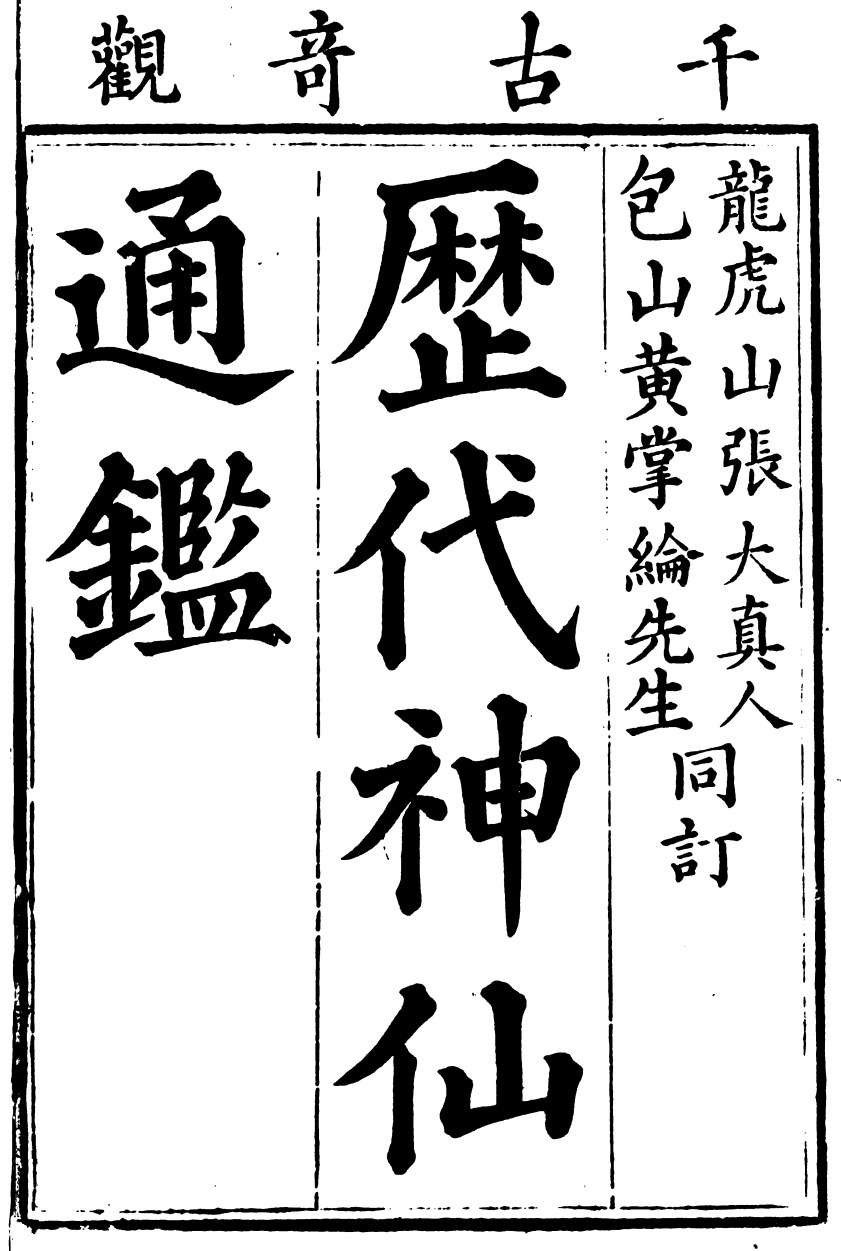
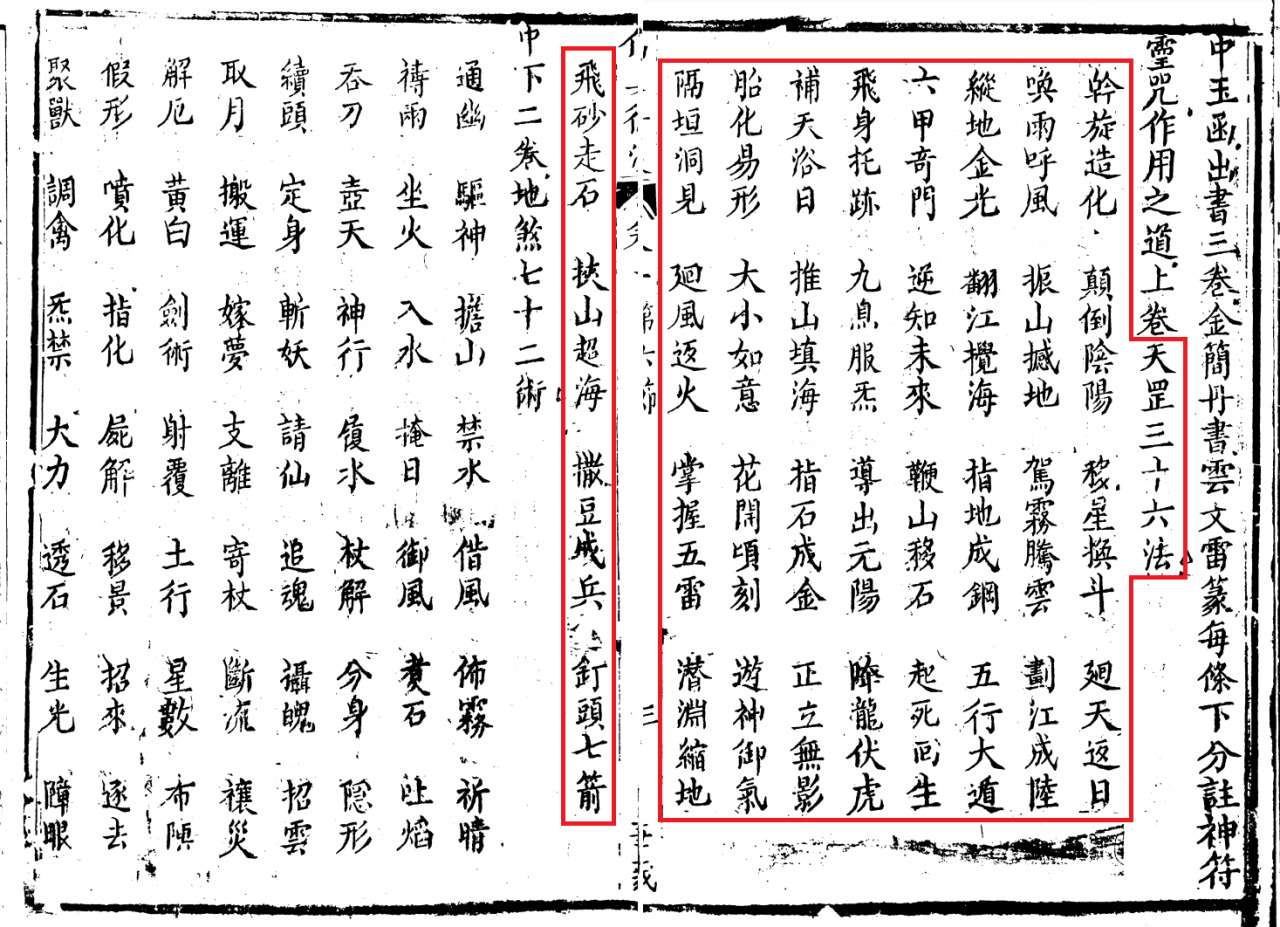
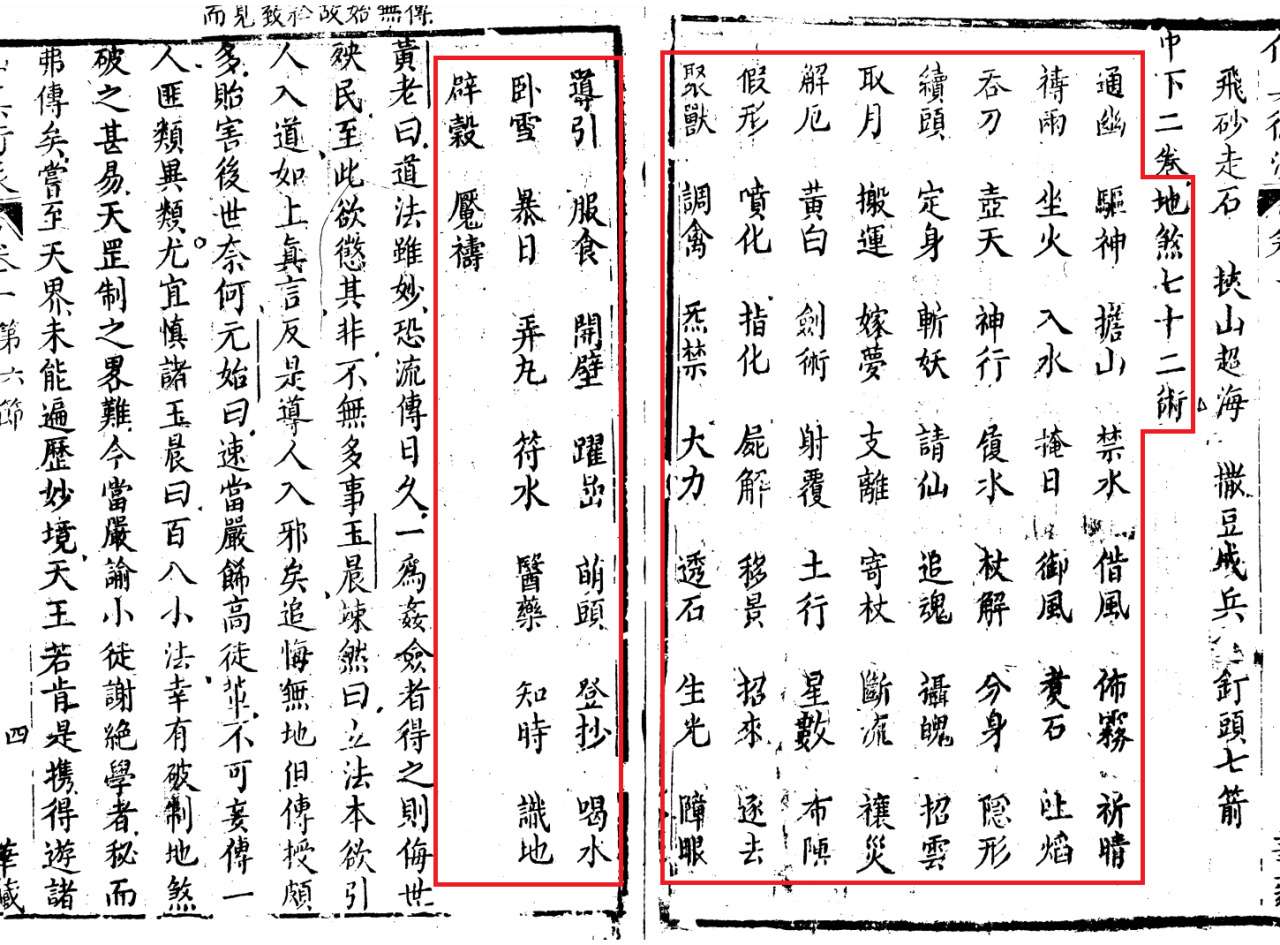
But I was recently contacted by a different reddit user who linked me to a dynastic source, The Comprehensive Mirror of Successive Divine Immortals (Lidai shenxian tongjian, 歷代神仙通鑑, c. 1700; hereafter The Comprehensive Mirror), [2] which does include respective lists for the “Thirty-Six Methods of the Heavenly Rectifiers” (Tiangang sanshiliu fa, 天罡三十六法) and the “Seventy-Two Arts of the Terrestrial Killers” (Disha qishier shu, 地煞七十二術) (said redditor translates the list of 72 abilities in video game terms here). The skills range from creating earthquakes to resurrecting the dead.
However, there are three reasons why these lists should not be associated with Sun and Zhu: 1) They do not appear in JTTW; 2) They postdate the novel by nearly a century; and 3) The JTTW narrative firmly establishes that the numbers of the 72 Terrestrial Killers and 36 Heavenly rectifiers are symbolic of the many ways that Monkey and Pigsy can change their shape. I will discuss this in more detail in section 1.
But for the sake of posterity, I would like to translate both lists so that anyone interested can see them for themselves. These will appear in sections 2 and 3. The info might serve as good fodder for fanfiction or D&D character development. Having said that, I don’t consider myself a translator or an expert on esoteric Taoist jargon. So, if you know of a better rendering for a given phrase, please let me know in the comments below or by email (see the “contact” button).
Also, I will be archiving the section of The Comprehensive Mirror containing the lists of the 72 and 36 skills. See section 4 below for the PDF link. It was downloaded from Google Books.
The title page of The Comprehensive Mirror (larger version) (PDF p. 6).
First, they are not canonical as they don’t appear in JTTW. I’m sure someone could comb through the novel and find parallels, but this wouldn’t necessarily constitute proof of direct influence. This is because immortals have displayed similar powers in Taoist hagiography since at least Ge Hong‘s Book of the Master Who Embraces Simplicity (Baopuzi, 抱樸子, 4th century CE). For example, just like Sun Wukong, the late-Han alchemist Zuo Ci (左慈) was known for enraging enemies, in this case the warlord Cao Cao (曹操), by using magic clones of himself in hilarious ways to escape trouble (see the 11-24-19 update here for a full translation of his shenanigans). Campany & Ge (2002), especially part II, is a treasure trove of such hagiographic tales.
Second, the lists postdate JTTW by almost a century. Whose to say that the popularity of the novel didn’t influence the creation of said lists? Even The Comprehensive Mirror refers at one point to the skills as the “thirty-six changes and seventy-two transformations” (sanshiliu bian, qishier hua, 三十六變,七十二化) (PDF p. 295). This mimics the metamorphic abilities of Monkey and Zhu discussed below. All one would need to do to create the lists is gather skills from Taoist hagiography and then assign them a place and number among the 72 Terrestrial Killers (Disha, 地煞) or 36 Heavenly Rectifiers (Tiangang, 天罡).
(I should note that the names of these numbered groups are based on malevolent and benevolent stellar deities that appear throughout Chinese culture and literature. See, for instance, the 108 stars of the Water Margin (Shuihu zhuan, 水滸傳, c. 14th century CE) (Meulenbeld, 2019).) [3]
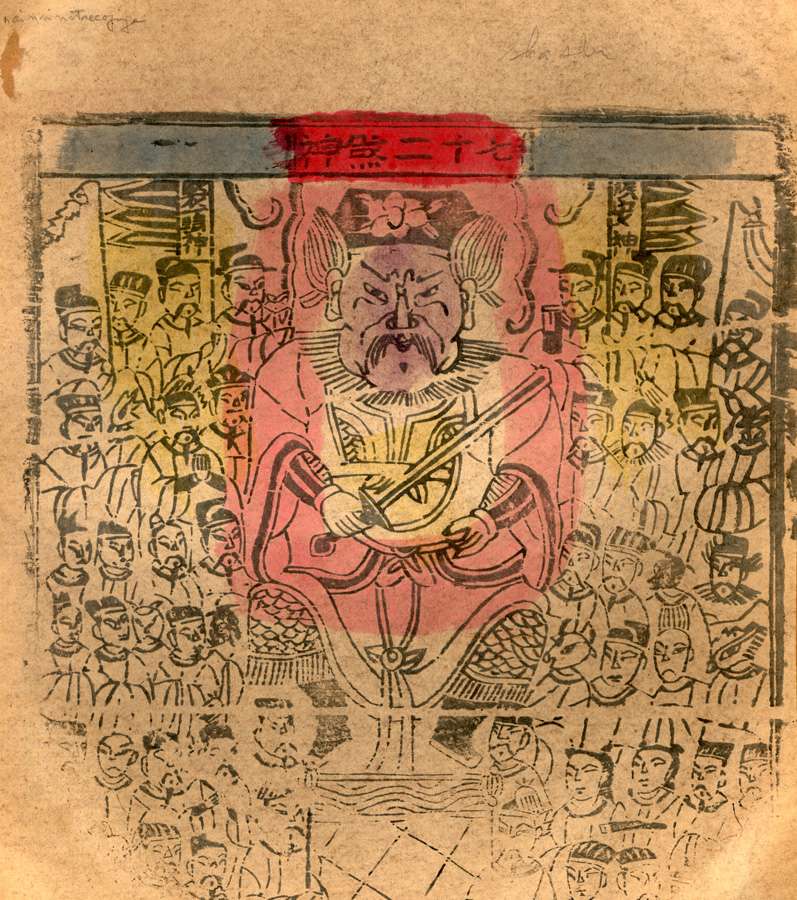
A folk print of the “72 Killer Gods” (Qishier Shashen, 七十二煞神) from the Anne S. Goodrich Collection (larger version). Image found here.
And third, most importantly, JTTW specifically states that Monkey has “seventy-two kinds of transformations” (qishier ban bianhua, 七十二般變化) and Zhu “thirty-six kinds of transformations” (sanshiliu ban bianhua, 三十六般變化). Therefore, the numbers of the 72 Terrestrial Killers and 36 Heavenly rectifiers are symbolic of the many ways that our heroes can change their shape. This is made clear in several places throughout the novel. Here, I will list a few examples.
In chapter 2, the Patriarch Subodhi teaches the 72 changes to Sun Wukong with the expressed purpose of helping him “hide” (duobi, 躲避) from the Three Calamities (sanzai lihai, 三災利害) of cosmic lightning, fire, and wind sent by heaven every 500 respective years to destroy immortals for defying fate and achieving eternal life:
“Very well, then,” said the Patriarch, “what method of hiding would you like to learn? There is the “Multitude of the Heavenly Rectifiers,” which numbers thirty-six transformations, and there is the “Multitude of Terrestrial Killers,” which numbers seventy-two transformations.” Wukong said, “Your pupil is always eager to catch more fishes, so I’ll learn the “Multitude of Terrestrial Killers.” “In that case,” said the Patriarch, “come up here, and I’ll pass on the oral formulas to you.” He then whispered something into his ear, though we do not know what sort of wondrous secrets he spoke of. But this Monkey King was someone who, knowing one thing, could understand a hundred! He immediately learned the oral formulas and, after working at them and practicing them himself, he mastered all seventy-two transformations (based on Wu & Yu, 2012, vol. 1, 122).
In chapter 18, Zhu states, “I have the transformations of the Heavenly Rectifiers” (我有天罡數的變化). [4] And later in chapter 67, he reveals that the 36 changes have their shortcomings:
I, old Hog, after all, am capable of thirty-six kinds of transformation. If you want me to change into something delicate, elegant, and agile, I simply can’t do it. But if it’s a mountain, a tree, a boulder, an earth mound, a scabby elephant, a graded hog, a water buffalo, or a camel, I can change into all these things (Wu & Yu, 2012, vol. 3, p. 253).
I have included reference numbers when certain skills are similar or related.
Take note that several of these skills appear in Investiture of the Gods (Fengshen yanyi, 封神演義, c. 1620), a famous vernacular novel containing the mythos of many gods still worshiped today in Chinese folk religion.
Woxuan zaohua (斡旋造化, lit: “mediate good luck”) – Creating good fortune.
Diandao yinyang (顛倒陰陽, lit: “reverse yin and yang”) – Disturbing the natural flow of the cosmos (switching the sun and moon, reversing right and wrong, confusing black and white, etc.).
Yixing huandou (移星換斗, lit: “shift the stars and switch the Big Dipper) – Altering the position of the stars. Perhaps this is a metaphor for changing someone’s fate.
Huitian fanri (迴天返日, lit: “turn around heaven to bring back the sun) – Rewinding the day to raise the setting sun into the sky.
Huanyu hufeng (喚雨呼風, Lit: “call the rain and summon the wind) – Summoning storms (see sec. 3, nos. 5-8 & 28).
Zhenshan handi (振山撼地, lit: “shake mountains and earth”) – Making earthquakes.
Jiawu tengyun (駕霧騰雲) – Flying on the mist and clouds (see sec. 3, no. 12).
Huajiang chenglu (劃江成陸) – Parting water to make new land.
Zongde jinguang (縱地金光, lit: “releasing golden light”) – Transforming into light, thus allowing one to travel thousands of Chinese miles in a single day (see sec. 3, no. 55).
Fanjiang jiaohai (翻江攪海, lit: “overturn rivers and disturb oceans) – Creating turbulent rapids and violent tsunamis.
Zhidi chenggang (指地成鋼) – Transforming earth into steel with just a point of the finger (see no. 23).
Wuxing dadun (五行大遁, lit: “five elements great escape”) – Escaping a place or situation through any of the five Chinese elements (wood, fire, earth, metal, and water) (see no. 32 and sec. 3, nos. 40, 54, & 59).
Liujia jimen (六甲奇門, lit: “Strang Door of the Six Jia Spirits) – A computational divination system used to foretell fate.
Nizhi weilai (逆知未來) – Foreknowledge of the future.
Bianshan yishi (鞭山移石, lit: “whipping mountains and shifting stones”) – A kind of earth bending where one can change the landscape at will (see sec. 3, no. 47).
Qisi huisheng (起死回生) – Bringing the dead back to life.
Feishen tuoji (飛身托跡, lit: “flying body trace”) – Traveling heaven and earth without leaving a trace.
Jiuqi fuqi (九息服炁, lit: “nine breaths air swallowing) – A kind of Taoist “embryonic breathing” thought to bring about immortality.
Daochu yuanyang (導出元陽) – Extracting someone’s primal yang energy (see no. 36).
Xianglong fuhu (降龍伏虎) – Subduing dragons and tigers. Apart from the literal reading, this could also be a metaphor for mastery of yin and yang energy.
Butian yuri (補天浴日) – Mending the heavens and bathing in the sun. Is this perhaps some kind of power of purification?
Tuishan tianhai (推山填海) – Pushing mountains and filling oceans.
Zhishi chengjin (指石成金) – Turning stone into gold with just a point of the finger (see no. 11).
Zhengli wuying (正立無影) – Standing in broad daylight without casting a shadow.
Taihua yixing (胎化易形, lit: “changing form into a fetus”) – Regressing one’s form to a youthful appearance (see sec. 3, no. 43). Could this be a reference to the “spirit embryo” from Taoist internal alchemy?
Daxiao ruyi (大小如意) – Enlarging or shrinking things to meet one’s desires (see sec. 3, no. 16).
Huakai qingke (花開頃刻) – Making flowers bloom and plants grow instantly.
Youshen yuqi (遊神御氣) – Traveling in spirit and riding the wind (see no. 17).
Geyuan dongjian (隔垣洞見) – Seeing through walls and partitions.
Huifeng fanhuo (迴風返火) – Repelling wind and fire (see sec. 3, no. 4).
Zhangwo wulei (掌握五雷, lit: “controlling the five thunders”) – Controlling divine, often wrathful beings to expel evil.
Qianyuan suodi (潛淵縮地, lit: “diving into the abyss and contracting earth”) – Traveling deep within the water and earth unimpeded (see no. 12 and sec. 3, nos. 40, 54, & 59). This likely also refers to immortals contracting the landscape in order to travel quickly or stay out of reach of those pursuing them.
Feisha zoushi (飛砂走石, lit: “flying sand and moving rocks”) – Calling forth a mighty wind (see no. 5 and sec. 3, nos. 5 & 12).
Jiashan chaohai (挾山超海) – Carrying mountains under arm while crossing oceans (see sec. 3, no. 3). This could also just mean the ability to do impossible things.
Sadou chengbing (撒豆成兵) – Transforming scattered beans into an army of soldiers.
Qijin (炁禁, lit: “qi restraint”) – A method to affect reality with one’s internal energy (e.g. heal disease, restrain ghosts or animals, reverse the flow of rivers, etc.).
Dali (大力) – Increasing strength.
Toushi (透石) – Passing through solid rock (see no. 40 & 59 and sec. 2, nos. 12 & 32).
Shengguang (生光) – Producing a splendid light (see sec. 2, no. 9).
Zhangyan (障眼, lit: “Obstruct vision”) – Creating a blind spot in someone or something’s eyesight (see no. 21).
Daoyin (導引) – Taoist breathing and stretching exercises.
Fushi (服食) – Consuming alchemical medicine (see no. 68).
Kaibi (開壁, lit: “open ramparts”) – Walking through walls (see nos. 40 & 54 and sec. 2, nos. 12 & 32).
Mengtou (萌頭) – Sprouting a new head after decapitation (see no. 22).
Dengchao (登抄) – I’m not sure what this is. A few online sources point to this skill increasing the course of something, such as making a fire burn faster and hotter. But someone has also suggested to me that it involves theft. I’m open to other suggestions
Heshui (喝水) – Imbibing supernatural amounts of water.
Woxue (臥雪, lit: “lie in snow”) – Warding off the cold of snow and ice.
Baori (暴日) – Exposing the sun (see no. 11).
Nongwan (弄丸, lit: “manage pellets”) – Skill with projectiles, like pellets and rocks.
Fushui (符水, lit: “talisman water”) – Creating disease-curing talismans meant to be burnt and swallowed with water.
Yiyao (醫藥) – Making medicinal remedies.
Zhishi (知時) – Knowledge of time and the seasons.
Shidi (識地) – Knowledge of the earth and all places.
Pigu (辟穀, lit: “grain law”) – Abstaining from the five grains in order to attain immortality. This may also refer to the common trope of immortals subsisting on wind and dew. [5]
The Saṃyutta Nikāya (Sk: संयुक्त निकाया; Ch: Xiang ying bu, 相應部, c. 250 BCE) notes that Buddhist cultivators develop a host of supernatural powers once they master the four mental qualities (Pali: Iddhipāda). Notice how similar they are to those discussed above:
Multiplying the body
Vanishing and reappearing
Passing through solid objects (walls, ramparts, mountains, etc.)
Diving into the earth like water
Walking on water like earth
Traveling through space
Touching the sun and moon
Hearing all sounds, both human and divine
Knowing the minds of others
Having memories of all of one’s past lives
Knowing the future rebirths (and their causes) of all beings
Liberation from the filth of the world through supreme wisdom (Bodhi, 2000, pp. 1727-1728)
Notes:
1) Anthony C. Yu (Wu & Yu, 2012) translates these as the “Art of the Heavenly Ladle” and the “Art of the Earthly Multitude” (vol. 1, p. 122). I instead follow the translation used by Meulenbeld (2019). In regards to Tiangang (天罡), he explains: “In its exorcist manifestation, the Northern Dipper is known as gang 罡, which I translate here as ‘rectifier’ due to the ritual function it has in righting wrong” (Meulenbeld, p. 7). “Terrestrial Killers” is a direct translation of Disha (地煞).
2) This work is a collection of Taoist hagiographic material from ancient times to the Ming.
3) For religious views on the 72 Terrestrial Killers (Disha, 地煞), see the cited quotes here.
4) Yu (Wu & Yu, 2012) translates this sentence as, “I know as many transformations as the number of stars in the Heavenly Ladle” (vol. 1, p. 376).
Bodhi, B. (2000). The Connected Discourses of the Buddha: A Translation of the Saṃyutta Nikāya; Translated from the Pāli by Bhikkhu Bodhi (Vols. 1-2). Boston: Wisdom Publications.
Campany, R. F., & Ge, H. (2002). To Live as Long as Heaven and Earth: A Translation and Study of Ge Hong’s Traditions of Divine Transcendents. Berkeley: University of California Press.
Meulenbeld, M. (2019). Vernacular “Fiction” and Celestial Script: A Daoist Manual for the Use of Water Margin. Religions, 10(9), 518. MDPI AG. Retrieved from http://dx.doi.org/10.3390/rel10090518.
Wu, C., & Yu, A. C. (2012). The Journey to the West(Vols. 1-4) (Rev. ed.). Chicago, Illinois: University of Chicago Press.
Note: My blog is not monetized, so I am not making any money from this post. My hope is that the PDFs will make this legendary story more accessible to a wider audience. If you enjoyed the digital versions, please, please, please support the official releases.
Last updated: 04-06-2026
I’m happy to host a number of foreign language translations of the noted Chinese classic Journey to the West (Xiyou ji, 西遊記, 1592 CE), as well as a precursor and some later unofficial sequels.
1. The Precursor
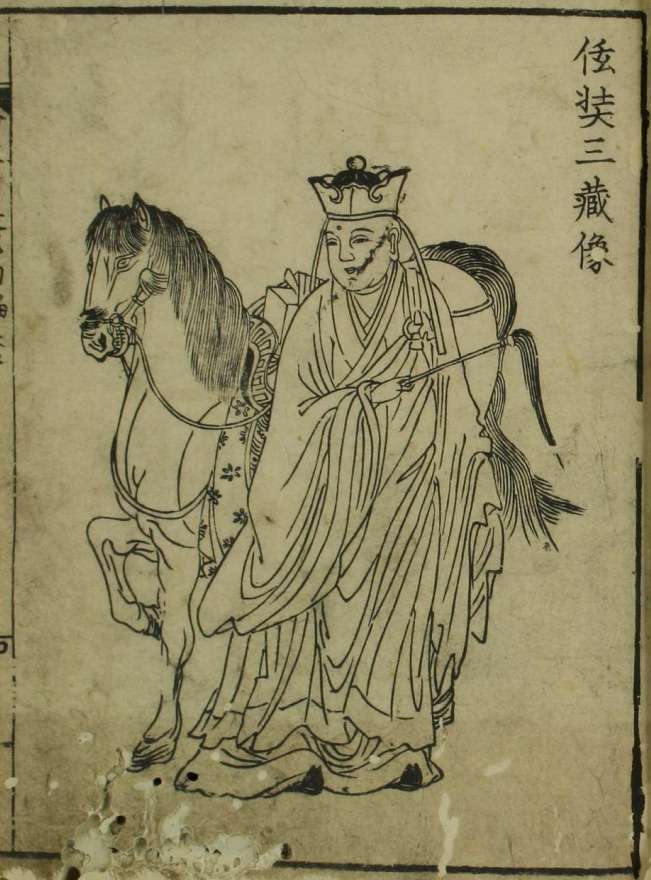
The Story of How Tripitaka of the Great Tang Procures the Scriptures (Datang Sanzang qujing shihua, 大唐三藏取經詩話, c. late-13th-century)
I will add more languages to this archive as they become available. Please let me know if you have access to other editions.
1. The Precursor
1.1. The Story of How Tripitaka of the Great Tang Procures the Scriptures (Datang Sanzang qujing shihua, 大唐三藏取經詩話, c. late-13th-century)
A. English
This 17-chapter novelette, which likely served as a prompt for oral storytellers, is the earliest known printed edition of the JTTW story cycle. It involves the adventures of Tripitaka and Sun Wukong’s antecedent, the “Monkey Pilgrim” (Hou xingzhe, 猴行者). The tale is translated by Charles S. Wivell.
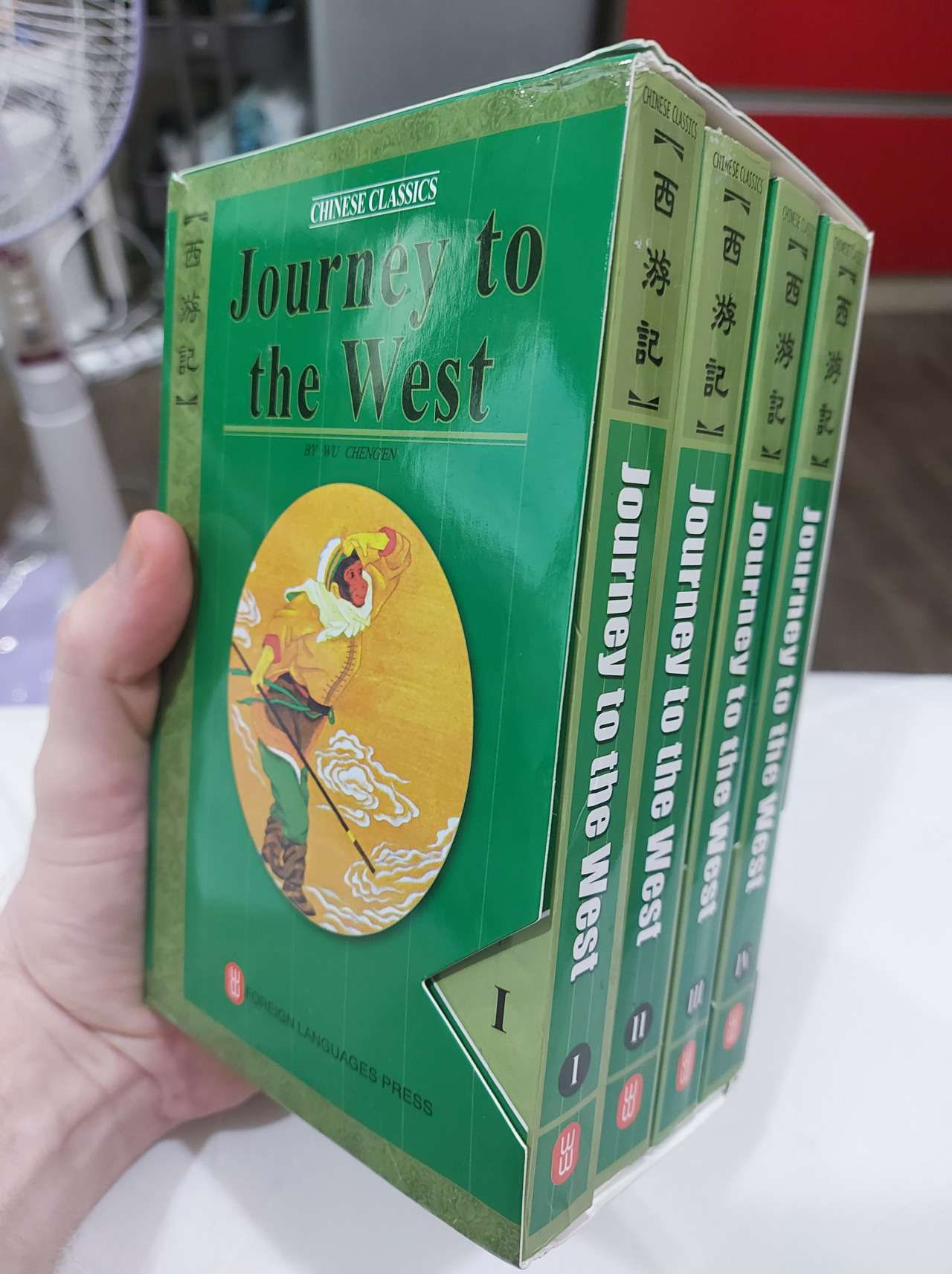
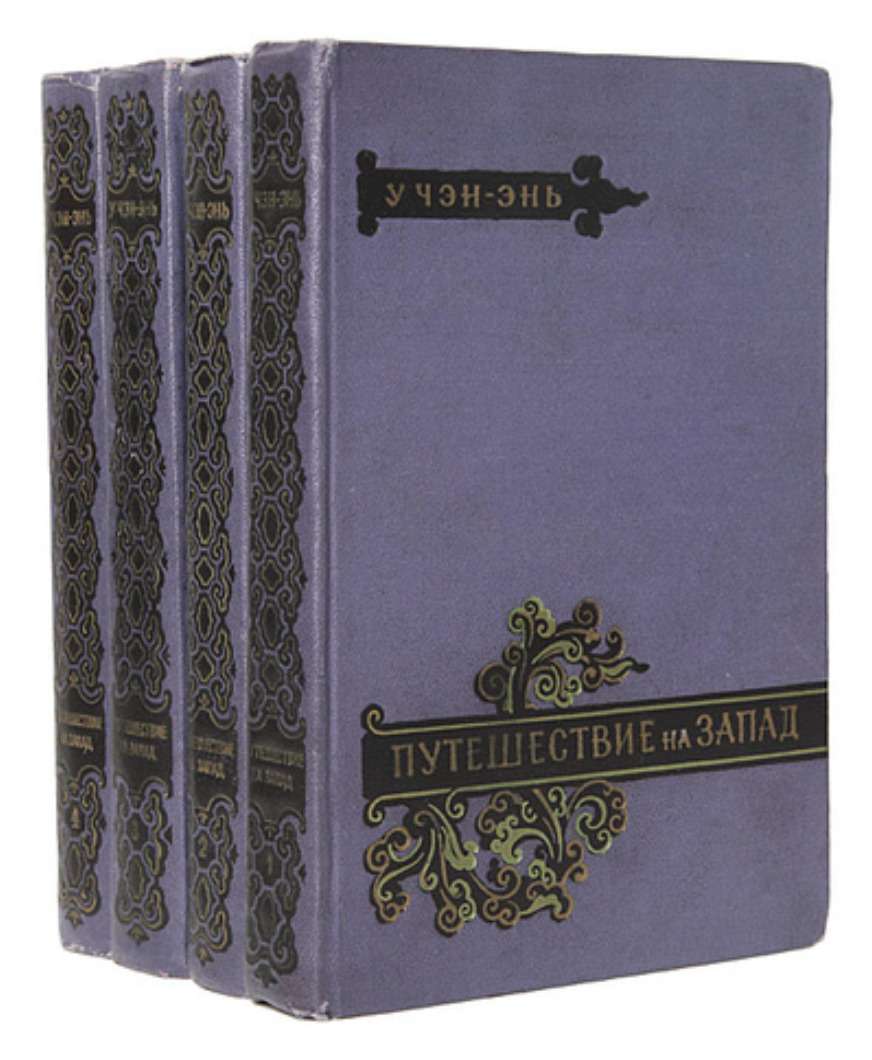
The four-volume box set in my collection (larger version).
A.2. Abridged
1) This is a PDF for Monkey (1942/1984) translated by Arthur Waley in 30 chapters (1 to 15, 18 and 19, 22, 37 to 39, 44 to 46, 47 to 49, and 98 to 100). See past book covers here.
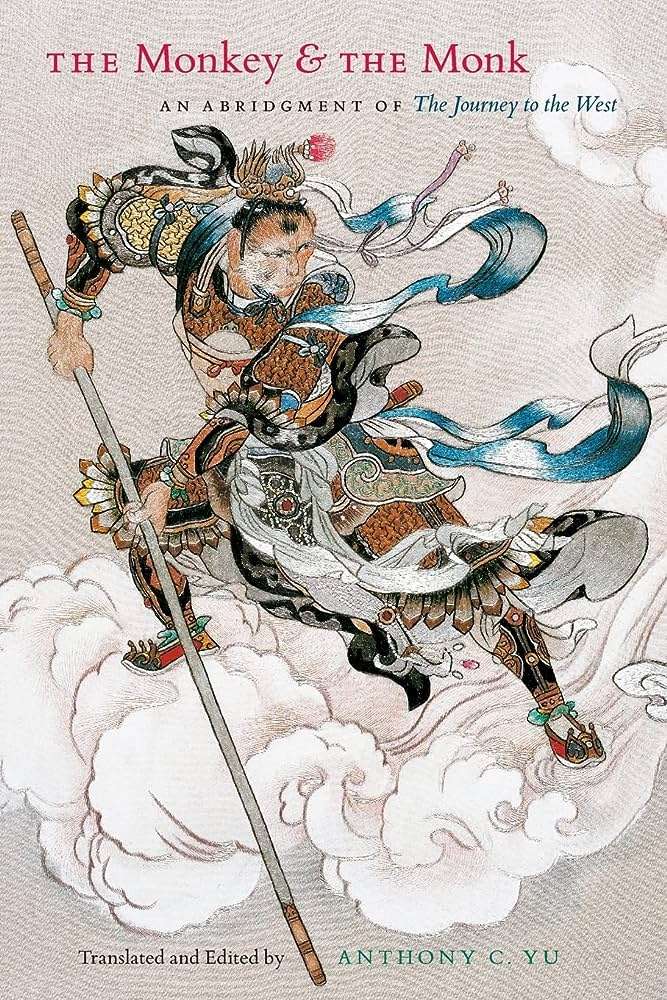
2) This is a PDF for The Monkey and the Monk (2006): An Abridgement of The Journey to the West translated by Anthony C. Yu in 31 chapters (1 to 15, 18 and 19, 22 and 23, 44 to 46, 53 to 55, 57 and 58, 84, and 98 to 100)
1) I just learned of “The Fifth Monkey” and their Journey to the West – An Audio Drama Series, which presents a new English translation alongside the original Chinese. They explain:
One reason that led our team to start this audio drama project is to correct some of the mistranslations found in the Yu/Jenner translations. Most of them are very minor and we certainly understand what could have led to those mistakes, but we think it is worth exploring how we can help bring a more accurate presentation of the original text in the English language (source).
2) YouTuber Sondley has recorded himself reading all 100 chapters of the Jenner edition.
B. French
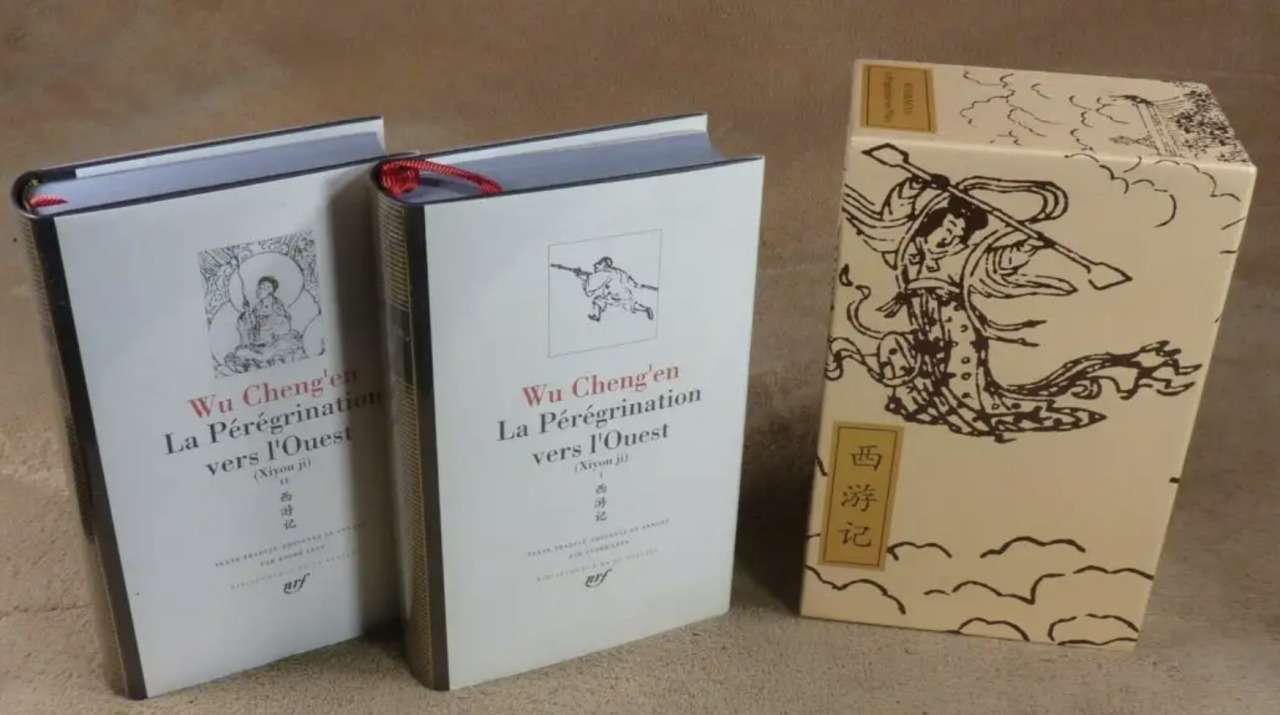
These are PDFs for La Pérégrination vers l’Ouest (Xiyou ji) (1991) translated by André Lévy in 100 chapters. I was told by one French academic that this edition “is one of the best available in Western languages.”
Thank you to arcanananas on Tumbler for volume one, and thank you to jyeet on the Journey to the West discord for volume two.
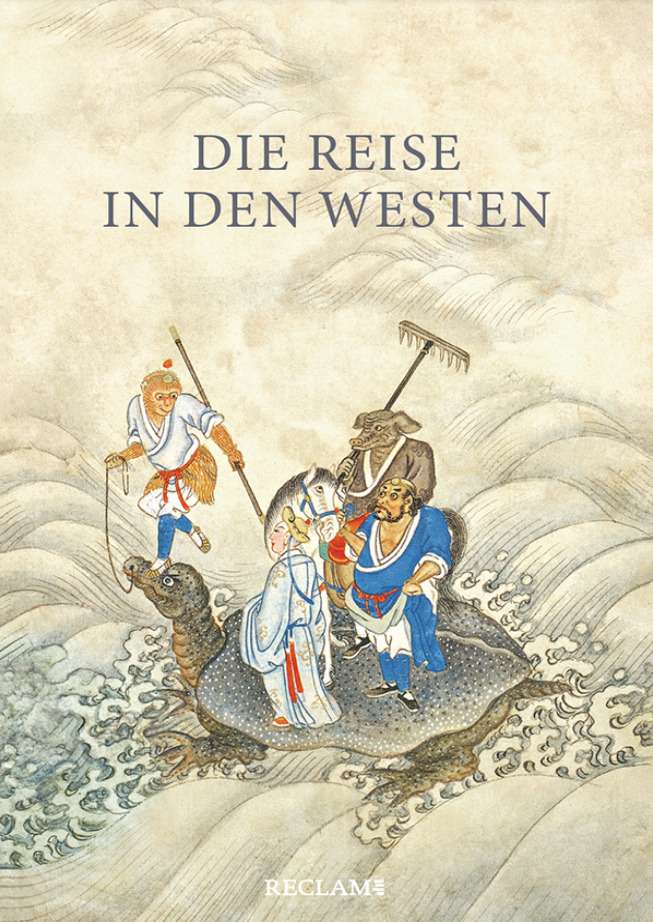
This is a PDF for Die Reise in den Westen. Ein klassischer chinesischer Roman (2016) translated by Eva Lüdi Kong in 100 chapters. It was awarded the Leipzig Book Fair prize in 2017. This version was converted from an ebook.
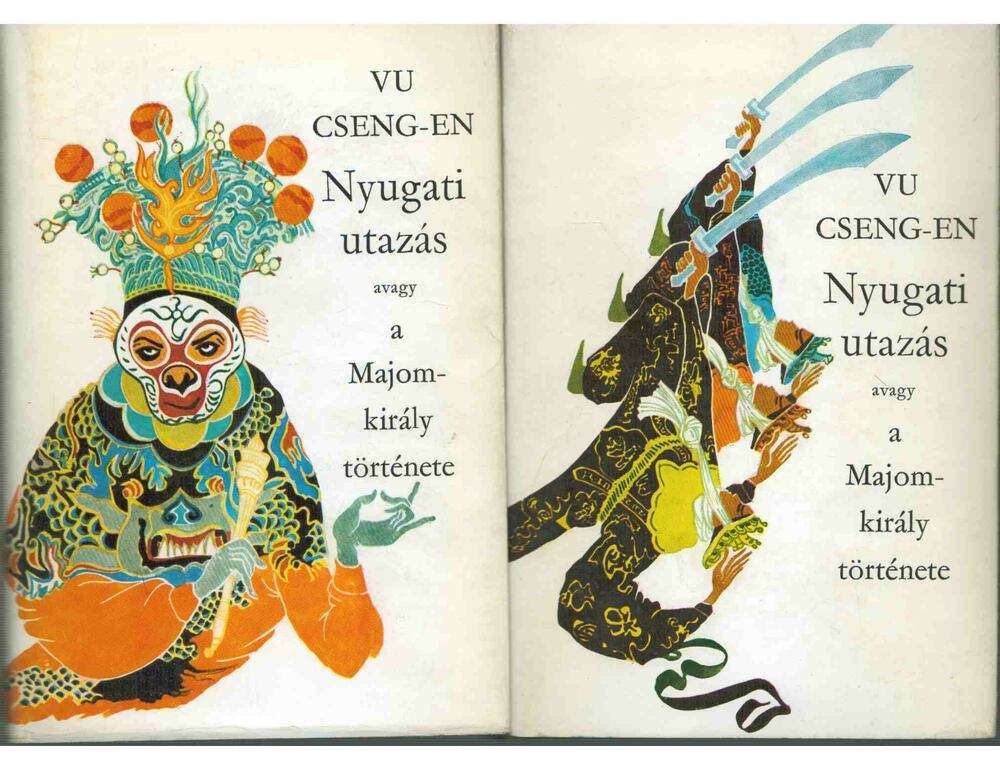
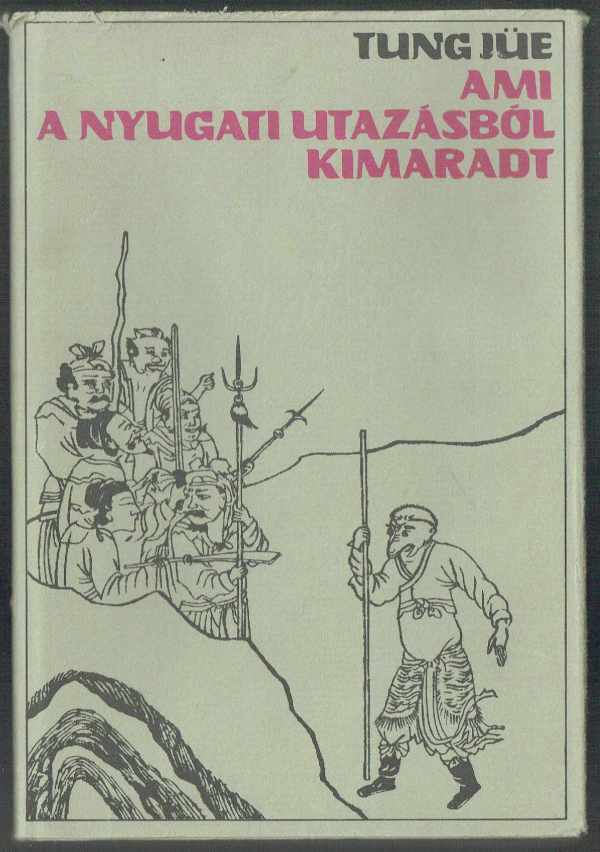
These are text PDFs for Nyugati utazás: avagy a majomkirály története (1969/1980) translated by Barnabás Csongor in two volumes. While the work covers the full 100 chapters, I’ve been told that it deletes the poems and occasionally paraphrases long-winded sections of text.
Thank you to Twitter user Jakabfi Károly for locating the files.
[Note 10-19-23: I was asked by the publisher to remove the PDF from the archive. I’m leaving the title here so others will know that an Italian translation exists.]
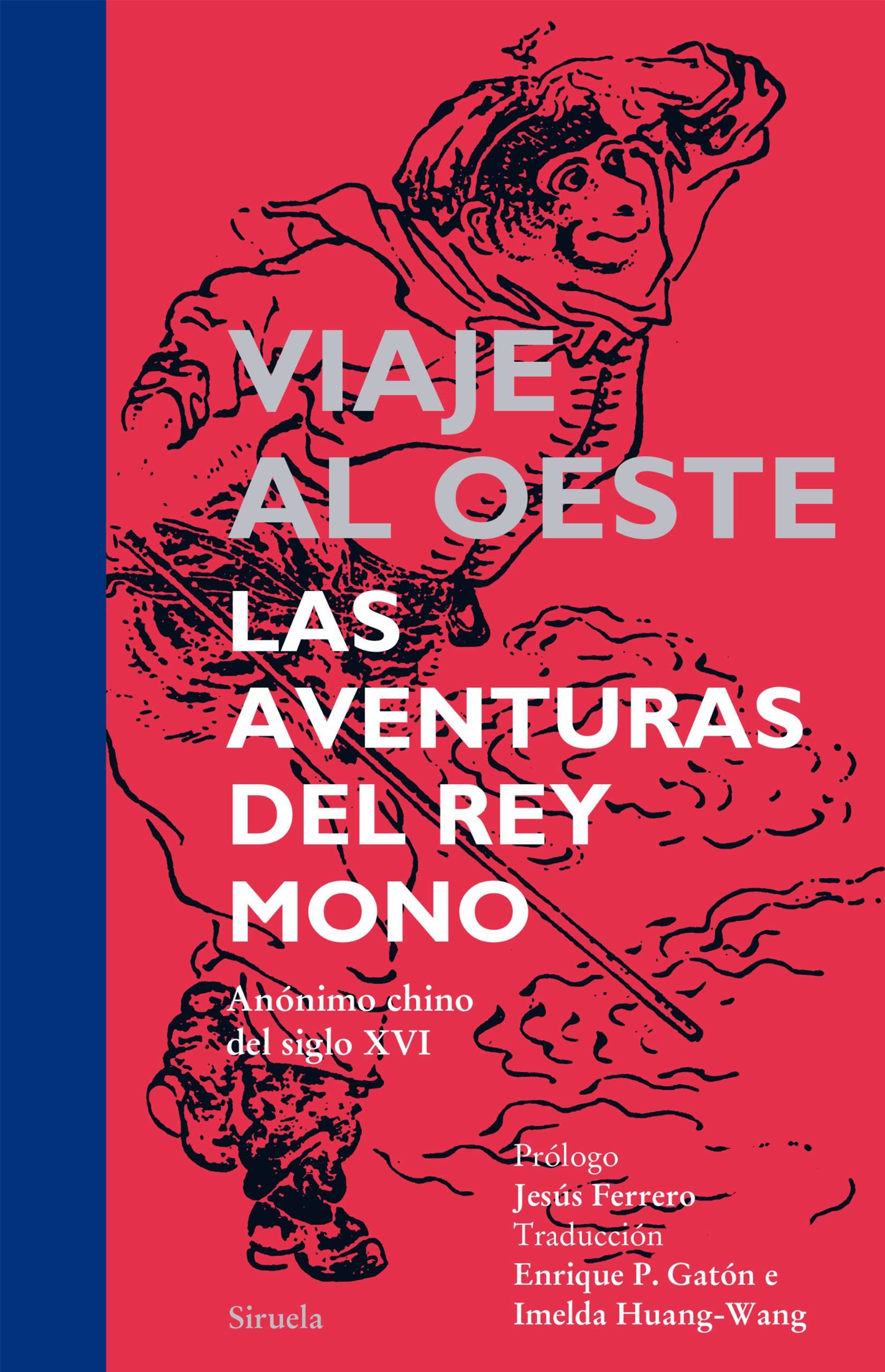
The Italian text is called Viaggio in occidente (1998/2008). It was translated by Serafino Balduzzi and published in two volumes. It is based on the French edition published in 1991. The work covers all 100 chapters.
F. Polish
This is a PDF for Małpi bunt (1976) translated by Tadeusz Żbikowski. It is a 14 chapter abridgement of the first 20 chapters of the original.
Thank you to Twitter user Friend_Pretend for locating the file.
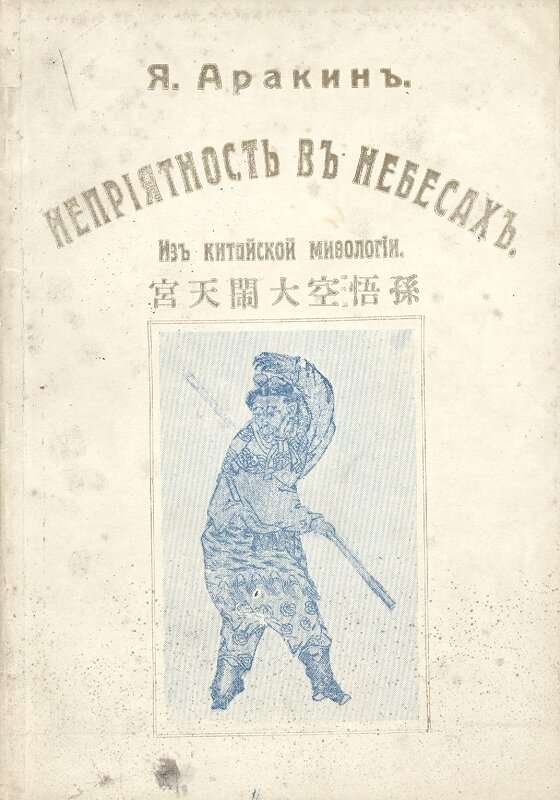
This is a text PDF for Неприятность в небесах. Из китайской мифологии (1926) translated by Yakov Arakin. It is a poetic retelling of the first seven chapters of the novel.
This is a PDF for ไซอิ๋ว (2004/2010). It appears to be based on a four-volume edition translated by one Mr. Tin (นายติ่น) and published from 1906 to 1909. I believe it covers all 100 chapters.
Thank you again to greencicadarchivist for locating the file.
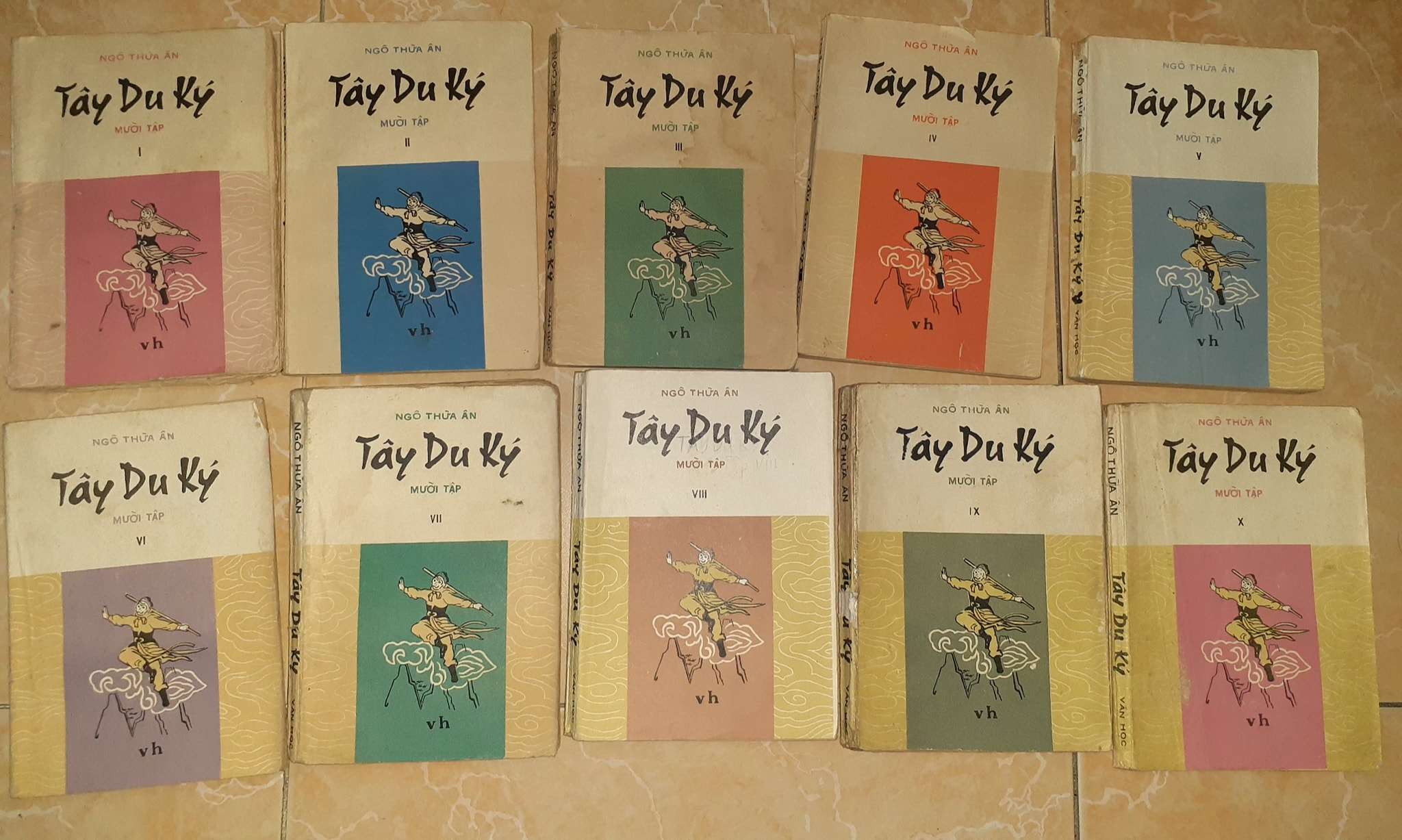
This is a text PDF for Tây Du Ký translated by Như Sơn, Mai Xuân Hải, and Phương Oanh. The 100 chapters were originally split between 10 volumes and published from 1982 to 1988. The volumes were later transcribed and combined to make a single eBook via an online community in 2013 (see here). I have converted it into a PDF.
3.1. A Supplement to the Journey to the West (Xiyoubu)
A. English
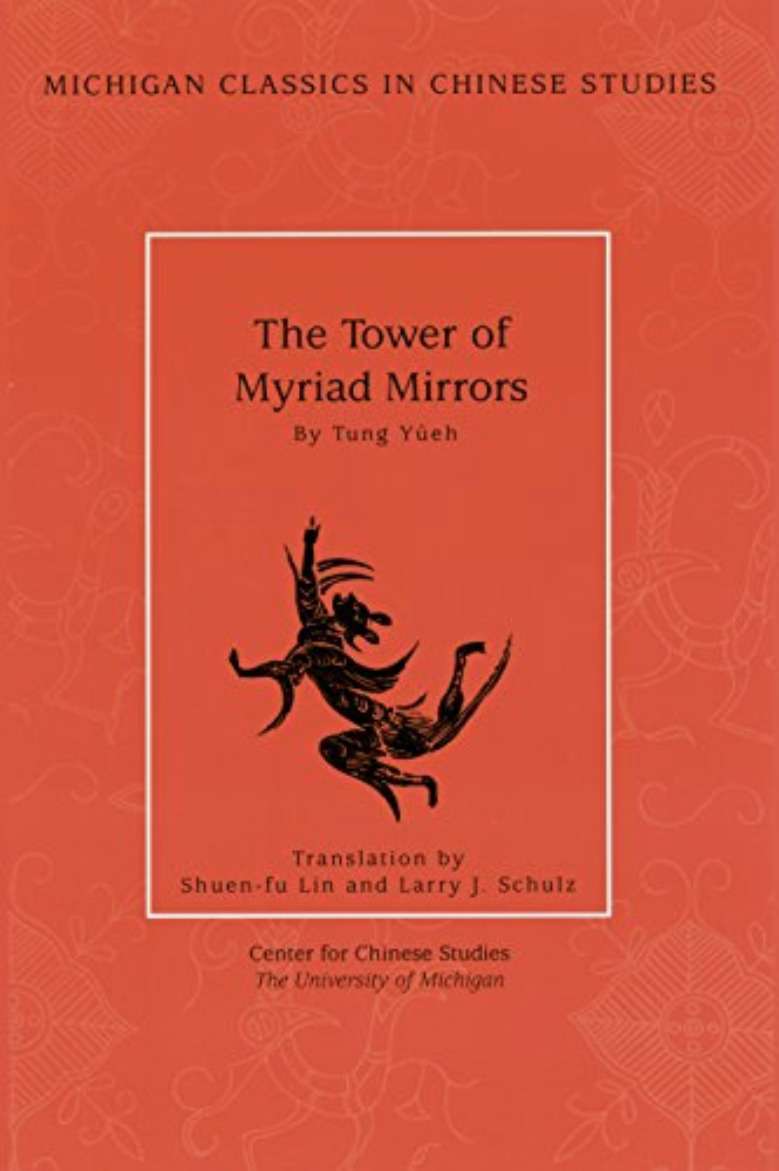
1) This is a PDF for Tower of Myriad Mirrors: A Supplement to Journey to the West (2000) translated by Shuen-fu Lin and Larry J. Schulz. This version was converted from Mobi.
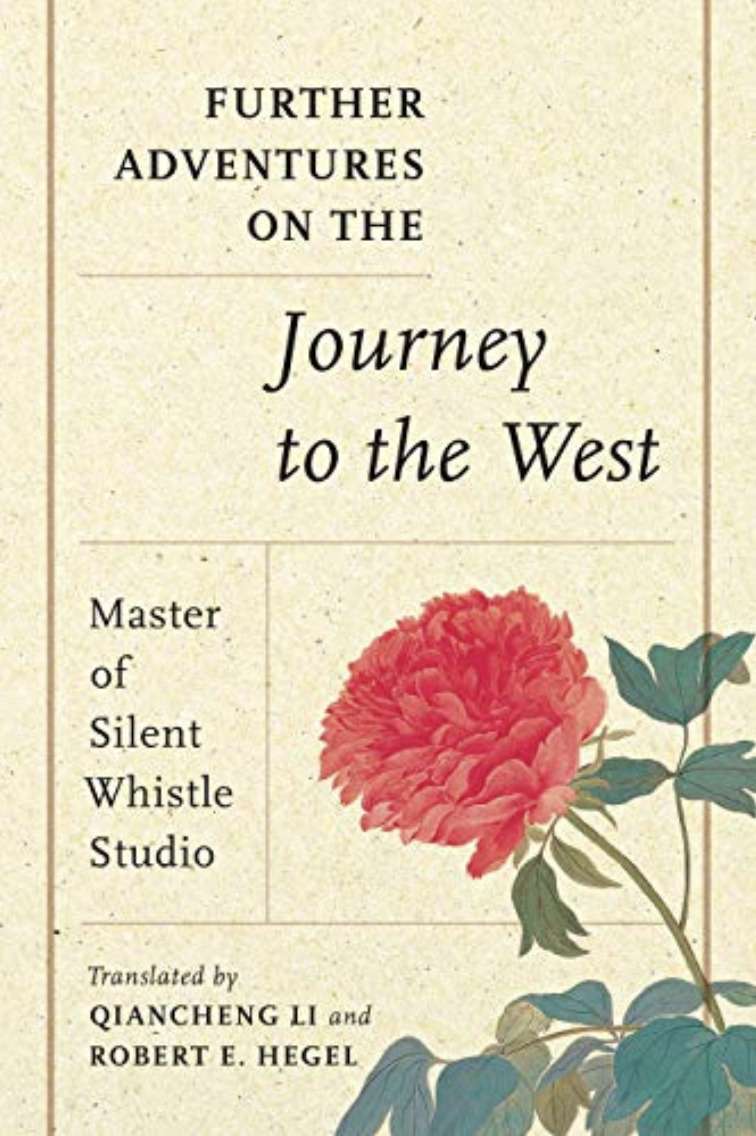
2) This is a PDF for Further Adventures on the Journey to the West – Master of Silent Whistle Studio (2020) translated by Qianchng Li and Robert E. Hegel.
3.2. Later Journey to the West (Hou Xiyouji, 後西遊記, 17th-century)
A. Chinese-English
This 41-chapter book has been translated into English with AI by the Chinese Text Project (Ctext). You can READ IT HERE(turn off your VPN for access). The novel does not yet have an official translation.
See my previous articles on the subject here, here, and here.
Update: 08-17-23
I forgot to mention that I have previously archived two other Chinese classics. The first is Creation of the Gods (Fengshen yanyi, 封神演義, c. 1620; a.k.a. Investiture of the Gods), a sort of prequel to JTTW.
The second is Journey to the South (Nanyouji, 南遊記, c. 1570s-1580s). This is NOT a direct sequel to JTTW. It instead follows the adventures of a martial god from Chinese folk religion. However, Sun Wukong makes a guest appearance in chapters one and seventeen.
While the earliest known published edition of Journey to the West (Xiyouji, 西遊記) hails from the 13th-century, the standard 1592 edition of the novel appears to have arrived on Japan’s shores at a relatively late date. For example, the 18th-century translator Nishida Korenori (西田維則; penname: Kuchiki sanjin, 口木山人) began publishing Japanese translations of the stories in 1758, ultimately publishing a total of 26 chapters before his death. Others picked up where he left off, including Ishimaro Sanjin (石麻呂山人) (ch. 27-39 and later 40-47), Ogata Teisai (尾方貞斎) (ch. 48-53), and Gakutei Kyuzan 岳亭丘山 (ch. 54-65). This incomplete version, known as The Popular Journey to the West (Tsuzoku saiyuki, 通俗西遊記, 1758-1831) was published in five instalments over 31 volumes. The first complete version of the novel, The Illustrated Journey to the West (Ehon Saiyuki, 繪本西遊記), was published in 40 volumes a few years later in 1835 (Tanaka, 1988, as cited in Chien, 2017, p. 21).
The latter is full of breathtaking woodblock prints, which are, in my honest opinion, FAR superior to those appearing in the aforementioned standard edition. While commonly attributed to Hokusai (北斎), this art was the joint work of Ohara Toya (大原東野), Utagawa Toyohiro (歌川豐廣), and Katsushika Taito II (二代葛飾戴斗) (Van Rappard-Boon, 1982, p. 147). Most are black and white (fig. 1-4), but a few are in color.
Here, I would like to archive PDF scans of the complete Japanese translation of Journey to the West. I hope it is useful to my readers.
The Journey to the West Research blog is proud to host an entry by our friend Monkey Ruler (Twitter and Tumblr). They have graciously written an essay on the global nature of Journey to the West adaptations, as well as provided a link to their ongoing project recording JTTW media (fig. 1). As of the publishing of this article, it includes a long list of almost 570 movies, 90 TV shows, and 160 video games! – Jim
Fig. 1 – Depictions of Sun Wukong from adaptations produced over 50 years apart: (left) Havoc in Heaven (Danao tiangong, 大鬧天宮, 1961) and (right) Monkey King: Hero is Back (Xiyouji zhi Dasheng guilai, 西遊記之大聖歸來, lit: “Journey to the West: Return of the Great Sage,” 2015) (larger version). Courtesy of Monkey Ruler.
I. Media adaptations
This started out as a collection of Xiyouji (西遊記; lit: “Journey to the West,” 1592) movies and TV shows for the sake of a Master’s class project; it was simple enough to look for Xiyouji media and start adding them to a collection datasheet. But even when the project was over, I kept finding more and more adaptations, even stumbling across others trying to show the magnitude of how much this novel has encompassed popular culture throughout the centuries. It has been told and re-told again and again in oral and published literature, plays, art, songs, poems, etc., and now on the big and small screens. Audiences are re-introduced to the image of Sun Wukong and his fellow pilgrims with every new media addition.
What really inspired me was the book Transforming Monkey: Adaptations and Representation of a Chinese Epic(2018) by Hongmei Sun, where she explained in depth the cultural impact that Sun Wukong (fig. 2) and Xiyouji has had on Chinese media, as well as how this loose set of franchises have come to represent Chinese culture as these shows and movies have become more globally accessible. Xiyouji is such an iconic cultural universe that it can be both heavily entertaining while still being so personal to audiences of any generation depending on how the artist/writer portrays their interpretation of these characters and their stories.
There hasn’t been a lot written about how these interpretations influence modern Xiyouji adaptations despite how the story has greatly influenced popular culture.
Fig. 2 – The front cover of Transforming Monkey (2018) (larger version).
Xiyouji is such an influential story, one that will continue to grow more and more globally known throughout time because it is such an all-encompassing piece that can cover politics, identities, and allegories, while still being a very personal and interpersonal work that artists or writers can relate to.
However, even with these layers of meaning and symbolism to be found, the story never loses the charming and entertaining aspects that can and have captured audiences. Despite being published over 430 years ago (with a history stretching back even further), Xiyouji is still able to relate to modern audiences through its allegories of oppression, rebellion, and self-identity. It has the capability to resonate with any generation depending on what artists or writers at the time wish to highlight or personally connect with themselves or their current world around them, using Xiyouji as a medium for their own struggles.
As Xiyouji starts to become more and more globally known, it is important to understand and resonate that this is still a Chinese story and how to address further adaptations with cross-nation gaps in both translation and cultural differences. There are media forms that are far more exploitative of the mythical journey, creating impractical scenarios of the narrative and thus changing the message of the story and characters completely. However, there needs to be an acknowledgment of what doesn’t work as Xiyouji adaptations due to the ever-changing zeitgeist in not only its home of origin but introducing it to a global sphere as it adds influence.
In order to see what works for adaptations, there needs to be an acknowledgment of what is the core of the story and just why it remains popular, story-beat or character-wise. For example, Sun Wukong can be used as a great model for positive ambivalence in media, moving away from set limits of a single stereotype and rather being a constant motion of new ideas and new identities. Monkey has been changed from a mischievous monkey to a revolutionary hero to a post-modern rebel against authority throughout the years. But even throughout the constant changes and interpretations, people never lose sight of what the nature of Sun Wukong is: rebelliousness, variability, optimism, and persistence.
Monkey is a transcending character as he is able to mediate contradictions within his own design, one being his gold-banded staff, a symbol of breaking barriers, and his golden filet (fig. 3), a symbol of limits. These two simple but prominent pieces of iconography immediately tell audiences who the character is supposed to be and what they are about.
Fig. 3 – A modern replica of Monkey’s golden filet or headband (larger version).
While it is entertaining and able to be enjoyed by younger audiences, Xiyouji still has a deeper meaning that can be interpreted and recognized into adulthood. This is one of the few stories that I imagine can be adapted again and again without the issue of overlap as there are so many ways people can personally connect with these characters.
Having that any generation, anyone really can find enjoyment in this media, and perhaps even be inspired to read the novel itself.
II. Archive link
Please consult the tabs at the bottom of the spreadsheet linked below. They are listed as “Movie Information,” “Movie Links,” “Honorary Shows,” “Game Information,” “Game Pictures,” “Honorary Games,” and “Sources.” – Jim
Monkey Ruler has officially posted a website called “Journey to the West Media.” They continue to update the page with movies, tv shows, video games, and now comic books.