The novel depicts Zhu Bajie as a reincarnation of the Marshal of the Heavenly Reeds (Tianpeng Yuanshuai, 天蓬元帥) (Wu & Yu, 2012, p. 212). But did you know that this general was actually venerated as a deity? His very name suggests that the god can be traced to early shamanistic beliefs about magico-religious medicine, for a better translation of Heavenly Reeds is “Heaven’s Mugwort.” Van Glahn (2004) explains that this “curious name…alludes to the plant’s demonifugic properties” (p. 121). This suggests the ancient belief that mugwort exorcised demons/illnesses was eventually anthropomorphized and deified as the general.
Sui Dynasty (581-618) sources describe him serving under the Northern Emperor (Beidi, 北帝), the Hades of Daoism, as a powerful exorcist. This is best exemplified by the “Northern Emperor’s Method of Killing Demons” (Beidi shagui zhi fa, 北帝殺鬼之法), a sixth-century rite which contains a prayer invoking Tianpeng by name (Davis, 2001, p. 75; Pregadio, 2008, p. 979). Another text identifies him as one of nine stellar gods associated with the Big Dipper constellation and “assign[s him] the function of security and protection” (Davis, 2001, p. 75; see also Andersen, 1989, pp. 35-36). Early-Song Dynasty (960-1279) sources expand on Heavenly Reed’s position under the Northern Emperor and describe him as head of the thirty-six generals of the Department of Exorcism (Andersen, 2008, pp. 991-992). Most importantly, this is when he was associated with two other powerful exorcist deities, namely Black Killer (Heisha, 黑煞) and Dark Warrior (Xuanwu, 玄武), to form the trinity of the “Three Great Generals of Heaven” (Davis, 2001, p. 75). This was later expanded to a quaternity known as the “Four Saints” (Sisheng, 四聖), which included Heavenly Reed, Black Killer, the True Martial God (Zhenwu, 真武, a variant of the Dark Warrior), and Heavenly Scheme (Tianyou, 天猷) (Pregadio, 2008, p. 479; Little, Eichman, & Ebrey, 2000, p. 298).
Tianpeng‘s position as a protector and association with the military led to his worship by soldiers. Davis (2001) writes, “The cult of Tianpeng remained popular among military circles into the Southern Song, when [legend has it] he aided various generals in their battles with the Jin” (p. 75). The Song also happened to be when he was bestowed the military rank of Marshal (Yuanshuai, 元帥) (Pregadio, 2008, p. 979), the name by which he is called in Journey to the West. During the Ming, a martial arts style (Tianpeng’s Fork, 天蓬釵) and a weapon technique (Tianpeng’s Spade, 天蓬鏟) were named in his honor.
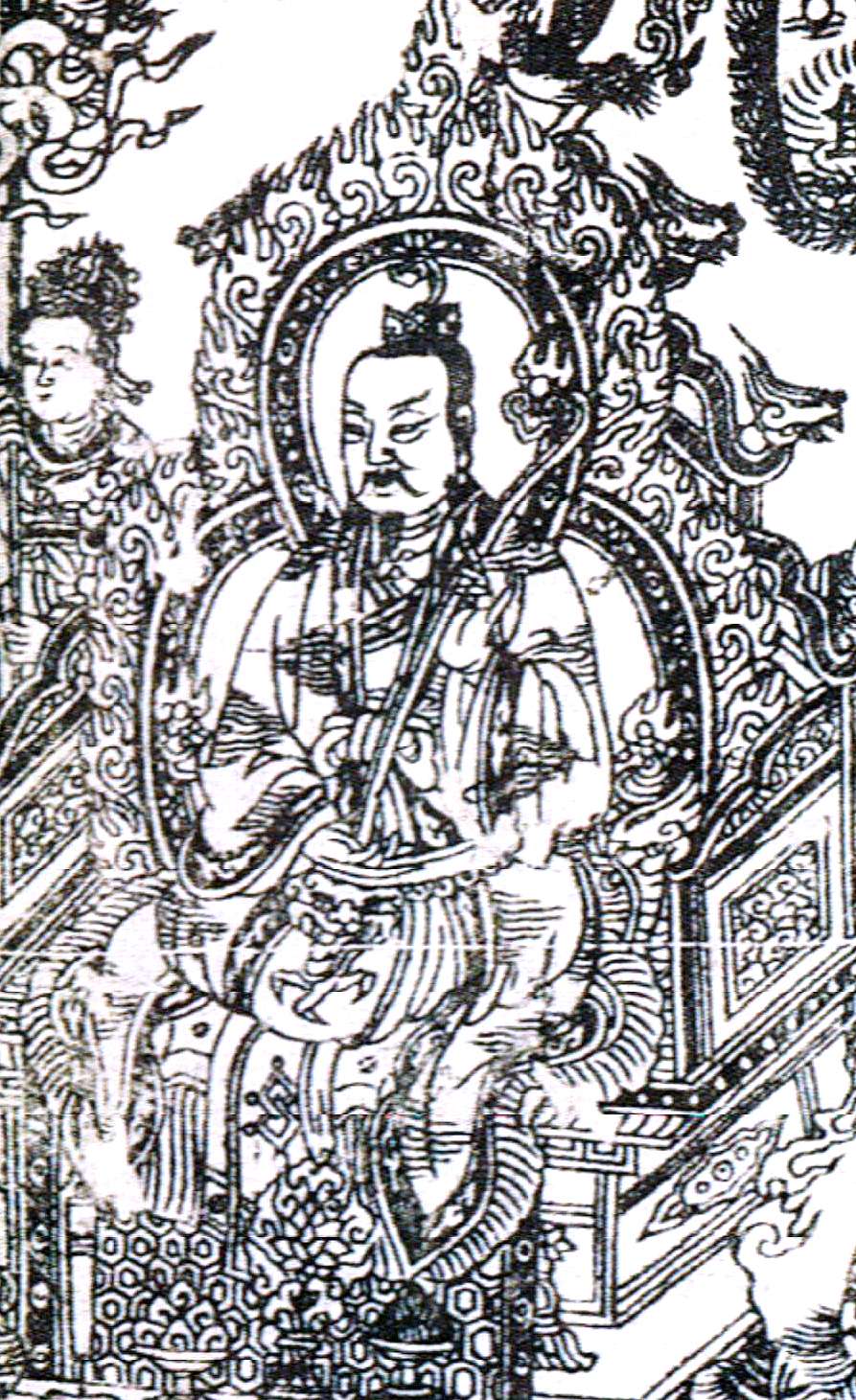
Tianpeng is described in one Song dynasty source as a multi-armed god “dressed in black clothes and a dark hat” (Davis, 2001, p. 75). The names of his trinity companions also reveal their connection with black (i.e, “Black Killer” and “Dark Warrior”). This is because the color is associated with the direction north and thereby the Northern Emperor, whom the three serve (Davis, 2001, p. 75; Welch, 2008, p. 223). A circa 1460 painting of the aforementioned Four Saints actually portrays the Marshal of Heavenly Reeds with black Skin (fig. 1). Why is this important? Because Journey to the West describes Pigsy as having a black face (Wu & Yu, 2012, p. 375, for example).
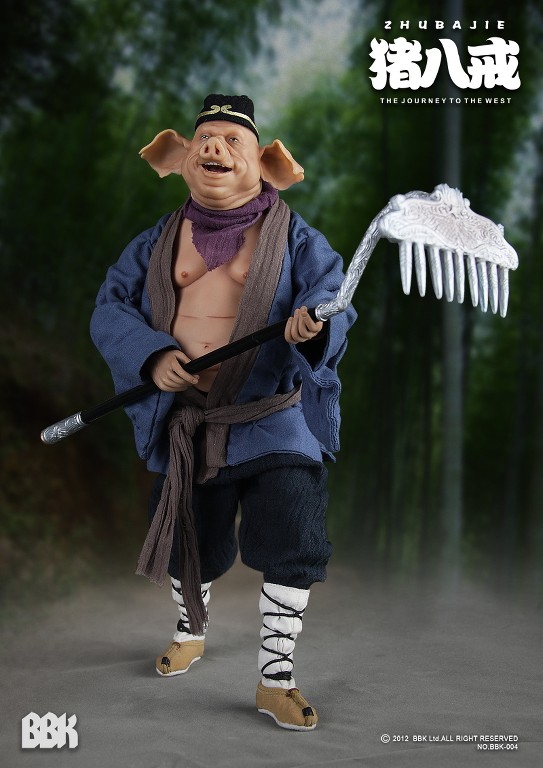
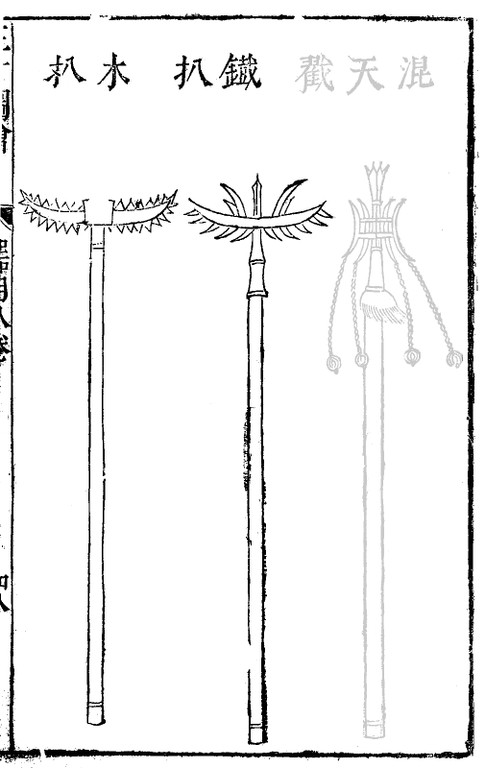
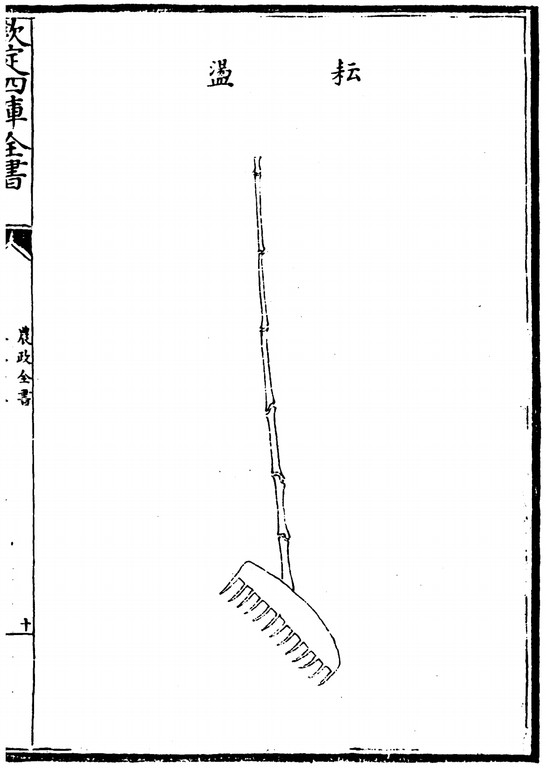
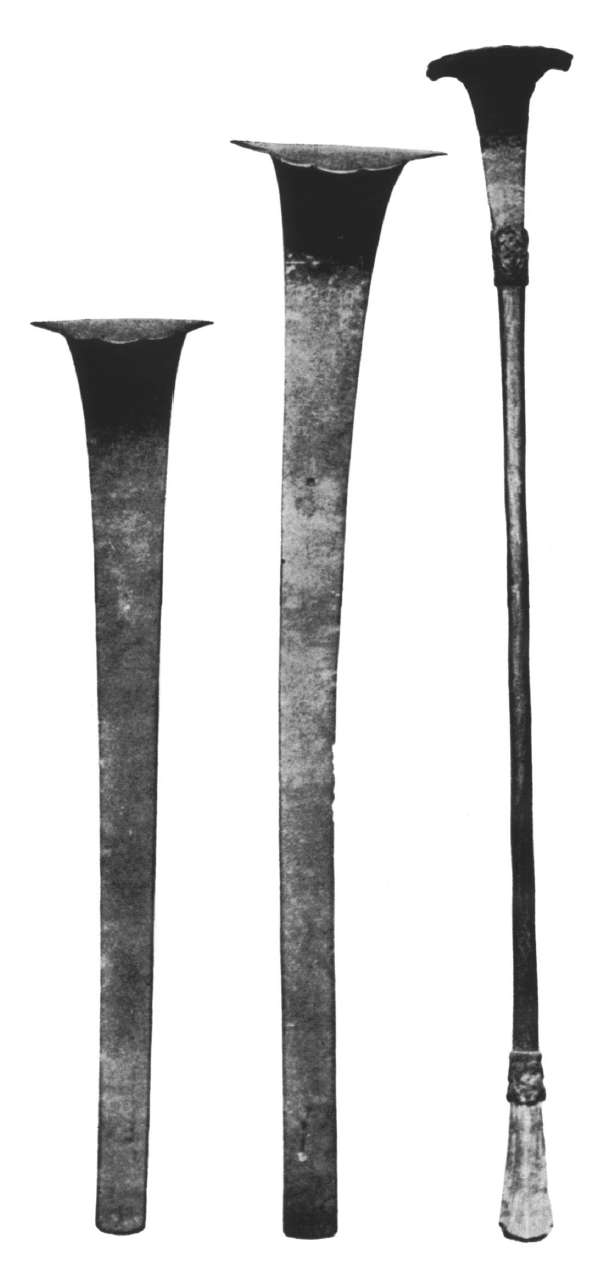
Fig. 1 – (Left) The circa 1460 painting depicting the Four Saints (Sisheng, 四聖) (larger version). Heavenly Reed is the black-skinned figure in the upper left. Fig. 2 – (Center Left) A modern Zhu Bajie action figure with an ornate silver-headed rake (larger version). Fig. 3 – (Center Right) A pair of Pa (鈀) military rakes from the San Cai Tu Hui (三才圖會, 1609) (larger version). Fig. 4 – (Right) A Yundang (耘盪, hand harrow) from a Ming Dynasty agricultural treatise that borrows heavily from the Nongshu (農書) (larger version).
JTTW describes Pigsy’s rake as being a polearm with nine teeth (fig. 2). But did you know that, despite serving as a general in heaven, his weapon is not the kind that was historically used by the Chinese military. Those of the Ming Dynasty (1368-1644), when the book was written, “were [two] meters in length and used to unseat enemy riders and hook and grab enemy weapons” (Swope, 2009, p. 78). The Pa (鈀, rake) (fig. 3), for example, was covered with hooks in place of teeth to aid in the aforementioned hooking action. [1] But noted Ming General Qi Jiguang (戚繼光, 1528-1588) considered it useless in his battle against Japanese pirates (Tang Pa (钂鈀), 2015).
Pigsy’s weapon more closely resembles agricultural tools that were traditionally used by peasant farmers as far back as the Yuan Dynasty (1271-1368). The Book of Agriculture (Nongshu, 農書, 1313), by the Confucian scholar and inventor Wang Zhen (王禎, fl. 1290-1333), includes descriptions and woodblock prints of several manual and water-powered farming implements. The book itself was written in response to the devastation that the Mongols had wrought on China over decades of war. So the featured tools were meant to help make life easier for farmers toiling away in the fields (Bray & Needham, 2004, pp. 59-60). One such innovation to come from the book was the Yundang (耘盪, hand harrow) (fig. 4), a bamboo-handled rake with metal teeth designed to weed rice crops (Bray & Needham, 2004, pp. 61-62). I suggest this and other tools like it most likely influenced Zhu Bajie’s weapon.
I also posit the hog spirit was given such a weapon because it added to his image as a country bumpkin. Whereas Monkey wields a magic iron staff once used by Yu the Great to tame the world flood, Pigsy brandishes a gardening tool. The weapon itself is comical in that it is said to have been handcrafted by Laozi (老子) from “divine ice steel” and etched with arcane symbols (Wu & Yu, 2012, pp. 382-383). That’s one fancy rake!
Update: 05-15-18
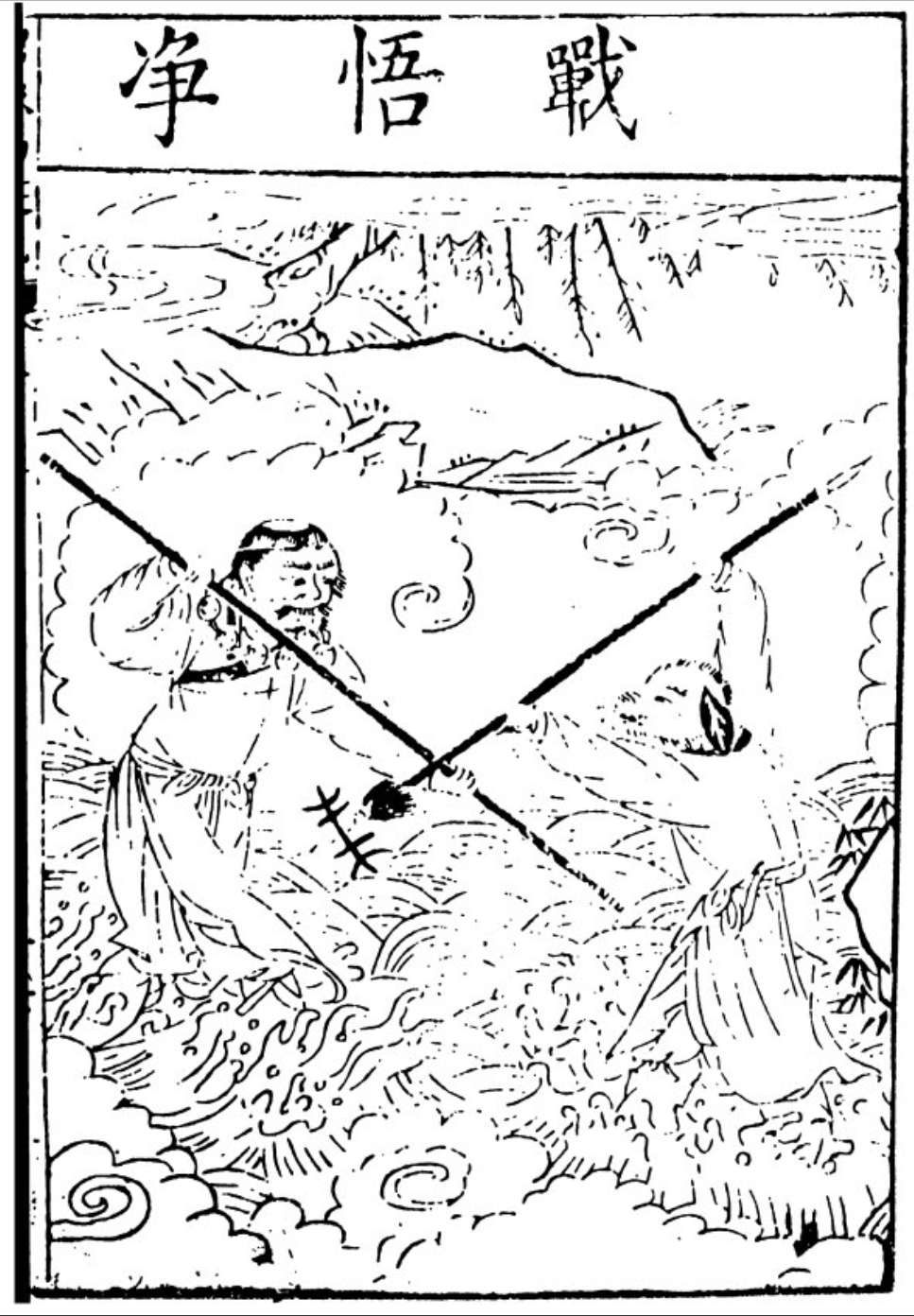
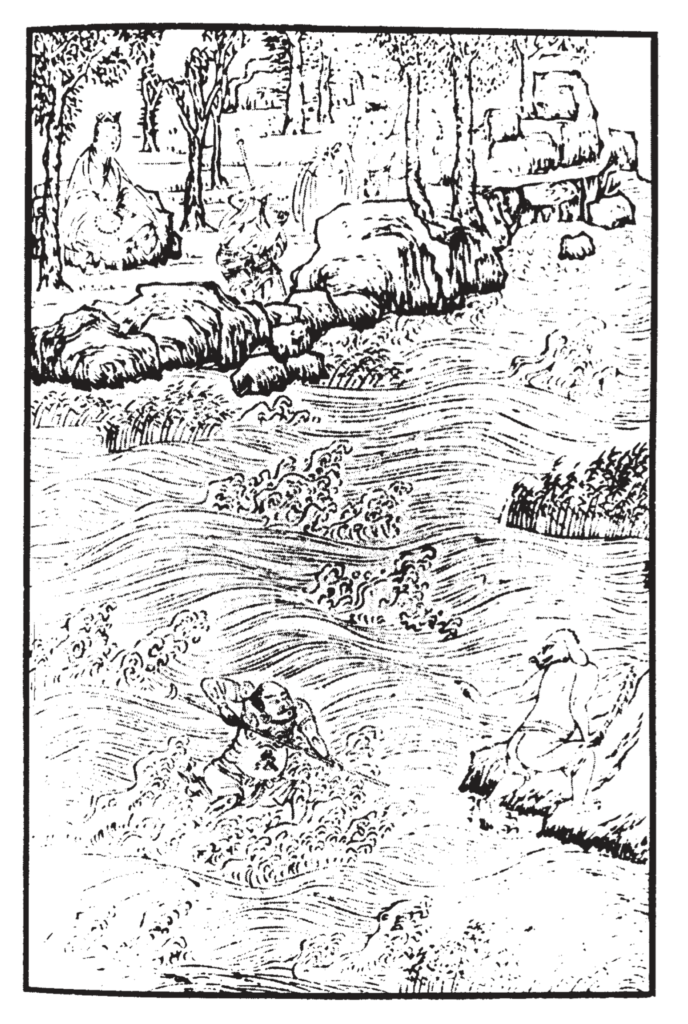
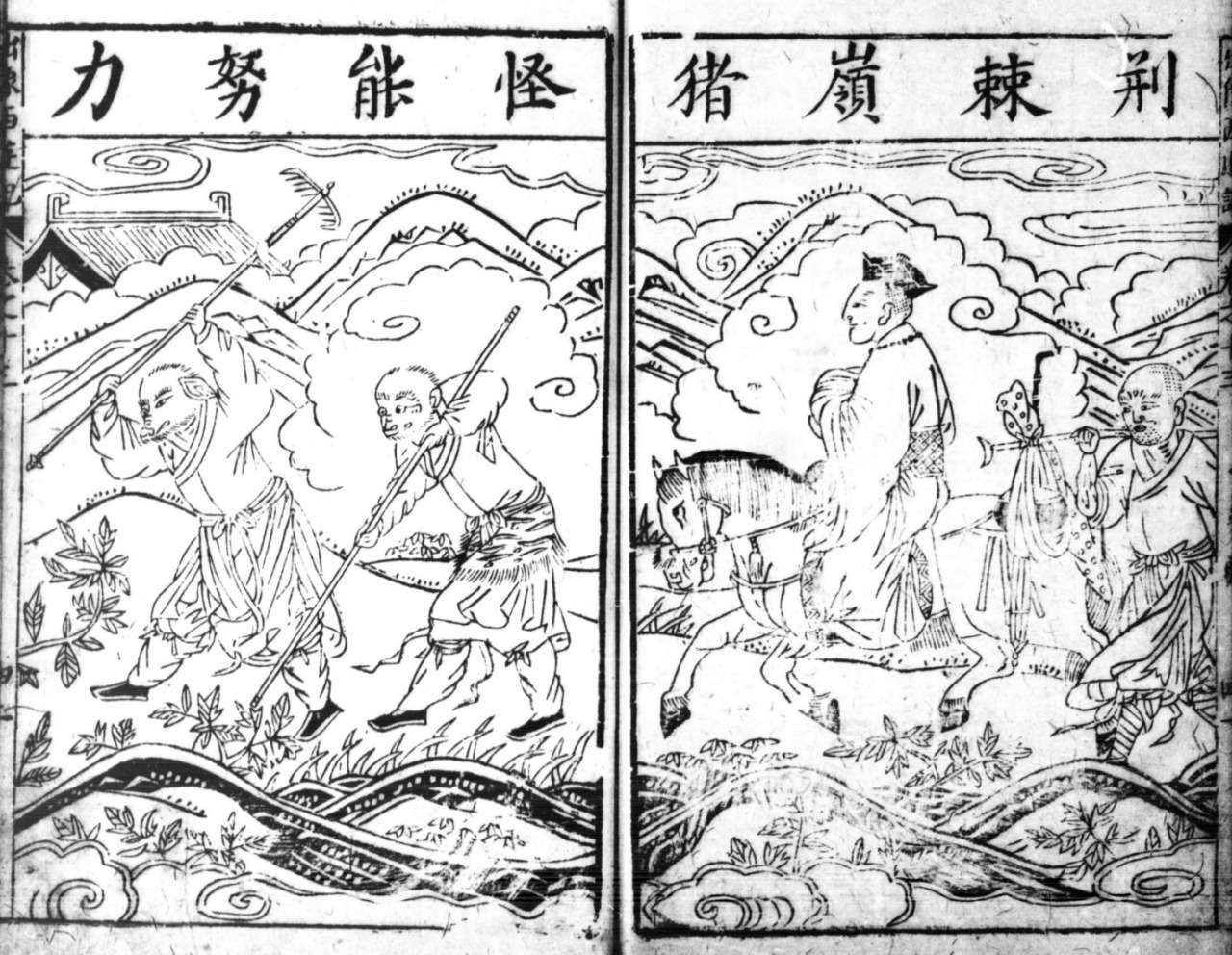
Feng Dajian of Nankai University was kind enough to direct me to this Ming-era woodblock print (fig. 5) by Shide tang (世德堂本), the original publisher of Journey to the West. Check out Pigsy’s war rake! Again, his weapon from the novel is the agricultural type, but this print is an interesting change of pace. Also, notice how Sandy’s staff doesn’t have any metal blades (as normally shown in pop culture).
Fig. 5 – Ming-era Shide tang print of Pigsy vs Sandy (larger version).
Update: 12-21-2018
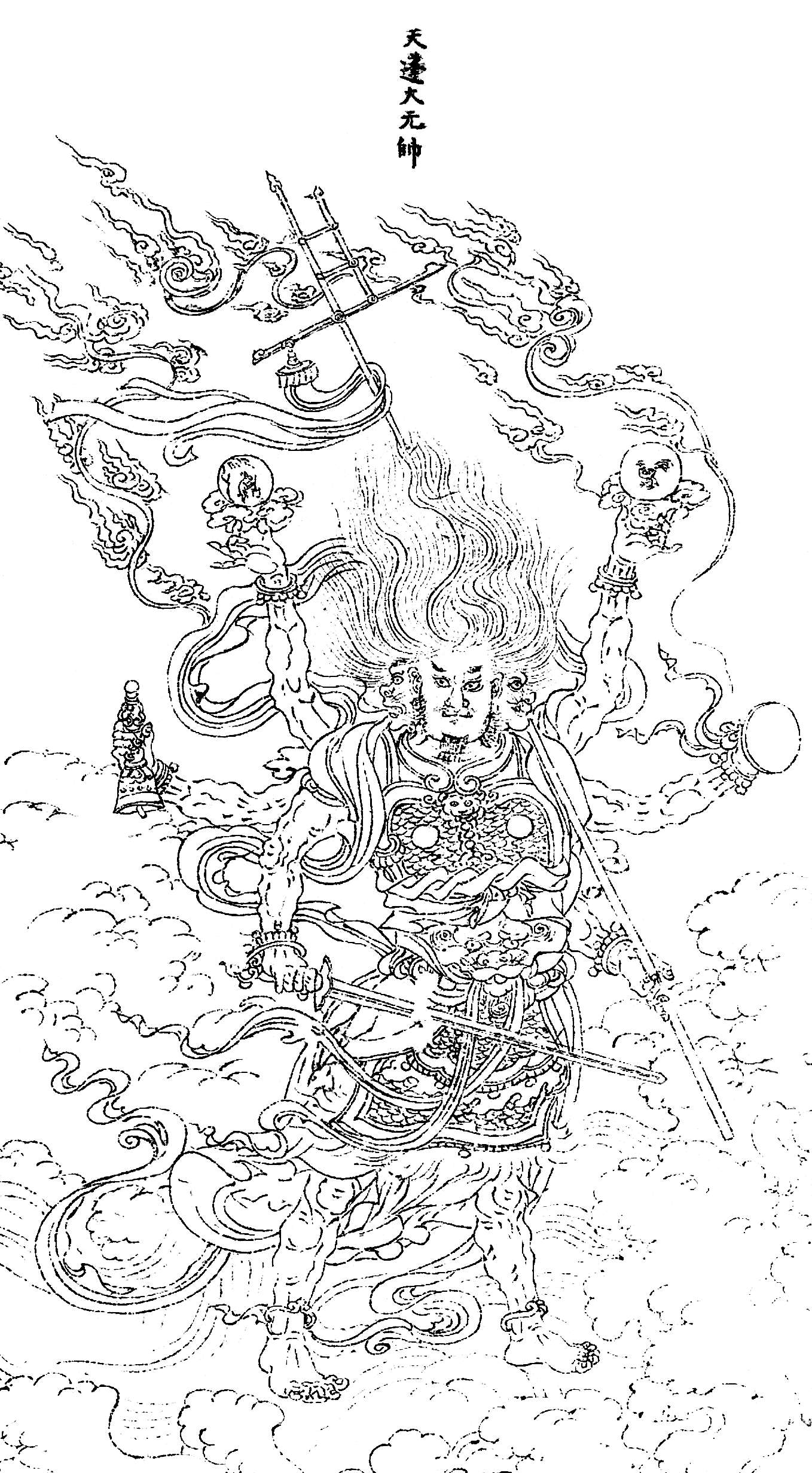
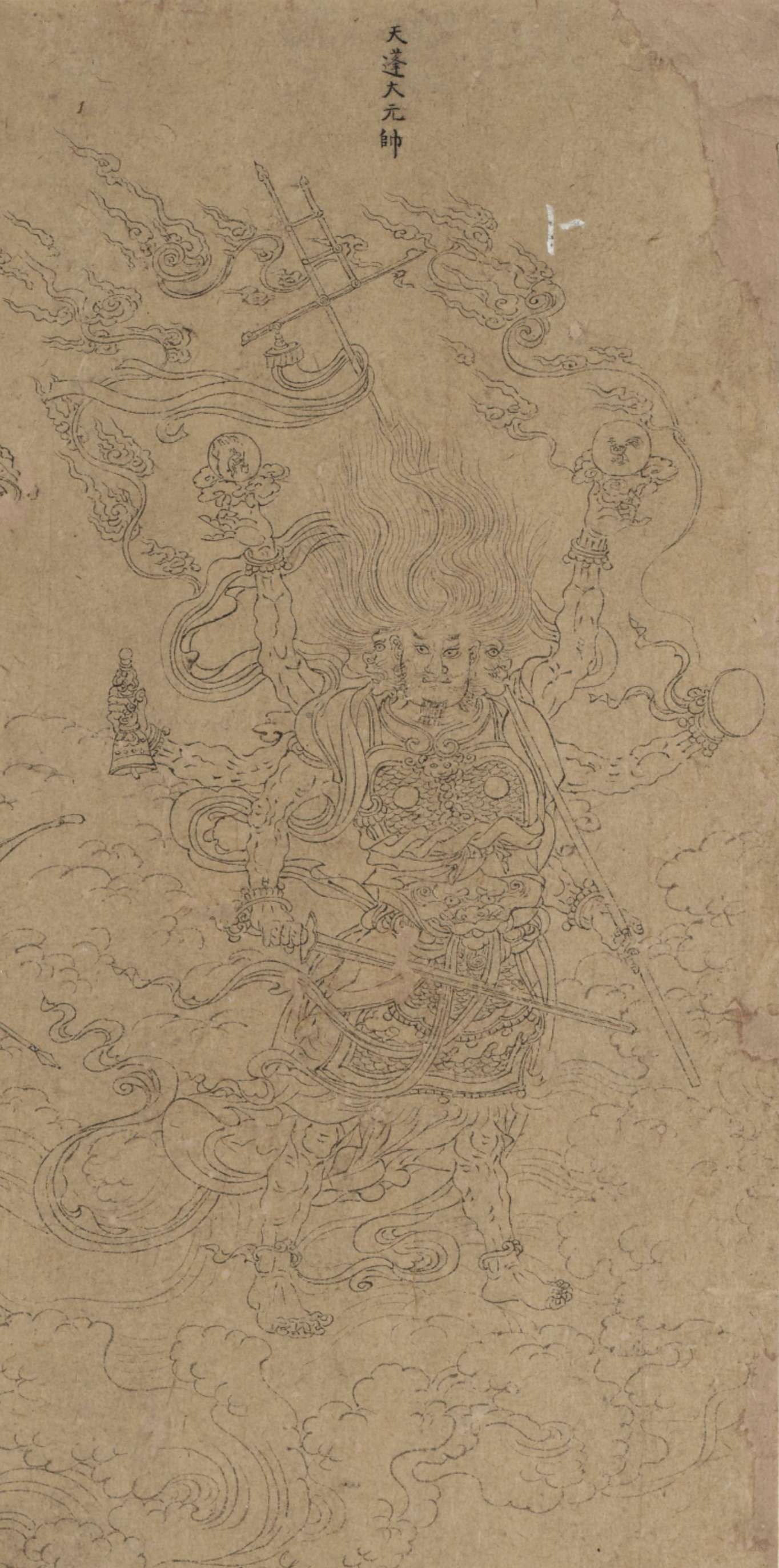
A beautiful rendering of Marshal Tianpeng (fig. 6) appears in the Ink treasures of [Wu] Daozi (Daozi mobao, 道子墨寶), a collection of ink drawings traditionally attributed to the noted 7th/8th-century artist Wu Daozi but likely hails from the 13th-century. Tianpeng is portrayed as an esoteric protector deity with multiple arms holding implements of both war and religion. The military arms include a halberd and a sword, while the religious items include a vajra bell, a mirror, and two orbs adorned with a rabbit and a rooster, respectively (fig. 7). These animals represent the moon and the sun, being zoomorphic symbols of yin and yang forces. Interestingly, the rabbit is seen mixing the elixir of immortality, a common motif in Chinese art (fig. 8).
Fig. 6 – Tianpeng from the 13th-century Ink Treasures of Wu Daozi (larger version). The original drawing can be seen here. Fig. 7 – Details of the Moon Rabbit and Sun Rooster (larger version). Fig. 8 – The Moon Rabbit motif from an 18th-century court robe (larger version).
What’s most interesting about the drawing is the obvious esoteric Buddhist influence. In this article, I mention a 13th-century stone relief carving of Sun Wukong in which he is portrayed with a headband, arm ornaments, bangles, a bone rosary, a girdle, a tiger skin apron, and anklets. These items are listed among an 8th-century source as ritual adornments worn by Buddhist yogis, each one representing a different esoteric Buddha or philosophical aspect of the religion. Many of these same ritual items appear on Tianpeng, pointing to a borrowing of esoteric Buddhist motifs by Daoism.
Update: 01-28-19
Brose (2018) suggests that Zhu Bajie may ultimately be based on a sun goddess worshiped in China. Known as Marici (Molizhi, 摩利支) in Buddhism and Doumu (斗母/斗姆, “Mother of the Dipper”) in Daoism, [2] she is often depicted as a fearsome, multi-armed guardian astride a boar or aloft a boar-driven chariot, and among whose multiple faces is a boar (fig. 9). This is because a stage play that predates the Ming novel represents Pigsy as the goddess’ mount come to earth (Brose, 2018, p. 174). This would mean Zhu Bajie’s connection to Marshal Tianpeng is a later addition to the story cycle. Both Tianpeng and Marici are associated with the stellar bodies of the Big Dipper constellation and share similar exorcistic duties (Brose, 2018, pp 175-176). This may explain why Pigsy was later associated with the general.
Fig. 9 – A modern altar statue showing Marici’s martial aspect riding a boar (larger version). Take note of the boar-like face on the right.
Regarding the origin of Marici’s boars, Getty (1988) explains that Riksha, the Sanskrit word used to denote the bright stars of the Big Dipper, sounds just like the term for bear. Therefore, one hypothesis states that this confusion may have resulted in the sun goddess’ mount being a bear, but due to the scarcity of the animal in South Asia—or just plain iconographic confusion, in my opinion, since both animals are dark-furred quadrupeds—the iconography was changed to a boar over time. If true, this means Zhu Bajie could have been a bear! Furthermore, the seven boars shown to be pulling her chariot in some religious art are most likely based on the seven steeds of the Hindu sun god, Surya (pp. 117-118).
Update: 09-01-19
Huang (2010) describes the common Daoist practice of visualizing gods residing in an adept’s body (shenshen, 身神, lit: “body gods”). The presence of these deities was thought to bring health and aid in the quest for immortality. She notes that the Ming edition of the Perfect Scripture of the Great Cavern (Dadong zhenjing, 大洞真經), originally collected by the Supreme Clarity patriarch Jiang Zongying (蔣宗瑛, d. 1281) during the Southern Song, includes fifty illustrations of groups of gods standing on clouds emanating from the top of a seated Daoist’s head. Most importantly, these deities include protective guardians (lishi, 力士), “[o]ne particular trinity [of which] consists of a general ‘who resembles the Great General of Heavenly Mugwort (Tianpeng dajiang 天蓬大將)'” (Huang, 2010, p. 65 n. 12). An example of this illustration appears in the first scroll of the work (fig. 10).
The illustration of the trinity of protective deities, including a general that looks like Marshal Tianpeng (larger version). Image found here.
Again, I would like to highlight the fact that the general’s name, Heavenly Mugwort (Tianpeng, 天蓬), recalls the historical use of the plant as a magic medicine to ward off the evil spirits of illness (see the top of the article). Therefore, Tianpeng’s use in this form of Daoist meditation likely served a medical purpose.
Update: 08-08-21
I’ve written an article on Zhu’s literary description.
I recently learned about a Tang-era story that likely influenced Zhu Bajie’s characterization in chapter 18 as a dark, wind-riding pig spirit with a lust for young women. Thank you to friend of the blog @ryin-silverfish for giving permission to quote their synopsis. I have added links below where necessary:
The earliest tale about a lusty pig demon could be found in the Tang dynasty Xuan Guai Lu (玄怪录). Guo Yuanzhen, a historical general during the reign of Gaozong and Wu Zetian, came across a mansion in his youth during travel. The whole place was lavishly decorated, as if preparing for a wedding banquet, but eerily empty save for one crying woman.
Turned out, she was the unwitting soon-to-be bride of a god called “General Wu” (乌将军), who demanded a beauty as his wife every year from the locals, and because they would pay a hefty sum to “buy” said bride, her own father sold her out to be this year’s sacrifice. Furious, Guo disguised himself as a guest, pretended to offer General Wu some venison, then cut off his hand with the meat knife.
Wounded, the General fled, and his severed limb turned into a pig’s hoof once the sun came out. Soon, the bride’s family and village elders came to the manor, ready to collect her body for the funeral, and were so freaked out by what Guo did that they were ready to sacrifice him to General Wu too, since the “god” was known to summon storm and hails whenever he didn’t get his bride.
Guo scolded them for being so damn gullible because no real gods would demand human sacrifices or, y’know, have pig hooves as hands, before gathering the young men of the villages and following the trail of blood to the pig demon’s abode, where they proceeded to smoke it out and kill it with an assortment of arrows and farming tools.
The woman, after calling out her terrible parents, pledged herself to Guo and became one of his wives, and all was well.
Notes:
1) Other kinds of military rakes included the pitchfork-like Yi Pa (㑥耙), the trident-like Tang (钂) and Tangpa (钂鈀), and the more rare halberd-like Mao Lian Tang (茅鐮钂) (Tang Pa (钂鈀), 2015).
2) For information on Marici, see Getty (1988), pp. 117-119. For Doumu, see Esposito, 2008, pp. 282-283.
Sources:
Andersen, P. (1989). The Practice of Bugang. Cahiers d’Extrême-Asie, 5. Numéro spécial Etudes taoïstes II / Special Issue on Taoist Studies II en l’honneur de Maxime Kaltenmark. 15-53.
Andersen, P. (2008). Tianxin zhengfa. In F. Pregadio (ed.), The Encyclopedia of Taoism (Vols. 1-2) (pp. 989-993). Longdon: Routledge.
Bray, F. & Needham, J. (2004). Science and Civilisation in China: Volume 6, Biology and Biological Technology; Part 2 – Agriculture. Cambridge: Cambridge U.P.
Davis, E. L. (2001). Society and the Supernatural in Song China. Honolulu: Univ. of Hawaií Press.
Getty, A. (1988). The Gods of Northern Buddhism: Their History and Iconography. New York: Dover Publications.
Huang, S. (2010). Daoist Body and Cosmos, Part I: Body Gods and Starry Travel. Journal of Daoist Studies 3, 57-90.
Little, S., Eichman, S., & Ebrey, P. B. (2000). Taoism and the Arts of China. Chicago: Art Institute of Chicago.
Swope, K. (2009). A Dragon’s Head and a Serpent’s Tail: Ming China and the First Great East Asian War, 1592-1598. Norman: University of Oklahoma Press.
Sha Wujing (沙悟淨), or “Sandy” for short, is commonly portrayed in modern media wielding a Crescent Moon Spade (Yueya chan, 月牙鏟, a.k.a. “Monk’s Spade“), a wooden polearm capped with a sharpened spade on one end and a crescent-shaped blade on the other (fig. 1). But did you know that Sandy never wields this kind of weapon in the novel? Chapter 22 contains a poem that describes the actual weapon and its pedigree. A section of it reads:
For years my treasure staff has enjoyed great fame,
Originally a tree of the sala variety in the moon, [1] Wu Gang cut down from it one limb. Lu Ban then made it, using all his skills.
Within the hub is “as-you-will” gold. [2]
Outside it’s wrapped by countless pearly threads.
It’s called the Treasure Staff Perfect for Subduing Monsters, [3]
[…] (based on Wu & Yu, 2012, vol. 1, p. 428)
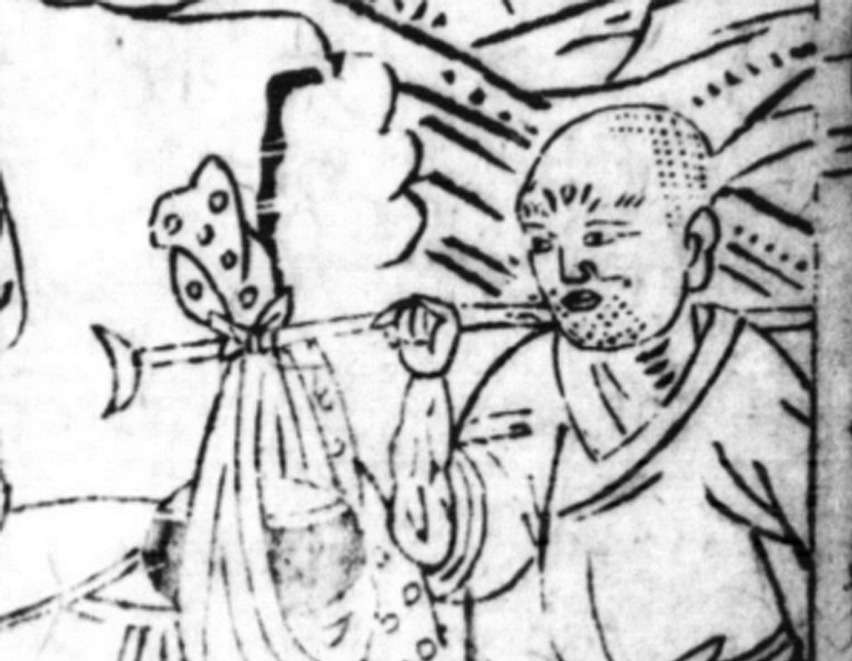
As you can see, it is described as a wooden staff devoid of any metal blades. So how did Sandy become associated with the Monk’s spade? It can be traced to a common motif appearing in late-Ming Dynasty (1368-1644) woodblock prints. Sandy is just one of a number of famous literary staff-wielding monks to be portrayed brandishing a polearm topped with a small crescent shape (fig. 2). Others include Huiming (惠明) from the Story of the Western Wing (Xixiangji, 西廂記, c. 1300) (fig. 3) and Lu Zhishen (魯智深) from the Water Margin (Shuihu zhuan, 水滸傳, c. 1400) (fig. 4) (Shahar, 2008, p. 97).
Fig. 1 – A modern depiction of Sandy wielding a Monk’s Spade (larger version). Fig. 2 – A late-Ming Dynasty print of Sha Wujing with the crescent staff (larger version). Fig. 3 – A 1614 woodblock print of Monk Huiming with a crescent staff (larger version). Fig. 4 – A late-Ming woodblock of Lu Zhishen with a crescent staff (larger version). Fig. 5 – Sandy from Ehon Saiyuki (circa 1806) (larger version). Fig. 6 – Sandy from Xiyou yuanzhi (1819) (larger version). Fig. 7 – A detail from a Long Corridor painting (circa 1890) (larger version).
The exact origin or purpose of the blade is unknown, however. Martial historian Meir Shahar (2008) comments:
Future research may determine the origins of the crescent shape, which is visible in some Ming period illustrations of the staff. Here I will mention only that an identical design is common in a wide variety of twentieth-century martial arts weapons, whether or not they are wielded by Buddhist clerics. The crescent’s significance in contemporary weaponry can be gauged by its appearance in the names of such instruments as the “Crescent-Shaped (Yueya) [Monk’s] Spade,” “Crescent-Shaped Spear,” “Crescent-Shaped Battle-ax,” and “Crescent-Shaped Rake” (pp. 97-98).
A woodblock print appearing in the first section of The Illustrated Journey to the West (Ehon Saiyuki, 画本西遊記), published in 1806, depicts Sandy holding a staff with a large crescent blade (fig. 5), showing how the once small accent had been enlarged by this time to become a more prominent feature of the polearm. This same weapon is echoed in a print from The Original Intent of The Journey to the West (Xiyou yuanzhi, 西遊原旨, 1819) (fig. 6), as well as in multiple circa 1890 JTTW-related paintings from the Long Corridor of the Summer Palace in Beijing (fig. 7, for example). So Ming depictions of Sandy wielding a crescent-tipped staff were most likely associated with the Monk’s Spade due to their physical similarities, and this probably took place no earlier than the early 20th-century.
Update: 02-25-18
Unlike Sha Wujing, there is a monster in the novel who wields a Crescent Moon spade. Chapter 63 describes the Nine-Headed Beast (Jiutou chong, 九頭蟲), [4] the son-in-law of a dragon king, using this bladed polearm in a battle against Monkey:
Enraged, Pilgrim shouted, “You brazen thievish fiend! What power do you have that you dare mouth such big words? Come up here and have a taste of your father’s rod!” Not in the least intimidated, the son-in-law parried the blow with his crescent-tooth spade; a marvelous battle thus broke out on top of that Scattered-Rock Mountain (Wu & Yu, 2012, vol. 3, p. 183).
There existed during the Ming Dynasty a military spade with a crescent blade on the top and a dagger-like blade on the bottom (武備志 (四十三) , n.d.) (fig. 8). This is likely the weapon used by the monster. Notice the similarities with figures five to seven. It’s easy to see how the crescent-tipped staff from the Ming woodblock prints could have later been associated with this military weapon. The difference is one of degree and not kind. This polearm was later modified into the modern Monk’s Spade, leading to depictions of Sandy wielding the weapon.
Fig. 8 – A Crescent Moon Spade from the Collection of Military Works (Wubei zhi, 武備志, c. 1621), a Ming treatise on military armaments and fighting techniques (larger version).
Update: 05-15-18
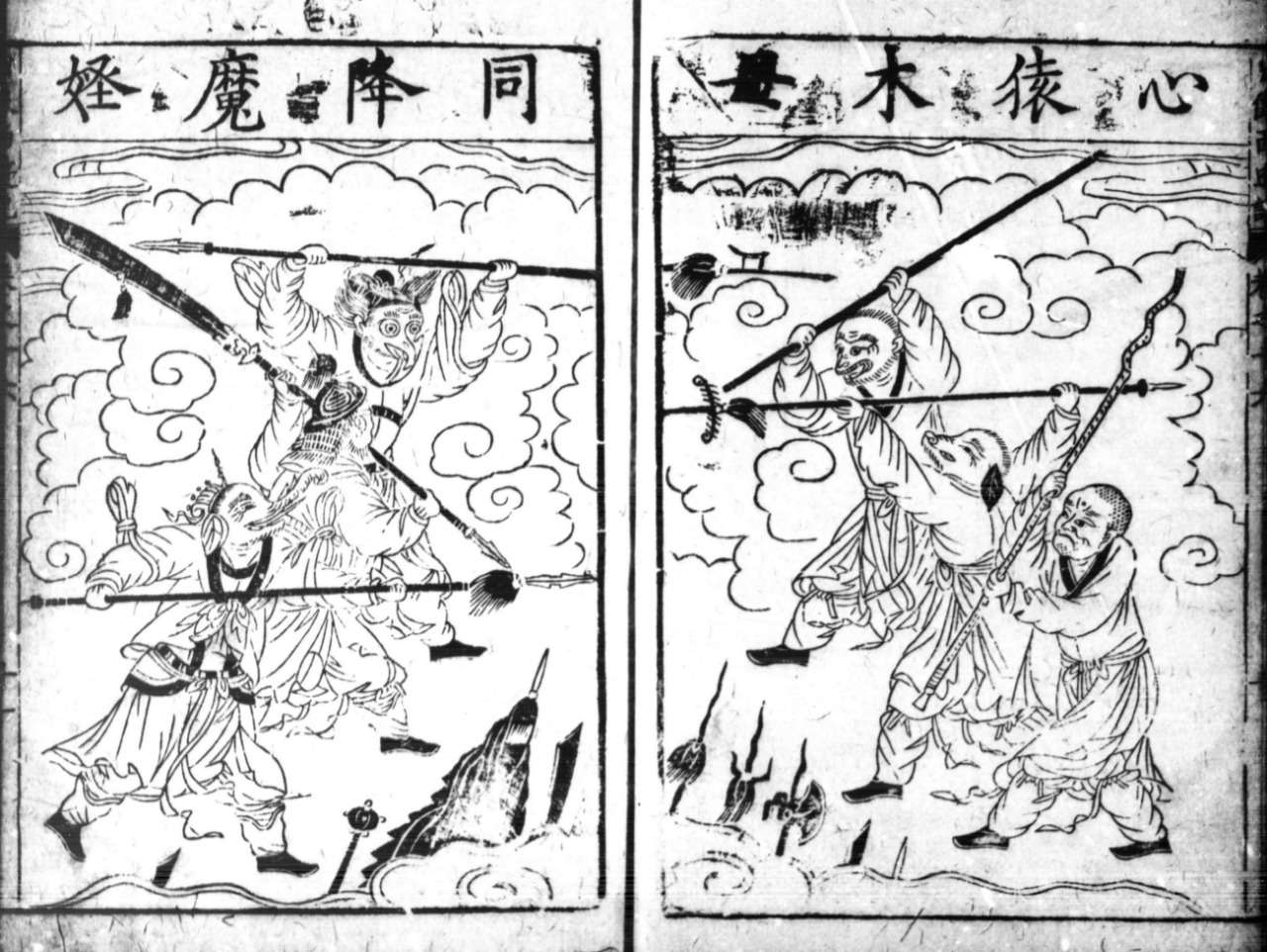
Feng Dajian of Nankai University was kind enough to direct me to this woodblock print (fig. 9) from the original 1592 publishing of Journey to the West. Sandy’s staff is more evident in this piece. It even lacks the aforementioned crescent shape.
Fig. 9 – The 1592 JTTW print of Sandy vs Pigsy (larger version).
Update: 07-02-23
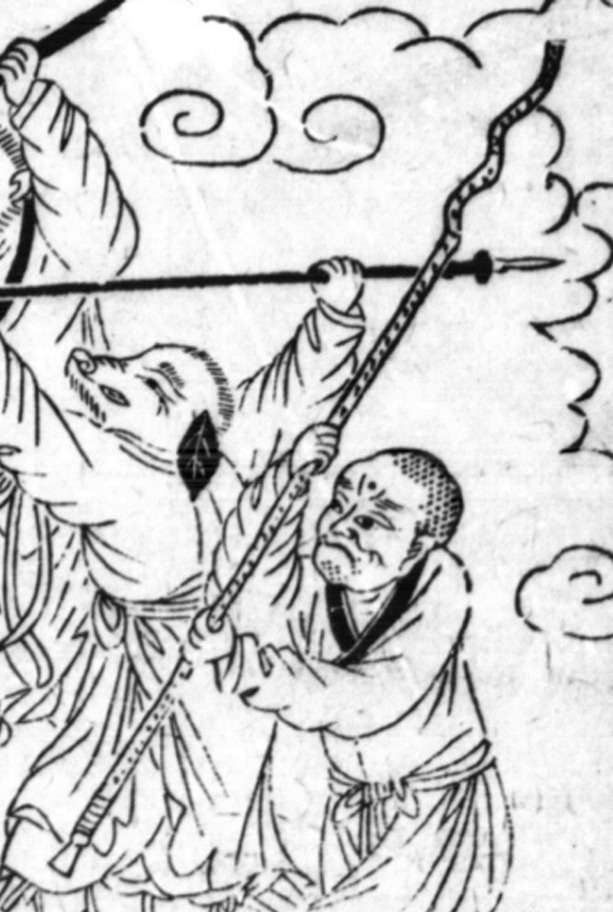
The woodblock prints from the original 1592 JTTW are extremely inconsistent. For example, figure nine shows Sha’s staff as a straight, black line. However, another print (fig. 10 & 11) depicts it with the crescent finial, and yet another (fig. 12 & 13) shows it as a twisting tree branch. The latter is my favorite because it aligns more with the weapon’s origin as presented above in the introduction.
Fig. 10 (top left) – A detail of the crescent staff (larger version). Fig. 11 (top right) – The full print (larger version). Fig. 12 (bottom left) – A detail of the tree branch staff (larger version). Fig. 13 (bottom right) – The full print (larger version).
Notes:
1) The original translation reads: “At first an evergreen tree in the moon” (Wu & Yu, 2012, vol. 1, p. 428). But the Chinese identifies the tree as suoluo pai (梭羅派), which literally means a “(family) branch of the sala tree.” I chose “a variety of” to avoid confusion with “tree branch.” And while the sala is technically a kind of evergreen in wet environments, it has deciduous-looking leaves. I chose to use the actual name of the tree to avoid confusion with pine evergreens. Yu (Wu & Yu, 2012) incorrectly identifies the suoluo tree as “Cunninghamia [l]anceolata,” a type of Chinese pine evergreen (vol. 4, p. 391 n. 7).
2) The original translation reads: “Within the hub one solid piece of gold” (Wu & Yu, 2012, vol. 1, p. 428). But the Chinese states that the inside is jin chenxin (金趁心), or “satisfactory metal/gold.” This is likely referring to the Chinese idiom chenxin ruyi (趁心如意), or “as one desires.” This important as the novel reveals that Sha’s weapon is capable of growing or shrinking on command just like Monkey’s cudgel, the “As-You-Will Gold-Banded Staff” (Wu & Yu, 2012, vol. 1, p. 429). Thank you to Irwen Wong of the Journey to the West Library blog for reminding me of this fact.
3) Yu (Wu & Yu, 2012) skipped over shan (善), or “good at, apt, perfect,” in his translation (vol. 1, p. 428).
4) The creature’s name is originally translated as the “Nine-Headed Insect,” but its true form is that of a monstrous reptilian bird (Wu & Yu, vol. 3, p. 184). While chong (蟲) usually means “insect, worm, or pest,” it can also mean “tiger.” For instance, Da chong (大蟲, “great beast”) is the name of the tiger killed by the hero Wu Song in the Water Margin (c. 1400) (Børdahl, 2007). So a better name for our villain would be “Nine-Headed Beast.”
Sources:
Børdahl, V. (2007). The Man-Hunting Tiger: From “Wu Song Fights the Tiger” in Chinese Traditions. Asian Folklore Studies,66(1/2), 141-163. Retrieved January 7, 2021, from http://www.jstor.org/stable/30030454
Shahar, M. (2008). The Shaolin Monastery: History, Religion, and the Chinese Martial Arts. University of Hawaii Press.
Wu, C., & Yu, A. C. (2012). The Journey to the West (Vols. 1-4) (Rev. ed.). Chicago, Illinois: University of Chicago Press.
Have you ever wondered why Journey to the West (Xiyouji, 西遊記, 1592, “JTTW” hereafter) depicts the Monkey King’s staff being stored in the underwater palace of the Eastern Sea Dragon King, or why it is associated with Yu the Great? The weapon is most likely based on a number of native Chinese mythic and historical iron objects.
First and foremost is a famous Chinese story concerning the immortal Xu Xun (許遜, a.k.a. Xu Jingyang, 許旌陽; a.k.a. Xu Jingzhi, 許敬之; 239–374) of the Jin Dynasty (265–420). Xu was a historical Daoist master and minor government official from Jiangsu province considered a paragon of filial piety. Popular stories depict him as a Chinese St. Patrick who traveled southern China ridding the land of flood dragons. One 17th-century story, “An Iron Tree at Jingyang Palace” (Jingyang gong tieshu zhenyao, 旌陽宮鐵樹鎮妖), describes how he chained the patriarch of the flood dragons to an iron tree that he had constructed and submerged it into a well, thus blocking the serpent’s children from leaving their subterranean aquatic realm (Feng, 2005, pp. 673-744). Pre-JTTW versions of this tale depict the tree as an actual iron pillar (fig. 1) (Little, Eichman, & Ebrey, 2000, pp. 314-317). Chinese Five Elements Theory dictates that metal produces water, and as its creator, holds dominion over it. Therefore, an iron pillar would be the perfect item to ward off creatures entrenched in the aquatic environment.
There are numerous historical examples of iron objects from the Tang and Song dynasties (7th–13th cent.) being used to control water. For instance, Tang official Li Deyu (李德裕, 787–848) erected the great Iron Pagoda on Mt. Beigu in Jiangsu “in order to subdue the tidal waves of the [Yangzi] river” (Andersen, 2001, p. 72). Iron oxen, such as the one by Pujin Bridge in southern Shanxi, were cast during the Tang and Song dynasties and placed along river banks, some serving as bridge anchors or possibly Daoist altar pieces. The thought was that the oxen would ward off flood waters. The first iron oxen is said, according to legend, to have been created by Yu the Great to ward off future floods. Yu is connected to other iron figures placed in or near flowing bodies of water (Andersen, 2001, pp. 73-75; Cast Iron Recumbent Ox, n.d.). Small statues of the monkey-like river spirit Wuzhiqi (無支祁) were submerged in rivers in southern China during the Song (fig. 2). The spirit is mentioned in Tang-Song records as being a fiery-eyed beast known to cause devastating floods, so Yu trapped the creature under Turtle Mountain (Andersen, 2001). This story has obvious parallels with Monkey’s fiery eyes and imprisonment under the Five Elements mountain.
Fig. 1 – A Ming Dynasty woodblock print depicting Xu the immortal overseeing the creation of the iron pillar in a furnace (right) and it’s placement in a well (left). Dated 1444-1445 (larger version). Fig. 2 – A Song Dynasty iron figurine of the monkey river spirit Wuzhiqi (larger version).
The 88th chapter of JTTW notes that the staff was created by Yu the Great to aid in his legendary quest to quell the fabled world flood:
An iron rod forged at Creation’s dawn By Great Yu himself, the god-man of old. The depths of all oceans, rivers, and lakes, Were fathomed and fixed by this very rod. Having board through mountains and conquered floods, It stayed in East Ocean and ruled the seas, […] (Wu & Yu, 2012, p. 201)
As previously noted, Five Elements Theory dictates that metal has dominion over water. Therefore, an iron pillar would have been the best tool for controlling vast bodies of water, including the Eastern Ocean. This explains why the pillar was in the dragon treasury. The connection between Yu and Monkey comes in the form of the aforementioned Wuzhiqi tale.
The pillar has ties to two literary precursors of Sun’s staff appearing in the earliest known edition of the novel, The Story of How Tripitaka of the Great Tang Procures the Scriptures(c. late 13th-century). Our hero uses an iron staff borrowed from the Queen Mother of the West and a golden-ringed monk’s staff given to him by the Mahabramha Deva, king of the gods. One chapter sees the latter being changed into a “gigantic yaksha whose head touched the sky and whose feet straddled the earth” in order to fight a demon (Wivell, 1994, p. 1189). The transformative powers of the monk’s staff was eventually grafted onto the iron staff to create the current incarnation of Monkey’s staff. These powers were, in effect, transferred to the pillar, giving it the ability to grow or shrink to any size. This is why the novel states Yu used the pillar as a ruler to set the depths of the rivers and oceans.
Update: 02-06-21
I have written an article that discusses the magic powers of the staff. These include the ability to shrink and grow, control the ocean, astral project and entangle with Monkey’s spirit, multiply endlessly, pick locks, and transform into various objects. It also has sentience to a certain degree.
Feng, M. (2005). Stories to Caution the World: A Ming Dynasty Collection. (S. Yang & Y. Yang Trans.). University of Washington Press (Original work published 1624)
Little, S., Eichman, S., & Ebrey, P. B. (2000). Taoism and the Arts of China. Chicago: Art Institute of Chicago.
Wivell, C.S. (1994). The Story of How the Monk Tripitaka of the Great Country of T’ang Brought Back the Sūtras. In V. H. Mair (Ed.), The Columbia Anthology of Traditional Chinese Literature (pp 1181-1207). New York: Columbia University Press.
Wu, C., & Yu, A. C. (2012). The Journey to the West (4 Vols.) (Rev. ed.). Chicago, Illinois: University of Chicago Press.
This is the third and final installment in my investigation of the history of the Monkey King’s staff from the great Chinese classic Journey to the West (Xiyouji,西遊記, 1592). The previous two articles discussed historical staves and an imperial monument that may have influenced the weapon. The current piece will focus on the name of the staff, the “As-you-wish gold-banded cudgel” (Ruyi jingu bang, 如意金箍棒). This title comes from an inscription appearing on the pole. As the novel states: “There was a line of inlaid writing near the end which said that it was ‘The As-you-wish Gold-Banded Cudgel. Weight: 13,500 Catties’” (17,550 lbs / 7,960 kg) (Ruyi jingu bang zhong yiwan sanqian wubai jin, 如意金箍棒重一萬三千五百斤). [1] The significance of the gold bands (jinggu, 金箍) was discussed in the first article, so it will not be covered here. This leaves “As-you-wish” (ruyi, 如意) and “Weight: 13,500 catties” (zhong yiwan sanqian wubai jin, 重一萬三千五百斤). In this paper, I will trace the origin of each concept and tie them back to Chinese literature, history, and religion. As always, I hope this will be of interest to layman and researchers.
Stating the weight of a weapon follows a tradition in Chinese Military Romance literature in which great heroes brandish heavy polearms and blades. For example, in Romance of the Three Kingdoms (Sanguo Yanyi, 三國演義, 14th-century), General Guan Yu (關羽) is said to have a glaive weighing 82 catties (107 lbs. / 48.5 kg). [2] This is referenced in a subsequent novel set hundreds of years later entitled the Water Margin (Shuihu Zhuan, 水滸傳, c. 1400). In the story, the bandit-turned-Buddhist monk Lu Zhishen (魯智深) asks a blacksmith to make him a monk’s staff (chanzhang, 禪杖, lit: Chan staff) weighing 100 catties (130 lbs. / 59 kg). But when the latter refuses on the grounds that not even the legendary general would be able to lift it, Lu asks for a staff weighing just as much as Guan’s polearm (here stated as 81 catties) to prove his equal. After some minor bickering, the two finally settle on a more reasonable 62 catties (81 lbs. / 37 kg). [3] The ability of these heroes to efficiently wield such weapons sets them apart from normal humans. Likewise, the extraordinary weight of Monkey’s staff sets him apart from his lowly human counterparts. He is after all a transcendent immortal capable of supernatural feats of strength. This then might explain the number appearing on the staff. Thirteen thousand five hundred is divisible by nine, which Chinese numerology considers to represent “infinity”. [4] (Note: I no longer agree with this. Please see the 07-03-21 update for my revised views on the origin of the staff’s weight.) So it’s possible the number (infinity multiplied) was meant to convey that the staff was heavy beyond comprehension, something that only a divine hero such as Monkey would be able to wield.
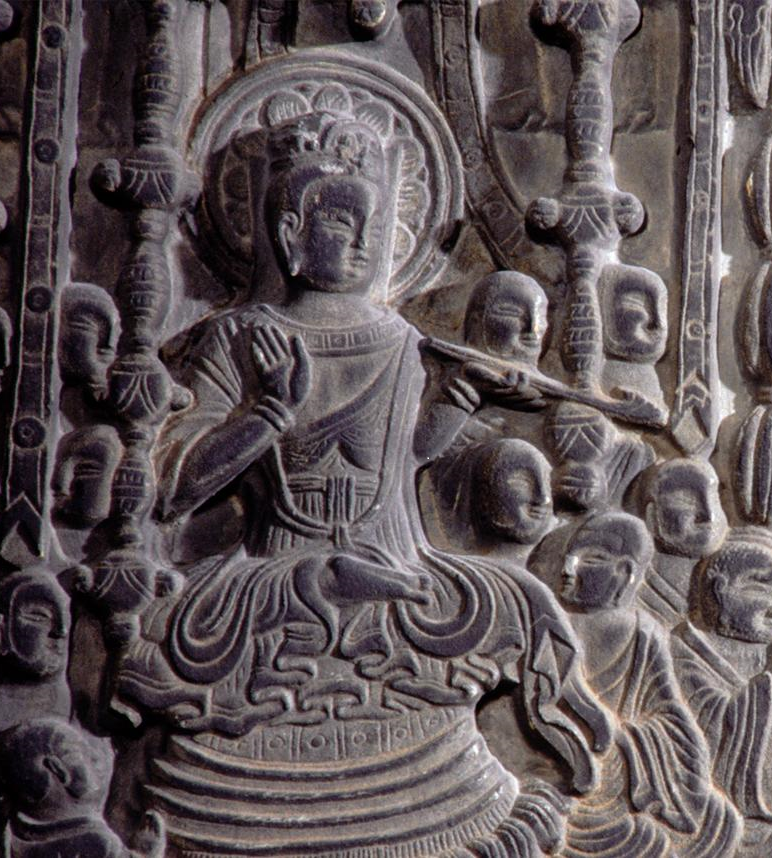
“As-you-wish” (ruyi, 如意), originates with a ritual scepter of that name shaped like an arching snake with a head in the form of a lingzhi mushroom (靈芝, a.k.a., “fungus of immortality”) (fig. 1). They are often seen carried by emperors and Buddhist and Daoist deities in Chinese art. Prior to the 10th-century, the scepter was closely associated with the Bodhisattva Manjusri (Wenshu, 文殊) and his famous debate with the householder Vimalakirti (Weimojie, 維摩詰). [5] Engravings of the event show him holding the object in the form of a tanbing (談柄), or “discussion stick”, an elongated, shoe horn-shaped wand historically used by religious and secular groups to designate the right to speak before an assembly (similar in function to the Native American “talking stick”) (fig. 2). [6] This implement was sometimes portrayed with vegetal features. For instance, a Chinese stele from the 6th-century shows Manjusri debating while holding a sprig (fig. 3). [7] J. Leroy Davidson suggests that this type of scepter has its origin in an Indian Buddhist Jataka tale in which a group of royal sisters use branches to initiate debates with suitors and Buddhist priests. [8] The term ruyi comes from the “wish-fulfilling” Kalpavriksha tree of Hindu mythology. [9] This is suggested by a Chinese source from the 7th-century which notes that, during the celebration of Upavasatha, [10] lay hosts often gifted “ruyi shu” (如意樹), or “As-you-wish trees” (no doubt saplings or branches), to Indian Buddhist priests [11]. It’s possible that these gifts served as unofficial symbols of the priests’ authority and combined with the aforesaid tradition of debating with branches. This would explain why an instrument of debate would carry the ruyi title.
Upon entering China with Buddhism, this symbol of authority was adopted by the upper echelons of society. [12] Early records describe emperors, generals, and ministers wielding the object as a means to assert or signify their power. For instance, during the Jin Dynasty (265–420), the court official Shi Chong (石崇, 249–300) used a metal ruyi to smash a coral tree, an imperial gift belonging to a rival aristocrat. [13] Jin General Xie Wan (謝萬, 320–361) used the object to point at his captains and direct his orders to them. [14]. General Wei Rui (韋叡, 442–520) of the Liang Dynasty (502–557) took this one step further and directed his troops in battle with a bamboo scepter. [15] Legend states that Northern Wei Dynasty (386–535) Emperor Xiaowen (孝文, 467–499) placed a bone ruyi (among other items) before his sons; the boy who chose it became his heir because it signified the right to rule. [16] During a time of war, Emperor Wu of Liang (梁武帝, 464–549) gave one of his generals a ruyi because, as one scholar suggests, it was sure to bring him victory in battle. [17]
Fig. 2 – Examples of tanbing-style ruyi from 8th-century Japan (larger version). Due to slow culture transmission, these could be reminiscent of early Chinese scepters. Fig. 3 – Manjusri holding a sprig while debating Vimalakirti. Detail from a Chinese Buddhist stele dated 533–543 (larger version).
Due to its historical association with military command, Literati ignorant of the scepter’s original function as an instrument of religious debate and authority came to consider the ruyi a type of weapon. For example, the Song Dynasty (960–1279) archaeologist Zhao Xigu (趙希鵠, c. 1195–post 1242) described the object as an iron club used for self-defense: “The men of old used the Ruyi for pointing or indicating the way, and also for guarding themselves against the unforeseen. It was made of wrought iron, and was over two feet in length…” [18] Zhao’s words were later echoed by the art collector Wen Zhenheng (文震亨, 1585–1645) during the Ming Dynasty (1368–1644). [19] The concept of an “As-you-wish” iron club used for self-defense no doubt influenced monkey’s staff. This is especially true since Wen shows the idea was current during the time that the Ming version of the novel was published.
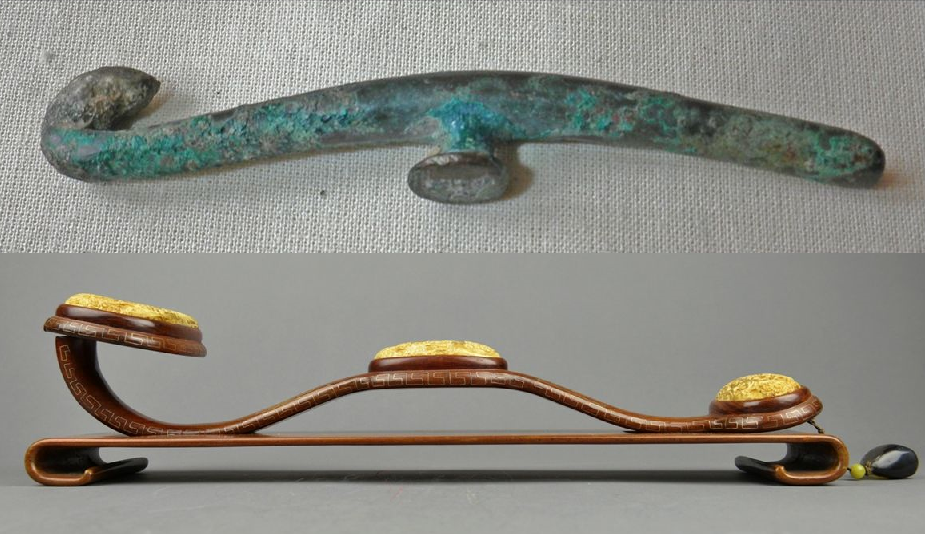
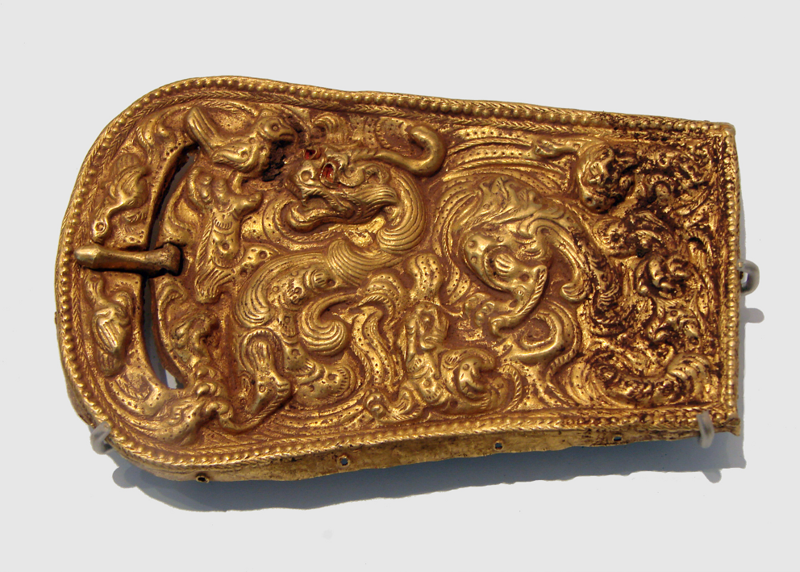
So how did the scepter come to have its signature serpentine curve and ornate head? J. Leroy Davidson believes this is a simple case of misidentification. He cites material from the Song Dynasty concerning people digging up a “a bronze box in which was a white ruyi decorated with motives of a dragon and tiger”. [20] Davidson suggests this archaeological artifact was actually a belt hook commonly worn during the Zhou and Han Dynasties (11th-c. BCE to 3rd-c. CE). Said hooks have an S-shaped curve and the accompanying buckles are often decorated with real and imagined creatures like those mentioned above (fig. 4 and 5). [21] It’s easy to see then how ancient belt buckles—perhaps the features weathered by time—could have been confused with a mushroom.
Fig. 4 – A profile comparison of a Han-era belt hook (top) and a ruyi (bottom) (larger version). Fig. 5 – A Han belt buckle featuring a dragon (larger version).
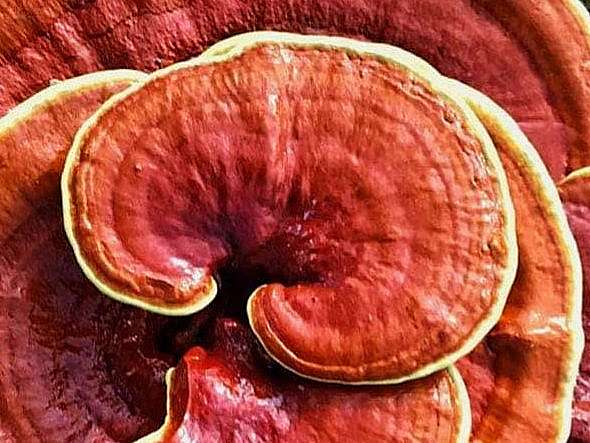
Just like the Vedic Soma and the Greek Ambrosia, the Chinese also had a magical, life-prolonging substance which they called Zhi (芝). [22] The Records of the Grand Historian (Shiji, 史記, c. 90 BCE) mentions that the emperors Qin Shihuangdi (秦始皇帝, 260–210 BCE) and Han Wudi (漢武帝, 156–87 BCE) sent thousands of men over many years in search of magical islands housing this immortal herb. [23] It was during the time of the latter that the substance was equated with lingzhi (靈芝, Ganoderma), a genus of spade-shaped mushroom with a lacquered appearance (fig. 6). [24] This fungus became the subject of esoteric texts starting from the Han Dynasty, many of which are now lost. Drawing on these extinct texts, the Daoist adept Ge Hong (葛洪, 283–343) was the first to classify the lingzhi into five major types. [25] Methods For Planting the Zhi Plants (Zhong zhicao fa, 種芝草法), a late Six Dynasties (220–589) text attributed to the Daoist god Laozi (老子), details how to seed this magical fungus by burying precious substances, such as gold or cinnabar, on a mountain side during solstices and equinoxes. [26] Originally written during the Song Dynasty, a Ming edition of Classification of Supreme Numinous Treasure Mushrooms (Taishang lingbao zhicao pin, 太上靈寶芝草品) lists one hundred twenty-six different kinds of immortality-bestowing fungi. It’s important to note that this text became part of the official Daoist Canon (Daozang, 道藏) during the mid-15th-century. [27] This means immortal mushrooms are a central tenet of Daoism.
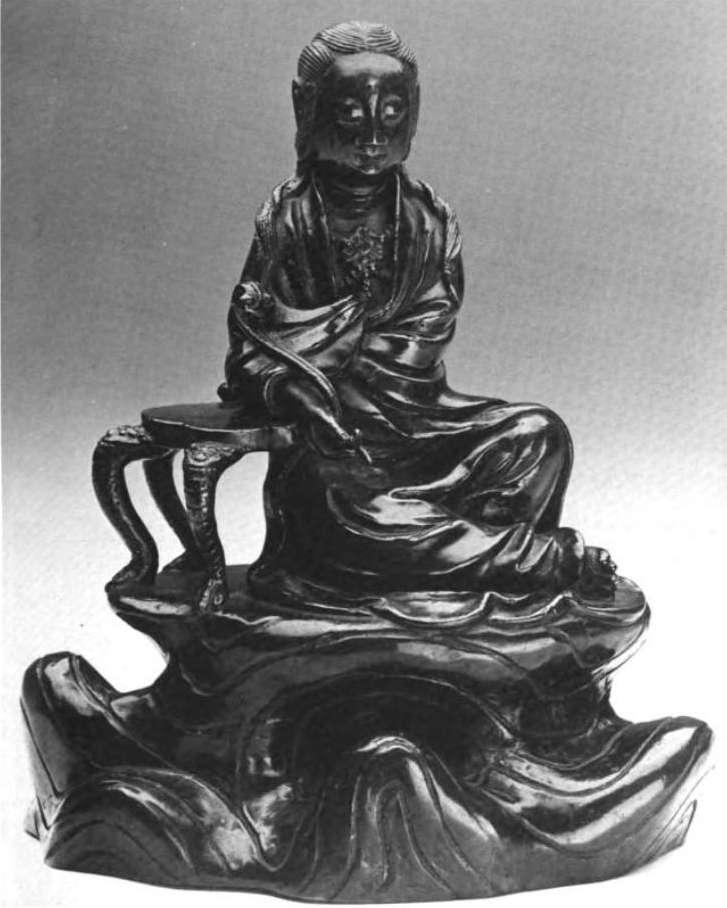
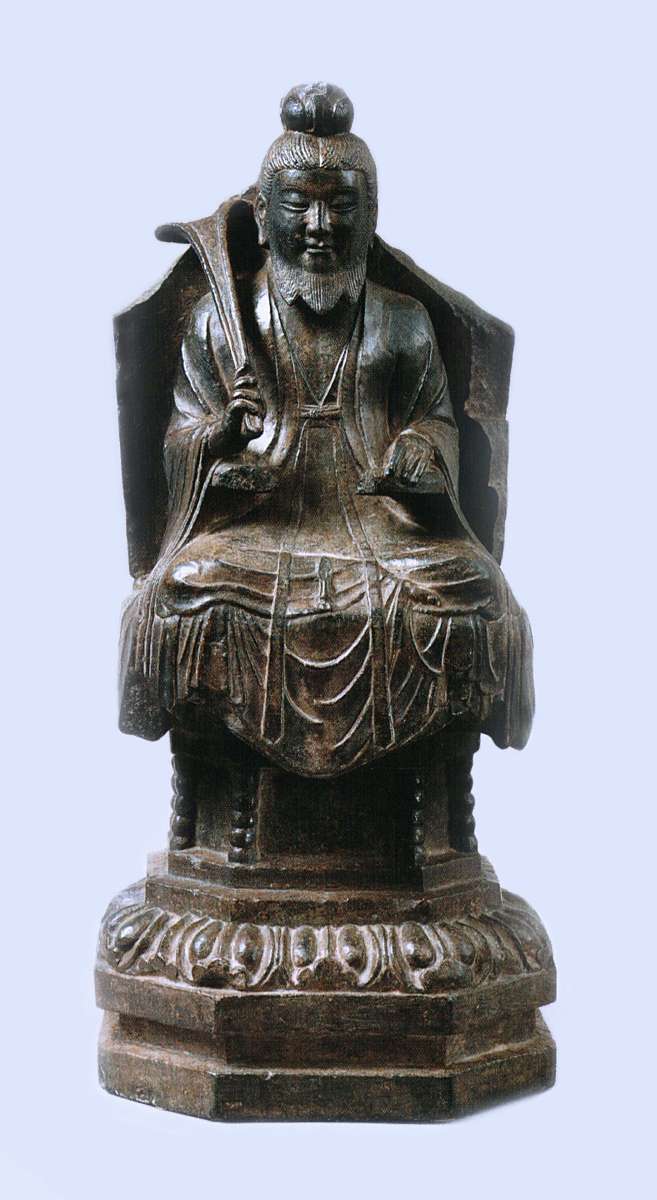
Daoism adopted the ruyi centuries prior to the Song Dynasty when the lingzhi mushroom was associated with the scepter. [28] It was one of the few ritual objects permitted Daoist monks living in medieval Chinese monasteries. [29] In fact, one early Tang Dynasty text states that it is among the items that “are essential for all Daoists, whether male or female, when they present offerings”. [30] Possibly taking a cue from Buddhist depictions of Manjusri, Daoists of the Tang began to depict some of their supreme deities with the scepter. For example, a late 7th- or early 8th-century statue of Laozi depicts him holding a straight tanbing-style ruyi (fig. 7). [31] After the lingzhi imagery was absorbed into the scepter, it became closely associated with the Celestial Worthy of Numinous Treasure (Lingbao Tianzun, 靈寶天尊), one of the Three Pure Ones (Sanqing, 三清), a trinity representing different aspects of the Dao (道). A 14th-century woodblock print depicts this deity holding a large mushroom ruyi—called by one scholar “his principle attribute”—while sitting on a heavenly throne surrounded by a sea of celestial beings (fig. 8). [32] The scepter was later associated with other Daoist deities during the Ming. [33] Therefore, the long association of the ruyi with Daoist immortals explains why Monkey would come to wield such an instrument with that name.
Fig. 7 – A late-7th- or early-8th-century statue of Laozi holding a straight tanbing-style ruyi (larger version). Fig. 8 – A 14th-century woodblock print depicting the Celestial Worthy holding a linzhi ruyi (larger version). Fig. 9 – Detail of a Cintamani, or “wish-granting pearl” (larger version).
Unlike their Daoist counterparts, Buddhists during the Tang looked upon the scepter as a somewhat base object. For example, although he listed it as a “lecture baton”, the monk Daoxuan (道璿, 702–760), an expert on monastic law, placed the ruyi in the same category as non-ritual items like satchels and spittoons. Furthermore, he described it as being one of the objects not among the “tools of the way”. [34] Sources from this time and the Song Dynasty equate the object with a simple backscratcher. [35] This shows that the ruyi lost any association that it may have had with wish-granting (as the term implies) upon entering China. So how did it regain its magic properties? This probably happened because it was equated with the Buddhist Cintamani, or “wish-granting pearl” (fig. 9). [36] This is suggested by the Chinese translation of the Sanskrit term, Ruyi zhu (如意珠). [37] The association between the two was surely established by the Ming as Monkey’s staff has the magical ability to grow or shrink according to his wishes. [38] This is best exemplified by a poem appearing in Chapter seven of Journey to the West:
A spirit beam filling the supreme void— That’s how the rod behaves accordingly. It lengthens or shortens as one would wish; Upright or prone, it grows or shrinks at will. [39]
The magic powers of the staff may be based on a weapon appearing in the earliest version of the novel, The Story of How Tripitaka of the Great Tang, Procures the Scriptures (Da Tang Sanzang qujing shihua, 大唐三藏取經詩話). In this 13th-century adaptation, our protagonist changes a ringed monk’s staff into a “gigantic yaksha whose head touched the sky and whose feet straddled the earth”. [40] This means that the Song and Ming Dynasty versions of the staff both have the ability to change their size and shape as Monkey wishes. I suggested in the second article that the initial description of the weapon in chapter one as a giant pillar of black iron is based on the famous Iron Pillar of Delhi, a religio-political Indian monument of the 4th-century. A warrior wishing to wield such a pillar would naturally need to shrink it down. Therefore, the “wish-granting” ruyi concept was probably associated with the shape-changing abilities of the ringed monk’s staff and applied to monkey’s signature iron weapon.
In conclusion, the inscription on Monkey’s staff stands as a microcosm of Chinese literature, history, and religion. The weight harkens back to Yuan and Ming (13th-c. to 17th-c. CE) Military Romance literature in which great heroes are distinguished from normal humans by their ability to brandish extremely heavy weapons. Monkey’s ability to wield a staff weighing nearly nine tons elevates him above his human counterparts as a divine hero with herculean strength. The ruyi (如意) concept is much older and can be traced back to ancient India. The term is based on the Kalpavriksha, or “wish-granting” tree, of Hindu mythology. This element of Hindu culture was absorbed by Indian Buddhism and mixed with a separate tradition to become a symbol of religious debate and authority. Upon entering China during the Han Dynasty (206 BCE–220 CE), this branch was stylized into a tanbing (談柄), or “Discussion Stick”, which later became the emblem of the Bodhisattva Manjusri. It was simultaneously adopted by aristocrats and military commanders in subsequent dynasties as a sign of their secular power. The object attained its current S-shape and ornate head during the Song Dynasty (960–1279) when historical archaeologists happened upon ancient Chinese belt hooks and buckles from the Zhou and Han Dynasties (11th-c. BCE–3rd-c. CE) and confused them for such scepters.
There are three reason for the ruyi term being applied to Sun Wukong’s magic weapon. First, due to its historical association with military commanders, literati during the Song and Ming Dynasties came to look upon the object as an iron club used for self-defense. This would be perfect for protecting Monkey’s Buddhist master Xuanzang (玄奘) during their journey to India. Second, the head of the scepter was associated with the immortality-bestowing lingzhi mushroom (靈芝) during the Song Dynasty and became the emblem of the highest gods of Daoism, most notably the Celestial Worthy of Numinous Treasure (靈寶天尊). This makes the ruyi an excellent weapon for an immortal macaque possessed of Daoist magic. Third, the scepter was equated with the Buddhist Cintamani, or “wish-granting pearl”; this was associated with the magic, shape-changing abilities of a literary precursor of the weapon. Hence, the Ming version of Monkey’s pole gained the ability to magically shrink or grow according to his wishes. So, in the end, we see that both Monkey and his staff straddle the Buddhist and Daoist religions.
Update: 01/05/2015
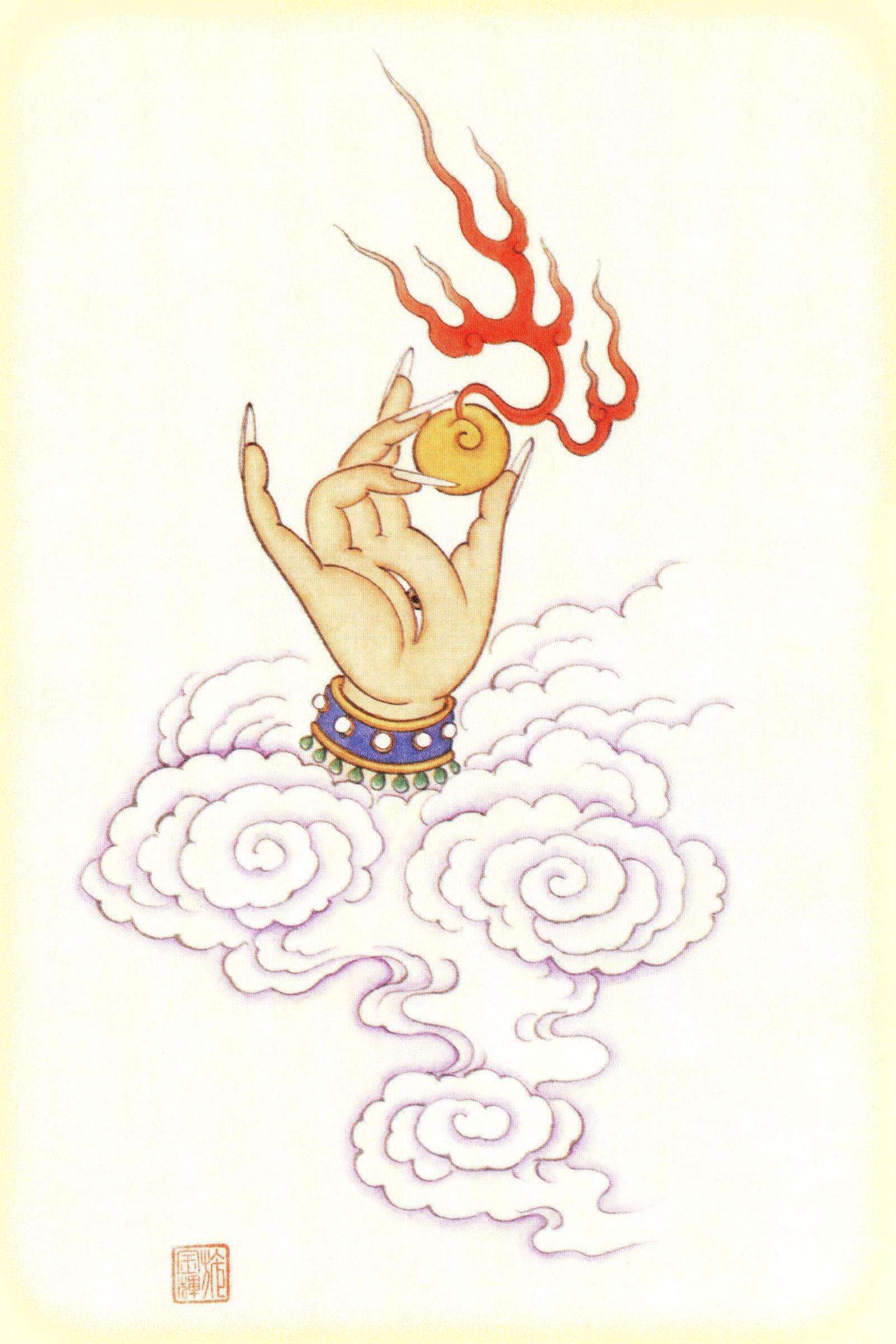
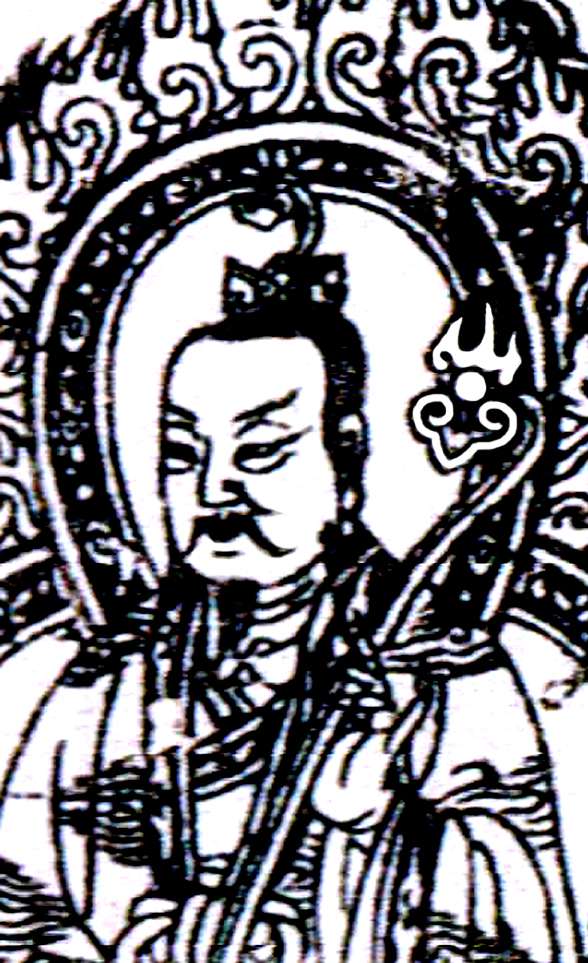
I suggested in the above entry that the ruyi may have been equated with the Buddhist cintamani, or “wish-granting pearl”. Well, I just noticed that the lingzhi-style scepter held by the Celestial Worthy from figure 8 appears to have a flaming pearl attached to it (fig. 9).
Fig. 9 – Enhanced version of the Celestial Worthy’s lingzhi ruyi scepter with a flaming pearl (larger version).
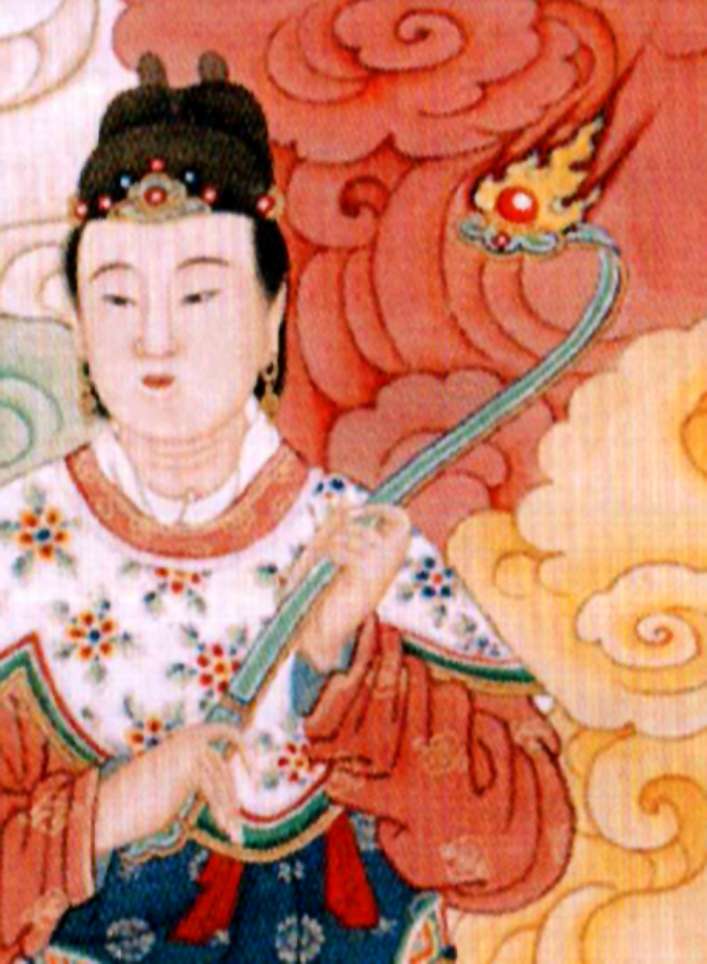
If it really is a Cintamani, this shows the association between the two happened by at least the 14th-century. This probably happened earlier considering iconography takes time to become standardized. I’ve found at least one other Chinese painting featuring a flaming pearl ruyi. A Ming work titled “The Lady of the Highest Primordial and the Empress of Earth” (c. 1600) features an attendant of the second deity holding the object (fig. 10).
A prime example of the relationship between the ruyi and the cintamani comes in the form of a 16th-century statue of the Bodhisattva Guanyin (觀音). The deity is usually associated with the flaming pearl, but this statue depicts her holding a scepter (fig. 11). H.A. van Oort comments: “In the mind of the artist, the scepter could well have replaced the cintamani, the “wish-fulfilling jewel”; in that case the statue is a very free interpretation of the Ju-i Kuan-yin [Ruyi Guanyin, 如意觀音], or Cintamani Avalokitesvara, the Kuan-yin with the wish-fulfilling pearl”. [41]
Fig. 11 – Guanyin holding a ruyi scepter (larger version).
Update: 08-16-2020
I’ve written an article suggest the ruyi/lingzhi mushroom influenced the shape of Wukong’s curlicue-style headband.
I have written an article that discusses the magic powers of the staff. These include the ability to shrink and grow, control the ocean, astral project and entangle with Monkey’s spirit, multiply endlessly, pick locks, and transform into various objects. It also has sentience to a certain degree.
[1] Wu Cheng’en and W.J.F. Jenner, Journey to the West (Vol. 1). [S.l.]: Foreign Languages Press, 2001), 56. Text altered slightly. Compare with Anthony C. Yu’s translation: “The Compliant Golden-Hooped Rod” (Wu Cheng’en and Anthony C. Yu, The Journey to the West (Vol. 1) (Chicago, Ill: University of Chicago Press, 2012), 135). I prefer the former. Both translations use the word “pounds”; however, the Chinese version of the novel uses jin (斤), known in English as “catty.” Catty and pound are two different measures of weight, the former being heavier than the latter. Therefore, the text has been altered to show this. The catty during the Ming Dynasty when the novel was compiled equaled 590 grams (Mark Elvin, The Retreat of the Elephants: An Environmental History of China (New Haven (Conn.): Yale University P, 2004), 491 n. 133). This means 13,500 catties would equal 17,550 lbs. [2] Luo Guanzhong and Moss Roberts, Three Kingdoms: A Historical Novel (Berkeley: University of California Press, 1991), 27. [3] Shi Naian, Guanzhong Luo, and Sidney Shapiro, Outlaws of the Marsh (Beijing: Foreign Languages Press, 1988), 94-95. [4] Patricia Bjaaland Welch, Chinese Art: A Guide to Motifs and Visual Imagery (North Clarendon, VT: Tuttle Pub, 2008), 230. [5] The Vimalakirti Sutra (c. 100) tells of how the Buddha chose Manjusri to call upon the malingering householder whom no other disciple wanted to visit due to his supernatural intellect. He and Vimalakirti debate Buddhist doctrine before a crowd of celestial onlookers until they realize that they are both equally versed in the dharma (Burton Watson, The Vimalakirti Sutra (New York: Columbia University Press, 1997)). For Manjusri’s association with the Ruyi scepter, see J. Leroy Davidson, “The Origin and Early Use of the Ju-i,” Artibus Asiae 13, no. 4 (1950): 240. The aforementioned sutra was not translated into Chinese until the 5th-century, so this means the ruyi became associated with the deity rather quickly. [6] Davidson, 241-242. Medieval Chinese dictionaries refer to the ruyi as a type of backscratcher, the idea being that it can reach the areas that “one wishes” (Ibid, 239; John Kieschnick, The Impact of Buddhism on Chinese Material Culture (Princeton: Princeton University Press, 2002), 142). [7] Ibid, 245. See plate IV for examples of 8th-century ruyi scepters from Japan shaped like Bamboo stalks. [8] Ibid, 246. Davidson cites a hard to find book that is long out of print. I located an archived scan of the publication online. See “A Manual of Buddhism, in Its Modern Development (1853).” Internet Archive. Accessed December 17, 2014. https://archive.org/details/manualofbudhism00hard. The story appears on page 255. [9] Davidson, 246. Various Puranas state that such trees arose during the churning of the ocean of milk. The gods allowed humans to wish for whatever their hearts desired until they started asking for evil things. The trees were then transported to heaven beyond the reach of man (Roshen Dalal, Hinduism: An Alphabetical Guide (New Delhi: Penguin Books, 2010), 189). [10] A day of religious observance in which the Buddhist lay community renews their commitment to the Eightfold Path. Buddhist priests are invited into homes to help with this process (Yijing, F. Max Müller, and Junjirō Takakusu, A Record of the Buddhist Religion As Practised in India and the Malay Archipelago (A.D. 671-695) (Oxford: Clarendon Press, 1896), 35 n. 1). [11] Davidson, 246-247. [12] John Kieschnick believes the ruyi is a strictly Chinese invention (Kieschnick, 138-152). I, however, find Davidson’s arguments for an Indian origin more compelling. [13] Joseph Edkins. “The Ju-i, or, Sceptre of Good fortune”. The East of Asia Magazine III (1904), 238. For a complete translation of the story, see John Minford and Joseph S. M. Lau, Classical Chinese Literature: From Antiquity to the Tang Dynasty (New York: Columbia University Press, 2000), 671-672. [14] Edkins, 238. [15] Ibid, 239. [16] Ibid. See also Kieschnick, 144. Kieschnick refers to him by his temple name Gaozu. I have used his reign name to avoid confusion with other similarly named emperors from subsequent dynasties. [17] Edkins, 239. [18] Berthold Laufer, Jade: A Study in Chinese Archaeology and Religion (Chicago: Field Museum of Natural History, 1912), 336 n. 1. Text altered slightly. Laufer describes the ruyi as a blunt sword, but the available information makes the object sound more like a club. [19] He writes: “The ruyi was used in ancient times to give directions or to protect oneself from the unexpected. It was for this reason that it was made of iron, and not on the basis of strictly aesthetic considerations…” (Kieschnick, 151). [20] Davidson, 249. Text altered slightly. [21] Ibid. [22] R. Gordon Wasson and Joseph Needham both suggested that Zhi was actually based on Indian stories of Soma (Paul U. Unschuld, Medicine in China: A History of Ideas (Berkeley: University of California Press, 1985), 112. [23] Sima Qian and Burton Watson, Records of the Grand Historian (Vol. 2) (Hong Kong: Columbia University Press, 1993), 14-15 and 45-46. Despite its association with mushrooms, some texts refer to it as a type of grass or herb (Wolfram Eberhard, A Dictionary of Chinese Symbols: Hidden Symbols in Chinese Life and Thought (London: Routledge & Kegan Paul, 1986), 173-174. [24] Xiao Tong, Wen Xuan or Selections of Refined Literature (Vol. 3) (Princeton, N.J.: Princeton Univ. Press, 1996), 201. [25] These are stone zhi (石芝), wood zhi (木芝), plant zhi (草芝), flesh zhi (肉芝), and mushroom zhi (菌芝) (Fabrizio Pregadio, The Encyclopedia of Taoism (Vol. 2) (London: Routledge, 2008), 1273). [26] Ibid. [27] Stephen Little and Shawn Eichman, Taoism and the Arts of China (Chicago: Art Institute of Chicago, 2000), 340. [28] The association with the lingzhi, however, may have been as early as the Tang Dynasty (618–907). Yan Liben’s (閻立本, 600–673) “The Thirteen Emperors” painting features a monarch holding a straight tanbing-style ruyi with the head in the shape of a lingzhi. Although, the scalloped perimeter could denote a cloud. See “The Thirteen Emperors.” Digital Scrolling Paintings Project. Accessed December 23, 2014. http://scrolls.uchicago.edu/scroll/thirteen-emperors. [29] Livia Kohn, The Daoist Monastic Manual: A Translation of the Fengdao Kejie (New York: Oxford University Press, 2004), 122. [30] Ibid, 119. [31] See image #39 in Little and Eichman , 183. Little suggests this could instead be a depiction of the Celestial Worthy of Numinous Treasure (靈寶天尊) (Ibid, 187 cat. nos. 39-42 n. 9). On the contrary, Silvio A. Bedini mentions an incense burner of Laozi carrying a ruyi on his famous journey to the Western Paradise (Silvio A. Bedini, The Trail of Time: Time Measurement with Incense in East Asia (Cambridge: Cambridge Univ. Press, 1994), 113). This suggests that Laozi was indeed associated with the scepter. [32] This illustrates a scene from an important Song Dynasty text in which the Celestial Worthy is said to reveal heavenly secrets to mankind (Little and Eichman, 237-238). [33] See, for example, Cao Guojiu (曹國舅) (Welch, 259). [34] Kieschnick, 148-149. [35] Ibid, 1414-142 and 149-150. [36] Erik Zürcher has suggested that the only way the lowly back scratcher could have become a symbol of lofty knowledge was via an association with the wish-granting pearl (Erik Zürcher, The Buddhist Conquest of China: The Spread and Adaptation of Buddhism in Early Medieval China (Leiden: Brill, 1997), 407 n. 59). It seems only natural that an affiliation between the scepter and the pearl would have sparked the idea that the former had magical properties. [37] I’m not sure when the term was first translated into Chinese, but it appears in the Scripture on the Ten Wheels, a 6th-century sutra centered around the Bodhisattva Dizang (地藏, a.k.a., Ksitigarbha) (Ng Zhiru, The Making of a Savior Bodhisattva Dizang in Medieval China (Honolulu: University of Hawai’i Press, 2007), 29-30). This shows the association between the ruyi and the wish-granting pearl could be quite old. For more information on the Cintamani, see Alice Getty, The Gods of Northern Buddhism: Their History and Iconography (New York: Dover Publications, 1988), 186-187. [38] Wu and Yu, 135. [39] Ibid, 190. [40] Victor H. Mair, The Columbia Anthology of Traditional Chinese Literature (New York: Columbia University Press, 1994), 1189. For the complete story, see pages 1181-1207. [41] H. A. van Oort, The Iconography of Chinese Buddhism in Traditional China (Leiden: E.J. Brill, 1986), 22.
Unschuld, Paul U. Medicine in China: A History of Ideas. Berkeley: University of California Press, 1985.
Watson, Burton. The Vimalakirti Sutra. New York: Columbia University Press, 1997.
Welch, Patricia Bjaaland. Chinese Art: A Guide to Motifs and Visual Imagery. North Clarendon, VT: Tuttle Pub, 2008.
Wu, Cheng’en, and Anthony C. Yu. The Journey to the West (Vol. 1). Chicago, Ill: University of Chicago Press, 2012.
Wu, Cheng’en, and W.J.F. Jenner. Journey to the West (Vol. 1). [S.l.]: Foreign Languages Press, 2001.
Xiao, Tong. Wen Xuan or Selections of Refined Literature (Vol. 3). Princeton, N.J.: Princeton Univ. Press, 1996.
Yijing, F. Max Müller, and Junjirō Takakusu. A Record of the Buddhist Religion As Practised in India and the Malay Archipelago (A.D. 671-695). Oxford: Clarendon Press, 1896.
Zürcher, Erik. The Buddhist Conquest of China: The Spread and Adaptation of Buddhism in Early Medieval China. Leiden: Brill, 1997.
[Since writing this article, I have come to appreciate a Chinese origin for the depiction of Monkey’s staff as an iron pillar. Please see the entry for 09-26-16 below. I am keeping this article up for posterity so others may see my thought process.]
Last updated: 07-04-2021
Much of my recent work on Journey to the West (Xiyouji, 西遊記; “JTTW” hereafter) has focused on the origins of Sun Wukong‘s magic staff. This is because, as far as I know, scholars haven’t attempted to trace it beyond the 13th-century JTTW. This entry discusses the staff’s influence by the ringed and metal staves respectively carried by religious and martial Buddhist monks. Over time, these were combined into a single weapon: the rings from the former were fused at the ends of the latter. However, this doesn’t explain all aspects of the weapon. Take for example the initial description of the staff as a black iron pillar with an inscription:
[Sun] Wukong girded up his clothes and went forward to touch it: it was an iron rod more than twenty feet long and as thick as a barrel (emphasis added). Using all his might, he lifted it with both hands, saying, “It’s a little too long and too thick. It would be more serviceable if it were somewhat shorter and thinner.” Hardly had he finished speaking when the treasure shrunk a few feet in length and became a layer thinner. “Smaller still would be even better,” said Wukong, giving it another bounce in his hands. Again the treasure became smaller. Highly pleased, Wukong took it out of the ocean treasury to examine it. He found a golden hoop at each end, with solid black iron in between. Immediately adjacent to one of the hoops (emphasis added) was the inscription, “The Compliant Golden-Hooped Rod. Weight: 17,550 lbs” (based Wu & Yu, 2012, p. 135). [1]
If the weapon is based on historical objects, could it be possible that this description is based on something real? I believe I have found the object that may have influenced Monkey’s treasure: the famous Iron Pillar of Delhi (Ch: Deli tiezhu, 德里鐵柱) (fig. 1).
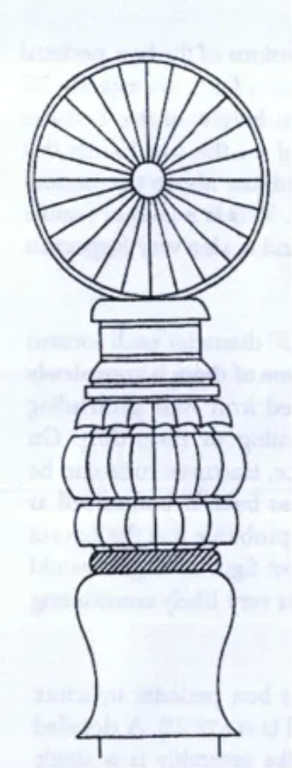
This Hindu monument was erected by King Chandragupta II (r. 380–413) of the Gupta Empire and dedicated to the deva Vishnu (Balasubramaniam, 2005, p. 14). It is nearly 24-feet (7.31 m) long, 21-feet (6.4 m) of which is sticking out of the ground (“an iron rod more than twenty feet long”). The shaft has a very wide diameter, 24-inches (60.96 cm) at the base and 17-inches (43.18 cm) at ground level (“as thick as a barrel”) (Balasubramaniam, 2005, p. 30). It has an ornamental bell capital that was originally topped by a chakra disc (“He found a golden hoop at each end”) (fig. 2) (Balasubramaniam, 2005, pp. 36-42). [2] And it also carries an inscription describing the military feats of the king (“Immediately adjacent to one of the hoops was the inscription…”) (fig. 3) (Balasubramaniam, 2005, pp. 6-8).
Fig. 2 (left) – A reconstruction of the chakra disc (larger version) (Balasubramaniam, 2005, p. 42). Fig. 3 (right) – The inscription (larger version).
What’s most interesting is the fact that the pillar is famous for resisting corrosion over the last 1,600 years. Scientists have analyzed its composition to find that it has a high phosphorous content, which forms a protective barrier against corrosive agents (Balasubramaniam, 2005, pp. 3 and 50-51). This means that the metallurgists of ancient India were far more advanced than originally thought. In addition, a local tradition in Delhi associates the pillar with Bhima, a supernaturally strong warrior from the great Hindu epic the Mahabharata (4th-cent. BCE). A legend circulating from at least the 19th-century (and maybe earlier) claims that he wielded the monument as a club in his ancient war against a rival army (Chunder, 1869, p. 152). Therefore, a black iron rod that defies time and is associated with martial heroes would surely make a fine weapon for an immortal monkey, no?
I unfortunately don’t know of any Chinese sources mentioning the pillar, so connecting it directly to JTTW is difficult. However, the pillar was around for 1,200 years prior to the standard 1592 version of the novel, and Buddhist monks such as Faxian and the historical Xuanzang made pilgrimages to northern India where the monument is located. Not to mention there is the possibility that Indian and Chinese merchants traveling back and forth between the two countries could have spread tales about the marvelous iron rod to China. These oral tales could have then reached the ear of the novel’s author-compiler during the Ming. I’ve contacted experts in Chinese history, religion, and literature to determine whether or not I’m on the right path. I’ll make a sister entry in the future if I happen upon any more information.
Update: 06-04-14
I recently learned that famed Muslim sojourner Ibn Battuta (1304-1377) referenced the pillar in his travel log:
In the center of the [Mosque of Delhi] is the awe-inspiring column of which [it is said] nobody knows of what metal it is constructed. One of their learned men told me that it is called Haft Jūsh, which means ‘seven metals’, and that it is composed of these seven. A part of this column, of a finger’s length, has been polished, and this polished part gives out a brilliant gleam. Iron makes no impression on it. It is thirty cubits high, and we rolled a turban round it, and the portion which encircled it measured eight cubits (Ibn Batuta & Gib, 2002, p. 622). [3]
Ibn Battuta traveled to China after his time in India, so this is just an example of how stories of the pillar could have come to the Middle Kingdom.
Update: 12-30-14
I just posted the third and final installment of my investigation on the history of Monkey’s staff. It can be read here.
Since writing the top entry, I’ve come to appreciate a Chinese origin for the staff’s depiction as an iron pillar. This entry serves as an addendum until I can write a longer blog on the subject.
I have written an article that discusses the magic powers of the staff. These include the ability to shrink and grow, control the ocean, astral project and entangle with Monkey’s spirit, multiply endlessly, pick locks, and transform into various objects. It also has sentience to a certain degree.
Here I present my theory on why Sun Wukong’s staff weighs 13,500 catties (17,560 lbs/7,965 kg). I believe the number is an embellishment on the weight of a stone block lifted by the bandit Wu Song in the Water Margin (c. 1400).
1) Anthony Yu’s (Wu & Yu, 2012) original translation states “thirteen thousand five hundred pounds” (vol. 1, p. 135). However, Chinese versions of the novel use jin (斤), known in English as “catty.” Catty and pound are two different measures of weight, the former being heavier than the latter. The catty during the Ming Dynasty when the novel was compiled equaled 590 grams (Elvin, 2004, p. 491 n. 133), so 13,500 catties would equal 17,550 lbs. Therefore, the English text has been altered to show the more accurate weight.
2) Balasubramaniam (2005) states that the discus was probably removed during the Muslim era for iconoclastic reasons (p. 43). I’m not sure when (if it all) stories of the pillar made it to China. Whether before or after the Muslim conquest, the ornamental nature of the discus and/or the remaining bell capital could have influenced the fusion of the rings from the religious staff to the ends of the martial iron staff.
3) A big thanks to Historum member Jinit for bringing the reference to my attention.
References
Balasubramaniam, R. (2005). Story of the Delhi Iron Pillar. Delhi: Foundation Books.
Chunder, B. (1869). The Travels of a Hindoo to Various Parts of Bengal and Upper India (Vol. 2). London: N. Trübner.
Elvin, Mark. (2004). The Retreat of the Elephants: An Environmental History of China. New Haven (Conn.): Yale University Press.
Ibn Batuta & Gib, H. A. R. 2000. The Travels of Ibn Baṭṭūṭa, A.D. 1325-1354 (Vol. 3). London: Hakluyt Society.
Wu, C., & Yu, A. C. (2012). The Journey to the West (Vol. 1) (Rev. ed.). Chicago, Illinois: University of Chicago Press.