Last updated: 04-04-2024
Sun Wukong is known for his limitless shape-changing powers, capable of taking the form of anything from gods, monsters, and humans to animals, insects, and even inanimate objects like buildings. But his most powerful transformation, that of a cosmic giant, is displayed only three times in the novel. It is used mostly in defense against other powerful characters, namely the god Erlang and the Bull Demon King. In this article, I will introduce the ancient astral-geographical term used to describe this phenomenon, associate the transformation with a divine giant from Chinese mythology, and explore possible ties to Hindu mythology.
Table of Contents
- 1. Episodes from the Novel
- 1.1. Chapter 3
- 1.2. Chapter 6
- 1.3. Chapter 61
- 2. Ties to Ancient Chinese Astral-Geography and Mythology
- 3. Possible Ties to Hindu Mythology
- 4. Conclusion
- 5. Updates
1. Episodes from the Novel
1.1. Chapter 3
The first instance takes place in chapter three after Monkey returns from the Dragon King’s undersea palace with his new weapon. The form is used to show off his magical abilities for his children (fig. 1):
Grasping the treasure [iron staff] in his hands, he began to perform the magic of cosmic imitation (emphasis added). Bending over, he cried, “Grow!” and at once grew to be ten thousand-zhang [104,300 ft or 31,800 m]-tall, [1] with a head like the Tai Mountain and a chest like a rugged peak, eyes like lightning and a mouth like a blood bowl, and teeth like swords and halberds. The rod in his hands was of such a size that its top reached the thirty-third Heaven and its bottom the eighteenth layer of Hell (based on Wu & Yu, 2012, vol. 1, p. 138).
… 將寶貝揝在手中,使一個法天像地的神通,把腰一躬,叫聲:「長!」他就長的高萬丈,頭如泰山,腰如峻嶺,眼如閃電,口似血盆,牙如劍戟;手中那棒,上抵三十三天,下至十八層地獄。

Fig. 1 – Monkey performs the cosmic transformation for his children (larger version). A page from Chen Huiguan’s Newly Illustrated and Complete Journey to the West (Chen Huiguan xinhui quanben xiyouji, 陈惠冠新绘全本西游记, 2001). Image found here.
1.2. Chapter 6
The second takes place in chapter six during his battle with Erlang Shen. The form is used this time in response to the god’s own cosmic transformation.
The Immortal Master [Erlang] fought the Great Sage for more than three hundred rounds, but the result could still not be determined. The Immortal Master, therefore, summoned all of his magic powers; with a shake he made his body a ten thousand zhang tall. Holding with both hands the divine lance of three points and two blades like the peaks that cap the Hua Mountain, this green-faced, sabre-toothed figure with scarlet hair aimed a violent blow at the head of the Great Sage. But the Great Sage also exerted his magical power and changed himself into a figure having the features and height of Erlang. He wielded a compliant golden-hooped rod that resembled the Heaven-supporting pillar on top of Mount Kunlun to oppose the god Erlang (based on Wu & Yu, 2012, vol. 1, p. 181).
[…]
Now we were telling you about the Immortal Master and the Great Sage, who had changed themselves into forms which imitated Heaven and Earth (emphasis added) (based on Wu & Yu, 2012, vol. 1, p. 182).
1.3. Chapter 61
The third takes place in chapter sixty-one during Sun’s battle with the Bull Demon King (fig. 2). Again, the form is used in response to another powerful character’s transformation.
With a loud guffaw, the Bull King then revealed his original form of a gigantic white bull, with a head like a rugged mountain and eyes like bolts of lightning. The two horns were like two iron pagodas, and his teeth were like rows of sharp daggers. From head to toe, he measured more than ten thousand-plus zhang [10,430 ft or 3,179.06 m], while his height from hoof to neck was about eight hundred zhang [8,344 ft or 2,543.25 m]. [2]
“Wretched ape!” he roared at Pilgrim [Monkey]. “What will you do with me now?” Pilgrim also changed back to his true form; yanking out his golden-hooped rod, he bent his back and then straightened out, crying, “Grow!” At once he grew to a height of ten thousand zhang, with a head like Mount Tai, eyes like the sun and moon, a mouth like a bloody pound, and teeth like doors (based on Wu & Yu, 2012, vol. 3, p. 157).
[…]
[After Zhu Bajie returns from exterminating all of the demons in the Bull King’s cave] “You have achieved great merit, Worthy Brother,” said Pilgrim. “Congratulations! Old Monkey has waged in vain a contest of transformation with him [the Bull King], for I have not yet achieved victory. He finally changed into the biggest possible white bull, and therefore assumed the appearance that imitated Heaven and Earth” (emphasis added) (based on Wu & Yu, 2012, vol. 3, p. 158).

Fig. 2 – Monkey vs the Bull King, both in their cosmic transformations (larger version). An 1833 woodblock print by Yashima Gakutei. Photo by Prof. Vincent Durand-Dastès of the National Institute for Oriental Languages and Civilizations. With permission.
2. Ties to Ancient Chinese Astral-Geography and Mythology
The exact word used each time to describe Sun’s modus for attaining his cosmic form is Fatian Xiangdi (法天像(象)地), or the “method of modeling Heaven on Earth.” This is actually related to ancient Pre-Qin and Han concepts of astral-geography later used in the construction of imperial Chinese cities. The ancient Chinese viewed the heavens as a complex system of seven star units set in four cardinal sections, making up the Twenty-Eight Lunar Mansions, all of which enclosed and revolved around a central star ruled by one of two supreme gods, Shangdi or Taiyi. Known as the “Purple Palace Enclosure” (Ziweiyuan, 紫微垣), this bound star system was the heavenly abode from which the supreme god oversaw reality, while the surrounding stars represented his civil and military officials and even outlying areas, such as dwellings and a marketplace. The Chinese emperor, commonly called the Son of Heaven, was considered the earthly counterpart of the great god, serving as the mediator between the will of heaven and the needs of man. Therefore, architects often modeled imperial cities on these celestial patterns, placing the emperor at the center surrounded by outer layers of courts, residential quarters, markets, and streets (Chan, 2008, pp. 8-19).
The arcane-sounding Fatian Xiangdi term was no doubt chosen simply because Monkey’s magic body mirrors the vastness of the cosmos (both heaven and earth), not that it borrowed particular celestial patterns like earthly architects. Interestingly, though, legend states the ancient Yuan capital of Dadu was modeled on the magic body of the child god Prince Nezha, who also appears in Journey to the West. [3]
The novel likens aspects of Sun’s cosmic form to earthly features and celestial bodies. This resembles stories of the ancient god Pangu (盤古) (fig. 3), the first being born into primordial chaos who slaved to separate heaven from earth, cleaving one from the other and forcing them apart. Stevens (1997) writes this monumental task took its toll on the titan:
He died as the task was reaching a climax and his body became features of the Earth. His head became the mountains, his breath the wind and clouds; his voice became thunder, his left eye the sun and his right eye the moon, and his four limbs became the four quarters of the Earth. His blood ran as rivers, his veins and muscles were the strata of the rocks, and his flesh the soil. His skin sprouted and became vegetable patches, forests and paddy fields, while his bones and teeth became the minerals. His sweat became the rain and to complete creation humanity sprang from the parasites on his body (p. 54).
Monkey in a way becomes a living embodiment of the divine giant because he too is described as having a head like a mountain, eyes like the sun and moon, and a mouth like a large body of liquid, which also happens to be blood.

Fig. 3 – A modern (metal?) relief simultaneously symbolizing Pangu’s separation of heaven and earth and the decay of his body into earthly features and celestial bodies (larger version). Take note of the eye-like sun. Found on this news article about the god.
Giant characters were obviously not a new concept to Chinese literature by the Ming. An earlier example comes to us from The Story of How Tripitaka of the Great Tang Procures the Scriptures, the thirteenth-century precursor of Journey to the West. Chapter six sees Monkey transform his golden-ringed monk’s staff “into a gigantic Yakşa whose head touched the sky and whose feet straddled the earth. In his hands he grasped a demon-subduing cudgel. His body was blue as indigo, his hair red as cinnabar” (Wivell, 1994, p. 1189) (fig. 4). This line simultaneously predicts Sun’s goliath form and blunt weapon (that touches heaven and earth like the head and feet of the yaksha) and Erlang’s monstrous appearance (i.e. his green skin and red hair).

Fig. 4 – A guardian yaksha statue, Bangkok, Thailand (larger version). Take note of the large stature, blue skin, and club. Found on this article.
3. Possible Ties to Hindu Mythology
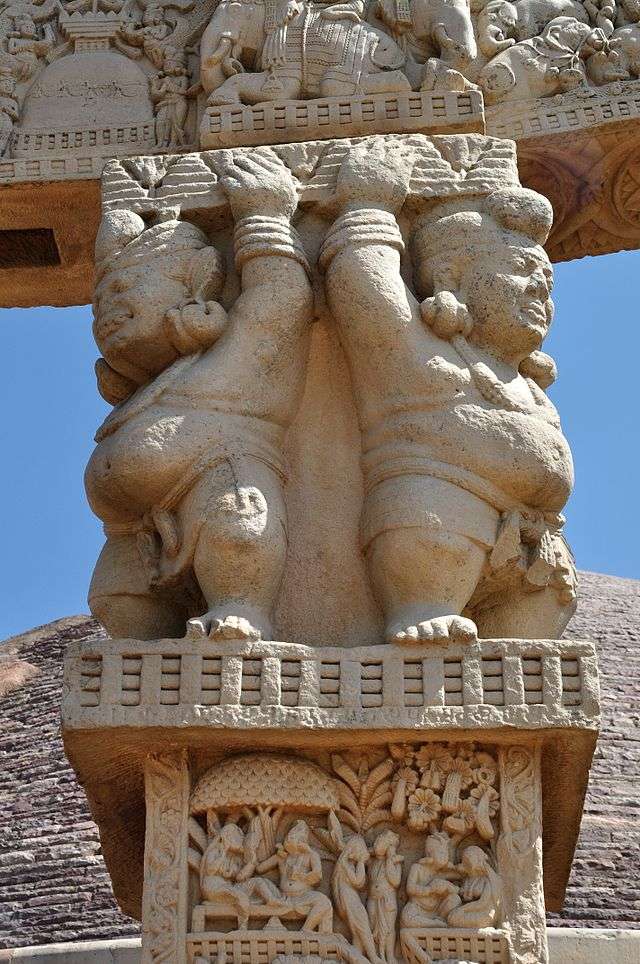
Yakşas or Yakshas (Ch: Yecha, 夜叉) appear in Hindu, Jain, and Buddhist scriptures as the assistants or protectors of divine beings. They are possessed of great magical powers and can do anything from flying to shape-changing (Dalal, 2014, p. 470; Buswell & Lopez, 2014, p. 1018). These nature spirits are often depicted in early religious art as portly dwarves (fig. 5), an element of iconography that they share with Vamana, the fifth avatar of the supreme deva Vishnu. This connection is important because the avatar is celebrated for his ability to eclipse the universe. According to Hindu mythology, Vishnu takes the form of the dwarf Brahmin when a benevolent asura named Mahabali wrestles control of the cosmos from the gods. Vamana visits the king during a great sacrifice, during which the asura grants gifts, and humbly requests only as much land as he can cover in three strides. But when his wish is granted, the deceptively small priest grows to cosmic proportions, “mightily waxing, swelling in every limb, with his first stride stepp[ing] beyond the sun and moon, with his second reach[ing] the limits of the universe, and with his third return[ing] to set his foot on the head of the conquered foe” (Zimmer & Campbell, 1992/1946, p. 132). With his feat (pun intended), Vishnu regains control of heaven (step one) and earth (step two), while simultaneously banishing the asura to the underworld (step three) (Dalal, 2014, p. 442).

Fig. 5 – A detail of chubby Yakshas from the western gateway of Stupa 1 at Sanchi (1st-cent.) (larger version). Image from here.
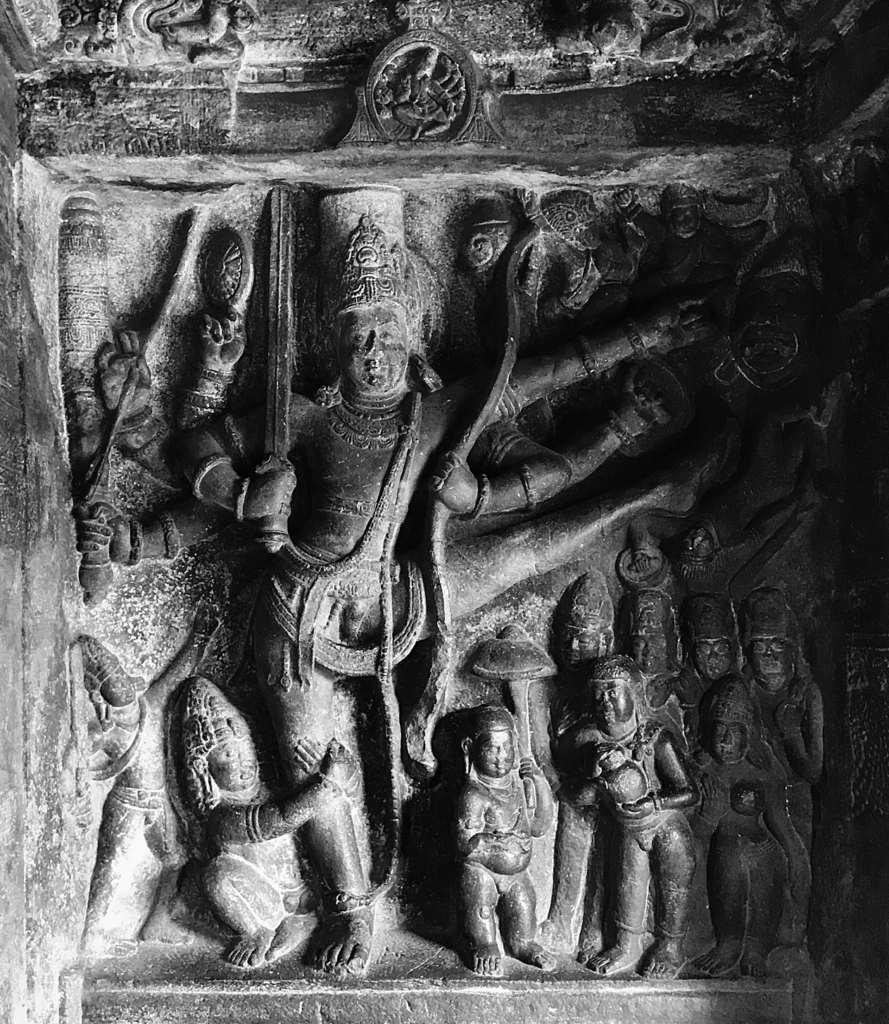
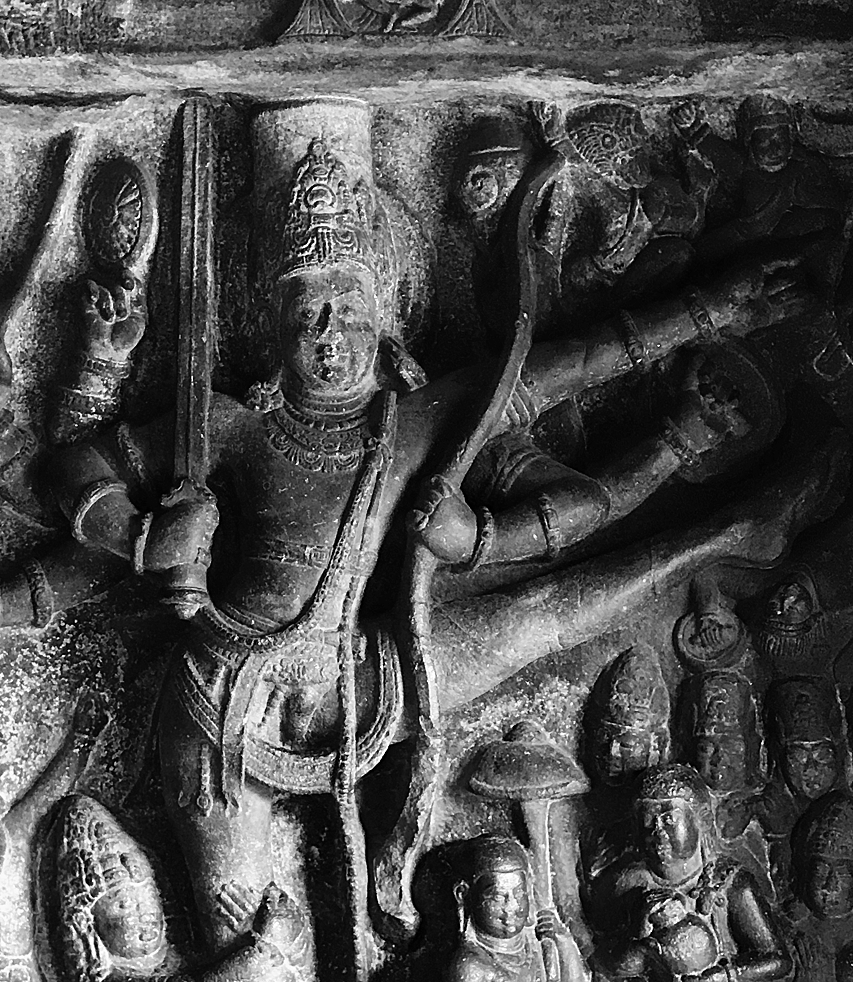
The noted art historian Heinrich Zimmer comments sculptures based on this story fall under a category of representationally kinetic art that he calls the “Phenomenon of Expanding Form” (Zimmer & Campbell, 1992/1946, p. 130). One cited example is the Trivikrama Vishnu (lit: “three steps” Vishnu), a sixth-century Badami cave number two relief (fig. 6) which presents a continuous narrative of the dwarf (fig. 7) growing to become the cosmic giant, the latter’s leg kicking high above his waist (fig. 8), symbolizing his mighty, universe-spanning strides. Though the piece is carved in stone, the dynamic nature of the composition gives it a feeling of swelling energy (Zimmer & Campbell, 1992/1946, p. 132).
The carving portrays the cosmic giant holding all manner of weapons, including a club, a sword, a bow, and a chakram, all of which are attributes of Vishnu (Dalal, 2014, p. 460).

Fig. 6 – The Trivikrama Vishnu relief carving of Vamana’s story, Badami cave number two (sixth-cent.) (larger version). Fig. 7 – A detail of the dwarf Brahmin holding a parasol (larger version). Fig. 8 – A detail of the cosmic giant holding celestial weapons and taking a supernaturally large stride (larger version). Adapted from this image.
The close association of the Yaksha and Vamana with a short, chubby body and shape-changing powers no doubt influenced the former to take on the latter’s ability to grow to huge proportions. In addition, after being absorbed into Buddhism, Yakshas are portrayed in scripture as divine warriors wielding clubs in defense of the dharma. Two prominent examples are Kubera (a.k.a. Vaisravana) and Vajrapani, both of whom are touted as the yaksha commander (Lutgendorf, 2007, p. 42; Buswell & Lopez, 2014, pp. 449 and 955). This surely influenced the later Chinese image of yakshas as club-wielding titans, such as the cited example from The Story. In turn, this and related material could have easily influenced the cosmic transformations of Monkey and other characters and their weapons from Journey to the West.
4. Conclusion
The novel describes Monkey taking on a giant cosmic form in chapters three, six, and sixty-one, the first time showing off his magic powers to his children and the second and third in response to the respective titanic transformations of Erlang and the Bull King. The magical spell used to achieve this form, titled Fatian Xiangdi (the “Method of modeling Heaven on Earth”), is based on ancient Pre-Qin and Han concepts of astral-geography later used in the construction of imperial Chinese cities. The idea of Sun’s body parts mirroring aspects of heaven and earth recalls the myth of the primordial god Pangu, whose body parts became the very building blocks of the cosmos after his death.
The cited episodes demonstrate that the characters involved transform both their bodies and weapons. Apart from being described as a 104,300-foot (31,800 m)-tall juggernaut with a head like Mt. Tai, Monkey’s staff is said to inhabit the upper and lowermost reaches of the universe (“its top reached the thirty-third Heaven and its bottom the eighteenth layer of Hell”) or that it resembles “the Heaven-supporting pillar on top of Mount Kunlun.” Likewise, Erlang’s three-pointed polearm is said to resemble “the peaks that cap the Hua Mountain.” Such transformations are predicted, for example, by an episode in the thirteenth-century precursor of Journey to the West in which Sun changes a monk’s staff into a gigantic Yaksha wielding a club.
While Yakshas are portrayed in early South Asian religious art as chubby dwarves, they most likely gained the ability to grow to enormous sizes thanks to iconographic similarities to Vamana, the fifth avatar of Vishnu famed for traversing the cosmos in three mighty steps. One sixth-century stone carving of the story portrays the dwarf-turned-cosmic giant wielding all sorts of celestial weapons. Additionally, Buddhist scriptures would come to portray yakshas as club-wielding warriors. Therefore, we can see how Monkey’s cosmic transformation could have ultimately been influenced by Hindu and Buddhist religious material.
5. Updates
Update: 10-17-21
Monkey also takes on his cosmic form in chapter 97. The episode calls it his “huge magic body” (da fa shen, 大法身). Read here for more information.
Watch Your Step: The Influence of Journey to the West on the “Ashiarai Yashiki” Yokai Story of Edo-Period Japan
Update: 08-06-22
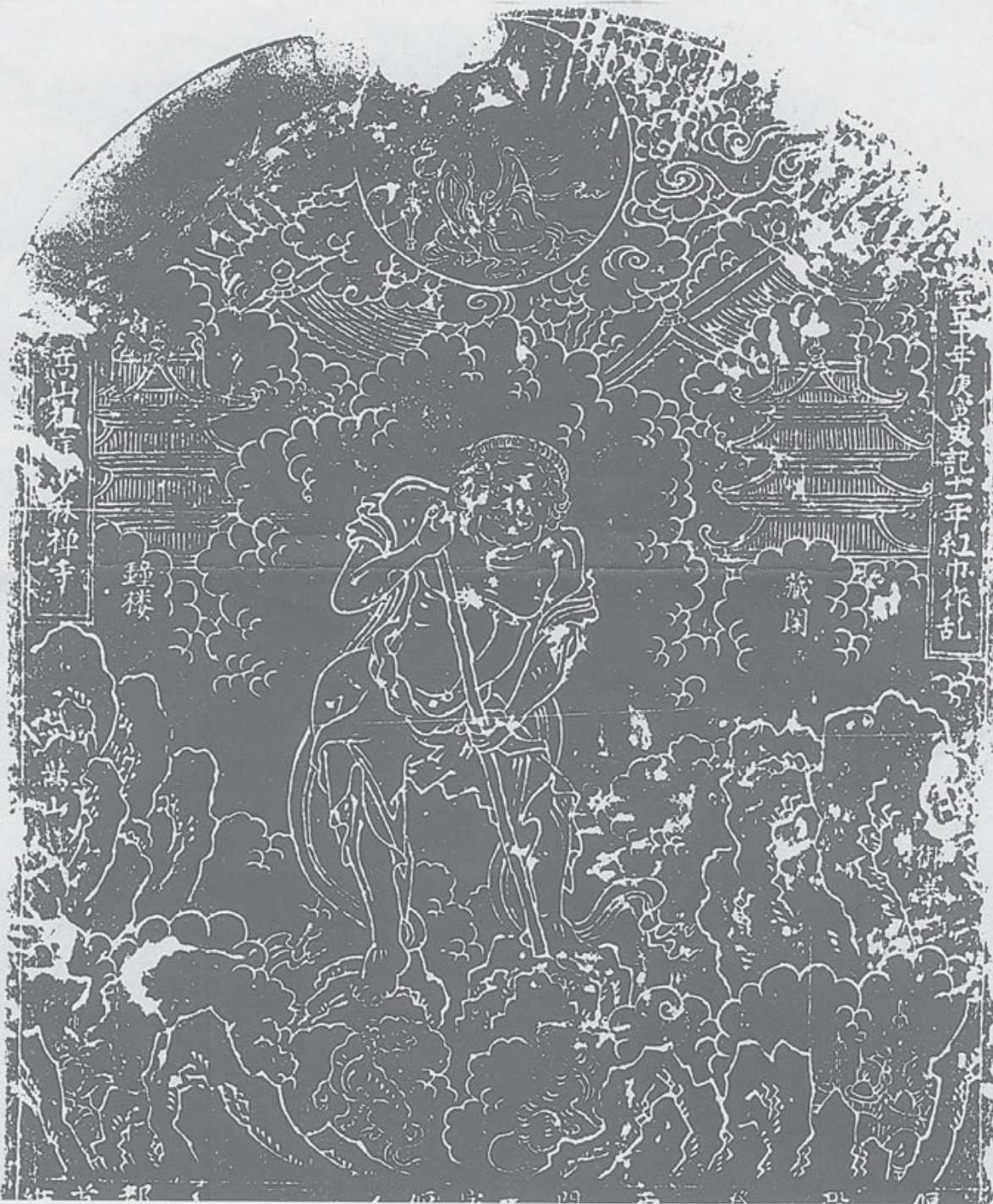
Sun Wukong’s cosmic body likely influenced Shaolin Monastery myth. The yaksha-bodhisattva Vajrapāni was historically worshiped as the progenitor of their famous staff method. A stele erected by Shaolin abbot Wenzai in 1517 shows that the deity’s vajra-club had been changed to a Chinese staff (fig. 9) (Shahar, 2008, p. 84). Vajrapāni’s Yaksha-like Nārāyana (Naluoyan(tian), 那羅延(天)) form was eventually equated with one of the four staff-wielding “Kimnara Kings” from the Lotus Sutra in 1575. His name was thus changed from Nārāyana to “Kimnara King” (Jinnaluo, 緊那羅) (Shahar, 2008, p. 87). One version of the story about his creation of the staff method takes place during the Yuan Dynasty‘s Red Turban Rebellion. Bandits lay siege to the monastery, but it is saved by a lowly kitchen worker wielding a long fire poker as a makeshift staff. He leaps into the oven and emerges as a monstrous giant tall enough to straddle both Mount Song and the imperial fort atop Mount Shaoshi, which are five miles (8.046 km) apart. The bandits flee when they behold this staff-wielding titan. The Shaolin monks later realize that the kitchen worker was none other than the Kimnara King in disguise (Shahar, 2008, pp. 87-88). Shahar (2008) suggests that mythical elements of the story were borrowed from the Monkey King’s adventures. He compares the worker’s transformation in the stove with Sun’s time in Laozi’s Eight Trigrams furnace (Bagua lu, 八卦爐), their use of the staff, and the fact that Monkey and his weapon can both grow to gigantic proportions (Shahar, 2008, p. 109). [4]
The aforementioned stele was erected in 1517, showing that Monkey’s cosmic body predates the standard 1592 edition of the novel.

Fig. 4 – The 1517 Shaolin stele showing a titanic Vajrapāni defending the monastery from rebels (larger version). From Shahar, 2008, p. 84.
Update: 04-04-24
In chapter 14, Sun Wukong lists a number of his powers, including the ability to grow as big as the cosmos:
“I, old Monkey, possess the ability to subdue dragons and tame tigers, and the power to overturn rivers and stir up oceans. I can look at a person’s countenance and discern his character; I can listen merely to sounds and discover the truth. If I want to be big, I can fill the universe; if I want to be small, I can be smaller than a piece of hair (emphasis added). In sum, I have boundless ways of transformation and incalculable means of becoming visible or invisible (Wu & Yu, 2012, vol. 1, p. 311).
This might imply that the aforementioned “ten thousand zhang” (wanzhang, 萬丈; 104,300 ft or 31,800 m) number is instead meant to be a metaphor for a much larger height, one that would fill the universe.
Notes:
1) Here, Anthony C. Yu’s English translation says Monkey grows to be “ten thousand feet tall.” However, the original Chinese source reads “萬丈” (wanzhang), wan meaning 10,000 and zhang being a measure designating ten Chinese feet (10,000 x 10 = 100,000). Therefore, I have changed the source to read “ten thousand zhang.“
2) Yu’s translation reads “eight hundred.” But, again, the original source is different. It reads “八百丈” (babai zhang), or 800 x 10 Chinese feet = 8,000. This makes more sense as he is said to be 10,000-plus feet long.
3) While the city is square, it has eleven gates, which legend states correspond to the three heads, six arms, and two legs of the god. For more information, see Chan (2008).
4) Yes, this information comes from Wikipedia, but I’m the one who originally added it under the screenname “Ghostexorcist.” See this edit history, for example.
Sources:
Chan, H. (2008). Legends of the Building of Old Peking. Seattle: University of Washington Press.
Dalal, R. (2014). Hinduism: An Alphabetical Guide. New Delhi, India: Penguin Books.
Lutgendorf, P. (2007). Hanuman’s Tale: The Messages of a Divine Monkey. Oxford: Oxford University Press.
Buswell, R., & Lopez, D. (2014). The Princeton Dictionary of Buddhism. Princeton University Press.
Shahar, M. (2008). The Shaolin Monastery: History, Religion, and the Chinese Martial Arts. Honolulu: University of Hawai’i Press.
Stevens, K. G. (1997). Chinese Gods: The Unseen World of Spirits and Demons. London: Collins & Brown.
Wivell, C.S. (1994). The Story of how the Monk Tripitaka of the Great Country of T’ang brought back the Sūtras. In Mair, Victor H. The Columbia Anthology of Traditional Chinese Literature (pp. 1181-1207). New York: Columbia University Press.
Wu, C., & Yu, A. C. (2012). The Journey to the West (Vols. 1-4) (Rev. ed.). Chicago, Illinois: University of Chicago Press.
Zimmer, H. R., & Campbell, J. (1992). Myths and Symbols in Indian Art and Civilization. Princeton, New Jersey: Princeton University Press. (Original work published 1946)