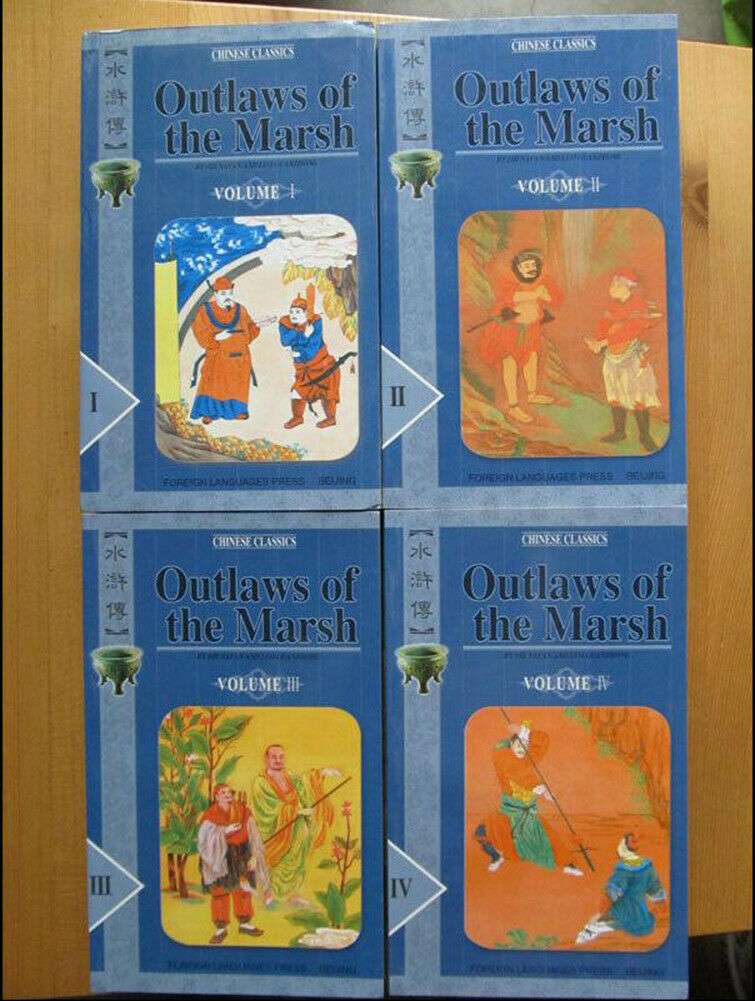
Note: My blog is not monetized, so I am not making any money from this post. My hope is that the PDF will make this legendary story more accessible to a wider audience. If you enjoyed the digital version, please, please, please support the official release.
Last updated: 05-31-2026
Here I present a PDF of the 100-chapter Foreign Language Press four-volume boxed set of Outlaws of the Marsh (a.k.a. Water Margin, Shuihu zhuan, 水滸傳, c. 1400; “WM” hereafter) translated by Sidney Shapiro. Credited to Shi Nai’an and Luo Guanzhong, this classic Chinese military romance follows 108 heavenly and earthly spirits-reborn-heroes who band together and use their great physical or mental strengths to rebel against the falling Song Dynasty (960–1279). Some of the surviving members later accept clemency from the government and work to fight the barbarian hordes invading China. Few live to old age.
Table of Contents
- 1. Influence on JTTW
- 2. Other Archived Classics
- 3. PDF Link
- 4. Updates
1. Influence on JTTW
I’m archiving this book because it has a deep connection with Journey to the West (Xiyouji, 西遊記, 1592; “JTTW” hereafter). Here are a few examples. First, the name and number of Sun Wukong‘s “Multitude of Terrestrial Killers” (Disha shu, 地煞數; a.k.a. his “72 kinds of transformations,” qishier ban bianhua, 七十二般變化) and Zhu Bajie’s “Multitude of Celestial Rectifiers” (Tiangang shu, 天罡數; a.k.a. his “36 kinds of transformations,” sanshiliu ban bianhua, 三十六般變化) are similar to that of the spirits mentioned above. [1] In WM ch. 2, they are called the “Stars of the 36 Celestial Rectifiers and of the 72 Terrestrial Killers—a total of 108 Demon Lords” (三十六員天罡星,七十二座地煞星,共是一百單八個魔君) (Meulenbeld, 2019, p. 5; Shi & Luo, 1975/2021b, vol. 1, p. 16). [2] Second, see my previous article analyzing the parallels between the Monkey King and the bandit Wu Song (武松). See also the sister article over at the Journey to the West Library blog. And third, I’ve previously suggested that Sun’s ploy to rescue the beleaguered wife of Zhu Bajie in JTTW ch. 18 is based on an event from WM ch. 5. Both feature:
- Young, beautiful daughters in unwanted relationships (Green Orchid vs the unnamed maiden).
- Elderly fathers worried for their child (Mr. Gao vs Mr. Liu).
- Evil spirit-turned-inhumanly strong, hot-tempered, heavy metal staff-wielding martial monks who come to their aid (Sun Wukong vs Lu Zhishen).
- The monk takes the place of the woman in a darkened room.
- The villain is beaten (Zhu Bajie vs Zhou Tong) (Wu & Yu, 2012, vol. 1, pp. 374-377; Shi & Luo, 1993/2001a, pp. 109-113).
2. Other Archived Classics
This PDF will complement the translations that I’ve previously archived. These include the JTTW story cycle (here and here), the four-volume 2000 Library of Chinese Classics Chinese-English bilingual edition of Creation of the Gods (Fengshen yanyi, 封神演義, c. 1620 CE), a fan translation of Journey to the South (Nanyouji, 南遊記, c. 1570s-1580s), and the four-volume 2001 Foreign Language Press boxed set of Three Kingdoms (Sanguo yanyi, 三國演義; lit: “Romance of the Three Kingdoms,” 14th century.).
3. PDF Link
Click to access Outlaws-of-the-Marsh.pdf

Fig. 1 – The four covers of the boxed set edition (larger version). Image found here.
4. Updates
4.1. Influence on JTTW – Part 2
Another possible influence recently dawned on me while updating WM citations on a past article. Recall that the bandit-monk Wu Song shares several connections with Sun Wukong. Well, in WM chapters 31 and 32, Wu swordfights and finally decapitates an evil Daoist (Shi & Luo, 1993/2001a, vol. 2, pp. 643-645; Shi & Luo, 1975/2021b, vol. 1, pp. 427-428). A young maiden previous held hostage by the fiend goes on to reveal that he had taken the nickname “Flying Centipede” (Fetian wugong, 飛天蜈蚣) because the local area was known as “Centipede Ridge” (Wugong feng, 蜈蚣峰) (Shi & Luo, 1975/2021b, vol. 2, pp. 428-429). [3] This bad guy might foretell the Demon Lord of a Hundred Eyes (Baiyan mojun, 百眼魔君), an evil, sword-wielding Daoist centipede spirit (wugong jing, 蜈蚣精) that Monkey fights in JTTW chapter 73.
Notes:
1) Anthony C. Yu (Wu & Yu, 2012) translates these as the “Art of the Heavenly Ladle” and the “Art of the Earthly Multitude” (vol. 1, p. 122). I instead follow the translation used by Meulenbeld (2019). In regards to Tiangang (天罡), he explains: “In its exorcist manifestation, the Northern Dipper is known as gang 罡, which I translate here as ‘rectifier’ due to the ritual function it has in righting wrong” (Meulenbeld, 2019, p. 7). “Terrestrial Killers” is a direct translation of Disha (地煞).
2) Shapiro translates these as the “[t]hirty-six stars of Heavenly spirits and seventy two stars of Earthly Fiends, a total of one hundred and eight demons” (Shi & Luo, 1993/2001a, vol. 1, p. 16). Each of the 108 bandits is later associated with a particular star in WM ch. 71 (Shi & Luo, 1993/2001a, vol. 4, pp. 1499-1501; Shi & Luo, 1975/2021b, vol. 3, pp. 972-975).
3) Shapiro incorrectly translates the location as “Centipede Hill” (Shi & Luo, 1993/2001a, vol. 2, p. 646). I have corrected the area name above based on the original Chinese.
Sources:
Meulenbeld, M. (2019). Vernacular “Fiction” and Celestial Script: A Daoist Manual for the Use of Water Margin. Religions, 10(9), 518. MDPI AG. Retrieved from http://dx.doi.org/10.3390/rel10090518.
Shi, N., & Luo, G. (2001a). Outlaws of the Marsh (Vols. 1-4) (S. Shapiro, Trans.). Beijing: Foreign Languages Press. (Original work published 1993)
Shi, N., & Luo, G. (2021b). Shuihu zhuan (shang, zhong, xia) [Tale of the Water Margin (Vols. 1-3)]. Beijing: Renmin wenxue chubanshe. (Original work published 1975)
Wu, C., & Yu, A. C. (2012). The Journey to the West (Vols. 1-4) (Rev. ed.). Chicago, Illinois: University of Chicago Press.