Shi Pantuo: An Influence on Sun Wukong

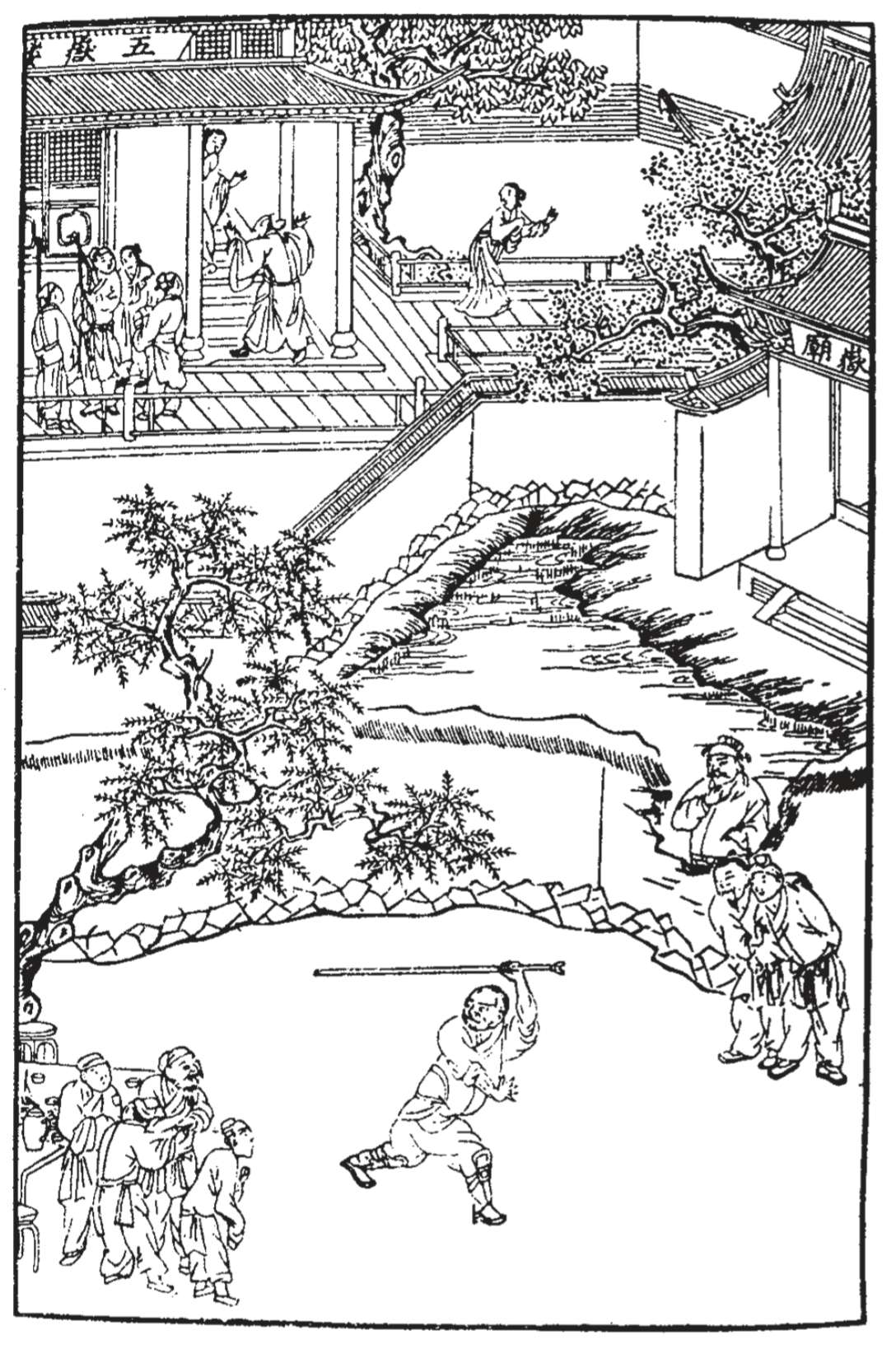
I was asked on Tumblr if I was familiar with Shi Pantuo (石槃陀/石盤陀/石磐陀; fig. 1), a historical figure suggested to be one of several influences on Sun Wukong. [1] He is known for serving as a temporary guide to the historical monk Xuanzang (玄奘, 602–664), on whom the literary Tripitaka is based. According to Hansen (2012), Shi was a Sogdian, an Iranic people active in Central Asia and China:

The guide’s last name, Shi, indicated that his family had originally come from the region of Kesh, or Shahrisabz, outside Samarkand, Uzbekistan, while his given name, Pantuo, was the Chinese transcription of Vandak, a common Sogdian name meaning “servant” of a given deity (p. 85). [2]

In this article, I will quote Shi’s full story appearing in A Biography of the Tripitaka Master of the Great Ci’en Monastery (Da Tang Daci’en si Sanzang Fashi Zhuan, 大唐大慈恩寺三藏法師傳, 7th-century; T2053), a journal of Xuanzang’s travels written by his disciple Huili (慧立). I will also discuss why he is believed to have been an inspiration for the Monkey King.

On a related note, please see my past article about the historical monk Wukong (悟空).

Fig. 1 – Statues of Xuanzang (left) and Shi Pantuo (right) from the Xuanzang Procures the Scriptures Museum (Xuanzang qujing bowuguan, 玄奘取经博物馆) in Guazhou County, Gansu Province, China (larger version). Image found here.

Table of Contents

1. Historical Record

Determined to procure Buddhist scriptures from India, Xuanzang ignored a royal prohibition against leaving China by traveling in secret towards the western reaches of the country. He was initially worried about traversing the border, which was heavily guarded by the military, but then his horse died, making matters worse. Then he was shocked to find that a warrant had been issued for his arrest. All of this weighed heavily on the monk (Huili & Shi, 1995, pp. 20-21). It was shortly thereafter that he met Shi Pantuo:

Now the Master worried all the more. Of the two junior monks [who had recently joined him in Liangzhou], Daozheng had already gone to Dunhuang, and only Huilin remained with him. Knowing that he could not stand the hardships of the long journey ahead, the Master dismissed him and let him go home. He bought a horse, but the trouble was that he had nobody to be his guide. Before the image of Maitreya Bodhisattva of the monastery [in Guazhou (fig. 2)] in which he was staying, he prayed for a man who might guide him through the pass. That night a monk of the Hu [胡, i.e. “barbarian“] tribe, named Dharma, of that monastery dreamed that the Master was sitting on a lotus flower going west. Dharma felt it strange and in the following morning he came to tell his dream to the Master, who was delighted in his mind, knowing that this was a good omen indicating the possibility of continuing his journey. But he said to Dharma, “A dream is but a fancy and is not worth mentioning.”

He again entered the shrine hall to pray. Before long a man of the Hu tribe came to pay homage to the image of the Buddha. He worshipped the Master by circumambulating him two or three … (Huili & Shi, 1995, p. 21)

… times. Being asked his name, the man said that he was named Pantuo with the surname of Shi (emphasis added). He begged for the conferment of the Precepts and was given the Five Precepts. Greatly delighted, the Hu man went away and returned in a moment with cakes and fruits. Seeing that the man was intelligent and strong with a reverential manner, the Master told him about his intention of taking the journey. The Hu man consented to send him across the five watchtowers, and this greatly pleased the Master. He bought some clothes and a horse for the man and made an appointment with him.

On the following day, when the sun was about to set, the Master went to a bushland where he waited for the man. Before long he arrived together with an old man of the Hu tribe, riding on an aged lean horse of reddish color. At this sight the Master felt displeased. But the young man said, “This old man knows the route to the West perfectly well. He has travelled to and from Yiwu for more than thirty times. I have brought him along in the hope that he might give you some counsel.” Then the old Hu man said, “The road to the West is perilous and the Sha River is an obstacle on the long way. There are demons and hot wind. Whoever encounters them cannot be spared from death. Even if you travel together with a large group of companions, you might go astray or be lost. How can you, reverend teacher, try to go all alone? I ask you to consider the matter carefully and not gamble with your life.”

The Master replied, “I started on my journey to the West for the purpose of seeking the Great Dharma. I shall not return to the East before I reach the Brahmanic countries. I shall not regret it even if I die on the way.”

The old man said, “If you insist on going, you had better ride my horse. This horse of mine has travelled to Yiwu fifteen times. It is sound and knows the way well. Yours is too young to travel such a long distance.”

Then the Master recalled that when he was about to start on his journey to the West from Chang’an, there was a sorcerer, named He Hongda, whose witchcraft and divination were usually effective. The Master had asked him to foretell the events of his … (Huili & Shi, 1995, p. 22)

… forthcoming journey. The sorcerer said, “You will be able to go, and it seems that you will be riding on an aged, lean horse of a reddish color, equipped with a varnished saddle with a piece of iron at the front.” On seeing that the Hu man’s horse was lean and reddish in color and that the varnished saddle had a piece of iron, the Master deemed it appropriate to take it, and so he changed his horse for that of the old Hu man, who was quite pleased and went away after due salutation.

After having packed his outfit, the Master started on the journey with the young Hu man. At about the third watch, they reached the river and saw the Yumen Pass at a distance. They went up the stream for about ten li [3.10 mi or 5 km] from the pass and came to a place where the banks of the river were over ten [Chinese] feet apart [10.43 ft or 3.18 m], beside which there was a wood of tamarisks. The Hu man cut some branches and built a bridge, on which he spread grass and paved it with sand. Then they drove their horses across [fig. 3].

The Master was glad to have crossed the river, and he unsaddled his horse to take rest at a place more than fifty paces from the Hu man. They spread their quilts on the ground to sleep. After a little while the Hu man got up, unsheathed his knife, and slowly advanced toward the Master, but he retreated at a distance of about ten paces. Not knowing what he had in his mind and suspecting that he might have an evil intent, the Master got up and recited scriptures and repeated the name of Avalokitesvara Bodhisattva [i.e. Guanyin], whereupon the Hu man lay down and slept. [3]

When it was nearly daybreak, the Master wakened the man to fetch some water for a wash. At the moment when they were about to continue the journey after having taken breakfast, the Hu man said, “Your disciple considers that the journey ahead is long and dangerous with neither water nor grass on the way. As water can be obtained only at the five towers, we have to reach them at night to steal water and pass along. But once discovered we shall be dead men. So it is safer to turn back.”

But the Master was determined not to go back, and so the Hu man proceeded with reluctance. He took out his sword and drew his bow, ordering the Master to go before him, but the Master … (Huili & Shi, 1995, p. 23)

… refused to precede him. When they had gone a few li, the man stopped and said, ‘Your disciple cannot go any more. I have a big family to support, and moreover I dare not trespass against the law.” The Master knew his mind and let him go back. The Hu man said, “You will certainly not be able to reach your destination. What shall I do if you are arrested and I am involved in the matter?” The Master replied, “Even if I am cut to pieces, I will never implicate you in my affair.” He then took a solemn oath and the man was satisfied. The Master presented him with a horse out of gratitude for his service, and they parted (Huili & Shi, 1995, p. 23).

___________________________

(I’m presenting two Chinese versions of the text here because I’ve noticed some differences.)

CBETA:

自是益增憂惘。所從二小僧,道整先向燉煌,唯惠琳在,知其不堪遠涉,亦放還。遂貿易得馬一匹,但苦無人相引。即於所停寺彌勒像前啟請,願得一人相引渡關。

其夜,寺有胡僧達摩,夢法師坐一蓮華向西而去。達摩私怪,旦而來白。法師心喜為得行之徵,然語達摩云:「夢為虛妄,何足涉言。」更入道場禮請。俄有一胡人來入禮佛,逐法師行二三匝。問其姓名,云姓石,字槃陀。此胡即請受戒,乃為授五戒。胡甚喜,辭還。少時齎餅菓更來。法師見其明健,貌又恭肅,遂告行意。胡人許諾言,送師過五烽。法師大喜,乃更貿衣資為買馬而期焉。

明日日欲下,遂入草間,須臾彼胡更與一胡老翁乘一瘦老赤馬相逐而至。法師心不懌,少胡曰:「此翁極諳西路,來去伊吾三十餘反,故共俱來,望有平章耳。」胡公因說:「西路險惡,沙河阻遠,鬼魅熱風,過無達者。徒侶眾多,猶數迷失,況師單獨,如何可行?願自斟量,勿輕身命。」法師報曰:「貧道為求大法,發趣西方,若不至婆羅門國,終不東歸。縱死中途,非所悔也。」胡翁曰:「師必去,可乘我此馬。此馬往反伊吾已十五度。健而知道。師馬少,不堪遠涉。」

法師乃竊念,在長安將發志西方日,有術人何弘達者,誦呪占觀,多有所中。法師令占行事,達曰:「師得去。去狀似乘一老赤瘦馬,漆鞍橋前有鐵。」既覩胡人所乘馬瘦赤,鞍漆有鐵,與何言合,心以為當,遂換馬。胡翁歡喜,禮敬而別。於是裝束,與少胡夜發。三更許到河,遙見玉關。去關上流十里許,兩岸可闊丈餘,傍有胡椒樹叢。胡乃斬木為橋,布草填沙,驅馬而過。

法師既渡而喜,因解駕停憩,與胡人相去可五十餘步,各下褥而眠。少時,胡人乃拔刀而起,徐向法師,未到十步許又迴,不知何意,疑有異心。即起誦經,念觀音菩薩。胡人見已,還臥遂眠。天欲明,法師喚令起取水𣹉漱,解齋訖欲發,胡人曰:「弟子將前途險遠,又無水草,唯五烽下有水,必須夜到偷水而過,但一處被覺,即是死人。不如歸還,用為安隱。」法師確然不迴,乃俛仰而進,露刃張弓,命法師前行。法師不肯居前,胡人自行數里而住,曰:「弟子不能去。家累既大而王法不可干也。」法師知其意,遂任還。胡人曰:「師必不達。如被擒捉,相引奈何?」法師報曰:「縱使切割此身如微塵者,終不相引。」為陳重誓,其意乃止。與馬一匹,勞謝而別。(Source)

Wikisource:

自是益增憂惘。所從二小僧,道整先向燉煌,唯慧琳在,知其不堪遠涉,亦放還。遂貿易得馬一疋,但苦無人相引。即於所停寺彌勒像前啟請,願得一人相引渡關。其夜,寺有胡僧達磨夢法師坐一蓮華向西而去。達磨私怪,旦而來白。法師心喜為得行之徵,然語達磨云:「夢為虛妄,何足涉言。」更入道場禮請,俄有一胡人來入禮佛,逐法師行二三幣。問其姓名,雲姓石字盤陀。此胡即請受戒,乃為授五戒。胡甚喜,辭還。少時齋餅果更來。法師見其明健,貌又恭肅,遂告行意。胡人許諾,言送師過五烽。法師大喜,乃更貿衣資為買馬而期焉。明日日欲下,遂入草間,須臾彼胡更與一胡老翁乘一瘦老赤馬相逐而至,法師心不懌。少胡曰:「此翁極諳西路,來去伊吾三十餘返,故共俱來,望有平章耳。」胡公因說西路險惡,沙河阻遠,鬼魅熱風,遇無免者。徒侶眾多,猶數迷失,況師單獨,如何可行?願自料量,勿輕身命。法師報曰:「貧道為求大法,發趣西方,若不至婆羅門國,終不東歸。縱死中途,非所悔也。」胡翁曰:「師必去,可乘我馬。此馬往返伊吾已有十五度,健而知道。師馬少,不堪遠涉。」法師乃竊念在長安將發誌西方日,有術人何弘達者,誦咒占觀,多有所中。法師令占行事,達曰:「師得去。去狀似乘一老赤瘦馬,漆鞍橋前有鐵。」既睹胡人所乘馬瘦赤,漆鞍有鐵,與何言合,心以為當,遂即換馬。胡翁歡喜,禮敬而別。

於是裝束,與少胡夜發。三更許到河,遙見玉門關。去關上流十里許,兩岸可闊丈餘,傍有梧桐樹叢。胡人乃斬木為橋,布草填沙,驅馬而過。法師既渡而喜,因解駕停,與胡人相去可五十餘步,各下褥而眠。少時胡人乃拔刀而起,徐向法師,未到十步許又回,不知何意,疑有異心。即起誦經,念觀音菩薩。胡人見已,還臥遂睡。天欲明,法師喚令起取水盥漱,解齋訖欲發,胡人曰:「弟子將前途險遠,又無水草,唯五烽下有水,必須夜到偷水而過,但一處被覺,即是死人。不如歸還,用為安穩。」法師確然不回。乃勉仰而進,露刀張弓,命法師前行。法師不肯居前,胡人自行數里而住,曰:「弟子不能去。家累既大而王法不可忤也。」法師知其意,遂任還。胡人曰:「師必不達。如被擒捉,相引奈何?」法師報曰:「縱使切割此身如微塵者,終不相引。」為陳重誓,其意乃止。與馬一疋,勞謝而別。(Source)

Fig. 2 (Top) – Xuanzang’s route to (red) and from (green) India. The black triangle indicates his starting point in the Chinese capital of Chang’an. The red arrow indicates Guazhou, where he met Shi Pantuo (larger version). Image found here. Fig. 3 (Bottom) – Xuanzang’s route from Guazhou towards the Yumen Pass. The bottom arrow indicates Guazhou, and the top arrow indicates where the monk and his guide passed the river and eventually parted ways (larger version). Image found here.

2. Connection to Sun Wukong

Zhang Jinchi (张锦池), a professor of Chinese Language and Literature at Harbin Normal University, has proposed five reasons for why Shi is a prototype of Sun Wukong:

1) Their functions as guides are similar; 2) their functions in resolving danger are comparable; 3) their identities as pilgrims are identical; 4) their delicate master-disciple relationships are similar; and 5) Shi Pantuo was a “barbarian monk” (huseng), and this is pronounced similarly to “macaque” (husun).

(1) 向导作用相类;(2) 解决危难作用相若;(3) 行者身份相同;(4) 师徒间微妙关系相似;(5) 石磐陀乃胡僧,胡僧与“猢狲”音近 (Chen, 2011, p. 50).

I’d like to provide context as a reminder of what we have already learned about Shi and what is known about Monkey from his story cycle. First, both obviously guide their masters, Shi past the Yumen Pass and Sun all the way to India. Second, both resolve danger in particular ways. Shi built a bridge, which helped them bypass a river blocking their path, and he also carried a sword and bow, which means he could have protected the monk from bandits if the need arose. Wukong of course uses his magic and martial skills to protect Tripitaka from all sorts of monsters and spirits. Third, the term “pilgrim” (xingzhe, 行者) refers to a “postulant,” a lay Buddhist acolyte who has yet to be ordained but lives as an untonsured monk, one expected to follow the Five Precepts against killing, lying, stealing, sexual misconduct, and drinking alcohol (Buswell & Lopez, 2014, pp. 1011-1012). Therefore, both Shi and Monkey were/are essentially untrained, itinerant monks who travel(ed) with their masters on the road west. Fourth, the master-disciple relationship is delicate because both postulants threaten their masters’ lives. Shi attempted to assault Xuanzang with a knife in the night, and Sun attempts to kill Tripitaka with his staff when the cleric first uses the tight-fillet spell (Wu & Yu, 2012, vol. 1, p. 320). And of course we can’t forget the times when the Tang Monk kicks Wukong out of the pilgrimage (Wu & Yu, 2012, vol. 2, pp. 26-28; vol. 3, pp. 89-91). And fifth, huseng (胡僧, “barbarian monk,” i.e. Shi) and husun (猢猻, “macaque,” i.e. Monkey) sound similar, implying a connection. But this last point requires more explanation. Mair (2015) comments on the relationship between the word hu (胡), Hu-barbarians, and beards:

The earliest mention I know of for hú 胡 with the meaning of “non-Sinitic people from the west” is in the Zhōu lǐ 周礼 (Rituals of the Zhou), which is a Western Han (206 BC-9 AD) text, whereas the earliest occurrence of hú 胡 with the meaning “beard” that I’m aware of is considerably later, during the Liang period (502-587) of the Southern Dynasties.

This speaks to a stereotyped image of foreigners as bearded people (fig. 4). Most importantly, their association with body hair eventually gave rise to a new name for monkeys. The Compendium of Materia Medica (Bencao gangmu本草綱目, 1596) states, “Since a monkey resembles a Hu-barbarian (Hu ren), he is also called ‘grandson of the barbarian’ (husun)” (猴形似胡人,故曰胡孫). This term is often used to refer to macaques. For example, even Sun’s first master references it in JTTW chapter one: “Though your features are not the most attractive, you do resemble a pignolia-eating macaque (husun)” (你身軀雖是鄙陋,卻像個食松果的猢猻) (based on Wu & Yu, 2012, vol. 1, p. 115). [4]

Therefore, all of these points combined make it easy to see how the concept of a Hu-barbarian monk traveling with Xuanzang could’ve helped give rise to stories about a husun (macaque) monk traveling with Tripitaka.

Fig. 4 – A 7th-century Chinese temple carving of a bearded Sogdian dancer (larger version).

Note:

1) This reminds me of “Euhemerism,” a philosophical interpretation of mythology where gods are suggested to have originally been deified historical figures.

2) A chart in Hansen (2005) shows that another variant of Pantuo (槃陀/盤陀/磐陀), a common Sogdian given name, is “畔陀” (p. 305).

3) Hansen (2012) questions if Shi approaching Xuanzang with a knife was a nightmare (p. 86).

A more sinical person might read the old Sogdian convincing Xuanzang to switch animals as a plot to cheat the monk out of a better quality horse. And Shi approaching him in the night with a knife could thus be read as the murderous finale of that plan. After all, the cleric wouldn’t be able to return to complain to the authorities about the bad trade if he was dead. But there are two problems with this theory: 1) Shi guided Xuanzang for a distance and even built a bridge to help bypass a river. That sure seems like way too much effort just to turn around and murder someone. Killing the monk just outside of town would have taken much less time and effort; and 2) the sorcerer He Hongda is said to have foretold the use of this skinny horse while the monk was still in Chang’an. However, a sinical person might counter that: 1) Shi was just scared to do the dirty deed too close to home; and 2) The “prophecy” was just a cover for the bad trade. I’ll let the reader decide.

4) The only difference between the old husun (胡孫) from the Materia Medica and the current husun (猢猻) is the addition of the dog radical (quan, 犭), thereby transforming the barbaric grandson into an animal.

Sources:

Buswell, R. E. , & Lopez, D. S. (2014). The Princeton Dictionary of Buddhism. Princeton, NJ: Princeton University Press.

Chen, M. (2011). Sun Wukong juese yanjiu jiqi yiyi tantao [An Investigation of the Research into Sun Wukong’s Role and Importance]. Journal of Xianning University, 31(11), 49-50. Retrieved from https://web.archive.org/web/20181220230540/http://lyglibrary.com/tsg/xyjwx/xyjyj/%E8%A5%BF%E6%B8%B8%E8%AE%B0%E8%AE%BA%E6%96%872011/%E5%AD%99%E6%82%9F%E7%A9%BA%E8%A7%92%E8%89%B2%E7%A0%94%E7%A9%B6%E5%8F%8A%E5%85%B6%E6%84%8F%E4%B9%89%E6%8E%A2%E8%AE%A8.pdf

Hansen, V. (2005). The Impact of the Silk Road Trade on Local Community: The Turfan Oasis, 500-800. In E. Trombert, & E. La Vaissière (Eds.), Les Sogdiens en Chine (pp. 283-310). Paris: École française d’Extrême-Orient.

Hansen, V. (2012). The Silk Road: A New History. Oxford, NY: Oxford University Press.

Huili, & Shi, Y. (1995). A Biography of the Tripitaka Master of the Great Ci’en Monastery of the Great Tang Dynasty (L. Rongxi Trans.). Berkeley, CA: Numata Center for Buddhist Translation and Research. Retrieved from https://www.bdkamerica.org/product/a-biography-of-the-tripitaka-master-of-the-great-cien-monastery/.

Mair, V. (2015, August 26). The bearded barbarian. Language Log. Retrieved from https://languagelog.ldc.upenn.edu/nll/?p=20808

Archive #29 – Ruthless Compassion: Wrathful Deities in Early Indo-Tibetan Esoteric Buddhist Art (1999)

I consider one of my greatest accomplishments on this blog to be discovering the origin of Sun Wukong’s golden headband. This would not have been possible without reading about the Hevajra Tantra (8th-century) in Robert Nelson Linrothe’s (1999) Ruthless Compassion: Wrathful Deities in Early Indo-Tibetan Esoteric Buddhist Art. This amazing study analyzes Esoteric Buddhist statues and texts to trace the evolution of these guardians from mere dwarf attendants to mighty warrior gods endowed with the power of the Five Wisdom Buddhas. This is a great resource for anyone researching religious art involving wrathful guardians in Buddhism, Daoism, and of course Chinese folk religion, for the iconography of these divine warriors spread far and wide.

I am sharing a PDF of the book found on libgen for the benefit of other scholars. The black and white portions of the book appear to be based on a xeroxed copy. However, there are full color plates in the back.

Book description:

Buddhists believe that the wrathful spirits represent inherent qualities of our own, and that meditating on them can transmute the otherwise malevolent sides of our own natures into positive qualities and actions. The wrathful deities also provide precious clues as to the early development of esoteric Buddhism in India, about which few early texts survive. Through careful examination of a large body of images as well as Sanskrit, Tibetan, and Indic texts, this lavishly illustrated volume traces the evolution of the forms and the unfolding significance of the wrathful deity in esoteric Buddhist sculpture.

Archive link:

Click to access Ruthless-Compassion-Wrathful-Deities-in-Early-Indo-Tibetan-Esoteric-Buddhist-Art-1999.pdf

Disclaimer:

This work has been posted for educational purposes. No malicious copyright infringement is intended. If you enjoyed the digital version, please support the official release.

Citation:

Linrothe, R. N. (1999). Ruthless Compassion: Wrathful Deities in Early Indo-Tibetan Esoteric Buddhist Art. London: Serindia Publ.

The Tightening Spell of Sun Wukong’s Golden Headband

Last updated: 04-09-2024

Sun Wukong‘s golden headband (jingu, 金箍; a.k.a. jingu, 緊箍, lit: “tight fillet”) (fig. 1) is an instantly recognizable part of his popular iconography. Anyone who’s read Journey to the West (Xiyouji西遊記, 1592 CE) will know that it painfully tightens around our hero’s skull to correct any unsavory behavior. “What kind of behavior?” someone might ask. Well, mass murder, of course! In chapter 56, for example, Monkey’s Buddhist master Tripitaka recites the spell to punish him for beating a group of bandits to death with his magic staff and beheading one of them with a blade (Wu & Yu, 2012, vol. 3, p. 89).

This spell is first revealed to the monk by Guanyin in chapter 14:

I have a spell which is called the True Words for Controlling the Mind [dingxin zhenyan, 定心真言], or the Tight-Fillet Spell [jingu er zhou, 緊箍兒咒]. You must memorize it secretly; commit it firmly to your memory, and don’t let anyone learn of it. I’ll try to catch up with him [Monkey] and persuade him to come back and follow you. When he returns, give him the shirt and the cap [containing the headband] to wear; and if he again refuses to obey you, recite the spell silently. He will not dare do violence or leave you again.” (Wu & Yu, 2012, p. 317).

我那裡還有一篇咒兒,喚做『定心真言』,又名做『緊箍兒咒』。你可暗暗的念熟,牢記心頭,再莫洩漏一人知道。我去趕上他,叫他還來跟你,你卻將此衣帽與他穿戴。他若不服你使喚,你就默念此咒,他再不敢行兇,也再不敢去了。」

You can see the exact words are never revealed. This is not surprising, though, as the spell is one of the few things in the entire Buddho-Daoist cosmos that can control Sun Wukong. Tripitaka’s life would be in danger and the journey would be doomed if any villains got ahold of this secret. But … what if … we could guess the spell, just for fun? I’d like to suggest a mantra based on historical religious beliefs and iconography. This thought experiment was written for the benefit of artists and fanfiction writers looking to create more accurate portrayals of the novel and its characters.

Fig. 1 – Monkey’s golden headband (larger version). Image found here.

Table of Contents

1. Religious Background

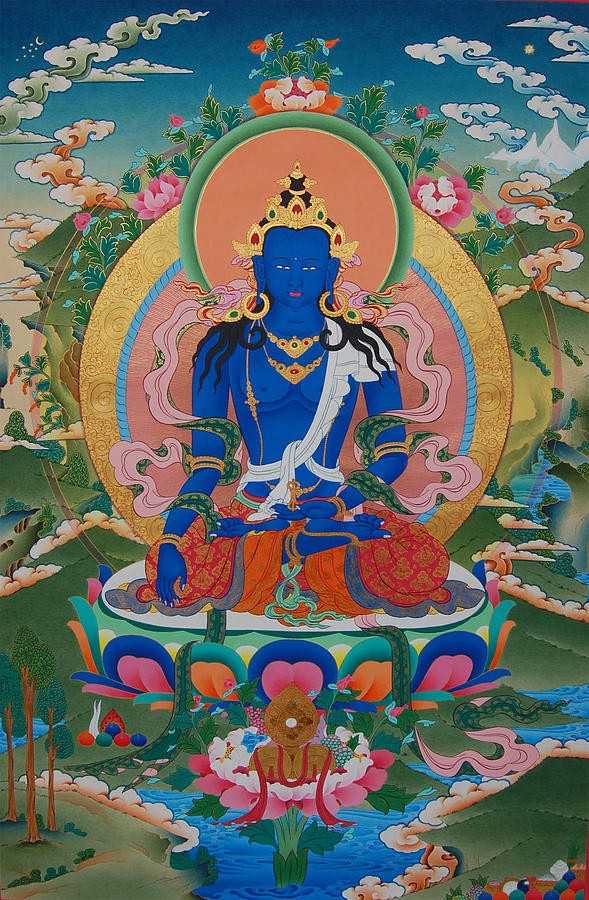
As I note in this article, the golden fillet is likely based on a ritual headband worn by Buddhist ascetics in ancient India. The Hevajra Tantra (Dabei kongzhi jingang dajiao wang yigui jing, 大悲空智金剛大教王儀軌經, 8th-c.) states yogins must wear the band and a list of other prescribed ritual items in their worship of the wrathful protector deity Heruka (Linrothe, 1999, p. 250). Most importantly, the tantra states the band symbolizes the Buddha Akshobhya (Ch: Achu, 阿閦; Budong, 不動; lit: “Immovable”) (fig. 2), who gained enlightenment through moralistic practices of right speech and action (Linrothe, 1999, p. 251; Buswell & Lopez, 2013, p. 27).

Fig. 2 – A depiction of Akshobhya (larger version). [1] Artist unknown.

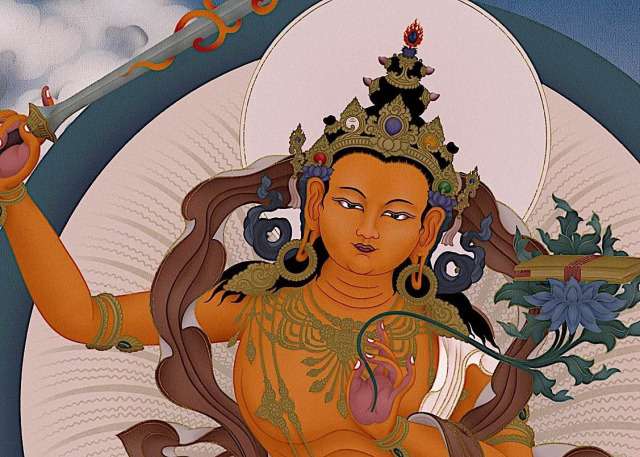
Akshobhya and the other esoteric Wisdom Buddhas are sometimes depicted as small figures or colored jewels in the headdress of the Manjusri Bodhisattva (and other Buddhist personages) (Getty, 1914/1988, p. 37; Vessantara, 1993, p. 155). Akshobhya is symbolized by the color blue (Getty, 1914/1988, p. 36). A cursory Google image search shows the blue jewel is often set in the top most position over Manjusri’s forehead (fig. 3).

This might suggest a more religiously accurate version of Sun Wukong’s golden headband would include a figure or jewel representing Akshobhya.

Fig. 3 – A modern painting of Manjusri by Ben Christian (larger version). The jewel above his forehead is a purple/blue color. Image found here

2. The Mantra

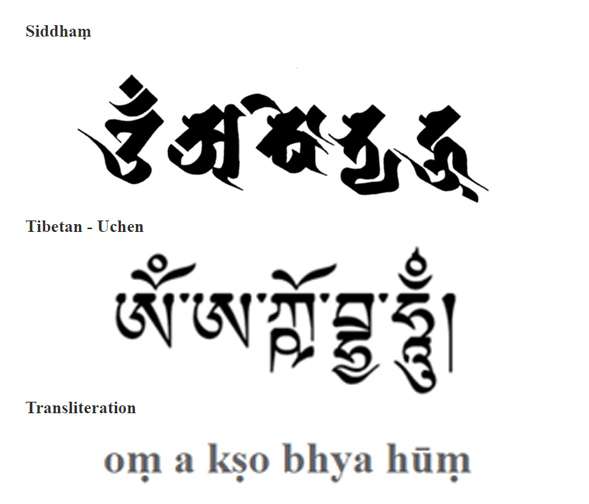
Given the above information, I’d like to suggest the tightening spell for Monkey’s headband—within the context of our thought experiment—is the Akshobhya Mantra! There are two kinds. I’ll leave it up to you which one you like best. The first is a short recitation of the buddha’s name: O a kṣo bhya hūṃ (fig. 4). This can be very roughly translated as “Praise to the Immovable One!” Om and Hum are both holy syllables invoking spiritual power and enlightenment, respectively. They also appear in the more well-known Oṃ maṇi padme hūṃ (Ch: An mo ni ba mi hong, 唵嘛呢叭咪吽). One Chinese version of the name mantra appears to be “An a bie zha zhi ga hong hong” (唵 阿別炸枝嘎 吽吽).

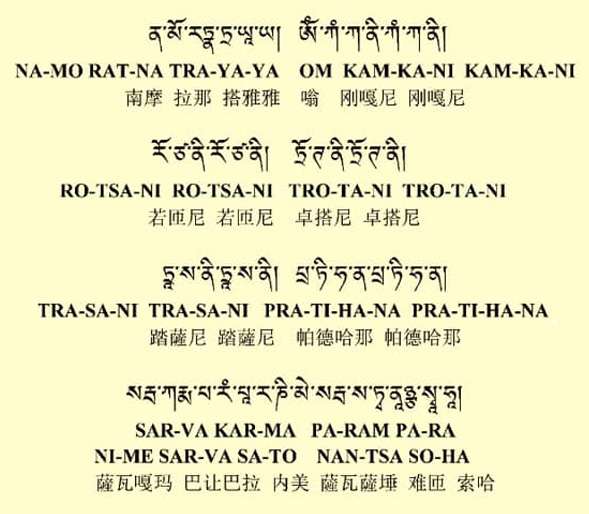
Fig. 4 – The Siddham and Uchen script versions of the short mantra (larger version). Based on information found here. Fig. 5 – A version of the longer chant with Uchen script, as well as English and Chinese transliterations (larger version). Based on an image found here.

The second is a longer chant, again called the “Mantra of Akshobhya” (Achu fo xinzhou, 阿閦佛心咒) (fig. 5 and video 1). It’s interesting to note that the historical Xuanzang (on whom Tripitaka is based) is known to have translated a version of this mantra. [2]

Reciting this to rein in Sun Wukong not only references the band’s historical and religious connection to Akshobhya but also serves as a physical reminder of right speech and action (how the deity gained buddhahood). It’s Tripitaka’s way of screaming, “Stop murdering everyone within arm’s reach!”

Video 1 – A chant of the long mantra.


3. Updates

Update: 01-24-22

The DC Comics’ story “The Monkey Prince Hates Superheroes” presents the spell as the Nianfo (fig. 6).

Fig. 6 – Shifu Pigsy (a.k.a. Zhu Bajie) reciting “Amituofo” to activate the golden headband on the Monkey Prince, son of the original Monkey King (larger version). From Yang, 2021, p. 80. Copyright DC Comics.


3.1. Additional Religious Background

Update: 01-25-22

The case for Akshobhya’s mantra being the tight-fillet spell is strengthened—again, within the context of our thought experiment—by the fact that he has power over strong negative emotions. According to Bangdel and Huntington (2003): “The transcendental insight represented by Akshobhya is mirrorlike wisdom (adarsha jnana), which…is the antidote to the poison of anger, or hatred” (p. 91). The monk Tripitaka assuages these emotions by activating the golden headband, once again reminding Wukong of right speech and action.

In addition, Akshobhya and Gautama have matching iconography: both are shown seated with the left hand palm up on the lap and the right reaching down to touch the earth. Hinayana Buddhists of Sri Lanka and Southeast Asia worship Gautama in this form, but Mahayana worships Akshobhya as such (see note #1). This is important as Gautama gives the three golden headbands to Guanyin in order to pacify any demons that she might encounter during her search for the scripture pilgrim (Wu & Yu, 2012, vol. 1, pp. 206-207). This shows there is a connection between the two Buddhas, and it also explains why Gautama would gift a headband associated with Akshobhya.


4. Updates (continued)

Update: 01-27-22

Various online sources and adaptations sometimes refer to the spell as the “Headache Sutra” (for example). But to my knowledge it’s never explicitly called this in the novel. The pain associated with the spell is generally used as a threat. For example, in chapter 16, Tripitaka exclaims: “Monkey! Aren’t you afraid of your headache [ni toutong, 你頭痛]? Do you still want to behave badly? (Wu & Yu, 2012, vol. 1, p. 347) (emphasis mine).

Chapter 25 provides two more names for the spell:

There is, moreover, the Tight-Fillet Spell or the Tight-Fillet Sutra [jingu er jing, 緊箍兒經]. It’s also [Tripitaka’s] “Old Saying Sutra” [jiuhua er jing, 舊話兒經]. [3] The moment he recites that, I’ll have a terrible headache, for it’s the magic trick designed to give me a hard time (Wu & Yu, 2012, vol. 1, p. 468).

叫做緊箍兒咒,又叫做緊箍兒經。他『舊話兒經』,即此是也。但若念動,我就頭疼,故有這個法兒難我。


Update: 07-25-22

I’ve written an article that explains the origins of the “crescent-style” headband.

The Monkey King’s Crescent-Style Headband


Update: 04-09-24

Another name for the spell is hua’er zhou (話兒咒), which Yu (Wu & Yu, 2012) translates as the “little something spell” (vol. 2, p. 16, for example).

Notes:

1) Akshobhya’s iconography is as follows:

[He] is represented seated, like all the Dhyani-Buddhas, with the legs locked and both feet apparent. There are often wheels marked on the soles of his feet, or a protuberance like a button, resembling the urna on the forehead. His left hand lies on his lap in ‘meditation’ mudra. His right touches the earth with the tips of the outstretched fingers, the palm turned inward. This is called the bhumisparsa or ‘witness’ mudra.

The Hinayana Buddhists in Ceylon, Java, Burma, and Siam worship Gautama Buddha under this form, while those of the Mahayana school look upon it as Akshobhya; for, with but rare exceptions, the historic Buddha is only appealed to by the Northern Buddhists in his ethereal form of Amitabha.

Akshobhya may also take in Tibet another form of Gautama Buddha called ‘Vajrasana’ (diamond throne). The attitude is the same as the above, but before him on the lotus throne lies a vajra, or it may be balanced in the palm of the left hand lying in ‘meditation’ mudra on his lap (Getty, 1914/1988, p. 36).

2) The Chinese source refers to Akshobhya as the “Immovable Buddha” (Budong rulai, 不動如來).

3) I’ve added an extra sentence from the Chinese original glossed over in the translation. Yu (Wu & Yu, 2012) translates the spell as the “Old-Time Sutra” in a previous sentence (vol. 1, p. 468).

Sources:

Bangdel, D., & Huntington, J. C. (2003). The Circle of Bliss: Buddhist Meditational Art. United Kingdom: Serindia Publications.

Buswell, R. E., & Lopez, D. S. (2013). The Princeton Dictionary of Buddhism. Princeton, NJ: Princeton University Press.

Getty, A. (1988). The Gods of Northern Buddhism: Their History, Iconography and Progressive Evolution through the Northern Buddhist Countries. New York: Dover Publications, Inc. (Original work published 1914)

Linrothe, R. N. (1999). Ruthless Compassion: Wrathful Deities in Early Indo-Tibetan Esoteric Buddhist Art. Boston, Mass: Shambhala.

Vessantara. (1993). Meeting the Buddhas: A Guide to Buddhas, Bodhisattvas, and Tantric Deities. United Kingdom: Windhorse Publications.

Wu, C., & Yu, A. C. (2012). The Journey to the West (Vols. 1-4) (Rev. ed.). Chicago, Illinois: University of Chicago Press.

Yang, G. L. (2021). The Monkey Prince Hates Superheroes. In Jessica Chen (Ed.). DC Festival of Heroes: The Asian Superhero Celebration (pp. 70-82) [Google Play]. New York, NY: DC Comics. Retrieved from https://play.google.com/store/books/details/Minh_Le_DC_Festival_of_Heroes_The_Asian_Superhero?id=qXUrEAAAQBAJ

The Origin of Sun Wukong’s Golden Headband

Last updated: 12-24-2023

The golden headband or fillet (jingu, 金箍; a.k.a. jingu, 緊箍, lit: “tight fillet”) is one of the Monkey King’s most recognizable iconographic elements appearing in visual media based on the great Chinese classic Journey to the West (Xiyouji西遊記, 1592 CE; “JTTW” hereafter). It is generally portrayed as a ringlet of gold with blunt ends that meet in the middle of the forehead and curl upwards like scowling eyebrows (type one) (fig. 1). A different version is a single band adorned with an upturned crescent shape in the center (type two) (fig. 2). Another still is a simple band devoid of decoration (type three) (fig. 3). Sun first earns the headband as punishment for murdering humans. The circlet is a heaven-sent magic treasure designed to reign in the immortal’s unruly, rebellious nature. Since Sun Wukong is a personification of the Buddhist concept of the “Monkey of the Mind” (xinyuan, 心猿), or the disquieted mind that bars humanity from enlightenment, the fillet serves as a not-so-subtle reminder of Buddhist restraint. Few scholars writing in English have attempted to analyze the treasure’s history.

In this paper, I present textual and visual evidence from India, China, and Japan that suggests it is ultimately based on a ritual headband worn by Esoteric Buddhist Yogin ascetics in 8th century CE India. I also show how such fillets became the emblem of some Chinese protector deities, as well as military monks in Chinese opera.

Table of Contents

1. Literary Origin and Purpose

The headband is first mentioned in chapter eight when three such “tightening fillets” are given to the Bodhisattva Guanyin by the Buddha in order to conquer any demons that she may come across while searching for a scripture pilgrim:

“These treasures are called the tightening fillets, and though they are all alike, their uses are not the same. I have a separate spell for each of them: the Golden, the Constrictive, and the Prohibitive Spell. If you encounter on the way any monster who possesses great magic powers, you must persuade him to learn to be good and to follow the scripture pilgrim as his disciple. If he is disobedient, this fillet may be put on his head, and it will strike root the moment it comes into contact with the flesh. Recite the particular spell which belongs to the fillet and it will cause the head to swell and ache so painfully that he will think his brains are bursting. That will persuade him to come within our fold” (Wu & Yu, 2012, vol. 1, pp. 206-207).

此寶喚做緊箍兒,雖是一樣三個,但只是用各不同。我有金緊禁的咒語三篇。假若路上撞見神通廣大的妖魔,你須是勸他學好,跟那取經人做個徒弟。他若不伏使喚,可將此箍兒與他戴在頭上,自然見肉生根。各依所用的咒語念一念,眼脹頭痛,腦門皆裂,管教他入我門來。

Guanyin later explains in JTTW chapter 42 which demons get which fillet (Wu & Yu, 2012, vol. 2, p. 251).

Sun Wukong earns the “Constrictive” (jin, 緊) band in JTTW chapter 14 after brutally murdering six thieves who accost his master Tripitaka, the chosen scripture pilgrim, on the road to the west. The killings cause the two to part ways, and it is during Monkey’s absence when Guanyin gives the monk a brocade hat containing the fillet and teaches him the “True Words for Controlling the Mind, or the Tight-Fillet Spell” (喚做『定心真言』,又名做『緊箍兒咒』) (Wu & Yu, 2012, vol. 1, p. 317). Sun is eventually persuaded to return and tricked into wearing the hat under the guise of gaining the ability to recite scripture without rote memorization. It soon takes root, and the powerful immortal is brought under control through the application of pain. He then promises to behave and to protect Tripitaka during their long journey to the Western Paradise. [1]

The remaining two fillets are used by Guanyin to conquer monsters in later episodes. She throws the “Prohibitive” (jin, 禁) band onto the head of the Black Bear Demon (Hei xiong jing, 黑熊精) in JTTW chapter 17, and after reciting the spell, he agrees to become the rear entrance guard of her Potalaka Island paradise (Wu & Yu, 2012, vol. 1, p. 365). The “Golden” (jin, 金) band is split into five rings—one each for the head, wrists, and ankles—and used to subdue Red Boy (Hong hai’er, 紅孩兒), the fire-spewing son of the Bull Demon King and Princess Iron Fan, at the end of JTTW chapter 42 and the beginning of 43 (Wu & Yu, 2012, vol. 2, pp. 251-252). The child demon becomes her disciple and eventually takes the religious name “Sudhana.” [2]

Monkey is forced to wear the fillet until he attains Buddhahood in JTTW chapter 100, causing it to vanish (Wu & Yu, 2012, vol. 4, p. 383). The band’s disappearance at the end of the novel denotes Sun’s internalization of self-control, but the treasure doesn’t disappear forever. It appears once more in the Later Journey to the West (Hou Xiyouji, 後西游記, 17th century CE), an unofficial sequel set 200 years after the original. The story follows a similar trajectory, with Monkey’s descendant Sun Luzhen (孫履真, “Monkey who Walks Reality”) attaining immortality and causing havoc in heaven. But this time the macaque Buddha is called in to quell the demon. Monkey quickly disarms the “Small Sage Equaling Heaven” of his iron staff and pacifies him not with trickery but with an enlightening Buddhist koan. He then places the band on Luzhen’s head to teach him restraint (see Liu, 1994).

Fig. 1 – (Left) The “Type One” headband. From the comedy A Chinese Odyssey Part Two: Cinderella (1995). (Center) The “Type Two” headband. From the famous 1986 TV show. (Right) The “Type Three” headband. From the 2011 TV show (larger version).

2. Past Research into the Origins of the Headband

It appears very few scholars writing in English have attempted to trace the origins of the golden fillet. Wang Tuancheng theorizes that the idea for the headband came from two sources. First, the historical journal of Xuanzang (602–664 CE), the Tang Dynasty monk on whom Tripitaka is loosely based, details how he was challenged to a religious debate by a man in a foreign kingdom who offered his own head as the price of defeat. Xuanzang won, but instead of collecting his prize, the monk took the man as his servant. Second, Wang notes that slaves during the Han Dynasty (206 BCE–220 CE) wore a metal collar around their neck shaped like the Chinese character for twenty (nian, 廿). He goes on to explain: “…the author transformed the metal hoop that the non-Buddhist might have worn to Sun Wukong’s headband” (Wang, 2006, p. 67).

I’m not particularly persuaded by this argument since Wang doesn’t offer any evidence as to why a Han-era slave implement would still be in use during the Tang (618–907 CE) four to five hundred years later; nor does he suggest a reason for why such a collar would be moved from the neck to the head. Besides, there exists religious art featuring the fillet (see below) that predates the novel by centuries, meaning it wasn’t the sole invention of the JTTW author-compiler.

Before I continue, I would like to point out that the 13th century CE precursor of the novel, The Story of How Tripitaka of the Great Tang Procures the Scriptures, does not mention the fillet at all. (This is just one of many differences between it and the final 16th century CE version.) Monkey is simply portrayed as a concerned celestial who purposely seeks out Tripitaka to ensure his safety, as the monk’s two previous incarnations have perished on the journey to India. In other words, he comes as a willing participant, which negates the need for punishment via the ringlet. [3] But at least two pictorial representations of Monkey coinciding with the Song Dynasty (960–1279 CE) depict him wearing a band, which, again, excludes the treasure being a later invention.

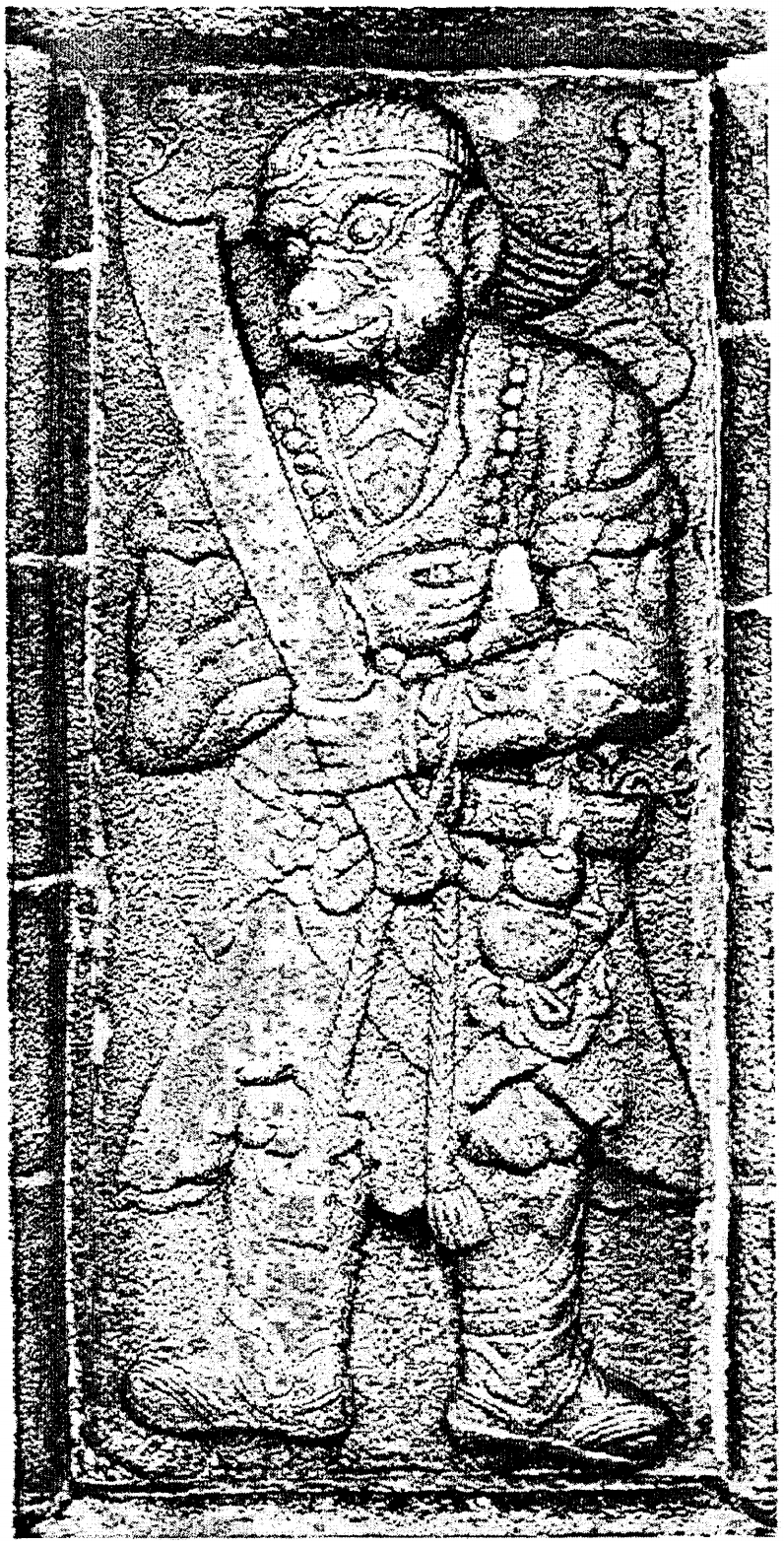
In her excellent paper on the origins of Sun Wukong, Hera S. Walker (1998) discusses a 13th century CE stone relief from the western pagoda of the Kaiyuan Temple (開元寺) in Quanzhou, Fujian province, China that portrays a sword-wielding, monkey-headed warrior (pp. 69-70). Considered by many to be an early depiction of Monkey, the figure wears a robe, a Buddhist rosary, and, most importantly, a type one fillet on the forehead (Fig. 4). [4] Walker quotes Victor Mair, who believes that the fillet “recalls the band around the head of representations of Andira, the simian guardian of Avalokitesvara” (the Indian counterpart to Guanyin) (Walker, 1998, p. 70). He goes on to list similarities between the stone relief and depictions of Andira, while also suggesting said depictions are based on south and southeast Asian representations of the Hindu monkey god Hanuman:

Identical earrings (these are key iconographic features of H[anuman] in many Southeast Asian R[ama saga]s), comparable tilt of the head… which seems to indicate enforced submission, long locks of hair… flaring out behind the head, elongated monkey’s mouth, similar decorations on the forearm and upper arm, etc. It is crucial to note that all these features can be found in South Asian and Southeast Asian representations of H[anuman] (Walker, 1998, p. 70).

So as it stands, the 13th century CE appears to be the furthest that the motif has been reliably traced.

Fig. 4 – The 13th century CE stone relief of Sun Wukong from the Kaiyuan Temple in Quanzhou, Fujian province, China (larger version).

3. My Findings

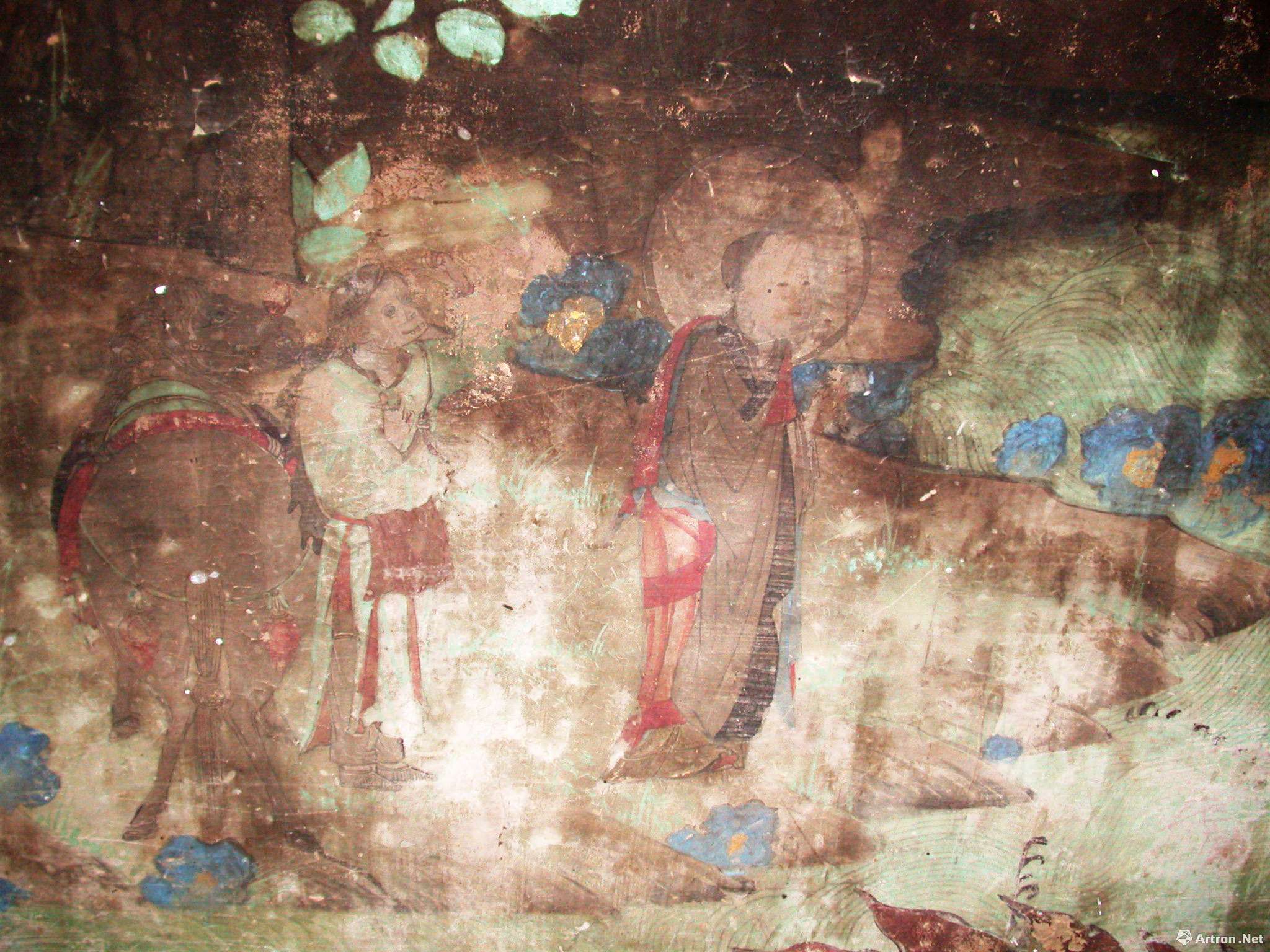
While Mair suggests a Southeast Asian Hindo-Buddhist influence, I know of at least one example from northeastern China that suggests an Indo-Tibetan Buddhist influence. The Eastern Thousand Buddha Cave no. 2 (Dong qianfo dong di 2 ku, 東千佛洞第2窟) in the Hexi Corridor of Gansu Province contains a late-Xixia dynasty (late-12th to early-13th century CE) mural of Xuanzang worshiping Guanyin from a riverbank. Monkey stands behind him tending to a brown horse. He is portrayed with a type three circlet on his head, waist length hair, and light blue-green robes with brown pants (fig. 5). This painting was completed during a time when China was seeing an influx of monks fleeing the inevitable fall of India’s Buddhist-led Pala Dynasty (750–1174 CE) from the 10th to the 12th century CE. They brought with them the highly influential Pala Buddhist art style and Vajrayana Buddhism, a form of esoteric Buddhism. The MET (2010) writes:

A mixture of Chinese-style and Vajrayana traditions and imagery was employed in the Tangut Xixia Kingdom …  which was based in Ningxia, Gansu, and parts of Shanxi … It is difficult to imagine that this “new” type of Buddhism, which not only was flourishing in Tibet in the late tenth century but was also found in the neighboring Xixia Kingdom and may have been practiced by Tibetans based in the Hexi Corridor region of Gansu Province, was completely unknown in central China until the advent of the Mongols (p. 19).

The painting of Monkey and Tripitaka was surely created by an Indian or Tibetan Buddhist monk, or at the very least a fellow Tangut or Chinese practitioner living in the area. This suggests that the imagery within the painting, such as the fillet, could have an Esoteric Buddhist pedigree, and textual evidence shows such headbands were indeed worn in some esoteric rituals.

For example, the Indian Buddhist Hevajra Tantra (Dabei kongzhi jingang dajiao wang yigui jing, 大悲空智金剛大教王儀軌經, 8th century CE) instructs adherents on how to adorn and dress themselves for worshipping Heruka, a Wrathful Destroyer of Obstacles:

The yogin must wear the sacred ear-rings, and the circlet on his head (emphasis added); on his wrists the bracelets, and the girdle round his waist, rings around his ankles, bangles round his arms; he wears the bone-necklace and for his dress a tiger-skin… (Linrothe, 1999, p. 250).

彼修觀者當如是行:謂頂想寶輪、耳帶、寶鐶,手串寶釧,腰垂寶帶,足繫寶鐸及妙臂釧,頸嚴寶鬘衣、虎皮衣 …

Furthermore, it describes how each of the ritual adornments and implements used in the ceremony represents each of the five esoteric Buddhas, as well as other religio-philosophical elements:

Aksobhya is symbolized by the circlet (emphasis added), Amitabha by the ear-rings, Ratnesa by the necklace, and Vairocana (by the rings) upon the wrists. Amogha is symbolized by the girdle. Wisdom by the khatvanga [staff] and Means by the drum, while the yogin represents the Wrathful One himself [i.e. Heruka]. Song symbolizes mantra, dance symbolizes meditation, and so singing and dancing the yogin always acts (Linrothe, 1999, p. 251).

「輪者,表阿閦如來;鐶者,無量壽如來;頸上鬘者,寶生如來;手寶釧者,大毘盧遮那如來;腰寶帶者,不空成就如來。於是色相而生念住:金剛渴椿誐杖者,表勝慧相;奎樓鼓者,即善方便故;瑜伽行者,瞋業清淨;住金剛歌詠者,真言清淨。

「又復,不應為求利養作是金剛歌舞事業。是故,瑜伽者當如是行…

As can be seen, the circlet represents Aksobhya (Sk: “Immovable”; Ch: Achu, 阿閦; Budong, 不動). This deity is known for his adamantine vow to attain buddhahood through the practice of Sila, or “morality,” the aim of which “is to restrain nonvirtuous deeds of body and speech, often in conjunction with the keeping of precepts” (Buswell & Lopez, 2014, pp. 27 and 821). So, the ritual band most likely served as a physical reminder of right speech and action, making it the best candidate for the origin of Monkey’s fillet. Sun is after all the representation of the “Monkey of the Mind” (as noted in the introduction), so his inclusion in the Eastern Thousand Buddha Cave painting was probably meant to convey the taming of this Buddhist concept via the circlet (apart from referencing the popular tale itself).

The Hevajra Tantra, the text in which the circlet appears, was first translated into Tibetan by Drogmi (993–1074 CE) and adopted during the 11th century CE as a central text by the respective founders of the Kagyu and Sakya sects, two of the six major schools of Tibetan Buddhism. Various members of the Sakya sect were invited by Mongol royalty to initiate them into the text’s esoteric teachings during the 13th century CE. These include Sakya Pandita and his nephew Chogyal Phagpa, who tutored Genghis Khan‘s grandson Prince Goden in 1244 and Kublai Khan in 1253, respectively. The meeting between Kublai and Chogyal resulted in Vajrayana Buddhism becoming the state religion of Mongolia. The Hevajra Tantra was translated into Chinese by the Indian monk Dharmapala (963–1058 CE) in 1055 during the Northern Song Dynasty (960–1127 CE). The text, however, did not become popular within the Chinese Buddhist community like it would with the Mongols in the 13th century CE (Bangdel & Huntington, 2003, p. 455). But this evidence shows how the concept of the 8th century CE ritual circlet could have traveled from India to East Asia to influence depictions of Sun Wukong in the 12th/13th century CE. And the relatively unknown status of the text in China might ultimately explain why there are so few ancient depictions of Chinese deities wearing the fillet, or why it does not appear in the 13th century CE version of JTTW.

While the late-Xixia mural (fig. 5) lacks many of the ritual adornments (apart from the fillet) mentioned in the Hevajra Tantra, the Quanzhou stone relief (refer back to fig. 3) includes the band, earrings, necklace, bangles, and possibly even a tiger skin apron, suggesting it too has an esoteric origin (most likely based on Chinese source material). The band’s connection to esoteric Buddhism is further strengthened by a 12th century CE painting from Japan. Titled Aka-Fudo (赤不動), or “Red Fudo [Myoo],” it depicts the wrathful esoteric god seated in a kingly fashion, holding a fiery, serpent-wrapped Vajra sword in one hand and a lasso in the other (fig. 6). He wears a golden, three-linked headband (similar to the curls of type one), which stands out against his deep red body and flaming aureola. Biswas (2010) notes: “… the headband on his forehead … indicate[s], according to some, a relation to the habit of groups of ascetics who were among the strong supporters of Acalanatha” (p. 112). His supporters were no doubt yogin practitioners in the same vein as those who worshipped Heraku and other such wrathful protector deities.

Fig. 5 – A portion of the late-Xixia (late-12th to early-13th century CE mural) in the Eastern Thousand Buddha Cave number two (larger version). Fig. 6 – The 12th century CE Japanese painting “Aka-Fudo” (赤不動) (larger version).

3.1. Symbol of Martial Deities and Warrior Monks

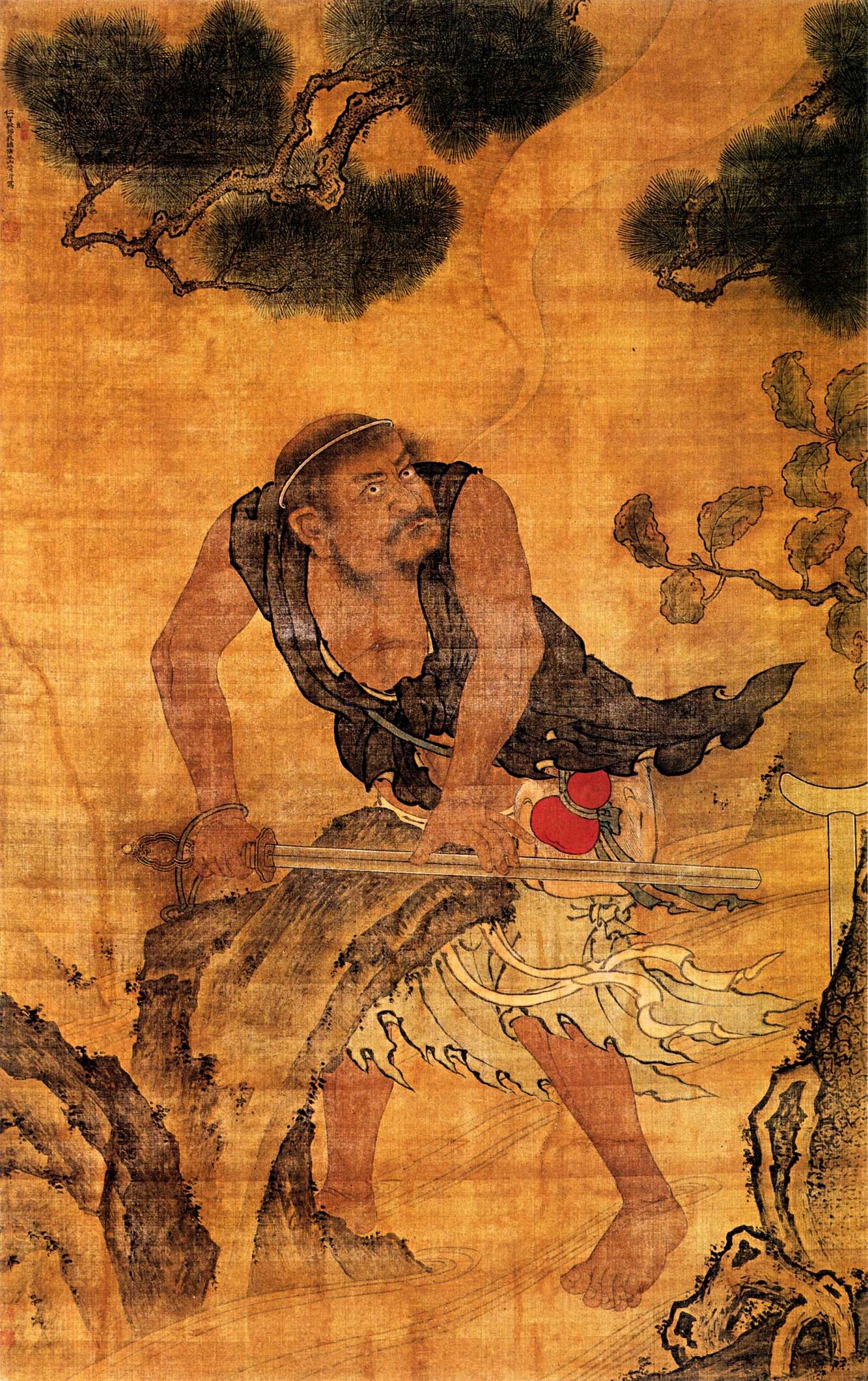
It’s important to note that Monkey was not the only cultural hero of the Ming Dynasty (1368–1644 CE) to wear a golden fillet. Another example is Li Tieguai (李鐵拐), or “Iron Crutch Li,” the oldest of the Eight Immortals. [5] Li is generally portrayed as a crippled beggar leaning on a cane. Legend has it that his original body was cremated prematurely by a disciple while the immortal traveled in spirit to answer a summons from Lord Laozi, the high god of Daoism. Li’s spirit returned a day later to find only ashes, thus forcing him to inhabit the body of a recently deceased cripple. According to Allen and Philips (2012), “Laozi gave him in recompense a golden headband and the crutch that was to become his symbol” (p. 108). Some depictions of Li wearing the fillet predate JTTW. The most striking example is Huang Ji’s Sharpening a Sword (early-15th century CE) (Fig. 7), which portrays the immortal wearing a type three band and sharpening a double-edged blade on a stone while staring menacingly at the viewer. [6] One theory suggests Li’s martial visage identifies him as a “spirit-guardian of the [Ming] state” (Little, 2000, p. 333). Both Monkey and Li are, therefore, portrayed as brutish, weapon-bearing, golden headband-wearing immortals who serve as protectors. This shows that the fillet was associated with certain warrior deities during the Ming.

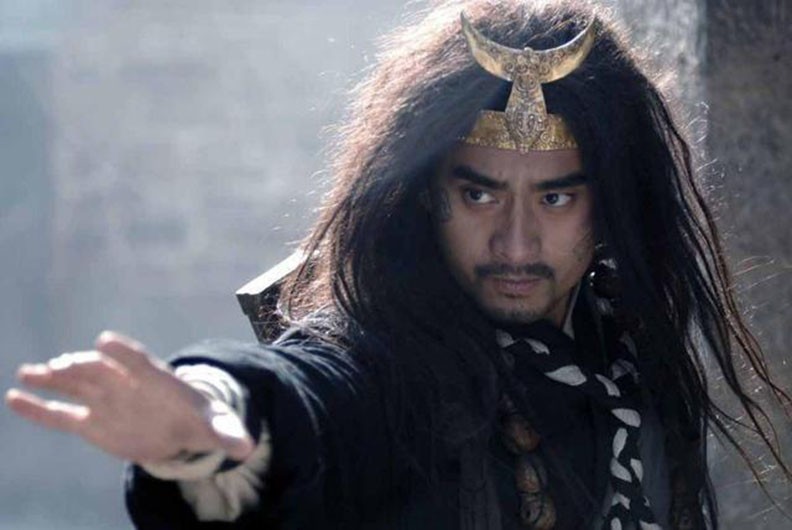
The fillet’s connection to religion and martial attributes culminated in the Jiegu (戒箍, “ring to forget desires”), a type two band worn by Military Monks (Wuseng, 武僧) in Chinese opera to show that they have taken a vow of abstinence (fig. 8). Such monks are depicted as wearing a Jiegu over long hair (Bonds, 2008, pp. 177-178 and 328), which contrasts with the bald heads of religious monks. [7] I would like to suggest that the band’s half-moon shape may have some connection to a Ming-era woodblock print motif in which martial monks are shown wielding staves tipped with a crescent (fig. 9) . The exact reason for the shape is still unknown (Shahar, 2008, pp. 97-98), but the association between the crescent and martial monks seems obvious. (See the 07-25-22 update below for the foreign origins of this motif.) The use of the fillet in Chinese opera led to it being worn by Sun Wukong in the highly popular 1986 live-action TV show adaptation of the novel (fig. 2). [8]

Fig. 7 (Left) – Huang Ji’s “Sharpening a Sword” (early-15th century CE) (larger version). Fig. 8 (Center) – An image of the military monk Wu Song wearing a jiegu (戒箍) fillet from a 2011 Water Margin TV show (larger version). Fig. 9 (Right) – A late-Ming woodblock of the warrior monk Lu Zhishen with a crescent staff (larger version). From Shahar (2008).

4. Conclusion

Examples of past research into the origins of the golden fillet respectively point to a slave collar from the Han dynasty (206 BCE–220 CE) and circa 13th century CE South and Southeast Asian depictions of the Buddhist guardian Andira and the Hindu monkey god Hanuman as possible precursors. However, the first isn’t credible, and the second, while on the right track, doesn’t go back far enough. A late-12th to early-13th century CE mural in the Eastern Thousand Buddha Cave complex depicts Sun Wukong wearing a type three fillet with possible ties to a ritual circlet worn by Esoteric Buddhist Yogin ascetics in 8th century CE India. The Hevajra Tantra, the esoteric text that mentions the band, associates it with the Aksobhya Buddha and thereby his moralistic, self-restraining practices. The text was transmitted from India to Tibet, China, and Mongolia from the 11th to the 13th centuries CE, showing a clear path for such imagery to appear in East Asia. A 12th century CE Japanese Buddhist painting of the guardian deity Fudo Myoo with a fillet suggests that the practice of wearing circlets in esoteric rituals continued for centuries. Other non-Buddhist deities became associated with the fillet during the Ming Dynasty. A 15th century CE painting of the immortal Li Tieguai, for example, depicts him as a type one circlet-wearing, sword-wielding guardian of the Ming dynasty. All of this suggests that the band became a symbol of Chinese protector deities. The association between the fillet and religion and martial attributes led to its use as the symbol of military monks in Chinese opera.


5. Updates

Update: 12-23-17

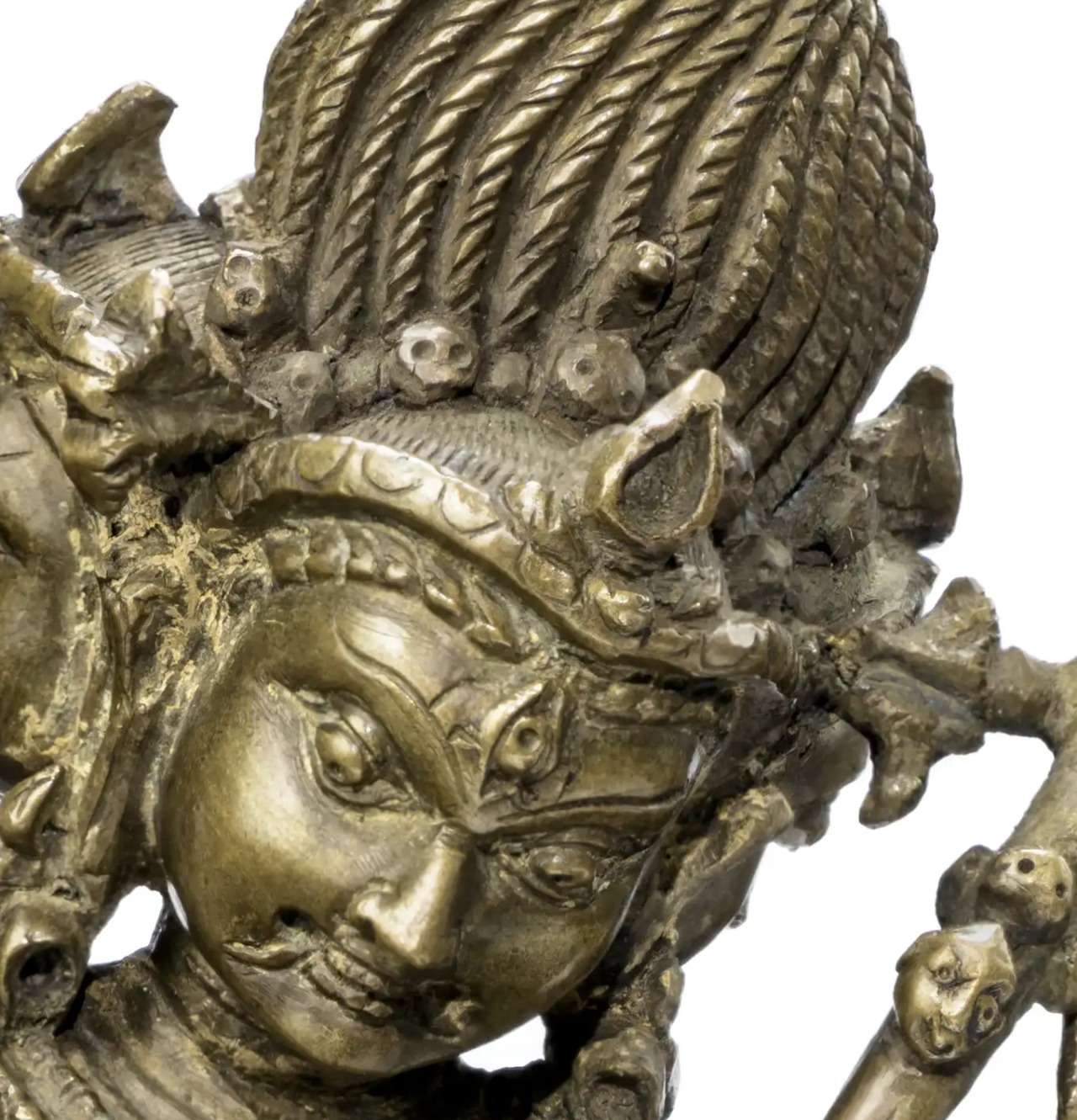
I’ve been wondering what the 8th century CE version of the circlet (along with the other ritual implements) mentioned in the Hevajra Tantra might have looked like. While I have yet to find a contemporary sculpture or painting, I have found an 11th to 12th century CE interpretation from Tibet. Titled The Buddhist Deity Hevajra (fig. 10), this copper alloy statue somewhat follows the prescribed iconography of the god as laid out in the aforementioned text:

Dark blue and like the sun in colour with reddened and extended eyes, his yellow hair twisted upwards, and adorned with the five symbolic adornments,/ the circlet, the ear-rings and necklace, the bracelets and belt. These five symbols are well known for the purificatory power of the Five Buddhas./ He has the form of a sixteen-year-old youth and is clad in a tiger-skin. His gaze is wrathful. In his left hand he holds a vajra-skull, and a khatvahga [staff] likewise in his left, while in his right is a vajra of [a] dark hue…(Linrothe, 1999, p. 256)

Fig. 10 – The Buddhist Deity Hevajra, late-11th to early-12th century CE, copper alloy (larger version). Courtesy of the Los Angeles County Museum of Art. Fig. 11 – Detail of the circlet (larger version).

The circlet here is depicted as a fitted band with crescent trim and a teardrop-shaped adornment (a conch?) (fig. 11). The statue’s iconography more closely follows that from the Sadhanamala (“Garland of Methods”), a compilation of esoteric texts from the 5th to 11th centuries CE. The following information probably derives from the later part of this period:

He wields the vajra in the right hand and from his left shoulder hangs the Khatvanga [staff] with a flowing banner, like a sacred thread. He carries in his left hand the kapala [skull cap] full of blood. His necklace is beautified by a chain of half-a-hundred severed heads. His face is slightly distorted with bare fangs and blood-shot eyes. His brown hair rises upwards and forms into a crown which bears the effigy of Aksobhya. He wears a kundala [ear decoration] and is decked in ornaments of bones. His head is beautified by five skulls (Donaldson, 2001, p. 221).

Our statue has many of these features but lacks the image of the Buddha in his hair. This suggests the knob visible in the coif (fig. 10) once carried such a figure. So, once again we see the importance of the Aksobhya Buddha. The statue is similar to 10th and 11th century CE stone statues from India. [9]

While this doesn’t get us any closer to what the original circlet looked like, this statue adds to the mutability of the fillet imagery. The Hevajra Tantra is vague in its description, and so it is no surprise that so many variations have appeared over the centuries. The original sanskrit text uses the word cakri (circle) to refer to the band (Farrow & Menon, 2001, pp. 61-62). This might explain the simple type three fillet worn by Monkey in the Eastern Thousand Buddha Cave no. two painting (fig. 2).


Update: 08-16-20

I have written an article suggesting an origin for the type one headband, or as I now call it, the “curlicue headband.”

Sun Wukong’s Curlicue-Style Headband


Update: 12-12-21

One thing I figured out a while ago but never explained here was the reason why the Japanese Buddhist protector deity Aka-Fudo (赤不動) (fig. 6) is depicted with a headband. I believe this is a visual representation of the fillet’s association with the Aksobhya Buddha. This is because the fudo (Ch: budong, 不動) of Aka-Fudo and the Sanskrit meaning of Aksobhya respectively mean “immovable.” So, the image of Aka-Fudo is encapsulating both his position as a protector deity and the Buddha represented by the headband. 


Update: 01-23-22

I’ve written an article suggesting a mantra for the secret spell that causes the golden fillet to tighten.

The Tightening Spell of Sun Wukong’s Golden Headband


Update: 07-25-22

I’ve written an article that explains the origins of the “crescent-style” headband.

The Monkey King’s Crescent-Style Headband


Update: 06-26-23

Above, I mentioned that the novel contains three kinds of headbands:

  1. Sun Wukong/Six Ears – “Constrictive” (jin, 緊) – ch. 14
  2. Black Bear Demon – “Prohibitive” (jin, 禁) – ch. 17
  3. Red Boy – “Golden” (jin, 金) – ch. 42

It’s interesting that all of them are pronounced “jin” (with varying tones).

Now imagine that there is a secret fourth headband not intended to punish but to empower. Called the “Strength” (jin, 勁) headband, it would only be used in the most extreme emergencies.

It would be neat to see someone work this into their fanfiction.


Update: 12-24-23

A character is briefly punished to wear a golden headband in the famed Ming-era novel Investiture of the Gods (Fengshen yanyi封神演義, c. 1620; summary). Chapter 82 reads: 

Ma Sui [馬遂] attacked him with his sword, and after only one round, threw a gold hoop [jingu, 金箍] around the immortal’s head. The Yellow Dragon Immortal [Huanglong zhenren, 黃龍真人] writher in pain but was quickly rescued and brought back to the pavilion.

The Yellow Immortal Dragon Immortal tried to take the hoop off his head but found it was impossible. It was so tight the true samadhi fire went out of his eyes.

The Immortal of the South Pole [Nanji xianweng, 南極仙翁] came in to announce Heavenly Primogenitor’s [Yuanshi tianzun, 元始天尊] arrival. The religious leader entered the pavilion and said, “The Yellow Dragon Immortal was destined to be caught in this gold hoop. Come here and let me help you.”

He pointed at the gold hoop, and it dropped to the ground (Gu, 2000, pp. 1713-1715).

只一合,馬遂祭起金箍,把黃龍真人的頭箍住了。真人頭疼不可忍,眾仙急救真人,大家回蘆篷上來。真人急忙除金箍,除又除不掉,只箍得三昧真火從眼中冒出;大家鬧在一處。不表。且說元始天尊來會萬仙陣,先著南極仙翁持玉符先行。南極仙翁跨鶴而來,雲光縹緲。馬遂抬頭,見是南極仙翁,急駕雲光至半空中來,阻住去路。仙翁笑曰:「馬遂,你休要猖獗,掌教師尊來了。」馬遂正欲爭持,只見後面仙樂一派,遍地異香,馬遂知不可爭持,按落雲頭,回歸本陣。南極仙翁先至蘆篷,率眾仙迎鑾接駕,上篷坐下。眾門人拜畢,侍立兩傍。元始曰:「黃龍真人有金箍之厄。」忙叫:「過來。」黃龍真人走至面前;元始用手一指,金箍隨脫。

(Gu (2000) skips over some elements in the original Chinese.)

I’ve known about this episode for a while but forget to post about it.

Notes

1) For the entire episode, see Wu & Yu, 2012, vol. 1, pp. 314-320.

2) The child first speaks his new name in chapter 49 (Wu & Yu, 2012, vol. 2, p. 354). The original Sudhana originates from the Avatamsaka Sutra (Wu & Yu, 2012, vol. 2, pp. 386-387 n. 3).

3) For a complete English translation, see Wivell (1994).

4) This is just one of many relief carvings that grace the pagoda. It includes other guardian-type figures with esoteric elements but rendered in the Chinese style. See Ecke and Demiéville (1935).

5) The Eight Immortals are Daoist saints who came to be worshipped as a group starting sometime in the Jin Dynasty (1115–1234 CE) (Little, 2000, p. 319).

6) The sword is usually a symbol of the immortal Lu Dongbin, but as noted above, it is used to identify Li Tieguai as a Ming guardian (Little, 2000, p. 333).

7) Shahar (2008) discusses the historical differences between religious and military monks in ancient China.

8) Liu Xiao Ling Tong (六小龄童; born Zhang Jinlai, 章金萊, 1959), the actor who played Monkey in the 1986 TV show, comes from a family who has specialized in playing Sun Wukong in Chinese opera for generations (Ye, 2016).

9) See the Heruka chapter in Linrothe (1999). He includes our statue in his study, but other sources describe it as Tibetan instead of Indian (Bangdel & Huntington, 2003, p. 458).

Bibliography

Allan, T., & Phillips, C. (2012). Ancient China’s Myths and Beliefs. New York: Rosen Pub.

Bangdel, D., & Huntington, J. C. (2003). The Circle of Bliss: Buddhist Meditational Art. Chicago, Ill: Serindia Publications.

Biswas, S. (2010). Indian Influence on the Art of Japan. New Delhi: Northern Book Centre.

Bonds, A. B. (2008). Beijing Opera costumes: The Visual Communication of Character and Culture. Honolulu: University of Hawai’i Press.

Buswell, R. E., & Lopez, D. S. (2014). The Princeton Dictionary of Buddhism. Princeton, NJ: Princeton University Press.

Donaldson, T. E. (2001). Iconography of the Buddhist Sculpture of Orissa. New Delhi: Indira Gandhi National Centre for the Arts.

Ecke, G., & Demiéville, P. (1935). The Twin Pagodas of Zayton: A Study of the Later Buddhist Sculpture in China. Cambridge, Mass: Harvard University Press.

>Farrow, G. W., & Menon, I. (2001). The Concealed Essence of the Hevajra Tantra: With the Commentary Yogaratnamālā. Delhi: Motilal Banarsidass Publ.

Gu, Z. (2000). Creation of the Gods (Vols. 1-4). Beijing: New World Press.

Linrothe, R. N. (1999). Ruthless Compassion: Wrathful Deities in Early Indo-Tibetan Esoteric Buddhist Art. Boston, Mass: Shambhala.

Little, S. (2000). Taoism and the Arts of China. Chicago, IL: Art Institute of Chicago.

Liu, X. (1994). The Odyssey of the Buddhist Mind: The Allegory of the Later Journey to the West. Lanham, Md: University Press of America.

Metropolitan Museum of Art, Leidy, D. P., Strahan, D. K., & Becker, L. (2010). Wisdom Embodied: Chinese Buddhist and Daoist sculpture in the Metropolitan Museum of Art. New York: Metropolitan Museum of Art.

Shahar, M. (2008). The Shaolin Monastery: History, Religion, and the Chinese Martial Arts. University of Hawaii Press.

Walker, H.S. (1998). Indigenous or Foreign? A Look at the Origins of Monkey Hero Sun Wukong. Sino-Platonic Papers, 81, 1-117.

Wang, T. (2006). Dust in the Wind: Retracing Dharma Master Xuanzang’s Western Pilgrimage. Taipei: Rhythms Monthly.

Wivell, C.S. (1994). The Story of How the Monk Tripitaka of the Great Country of T’ang Brought Back the Sūtras. In V. H. Mair (Ed.), The Columbia Anthology of Traditional Chinese Literature (pp. 1181-1207). New York: Columbia University Press.

Wu, C., & Yu, A. C. (2012). The Journey to the West (Vols. 1-4) (Rev. ed.) Chicago, Ill: University of Chicago Press.

Ye, X. (2016). Liu Xiao Ling Tong and Sun Wukong. Retrieved December 15, 2017, from https://www.youlinmagazine.com/story/liu-xiao-ling-tong-and-sun-wukong/Njgw