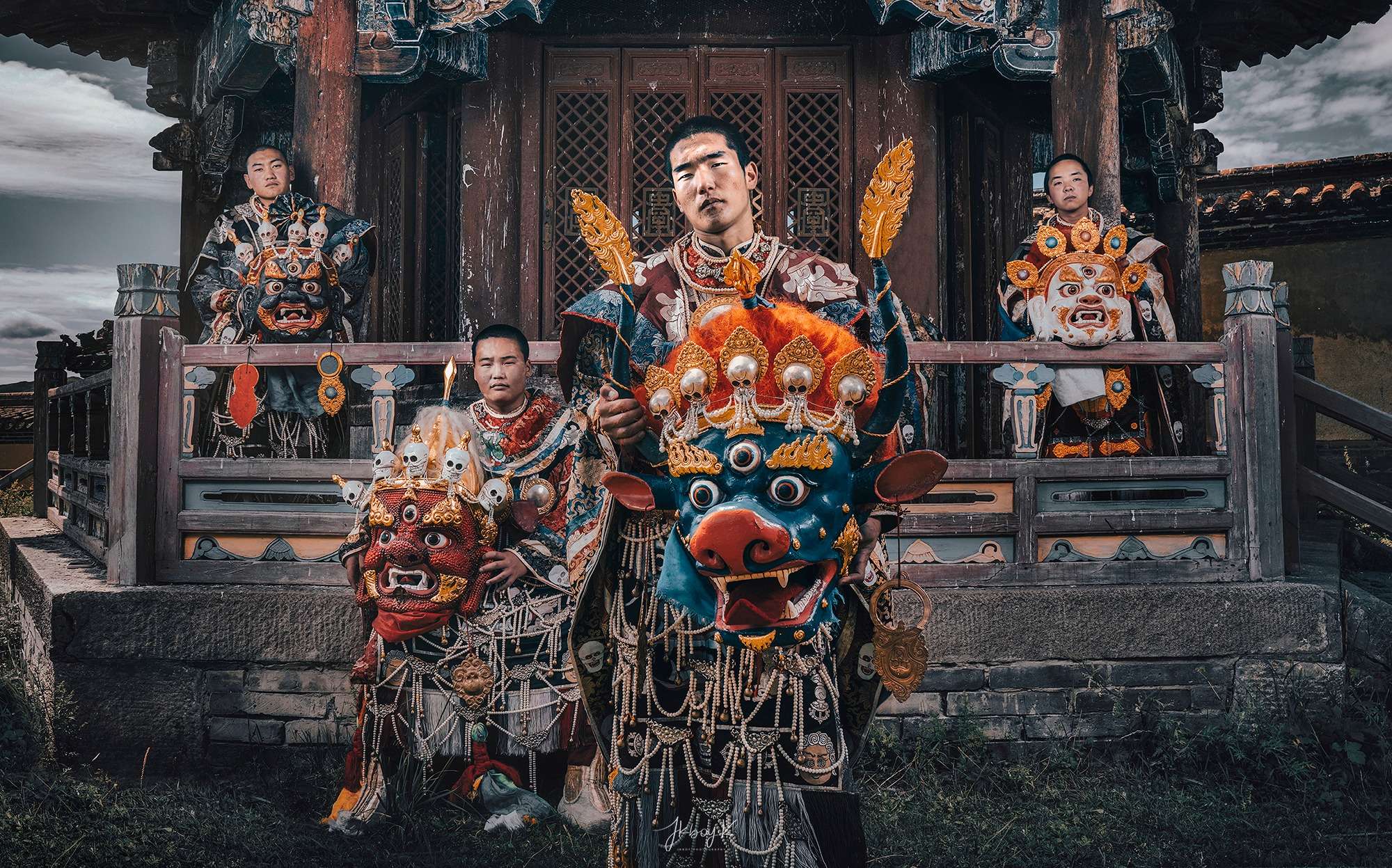
From time to time I like to post a fun blog not directly related to (though informed by) my research. A past example can be seen here. Regular articles will resume after this entry.
Last Updated: 08-27-2022
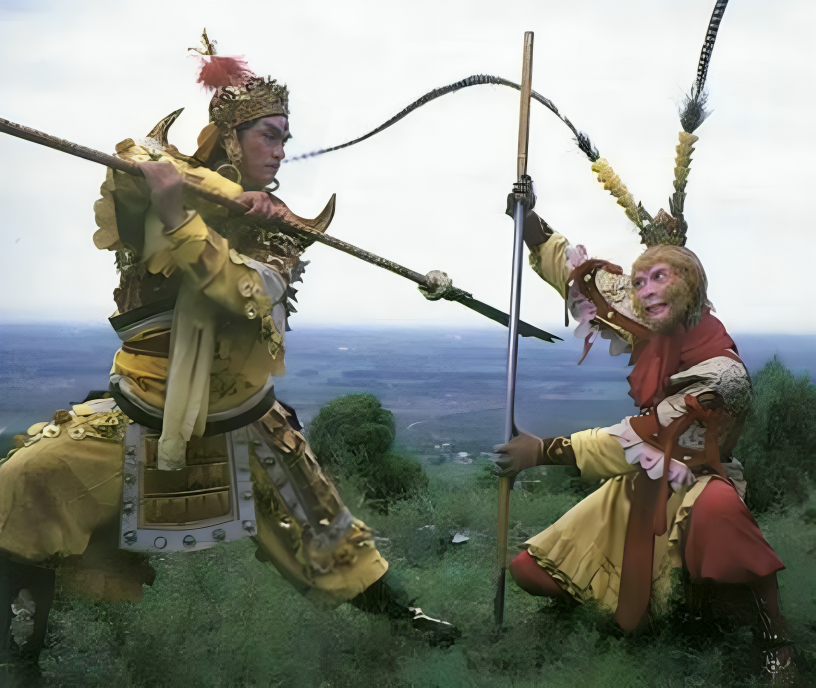
Sun Wukong is kicked out of Patriarch Subodhi‘s (Xuputi zushi, 須菩提祖師) school in chapter two of Journey to the West (Xiyouji, 西遊記, 1592) for showing off his transformation skills to his less-accomplished religious brothers. Upon their request, he changes into a perfect pine tree that’s completely indistinguishable from a real one. The subsequent applause greatly disturbs the Master, who reprimands and expels the Monkey King under the pretense of saving his life from those who would harm him to learn his heavenly secrets (Wu & Yu, 2012, vol. 1, pp. 123-125). [1]
This event is a turning point in Sun’s life, for he transitions from an inward pursuit of spiritual cultivation to an external quest for power, ending with an attempt to unseat the Jade Emperor (Yuhuang shangdi, 玉皇上帝). This ultimately leads to the Buddha imprisoning the seditious primate beneath Five Elements Mountain and punishing him to a hellish diet for 600 plus years.
Here, I would like to prepose a different reason, one that makes more sense and better aligns with some of my previous story ideas.
Table of Contents
1. The Story so Far
Last year I posted a story prompt to reddit to inspire writers looking for a Xianxia (仙俠, “immortal hero”) plot. It serves as a good summation of my past ideas:
The novel briefly mentions that Sun Wukong lives for ten years in the mountain home of the Buddho-Daoist sage Master Subodhi. The first seven are spent as a junior Daoist monk doing menial tasks and learning basic religious or life skills. However, the last three years are spent as a close disciple of Subodhi, learning elixir arts, magic, and combat skills. The novel glosses over his early cultivation in order to jump directly into the action. But imagine a Xianxia story focusing on those three years.
Drama with fellow disciples could arise from Monkey’s supernatural aptitude for quickly learning and mastering a skill. After all, it only takes him three years to go from a mere stone monkey to a powerful immortal capable of going toe-to-toe with gods and demons with millennia of cultivation and combat experience. Think of the resulting battles between our hero and his jealous senior religious brothers and sisters frustrated with his great progress.
In addition, given Sun’s demonstrated knowledge in boxing, weapons, and troop movement, I came up with the story idea that Subodhi’s school is the training ground for an immortal monastic army akin to the famous Shaolin temple. Shaolin was mobilized by the Chinese government during the 16th-century to battle pirates attacking the coast. Records indicate that one historical Shaolin monk was made the leader, and he was later forced to singlehandedly defend himself against eight individuals vying for his position. Likewise, I imagine heaven calls up Subodhi’s army to battle some demonic evil, and Monkey might quickly rise through the ranks. This would naturally lead to more tension with his fellow disciples, causing him to defend his position. All of these challenges, plus any action seen by the monastic army in heavenly battles, would explain how Sun Wukong became such a seasoned fighter in such a short time.
Plus, there is the added bonus of Subodhi’s army being called upon to fight Sun during his rebellion against heaven. He might have far surpassed his religious brothers and sisters in skill at this point.
2. Additions
In chapter one, Subodhi is shown to have 12 generation names (zibei, 字輩) used to name the students of his religious lineage, three of which were historically used by Daoism. [2]
- Guang (廣)
- Da (大)
- Zhi (智)
- Hui (慧)
- Zhen (真)
- Ru (如)
- Xing (性)
- Hai (海)
- Ying (穎)
- Wu (悟)
- Yuan (圓)
- Jue (覺) (Wu & Yu, 2012, p. 115).
Monkey is part of the tenth generation (Wu & Yu, 2012, p. 115). This means that all of Subodhi’s students taken in around the same time would all have Wu (悟) in their name. Perhaps Sun trains with his fellow Wu cohort but quickly moves on to older generations as his skill rapidly progresses.
This leads me to my next point. Above, I mentioned that Subodhi’s army might be called to bear against Monkey during his rebellion. But wouldn’t they recognize him? This feeds into a common question asked around the internet: Why doesn’t Wukong run into any fellow disciples on the journey?
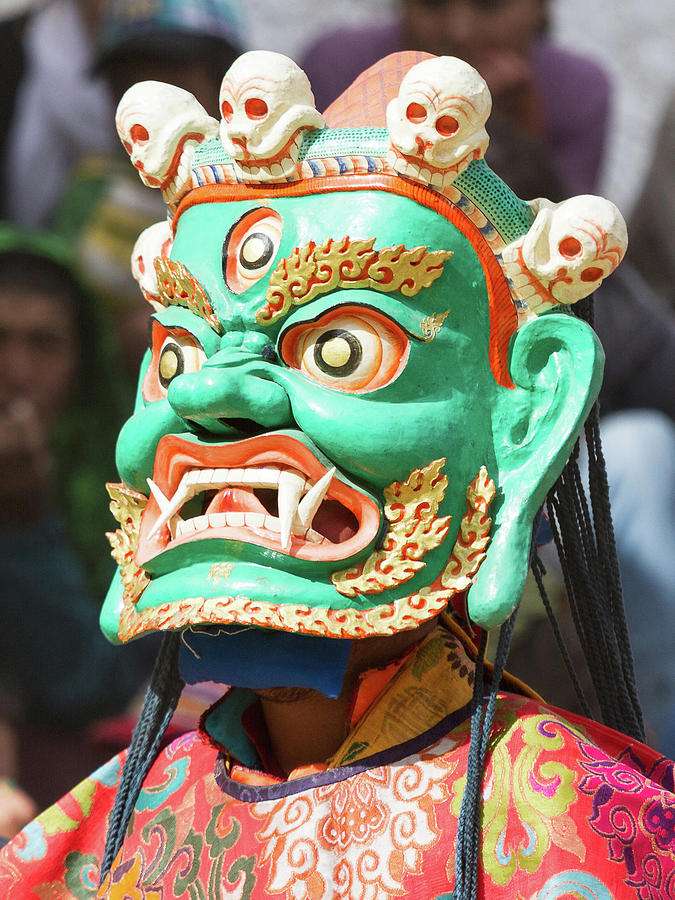
Well, the simple answer is that this isn’t important to the plot. But I’ve considered two ideas to work around this: One, his younger religious brothers are likely still studying under the Master. And two, the older generations—the ones serving in the monastic army—probably don’t know what Monkey looks like because advanced disciples, within the present story, are made to wear a host of fierce, multi-colored masks (fig. 1) as a way to forsake their identity and subsume the self into deep spiritual and martial cultivation. They would represent the negative thoughts and emotions that keep humans trapped in the illusionary world of Saṃsāra and chained to the wheel of rebirth. Perhaps the face becomes more human and peaceful-looking as the students progress through their training.

Fig. 1 – “Monk in dharmapala mask performs a mystery dance of Tantric Tibetan Buddhism on Cham Dance Festival” (larger version). Photo by Oleg Ivanov. Image found here.
Also, in my version of the story universe, all immortals and deities attain a halo upon achieving divine status. Here, for example, is a photomanipulation of a haloed Sun Wukong by Elijah McTaggart and myself. Take note of the fiery aureola engulfing the halo. This will come into play shortly (fig. 2). I imagine that these halos/aureolas respectively spin and shine brighter when a divinity’s spiritual power is used.

Fig. 2 – The Monkey King with a halo (larger version). As seen on deviantart. Based on my original photomanipulation.
3. Why He’s Really Kicked Out
The reason I’ve devised is connected to one of the aforementioned fights between Monkey and his older religious brothers or sisters. Perhaps Sun is attacked by multiple powerful assailants at once (just like the historical Shaolin monk), and when they start to overwhelm him, his anger ignites his halo, which begins to furiously spin and produce a radiant splendor. Instantly, he takes on a titanic cosmic form, growing 100,000 feet (30,480 m) tall and stomping on his assailants. At the same time, his docile-looking mask cracks and reverts to it’s original, fierce form. This, combined with a fiery aureola, gives him the appearance of a giant Dharmapala (Ch: Fahu, 法護), a wrathful “Protector of the Dharma” (Buddhist Law) (fig. 3) (Buswell & Lopez, 2014, pp. 249-250). This display of raw, untamed spiritual power frightens his older religious brethren. Subodhi himself is also taken aback as Monkey exhibits a great, fiery anger, while also manifesting advanced cultivation techniques that haven’t even been taught to him yet—a testament to his great spiritual intelligence. The Master fears that this rage, combined with Monkey’s demonstrated talent for exponential spiritual growth and perhaps a problem with controlling this power (given Sun’s short years of study), will lead him down the path to villainy.
This brings us back to the pine tree incident. Perhaps the fight causes Subodhi to uncharacteristically allow Monkey a chance to visit his generational cohort. And when Sun acquiesces to their requests to see his transformation powers, the Master uses this as an opportunity to expel his student.

Fig. 3 – A modern thangka of the Six-Armed Mahakala dharmapala (larger version). Image found here.
4. My Thoughts
I like this idea because it foreshadows Sun’s cosmic transformations throughout the novel (ch. 3, 6, 61, and 97). It also foreshadows his later mischief throughout the cosmos and eventual rebellion.
5. Updates
Update: 05-16-22
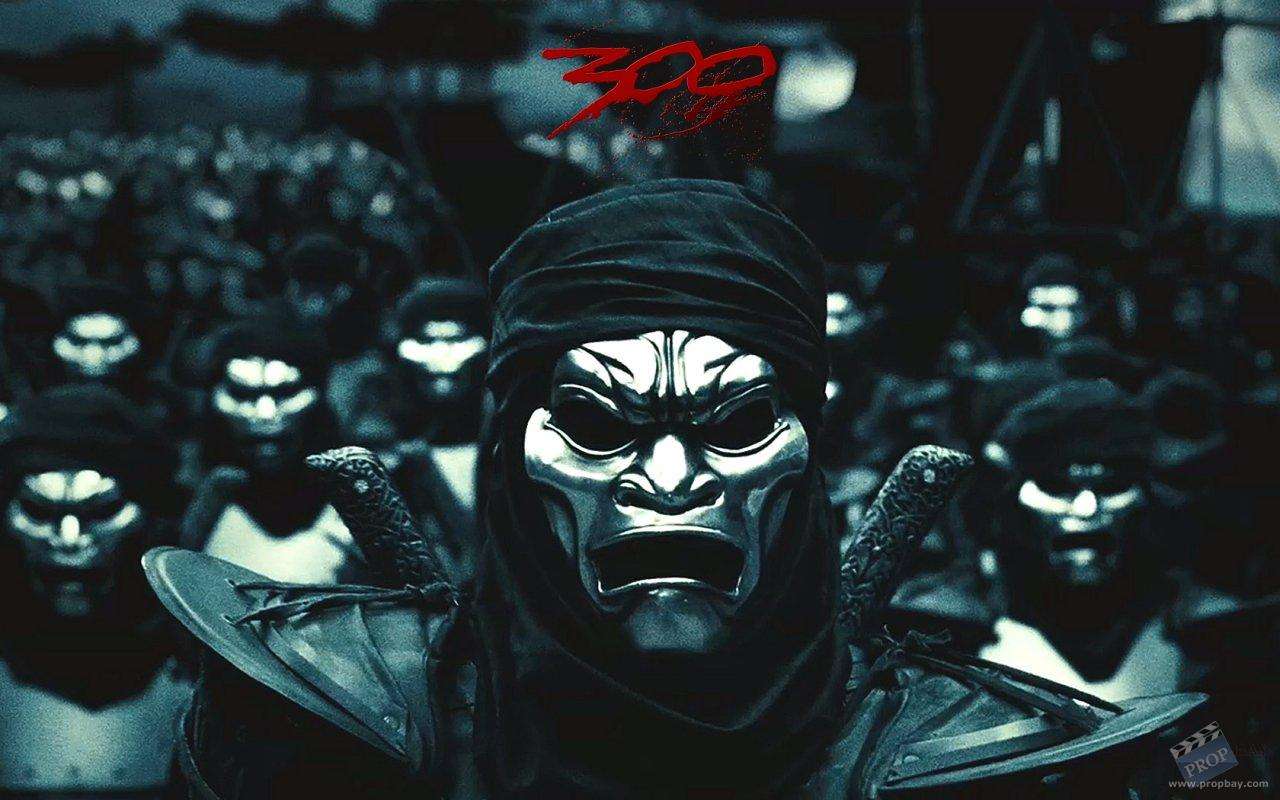
I imagine Master Subodhi’s mask-wearing monastic army would have an ominous feel to them just like the stylized Persian “immortals” from the film 300 (2006) (fig. 4).

Fig. 4 – The Persian Immortals from 300 (2006) (larger version).
Update: 05-20-22
On second thought, a better mask would emulate the six paths of reincarnation in Buddhist cosmology:
As before, each would indicate the level of a disciple’s spiritual attainment. Perhaps Master Subodhi’s army would have different units of each category, each one being more powerful than the last.
Update: 05-24-22
Some readers might question why I’ve included so many Buddhist elements if Master Subodhi is a Daoist immortal. While this is true, I choose instead to refer to him as a “Buddho-Daoist Sage” as he preaches aspects of both religions in his lectures:
With words so florid and eloquent
That gold lotus sprang from the ground.
The doctrine of three vehicles he subtly rehearsed,
Including even the laws’ minutest tittle.
The yak-tail waved slowly and spouted elegance:
His thunderous voice moved e’en the Ninth Heaven.
For a while he lectured on Dao;
For a while he spoke on Chan–
To harmonize the Three Parties is a natural thing.
One word’s elucidation filled with truth
Points to the birthless showing nature’s mystery (Wu & Yu, 2012, p. 122) (emphasis mine).
He even advocates for his students to become Buddhas. For example, the poem that Subodhi uses to reveal the secret of immortality to Monkey ends with: “When that’s done, be a Buddha or immortal at will!” (Wu & Yu, 2012, p. 120).
It’s also important to remember that Master Subodhi is based on Subhuti, a historical disciple of the Buddha.
Update: 08-27-23
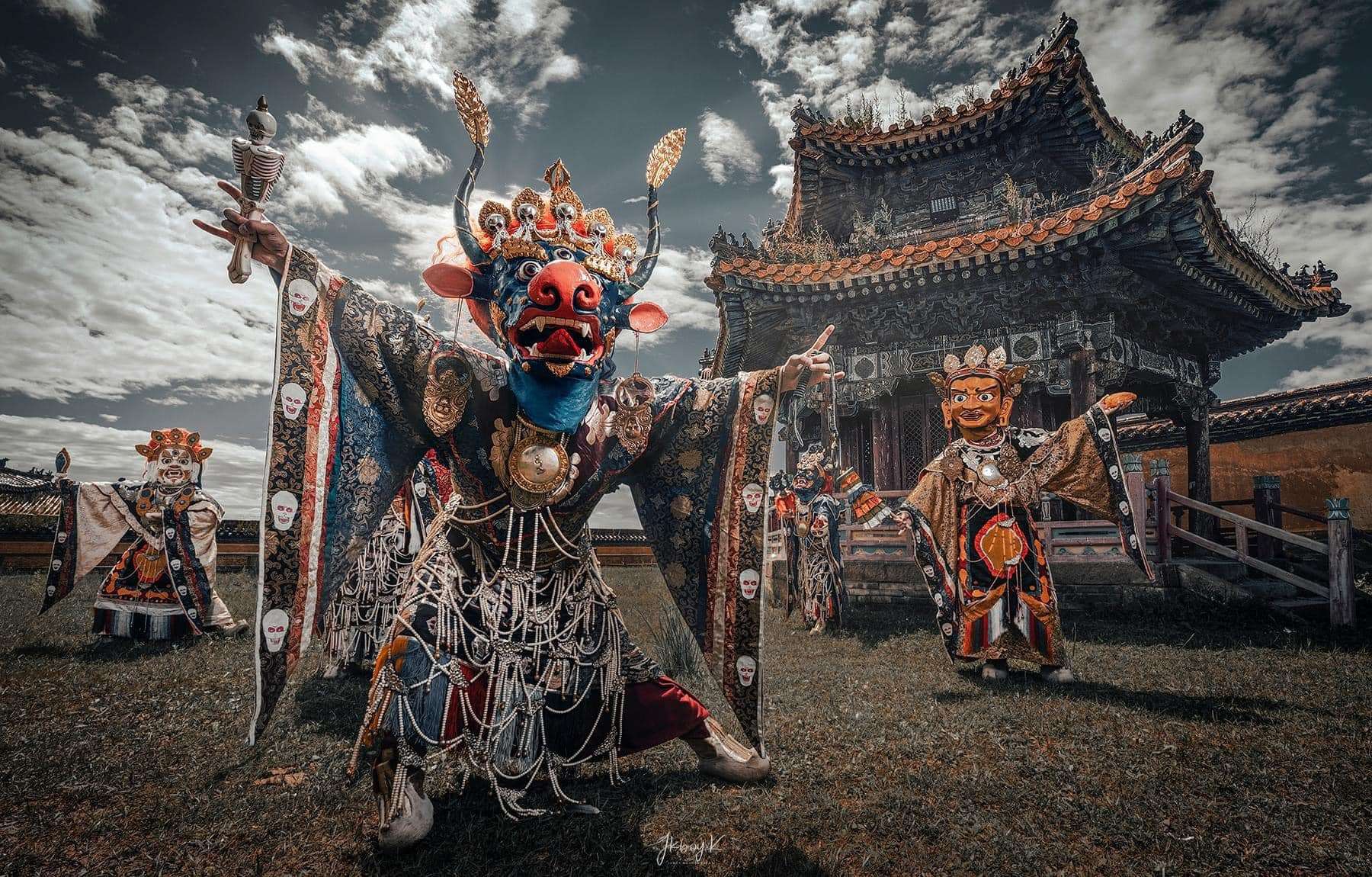
Above, I suggested that Subodhi’s advanced students could wear masks similar to the Tibetan Cham dancers. Well, someone on Facebook posted lovely images of said dancers by the photographer “JKBoy” Jatenipat Ketpradit (fig. 5-7). I just wanted to share some of them so that readers will have a better understanding of what the students might look like.

Fig 5 (top) – The monks performing the Cham dance (larger version). Fig. 6 (middle) – The dancers with their masks off (larger version). Fig. 7 (bottom) – A portrait of a Cham dancer (larger version). Images found here. Copyright Jatenipat Ketpradit.
Notes:
1) I quote the scene of his expulsion below:
“You, Wukong, come over here! I ask you what sort of exhibition were you putting on, changing into a pine tree? This ability you now possess, is it just for showing off to people? Suppose you saw someone with this ability. Wouldn’t you ask him at once how he acquired it? So when others see that you are in possession of it, they’ll come begging. If you’re afraid to refuse them, you will give away the secret; if you don’t, they may hurt you. You are actually placing your life in grave jeopardy.” “I beseech the master to forgive me,” Wukong said, kowtowing. “I won’t condemn you,” said the Patriarch, “but you must leave this place.” When Wukong heard this, tears fell from his eyes. “Where am I to go, Teacher?” he asked. “From wherever you came,” the Patriarch said, “you should go back there.” “I came from the East Purvavideha Continent,” Wukong said, his memory jolted by the Patriarch, “from the Water-Curtain Cave of the Flower-Fruit Mountain in the Aolai Country.” “Go back there quickly and save your life,” the Patriarch said. “You cannot possibly remain here!” “Allow me to inform my esteemed teacher,” said Wukong, properly penitent, “I have been away from home for twenty years, and I certainly long to see my subjects and followers of bygone days again. But I keep thinking that my master’s profound kindness to me has not yet been repaid. I, therefore, dare not leave.” “There’s nothing to be repaid,” said the Patriarch. “See that you don’t get into trouble and involve me: that’s all I ask.” Seeing that there was no other alternative, Wukong had to bow to the Patriarch and take leave of the congregation. “Once you leave,” the Patriarch said, “you’re bound to end up evildoing. I don’t care what kind of villainy and violence you engage in, but I forbid you ever to mention that you are my disciple. For if you but utter half the word, I’ll know about it; you can be assured, wretched monkey, that you’ll be skinned alive. I will break all your bones and banish your soul to the Place of Ninefold Darkness [Jiuyou zhi chu, 九幽之處], from which you will not be released even after ten thousand afflictions!” “I will never dare mention my master,” said Wukong. “I’ll say that I’ve learned this all by myself.” Having thanked the Patriarch, Wukong turned away, made the magic sign, pulled himself up, and performed the cloud-somersault (Wu & Yu, 2012, pp. 124-125).
2) Ter Haar (2021) provides a list of such generational names:
Table 1. The use affiliation characters by People of the Way
Dao 道 (Huzhou, Jiaxing, Taizhou, Suzhou) (13 cases) – The Way
Zhi 智 (Huzhou, Jiaxing) (6 cases) – Wisdom
Yuan 圓 (Huzhou, Jiaxing, Taizhou) (5 cases) – Complete
Pu 普 (Taicang, Taizhou, Huating) (4 cases) – Universal
Miao 妙 (Deqing, Jiaxing) (3 cases) – Wondrous
Jue 覺 (Huating) (1 case) – Awareness (p. 39)
Sources:
Buswell, R. E., & Lopez, D. S. (2014). The Princeton Dictionary of Buddhism. Princeton University Press.
Ter Haar, B. (2021). The White Lotus Teachings in Chinese Religious History. Netherlands: Brill.
Wu, C. & Yu, A. C. (2012). The Journey to the West (Vol. 1) (Rev. ed.). Chicago, Illinois: University of Chicago Press.