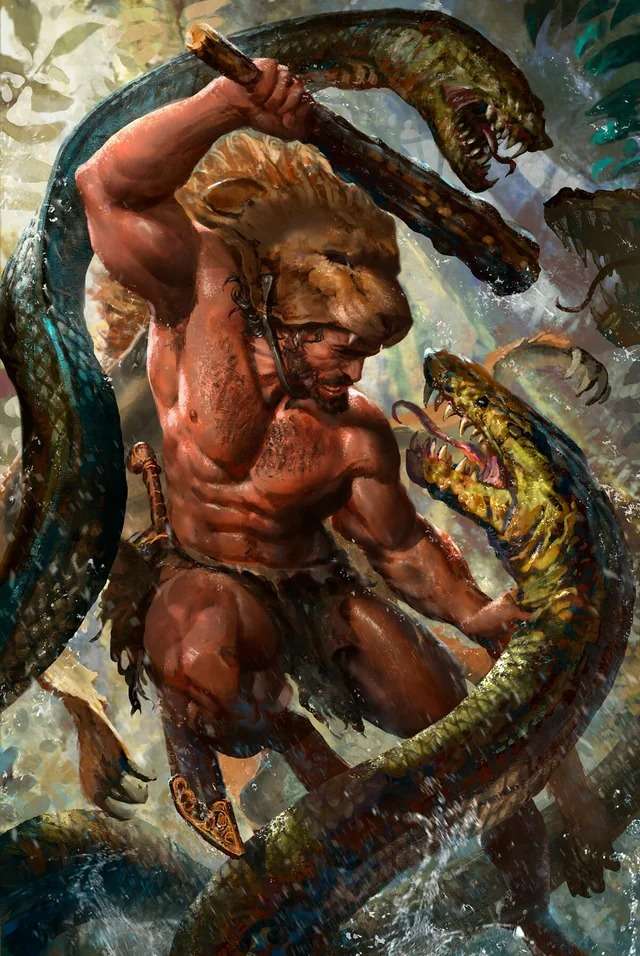
Hercules vs Sun Wukong Death Battle Analysis

Last Updated: 10-04-2025

DEATH BATTLE! is a YouTube show that pits famous fictional and (now) mythological characters against one another to see who is the strongest. The outcome of each fight, usually ending in death, is supposedly based on research comparing the combatants’ respective canonical strengths and weaknesses. There are in total nine seasons with 161 episodes. The 162nd episode (episode 7 of season 9) will feature a battle between the hero Hercules from Greco-Roman myth and Sun Wukong from the Chinese Journey to the West (Xiyouji, 西遊記, 1592, JTTW hereafter) story cycle. I only learned about this upcoming fight a little over a week ago when I noticed via my website analytics that a DEATH BATTLE! staff member had linked to my research blog on their external site. Very little concrete information about the battle was released until a few days ago, so I’ve been scrambling to finish this article in preparation for the episode on June 20th, 2022. It can be watched here:

This may not seem very important to some of my followers and lurkers, but DEATH BATTLE! has 5.05 million subscribers, and their last video received 1.7 million views in just a week and the one before got 5 million in just 3 weeks! Therefore, the battle is likely to introduce many, many people to the Monkey King. For example, the primate hero’s fighter preview gained nearly 220,000 views in the first 24 hours, 260,000 as of June 18th, 2022. And as of the same date, Hercules’ fighter preview has 287,000 views.

Win or lose, the purpose of this article is to present accurate information about Sun Wukong. I will correct any mistakes that appear in the video. I will also present a list of surprising parallels shared between Hercules and Sun Wukong, suggesting that they might have been influenced by the same mythic tropes. See also my articles comparing Monkey with the Water Margin hero Wu Song and the historical Buddha.

Before continuing, I want to note that I know the original name is Heracles (or Herakles), but I will use Hercules throughout as this is the name chosen by the staff of DEATH BATTLE!

1. Analysis

1.1. The Death Battle

It’s official, Sun Wukong WON the fight. I will add my comments and corrections (in blue) to the official battle transcript:

An ancient scroll unfurls onscreen as a painted mountain manifests. An unseen narrator begins his story.

1. This was an interesting concept.

Muse: Our tale begins up top a great mountain, where the mighty Heracles sought a gift from the Gods.

As narrated, the legendary demigod finishes his trek up the mountain and calls out to the nearby Monkey King, Sun Wukong, who is sitting atop his Nimbus cloud and holding a divine fruit in his hand.

2. Just a tiny nitpick: The Nimbus cloud is not from JTTW but the Dragon Ball franchise. The novel refers to this skill as the Cloud-Somersault.

Hercules: Ho there! I’m in need of that apple. Relinquish it.

Wukong turns to face the hero and explains his own need for it.

Sun Wukong: Sorry, I’m supposed to find my master some vegetarian food.

3. I really like that the fight starts over fruit. As I note below (sec. 2, #12), both characters steal supernatural fruit (golden apples vs immortal peaches) from the gardens of queenly goddesses (Hera vs the Queen Mother of the West). So this was a nice nod to both myths.

But in hindsight, Monkey stealing the golden apples to feed his master doesn’t make much sense considering: 1) they are located in a land that’s much further west than the scripture monk’s final western destination, India; and 2) I don’t recall reading that the golden apples were anything other than treasures. To my knowledge, none of the associated myths treat them as foodstuff. Someone please correct me if I’m wrong.

However, the explanation is ignored. His short temper kicking in, Hercules draws his sword from its scabbard and threatens Wukong.

Hercules: You’ll find it… elsewhere.

With a shrug and groan of annoyance, Wukong passes the apple to Hercules, who catches it.

Muse: But Heracles was not so easily fooled.

4. Legitimate question: Is Hercules known for having supernatural perception? Are there examples of him seeing through illusions in his original mythos? If anyone knows, please leave a comment.

The hero’s satisfaction turns to indignation as he crushes the illusory fruit in his hand, revealing it to merely be strands of Wukong’s hair. With his scheme discovered, the trickster god pulls out a miniaturized Ruyi Jingu Bang from his ear and enlarges it to its standard size. Laughing with glee, he leaps from his cloud and clashes with Hercules’ sword,

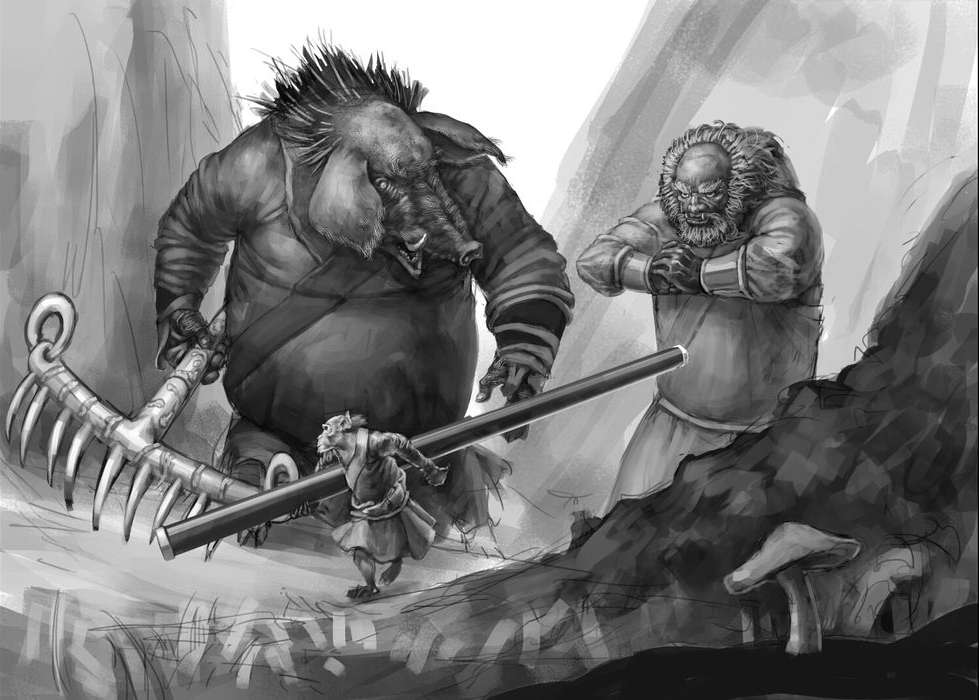
5. Another tiny nitpick: The “standard size” in the animation was not large enough. The novel states that Monkey fights with the staff when it’s around 12 feet (3.65 m) long [1] and the width of a bowl (Wu & Yu, 2012, vol. 1, p. 135, for example). [2] This illustration (fig. 1) shows how big the staff should be in relation to Sun’s body size.

Fig. 1 – Monkey and his religious brothers on patrol (larger version). Artwork by @真·迪绝人 (see here and here). Image found here.

Muse: The Monkey King’s strike rang true, but he’d not so easily overwhelm the God of Strength.

Locked in a clash of weapons, Hercules slashes at Wukong, who dissipates into smoke. The monkey flies behind Hercules on his Nimbus and jabs the hero in the gut with his staff, sending him flying into a cliff below. The mighty demigod is hardly phased though and springs back with a powerful dropkick against the advancing Wukong, sending them down another level.

6. I personally thought Monkey relied far too much on turning into a puff of smoke. I think he instead would have preferred to meet Hercules head-on.

As they both land, Hercules attempts to slash him with his sword once again, but Sun Wukong disappears in a smoke cloud and strikes Hercules with his Ruyi Jingu Bang. As Hercules lies on the ground, the Monkey King extends the staff and brings it down on the hero, who raises his sword to block the strike, only for the blade to shatter. Quickly recovering, Hercules grabs the Ruyi Jingu Bang and pulls on it, bringing Sun Wukong down to him.

Hercules: I am Heracles!

With a single mighty punch to the jaw, Heracles sent the Monkey King soaring through the sky, hitting the edge of the scroll and forcing it to go higher up before landing on a nearby cloud. Before the Monkey King has time to even breathe, Hercules shoots an arrow at him, only narrowly missing.

Sun Wukong: Yikes!

As the hero continues his assault, Wukong begins to jump through the clouds in order to avoid all of his shots, and after beginning to fly with one of them, summons several clones with his hairs to try and reach Hercules. However, the God of Strength manages to shoot down almost all of the clones. One of them climbs onto the cloud Wukong is riding and grabs his tail. Wukong spins him around and launches himself and the clone at Hercules. The Wukongs turn into birds to reach Hercules faster, before turning into snakes to restrict his arms. Tired of the monkey’s shenanigans, Hercules breaks free and grabs his rattles.

7. Legitimate question: Does Hercules have unlimited arrows? Please let me know.

Regarding the transformations, this seemed so out of place during the battle as Monkey never uses animal forms offensively. He instead uses them for stealth or, most famously, to hide from from an opponent

Hercules: Die, demon!

The loud noise echoes through the skies, destroying every single Wukong clone. Reeling in pain from the noise, Wukong’s snake transformation comes undone as he tumbles down the mountain into the forest below.

Sun Wukong: Agony, agony!

8. Why would the rattles have any effect on Monkey? I don’t recall his ears being a weakness

Update: 06-24-22

A redditor explained the following: “It’s not so much that Wukong is weak to sound, more so that the krotalas [rattles] are so loud that the noise causes pain to whatever hears them…”

But the original sources don’t make this claim. For example, the Argonautica of Apollonius Rhodius reads: 

“For not even could Heracles, when he came to Arcadia, drive away with bow and arrow the birds that swam on the Stymphalian lake. I saw it myself. But he shook in his hand a rattle of bronze and made a loud clatter as he stood upon a lofty peak, and the birds fled far off, screeching in bewildered fear” (2.1052).

The Bibliotheca Historica of Diodorus reads:

“Heracles then received a Command to drive the birds out of the Stymphalian Lake, and he easily accomplished the Labour by means of a device of art and by ingenuity. The lake abounded, it would appear, with a multitude of birds without telling, which destroyed the fruits of the country round-about. Now it was not possible to master the animals by force because of the exceptional multitude of them, and so the deed called for ingenuity in cleverly discovering some device. Consequently he fashioned a bronze rattle whereby he made a terrible noise and frightened the animals away, and furthermore, by maintaining a continual din, he easily forced them to abandon their siege of the place and cleansed the lake of them” (4.13.2).

And Pausanias writes:

“There is a story current about the water of the Stymphalus, that at one time man-eating birds bred on it, which Heracles is said to have shot down. Peisander of Camira, however, says that Heracles did not kill the birds, but drove them away with the noise of rattles” (8.22.4).

As can be seen, no mention is made of the implements being painfully loud to anything other than the birds (please provide an example if you know otherwise). While uncertain of the true reason why the rattles appear in the story, Aston (2021) posits that they could reference cultic practices or even just the “noisy rattle[s] or clapper[s] … used by farmers to scare birds from their crops” (p. 102).

I can understand the rattles working if Monkey was still in bird form, but the clone attacking Hercules had already transformed into a snake at the point. And the rattle subsequently affects all of the clones. This doesn’t make any sense.

The scroll unfurls further, revealing the spot where the Monkey King landed, as he begins to laugh.

Muse: The Monkey King fell into a strange forest, in awe of such a wondrous fight. But should he mistake his fear, he might lose his head.

Hercules comes crashing down, instantly crushing Wukong’s head with his club. But to his shock, the beheaded body of the Great Sage gets right back up.

9. Crushing Monkey’s head would not be possible with the olive club, for it would break over his adamantine crown like when Hercules broke the weapon over the Nemean Lion‘s head (sec. 2, #3). Sun’s crown is one of the hardest parts of his body, easily taking direct blows from even sharp weapons wielded by demons with no issue (sec. 1.2, #3).

It think it would have made more sense for both heroes to have, at some point, exchanged blows with their respective blunt weapons (sec. 2, #4). But, again, the club wouldn’t have lasted long. This brings me back to my previous question about the number of Hercules’ arrows. If he ran out, then he would be weaponless after both his sword and club are destroyed.

So, I think at this point Sun would have placed his staff in his ear and offered to have a boxing match with the Greek hero. Something similar happens twice in JTTW. In chapter two, Monkey confronts a demon that had been terrorizing his children during his quest for immortality. But when the monster sees that the primate is not only small but also unarmed, he offers to fight him barehanded in order to avoid criticism from other demon kings. Sun ends up beating him so badly that the monster rushes to defend himself with his sword (Wu & Yu, 2012, vol. 1, p. 128). And in chapter 51, another demon uses a powerful treasure stolen from heaven to take away Monkey’s staff, leading the latter to challenge the monster to unarmed combat to show that he isn’t useless without his weapon. A poem describing the subsequent battle states that the combatants use real-world punching and kicking techniques, many of which are known and still practiced today. And while said poem claims that they are equally matched, all of the heavenly commanders agree that Monkey’s technique is faster and more polished (Wu & Yu, 2012, vol. 3, pp. 12-14)

Seeing Hercules and Sun duke it out, causing the earth to shake and mountains crumble, would be much more entertaining than the latter’s game of hopscotch among the clouds from the video.

Sun Wukong: I haven’t had such fun since I fought all of Heaven! Change!

Wukong transforms into a taller, three-headed and six-armed version of himself, with three separate Ruyi Jingu Bangs included.

Sun Wukong: Behold me, the Immortal Monkey King!

Hercules stares at his opponent’s transformation and laments his misfortune.

Hercules: Huh… Multiple heads. Of course.

10. A nice nod to the Lernean Hydra.

Both warriors begin to trade blows, Hercules managing to avoid a few of Wukong’s strikes before being disarmed of his club and becoming a victim of a staff combo before being kicked away. He shoots out three more arrows at the Monkey King, which seemingly manage to damage him, before his three-headed form dissipates into smoke, and the real Wukong jumps right back up to the clouds, before sending out his staff to hit Hercules once more. The hero merely watches before the staff suddenly grows into an enormous size mere inches away from his face.

11. Monkey does indeed use deceptive magic doubles in battle. One example happens in chapter 4 during his fight with Prince Nezha

“They clashed like raindrops and meteors in the air, but victory or defeat was not yet determined. Wukong, however, proved to be the one swifter of eye and hand. Right in the midst of the confusion, he plucked a piece of hair and shouted, ‘Change!’ It changed into a copy of him, also wielding a rod in its hands and deceiving [Nezha]. His real person leaped behind [Nezha] and struck his left shoulder with the rod. [Nezha] … heard the rod whizzing through the air and tried desperately to dodge it. Unable to move quickly enough, he took the blow and fled in pain” (Wu & Yu, 2012, vol. 1, p. 156).

Hercules: Huh?

He is suddenly crushed underneath the Ruyi Jingu Bang as Wukong sits on top of it and laughs. But the staff suddenly begins to shake, as Hercules begins to lift it from underneath.

Hercules: You’ve had your fun, beast, but I’ve had enough!

Hercules throws the staff away, forcing Wukong to get off it before changing its size once more, and preparing to strike a finishing blow. Hercules sees this and charges towards the Monkey King, clashing with the staff with only his fist. But as the blows make contact, two blue, divine versions of the two warriors can be seen holding the scroll, before preparing their weapons for a clash of their own. The club of Hercules’ celestial body leaves a trail of constellations, while the celestial Ruyi Jingu Bang leaves a trail of names of Four Symbols written in Chinese in its wake.

Muse: The gods watched their earthbound selves, and so joined in battle. The God of Strength mustered the heart of Olympus, while the Great Sage harnessed power equal to Heaven! Thus…

The two celestial bodies swing at each other, with the force of the blows turning the screen a blinding white. Slowly, the light fades away to reveal that Hercules’ celestial body has been impaled by the Ruyi Jingu Bang. The scroll floats back into view, covering the screen once more.

12. I think I understand what the Death Battle staff was going for when they portrayed each character in their celestial form. But this contradicts their promise to not use the heroes’ post-apotheosic versions. Therefore, this also seemed extremely out of place during the fight.

Muse: The Monkey King emerged victorious!

Returning back inside the scroll, Wukong’s attack manages to overpower Hercules, and its might destroys the God of Strength leaving nothing behind.

Sun Wukong: Wow, would you look at that! I struck him so hard he was reduced to nothingness!

13. I think this would have only killed Hercules’ mortal half, releasing the god within and prolonging the fight. While sources vary on what caused his apotheosis (virtus vs the 12 Labors vs Gigantomachy deeds), it’s clear that the son of Zeus become a god upon his fiery death (Romero-Gonzalez, 2021, p. 275).

Wukong laughs once more and grabs the apple, leaving the forest to rejoin his master.

Muse: With a formidable foe slain, stricken against the mountain’s breast, so ends our great tale of East and West.

14. I was honestly underwhelmed by the ending. It seemed like the staff ran out of time, money, or interest and decided to stop the episode prematurely. It should have gone on much longer since Hercules and Sun Wukong are the first two mythological characters to be featured. I also thought Hercules was splattered way too easily. I’m sure there could have been a different way to end the fight. It would have been more respectful to both pantheons if the heroes had simply come to a draw and, having developed a newfound respect for each other’s skills, parted as bond brothers.

But considering that the show is called “Death Battle!”, somebody needs to die (the fans would otherwise be upset). So, baring that in mind, I thought of an idea five days before the episode aired, but I must admit that it’s not very respectful to the Greek hero. In my scenario, Sun seemingly disappears, but he actually turns into an insect and flies into Hercules’ mouth and crawls into his stomach. There, Monkey beats him up from the inside using the iron staff or even his fists. Then he instantly takes on his 100,000 foot (30,480 m) tall cosmic form, causing Hercules’ mortal body to explode. This “attack from within” tactic appears in chapters 59, 75, and 82 of JTTW, [3] as well as chapter 11 of the late-13th-century version of the story cycle

Lasty, I didn’t think the sprite animation was appropriate for such a mythic showdown. I personally would have liked more dynamic, hand-drawn animation like that from the Omni-man vs Homelander episode.

Update: 06-24-22

The same redditor from above also explained that the show apparently has budgetary constraints on episode length and art style. This explains the seemingly abrupt ending and the sprite animation. Hand drawn animation is apparently only reserved for the very tip of the top-most requested matchups.

This still doesn’t change my opinion, though. This was their first battle between extremely famous mythological characters. The fight should have been more grand.

But this information still doesn’t change my opinion of the episode. Rooster Teeth should have allotted a larger budget and made the episode longer.

1.2. The Results

I will do the same for the official fight result transcript:

Boomstick: Talking about a herculean matchup.

Wiz: Heracles was among the greatest heroes in myth, but the Great Sage Equal to Heaven held many more advantages.

Boomstick: You’d think Sun might not measure up to the God of Strength… you know, strength, but he totally could. remember he carried Sumeru on his back, the mountain holding up the infinite celestial sky, like how Heracles held up the infinite celestial sphere.

1. The Death Battle researchers likely learned about this feat from my article. But nowhere do I write that the mountain upheld the sky. The Abhidharmakośa (Ch: Api damo jushe lun, 阿毗達磨俱舍論, 4th to 5th-century) contains an overview of the Hindo-Buddhist cosmos, and it states that the sun, moon, and stars orbit half way down the exposed portion of the mountain [4] in a whirlpool-like ring of wind (Vasubandhu, 2014, pp. 460; Sadakata, 1997, p. 38-40). But the source doesn’t associate this ring with any weight.

Conversely, native Chinese mythology views the sky as a solid object that must be propped up by mountains. And if one of these earthly pillars is damage, it will cause the sky to tilt and even tear, requiring divine repair. See, for example, the legend of Nuwa mending the sky (Birrell, 1999, pp. 69-72 and 96-97). But this has no baring on the discussion at hand as Journey to the West expressly describes the world according to Hindo-Buddhist cosmic geography.

Therefore, Sun’s feat should be scaled accordingly. But I’m not sure how this would be possible as the Buddhist and Greek concepts of the sky appear to be fundamentally different. I’ll have to read more on the latter concept to be sure.

Update: 06-25-22

I was contacted by a reader who said that the episode’s Sun Wukong researcher responded to me on the Death Battle discord, stating:

“To clarify, the basis for what Sumeru supports comes from the Buddhist cosmology lectures sourced in the character sheet. Though the article Jim wrote was what made me initially take note of the feat.

https://www.youtube.com/watch?v=6agAavZTEK0

https://www.youtube.com/watch?v=UMQeFiwacbQ” (per a screenshot emailed to me). 

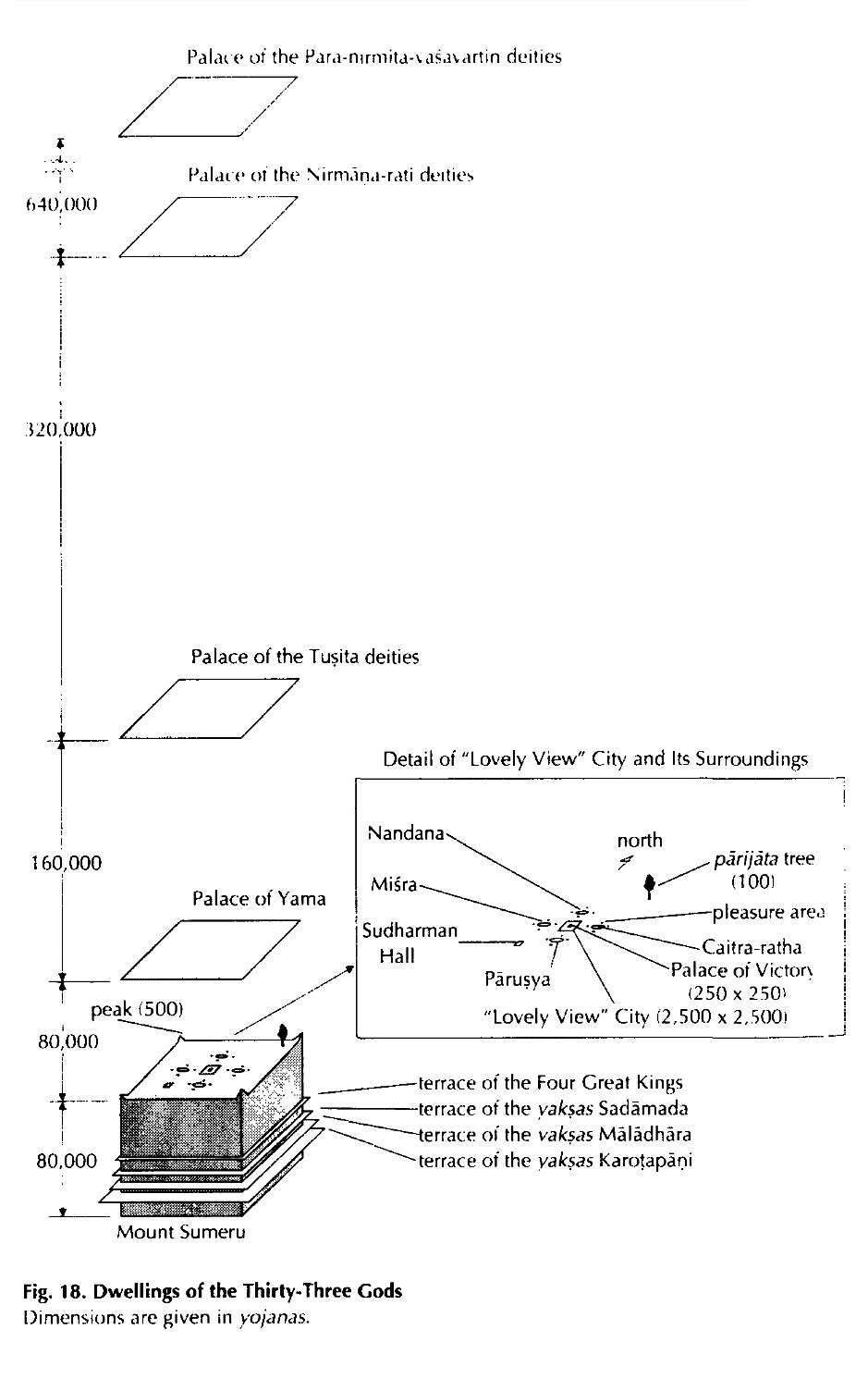
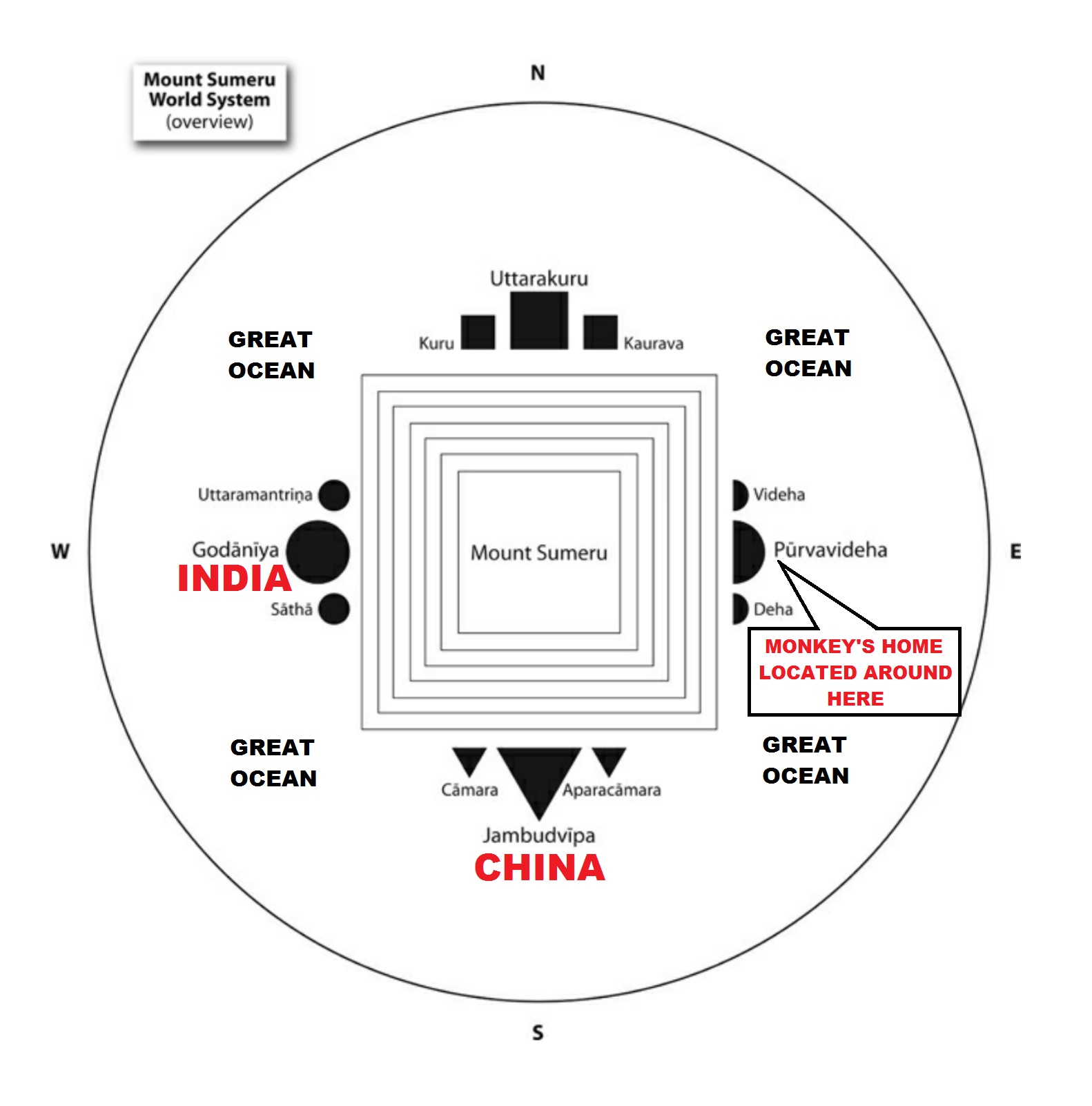
But I’ve watched the videos and they don’t contradict what I wrote. The problem is that the researcher didn’t make a distinction between the “sky” (as stated in the Death Battle video) and “heaven.” I’ve already described the wind ring in which the celestial bodies orbit the midpoint of Mt. Sumeru. So, now I will give a brief and very simplified overview of the Buddhist cosmos to help readers form a better picture of what I’m arguing. As the axis mundi, Mt. Sumeru is located at the center of our earthly realm, with a ring of seven smaller mountains circling it. This landmass is surrounded by four island-like continents, one for each face of Sumeru, that float in a great sea resting on a disc of golden earth (kāñcanamaṇḍala). This is then supported by a disc of water (jalamaṇḍala) and finally a disc of wind (vāyumaṇḍala), each layer generally becoming larger as one descends. This grand creation is thought to float in “space” (ākāśa) (Sadakata, 1997, pp. 25-30), sometimes translated as “sky” (Buswell & Lopez, 2014, p. 26). There are indeed various layers of heavens on and above Mt. Sumeru, but they appear to be separate from this space/sky (fig. 2). The first two heavens, that of the Four Great Kings and the 33 Gods, are respectively located at the midpoint and summit of Mt. Sumeru. But the following four heavens float above it at varying heights (fig. 3) (Sadakata, 1997, pp. 56-62). Therefore, by running with Mt. Sumeru on one shoulder (and Mt. Emei on the other), Monkey would have supported both the landmass and the two earthly heavens, a monumental task to be sure. But he doesn’t support the four floating heavens above or, most importantly, the space/sky that they are located in. 

Having written the above, I want to note that I’m not claiming Hercules’ feat is stronger by default. I just want to present accurate information. I will at some point post an update with info about ancient Greek concepts of the sky.

Fig. 2 – A diagram of the Buddhist cosmos by MC Owens (larger version). Image from this talk. It’s the most simplistic, eye-catching version I’ve seen. The column of red, blue, and purple rings on the bottom represent the various layers of Hell. Fig. 3 – A diagram of the various heavens on and above Mt. Sumeru (larger version). From Sadakata, 1997, p. 60.

Wiz: As befitting heroes of myth they were on par in that they were both incomprehensibly strong, however, Wukong’s healing abilities meant he could bounce back from Heracles deadliest blows, whereas Heracles did not have a similar option.

Boomstick: But Heracles did have one way of putting the Monkey King down, his arrows dipped in hydra poison.

Wiz: The hydra poison threatened even the gods of Olympus, similar to the scorpion sting. Whether or not it would be fatal is questionable but it could have incapacitated Wukong, similar to how it affected Heracles himself.

2. The novel presents concepts with elemental states beyond heaven and earth. A prime example is Red Boy‘s Samādhi fire, which is considered more powerful than normal or even divine flames. [5] Likewise, the scorpion’s “horse-felling poison” (daoma du, 倒馬毒) likely falls into this separate category, for it was able to hurt even the Buddha! The bodhisattva Guanyin explains:

“Once upon a time she [the scorpion] happened to be listening to a lecture in the Thunderclap Monastery. When Tathagata saw her, he wanted to push her away with his hand, but she turned around and gave the left thumb of the Buddha a stab. Even Tathagata found the pain unbearable!” (Wu & Yu, 2012, vol. 3, p. 72).

The aforementioned monastery is located in the Western Paradise. This suggests that she might have been imbued with “dharma power” [6] over a certain period of time, making her a super powerful foe. Even the bodhisattva Guanyin fears her sting (Wu & Yu, 2012, vol. 3, p. 72). 

I suggest that the scorpion’s sting may be stronger than the hydra’s heavenly poison. [7] Therefore, I question if the latter would have the same effect on the Monkey King.

Boomstick: But that is one very specific win condition and we’re looking at this with every possible option in mind.

Wiz: With his variety of clones, transformations and numerous other spells, Wukong’s arsenal was far more versatile.

Boomstick: Like, there was nothing stopping him from making thousands of clones of himself and just sitting back, while they beat up Herc for him. Unsporting been like? Sure. In character? Absolutely.

Wiz: Even then, those arrows would have to actually strike Wukong, which would be extremely difficult. Yes, in some depictions Heracles could potentially shoot the sun of Helios, his arrows flying 90 times the speed of light. However, in his contest with the Buddha, Wukong leap to the edge of the universe in a single second. To do so he had to be moving over 1.4 quintillion times faster than light.

3. But even if the hydra venom was equally potent, there is no guarantee that Hercules’ arrows could pierce Sun’s adamantine hide. The novel is clear that Monkey’s frame is nearly indestructible. For instance, upon his capture, heaven fails to execute him:

“They then slashed him with a scimitar, hewed him with an ax, stabbed him with a spear, and hacked him with a sword, but they could not hurt his body in any way. Next, the Star Spirit of the South Pole ordered the various deities of the Fire Department to burn him with fire, but that, too, had little effect. The gods of the Thunder Department were then ordered to strike him with thunderbolts [lei xie ding, 雷屑釘, lit: “nails of thunder”], but not a single one of his hairs was destroyed.” (Wu & Yu, 2012, vol. 1, p. 188).

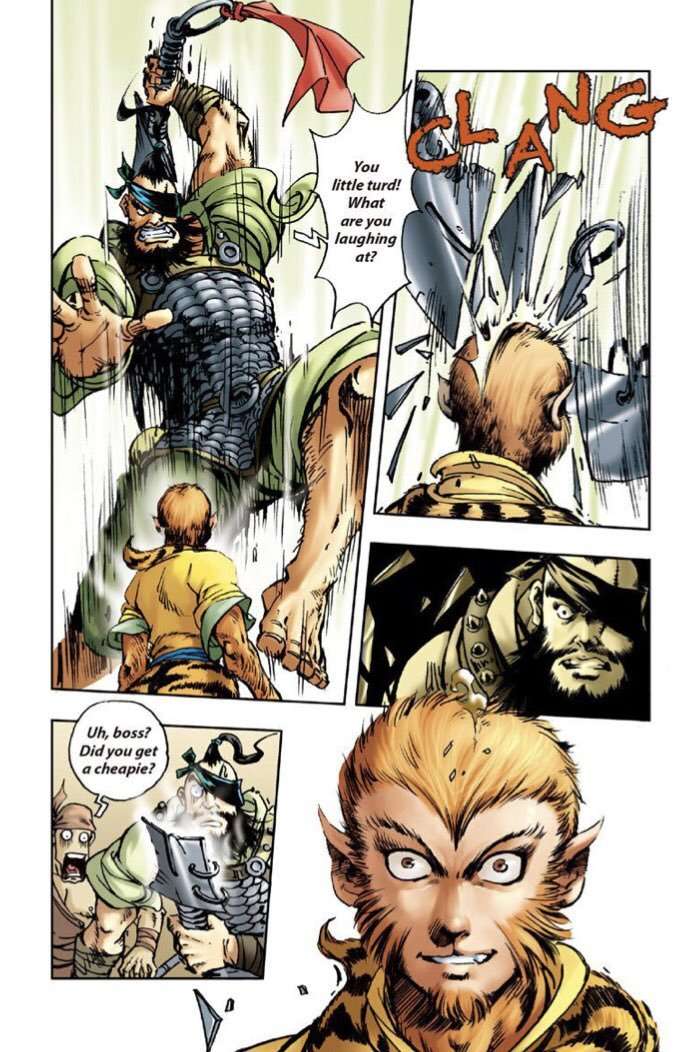
This invincibility follows him throughout the novel. For example, in chapter 75, Sun agrees to a demon lord’s offer to set the monk free if he can survive a blow to his head with a scimitar (fig. 4):

“‘When he heard this, Pilgrim smiled and said, ‘Fiend! If you have brush and paper in your cave, take them out and I’ll sign a contract with you. You can start delivering your blows from today until next year, and I won’t regard you seriously!’ Arousing his spirit, the old demon stood firmly with one foot placed in front of the other. He lifted up his scimitar with both hands and brought it down hard on the head of the Great Sage. Our Great Sage, however, jerked his head upward to meet the blow. All they heard was a loud crack, but the skin on the head did not even redden” (Wu & Yu, 2012, vol. 3, p. 373).

Fig. 4 – Page from a Journey to the West comic book showing Monkey’s hard head (larger version). Image found on Twitter.

Someone may argue that the scorpion’s sting pierced his face, but refer back to what I wrote about dharma power in comment #2, and see also note #6 below.

Also, the Death Battle crew lists astronomically large numbers without explaining how the figures were calculated (I make the same critic of the G1 Death Battle Fan Blog in my 06-19-22 update). These figures mean absolutely nothing without some sort of explanation.

But since the numbers are used in reference to Monkey’s feat of leaping out of the Buddha’s palm, I want to explain its significance for those who don’t understand (per this reddit post). Sadakata (1997) writes: “[Sun’s feat] reflects the world of the Flower Garland Sutra, where every phenomenon is located within the buddha-world” (p. 155). He goes on to discuss the Cosmic Buddha Vairochana, noting how Buddhist art from all over the world depicts the myriad Buddhas as his emanations. One Javanese example features images of the Five Dhyani Buddhas encircling a stupa dedicated to Vairochana, thereby “express[ing] the Mahayana idea that the buddhas emanate from Mahavairocana and penetrate the universe, that the ‘one’ is at the same time the ‘many'” (Sadakata, 1997, pp. 156-157). Therefore, in essence, the Buddha’s palm in the novel represents the universe.  

Update: 06-25-22

Another redditor wrote:

“[T]he Hydra venom doesn’t need to ‘pierce’ your body to make effect, it just needs to have skin contact, referring to the time Hercules died because he was tricked into using a robe with some hydra venom on it.”

I responded:

“I’m aware of how Hercules dies, but there’s still the question of whether or not the venom would be absorbed into Sun Wukong’s nearly indestructible skin. I don’t recall any similar episode where a substance is absorbed through his skin in JTTW. So assuming that it could is not the same as citing evidence that it would. I’m not trying to split hairs. I’m just a stickler for details.”

But I will concede that artistic license and the need to raise the stakes of the battle could warrant the venom effecting him even if the arrows can’t penetrate his skin. 

Boomstick: Making him way faster than Herc could ever hope to be.

Wiz: Heracles held might of mythic proportions, but barring a lucky shot. Sun Wukong’s versatile magic, similar strength and absolutely absurd speed overcame this foe fitting for heaven’s equal.

Boomstick: When fighting Sun Wukong, Heracles mythed his chance.

Wiz: The winner is the Monkey King, Sun Wukong.

2. List of Parallels

This has been split off into its own article to make the present post a more manageable length.

Parallels Between Sun Wukong and Hercules


Update: 06-19-22

I’ve been notified by several people that the G1 Death Battle Fan Blog has posted a prediction. This blog is independent from the actual content creators. In a 7 to 6 split, the blog predicts Hercules will win, explaining that he is stronger and faster. While seemingly thorough, portions of their analysis make no sense. For example, the section on speed reads:

As far as speed goes, the demigod also comes out on top. Taking into account Wukong growing his staff from Earth to the Underworld and the Heavens, then scaling that back to his speed, he could potentially move at 800 quadrillion times the speed of light. However, Heracles scaling to Zeus surpasses this by dozens of times, with him being able to send shockwaves across the entire firmament by simply nodding his head. Zeus nodding his head is an act that should have been done with extreme ease – at least more ease than Zeus actually wrestling Heracles – meaning that Heracles should reasonably scale. As the firmament and Olympus are on the outer sphere of the cosmos, which encircle each other, this would have had to cross the entire diameter, putting the feat at 29 quintillion times the speed of light, over 36 times faster than Wukong …

They scale Sun Wukong’s speed not by his Cloud-Somersault (a metaphor for instantaneous travel) or his ability to carry mountains with meteoric speed but by the magic growth of his staff into a pillar of heaven. Why? They also provide astronomically large numbers without explaining how the figures were calculated, a very common problem with such versus discussions.

In addition, they wrongly state that the 72 Transformations grant Monkey immortality. He actually first attains immortality via Daoist elixir arts. Furthermore, they claim that Sun’s immortality can be taken away from him, referencing his turn in Laozi’s Eight Trigrams furnace. While the extreme heat was meant to extract the elixir from his body, it doesn’t work as Monkey was able to hide in a cooler part of the furnace (Wu & Yu, 2012, vol. 1, p. 189). But we don’t know if this plan would have worked even if Sun had been stuck in direct heat. This is confusing an “intended result” with an “actual result.” But even if the heat could complete the job, how exactly is Hercules going to defeat Sun’s immortality. Does he also carry around a heavenly furnace? This is never explained in the analysis.

I don’t have time to analyze the entire article. I will reserve this space for the actual fight results.

Note: In light of new evidence, I’ve changed my opinion regarding the furnace. Please see the 06-28-22 update below.


Update: 06-23-22

I have finished adding my comments to the official fight and result transcripts of the battle (sec. 1.1 and 1.2). If any new evidence comes to light, I will make sure to further update the page.

I’m thrilled to announce that the episode has 1.1 million views after only two days! 925,000 plus of those were in the first 24 hours! I knew this fight would attract a lot of attention. I hope more and more people will finally read the novel and fall in love with Monkey’s adventures like I did oh so long ago.


Update: 06-26-22

When I originally watched the video, I skipped the character analysis straight to the fight. I only just now got around to reading the official transcript for the beginning, and I’m sorry to report that Monkey’s section is riddled with errors. Whomever wrote it has definitely never read the book. It would be like me writing a Death Battle transcript about Harry Potter based on a very lazy read of Wikipedia. I tried correcting the mistakes onsite, but my edits were reverted, and I was told that the transcript is off limits. Therefore, I’ve decided to add my corrections and comments here (in blue) like I did above.

But before continuing, I want to note that I’m upset because it appears that info from my research blog was likely used in the video and Death Battle wiki website without the specific articles being linked to. Sure, my general blog URL was added twice to an external site (here and here), but this is not the same as linking to the actual articles on the video/wiki so people can see where Death Battle got their information from. Make no mistake, this has little to do with publicity; my blog generates zero money for me. It’s just fair that my work be recognized if it’s being used, especially if it contributed to a video currently making money for its creators

3. Sun Wukong’s character analysis

Wiz: There once was a mighty monkey warrior, born of a mystic stone from the energy of the sun and moon. Upon birth, he graciously bowed to the cardinal directions and-

1. The stone was “nourished for a long period by the seeds of Heaven and Earth and by the essences of the sun and the moon” (Wu & Yu, 2012, vol. 1, p. 101). 

Boomstick: Shot lasers from his eyes! Strap in folks, this one’s a doozy.

2. This feat is likely based on the birth of the historical Buddha. See parallel #2 on this article.

Wiz: This monkey soon befriended a band of other primates and, rather narcissistically, named himself their handsome Monkey King.

3. Sun doesn’t just proclaim himself king, though the addition of “handsome” is pure ego on his part (he’s actually really ugly). He proves himself in a test of bravery by jumping through a waterfall to discover a long-forgotten immortal’s grotto-heaven (see the opening of this article).

Boomstick: But after a few centuries of monkeying about, he got a taste of the dreaded… midlife crisis!

Wiz: You see, the Monkey King was fierce and brave, yet he feared death, so he ventured to new lands in search of immortality.

4. Brave? Yes. Fierce? Not yet a warrior.

Boomstick: Turns out, he’d find a lot of it.

Wiz: Training under the Taoist master, Puti, he earned his first method of immortality and a new name. He would be the Monkey Awakened to the Void, spoken as: Sun Wukong.

5. Subodhi is a Buddho-Daoist sage with heavy Buddhist associations despite his normal portrayal as an immortal.

Boomstick: He also learned a bunch of magic. He can ride clouds, make thousands of clones, heal from fatal wounds like decapitation, and transform into basically anything: a bird, some vapor, a pitchfork, even an incredible fighting temple!

Popup: Though this technique is called “72 Earthly Transformations”, the scope of Sun Wukong’s shapeshifting is limited only by his imagination. The number actually references a collection of stars that the power is associated with.

6. Example #1 of info from my blog being used but not linked to. And the actual name for the technique is the “Multitude of the Terrestrial Killers” (Disha shu地煞數). [10]

Wiz: With his famous cloud somersault, he could traverse the world at incredibly high speed. At first, a single somersault could carry him 180,000 li [a typo for 108,000], li being a traditional Chinese unit equal to about 500 meters, making one somersault move 54,000 kilometers per second, fast enough to circle the entire Earth in one leap.

7. Example #2 of info from my blog being used but not linked to. I note this ability to encircle the earth in the opening paragraph here.

Boomstick: And he’d only get faster from there. Monkey would do whatever it took to prove he was the best of the best.

Wiz: When fighting the mighty deity Prince Nezha, his foe transformed into a more powerful visage with three heads and six arms.

8. This doesn’t happen until chapters later when Monkey first rebels. I’m not sure why they would introduce this fight so early.

Boomstick: But Sun was like, “Hey, I can do that too,” and then did just that.

Wiz: Sun Wukong eventually returned to his simian subjects and, with his newfound power, amassed a veritable army. However, he felt no weapon in their arsenal suited him.

Boomstick: So he barged into the Dragon King‘s palace and demanded he hand over a weapon worthy of a king who can match the power of Heaven. Yeah, Sun was pretty full of himself. But, he wound up taking a pillar, originally designed to measure the depths of the ocean.

Popup: Some translations claim this “golden-hooped rod” measured or held up the galaxy, but these are incorrect. It was originally used to gauge the depth of the Great Flood, a story regarding the rise of dynastic China.

9. Example #3 of info from my blog being used but not linked to. Here I discuss the error in translation that led to this common misconception.

Wiz: What seemed like a worthless rod to the Dragon King was actually the perfect weapon for Wukong. Weighing nearly eight tons, the Ruyi Jingu Bang can change size at his whim. It can shrink to the size of a needle or grow long enough to pierce the heavens.

10. The pillar was not “useless.” He considered it an item of great importance:

“‘That,’ said the Dragon King, ‘was the measure with which the Great Yu fixed the depths of rivers and oceans when he conquered the Flood. It’s a piece of magic iron, but of what use could it be to him [Monkey]?'” (Wu & Yu, 2012, p. 135).

And later, he even refers to it as a “divine treasure” (Wu & Yu, 2012, p. 142).

But the Dragon Queen suggests giving it to the rude and very powerful immortal anyway so that he will leave their kingdom (Wu & Yu, 2012, p. 135).

Also, the staff weighs nearly nine tons.

Boomstick: The same heavens that got pretty mad with Sun after he crossed his name out of the Ledger of Death, making himself double immortal! Wait, how does that work?

Wiz: And even more mad when he demanded to be formally acknowledged as “The Great Sage Equal to Heaven”.

11. This doesn’t happen until after serving as the Bimawen and subsequently rebelling. Again, they introduce something too early.

Boomstick: Okay, we got a headstrong goofball who quickly masters new powers and wants a fancy title. This is just Shonen anime!

Wiz: Now, the Monkey King may have lashed out, but it was because when he requested a place in Heaven, a place he truly believed he deserved, the Jade Emperor‘s court reduced him to a stable boy.

12. He didn’t request a place in heaven. The celestial bureaucracy just gave him a position to keep his unruly adventures in check (Wu & Yu, 2012, vol. 1, p. 143). Monkey only later “lashes out” upon learning of his low rank (Wu & Yu, 2012, vol. 1, p. 149).

Boomstick: Beneath all his antics, what Sun wanted most was to prove himself.

Wiz: Even with all the shenanigans, the Jade Emperor remained cautious and willing to placate Wukong.

Boomstick: By making him the watchdog of the Garden of Immortal Peaches. He totally ate that shit, didn’t he, Wiz?

13. It’s only at this point when Monkey battles Nezha, and when he proves too powerful, heaven placates him with the aforementioned sagely title and the above position (Wu & Yu, 2012, vol. 1, pp. 155-159).

Wiz: Oh yeah, Wukong got hammered, ate most of the peaches, ran around the Jade Palace in a fit, and found five gourds of immortality pills… which he promptly swallowed. All of them.

Boomstick: Ok, so that makes… how many layers of immortality now?

Wiz: I’d say a few… hundred? Thousand? If you count each individual peach and pill. When he sobered up, he knew he was in serious trouble, so naturally… he prepared for war.

14. This glosses over the reason for why Sun was drunk in the first place. He crashes the long-awaited immortal peach banquet and drinks all of the heavenly wine. Only then does he drunkenly stumble into Laozi’s laboratory and eat all of the alchemical pills (Wu & Yu, 2012, vol. 1, pp. 165-166).

Boomstick: Wow, that escalated quickly! What are they gonna do? Kill him? So, the Monkey King proved too strong for Heaven. He battled all their best fighters, and even matched Erlang Shen blow-for-blow in an epic battle of transformations! He’s that guy with the third eye.

Wiz: And Heaven’s greatest holy warrior. Yet, no matter Erlang’s form, Wukong always had a counter. Until Laozi threw in a convenient plot MacGuffin that captured the monkey. But even with Wukong in chains, Heaven had a problem.

15. Sun has no problem fighting Erlang, that is until his beloved monkey army is routed. He thereafter loses heart and flees, using a number of animal/structural transformations to escape (Wu & Yu, 2012, vol. 1, pp. 181-184). This is obviously different from the scenario described above. See this article by my friend Irwen Wong over at Journey to the West Library to learn how Erlang wins the majority of their encounters. 

Also, Laozi’s Diamond snare doesn’t capture Monkey. It simply hits Sun on the head, dazing him long enough for heaven to capture him (Wu & Yu, 2012, vol. 1, p. 186).

We cut to Boomstick.

Boomstick: He just wouldn’t die! Lightning, fire, even Laozi’s de-immortalizing furnace just made the monkey stronger!

16. The purpose of the Eight Trigrams furnace is not to remove one’s immortality but to produce the intense heat needed to manufacture alchemical elixirs (see section III of this article). This is an important distinction.

Laozi suggests that the reason why Monkey has a nearly indestructible body is because all of the immortal peaches and alchemical pills were likely refined in his lower elixir field. He then offers a possible solution:

“It would be better, therefore, if [he is placed] in the Brazier of Eight Trigrams, where he will be smelted by high and low heat. When he is finally separated from my elixir, his body will certainly be reduced to ashes” (Wu & Yu, 2012, vol. 1, pp. 188-189).

But as I note in my 06-19-22 critique of the G1 Death Battle Fan Blog,

“…it doesn’t work as Monkey was able to hide in a cooler part of the furnace. But we don’t know if this plan would have worked even if Sun had been stuck in direct heat. This is confusing an ‘intended result’ with an ‘actual result’.”

Note: In light of new evidence, I’ve changed my opinion regarding the furnace. Please see the 06-28-22 update below.

Wiz: Now, Wukong is not invincible. He has been hurt by the Scorpion Demoness’ poison, which could even harm the Buddha, an awaken divine being liberated from the cycle of life and death entirely.

17. Please see what I wrote about the scorpion above (sec. 1.2, #2)

[Random skit removed for brevity]

Boomstick: Ugh… But even after all that, Sun had one more challenger to contend with; the Buddha himself!

Wiz: Buddha approached Wukong with a contest: leap out of his hand, and he could have the Jade Emperor’s throne for himself.

Boomstick: Having no impulse control, the monkey agreed, and in an instant, somersaulted to the very edge of Heaven.

Wiz: But he had already lost. Because Buddha achieved Nirvana, he transcended the world, literally holding all of existence. So even at the edge of the universe, Wukong technically never left his hand.

18. This matches what I wrote above about the Buddha and the universe (sec. 1.2, #3).

Boomstick: For his rebellion, Sun was put in time out, sealed under a mountain for 500 years.

19. This is an understandable mistake as the phrase “500 years” is thrown around a lot in the novel. But as I explain here, chapter 14 states that the mountain trapped Monkey during the rein of a historical usurper (Wu & Yu, 2012, vol. 1, p. 306), revealing that his imprisonment actually lasts somewhere between 617 to 649 years.   

Wiz: But even Sun Wukong would find a chance at redemption. In his case, he was tasked with escorting and protecting a monk, Tang Sanzang, or Tripitaka, on a journey to the west.

Boomstick: With additional companions Pigsy and Sandy. The trip was a tough one, and Monkey abandoned it more than once. But through it all, he always returned to shine as the group’s powerhouse, saving Tripitaka’s life many, many times. Seriously, this guy could not stay out of trouble. It’s like Wiz on a blind date.

Wiz: Ahem. Wukong has cracked apart mountains, slayed hundreds of monsters, and survived the Yellow Wind Demon‘s storm that could destroy the universe. As in Heaven, Earth, the 18 layers of Hell, and more!

Popup: The storm is depicted differently across translations, but the original Chinese text uses “乾坤”, meaning “universe”, or more literally “every manifestation of nature”.

Boomstick: That’s cool and all, Wiz, but let’s answer the real question. Can he beat Goku?

Wiz: Um… maybe! During his journey, Wukong performed possibly his most legendary feat: holding up Mount Sumeru which, in traditional Mahayana Buddhism, is a mountain supporting the infinite cosmic sky.

Boomstick: And Sun just hauled it around on one shoulder. Just one! Because on his other shoulder… was a whole other mountain!

Popup: The other mountain was Mount Emei, one of the Sacred Mountain of China.

20. Example #4 of info from my blog being used but not linked to. This material of course comes from here.

Wiz: After 14 years of travel, the journey was complete, and Wukong had finally accomplished a truly great deed. For this, he was given his long-awaited place among the heavens.

Boomstick: As the Victorious Fighting Buddha! Now that’s got to be an anime.

Wiz: After so much time as a rebel, an outcast, and a truly unstoppable warrior, Sun Wukong had, at last, found his home.


Update: 06-28-22

I previously referenced Sun’s turn in Laozi’s Eight Trigrams furnace but stated that this should not be used as an anti-feat since the flames never actually hurt him (due to taking shelter in a cooler portion of the brazier) (06-19-22 update & sec. 4, #16). I also referenced Red Boy’s spiritually-cultivated Samādhi fire, noting that it is more powerful than earthly or even heavenly fire (sec. 1.2, #2). Regarding the latter, remember that Monkey easily survives an attempted execution by this celestial flame (sec. 1.2, #3). But it’s important to highlight that, in chapter 41, the combination of Samādhi fire and intense smoke is shown to override Monkey’s famous fire-protection spell:

His whole body covered by flame and smoke, the Great Sage found the intense heat unbearable and he dove straight into the mountain stream to try to put out the fire. Little did he anticipate that the shock of the cold water [11] was so great that the heat caused by the fire was forced inward into his body and he fainted immediately (Wu & Yu, vol. 2, p. 231).

And I was recently reminded of an additional episode where Sun has another brush with supernatural flames. In chapter 75, an ancient demon king places Monkey in a small, unassuming vase for execution, but the latter comments on the cool temperature inside. However, it turns out that this is an ultra powerful treasure “governed by the double primal forces of yin and yang” (Wu & Yu, 2012, vol. 3, p. 368), and the second that he speaks, the vessel assaults Sun first with fire, then biting snakes, and finally fire dragons. The first round of fire has no effect on him (nor do the snakes) but the fire dragons produce flames so hot that they also override the fire-protection spell:

He had hardly finished speaking when he felt some pain on his shanks. Rubbing them hurriedly with his hand, he found his shanks were turning flaccid because of the fire. More and more anxious, he thought to himself, “What’s to become of me? Even my shanks are weakened by the fire. I’ll be reduced to a cripple!” (Wu & Yu, 2012, vol. 3, p. 369)

What’s interesting is that the vase’s various torments are said to be “activated by the seven jewels, the eight trigrams, and the twenty-four solar terms” (Wu & Yu, 2012, vol. 3, p. 368) (emphasis mine). These are the same eight trigrams as Laozi’s furnace. So, this suggests that Sun’s time in the brazier would have actually hurt his body. While this might even destroy his form, the novel hints that, besides providing a surplus of extra heads, the 72 Transformations also grant Monkey extra lives just like a video game (see the 06-12-22 update here). But this “respawning” is never officially shown in the novel. So what would happen if Sun had been trapped inside the Eight Trigrams furnace in direct heat? Would he just keep regenerating over and over again until his extra lives were spent (or he escaped), or would the supernatural flames simply destroy his body once and for all? I’m not sure. Make of this what you will.

But my original point still stands: Hercules would not have been able to overcome Monkey’s immortality unless he was carrying around a heavenly furnace and managed to force and keep the primate hero inside for a given time.


Update: 07-01-22

I forgot to mention something regarding the various fire-related episodes in the last update: Sun Wukong’s abilities are presented inconsistently throughout the novel. This is best illustrated by two episodes. As mentioned above, in chapter 75, Monkey cries that he’ll be a cripple if the supernatural fire continues to burn his ankles. But he previously demonstrated the ability to heal using his immortal breath in Chapter 46:

With a swagger, Pilgrim walked down to the execution site. Leaning himself on a huge pillar, he untied his robe and revealed his stomach. The executioner used a rope and tied his neck to the pillar; down below, another rope strapped his two legs also to the pillar. Then he wielded a sharp dagger and ripped Pilgrim’s chest downward, all the way to his lower abdomen. Pilgrim used both his hands to push open his belly, and then he took out his intestines, which he examined one by one. After a long pause, he put them back inside, coil for coil exactly as before. Grasping the skins of his belly and bringing them together with his hands, he blew his magic breath on his abdomen, crying, “Grow!” At once his belly closed up completely (Wu & Yu, 2012, vol. 2, p. 309).

Prior to this, he quoted a fun poem about his abilities:

Cut off my head and I still can speak,
Sever my arms, I still can beat you up!
My legs amputated, I still can walk.
My belly, ripped open, will heal again,
Smooth and snug as a wonton people make:
A tiny pinch and it’s completely formed.
To bathe in boiling oil is easier still;
Like warm liquid cleanse me of dirt it will (Wu & Yu, 2012, vol. 2, p. 307).

This inconsistency is likely due to the standard 1592 edition of Journey to the West coalescing from independent oral stories developed and told over the centuries (see the late-13th-century version of the story, for example). Therefore, it’s important to remember that Monkey is only as fast, strong, or invulnerable as the story calls for him to be. This serves to heighten the drama, making the story more compelling.


Update: 05-20-23

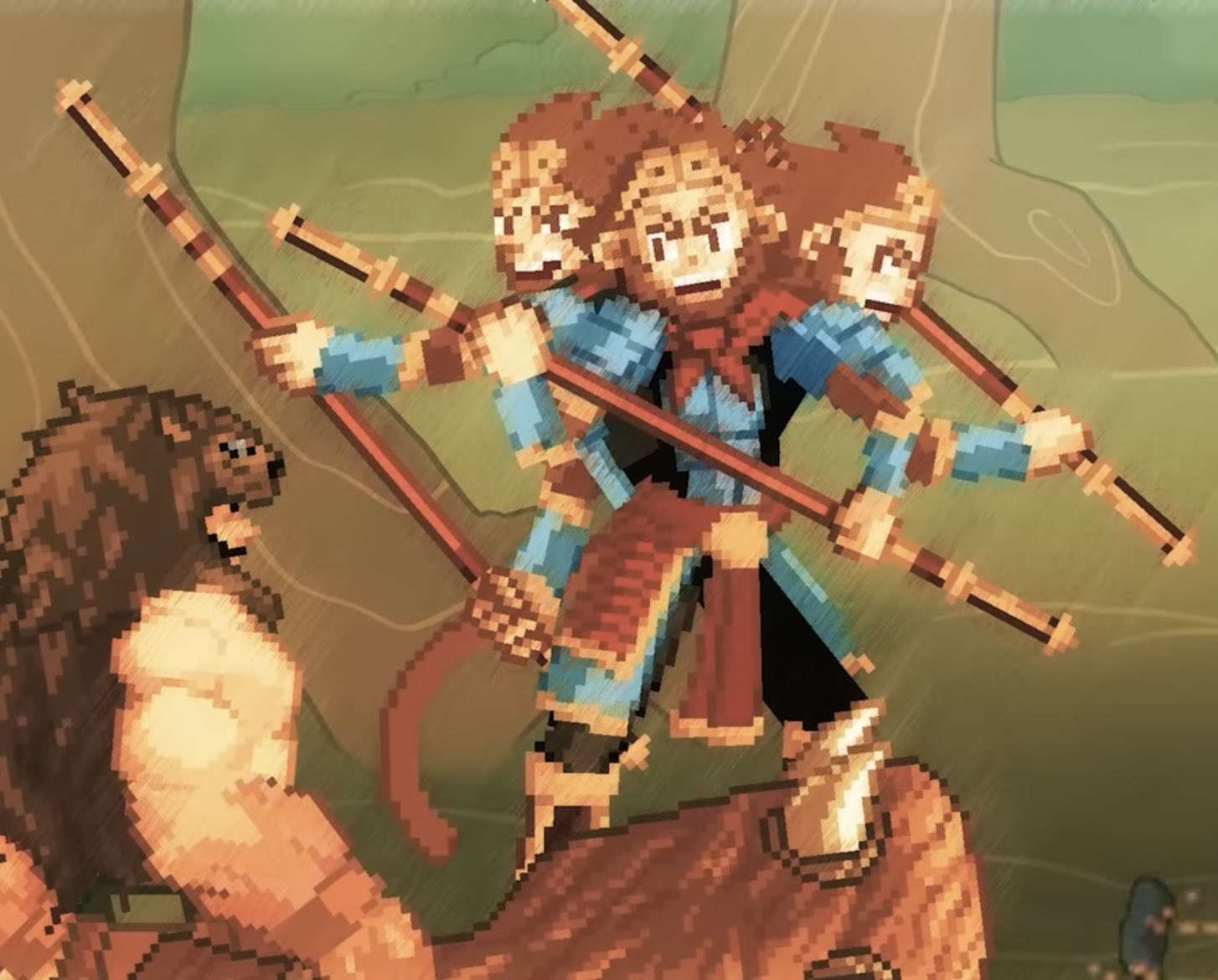
Above, I mentioned that the DEATHBATTLE! video animated the characters as sprites. I didn’t like Monkey’s design at the time because he was so tiny that you couldn’t see any of the details. However, someone on twitter recently posted hi def and up-close images of him from the battle (fig. 8), and I have to say that he looks pretty good.

Fig. 8 – The three-headed, six-armed sprite Sun Wukong from the video (larger version). Image found on this tweet.


Update: 08-03-23

I want a Hercules-Sun Wukong (fig. 9 & 10) buddy cop movie:

One is a divine hero who is super strong, wears a big cat skin, and fights monsters with a blunt weapon. The other is a divine hero who is super strong, wears a big cat skin, and fights monsters with a blunt weapon. Both are extremely pissed and ready to clean up the streets.

Fig. 9 – Hercules kicking some hydra ass (larger version). Image found here. Fig. 10 – Monkey about to kick somebody’s ass (larger version). Image found here.


Update: 12-01-24

I have split the parallels off into their own article.

Parallels Between Sun Wukong and Hercules


Update: 10-04-25

I have split off material from this page to create a new article discussing a more natural reason for Hercules and Sun Wukong to fight each other.

Story Idea: Sun Wukong vs Heracles

Notes:

1) JTTW uses two measurement units when referring to the staff, the chi (尺, i.e. “Chinese foot”; 12.52 in / 31.8 cm) and the zhang (丈; 1 = 10 chi) (Jiang, 2005, p. xxxi). Monkey is said to fight with the staff at two lengths, “two zhang” (erzhang, 二丈, i.e. 20 chi) in chapter three and “12 or 13 chi” (丈二三) in chapter 88 (Wu & Yu, 2012, vol. 1, p. 135; vol. 4, p. 196). But twenty is likely a typo for 12 (zhanger, 丈二, 3.82 m / 12.53 ft.) since the pillar was already close to the former size when Sun first saw it in the dragon treasury. Therefore, this correction agrees with the latter measurement.

2) Translation slightly altered. Yu (Wu & Yu, 2012) writes that it’s the size of a “rice bowl” (vol. 1, p. 135), but this doesn’t appear in the original Chinese.

3) In chatper 59, for example, he invades the stomach of his former bond brother‘s wife in an attempt to procure a magic weapon needed to clear his master’s path to the west:

“I’m now having a little fun in my esteemed Sister-in-law’s stomach! I am, as the saying goes, seeing right through you! I know how thirsty you must be, so let me send you a ‘sitting bowl’ to relieve your thirst” Suddenly he shoved his foot down hard and unbearable pain shot through Rākṣasī’s lower abdomen, sending her tumbling to the floor and moaning. “Please don’t refuse me, Sister-in-law,” said Pilgrim, “I’m presenting you with an added snack for your hunger.” He jerked his head upward, and unbearable pain coursed through Rākṣasī’s heart. She began to roll all over the ground, the pain turning her face yellow and her lips white. All she could do was to cry out, “Brother-in-law Sun, please spare my life!” (Wu & Yu, 2012, vol. 3, p. 129).

4) Mt. Sumeru is said to be 160,000 yojanas (1 yojana = roughly 8 miles/12.87 km) tall, with 80,000 below a great ocean and 80,000 exposed above (Vasubandhu, 2014, pp. 454).

5) Three lines from a poem in chapter 41 read: “It’s not fire from Heaven, / Nor is it a wildfire. / It’s the realized samādhi fire born of the demon’s self-cultivation” (Wu & Yu, 2012, vol. 2, p. 225).

6) “Dharma power” (fali, 法力) is the strongest form of magic in Journey to the West. See this paper for an explanation of the novel’s Buddho-Daoist cosmic hierarchy, which places Buddhist deities at the top.

7) The hydra is the nigh-immortal offspring of the Titanic monsters Typhon and Echidna (Hesiod & Powell, 2017, p. 52).

8) Yu (Wu & Yu, 2012) uses “pounds” instead of the original jin (斤, a.k.a. catty) (vol. 1, p. 135). During the Ming dynasty when the novel was compiled, one jin equaled approximately 590 grams (Jiang, 2005, p. xxxi). I will therefore alter Yu’s translation to reflect more accurate measures.

9) Yes, this information comes from Wikipedia, but I’m the one who originally added it under the screenname “Ghostexorcist.” See this edit history, for example.

10) I follow the translation used in Meulenbeld (2019). Yu (Wu & Yu, 2012) simply translates this as the “Art of the Earthly Multitude” (vol. 1, p. 122).

11) This sounds like a case of thermal shock.

Sources:

Aston, E. (2021). Labor VI: The Stymphalian Birds. In D. Ogden (Ed.), The Oxford Handbook of Heracles (pp. 95-106). United Kingdom: Oxford University Press.

Birrell, A. (1999). Chinese Mythology: An Introduction. Baltimore: The Johns Hopkins University Press.

Deacy, S. (2021). Heracles between Hera and Athena. In D. Ogden (Ed.), The Oxford Handbook of Heracles (pp. 387-394). United Kingdom: Oxford University Press.

Hanesworth, P. (2021). Labor XII: Cerberus. In D. Ogden (Ed.), The Oxford Handbook of Heracles (pp. 165-180). United Kingdom: Oxford University Press.

Hesiod, & Powell, B. B. (2017). The Poems of Hesiod: Theogony, Works and Days, and The Shield of Herakles. United States: University of California Press.

Hinsch, B. (2011). Women in Early Imperial China. Lanham, Md: Rowman & Littlefield Publishers.

Hsing, I.T., & Crowell, W. G. (2005). Heracles in the East: The Diffusion and Transformation of His Image in the Arts of Central Asia, India, and Medieval China. Asia Major, 18(2), 103–154. http://www.jstor.org/stable/41649907

Hsu, K. L. (2021). The Madness and the Labors. In D. Ogden (Ed.), The Oxford Handbook of Heracles (pp. 13-25). United Kingdom: Oxford University Press.

Huntington, J. C., Bangdel, D. (2003). The Circle of Bliss: Buddhist Meditational Art. United Kingdom: Serindia Publications.

Jiang, Y. (2005). The Great Ming Code: Da Ming Lü. United States: University of Washington Press.

March, J. (2021). Labor I: The Nemean Lion. In D. Ogden (Ed.), The Oxford Handbook of Heracles (pp. 29-44). United Kingdom: Oxford University Press.

Mayor, A. (2021). The Girdle of the Amazon Hippolyte. In D. Ogden (Ed.), The Oxford Handbook of Heracles (pp. 124-134). United Kingdom: Oxford University Press.

Meulenbeld. (2019). Vernacular “Fiction” and Celestial Script: A Daoist Manual for the Use of Water Margin. Religions10(9), 518. MDPI AG. Retrieved from http://dx.doi.org/10.3390/rel10090518

Ogden, D. (2021a). Introduction. In D. Ogden (Ed.), The Oxford Handbook of Heracles (pp. xxi-xxxi). United Kingdom: Oxford University Press.

Ogden, D. (2021b). Labor VIII: The Mares of Diomede (and Alcestis). In D. Ogden (Ed.), The Oxford Handbook of Heracles (pp. 113-123). United Kingdom: Oxford University Press.

Pache, C. (2021). Birth and Childhood. In D. Ogden (Ed.), The Oxford Handbook of Heracles (pp. 3-12). United Kingdom: Oxford University Press.

Romero-Gonzalez, D. (2021). Deianeira, Death, and Apotheosis. In D. Ogden (Ed.), The Oxford Handbook of Heracles (pp. 266-280). United Kingdom: Oxford University Press.

Sadakata, A. (1997). Buddhist Cosmology: Philosophy and Origins. Japan: Kosei Publishing Company.

Salowey, C. (2021). The Gigantomachy. In D. Ogden (Ed.), The Oxford Handbook of Heracles (pp. 235-250). United Kingdom: Oxford University Press.

Salapata, G. (2021). Labor XI: The Apples of Hesperides. In D. Ogden (Ed.), The Oxford Handbook of Heracles (pp. 149-164). United Kingdom: Oxford University Press.

Shahar, M. (2008). The Shaolin Monastery: History, Religion, and the Chinese Martial Arts. Honolulu: University of Hawai’i Press.

Theocritus, & Gow A. S. F. (1952). Theocritus (Vol. 1-2). Kiribati: Cambridge University Press.

Vasubandhu (2014). Abhidharmakosabhasyam of Vasubandhu (Vol. 2) (L. de La Vallee Poussin & L. M. Pruden, Trans.). United States: Jain Publishing Company.

Wivell, C.S. (1994). The Story of How the Monk Tripitaka of the Great Country of T’ang Brought Back the Sūtras. In V. Mair (Ed.), The Columbia Anthology of Traditional Chinese Literature (pp. 1181-1207). New York: Columbia University Press.

Wu, C., & Yu, A. C. (2012). The Journey to the West (Vols. 1-4) (Rev. ed.). Chicago, Illinois: University of Chicago Press.

The Patriarch Subodhi: Sun Wukong’s First Master

Last updated: 09-25-2024

If you were to ask someone to name Sun Wukong‘s master, those familiar with Journey to the West (Xiyouji, 西遊記, 1592) would probably say the Tang monk Tripitaka (Tang Sanzang, 唐三藏). But many forget that the cleric is actually his second master. His first, the Patriarch Subodhi (Xuputi zushi, 須菩提祖師; a.k.a. “Patriarch Puti / Bodhi,Puti zushi, 菩提祖師), is rarely brought up in conversation. But this wise old man / elderly martial arts master archetype is the source of the Monkey King’s divine longevity, magical skills, and fighting prowess. He therefore deserves his own article. I’ve already written several pieces mentioning him, so I’ve decided to combine everything (including new material) onto a single page.

This article describes his origins, story in the novel, and description; the location, description, and meaning of the name of his mountain home; his school uniform; how he names his students and why the Monkey King is called Sun Wukong; his religious, magical, and martial arts curriculum, including tests of spiritual intelligence; and his spiritual powers. Despite his common portrayal as a Daoist immortal (xian, 仙), the novel stresses a connection to Buddhism. I ultimately suggest that the Patriarch Subodhi is in reality a bodhisattva (pusa, 菩薩), albeit one with Daoist leanings.

1. Origins

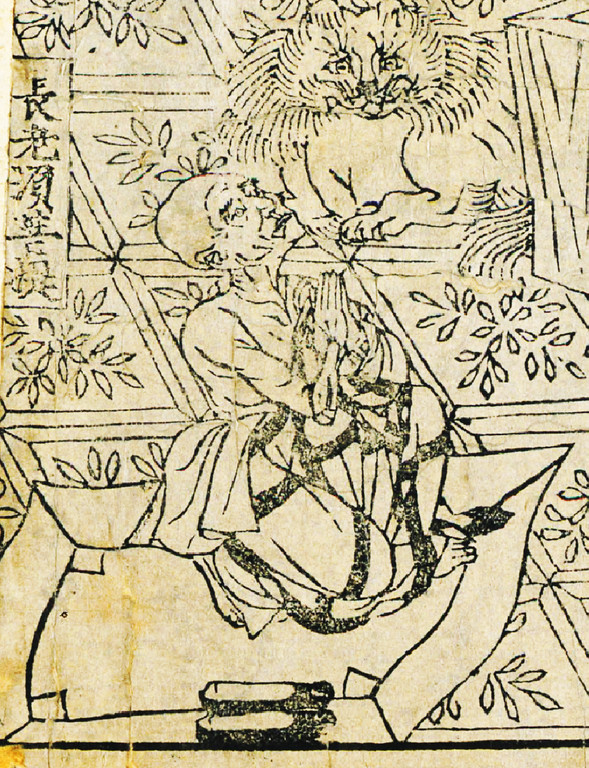
Subodhi is based on Subhūti (Xuputi, 須扶提 / 須浮帝 / 蘇補底 / 蘇部底) (fig. 1), [1] one of the ten principle disciples of the Gautama Buddha. He plays an understated role in the original Pāli canon of Theravāda Buddhism, being recognized by the Buddha as the most accomplished in meditating on the concept of “loving-kindness” (Pāli: Metta; Sanskrit: Maitri), or wishing for the happiness of others (Buswell & Lopez, 2014, pp. 861-862; Osto, 2016, pp. 126-127). On the contrary, Subhūti plays a much larger role in Prajñāpāramitā texts of Mahāyāna Buddhism in which he is famed for contemplating “emptiness” (Pāli: suññatā; Sk: śūnyatā; Ch: kong, 空), a subject with textual interpretations ranging from ridding oneself of sexual desires to realizing the truth of the illusionary nature of Saṃsāra (Buswell & Lopez, 2014, pp. 872; Osto, 2016, p. 126). Because of this, he is also known in Chinese as the “One who expounded vacuity [emptiness]” (Kongsheng, 空生) (Soothill & Hodous, 1937/2014, p. 277). In fact, Osto (2016) suggests that Subhūti was secretly a bodhisattva, reasoning: “How else would he have the necessary insight to understand the profound and paradoxical philosophy of emptiness (śūnyatā) as it is found in these texts?” (p. 128). [2]

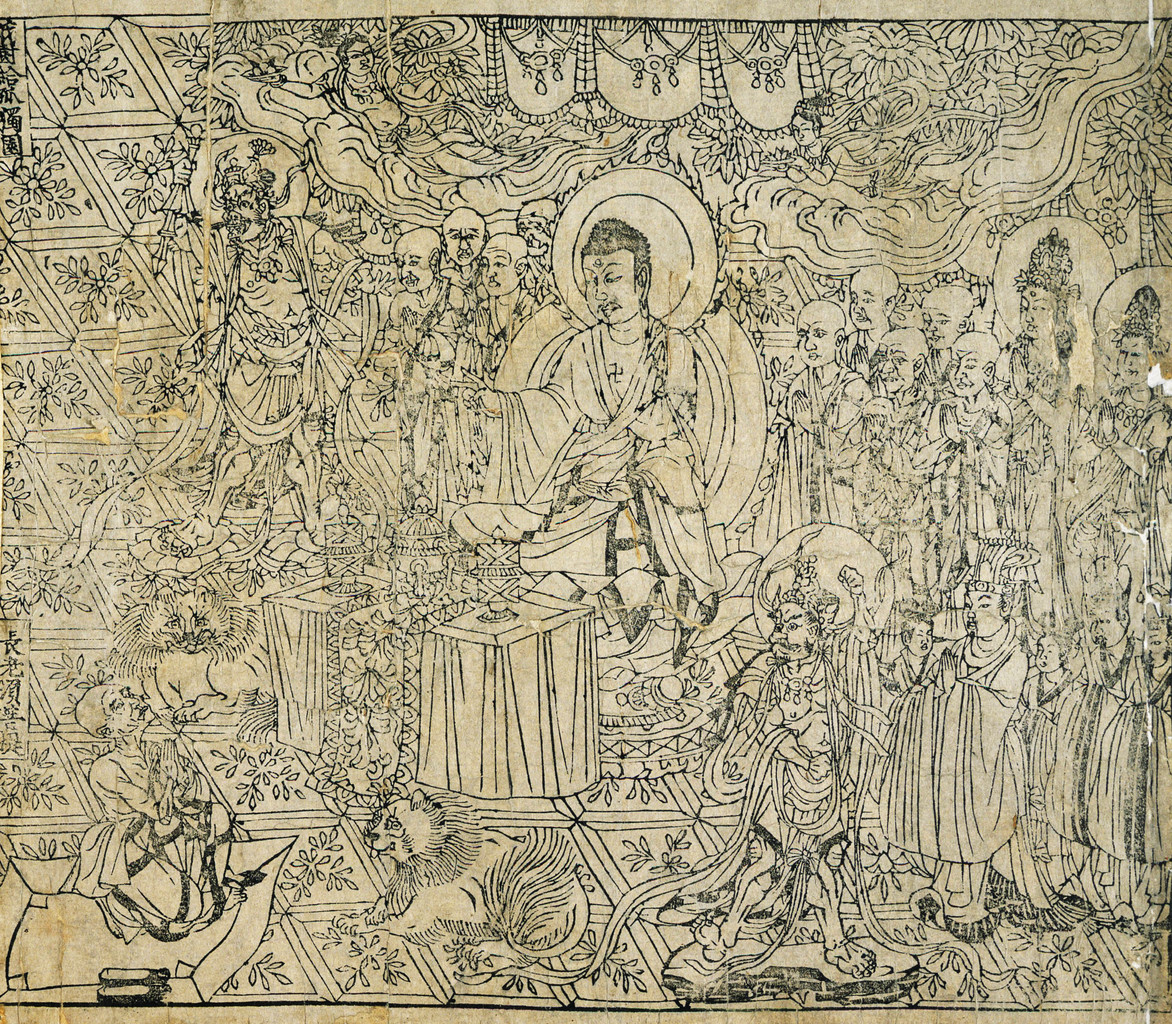
Fig. 1 – A detail of Subhūti from a woodblock frontispiece appearing in an 868 CE copy of the Diamond Sutra (larger version). This document is the oldest known dated printed book in the world (full woodblock).

Shao (2006) suggests that Subodhi was modeled on the historical disciple “to evoke a scriptural tradition that identifies Subhūti as the Buddhist at his best, one having the spiritual and intuitive approximation to ’emptiness’ … that the Chan [Zen] Buddhists value tremendously” (p. 723). He continues:

Is it then possible that what the novelist tried to highlight with Subhūti’s name was his reputation as the epitome of emptiness? We can certainly find ample textual evidence to support this line of thinking. Although Monkey’s Taoist realization is worthy of heaven, his Buddhist given name Wukong, or Awaken to Emptiness, obviously represents Subhūti’s Buddhist heritage, for the name is exactly what distinguishes Subhūti in the Buddhist tradition. What gives proof of the power and vitality of this bequest is the fact that “emptiness” constitutes the core of Monkey’s religious being (Shao, 2006, p. 724).

It should be noted that the complete Chinese name Xuputi (須菩提) is only used once in the novel to refer to the Patriarch (see here), while Puti (菩提) is used at least three times (see here). This is interesting as the latter term is a transliteration of bodhi (Pāli / Sk: “awakening” or “enlightenment”), an important concept in Buddhism in which one discovers the Four Noble Truths, thereby achieving enlightenment and freeing themself from the cycle of rebirth (Buswell & Lopez, 2014, p. 129). Therefore, the novel positions the Patriarch as a means to or even embodiment of enlightenment. This is fitting given Osto’s (2016) suggestion above that the historical Subhūti was a bodhisattva, “a ‘being’ (sattva) intent on awakening (bodhi) who has aroused the aspiration to achieve buddhahood” (Buswell & Lopez, 2014, p. 129). More on this below.

2. The literary teacher

2.1. His story

Subodhi is introduced by name in chapter one when a woodcutter tells the Monkey King about the sage and the location of his mountain home. He learns that the Patriarch “has already sent out innumerable disciples” and that at present “there are thirty or forty persons who are practicing austerities with him” (Wu & Yu, 2012, vol. 1, p. 112). After a quick exchange with an immortal lad at the front door, the Stone Monkey is led to a hall where Subodhi is lecturing to a group of “lesser immortals” (xiaoxian, 小仙). The Patriarch asks for his name and the location of his home but becomes upset as he believes Monkey is lying about his ten year journey from afar. However, after being assured of the truth and hearing of the miraculous stone birth, Subodhi officially accepts the primate as a disciple, giving him the religious name Sun Wukong (孫悟空, “Monkey Awakened to Emptiness”).

In the opening of chapter two, the Patriarch has his immortal students tutor Monkey in menial tasks like fetching firewood and water, tending the garden, and cleaning the monastery grounds, as well as provide lessons on human language and etiquette, calligraphy, scripture reading, and minor ritual procedures like incense burning. Seven years later, Subodhi notices Sun jumping around in excitement as the primate listens to his lecture. He thereafter offers to teach Monkey a number of skills, but the latter refuses multiple times since they won’t lead to immortality. This rejection makes the Patriarch visually upset, leading him to strike Sun on the head three times with a ruler and then walk away with his hands behind his back. His senior religious brothers chastise him for angering their master, but due to his spiritual intelligence, Sun realizes that the admonishment was really secret code. He later enters Subodhi’s room at the third watch (three hits) using a back door (hands behind back), and it is there where the teacher reveals the secret of immortality in a flowery poem.

After Monkey successfully attains eternal life three years later, the Patriarch teaches him the 72 transformations in order to hide from three heaven-sent elemental attacks slated to destroy him. In addition, he teaches the cloud-somersault, a method of super fast flight. Sun’s religious brothers are amazed at his attainments and request that he display his power of transformation by changing into a pine tree. The resulting applause disturbs Subodhi, who sends the others away before reprimanding and expelling his disciple under the pretense of saving Monkey’s life from those who would harm him to learn his heavenly secrets. But before Sun has a chance to leave, his master threatens him with everlasting torment in the underworld if he ever reveals that the Patriarch had been his tutor. Monkey promises never to speak his name. This is the last time that Subodhi is seen in the story, but he is referenced two more times in later chapters (see section 3.4 below).

2.2. Allusions to Buddhist masters

Shao (1997) writes that Subodhi hitting Monkey on the head three times—a coded message for receiving secret teachings in the Master’s room at the third watch—is likely based on two episodes from the life of Huineng (惠能, 638-713), the Sixth Chan (Zen) Patriarch:

According to [the Platform Sutra], Huineng was pounding grain when Hongren [the 5th Chan Patriarch] came in, “hit on the mortar three times with his stick and then left” (以杖击碓三下而去). The non-verbal message occurred to the young man as a piece of intuition. By the third watch he arrived dutifully at the master’s chamber where Hongren passed the secret Dharma by way of enlightening him on [the Diamond Sutra], behind a raised cassock used to protect them from the intrusion of prying eyes. The other source is Caoxi dashi biezhuan 曹溪大师别传 (An Alternative Biography of the Great Master From Caoxi) in which Huineng hit Shenhui … a few times, seemingly annoyed by the insolence of his disciple’s clever repartee. But it was to none other than Shenhui that he imparted the secret Dharma—in the middle of the night, and with a similar group of dumb disciples who had seen nothing but impudence in Shenhui (pp. 60-61).

The allusion to Hongren and his use of the Diamond Sutra is apt as the historical Subhūti plays a large part in the scripture. His questions fuel the lesson, with the “Buddha’s reply constitut[ing] the body of the sutra” (Watson, 2010, p. 72).

Therefore, the aforementioned episodes associate the Patriarch with two enlightened Chan masters and their secret, unorthodox transmission of the Dharma, supporting his connection to Buddhism.

The novel includes a third allusion to Huineng. This will be discussed in section 4.3 below.

2.3. His description

The novel never gives an overt description of Subodhi’s features or dress. This ambiguity makes him a blank slate onto which anyone’s personal vision can be written. But there are a few references to his stately, awe-inspiring presence. A poem in chapter one reads:

A Golden Immortal of Great Awareness and of great ken and purest mien,
Master Bodhi, whose wondrous appearance like the West
Had no end or birth by work of the Double Three.
His whole spirit and breath were with mercy filled.
Empty, spontaneous, it could change at will,
His Buddha-nature able to do all things.
The same age as Heaven had his majestic frame.
Fully tried and enlightened was this grand priest (Wu & Yu, 2012, vol. 1, p. 114). [4]

大覺金仙沒垢姿,西方妙相祖菩提。不生不滅三三行,全氣全神萬萬慈。空寂自然隨變化,真如本性任為之。與天同壽莊嚴體,歷劫明心大法師。

Numerous elements from this poem require explanation. “Golden Immortal of Great Awareness” (Dajue jinxian, 大覺金仙) was a title bestowed on the Buddha by Song Emperor Huizong in 1119 in order to bring Buddhism under the banner of Daoism (Eskildsen, 2008, p. 43 n. 32). “Wonderous appearance like the West” (Xifang miaoxiang, 西方妙相) compares the splendor of his person to the Western Pure Land (Sk: Sukhāvatī; Ch: Xifang jingtu, 西方淨土) of the Amitābha Buddha. “No end and no birth” (busheng bumie, 不生不滅) refers to his eternal life free from the wheel of reincarnation, which is thanks to his mastery of the “Double Three” (Sansan xing, 三三行). Yu (Wu & Yu, 2012) explains that this term likely refers to the “three samādhis,” a high-level meditation technique which focuses on the Buddhist philosophical concepts of emptiness, no appearance, and no desires (Wu & Yu, 2012, vol. 1, p. 507 n. 16). “Empty” (kong, 空) in the next line of course refers to Subodhi’s constant meditations on emptiness. “Buddha-nature” (Sk: tathāgatagarbha, lit: “womb of the tathāgata“; Ch: Zhenru benxing, 真如本性; a.k.a. Rulai zang, 如來藏) is “the potential to achieve buddhahood that, according to some Mahāyāna schools, is inherent in all sentient beings” (Buswell & Lopez, 2014, p. 897). This is an open reference to the Buddho-Daoist philosophy of the Southern Quanzhen School Patriarch Zhang Boduan (張伯端, mid to late-980s-1082), which greatly influenced Journey to the West. He believed that in order to become a true transcendent (xian, 仙), one had to achieve both the Daoist elixir of immortality and Buddha-nature (Shao, 1997; 2006). This dual achievement thus signifies that Subodhi is a celestial of the highest order. His “majestic” (or stately) body (zhuangyan ti, 莊嚴體) is said to have the “same age as heaven” (yutian tongshou, 與天同壽), a phrase used in the novel to denote the endless longevity of such divine beings (see here). The last line notes that he is a fully “enlightened” (mingxin, 明心; lit: “illuminous heart-mind”) master. Taken together, the allusions to Buddhas, the Western paradise, emptiness, and enlightenment speak to Subodhi’s identity as a Buddhist deity. And given his association with bodhi (awakening), I suggest that he is in fact a bodhisattva like his namesake, albeit one with Daoist leanings.

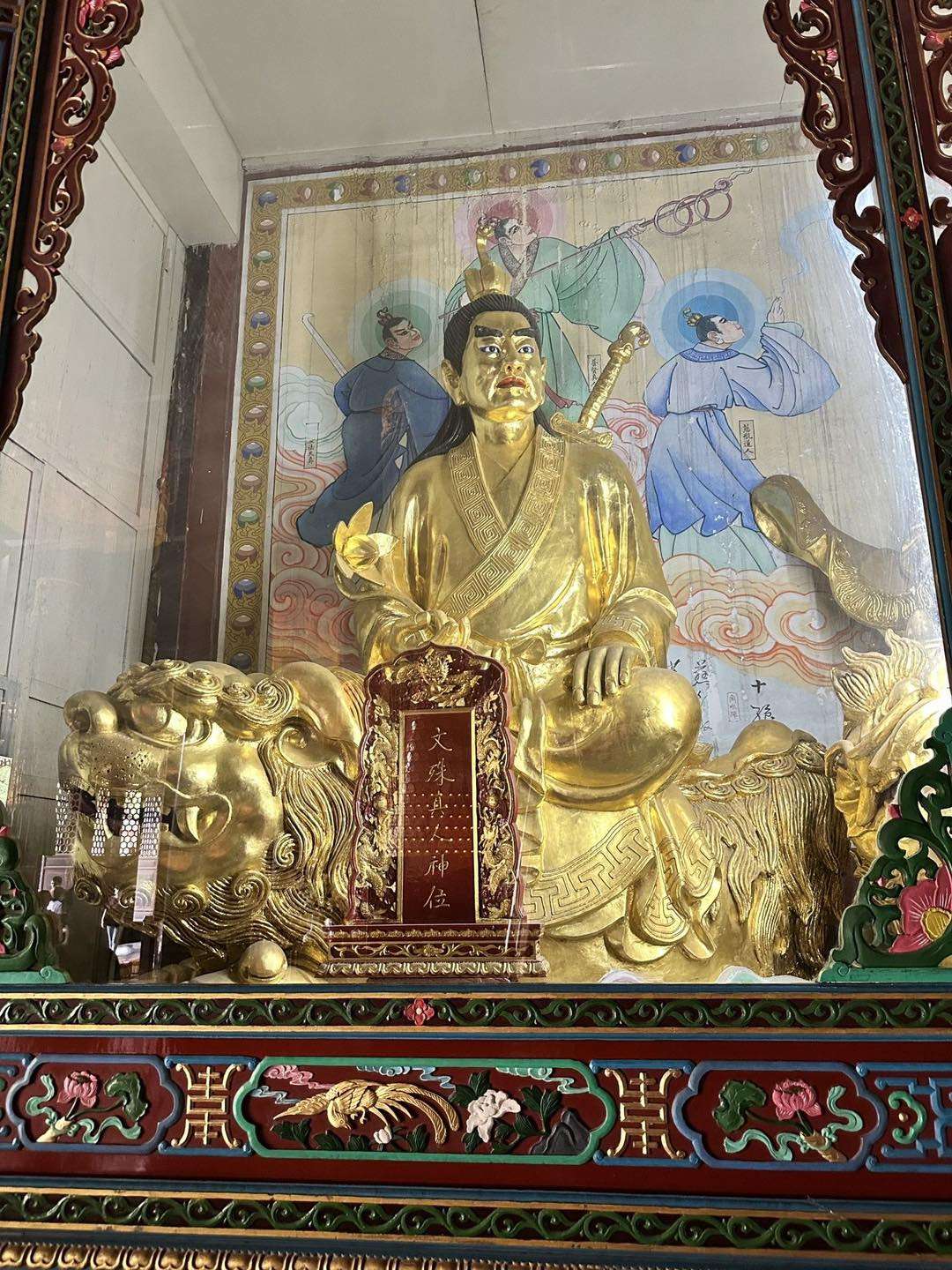
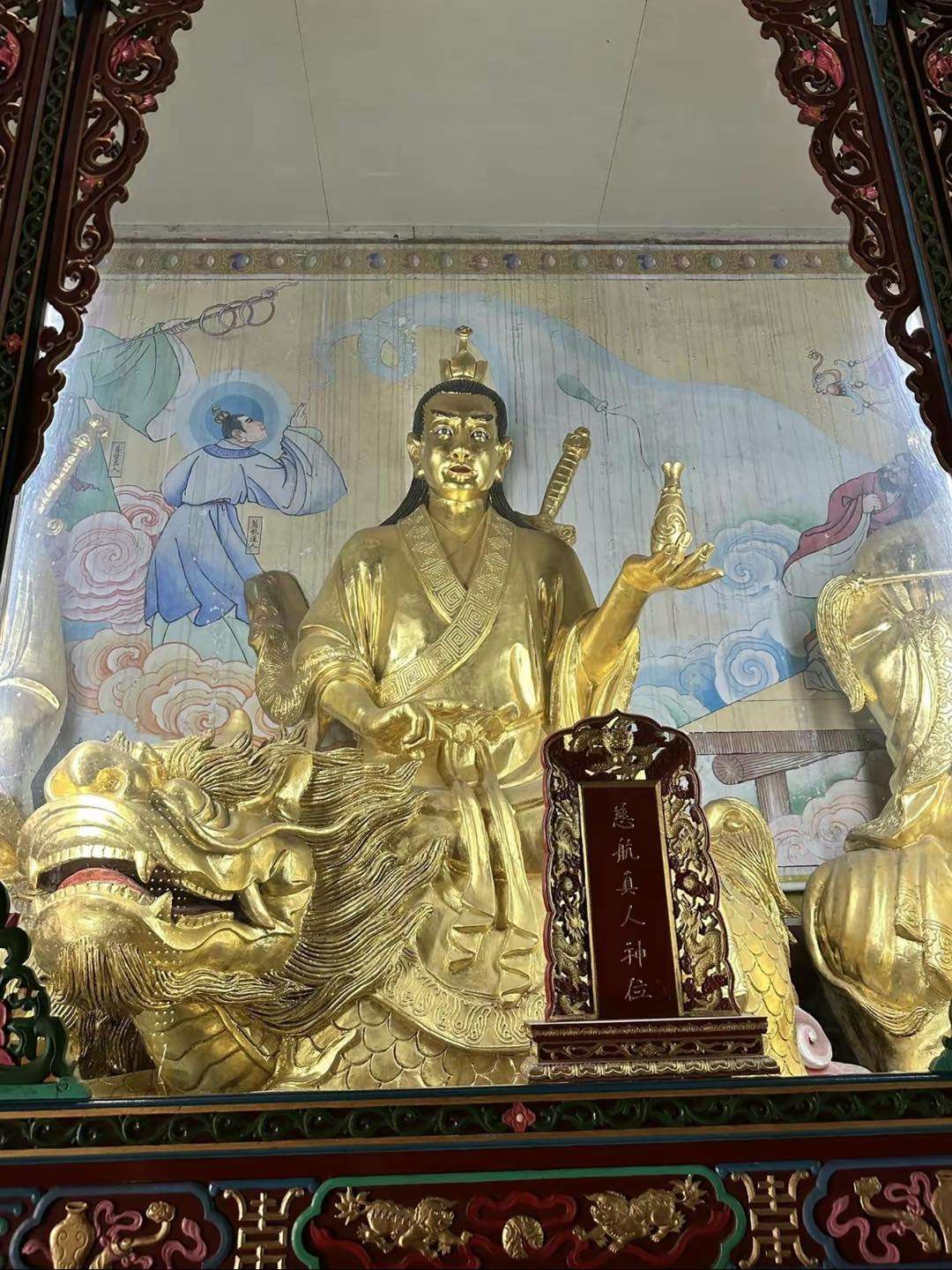
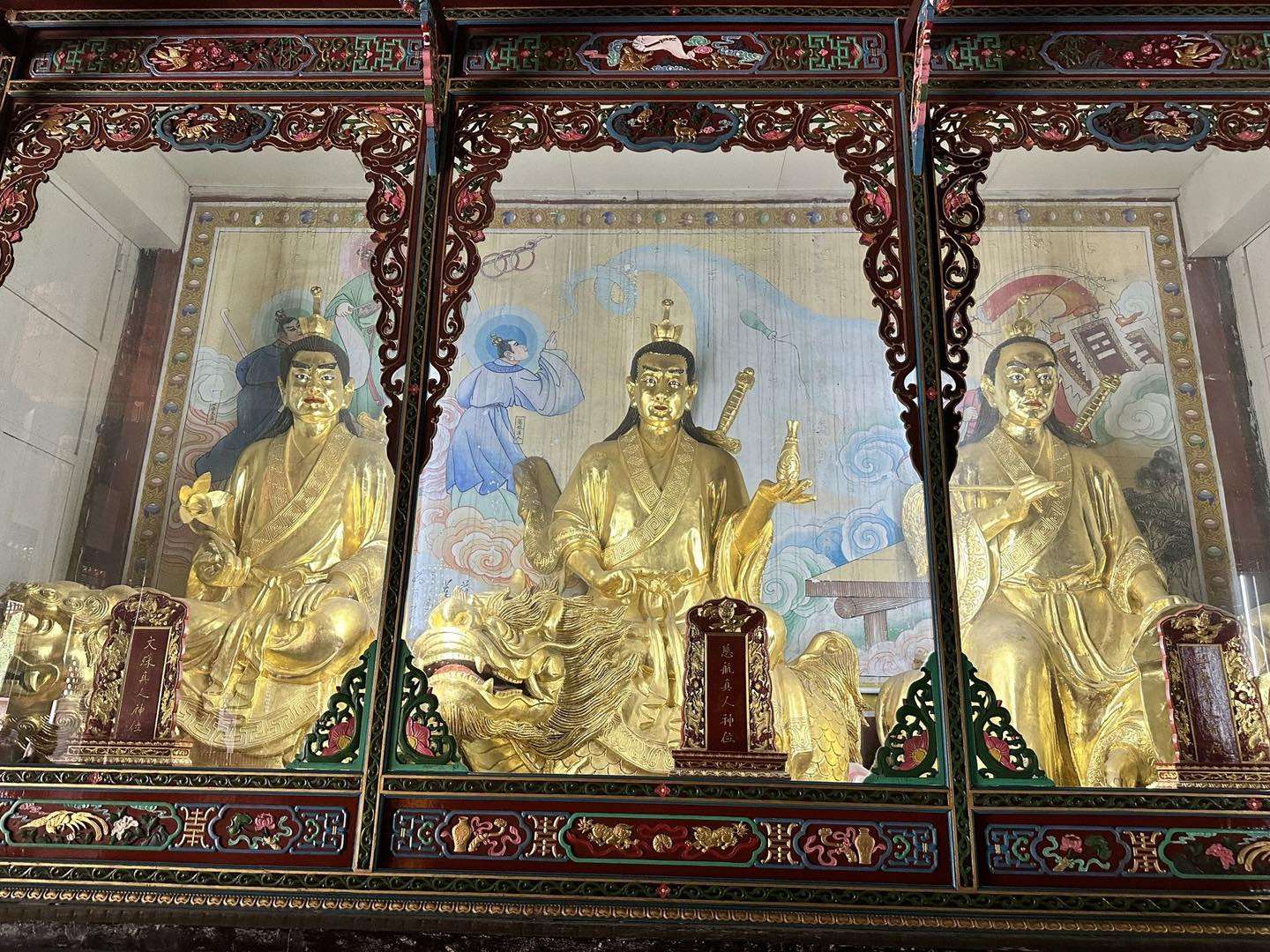
A Daoist bodhisattva may seem paradoxical, but this concept comfortably fits into the syncretic worldview espoused in late-Ming literature. For example, three well-known bodhisattvas are depicted as former high-ranking immortals in Investiture of the Gods (Fengshen yanyi, 封神演義, c. 1620). These include Guanyin (觀音) as “Person of the Way, Compassionate Ferry” (Cihang daoren, 慈航道人) (fig. 2), Mañjuśrī (Wenshu, 文殊) as the “Dharma-Spreading Heavenly Master of Outstanding Culture” (Wenshu guangfa tianzun, 文殊廣法天尊), and Samantabhadra (Puxian, 普賢) as the “Perfected Man of Universal Virtue” (Puxian zhenren, 普賢真人). Together, they later convert to Buddhism and become disciples of the Buddha at the end of chapter 83. [3]

Fig. 2 – A modern idol of Guanyin’s Daoist persona Person of the Way, Compassionate Ferry (larger version).

2.4. Ancient depiction

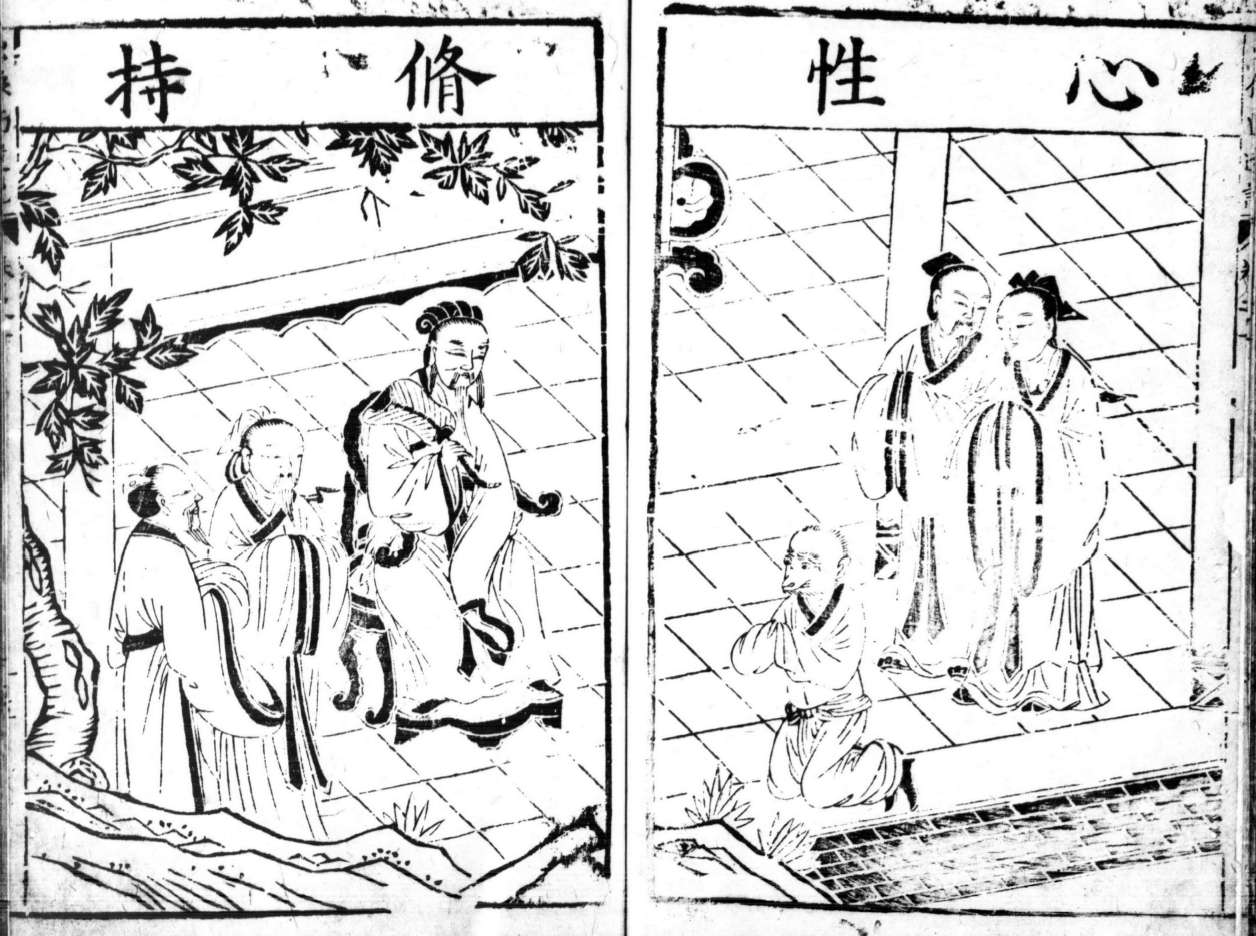
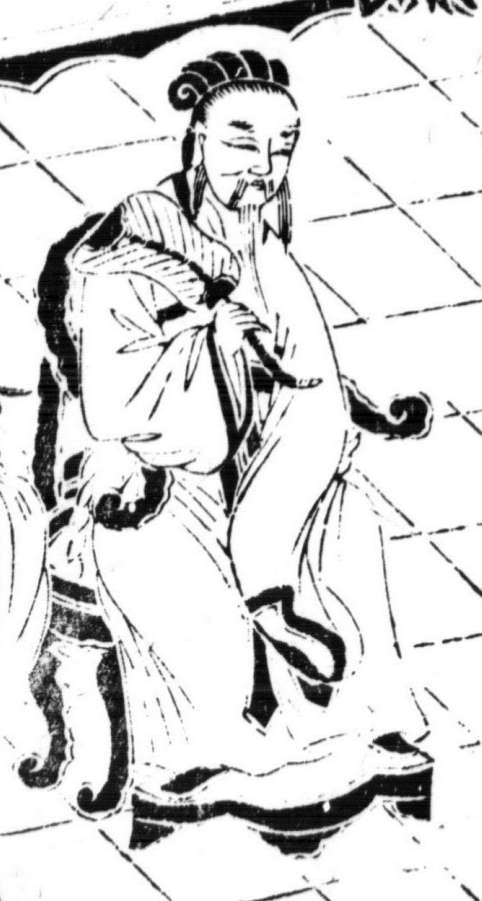
The standard 1592 edition of Journey to the West was originally published with a series of quaint woodblock prints. One features an image of the Patriarch, depicting him as a robed master holding a palace fan while seated in an ornate chair. He wears a guan-cap and has a kind face with airy whiskers and hints of large-lobed ears (fig. 3 and 4).

Fig. 3 (Left)- A woodblock of Monkey meeting the Patriarch for the first time (larger version). From the standard 1592 edition of the novel. Fig. 4 (Right) – A detail of Subodhi (larger version).

3. Mountain home

Subodhi’s home is located in a place with the literal name “Cave of the Slanted Moon and Three Stars on Spirit Tower and Square Inch Mountain” (Lingtai fangcun shan, xieyue sanxing dong靈臺方寸山,斜月三星洞).

3.1. Mountain description

The novel remarks on the beauty of the mountain as Monkey walks through a forest to the school’s front entrance:

Mist and smoke in diffusive brilliance,
Flashing lights from the sun and moon,
A thousand stalks of old cypress,
Ten thousand stems of tall bamboo.
A thousand stalks of old cypress
Draped in rain half fill the air with tender green;
Ten thousand stems of tall bamboo
Held in smoke will paint the glen chartreuse.
Strange flowers spread brocades before the door.
Jadelike grass emits fragrance beside the bridge.
On ridges protruding grow moist green lichens;
On hanging cliffs cling the long blue mosses.
The cries of immortal cranes are often heard.
Once in a while a phoenix soars overhead.
When the cranes cry,
Their sounds reach through the marsh to the distant sky.
When the phoenix soars up,
Its plume with five bright colors embroiders the clouds.
Black apes and white deer may come or hide;
Gold lions and jade elephants may leave or bide.
A Blessed Land [Fudi] to be seen in spirit:
It has the true semblance of Paradise (Wu & Yu, 2012, vol. 1, pp. 112-113).

煙霞散彩,日月搖光。千株老柏,萬節修篁。千株老柏,帶雨半空青冉冉;萬節修篁,含煙一壑色蒼蒼。門外奇花佈錦,橋邊瑤草噴香。石崖突兀青苔潤,懸壁高張翠蘚長。時聞仙鶴唳,每見鳳凰翔。仙鶴唳時,聲振九皋霄漢遠;鳳凰翔起,翎毛五色彩雲光。玄猿白鹿隨隱見,金獅玉象任行藏。細觀靈福地,真個賽天堂。

“Blessed lands” (Fudi, 福地) are thought to be “earthly paradises that do not suffer from floods, wars, epidemics, illnesses, old age or death” (Miura, 2008, p. 368). Daoism recognizes 72 Blessed Lands, each with their own documented name and location (Miura, 2008, p. 371).

3.2. Cave description

Once Sun is invited inside, the cave is described as having “rows and rows of lofty towers and huge alcoves, of pearly chambers and carved arches,” as well as “innumerable quiet chambers and empty studios” (Wu & Yu, 2012, vol. 1, p. 114). The hall where Subodhi gives his lessons is said to be centered around his “green jade platform” (yaotai, 瑤臺) (Wu & Yu, 2012, vol. 1, p. 114). This kind of terrace is often associated with the immortal lands of Mount Kunlun (Santangelo, 2013, p. 604 n. 5).

3.3. Buddho-Daoist metaphor

The names of the cave and mountain reference the philosophical concept of the “heart-mind” (xin, 心), the center of spiritual intellect, no less than three times. As I explain in this article, the name “slanted moon and three stars” is a literal description of the Chinese character for the heart-mind (fig. 5). “Spirit Tower/platform” (lingtai, 靈臺) is used in Daoist literature to refer to the heart-mind, more specifically the middle elixir field (zhong dantian, 中丹田) around the heart, which is considered the seat of the spirit. During internal alchemical meditation, the spirit is directed from here, along with other energetic substances from elsewhere, into the “square inch” (fangcun, 方寸). This too is a Daoist reference to the heart-mind, more specifically the lower elixir field (xia dantian, 下丹田) around the abdomen, the storehouse of vital energies. The synergy of these energies is thought to bolster the body and bring about immortality. Therefore, a more accurate translation of Patriarch Subodhi’s home, which takes into account the veiled Daoist meanings, would be “Cave of the Slanted Moon and Three Stars on the Mountain of Spiritual Heart and Elixir Mind.”

heart calligraphy

Fig. 5 – The Chinese character for heart-mind (xin) literally looks like a crescent moon surmounted by three stars. Original image found here.

At the same time, this triple emphasis on the heart-mind references Monkey’s role in the novel as the “Mind Monkey” (xinyuan, 心猿), a Buddhist concept denoting the disquieted thoughts that keep Man trapped in Saṃsāra. Evidence for this includes the titles for chapters seven (“From the Eight Trigrams Brazier the Great Sage escapes; / Beneath the Five Phases Mountain, Mind Monkey is still”) and fourteen (“Mind Monkey returns to the Right; / The Six Robbers vanish from sight”). Also, a poem in chapter seven reads: “An ape’s body of Dao weds the human mind. / Mind is a monkey—this meaning’s profound” (Wu & Yu, 2012, p. 190). [5]

Therefore, the name of the Patriarch’s mountain home is a double metaphor for Daoist alchemical and Buddhist philosophical concepts.

3.4. References in later chapters

Monkey references Subodhi and his mountain home twice in the novel. He recites a biographical poem in chapter 17 in which he states:

[…]
Seedlings of herbs I plucked on Spirit Tower Mountain.
There was in that mountain an old immortal.
His age: one hundred and eight thousand years!
He became my master most solemnly
And showed me the way to longevity
[…] (Wu & Yu, 2012, vol. 1, p. 352). [6]

[…] 靈臺山上採藥苗。
那山有個老仙長,壽年十萬八千高。
老孫拜他為師父,指我長生路一條。
[…]

In another biographical poem from chapter 67, he states: “I bowed to the Patriarch of Spirit Tower and Square Inch / and perfected with him the martial arts” (Wu & Yu, 2012, vol 3, p. 243). These statements are veiled admissions of studying alchemical and combat arts under the Sage, thereby not revealing his true master’s identity (as promised in chapter two).

3.5. Location

The location of this mountain is revealed in chapter one during Monkey’s first conversation with Subodhi. After hearing of Sun’s travels, the Patriarch asks:

[H]ow is it that you mention the East Purvavideha Continent? Separating that place and mine are two great oceans and the entire region of the Southern Jambudvipa Continent. How could you possibly get here? (Wu & Yu, 2012, vol. 1, p. 114).

祖師道:「你既老實,怎麼說東勝神洲?那去處到我這裡隔兩重大海,一座南贍部洲,如何就得到此?

The world of Journey to the West is modeled on Hindo-Buddhist cosmic geography, which places the Eastern Purvavideha Continent (Sk: “Surpassing the body”; Ch: Dongsheng shenzhou, 東勝神洲), the Southern Jambudvipa Continent (Sk: “Rose-Apple”; Ch: Nanshan buzhou, 南贍部洲), the Western Godaniya Continent (Sk: “Using Cattle”; Ch: Xiniu hezhou, 西牛賀洲), the Northern Uttarakuru Continent (Sk: “Unpleasant Sound”; Ch: Beiju luzhou, 北俱盧洲) around the four respective faces of Mount Sumeru (Ximi shan, 須彌山; Miaogao shan, 妙高山), a giant mountain that serves as the axis mundi of the cosmos, as well as the abode of assorted gods and sages (Buswell & Lopez, 2014, p. 869) (fig. 6). While said geography traditionally associates Southern Jambudvipa with India, or the known world to the ancient people of South Asia (Buswell & Lopez, 2014, p. 377), the novel places the “Land of the East” (Dongtu, 東土) (i.e. China) within the continent and associates India with Western Godaniya (Wu & Yu, 2012, pp. 204-205). Therefore, Subodhi’s mountain is located in India, further strengthening his link with Buddhism.

Fig. 6 – A diagram showing a bird’s-eye view of Hindo-Buddhist cosmic geography as presented in Journey to the West. Adapted from Buswell & Lopez, 2014, p. xxix (larger version).

4. School

4.1. Possible uniform

Upon returning to the Mountain of Flowers and Fruit from Subodhi’s school in chapter two, the novel describes Sun Wukong’s clothing through the eyes of a monster imp: “He is bare-headed, wears a red robe with a yellow sash, and has a pair of black boots on” (Wu & Yu, vol. 1, p. 127). The “red robe” is vague, but a poem in chapter one states that the immortal lad who invited Monkey into the cave was wearing a “wide robe with two sleeves of wind” (Wu & Yu, 2012, vol. 1, p. 113). This probably references the large, open arms of the zhiduo robe (直裰; a.k.a. haiqing, 海青), which is known colloquially in English as “Buddhist monk” or “Taoist monk” robes (fig. 7).

The novel doesn’t mention Monkey changing his clothing prior to returning home, so this might describe his school uniform.

Fig. 7 – A zhiduo robe with large sleeves (larger version). Image found here. Imagine this robe red, with a yellow sash at the waist.

4.2. Student names

Subodhi is shown to have 12 generational names (zibei, 字輩) used to name the cohorts of his religious lineage.

  1. Guang (廣)
  2. Da (大)
  3. Zhi (智)
  4. Hui (慧)
  5. Zhen (真)
  6. Ru (如)
  7. Xing (性)
  8. Hai (海)
  9. Ying (穎)
  10. Wu (悟)
  11. Yuan (圓)
  12. Jue (覺) (Wu & Yu, 2012, p. 115).

祖師道:「乃廣、大、智、慧、真、如、性、海、穎、悟、圓、覺十二字 …」

Three of the listed names, Zhi (智), Yuan (圓), and Jue (覺), were historically used in Daoism. [7]

Monkey is part of the tenth generation (Wu & Yu, 2012, p. 115), meaning that all of Subodhi’s students taken in around the same time would all have Wu (悟) in their name.

The novel explains in detail why Subodhi names his primate disciple Sun Wukong, tying it to Buddho-Daoist philosophy:

The Patriarch laughed and said, “Though your features are not the most attractive, you do resemble a pignolia-eating monkey (husun [猢猻]). This gives me the idea of taking a surname for you from your appearance. I intended to call you by the name Hu [猢]. If I drop the animal radical [犭] from this word, what’s left is a compound made up of the two characters, gu [古] and yue [月]. Gu means aged and yue [“moon”] denotes feminine yin energy [陰], but aged yin cannot reproduce. Therefore, it is better to give you the surname of Sun [猻]. If I drop the animal radical from this word, what we have left is the compound of zi [子] and xi [系]. Zi means a boy and xi means a baby, and that name exactly accords with the fundamental Doctrine of the Baby Boy [Ying’er zhi benlun, 嬰兒之本論]. So your surname will be ‘Sun.'”

[After explaining the generational names] “You will hence be given the religious name ‘Aware of Emptiness’ (wukong [悟空]). All right?” (Wu & Yu, 2012, vol. 1, p. 115).

祖師笑道:「你身軀雖是鄙陋,卻像個食松果的猢猻。我與你就身上取個姓氏,意思教你姓『猢』。猢字去了個獸傍,乃是個古月。古者,老也;月者,陰也。老陰不能化育,教你姓『猻』倒好。猻字去了獸傍,乃是個子系。子者,兒男也;系者,嬰細也,正合嬰兒之本論。教你姓『孫』罷。」

[…] 排到你,正當『悟』字。與你起個法名叫做『孫悟空』,好麼?」

Yu (Wu & Yu, 2012) explains: “The Baby Boy is none other than the ‘holy embryo or shengtai 聖胎,’ the avatar of the realized state of immortality in the adept’s body” (vol. 1, p. 86). Daoist doctrine dictates that the “Three Treasures” (Sanbao, 三寶) of semen (jing, 精), breath (qi, 氣), and spirit (shen, 神) be combined to create a holy embryo. The third stage of this internal alchemical process involves the nurturing of said embryo to maturation with spiritual energies and eventually guiding it upwards and out the Heavenly Gate (Tianguan, 天關), or the top of the crown. This results in a fledgling immortal spirit body that must be trained over an additional three year period in which it learns to travel far and wide apart from the physical vessel (Kohn, 2008, pp. 179-180). Therefore, Sun (孫) not only references the primate disciple’s appearance but also his Daoist immortality.

“Wukong” (悟空) combines “Emptiness” (Kong, 空) with “Awakening,” Wu (悟) being “one of the common Chinese translations for the Sanskrit term bodhi (awakening)” (i.e. the bodhi of Subodhi) (Buswell & Lopez, 2014, p. 998). Awakening takes two forms in Chan Buddhism: “instant” (dunwu, 頓悟) and “gradual” (jianwu, 漸悟). The former involves the sudden manifestation of inherent Buddha-nature (see section 2.3), while the latter involves compounding realization, often over a long period of purification (Buswell & Lopez, 2014, p. 998; see also pp. 273 and 384-385). As explained in section 1, bodhi involves realizing the Four Noble Truths, thereby achieving enlightenment and freeing oneself from the cycle of rebirth. Therefore, Wukong references said enlightenment.

Given the above information, another translation for Sun Wukong would be “Immortal Enlightened By Emptiness.” This shows that Monkey’s name incapsulates his story arc: attaining divine longevity in the beginning and ascending to Buddhahood at the end. This, again, is an open reference to the highly influential Buddho-Daoist philosophy of Zhang Boduan (see section 2.3).

4.3. Tests of spiritual intelligence

The Patriarch first offers to teach Monkey a selection of skills from the 360 “Side Gates” (bangmen, 傍門; a.k.a. pangmen, 旁門), noting that they will “result in illumination” (zhengguo, 正果; lit: “right fruit”) (Wu & Yu, 2012, vol. 1, p. 117). The skills include:

  • Method gate (Shuzi menzhong, 術字門中) – “[C]onsists of summoning immortals and working the planchette, of divination by manipulating yarrow stalks, and of learning the secrets of pursuing good and avoiding evil” (Wu & Yu, 2012, vol. 1, p. 117).
  • Dissemination gate (Liuzi menzhong, 流字門中) – “[I]ncludes the Confucians, the Buddhists, the Daoists, the Dualists, the Mohists, and the Physicians. They read scriptures or recite prayers; they interview priests or conjure up saints and the like” (Wu & Yu, 2012, vol. 1, p. 117).
  • Silence gate (Jingzi menzhong, 靜字門中) – “To cultivate fasting and abstinence … quiescence and inactivity, meditation and the art of cross-legged sitting, restraint of language, and a vegetarian diet. There are also the practices of yoga, exercises standing or prostrate, entrance into complete stillness, contemplation in solitary confinement, and the like” (Wu & Yu, 2012, vol. 1, pp. 117-118).
  • Action gate (Dongzi menzhong, 動字門中) – “[G]athering the yin to nourish the yang, bending the bow and treading the arrow, and rubbing the navel to pass breath. There are also experimentation with alchemical formulas, burning rushes and forging cauldrons, taking red lead, making autumn stone, and drinking bride’s milk and the like” (Wu & Yu, 2012, vol. 1, p. 118).

However, the Side Gates, which number 3,600 in Daoist literature, were historically considered “unorthodox training methods of limited benefit” (Eskildsen, 2019, p. 43). This shows that Subodhi is testing his disciple to see if he will fall for studying lesser arts. But Sun passes by refusing to learn them.

Another test takes place when Monkey visits his master’s room at the third watch to receive secret teachings. Shao (2006) explains that, once again, the novel alludes to the Sixth Chan Patriarch Huineng:

[Monkey] sets the stage for a striking display of his unusually profound insight when he announces his intentions to become an immortal. This provokes Subhuti to issue him a challenge by refusing to teach him, for he is “some what different from other people.” Monkey may not realize that the master is trying to gauge his spiritual power, but he rises to the occasion with a genuine clarity of vision: “I have a round head pointing to Heaven, and square feet walking on Earth. Similarly, I have nine apertures and four limbs, entrails and cavities. In what way am I different from other people?”

[…]

[W]e may look to Huineng’s story from which Monkey garners meaning. No doubt, Monkey’s inspired cleverness is modeled on Huineng’s reply to Hongren, the fifth patriarch of Chinese Chan Buddhism, in Huineng’s Tanjing (The Platform Sutra). When Huineng announces his intentions to become a Buddha, Hongren pounces upon him with a poignant reminder that he is “from Lingnan,” a “barbarian,” and therefore cannot become a Buddha. Huineng refuses to be intimidated, however. He holds his own with an unparalleled depth of insight about Buddha-nature: There may be “northern and southern men,” but “the Buddha nature fundamentally has no north or south.” Surely Monkey’s phrasing, his unusual insightfulness, and the quickness and aplomb with which he rises to the challenge are reminiscent of Huineng … (pp. 719-720).

Monkey clearly passes this test, for his insightful reply convinces the Patriarch to teach him the secret of eternal life.

Subodhi no doubt uses such examinations to filter out unsuitable candidates, allowing only the brightest individuals to become his inner disciples.

4.4. Overtly stated curriculum and tools

The novel specifically mentions Subodhi offering or teaching Monkey the following concepts:

1) Chinese philosophy – A poem describes one of these lectures with esoteric imagery. Most importantly, a section states: “For a while he lectured on Dao / For a while he spoke on Chan / To harmonize the Three Parties is a natural thing” (Wu & Yu, 2012, vol. 1, p. 116).

The “Three Parties” refer to the Ming syncretic philosophy of the “Three Teachings” (Sanjiao, 三教), which combines elements from Buddhism, Daoism, and Confucianism. This shows that his disciples are given a well-rounded religious education, which explains why Sun is competent even in Buddhist scripture. [9]

Also, during his lectures on philosophy, Subodhi is said to wield a “Precepts ruler” (jiechi, 戒尺), which he uses to admonish his students (Wu & Yu, 2012, vol. 1, p. 118). Such a device figures among the tools of Buddhism (Leong, 2001, p. 49).

2) Secret of Immortality – Breathing exercises designed to absorb yang energy during prescribed times (after midnight and before noon), the retention of chaste semen and transformation into qi energy, and the purification and circulation of the resulting spiritual energy throughout the body.

These internal methods are passed onto Monkey in secret via a flowery poem chocked full of alchemical imagery. It ends with the line, “When that’s done, be a Buddha or immortal at will!” (Wu & Yu, 2012, vol. 1, p. 120). Combined with his syncretic philosophy, this suggests that the Patriarch offers his students more than one spiritual path to divinity.

3) Transformations – A series of oral formulas that allow the user to change their body into any person, animal, or object. Two forms are offered: the 72 changes of the “Multitude of Terrestrial Killers” (Disha shu, 地煞數) and the 36 changes of the “Multitude of the Heavenly Rectifiers” (Tiangang shu, 天罡數) (Wu & Yu, 2012, vol. 1, p. 122). [8]

Subodhi teaches this skill to Monkey with the expressed purpose of helping him hide from three calamities of cosmic lightning, fire, and wind sent by heaven to destroy immortals for defying fate and achieving eternal life. But beyond the power of metamorphosis, the novel implies that the ability also grants the user multiple lives (similar to a video game), which might serve as a buffer against the calamities. For example, in chapter 41, after Sun passes out from Red Boy‘s fiery attack, Zhu Bajie reassures everyone by saying: “If he is capable of seventy-two transformations, he has seventy-two lives” (Wu & Yu, 2012, vol. 2, p. 232). Also, in chapter 46, Monkey magically regrows his head after being non-fatally beheaded in a contest of magical skill. Sha Wujing remarks: If he knows seventy-two ways of transformation, … he may have altogether seventy-two heads!” (Wu & Yu, 2012, vol. 2, p. 308). In addition, while not directly related to the primate hero, the Bull Demon King is said in chapter 61 to also know the 72 changes (Wu & Yu, 2012, vol. 3, p. 148). He uses the extra lives to survive being beheaded by Prince Nezha a number of times:

[Nezha] leaped onto the bull’s back and brought his monster-cleaving sword down on the bull’s neck: the bull was beheaded at once. Putting away his scimitar, the devaraja was about to greet [Sun Wukong] when another head emerged from the torso of the bull, his mouth belching black air and his eyes beaming golden rays. [Nezha] lifted his sword once more and cut off the bull’s head; as soon as it dropped to the ground, another head came out. It went on like this more than ten times. At last, [Nezha] took out his fiery wheel and hung it on the Bull’s horn. The wheel at once started a great blaze of true immortal fire, which burned so fiercely that the bull began to growl and roar madly, shaking his head and wagging his tail (Wu & Yu, vol. 3, p. 160). [10]

飛身跳在牛王背上,使斬妖劍望頸項上一揮,不覺得把個牛頭斬下。天王收刀,卻才與行者相見。那牛王腔子裡又鑽出一個頭來,口吐黑氣,眼放金光。被哪吒又砍一劍,頭落處,又鑽出一個頭來。一連砍了十數劍,隨即長出十數個頭。哪吒取出火輪兒掛在那老牛的角上,便吹真火,焰焰烘烘,把牛王燒得張狂哮吼,搖頭擺尾。

This agrees with the connection between transformation and immortality in Daoism. Robinet (1979) explains that gods and saints are portrayed in Daoist literature as being in constant flux, changing with the seasons, taking on different guises and titles, disappearing and reappearing, never remaining the same, thereby living eternally.

4) Flight – A method of flying through the sky on divine clouds. Two types are offered: “cloud-soaring” (jiayun, 駕雲), the most common method used by celestials throughout the cosmos. It involves stamping the foot to summon clouds (Wu & Yu, 2012, vol. 1, p. 123); and “cloud-somersaulting” (jindou yun, 觔/筋斗雲), the method chosen by Sun (fig. 8). It involves simultaneously “mak[ing] the magic sign, recit[ing] the spell, clench[ing] the fist tightly, shak[ing] the body” and then jumping into the sky, leaping from cloud to cloud (Wu & Yu, 2012, vol. 1, p. 123). The latter method is by far the fastest, enabling the user to travel 108,000 li (33,554 mi / 54,000 km) in a single instant.

Shao (2006) states that the latter skill is based on a philosophical metaphor from Huineng’s Platform Sutra. The Chan Master explains that the common trope of the Buddha’s paradise being separated from the world of man by 108,000 li is based on a combination of the “Ten Evils” (Shi’e, 十惡) and “Eight Wrongs” (Baxie, 八邪) of Buddhism (see section III here). Those who rid themselves of these spiritual flaws will achieve enlightenment and thus arrive instantly at the Buddha’s paradise (Shao, 2006, p. 718; Huineng & Cleary, 1998, pp. 26-27). Therefore, Subodhi teaches a skill that’s a metaphor for instant enlightenment, further supporting his connection to Buddhism.

37e2fc9cebe000bb1c76c73e7ad2963a-d5oas0h

Fig. 8 – Monkey soaring on his cloud (larger version). Drawing by Funzee on deviantart.

4.5. Mentioned in passing

As noted in section 3.3, Sun states: “I bowed to the Patriarch of Spirit Tower and Square Inch / and perfected with him the martial arts [wuyi, 武藝]” (Wu & Yu, 2012, vol 3, p. 243). [11]

5) Military arts – Monkey demonstrates knowledge in troop movement, weapons (swords, spears, axes, bows and arrows, staves, etc.), and unarmed boxing. His preferred method is “Short Fist” (Duan quan, 短拳), which is known for compact, short-ranged attacks. This is likely just one of many boxing styles taught by Subodhi.

Shahar (2008) explains that the martials arts of the famed Chan Buddhist Shaolin Monastery developed during the Ming-Qing transition from a synthesis of Daoist gymnastics (stretching and breathing exercises), religious rituals, and fist techniques. This new form of spiritual cultivation ushered in the era of so-called “internal martial arts,” Taiji boxing being the most famous among them. Journey to the West was published during the late-Ming when this synthesis was in full swing. Therefore, the study of martial arts in a religious institution is an accurate snapshot of one facet of 16th-century monastic life.

4.6. Implied

Although not directly stated, the following skills are likely learned while studying under the Patriarch.

6) General magic – Monkey is shown capable of calling forth gods and spirits, growing or shrinking to any size, parting fire and water, creating impassable barriers, conjuring wind storms, casting illusions, freezing people in place, making endless doubles of himself, unlocking any lock, bestowing superhuman strength, bringing the dead back to life, etc.

7) Traditional Chinese Medicine – Monkey knows how to analyze a patient’s pulse and then concoct individualized medicine from a number of raw ingredients.

This makes sense as a knowledge of harming and healing often goes hand in hand in traditional Chinese martial arts. A prime example is the folk hero Wong Fei-Hung (黃飛鴻, 1847-1925), a Hung Ga boxer and physician from Qing-era Guangdong.

5. Powers

The breadth of skills taught to Monkey speaks to the Patriarch’s own vast array of religious, magical, and martial abilities. But he displays (or at least hints at having) the following three powers.

5.1. Clairvoyance

Subodhi demonstrates the ability to see peoples, events, and times beyond his person in chapter one when Monkey first arrives at his home. An immortal lad opens the door and tells the primate:

“My master … has just left his couch to give a lecture on the platform. Before even announcing his theme, however, he told me to go out and open the door, saying, ‘There is someone outside who wants to practice austerities. You may go and receive him'” (Wu & Yu, 2012, vol. 1, pp. 113-114).

童子道:「我家師父正才下榻,登壇講道,還未說出原由,就教我出來開門。說:『外面有個修行的來了,可去接待接待。』… 」

5.2. Omniscience

At the end of chapter two, Subodhi makes a statement suggesting that he is aware of all things:

I forbid you ever to mention that you are my disciple. For if you but utter half the word, I’ll know about it; you can be assured, wretched monkey, that you’ll be skinned alive … (Wu & Yu, 2012, vol. 1, p. 125).

卻不許說是我的徒弟。你說出半個字來,我就知之,把你這猢猻剝皮

5.3. Control of spirits and karmic results

He continues: “I will break all your bones and banish your soul to the Place of Ninefold Darkness, from which you will not be released even after ten thousand afflictions!” (Wu & Yu, 2012, vol. 1, p. 125). This latter ability implies that he has some control over souls and their karmic punishment in the afterlife.

5.4. Possible reason for expelling Monkey

The aforementioned powers raises a question: “If Subodhi has these abilities, why would he take Sun as a disciple knowing full well that he would later expel him for simply displaying his newly cultivated powers?” Someone might say showing off is a sign of ego and the need for validation, qualities unbecoming of a spiritual cultivator. But there is a better answer. Being a bodhisattva with the power of foresight, the Patriarch would no doubt foresee Monkey’s later attainment of Buddhahood, realizing that the trials and tribulations of protecting the Tang Monk on the journey to India would be the price that he needs to pay to gradually awaken (jianwu, 漸悟) his enlightenment. Therefore, expelling Sun would ignite the chain of events leading to his eventual Buddhahood. This makes Subodhi an agent of Dharma, one who uses whatever methods necessary to bring about the enlightenment of his disciples.

6. Conclusion

The Patriarch Subodhi finds his origins in Subhūti, one of the ten principle disciples of the historical Buddha known for his knowledge of “emptiness.” The literary figure’s connection to Buddhism is not in name only, however. The Chinese name used most in the novel to refer to Subodhi is Puti, a transliteration for bodhi (“awakening” or “enlightenment”). His story in Journey to the West is partly based on events from the lives of the respective Fifth and Sixth Chan (Zen) Patriarchs and their transmission of the Dharma. A poem in chapter one even compares him to the Buddha and the splendor of the Western paradise, as well as further ties him to emptiness and enlightenment.

The name of Subodhi’s home, Cave of the Slanted Moon and Three Stars on the Mountain of Spiritual Heart and Elixir Mind, serves as a double metaphor for Daoist internal alchemical practices and Buddhist concepts of the mind. It is described as a mountain paradise, and the cave therein is said to be filled with grand architecture, which is centered around the Patriarch’s green jade lecture platform. The mountain is located in the Western Godaniya Continent of Hindo-Buddhist cosmic geography, placing it squarely in India, home of the historical Subhūti.

Subodhi’s students possibly wear a red robe with large, open sleeves, a yellow sash, and black boots, and they are named according to a twelve generation character list. His choice for the Monkey King’s religious name, Sun Wukong, is packed full of philosophical significance related to the formation of a Daoist immortal spirit embryo and the manifestation of enlightenment. As for the Patriarch’s curriculum, he teaches Buddho-Daoist philosophy, the secret of eternal life, transformations, flight via cloud, armed and unarmed military arts, general magic, and Traditional Chinese Medicine. Tests of spiritual intelligence appear to be used to permit only the brightest into his inner circle.

Subodhi exhibits (or hints at having) clairvoyance, omniscience, and control over souls and karmic results. His power of foresight might then explain why he accepted Monkey as a student, only to later expel him. This was likely done to ignite the chain of events that would eventually lead to Sun’s achievement of Buddhahood, thereby completing the last of Zhang Boduan’s two-step process towards Buddo-Daoist transcendence.

Journey to the West stresses the Patriarch’s status as a Buddhist deity, albeit one with Daoist leanings. Therefore, I suggest that he is a bodhisattva like (as one scholar has proposed) the historical Subhūti. A Daoist bodhisattva, however, is not a paradox as such figures appear in late-Ming syncretic popular literature. Examples include the former high-ranking immortals-turned-bodhisattvas Guanyin, Mañjuśrī, and Samantabhadra from Investiture of the Gods (c. 1620).


Update: 06-04-22

Above I mentioned that Puti (菩提) is used at least three times to refer to Subodhi, thus stressing the Patriarch’s connection to the Buddhist concept of bodhi (Pāli / Sk: “awakening” or “enlightenment”). There’s actually a fourth usage, appearing in the title of chapter two: “Fully awoke to Bodhi’s wondrous truths / He cuts off Mara, returns to the root, and joins Primal Spirit” (Wu & Yu, 2012, p. 116). The title serves as a double reference to the end of Prince Siddhārtha‘s path to enlightenment. (I explain in this article that the author-compiler of the standard 1592 edition of Journey to the West likely based Monkey’s early life on the Buddha to make his spiritual journey more familiar to the reader.) As part of the Prince’s meditative journey inward to discover hidden truths, he faces off against the army of the heavenly demon Māra (Mo, 魔), the ruler of the illusionary world of Saṃsāra. But these evil forces are rendered powerless by Siddhartha’s supreme focus of mind and burgeoning grasp of reality. He shortly thereafter achieves enlightenment (a.k.a. bodhi) (Beal, 1883, pp. 156-163). Likewise, thanks to [Su]Bodhi’s guidance, Sun Wukong is able to also stop Mara and achieve immortality.

This free association between Buddhist (bodhi/Mara/returning to the root) and Daoist (primal spirit) concepts was common place in Ming-era religious literature. Darga (2008) explains:

Comparing the development of the embryo to the revelation of Buddhahood is typical of neidan texts of the Ming period. For instance, the Xingming guizhi (Principles of Balanced Cultivation of Inner Nature and Vital Force) uses Body of the Law (fashen 法身, dharmakāya) as a synonym for shengtai. The birth of the embryo represents the appearance of the original spirit (yuanshen 元神) or Buddhahood and is understood as enlightenment (p. 884).

Therefore, the Monkey King’s immortality is synonymous with the Buddha’s enlightenment. And since Subodhi is key to Sun’s spiritual achievement, and given the Patriarch’s demonstrated connection to Buddhism in the novel, I’d like to further suggest that the character is the original disciple Subhūti. After all, he still lives in India like his namesake.

Despite all of the overwhelming evidence for the Patriarch’s connection to Buddhism, someone might point out that the novel refers to him as a “Spirit Immortal” (shenxian, 神仙) (for example). The Anthology of the Transmission of the Dao from Zhongli Quan to Lü Dongbin (Zhong Lü Chuan Dao Ji, 鐘呂傳道集, c. late-Tang) explains that this is the fourth of five kinds of transcendents [12] who has cast off the mortal body (per the methods outlined above) to enjoy a life free from the dust of the world (Wong, 2000, p. 29; see also here). But making this distinction in the face of Ming syncretism amounts to little more than arguing semantics. As we’ve seen, this philosophy equates achieving immortality with enlightenment. And Subodhi’s description above as having “no end and no birth” (busheng bumie, 不生不滅) embodies that, for he has both the Daoist elixir and the Buddha-mind and has thus broken free of the wheel of rebirth.

Taking a page from the Daoist Bodhisattvas of Investiture of the Gods (Fengshen yanyi, 封神演義, c. 1620), perhaps Subodhi/Subhūti was an immortal recruited by the Buddha, or the Buddhist disciple trained under the former high-ranking immortals-turned-bodhisattvas Guanyin, Mañjuśrī, and Samantabhadra. Knowing different paths to divinity would make him a more affective teacher and bodhisattva.

Here is a welcoming, modern image of Subhūti (fig. 9). The top line reads “The Honored Monk Subhūti’s Understanding of Emptiness is Number One” (Xuputi zunzhe jiekong diyi, 须菩提尊者解空第一). I love the golden halo.

Fig. 9 – A modern ink on paper drawing of Subhūti (larger version). Image found here.


Update: 06-06-22

Subodhi is alluded to in Investiture of the Gods (c. 1620). It reproduces a poem about the sage from chapter one of Journey to the West (section 2.3). The original reads:

A Golden Immortal of Great Awareness and of great ken and purest mien,
Master Bodhi, whose wondrous appearance like the West
Had no end or birth by work of the Double Three.
His whole spirit and breath were with mercy filled.
Empty, spontaneous, it could change at will,
His Buddha-nature able to do all things.
The same age as Heaven had his majestic frame.
Fully tried and enlightened was this grand priest (Wu & Yu, 2012, vol. 1, p. 114).

大覺金仙沒垢姿,西方妙相祖菩提。不生不滅三三行,全氣全神萬萬慈。空寂自然隨變化,真如本性任為之。與天同壽莊嚴體,歷劫明心大法師。

Chapter 61 of Investiture of the Gods reproduces the poem with only minor changes (indicated in red):

A Golden Immortal of Great Awareness and timelessness, [13]
Dharma Master Bodhi of the wondrous West
Had no end or birth by work of the Double Three.
His whole spirit and breath were with mercy filled.
Empty, spontaneous, it could change at will,
His Buddha-nature able to do all things.
The same age as Heaven had his majestic frame.
Fully tried and enlightened was this grand priest (emphasis mine). [14]

大覺金仙不二時,西方妙祖菩提。不生不滅三三行,全氣全神萬萬慈。空寂自然隨變化,真如本性任為之。與天同壽莊嚴體,歷劫明心大法師。

It goes on to associate the poem with a Buddhist deity known as “Person of the Way, Cundī (Zhunti daoren, 準提道人) (fig. 10). This figure is traditionally considered a multi-armed, female bodhisattva with a strong connection to the Cundā Dhāraṇī, a power-bestowing mantra (Buswell & Lopez, 2014, p. 204). Therefore, it appears that the author was trying to provide an origin for Subodhi (likely based on “提” (ti) appearing in both character’s names). Afterall, the novel is often considered a sequel to Journey to the West because it reveals the origins of many secondary characters (Li Jing, Nezha, Muzha, Erlang, etc.). However, it’s important to remember that Investiture of the Gods is still a separate novel by a different author. So, any events therein should NOT be considered canon for Journey to the West. Besides, the latter work clearly establishes a link between Subodhi and the historical Subhūti.

Fig. 10 – Person of the Way, Cundī (top right) fighting against a rogue immortal (lower left) (larger version). From a modern manhua comic book. Image found here.


Update: 06-09-22

It turns out that Subodhi is not the invention of the author-compiler [15] of the standard 1592 edition of Journey to the West. He appears in the earlier “Zhu edition” of the novel, a.k.a. Chronicle of Deliverances in Tang Sanzang’s Journey to the West (Tang Sanzang Xiyou shi e zhuan, 唐三藏西遊释厄傳) by Zhu Dingchen (朱鼎臣). [16] The following quote indicates the differences between the Zhu edition (red) with the 1592 edition (black):

With solemnity the Monkey King set his clothes in order and followed the boy into the depths of the cave. They passed rows and rows of lofty towers and huge alcoves, of pearly chambers and carved arches. After walking through innumerable quiet chambers and empty studios, they finally reached the base of the green jade platform. Patriarch Subodhi was seen seated solemnly on the platform, with thirty lesser immortals standing below in rows. He [It] was truly a realm of immortals. Let’s listen to the explanation in the next chapter. (emphasis mine)

[Poem describing Master Subodhi. See above for translation. The Zhu version has a typo in the line “Grand priest” (“大師” instead of “大法師”).]

這猴王整衣端,隨童子徑入洞天深處觀看:一層層深閣瓊樓,一進進珠宮貝闕,說不盡那靜室幽居,直至瑤台之下。見那菩提祖師端坐在台上,兩邊有三十個小仙侍立台下。果然是座仙境。且聽下回分解

大覺金仙沒垢姿,西方妙相祖菩提,不生不滅三三行,全氣全神萬萬慈。空寂自然隨變化,真如本性任為之, 與天同壽莊嚴體,歷劫明心大法 (原作“”) 師。

The Zhu version is comprised of ten scrolls (juan, 卷) with three to ten subsections each. These subsections differ from the chapter layout of the 1592 edition. For example, subsections one to three and four to five respectively correspond to chapters one and two of the 1592 edition (Koss, 1981, pp. 14-15). It’s interesting to note that the above poem caps the first subsection of scroll one. This is why it ends with: “Let’s listen to the explanation in the next chapter” (qieting xiahua fenjie, 且聽下回分解).


Update: 06-10-22

Monkey’s religious name Wukong (悟空), or “Awakened to Emptiness,” predates the 1592 and Zhu editions, appearing as early as an early-Ming zaju play. Therefore, I’d like to suggest that the historical Subhūti was chosen as the basis for a master worthy of bestowing this name because of his great knowledge of emptiness, as well as the large role that he plays in the Diamond Sutra (Sk: Vajracchedikā Prajñāpāramitā Sūtra; Ch: Jingang bore boluomiduo jing, 金剛般若波羅蜜多經;  a.k.a. Jingang jing金剛經). After all, the scripture “deals with the concept of emptiness” despite never once “employ[ing] the word for emptiness śūnyatā [Ch: kong, 空]” (Watson, 2010, p. 75). [17]  Alluding to the sutra makes sense as it was so overwhelmingly popular when Journey to the West was written that tales of its miracles were eventually compiled during the late-Ming and Qing dynasties (Ho, 2019). So, the people reading the novel would have no doubt recognized Subodhi as an allusion to Subhūti from the scripture.

The late-13th-century version of the Journey to the West story cycle already presents Monkey as an ancient Daoist immortal with magic powers from the very beginning. Therefore, this element likely played a role in draping the Buddhist master in a thin veil of Daoism to create the Buddho-Daoist sage Subodhi.


Update: 03-13-23

I just learned that the uber popular cartoon Lego Monkie Kid has introduced Master Subodhi in the recent 4th season. The following clip shows him training the reincarnations of Tripitaka, Zhu Bajie, and the White Dragon Horse and apparently the original Sha Wujing (video 1).

Video 1 – Master Subodhi trains new students in Lego Monkie Kid season 4.


Update: 05-15-23

Above in section 2.3, I mentioned how Subodhi’s seemingly paradoxical depiction as a Daoist bodhisattva wasn’t weird as other vernacular literature of the time included such beings:

A Daoist bodhisattva may seem paradoxical, but this concept comfortably fits into the syncretic worldview espoused in late-Ming literature. For example, three well-known bodhisattvas are depicted as former high-ranking immortals in Investiture of the Gods (Fengshen yanyi, 封神演義, c. 1620). These include Guanyin (觀音) as “Person of the Way, Compassionate Ferry” (Cihang daoren, 慈航道人), Mañjuśrī (Wenshu, 文殊) as the “Dharma-Spreading Heavenly Master of Outstanding Culture” (Wenshu guangfa tianzun, 文殊廣法天尊), and Samantabhadra (Puxian, 普賢) as the “Perfected Man of Universal Virtue” (Puxian zhenren, 普賢真人). Together, they later convert to Buddhism and become disciples of the Buddha at the end of chapter 83.

Well, I was happy to learn that Qingyang Temple in Chengdu, Sichuan Province, China (Chengdu Qingyang Gong, 成都青羊宮) houses idols to the three Daoist bodhisattvas from Investiture of the Gods (fig. 11 to 14).

Fig. 11 – (Top Left) The “Perfected Man of Outstanding Culture” (Wenshu zhenren, 文殊真人), a.k.a. Mañjuśrī (larger version). Fig. 12 – (Top Center) The “Perfected Man, Compassionate Ferry” (Cihang zhenren, 慈航真人), a.k.a. Guanyin (larger version). Fig. 13 – (Top Left) The Perfected Man of Universal Virtue (Puxian zhenren, 普賢真人), a.k.a. Samantabhadra (larger version). Fig. 14 – (Bottom) All three idols side by side (larger version). The original Facebook post can be seen here.


Update: 06-09-23

Tumblr user @sketching-shark has drawn a Buddho-Daoist depiction of Master Subodhi based on information in this article (fig. 15).

Fig. 15 – Subodhi by @sketching-shark (larger version). The original drawing can be seen here.


Update: 06-08-24

This is not directly connected to Subodhi, but it’s still interesting. Recall that the Sanskrit name Subhuti is the source for the Chinese name Xuputi/Subodhi. Well, it turns out that the former was a common name in Central Asia. According to this video:

Subhuti/Sophytos/Sophytes was a name that was used by many in this heterogenous region, including those of Iranian, Greek, and Central Asian descent.


Update: 09-25-24

@Ed1171918745 (a.k.a. “Fantasy of Ming”) on Twitter posted a mural by Wang Yixin (王怡新) and Wang Yu (王宇), who I later found out had painted it for the recent video game Black Myth: Wukong. It is a lovely rendition of Subodhi teaching Monkey and his other students painted in the Northern Song Dynasty style (fig. 16).

Fig. 16 – “Riddle in the Pot” (Pan zhong zhi mi, 盤中之謎) by Wang Yixing and Wang Yu (larger version).

The title alludes to the Patriarch hitting Monkey on the head three times as an invitation to receive secret teachings in the middle of the night (refer back to sec. 4.3). His religious brothers become angry, thinking that Sun had offended the master, but our hero understands it as code: “For the Monkey King, in fact, had already solved secretly, as it were, the riddle in the pot (emphasis added); he therefore did not quarrel with the other people but patiently held his tongue” (Wu & Yu, 2012, vol. 1, pp. 118-119).

Notes:

1) The list of Xuputi variations comes from Soothill & Hodous, 1937/2014, p. 394.

2) Osto (2016) continues:

This conception that certain disciples of the Buddha were actually crypto-bodhisattvas fits in well with the Prajñāpāramitā idea … that a true bodhisattva does not maintain the idea that ‘I am a bodhisattva‘. Though these bodhisattva-disciples are actually bodhisattvas in guise of disciples, as true bodhisattvas, they would never admit to being bodhisattvas, because the false conception of ‘bodhisattva‘ as a truly existent dharma with ‘own-being’ never occurs in their minds (p. 128).

3) The English translation glosses over this, choosing instead to state how the three “not long thereafter” became the aforementioned bodhisattvas (Gu, 2000, p. 1737).

4) Source slightly altered. I’ve made the translation more accurate. I will do this with the rest of Yu’s (Wu & Yu, 2012) translation where necessary.

5) Yu (Wu & Yu, 2012) suggests that this poem is related to the Buddha’s statement that Sun is “only a monkey who happened to become a spirit, … merely a beast who has just attained human form in this incarnation” (p. 70). This alludes to a Confucian hierarchical scale present in the novel where animals are able to attain human qualities through spiritual cultivation. So Monkey’s training under Subodhi allows him to wed his monkey form to the human heart-mind.

6) Thank you to Irwen Wong of the Journey to the West Library blog for bringing this to my attention.

7) Ter Haar (2021) provides a list of such generational names:

Table 1. The use affiliation characters by People of the Way

Dao 道 (Huzhou, Jiaxing, Taizhou, Suzhou) (13 cases) – The Way
Zhi 智 (Huzhou, Jiaxing) (6 cases) – Wisdom
Yuan 圓 (Huzhou, Jiaxing, Taizhou) (5 cases) – Complete
Pu 普 (Taicang, Taizhou, Huating) (4 cases) – Universal
Miao 妙 (Deqing, Jiaxing) (3 cases) – Wondrous
Jue 覺 (Huating) (1 case) – Awareness (p. 39)

8) An example of the Monkey King’s knowledge of Buddhist scripture happens in chapter 93:

“Disciple,” said the Tang Monk, “it may be true that the land of Buddha is not far away. But remember what the temple priests told us the other day: the distance to the capital of the Kingdom of lndia is still some two thousand miles. I wonder how far have we gone already.”

“Master,” said Pilgrim, “could it be that you have quite forgotten again the Heart Sūtra [Xinjing, 心經] of the Crow’s Nest Chan Master?”

Tripitaka said, “That Prajñā-pāramitā is like a cassock or an alms bowl that accompanies my very body. Since it was taught me by that Crow’s Nest Chan Master, has there been a day that I didn’t recite it? Indeed, has there been a single hour that I didn’t have it in mind? I could recite the piece backward! How could I have forgotten it?”

“Master, you may be able to recite it,” said Pilgrim, “but you haven’t begged that Chan Master for its proper interpretation.”

“Ape-head!” snapped Tripitaka. “How dare you say that I don’t know its interpretation! Do you?”

“Yes, I know its interpretation!” replied Pilgrim. After that exchange, neither Tripitaka nor Pilgrim uttered another word. At their sides, Eight Rules nearly collapsed with giggles and Sha Monk almost broke up with amusement.

“What brassiness!” said Eight Rules. “Like me, he began his career as a monster-spirit. He wasn’t an acolyte who had heard lectures on the sūtras, nor was he a seminarian who had seen the law expounded. It’s sheer flimflam and pettifoggery to say that he knows how to interpret the sutra! Hey, why is he silent now? Let’s hear the lecture! Please give us the interpretation!”

“Second Elder Brother,” said Sha Monk, “do you believe him? Big Brother is giving us a nice tall tale, just to egg Master on his journey. He may know how to play with a rod. He doesn’t know anything about explaining a sūtra!”

“Wuneng and Wujing,” said Tripitaka, “stop this claptrap! Wukong’s interpretation is made in a speechless language. That’s true interpretation” (Wu & Yu, 2012, vol. 4, pp. 264-265)

9) These methods are named after a set of 108 stellar deities from Chinese astrology and popular literature. Sources describe the 72 stars as malevolent, while the 36 are more helpful. I follow the translation of these names from Meulenbeld (2019).

10) Thanks again to Irwen Wong for bringing these examples to my attention.

11) The term wuyi has been used as far back as the third-century CE to refer to Chinese martial arts. It predates the more familiar wushu (武術) by some three centuries (Lorge, 2012, p. 10).

12) The Anthology of the Transmission of the Dao from Zhongli Quan to Lü Dongbin (Zhong Lü Chuan Dao Ji, 鐘呂傳道集, c. late-Tang) states:

The three paths of cultivation are the Lesser Path, the Middle Path, and the Great Path. The five classes of immortals are ghost immortal, human immortal, earth immortal, spirit immortal, and celestial immortal (Wong, 2000, p. 29).

法有三成者,小成、中成、大成之不同也。仙有五等者,鬼仙、人仙、地仙、神仙、天仙

13) The original Chinese characters that I chose to translate as “timelessness” are “不二時” (bu ershi). Soothill and Hodous (1937/2014) define the phrase “二時” (ershi) as: “The two times or periods—morning and evening. Also 迦羅 kāla, a regular or fixed hour for meals, and 三昧那 samaya, irregular or unfixed hours or times” (p. 25). They further define kāla as: “a definite time, a division of time; the time of work, study, etc., as opposed to leisure time” (Soothill and Hodous, 1937/2014,p. 316). Therefore, the Investiture of the Gods poem might be suggesting that the intended character is beyond time.

14) The English version doesn’t even translate the poem (Gu, 2000, pp. 1248 and 1249).

15) The question of Wu Cheng’en‘s authorship is beyond the scope of this article.

16) Koss (1981) performs an in-depth analysis of the standard 1592, Zhu, and Yang editions of the Ming-era Journey to the West, showing that the 1592 edition is an expansion of Zhu and Yang is a later abridgement of the former. Zhu being the oldest, with portions likely predating 1450, is based on its earlier style phrasing and chapter structure; the use of vernacular language with simplistic two-person dialogue and fewer and less literary poems, suggesting a reliance on oral literature; and Zhu illustrations serving as the basis for many pictures from the 1592 edition.

17) The Diamond Sutra uses an “A is not-A” structure to negate anything and everything that might lead to physical or spiritual clinging. For example, one passage reads:

“Subhūti, [if a bodhisattva] were to say, ‘I am going to save a countless number of living beings,’ then one could not call that person a bodhisattva. Why? Because, Subhūti, there is no such dharma called a bodhisattva. Therefore, the Buddha teaches that, with regard to all dharmas, there is no self, no being, no living creature, no individual.”

“Subhūti, if a bodhisattva were to say, ‘I will adorn the buddha lands,’ he cannot be called a bodhisattva. Why? Because the Buddha teaches that to adorn the buddha lands is not to adorn them. This is called adorning. Subhūti, if the bodhisattvas thoroughly understand that there is no such thing as a self, then the [Tathāgata] declares that they are truly worthy to be called bodhisattvas” (Watson, 2010, p. 90).

“Adorning the Buddha land” refers to the treasure-like splendor of the heavenly paradises created for those saved by bodhisattvas (Watson, 2010, p. 83 n. 20).

Sources:

Beal, S. (Trans.). (1883). The Fo-sho-hing-tsan-king: A Life of Buddha by Asvaghosha Bodhisattva. Oxford: Clarendon Press. Retrieved from https://archive.org/details/foshohingtsankin00asva/mode/2up

Buswell, R. E., & Lopez, D. S. (2014). The Princeton Dictionary of Buddhism. N: Princeton University Press.

Darga, M. (2008) Shengtai. In F. Pregadio (Ed.), The Encyclopedia of Taoism (Vol. 1-2) (pp. 883-884). Longdon: Routledge.

Eskildsen, S. (2008). Do Immortals Kill?: The Controversy Surrounding Lü Dongbin. Journal of Daoist Studies 1, 28-66. doi:10.1353/dao.2008.0001.

Eskildsen, S. (2019). Daoist Theories on Sexual Body Alteration. In A. Cuffel, A. Echevarria, & G. T. Halkias (Eds.), Religious Boundaries for Sex, Gender, and Corporeality (pp. 33-47). London: Routledge.

Gu, Z. (2000). Creation of the Gods (Vol. 4). Beijing: New World Press.

Ho, C. H. (2019). Diamond Sutra Narratives: Textual Production and Lay Religiosity in Medieval China. Netherlands: Brill.

Huineng, & Cleary, T. F. (1998). The Sutra of Hui-neng, Grand Master of Zen: With Hui-neng’s Commentary on the Diamond Sutra. Boston: Shambhala.

Kohn, L. (2008). Chinese Healing Exercises: The Tradition of Daoyin. Honolulu: University of Hawaiʻi Press.

Koss, N. (1981). The Xiyou ji in Its Formative Stages: The Late Ming Editions (Vol. 1-2). (Doctoral dissertation). Available from ProQuest Dissertations and Theses database. (UMI No. 8112445)

Leong, H. (2001). Ritual Implements, Tools & Objects of Chinese Buddhism. Taiwan: Yuan guang Buddhist Publications.

Lorge, P. A. (2012). Chinese Martial Arts: From Antiquity to the Twenty-First Century. New York, NY: Cambridge University Press.

Meulenbeld, M. (2019). Vernacular “Fiction” and Celestial Script: A Daoist Manual for the Use of Water Margin. Religions10(9), 518. MDPI AG. Retrieved from http://dx.doi.org/10.3390/rel10090518.

Miura, K. (2008). Dongtian and Fudi. In F. Pregadio (Ed.), The Encyclopedia of Taoism (Vol. 1-2) (pp. 368-373). Longdon: Routledge.

Osto, D. (2016). Orality, Authority, and Conservatism in the Prajnaparamita Sutras. In B. Black & L. Patton (Eds.), Dialogue in Early South Asian Religions: Hindu, Buddhist, and Jain Traditions (pp. 115-136). United Kingdom: Taylor & Francis.

Robinet, I. (1993). Taoist Meditation: The Mao-Shan Tradition of Great Purity. Albany: State University of New York Press.

Santangelo, P. (2013). Zibuyu, “What The Master Would Not Discuss”, According to Yuan Mei (1716 – 1798): A Collection of Supernatural Stories (2 Vols). Netherlands: Brill.

Shahar, M. (2008). The Shaolin Monastery: History, Religion, and the Chinese Martial Arts. Honolulu: University of Hawai’i Press.

Shao, P. (1997). Monkey and Chinese Scriptural Tradition: A Rereading of the Novel Xiyouji (UMI No. 9818173) [Doctoral dissertation, Washington University]. Available from ProQuest Dissertations and Theses database.

Shao, P. (2006). Huineng, Subhūti, and Monkey’s Religion in “Xiyou ji”The Journal of Asian Studies, 65(4), 713-740. Retrieved from www.jstor.org/stable/25076127.

Soothill, W. E., & Hodous, L. (2014). A Dictionary of Chinese Buddhist Terms: With Sanskrit and English Equivalents and a Sanskrit-Pali Index. London: Routledge. (Original work published 1937)

Ter Haar, B. (2021). The White Lotus Teachings in Chinese Religious History. Netherlands: Brill.

Watson, B. (2010). The Diamond Sutra. The Eastern Buddhist, 41(1), 67–100. Retrieved from www.jstor.org/stable/26289589.

Wong, E. (2000). Tao of Health, Longevity, and Immortality: The Teachings of Immortals Chung and Lü. United States: Shambhala.

Wu, C., & Yu, A. C. (2012). The Journey to the West (Vols. 1-4) (Rev. ed.). Chicago, Illinois: University of Chicago Press.

The Monkey King’s Worship in Thailand

Last updated: 09-11-2022

I first learned of Great Sage worship in Thailand when Ronni Pinsler of the BOXS project showed me a Monkey King statue on a Thai Facebook group. Since then, I’ve noticed an explosion in social media posts (mainly on Facebook and Instagram) highlighting his veneration in the “Land of Smiles”. Here, I’d like to record what I’ve learned so far.

Please revisit the page for future updates.

I. Names for the Monkey King

  1. เห้งเจีย (Hêng jiia, or just “Heng Jia/Chia” = Xingzhe, 行者, “Pilgrim”). [1] This appears to be the most popular of his Thai names. This should come as no surprise, though, as Xingzhe (行者) is used FAR more to refer to Monkey in Journey to the West (4,335 times) than Wukong (悟空) (512 times). [2]
  2. ซุนหงอคง (Sun ngŏr kong, or just “Sun Ngokong” = Sun Wukong, 孫悟空) (see here).
  3. ฉีเทียนต้าเชิ่ง (Chĕe tiian dtâa chêrng = Qitian dasheng, 齊天大聖, “Great Sage Equaling Heaven”)
  4. ฉีเทียนต้าเซิน (Chĕe tiian dtâa sern = same as above)
  5. โต้วจั้นเชิ่งโฝ (Dtôh wá jân chêrng fŏh = Douzhan shengfo, 鬥戰勝佛, “Victorious Fighting Buddha”)
  6. ต้าเชิ่งโฝจู่ (Dtâa chêrng fŏh jòo = Dasheng fozu, 大聖佛祖, “Great Sage Buddha Patriarch”
  7. ไต้เสี่ยฮุกโจ้ว (Dtâi sìia húk-jôh, or just “Tai Sia Huk Chou/Zhou/Jow” = same as above)

II. Statuary

Various Thai Facebook groups post pictures of the same kinds of monkey god statues found in East and Southeast Asia. These range from armored warriors wielding the magic staff to serene buddhas on lotus thrones (consult the third paragraph after video one here for a description of Monkey’s traditional iconography). But I’ve noticed that one flavor of Thai Great Sage statue is almost entirely gilded (or draped with gold cloth) except for a pink/red mask around the eyes, the latter being similar to his Chinese opera depictions. Said statues tend to feature a golden headband with very tall curlicues (fig. 1).

Fig. 1 – An example of a golden Thai monkey statue with a pink mask and a high curlicue headband (larger version). Originally posted here.

I’ve also noticed an abundance of Dizang-like Monkey Buddha statues, similar to those found in Singapore (I haven’t seen many such depictions in Taiwan). This may be of Fujian influence (see here). He is sometimes portrayed wearing an ornate crown (with or without the golden headband) and monk’s robes and seated on a lotus throne. One hand is held in a mudra, while the other clasps a ruyi scepter (or more rarely a fly whisk). I recently purchased such a statue with an amulet pressed in the bottom (fig. 2 and video #1).

Fig. 2 – My 20cm colored resin Thai Monkey Buddha statue (larger version). Take note that the lotus throne sits on a pile of gold coins and ingots. Picture by the original seller.

Video #1 – Video by the original seller.

III. Amulets

Buddhist amulets (Th: prá krêuuang, พระเครื่อง) are immensely important to Thai devotees. Marcus (2018) explains that they are believed to “endow wearers with supernatural faculties”. He continues: “Some amulets are thought to bring success and happiness. Others are believed to protect the wearer against disease, witchcraft, and misfortune” (Marcus, 2018). It’s no different for worshipers of the Monkey King. I’ve seen countless examples on Facebook ranging from Monkey Buddhas to Monkey warriors. See four examples below (fig. 3-6).

Fig. 3 – An amulet listing him as the “Great Sage Buddha Patriarch” (larger version). Originally posted here. Fig. 4 – A multi-armed Buddha Patriarch (larger version). Originally posted here. Fig. 5 – An armored, flying Buddha Patriarch (larger version). Originally posted here. Fig. 6 – Another armored example (larger version). Originally posted here.

IV. Spirit-Mediumship

Like East and Southeast Asia, Thailand also has Great Sage spirit-mediums (Ch: Jitong, 乩童; Hokkien: Tangki, 童乩; lit: “Divining Child”) (consult the paragraph after figure six here for more information about these ritual specialists). One temple medium seen on the ไปดีมาดี Channel1928 YouTube channel employs white, black, and gold headbands with the aforementioned high curlicue design. The color used appears to depend on which monkey god takes over the medium. I can’t comment on any rituals particular to the Thai religious sphere. But I have seen the medium perform self-mortification in order to create paper talismans (video #2). This is a normal function of spirit-mediums even in East and Southeast Asia. See my twitter post for pictures of a similar Taiwanese ritual.

I’m hoping to gather more information on Thai Great Sage spirit-mediumship in the future.

Video #2 –  HEADPHONE WARNING!!! The Thai Great Sage medium cuts his tongue to create paper talismans.


Update: 04-20-22

I just learned from this webpage that there is a Thai language book about the history of the Monkey King. Here’s the citation:

จรัสศรี จิรภาส. เห้งเจีย (ฉีเทียนต้าเสิ้ง) ลิงในวรรณกรรมที่กลายเป็นเทพเจ้า. กรุงเทพฯ : มติชน, 2547.

Jaratsri Jirapas. Heng Jia (Chi Tian Da Sheng), a Literary Monkey who has become a God. Bangkok: Matichon, 2004.

This online book seller has pictures of the cover (fig. 7) and some of the internal pages.

Fig. 7 – The cover of the Heng Jia book (larger version).

Also, I’ve learned the name and location of a small monkey god temple in Bangkok, Thailand (fig. 8-10 and video #3). It is claimed to be at least 200 years old(!), suggesting that Heng Jia has been worshiped by Chinese-Thai for several centuries:

ศาลเจ้าพ่อเห้งเจีย (Săan-jâo-pôr Hêng-jiia) – “Shrine of Heng Jia”

66 Rama IV Rd, Talat Noi, Samphanthawong, Bangkok 10500, Thailand

+66 2 221 9018

Fig. 8 – The main altar statue, behind which are two gold Monkey Buddha statues with pink masks (larger version). Fig. 9 – The left Monkey Buddha (larger version). Fig. 10 – The right Monkey Buddha (larger version). Pictures by KittyBinny’s Journey on Blockdit.

Video #3 – An episode about the temple on the MY CHANNEL – OFFICIAL YouTube Channel.


Update: 04-21-21

A fellow member of the Taoism Singapore and the Local Gods and their Legends Facebook groups was kind enough to let me post pictures of a Thai Monkey God amulet that he received in San Francisco around the year 2000. The top notes that it’s from the Tanglai Temple (Tanglai gong, 唐來宮), the first two characters being a term used in Journey to the West to indicate that the pilgrims have “come from China” in the east. The characters on the left and right sides combine to read “I submit to the Buddha Amitabha” (Namo Amituofo, 南無阿彌陀佛). The Thai at the bottom reads “Reverend Monk Heng Jia” (lŭuang bpòo hêng-jiia, หลวงปู่เห้งเจีย) (fig. 11). The reverse depicts the eight trigrams encircling a Taiju symbol (fig. 12), indicating that the amulet is Buddho-Daoist.

Fig. 11 – The front of the Monkey God amulet (larger version). Fig. 12 – The backside (larger version). 


Update: 04-22-22

Ellis (2017) mentions a “monument” to Heng Jia in Chao Pho Khao Yai cave (ศาลเจ้าพ่อเขาใหญ่) (p. 86). Mr. Ellis told me in a personal communication that the cave “is on Ko Si Chang island off the coast of Pattaya“. The address is:

5R94+7MM, Tha Thewawong, Ko Sichang District, Chon Buri 20120, Thailand

The small Monkey shrine is located in the interior, and it is surrounded by a forest of red prayer sheets (fig. 13). See here for a video touring the cave. The section featuring Heng Jia starts around minute 3:16.

Munier (1998) notes that this cave is the “only one” dedicated to Monkey in Thailand (p. 170) (see the 09-11-22 update below). A big thank you to Mr. Ellis for providing this information. Please check out his blog.

Fig. 13 – The Heng Jia shrine at Chao Pho Khao Yai cave (larger version). Original photo posted here. See here for a wider shot of the shrine.


Update: 04-23-22

A fellow member of a Monkey King group that I belong to posted this article of seven Thai Heng Jia shrines, including the ones I’ve mentioned above.

https://travel.trueid.net/detail/m0gr288wBPQx

Also, here’s a Thai prayer to Hengjia (video #4). It’s called “Prayer to the Great Sage Buddha Patriarch” (Bòt sùuat mon dtâi sìia húk-jôh, บทสวดมนต์ไต้เสี่ยฮุกโจ้ว), and the video labels it in Chinese as “Scripture of the Great Sage Buddha Patriarch” (Dasheng fozu jing, 大聖佛祖經).

Video #4 – The prayer to Hengjia.

Here’s a transcription of the prayer:

ไต่เสี่ยฮุกโจวเก็ง
ไต่ เสี่ย จู เสี่ยง กิ๋ง
บ่อ เสียง กิก เซี้ยง จูง
ก่วย ขื่อ อี ซิว เจ่ง
หลี่ ไอ่ เถี่ยว สี่ กัง
ซุ้ย ชื้อ สี่ เกียง เอ๋า
เหลี่ยง เมี่ยง จู คุ่ง อู๋
ห่วย ซิง เทียง ตง จู้
ปัก เก๊ก ฉิก อ้วง จูง
หู่ เพียก กั่ง ข่วง อ๋วย
จู๋ ไจ้ อี บ่วง ลุ้ย
เสียง ไจ่ เส็ก เกีย ซือ
อุ่ย เจ่ง กู่ ซวง ส่วย
อั้ว เต้ง กิม อี บุ๋ง
ง่วง ก้วง อี ม้วก สี่
หยู่ สี เก็ง กง เต็ก
คิ่ว ฮุก จิ่ง ซวง เอี้ยง
ไต่ เสี่ย ฮุก โจ้ว เก็ง
ยื่อ ซี้ ฮุก เก่า ไต๋ เจ่ง
เยียก อู๋ เสียง น้ำ สิ่ง นึ่ง ยิ้ง
ม้วย ยิก จี่ ซิม เหนี่ยม เจ็ก กึ้ง
หยู่ จ้วง กิม กัง เก็ง ซา จับ บ่วง กิ้ง
อิ่ว ติก สิ่ง เม้ง เกีย หู
เจ่ง ซิ้ง ที หี
ตี่ หุย ไจ เทียง ตี๋
อู่ นั่ง อ่วย เสี้ย เจ็ก ปึ้ง
อื้อ นั้ง หลิ่ว ท้วง
กง เต็ก เกา หยู่ ซู หนี่ ซัว
ชิม หยู่ ไต่ ไห้
บ่อ เหลียง กง เต็ก
ย่ง สี่ ปุก ตะ ตี่ เง็ก มิ้ง
ฉู่ ฉู่ หลั่ง สั่ว
เทีย ตัก มอ อิ้ง ซา ผ่อ ฮอ


Update: 04-24-22

This page mentions the benefits of worshiping Heng Jia (based on Google Translate):

If anyone worships Lord Tai Sia Huk Zhou, it will make everything smooth, turning bad into good, making it possible to do anything without obstacles. This includes family and friends, doing business, selling progress, keeping anything bad from coming into our lives. The believer must behave well, think positively, and never think ill of others. All blessings will bear fruit. Life will be truly happy and business will progress more and more.

[…]

If worshipers are free from evil and have health, intelligence, tact, and courage, they will be able to always find a solution to their problems. Therefore, [Heng Jia’s faith] is very popular among business operators that need to find a solution to every obstacle and problem.


Update: 05-21-22

A Thai temple is raising funds by selling Monkey King statues in different postures, each with their own benefits (fig. 14-16). Here is a translation by a friend:

1. Clairvoyant posture = worship this for blessing of import/export trading.
2. Success posture = worship this for blessing of wealth.
3. Meditation posture = worship this for blessing of wisdom.

Fig. 14 – The “Clairvoyant posture” (larger version). Fig. 15 – The “Success posture” (larger version). Fig. 16 – The “Meditation posture” (larger version).


Update: 06-07-22

My friend posted a picture of a Thai Great Sage shrine to Facebook. It shows a stone monkey statue, behind which is a large silver and gold staff. Whereas the literary weapon is “如意金箍棒” (Ruyi jingu bang), the “As-you-will Gold-Banded Staff”, the shrine version is labeled “如意金剛榜” (Ruyi jingang bang), “As-you-will Vajra staff” (fig. 17 and 18). [3] The Vajra (jingang, 金剛) is a heavenly weapon closely associated with the Buddhist guardian deity Vajrapāni (Jingang shou pusa, 金剛手菩薩, lit: “The Vajra-Bearing Bodhisattva”) (Buswell & Lopez, 2014, p. 955). Therefore, the name change strengthens Sun Wukong’s association with Buddhism.

Fig. 17 – The Great Sage shrine with a stone monkey statue and the silver and gold staff (larger version). Fig. 18 – Detail of the Chinese characters on the staff (larger version).


Update: 09-03-22

I’ve written an article about a large brass Monkey King statue that I received from Thailand (fig. 19).

My Great Sage Monkey King Statue from Thailand

Fig. 19 – My new Great Sage statue from Thailand (larger version).


Update: 09-05-22

Figures one, nine, and ten above show gilded Monkey King statues with a pink mask over their eyes. I’ve found another variant that covers the entire face (fig. 20). Hints of this appear on my recently acquired Monkey King statue from Thailand. It lacks the color but includes a raised line around the face marking the boundary of said pink patch (fig. 21).

Fig. 20 – The whole face variant of the pink face patch (larger version). Picture originally posted here. Fig. 21 – Detail of my Thai statue indicating the aforementioned patch (larger version).


Update: 09-11-22

Mr. Ellis of the Caves and Caving in Thailand blog (see the 04-22-22 update above) was kind enough to point me to another Heng Jia cave shrine (fig. 22):

It is Tham Thevasathit, which is in the temple complex on top of the hill to the north of Prachaup Khiri Khan town at 11.8153 N 99.7986 E (personal communication).

Fig. 22 – A photo of Heng Jia’s statue in the cave shrine of Tham Thevasathit (larger version). Image courtesy of Mr. Ellis.

Note:

1) See section III of this article for more info on the name “Pilgrim”.

2) Thank you to Irwen Wong for bringing this to my attention.

3) 榜 (bang) should be 棒 (bang).

Source:

Buswell, R. E., & Lopez, D. S. (2014). The Princeton Dictionary of Buddhism. N: Princeton University Press.

Ellis, M. (2017). The Caves of Eastern Thailand. (n.p.): Lulu.com.

Marcus, D. (2018, May 5). Featured Object: Thai Buddhist Amulet. Spurlock Museum of World Cultures Blog. Retrieved April 17, 2022, from https://www.spurlock.illinois.edu/blog/p/featured-object-thai/263.

Munier, C. (1998). Sacred Rocks and Buddhist Caves in Thailand. Thailand: White Lotus.

Archive #36 – Sun Wukong and Battles of Magical Transformations

Last updated: 04-10-2022

One of the most famous episodes from Journey to the West (Xiyouji, 西遊記, 1592) happens in chapter six when heaven sends Erlang to confront Sun Wukong during his rebellion. After a prolonged, indecisive battle between the two immortals in their respective humanoid and cosmic giant forms, Monkey loses heart when his children are captured, causing him to flee. He tries to hide in the guise of a sparrow but is soon spotted by Erlang. This leads to an epic battle of magical transformations (video 1):

… Erlang at once discovered that the Great Sage had changed into a small sparrow perched on a tree. He changed out of his magic form and took off his pellet bow. With a shake of his body, he changed into a sparrow hawk with outstretched wings, ready to attack its prey. When the Great Sage saw this, he darted up with a flutter of his wings; changing himself into a cormorant, he headed straight for the open sky. When Erlang saw this, he quickly shook his feathers and changed into a huge ocean crane, which could penetrate the clouds to strike with its bill. The Great Sage therefore lowered his direction, changed into a small fish, and dove into a stream with a splash. Erlang rushed to the edge of the water but could see no trace of him. He thought to himself, “This simian must have gone into the water and changed himself into a fish, a shrimp, or the like. I’ll change again to catch him.” He duly changed into a fish hawk and skimmed downstream over the waves. After a while, the fish into which the Great Sage had changed was swimming along with the current. Suddenly he saw a bird that looked like a green kite though its feathers were not entirely green, like an egret though it had small feathers, and like an old crane though its feet were not red. “That must be the transformed Erlang waiting for me,” he thought to himself. He swiftly turned around and swam away after releasing a few bubbles. When Erlang saw this, he said, “The fish that released the bubbles looks like a carp though its tail is not red, like a perch though there are no patterns on its scales, like a snake fish though there are no stars on its head, like a bream though its gills have no bristles. Why does it move away the moment it sees me? It must be the transformed monkey himself!” He swooped toward the fish and snapped at it with his beak. The Great Sage shot out of the water and changed at once into a water snake; he swam toward shore and wriggled into the grass along the bank. When Erlang saw that he had snapped in vain and that a snake had darted away in the water with a splash, he knew that the Great Sage had changed again. Turning around quickly, he changed into a scarlet-topped gray crane, which extended its heel like sharp iron pincers to devour the snake. With a bounce, the snake changed again into a spotted bustard standing by itself rather stupidly amid the water pepper along the bank. When Erlang saw that the monkey had changed into such a vulgar creature—for the spotted bustard is the basest and most promiscuous of birds, mating indiscriminately with phoenixes, hawks, or crows-he refused to approach him. Changing back into his true form, he went and stretched his bow to the fullest. With one pellet he sent the bird hurtling (Wu & Yu, 2012, vol. 1, pp. 182-183).

二郎圓睜鳳目觀看,見大聖變了麻雀兒,釘在樹上。就收了法象,撇了神鋒,卸下彈弓。搖身一變,變作個鷂鷹兒,抖開翅,飛將去撲打。大聖見了,颼的一翅飛起去,變作一只大鶿老,沖天而去。二郎見了,急抖翎毛,搖身一變,變作一隻大海鶴,鑽上雲霄來嗛。大聖又將身按下,入澗中,變作一個魚兒,淬入水內。二郎趕至澗邊,不見蹤跡。心中暗想道:「這猢猻必然下水去也,定變作魚蝦之類。等我再變變拿他。」果一變,變作個魚鷹兒,飄蕩在下溜頭波面上,等待片時。那大聖變魚兒,順水正游,忽見一隻飛禽:似青鷂,毛片不青;似鷺鷥,頂上無纓;似老鸛,腿又不紅:「想是二郎變化了等我哩!」急轉頭,打個花就走。二郎看見道:「打花的魚兒:似鯉魚,尾巴不紅;似鱖魚,花鱗不見;似黑魚,頭上無星;似魴魚,鰓上無針。他怎麼見了我就回去了?必然是那猴變的。」趕上來,刷的啄一嘴。那大聖就攛出水中,一變,變作一條水蛇,游近岸,鑽入草中。二郎因嗛他不著,他見水響中,見一條蛇攛出去,認得是大聖。急轉身,又變了一隻朱繡頂的灰鶴,伸著一個長嘴,與一把尖頭鐵鉗子相似,徑來吃這水蛇。水蛇跳一跳,又變做一隻花鴇,木木樗樗的,立在蓼汀之上。二郎見他變得低賤,(花鴇乃鳥中至賤至淫之物,不拘鸞、鳳、鷹、鴉,都與交群)故此不去攏傍。即現原身,走將去,取過彈弓,拽滿,一彈子把他打個躘踵。

Video 1 – A light-hearted, animated version of the battle between Erlang and Sun Wukong. From the 1960s classic Havoc in Heaven.

My friend Irwen Wong over at the Journey to the West Library blog has analyzed this fight, showing that Erlang’s changes are always a stronger response to the Monkey King’s transformations.

[…] 1.3. Round 3

Type: Transformation
Monkey turns himself into a sparrow and flees by flying away. Erlang notices this transformation and turns himself into a sparrow hawk to attack.
Result: Erlang wins.

1.4. Round 4

Type: Transformation
When Monkey now changes into a cormorant to be able to fly higher, out of Erlang’s hawk’s reach. Erlang was aware of this and transforms into an ocean crane to give chase.
Result: Erlang wins.

1.5. Round 5

Type: Transformation & intellect
Monkey was afraid of Erlang’s powerful transformations and turns himself into a small fish to hide in a stream. Erlang changes into a fish hawk and scans the stream for Monkey’s trace. He cleverly identifies the fish that was Monkey and attempts to catch it.
Result: Erlang wins.

1.6. Round 6

Type: Transformation
Monkey immediately darts out of the water when he sees Erlang and changes into a water snake. Erlang transforms into a grey crane to catch the water snake.
Result: Erlang wins.

1.7. Round 7

Type: Transformation & intellect
Monkey sees that Erlang had turned into a crane to chase him, so he wittily transformed into a spotted bustard to oppose Erlang’s crane.
Result: Monkey wins – Erlang as a crane did not dare approach the bustard.

1.8. Round 8

Type: Transformation & combat
When Monkey changed into a bustard, Erlang was afraid to approach it. Instead, Erlang reverted to his original form and took out his pellet bow. With the bow, he aimed at Monkey’s bustard and succeeded with a strong direct hit.
Result: Erlang wins.
[…]

This magical battle is actually related to an ancient mythic motif involving two warring supernatural beings.

I. Antecedents of the motif

Ioannis M. Konstantakos’ (2016) paper “The Magical Transformation Contest in the Ancient Storytelling Tradition” explains that the motif can be traced to the Near East of the late-3rd millennium BCE. However, the oldest variants instead depict the combatants transforming objects and not their physical bodies in battle. But the outcome is still the same: one competitor produces stronger responses to the other’s initial attack. For example, the Sumerian tale Enmerkar and Ensuhgirana (c. early-2nd millennium BCE) depicts the two titular characters engaged in a magical battle over the fate of their respective homelands. Konstantakos (2016) writes:

The competition of Sağburu and Urğirnuna consists precisely in the magical fabrication of various animals. Each one of the adversaries throws a certain object of witchcraft into the river and draws out a magically produced creature (or group of creatures). Every time, however, Sağburu’s creations are bigger, stronger, and wilder than those of Urğirnuna, which they seize and lacerate as a result. Specifically, the foreign sorcerer produces in sequence: 1) a big carp; 2) a ewe with its lamb; 3) a cow with its calf; 4) an ibex and a wild sheep; and 5) a young gazelle. The wise witch, on the other hand, counters these creations correspondingly with 1) an eagle; 2) a wolf; 3) a lion; 4) a mountain leopard; and 5) a tiger and another kind of lion. In this way, all of Urğirnuna’s creatures are eliminated, and Sağburu wins the contest (p. 210).

This finds parallels with ancient Egyptian stories and even an event from the book of Exodus (7.8-12) (Konstantakos, 2016, pp. 210-213).

The more familiar version of the motif, which sees competitors transforming their bodies, is found in ancient Greek drama. Konstantakos (2016) describes one such tale involving the lustful adventures of Zeus:

The Cypria offers the most expanded and detailed form of the saga. Zeus was amorously chasing [his daughter] Nemesis, but she was averse to his sexual intentions and ran away. In the course of her flight, Nemesis took the form of various beasts; she became a fish in the sea and swam through the Ocean’s stream; then she changed herself into many kinds of animals on the land, in order to escape. In the end, the goddess was transformed into a bird, the species of which is variously given in the ancient sources. … Zeus assimilated himself to the same species of bird, becoming respectively a gander in the former version and a male swan in the latter one. In this form, the great god finally managed to mate with the metamorphosed and bird-like Nemesis (pp. 213-214).

The body transforming motif came to influence later European stories, many involving a battle between a magician and his arrogant pupil (folklore index no. 325) (Konstantakos, 2016, p. 208).

The Greek version is very similar to the battle between Erlang and Sun Wukong, for both feature a character fleeing under different magical disguises while being chased by an assailant who undergoes stronger transformations in response. Given the link between Greek and Indian philosophy, I’d wager that there’s some ancient South Asian version of this motif that came to influence Journey to the West. I’m just happy that Monkey wasn’t handled like Nemesis in the final product. That would have been awkward for everyone!

II. Archive

Below, I archive Konstantakos (2016). The first half of the paper is fascinating, while the second is quite repetitive. It takes up a great deal of space analyzing a Near Eastern-influenced version of the motif in the Greek Alexander Romance. Please keep this in mind.

Archive link:

Click to access The_Magical_Transformation_Contest_in_t.pdf

Disclaimer:

This has been posted for educational purposes. No malicious copyright infringement is intended. If you liked the digital version, please support the official release.


Update: 04-10-22

I’ve mentioned in this article (section 3) that the Bull Demon King‘s story arc shares many similarities with Sun Wukong’s. He too has a battle of transformations, but instead of Erlang, his opponent is the Monkey King. Chapter 61 reads:

[…] Unable to enter the cave, the old Bull turned swiftly and saw Eight Rules and Pilgrim rushing toward him. He became so flustered that he abandoned his armor and his iron rod; with one shake of his body, he changed into a swan and flew into the air.

[…]

Putting away his golden-hooped rod, the Great Sage shook his body and changed into a Manchurian vulture, which spread its wings and darted up to a hole in the clouds. It then hurtled down and dropped onto the swan, seeking to seize its neck and peck at the eyes. Knowing also that this was a transformation of Pilgrim Sun, the Bull King hurriedly flapped his wings and changed himself into a yellow eagle to attack the vulture. At once Pilgrim changed himself into a black phoenix, the special foe of the yellow eagle. Recognizing him, the Bull King changed next into a white crane which, after a long cry, flew toward the south. Pilgrim stood still, and shaking his feathers, changed into a scarlet phoenix that uttered a resounding call. Since the phoenix was the ruler of all the birds and fowl, the white crane dared not touch him. Spreading wide his wings, he dived instead down the cliff and changed with one shake of the body into a musk deer, grazing rather timorously before the slope. Recognizing him, Pilgrim flew down also and changed into a hungry tiger which, with wagging tail and flying paws, went after the deer for food. Greatly flustered, the demon king then changed into a huge spotted leopard to attack the tiger. When Pilgrim saw him, he faced the wind and, with one shake of his head, changed into a golden-eyed Asian lion, with a voice like thunder and a head of bronze, which pounced on the huge leopard. Growing even more anxious, the Bull King changed into a large bear, which extended his paws to try to seize the lion. Rolling on the ground, Pilgrim at once turned himself into a scabby elephant, with a trunk like a python and tusks like bamboo shoots. Whipping up his trunk, he tried to catch hold of the bear (Wu & Yu, 2012, vol. 3, pp. 156-157).

This fight shows that Sun Wukong learned a lot from his encounter with Erlang, for his transformations are far more fierce in comparison.

Sources:

Konstantakos, I. (2016). The Magical Transformation Contest in the Ancient Storytelling Tradition. Estudios griegos e indoeuropeos, 26, 207-234. Retrieved from https://www.academia.edu/25983449/_The_Magical_Transformation_Contest_in_the_Ancient_Storytelling_Tradition_Cuadernos_de_Filolog%C3%ADa_Cl%C3%A1sica_Estudios_griegos_e_indoeuropeos_26_2016_207_234.

Wu, C., & Yu, A. C. (2012). The Journey to the West (Vols. 1-4) (Rev. ed.). Chicago, Illinois: University of Chicago Press.

Archive #35 – The Tang Monk Tripitaka as a Confucian in Journey to the West

Last updated: 04-29-2022

I’ve already posted three entries on the Tang monk Tripitaka (Tang Sanzang, 唐三藏; a.k.a. Xuanzang). The first discusses his former incarnation as Master Golden Cicada (Jinchan zi, 金蟬子), the Buddha’s fictional second disciple; the second discusses how chapter nine of the current one hundred chapter edition of Journey to the West did not appear in the original version published in 1592; and the third discusses the connection between his exile from heaven to ancient Greek and Egyptian philosophy.  Here, I’d like present information that describes the monk’s characterization throughout the story. I’m quoting several pages from Yu’s (2008) paper “The Formation of Fiction in the ‘Journey to the West’.” He shows that, instead of a being a model Buddhist, the literary monk is cast as a Confucian.

I. Relevant pages

However that kind of textual contradiction is to be resolved, what no reader of the full-length novel can fail to notice is how deeply in Xuanzang’s consciousness is imprinted the magnitude of the imperial favor and charge bestowed on him. The historical pilgrim’s dedication to visit the Western region was motivated by the quest for doctrinal clarification (Fashizhuan 法師傳 I: “The Master of the Law … thus vowed to tour the region of the West so as to inquire about the perplexities (of his faith) 法師 … 乃誓遊西方以問所惑”), and this commitment would make him risk even death for defying “the laws of the state 國法” (Xingzhuang 行狀). In sharp contrast, the fictive priest, when promoted to be the emperor’s bond-brother for the willingness to serve as the scripture-seeker, said to his ruler: “Your Majesty, what ability and what virtue does your poor monk possess that he should merit such affection from your Heavenly Grace? I shall not spare myself in this journey, but I shall proceed with all diligence until I reach the Western Heaven. If I did not attain my goal, or the true scriptures, I would not dare return to our land even if I were to die. May I fall into eternal perdition in Hell. 陛下, 貧僧有何德何能, 敢蒙天恩眷顧如此? 我這一去, 定要捐軀努力, 直至西天; 如不到西天, 不得真經, 即死也不敢回國, 永墮沉淪地獄.” 

Whereas the historical pilgrim, upon his successful return to China with scriptures, felt compelled to seek imperial pardon for “braving to transgress the authoritative statutes and departing for India on one’s own authority 冒越憲章私往天竺” through both written memorial and direct oral petition (Fashizhuan 6), the fictive priest would be welcomed by a faithful and expectant ruler who had even built a Scripture-Anticipation Tower 望經樓 to wait anxiously for his envoy for eleven more years (chapter 100). This portrait of the pilgrimage’s imperial sponsorship, intervention (most notably in the travel rescript bearing the imperial seal administered by the emperor himself), and reception helps explain why the fictive priest would consider his religious mission to be, in fact, his obligated service to his lord and state, and that the mission’s success must enact not merely the fulfilment of a vow to Buddha but equally one to a human emperor. As the lead-in poem that inaugurates the priest’s formal journey at the beginning of chapter 13 puts it: “The rich Tang ruler issued a decree/Deputing Xuanzang to seek the source of Zen 大有唐王降敕封/欽差玄奘問禪宗.”

The fact that the fictive pilgrim was sent on his way by the highest human authority with tokens of imperial favor thus also changes fundamentally Xuanzang’s identity and its mode of disclosure. In sharp contrast to the historical figure who, deciding to defy the court’s proscription to travel in the western regions, “dared not show himself in public but rested during the day and journeyed only at night 不敢公出, 乃畫伏夜行” (Fashizhuan 1), the novelistic Xuanzang had no difficulty or hesitation in telling the first stranger he met that he was an imperial envoy sent by the Tang emperor to seek scriptures from Buddha in the Western Heaven. The words, uttered by both master and disciples, would become a formulaic announcement throughout the priest’s journey to every conceivable audience – whether divine, demonic or human – much as the imperial travel rescript authorizing his undertaking would be signed and stamped with royal seals of all the states and kingdoms the pilgrims visited, and from where they had gained permitted passage (chapter 100). The “Shengjiao xu 聖教序 (Preface to the Holy Religion”) bestowed by the historical Taizong on the repatriated Xuanzang, transcribed nearly verbatim in chapter 100 of the novel, had declared unambiguously that the journey was the monk’s solitary expedition 承危達邁, 策杖孤征. In this ex post facto encomium bequeathed to a cleric newly pardoned for a seventeen-year-old crime against the state, not even the emperor could claim credit for authorizing or assisting the project in any manner. On the other hand, the invented rescript, in poignant irony, would not allow the readers to forget for one minute that imperial charge and enablement were as needed as the assistance of the gods.

Throughout the novel’s lengthy course, therefore, there are quite a few examples in which Xuanzang frets about his inability to fulfill the decreed wish of his human lord 旨意 as much as the dreaded failure to reach and see Buddha. Fearing contracted illness might prove fatal during the episode of the Sea-Pacifying Monastery in chapter 81, a tearful Tripitaka would write a poem that he wants Monkey to take back to the Tang court, to inform his Sage Lord 聖君 of his precarious health and request another pilgrim be sent instead. Captured by a leopard monster in chapter 85, Tripitaka explains to a fellow prisoner that “If I lose my life here, would that not have dashed the expectation of the emperor and the high hopes of his ministers? 今若喪命, 可不盼殺那君王, 辜負那臣子?” When told by his interlocutor, a stereotypical wood-cutter who is the sole supporter of an old widowed mother (compare with the one who spoke to Monkey in chapter 1), the priest breaks into loud wailing, crying:

How pitiful! How pitiful! 可憐 可憐
If even a rustic has longings for his kin, Has not this poor priest chanted sūtras in vain?
To serve the ruler or to serve one’s parents follows the same
principle. You live by the kindness of your parents, and I live by the kindness of my ruler. 山人尚有思親意, 空教貧僧會念經, 事君事親, 皆同一理, 你為親恩, 我爲君恩.

Tripitaka’s emotional outburst not only places his sentiments squarely within the most familiar discourse of historical Confucian teachings, but also echoes his parting address to his monastic community at the Temple of Great Blessings 洪福寺 on the eve of his journey: “I have already made a great vow and a profound promise, that if I do not acquire the true scriptures, I shall fall into eternal perdition in Hell. Since I have received such grace and favor from the king, I have no alternative but to requite my country to the limit of loyalty. 我已發了弘誓大願, 不取真經, 永墮沉淪地獄, 大底是受王恩寵, 不得不盡忠以報國耳.” That remark, in turn, even more pointedly repeats a similar confession spoken by the Xuanzang of the twenty-four-act zaju: “Honored viewers, attend to the single statement by this lowly monk: a subject must reach the limit of loyalty, much as son must reach the limit of filial piety. There is no other means of requital than the perfection of both loyalty and filial piety. 眾官, 聽小僧一句言語: 為臣盡忠, 為子盡孝, 忠孝兩全, 餘無所報.” Words such as these may seem hackneyed and platitudinous to modern ears, to say the least, but this portrait of the novelistic Xuanzang cannot be ignored. Built consistently on the tradition of antecedent legend, but with important innovative additions apparently supplied by the Shidetang author, his characterization seems to fit precisely the mold of a stereotype – the traditional Confucian scholar-official.

If the full-length novel seems to indicate a presumption of the Three-Religions-in-One ideology 三教歸一 (or, 三教合一) for both its content and context, who among the five fictive pilgrims is more appropriate than the human monk to live to the limits of political loyalism and filial piety, especially when all four of the other disciples have only such tenuous relations to human culture and lineage? The historical Xuanzang was unquestionably a hero of religion, aptly turning his back on family and court in his youth to face appalling dangers with nary a regret, and without doubt a master of literary Sinitic and of scriptural styles shaped by difficult encounters with Indic languages. His biography, compiled by two disciples and touched with hagiography, duly recorded serial visitations to various states of Central Asia and India beset by encounters with gods and demons, physical perils and privations, triumphal religious proselytism, and royal hospitality in many locales. Nonetheless, could a faithful replica of this character who began his famed journey as a treasonous subject be expected to amuse and entertain in the popular imagination? The novelistic figure, by contrast, is timid, ethically fastidious, occasionally dogmatic and heedful of slander, and prone to partiality – mundane traits not uncommon to other male leads typed in Ming drama or vernacular fiction. Most interestingly, although this pilgrim, consistent with his vocational vow of celibacy, may display intractable resistance to sexual temptations in all circumstances (chapters 24, 54-55, 82-83), he is also so fond of poetry that he would discuss poetics with tree monsters (chapter 64) and compose quatrains in a region near India (chapter 94). Perhaps in parody of filial piety blended with the religious notion of reverting to the source and origin 反本還原 extolled in both Daoism and Buddhism, the narrative shows him to be so attached to his mother (when he is not thinking about the emperor) that an ordeal is almost conveniently structured right in his path nearing its goal that would reenact the fated marriage of his parents – the chance selection of the father by the mother’s thrown embroidered ball (chapters 93-95). In this episode on the Kingdom of India, where to the Tang Monk’s chauvinistic eyes the clothing, utensils, manner of speech, and behavior of the people completely resemble those of the Great Tang, the pilgrim’s persistent invocation of maternal experience also justly invites Monkey’s teasing about his master’s “longing for the past 慕古之意.” Is not such a person, dwelling in the religiously syncretic world of the full-length novel, a fit representative of Confucianism, at least as known and imagined by the vast populace? (Yu, 2008, pp. 22-26).

Disclaimer:

This has been posted for educational purposes. No malicious copyright infringement is intended. If you liked the digital version, please support the official release.

II. My thoughts

So having read the above, we know that the change from the heroic historical monk to the cowardly literary figure was likely done for entertainment purposes, as well as to interject a bit of Confucianism in honor of syncretic Ming philosophy. But I can’t help but think that this was also meant to fuel the constant bickering between Tripitaka and Sun Wukong. After all, Confucianism and Buddhism were bitter enemies throughout the centuries. While Confucianism also critiqued Daoism, Buddhism was an easier target due to (among other objections) its foreign origins and association with postulants leaving their families. [1] Ming-era scholar Wang Shouren (王守仁, 1472-1529), for instance, faulted the religion for “ignoring canonical human relations, abandoning affairs and things [of the world] …, and fostering selfishness and self-benefit” (Wang, 1992, as cited in Yu, 2012, p. 72). In addition, the Monkey King is often cast as the voice of reason, while the monk remains blind to reality, a prime example being the white bone spirit episode. This dynamic may have been intended to lampoon Confucianism. If true, this would mean that the author-compiler, be it Wu Cheng’en (吳承恩, c. 1500-1582) or some other scholar-official, was likely poking fun at himself and those in his social circle.


Update: 04-29-22

Chapter 43 has a great example of Monkey being the voice of reason by chastising the monk for being too worldly:

Pilgrim said, “Old Master, you have forgotten the one about ‘no eye, ear, nose, tongue, body, or mind: Those of us who have left the family should see no form with our eyes, should hear no sound with our ears, should smell no smell with our noses, should taste no taste with our tongues; our bodies should have no knowledge of heat or cold, and our minds should gather no vain thoughts. This is called the extermination of the Six Robbers. But look at you now! Though you may be on your way to seek scriptures, your mind is full of vain thoughts: fearing the demons you are unwilling to risk your life; desiring vegetarian food you arouse your tongue; loving fragrance and sweetness you provoke your nose; listening to sounds you disturb your ears; looking at things and events you fix your eyes. You have, in sum, assembled all the Six Robbers together. How could you possibly get to the Western Heaven to see Buddha?” (Wu & Yu, 2012, vol. 2, p. 254).

行者道:「老師父,你忘了『無眼耳鼻舌身意』。我等出家之人,眼不視色,耳不聽聲,鼻不嗅香,舌不嘗味,身不知寒暑,意不存妄想:如此謂之祛褪六賊。你如今為求經,念念在意;怕妖魔,不肯捨身;要齋吃,動舌;喜香甜,觸鼻;聞聲音,驚耳;睹事物,凝眸;招來這六賊紛紛,怎生得西天見佛?」

Note:

1) For a detailed discussion of all the various points raised by Confucians against Buddhism, please see Langlais (1972).

Sources:

Langlais, J. M. (1972). Early Neo-Confucian Criticism of Chinese Buddhism [Unpublished master’s dissertation, McMaster University]. Retrieved from https://macsphere.mcmaster.ca/bitstream/11375/9287/1/fulltext.pdf

Yu, A. C. (2008). The Formation of Fiction in the “Journey to the West.” Asia Major21(1), 15-44.

Yu, A. C. (2012). Introduction. In C. Wu and A. C. Yu. The Journey to the West (Vol. 1) (pp. 1-100). Chicago, Illinois: University of Chicago Press.

Wu, C., & Yu, A. C. (2012). The Journey to the West (Vol. 1). Chicago, Illinois: University of Chicago Press.